




CUET Physical Education Question Paper 2024 (Set C) is available here for download. NTA conducted CUET 2024 Physical Education paper on 17 May in Shift 1B from 12 PM to 12:45 PM. CUET Physical Education Question Paper 2024 is based on objective-type questions (MCQs). Candidates get 45 minutes to solve 40 MCQs out of 50 in CUET 2024 question paper for Physical Education.
Download CUET 2025 Question Paper with Solution PDFs
CUET Physical Education Question Paper 2024 (Set C) PDF Download
| CUET 2024 Physical Education Question Paper Set C |  Download Download |
Check Solution |
CUET Physical Education Question Paper with Solution
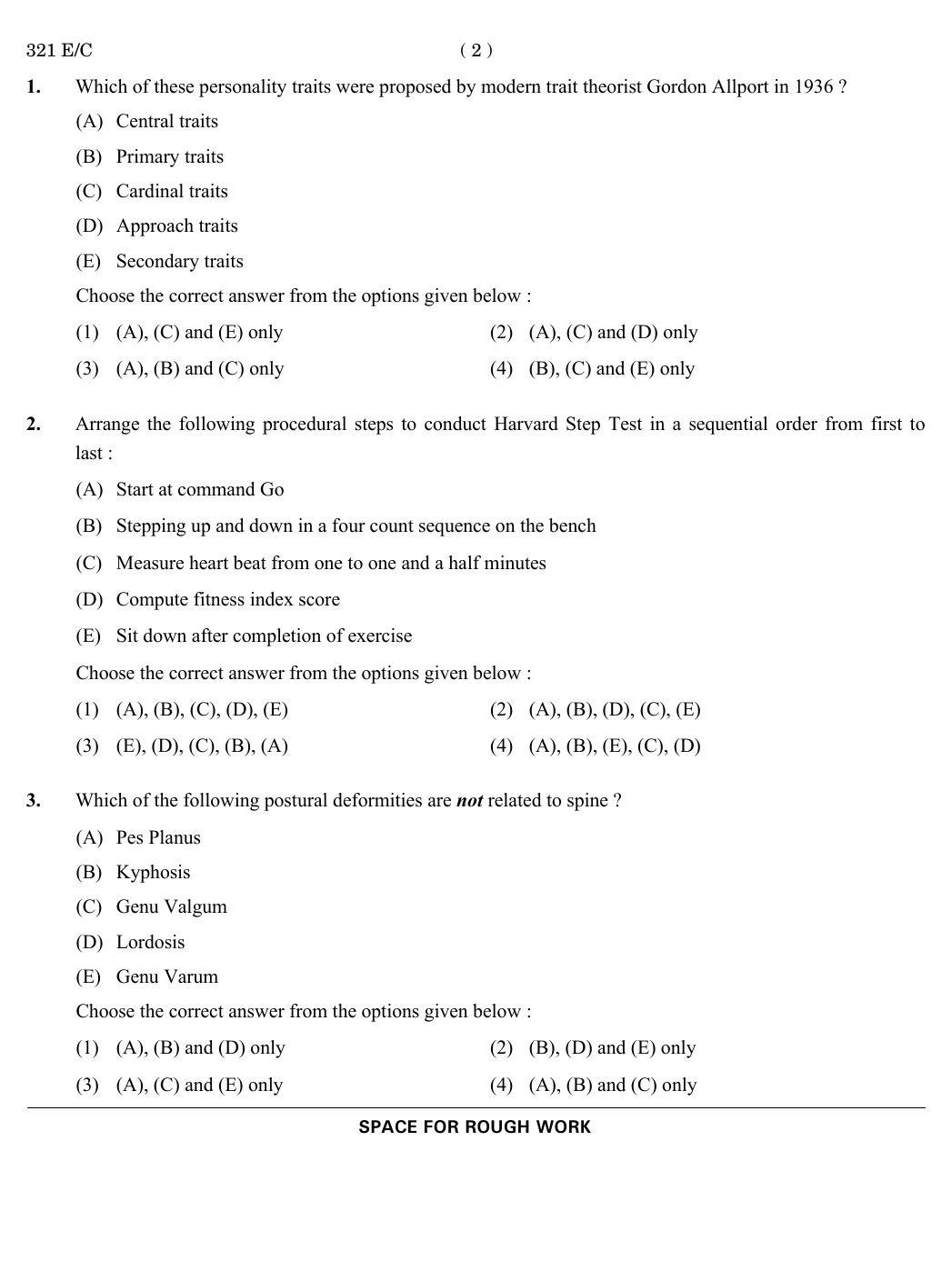
Which of these personality traits were proposed by modern trait theorist Gordon Allport in 1936?
(A) Central traits
(B) Primary traits
(C) Cardinal traits
(D) Approach traits
(E) Secondary traits
View Solution
Arrange the following procedural steps to conduct the Harvard Step Test in a sequential order from first to last:
(A) Start at command "Go"
(B) Stepping up and down in a four-count sequence on the bench
(C) Measure heart rate from one to one and a half minutes
(D) Compute fitness index score
(E) Sit down after completion of the exercise
View Solution
Which of the following postural deformities are not related to the spine?
(A) Pes Planus
(B) Kyphosis
(C) Genu Valgum
(D) Lordosis
(E) Genu Varum
View Solution
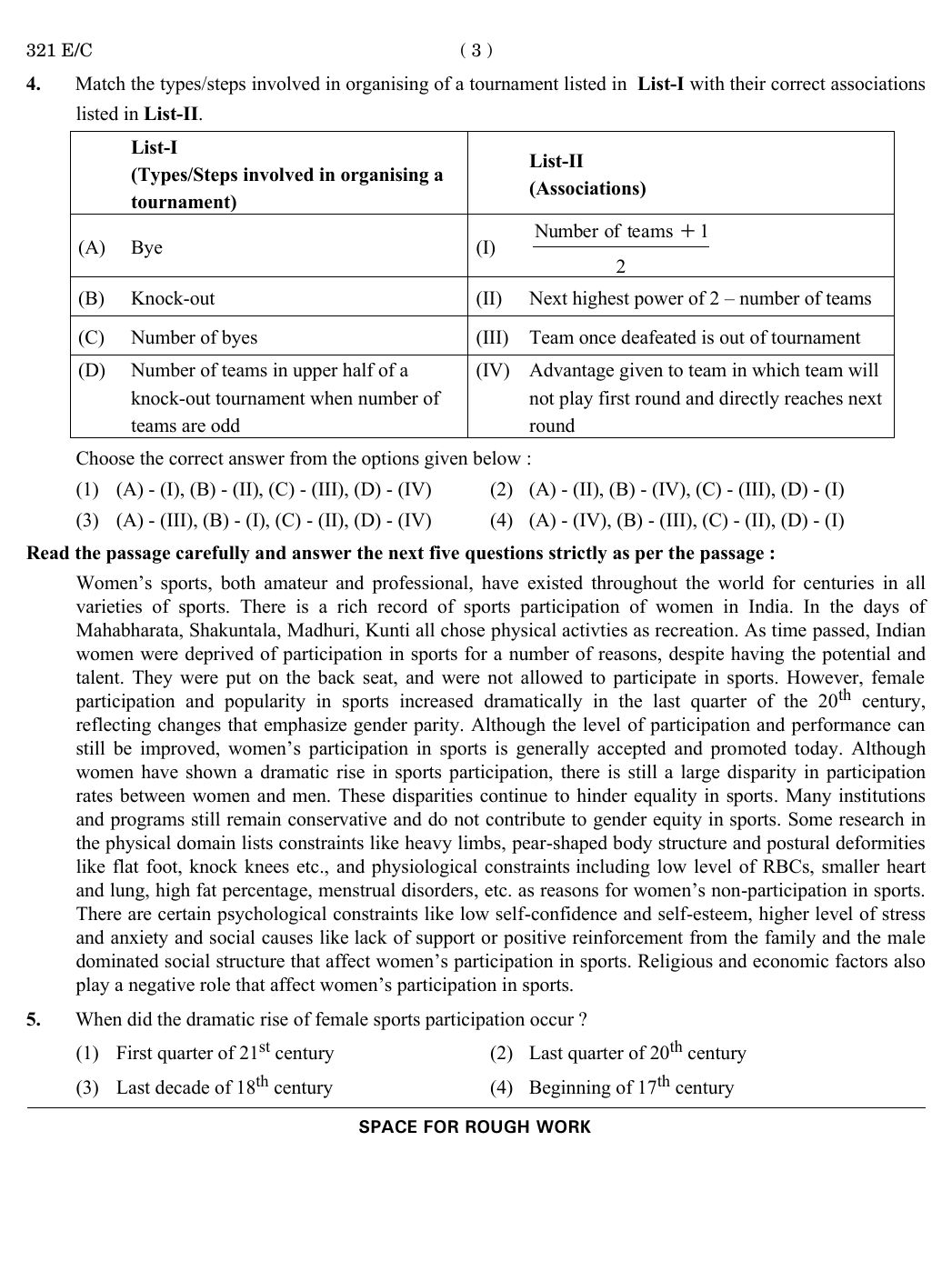
Match the types/steps involved in organizing a tournament listed in List-I with their correct associations listed in List-II:
List-I (Tournament Types)
(A) Bye
(B) Knock-out
(C) Number of byes
(D) Number of teams in upper half (odd teams)
List-II (Associations)
(I) Advantage given to team not playing the first round
(II) Team eliminated after first defeat
(III) Next highest power of 2 - number of teams
(IV) (Number of teams + 1)/2
View Solution
When did the dramatic rise of female sports participation occur?
(A) First quarter of 21st century
(B) Last quarter of 20th century
(C) Last decade of 18th century
(D) Beginning of 17th century
View Solution
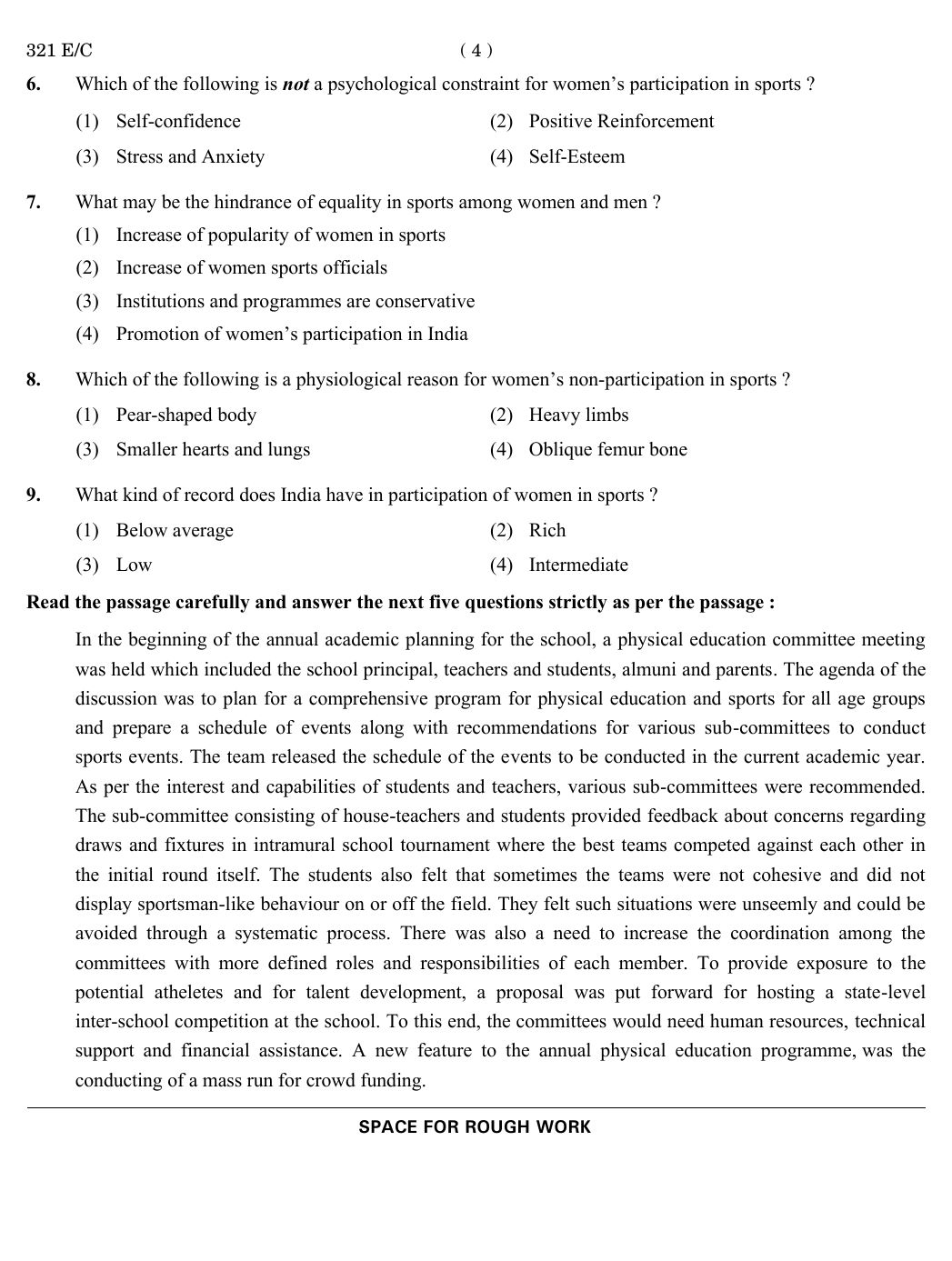
Which of the following is not a psychological constraint for women's participation in sports?
(A) Self-confidence
(B) Positive Reinforcement
(C) Stress and Anxiety
(D) Self-Esteem
View Solution
What may be the hindrance of equality in sports among women and men?
(A) Increase in the popularity of women in sports
(B) Increase of women sports officials
(C) Institutions and programs are conservative
(D) Promotion of women's participation in India
View Solution
Which of the following is a physiological reason for women's non-participation in sports?
(A) Pear-shaped body
(B) Heavy limbs
(C) Smaller hearts and lungs
(D) Oblique femur bone
View Solution
What kind of record does India have in participation of women in sports?
(A) Below average
(B) Rich
(C) Low
(D) Intermediate
View Solution
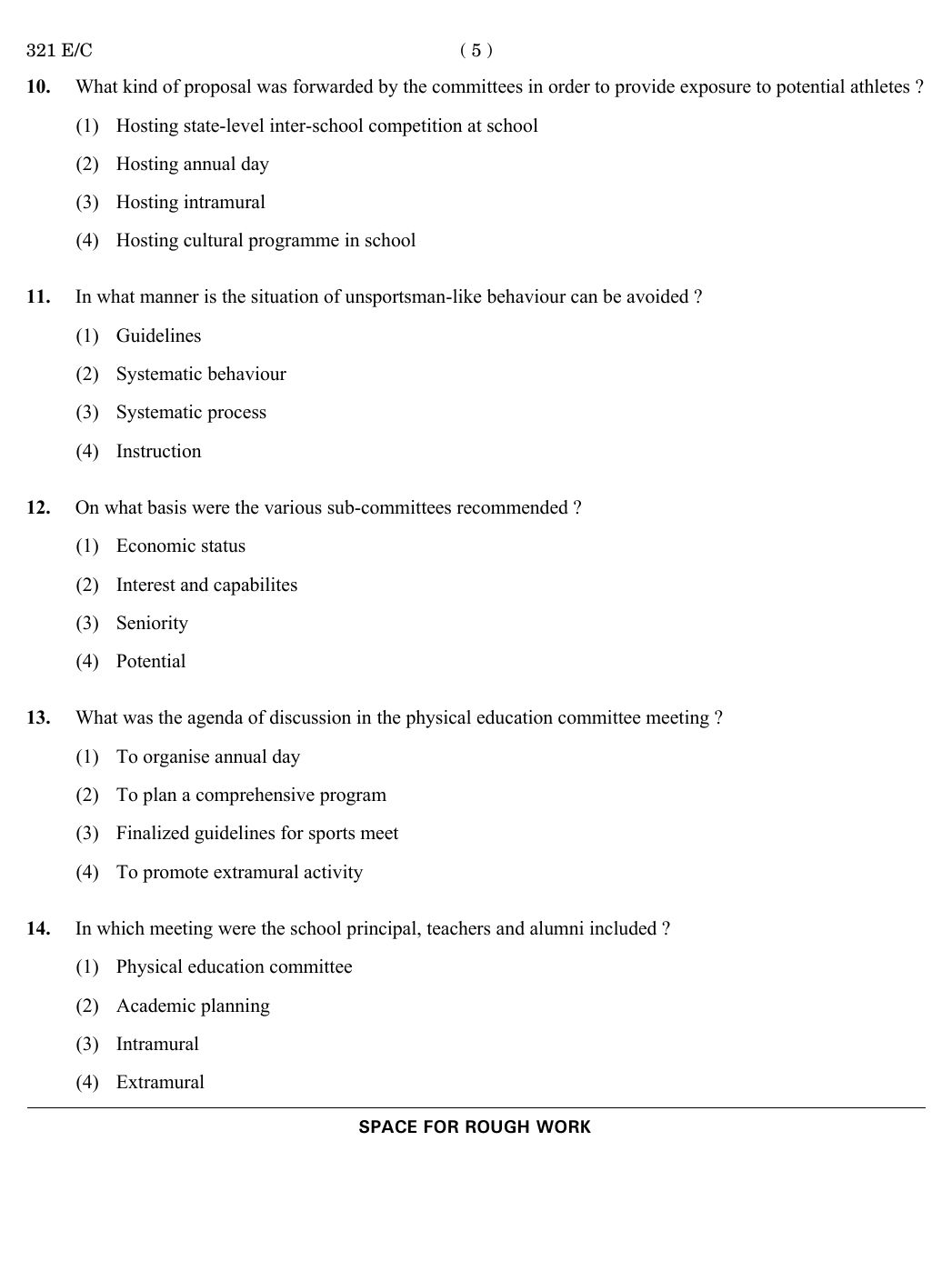
What kind of proposal was forwarded by the committees in order to provide exposure to potential athletes?
(A) Hosting state-level inter-school competition at school
(B) Hosting annual day
(C) Hosting intramural
(D) Hosting cultural program in school
View Solution
In what manner can the situation of unsportsman-like behavior be avoided?
(A) Guidelines
(B) Systematic behavior
(C) Systematic process
(D) Instruction
View Solution
On what basis were the various sub-committees recommended?
(A) Economic status
(B) Interest and capabilities
(C) Seniority
(D) Potential
View Solution
What was the agenda of discussion in the physical education committee meeting?
(A) To organize annual day
(B) To plan a comprehensive program
(C) Finalized guidelines for sports meet
(D) To promote extramural activity
View Solution
In which meeting were the school principal, teachers, and alumni included?
(A) Physical education committee
(B) Academic planning
(C) Intramural
(D) Extramural
View Solution
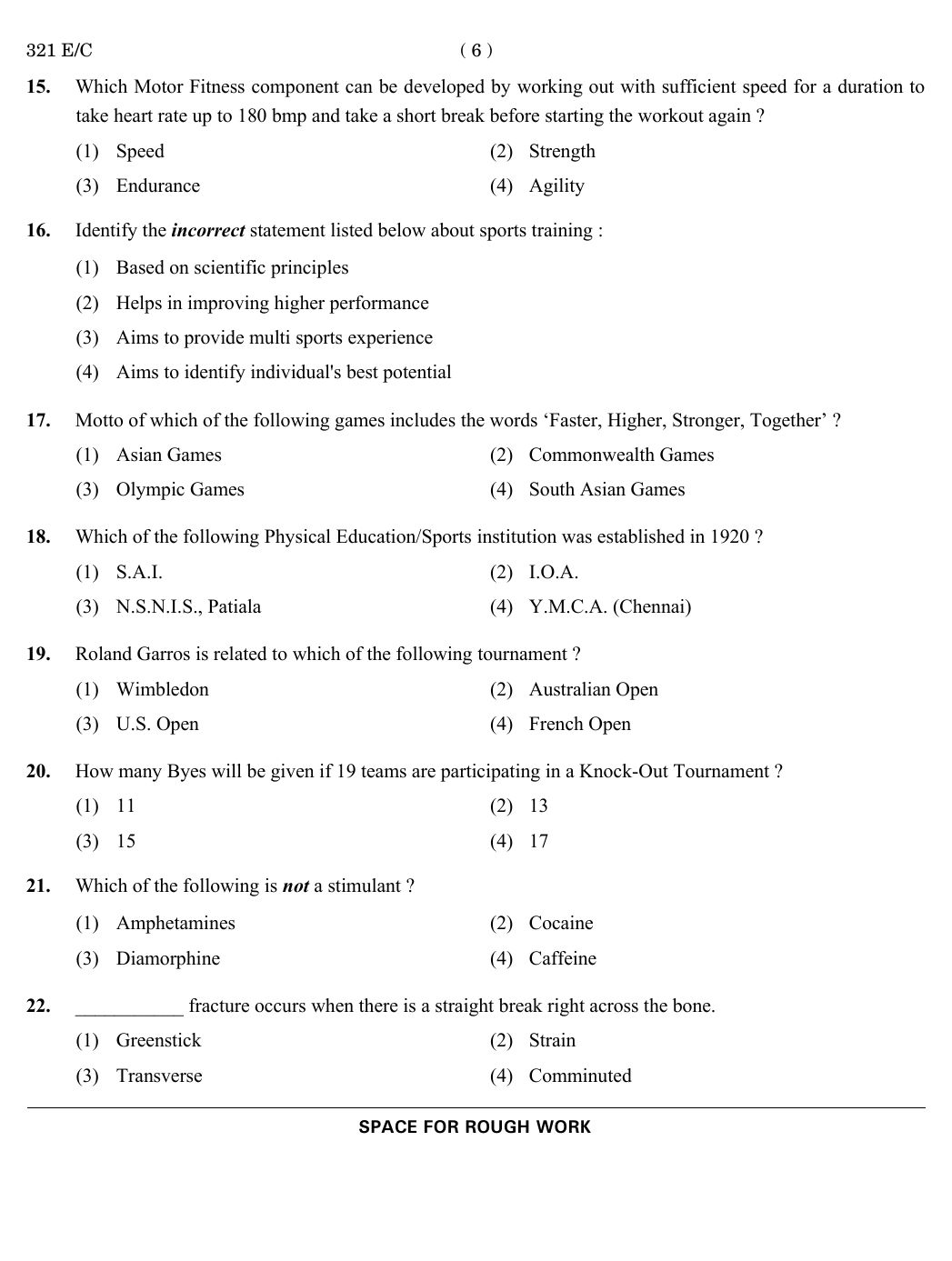
Which Motor Fitness component can be developed by working out with sufficient speed for a duration to take heart rate up to 180 bpm and taking a short break before starting the workout again?
(A) Speed
(B) Strength
(C) Endurance
(D) Agility
View Solution
Identify the incorrect statement listed below about sports training:
(A) Based on scientific principles
(B) Helps in improving higher performance
(C) Aims to provide multi-sports experience
(D) Aims to identify individual's best potential
View Solution
Motto of which of the following games includes the words ‘Faster, Higher, Stronger, Together'?
(A) Asian Games
(B) Commonwealth Games
(C) Olympic Games
(D) South Asian Games
View Solution
Which of the following Physical Education/Sports institutions was established in 1920?
(A) S.A.I.
(B) I.O.A.
(C) N.S.N.I.S., Patiala
(D) Y.M.C.A. (Chennai)
View Solution
Roland Garros is related to which of the following tournaments?
(A) Wimbledon
(B) Australian Open
(C) U.S. Open
(D) French Open
View Solution
How many Byes will be given if 19 teams are participating in a Knock-Out Tournament?
(A) 11
(B) 13
(C) 15
(D) 17
View Solution
Which of the following is not a stimulant?
(A) Amphetamines
(B) Cocaine
(C) Diamorphine
(D) Caffeine
View Solution
__________ fracture occurs when there is a straight break right across the bone.
(A) Greenstick
(B) Strain
(C) Transverse
(D) Comminuted
View Solution
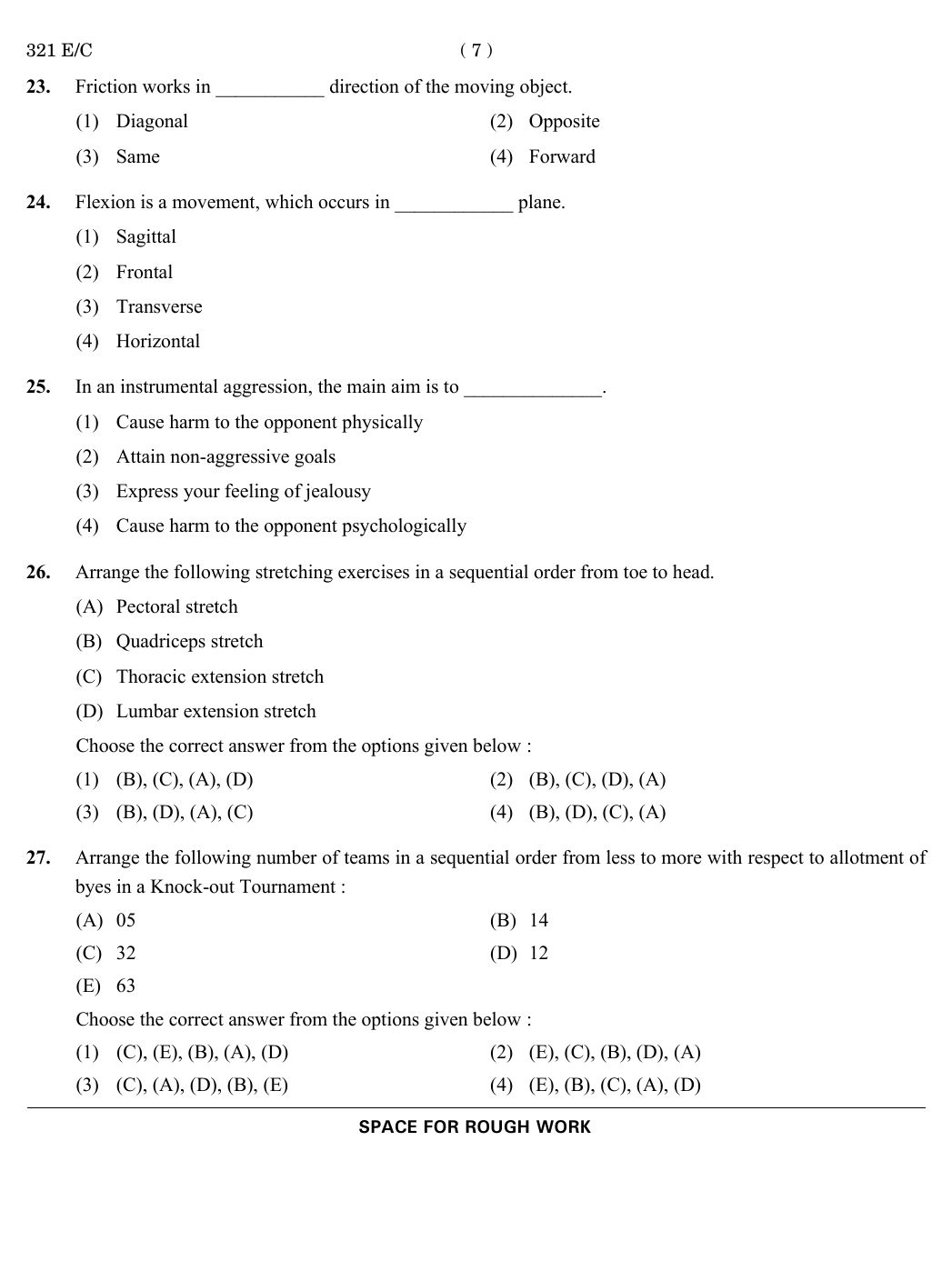
Friction works in______ of the moving object.
(A) Diagonal
(B) Opposite
(C) Same
(D) Forward
View Solution
Flexion is a movement, which occurs in __________ plane.
(A) Sagittal
(B) Frontal
(C) Transverse
(D) Horizontal
View Solution
In an instrumental aggression, the main aim is to ___________.
(A) Cause harm to the opponent physically
(B) Attain non-aggressive goals
(C) Express your feeling of jealousy
(D) Cause harm to the opponent psychologically
View Solution
Arrange the following stretching exercises in a sequential order from toe to head.
(A) Pectoral stretch
(B) Quadriceps stretch
(C) Thoracic extension stretch
(D) Lumbar extension stretch
View Solution
Arrange the following number of teams in a sequential order from less to more with respect to the allotment of byes in a Knock-out Tournament:
(A) 05
(B) 14
(C) 32
(D) 12
(E) 63
View Solution
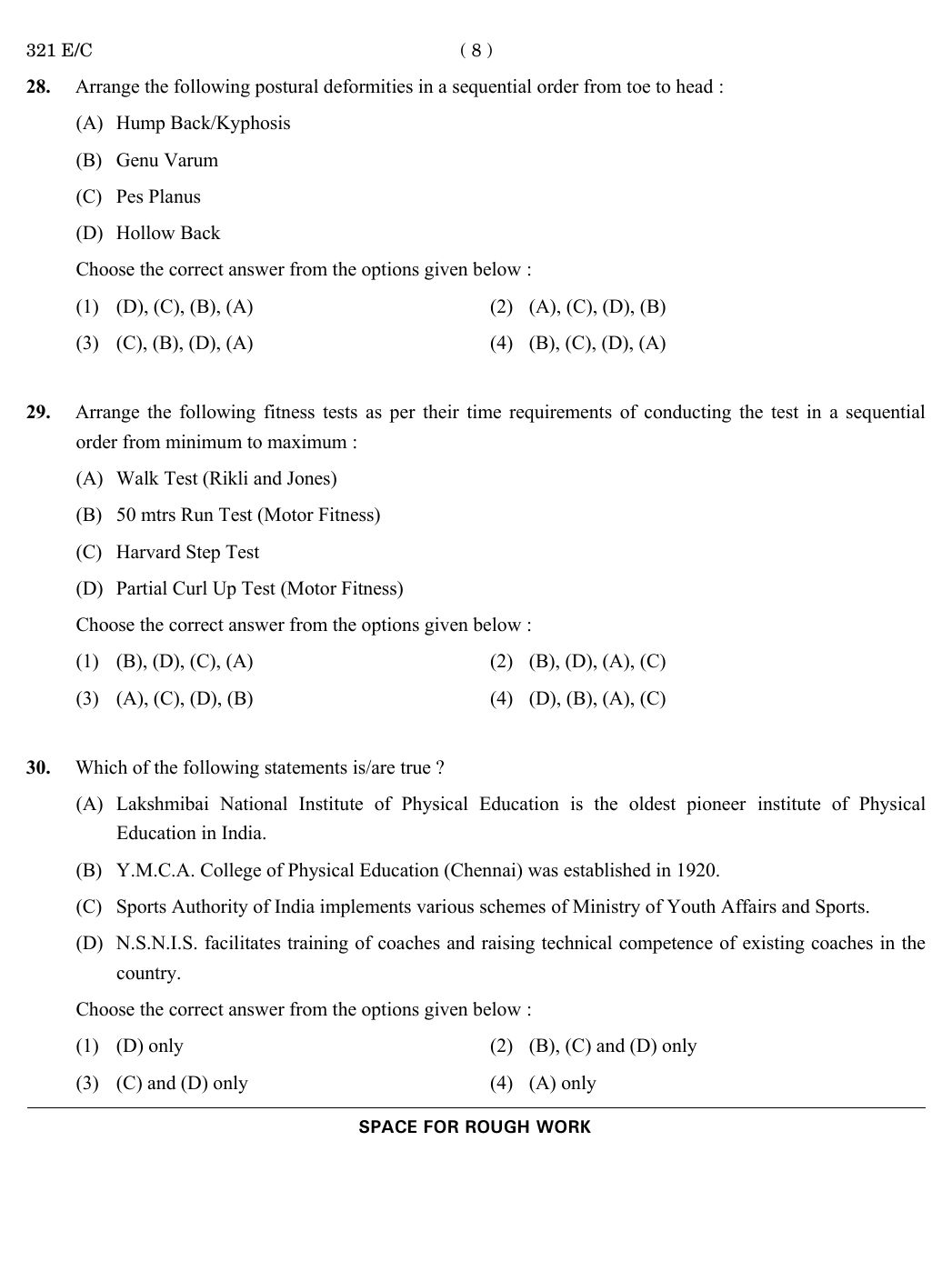
Arrange the following postural deformities in a sequential order from toe to head:
(A) Hump Back/Kyphosis
(B) Genu Varum
(C) Pes Planus
(D) Hollow Back
Choose the correct answer from the options given below :
View Solution
Arrange the following fitness tests as per their time requirements in a sequential order from minimum to maximum:
(A) Walk Test (Rikli and Jones)
(B) 50 mtrs Run Test (Motor Fitness)
(C) Harvard Step Test
(D) Partial Curl Up Test (Motor Fitness)
View Solution
Which of the following statements is/are true?
(A) Lakshmibai National Institute of Physical Education is the oldest pioneer institute of Physical Education in India.
(B) Y.M.C.A. College of Physical Education (Chennai) was established in 1920.
(C) Sports Authority of India implements various schemes of Ministry of Youth Affairs and Sports.
(D) N.S.N.I.S. facilitates training of coaches and raising technical competence of existing coaches in the country.
View Solution
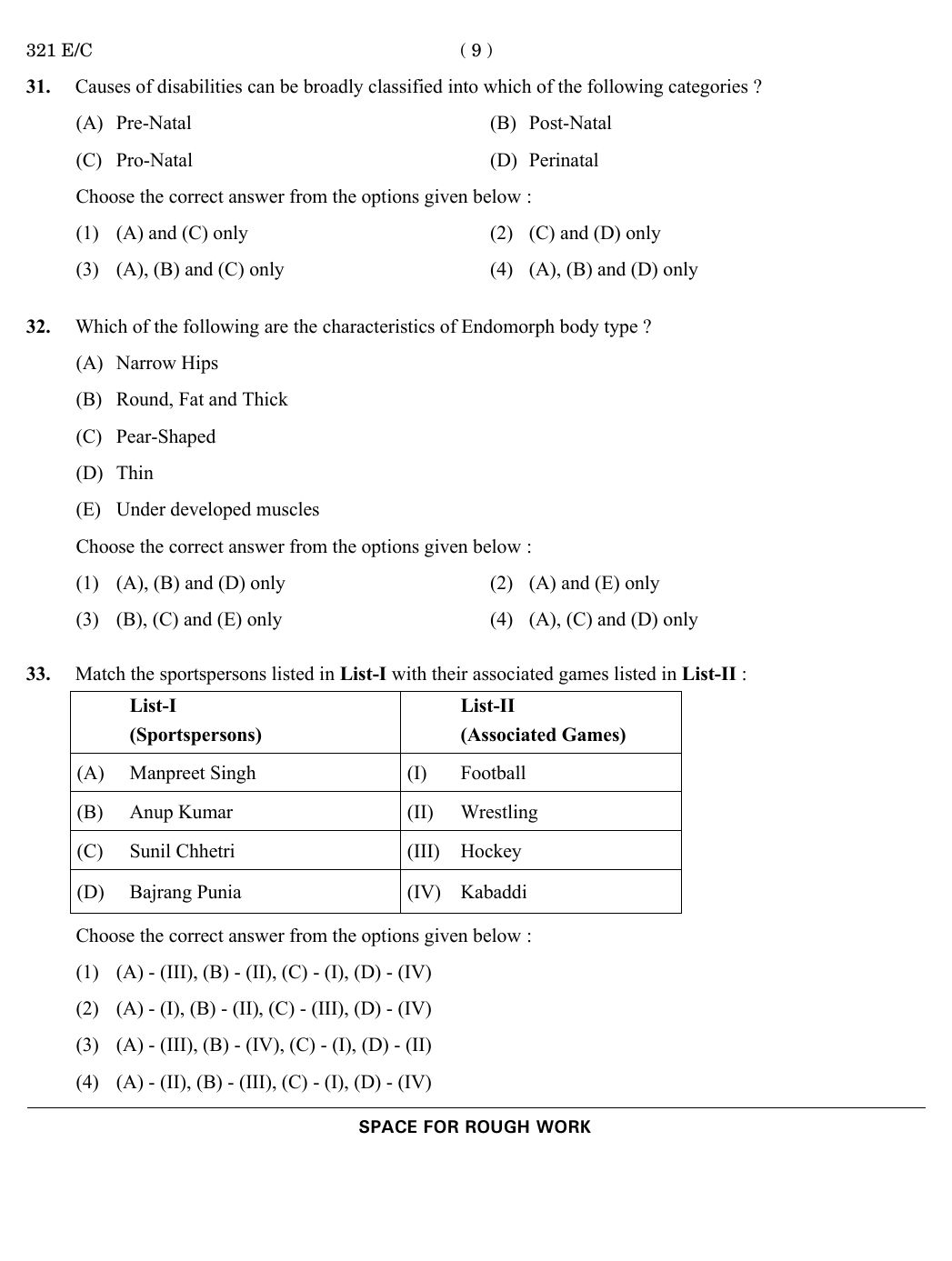
Causes of disabilities can be broadly classified into which of the following categories?
(A) Pre-Natal
(B) Post-Natal
(C) Pro-Natal
(D) Perinatal
View Solution
Which of the following are the characteristics of Endomorph body type?
(A) Narrow Hips
(B) Round, Fat and Thick
(C) Pear-Shaped
(D) Thin
(E) Under-developed muscles
View Solution
Match the sportspersons listed in List-I with their associated games listed in List-II:
List-I (Sportspersons)
(A) Manpreet Singh
(B) Anup Kumar
(C) Sunil Chhetri
(D) Bajrang Punia
List-II (Associated Games)
(I) Football
(II) Wrestling
(III) Hockey
(IV) Kabaddi
View Solution
Match the postural deformities listed in List-I with their corrective measures listed in List-II:
List-I (Postural Deformities)
(A) Knock Knees
(B) Round Shoulders
(C) Kyphosis
(D) Bow Legs
List-II (Corrective Measures)
(I) Walking on inner edge of feet
(III) Wall stretch, Pull Ups
(IV) Swimming, Gym ball exercises
(II) Horse Riding
View Solution
Match the traits listed in List-I with their explanation listed in List-II:
List-I (Traits)
(A) Cardinal Traits
(B) Central Traits
(C) Assessment of Traits
(D) Secondary Traits
List-II (Explanation)
(I) Dominant behavior
(II) Building blocks that shape most of our behavior
(III) Based on 3 factors
(IV) Reflect only in certain circumstances
View Solution
Which training method is another variation of variable pace method?
(A) Fartlek method
(B) Interval method
(C) Repetition method
(D) Continuous method
View Solution
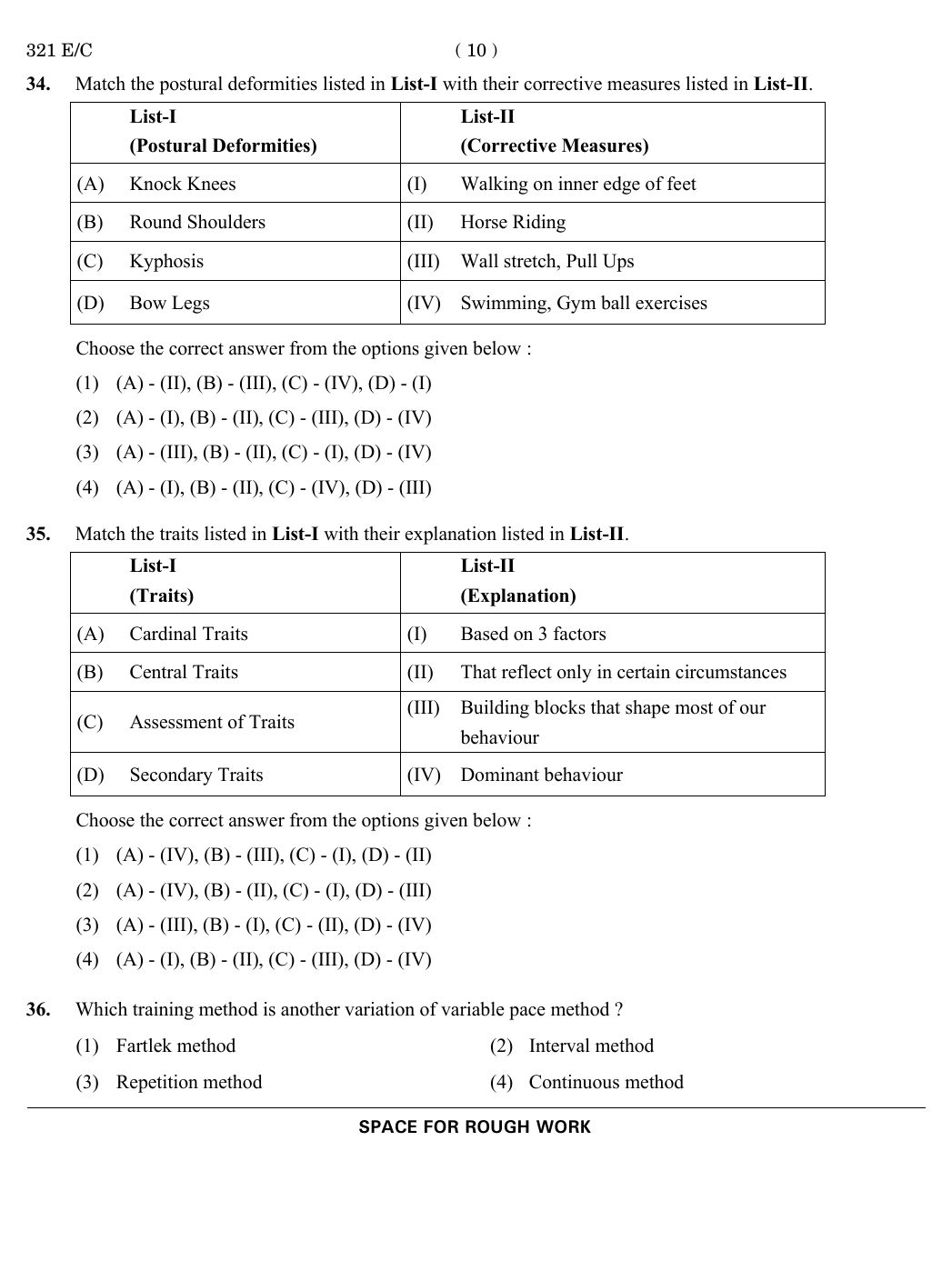
Identify the movement of the exercise shown in the picture given below:
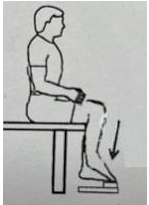
(A) Isometric ankle plantar flexion
(B) Isometric ankle flexion
(C) Isotonic ankle flexion
(D) Isotonic ankle plantar flexion
View Solution
Maintenance of plank position is an example of which type of strength development exercise?
(A) Isometric
(B) Isotonic
(C) Isokinetic
(D) Isonomic
View Solution
Venue of Olympic Games is decided by which of the following body?
(A) International Olympic Academy
(B) International Sports Association
(C) International Olympic Committee
(D) International Olympic Association
View Solution
Which is the governing body responsible for Deaflympics?
(A) World Deaf Committee (WDC)
(B) International Paralympic Committee (IPC)
(C) International Committee of Sports for the Deaf (ICSD)
(D) Special Olympic Committee (SOC)
View Solution
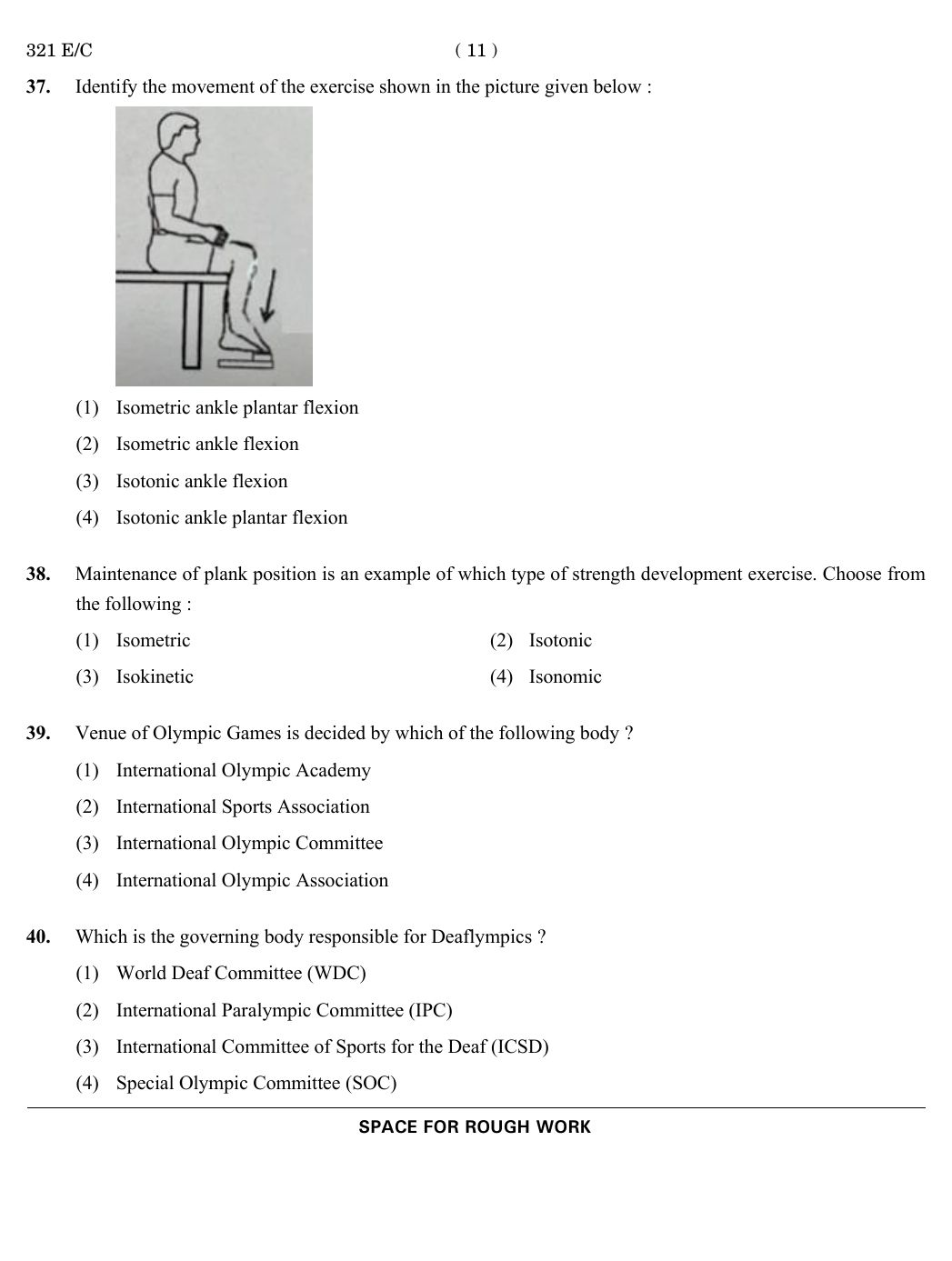
Identify the correct type of postural disorder from the picture given below:
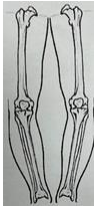
(A) Knock Knee
(B) Bow Leg
(C) Scoliosis
(D) Lordosis
View Solution
Which of the following is not a cause of sports injury during training?
(A) Sudden increase of load
(B) Lack of proper sports facilities
(C) Poor exercise technique
(D) Proper Warm-Up
View Solution
Which of the following is not a soft tissue injury?
(A) Contusion
(B) Sprain
(C) Dislocation
(D) Strain
View Solution
Which one of the following is not a symptom of a dislocated shoulder joint?
(A) Pain
(B) Swelling
(C) Instability of joint
(D) Visible bleeding
View Solution
A tear-like wound caused by either the skin hitting an adjacent object or an object hitting the skin with force will be called:
(A) Abrasion
(B) Contusion
(C) Incision
(D) Laceration
View Solution
What is the weight of the medicine ball for boys in the Barrow Motor Ability Test?
(A) 2 kg
(B) 3 kg
(C) 6 kg
(D) 1 kg
View Solution
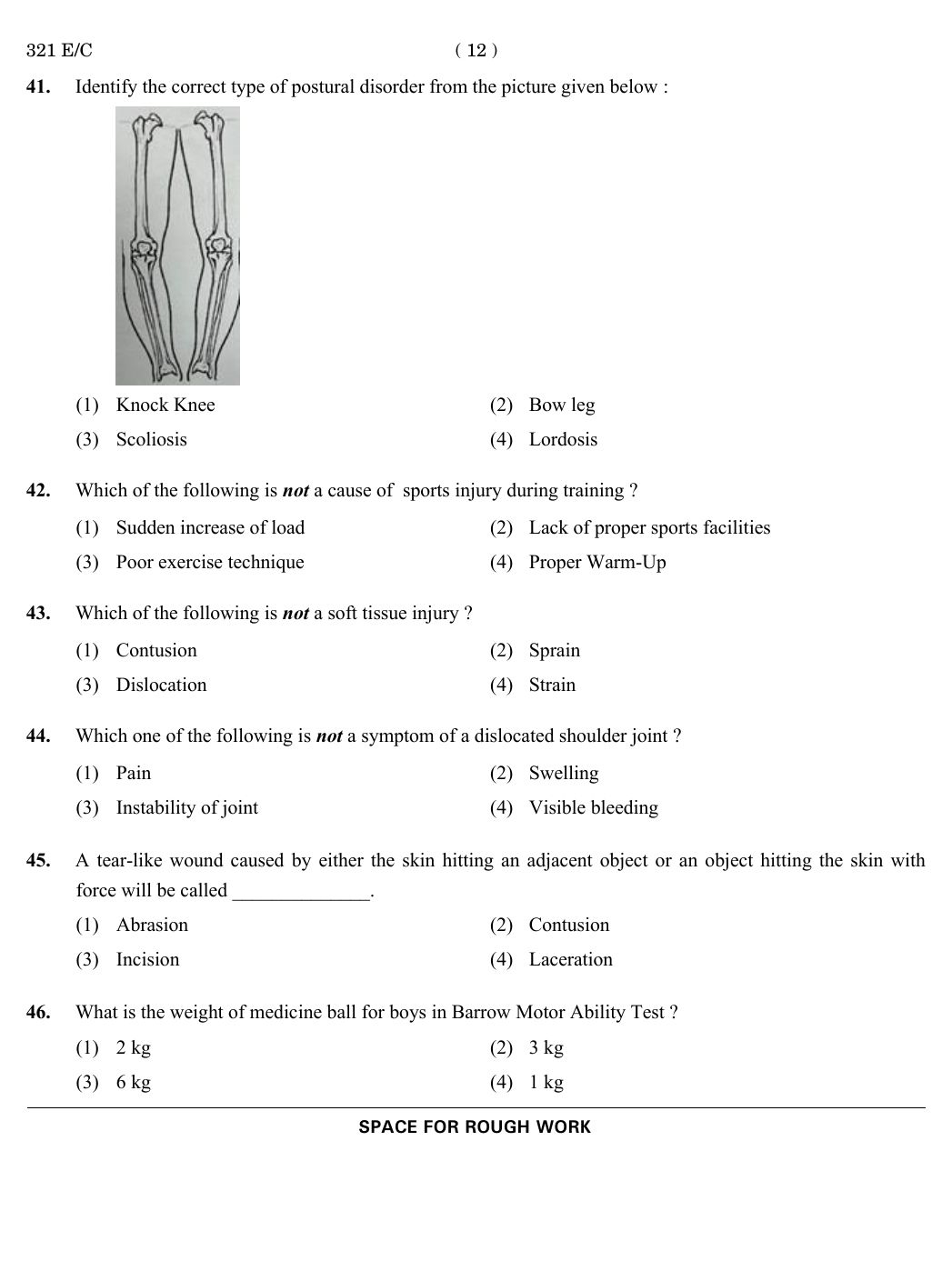
Identify the test item of the Senior Citizen's Fitness Test shown in the picture below:
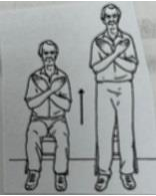
(A) Chair sit and reach test
(B) Back Scratch test
(C) Arm curl test
(D) 30-second Chair stand test
View Solution
Which of the following will be called as the study of motion of the body with respect to the time, displacement, velocity, and speed of movement either in a straight line or in a rotary direction?
(A) Statics
(B) Dynamics
(C) Kinematics
(D) Kinetics
View Solution
Which of the following options is not the importance of Sports Biomechanics?
(A) Performance enhancement
(B) Technique improvement
(C) Equipment improvement
(D) Tactical enhancement
View Solution
What will be the correct sequence of the management of abrasion?
(A) Visit a doctor
(B) Use sterilized gauze to wipe the dirt and clean the affected area
(C) Application of ointment
(D) Cover the injured part
View Solution



Comments