




CUET 2026 Home Science Question Paper is available for download here. NTA conducted the CUET 2026 exam from 11th May to 31st May in two shifts.
The CUET 2026 Home Science question paper includes the following:
- 50 questions, to be attempted in 60 minutes
- Question type: multiple choice questions (MCQs) with four options
- Marking: +5 for a correct answer, -1 for an incorrect answer, 0 for an unattempted question
- Maximum marks: 250
CUET 2026 Home Science May 21 Shift 2 Question Paper with Solution PDF
| NTA Official PDF | CD PDF | CD PDF with Solutions |
|---|---|---|
| Download official PDF 7.12 MB | Download Collegedunia PDF 0.32 MB | Download solutions PDF 0.28 MB |
Also Check:
- CUET 2027 Latest Updates
- Download CUET UG Previous Year Papers for free
- CUET 2026 May 21 Shift 2 Home Science Question Paper with Solutions

CUET 2026 Home Science May 21 Shift 2 Questions with Solutions
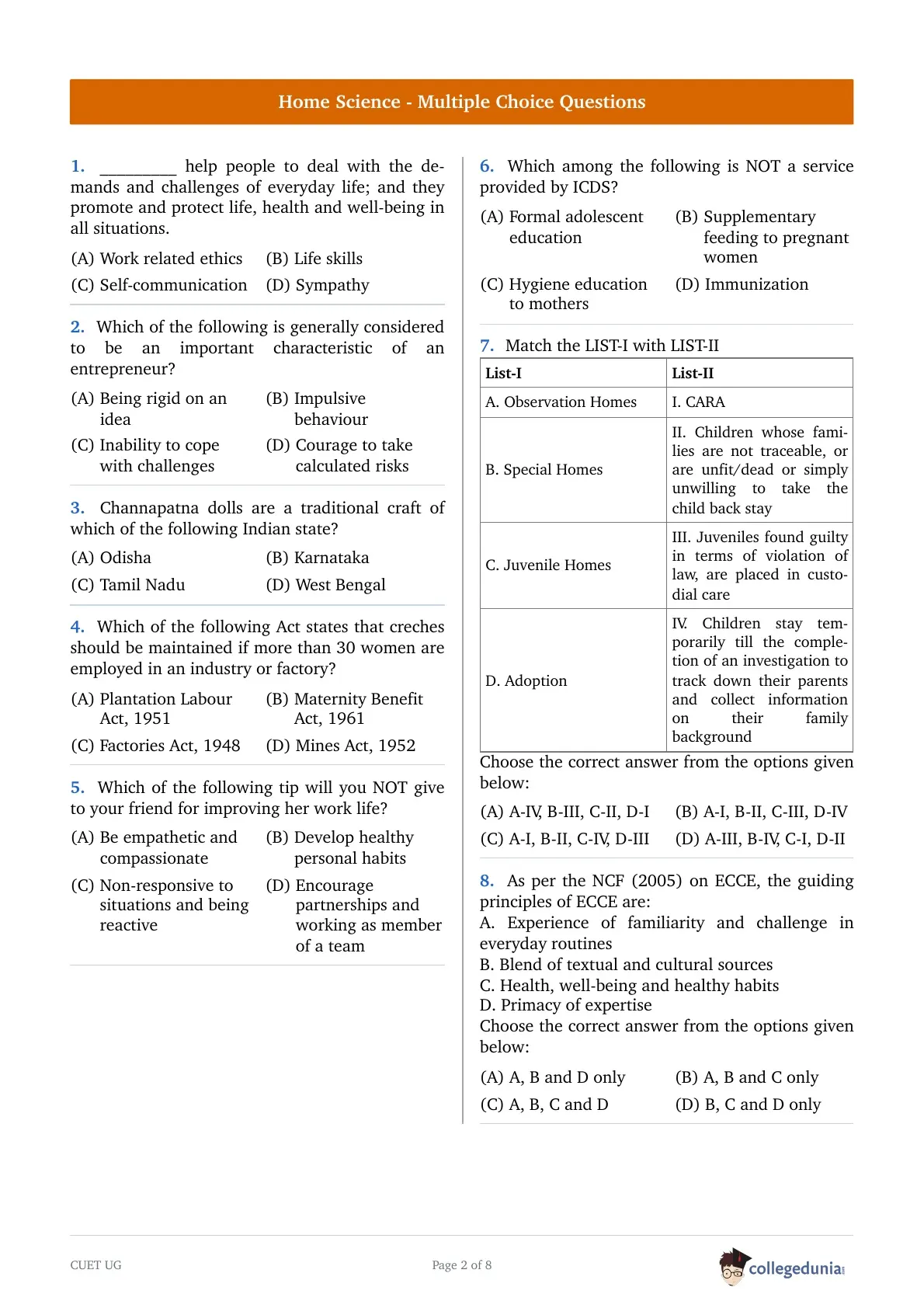
_____________ help people to deal with the demands and challenges of everyday life; and they promote and protect life, health and well-being in all situations.
Which of the following is generally considered to be an important characteristic of an entrepreneur?
Channapatna dolls are a traditional craft of which of the following Indian state?
Which of the following Act states that creches should be maintained if more than 30 women are employed in an industry or factory?
Which of the following tip will you NOT give to your friend for improving her work life?
Which among the following is NOT a service provided by ICDS?
Match the LIST-I with LIST-II
| List I | List II | ||
|---|---|---|---|
| A. | Observation Homes | I. | CARA |
| B. | Special Homes | II. | Children whose families are not traceable, or are unfit/dead or simply unwilling to take the child back stay |
| C. | Juvenile Homes | III. | Juveniles found guilty in terms of violation of law, are placed in custodial care |
| D. | Adoption | IV. | Children stay temporarily till the completion of an investigation to track down their parents and collect information on their family background |
As per the NCF (2005) on ECCE, the guiding principles of ECCE are:
A. Experience of familiarity and challenge in everyday routines
B. Blend of textual and cultural sources
C. Health, well-being and healthy habits
D. Primacy of expertise
Choose the correct answer from the options given below:
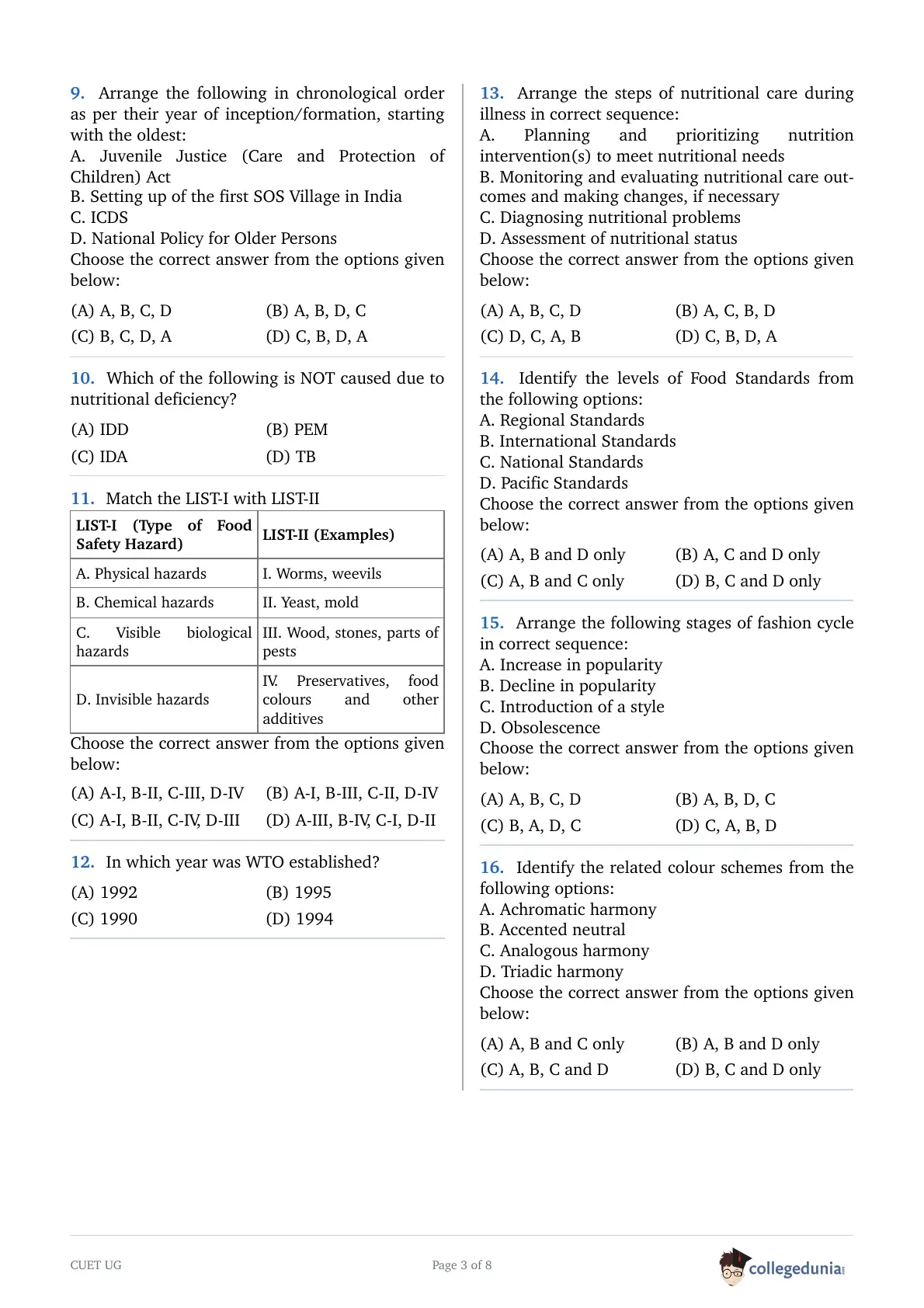
Arrange the following in chronological order as per their year of inception/formation, starting with the oldest:
A. Juvenile Justice (Care and Protection of Children) Act
B. Setting up of the first SOS Village in India
C. ICDS
D. National Policy for Older Persons
Choose the correct answer from the options given below:
Which of the following is NOT caused due to nutritional deficiency?
Match the LIST-I with LIST-II
| LIST-I (Type of Food Safety Hazard) | LIST-II (Examples) |
|---|---|
| A. Physical hazards | I. Worms, weevils |
| B. Chemical hazards | II. Yeast, mold |
| C. Visible biological hazards | III. Wood, stones, parts of pests |
| D. Invisible hazards | IV. Preservatives, food colours and other additives |
In which year was WTO established?
Arrange the steps of nutritional care during illness in correct sequence:
A. Planning and prioritizing nutrition intervention(s) to meet nutritional needs
B. Monitoring and evaluating nutritional care outcomes and making changes, if necessary
C. Diagnosing nutritional problems
D. Assessment of nutritional status
Choose the correct answer from the options given below:
Identify the levels of Food Standards from the following options:
A. Regional Standards
B. International Standards
C. National Standards
D. Pacific Standards
Choose the correct answer from the options given below:
Arrange the following stages of fashion cycle in correct sequence:
A. Increase in popularity
B. Decline in popularity
C. Introduction of a style
D. Obsolescence
Choose the correct answer from the options given below:
Identify the related colour schemes from the following options:
A. Achromatic harmony
B. Accented neutral
C. Analogous harmony
D. Triadic harmony
Choose the correct answer from the options given below:
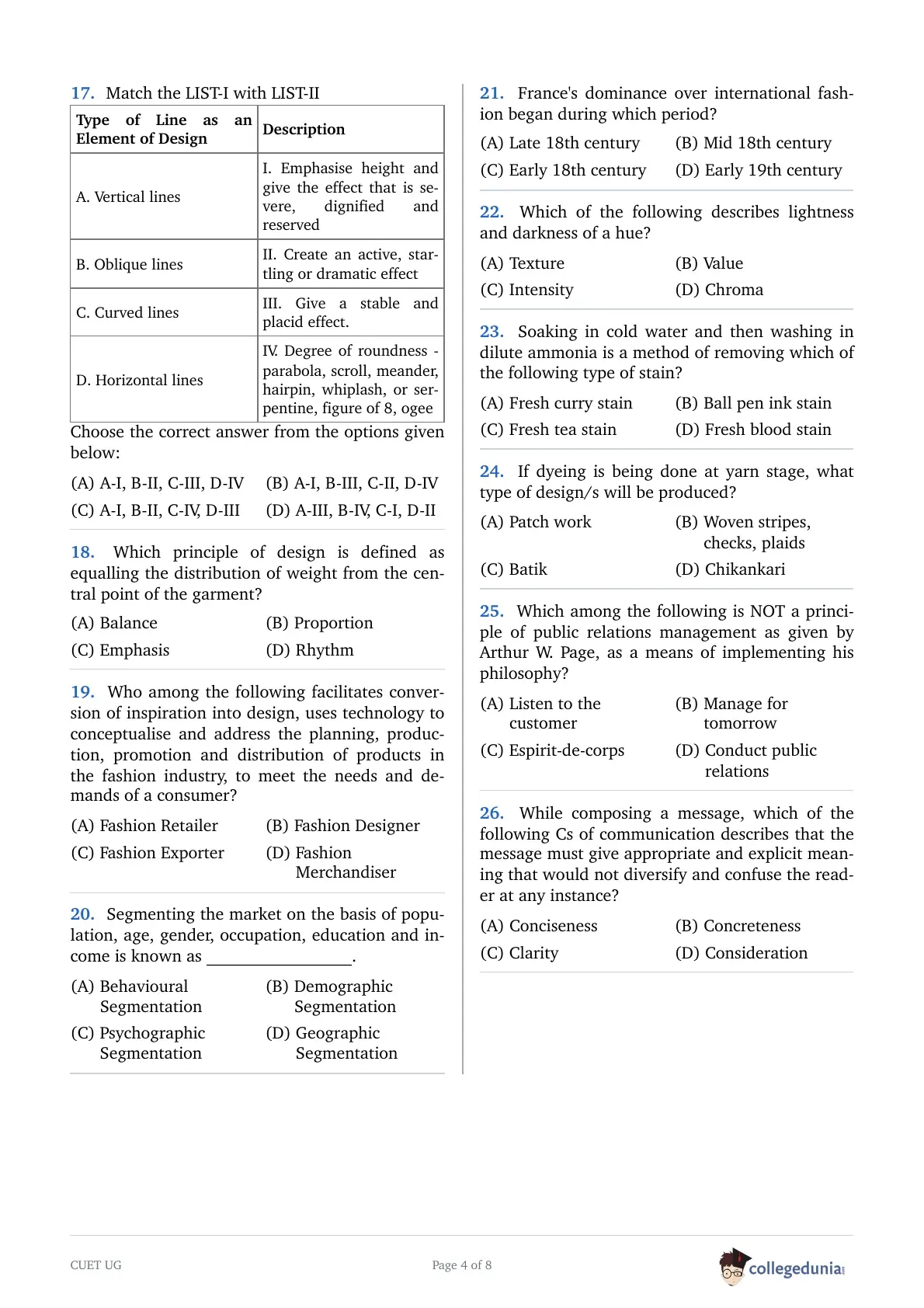
Match the LIST-I with LIST-II
| LIST-I Type of Line as an Element of Design | LIST-II Description | ||
|---|---|---|---|
| A. | Vertical lines | I. | Emphasise height and give the effect that is severe, dignified and reserved |
| B. | Oblique lines | II. | Create an active, startling or dramatic effect |
| C. | Curved lines | III. | Give a stable and placid effect. |
| D. | Horizontal lines | IV. | Degree of roundness - parabola, scroll, meander, hairpin, whiplash, or serpentine, figure of 8, ogee |
Choose the correct answer from the options given below:
Which principle of design is defined as equalling the distribution of weight from the central point of the garment?
Who among the following facilitates conversion of inspiration into design, uses technology to conceptualise and address the planning, production, promotion and distribution of products in the fashion industry, to meet the needs and demands of a consumer?
Segmenting the market on the basis of population, age, gender, occupation, education and income is known as .
France's dominance over international fashion began during which period?
Which of the following describes lightness and darkness of a hue?
Soaking in cold water and then washing in dilute ammonia is a method of removing which of the following type of stain?
If dyeing is being done at yarn stage, what type of design/s will be produced?
Which among the following is NOT a principle of public relations management as given by Arthur W. Page, as a means of implementing his philosophy?
While composing a message, which of the following Cs of communication describes that the message must give appropriate and explicit meaning that would not diversify and confuse the reader at any instance?
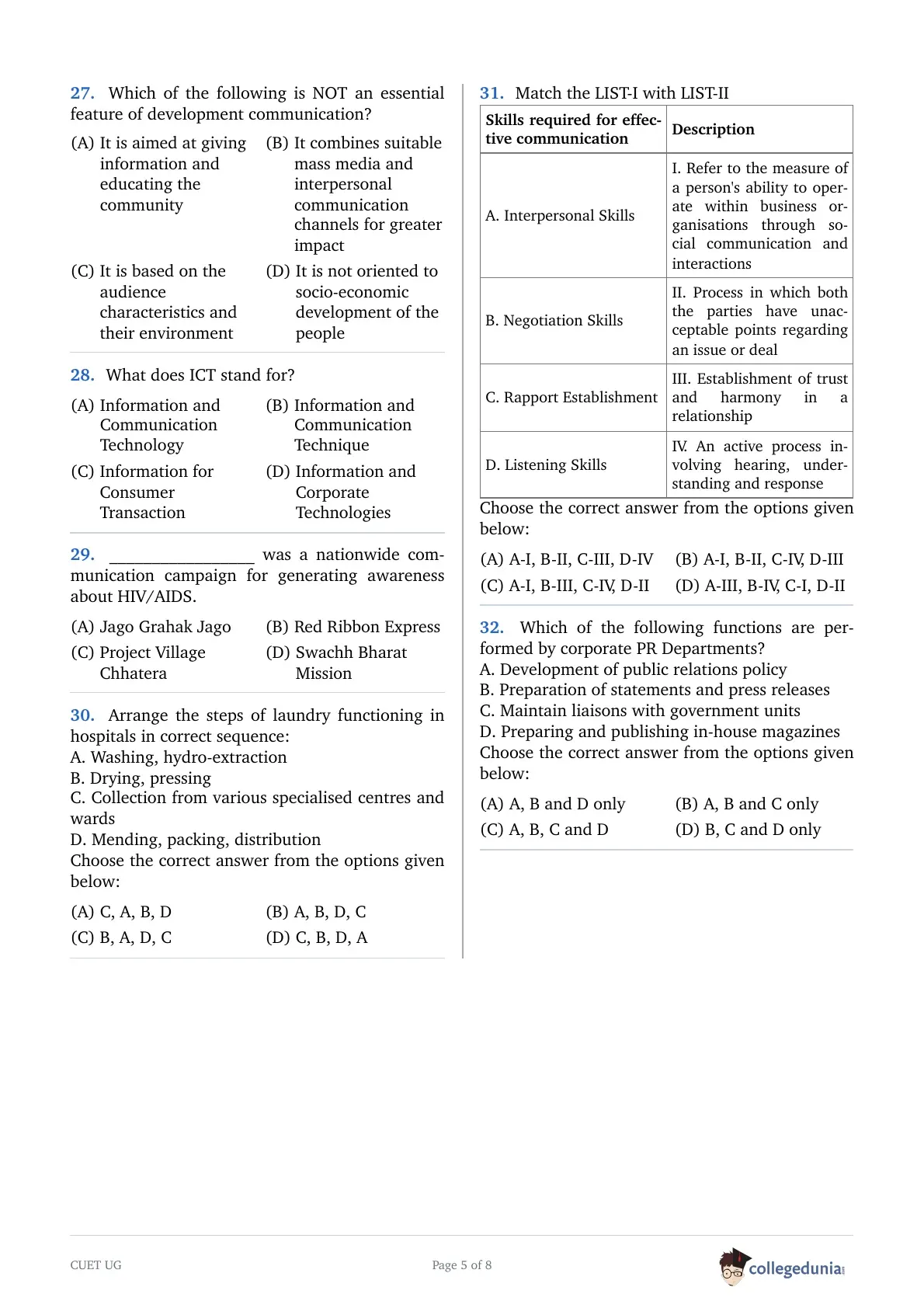
Which of the following is NOT an essential feature of development communication?
What does ICT stands for?
__________ was a nationwide communication campaign for generating awareness about HIV/AIDS.
Arrange the steps of laundry functioning in hospitals in correct sequence:
A. Washing, hydro-extraction
B. Drying, pressing
C. Collection from various specialised centres and wards
D. Mending, packing, distribution
Choose the correct answer from the options given below:
Match the LIST-I with LIST-II
| LIST-I: Skills required for effective communication | LIST-II: Description | ||
|---|---|---|---|
| A. | Interpersonal Skills | I. | Refer to the measure of a person's ability to operate within business organisations through social communication and interactions |
| B. | Negotiation Skills | II. | Process in which both the parties have unacceptable points regarding an issue or deal |
| C. | Rapport Establishment | III. | Establishment of trust and harmony in a relationship |
| D. | Listening Skills | IV. | An active process involving hearing, understanding and response |
Which of the following functions are performed by corporate PR Departments?
A. Development of public relations policy
B. Preparation of statements and press releases
C. Maintain liaisons with government units
D. Preparing and publishing in-house magazines
Choose the correct answer from the options given below:
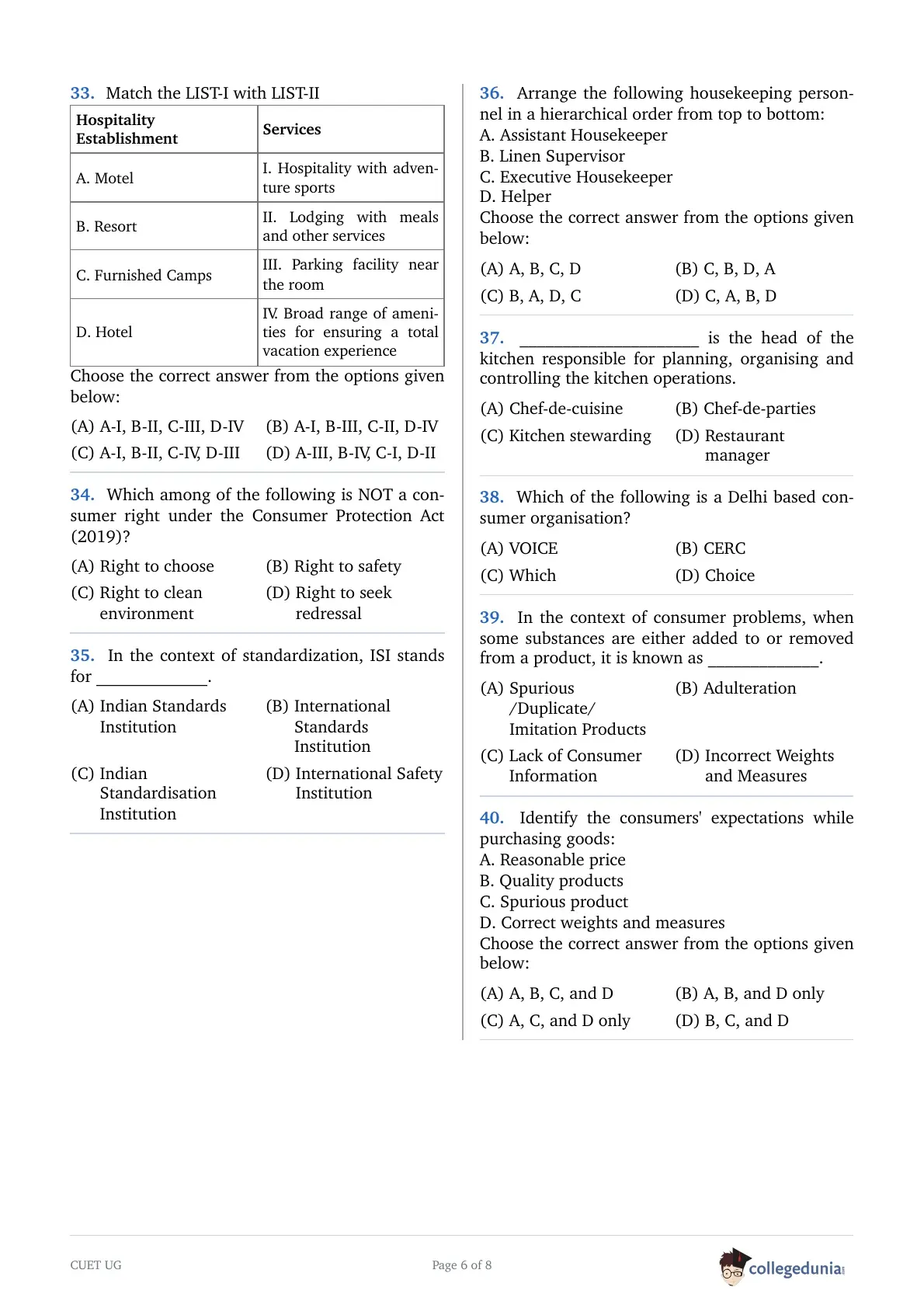
Match the LIST-I with LIST-II
| List-I Hospitality Establishment | List-II Services | ||
|---|---|---|---|
| A. | Motel | I. | Hospitality with adventure sports |
| B. | Resort | II. | Lodging with meals and other services |
| C. | Furnished Camps | III. | Parking facility near the room |
| D. | Hotel | IV. | Broad range of amenities for ensuring a total vacation experience |
Which among of the following is NOT a consumer right under the Consumer Protection Act (2019)?
In the context of standardization, ISI stands for .
Arrange the following housekeeping personnel in a hierarchical order from top to bottom:
A. Assistant Housekeeper
B. Linen Supervisor
C. Executive Housekeeper
D. Helper
Choose the correct answer from the options given below:
is the head of the kitchen responsible for planning, organising and controlling the kitchen operations.
Which of the following is a Delhi based consumer organisation?
In the context of consumer problems, when some substances are either added to or removed from a product, it is known as .
Identify the consumers' expectations while purchasing goods:
A. Reasonable price
B. Quality products
C. Spurious product
D. Correct weights and measures
Choose the correct answer from the options given below:

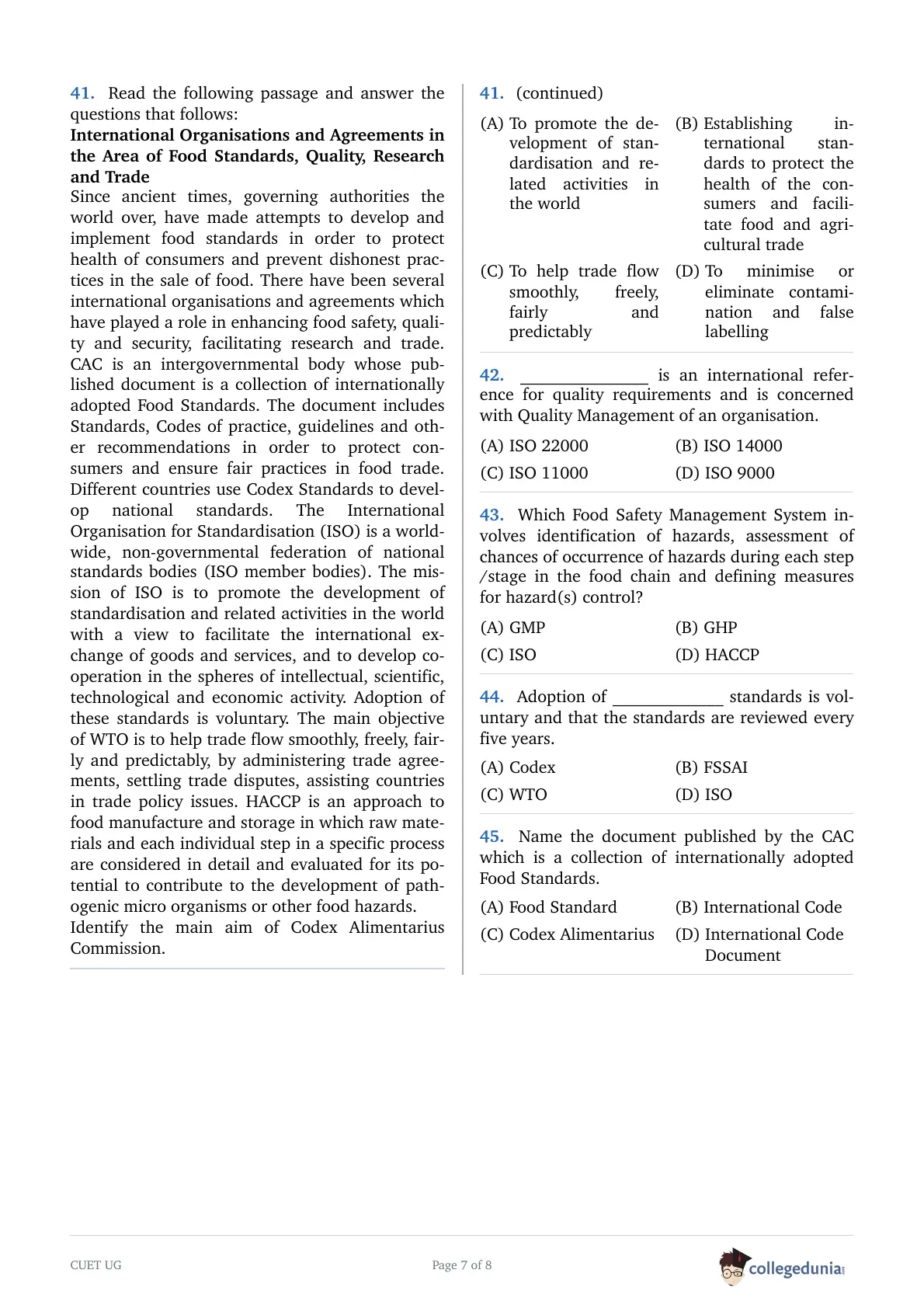
is an international reference for quality requirements and is concerned with Quality Management of an organisation.
Which Food Safety Management System involves identification of hazards, assessment of chances of occurrence of hazards during each step /stage in the food chain and defining measures for hazard(s) control?
Adoption of standards is voluntary and that the standards are reviewed every five years.
Name the document published by the CAC which is a collection of internationally adopted Food Standards.

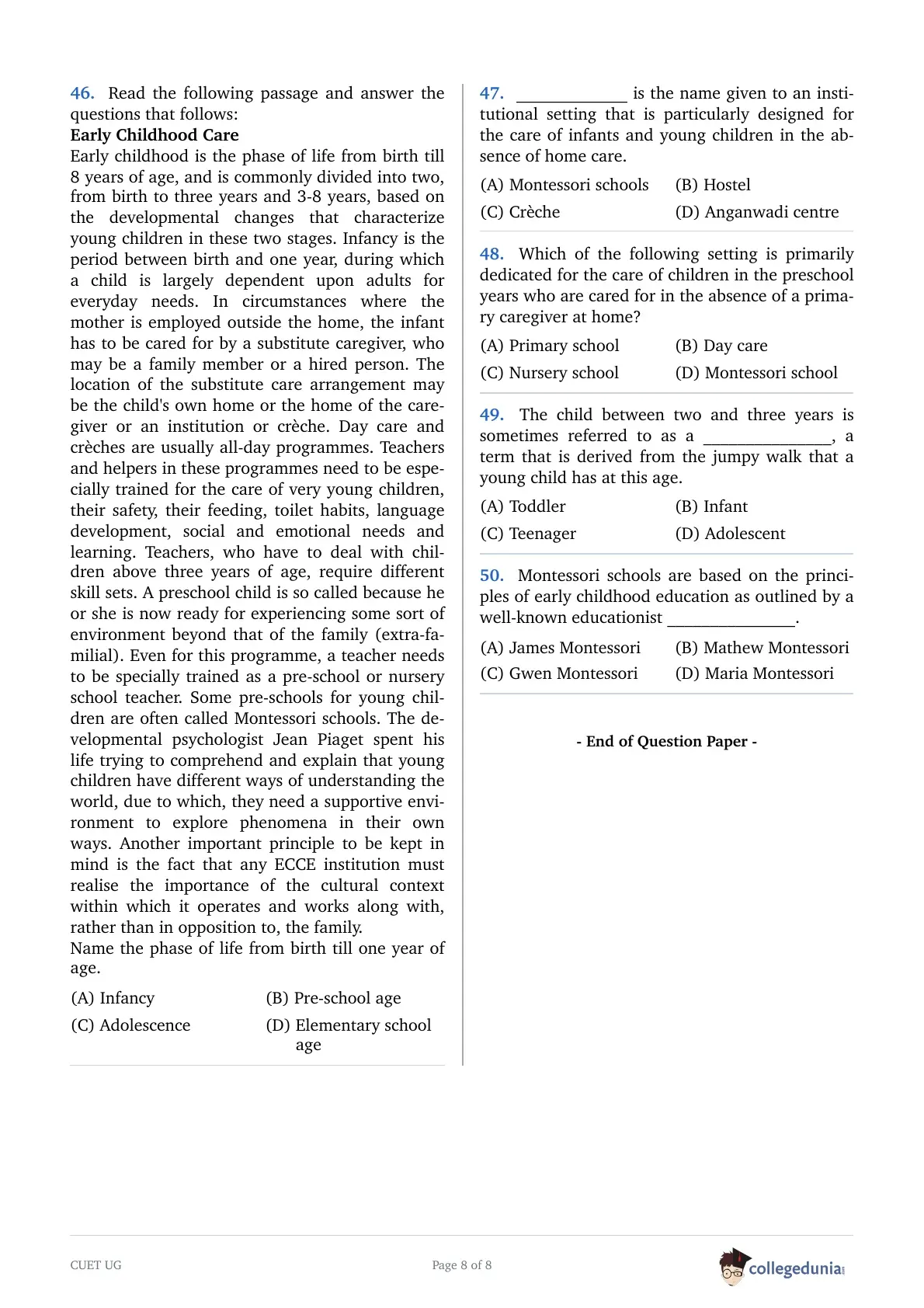
_____________ is the name given to an institutional setting that is particularly designed for the care of infants and young children in the absence of home care.
Which of the following setting is primarily dedicated for the care of children in the preschool years who are cared for in the absence of a primary caregiver at home?
The child between two and three years is sometimes referred to as a ________________, a term that is derived from the jumpy walk that a young child has at this age.
Montessori schools are based on the principles of early childhood education as outlined by a well-known educationist ________________.
CUET UG 2026 Exam Pattern and Marking Scheme
| Parameter | Details |
|---|---|
| Exam Name | Common University Entrance Test (CUET UG) 2026 |
| Conducting Body | National Testing Agency (NTA) |
| Exam Mode | Computer-Based Test (CBT) |
| Exam Duration | 60 minutes per test |
| Total Sections | 3 (Languages, Domain Subjects, General Test) |
| Question Type | Multiple Choice Questions (MCQs) |
| Questions per Test | 50 questions (all compulsory) |
| Marking Scheme | +5 for correct, -1 for incorrect |
| Maximum Marks | 250 marks per test |
| Maximum Subject Choices | 5 subjects in total |
| Syllabus Base | Class 12 NCERT (mainly for Domain Subjects) |



Comments