




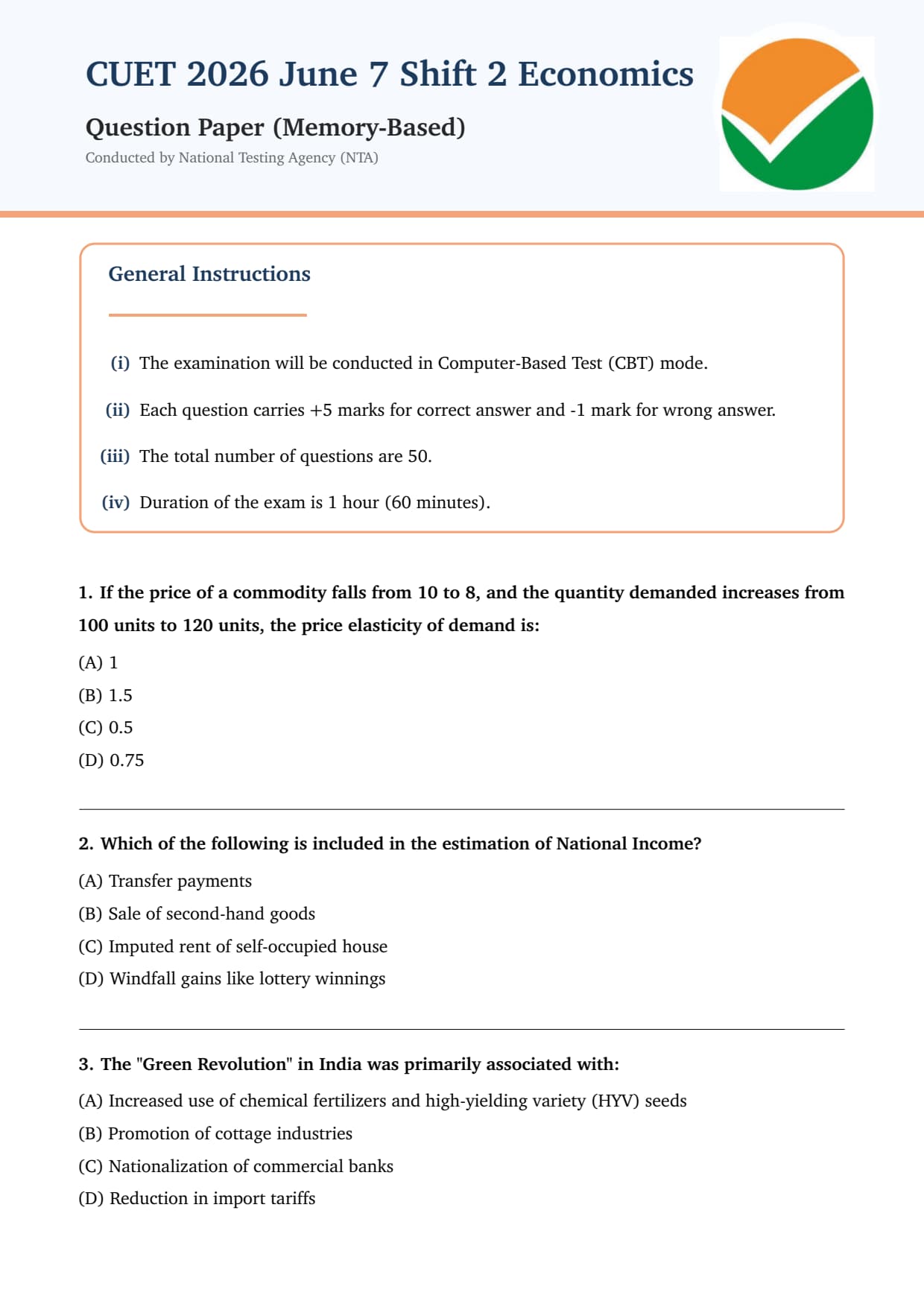
CUET 2026 June 7 Shift 2 Economics Question Paper is available for download here. NTA conducted the CUET 2026 exam from 11th May to 31st May.
- CUET 2026 Economics exam consists of 50 questions for 250 marks to be attempted in 60 minutes.
- As per the marking scheme, 5 marks are awarded for each correct answer, and 1 mark is deducted for incorrect answer.
Candidates can download CUET 2026 June 7 Shift 2 Economics Question Paper with Answer Key and Solution PDF from links provided below.
Related Links:
- CUET 2026 June 7 Shift 2 Economics Answer Key
- CUET UG 2026 Economics Marks vs Expected Percentile and Colleges
CUET 2026 Economics June 7 Shift 2 Question Paper with Solution PDF
| CUET June 7 Shift 2 Economics Question Paper 2026 | Download PDF | Check Solutions |
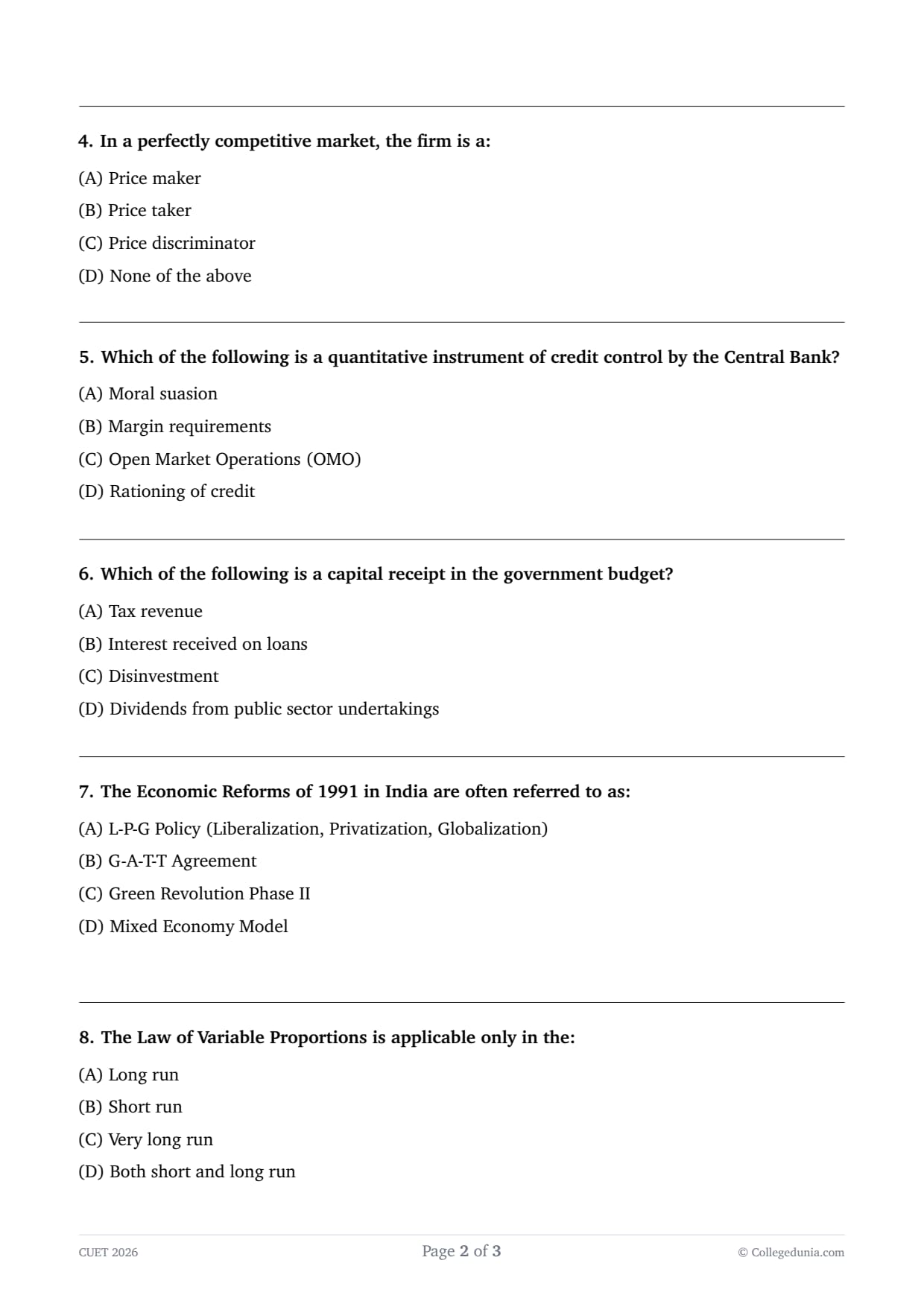
If the price of a commodity falls from ₹10 to ₹8, and the quantity demanded increases from 100 units to 120 units, the price elasticity of demand is:
View Solution
Concept:
Price Elasticity of Demand measures the responsiveness of quantity demanded to a change in price.
It indicates how much quantity demanded changes when the price of a commodity changes.
The formula is:
\[ E_d = \frac{% Change in Quantity Demanded} {% Change in Price} \]
Using the percentage method:
\[ E_d = \frac{\Delta Q}{Q} \times \frac{P}{\Delta P} \]
where
\[ \Delta Q = Change in Quantity \]
and
\[ \Delta P = Change in Price \]
Step 1: Identify the given information.
Original Price
\[ P = ₹10 \]
New Price
\[ P_1 = ₹8 \]
Original Quantity
\[ Q = 100 \]
New Quantity
\[ Q_1 = 120 \]
Step 2: Calculate the change in quantity demanded.
\[ \Delta Q = 120-100 = 20 \]
Therefore,
\[ \frac{\Delta Q}{Q} = \frac{20}{100} = 0.2 \]
Step 3: Calculate the change in price.
\[ \Delta P = 10-8 = 2 \]
Thus,
\[ \frac{P}{\Delta P} = \frac{10}{2} = 5 \]
Step 4: Apply the elasticity formula.
\[ E_d = \frac{\Delta Q}{Q} \times \frac{P}{\Delta P} \]
\[ = \frac{20}{100} \times \frac{10}{2} \]
\[ = 0.2 \times 5 \]
\[ = 1 \]
Step 5: Interpret the result.
Since
\[ E_d = 1 \]
the demand is said to be unitary elastic.
A given percentage change in price causes an equal percentage change in quantity demanded.
Therefore,
\[ \boxed{E_d = 1} \]
Hence, the correct answer is:
\[ \boxed{(A)} \] Quick Tip: If elasticity is: \[ E_d=1 \] Demand is unitary elastic. \[ E_d>1 \] Demand is elastic. \[ E_d<1 \] Demand is inelastic.
Which of the following is included in the estimation of National Income?
View Solution
Concept:
National Income measures the money value of all final goods and services produced within an economy during an accounting year.
Only those activities that contribute to current production are included.
While estimating National Income, economists follow specific rules regarding inclusion and exclusion of various items.
Step 1: Understand transfer payments.
Transfer payments include:
Old age pension
Scholarships
Unemployment allowance
Donations
These payments are received without rendering any productive service.
Hence they are excluded.
Step 2: Understand second-hand goods.
Sale of second-hand goods does not represent current production.
The goods were already counted when originally produced.
Therefore they are excluded.
Step 3: Understand windfall gains.
Lottery winnings and similar gains are not earned through production.
Hence they are excluded from National Income.
Step 4: Understand imputed rent.
Suppose a person owns and occupies his own house.
No actual rent is paid.
However, that house provides housing services.
Economists estimate a notional rent called:
\[ Imputed Rent \]
This value is included in National Income because it represents productive services.
Step 5: Choose the correct answer.
Among all options, only imputed rent contributes to current production.
Therefore,
\[ \boxed{Imputed Rent of Self-occupied House} \]
is included.
Hence,
\[ \boxed{(C)} \] Quick Tip: Included in National Income: Imputed rent Value of final goods Services rendered Excluded: Transfer payments Lottery winnings Sale of second-hand goods
The "Green Revolution" in India was primarily associated with:
View Solution
Concept:
The Green Revolution refers to the rapid increase in agricultural production achieved through the adoption of modern farming techniques.
It was introduced in India during the mid-1960s to overcome food shortages and increase food grain production.
The movement transformed Indian agriculture and helped the country move towards self-sufficiency in food grains.
Step 1: Understand the objectives of the Green Revolution.
The major objectives were:
Increase agricultural productivity.
Achieve food security.
Reduce dependence on food imports.
Improve farmers' income'.
Step 2: Identify the important features.
The Green Revolution was based on:
HYV seeds
Chemical fertilizers
Pesticides
Irrigation facilities
Farm mechanization
These inputs significantly increased crop yields.
Step 3: Examine the options.
Option (A):
Directly represents the Green Revolution.
Correct.
Option (B):
Related to rural industrialization.
Incorrect.
Option (C):
Related to banking reforms.
Incorrect.
Option (D):
Related to trade policy.
Incorrect.
Step 4: Conclude the answer.
The Green Revolution was mainly associated with:
\[ \boxed{HYV Seeds + Chemical Fertilizers} \]
Hence,
\[ \boxed{(A)} \] Quick Tip: Key personalities associated with the Green Revolution: Dr. Norman Borlaug Dr. M. S. Swaminathan Major crops: Wheat Rice
In a perfectly competitive market, the firm is a:
View Solution
Concept:
Perfect Competition is a market structure characterized by a large number of buyers and sellers, homogeneous products, free entry and exit of firms, and perfect knowledge of market conditions.
Since there are a very large number of firms producing identical products, no individual firm can influence the market price.
The market price is determined by the interaction of overall market demand and market supply.
Each individual firm has to accept the prevailing market price and therefore is called a Price Taker.
Step 1: Understand the meaning of perfect competition.
Under perfect competition:
There are many buyers and sellers.
Products are identical.
Buyers have complete information.
Firms can freely enter or leave the industry.
Because of these features, competition among firms is extremely high.
Step 2: Understand why a firm cannot fix price.
Suppose the market price of a commodity is:
\[ ₹100 \]
If a firm tries to charge:
\[ ₹110 \]
buyers will immediately purchase from other firms selling the same product at:
\[ ₹100 \]
As a result, the firm loses all customers.
Thus the firm cannot charge a higher price.
Step 3: Understand why a firm does not charge a lower price.
If the firm charges less than the market price, it suffers unnecessary loss because consumers are already willing to pay the market price.
Therefore, charging a lower price is not beneficial.
Step 4: Determine the role of the firm.
Since the firm neither increases nor decreases the market price, it simply accepts the price determined by market forces.
Hence:
\[ \boxed{Firm = Price Taker} \]
Therefore,
\[ \boxed{Price Taker} \]
Hence,
\[ \boxed{(B)} \] Quick Tip: Remember: \[ Perfect Competition \Rightarrow Price Taker \] \[ Monopoly \Rightarrow Price Maker \] This is one of the most frequently asked concepts in Microeconomics.
Which of the following is a quantitative instrument of credit control by the Central Bank?
View Solution
Concept:
The Central Bank controls the supply of credit in the economy through various monetary policy instruments.
These instruments are classified into:
Quantitative Instruments
Qualitative Instruments
Quantitative instruments affect the total volume of credit in the economy.
Qualitative instruments regulate the direction and use of credit.
Open Market Operations (OMO) is one of the most important quantitative instruments used by the Central Bank.
Step 1: Understand quantitative credit control.
Quantitative methods influence the overall supply of money and credit.
Examples include:
Bank Rate Policy
Cash Reserve Ratio (CRR)
Statutory Liquidity Ratio (SLR)
Open Market Operations (OMO)
These measures affect the entire banking system.
Step 2: Understand Open Market Operations.
Open Market Operations refer to the purchase and sale of government securities by the Central Bank.
When the Central Bank purchases securities:
\[ Money Supply Increases \]
When it sells securities:
\[ Money Supply Decreases \]
Thus OMO directly controls the volume of credit.
Step 3: Examine Moral Suasion.
Moral suasion refers to requests, persuasion and advice given by the Central Bank to commercial banks.
It does not directly alter the quantity of money.
Hence it is a qualitative method.
Step 4: Examine Margin Requirements and Credit Rationing.
Margin requirements regulate loans against securities.
Credit rationing restricts credit to particular sectors.
Both are selective or qualitative measures.
Therefore they are not quantitative instruments.
Step 5: Choose the correct answer.
Among the given options, only Open Market Operations directly influence total credit in the economy.
Hence:
\[ \boxed{Open Market Operations (OMO)} \]
Therefore,
\[ \boxed{(C)} \] Quick Tip: Quantitative Instruments: CRR SLR Bank Rate Repo Rate Open Market Operations Qualitative Instruments: Moral Suasion Margin Requirements Credit Rationing
Which of the following is a capital receipt in the government budget?
View Solution
Concept:
Government receipts are broadly classified into:
Revenue Receipts
Capital Receipts
Revenue Receipts neither create liabilities nor reduce assets of the government.
Capital Receipts either create liabilities or reduce assets of the government.
Disinvestment represents the sale of government ownership in public sector enterprises and therefore reduces government assets.
Hence it is treated as a capital receipt.
Step 1: Understand Revenue Receipts.
Revenue receipts are regular receipts of the government.
Examples include:
Tax revenue
Interest receipts
Dividends
Fees and fines
These do not affect government assets significantly.
Step 2: Understand Capital Receipts.
Capital receipts include:
Borrowings
Recovery of loans
Disinvestment
These receipts either increase liabilities or decrease assets.
Step 3: Understand disinvestment.
Disinvestment means selling shares of public sector enterprises.
Suppose the government sells part of its ownership in a public enterprise.
The government receives money.
However, its ownership stake decreases.
Therefore:
\[ Government Assets Decrease \]
Hence it is a capital receipt.
Step 5: Choose the correct answer.
Since disinvestment reduces government assets and generates funds:
\[ \boxed{Disinvestment} \]
is classified as a capital receipt.
Therefore,
\[ \boxed{(C)} \] Quick Tip: Revenue Receipts: Taxes Interest Dividends Fees Capital Receipts: Borrowings Recovery of Loans Disinvestment
The Economic Reforms of 1991 in India are often referred to as:
View Solution
Concept:
The economic reforms introduced in India in 1991 marked a major turning point in the country's economic history. These reforms were introduced to overcome the severe balance of payments crisis and to accelerate economic growth.
The reforms were based on three major pillars:
Liberalization
Privatization
Globalization
Together these reforms are popularly known as the LPG Reforms or LPG Policy.
Step 1: Understand the economic situation before 1991.
Before 1991, the Indian economy was characterized by extensive government controls, industrial licensing, import restrictions and limited participation of the private sector.
The country faced:
High fiscal deficit
Low foreign exchange reserves
Slow industrial growth
Rising external debt
These challenges made economic reforms necessary.
Step 2: Study the three components of LPG policy.
Liberalization:
Liberalization refers to removal of unnecessary government restrictions on economic activities.
Examples include:
Abolition of industrial licensing in many industries
Reduction in government regulations
Greater freedom for businesses
Privatization:
Privatization means increasing the role of private enterprises and reducing the dominance of the public sector.
Examples include:
Disinvestment in public sector enterprises
Encouragement to private investment
Greater competition among firms
Globalization:
Globalization refers to integrating the Indian economy with the world economy.
Examples include:
Encouraging foreign investment
Expansion of international trade
Reduction in import barriers
Step 3: Identify the commonly used name of the 1991 reforms.
Since the reforms were based on Liberalization, Privatization and Globalization, they are collectively known as:
\[ \boxed{LPG Policy} \]
Hence the correct answer is
\[ \boxed{Option (A)} \] Quick Tip: Remember the abbreviation: \[ L = Liberalization \] \[ P = Privatization \] \[ G = Globalization \] The 1991 Economic Reforms are therefore known as the LPG Reforms.
The Law of Variable Proportions is applicable only in the:
View Solution
Concept:
The Law of Variable Proportions explains how output changes when one factor of production is varied while other factors remain fixed.
It is one of the most important laws of production studied in microeconomics.
Step 1: Understand the meaning of the law.
Suppose a farmer owns a fixed amount of land.
If additional units of labour are employed on the same land, total output will change.
Initially output increases rapidly, then increases at a decreasing rate, and eventually may decline.
This phenomenon is explained by the Law of Variable Proportions.
Step 2: Identify the condition required for the law.
The law operates only when:
At least one factor is fixed.
At least one factor is variable.
Technology remains unchanged.
Examples:
Land fixed, labour variable.
Building fixed, workers variable.
Machinery fixed, raw material variable.
Step 3: Relate this condition to time period.
In the short run:
Some factors remain fixed.
Some factors can be varied.
Therefore the law can operate.
In the long run:
All factors are variable.
No factor remains fixed.
Hence the Law of Variable Proportions does not apply in the long run.
Step 4: State the conclusion.
Since the law requires fixed and variable factors simultaneously, it applies only in the short run.
Therefore,
\[ \boxed{Short Run} \]
Hence the correct answer is
\[ \boxed{Option (B)} \] Quick Tip: Law of Variable Proportions: \[ Short Run \Rightarrow Applicable \] \[ Long Run \Rightarrow Not Applicable \] Reason: In the short run some factors remain fixed.
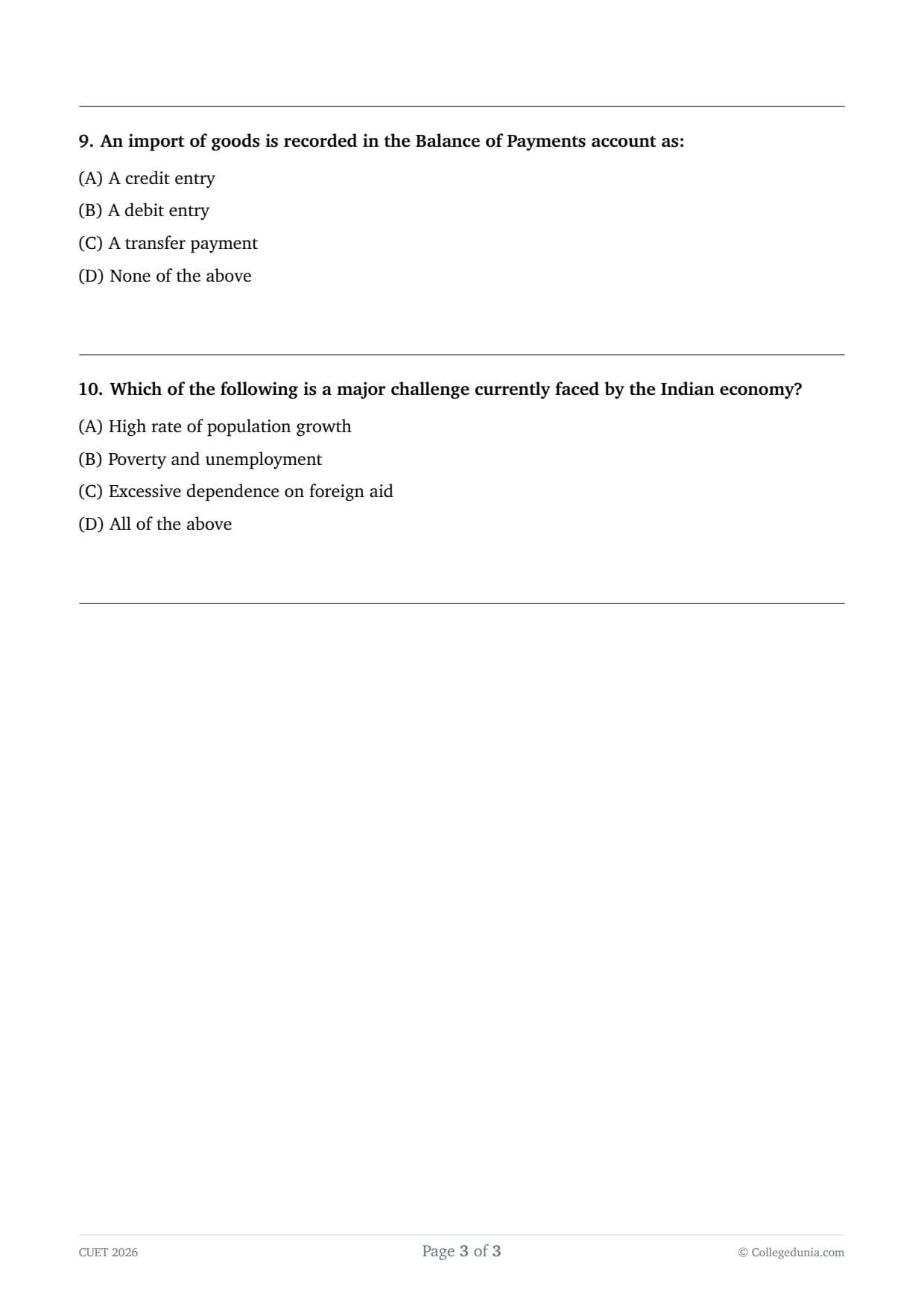
An import of goods is recorded in the Balance of Payments account as:
View Solution
Concept:
Balance of Payments (BOP) is a systematic record of all economic transactions between residents of a country and the rest of the world during a given period.
Every transaction is recorded either as:
Credit item
Debit item
Step 1: Understand credit entries in BOP.
Credit entries represent inflow of foreign exchange into the country.
Examples:
Exports of goods
Exports of services
Foreign investment received
Foreign loans received
These transactions bring foreign currency into the country.
Step 2: Understand debit entries in BOP.
Debit entries represent outflow of foreign exchange from the country.
Examples:
Imports of goods
Imports of services
Foreign investment abroad
Repayment of foreign loans
These transactions involve payment to foreign countries.
Step 3: Apply the concept to imports.
When India imports goods from another country:
Goods enter India.
Payment goes out of India.
Foreign exchange leaves the country.
Therefore imports are recorded as debit items.
Step 4: Write the final conclusion.
Since imports involve outflow of foreign exchange,
\[ \boxed{Imports are recorded as Debit Entries} \]
Hence the correct answer is
\[ \boxed{Option (B)} \] Quick Tip: Easy rule for BOP: \[ Exports \Rightarrow Credit \] \[ Imports \Rightarrow Debit \] Foreign exchange inflow = Credit. Foreign exchange outflow = Debit.
Which of the following is a major challenge currently faced by the Indian economy?
View Solution
Concept:
Despite significant economic progress, the Indian economy continues to face several developmental challenges.
Economic growth alone is not sufficient unless it is accompanied by improvements in employment, living standards and social welfare.
Step 1: Study the problem of population growth.
India has one of the largest populations in the world.
Rapid population growth creates pressure on:
Natural resources
Education facilities
Healthcare services
Employment opportunities
Housing and infrastructure
Therefore population growth remains a significant challenge.
Step 2: Understand poverty and unemployment.
Although poverty has declined over time, a considerable section of the population still faces economic hardship.
Major concerns include:
Lack of adequate income
Underemployment
Seasonal unemployment
Educated unemployment
These issues affect economic and social development.
Step 3: Examine dependence on foreign resources.
Developing economies often require:
Foreign capital
Foreign technology
International assistance
Excessive dependence on external sources may create economic vulnerabilities.
Therefore reducing dependence and strengthening self-reliance remains an important objective.
Step 4: Draw the final conclusion.
All the factors listed in the question represent important economic challenges.
Therefore,
\[ \boxed{All of the above} \]
Hence the correct answer is
\[ \boxed{Option (D)} \] Quick Tip: Major challenges of the Indian economy include: Population growth Poverty Unemployment Regional imbalance Human capital development Always remember that economic development involves solving multiple challenges simultaneously.
CUET UG 2026 Exam Pattern
| Parameter | Details |
|---|---|
| Exam Name | Common University Entrance Test (CUET UG) 2026 |
| Conducting Body | National Testing Agency (NTA) |
| Exam Mode | Computer-Based Test (CBT) |
| Exam Duration | 60 minutes per test |
| Total Sections | 3 (Languages, Domain Subjects, General Test) |
| Question Type | Multiple Choice Questions (MCQs) |
| Questions per Test | 50 questions (all compulsory) |
| Marking Scheme | +5 for correct, -1 for incorrect |
| Maximum Marks | 250 marks per test |
| Maximum Subject Choices | 5 subjects in total |
| Syllabus Base | Class 12 NCERT (mainly for Domain Subjects) |



Comments