




CUET 2026 May 20 Shift 1 Business Studies Question Paper is available for download here. NTA conducted the CUET 2026 exam from 11th May to 31st May.
- CUET 2026 Business Studies exam consists of 50 questions for 250 marks to be attempted in 60 minutes.
- As per the marking scheme, 5 marks are awarded for each correct answer, and 1 mark is deducted for incorrect answer.
Candidates can download CUET 2026 May 20 Shift 1 Business Studies Question Paper with Answer Key and Solution PDF from links provided below.
Related Links:
- CUET 2026 May 20 Shift 1 Business Studies Answer Key
- CUET UG 2026 Business Studies Marks vs Expected Percentile and Colleges
CUET 2026 Business Studies May 20 Shift 1 Question Paper with Solution PDF
| CUET May 20 Shift 1 Business Studies Question Paper 2026 | Download PDF | Check Solutions |



Which of the following statements best describe the features of Business Environment?
(A) Business environment is largely uncertain.
(B) Business environment is a complex phenomenon that is relatively easier to understand in parts but difficult to grasp in its totality.
(C) Business environment includes only general forces.
(D) Business environment is a relative concept.
Choose the correct answer from the options given below:
View Solution
Step 1: Understanding the Concept:Business environment means the sum total of all forces, factors and institutions outside the business that can affect its working. This question asks which of four statements truly describe its features.
Step 2: Key Formula or Approach:
We recall the standard features of business environment: it is the totality of external forces, it has specific and general forces, it is dynamic, it is uncertain, it is complex, and it is relative. We then test each statement against this list.
Step 3: Check statement (A).
Changes in technology, fashion, government policy and competition are hard to predict. Managers cannot know exactly what will happen next. So the environment is largely uncertain. So (A) is TRUE.
Step 4: Check statement (B).
The environment has many forces which are linked to each other. A manager can study one force at a time, such as technology or law, quite easily. But the combined effect of all forces together is hard to understand. This is the complexity feature. So (B) is TRUE.
Step 5: Check statement (C).
Business environment has two parts. Specific forces such as customers, suppliers, competitors and investors act directly on a firm. General forces such as social, political, legal and technological forces act on all firms. Saying it includes only general forces ignores the specific forces. So (C) is FALSE.
Step 6: Check statement (D).
The same event can have a different effect in different places and on different firms. A change in import duty may help one firm and hurt another. A firm's view of its environment depends on its own situation. So the environment is a relative concept and (D) is TRUE.
Step 7: Match with the options.
True statements are (A), (B) and (D). Option 1 lists exactly these three. Option 2 and option 4 include (C), which is false. Option 3 includes (C) and drops (A) and (B), so it is wrong too.
Final Answer:
Statements (A), (B) and (D) are true and (C) is false, so option 1 is correct. \[ \boxed{\text{Option 1: (A), (B) and (D) only}} \]
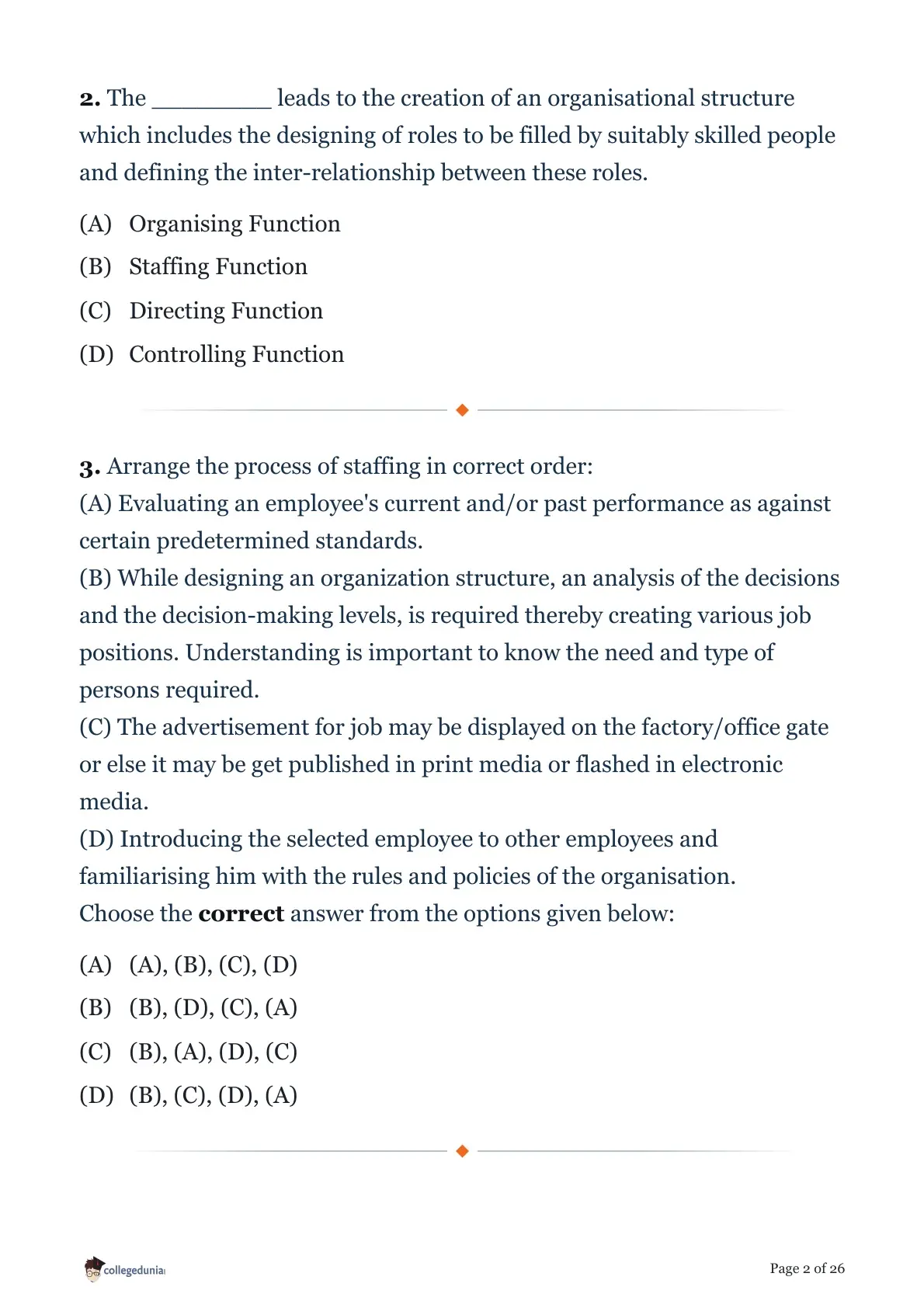
The ________ leads to the creation of an organisational structure which includes the designing of roles to be filled by suitably skilled people and defining the inter-relationship between these roles.
View Solution
Step 1: Understanding the Concept:Management has five functions: planning, organising, staffing, directing and controlling. This question asks which function builds the structure of roles and their links.
Step 2: Key Formula or Approach:
Organising means identifying the work, grouping it into jobs, assigning duties, giving authority and setting reporting relationships. The result of this is the organisation structure.
Step 3: Check option 1, Organising Function.
This function creates the structure, designs the roles and defines how the roles are related to each other. The question describes exactly this. So option 1 is CORRECT.
Step 4: Check option 2, Staffing Function.
Staffing fills the roles that already exist with suitable people. It deals with recruitment, selection, training and appraisal. It does not design the roles or the structure. So option 2 is WRONG.
Step 5: Check option 3, Directing Function.
Directing deals with guiding, motivating, leading and communicating with people so that they work towards the goals. It does not create the structure. So option 3 is WRONG.
Step 6: Check option 4, Controlling Function.
Controlling compares actual results with plans and corrects any gap. It does not build roles or links between them. So option 4 is WRONG.
Final Answer:
The function that designs roles and defines their relationships is organising, which is option 1. \[ \boxed{\text{Option 1: Organising Function}} \]
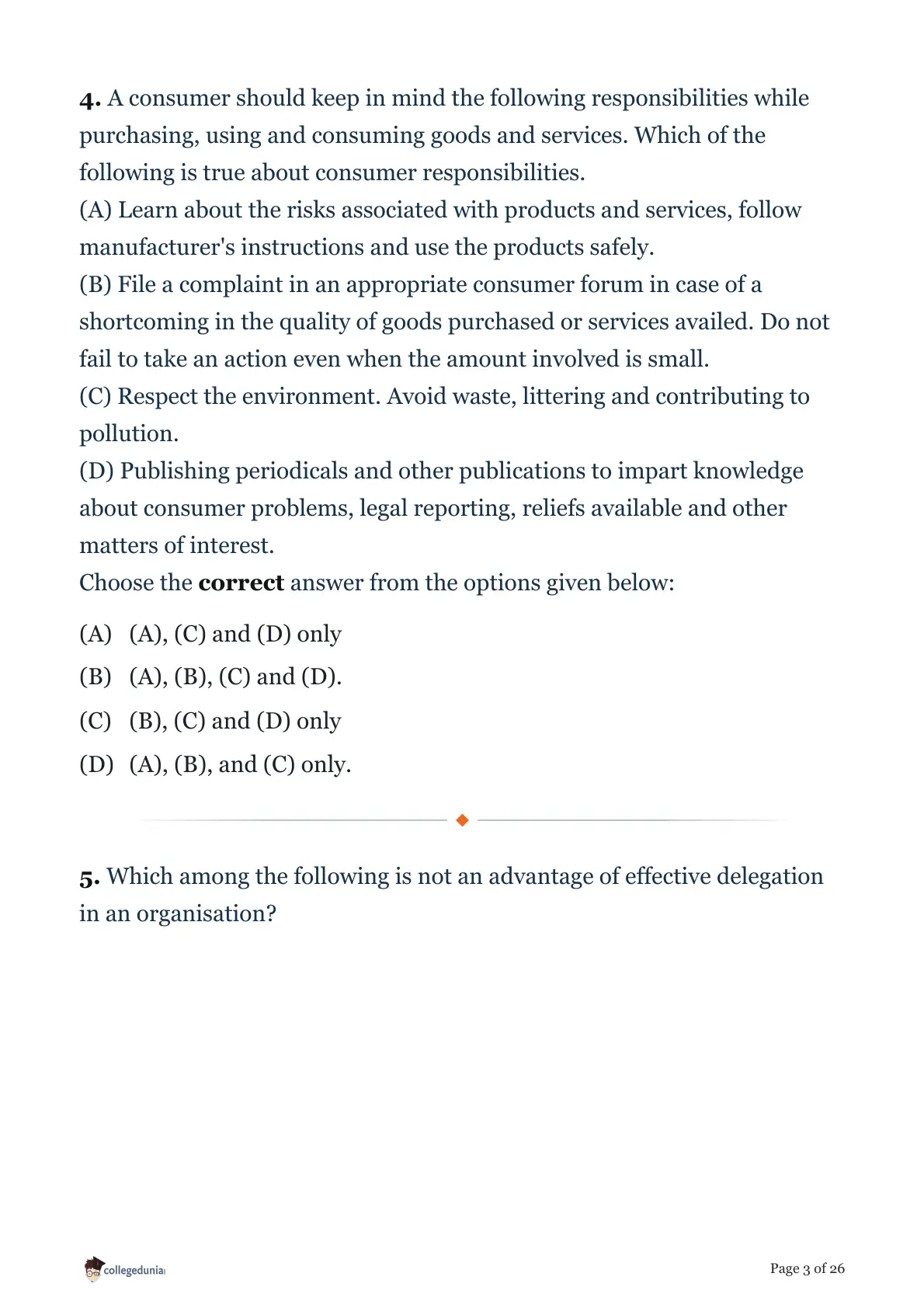
Arrange the process of staffing in correct order:
(A) Evaluating an employee's current and/or past performance as against certain predetermined standards.
(B) While designing an organization structure, an analysis of the decisions and the decision-making levels, is required thereby creating various job positions. Understanding is important to know the need and type of persons required.
(C) The advertisement for job may be displayed on the factory/office gate or else it may be get published in print media or flashed in electronic media.
(D) Introducing the selected employee to other employees and familiarising him with the rules and policies of the organisation.
Choose the correct answer from the options given below:
View Solution
Step 1: Understanding the Concept:Staffing is the process of filling and keeping filled the positions in the structure. It follows a fixed order of steps. We must match each statement to its step and then arrange them.
Step 2: Key Formula or Approach:
The usual order is: estimating manpower requirements, recruitment, selection, placement and orientation, training and development, performance appraisal, and promotion and career planning.
Step 3: Identify statement (B).
It talks about analysing the jobs and finding the number and type of persons required. This is estimating the manpower requirements. It is the first step.
Step 4: Identify statement (C).
Advertising a job on the gate or in print and electronic media is a way of inviting applicants. This is recruitment. It comes after the need is known.
Step 5: Identify statement (D).
Introducing the selected person to others and teaching the rules and policies is placement and orientation. It can happen only after people are recruited and selected.
Step 6: Identify statement (A).
Checking an employee's present or past performance against set standards is performance appraisal. It happens after the person has worked for some time, so it is last in this list.
Step 7: Put them in order.
The order is (B), then (C), then (D), then (A). This is option 4. Option 1 starts with appraisal, which is wrong. Option 2 puts orientation before recruitment, which is wrong. Option 3 puts appraisal before orientation and recruitment last, which is wrong.
Final Answer:
The correct sequence is (B), (C), (D), (A), which is option 4. \[ \boxed{\text{Option 4: (B), (C), (D), (A)}} \]
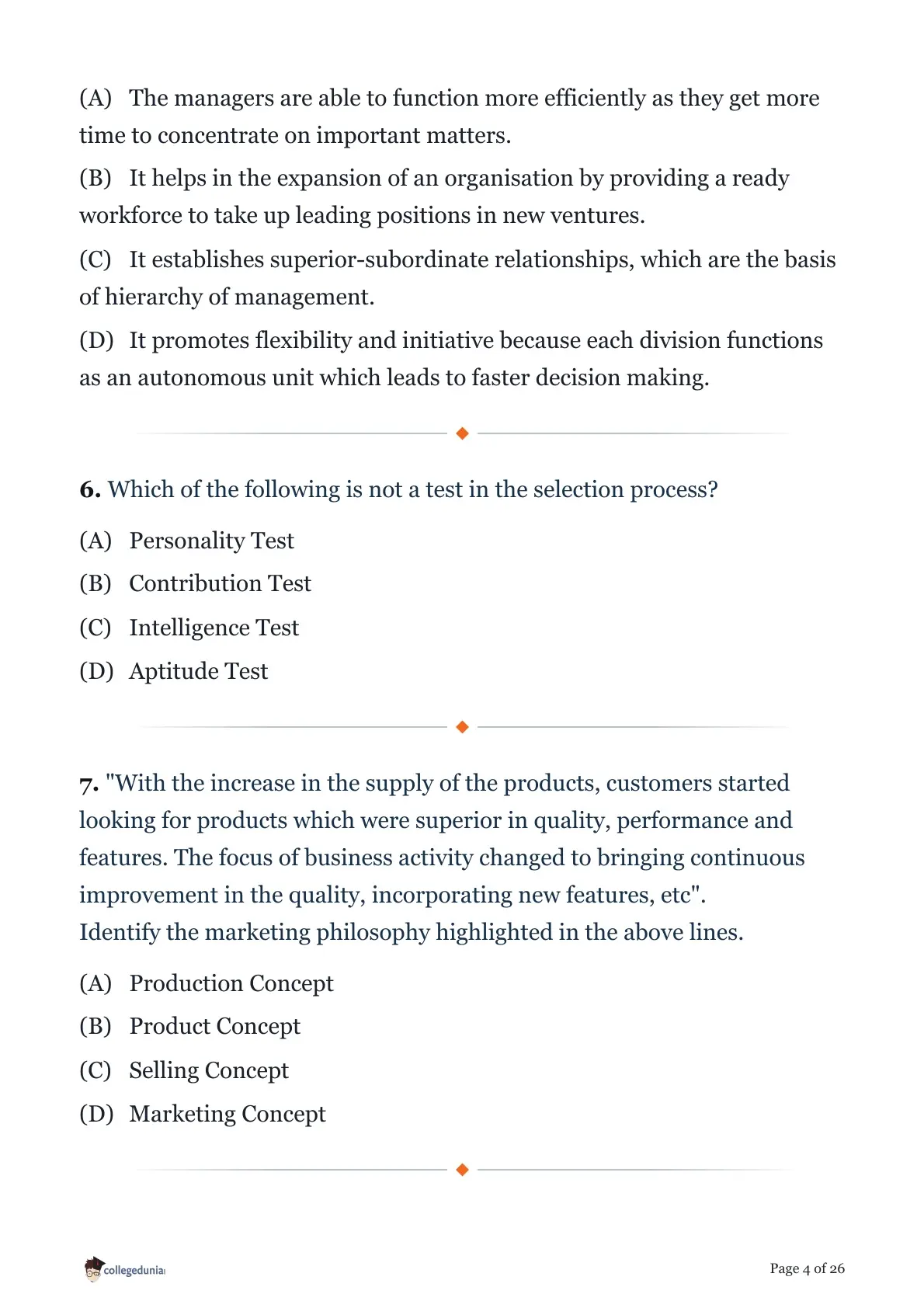
A consumer should keep in mind the following responsibilities while purchasing, using and consuming goods and services. Which of the following is true about consumer responsibilities.
(A) Learn about the risks associated with products and services, follow manufacturer's instructions and use the products safely.
(B) File a complaint in an appropriate consumer forum in case of a shortcoming in the quality of goods purchased or services availed. Do not fail to take an action even when the amount involved is small.
(C) Respect the environment. Avoid waste, littering and contributing to pollution.
(D) Publishing periodicals and other publications to impart knowledge about consumer problems, legal reporting, reliefs available and other matters of interest.
Choose the correct answer from the options given below:
View Solution
Step 1: Understanding the Concept:Under consumer protection, a consumer has rights and also responsibilities. Some statements in the question are duties of a consumer, and one may be the work of some other body. We must separate them.
Step 2: Key Formula or Approach:
Recall the list of responsibilities: be aware about goods and services, buy only standard goods, learn about risks and use safely, read labels, assert and file complaints, be honest, ask for a cash memo, form consumer groups, and respect the environment.
Step 3: Check statement (A).
Learning about the risks of a product and following the maker's instructions for safe use is the responsibility of being aware and careful. So (A) is TRUE.
Step 4: Check statement (B).
A consumer must file a complaint in a proper forum when quality is poor. Silence because the amount is small does not help others. Filing a complaint is a clear consumer responsibility. So (B) is TRUE.
Step 5: Check statement (C).
A consumer must respect the environment and avoid waste, littering and pollution. This is listed as a responsibility. So (C) is TRUE.
Step 6: Check statement (D).
Publishing periodicals and other material to give knowledge about consumer problems and relief is the work of consumer organisations and NGOs. It is part of their role, not a duty of an individual consumer. So (D) is FALSE.
Step 7: Match with the options.
The true statements are (A), (B) and (C) only. That is option 4. Options 1, 2 and 3 all include (D), so they are wrong.
Final Answer:
Statements (A), (B) and (C) are consumer responsibilities, and (D) belongs to consumer organisations, so option 4 is correct. \[ \boxed{\text{Option 4: (A), (B) and (C) only}} \]
Which among the following is not an advantage of effective delegation in an organisation?
View Solution
Step 1: Understanding the Concept:Delegation means a manager hands over part of his work and the needed authority to a subordinate. The question asks which of the four statements is not an advantage of delegation. The odd one may belong to a different idea.
Step 2: Key Formula or Approach:
Recall the importance of delegation: effective management, employee development, motivation of employees, facilitation of growth, a basis of management hierarchy, and better coordination.
Step 3: Check option 1.
When a manager passes routine work to others, he gets time for important work like planning and policy. This is effective management. So option 1 is an advantage.
Step 4: Check option 2.
Subordinates who handle delegated work learn skills and take more responsibility. So the firm has trained people ready for higher posts when it grows. This is facilitation of growth. So option 2 is an advantage.
Step 5: Check option 3.
Delegation of authority creates the superior-subordinate links, and these links form the chain of command in the hierarchy. This is the basis of management hierarchy. So option 3 is an advantage.
Step 6: Check option 4.
Making each division work as an autonomous unit with its own decision power is the idea of decentralisation, which is the delegation of authority at every level and to every division. It is a different concept. A single act of delegation does not make a division autonomous. So option 4 is not an advantage of delegation.
Step 7: Decide.
Options 1, 2 and 3 match the standard advantages. Option 4 describes decentralisation. So the answer is option 4.
Final Answer:
The statement that is not an advantage of delegation is option 4, which describes decentralisation. \[ \boxed{\text{Option 4}} \]
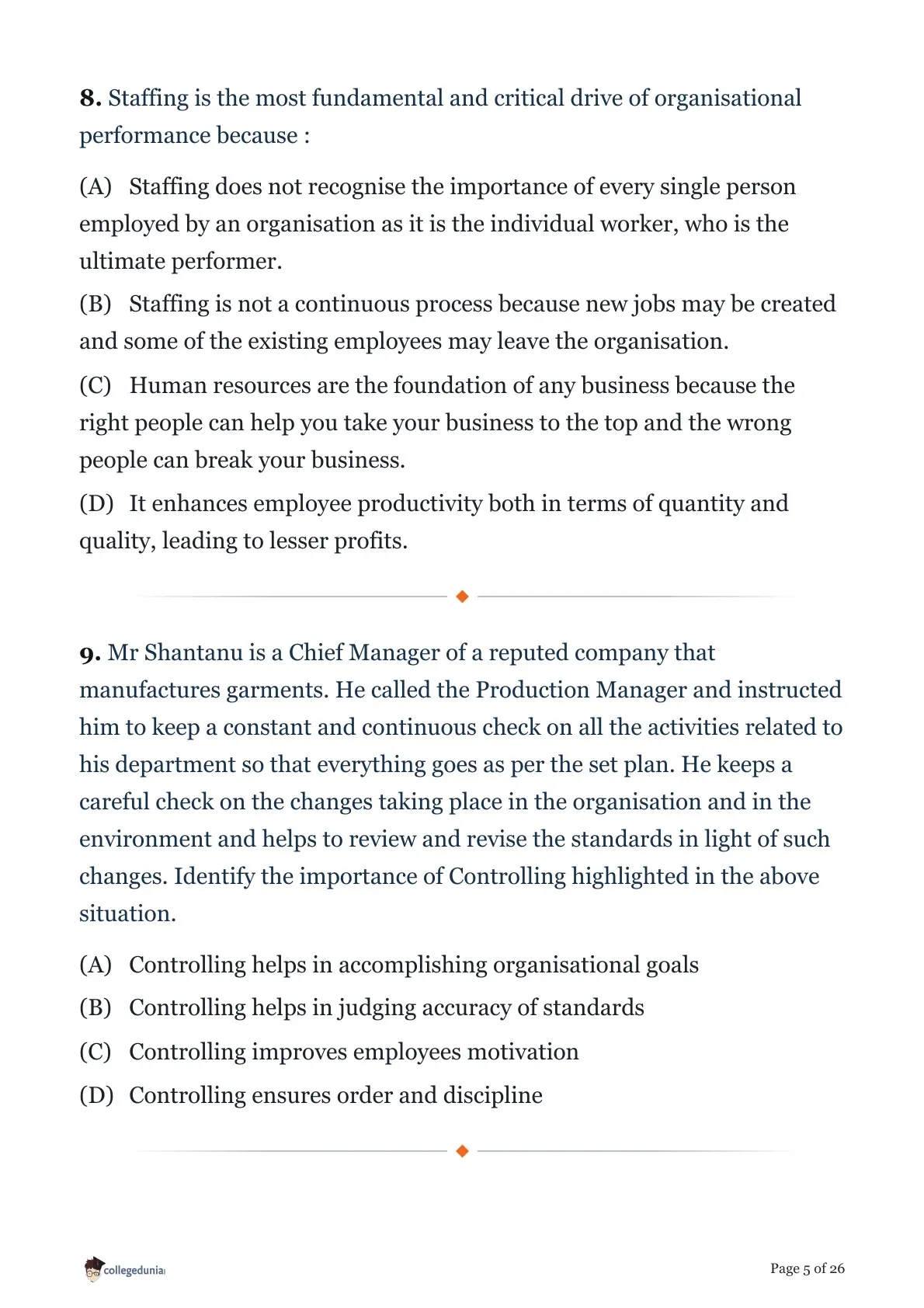
Which of the following is not a test in the selection process?
View Solution
Step 1: Understanding the Question:The question asks which of the four named items is not one of the tests used while selecting employees. Selection is the step in staffing where the best candidates are picked from the pool of applicants.
Step 2: Key Concept:
Employment tests used in selection are of these kinds: intelligence tests, aptitude tests, personality tests, trade or proficiency tests, and interest tests. They help the employer judge how well a candidate fits the job.
Step 3: Check option (A).
A personality test studies traits such as attitude, temperament and emotional balance. It is a standard selection test. So (A) is a test and is not the answer.
Step 4: Check option (B).
There is no selection test called a contribution test. Contribution is a word used in other places, such as partnership accounts or fund sharing, but it is not an employment test. So (B) is the item that is not a test in the selection process.
Step 5: Check option (C).
An intelligence test measures mental ability, reasoning and learning speed. It is a standard selection test. So (C) is a test and is not the answer.
Step 6: Check option (D).
An aptitude test measures a candidate's potential to learn or to perform a particular skill. It is a standard selection test. So (D) is a test and is not the answer.
Final Answer:
Three of the options are recognised selection tests, and the contribution test is not. The correct choice is option 2. \[ \boxed{\text{Option 2}} \]
"With the increase in the supply of the products, customers started looking for products which were superior in quality, performance and features. The focus of business activity changed to bringing continuous improvement in the quality, incorporating new features, etc".
Identify the marketing philosophy highlighted in the above lines.
View Solution
Step 1: Understanding the Question:The lines describe a stage where supply has grown, buyers look for better quality, performance and features, and the firm keeps improving the product. We must name the marketing philosophy that matches.
Step 2: Key Concept:
Marketing philosophies are: production concept (make more, cheaply), product concept (make better products), selling concept (push sales through promotion) and marketing concept (find and satisfy customer needs). The key phrase here is continuous improvement of the product itself.
Step 3: Check option (A).
The production concept works when demand is more than supply, so the aim is to produce a lot at low cost. Here supply has increased and the focus is on quality, so (A) is wrong.
Step 4: Check option (B).
The product concept says customers prefer products with the best quality, performance and features, so the firm keeps improving the product. This matches the passage closely. So (B) is correct.
Step 5: Check option (C).
The selling concept believes buyers must be pushed with heavy selling and promotion. The passage talks about quality improvement, not aggressive selling, so (C) is wrong.
Step 6: Check option (D).
The marketing concept starts from customer needs and wants and aims at satisfaction and profit. The passage never mentions studying customer needs, only improving the product, so (D) is wrong.
Final Answer:
The philosophy is the product concept, which is option 2. \[ \boxed{\text{Option 2}} \]
Staffing is the most fundamental and critical drive of organisational performance because :
View Solution
Step 1: Understanding the Question:The statement says staffing is the most basic driver of how well an organisation performs. We need the reason that correctly supports this claim.
Step 2: Key Concept:
Staffing means filling and keeping filled the positions in the structure with suitable people. Its importance is that it gives competent people, improves job satisfaction and productivity, and builds the human base on which every other function depends.
Step 3: Check option (A).
This option says staffing does not recognise the importance of each person. Staffing actually values each person, so the statement is false and also does not support the claim. (A) is wrong.
Step 4: Check option (B).
This option says staffing is not continuous. In fact staffing is a continuous process, because vacancies keep arising through growth, transfers and exits. So (B) is wrong.
Step 5: Check option (C).
This option says human resources are the foundation of a business, and the right people can take it to the top while the wrong ones can break it. This is a correct reason for staffing being critical. So (C) is correct.
Step 6: Check option (D).
This option says productivity rises and this leads to lesser profits. Higher productivity leads to higher profits, so the conclusion is illogical. (D) is wrong.
Final Answer:
The valid reason is that people are the foundation of the business, which is option 3. \[ \boxed{\text{Option 3}} \]
Mr Shantanu is a Chief Manager of a reputed company that manufactures garments. He called the Production Manager and instructed him to keep a constant and continuous check on all the activities related to his department so that everything goes as per the set plan. He keeps a careful check on the changes taking place in the organisation and in the environment and helps to review and revise the standards in light of such changes. Identify the importance of Controlling highlighted in the above situation.
View Solution
Step 1: Understanding the Question:The case shows a manager who checks all activities against the plan and also reviews and revises standards when the organisation or environment changes. We must name which importance of controlling this stresses.
Step 2: Key Concept:
Importance of controlling includes: accomplishing goals, judging the accuracy of standards, making efficient use of resources, improving employee motivation, ensuring order and discipline, and facilitating coordination. Reviewing standards in light of change is linked to judging accuracy of standards.
Step 3: Check option (A).
Accomplishing goals is about guiding the firm toward its aims by correcting deviations. The case stresses reviewing standards, not goal attainment as such, so (A) is not the best match.
Step 4: Check option (B).
Judging the accuracy of standards means a good control system checks whether standards are right and revises them in light of changes in the organisation and environment. The case describes exactly this. So (B) is correct.
Step 5: Check option (C).
Improving motivation relates to clear standards and rewards that push people to perform. The case has no talk of motivating staff, so (C) is wrong.
Step 6: Check option (D).
Order and discipline relates to creating a climate where staff behave carefully because they are monitored. The case does not talk about behaviour, so (D) is wrong.
Final Answer:
The case highlights judging the accuracy of standards, which is option 2. \[ \boxed{\text{Option 2}} \]
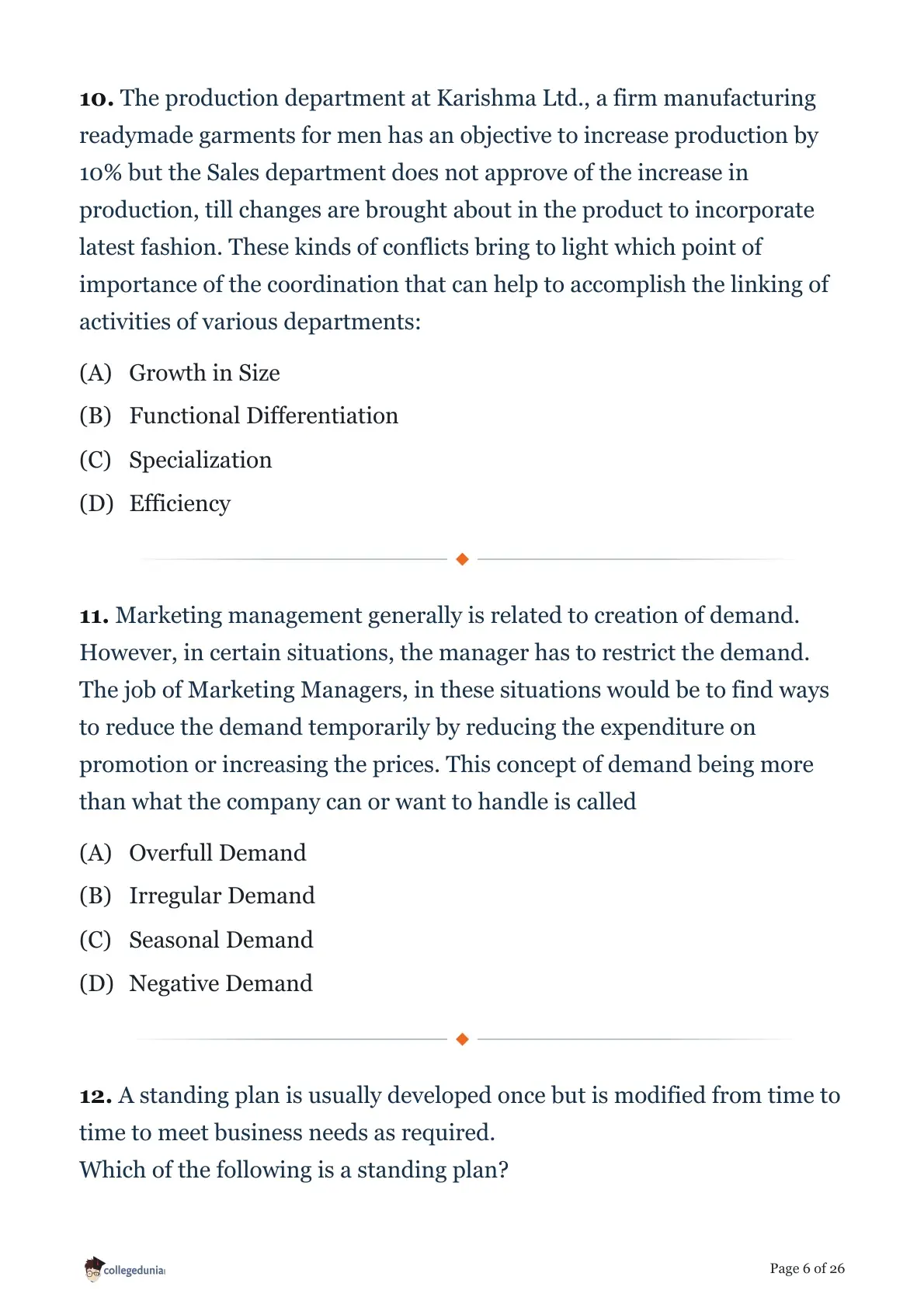
The production department at Karishma Ltd., a firm manufacturing readymade garments for men has an objective to increase production by 10% but the Sales department does not approve of the increase in production, till changes are brought about in the product to incorporate latest fashion. These kinds of conflicts bring to light which point of importance of the coordination that can help to accomplish the linking of activities of various departments:
View Solution
Step 1: Understanding the Question:Two departments have different aims and they conflict. The question asks which point of importance of coordination is shown by such conflict among departments.
Step 2: Key Concept:
The importance of coordination lies in growth in size, functional differentiation, and specialisation. Functional differentiation means each department works toward its own goals in its own way, which often leads to conflicts that coordination must resolve.
Step 3: Check option (A).
Growth in size means that as a firm grows, the number of people and levels rises, so coordination is needed to keep them together. The case is about two departments with different goals, not about size, so (A) is wrong.
Step 4: Check option (B).
Functional differentiation means departments develop their own aims, outlook and methods, so they may clash. Production wants more output while sales wants a changed product. This matches the case. So (B) is correct.
Step 5: Check option (C).
Specialisation means experts do specialised tasks and they need coordination. The case is not about expert skills, so (C) is wrong.
Step 6: Check option (D).
Efficiency is not listed among the points of importance of coordination in this form, and the case does not talk about efficiency. So (D) is wrong.
Final Answer:
The conflict between production and sales is due to functional differentiation, option 2. \[ \boxed{\text{Option 2}} \]
Marketing management generally is related to creation of demand. However, in certain situations, the manager has to restrict the demand. The job of Marketing Managers, in these situations would be to find ways to reduce the demand temporarily by reducing the expenditure on promotion or increasing the prices. This concept of demand being more than what the company can or want to handle is called
View Solution
Step 1: Understanding the Question:The text says demand is higher than the firm can or wants to handle, and the manager tries to cut it by lowering promotion or raising prices. We must name this state of demand.
Step 2: Key Concept:
Marketing management handles different demand states: negative, no, latent, falling, irregular, full, overfull and unwholesome demand. Overfull demand means the demand level is higher than the firm can or wants to meet. The remedy is demarketing.
Step 3: Check option (A).
Overfull demand means demand exceeds the capacity or wish of the firm, so demarketing through lower promotion and higher prices is used. This matches the text. So (A) is correct.
Step 4: Check option (B).
Irregular demand means demand varies from time to time, with peaks and slumps. The text does not talk about variation, so (B) is wrong.
Step 5: Check option (C).
Seasonal demand is irregular demand tied to seasons. The text gives no hint of a season, so (C) is wrong.
Step 6: Check option (D).
Negative demand means people dislike the product and may even pay to avoid it. Here the opposite is true, so (D) is wrong.
Final Answer:
The concept is overfull demand, option 1. \[ \boxed{\text{Option 1}} \]
A standing plan is usually developed once but is modified from time to time to meet business needs as required.
Which of the following is a standing plan?
View Solution
Step 1: Understanding the Question:A standing plan is made once and used again and again for repeated situations, with changes only when needed. We must pick the one among the four that is a standing plan.
Step 2: Key Concept:
Types of plans: objectives, strategy, policy, procedure, method, rule, programme, budget and project. Standing plans are used repeatedly, and they are policy, procedure, method and rule. Single use plans are programmes, budgets and projects.
Step 3: Check option (A).
A project is a one time plan with a fixed start and end. It is a single use plan, so (A) is wrong.
Step 4: Check option (B).
A budget is a statement of expected results in numbers for a particular period. It is prepared again for each period and counts as a single use plan, so (B) is wrong.
Step 5: Check option (C).
A strategy is a comprehensive plan for reaching long term goals and is shaped by the environment. It is not listed as a standing plan in the usual classification, so (C) is wrong.
Step 6: Check option (D).
A policy is a general guideline for decision making, framed once and followed in repeated situations. It is a standing plan, so (D) is correct.
Final Answer:
Policy is the standing plan in this list, option 4. \[ \boxed{\text{Option 4}} \]
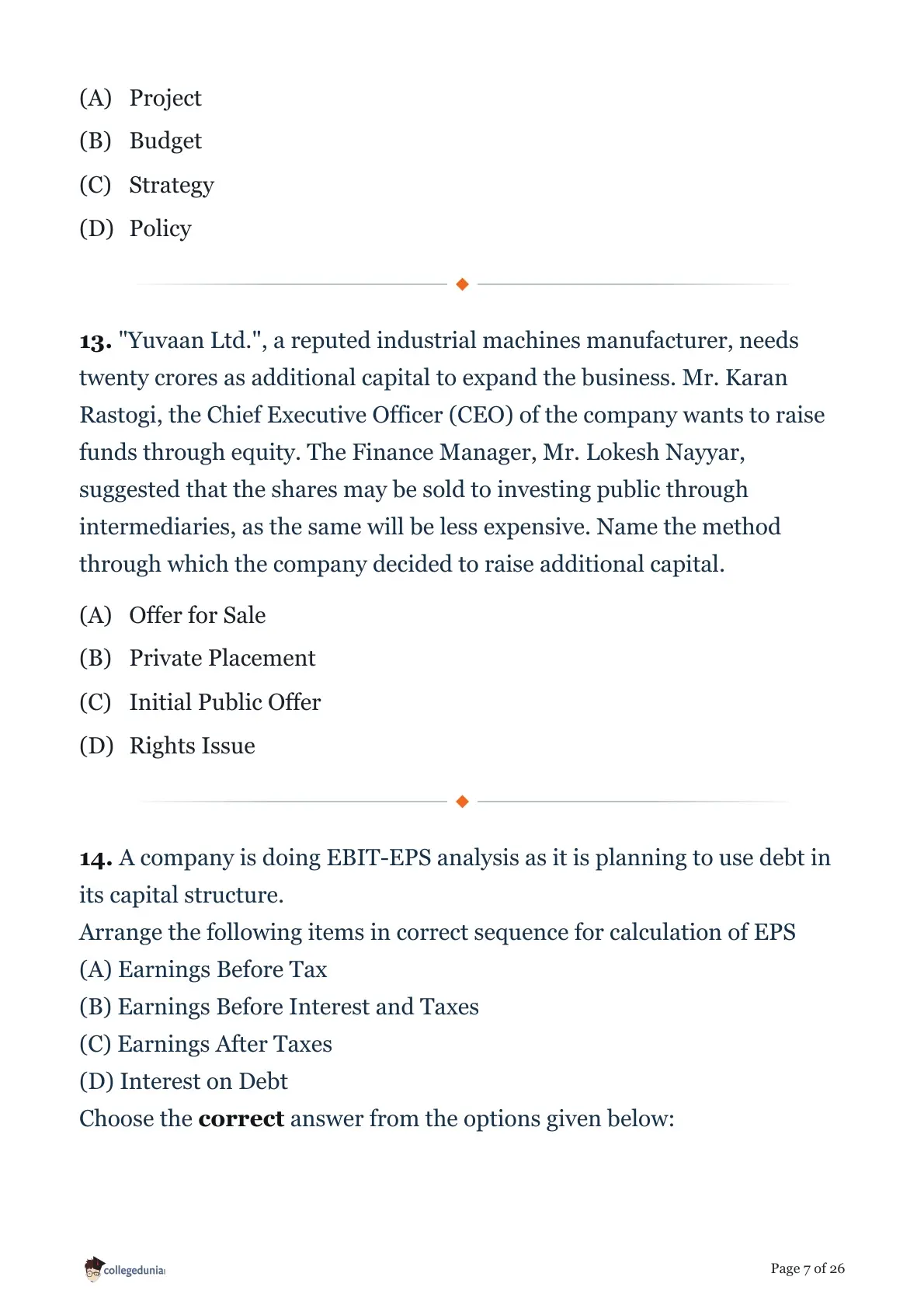
"Yuvaan Ltd.", a reputed industrial machines manufacturer, needs twenty crores as additional capital to expand the business. Mr. Karan Rastogi, the Chief Executive Officer (CEO) of the company wants to raise funds through equity. The Finance Manager, Mr. Lokesh Nayyar, suggested that the shares may be sold to investing public through intermediaries, as the same will be less expensive. Name the method through which the company decided to raise additional capital.
View Solution
Step 1: Understanding the Question:The company wants equity funds, and the finance manager says the shares should be sold to the investing public through intermediaries because that costs less. We must name the method.
Step 2: Key Concept:
Methods of floating a new issue in the primary market are: offer through prospectus (public issue, IPO), offer for sale, private placement, rights issue and e-IPOs. In offer for sale, the company sells shares in bulk to intermediaries such as issuing houses or brokers, who resell them to the public. It saves the cost and trouble of a direct public issue.
Step 3: Check option (A).
Offer for sale means shares are sold to the investing public through intermediaries, with no direct dealing by the company. It is cheaper than a direct public issue. This fits the case, so (A) is correct.
Step 4: Check option (B).
Private placement means shares are allotted to a few selected investors such as institutions or rich individuals. The case says the investing public, so (B) is wrong.
Step 5: Check option (C).
An initial public offer means the company itself invites the public to buy shares through a prospectus. The case says shares are sold through intermediaries, so (C) is wrong.
Step 6: Check option (D).
A rights issue gives the existing shareholders the first chance to buy new shares. The case does not talk about existing shareholders, so (D) is wrong.
Final Answer:
The method is offer for sale, option 1. \[ \boxed{\text{Option 1}} \]
A company is doing EBIT-EPS analysis as it is planning to use debt in its capital structure.
Arrange the following items in correct sequence for calculation of EPS
(A) Earnings Before Tax
(B) Earnings Before Interest and Taxes
(C) Earnings After Taxes
(D) Interest on Debt
Choose the correct answer from the options given below:
View Solution
Step 1: Understanding the Question:The question is about EBIT-EPS analysis. In this analysis we start from the operating profit of the company and move down step by step until we reach the profit that belongs to each equity share. We have to put the four given items in the order in which they appear in this calculation.
Step 2: Key Formula or Approach:
The usual layout is: EBIT, then less interest on debt, which gives EBT (earnings before tax), then less tax, which gives EAT (earnings after tax), and then EAT less preference dividend, divided by the number of equity shares, gives EPS.
Step 3: Detailed Explanation:
The first item is always EBIT, which is item (B), because it is the profit before any financing cost or tax.
The next deduction is interest on debt, item (D), because interest is paid before tax is worked out.
After deducting interest from EBIT we get earnings before tax, item (A).
After deducting tax from EBT we get earnings after tax, item (C). This figure is then divided by the number of shares to get EPS.
So the sequence is (B), (D), (A), (C).
Step 4: Check option 1:
The order (A), (B), (C), (D) starts with earnings before tax, but EBT can only be known after EBIT and interest are known. So option 1 is wrong.
Step 5: Check option 2:
The order (D), (C), (B), (A) starts with interest and ends with EBT. This reverses the real flow of profit, so option 2 is wrong.
Step 6: Check option 3:
The order (B), (C), (D), (A) puts earnings after tax before interest. But tax is calculated after interest is deducted, so option 3 is wrong.
Step 7: Check option 4:
The order (B), (D), (A), (C) matches the flow EBIT, interest, EBT, EAT. So option 4 is correct.
Final Answer:
The correct sequence is EBIT, interest, EBT, EAT, which is option 4. \[ \boxed{\text{(B), (D), (A), (C)}} \]
Identify which of the following is not a benefit derived by the customer on purchase of a product or a service.
View Solution
Step 1: Understanding the Question:We are asked to find the one item that a customer does not receive when buying a product or service. So three options are real benefits to the buyer and one is not.
Step 2: Key Idea:
In marketing, a customer buys a product for the value it gives. This value is of three kinds: functional (what the product does), psychological (how it makes the buyer feel) and social (how it helps the buyer in society).
Step 3: Check option 1:
Psychological benefits are things like pride, comfort and satisfaction from owning a brand. The buyer gets these, so option 1 is a customer benefit.
Step 4: Check option 2:
Functional benefits are the practical uses, such as a phone making calls or a car moving people. The buyer gets these, so option 2 is a customer benefit.
Step 5: Check option 3:
Social benefits are the status or acceptance a buyer gains from others by using a product. The buyer gets these, so option 3 is a customer benefit.
Step 6: Check option 4:
Marketing benefits are the gains a seller or firm gets from marketing, such as sales and brand recall. The customer does not get these. So option 4 is not a customer benefit and is the answer.
Final Answer:
Marketing benefits go to the firm, not the customer, so option 4 is correct. \[ \boxed{\text{Marketing benefits}} \]
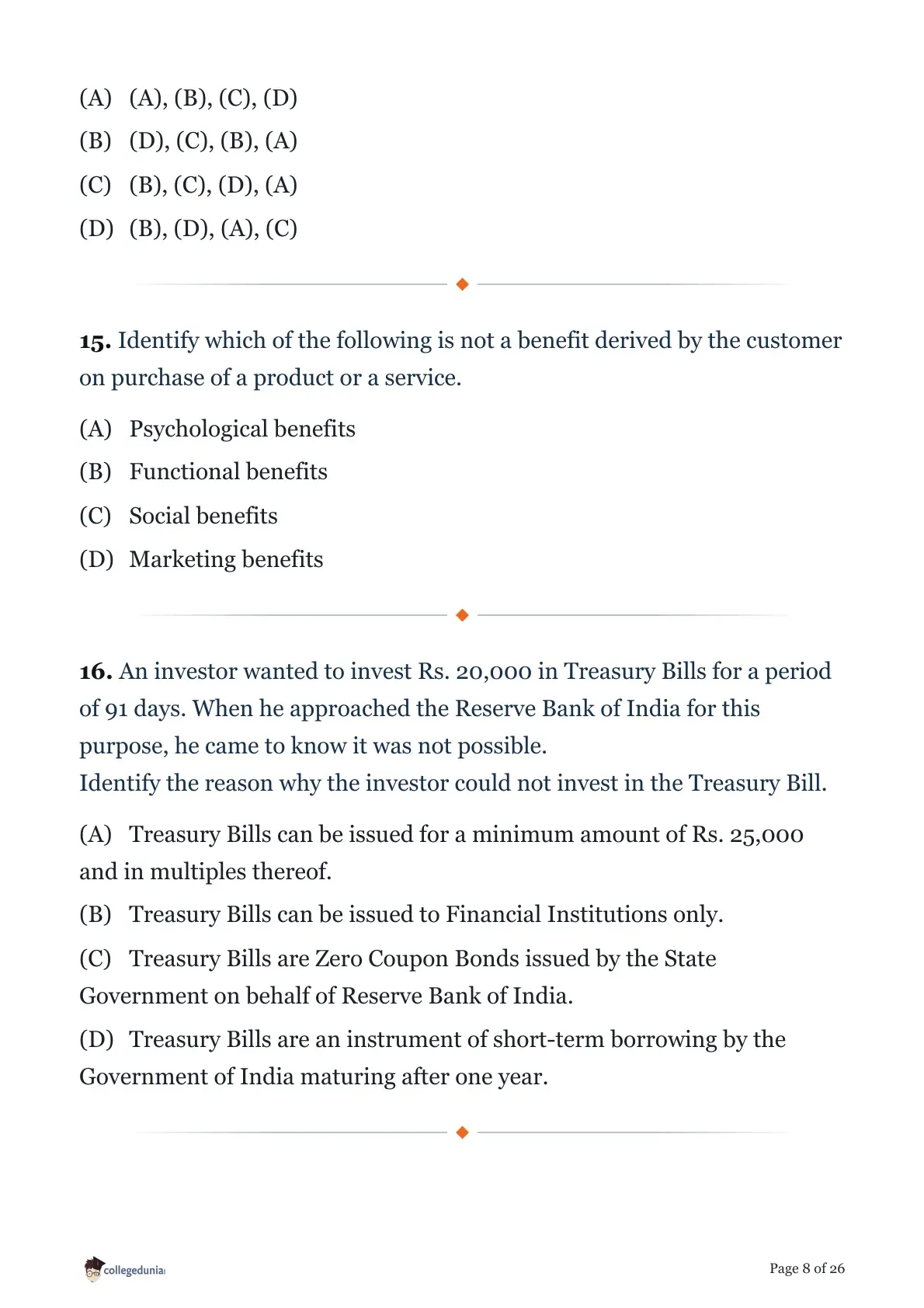
An investor wanted to invest Rs. 20,000 in Treasury Bills for a period of 91 days. When he approached the Reserve Bank of India for this purpose, he came to know it was not possible.
Identify the reason why the investor could not invest in the Treasury Bill.
View Solution
Step 1: Understanding the Question:An investor wants to put Rs. 20,000 in a 91-day Treasury Bill but the RBI says no. We need to find which fact about Treasury Bills explains this.
Step 2: Key Fact:
Treasury Bills are money market instruments issued by the Government of India through the RBI. They come in maturities of 91, 182 and 364 days. They are sold at a discount and repaid at face value. The minimum amount for a bid is Rs. 25,000 and then in multiples of Rs. 25,000.
Step 3: Detailed Explanation:
The investor offered Rs. 20,000. This is below the minimum of Rs. 25,000. So the investor was rejected only because of the minimum amount rule. The period of 91 days is a valid maturity, so that was not the problem.
Step 4: Check option 1:
This states the minimum Rs. 25,000 and multiples. It exactly explains why Rs. 20,000 is not allowed. So option 1 is correct.
Step 5: Check option 2:
Treasury Bills are open to individuals, firms, banks and institutions. So they are not for financial institutions only. Option 2 is wrong.
Step 6: Check option 3:
Treasury Bills are issued by the Central Government through the RBI, not by a State Government. They are indeed zero coupon, but the issuer is wrongly stated. Option 3 is wrong.
Step 7: Check option 4:
Treasury Bills mature in less than one year (up to 364 days), not after one year. Also, the investor wanted 91 days, which is allowed. Option 4 is wrong.
Final Answer:
The amount of Rs. 20,000 is below the minimum Rs. 25,000, so option 1 is the reason. \[ \boxed{\text{Option 1}} \]
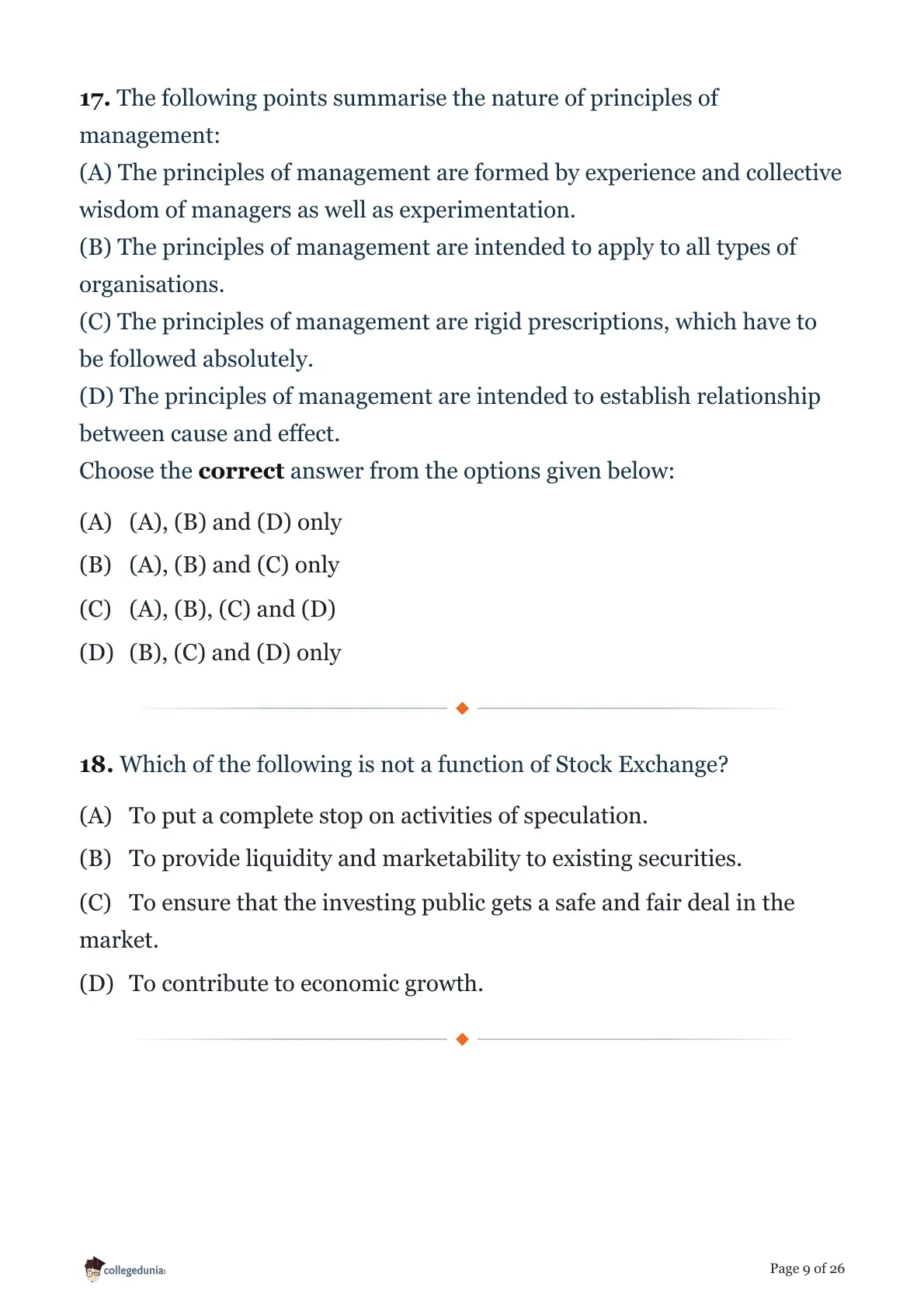
The following points summarise the nature of principles of management:
(A) The principles of management are formed by experience and collective wisdom of managers as well as experimentation.
(B) The principles of management are intended to apply to all types of organisations.
(C) The principles of management are rigid prescriptions, which have to be followed absolutely.
(D) The principles of management are intended to establish relationship between cause and effect.
Choose the correct answer from the options given below:
View Solution
Step 1: Understanding the Question:We must pick which of the four statements truly describe the nature of management principles. The answer options combine different statements.
Step 2: Key Idea:
Management principles are guidelines, not hard rules. They come from experience and experiments, apply to all kinds of organisations, are flexible, and show cause and effect relationships.
Step 3: Check statement (A):
Management principles are developed from the experience of managers and from experiments, so they are formed by observation and testing. So (A) is TRUE.
Step 4: Check statement (B):
The principles are universal in nature, which means they can be used in business, schools, hospitals and clubs alike. So (B) is TRUE.
Step 5: Check statement (C):
The principles are guidelines to action. They are flexible, and managers change them as the situation needs. They are not rigid rules that must be followed absolutely. So (C) is FALSE.
Step 6: Check statement (D):
The principles state how one action leads to a result, for example more division of work leads to more efficiency. So they establish cause and effect relationships. So (D) is TRUE.
Step 7: Match with the options:
The true statements are (A), (B) and (D). Option 1 lists exactly these. Options 2, 3 and 4 include (C), which is false, so they are wrong.
Final Answer:
Statements A, B and D are correct, and C is wrong, so the answer is option 1. \[ \boxed{\text{(A), (B) and (D) only}} \]
Which of the following is not a function of Stock Exchange?
View Solution
Step 1: Understanding the Question:We must find the statement that is not a real function of a stock exchange. Three options are genuine functions and one is not.
Step 2: Key Idea:
A stock exchange gives liquidity to shares, sets fair prices, protects investors, helps raise capital and supports growth. It also controls speculation so that it does not harm the market. But it can only regulate it, not remove it fully.
Step 3: Check option 1:
Speculation means buying and selling for short term gain on price moves. The exchange tries to keep it under control through rules, but it cannot put a complete stop on it. In fact some speculation adds to liquidity. So option 1 is not a function.
Step 4: Check option 2:
Giving liquidity and marketability means an investor can sell a share quickly. This is a main function of the exchange. So option 2 is a function.
Step 5: Check option 3:
The exchange makes rules and checks dealings so that investors are treated safely and fairly. This is a function. So option 3 is a function.
Step 6: Check option 4:
By helping firms raise capital and by pricing securities, the exchange helps the economy grow. This is a function. So option 4 is a function.
Final Answer:
Stopping speculation completely is not possible or a function, so option 1 is correct. \[ \boxed{\text{Option 1}} \]
Arrange the following steps of Planning process in order:
(A) Planning is concerned with the future which is uncertain and every planner is using conjecture about what might happen in future.
(B) An innovative course may be adopted by involving more people and sharing their ideas. If the project is important, then more alternatives should be generated and thoroughly discussed amongst the members of the organisation.
(C) Monitoring the plans is equally important to ensure that objectives are achieved.
(D) Every organization must have certain objectives. Objectives may be set for the entire organisation and each department or unit within the organisation.
Choose the correct answer from the options given below:
View Solution
Step 1: Understanding the Question:Each statement describes one step of the planning process. We must arrange the four steps in their right order.
Step 2: Key Idea:
The steps of planning are: setting objectives, developing premises, identifying alternative courses of action, evaluating alternatives, selecting an alternative, implementing the plan, and following up the action.
Step 3: Identify each statement:
Statement (D) is about objectives, so it is setting objectives. Statement (A) is about the uncertain future and assumptions, so it is developing premises. Statement (B) is about generating and discussing alternatives, so it is identifying alternative courses of action. Statement (C) is about monitoring, so it is follow-up.
Step 4: Put them in order:
Objectives come first, then premises, then alternatives, and monitoring comes last. So the order is (D), (A), (B), (C).
Step 5: Check option 1:
(D), (B), (C), (A) puts monitoring before the premises. Monitoring cannot come before the plan is made. Option 1 is wrong.
Step 6: Check option 2:
(D), (A), (B), (C) matches the correct flow. Option 2 is right.
Step 7: Check option 3:
(A), (D), (B), (C) starts with premises, but premises are built around known objectives. Option 3 is wrong.
Step 8: Check option 4:
(C), (B), (D), (A) starts with monitoring and ends with premises. This is the reverse of the real order. Option 4 is wrong.
Final Answer:
The correct order is objectives, premises, alternatives, follow-up, which is option 2. \[ \boxed{\text{(D), (A), (B), (C)}} \]
Which of the following is an Off the Job Training method?
View Solution
Step 1: Understanding the Question:We must find which listed method is given away from the actual workplace, which is called off the job training.
Step 2: Key Idea:
On the job methods train the worker at the place of work while doing work. These include coaching, demonstration, apprenticeship and job rotation. Off the job methods take the worker away from the work place, such as classroom lectures, films, case studies, vestibule training and programmed instruction.
Step 3: Check option 1:
Apprenticeship programmes combine learning with real work under an expert. This is on the job. So option 1 is wrong.
Step 4: Check option 2:
Coaching is when a superior guides a worker at the work place. This is on the job. So option 2 is wrong.
Step 5: Check option 3:
Programmed instruction breaks learning into small units that the learner studies in a set sequence using books or computers, away from real work. This is off the job. So option 3 is correct.
Step 6: Check option 4:
Internship training places a student in a firm to learn while working. This is on the job. So option 4 is wrong.
Final Answer:
Programmed instruction is the off the job method, so option 3 is correct. \[ \boxed{\text{Programmed Instruction}} \]
Mrs. Mathur sent her servant to the Chemist for purchasing medicine which she found was expired. On approaching the chemist, he accepted that medicine has expired.
Which right has been exercised by Mrs. Mathur?
View Solution
Step 1: Understanding the Question:Mrs. Mathur found that the medicine she bought had expired and went back to the chemist, who admitted it. We must name the consumer right she used.
Step 2: Check option (1) Right to be Heard:
By going to the chemist and raising the problem, she was making her complaint heard. This is accepted by the NTA key.
Step 3: Check option (2) Right to Seek Redressal:
Redressal means asking for compensation or a remedy through a forum. She has only raised the matter with the seller, so this is not accepted by the key.
Step 4: Check option (3) Right to be Informed:
The chemist failed to give correct information about the expiry of the product, and she found it out for herself. This is accepted by the NTA key.
Step 5: Check option (4) Right to Consumer Education:
This right is about gaining knowledge and skills as a consumer. It is not the right used here.
Final Answer:
The NTA final answer key accepts both option 1 (Right to be Heard) and option 3 (Right to be Informed) for this question. Option 3 is recorded here as the answer. \[ \boxed{\text{Right to be Informed}} \]
Arrange the following in the correct order of the working of the Demat System.
(A) An account opening form and documentation (PAN card details, photograph, power of attorney) may be completed.
(B) If shares are applied in a public offer, simple details of DP and demat account are to be given and the shares on allotment would automatically be credited to the demat account.
(C) The physical certificate is to be given to the DP along with a dematerialization request form.
(D) A Depository Participant (DP), either a bank, broker, or financial services company, may be identified.
Choose the correct answer from the options given below:
View Solution
Step 1: Understanding the Question:We must put four stages of using a demat system in the right order.
The stages are choosing a DP, opening an account, converting paper shares and receiving new shares directly.
Step 2: Key Formula or Approach:
Think of it like opening a bank account. First you pick the bank, then you open the account, then you deposit what you own, and only then can money (or shares) come in.
Step 3: Finding the First Step:
You cannot open a demat account without a Depository Participant (DP). So (D), identifying the DP, comes first.
(B) and (C) need an existing account, so they cannot come first.
Step 4: Finding the Second Step:
After picking the DP, you fill the account opening form with PAN details, photograph and power of attorney. This is (A).
Step 5: Finding the Third Step:
Once the account exists, you can hand over old physical share certificates with a dematerialization request form. This is (C).
Step 6: Finding the Last Step:
With a working account, new shares from a public offer can be credited straight into it. This is (B).
Step 7: Check the Options:
Option 1 starts with (A), which skips choosing the DP, so it is wrong.
Option 2 puts (C) before (A), but there is no account yet to receive converted shares, so it is wrong.
Option 3 starts with (B), which needs a ready account, so it is wrong.
Option 4 gives (D), (A), (C), (B), which matches our order, so it is right.
Final Answer:
The correct order is (D), (A), (C), (B). This is option 4. \[ \boxed{\text{Option 4}} \]
Packaging has acquired great significance in the marketing of goods and services, because of following reasons:
(A) Because of the increasing standards of living in the country.
(B) Because the self-service retail outlets are becoming very popular.
(C) Because it helps in creating product differentiation.
(D) Because it describes the product and specifies its contents.
Choose the correct answer from the options given below:
View Solution
Step 1: Understanding the Question:We need the reasons that explain why packaging has become important in marketing.
Four statements are given and we must pick the right three.
Step 2: Key Formula or Approach:
The usual reasons given for the importance of packaging are: rising standards of living, growth of self-service outlets, product differentiation, and the chance to innovate.
Describing the product and its contents is a different function. It is done by labelling, not packaging.
Step 3: Statement (A):
As incomes rise, people want better looking and safer packs. So (A) is a true reason.
Step 4: Statement (B):
In self-service shops there is no salesperson, so the pack must attract and inform the buyer. So (B) is a true reason.
Step 5: Statement (C):
A distinct pack makes one brand look different from its rivals. So (C) is a true reason.
Step 6: Statement (D):
Giving the product details and contents is the job of the label. A label may sit on the pack, but it is a separate function. So (D) is not counted as a reason for packaging.
Step 7: Check the Options:
Option 1 and option 4 include (D), so both are wrong.
Option 2 includes (D) and leaves out (C), so it is wrong.
Option 3 has (A), (B) and (C), so it is right.
Final Answer:
The correct reasons are (A), (B) and (C). This is option 3. \[ \boxed{\text{Option 3}} \]
Decentralization should be applied with caution as .
View Solution
Step 1: Understanding the Question:Decentralisation means spreading decision making power to lower levels of the organisation.
We need the reason why it must be used with care.
Step 2: Key Formula or Approach:
Every benefit of decentralisation, such as quick decisions and more initiative, also carries the risk of losing control from the centre.
Step 3: Option 1:
If each department follows its own rules, they may pull in different directions and harm the whole organisation.
This is the real risk, so option 1 is right.
Step 4: Option 2:
Employees usually welcome more authority, because it raises their motivation. So this is not the reason.
Step 5: Option 3:
Decentralisation reduces the load on top management, because they hand over routine decisions. So this option is the opposite of the truth.
Step 6: Option 4:
Decentralisation increases autonomy of lower levels. So this option is also the opposite of the truth.
Final Answer:
The caution is the risk of departments drifting away from the aims of the whole firm. This is option 1. \[ \boxed{\text{Option 1}} \]
"In Japanese companies, paternalistic style of management is in practice. If at all workers go to strike they wear a black badge but work more than normal working hours to gain the sympathy of the management."
Identify the principle of Taylor highlighted in the above lines.
View Solution
Step 1: Understanding the Question:The lines say that Japanese workers do not fight with management. Even during a protest they work extra hours.
We must match this with one of Taylor's four principles.
Step 2: Key Formula or Approach:
Taylor's principles are: science not rule of thumb, harmony not discord, cooperation not individualism, and development of each person to greatest efficiency.
Step 3: Option 1:
This principle asks for fixed scientific methods in place of guesswork. The lines say nothing about methods, so it is wrong.
Step 4: Option 2:
This principle asks for a friendly relation between workers and management in place of conflict.
The workers avoid open conflict and even show sympathy for management, so this fits well.
Step 5: Option 3:
This principle is about working together as a team instead of each person working only for himself, and about not restricting output.
The lines are about the mood between workers and management, not about team output, so it fits less well.
Step 6: Option 4:
This principle is about selecting and training workers. The lines do not mention training, so it is wrong.
Final Answer:
The lines show a peaceful, caring relation between workers and management. This is harmony, not discord, option 2. \[ \boxed{\text{Option 2}} \]
Which of the following is not a component of economic environment?
View Solution
Step 1: Understanding the Question:The economic environment covers the economic factors that affect a business, such as the type of economy, output trends and infrastructure.
We must find the one that is not an economic factor.
Step 2: Key Formula or Approach:
Economic factors are about money, production, markets and infrastructure.
Attitudes, lifestyles and preferences are about people and society.
Step 3: Option 1:
The role of the private and public sectors describes the structure of the economy. It is an economic component, so it is not the answer.
Step 4: Option 2:
Farm and factory production trends show how the economy is growing. It is an economic component, so it is not the answer.
Step 5: Option 3:
Attitudes to new products, lifestyles, job patterns and consumer preferences describe the way people live and think. This belongs to the social environment, so this is the answer.
Step 6: Option 4:
Transport and communication growth is part of economic infrastructure. It is an economic component, so it is not the answer.
Final Answer:
Option 3 is a social factor, so it is not part of the economic environment. \[ \boxed{\text{Option 3}} \]
Match List-I with List-II
| List-I Steps in selection process | List-II Description of Steps |
|---|---|
| (A) Reference Checks | (I) Elimination of unqualified or unfit job seekers based on the information supplied in the application forms. |
| (B) Contract of Employment | (II) Generally contains a date by which the appointee must report on duty. |
| (C) Preliminary Screening | (III) For verifying information and gaining additional information of an applicant. |
| (D) Job Offer | (IV) It includes job title, duties, responsibilities, rates of pay, allowances, hours of work, leave rules, sickness, etc. |
View Solution
Step 1: Understanding the Question:We must match four steps of the selection process with their descriptions.
Step 2: Key Formula or Approach:
Selection runs in this order: preliminary screening, tests, interview, reference and background checks, selection decision, medical exam, job offer, contract of employment.
We match each step with the description that fits its purpose.
Step 3: Match (A) Reference Checks:
Employers call the persons named by the candidate to confirm facts and learn more. This is (III).
Step 4: Match (B) Contract of Employment:
This is a written agreement listing job title, duties, pay, allowances, working hours and leave rules. This is (IV).
Step 5: Match (C) Preliminary Screening:
This is the first filter, which removes unfit applicants using the application form. This is (I).
Step 6: Match (D) Job Offer:
The offer letter is sent to the chosen candidate and usually states the date to report on duty. This is (II).
Step 7: Check the Options:
The set (A)-(III), (B)-(IV), (C)-(I), (D)-(II) is only in option 4.
Options 1, 2 and 3 each get at least one pair wrong, for example option 1 pairs reference checks with screening.
Final Answer:
The matches are A-III, B-IV, C-I and D-II. This is option 4. \[ \boxed{\text{Option 4}} \]
In today's scenario, organizations look for individuals with specific qualifications and experience to manage them. What does the above statement imply?
View Solution
Step 1: Understand the question.The statement says that organisations now want managers who have specific qualifications and experience. We must match this idea with one of the nature-of-management ideas: science, art or profession.
So the clue to look for is the need for formal education and training.
Step 2: Recall the features of a profession.
A profession has a well-defined body of knowledge, restricted entry based on an examination or a degree, formal training, a code of conduct and a service motive.
Specific qualifications and experience as an entry requirement point to the 'restricted entry' and 'formal education' features.
Step 3: Check option (1), Management as a Science.
Science means a systematic body of knowledge based on cause and effect and tested by experiments. The statement does not talk about principles or experiments. It talks about the people who manage. So option (1) does not fit.
Step 4: Check option (2), Management as an Art.
Art means the personal skill and creativity used to apply knowledge in practice. The statement does not stress personal skill or creativity. It stresses qualifications. So option (2) does not fit.
Step 5: Check option (3), Management as a Profession.
Requiring a particular qualification and experience before a person can manage is exactly what happens in a profession such as medicine or law. So option (3) fits the statement.
Step 6: Check option (4), both Art and Science.
This option says management has both art and science features. It is a true general idea, but the given lines carry no clue about knowledge principles or personal skill. So option (4) is not the best match.
Final Answer:
The need for specific qualifications and experience shows that management is treated as a profession. This is option (3). \[ \boxed{\text{Management as a Profession (Option 3)}} \]
Match List-I with List-II
| List-I Techniques of Scientific Management | List-II Description |
|---|---|
| (A) Method Study | (I) Standard time taken to perform a well-defined job. |
| (B) Motion Study | (II) Study of movements like lifting, putting objects, sitting and changing positions, etc., |
| (C) Fatigue Study | (III) Minimise the cost of production and maximise the quality and satisfaction of the customer. |
| (D) Time Study | (IV) Determines the amount and frequency of rest intervals in completing a task. |
View Solution
Step 1: Understand the task.We must match four techniques of Scientific Management, given by F. W. Taylor, with their descriptions. Each technique has one clear purpose, so we match them one by one.
Step 2: Match Method Study (A).
Method study looks for the one best way of doing a job. Its aim is to cut the cost of production and raise the quality and the customer's satisfaction. So (A) matches (III).
Step 3: Match Motion Study (B).
Motion study looks at the movements a worker makes while doing a job, such as lifting, putting things down, sitting and changing position. It removes the useless movements. So (B) matches (II).
Step 4: Match Fatigue Study (C).
Fatigue study finds how long and how often a worker needs rest so that tiredness does not reduce output. So (C) matches (IV).
Step 5: Match Time Study (D).
Time study measures the standard time a well-defined job should take, using a stopwatch. So (D) matches (I).
Step 6: Compare with the options.
We have A-III, B-II, C-IV, D-I. Option (1) gives A-I, so it is wrong. Option (3) gives B-I and D-II, so it is wrong. Option (4) gives B-IV and C-II, so it is wrong. Only option (2) has all four pairs right.
Final Answer:
The correct matching is A-III, B-II, C-IV and D-I, which is option (2). \[ \boxed{\text{Option 2: (A)-(III), (B)-(II), (C)-(IV), (D)-(I)}} \]
Arrange the following as per Maslow's hierarchy of needs:
(A) It refers to the drive to become what one is capable of becoming.
(B) Hunger, thirst, shelter, and sleep are some examples of these needs.
(C) Job security, stability of income, Pension plans etc.
(D) These include factors such as self-respect, autonomy status, recognition and attention.
Choose the correct answer from the options given below:
View Solution
Step 1: Recall the hierarchy.Maslow gave five levels of needs, from the lowest to the highest: basic physical (physiological) needs, safety and security needs, affiliation or belonging needs, esteem needs and self-actualisation needs. A person tries to meet a lower need before moving up.
Step 2: Identify statement (A).
The drive to become what one is capable of becoming is self-actualisation. It is the top level of the hierarchy.
Step 3: Identify statement (B).
Hunger, thirst, shelter and sleep are the basic physical needs. They are the first and lowest level.
Step 4: Identify statement (C).
Job security, a stable income and pension plans are safety and security needs. They are the second level.
Step 5: Identify statement (D).
Self-respect, status, recognition and attention are esteem needs. They are the fourth level, below self-actualisation.
Step 6: Arrange in order.
The order from lowest to highest is (B) basic, (C) safety, (D) esteem, (A) self-actualisation. This is option (3). Option (1) puts self-actualisation first, which is the reverse. Option (2) and option (4) mix the order of safety and esteem needs.
Final Answer:
The correct order is B, C, D, A, which is option (3). \[ \boxed{\text{Option 3: (B), (C), (D), (A)}} \]
Though advertising is one of the most frequently used medium of promotion of goods and services, it attracts lot of criticism. Identify various criticisms of Advertising:
(A) Undermines Social Values
(B) Encourages Sale of Inferior Products
(C) Confuses the Buyers
(D) Flexible Tool
Choose the correct answer from the options given below:
View Solution
Step 1: Understand the question.We are asked to pick which of the four points are criticisms of advertising. So we must separate the points that are objections from the points that are merits.
Step 2: Check (A), Undermines Social Values.
Critics say that many advertisements promote materialism, show unreal lifestyles and sometimes go against social values and customs. So (A) is a criticism.
Step 3: Check (B), Encourages Sale of Inferior Products.
Advertising can make people buy poor quality goods by making them look attractive. Critics also say it hides the low quality. So (B) is a criticism.
Step 4: Check (C), Confuses the Buyers.
Too many ads for similar products with different claims make it hard for buyers to choose. This is a standard objection. So (C) is a criticism.
Step 5: Check (D), Flexible Tool.
Advertising can be used in many media and can be changed to suit the product, the audience and the budget. This is a merit of advertising, not a criticism. So (D) is not a criticism.
Step 6: Pick the option.
The criticisms are A, B and C only. That is option (1). Options (2), (3) and (4) all include (D), so they are wrong.
Final Answer:
Points A, B and C are criticisms of advertising and D is a merit, so option (1) is correct. \[ \boxed{\text{Option 1: (A), (B) and (C) only}} \]
"In an organisation, a well-defined plan is drawn up with specific goals to be achieved within a specific time frame. These plans then decide the future course of action and managers may not be in a position to change it. Following a pre-decided plan, when circumstances have changed, it may not turn out to be in the organisations interest".
The above statement reflects which limitation of planning?
View Solution
Step 1: Understand the statement.The statement says a plan is fixed with goals and a time frame. After that the managers may not be able to change it, even if the situation changes. We must pick the limitation of planning that describes this.
Step 2: Find the central idea.
The central idea is that the plan cannot be changed easily once it is made. A plan that cannot be changed is stiff, or rigid. In the textbook this limitation is named 'planning leads to rigidity'.
Step 3: Check option (1).
Planning being time-consuming means a lot of time is spent in collecting data and in making the plan. The statement does not talk about the time spent on making the plan. So option (1) is wrong.
Step 4: Check option (2).
Planning leads to rigidity means that a plan, once made, is followed even when it should be changed, since managers feel bound to it. This matches the statement closely. So option (2) is right.
Step 5: Check option (3).
Planning may not work in a dynamic environment means that forecasts fail when the business environment changes fast. The statement mentions changed circumstances, so this option looks close. But the focus of the statement is that managers are not able to change the plan, which is rigidity. So option (3) is the common wrong choice.
Step 6: Check option (4).
Planning reduces creativity means that managers only follow the plan and do not try new ideas. The statement is about changing course, not about new ideas. So option (4) is wrong.
Final Answer:
The statement stresses that a fixed plan cannot be changed, which is the rigidity limitation. This is option (2). \[ \boxed{\text{Option 2: Planning leads to rigidity}} \]
Which of the following statement is true?
View Solution
Step 1: Understand the question.We must find the one true statement about pricing objectives and promotion. Each option is a separate claim, so we test them one by one.
Step 2: Check option (1).
A firm that wants to be the quality leader has high costs for good materials and research. So it normally charges higher prices, not lower ones. Option (1) is false.
Step 3: Check option (2).
Free samples, discounts and contests are tools of sales promotion, not public regulation. Also, sales promotion tools may be aimed at dealers and sales staff too, not only customers. Option (2) is false.
Step 4: Check option (3).
In the long run, a firm that wants maximum profit does not simply charge the highest price. A very high price loses customers. Maximum current profit is a different objective. So option (3) is false.
Step 5: Check option (4).
A firm that wants the largest market share sets low prices to attract many buyers and to sell in large volume. This is the penetration approach. So option (4) is true.
Step 6: Conclude.
Only option (4) is a true statement.
Final Answer:
The firm chasing market share leadership keeps its prices low, so option (4) is the true statement. \[ \boxed{\text{Option 4}} \]
"The aim of a manager is to reduce costs and increase productivity through better planning, organising, directing, staffing and controlling the activities of the organization". The statement highlights which point of importance of management?
View Solution
Step 1: Understand the question.The statement says that the manager wants to cut costs and raise productivity by using the functions of management well. We need to find which importance point this describes.
Step 2: Recall the importance points.
The usual points are: management achieves group goals, increases efficiency, creates a dynamic organisation, helps achieve personal objectives and helps develop society.
Step 3: Check option (1).
Efficiency means getting the most output for the least input. Lower costs and higher productivity are exactly this idea. So option (1) fits.
Step 4: Check option (2).
Personal objectives are about employees meeting their own needs, such as pay and growth. The statement does not talk about employees' own aims. So option (2) is wrong.
Step 5: Check option (3).
A dynamic organisation means the organisation can adapt to a changing environment. The statement does not talk about change. So option (3) is wrong.
Step 6: Check option (4).
Group goals mean bringing individual efforts together to reach the common aim of the organisation. The statement talks about cost and productivity, not about common goals. So option (4) is wrong.
Final Answer:
Reducing costs and raising productivity is increased efficiency, so option (1) is correct. \[ \boxed{\text{Option 1: Management increases efficiency}} \]
"It refers to the number of subordinates that can be effectively managed by a superior. This determines the levels of management in the structure."
Identify the concept of organization structure discussed in the above lines.
View Solution
Step 1: Understanding the Concept:The question gives a short description and asks for the matching term from organising. The key phrase is 'number of subordinates that can be effectively managed by a superior'.
Step 2: Key Formula or Approach:
The number of people who report directly to one manager is called the span of management, or span of control.
A wide span means fewer levels in the hierarchy. A narrow span means more levels.
Step 3: Check option 1:
Span of Management means the number of subordinates one superior can manage well. Because it decides how many levels there are, it fits both sentences of the statement. So option 1 is CORRECT.
Step 4: Check option 2:
Functional Structure groups jobs by function such as production, marketing and finance. It is a way to form departments and is not about the count of subordinates. So option 2 is WRONG.
Step 5: Check option 3:
Divisional Structure groups work by product or market, with each division working like a small unit. It does not define the number of subordinates under one manager. So option 3 is WRONG.
Step 6: Check option 4:
Departmentalisation means grouping similar activities into departments. It decides how the work is divided, not how many subordinates one superior handles. So option 4 is WRONG.
Final Answer:
The lines describe the span of management, option 1. \[ \boxed{\text{Option 1: Span of Management}} \]
It has been made compulsory to settle all trades within 2 days of the trade, i.e. on a T+2 basis, since 2003. Prior to the reforms, the securities were traded and all positions in the stock market were settled on a settlement cycle whether it was delivery of securities or payment of cash.
View Solution
Step 1: Understanding the Concept:This question is from the chapter on financial markets. It is about the settlement cycle in the stock market, which is the time allowed to complete the delivery of shares and the payment of money after a trade.
Step 2: Key Formula or Approach:
Before the reforms of the 1990s, Indian exchanges used an account period settlement. All trades made in a week or in a fortnight were settled together at the end of that period.
After the reforms, rolling settlement was brought in. It moved to T+3, then T+2 from 2003.
Step 3: Check option 1:
Weekly / fortnightly. This matches the old account period system, where trades of a week or two were settled together. So option 1 is CORRECT.
Step 4: Check option 2:
Daily. Settling every trade on the same day is not what happened earlier. Rolling settlement was a later change and was not a daily cycle. So option 2 is WRONG.
Step 5: Check option 3:
T+4 days. India never used a four-day rolling cycle on the way to T+2. So option 3 is WRONG.
Step 6: Check option 4:
T+3 days. T+3 was a step in the rolling settlement that came after the old system, and it was itself part of the reform. The question asks about the time before the reforms. So option 4 is WRONG.
Final Answer:
Before the reforms, trades were settled on a weekly or fortnightly cycle, option 1. \[ \boxed{\text{Option 1: Weekly / fortnightly}} \]
Match List-I with List-II
| List-I | List-II |
|---|---|
| (Concepts) | (Meaning) |
| (A) Responsibility | (I) Granting of authority to subordinates to operate within prescribed limits. |
| (B) Accountability | (II) Being answerable for the final outcome. |
| (C) Delegation | (III) The obligation of a subordinate to properly perform the assigned duty. |
| (D) Centralisation | (IV) Decision-making authority is retained by higher management levels. |
View Solution
Step 1: Understanding the Concept:This is a matching question on the organising chapter. It uses four terms, which are responsibility, accountability, delegation and centralisation. Each term has to be joined with its meaning.
Step 2: Key Formula or Approach:
Learn the four meanings in plain words.
Responsibility is the duty to do the assigned job.
Accountability is the duty to answer for the result.
Delegation is handing authority down to subordinates.
Centralisation is keeping the decision power at the top.
Step 3: Match (A) Responsibility:
Responsibility is the duty of a subordinate to do the assigned work properly. This is meaning (III). So A goes with III.
Step 4: Match (B) Accountability:
Accountability means being answerable for the final outcome. This is meaning (II). So B goes with II.
Step 5: Match (C) Delegation:
Delegation means giving authority to subordinates so that they can work within prescribed limits. This is meaning (I). So C goes with I.
Step 6: Match (D) Centralisation:
Centralisation means decision-making authority stays with higher management. This is meaning (IV). So D goes with IV.
Step 7: Compare with the options:
Our pairs are A-III, B-II, C-I and D-IV.
Option 1 starts with A-I, which is wrong.
Option 2 is A-III, B-II, C-I, D-IV, which is exactly our result.
Option 3 starts with A-I, which is wrong.
Option 4 has B-IV, which is wrong.
Final Answer:
The correct match is A-III, B-II, C-I and D-IV, which is option 2. \[ \boxed{\text{Option 2: (A)-(III), (B)-(II), (C)-(I), (D)-(IV)}} \]
Match List-I with List-II
| List-I | List-II |
|---|---|
| (Standards to gauge performance) | (Functional areas of Business) |
| (A) Sales volume, sales expense, advertising expenditure, individual sales performance, etc. | (I) Production |
| (B) Labour turnover, labour relations, labor absenteeism, etc. | (II) Finance and Accounting |
| (C) Quantity, quality, cost, individual job performance, etc. | (III) Human Resource Management |
| (D) Flow of capital, capital expenditure, inventories, liquidity, etc. | (IV) Marketing |
View Solution
Step 1: Understanding the Concept:In the controlling chapter, a manager sets standards of performance for each functional area of the business. This question asks us to join each set of standards with its area.
Step 2: Key Formula or Approach:
Ask which department would measure each item. Sales and advertising belong to the marketing department. Labour turnover and absenteeism belong to human resources. Quantity, quality and cost of output belong to production. Capital flow and liquidity belong to finance.
Step 3: Match (A):
Sales volume, sales expense, advertising expenditure and individual sales performance are all marketing measures. So A goes with (IV) Marketing.
Step 4: Match (B):
Labour turnover, labour relations and absenteeism are about the workforce. These are standards of Human Resource Management. So B goes with (III).
Step 5: Match (C):
Quantity, quality, cost and individual job performance are measured on the shop floor. These are standards of Production. So C goes with (I).
Step 6: Match (D):
Flow of capital, capital expenditure, inventories and liquidity are money matters. These are standards of Finance and Accounting. So D goes with (II).
Step 7: Compare with the options:
Our result is A-IV, B-III, C-I, D-II.
Option 1 gives A-I, which is wrong.
Option 2 gives A-II, which is wrong.
Option 3 is A-IV, B-III, C-I, D-II, which is exactly ours.
Option 4 gives A-III, which is wrong.
Final Answer:
The right pairs are A-IV, B-III, C-I and D-II, which is option 3. \[ \boxed{\text{Option 3: (A)-(IV), (B)-(III), (C)-(I), (D)-(II)}} \]
FSSAI (Food Safety and Standards authority of India) has made a proposal for hotels and other food outlets to declare the kind of oil/fat used in cooking each of the food items on their menus. The Consumer Right being reinforced by this proposal is .
View Solution
Step 1: Understanding the Concept:The Consumer Protection Act gives consumers a set of rights. The question gives a real example and asks which right it supports.
Step 2: Key Formula or Approach:
Look at what the proposal asks hotels to do. They must declare the kind of oil or fat used in each dish. This gives the customer facts about the product before buying.
The right that deals with facts about quality, quantity, content and price is the right to be informed.
Step 3: Check option 1:
Right to be Informed means the consumer should be told the details of what is sold. A menu that states the oil or fat used does just that. So option 1 is CORRECT.
Step 4: Check option 2:
Right to Consumer Education means getting the knowledge and skills to be a smart consumer, such as through awareness campaigns. The proposal is not teaching anyone. So option 2 is WRONG.
Step 5: Check option 3:
Right to Seek Redressal means getting relief when a consumer has been wronged, for example a refund or compensation. No complaint is involved here. So option 3 is WRONG.
Step 6: Check option 4:
Right to be Heard means the consumer's views get proper attention at the right forums. The proposal does not ask for opinions. So option 4 is WRONG.
Final Answer:
Declaring the oil or fat used gives customers facts, so the right reinforced is the right to be informed, option 1. \[ \boxed{\text{Option 1: Right to be Informed}} \]
Match List-I with List-II
| List-I | List-II |
|---|---|
| (What can be marketed) | (Category) |
| (A) Events | (I) Family Planning |
| (B) Services | (II) Udaipur - 'The City of Lakes' |
| (C) Ideas | (III) Fashion Show |
| (D) Place | (IV) Online Trading |
View Solution
Step 1: Understanding the Concept:In the marketing chapter, we learn that many things can be marketed, not just goods. The main types are events, services, ideas, places, persons, goods and so on. This question asks us to give an example for each type.
Step 2: Key Formula or Approach:
For each type in List-I, pick the example in List-II that belongs to it.
An event is something that happens at a set time. A service is an activity done for a customer. An idea is a social thought or message. A place is a location promoted to visitors.
Step 3: Match (A) Events:
A fashion show is an event arranged for an audience at a set time. So A goes with (III).
Step 4: Match (B) Services:
Online trading is a service given by a broker or platform to investors. So B goes with (IV).
Step 5: Match (C) Ideas:
Family planning is a social idea promoted through campaigns to change how people think. So C goes with (I).
Step 6: Match (D) Place:
Udaipur, 'The City of Lakes', is a place promoted for tourists. So D goes with (II).
Step 7: Compare with the options:
Our result is A-III, B-IV, C-I, D-II.
Option 1 gives A-I, which is wrong.
Option 2 gives A-I, which is wrong.
Option 3 gives A-I, which is wrong.
Option 4 is A-III, B-IV, C-I, D-II, which is exactly ours.
Final Answer:
The right pairs are A-III, B-IV, C-I and D-II, which is option 4. \[ \boxed{\text{Option 4: (A)-(III), (B)-(IV), (C)-(I), (D)-(II)}} \]

"She was very enthusiastic and approached a Financial Consultant, who told her that approximately Rs. 50 lakhs would be required for undertaking the modernization and expansion programme." Identify the concept of Financial Management which helped in deciding the quantum of finance required.
View Solution
Step 1: Understanding the Question:The quoted line says the consultant estimated about Rs. 50 lakhs for the modernization plan. We must name the financial management idea used to decide how much finance is needed.
Step 2: Key Concept:
Financial planning means estimating the funds a business needs, deciding their sources and timing, and preparing a plan for using them. Fixing the quantum of funds is its first job.
Step 3: Check option (A).
Financial leverage is the use of fixed cost funds such as debt to raise returns to shareholders. It does not tell us how much money is needed. So (A) is wrong.
Step 4: Check option (B).
Trading on equity means using borrowed money at a lower interest rate than the business earns, to lift the earnings per share. It is about benefit from debt, not about the size of the requirement. So (B) is wrong.
Step 5: Check option (C).
Capital structure is the mix of debt and equity used to raise funds. It deals with the proportion of sources, not the total amount needed. So (C) is wrong.
Step 6: Check option (D).
Financial planning begins with estimating the amount of funds required. The consultant did exactly this when he said about Rs. 50 lakhs were needed. So (D) is right.
Final Answer:
The consultant fixed the amount of funds needed for the project, which is the work of financial planning, so option 4 is correct. \[ \boxed{\text{Option 4}} \]
"The Financial Consultant advised her about the judicious mix of equity (40%) and Debt (60%)." Identify the concept of Financial Management as reflected in the above situation.
View Solution
Step 1: Understanding the Question:The consultant suggested 40 percent equity and 60 percent debt. We need the term for such a mix of long term funds.
Step 2: Key Concept:
Capital structure is the proportion of owners' funds (equity) and borrowed funds (debt) used to finance a business. Choosing this proportion is a financing decision.
Step 3: Check option (A).
An investing decision is about where to put funds, such as which assets or projects to buy. The line talks about sources of funds, not their use. So (A) is wrong.
Step 4: Check option (B).
The line gives a ratio between equity and debt. That ratio is exactly what capital structure means. So (B) is right.
Step 5: Check option (C).
A dividend decision is about how much profit to pay to shareholders and how much to keep. No profit sharing is mentioned. So (C) is wrong.
Step 6: Check option (D).
Finance outlay is not a standard financial management decision. It only suggests spending, and the line is not about spending. So (D) is wrong.
Final Answer:
The 40:60 mix of equity and debt is the capital structure, option 2. \[ \boxed{\text{Option 2}} \]
State the reason why Charvi should choose equity as the source of finance?
View Solution
Step 1: Understanding the Question:The question asks for the reason that supports raising money through equity for Charvi's firm. The case tells us her business has high fixed operating costs and weak cash flow.
Step 2: Key Concept:
Debt carries fixed interest and repayment, which must be paid even in bad times. Equity has no fixed payment. So a firm with weak cash flow finds equity safer. Cash flow position is a factor affecting the choice of capital structure.
Step 3: Check option (A).
A bullish market is when share prices are rising, and shareholders then earn more, not less. The statement is also not a reason to choose equity. So (A) is wrong.
Step 4: Check option (B).
High fixed operating cost raises business risk, but this alone does not make equity a better source. It is a general remark and not the best reason here. So (B) is not the answer.
Step 5: Check option (C).
Dividend is paid out of profit after tax and is not tax deductible. Interest is the tax deductible item. So (C) is factually wrong.
Step 6: Check option (D).
With weak cash flow the firm may fail to meet fixed payments such as interest and loan repayment. Equity does not need such payments, so this is the right reason. So (D) is right.
Final Answer:
Weak cash flow makes fixed debt payments risky, so equity is preferred. The answer is option 4. \[ \boxed{\text{Option 4}} \]
"He also suggested her to take loan from Financial Institution as the cost of raising funds from Financial Institutions is low". Identify the factor reflected in the statement.
View Solution
Step 1: Understanding the Question:The statement says loans from financial institutions are chosen because the cost of raising such funds is low. We must name the factor of capital structure shown here.
Step 2: Key Concept:
Floatation costs are the costs of raising funds, such as underwriting fees, brokerage and expenses of issuing securities. Raising funds from shares or debentures carries these costs, while a loan from an institution usually has a lower such cost. Lower floatation cost makes a source more attractive.
Step 3: Check option (A).
The consultant speaks of the cost of raising funds, which is the meaning of floatation costs. So (A) is right.
Step 4: Check option (B).
Control considerations deal with whether new equity would dilute the owners' control. The statement does not mention control. So (B) is wrong.
Step 5: Check option (C).
Risk considerations deal with financial risk from fixed charges on debt. The statement is about cost, not risk. So (C) is wrong.
Step 6: Check option (D).
Fixed operating costs are costs such as rent and salaries that remain the same at any output level. They are not the cost of raising funds. So (D) is wrong.
Final Answer:
The low cost of raising funds is the floatation cost factor, option 1. \[ \boxed{\text{Option 1}} \]
"Debt is considered to be the cheapest of all the sources". Identify the factor which supports this source of finance.
View Solution
Step 1: Understanding the Question:We need the factor that makes debt the cheapest source. The case says the interest on a loan is a tax deductible expense.
Step 2: Key Concept:
Interest paid on debt is deducted from profit before tax is worked out, so it reduces the tax bill. This lowers the effective cost of debt. The higher the tax rate, the greater the saving. Dividends on equity get no such relief.
Step 3: Check option (A).
Inflation affects the real value of money and the cost of capital in general. It is not the reason debt is cheaper than other sources. So (A) is not right.
Step 4: Check option (B).
The tax rate is the factor. Because interest is tax deductible, debt costs less after tax than equity. So (B) is right.
Step 5: Check option (C).
Growth prospects decide how much funding a firm may need and how well it can use debt. They do not make debt itself cheap. So (C) is wrong.
Step 6: Check option (D).
Financing alternatives is not a standard factor of capital structure in the syllabus, and it does not explain the low cost of debt. So (D) is wrong.
Final Answer:
Tax deductibility of interest, which depends on the tax rate, makes debt cheap. The answer is option 2. \[ \boxed{\text{Option 2}} \]

Identify the element of the function of management as discussed in the above case.
View Solution
Step 1: Understanding the Question:The case talks about what three friends expect from a job: stability, growth and facilities, and autonomy. We must name the element of directing involved.
Step 2: Key Concept:
Directing has four elements: supervision, motivation, leadership and communication. Motivation is the process of stimulating people to act to achieve goals, by offering incentives that satisfy their needs.
Step 3: Check option (A).
Supervision means watching over the work of subordinates to see that it goes as planned. The case has no one watching work. So (A) is wrong.
Step 4: Check option (B).
Each friend names things that would drive him to join and work well, such as job security, career growth and a good climate. These are incentives that motivate. So (B) is right.
Step 5: Check option (C).
Leadership is influencing people to follow a path willingly. The case has no leader guiding a group. So (C) is wrong.
Step 6: Check option (D).
Communication is the exchange of information between people. The friends are discussing wishes, but the case is about the things that move them, not about a message. So (D) is wrong.
Final Answer:
The case is about the needs and incentives that move employees, which is motivation, option 2. \[ \boxed{\text{Option 2}} \]
"Raman wants to work with a company which has an appropriate and clear development plan for its employees and helps the employees to grow to higher levels in the organisation. In addition to this, the company should also provide facilities like free housing, free medical aid etc." Which of the following incentive is being prioritised by Raman for taking up the job?
View Solution
Step 1: Understanding the Question:Raman wants a clear plan that helps employees rise to higher levels. Free housing and medical aid are only extras for him. We must find the incentive he puts first.
Step 2: Key Concept:
Career advancement opportunity is a non-financial incentive. It means a clear path of growth and promotion in the organisation. Housing and medical aid are financial incentives (perquisites), and the key phrase here is growing to higher levels.
Step 3: Check option (A).
Organisational climate means the work culture and the characteristics of the organisation. Raman does not talk about culture. So (A) is wrong.
Step 4: Check option (B).
Job enrichment means redesigning a job to make it more challenging and meaningful. That was Ansh's wish, not Raman's. So (B) is wrong.
Step 5: Check option (C).
Employee participation means involving employees in decisions that affect them. It is not mentioned for Raman. So (C) is wrong.
Step 6: Check option (D).
A development plan to reach higher levels is career advancement. So (D) is right.
Final Answer:
Raman values a growth path in the organisation, which is career advancement opportunity, option 4. \[ \boxed{\text{Option 4}} \]
Which of the following non-financial incentive is not discussed in the above case?
View Solution
Step 1: Understanding the Question:We must find the non-financial incentive that is not discussed in the case. So we check each option against what Rajat, Raman and Ansh say.
Step 2: Key Concept:
Non-financial incentives include status, organisational climate, career advancement, job enrichment, employee recognition programmes, job security, employee participation and employee empowerment. We match each to the case.
Step 3: Check option (A).
Rajat prefers a government job for stability of income and post retirement benefits. That is job security, and it is discussed. So (A) is not the answer.
Step 4: Check option (B).
Status means the rank or position given to a person in the organisation. The case does not say any friend wants a particular rank, although a government job may carry some prestige. Reading the text strictly, status is not clearly discussed. This option is a weak candidate but not the best answer.
Step 5: Check option (C).
Employee recognition programmes mean public appreciation or awards for good work. No friend speaks of praise, awards or recognition anywhere in the case. So (C) is not discussed and is the answer.
Step 6: Check option (D).
Ansh wants a culture of individual autonomy, which is about organisational climate. So it is discussed and (D) is not the answer.
Final Answer:
Recognition programmes are not referred to at all, so option 3 is chosen. The wording of option 2 is also weak, so this item is less certain. \[ \boxed{\text{Option 3}} \]
Which of the incentives is being referred to in the context of Ansh's preference for job in an organisation?
View Solution
Step 1: Understand the question.Ansh likes an organisation with a culture of individual autonomy, personal growth and meaningful work. We must name the incentive this describes.
Step 2: Recall the incentives.
Growth benefits, job enrichment, job security and bonus are the four given options. Each has a clear meaning in the chapter on Directing.
Step 3: Check option 1, Growth benefits.
Growth benefits usually mean extra pay or perks linked to the growth of the firm or the employee, such as profit sharing. Ansh does not ask for money or perks. So option 1 is wrong.
Step 4: Check option 2, Job enrichment.
Job enrichment means redesigning a job to give more autonomy, responsibility and variety so the work becomes meaningful and helps personal growth. This is exactly what Ansh asks for. So option 2 is right.
Step 5: Check option 3, Job Security.
Job security means assurance of continuing in service and a steady income. This fits Rajat, not Ansh. So option 3 is wrong.
Step 6: Check option 4, Bonus.
Bonus is a financial incentive paid over and above wages. Ansh talks about work experience and autonomy, not any payment. So option 4 is wrong.
Final Answer:
Ansh wants autonomy and meaningful work, which is job enrichment, option 2. \[ \boxed{\text{Option 2: Job enrichment}} \]
Rajat puts stability in job on a high priority. Stability of job belongs to which level of needs of Maslow's needs hierarchy theory?
View Solution
Step 1: Understand the question.Rajat values stability in his job and future income. We must place this need on Maslow's hierarchy of needs.
Step 2: Recall the hierarchy.
Maslow's order from bottom is physiological, safety, affiliation or belonging, esteem and self-actualisation needs. Safety needs cover security of job, income and protection from harm.
Step 3: Check option 1, Esteem Needs.
Esteem needs are about self-respect, status and recognition. Rajat talks about steady income, not respect. So option 1 is wrong.
Step 4: Check option 2, Affiliation Needs.
Affiliation needs are about friendship, love and belonging to a group. Nothing in the case is about this. So option 2 is wrong.
Step 5: Check option 3, Safety Needs.
Safety needs include security of job and income and post retirement benefits. Rajat wants all three. So option 3 is right.
Step 6: Check option 4, Self-actualization Needs.
This is the highest level, about reaching one's full potential. Job stability is far from this. So option 4 is wrong.
Final Answer:
Stability of job belongs to safety needs, option 3. \[ \boxed{\text{Option 3: Safety Needs}} \]
CUET UG 2026 Exam Pattern
| Parameter | Details |
|---|---|
| Exam Name | Common University Entrance Test (CUET UG) 2026 |
| Conducting Body | National Testing Agency (NTA) |
| Exam Mode | Computer-Based Test (CBT) |
| Exam Duration | 60 minutes per test |
| Total Sections | 3 (Languages, Domain Subjects, General Test) |
| Question Type | Multiple Choice Questions (MCQs) |
| Questions per Test | 50 questions (all compulsory) |
| Marking Scheme | +5 for correct, -1 for incorrect |
| Maximum Marks | 250 marks per test |
| Maximum Subject Choices | 5 subjects in total |
| Syllabus Base | Class 12 NCERT (mainly for Domain Subjects) |



Comments