




CUET Legal Studies Question Paper 2024 is available here for download. NTA conducted CUET 2024 Legal Studies paper on 22 May in Shift 3. CUET Legal Studies Question Paper 2024 is based on objective-type questions (MCQs). Candidates get 45 minutes to solve 40 MCQs out of 50 in CUET 2024 question paper for Legal Studies.
CUET Legal Studies Question Paper 2024 PDF Download
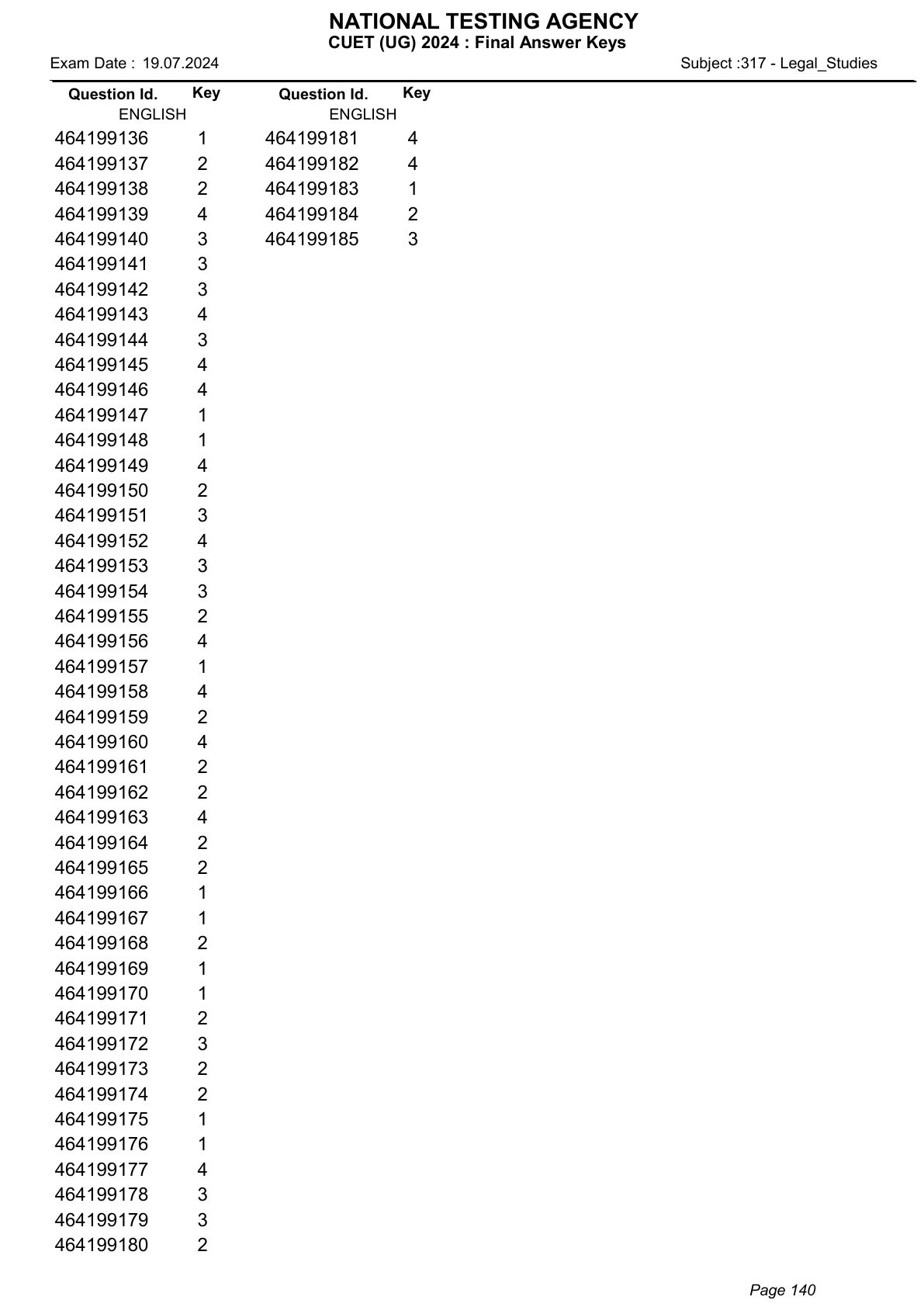
| CUET Legal Studies Question Paper with Answer Key |  Download Download |
To be Added |
CUET Legal Studies Questions With Solutions
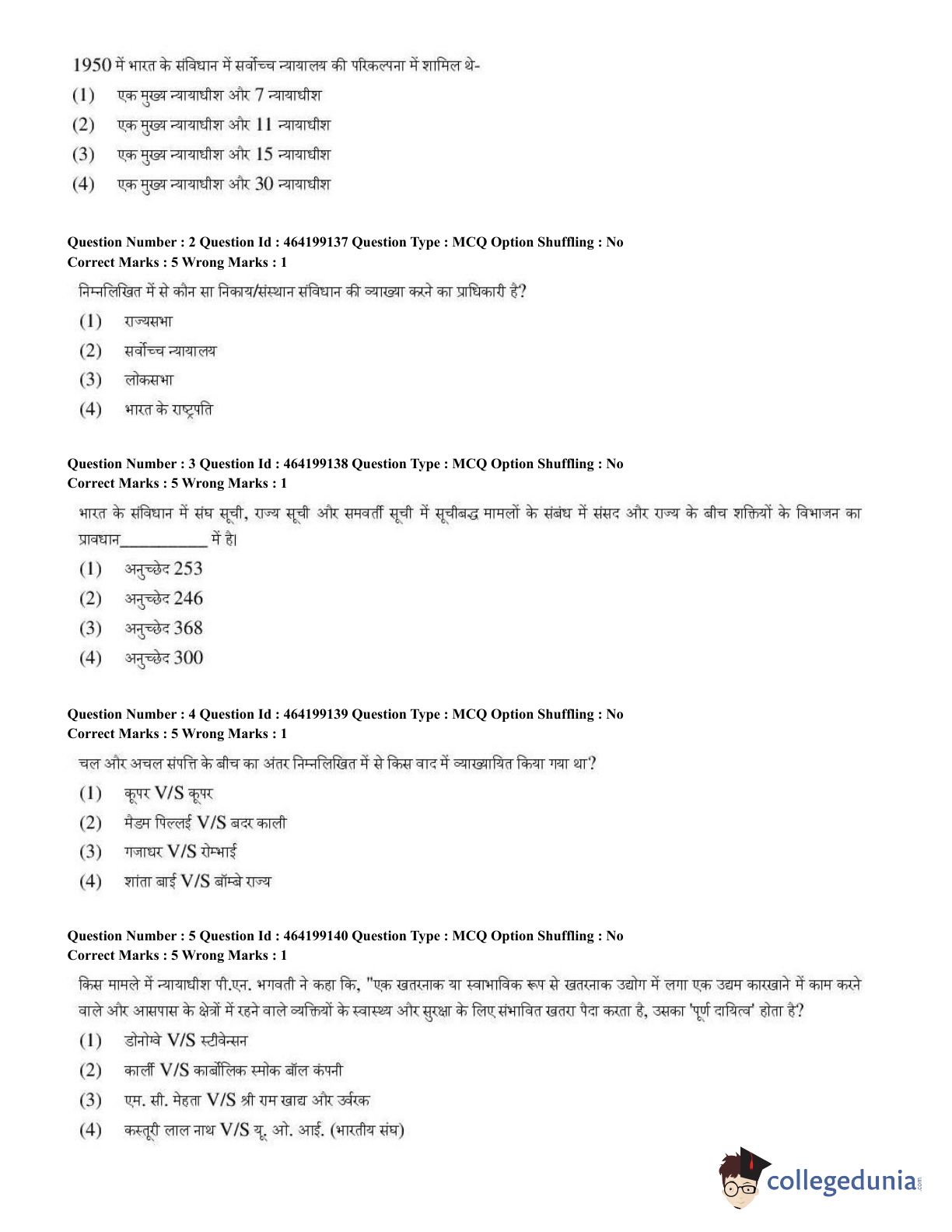
In the 1950s, the Supreme Court's vision in the Constitution of India included:
View Solution
In the initial years of the Supreme Court of India, as envisioned in the Constitution, it consisted of one Chief Justice and seven judges.
Quick Tip: Remember the initial composition of the Supreme Court to understand its evolution.Which of the following bodies/institutions is authorized to interpret the Constitution?
View Solution
The Supreme Court of India is the final interpreter of the Constitution. Its interpretations are binding on all courts and governments in the country.
Quick Tip: The Supreme Court is the guardian of the Constitution and its ultimate interpreter.In the Constitution of India, the provision for the division of powers between the Parliament and the State with respect to matters listed in the Union List, State List, and Concurrent List is in Article _________.
View Solution
Article 246 of the Indian Constitution deals with the subject matter of laws made by Parliament and by the legislatures of States.
Quick Tip: Remember that Article 246 is crucial for understanding the legislative powers and their distribution.The difference between movable and immovable property was interpreted in which of the following cases?
View Solution
The case of Shanta Bai V/S State of Bombay clearly explained the difference between movable and immovable property in the context of the Transfer of Property Act.
Quick Tip: Keep track of landmark cases that define important concepts in property law.In which case did Justice P.N. Bhagwati state that, "An enterprise engaged in a hazardous or inherently dangerous industry poses a potential threat to the health and safety of those working in the factory and those residing in the surrounding areas and, therefore, must have ‘strict liability’”?
View Solution
In M.C. Mehta V/S Shri Ram Food and Fertilizer case, Justice P.N. Bhagwati propounded the principle of ‘strict and absolute liability’ for enterprises engaged in hazardous or inherently dangerous activities.
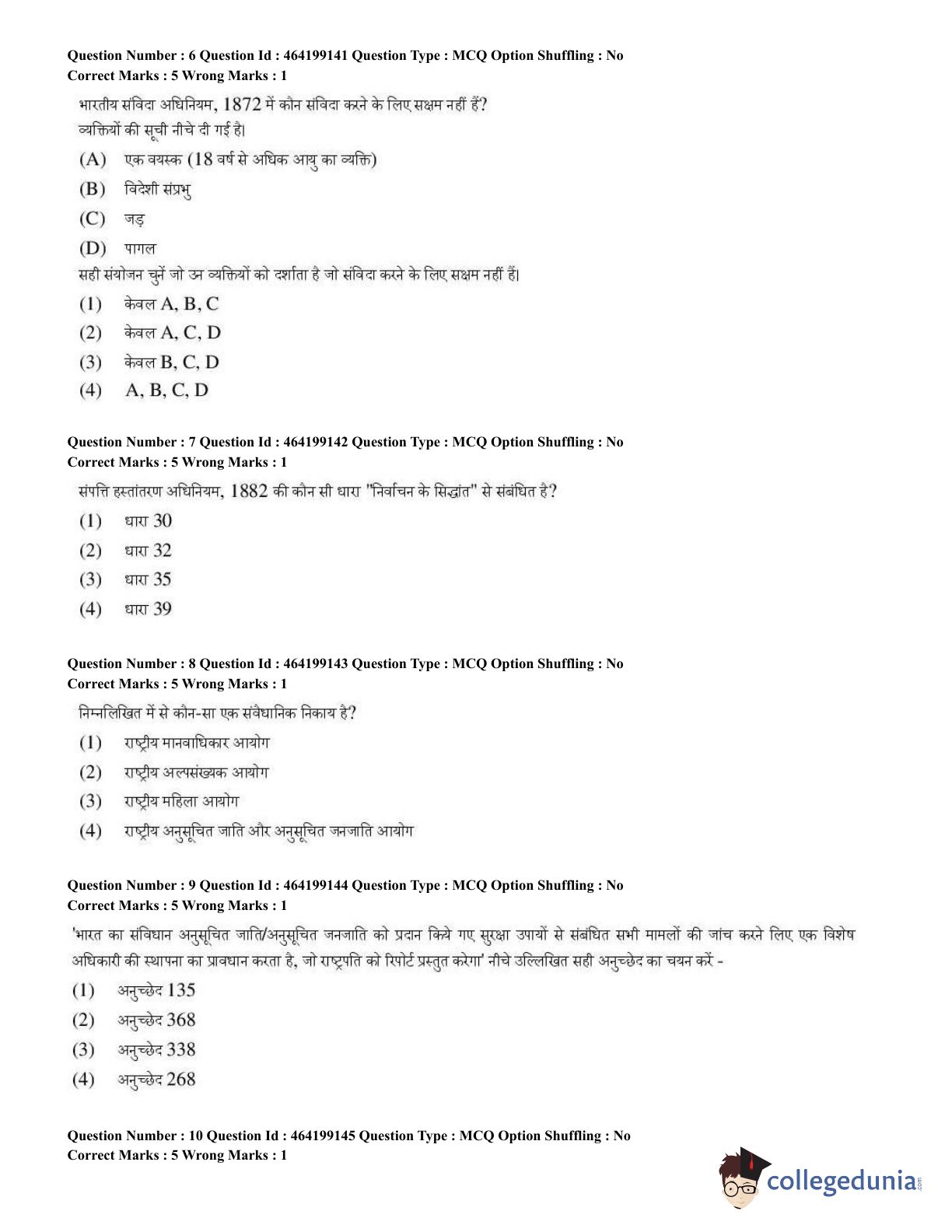
Quick Tip: Remember the key cases related to environmental law and the evolution of legal principles around corporate responsibility.Who among the following is NOT competent to contract under the Indian Contract Act, 1872? List of individuals is given below:
(A) An adult (a person of more than 18 years of age)
(B) Foreign Sovereign
(C) Lunatic
(D) Idiot
Choose the correct combination that reflects the individuals who are NOT competent to contract.
View Solution
According to the Indian Contract Act, 1872, a person must be of the age of majority, of sound mind, and not disqualified from contracting by any law to be competent to contract. Foreign Sovereigns, Lunatics, and Idiots are generally considered not competent to contract.
Quick Tip: Ensure you have a solid understanding of who is considered legally competent to enter into a contract.Which section of the Transfer of Property Act, 1882, relates to the "Doctrine of Election"?
View Solution
Section 35 of the Transfer of Property Act, 1882 deals with the Doctrine of Election, which arises when a person is required to choose between two rights, one of which he can exercise only by foregoing the other.
Quick Tip: Remember the specific sections of the Transfer of Property Act that deal with crucial legal doctrines.Which of the following is a constitutional body?
View Solution
The National Commission for Scheduled Castes and Scheduled Tribes is a constitutional body as it is directly mentioned in the Constitution of India. The others are statutory bodies created by Acts of Parliament.
Quick Tip: Differentiate between constitutional bodies established by the Constitution itself and statutory bodies created by legislation.'The Constitution of India provides for the establishment of a special officer to investigate all matters relating to the safeguards provided to Scheduled Castes/Scheduled Tribes, who shall report to the President'. Choose the correct Article mentioned below -
View Solution
Article 338 of the Indian Constitution provides for the establishment of a National Commission for Scheduled Castes and Scheduled Tribes, which investigates all matters relating to the safeguards provided to them and reports to the President.
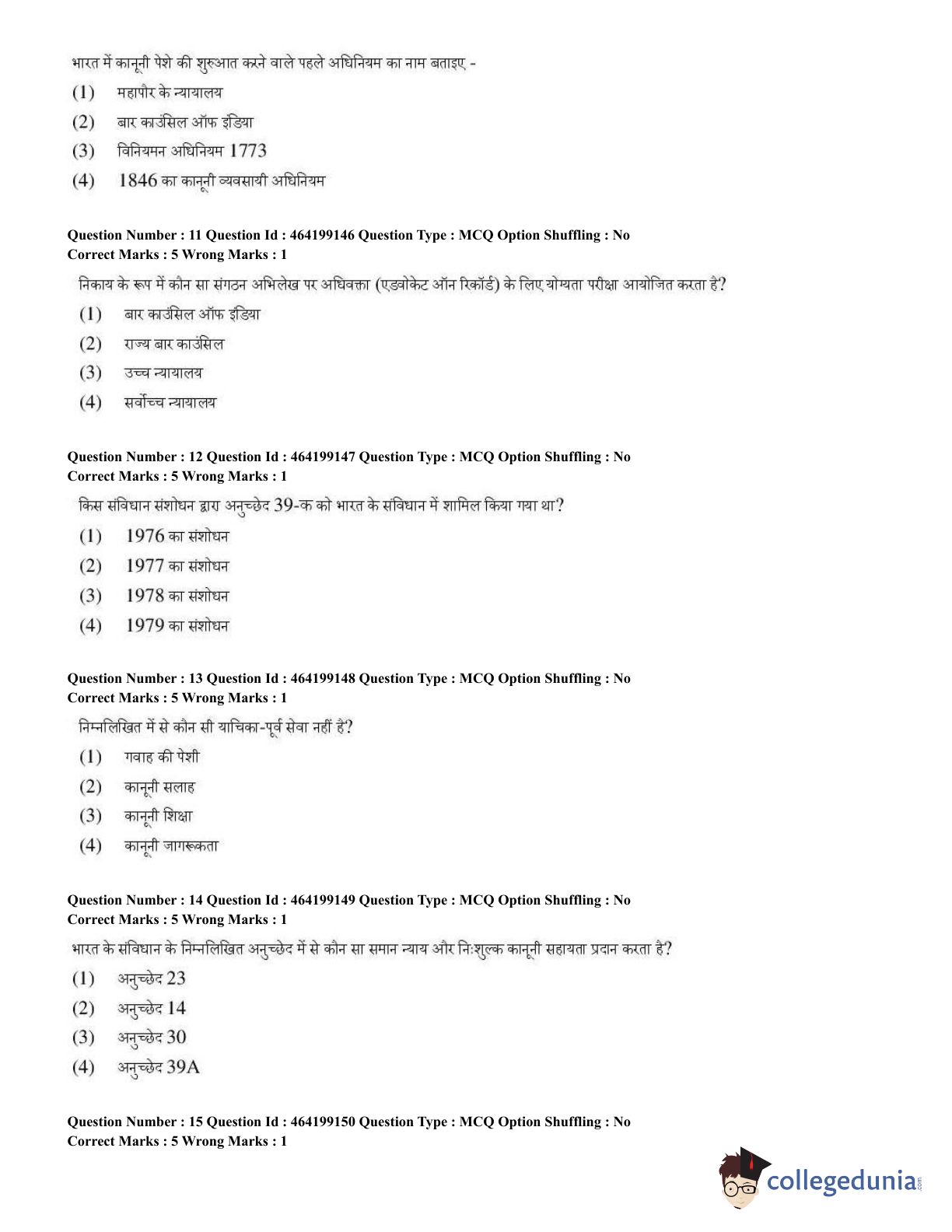
Quick Tip: Remember which articles in the Constitution deal with the rights and protections of specific groups.Name the first Act that initiated the legal profession in India -
View Solution
The Legal Practitioners Act of 1846 was the first Act in India that allowed qualified persons to practice law in any of the Company's courts.
Quick Tip: Note the key events and legislation that marked the beginning of the formal legal system in India.Which organization, as a body, conducts the qualifying examination for Advocate on Record (Advocate on Record) ?
View Solution
The Supreme Court of India conducts the qualifying examination for becoming an Advocate on Record, allowing advocates to file cases directly in the Supreme Court.
Quick Tip: Associate the Advocate on Record examination with the Supreme Court's specific requirements.Which Constitution Amendment inserted Article 39-A into the Constitution of India?
View Solution
The 42nd Amendment of 1976 inserted Article 39-A into the Constitution of India, providing for equal justice and free legal aid.
Quick Tip: Remember key amendments that have significantly impacted the Constitution's social justice aspects.Which of the following is NOT a plea-preliminary service?
View Solution
Legal advice and education are preliminary services, while witness testimony is evidence presented during the trial, and not a preliminary measure.
Quick Tip: Differentiate between pre-trial preparations and actual court procedures.Which of the following Articles of the Constitution of India provides for equal justice and free legal aid?
View Solution
Article 39A of the Indian Constitution provides for equal justice and free legal aid, aiming to ensure that the legal system promotes justice on the basis of equal opportunity.
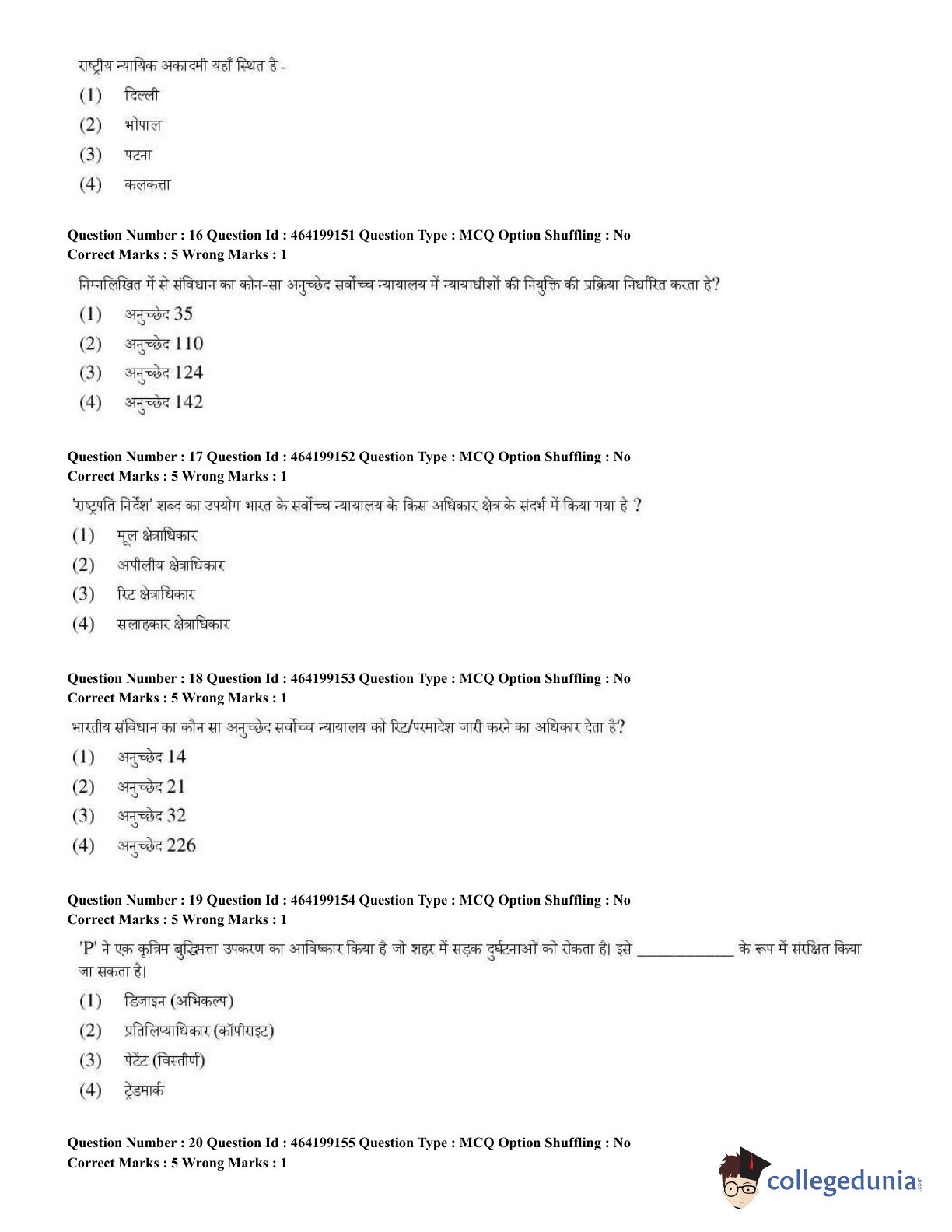
Quick Tip: Associate Article 39A with the principle of equal access to justice and legal support.The National Judicial Academy is located here -
View Solution
The National Judicial Academy, an institution to impart training to judicial officers, is located in Bhopal, Madhya Pradesh.
Quick Tip: Know the location of major legal institutions in India.Which of the following Articles of the Constitution determines the procedure for the appointment of judges in the Supreme Court?
View Solution
Article 124 of the Constitution of India deals with the establishment and constitution of the Supreme Court, including the procedure for the appointment of judges.
Quick Tip: Familiarize yourself with the constitutional articles pertaining to the judiciary's composition and functions.'Presidential Reference' word usage pertains to which jurisdiction of the Supreme Court of India?
View Solution
The term 'Presidential Reference' is used in relation to the Supreme Court's advisory jurisdiction, as per Article 143 of the Constitution, where the President seeks the Court's opinion on a question of law or fact.
Quick Tip: Link the term "Presidential Reference" to the Supreme Court's advisory role under Article 143.Which Article of the Indian Constitution empowers the Supreme Court to issue Writs/Mandamus?
View Solution
Article 32 of the Indian Constitution empowers the Supreme Court to issue writs, including mandamus, for the enforcement of fundamental rights. The High Courts are empowered under Article 226.
Quick Tip: Remember Article 32 as the "heart and soul" of the Constitution, providing the right to constitutional remedies.'P' has invented an Artificial Intelligence tool that prevents road accidents in the city. It can be protected as:
View Solution
An Artificial Intelligence tool preventing road accidents is an invention and is protected under the provision of "Patent".
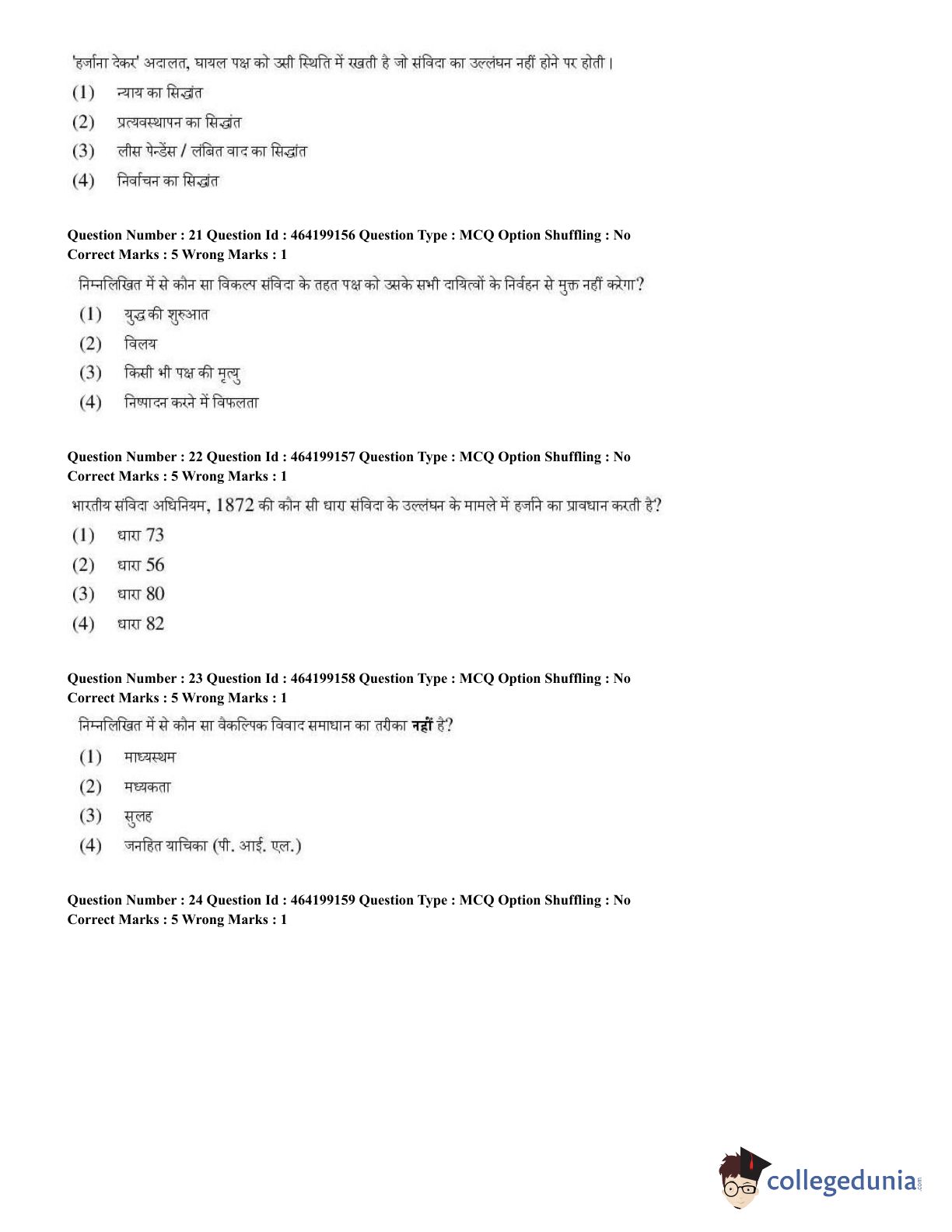
Quick Tip: Patent law protects inventions, allowing the inventor exclusive rights to use, sell, and manufacture the invention for a certain period.'Restitutio in integrum' court places injured party in which of the following condition had breach not happened.
View Solution
‘Restitutio in integrum’ refers to compensation or damages awarded to restore the injured party to the condition they would have been in had the breach not occurred. This aligns with the principle of restitutio, aiming to provide full restitution.
Quick Tip: Link the phrase "Restitutio in integrum" with the legal principle of restoring someone to their original position.Which of the following options will NOT relieve the party from all its obligations under the contract?
View Solution
A party's failure to perform does not relieve them of all obligations; it typically leads to liability for breach of contract. War, merger, or death can sometimes discharge contractual obligations under specific doctrines, but a simple failure to perform typically does not.
Quick Tip: Differentiate between situations that discharge a contract and those that lead to a breach.Which section of the Indian Contract Act, 1872, provides for the provision of damages in case of breach of contract?
View Solution
Section 73 of the Indian Contract Act, 1872, deals with compensation for loss or damage caused by breach of contract, allowing the injured party to receive compensation for any loss or damage which naturally arose in the usual course of things from such breach.
Quick Tip: Remember Section 73 in relation to remedies for breach of contract under Indian law.Which of the following is NOT a method of Alternative Dispute Resolution?
View Solution
Arbitration, Mediation, and Conciliation are all methods of Alternative Dispute Resolution (ADR). Public Interest Litigation (PIL) is a legal action initiated in a court of law for the enforcement of public interest or general welfare and is not considered a form of ADR.
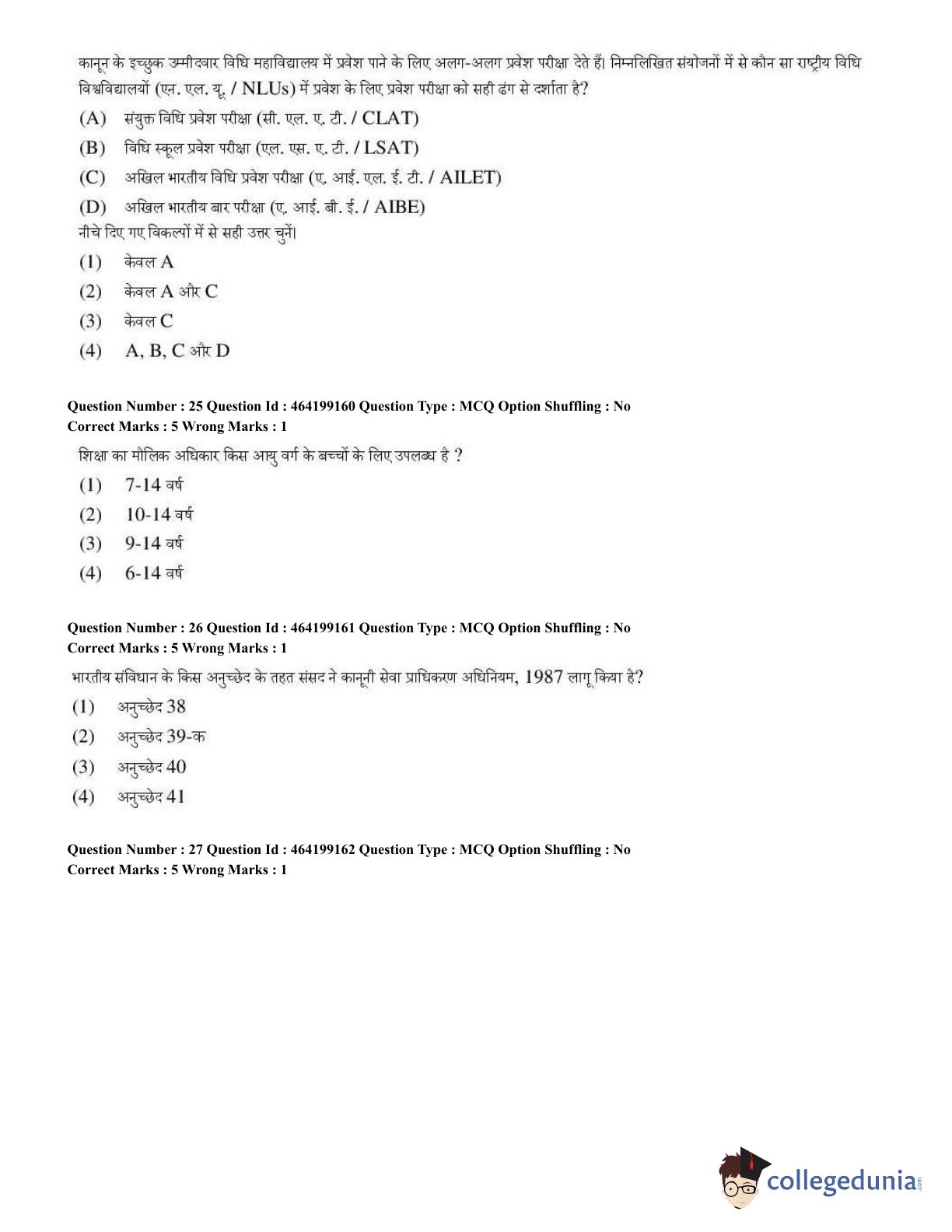
Quick Tip: Understand the various forms of ADR and their differences from traditional litigation.Aspiring law candidates give different entrance exams to get admission in law colleges. Which of the following combinations correctly represents the entrance exam for admission to the National Law Universities (NLU’s / NLUs) in a well manner ?
(A) Combined Law Admission Test (CLAT)
(B) Law School Admission Test (LSAT)
(C) All India Law Entrance Test (AILET)
(D) All India Bar Examination (AIBE)
Choose the correct answer from the options given below.
View Solution
The CLAT (Common Law Admission Test) is primarily used for admission to most NLUs, and AILET (All India Law Entrance Test) is conducted specifically for NLU Delhi. LSAT is used by some private law colleges, while AIBE is for practicing lawyers.
Quick Tip: Keep up-to-date on the different law entrance exams and the institutions they are linked to.The Fundamental Right to Education is available to children of which age group?
View Solution
The Fundamental Right to Education, as enshrined in Article 21A of the Indian Constitution, is available to children in the age group of 6-14 years.
Quick Tip: Remember that the Right to Education applies to children aged 6-14 years.Under which article of the Indian Constitution did the Parliament enact the Legal Services Authority Act, 1987?
View Solution
The Legal Services Authority Act, 1987 was enacted by the Parliament in furtherance of Article 39-A of the Indian Constitution, which provides for equal justice and free legal aid.
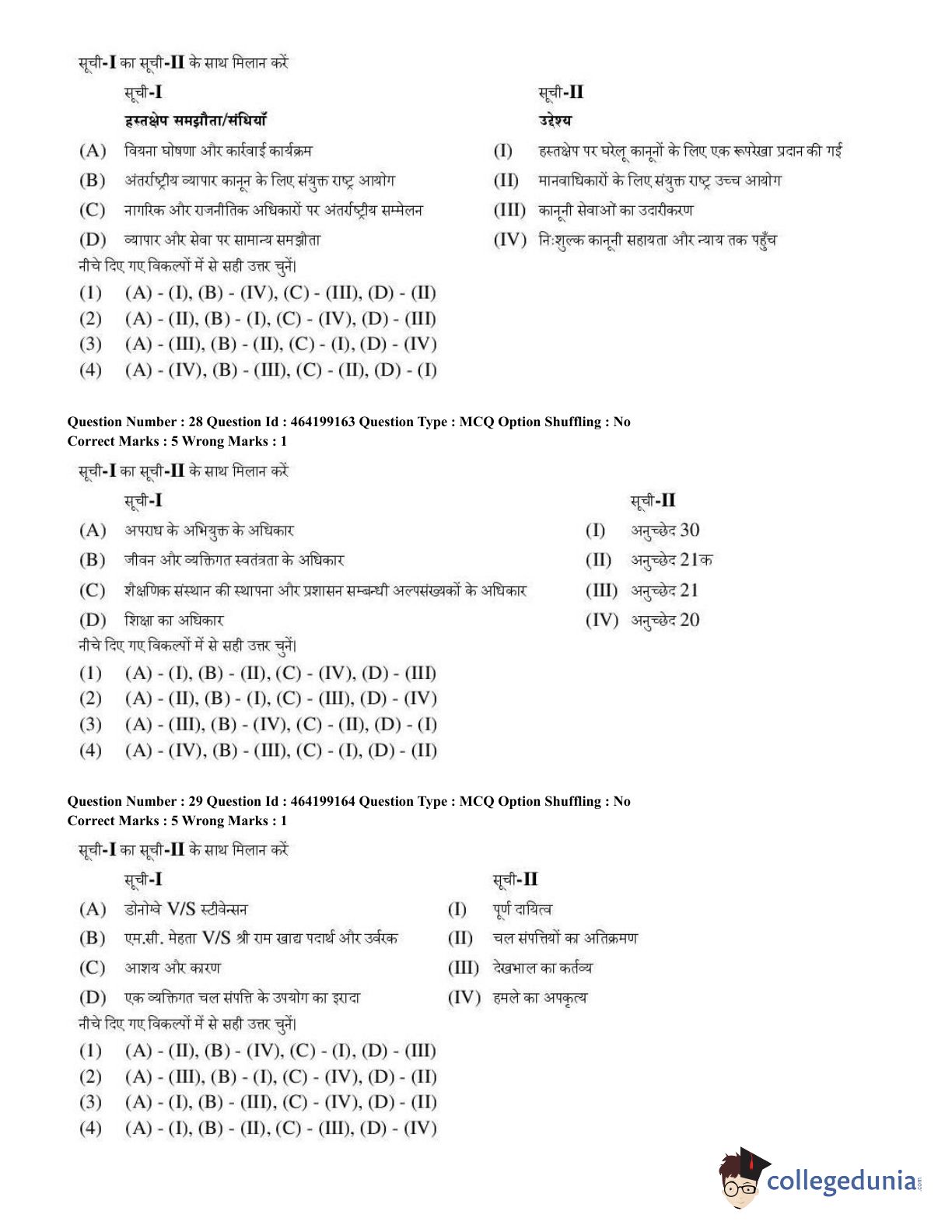
Quick Tip: Connect the Legal Services Authority Act with Article 39-A, which emphasizes equal access to justice.Match list I with list II
List I: List of Agreements/Treaties
(A) Vienna Declaration and Program of Action
(B) United Nations Commission on International Trade Law
(C) International Covenant on Civil and Political Rights
(D) General Agreement on Trade in Service
List II: Purpose
(I) Intervention provided on domestic laws
(II) United Nations High Commission on human rights
(III) Liberating in the legal services
(IV) Access to Justice and free legal help Choose the correct answer from the options given below.
View Solution
Correct matches are:
A - II - Vienna Declaration and Program of Action aimed at promoting cooperation among all states on Human Rights
B - I - United Nations Commission on International Trade Law (UNCITRAL) for the purpose of intervention in domestic laws.
C - IV - International Covenant on Civil and Political Rights ensures legal services
D - III - General Agreement on Trade in Services seeks the liberalization of legal services.
Quick Tip: Remember the Agreements/Treaties and their Purposes.Match list I with list II
List I:
(A) Rights of accused to against offences
(B) Right to life and personal liberty
(C) Rights of Minorities to establish and administer their educational institutions
(D) Right to education
List II:
(I) Article 30
(II) Article 21A
(III) Article 21
(IV) Article 20
Choose the correct answer from the options given below.
(4) (A) - (IV), (B) - (III), (C) - (I), (D) - (II)
View Solution
Correct matches are:(A)Rights of accused against offences - Article 20
(B) Right to life and personal liberty - Article 21
(C)Rights of Minorities to establish and administer their educational institutions - Article 30
(D) Right to Education - Article 21 A
Match list I with list II
List I:
(A) Donoghue V/S Stevenson
(B) M.C. Mehta V/S Sri Ram Food and Fertilizers
(C) Intention and cause
(D) Intention of causing the use of a personal mobile property
List II:
(I) Full liability
(II) Transgression of use the mobile ownership
(III) Duty of care
(IV) Tort of Attack Choose the correct answer from the options given below.
View Solution
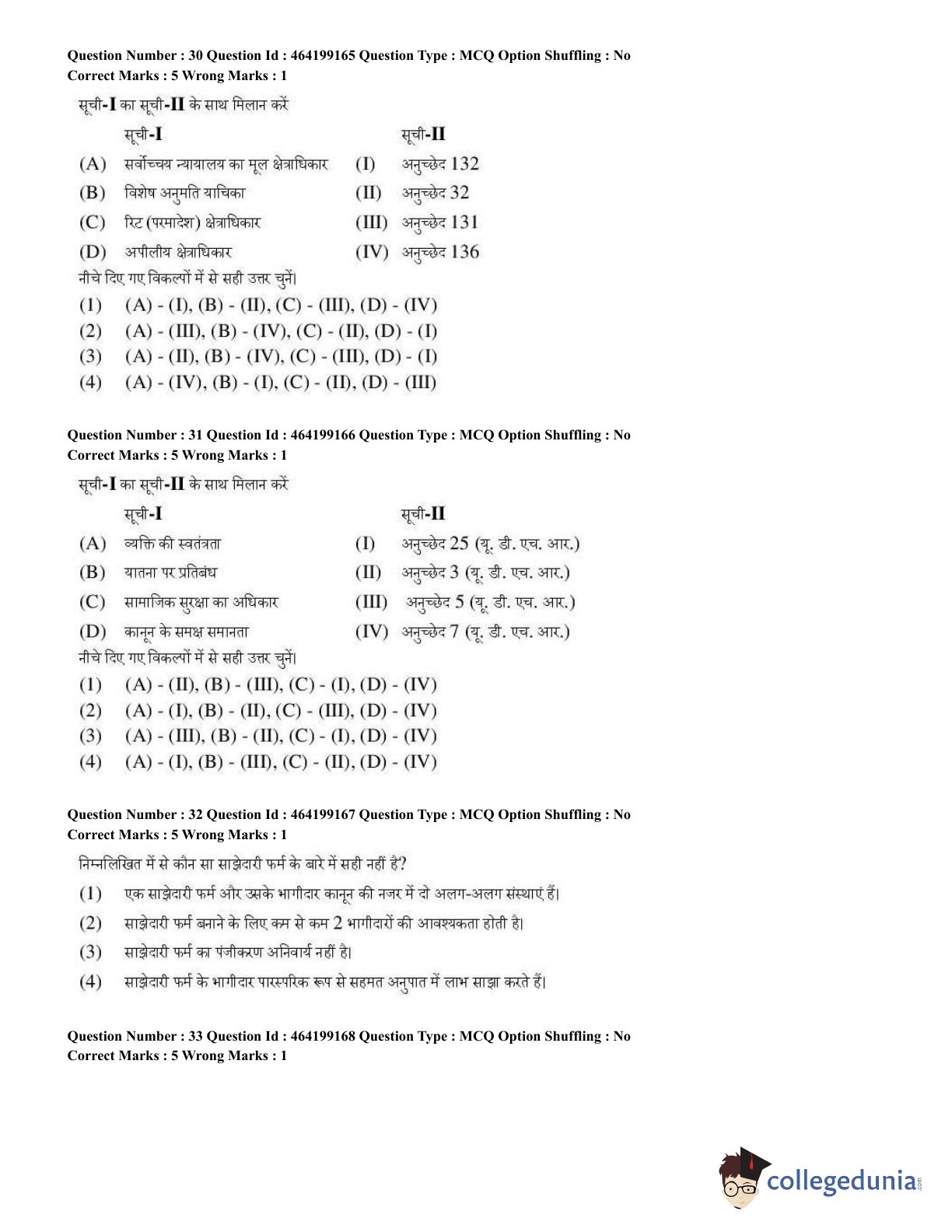
Match list I with list II
List I:
(A)Original jurisdiction of Supreme Court
(B) Special Leave Petition
(C) Writ jurisdiction
(D) Appellete Jurisdiction
List II:
(I) Section 132
(II) Section 32
(III) Section 131
(IV) Section 136
Choose the correct answer from the options given below.
View Solution
Correct matches are:
(A)Original jurisdiction of Supreme Court - Section 131
(B) Special Leave Petition - Section 136
(C) Writ jurisdiction - Section 32
(D) Appellate Jurisdiction - Section 132
Match list I with list II
List I:
(A) The freedom of the Self
(B) Prohibition of torture
(C) Right to Social Security
(D) Equality before the law
List II:
(I) Section 25 (U.D.H.R)
(II) Section 3 (U.D.H.R)
(III) Section 5 (U.D.H.R)
(IV) Section 7 (U.D.H.R)
Choose the correct answer from the options given below.
View Solution
Correct matches are:
(A) The freedom of the Self - Section 25 (U.D.H.R)
(B) Prohibition of torture - Section 5 (U.D.H.R)
(C) Right to Social Security - Section 3 (U.D.H.R)
(D) Equality before the law - Section 7 (U.D.H.R)
Which of the following is not correct about the partnership firm?
View Solution
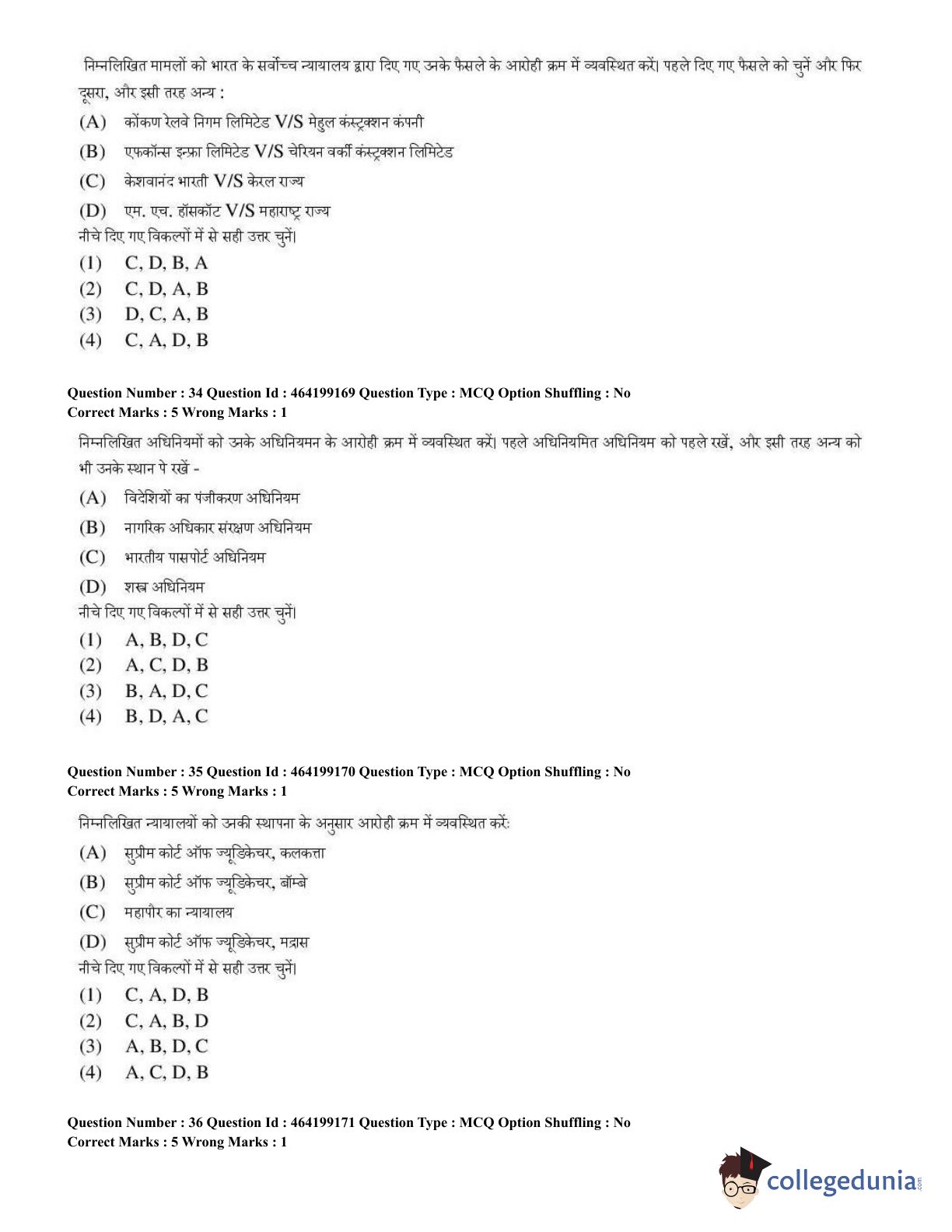
Because partnership firms and its partner are considered as one single entity in the eyes of law not separate.Arrange the following cases in ascending order of their decision by the Supreme Court of India. Choose the case given first and then the second, and so on:
(A) Konkan Railway Corporation Limited V/S Mehul Construction Company
(B) Afcons Infra Limited V/S Cherian Varkey Construction Limited
(C) Kesavananda Bharati V/S State of Kerala
(D) M. H. Hoskot V/S State of Maharashtra
View Solution
The chronological order is M. H. Hoskot V/S State of Maharashtra, Kesavananda Bharati V/S State of Kerala , Konkan Railway Corporation Limited V/S Mehul Construction Company, Afcons Infra Limited V/S Cherian Varkey Construction Limited. Quick Tip: It is very important to remember the case laws and the year of judgement of important cases.Arrange the following Acts in the ascending order of their enactment. Put the first enacted Act first, and so on -
(A) The Registration of Foreigners Act(B) The Protection of Civil Rights Act
(C) The Passports Act of India
(D) The Arms Act Choose the correct answer from the options given below.
View Solution
The Registration of Foreigners Act was established in 1939, The Passports Act of India 1967, The Arms Act 1959 and, The Protection of Civil Rights Act 1955. Quick Tip: Remember the years of enactment to solve ascending or desceding arrangement questionsArrange the following Courts in ascending order according to their establishment:
(A) Supreme Court of Judicature, Calcutta(B) Supreme Court of Judicature, Bombay
(C) Mayor's Court
(D) Supreme Court of Judicature, Madras Choose the correct answer from the options given below.
View Solution
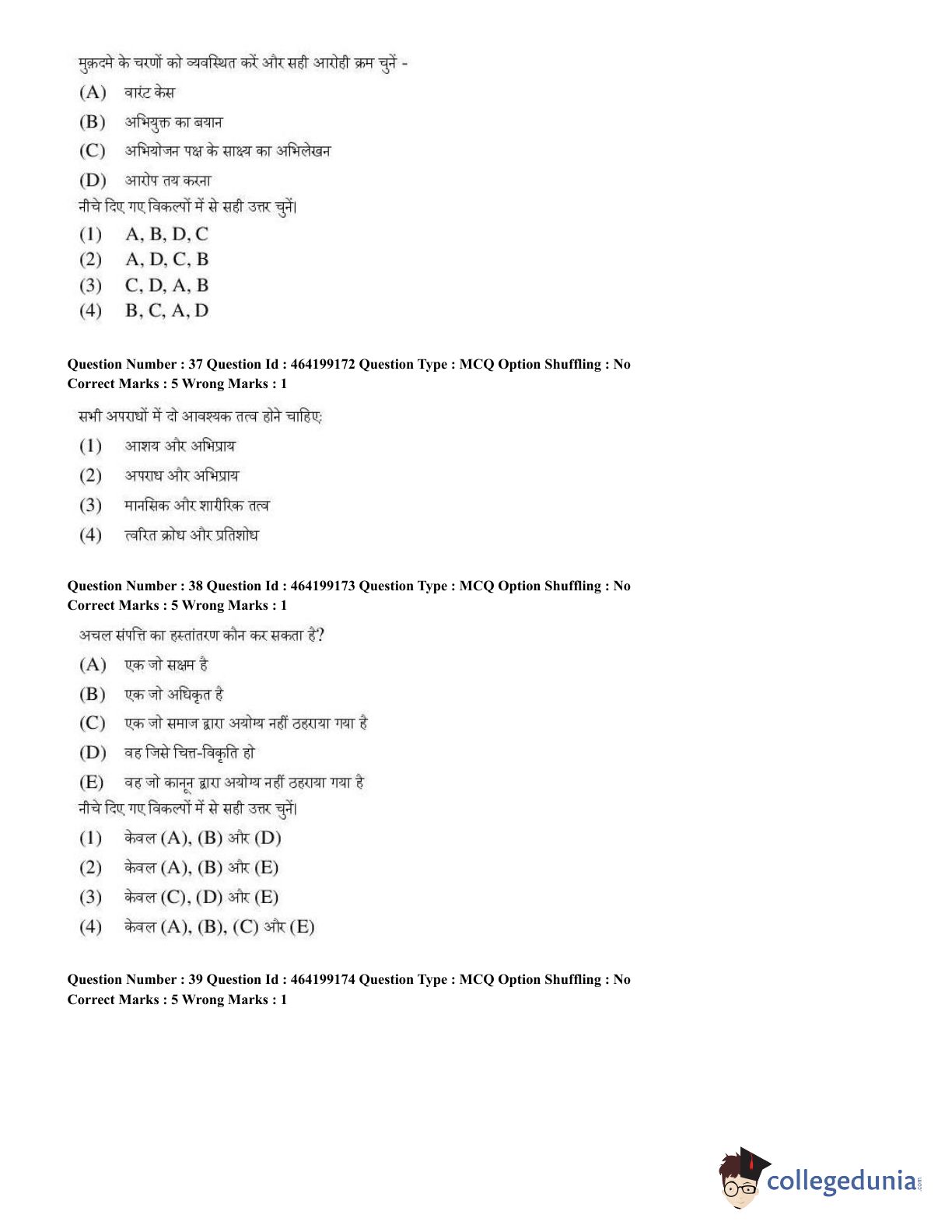
The Mayor's court was setup in 1726, Supreme Court of Judicature, Calcutta in 1774, Supreme Court of Judicature, Madras in 1801, and Supreme Court of Judicature, Bombay in 1823 Quick Tip: The history of the judicature system is important to crack ascending or desceding arragement.Arrange the steps of the trial in their correct order and choose the right ascending order
(A) Warrant Case(B) Statement of the Accused
(C) Recording of Evidence on behalf of the prosecution
(D) Framing the Charge Choose the correct answer from the options given below.
View Solution
The correct order is (A) Warrant Case (D) Framing the Charge (C) Recording of Evidence on behalf of the prosecution and (B) Statement of the Accused. Quick Tip: Process of the trial must be remembered for better understanding.All crimes must have the two essential elements:
View Solution
All crimes must have the two essential elements of mens rea (mental intention to commit the crime) and actus reus (physical action of committing the crime). Quick Tip:Who can transfer immovable property?
(A) One who is capable
(B) One who is authorized
(C) One who has not been declared ineligible by the society
(D) He who has a mental disorder
(E) One who has not been declared ineligible by law
Choose the correct answer from the options given below.
View Solution
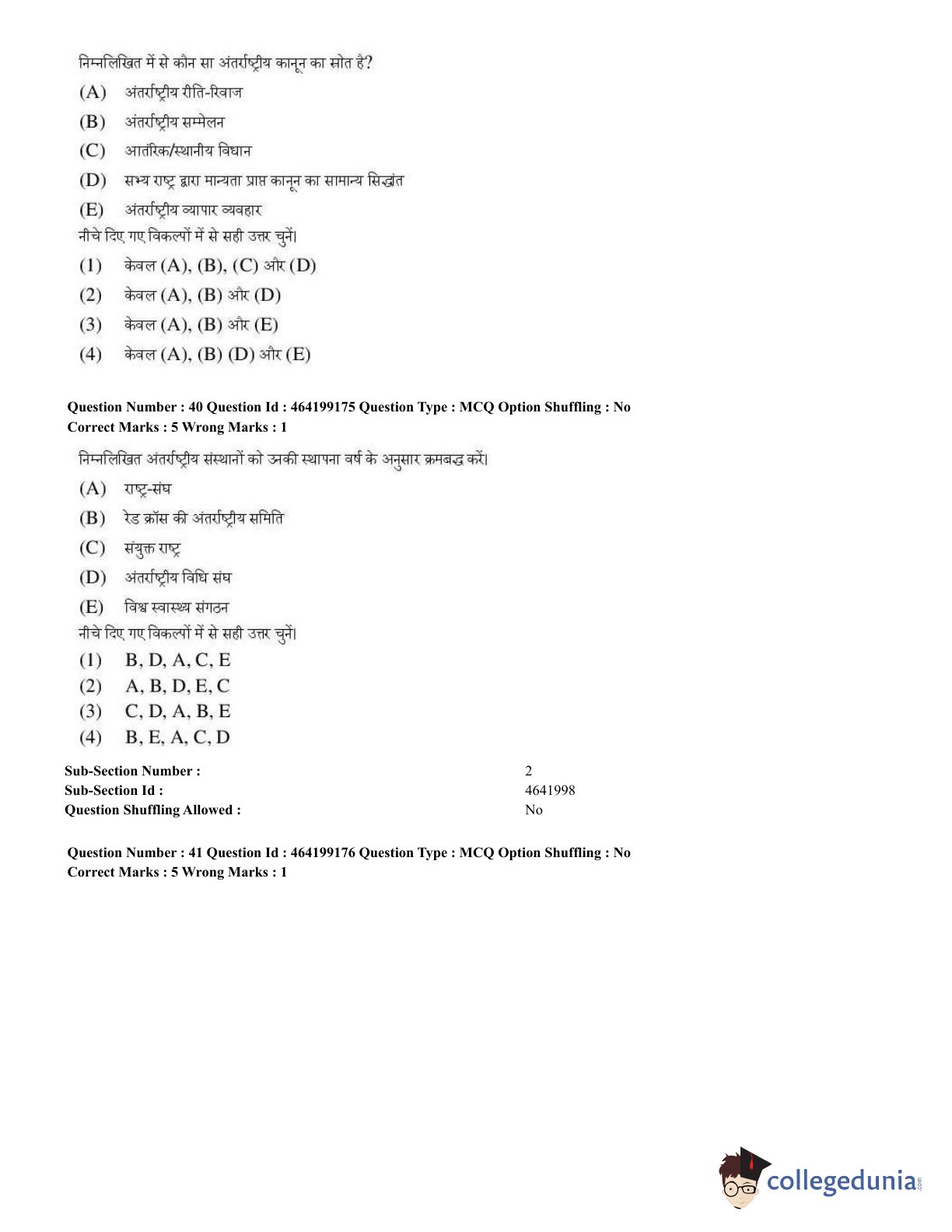
Mental disorder makes any person ineligible for the transfer of immovable property. Quick Tip:Which of the following is a source of international law?
(A) International custom(B) International Convention
(C) Internal / local legislation
(D) General Principles of Law recognized by civilized nations
(E) International trade practices Choose the correct answer from the options given below.
View Solution
According to Article 38(1) of the Statute of the International Court of Justice, the sources of international law are: (a) International conventions (b) International custom and (c)The general principles of law recognized by civilized nations Quick Tip:Arrange the following international institutions according to their year of establishment.
(A) League of Nations
(B) International Committee of the Red Cross
(C) United Nations
(D) International Law Union
(E) World Health Organisation
Choose the correct answer from the options given below.
View Solution
International Committee of the Red Cross was established in 1863, International Law Union in 1873, League of Nations in 1920, United Nations in 1945 and World Health Organisation in 1948 Quick Tip:It is important to remember the dates of formation or the establishmen tdates of international institutions.Question 41:
परिच्छेद को पढ़ें और प्रश्नों का उत्तर दें -
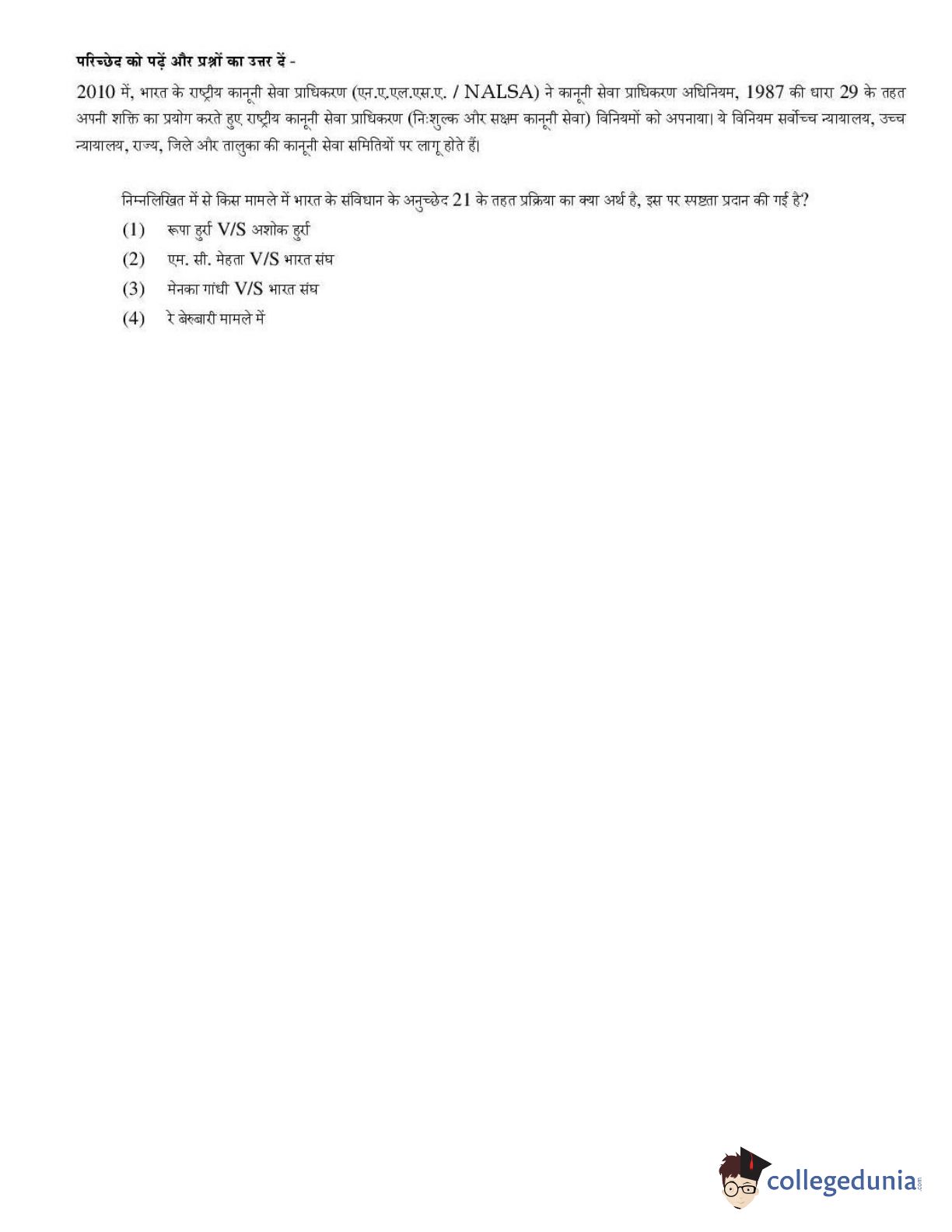
2010 में, भारत के राष्ट्रीय कानूनी सेवा प्राधिकरण (एन.ए.एल.एस.ए. / NALSA) ने कानूनी सेवा प्राधिकरण अधिनियम, 1987 की धारा 29 के तहत अपनी शक्ति का प्रयोग करते हुए राष्ट्रीय कानूनी सेवा प्राधिकरण (निःशुल्क और सक्षम कानूनी सेवा) विनियमों को अपनाया। ये विनियम सर्वोच्च न्यायालय, उच्च न्यायालय, राज्य, जिले और तालुका की कानूनी सेवा समितियों पर लागू होते हैं।
निम्नलिखित में से किस मामले में भारत के संविधान के अनुच्छेद 21 के तहत प्रक्रिया का क्या अर्थ है, इस पर स्पष्टता प्रदान की गई है?
View Solution
The Maneka Gandhi v. Union of India case (1978) clarified the meaning of "procedure established by law" under Article 21 of the Indian Constitution, holding that it must be fair, just, and reasonable, and not arbitrary, fanciful, or oppressive.
परिच्छेद को पढ़ें और प्रश्न के उत्तर दें -
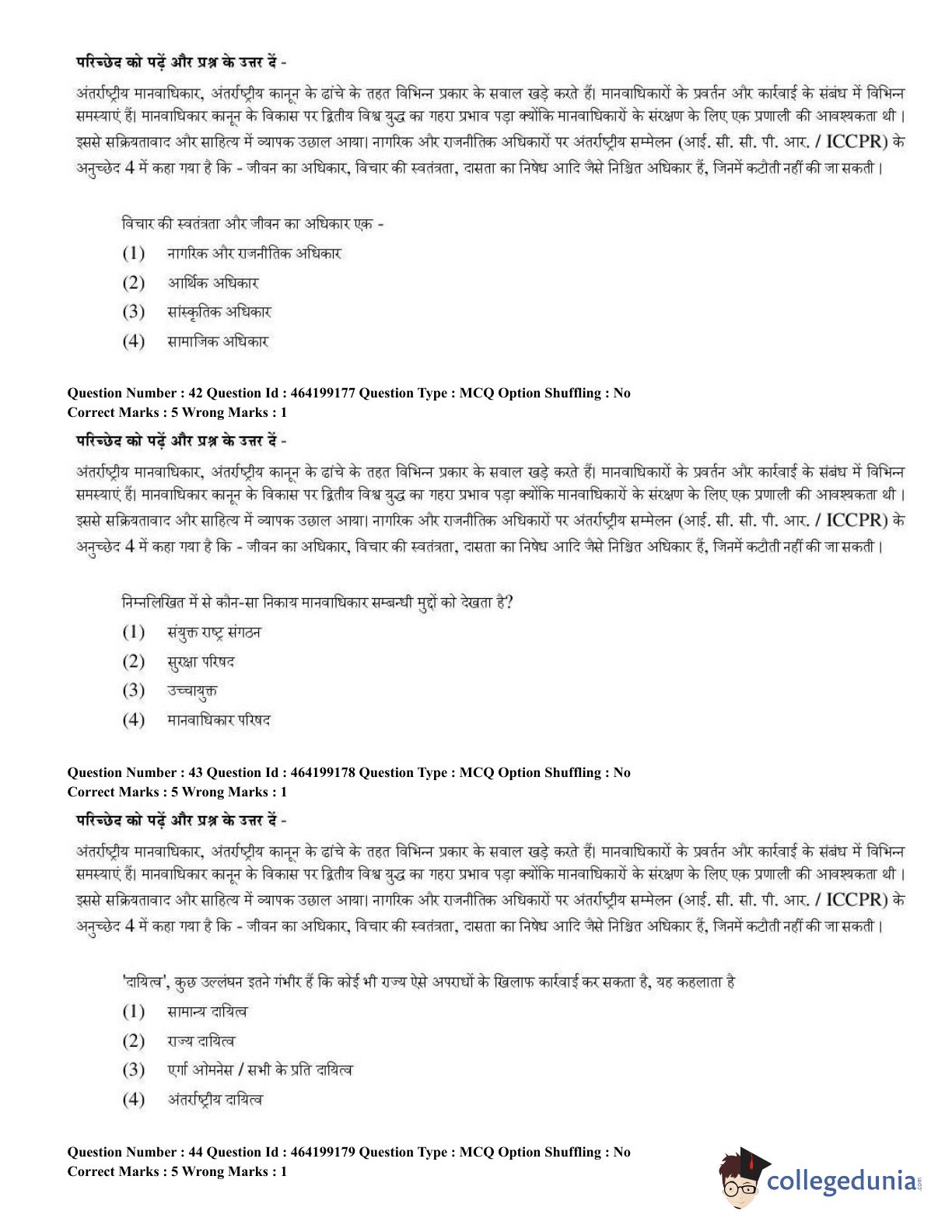
अंतर्राष्ट्रीय मानवाधिकार, अंतर्राष्ट्रीय कानून के ढांचे के तहत विभिन्न प्रकार के सवाल खड़े करते हैं। मानवाधिकारों के प्रवर्तन और कार्रवाई के संबंध में विभिन्न समस्याएं हैं। मानवाधिकार कानून के विकास पर द्वितीय विश्व युद्ध का गहरा प्रभाव पड़ा क्योंकि मानवाधिकारों के संरक्षण के लिए एक प्रणाली की आवश्यकता थी । इससे सक्रियतावाद और साहित्य में व्यापक उछाल आया। नागरिक और राजनीतिक अधिकारों पर अंतर्राष्ट्रीय सम्मेलन (आई. सी. सी. पी. आर. / ICCPR) के अनुच्छेद 4 में कहा गया है कि जीवन का अधिकार, विचार की स्वतंत्रता, दासता का निषेध आदि जैसे निश्चित अधिकार हैं, जिनमें कटौती नहीं की जा सकती ।
निम्नलिखित में से कौन-सा निकाय मानवाधिकार सम्बन्धी मुद्दों को देखता है?
View Solution
Given the context of human rights and the need for a specialized body, the Human Rights Council is the most relevant choice.
परिच्छेद को पढ़ें और प्रश्न के उत्तर दें -
अंतर्राष्ट्रीय मानवाधिकार, अंतर्राष्ट्रीय कानून के ढांचे के तहत विभिन्न प्रकार के सवाल खड़े करते हैं। मानवाधिकारों के प्रवर्तन और कार्रवाई के संबंध में विभिन्न समस्याएं हैं। मानवाधिकार कानून के विकास पर द्वितीय विश्व युद्ध का गहरा प्रभाव पड़ा क्योंकि मानवाधिकारों के संरक्षण के लिए एक प्रणाली की आवश्यकता थी । इससे सक्रियतावाद और साहित्य में व्यापक उछाल आया। नागरिक और राजनीतिक अधिकारों पर अंतर्राष्ट्रीय सम्मेलन (आई. सी. सी. पी. आर. / ICCPR) के अनुच्छेद 4 में कहा गया है कि जीवन का अधिकार, विचार की स्वतंत्रता, दासता का निषेध आदि जैसे निश्चित अधिकार हैं, जिनमें कटौती नहीं की जा सकती ।
'दायित्व', कुछ उल्लंघन इतने गंभीर हैं कि कोई भी राज्य ऐसे अपराधों के खिलाफ कार्रवाई कर सकता है, यह कहलाता है
View Solution
Obligations *erga omnes* (Latin for "towards all") are obligations that a state owes to the international community as a whole, distinguishing them from those owed to another state.
परिच्छेद को पढ़ें और प्रश्न के उत्तर दें -
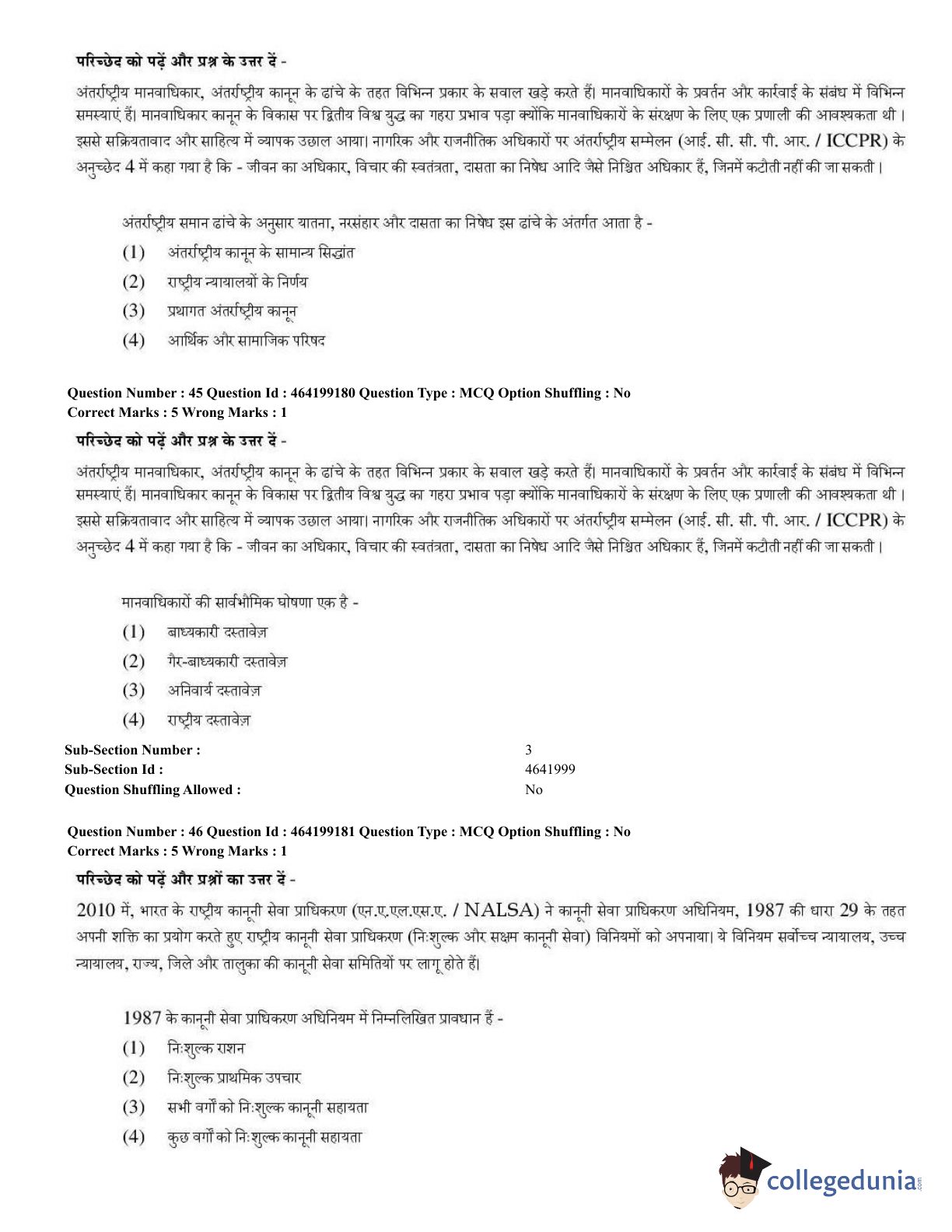
अंतर्राष्ट्रीय मानवाधिकार, अंतर्राष्ट्रीय कानून के ढांचे के तहत विभिन्न प्रकार के सवाल खड़े करते हैं। मानवाधिकारों के प्रवर्तन और कार्रवाई के संबंध में विभिन्न समस्याएं हैं। मानवाधिकार कानून के विकास पर द्वितीय विश्व युद्ध का गहरा प्रभाव पड़ा क्योंकि मानवाधिकारों के संरक्षण के लिए एक प्रणाली की आवश्यकता थी । इससे सक्रियतावाद और साहित्य में व्यापक उछाल आया। नागरिक और राजनीतिक अधिकारों पर अंतर्राष्ट्रीय सम्मेलन (आई. सी. सी. पी. आर. / ICCPR) के अनुच्छेद 4 में कहा गया है कि जीवन का अधिकार, विचार की स्वतंत्रता, दासता का निषेध आदि जैसे निश्चित अधिकार हैं, जिनमें कटौती नहीं की जा सकती ।
अंतर्राष्ट्रीय समान ढांचे के अनुसार यातना, नरसंहार और दासता का निषेध इस ढांचे के अंतर्गत आता है -
View Solution
Torture, genocide, and slavery are so universally condemned that their prohibition is considered part of customary international law (and *jus cogens*), binding on all states regardless of whether they have ratified treaties specifically prohibiting them.
परिच्छेद को पढ़ें और प्रश्न के उत्तर दें -
अंतर्राष्ट्रीय मानवाधिकार, अंतर्राष्ट्रीय कानून के ढांचे के तहत विभिन्न प्रकार के सवाल खड़े करते हैं। मानवाधिकारों के प्रवर्तन और कार्रवाई के संबंध में विभिन्न समस्याएं हैं। मानवाधिकार कानून के विकास पर द्वितीय विश्व युद्ध का गहरा प्रभाव पड़ा क्योंकि मानवाधिकारों के संरक्षण के लिए एक प्रणाली की आवश्यकता थी । इससे सक्रियतावाद और साहित्य में व्यापक उछाल आया। नागरिक और राजनीतिक अधिकारों पर अंतर्राष्ट्रीय सम्मेलन (आई. सी. सी. पी. आर. / ICCPR) के अनुच्छेद 4 में कहा गया है कि जीवन का अधिकार, विचार की स्वतंत्रता, दासता का निषेध आदि जैसे निश्चित अधिकार हैं, जिनमें कटौती नहीं की जा सकती ।
मानवाधिकारों की सार्वभौमिक घोषणा एक है -
View Solution
The Universal Declaration of Human Rights (UDHR) is generally considered a non-binding declaration. While it does not have the force of a treaty, it has significant moral and political weight and has influenced the development of many subsequent binding human rights treaties.
In 2010, the National Legal Services Authority of India (N.A.L.S.A. / NALSA) adopted the National Legal Services Authority (Free and Competent Legal Service) Regulations, by exercising its power under section 29 of the Legal Services Authorities Act, 1987. These Regulations apply to the Legal Service Committees of the Supreme Court, High Court, State, District and Taluka.
The 1987 Legal Services Authority Act has the following provisions -
Correct Answer:
(4) Free legal aid to some sections
View Solution
The Legal Services Authorities Act, 1987, aims to provide free and competent legal services to the weaker sections of the society. It does not apply universally to all citizens but only to specified categories, including women, children, Scheduled Castes, Scheduled Tribes, victims of trafficking, and persons with disabilities, among others. Therefore, legal aid is not provided to all, but to **some** eligible sections.
Thus, the solution is (4) Free legal aid to some sections.
\begin{quicktipbox
Legal aid under the 1987 Act is available only to specific disadvantaged sections of society, not everyone.
\end{quicktipbox Quick Tip: Legal aid under the 1987 Act is available only to specific disadvantaged sections of society, not everyone.
In 2010, the National Legal Services Authority of India (N.A.L.S.A. / NALSA) adopted the National Legal Services Authority (Free and Competent Legal Service) Regulations, by exercising its power under section 29 of the Legal Services Authorities Act, 1987. These Regulations apply to the Legal Service Committees of the Supreme Court, High Court, State, District and Taluka.
Free legal aid is provided to ensure -
Correct Answer:
(4) justice
View Solution
The goal of free legal aid is to provide access to justice for all, particularly to those who cannot afford legal representation. It is rooted in Article 39A of the Constitution, which directs the State to ensure that the legal system promotes justice on the basis of equal opportunity.
Thus, the solution is (4) justice.
\begin{quicktipbox
Free legal aid is a tool to uphold **justice**, especially for those who lack resources.
\end{quicktipbox Quick Tip: Free legal aid is a tool to uphold **justice**, especially for those who lack resources.
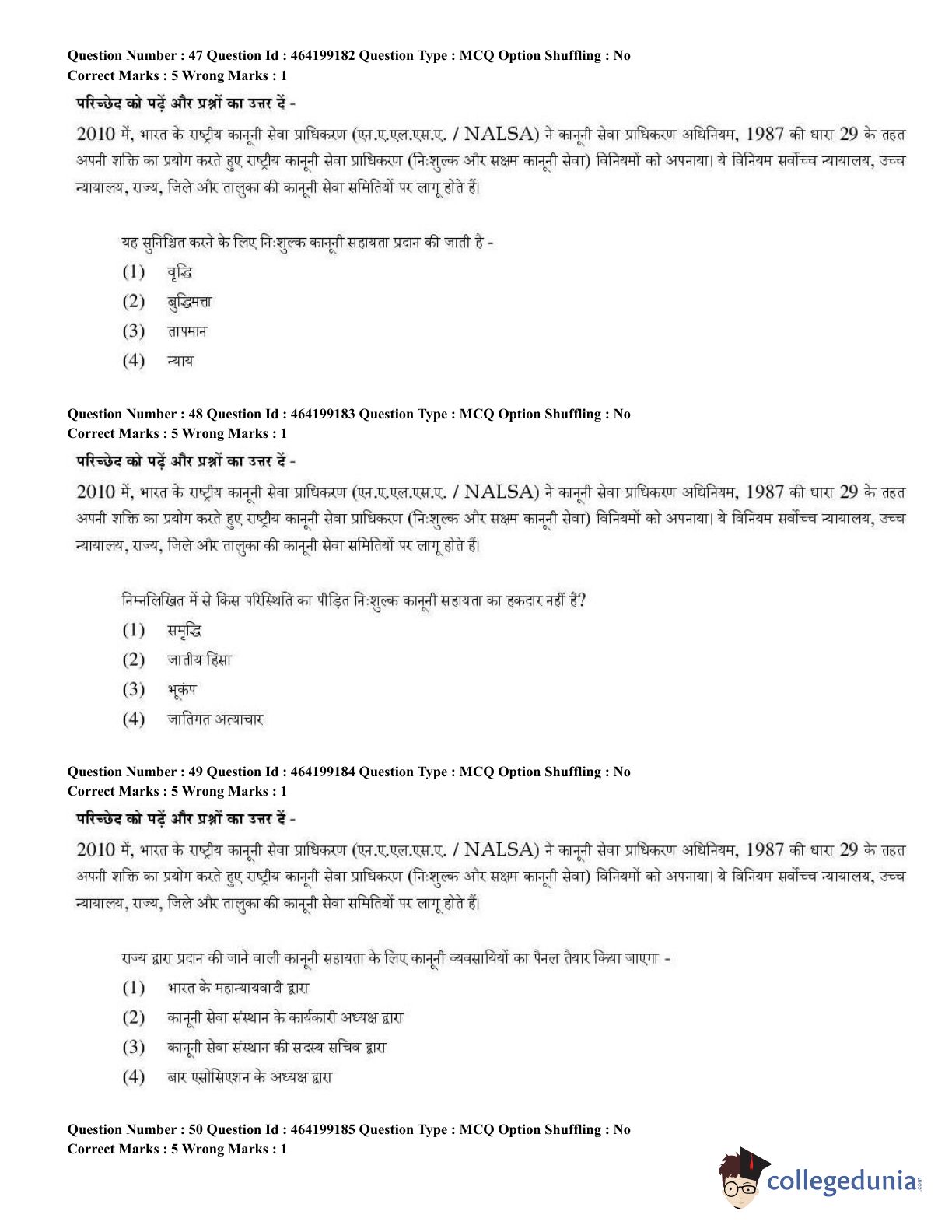
In 2010, the National Legal Services Authority of India (N.A.L.S.A. / NALSA) adopted the National Legal Services Authority (Free and Competent Legal Service) Regulations, by exercising its power under section 29 of the Legal Services Authorities Act, 1987. These Regulations apply to the Legal Service Committees of the Supreme Court, High Court, State, District and Taluka.
The victim of which of the following circumstances is not entitled to free legal aid?
Correct Answer:
(1) Prosperities
View Solution
The Legal Services Authorities Act, 1987, extends free legal aid to victims of natural disasters (like earthquakes), social injustices (such as caste atrocities), and communal or ethnic violence. However, those who are prosperous or financially well-off do not fall under the categories eligible for free legal aid.
Thus, the solution is (1) Prosperities.
\begin{quicktipbox
Free legal aid is meant for those facing hardship or injustice—not for the economically prosperous.
\end{quicktipbox Quick Tip: Free legal aid is meant for those facing hardship or injustice—not for the economically prosperous.
In 2010, the National Legal Services Authority of India (N.A.L.S.A. / NALSA) adopted the National Legal Services Authority (Free and Competent Legal Service) Regulations, by exercising its power under section 29 of the Legal Services Authorities Act, 1987. These Regulations apply to the Legal Service Committees of the Supreme Court, High Court, State, District and Taluka.
The panel of legal professionals to give legal assistance provided by the State shall be prepared by -
Correct Answer:
(3) By the member secretary of the Legal Service Institution
View Solution
According to the National Legal Services Authority (Free and Competent Legal Services) Regulations, 2010, it is the **Member Secretary** (or Secretary) of the Legal Services Institution who is responsible for preparing a panel of legal professionals to provide free legal aid.
Thus, the solution is (3) By the member secretary of the Legal Service Institution.
\begin{quicktipbox
The **Member Secretary** of the Legal Services Institution prepares the legal aid panel, not external authorities.
\end{quicktipbox Quick Tip: The **Member Secretary** of the Legal Services Institution prepares the legal aid panel, not external authorities.
In 2010, the National Legal Services Authority of India (N.A.L.S.A. / NALSA) adopted the National Legal Services Authority (Free and Competent Legal Service) Regulations, by exercising its power under section 29 of the Legal Services Authorities Act, 1987. These Regulations apply to the Legal Service Committees of the Supreme Court, High Court, State, District and Taluka.
In which of the following cases has clarity been provided on what is the meaning of procedure under article 21 of the Constitution of India?
Correct Answer:
(3) Maneka Gandhi V/S Union of India
View Solution
The landmark judgment in **Maneka Gandhi v. Union of India (1978)** expanded the interpretation of Article 21. The Supreme Court ruled that the “procedure established by law” must be **just, fair, and reasonable**, and not arbitrary. This case revolutionized personal liberty protections under the Constitution.
Thus, the solution is (3) Maneka Gandhi V/S Union of India.
\begin{quicktipbox
Remember: **Maneka Gandhi case** interpreted Article 21 broadly—ensuring fair legal procedures.
\end{quicktipbox Quick Tip: Remember: **Maneka Gandhi case** interpreted Article 21 broadly—ensuring fair legal procedures.



Comments