




CUET Mathematics Question Paper 2024 (Set D) is available for download. NTA is going to conduct CUET 2024 Mathematics paper on 16 May in Shift 2B from 5:15 PM to 6:15 PM. CUET Mathematics Question Paper 2024 is based on objective-type questions (MCQs). Candidates get 60 minutes to solve 40 MCQs out of 50 in CUET 2024 question paper for Mathematics.
CUET Mathematics Question Paper 2024 (Set D) PDF Download
| CUET 2024 Mathematics Question Paper Set D with Answer Key |  Download Download |
Check Solution |
CUET UG 2024 Mathematics Question Paper 319 E SET D with Solutions
An objective function Z = ax + by is maximum at points (8,2) and (4,6). If a ≥ 0, b ≥ 0, and ab = 25, then the maximum value of the function is:
View Solution
The area of the region bounded by the lines x + 2y = 12, x = 2, x = 6, and the x-axis is:
View Solution
A die is rolled thrice. What is the probability of getting a number greater than 4 in the first and second throw of the dice, and a number less than 4 in the third throw?
View Solution
Probability of rolling greater than 4: P(greater than 4) = 2/6 = 1/3.
Probability of rolling less than 4: P(less than 4) = 3/6 = 1/2.
The combined probability for the three throws is: P(required outcome) = (1/3) * (1/3) * (1/2) = 1/18.
The corner points of the feasible region for an L.P.P. are (0, 10), (5, 5), (5, 15) and (0, 30). If the objective function is
Z = αx + βy, α, β > 0, the condition on α and β so that maximum of Z occurs at corner points (5, 5) and (0, 20) is:
5α = β
View Solution
To maximize Z at the given points, you need to solve for α and β by considering the slopes of the objective function and the boundary lines of the feasible region.
If t = e^(2x) and y = ln(t²), then d²y/dx² is:
View Solution
First, simplify y = ln(t²) as follows:
Since t = e^(2x), we have: y = 2 * ln(t) = 4x.
First derivative: dy/dx = 4
Second derivative: d²y/dx² = 0
Thus, d²y/dx² is 0.
If A and B are symmetric matrices of the same order, then AB - BA is:
View Solution
If A is a square matrix of order 4 and |A| = 4, then |2A| will be:
View Solution
For an n × n matrix, |kA| = k^n * |A|.
Here, |2A| = 2^4 * 4 = 64.
If [A]₃×₂ [B]ₓ×ᵧ = [C]₃×₁, then x and y are:
View Solution
Given the matrices [A]₃×₂, [B]ₓ×ᵧ, and [C]₃×₁, for matrix multiplication to be defined, x must equal 2.
The resulting product [A][B] will have dimensions 3 × y, which must match [C]₃×₁, so y = 1.
If a function f(x) = x² + bx + 1 is increasing in the interval [1, 2], then the least value of b is:
View Solution
Two dice are thrown simultaneously. If X denotes the number of fours, then the expectation of X will be:
View Solution
Each die has a probability of 1/6 of showing a four. The expectation of X (the number of fours) is the sum of the expectations for each die: E(X) = E(X1) + E(X2).
E(X1) = 1/6, E(X2) = 1/6.
Thus, E(X) = 1/6 + 1/6 = 2/6 = 1/3.
For the function f(x) = 2x³ − 9x² + 12x − 5, x ∈ [0, 3], match List-I with List-II:
List-I
(A) Absolute maximum value
(B) Absolute minimum value
(C) Point of maxima
(D) Point of minima
List-II
(I) 3
(II) 0
(III) -5
(IV) 4
Choose the correct answer from the options given below :
View Solution
Differentiate f(x) = 2x³ − 9x² + 12x − 5 to find f'(x) = 6x² − 18x + 12.
Solve f'(x) = 0 to find critical points within the interval [0, 3].
Evaluate f(x) at the endpoints x = 0 and x = 3, and at the critical points, to determine the absolute maximum and minimum values.
The second-order derivative of which of the following functions is 5x?
View Solution
We need to determine which function’s second derivative equals 5x.
For (1), (2), and (3), the second derivatives do not yield 5x.
For (4), d²/dx² of 5x * (ln(5))² = 5x.
The degree of the differential equation 1 - (dy/dx)² = k(d²y/dx²) is:
View Solution
The value of the integral from x to π of (x + n) dx is:
View Solution
This integral involves solving the definite integral using substitution and evaluating at limits to reach the final result.
The value of the integral from 0 to 2 of (a - bx) / (a + bx) dx is:
View Solution
This is a standard integral that can be solved using substitution and evaluating the limits.
The unit vector perpendicular to each of the vectors a + b and ⃗a − b, where a = î + ĵ + k̂ and b = î + 2ĵ + 3k̂, is:
View Solution
The cross product of ⃗a + ⃗b and ⃗a − ⃗b gives the perpendicular vector. After computing the cross product, normalize it to find the unit vector: −1/√6 î + 2/√6 ĵ − 1/√6 k̂.
Let X denote the number of hours you play during a randomly selected day. The probability that X can take values x has the following form, where c is some constant:
(0.1, if x = 0, cx, if x = 1 or x = 2, c(5 − x), if x = 3 or x = 4, 0, otherwise)
Choose the correct answer from the options given below:
View Solution
If sin y = x sin(a + y), then dy/dx is:
View Solution
Differentiate both sides with respect to x: cos y * dy/dx = sin(a + y) + x cos(a + y) * dy/dx.
Isolate dy/dx and simplify to get: dy/dx = sin²(a + y) / sin a.
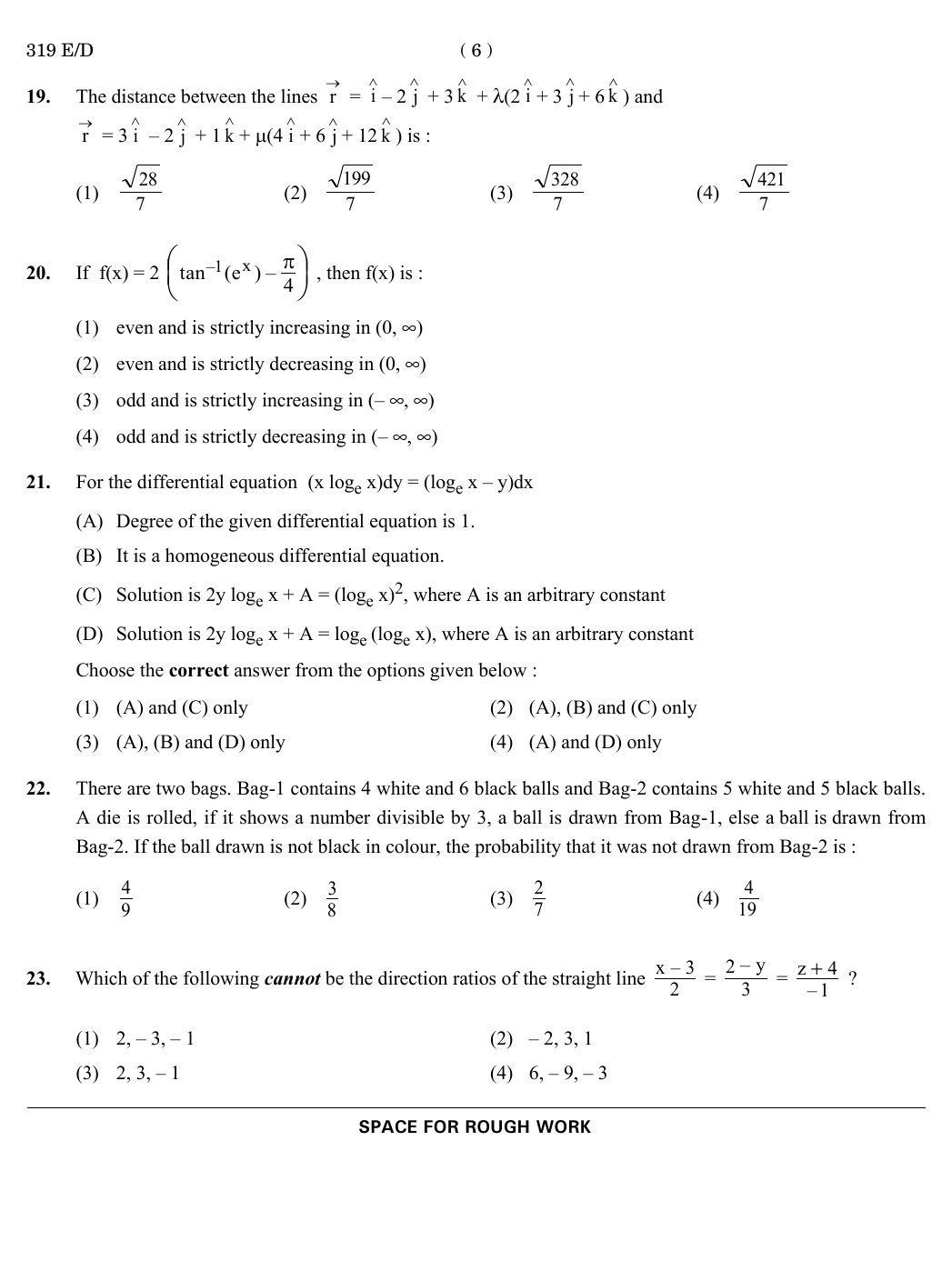
The distance between the lines r = î − 2ĵ + 3k̂ + λ(2î + 3ĵ + 6k̂) and r = 3î − 2ĵ + k̂ + µ(4î + 6ĵ + 12k̂) is:
View Solution
Use the formula for the distance between two skew lines: d = |(⃗d₁ × ⃗d₂) · (⃗r₂ − ⃗r₁)| / |⃗d₁ × ⃗d₂|. After calculating the cross product and dot product, the distance is √328/7.
If f(x) = 2 tan⁻¹(ex) − π/4, then f(x) is:
View Solution
f(x) = 2 tan⁻¹(ex) − π/4 is an odd function and is strictly increasing over the entire real line. Thus, the correct answer is (3).
For the differential equation (x loge x) dy = (logex − y) dx:
View Solution
There are two bags. Bag-1 contains 4 white and 6 black balls and Bag-2 contains 5 white and 5 black balls. A die is rolled, if it shows a number divisible by 3, a ball is drawn from Bag-1, else a ball is drawn from Bag-2. If the ball drawn is not black in color, the probability that it was not drawn from Bag-2 is:
View Solution
Using Bayes' theorem, we calculate the probability that the ball was not drawn from Bag-2, given that it is not black. The final result is 2/7.
Which of the following cannot be the direction ratios of the straight line x − 3 / 2 = 2 − y / 3 = z + 4 / −1?
View Solution
The direction ratios of the line x − 3 / 2 = 2 − y / 3 = z + 4 / −1 are 2, −3, −1. Option (3) does not match the correct direction ratios, as the second direction ratio should be negative.
Which one of the following represents the correct feasible region determined by the following constraints of an LPP? x + y ≥ 10, 2x + 2y ≤ 25, x ≥ 0, y ≥ 0.
View Solution
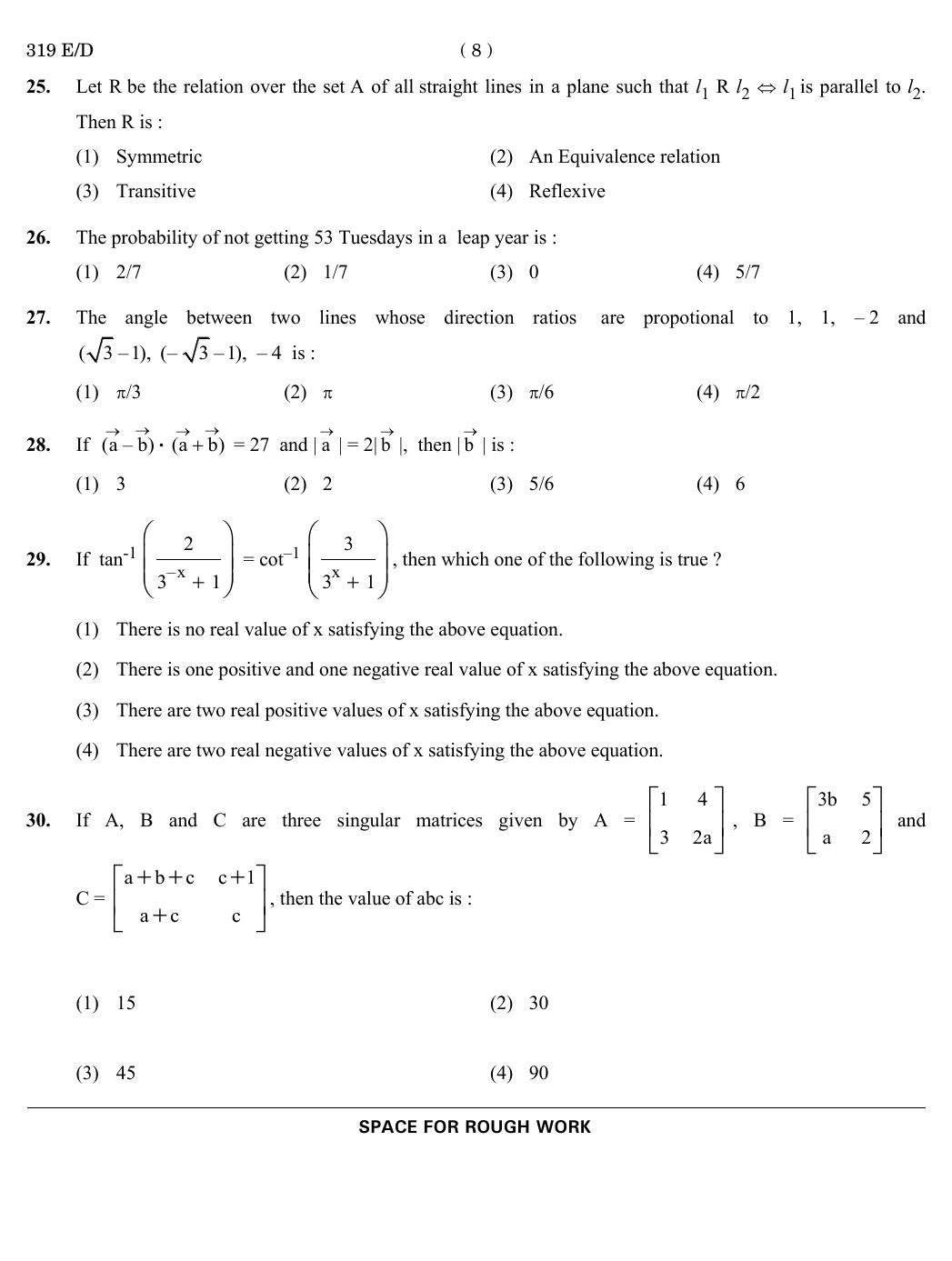
Let R be the relation over the set A of all straight lines in a plane such that l₁Rl₂ ⇐⇒ l₁ is parallel to l₂. Then R is:
View Solution
The relation R is reflexive (a line is parallel to itself), symmetric (if l₁ is parallel to l₂, then l₂ is parallel to l₁), and transitive (if l₁ is parallel to l₂, and l₂ is parallel to l₃, then l₁ is parallel to l₃).
The probability of not getting 53 Tuesdays in a leap year is:
View Solution
The angle between two lines whose direction ratios are proportional to 1, 1, −2 and (√3 − 1), (−√3 − 1), −4 is:
View Solution
If \( \vec{a} \cdot \vec{b} + \vec{a} \cdot \vec{a} = 27 \) and \( |\vec{a}| = 2|\vec{b}| \), then \( |\vec{b}| \) is:
View Solution
By using the formula \( \vec{a} \cdot \vec{b} = |\vec{a}| |\vec{b}| \cos(\theta) \) and substituting the given information, we find \( |\vec{b}| = 3 \).
If tan⁻¹(2 / 3 − x + 1) = cot⁻¹(3 / 3x + 1), then which one of the following is true?
View Solution
By using the identity cot⁻¹(y) = π/2 − tan⁻¹(y), we can solve the equation and find that there are two solutions for x, one positive and one negative.
If A, B, and C are three singular matrices given by A = [3b, 5; a, 2], B = [1, 4; 3, 2], and C = [a + b + c, c + 1; a + c, c], then the value of abc is:
View Solution
The determinant of each matrix is zero because they are singular. Solving the equations formed by the determinants, we find that the value of abc is 45.
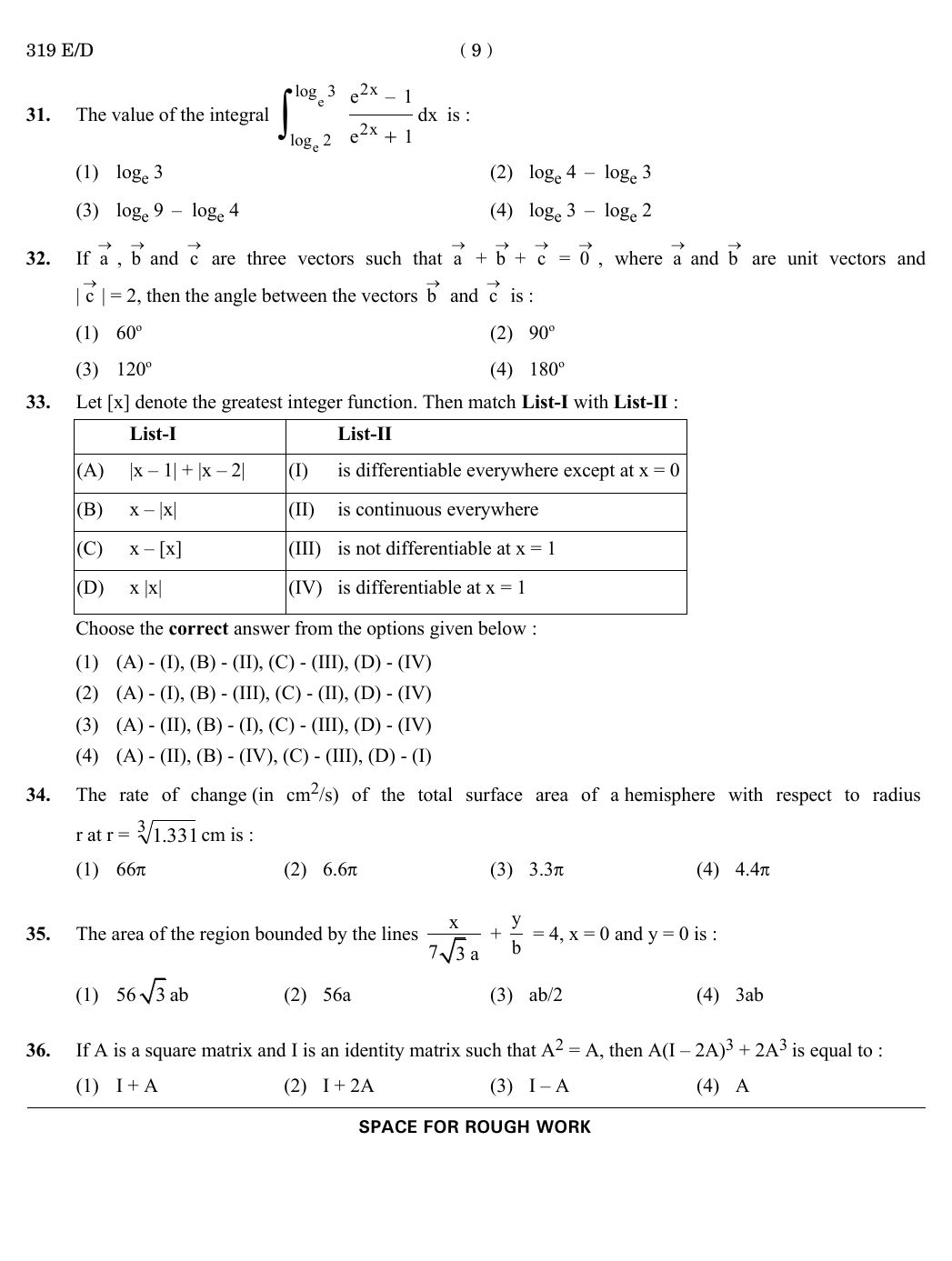
The value of the integral
∫ee+1 (log(3) * 2x) / (2x * log(2) * e - 1) dx is:
View Solution
This is an integral involving logarithmic functions, which can be simplified using standard integration techniques for logarithms.
If a, b, c are three vectors such that a + b + c = 0, where a and b are unit vectors and |c| = 2, then the angle between the vectors b and c is:
View Solution
Let [x] denote the greatest integer function. Then match List-I with List-II:
List-I
(A) |x − 1| + |x − 2|
(B) x − |x|
(C) x − [x]
(D) x|x|
List-II
(I) is differentiable everywhere except at x = 0
(II) is continuous everywhere
(III) is not differentiable at x = 1
(IV) is differentiable at x = 1
Choose the correct answer from the options given below :
View Solution
(A) |x − 1| + |x − 2| is continuous everywhere. Match: (A) → (II).
(B) x − |x| is differentiable at x = 1. Match: (B) → (I).
(C) x − [x] is not differentiable at x = 1. Match: (C) → (III).
(D) x|x| is differentiable at x = 1. Match: (D) → (IV).
The rate of change (in cm²/s) of the total surface area of a hemisphere with respect to radius r at r = √3 is:
View Solution
The area of the region bounded by the lines x + 7√3a + y/b = 4, x = 0, and y = 0 is:
View Solution
The equation of the line is x + 7√3a + y/b = 4.
The intercepts are: when x = 0, y = 4b, and when y = 0, x = 28√3a.
The area of the triangle formed is given by: Area = 1/2 × base × height.
The base is 28√3a and the height is 4b, so the area is: Area = 1/2 × (28√3a) × (4b) = 56√3ab.
If A is a square matrix and I is an identity matrix such that A² = A, then A(I − 2A)³ + 2A³ is equal to:
View Solution
We are given that A² = A.
Using this, simplify the expression A(I − 2A)³ + 2A³.
First, simplify (I − 2A)³ = I − 6A.
Then, the expression becomes A(I − 6A) + 2A.
Simplify to get A.
Match List-I with List-II:
List-I
(A) Integrating factor of xdy − (y + 2x²)dx = 0
(B) Integrating factor of (2x² − 3y)dx = xdy
(C) Integrating factor of (2y + 3x²)dx + xdy = 0
(D) Integrating factor of 2xdy + (3x³ + 2y)dx = 0
List-II
(I) 1/x
(II) x
(III) x²
(IV) x³
Choose the correct answer from the options given below :
View Solution
Analyze each differential equation and find the corresponding integrating factor:
(A) 1/x, (B) x³, (C) x², (D) x.
If the function f: N → N is defined as f(n) =
(A) f is injective
(B) f is into
(C) f is surjective
(D) f is invertible
Choose the correct answer from the options given below:
View Solution
Evaluate ∫(1 − cot(x)) csc(x) + cos(x) dx from 0 to π/2:
View Solution
The integrand is odd with respect to x = π/4, and since the integral is symmetric about π/4, the value of the integral is 0.
If the random variable X has the following distribution:
X: 0 1 2
P(X): k 2k 3k
Choose the correct answer from the options given below:
View Solution
For a square matrix Aₙₓₙ:
(A) |adj A| = |A|ⁿ⁻¹
(B) |A| = |adj A|ⁿ⁻¹
(C) A(adj A) = |A|
(D) A⁻¹ = 1 / |A|
Choose the correct answer from the options given below:
View Solution
For a square matrix Aₙₓₙ, the determinant of the adjugate of A is given by: |adj A| = |A|ⁿ⁻¹.
This property confirms that (A) is correct.
For the inverse of a matrix: |A⁻¹| = 1 / |A|.
This property confirms that (D) is correct.
(C) is valid, but it is not relevant to the determinant properties.
(B) is incorrect because |A| ≠ |adj A|ⁿ⁻¹.
The matrix
[1 0 0]
[0 1 0]
[0 0 1]
is a:
(A) scalar matrix
(B) diagonal matrix
(C) skew-symmetric matrix
(D) symmetric matrix
Choose the correct answer from the options given below:
View Solution
The matrix is a scalar matrix because all diagonal elements are equal and non-zero.
It is also a diagonal matrix since all non-diagonal elements are zero.
This matrix is symmetric because A = Aᵀ.
It is not skew-symmetric because all diagonal elements are non-zero.
The feasible region represented by the constraints 4x + y ≥ 80, x + 5y ≥ 115, 3x + 2y ≤ 150, x, y ≥ 0 of an LPP is:
Choose the correct answer from the options given below:
View Solution
The area of the region enclosed between the curves 4x² = y and y = 4 is:
Choose the correct answer from the options given below:
View Solution
The curves 4x² = y and y = 4 intersect at y = 4.
We find the area between these curves from y = 0 to y = 4.
Using integration: Area = 2 * ∫ from 0 to 4 of √y dy = 16/3 sq. units.
Evaluate ∫ e^x (2x + 1) / (2√x) dx:
Choose the correct answer from the options given below:
View Solution
The integrand simplifies to: e^x√x + 1 / (2√x) dx.
After substitution and simplification, the result is e^x√x + C.
If f(x) is defined as:
f(x) = {kx + 1 if x ≤ π, cos(x) if x > π},
is continuous at x = π, then the value of k is:
Choose the correct answer from the options given below:
View Solution
For continuity at x = π, the left-hand limit, right-hand limit, and the value of the function at x = π must all be equal.
Equating the left-hand limit and right-hand limit gives k = -2/π.
If P = [−1, 2, 1]ᵀ and Q = [2, −4, 1], then (PQ)ᵀ will be:
Choose the correct answer from the options given below:
View Solution
Compute the product PQ: the result is a 3x3 matrix.
Take the transpose of PQ to get (PQ)ᵀ = [-2 4 2, 4 −8 −4, −1 2 1].
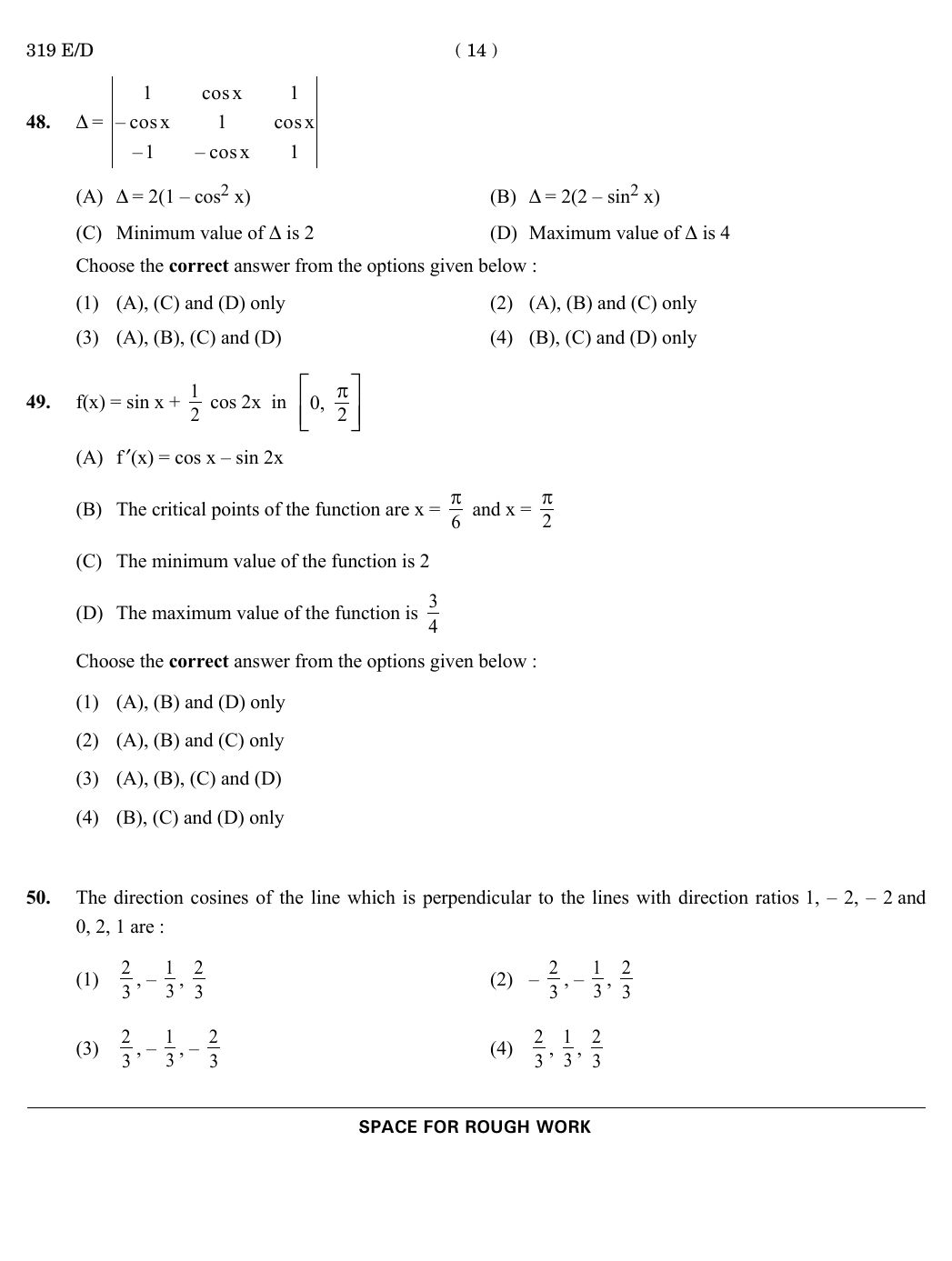
If Δ =
[1 cos(x) 1]
[-cos(x) 1 cos(x)]
[-1 -cos(x) 1]
Then:
(A) Δ = 2(1 – cos² x)
(B) Δ = 2(2 – sin² x)
(C) Minimum value of Δ is 2
(D) Maximum value of Δ is 4
Choose the correct answer from the options given below:
View Solution
If f(x) = sin(x) + 1/2 cos²(x) in [0, π/2], then:
(A) f'(x) = cos x – sin 2x
(B) The critical points of the function are x = π/6 and x = π/2
(C) The minimum value of the function is 2
(D) The maximum value of the function is 3/4
Choose the correct answer from the options given below:
View Solution
The direction cosines of the line which is perpendicular to the lines with direction ratios 1, -2, -2 and 0, 2, 1 are:
View Solution
A random variable X has the following probability distribution:
X = -2, -1, 0, 1, 2
P(X) = 0.2, 0.1, 0.3, 0.2, 0.2. The variance of X will be:
View Solution
The variance is calculated using the formula Variance = E(X²) - (E(X))², where E(X) is the expected value and E(X²) is the expected value of X².
A Multinational company creates a sinking fund by setting a sum of ₹12,000 annually for 10 years to pay off a bond issue of ₹72,000. If the fund accumulates at 5% per annum compound interest, then the surplus after paying for the bond is:
View Solution
The amount accumulated in the sinking fund is calculated using the formula for compound interest. The surplus is the difference between the accumulated amount and the bond amount.
If A = [2, 4; 4, 3], X = [n; 1], B = [8; 11], and AX = B, then the value of n will be:
View Solution
This is a matrix equation where we solve for the unknown \( n \) by performing matrix multiplication and solving the resulting equation.
The equation of the tangent to the curve \( \frac{5}{2}x + \frac{5}{2}y = 33 \) at the point (1, 4) is:
View Solution
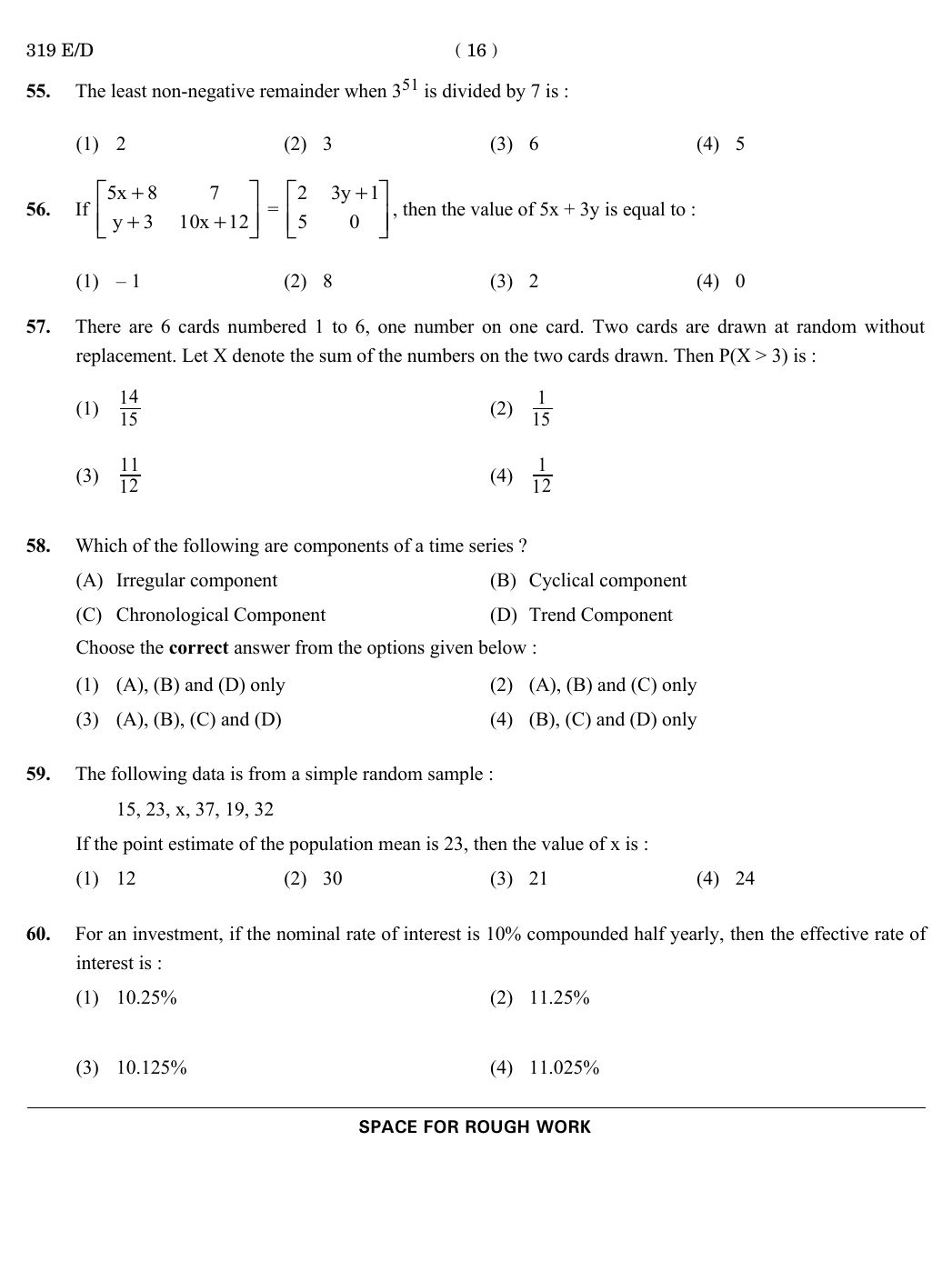
The least non-negative remainder when 351 is divided by 7 is:
View Solution
To find the remainder, divide 351 by 7 and calculate the remainder. 351 ÷ 7 = 50 with a remainder of 6.
If
[12x + 10y; 78x + 5y] = [0; 32], then the value of 5x + 3y is equal to:
View Solution
Solve the system of linear equations to find the values of x and y, and substitute them into the equation 5x + 3y.
There are 6 cards numbered 1 to 6, one number on one card. Two cards are drawn at random without replacement. Let X denote the sum of the numbers on the two cards drawn. Then P(X > 3) is:
View Solution
The total number of possible outcomes is 15, and the favorable outcomes where the sum is greater than 3 are calculated. The probability is the ratio of favorable outcomes to total outcomes.
Which of the following are components of a time series?
(A) Irregular component
(B) Cyclical component
(C) Chronological Component
(D) Trend Component
Choose the correct answer from the options given below:
View Solution
The following data is from a simple random sample: 15, 23, x, 37, 19, 32. If the point estimate of the population mean is 23, then the value of x is:
View Solution
The point estimate of the population mean is the sample mean, which is calculated as the sum of the sample values divided by the number of values. Solving for x gives 12.
For an investment, if the nominal rate of interest is 10% compounded half yearly, then the effective rate of interest is:
View Solution
The effective rate of interest is calculated using the formula Effective Rate = (1 + i/n)n - 1, where i = 0.1 and n = 2.
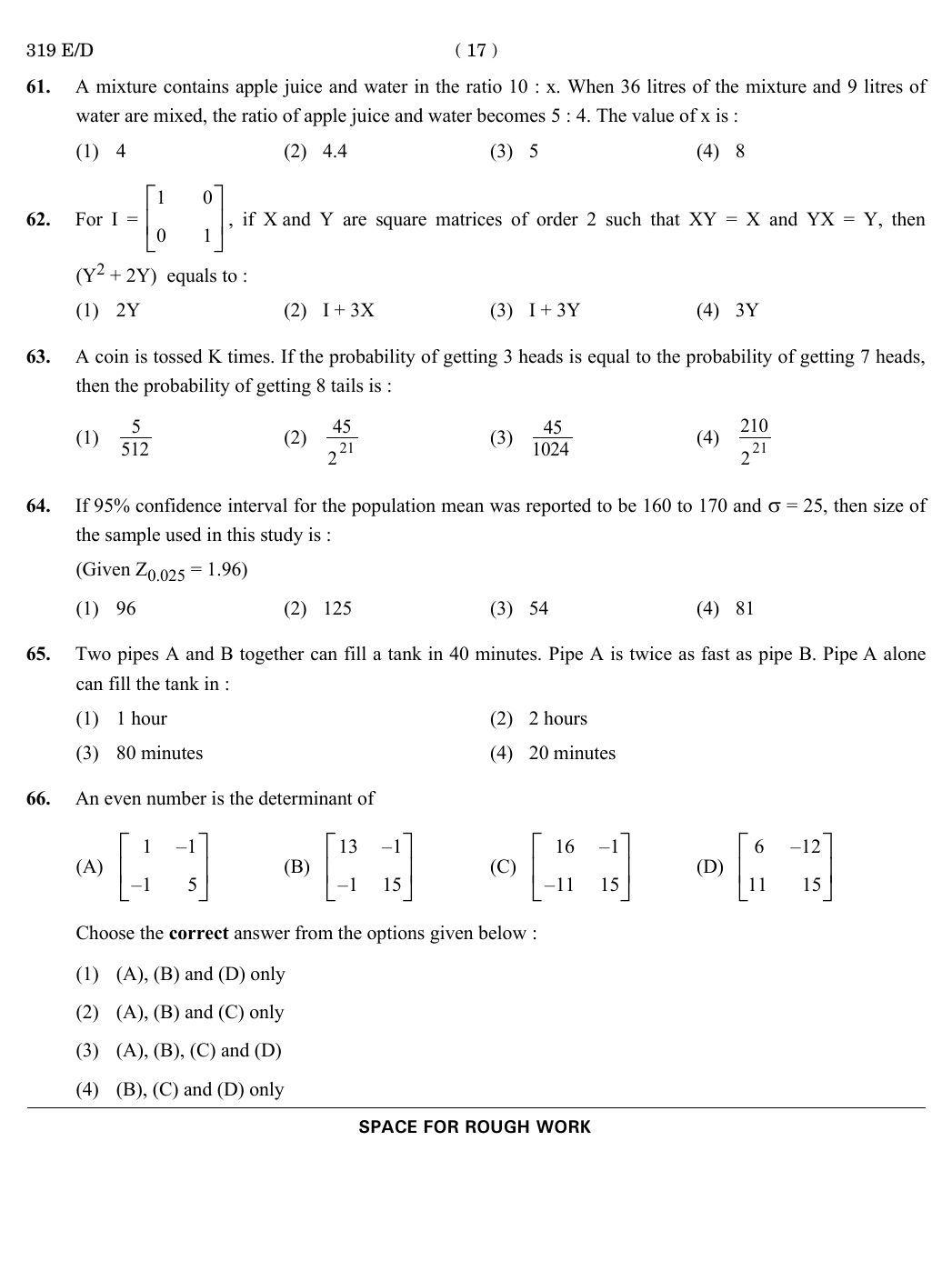
A mixture contains apple juice and water in the ratio 10 : x. When 36 litres of the mixture and 9 litres of water are mixed, the ratio of apple juice and water becomes 5 : 4. The value of x is:
View Solution
For
I = [10, 0; 0, 1], if X and Y are square matrices of order 2 such that XY = X and YX = Y, then (Y2 + 2Y) equals to:
View Solution
Using the properties of matrix multiplication and the given equations, we find that \( Y^2 + 2Y = I + 3Y \).
A coin is tossed K times. If the probability of getting 3 heads is equal to the probability of getting 7 heads, then the probability of getting 8 tails is:
View Solution
The probability of getting exactly 3 heads or 7 heads can be computed using the binomial distribution formula, and the probability of 8 tails is derived from that.
If 95% confidence interval for the population mean was reported to be 160 to 170 and
σ = 25, then size of the sample used in this study is:
View Solution
The size of the sample is calculated using the formula for the confidence interval, where the margin of error and standard deviation are used.
Two pipes A and B together can fill a tank in 40 minutes. Pipe A is twice as fast as pipe B. Pipe A alone can fill the tank in:
View Solution
Let the rate of Pipe B be x. Then the rate of Pipe A is 2x. The combined rate of filling the tank is given by 1/40, and solving for x gives the time for Pipe A to fill the tank.
An even number is the determinant of:
(1)
[1, -1; -1, 5](2)
[13, -1; -1, 15](3)
[16, -1; -11, 15](4)
[6, -12; 11, 15]Choose the correct answer from the options given below:
[6, -12; 11, 15]
View Solution
The determinant of a 2x2 matrix [a, b; c, d] is calculated using the formula ad - bc. The determinant of the fourth option is even.
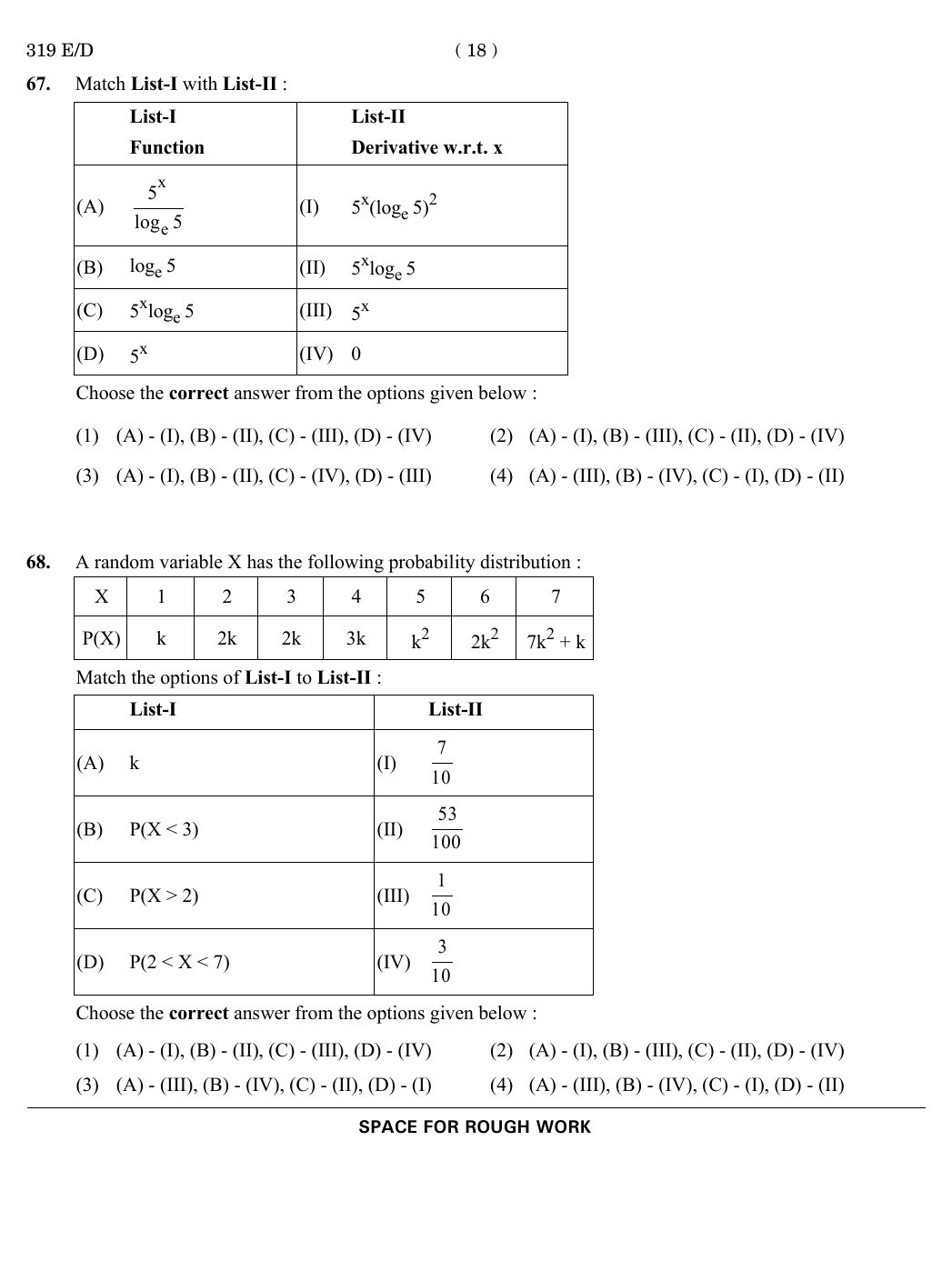
Match List-I with List-II:
List-I
(A) x * e5 log 5
(B) loge 5
(C) 5x * loge 5
(D) 5x
List-II
(I) 5x * (loge 5)2
(II) 5x * loge 5
(III) 5x
(IV) 0
Choose the correct answer from the options given below:
View Solution
The derivatives of the functions are matched with their corresponding options based on standard derivative rules and simplifications.
A random variable X has the following probability distribution:
X: 1, 2, 3, 4, 5, 6, 7
P(X): k, 2k, 2k, 3k, k2, 2k2, 7k2 + k
Match the options of List-I to List-II:
List-I
(A) k
(B) P(X < 3)
(C) P(X > 2)
(D) P(2 < X < 7)
List-II
(I) 7/10
(II) 53/100
(III) 1/10
(IV) 3/10
Choose the correct answer from the options given below:
View Solution
By using the properties of probability distributions and calculating the values for each condition, we match the correct answers.
For which one of the following purposes is CAGR (Compounded Annual Growth Rate) not used?
View Solution
CAGR is typically used in finance for growth analysis over time, not for analyzing donations in non-profit sectors.
A flower vase costs ₹36,000. With an annual depreciation of ₹2,000, its cost will be ₹6,000 in ______ years.
View Solution
The depreciation formula is \( \text{Final cost} = \text{Initial cost} - \text{Depreciation} \times \text{Years} \). Solving gives 17 years for the price to reduce to ₹6,000.
Arun's speed of swimming in still water is 5 km/hr. He swims between two points in a river and returns back to the same starting point. He took 20 minutes more to cover the distance upstream than downstream. If the speed of the stream is 2 km/hr, then the distance between the two points is:
View Solution
Use the relation \( \text{time} = \frac{\text{distance}}{\text{speed}} \) and account for the effect of the stream speed to find the distance.
If ey = xx, then which of the following is true?
View Solution
Differentiating the equation ey = xx twice with respect to x, and solving for the second derivative, we get d2y / dx2 - dy / dx = 0.
The probability of a shooter hitting a target is \( \frac{3}{4} \). How many minimum number of times must he fire so that the probability of hitting the target at least once is more than 90%?
View Solution
Use the formula \( 1 - P(\text{no hit})^n > 0.9 \), where \( P(\text{no hit}) = \frac{1}{4} \), and solve for \( n \).
Match List-I with List-II:
List-I
(A) Distribution of a sample leads to becoming a normal distribution
(B) Some subset of the entire population
(C) Population mean
(D) Some assumptions about the population
List-II
(I) Central Limit Theorem
(II) Hypothesis
(III) Sample
(IV) Parameter
Choose the correct answer from the options given below:
View Solution
According to the Central Limit Theorem, a sample distribution approaches a normal distribution as the sample size increases. The rest match the definitions of statistics terms.
Ms. Sheela creates a fund of ₹1,00,000 for providing scholarships to needy children. The scholarship is provided in the beginning of the year. This fund earns an interest of r% per annum. If the scholarship amount is taken as ₹8,000, then \( r = \)
View Solution
The formula for simple interest \( I = P \times r \times t \) is used, where \( P = 100,000 \), \( I = 8,000 \), and \( t = 1 \). Solving gives \( r = 2.5\% \).
A person wants to invest an amount of ₹75,000. He has two options A and B yielding 8% and 9% return respectively on the invested amount. He plans to invest at least ₹15,000 in Plan A and at least ₹25,000 in Plan B. Also, he wants that his investment in Plan A is less than or equal to his investment in Plan B. Which of the following options describes the given LPP to maximize the return?
Z = 0.08x + 0.09y where x ≥ 15000, y ≥ 25000, x + y ≥ 75000, x ≤ y, x, y ≥ 0
View Solution
This linear programming problem maximizes the return function subject to constraints on investments in Plan A and Plan B and their relationship. The correct set of constraints ensures that the investment in Plan A is less than or equal to the investment in Plan B.
In a 700 m race, Amit reaches the finish point in 20 seconds and Rahul reaches in 25 seconds. Amit beats Rahul by a distance of:
View Solution
For the given five values 12, 15, 18, 24, 36; the three-year moving averages are:
View Solution
The moving average is calculated by taking the average of every 3 consecutive values. For example, the first moving average is \( \frac{12 + 15 + 18}{3} = 15 \), and so on.
A property dealer wishes to buy different houses given in the table below with some down payments and balance in EMI for 25 years. Bank charges 6% per annum compounded monthly.
Property type | Price (₹) | Down Payment (₹)
P | 45,00,000 | 5,00,000
Q | 55,00,000 | 5,00,000
R | 65,00,000 | 10,00,000
S | 75,00,000 | 15,00,000
Match List-I with List-II:
View Solution
The EMI for each property is calculated using the EMI formula for compound interest: \( EMI = \frac{P \times r \times (1+r)^n}{(1+r)^n-1} \), where \( P \) is the loan amount, \( r \) is the monthly interest rate, and \( n \) is the number of payments.
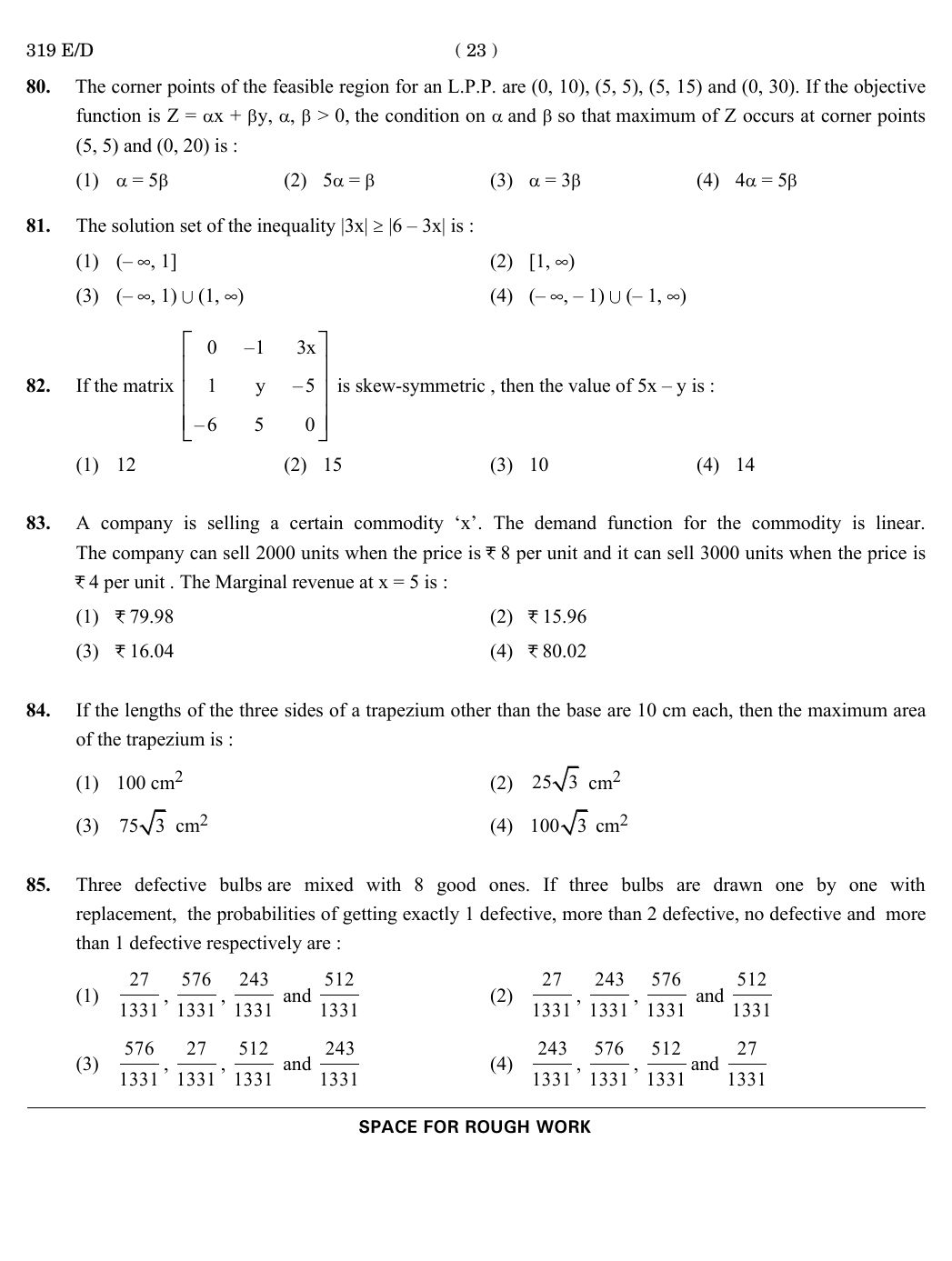
The corner points of the feasible region for an L.P.P. are (0, 10), (5, 5), (5, 15) and (0, 30). If the objective function is
Z = αx + βy, α, β > 0, the condition on α and β so that maximum of Z occurs at corner points (5, 5) and (0, 20) is:
5α = β
View Solution
To maximize Z at the given points, you need to solve for α and β by considering the slopes of the objective function and the boundary lines of the feasible region.
The solution set of the inequality
|3x| ≥ |6 - 3x| is:
If the matrix
<0, -1, 3x; 1, y, -5; -6, 5, 0> is skew-symmetric, then the value of 5x - y is:
View Solution
In a skew-symmetric matrix, all diagonal elements must be zero. By equating the elements to their corresponding negatives and solving for x and y, we find 5x - y = 10.
A company is selling a certain commodity ‘x’. The demand function for the commodity is linear. The company can sell 2000 units when the price is ₹8 per unit and it can sell 3000 units when the price is ₹4 per unit. The Marginal revenue at x = 5 is:
View Solution
The demand function is linear, so we find the equation of the demand curve and use the marginal revenue formula: MR = d(TR)/dx, where TR is the total revenue.
If the lengths of the three sides of a trapezium other than the base are 10 cm each, then the maximum area of the trapezium is:
View Solution
To maximize the area of the trapezium, we use the formula for the area of a trapezium with equal non-parallel sides and calculate the maximum when the height is maximized.
Three defective bulbs are mixed with 8 good ones. If three bulbs are drawn one by one with replacement, the probabilities of getting exactly 1 defective, more than 2 defective, no defective, and more than 1 defective respectively are:
View Solution
The probabilities are calculated using the binomial distribution formula for drawing defective and non-defective bulbs with replacement. Each probability is computed for the respective scenarios.












Comments