




CUET 2026 Agriculture Question Paper is available for download here. NTA conducted the CUET 2026 exam from 11th May to 31st May in two shifts.
The CUET 2026 Agriculture question paper includes the following:
- 50 questions, to be attempted in 60 minutes
- Question type: multiple choice questions (MCQs) with four options
- Marking: +5 for a correct answer, -1 for an incorrect answer, 0 for an unattempted question
- Maximum marks: 250
CUET 2026 Agriculture May 15 Shift 1 Question Paper with Solution PDF
| NTA Official PDF | CD PDF | CD PDF with Solutions |
|---|---|---|
| Download official PDF 6.79 MB | Download Collegedunia PDF 0.32 MB | Download solutions PDF 0.31 MB |
Also Check:
- CUET 2027 Latest Updates
- Download CUET UG Previous Year Papers for free
- CUET 2026 May 15 Shift 1 Agriculture Question Paper with Solutions
CUET 2026 Agriculture May 15 Shift 1 Questions with Solutions
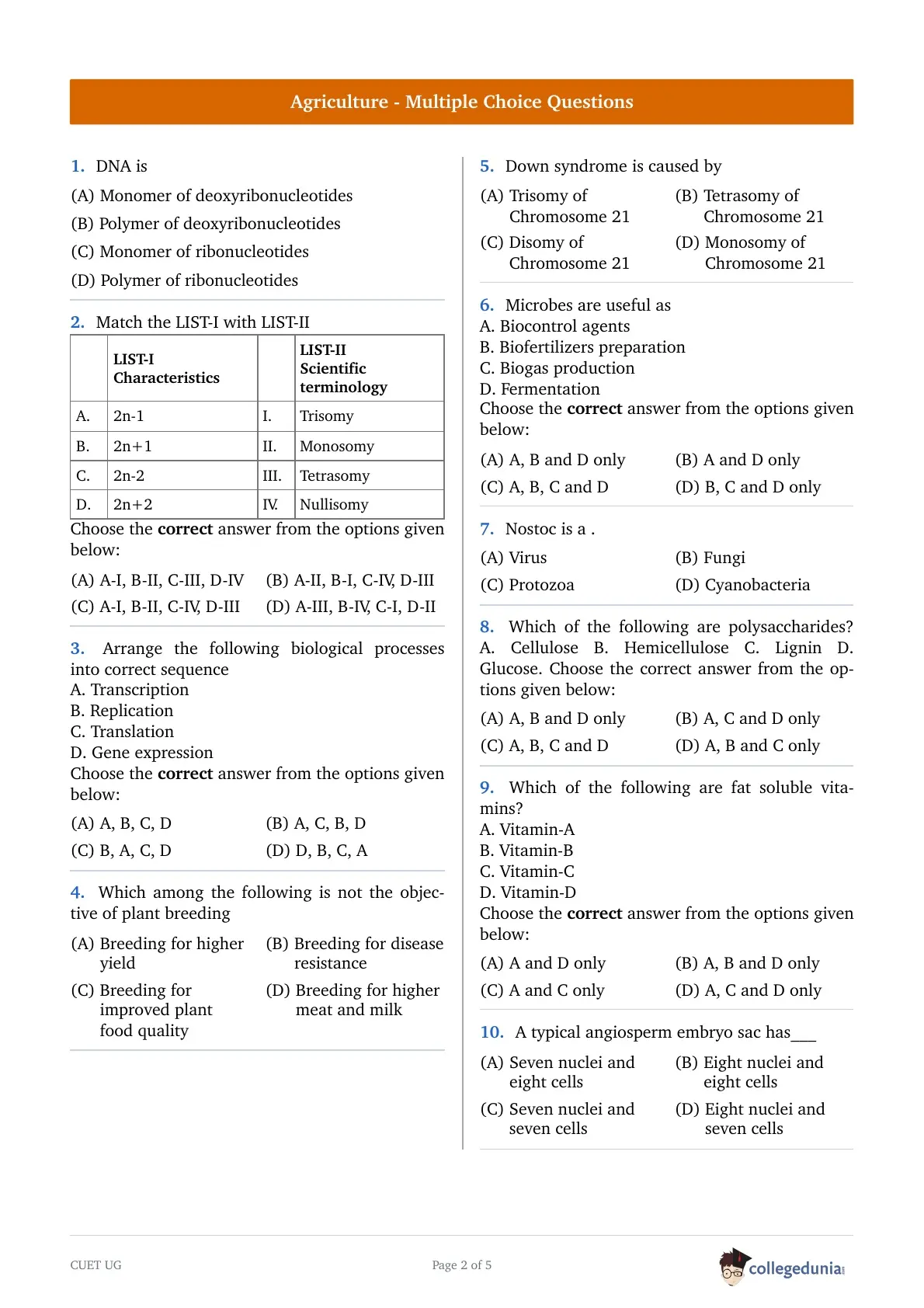
DNA is
Match the LIST-I with LIST-II
| LIST-I Characteristics | LIST-II Scientific terminology | ||
|---|---|---|---|
| A. | 2n-1 | I. | Trisomy |
| B. | 2n+1 | II. | Monosomy |
| C. | 2n-2 | III. | Tetrasomy |
| D. | 2n+2 | IV. | Nullisomy |
Arrange the following biological processes into correct sequence
A. Transcription
B. Replication
C. Translation
D. Gene expression
Choose the correct answer from the options given below:
Which among the following is not the objective of plant breeding
Down syndrome is caused by
Microbes are useful as
A. Biocontrol agents
B. Biofertilizers preparation
C. Biogas production
D. Fermentation
Choose the correct answer from the options given below:
Nostoc is a .
Which of the following are polysaccharides?
A. Cellulose
B. Hemicellulose
C. Lignin
D. Glucose
Choose the correct answer from the options given below:
Which of the following are fat soluble vitamins?
A. Vitamin-A
B. Vitamin-B
C. Vitamin-C
D. Vitamin-D
Choose the correct answer from the options given below:
A typical angiosperm embryo sac has .
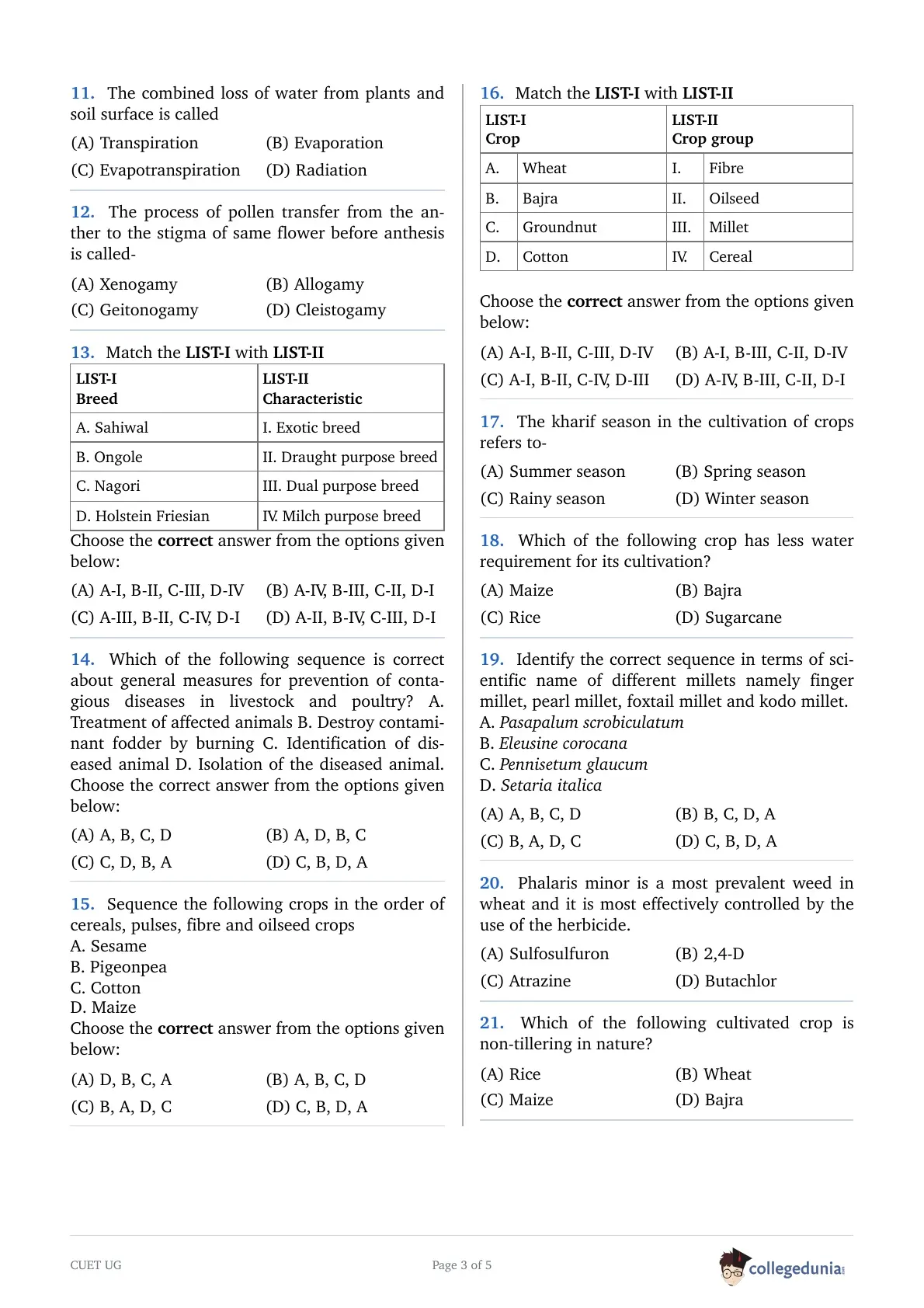
The combined loss of water from plants and soil surface is called
The process of pollen transfer from the anther to the stigma of same flower before anthesis is called-
Match the LIST-I with LIST-II
| LIST-I Breed | LIST-II Characteristic |
|---|---|
| A. Sahiwal | I. Exotic breed |
| B. Ongole | II. Draught purpose breed |
| C. Nagori | III. Dual purpose breed |
| D. Holstein Friesian | IV. Milch purpose breed |
Which of the following sequence is correct about general measures for prevention of contagious diseases in livestock and poultry?
A. Treatment of affected animals
B. Destroy contaminant fodder by burning
C. Identification of diseased animal
D. Isolation of the diseased animal
Choose the correct answer from the options given below:
Sequence the following crops in the order of cereals, pulses, fibre and oilseed crops
A. Sesame
B. Pigeonpea
C. Cotton
D. Maize
Choose the correct answer from the options given below:
Match the LIST-I with LIST-II
| LIST-I Crop | LIST-II Crop group | ||
|---|---|---|---|
| A. | Wheat | I. | Fibre |
| B. | Bajra | II. | Oilseed |
| C. | Groundnut | III. | Millet |
| D. | Cotton | IV. | Cereal |
Choose the correct answer from the options given below:
The kharif season in the cultivation of crops refers to-
Which of the following crop has less water requirement for its cultivation?
Identify the correct sequence in terms of scientific name of different millets namely finger millet, pearl millet, foxtail millet and kodo millet.
A. Pasapalum scrobiculatum
B. Eleusine corocana
C. Pennisetum glaucum
D. Setaria italica
Phalaris minor is a most prevalent weed in wheat and it is most effectively controlled by the use of the herbicide.
Which of the following cultivated crop is non-tillering in nature?
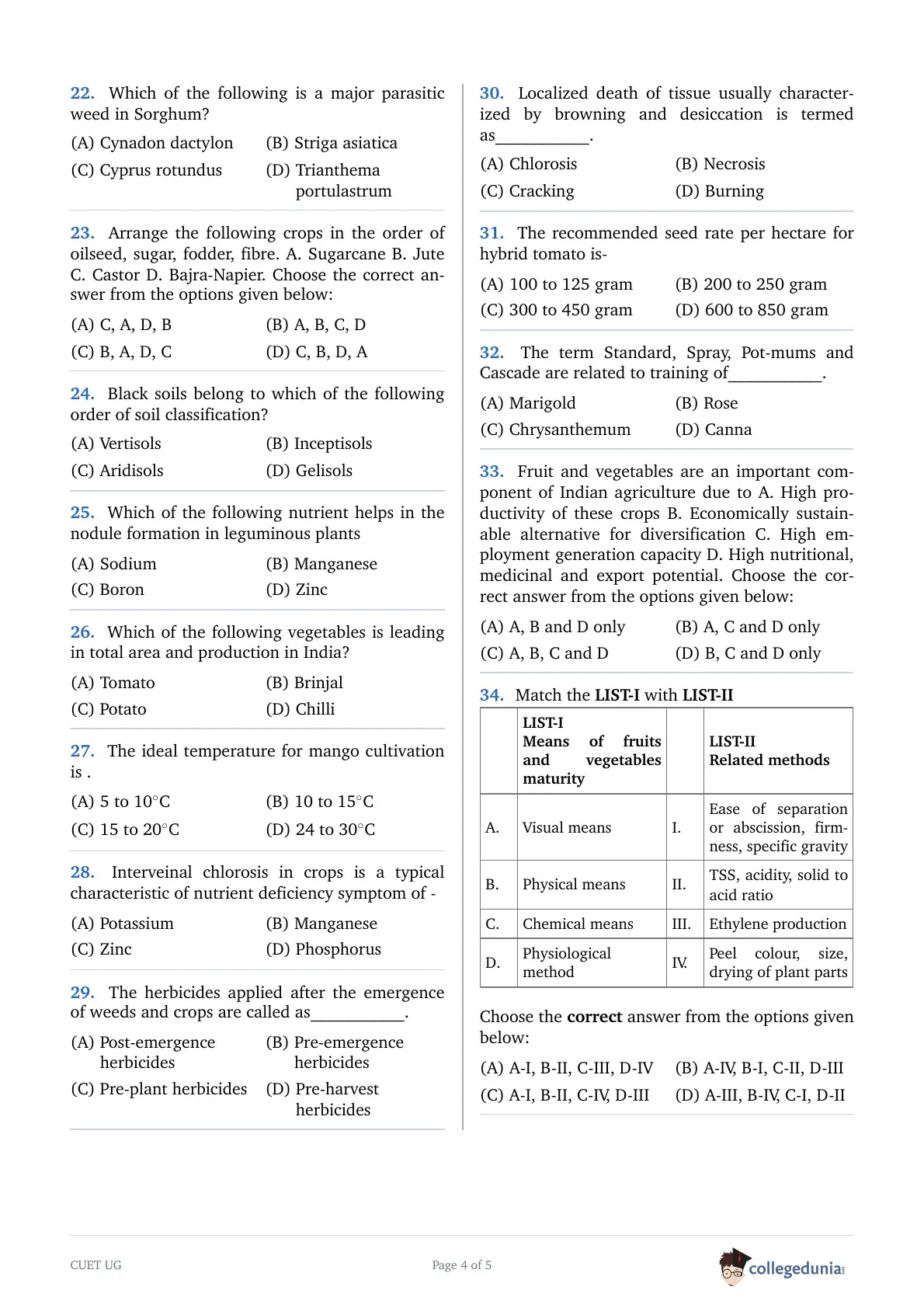
Which of the following is a major parasitic weed in Sorghum?
Arrange the following crops in the order of oilseed, sugar, fodder, fibre.
A. Sugarcane
B. Jute
C. Castor
D. Bajra-Napier
Choose the correct answer from the options given below:
Black soils belong to which of the following order of soil classification?
Which of the following nutrient helps in the nodule formation in leguminous plants?
Which of the following vegetables is leading in total area and production in India?
The ideal temperature for mango cultivation is .
Interveinal chlorosis in crops is a typical characteristic of nutrient deficiency symptom of -
The herbicides applied after the emergence of weeds and crops are called as .
Localized death of tissue usually characterized by browning and desiccation is termed as .
The recommended seed rate per hectare for hybrid tomato is-
The term Standard, Spray, Pot-mums and Cascade are related to training of .
Fruit and vegetables are an important component of Indian agriculture due to
A. High productivity of these crops
B. Economically sustainable alternative for diversification
C. High employment generation capacity
D. High nutritional, medicinal and export potential
Choose the correct answer from the options given below:
Match the LIST-I with LIST-II
| LIST-I Means of fruits and vegetables maturity | LIST-II Related methods | ||
|---|---|---|---|
| A. | Visual means | I. | Ease of separation or abscission, firmness, specific gravity |
| B. | Physical means | II. | TSS, acidity, solid to acid ratio |
| C. | Chemical means | III. | Ethylene production |
| D. | Physiological method | IV. | Peel colour, size, drying of plant parts |
Choose the correct answer from the options given below:
Match the LIST-I with LIST-II
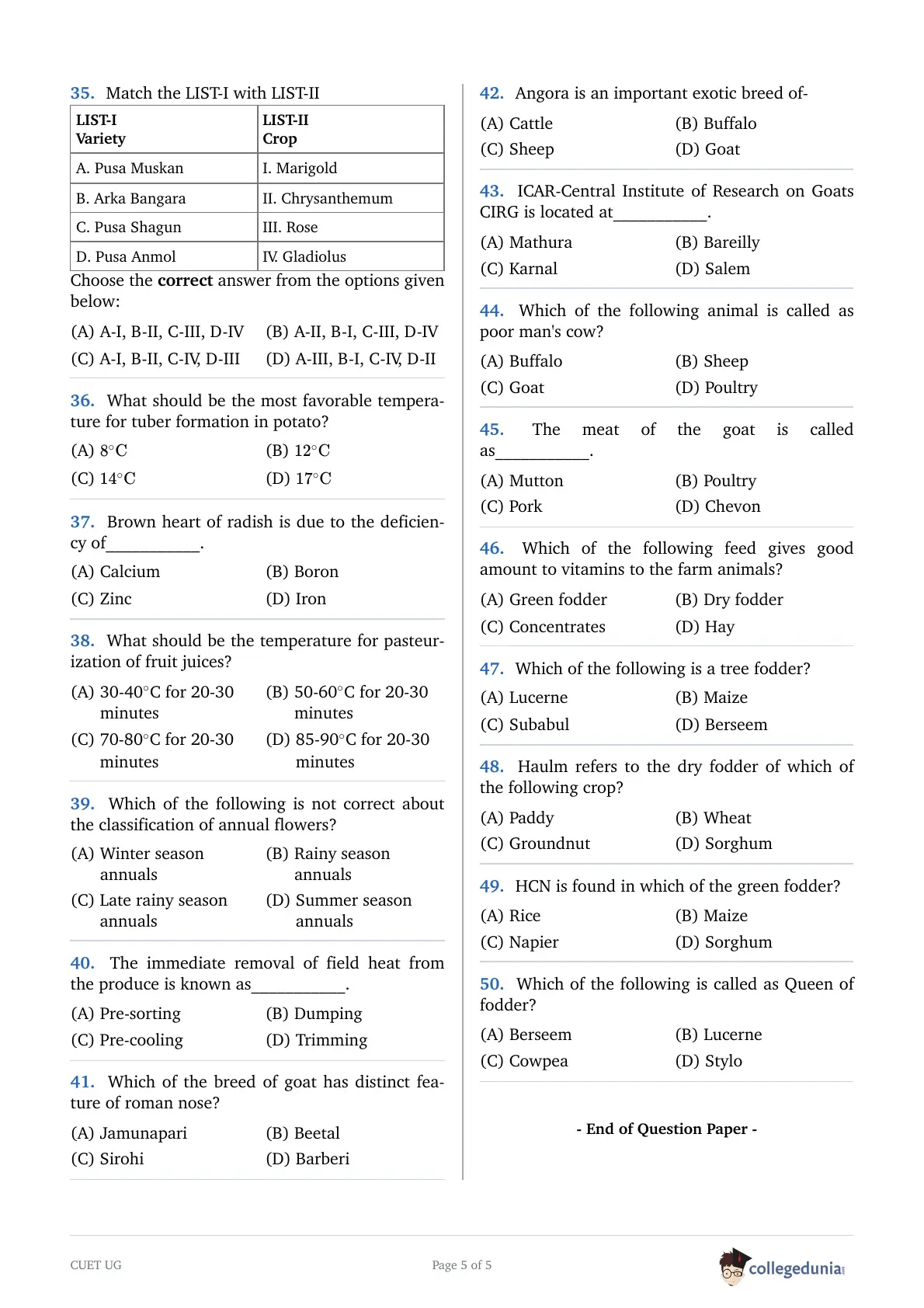
| LIST-I Variety | LIST-II Crop |
|---|---|
| A. Pusa Muskan | I. Marigold |
| B. Arka Bangara | II. Chrysanthemum |
| C. Pusa Shagun | III. Rose |
| D. Pusa Anmol | IV. Gladiolus |
What should be the most favorable temperature for tuber formation in potato?
Brown heart of radish is due to the deficiency of .
What should be the temperature for pasteurization of fruit juices?
Which of the following is not correct about the classification of annual flowers?
The immediate removal of field heat from the produce is known as .

ICAR-Central Institute of Research on Goats CIRG is located at __________.

Which of the following feed gives good amount to vitamins to the farm animals?
CUET UG 2026 Exam Pattern and Marking Scheme
| Parameter | Details |
|---|---|
| Exam Name | Common University Entrance Test (CUET UG) 2026 |
| Conducting Body | National Testing Agency (NTA) |
| Exam Mode | Computer-Based Test (CBT) |
| Exam Duration | 60 minutes per test |
| Total Sections | 3 (Languages, Domain Subjects, General Test) |
| Question Type | Multiple Choice Questions (MCQs) |
| Questions per Test | 50 questions (all compulsory) |
| Marking Scheme | +5 for correct, -1 for incorrect |
| Maximum Marks | 250 marks per test |
| Maximum Subject Choices | 5 subjects in total |
| Syllabus Base | Class 12 NCERT (mainly for Domain Subjects) |



Comments