




CUET 2026 June 7 Shift 2 Accountancy Question Paper is available for download here. NTA is conducting the CUET 2026 exam from 11th May to 31st May and 6th June to 7th June.
- CUET 2026 Accountancy exam consists of 50 questions for 250 marks to be attempted in 60 minutes.
- As per the marking scheme, 5 marks are awarded for each correct answer, and 1 mark is deducted for incorrect answer.
Candidates can download CUET 2026 June 7 Shift 2 Accountancy Question Paper with Answer Key and Solution PDF from links provided below.
Related Links:
- CUET 2026 June 7 Shift 2 Accountancy Answer Key
- CUET UG 2026 Accountancy Marks vs Expected Percentile and Colleges
CUET 2026 Accountancy June 7 Shift 2 Question Paper with Solution PDF
| CUET June 7 Shift 2 Accountancy Question Paper 2026 | Download PDF | Check Solutions |
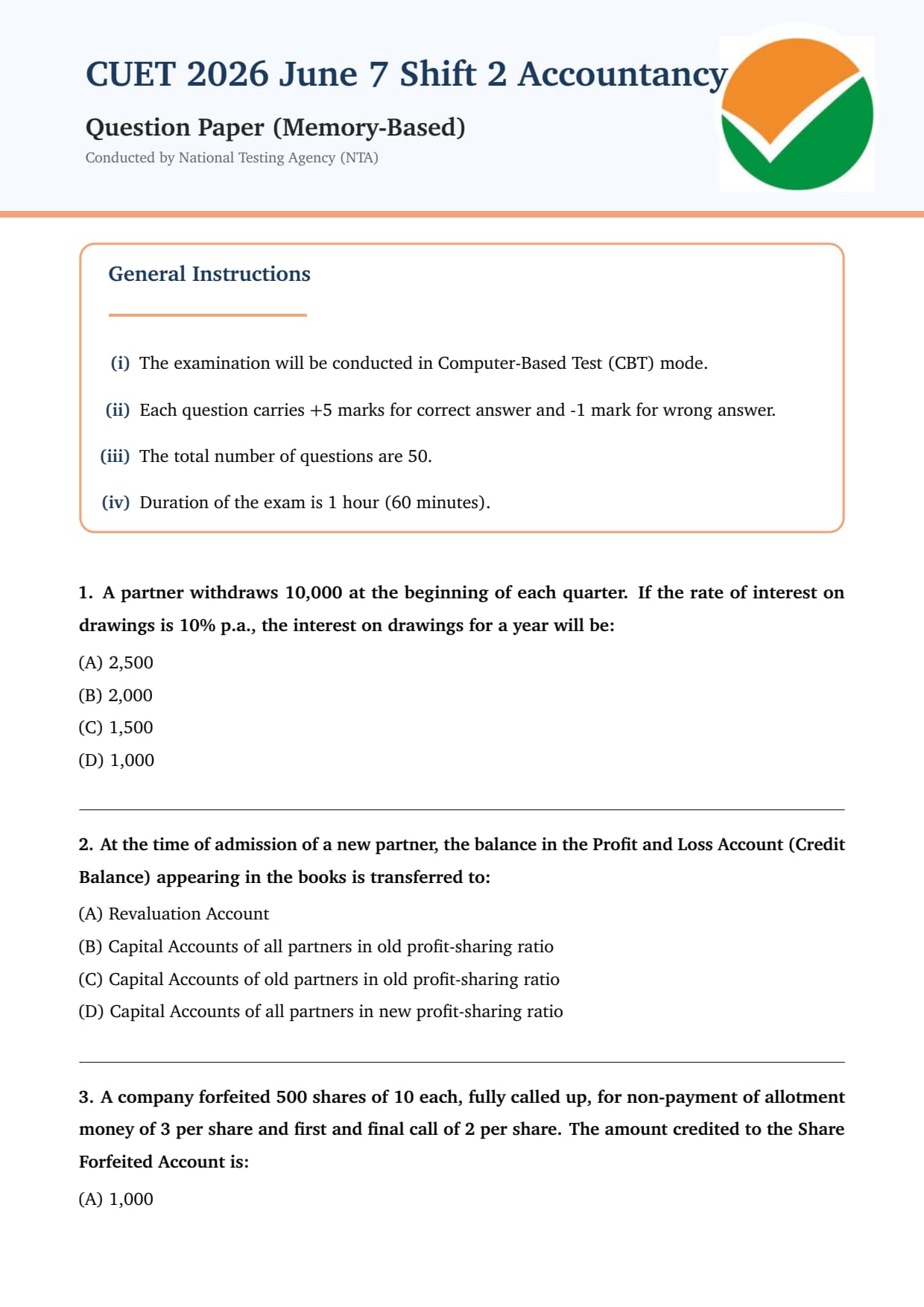
A partner withdraws ₹10,000 at the beginning of each quarter. If the rate of interest on drawings is 10% p.a., the interest on drawings for a year will be:
View Solution
Concept:
Interest on drawings is charged when partners withdraw money from the firm for personal use. The interest is calculated for the period during which the amount remains withdrawn from the business.
When equal amounts are withdrawn at the beginning of each quarter, the average period method can be used. For quarterly drawings made at the beginning of each quarter, the average period is:
\[ \frac{12+9+6+3}{4}=7.5 months \]
This method saves time and avoids calculating interest separately for each withdrawal.
Step 1: Write the details given in the question.
Amount withdrawn at the beginning of each quarter:
\[ ₹10,000 \]
Number of quarters:
\[ 4 \]
Rate of interest:
\[ 10% per annum \]
Therefore, total drawings during the year are:
\[ ₹10,000 \times 4 = ₹40,000 \]
Step 2: Determine the average period.
Since the withdrawals are made at the beginning of each quarter:
\[ 1st Quarter = 12 months \]
\[ 2nd Quarter = 9 months \]
\[ 3rd Quarter = 6 months \]
\[ 4th Quarter = 3 months \]
Average period
\[ = \frac{12+9+6+3}{4} = \frac{30}{4} = 7.5 months \]
Step 3: Apply the interest on drawings formula.
\[ Interest on Drawings = \frac{Total Drawings\times R \times T}{100 \times 12} \]
Substituting the values:
\[ = \frac{40,000 \times 10 \times 7.5}{100 \times 12} \]
\[ = \frac{4,00,000 \times 7.5}{1200} \]
\[ = ₹2,500 \]
Step 4: Interpret the result.
The partner has withdrawn money throughout the year. Since the withdrawals reduce the firm's available funds, the partner is charged interest on drawings.
The total interest chargeable is:
\[ \boxed{₹2,500} \]
Hence Option (A) is correct. Quick Tip: For equal drawings at the beginning of each quarter, the average period is always 7.5 months. Interest on Drawings = Total Drawings × Rate × Average Period / (100 × 12)
At the time of admission of a new partner, the balance in the Profit and Loss Account (Credit Balance) appearing in the books is transferred to:
View Solution
Concept:
At the time of admission of a new partner, all accumulated profits and reserves belonging to the old partners must be distributed among them before the new partner is admitted.
A credit balance in the Profit and Loss Account represents accumulated profits that have not yet been distributed. Since these profits were earned before the admission of the new partner, the new partner has no claim over them.
Therefore, such profits are transferred only to the old partners in their old profit-sharing ratio.
Step 1: Understand the nature of Profit and Loss Account credit balance.
A credit balance in the Profit and Loss Account indicates:
Accumulated profits.
Undistributed earnings.
Profits belonging to existing partners.
Thus it is a gain available for distribution among partners.
Step 2: Identify the stage of admission.
The question relates to the admission of a new partner.
Whenever a new partner enters:
Existing profits belong to old partners.
Existing reserves belong to old partners.
New partner gets no share in past profits.
Therefore accumulated profits must first be distributed.
Step 3: Apply the accounting treatment.
The journal entry is:
\[ Profit and Loss A/c Dr. \]
\[ To Old Partners' Capital A/cs \]
in the old profit-sharing ratio.
This transfers accumulated profits to the capital accounts of old partners.
Step 4: Examine the options.
Option (A):
Revaluation Account is used for revaluation of assets and liabilities, not for accumulated profits.
Hence incorrect.
Option (B):
Includes all partners, including the new partner.
Incorrect because the new partner is not entitled to past profits.
Option (C):
Capital Accounts of old partners in old ratio.
This is the correct accounting treatment.
Option (D):
New ratio is used after admission.
Accumulated profits must be distributed before admission.
Hence incorrect.
Step 5: Conclude the answer.
Therefore accumulated profits represented by the credit balance of Profit and Loss Account are transferred to:
\[ \boxed{Capital Accounts of old partners in old profit-sharing ratio} \]
Hence Option (C) is correct. Quick Tip: Rule to remember: Accumulated Profits, General Reserve and Credit Balance of Profit \& Loss Account always belong to old partners and are distributed in the old profit-sharing ratio before admission of a new partner.
A company forfeited 500 shares of ₹10 each, fully called up, for non-payment of allotment money of ₹3 per share and first and final call of ₹2 per share. The amount credited to the Share Forfeited Account is:
View Solution
Concept:
When shares are forfeited, the amount already received from shareholders is transferred to the Share Forfeiture Account.
The Share Forfeiture Account represents the amount paid by shareholders before forfeiture and serves as a capital gain for the company.
Therefore:
\[ Share Forfeiture Amount = Called-up Value - Unpaid Amount \]
multiplied by the number of shares forfeited.
Step 1: Determine the called-up value per share.
The shares are:
\[ ₹10 each \]
and are fully called up.
Therefore called-up value per share is:
\[ ₹10 \]
Step 2: Calculate the unpaid amount per share.
Non-payment includes:
Allotment money:
\[ ₹3 \]
First and final call:
\[ ₹2 \]
Total unpaid amount:
\[ ₹3+₹2 = ₹5 \]
Step 3: Calculate amount already received per share.
Amount received per share:
\[ ₹10-₹5 = ₹5 \]
Thus each shareholder had paid:
\[ ₹5 \]
before forfeiture.
Step 4: Calculate total amount transferred to Share Forfeiture Account.
Number of shares forfeited:
\[ 500 \]
Amount received per share:
\[ ₹5 \]
Therefore:
\[ 500 \times 5 = ₹2,500 \]
Step 5: Verify through journal entry.
At forfeiture:
\[ Share Capital A/c Dr. \quad ₹5,000 \]
\[ To Share Allotment A/c \quad ₹1,500 \]
\[ To Share Final Call A/c \quad ₹1,000 \]
\[ To Share Forfeiture A/c \quad ₹2,500 \]
Hence the credit to Share Forfeiture Account is:
\[ ₹2,500 \]
Step 6: State the final answer.
\[ \boxed{₹2,500} \]
Hence Option (B) is correct. Quick Tip: Share Forfeiture Account always contains the amount already received from shareholders before forfeiture. Formula: Share Forfeiture Amount = (Number of Shares) × (Amount Received per Share)
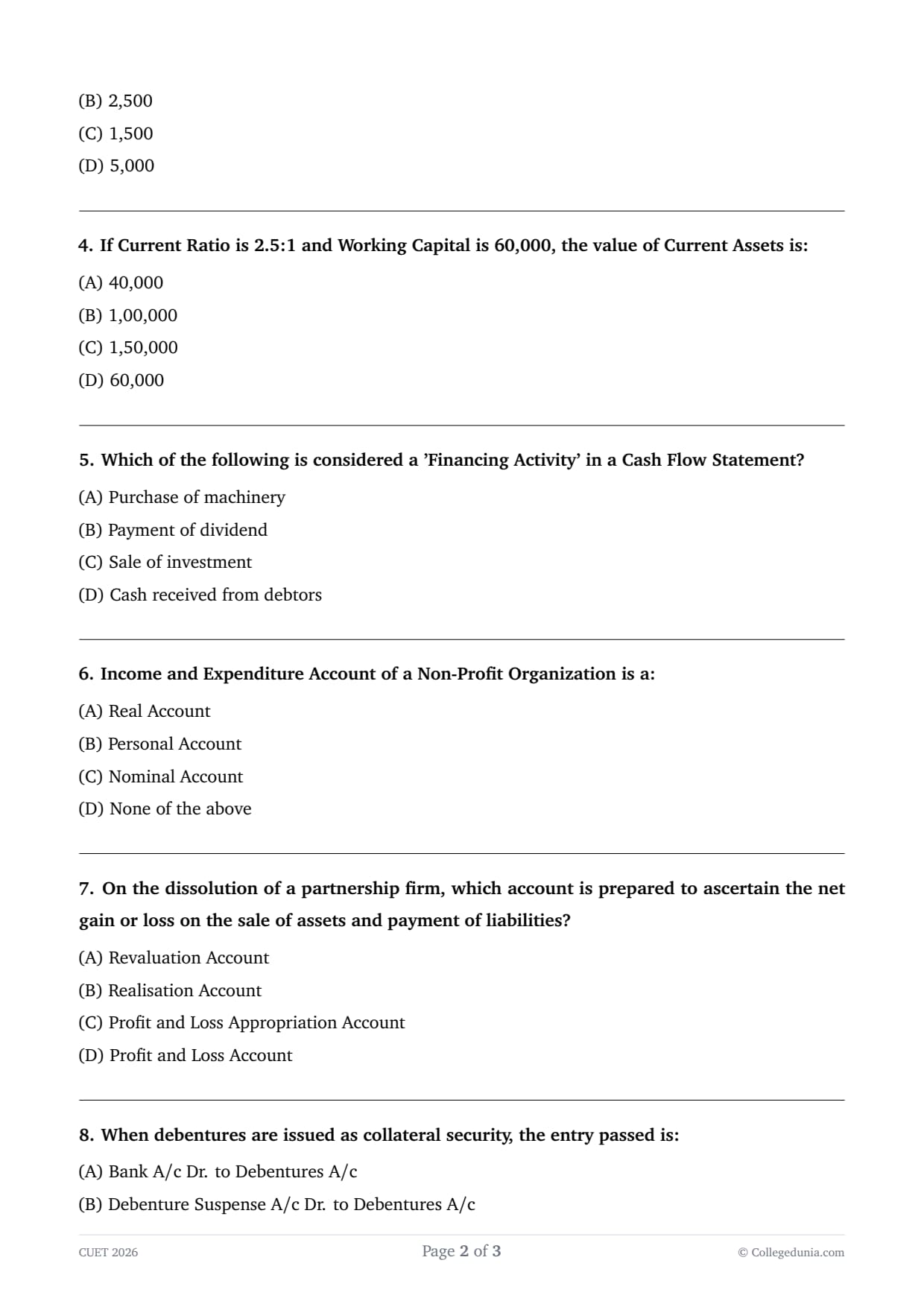
If Current Ratio is 2.5:1 and Working Capital is ₹60,000, the value of Current Assets is:
View Solution
Concept:
Current Ratio is one of the most important liquidity ratios used in financial statement analysis. It measures the ability of a business to meet its short-term obligations with the help of its short-term assets.
The formula is:
\[ Current Ratio = \frac{Current Assets}{Current Liabilities} \]
Working Capital represents the excess of Current Assets over Current Liabilities.
\[ Working Capital = Current Assets - Current Liabilities \]
In this question, both Current Ratio and Working Capital are given. Therefore, we can first establish a relationship between Current Assets and Current Liabilities and then determine their actual values.
Step 1: Write the Current Ratio in mathematical form.
Given:
\[ Current Ratio = 2.5:1 \]
Therefore,
\[ \frac{Current Assets}{Current Liabilities} = \frac{2.5}{1} \]
Let Current Liabilities be \(x\).
Then,
\[ Current Assets = 2.5x \]
Step 2: Use the Working Capital formula.
Working Capital is given as:
\[ ₹60,000 \]
Using
\[ Working Capital = Current Assets - Current Liabilities \]
we get
\[ 60,000 = 2.5x-x \]
\[ 60,000 = 1.5x \]
Step 3: Calculate Current Liabilities.
\[ x = \frac{60,000}{1.5} \]
\[ x = 40,000 \]
Hence,
\[ Current Liabilities = ₹40,000 \]
Step 4: Calculate Current Assets.
Since
\[ Current Assets = 2.5x \]
\[ = 2.5 \times 40,000 \]
\[ = ₹1,00,000 \]
Step 5: Verify the result.
\[ Working Capital = 1,00,000-40,000 \]
\[ = ₹60,000 \]
The answer satisfies the given condition.
Therefore,
\[ \boxed{Current Assets=₹1,00,000} \]
Hence, the correct option is
\[ \boxed{(B)\ ₹1,00,000} \] Quick Tip: Whenever Current Ratio and Working Capital are given together, assume Current Liabilities as \(x\). Then express Current Assets using the ratio and substitute into the Working Capital formula. \[ Working Capital = Current Assets - Current Liabilities \] This method quickly gives the required values.
Which of the following is considered a 'Financing Activity' in a Cash Flow Statement?
View Solution
Concept:
According to Accounting Standard (AS-3), cash flows are classified into three categories:
Operating Activities
Investing Activities
Financing Activities
Operating Activities relate to the principal revenue-generating activities of the business.
Investing Activities relate to acquisition and disposal of long-term assets and investments.
Financing Activities relate to changes in owner's funds and long-term borrowings.
Step 1: Understand Financing Activities.
Financing activities include transactions that affect:
Share Capital
Debentures
Long-term Loans
Dividend Payments
These activities determine the capital structure of the business.
Step 2: Examine Option (A).
Purchase of machinery involves acquisition of a fixed asset.
Therefore it is an Investing Activity.
Hence Option (A) is incorrect.
Step 3: Examine Option (B).
Payment of dividend represents distribution of profits to shareholders.
It affects shareholders' funds and is treated as a Financing Activity.
Therefore Option (B) is correct.
Step 4: Examine Option (C).
Sale of investment involves disposal of investments.
This is classified as an Investing Activity.
Hence Option (C) is incorrect.
Step 5: Examine Option (D).
Cash received from debtors arises from normal trading operations.
Therefore it is an Operating Activity.
Hence Option (D) is incorrect.
Step 6: Choose the correct answer.
Among all the options, only payment of dividend belongs to Financing Activities.
Therefore,
\[ \boxed{Payment of dividend} \]
is the correct answer.
\[ \boxed{(B)} \] Quick Tip: Remember: Operating Activities = Day-to-day business operations. Investing Activities = Purchase or sale of fixed assets and investments. Financing Activities = Share capital, debentures, loans and dividend related transactions.
Income and Expenditure Account of a Non-Profit Organization is a:
View Solution
Concept:
A Non-Profit Organization (NPO) such as a club, charitable institution, educational institution or hospital prepares an Income and Expenditure Account to determine surplus or deficit for a particular accounting period.
This account is similar to the Profit and Loss Account prepared by a business concern.
It records only revenue incomes and revenue expenses on an accrual basis.
Step 1: Understand the purpose of Income and Expenditure Account.
The account is prepared to ascertain:
\[ Surplus = Income - Expenditure \]
or
\[ Deficit = Expenditure - Income \]
It summarizes all revenue items relating to the current accounting period.
Step 2: Recall the types of accounts.
Traditional classification divides accounts into:
Personal Accounts
Real Accounts
Nominal Accounts
Personal Accounts relate to persons, firms, companies and institutions.
Real Accounts relate to assets such as:
\[ Cash, Furniture, Building, Machinery \]
Nominal Accounts relate to:
\[ Expenses, Losses, Incomes and Gains \]
Step 3: Identify the nature of Income and Expenditure Account.
Income and Expenditure Account contains items such as:
Salary
Rent
Subscription
Interest Received
Electricity Expenses
Miscellaneous Income
All these items are revenue incomes or revenue expenses.
Since it summarizes nominal items only, it is classified as a Nominal Account.
Step 4: Eliminate incorrect options.
Option (A):
Real Account relates to assets, therefore incorrect.
Option (B):
Personal Account relates to persons or organizations, therefore incorrect.
Option (D):
Not applicable because one of the given options is correct.
Step 5: Select the correct answer.
Income and Expenditure Account records incomes and expenses only.
Hence it is a:
\[ \boxed{Nominal Account} \]
Therefore,
\[ \boxed{(C)} \] Quick Tip: Income and Expenditure Account of an NPO is equivalent to the Profit and Loss Account of a business concern. Since it records revenue incomes and expenses, it is treated as a Nominal Account.
On the dissolution of a partnership firm, which account is prepared to ascertain the net gain or loss on the sale of assets and payment of liabilities?
View Solution
Concept:
Dissolution of a partnership firm means the business is permanently closed and all assets are realized, liabilities are settled and the remaining balance is distributed among partners.
At the time of dissolution, a special account known as the Realisation Account is prepared. The main purpose of this account is to determine the overall profit or loss arising from the realization of assets and settlement of liabilities.
The balance of Realisation Account ultimately represents either:
\[ Profit on Realisation \]
or
\[ Loss on Realisation \]
which is transferred to partners' capital accounts in their profit-sharing ratio.
Step 1: Understand the purpose of Realisation Account.
When a firm is dissolved:
Assets are sold.
Liabilities are paid.
Expenses of dissolution are settled.
Partners receive the final balance.
To record all these transactions systematically, Realisation Account is prepared.
Step 2: Study the treatment of assets.
All assets except cash and bank are transferred to the debit side of Realisation Account at their book values.
For example:
\[ Realisation A/c Dr. \]
\[ To Machinery A/c \]
\[ To Furniture A/c \]
etc.
Step 3: Study the treatment of liabilities.
External liabilities are transferred to the credit side of Realisation Account.
For example:
\[ Creditors A/c Dr. \]
\[ To Realisation A/c \]
Step 4: Determine profit or loss on realization.
After recording all realization proceeds, liabilities paid and realization expenses:
Credit side greater than debit side = Profit on Realisation.
Debit side greater than credit side = Loss on Realisation.
This balance is transferred to partners' capital accounts.
Step 5: Examine the given options.
Option (A):
Revaluation Account is prepared at the time of admission, retirement or death of a partner, not at dissolution.
Hence incorrect.
Option (B):
Realisation Account is specifically prepared during dissolution to determine profit or loss on realization.
Hence correct.
Option (C):
Profit and Loss Appropriation Account is used for distribution of profits among partners.
Hence incorrect.
Option (D):
Profit and Loss Account determines operating profit of the business and is not prepared for realization purposes.
Hence incorrect.
Step 6: Select the correct answer.
The account prepared to ascertain the net gain or loss on realization of assets and settlement of liabilities is:
\[ \boxed{Realisation Account} \]
Hence,
\[ \boxed{(B)} \] Quick Tip: Remember: \[ Admission/Retirement \rightarrow Revaluation Account \] \[ Dissolution \rightarrow Realisation Account \] This distinction is frequently tested in board examinations and competitive exams.
When debentures are issued as collateral security, the entry passed is:
View Solution
Concept:
Collateral Security refers to additional security provided by a company to a lender for obtaining a loan.
Debentures issued as collateral security are not issued for immediate cash consideration. They are merely held by the lender as security and become effective only if the company defaults in repayment of the loan.
Therefore, according to the alternative accounting treatment, no journal entry is passed.
Step 1: Understand collateral security.
Suppose a company borrows:
\[ ₹10,00,000 \]
from a bank.
The bank may ask for additional security.
The company may issue debentures as collateral security.
These debentures act only as a guarantee.
Step 2: Understand why no entry may be passed.
The debentures are not actually issued for raising funds.
They merely provide assurance to the lender.
Since there is no immediate financial transaction regarding those debentures, many firms follow the alternative method where no journal entry is recorded.
Only a note is given in the Balance Sheet.
Step 3: Know the alternative treatment.
Sometimes companies pass:
\[ Debenture Suspense A/c Dr. \]
\[ To Debentures A/c \]
However, this is an optional treatment.
For examination purposes, when asked generally, the accepted answer is that no journal entry is passed.
Step 4: Evaluate the options.
Option (A):
Used for normal issue of debentures for cash.
Incorrect.
Option (B):
Represents the alternative method.
Not the standard answer here.
Option (C):
No entry is passed.
Correct.
Option (D):
Incorrect accounting treatment.
Step 5: Select the answer.
Hence,
\[ \boxed{No entry is passed} \]
Therefore,
\[ \boxed{(C)} \] Quick Tip: For debentures issued as collateral security: Most common exam answer: No journal entry. Alternative treatment: \[ Debenture Suspense A/c Dr. \] \[ To Debentures A/c \]
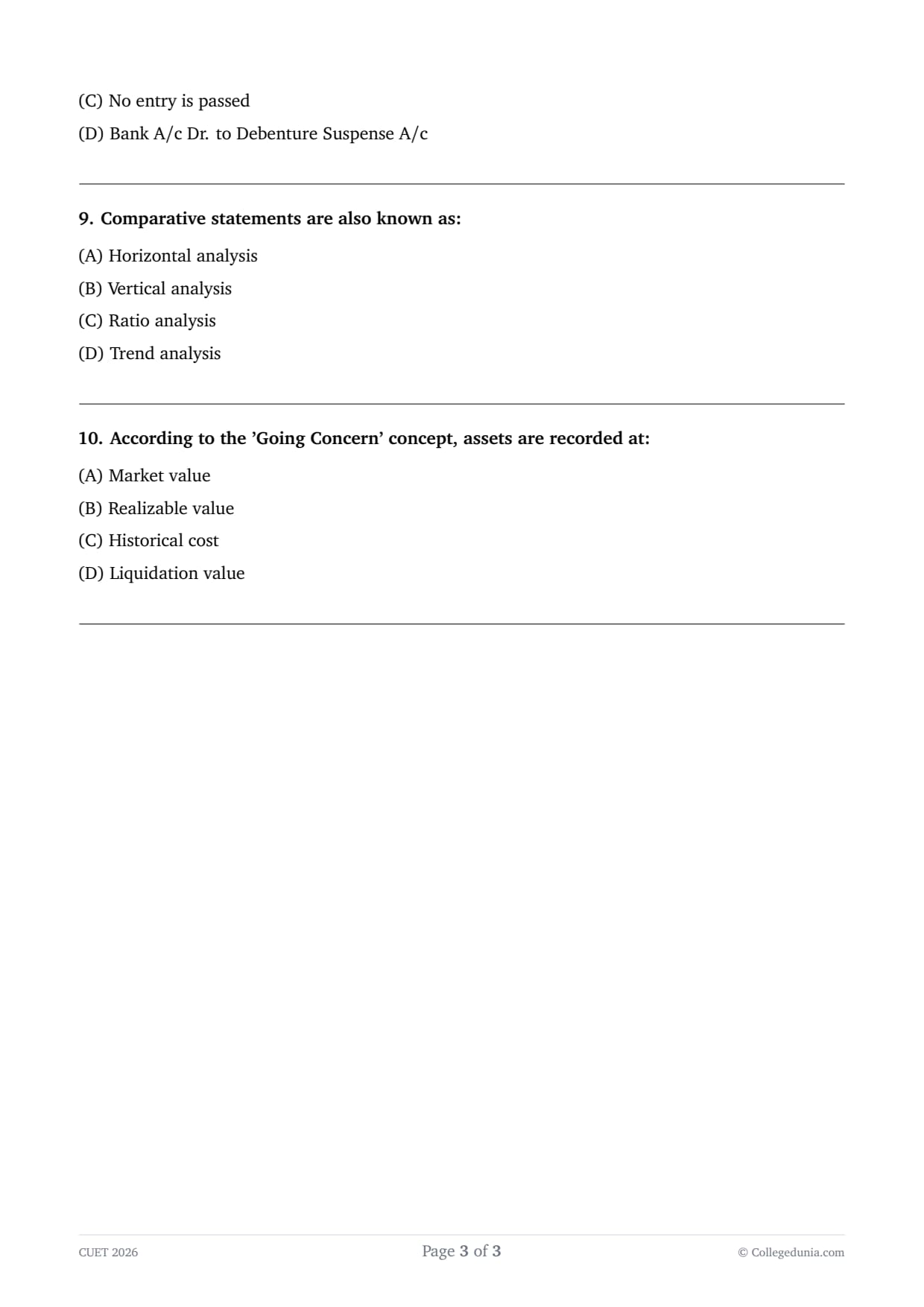
Comparative statements are also known as:
View Solution
Concept:
Comparative Financial Statements are statements in which financial data of two or more years are presented side by side for comparison.
The purpose is to study changes in performance over different accounting periods.
This method of analysis is known as Horizontal Analysis because comparison is made across different years.
Step 1: Understand comparative statements.
Suppose a company's sales are:
\[ 2023 = ₹8,00,000 \]
\[ 2024 = ₹10,00,000 \]
The increase can easily be observed by comparing both years.
This comparison helps in decision making.
Step 2: Why is it called Horizontal Analysis?
Data from multiple years is placed horizontally.
Example:
\[ \begin{array}{c|c|c} \text{Particulars} & \text{2023} & \text{2024} \\ \hline \text{Sales} & 8,00,000 & 10,00,000 \end{array} \]
Comparison is made across years.
Hence it is called Horizontal Analysis.
Step 3: Differentiate from Vertical Analysis.
Vertical Analysis studies the relationship between items within the same financial statement.
Example:
\[ Gross Profit as % of Sales \]
for one particular year.
Therefore it is different from comparative statements.
Step 4: Evaluate the options.
Option (A):
Horizontal Analysis.
Correct.
Option (B):
Vertical Analysis.
Incorrect.
Option (C):
Ratio Analysis is a different technique.
Incorrect.
Option (D):
Trend Analysis is related but not the direct synonym of comparative statements.
Incorrect.
Step 5: Choose the correct answer.
Thus comparative statements are known as:
\[ \boxed{Horizontal Analysis} \]
Hence,
\[ \boxed{(A)} \] Quick Tip: Remember: \[ Comparative Statements = Horizontal Analysis \] \[ Common Size Statements = Vertical Analysis \]
According to the 'Going Concern' concept, assets are recorded at:
View Solution
Concept:
The Going Concern Concept assumes that the business will continue to operate for an indefinite future and there is no intention or necessity to liquidate it.
Because of this assumption, assets are recorded at their original acquisition cost rather than their market value or liquidation value.
This principle forms one of the fundamental assumptions of accounting.
Step 1: Understand the meaning of Going Concern.
The concept assumes:
Business will continue operations.
Assets will be used in future.
Liabilities will be paid in normal course.
There is no immediate closure.
Step 2: Understand asset valuation.
Suppose machinery was purchased for:
\[ ₹5,00,000 \]
After one year, market value may become:
\[ ₹6,00,000 \]
or
\[ ₹4,50,000 \]
Still, accounting records continue on the basis of original cost (subject to depreciation).
Step 3: Why not market value?
Market values fluctuate frequently.
Recording assets at market value would reduce consistency and comparability.
Therefore accounting prefers historical cost.
Step 4: Why not liquidation value?
Liquidation value becomes relevant only when the business is expected to close.
The Going Concern assumption specifically states that closure is not expected.
Hence liquidation value is ignored.
Step 5: Evaluate the options.
Option (A):
Market Value.
Incorrect.
Option (B):
Realizable Value.
Incorrect.
Option (C):
Historical Cost.
Correct.
Option (D):
Liquidation Value.
Incorrect.
Step 6: Select the correct answer.
According to the Going Concern Concept:
\[ \boxed{Assets are recorded at Historical Cost} \]
Therefore,
\[ \boxed{(C)} \] Quick Tip: Going Concern Concept assumes that the business will continue for a long period. Therefore assets are recorded at: \[ \boxed{Historical Cost} \] and not at market value or liquidation value.
CUET UG 2026 Exam Pattern
| Parameter | Details |
|---|---|
| Exam Name | Common University Entrance Test (CUET UG) 2026 |
| Conducting Body | National Testing Agency (NTA) |
| Exam Mode | Computer-Based Test (CBT) |
| Exam Duration | 60 minutes per test |
| Total Sections | 3 (Languages, Domain Subjects, General Test) |
| Question Type | Multiple Choice Questions (MCQs) |
| Questions per Test | 50 questions (all compulsory) |
| Marking Scheme | +5 for correct, -1 for incorrect |
| Maximum Marks | 250 marks per test |
| Maximum Subject Choices | 5 subjects in total |
| Syllabus Base | Class 12 NCERT (mainly for Domain Subjects) |



Comments