




CUET 2026 May 20 Shift 1 Biology Question Paper is available for download here. NTA conducted the CUET 2026 exam from 11th May to 31st May.
- CUET 2026 Biology exam consists of 50 questions for 250 marks to be attempted in 60 minutes.
- As per the marking scheme, 5 marks are awarded for each correct answer, and 1 mark is deducted for incorrect answer.
Candidates can download CUET 2026 May 20 Shift 1 Biology Question Paper with Answer Key and Solution PDF from links provided below.
Related Links:
CUET 2026 Biology May 20 Shift 1 Question Paper with Solution PDF
| CUET May 20 Shift 1 Biology Question Paper 2026 | Download PDF | Check Solutions |
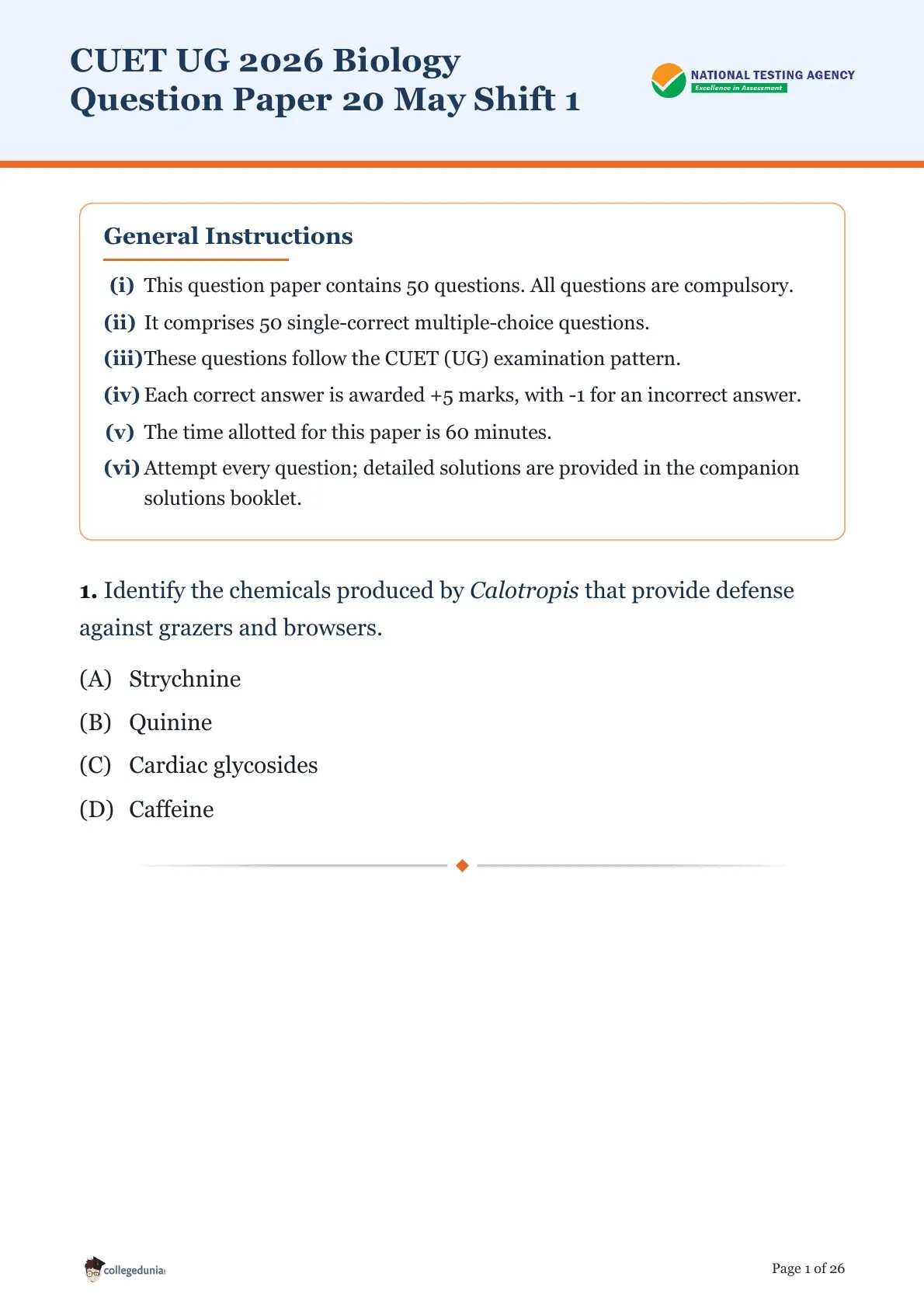


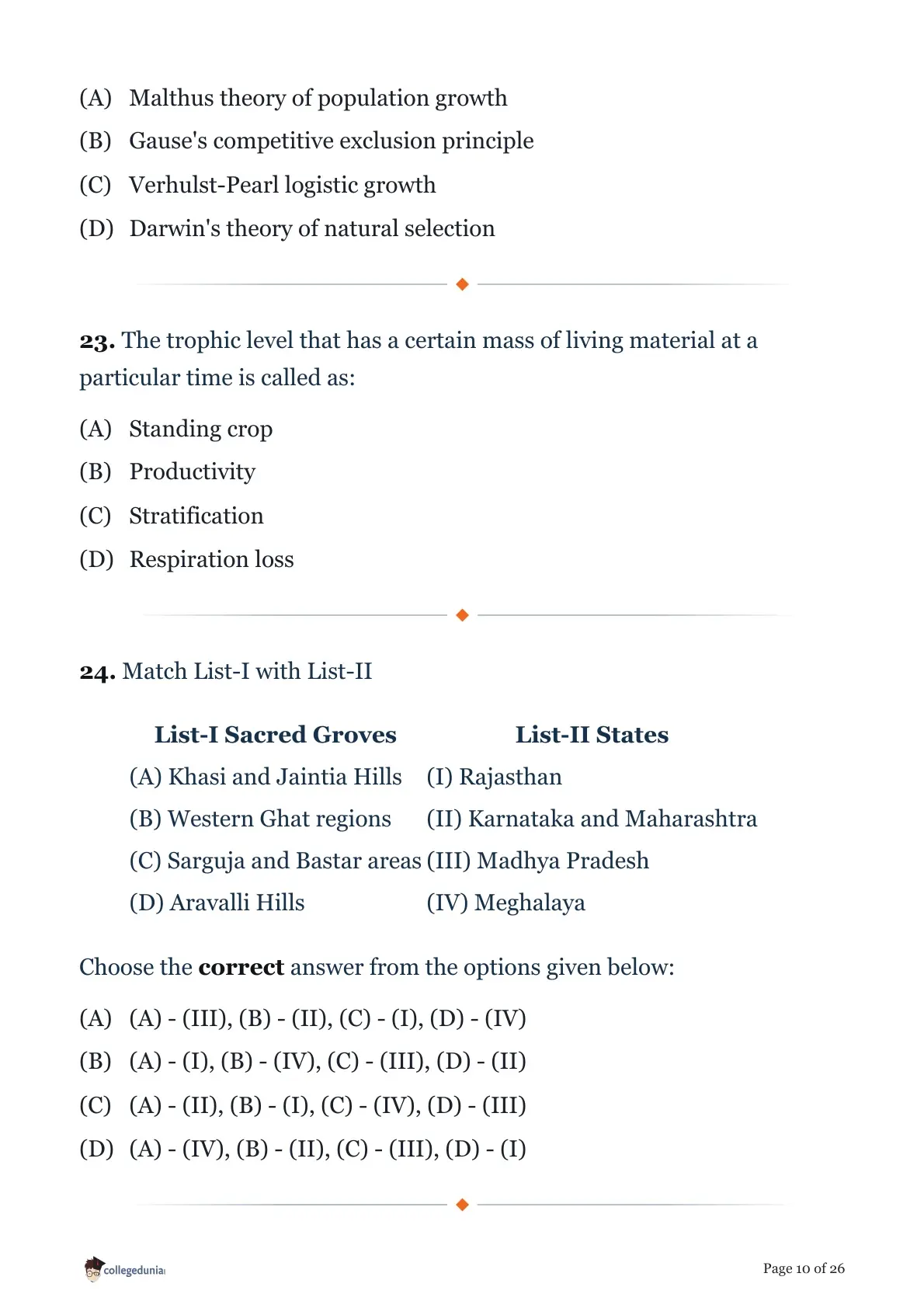
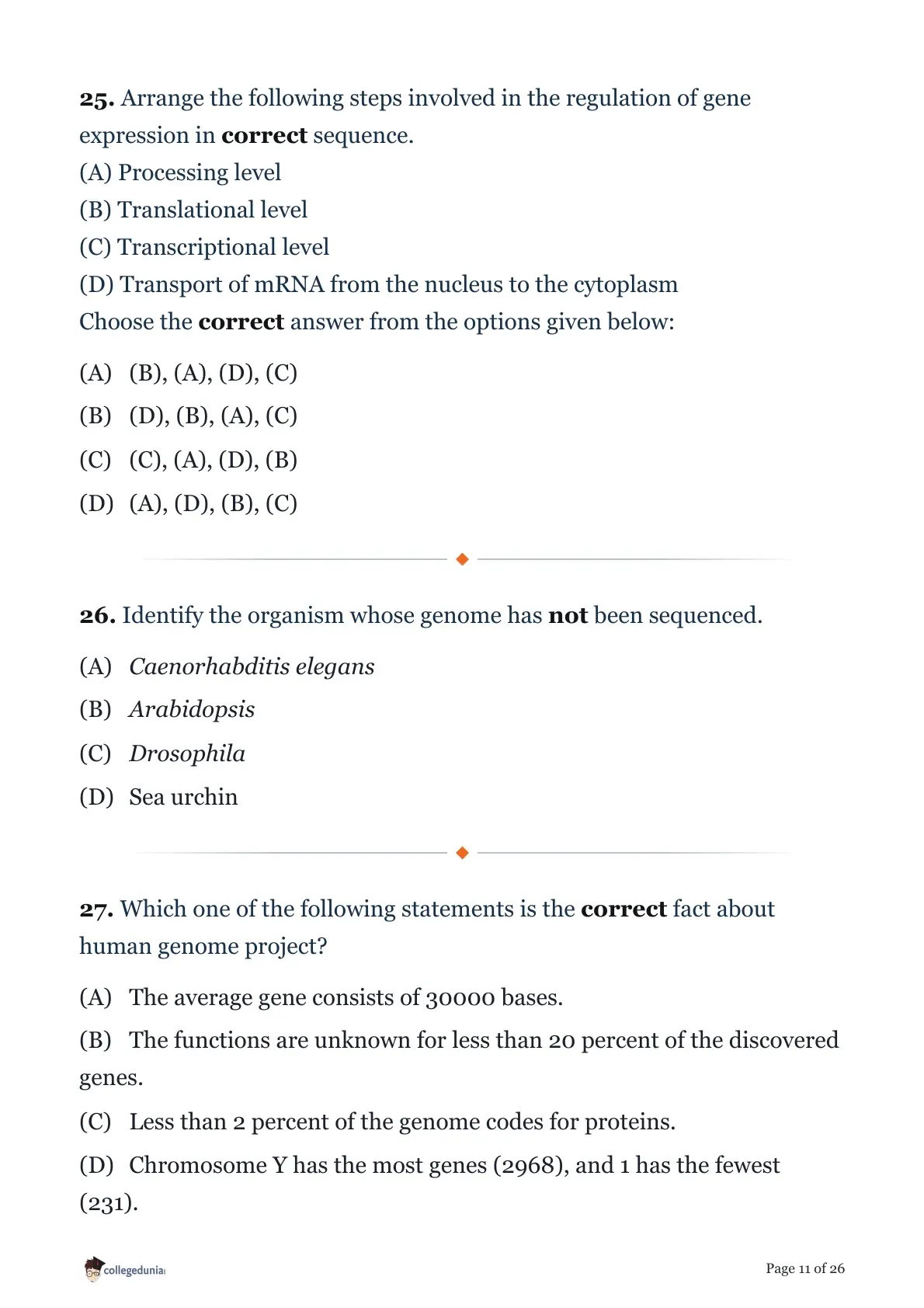
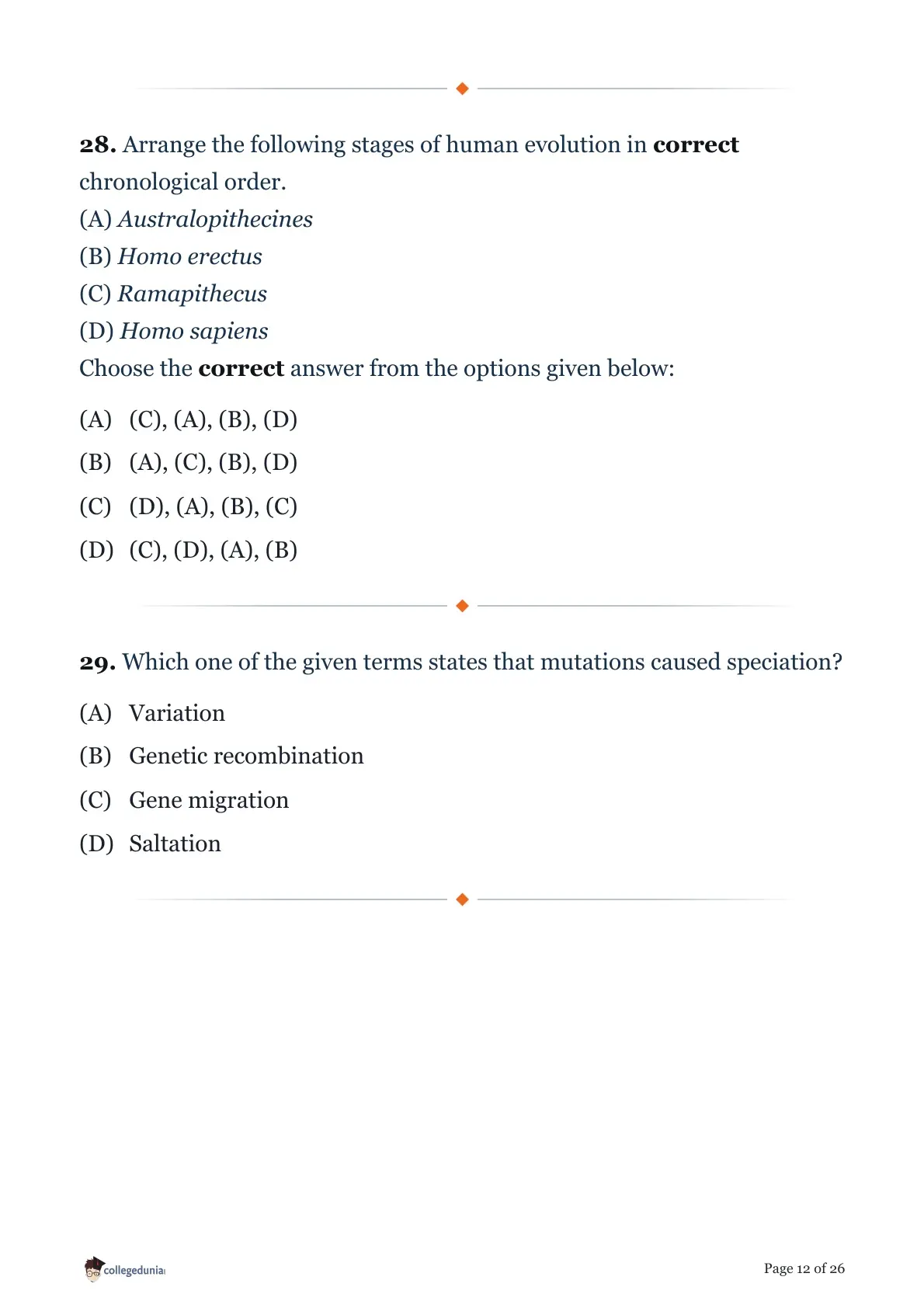





Identify the chemicals produced by Calotropis that provide defense against grazers and browsers.
View Solution
Step 1: Understanding the Concept:Some plants make poisonous chemicals so that animals do not eat them. Calotropis (Aak or milkweed) is a common example from the NCERT chapter on organismic interactions.
Step 2: Key Fact:
Calotropis produces highly poisonous cardiac glycosides. Grazing animals that eat it fall sick, so they avoid the plant.
Step 3: Check option (1):
Strychnine is a poison made by Strychnos plants, not by Calotropis. So option 1 is wrong.
Step 4: Check option (2):
Quinine comes from Cinchona. It is used against malaria. So option 2 is wrong.
Step 5: Check option (3):
Cardiac glycosides are the defence chemicals of Calotropis. So option 3 is right.
Step 6: Check option (4):
Caffeine is made by tea and coffee plants. So option 4 is wrong.
Final Answer:
Calotropis protects itself with cardiac glycosides, which is option 3. \[ \boxed{\text{Option 3}} \]
Match List-I with List-II
| List-I (Organisms) | List-II (Trophic levels) |
|---|---|
| (A) Man, lion | (I) Third |
| (B) Zooplankton, cow | (II) First |
| (C) Phytoplankton, trees | (III) Fourth |
| (D) Birds, wolves | (IV) Second |
Choose the correct answer from the options given below:
View Solution
Step 1: Understanding the Concept:In a food chain, each feeding step is a trophic level. Producers sit at the first level. Herbivores sit at the second. Animals that eat herbivores come next.
Step 2: Key Approach:
Place each organism on a level, then match with List-II. Then compare with the four options.
Step 3: Place (C):
Phytoplankton and trees make their own food, so they are producers at the first trophic level. (C) matches (II).
Step 4: Place (B):
Zooplankton and cow eat plants or phytoplankton. They are primary consumers at the second level. (B) matches (IV).
Step 5: Place (D):
Birds and wolves eat herbivores in this chain. They are secondary consumers at the third level. (D) matches (I).
Step 6: Place (A):
Man and lion are top carnivores here, at the fourth level. (A) matches (III).
Step 7: Compare with options:
The set A-III, B-IV, C-II, D-I is option 3. Options 1, 2 and 4 each give at least one wrong pair, such as putting trees on the third or fourth level.
Final Answer:
The correct matching is A-III, B-IV, C-II, D-I, which is option 3. \[ \boxed{\text{Option 3}} \]
The species confined to a particular region and not found anywhere else is:
View Solution
Step 1: Understanding the Concept:The question asks for the word for a species found in only one region of the world.
Step 2: Check option (1):
Cosmopolitan species are found all over the world, such as the housefly. This is the opposite of the question. Wrong.
Step 3: Check option (2):
Endemism means a species lives only in one area and nowhere else. This matches the question. Right.
Step 4: Check option (3):
A hot-spot is an area with very high species richness and many endemic species, and with heavy loss of habitat. It is a region, not the species. Wrong.
Step 5: Check option (4):
An alien species is one brought into a new area from outside. It is not limited to one region. Wrong.
Final Answer:
The word is endemism, option 2. \[ \boxed{\text{Option 2}} \]
Identify the correct reasons for cutting and clearing of Amazon rain forest?
(A) Cultivating soyabeans
(B) Growing wheat and maize
(C) Setting up industries
(D) Conversion to grasslands for raising beef cattle
Choose the correct answer from the options given below:
View Solution
Step 1: Understanding the Concept:The Amazon rain forest is cut for a few known reasons. The NCERT chapter on biodiversity loss names them.
Step 2: Check (A):
Large areas are cleared to grow soyabeans. So (A) is correct.
Step 3: Check (B):
Wheat and maize are not the crops linked with Amazon clearing. So (B) is not correct.
Step 4: Check (C):
Industry set-up is not named as the main reason for clearing the Amazon. So (C) is not correct.
Step 5: Check (D):
Forest is turned into grassland to raise beef cattle. So (D) is correct.
Step 6: Pick the option:
Only (A) and (D) are correct, which is option 2.
Final Answer:
The correct reasons are (A) and (D), option 2. \[ \boxed{\text{Option 2}} \]
Which one of the following is a inhibitor genes in lac operon?
View Solution
Step 1: Understanding the Concept:The lac operon has a regulator gene (i) and three structural genes (z, y and a).
Step 2: Role of gene i:
Gene i makes the repressor protein. The repressor sits on the operator and blocks transcription. So gene i is the inhibitor gene.
Step 3: Check z, y and a:
Gene z codes for beta-galactosidase. Gene y codes for permease. Gene a codes for transacetylase. These are enzymes made when the operon is on, so they are not inhibitors.
Step 4: Choose:
Option 1 is correct. Options 2, 3 and 4 are structural genes and are wrong.
Final Answer:
Gene i is the inhibitor gene, option 1. \[ \boxed{\text{Option 1}} \]
The scientist who developed a method for sequencing the DNA fragments was:
View Solution
Step 1: Understanding the Concept:The question asks who developed a DNA sequencing method.
Step 2: Check option (1):
Frederick Griffith did the transformation experiment on Streptococcus. Wrong.
Step 3: Check option (2):
Frederick Sanger developed the chain termination method of DNA sequencing in the 1970s. Right.
Step 4: Check option (3):
George Gamow proposed that the genetic code is a triplet. Wrong.
Step 5: Check option (4):
Har Gobind Khorana made synthetic RNA with known repeating sequences that helped crack the genetic code. Wrong.
Final Answer:
Sanger developed DNA sequencing, option 2. \[ \boxed{\text{Option 2}} \]
Which one of the followings is not a terminator codon?
View Solution
Step 1: Understanding the Concept:Out of the 64 codons, three are stop codons. They do not code for any amino acid and end translation.
Step 2: List them:
The stop codons are UAA, UAG and UGA.
Step 3: Check each option:
UAA is a stop codon. UAG is a stop codon. UGA is a stop codon. UUC is not a stop codon because it codes for phenylalanine.
Step 4: Choose:
The one that is not a terminator codon is UUC, option 3.
Final Answer:
UUC codes for phenylalanine, so option 3 is the answer. \[ \boxed{\text{Option 3}} \]
Select the correct statements regarding Hardy-Weinberg principle.
(A) Sum total of all the allelic frequencies is 1.
(B) Genetic drift affect Hardy-Weinberg principle.
(C) Allele frequencies in a population are stable and is constant from generation to generation.
(D) The gene pool continues changing generation after generation.
Choose the correct answer from the options given below:
View Solution
Step 1: Understand the Concept:The Hardy-Weinberg principle says that allele and genotype frequencies in a population stay constant from generation to generation, as long as no evolutionary force acts on it. The equation is \(p + q = 1\) for alleles and \(p^2 + 2pq + q^2 = 1\) for genotypes.
Step 2: Check statement (A):
The frequencies of all alleles of a gene add up to 1, for example \(p + q = 1\). So (A) is TRUE.
Step 3: Check statement (B):
Genetic drift is a chance change in allele frequency. It is one of the factors that disturb the equilibrium, so it affects the Hardy-Weinberg principle (the principle holds only when drift is absent). So (B) is TRUE as given in the paper.
Step 4: Check statement (C):
In an undisturbed population, allele frequencies are stable and constant across generations. This is the core idea of the principle. So (C) is TRUE.
Step 5: Check statement (D):
If the gene pool kept changing every generation, the population would not be in equilibrium. The principle says the gene pool stays constant. So (D) is FALSE.
Step 6: Match with the options:
True statements are (A), (B) and (C). Option 2 lists exactly these. Option 1 and option 3 include (D), which is false. Option 4 misses (A), which is true.
Final Answer:
Statements (A), (B) and (C) are correct. The right option is 2. \[ \boxed{2} \]
Identify the agencies which are involved in developing the technology of biogas production.
(A) Khadi and Village Industries Commission
(B) Indian Farmers Welfare Association
(C) Indian Biogas Production Institute
(D) Indian Agricultural Research Institute
Choose the correct answer from the options given below:
View Solution
Step 1: Understand the Concept:Biogas is a mix of methane, carbon dioxide and some hydrogen made when anaerobic bacteria (methanogens) break down cattle dung and other waste. In India, the technology was developed through research and rural programmes.
Step 2: Recall the facts:
NCERT states that the biogas technology was developed in India mainly through the efforts of the Indian Agricultural Research Institute (IARI) and the Khadi and Village Industries Commission (KVIC).
Step 3: Check statement (A):
Khadi and Village Industries Commission took part in developing biogas technology. So (A) is TRUE.
Step 4: Check statement (B):
Indian Farmers Welfare Association is not named in this role. So (B) is FALSE.
Step 5: Check statement (C):
Indian Biogas Production Institute is not a known developer of the technology. So (C) is FALSE.
Step 6: Check statement (D):
Indian Agricultural Research Institute took part in developing biogas technology. So (D) is TRUE.
Step 7: Match with the options:
Only (A) and (D) are correct, which is option 3.
Final Answer:
The agencies are KVIC and IARI, so the correct option is 3. \[ \boxed{3} \]
Identify the bacteria which can fix atmospheric nitrogen and are free-living in the soil.
(A) Azotobacter
(B) Rhizobium
(C) Azospirillum
(D) Anabaena
Choose the correct answer from the options given below:
View Solution
Step 1: Understand the Concept:Biological nitrogen fixation is the conversion of atmospheric nitrogen into ammonia by microbes. Some do it in a symbiotic partnership with plants, and some live freely in the soil.
Step 2: Check (A) Azotobacter:
Azotobacter is a free-living, aerobic nitrogen-fixing soil bacterium. So (A) fits.
Step 3: Check (B) Rhizobium:
Rhizobium lives inside the root nodules of legumes. It is symbiotic, not free-living. So (B) does not fit.
Step 4: Check (C) Azospirillum:
NCERT lists Azospirillum along with Azotobacter as free-living nitrogen fixers of the soil. So (C) fits.
Step 5: Check (D) Anabaena:
Anabaena is a filamentous cyanobacterium. It fixes nitrogen with the help of heterocysts, and it is also found as a symbiont in Azolla. The question asks for soil bacteria, and NCERT names Azotobacter and Azospirillum for this role, so (D) is left out.
Step 6: Match with the options:
(A) and (C) only is option 1.
Final Answer:
The free-living nitrogen-fixing soil bacteria are Azotobacter and Azospirillum, so the correct option is 1. \[ \boxed{1} \]
Arrange the following steps involved in PCR in the correct sequence.
(A) Amplification
(B) Extension of primers
(C) Primer annealing
(D) Denaturation
Choose the correct answer from the options given below:
View Solution
Step 1: Understand the Concept:PCR (polymerase chain reaction) makes many copies of a DNA segment. Each cycle has three main stages, and the cycle is repeated many times.
Step 2: Stage 1 is denaturation:
The double-stranded DNA is heated to about 94 degrees C. The two strands separate. So (D) comes first.
Step 3: Stage 2 is primer annealing:
The mixture is cooled and the two primers bind to the complementary sequences on each single strand. So (C) comes next.
Step 4: Stage 3 is extension of primers:
Taq polymerase adds nucleotides to the primers and builds new strands. So (B) is third.
Step 5: Amplification:
Repeating the cycle again and again gives billions of copies, which is the amplification of the DNA. So (A) comes last.
Step 6: Match with the options:
The order D, C, B, A is option 4.
Final Answer:
The correct sequence is Denaturation, Primer annealing, Extension of primers, Amplification. \[ \boxed{4} \]
Which one of the following microorganisms is used as a cloning vector to deliver the genes of interest into a variety of plants?
View Solution
Step 1: Understand the Concept:A cloning vector carries a foreign gene into a host cell. For plants, a natural gene carrier is needed that can insert DNA into the plant genome.
Step 2: Check option 1:
Bacillus thuringiensis makes the Bt toxin protein. Its gene is used in crops, but the bacterium is not the vector. So option 1 is wrong.
Step 3: Check option 2:
Rhino viruses cause the common cold in humans. They are not used as plant vectors. So option 2 is wrong.
Step 4: Check option 3:
Agrobacterium tumefaciens is a soil bacterium that causes crown gall disease. Its Ti plasmid transfers T-DNA into plant cells. Scientists disarm the Ti plasmid and use it to deliver useful genes into many plants. So option 3 is right.
Step 5: Check option 4:
Nucleopolyhedrovirus is a baculovirus that infects insects. It is used as a biocontrol agent, not as a plant vector. So option 4 is wrong.
Final Answer:
Agrobacterium tumefaciens is the cloning vector for plants, which is option 3. \[ \boxed{3} \]
Which one of the following organisms has been disarmed and used to deliver desirable genes into animal cells?
View Solution
Step 1: Understand the Concept:Some viruses can enter animal cells and place their genes into the host genome. If their disease-causing genes are removed, they become safe gene carriers.
Step 2: Check option 1:
Retroviruses are RNA viruses that can integrate into the host genome. NCERT says that retroviruses have been disarmed and used to deliver desirable genes into animal cells. So option 1 is right.
Step 3: Check option 2:
Cyanobacteria are photosynthetic bacteria. They are not used as vectors for animal cells. So option 2 is wrong.
Step 4: Check option 3:
Yeast is a eukaryotic host and a source of vectors such as YACs, but it is not an organism disarmed to deliver genes into animal cells. So option 3 is wrong.
Step 5: Check option 4:
Baculoviruses infect insects and are used as biocontrol agents or in insect cell expression. They are not the standard answer here. So option 4 is wrong.
Final Answer:
Disarmed retroviruses carry genes into animal cells, so the correct option is 1. \[ \boxed{1} \]
Arrange the following steps which are involved in action of Bt toxin proteins on insects in correct sequence.
(A) Conversion of inactive toxin into active one by alkaline pH of the gut of insect
(B) Creation of pores that cause cell swelling and lysis which leads to death of insect
(C) Inactive protoxins is ingested by insect
(D) Activated toxin binds to the surface of midgut epithelial cells of insect
Choose the correct answer from the options given below:
View Solution
Step 1: Understand the Concept:Bt toxin comes from Bacillus thuringiensis. The bacterium makes the toxin as an inactive protoxin crystal. The insect must eat it, and then the toxin is switched on inside the gut.
Step 2: First step:
The insect eats the plant that carries the Bt protein. So (C) comes first.
Step 3: Second step:
The alkaline pH of the insect gut dissolves the crystal and turns the inactive protoxin into the active toxin. So (A) is second.
Step 4: Third step:
The active toxin binds to the surface of the midgut epithelial cells. So (D) is third.
Step 5: Fourth step:
The toxin makes pores, the cells swell and burst, and the insect dies. So (B) is last.
Step 6: Match with the options:
The order C, A, D, B is option 3.
Final Answer:
The right sequence is C, A, D, B, which is option 3. \[ \boxed{3} \]
Which one of the following techniques serve the purpose of early diagnosis of diseases?
View Solution
Step 1: Understand the question.The question asks for a technique that can detect a disease very early, even before clear symptoms show. Early diagnosis needs a test that is highly sensitive and finds tiny amounts of a pathogen or its products.
Step 2: Recall the key idea.
ELISA stands for enzyme linked immuno-sorbent assay. It is based on the antigen-antibody reaction. It can detect antigens (proteins, glycoproteins) of a pathogen or the antibodies made against it, even when the amount is very small. Conventional methods like serum or urine analysis only detect a disease after it has already built up in the body.
Step 3: Check option 1 (Stool analysis).
Stool analysis finds parasites, eggs or blood in the faeces. It works only once the infection is well established, so it is not an early diagnosis technique. Option 1 is wrong.
Step 4: Check option 2 (ELISA).
ELISA picks up the pathogen's antigen or the host's antibodies at a very early stage. It is used for early detection of HIV, hepatitis and many other infections. Option 2 is correct.
Step 5: Check option 3 (Urine analysis).
Urine analysis is a routine test for kidney problems, diabetes and urinary infections. It does not detect most diseases early. Option 3 is wrong.
Step 6: Check option 4 (Serum analysis).
Serum analysis is a general term for testing blood serum. By itself it is not a specific early-detection tool. The specific early-detection technique is the immunological test ELISA. Option 4 is wrong.
Final Answer:
ELISA detects antigens or antibodies in very small amounts, so it serves early diagnosis. \[ \boxed{\text{Option 2: ELISA}} \]
When the pistils are fused together, this state is called:
View Solution
Step 1: Understand the question.A flower can have one pistil or many pistils (carpels). The question asks for the name of the state when the carpels are joined to each other.
Step 2: Recall the terms.
The gynoecium is the female part of the flower, made of one or more carpels. If the carpels are free from each other, the gynoecium is apocarpous. If the carpels are fused, it is syncarpous. A gynoecium with a single carpel is monocarpellary, and one with many carpels is multicarpellary.
Step 3: Check option 1 (Apocarpous).
Apocarpous means the carpels are free. Examples are lotus and rose. This is the opposite of fused, so option 1 is wrong.
Step 4: Check option 2 (Syncarpous).
Syncarpous means the carpels are fused together. Examples are mustard, tomato and Papaver. This matches the question, so option 2 is correct.
Step 5: Check option 3 (Monocarpellary).
Monocarpellary means only one carpel is present, as in pea. Nothing is fused here because there is just one. Option 3 is wrong.
Step 6: Check option 4 (Multicarpellary).
Multicarpellary only tells us that there are many carpels. They may be free or fused, so it does not name the fused state. Option 4 is wrong.
Final Answer:
Fused carpels in a gynoecium are called syncarpous. \[ \boxed{\text{Option 2: Syncarpous}} \]
Pollination is not carried out by water in -
View Solution
Step 1: Understand the question.We need the plant in which water does not carry the pollen. Only a few aquatic plants use water for pollination. Most aquatic plants, such as water lily and water hyacinth, are pollinated by insects or wind because their flowers rise above the water.
Step 2: Recall the key fact.
Hydrophily (pollination by water) is found in about 30 genera, mostly monocots. Common examples are Vallisneria, Hydrilla and Zostera.
Step 3: Check option 1 (Zostera).
Zostera is a marine sea grass. Its long ribbon-like pollen grains are carried within the water. So water pollinates it, and option 1 is not the answer.
Step 4: Check option 2 (Water lily).
In water lily the flowers come up above the water surface. They are pollinated by insects or wind, not by water. So this is the plant that is not water pollinated. Option 2 is correct.
Step 5: Check option 3 (Hydrilla).
Hydrilla is a submerged plant that is pollinated by water. Option 3 is not the answer.
Step 6: Check option 4 (Vallisneria).
In Vallisneria the female flower reaches the surface on a long stalk and the male flowers or pollen float on the water surface to reach it. This is pollination by water, so option 4 is not the answer.
Final Answer:
Water lily is pollinated by insects or wind, not by water. \[ \boxed{\text{Option 2: Water lily}} \]
Identify the structures which have the potency to give rise to all the tissues and organs.
View Solution
Step 1: Understand the question.The question asks which structure can form all the tissues and organs of the body. This property is called potency, the ability of a cell to change into many cell types.
Step 2: Recall the key idea.
In the early embryo, the inner cell mass of the blastocyst contains stem cells. These cells have the potency to give rise to all tissues and organs. The outer layer of the blastocyst is the trophoblast, which helps in forming the placenta.
Step 3: Check option 1 (Stem cells).
Stem cells can divide and differentiate into any tissue or organ. Option 1 is correct.
Step 4: Check option 2 (Trophoblast).
The trophoblast is the outer layer of the blastocyst. It attaches to the uterus and forms extra-embryonic structures, so it does not form all body organs. Option 2 is wrong.
Step 5: Check option 3 (Chorionic villi).
Chorionic villi are finger-like projections of the chorion. They join with the uterine tissue to make the placenta. They do not form all organs. Option 3 is wrong.
Step 6: Check option 4 (Placenta).
The placenta is a structure for exchange of nutrients, gases and wastes between mother and foetus. It cannot form all tissues. Option 4 is wrong.
Final Answer:
Stem cells have the potency to give rise to all tissues and organs. \[ \boxed{\text{Option 1: Stem cells}} \]
Which one of the following structures is not essential for maturation and motility of sperms?
View Solution
Step 1: Understand the question.We need the structure that does not help sperms to mature or move. Look at each option as part of the male reproductive system or the female system.
Step 2: Recall the key facts.
Sperms mature and gain motility in the epididymis. The secretions of the accessory glands, namely seminal vesicle, prostate and bulbourethral glands, form the seminal plasma. This fluid gives sperms fructose as energy and keeps them active.
Step 3: Check option 1 (Epididymis).
Sperms are stored here and become mature and motile. So it is essential. Option 1 is not the answer.
Step 4: Check option 2 (Cervix).
The cervix is part of the female reproductive tract. It is the neck of the uterus. It plays no role in the maturation or motility of sperms inside the male body. So it is not essential for this. Option 2 is correct.
Step 5: Check option 3 (Seminal vesicle).
Seminal vesicles secrete a fluid rich in fructose, which gives energy for sperm motility. So it is essential. Option 3 is not the answer.
Step 6: Check option 4 (Prostate).
The prostate secretes an alkaline fluid that helps sperm movement. So it is essential. Option 4 is not the answer.
Final Answer:
The cervix is a female structure and does not help sperm maturation or motility. \[ \boxed{\text{Option 2: Cervix}} \]
Match List-I with List-II
| List-I Contraceptive methods | List-II Examples |
|---|---|
| (A) Non-medicated IUD | (I) Multiload 375 |
| (B) Copper releasing IUD | (II) LNG-20 |
| (C) Hormone releasing IUD | (III) Vaults |
| (D) Barrier method | (IV) Lippes loop |
View Solution
Step 1: Understand the question.We must match each type of contraceptive in List-I with its example in List-II. These are standard facts from the chapter on reproductive health.
Step 2: Match (A) Non-medicated IUD.
Non-medicated intra-uterine devices do not release any chemical or hormone. Lippes loop is the example. So A matches (IV).
Step 3: Match (B) Copper releasing IUD.
Copper ions released by these devices suppress sperm motility and the fertilising ability of sperms. Copper T, Cu7 and Multiload 375 are examples. So B matches (I).
Step 4: Match (C) Hormone releasing IUD.
These devices release progestogens or progestogen-estrogen combinations. LNG-20 and Progestasert are examples. So C matches (II).
Step 5: Match (D) Barrier method.
Barriers stop the sperm and egg from meeting physically. Condoms, diaphragms, cervical caps and vaults are examples. So D matches (III).
Step 6: Compare with the options.
The correct set is A-IV, B-I, C-II, D-III. Option 1 has A-III and so is wrong. Option 2 has C-III and D-II, so it is wrong. Option 3 has A-I, so it is wrong. Option 4 matches exactly.
Final Answer:
The matching is A-IV, B-I, C-II, D-III. \[ \boxed{\text{Option 4: (A)-(IV), (B)-(I), (C)-(II), (D)-(III)}} \]
Which one of the following diseases is completely curable if detected early and treated properly?
View Solution
Step 1: Understand the question.We need the sexually transmitted infection that can be cured fully with early detection and proper treatment.
Step 2: Recall the key idea.
Gonorrhoea, syphilis and chlamydiasis are bacterial STIs. Bacteria can be killed by suitable antibiotics, so these diseases are curable if treated early. Hepatitis-B, genital herpes and HIV are viral. Antibiotics do not work against viruses, and these infections cannot be completely cured.
Step 3: Check option 1 (Hepatitis-B).
This is caused by the hepatitis B virus. Treatment can control it, but it can cause long-term liver damage. It is not described as completely curable. Option 1 is wrong.
Step 4: Check option 2 (Gonorrhoea).
This is caused by the bacterium Neisseria gonorrhoeae. Early treatment with antibiotics cures it fully. Option 2 is correct.
Step 5: Check option 3 (Genital herpes).
This is caused by the herpes simplex virus. The virus stays in the body and symptoms return from time to time. Option 3 is wrong.
Step 6: Check option 4 (HIV).
HIV causes AIDS. There is no complete cure, though drugs can slow it. Option 4 is wrong.
Final Answer:
Gonorrhoea is bacterial, so it is completely curable with early antibiotic treatment. \[ \boxed{\text{Option 2: Gonorrhoea}} \]
"Two closely related species competing for the same resources cannot co-exist indefinitely and the competitively inferior one will be eliminated eventually." This statement was given by:
View Solution
Step 1: Understanding the QuestionThe statement talks about two similar species that compete for the same resource. The weaker competitor is finally removed from the habitat. We must name the principle that says this.
Step 2: Key Concept
Interspecific competition happens when different species use the same limited resource. G. F. Gause did lab experiments with two Paramecium species grown together. One species survived and the other died out. His finding is called the competitive exclusion principle.
Step 3: Check option 1
Malthus gave a theory about human population growing faster than food supply. It does not talk about two species competing. So option 1 is wrong.
Step 4: Check option 2
Gause's principle says that two closely related species competing for the same resources cannot live together for long, and the inferior competitor is eliminated. This matches the statement word by word. So option 2 is right.
Step 5: Check option 3
Verhulst-Pearl logistic growth describes how one population grows with a carrying capacity (an S-shaped curve). It is about one population, not competition between two species. So option 3 is wrong.
Step 6: Check option 4
Darwin's natural selection is about survival of the fittest individuals through variation. It is a broad theory of evolution and not the specific statement on co-existence of two competing species. So option 4 is wrong.
Final Answer:
The statement is given by Gause's competitive exclusion principle, which is option 2.
The trophic level that has a certain mass of living material at a particular time is called as:
View Solution
Step 1: Understanding the QuestionWe need the term for the mass of living material present at one trophic level at one given time.
Step 2: Key Concept
Each trophic level holds some amount of living matter (biomass) at a given moment. This amount is measured as fresh or dry weight per unit area. It is called the standing crop.
Step 3: Check option 1
Standing crop is the mass of living organisms present in a trophic level at a particular time. This is exactly what the question asks. So option 1 is right.
Step 4: Check option 2
Productivity is the rate at which biomass or organic matter is produced per unit area per unit time. It is a rate, not a mass at one time. So option 2 is wrong.
Step 5: Check option 3
Stratification is the vertical layering of plants and animals in a community, such as canopy and understorey in a forest. So option 3 is wrong.
Step 6: Check option 4
Respiration loss is the energy lost as heat by organisms during respiration. It is not a measure of stored biomass. So option 4 is wrong.
Final Answer:
The mass of living material at a trophic level at a particular time is the standing crop, option 1.
Match List-I with List-II
| List-I Sacred Groves | List-II States |
|---|---|
| (A) Khasi and Jaintia Hills | (I) Rajasthan |
| (B) Western Ghat regions | (II) Karnataka and Maharashtra |
| (C) Sarguja and Bastar areas | (III) Madhya Pradesh |
| (D) Aravalli Hills | (IV) Meghalaya |
View Solution
Step 1: Understanding the QuestionSacred groves are patches of forest kept untouched by local people because of religious beliefs. We must match each sacred grove region with its state.
Step 2: Match (A)
The sacred groves of Khasi and Jaintia Hills are found in Meghalaya. So (A) goes with (IV).
Step 3: Match (B)
The sacred groves of the Western Ghat regions are in Karnataka and Maharashtra. So (B) goes with (II).
Step 4: Match (C)
The sacred groves of the Sarguja and Bastar areas are listed under Madhya Pradesh in the NCERT text. So (C) goes with (III).
Step 5: Match (D)
The sacred groves of the Aravalli Hills are in Rajasthan. So (D) goes with (I).
Step 6: Compare with the options
The pairs are A-IV, B-II, C-III, D-I. Option 1 has A-III, which is wrong. Option 2 has A-I, which is wrong. Option 3 has A-II, which is wrong. Only option 4 has all four pairs right.
Final Answer:
The correct matching is A-IV, B-II, C-III, D-I, which is option 4.
Arrange the following steps involved in the regulation of gene expression in correct sequence.
(A) Processing level
(B) Translational level
(C) Transcriptional level
(D) Transport of mRNA from the nucleus to the cytoplasm
Choose the correct answer from the options given below:
View Solution
Step 1: Understanding the QuestionIn eukaryotes, gene expression can be controlled at several stages. We must put the given levels in the order in which they occur in the cell.
Step 2: Key Idea
The flow is DNA to primary transcript, then processed mRNA, then export from nucleus, then protein synthesis. Control can act at each of these stages in the same order.
Step 3: Stage 1
The first step is the formation of the primary transcript from DNA. This is the transcriptional level, so (C) comes first.
Step 4: Stage 2
The primary transcript (hnRNA) is then spliced, capped and tailed. This is the processing level, so (A) comes second.
Step 5: Stage 3
The processed mRNA leaves the nucleus through nuclear pores. This is the transport of mRNA to the cytoplasm, so (D) comes third.
Step 6: Stage 4
Finally the mRNA is read by ribosomes to make protein. This is the translational level, so (B) comes last.
Step 7: Compare with the options
The sequence is C, A, D, B. This is option 3. Option 1 starts with translation, which cannot be first. Option 2 starts with transport, which cannot happen before the mRNA is made. Option 4 starts with processing, which cannot happen before transcription.
Final Answer:
The correct sequence is (C), (A), (D), (B), which is option 3.
Identify the organism whose genome has not been sequenced.
View Solution
Step 1: Understanding the QuestionWe must pick the organism that is not listed among the model organisms whose genomes were sequenced.
Step 2: Key Concept
After the Human Genome Project, genomes of several model organisms were sequenced. The NCERT list includes bacteria, yeast, the nematode Caenorhabditis elegans, the fruit fly Drosophila, and the plants Arabidopsis and rice.
Step 3: Check option 1
The genome of Caenorhabditis elegans was sequenced in 1998. So it is sequenced and option 1 is not the answer.
Step 4: Check option 2
Arabidopsis was the first plant whose genome was sequenced (2000). So option 2 is not the answer.
Step 5: Check option 3
The Drosophila genome was sequenced in 2000. So option 3 is not the answer.
Step 6: Check option 4
Sea urchin is not part of the standard list of sequenced model organisms in the syllabus. Among the four options it is the one that the question treats as not sequenced, so the expected answer is option 4. (In real research a sea urchin genome was also published later, but it is outside the syllabus list.)
Final Answer:
The answer expected from the syllabus list is Sea urchin, option 4.
Which one of the following statements is the correct fact about human genome project?
View Solution
Step 1: Understanding the QuestionWe need the one true statement about the findings of the Human Genome Project.
Step 2: Key Facts
The human genome has about 3 billion base pairs and about 30,000 genes. The average gene has about 3000 bases. Less than 2 percent codes for proteins. The functions of over 50 percent of discovered genes are unknown. Chromosome 1 has the most genes (2968) and Y has the fewest (231).
Step 3: Check option 1
The average gene has about 3000 bases, not 30000. The number 30000 is the approximate number of genes. So option 1 is false.
Step 4: Check option 2
The functions are unknown for over 50 percent of the genes, not less than 20 percent. So option 2 is false.
Step 5: Check option 3
Less than 2 percent of the genome codes for proteins. Most of the genome is repetitive or non-coding. So option 3 is true.
Step 6: Check option 4
Chromosome 1 has the most genes (2968) and Y has the fewest (231). The option reverses them. So option 4 is false.
Final Answer:
Less than 2 percent of the genome codes for proteins, option 3.
Arrange the following stages of human evolution in correct chronological order.
(A) Australopithecines
(B) Homo erectus
(C) Ramapithecus
(D) Homo sapiens
Choose the correct answer from the options given below:
View Solution
Step 1: Understanding the QuestionWe must put four stages of human evolution from the oldest to the newest.
Step 2: Key Facts
Ramapithecus lived about 15 million years ago and was ape-like. Australopithecines lived about 3-4 million years ago. Homo erectus lived about 1.5 million years ago. Homo sapiens (modern humans) appeared about 75,000-10,000 years ago.
Step 3: Order the stages
The oldest is Ramapithecus (C). Next is Australopithecus (A). Then Homo erectus (B). The newest is Homo sapiens (D). So the order is C, A, B, D.
Step 4: Compare with the options
Option 1 gives C, A, B, D, which matches. Option 2 puts Australopithecus before Ramapithecus, which is wrong. Option 3 begins with Homo sapiens, which is the latest, so it is wrong. Option 4 puts Homo sapiens before Australopithecus, which is wrong.
Final Answer:
The chronological order is (C), (A), (B), (D), which is option 1.
Which one of the given terms states that mutations caused speciation?
View Solution
Step 1: Understanding the QuestionWe need the term for the idea that a single large mutation can produce a new species.
Step 2: Key Concept
Hugo de Vries proposed the mutation theory. He said that large, sudden, discontinuous changes called mutations cause evolution and speciation. Such a large single-step mutation is called saltation.
Step 3: Check option 1
Variation is the small differences among individuals. Darwin said small variations are the raw material for evolution. It does not say mutation causes speciation. So option 1 is wrong.
Step 4: Check option 2
Genetic recombination is the shuffling of genes during meiosis and crossing over. It makes new combinations but it is not a mutation. So option 2 is wrong.
Step 5: Check option 3
Gene migration (gene flow) is the movement of genes between populations. It is not a mutation. So option 3 is wrong.
Step 6: Check option 4
Saltation is a single-step large mutation that can give rise to a new species. So option 4 is right.
Final Answer:
The term is saltation, option 4.
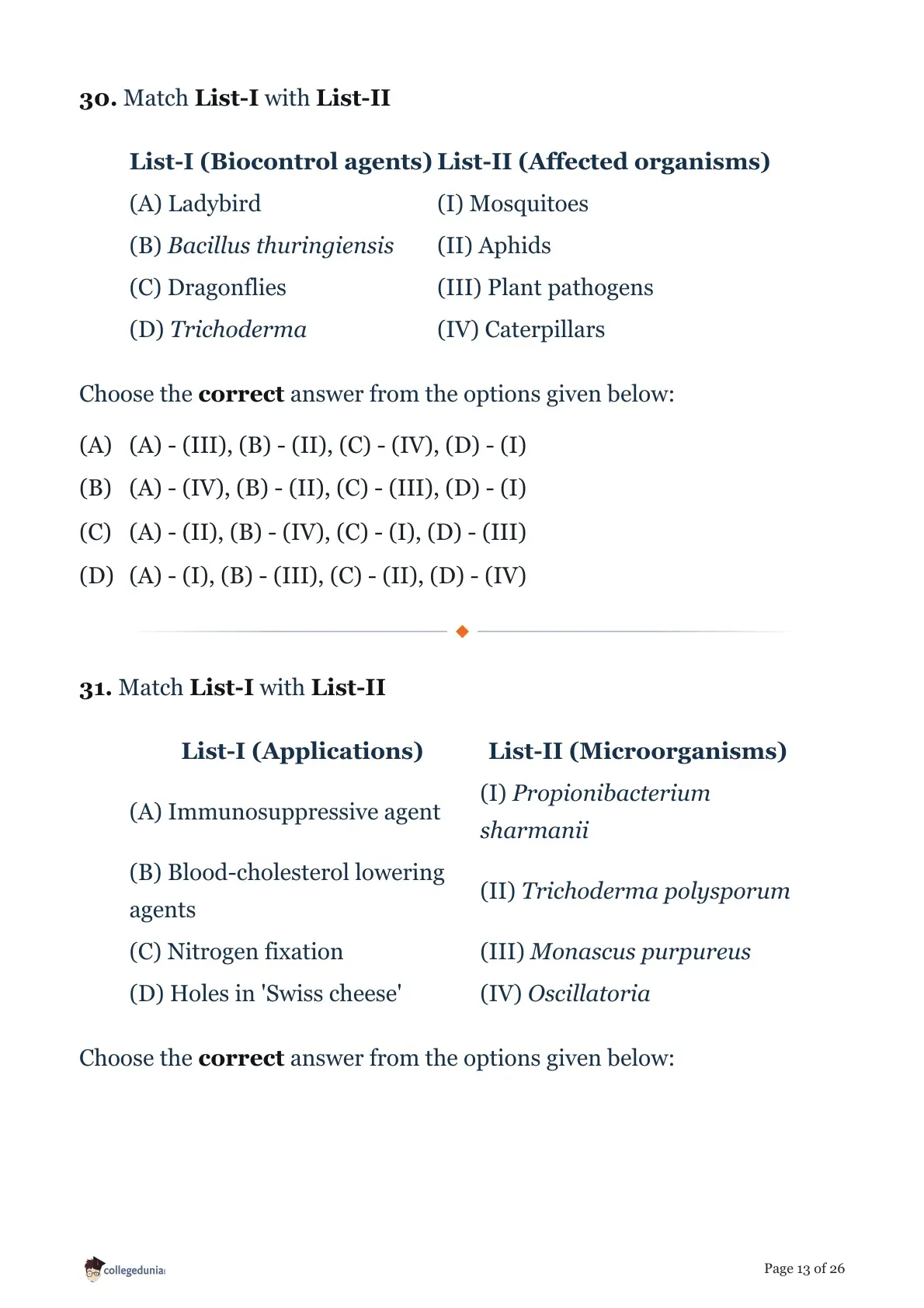
Match List-I with List-II
| List-I (Biocontrol agents) | List-II (Affected organisms) |
|---|---|
| (A) Ladybird | (I) Mosquitoes |
| (B) Bacillus thuringiensis | (II) Aphids |
| (C) Dragonflies | (III) Plant pathogens |
| (D) Trichoderma | (IV) Caterpillars |
View Solution
Step 1: Understanding the Concept:A biocontrol agent is a living organism used to control a pest or disease instead of chemicals. Each agent in List-I targets a particular group in List-II.
Step 2: Match (A) Ladybird:
Ladybirds eat aphids and other small insects that suck sap from plants. So (A) matches (II) Aphids.
Step 3: Match (B) Bacillus thuringiensis:
This bacterium makes Bt toxin. The toxin kills caterpillars (larvae of moths and butterflies) such as the corn borer. So (B) matches (IV) Caterpillars.
Step 4: Match (C) Dragonflies:
Dragonflies catch and eat adult mosquitoes and their larvae near water. So (C) matches (I) Mosquitoes.
Step 5: Match (D) Trichoderma:
Trichoderma is a fungus that grows around roots and fights many plant disease fungi. So (D) matches (III) Plant pathogens.
Step 6: Check the options:
The pairs are A-II, B-IV, C-I, D-III. This is exactly option 3. Option 1 wrongly pairs the ladybird with plant pathogens. Option 2 pairs the ladybird with caterpillars. Option 4 pairs the ladybird with mosquitoes. All three are wrong.
Final Answer:
The matching is (A)-(II), (B)-(IV), (C)-(I), (D)-(III), which is option 3.
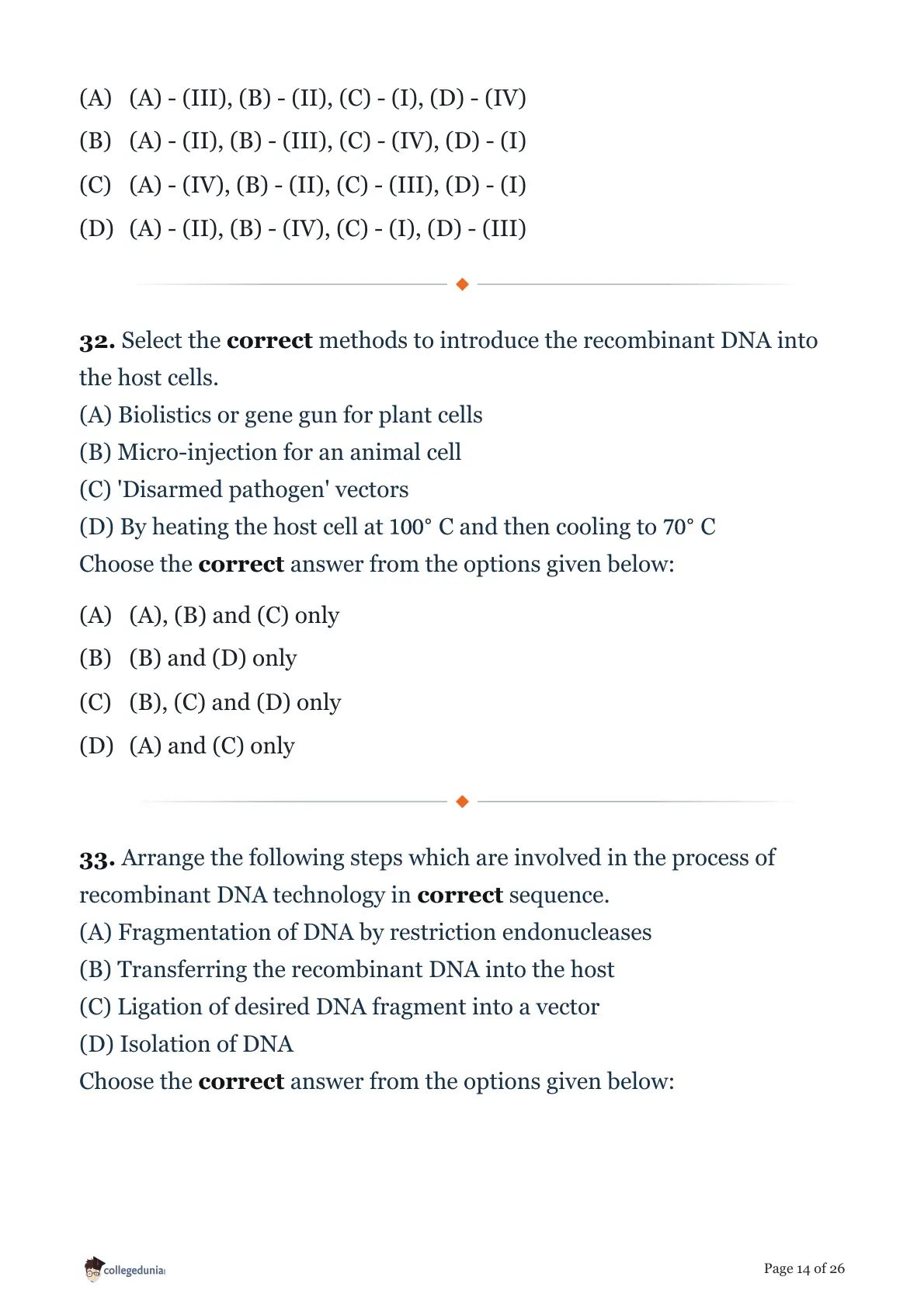
Match List-I with List-II
| List-I (Applications) | List-II (Microorganisms) |
|---|---|
| (A) Immunosuppressive agent | (I) Propionibacterium sharmanii |
| (B) Blood-cholesterol lowering agents | (II) Trichoderma polysporum |
| (C) Nitrogen fixation | (III) Monascus purpureus |
| (D) Holes in 'Swiss cheese' | (IV) Oscillatoria |
View Solution
Step 1: Understanding the Concept:Microbes give us many useful products. This question asks which microbe gives which product or process.
Step 2: Match (A) Immunosuppressive agent:
Cyclosporin A is used after organ transplants to stop rejection. It comes from the fungus Trichoderma polysporum. So (A) matches (II).
Step 3: Match (B) Blood-cholesterol lowering agents:
Statins lower blood cholesterol. They are made by the yeast Monascus purpureus. So (B) matches (III).
Step 4: Match (C) Nitrogen fixation:
Oscillatoria is a cyanobacterium that can fix atmospheric nitrogen. So (C) matches (IV).
Step 5: Match (D) Holes in Swiss cheese:
The bacterium Propionibacterium sharmanii releases a large amount of carbon dioxide, and this makes the big holes. So (D) matches (I).
Step 6: Check the options:
The pairs are A-II, B-III, C-IV, D-I, which is option 2. Option 1 pairs A with Monascus, which is wrong. Option 3 pairs A with Oscillatoria, which is wrong. Option 4 pairs B with Oscillatoria, which is wrong.
Final Answer:
The correct matching is (A)-(II), (B)-(III), (C)-(IV), (D)-(I), which is option 2.
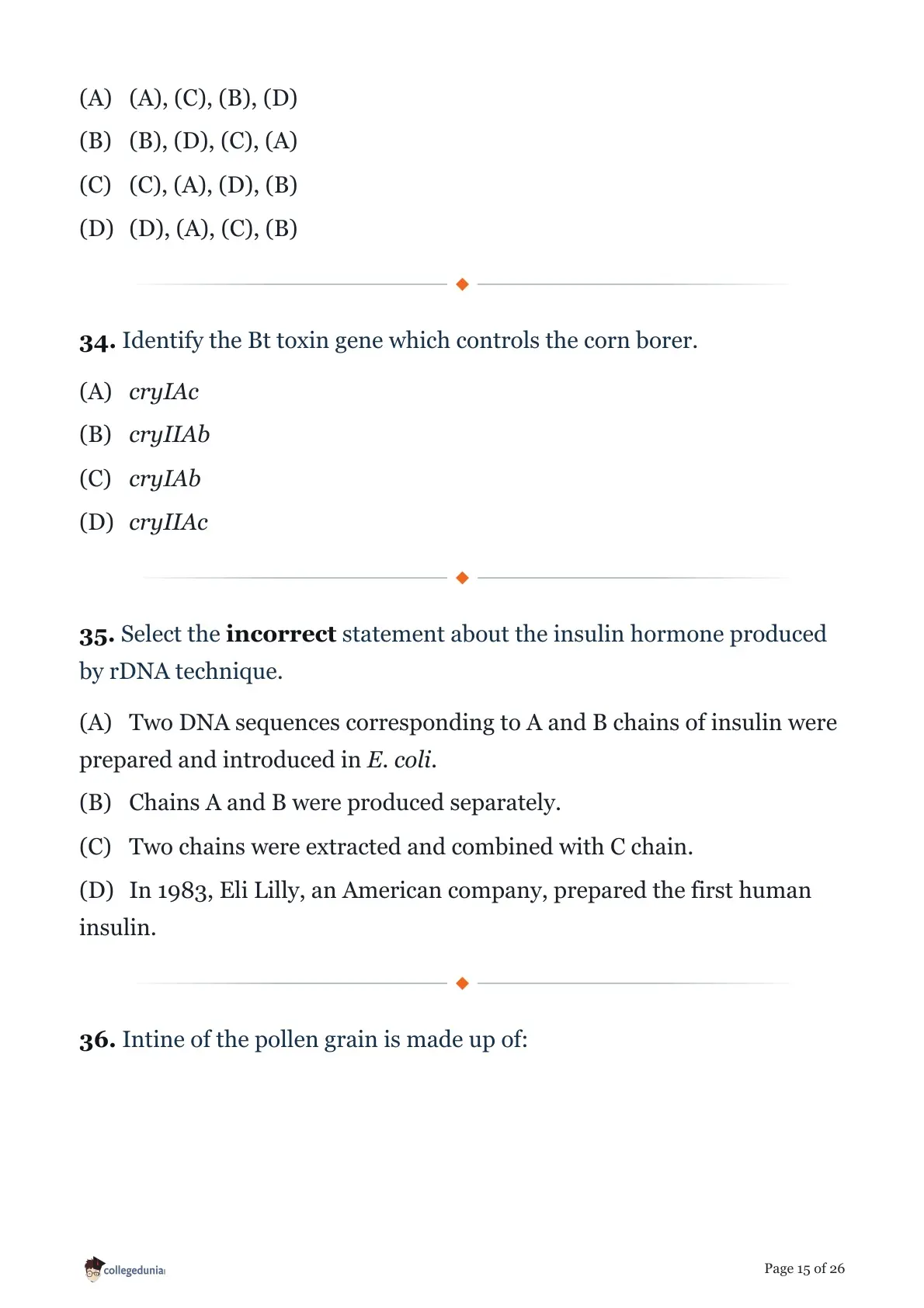
Select the correct methods to introduce the recombinant DNA into the host cells.
(A) Biolistics or gene gun for plant cells
(B) Micro-injection for an animal cell
(C) 'Disarmed pathogen' vectors
(D) By heating the host cell at \(100^{\circ}\) C and then cooling to \(70^{\circ}\) C
Choose the correct answer from the options given below:
View Solution
Step 1: Understanding the Concept:After the recombinant DNA is made, it must enter the host cell. Several physical and biological methods are used.
Step 2: Check statement (A):
In biolistics a gene gun fires gold or tungsten particles coated with DNA into plant cells. So (A) is TRUE.
Step 3: Check statement (B):
In micro-injection the DNA is injected straight into the nucleus of an animal cell with a fine needle. So (B) is TRUE.
Step 4: Check statement (C):
Disarmed pathogens such as Agrobacterium tumefaciens (with the disease genes removed) carry the gene into plant cells. Retroviruses are used for animal cells. So (C) is TRUE.
Step 5: Check statement (D):
The real heat shock method warms bacterial cells at \(42^{\circ}\)C after chilling them with calcium ions. It does not use \(100^{\circ}\)C and \(70^{\circ}\)C, and \(100^{\circ}\)C would kill the cells. So (D) is FALSE.
Step 6: Pick the option:
A, B and C are true and D is false. That is option 1.
Final Answer:
Statements A, B and C are correct, so the answer is option 1.
Arrange the following steps which are involved in the process of recombinant DNA technology in correct sequence.
(A) Fragmentation of DNA by restriction endonucleases
(B) Transferring the recombinant DNA into the host
(C) Ligation of desired DNA fragment into a vector
(D) Isolation of DNA
Choose the correct answer from the options given below:
View Solution
Step 1: Understanding the Concept:Recombinant DNA technology follows a fixed order, from getting the DNA to putting the new DNA in a host.
Step 2: First step:
We must first isolate the DNA from the cells. So (D) comes first.
Step 3: Second step:
The isolated DNA is cut into pieces with restriction endonucleases. So (A) comes next.
Step 4: Third step:
The wanted fragment is joined into a vector using DNA ligase. So (C) comes third.
Step 5: Last step:
The recombinant DNA is then moved into the host cell. So (B) is last.
Step 6: Check the options:
The order D, A, C, B is option 4. The other options start with A, B or C, which cannot be first because there is no DNA to cut or join before it is isolated.
Final Answer:
The correct sequence is (D), (A), (C), (B), which is option 4.
Identify the Bt toxin gene which controls the corn borer.
View Solution
Step 1: Understanding the Concept:Bt toxin genes are named cry genes. Each one kills a different group of insects.
Step 2: Recall which gene does what:
The genes cryIAc and cryIIAb control the cotton bollworms. The gene cryIAb controls the corn borer.
Step 3: Check the options:
Option 1, cryIAc, is for cotton bollworm. Option 2, cryIIAb, is also for cotton bollworm. Option 3, cryIAb, is for the corn borer. Option 4, cryIIAc, is not the corn borer gene.
Final Answer:
The corn borer gene is cryIAb, option 3.
Select the incorrect statement about the insulin hormone produced by rDNA technique.
View Solution
Step 1: Understanding the Concept:Human insulin has two chains, A and B, joined by disulfide bonds. In the body it is first made as pro-insulin with an extra C peptide, which is removed later.
Step 2: Check statement 1:
Two DNA sequences for chains A and B were prepared and put into E. coli plasmids. This is true.
Step 3: Check statement 2:
The chains A and B were made separately by the bacteria. This is true.
Step 4: Check statement 3:
The two chains were extracted and joined with each other by disulfide bonds to form human insulin. They were not combined with a C chain, because mature insulin has no C chain. So this statement is FALSE.
Step 5: Check statement 4:
In 1983 Eli Lilly, an American company, made the first human insulin by rDNA technique. This is true.
Final Answer:
Statement 3 is incorrect, so the answer is option 3.
Intine of the pollen grain is made up of:
View Solution
Step 1: Understanding the Concept:A pollen grain wall has two layers: the outer exine and the inner intine.
Step 2: Recall the make-up:
The exine is made of sporopollenin, a very tough material. The intine is a thin layer of cellulose and pectin.
Step 3: Check the options:
Option 1 has starch and agarose, which are not wall parts here. Option 2 has heparin and lignin, which are wrong. Option 3 has cellulose and pectin, which is right. Option 4 has glycogen and collagen, which are animal materials.
Final Answer:
The intine is made of cellulose and pectin, option 3.
At maturity, a typical angiosperm embryo sac is:
View Solution
Step 1: Understanding the Concept:The embryo sac forms from the functional megaspore. Its nucleus divides three times, so 8 nuclei form.
Step 2: Count the nuclei:
Three divisions give 8 nuclei: 4 at each end. Three of the four at each end form cells, and one from each end moves to the centre.
Step 3: Count the cells:
The micropylar end has 3 cells (egg apparatus: 1 egg and 2 synergids). The chalazal end has 3 antipodal cells. The large central cell holds 2 polar nuclei. This gives 3 + 3 + 1 = 7 cells.
Step 4: Check the options:
The embryo sac is 8-nucleate and 7-celled. That is option 4. Options 1, 2 and 3 give wrong counts.
Final Answer:
A typical embryo sac is 8-nucleate and 7-celled, option 4.
Which one of the following hormones is not involved in the process of parturition?
View Solution
Step 1: Understanding the Concept:Parturition is the process of child birth. It is started by signals from the fully developed foetus and the placenta.
Step 2: Recall the signal chain:
The foetus sends a signal that raises cortisol. This causes mild uterine contractions called the foetal ejection reflex. The reflex triggers release of oxytocin from the mother's pituitary. Oxytocin makes the uterus contract more strongly. Estrogens increase the sensitivity of the uterus to oxytocin.
Step 3: Check each option:
Estrogens help parturition, so option 1 is involved. Cortisol is part of the foetal signal, so option 2 is involved. Oxytocin causes strong contractions, so option 3 is involved. Prolactin works in lactation (milk production), not in birth.
Step 4: Conclusion:
Prolactin is the hormone not involved in parturition.
Final Answer:
Prolactin is not involved in parturition. It is option 4.
Which one of the following structures provide energy for sperm movement?
View Solution
Step 1: Understanding the Concept:A sperm has a head, a neck, a middle piece and a tail. Moving the tail needs ATP.
Step 2: Find the energy source:
The middle piece has many mitochondria. Mitochondria make ATP, so the middle piece supplies energy for the tail to beat.
Step 3: Check the other options:
The acrosome is a cap on the head with enzymes that help enter the egg. The head holds the nucleus with DNA. The tail only moves the sperm using the energy it is given. None of these make energy.
Step 4: Conclusion:
The middle piece is the correct choice.
Final Answer:
The middle piece gives energy for sperm movement, option 3.
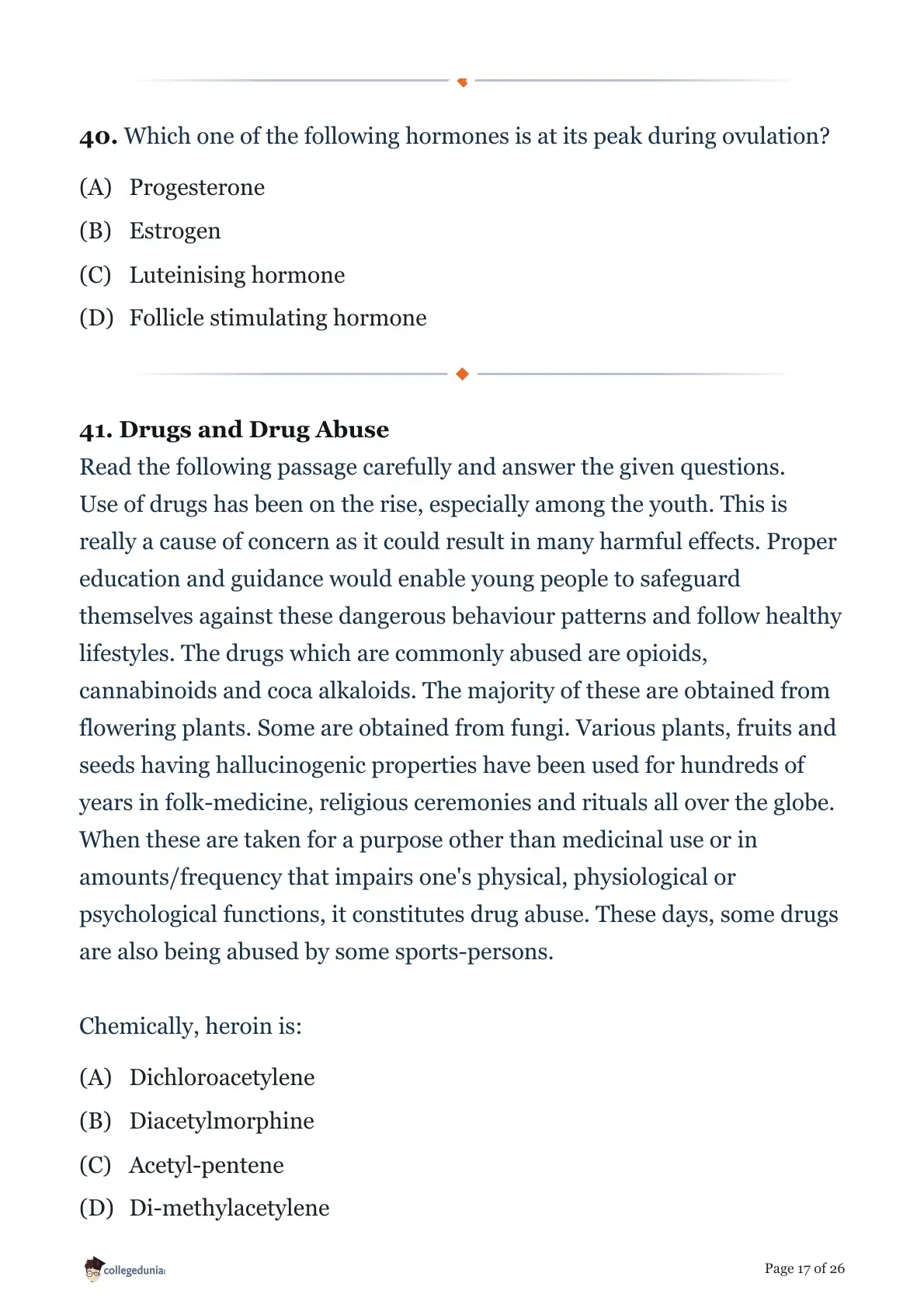
Which one of the following hormones is at its peak during ovulation?
View Solution
Step 1: Understanding the Concept:Ovulation is the release of the egg from the Graafian follicle. It happens around day 14 of the menstrual cycle.
Step 2: Recall the hormone pattern:
Rising estrogen from the growing follicle causes a sharp surge of LH in mid-cycle. A smaller FSH rise comes with it. The LH surge is the direct trigger of ovulation.
Step 3: Check the options:
Progesterone is low before ovulation and rises later in the luteal phase, so option 1 is wrong. Estrogen peaks just before the surge but is the cause, not the peak at ovulation itself. FSH has only a minor rise. LH shows the biggest peak.
Step 4: Conclusion:
The standard textbook answer is luteinising hormone.
Final Answer:
Luteinising hormone peaks at ovulation, option 3.
Drugs and Drug Abuse
Read the following passage carefully and answer the given questions.
Use of drugs has been on the rise, especially among the youth. This is really a cause of concern as it could result in many harmful effects. Proper education and guidance would enable young people to safeguard themselves against these dangerous behaviour patterns and follow healthy lifestyles. The drugs which are commonly abused are opioids, cannabinoids and coca alkaloids. The majority of these are obtained from flowering plants. Some are obtained from fungi. Various plants, fruits and seeds having hallucinogenic properties have been used for hundreds of years in folk-medicine, religious ceremonies and rituals all over the globe. When these are taken for a purpose other than medicinal use or in amounts/frequency that impairs one's physical, physiological or psychological functions, it constitutes drug abuse. These days, some drugs are also being abused by some sports-persons.
Chemically, heroin is:
View Solution
Step 1: Understanding the Concept:The passage says that opioids, cannabinoids and coca alkaloids are common drugs of abuse and that many come from flowering plants.
Step 2: Recall the facts:
Heroin is chemically diacetylmorphine. It is made by acetylation of morphine, which is taken from the latex of the poppy plant Papaver somniferum. It is a white, odourless, bitter crystalline compound, usually smoked, snorted or injected. It acts as a depressant and slows body functions.
Step 3: Check the options:
The correct choice is option 2, Diacetylmorphine. The other options do not match the facts given in Step 2.
Final Answer:
The answer is option 2, Diacetylmorphine.
Drugs and Drug Abuse
Read the following passage carefully and answer the given questions.
Use of drugs has been on the rise, especially among the youth. This is really a cause of concern as it could result in many harmful effects. Proper education and guidance would enable young people to safeguard themselves against these dangerous behaviour patterns and follow healthy lifestyles. The drugs which are commonly abused are opioids, cannabinoids and coca alkaloids. The majority of these are obtained from flowering plants. Some are obtained from fungi. Various plants, fruits and seeds having hallucinogenic properties have been used for hundreds of years in folk-medicine, religious ceremonies and rituals all over the globe. When these are taken for a purpose other than medicinal use or in amounts/frequency that impairs one's physical, physiological or psychological functions, it constitutes drug abuse. These days, some drugs are also being abused by some sports-persons.
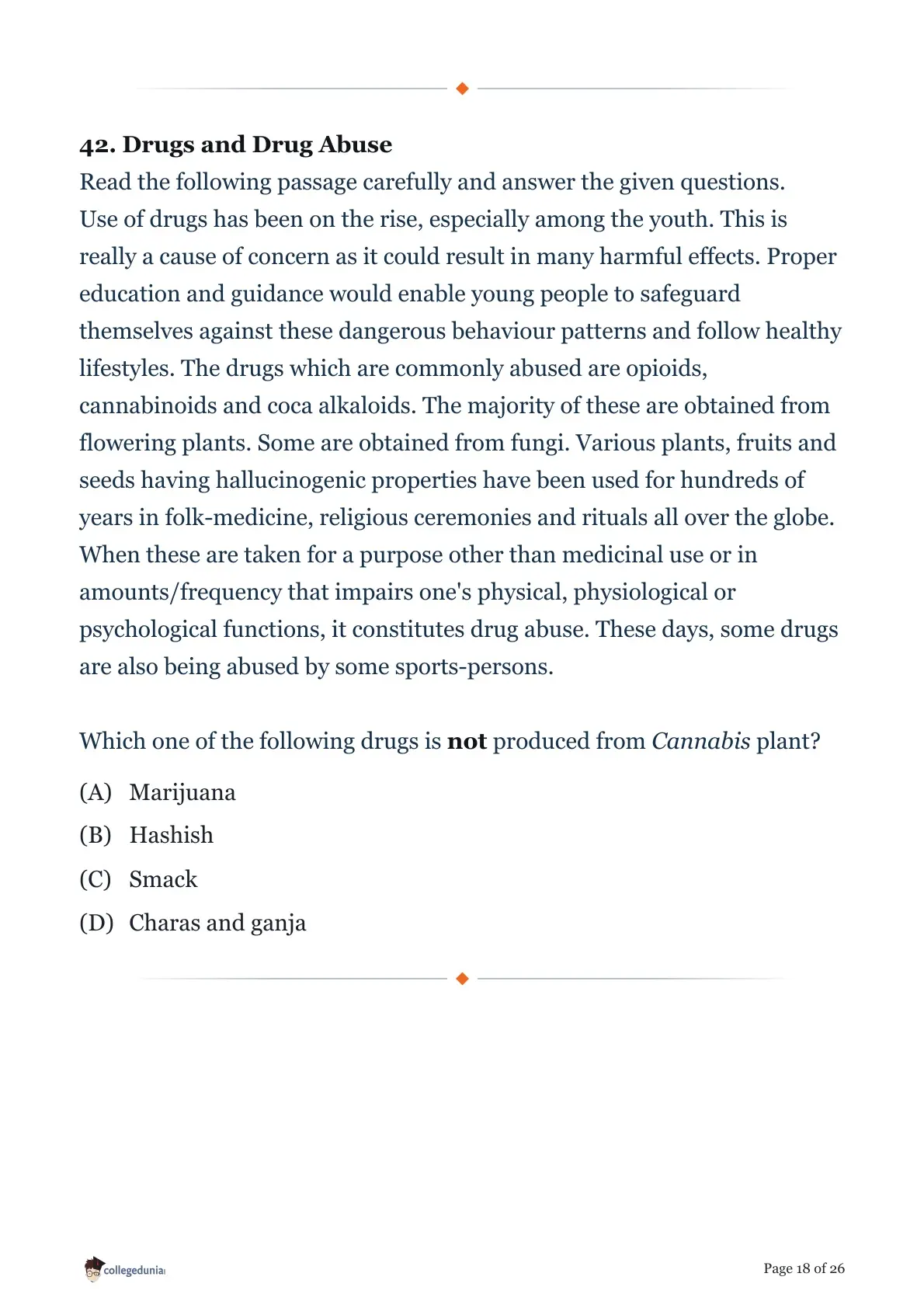
Which one of the following drugs is not produced from Cannabis plant?
View Solution
Step 1: Understanding the Concept:The passage says that opioids, cannabinoids and coca alkaloids are common drugs of abuse and that many come from flowering plants.
Step 2: Recall the facts:
Cannabinoids come from the inflorescence of Cannabis sativa. Marijuana, hashish, charas and ganja are all cannabis products. Smack is a street name for heroin, which is made from morphine of the poppy plant, not from Cannabis.
Step 3: Check the options:
The correct choice is option 3, Smack. The other options do not match the facts given in Step 2.
Final Answer:
The answer is option 3, Smack.
Drugs and Drug Abuse
Read the following passage carefully and answer the given questions.
Use of drugs has been on the rise, especially among the youth. This is really a cause of concern as it could result in many harmful effects. Proper education and guidance would enable young people to safeguard themselves against these dangerous behaviour patterns and follow healthy lifestyles. The drugs which are commonly abused are opioids, cannabinoids and coca alkaloids. The majority of these are obtained from flowering plants. Some are obtained from fungi. Various plants, fruits and seeds having hallucinogenic properties have been used for hundreds of years in folk-medicine, religious ceremonies and rituals all over the globe. When these are taken for a purpose other than medicinal use or in amounts/frequency that impairs one's physical, physiological or psychological functions, it constitutes drug abuse. These days, some drugs are also being abused by some sports-persons.
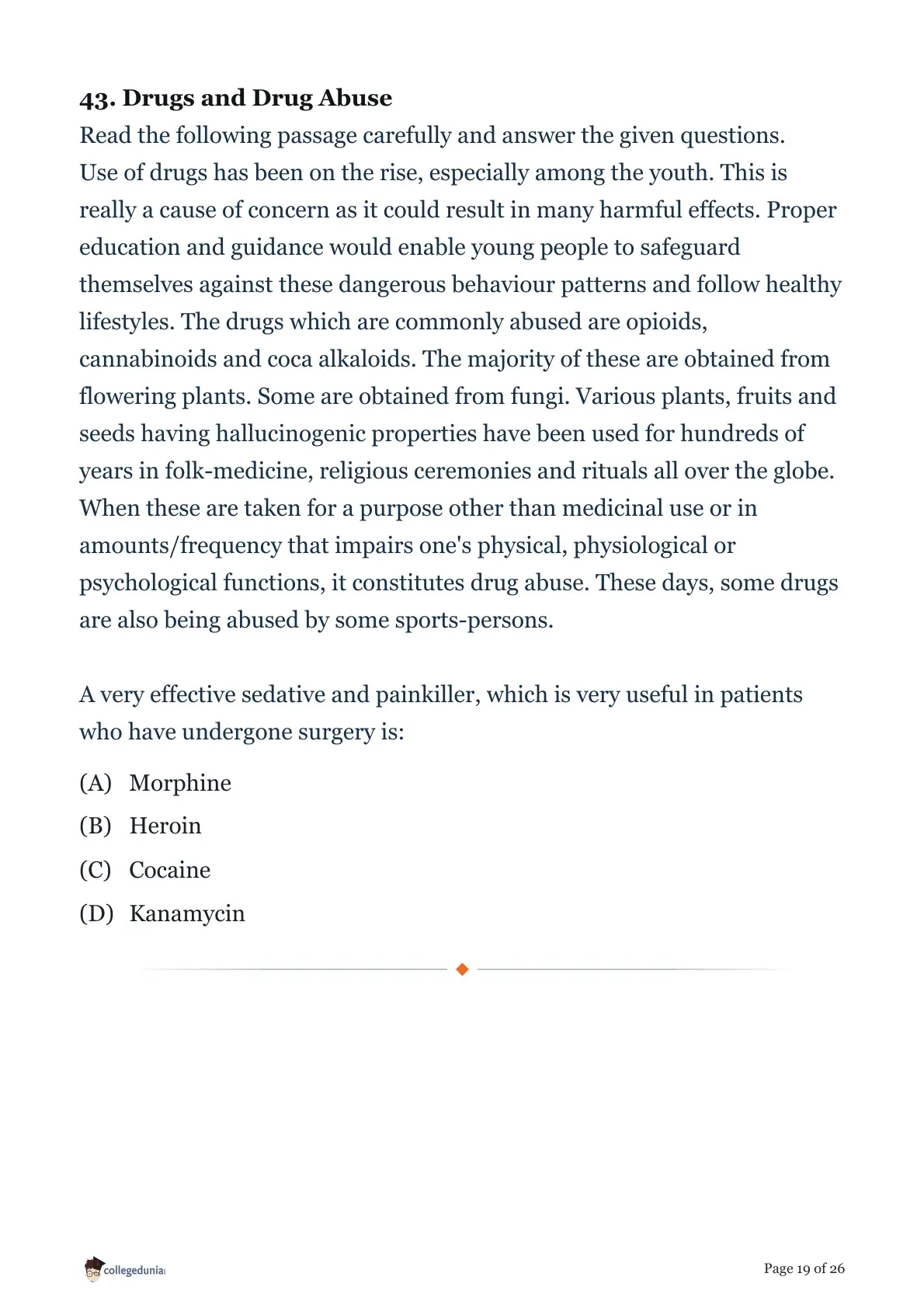
A very effective sedative and painkiller, which is very useful in patients who have undergone surgery is:
View Solution
Step 1: Understanding the Concept:The passage says that opioids, cannabinoids and coca alkaloids are common drugs of abuse and that many come from flowering plants.
Step 2: Recall the facts:
Morphine is an opioid from the latex of the poppy. It is a very effective sedative and painkiller, and doctors use it for patients after surgery. Heroin is a drug of abuse. Cocaine is a coca alkaloid stimulant. Kanamycin is an antibiotic.
Step 3: Check the options:
The correct choice is option 1, Morphine. The other options do not match the facts given in Step 2.
Final Answer:
The answer is option 1, Morphine.
Drugs and Drug Abuse
Read the following passage carefully and answer the given questions.
Use of drugs has been on the rise, especially among the youth. This is really a cause of concern as it could result in many harmful effects. Proper education and guidance would enable young people to safeguard themselves against these dangerous behaviour patterns and follow healthy lifestyles. The drugs which are commonly abused are opioids, cannabinoids and coca alkaloids. The majority of these are obtained from flowering plants. Some are obtained from fungi. Various plants, fruits and seeds having hallucinogenic properties have been used for hundreds of years in folk-medicine, religious ceremonies and rituals all over the globe. When these are taken for a purpose other than medicinal use or in amounts/frequency that impairs one's physical, physiological or psychological functions, it constitutes drug abuse. These days, some drugs are also being abused by some sports-persons.
Which one of the following drugs is not normally used as medicine to help patients cope with mental illnesses?
View Solution
Step 1: Understanding the Concept:The passage says that opioids, cannabinoids and coca alkaloids are common drugs of abuse and that many come from flowering plants.
Step 2: Recall the facts:
Amphetamines, benzodiazepines and barbiturates act on the nervous system. They are used as medicines for depression, anxiety and insomnia. Chloramphenicol is an antibiotic that treats bacterial infections such as typhoid. It has no role in mental illness.
Step 3: Check the options:
The correct choice is option 1, Chloramphenicol. The other options do not match the facts given in Step 2.
Final Answer:
The answer is option 1, Chloramphenicol.
Drugs and Drug Abuse
Read the following passage carefully and answer the given questions.
Use of drugs has been on the rise, especially among the youth. This is really a cause of concern as it could result in many harmful effects. Proper education and guidance would enable young people to safeguard themselves against these dangerous behaviour patterns and follow healthy lifestyles. The drugs which are commonly abused are opioids, cannabinoids and coca alkaloids. The majority of these are obtained from flowering plants. Some are obtained from fungi. Various plants, fruits and seeds having hallucinogenic properties have been used for hundreds of years in folk-medicine, religious ceremonies and rituals all over the globe. When these are taken for a purpose other than medicinal use or in amounts/frequency that impairs one's physical, physiological or psychological functions, it constitutes drug abuse. These days, some drugs are also being abused by some sports-persons.
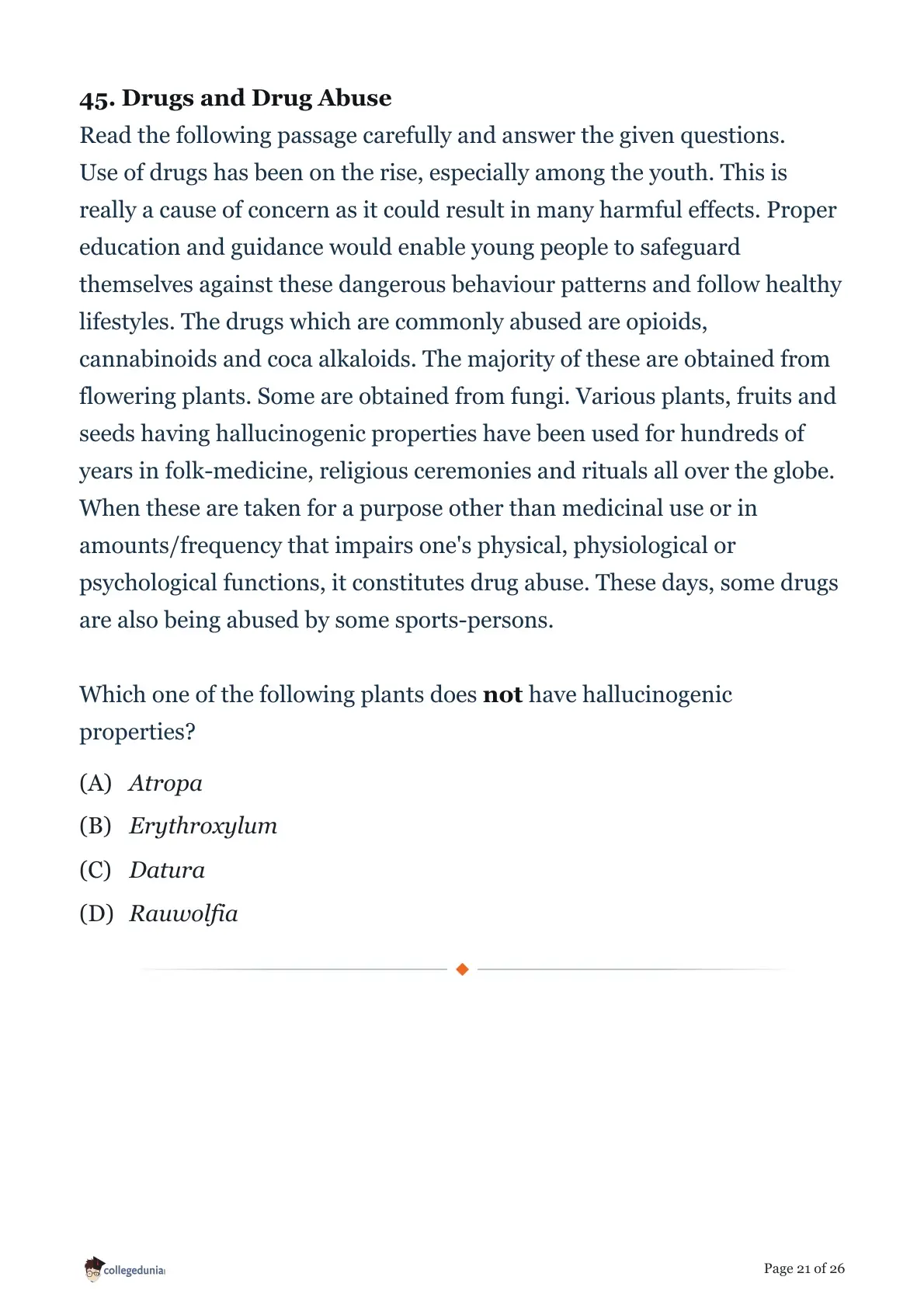
Which one of the following plants does not have hallucinogenic properties?
View Solution
Step 1: Understanding the Concept:The passage says that opioids, cannabinoids and coca alkaloids are common drugs of abuse and that many come from flowering plants.
Step 2: Recall the facts:
Atropa belladonna and Datura give hallucinogens such as atropine and datura alkaloids. Erythroxylum coca gives cocaine, which is a stimulant with hallucinogenic effects. Rauwolfia serpentina gives reserpine, which is a tranquilizer used for high blood pressure and not a hallucinogen.
Step 3: Check the options:
The correct choice is option 4, Rauwolfia. The other options do not match the facts given in Step 2.
Final Answer:
The answer is option 4, Rauwolfia.
Mendelian Disorders
Read the following passage carefully and answer the given questions.
Genetic disorders may be grouped into two categories - Mendelian disorders and Chromosomal disorders. Mendelian disorders are mainly determined by alteration or mutation in a single gene. These disorders are transmitted to the offspring on the same lines as in the principle of inheritance. The pattern of inheritance of such Mendelian disorders can be traced in a family by pedigree analysis. Most common and prevalent Mendelian disorders are Haemophilia, Cystic fibrosis, Sickle-cell anaemia, Colour blindness, Phenylketonuria, Thalassemia, etc. The Mendelian disorders may be dominant or recessive. By pedigree analysis, one can easily understand whether the trait in question is dominant or recessive. Similarly, the trait may also be linked to the sex chromosome or an autosome.
Which one of the following diseases is an autosomal dominant disorder?
View Solution
Step 1: Understanding the Concept:An autosomal disorder is caused by a gene on a non-sex chromosome. A dominant disorder shows up even when only one copy of the faulty allele is present. A recessive disorder shows up only when both copies are faulty.
Step 2: Check option 1, Sickle-cell anaemia:
It is caused by a change in the beta globin gene on chromosome 11. A person needs two faulty copies to have the disease. So it is autosomal recessive and option 1 is wrong.
Step 3: Check option 2, Myotonic dystrophy:
This muscle disease is caused by a repeat expansion in a gene on an autosome. One faulty copy is enough to cause it. So it is autosomal dominant and option 2 is right.
Step 4: Check option 3, Phenylketonuria:
The enzyme phenylalanine hydroxylase is missing when both copies of the gene are faulty. So it is autosomal recessive and option 3 is wrong.
Step 5: Check option 4, Thalassemia:
Thalassemia is caused by faulty globin genes and shows up in the person who gets two faulty copies. It is autosomal recessive, so option 4 is wrong.
Final Answer:
Myotonic dystrophy is the autosomal dominant disorder, which is option 2.
Mendelian Disorders
Read the following passage carefully and answer the given questions.
Genetic disorders may be grouped into two categories - Mendelian disorders and Chromosomal disorders. Mendelian disorders are mainly determined by alteration or mutation in a single gene. These disorders are transmitted to the offspring on the same lines as in the principle of inheritance. The pattern of inheritance of such Mendelian disorders can be traced in a family by pedigree analysis. Most common and prevalent Mendelian disorders are Haemophilia, Cystic fibrosis, Sickle-cell anaemia, Colour blindness, Phenylketonuria, Thalassemia, etc. The Mendelian disorders may be dominant or recessive. By pedigree analysis, one can easily understand whether the trait in question is dominant or recessive. Similarly, the trait may also be linked to the sex chromosome or an autosome.
Which one of the following substitutions is a cause of sickle-cell anaemia?
View Solution
Step 1: Understanding the Concept:Sickle-cell anaemia is caused by a point mutation in the beta globin gene. The base change GAG to GTG changes one amino acid in the beta chain of haemoglobin.
Step 2: Recall the exact change:
At the sixth position of the beta globin chain, glutamic acid (a charged, acidic amino acid) is replaced by valine (a non-polar amino acid). The changed haemoglobin sticks together under low oxygen and bends the red cell into a sickle shape.
Step 3: Check the options:
Option 3 states exactly this change. Option 1 has the amino acids the wrong way round and uses aspartic acid. Option 2 uses alanine, which is not involved. Option 4 uses glycine and methionine, which are also not involved.
Final Answer:
Glutamic acid is replaced by valine at the sixth position of the beta chain, which is option 3.
Mendelian Disorders
Read the following passage carefully and answer the given questions.
Genetic disorders may be grouped into two categories - Mendelian disorders and Chromosomal disorders. Mendelian disorders are mainly determined by alteration or mutation in a single gene. These disorders are transmitted to the offspring on the same lines as in the principle of inheritance. The pattern of inheritance of such Mendelian disorders can be traced in a family by pedigree analysis. Most common and prevalent Mendelian disorders are Haemophilia, Cystic fibrosis, Sickle-cell anaemia, Colour blindness, Phenylketonuria, Thalassemia, etc. The Mendelian disorders may be dominant or recessive. By pedigree analysis, one can easily understand whether the trait in question is dominant or recessive. Similarly, the trait may also be linked to the sex chromosome or an autosome.
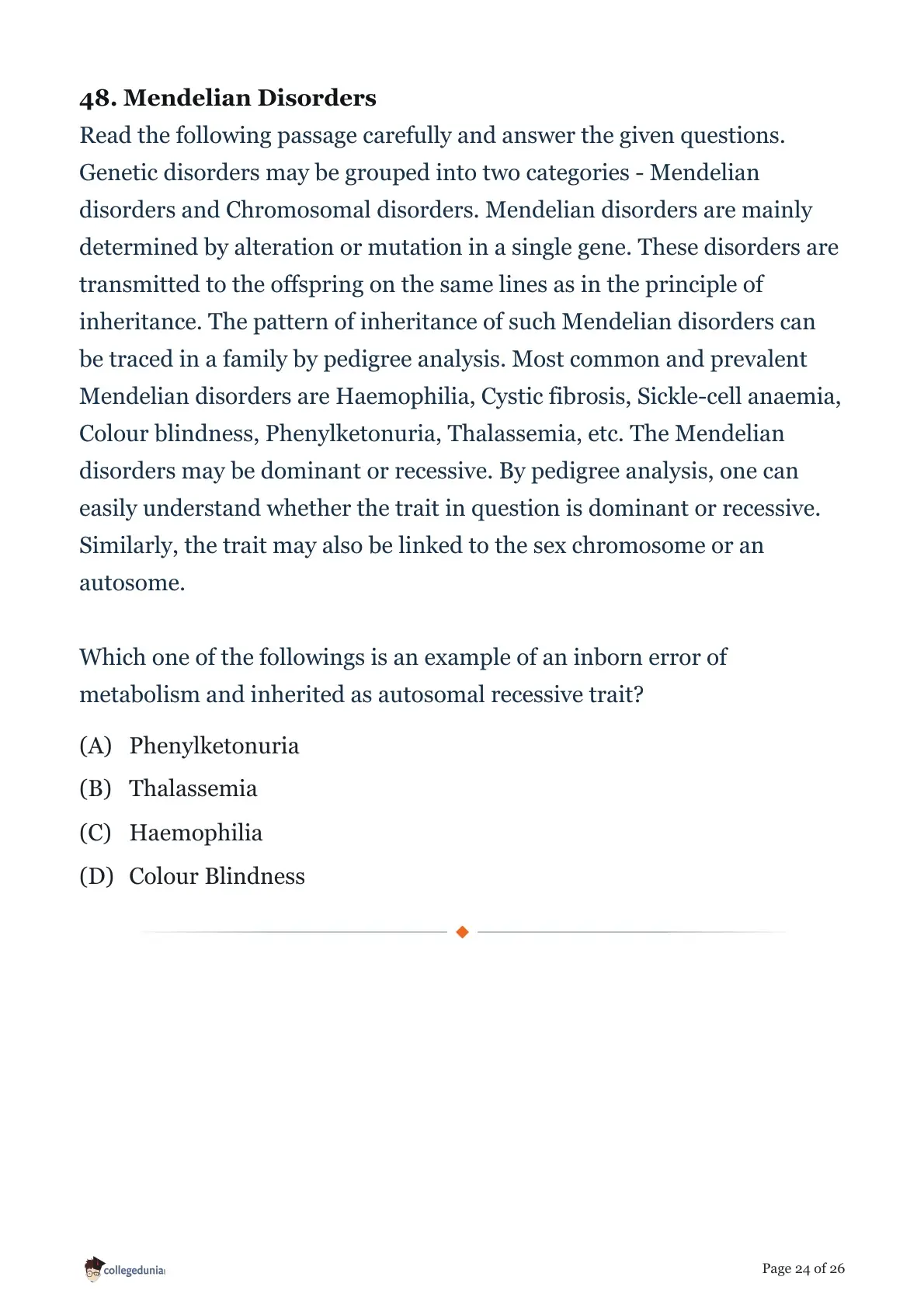
Which one of the followings is an example of an inborn error of metabolism and inherited as autosomal recessive trait?
View Solution
Step 1: Understanding the Concept:An inborn error of metabolism is a genetic disease where one enzyme of a metabolic pathway is missing or faulty. The question also needs the inheritance to be autosomal recessive.
Step 2: Check option 1, Phenylketonuria:
In this disease the enzyme phenylalanine hydroxylase is missing, so phenylalanine cannot change to tyrosine. It builds up and harms the brain. The gene is on an autosome and both copies must be faulty, so it is autosomal recessive. Option 1 is right.
Step 3: Check option 2, Thalassemia:
It is a defect in the amount of globin chains made. It is a blood disorder and not an enzyme (metabolic) defect, so option 2 is wrong.
Step 4: Check options 3 and 4:
Haemophilia and colour blindness are X-linked recessive traits. They are not autosomal, so both are wrong.
Final Answer:
Phenylketonuria is the inborn error of metabolism with autosomal recessive inheritance, which is option 1.
Mendelian Disorders
Read the following passage carefully and answer the given questions.
Genetic disorders may be grouped into two categories - Mendelian disorders and Chromosomal disorders. Mendelian disorders are mainly determined by alteration or mutation in a single gene. These disorders are transmitted to the offspring on the same lines as in the principle of inheritance. The pattern of inheritance of such Mendelian disorders can be traced in a family by pedigree analysis. Most common and prevalent Mendelian disorders are Haemophilia, Cystic fibrosis, Sickle-cell anaemia, Colour blindness, Phenylketonuria, Thalassemia, etc. The Mendelian disorders may be dominant or recessive. By pedigree analysis, one can easily understand whether the trait in question is dominant or recessive. Similarly, the trait may also be linked to the sex chromosome or an autosome.
\(\alpha\)-thalassemia is controlled by the genes:
View Solution
Step 1: Understanding the Concept:Thalassemia is a blood disease in which the synthesis of one globin chain of haemoglobin is reduced. In alpha thalassemia the alpha globin chain is affected. In beta thalassemia the beta globin chain is affected.
Step 2: Recall the genes:
Alpha globin is coded by two closely linked genes, HBA1 and HBA2, on chromosome 16. Each parent gives one copy of the pair, so a person has four alpha globin genes. Beta globin is coded by the HBB gene on chromosome 11.
Step 3: Check the options:
Option 1 and option 4 mention chromosome 11 and HBB, which belong to beta thalassemia. Option 2 uses gene names that do not exist. Option 3 gives HBA1 and HBA2 on chromosome 16 and is right.
Final Answer:
Alpha thalassemia is controlled by HBA1 and HBA2 on chromosome 16, which is option 3.
Mendelian Disorders
Read the following passage carefully and answer the given questions.
Genetic disorders may be grouped into two categories - Mendelian disorders and Chromosomal disorders. Mendelian disorders are mainly determined by alteration or mutation in a single gene. These disorders are transmitted to the offspring on the same lines as in the principle of inheritance. The pattern of inheritance of such Mendelian disorders can be traced in a family by pedigree analysis. Most common and prevalent Mendelian disorders are Haemophilia, Cystic fibrosis, Sickle-cell anaemia, Colour blindness, Phenylketonuria, Thalassemia, etc. The Mendelian disorders may be dominant or recessive. By pedigree analysis, one can easily understand whether the trait in question is dominant or recessive. Similarly, the trait may also be linked to the sex chromosome or an autosome.
Failure of segregation of chromatids during cell division results in:
View Solution
Step 1: Understanding the Concept:During anaphase the sister chromatids separate and go to opposite poles. If they fail to separate, one daughter cell gets an extra chromosome and the other loses one. This is called non-disjunction.
Step 2: Name the result:
Gain or loss of one or a few chromosomes, so that the number is not an exact multiple of the haploid set, is called aneuploidy. Down syndrome (trisomy 21) is an example.
Step 3: Check the other options:
Apomixis is the formation of seeds without fertilisation. Polyploidy is a gain of whole sets of chromosomes, and it arises when the whole set fails to separate and not just a chromatid. Parthenocarpy is the formation of fruit without fertilisation. So options 1, 3 and 4 are wrong.
Final Answer:
Failure of chromatid segregation gives aneuploidy, which is option 2.
CUET UG 2026 Exam Pattern
| Parameter | Details |
|---|---|
| Exam Name | Common University Entrance Test (CUET UG) 2026 |
| Conducting Body | National Testing Agency (NTA) |
| Exam Mode | Computer-Based Test (CBT) |
| Exam Duration | 60 minutes per test |
| Total Sections | 3 (Languages, Domain Subjects, General Test) |
| Question Type | Multiple Choice Questions (MCQs) |
| Questions per Test | 50 questions (all compulsory) |
| Marking Scheme | +5 for correct, -1 for incorrect |
| Maximum Marks | 250 marks per test |
| Maximum Subject Choices | 5 subjects in total |
| Syllabus Base | Class 12 NCERT (mainly for Domain Subjects) |



Comments