




The CAT 2017 Slot 2 Question Paper (CAT 2017, conducted by IIM Lucknow on November 26, 2017) is available here as a free PDF download, together with the official question paper.
The CAT 2017 Slot 2 question paper includes the following:
- 100 questions in a 3-hour computer based test, split into three sections: VARC (34), DILR (32) and QA (34)
- Sectional time limit: 60 minutes per section, and candidates cannot switch between sections
- Question types: multiple choice questions (MCQs) and Type In The Answer (TITA) questions
- Marking: +3 for a correct answer, -1 for an incorrect MCQ, no negative marking for TITA, 0 for an unattempted question
- Maximum marks: 300
CAT 2017 Slot 2 Question Paper PDF
| Official PDF | CD PDF | CD PDF with Solutions |
|---|---|---|
| Download official PDF 0.74 MB | Download Collegedunia PDF 0.57 MB | - |
Also Check:

CAT 2017 Slot 2 Question Paper Analysis
Watch a slot-wise analysis of the CAT 2017 Slot 2 question paper below.
Source: Endeavor Careers (Endeavor Magic) YouTube channel - CAT 2017: Exam Analysis (Second Slot)
CAT 2017 Slot 2 Questions with Solutions
Verbal Ability and Reading Comprehension (VARC) (Q1 - Q34)
The five sentences (labelled 1,2,3,4, and 5) given in this question, when properly sequenced, form a coherent paragraph. Decide on the proper order for the sentence and key in this sequence of five numbers as your answer.
1.Before plants can take life from atmosphere, nitrogen must undergo transformations similar to ones that food undergoes in our digestive machinery.
2. In its aerial form nitrogen is insoluble, unusable and is in need of transformation.
3. Lightning starts the series of chemical reactions that need to happen to nitrogen, ultimately helping it nourish our earth.
4. Nitrogen - an essential food for plants - is an abundant resource, with about 22 million tons of it floating over each square mile of earth.
5. One of the most dramatic examples in nature of ill wind that blows goodness is lightning.
Identify the most appropriate summary for the paragraph.
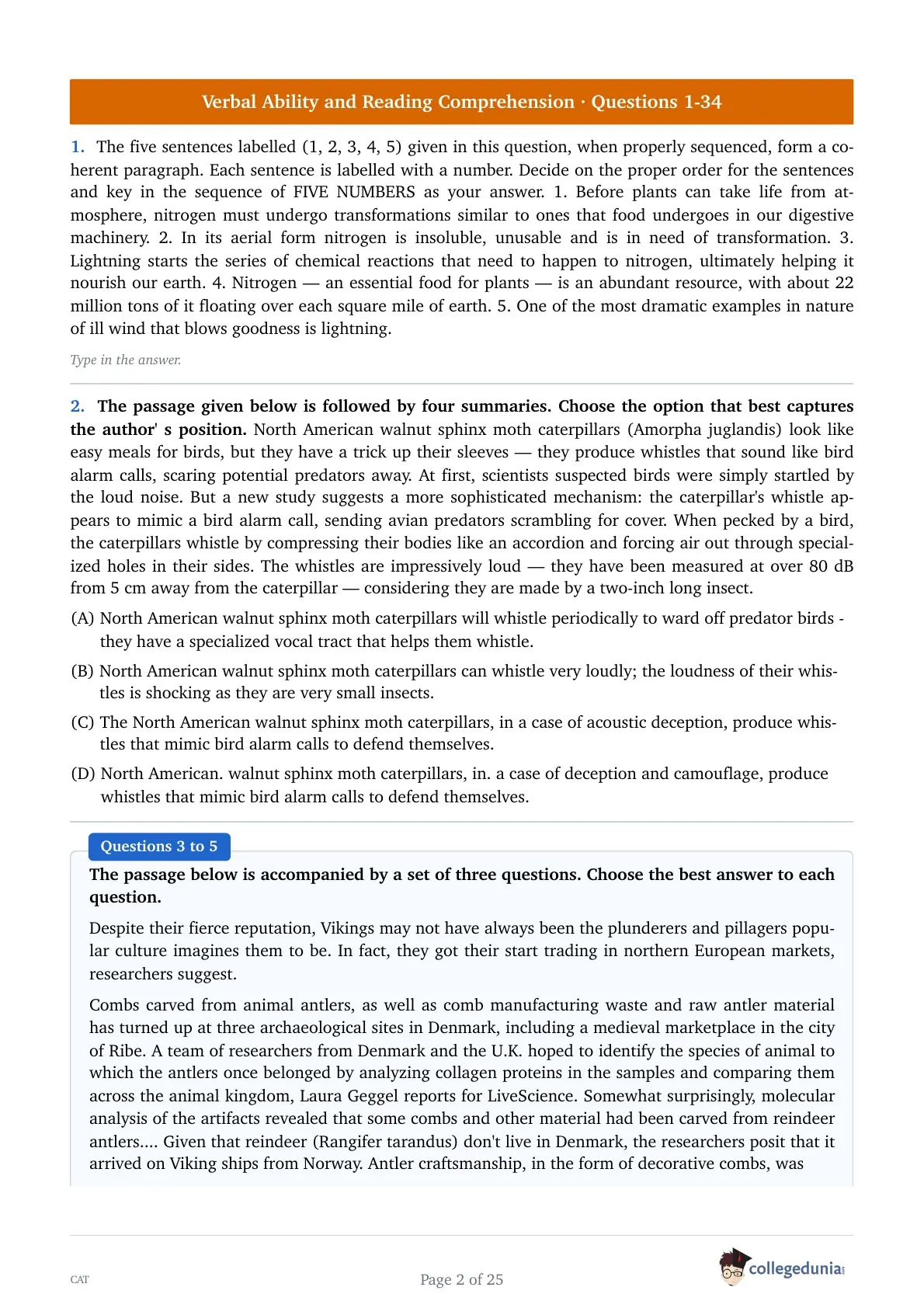
North American walnut sphinx moth caterpillars (Amorpha juglandis) look like easy meals for birds, but they have a trick up their sleeves—they produce whistles that sound like bird alarm calls, scaring potential predators away. At first, scientists suspected birds were simply startled by the loud noise. But a new study suggests a more sophisticated mechanism: the caterpillar's whistle appears to mimic a bird alarm call, sending avian predators scrambling for cover. When pecked by a bird, the caterpillars whistle by compressing their bodies like an accordion and forcing air out through specialized holes in their sides. The whistles are impressively loud - they have been measured at over 80 dB from 5 cm away from the caterpillar - considering they are made by a two-inch long insect.
Comprehension:
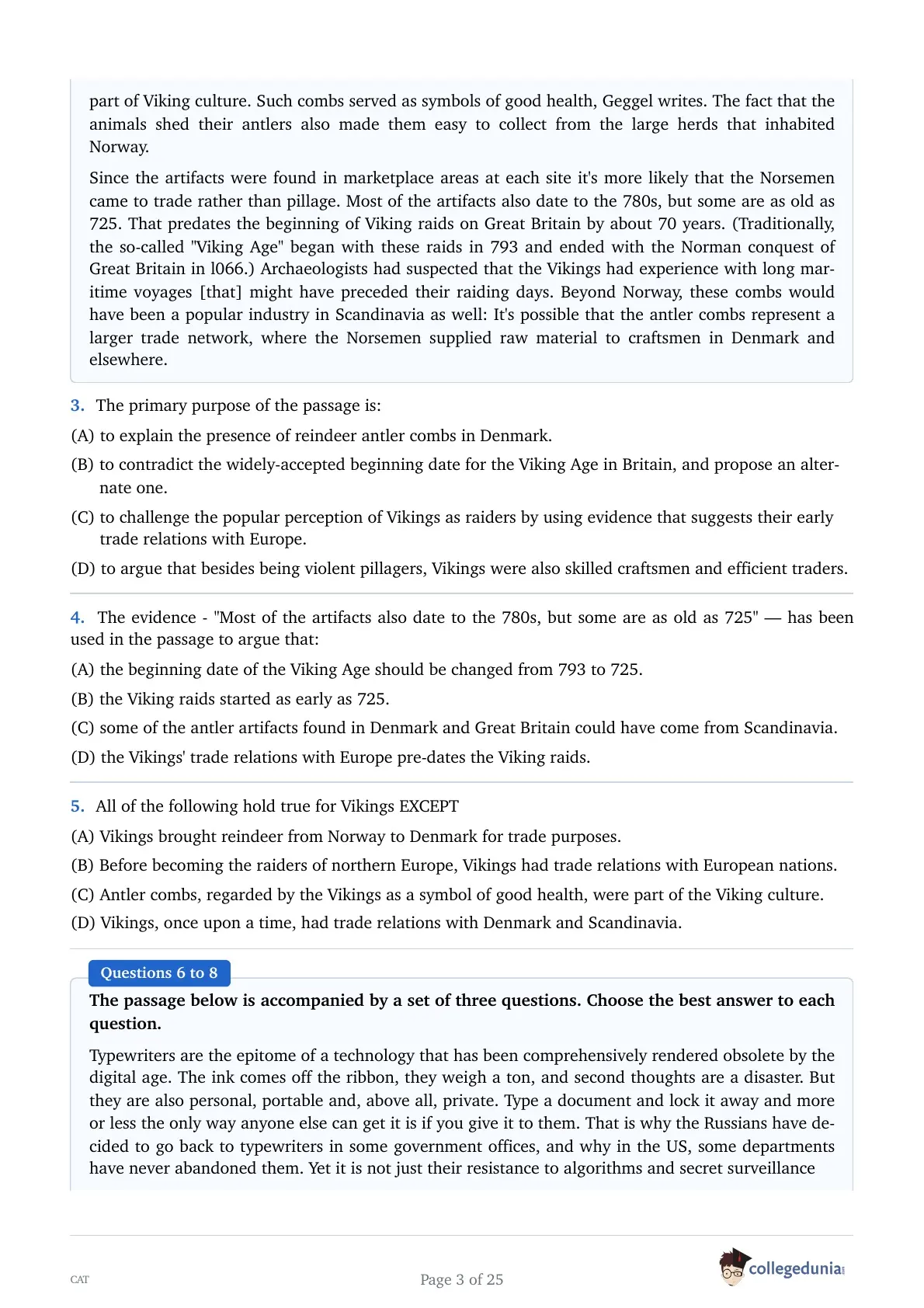
Despite their fierce reputation. Vikings may not have always been the plunderers and pillagers popular culture imagines them to be. In fact, they got their start trading in northern European markets, researchers suggest.
Combs carved from animal antlers, as well as comb manufacturing waste and raw antler material has turned up at three archaeological sites in Denmark, including a medieval marketplace in the city of Ribe. A team of researchers from Denmark and the U.K. hoped to identify the species of animal to which the antlers once belonged by analyzing collagen proteins in the samples and comparing them across the animal kingdom, Laura Geggel reports for LiveScience. Somewhat surprisingly, molecular analysis of the artifacts revealed that some combs and other material had been carved from reindeer antlers.... Given that reindeer (Rangifer tarandus) don't live in Denmark, the researchers posit that it arrived on Viking ships from Norway. Antler craftsmanship, in the form of decorative combs, was part of Viking culture. Such combs served as symbols of good health, Geggel writes. The fact that the animals shed their antlers also made them easy to collect from the large herds that inhabited Norway.
Read More
Since the artifacts were found in marketplace areas at each site it's more likely that the Norsemen came to trade rather than pillage. Most of the artifacts also date to the 780s, but some are as old as 725. That predates the beginning of Viking raids on Great Britain by about 70 years. (Traditionally, the so-called "Viking Age" began with these raids in 793 and ended with the Norman conquest of Great Britain in 1066.) Archaeologists had suspected that the Vikings had experience with long maritime voyages [that] might have preceded their raiding days. Beyond Norway, these combs would have been a popular industry in Scandinavia as well. It's possible that the antler combs represent a larger trade network, where the Norsemen supplied raw material to craftsmen in Denmark and elsewhere.The primary purpose of the passage is:
The evidence - "Most of the artifacts also date to the 780s, but some are as old as 725" - has been used in the passage to argue that:
All of the following hold true for Vikings EXCEPT
Comprehension:
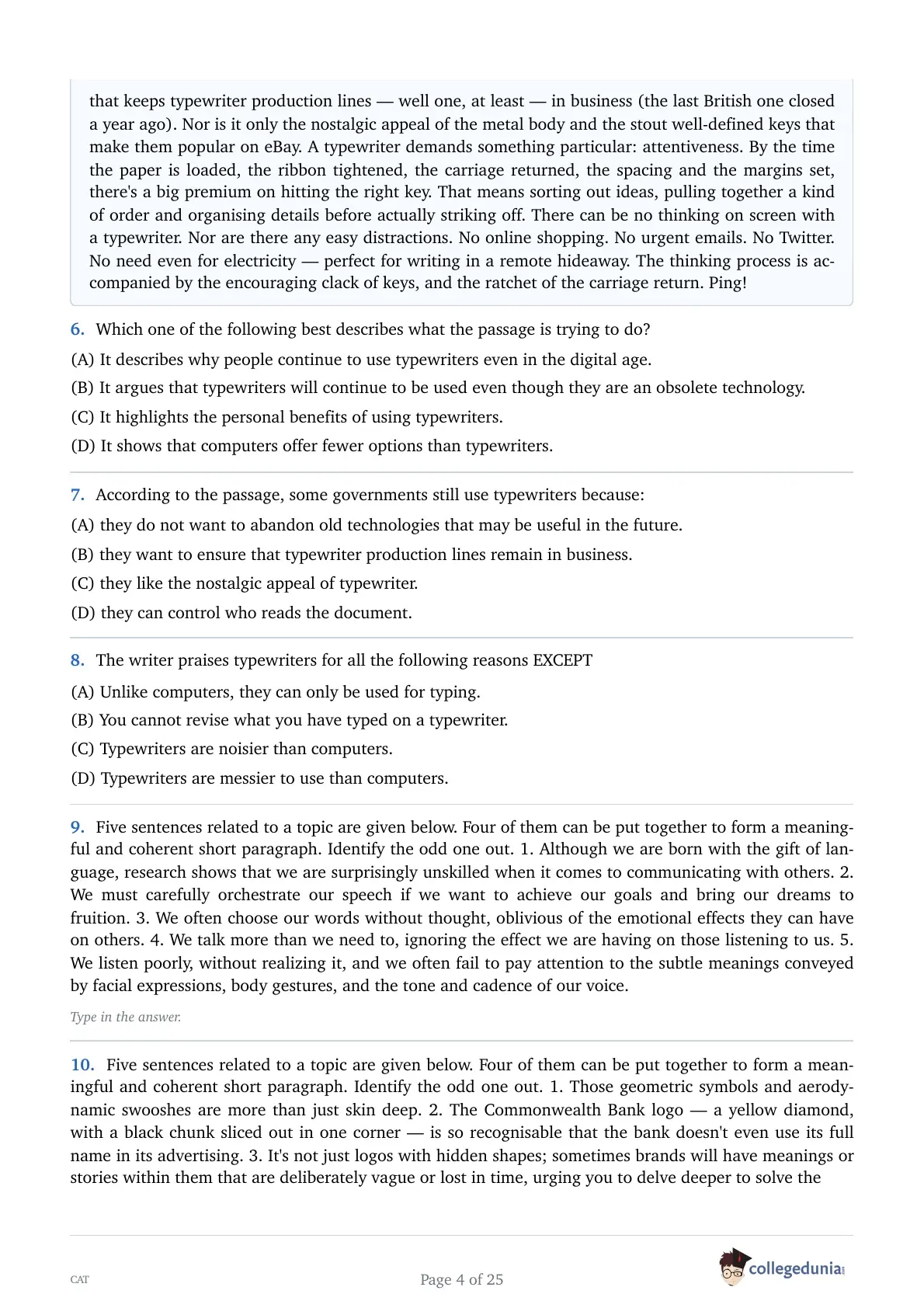
Typewriters are the epitome of a technology that has been comprehensively rendered obsolete by the digital age. The ink comes off the ribbon, they weigh a ton, and second thoughts are a disaster. But they are also personal, portable and, above all, private. Type a document and lock it away and more or less the only way anyone else can get it is if you give it to them. That is why the Russians have decided to go back to typewriters in some government offices, and why in the US, some departments have never abandoned them. Yet it is not just their resistance to algorithms and secret surveillance that keeps typewriter production lines - well one, at least - in business (the last British one closed a year ago). Nor is it only the nostalgic appeal of the metal body and the stout well-defined keys that make them popular on eBay. A typewriter demands something particular: attentiveness. By the time the paper is loaded, the ribbon tightened, the carriage returned, the spacing and the margins set, there's a big premium on hitting the right key. That means sorting out ideas, pulling together a kind of order and organising details before actually striking off. There can be no thinking on screen with a typewriter. Nor are there any easy distractions. No online shopping. No urgent emails. No Twitter. No need even for electricity - perfect for writing in a remote hideaway. The thinking process is accompanied by the encouraging clack of keys, and the ratchet of the carriage return. Ping!
Which one of the following best describes what the passage is trying to do?
According to the passage, some governments still use typewriters because:
The writer praises typewriters for all the following reasons EXCEPT
Five sentences related to a topic are given below. Four of them can be put together to form a meaningful and coherent short paragraph. Identify the odd one out. Choose its number as your answer and key it in.
1. Although we are born with the gift of language,research shows that we are surprisingly unskilled when it comes to communicating with others.
2. We must carefully orchestrate our speech if we want to achieve our goals and bring our dreams to fruition.
3. We often choose our words without thought, oblivious of the emotional effects they can have on others.
4. We talk more than we need to, ignoring the effect we are having on those listening to us.
5. We listen poorly, without realizing it, and we often fail to pay attention to the subtle meanings conveyed by facial expressions, body gestures, and the tone and cadence of our voice.
Five sentences related to a topic are given below. Four of them can be put together to form a meaningful and coherent short paragraph. Identify the odd one out. Choose its number as your answer and key it in.
1. Those geometric symbols and aerodynamic swooshes are more than just skin deep.
2. The Commonwealth Bank logo - a yellow diamond, with a black chunk sliced out in one corner - is so recognisable that the bank doesn't even use its full name in its advertising.
3. It's not just logos with hidden shapes; sometimes brands will have meanings or stories within them that are deliberately vague or lost in time, urging you to delve deeper to solve the riddle.
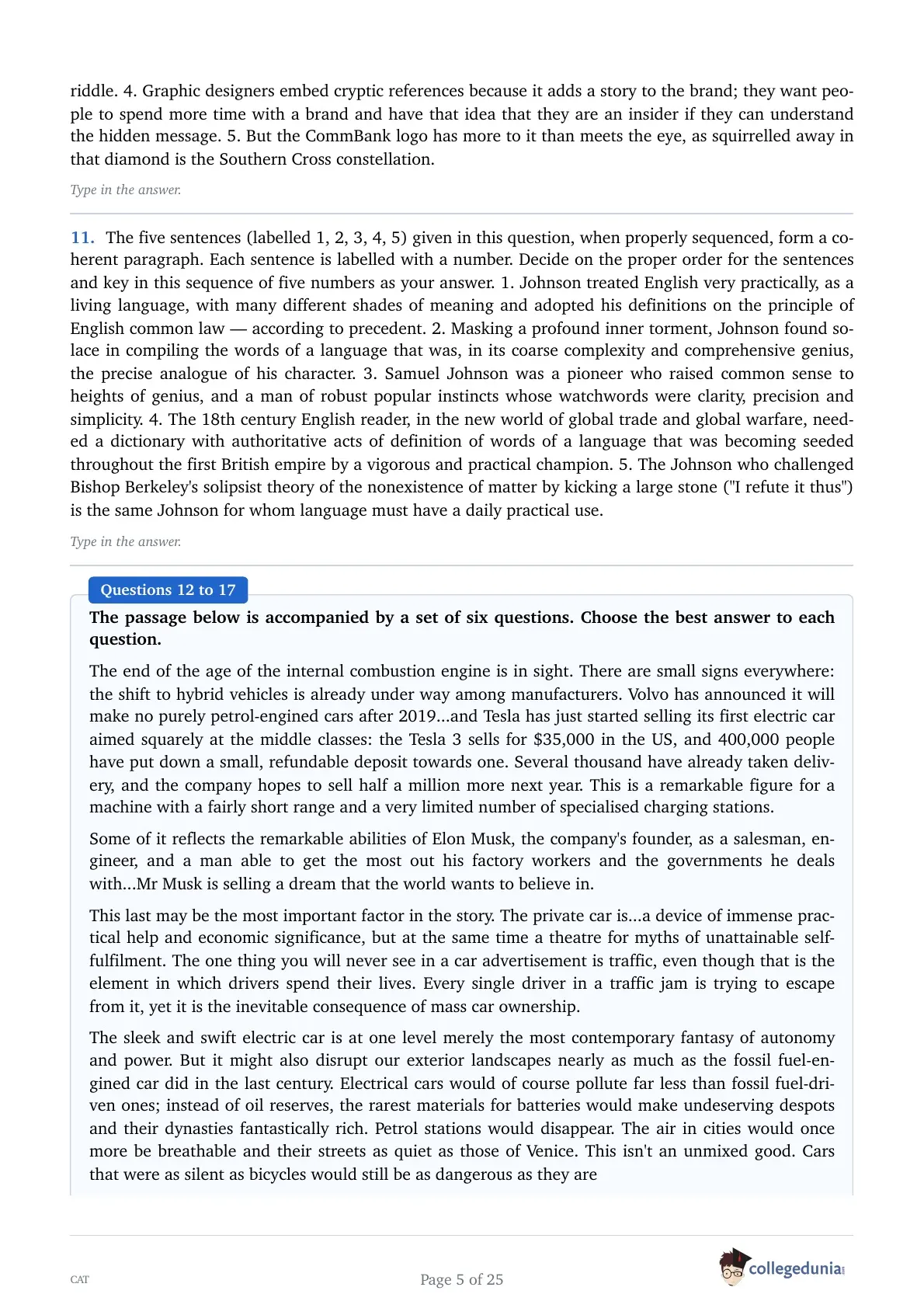
4. Graphic designers embed cryptic references because it adds a story to the brand; they want people to spend more time with a brand and have that idea that they are an insider if they can understand the hidden message.
5. But the Comm Bank logo has more to it than meets the eye, as squirrelled away in that diamond is the Southern Cross constellation.
The five sentences (labelled 1,2,3,4, and 5) given in this question, when properly sequenced, form a coherent paragraph. Decide on the proper order for the sentence and key in this sequence of five numbers as your answer.
1. Johnson treated English very practically, as a living language, with many different shades of meaning and adopted his definitions on the principle of English common law - according to precedent.
2. Masking a profound inner torment, Johnson found solace in compiling the words of a language that was, in its coarse complexity and comprehensive genius, the precise analogue of his character.
3. Samuel Johnson was a pioneer who raised common sense to heights of genius, and a man of robust popular instincts whose watchwords were clarity, precision and simplicity.
4. The 18th century English reader, in the new world of global trade and global warfare, needed a dictionary with authoritative acts of definition of words of a language that was becoming seeded throughout the first British empire by a vigorous and practical champion.
5. The Johnson who challenged Bishop Berkeley's solipsist theory of the nonexistence of matter by kicking a large stone ("I refute it thus") is the same Johnson for whom language must have a daily practical use.
Comprehension:
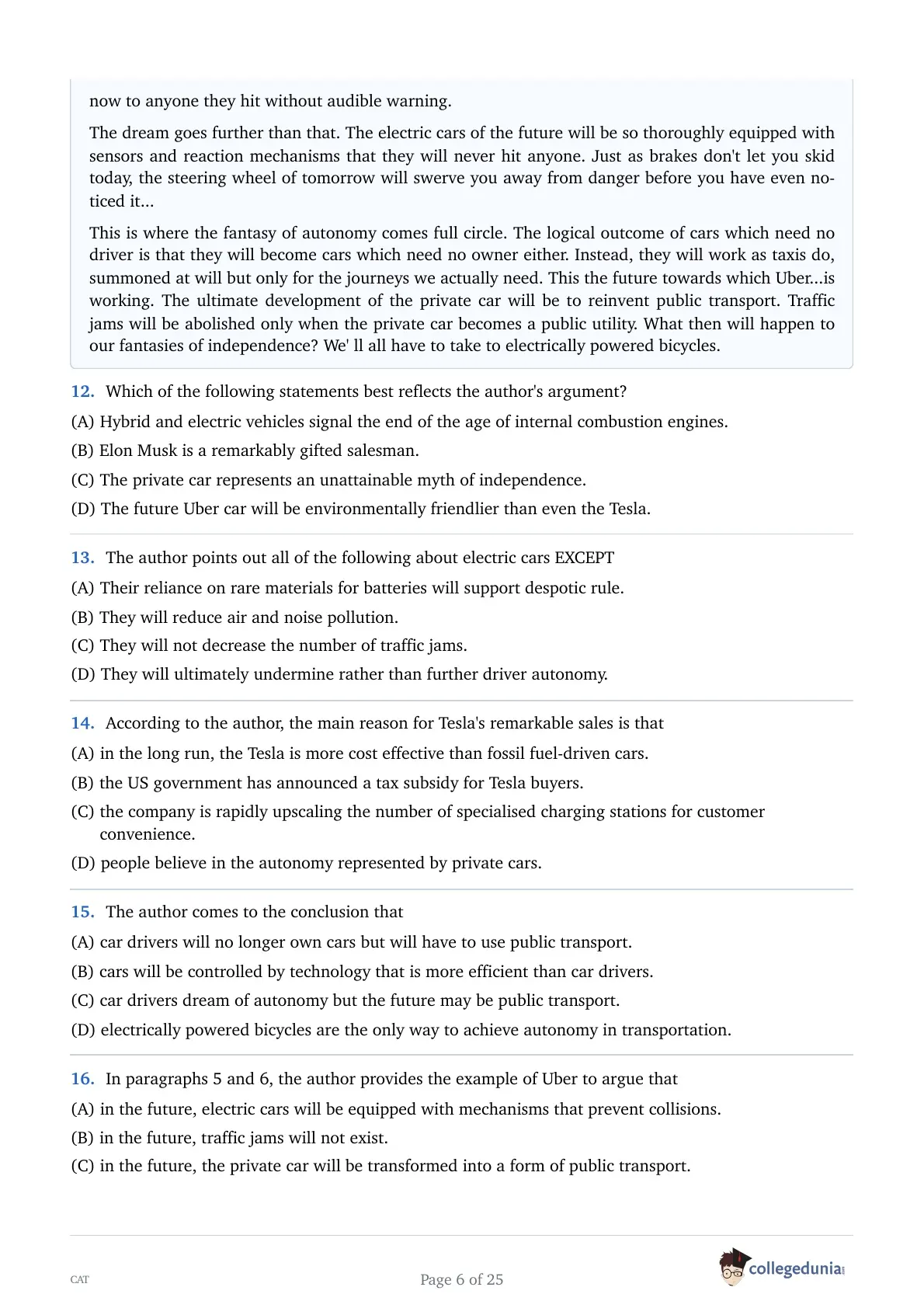
The end of the age of the internal combustion engine is in sight. There are small signs everywhere: the shift to hybrid vehicles is already under way among manufacturers. Volvo has announced it will make no purely petrol-engined cars after 2019...and Tesla has just started selling its first electric car aimed squarely at the middle classes: the Tesla 3 sells for $35,000 in the US, and 400,000 people have put down a small, refundable deposit towards one. Several thousand have already taken delivery, and the company hopes to sell half a million more next year. This is a remarkable figure for a machine with a fairly short range and a very limited number of specialised charging stations.
Some of it reflects the remarkable abilities of Elon Musk, the company's founder, as a salesman, engineer, and a man able to get the most out his factory workers and the governments he deals with...Mr Musk is selling a dream that the world wants to believe in.
Read More
This last may be the most important factor in the story. The private car is...a device of immense practical help and economic significance, but at the same time a theatre for myths of unattainable self-fulfilment. The one thing you will never see in a car advertisement is traffic, even though that is the element in which drivers spend their lives. Every single driver in a traffic jam is trying to escape from it, yet it is the inevitable consequence of mass car ownership.The sleek and swift electric car is at one level merely the most contemporary fantasy of autonomy and power. But it might also disrupt our exterior landscapes nearly as much as the fossil fuel-engined car did in the last century. Electrical cars would of course pollute far less than fossil fuel-driven ones; instead of oil reserves, the rarest materials for batteries would make undeserving despots and their dynasties fantastically rich. Petrol stations would disappear. The air in cities would once more be breathable and their streets as quiet as those of Venice. This isn't an unmixed good. Cars that were as silent as bicycles would still be as dangerous as they are now to anyone they hit without audible warning.
The dream goes further than that. The electric cars of the future will be so thoroughly equipped with sensors and reaction mechanisms that they will never hit anyone. Just as brakes don't let you skid today, the steering wheel of tomorrow will swerve you away from danger before you have even noticed it...
This is where the fantasy of autonomy comes full circle. The logical outcome of cars which need no driver is that they will become cars which need no owner either. Instead, they will work as taxis do, summoned at will but only for the journeys we actually need. This the future towards which Uber...is working. The ultimate development of the private car will be to reinvent public transport. Traffic jams will be abolished only when the private car becomes a public utility. What then will happen to our fantasies of independence? We'll all have to take to electrically powered bicycles.
Which of the following statements best reflects the author's argument?
The author points out all of the following about electric cars EXCEPT
According to the author, the main reason for Tesla's remarkable sales is that
The author comes to the conclusion that
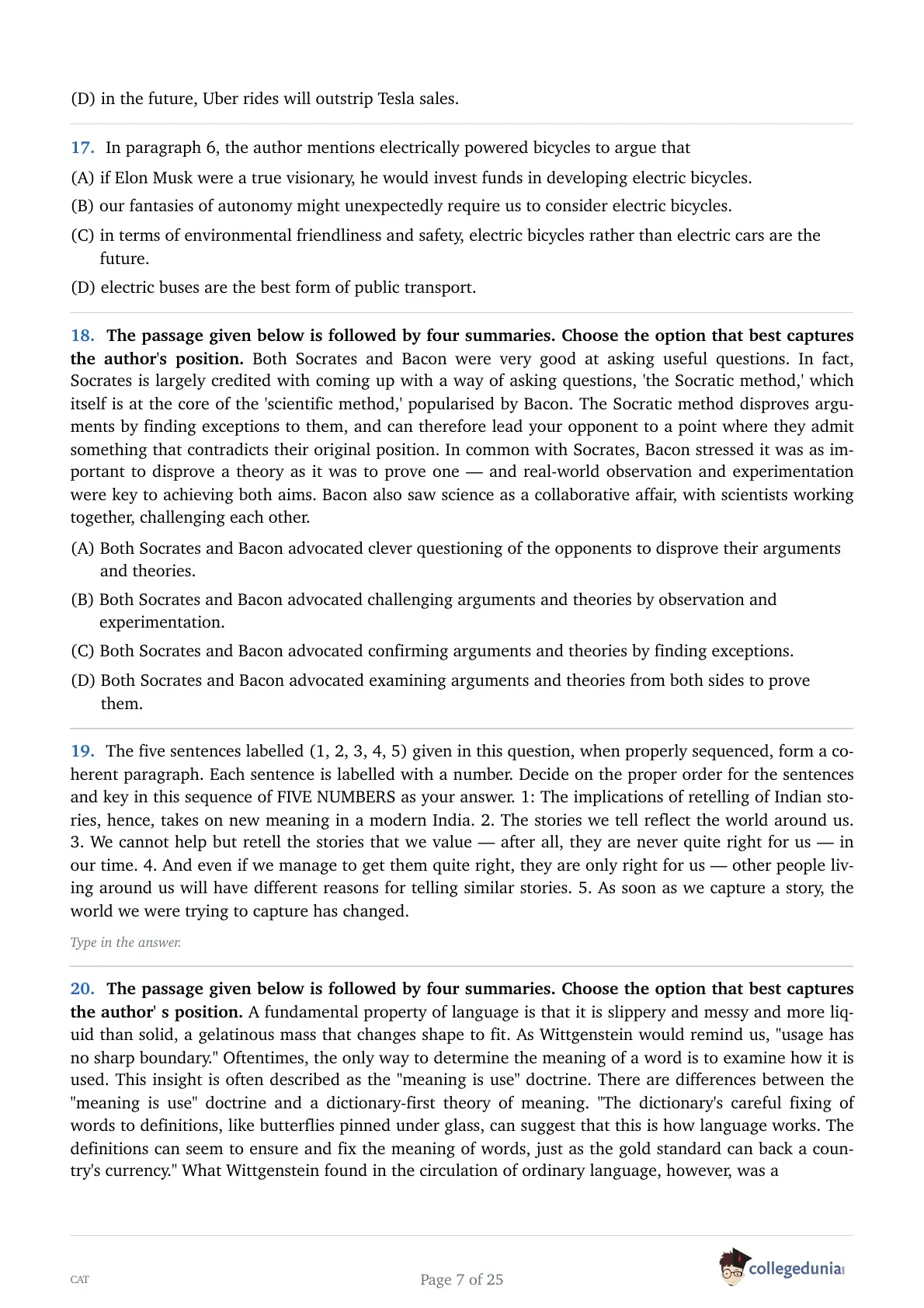
In paragraphs 5 and 6, the author provides the example of Uber to argue that
In paragraph 6, the author mentions electrically powered bicycles to argue that
Identify the most appropriate summary for the paragraph.
Both Socrates and Bacon were very good at asking useful questions. In fact, Socrates is largely credited with corning up with a way of asking questions, 'the Socratic method/ which itself is at the core of the 'scientific method, 'popularised by Bacon. The Socratic method disproves arguments by finding exceptions to them, and can therefore lead your opponent to a point where they admit something that contradicts their original position. In common with Socrates, Bacon stressed it was as important to disprove a theory as it was to prove one - and real-world observation and experimentation were key to achieving both aims. Bacon also saw science as a collaborative affair, with scientists working together, challenging each other.
The five sentences (labelled 1,2,3,4, and 5) given in this question, when properly sequenced, form a coherent paragraph. Decide on the proper order for the sentence and key in this sequence of five numbers as your answer.
1. The implications of retelling of Indian stories, hence, takes on new meaning in a modern India.
2. The stories we tell reflect the world around us.
3. We cannot help but retell the stories that we value - after all, they are never quite right for us - in our time. 4. And even if we manage to get them quite right, they are only right for us - other people living around us will have different reasons for telling similar stories.
5. As soon as we capture a story, the world we were trying to capture has changed.
Identify the most appropriate summary for the paragraph.
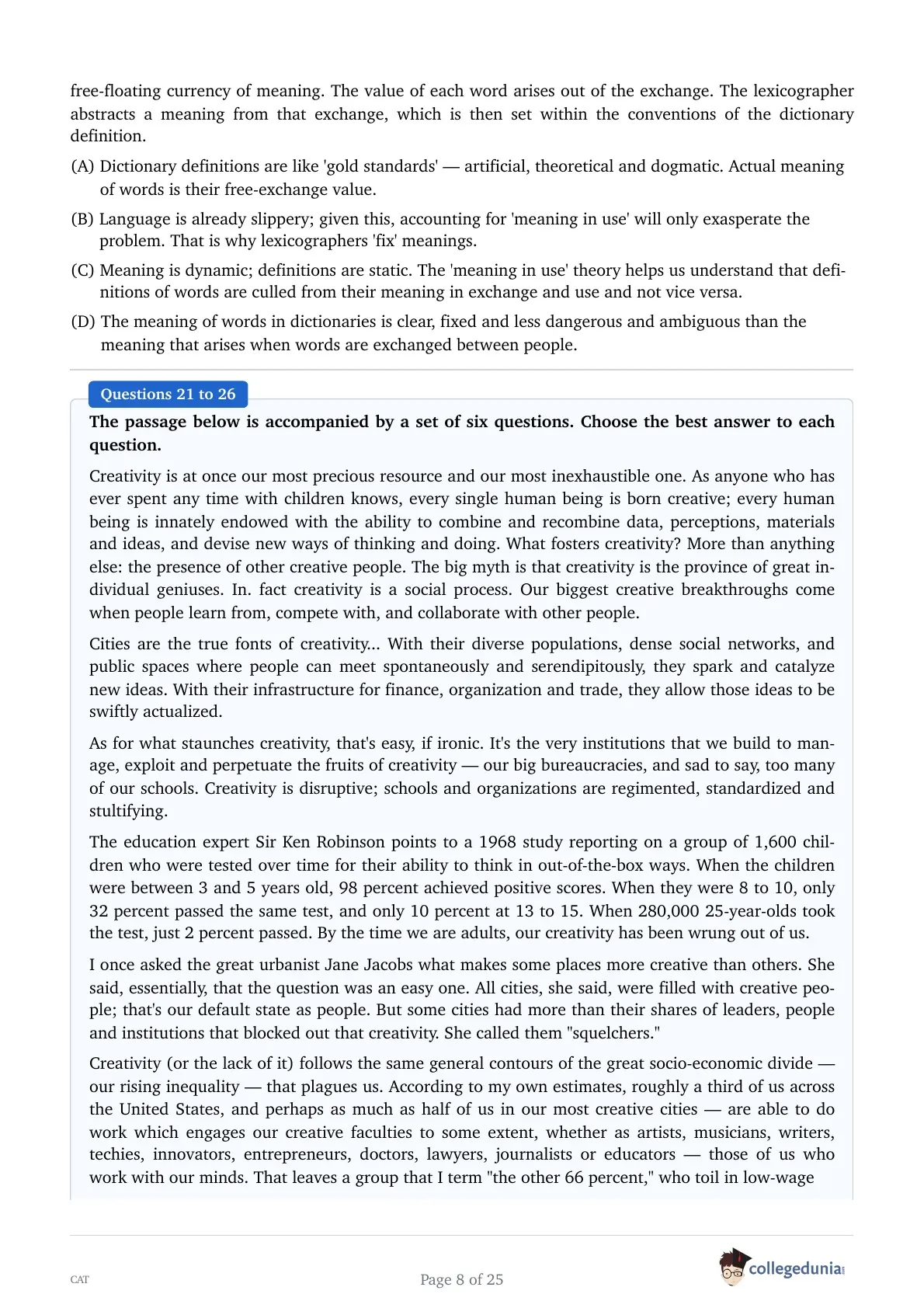
A fundamental property of language is that it is slippery and messy and more liquid than solid, a gelatinous mass that changes shape to fit. As Wittgenstein would remind us, "usage has no sharp boundary." Oftentimes, the only way to determine the meaning of a word is to examine how it is used. This insight is often described as the "meaning is use" doctrine. There are differences between the "meaning is use" doctrine and a dictionary-first theory of meaning. "The dictionary's careful fixing of words to definitions, like butterflies pinned under glass, can suggest that this is how language works. The definitions can seem to ensure and fix the meaning of words, just as the gold standard can back a country's currency." What Wittgenstein found in the circulation of ordinary language, however, was a free-floating currency of meaning. The value of each word arises out of the exchange. The lexicographer abstracts a meaning from that exchange, which is then set within the conventions of the dictionary definition.
Comprehension:
Creativity is at once our most precious resource and our most inexhaustible one. As anyone who has ever spent any time with children knows, every single human being is born creative; every human being is innately endowed with the ability to combine and recombine data, perceptions, materials and ideas, and devise new ways of thinking and doing. What fosters creativity? More than anything else: the presence of other creative people. The big myth is that creativity is the province of great individual geniuses. In fact creativity is a social process. Our biggest creative breakthroughs come when people learn from, compete with, and collaborate with other people.
Cities are the true fonts of creativity... With their diverse populations, dense social networks, and public spaces where people can meet spontaneously and serendipitously, they spark and catalyze new ideas. With their infrastructure for finance, organization and trade, they allow those ideas to be swiftly actualized.
Read More
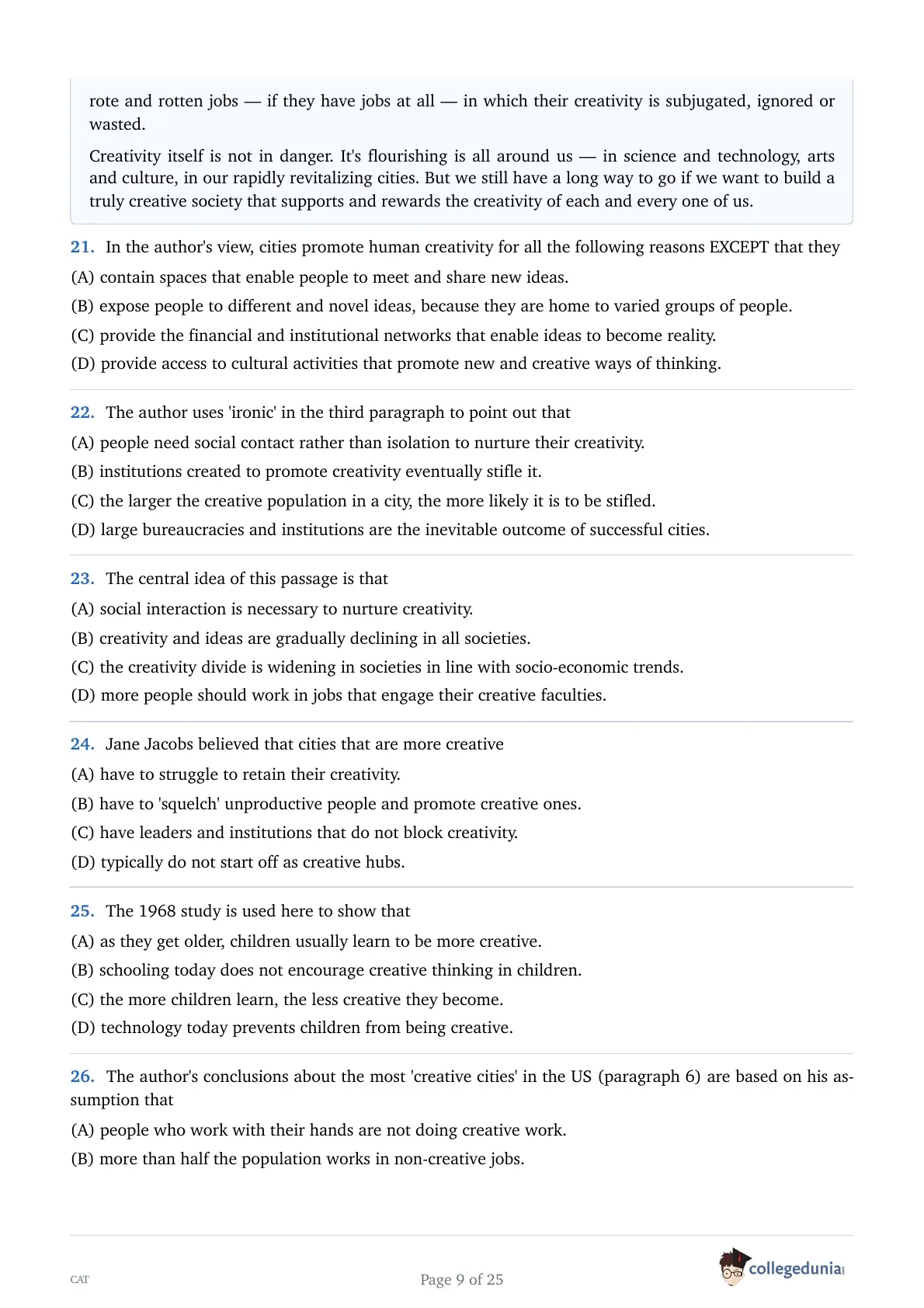
As for what staunches creativity, that's easy, if ironic. It's the very institutions that we build to manage, exploit and perpetuate the fruits of creativity — our big bureaucracies, and sad to say, too many of our schools. Creativity is disruptive; schools and organizations are regimented, standardized and stultifying.The education expert Sir Ken Robinson points to a 1968 study reporting on a group of 1,600 children who were tested over time for their ability to think in out-of-the-box ways. When the children were between 3 and 5 years old, 98 percent achieved positive scores. When they were 8 to 10, only 32 percent passed the same test, and only 10 percent at 13 to 15. When 280,000 25-year-olds took the test, just 2 percent passed. By the time we are adults, our creativity has been wrung out of us.
I once asked the great urbanist Jane Jacobs what makes some places more creative than others. She said, essentially, that the question was an easy one. All cities, she said, were filled with creative people; that's our default state as people. But some cities had more than their shares of leaders, people and institutions that blocked out that creativity. She called them "squelchers."
Creativity (or the lack of it) follows the same general contours of the great socio-economic divide - our rising inequality - that plagues us. According to my own estimates, roughly a third of us across the United States, and perhaps as much as half of us in our most creative cities - are able to do work which engages our creative faculties to some extent, whether as artists, musicians, writers, techies, innovators, entrepreneurs, doctors, lawyers, journalists or educators - those of us who work with our minds. That leaves a group that I term "the other 66 percent," who toil in low-wage rote and rotten jobs — if they have jobs at all — in which their creativity is subjugated, ignored or wasted. Creativity (or the lack of it) follows the same general contours of the great socio-economic divide - our rising inequality - that plagues us. According to my own estimates, roughly a third of us across the United States, and perhaps as much as half of us in our most creative cities - are able to do work which engages our creative faculties to some extent, whether as artists, musicians, writers, techies, innovators, entrepreneurs, doctors, lawyers, journalists or educators - those of us who work with our minds. That leaves a group that I term "the other 66 percent," who toil in low-wage rote and rotten jobs — if they have jobs at all — in which their creativity is subjugated, ignored or wasted.
Creativity itself is not in danger. It's flourishing is all around us - in science and technology, arts and culture, in our rapidly revitalizing cities. But we still have a long way to go if we want to build a truly creative society that supports and rewards the creativity of each and every one of us.
In the author's view, cities promote human creativity for all the following reasons EXCEPT that the
The author uses 'ironic' in the third paragraph to point out that
The central idea of this passage is that
Jane Jacobs believed that cities that are more creative
The 1968 study is used here to show that
The author's conclusions about the most 'creative cities' in the US (paragraph 6) are based on his assumption that
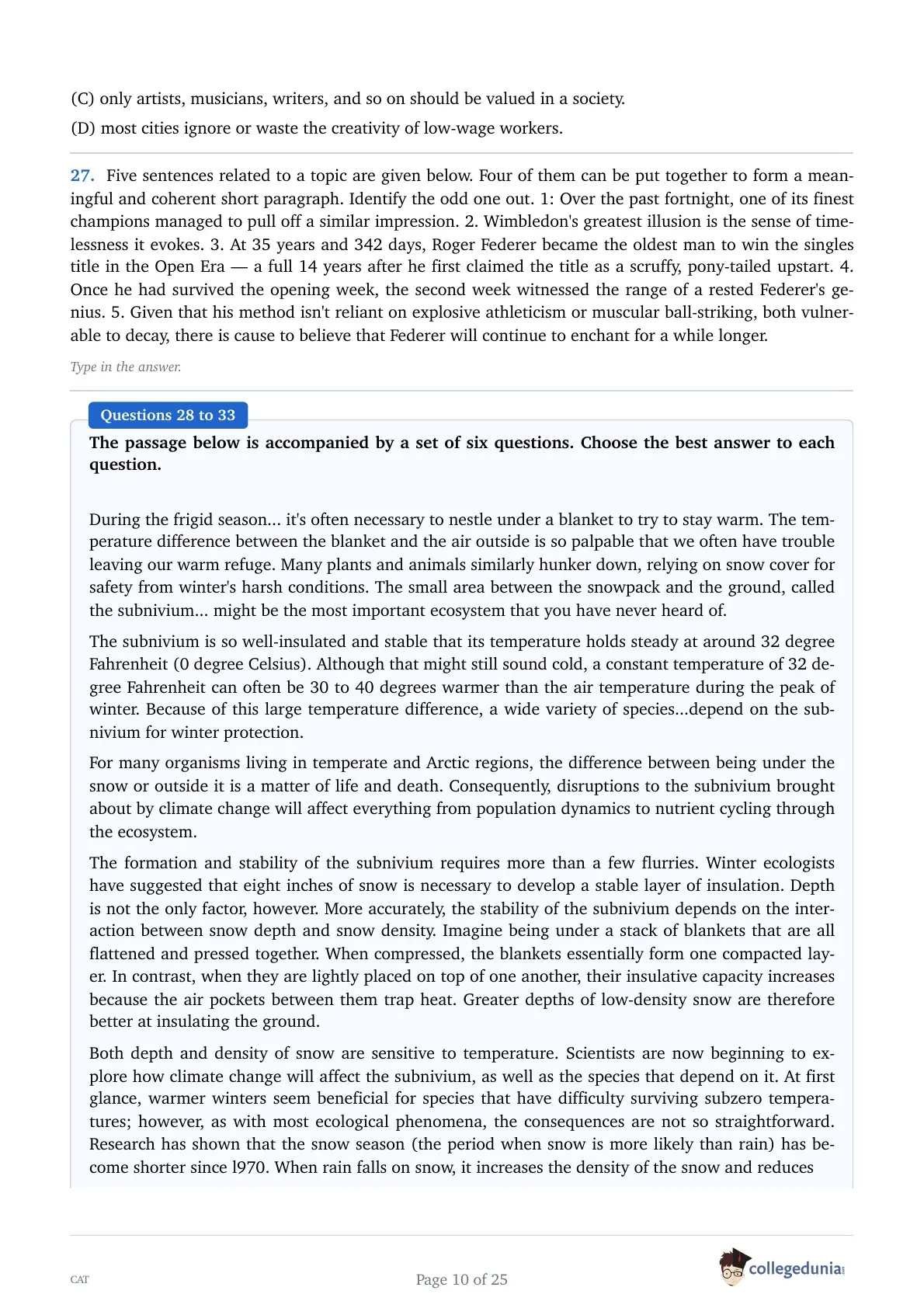
Five sentences related to a topic are given below. Four of them can be put together to form a meaningful and coherent short paragraph. Identify the odd one out. Choose its number as your answer and key it in.
1. Over the past fortnight,one of its finest champions managed to pull off a similar impression.
2. Wimbledon's greatest illusion is the sense of timelessness it evokes.
3. At 35 years and 342 days, Roger Federer became the oldest man to win the singles title in the Open Era - a full 14 years after he first claimed the title as a scruffy, pony-tailed upstart.
4. Once he had survived the opening week, the second week witnessed the range of a rested Federer's genius.
5. Given that his method isn't reliant on explosive athleticism or muscular ball-striking, both vulnerable to decay, there is cause to believe that Federer will continue to enchant for a while longer.
Comprehension:
During the frigid season...it's often necessary to nestle under a blanket to try to stay warm.The temperature difference between the blanket and the air outside is so palpable that we often have trouble leaving our warm refuge.Many plants and animals similarly hunker down,relying on snow cover for safety from winter's harsh conditions.The small area between the snowpack and the ground,called the subnivium...might be the most important ecosystem that you have never heard of.
The subnivium is so well-insulated and stable that its temperature holds steady at around 32 degree Fahrenheit (0 degree Celsius). Although that might still sound cold, a constant temperature of 32 degree Fahrenheit can often be 30 to 40 degrees warmer than the air temperature during the peak of winter. Because of this large temperature difference, a wide variety of species...depend on the subnivium for winter protection.
Read More
For many organisms living in temperate and Arctic regions, the difference between being under the snow or outside it is a matter of life and death. Consequently, disruptions to the subnivium brought about by climate change will affect everything from population dynamics to nutrient cycling through the ecosystem.The formation and stability of the subnivium requires more than a few flurries. Winter ecologists have suggested that eight inches of snow is necessary to develop a stable layer of insulation. Depth is not the only factor, however. More accurately, the stability of the subnivium depends on the interaction between snow depth and snow density. Imagine being under a stack of blankets that are all flattened and pressed together. When compressed, the blankets essentially form one compacted layer. In contrast, when they are lightly placed on top of one another, their insulative capacity increases because the air pockets between them trap heat. Greater depths of low-density snow are therefore better at insulating the ground.
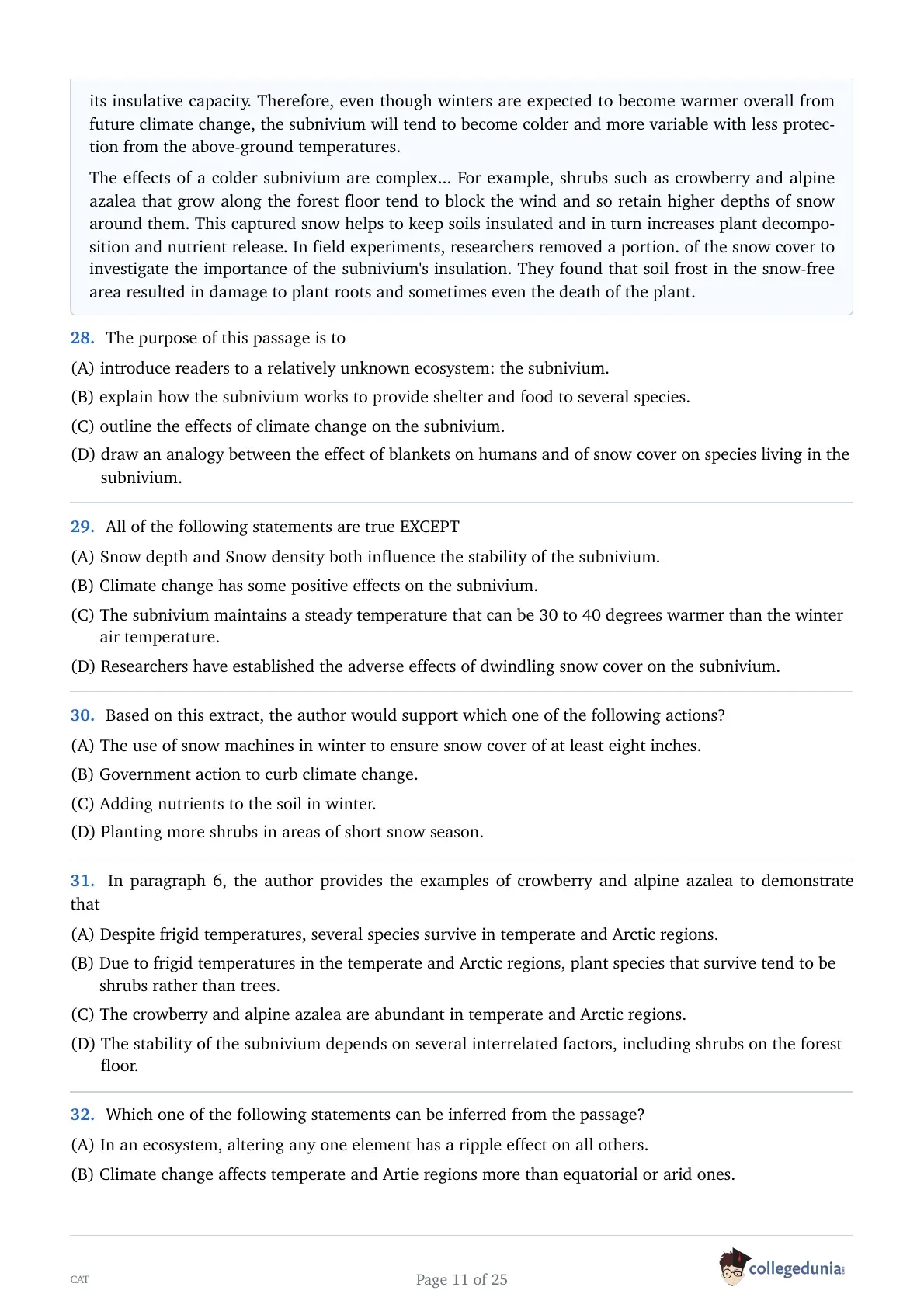
Both depth and density of snow are sensitive to temperature. Scientists are now beginning to explore how climate change will affect the subnivium, as well as the species that depend on it. At first glance, warmer winters seem beneficial for species that have difficulty surviving subzero temperatures; however, as with most ecological phenomena, the consequences are not so straightforward. Research has shown that the snow season (the period when snow is more likely than rain) has become shorter since 1970. When rain falls on snow, it increases the density of the snow and reduces its insulative capacity. Therefore, even though winters are expected to become warmer overall from future climate change, the subnivium will tend to become colder and more variable with less protection from the above-ground temperatures.
The effects of a colder subnivium are complex...For example, shrubs such as crowberry and alpine a2alea that grow along the forest floor tend to block the wind and so retain higher depths of snow around them. This captured snow helps to keep soils insulated and in turn increases plant decomposition and nutrient release. In field experiments, researchers removed a portion of the snow cover to investigate the importance of the subnivium's insulation. They found that soil frost in the snow-free area resulted in damage to plant roots and sometimes even the death of the plant.
The purpose of this passage is to
A) introduce readers to a relatively unknown ecosystem: the subnivium
B) explain how the subnivium works to provide shelter and food to several species.
C) outline the effects of climate change on the subnivium.
D) draw an analogy between the effect of blankets on humans and of snow cover on species living in the subnivium.
The purpose of this passage is to
All of the following statements are true EXCEPT
Based on this extract, the author would support which one of the following actions?
In paragraph 6, the author provides the examples of crowberry and alpine azalea to demonstrate that
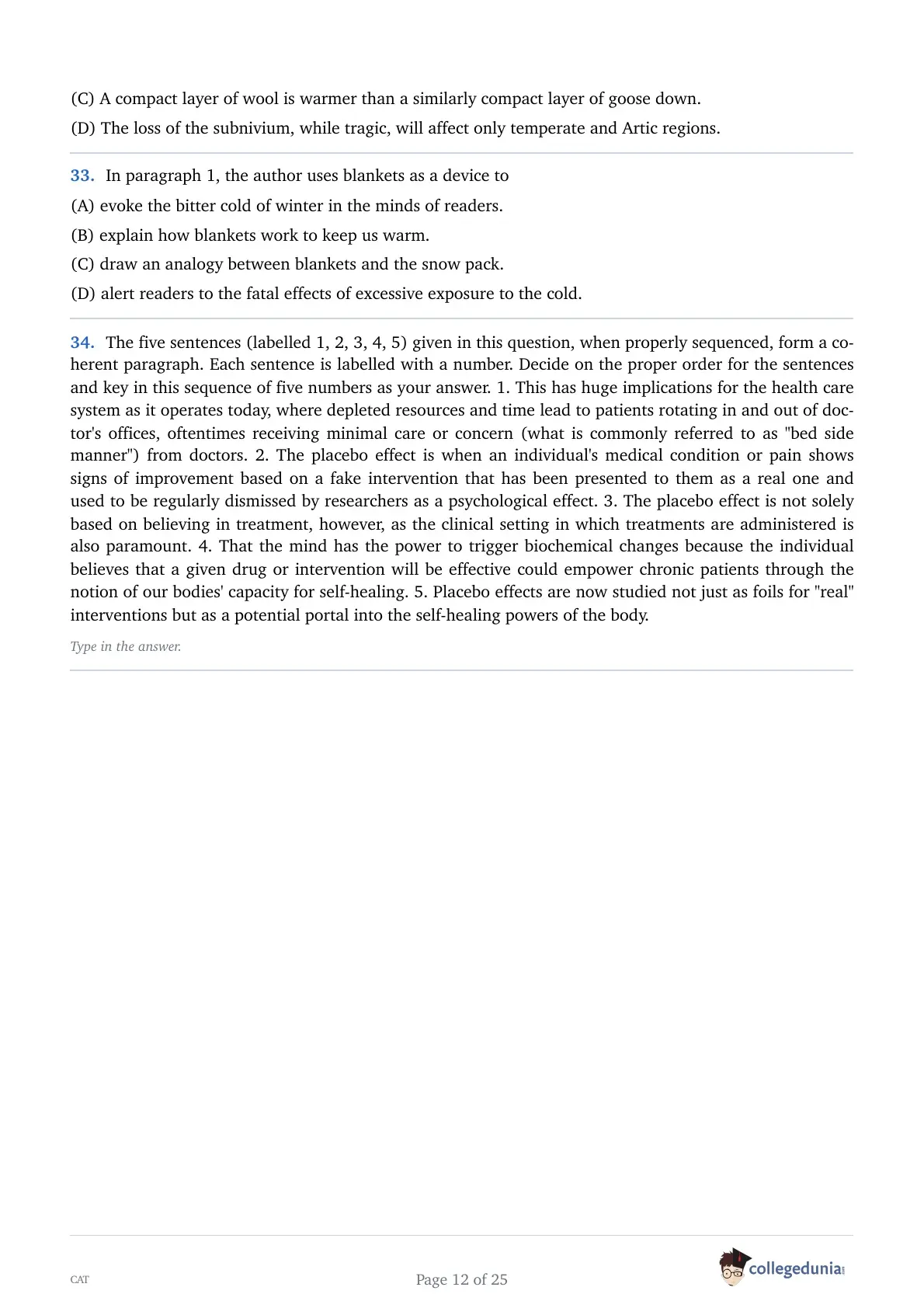
Which one of the following statements can be inferred from the passage?
In paragraph 1, the author uses blankets as a device to
The six sentences (labelled 1,2,3,4,5 and 6) given in this question, when properly sequenced, form a coherent paragraph. Decide on the proper order for the sentence and key in this sequence of six numbers as your answer.
1.This has huge implications for the health care system as it operates today, where depleted resources and time lead to patients rotating in and out of doctor's offices, oftentimes receiving minimal care or concern (what is commonly referred to as "bed side manner") from doctors.
2. The placebo effect is when an individual's medical condition or pain shows signs of improvement based on a fake intervention that has been presented to them as a real one and used to be regularly dismissed by researchers as a psychological effect.
3. The placebo effect is not solely based on believing in treatment, however, as the clinical setting in which treatments are administered is also paramount.
4. That the mind has the power to trigger biochemical changes because the individual believes that a given drug or intervention will be effective could empower chronic patients through the notion of our bodies' capacity for self-healing.
5. Placebo effects are now studied not just as foils for "real" interventions but as a potential portal into the self-healing powers of the body.
Data Interpretation and Logical Reasoning (DILR) (Q35 - Q66)
Comprehension:
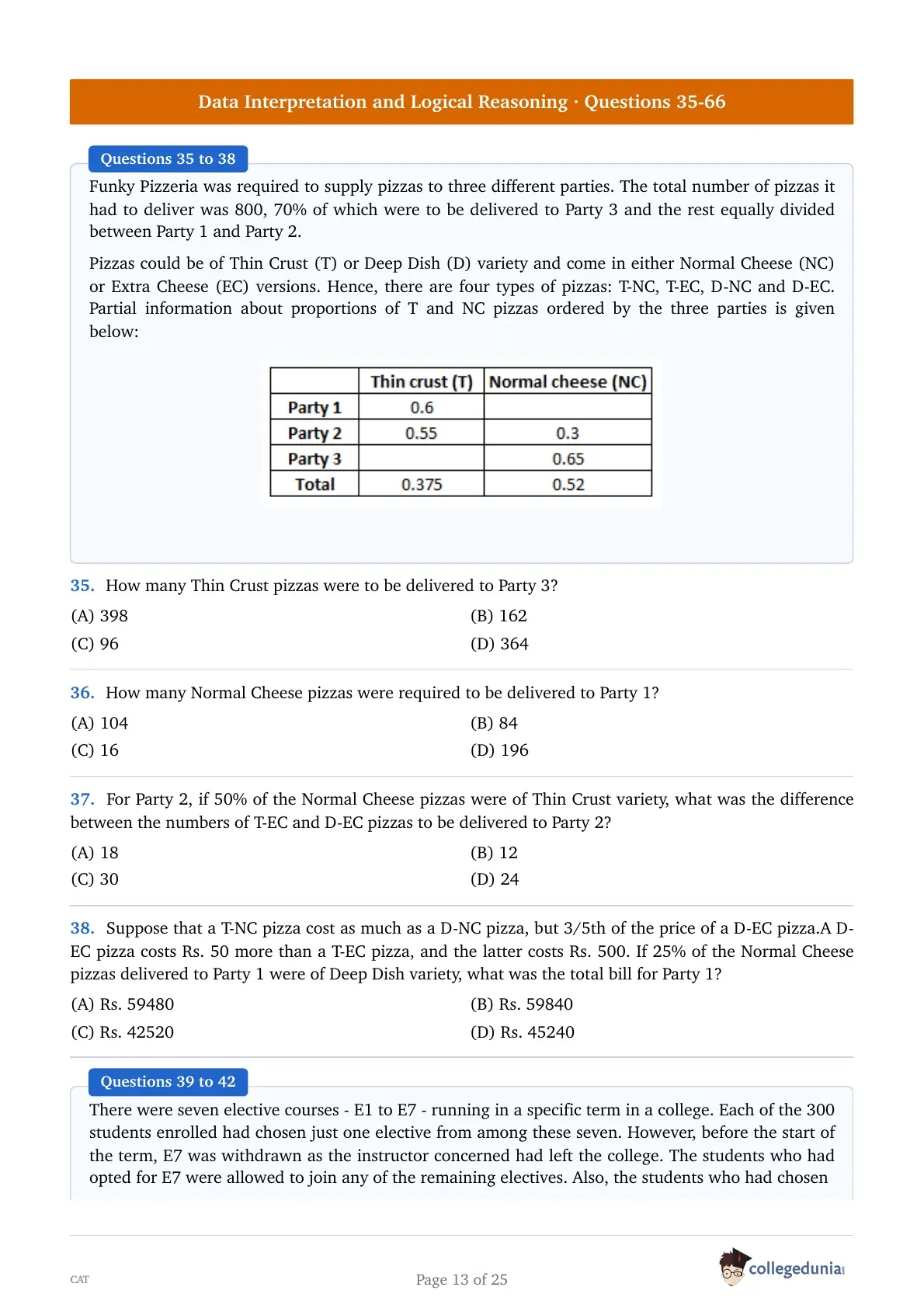
Funky Pizzaria was required to supply pizzas to three different parties. The total number of pizzas it had to deliver was 800, 70% of which were to be delivered to Party 3 and the rest equally divided between Party 1 and Party 2.
Pizzas could be of Thin Crust (T) or Deep Dish (D) variety and come in either Normal Cheese (NC) or Extra Cheese (EC) versions. Hence, there are four types of pizzas: T-NC, T-EC, D-NC and D-EC. Partial information about proportions of T and NC pizzas ordered by the three parties is given below:
How many Thin Crust pizzas were to be delivered to Party 3?
How many Normal Cheese pizzas were required to be delivered to Party 1?
For Party 2, if 50% of the Normal Cheese pizzas were of Thin Crust variety, what was the difference between the numbers of T-EC and D-EC pizzas to be delivered to Party 2
Suppose that a T-NC pizza cost as much as a D-NC pizza, but 3/5th of the price of a D-EC pizza. A D-EC pizza costs Rs. 50 more than a T-EC pizza, and the latter costs Rs. 500. If 25% of the Normal Cheese pizzas delivered to Party 1 were of Deep Dish variety, what was the total bill for Party 1?
Comprehension:
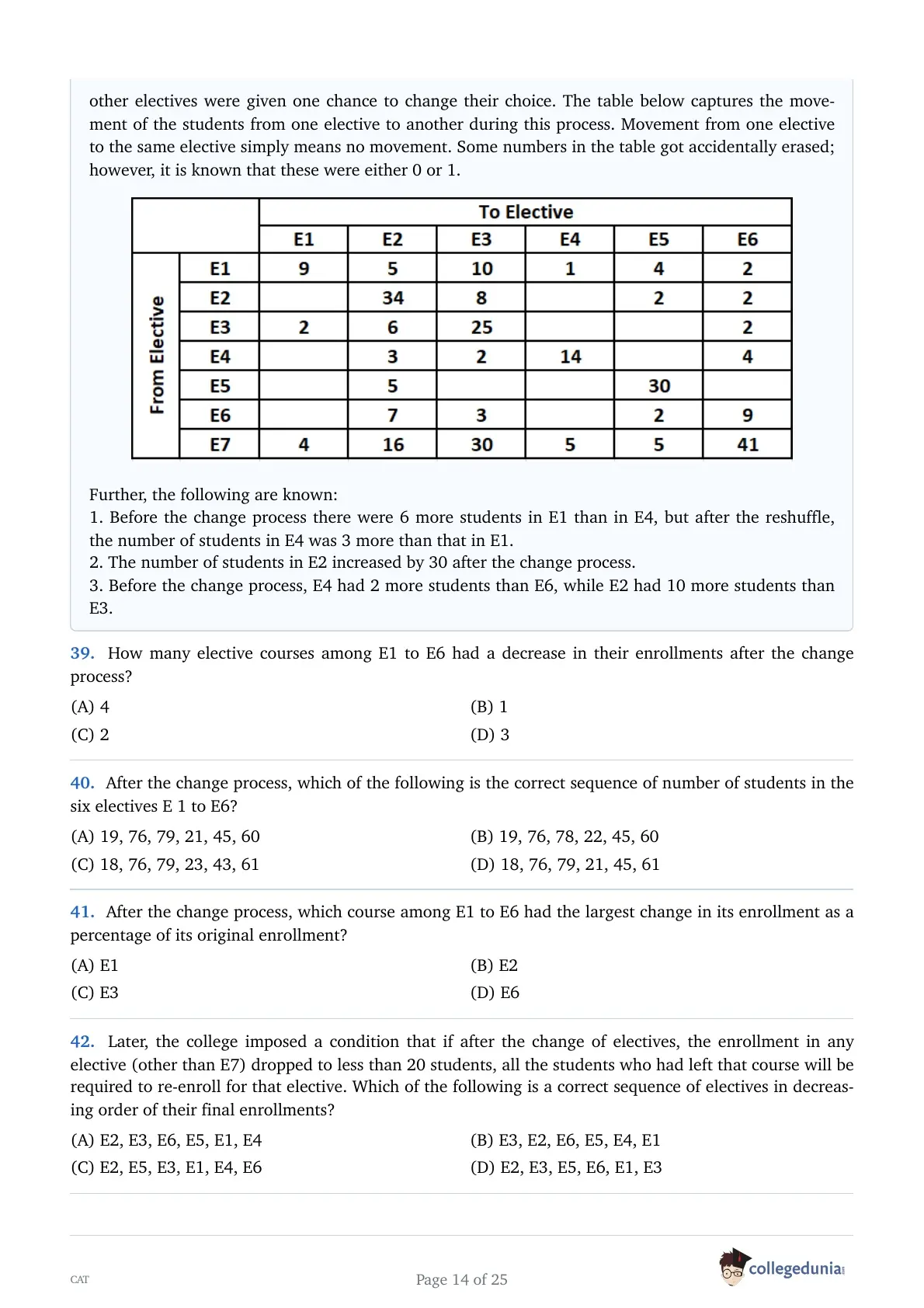
There were seven elective courses - El to E7 - running in a specific term in a college. Each of the 300 students enrolled had chosen just one elective from among these seven. However, before the start of the term, E7 was withdrawn as the instructor concerned had left the college. The students who had opted for E7 were allowed to join any of the remaining electives. Also, the students who had chosen other electives were given one chance to change their choice. The table below captures the movement of the students from one elective to another during this process. Movement from one elective to the same elective simply means no movement. Some numbers in the table got accidentally erased; however, it is known that these were either 0 or 1.
Further, the following are known:
1. Before the change process there were 6 more students in E1 than in E4, but after the reshuffle, the number of students in E4 was 3 more than that in E1.
2. The number of students in E2 increased by 30 after the change process.
3. Before the change process, E4 had 2 more students than E6, while E2 had 10 more students than E3.
How many elective courses among E1 to E6 had a decrease in their enrollments after the change process?
After the change process, which of the following is the correct sequence of number of students in the six electives El to E6?
After the change process, which course among El to E6 had the largest change in its enrollment as a percentage of its original enrollment?
college imposed a condition that if after the change of electives, the enrollment in any elective (other than E7) dropped to less than 20 students, all the students who had left that course will be required to re-enroll for that elective.
Which of the following is a correct sequence of electives in decreasing order of their final enrollments?
Comprehension:
An old woman had the following assets:
(a) Rs. 70 lakh in bank deposits
(b) 1 house worth Rs. 50 lakh
(c) 3 flats, each worth Rs. 30 lakh
(d) Certain number of gold coins, each worth Rs. 1 lakh
She wanted to distribute her assets among her three children; Neeta, Seeta and Geeta. The house, any of the flats or any of the coins were not to be split. That is, the house went entirely to one child; a flat went to one child and similarly, a gold coin went to one child.
Among the three, Neeta received the least amount in bank deposits, while Geeta received the highest. The value of the assets was distributed equally among the children, as were the gold coins.
How much did Seeta receive in bank deposits (in lakhs of rupees)?
How many flats did Neeta receive?
How many gold coins did the old woman have?
How much did Geeta get in bank deposits (in lakhs of rupees)?
Comprehension:
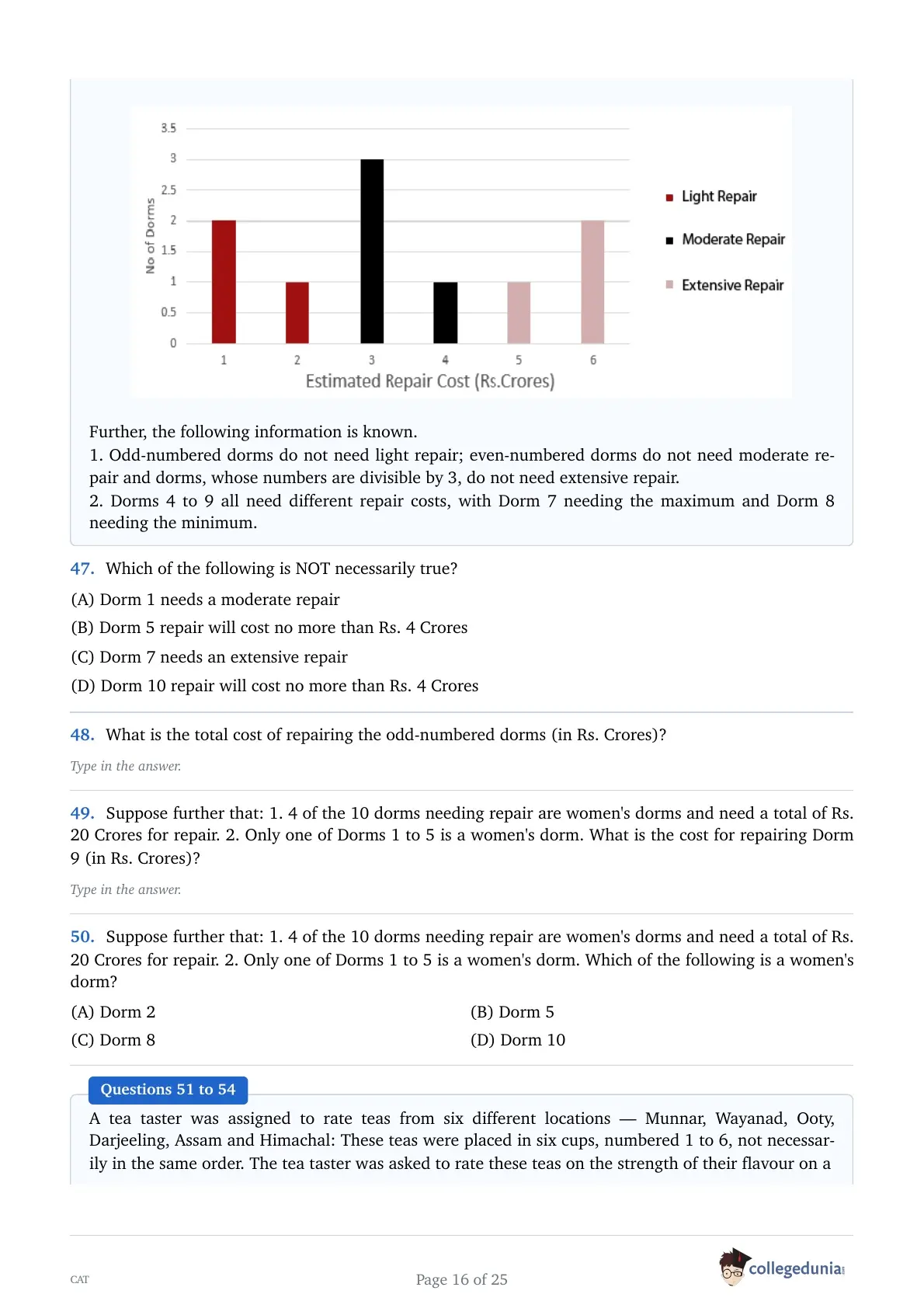
At a management school, the oldest 10 dorms, numbered 1 to 10, need to be repaired urgently, The following diagram represents the estimated repair costs (in Rs. Crores) for the 10 dorms. For any dorm, the estimated repair cost (in Rs. Crores) is an integer. Repairs with estimated cost Rs. 1 or 2 Crores are considered light repairs, repairs with estimated cost Rs. 3 or 4 are considered moderate repairs and repairs with estimated cost Rs. 5 or 6 Crores are considered extensive repairs.
Further, the following are known: 1. Odd-numbered dorms do not need light repair; even-numbered dorms do not need moderate repair and dorms, whose numbers are divisible by 3, do not need extensive repair. 2. Dorms 4 to 9 all need different repair costs, with Dorm 7 needing the maximum and Dorm 8 needing the minimum.
Which of the following is NOT necessarily true?
What is the total cost of repairing the odd-numbered dorms (in Rs. Crores)?
Suppose further that: 1. 4 of the 10 dorms needing repair are women's dorms and need a total of Rs. 20 Crores for repair. 2. Only one of Dorms 1 to 5 is a women's dorm
What is the cost for repairing Dorm 9 (in Rs. Crores)?
Suppose further that: 1. 4 of the 10 dorms needing repair are women's dorms and need a total of Rs. 20 Crores for repair. 2. Only one of Dorms 1 to 5 is a women's dorm
Which of the following is a women's dorm?
Comprehension:
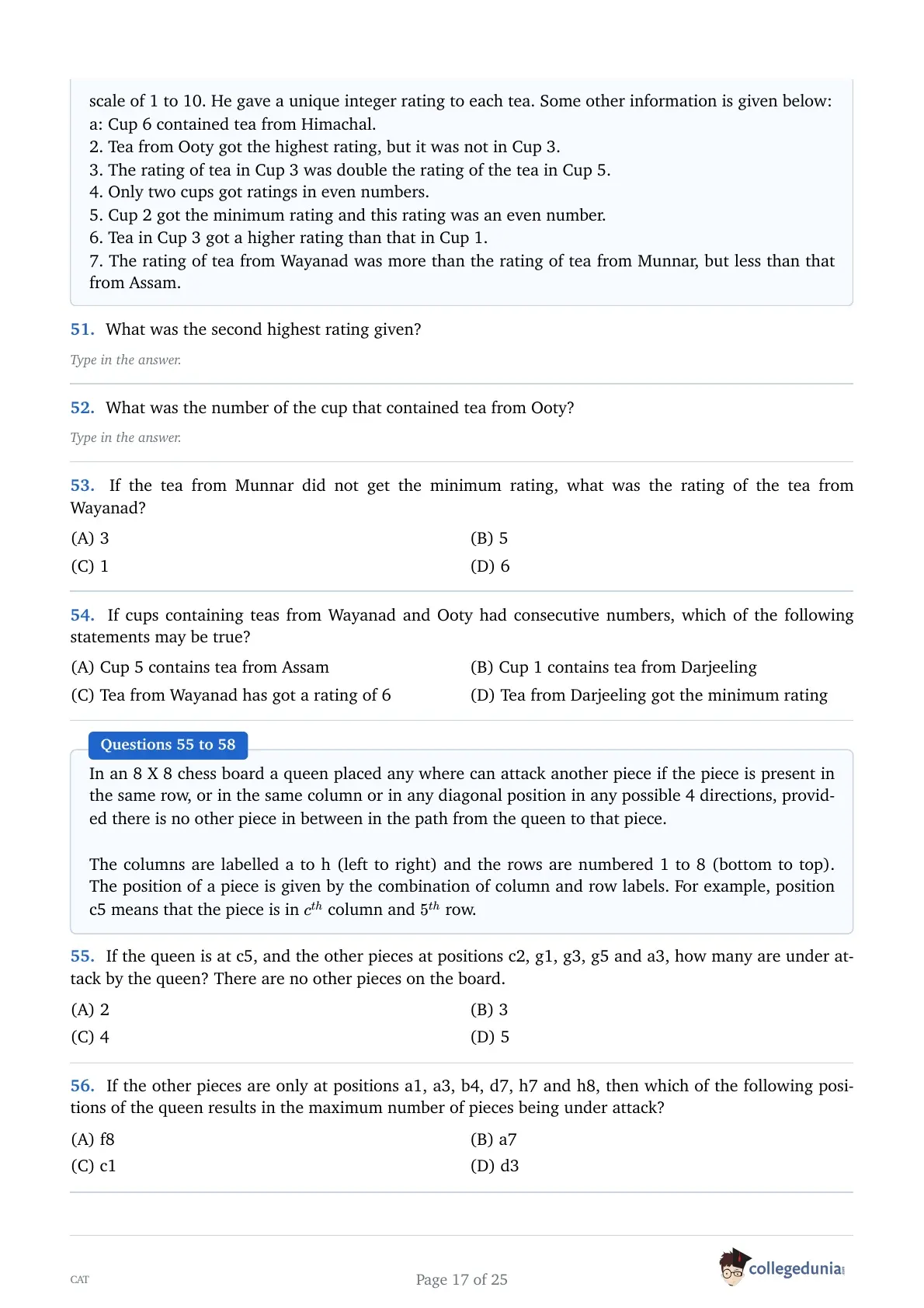
A tea taster was assigned to rate teas from six different locations - Munnar, Wayanad, Ooty, Darjeeling, Assam and Himachal. These teas were placed in six cups, numbered 1 to 6, not necessarily in the same order. The tea taster was asked to rate these teas on the strength of their flavour on a scale of 1 to 10. He gave a unique integer rating to each tea. Some other information is given below:
1. Cup 6 contained tea from Himachal.
2. Tea from Ooty got the highest rating, but it was not in Cup 3.
3. The rating of tea in Cup 3 was double the rating of the tea in Cup 5.
4. Only two cups got ratings in even numbers.
5. Cup 2 got the minimum rating and this rating was an even number.
6. Tea in Cup 3 got a higher rating than that in Cup 1.
7. The rating of tea from Wayanad was more than the rating of tea from Munnar, but less than that from Assam.
What was the second highest rating given?
What was the number of the cup that contained tea from Ooty?
If the tea from Munnar did not get the minimum rating, what was the rating of the tea from Wayanad?
If cups containing teas from Wayanad and Ooty had consecutive numbers, which of the following statements may be true?
Comprehension:
In an 8 X 8 chessboard a queen placed anywhere can attack another piece if the piece is present in the same row, or in the same column or in any diagonal position in any possible 4 directions, provided there is no other piece in between in the path from the queen to that piece.
The columns are labelled a to h (left to right) and the rows are numbered 1 to 8 (bottom to top). The position of a piece is given by the combination of column and row labels. For example, position c5 means that the piece is in cth column and 5th row.
If the queen is at c5, and the other pieces at positions c2, gl, g3, g5 and a3, how many are under attack by the queen? There are no other pieces on the board.
If the other pieces are only at positions al, a3, b4, d7, h7 and h8, then which of the following positions of the queen results in the maximum number of pieces being under attack?
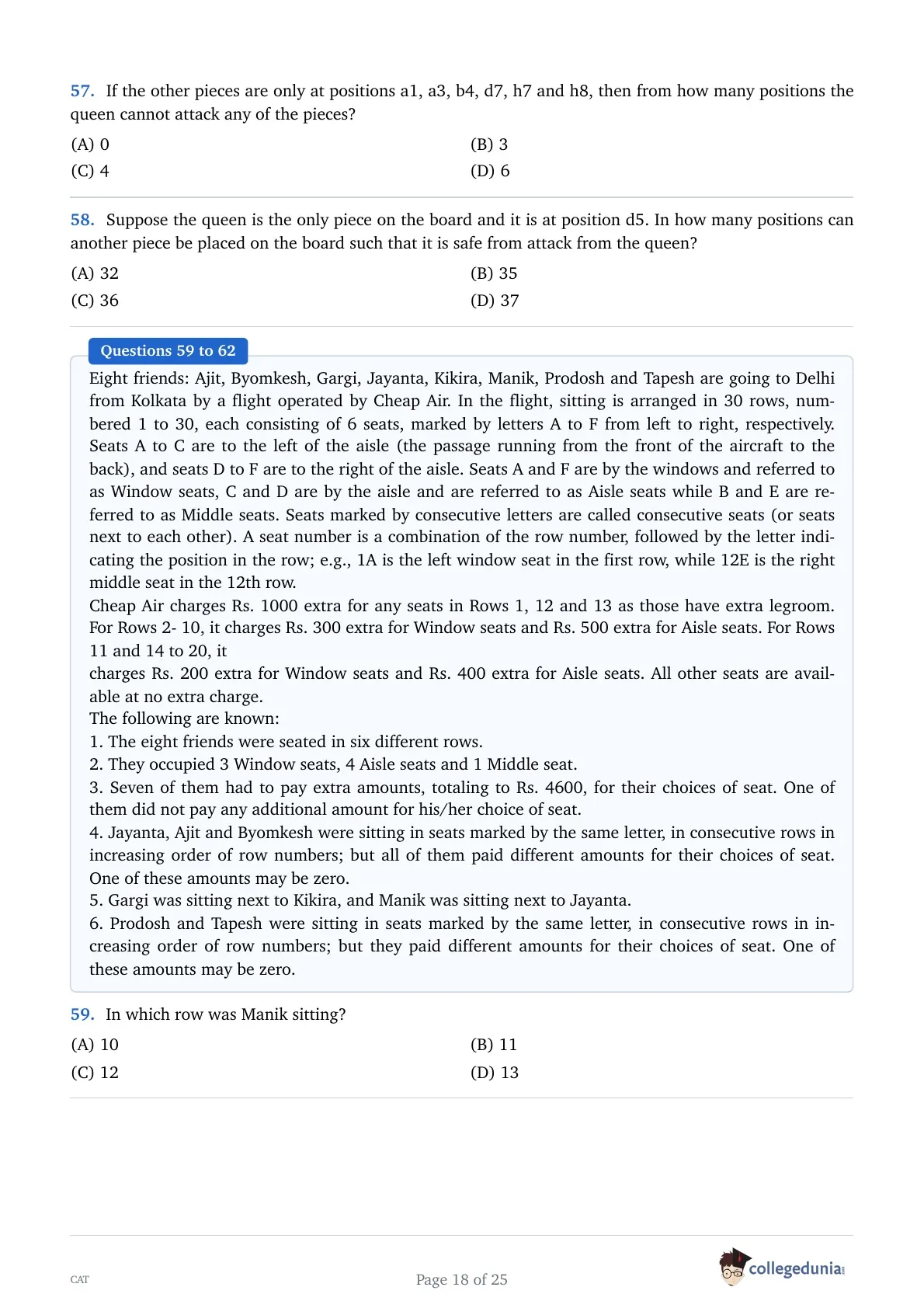
If the other pieces are only at positions al, a3, b4, d7, h7 and h8, then from how many positions the queen cannot attack any of the pieces?
Suppose the queen is the only piece on the board and it is at position d5. In how many positions can another piece be placed on the board such that it is safe from attack from the queen?
Comprehension:
Eight friends: Ajit, Byomkesh, Gargi, Jayanta, Kikira, Manik, Prodosh and Tapesh are going to Delhi from Kolkata by a flight operated by Cheap Air. In the flight, sitting is arranged in 30 rows, numbered 1 to 30, each consisting of 6 seats, marked by letters A to F from left to right, respectively. Seats A to C are to the left of the aisle (the passage running from the front of the aircraft to the back), and seats D to F are to the right of the aisle. Seats A and F are by the windows and referred to as Window seats, C and D are by the aisle and are referred to as Aisle seats while B and E are referred to as Middle seats. Seats marked by consecutive letters are called consecutive seats (or seats next to each other). A seat number is a combination of the row number, followed by the letter indicating the position in the row; e.g., 1A is the left window seat in the first row, while 12E is the right middle seat in the 12th row.
Cheap Air charges Rs. 1000 extra for any seats in Rows 1, 12 and 13 as those have extra legroom. For Rows 2-10, it charges Rs. 300 extra for Window seats and Rs. 500 extra for Aisle seats. For Rows 11 and 14 to 20, it charges Rs. 200 extra for Window seats and Rs. 400 extra for Aisle seats. All other seats are available at no extra charge.
The following are known:
1.The eight friends were seated in six different rows.
2.They occupied 3 Window seats, 4 Aisle seats and 1 Middle seat.
3.Seven of them had to pay extra amounts, totaling to Rs. 4600, for their choices of seat. One of them did not pay any additional amount for his/her choice of seat.
4.Jayanta, Ajit and Byomkesh were sitting in seats marked by the same letter, in consecutive rows in increasing order of row numbers; but all of them paid different amounts for their choices of seat. One of these amounts may be zero.
5.Gargi was sitting next to Kikira, and Manik was sitting next to Jayanta.
6.Prodosh and Tapesh were sitting in seats marked by the same letter, in consecutive rows in increasing order of row numbers; but they paid different amounts for their choices of seat. One of these amounts may be zero.
In which row was Manik sitting?
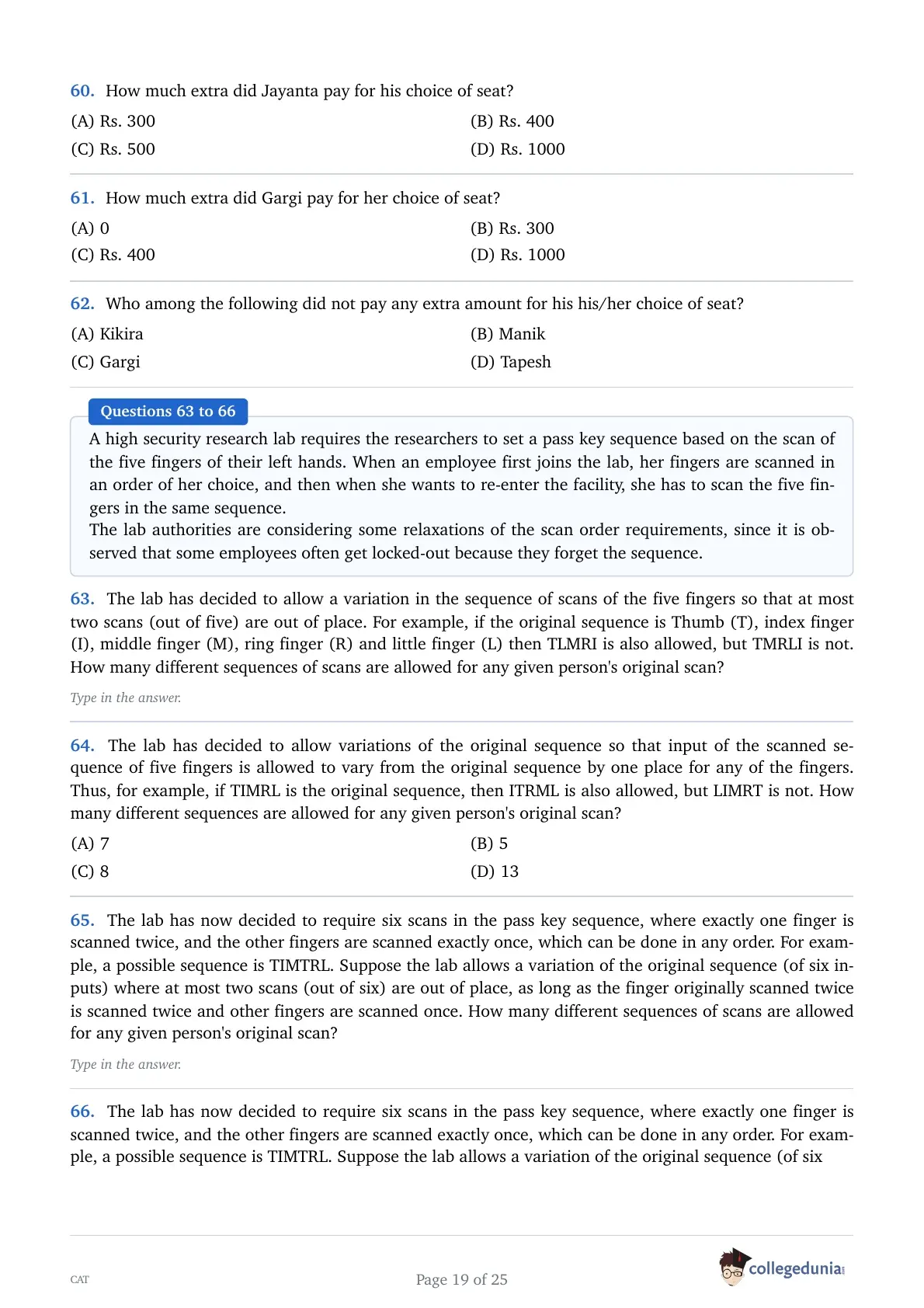
How much extra did Jayanta pay for his choice of seat?
How much extra did Gargi pay for her choice of seat?
Who among the following did not pay any extra amount for his/her choice of seat?
Comprehension:
A high security research lab requires the researchers to set a pass key sequence based on the scan of the five fingers of their left hands. When an employee first joins the lab, her fingers are scanned in an order of her choice, and then when she wants to re-enter the facility, she has to scan the five fingers in the same sequence. The lab authorities are considering some relaxations of the scan order requirements, since it is observed that some employees often get locked-out because they forget the sequence.
How many different sequences of scans are allowed for any given person's original scan?
How many different sequences are allowed for any given person's original scan?
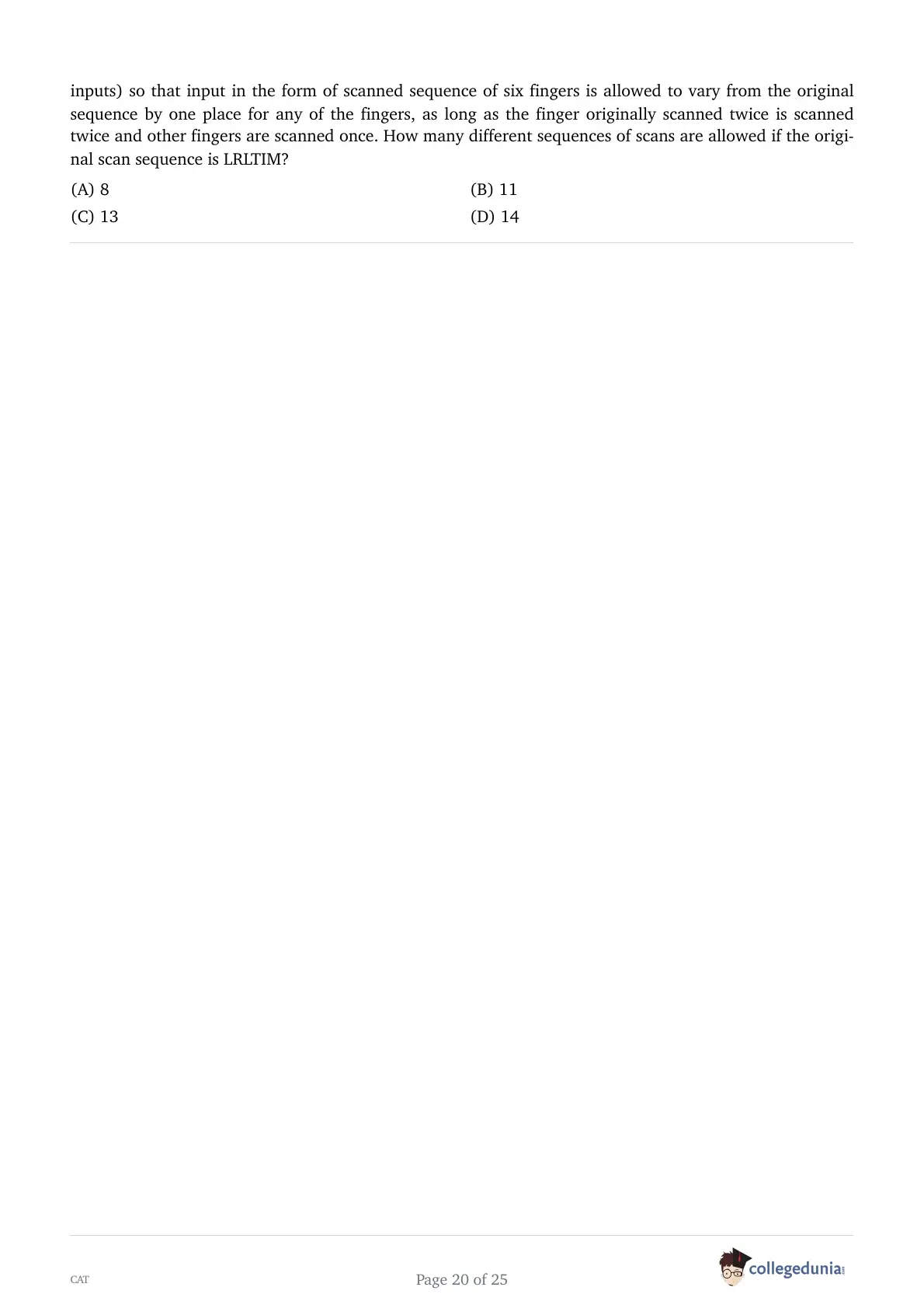
How many different sequences of scans are allowed for any given person's original scan?
How many different sequences of scans are allowed if the original scan sequence is LRLTIM?
Quantitative Ability (QA) (Q67 - Q100)
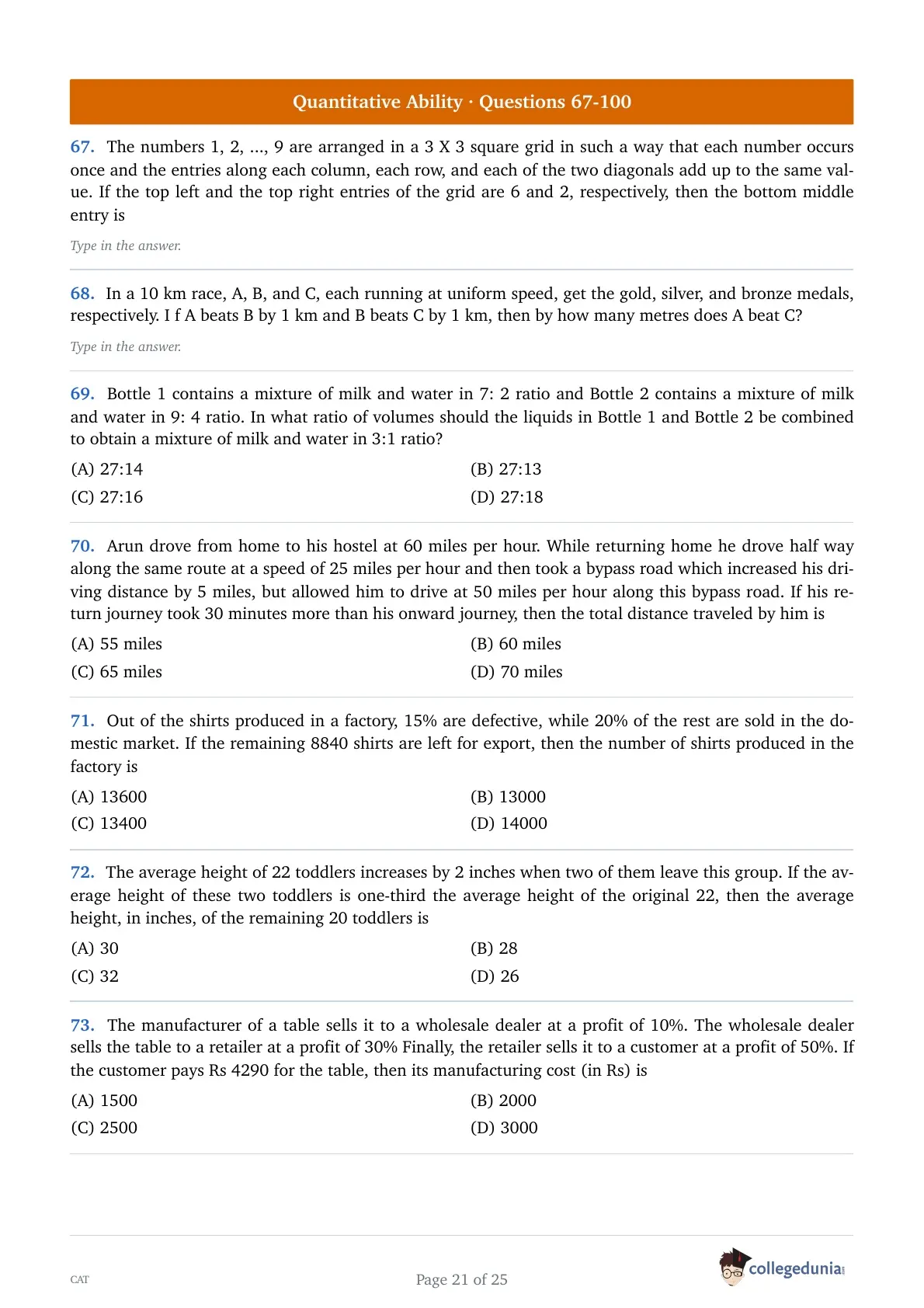
If the top left and the top right entries of the grid are 6 and 2, respectively, then the bottom middle entry is
In a 10 km race. A, B, and C, each running at uniform speed, get the gold, silver, and bronze medals, respectively. If A beats B by 1 km and B beats C by 1 km, then by how many metres does A beat C?
Bottle 1 contains a mixture of milk and water in 7 : 2 ratio and Bottle 2 contains a mixture of milk and water in 9 : 4 ratio. In what ratio of volumes should the liquids in Bottle 1 and Bottle 2 be combined to obtain a mixture of milk and water in 3 : 1 ratio?
Arun drove from home to his hostel at 60 miles per hour. While returning home he drove half way along the same route at a speed of 25 miles per hour and then took a bypass road which increased his driving distance by 5 miles, but allowed him to drive at 50 miles per hour along this bypass road. If his return journey took 30 minutes more than his onward journey, then the total distance traveled by him is
Out of the shirts produced in a factory, 15% are defective, while 20% of the rest are sold in the domestic market. If the remaining 8840 shirts are left for export, then the number of shirts produced in the factory is
The average height of 22 toddlers increases by 2 inches when two of them leave this group. If the average height of these two toddlers is one-third the average height of the original 22, then the average height, in inches, of the remaining 20 toddlers is
The manufacturer of a table sells it to a wholesale dealer at a profit of 10%. The wholesale dealer sells the table to a retailer at a profit of 30%. Finally, the retailer sells it to a customer at a profit of 50%. If the customer pays Rs 4290 for the table, then its manufacturing cost (in Rs) is
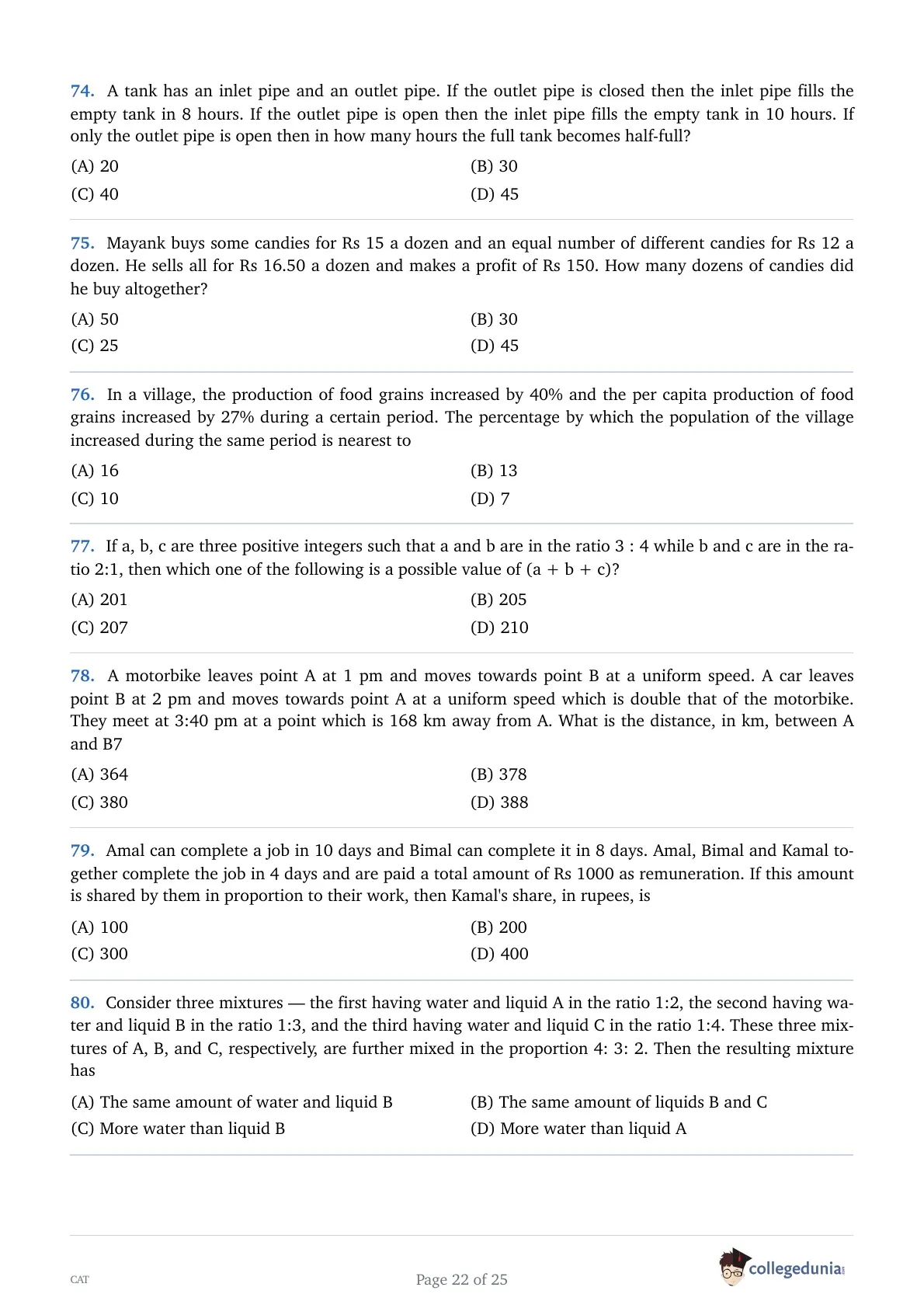
A tank has an inlet pipe and an outlet pipe. If the outlet pipe is closed then the inlet pipe fills the empty tank in 8 hours. If the outlet pipe is open then the inlet pipe fills the empty tank in 10 hours. If only the outlet pipe is open then in how many hours the full tank becomes half-full?
Mayank buys some candies for Rs 15 a dozen and an equal number of different candies for Rs 12 a dozen. He sells all for Rs 16.50 a dozen and makes a profit of Rs 150. How many dozens of candies did he buy altogether?
In a village, the production of food grains increased by 40% and the per capita production of food grains increased by 27% during a certain period. The percentage by which the population of the village increased during the same period is nearest to
If a, b, c are three positive integers such that a and b are in the ratio 3 : 4 while b and c are in the ratio 2:1, then which one of the following is a possible value of (a + b + c)?
A motorbike leaves point A at 1 pm and moves towards point B at a uniform speed. A car leaves point B at 2 pm and moves towards point A at a uniform speed which is double that of the motorbike. They meet at 3:40 pm at a point which is 168 km away from A. What is the distance, in km, between A and B?
Amal can complete a job in 10 days and Bimal can complete it in 8 days. Amal, Bimal and Kamal together complete the job in 4 days and are paid a total amount of Rs 1000 as remuneration.If this amount is shared by them in proportion to their work,then Kamal's share,in rupees,is
Consider three mixtures - the first having water and liquid A in the ratio 1 : 2, the second having water and liquid B in the ratio 1 : 3, and the third having water and liquid C in the ratio 1 : 4. These three mixtures of A, B, and C, respectively, are further mixed in the proportion 4:3:2. Then the resulting mixture has
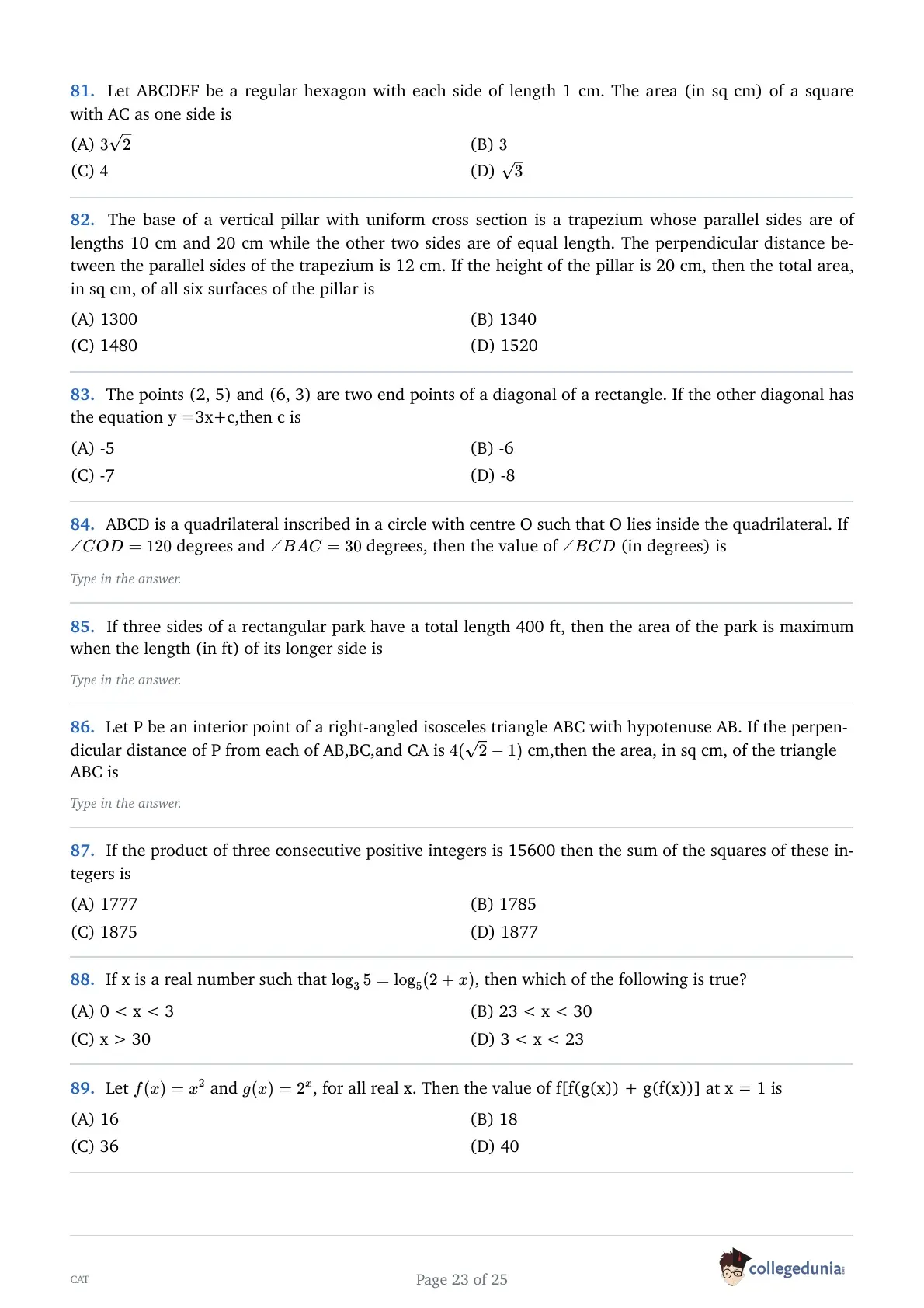
Let ABCDEF be a regular hexagon with each side of length 1 cm. The area (in sq cm) of a square with AC as one side is
The base of a vertical pillar with uniform cross section is a trapezium whose parallel sides are of lengths 10 cm and 20 cm while the other two sides are of equal length. The perpendicular distance between the parallel sides of the trapezium is 12 cm. If the height of the pillar is 20 cm, then the total area, in sq cm, of all six surfaces of the pillar is
The points (2, 5) and (6, 3) are two end points of a diagonal of a rectangle. If the other diagonal has the equation y = 3x + c, then c is
ABCD is a quadrilateral inscribed in a circle with centre O. If ∠COD = 120 degrees and ∠BAC = 30 degrees, then the value of ∠BCD (in degrees) is
If three sides of a rectangular park have a total length 400 ft, then the area of the park is maximum when the length (in ft) of its longer side is
Let P be an interior point of a right-angled isosceles triangle ABC with hypotenuse AB. If the perpendicular distance of P from each of AB, BC, and CA is 4 (√2 - l) cm, then the area, in sq cm, of the triangle ABC is
If the product of three consecutive positive integers is 15600 then the sum of the squares of these integers is
If x is a real number such that log3 5 = log5 (2 + x), then which of the following is true?
Let f(x) = x2 and g(x) = 2X , for all real x. Then the value of f( f(g(x)) + g(f(x)) ) at x = 1 is
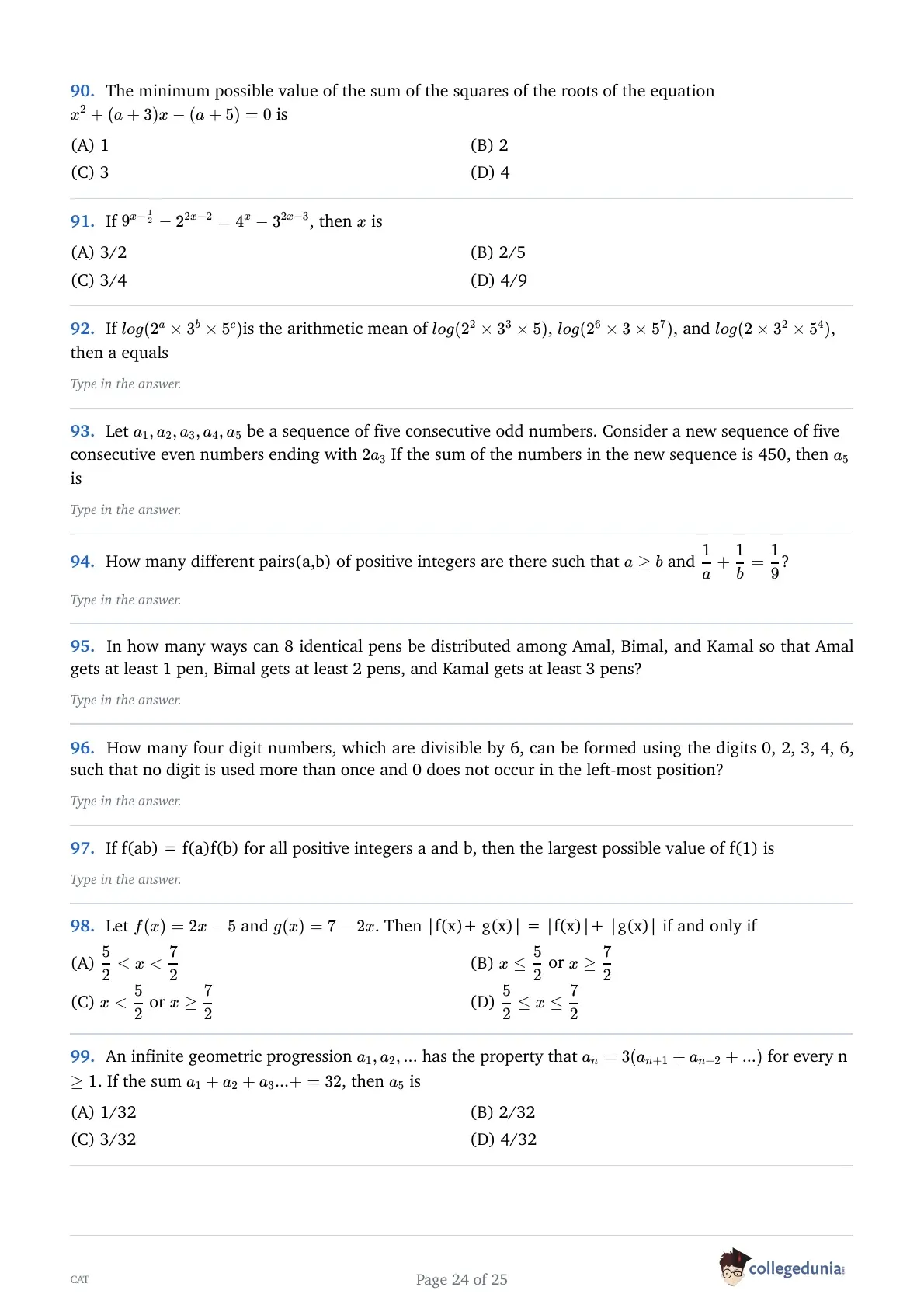
The minimum possible value of the sum of the squares of the roots of the equation x2 + (a + 3)x - (a + 5) = 0 is
If 9x-1/2-22x-2=4x-32x-3, then x is
If log (2a × 3b × 5C) is the arithmetic mean of log (22 × 33 × 5), log (26 × 3 × 57 ), and log (2 × 32 × 54 ), then a equals
Let a1 , a2 , a3 , a4 , a5 be a sequence of five consecutive odd numbers. Consider a new sequence of five consecutive even numbers ending with 2a3.
If the sum of the numbers in the new sequence is 450, then a5 is
How many different pairs (a, b) of positive integers are there such that a ≤ b and 1/a+1/b=1/9=?
In how many ways can 8 identical pens be distributed among Amal, Bimal, and Kamal so that Amal gets at least 1 pen, Bimal gets at least 2 pens, and Kamal gets at least 3 pens?
How many four digit numbers, which are divisible by 6, can be formed using the digits 0, 2, 3, 4, 6, such that no digit is used more than once and 0 does not occur in the left-most position?
If f(ab) = f(a)f(b) for all positive integers a and b, then the largest possible value of f(l) is
Let f(x) = 2x-5and g(x) = 7-2x. Then |f(x) + g(x)| = |f(x)| + |g(x)| if and only if
An infinite geometric progression a1 , a2 , a3 ,... has the property that an = 3(an+ l + an+2 +….) for every n ≥ 1. If the sum a1 + a2 + a3 +….... = 32, then a5 is
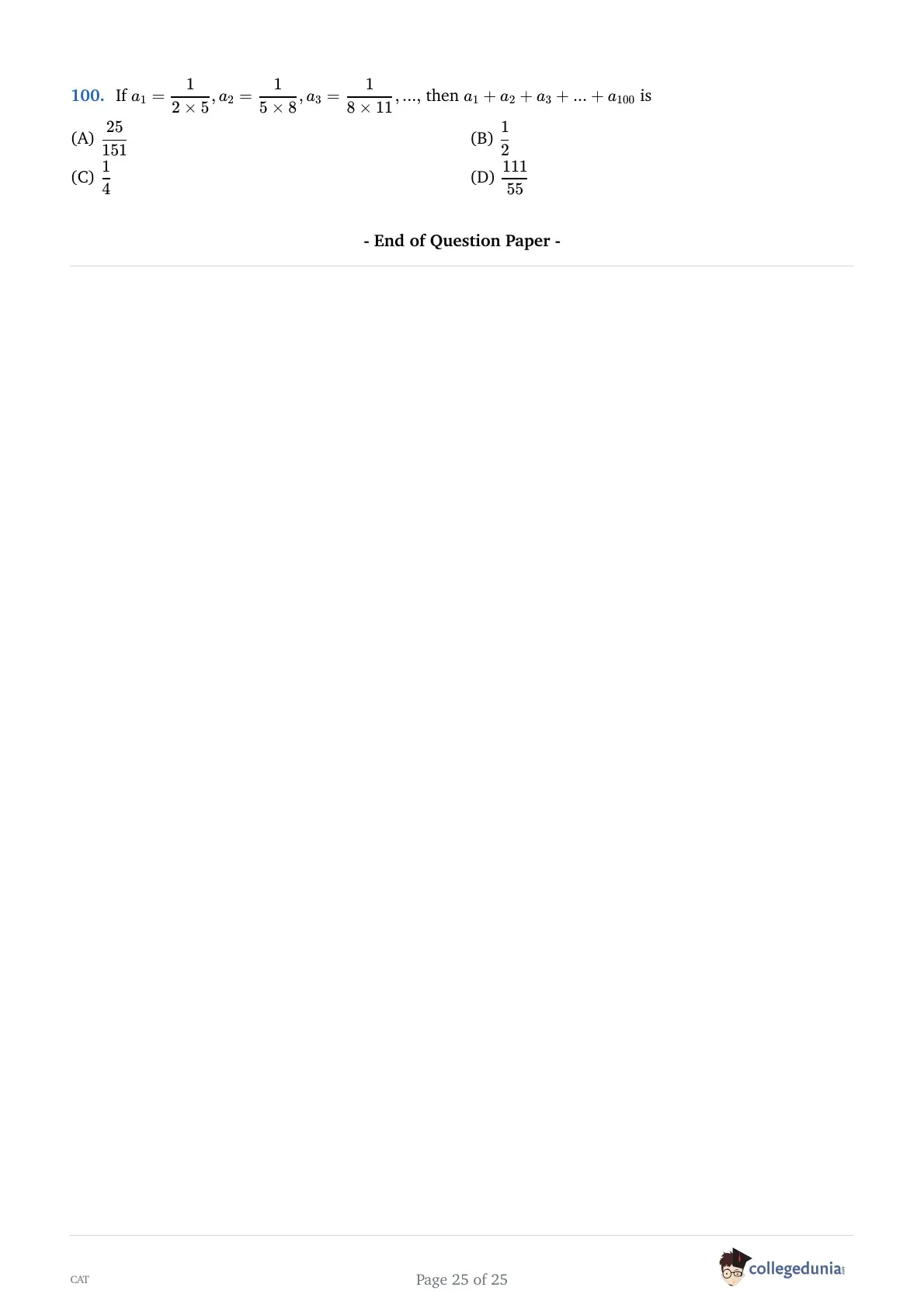
If a1=1/2×5, a2=1/5×8, a3=1/8×11,...,then a1, +a2, +a3, +....a100 is
CAT 2017 Exam Pattern and Marking Scheme
Section-wise Exam Pattern
| Section | Questions | Time | Marks per question | Maximum marks |
|---|---|---|---|---|
| Verbal Ability and Reading Comprehension (VARC) | 34 | 60 minutes | 3 | 102 |
| Data Interpretation and Logical Reasoning (DILR) | 32 | 60 minutes | 3 | 96 |
| Quantitative Ability (QA) | 34 | 60 minutes | 3 | 102 |
| Total | 100 | 180 minutes | - | 300 |
Marking Scheme
| Question type and response | Marks |
|---|---|
| MCQ - correct answer | +3 |
| MCQ - incorrect answer | -1 |
| TITA - correct answer | +3 |
| TITA - incorrect answer | 0 (no negative marking) |
| Unattempted question | 0 |



Comments