




The CAT 2019 Slot 2 Question Paper (CAT 2019, conducted by IIM Kozhikode on November 24, 2019) is available here as a free PDF download, together with the official question paper.
The CAT 2019 Slot 2 question paper includes the following:
- 100 questions in a 3-hour computer based test, split into three sections: VARC (34), DILR (32) and QA (34)
- Sectional time limit: 60 minutes per section, and candidates cannot switch between sections
- Question types: multiple choice questions (MCQs) and Type In The Answer (TITA) questions
- Marking: +3 for a correct answer, -1 for an incorrect MCQ, no negative marking for TITA, 0 for an unattempted question
- Maximum marks: 300
CAT 2019 Slot 2 Question Paper PDF
| Official PDF | CD PDF | CD PDF with Solutions |
|---|---|---|
| Download official PDF 0.98 MB | Download Collegedunia PDF 0.79 MB | - |
Also Check:


CAT 2019 Slot 2 Question Paper Analysis
Watch a slot-wise analysis of the CAT 2019 Slot 2 question paper below.
Source: Konversations By InsideIIM
CAT 2019 Slot 2 Questions with Solutions
Verbal Ability and Reading Comprehension (VARC) (Q1 - Q34)
Comprehension:
The magic of squatter cities is that they are improved steadily and gradually by their residents. To a planner’s eye, these cities look chaotic. I trained as a biologist and to my eye, they look organic. Squatter cities are also unexpectedly green. They have maximum density—1 million people per square mile in some areas of Mumbai—and have minimum energy and material use. People get around by foot, bicycle, rickshaw, or the universal shared taxi.
Not everything is efficient in the slums, though. In the Brazilian favelas where electricity is stolen and therefore free, people leave their lights on all day. But in most slums recycling is literally a way of life. The Dharavi slum in Mumbai has 400 recycling units and 30,000 ragpickers. Six thousand tons of rubbish are sorted every day. In 2007, the Economist reported that in Vietnam and Mozambique, “Waves of gleaners sift the sweepings of Hanoi’s streets, just as Mozambiquan children pick over the rubbish of Maputo’s main tip. Every city in Asia and Latin America has an industry based on gathering up old cardboard boxes.” . . .
Read More
In his 1985 article, Calthorpe made a statement that still jars with most people: “The city is the most environmentally benign form of human settlement. Each city dweller consumes less land, less energy, less water, and produces less pollution than his counterpart in settlements of lower densities.” “Green Manhattan” was the inflammatory title of a 2004 New Yorker article by David Owen. “By the most significant measures,” he wrote, “New York is the greenest community in the United States, and one of the greenest cities in the world . . . The key to New York’s relative environmental benignity is its extreme compactness. . . . Placing one and a half million people on a twenty-three-square-mile island sharply reduces their opportunities to be wasteful.” He went on to note that this very compactness forces people to live in the world’s most energy-efficient apartment buildings. . . .Urban density allows half of humanity to live on 2.8 per cent of the land. . . . Consider just the infrastructure efficiencies. According to a 2004 UN report: “The concentration of population and enterprises in urban areas greatly reduces the unit cost of piped water, sewers, drains, roads, electricity, garbage collection, transport, health care, and schools.” . . . [T]he nationally subsidised city of Manaus in northern Brazil “answers the question” of how to stop deforestation: give people decent jobs. Then they can afford houses, and gain security. One hundred thousand people who would otherwise be deforesting the jungle around Manaus are now prospering in town making such things as mobile phones and televisions. . . .
Of course, fast-growing cities are far from an unmitigated good. They concentrate crime, pollution, disease and injustice as much as business, innovation, education and entertainment. . . . But if they are overall a net good for those who move there, it is because cities offer more than just jobs. They are transformative: in the slums, as well as the office towers and leafy suburbs, the progress is from hick to metropolitan to cosmopolitan . . .
We can infer that Calthorpe’s statement “still jars” with most people because most people:
In the context of the passage, the author refers to Manaus in order to:
According to the passage, squatter cities are environment-friendly for all of the following reasons EXCEPT:
Which one of the following statements would undermine the author’s stand regarding the greenness of cities?
From the passage it can be inferred that cities are good places to live in for all of the following reasons EXCEPT that they:
Comprehension:
War, natural disasters and climate change are destroying some of the world's most precious cultural sites. Google is trying to help preserve these archaeological wonders by allowing users access to 3D images of these treasures through its site.
But the project is raising questions about Google's motivations and about who should own the digital copyrights. Some critics call it a form of "digital colonialism."
Read More
When it comes to archaeological treasures, the losses have been mounting. ISIS blew up parts of the ancient city of Palmyra in Syria and an earthquake hit Bagan, an ancient city in Myanmar, damaging dozens of temples, in 2016. In the past, all archaeologists and historians had for restoration and research were photos, drawings, remnants and intuition.But that's changing. Before the earthquake at Bagan, many of the temples on the site were scanned. . . . [These] scans . . . are on Google's Arts & Culture site. The digital renditions allow viewers to virtually wander the halls of the temple, look up-close at paintings and turn the building over, to look up at its chambers. . . . [Google Arts & Culture] works with museums and other nonprofits . . . to put high-quality images online.
The images of the temples in Bagan are part of a collaboration with CyArk, a nonprofit that creates the 3D scanning of historic sites. . . . Google . . . says [it] doesn't make money off this website, but it fits in with Google's mission to make the world's information available and useful.
Critics say the collaboration could be an attempt by a large corporation to wrap itself in the sheen of culture. Ethan Watrall, an archaeologist, professor at Michigan State University and a member of the Society for American Archaeology, says he's not comfortable with the arrangement between CyArk and Google. . . . Watrall says this project is just a way for Google to promote Google. "They want to make this material accessible so people will browse it and be filled with wonder by it," he says. "But at its core, it's all about advertisements and driving traffic." Watrall says these images belong on the site of a museum or educational institution, where there is serious scholarship and a very different mission. . . .
[There's] another issue for some archaeologists and art historians. CyArk owns the copyrights of the scans — not the countries where these sites are located. That means the countries need CyArk's permission to use these images for commercial purposes.
Erin Thompson, a professor of art crime at John Jay College of Criminal Justice in New York City, says it's the latest example of a Western nation appropriating a foreign culture, a centuries-long battle. . . . CyArk says it copyrights the scans so no one can use them in an inappropriate way. The company says it works closely with authorities during the process, even training local people to help. But critics like Thompson are not persuaded. . . . She would prefer the scans to be owned by the countries and people where these sites are located.
Which of the following, if true, would most strongly invalidate Dr. Watrall’s objections?
By “digital colonialism”, critics of the CyArk–Google project are referring to the fact that:
Of the following arguments, which one is LEAST likely to be used by the companies that digitally scan cultural sites?
Based on his views mentioned in the passage, one could best characterise Dr. Watrall as being:
In Dr. Thompson’s view, CyArk owning the copyright of its digital scans of archaeological sites is akin to:
Comprehension:
Around the world, capital cities are disgorging bureaucrats. In the post-colonial fervour of the 20th century, coastal capitals picked by trade-focused empires were spurned for “regionally neutral” new ones . . . . But decamping wholesale is costly and unpopular; governments these days prefer piecemeal dispersal. The trend reflects how the world has changed. In past eras, when information travelled at a snail’s pace, civil servants had to cluster together. But now desk-workers can ping emails and video-chat around the world. Travel for face-to-face meetings may be unavoidable, but transport links, too, have improved. . . .
Proponents of moving civil servants around promise countless benefits. It disperses the risk that a terrorist attack or natural disaster will cripple an entire government. Wonks in the sticks will be inspired by new ideas that walled-off capitals cannot conjure up. Autonomous regulators perform best far from the pressure and lobbying of the big city. Some even hail a cure for ascendant cynicism and populism. The unloved bureaucrats of faraway capitals will become as popular as firefighters once they mix with regular folk.
Read More
Beyond these sunny visions, dispersing central-government functions usually has three specific aims: to improve the lives of both civil servants and those living in clogged capitals; to save money; and to redress regional imbalances. The trouble is that these goals are not always realized.The first aim—improving living conditions—has a long pedigree. After the second world war Britain moved thousands of civil servants to “agreeable English country towns” as London was rebuilt. But swapping the capital for somewhere smaller is not always agreeable. Attrition rates can exceed 80%. . . . The second reason to pack bureaucrats off is to save money. Office space costs far more in capitals. . . .
Agencies that are moved elsewhere can often recruit better workers on lower salaries than in capitals, where well-paying multinationals mop up talent.
The third reason to shift is to rebalance regional inequality. . . . Norway treats federal jobs as a resource every region deserves to enjoy, like profits from oil. Where government jobs go, private ones follow. . . . Sometimes the aim is to fulfil the potential of a country’s second-tier cities. Unlike poor, remote places, bigger cities can make the most of relocated government agencies, linking them to local universities and businesses and supplying a better-educated workforce. The decision in 1946 to set up America’s Centres for Disease Control in Atlanta rather than Washington, D.C., has transformed the city into a hub for health-sector research and business.
The dilemma is obvious. Pick small, poor towns, and areas of high unemployment get new jobs, but it is hard to attract the most qualified workers; opt for larger cities with infrastructure and better-qualified residents, and the country’s most deprived areas see little benefit. . . . Others contend that decentralization begets corruption by making government agencies less accountable. . . . A study in America found that state-government corruption is worse when the state capital is isolated—journalists, who tend to live in the bigger cities, become less watchful of those in power.
According to the passage, colonial powers located their capitals:
According to the author, relocating government agencies has not always been a success for all of the following reasons EXCEPT:
The “long pedigree” of the aim to shift civil servants to improve their living standards implies that this move:
People who support decentralising central government functions are LEAST likely to cite which of the following reasons for their view?
The “dilemma” mentioned in the passage refers to:
Five sentences related to a topic are given below. Four of them can be put together to form a meaningful and coherent short paragraph. Identify the odd one out. Choose its number as your answer and key it in.
1. A particularly interesting example of inference occurs in many single panel comics.
2. It’s the creator’s participation and imagination that makes the single-panel comic so engaging and so rewarding.
3.
Often, the humor requires you to imagine what happened in the instant immediately before or immediately after the panel you’re being shown.
4.
To get the joke, you actually have to figure out what some of these missing panels must be.
5.
It is as though the cartoonist devised a series of panels to tell the story and has chosen to show you only one – and typically not even the funniest.
The four sentences (labelled 1, 2, 3, 4) given below, when properly sequenced would yield a coherent paragraph. Decide on the proper sequence of the order of the sentences and key in the sequence of the four numbers as your answer.
1. To the uninitiated listener, atonal music can sound like chaotic, random noise.
2. Atonality is a condition of music in which the constructs of the music do not ‘live’ within the confines of a particular key signature, scale, or mode.
3. After you realize the amount of knowledge, skill, and technical expertise required to compose or perform it, your tune may change, so to speak.
4. However, atonality is one of the most important movements in 20th century music.
The four sentences (labelled 1, 2, 3, 4) given below, when properly sequenced would yield a coherent paragraph. Decide on the proper sequence of the order of the sentences and key in the sequence of the four numbers as your answer.
1. Living things—animals and plants—typically exhibit correlational structure.
2. Adaptive behavior depends on cognitive economy, treating objects as equivalent.
3. The information we receive from our senses, from the world, typically has structure and order, and is not arbitrary.
4. To categorize an object means to consider it equivalent to other things in that category, and different—along some salient dimension—from things that are not.
The four sentences (labelled 1, 2, 3, 4) given below, when properly sequenced would yield a coherent paragraph. Decide on the proper sequence of the order of the sentences and key in the sequence of the four numbers as your answer.
1. Conceptualizations of ‘women’s time’ as contrary to clock-time and clock-time as synonymous with economic rationalism are two of the deleterious results of this representation.
2. While dichotomies of ‘men’s time’, ‘women’s time’, clock-time, and caring time can be analytically useful, this article argues that everyday caring practices incorporate a multiplicity of times; and both men and women can engage in these multiple-times.
3. When the everyday practices of working sole fathers and working sole mothers are carefully examined to explore conceptualizations of gendered time, it is found that caring time is often more focused on the clock than generally theorized.
4. Clock-time has been consistently represented in feminist literature as a masculine artefact representative of a ‘time is money’ perspective.
Comprehension:
For two years, I tracked down dozens of . . . Chinese in Upper Egypt [who were] selling lingerie. In a deeply conservative region, where Egyptian families rarely allow women to work or own businesses, the Chinese flourished because of their status as outsiders. They didn’t gossip, and they kept their opinions to themselves. In a New Yorker article entitled “Learning to Speak Lingerie,” I described the Chinese use of Arabic as another non-threatening characteristic. I wrote, “Unlike Mandarin, Arabic is inflected for gender, and Chinese dealers, who learn the language strictly by ear, often pick up speech patterns from female customers. I’ve come to think of it as the lingerie dialect, and there’s something disarming about these Chinese men speaking in the feminine voice.” . . .
When I wrote about the Chinese in the New Yorker, most readers seemed to appreciate the unusual perspective. But as I often find with topics that involve the Middle East, some people had trouble getting past the black-and-white quality of a byline. “This piece is so orientalist I don’t know what to do,” Aisha Gani, a reporter who worked at The Guardian, tweeted. Another colleague at the British paper, Iman Amrani, agreed: “I wouldn’t have minded an article on the subject written by an Egyptian woman—probably would have had better insight.” . . .
Read More
As an MOL (man of language), I also take issue with this kind of essentialism. Empathy and understanding are not inherited traits, and they are not strictly tied to gender and race. An individual who wrestles with a difficult language can learn to be more sympathetic to outsiders and open to different experiences of the world. This learning process—the embarrassments, the frustrations, the gradual sense of understanding and connection—is invariably transformative. In Upper Egypt, the Chinese experience of struggling to learn Arabic and local culture had made them much more thoughtful. In the same way, I was interested in their lives not because of some kind of voyeurism, but because I had also experienced Egypt and Arabic as an outsider. And both the Chinese and the Egyptians welcomed me because I spoke their languages. My identity as a white male was far less important than my ability to communicate.And that easily lobbed word—“Orientalist”—hardly captures the complexity of our interactions. What exactly is the dynamic when a man from Missouri observes a Zhejiang native selling lingerie to an Upper Egyptian woman? . . . If all of us now stand beside the same river, speaking in ways we all understand, who’s looking east and who’s looking west? Which way is Oriental?
For all of our current interest in identity politics, there’s no corresponding sense of identity linguistics. You are what you speak—the words that run throughout your mind are at least as fundamental to your selfhood as is your ethnicity or your gender. And sometimes it’s healthy to consider human characteristics that are not inborn, rigid, and outwardly defined. After all, you can always learn another language and change who you are.
According to the passage, which of the following is not responsible for language’s ability to change us?
A French ethnographer decides to study the culture of a Nigerian tribe. Which of the following is most likely to be the view of the author of the passage?
Which of the following can be inferred from the author’s claim, “Which way is Oriental?”
The author’s critics would argue that:
Comprehension:
British colonial policy . . . went through two policy phases, or at least there were two strategies between which its policies actually oscillated, sometimes to its great advantage. At first, the new colonial apparatus exercised caution, and occupied India by a mix of military power and subtle diplomacy, the high ground in the middle of the circle of circles. This, however, pushed them into contradictions. For, whatever their sense of the strangeness of the country and the thinness of colonial presence, the British colonial state represented the great conquering discourse of Enlightenment rationalism, entering India precisely at the moment of its greatest unchecked arrogance. As inheritors and representatives of this discourse, which carried everything before it, this colonial state could hardly adopt for long such a self-denying attitude. It had restructured everything in Europe—the productive system, the political regimes, the moral and cognitive orders—and would do the same in India, particularly as some empirically inclined theorists of that generation considered the colonies a massive laboratory of utilitarian or other theoretical experiments. Consequently, the colonial state could not settle simply for eminence at the cost of its marginality; it began to take initiatives to introduce the logic of modernity into Indian society. But this modernity did not enter a passive society. Sometimes, its initiatives were resisted by pre-existing structural forms. At times, there was a more direct form of collective resistance. Therefore the map of continuity and discontinuity that this state left behind at the time of independence was rather complex and has to be traced with care.
Most significantly, of course, initiatives for . . . modernity came to assume an external character. The acceptance of modernity came to be connected, ineradicably, with subjection. This again points to two different problems, one theoretical, the other political. Theoretically, because modernity was externally introduced, it is explanatorily unhelpful to apply the logical format of the ‘transition process’ to this pattern of change. Such a logical format would be wrong on two counts. First, however subtly, it would imply that what was proposed to be built was something like European capitalism. (And, in any case, historians have forcefully argued that what it was to replace was not like feudalism, with or without modificatory adjectives.) But, more fundamentally, the logical structure of endogenous change does not apply here. Here transformation agendas attack as an external force. This externality is not something that can be casually mentioned and forgotten. It is inscribed on every move, every object, every proposal, every legislative act, each line of causality. It comes to be marked on the epoch itself. This repetitive emphasis on externality should not be seen as a nationalist initiative that is so well rehearsed in Indian social science. . . .
Read More
Quite apart from the externality of the entire historical proposal of modernity, some of its contents were remarkable. . . . Economic reforms, or rather alterations . . . did not foreshadow the construction of a classical capitalist economy, with its necessary emphasis on extractive and transport sectors. What happened was the creation of a degenerate version of capitalism —what early dependency theorists called the ‘development of underdevelopment’.“Consequently, the colonial state could not settle simply for eminence at the cost of its marginality; it began to take initiatives to introduce the logic of modernity into Indian society.” Which of the following best captures the sense of this statement?
All of the following statements, if true, could be seen as supporting the arguments in the passage, EXCEPT:
All of the following statements about British colonialism can be inferred from the first paragraph, EXCEPT that it:
Which one of the following 5-word sequences best captures the flow of the arguments in the passage?
Which of the following observations is a valid conclusion to draw from the author’s statement that “the logical structure of endogenous change does not apply here. Here transformation agendas attack as an external force”?
The four sentences (labelled 1, 2, 3, 4) given below, when properly sequenced would yield a coherent paragraph. Decide on the proper sequence of the order of the sentences and key in the sequence of the four numbers as your answer.
1. Such a belief in the harmony of nature requires a purpose presumably imposed by the goodness and wisdom of a deity.
2. These parts, all fit together into an integrated, well-ordered system that was created by design.
3. Historically, the notion of a balance of nature is part observational, part metaphysical, and not scientific in any way.
4. It is an example of an ancient belief system called teleology, the notion that what we call nature has a predetermined destiny associated with its component parts.
The passage given below is followed by four alternate summaries. Choose the option that best captures the essence of the passage.
Language is an autapomorphy found only in our lineage, and not shared with other branches of our group such as primates. We also have no definitive evidence that any species other than Homo sapiens ever had language. However, it must be noted straightaway that ‘language’ is not a monolithic entity, but rather a complex bundle of traits that must have evolved over a significant time frame…. Moreover, language crucially draws on aspects of cognition that are long established in the primate lineage, such as memory: the language faculty as a whole comprises more than just the uniquely linguistic features.
The passage given below is followed by four alternate summaries. Choose the option that best captures the essence of the passage.
Privacy-challenged office workers may find it hard to believe, but open-plan offices and cubicles were invented by architects and designers who thought that to break down the social walls that divide people, you had to break down the real walls, too. Modernist architects saw walls and rooms as downright fascist. The spaciousness and flexibility of an open plan would liberate homeowners and office dwellers from the confines of boxes. But companies took up their idea less out of a democratic ideology than a desire to pack in as many workers as they could. The typical open-plan office of the first half of the 20th century was a white-collar assembly line. Cubicles were interior designers’ attempt to put some soul back in.
The passage given below is followed by four alternate summaries. Choose the option that best captures the essence of the passage.
Social movement organizations often struggle to mobilize supporters from allied movements in their efforts to achieve critical mass. Organizations with hybrid identities—those whose organizational identities span the boundaries of two or more social movements, issues, or identities—are vital to mobilizing these constituencies. Studies of the post-9/11 U.S. antiwar movement show that individuals with past involvement in non-anti-war movements are more likely to join hybrid organizations than are individuals without involvement in non-anti-war movements. In addition, they show that organizations with hybrid identities occupy relatively more central positions in inter-organizational contact networks within the antiwar movement and thus recruit significantly more participants in demonstrations than do nonhybrid organizations.
Five sentences related to a topic are given below in a jumbled order. Four of them form a coherent and unified paragraph. Identify the odd sentence that does not go with the four. Key in the number of the option that you choose.
1. Socrates told us that ‘the unexamined life is not worth living’ and that to ‘know thyself’ is the path to true wisdom
2. It suggests that you should adopt an ancient rhetorical method favored by the likes of Julius Caesar and known as ‘illeism’ – or speaking about yourself in the third person.
3.
Research has shown that people who are prone to rumination also often suffer from impaired decision making under pressure and are at a substantially increased risk of depression.
4. Simple rumination – the process of churning your concerns around in your head – is not the way to achieve self-realization.
5. The idea is that this small change in perspective can clear your emotional fog, allowing you to see past your biases.
Five sentences related to a topic are given below. Four of them can be put together to form a meaningful and coherent short paragraph. Identify the odd one out. Choose its number as your answer and key it in.
1.
Ocean plastic is problematic for a number of reasons, but primarily because marine animals eat it.
2.
The largest numerical proportion of ocean plastic falls in small size fractions.
3. Aside from clogging up the digestive tracts of marine life, plastic also tends to adsorb pollutants from the water column.
4.
Plastic in the oceans is arguably one of the most important and pervasive environmental problems today.
5. Eating plastic has a number of negative consequences such as the retention of plastic particles in the gut for longer periods than normal food particles.
Data Interpretation and Logical Reasoning (DILR) (Q35 - Q66)
Comprehension:
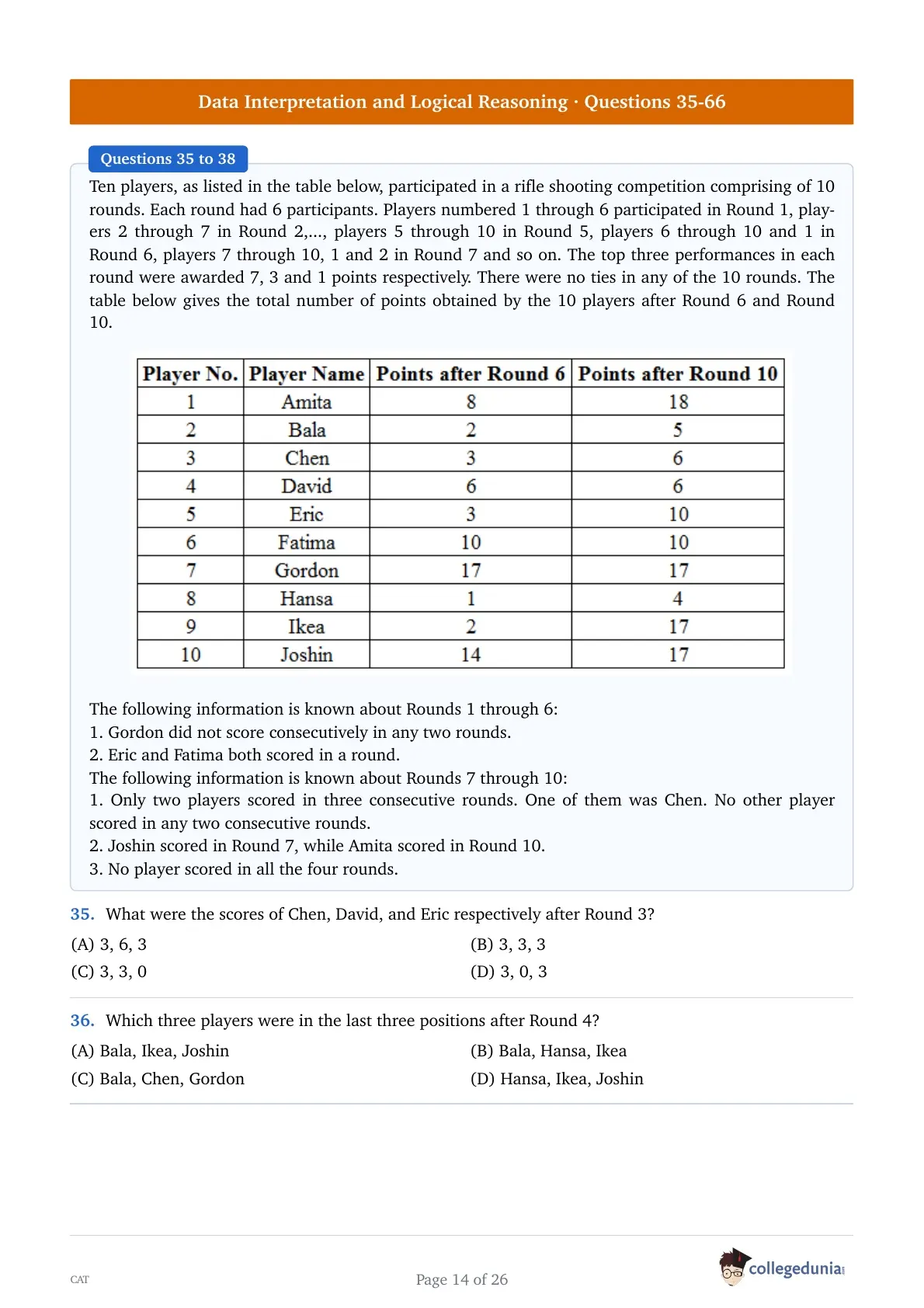
Ten players, as listed in the table below, participated in a rifle shooting competition comprising of 10 rounds. Each round had 6 participants. Players numbered 1 through 6 participated in Round 1, players 2 through 7 in Round 2,..., players 5 through 10 in Round 5, players 6 through 10 and 1 in Round 6, players 7 through 10, 1 and 2 in Round 7 and so on. 
The top three performances in each round were awarded 7, 3 and 1 points respectively. There were no ties in any of the 10 rounds. The table below gives the total number of points obtained by the 10 players after Round 6 and Round 10.
The following information is known about Rounds 1 through 6:
1. Gordon did not score consecutively in any two rounds.
2. Eric and Fatima both scored in a round.
The following information is known about Rounds 7 through 10:
1. Only two players scored in three consecutive rounds. One of them was Chen. No other player scored in any two consecutive rounds.
2. Joshin scored in Round 7, while Amita scored in Round 10.
3. No player scored in all the four rounds.
What were the scores of Chen, David, and Eric respectively after Round 3?
Which three players were in the last three positions after Round 4?
Which player scored points in maximum number of rounds?
Which players scored points in the last round?
Comprehension:
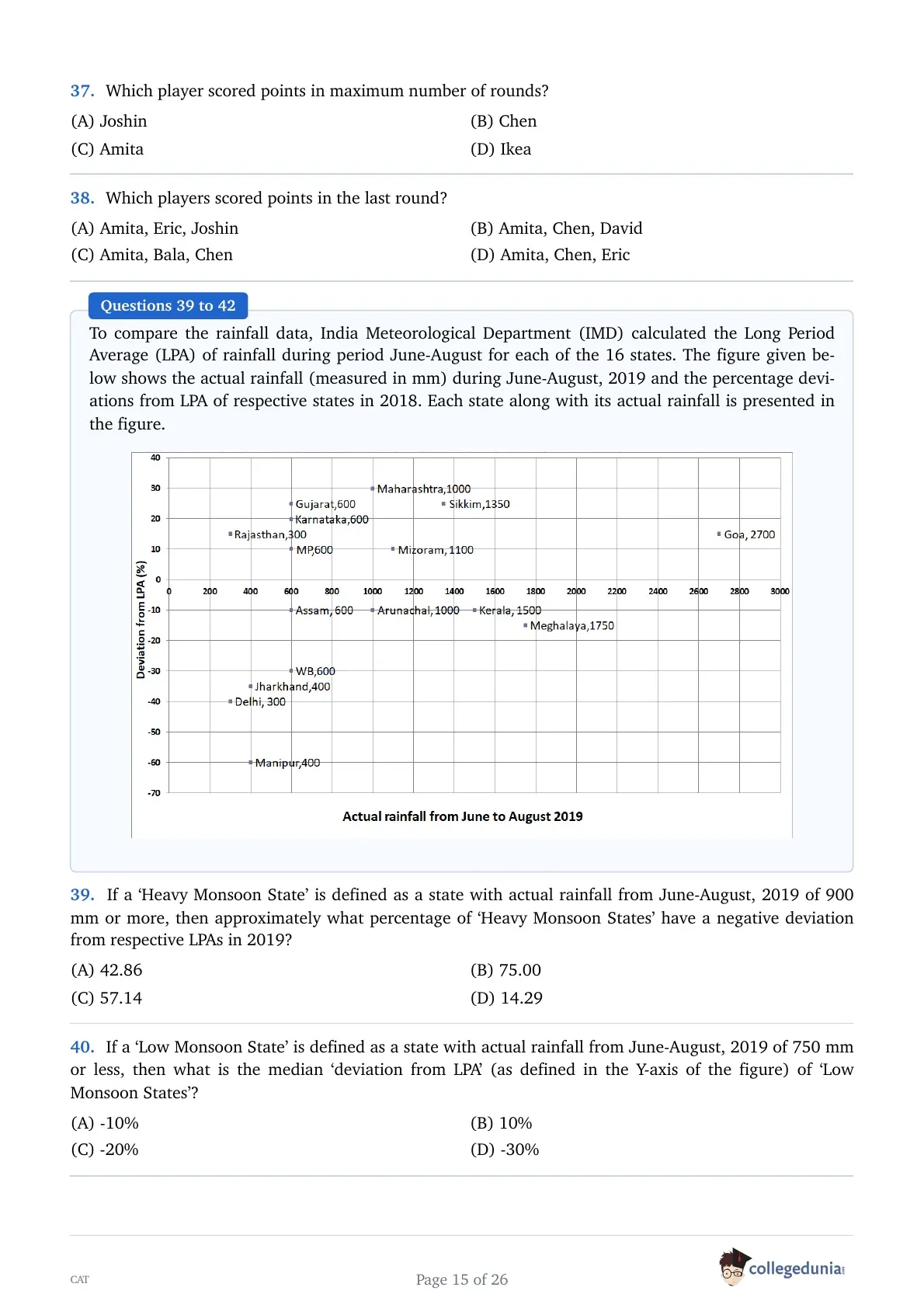
To compare the rainfall data, India Meteorological Department (IMD) calculated the Long Period Average (LPA) of rainfall during period June-August for each of the 16 states. The figure given below shows the actual rainfall (measured in mm) during June-August, 2019 and the percentage deviations from LPA of respective states in 2018. Each state along with its actual rainfall is presented in the figure.
If a ‘Heavy Monsoon State’ is defined as a state with actual rainfall from June-August, 2019 of 900 mm or more, then approximately what percentage of ‘Heavy Monsoon States’ have a negative deviation from respective LPAs in 2019?
If a ‘Low Monsoon State’ is defined as a state with actual rainfall from June-August,2019 of 750 mm or less, then what is the median ‘deviation from LPA’ (as defined in the Y-axis of the figure) of ‘Low Monsoon States’?
What is the average rainfall of all states that have actual rainfall of 600 mm or less in 2019 and have a negative deviation from LPA?
The LPA of a state for a year is defined as the average rainfall in the preceding 10 years considering the period of June-August. For example, LPA in 2018 is the average rainfall during 2009-2018 and LPA in 2019 is the average rainfall during 2010-2019. It is also observed that the actual rainfall in Gujarat in 2019 is 20% more than the rainfall in 2009. The LPA of Gujarat in 2019 is closest to
Comprehension:
The first year students in a business school are split into six sections. In 2019 the Business Statistics course was taught in these six sections by Annie, Beti, Chetan, Dave, Esha, and Fakir. All six sections had a common midterm (MT) and a common endterm (ET) worth 100 marks each. ET contained more questions than MT. Questions for MT and ET were prepared collectively by the six faculty members. Considering MT and ET together, each faculty member prepared the same number of questions. Each of MT and ET had at least four questions that were worth 5 marks, at least three questions that were worth 10 marks, and at least two questions that were worth 15 marks. In both MT and ET, all the 5-mark questions preceded the 10-mark questions, and all the 15- mark questions followed the 10-mark questions.
The following additional facts are known.
i. Annie prepared the fifth question for both MT and ET. For MT, this question carried 5 marks.
ii. Annie prepared one question for MT. Every other faculty member prepared more than one questions for MT.
iii. All questions prepared by a faculty member appeared consecutively in MT as well as ET.
iv. Chetan prepared the third question in both MT and ET; and Esha prepared the eighth question in both.
v. Fakir prepared the first question of MT and the last one in ET. Dave prepared the last question of MT and the first one in ET.
The second question in ET was prepared by:
How many 5- mark questions were there in MT and ET combined?
Who prepared 15-mark questions for MT and ET?
Which of the following questions did Beti prepare in ET?
Comprehension:

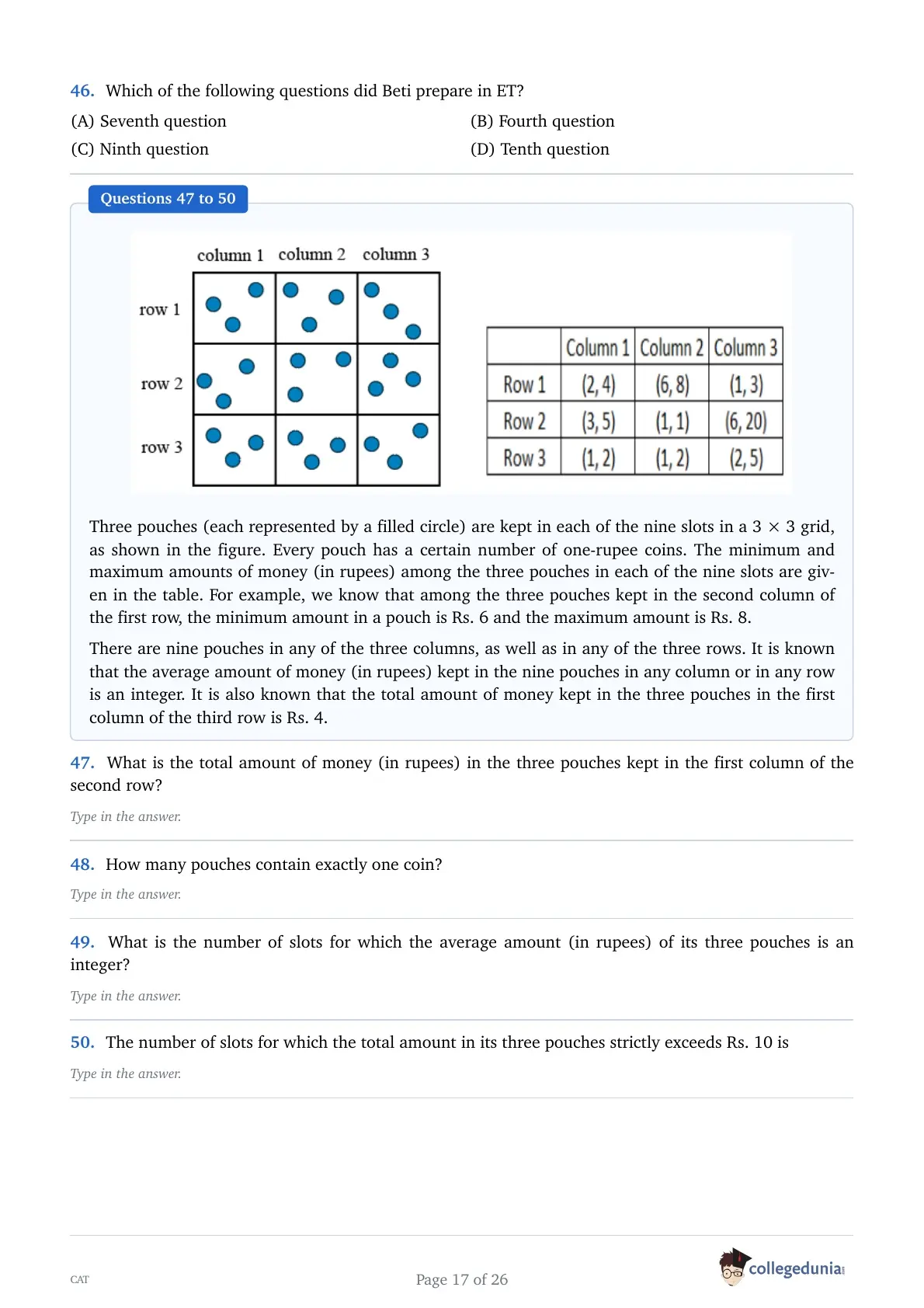
Three pouches (each represented by a filled circle) are kept in each of the nine slots in a 3× 3 grid, as shown in the figure. Every pouch has a certain number of one-rupee coins. The minimum and maximum amounts of money (in rupees) among the three pouches in each of the nine slots are given in the table. For example, we know that among the three pouches kept in the second column of the first row, the minimum amount in a pouch is Rs. 6 and the maximum amount is Rs. 8.
There are nine pouches in any of the three columns, as well as in any of the three rows. It is known that the average amount of money (in rupees) kept in the nine pouches in any column or in any row is an integer. It is also known that the total amount of money kept in the three pouches in the first column of the third row is Rs. 4.
What is the total amount of money (in rupees) in the three pouches kept in the first column of the second row?
How many pouches contain exactly one coin?
What is the number of slots for which the average amount (in rupees) of its three pouches is an integer?
The number of slots for which the total amount in its three pouches strictly exceeds Rs. 10 is
Comprehension:
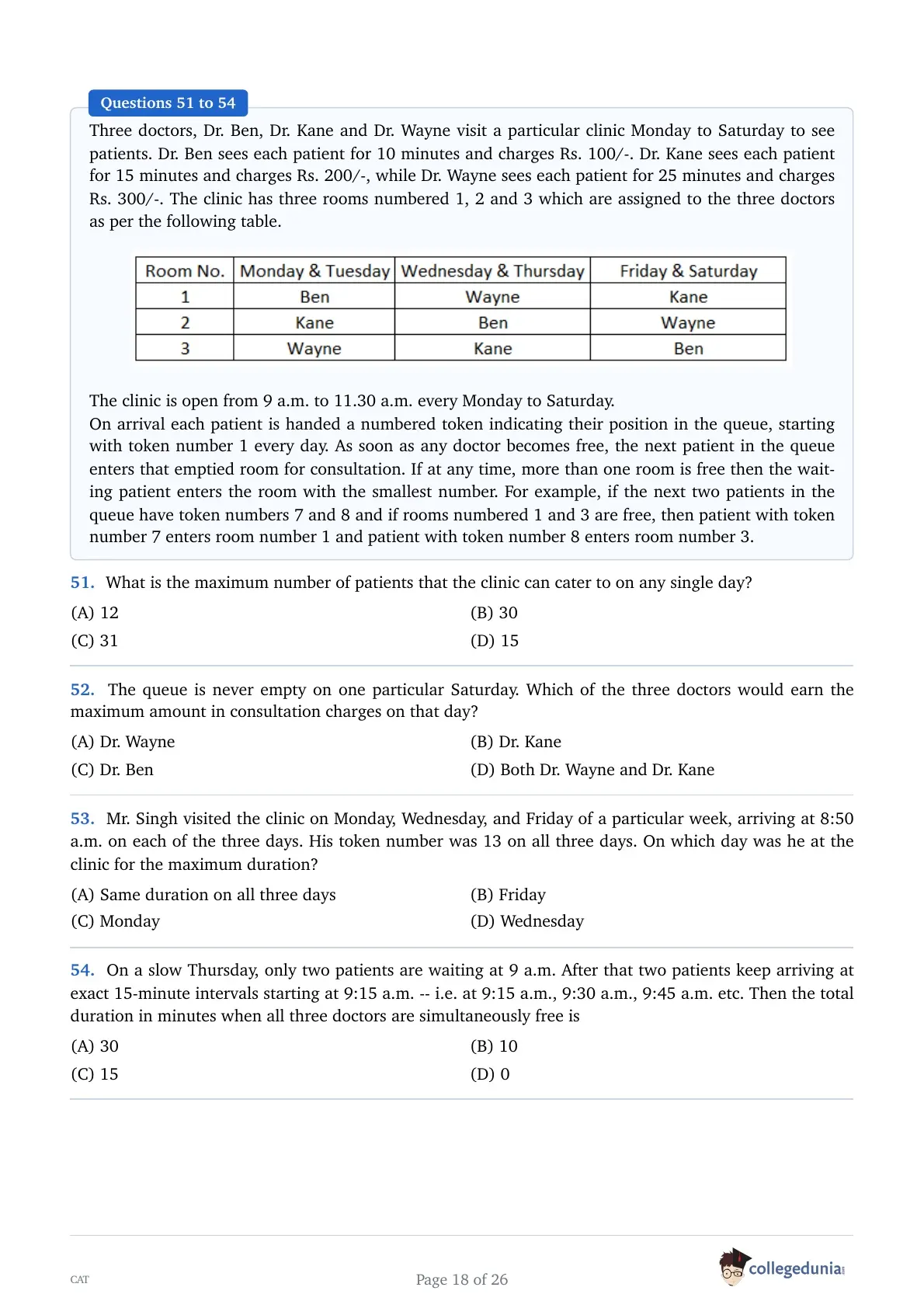
Three doctors, Dr. Ben, Dr. Kane and Dr. Wayne visit a particular clinic Monday to Saturday to see patients. Dr. Ben sees each patient for 10 minutes and charges Rs. 100/-. Dr. Kane sees each patient for 15 minutes and charges Rs. 200/-, while Dr. Wayne sees each patient for 25 minutes and charges Rs. 300/-.
The clinic has three rooms numbered 1, 2 and 3 which are assigned to the three doctors as per the following table. 
The clinic is open from 9 a.m. to 11.30 a.m. every Monday to Saturday.
On arrival each patient is handed a numbered token indicating their position in the queue, starting with token number 1 every day. As soon as any doctor becomes free, the next patient in the queue enters that emptied room for consultation. If at any time, more than one room is free then the waiting patient enters the room with the smallest number. For example, if the next two patients in the queue have token numbers 7 and 8 and if rooms numbered 1 and 3 are free, then patient with token number 7 enters room number 1 and patient with token number 8 enters room number 3.
What is the maximum number of patients that the clinic can cater to on any single day?
The queue is never empty on one particular Saturday. Which of the three doctors would earn the maximum amount in consultation charges on that day?
Mr. Singh visited the clinic on Monday, Wednesday, and Friday of a particular week, arriving at 8:50 a.m. on each of the three days. His token number was 13 on all three days. On which day was he at the clinic for the maximum duration?
On a slow Thursday, only two patients are waiting at 9 a.m. After that two patients keep arriving at exact 15 minute intervals starting at 9:15 a.m. -- i.e. at 9:15 a.m., 9:30 a.m., 9:45 a.m. etc. Then the total duration in minutes when all three doctors are simultaneously free is
Comprehension:
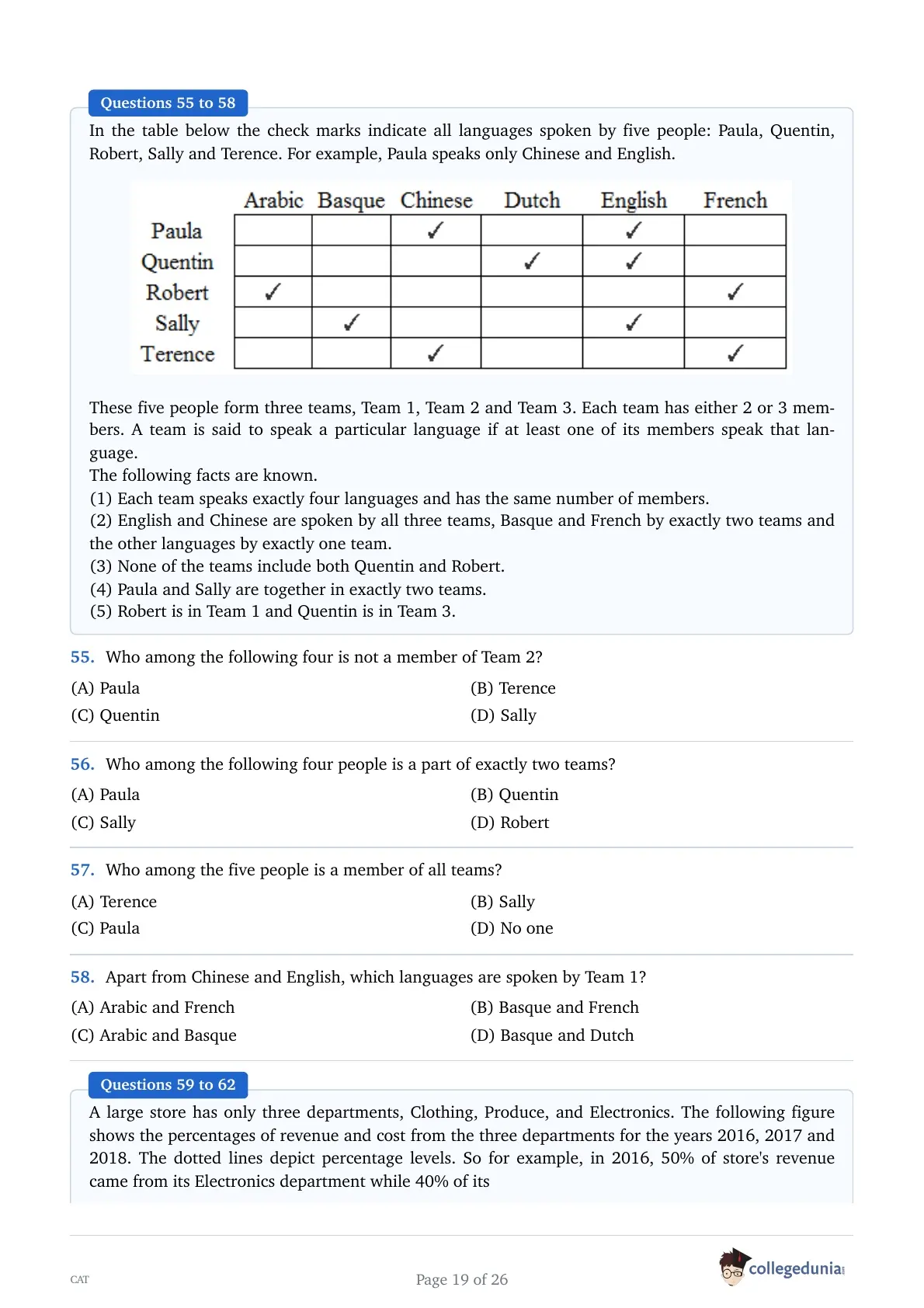
In the table below the check marks indicate all languages spoken by five people: Paula, Quentin, Robert, Sally and Terence. For example, Paula speaks only Chinese and English.
These five people form three teams, Team 1, Team 2 and Team 3. Each team has either 2 or 3 members. A team is said to speak a particular language if at least one of its members speak that language.
The following facts are known.
1. Each team speaks exactly four languages and has the same number of members.
2. English and Chinese are spoken by all three teams, Basque and French by exactly two teams and the other languages by exactly one team.
3. None of the teams include both Quentin and Robert.
4. Paula and Sally are together in exactly two teams.
5. Robert is in Team 1 and Quentin is in Team 3.
Who among the following four is not a member of Team 2?
Who among the following four people is a part of exactly two teams?
Who among the five people is a member of all teams?
Apart from Chinese and English, which languages are spoken by Team 1?
Comprehension:
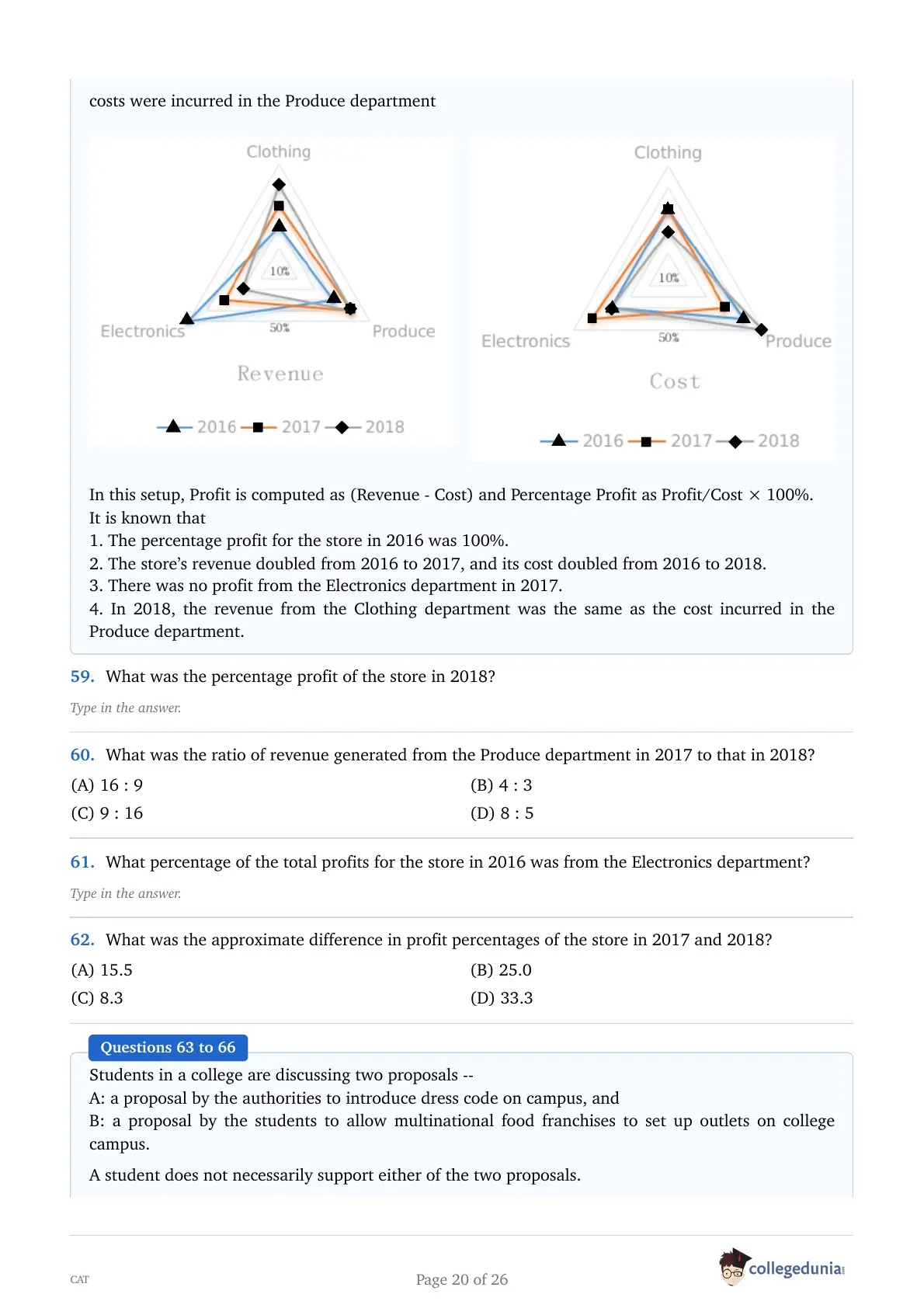
A large store has only three departments, Clothing, Produce, and Electronics. The following figure shows the percentages of revenue and cost from the three departments for the years 2016, 2017 and 2018. The dotted lines depict percentage levels. So for example, in 2016, 50% of store's revenue came from its Electronics department while 40% of its costs were incurred in the Produce department.
In this setup, Profit is computed as (Revenue – Cost) and Percentage Profit as Profit/Cost × 100%.
It is known that
1. The percentage profit for the store in 2016 was 100%.
2. The store’s revenue doubled from 2016 to 2017, and its cost doubled from 2016 to 2018.
3. There was no profit from the Electronics department in 2017.
4. In 2018, the revenue from the Clothing department was the same as the cost incurred in the Produce department.
What was the percentage profit of the store in 2018?
What was the ratio of revenue generated from the Produce department in 2017 to that in 2018?
What percentage of the total profits for the store in 2016 was from the Electronics department?
What was the approximate difference in profit percentages of the store in 2017 and 2018?
Comprehension:
Students in a college are discussing two proposals --
A: a proposal by the authorities to introduce dress code on campus, and
B: a proposal by the students to allow multinational food franchises to set up outlets on college campus.
A student does not necessarily support either of the two proposals.
In an upcoming election for student union president, there are two candidates in fray: Sunita and Ragini. Every student prefers one of the two candidates.
A survey was conducted among the students by picking a sample of 500 students.
The following information was noted from this survey.
1. 250 students supported proposal A and 250 students supported proposal B.
2. Among the 200 students who preferred Sunita as student union president, 80% supported proposal A.
3. Among those who preferred Ragini, 30% supported proposal A.
4. 20% of those who supported proposal B preferred Sunita.
5. 40% of those who did not support proposal B preferred Ragini.
6. Every student who preferred Sunita and supported proposal B also supported proposal A.
7. Among those who preferred Ragini, 20% did not support any of the proposals.
Among the students surveyed who supported proposal A, what percentage preferred Sunita for student union president?
What percentage of the students surveyed who did not support proposal A preferred Ragini as student union president?
How many of the students surveyed supported proposal B, did not support proposal A and preferred Ragini as student union president?
Quantitative Ability (QA) (Q67 - Q100)
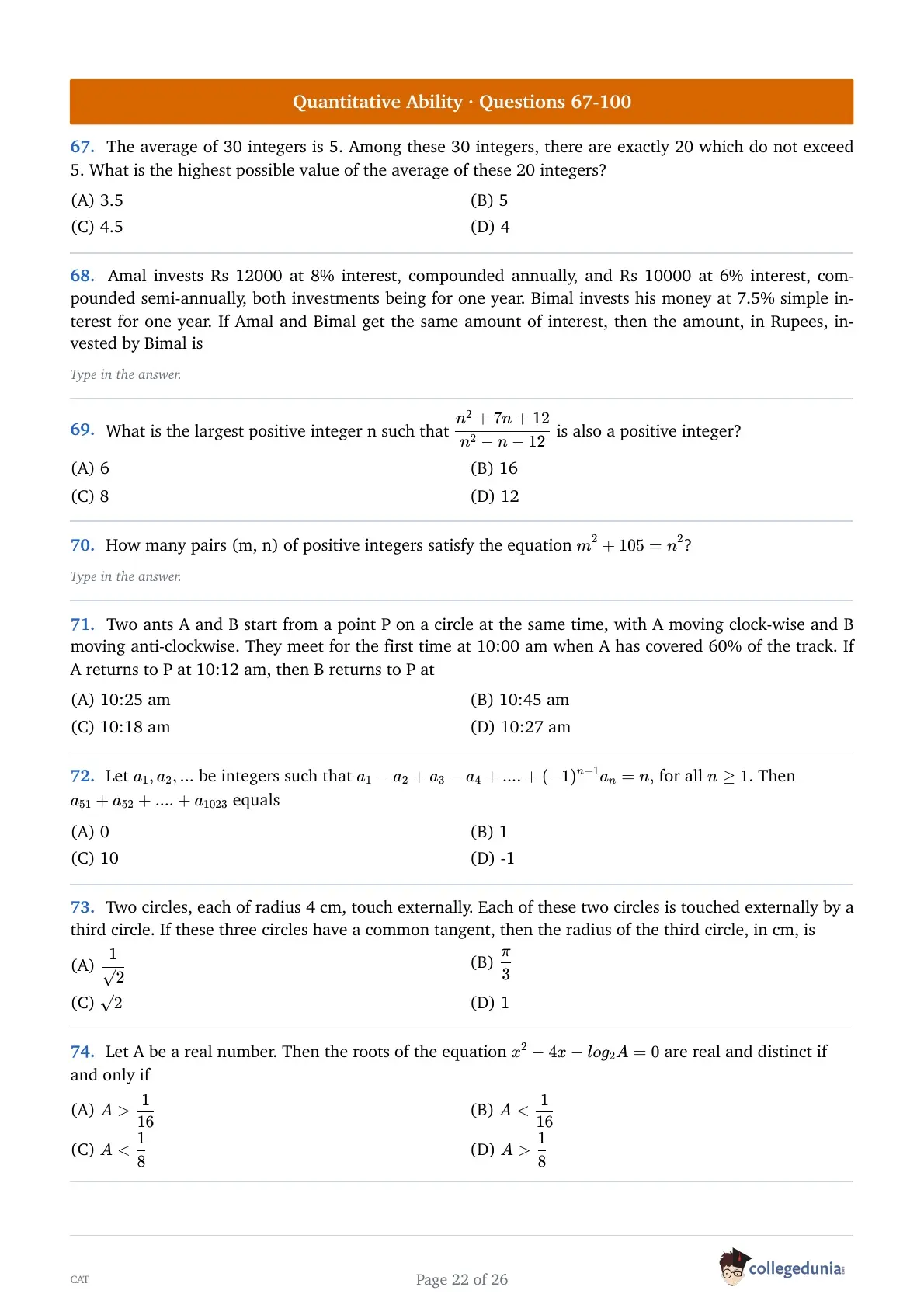
The average of 30 integers is 5. Among these 30 integers, there are exactly 20 which do not exceed 5. What is the highest possible value of the average of these 20 integers?
Amal invests Rs 12000 at 8% interest, compounded annually, and Rs 10000 at 6% interest, compounded semi-annually, both investments being for one year. Bimal invests his money at 7.5% simple interest for one year. If Amal and Bimal get the same amount of interest, then the amount, in Rupees, invested by Bimal is
What is the largest positive integer n such that \(\frac{n^2+7n+12}{n^2-n-12}\) is also a positive integer?
How many pairs (m, n) of positive integers satisfy the equation \(m^2+105=n^2 \) ?
Two ants A and B start from a point P on a circle at the same time, with A moving clock-wise and B moving anti-clockwise. They meet for the first time at 10:00 am when A has covered 60% of the track. If A returns to P at 10:12 am, then B returns to P at
Let \(a_1,a_2,….\) be integers such that \(a_1-a_2+a_3-a_4+…..+(-1)^{n-1}a_n=n\), for all \(n≥1\),then \(a_{51}+a_{52}+….+a_{1023} \) equals
Two circles, each of radius 4 cm, touch externally. Each of these two circles is touched externally by a third circle. If these three circles have a common tangent, then the radius of the third circle, in cm, is
Let A be a real number. Then the roots of the equation \(x^2-4x-log_{2}A=0 \) are real and distinct if and only if
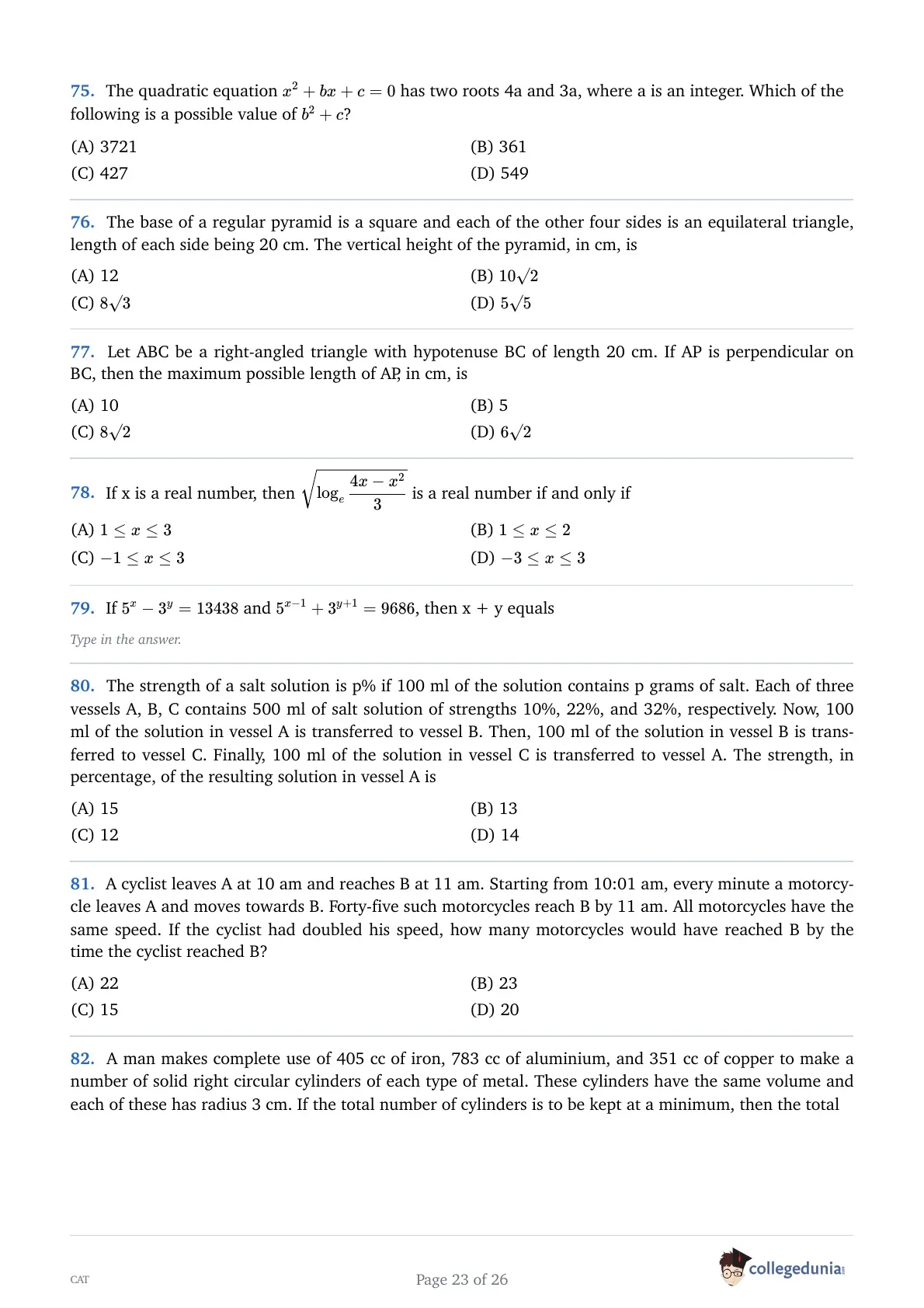
The quadratic equation \(x^2+bx+c=0\) has two roots 4a and 3a, where a is an integer. Which of the following is a possible value of \(b^2+c\ ?\)
The base of a regular pyramid is a square and each of the other four sides is an equilateral triangle, length of each side being 20 cm. The vertical height of the pyramid, in cm, is
Let ABC be a right-angled triangle with hypotenuse BC of length 20 cm. If AP is perpendicular on BC, then the maximum possible length of AP, in cm, is
If x is a real number, then \(\sqrt{log_e\frac{4x-x^2}{3}}\) is a real number if and only if
If \(5^x-3^y=13438\) and \(5^{x-1}+3^{y+1}=9686,\) then \(x+y\) equals?
The strength of a salt solution is p% if 100 ml of the solution contains p grams of salt. Each of three vessels A, B, C contains 500 ml of salt solution of strengths 10%, 22%, and 32%, respectively. Now, 100 ml of the solution in vessel A is transferred to vessel B. Then, 100 ml of the solution in vessel B is transferred to vessel C. Finally, 100 ml of the solution in vessel C is transferred to vessel A. The strength, in percentage, of the resulting solution in vessel A is
A cyclist leaves A at 10 am and reaches B at 11 am. Starting from 10:01 am, every minute a motor cycle leaves A and moves towards B. Forty-five such motor cycles reach B by 11 am. All motor cycles have the same speed. If the cyclist had doubled his speed, how many motor cycles would have reached B by the time the cyclist reached B?
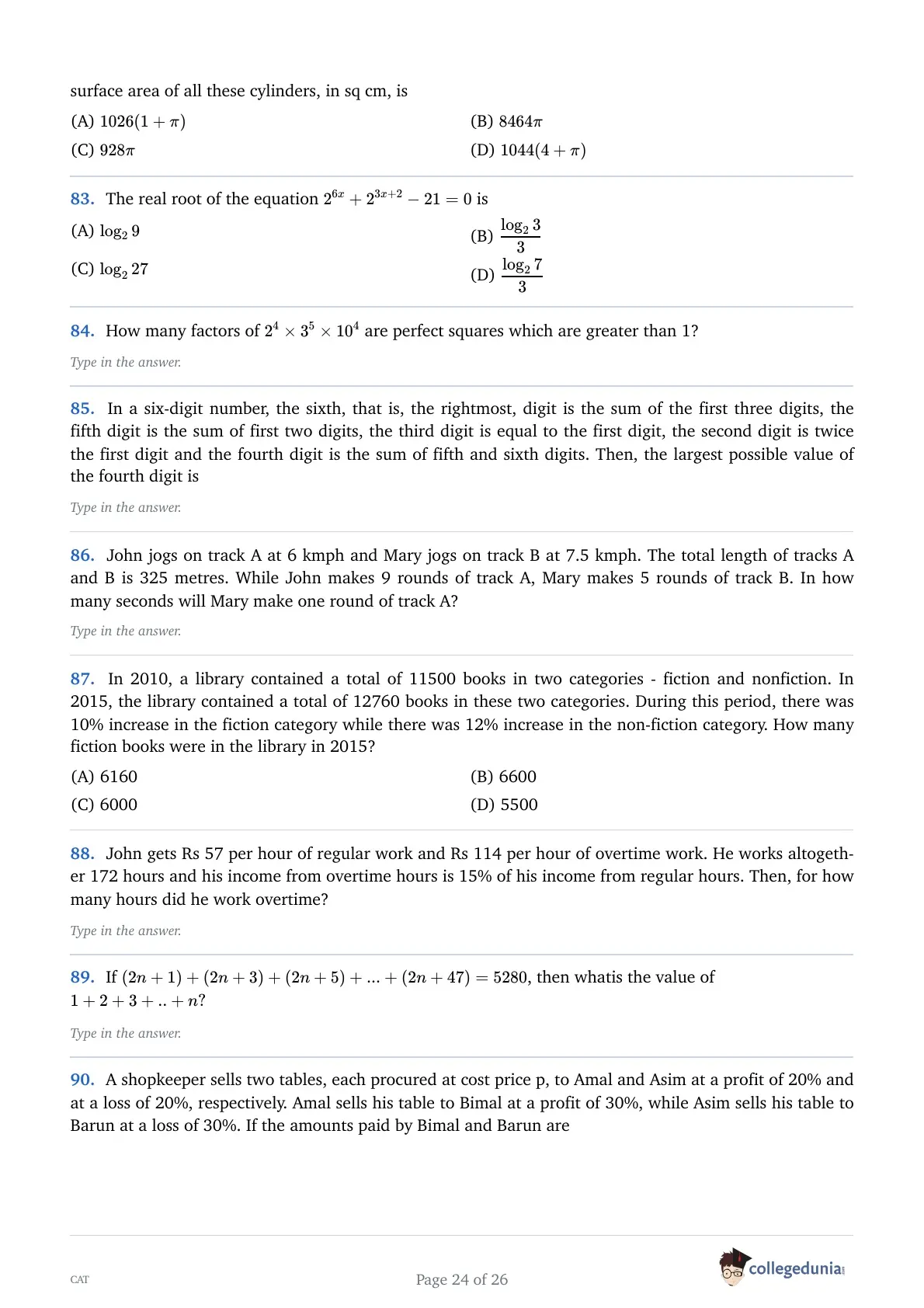
A man makes complete use of 405 cc of iron, 783 cc of aluminium, and 351 cc of copper to make a number of solid right circular cylinders of each type of metal. These cylinders have the same volume and each of these has radius 3 cm. If the total number of cylinders is to be kept at a minimum, then the total surface area of all these cylinders, in sq cm, is
The real root of the equation \(2^{6x}+2^{3x+2}-21=0\) is
How many factors of \(2^4\times3^5\times10^4\) are perfect squares which are greater than 1 ?
In a six-digit number, the sixth, that is, the rightmost, digit is the sum of the first three digits, the fifth digit is the sum of first two digits, the third digit is equal to the first digit, the second digit is twice the first digit and the fourth digit is the sum of fifth and sixth digits. Then, the largest possible value of the fourth digit is
John jogs on track A at 6 kmph and Mary jogs on track B at 7.5 kmph. The total length of tracks A and B is 325 metres. While John makes 9 rounds of track A, Mary makes 5 rounds of track B. In how many seconds will Mary make one round of track A?
In 2010, a library contained a total of 11500 books in two categories -fiction and nonfiction. In 2015, the library contained a total of 12760 books in these two categories. During this period, there was 10% increase in the fiction category while there was 12% increase in the non-fiction category. How many fiction books were in the library in 2015?
John gets Rs 57 per hour of regular work and Rs 114 per hour of overtime work. He works altogether 172 hours and his income from overtime hours is 15% of his income from regular hours. Then, for how many hours did he work overtime?
If \((2n+1)+(2n+3)+(2n+5)+….+(2n+47)=5280,\) then what is the value of \(1+2+3+….n?\)
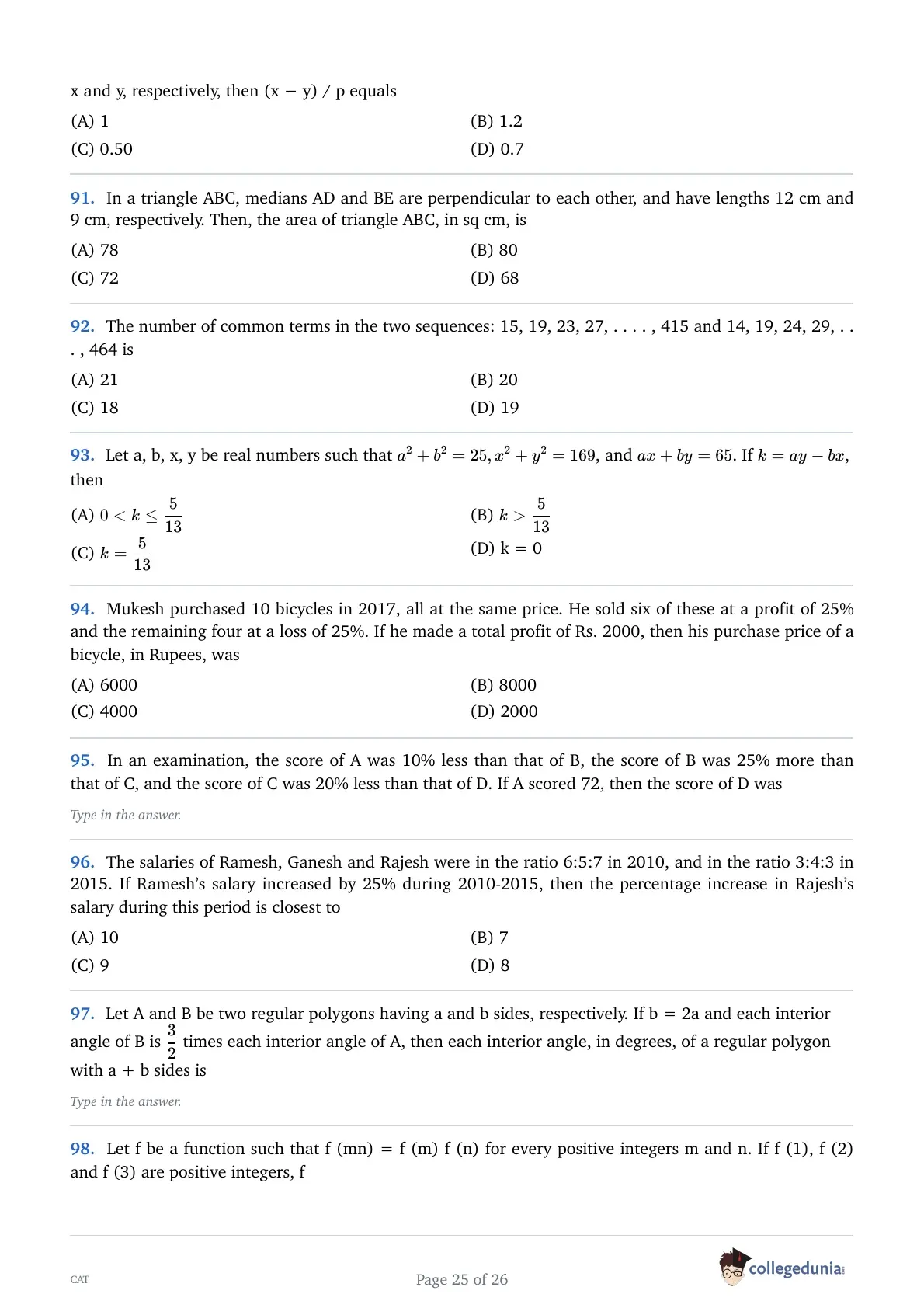
A shopkeeper sells two tables, each procured at cost price p, to Amal and Asim at a profit of 20% and at a loss of 20%, respectively. Amal sells his table to Bimal at a profit of 30%, while Asim sells his table to Barun at a loss of 30%. If the amounts paid by Bimal and Barun are x and y, respectively, then \(\frac{(x −y) }{ p}\) equals
In a triangle ABC, medians AD and BE are perpendicular to each other, and have lengths 12 cm and 9 cm, respectively. Then, the area of triangle ABC, in sq cm, is
The number of common terms in the two sequences: 15, 19, 23, 27, . . . . , 415 and 14, 19, 24, 29, . . . , 464 is
Let a, b, x, y be real numbers such that \(a^2+b^2=25,x^2+y^2=169,\) and \(ax+by=65.\) If \(k= ay-bx,\) then
Mukesh purchased 10 bicycles in 2017, all at the same price. He sold six of these at a profit of 25% and the remaining four at a loss of 25%. If he made a total profit of Rs. 2000, then his purchase price of a bicycle, in Rupees, was
In an examination, the score of A was 10% less than that of B, the score of B was 25% more than that of C, and the score of C was 20% less than that of D. If A scored 72, then the score of D was
The salaries of Ramesh, Ganesh and Rajesh were in the ratio 6:5:7 in 2010, and in the ratio 3:4:3 in 2015. If Ramesh’s salary increased by 25% during 2010-2015, then the percentage increase in Rajesh’s salary during this period is closest to
Let A and B be two regular polygons having a and b sides, respectively. If b = 2a and each interior angle of B is \(\frac{3}{2}\) times each interior angle of A, then each interior angle, in degrees, of a regular polygon with a + b sides is
Let f be a function such that f (mn) = f (m) f (n) for every positive integers m and n. If f (1), f (2) and f (3) are positive integers, f (1) < f (2), and f (24) = 54, then f (18) equals
Anil alone can do a job in 20 days while Sunil alone can do it in 40 days. Anil starts the job, and after 3 days, Sunil joins him. Again, after a few more days, Bimal joins them and they together finish the job. If Bimal has done 10% of the job, then in how many days was the job done?
In an examination, Rama's score was one-twelfth of the sum of the scores of Mohan and Anjali. After a review, the score of each of them increased by 6. The revised scores of Anjali, Mohan, and Rama were in the ratio 11:10:3. Then Anjali's score exceeded Rama's score by
CAT 2019 Exam Pattern and Marking Scheme
Section-wise Exam Pattern
| Section | Questions | Time | Marks per question | Maximum marks |
|---|---|---|---|---|
| Verbal Ability and Reading Comprehension (VARC) | 34 | 60 minutes | 3 | 102 |
| Data Interpretation and Logical Reasoning (DILR) | 32 | 60 minutes | 3 | 96 |
| Quantitative Ability (QA) | 34 | 60 minutes | 3 | 102 |
| Total | 100 | 180 minutes | - | 300 |
Marking Scheme
| Question type and response | Marks |
|---|---|
| MCQ - correct answer | +3 |
| MCQ - incorrect answer | -1 |
| TITA - correct answer | +3 |
| TITA - incorrect answer | 0 (no negative marking) |
| Unattempted question | 0 |



Comments