




With CAT 2026 scheduled for November 29, 2026, aspirants have less than a month to strengthen their Quantitative Aptitude preparation.
Geometry questions often require candidates to combine formula knowledge with diagram-based reasoning, making speed and accuracy important during the 40-minute Quant section.
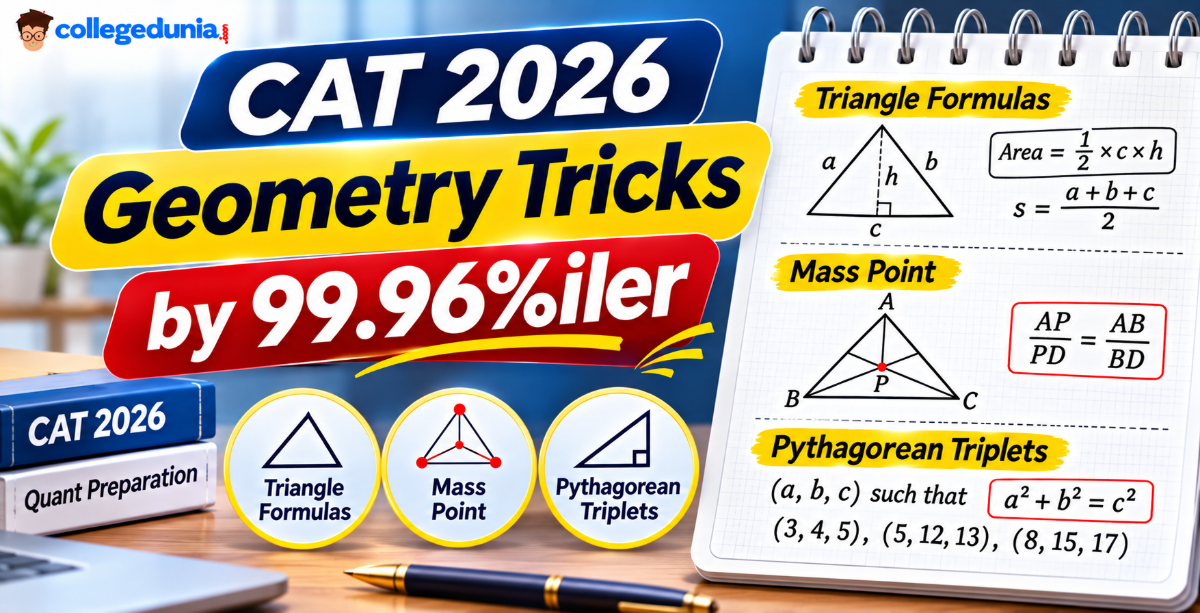
A 99.96 percentiler has shared key techniques for solving CAT Geometry questions, including seven triangle area methods, centroid and median properties, mass point geometry, coordinate geometry, circle theorems and Pythagorean triplets.
- The session explains seven triangle area methods, including Heron’s formula, the inradius formula and the Shoelace formula.
- Candidates can use median and centroid properties to find length and area ratios within triangles.
- Mass point geometry applies a balancing-scale analogy to solve segment and area-ratio problems.
- Coordinate geometry and circle properties help simplify questions involving distances, chords, tangents and angles.
- Memorising common Pythagorean triplets can help candidates recognise right triangles and calculate missing sides faster.
Candidates preparing for CAT 2026 can practise these concepts through previous-year questions and mock tests to improve their Geometry accuracy and solving speed.
Related Articles:
- CAT Syllabus 2026: Subject Wise Topics, Chapter Weightage and PDF Download
- CAT 2026 QA Chapter-Wise Weightage: Most Important Topics from Arithmetic, Algebra and Number System
Key Summary
- Geometry is theorem and formula heavy, but structure and visualisation help students solve faster.
- A precise diagram is the first step, followed by median properties and mass point geometry for hidden ratios.
- Memorising common Pythagorean triplets saves time on right triangle questions.
- The speaker advises solving on paper instead of binge-watching, and practising previous year questions (PYQs).
CAT 2026 Geometry: Triangle Area Formulas
CAT Geometry questions can provide different combinations of side lengths, angles, coordinates or ratios. Knowing multiple triangle area methods helps candidates select the most direct approach instead of relying on a single formula.
The following seven methods are useful for solving triangle area and ratio-based questions:
| No. | Formula / Method | Best Used When |
|---|---|---|
| 1 | Area = ½ × base × height | Base and height are known |
| 2 | Area = ½ × a × b × sin θ | Two sides and the included angle are given |
| 3 | Heron’s formula: √[s(s − a)(s − b)(s − c)] | All three sides are given |
| 4 | Area = r × s | Inradius and semi-perimeter are involved |
| 5 | Area = abc / 4R | Circumradius and side lengths are involved |
| 6 | Shoelace formula | Coordinates of the vertices are given |
| 7 | Area ratios using mass point and median properties | Only relative areas or ratios are required |
Here, s is the semi-perimeter, r is the inradius and R is the circumradius.
Check: CAT QA Paper Analysis 2026: Difficulty Level, Topic Distribution, and Good Attempts
Ques. How many triangle area methods are important for CAT Geometry?
Ans. Seven methods are covered: base-height, sine, Heron’s, inradius, circumradius, Shoelace and area-ratio methods.
CAT 2025 QA Question Paper PDF
| Slot | Resources | Practice |
|---|---|---|
| CAT 2025 QA Slot 1 | Download PDF | Take Mock Test |
| Solution PDF | ||
| CAT 2025 QA Slot 2 | Download PDF | Take Mock Test |
| Solution PDF | ||
| CAT 2025 QA Slot 3 | Download PDF | Take Mock Test |
| Solution PDF |
CAT 2026 Geometry: Medians, Centroid and Area Ratios
The centroid divides each median in the ratio 2:1 from the vertex, and each median splits a triangle into parts with specific area ratios. The video notes that frequent CAT questions, around 5 to 7 in a practice session, test these ideas.
- Area ratio to side ratio: When the height is constant, area ratios translate directly into base ratios.
- Hidden figures: Smaller triangles inside a figure can often be found through visualisation or mass point geometry.
- Right triangles: The median to the hypotenuse equals half the hypotenuse and acts as the circumradius.
Watch the video: CAT Most Important Questions & Tricks by 99.96%iler for CAT 2026 (20 min)
CAT 2026 Mass Point Geometry: The Balancing Scale Method
In mass point geometry, weights at points are inversely proportional to the segment lengths, like weights on a balanced scale. The video uses this idea for problems where several ratios and segments interact.
- Weights and lengths: The longer segment carries the smaller weight.
- CVN theorem: Used for area ratio problems when three lines intersect.
- Ladder theorem: Relates the areas of subdivided triangles or quadrilaterals, where the areas of the parts add up to the area of the whole.
Also Check: CAT 2026 Quant Topic Wise Weightage: Check Expected Questions, Previous Year Trends & High-Scoring Topics
Ques. What is mass point geometry in CAT?
Ans. It is a method that assigns weights to points so that weights are inversely proportional to segment lengths, helping solve ratio problems quickly.
CAT 2026 Coordinate Geometry, Circles and Pythagorean Triplets
- Shoelace formula: Gives the area of a polygon from its vertex coordinates. The first coordinate is repeated at the end to close the polygon.
- Distance formula: √[(x2 – x1)² + (y2 – y1)²] for quick side lengths.
- Intersecting chords: For chord segments a, b, c and d, a × b = c × d.
- Tangents and angles: Tangents from an external point are equal, and an angle subtending a diameter is 90°.
- Special triangles: 30-60-90 and 45-45-90 triangles give side values without calculation.
| Pythagorean Triplets to Memorise |
|---|
| (3, 4, 5), (5, 12, 13), (7, 24, 25), (8, 15, 17) |
| (20, 21, 29), (9, 40, 41), (28, 45, 53), (20, 99, 101) |
Multiples of these triplets help students recognise right triangles in diagrams and find missing lengths or areas without heavy calculation.
Check:
- CAT Coordinate Geometry Topic-Wise PYQs (1991-2025) and Weightage
- CAT Geometry and Mensuration Topic-Wise PYQs (2021-2025)
CAT Subject-wise Sample Papers 2026 - Download PDF
| CAT Quantitative Aptitude Sample Paper |  Download |
Ques. Which Pythagorean triplets should be memorised for CAT?
Ans. The video lists (3, 4, 5), (5, 12, 13), (7, 24, 25), (8, 15, 17), (20, 21, 29), (9, 40, 41), (28, 45, 53) and (20, 99, 101).
CAT 2026 Geometry: Preparation Strategy
Candidates can strengthen their Geometry preparation by combining formula revision with regular problem-solving practice.
- Solve questions on paper while reviewing the concepts instead of passively reading solutions.
- Prepare short notes on important formulas and theorems for quick revision.
- Practise previous-year questions (PYQs) to understand how CAT tests Geometry concepts.
- Focus on visualisation and conceptual understanding rather than rote memorisation.
- Aim to solve around 75–80 focused Geometry questions to build familiarity with different question types.
MBA Case Study: Toyota Innova and Qualis
The Toyota case study is an example of decision-making under risk, showing how a company can make a strategic choice during a product transition.
- The problem: Customers were initially unreceptive to the Innova, while the Qualis had a strong and loyal customer base.
- The proposal: A young MBA graduate suggested targeting existing Toyota customers and gradually discontinuing the Qualis to encourage them to shift to the Innova.
- The decision: Although the proposal was risky, senior management supported the strategy.
- The outcome and lesson: The case highlights how decision-making, customer loyalty, and market segmentation can guide a product transition—even when it involves phasing out a popular model.
Ques. Is the Toyota case study relevant for CAT?
Ans. The case study is not a direct CAT syllabus topic. However, it is a useful example of decision-making under risk and can help illustrate strategic thinking in MBA interviews and coursework.
Check CAT QA Mock Test: Free Mock Test Series, Topic, Sectional, Full CAT Mock Tests
CAT 2026 Official Links
| Resource | Link |
|---|---|
| Official CAT website | iimcat.ac.in |



Comments