



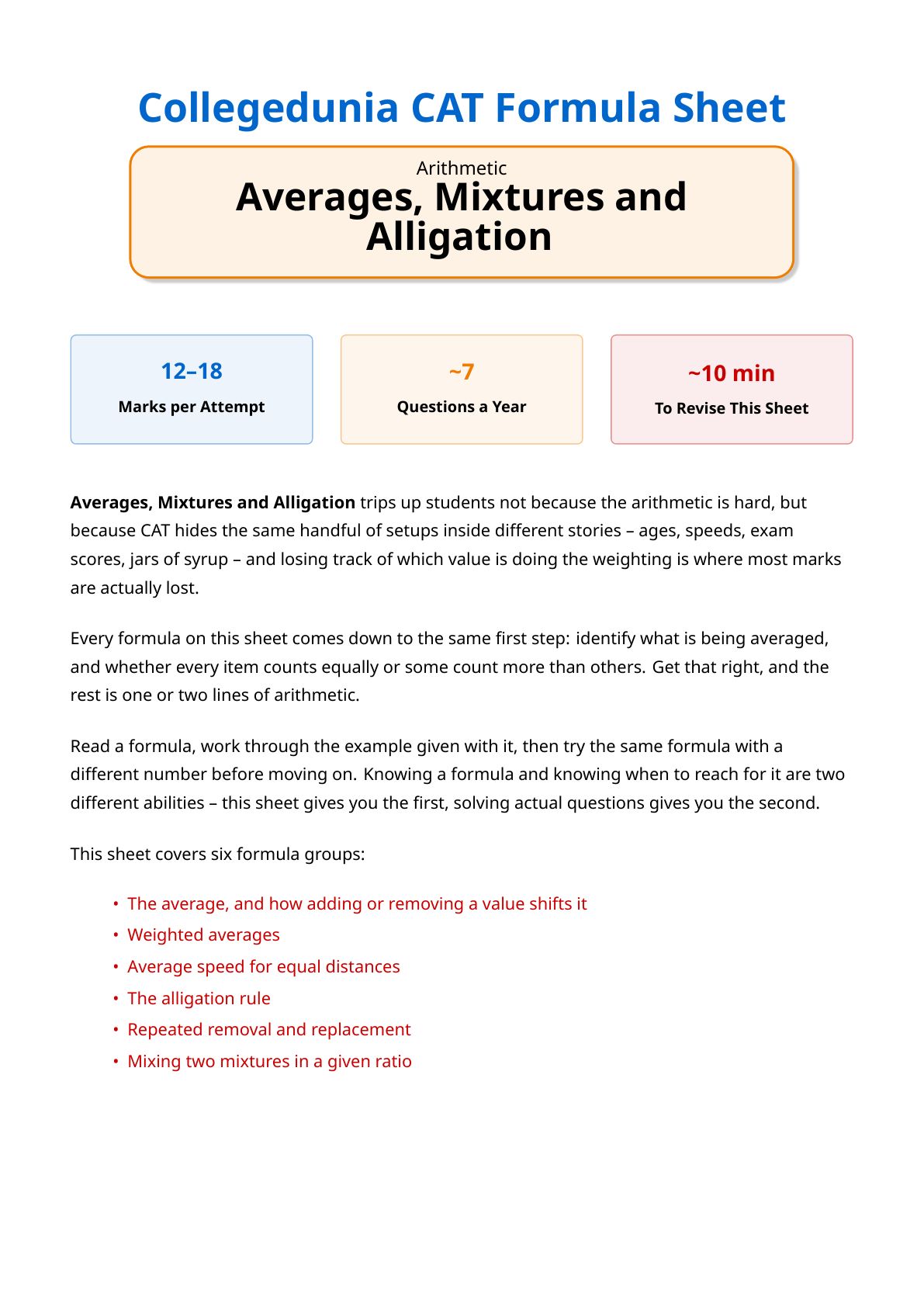
CAT Averages, Mixtures and Alligation formula sheet, free to download as a 6-page PDF. The topic carries about 12 to 18 marks across roughly 7 questions a year, and takes roughly ten minutes to work through, so it belongs in your final revision.
The sheet covers all six formula groups in real notation, a 10-year weightage table, two real CAT questions with full solutions, and a concept video.
Built for revision, so every line trades explanation for speed. Read the working behind each formula in the full Averages, Mixtures and Alligation notes before leaning on this sheet.
Averages, Mixtures and Alligation Weightage in CAT: Previous Year Questions Analysis
As per CAT Averages, Mixtures and Alligation weightage from past years, students can expect 6-7 questions from this topic every year, with 2021 as the highest-yielding year at 12 questions. This figure combines three closely related tags in the tagged past-paper data (Averages, Mixture Problems, and Mixtures and Alligations), since CAT does not release an official chapter-wise weightage of its own.
| Year | Questions |
|---|---|
| 2025 | 9 |
| 2024 | 7 |
| 2023 | 7 |
| 2022 | 11 |
| 2021 | 12 |
| 2020 | 6 |
| 2019 | 4 |
| 2018 | 6 |
| 2017 | 5 |
| 2016 | 3 |
| 10-Year Average | ~7.0 |
This is one of the heavier Arithmetic topics on the paper, and the count has stayed at 4 or more every single year since 2016. Averages also feeds directly into other topics − a Time, Speed and Distance or Data Interpretation question routinely needs the same weighted-average logic taught here.
Average Formula for CAT: How to Calculate Simple and Weighted Averages
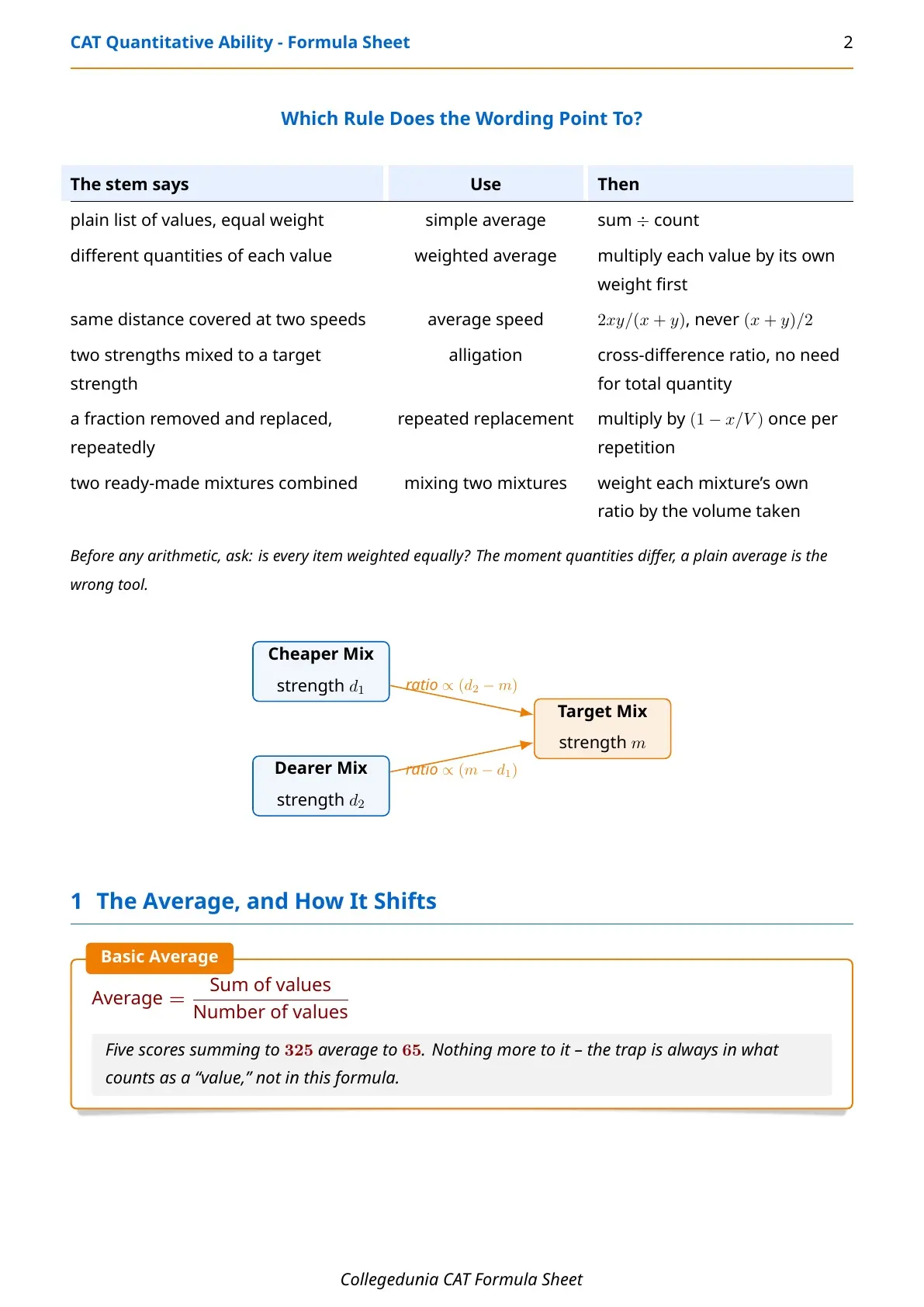
A plain average assumes every value counts equally − the moment quantities differ, it stops being the right tool:
Five scores summing to 325 average to 65. The formula itself is never the hard part; identifying what counts as a "value" is.
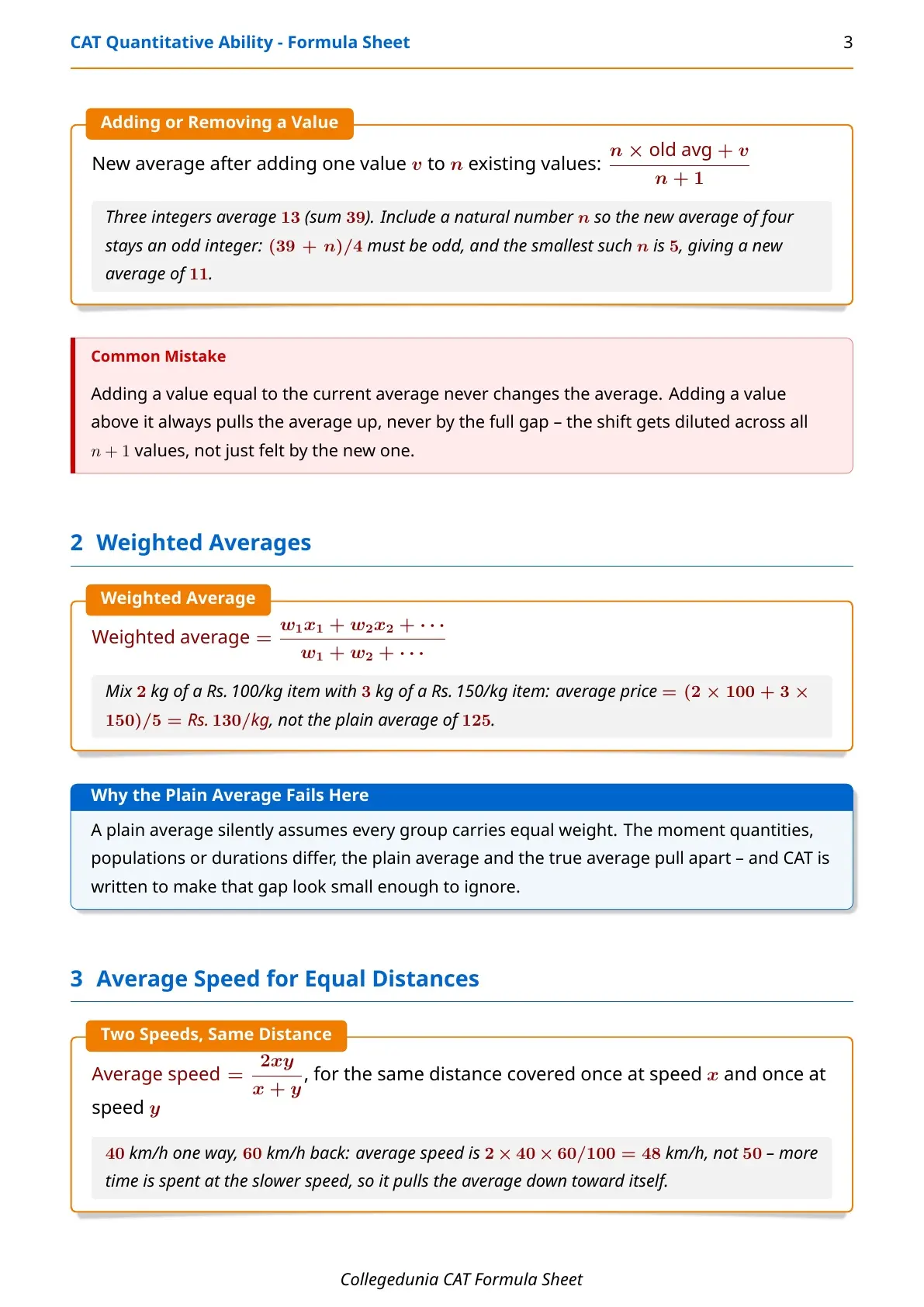
Adding or removing one value shifts the average by less than the new value's own gap from it, since the shift gets diluted across every value, not just the new one:
When quantities differ, a weighted average replaces the plain one:
2 kg of a Rs.100/kg item mixed with 3 kg of a Rs.150/kg item averages to Rs.130/kg, not the plain average of Rs.125 − the heavier quantity pulls the average toward itself.
CAT 2022 (Slot 1). The average of three integers is 13, so their sum is 39. Include a natural number n so the new average of four integers stays an odd integer: (39+n)/4 must be odd, and the smallest such n is 5, giving a new average of 11.
Average Speed Formula for CAT: Why 2xy/(x+y) Not (x+y)/2
Covering the same distance once at speed x and once at speed y never averages to (x+y)/2 − that formula only applies when the time at each speed is equal, not the distance:
40 km/h one way and 60 km/h back averages to 2 × 40 × 60 / 100 = 48 km/h, not 50 − more time is spent at the slower speed, so it pulls the average down toward itself. Confusing distance-equal with time-equal is the single most common error in this section.
Alligation Rule for CAT: How to Mix Two Quantities to a Target Strength
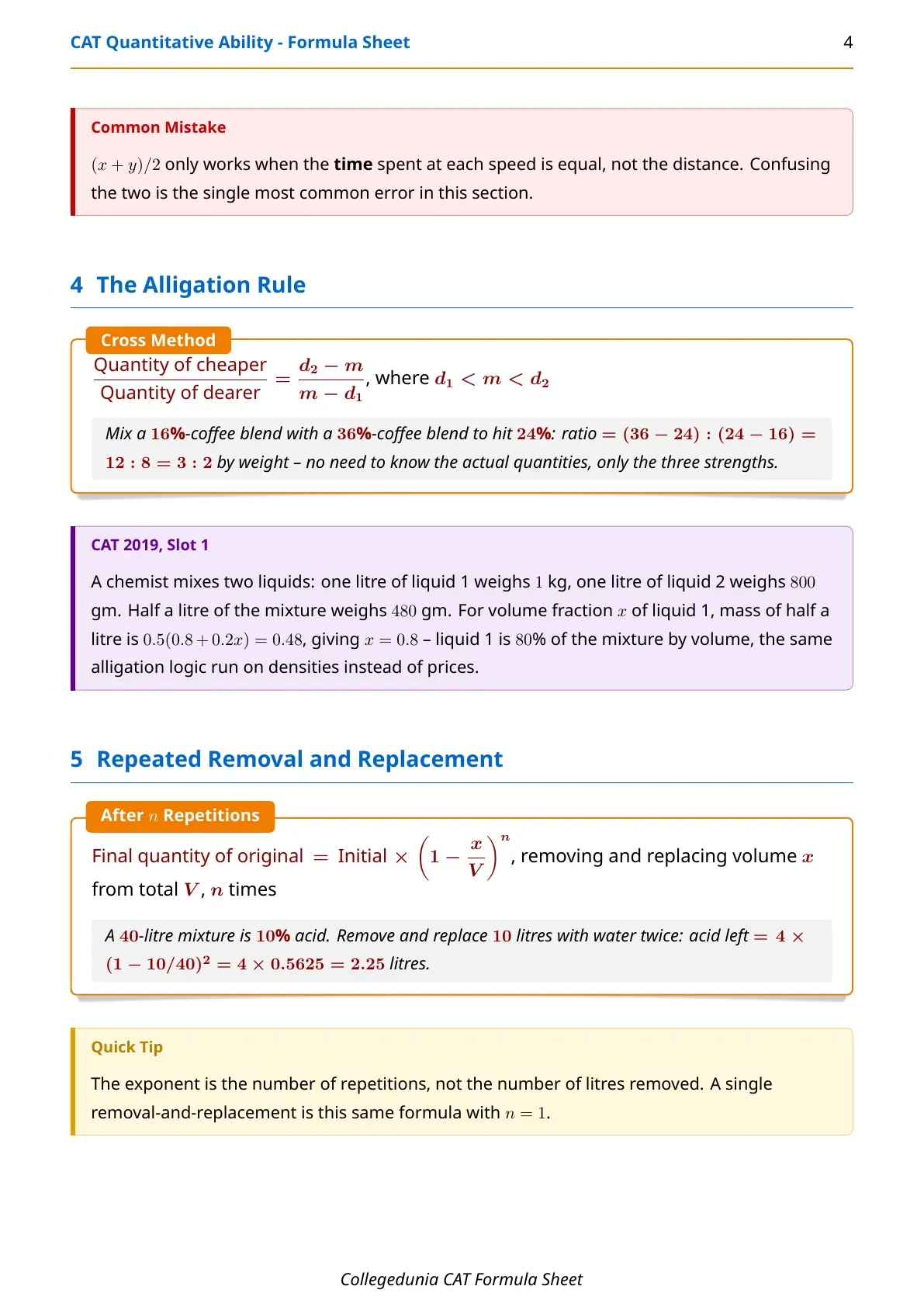
The alligation rule finds the ratio in which two strengths must be mixed to hit a target strength, without ever needing the actual quantities:
Mixing a 16%-coffee blend with a 36%-coffee blend to hit 24% needs a ratio of (36−24):(24−16) = 12:8 = 3:2 by weight − only the three strengths matter, not the actual amounts.
CAT 2019 (Slot 1). A chemist mixes two liquids: one litre of liquid 1 weighs 1 kg, one litre of liquid 2 weighs 800 gm, and half a litre of the mixture weighs 480 gm. For volume fraction x of liquid 1, 0.5(0.8 + 0.2x) = 0.48 gives x = 0.8, so liquid 1 is 80% of the mixture by volume − the same alligation logic run on densities instead of prices.
Repeated Replacement Formula in Mixtures: How to Solve Removal and Replacement Problems
When a fraction of a mixture is removed and replaced with a pure substance, repeating the process n times compounds the loss:
A 40-litre mixture that is 10% acid has 4 litres of acid. Removing and replacing 10 litres with water twice leaves 4 × (1−10/40)² = 4 × 0.5625 = 2.25 litres of acid. The exponent counts repetitions, not litres removed − a single removal-and-replacement is this same formula with n=1.
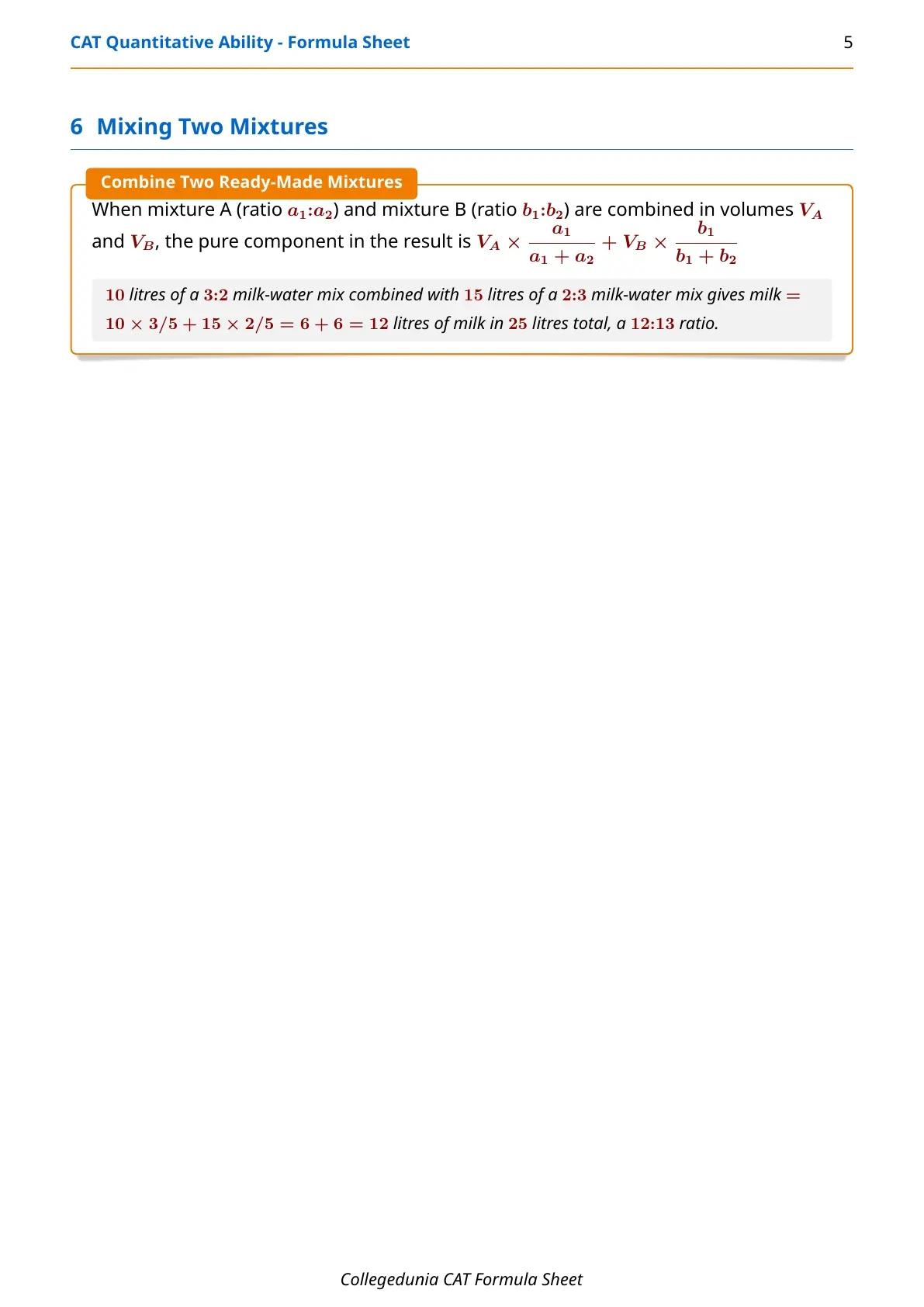
Mixing Two Mixtures Formula for CAT Quantitative Aptitude
When two ready-made mixtures with different ratios are combined, each one's own ratio has to be weighted by the volume actually taken from it:
10 litres of a 3:2 milk-water mix combined with 15 litres of a 2:3 milk-water mix gives milk = 10 × 3/5 + 15 × 2/5 = 6 + 6 = 12 litres of milk in 25 litres total, a 12:13 ratio.
Averages and Mixtures Questions for CAT with Solutions PDF
Averages, Mixtures and Alligation questions in CAT rarely test one formula in isolation. Below are two real CAT questions with solutions:
Q1 (CAT 2022, Slot 1). The average of three integers is 13. When a natural number n is included, the average of these four integers remains an odd integer. The minimum possible value of n is
(a) 3 (b) 4 (c) 5 (d) 1
Show Solution
- Step 1: The average of three integers is 13, so their sum is 3 × 13 = 39.
- Step 2: Adding a natural number n, the new sum is 39 + n and the new average is (39+n)/4.
- Step 3: This new average must be an odd integer, so 39+n must be divisible by 4 with an odd quotient.
- Step 4: Checking n = 1 gives sum 40, average 10 (even, fails). Checking n = 5 gives sum 44, average 11 (odd, works).
- Step 5: n = 5 is the smallest natural number satisfying both conditions.
Answer: (c) 5
Q2 (CAT 2019, Slot 1). A chemist mixes two liquids 1 and 2. One litre of liquid 1 weighs 1 kg and one litre of liquid 2 weighs 800 gm. If half litre of the mixture weighs 480 gm, then the percentage of liquid 1 in the mixture, in terms of volume, is
(a) 80 (b) 70 (c) 85 (d) 75
Show Solution
- Step 1: Let x be the volume fraction of liquid 1 in the mixture, so (1−x) is the fraction of liquid 2.
- Step 2: One litre of liquid 1 weighs 1 kg, one litre of liquid 2 weighs 0.8 kg, so one litre of the mixture weighs (x × 1 + (1−x) × 0.8) kg = (0.8 + 0.2x) kg.
- Step 3: Half a litre of the mixture weighs 0.48 kg, so a full litre weighs 0.96 kg: 0.8 + 0.2x = 0.96.
- Step 4: Solving: 0.2x = 0.16, so x = 0.8.
- Step 5: Liquid 1 makes up 80% of the mixture by volume.
Answer: (a) 80
Neither question is answered by a single formula on this sheet on its own − both need the base setup chained with another relation, which is the real skill this sheet is meant to build.
Averages, Mixtures and Alligation Concept Video for CAT with Solved Examples
Source: MBA Wallah
How to Revise Averages, Mixtures and Alligation Before CAT
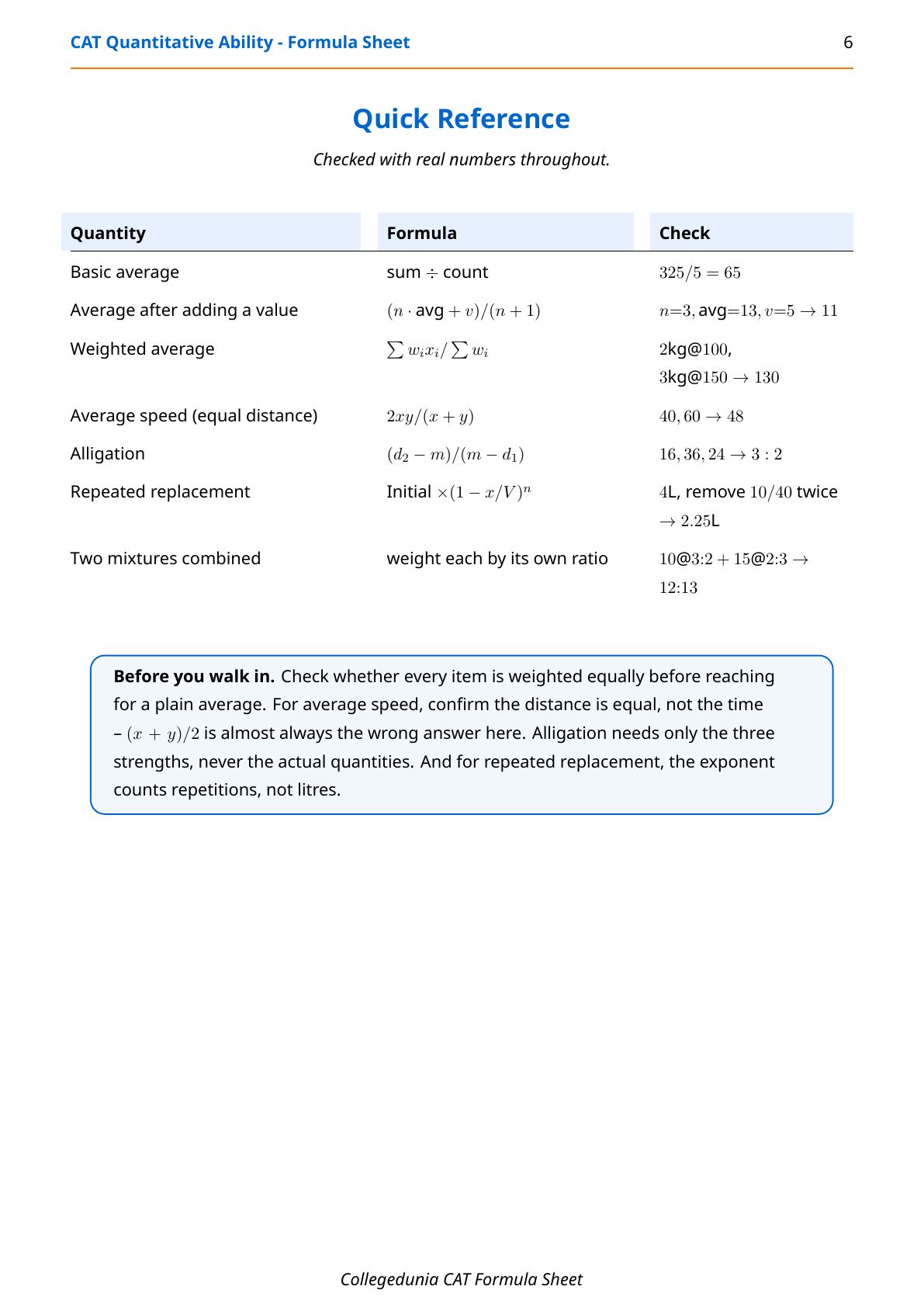
The closing page repeats every formula in one table, each checked against real numbers.
- Cover the formula column and reproduce it from the quantity name
- Ask whether every item is weighted equally before reaching for a plain average
- Re-derive the alligation ratio from the cross method rather than memorising the final expression alone
- Check whether a speed question holds distance or time equal before picking a formula
CAT Averages, Mixtures and Alligation Formula Sheet FAQs
Ques. Is average speed always (x+y)/2 for two speeds?
Ans. No. That formula only applies when the time spent at each speed is equal. When the distance is equal instead, the correct formula is 2xy/(x+y), which is always less than or equal to the plain average.
Ques. Does the alligation rule need the actual quantities being mixed?
Ans. No. Alligation only needs the three strengths − the cheaper mix, the dearer mix, and the target − to find the ratio in which they combine. The actual volumes are never required.
Ques. How is the repeated replacement formula different from a single replacement?
Ans. A single removal-and-replacement is Initial × (1 − x/V). Repeating it n times raises the same factor to the power n, which is why the loss compounds rather than adding up linearly.
Ques. Why does Averages, Mixtures and Alligation carry higher weightage than most other Arithmetic topics?
Ans. The tagged data combines three related chapters − Averages, Mixture Problems, and Mixtures and Alligations − which are usually taught and tested together, so the combined count runs higher than a single-formula topic like Percentages or Profit and Loss.
Ques. Can the PDF be downloaded for free?
Ans. Yes. All 6 pages can be read on this page or downloaded at no cost, so it can be printed or kept on a phone for last-minute revision.



Comments