




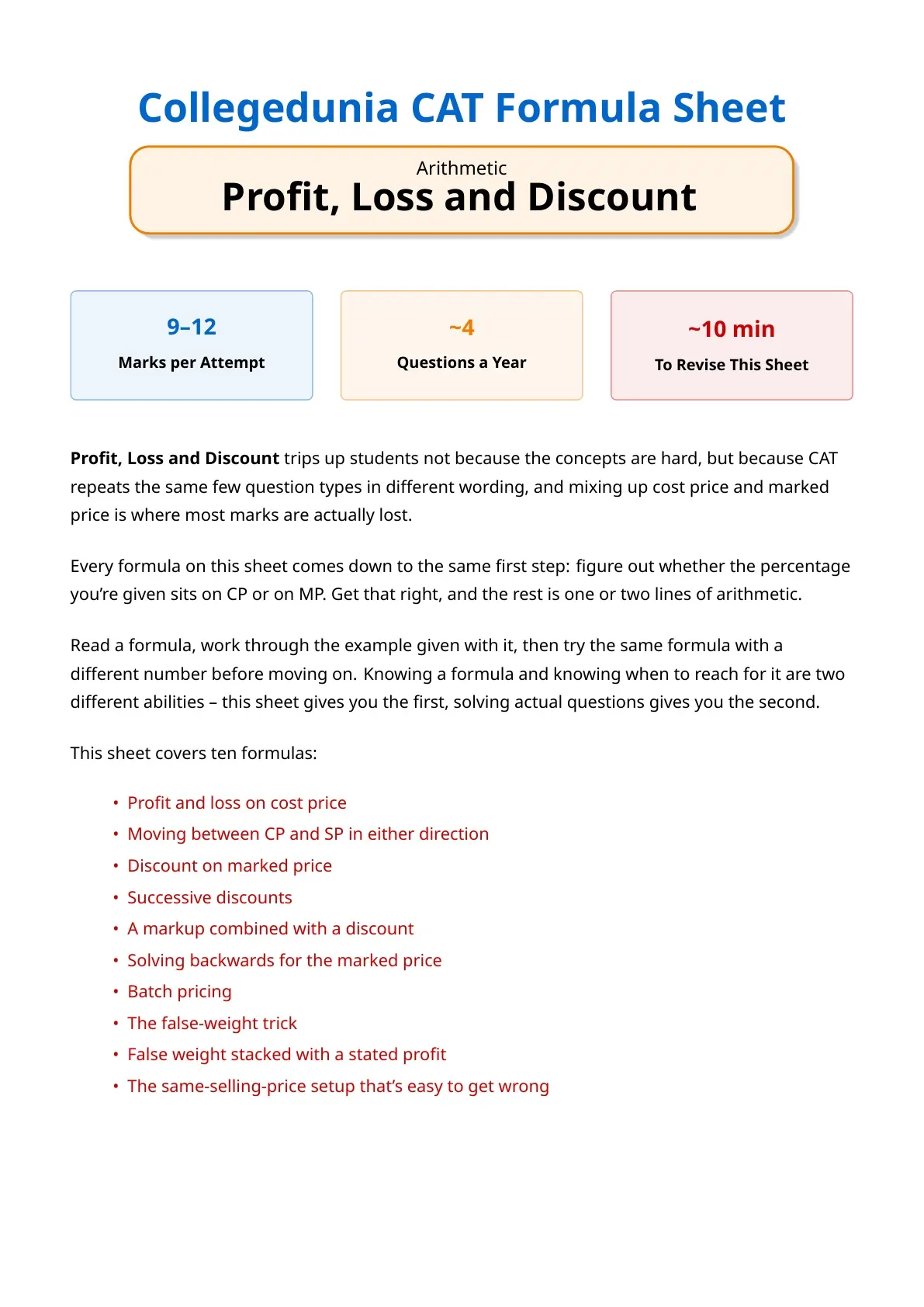
CAT Profit, Loss and Discount formula sheet, free to download as a 7-page PDF. The topic carries about 9 to 12 marks across roughly 4 questions a year, and takes roughly ten minutes to work through, so it belongs in your final revision.
The sheet covers all ten formulas in real notation, a 15-year weightage table, two real CAT questions with full solutions, and a concept video.
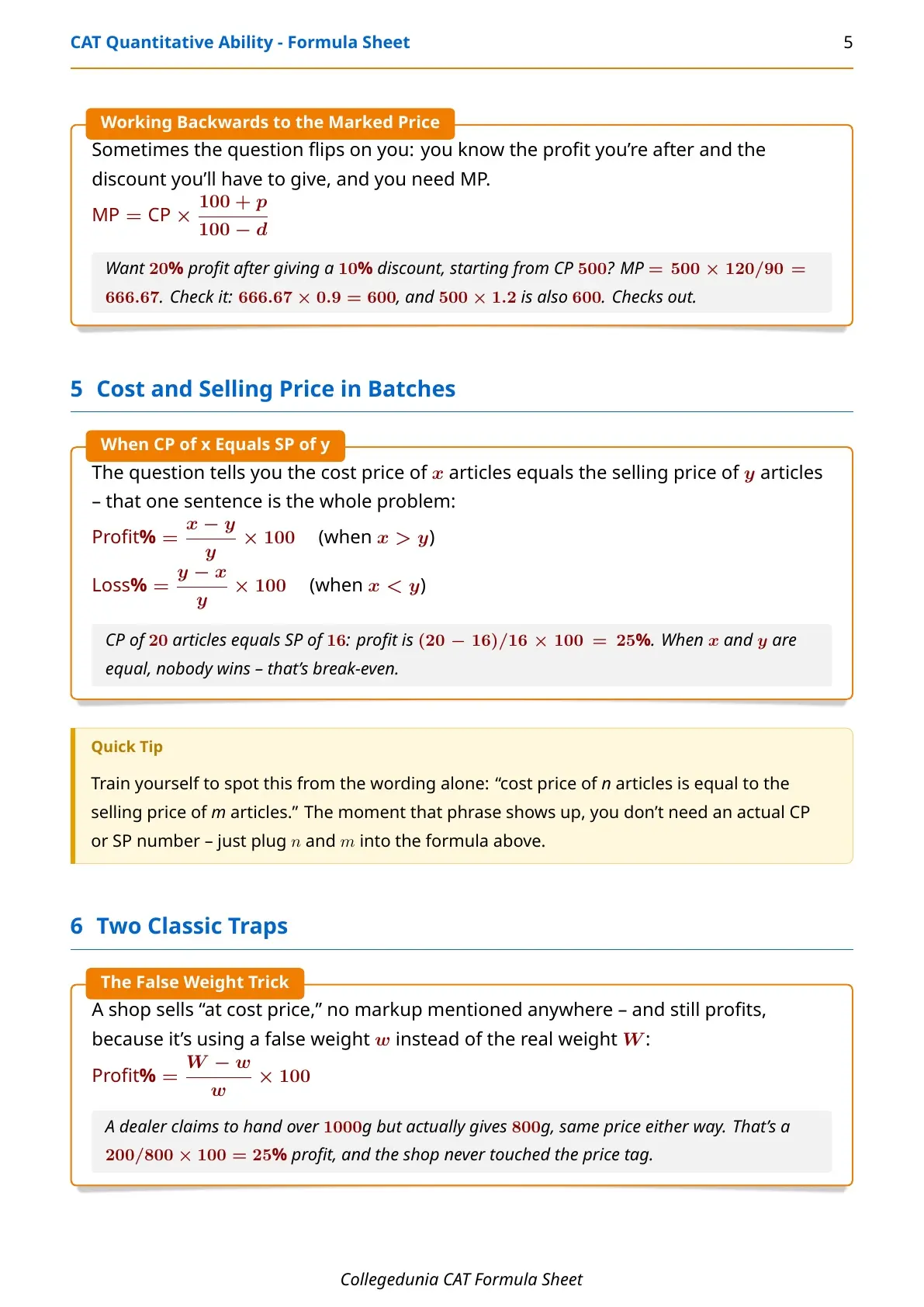
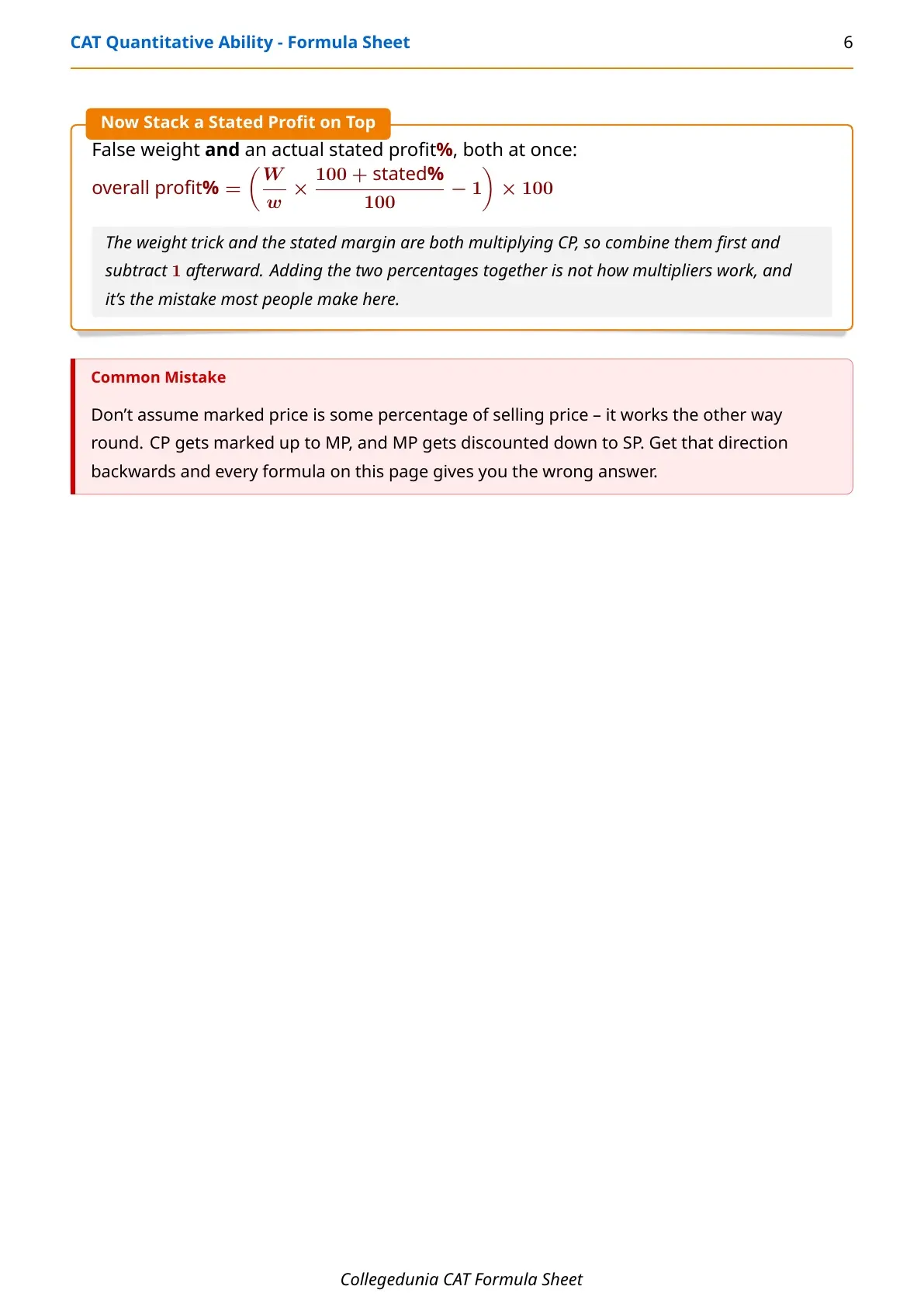
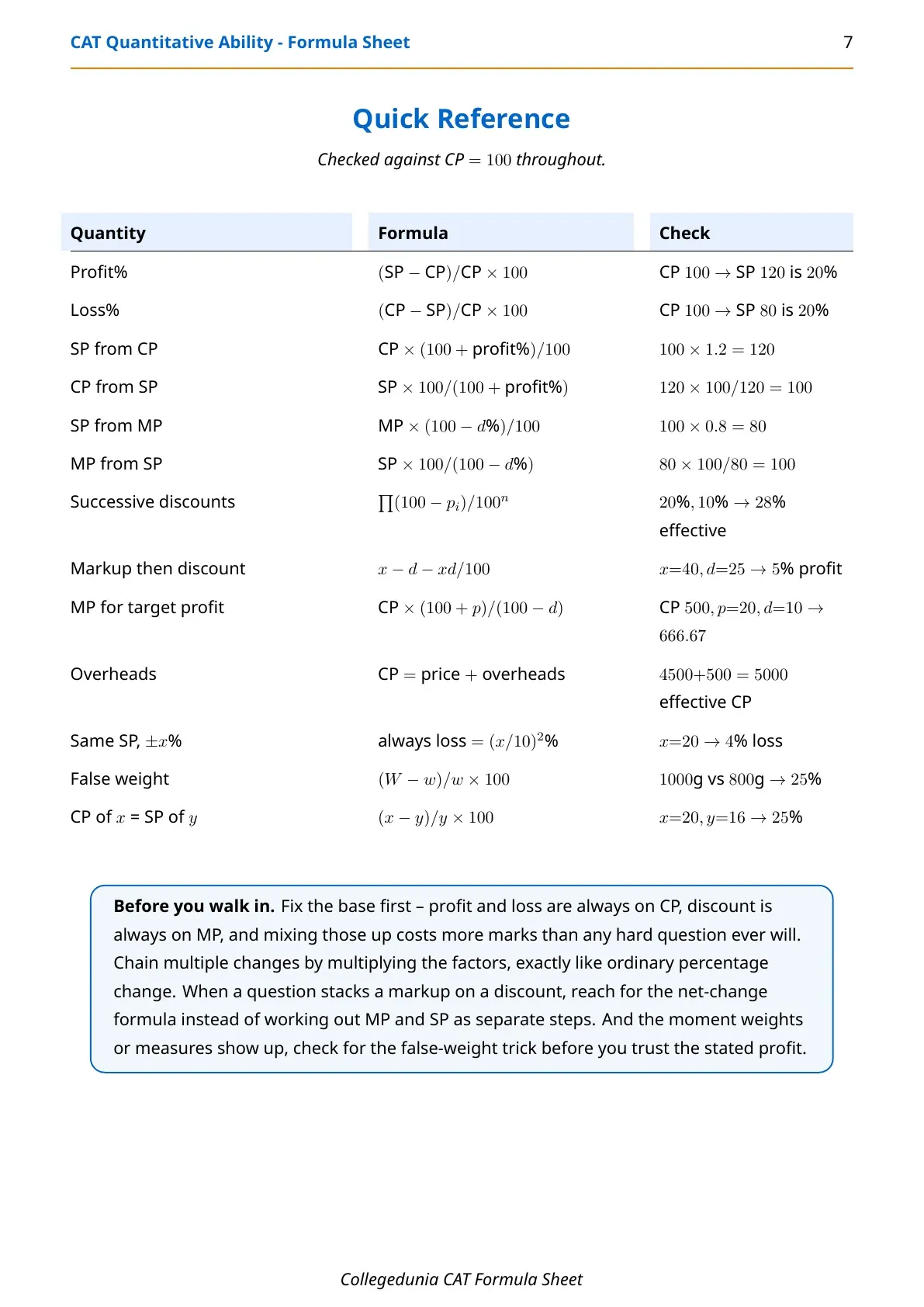
Built for revision, so every line trades explanation for speed. Read the working behind each formula in the full Profit, Loss and Discount notes before leaning on this sheet.
Profit and Loss Weightage in CAT: Previous Year Questions Analysis
As per CAT Profit and Loss weightage from past years, students can expect 3-5 questions from this topic every year, with 2016 as the highest-yielding year at 7 questions. CAT does not release an official chapter-wise weightage, so the numbers below are based on tagging every question from the released papers by topic and year, going back to 2011.
| Year | Questions |
|---|---|
| 2025 | 5 |
| 2024 | 4 |
| 2023 | 4 |
| 2022 | 3 |
| 2021 | 5 |
| 2020 | 4 |
| 2019 | 2 |
| 2018 | 2 |
| 2017 | 6 |
| 2016 | 7 |
| 2015 | 6 |
| 2014 | 5 |
| 2013 | 2 |
| 2012 | 1 |
| 2011 | 3 |
| 15-Year Average | ~4 |
As per CAT exam pattern and topic-wise weightage from recent papers, the count has stayed in the 3-to-5 range every year since 2020, making Profit and Loss one of the more consistently-asked Arithmetic topics in CAT QA. Discount is rarely tested as a standalone question − in most years it is combined with a Profit and Loss question instead of being asked on its own, which is why both topics are covered together on this sheet.
Profit and Loss Formula for CP, SP and Discount: Which Base to Use
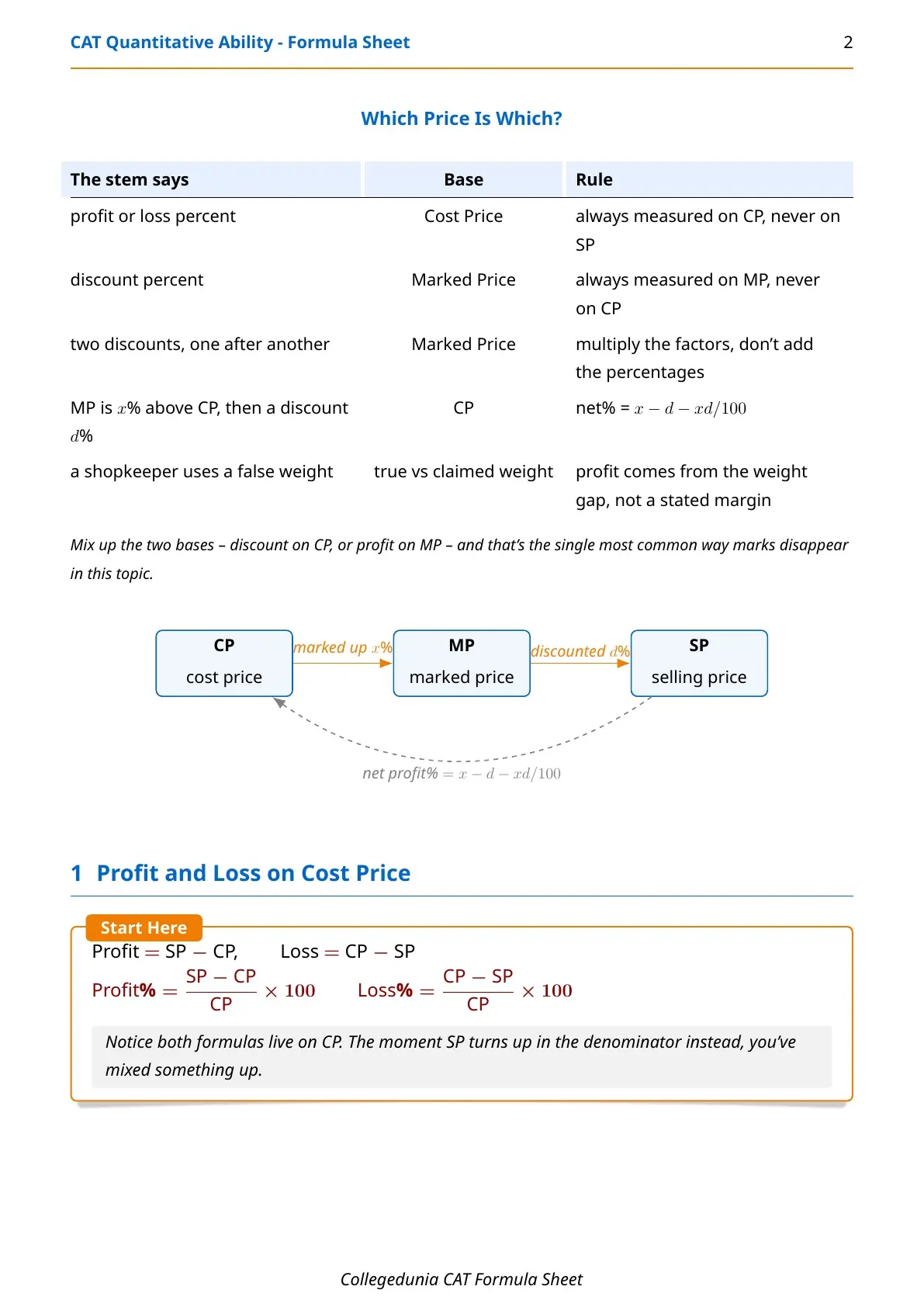
Every Profit and Loss question is built on one of two bases − Cost Price for profit and loss, and Marked Price for discount − and mixing the two up is the single most common way marks are lost in this topic.
Profit and loss are both measured on Cost Price, never on SP:
Discount% is read the same way, but off Marked Price instead:
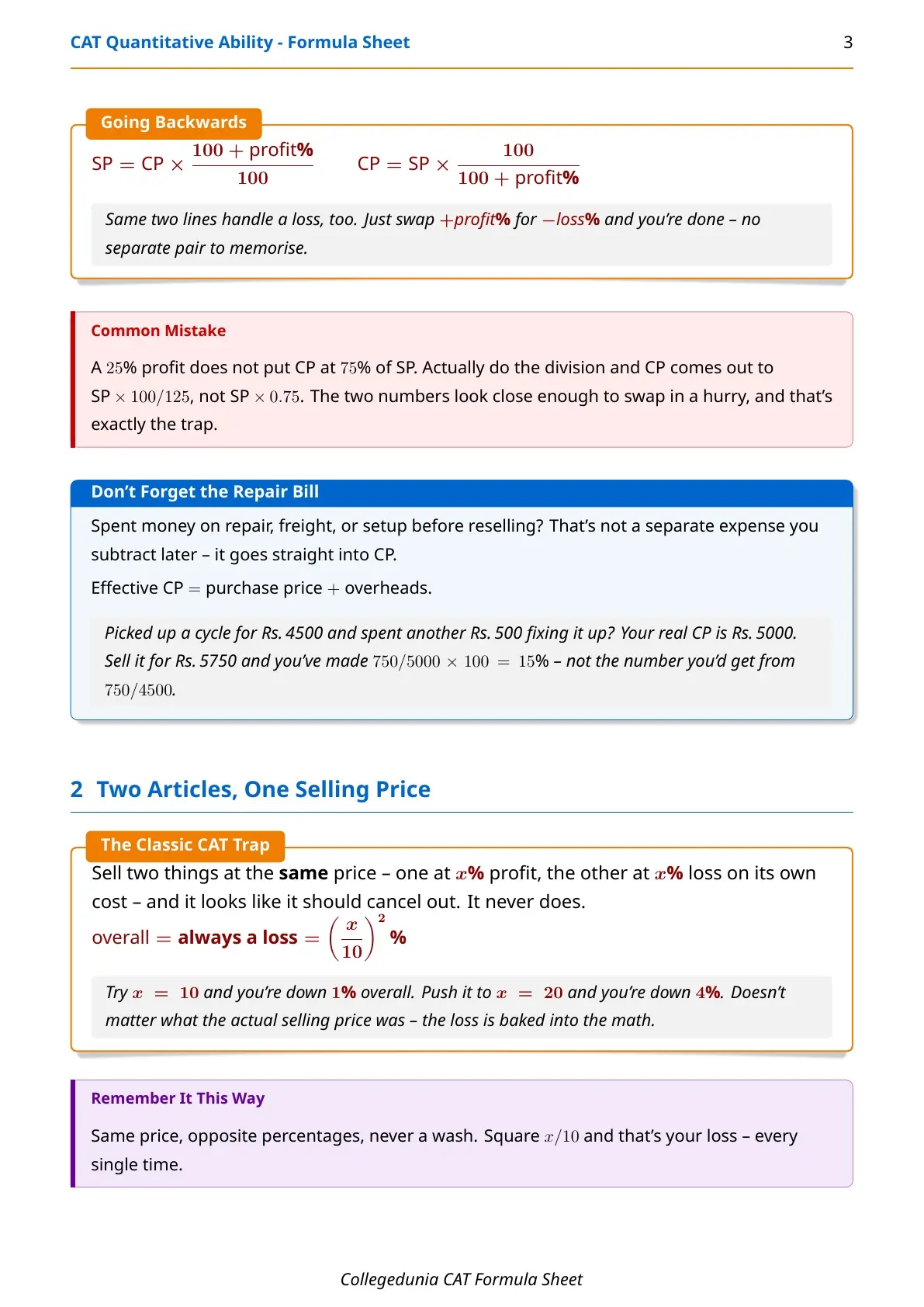
A profit of 25% does not put CP at 75% of SP; CP = SP × 100/125.
Repair, freight or installation costs paid before resale count toward CP too, added before the profit percentage is worked out. A cycle bought for Rs.4500 with Rs.500 spent on repair has an effective CP of Rs.5000, so a sale at Rs.5750 is a 15% profit, not 750/4500.
Profit and Loss Shortcut Tricks for CAT Quantitative Aptitude
CAT reuses one setup often enough to earn its own shortcut. Sell two articles at the same SP, one at x% profit and the other at x% loss on its own CP, and you always end up at a loss:
At x = 10 that's a 1% loss; at x = 20 it's 4%.
The result never depends on what the actual SP was, and it is never break-even, even though the two percentages look like they should cancel.
CAT 2023 (Slot 1) built a harder version of the same trick. Gita sells two objects at one equal price: 20% profit on the first, 10% loss on the second. She then raises both to a new equal price, and the second object now sells at 10% profit. The question asks for the resulting profit on the first.
The equal-price setup is the same shortcut as above. Swapping a matched x and x for 20% and 10% is what turns a giveaway into a real question. Work the cost price of each object off the first selling price, then carry both into the second selling price. The profit on the first object comes out to about 47%.
Successive Discount Formula: How to Calculate Two Successive Discounts
Successive discount questions are common in the CAT Arithmetic section, and most marks are lost by simply adding the discount percentages instead of multiplying them.
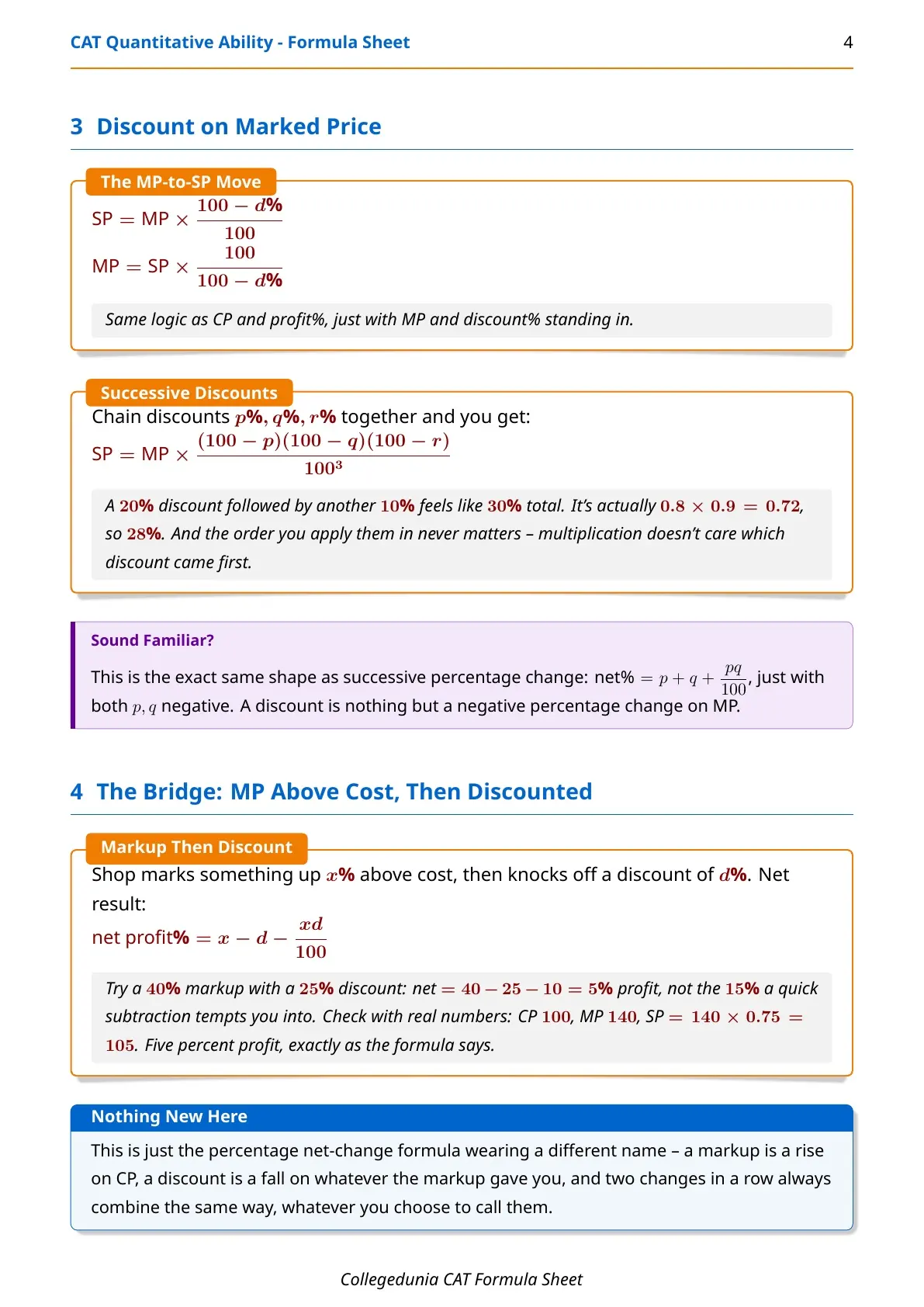
For discounts p%, q%, r% in sequence:
20% then 10% off multiplies to 0.8 × 0.9 = 0.72, an effective 28% off, not 30%. Order never changes the total, since multiplication commutes.
When a markup is followed by a discount, the two combine into one net change:
A markup of 40% followed by a 25% discount nets 40 − 25 − 10 = 5% profit, not the 15% a quick subtraction would suggest.
Running that formula backwards gives the marked price needed for a target profit:
For a target profit of 20% after a 10% discount on CP 500, MP = 500 × 120/90 = 666.67, which checks out at 666.67 × 0.9 = 600 = 500 × 1.2.
Batch Pricing Formula in Profit and Loss: CP of x Articles Equal to SP of y
Batch pricing questions describe the cost price of one quantity of articles as equal to the selling price of another, without stating an actual CP or SP value.
CP of 20 articles = SP of 16: profit = (20−16)/16 × 100 = 25%. Spot this setup from wording like "cost price of n articles equals the selling price of m articles."
False Weight Trick in Profit and Loss: How Shopkeepers Profit Without a Markup
The false weight trick is a frequently tested concept in CAT Profit and Loss, where a shopkeeper earns profit without applying any stated markup.
A shop can advertise no markup at all and still profit, by handing over less than the stated weight:
Claiming 1000g but delivering 800g gives a 25% profit at the same sticker price, with no stated markup at all.
Combined with a stated profit% on top, the false weight and the markup multiply together rather than add:
The weight gain and the stated margin both act as multipliers on cost price, so combine them before subtracting 1, never by adding the two percentages.
Profit, Loss and Discount Questions for CAT with Solutions PDF
Profit, Loss and Discount questions in CAT are rarely solved with a single formula and usually combine two or more of the relations above. Below are two real CAT questions with solutions:
Q1 (CAT 2024, Slot 3). Gopi marks a price on a product in order to make 20% profit. Ravi gets a 10% discount on this marked price, and thus saves Rs.15. Then, the profit, in rupees, made by Gopi by selling the product to Ravi, is
(a) 10 (b) 25 (c) 15 (d) 20
Show Solution
- Step 1: The 10% discount saving fixes the marked price: 10% of MP = Rs.15, so MP = Rs.150.
- Step 2: Since MP is 20% above CP, CP = MP/1.2 = 150/1.2 = Rs.125.
- Step 3: The actual selling price after the 10% discount is SP = MP × 0.9 = 150 × 0.9 = Rs.135.
- Step 4: Profit = SP − CP = 135 − 125 = Rs.10, not the Rs.15 a quick read suggests.
Answer: (a) Rs.10
Q2 (CAT 2025, Slot 2). An item with a cost price of Rs.1650 is sold at a certain discount on a fixed marked price to earn a profit of 20% on the cost price. If the discount was doubled, the profit would have been Rs.110. The rate of discount, in percentage, at which the profit percentage would be equal to the rate of discount, is nearest to
(a) 16 (b) 18 (c) 14 (d) 12
Show Solution
- Step 1: At the original discount, SP = 1.2 × 1650 = Rs.1980, so MP × (1−d) = 1980.
- Step 2: If the discount is doubled, SP = 1650 + 110 = Rs.1760, so MP × (1−2d) = 1760.
- Step 3: Subtracting the two equations gives MP × d = 220.
- Step 4: Substituting back into the first equation: MP − 220 = 1980, so MP = Rs.2200, and the original discount d = 220/2200 = 10%.
- Step 5: Now find the rate r at which profit% equals discount%: SP = 2200(1−r), and profit% = [2200(1−r) − 1650]/1650 × 100.
- Step 6: Setting this equal to 100r and solving gives r = 550/3850 = 1/7, or about 14.29%.
Answer: (c) 14%
Neither question is answered by a single formula on this sheet on its own − both need two of the relations above chained together, which is the real skill this sheet is meant to build.
Profit and Loss Concept Video for CAT with Solved Examples
Source: MBA Wallah
How to Revise Profit, Loss and Discount Before CAT
The final days before CAT should focus on quick recall rather than fresh learning.
The closing page repeats every formula in one table, each checked against a cost price of 100.
- Cover the formula column and reproduce it from the quantity name
- Fix which base each line uses before writing anything down
- Re-derive the markup-then-discount formula rather than memorising the final expression alone
- Check for a false-weight trick whenever a question mentions weights or measures
CAT Profit Loss Discount Formula Sheet FAQs
Ques. Is discount always calculated on cost price?
Ans. No. Discount is always calculated on marked price, while profit and loss are always calculated on cost price. Mixing the two bases is the single most common error in this topic.
Ques. Do two successive discounts of 20% and 10% add up to 30% off?
Ans. No. The discounts multiply as factors: 0.8 times 0.9 gives 0.72, an effective 28% off. Successive discounts always give a smaller total than adding the two percentages.
Ques. If I sell two items at the same price, one at a 10% profit and one at a 10% loss, do I break even?
Ans. No. The result is always a small loss, equal to (x/10) squared percent. At 10%, that works out to a 1% loss overall, purely because the two items had different cost prices even though they sold for the same amount.
Ques. How common is the false weight trick in CAT?
Ans. It appears regularly inside profit and loss sets, usually disguised as a shop selling at cost price while using a lighter weight. The profit comes entirely from the weight gap.
Ques. Can the PDF be downloaded for free?
Ans. Yes. All 7 pages can be read on this page or downloaded at no cost, so it can be printed or kept on a phone for last-minute revision.



Comments