



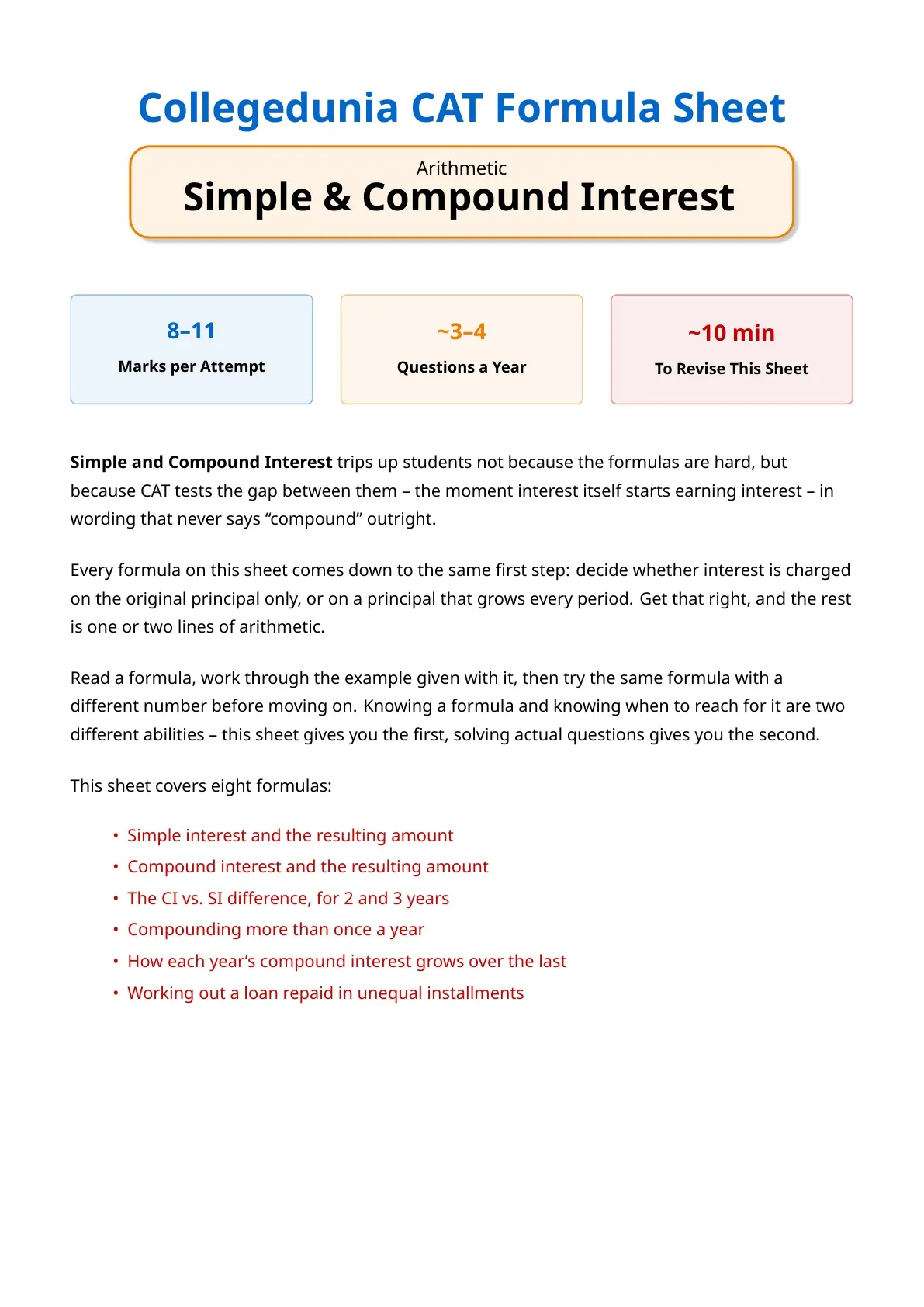
CAT Simple Interest and Compound Interest formula sheet, free to download as a 6-page PDF. The topic carries about 8 to 11 marks across roughly 3 to 4 questions a year, and takes roughly ten minutes to work through, so it belongs in your final revision.
The sheet covers all eight formulas in real notation, an 8-year weightage table, two real CAT questions with full solutions, and a concept video.
Built for revision, so every line trades explanation for speed. Read the working behind each formula in the full Simple Interest and Compound Interest notes before leaning on this sheet.
Simple Interest and Compound Interest Weightage in CAT: Previous Year Questions Analysis
As per CAT Simple Interest and Compound Interest weightage from past years, students can expect 3-4 questions from this topic every year, with 2020 as the highest-yielding year at 6 questions. CAT does not release an official chapter-wise weightage, so the numbers below are based on tagging every question from the released papers by topic and year.
| Year | Questions |
|---|---|
| 2025 | 3 |
| 2024 | 4 |
| 2023 | 3 |
| 2022 | 5 |
| 2021 | 2 |
| 2020 | 6 |
| 2019 | 3 |
| 2018 | 2 |
| 8-Year Average | ~3.5 |
Compound interest questions outnumber pure simple-interest ones in recent papers − most years mix in a half-yearly or successive-year twist rather than testing the plain SI formula alone, which is why this sheet spends more sections on compound interest than on simple.
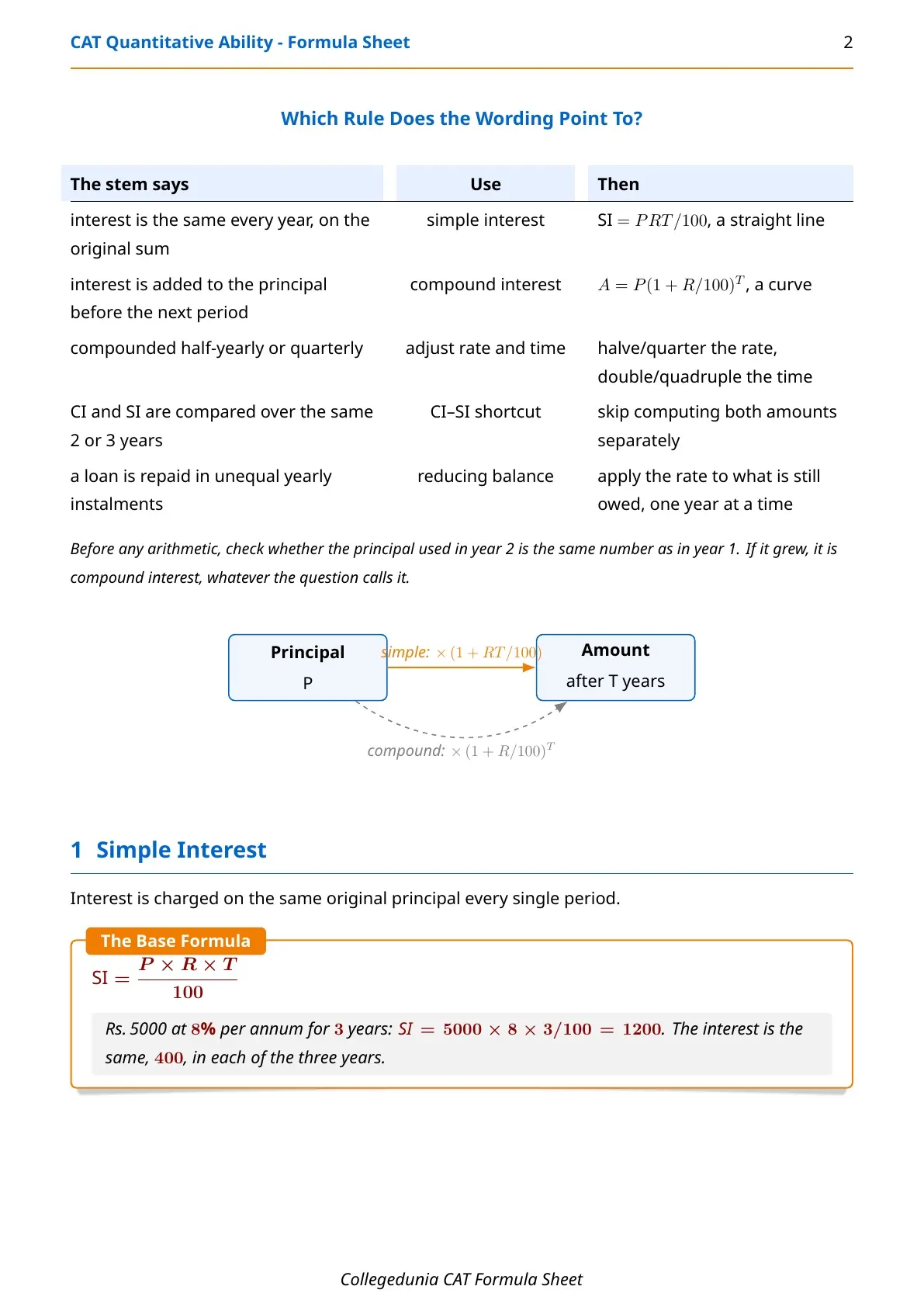
Simple Interest Formula for CAT: How to Calculate SI and Amount
Simple interest charges the same original principal every single period, so the interest earned is identical year after year.
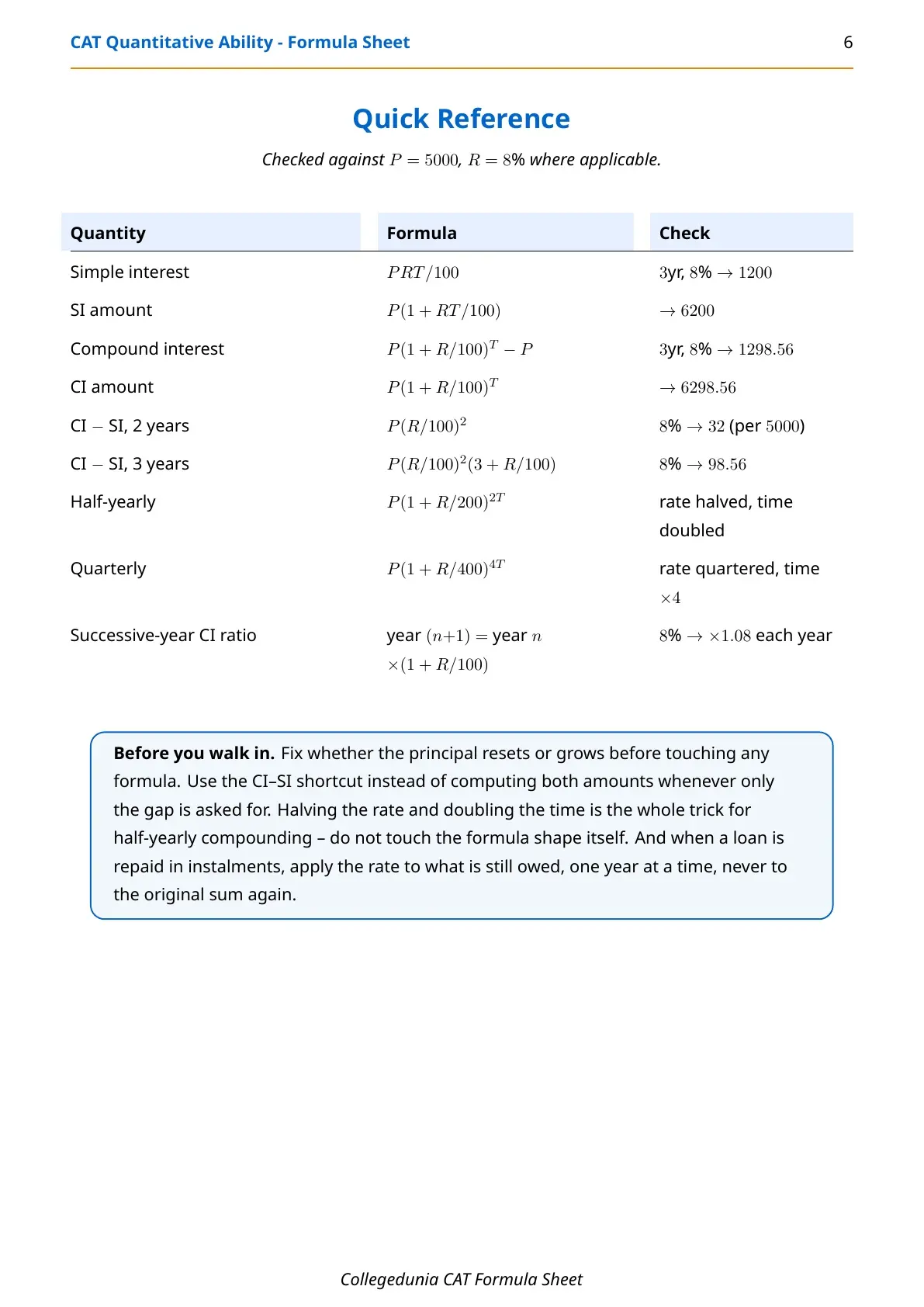
Rs.5000 at 8% per annum for 3 years gives SI = 5000 × 8 × 3/100 = 1200, with Rs.400 of that added in each of the three years − a straight line, not a curve.
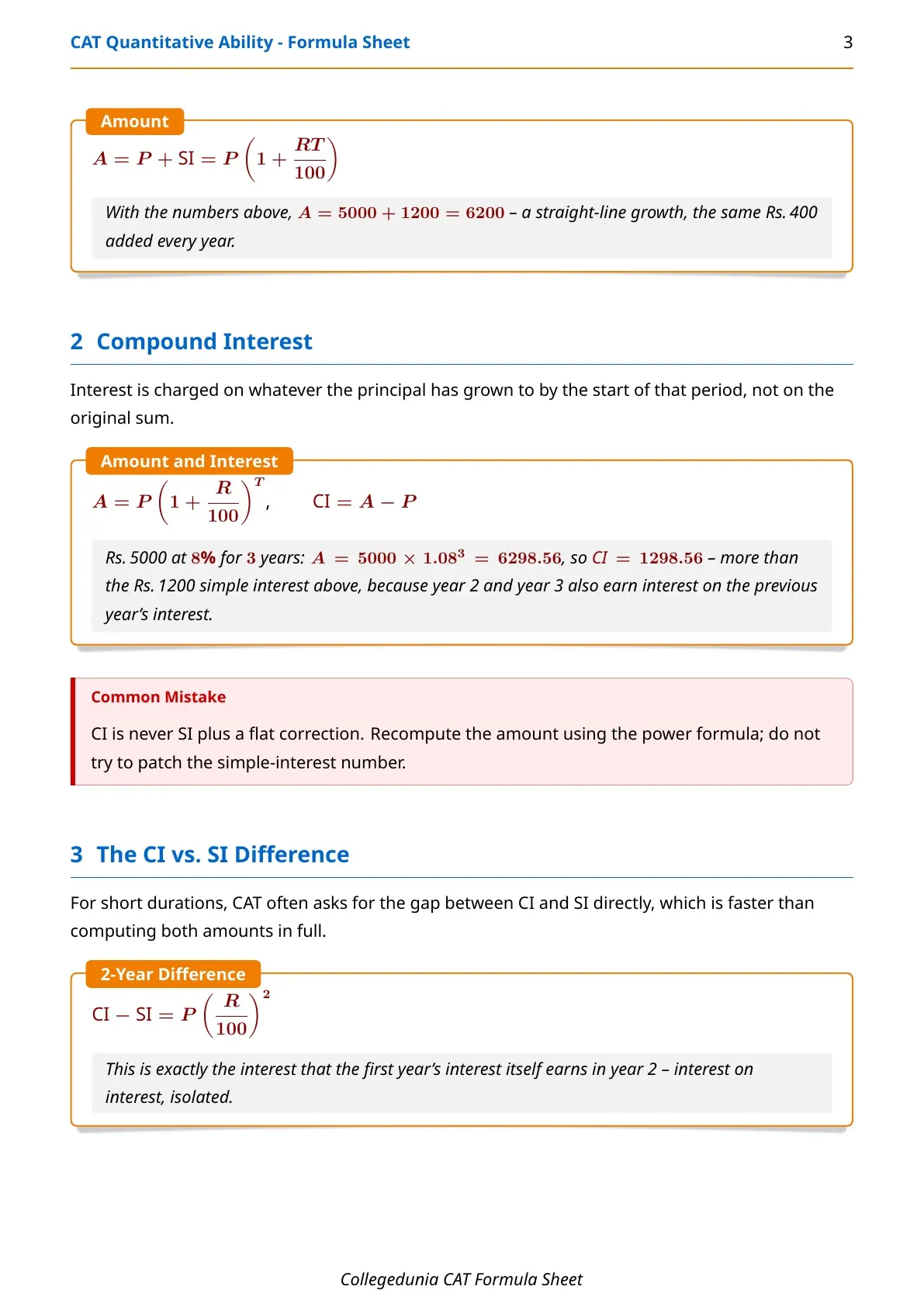
Compound Interest Formula for CAT: How to Calculate CI and Amount
Compound interest charges the rate on whatever the principal has grown to by the start of that period, not on the original sum.
The same Rs.5000 at 8% for 3 years gives an amount of 5000 × 1.08³ = 6298.56, so CI = 1298.56 − higher than the Rs.1200 simple interest, because years 2 and 3 also earn interest on the previous year's interest.
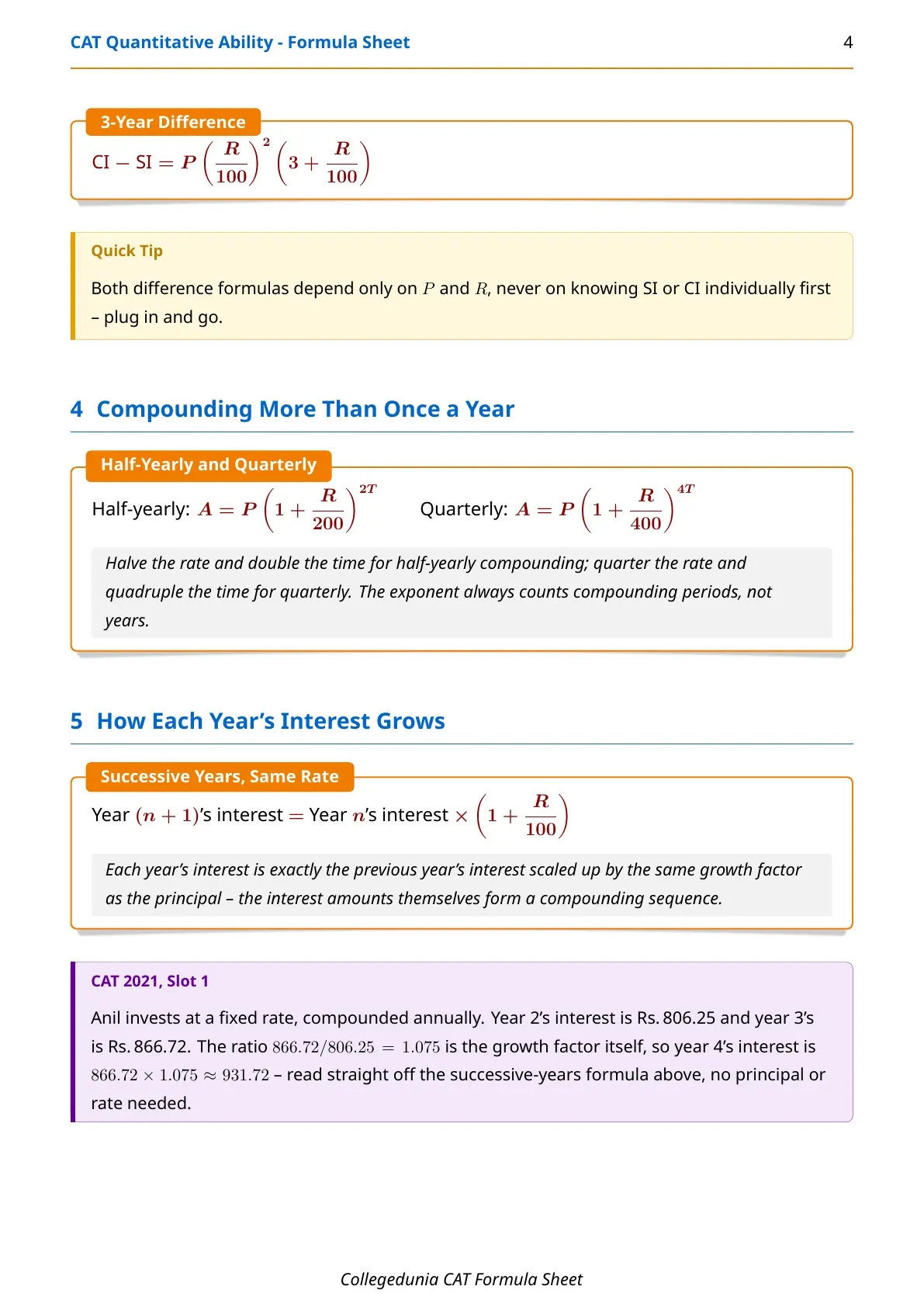
CAT 2021 (Slot 1). Anil invests at a fixed rate, compounded annually. If year 2's interest is Rs.806.25 and year 3's is Rs.866.72, each year's compound interest is the previous year's interest scaled up by the same growth factor as the principal itself − the ratio 866.72/806.25 = 1.075 gives that factor directly, so year 4's interest works out to about Rs.931.72 without ever needing the principal or the rate.
CI vs SI Difference Formula: How to Calculate the Gap Without Computing Both
For short durations, CAT often asks only for the gap between CI and SI, which is faster to find directly than computing both amounts in full.
Both formulas depend only on the principal and the rate, never on knowing SI or CI individually first, so they are worth reaching for the moment a question only asks for the difference.
Half Yearly and Quarterly Compound Interest Formula for CAT
Compounding more than once a year changes the exponent, not the shape of the formula.
Halve the rate and double the time for half-yearly compounding, or quarter the rate and quadruple the time for quarterly − the exponent always counts compounding periods, not calendar years.
Simple Interest and Compound Interest Questions for CAT with Solutions PDF
Simple Interest and Compound Interest questions in CAT rarely test one formula in isolation and usually chain a second relation on top. Below are two real CAT questions with solutions:
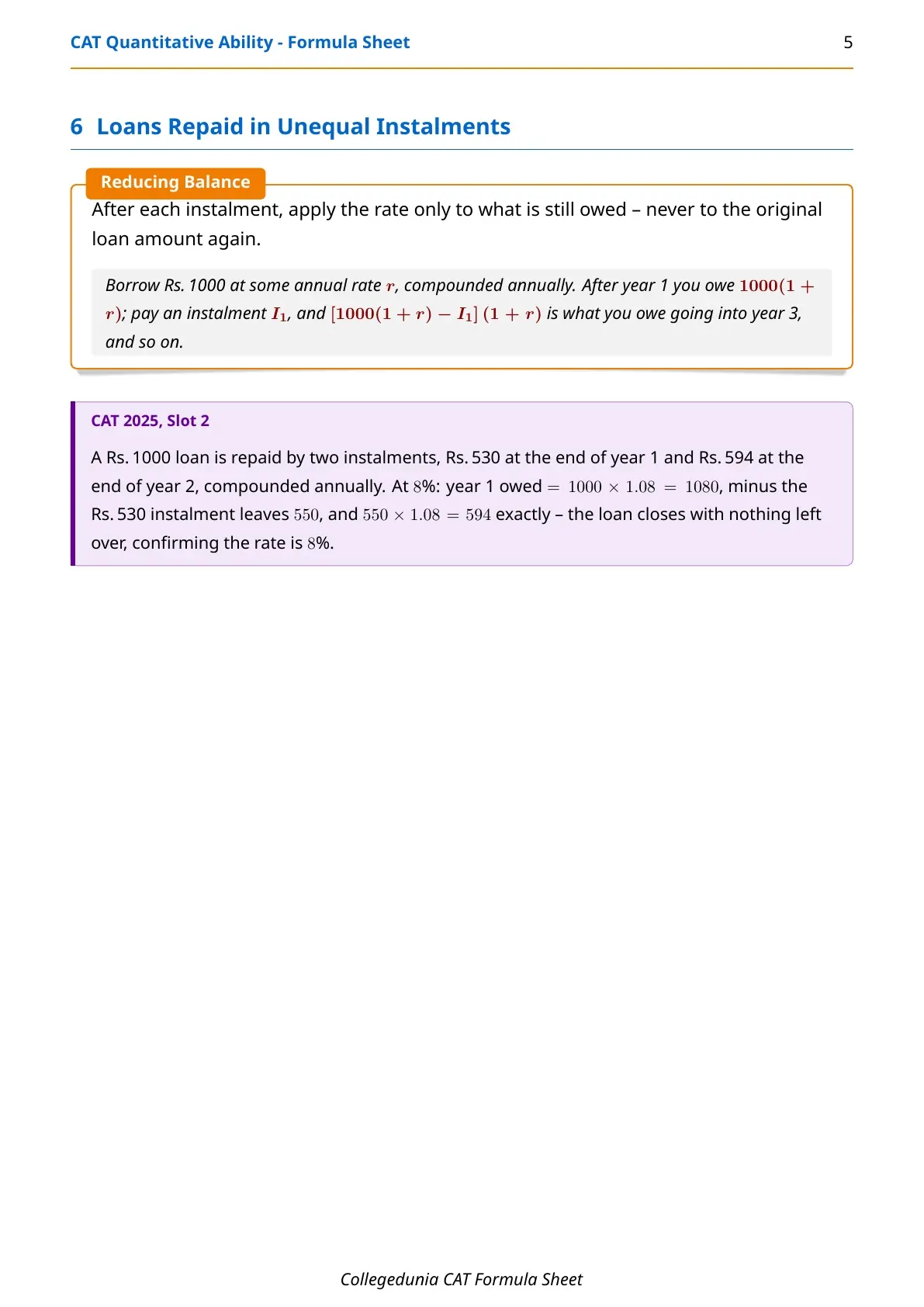
Q1 (CAT 2025, Slot 2). A loan of Rs.1000 is fully repaid by two instalments of Rs.530 and Rs.594, paid at the end of the first and second year respectively. If the interest is compounded annually, then the rate of interest, in percentage, is
(a) 10 (b) 11 (c) 9 (d) 8
Show Solution
- Step 1: Try the reducing-balance approach at each option's rate. At 8%, after year 1 the amount owed = 1000 × 1.08 = 1080.
- Step 2: Paying the first instalment of Rs.530 leaves 1080 − 530 = 550 still owed going into year 2.
- Step 3: That remaining 550 grows for one more year at the same rate: 550 × 1.08 = 594.
- Step 4: This equals the second instalment exactly, so the loan closes with nothing left over at 8%.
Answer: (d) 8
Q2 (CAT 2021, Slot 1). Anil invests some money at a fixed rate of interest, compounded annually. If the interests accrued during the second and third year are Rs.806.25 and Rs.866.72 respectively, the interest accrued, in INR, during the fourth year is nearest to
(a) 929.48 (b) 934.65 (c) 931.72 (d) 926.84
Show Solution
- Step 1: In compound interest, each year's interest is the previous year's interest times the same growth factor (1 + R/100) as the principal.
- Step 2: That growth factor is found directly from the two given years: 866.72/806.25 = 1.075.
- Step 3: Applying the same factor to year 3's interest gives year 4's interest: 866.72 × 1.075 = 931.72.
Answer: (c) 931.72
Neither question is answered by a single formula on this sheet on its own − both need the compound-growth relation chained with another step, which is the real skill this sheet is meant to build.
Simple Interest and Compound Interest Concept Video for CAT with Solved Examples
Source: MBA Wallah
How to Revise Simple Interest and Compound Interest Before CAT
The closing page repeats every formula in one table, checked against a fixed principal and rate.
- Cover the formula column and reproduce it from the quantity name
- Decide whether the principal resets or grows before touching any formula
- Re-derive the CI-SI difference formula rather than memorising the final expression alone
- Check whether a question wants the plain rate or a half-yearly/quarterly adjusted one whenever compounding is mentioned
CAT Simple Interest and Compound Interest Formula Sheet FAQs
Ques. Is compound interest always higher than simple interest at the same rate?
Ans. Yes, for any period beyond the first year. Compound interest earns interest on the previous period's interest as well, so the CI − SI difference formula, P(R/100)² for 2 years, is always positive whenever the rate is positive.
Ques. How do I handle interest compounded half-yearly?
Ans. Halve the annual rate and double the number of years before applying the compound interest formula. A 3-year investment at 8% compounded half-yearly becomes a 6-period calculation at 4% per period.
Ques. Does each year's compound interest grow by the same rate as the principal?
Ans. Yes. Year (n+1)'s interest equals year n's interest multiplied by (1 + R/100), the same growth factor that scales the principal itself, which is why two consecutive years' interest figures are enough to find the rate.
Ques. How is a loan repaid in unequal instalments calculated?
Ans. Apply the interest rate to whatever is still owed after each instalment, never to the original loan amount again. This reducing-balance approach is how a compounded loan's instalments are checked or solved.
Ques. Can the PDF be downloaded for free?
Ans. Yes. All 6 pages can be read on this page or downloaded at no cost, so it can be printed or kept on a phone for last-minute revision.



Comments