



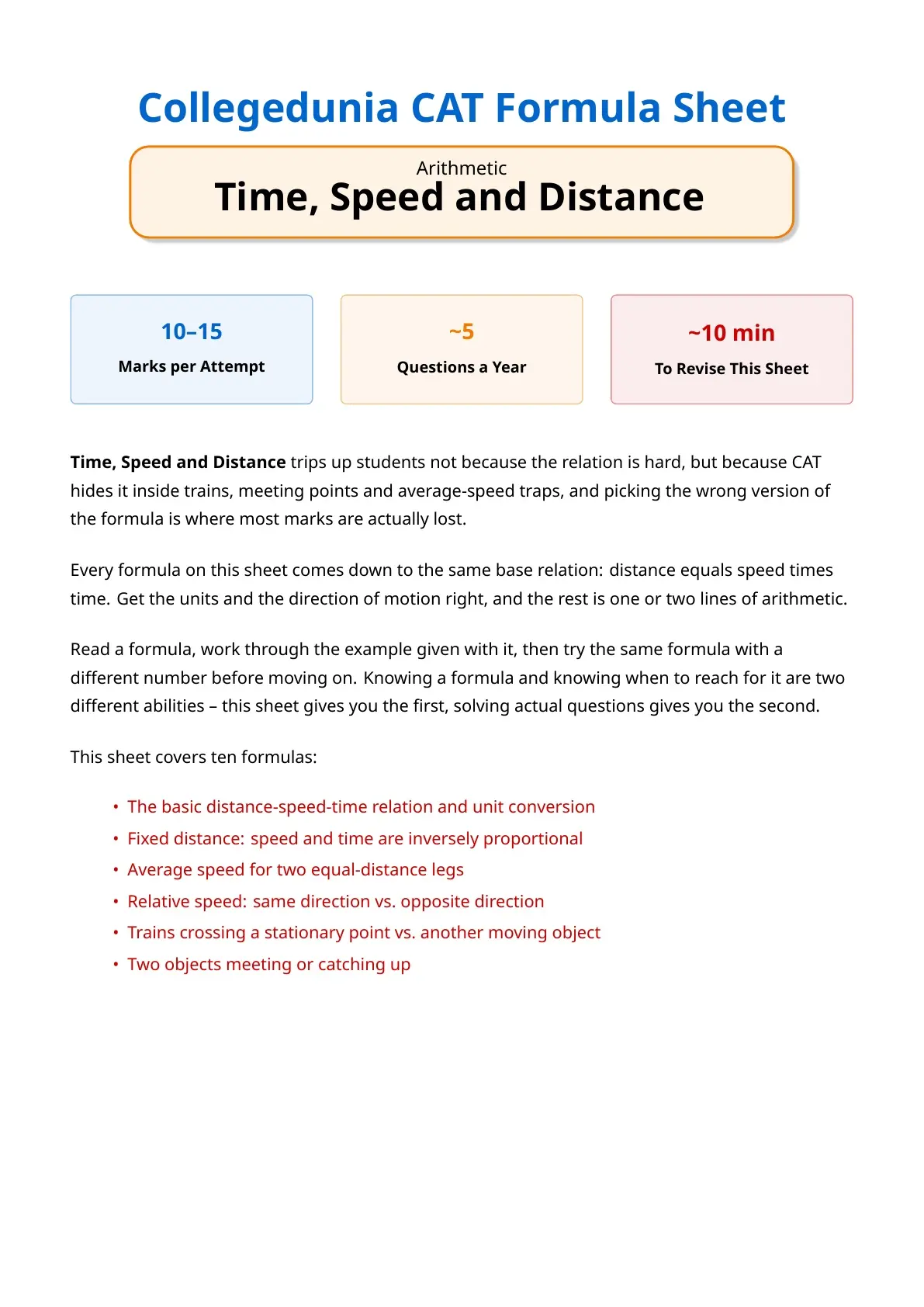
CAT Time, Speed and Distance formula sheet, free to download as a 6-page PDF. The topic carries about 10 to 15 marks across roughly 5 questions a year, and takes roughly ten minutes to work through, so it belongs in your final revision.
The sheet covers all ten formulas in real notation, a 15-year weightage table, two real CAT questions with full solutions, and a concept video.
Prefer notebook-style revision? The same formulas, worked examples and weightage table are also laid out as a 22-page handwritten-style revision booklet, sized to print and fold into a pocket-sized book.
Built for revision, so every line trades explanation for speed. Read the working behind each formula in the full Time, Speed and Distance notes before leaning on this sheet.
Time Speed Distance Weightage in CAT: Previous Year Questions Analysis
As per CAT Time, Speed and Distance weightage from past years, students can expect 4 to 5 questions from this topic every year, with 2020 as the highest-yielding year at 11 questions. CAT does not release an official chapter-wise weightage, so the numbers below are based on tagging every question from the released papers by topic and year.
| Year | Questions |
|---|---|
| 2025 | 4 |
| 2024 | 4 |
| 2023 | 5 |
| 2022 | 5 |
| 2021 | 4 |
| 2020 | 11 |
| 2019 | 5 |
| 2018 | 5 |
| 2017 | 5 |
| 2016 | 4 |
| 2015 | 7 |
| 2014 | 5 |
| 2013 | 4 |
| 2012 | 2 |
| 2011 | 3 |
| 15-Year Average | ~4.9 |
This is one of the heaviest-weighted single topics in CAT Quantitative Ability − the 15-year average of nearly 5 questions a year is higher than either Profit and Loss or Percentages, and 2020 alone carried 11 questions across its three slots. The topic also spans several question types (basic speed, trains, relative speed, circular tracks) that CAT tags separately but which all use the formulas on this sheet.
Time Speed Distance Formula for CAT: The Basic Relation and Unit Conversion
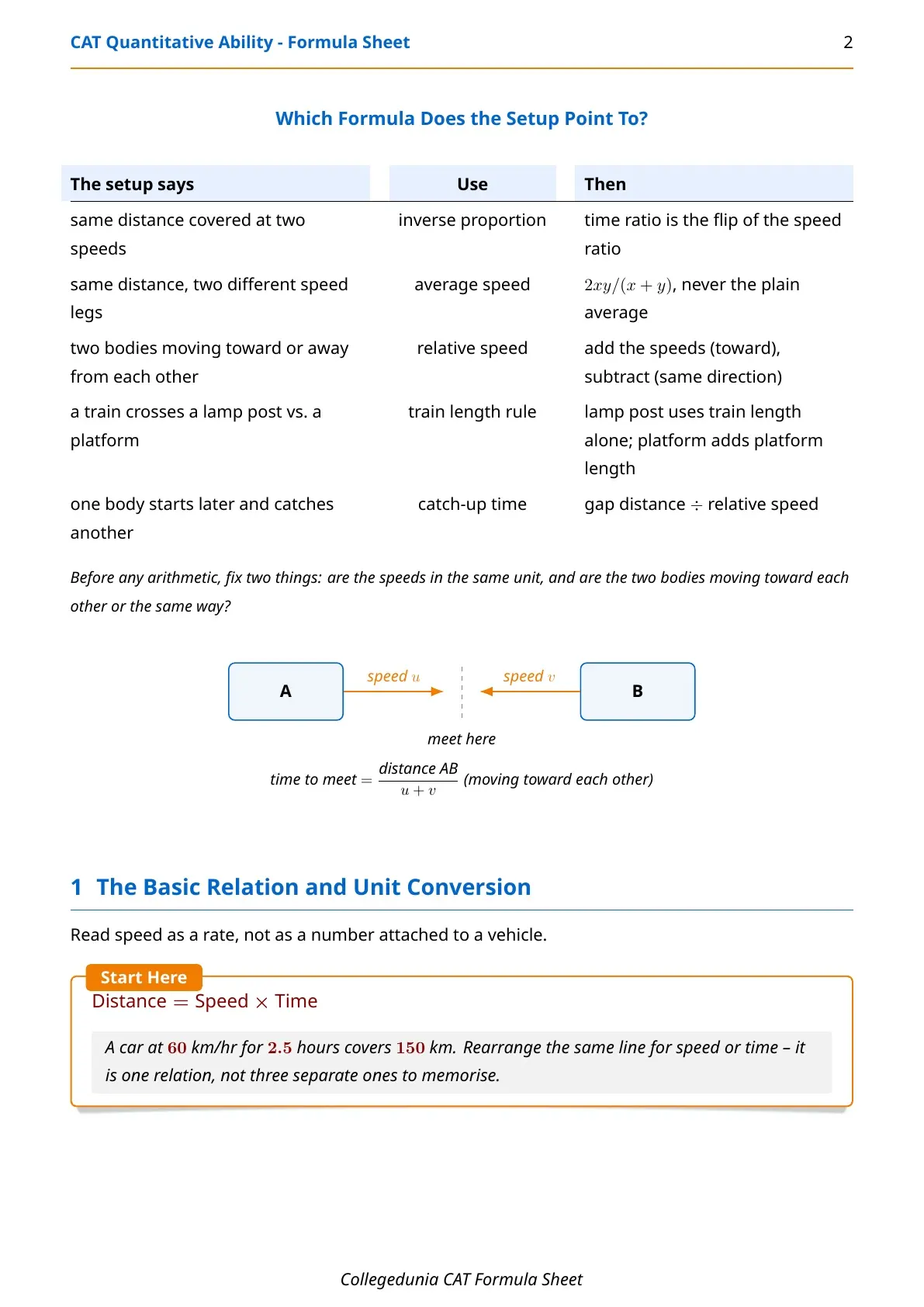
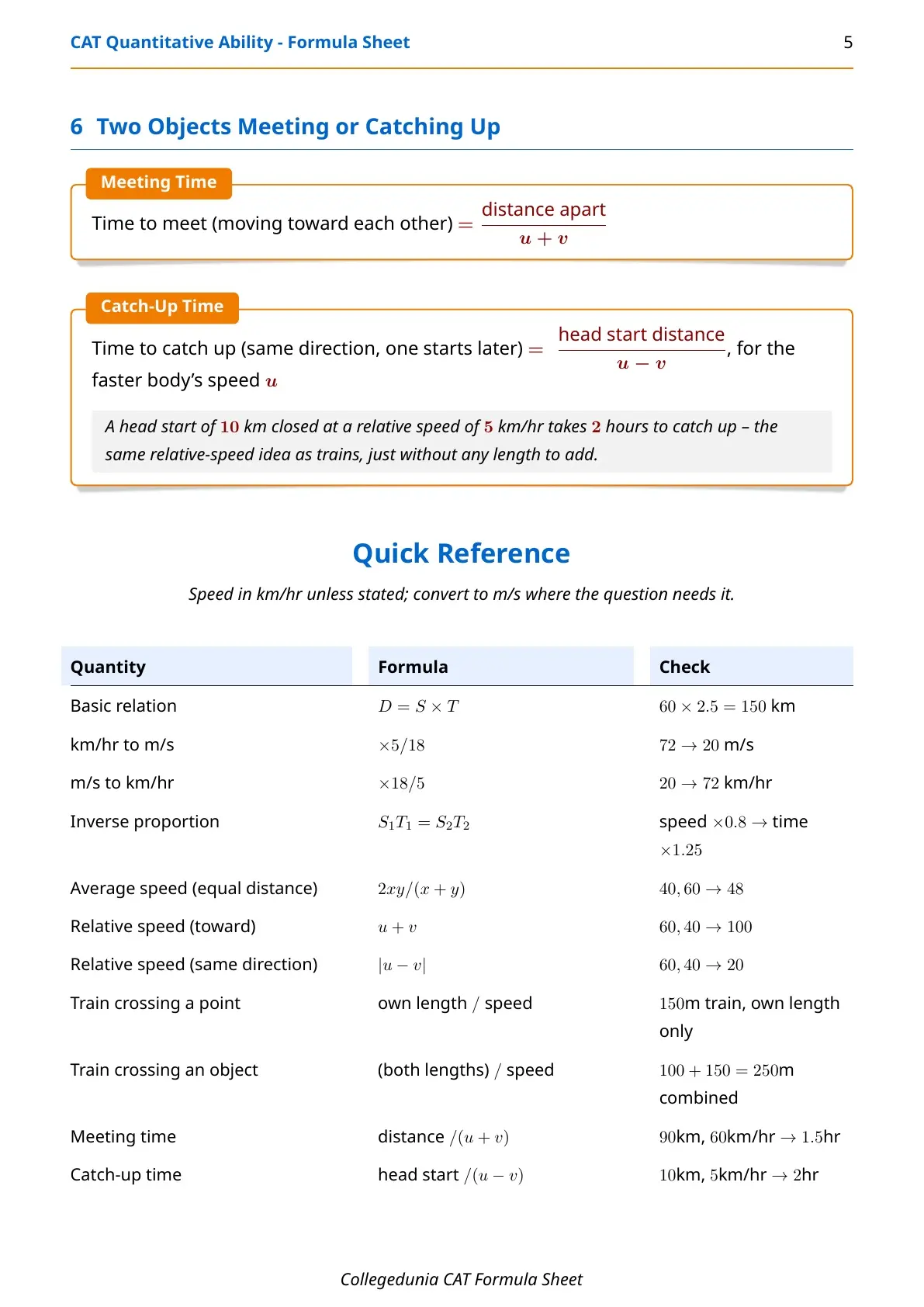
Every question on this topic starts from the same relation between distance, speed and time:
A car at 60 km/hr for 2.5 hours covers 150 km − the same relation rearranged gives speed or time instead, so it is one formula to remember, not three.
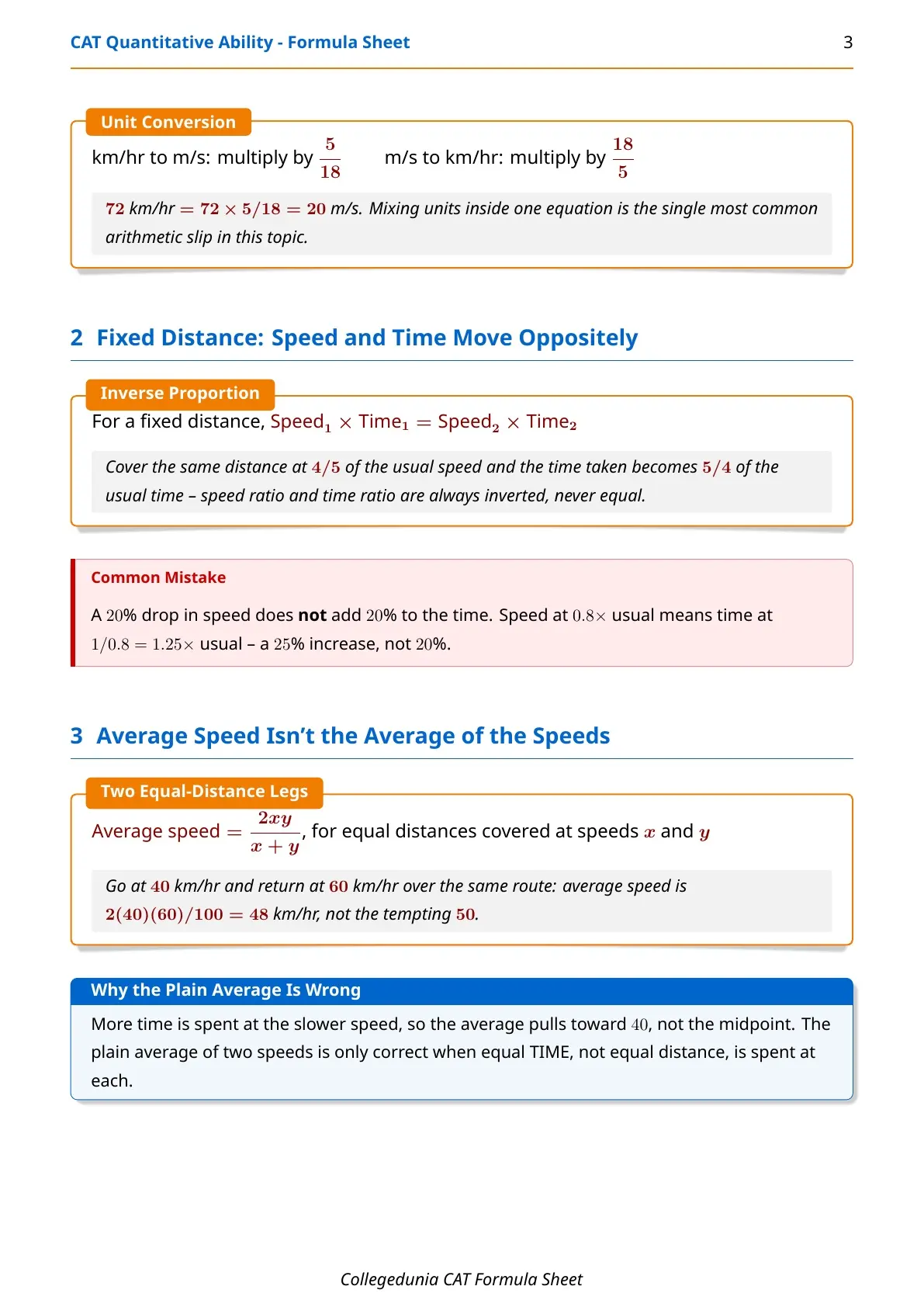
Mixing units inside one equation is the single most common arithmetic slip in this topic, so the conversion factor is worth memorising cold:
72 km/hr = 72 × 5/18 = 20 m/s.
Average Speed Formula in CAT: Why It Isn't the Average of the Speeds
When the same distance is covered twice at two different speeds, the average speed is not the plain average of the two numbers:
Go at 40 km/hr and return at 60 km/hr over the same route: average speed works out to 2(40)(60)/100 = 48 km/hr, not the tempting 50. More time gets spent at the slower speed, so the true average always pulls toward the smaller number.
Relative Speed Formula for CAT: Moving Toward vs Moving in the Same Direction
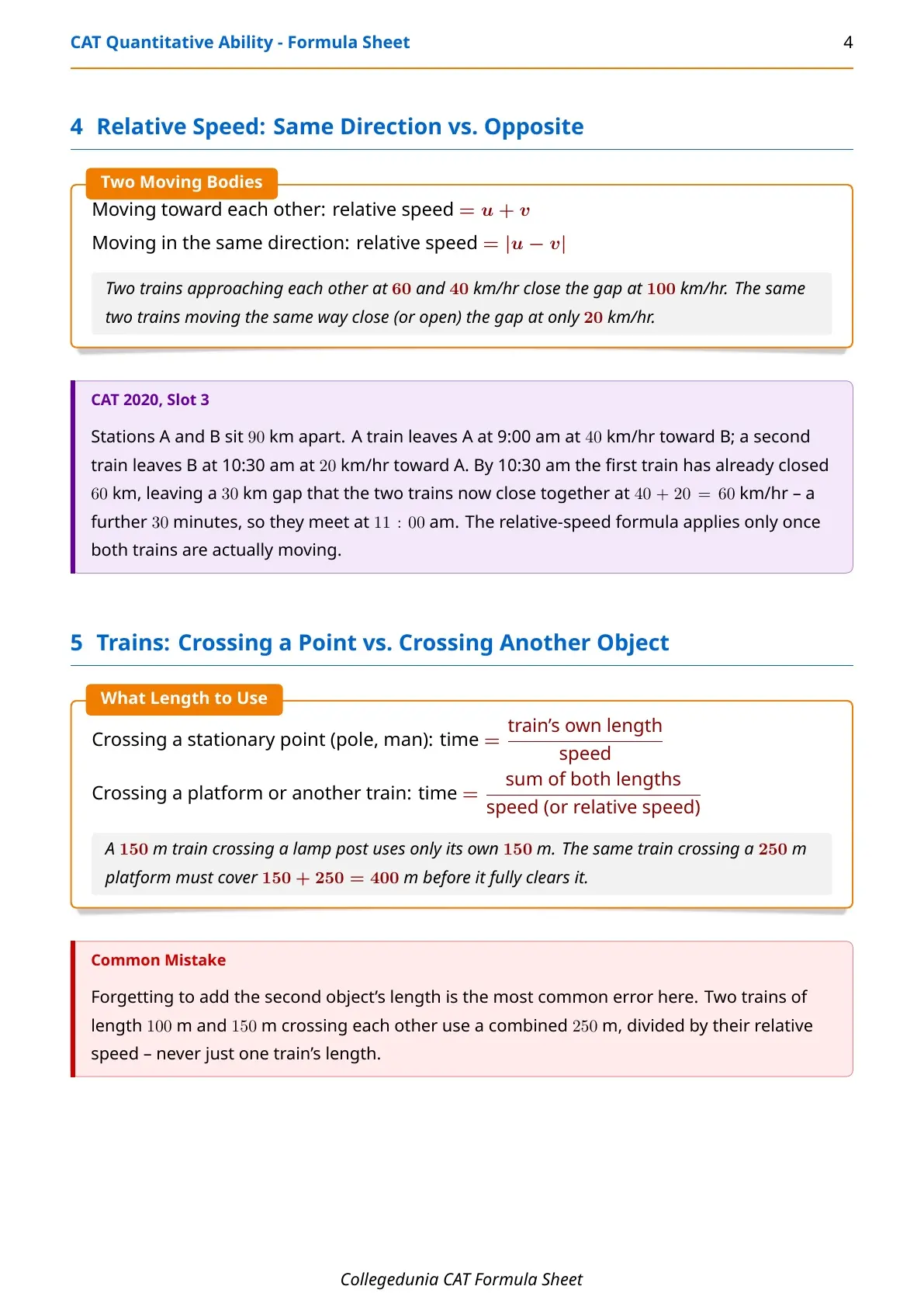
Two moving bodies combine their speeds differently depending on which way they are headed:
Two trains approaching each other at 60 and 40 km/hr close the gap at 100 km/hr; the same two trains moving the same way close it at only 20 km/hr.
CAT 2020 (Slot 3). Stations A and B sit 90 km apart. A train leaves A at 9:00 am at 40 km/hr toward B; a second train leaves B at 10:30 am at 20 km/hr toward A. By 10:30 am the first train has already closed 60 km on its own, leaving a 30 km gap that both trains now close together at 40 + 20 = 60 km/hr − a further 30 minutes, so they meet at 11:00 am. The relative-speed formula only applies once both trains are actually moving.
Train Problems in CAT: Crossing a Point vs Crossing Another Object
The length used in a train question depends entirely on what it is crossing:
A 150 m train crossing a lamp post uses only its own 150 m. The same train crossing a 250 m platform must cover 150 + 250 = 400 m before it fully clears it − forgetting to add the second length is the most common error in this question type.
Time Speed Distance Questions for CAT with Solutions PDF
Time, Speed and Distance questions in CAT rarely test one formula alone and usually chain two relations together. Below are two real CAT questions with solutions:
Q1 (CAT 2020, Slot 1). Leaving home at the same time, Amal reaches the office at 10:15 am if he travels at 8 km/hr, and at 9:40 am if he travels at 15 km/hr. Leaving home at 9:10 am, at what speed, in km/hr, must he travel so as to reach office exactly at 10 am?
(a) 13 (b) 12 (c) 14 (d) 11
Show Solution
- Step 1: Let Amal's usual leaving time be x minutes after 9:00 am, and distance D. Reaching at 10:15 am at 8 km/hr: D = 8(75−x)/60.
- Step 2: Reaching at 9:40 am at 15 km/hr: D = 15(40−x)/60. Setting the two equal gives x = 0, so he actually leaves at 9:00 am and D = 10 km.
- Step 3: Now leaving at 9:10 am to reach exactly at 10:00 am, he has 50 minutes = 50/60 hours available.
- Step 4: Required speed = distance/time = 10 ÷ (50/60) = 12 km/hr.
Answer: (b) 12
Q2 (CAT 2020, Slot 3). Vimla starts for office every day at 9 am and reaches exactly on time if she drives at her usual speed of 40 km/hr. She is late by 6 minutes if she drives at 35 km/hr. One day, she covers two-thirds of her distance to office in one-third of her usual total time to reach office, and then stops for 8 minutes. The speed, in km/hr, at which she should drive the remaining distance to reach office exactly on time is
(a) 29 (b) 26 (c) 28 (d) 27
Show Solution
- Step 1: Let her usual time be T hours, so distance D = 40T. At 35 km/hr she is 6 minutes (0.1 hr) late: D/35 = T + 0.1.
- Step 2: Substituting D = 40T: 40T/35 = T + 0.1, which solves to T = 0.7 hours = 42 minutes, so D = 28 km.
- Step 3: She covers two-thirds of the distance (18.67 km) in one-third of the usual time (14 minutes), then stops for 8 minutes − using up 22 minutes total.
- Step 4: Time left to stay on schedule = 42 − 22 = 20 minutes = 1/3 hour, with one-third of the distance (9.33 km) still to cover.
- Step 5: Required speed = 9.33 ÷ (1/3) = 28 km/hr.
Answer: (c) 28
Neither question is answered by a single formula on this sheet on its own − both need the basic distance-speed-time relation set up twice and solved together, which is the real skill this sheet is meant to build.
Time Speed Distance Concept Video for CAT with Solved Examples
Source: MBA Wallah
How to Revise Time, Speed and Distance Before CAT
The closing page repeats every formula in one table, checked against real numbers throughout.
- Cover the formula column and reproduce it from the quantity name
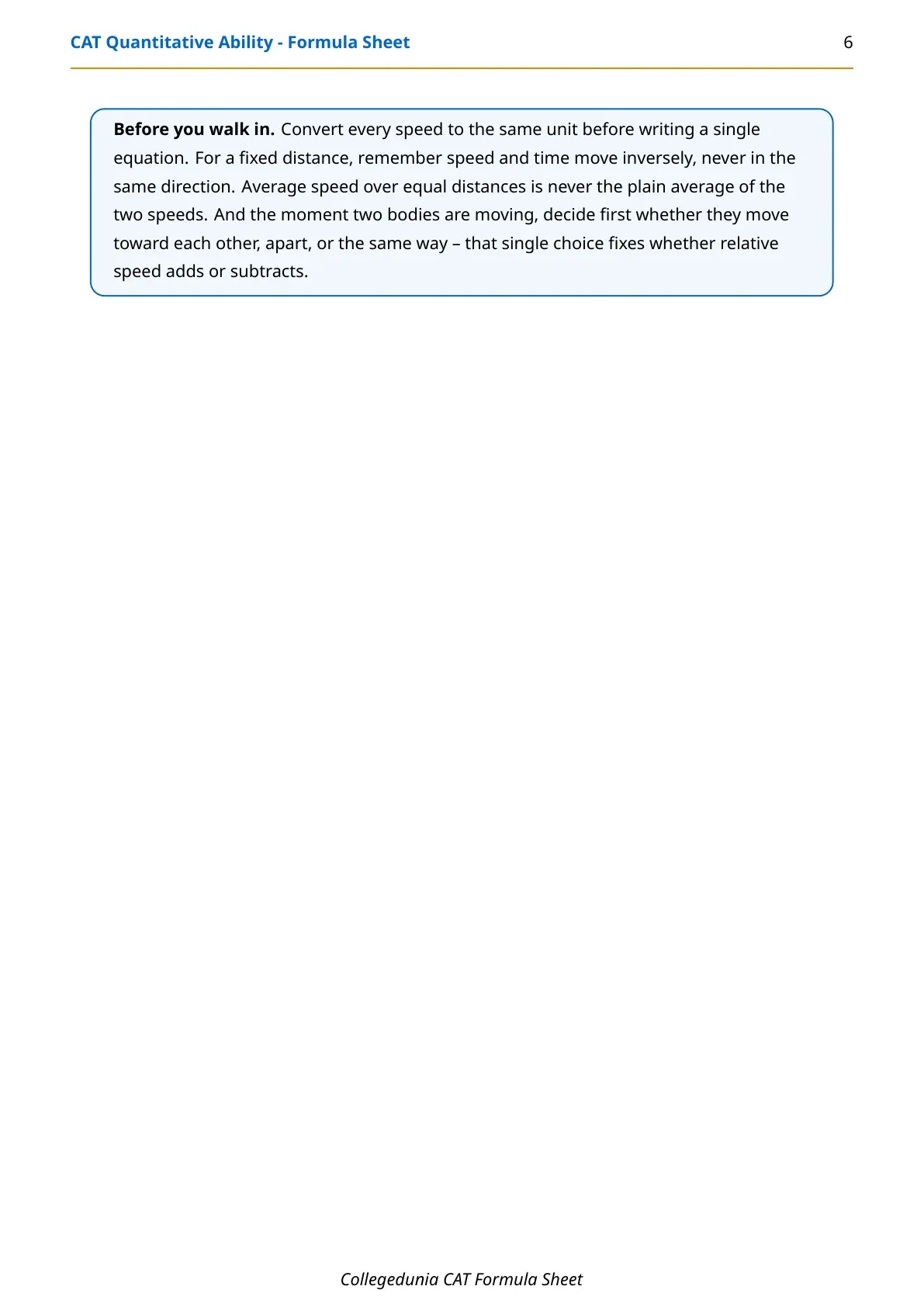
- Convert every speed to the same unit before writing a single equation
- Decide whether two bodies are moving toward each other, apart, or the same way before reaching for relative speed
- Check whether a train question needs the train's own length alone or the combined length of both objects
CAT Time Speed Distance Formula Sheet FAQs
Ques. Is average speed always the average of the two speeds?
Ans. Only when equal time is spent at each speed. When the same distance (not the same time) is covered at two speeds, average speed = 2xy/(x+y), which is always less than the plain average of x and y.
Ques. Do I always add the speeds of two trains moving toward each other?
Ans. Yes, when they move toward each other, relative speed is the sum of both speeds. If they move in the same direction instead, relative speed is the difference between them.
Ques. Do I use just the train's length or both lengths when it crosses something?
Ans. Crossing a stationary point like a pole or a man uses only the train's own length. Crossing a platform or another train needs the sum of both lengths, since the train must fully clear the second object.
Ques. How does Time, Speed and Distance weightage in CAT compare to other Arithmetic topics?
Ans. At close to 5 questions a year on a 15-year average, it is one of the heaviest single topics in CAT Quantitative Ability, ahead of both Profit and Loss and Percentages.
Ques. Can the PDF be downloaded for free?
Ans. Yes. All 6 pages can be read on this page or downloaded at no cost, so it can be printed or kept on a phone for last-minute revision.



Comments