




The CAT 2024 Slot 1 Question Paper (CAT 2024, conducted by IIM Calcutta on November 24, 2024) is available here as a free PDF download, together with the official question paper.
The CAT 2024 Slot 1 question paper includes the following:
- 68 questions in a 2-hour computer based test, split into three sections: VARC (24), DILR (22) and QA (22)
- Sectional time limit: 40 minutes per section, and candidates cannot switch between sections
- Question types: multiple choice questions (MCQs) and Type In The Answer (TITA) questions
- Marking: +3 for a correct answer, -1 for an incorrect MCQ, no negative marking for TITA, 0 for an unattempted question
- Maximum marks: 204
CAT 2024 Slot 1 Question Paper PDF
| Official PDF | CD PDF | CD PDF with Solutions |
|---|---|---|
| Download official PDF 0.62 MB | Download Collegedunia PDF 0.52 MB | - |
Also Check:

CAT 2024 Slot 1 Question Paper Analysis
Collegedunia's CAT 2024 Slot 1 analysis (held on November 24, 2024 from 8:30 am to 10:30 am), based on student reactions and expert opinions, rates the paper as easy to moderate overall. VARC was moderate to difficult, while DILR and QA were easy to moderate.
| Section | Questions | Time | Difficulty level (student feedback) |
|---|---|---|---|
| Verbal Ability and Reading Comprehension (VARC) | 24 | 40 minutes | Moderate to Difficult |
| Data Interpretation and Logical Reasoning (DILR) | 22 | 40 minutes | Easy to Moderate |
| Quantitative Ability (QA) | 22 | 40 minutes | Easy to Moderate |
| Overall | 68 | 120 minutes | Easy to Moderate |
For the detailed section-wise analysis, read CAT 2024 Slot 1 Analysis.
Source: Manoeuvre MBA
CAT 2024 Slot 1 Questions with Solutions
Verbal Ability and Reading Comprehension (VARC) (Q1 - Q24)
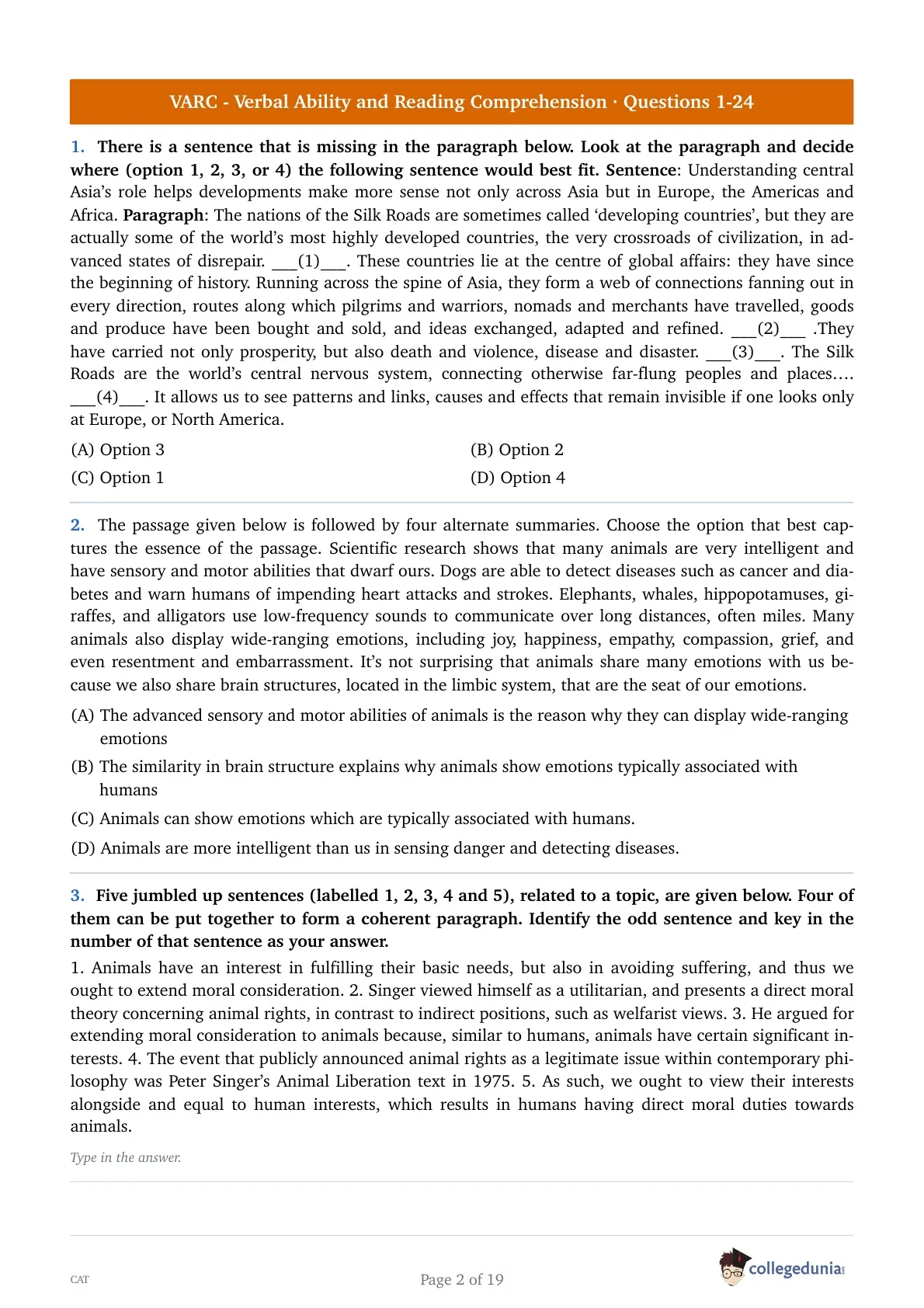
There is a sentence that is missing in the paragraph below. Look at the paragraph and decide where (option 1, 2, 3, or 4) the following sentence would best fit.
Sentence: Understanding central Asia’s role helps developments make more sense not only across Asia but in Europe, the Americas and Africa.
Paragraph: The nations of the Silk Roads are sometimes called ‘developing countries’, but they are actually some of the world’s most highly developed countries, the very crossroads of civilization, in advanced states of disrepair. ___(1)___. These countries lie at the centre of global affairs: they have since the beginning of history. Running across the spine of Asia, they form a web of connections fanning out in every direction, routes along which pilgrims and warriors, nomads and merchants have travelled, goods and produce have been bought and sold, and ideas exchanged, adapted and refined. ___(2)___ .They have carried not only prosperity, but also death and violence, disease and disaster. ___(3)___. The Silk Roads are the world’s central nervous system, connecting otherwise far-flung peoples and places…. ___(4)___. It allows us to see patterns and links, causes and effects that remain invisible if one looks only at Europe, or North America.
The passage given below is followed by four alternate summaries. Choose the option that best captures the essence of the passage.
Scientific research shows that many animals are very intelligent and have sensory and motor abilities that dwarf ours. Dogs are able to detect diseases such as cancer and diabetes and warn humans of impending heart attacks and strokes. Elephants, whales, hippopotamuses, giraffes, and alligators use low-frequency sounds to communicate over long distances, often miles. Many animals also display wide-ranging emotions, including joy, happiness, empathy, compassion, grief, and even resentment and embarrassment. It’s not surprising that animals share many emotions with us because we also share brain structures, located in the limbic system, that are the seat of our emotions.
Five jumbled up sentences (labelled 1, 2, 3, 4 and 5), related to a topic, are given below. Four of them can be put together to form a coherent paragraph. Identify the odd sentence and key in the number of that sentence as your answer.
1. Animals have an interest in fulfilling their basic needs, but also in avoiding suffering, and thus we ought to extend moral consideration.
2. Singer viewed himself as a utilitarian, and presents a direct moral theory concerning animal rights, in contrast to indirect positions, such as welfarist views.
3. He argued for extending moral consideration to animals because, similar to humans, animals have certain significant interests.
4. The event that publicly announced animal rights as a legitimate issue within contemporary philosophy was Peter Singer’s Animal Liberation text in 1975.
5. As such, we ought to view their interests alongside and equal to human interests, which results in humans having direct moral duties towards animals.
Five jumbled up sentences (labelled 1, 2, 3, 4 and 5), related to a topic, are given below. Four of them can be put together to form a coherent paragraph. Identify the odd sentence and key in the number of that sentence as your answer.
1. Urbanites also have more and better options for getting around: Uber is ubiquitous; easy-to-rent dockless bicycles are spreading; battery-powered scooters will be next.
2. When more people use buses or trains the service usually improves because public-transport agencies run more buses and trains.
3. Worsening services on public transport, terrorist attacks in some urban metros and a rise in fares have been blamed for this trend.
4. It seems more likely that public transport is being squeezed structurally as people’s need to travel is diminishing as a result of smartphones, video conferencing, online shopping and so on.
5. There has been a puzzling decline in the use of urban public transport in many countries in the west, despite the growth in urban populations and rising employment.
Comprehension:
The passage below is accompanied by four questions. Based on the passage, choose the best answer for each question.
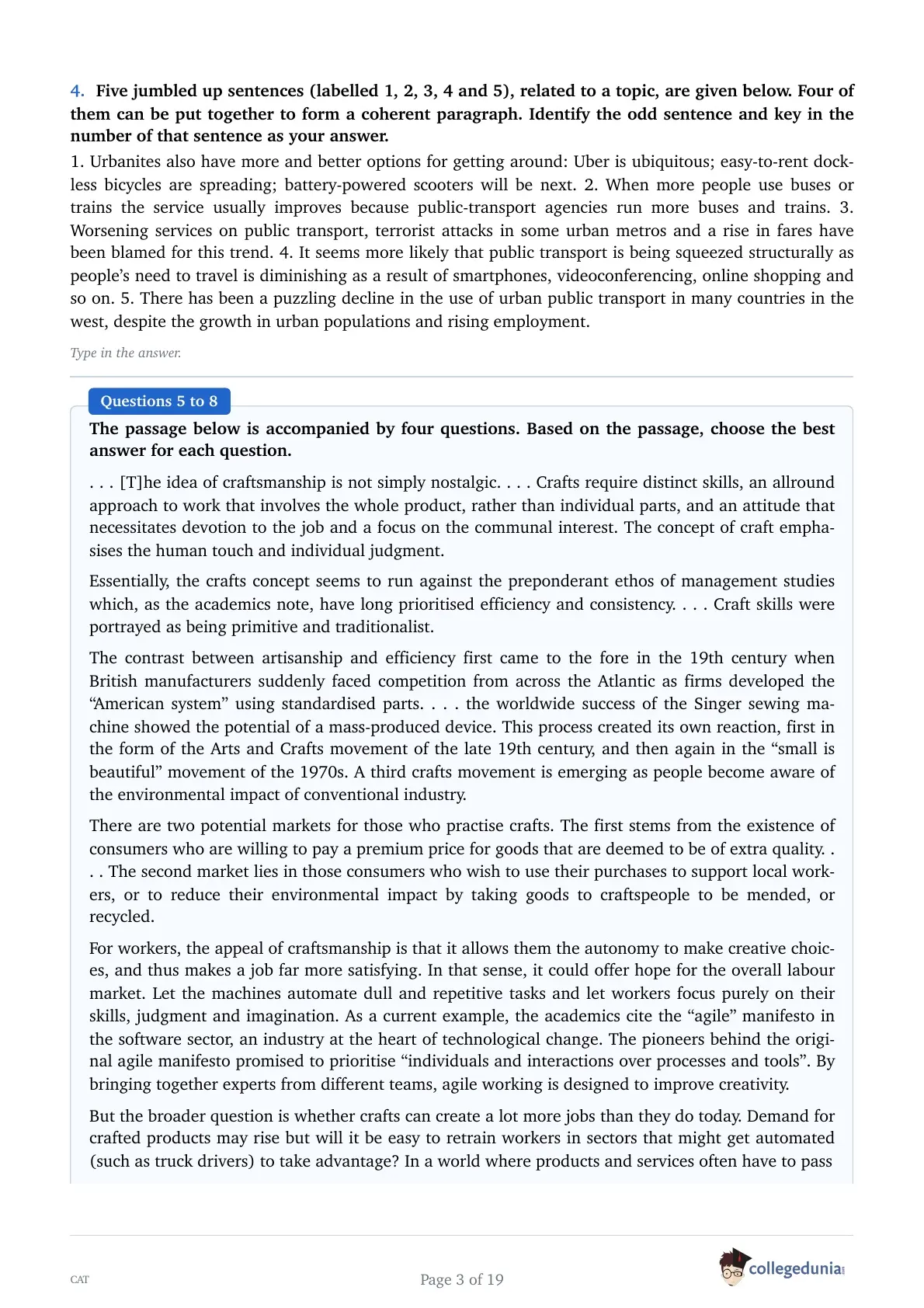
. . . [T]he idea of craftsmanship is not simply nostalgic. . . . Crafts require distinct skills, an all round approach to work that involves the whole product, rather than individual parts, and an attitude that necessitates devotion to the job and a focus on the communal interest. The concept of craft emphasises the human touch and individual judgment.
Read More
Essentially, the crafts concept seems to run against the preponderant ethos of management studies which, as the academics note, have long prioritised efficiency and consistency. . . . Craft skills were portrayed as being primitive and traditionalist.The contrast between artisanship and efficiency first came to the fore in the 19th century when British manufacturers suddenly faced competition from across the Atlantic as firms developed the “American system” using standardised parts. . . . the worldwide success of the Singer sewing machine showed the potential of a mass-produced device. This process created its own reaction, first in the form of the Arts and Crafts movement of the late 19th century, and then again in the “small is beautiful” movement of the 1970s. A third crafts movement is emerging as people become aware of the environmental impact of conventional industry.
There are two potential markets for those who practise crafts. The first stems from the existence of consumers who are willing to pay a premium price for goods that are deemed to be of extra quality. . . . The second market lies in those consumers who wish to use their purchases to support local workers, or to reduce their environmental impact by taking goods to craftspeople to be mended, or recycled.
For workers, the appeal of craftsmanship is that it allows them the autonomy to make creative choices, and thus makes a job far more satisfying. In that sense, it could offer hope for the overall labour market. Let the machines automate dull and repetitive tasks and let workers focus purely on their skills, judgment and imagination. As a current example, the academics cite the “agile” manifesto in the software sector, an industry at the heart of technological change. The pioneers behind the original agile manifesto promised to prioritise “individuals and interactions over processes and tools”. By bringing together experts from different teams, agile working is designed to improve creativity.
But the broader question is whether crafts can create a lot more jobs than they do today. Demand for crafted products may rise but will it be easy to retrain workers in sectors that might get automated (such as truck drivers) to take advantage? In a world where products and services often have to pass through regulatory hoops, large companies will usually have the advantage.
History also suggests that the link between crafts and creativity is not automatic. Medieval craft guilds were monopolies which resisted new entrants. They were also highly hierarchical with young men required to spend long periods as apprentices and journeymen before they could set up on their own; by that time the innovative spirit may have been knocked out of them. Craft workers can thrive in the modern era, but only if they don’t get too organised.
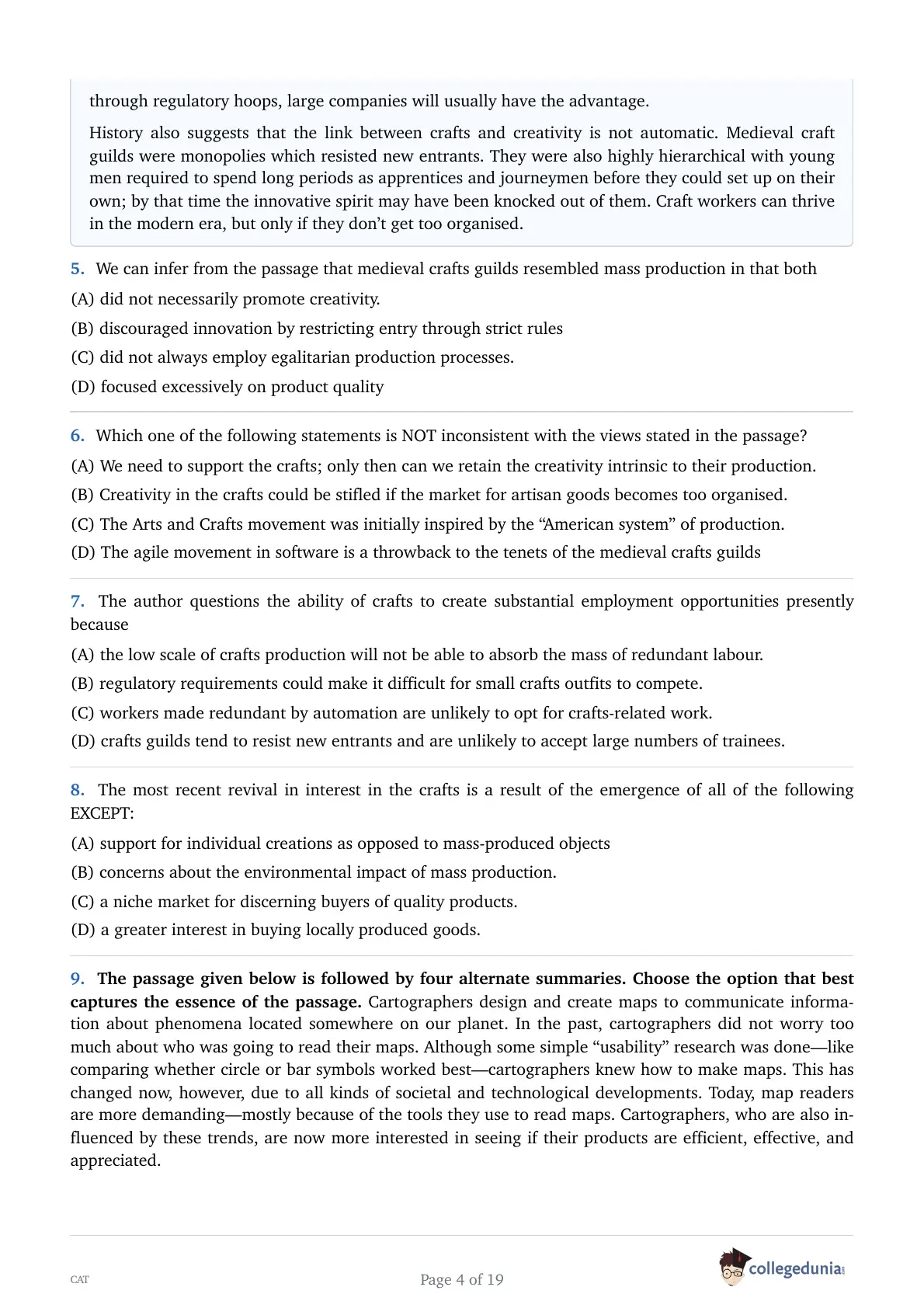
We can infer from the passage that medieval crafts guilds resembled mass production in that both
Which one of the following statements is NOT inconsistent with the views stated in the passage?
The author questions the ability of crafts to create substantial employment opportunities presently because
The most recent revival in interest in the crafts is a result of the emergence of all of the following EXCEPT:
The passage given below is followed by four alternate summaries. Choose the option that best captures the essence of the passage.
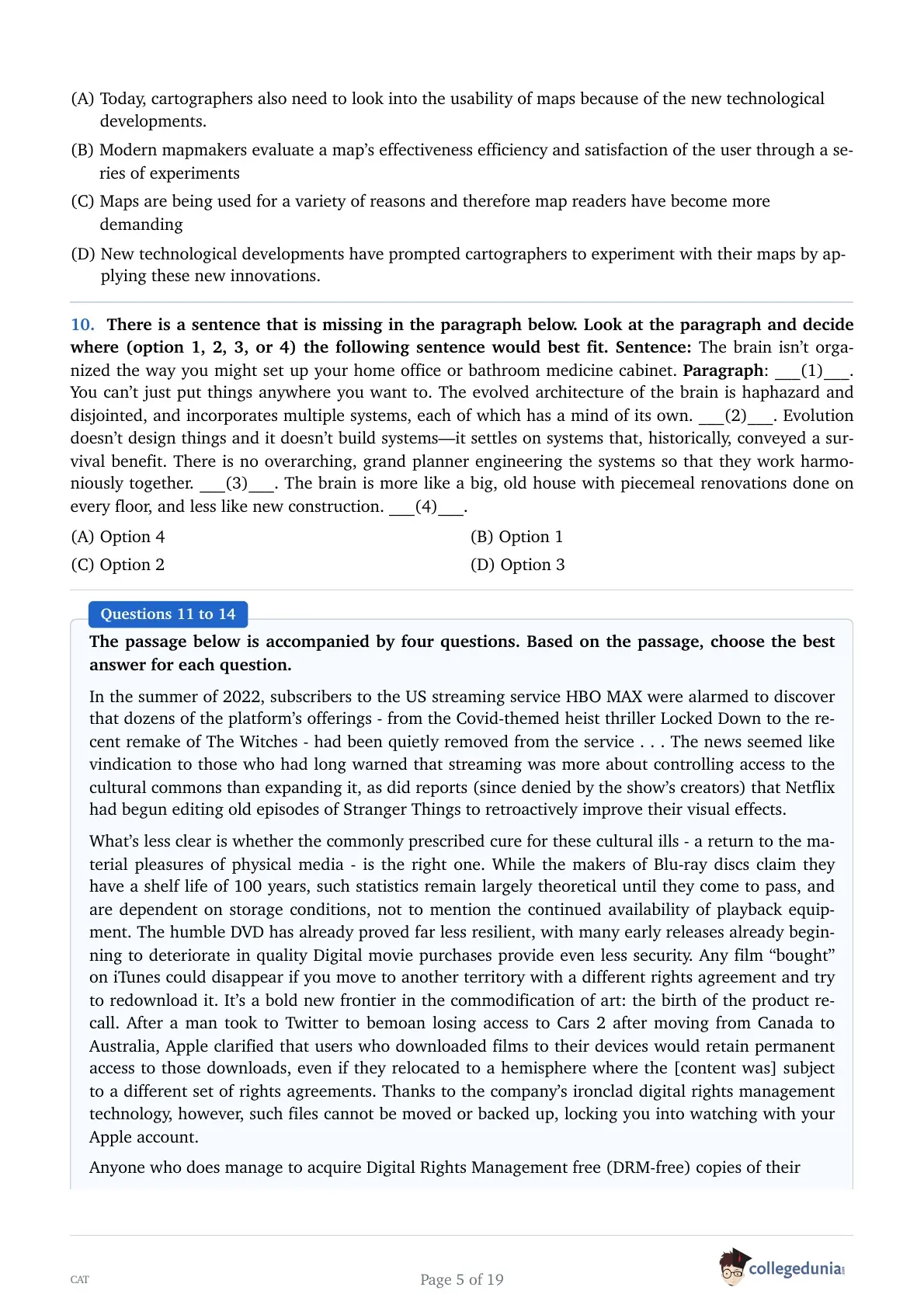
Cartographers design and create maps to communicate information about phenomena located somewhere on our planet. In the past, cartographers did not worry too much about who was going to read their maps. Although some simple “usability” research was done—like comparing whether circle or bar symbols worked best—cartographers knew how to make maps. This has changed now, however, due to all kinds of societal and technological developments. Today, map readers are more demanding—mostly because of the tools they use to read maps. Cartographers, who are also influenced by these trends, are now more interested in seeing if their products are efficient, effective, and appreciated.
There is a sentence that is missing in the paragraph below. Look at the paragraph and decide where (option 1, 2, 3, or 4) the following sentence would best fit.
Sentence: The brain isn’t organized the way you might set up your home office or bathroom medicine cabinet.
Paragraph: ___(1)___. You can’t just put things anywhere you want to. The evolved architecture of the brain is haphazard and disjointed, and incorporates multiple systems, each of which has a mind of its own. ___(2)___. Evolution doesn’t design things and it doesn’t build systems—it settles on systems that, historically, conveyed a survival benefit. There is no overarching, grand planner engineering the systems so that they work harmoniously together. ___(3)___. The brain is more like a big, old house with piecemeal renovations done on every floor, and less like new construction. ___(4)___.
Comprehension:
The passage below is accompanied by four questions. Based on the passage, choose the best answer for each question.
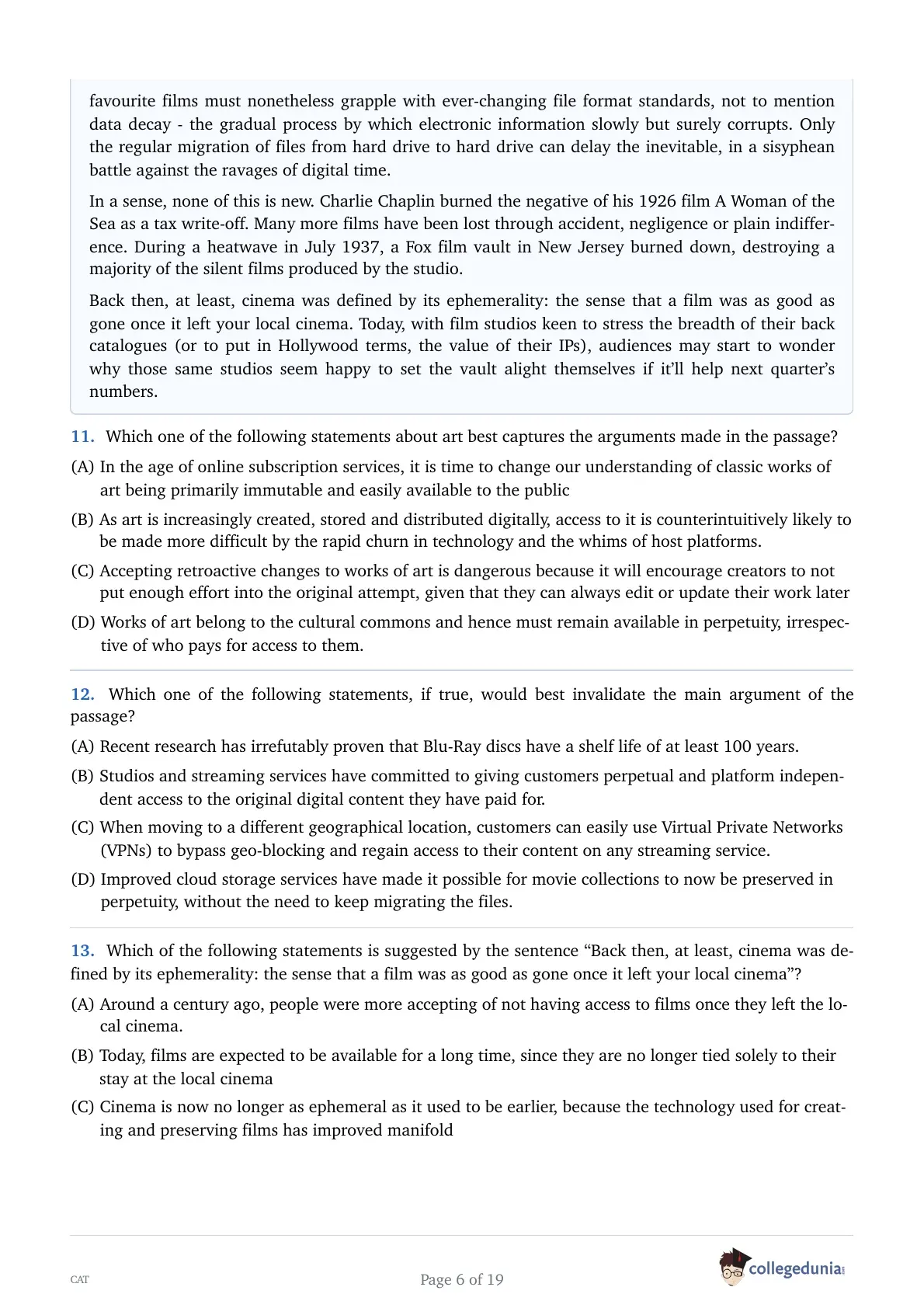
In the summer of 2022, subscribers to the US streaming service HBO MAX were alarmed to discover that dozens of the platform’s offerings – from the Covid-themed heist thriller Locked Down to the recent remake of The Witches – had been quietly removed from the service . . . The news seemed like vindication to those who had long warned that streaming was more about controlling access to the cultural commons than expanding it, as did reports (since denied by the show’s creators) that Netflix had begun editing old episodes of Stranger Things to retroactively improve their visual effects.
Read More
What’s less clear is whether the commonly prescribed cure for these cultural ills – a return to the material pleasures of physical media – is the right one. While the makers of Blu-ray discs claim they have a shelf life of 100 years, such statistics remain largely theoretical until they come to pass, and are dependent on storage conditions, not to mention the continued availability of playback equipment. The humble DVD has already proved far less resilient, with many early releases already beginning to deteriorate in quality Digital movie purchases provide even less security. Any film “bought” on iTunes could disappear if you move to another territory with a different rights agreement and try to redownload it. It’s a bold new frontier in the commodification of art: the birth of the product recall. After a man took to Twitter to bemoan losing access to Cars 2 after moving from Canada to Australia, Apple clarified that users who downloaded films to their devices would retain permanent access to those downloads, even if they relocated to a hemisphere where the [content was] subject to a different set of rights agreements. Thanks to the company’s ironclad digital rights management technology, however, such files cannot be moved or backed up, locking you into watching with your Apple account.Anyone who does manage to acquire Digital Rights Management free (DRM-free) copies of their favourite films must nonetheless grapple with ever-changing file format standards, not to mention data decay – the gradual process by which electronic information slowly but surely corrupts. Only the regular migration of files from hard drive to hard drive can delay the inevitable, in a sisyphean battle against the ravages of digital time.
In a sense, none of this is new. Charlie Chaplin burned the negative of his 1926 film A Woman of the Sea as a tax write-off. Many more films have been lost through accident, negligence or plain indifference. During a heatwave in July 1937, a Fox film vault in New Jersey burned down, destroying a majority of the silent films produced by the studio.
Back then, at least, cinema was defined by its ephemerality: the sense that a film was as good as gone once it left your local cinema. Today, with film studios keen to stress the breadth of their back catalogues (or to put in Hollywood terms, the value of their IPs), audiences may start to wonder why those same studios seem happy to set the vault alight themselves if it’ll help next quarter’s numbers.
Which one of the following statements about art best captures the arguments made in the passage?
Which one of the following statements, if true, would best invalidate the main argument of the passage?
Which of the following statements is suggested by the sentence “Back then, at least, cinema was defined by its ephemerality: the sense that a film was as good as gone once it left your local cinema”?
“Netflix had begun editing old episodes of Stranger Things to retroactively improve their visual effects.” What is the purpose of this example used in the passage?
Comprehension:
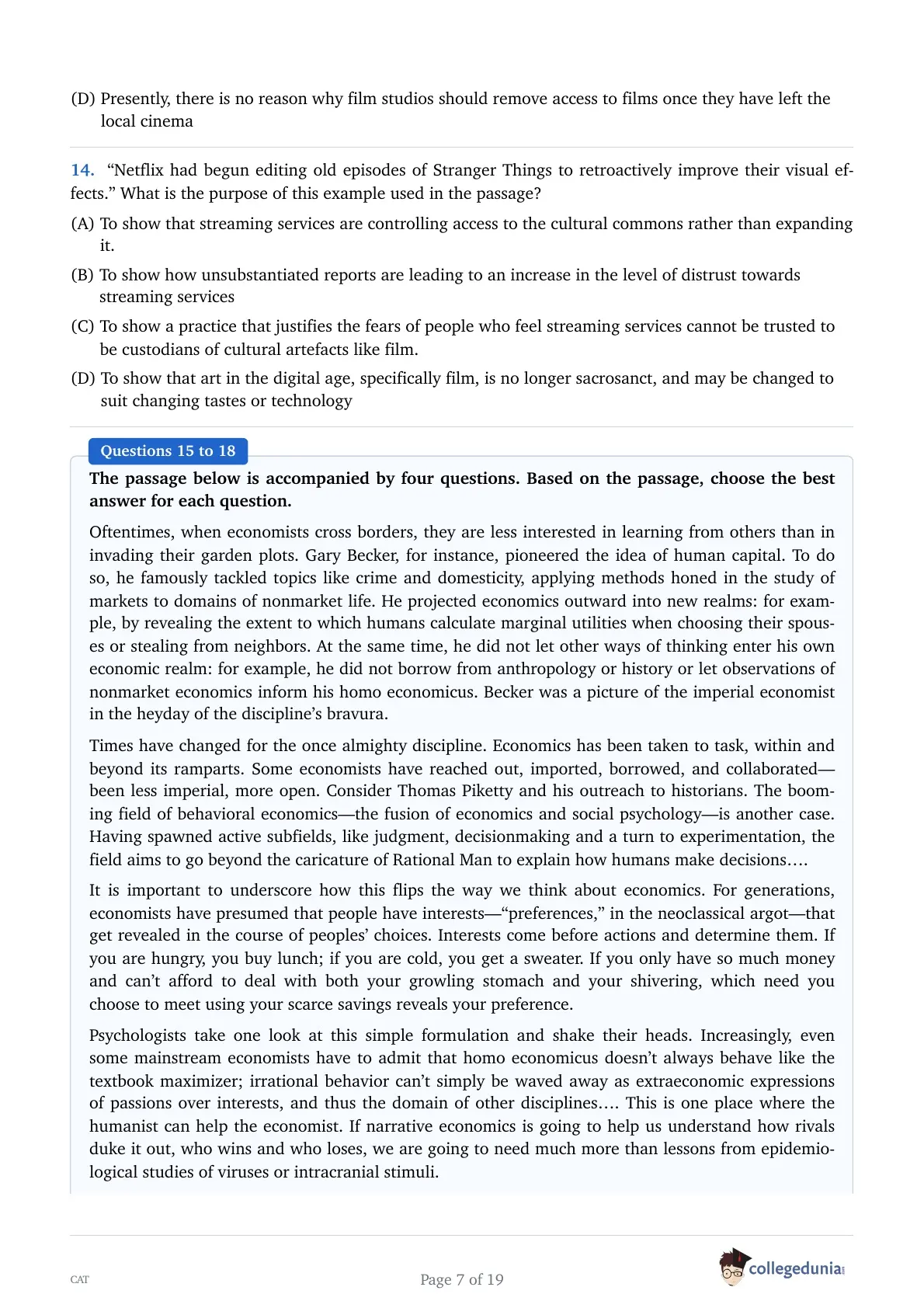
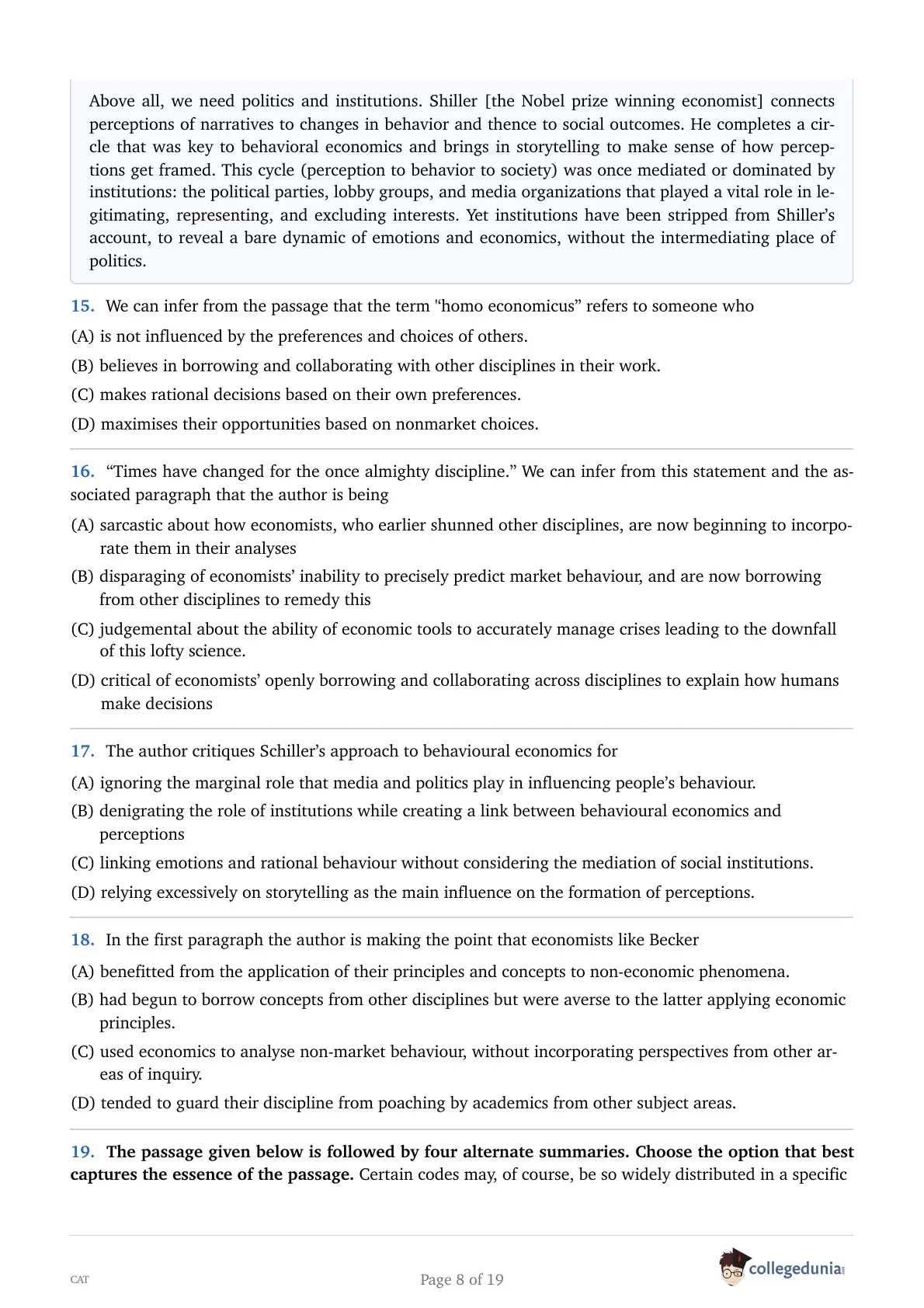
Comprehension: The passage below is accompanied by four questions. Based on the passage, choose the best answer for each question. Oftentimes, when economists cross borders, they are less interested in learning from others than in invading their garden plots. Gary Becker, for instance, pioneered the idea of human capital. To do so, he famously tackled topics like crime and domesticity, applying methods honed in the study of markets to domains of nonmarket life. He projected economics outward into new realms: for example, by revealing the extent to which humans calculate marginal utilities when choosing their spouses or stealing from neighbors. At the same time, he did not let other ways of thinking enter his own economic realm: for example, he did not borrow from anthropology or history or let observations of nonmarket economics inform his homo economicus. Becker was a picture of the imperial economist in the heyday of the discipline’s bravura. Times have changed for the once almighty discipline. Economics has been taken to task, within and beyond its ramparts. Some economists have reached out, imported, borrowed, and collaborated—been less imperial, more open. Consider Thomas Piketty and his outreach to historians. The booming field of behavioral economics—the fusion of economics and social psychology—is another case. Having spawned active subfields, like judgment, decision making and a turn to experimentation, the field aims to go beyond the caricature of Rational Man to explain how humans make decisions…. It is important to underscore how this flips the way we think about economics. For generations, economists have presumed that people have interests—“preferences,” in the neoclassical argot—that get revealed in the course of peoples’ choices. Interests come before actions and determine them. If you are hungry, you buy lunch; if you are cold, you get a sweater. If you only have so much money and can’t afford to deal with both your growling stomach and your shivering, which need you choose to meet using your scarce savings reveals your preference. Psychologists take one look at this simple formulation and shake their heads. Increasingly, even some mainstream economists have to admit that homo economicus doesn’t always behave like the textbook maximizer; irrational behavior can’t simply be waved away as extra economic expressions of passions over interests, and thus the domain of other disciplines…. This is one place where the humanist can help the economist. If narrative economics is going to help us understand how rivals duke it out, who wins and who loses, we are going to need much more than lessons from epidemiological studies of viruses or intracranial stimuli. Above all, we need politics and institutions. Shiller [the Nobel prize winning economist] connects perceptions of narratives to changes in behavior and thence to social outcomes. He completes a circle that was key to behavioral economics and brings in storytelling to make sense of how perceptions get framed. This cycle (perception to behavior to society) was once mediated or dominated by institutions: the political parties, lobby groups, and media organizations that played a vital role in legitimating, representing, and excluding interests. Yet institutions have been stripped from Shiller’s account, to reveal a bare dynamic of emotions and economics, without the intermediating place of politics.
We can infer from the passage that the term '‘homo economicus” refers to someone who
“Times have changed for the once almighty discipline.” We can infer from this statement and the associated paragraph that the author is being
The author critiques Schiller’s approach to behavioural economics for
In the first paragraph the author is making the point that economists like Becker
The passage given below is followed by four alternate summaries. Choose the option that best captures the essence of the passage.
Certain codes may, of course, be so widely distributed in a specific language community or culture, and be learned at so early an age, that they appear not to be constructed – the effect of an articulation between sign and referent – but to be ‘naturally’ given. Simple visual signs appear to have achieved a ‘near-universality’ in this sense: though evidence remains that even apparently ‘natural’ visual codes are culture specific. However, this does not mean that no codes have intervened; rather, that the codes have been profoundly naturalized. The operation of naturalized codes reveals not the transparency and ‘naturalness’ of language but the depth, the habituation and the near-universality of the codes in use. They produce apparently ‘natural’ recognitions. This has the (ideological) effect of concealing the practices of coding which are present.
Comprehension:
Comprehension:
The passage below is accompanied by four questions. Based on the passage, choose the best answer for each question
Read More
Landing in Australia, the British colonists weren’t much impressed with the small-bodied, slender-snooted marsupials called bandicoots. “Their muzzle, which is much too long, gives them an air exceedingly stupid,” one naturalist noted in 1805. They nicknamed one type the “zebra rat” because of its black-striped rump.Silly-looking or not, though, the zebra rat—the smallest bandicoot, more commonly known today as the western barred bandicoot—exhibited a genius for survival in the harsh outback, where its ancestors had persisted for some 26 million years. Its births were triggered by rainfall in the bone-dry desert. It carried its breath-mint-size babies in a backward-facing pouch so mothers could forage for food and dig shallow, camouflaged shelters.
Still, these adaptations did not prepare the western barred bandicoot for the colonial-era transformation of its ecosystem, particularly the onslaught of imported British animals, from cattle and rabbits that damaged delicate desert vegetation to ravenous house cats that soon developed a taste for bandicoots. Several of the dozen-odd bandicoot species went extinct, and by the 1940s the western barred bandicoot, whose original range stretched across much of the continent, persisted only on two predator-free islands in Shark Bay, off Australia’s western coast.
“Our isolated fauna had simply not been exposed to these predators,” says Reece Pedler, an ecologist with the Wild Deserts conservation program.
Now Wild Deserts is using descendants of those few thousand island survivors, called Shark Bay bandicoots, in a new effort to seed a mainland bandicoot revival. They’ve imported 20 bandicoots to a preserve on the edge of the Strzelecki Desert, in the remote interior of New South Wales. This sanctuary is a challenging place, desolate much of the year, with one of the world’s most mercurial rainfall patterns—relentless droughts followed by sudden drenching floods.
The imported bandicoots occupy two fenced “exclosures,” cleared of invasive rabbits (courtesy of Pedler’s sheepdog) and of feral cats (which slunk off once the rabbits disappeared). A third fenced area contains the program’s Wild Training Zone, where two other rare marsupials (bilbies, a larger type of bandicoot, and mulgaras, a somewhat fearsome fuzzball known for sucking the brains out of prey) currently share terrain with controlled numbers of cats, learning to evade them. It’s unclear whether the Shark Bay bandicoots, which are perhaps even more predator-naive than their now-extinct mainland bandicoot kin, will be able to make that kind of breakthrough.
For now, though, a recent surge of rainfall has led to a bandicoot joey boom, raising the Wild Deserts population to about 100, with other sanctuaries adding to that number. There are also signs of rebirth in the landscape itself. With their constant digging, the bandicoots trap moisture and allow for seed germination so the cattle-damaged desert can restore itself.
They have a new nickname—a flattering one, this time. “We call them ecosystem engineers,” Pedler says.
According to the text, the western barred bandicoots now have a flattering name because they have
Which one of the following options does NOT represent the characteristics of the western barred bandicoot?
The text uses the word ‘exclosures’ because Wild Deserts has adopted a measure of
Which one of the following statements provides a gist of this passage?
There is a sentence that is missing in the paragraph below. Look at the paragraph and decide where (option 1, 2, 3, or 4) the following sentence would best fit.
Sentence: Comprehending a wide range of emotions, Renaissance music nevertheless portrayed all emotions in a balanced and moderate fashion.
Paragraph: A volume of translated Italian madrigals were published in London during the year of 1588. This sudden public interest facilitated a surge of English Madrigal writing as well as a spurt of other secular music writing and publication. ___(1)___. This music boom lasted for thirty years and was as much a golden age of music as British literature was with Shakespeare and Queen Elizabeth I. ___(2)___. The rebirth in both literature and music originated in Italy and migrated to England; the English madrigal became more humorous and lighter in England as compared to Italy. Renaissance music was mostly polyphonic in texture. ___(3)___. Extreme use of and contrasts in dynamics, rhythm, and tone colour do not occur. ___(4)___. The rhythms in Renaissance music tend to have a smooth, soft flow instead of a sharp, well-defined pulse of accents.
Data Interpretation and Logical Reasoning (DILR) (Q25 - Q46)
Comprehension:
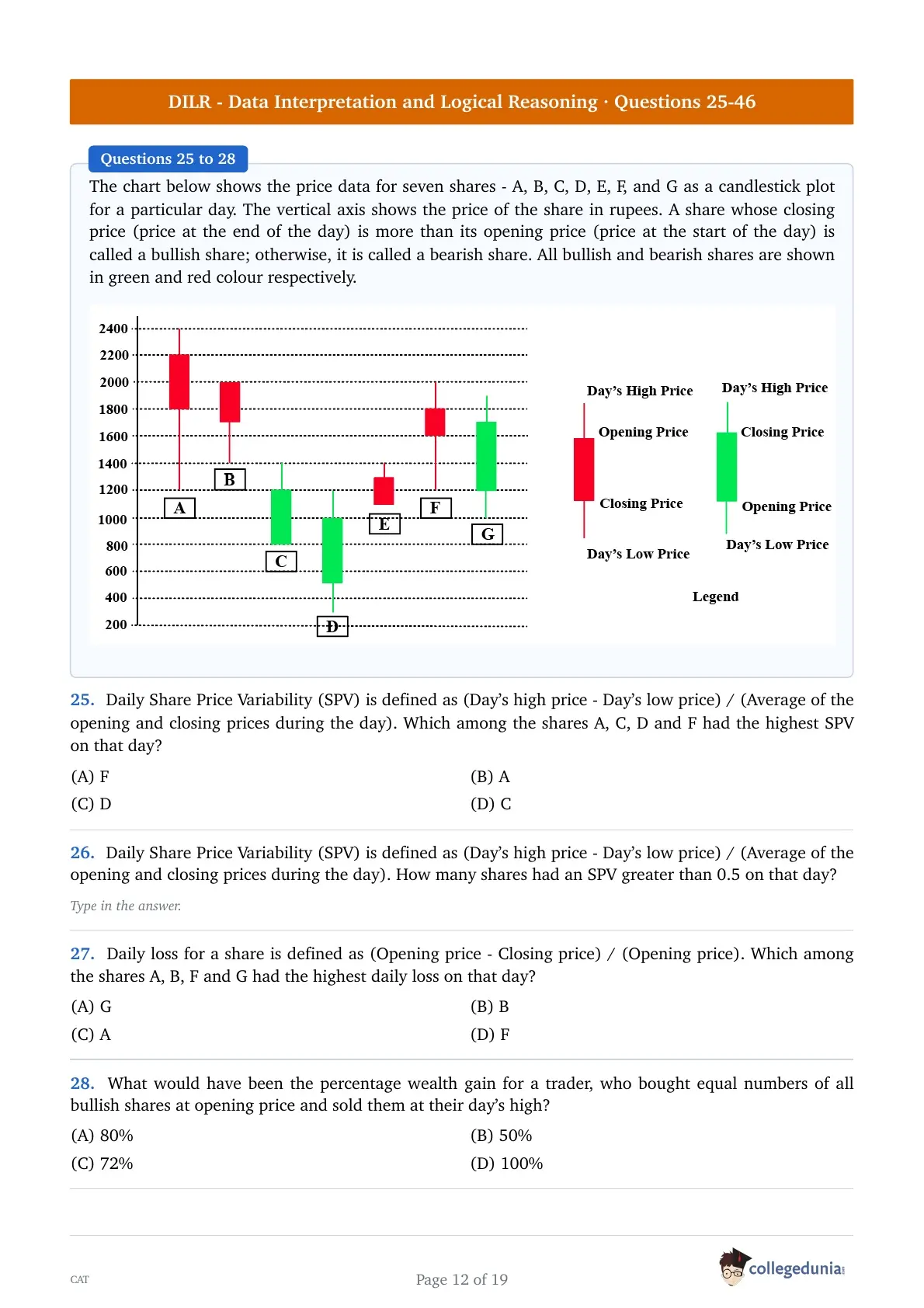
The chart below shows the price data for seven shares – A, B, C, D, E, F, and G as a candlestick plot for a particular day. The vertical axis shows the price of the share in rupees. A share whose closing price (price at the end of the day) is more than its opening price (price at the start of the day) is called a bullish share; otherwise, it is called a bearish share. All bullish and bearish shares are shown in green and red colour respectively.
Daily Share Price Variability (SPV) is defined as (Day’s high price - Day’s low price) /(Average of the opening and closing prices during the day). Which among the shares A, C, D and F had the highest SPV on that day?
Daily Share Price Variability (SPV) is defined as (Day’s high price - Day’s low price) /(Average of the opening and closing prices during the day). How many shares had an SPV greater than 0.5 on that day?
Daily loss for a share is defined as (Opening price – Closing price) / (Opening price). Which among the shares A, B, F and G had the highest daily loss on that day?
What would have been the percentage wealth gain for a trader, who bought equal numbers of all bullish shares at opening price and sold them at their day’s high?
Comprehension:
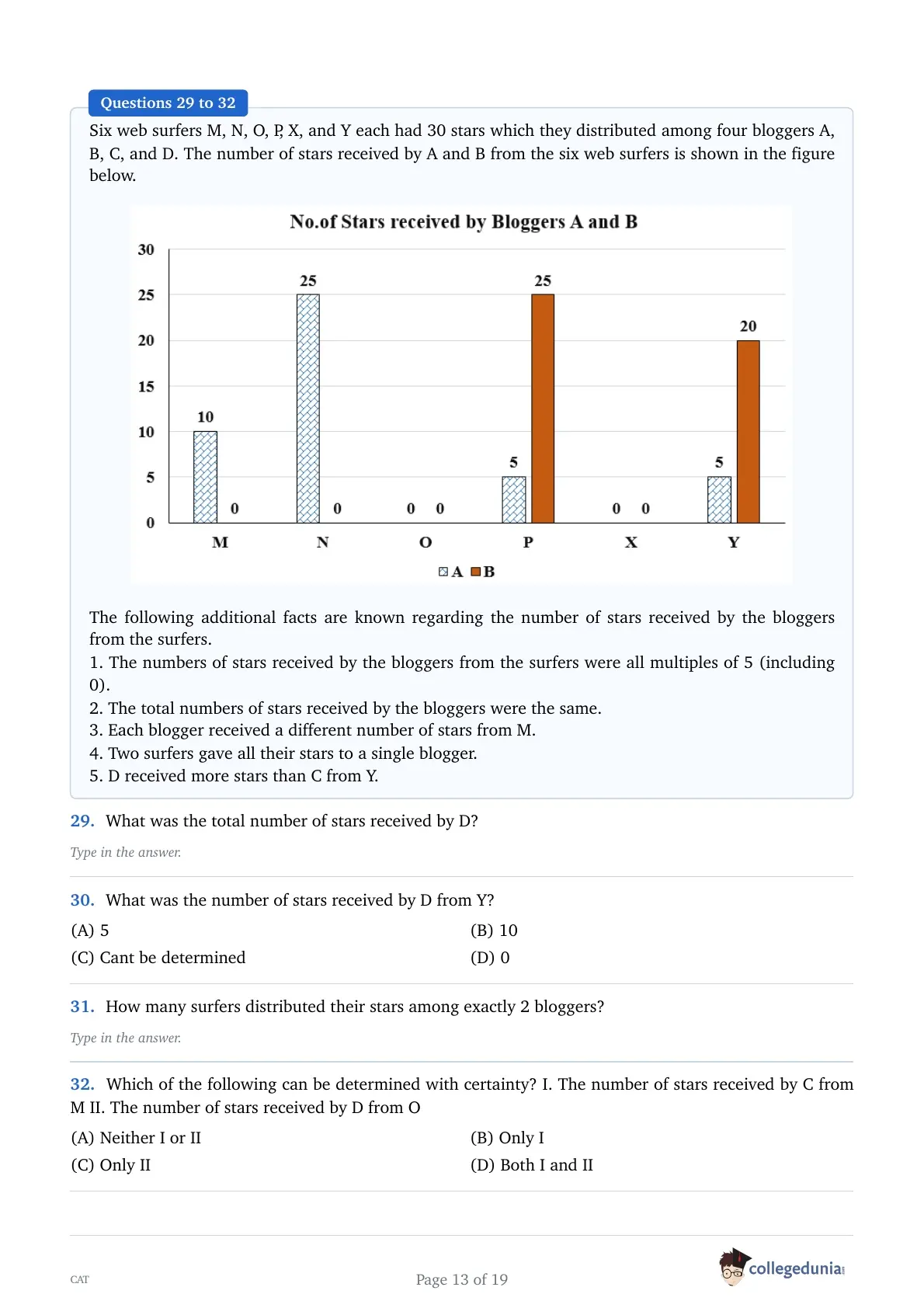
Six web surfers M, N, O, P, X, and Y each had 30 stars which they distributed among four bloggers A, B, C, and D. The number of stars received by A and B from the six web surfers is shown in the figure below
The following additional facts are known regarding the number of stars received by the bloggers from the surfers.
1. The numbers of stars received by the bloggers from the surfers were all multiples of 5 (including 0).
2. The total numbers of stars received by the bloggers were the same.
3. Each blogger received a different number of stars from M.
4. Two surfers gave all their stars to a single blogger.
5. D received more stars than C from Y
What was the total number of stars received by D?
What was the number of stars received by D from Y?
How many surfers distributed their stars among exactly 2 bloggers?
Which of the following can be determined with certainty?
I. The number of stars received by C from M
II. The number of stars received by D from O
Comprehension:
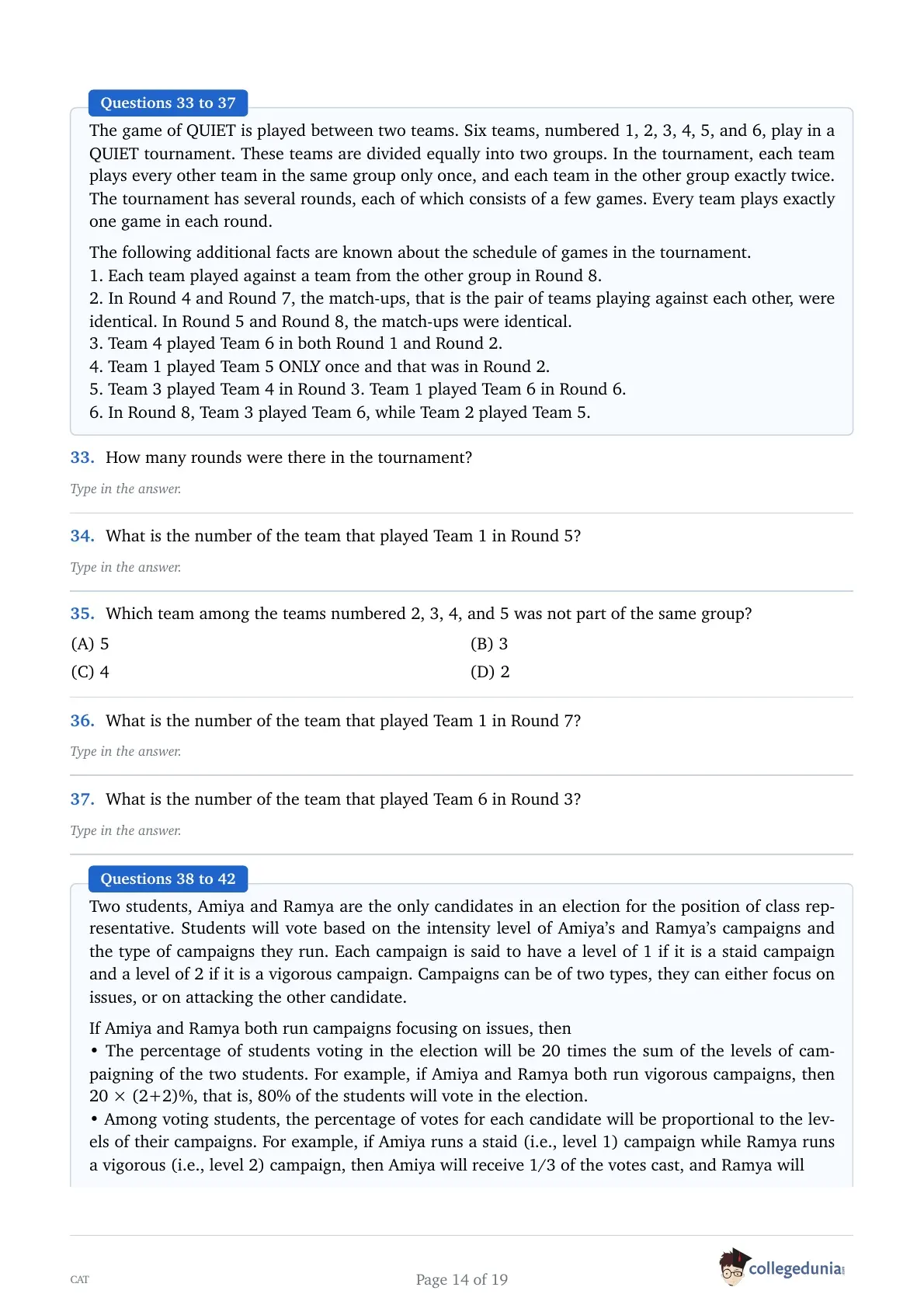
The game of QUIET is played between two teams. Six teams, numbered 1, 2, 3, 4, 5, and 6, play in a QUIET tournament. These teams are divided equally into two groups. In the tournament, each team plays every other team in the same group only once, and each team in the other group exactly twice. The tournament has several rounds, each of which consists of a few games. Every team plays exactly one game in each round.
The following additional facts are known about the schedule of games in the tournament.
1. Each team played against a team from the other group in Round 8.
2. In Round 4 and Round 7, the match-ups, that is the pair of teams playing against each other, were identical. In Round 5 and Round 8, the match ups were identical.
3. Team 4 played Team 6 in both Round 1 and Round 2.
4. Team 1 played Team 5 ONLY once and that was in Round 2.
5. Team 3 played Team 4 in Round 3. Team 1 played Team 6 in Round 6.
6. In Round 8, Team 3 played Team 6, while Team 2 played Team 5.
How many rounds were there in the tournament?
What is the number of the team that played Team 1 in Round 5?
Which team among the teams numbered 2, 3, 4, and 5 was not part of the same group?
What is the number of the team that played Team 1 in Round 7?
What is the number of the team that played Team 6 in Round 3?
Comprehension:
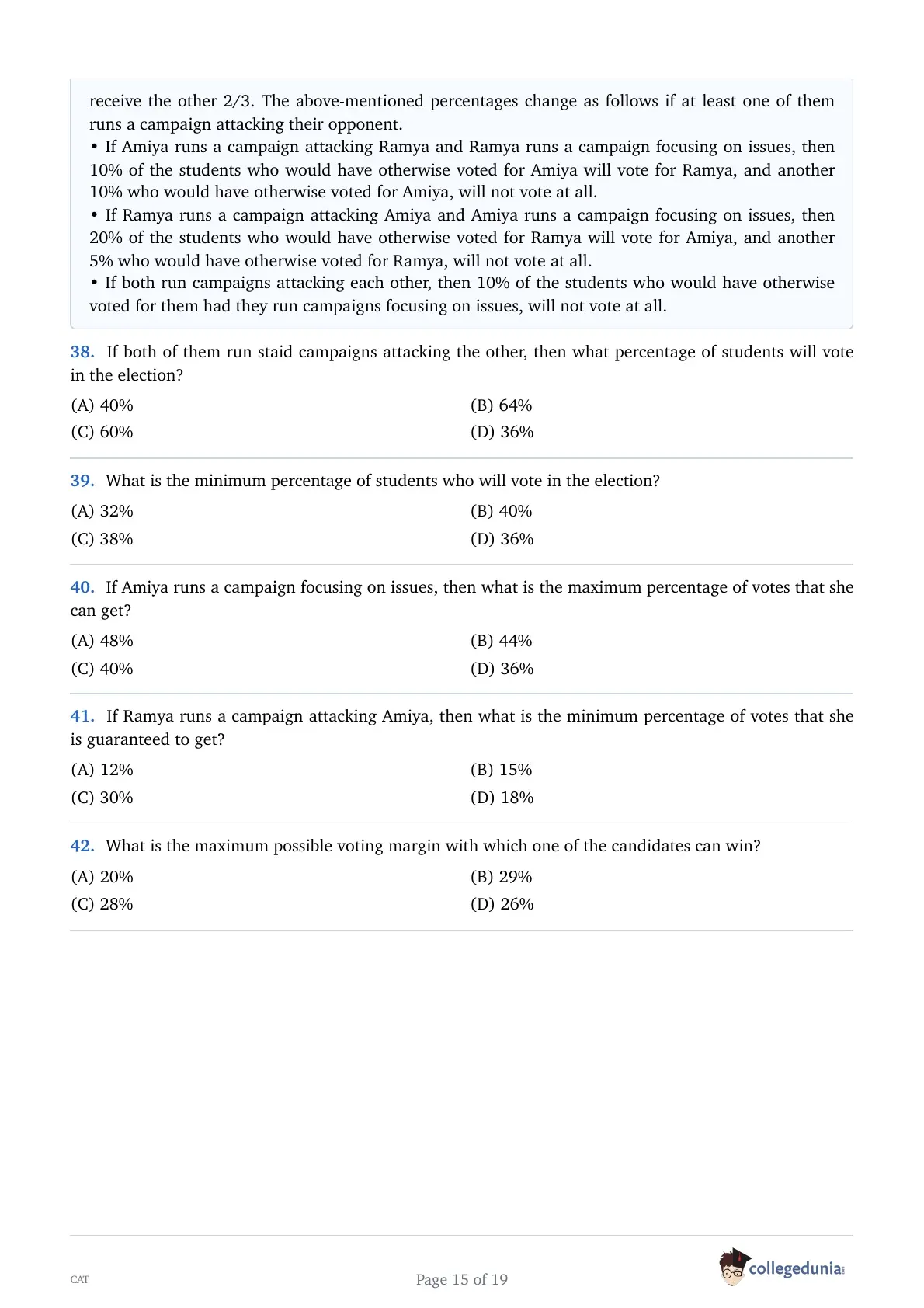
Two students, Amiya and Ramya are the only candidates in an election for the position of class representative. Students will vote based on the intensity level of Amiya’s and Ramya’s campaigns and the type of campaigns they run. Each campaign is said to have a level of 1 if it is a staid campaign and a level of 2 if it is a vigorous campaign. Campaigns can be of two types, they can either focus on issues, or on attacking the other candidate.
If Amiya and Ramya both run campaigns focusing on issues, then
• The percentage of students voting in the election will be 20 times the sum of the levels of campaigning of the two students. For example, if Amiya and Ramya both run vigorous campaigns, then \(20 × (2+2)\%\), that is, \(80\%\) of the students will vote in the election.
• Among voting students, the percentage of votes for each candidate will be proportional to the levels of their campaigns. For example, if Amiya runs a staid (i.e., level 1) campaign while Ramya runs a vigorous (i.e., level 2) campaign, then Amiya will receive \(\frac{1}{3}\) of the votes cast, and Ramya will receive the other \(\frac{2}{3}\).
The above-mentioned percentages change as follows if at least one of them runs a campaign attacking their opponent.
• If Amiya runs a campaign attacking Ramya and Ramya runs a campaign focusing on issues, then \(10\%\) of the students who would have otherwise voted for Amiya will vote for Ramya, and another \(10\%\) who would have otherwise voted for Amiya, will not vote at all.
• If Ramya runs a campaign attacking Amiya and Amiya runs a campaign focusing on issues, then \(20\%\) of the students who would have otherwise voted for Ramya will vote for Amiya, and another \(5\%\) who would have otherwise voted for Ramya, will not vote at all.
• If both run campaigns attacking each other, then \(10\%\) of the students who would have otherwise voted for them had they run campaigns focusing on issues, will not vote at all.
If both of them run staid campaigns attacking the other, then what percentage of students will vote in the election?
What is the minimum percentage of students who will vote in the election?
If Amiya runs a campaign focusing on issues, then what is the maximum percentage of votes that she can get?
If Ramya runs a campaign attacking Amiya, then what is the minimum percentage of votes that she is guaranteed to get?
What is the maximum possible voting margin with which one of the candidates can win?
Comprehension:
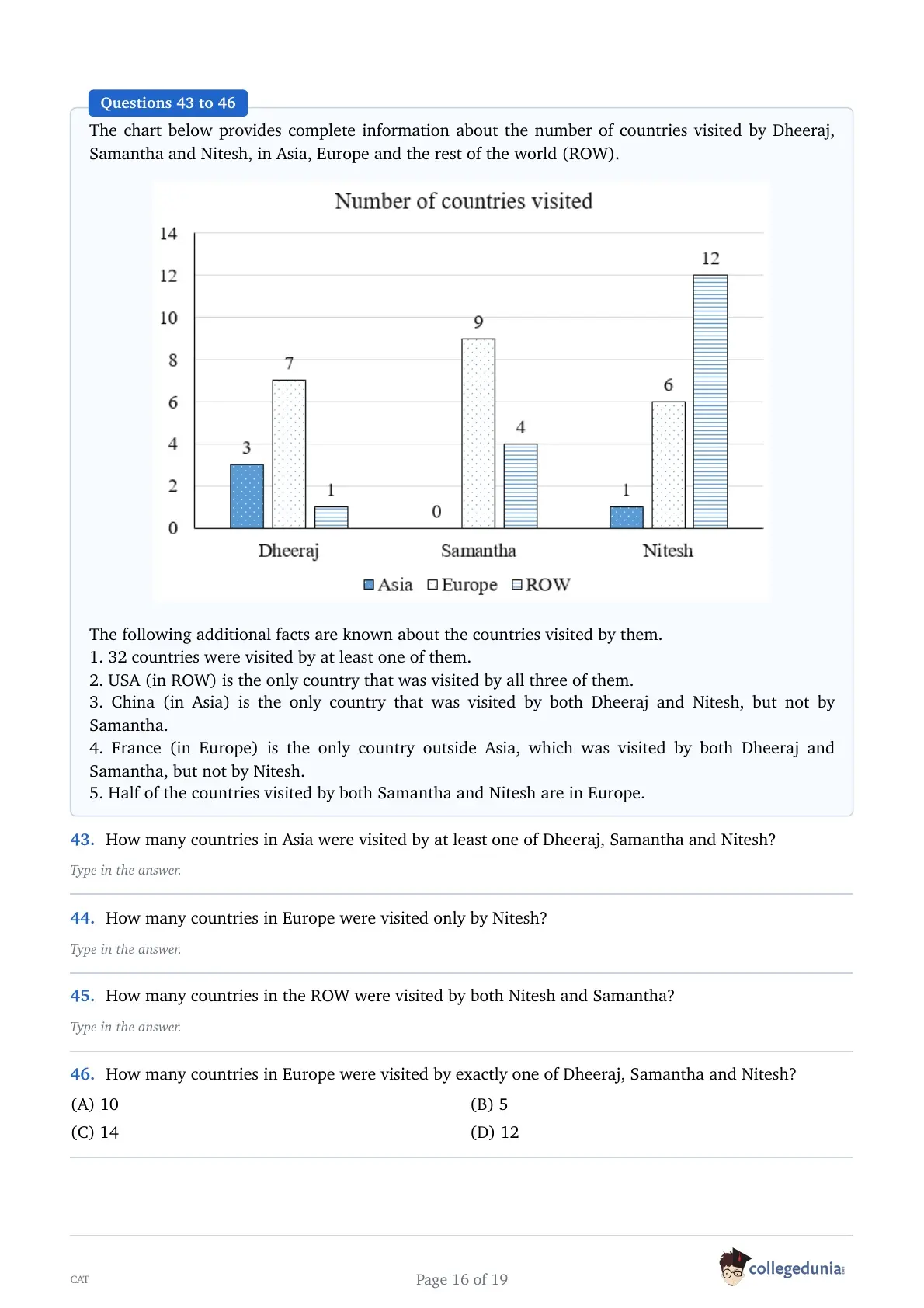
The chart below provides complete information about the number of countries visited by Dheeraj, Samantha and Nitesh, in Asia, Europe and the rest of the world (ROW).
The following additional facts are known about the countries visited by them.
1. 32 countries were visited by at least one of them.
2. USA (in ROW) is the only country that was visited by all three of them.
3. China (in Asia) is the only country that was visited by both Dheeraj and Nitesh, but not by Samantha.
4. France (in Europe) is the only country outside Asia, which was visited by both Dheeraj and Samantha, but not by Nitesh.
5. Half of the countries visited by both Samantha and Nitesh are in Europe.
How many countries in Asia were visited by at least one of Dheeraj, Samantha and Nitesh?
How many countries in Europe were visited only by Nitesh?
How many countries in the ROW were visited by both Nitesh and Samantha?
How many countries in Europe were visited by exactly one of Dheeraj, Samantha and Nitesh?
Quantitative Ability (QA) (Q47 - Q68)
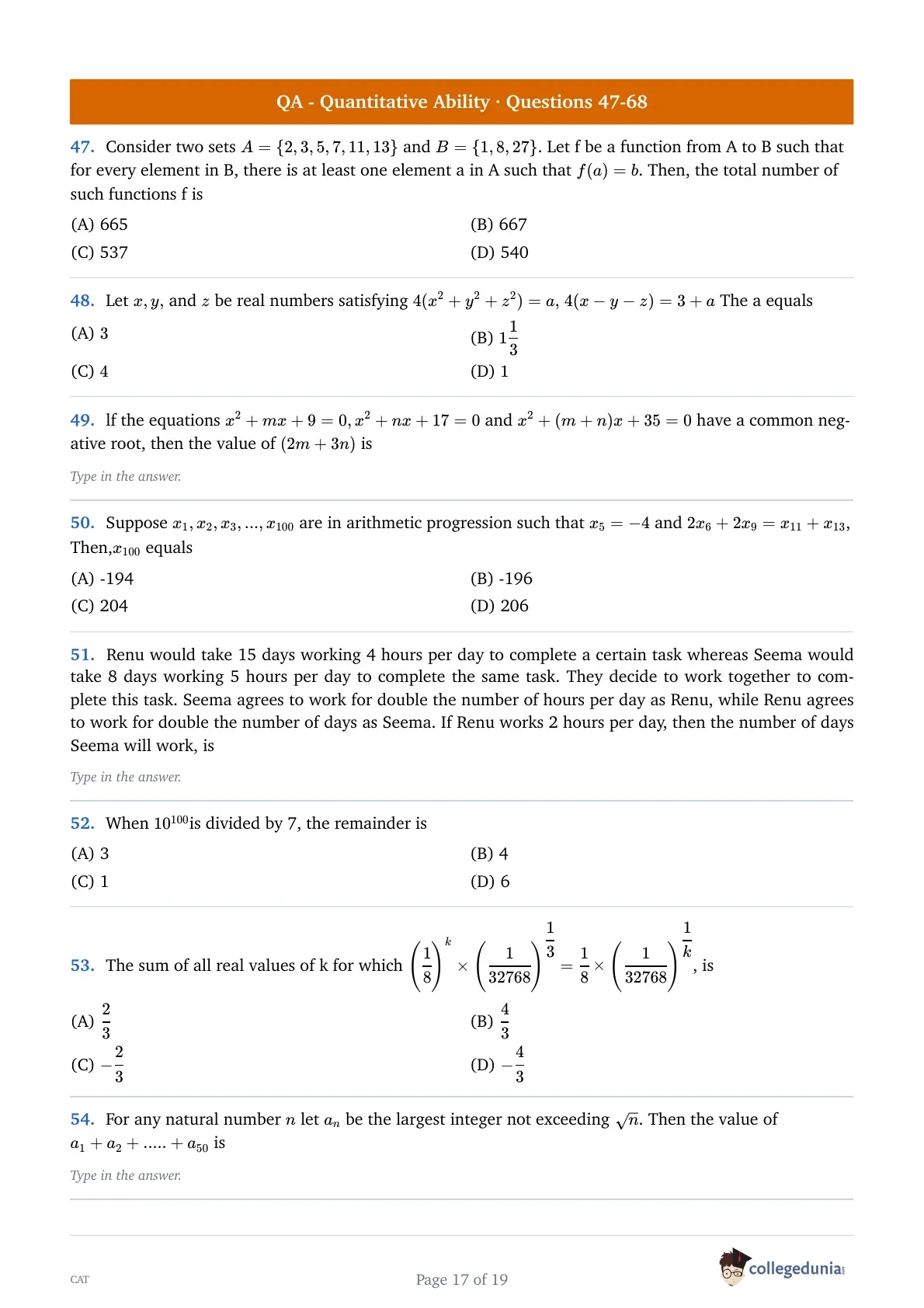
Consider two sets A = {2, 3, 5, 7, 11, 13} and B = {1, 8, 27}. Let f be a function from A to B such that for every element b in B, there is at least one element a in A such that f(a) = b. Then, the total number of such functions f is
Let \(x\), \(y\), and \(z\) be real numbers satisfying
\(4(x^2 + y^2 + z^2) = a,\)
\(4(x - y - z) = 3 + a.\)
Then \(a\) equals ?
If the equations \(x^2 + mx + 9 = 0\), \(x^2 + nx + 17 = 0\), and \(x^2 + (m+n)x + 35 = 0\) have a common negative root, then the value of \((2m + 3n)\) is ?
Suppose \(x_1, x_2, x_3, \dots, x_{100}\) are in arithmetic progression such that \(x_5 = -4\) and \(2x_6 + 2x_9 = x_{11} + x_{13}\). Then, \(x_{100}\) equals ?
Renu would take 15 days working 4 hours per day to complete a certain task whereas Seema would take 8 days working 5 hours per day to complete the same task. They decide to work together to complete this task. Seema agrees to work for double the number of hours per day as Renu, while Renu agrees to work for double the number of days as Seema. If Renu works 2 hours per day, then the number of days Seema will work, is
When \(10^{100}\) is divided by 7, the remainder is ?
The sum of all real values of \(k\) for which \((\frac{1}{8})^k \times (\frac{1}{32768})^{\frac{4}{3}} = \frac{1}{8} \times (\frac{1}{32768})^{\frac{k}{3}}\) is
Let \(a_n\) be the largest integer not exceeding \(\sqrt{n}\). Then the value of \(a_1 + a_2 + \dots + a_{50}\) is
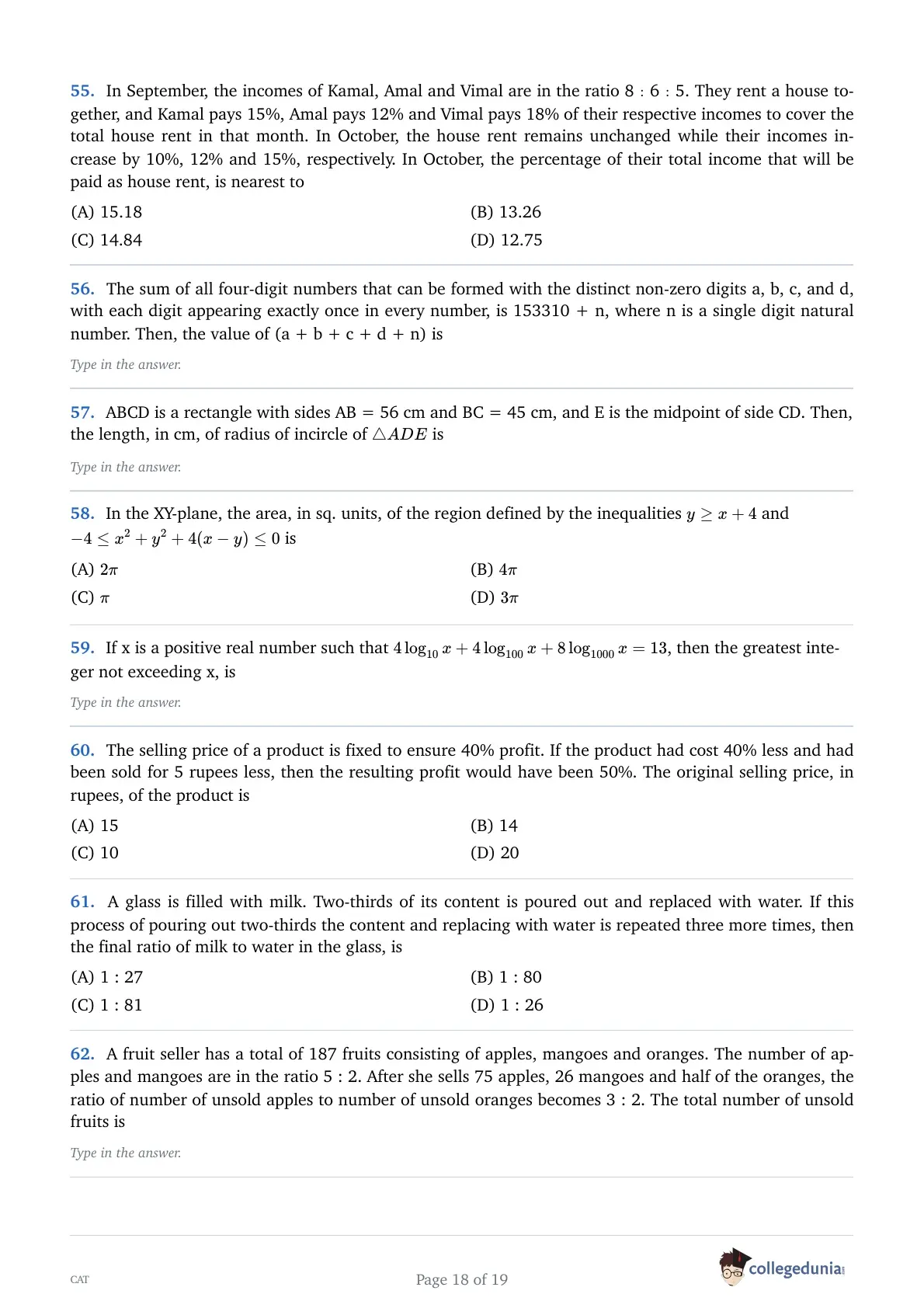
In September, the incomes of Kamal, Amal and Vimal are in the ratio 8 ∶ 6 ∶ 5. They rent a house together, and Kamal pays 15%, Amal pays 12% and Vimal pays 18% of their respective incomes to cover the total house rent in that month. In October, the house rent remains unchanged while their incomes increase by 10%, 12% and 15%, respectively. In October, the percentage of their total income that will be paid as house rent, is nearest to
The sum of all four-digit numbers that can be formed with the distinct non-zero digits \(a\), \(b\), \(c\), and \(d\), with each digit appearing exactly once in every number, is \(153310 + n\), where \(n\) is a single digit natural number. Then, the value of \((a + b + c + d)\) is ?
ABCD is a rectangle with sides AB = 56 cm and BC = 45 cm, and E is the midpoint of side CD. Then, the length, in cm, of radius of incircle of \(\triangle ADE\) is
In the \(XY\)-plane, the area, in sq. units, of the region defined by the inequalities \(y \ge x + 4\) and \(-4 \le x^2 + y^2 + 4(x - y) \le 0\) is
Let \(x\) be a positive real number such that \(4 \log_{10} x + 4 \log_{100} x + 8 \log_{1000} x = 13\) , then the greatest integer not exceeding \(x\). is
The selling price of a product is fixed to ensure 40% profit. If the product had cost 40% less and had been sold for 5 rupees less, then the resulting profit would have been 50%. The original selling price, in rupees, of the product is
A glass is filled with milk. Two-thirds of its content is poured out and replaced with water. If this process of pouring out two-thirds the content and replacing with water is repeated three more times, then the final ratio of milk to water in the glass, is
A fruit seller has a total of 187 fruits consisting of apples, mangoes and oranges. The number of apples and mangoes are in the ratio 5 : 2. After she sells 75 apples, 26 mangoes and half of the oranges, the ratio of number of unsold apples to number of unsold oranges becomes 3 : 2. The total number of unsold fruits is
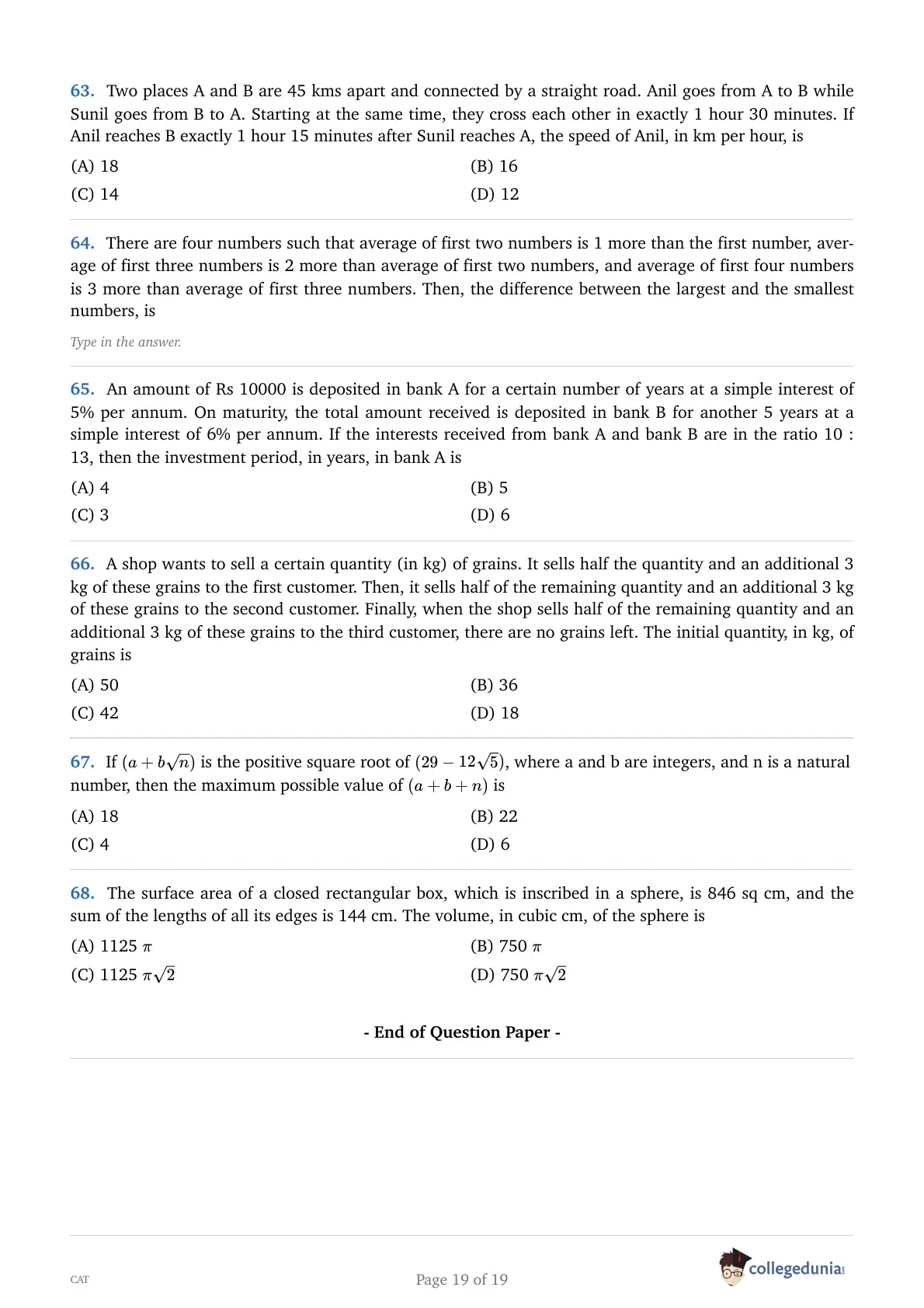
Two places A and B are 45 kms apart and connected by a straight road. Anil goes from A to B while Sunil goes from B to A. Starting at the same time, they cross each other in exactly 1 hour 30 minutes. If Anil reaches B exactly 1 hour 15 minutes after Sunil reaches A, the speed of Anil, in km per hour, is
There are four numbers such that average of first two numbers is 1 more than the first number, average of first three numbers is 2 more than average of first two numbers, and average of first four numbers is 3 more than average of first three numbers. Then, the difference between the largest and the smallest numbers, is
An amount of Rs 10000 is deposited in bank A for a certain number of years at a simple interest of 5% per annum. On maturity, the total amount received is deposited in bank B for another 5 years at a simple interest of 6% per annum. If the interests received from bank A and bank B are in the ratio 10 : 13, then the investment period, in years, in bank A is
A shop wants to sell a certain quantity (in kg) of grains. It sells half the quantity and an additional 3 kg of these grains to the first customer. Then, it sells half of the remaining quantity and an additional 3 kg of these grains to the second customer. Finally, when the shop sells half of the remaining quantity and an additional 3 kg of these grains to the third customer, there are no grains left. The initial quantity, in kg, of grains is
If \((a + b\sqrt{n})\) is the positive square root of \((29 - 12\sqrt{5})\), where \(a\) and \(b\) are integers, and \(n\) is a natural number, then the maximum possible value of \((a + b + n)\) is ?
The surface area of a closed rectangular box, which is inscribed in a sphere, is 846 sq cm, and the sum of the lengths of all its edges is 144 cm. The volume, in cubic cm, of the sphere is ?
CAT 2024 Exam Pattern and Marking Scheme
Section-wise Exam Pattern
| Section | Questions | Time | Marks per question | Maximum marks |
|---|---|---|---|---|
| Verbal Ability and Reading Comprehension (VARC) | 24 | 40 minutes | 3 | 72 |
| Data Interpretation and Logical Reasoning (DILR) | 22 | 40 minutes | 3 | 66 |
| Quantitative Ability (QA) | 22 | 40 minutes | 3 | 66 |
| Total | 68 | 120 minutes | - | 204 |
Marking Scheme
| Question type and response | Marks |
|---|---|
| MCQ - correct answer | +3 |
| MCQ - incorrect answer | -1 |
| TITA - correct answer | +3 |
| TITA - incorrect answer | 0 (no negative marking) |
| Unattempted question | 0 |



Comments