




The CAT 2025 Slot 3 Question Paper (CAT 2025, conducted by IIM Kozhikode on November 30, 2025) is available here as a free PDF download, together with the official question paper.
The CAT 2025 Slot 3 question paper includes the following:
- 68 questions in a 2-hour computer based test, split into three sections: VARC (24), DILR (22) and QA (22)
- Sectional time limit: 40 minutes per section, and candidates cannot switch between sections
- Question types: multiple choice questions (MCQs) and Type In The Answer (TITA) questions
- Marking: +3 for a correct answer, -1 for an incorrect MCQ, no negative marking for TITA, 0 for an unattempted question
- Maximum marks: 204
CAT 2025 Slot 3 Question Paper PDF
| Official PDF | CD PDF | CD PDF with Solutions |
|---|---|---|
| Download official PDF 0.64 MB | Download Collegedunia PDF 0.59 MB | - |
Also Check:

CAT 2025 Slot 3 Question Paper Analysis
Student reactions and expert feedback collected by Collegedunia after the CAT 2025 Slot 3 exam (held by IIM Kozhikode from 4:30 pm to 6:30 pm) suggest the paper was moderate to tough. Quant was the hardest section, VARC was moderate and DILR was moderately easy.
| Section | Questions | Time | Difficulty level (student feedback) |
|---|---|---|---|
| Verbal Ability and Reading Comprehension (VARC) | 24 | 40 minutes | Moderate |
| Data Interpretation and Logical Reasoning (DILR) | 22 | 40 minutes | Moderately easy (easier than Slot 1 and Slot 2) |
| Quantitative Ability (QA) | 22 | 40 minutes | Tough (hardest section) |
| Overall | 68 | 120 minutes | Moderate to Tough |
For the detailed section-wise analysis, read CAT 2025 Slot 3 Exam Analysis.
Source: IMS CAT Prep (YouTube)
CAT 2025 Slot 3 Questions with Solutions
Verbal Ability and Reading Comprehension (VARC) (Q1 - Q24)
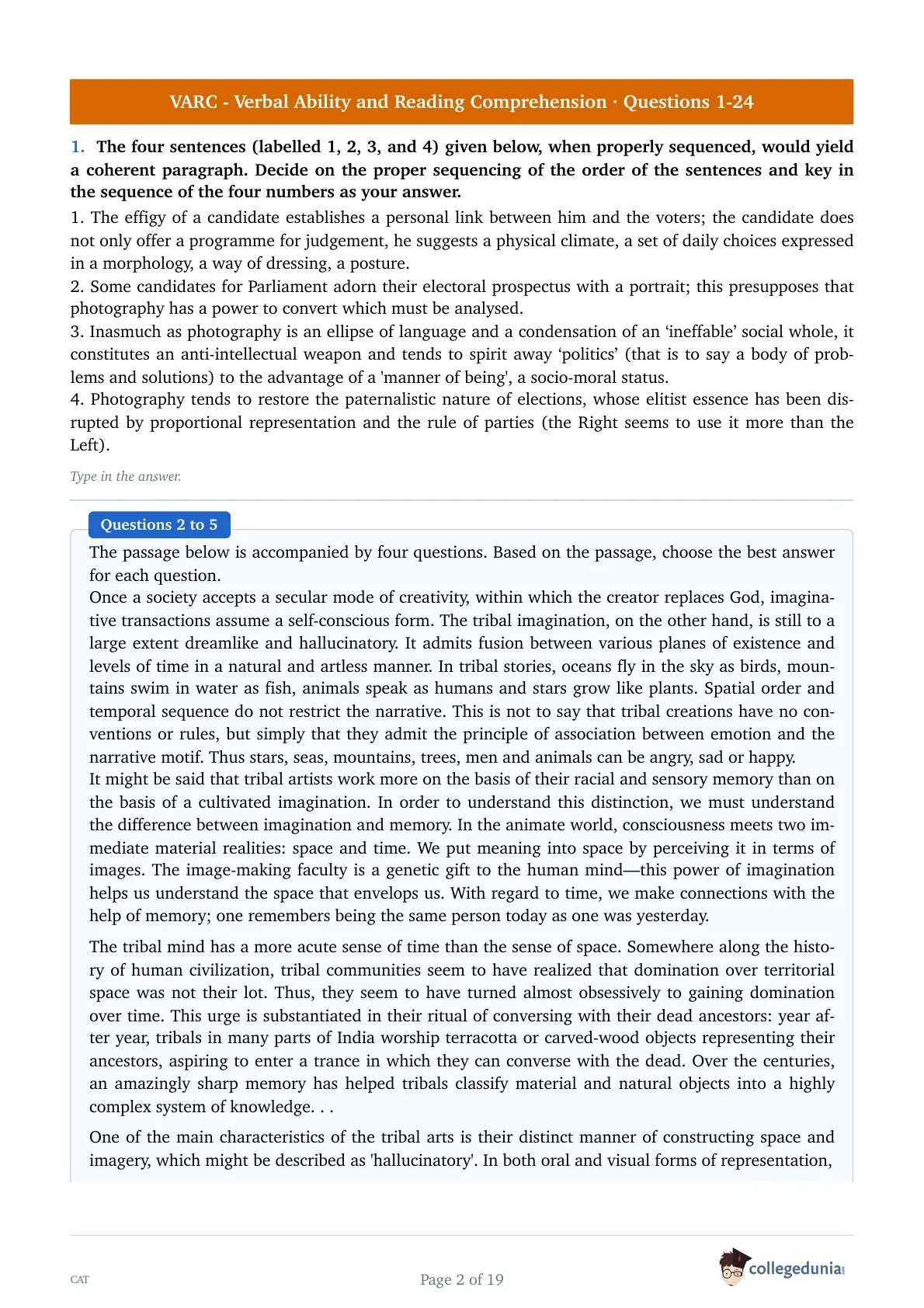
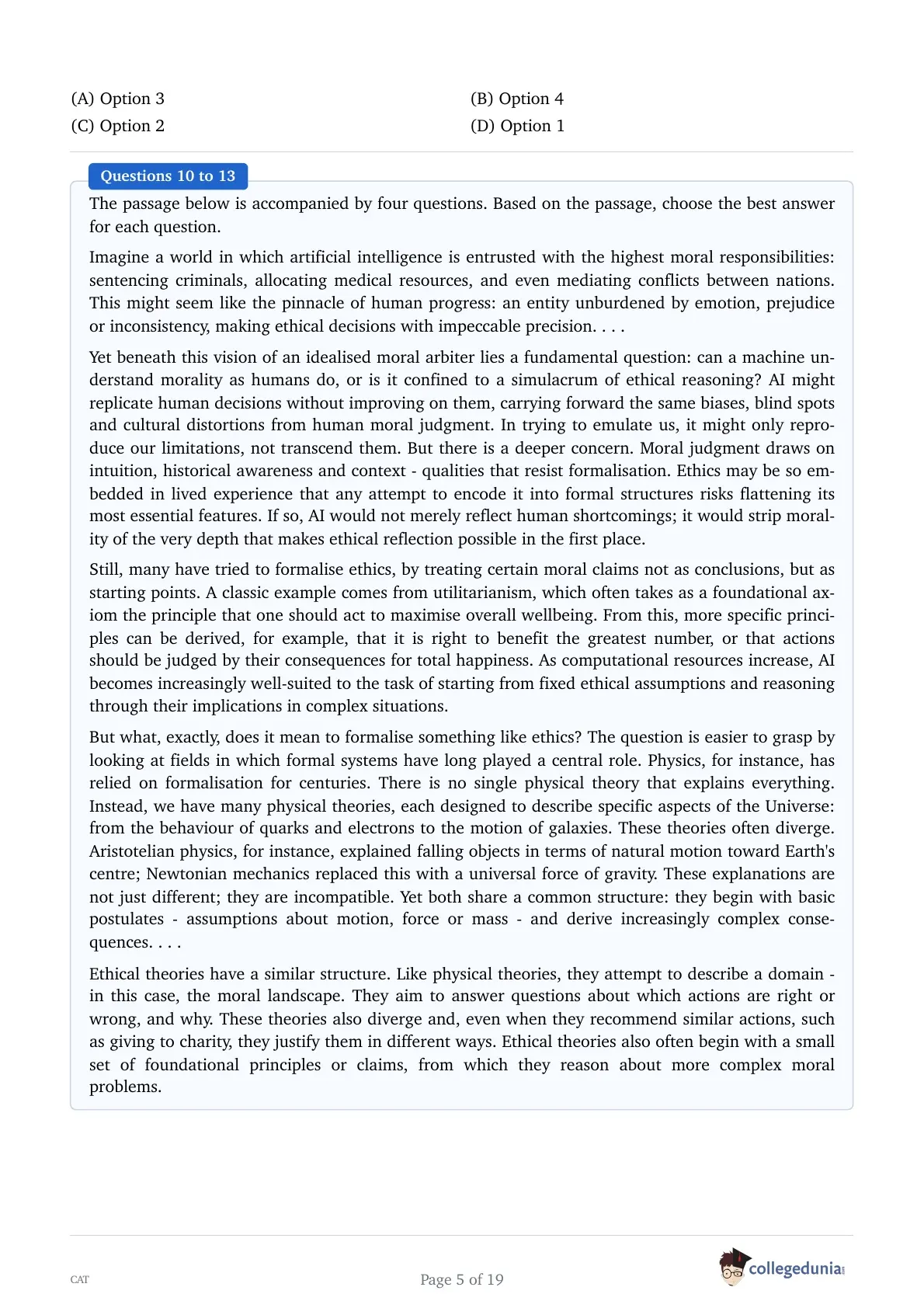
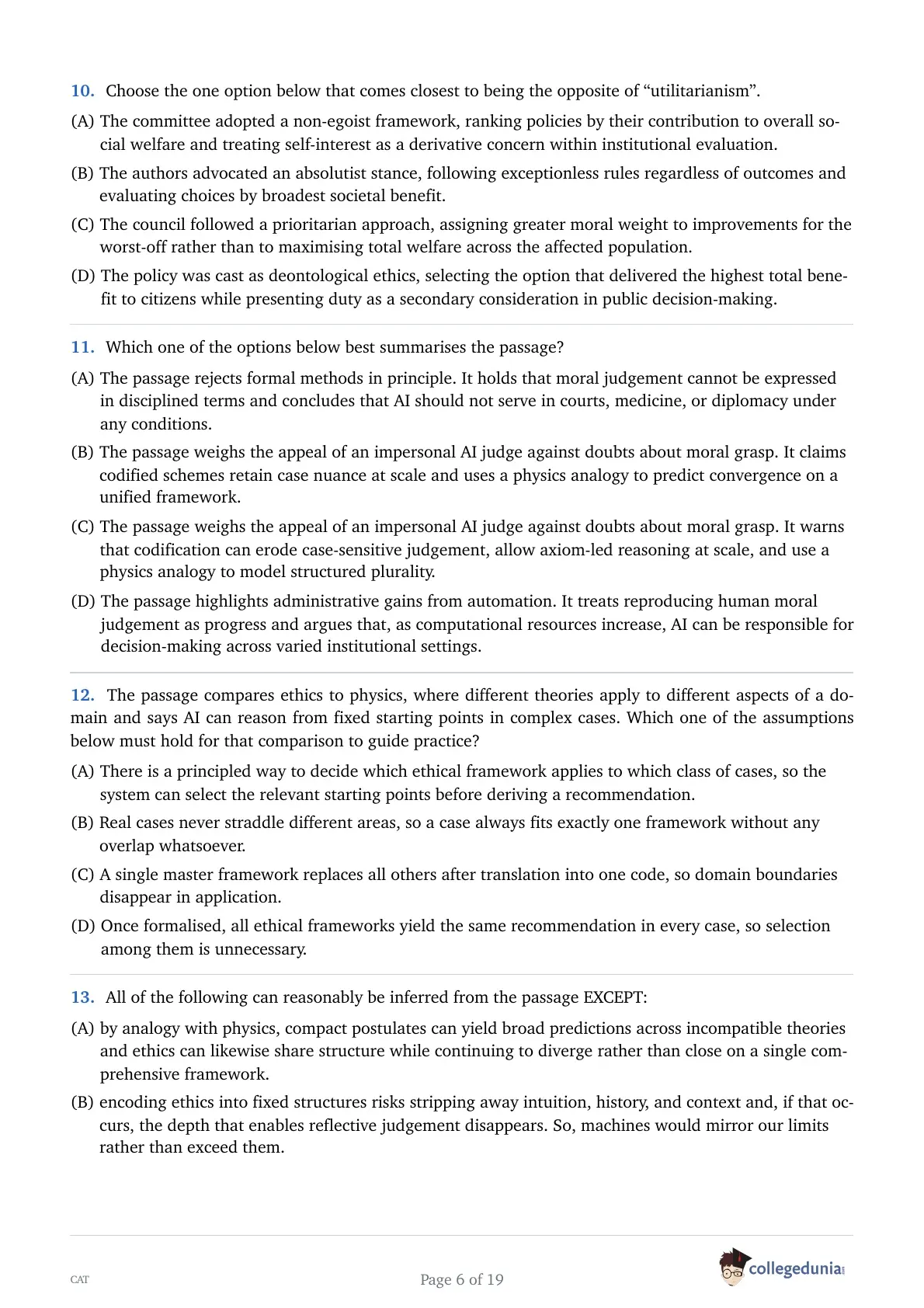
All of the following can reasonably be inferred from the passage EXCEPT:
Which one of the options below best summarises the passage?
The passage compares ethics to physics, where different theories apply to different aspects of a domain and says AI can reason from fixed starting points in complex cases. Which one of the assumptions below must hold for that comparison to guide practice?
Choose the one option below that comes closest to being the opposite of “utilitarianism”.
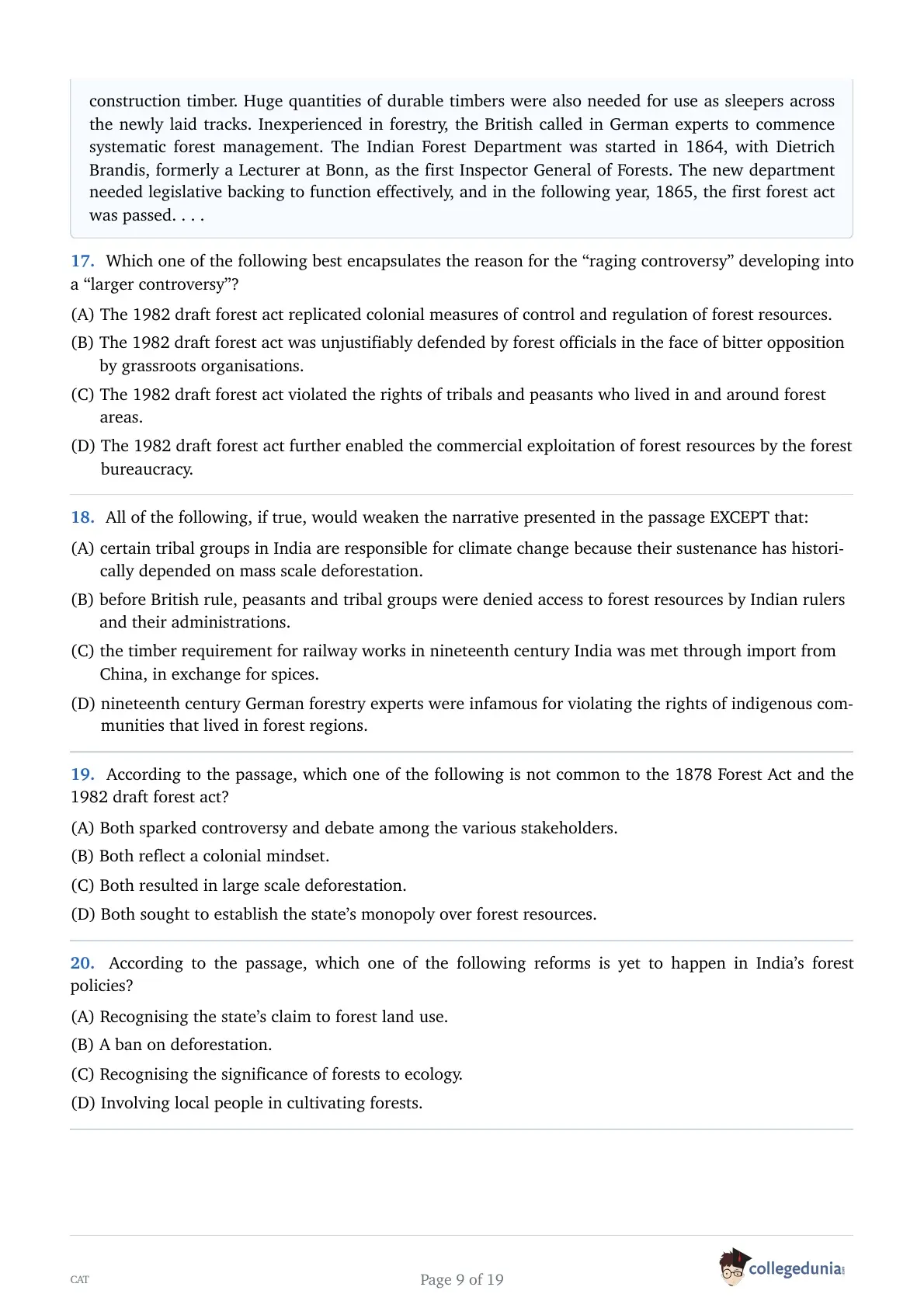
Which one of the following best encapsulates the reason for the “raging controversy” developing into a “larger controversy”?
According to the passage, which one of the following reforms is yet to happen in India’s forest policies?
According to the passage, which one of the following is not common to the 1878 Forest Act and the 1982 draft forest act?
All of the following, if true, would weaken the narrative presented in the passage EXCEPT that:
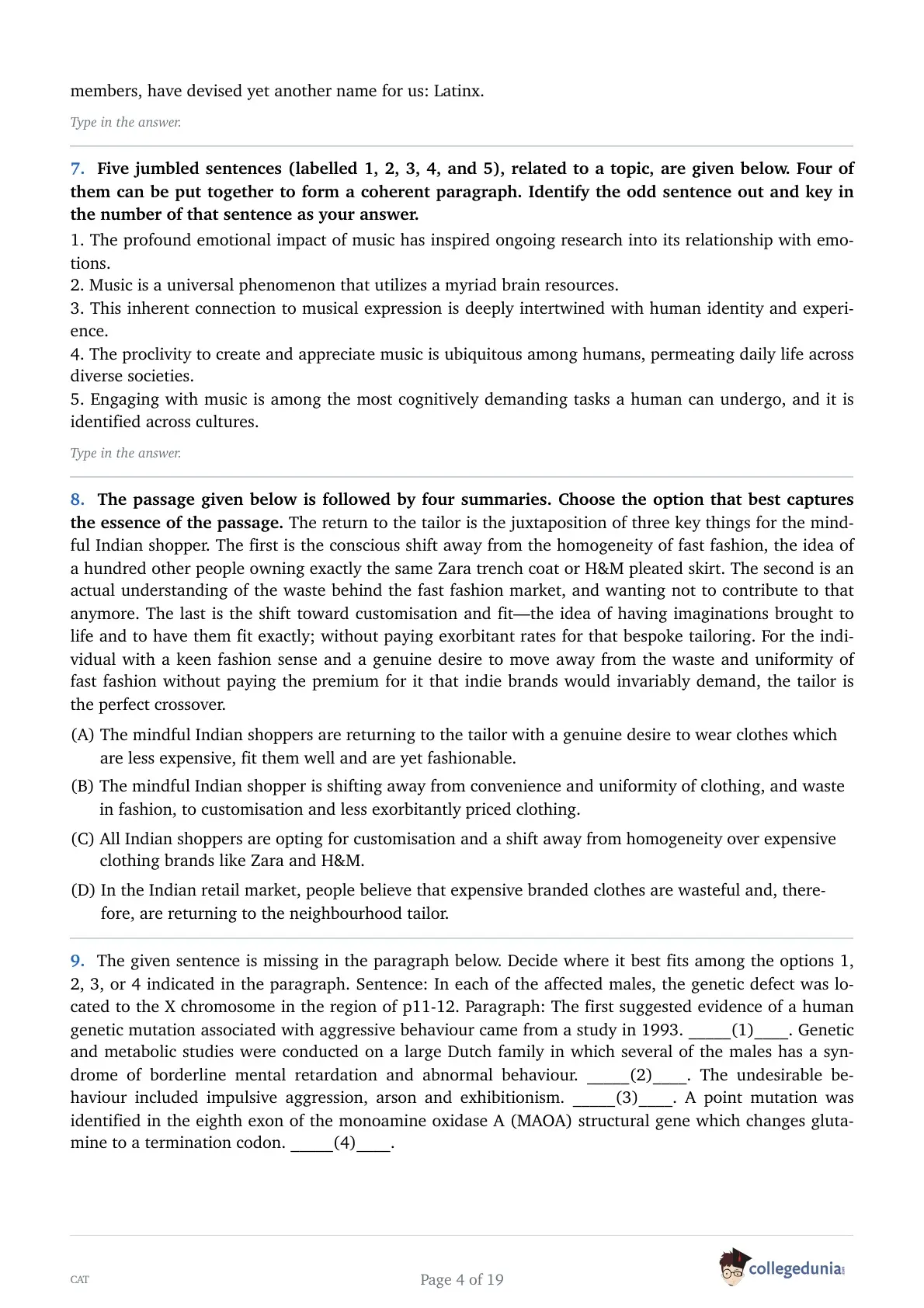
The given sentence is missing in the paragraph below. Decide where it best fits among the options 1, 2, 3, or 4 indicated in the paragraph.
Sentence: In each of the affected males, the genetic defect was located to the X chromosome in the region of p11-12.
Paragraph: The first suggested evidence of a human genetic mutation associated with aggressive behaviour came from a study in 1993. ____ (1)____. Genetic and metabolic studies were conducted on a large Dutch family in which several of the males has a syndrome of borderline mental retardation and abnormal behaviour. ____ (2)____. The undesirable behaviour included impulsive aggression, arson and exhibitionism. ____ (3)____. A point mutation was identified in the eighth exon of the monoamine oxidase A (MAOA) structural gene which changes glutamine to a termination codon. ____ (4)____.
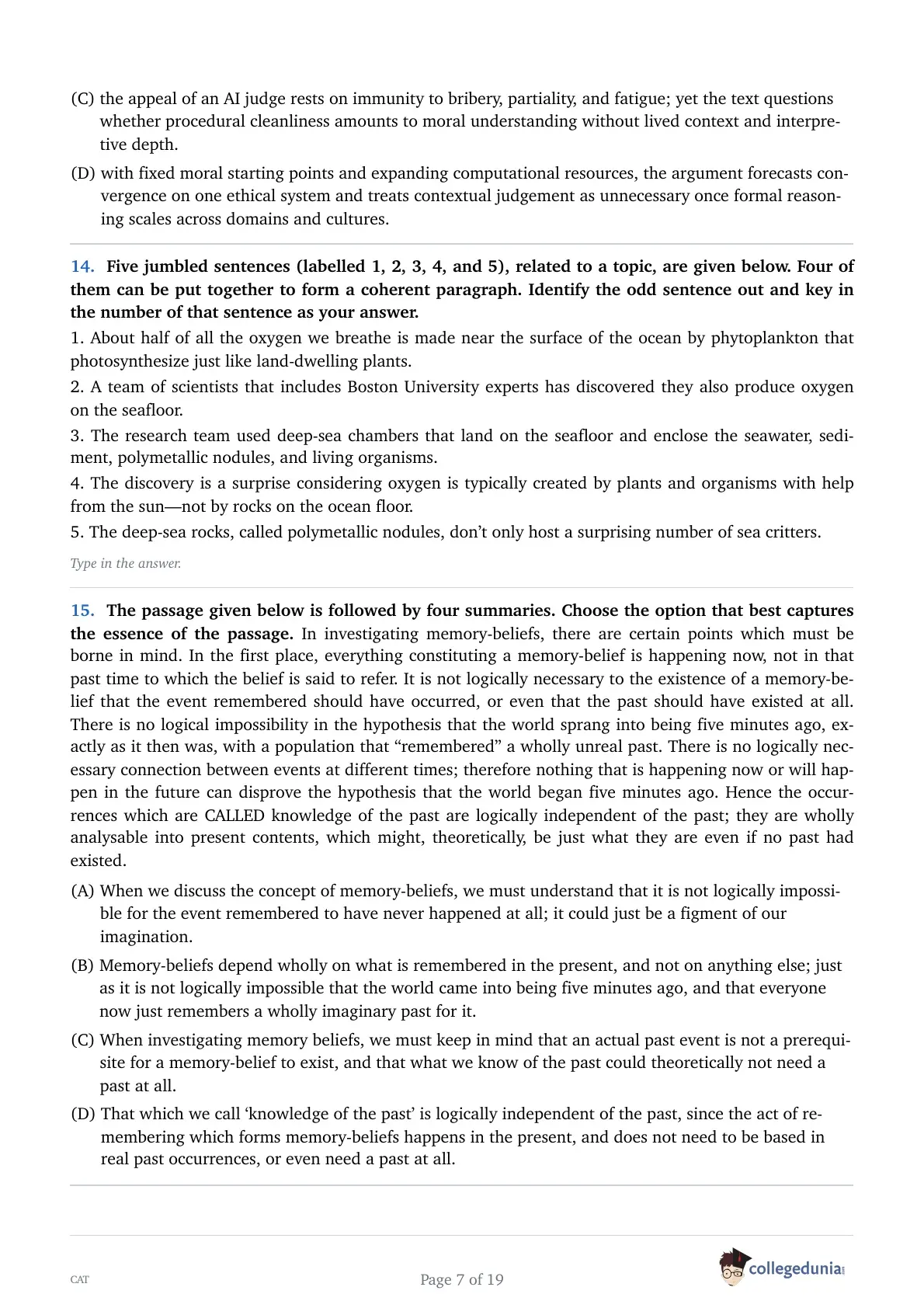
Five jumbled sentences (labelled 1, 2, 3, 4, and 5), related to a topic, are given below. Four of them can be put together to form a coherent paragraph. Identify the odd sentence out and key in the number of that sentence as your answer.
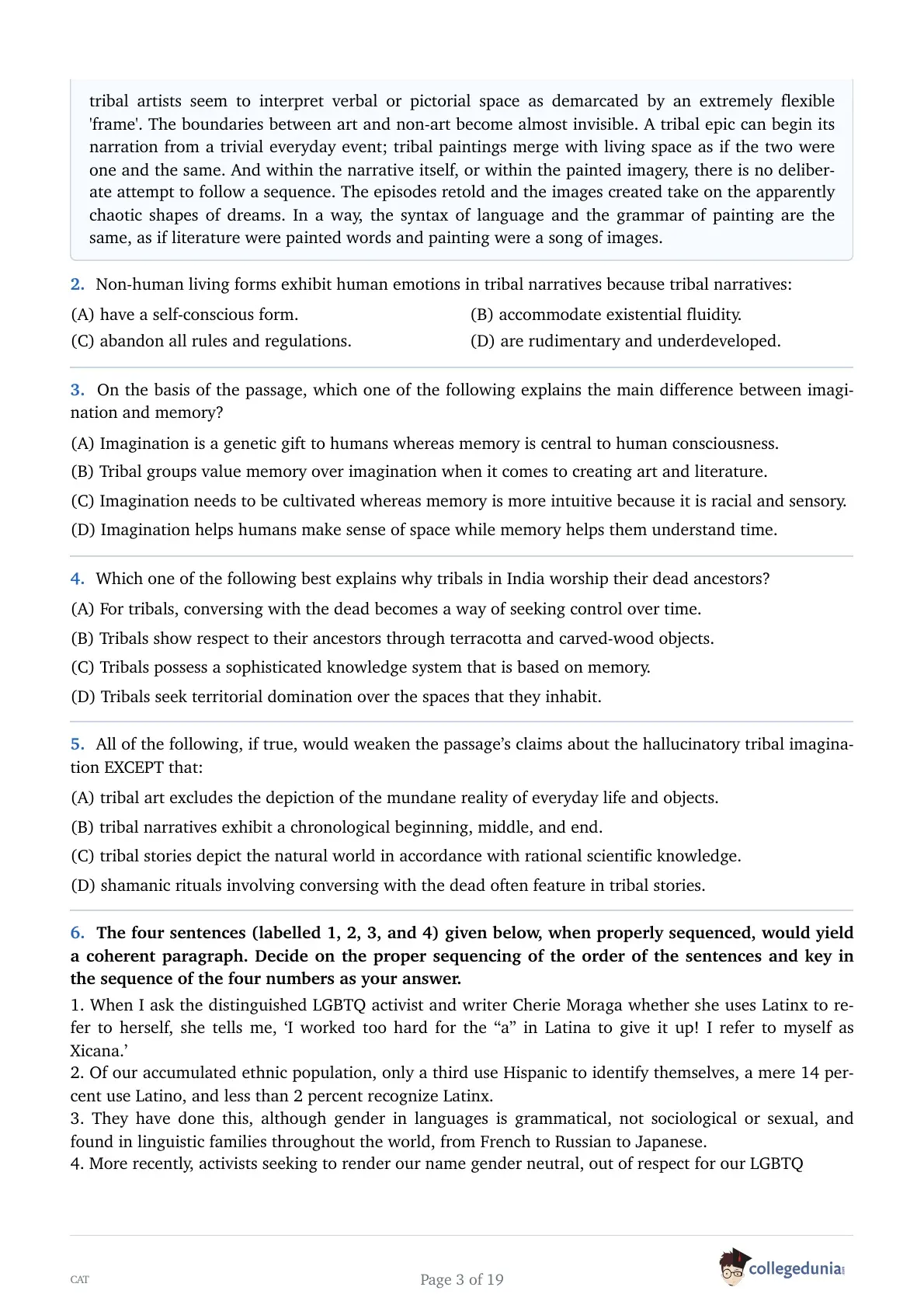
The four sentences (labelled 1, 2, 3, and 4) given below, when properly sequenced, would yield a coherent paragraph. Decide on the proper sequencing of the order of the sentences and key in the sequence of the four numbers as your answer.
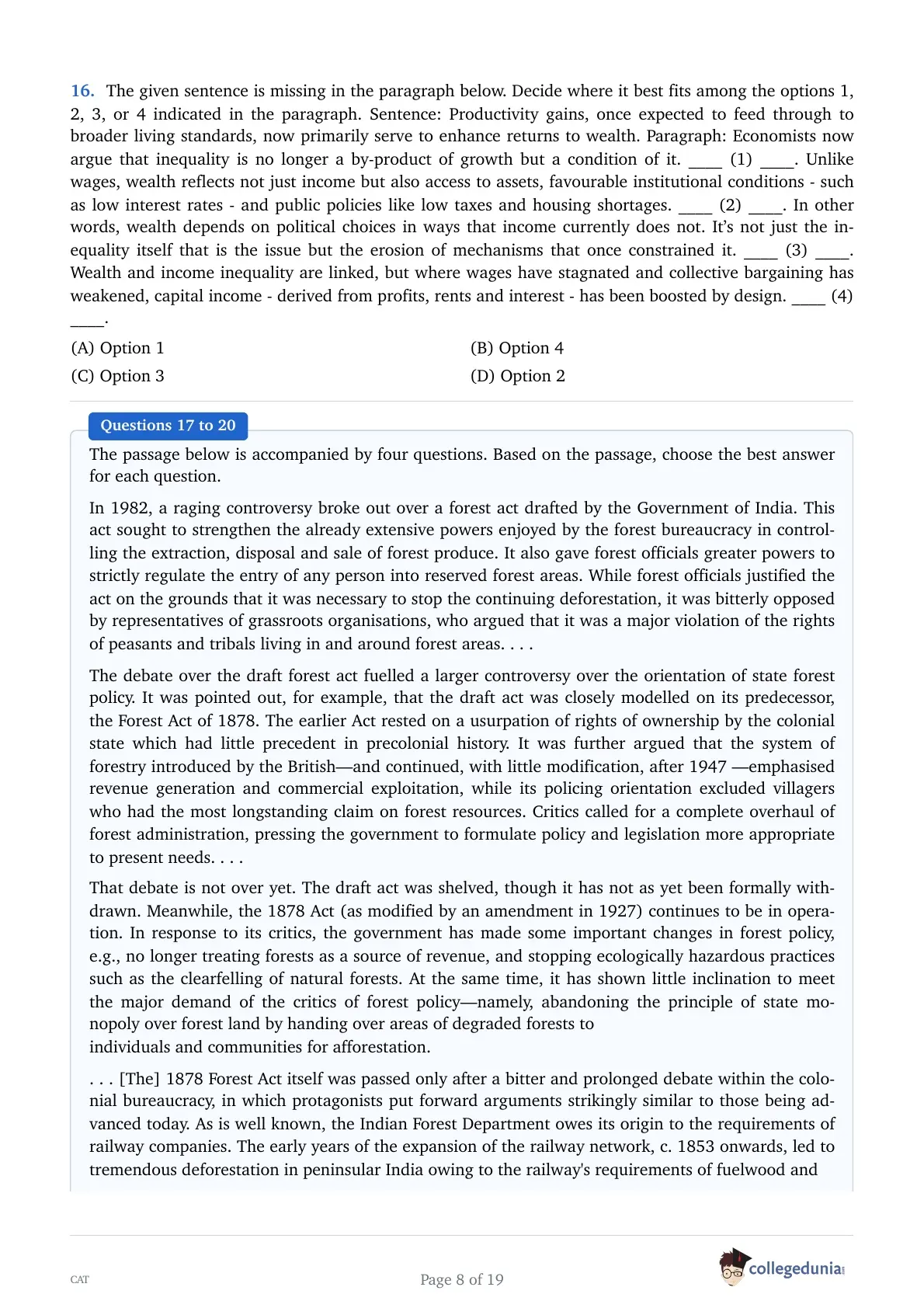
The given sentence is missing in the paragraph below. Decide where it best fits among the options 1, 2, 3, or 4 indicated in the paragraph.
Sentence: Productivity gains, once expected to feed through to broader living standards, now primarily serve to enhance returns to wealth.
Paragraph: Economists now argue that inequality is no longer a by-product of growth but a condition of it. ____ (1)____. Unlike wages, wealth reflects not just income but also access to assets, favourable institutional conditions—such as low interest rates—and public policies like low taxes and housing shortages. ____ (2)____. In other words, wealth depends on political choices in ways that income currently does not. It’s not just the inequality itself that is the issue but the erosion of mechanisms that once constrained it. ____ (3)____. Wealth and income inequality are linked, but where wages have stagnated and collective bargaining has weakened, capital income—derived from profits, rents and interest—has been boosted by design. ____ (4)____.
The passage given below is followed by four summaries. Choose the option that best captures the essence of the passage.
The return to the tailor is the juxtaposition of three key things for the mindful Indian shopper. The first is the conscious shift away from the homogeneity of fast fashion, the idea of a
Read More
hundred other people owning exactly the same Zara trench coat or H&M pleated skirt. The second is an actual understanding of the waste behind the fast fashion market, and wanting not to contribute to that anymore. The last is the shift toward customisation and fit—the idea of having imaginations brought to life and to have them fit exactly; without paying exorbitant rates for that bespoke tailoring. For the individual with a keen fashion sense and a genuine desire to move away from the waste and uniformity of fast fashion without paying the premium for it that indie brands would invariably demand, the tailor is the perfect crossover.Five jumbled sentences (labelled 1, 2, 3, 4, and 5), related to a topic, are given below. Four of them can be put together to form a coherent paragraph. Identify the odd sentence out and key in the number of that sentence as your answer.
The four sentences (labelled 1, 2, 3, and 4) given below, when properly sequenced, would yield a coherent paragraph. Decide on the proper sequencing of the order of the sentences and key in the sequence of the four numbers as your answer.
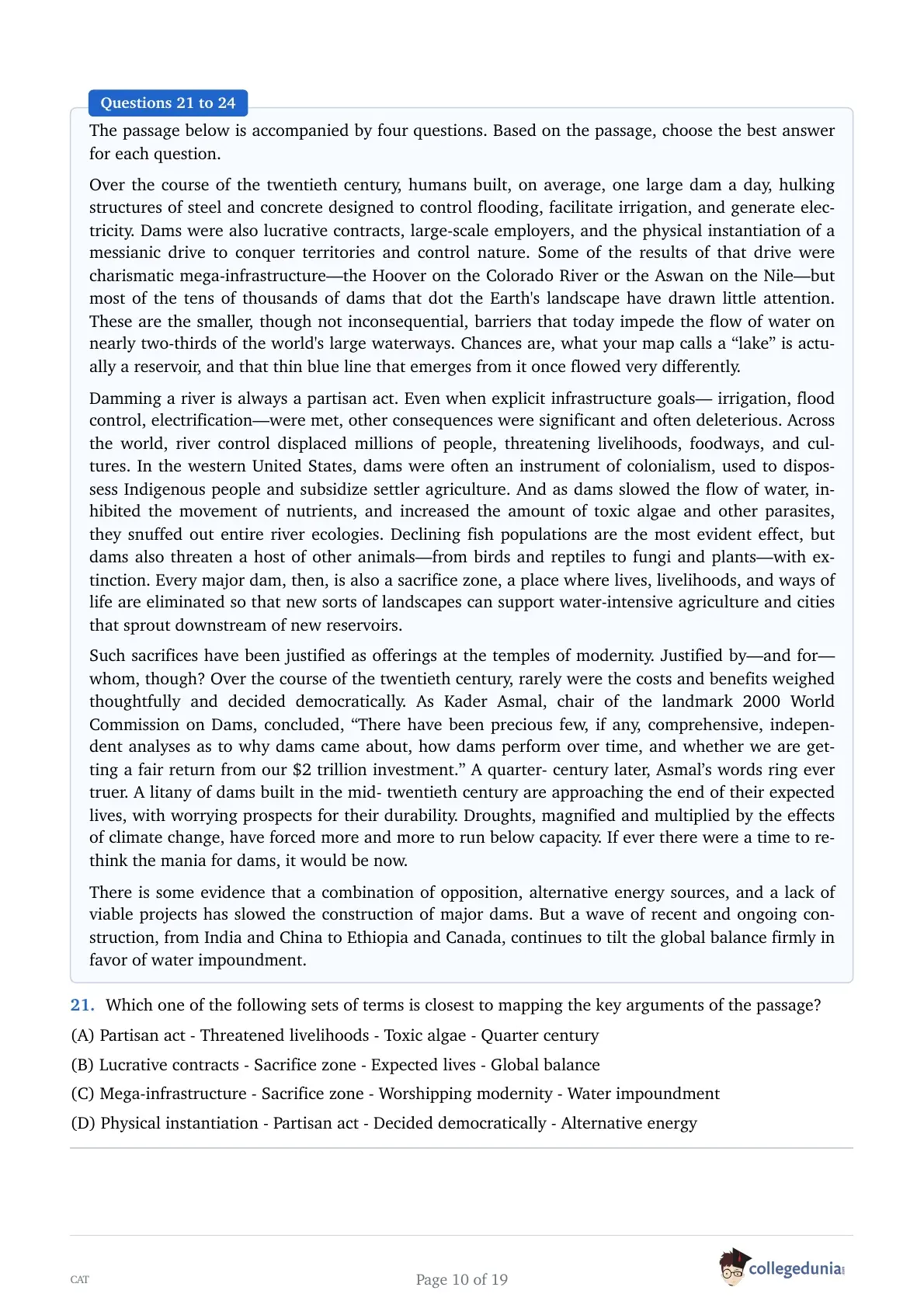
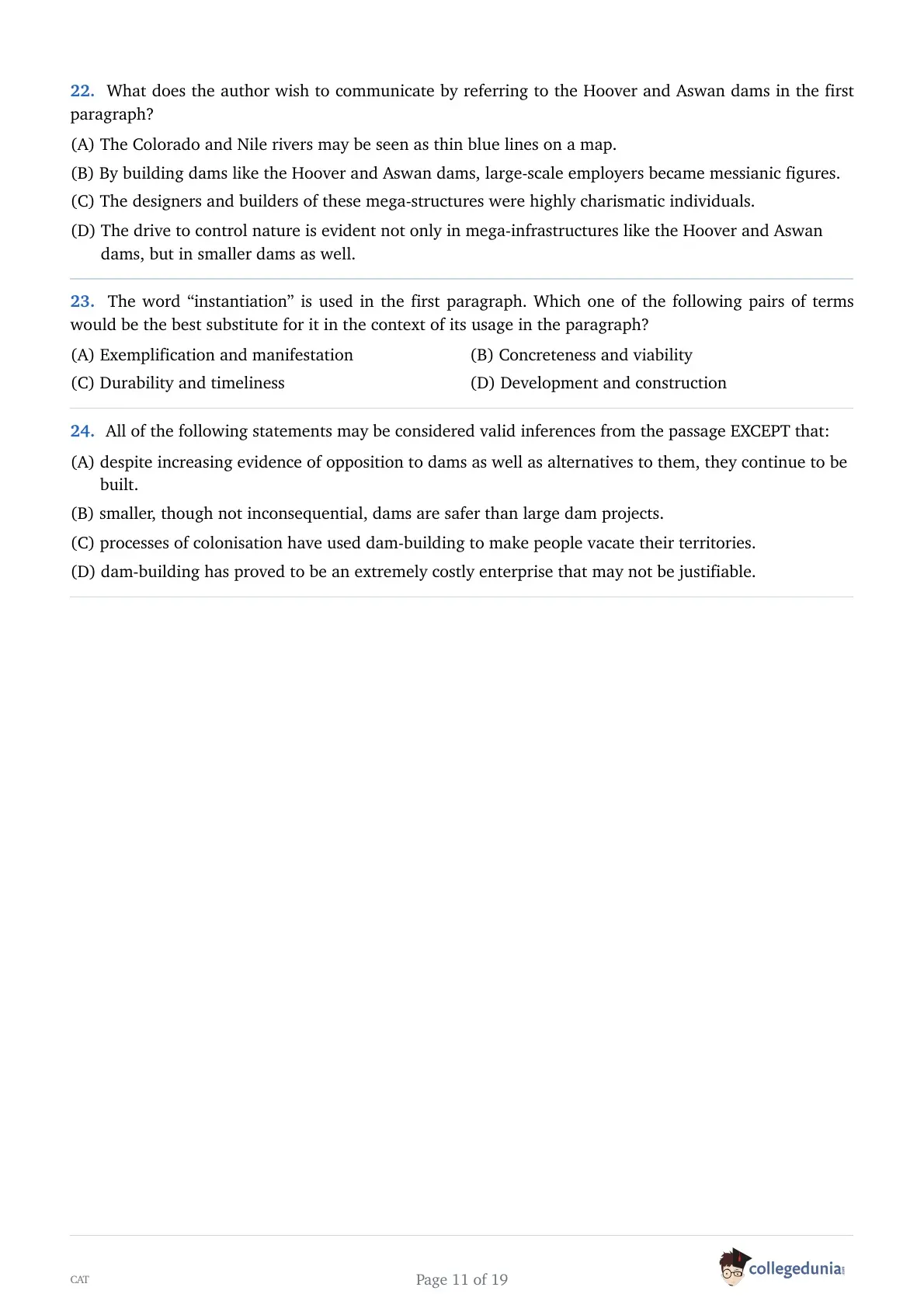
What does the author wish to communicate by referring to the Hoover and Aswan dams in the first paragraph?
The word “instantiation” is used in the first paragraph. Which one of the following pairs of terms would be the best substitute for it in the context of its usage in the paragraph?
All of the following statements may be considered valid inferences from the passage EXCEPT that:
Which one of the following sets of terms is closest to mapping the key arguments of the passage?
Non-human living forms exhibit human emotions in tribal narratives because tribal narratives:
On the basis of the passage, which one of the following explains the main difference between imagination and memory?
All of the following statements may be considered valid inferences from the passage EXCEPT that:
Which one of the following best explains why tribals in India worship their dead ancestors?
The passage given below is followed by four summaries. Choose the option that best captures the essence of the passage.
In investigating memory-beliefs, there are certain points which must be borne in mind. In the first place, everything constituting a memory-belief is happening now, not in that past time to which the belief is said to refer. It is not logically necessary to the existence of a memory-belief that the event remembered should have occurred, or even
Read More
that the past should have existed at all. There is no logical impossibility in the hypothesis that the world sprang into being five minutes ago, exactly as it then was, with a population that "remembered" a wholly unreal past. There is no logically necessary connection between events at different times; therefore nothing that is happening now or will happen in the future can disprove the hypothesis that the world began five minutes ago. Hence the occurrences which are CALLED knowledge of the past are logically independent of the past; they are wholly analysable into present contents, which might, theoretically, be just what they are even if no past had existed.Data Interpretation and Logical Reasoning (DILR) (Q25 - Q46)
Comprehension:
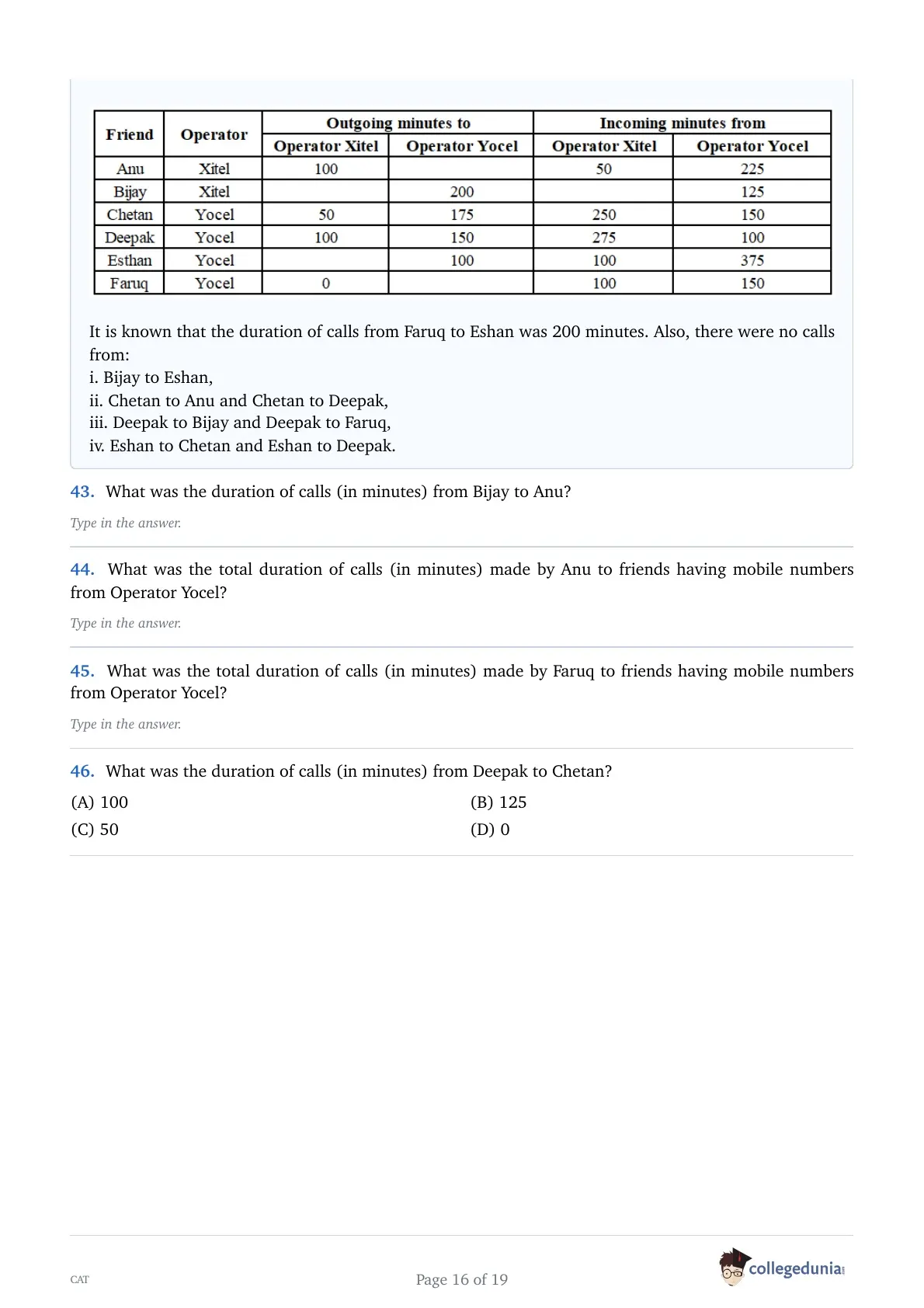
Anu, Bijay, Chetan, Deepak, Eshan, and Faruq are six friends. Each of them uses a mobile number from exactly one of the two mobile operators - Xitel and Yocel. During the last month, the six friends made several calls to each other. Each call was made by one of these six friends to another. The table below summarizes the number of minutes of calls that each of the six made to (outgoing minutes to) and received from (incoming minutes from) these friends, grouped by the operators. Some of the entries are missing.
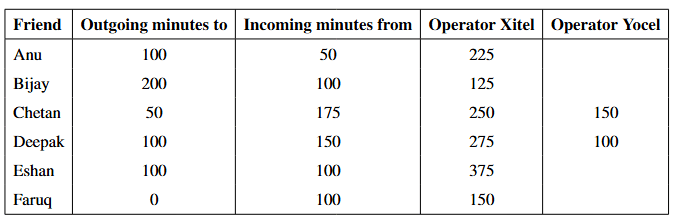
It is known that the duration of calls from Faruq to Eshan was 200 minutes. Also, there were no calls from:
- Bijay to Eshan,
- Chetan to Anu and Chetan to Deepak,
- Deepak to Bijay and Deepak to Faruq,
- Eshan to Chetan and Eshan to Deepak.
Question 25:
What was the duration of calls (in minutes) from Bijay to Anu?
What was the total duration of calls (in minutes) made by Anu to friends having mobile numbers from Operator Yocel?
What was the total duration of calls (in minutes) made by Faruq to friends having mobile numbers from Operator Yocel?
What was the duration of calls (in minutes) from Deepak to Chetan?
Comprehension:
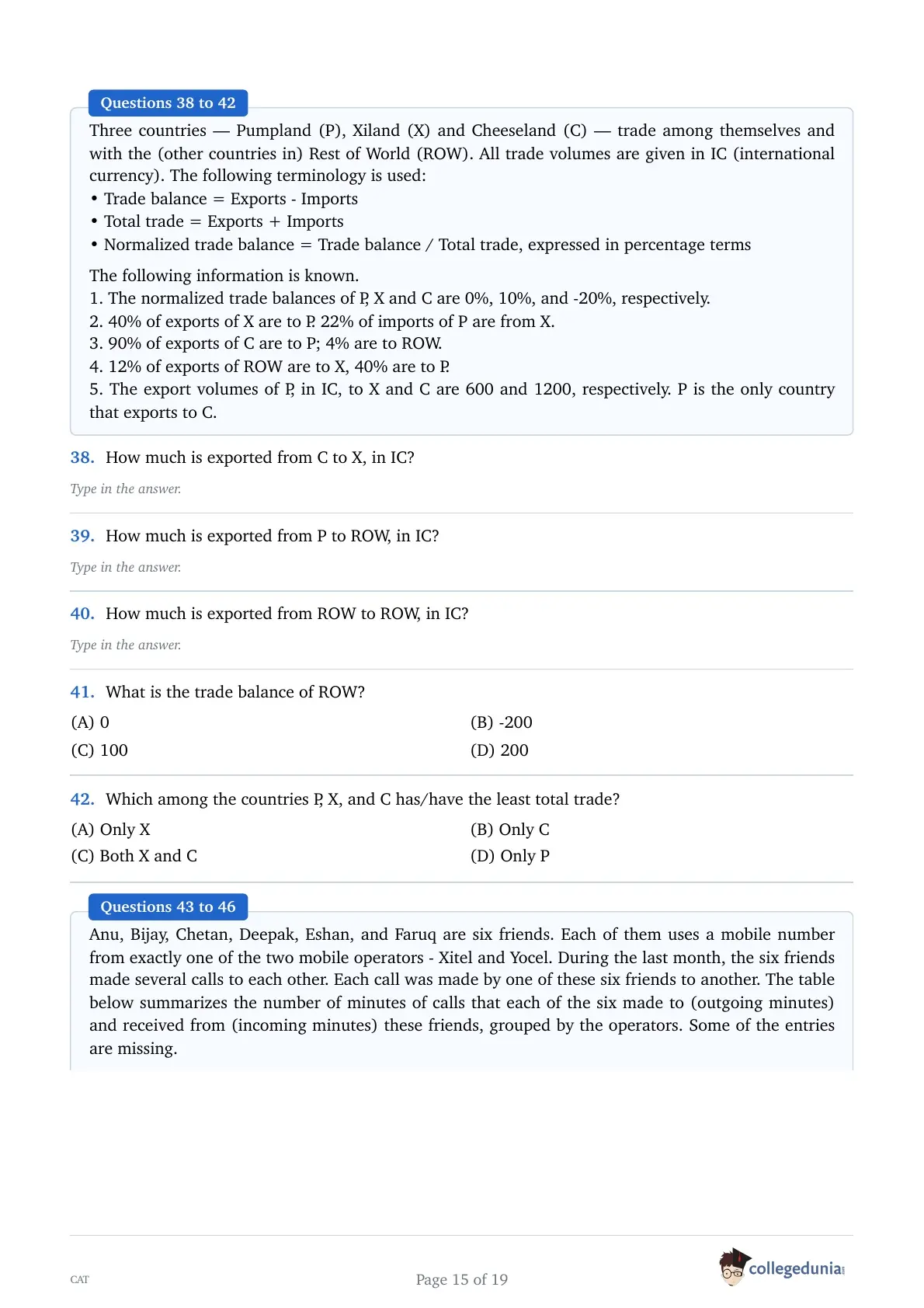
Three countries — Pumpland (P), Xiland (X), and Cheeseland (C) — trade among themselves and with the other countries in Rest of World (ROW). All trade volumes are given in IC (international currency). The following terminology is used:
- Trade balance = Exports – Imports
- Total trade = Exports + Imports
- Normalized trade balance = Trade balance / Total trade, expressed in percentage terms
The following information is known:
- The normalized trade balances of P, X, and C are 0\%, 10\%, and –20\%, respectively.
- 40\% of exports of X are to P. 22\% of imports of P are from X.
- 90\% of exports of C are to P; 4\% are to ROW.
- 12\% of exports of ROW are to X, 40\% are to P.
- The export volumes of P, in IC, to X and C are 600 and 1200, respectively. P is the only country that exports to C.
Question 29:
How much is exported from C to X, in IC?
How much is exported from P to ROW, in IC?
How much is exported from ROW to ROW, in IC?
What is the trade balance of ROW?
Which among the countries P, X, and C has/have the least total trade?
Comprehension:
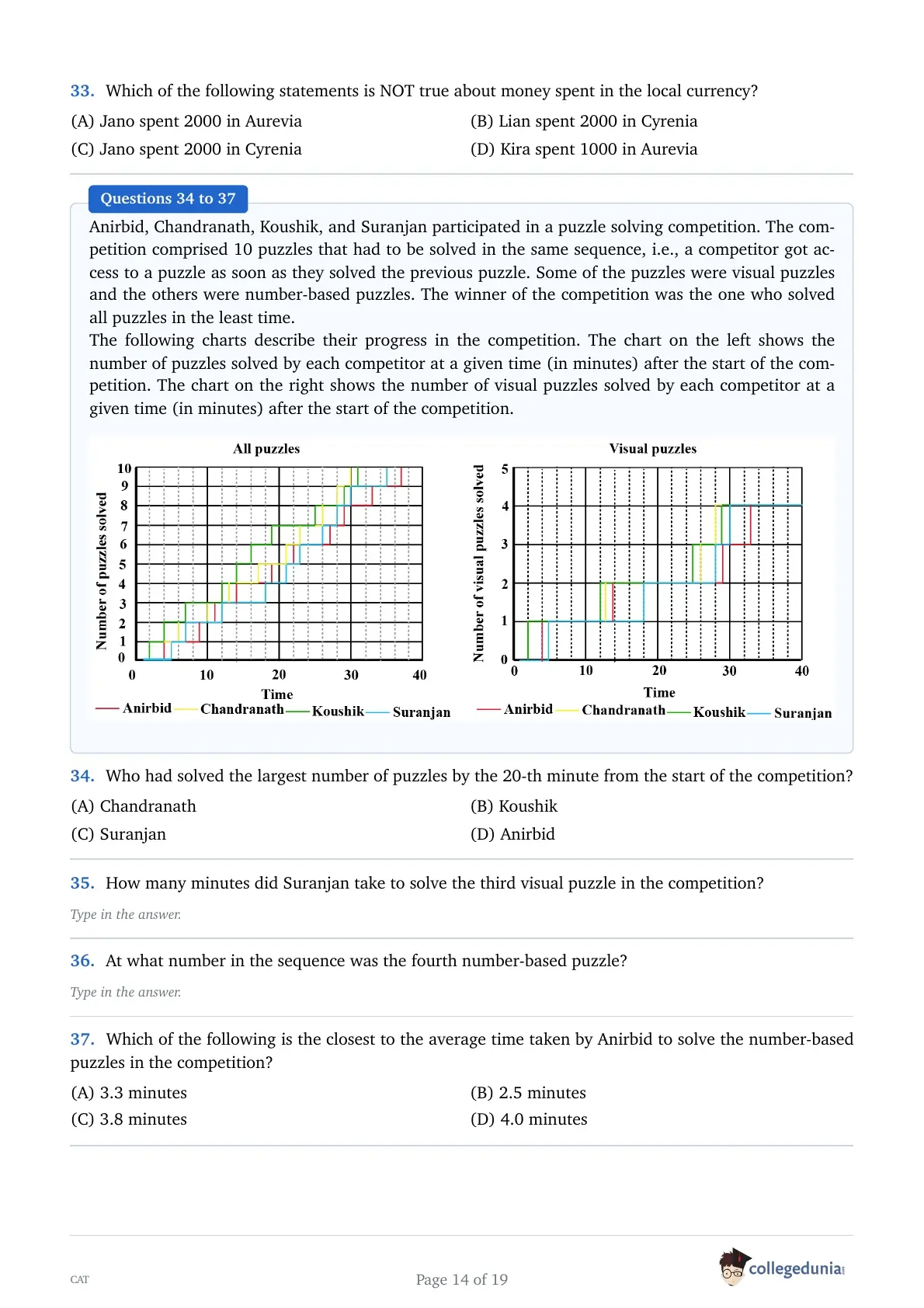
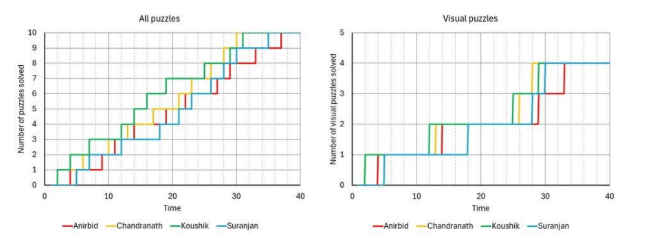
Anirbid, Chandranath, Koushik, and Suranjan participated in a puzzle-solving competition. The competition comprised 10 puzzles that had to be solved in the same sequence, i.e., a competitor got access to a puzzle as soon as they solved the previous puzzle. Some of the puzzles were visual puzzles, and others were number-based puzzles. The winner of the competition was the one who solved all puzzles in the least time.
The following charts describe their progress in the competition. The chart on the left shows the number of puzzles solved by each competitor at a given time (in minutes) after the start of the competition. The chart on the right shows the number of visual puzzles solved by each competitor at a given time (in minutes) after the start of the competition.
Question 34:
Who had solved the largest number of puzzles by the 20th minute from the start of the competition?
How many minutes did Suranjan take to solve the third visual puzzle in the competition?
At what number in the sequence was the fourth number-based puzzle?
Which of the following is the closest to the average time taken by Anirbid to solve the number-based puzzles in the competition?
Comprehension:
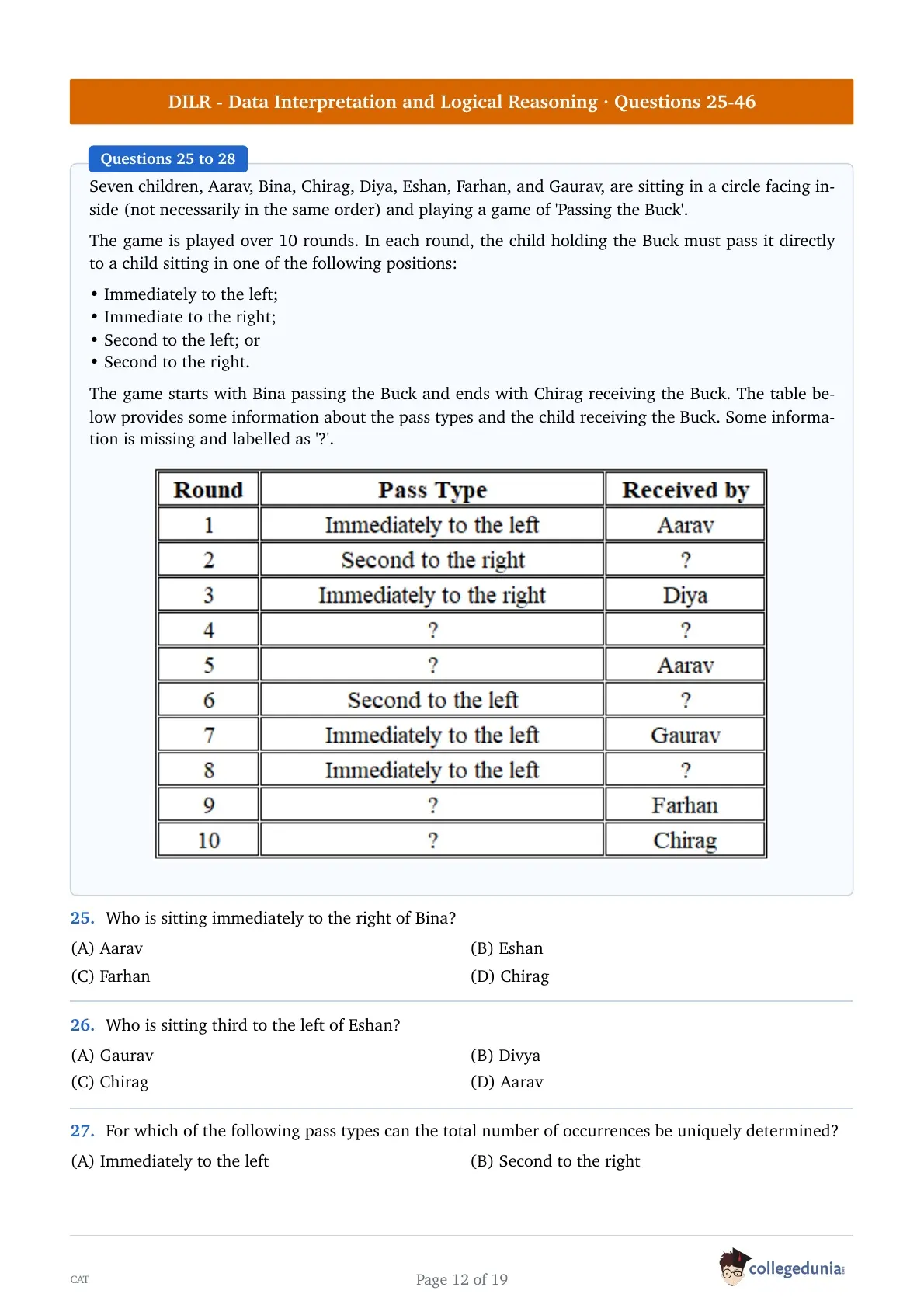
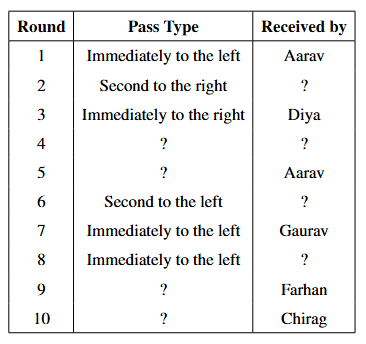
Seven children, Aarav, Bina, Chirag, Diya, Eshan, Farhan, and Gaurav, are sitting in a circle facing inside (not necessarily in the same order) and playing a game of 'Passing the Buck'.
The game is played over 10 rounds. In each round, the child holding the Buck must pass it directly to a child sitting in one of the following positions:
- Immediately to the left;
- Immediately to the right;
- Second to the left;
- Second to the right.
The game starts with Bina passing the Buck and ends with Chirag receiving the Buck. The table below provides some information about the pass types and the child receiving the Buck. Some information is missing and labelled as '?'.
Question 38:
Who is sitting immediately to the right of Bina?
Who is sitting third to the left of Eshan?
For which of the following pass types can the total number of occurrences be uniquely determined?
For which of the following children is it possible to determine how many times they received the Buck?
Comprehension:
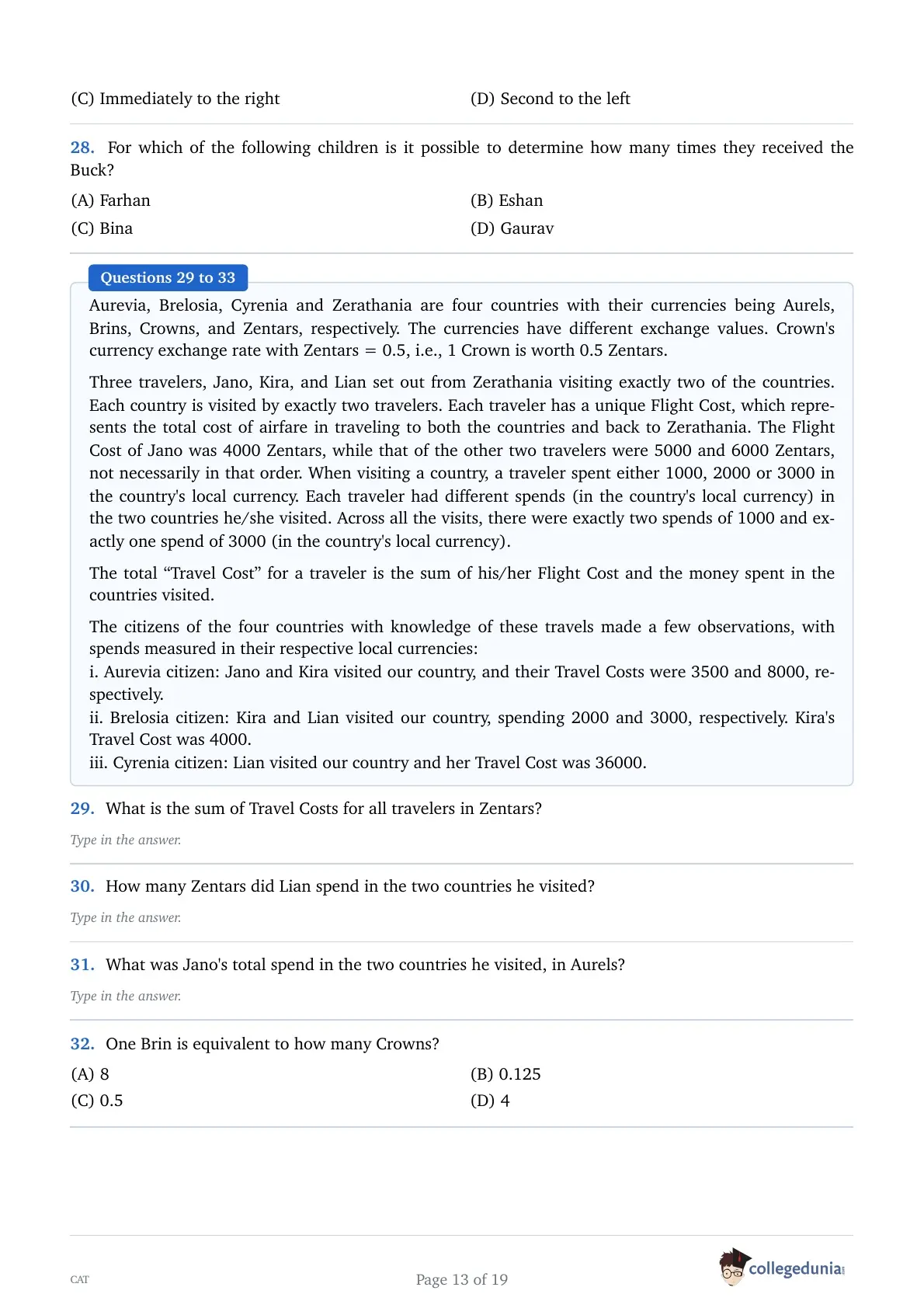
Aurevia, Brelosia, Cyrenia and Zerathania are four countries with their currencies being Aurels, Brins, Crowns, and Zentars, respectively. The currencies have different exchange values. Crown's currency exchange rate with Zentars = 0.5, i.e., 1 Crown is worth 0.5 Zentars.
Three travelers, Jano, Kira, and Lian set out from Zerathania visiting exactly two of the countries. Each country is visited by exactly two travelers. Each traveler has a unique Flight Cost, which represents the total cost of airfare in traveling to both the countries and back to Zerathania. The Flight Cost of Jano was 4000 Zentars, while that of the other two travelers were 5000 and 6000 Zentars, not necessarily in that order.
When visiting a country, a traveler spent either 1000, 2000 or 3000 in the country’s local currency. Each traveler had different spends (in the country’s local currency) in the two countries he/she visited. Across all the visits, there were exactly two spends of 1000 and exactly one spend of 3000 (in the country’s local currency).
The total “Travel Cost” for a traveler is the sum of his/her Flight Cost and the money spent in the countries visited.
The citizens of the four countries with knowledge of these travels made a few observations, with spends measured in their respective local currencies:
- Aurevia citizen: Jano and Kira visited our country, and their Travel Costs were 3500 and 8000, respectively.
- Brelosia citizen: Kira and Lian visited our country, spending 2000 and 3000, respectively. Kira’s Travel Cost was 4000.
- Cyrenia citizen: Lian visited our country and her Travel Cost was 36000.
Question 42:
What is the sum of Travel Costs for all travelers in Zentars?
How many Zentars did Lian spend in the two countries he visited?
What was Jano’s total spend in the two countries he visited, in Aurels?
One Brin is equivalent to how many Crowns?
Which of the following statements is NOT true about money spent in the local currency?
Quantitative Ability (QA) (Q47 - Q68)
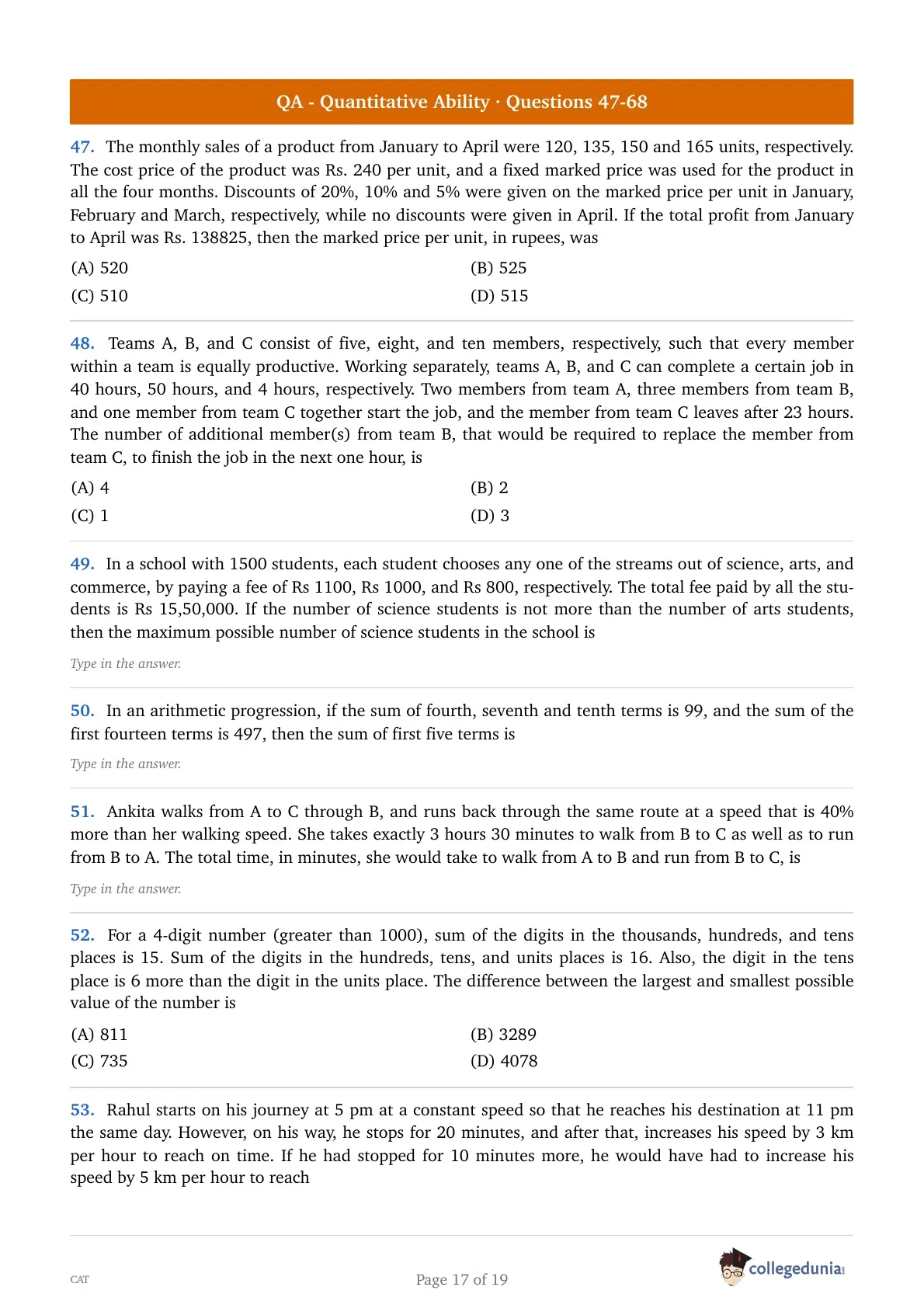
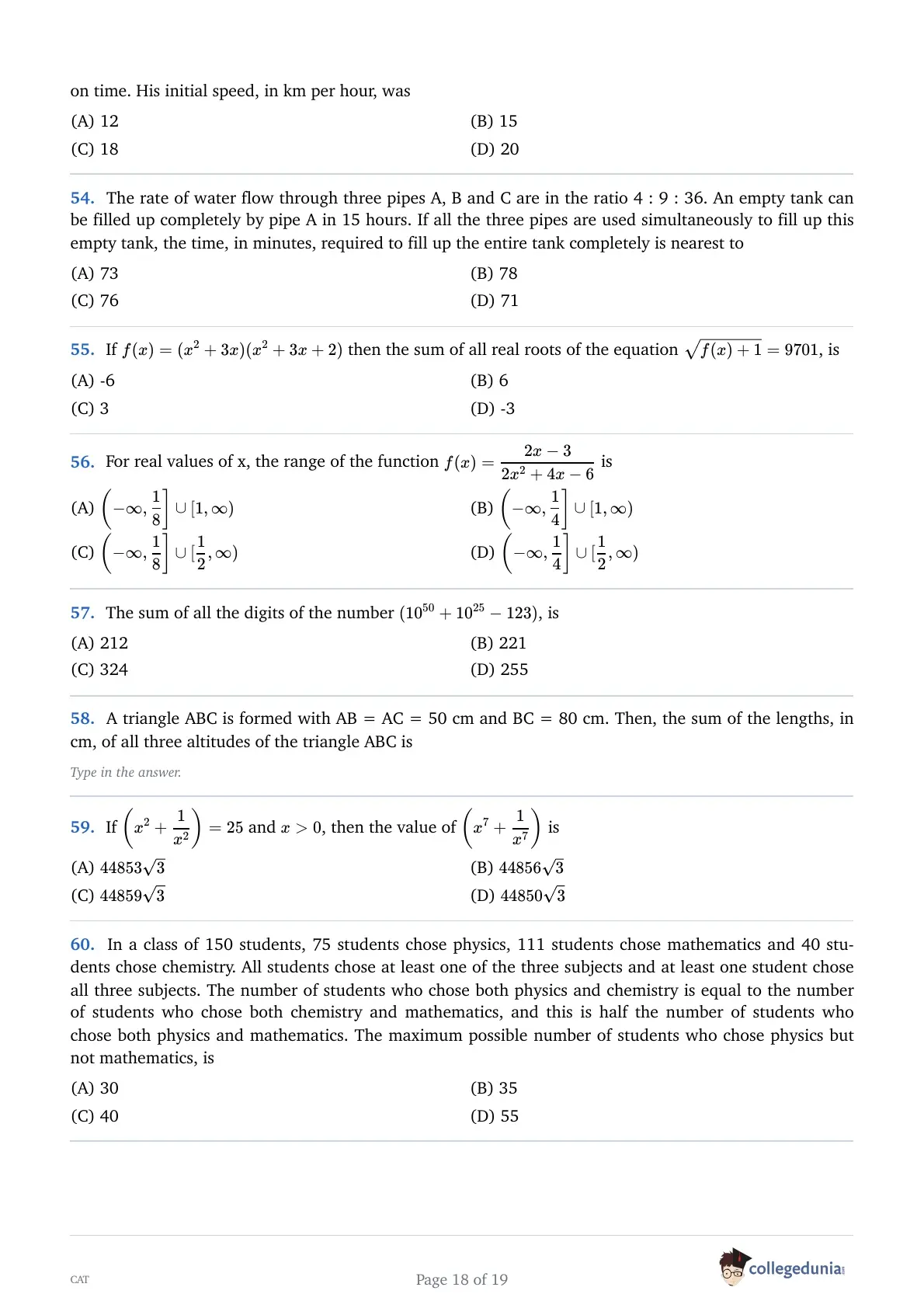
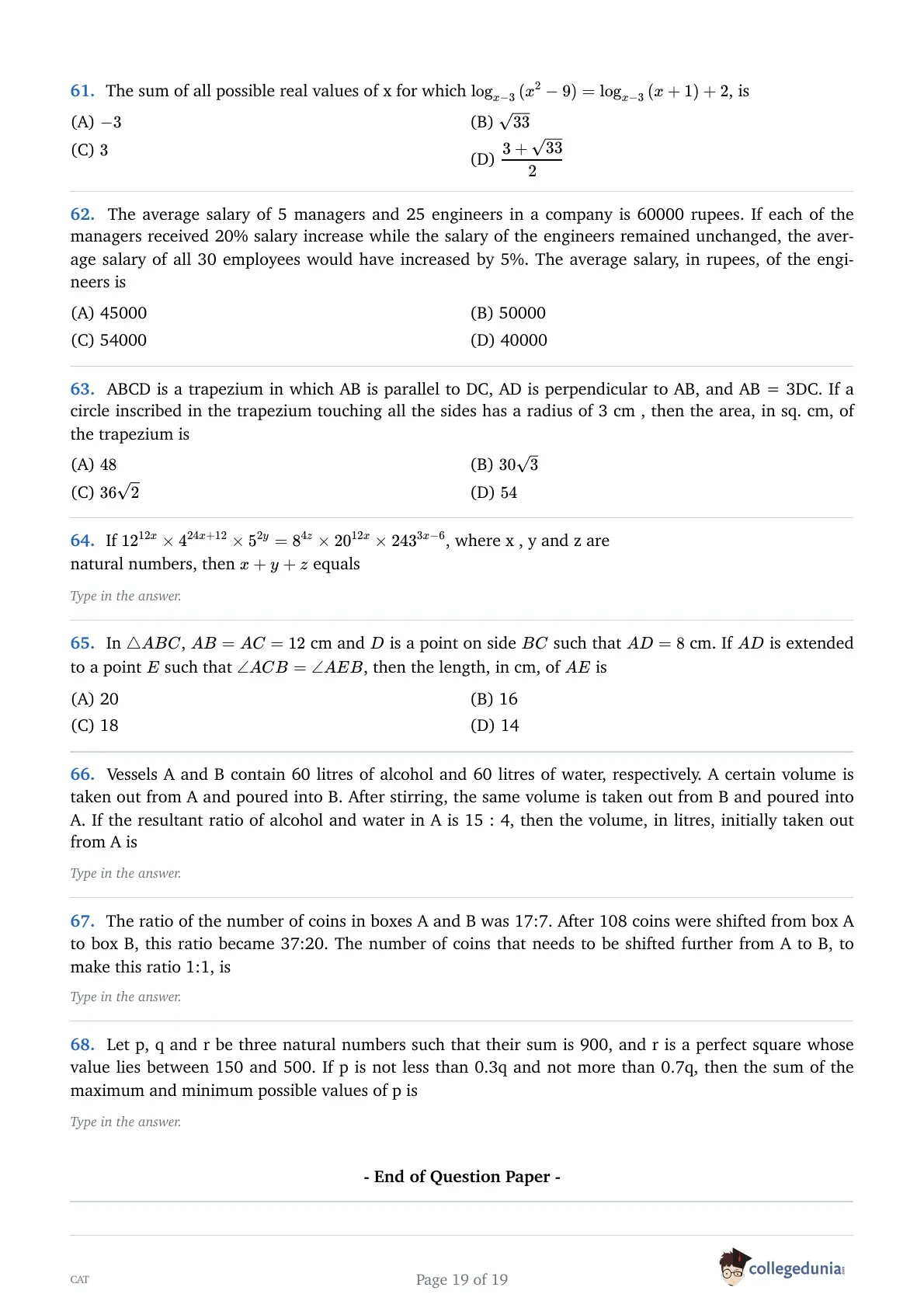
For a 4-digit number (greater than 1000), sum of the digits in the thousands, hundreds, and tens places is 15. Sum of the digits in the hundreds, tens, and units places is 16. Also, the digit in the tens place is 6 more than the digit in the units place. The difference between the largest and smallest possible value of the number is
ABCD is a trapezium in which AB is parallel to DC, AD is perpendicular to AB, and \(AB = 3DC\). If a circle inscribed in the trapezium touching all the sides has a radius of 3 cm, then the area, in sq. cm, of the trapezium is
Vessels A and B contain 60 litres of alcohol and 60 litres of water, respectively. A certain volume is taken out from A and poured into B. After stirring, the same volume is taken out from B and poured into A. If the resultant ratio of alcohol and water in A is 15 : 4, then the volume, in litres, initially taken out from A is
In a class of 150 students, 75 students chose physics, 111 students chose mathematics and 40 students chose chemistry. All students chose at least one of the three subjects and at least one student chose all three subjects. The number of students who chose both physics and chemistry is equal to the number of students who chose both chemistry and mathematics, and this is half the number of students who chose both physics and mathematics. The maximum possible number of students who chose physics but not mathematics, is
In \(\Delta ABC\), \(AB = AC = 12 cm\) and \(D\) is a point on side \(BC\) such that \(AD = 8 cm\). If \(AD\) is extended to a point \(E\) such that \(\angle ACB = \angle AEB\), then the length, in cm, of \(AE\) is
If \(\left(x^2 + \frac{1}{x^2}\right) = 25\) and \(x > 0\), then the value of \(\left(x^7 + \frac{1}{x^7}\right)\) is
Rahul starts on his journey at 5 pm at a constant speed so that he reaches his destination at 11 pm the same day. However, on his way, he stops for 20 minutes, and after that, increases his speed by 3 km per hour to reach on time. If he had stopped for 10 minutes more, he would have had to increase his speed by 5 km per hour to reach on time. His initial speed, in km per hour, was
The sum of all possible real values of \(x\) for which \[ \log_{x-3}(x^2 - 9) = \log_{x-3}(x + 1) + 2, \]
is
The ratio of the number of coins in boxes A and B was 17:7. After 108 coins were shifted from box A to box B, this ratio became 37:20. The number of coins that needs to be shifted further from A to B, to make this ratio 1:1, is
The rate of water flow through three pipes A, B and C are in the ratio 4 : 9 : 36. An empty tank can be filled up completely by pipe A in 15 hours. If all the three pipes are used simultaneously to fill up this empty tank, the time, in minutes, required to fill up the entire tank completely is nearest to
Teams A, B, and C consist of five, eight, and ten members, respectively, such that every member within a team is equally productive. Working separately, teams A, B, and C can complete a certain job in 40 hours, 50 hours, and 4 hours, respectively. Two members from team A, three members from team B, and one member from team C together start the job, and the member from team C leaves after 23 hours. The number of additional member(s) from team B, that would be required to replace the member from team C, to finish the job in the next one hour, is
Ankita walks from A to C through B, and runs back through the same route at a speed that is 40% more than her walking speed. She takes exactly 3 hours 30 minutes to walk from B to C as well as to run from B to A. The total time, in minutes, she would take to walk from A to B and run from B to C, is
If \(12^{12x} \times 4^{24x+12} \times 5^{2y} = 8^{4z} \times 20^{12x} \times 243^{3x-6}\), where \(x\), \(y\) and \(z\) are natural numbers, then \(x + y + z\) equals
The sum of all the digits of the number \((10^{50} + 10^{25} - 123)\), is
If \(f(x) = (x^2 + 3x)(x^2 + 3x + 2)\), then the sum of all real roots of the equation \(\sqrt{f(x) + 1} = 9701\), is
For real values of \(x\), the range of the function \(f(x) = \dfrac{2x - 3}{2x^2 + 4x - 6}\) is
The monthly sales of a product from January to April were 120, 135, 150 and 165 units, respectively. The cost price of the product was Rs. 240 per unit, and a fixed marked price was used for the product in all the four months. Discounts of 20%, 10% and 5% were given on the marked price per unit in January, February and March, respectively, while no discounts were given in April. If the total profit from January to April was Rs. 138825, then the marked price per unit, in rupees, was
A triangle \(ABC\) is formed with \(AB = AC = 50 cm\) and \(BC = 80 cm\). Then, the sum of the lengths, in cm, of all three altitudes of the triangle \(ABC\) is
Let \(p, q\) and \(r\) be three natural numbers such that their sum is 900, and \(r\) is a perfect square whose value lies between 150 and 500. If \(p\) is not less than \(0.3q\) and not more than \(0.7q\), then the sum of the maximum and minimum possible values of \(p\) is
The average salary of 5 managers and 25 engineers in a company is 60000 rupees. If each of the managers received 20% salary increase while the salary of the engineers remained unchanged, the average salary of all 30 employees would have increased by 5%. The average salary, in rupees, of the engineers is
In a school with 1500 students, each student chooses any one of the streams out of science, arts, and commerce, by paying a fee of Rs 1100, Rs 1000, and Rs 800, respectively. The total fee paid by all the students is Rs 15,50,000. If the number of science students is not more than the number of arts students, then the maximum possible number of science students in the school is
In an arithmetic progression, if the sum of fourth, seventh and tenth terms is 99, and the sum of the first fourteen terms is 497, then the sum of first five terms is
CAT 2025 Exam Pattern and Marking Scheme
Section-wise Exam Pattern
| Section | Questions | Time | Marks per question | Maximum marks |
|---|---|---|---|---|
| Verbal Ability and Reading Comprehension (VARC) | 24 | 40 minutes | 3 | 72 |
| Data Interpretation and Logical Reasoning (DILR) | 22 | 40 minutes | 3 | 66 |
| Quantitative Ability (QA) | 22 | 40 minutes | 3 | 66 |
| Total | 68 | 120 minutes | - | 204 |
Marking Scheme
| Question type and response | Marks |
|---|---|
| MCQ - correct answer | +3 |
| MCQ - incorrect answer | -1 |
| TITA - correct answer | +3 |
| TITA - incorrect answer | 0 (no negative marking) |
| Unattempted question | 0 |



Comments