




CAT 2026 VARC is expected to include 24 questions carrying a total of 72 marks to be completed in 40 minutes and there is +3 marks for correct answer.
- Reading Comprehension (RC) is expected to have around 16 questions which makes it the highest weightage part of the VARC section.
- Verbal Ability (VA) is expected to include around 8 questions from topics such as Para Jumbles, Para Summary and Odd Sentence Out.
- RC questions are expected to be MCQs with -1 negative marking for every incorrect answer.
- Most VA questions are expected to be TITA (Type In The Answer) which do not have negative marking.
- A VARC score of around 40+ marks has generally corresponded to the 90 percentile or above in recent CAT examinations although the final percentile depends on the examination difficulty level and normalisation process.
Related Links:
- CAT Syllabus- Download Syllabus PDF, Section-wise Weightage and Preparation Tips
- CAT VARC Exam Analysis: Check Section-wise Analysis, Difficulty Level, & Weightage
- CAT Verbal Ability and Reading Comprehension Preparation Tips, Best Books, and Important Topics
- CAT Cutoff 2026: Check Category-wise Cutoff for IIMs and Top MBA Colleges, Marks vs Percentile, Good Score
Key Summary
- Candidates should spend around 60–65% of their VARC preparation time on Reading Comprehension and the remaining 35–40% on Verbal Ability to match the expected section weightage.
- Completing Reading Comprehension within 30–32 minutes and using the remaining 8–10 minutes for Verbal Ability can help improve overall section management.
- Regular practice of editorials, Reading Comprehension passages, Para Jumbles, and Odd Sentence Out questions, along with mock test analysis, can strengthen overall VARC performance.
- Even a small improvement in Verbal Ability accuracy can increase the overall VARC percentile, especially in a competitive CAT examination.
CAT 2026 VARC Section Overview
Verbal Ability and Reading Comprehension (VARC) is one of the three sections in CAT 2026 along with Data Interpretation and Logical Reasoning (DILR) and Quantitative Aptitude (QA).
- CAT 2026 VARC is expected to include 24 questions carrying a total of 72 marks.
- The VARC section is expected to contribute around 36% of the overall CAT 2026 score.
- Every correct answer carries +3 marks.
- MCQ questions have -1 negative marking for every incorrect answer, while TITA (Type In The Answer) questions do not have any negative marking.
- Candidates will have 40 minutes to complete the VARC section, with no option to switch between sections during the examination.
- Reading Comprehension is expected to include four passages with 16 questions, while Verbal Ability is expected to contribute eight questions from topics such as Para Jumbles, Para Summary, and Odd Sentence Out.
- The overall structure of the VARC section is expected to remain similar to the CAT 2021–2025 pattern, although the difficulty level may vary.
Also Read
CAT Cutoff: Check Category-wise Cutoff for IIMs and Top MBA Colleges, Marks vs Percentile, Good ScoreReading Comprehension: Weightage and Question Types
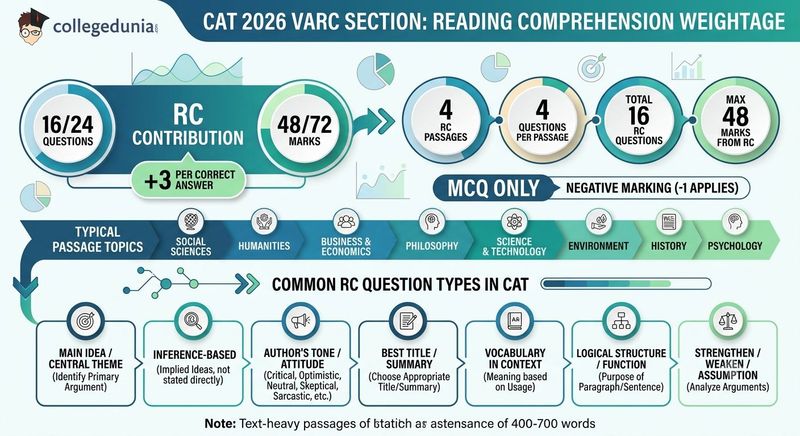
Reading Comprehension (RC) is expected to contribute around 16 of the 24 questions in the CAT 2026 VARC section, making it the highest-weightage component.
- RC is expected to account for nearly 48 of the 72 marks in the VARC section.
- Each Reading Comprehension passage is expected to contain around 400–700 words.
- Candidates are expected to answer questions based on the main idea, author's tone, inference, logical reasoning, and overall argument presented in the passage.
| RC Parameter | Details |
|---|---|
| Number of RC passages | 4 |
| Questions per passage | 4 |
| Total RC questions | 16 |
| Maximum marks from RC |
48 (+3 per correct answer) |
| Question type |
MCQ only (negative marking of -1 applies) |
| Typical passage topics |
Social Sciences, Humanities, Business & Economics, Philosophy, Science & Technology, Environment, History, Psychology |
Common RC question types in CAT:
- Main Idea / Central Theme: Questions ask candidates to identify the primary argument or central message of the passage.
- Inference-Based Questions: These questions test the ability to identify ideas that are implied but not stated directly by the author.
- Author's Tone / Attitude: Candidates should identify the writer's tone such as critical, optimistic, neutral, skeptical, or sarcastic.
- Best Title / Summary: Questions require candidates to choose the most appropriate title or summary based on the passage.
- Vocabulary in Context: These questions test the meaning of a word or phrase according to its usage in the passage.
- Logical Structure / Function: Questions focus on the purpose of a paragraph or sentence within the overall flow of the passage.
- Strengthen / Weaken / Assumption: These questions evaluate the ability to analyse arguments by identifying assumptions or determining which statements strengthen or weaken the author's reasoning.
Also Read
CAT QA Chapter-Wise Weightage: High-Priority TopicsQues. How can candidates improve Reading Comprehension accuracy for CAT 2026?
Ans. Candidates can improve Reading Comprehension accuracy by reading editorials and long-form articles daily, identifying the author's main argument before looking at the questions, and practising passage-based questions regularly. Reviewing incorrect answers and understanding why the chosen option was wrong also helps candidates reduce repeated mistakes and improve performance in CAT 2026 VARC.
Ques. How much time should candidates spend on each Reading Comprehension passage in CAT 2026?
Ans. Candidates should aim to complete each Reading Comprehension passage in about 7–8 minutes, including reading the passage and answering the four questions. Spending too much time on a single passage can reduce the time available for other RC passages and the Verbal Ability section, making effective time management essential in CAT 2026.
These target actual high-volume search queries such as:
How to improve RC accuracy in CAT?
How much time per RC passage in CAT?
CAT RC strategy
How to solve CAT RC quickly
They are also different from the FAQs you've already covered.
Verbal Ability: Weightage and Question Types
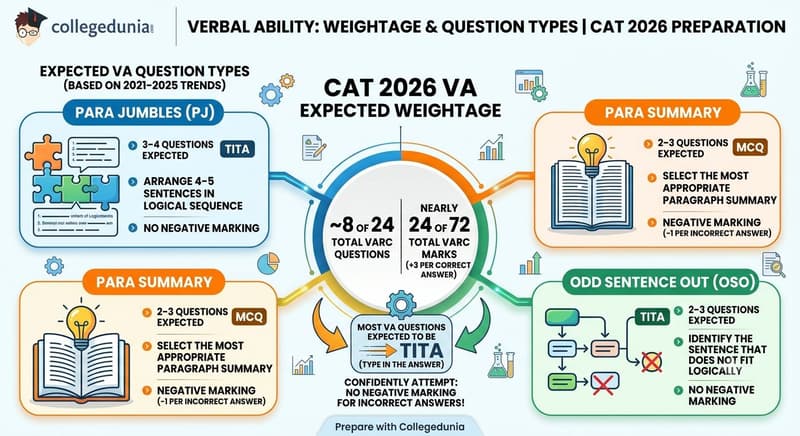
Verbal Ability (VA) is expected to contribute around 8 of the 24 questions in the CAT 2026 VARC section, accounting for nearly 24 of the 72 marks.
- Most Verbal Ability questions are expected to be TITA (Type In The Answer), which do not have negative marking.
- Candidates can maximise their score in the VA section by attempting TITA questions with confidence, as incorrect answers do not attract any penalty.
| VA Parameter | Details |
|---|---|
| Total VA questions | ~8 |
| Maximum marks from VA |
24 (+3 per correct answer) |
| Para Jumbles | 3–4 questions (TITA — no negative marking) |
| Para Summary | 2–3 questions (MCQ — negative marking applies) |
| Odd Sentence Out | 2–3 questions (TITA — no negative marking) |
VA Question Types Expected in CAT 2026 (based on 2021–2025 trends):
- Para Jumbles (PJ): Candidates are required to arrange 4–5 sentences in the correct logical sequence. These questions are generally TITA (Type In The Answer) and do not have negative marking.
- Para Summary: Candidates should select the most appropriate summary of a given paragraph. These questions are generally MCQs and carry -1 negative marking for every incorrect answer.
- Odd Sentence Out (OSO): Candidates need to identify the sentence that does not fit logically within a paragraph. These questions are generally TITA (Type In The Answer) and do not have negative marking.
Also Read
CAT 2026 99 Percentile: Month-by-Month Preparation Plan from JulyQues. Which Verbal Ability topic is the easiest to score in CAT 2026?
Ans. There is no single easiest topic for every candidate, but Para Summary is often considered more scoring for candidates with strong reading comprehension, while Para Jumbles and Odd Sentence Out can be high-scoring because they are generally TITA questions without negative marking. Candidates should practise all three question types regularly to maximise their VARC score.
Ques. How should candidates prepare for Para Jumbles and Odd Sentence Out in CAT 2026?
Ans. Candidates should improve their performance in Para Jumbles and Odd Sentence Out by practising paragraph sequencing, identifying opening and concluding sentences, tracking logical connectors, and recognising the flow of ideas. Since these questions are generally TITA and do not have negative marking, regular practice can help candidates increase attempts and improve their overall VARC score.
CAT 2026 VARC Marks Distribution Table
The 16-question Reading Comprehension and 8-question Verbal Ability pattern is expected to continue in CAT 2026, following the examination structure of recent years.
- The table below presents the expected distribution of Reading Comprehension (RC) and Verbal Ability (VA) questions in CAT 2026, based on trends observed from CAT 2021 to CAT 2025.
| Sub-section | Questions (Expected) | Max Marks | Weightage in VARC | Question Type | Negative Marking |
|---|---|---|---|---|---|
| Reading Comprehension (RC) | 16 | 48 | ~67% | MCQ | Yes (-1 per wrong answer) |
| Para Jumbles | 3–4 | 9–12 | ~14–17% | TITA | No |
| Para Summary | 2–3 | 6–9 | ~8–12% | MCQ | Yes (-1 per wrong answer) |
| Odd Sentence Out | 2–3 | 6–9 | ~8–12% | TITA | No |
| Total VARC | 24 | 72 | 100% | — | — |
Also Read
CAT 2026: Is 95 Percentile Safe for IIM Ahmedabad, Bangalore and CalcuttaScoring Strategy for Reading Comprehension
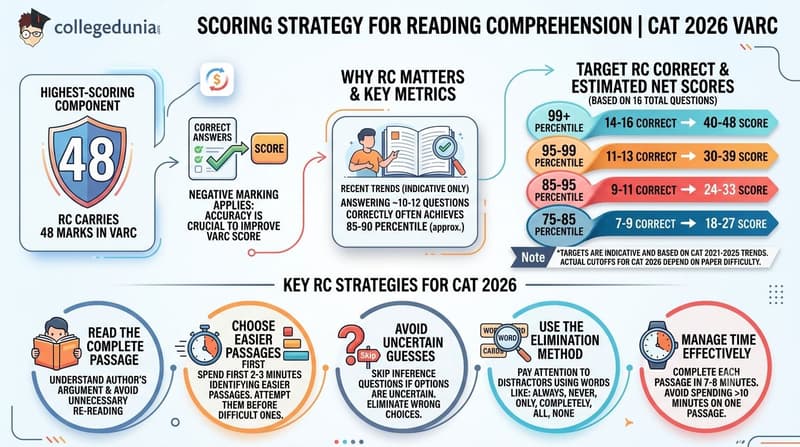
Reading Comprehension (RC) carries 48 marks, making it the highest-scoring component of the CAT 2026 VARC section.
- RC questions have negative marking, making accuracy an important factor in improving the VARC score.
- Based on recent CAT trends, candidates answering around 10–12 Reading Comprehension questions correctly out of 16 are expected to achieve around the 85–90 percentile in the VARC section.
| Target VARC Percentile | RC Correct (of 16) | Approx RC Net Score |
|---|---|---|
| 99+ percentile | 14–16 | 40–48 |
| 95–99 percentile | 11–13 | 30–39 |
| 85–95 percentile | 9–11 | 24–33 |
| 75–85 percentile | 7–9 | 18–27 |
Note: These targets are indicative and based on CAT 2021–2025 trends. Actual cutoffs for CAT 2026 will depend on overall paper difficulty.
Key RC strategies for CAT 2026:
- Read the Complete Passage: Candidates should read the entire passage before answering the questions to understand the author's argument and avoid unnecessary re-reading.
- Choose Easier Passages First: Candidates should spend the first 2–3 minutes identifying the easier passages and attempt them before moving to the more difficult ones.
- Avoid Uncertain Guesses: Candidates should skip inference-based questions if the correct option cannot be identified with reasonable confidence after eliminating incorrect choices.
- Use the Elimination Method: Pay close attention to options containing words such as "always," "never," "only," "completely," "all," and "none," as these are often distractors in Reading Comprehension questions.
- Manage Time Effectively: Candidates should aim to complete each Reading Comprehension passage, including its questions, within 7–8 minutes and avoid spending more than 10 minutes on any single passage.
Also Read
CAT 2026 Below 85 Percentile: MBA Options for General CategoryQues. How many Reading Comprehension questions should candidates answer correctly to score 99 percentile in CAT 2026 VARC?
Ans. Based on CAT 2021–2025 trends, candidates targeting a 99+ percentile in the VARC section should aim to answer around 14–16 Reading Comprehension questions correctly out of 16. Since RC carries the highest weightage in VARC, maintaining high accuracy is more important than attempting every question.
Ques. Should candidates guess Reading Comprehension answers in CAT 2026?
Ans. No. Candidates should avoid random guessing in the CAT 2026 Reading Comprehension section because every incorrect MCQ attracts -1 negative marking. A better strategy is to use the elimination method, attempt questions with reasonable confidence, and skip questions where two or more options appear equally plausible. This approach helps maximise the net VARC score.
Scoring Strategy for Verbal Ability
Verbal Ability (VA) carries 24 marks in the CAT 2026 VARC section and Most VA questions are expected to be TITA (Type In The Answer) and do not have negative marking.
- Candidates should attempt TITA questions, as incorrect answers do not attract any penalty.
- A VA score of around 15–18 marks can significantly improve the overall VARC percentile in CAT 2026.
- Attempt TITA Questions: Candidates should attempt all TITA (Type In The Answer) questions, including Para Jumbles and Odd Sentence Out, as incorrect answers do not carry negative marking.
- Para Jumbles Strategy: Identify the mandatory sentence pairs, followed by the opening and closing sentences, before arranging the remaining sentences in the correct logical order.
- Para Summary Strategy: Select the option that accurately reflects the central idea of the paragraph without introducing additional information or omitting the main point.
- Odd Sentence Out Strategy: Identify the sentence that disrupts the logical flow of the paragraph by changing the topic, sequence of ideas, tone, or context.
- Time Management: Candidates should aim to complete all Reading Comprehension passages within 30–32 minutes and use the remaining 8–10 minutes to attempt the Verbal Ability questions.
Also Read
CAT 2026: Score 99+ Percentile with 5-Month Study Plan and Section-Wise StrategyHow to Balance RC and VA Preparation for CAT 2026
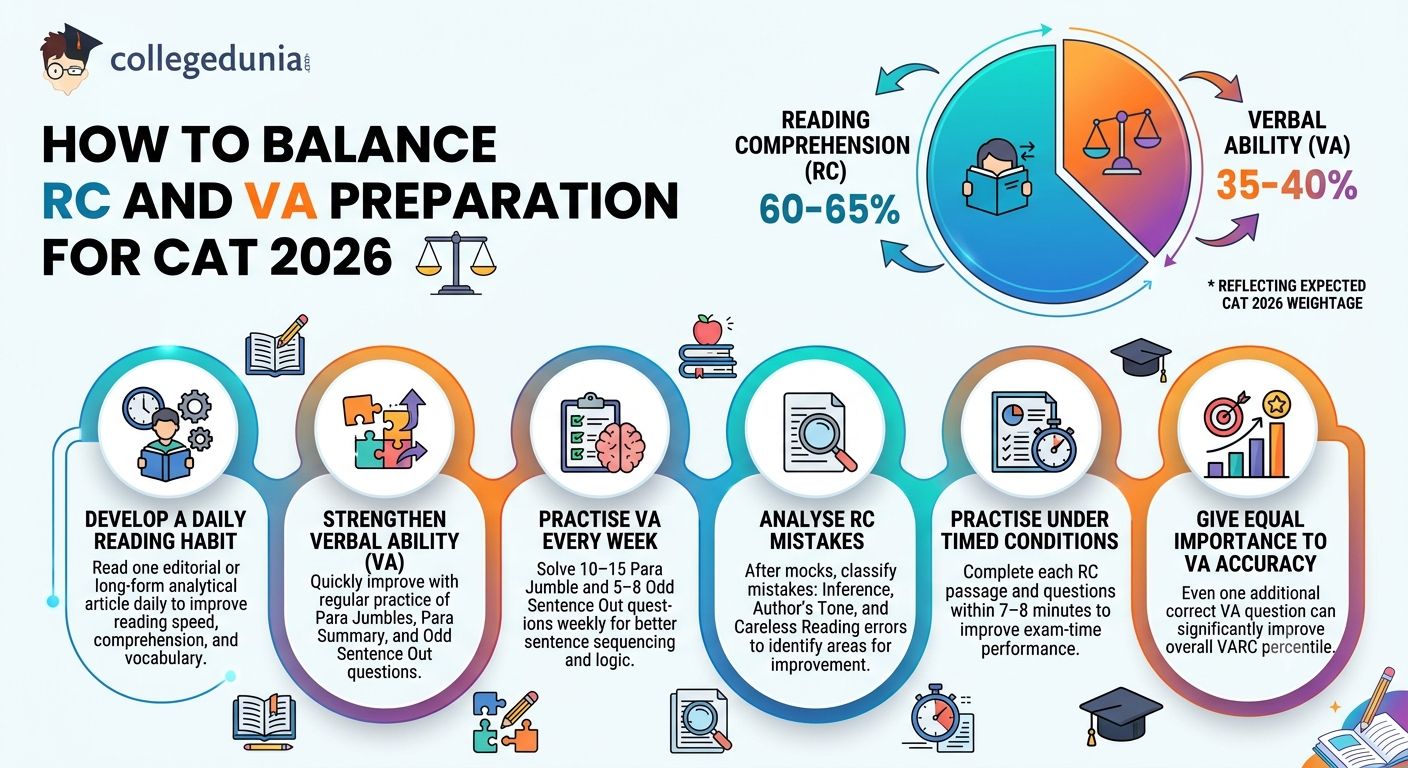
Candidates should spend around 60–65% of their VARC preparation time on Reading Comprehension and the remaining 35–40% on Verbal Ability, reflecting the expected weightage in CAT 2026.
- Strengthen Verbal Ability: Verbal Ability can improve quickly with regular practice of Para Jumbles, Para Summary, and Odd Sentence Out questions.
- Develop a Daily Reading Habit: Candidates should read one editorial or long-form analytical article every day to improve reading speed, comprehension, and vocabulary.
- Practise VA Every Week: Solve 10–15 Para Jumble questions and 5–8 Odd Sentence Out questions every week to improve sentence sequencing and logical flow.
- Analyse RC Mistakes: After every mock test, classify Reading Comprehension mistakes into inference, author's tone, and careless reading errors to identify areas that need improvement.
- Practise Under Timed Conditions: Candidates should complete each Reading Comprehension passage within 7–8 minutes, including the questions, to improve exam-time performance.
- Give Equal Importance to VA Accuracy: Even one additional correct Verbal Ability question can improve the overall VARC percentile, particularly in a highly competitive CAT examination.
Also Read
CAT 2026 QA Chapter-Wise Weightage: Most Important Topics from Arithmetic, Algebra and Number SystemQues. How should candidates divide their preparation time between Reading Comprehension and Verbal Ability for CAT 2026?
Ans. Candidates should allocate around 60–65% of their VARC preparation time to Reading Comprehension (RC) and the remaining 35–40% to Verbal Ability (VA). Since RC contributes the majority of the VARC questions, it deserves greater attention, while consistent weekly practice of VA helps candidates improve accuracy and maximise their overall VARC score.
Ques. How can candidates improve their CAT 2026 VARC percentile through regular practice?
Ans. Candidates can improve their CAT 2026 VARC percentile by developing a daily reading habit, practising Reading Comprehension and Verbal Ability questions under timed conditions, and analysing mistakes after every mock test. Classifying errors into categories such as inference, author's tone, and careless reading helps candidates identify weak areas and improve accuracy in subsequent practice sessions.
CAT 2026 VARC Section: Reddit Discussion
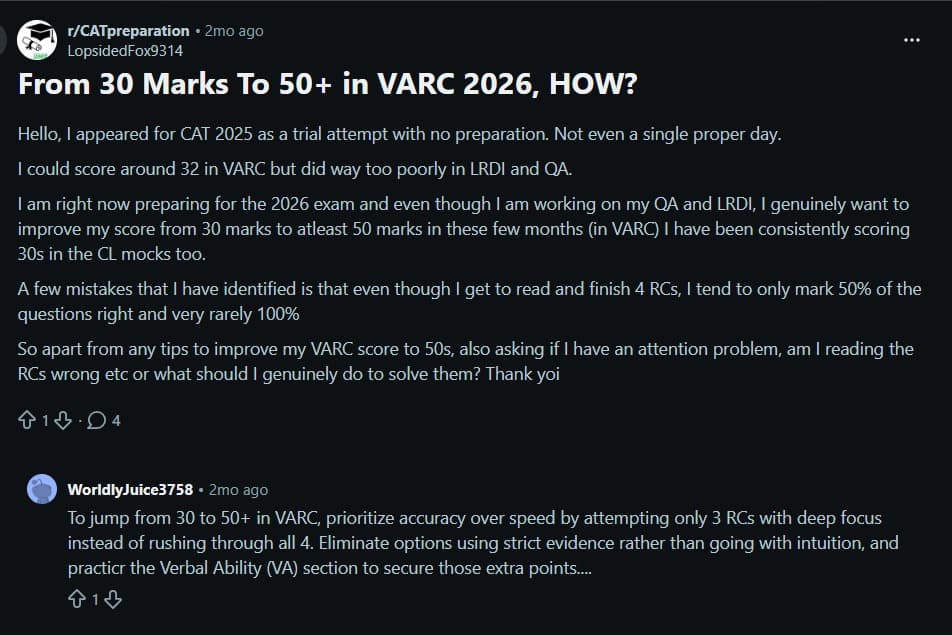
- The discussion focused on improving VARC performance for CAT 2026, with candidates seeking strategies to increase their score from around 30 marks to 50+, particularly by improving Reading Comprehension accuracy.
- Another Reddit user advised candidates to prioritise accuracy over attempting every passage, recommending solving fewer RCs with deeper focus, selecting answers strictly based on textual evidence instead of intuition, and strengthening the Verbal Ability section to gain additional marks.
CAT 2026 VARC Section FAQs
Ques. How many questions are there in CAT 2026 VARC and how are they split?
Ans. The CAT 2026 VARC section is expected to include 24 questions carrying 72 marks. Based on CAT 2021–2025 trends, around 16 questions are expected from Reading Comprehension (RC) across four passages, while the remaining 8 questions are likely to be from Verbal Ability (VA), including Para Jumbles, Para Summary, and Odd Sentence Out.
Ques. What is the weightage of Reading Comprehension in CAT VARC?
Ans. Reading Comprehension (RC) is expected to contribute approximately 67% of the CAT 2026 VARC section with 16 questions across four passages. Since RC carries the majority of the section, candidates should prioritise improving reading speed, comprehension, and inference-based question-solving skills during preparation.
Ques. Are CAT 2026 VA questions MCQ or TITA?
Ans. The Verbal Ability (VA) section in CAT 2026 is expected to include both MCQ and TITA (Type In The Answer) questions. Para Jumbles and Odd Sentence Out are generally TITA questions without negative marking, while Para Summary is usually asked as an MCQ with a -1 mark penalty for incorrect answers.
Ques. What is a good VARC score in CAT 2026 for IIM admission calls?
Ans. Based on recent CAT trends, a VARC score of around 45–50 marks out of 72 is generally considered competitive for achieving a 95+ percentile in the section. However, candidates targeting top IIMs should also secure a high overall percentile by performing consistently across VARC, DILR, and QA.
Ques. How much time should I allocate to VA and RC during CAT 2026?
Ans. Candidates have 40 minutes to complete the CAT 2026 VARC section. A common strategy is to spend 30–32 minutes on the four Reading Comprehension passages and use the remaining 8–10 minutes for Verbal Ability questions. This approach allows candidates to maximise attempts while maintaining accuracy.
Ques. Is Verbal Ability worth preparing for given its lower weightage?
Ans. Yes. Although Verbal Ability carries fewer questions than Reading Comprehension, it can significantly improve the overall VARC score. Since Para Jumbles and Odd Sentence Out generally do not have negative marking, candidates can attempt these questions with relatively lower risk and improve their chances of clearing sectional cutoffs.



Comments