




CAT is best for fresh graduates eyeing 2 year flagship MBAs at top IIMs while GMAT is better for working professionals (2+ years experience) targeting executive MBAs, ISB or global programs.
- CAT 2026 is expected to be conducted on November 29 2026 while GMAT is conducted throughout the year and the score remains valid for five years.
- The CAT 2026 application fee is expected to be around ₹2600 for the General category and GMAT examination fee is USD 275 which is approximately ₹23000 at authorised test centres.
- CAT scores remain valid for one year and are accepted mainly by management institutes in India.
- All IIMs accept CAT scores for admission to their flagship PGP or MBA programmes.
- GMAT scores are generally not accepted for the flagship PGP or MBA programmes at the IIMs except for specific categories such as overseas candidates and executive programmes.
Related Links:
- CAT Preparation 2026: 6 Month Strategy, Self-Preparation, Books, Mock Tests & Online Coachings
- CAT Topic Wise Weightage for QA, VARC and DILR, Check Previous Years’ Question
- CAT Cutoff 2026: Check Category-wise Cutoff for IIMs and Top MBA Colleges, Marks vs Percentile, Good Score

Key Summary
- CAT 2026 is the preferred entrance examination for candidates targeting the IIMs and other leading management institutes in India.
- GMAT is widely accepted for admission to ISB Hyderabad, Great Lakes, executive MBA programmes and business schools abroad.
- CAT 2026 registration process is expected to begin in August 2026.
- GMAT scores are accepted by 7700+ business programmes worldwide.
CAT 2026 vs GMAT 2026: Key Differences at a Glance
The comparison table below covers the most important parameters to evaluate CAT 2026 and GMAT 2026 side by side.
| Parameter | CAT 2026 | GMAT 2026 (Focus Edition) |
|---|---|---|
| Full Name | Common Admission Test | Graduate Management Admission Test |
| Conducting Body | IIMs (rotational) | GMAC |
| Exam Frequency | Once a year (November) | Year-round (up to 5 times in 12 months) |
| Duration |
2 hours (120 minutes) |
2 hours 15 minutes |
| Mode | Computer-Based Test | Computer-Adaptive Test |
| Score Range |
Varies (scaled, typically reported as percentile + raw score; total marks ~198–204) |
205–805 |
| Score Validity | 1 year | 5 years |
| Application Fee |
INR 2,600 (general) |
USD 275 (~INR 23,000) at test centers |
| Negative Marking |
Yes (−1 for wrong MCQs; none for TITA) |
No |
| Primary Acceptance | 1,200+ Indian B-schools including IIMs |
ISB, Great Lakes, global programs (7,700+ worldwide) |
| Difficulty Level | Very High | High |
| Avg. Preparation Time | 6–12 months | 3–6 months |
Also Read
CAT 2026 vs XAT 2027: Exam Pattern, Difficulty and B-SchoolsQues. How long is the CAT 2026 score valid compared to the GMAT 2026 score?
Ans. CAT 2026 scores are generally valid for one admission cycle, making them suitable for MBA admissions in the corresponding academic year. In contrast, GMAT 2026 scores remain valid for five years, allowing candidates to apply to multiple business schools across different admission cycles without retaking the exam.
Ques. Which exam is more expensive to take: CAT 2026 or GMAT 2026?
Ans. GMAT 2026 has a significantly higher examination fee than CAT 2026. The CAT application fee is expected to be around INR 2,600 for General category candidates, whereas the GMAT Focus Edition costs approximately USD 275 (around INR 23,000 at test centres). Candidates should consider the exam fee along with their target colleges and career goals before choosing between the two examinations.
CAT 2026 vs GMAT 2026: Exam Pattern Comparison
The two exams differ significantly in structure, section count, and type of questions asked.
CAT 2026 Exam Pattern
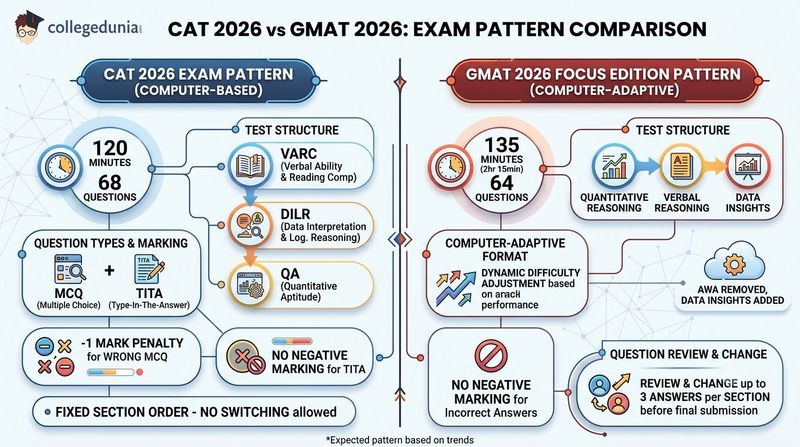
CAT 2026 is expected to be conducted as a computer-based test with 68 questions to be completed in 120 minutes.
- The examination is expected to include Verbal Ability and Reading Comprehension (VARC), Data Interpretation and Logical Reasoning (DILR), and Quantitative Aptitude (QA).
- CAT 2026 is expected to include both MCQ and TITA (Type In The Answer) questions.
- MCQ questions carry a -1 mark penalty for every incorrect answer.
- TITA questions do not have negative marking.
- Candidates cannot switch between sections during the CAT 2026 examination.
| Section | Questions | Duration (minutes) |
|---|---|---|
| Verbal Ability and Reading Comprehension (VARC) | 24 | 40 |
| Data Interpretation and Logical Reasoning (DILR) | 22 | 40 |
| Quantitative Aptitude (QA) | 22 | 40 |
| Total | 68 | 120 |
GMAT 2026 Focus Edition Pattern
The GMAT Focus Edition consists of 64 questions to be completed in 2 hours 15 minutes.
- The examination is divided into three sections and follows a computer-adaptive format.
- The difficulty level of questions changes according to a candidate's performance during the examination.
- The GMAT Focus Edition, introduced in 2023, removed the Analytical Writing Assessment (AWA) and added Data Insights in place of the earlier Integrated Reasoning section.
- GMAT does not have negative marking for incorrect answers.
- Candidates can review and change up to three answers in each section before submitting the final responses.
| Section | Questions | Duration (minutes) |
|---|---|---|
| Quantitative Reasoning | 21 | 45 |
| Verbal Reasoning | 23 | 45 |
| Data Insights | 20 | 45 |
| Total | 64 | 135 |
Also Read
CAT 2026 99 Percentile: Month-by-Month Preparation Plan from JulyQues. Can candidates change their answers during CAT 2026 and GMAT 2026?
Ans. The answer review policy differs for the two exams. In CAT 2026, candidates cannot revisit or change answers after the sectional time ends. In the GMAT 2026 Focus Edition, candidates can review and edit up to three responses in each section before submitting the section, offering greater flexibility during the examination.
Ques. Is there sectional time limit in CAT 2026 and GMAT 2026?
Ans. Yes, but the rules are different. In CAT 2026, candidates get 40 minutes for each section and cannot move to another section until the allotted time ends. In GMAT 2026 Focus Edition, each section has a 45-minute time limit, but candidates have greater flexibility within the exam, including the option to review and change up to three answers per section.
CAT 2026 vs GMAT 2026: Fees, Validity, and Attempts
CAT 2026 has a lower application fee than the GMAT, making it a more affordable option for many candidates.
- Reserved category candidates pay a lower application fee for CAT 2026.
- GMAT scores remain valid for five years, allowing candidates to apply across multiple admission cycles.
- Candidates can take the GMAT multiple times in a year, subject to the official attempt limit.
- Candidates who miss CAT 2026 must wait for the next admission cycle to appear for CAT 2027.
- The previous GMAT lifetime limit of eight attempts has been removed.
- Candidates can now take the GMAT without a lifetime attempt limit, subject to the maximum of five attempts in a year.
| Factor | CAT 2026 | GMAT 2026 |
|---|---|---|
| Application Fee (General) |
INR 2,600 |
USD 275 (~INR 23,000) |
| Application Fee (Reserved) |
INR 1,300 (SC/ST/PwD) |
No concession |
| Score Validity | 1 year | 5 years |
| Attempts Per Year | 1 |
Up to 5 (in a rolling 12-month period) |
| Lifetime Attempts | No cap |
No lifetime limit (previously 8; removed) |
| Rescheduling | Not allowed after slot booking |
Allowed (with fee; depends on timing) |
Also Read
CAT 2026 Safe Score for SC/ST Candidates: Minimum Percentile for IIM ShortlistColleges Accepting CAT 2026 vs GMAT 2026 in India
The institute list is the single most important factor when choosing between CAT and GMAT for MBA.
Top Colleges Accepting CAT 2026
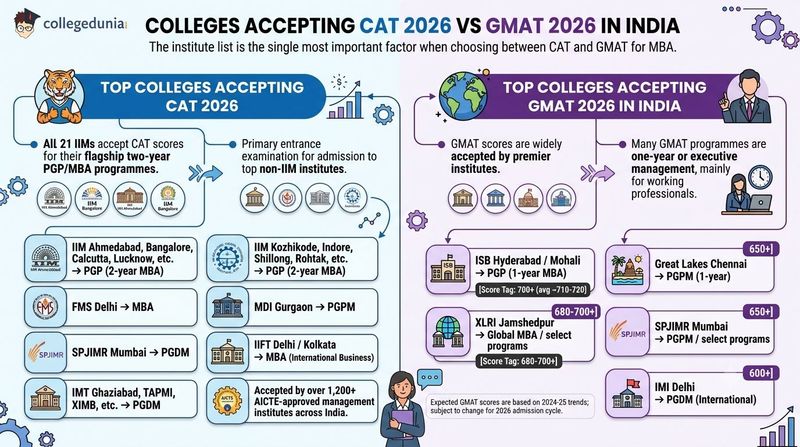
All 21 IIMs accept CAT scores for admission to their flagship two-year PGP/MBA programmes.
- CAT is the primary entrance examination for admission to FMS Delhi, MDI Gurgaon, SPJIMR Mumbai (PGDM), IIFT, and more than 1,200 AICTE-approved management institutes across India.
| Institute | Program |
|---|---|
|
IIM Ahmedabad, Bangalore, Calcutta, Lucknow, etc. |
PGP (2-year MBA) |
|
IIM Kozhikode, Indore, Shillong, Rohtak, etc. |
PGP (2-year MBA) |
| FMS Delhi | MBA |
| MDI Gurgaon | PGPM |
| SPJIMR Mumbai | PGDM |
| IIFT Delhi / Kolkata |
MBA (International Business) |
|
IMT Ghaziabad, TAPMI, XIMB, etc. |
PGDM |
Top Colleges Accepting GMAT 2026 in India
GMAT scores are widely accepted by ISB Hyderabad, ISB Mohali, Great Lakes, and selected programmes at XLRI and SPJIMR.
- Many institutes accepting GMAT scores offer one-year or executive management programmes, mainly for working professionals.
- The expected GMAT score ranges are based on the 2024–25 admission trends and may change for the 2026 admission cycle.
| Institute | Program | Expected GMAT Score |
|---|---|---|
| ISB Hyderabad / Mohali | PGP (1-year MBA) | 700+ (avg ~710–720) |
| Great Lakes Chennai | PGPM (1-year) | 650+ |
| XLRI Jamshedpur |
Global MBA / select programs |
680–700+ |
|
SPJIMR Mumbai |
PGPM / select programs |
650+ |
| IMI Delhi |
PGDM (International) |
600+ |
Also Read
CAT 2026 Safe Score for OBC-NCL: Minimum Percentile for IIM CallsQues. Which top Indian MBA colleges accept only CAT 2026 scores?
Ans. All 21 IIMs accept only CAT 2026 scores for admission to their flagship two-year MBA/PGP programmes. Apart from the IIMs, institutes such as FMS Delhi, MDI Gurgaon, IIFT, and several other leading MBA colleges also use CAT as their primary entrance examination for admission.
Ques. Which Indian MBA colleges accept GMAT 2026 scores for one-year MBA programmes?
Ans. ISB Hyderabad, ISB Mohali, Great Lakes Chennai, SPJIMR Mumbai (selected programmes), XLRI Jamshedpur (selected programmes), and IMI Delhi accept GMAT 2026 scores for various one-year, executive, or international management programmes. Most of these programmes are designed for candidates with prior work experience, and the required GMAT score varies by institute and programme.
CAT 2026 vs GMAT 2026: Which Exam Should You Choose?
Candidates should choose between CAT and GMAT based on their target management institutes, work experience, preparation time, and career goals.
- Many MBA candidates prepare for both CAT and GMAT, as the Quantitative and Verbal sections have considerable overlap.
- CAT is the preferred examination for admission to the IIMs and other leading management institutes in India.
- GMAT helps candidates keep admission options open at ISB, executive management programmes, and international business schools.
| Choose CAT 2026 If... | Choose GMAT 2026 If... |
|---|---|
|
Candidates want to join an IIM or top Indian B-school |
Candidates are targeting ISB, executive programs, or global B-schools |
|
Candidates are fresh graduates or have 0–2 years of experience |
Candidates are a working professional with 3+ years of experience |
|
Candidates prefer a lower exam fee (~INR 2,600) |
Candidates need a score valid for 5 years to apply across multiple cycles |
|
Candidates are strong in advanced quant, logical reasoning, and reading comprehension |
Candidates prefer no negative marking and flexible scheduling |
|
Candidates want access to 1,200+ Indian MBA programs |
Candidates want access to 7,700+ global MBA programs |
|
Candidates can dedicate 6–12 months to intensive preparation |
Candidates have 3–6 months and want to attempt the exam sooner |
Also Read
CAT 2026: Is 95 Percentile Safe for IIM Ahmedabad, Bangalore and CalcuttaQues. Can fresh graduates apply for GMAT 2026 instead of CAT 2026?
Ans. Yes. Fresh graduates can take GMAT 2026, but it is generally more beneficial for candidates targeting global MBA programmes or specific Indian institutes that accept GMAT scores. Candidates aiming for IIMs and most top Indian MBA colleges should primarily appear for CAT 2026, as it remains the main entrance examination for flagship two-year MBA programmes.
CAT 2026 vs GMAT 2026: Reddit Disussion
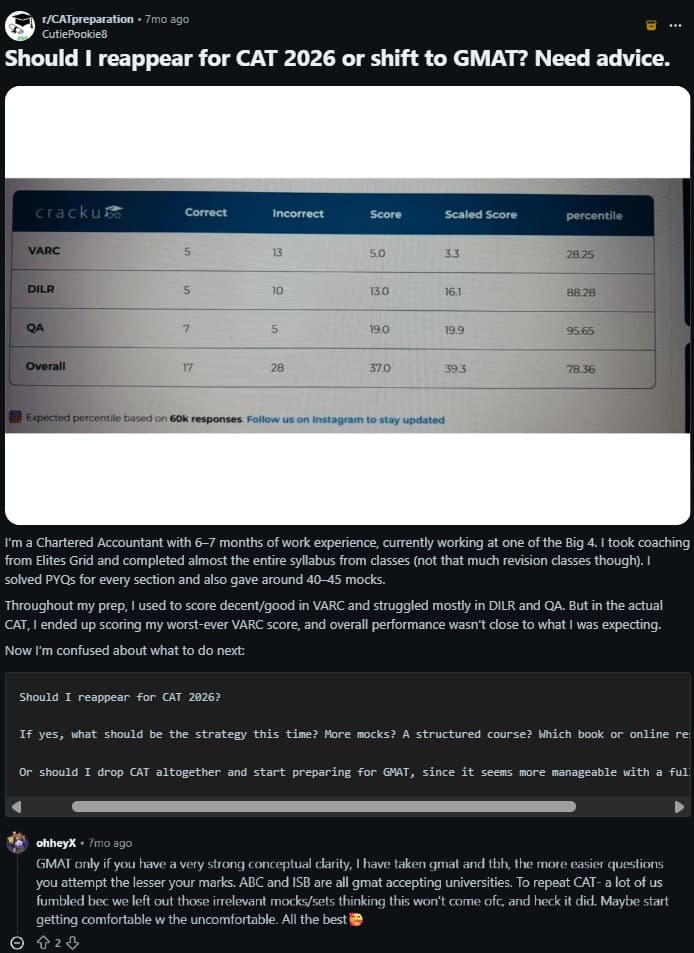
- The discussion focused on whether candidates should reappear for CAT 2026 or switch to GMAT, particularly after an unsuccessful CAT attempt despite extensive preparation, mock tests, and full-time work experience.
- Another Reddit user suggested that GMAT is a suitable option only for candidates with strong conceptual clarity, while advising CAT aspirants to prepare more comprehensively by practising unfamiliar question types and not ignoring seemingly less important mock questions. The user also noted that top institutes such as IIM Ahmedabad, IIM Bangalore, IIM Calcutta, and ISB accept GMAT scores for certain programmes.
Source: Reddit
CAT 2026 vs GMAT 2026 FAQs
Ques. Is CAT harder than GMAT?
Ans. CAT is generally considered harder for most Indian candidates, particularly due to its advanced DILR puzzles, high-difficulty VARC, and negative marking. The GMAT Focus Edition is computer-adaptive and can be equally challenging at the higher score bands, but the absence of negative marking and flexible question review reduces overall test pressure.
Ques. Can I use a GMAT score for IIM admissions?
Ans. No. All 21 IIMs accept only CAT scores for their flagship 2-year PGP programs. Some IIMs accept GMAT for executive MBA or one-year executive PGP programs (e.g., PGPX), but not for the full-time 2-year PGP.
Ques. How many times can I take GMAT in 2026?
Ans. Candidates can take the GMAT up to 5 times in a rolling 12-month period, with at least 16 days between attempts. There is no lifetime cap (the previous limit of 8 attempts has been removed). In contrast, CAT is held only once a year in November.
Ques. Is GMAT valid for MBA admissions in India without CAT?
Ans. Yes, for specific programs. ISB Hyderabad, Great Lakes, XLRI (select programs), SPJIMR (select programs), and several others accept GMAT without requiring CAT. Most of these are 1-year or executive programs designed for candidates with 3+ years of work experience.
Ques. What is a good GMAT score for ISB admission in 2026?
Ans. Based on recent admission trends, a GMAT score of 700 or above significantly strengthens a candidate’s ISB application. The average GMAT score for ISB’s admitted batch has been around 710–720. Scores below 680 are generally considered competitive only with an exceptionally strong profile.
Ques. Should I take both CAT 2026 and GMAT 2026?
Ans. Yes, if budget and time permit, taking both is a strong strategy. Candidates can target IIMs and top Indian B-schools via CAT, while keeping ISB, executive programs, and global options open via GMAT. Quantitative and verbal preparation overlaps substantially, so the additional effort for the second exam is manageable for well-prepared candidates.



Comments