




CAT Percentages notes, free to download as an 18-page PDF with 11 diagrams. Percentages feed most of Arithmetic, so the topic is worth well beyond its own 4 to 6 marks.
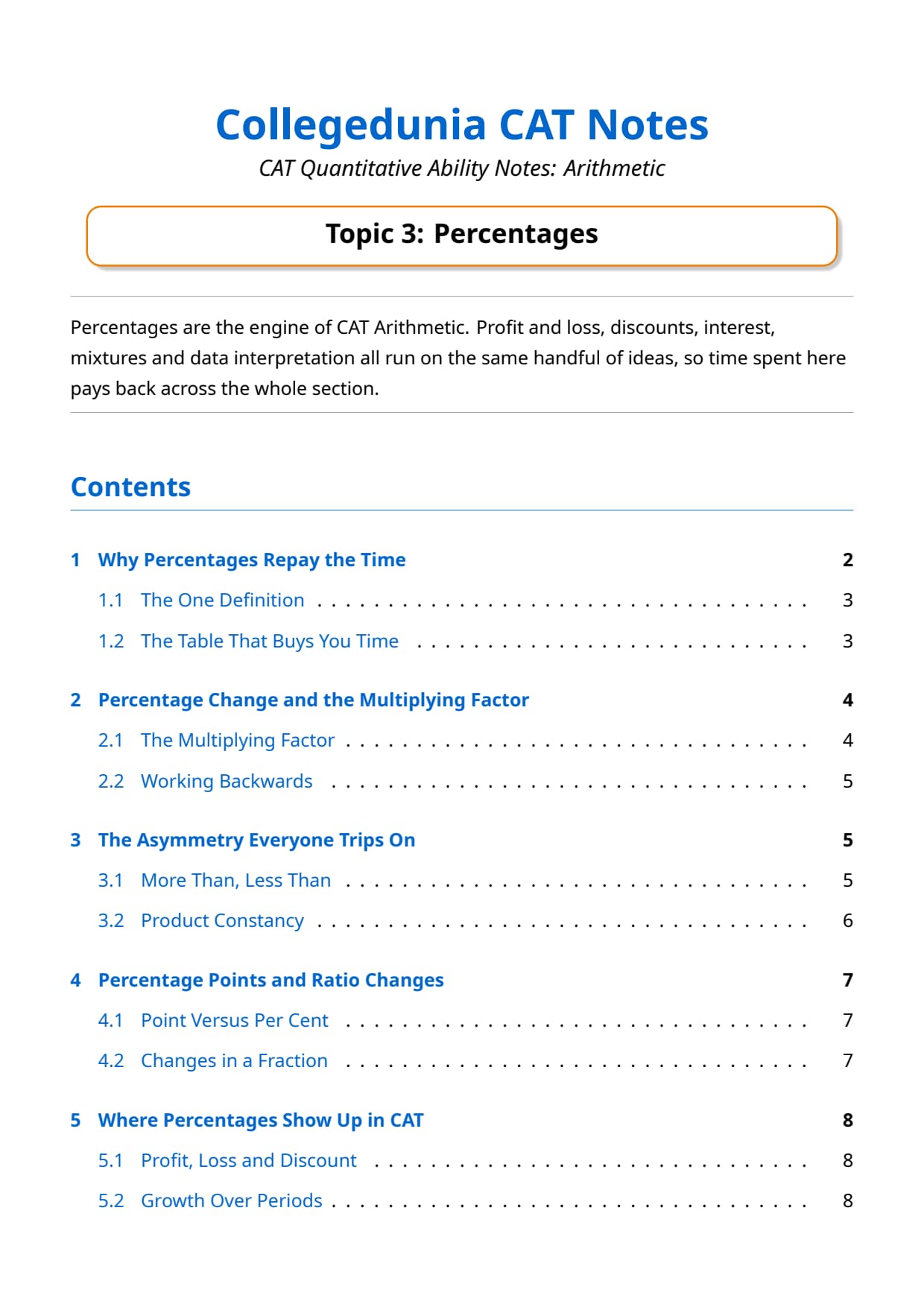
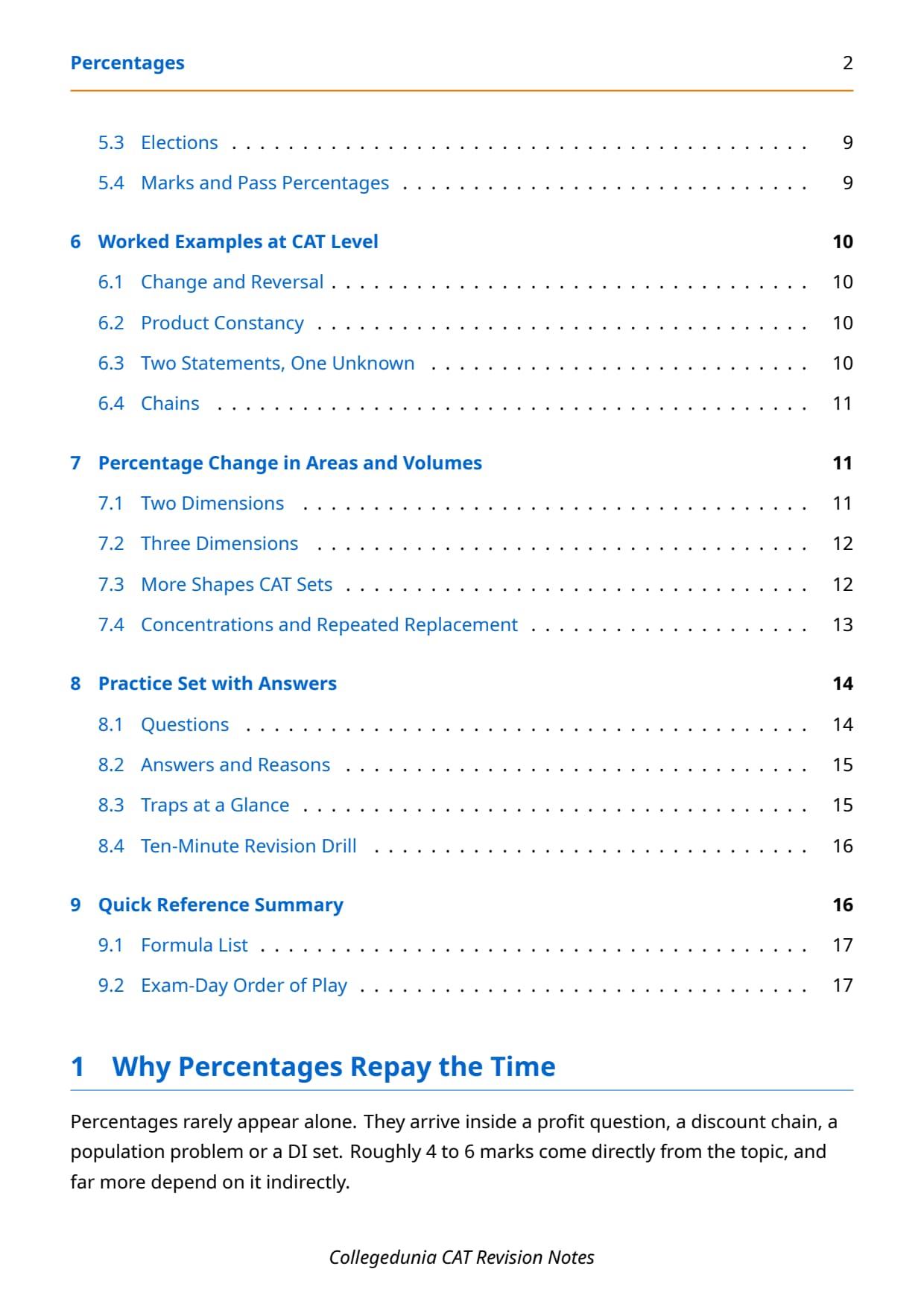
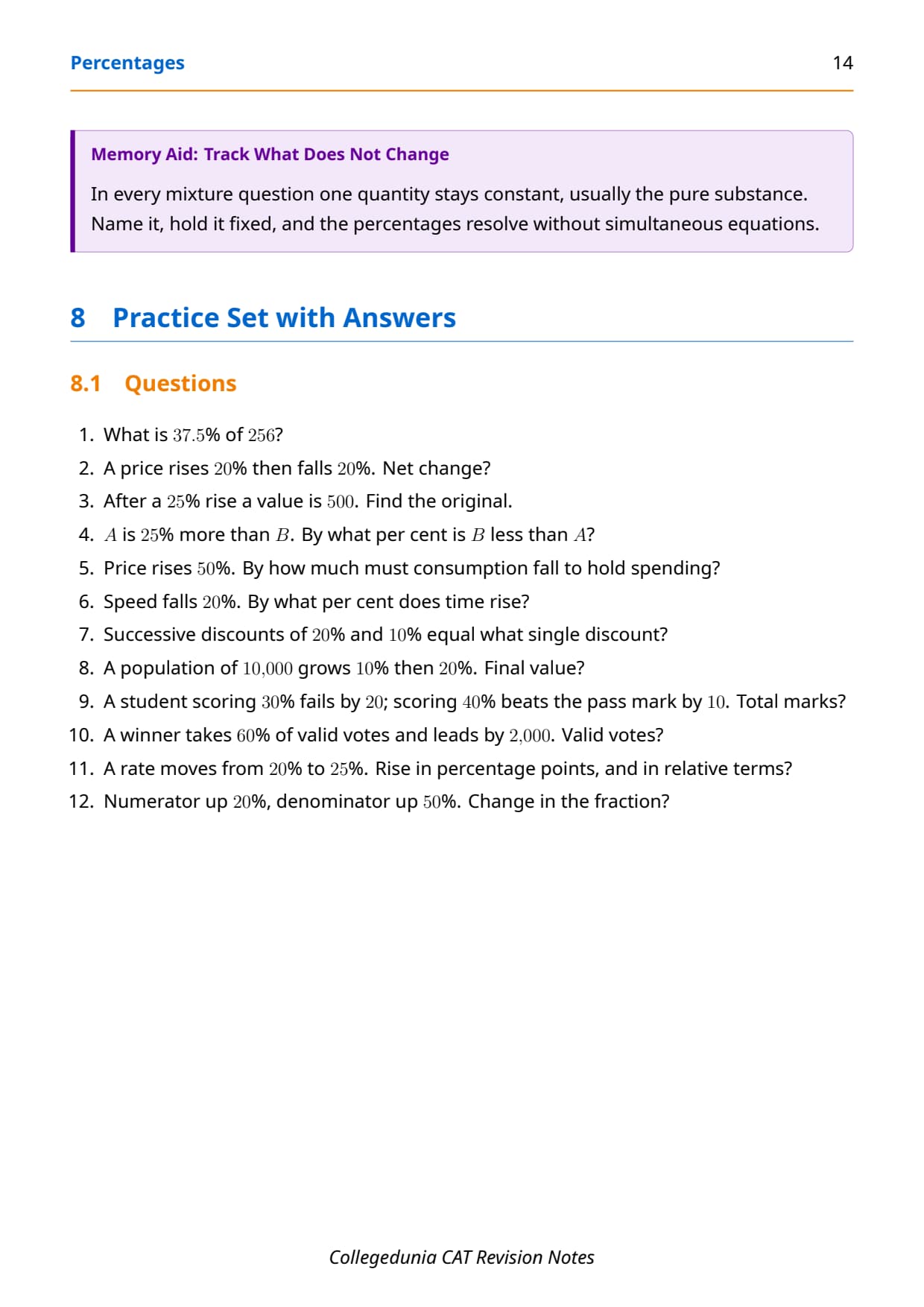
These are typeset revision notes with thirteen worked examples and a twelve question practice set. Profit and loss, discounts, interest, mixtures and data interpretation all run on the ideas in here.
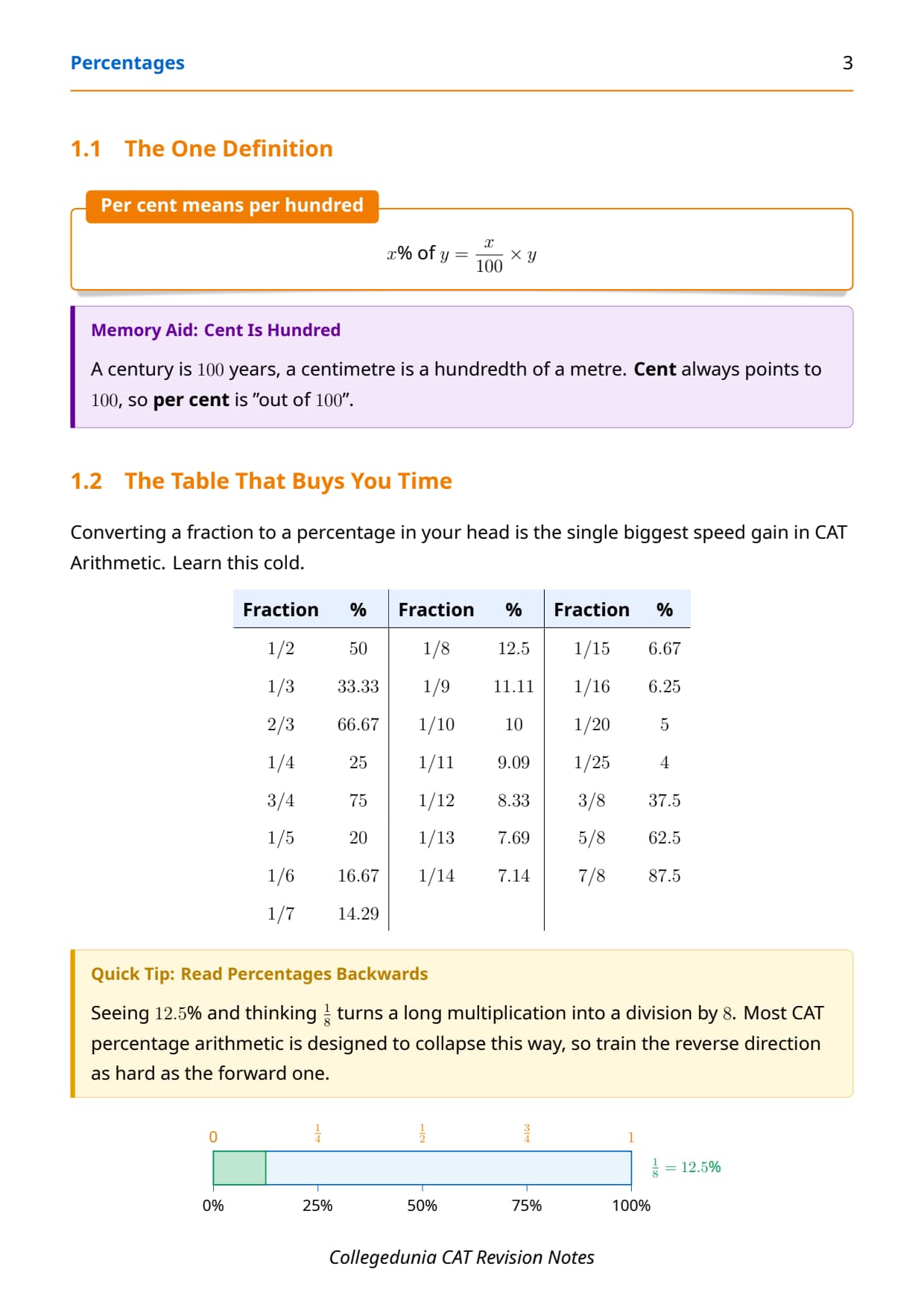
The Table That Buys the Most Time
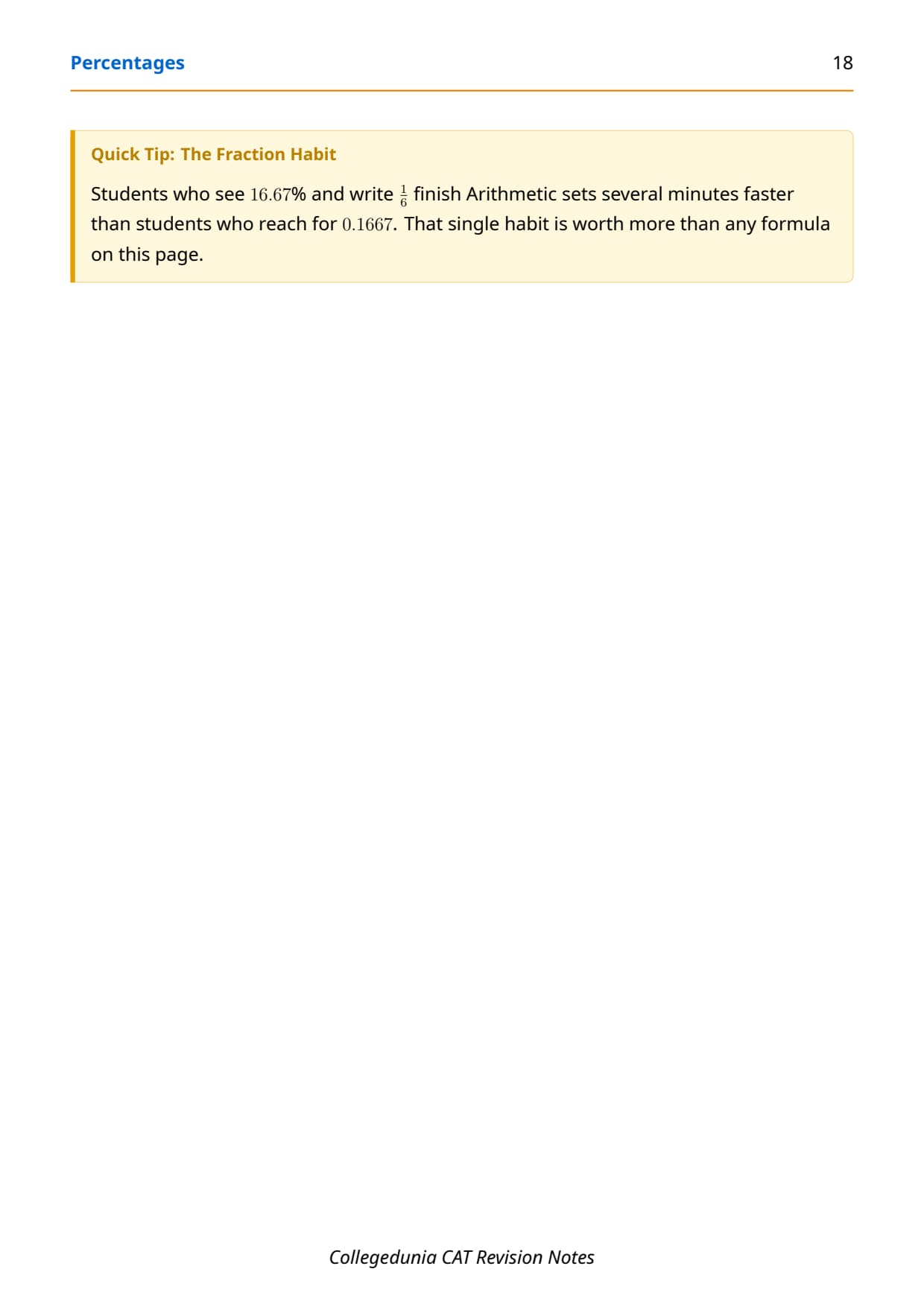
Converting a fraction to a percentage in your head is the single biggest speed gain in CAT Arithmetic, and the notes put that table on page one.
- Seeing 12.5% and thinking one-eighth turns a long multiplication into a division
- 16.67% is one-sixth, 37.5% is three-eighths, 9.09% is one-eleventh
- Most CAT percentage arithmetic is built to collapse this way
Train the reverse direction as hard as the forward one. Students who read percentages back into fractions finish Arithmetic sets minutes faster.
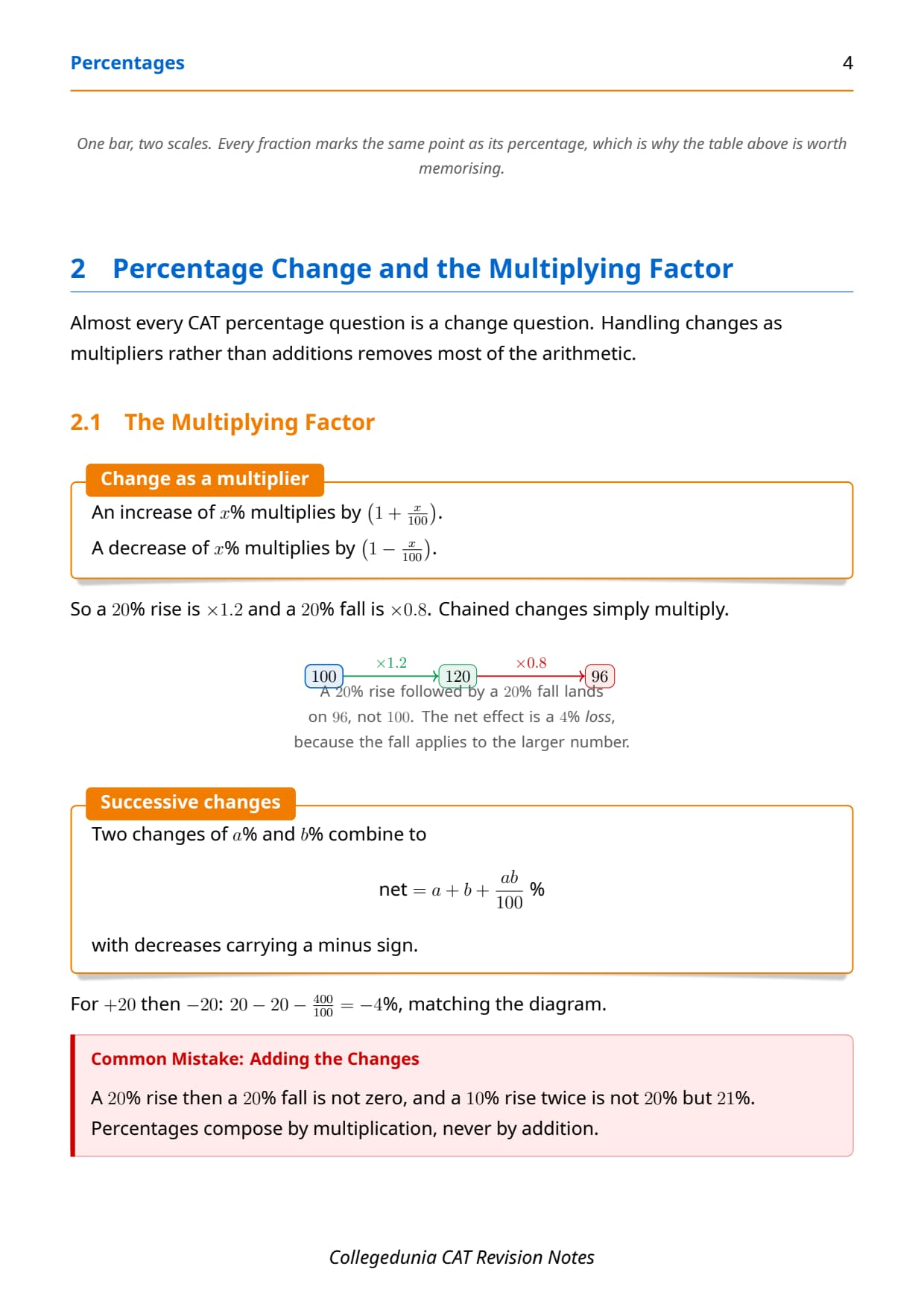
Treat Every Change as a Multiplier
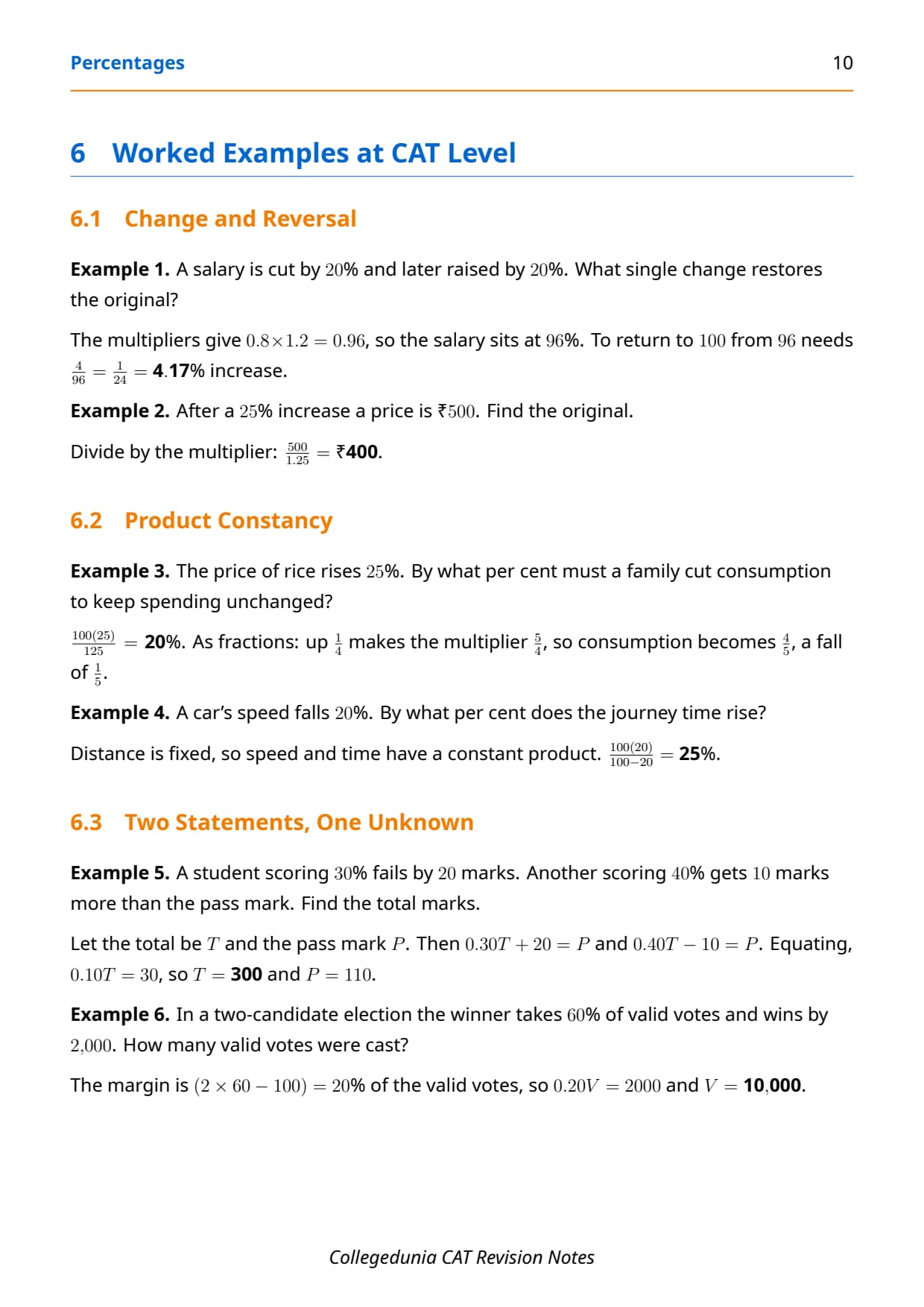
A rise of 20% is a multiplication by 1.2 and a fall of 20% is a multiplication by 0.8. Chained changes simply multiply, which removes nearly all the arithmetic.
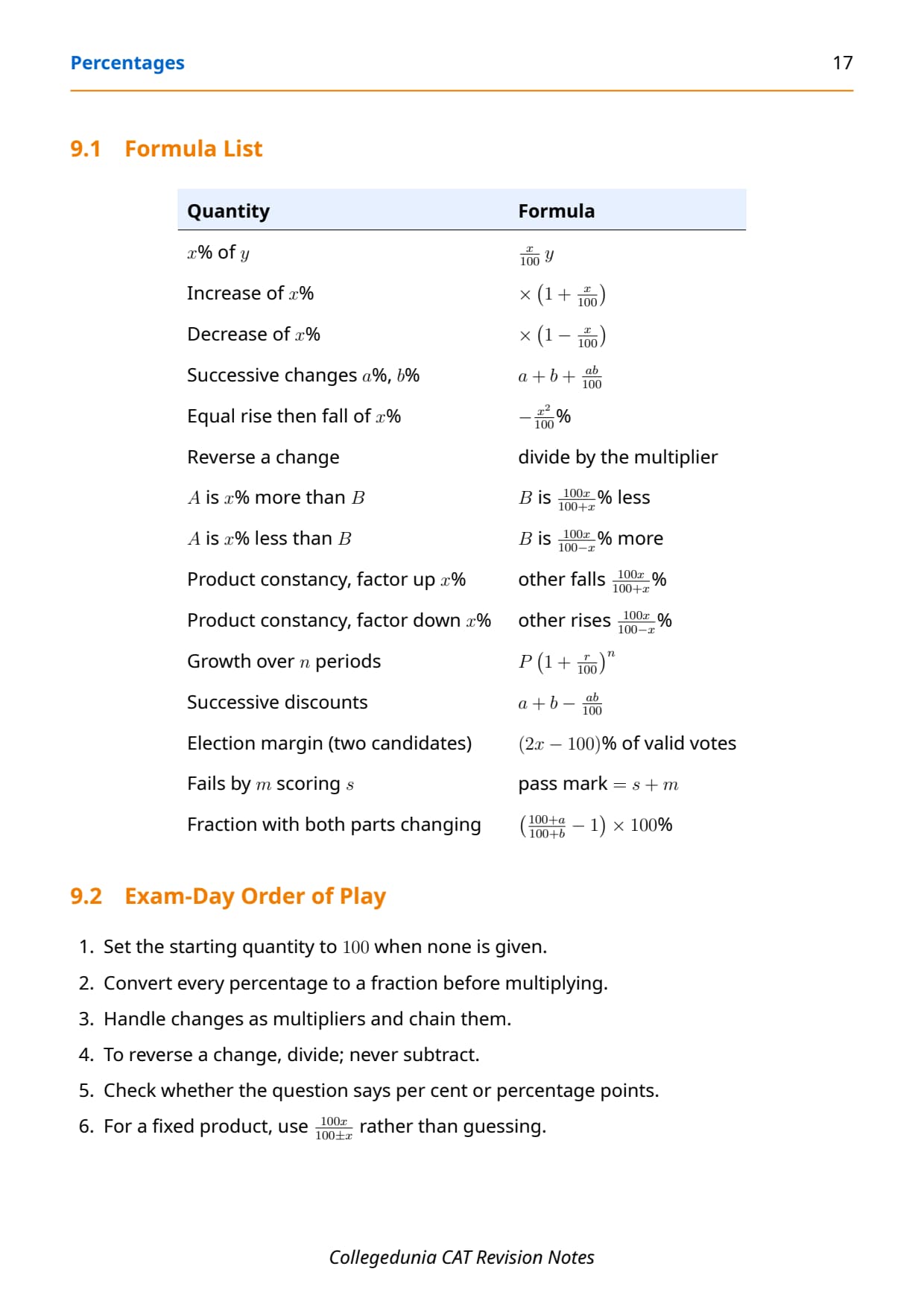
- Two changes combine as a plus b plus ab over 100, decreases carrying a minus
- A 20% rise then a 20% fall lands at 96, a net 4% loss, not zero
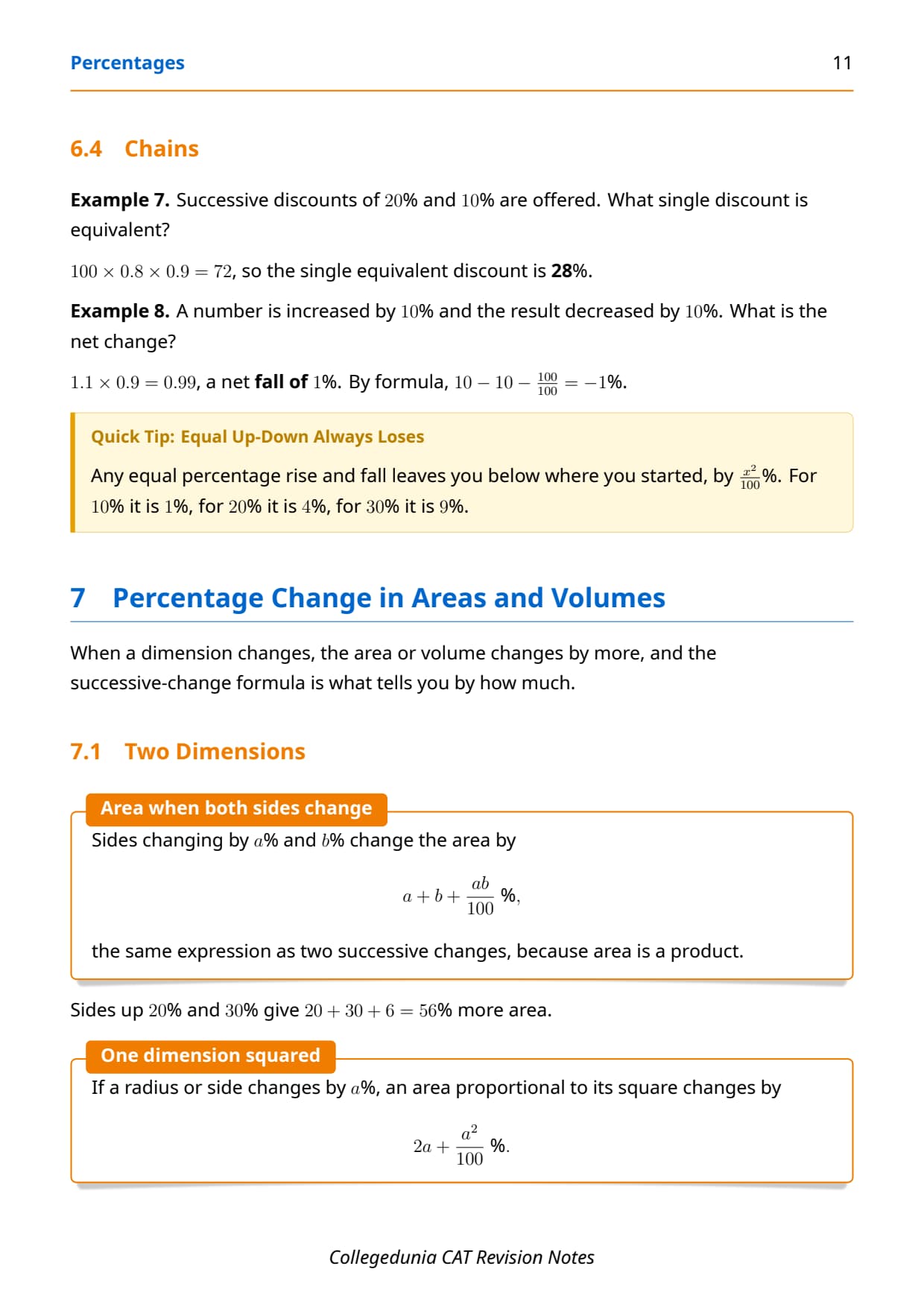
- Equal rise and fall always loses, by the square of the percentage over 100
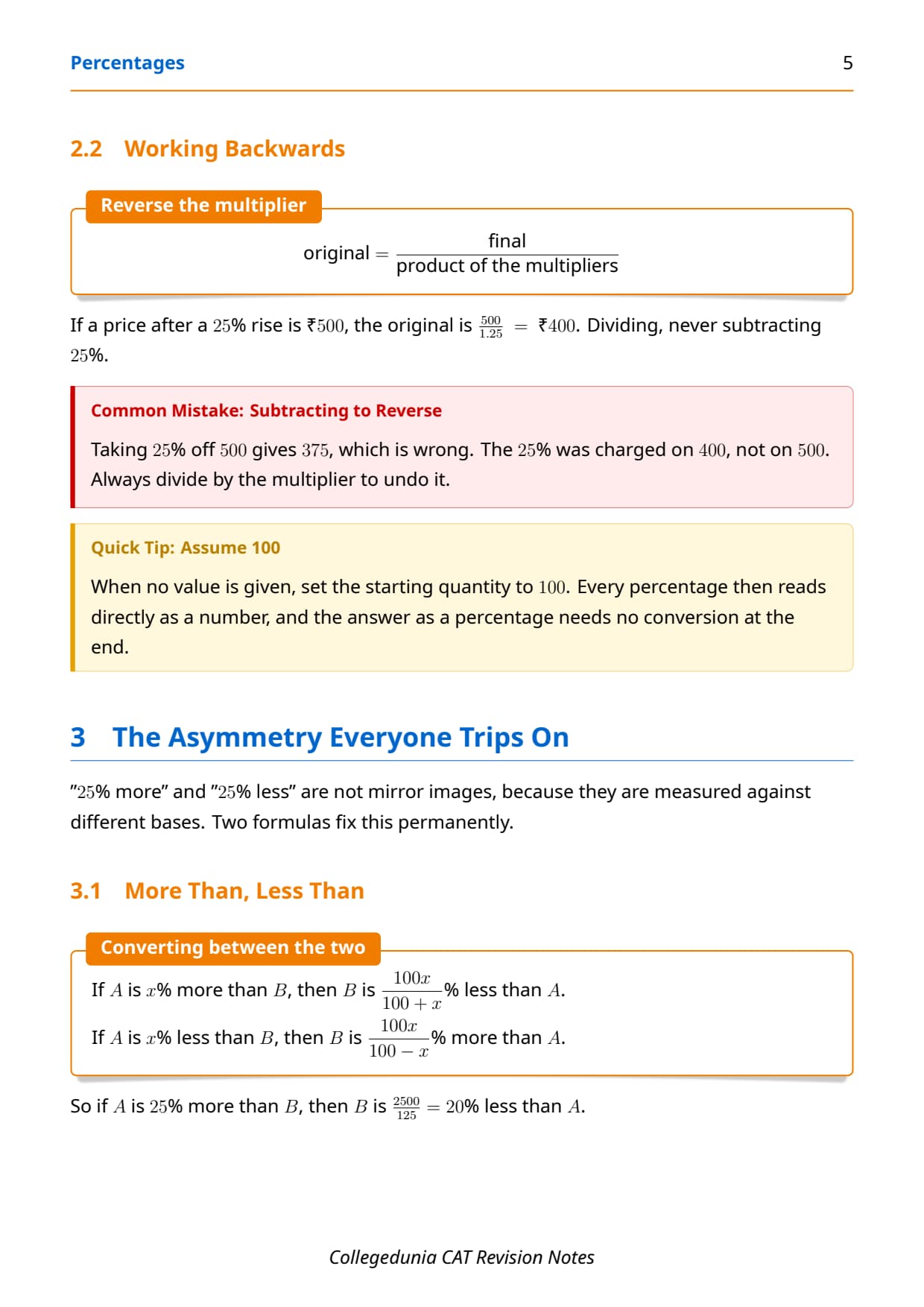
- To reverse a change you divide by the multiplier, never subtract
That last one is a frequent lost mark. If a price after a 25% rise is 500, the original is 500 divided by 1.25, which is 400, not 500 less 25%.
The Asymmetry Almost Everyone Trips On
"25% more" and "25% less" are not mirror images, because they are measured against different bases.
- If A is x% more than B, then B is 100x over 100 plus x per cent less than A
- So 25% more one way is only 20% less the other way
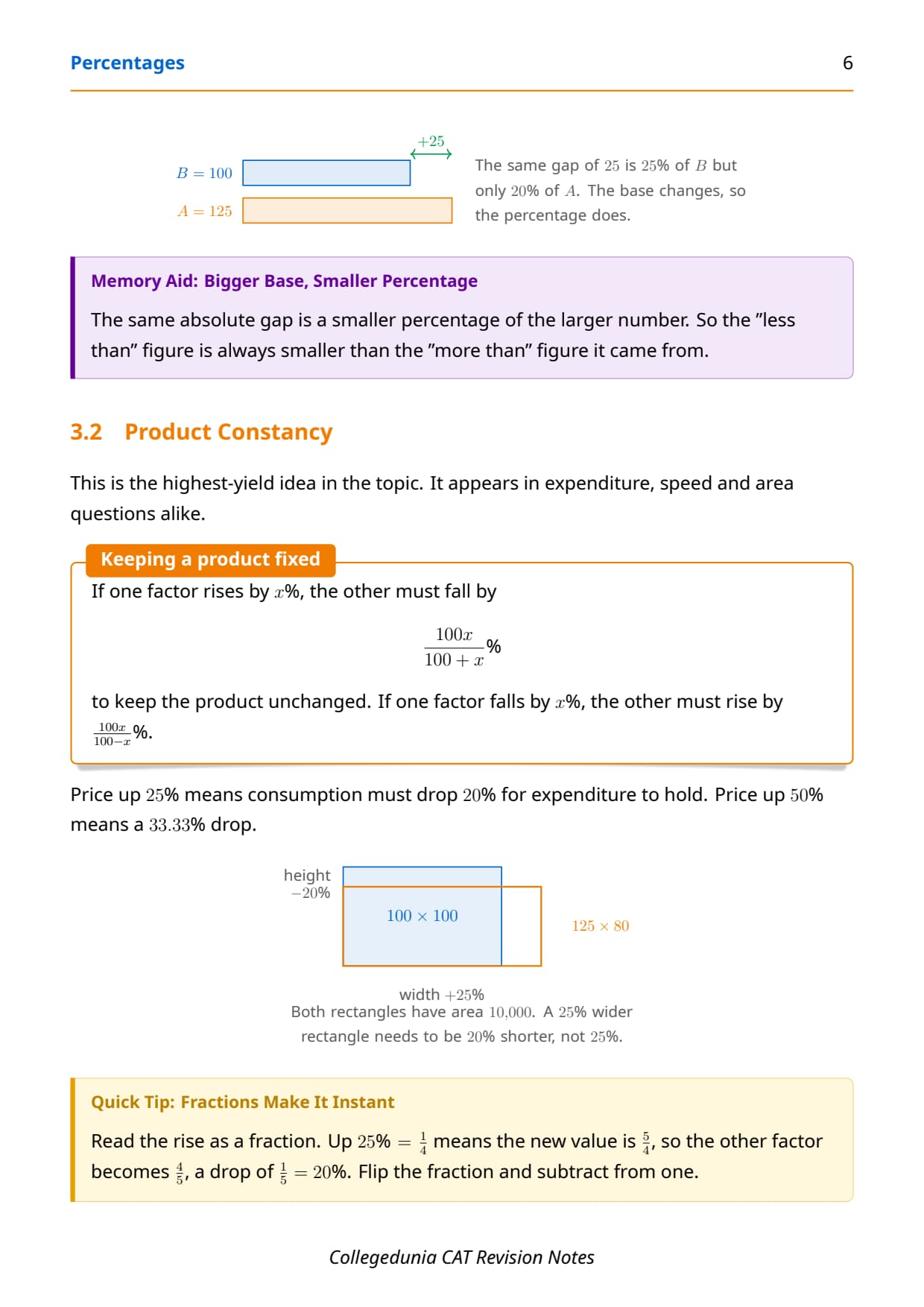
- The same absolute gap is a smaller percentage of the larger number
Product Constancy, the Highest-Yield Idea
If a product must stay fixed and one factor rises by x%, the other must fall by 100x over 100 plus x. It shows up in expenditure, speed and area questions alike.
- Price up 25% means consumption must drop 20% to hold spending
- Price up 50% means a drop of 33.33%
- Speed down 20% means journey time up 25%
The fraction route is instant: up a quarter makes the multiplier five-fourths, so the other factor becomes four-fifths, a drop of one-fifth.
Watch the Percentage Shortcuts Applied
Source: Rodha
Where the Topic Actually Appears
Percentages are a service department for the rest of Arithmetic, and the notes rehearse the four settings CAT favours.
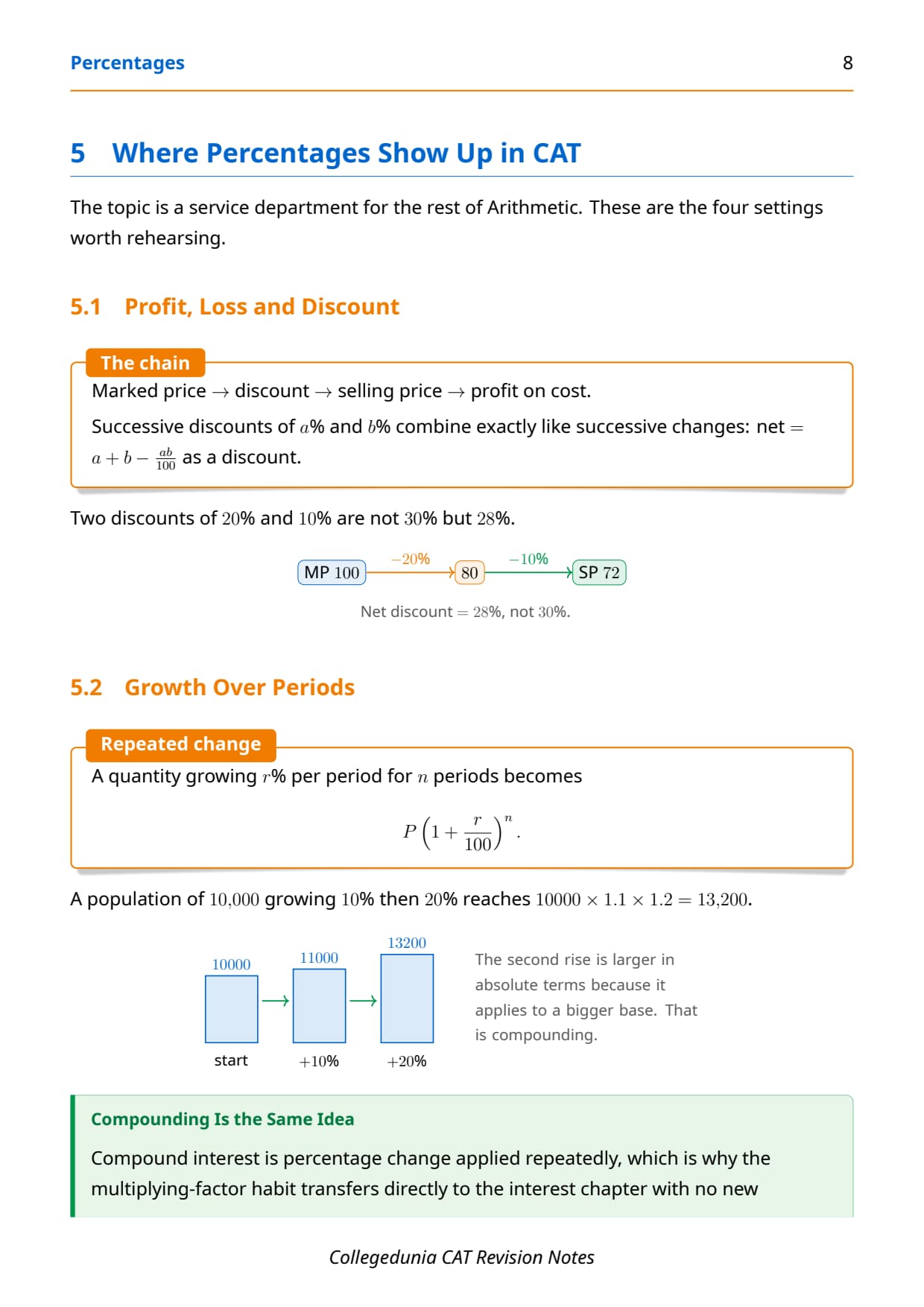
- Discounts: successive 20% and 10% is 28%, not 30%
- Growth: repeated change is compounding, so multiply the factors
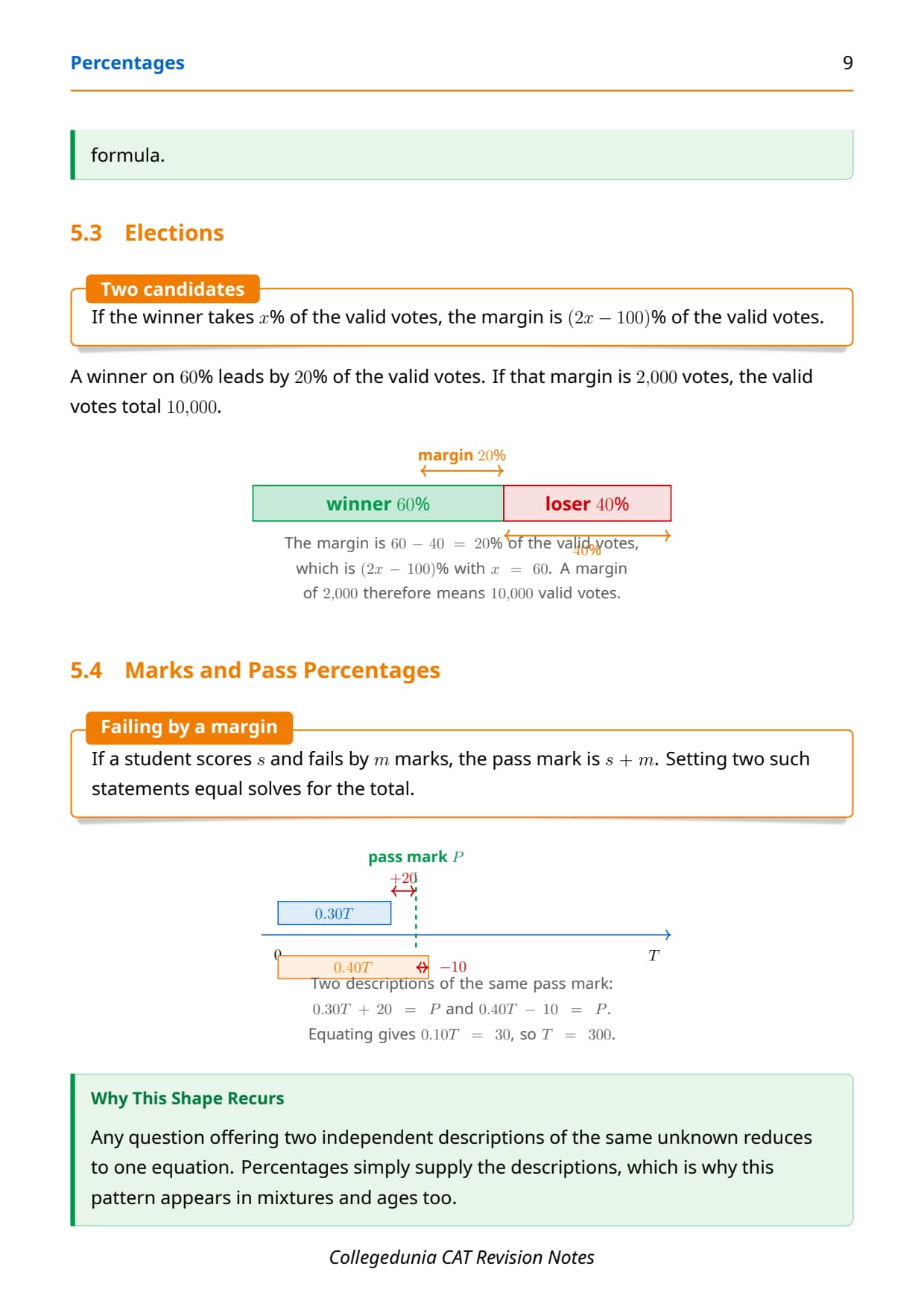
- Elections: a winner on x% of valid votes leads by 2x minus 100 per cent of them
- Marks: two descriptions of the same pass mark give one equation
- Mixtures: hold the unchanged quantity fixed and the percentages resolve
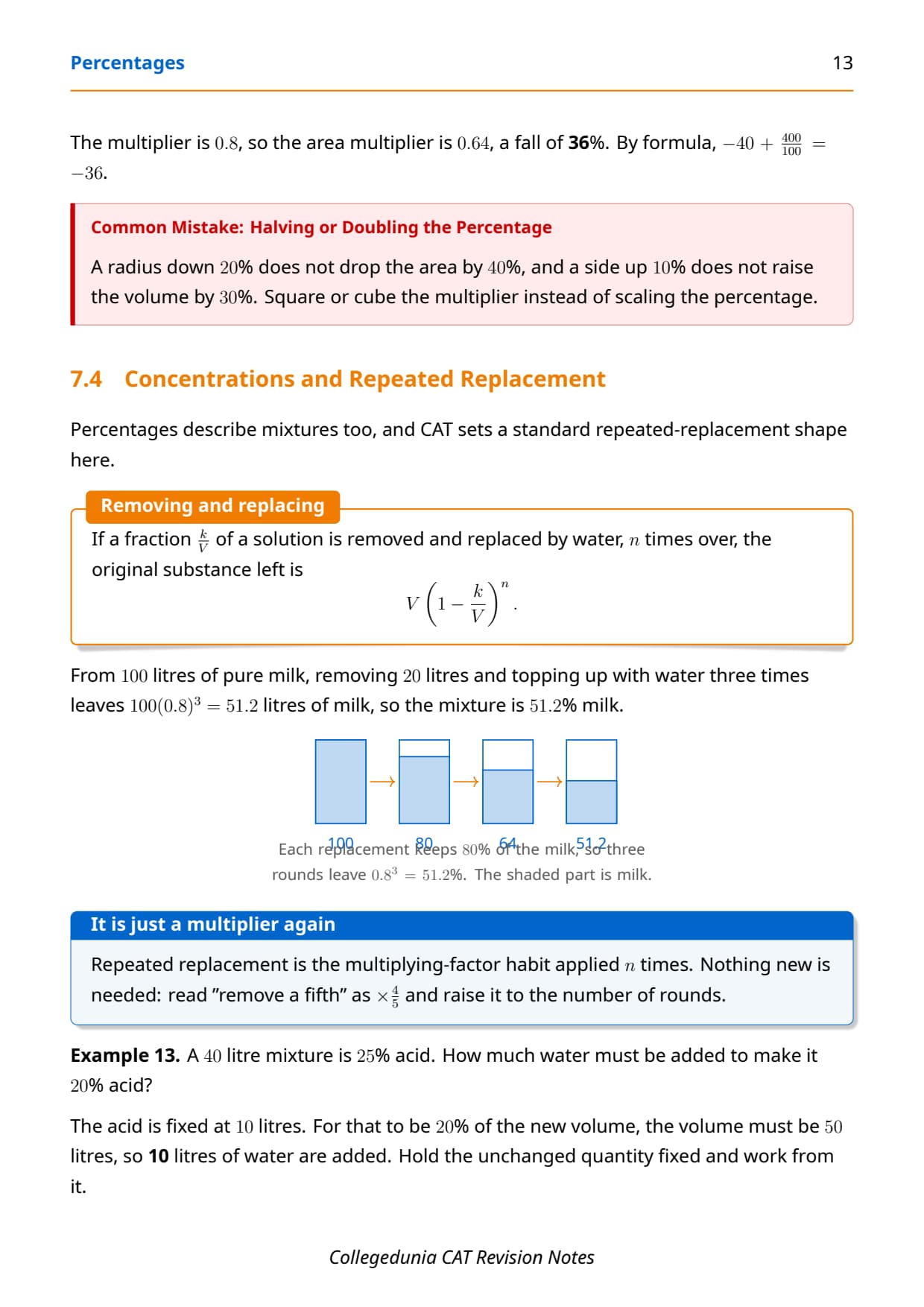
Areas, Volumes and Repeated Replacement
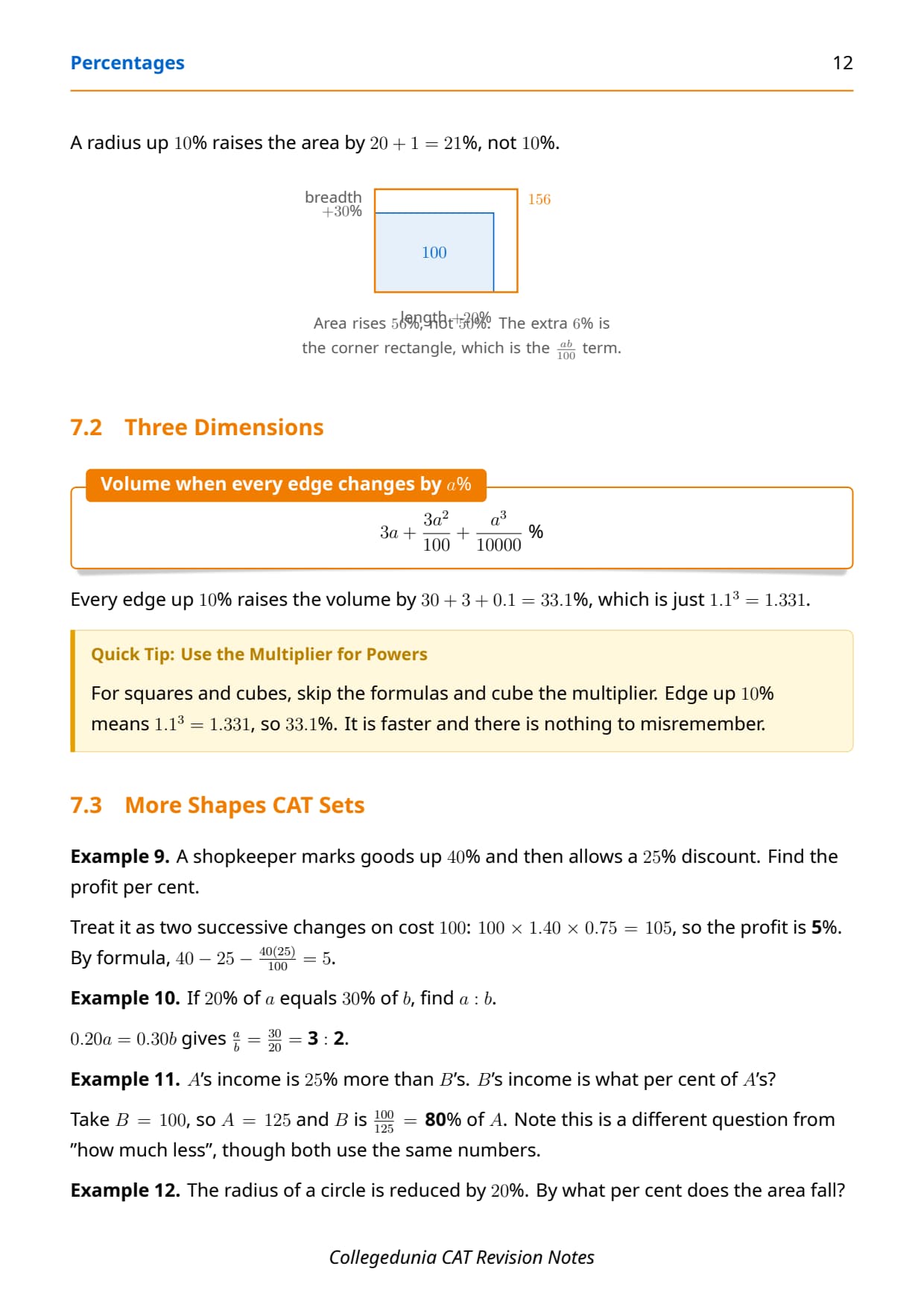
When a dimension changes, area and volume change by more, and the same successive-change formula tells you how much.
- Sides up 20% and 30% raise the area 56%, the extra 6% being the corner
- A radius up 10% raises the area 21%, not 10%
- Every edge up 10% raises the volume 33.1%, which is just 1.1 cubed
- Removing a fifth and topping up three times leaves 51.2% of the original
For powers, skip the formulas and cube the multiplier. It is faster and there is nothing to misremember.
How to Revise This Topic
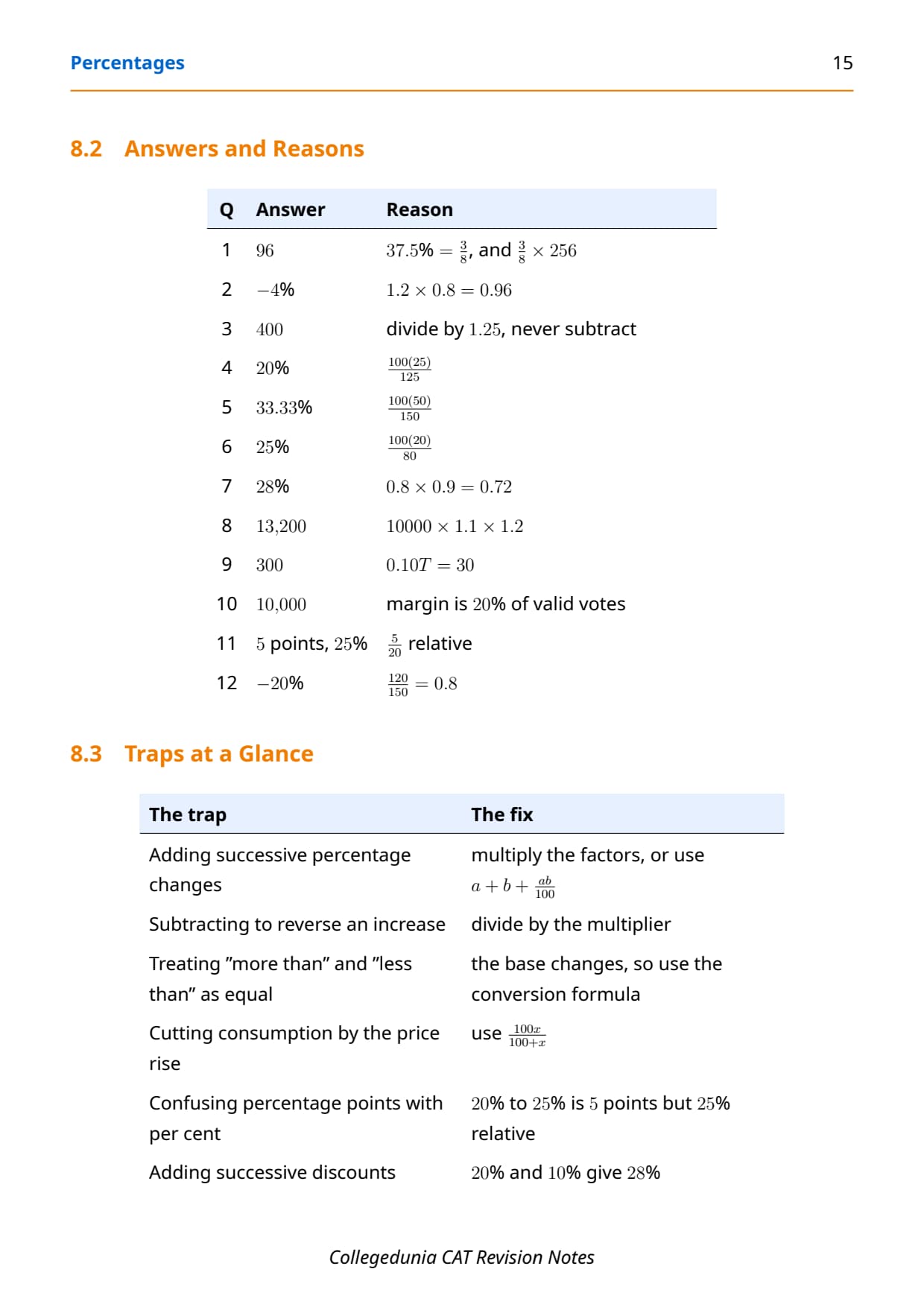
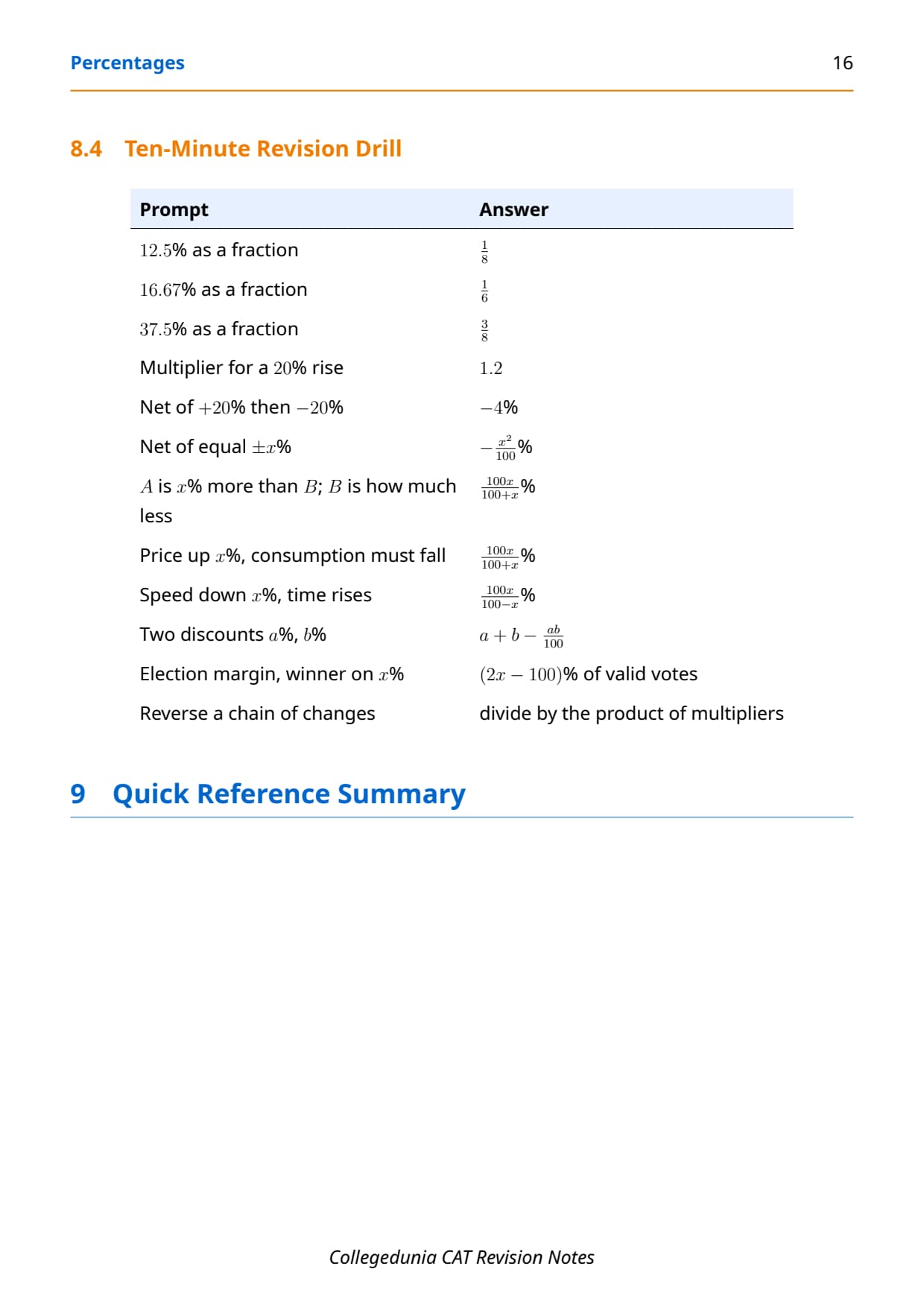
The last four pages carry a formula list, a traps table and a ten-minute drill built for a final pass.
- Set the starting quantity to 100 whenever none is given
- Convert every percentage to a fraction before multiplying
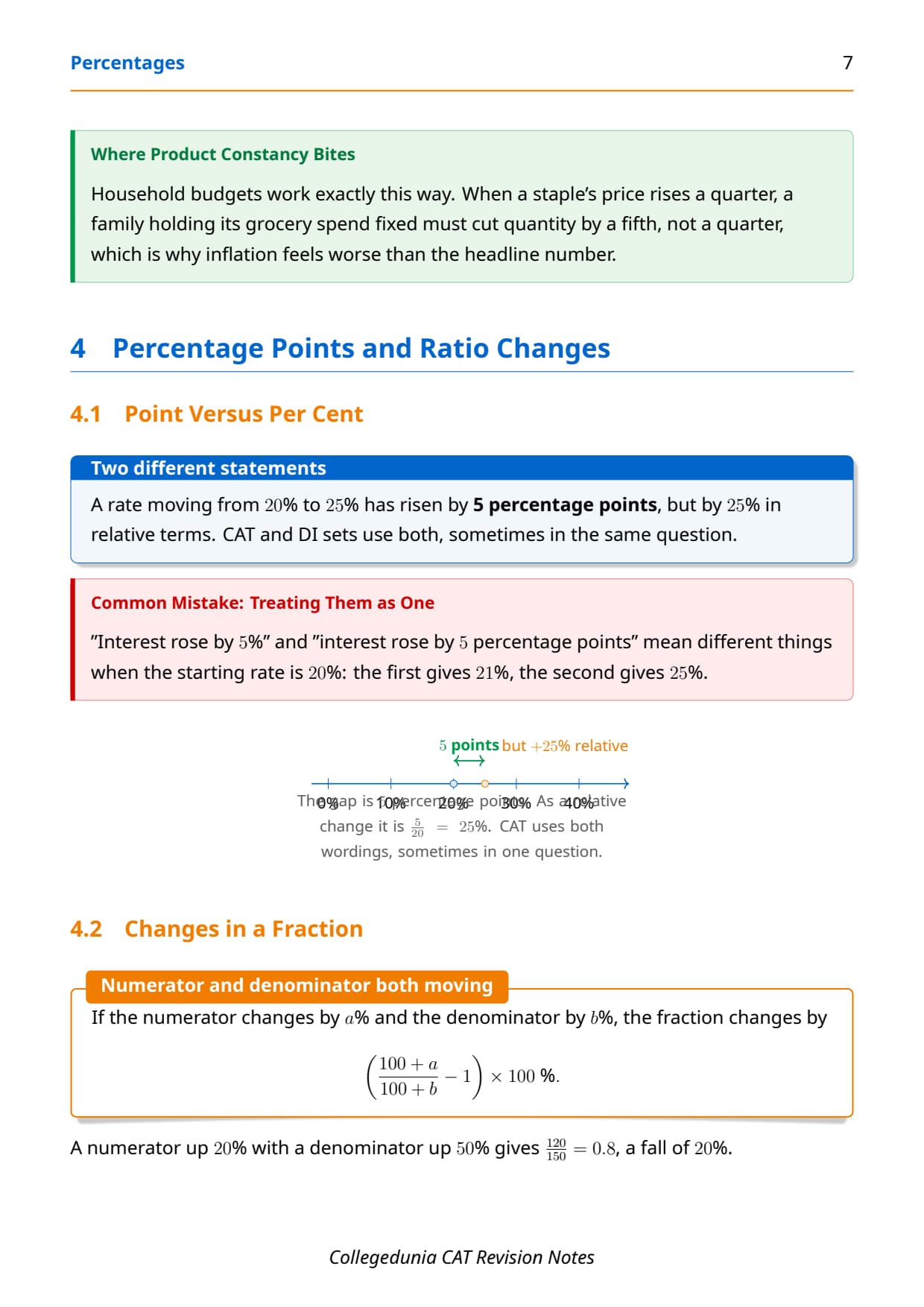
- Check whether the question says per cent or percentage points
- Attempt the practice set closed book, then read the one-line reasons
CAT Percentages Notes FAQs
Ques. How important are percentages for CAT Quant?
Ans. About 4 to 6 marks come directly from the topic, but far more depend on it. Profit and loss, discounts, interest, mixtures and most data interpretation sets are percentage questions wearing a different label, so it is among the highest-return topics in Arithmetic.
Ques. Why is a 20% rise followed by a 20% fall not zero?
Ans. Because the fall applies to the larger number. The multipliers are 1.2 and 0.8, giving 0.96, so the net effect is a 4% loss. Any equal rise and fall of x per cent leaves you below the start by x squared over 100 per cent.
Ques. What is product constancy and why does it matter?
Ans. When a product must stay fixed and one factor rises x per cent, the other must fall by 100x over 100 plus x. It answers expenditure, speed and area questions with one formula, which is why the notes treat it as the highest-yield idea in the topic.
Ques. What is the difference between per cent and percentage points?
Ans. A rate moving from 20% to 25% has risen by 5 percentage points but by 25% in relative terms. CAT and DI sets use both wordings, sometimes in the same question, so the notes flag it explicitly.
Ques. Can these notes be downloaded free?
Ans. Yes. The full 18 page PDF can be read on this page and downloaded at no cost, so students can print it or keep it on a phone for revision.



Comments