




Based on students' first reactions, the overall difficulty level of the Re-NEET 2026 exam held on June 21 was moderate, which is similar to the original NEET UG 2026 exam conducted on May 3. While many experts had expected the re-exam paper to be more challenging, the actual paper did not show a significant increase in difficulty.
- The overall difficulty level remained moderate, similar to the May 3 NEET 2026 paper.
- Physics was reported as the toughest and most time-consuming section, with several numerical and application-based questions.
- Chemistry was moderate, with a balanced mix of Organic, Physical, and Inorganic Chemistry questions.
- Biology was largely NCERT-based and comparatively easier, helping students maximize their scores.
- Students reported that the paper followed the expected NEET pattern without any major surprises in terms of question distribution.
Related Links:
- Check NEET 2026 June 21 Analysis
- ReNEET 2026 Expected Marks vs Rank for 600 Marks EWS Category
- ReNEET 2026 Expected Marks vs Rank for 500 Marks SC Category
- ReNEET 2026 Expected Marks vs Rank for 600 Marks General Category
- ReNEET 2026 Expected Marks vs Rank for 480 Marks ST Category
Key Summary
- Original NEET UG 2026 (May 3) difficulty: Moderate overall. Physics tough, Chemistry moderate, Biology easy-to-moderate.
- Re NEET 2026 (June 21) difficulty: Moderate to Tough. Experts lean toward a slightly more challenging paper.
- NTA's official stance: No change in syllabus or exam pattern for Re NEET 2026. Difficulty not officially disclosed.
- Historical precedent: AIPMT 2015 re-exam was moderately difficult and slightly harder than the original. NEET 2025 (the last regular exam) was rated Moderate to Difficult.
- Key reason for higher difficulty: NTA is under CBI scrutiny. Tougher, more original question sets reduce re-leak risk and strengthen rank credibility.
- Competition factor: All 22.79 lakh students have had 7 extra weeks of preparation. Even at the same difficulty level, competition is sharper.
- Expert advice: Prepare for a moderate to tough paper. Focus on NCERT, mock tests, and previous year questions (PYQs) from 2023 to 2025.
Difficulty Level of NEET 2026 June 21 Exam
Most candidates found the paper moderate overall, with Physics being the most challenging section and Biology the most scoring.
| Section | Difficulty Level | Key Highlights |
|---|---|---|
| Physics | Moderate to Difficult | Lengthy section with numerical and application-based questions. |
| Chemistry | Moderate | Balanced mix of Organic, Physical, and Inorganic Chemistry questions. |
| Biology | Easy to Moderate | Mostly NCERT-based with direct and concept-linked questions. |
| Overall Paper | Moderate | Similar in difficulty to the original NEET 2026 exam held on May 3. |
Student Feedback: Most candidates found the paper moderate overall, with Physics being the most challenging section and Biology the most scoring.
Check:
- NEET UG 2026 Question Paper Analysis (Available)– Difficulty Level, Section-wise Review & Expected Cutoff (May 3)
- NEET Marks vs Rank 2026: Check NEET Course-wise Marks vs Rank, Safe Score, Rank Predictor, and Expected Cut off
Ques. Did the AIPMT 2015 re-exam become drastically harder than the original?
Ans. No, the AIPMT 2015 re-exam was not drastically harder. It was rated as moderately difficult and slightly more balanced compared to the original paper. However, it was not easy, and students who had assumed a lenient paper found it more demanding than expected. Experts use the 2015 precedent to argue that Re NEET 2026 will be moderate to tough but not overwhelmingly difficult.
NEET UG 2026 (May 3) Difficulty Level
- The overall NEET UG 2026 paper (May 3) was rated Moderate by experts and most students. It was described as slightly easier than NEET 2025, which was rated Moderate to Difficult.
- Physics was the hardest section. It was numerical-heavy, calculation-intensive, and time-consuming. This continued Physics's trend as the toughest NEET section since 2022.
- Chemistry was Moderate. Questions were drawn from Physical, Organic, and Inorganic Chemistry in a balanced mix, largely NCERT-aligned.
- Biology (Botany + Zoology) was Easy to Moderate. Most questions were directly from NCERT, making it the highest-scoring section and an easy pick for time management.
| Subject | No. of Questions | Total Marks | NEET UG 2026 (May 3) Difficulty | Key Observation |
|---|---|---|---|---|
| Physics | 45 | 180 | Tough | Numerical-heavy, multi-step calculation questions, time-consuming |
| Chemistry | 45 | 180 | Moderate | Balanced mix of Physical, Organic, Inorganic. NCERT-focused with few tricky questions |
| Biology (Botany) | 50 | 200 | Easy to Moderate | Mostly direct NCERT questions. Highly scoring section |
| Biology (Zoology) | 40 | 160 | Easy to Moderate | Conceptual and direct NCERT-based. Some questions had tricky options |
| Overall | 180 | 720 | Moderate | Slightly easier than NEET 2025. Physics made paper time-sensitive |
Check:
- NEET 2026 Question Paper (Available): Download Answer Key with Solution PDF
- NEET Answer Key 2026: Check Code-Wise PDF (Available), Release Date, Result & Response Sheet
Ques. Has NTA officially announced that Re NEET 2026 will be harder?
Ans. No. NTA has not officially announced any change in difficulty level, syllabus, or exam pattern for Re NEET 2026. The re-exam will follow the same 180-question, 720-mark format as always. Difficulty predictions are based on expert analysis and historical re-exam trends, not official NTA statements.
NEET 2026 Question Paper with Solution PDF for All Codes (Available)
| Paper Code | Question Paper PDF | Solutions PDF |
|---|---|---|
| NEET 2026 Question Paper Code 11 | Download PDF | Check Solutions |
| NEET 2026 Question Paper Code 12 | Download PDF | Check Solutions |
| NEET 2026 Question Paper Code 13 | Download PDF | Check Solutions |
| NEET 2026 Question Paper Code 14 | Download PDF | Check Solutions |
Subject-wise Difficulty Level of Re NEET 2026 ( 21st June)
- Physics was the toughest section, featuring lengthy numerical and application-based questions from Current Electricity, Rotational Motion, Electrostatics, Modern Physics, and Thermodynamics. A good attempt was around 30-35 questions.
- Chemistry was moderately difficult, with Organic Chemistry carrying the highest weightage. Most questions were based on NCERT concepts from Hydrocarbons, Haloalkanes, Chemical Kinetics, and Equilibrium. A good attempt was 33-38 questions.
- Biology remained the most scoring section, with nearly 95% NCERT-based questions. Genetics, Biotechnology, Ecology, Human Physiology, and Reproduction were among the most important topics. A good attempt was 75-78 questions.
- Overall, the paper was rated moderate, similar to the original May 3 NEET 2026 exam. Students with strong NCERT preparation and regular mock test practice found the paper manageable.
| Subject | Difficulty Level | Good Attempts | Key Topics | NCERT Weightage |
|---|---|---|---|---|
| Physics | Moderate to Difficult | 30 to 35 questions | Current Electricity, Rotational Motion, Electrostatics, Modern Physics, Ray Optics, Thermodynamics | Around 70% |
| Chemistry | Moderate | 33 to 38 questions | Organic Chemistry, Hydrocarbons, Haloalkanes, Chemical Kinetics, Equilibrium | Around 80 to 85% |
| Biology (Botany + Zoology) | Easy to Moderate | 75 to 78 questions | Genetics, Biotechnology, Ecology, Human Physiology, Plant Physiology, Reproduction | Around 95% |
Check:
- Will NEET 2026 Cutoff Rise or Fall? Impact of the NEET Paper Cancellation
- NEET 2026 Expected Cut Off: Last 3 Years Category-Wise Trend Analysis & Safe Score for NEET Exam
Ques. Which subject was the toughest in Re NEET 2026?
Ans. Physics remained the toughest subject in Re NEET 2026, continuing a trend seen since 2022. As per experts, more multi-step numerical and assertion-reason-type questions were in Physics. Chemistry was difficult, especially in Organic Chemistry. Biology was the most scoring section, but may have fewer direct NCERT questions compared to May 3.
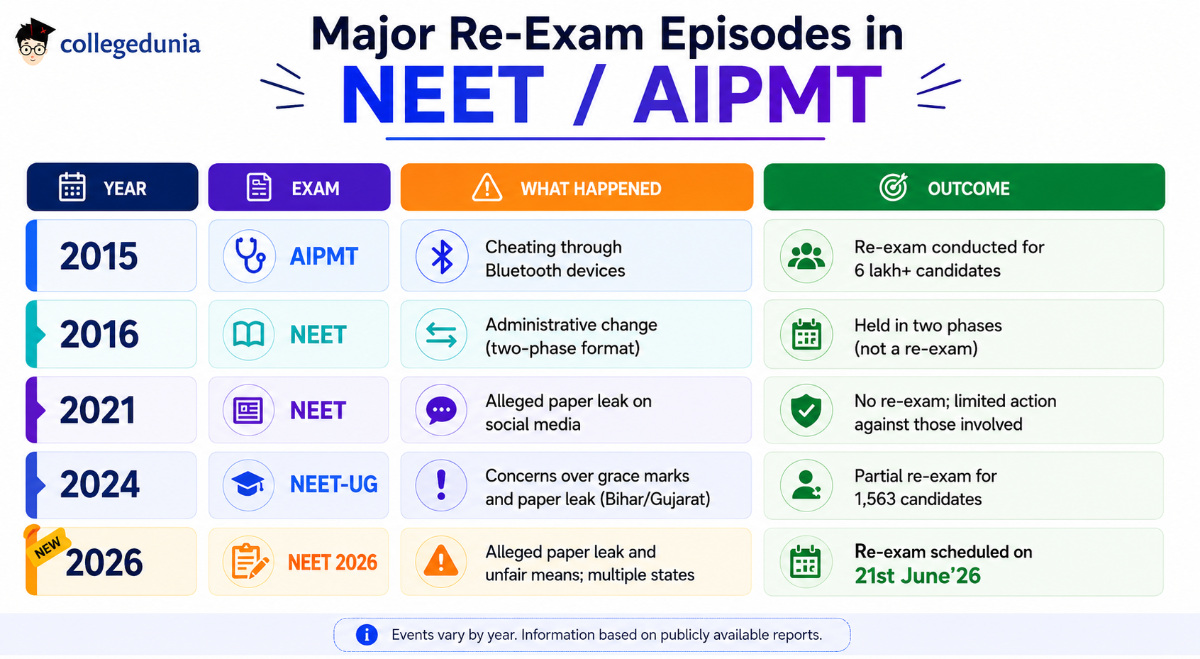
What Happened in Past NEET Re-Exams?
- Re-exams in NEET/AIPMT have been conducted only in exceptional cases.
- The biggest re-exam was AIPMT 2015, involving over 6 lakh candidates.
- Recent cases have mostly led to limited re-tests or investigations rather than a nationwide re-exam.
Check:
- NEET 2026 Qualifying vs Admission Cutoff: Key Differences & Expert Tips
- NEET 2026 State Quota Cutoff: Expected Category-wise Marks, AIQ vs State & Top State Analysis
Will Re NEET 2026 Paper Be Tougher Than the Original NEET 2026 FAQs
Ques. Will Re NEET 2026 paper be tougher than original NEET 2026?
Ans. According to expert analysis and student reaction Re NEET 2026 was moderate to tough, which is a slight step up from the original May 3 paper, rated as Moderate.
Ques. Will the syllabus or exam pattern change for Re NEET 2026?
Ans. No. NTA has confirmed that Re NEET 2026 will follow the same syllabus and exam pattern as always: 180 questions, 720 marks, covering Physics (45 questions), Chemistry (45 questions), and Biology (90 questions), with a duration of 3 hours 15 minutes. There is no official indication of any change to the pattern or syllabus.
Ques. Is Re NEET 2026 expected to be easier because students are under stress?
Ans. No. Multiple coaching experts have specifically flagged this as a common misconception. Historical data from AIPMT 2015 and the broader NEET difficulty trajectory show that re-exams do not become easier to accommodate student stress. NTA's primary goal is to maintain rank credibility and exam integrity, which requires a paper that differentiates candidates effectively.
Ques. What score should I target to be safe for a top rank in Re NEET 2026?
Ans. This depends on the actual difficulty of the June 21 paper. If the paper is moderate (similar to May 3), a score above 650 would be competitive for top ranks. If the paper is tougher, scores in the 620 to 650 range may fetch similar ranks. Targeting 85%+ accuracy on 155-160 questions is a strong approach regardless of the difficulty level. Official cutoffs will only be announced after the results.
Ques. What types of questions should I expect in Re NEET 2026?
Ans. Experts predict more assertion-reason questions, statement-based questions, and application-based numericals in Re NEET 2026 compared to May 3. Biology may include more analytical questions beyond direct NCERT recall. Chemistry may test more Organic Chemistry applications. Physics is expected to maintain or increase its numerical intensity. Extensive practice with NEET 2024 and 2025 papers is the best way to prepare for these question types.



Comments