




NEET 2026 Chemistry Question Paper is available here. NTA conducted NEET 2026 exam on May 3 in single shift from 2 PM to 5 PM. NEET question question paper consists of 180 questions for 720 marks to be attempted in 3 hours.
- NEET Chemistry Question Paper 2026 consists of 45 questions.
- Each correct answer carries 4 marks and incorrect answer has a negative marking of 1.
Candidates can download NEET 2026 Chemistry Question Paper with Answer Key and Solution PDF from the links provided below
NEET 2026 Chemistry Question Paper with Solution PDF
| NEET 2026 Chemistry Question Paper | Download PDF | Check Solution |
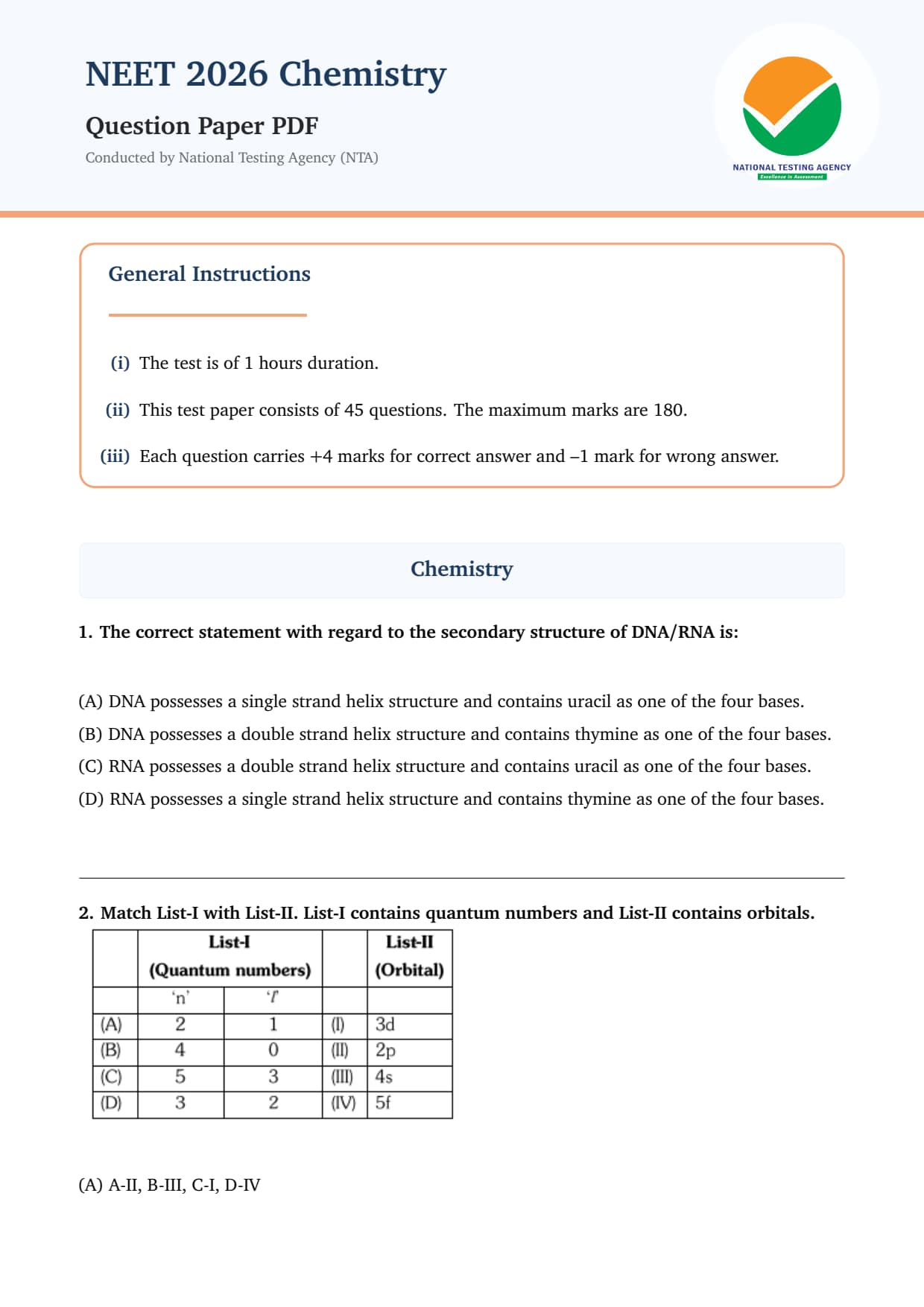
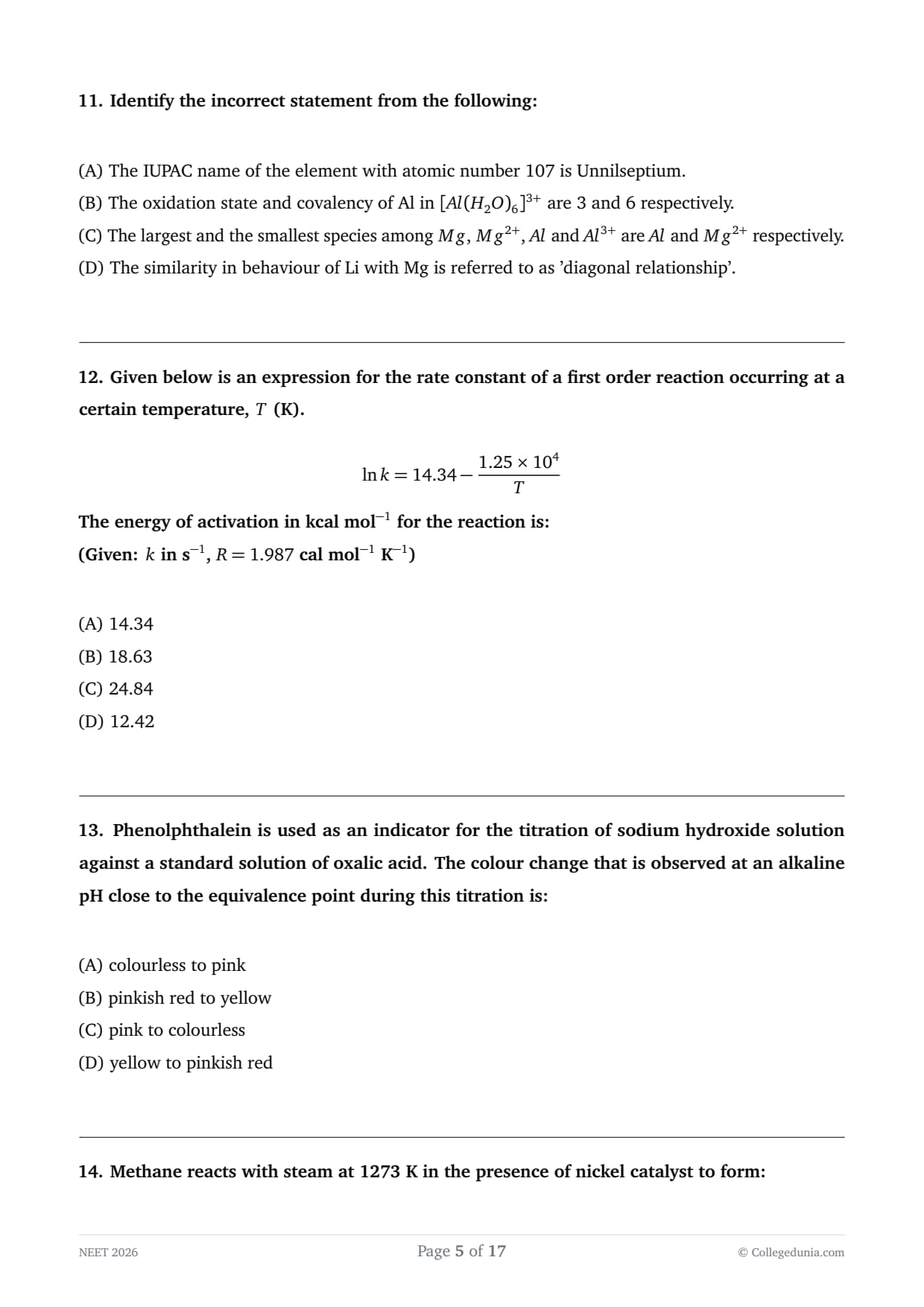
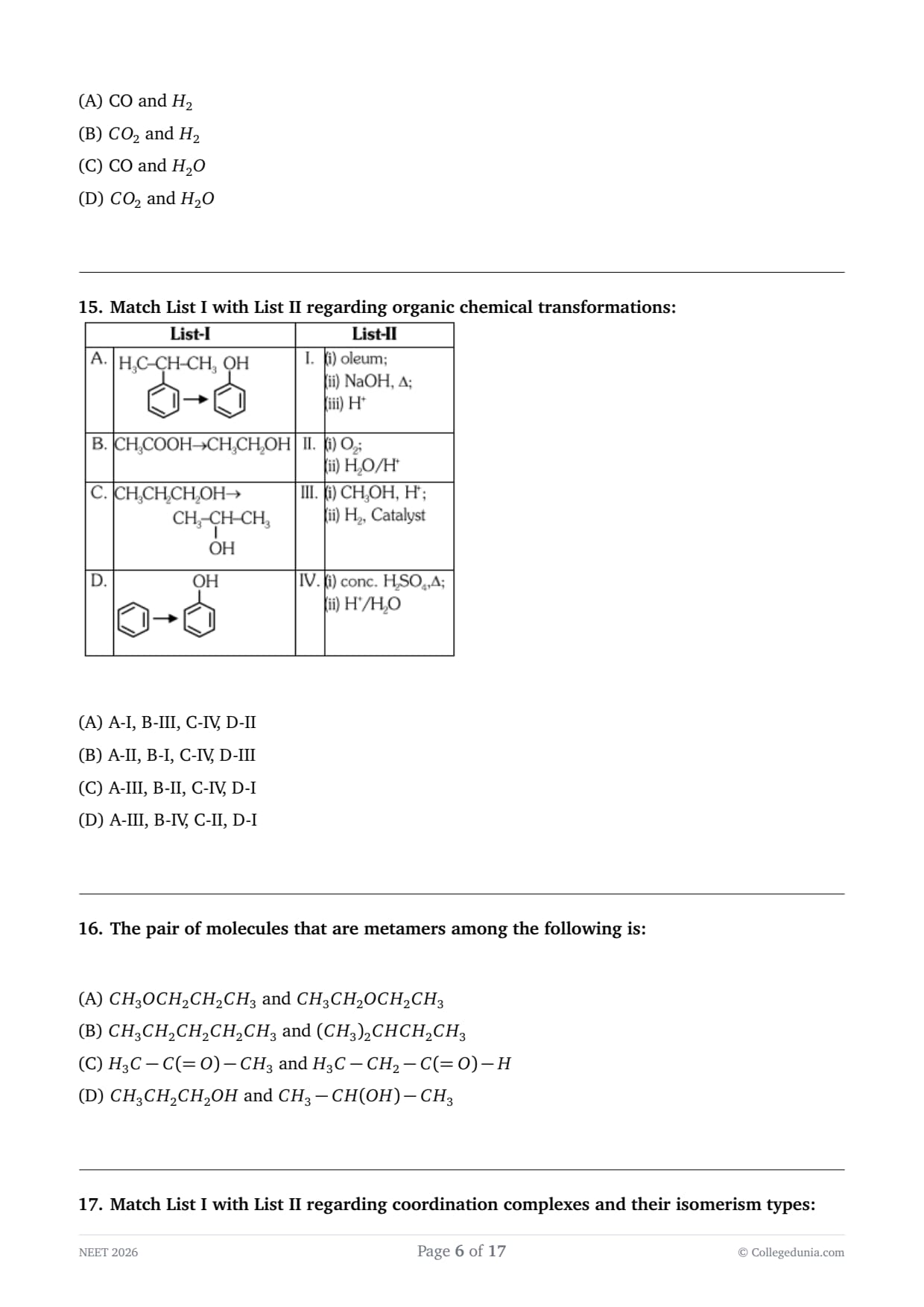
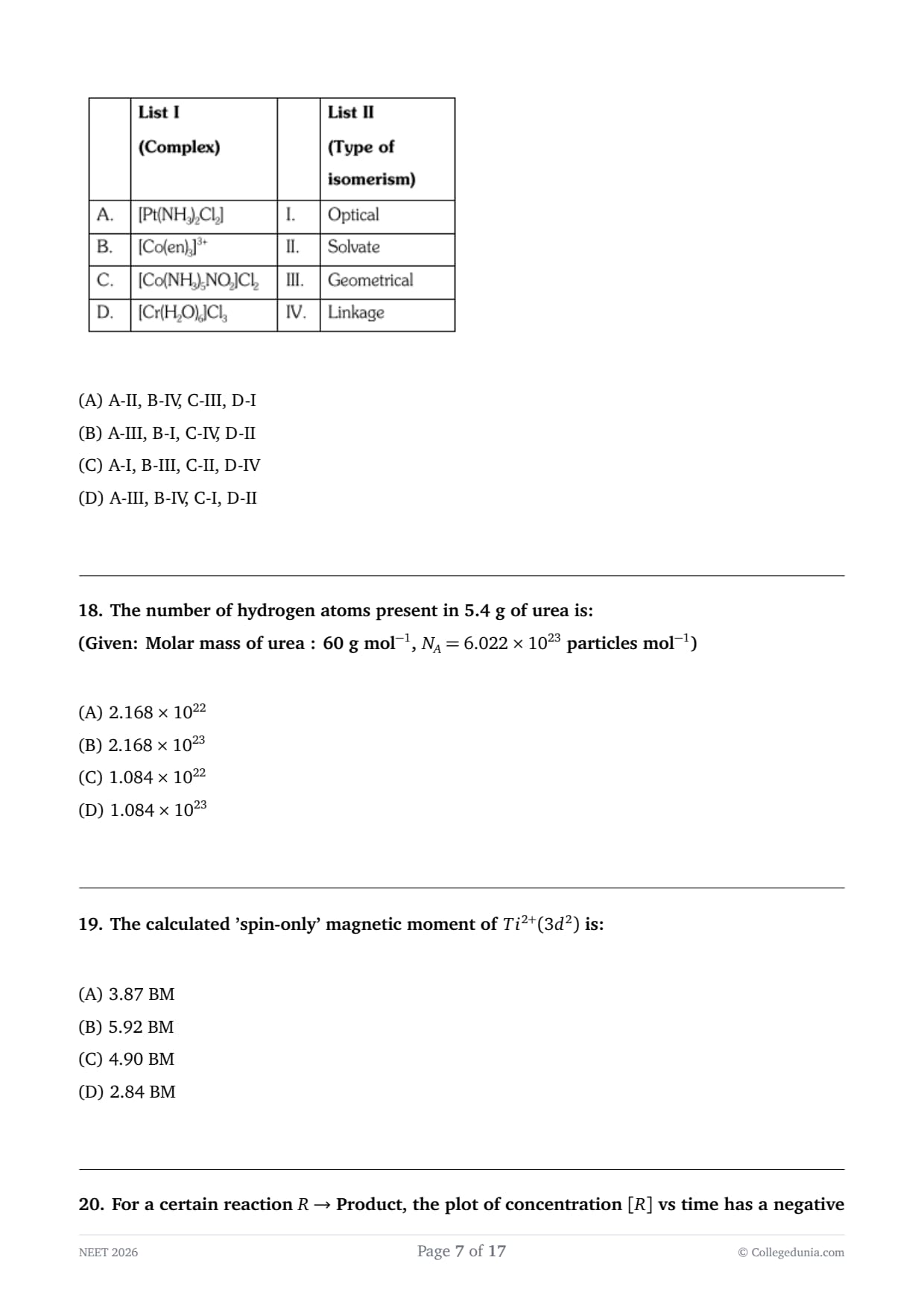
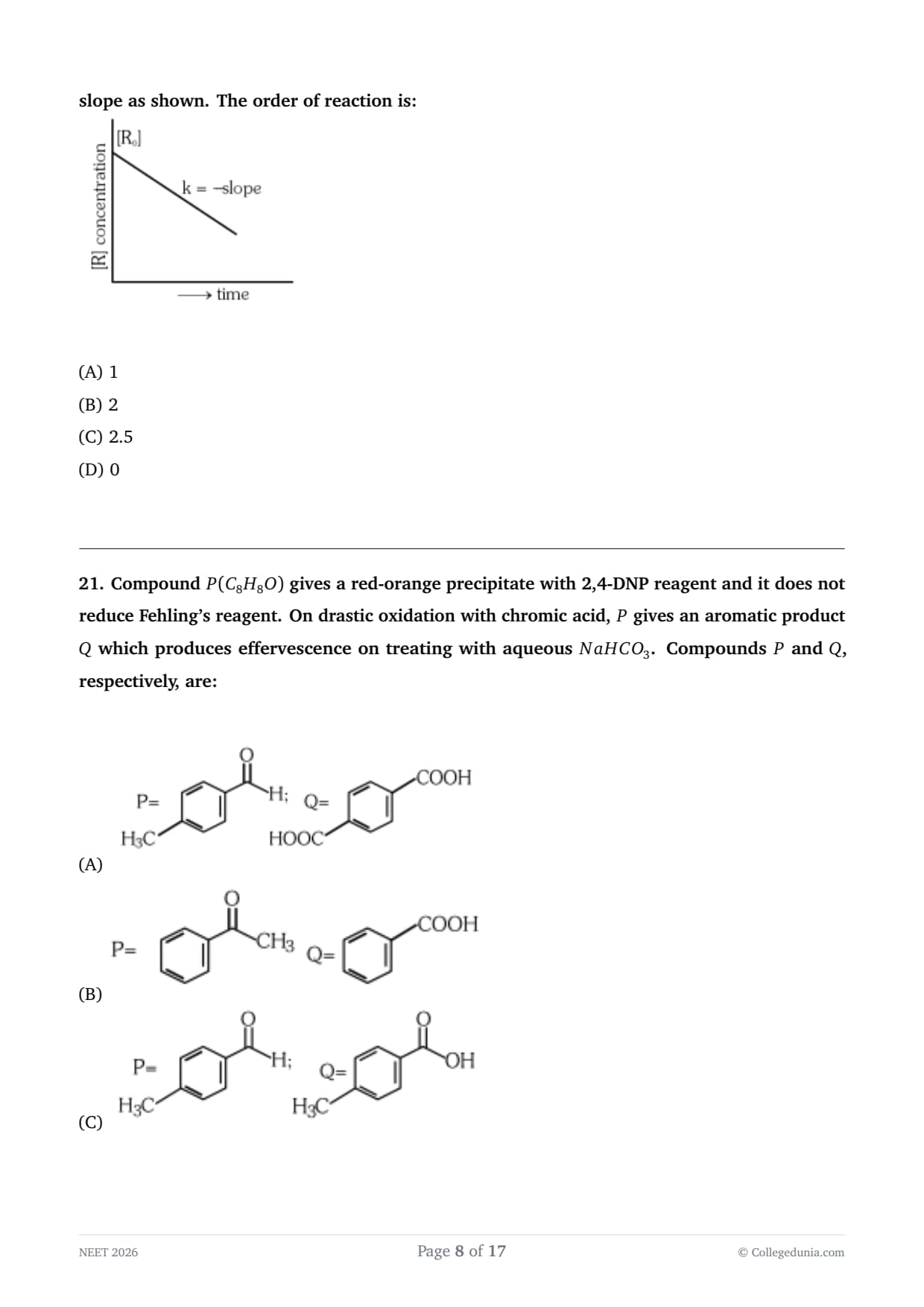

The correct statement with regard to the secondary structure of DNA/RNA is:
View Solution
Step 1: Understanding the Question:
The question asks us to identify the correct description of the secondary structure and nitrogenous base composition of Deoxyribonucleic acid (DNA) and Ribonucleic acid (RNA).
Step 2: Detailed Explanation:
Structure of DNA: DNA typically exists as a double-stranded helix.
This structure was famously proposed by Watson and Crick, where two polynucleotide chains run antiparallel to each other and are held together by hydrogen bonds between complementary base pairs.
Bases in DNA: The four nitrogenous bases found in DNA are Adenine (A), Guanine (G), Cytosine (C), and Thymine (T).
Thymine is specific to DNA and pairs with Adenine through two hydrogen bonds.
Structure of RNA: RNA is generally single-stranded, although it can fold into complex secondary structures like hairpins or loops through internal base pairing.
Unlike DNA, it does not typically form a long, regular double helix in its primary biological roles.
Bases in RNA: The four nitrogenous bases in RNA are Adenine (A), Guanine (G), Cytosine (C), and Uracil (U).
Uracil replaces Thymine in RNA and pairs with Adenine.
Analyzing Options:
Option (A) is incorrect because DNA is double-stranded and does not contain Uracil.
Option (B) is correct as it accurately describes DNA's double-stranded helix and the presence of Thymine.
Option (C) is incorrect because RNA is typically single-stranded.
Option (D) is incorrect because RNA contains Uracil, not Thymine.
Step 3: Final Answer:
Based on the biological structures of nucleic acids, DNA is a double helix containing thymine, while RNA is a single strand containing uracil.
Therefore, the only correct statement is provided in option (B).
Quick Tip: Remember the mnemonic "RNA has U, DNA has T".
Also, visualize DNA as a "twisted ladder" (double helix) and RNA as a "single ribbon" (single strand).
This basic distinction is a frequent topic in competitive chemistry and biology sections.
Match List-I with List-II. List-I contains quantum numbers and List-II contains orbitals.

View Solution
Step 1: Understanding the Question:
The task is to match the set of principal quantum number (\(n\)) and azimuthal quantum number (\(l\)) given in List-I with the corresponding orbital notation in List-II.
Step 2: Key Formula or Approach:
The orbital notation is determined by the values of \(n\) and \(l\).
The value of \(n\) provides the shell number.
The value of \(l\) corresponds to the subshell type:
\(l = 0\) is \(s\), \(l = 1\) is \(p\), \(l = 2\) is \(d\), and \(l = 3\) is \(f\).
Step 3: Detailed Explanation:
Case A: \(n = 2\) and \(l = 1\).
\(n=2\) means the second shell. \(l=1\) corresponds to the \(p\) subshell.
Thus, the orbital is \(2p\). This matches with II.
Case B: \(n = 4\) and \(l = 0\).
\(n=4\) means the fourth shell. \(l=0\) corresponds to the \(s\) subshell.
Thus, the orbital is \(4s\). This matches with III.
Case C: \(n = 5\) and \(l = 3\).
\(n=5\) means the fifth shell. \(l=3\) corresponds to the \(f\) subshell.
Thus, the orbital is \(5f\). This matches with IV.
Case D: \(n = 3\) and \(l = 2\).
\(n=3\) means the third shell. \(l=2\) corresponds to the \(d\) subshell.
Thus, the orbital is \(3d\). This matches with I.
Combined Mapping: A-II, B-III, C-IV, D-I.
Step 4: Final Answer:
By applying the quantum number rules for subshells, we find the correct match corresponds to option (B).
Quick Tip: Quick check: \(l\) values follow the alphabetical sequence (mostly) after \(d\): \(s, p, d, f\) correspond to \(0, 1, 2, 3\).
Always write the number \(n\) first followed by the letter representing \(l\) to avoid confusion.
During Lassaigne’s test, the elements present in an organic compound are converted from:
View Solution
Step 1: Understanding the Question:
Lassaigne's test is a qualitative analysis used to detect elements like nitrogen, sulphur, and halogens in organic compounds. The question asks about the nature of chemical bonding transformation during this test.
Step 2: Detailed Explanation:
Nature of Organic Compounds: Elements such as Carbon, Nitrogen, Sulphur, and Halogens are bonded covalently within organic molecules.
These covalent bonds are stable and do not easily ionize in aqueous solution, making direct detection difficult.
Sodium Fusion Process: In Lassaigne's test, the organic compound is fused with a small piece of metallic sodium (Na).
This intense heating breaks the covalent bonds and converts the elements into water-soluble ionic sodium salts.
Chemical Conversions:
Nitrogen is converted to sodium cyanide: \( Na + C + N \rightarrow NaCN \).
Sulphur is converted to sodium sulphide: \( 2Na + S \rightarrow Na_{2}S \).
Halogens (X) are converted to sodium halides: \( Na + X \rightarrow NaX \).
Extraction: The fused mass is then extracted with distilled water. The resulting "sodium extract" contains these ions (\( CN^{-} \), \( S^{2-} \), \( X^{-} \)), which can then be identified using specific chemical reagents.
Conclusion: The transformation is essentially the conversion of elements from a covalent state in the organic compound to an ionic state in the sodium extract.
Step 3: Final Answer:
Since the goal of the fusion is to produce soluble ions from covalent molecules, the correct answer is (A).
Quick Tip: Remember that "Fusion" usually implies breaking down strong covalent structures to form simpler ionic lattices.
Lassaigne's test is often called the "Sodium Fusion Test" for this very reason.
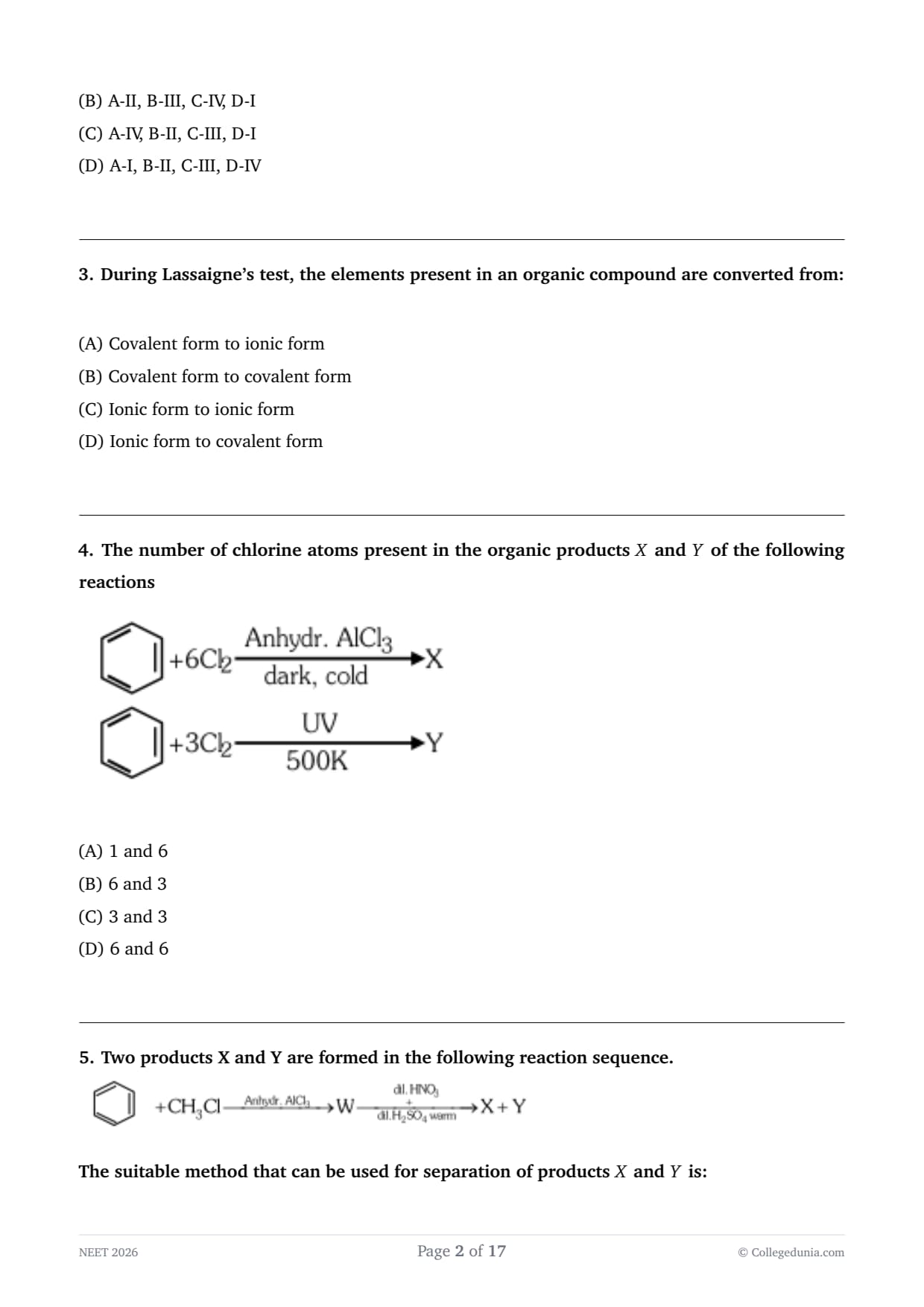
The number of chlorine atoms present in the organic products \(X\) and \(Y\) of the following reactions

View Solution
Step 1: Understanding the Question:
We need to determine the number of chlorine atoms in products \(X\) and \(Y\) formed from benzene under two different reaction conditions.
Step 2: Detailed Explanation:
Reaction 1 (Formation of \(X\)):
Benzene reacts with chlorine in the presence of a Lewis acid catalyst like anhydrous \( AlCl_{3} \) in the dark.
This is an Electrophilic Aromatic Substitution reaction.
One hydrogen atom of the benzene ring is replaced by one chlorine atom to form chlorobenzene (\( C_{6}H_{5}Cl \)).
Therefore, the product \(X\) has 1 chlorine atom.
Reaction 2 (Formation of \(Y\)):
Benzene reacts with chlorine under high temperature (500K) or UV light (\( h\nu \)).
Under these conditions, the aromaticity of benzene is overcome, and an addition reaction occurs instead of substitution.
Three molecules of chlorine (\( 3Cl_{2} \)) add across the three double bonds of benzene.
The product is benzene hexachloride (BHC), also known as gammaxane or Lindane (\( C_{6}H_{6}Cl_{6} \)).
Therefore, the product \(Y\) has 6 chlorine atoms.
Step 3: Final Answer:
Product \(X\) contains 1 Cl atom and product \(Y\) contains 6 Cl atoms.
The respective values are 1 and 6, matching option (A).
Quick Tip: Lewis acid (\(AlCl_{3}\)) = Substitution (stays aromatic, 1 Cl).
UV light/Heat = Addition (loses aromaticity, 6 Cl).
This is a classic distinction in Benzene reactivity.
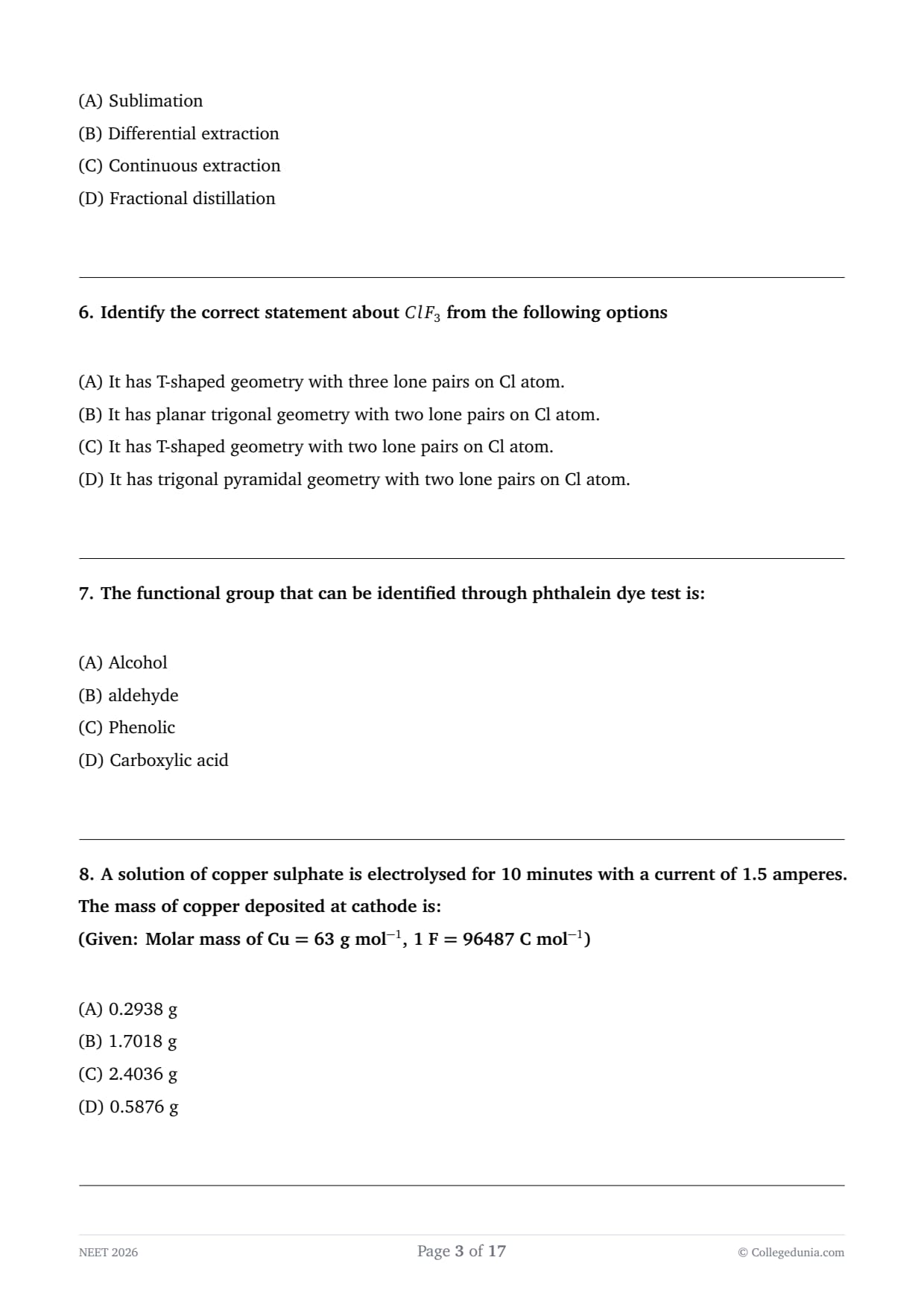
Two products X and Y are formed in the following reaction sequence.

The suitable method that can be used for separation of products \(X\) and \(Y\) is:
View Solution
Step 1: Understanding the Question:
First, we identify the chemical species \(X\) and \(Y\). Then, we determine the best method to separate them.
Step 2: Detailed Explanation:
Step 1 of Reaction: Benzene undergoes Friedel-Crafts alkylation with \( CH_{3}Cl \) and anhydrous \( AlCl_{3} \).
The product \(X\) is Toluene (\( C_{6}H_{5}CH_{3} \)).
Step 2 of Reaction: Toluene undergoes nitration with dilute \( HNO_{3} \) and \( H_{2}SO_{4} \).
Since the methyl group is an ortho/para directing group, nitration yields a mixture of ortho-nitrotoluene and para-nitrotoluene.
Let \(X\) be o-nitrotoluene and \(Y\) be p-nitrotoluene (or vice-versa).
Separation Logic: Ortho and para isomers typically have different physical properties.
Specifically, they have different boiling points due to differences in molecular symmetry and intermolecular forces (ortho often has intra-molecular H-bonding if applicable, but here it's about steric effects and dipole moments).
Methods:
Sublimation is for solids that vaporize directly (not applicable here).
Extraction methods are for separating based on solubility in different solvents.
Fractional distillation is used for separating liquids with sufficiently different boiling points.
In the case of nitrotoluenes, their boiling points differ (ortho: ~222\(^{\circ}\)C, para: ~238\(^{\circ}\)C), allowing separation via fractional distillation or steam distillation.
Step 3: Final Answer:
Given the options, fractional distillation is the standard laboratory and industrial technique to separate such isomers.
Quick Tip: Isomers like o-nitrophenol and p-nitrophenol are often separated by steam distillation.
For alkyl derivatives like nitrotoluenes, fractional distillation is highly effective.
Identify the correct statement about \(ClF_{3}\) from the following options
View Solution
Step 1: Understanding the Question:
The question asks for the correct molecular geometry and lone pair count for the interhalogen compound Chlorine trifluoride (\( ClF_{3} \)).
Step 2: Key Formula or Approach:
We use the VSEPR (Valence Shell Electron Pair Repulsion) theory.
The central atom is Chlorine (Cl), which belongs to Group 17.
Step 3: Detailed Explanation:
Valence Electrons: Cl has 7 valence electrons.
Bond Pairs (BP): It forms 3 single bonds with 3 Fluorine atoms. So, BP = 3.
Lone Pairs (LP): Remaining electrons = \( 7 - 3 = 4 \) electrons, which makes 2 lone pairs. So, LP = 2.
Steric Number: Total electron pairs = \( BP + LP = 3 + 2 = 5 \).
Hybridization: A steric number of 5 corresponds to \( sp^{3}d \) hybridization.
Electron Geometry: The electron pairs arrange in a Trigonal Bipyramidal (TBP) geometry.
Molecular Geometry: To minimize repulsion, the 2 lone pairs occupy the equatorial positions of the TBP.
The 3 Fluorine atoms occupy the remaining two axial and one equatorial positions.
This results in a "T-shaped" molecular geometry.
Step 4: Final Answer:
The molecule \( ClF_{3} \) has a T-shaped geometry and possesses 2 lone pairs on the central Chlorine atom.
Thus, option (C) is correct.
Quick Tip: Lone pairs always prefer equatorial positions in \(sp^{3}d\) (TBP) to maximize the bond angle and minimize repulsion (\(120^{\circ}\) vs \(90^{\circ}\)).
This is a standard example for T-shaped geometry.
The functional group that can be identified through phthalein dye test is:
View Solution
Step 1: Understanding the Question:
The phthalein dye test is a characteristic qualitative identification test for a specific organic functional group. We need to identify the group that reacts to form intensely colored phthalein dyes.
Step 2: Detailed Explanation:
Reaction Mechanism: The test involves heating an organic compound with phthalic anhydride in the presence of a dehydrating agent like concentrated sulphuric acid (\(H_{2}SO_{4}\)).
Role of Phenols: When phenols are subjected to these conditions, they undergo a condensation reaction with phthalic anhydride. For example, phenol reacting with phthalic anhydride produces phenolphthalein.
Diagnostic Observation: The reaction mixture is later treated with an alkali (like sodium hydroxide). If a phenolic group was present, the solution develops a characteristic deep pink, red, or violet color (depending on the specific phenol) due to the formation of the anionic species of the phthalein dye.
Variations: Different phenols yield different colors. For example, resorcinol produces fluorescein, which exhibits a brilliant green fluorescence in alkaline solution. Alcohols, aldehydes, and carboxylic acids do not yield such colored dyes under these specific conditions.
Step 3: Final Answer:
The phthalein dye test is the definitive test for detecting the phenolic group in organic compounds. Thus, option (C) is correct.
Quick Tip: Associate the word "Phthalein" directly with "Phenolphthalein". Since you know phenolphthalein is used as an indicator in acid-base titrations involving phenols, it helps you remember the test is for the phenolic group.
A solution of copper sulphate is electrolysed for 10 minutes with a current of 1.5 amperes. The mass of copper deposited at cathode is:
(Given: Molar mass of Cu = 63 g mol\(^{-1}\), 1 F = 96487 C mol\(^{-1}\))
View Solution
Step 1: Understanding the Question:
We need to calculate the mass of copper metal deposited on the cathode using Faraday's First Law of Electrolysis, based on the provided current, time, and molar mass.
Step 2: Key Formula or Approach:
The mass (\(w\)) of substance deposited is given by: \[ w = \frac{M \times I \times t}{n \times F} \]
where \(M\) is molar mass, \(I\) is current, \(t\) is time in seconds, \(n\) is the valence factor, and \(F\) is Faraday's constant.
Step 3: Detailed Explanation:
Identify variables:
Molar mass of Copper (\(M\)) = \(63\) g/mol.
Current (\(I\)) = \(1.5\) A.
Time (\(t\)) = \(10 min = 10 \times 60 = 600\) seconds.
Faraday's constant (\(F\)) = \(96487\) C/mol.
Determine \(n\)-factor: In copper sulphate (\(CuSO_{4}\)), copper is in the \(+2\) oxidation state (\(Cu^{2+}\)). The reduction reaction is:
\[ Cu^{2+}(aq) + 2e^{-} \rightarrow Cu(s) \]
Therefore, the number of moles of electrons (\(n\)) required to deposit one mole of copper is \(2\).
Perform the calculation:
\[ w = \frac{63 g/mol \times 1.5 A \times 600 s}{2 \times 96487 C/mol} \]
\[ w = \frac{56700}{192974} \]
\[ w \approx 0.29382 g \]
Step 4: Final Answer:
The mass of copper deposited is approximately \(0.2938\) g, matching option (A).
Quick Tip: The most common mistake in electrolysis problems is forgetting to convert time into seconds. Always ensure \(t\) is in seconds before plugging into the Faraday formula.
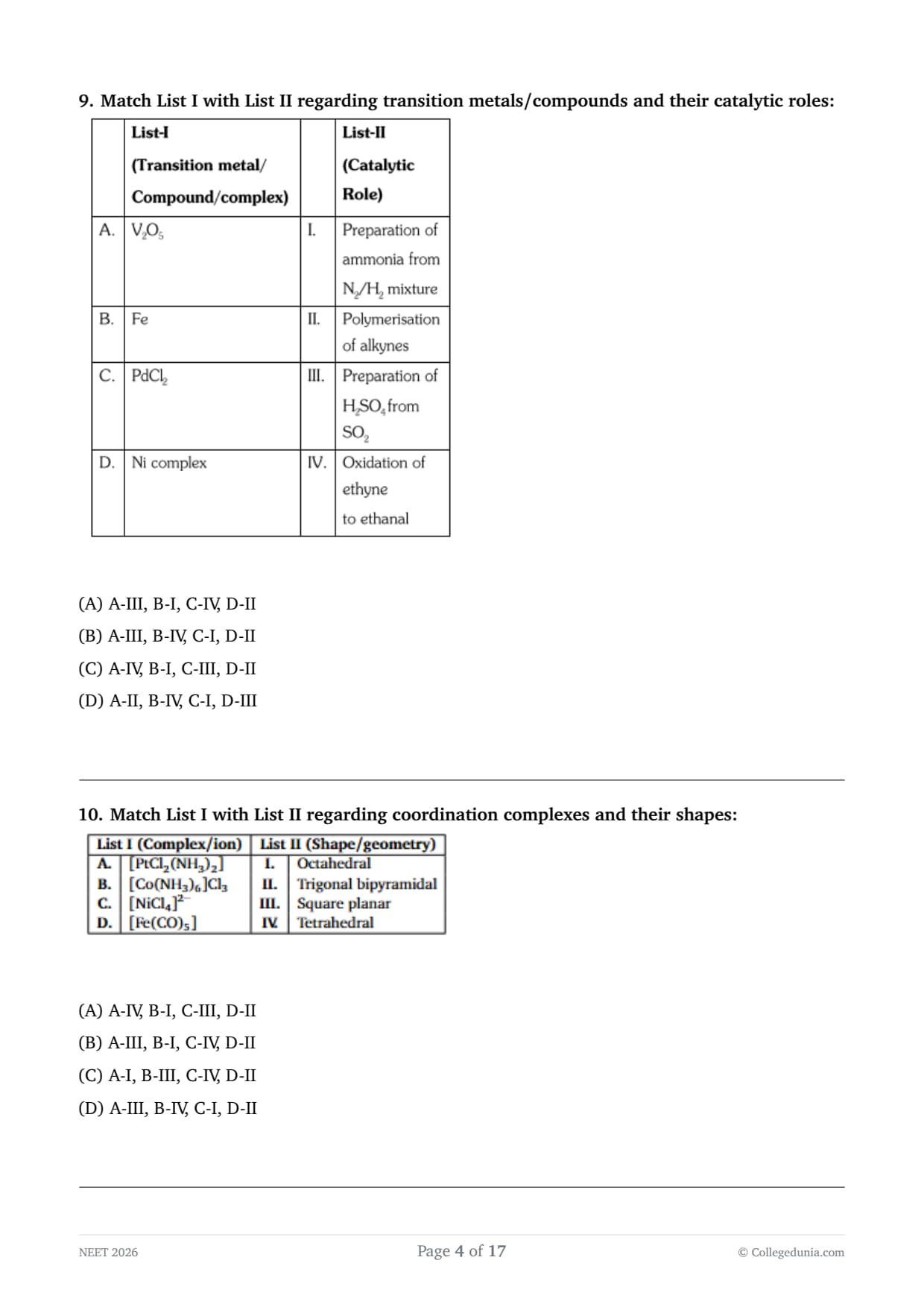
Match List I with List II regarding transition metals/compounds and their catalytic roles:

View Solution
Step 1: Understanding the Question:
The question asks to match industrial catalysts (transition metals or their compounds) in List I with their specific chemical processes in List II.
Step 2: Detailed Explanation:
A. \(V_{2}O_{5}\) (Vanadium Pentoxide): It is used in the Contact Process for the industrial manufacture of sulfuric acid. Its specific role is to catalyze the oxidation of sulfur dioxide to sulfur trioxide: \(2SO_{2} + O_{2} \rightleftharpoons 2SO_{3}\). Thus, A matches with III.
B. \(Fe\) (Iron): Finely divided iron, often with promoters like molybdenum or \(K_{2}O\), is the classic catalyst for the Haber's Process, which synthesizes ammonia (\(NH_{3}\)) from nitrogen and hydrogen gases. Thus, B matches with I.
C. \(PdCl_{2}\) (Palladium Chloride): It is used as a catalyst in the Wacker Process. In this process, ethene is oxidized to ethanal (acetaldehyde) in the presence of \(PdCl_{2}\) and \(CuCl_{2}\). Thus, C matches with IV.
D. \(Ni\) complex (Nickel Complex): Nickel complexes or organonickel compounds are frequently used for the polymerisation of alkynes and other organic synthesis reactions like hydrogenation or oligomerization. Thus, D matches with II.
Step 3: Final Answer:
Comparing these matches to the options, the correct sequence is A-III, B-I, C-IV, D-II, which is found in option (A).
Quick Tip: Industrial catalysts are high-yield topics. Memorize these standard pairs: \(V_{2}O_{5}\) for \(H_{2}SO_{4}\), \(Fe\) for \(NH_{3}\), \(Pt/Rh\) for \(HNO_{3}\) (Ostwald), and \(Ni\) for hydrogenation.
Match List I with List II regarding coordination complexes and their shapes:

View Solution
Step 1: Understanding the Question:
This matching question connects coordination complexes with their molecular geometry, which is dictated by the coordination number and the nature of the metal and ligands.
Step 2: Detailed Explanation:
A. \([Pt(Cl_{2})(NH_{3})_{2}]\): This is a square planar complex of Platinum(II). Pt(II) complexes with coordination number 4 are almost always square planar (\(dsp^{2}\) hybridization) regardless of whether the ligands are strong or weak field, due to large crystal field splitting. Thus, A matches with III.
B. \([Co(NH_{3})_{6}]Cl_{3}\): The central cobalt ion is surrounded by six ammonia ligands. A coordination number of 6 universally results in an octahedral geometry (\(d^{2}sp^{3}\) or \(sp^{3}d^{2}\) hybridization). Thus, B matches with I.
C. \([NiCl_{4}]^{2-}\): Here, Nickel(II) has a coordination number of 4. Chlorine is a weak-field ligand, so no pairing of electrons occurs in the \(3d\) orbital. The complex adopts \(sp^{3}\) hybridization, resulting in a tetrahedral shape. Thus, C matches with IV.
D. \([Fe(CO)_{5}]\): Iron pentacarbonyl has a coordination number of 5. The \(CO\) is a strong-field ligand, and for a C.N. of 5, the most stable geometry is trigonal bipyramidal. Thus, D matches with II.
Step 3: Final Answer:
The resulting sequence is A-III, B-I, C-IV, D-II. This corresponds to option (B).
Quick Tip: For 4-coordinate complexes: \(Pt\) and \(Pd\) usually form square planar complexes. \(Ni\) with weak ligands (like \(Cl^{-}\)) forms tetrahedral, while \(Ni\) with strong ligands (like \(CN^{-}\)) forms square planar.
Identify the incorrect statement from the following:
View Solution
Step 1: Understanding the Question:
We need to evaluate four statements across various inorganic chemistry topics (nomenclature, coordination, periodic trends, s-block) to find the false one.
Step 2: Detailed Explanation:
Analysis of Statement (A): IUPAC rules for elements \(Z > 100\) use numerical roots: \(1 = un\), \(0 = nil\), \(7 = sept\). For \(107\), we get \(Un + nil + sept + ium = Unnilseptium\). This is correct.
Analysis of Statement (B): In \([Al(H_{2}O)_{6}]^{3+}\), water is a neutral ligand. Thus, the \(+3\) charge belongs to Aluminium. It is bonded to 6 ligands, so the coordination number (covalency) is 6. This is correct.
Analysis of Statement (C):
Across a period (from \(Mg\) to \(Al\)), atomic size decreases due to increasing nuclear charge. Therefore, \(Mg\) is larger than \(Al\). The statement says \(Al\) is the largest, which is false.
For isoelectronic species (\(Mg^{2+}\), \(Al^{3+}\), both have 10 electrons), size decreases as nuclear charge increases (\(Z=12\) for \(Mg\), \(Z=13\) for \(Al\)). Thus, \(Al^{3+}\) is smaller than \(Mg^{2+}\). The statement says \(Mg^{2+}\) is the smallest, which is also false.
Thus, statement (C) is incorrect.
Analysis of Statement (D): Lithium and Magnesium (in different periods and groups) show similar properties because they have similar ionic sizes and charge-to-size ratios (polarizing power). This phenomenon is indeed the "diagonal relationship". This is correct.
Step 3: Final Answer:
Statement (C) provides the wrong size trends for the atoms and ions listed. Therefore, (C) is the incorrect statement.
Quick Tip: Size Order: \(Neutral Atom > Cation\).
Isoelectronic Cations: Higher atomic number (\(Z\)) results in a smaller radius because the nucleus pulls the same number of electrons more tightly.
Given below is an expression for the rate constant of a first order reaction occurring at a certain temperature, \(T\) (K).
\[ \ln k = 14.34 - \frac{1.25 \times 10^{4}}{T} \]
The energy of activation in kcal mol\(^{-1}\) for the reaction is:
(Given: \(k\) in s\(^{-1}\), \(R = 1.987\) cal mol\(^{-1}\) K\(^{-1}\))
View Solution
Step 1: Understanding the Question:
We are provided with the natural log form of the Arrhenius equation. We need to find the activation energy (\(E_{a}\)) by comparing the given equation to the standard theoretical model.
Step 2: Key Formula or Approach:
The Arrhenius equation in natural log form is: \[ \ln k = \ln A - \frac{E_{a}}{RT} \]
Step 3: Detailed Explanation:
Comparison: Compare the standard form \(\ln k = Constant - \frac{E_{a}}{R} \cdot \frac{1}{T}\) with the given equation \(\ln k = 14.34 - \frac{1.25 \times 10^{4}}{T}\).
Isolate the term: The coefficient of \(\frac{1}{T}\) in both equations must be equal.
\[ \frac{E_{a}}{R} = 1.25 \times 10^{4} \]
Calculation in calories:
\[ E_{a} = 1.25 \times 10^{4} \times R \]
\[ E_{a} = 1.25 \times 10^{4} \times 1.987 = 24837.5 cal mol^{-1} \]
Conversion to kcal: Since the question asks for the value in kcal mol\(^{-1}\), we divide the result by 1000.
\[ E_{a} = \frac{24837.5}{1000} kcal mol^{-1} = 24.8375 kcal mol^{-1} \]
Step 4: Final Answer:
Rounding to two decimal places, we get \(24.84\) kcal mol\(^{-1}\). This matches option (C).
Quick Tip: For equations like this, simply multiply the numerator above the temperature \(T\) by the gas constant \(R\) to get the activation energy. Just be very careful with the final units (cal vs kcal).
Phenolphthalein is used as an indicator for the titration of sodium hydroxide solution against a standard solution of oxalic acid. The colour change that is observed at an alkaline pH close to the equivalence point during this titration is:
View Solution
Step 1: Understanding the Question:
We need to identify the visual signal (color change) of phenolphthalein at the endpoint of an acid-base titration involving sodium hydroxide (strong base) and oxalic acid (weak acid).
Step 2: Detailed Explanation:
Setup of Titration: In the phrasing "titration of A against B", normally B is the standard solution in the burette. Here, oxalic acid is the standard titrant. Therefore, the analyte (sodium hydroxide) is in the conical flask.
Alternative setup: In most general laboratory procedures for this pair, we add the base (NaOH) from the burette to the acid (oxalic acid) in the flask because it's easier to detect the first faint pink color than to see a color disappear.
Indicator Properties: Phenolphthalein is an acid-base indicator that is colourless in acidic and neutral solutions (pH \(<\) 8.3) and pink/red in basic solutions (pH \(>\) 8.3).
Observation during titration:
If NaOH is added to the acid: The flask starts colourless. At the equivalence point, the pH rises sharply. The first drop of excess base turns the solution pink.
If Acid is added to the base: The flask starts pink. At the equivalence point, as the pH drops below 8.3, the solution turns colourless.
Refined Context: The question specifies "at an alkaline pH close to the equivalence point". This implies the transition where the solution becomes pink as it enters the basic range.
Step 4: Final Answer:
The standard observation for a phenolphthalein endpoint in this neutralization is the appearance of a pink color. Thus, the correct answer is (A).
Quick Tip: Weak Acid vs. Strong Base titrations always have an equivalence point at a pH \(>\) 7. Phenolphthalein is the perfect indicator because its color transition range (8.3 to 10.0) matches the vertical part of the titration curve.
Methane reacts with steam at 1273 K in the presence of nickel catalyst to form:
View Solution
Step 1: Understanding the Question:
The question identifies specific industrial reaction conditions (reactants, temperature, catalyst) and asks us to name the gaseous products formed.
Step 2: Detailed Explanation:
Reaction Type: This is the "Steam Reforming of Methane" (SMR). It is the primary industrial method used to produce hydrogen gas for the manufacture of ammonia and other chemical applications.
Chemical Equation: At very high temperatures (like 1273 K) and in the presence of a Nickel catalyst, methane (\(CH_{4}\)) reacts with water vapor (\(H_{2}O\)) as follows:
\[ CH_{4}(g) + H_{2}O(g) \xrightarrow[1273K]{Ni} CO(g) + 3H_{2}(g) \]
Products: The reaction generates Carbon Monoxide (CO) and Hydrogen (\(H_{2}\)).
Syn-gas: This specific mixture of \(CO\) and \(H_{2}\) is known as "Synthesis Gas" or "Syngas". It is a highly valuable feedstock for the Fischer-Tropsch process and for methanol synthesis.
Step 3: Final Answer:
The products are Carbon Monoxide and Hydrogen. This is represented by option (A).
Quick Tip: Steam Reforming is a highly endothermic reaction, which is why such high temperatures (around \(1000^{\circ}\)C or 1273 K) are required. Don't confuse this with the "Water Gas Shift reaction" which converts \(CO\) to \(CO_{2}\) later in the process.
Match List I with List II regarding organic chemical transformations:

View Solution
Step 1: Understanding the Question:
This matching exercise links specific reactant-to-product conversions in organic chemistry with the necessary reagents and conditions.
Step 2: Detailed Explanation:
A. Benzene \(\rightarrow\) Isopropyl benzene (Cumene): This is a Friedel-Crafts alkylation. It is industrially performed by reacting benzene with propene in the presence of an acid catalyst (\(H^{+}\)). Thus, A matches with III.
B. Acetic acid \(\rightarrow\) Ethanol: Reducing a carboxylic acid to a primary alcohol requires a strong reducing agent. Lithium Aluminium Hydride (\(LiAlH_{4}\)) followed by acid hydrolysis is the standard laboratory method. Thus, B matches with II.
C. Propan-1-ol \(\rightarrow\) Propene: Converting an alcohol to an alkene is a dehydration reaction. Heating the alcohol with concentrated sulphuric acid (\(H_{2}SO_{4}, \Delta\)) removes a water molecule to form the double bond. Thus, C matches with IV.
D. Benzene \(\rightarrow\) Phenol: A common multi-step route involves sulfonating benzene with oleum to form benzenesulphonic acid, fusing it with molten sodium hydroxide, and finally acidifying the salt to release phenol. Thus, D matches with I.
Step 3: Final Answer:
The matching pairs are A-III, B-II, C-IV, and D-I. This correct set is found in option (C).
Quick Tip: Reagent matching is easier if you look for the "strong" reagents first. \(LiAlH_{4}\) is a very specific reagent for acid reduction, and \(H_{2}SO_{4}\) is the classic dehydrating agent. Match those first to eliminate distractors.
The pair of molecules that are metamers among the following is:
View Solution
Step 1: Understanding the Question:
We are asked to identify which pair of structural isomers specifically illustrates the phenomenon of metamerism.
Step 2: Detailed Explanation:
Definition of Metamerism: It is a type of structural isomerism where molecules have the same functional group but different distributions of alkyl groups around that polyvalent functional group (such as \(-O-\), \(-S-\), \(-NH-\), or \(-CO-\)).
Analyzing Option (A):
Molecule 1: \(CH_{3}-O-CH_{2}CH_{2}CH_{3}\) (Methyl propyl ether). Alkyl groups are methyl and propyl.
Molecule 2: \(CH_{3}CH_{2}-O-CH_{2}CH_{3}\) (Diethyl ether). Alkyl groups are two ethyls.
Both have the same formula (\(C_{4}H_{10}O\)) and the same functional group (ether). Since the alkyl group distribution around the oxygen differs, they are metamers.
Analyzing Other Options:
(B) \(n\)-pentane and \(iso\)-pentane differ in the arrangement of the carbon skeleton, making them chain isomers.
(C) Acetone (a ketone) and Propanal (an aldehyde) have different functional groups, making them functional isomers.
(D) Propan-1-ol and Propan-2-ol differ only in the position of the \(-OH\) group, making them position isomers.
Step 3: Final Answer:
Only option (A) represents metamerism as the alkyl chain distribution around the ether oxygen is different.
Quick Tip: Metamers are common in ethers and ketones. Just look for the same "bridge" functional group and check if the total carbon count on each "side" has shifted between the two molecules.
Match List I with List II regarding coordination complexes and their isomerism types:

View Solution
Step 1: Understanding the Question:
We need to match coordination complexes with the specific type of isomerism they typically exhibit in the laboratory.
Step 2: Detailed Explanation:
A. \([Pt(NH_{3})_{2}Cl_{2}]\): This is a square planar complex of the form \(MA_{2}B_{2}\). It exists in two forms: \(cis\) (both \(Cl\) on the same side) and \(trans\) (opposite sides). This is geometrical isomerism. Thus, A matches with III.
B. \([Co(en)_{3}]^{3+}\): This octahedral complex contains three bidentate ligands. It lacks any plane of symmetry or center of inversion, allowing it to exist as non-superimposable mirror images (right and left-handed forms). This is optical isomerism. Thus, B matches with I.
C. \([Co(NH_{3})_{5}NO_{2}]Cl_{2}\): The nitrite ion (\(NO_{2}^{-}\)) is an ambidentate ligand. It can bind through Nitrogen (\(nitro\)) or Oxygen (\(nitrito\)). This results in linkage isomerism. Thus, C matches with IV.
D. \([Cr(H_{2}O)_{6}]Cl_{3}\): In this complex, the solvent molecules (water) can be exchanged with ions from the outer sphere (like \(Cl^{-}\)) to produce isomers such as \([Cr(H_{2}O)_{5}Cl]Cl_{2} \cdot H_{2}O\). This is solvate (or hydrate) isomerism. Thus, D matches with II.
Step 3: Final Answer:
The matching combination is A-III, B-I, C-IV, D-II, which is found in option (B).
Quick Tip: Isomerism Tip: Ambidentate ligands (\(NO_{2}^{-}\), \(SCN^{-}\), \(CN^{-}\)) almost always mean Linkage isomerism. Chelate rings (like \(en\) or \(ox\)) in octahedral geometry almost always mean Optical isomerism.
The number of hydrogen atoms present in 5.4 g of urea is:
(Given: Molar mass of urea : 60 g mol\(^{-1}\), \(N_{A} = 6.022 \times 10^{23}\) particles mol\(^{-1}\))
View Solution
Step 1: Understanding the Question:
The goal is to calculate the absolute number of hydrogen atoms in a specified mass of urea (\(5.4\) g) using basic mole concept principles.
Step 2: Key Formula or Approach:
1. Find moles of urea: \(n = \frac{mass}{molar mass}\).
2. Identify H atoms per molecule.
3. Total H atoms = \(n_{urea} \times atoms per molecule \times N_{A}\).
Step 3: Detailed Explanation:
Step 1: Moles of Urea:
\[ Moles of urea = \frac{5.4 g}{60 g/mol} = 0.09 mol \]
Step 2: Atoms per molecule:
The chemical formula of urea is \(NH_{2}CONH_{2}\). By counting, each molecule contains \(2 + 2 = 4\) hydrogen atoms.
Step 3: Total Hydrogen Atoms:
\[ Total H atoms = 0.09 mol \times \frac{4 H atoms}{1 urea molecule} \times 6.022 \times 10^{23} molecules/mol \]
\[ Total H atoms = 0.36 \times 6.022 \times 10^{23} \]
\[ Total H atoms = 2.16792 \times 10^{23} \]
Step 4: Final Answer:
Rounding to three decimal places, we get \(2.168 \times 10^{23}\). This matches option (B).
Quick Tip: Double-check the chemical formula! Urea is sometimes confused with other nitrogenous compounds. Always remember it as \(NH_{2}CONH_{2}\), giving you a total of 8 atoms: 1 C, 1 O, 2 N, and 4 H.
The calculated 'spin-only' magnetic moment of \(Ti^{2+}(3d^{2})\) is:
View Solution
Step 1: Understanding the Question:
We need to calculate the magnetic moment of the \(Ti^{2+}\) ion based on its electron configuration and the number of unpaired electrons it possesses.
Step 2: Key Formula or Approach:
The spin-only magnetic moment (\(\mu_{s}\)) is calculated using the formula: \[ \mu_{s} = \sqrt{n(n + 2)} Bohr Magnetons (BM) \]
where \(n\) is the number of unpaired electrons.
Step 3: Detailed Explanation:
Ion Configuration: Titanium (Atomic Number \(22\)) has the ground-state configuration \([Ar] 4s^{2} 3d^{2}\). When it loses two electrons to form \(Ti^{2+}\), the \(4s\) electrons are removed first. The configuration becomes \([Ar] 3d^{2}\).
Unpaired Electrons (\(n\)): In a \(3d^{2}\) subshell, the two electrons occupy two separate \(d\)-orbitals with parallel spins according to Hund's Rule. Thus, \(n = 2\).
Magnetic Moment Calculation:
\[ \mu_{s} = \sqrt{2(2 + 2)} \]
\[ \mu_{s} = \sqrt{2 \times 4} = \sqrt{8} \]
\[ \mu_{s} \approx 2.8284 BM \]
Step 4: Final Answer:
The calculated value is approximately \(2.83\) BM. Looking at the options, \(2.84\) BM is the closest correct value. Thus, (D) is the correct option.
Quick Tip: A fast way to estimate magnetic moments: if the number of unpaired electrons is \(n\), the magnetic moment will be "\(n\) point something". For \(n=1 \rightarrow 1.73\) BM For \(n=2 \rightarrow 2.83\) BM For \(n=3 \rightarrow 3.87\) BM.
For a certain reaction \(R \rightarrow\) Product, the plot of concentration \([R]\) vs time has a negative slope as shown. The order of reaction is:

View Solution
Step 1: Understanding the Question:
The problem provides a graphical relationship between reactant concentration and time and asks us to determine the order of the chemical reaction from this visual representation.
Step 2: Detailed Explanation:
Defining Orders via Graphs:
Zero Order: The rate is independent of concentration (\(Rate = k\)). The integrated rate equation is \([R] = [R]_{0} - kt\). This is a linear equation (\(y = mx + c\)) with a slope of \(-k\). A plot of \([R]\) vs \(t\) yields a straight line with a negative slope.
First Order: The rate depends on the first power of concentration. The integrated equation is \(\ln[R] = \ln[R]_{0} - kt\). Only a plot of \(\ln[R]\) vs \(t\) would be a straight line.
Second Order: A plot of \(1/[R]\) vs \(t\) would yield a straight line.
Analyzing the Provided Graph: The Y-axis is clearly labeled as concentration \([R]\), and the X-axis is time. The plot shows a perfect straight line extending from an initial concentration \([R]_{0}\) down to zero over time.
Conclusion: Because the direct relationship between raw concentration and time is linear, the reaction must be zero order. In such a reaction, the amount of reactant consumed per unit time remains constant, regardless of how much reactant remains.
Step 4: Final Answer:
The graph depicts a zero-order reaction. Thus, the correct option is (D).
Quick Tip: Look at the Y-axis label! If it is \([R]\), it is zero order. If it is \(\ln[R]\) or \(\log[R]\), it is first order. If it is \(1/[R]\), it is second order. This is the fastest way to solve these kinetics questions.
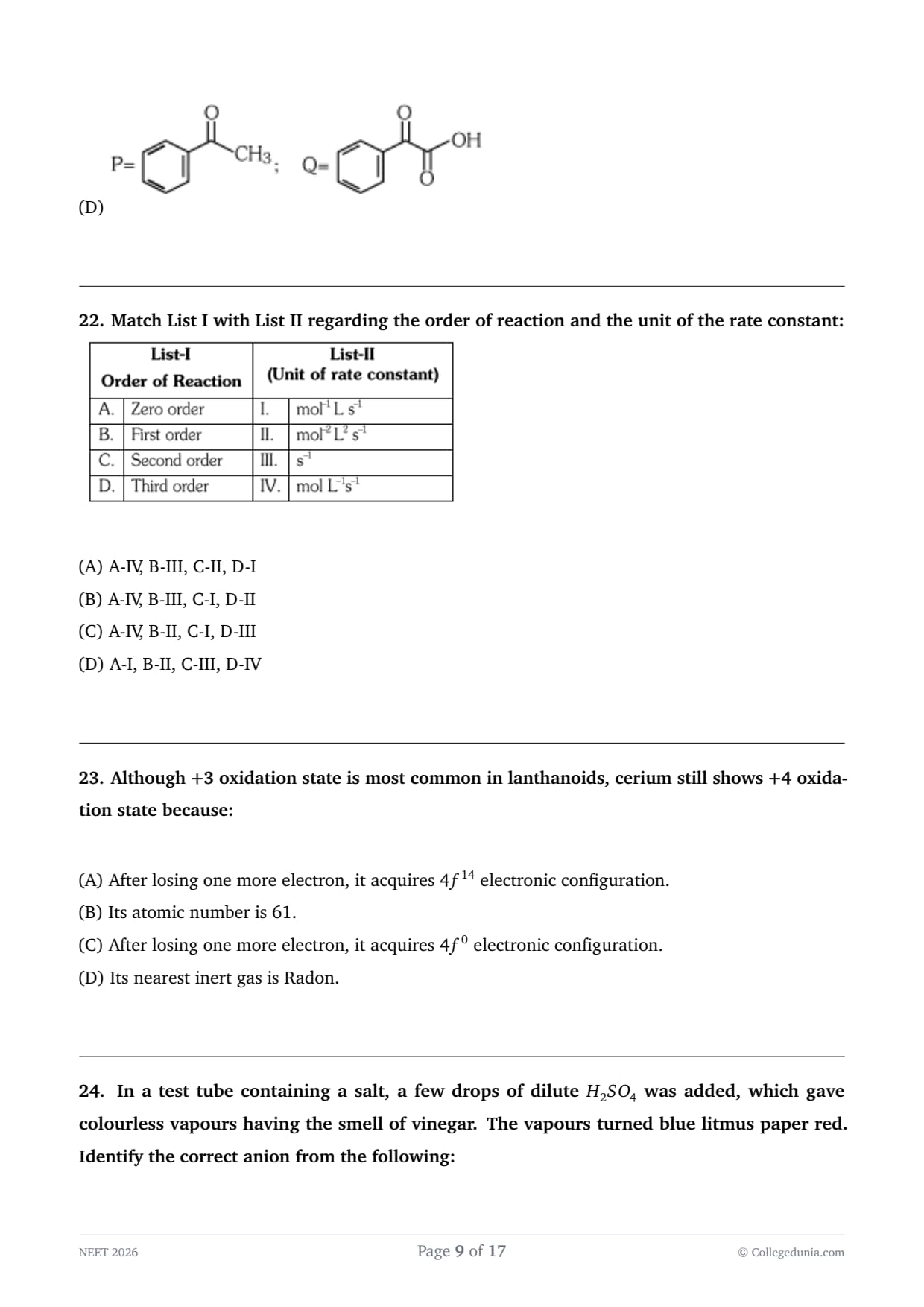
Compound \(P (C_{8}H_{8}O)\) gives a red-orange precipitate with 2,4-DNP reagent and it does not reduce Fehling's reagent. On drastic oxidation with chromic acid, \(P\) gives an aromatic product \(Q\) which produces effervescence on treating with aqueous \(NaHCO_{3}\). Compounds \(P\) and \(Q\), respectively, are:
- (A)
![]()
- (B)
![]()
- (C)
![]()
- (D)
![]()


View Solution
Step 1: Understanding the Question:
The question asks for the identification of an organic compound \(P\) based on its molecular formula \(C_{8}H_{8}O\) and its chemical reactivity. We need to identify \(P\) and its oxidation product \(Q\) using functional group tests and oxidation results.
Step 2: Key Formula or Approach:
2,4-DNP test identifies the presence of a carbonyl group (aldehyde or ketone).
Fehling's reagent distinguishes between aldehydes (positive) and ketones (negative).
Reaction with \(NaHCO_{3}\) identifies a carboxylic acid group (\(-COOH\)).
Step 3: Detailed Explanation:
Reaction with 2,4-DNP: Compound \(P\) gives a red-orange precipitate with 2,4-Dinitrophenylhydrazine (Brady's reagent). This indicates that \(P\) contains a carbonyl group, either an aldehyde or a ketone.
Reaction with Fehling's reagent: \(P\) does not reduce Fehling's reagent. This confirms that \(P\) is not an aldehyde (specifically, not an aliphatic aldehyde) and in this context, suggests it is an aromatic ketone.
Molecular Formula Analysis: The formula \(C_{8}H_{8}O\) suggests a high degree of unsaturation. An aromatic ketone with 8 carbons is Acetophenone (\(C_{6}H_{5}COCH_{3}\)).
Oxidation of \(P\): On drastic oxidation with chromic acid (\(Na_{2}Cr_{2}O_{7}/H_{2}SO_{4}\)), the alkyl group attached to the aromatic ring is oxidized to a carboxyl group, regardless of its length. For acetophenone, the \(-COCH_{3}\) group is oxidized to a \(-COOH\) group, forming Benzoic acid (\(C_{6}H_{5}COOH\)). This is our product \(Q\).
Reaction of \(Q\) with \(NaHCO_{3}\): Benzoic acid is a sufficiently strong acid to react with sodium bicarbonate, releasing carbon dioxide gas, which causes the observed effervescence.
Conclusion: Compound \(P\) is Acetophenone and Compound \(Q\) is Benzoic acid.
Step 4: Final Answer:
Based on the chemical properties, \(P\) is acetophenone and \(Q\) is benzoic acid. This corresponds to the structures shown in the correct option.
Quick Tip: Ketones do not reduce Fehling's or Tollen's reagents. If an aromatic compound with one oxygen gives a 2,4-DNP test but fails the Fehling's test, look for an aromatic ketone like acetophenone.
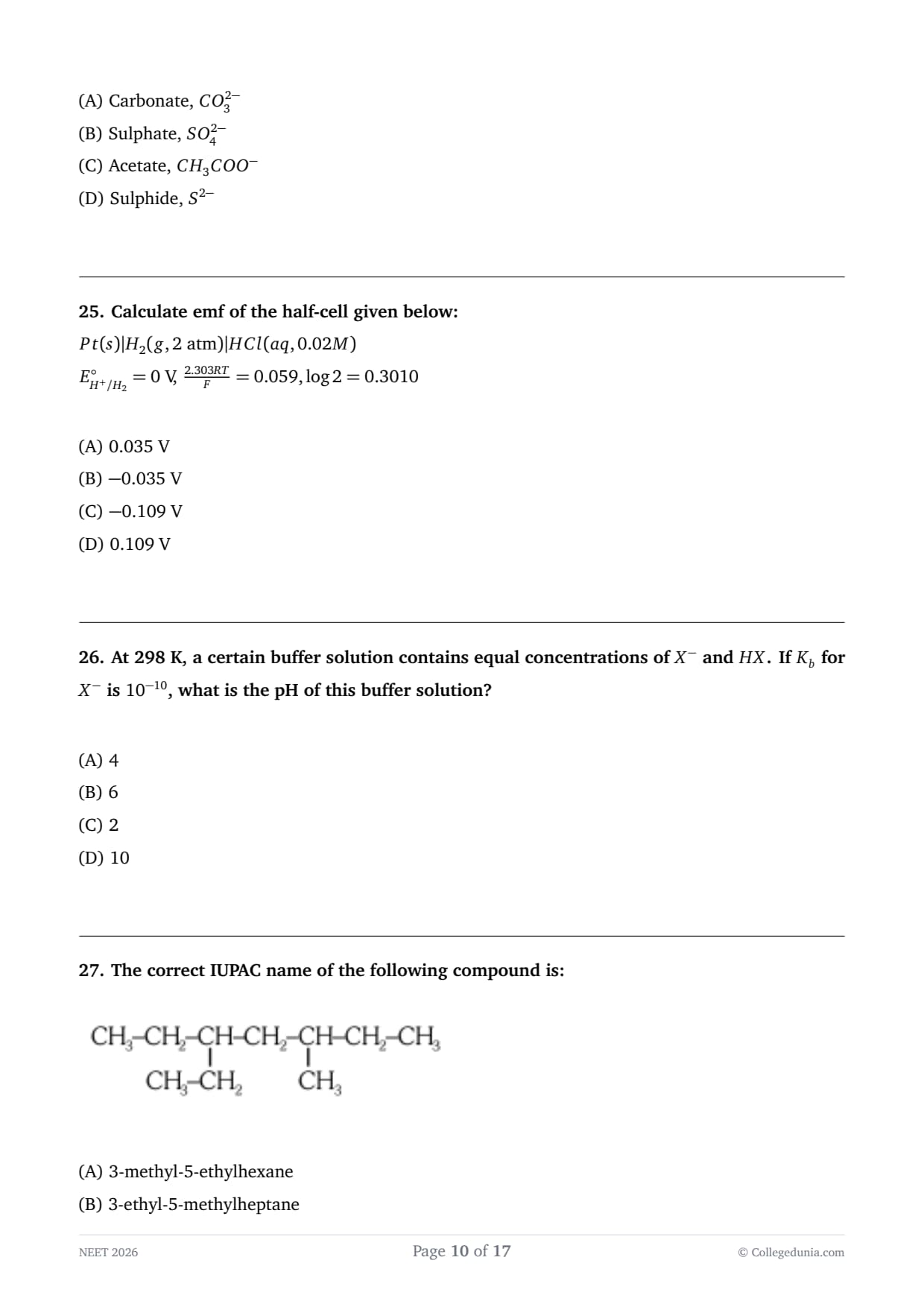
Match List I with List II regarding the order of reaction and the unit of the rate constant:

View Solution
Step 1: Understanding the Question:
We need to match the order of a chemical reaction (\(n\)) with the corresponding units for its rate constant (\(k\)). The units depend on the overall order of the reaction.
Step 2: Key Formula or Approach:
The general formula for the units of the rate constant \(k\) is:
\[ Units of k = (mol L^{-1})^{1-n} s^{-1} \]
where \(n\) is the order of the reaction.
Step 3: Detailed Explanation:
A. Zero order (\(n=0\)):
Substituting \(n=0\) in the general formula:
\( k = (mol L^{-1})^{1-0} s^{-1} = mol L^{-1} s^{-1} \).
This matches with entry IV in List II.
B. First order (\(n=1\)):
Substituting \(n=1\) in the general formula:
\( k = (mol L^{-1})^{1-1} s^{-1} = (mol L^{-1})^{0} s^{-1} = s^{-1} \).
This matches with entry III in List II.
C. Second order (\(n=2\)):
Substituting \(n=2\) in the general formula:
\( k = (mol L^{-1})^{1-2} s^{-1} = (mol L^{-1})^{-1} s^{-1} = mol^{-1} L s^{-1} \).
This matches with entry I in List II.
D. Third order (\(n=3\)):
Substituting \(n=3\) in the general formula:
\( k = (mol L^{-1})^{1-3} s^{-1} = (mol L^{-1})^{-2} s^{-1} = mol^{-2} L^{2} s^{-1} \).
This matches with entry II in List II.
Mapping: A-IV, B-III, C-I, D-II.
Step 4: Final Answer:
By applying the general unit formula for the rate constant, we find the correct sequence is A-IV, B-III, C-I, D-II.
Quick Tip: To quickly remember units of \(k\), just use \( M^{1-n} t^{-1} \) where \(M\) is molarity (\(mol/L\)) and \(t\) is time. For \(n=1\), units are always time\(^{-1}\) regardless of concentration units.
Although +3 oxidation state is most common in lanthanoids, cerium still shows +4 oxidation state because:
View Solution
Step 1: Understanding the Question:
The question asks for the reason behind the stability or existence of the +4 oxidation state in Cerium, despite +3 being the characteristic state for lanthanoids.
Step 2: Key Formula or Approach:
Stability of oxidation states in transition and inner transition metals is often linked to reaching a stable electronic configuration, such as half-filled (\(f^{7}\)) or fully empty/filled (\(f^{0}/f^{14}\)) subshells.
Step 3: Detailed Explanation:
Electronic Configuration of Cerium: Cerium (atomic number \(Z=58\)) has the ground state electronic configuration: \( [Xe] 4f^{1} 5d^{1} 6s^{2} \).
Lanthanoid Trend: Most lanthanoids are most stable in the +3 state, where they typically lose the two \(6s\) electrons and one \(5d\) or \(4f\) electron. For Cerium, the \( Ce^{3+} \) state has the configuration \( [Xe] 4f^{1} \).
The +4 State: Cerium can lose a fourth electron from its \(4f\) orbital. When it does so, the configuration becomes \( Ce^{4+} \): \( [Xe] 4f^{0} \).
Stability factor: The \(4f^{0}\) configuration means the \(4f\) subshell is completely empty. This results in an electronic structure identical to the noble gas Xenon (\([Xe]\)). Noble gas configurations are exceptionally stable due to symmetry and the effective shielding of the nucleus.
Chemical Consequence: Because of this extra stability, Cerium is well-known for existing in the +4 state. However, it is a strong oxidizing agent because it ultimately prefers to return to the more common +3 state.
Step 4: Final Answer:
The formation of the +4 state in Cerium allows it to achieve a stable, empty \(4f^{0}\) configuration, which mimics the electron structure of the noble gas Xenon.
Quick Tip: In the f-block, stability is found in \(f^{0}, f^{7},\) and \(f^{14}\). Look at the atomic number and count electrons lost to reach these "magic" numbers. For Ce (\(Z=58\)), losing 4 electrons leaves 54 electrons, which is Xenon (\([Xe]\)).
In a test tube containing a salt, a few drops of dilute \(H_{2}SO_{4}\) was added, which gave colourless vapours having the smell of vinegar. The vapours turned blue litmus paper red. Identify the correct anion from the following:
View Solution
Step 1: Understanding the Question:
The question describes the results of a preliminary acid test on an unknown salt. We need to identify the anion based on the physical properties of the gas evolved and its reaction with litmus paper.
Step 2: Detailed Explanation:
Reaction with dilute \(H_{2}SO_{4}\): Dilute sulfuric acid is used to identify anions of "Group I" in qualitative analysis. These include carbonate, sulphide, sulphite, nitrite, and acetate.
The Characteristic Smell: The most crucial clue is the "smell of vinegar". In chemistry, the distinctive smell of vinegar is associated exclusively with acetic acid (\(CH_{3}COOH\)).
Evolution of Gas: When an acetate salt (like sodium acetate) reacts with dilute \(H_{2}SO_{4}\), it undergoes a displacement reaction:
\( 2CH_{3}COONa + H_{2}SO_{4} \rightarrow Na_{2}SO_{4} + 2CH_{3}COOH \uparrow \).
Acetic acid is volatile and is released as colourless vapours.
Litmus Test: Acetic acid is a weak acid. Acids turn blue litmus paper red. Therefore, the vapours turning blue litmus red confirms the acidic nature of the gas.
Eliminating other options:
- Carbonates give \(CO_{2}\), which is odourless and colourless.
- Sulphides give \(H_{2}S\), which smells like rotten eggs.
- Sulphates do not react with dilute \(H_{2}SO_{4}\) as they are the salts of the acid itself.
Step 3: Final Answer:
The presence of a vinegar smell and the acidic reaction with litmus paper upon treatment with dilute \(H_{2}SO_{4}\) confirms the presence of the acetate anion.
Quick Tip: Always associate "smell of vinegar" with Acetate (\(CH_{3}COO^{-}\)) and "smell of rotten eggs" with Sulphide (\(S^{2-}\)). These are unique identifiers in salt analysis.
Calculate emf of the half-cell given below:
\( Pt(s) | H_{2}(g, 2 atm) | HCl(aq, 0.02 M) \)
\( E^{\circ}_{H^{+}/H_{2}} = 0 V, \frac{2.303 RT}{F} = 0.059, \log 2 = 0.3010 \)
View Solution
Step 1: Understanding the Question:
The question asks for the reduction potential (emf) of a non-standard hydrogen half-cell. We must use the Nernst equation to find the electrode potential based on the given concentration of \(H^{+}\) and pressure of \(H_{2}\) gas.
Step 2: Key Formula or Approach:
The reduction reaction for a hydrogen electrode is:
\( 2H^{+}(aq) + 2e^{-} \rightarrow H_{2}(g) \)
The Nernst equation for this reduction potential is:
\[ E = E^{\circ} - \frac{0.059}{n} \log \frac{P_{H_{2}}}{[H^{+}]^{2}} \]
where \(n = 2\), \(E^{\circ} = 0 V\), \(P_{H_{2}} = 2 atm\), and \([H^{+}] = 0.02 M\).
Step 3: Detailed Explanation:
Determine the values:
\( [H^{+}] = 0.02 = 2 \times 10^{-2} M \).
\( [H^{+}]^{2} = (2 \times 10^{-2})^{2} = 4 \times 10^{-4} \).
\( P_{H_{2}} = 2 atm \).
Substitute into the equation:
\( E = 0 - \frac{0.059}{2} \log \left( \frac{2}{4 \times 10^{-4}} \right) \).
\( E = -0.0295 \log \left( \frac{1}{2 \times 10^{-4}} \right) \).
\( E = -0.0295 \log (0.5 \times 10^{4}) \).
\( E = -0.0295 \log (5 \times 10^{3}) \).
Calculate the logarithm:
\( \log(5 \times 10^{3}) = \log 5 + 3 \).
Since \( \log 5 = 1 - \log 2 = 1 - 0.3010 = 0.6990 \).
So, \( \log(5 \times 10^{3}) = 0.699 + 3 = 3.699 \).
Final calculation:
\( E = -0.0295 \times 3.699 \approx -0.10912 V \).
Step 4: Final Answer:
The potential of the given half-cell is \(-0.109 V\).
Quick Tip: For a reduction potential, if you increase pressure of product (\(H_{2}\)), the potential decreases (becomes more negative). If you increase concentration of reactant (\(H^{+}\)), the potential increases. Here, pressure is high and concentration is low, so we expect a negative value.
At 298 K, a certain buffer solution contains equal concentrations of \(X^{-}\) and \(HX\). If \(K_{b}\) for \(X^{-}\) is \(10^{-10}\), what is the pH of this buffer solution?
View Solution
Step 1: Understanding the Question:
We are given an acidic buffer consisting of a weak acid \(HX\) and its conjugate base \(X^{-}\). The concentrations are equal. We need to find the pH using the provided \(K_{b}\) of the conjugate base.
Step 2: Key Formula or Approach:
1. Relation between \(K_{a}\) and \(K_{b}\) for a conjugate pair: \( K_{a} \times K_{b} = K_{w} = 10^{-14} \).
2. Henderson-Hasselbalch equation for acidic buffer:
\[ pH = pK_{a} + \log \frac{[Salt]}{[Acid]} \]
Step 3: Detailed Explanation:
Calculate \(K_{a}\) of the acid \(HX\):
Given \( K_{b} for X^{-} = 10^{-10} \).
\( K_{a} = \frac{K_{w}}{K_{b}} = \frac{10^{-14}}{10^{-10}} = 10^{-4} \).
Calculate \(pK_{a}\):
\( pK_{a} = -\log K_{a} = -\log(10^{-4}) = 4 \).
Apply Henderson-Hasselbalch equation:
We are told the concentrations are equal: \( [X^{-}] = [HX] \).
Therefore, \( \frac{[Salt]}{[Acid]} = 1 \).
\( pH = pK_{a} + \log(1) \).
Since \( \log(1) = 0 \),
\( pH = pK_{a} = 4 \).
Step 4: Final Answer:
The pH of the buffer solution is 4.
Quick Tip: Whenever the concentration of the salt and the acid (or base and salt) are equal in a buffer, the pH is simply equal to the \(pK_{a}\) (or pOH equals \(pK_{b}\)). This is known as the "half-neutralization point" or the point of maximum buffer capacity.
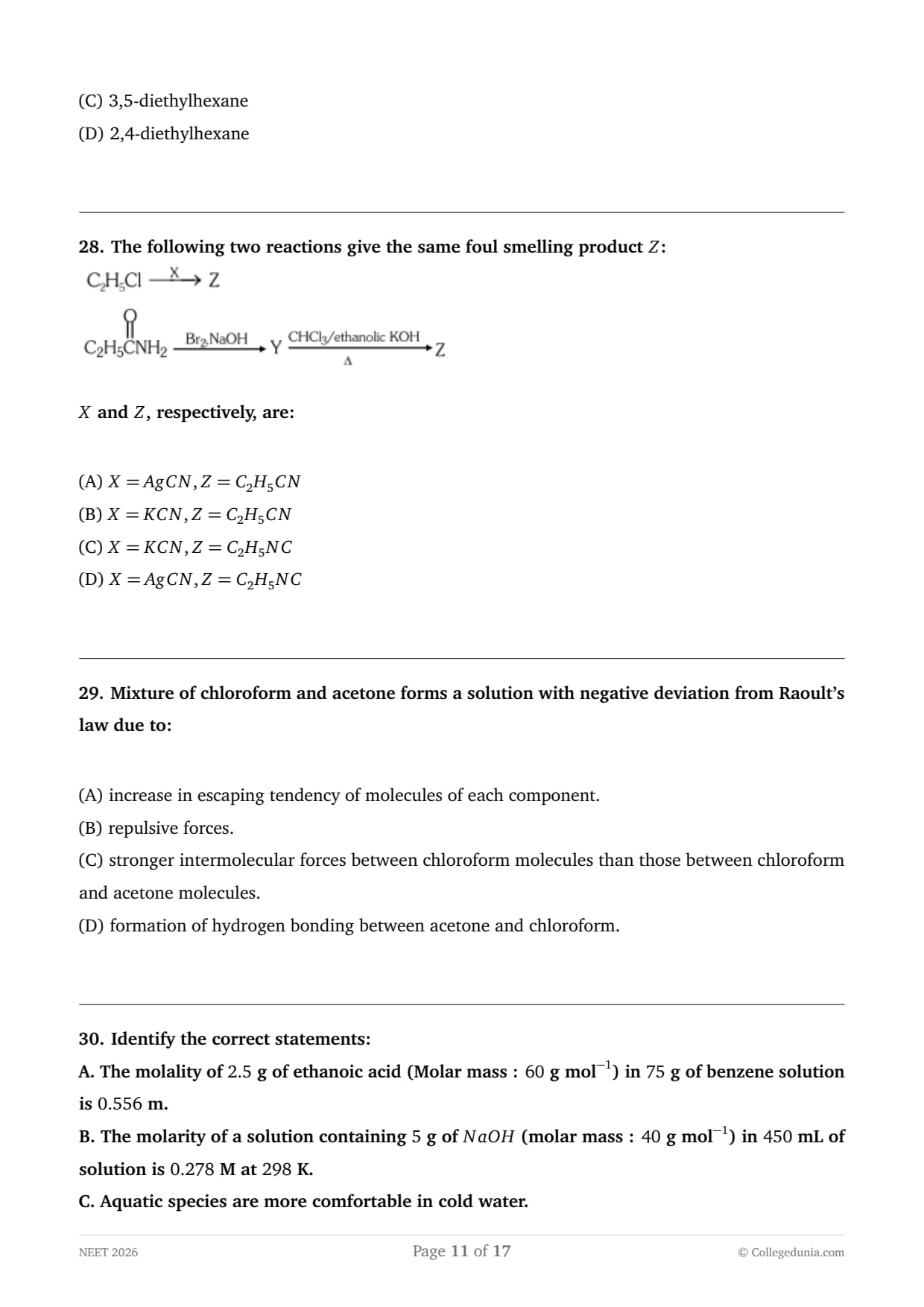
The correct IUPAC name of the following compound is:

View Solution
Step 1: Understanding the Question:
The task is to determine the systematic IUPAC name for a branched alkane. We must identify the longest continuous carbon chain, identify substituents, and number the chain correctly.
Step 2: Detailed Explanation:
Identify the longest carbon chain:
Looking at the structure:
\( CH_{3}(1)-CH_{2}(2)-CH(3)-CH_{2}(4)-CH(5)-CH_{2}(6)-CH_{3}(7) \)
The longest chain contains 7 carbon atoms. Therefore, the parent name is heptane.
Identify substituents:
At the 3rd or 5th carbon (depending on numbering direction), there is a methyl group (\(-CH_{3}\)) and an ethyl group (\(-CH_{2}CH_{3}\)).
Numbering the chain:
- Numbering from left to right: Substituents are at positions 3 and 5. (3-methyl, 5-ethyl).
- Numbering from right to left: Substituents are at positions 3 and 5. (3-ethyl, 5-methyl).
Applying Alphabetical Order Rule:
When numbering from either end gives the same locants (3, 5), the end that gives a lower number to the substituent that comes first alphabetically is preferred.
"Ethyl" starts with 'E' and "Methyl" starts with 'M'. Since 'E' comes before 'M', the ethyl group should get the lower number (3).
Therefore, the correct numbering starts from the right side.
Final assembly:
The name is 3-ethyl-5-methylheptane.
Step 3: Final Answer:
Following IUPAC rules, the correct name is 3-ethyl-5-methylheptane.
Quick Tip: When you have a "tie" in the locant set from both directions, use alphabetical order to break the tie. The group that comes first in the alphabet gets the lower locant.
The following two reactions give the same foul smelling product \(Z\):

\(X\) and \(Z\), respectively, are:
View Solution
Step 1: Understanding the Question:
We need to identify intermediates \(X\) and final product \(Z\) in two reaction pathways. The primary clue is that \(Z\) is "foul smelling".
Step 2: Detailed Explanation:
Pathway 1 - Hoffmann Bromamide Reaction:
Propanamide (\(C_{2}H_{5}CONH_{2}\)) reacts with \(Br_{2}\) and \(NaOH\). This is the Hoffmann Bromamide degradation, which converts an amide to a primary amine with one less carbon.
Result: \(X = C_{2}H_{5}NH_{2}\) (Ethylamine).
Pathway 1 - Carbylamine Reaction:
\(X\) (Ethylamine) then reacts with \(CHCl_{3}\) and alcoholic \(KOH\) with heating. This is the Carbylamine reaction, a test for primary amines.
Primary amines react to form isocyanides (carbylamines), which have a characteristic "foul" or offensive smell.
Result: \(Z = C_{2}H_{5}NC\) (Ethyl isocyanide).
Pathway 2 - Nucleophilic Substitution:
Chloroethane (\(C_{2}H_{5}Cl\)) reacts with a reagent to give \(Z\) (\(C_{2}H_{5}NC\)).
To get an isocyanide from an alkyl halide, we use silver cyanide (\(AgCN\)). Silver cyanide is covalent, so the nitrogen atom acts as the nucleophile. (In contrast, ionic \(KCN\) would give the cyanide \(R-CN\)).
Result: The reagent must be \(AgCN\).
Wait, let's re-examine the choices:
The diagram in the PDF indicates \(X\) as a reagent for the second reaction. If \(Z\) is \(C_{2}H_{5}NC\), and it comes from \(C_{2}H_{5}Cl\), then \(X\) must be \(AgCN\).
Step 3: Final Answer:
Compound \(X\) used in the second step is \(AgCN\) and product \(Z\) is the foul-smelling ethyl isocyanide (\(C_{2}H_{5}NC\)).
Quick Tip: Whenever you see "foul smelling" in organic nitrogen chemistry, think of Isocyanides (Carbylamines). Primary amine + chloroform + base = foul smell. Alkyl halide + \(AgCN\) = isocyanide.
Mixture of chloroform and acetone forms a solution with negative deviation from Raoult's law due to:
View Solution
Step 1: Understanding the Question:
The question asks for the molecular reason behind the negative deviation from Raoult's law observed in a specific binary mixture (chloroform and acetone).
Step 2: Detailed Explanation:
Negative Deviation Defined: Negative deviation occurs when the vapor pressure of the solution is lower than predicted by Raoult's law. This happens when the \(A-B\) (solute-solvent) intermolecular attractions are stronger than \(A-A\) and \(B-B\) attractions.
Specific Case - Chloroform and Acetone:
Chloroform (\(CHCl_{3}\)) and Acetone (\(CH_{3}COCH_{3}\)) individually have weak dipole-dipole interactions.
New Interaction: When mixed, the hydrogen atom of chloroform (which is acidic due to the three electron-withdrawing chlorine atoms) forms a hydrogen bond with the electronegative oxygen atom of the carbonyl group in acetone.
Mechanism: \( Cl_{3}C-H \cdots O=C(CH_{3})_{2} \).
Consequence: This new intermolecular hydrogen bond is stronger than the original interactions. As a result, the molecules are held more tightly in the liquid phase, decreasing their "escaping tendency" into the vapor phase.
Result: This leads to a lower vapor pressure, negative deviation from Raoult's law, and a decrease in the volume of the solution (\(\Delta V_{mix} < 0\)).
Step 3: Final Answer:
The negative deviation is caused by the formation of strong intermolecular hydrogen bonds between the chloroform and acetone molecules.
Quick Tip: Stronger \(A-B\) bonds = lower escaping tendency = negative deviation.
Weaker \(A-B\) bonds = higher escaping tendency = positive deviation.
H-bonding between unlike molecules is the classic example for negative deviation.
Identify the correct statements:
A. The molality of \(2.5 g\) of ethanoic acid (Molar mass : \(60 g mol^{-1}\)) in \(75 g\) of benzene solution is \(0.556 m\).
B. The molarity of a solution containing \(5 g\) of \(NaOH\) (molar mass : \(40 g mol^{-1}\)) in \(450 mL\) of solution is \(0.278 M\) at \(298 K\).
C. Aquatic species are more comfortable in cold water.
D. The solubility of gas increases with decrease in pressure.
E. For a binary mixture of \(A\) and \(B\), the number of moles are \(n_{A}\) and \(n_{B}\) respectively. The mole fraction of \(B\) will be \( x_{B} = \frac{n_{A}}{n_{A} + n_{B}} \).
View Solution
Step 1: Understanding the Question:
We must evaluate each of the five statements (\(A\) to \(E\)) and identify which ones are scientifically correct.
Step 2: Detailed Explanation:
Statement A (Calculation):
\( Moles of acid = \frac{2.5}{60} = 0.04167 mol \).
\( Mass of solvent (benzene) = 0.075 kg \).
\( Molality = \frac{moles}{mass in kg} = \frac{0.04167}{0.075} = 0.5556 \approx 0.556 m \).
Statement A is correct.
Statement B (Calculation):
\( Moles of NaOH = \frac{5}{40} = 0.125 mol \).
\( Volume = 0.450 L \).
\( Molarity = \frac{0.125}{0.450} = 0.2777 \approx 0.278 M \).
Statement B is correct.
Statement C (Henry's Law):
The solubility of gases in liquids decreases as temperature increases. Cold water has more dissolved oxygen than warm water. Therefore, aquatic species breathe more easily and are more comfortable in cold water.
Statement C is correct.
Statement D (Henry's Law):
Henry's law states that the solubility of a gas is directly proportional to its partial pressure. So, solubility increases with increase in pressure.
Statement D is incorrect.
Statement E (Mole Fraction):
Mole fraction of \(B\) is defined as \( x_{B} = \frac{n_{B}}{n_{A} + n_{B}} \). The provided formula \( \frac{n_{A}}{n_{A} + n_{B}} \) is for component \(A\).
Statement E is incorrect.
Step 3: Final Answer:
Statements A, B, and C are correct. This corresponds to option (C).
Quick Tip: Remember Henry's law: \(P = K_{H} x\). As temperature increases, \(K_{H}\) increases, which means solubility (\(x\)) decreases. This is why "cold water" is better for fish! Also, mole fraction always uses the moles of the substance in question as the numerator.
Identify the incorrect statement from the following:
View Solution
Step 1: Understanding the Question:
We need to examine four statements about periodic table elements and identify the one that is false.
Step 2: Detailed Explanation:
Statement A: Boron halides like \(BCl_{3}\) are monomers because of small size and significant \(p\pi-p\pi\) back-bonding. Aluminium chloride (\(AlCl_{3}\)) exists as a dimer (\(Al_{2}Cl_{6}\)) in non-polar solvents and vapor phase at low temperatures to complete its octet. This is correct.
Statement B: Catenation (the linking of atoms of the same element into chains) depends on bond energy. Carbon has very high \(C-C\) bond energy. The property decreases down the group as bond strength decreases. The order given is correct.
Statement C: Oxygen typically shows \(-2\) oxidation state. However, it exhibits other states:
- In peroxides (\(H_{2}O_{2}\)), it is \(-1\).
- In superoxides (\(KO_{2}\)), it is \(-1/2\).
- In \(OF_{2}\), it is \(+2\) (since fluorine is more electronegative).
- In \(O_{2}F_{2}\), it is \(+1\).
Thus, saying it exhibits "only" \(-2\) is incorrect.
Statement D: Carbon is a small second-period element with available p-orbitals. It can form stable multiple bonds (\(C=C, C \equiv C\)) through side-on overlap of p-orbitals. This is correct.
Step 3: Final Answer:
Statement (C) is false because oxygen exhibits multiple oxidation states depending on the compound.
Quick Tip: Oxygen is usually \(-2\), but look for peroxides (\(-1\)) and compounds with Fluorine (positive) to find exceptions. In inorganic chemistry, words like "only" or "always" often signal an incorrect statement.
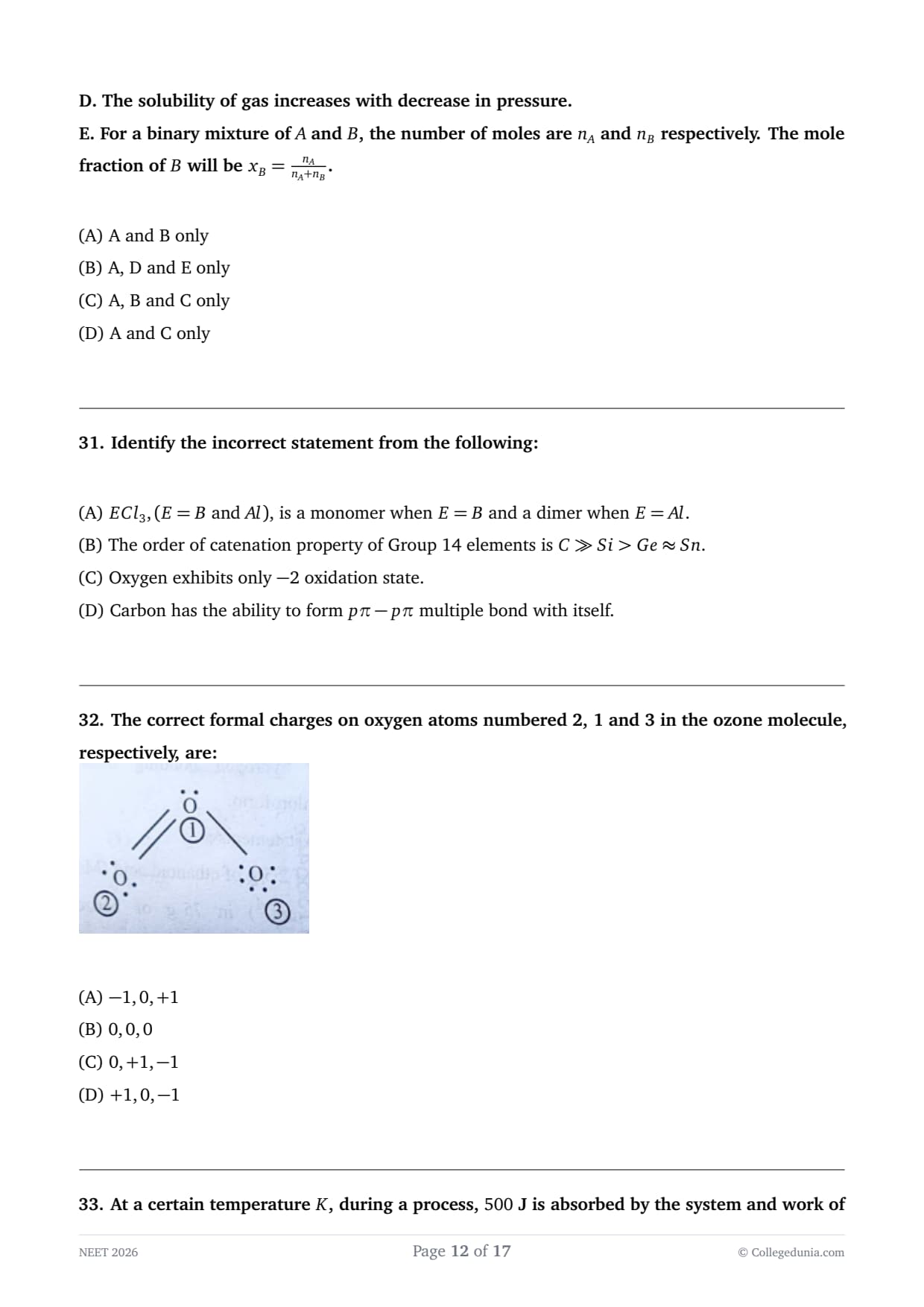
The correct formal charges on oxygen atoms numbered 2, 1 and 3 in the ozone molecule, respectively, are:

View Solution
Step 1: Understanding the Question:
We need to calculate the formal charge on each of the three oxygen atoms in the ozone (\(O_{3}\)) resonance structure.
Step 2: Key Formula or Approach:
\[ Formal Charge (F.C.) = [Valence e^{-}] - [Unshared e^{-}] - \frac{1}{2}[Shared e^{-}] \]
For Oxygen, Valence electrons = 6.
Step 3: Detailed Explanation:
Let's consider the standard resonance structure: \( O(2)=O(1)^{+}-O(3)^{-} \).
Atom 1 (Central Oxygen):
It has 3 bonds (1 double, 1 single) and 1 lone pair (2 electrons).
Shared electrons = 6.
\( F.C. = 6 - 2 - \frac{1}{2}(6) = 6 - 2 - 3 = +1 \).
Atom 2 (Double-bonded Oxygen):
It has 2 bonds and 2 lone pairs (4 electrons).
Shared electrons = 4.
\( F.C. = 6 - 4 - \frac{1}{2}(4) = 6 - 4 - 2 = 0 \).
Atom 3 (Single-bonded Oxygen):
It has 1 bond and 3 lone pairs (6 electrons).
Shared electrons = 2.
\( F.C. = 6 - 6 - \frac{1}{2}(2) = 6 - 6 - 1 = -1 \).
Ordering: The question asks for 2, 1, and 3.
Results: \(0, +1, -1\).
Step 4: Final Answer:
The formal charges are \(0, +1,\) and \(-1\) for atoms 2, 1, and 3 respectively.
Quick Tip: In the Lewis structure of Ozone, one oxygen must be positive and one must be negative so that the overall molecule is neutral (\(+1 + 0 + (-1) = 0\)). The central atom, having three bonds, always carries the positive charge.
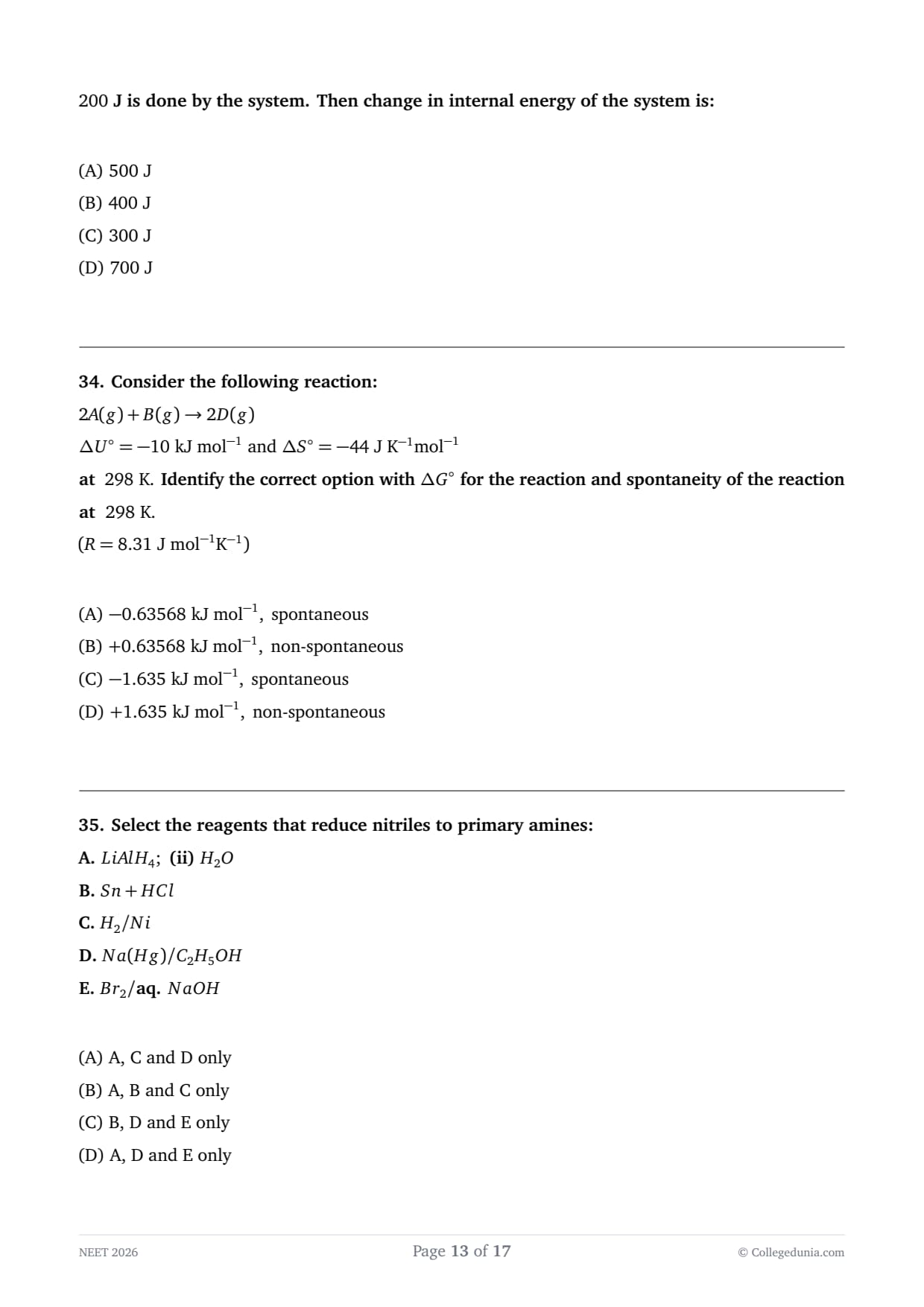
At a certain temperature \(K\), during a process, \(500 J\) is absorbed by the system and work of \(200 J\) is done by the system. Then change in internal energy of the system is:
View Solution
Step 1: Understanding the Question:
The question asks for the change in internal energy (\(\Delta U\)) of a system using the first law of thermodynamics, given the heat absorbed and work performed.
Step 2: Key Formula or Approach:
The First Law of Thermodynamics:
\[ \Delta U = q + w \]
Sign Conventions:
- \(q\) (Heat absorbed by system) is positive.
- \(w\) (Work done on the system) is positive.
- \(w\) (Work done by the system) is negative.
Step 3: Detailed Explanation:
Identify the values:
Heat absorbed (\(q\)) = \(+500 J\).
Work done by the system (\(w\)) = \(-200 J\).
Calculate \(\Delta U\):
\( \Delta U = 500 J + (-200 J) \).
\( \Delta U = 300 J \).
Physical Meaning: The system absorbed energy in the form of heat, but "spent" some of it to do work on the surroundings. The remaining energy (\(300 J\)) stayed within the system as internal energy.
Step 4: Final Answer:
The change in internal energy is \(+300 J\).
Quick Tip: Always watch the wording! "Done by the system" means the system is losing energy, so \(w\) is negative. If it was "done on the system", \(w\) would be positive and the answer would have been \(700 J\).
Consider the following reaction:
\( 2A(g) + B(g) \rightarrow 2D(g) \)
\( \Delta U^{\circ} = -10 kJ mol^{-1} and \Delta S^{\circ} = -44 J K^{-1} mol^{-1} \)
at \(298 K\). Identify the correct option with \(\Delta G^{\circ}\) for the reaction and spontaneity of the reaction at \(298 K\).
\( (R = 8.31 J mol^{-1} K^{-1}) \)
View Solution
Step 1: Understanding the Question:
We need to calculate the standard Gibbs free energy change (\(\Delta G^{\circ}\)) to determine the spontaneity of the reaction. We are given internal energy change (\(\Delta U^{\circ}\)), entropy change (\(\Delta S^{\circ}\)), and temperature.
Step 2: Key Formula or Approach:
1. Relation between Enthalpy (\(\Delta H^{\circ}\)) and Internal Energy (\(\Delta U^{\circ}\)):
\[ \Delta H^{\circ} = \Delta U^{\circ} + \Delta n_{g}RT \]
2. Gibbs-Helmholtz Equation:
\[ \Delta G^{\circ} = \Delta H^{\circ} - T\Delta S^{\circ} \]
Step 3: Detailed Explanation:
Calculate \(\Delta n_{g}\):
Change in number of moles of gaseous products and reactants:
\( \Delta n_{g} = (moles of product D) - (moles of A + B) \).
\( \Delta n_{g} = 2 - (2 + 1) = -1 \).
Calculate \(\Delta H^{\circ}\):
\( \Delta H^{\circ} = -10 kJ + (-1) \times 8.31 \times 10^{-3} kJ K^{-1} mol^{-1} \times 298 K \).
\( \Delta H^{\circ} = -10 - 2.47638 = -12.47638 kJ mol^{-1} \).
Calculate \(\Delta G^{\circ}\):
\( \Delta G^{\circ} = -12.47638 kJ - [298 K \times (-44 \times 10^{-3} kJ K^{-1} mol^{-1})] \).
\( \Delta G^{\circ} = -12.47638 + 13.112 \).
\( \Delta G^{\circ} = +0.63562 kJ mol^{-1} \).
Spontaneity:
If \( \Delta G^{\circ} > 0 \), the reaction is non-spontaneous.
If \( \Delta G^{\circ} < 0 \), the reaction is spontaneous.
Step 4: Final Answer:
Since \( \Delta G^{\circ} \approx +0.6356 kJ mol^{-1} \), the reaction is non-spontaneous.
Quick Tip: Pay extreme attention to units! \(R\) and \(\Delta S\) are in Joules, while \(\Delta U\) is in kiloJoules. Convert everything to kJ before the final subtraction to avoid a common mistake. If \(\Delta G\) is positive, it's non-spontaneous.
Select the reagents that reduce nitriles to primary amines:
A. \( LiAlH_{4}; (ii) H_{2}O \)
B. \( Sn + HCl \)
C. \( H_{2}/Ni \)
D. \( Na(Hg)/C_{2}H_{5}OH \)
E. \( Br_{2}/aq. NaOH \)
View Solution
Step 1: Understanding the Question:
We need to identify which chemical reagents are capable of reducing the nitrile group (\(-CN\)) to a primary amine group (\(-CH_{2}NH_{2}\)).
Step 2: Detailed Explanation:
Reagent A (\( LiAlH_{4} \)): Lithium aluminium hydride is a very strong reducing agent. It reduces nitriles completely to primary amines. This is a standard laboratory method. Correct.
Reagent B (\( Sn + HCl \)): This reagent is typically used for the reduction of nitro compounds (\(-NO_{2}\)) to amines. It is not a standard reagent for the complete reduction of nitriles to amines (it is used in the Stephen reaction to reduce nitriles specifically to aldehydes). Incorrect.
Reagent C (\( H_{2}/Ni \)): Catalytic hydrogenation using transition metals like nickel, palladium, or platinum successfully reduces nitriles to primary amines. Correct.
Reagent D (\( Na(Hg)/C_{2}H_{5}OH \)): This is the Mendius reaction. Sodium amalgam in alcohol provides "nascent hydrogen" which reduces the nitrile group to a primary amine. Correct.
Reagent E (\( Br_{2}/aq. NaOH \)): This is the reagent for the Hoffmann Bromamide reaction, which converts an amide to an amine. It does not react with nitriles in this manner. Incorrect.
Step 3: Final Answer:
Reagents A, C, and D are standard methods for reducing nitriles to primary amines.
Quick Tip: Mnemonic: "Mendius is Na/Hg, Catalytic is H2/Ni, Strongest is LiAlH4." These three paths all take you from Nitrile to Amine. \(Sn+HCl\) is usually the "Nitrogen reduction" trap for Nitrile questions.
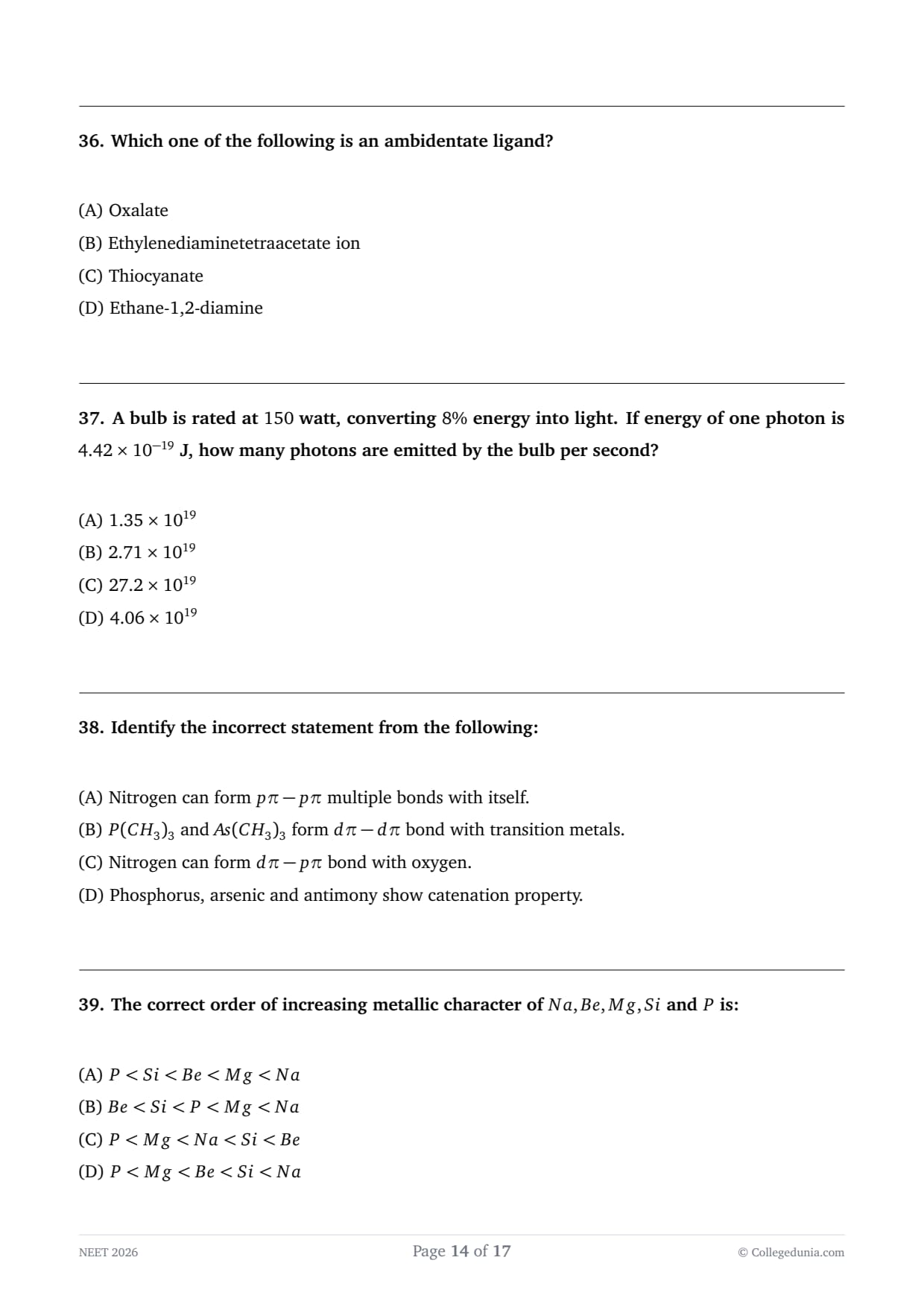
Which one of the following is an ambidentate ligand?
View Solution
Step 1: Understanding the Question:
The question asks to identify an ambidentate ligand among the given choices. An ambidentate ligand is a ligand that has more than one donor atom but can coordinate with the central metal atom through only one atom at a time.
Step 2: Detailed Explanation:
Oxalate (\( C_{2}O_{4}^{2-} \)): This is a bidentate ligand. It coordinates through two oxygen atoms simultaneously. Not ambidentate.
EDTA (\( C_{10}H_{16}N_{2}O_{8}^{4-} \)): This is a hexadentate ligand. It coordinates through six donor atoms (2 N, 4 O). Not ambidentate.
Thiocyanate (\( SCN^{-} \)): This ligand has two potential donor atoms: Nitrogen (N) and Sulphur (S). It can bind to a metal either as \( M-SCN \) (thiocyanato) or \( M-NCS \) (isothiocyanato). It only uses one atom at a time. This perfectly fits the definition of an ambidentate ligand.
Ethane-1,2-diamine (en): This is a bidentate ligand. It coordinates through both nitrogen atoms at the same time to form a chelate ring. Not ambidentate.
Step 3: Final Answer:
Thiocyanate is an ambidentate ligand because it can coordinate via either \(S\) or \(N\).
Quick Tip: Standard ambidentate ligands to memorize: \(NO_{2}^{-}\) (Nitro and Nitrito), \(SCN^{-}\) (Thiocyanato and Isothiocyanato), and \(CN^{-}\) (Cyano and Isocyano). Look for these in any coordination chemistry question.
A bulb is rated at \(150 watt\), converting \(8%\) energy into light. If energy of one photon is \(4.42 \times 10^{-19} J\), how many photons are emitted by the bulb per second?
View Solution
Step 1: Understanding the Question:
We need to calculate the number of photons emitted per second. We are given the total power rating of the bulb, its efficiency in producing light, and the energy of a single photon.
Step 2: Key Formula or Approach:
1. Total Light Energy per second (Useful Power) = \( Rating \times Efficiency \).
2. \( Total Energy = n \times E_{photon} \), where \(n\) is the number of photons.
Step 3: Detailed Explanation:
Calculate total energy emitted as light per second:
Power rating = \(150 W\) (\(150 J/s\)).
Efficiency = \(8% = 0.08\).
Light Energy (\(E_{total}\)) = \(150 \times 0.08 = 12 J/s\).
Calculate number of photons (\(n\)) per second:
Given energy of one photon (\( E_{p} \)) = \(4.42 \times 10^{-19} J\).
\( n = \frac{E_{total}}{E_{p}} \).
\( n = \frac{12}{4.42 \times 10^{-19}} \).
\( n = 2.7149 \times 10^{19} \).
Step 4: Final Answer:
The bulb emits approximately \(2.71 \times 10^{19}\) photons per second.
Quick Tip: Watt = Joules/second. Always remember to multiply the power by the efficiency decimal (0.08 in this case) to get the "useful" energy used for photons. If you used the full 150W, you'd get an answer that is much larger.
Identify the incorrect statement from the following:
View Solution
Step 1: Understanding the Question:
We need to evaluate statements regarding the bonding and properties of Group 15 elements to find the false one.
Step 2: Detailed Explanation:
Statement A: Nitrogen is a small second-period element. It forms stable \(N \equiv N\) triple bonds through \(p\pi-p\pi\) overlap. This is correct.
Statement B: Heavy elements like P and As have vacant d-orbitals. They can act as \(\pi\)-acceptors from transition metals, forming \(d\pi-d\pi\) back bonds. This is correct.
Statement C: Nitrogen is in the second period (\(n=2\)). Its electronic configuration is \( 1s^{2} 2s^{2} 2p^{3} \). It does not have vacant d-orbitals. Therefore, it cannot form \(d\pi-p\pi\) or \(d\pi-d\pi\) bonds with any element. This statement is incorrect.
Statement D: Group 15 elements like P, As, and Sb exhibit catenation (forming chains), although the property is much weaker than in Carbon. Phosphorus forms chains and rings in its allotropes (\(P_{4}\)). This is correct.
Step 3: Final Answer:
The incorrect statement is (C) because Nitrogen lacks d-orbitals.
Quick Tip: Second-period elements (\(Li, Be, B, C, N, O, F\)) NEVER use d-orbitals because they don't exist for \(n=2\). Any option suggesting d-orbital bonding for these elements is always false.
The correct order of increasing metallic character of \( Na, Be, Mg, Si and P \) is:
View Solution
Step 1: Understanding the Question:
We need to rank the given elements based on their metallic character. Metallic character is the tendency to lose electrons.
Step 2: Detailed Explanation:
General Trends: Metallic character increases down a group (as atoms get larger and lose electrons more easily) and decreases across a period (as nuclear charge increases, making it harder to lose electrons).
Analyze the elements:
- Group 1: \( Na \) (Period 3).
- Group 2: \( Be \) (Period 2), \( Mg \) (Period 3).
- Group 14: \( Si \) (Period 3).
- Group 15: \( P \) (Period 3).
Comparison in Period 3:
From left to right: \( Na > Mg > Si > P \). \( Na \) is the most metallic in this period.
Comparison in Group 2:
From top to bottom: \( Mg > Be \).
Relating Be and the others: \( Be \) is in Period 2. It is less metallic than \( Mg \) and \( Na \). However, since it is in Group 2, it is more metallic than the non-metals/metalloids \( Si \) and \( P \) which are further to the right.
Final Order:
Least metallic: \( P \) (Non-metal).
Then \( Si \) (Metalloid).
Then \( Be \) (Metal, but small and high Ionization Energy).
Then \( Mg \) (Metal, Period 3, Group 2).
Most metallic: \( Na \) (Alkali Metal, Group 1).
Order: \( P < Si < Be < Mg < Na \).
Step 3: Final Answer:
The correct increasing order is \( P < Si < Be < Mg < Na \).
Quick Tip: Trend: Bottom-left of periodic table is most metallic. Top-right is most non-metallic. Arrange by Group first (1 is most metallic), then Period.
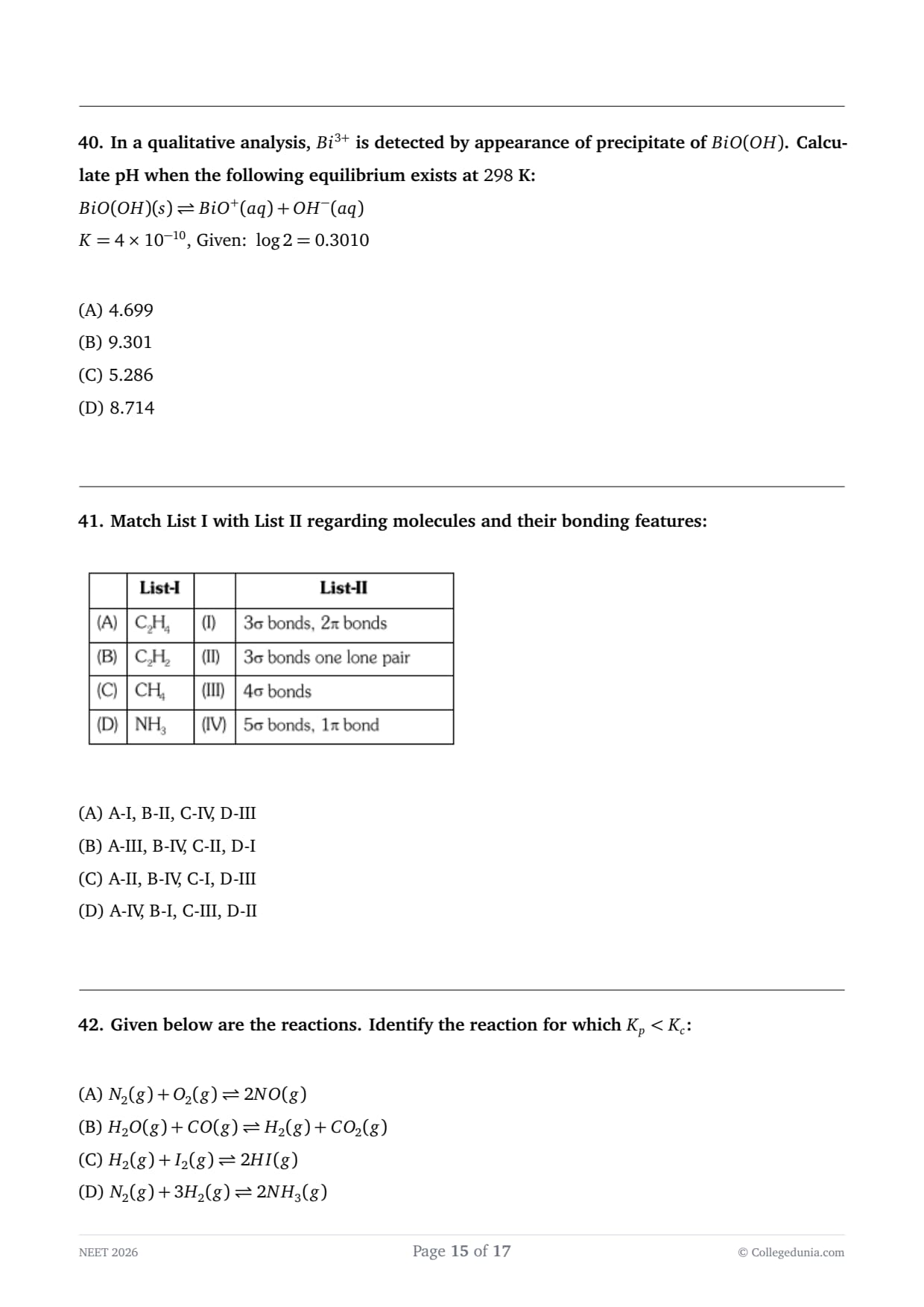
In a qualitative analysis, \( Bi^{3+} \) is detected by appearance of precipitate of \( BiO(OH) \). Calculate pH when the following equilibrium exists at \( 298 K \):
\( BiO(OH)(s) \rightleftharpoons BiO^{+}(aq) + OH^{-}(aq) \)
\( K = 4 \times 10^{-10} , Given: \log 2 = 0.3010 \)
View Solution
Step 1: Understanding the Question:
We are given the equilibrium constant (\(K\)) for the dissolution of a precipitate. We need to find the pH of the solution at equilibrium.
Step 2: Key Formula or Approach:
1. For the equilibrium: \( BiO(OH)(s) \rightleftharpoons BiO^{+} + OH^{-} \).
2. \( K = [BiO^{+}][OH^{-}] \). Since it's a 1:1 ratio, let solubility be \(s\).
3. \( K = s^{2} \implies [OH^{-}] = \sqrt{K} \).
4. \( pOH = -\log [OH^{-}] \).
5. \( pH = 14 - pOH \).
Step 3: Detailed Explanation:
Calculate \([OH^{-}]\) at equilibrium:
\( s^{2} = 4 \times 10^{-10} \).
\( s = [OH^{-}] = \sqrt{4 \times 10^{-10}} = 2 \times 10^{-5} M \).
Calculate pOH:
\( pOH = -\log(2 \times 10^{-5}) \).
\( pOH = -(\log 2 + \log 10^{-5}) \).
\( pOH = -(0.3010 - 5) = 4.699 \).
Calculate pH:
\( pH = 14 - 4.699 \).
\( pH = 9.301 \).
Step 4: Final Answer:
The pH of the solution at equilibrium is 9.301.
Quick Tip: The equilibrium produces \(OH^{-}\) ions, so the solution must be basic (\(pH > 7\)). Options A and C are acidic, so they can be eliminated immediately without calculation. Always check if your final answer makes sense physically!
Match List I with List II regarding molecules and their bonding features:

View Solution
Step 1: Understanding the Question:
We need to match simple organic and inorganic molecules with the correct number and types of covalent bonds and lone pairs.
Step 2: Detailed Explanation:
A. Ethene (\( C_{2}H_{4} \)):
Structure: \( H_{2}C=CH_{2} \). Each Carbon is joined to the other by a double bond (one \(\sigma\) and one \(\pi\)).
Bonding feature: 1 \(\sigma\) bond, 1 \(\pi\) bond between Carbons (usually referenced per bond, but the matching feature is IV).
B. Ethyne (\( C_{2}H_{2} \)):
Structure: \( HC \equiv CH \). The Carbon atoms are joined by a triple bond.
Bonding feature: 1 \(\sigma\) bond, 2 \(\pi\) bonds between Carbons. Matching feature I.
C. Methane (\( CH_{4} \)):
Structure: A central Carbon with four single bonds to Hydrogen.
Bonding feature: 4 \(\sigma\) bonds. Matching feature III.
D. Ammonia (\( NH_{3} \)):
Structure: Central Nitrogen with three single bonds to Hydrogen and one lone pair.
Bonding feature: 3 \(\sigma\) bonds, 1 lone pair. Matching feature II.
Mapping: A-IV, B-I, C-III, D-II.
Step 3: Final Answer:
By analyzing the structures, the correct match is A-IV, B-I, C-III, D-II.
Quick Tip: Single bond = 1 \(\sigma\). Double bond = 1 \(\sigma\) + 1 \(\pi\). Triple bond = 1 \(\sigma\) + 2 \(\pi\). Group 15 elements (N) usually have one lone pair when forming three bonds.
Given below are the reactions. Identify the reaction for which \( K_{p} < K_{c} \):
View Solution
Step 1: Understanding the Question:
We need to determine for which reaction the pressure-based equilibrium constant (\( K_{p} \)) is less than the concentration-based constant (\( K_{c} \)).
Step 2: Key Formula or Approach:
The relationship between \( K_{p} \) and \( K_{c} \) is:
\[ K_{p} = K_{c}(RT)^{\Delta n_{g}} \]
- If \( \Delta n_{g} = 0 \), then \( K_{p} = K_{c} \).
- If \( \Delta n_{g} > 0 \), then \( K_{p} > K_{c} \) (assuming \( RT > 1 \)).
- If \( \Delta n_{g} < 0 \), then \( K_{p} < K_{c} \).
where \( \Delta n_{g} \) is (moles of gaseous products) - (moles of gaseous reactants).
Step 3: Detailed Explanation:
Reaction A: \( \Delta n_{g} = 2 - (1 + 1) = 0 \). Therefore, \( K_{p} = K_{c} \).
Reaction B: \( \Delta n_{g} = (1 + 1) - (1 + 1) = 0 \). Therefore, \( K_{p} = K_{c} \).
Reaction C: \( \Delta n_{g} = 2 - (1 + 1) = 0 \). Therefore, \( K_{p} = K_{c} \).
Reaction D: \( \Delta n_{g} = 2 - (1 + 3) = 2 - 4 = -2 \).
Since \( \Delta n_{g} \) is negative, \( K_{p} = K_{c}(RT)^{-2} = \frac{K_{c}}{(RT)^{2}} \).
Therefore, \( K_{p} < K_{c} \).
Step 4: Final Answer:
In the Haber process reaction (D), there is a decrease in the number of gaseous moles, leading to \( K_{p} < K_{c} \).
Quick Tip: Look for the side with fewer gas moles. If there are fewer moles on the product side (\( \Delta n_{g} < 0 \)), then \( K_{p} \) is always smaller than \( K_{c} \).
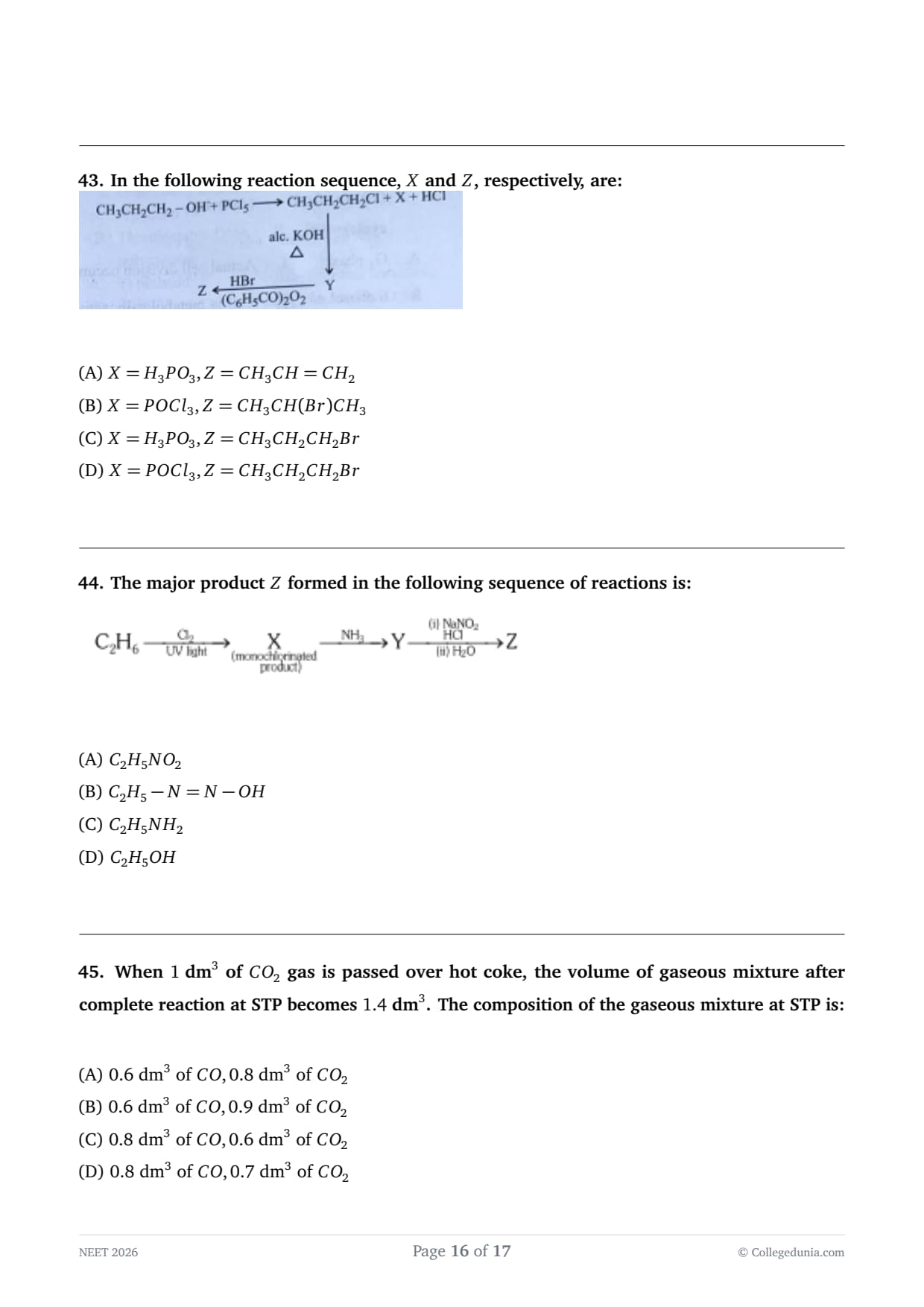
In the following reaction sequence, \(X\) and \(Z\), respectively, are:

View Solution
Step 1: Understanding the Question:
The question asks to identify the byproduct \(X\) from the first reaction and the final organic product \(Z\) from a sequence starting with an alcohol.
Step 2: Detailed Explanation:
Reaction 1 (Alcohol to Halide):
Propan-1-ol reacts with \( PCl_{5} \). The reaction is:
\( ROH + PCl_{5} \rightarrow RCl + POCl_{3} + HCl \).
For propan-1-ol, the organic product is 1-chloropropane. The specific phosphorus byproduct given in this mechanism is Phosphorus oxychloride, \( POCl_{3} \).
Therefore, \(X = POCl_{3}\).
Reaction 2 (Elimination):
1-chloropropane reacts with alcoholic \( KOH \) with heating. Alcoholic \( KOH \) is a reagent for dehydrohalogenation (elimination).
\( CH_{3}CH_{2}CH_{2}Cl \xrightarrow{alc. KOH, \Delta} CH_{3}CH = CH_{2} (Propene) \).
Therefore, \(Y\) is Propene.
Reaction 3 (Addition):
Propene reacts with \( HBr \). This is an electrophilic addition reaction. According to Markovnikov's Rule, the hydrogen atom adds to the carbon with more hydrogen atoms, and the bromine adds to the more substituted carbon.
\( CH_{3}CH = CH_{2} + HBr \rightarrow CH_{3}CH(Br)CH_{3} (2-bromopropane) \).
Therefore, \(Z = CH_{3}CH(Br)CH_{3}\).
Step 3: Final Answer:
\(X\) is \( POCl_{3} \) and \(Z\) is 2-bromopropane.
Quick Tip: Reagent check: \( PCl_{5} \) gives \( POCl_{3} \), while \( PCl_{3} \) gives \( H_{3}PO_{3} \). Elimination followed by \( HBr \) addition to a 1-substituted propane chain always moves the substituent to the 2-position (the more stable cation intermediate).
The major product \(Z\) formed in the following sequence of reactions is:

View Solution
Step 1: Understanding the Question:
We need to identify the final major product \(Z\) in a four-step synthetic sequence starting from Ethane.
Step 2: Detailed Explanation:
Step 1 - Halogenation:
Ethane (\( C_{2}H_{6} \)) reacts with Chlorine in the presence of UV light. This is a free radical substitution reaction.
Result: \(X = C_{2}H_{5}Cl\) (Chloroethane).
Step 2 - Nucleophilic Substitution:
Chloroethane reacts with Ammonia. Ammonia acts as a nucleophile and displaces the chlorine.
Result: \(Y = C_{2}H_{5}NH_{2}\) (Ethylamine).
Step 3 - Diazotization:
Ethylamine reacts with nitrous acid (\( NaNO_{2} + HCl \)). For primary aliphatic amines, this forms an aliphatic diazonium salt:
\( C_{2}H_{5}NH_{2} \xrightarrow{HNO_{2}} [C_{2}H_{5}N_{2}^{+}Cl^{-}] \).
Step 4 - Hydrolysis:
Aliphatic diazonium salts are highly unstable even at low temperatures and immediately decompose upon contact with water (\( H_{2}O \)), releasing Nitrogen gas and forming an alcohol.
\( [C_{2}H_{5}N_{2}^{+}Cl^{-}] + H_{2}O \rightarrow C_{2}H_{5}OH + N_{2} \uparrow + HCl \).
Result: \(Z = C_{2}H_{5}OH\) (Ethanol).
Step 3: Final Answer:
The final major product \(Z\) is Ethanol.
Quick Tip: Primary aromatic amines give stable diazonium salts (at 0-5 \(^{\circ}\)C), but primary aliphatic amines always give alcohols because their diazonium salts are too unstable to exist. This is a common point of confusion in organic tests.
When \( 1 dm^{3} \) of \( CO_{2} \) gas is passed over hot coke, the volume of gaseous mixture after complete reaction at STP becomes \( 1.4 dm^{3} \). The composition of the gaseous mixture at STP is:
View Solution
Step 1: Understanding the Question:
The reaction involves passing \( CO_{2} \) over hot carbon (coke) to produce Carbon Monoxide (\( CO \)). We need to find the final volumes of both gases based on the total final volume.
Step 2: Key Formula or Approach:
Chemical Equation: \( CO_{2}(g) + C(s) \rightarrow 2CO(g) \).
We use the stoichometry of the gas phase reaction where volumes are proportional to moles.
Step 3: Detailed Explanation:
Setup the reaction table:
Initial volume of \( CO_{2} = 1 dm^{3} \).
Let \(x\) be the volume of \( CO_{2} \) that reacts.
- Volume of \( CO_{2} \) remaining = \( 1 - x \).
- Volume of \( CO \) produced = \( 2x \) (since 1 mole of \( CO_{2} \) gives 2 moles of \( CO \)).
Solve for \(x\):
Total final volume = (Remaining \( CO_{2} \)) + (Produced \( CO \)).
\( (1 - x) + 2x = 1.4 dm^{3} \).
\( 1 + x = 1.4 \).
\( x = 0.4 dm^{3} \).
Determine final composition:
- Volume of \( CO_{2} = 1 - 0.4 = 0.6 dm^{3} \).
- Volume of \( CO = 2(0.4) = 0.8 dm^{3} \).
Step 4: Final Answer:
The mixture contains \( 0.8 dm^{3} \) of \( CO \) and \( 0.6 dm^{3} \) of \( CO_{2} \).
Quick Tip: Remember that for every volume of \( CO_{2} \) that disappears, two volumes of \( CO \) appear. The net increase in total volume is exactly equal to the volume of \( CO_{2} \) that reacted (\( \Delta V = x \)).
NEET 2026 Chemistry Topic-Wise Weightage
| Topic | Expected Questions |
|---|---|
| Organic Chemistry - Some Basic Principles & Techniques | 3–4 |
| Equilibrium | 2–3 |
| Hydrocarbons | 2–3 |
| Chemical Kinetics | 2–3 |
| Coordination Compounds | 2–3 |
| Aldehydes, Ketones & Carboxylic Acids | 2–3 |
| Solutions | 2–3 |
| Chemical Bonding and Molecular Structure | 2 |
| Structure of Atom | 2 |
| Classification of Elements & Periodicity in Properties | 2 |
| Some Basic Concepts of Chemistry | 2 |
| The d- and f-Block Elements | 2 |
| Amines | 2 |
| Haloalkanes & Haloarenes | 2 |
| Electrochemistry | 1–2 |
| Thermodynamics | 1–2 |
| The p-Block Elements (Group 15 to 18) | 1–2 |
| Alcohols, Phenols & Ethers | 1–2 |
| Biomolecules | 1–2 |
| Redox Reactions | 1 |
| Principles Related to Practical Chemistry | 1 |
| The p-Block Elements (Group 13 & 14) | 1 |



Comments