




Class 12 students looking to prepare for JEE Main 2027 from Class 12 should focus on completing their Class 12 syllabus while revising important Class 11 topics at the same time.
Based on recent paper trends, Class 12 topics contribute around 50-55% of the JEE Main syllabus, while Class 11 topics account for about 45-50%.
- Students should study Class 12 topics alongside JEE Main-level questions to prepare for both exams simultaneously.
- NCERT is especially important for Chemistry, so students should read it carefully and revise important formulas, reactions and concepts.
- Students should spend 1-1.5 hours daily or use weekends to revise Class 11 chapters, especially the topics that support Class 12 concepts.
- Students should prioritise Class 12 Physics topics such as Electrostatics, Current Electricity, Magnetism, Optics, and Modern Physics, as these areas regularly contribute to JEE Main questions.
- In Chemistry and Mathematics, students should focus on Electrochemistry, Chemical Kinetics, Coordination Compounds, Organic Chemistry, Calculus, Matrices, Determinants, Vectors and 3D Geometry.
- Students should solve 10-15 years of JEE Main PYQs to understand the question pattern and identify frequently tested concepts.
With regular revision, PYQ practice and mock tests, students can complete the Class 12 syllabus, reduce their Class 11 backlog and improve their speed and accuracy for JEE Main 2027.
Related Links:
- JEE Main Syllabus 2027: Download PDF, Subject-Wise Topics & Latest Updates
- Check JEE Main Exam Pattern 2027: Check Latest updates, Marking Scheme, Weightage & Syllabus
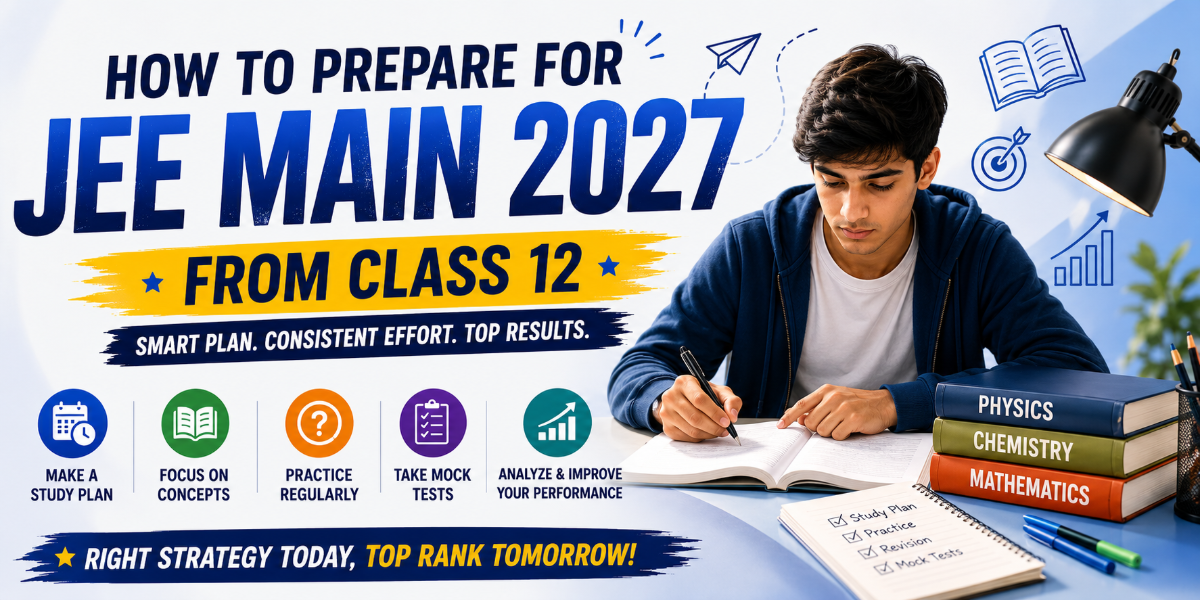
JEE Main 2027 Preparation Strategy for Class 12 Students
- Students completing 90% or more of the Class 12 syllabus by November can focus mainly on PYQs, mock tests and Class 11 revision afterwards.
- Students with 75-90% syllabus coverage should first finish the remaining high-priority chapters before increasing their mock-test practice.
- Students who have completed 50-75% of the syllabus should prioritise high-weightage chapters instead of trying to complete every chapter equally.
- Those who have covered less than 50% of the syllabus should focus on core concepts and priority chapters before spending more time on full-length mocks.
- Completing at least 75% of the Class 12 syllabus by November gives students more time in December and January for revision, PYQs and mock tests.
| Preparation Stage | Approx. Period | Main Target | Suggested Question Practice |
|---|---|---|---|
| Syllabus Building | September-October 2026 | Complete major Class 12 chapters | 30-50 questions/chapter |
| Syllabus + PYQ Phase | October-November 2026 | Complete remaining chapters + PYQs | 50-80 PYQs/chapter |
| Revision Phase | November-December 2026 | Revise Class 11 + Class 12 | 2-3 chapter tests/week |
| Mock Test Phase | December 2026 | Full-syllabus practice | 2-3 full mocks/week |
| Final Revision | January 2027 | Formulae, NCERT, PYQs and errors | 1 mock every 1-2 days |
How Much Class 12 Syllabus Should You Complete Before January 2027?
| Preparation Level by November | Class 12 Coverage | What to Prioritise Next |
|---|---|---|
| Strong | 90%+ | PYQs + mocks + Class 11 revision |
| Good | 75-90% | Finish remaining high-priority chapters |
| Average | 50-75% | Complete high-weightage chapters first |
| Low | Below 50% | Build core concepts and target priority chapters |
Download JEE Mains Syllabus PDF:
| Subject | Expected JEE Main 2027 Syllabus PDF |
|---|---|
| Physics | Download PDF |
| Chemistry | Download PDF |
| Mathematics | Download PDF |
| B.Arch | Download PDF |
| B.Planning | Download PDF |
Read More about: JEE Mains Syllabus 2027 PDF Download NTA
Ques. Can a Class 12 student prepare for JEE Main 2027 in five months?
Ans. Yes. Five months provides enough time for structured preparation if the student prioritises Class 12 chapters, revises important Class 11 topics and solves PYQs instead of trying to study from multiple resources.
Ques. How much of Class 12 should be completed before starting mock tests?
Ans. Students should begin chapter or part-syllabus tests as soon as they have completed enough chapters to create a meaningful test. Full-syllabus mocks should become regular after most of the syllabus is covered.
High-Weightage Class 12 Chapters for JEE Main 2027
Class 12 Physics: Priority Chapters
- Electrostatics, Current Electricity, and Ray & Wave Optics are the top-priority topics, with an estimated 7-10% weightage each in the table.
- Moving Charges & Magnetism and EMI & AC carry around 5-7% weightage, so students should focus on formulas, applications and numerical practice.
- Dual Nature, Atoms & Nuclei, and Semiconductor Electronics are comparatively shorter scoring areas, with around 3-6% weightage, making NCERT, formulas and PYQs important.
| Chapter/Unit | Priority | Approx. Weightage | Preparation Target |
|---|---|---|---|
| Electrostatics | Very High | 8-10% | Concepts + numerical practice |
| Current Electricity | Very High | 7-9% | Formulae + PYQs |
| Moving Charges & Magnetism | High | 5-7% | Numerical practice |
| EMI & AC | High | 5-7% | Formulae + application |
| Ray & Wave Optics | High | 8-10% | Concepts + PYQs |
| Dual Nature | High | 3-5% | Direct + numerical questions |
| Atoms & Nuclei | High | 4-6% | Formula-based questions |
| Semiconductor Electronics | High | 3-5% | NCERT + PYQs |
Ques. Which Class 12 Physics chapters should I complete first?
Ans. Electrostatics, Current Electricity, Magnetism, EMI, AC, Optics and Modern Physics should be placed high on the preparation list.
Ques. How many Physics questions should I practise after completing a chapter?
Ans. A practical target is 50-80 quality JEE Main questions/PYQs per major chapter, followed by a timed chapter test.
Class 12 Chemistry: Priority Chapters
- Electrochemistry, Coordination Compounds, and Aldehydes, Ketones & Acids are the top-priority areas, with an estimated 5-7% weightage each.
- Solutions and Chemical Kinetics carry around 4-6% weightage, so students should focus on formula-based questions, numericals and PYQs.
- d- and f-Block, Haloalkanes, Alcohols, Phenols & Ethers, Amines, and Biomolecules can be prepared mainly through NCERT revision, reactions and PYQs.
| Chapter/Area | Priority | Approx. Weightage | Best Practice Method |
|---|---|---|---|
| Solutions | High | 4-6% | Formulae + numericals |
| Electrochemistry | Very High | 5-7% | Formulae + PYQs |
| Chemical Kinetics | High | 4-6% | Numericals + PYQs |
| Coordination Compounds | Very High | 5-7% | NCERT + PYQs |
| d- and f-Block | High | 3-5% | NCERT revision |
| Haloalkanes/Haloarenes | High | 3-5% | Reactions + PYQs |
| Alcohols, Phenols & Ethers | High | 3-5% | Reaction practice |
| Aldehydes, Ketones & Acids | Very High | 5-7% | Reaction mechanisms + PYQs |
| Amines | High | 3-5% | NCERT + reactions |
| Biomolecules | Medium-High | 2-4% | NCERT-based revision |
Ques. Is NCERT important for Class 12 Chemistry in JEE Main?
Ans. Yes. Students should read NCERT carefully, particularly for Inorganic Chemistry and factual portions. NCERT should be completed before moving extensively to additional reference material.
Ques. Which Chemistry chapters should be revised repeatedly?
Ans. Coordination Compounds, Electrochemistry, Chemical Kinetics and important Organic Chemistry reactions should be included in weekly revision cycles.
Class 12 Mathematics: Priority Chapters
- Integrals has the highest estimated weightage at 8-10%, followed by Matrices & Determinants, Application of Derivatives, Vector Algebra and 3D Geometry at around 5-8%.
- Students should target 60-70+ questions for Integrals and Application of Derivatives, while solving 50+ questions each from Matrices & Determinants, Vector Algebra and 3D Geometry.
- Continuity & Differentiability, Differential Equations and Probability carry around 3-7% weightage, so students can focus on 40-50 questions from each during preparation.
| Chapter/Unit | Priority | Approx. Weightage | Practice Target |
|---|---|---|---|
| Matrices & Determinants | Very High | 6-8% | 50+ questions |
| Continuity & Differentiability | High | 5-7% | 50+ questions |
| Application of Derivatives | Very High | 5-7% | 60+ questions |
| Integrals | Very High | 8-10% | 70+ questions |
| Differential Equations | High | 3-5% | 40+ questions |
| Vector Algebra | Very High | 5-7% | 50+ questions |
| 3D Geometry | Very High | 5-7% | 50+ questions |
| Probability | High | 3-5% | 40+ questions |
Check:
- JEE Main Physics Sample Paper 2026 PDF by NTA
- JEE Main Chemistry Sample Paper 2026 PDF by NTA
- JEE Main Maths Sample Paper 2026 PDF by NTA
Ques. Which Class 12 Maths topics have the highest priority?
Ans. Calculus, Matrices and Determinants, Vector Algebra and 3D Geometry should receive high priority because they cover multiple recurring question types.
Ques. Should I solve questions topic-wise or chapter-wise?
Ans. Start topic-wise while learning a chapter and move to chapter-wise mixed questions after completing the full chapter.
JEE Main 2027 Month-Wise Study Plan for Class 12 Syllabus
The following plan is designed around the expected January 2027 Session 1.
| Month | Class 12 Target | Class 11 Target | Testing |
|---|---|---|---|
| September 2026 | Build core concepts | 1–2 chapters/week | Chapter tests |
| October 2026 | Complete high-priority chapters | 2 chapters/week | 2 tests/week |
| November 2026 | Finish remaining syllabus | Important weak chapters | 2–3 tests/week |
| December 2026 | Full revision | Full revision of priority areas | 2–3 full mocks/week |
| January 2027 | Final revision | Formula + weak-topic revision | Full mocks + PYQs |
| Resource | Best Use |
|---|---|
| JEE Main PYQs | Understand question patterns and difficulty |
| JEE Main Mock Tests | Improve speed, accuracy and time management |
| JEE Main 2027 Important Notes and Formula | Quick revision before tests and the examination |
Daily Study Timetable for JEE Main 2027 Class 12 Syllabus
The number of study hours should be linked to the student's school schedule and syllabus status rather than a fixed 10–12-hour target.
| Activity | Daily Target |
|---|---|
| Class 12 concept study | 2 hours |
| Physics problem solving | 1 hour |
| Chemistry NCERT/PYQs | 1–1.5 hours |
| Mathematics practice | 1.5–2 hours |
| Class 11 revision | 30–45 minutes |
| Error/formula revision | 20–30 minutes |
Check:
- JEE Main Physics Preparation 2027: Check Monthly Preparation Plan, Way to Score 100+, Weightage & Books
- JEE Main Chemistry preparation 2027: Check Preparation Plan, Syllabus, Weightage, Mock tests & Books
- JEE Main Maths Preparation 2027- Check 60 Days Study Plan, Important Books, Mock Tests and PYQs
Check:
| Best Books JEE Mains Maths 2026 | Best Books JEE Mains Chemistry 2026 | Best Books JEE Mains Physics 2026 |
JEE Main 2027 PYQ Strategy
PYQs should be used as a measurement tool, not just as another question bank.
| PYQ Stage | Questions to Attempt | Purpose |
|---|---|---|
| After chapter completion | 30–50 | Check basic application |
| After major unit completion | 50–100 | Identify recurring concepts |
| Revision phase | 100+ mixed | Improve selection and speed |
| Mock phase | Full paper | Simulate examination |
Students should record the accuracy percentage after every PYQ session.
For example, if 40 questions are attempted and 30 are correct, the accuracy is 75%. A student should aim to improve both accuracy and time taken before moving to more difficult question sets.
JEE Main Previous Year Question Papers
When to Start Mock Tests for JEE Main 2027
Students should introduce tests in stages.
| Period | Test Type | Frequency |
|---|---|---|
| September | Chapter tests | 1–2/week |
| October | Chapter + unit tests | 2/week |
| November | Part-syllabus tests | 2–3/week |
| December | Full-length mocks | 2–3/week |
| January | Full mocks + PYQs | 3–4/week, depending on stamina |
After each mock, students should spend at least 1–2 hours analysing the paper rather than immediately moving to the next test.
JEE Main 2027 Mock Tests
| JEE Main Mock Test 1 | JEE Main Mock Test 2 | JEE Main Mock Test 3 |
| JEE Main Mock Test 4 | JEE Main Mock Test 5 | JEE Main Mock Test 6 |
Check: JEE Main Mock Test- Attempt Free Chapterwise test, Question Paper (2026-2011), JEE Main PYQ
Mock-Test Performance Targets
| Accuracy | Preparation Status |
|---|---|
| 90%+ | Strong conversion of attempted questions |
| 80–90% | Good, but review repeated errors |
| 70–80% | Improve question selection and concepts |
| Below 70% | Focus on revision before increasing mock frequency |
JEE Main 2027: Important Links
| JEE Main 2027 Syllabus | JEE Main 2027 Exam Dates | JEE Main 2027 Registration |
| JEE Main 2027 Eligibility | JEE Main 2027 Exam Pattern | JEE Main 2027 Previous Year Papers |
How to Prepare for JEE Main 2027 from Class 12 FAQs
Ques. Can I prepare for JEE Main 2027 while studying in Class 12?
Ans. Yes. Class 12 students can prepare for JEE Main 2027 by studying their board syllabus along with JEE Main-level questions, PYQs and regular mock tests.
Ques. Which Class 12 topics are important for JEE Main 2027?
Ans. Important topics include Electrostatics, Current Electricity, Optics and Modern Physics in Physics; Electrochemistry, Chemical Kinetics and Coordination Compounds in Chemistry; and Calculus, Matrices, Determinants, Vectors and 3D Geometry in Mathematics.
Ques. How should I manage Class 11 and Class 12 syllabus for JEE Main 2027?
Ans. Students should continue their Class 12 preparation and set aside 1–1.5 hours daily or dedicated weekend sessions for revising important Class 11 chapters.
Ques. When should Class 12 students start JEE Main 2027 mock tests?
Ans. Students can start with chapter-wise and sectional tests as soon as they complete the relevant topics. Full-length mock tests should become regular by November or December 2026.
Ques. Can I score 99+ percentile in JEE Main 2027 if I start in Class 12?
Ans. Yes, it is possible with strong syllabus coverage, regular PYQ practice, high accuracy and consistent mock-test performance. However, there is no fixed score or study-hour target that guarantees a 99+ percentile



Comments