




JEE Main exam consists of three subjects: Physics, Chemistry, and Mathematics, with 30 questions in each subject. Each subject has two sections. Section A contains 20 MCQs, while Section B contains 10 Numerical Value Questions, out of which candidates have to attempt any 5.
The chapter-wise distribution has remained fairly consistent from 2022 to 2026, although the number of questions from individual chapters can change across years and shifts. Candidates have to attempt 75 questions out of 90, with 25 questions from each subject, for a maximum of 300 marks.
- In Physics, Modern Physics carries the highest individual weightage at around 9.5%–11%, with about 3 questions expected from Atoms, Nuclei, and Dual Nature.
- Electrostatics & Capacitance contribute around 7.5%–8.5%, while Current Electricity contributes 6.5%–7.5%, with roughly 2 questions each.
- In Chemistry, Coordination Compounds has one of the highest chapter-wise weightages at 7%–8.4% and is expected to contribute around 2 questions.
- Aldehydes, Ketones & Carboxylic Acids carries around 6%–7.5% weightage, with approximately 2 questions expected.
- In Mathematics, Coordinate Geometry has the highest individual weightage at around 9%–11%, contributing approximately 2–3 questions from Circles, Parabola, Ellipse, and Hyperbola.
- 3D Geometry and Matrices & Determinants carry around 7%–7.5% and 7%–8%, respectively, with approximately 2 questions each.
Related Links:
- JEE Main Exam Pattern 2027: Total Questions for BE/BTech & BArch/BPlan, Marking Scheme, Total Marks
- JEE Main Syllabus 2027: Download PDF, Subject-Wise Topics & Latest Updates
- JEE Main 2026 Question Paper PDF: Download Session 1 & 2 Shift-wise Papers with Solutions
Key Summary
- The JEE Main chapter wise weightage shows Modern Physics, Current Electricity, and Electrostatics as the highest-yield Physics chapters year after year.
- For Chemistry, the most weightage chapters for JEE Mains Chemistry are Coordination Compounds, Organic Compounds Containing Oxygen, and Hydrocarbons.
- Maths weightage in JEE Mains is dominated by Three-Dimensional Geometry, Matrices & Determinants, and Conic Sections; together, these make up a large share of the paper.
- Because the JEE Main chapter wise weightage has remained fairly stable across 2022–2026, past-year distribution data is a reliable guide for 2027 preparation.
JEE Main Chapter-wise Weightage 2027: Overview
Each JEE Main subject, Physics, Chemistry, and Mathematics, contains 25 questions:
- 20 MCQs and
- 5 NAT questions.
The JEE Main chapter wise weightage varies within each subject:
- Physics rewards structural concepts in Mechanics and application-based questions in Electrodynamics and Modern Physics under the current JEE Main chapter wise weightage pattern.
- Chemistry remains the most scoring section, with Physical, Organic, and Inorganic sub-branches typically receiving a balanced distribution of around 30–35% each.
- Mathematics is generally rated the lengthiest and most time-consuming section, and JEE mains maths weightage is concentrated in a handful of calculus- and geometry-heavy chapters.
- JEE Main 2026 Session 2 Paper Analysis Out: Check Shift-wise Difficulty Level, Student Reactions and Paper Review
- JEE Main Chemistry Syllabus 2027: Section-wise, High-Weightage Topics, Preparation Tips & Study Plan
This video discusses a strategic approach to mastering 30 essential chapters across physics, chemistry, and mathematics to aim for top percentile scores. It provides a subject-wise breakdown of high-yield topics, emphasizing efficient study methods and resource utilization to navigate the extensive JEE Main syllabus
JEE Main Chapter wise Weightage: Physics
Physics papers heavily reward structural concepts in Mechanics and application-based questions in Electrodynamics and Modern Physics.
The table below captures the current JEE Main chapter wise weightage for Physics, along with the expected number of questions and a priority tier for each chapter.
- Modern Physics carries the highest weightage at 9.5%–11%, followed by Electrostatics (7.5%–8.5%) and Current Electricity (6.5%–7.5%).
- Most other chapters contribute around 1–2 questions, including Optics, Thermodynamics, Kinematics, Magnetism, Gravitation, and Rotational Motion.
| Unit / Chapter | Estimated Weightage | Expected Questions |
|---|---|---|
| Modern Physics (Atoms, Nuclei, Dual Nature) | 9.5% – 11% | 3 questions |
| Electrostatics (Electric Charges & Fields, Capacitance) | 7.5% – 8.5% | 2 questions |
| Current Electricity | 6.5% – 7.5% | 2 questions |
| Electromagnetic Induction & AC | 6.5% – 7.0% | 2 questions |
| Ray Optics & Optical Instruments | 5.0% – 6.5% | 1–2 questions |
| Heat & Thermodynamics | 5.0% – 6.0% | 1–2 questions |
| Kinematics (Motion in 1D & 2D) | 5.5% | 1–2 questions |
| Properties of Solids & Fluids | 5.0% | 1 question |
| Magnetic Effects of Current & Magnetism | 4.5% – 5.5% | 1–2 questions |
| Waves & Oscillations (SHM) | 4.5% – 5.0% | 1 question |
| Gravitation | 4.5% | 1 question |
| Rotational Motion | 4.3% | 1 question |
| Units and Measurements | 4.2% | 1 question |
| Electromagnetic Waves | 2.9% | 1 question |
Physics Past 5-Year Trends
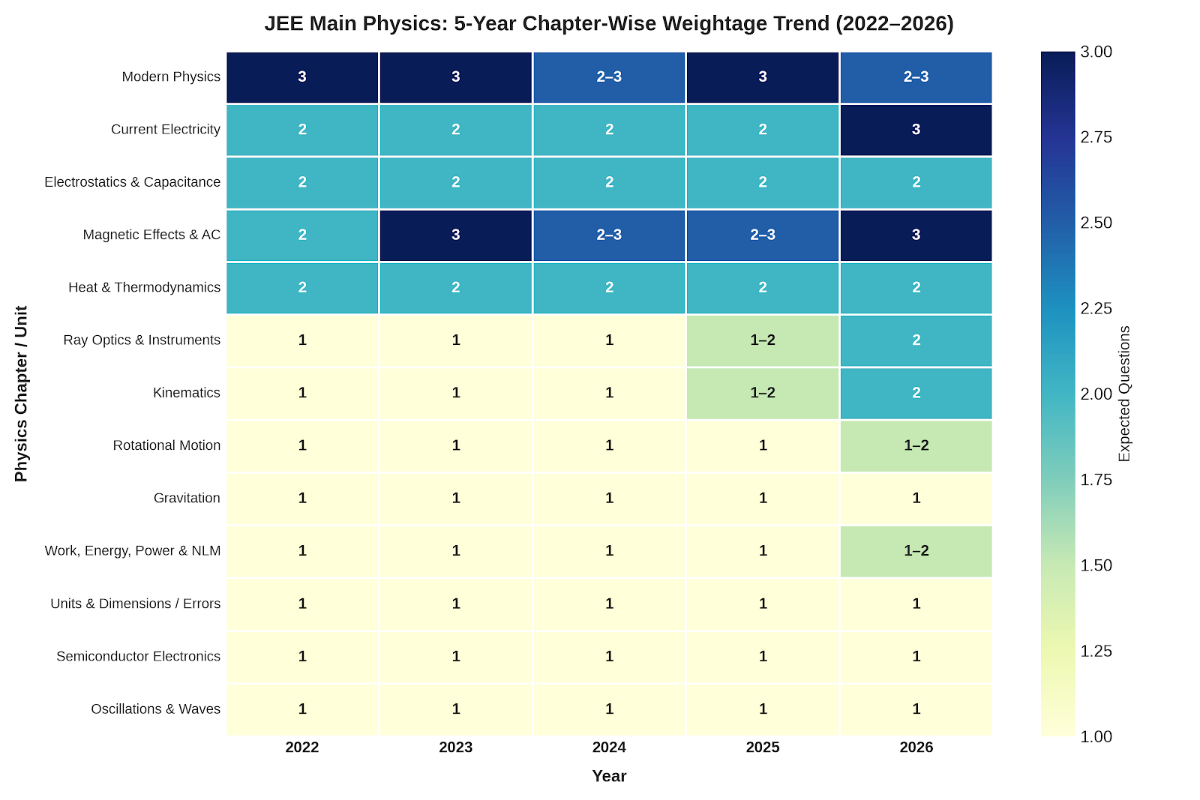
Analysis of JEE Main papers from 2022 to 2026 shows that the chapter-wise weightage has remained largely consistent, although the number of questions from individual chapters may vary slightly across shifts.
- Modern Physics: Focus on de Broglie wavelength, Bohr transitions, and nuclear binding energy.
- Current Electricity: Practice Kirchhoff’s laws, meter bridge, potentiometer, and resistor color coding.
- Magnetic Effects & AC: Prepare magnetic field problems, Q-factor, resonance, and LCR power calculations.
- Electrostatics & Capacitance: Practice Gauss’s law, electric field/potential, and dielectric-based capacitor problems.
| Physics Chapter / Unit | 2022 | 2023 | 2024 | 2025 | 2026 |
|---|---|---|---|---|---|
| Modern Physics (Atoms, Nuclei, Dual Nature) | 3 | 3 | 2–3 | 3 | 2–3 |
| Current Electricity | 2 | 2 | 2 | 2 | 3 |
| Electrostatics & Capacitance | 2 | 2 | 2 | 2 | 2 |
| Magnetic Effects of Current & AC | 2 | 3 | 2–3 | 2–3 | 3 |
| Heat & Thermodynamics / KTG | 2 | 2 | 2 | 2 | 2 |
| Ray Optics & Optical Instruments | 1 | 1 | 1 | 1–2 | 2 |
| Kinematics | 1 | 1 | 1 | 1–2 | 2 |
| Rotational Motion | 1 | 1 | 1 | 1 | 1–2 |
| Gravitation | 1 | 1 | 1 | 1 | 1 |
| Work, Energy & Power / NLM | 1 | 1 | 1 | 1 | 1–2 |
| Units & Dimensions / Errors | 1 | 1 | 1 | 1 | 1 |
| Semiconductor Electronics | 1 | 1 | 1 | 1 | 1 |
| Oscillations & Waves (SHM) | 1 | 1 | 1 | 1 | 1 |
Ques. Which are the high weightage chapters for JEE Mains Physics?
Ans. Based on the JEE Main chapter wise weightage over the last five years, Modern Physics, Current Electricity, Electrostatics & Capacitance, and Magnetic Effects of Current & AC are consistently the highest-yield chapters.
Check Out:
JEE Main 2026 Question Paper (Available)
| JEE Main 2026 Question Paper | Question Paper | Solution PDF |
|---|---|---|
| JEE Main 2026 Question Paper (21 Jan Shift 1) | Download PDF | Check Solutions |
| JEE Main 2026 Question Paper (21 Jan Shift 2) | Download PDF | Check Solutions |
| JEE Main 2026 Question Paper (22 Jan Shift 1) | Download PDF | Check Solutions |
| JEE Main 2026 Question Paper (22 Jan Shift 2) | Download PDF | Check Solutions |
| JEE Main 2026 Question Paper (23 Jan Shift 1) | Download PDF | Check Solutions |
| JEE Main 2026 Question Paper (23 Jan Shift 2) | Download PDF | Check Solutions |
| JEE Main 2026 Question Paper (24 Jan Shift 1) | Download PDF | Check Solutions |
| JEE Main 2026 Question Paper (24 Jan Shift 2) | Download PDF | Check Solutions |
| JEE Main 2026 Question Paper (28 Jan Shift 1) | Download PDF | Check Solutions |
| JEE Main 2026 Question Paper (28 Jan Shift 2) | Download PDF | Check Solutions |
JEE Main Chapter Wise Weightage: Chemistry
Chemistry continues to be the most scoring section under the JEE Main chapter wise weightage. Physical, Organic, and Inorganic sub-branches typically receive a balanced distribution (~30–35% each).
NCERT textbooks remain the definitive source, especially for Inorganic blocks and Biomolecules.
- Focus your core preparation on Coordination Compounds and Aldehydes, Ketones & Carboxylic Acids, as they carry the highest individual weightages (up to 8.4% and 7.5% respectively) and are both expected to yield 2 questions each.
- Chapters like Periodic Table & Classification (2.0%), Atomic Structure (3.3%), and Chemical Bonding (3.3%) carry minimal weightage and yield only 1 question each, so prioritize quick conceptual reviews over lengthy revision sessions for them.
| Unit / Chapter | Estimated Weightage | Expected Questions |
|---|---|---|
| Coordination Compounds | 7.0% – 8.4% | 2 questions |
| Organic Compounds Containing Oxygen (Aldehydes, Ketones, Carboxylic Acids) | 6.0% – 7.5% | 2 questions |
| Hydrocarbons | 6.0% – 6.5% | 1–2 questions |
| Biomolecules & Polymers | 5.5% – 6.0% | 1–2 questions |
| Electrochemistry & Redox Reactions | 5.0% – 5.6% | 1–2 questions |
| d and f-Block Elements | 4.6% | 1 question |
| Equilibrium (Chemical & Ionic) | 4.5% | 1–2 questions |
| Solutions | 4.5% | 1 question |
| General Organic Chemistry (GOC) | 4.0% – 5.0% | 1 question |
| p-Block Elements | 3.5% – 5.0% | 1–2 questions |
| Chemical Kinetics | 3.6% | 1 question |
| Chemical Bonding & Molecular Structure | 3.3% | 1 question |
| Atomic Structure | 3.3% | 1 question |
| Periodic Table & Classification | 2.0% | 1 question |
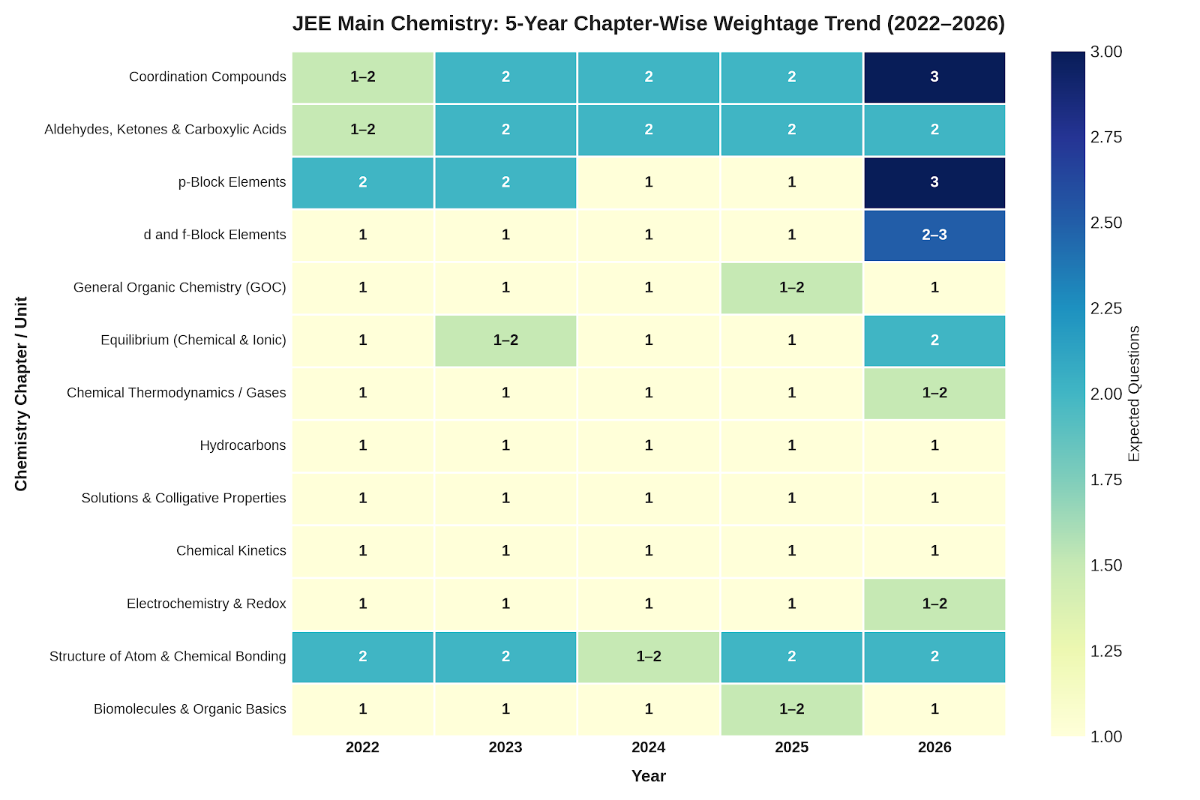
Chemistry Past 5-Year Trends
- Coordination Compounds: Focus on d-electron configuration, hybridization, magnetic nature, IUPAC naming, and optical/geometrical isomerism.
- Organic Chemistry: Practice acidity/basicity using inductive and resonance effects, along with Aldol, Cannizzaro, Hoffmann Bromamide, and Reimer–Tiemann reactions.
- p-, d- and f-Block: Revise structures, oxidation states, inert pair effect, lanthanide contraction, and NCERT-based compounds such as phosphorus/sulfur oxoacids and xenon compounds.
- Equilibrium & Kinetics: Prioritize first-order reactions, half-life, Arrhenius equation, buffer pH, and Ksp calculations.
| Chemistry Chapter / Unit | 2022 | 2023 | 2024 | 2025 | 2026 |
|---|---|---|---|---|---|
| Coordination Compounds | 1–2 | 2 | 2 | 2 | 3 |
| Aldehydes, Ketones & Carboxylic Acids | 1–2 | 2 | 2 | 2 | 2 |
| p-Block Elements | 2 | 2 | 1 | 1 | 3 |
| d and f-Block Elements | 1 | 1 | 1 | 1 | 2–3 |
| General Organic Chemistry (GOC) | 1 | 1 | 1 | 1–2 | 1 |
| Equilibrium (Chemical & Ionic) | 1 | 1–2 | 1 | 1 | 2 |
| Chemical Thermodynamics / Gases | 1 | 1 | 1 | 1 | 1–2 |
| Hydrocarbons | 1 | 1 | 1 | 1 | 1 |
| Solutions & Colligative Properties | 1 | 1 | 1 | 1 | 1 |
| Chemical Kinetics | 1 | 1 | 1 | 1 | 1 |
| Electrochemistry & Redox | 1 | 1 | 1 | 1 | 1–2 |
| Structure of Atom & Chemical Bonding | 2 | 2 | 1–2 | 2 | 2 |
| Biomolecules & Organic Basics | 1 | 1 | 1 | 1–2 | 1 |
Ques. What are the most weightage chapters for JEE Mains Chemistry?
Ans. Within the JEE Main chapter wise weightage for Chemistry, Coordination Compounds, Organic Compounds Containing Oxygen, Hydrocarbons, and Electrochemistry & Redox Reactions carry the highest and most consistent weightage.
JEE Main 2026 Question Paper with Solution PDF (Session 2)
| JEE Main 2026 Session 2 | Question Paper PDF | Solution PDF |
|---|---|---|
| JEE Main April 2 Shift 1 | Download Pdf | View Solutions |
| JEE Main April 2 Shift 2 | Download Pdf | View Solutions |
| JEE Main April 4 Shift 1 | Download Pdf | View Solutions |
| JEE Main April 4 Shift 2 | Download Pdf | View Solutions |
| JEE Main April 5 Shift 1 | Download Pdf | View Solutions |
| JEE Main April 5 Shift 2 | Download Pdf | View Solutions |
| JEE Main April 6 Shift 1 | Download Pdf | View Solutions |
| JEE Main April 6 Shift 2 | Download Pdf | View Solutions |
| JEE Main April 8 Shift 2 | Download Pdf | View Solutions |
| JEE Main 2026 B.Arch | Download Pdf | View Solutions |
| JEE Main 2026 B.Planning | Download Pdf | View Solutions |
| JEE Main 2026 B.Arch and B.Planning | Download Pdf | View Solutions |
JEE Main Chapter Wise Weightage: Mathematics
Mathematics is generally rated as the lengthiest and most time-consuming section of the exam. High weightage units like Calculus and Vectors/3D Geometry are important for achieving a top percentile.
- Coordinate Geometry stands out as the single most critical unit (9.0%–11.0% weightage, 2–3 questions)
- These are closely followed by 3D Geometry and Matrices & Determinants, making them top-priority targets for maximizing score efficiency.
- Units like Definite Integration & Area Under Curves, Complex Numbers & Quadratic Equations, and Probability & Statistics each consistently contribute around 6%–8% weightage and 2 questions, forming a strong core.
- Chapters such as Straight Lines (2.7%) and Trigonometry (2.5%–3.0%) yield only 1 question each despite vast syllabus coverage
- So stick to formula sheets and key concepts rather than spending excessive time on complex practice.
| Unit / Chapter | Estimated Weightage | Expected Questions |
|---|---|---|
| Coordinate Geometry (Circles, Parabola, Ellipse, Hyperbola) | 9.0% – 11.0% | 2–3 questions |
| Three-Dimensional Geometry | 7.3% – 7.5% | 2 questions |
| Matrices & Determinants | 7.0% – 8.0% | 2 questions |
| Definite Integration & Area Under Curves | 6.5% – 8.0% | 2 questions |
| Complex Numbers & Quadratic Equations | 6.5% – 8.0% | 2 questions |
| Probability & Statistics | 6.0% – 7.0% | 2 questions |
| Sequences & Series | 5.7% | 1–2 questions |
| Limits, Continuity, & Differentiability | 5.5% | 1–2 questions |
| Binomial Theorem | 5.0% | 1 question |
| Vector Algebra | 4.6% – 5.0% | 1–2 questions |
| Differential Equations | 4.1% | 1 question |
| Permutations & Combinations | 3.6% | 1 question |
| Straight Lines | 2.7% | 1 question |
| Trigonometry (Identities & Inverse Functions) | 2.5% – 3.0% | 1 question |
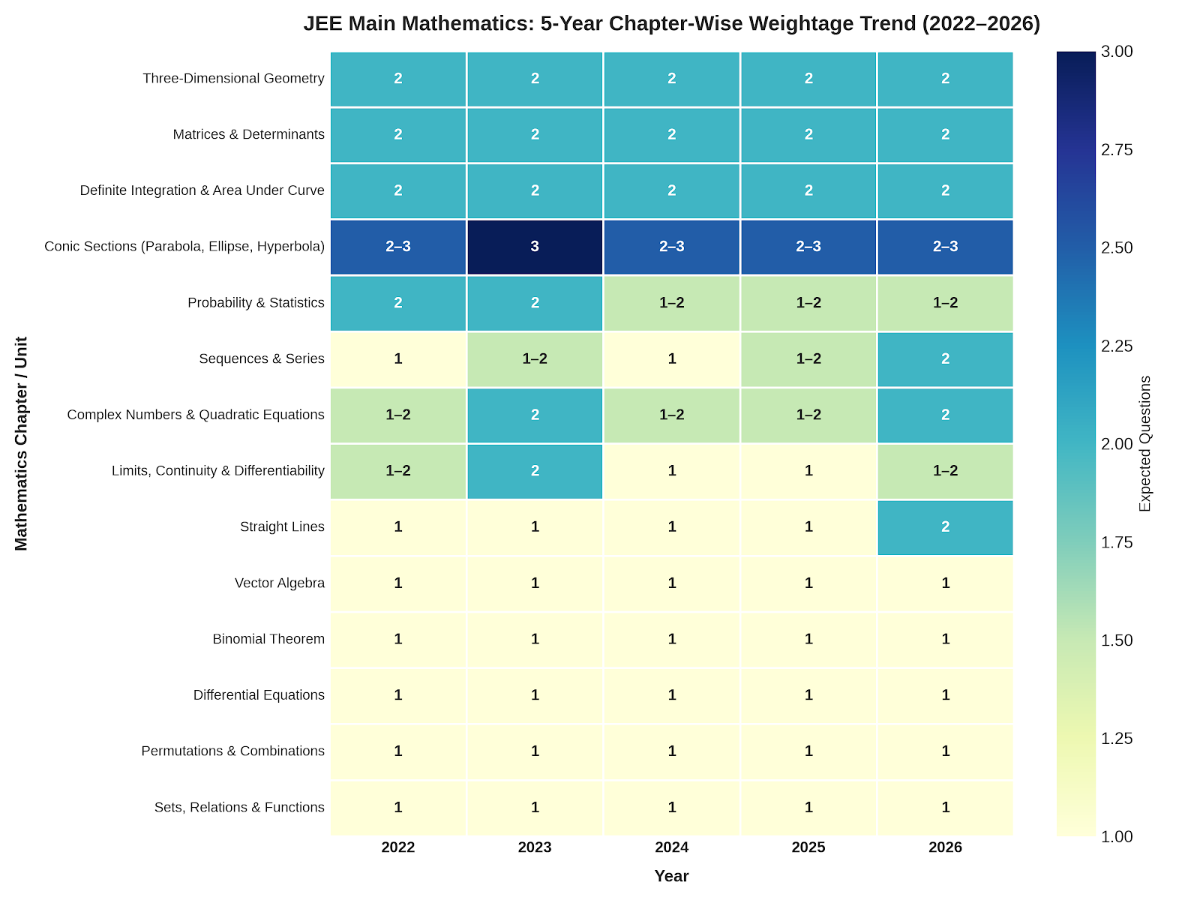
Mathematics Past 5-Year Trends
Vector Algebra & 3D Geometry is the highest-scoring mathematical unit under the JEE Main chapter-wise weightage. Focus on finding the shortest distance between two skew lines using vector methods.
- Matrices & Determinants: Expect questions on solving systems of linear equations using Cramer's Rule. Memorize the structural properties of adjoints, such as |adj(A)| = |A|ⁿ⁻¹, etc.
- Calculus (Definite Integration & AUC): Master the King's Property, which solves a large majority of JEE Main integration problems.
- For Area Under the Curve (AUC), practice sketching and finding the area bounded between standard parabolas and straight lines.
- Conic Sections: Finding the equations of common tangents to two different conics (e.g., a circle and a parabola). Ensure you can quickly find the eccentricity, length of the latus rectum, and equations of focal chords.
| Mathematics Chapter / Unit | 2022 | 2023 | 2024 | 2025 | 2026 |
|---|---|---|---|---|---|
| Three-Dimensional Geometry | 2 | 2 | 2 | 2 | 2 |
| Vector Algebra | 1 | 1 | 1 | 1 | 1 |
| Matrices & Determinants | 2 | 2 | 2 | 2 | 2 |
| Conic Sections (Parabola, Ellipse, Hyperbola) | 2–3 | 3 | 2–3 | 2–3 | 2–3 |
| Definite Integration & Area Under Curve | 2 | 2 | 2 | 2 | 2 |
| Sequences & Series | 1 | 1–2 | 1 | 1–2 | 2 |
| Limits, Continuity & Differentiability | 1–2 | 2 | 1 | 1 | 1–2 |
| Probability & Statistics | 2 | 2 | 1–2 | 1–2 | 1–2 |
| Complex Numbers & Quadratic Equations | 1–2 | 2 | 1–2 | 1–2 | 2 |
| Binomial Theorem | 1 | 1 | 1 | 1 | 1 |
| Differential Equations | 1 | 1 | 1 | 1 | 1 |
| Permutations & Combinations | 1 | 1 | 1 | 1 | 1 |
| Straight Lines | 1 | 1 | 1 | 1 | 2 |
| Sets, Relations & Functions | 1 | 1 | 1 | 1 | 1 |
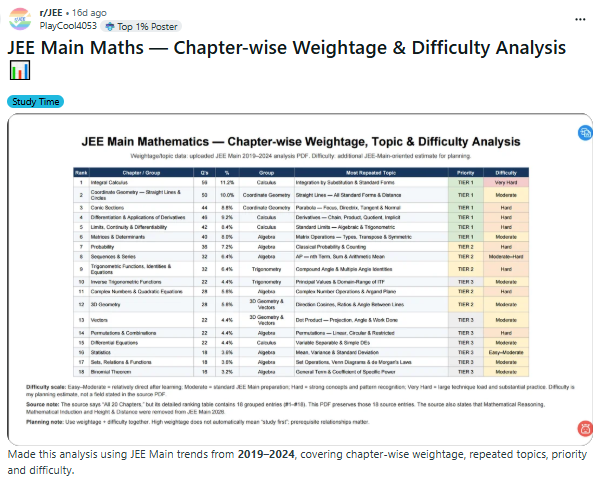
As per Reddit discussions, students highlight their own analysis and high-weightage topics in Mathematics:
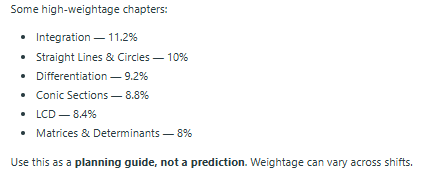
- Calculus Questions: Combining Integration, Differentiation, and LCD accounts for 28.8% of the paper.
- Integration (11.2%): The single highest-weightage topic on the list, making integral calculus the top priority.
- Straight Lines & Circles (10.0%): The largest share of foundational coordinate geometry, accounting for a full tenth of the mathematics section.
- Differentiation (9.2%): Forms the second major pillar of calculus alongside integration, carrying heavy weightage.
- Coordinate Geometry Core: Straight Lines, Circles, and Conic Sections combined make up 18.8% of the paper.
Source: Reddit
Ques. Which are the most weightage chapters for JEE Mains Maths?
Ans. Under the current JEE Main chapter wise weightage, Coordinate Geometry, Three-Dimensional Geometry, Matrices & Determinants, and Definite Integration & Area Under Curves carry the highest combined weightage in Mathematics.
Check Out:
JEE Main 2025 Question Paper (Session 1)
| JEE Main 2025 Question Paper | Question Paper | Solution PDF |
|---|---|---|
| JEE Main 2025 Question Paper (22 Jan Shift 1) | Download PDF | Check Solutions |
| JEE Main 2025 Question Paper (22 Jan Shift 2) | Download PDF | Check Solutions |
| JEE Main 2025 Question Paper (23 Jan Shift 1) | Download PDF | Check Solutions |
| JEE Main 2025 Question Paper (23 Jan Shift 2) | Download PDF | Check Solutions |
| JEE Main 2025 Question Paper (24 Jan Shift 1) | Download PDF | Check Solutions |
| JEE Main 2025 Question Paper (24 Jan Shift 2) | Download PDF | Check Solutions |
| JEE Main 2025 Question Paper (28 Jan Shift 1) | Download PDF | Check Solutions |
| JEE Main 2025 Question Paper (28 Jan Shift 2) | Download PDF | Check Solutions |
| JEE Main 2025 Question Paper (29 Jan Shift 1) | Download PDF | Check Solutions |
| JEE Main 2025 Question Paper (29 Jan Shift 2) | Download PDF | Check Solutions |
JEE Main 2025 Question Paper (Session 2)
| JEE Main 2025 Question Paper | Question Paper | Solution PDF |
|---|---|---|
| JEE Main 2025 Question Paper (2 April Shift 1) | Download PDF | Check Solutions |
| JEE Main 2025 Question Paper (2 April Shift 2) | Download PDF | Check Solutions |
| JEE Main 2025 Question Paper (3 April Shift 1) | Download PDF | Check Solutions |
| JEE Main 2025 Question Paper (3 April Shift 2) | Download PDF | Check Solutions |
| JEE Main 2025 Question Paper (4 April Shift 1) | Download PDF | Check Solutions |
| JEE Main 2025 Question Paper (4 April Shift 2) | Download PDF | Check Solutions |
| JEE Main 2025 Question Paper (7 April Shift 1) | Download PDF | Check Solutions |
| JEE Main 2025 Question Paper (7 April Shift 2) | Download PDF | Check Solutions |
| JEE Main 2025 Question Paper (8 April Shift 2) | Download PDF | Check Solutions |
| JEE Main 2025 Question Paper (2 April Shift 1) | Download PDF | Check Solutions |
| JEE Main 2025 Question Paper (2 April Shift 2) | Download PDF | Check Solutions |
| JEE Main 2025 Question Paper (3 April Shift 1) | Download PDF | Check Solutions |
| JEE Main 2025 Question Paper (3 April Shift 2) | Download PDF | Check Solutions |
| JEE Main 2025 Question Paper (4 April Shift 1) | Download PDF | Check Solutions |
| JEE Main 2025 Question Paper (4 April Shift 2) | Download PDF | Check Solutions |
| JEE Main 2025 Question Paper (7 April Shift 1) | Download PDF | Check Solutions |
| JEE Main 2025 Question Paper (7 April Shift 2) | Download PDF | Check Solutions |
| JEE Main 2025 Question Paper (8 April Shift 2) | Download PDF | Check Solutions |
JEE Main Chapter Wise Weightage: Subject Comparison
Looking at the JEE Main chapter-wise weightage across all three subjects helps candidates decide where to focus revision time in the final weeks before the exam.
- Chemistry: Balanced evenly across Physical, Organic, and Inorganic topics.
- Chemistry serves as the most scoring section, where mastering key chapters like Coordination Compounds and Organic Compounds Containing Oxygen yields high efficiency.
- Physics: Driven by application-heavy units like Modern Physics and Electrostatics, success in Physics requires a deep, fundamental understanding of Mechanics and Electrodynamics.
- Mathematics: Because Math is the lengthiest section, strategy revolves around speed and accuracy in high-yield clusters
- Focus specifically on Coordinate Geometry, 3D Geometry, and Matrices & Determinants.
| Subject | Highest-Weightage Chapters | Overall Character |
|---|---|---|
| Physics | Modern Physics, Electrostatics & Capacitance, Current Electricity, Magnetic Effects & AC | Concept- and application-heavy; rewards strong grasp of Mechanics and Electrodynamics |
| Chemistry | Coordination Compounds, Organic Compounds Containing Oxygen, Hydrocarbons, Electrochemistry & Redox | Most scoring section; balanced across Physical, Organic, and Inorganic Chemistry |
| Mathematics | Coordinate Geometry, Three-Dimensional Geometry, Matrices & Determinants, Definite Integration & AUC | Lengthiest and most time-consuming; rewards speed alongside conceptual clarity |
Ques. Is the JEE mains weightage chapter wise the same every year?
Ans. The overall JEE Main chapter wise weightage has remained fairly stable from 2022 to 2026, though individual chapters like Current Electricity, p-Block Elements, and Straight Lines have shown small year-on-year increases in recent sessions.
How to Use JEE Main Chapter Wise Weightage for Preparation
Start revision with high-priority tier chapters identified in the JEE Main chapter wise weightage; Modern Physics, Coordination Compounds, and Three-Dimensional Geometry are strong starting points across the three subjects.
- Prioritize your study time such that you can spend less time revising high-weightage topics you already know well and focus more on moderate-weightage topics where you struggle.
- Pay close attention to topics showing an upward trend in recent exams (like Current Electricity or Coordination Compounds), as they offer the most predictable scoring opportunities.
- Avoid ignoring low-weightage chapters entirely, because even the smaller topics usually yield at least one guaranteed, straightforward question per exam session.
- After covering the full syllabus, revisit the high-weightage chapters right before the exam to hone your solving speed and accuracy rather than relearning concepts.
JEE Main Chapter Wise Weightage FAQs
Ques. What is JEE Main chapter wise weightage?
Ans. JEE Main chapter wise weightage refers to the approximate percentage of marks and number of questions each chapter contributes to the 25-question Physics, Chemistry, and Mathematics papers, based on historical exam patterns from previous years. Some candidates search for this as "chapter wise weightage for JEE Main," but it refers to the same underlying data.
Ques. Which are the high weightage chapters for JEE Mains overall?
Ans. Across all three subjects, the high weightage chapters for JEE Mains include
- Modern Physics and Electrostatics in Physics;
- Coordination Compounds and Organic Compounds Containing Oxygen in Chemistry;
- Coordinate Geometry, Three-Dimensional Geometry, and Matrices & Determinants in Mathematics.
Ques. Does the JEE Main chapter wise weightage change between exam sessions in the same year?
Ans. Minor fluctuations occur between sessions, but the JEE Main chapter wise weightage at the sub-discipline level (Mechanics, Electrodynamics, Modern Physics in Physics; Organic, Inorganic, Physical in Chemistry; Calculus, Algebra, Geometry in Maths) remains broadly consistent.
Ques. How reliable is using previous years' JEE mains weightage chapter wise data for 2027 preparation?
Ans. Since the JEE mains weightage chapter wise pattern has stayed largely stable from 2022 through 2026, using this historical data remains one of the most reliable ways to prioritize chapters for 2027, though candidates should still cover the complete syllabus rather than skipping any chapter entirely.



Comments