



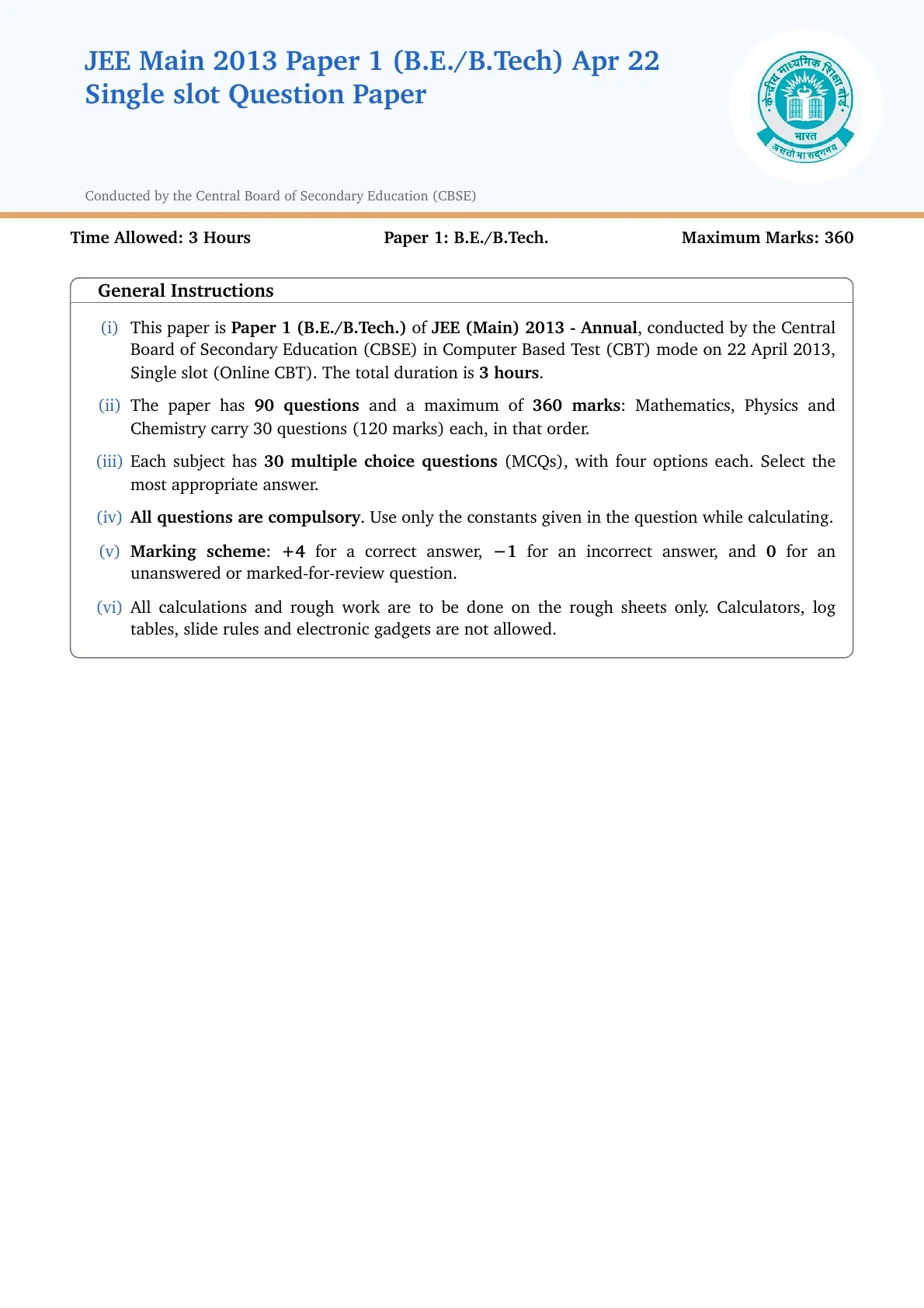
JEE Main 2013 April 22 Question Paper is available here with solutions PDF and detailed solutions for every question. CBSE conducted the online (CBT) JEE Main 2013 Paper 1 (B.E./B.Tech) on April 22, 2013. The question paper includes the following:
- 90 questions in a 3-hour CBT Mode: 30 each from Mathematics, Physics and Chemistry
- Question type: multiple choice questions (MCQs) with 4 options, one correct answer
- Marking: +4 for a correct answer, -1 for an incorrect answer, 0 for an unattempted question
- Maximum marks: 360 (120 per subject)
JEE Main 2013 April 22 Question Paper with Solution PDF
| CBSE Official PDF | CD PDF | CD PDF with Solutions |
|---|---|---|
| Download official PDF 3.63 MB | Download Collegedunia PDF 4.36 MB | Download solutions PDF 1.38 MB |
Also Check:
JEE Main 2013 April 22 Questions with Solutions
Mathematics (Q1 - Q30)
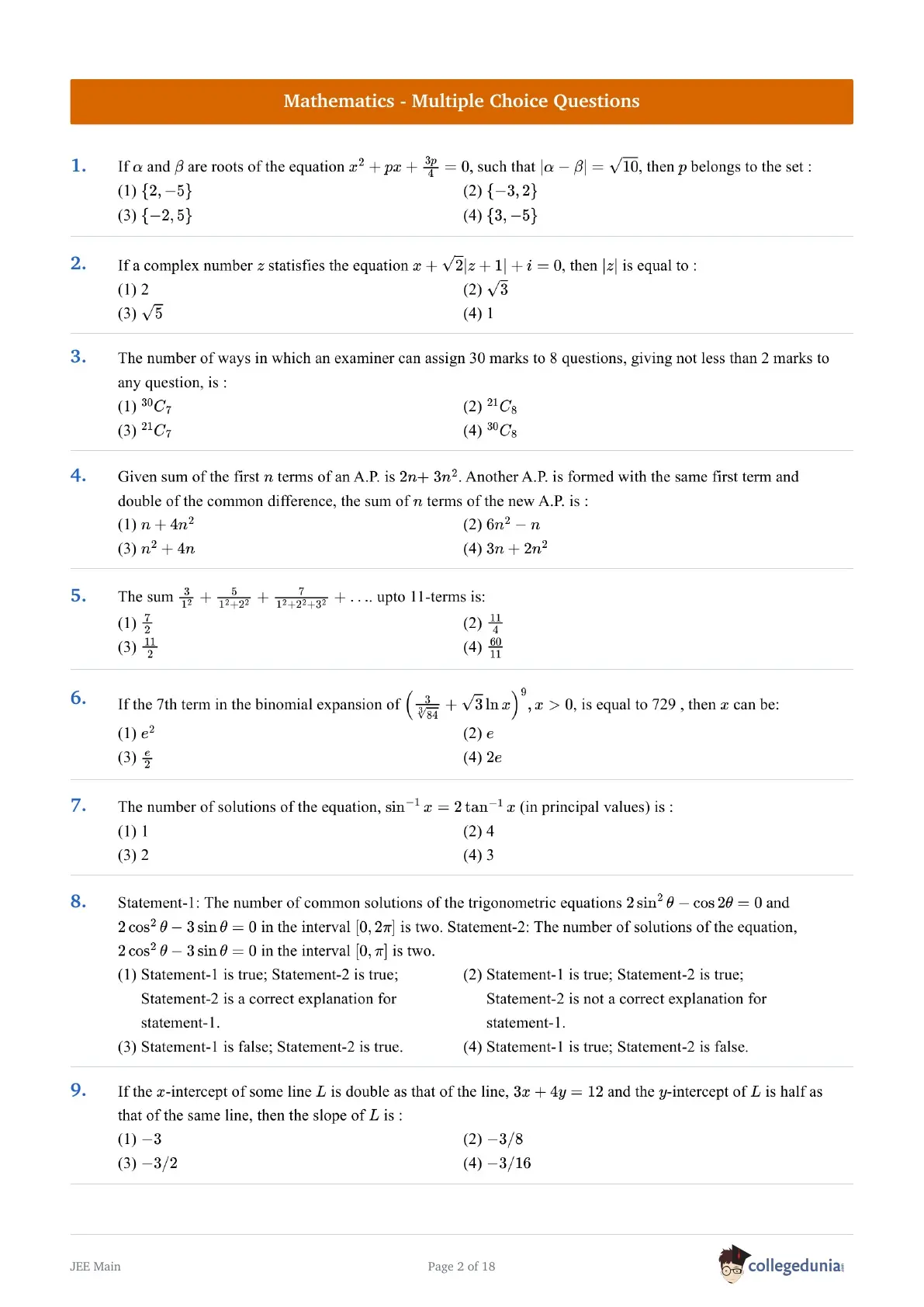
If \(\alpha\) and \(\beta\) are roots of the equation \(x^2 + px + \frac{3p}{4} = 0\), such that \(|\alpha - \beta| = \sqrt{10}\), then \(p\) belongs to the set :
If a complex number \(z\) statisfies the equation \(x + \sqrt{2}|z + 1| + i = 0\), then \(|z|\) is equal to :
The number of ways in which an examiner can assign 30 marks to 8 questions, giving not less than 2 marks to any question, is :
Given sum of the first \(n\) terms of an A.P. is \(2n + 3n^2\). Another A.P. is formed with the same first term and double of the common difference, the sum of \(n\) terms of the new A.P. is :
The sum \(\dfrac{3}{1^2} + \dfrac{5}{1^2+2^2} + \dfrac{7}{1^2+2^2+3^2} + \cdots\) upto 11-terms is :
If the 7th term in the binomial expansion of \(\left(\dfrac{3}{\sqrt[3]{84}} + \sqrt{3}\ln x\right)^9\), \(x \gt 0\), is equal to 729 , then \(x\) can be:
The number of solutions of the equation, \(\sin^{-1}x = 2\tan^{-1}x\) (in principal values) is :
Statement-1: The number of common solutions of the trigonometric equations \(2\sin^2\theta - \cos 2\theta = 0\) and \(2\cos^2\theta - 3\sin\theta = 0\) in the interval \([0, 2\pi]\) is two.
Statement-2: The number of solutions of the equation, \(2\cos^2\theta - 3\sin\theta = 0\) in the interval \([0, \pi]\) is two.
If the x-intercept of some line \( L \) is double as that of the line, \( 3x+4y = 12 \) and the \( y \)-intercept of \( L \), is half as that of the same line, then the slope of \( L \) is:
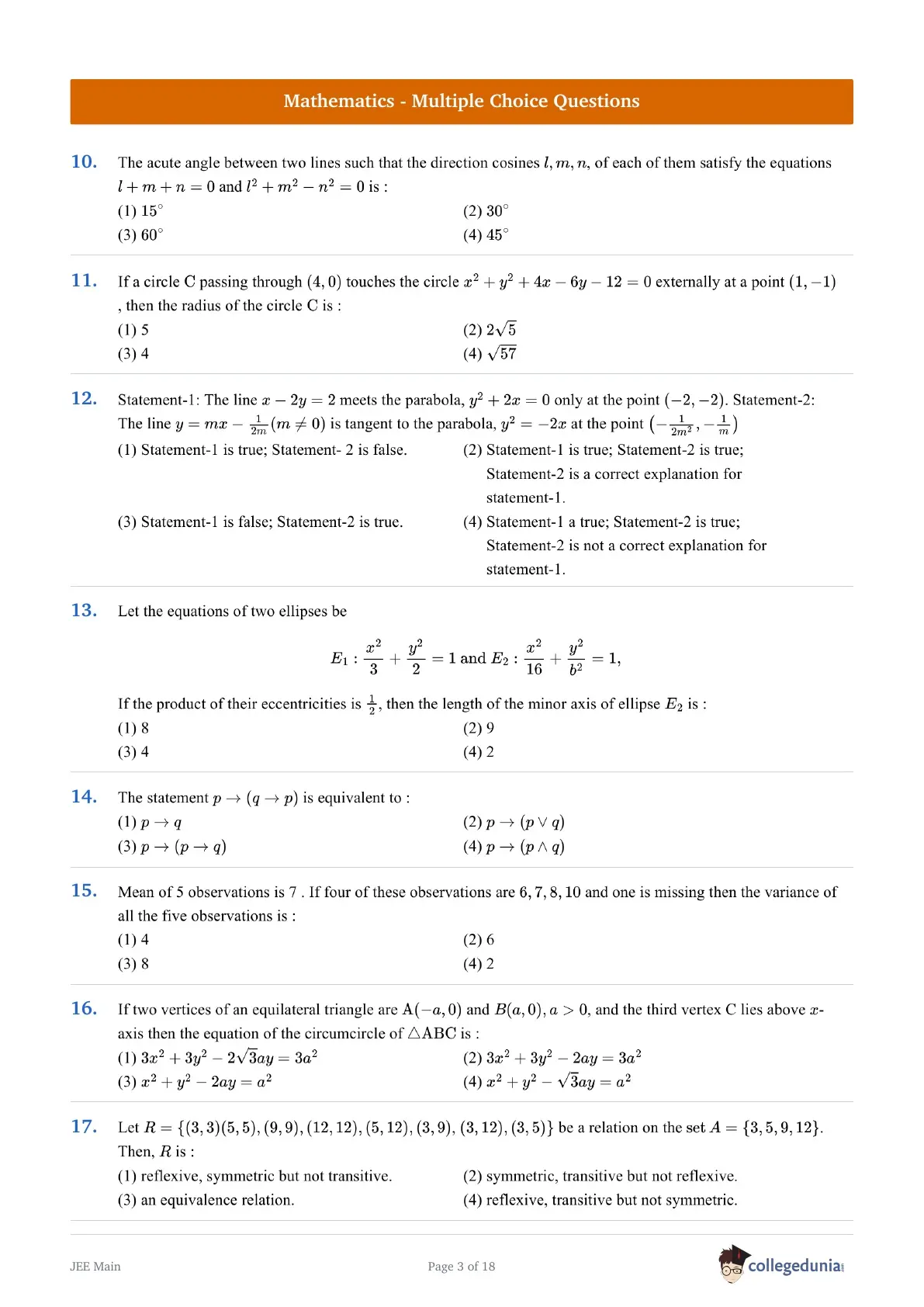
The acute angle between two lines such that the direction cosines \(l, m, n\), of each of them satisfy the equations \(l + m + n = 0\) and \(l^2 + m^2 - n^2 = 0\) is :
If a circle \( C \) passing through the point \( (4,0) \) touches the circle \( x^2 + y^2 + 4x - 6y = 12 \) externally at the point \( (1, -1) \), then the radius of \( C \) is :
The line \( x - 2y = 2 \) meets the parabola, \( y^2 + 2x = 0 \) only at the point \( (- 2,-2) \). The line \( y=mx-\frac{1}{2m}\left(m\ne0\right) \) is tangent to the parabola, \( y^{2} = - 2x \) at the point \( \left(-\frac{1}{2m^{2}}, -\frac{1}{m}\right). \)
Let the equations of two ellipses be \( E_{1} : \frac{x^{2}}{3}+\frac{y^{2}}{2}=1 and E_{2} : \frac{x^{2}}{16}+\frac{y^{2}}{b^{2}}=1 \), If the product of their eccentricities is \( \frac{1}{2} \), then the length of the minor axis of ellipse \( E_2 \) is:
The statement \(p \to (q \to p)\) is equivalent to :
Mean of 5 observations is 7 . If four of these observations are 6, 7, 8, 10 and one is missing then the variance of all the five observations is :
If two vertices of an equilateral triangle are \( A (- a, 0) \) and \( B (a, 0), a > 0 \), and the third vertex \( C \) lies above x-axis then the equation of the circumcircle of \( \Delta ABC \) is :
Let \( R=\left\{ \left(3,3\right) \left(5,5\right), \left(9,9\right), \left(12,12\right), \left(5,12\right), \left(3,9\right), \left(3,12\right), \left(3,5\right)\right\} \) be a relation on the set \( A=\left\{3,5,9,12\right\} \). Then, \( R \) is:
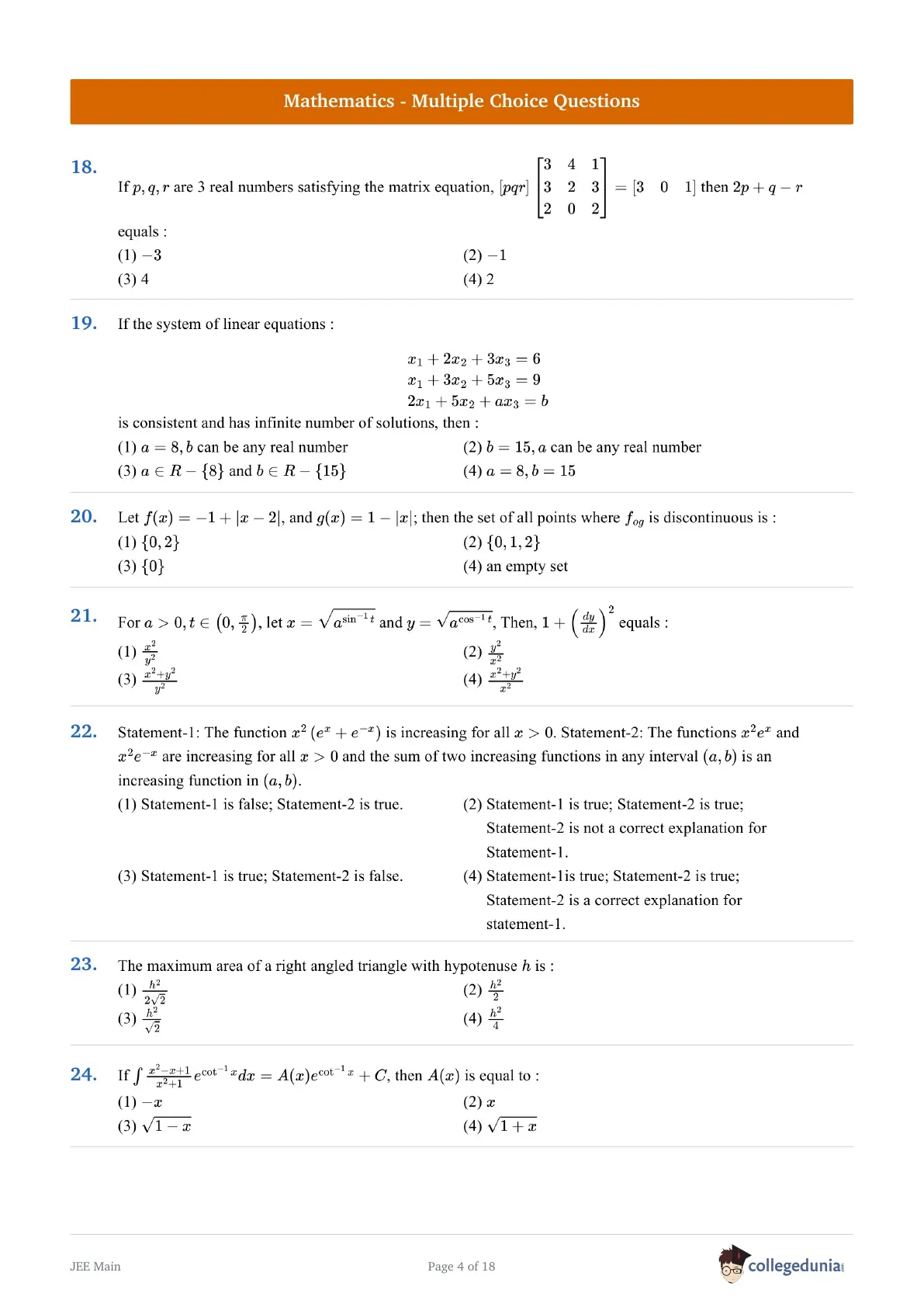
If \(p, q, r\) are 3 real numbers satisfying the matrix equation, \([p\ q\ r]\begin{bmatrix}3&4&1\\3&2&3\\2&0&2\end{bmatrix} = [3\ \ 0\ \ 1]\) then \(2p + q - r\) equals :
If the system of linear equations :
\(x_1 + 2x_2 + 3x_3 = 6\)
\(x_1 + 3x_2 + 5x_3 = 9\)
\(2x_1 + 5x_2 + ax_3 = b\)
is consistent and has infinite number of solutions, then :
Let \(f(x) = -1 + |x - 2|\), and \(g(x) = 1 - |x|\); then the set of all points where \(f\!og\) is discontinuous is :
For \(a \gt 0,\ t \in \left(0, \dfrac{\pi}{2}\right)\), let \(x = \sqrt{a^{\sin^{-1}t}}\) and \(y = \sqrt{a^{\cos^{-1}t}}\), Then, \(1 + \left(\dfrac{dy}{dx}\right)^2\) equals :
Statement-1: The function \(x^2(e^x+e^{-x})\) is increasing for all \(x \gt 0\).
Statement-2: The functions \(x^2e^x\) and \(x^2e^{-x}\) are increasing for all \(x \gt 0\) and the sum of two increasing functions in any interval \((a,b)\) is an increasing function in \((a,b)\).
The maximum area of a right angled triangle with hypotenuse \( h \) is :
If \(\int \frac{x^2-x+1}{x^2+1}\,e^{\cot^{-1}x}\,dx = A(x)\,e^{\cot^{-1}x}+C\), then \(A(x)\) is equal to :
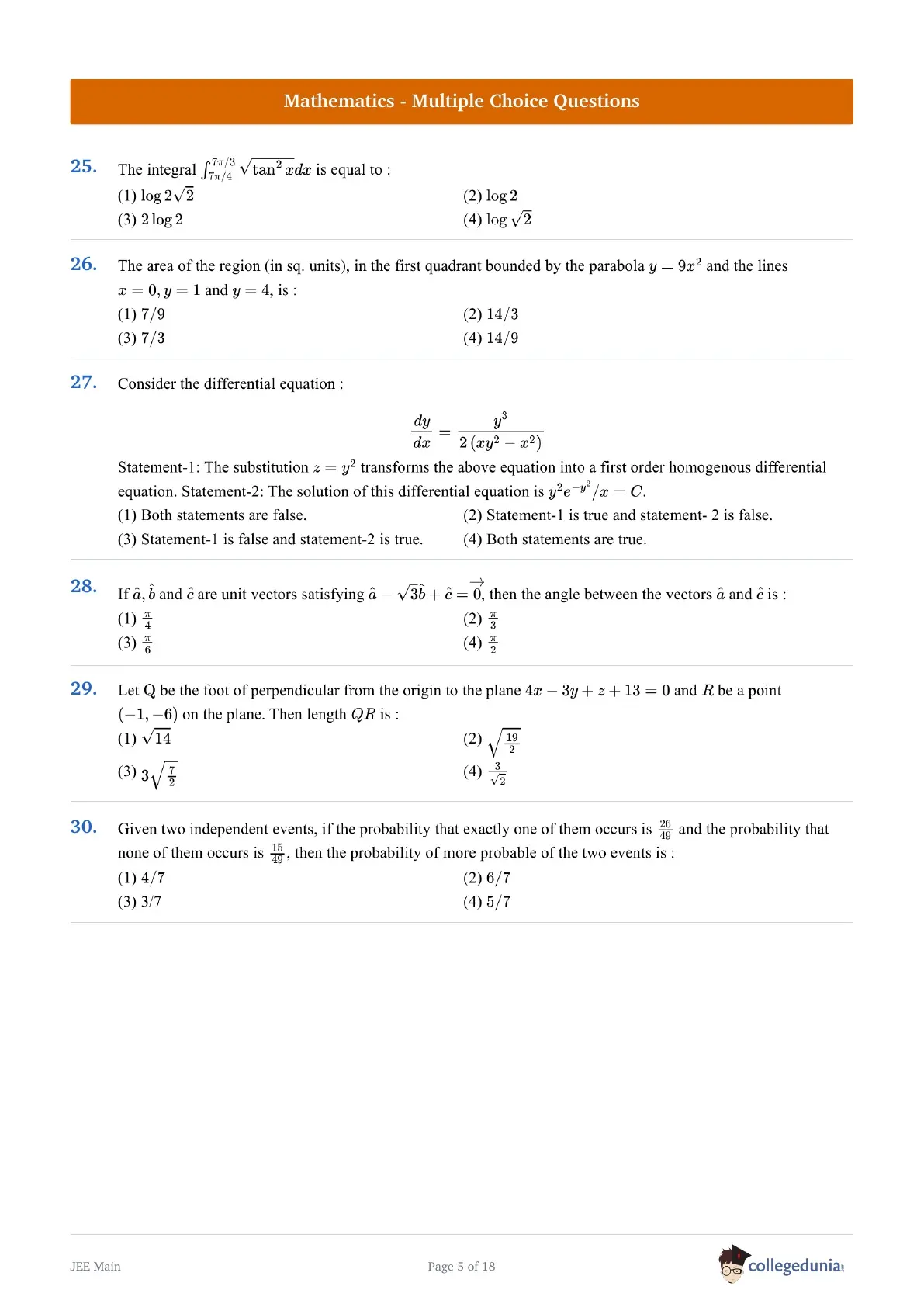
The integral \(\int_{7\pi/4}^{7\pi/3}\sqrt{\tan^2x}\,dx\) is equal to :
The area of the region (in sq. units), in the first quadrant bounded by the parabola \(y=9x^2\) and the lines \(x=0,\ y=1\) and \(y=4\), is :
Consider the differential equation :
\(\frac{dy}{dx}=\frac{y^3}{2(xy^2-x^2)}\)
Statement-1: The substitution \(z=y^2\) transforms the above equation into a first order homogenous differential equation.
Statement-2: The solution of this differential equation is \(y^2e^{-y^2}/x=C\).
If \(\hat a,\ \hat b\) and \(\hat c\) are unit vectors satisfying \(\hat a-\sqrt3\,\hat b+\hat c=\vec 0\), then the angle between the vectors \(\hat a\) and \(\hat c\) is :
Let Q be the foot of perpendicular from the origin to the plane \(4x-3y+z+13=0\) and R be a point \((-1,-6)\) on the plane. Then length QR is :
Given two independent events, if the probability that exactly one of them occurs is \(\frac{26}{49}\) and the probability that none of them occurs is \(\frac{15}{49}\), then the probability of more probable of the two events is :
Physics (Q31 - Q60)
The dimensions of angular momentum, latent heat and capacitance are, respectively.
A ball projected from ground at an angle of \(45^\circ\) just clears a wall in front. If point of projection is 4 m from the foot of wall and ball strikes the ground at a distance of 6 m on the other side of the wall, the height of the wall is :
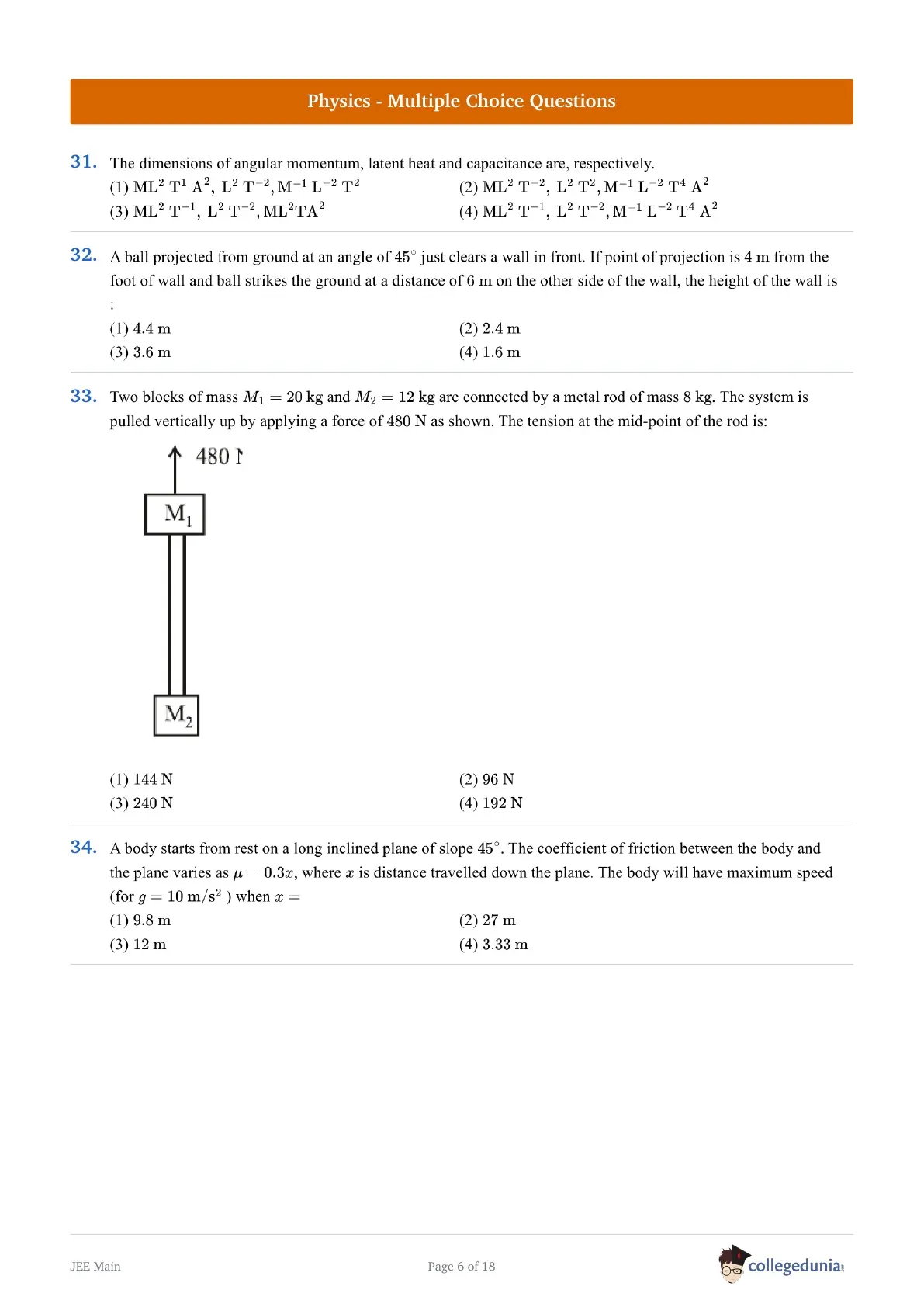
Two blocks of mass \( M_1 = 20\, kg \) and \( M_2 = 12\, kg \) are connected by a metal rod of mass \( 8\, kg \). The system is pulled vertically up by applying a force of \( 480\, N \) as shown. The tension at the mid-point of the rod is :
A body starts from rest on a long inclined plane of slope \(45^\circ\). The coefficient of friction between the body and the plane varies as \(\mu=0.3x\), where \(x\) is distance travelled down the plane. The body will have maximum speed (for \(g=10\ \mathrm{m/s^2}\)) when \(x=\)
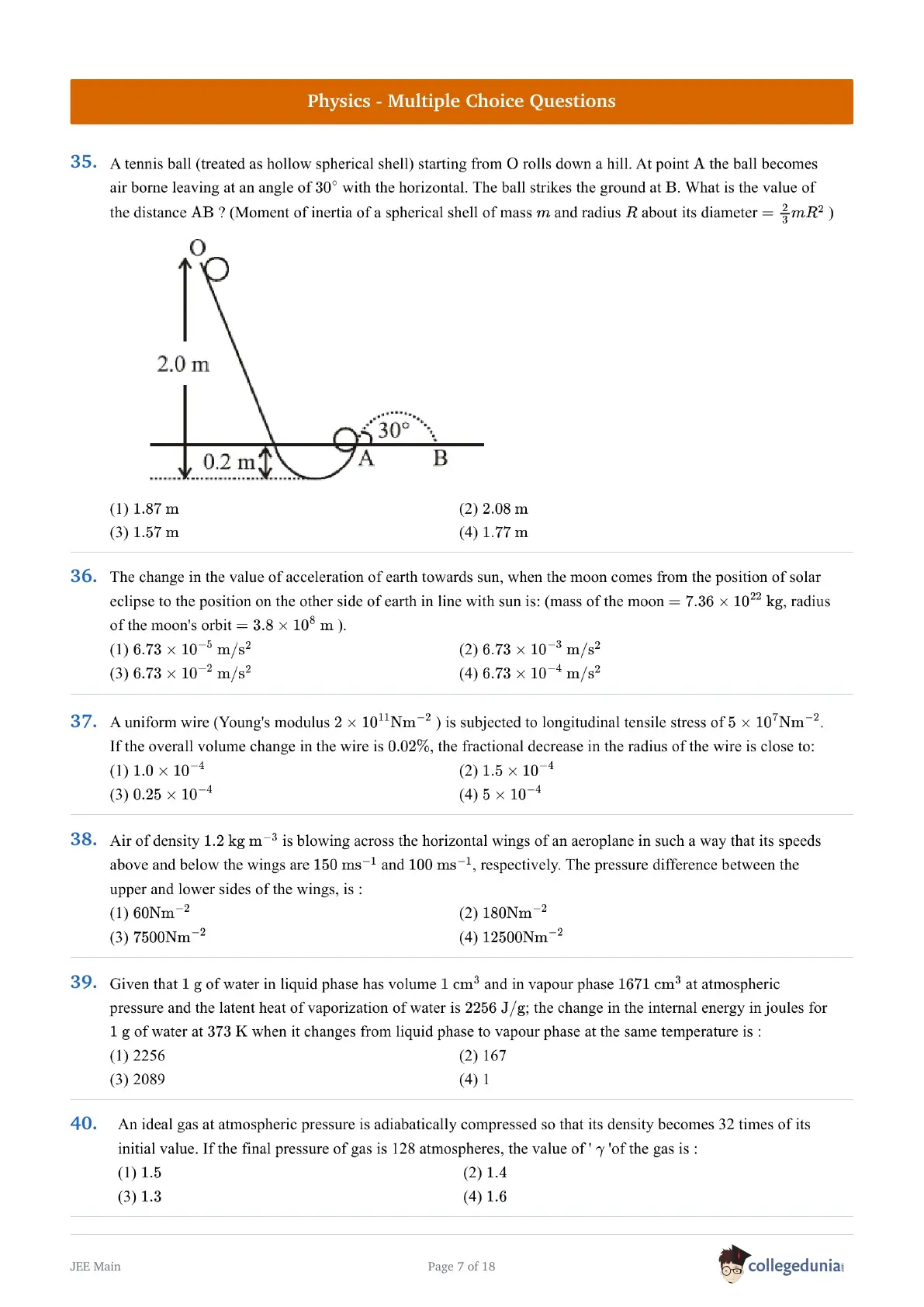
A tennis ball (treated as hollow spherical shell) starting from \( O \) rolls down a hill. At point A the ball becomes air borne leaving at an angle of \( 30^\circ \) with the horizontal. The ball strikes the ground at \( B \). What is the value of the distance \( AB \) ? (Moment of inertia of a spherical shell of mass \( m \) and radius \( R \) about its diameter \( =\frac{2}{3}mR^{2} \) )
The change in the value of acceleration of earth towards sun, when the moon comes from the position of solar eclipse to the position on the other side of earth in line with sun is: (mass of the moon \(=7.36\times10^{22}\) kg, radius of the moon's orbit \(=3.8\times10^{8}\) m ).
A uniform wire (Young?s modulus \( 2 \times 10^{11}\,Nm^{-2} \)) is subjected to longitudinal tensile stress of \( 5 \times 10^{7}\,Nm^{-2} \). If the overall volume change in the wire is \( 0.02\% \), the fractional decrease in the radius of the wire is close to:
Air of density \( 1.2\, kg\, m^{-3} \) is blowing across the horizontal wings of an aeroplane in such a way that its speeds above and below the wings are \( 150\, ms^{-1} \) and \( 100\, ms^{-1} \), respectively. The pressure difference between the upper and lower sides of the wings, is :
Given that 1 g of water in liquid phase has volume 1 cm\(^3\) and in vapour phase 1671 cm\(^3\) at atmospheric pressure and the latent heat of vaporization of water is 2256 J/g; the change in the internal energy in joules for 1 g of water at 373 K when it changes from liquid phase to vapour phase at the same temperature is :
An ideal gas at atmospheric pressure is adiabatically compressed so that its density becomes \( 32 \) times of its initial value. If the final pressure of gas is \( 128 \) atmospheres, the value of ?\( \gamma \)?of the gas is :
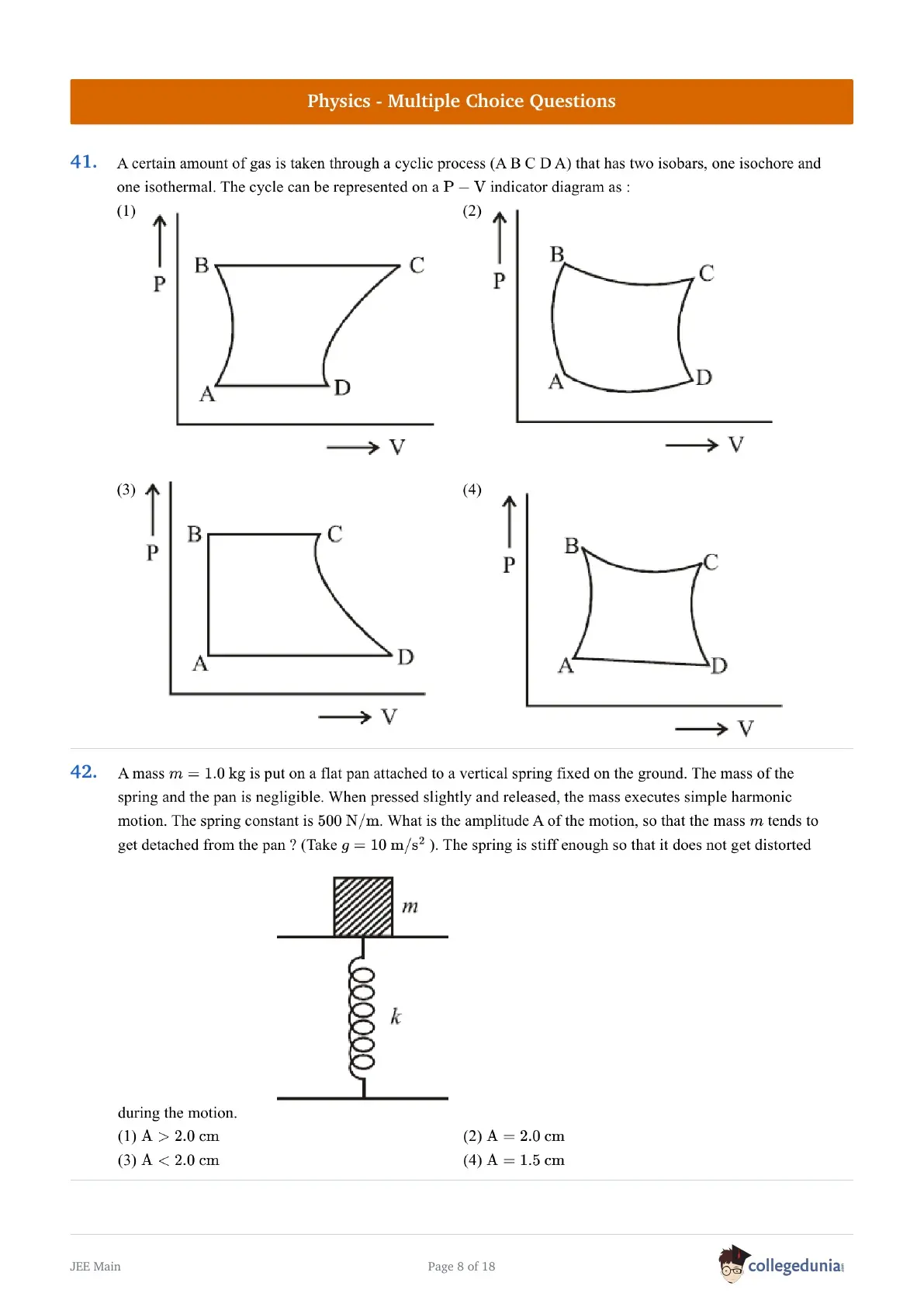
A certain amount of gas is taken through a cyclic process (A B C D A) that has two isobars, one isochore and one isothermal. The cycle can be represented on a \(P-V\) indicator diagram as :
- (A)
![]()
- (B)
![]()
- (C)
![]()
- (D)
![]()


A mass \(m=1.0\) kg is put on a flat pan attached to a vertical spring fixed on the ground. The mass of the spring and the pan is negligible. When pressed slightly and released, the mass executes simple harmonic motion. The spring constant is 500 N/m. What is the amplitude A of the motion, so that the mass \(m\) tends to get detached from the pan ? (Take \(g=10\ \mathrm{m/s^2}\) ). The spring is stiff enough so that it does not get distorted during the motion. 
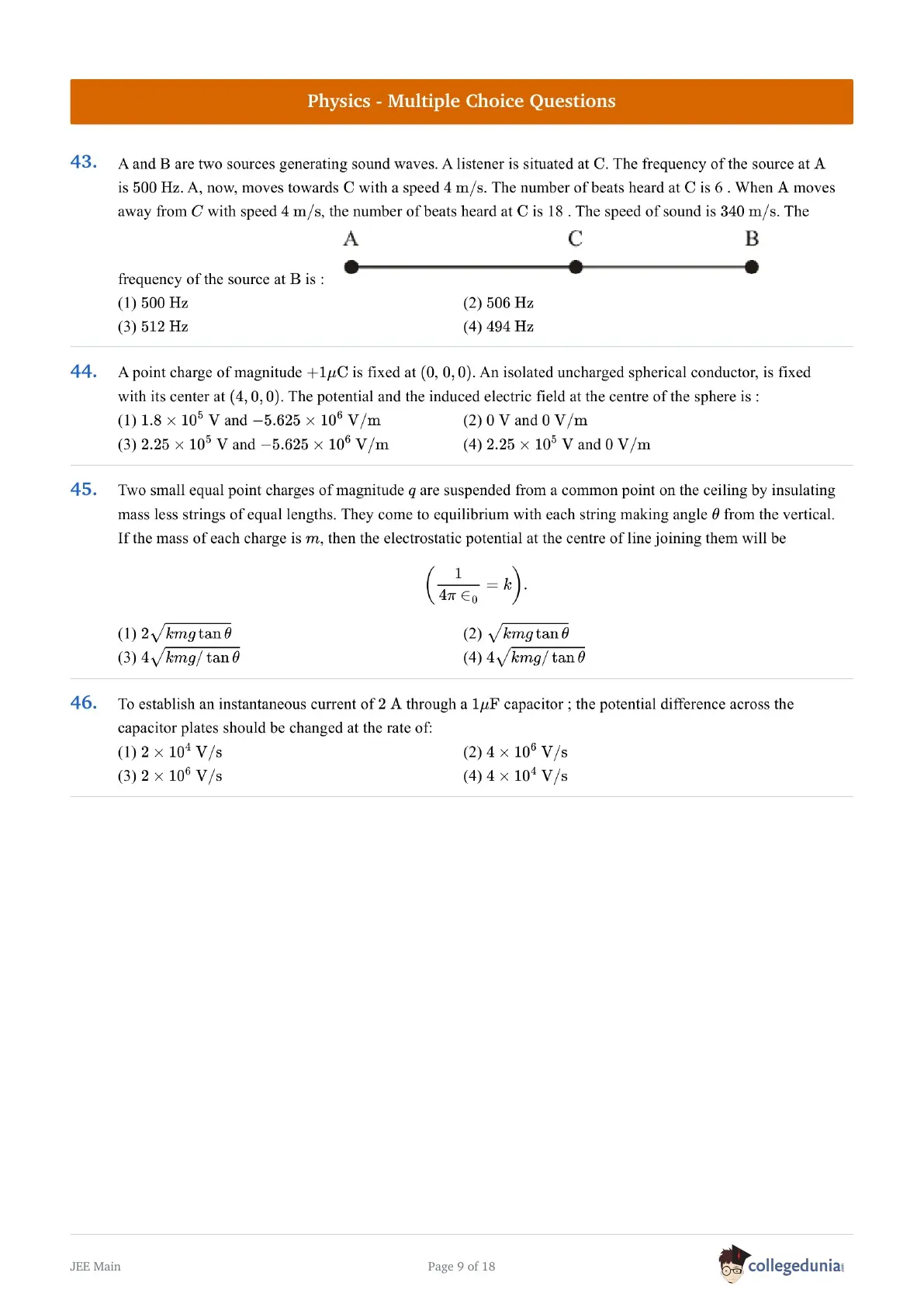
A and B are two sources generating sound waves. A listener is situated at C. The frequency of the source at A is 500 Hz. A, now, moves towards C with a speed 4 m/s. The number of beats heard at C is 6. When A moves away from C with speed 4 m/s, the number of beats heard at C is 18. The speed of sound is 340 m/s.  The frequency of the source at B is :
A point charge of magnitude \(+1\,\mu\mathrm{C}\) is fixed at \((0,0,0)\). An isolated uncharged spherical conductor, is fixed with its center at \((4,0,0)\). The potential and the induced electric field at the centre of the sphere is :
Two small equal point charges of magnitude \( q \) are suspended from a common point on the ceiling by insulating mass less strings of equal lengths. They come to equilibrium with each string making angle \( \theta \) from the vertical. If the mass of each charge is \( m \), then the electrostatic potential at the centre of line joining them will be \( \left(\frac{1}{4\pi\,\in_{0}}=k\right). \)
To establish an instantaneous current of \( 2 A \) through a \( 1 \mu F \) capacitor; the potential difference across the capacitor plates should be changed at the rate of :
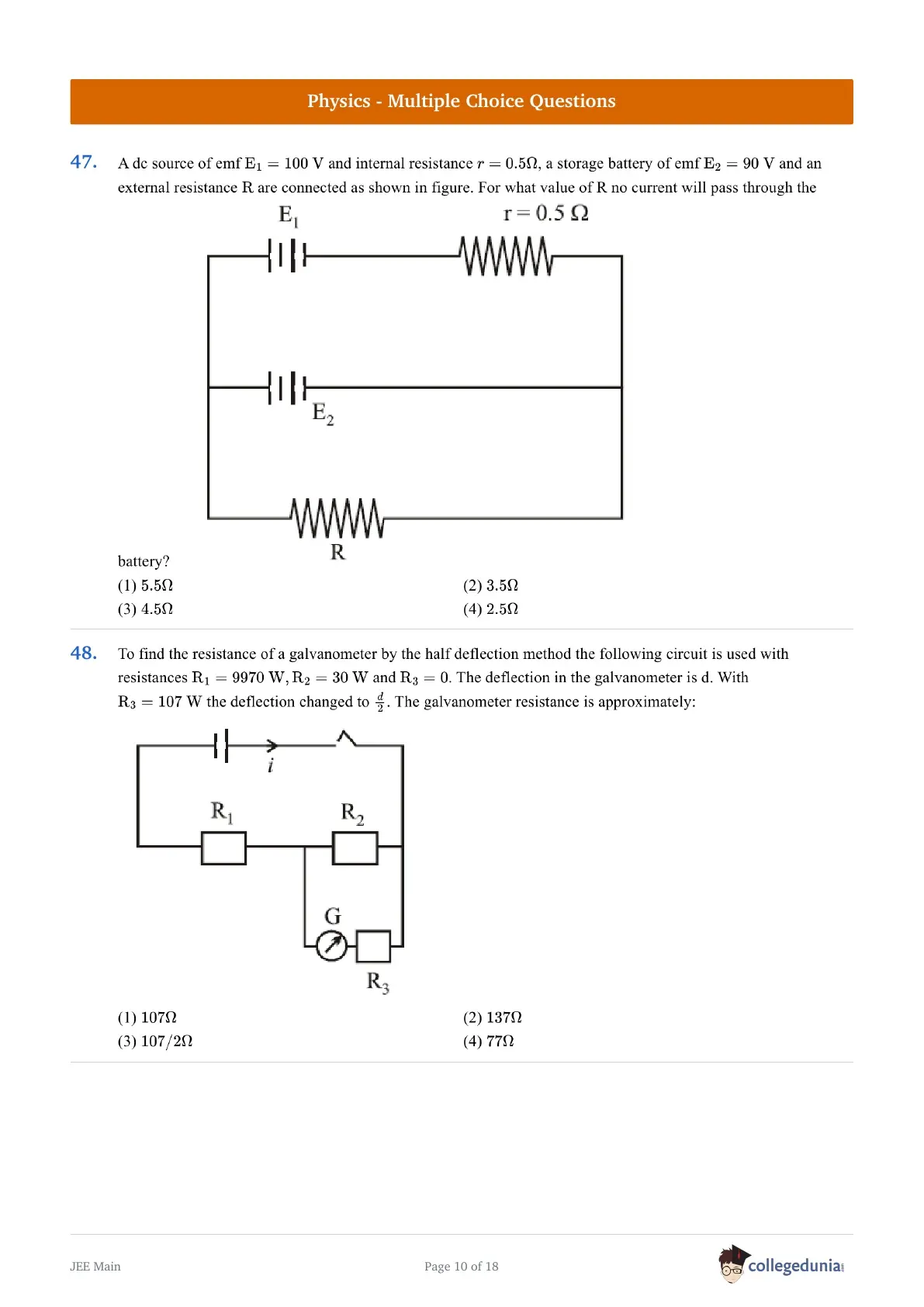
A dc source of emf \(E_1=100\) V and internal resistance \(r=0.5\ \Omega\), a storage battery of emf \(E_2=90\) V and an external resistance R are connected as shown in figure. For what value of R no current will pass through the battery? 
To find the resistance of a galvanometer by the half deflection method the following circuit is used with resistances \(R_1=9970\ \Omega\), \(R_2=30\ \Omega\) and \(R_3=0\). The deflection in the galvanometer is d. With \(R_3=107\ \Omega\) the deflection changed to \(\frac d2\). The galvanometer resistance is approximately: 
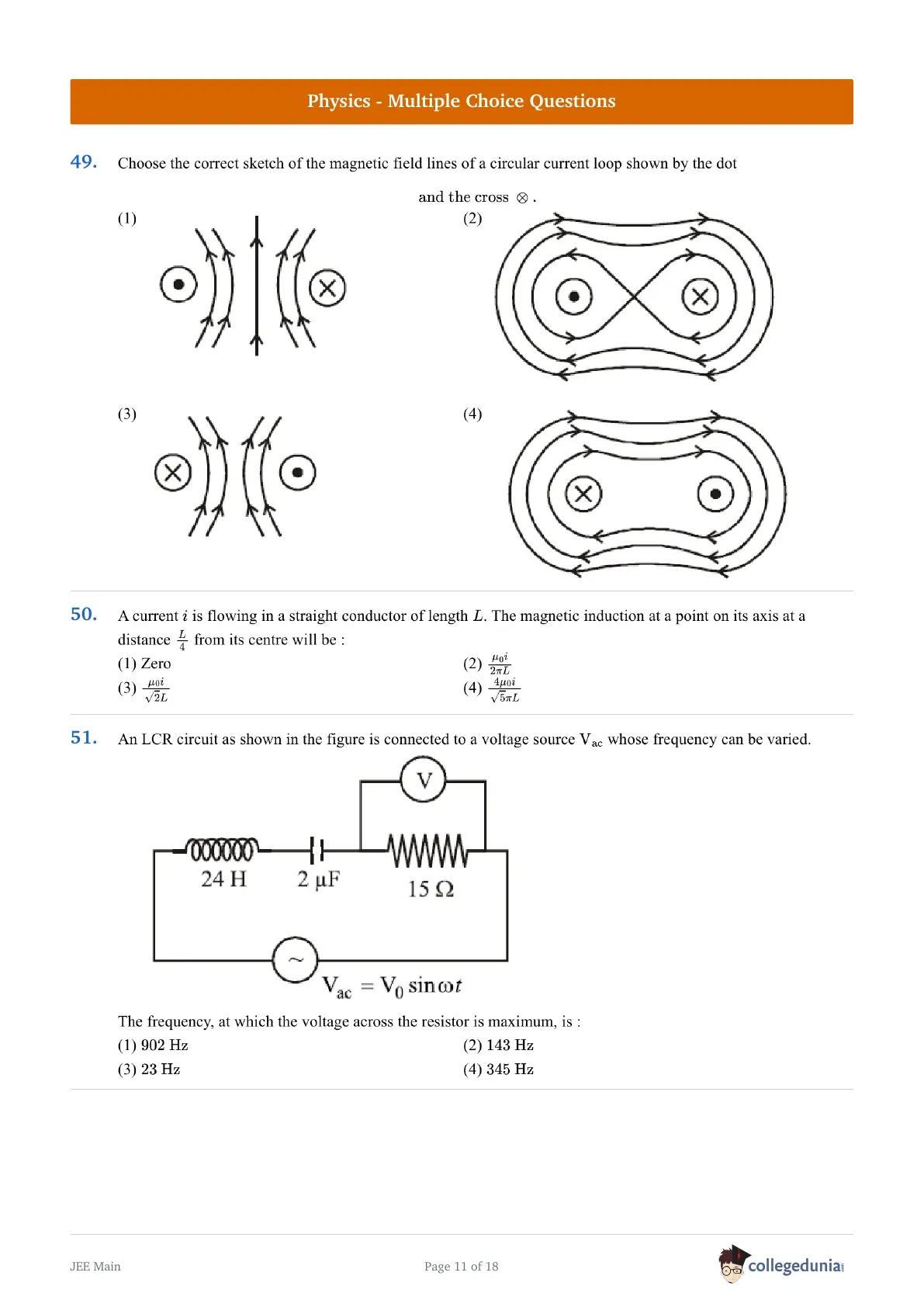
Choose the correct sketch of the magnetic field lines of a circular current loop shown by the dot ? and the cross ?.
- (A)
![]()
- (B)
![]()
- (C)
![]()
- (D)
![]()


A current \(i\) is flowing in a straight conductor of length \(L\). The magnetic induction at a point on its axis at a distance \(\frac{L}{4}\) from its centre will be :
An LCR circuit as shown in the figure is connected to a voltage source \(V_{ac}\) whose frequency can be varied. 
(Circuit: inductor 24 H, capacitor 2 \(\mu\)F and resistor 15 \(\Omega\) in series with the source \(V_{ac} = V_0 \sin\omega t\); a voltmeter V is connected across the resistor.)
The frequency, at which the voltage across the resistor is maximum, is :
In a series L - C - R circuit, \(C = 10^{-11}\) Farad, \(L = 10^{-5}\) Henry and \(R = 100\) Ohm, when a constant D.C. voltage \(E\) is applied to the circuit, the capacitor acquires a charge \(10^{-9}\) C. The D.C. source is replaced by a sinusoidal voltage source in which the peak voltage \(E_0\) is equal to the constant D.C. voltage \(E\). At resonance the peak value of the charge acquired by the capacitor will be :
A plane electromagnetic wave in a non-magnetic dielectric medium is given by \( \vec{E}=\vec{E}_{0}\left(4\times10^{-7}\,x-50t\right) \) with distance being in meter and time in seconds. The dielectric constant of the medium is:
The focal length of the objective and the eyepiece of a telescope are 50 cm and 5 cm respectively. If the telescope is focussed for distinct vision on a scale distant 2 m from its objective, then its magnifying power will be :
The image of an illuminated square is obtained on a screen with the help of a converging lens. The distance of the square from the lens is \( 40\, cm \). The area of the image is \( 9 \) times that of the square. The focal length of the lens is :
This question has Statement-1 and Statement-2. Of the four choices given after the Statements, choose the one that best describes the two Statements.
Statement-1: Short wave transmission is achieved due to the total internal reflection of the e-m wave from an appropriate height in the ionosphere.
Statement-2: Refractive index of a plasma is independent of the frequency of e-m waves.
This question has Statement-1 and Statement-2. Of the four choices given after the Statements, choose the one that best describes the two Statements.
Statement-1: In Young's double slit experiment, the number of fringes observed in the field of view is small with longer wavelength of light and is large with shorter wavelength of light.
Statement-2: In the double slit experiment the fringe width depends directly on the wavelength of light.
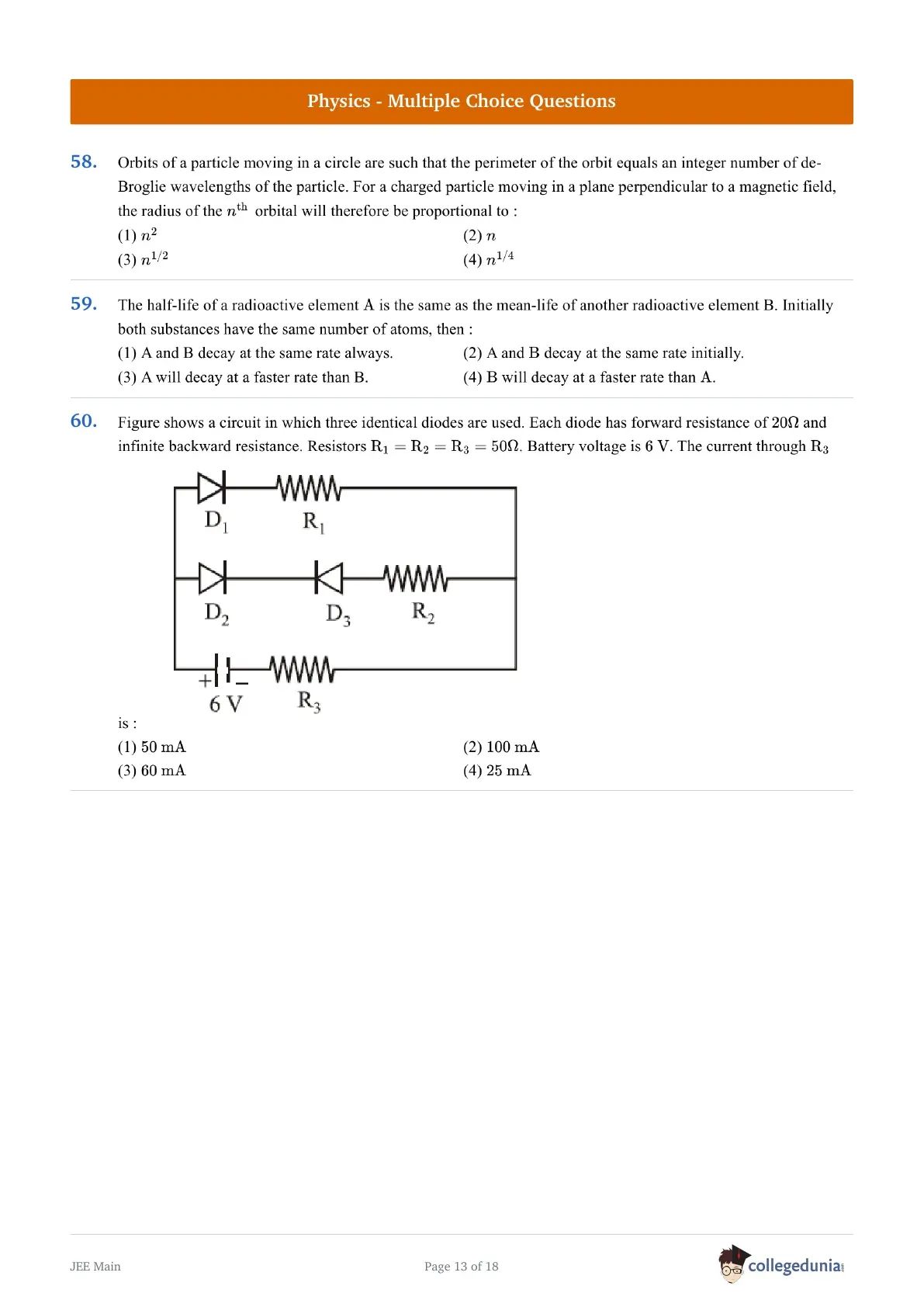
Orbits of a particle moving in a circle are such that the perimeter of the orbit equals an integer number of de-Broglie wavelengths of the particle. For a charged particle moving in a plane perpendicular to a magnetic field, the radius of the \(n^{\mathrm{th}}\) orbital will therefore be proportional to :
The half-life of a radioactive element A is the same as the mean-life of another radioactive element B. Initially both substances have the same number of atoms, then :
Figure shows a circuit in which three identical diodes are used. Each diode has forward resistance of \( 20 \,\Omega \) and infinite backward resistance. Resistors \( R_{1}=R_{2}=R_{3}=50\,\Omega \). Battery voltage is \( 6\, V \). The current through \( R_3 \) is:
Chemistry (Q61 - Q90)
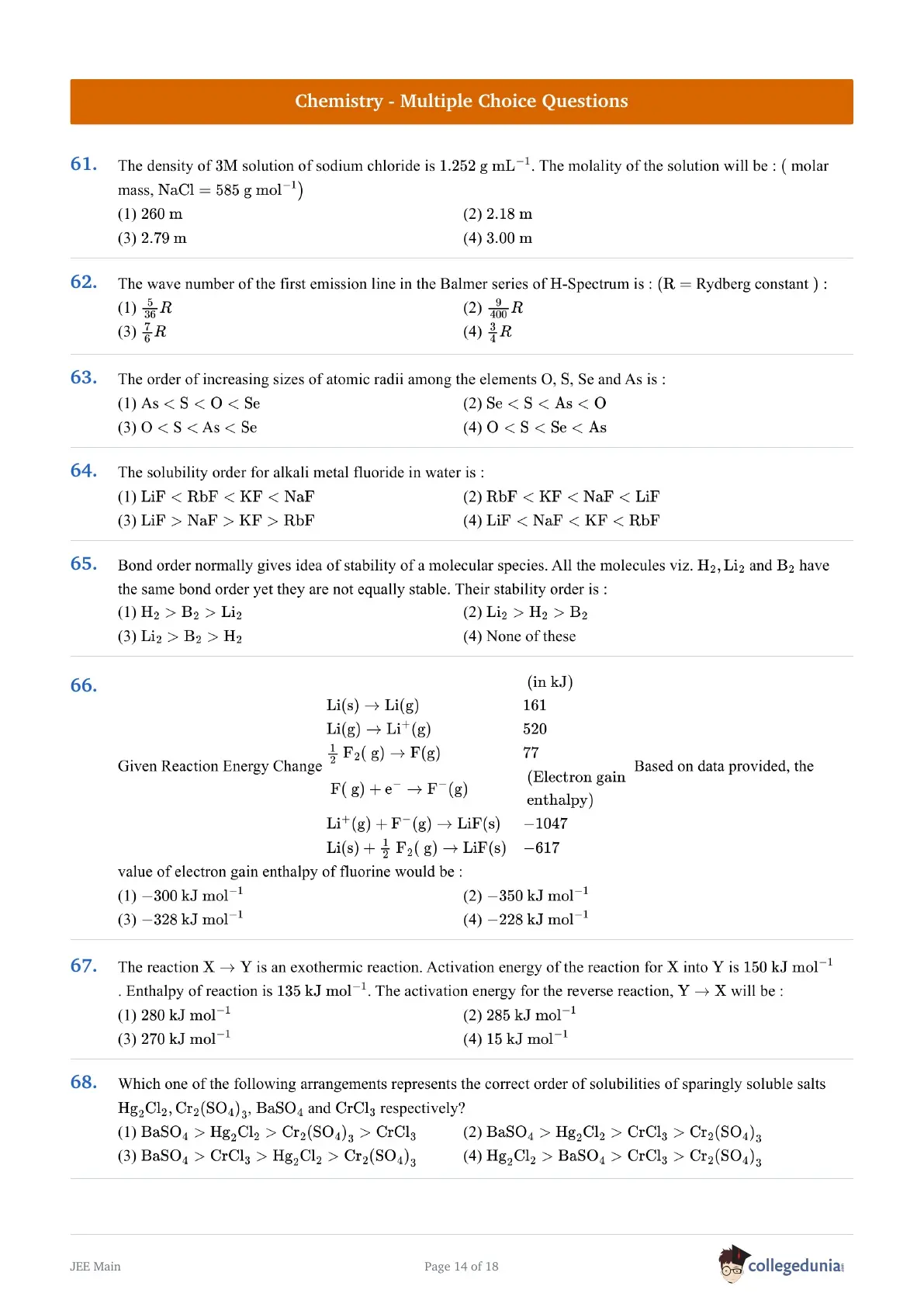
The density of \( 3M \) solution of sodium chloride is \( 1.252\, g\, mL^{-1} \). The molality of the solution will be: (molar mass, \( NaCl = 585\, g\, mol^{-1} \))
The wave number of the first emission line in the Balmer series of H-Spectrum is : (\(R\) = Rydberg constant)
The order of increasing sizes of atomic radii among the elements \( O, S, Se \) and \( As \) is :
The solubility order for alkali metal fluoride in water is :
Bond order normally gives idea of stability of a molecular species. All the molecules viz. \(\mathrm{H_2}\), \(\mathrm{Li_2}\) and \(\mathrm{B_2}\) have the same bond order yet they are not equally stable. Their stability order is :
Given
| Reaction | Energy Change (in kJ) |
| \(\mathrm{Li(s)} \to \mathrm{Li(g)}\) | 161 |
| \(\mathrm{Li(g)} \to \mathrm{Li^+(g)}\) | 520 |
| \(\frac{1}{2}\mathrm{F_2(g)} \to \mathrm{F(g)}\) | 77 |
| \(\mathrm{F(g)} + \mathrm{e^-} \to \mathrm{F^-(g)}\) | (Electron gain enthalpy) |
| \(\mathrm{Li^+(g)} + \mathrm{F^-(g)} \to \mathrm{LiF(s)}\) | \(-1047\) |
| \(\mathrm{Li(s)} + \frac{1}{2}\mathrm{F_2(g)} \to \mathrm{LiF(s)}\) | \(-617\) |
The reaction \(\mathrm{X} \to \mathrm{Y}\) is an exothermic reaction. Activation energy of the reaction for X into Y is 150 kJ mol-1. Enthalpy of reaction is 135 kJ mol-1. The activation energy for the reverse reaction, \(\mathrm{Y} \to \mathrm{X}\) will be :
Which one of the following arrangements represents the correct order of solubilities of sparingly soluble salts \(\mathrm{Hg_2Cl_2}\), \(\mathrm{Cr_2(SO_4)_3}\), \(\mathrm{BaSO_4}\) and \(\mathrm{CrCl_3}\) respectively?
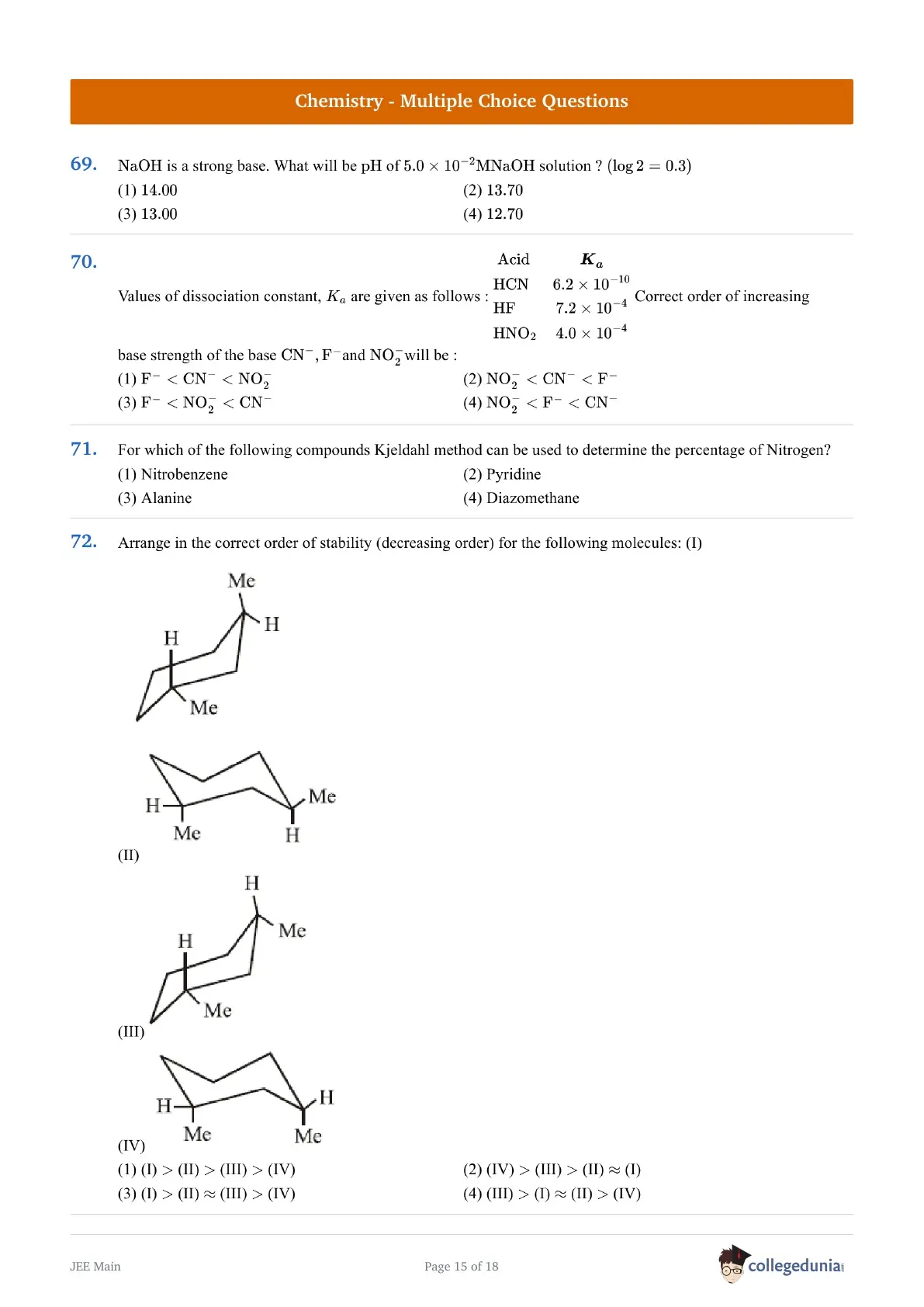
NaOH is a strong base. What will be pH of \(5.0\times10^{-2}\) M NaOH solution ? (\(\log 2 = 0.3\))
Values of dissociation constant, \(K_a\) are given as follows :
| Acid | \(K_a\) |
| HCN | \(6.2\times10^{-10}\) |
| HF | \(7.2\times10^{-4}\) |
| \(\mathrm{HNO_2}\) | \(4.0\times10^{-4}\) |
For which of the following compounds Kjeldahl method can be used to determine the percentage of Nitrogen ?
Arrange in the correct order of stability (decreasing order) for the following molecules :
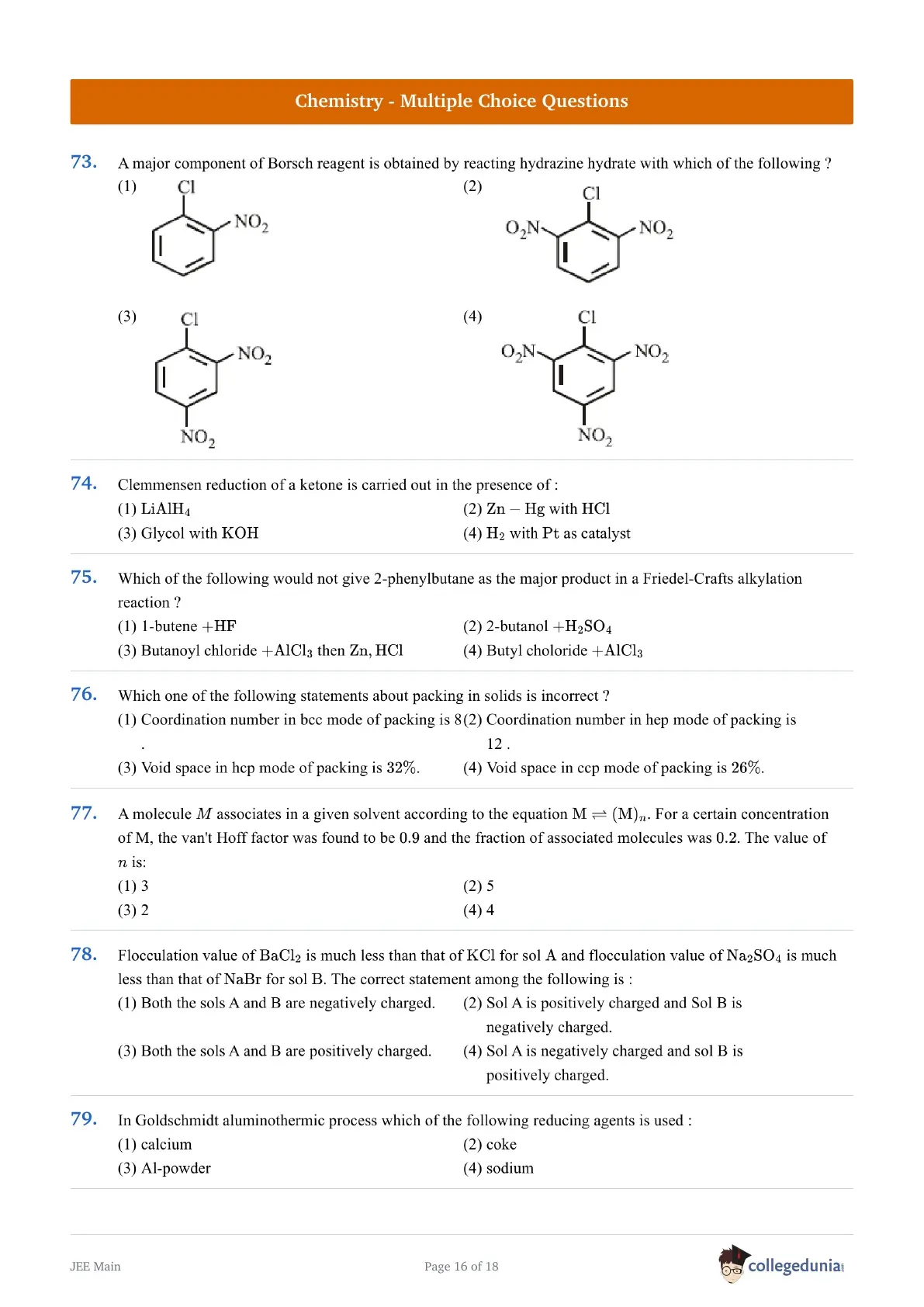
A major component of Borsch reagent is obtained by reacting hydrazine hydrate with which of the following ?
- (A)
![]()
- (B)
![]()
- (C)
![]()
- (D)
![]()


Clemmensen reduction of a ketone is carried out in the presence of :
Which of the following would not give 2-phenylbutane as the major product in a Friedel-Crafts alkylation reaction ?
Which one of the following statements about packing in solids is ?
A molecule \(M\) associates in a given solvent according to the equation \(\mathrm{M} \rightleftharpoons (\mathrm{M})_n\). For a certain concentration of M, the van't Hoff factor was found to be 0.9 and the fraction of associated molecules was 0.2. The value of \(n\) is :
Flocculation value of \(\mathrm{BaCl_2}\) is much less than that of \(\mathrm{KCl}\) for sol A and flocculation value of \(\mathrm{Na_2SO_4}\) is much less than that of \(\mathrm{NaBr}\) for sol B. The correct statement among the following is :
In Goldschmidt aluminothermic process which of the following reducing agents is used:
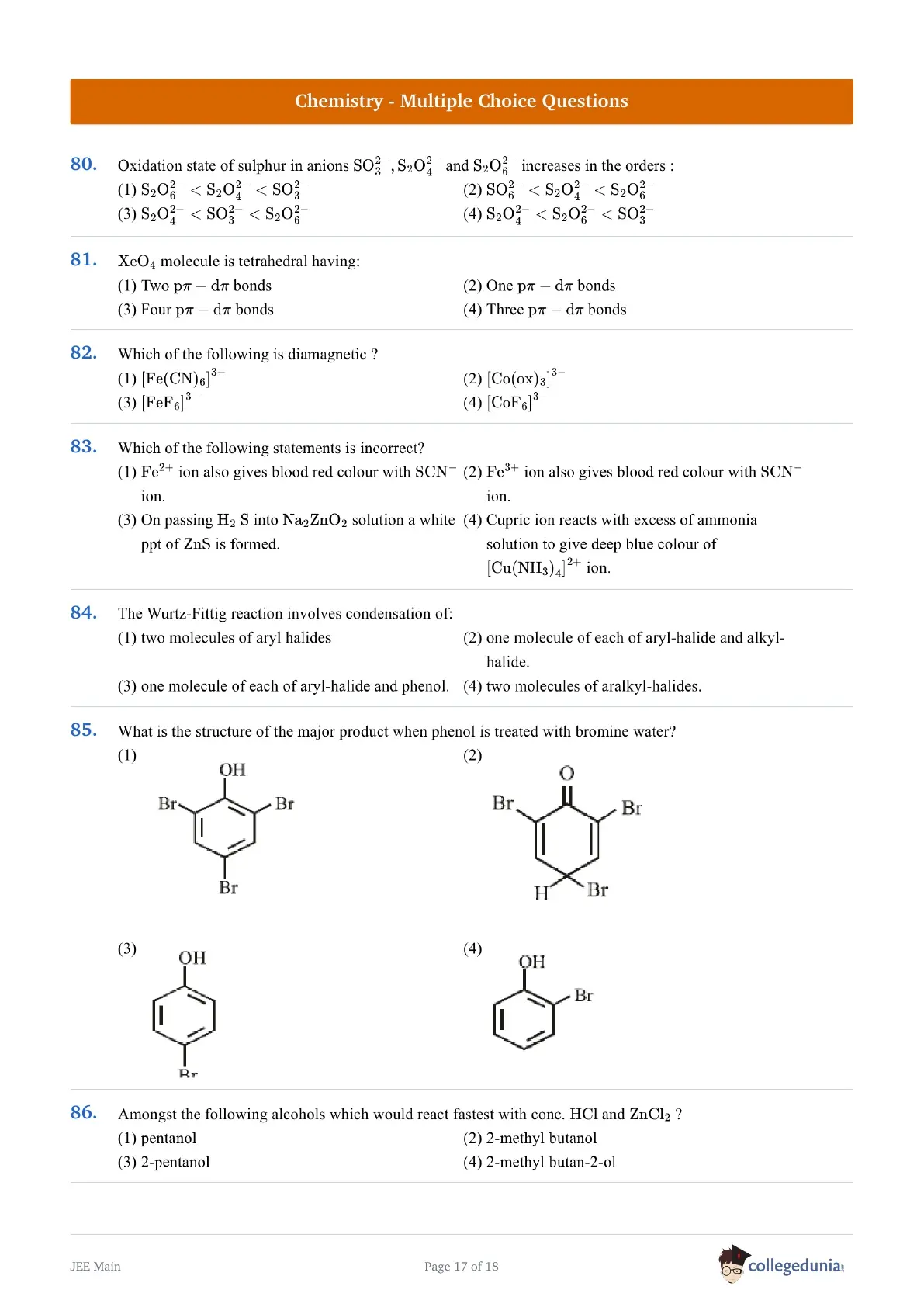
Oxidation state of sulphur in anions \( SO^{2-}_{3}. S_{2}O^{2-}_{4} \) and \( S_{2}O^{2-}_{6} \) increases in the orders:
\( XeO_4 \) molecule is tetrahedral having :
Which of the following is diamagnetic?
Which of the following statements is incorrect?
The Wurtz-Fittig reaction involves condensation of:
What is the structure of the major product when phenol is treated with bromine water?
- (A)
![]()
- (B)
![]()
- (C)
![]()
- (D)
![]()


Amongst the following alcohols which would react fastest with conc. \(\mathrm{HCl}\) and \(\mathrm{ZnCl_2}\) ?
In Williamson synthesis of mixed ether having a primary and a tertiary alkyl group if tertiary halide is used, then :
The polymer used for optical lenses is :
Which of the following statements about aspirin is not true?
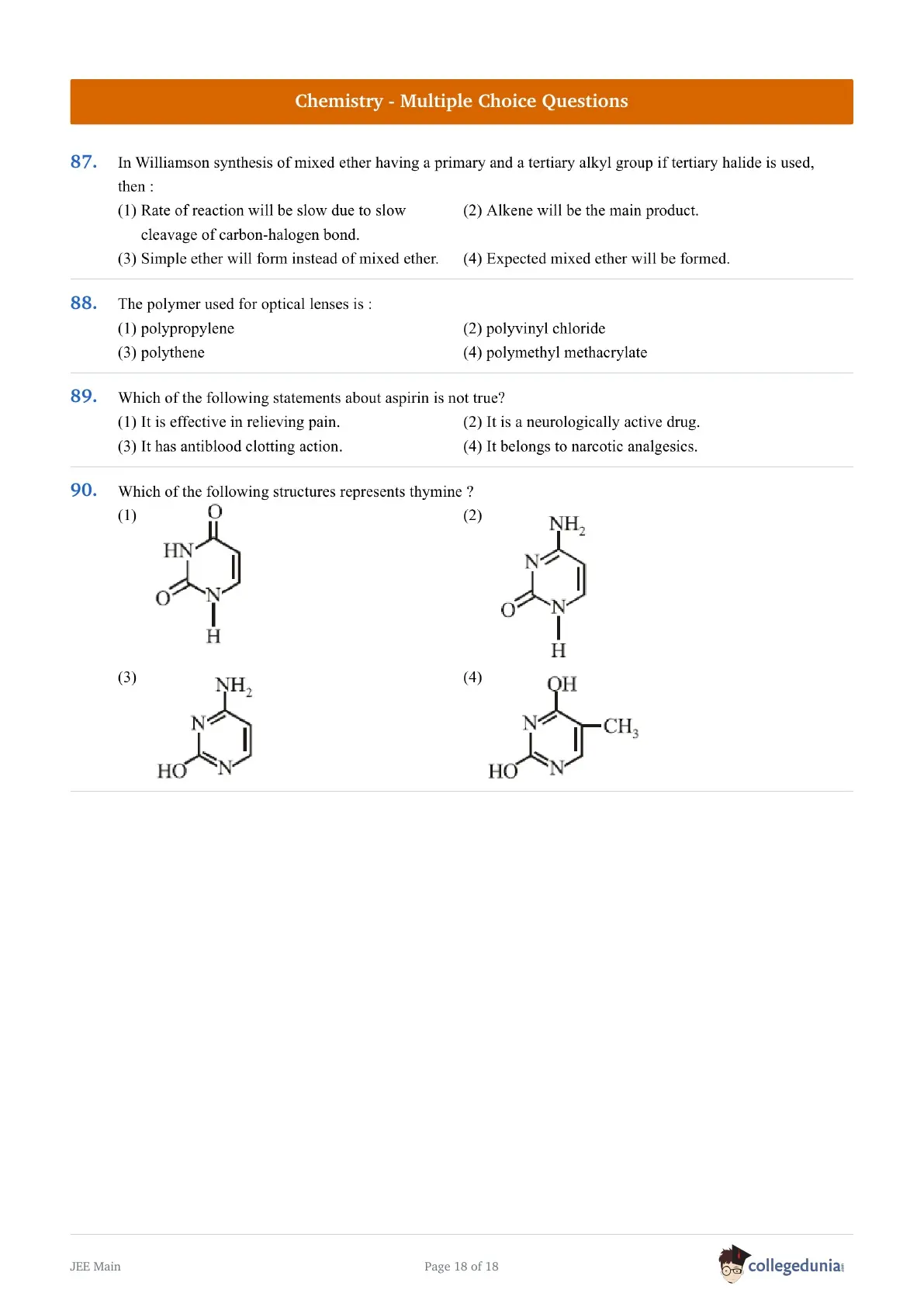
Which of the following structures represents thymine?
- (A)
![Which of the following structures represents thymine]()
- (B)
![Which of the following structures represents thymine]()
- (C)
![Which of the following structures represents thymine]()
- (D)
![Which of the following structures represents thymine]()


JEE Main 2013 Exam Pattern and Marking Scheme
| Particulars | Details |
|---|---|
| Exam Mode | Online (Computer-Based Test) |
| Paper | B.E./B.Tech (Paper 1) |
| Duration | 3 hours (180 minutes) |
| Type of Questions | Multiple Choice Questions (MCQs) |
| Subjects | Mathematics, Physics, Chemistry |
| Total Questions | 90 questions (30 per subject) |
| Total Marks | 360 marks |
| Marking Scheme | +4 for correct answer & -1 for incorrect answer |



Comments