




JEE Main 2013 April 23 Question Paper is available here with solutions PDF and detailed solutions for every question. CBSE conducted the online (CBT) JEE Main 2013 Paper 1 (B.E./B.Tech) on April 23, 2013. The question paper includes the following:
- 90 questions in a 3-hour CBT Mode: 30 each from Mathematics, Physics and Chemistry
- Question type: multiple choice questions (MCQs) with 4 options, one correct answer
- Marking: +4 for a correct answer, -1 for an incorrect answer, 0 for an unattempted question
- Maximum marks: 360 (120 per subject)
JEE Main 2013 April 23 Question Paper with Solution PDF
| CBSE Official PDF | CD PDF | CD PDF with Solutions |
|---|---|---|
| Download official PDF 2.96 MB | Download Collegedunia PDF 4.68 MB | Download solutions PDF 0.94 MB |
Also Check:
JEE Main 2013 April 23 Questions with Solutions
Mathematics (Q1 - Q30)
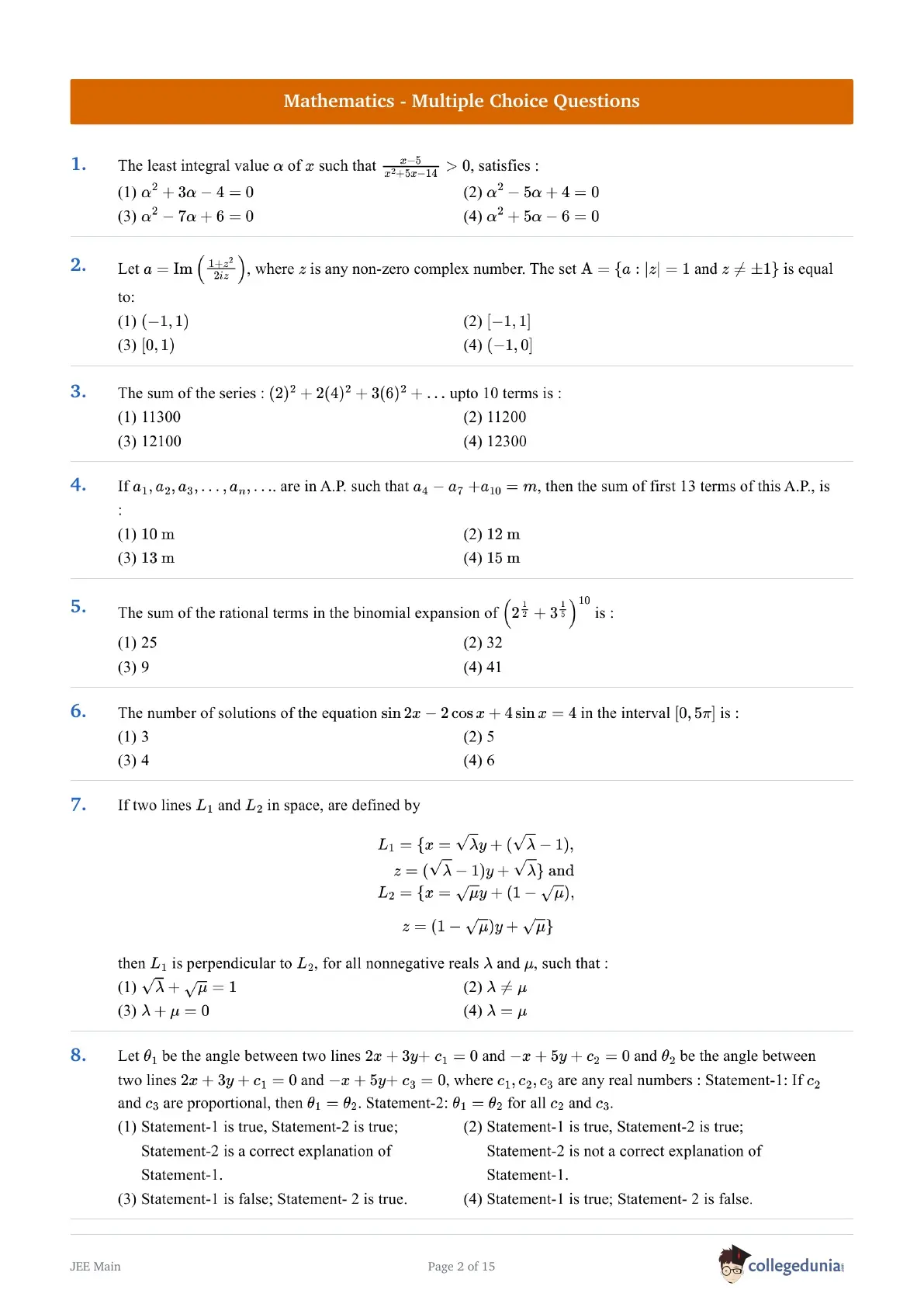
The least integral value \(\alpha\) of \(x\) such that \(\dfrac{x-5}{x^2+5x-14} \gt 0\), satisfies :
Let \( a=Im\left(\frac{1+z^{2}}{2iz}\right), \) where \( z \) is any non-zero complex number. The set \( A=\left\{a:\left|z\right|=1\,and\,z\ne\pm1\right\} \) is equal to:
The sum of the series : \((2)^2 + 2(4)^2 + 3(6)^2 + \ldots\) upto 10 terms is :
If \(a_1, a_2, a_3, \ldots, a_n, \ldots\) are in A.P. such that \(a_4 - a_7 + a_{10} = m\), then the sum of first 13 terms of this A.P., is :
The sum of the rational terms in the binomial expansion of \(\left(2^{\frac{1}{2}} + 3^{\frac{1}{5}}\right)^{10}\) is :
The number of solutions of the equation \(\sin 2x - 2\cos x + 4\sin x = 4\) in the interval \([0, 5\pi]\) is :
If two lines \(L_1\) and \(L_2\) in space, are defined by
\(L_1 = \{x = \sqrt{\lambda}\,y + (\sqrt{\lambda} - 1),\ z = (\sqrt{\lambda} - 1)\,y + \sqrt{\lambda}\}\) and
\(L_2 = \{x = \sqrt{\mu}\,y + (1 - \sqrt{\mu}),\ z = (1 - \sqrt{\mu})\,y + \sqrt{\mu}\}\)
then \(L_1\) is perpendicular to \(L_2\), for all nonnegative reals \(\lambda\) and \(\mu\), such that :
Let \(\theta_1\) be the angle between two lines \(2x + 3y + c_1 = 0\) and \(-x + 5y + c_2 = 0\) and \(\theta_2\) be the angle between two lines \(2x + 3y + c_1 = 0\) and \(-x + 5y + c_3 = 0\), where \(c_1, c_2, c_3\) are any real numbers :
Statement-1 : If \(c_2\) and \(c_3\) are proportional, then \(\theta_1 = \theta_2\).
Statement-2 : \(\theta_1 = \theta_2\) for all \(c_2\) and \(c_3\).
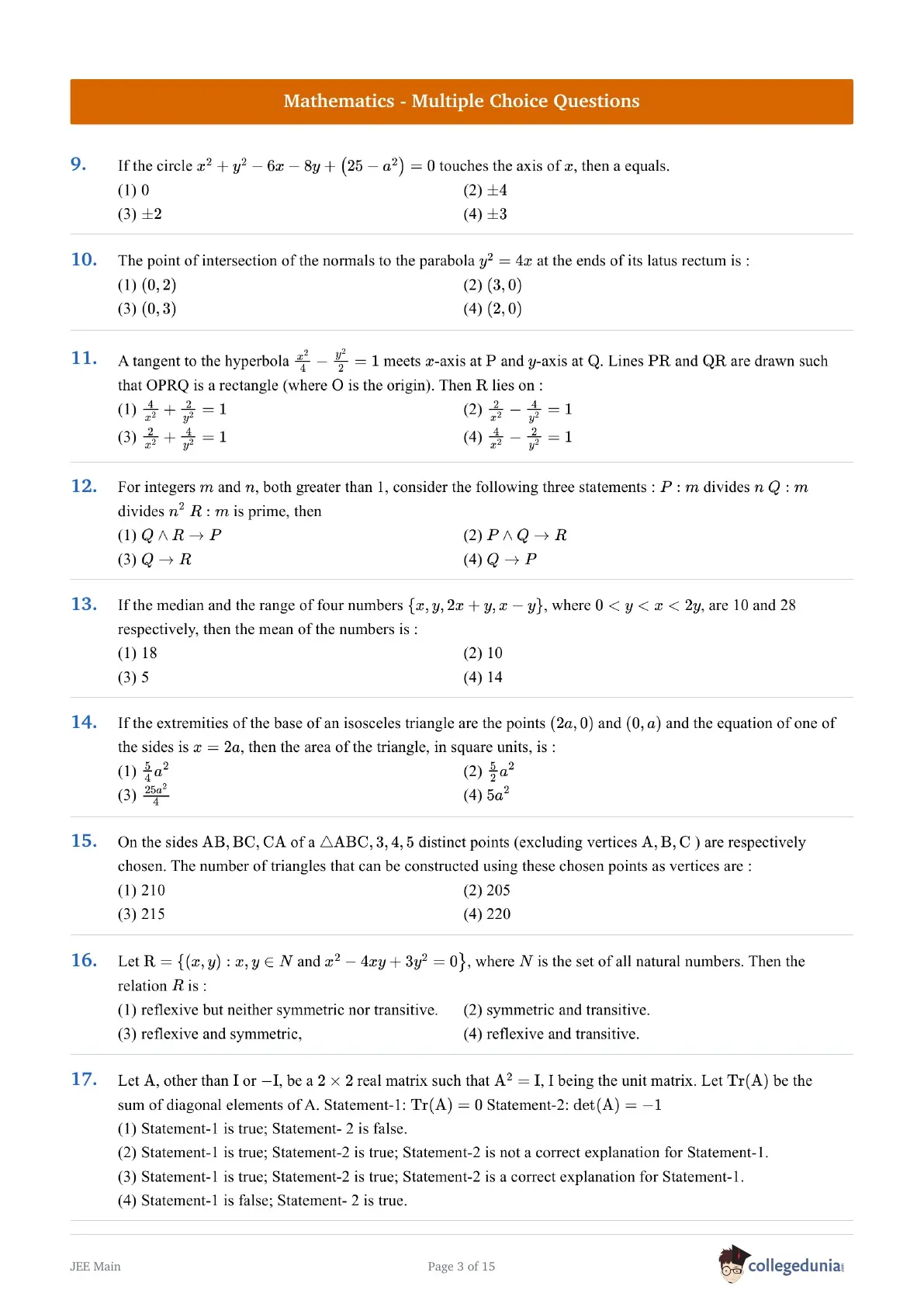
If the circle \(x^2 + y^2 - 6x - 8y + (25 - a^2) = 0\) touches the axis of \(x\), then \(a\) equals.
The point of intersection of the normals to the parabola \(y^2 = 4x\) at the ends of its latus rectum is :
A tangent to the hyperbola \( \frac{x^{4}}{4}-\frac{y^{2}}{2}=1 \) meets x-axis at \( P \) and y-axis at \( Q \). Lines \( PR \) and \( QR \) are drawn such that \( OPRQ \) is a rectangle (where \( O \) is the origin). Then \( R \) lies on :
For integers \(m\) and \(n\), both greater than 1, consider the following three statements : \(P : m\) divides \(n\) \(Q : m\) divides \(n^2\) \(R : m\) is prime, then
If the median and the range of four numbers \(\{x, y, 2x+y, x-y\}\), where \(0 \lt y \lt x \lt 2y\), are 10 and 28 respectively, then the mean of the numbers is :
If the extremities of the base of an isosceles triangle are the points \( (2a, 0) \) and \( (0, a) \) and the equation of one of the sides is \( x = 2a \), then the area of the triangle, in square units, is :
On the sides \( AB, BC, CA \) of a \( \Delta ABC, 3, 4, 5 \) distinct points (excluding vertices \( A, B, C \)) are respectively chosen. The number of triangles that can be constructed using these chosen points as vertices a re :
Let \(R=\{(x, y) : x, y \in N \text{ and } x^2-4xy+3y^2=0\}\), where \(N\) is the set of all natural numbers. Then the relation \(R\) is :
Let A, other than I or \(-I\), be a \(2 \times 2\) real matrix such that \(A^2=I\), I being the unit matrix. Let \(\mathrm{Tr}(A)\) be the sum of diagonal elements of A.
Statement-1: \(\mathrm{Tr}(A)=0\)
Statement-2: \(\det(A)=-1\)
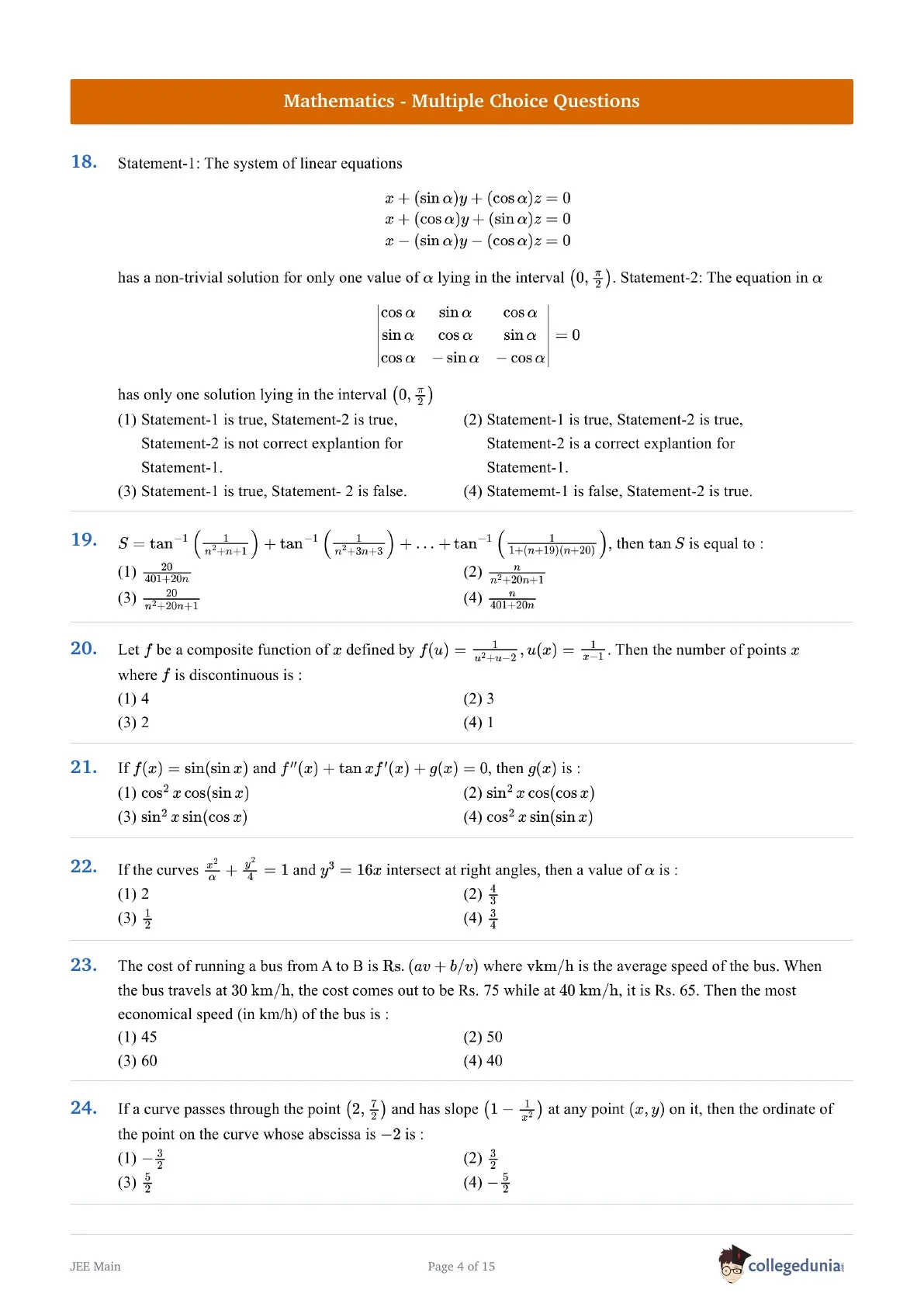
Statement-1: The system of linear equations
\(x+(\sin\alpha)y+(\cos\alpha)z=0\)
\(x+(\cos\alpha)y+(\sin\alpha)z=0\)
\(x-(\sin\alpha)y-(\cos\alpha)z=0\)
has a non-trivial solution for only one value of \(\alpha\) lying in the interval \(\left(0, \frac{\pi}{2}\right)\).
Statement-2: The equation in \(\alpha\)
\(\begin{vmatrix}\cos\alpha & \sin\alpha & \cos\alpha\\ \sin\alpha & \cos\alpha & \sin\alpha\\ \cos\alpha & -\sin\alpha & -\cos\alpha\end{vmatrix}=0\)
has only one solution lying in the interval \(\left(0, \frac{\pi}{2}\right)\)
\(S=\tan^{-1}\left(\frac{1}{n^2+n+1}\right)+\tan^{-1}\left(\frac{1}{n^2+3n+3}\right)+\ldots+\tan^{-1}\left(\frac{1}{1+(n+19)(n+20)}\right)\), then \(\tan S\) is equal to :
Let \(f\) be a composite function of \(x\) defined by \(f(u)=\frac{1}{u^2+u-2},\ u(x)=\frac{1}{x-1}\). Then the number of points \(x\) where \(f\) is discontinuous is :
If \( f(x) = sin\, (sin\, x) \) and \( f'' (x) + tan \,x\,f'(x)+ g(x) = 0, \) then \( g(x) \) is :
If the curves \(\frac{x^2}{\alpha}+\frac{y^2}{4}=1\) and \(y^3=16x\) intersect at right angles, then a value of \(\alpha\) is :
The cost of running a bus from \( A \) to \( B \) , is \( Rs.\left(av+\frac{b}{v}\right) \) where \( v \) km/h is the average speed of the bus. When the bus travels at \( 30\, km/h \), the cost comes out to be \( Rs.\, 75 \) while at \( 40\, km/h \), it is \( Rs. \,65 \). Then the most economical speed (in \( km/ h \)) of the bus is :
If a curve passes through the point \(\left(2, \frac{7}{2}\right)\) and has slope \(\left(1-\frac{1}{x^2}\right)\) at any point \((x, y)\) on it, then the ordinate of the point on the curve whose abscissa is \(-2\) is :
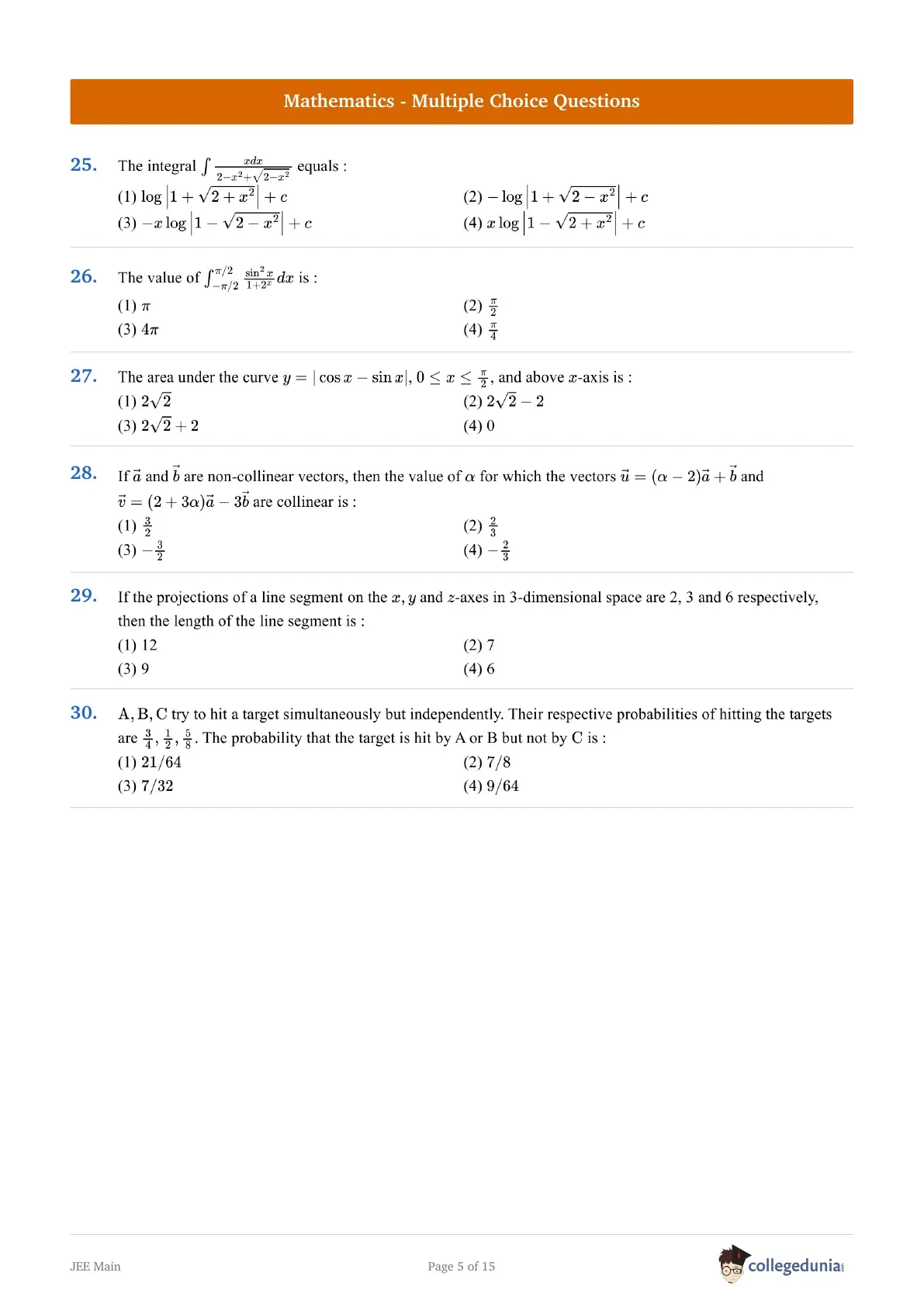
The integral \( \int \frac{xdx}{2-x^{2}+\sqrt{2-x^{2}}} \) equals
The value of \(\displaystyle\int_{-\pi/2}^{\pi/2}\dfrac{\sin^2 x}{1+2^x}\,dx\) is :
The area under the curve \(y=|\cos x-\sin x|,\ 0\le x\le\frac{\pi}{2}\), and above \(x\)-axis is :
If \( \vec{a} \) and \( \vec{b} \) are non-collinear vectors, then the value of a for which the vectors \( \vec{u}=\left(\alpha-2\right)\vec{a}+\vec{b} \) and \( \vec{v}=\left(2+3\alpha\right)\vec{a}-3\vec{b} \) are collinear is :
If the projections of a line segment on the \(x\), \(y\) and \(z\)-axes in 3-dimensional space are 2, 3 and 6 respectively, then the length of the line segment is :
A, B, C try to hit a target simultaneously but independently. Their respective probabilities of hitting the targets are \(\frac{3}{4},\frac{1}{2},\frac{5}{8}\). The probability that the target is hit by A or B but not by C is :
Physics (Q31 - Q60)
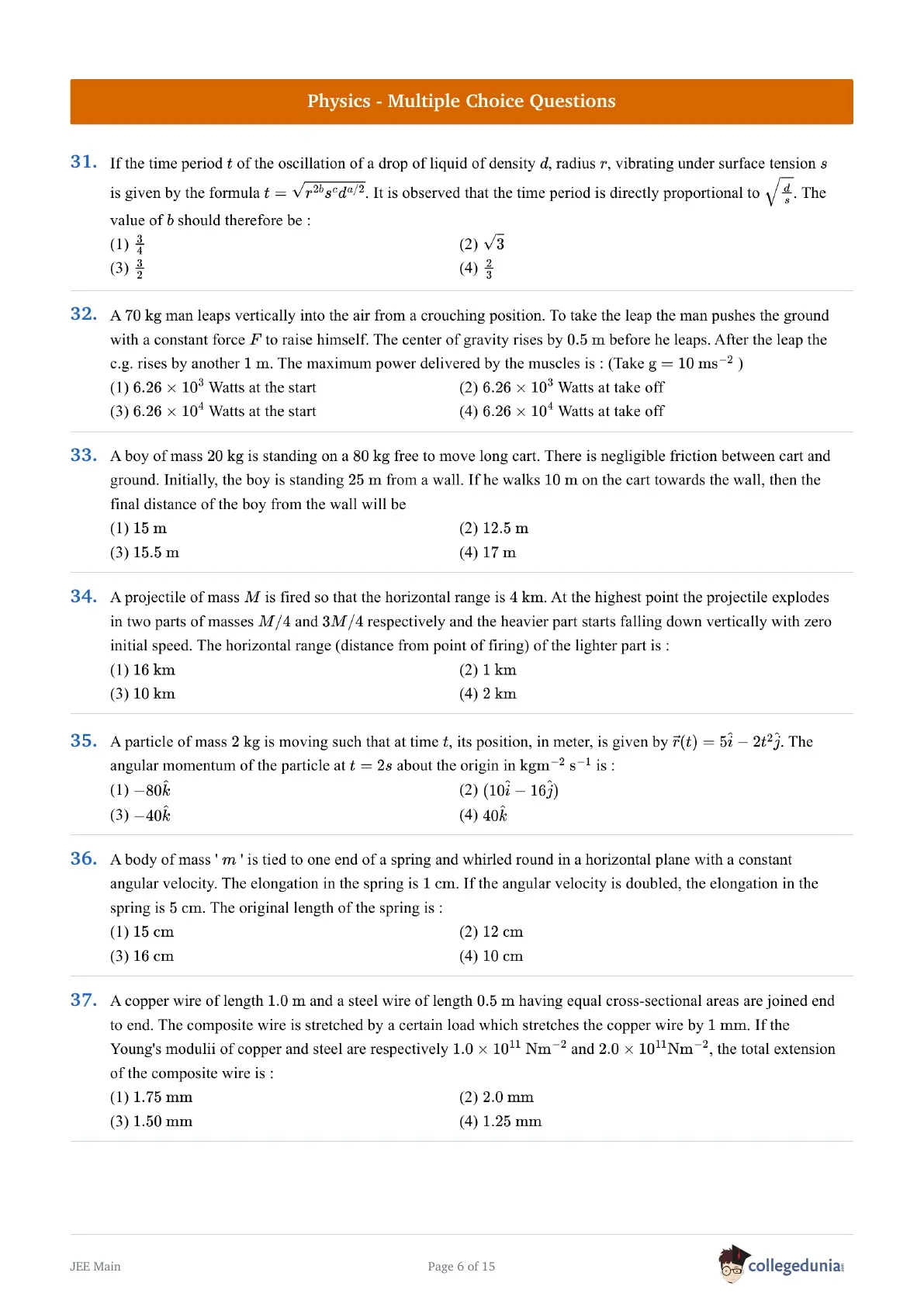
If the time period \( t \) of the oscillation of a drop of liquid of density \( d \), radius \( r \), vibrating under surface tension \( s \) is given by the formula \( t=\sqrt{r^{2b}s^{c}d^{a/2}}. \) It is observed that the time period is directly proportional to \( \sqrt{\frac{d}{s}}. \) The value of \( b \) should therefore be :
A 70 kg man leaps vertically into the air from a crouching position. To take the leap the man pushes the ground with a constant force \(F\) to raise himself. The center of gravity rises by 0.5 m before he leaps. After the leap the c.g. rises by another 1 m. The maximum power delivered by the muscles is : (Take \(g=10\ \mathrm{ms^{-2}}\))
A boy of mass 20 kg is standing on a 80 kg free to move long cart. There is negligible friction between cart and ground. Initially, the boy is standing 25 m from a wall. If he walks 10 m on the cart towards the wall, then the final distance of the boy from the wall will be
A projectile of mass \( M \) is fired so that the horizontal range is \( 4\, km \). At the highest point the projectile explodes in two parts of masses \( M/4 \) and \( 3M/4 \) respectively and the heavier part starts falling down vertically with zero initial speed. The horizontal range (distance from point of firing) of the lighter part is :
A particle of mass 2 kg is moving such that at time \(t\), its position, in meter, is given by \(\vec{r}(t)=5\hat{i}-2t^2\hat{j}\). The angular momentum of the particle at \(t=2\,\mathrm{s}\) about the origin in \(\mathrm{kgm^{-2}\,s^{-1}}\) is :
A body of mass ' \(m\) ' is tied to one end of a spring and whirled round in a horizontal plane with a constant angular velocity. The elongation in the spring is 1 cm. If the angular velocity is doubled, the elongation in the spring is 5 cm. The original length of the spring is :
A copper wire of length 1.0 m and a steel wire of length 0.5 m having equal cross-sectional areas are joined end to end. The composite wire is stretched by a certain load which stretches the copper wire by 1 mm. If the Young's modulii of copper and steel are respectively \(1.0\times10^{11}\ \mathrm{Nm^{-2}}\) and \(2.0\times10^{11}\ \mathrm{Nm^{-2}}\), the total extension of the composite wire is :
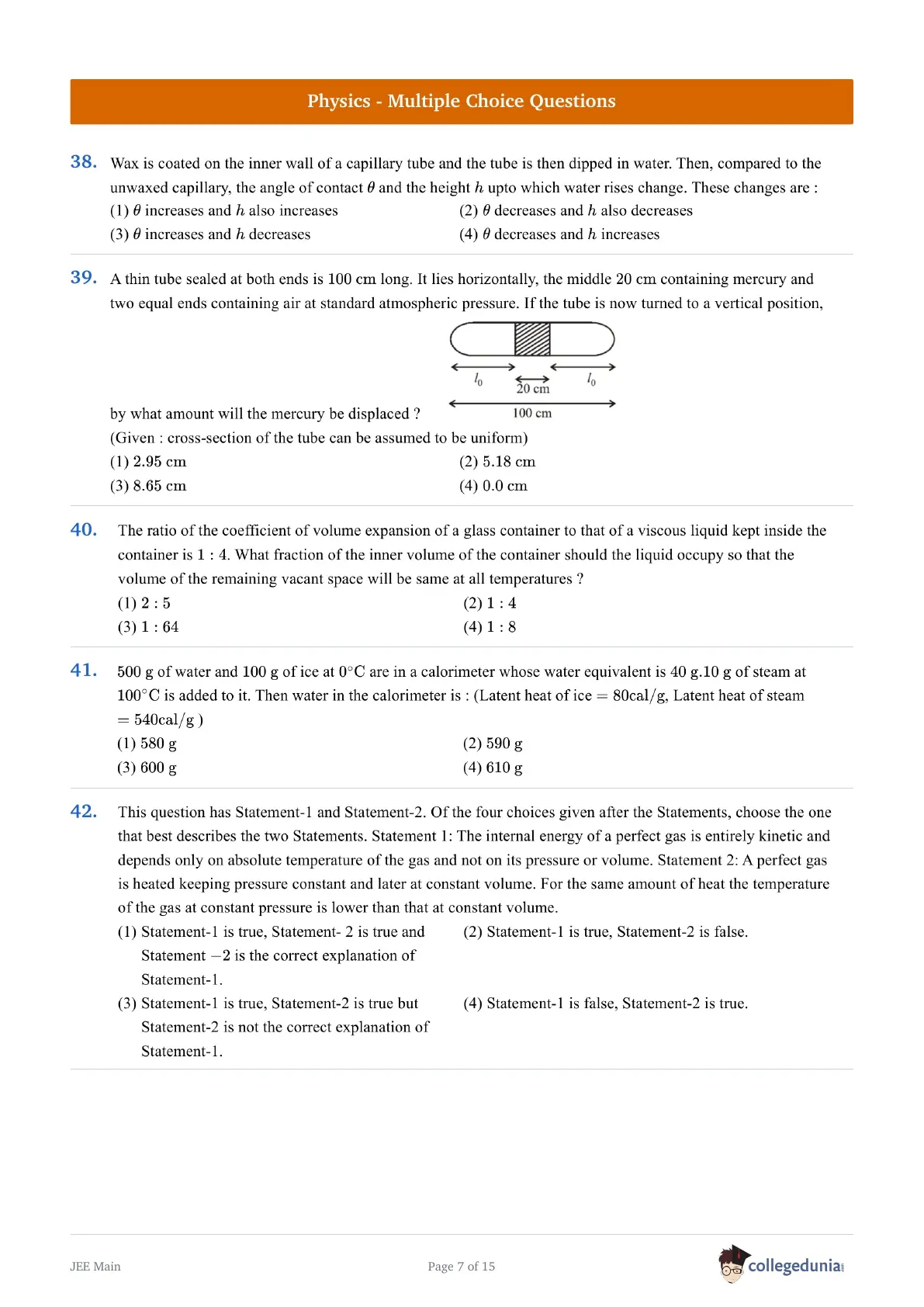
Wax is coated on the inner wall of a capillary tube and the tube is then dipped in water. Then, compared to the unwaxed capillary, the angle of contact \(\theta\) and the height \(h\) upto which water rises change. These changes are :
A thin tube sealed at both ends is 100 cm long. It lies horizontally, the middle 20 cm containing mercury and two equal ends containing air at standard atmospheric pressure. If the tube is now turned to a vertical position,  by what amount will the mercury be displaced ?
(Given : cross-section of the tube can be assumed to be uniform)
The ratio of the coefficient of volume expansion of a glass container to that of a viscous liquid kept inside the container is 1 : 4. What fraction of the inner volume of the container should the liquid occupy so that the volume of the remaining vacant space will be same at all temperatures ?
\(500 \,g\) of water and \(100\, g\) of ice at \(0^{\circ}C\) are in a calorimeter whose water equivalent is \(40\, g\). \(10\, g\) of steam at \(100^\circ C\) is added to it. Then water in the calorimeter is : (Latent heat of ice \(= 80\, cal/g\), Latent heat of steam \(=540\, cal/g\))
This question has Statement-1 and Statement-2. Of the four choices given after the Statements, choose the one that best describes the two Statements.
Statement 1: The internal energy of a perfect gas is entirely kinetic and depends only on absolute temperature of the gas and not on its pressure or volume.
Statement 2: A perfect gas is heated keeping pressure constant and later at constant volume. For the same amount of heat the temperature of the gas at constant pressure is lower than that at constant volume.
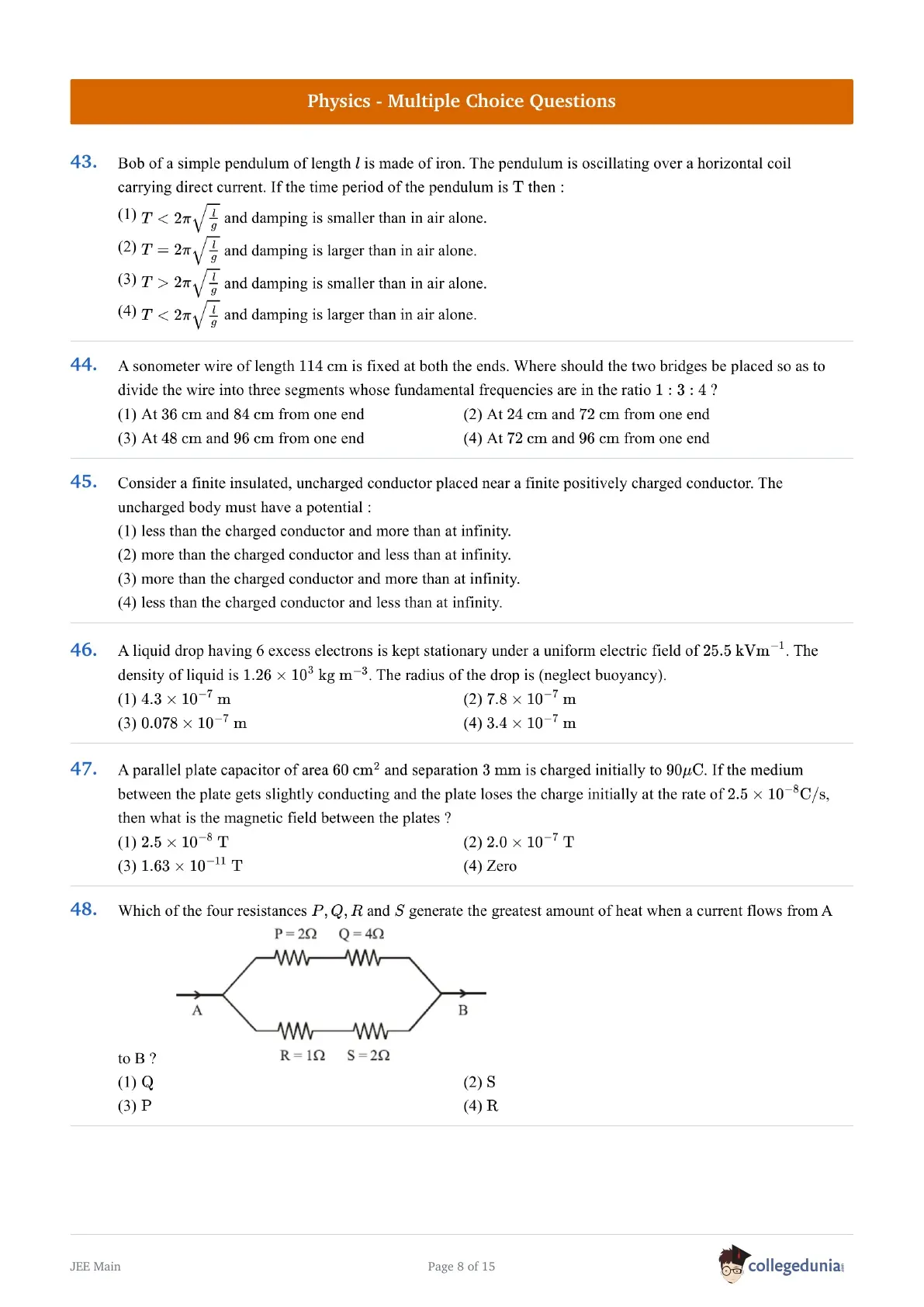
Bob of a simple pendulum of length \(l\) is made of iron. The pendulum is oscillating over a horizontal coil carrying direct current. If the time period of the pendulum is T then :
A sonometer wire of length \( 114\, cm \) is fixed at both the ends. Where should the two bridges be placed so as to divide the wire into three segments whose fundamental frequencies are in the ratio \( 1 : 3 : 4 \) ?
Consider a finite insulated, uncharged conductor placed near a finite positively charged conductor. The uncharged body must have a potential :
A liquid drop having 6 excess electrons is kept stationary under a uniform electric field of 25.5 kVm\(^{-1}\). The density of liquid is \(1.26\times10^{3}\) kg m\(^{-3}\). The radius of the drop is (neglect buoyancy).
A parallel plate capacitor of area \( 60\, cm^2 \) and separation \( 3\, mm \) is charged initially to \( 90\, \mu C \). If the medium between the plate gets slightly conducting and the plate loses the charge initially at the rate of \( 2.5 \times 10^{-8}\, C/s \), then what is the magnetic field between the plates ?
Which of the four resistances \(P, Q, R\) and \(S\) generate the greatest amount of heat when a current flows from A  to B ?
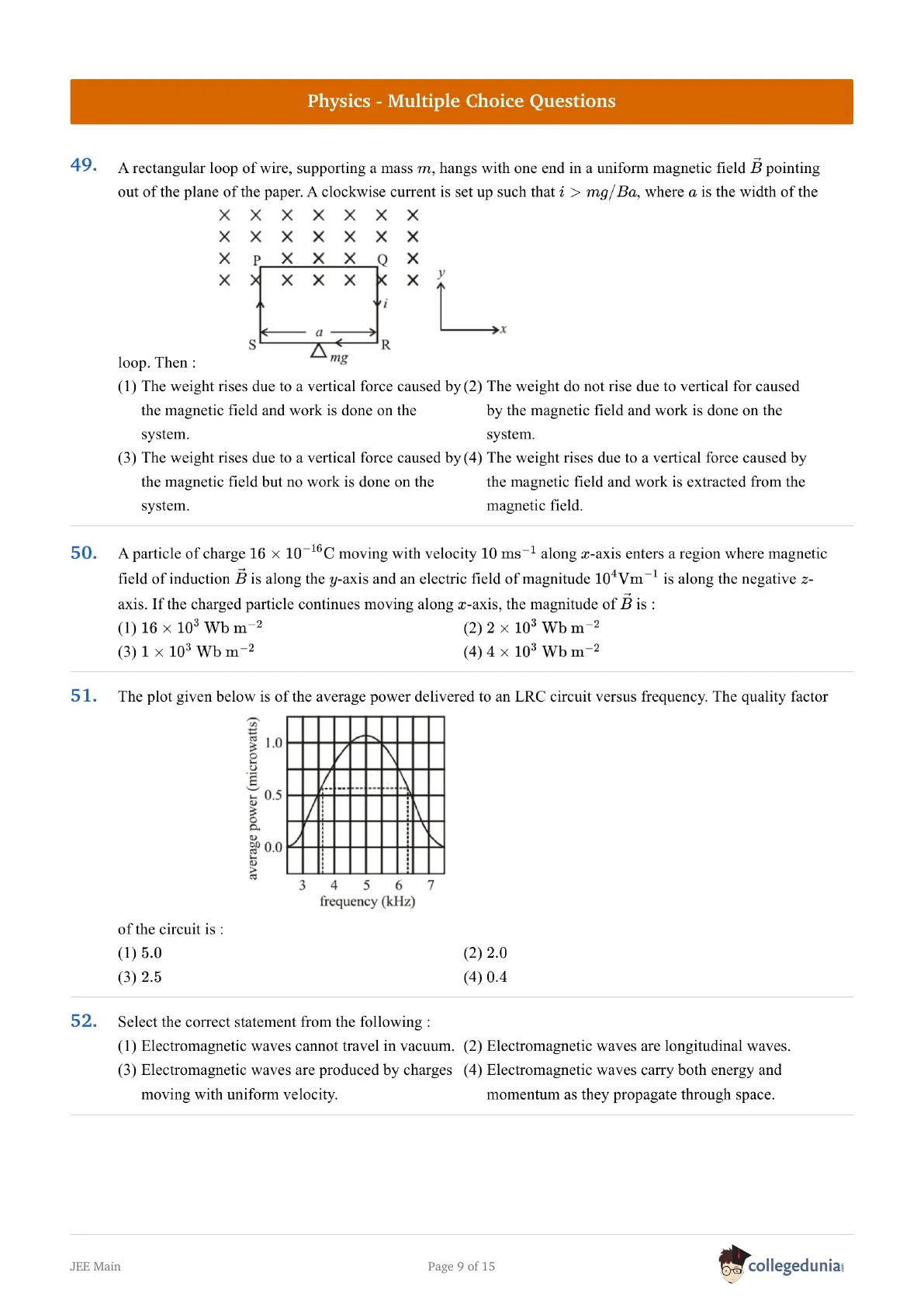
A rectangular loop of wire, supporting a mass \(m\), hangs with one end in a uniform magnetic field \(\vec{B}\) pointing out of the plane of the paper. A clockwise current is set up such that \(i \gt mg/Ba\), where \(a\) is the width of the loop.  Then :
A particle of charge \(16\times10^{-16}\) C moving with velocity 10 ms\(^{-1}\) along \(x\)-axis enters a region where magnetic field of induction \(\vec{B}\) is along the \(y\)-axis and an electric field of magnitude \(10^{4}\) Vm\(^{-1}\) is along the negative \(z\)-axis. If the charged particle continues moving along \(x\)-axis, the magnitude of \(\vec{B}\) is :
The plot given below is of the average power delivered to an LRC circuit versus frequency. The quality factor  of the circuit is :
Select the correct statement from the following
This question has Statement-1 and Statement-2. Of the four choices given after the Statements, choose the one that best describes the two Statements.
Statement 1: Very large size telescopes are reflecting telescopes instead of refracting telescopes.
Statement 2: It is easier to provide mechanical support to large size mirrors than large size lenses.
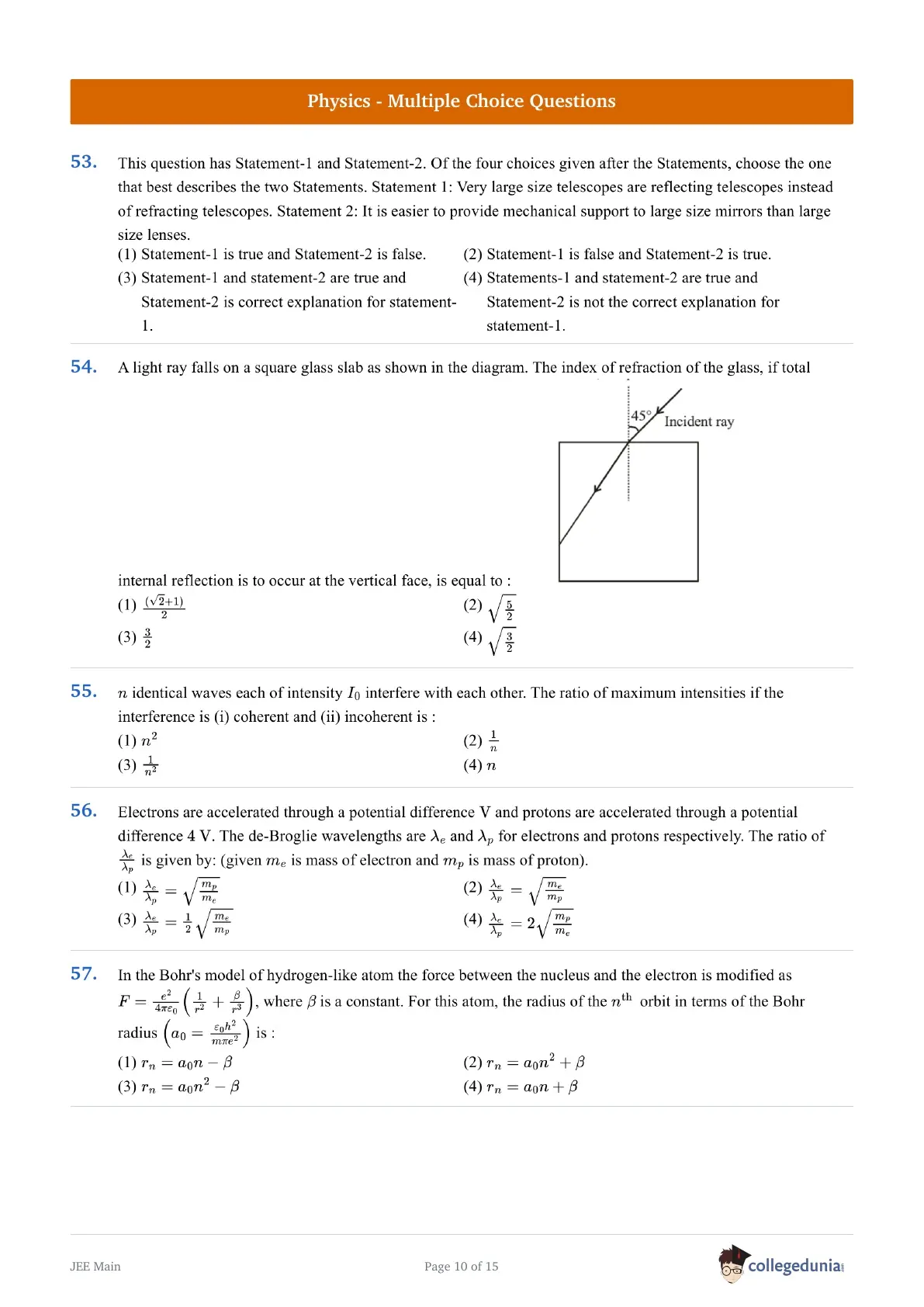
A light ray falls on a square glass slab as shown in the diagram. The index of refraction of the glass, if total internal reflection is to occur at the vertical face, is equal to :
\(n\) identical waves each of intensity \(I_0\) interfere with each other. The ratio of maximum intensities if the interference is (i) coherent and (ii) incoherent is :
Electrons are accelerated through a potential difference V and protons are accelerated through a potential difference 4 V. The de-Broglie wavelengths are \(\lambda_e\) and \(\lambda_p\) for electrons and protons respectively. The ratio of \(\frac{\lambda_e}{\lambda_p}\) is given by: (given \(m_e\) is mass of electron and \(m_p\) is mass of proton).
In the Bohr's model of hydrogen-like atom the force between the nucleus and the electron is modified as \(F=\dfrac{e^2}{4\pi\varepsilon_0}\left(\dfrac{1}{r^2}+\dfrac{\beta}{r^3}\right)\), where \(\beta\) is a constant. For this atom, the radius of the \(n^{th}\) orbit in terms of the Bohr radius \(\left(a_0=\dfrac{\varepsilon_0h^2}{m\pi e^2}\right)\) is :
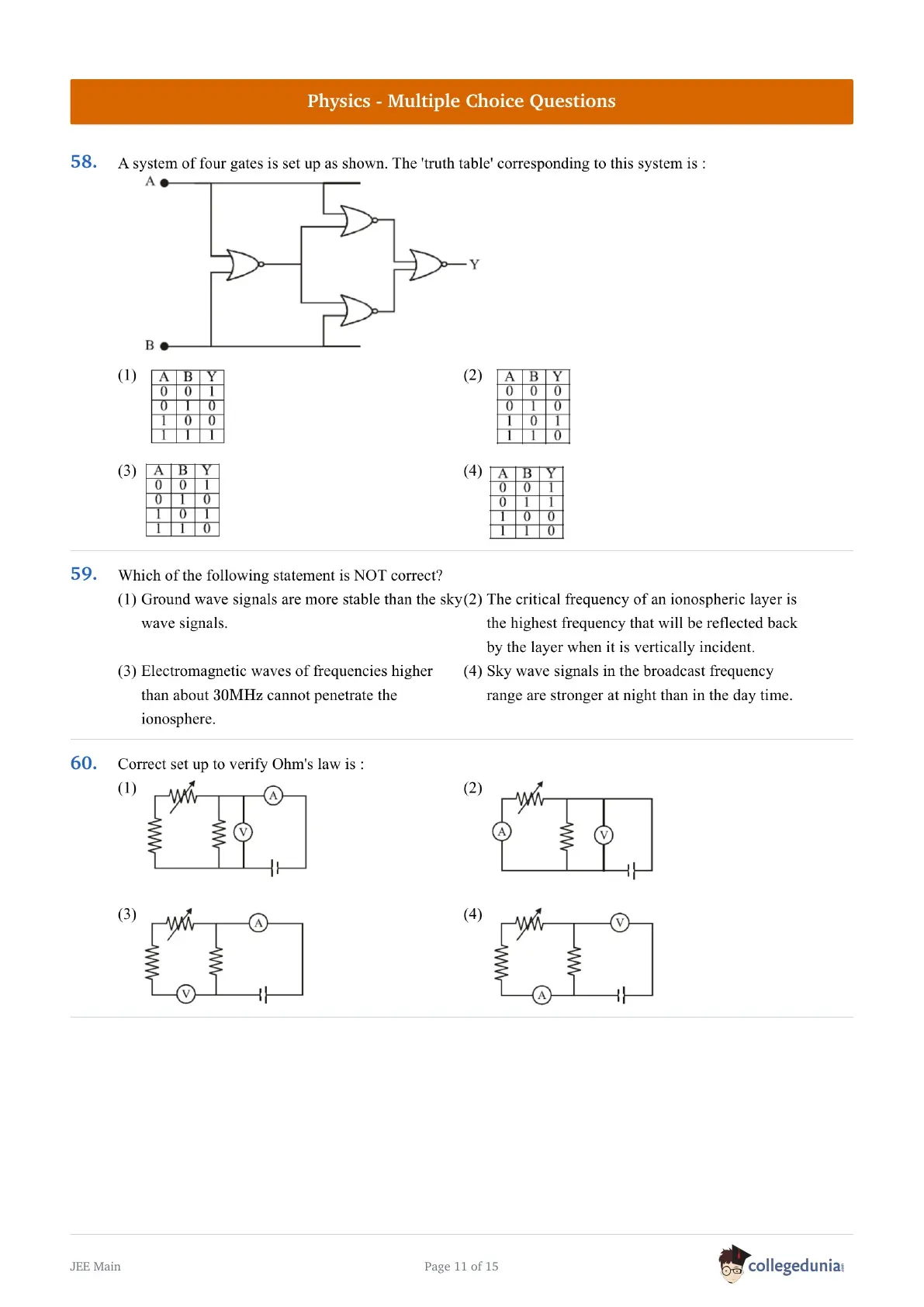
A system of four gates is set up as shown. The 'truth table' corresponding to this system is : 
- (A)
![]()
- (B)
![]()
- (C)
![]()
- (D)
![]()


Which of the following statement is NOT correct?


Chemistry (Q61 - Q90)
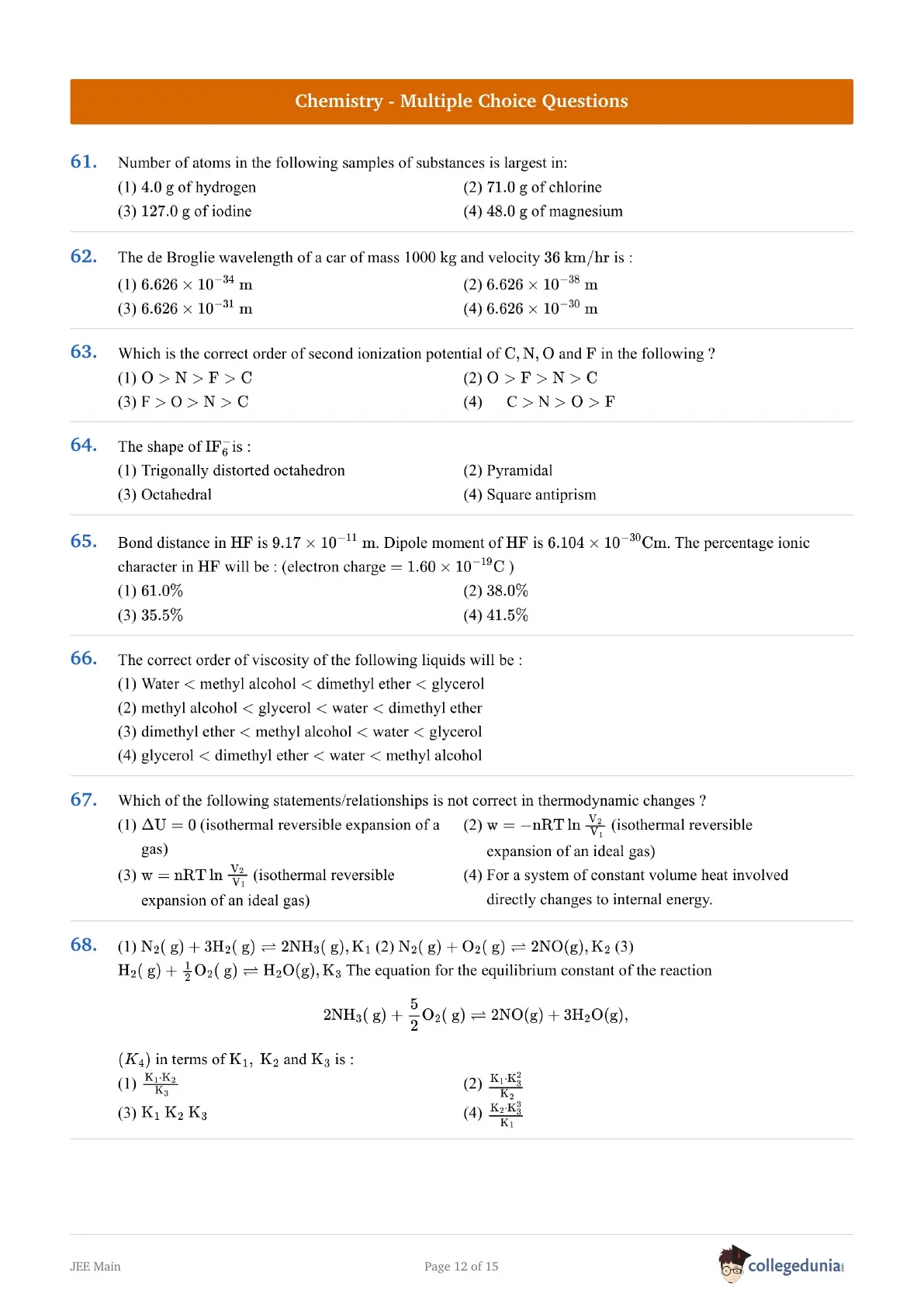
Number of atoms in the following samples of substances is largest in :
The de Broglie wavelength of a car of mass 1000 kg and velocity 36 km/hr is :
Which is the correct order of second ionization potential of \(\mathrm{C, N, O}\) and \(\mathrm{F}\) in the following ?
The shape of \(\mathrm{IF_6^-}\) is :
Bond distance in \( HF \) is \( 9.17 \times 10^{-11}\, m \). Dipole moment of \( HF \) is \( 6.10^4 \times 10^{-30}\, Cm \) . The percentage ionic character in \( HF \) will be : (electron charge \( = 1.60 \times 10^{-19}\, C \))
The correct order of viscosity of the following liquids will be:
Which of the following statements/relationships is not correct in thermodynamic changes ?
\({(1) \,N_2(g) +3H_2(g)<=> 2NH_3(g), K_1}\)
\({(2) \,N_2(g) +O_2(g)<=> 2NHO(g), K_2}\)
\({(3) \,H_2(g) +\frac{1}{2}O_2(g)<=> H_2O(g), K_3}\)
The equation for the equilibrium constant of the reaction
\({2NH_3(g) +\frac{5}{2}O_2(g)<=> 2NO(g), 3H_2O(g)}\), \((K_4)\) in terms of \(K_1\) and \(K_3\) is:
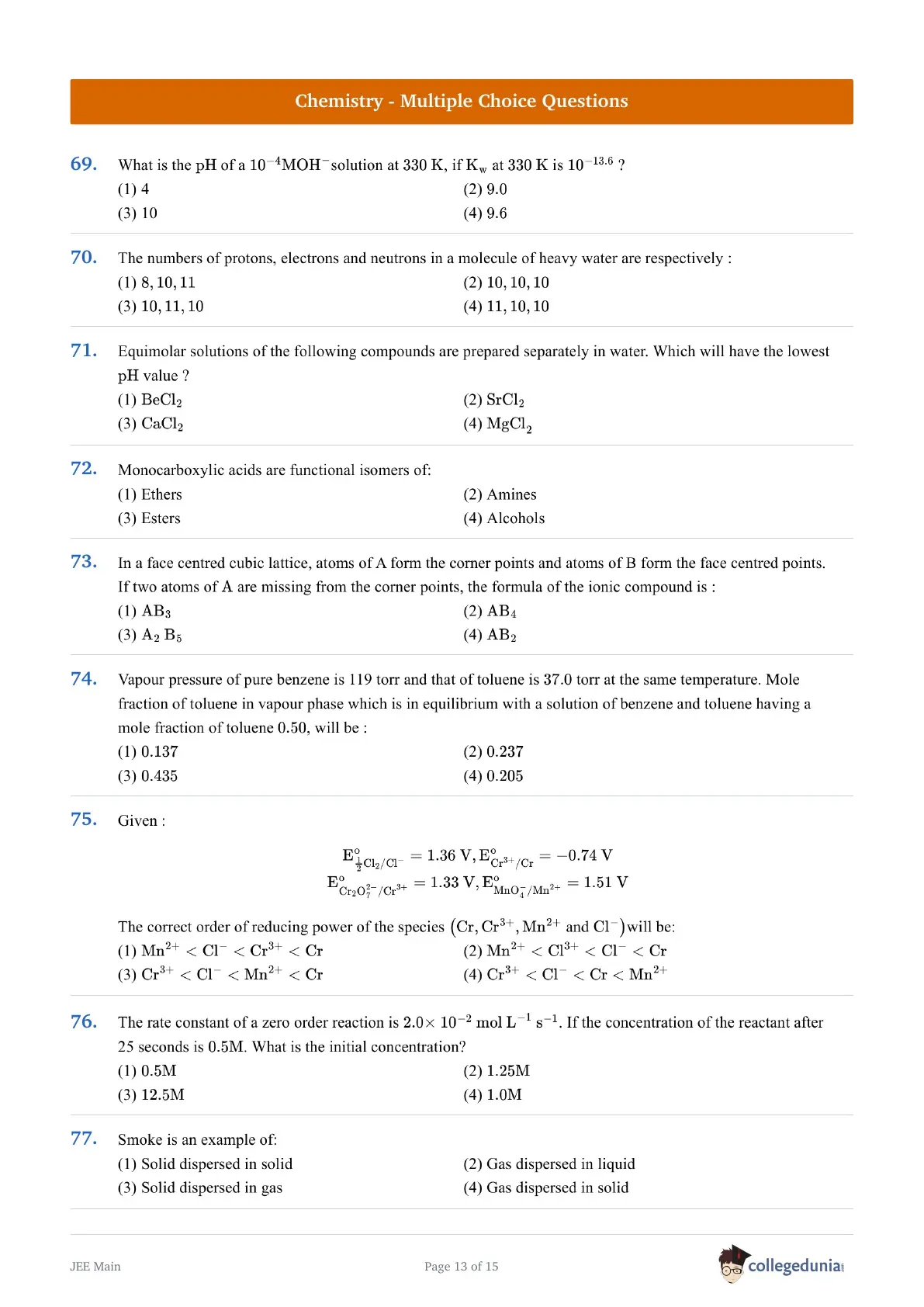
What is the pH of a \(10^{-4}\ \mathrm{M\ OH^-}\) solution at 330 K, if \(K_w\) at 330 K is \(10^{-13.6}\) ?
The numbers of protons, electrons and neutrons in a molecule of heavy water are respectively :
Equimolar solutions of the following compounds are prepared separately in water. Which will have the lowest pH value ?
Monocarboxylic acids are functional isomers of:
In a face centred cubic lattice, atoms of \( A \) form the comer points and atoms of \( B \) form the face centred points. If two atoms of \( A \) are missing from the comer points, the formula of the ionic compound is :
Vapour pressure of pure benzene is \( 119 \) torr and that of toluene is \( 37.0 \) torr at the same temperature. Mole fraction of toluene in vapour phase which is in equilibrium with a solution of benzene and toluene having a mole fraction of toluene \( 0.50 \), will be :
Given :
\(E^\circ_{\frac{1}{2}\mathrm{Cl_2/Cl^-}} = 1.36\ \mathrm{V},\ E^\circ_{\mathrm{Cr^{3+}/Cr}} = -0.74\ \mathrm{V}\)
\(E^\circ_{\mathrm{Cr_2O_7^{2-}/Cr^{3+}}} = 1.33\ \mathrm{V},\ E^\circ_{\mathrm{MnO_4^-/Mn^{2+}}} = 1.51\ \mathrm{V}\)
The correct order of reducing power of the species \((\mathrm{Cr, Cr^{3+}, Mn^{2+}}\) and \(\mathrm{Cl^-})\) will be :
The rate constant of a zero order reaction is \( 2.0 \times 10^{-2}\, mol \,L^{-1}\, s^{-1} \). If the concentration of the reactant after \( 25 \) seconds is \( 0.5\,M \). What is the initial concentration ?
Smoke is an example of :
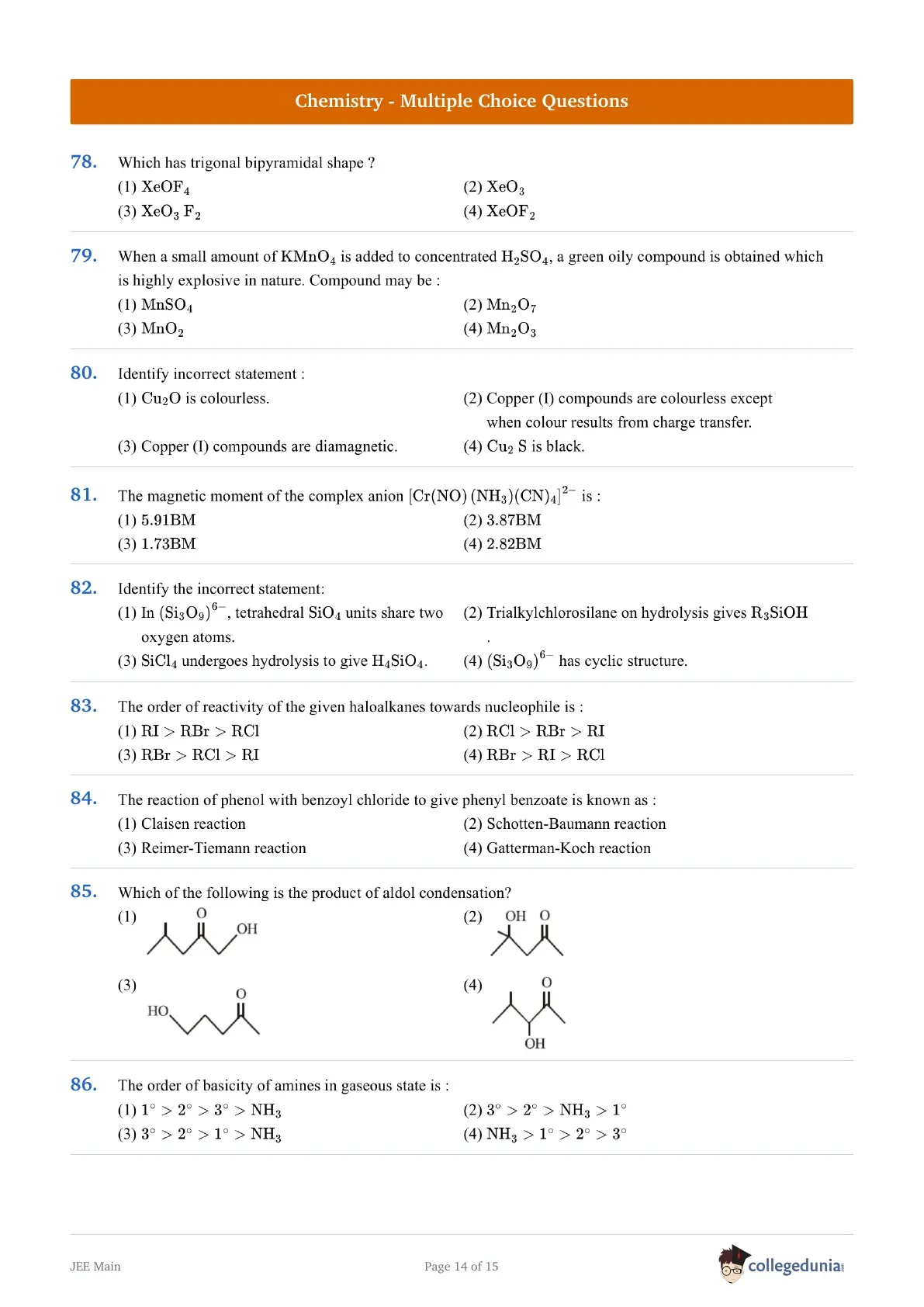
Which has trigonal bipyramidal shape ?
When a small amount of \(\mathrm{KMnO_4}\) is added to concentrated \(\mathrm{H_2SO_4}\), a green oily compound is obtained which is highly explosive in nature. Compound may be :
Identify incorrect statement :
The magnetic moment of the complex anion \([\mathrm{Cr(NO)(NH_3)(CN)_4}]^{2-}\) is :
Identify the incorrect statement:
The order of reactivity of the given haloalkanes towards nucleophile is :
The reaction of phenol with benzoyl chloride to give phenyl benzoate is known as :
Which of the following is the product of aldol condensation?
- (A)
![]()
- (B)
![]()
- (C)
![]()
- (D)
![]()


The order of basicity of amines in gaseous state is:
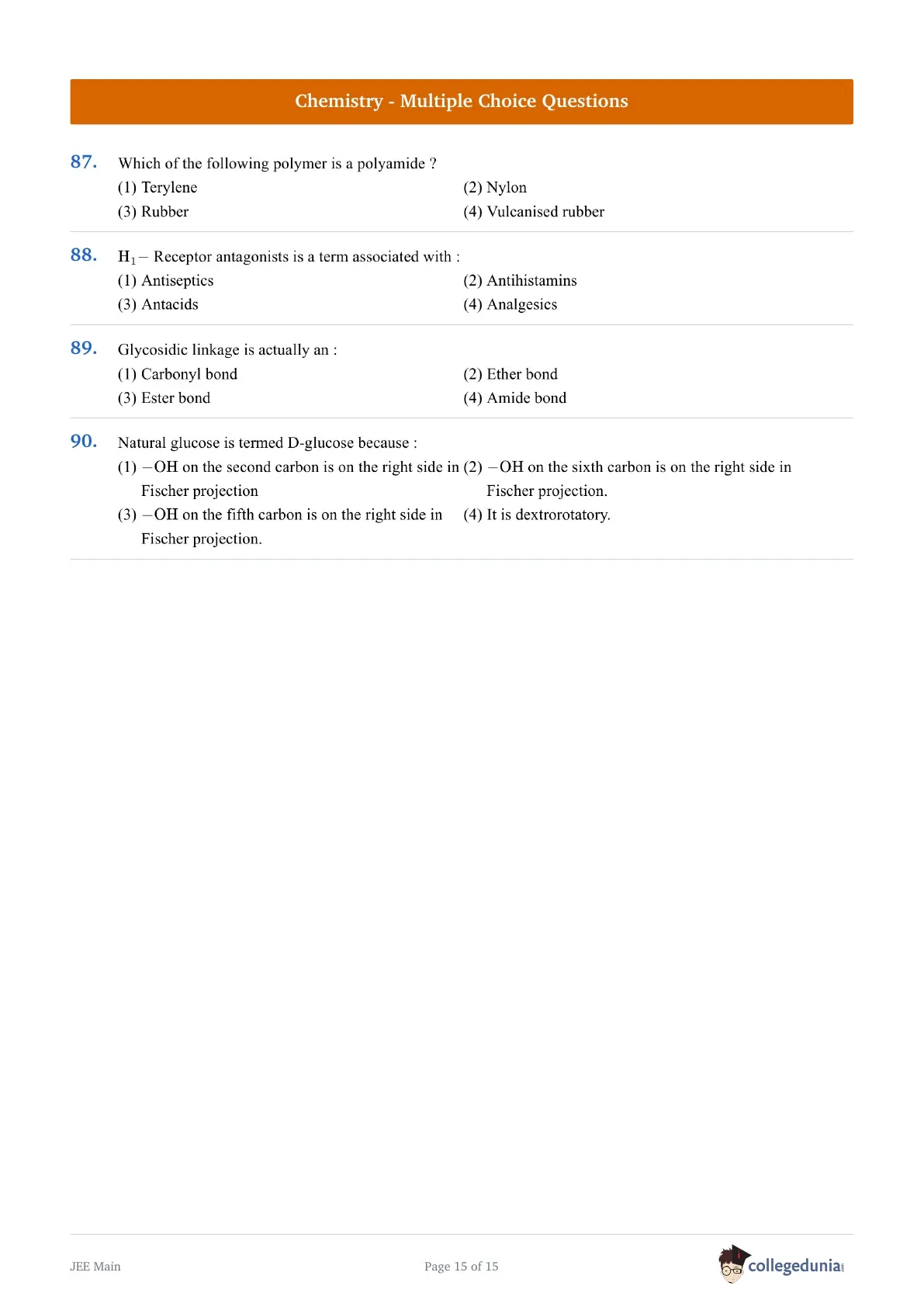
Which of the following polymer is a polyamide ?
\(\mathrm{H_1}\)-Receptor antagonists is a term associated with :
Glycosidic linkage is actually an :
Natural glucose is termed D-glucose because :
JEE Main 2013 Exam Pattern and Marking Scheme
| Particulars | Details |
|---|---|
| Exam Mode | Online (Computer-Based Test) |
| Paper | B.E./B.Tech (Paper 1) |
| Duration | 3 hours (180 minutes) |
| Type of Questions | Multiple Choice Questions (MCQs) |
| Subjects | Mathematics, Physics, Chemistry |
| Total Questions | 90 questions (30 per subject) |
| Total Marks | 360 marks |
| Marking Scheme | +4 for correct answer & -1 for incorrect answer |



Comments