



JEE Main 2013 April 25 Question Paper is available here with solutions PDF and detailed solutions for every question. CBSE conducted the online (CBT) JEE Main 2013 Paper 1 (B.E./B.Tech) on April 25, 2013. The question paper includes the following:
- 90 questions in a 3-hour CBT Mode: 30 each from Mathematics, Physics and Chemistry
- Question type: multiple choice questions (MCQs) with 4 options, one correct answer
- Marking: +4 for a correct answer, -1 for an incorrect answer, 0 for an unattempted question
- Maximum marks: 360 (120 per subject)
JEE Main 2013 April 25 Question Paper with Solution PDF
| CBSE Official PDF | CD PDF | CD PDF with Solutions |
|---|---|---|
| Download official PDF 3.15 MB | Download Collegedunia PDF 4.31 MB | Download solutions PDF 0.77 MB |
Also Check:
JEE Main 2013 April 25 Questions with Solutions
Mathematics (Q1 - Q30)
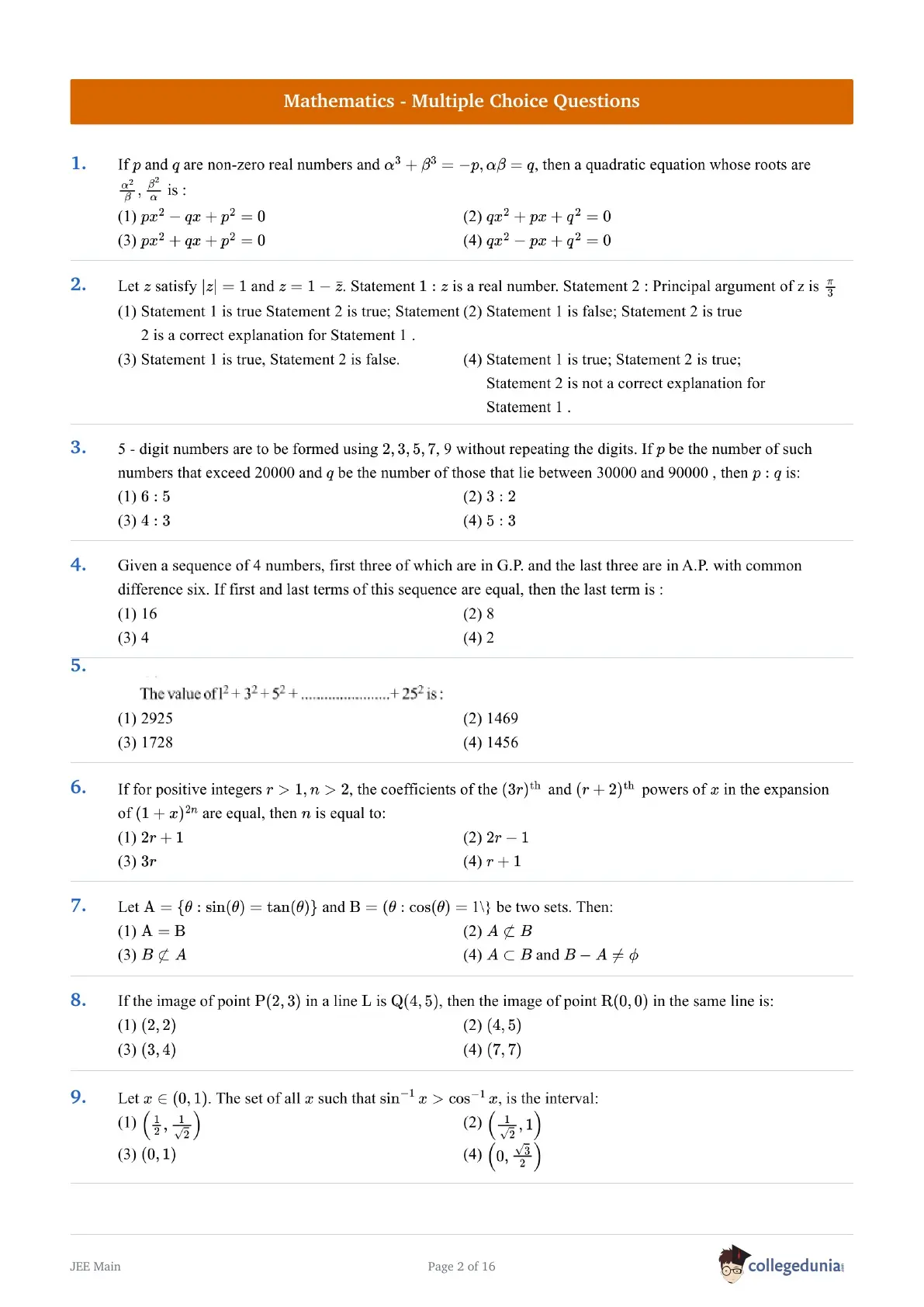
If \(p\) and \(q\) are non-zero real numbers and \(\alpha^3 + \beta^3 = -p,\ \alpha\beta = q\), then a quadratic equation whose roots are \(\frac{\alpha^2}{\beta},\ \frac{\beta^2}{\alpha}\) is :
Let \(z\) satisfy \(|z| = 1\) and \(z = 1 - \bar{z}\). Statement 1 : \(z\) is a real number. Statement 2 : Principal argument of \(z\) is \(\frac{\pi}{3}\).
5 - digit numbers are to be formed using \(2, 3, 5, 7, 9\) without repeating the digits. If \(p\) be the number of such numbers that exceed \(20000\) and \(q\) be the number of those that lie between \(30000\) and \(90000\), then \(p : q\) is:
Given a sequence of 4 numbers, first three of which are in G.P. and the last three are in A.P. with common difference six. If first and last terms of this sequence are equal, then the last term is :
The value of \(1^2 + 3^2 + 5^2 + \ldots\ldots + 25^2\) is :
If for positive integers \(r \gt 1, n \gt 2\), the coefficients of the \((3r)^{\text{th}}\) and \((r+2)^{\text{th}}\) powers of \(x\) in the expansion of \((1 + x)^{2n}\) are equal, then \(n\) is equal to:
Let \(A = \{\theta : \sin(\theta) = \tan(\theta)\}\) and \(B = \{\theta : \cos(\theta) = 1\}\) be two sets. Then:
If the image of point \(P(2, 3)\) in a line \(L\) is \(Q(4,5)\), then the image of point \(R(0,0)\) in the same line is:
Let \(x \in \left(0,1\right).\) The set of all x such that \(sin^{-1} x >\, cos^{-1} x, \) is the interval:
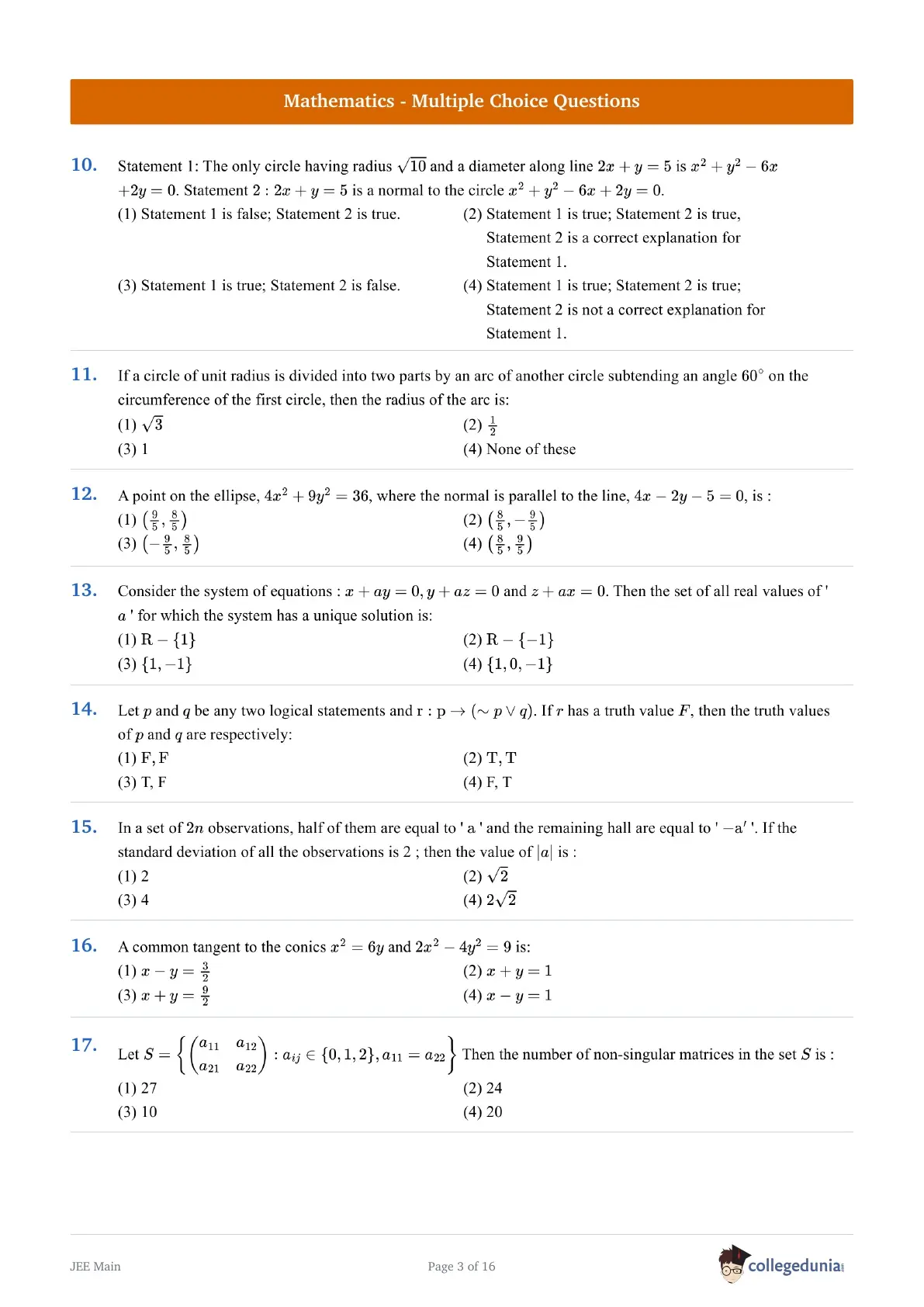
Statement 1 : The only circle having radius \(\sqrt{10}\) and a diameter along line \(2 x+y=5 \, is\, x^{2}+y^{2}-6x+2y=0.\) Statement 2 : \(2x + y = 5\) is a normal to the circle \(x^{2}+y^{2}-6x+2y=0.\)
If a circle of unit radius is divided into two parts by an arc of another circle subtending an angle \(60^\circ\) on the circumference of the first circle, then the radius of the arc is:
A point on the ellipse, \(4x^2 + 9y^2 = 36\), where the normal is parallel to the line, \(4x - 2y - 5 = 0\), is :
Consider the system of equations : \(x + ay = 0,\ y + az = 0\) and \(z + ax = 0\). Then the set of all real values of 'a' for which the system has a unique solution is:
Let \(p\) and \(q\) be any two logical statements and \(r : p \rightarrow (\sim p \vee q)\). If \(r\) has a truth value \(F\), then the truth values of \(p\) and \(q\) are respectively:
In a set of \(2n\) observations, half of them are equal to 'a' and the remaining half are equal to '\(-a\)'. If the standard deviation of all the observations is 2 ; then the value of \(|a|\) is :
A common tangent to the conics \(x^{2}=6y\) and \(2x^{2}-4y^{2}=9\) is:
Let \(S=\left\{\begin{pmatrix}a_{11}&a_{12}\\a_{21}&a_{22}\end{pmatrix}: a_{ij}\in\{0,1,2\},\ a_{11}=a_{22}\right\}\). Then the number of non-singular matrices in the set \(S\) is :
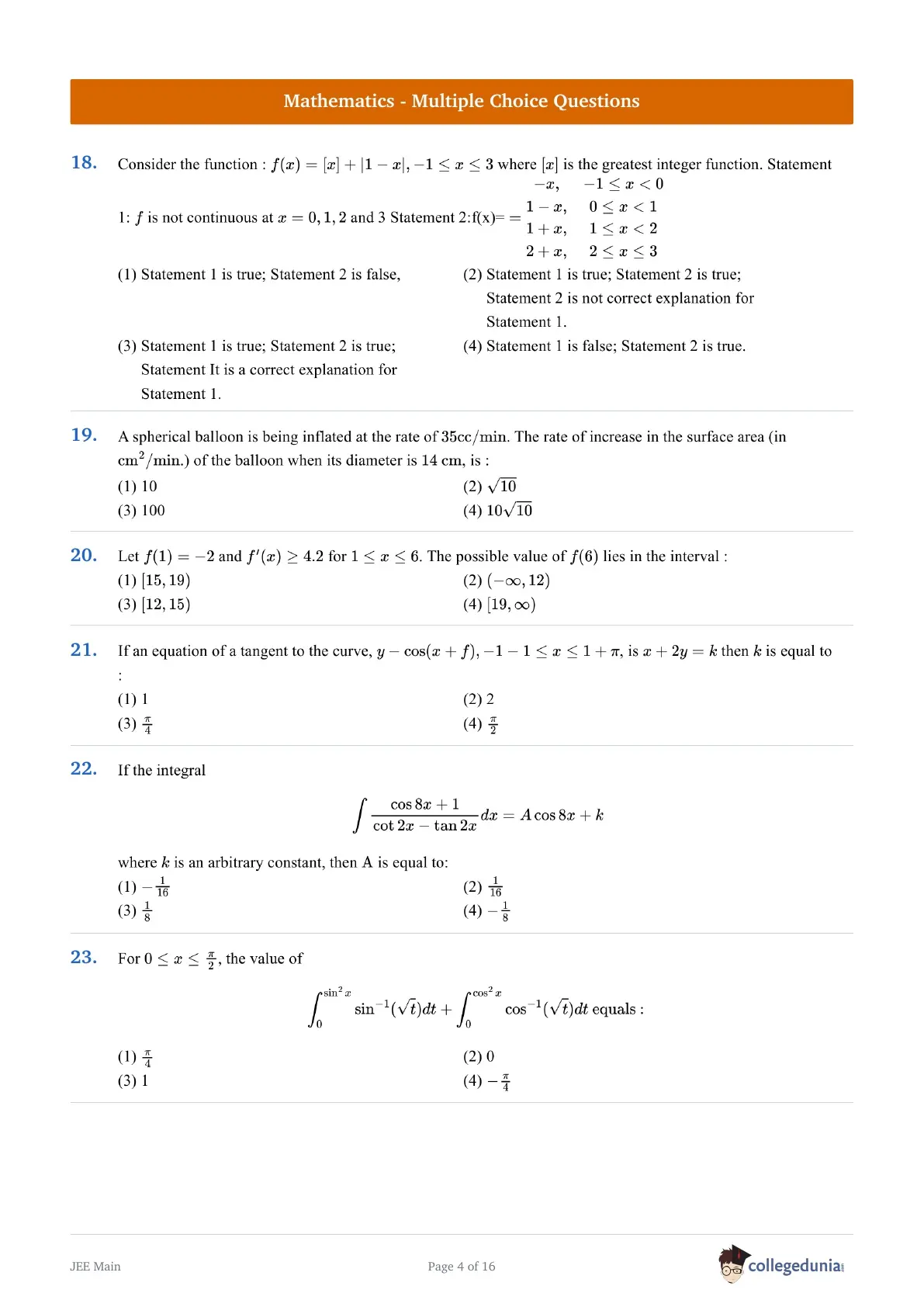
Consider the function : \(f(x)=[x]+|1-x|,\ -1\le x\le3\) where \([x]\) is the greatest integer function. Statement 1 : \(f\) is not continuous at \(x=0,1,2\) and \(3\) Statement 2 : \(f(x)=\begin{cases}-x, & -1\le x\lt0\\ 1-x, & 0\le x\lt1\\ 1+x, & 1\le x\lt2\\ 2+x, & 2\le x\le3\end{cases}\)
A spherical balloon is being inflated at the rate of 35cc/min. The rate of increase in the surface area (in \(\mathrm{cm^2}\)/min.) of the balloon when its diameter is 14 cm, is :
Let \(f(1) = -2\) and \(f'(x) \ge 4.2\) for \(1 \le x \le 6\). The possible value of \(f(6)\) lies in the interval :
If an equation of a tangent to the curve, \(y - \cos(x + y) = 0,\ -1 \le x \le 1 + \pi\), is \(x + 2y = k\) then \(k\) is equal to :
If the integral \(\int \frac{cos 8x+1}{cot 2x-tan 2x} dx=A cos 8x+k,\) where \(k\) is an arbitrary constant, then \(A\) is equal to:
For \(0 \le x \le \frac{\pi}{2}\), the value of \(\displaystyle\int_0^{\sin^2 x}\sin^{-1}(\sqrt{t})\,dt+\int_0^{\cos^2 x}\cos^{-1}(\sqrt{t})\,dt\) equals :
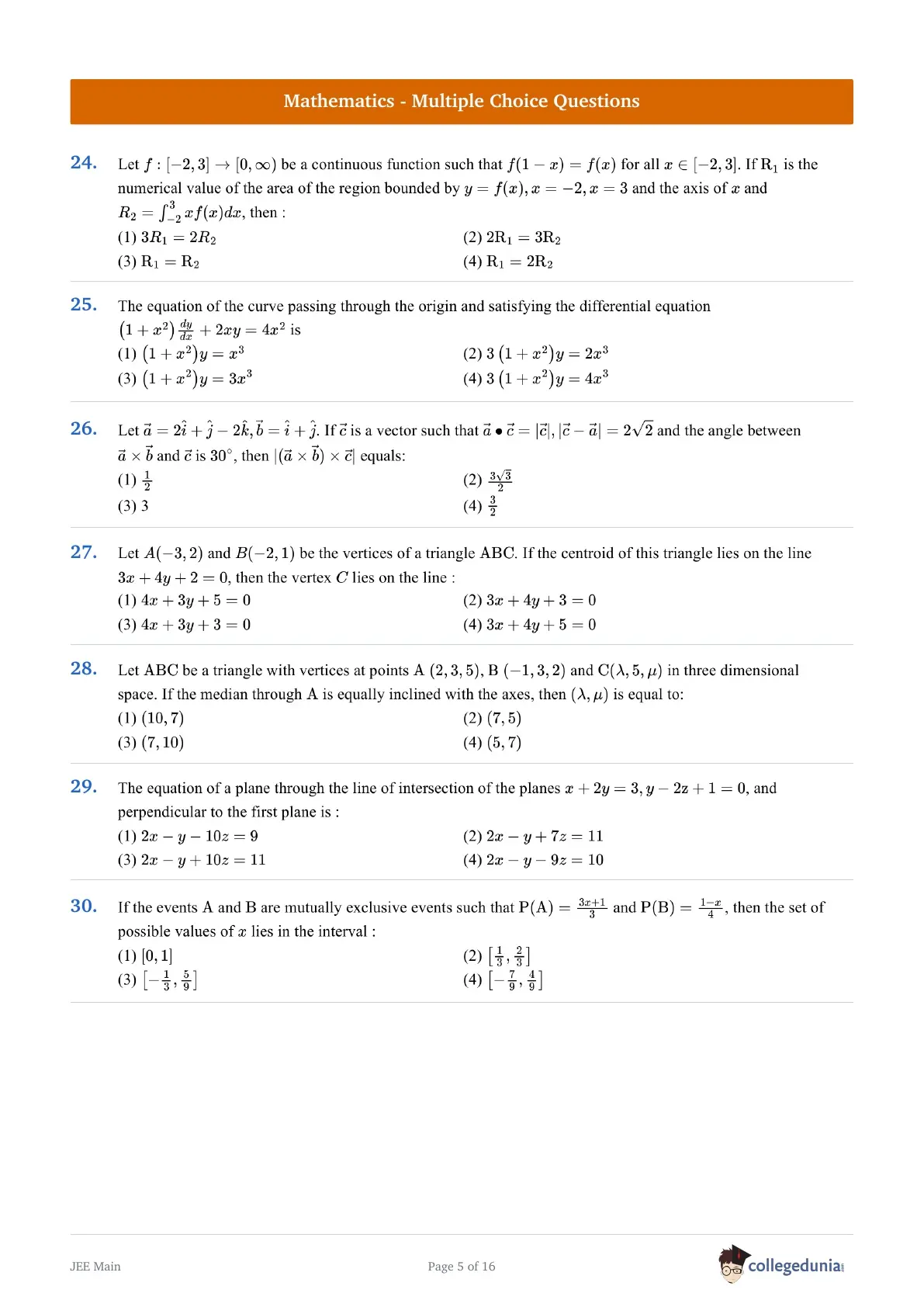
Let \(f:[-2,3]\to[0,\infty)\) be a continuous function such that \(f(1-x)=f(x)\) for all \(x\in[-2,3]\). If \(R_1\) is the numerical value of the area of the region bounded by \(y=f(x),\ x=-2,\ x=3\) and the axis of \(x\) and \(R_2=\int_{-2}^{3}xf(x)\,dx\), then :
The equation of the curve passing through the origin and satisfying the differential equation \((1+x^2)\frac{dy}{dx}+2xy=4x^2\) is
Let \(\vec a=2\hat i+\hat j-2\hat k,\ \vec b=\hat i+\hat j\). If \(\vec c\) is a vector such that \(\vec a\cdot\vec c=|\vec c|,\ |\vec c-\vec a|=2\sqrt2\) and the angle between \(\vec a\times\vec b\) and \(\vec c\) is \(30^\circ\), then \(|(\vec a\times\vec b)\times\vec c|\) equals:
Let \(A (-3,2)\) and \(B (-2,1)\) be the vertices of a triangle \(ABC\). If the centroid of this triangle lies on the line \(3x + 4y+2 = 0\), then the vertex \(C\) lies on the line :
Let ABC be a triangle with vertices at points \(A(2,3,5),\ B(-1,3,2)\) and \(C(\lambda,5,\mu)\) in three dimensional space. If the median through A is equally inclined with the axes, then \((\lambda,\mu)\) is equal to:
The equation of a plane through the line of intersection of the planes \(x+2y=3,\ y-2z+1=0\), and perpendicular to the first plane is :
If the events A and B are mutually exclusive events such that \(P(A)=\frac{3x+1}{3}\) and \(P(B)=\frac{1-x}{4}\), then the set of possible values of \(x\) lies in the interval :
Physics (Q31 - Q60)
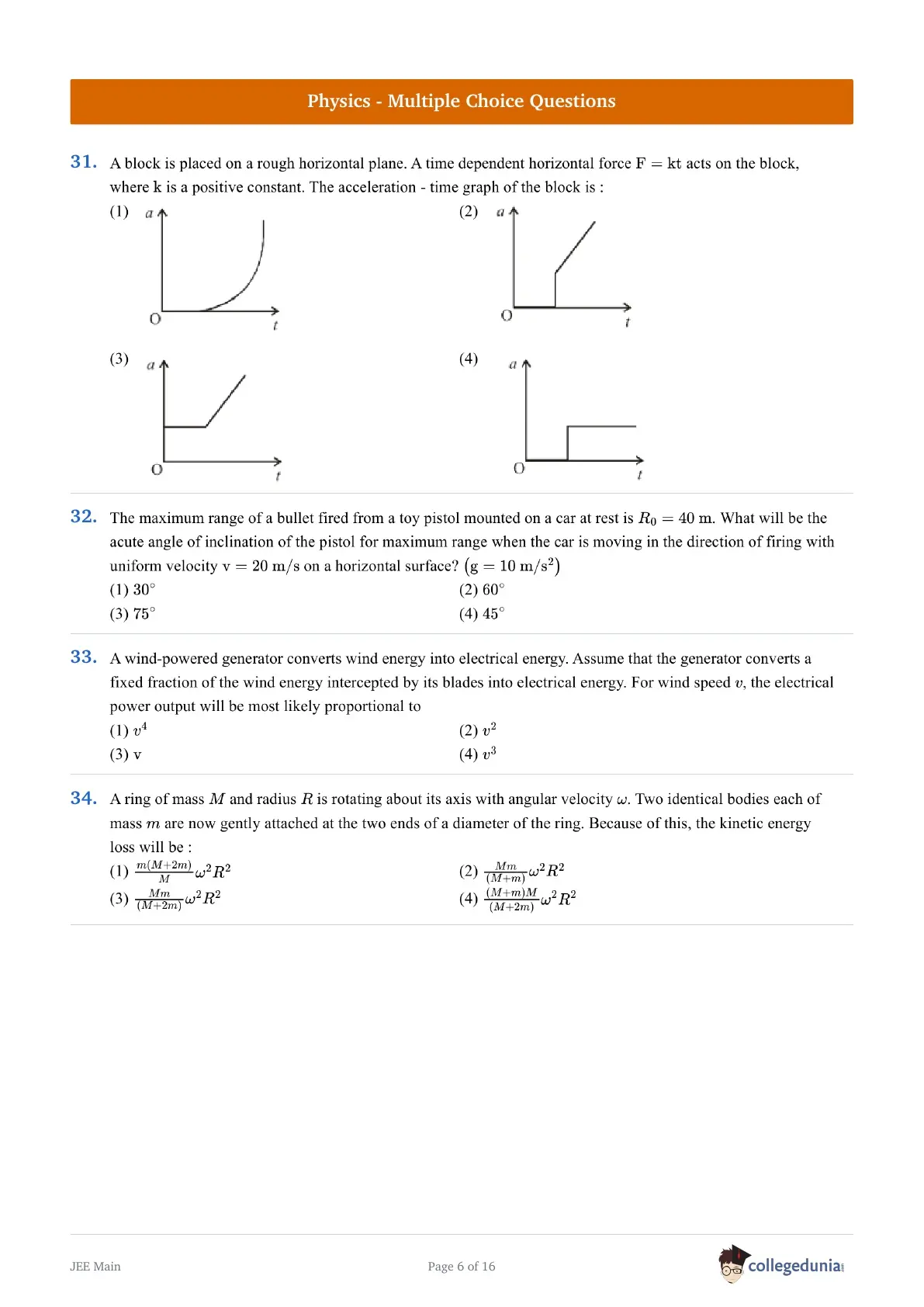
A block is placed on a rough horizontal plane. A time dependent horizontal force \(F = kt\) acts on the block, where \(k\) is a positive constant. The acceleration - time graph of the block is:
- (1)
![acceleration - time graph]()
- (2)
![acceleration - time graph]()
- (3)
![acceleration - time graph]()
- (4)
![acceleration - time graph]()


The maximum range of a bullet fired from a toy pistol mounted on a car at rest is \(R_0=40\) m. What will be the acute angle of inclination of the pistol for maximum range when the car is moving in the direction of firing with uniform velocity \(v=20\) m/s on a horizontal surface? (\(g=10\ \mathrm{m/s^2}\))
A wind-powered generator converts wind energy into electrical energy. Assume that the generator converts a fixed fraction of the wind energy intercepted by its blades into electrical energy. For wind speed \(v\), the electrical power output will be most likely proportional to
A ring of mass \(M\) and radius \(R\) is rotating about its axis with angular velocity \(\omega\). Two identical bodies each of mass \(m\) are now gently attached at the two ends of a diameter of the ring. Because of this, the kinetic energy loss will be :
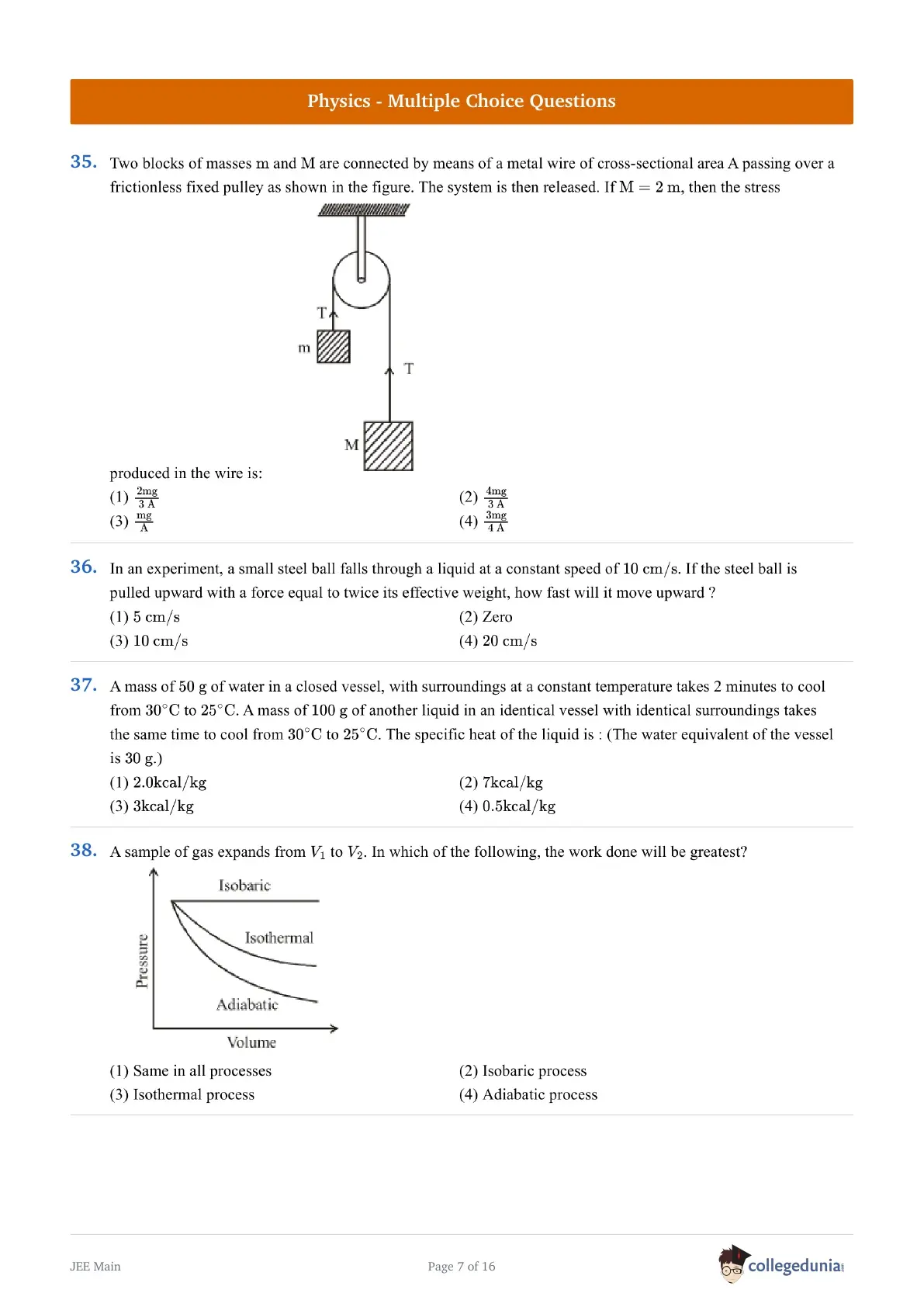
Two blocks of masses \(m\) and \(M\) are connected by means of a metal wire of cross-sectional area \(A\) passing over a frictionless fixed pulley as shown in the figure. The system is then released. If \(M \,= \,2 m\), then the stress produced in the wire is:
In an experiment, a small steel ball falls through a liquid at a constant speed of \(10\, cm/s\). If the steel ball is pulled upward with a force equal to twice its effective weight, how fast will it move upward ?
A mass of \(50\,g\) of water in a closed vessel, with surroundings at a constant temperature takes \(2\) minutes to cool from \(30^\circ C\) to \(25^\circ C\). A mass of \(100\,g\) of another liquid in an identical vessel with identical surroundings takes the same time to cool from \(30^\circ C\) to \(25^\circ C\). The specific heat of the liquid is: (The water equivalent of the vessel is \(30\,g\).)
A sample of gas expands from \(V_1\) to \(V_2\). In which of the following, the work done will be greatest? 
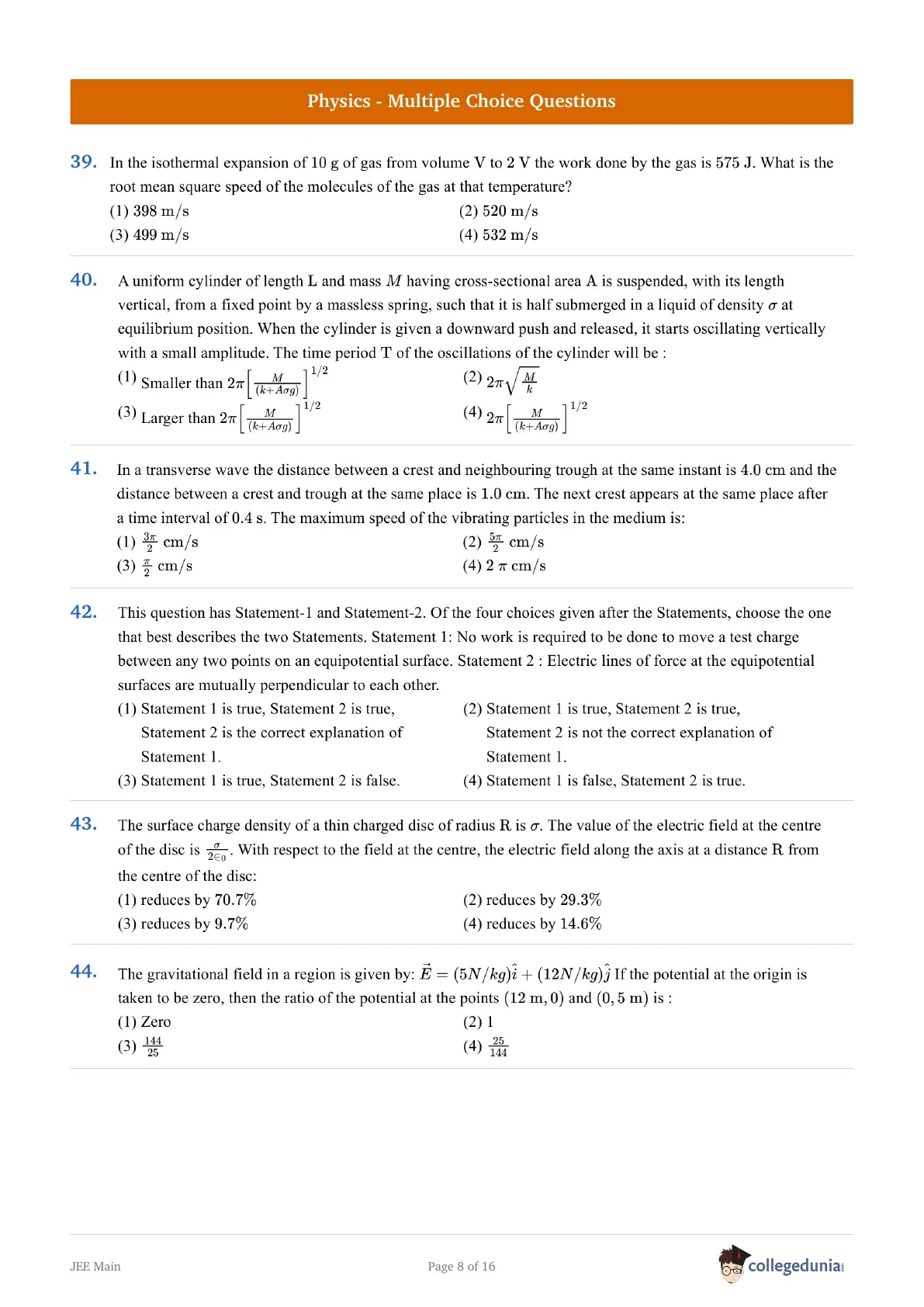
In the isothermal expansion of 10 g of gas from volume V to 2V the work done by the gas is 575 J. What is the root mean square speed of the molecules of the gas at that temperature?
A uniform cylinder of length L and mass M having cross-sectional area A is suspended, with its length vertical, from a fixed point by a massless spring, such that it is half submerged in a liquid of density \(\sigma\) at equilibrium position. When the cylinder is given a downward push and released, it starts oscillating vertically with a small amplitude. The time period T of the oscillations of the cylinder will be :
In a transverse wave the distance between a crest and neighbouring trough at the same instant is 4.0 cm and the distance between a crest and trough at the same place is 1.0 cm. The next crest appears at the same place after a time interval of 0.4 s. The maximum speed of the vibrating particles in the medium is:
This question has Statement-1 and Statement-2. Of the four choices given after the Statements, choose the one that best describes the two Statements.
Statement 1: No work is required to be done to move a test charge between any two points on an equipotential surface.
Statement 2: Electric lines of force at the equipotential surfaces are mutually perpendicular to each other.
The surface charge density of a thin charged disc of radius \(R\) is \(\sigma\). The value of the electric field at the centre of the disc is \(\frac{\sigma}{2 \in_{0}} \cdot\) With respect to the field at the centre, the electric field along the axis at a distance \(R\) from the centre of the disc :
The gravitational field in a region is given by: \(\vec{E} = (5\ N/kg)\hat{i} + (12\ N/kg)\hat{j}\). If the potential at the origin is taken to be zero, then the ratio of the potential at the points \((12\ \mathrm{m}, 0)\) and \((0, 5\ \mathrm{m})\) is :
A parallel plate capacitor having a separation between the plates d, plate area A and material with dielectric constant K has capacitance \(C_0\). Now one-third of the material is replaced by another material with dielectric constant 2 K, so that effectively there are two capacitors one with area \(\frac{1}{3}\)A, dielectric constant 2 K and another with area \(\frac{2}{3}\)A and dielectric constant K. If the capacitance of this new capacitor is C then \(\frac{C}{C_0}\) is
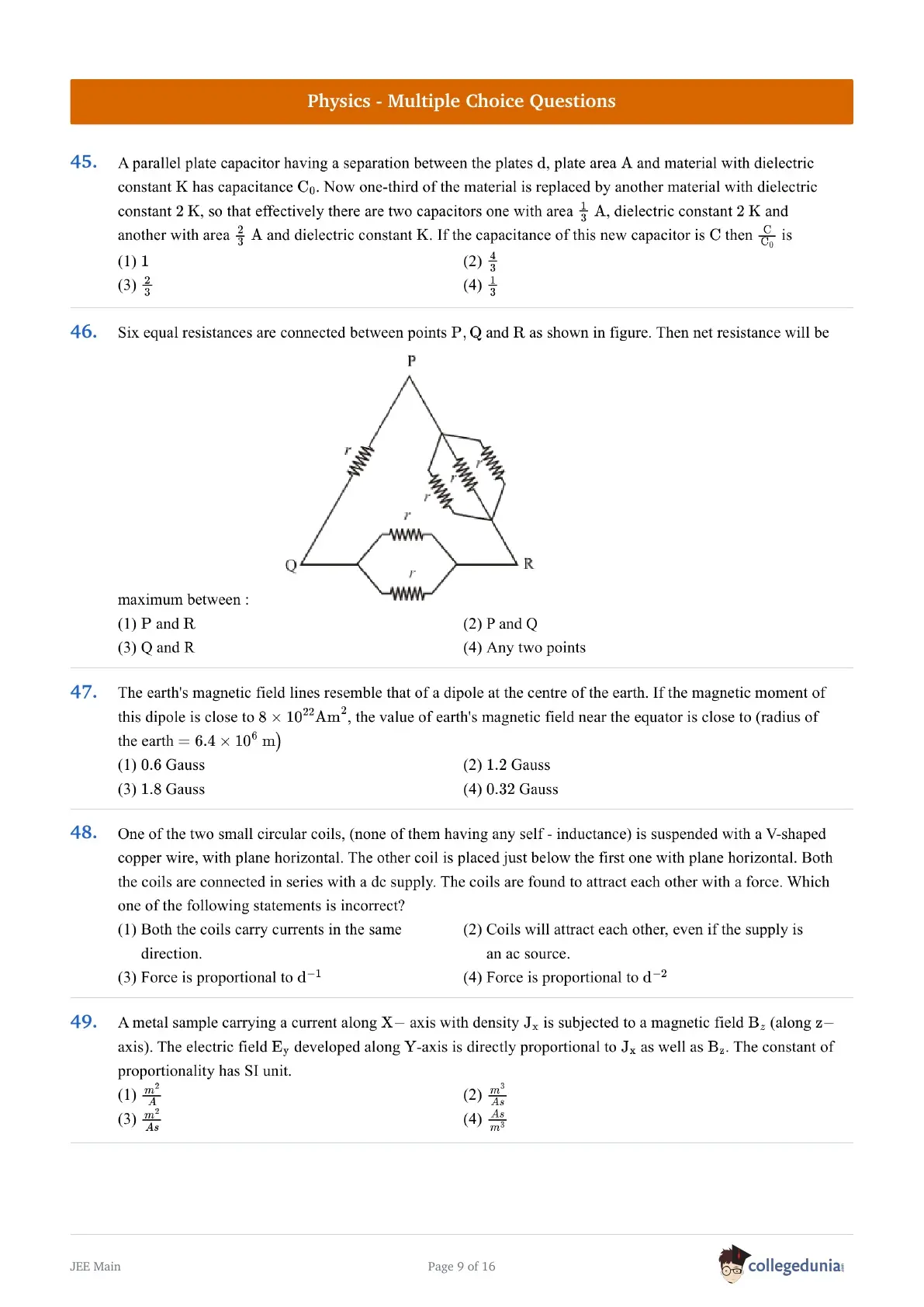
Six equal resistances are connected between points P, Q and R as shown in figure. Then net resistance will be  maximum between :
The earth's magnetic field lines resemble that of a dipole at the centre of the earth. If the magnetic moment of this dipole is close to \(8\times 10^{22}\ \mathrm{Am^2}\), the value of earth's magnetic field near the equator is close to (radius of the earth = \(6.4\times 10^{6}\) m)
One of the two small circular coils, (none of them having any self - inductance) is suspended with a V-shaped copper wire, with plane horizontal. The other coil is placed just below the first one with plane horizontal. Both the coils are connected in series with a dc supply. The coils are found to attract each other with a force. Which one of the following statements is incorrect?
A metal sample carrying a current along X− axis with density \(J_x\) is subjected to a magnetic field \(B_z\) (along z− axis). The electric field \(E_y\) developed along Y-axis is directly proportional to \(J_x\) as well as \(B_z\). The constant of proportionality has SI unit.
When resonance is produced in a series LCR circuit, then which of the following is not correct?
A series LR circuit is connected to an ac source of frequency \(\omega\) and the inductive reactance is equal to 2R. A capacitance of capacitive reactance equal to R is added in series with L and R. The ratio of the new power factor to the old one is :
A printed page is pressed by a glass of water. The refractive index of the glass and water is \(1.5\) and \(1.33\) , respectively. If the thickness of the bottom of glass is \(1 \,cm\) and depth of water is \(5 \,cm\) , how much the page will appear to be shifted if viewed from the top ?
A thin glass plate of thickness \(\frac{2500}{3}\lambda\) (\(\lambda\) is wavelength of light used) and refractive index \(\mu = 1.5\) is inserted between one of the slits and the screen in Young's double slit experiment. At a point on the screen equidistant from the slits, the ratio of the intensities before and after the introduction of the glass plate is :
The source that illuminates the double − slit in 'double - slit interference experiment' emits two distinct monochromatic waves of wavelength 500 nm and 600 nm, each of them producing its own pattern on the screen. At the central point of the pattern when path difference is zero, maxima of both the patterns coincide and the resulting interference pattern is most distinct at the region of zero path difference. But as one moves out of this central region, the two fringe systems are gradually out of step such that maximum due to one wavelength coincides with the minimum due to the other and the combined fringe system becomes completely indistinct. This may happen when path difference in nm is:
This question has Statement-1 and Statement-2. Of the four choices given after the Statements, choose the one that best describes the two Statements.
Statement-1 : Out of radio waves and microwaves, the radio waves undergo more diffraction.
Statement-2 : Radio waves have greater frequency compared to microwaves.
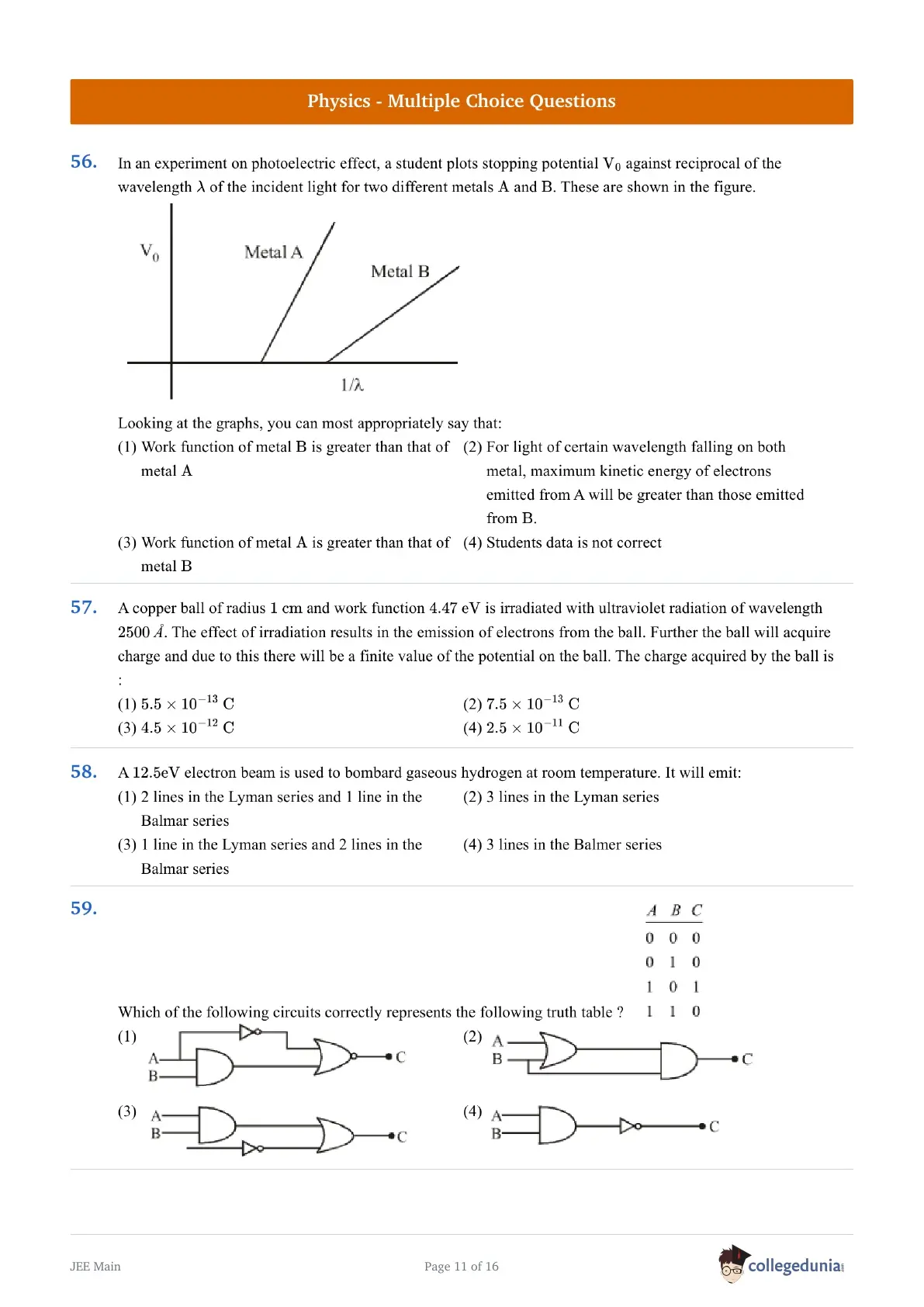
In an experiment on photoelectric effect, a student plots stopping potential \(V_0\) against reciprocal of the wavelength \(\lambda\) of the incident light for two different metals A and B. These are shown in the figure.
Looking at the graphs, you can most appropriately say that:
A copper ball of radius 1 cm and work function 4.47 eV is irradiated with ultraviolet radiation of wavelength 2500 \(\mathrm{\AA}\). The effect of irradiation results in the emission of electrons from the ball. Further the ball will acquire charge and due to this there will be a finite value of the potential on the ball. The charge acquired by the ball is :
A \(12.5\, eV\) electron beam is used to bombard gaseous hydrogen at room temperature. It will emit :
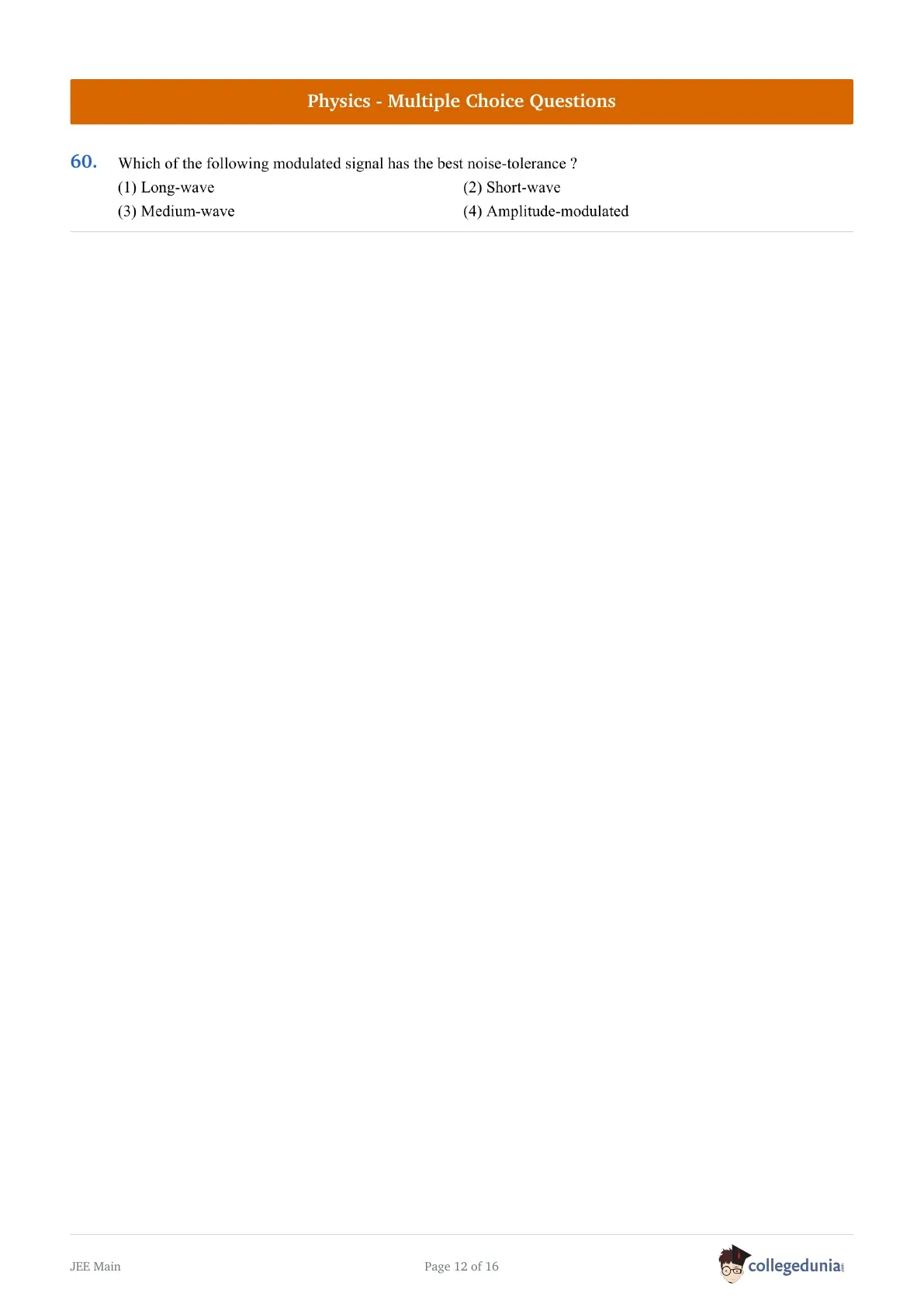
| A | B | C |
| 0 | 0 | 0 |
| 0 | 1 | 0 |
| 1 | 0 | 1 |
| 1 | 1 | 0 |
- (1)
![]()
- (2)
![]()
- (3)
![]()
- (4)
![]()


Which of the following modulated signal has the best noise-tolerance ?
Chemistry (Q61 - Q90)
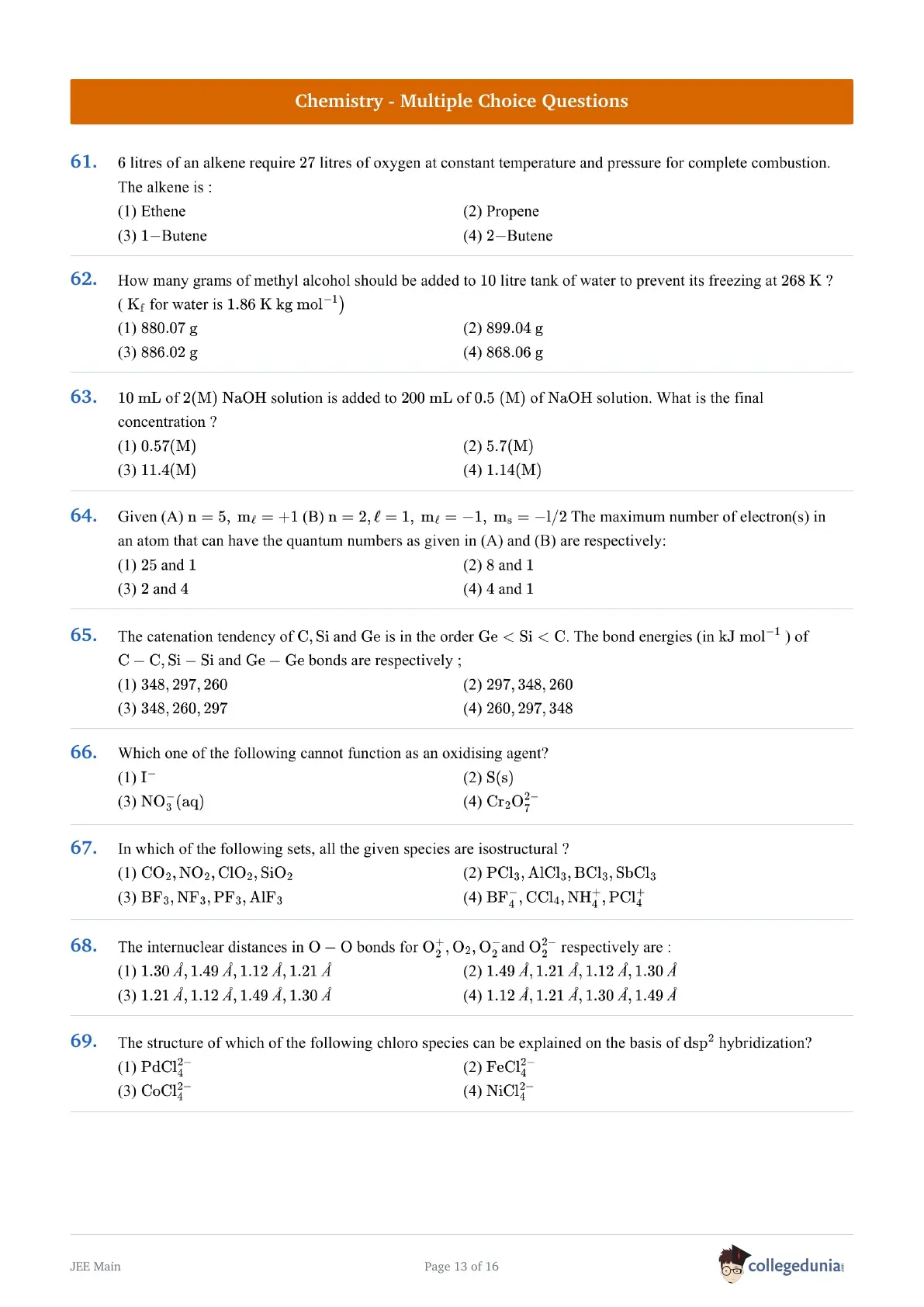
\(6\) litres of an alkene require \(27\) litres of oxygen at constant temperature and pressure for complete combustion. The alkene is:
How many grams of methyl alcohol should be added to \(10\) litre tank of water to prevent its freezing at \(268\, K\) ? \(\left(K_{f} \, for\, water\, is \,1.86 K\, kg \, mol^{-1} \right)\)
\(10\, mL\) of \(2(M)\) \(NaOH\) solution is added to \(200\, mL\) of \(0.5 (M)\) of \(NaOH\) solution. What is the final concentration ?
Given (A) \(n=5, m_{\ell} =+1\) (B) \(n=2, \ell=1, m_{\ell} =1, m_{s} =-\frac{1}{2}\) The maximum number of electron(s) in an atom that can have the quantum numbers as given in (A) and (B) are respectively:
The catenation tendency of C, Si and Ge is in the order Ge \(\lt\) Si \(\lt\) C. The bond energies (in kJ \(\mathrm{mol^{-1}}\) ) of C \(-\) C, Si \(-\) Si and Ge \(-\) Ge bonds are respectively ;
Which one of the following cannot function as an oxidising agent?
In which of the following sets, all the given species are isostructural ?
The internuclear distances in O \(-\) O bonds for \(\mathrm{O_2^+, O_2, O_2^-}\) and \(\mathrm{O_2^{2-}}\) respectively are :
The structure of which of the following chloro species can be explained on the basis of \(dsp^2\) hybridization?
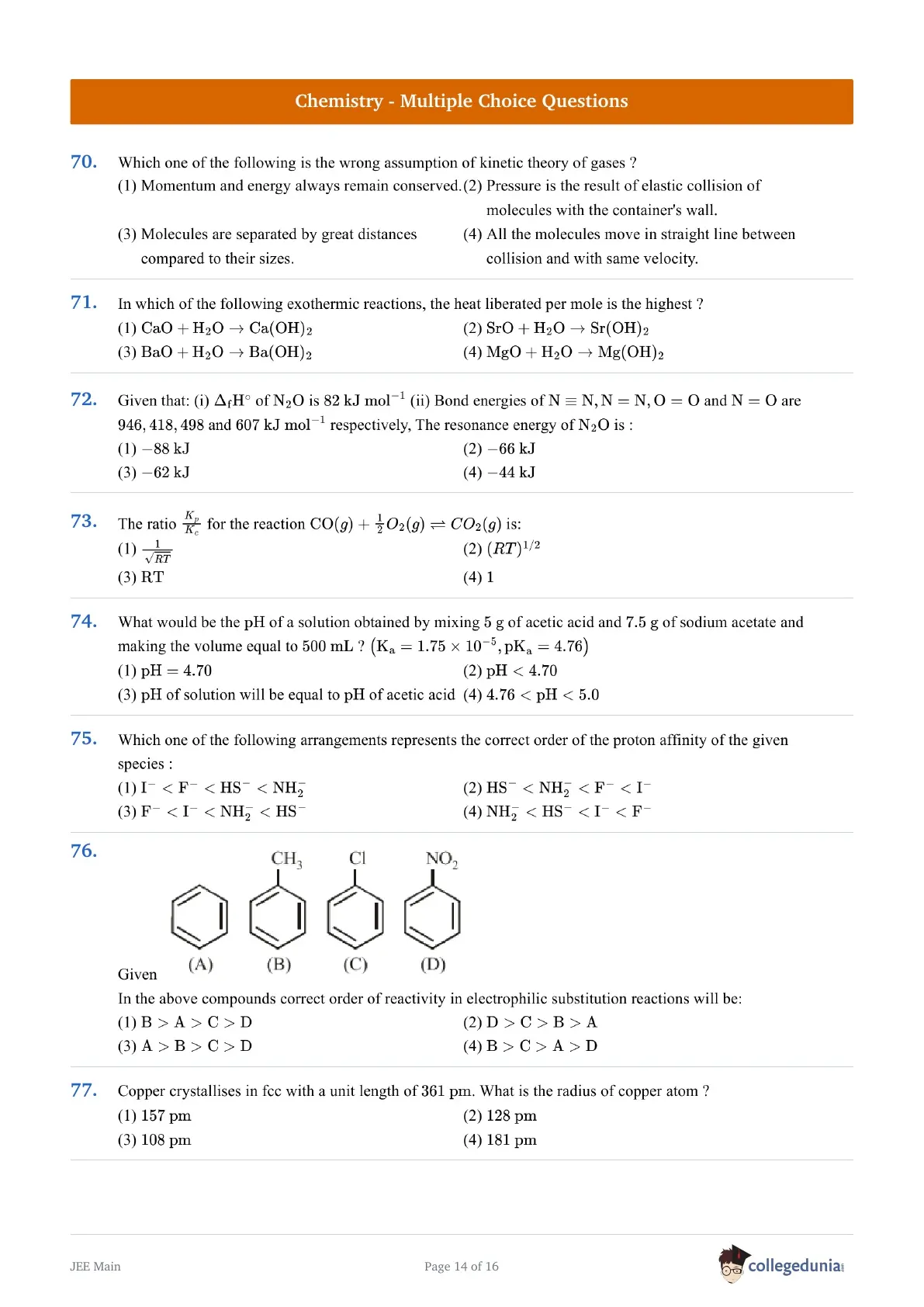
Which one of the following is the wrong assumption of kinetic theory of gases?
In which of the following exothermic reactions, the heat liberated per mole is the highest ?
Given that: (i) \(\Delta_f H^\circ\) of \(\mathrm{N_2O}\) is 82 kJ \(\mathrm{mol^{-1}}\) (ii) Bond energies of \(\mathrm{N\equiv N, N=N, O=O}\) and \(\mathrm{N=O}\) are 946, 418, 498 and 607 kJ \(\mathrm{mol^{-1}}\) respectively, The resonance energy of \(\mathrm{N_2O}\) is :
The ratio \(\frac{K_p}{K_c}\) for the reaction \(\mathrm{CO}(g) + \frac{1}{2}\mathrm{O_2}(g) \rightleftharpoons \mathrm{CO_2}(g)\) is:
What would be the pH of a solution obtained by mixing 5 g of acetic acid and 7.5 g of sodium acetate and making the volume equal to 500 mL ? (\(\mathrm{K_a} = 1.75 \times 10^{-5}\), \(\mathrm{pK_a} = 4.76\))
Which one of the following arrangements represents the correct order of the proton affinity of the given species :

Given
In the above compounds correct order of reactivity in electrophilic substitution reactions will be:
Copper crystallises in fcc with a unit length of \(361\,pm\). What is the radius of copper atom ?
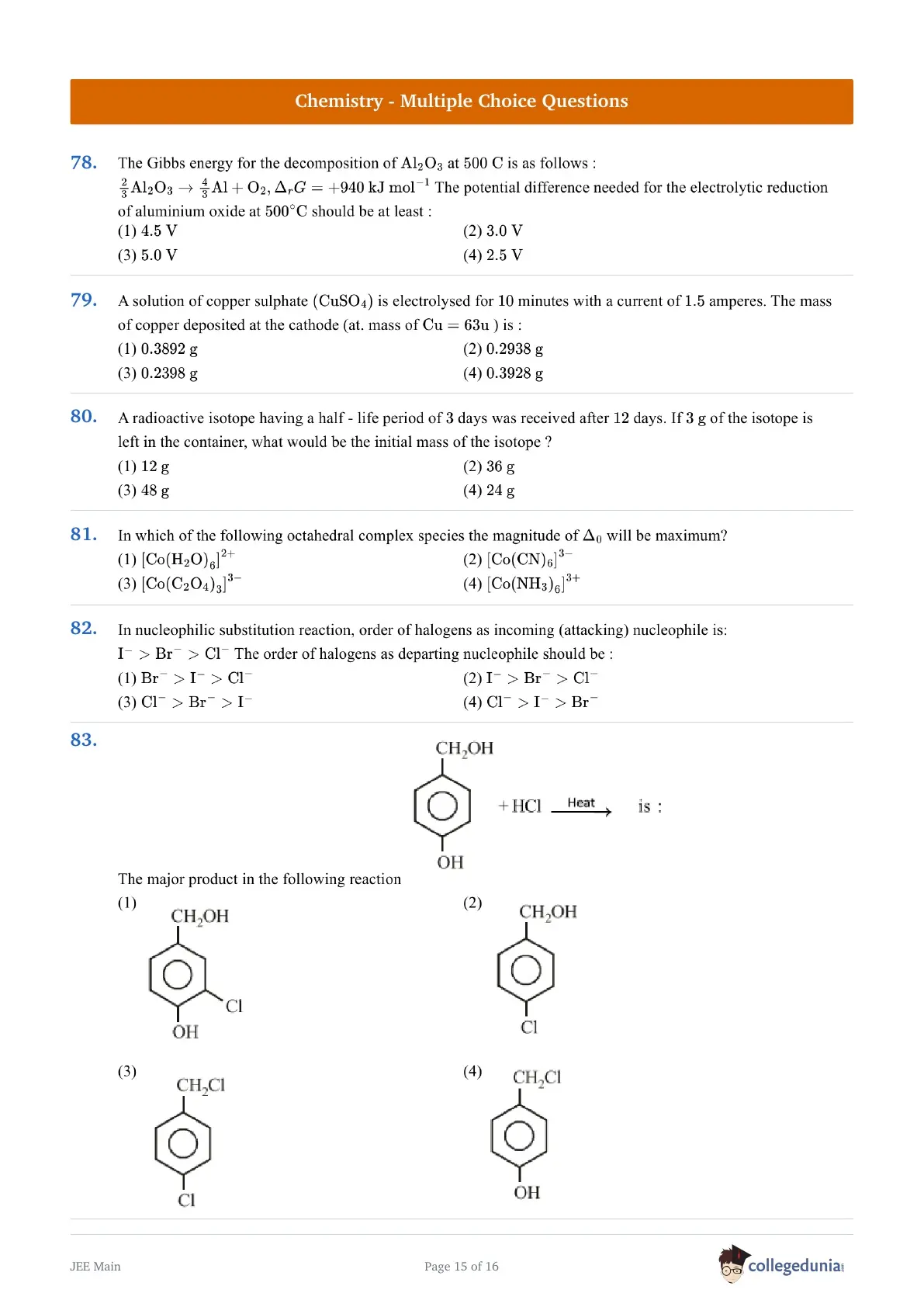
The Gibbs energy for the decomposition of \(\mathrm{Al_2O_3}\) at 500 C is as follows :
\(\frac{2}{3}\mathrm{Al_2O_3} \rightarrow \frac{4}{3}\mathrm{Al} + \mathrm{O_2}\), \(\Delta_r G = +940\ \mathrm{kJ\ mol^{-1}}\) The potential difference needed for the electrolytic reduction of aluminium oxide at \(500^\circ\mathrm{C}\) should be at least :
A solution of copper sulphate \(\left(CuSO_{4}\right)\) is electrolysed for 10 minutes with a current of \(1.5\) amperes. The mass of copper deposited at the cathode (at. mass of \(Cu = 63u\)) is :
A radioactive isotope having a half - life period of 3 days was received after 12 days. If 3 g of the isotope is left in the container, what would be the initial mass of the isotope ?
In which of the following octahedral complex species the magnitude of \(\Delta_o\) will be maximum?
In nucleophilic substitution reaction, order of halogens as incoming (attacking) nucleophile is: \(I^- > \, Br^{-} > \, Cl^-\) The order of halogens as departing nucleophile should be:

The major product in the following reaction (p-hydroxybenzyl alcohol + HCl, Heat) is :
- (1)
![]()
- (2)
![]()
- (3)
![]()
- (4)
![]()


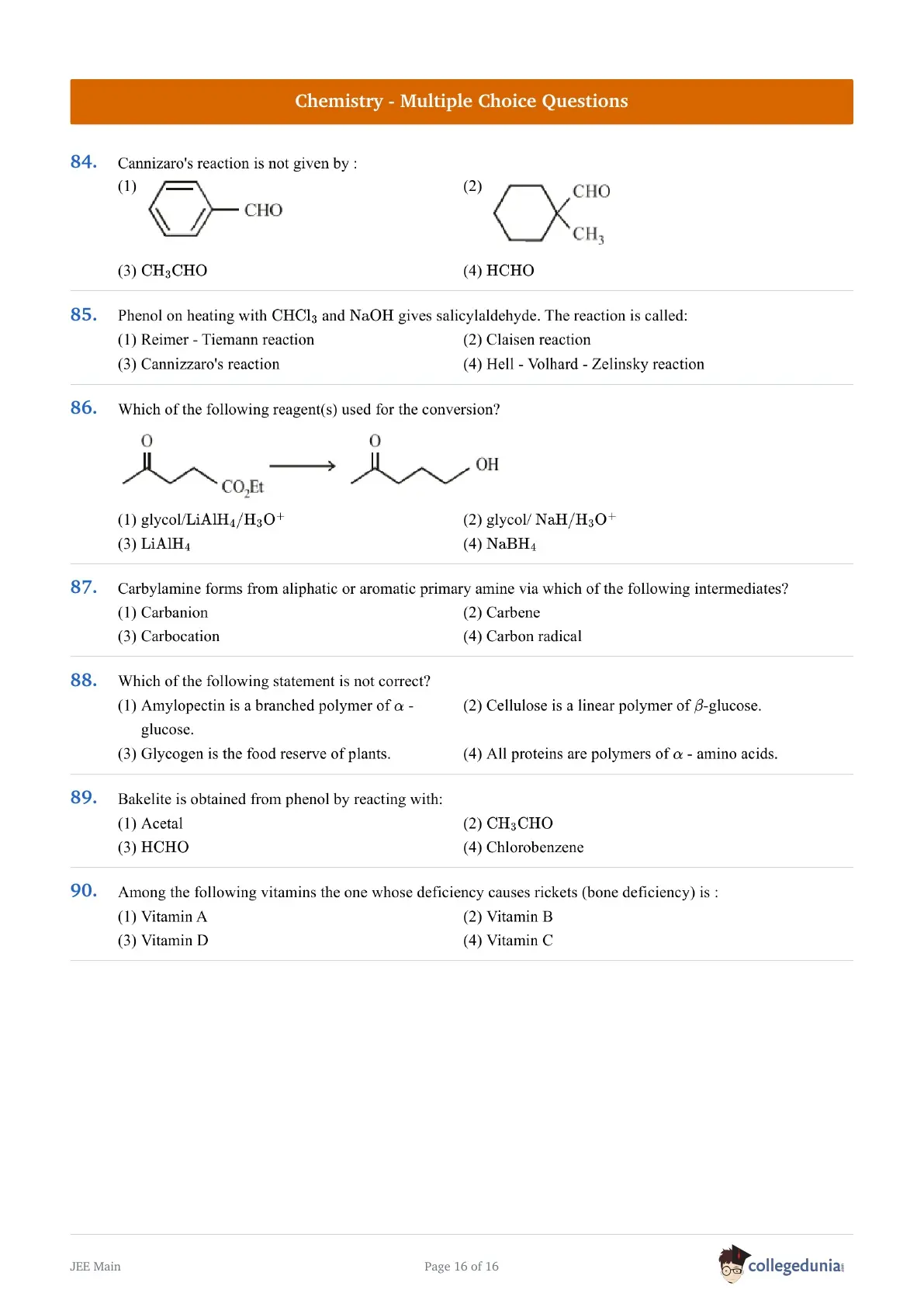
Cannizzaro's reaction is not given by :
- (1)
![]()
- (2)
![]()
- (3) \(\mathrm{CH_3CHO}\)
- (4) \(\mathrm{HCHO}\)


Phenol on heating with \(\mathrm{CHCl_3}\) and NaOH gives salicylaldehyde. The reaction is called:
Which of the following reagent(s) used for the conversion?
Carbylamine forms from aliphatic or aromatic primary amine via which of the following intermediates?
Which of the following statement is not correct?
Bakelite is obtained from phenol by reacting with:
Among the following vitamins the one whose deficiency causes rickets (bone deficiency) is :
JEE Main 2013 Exam Pattern and Marking Scheme
| Particulars | Details |
|---|---|
| Exam Mode | Online (Computer-Based Test) |
| Paper | B.E./B.Tech (Paper 1) |
| Duration | 3 hours (180 minutes) |
| Type of Questions | Multiple Choice Questions (MCQs) |
| Subjects | Mathematics, Physics, Chemistry |
| Total Questions | 90 questions (30 per subject) |
| Total Marks | 360 marks |
| Marking Scheme | +4 for correct answer & -1 for incorrect answer |



Comments