



JEE Main 2014 April 19 Question Paper is available here with solutions PDF and detailed solutions for every question. CBSE conducted the computer-based test (CBT) Paper 1 on April 19, 2014. The JEE Main 2014 Paper 1 (B.E./B.Tech) question paper includes the following:
- 90 questions in a 3-hour CBT Mode: 30 each from Mathematics, Physics and Chemistry
- Question type: all multiple choice questions (MCQs) with a single correct option, 4 marks each
- Sections: Mathematics (30), Physics (30) and Chemistry (30), all questions compulsory
- Marking: +4 for a correct answer, -1 for an incorrect answer, 0 for an unattempted question
- Maximum marks: 360 (120 per subject)
JEE Main 2014 April 19 Question Paper with Solution PDF
| NTA Official PDF | CD PDF | CD PDF with Solutions |
|---|---|---|
| Download official PDF 4.68 MB | Download Collegedunia PDF 5.13 MB | Download solutions PDF 0.96 MB |
Also Check:
JEE Main 2014 April 19 Questions with Solutions
Mathematics (Q1 - Q30)
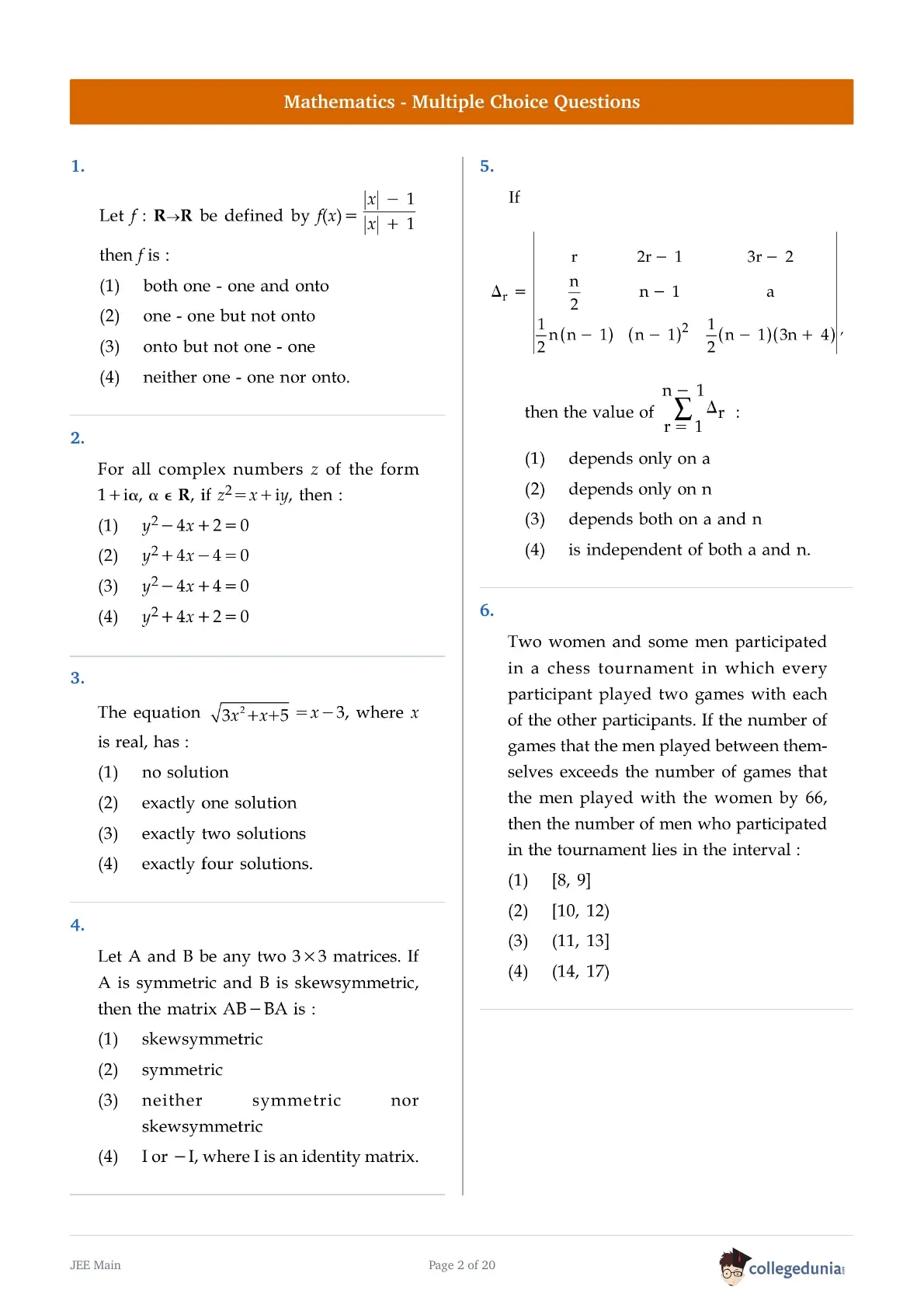
Let \(f : \mathbf{R}\to\mathbf{R}\) be defined by \(f(x)=\frac{|x|-1}{|x|+1}\), then \(f\) is :
For all complex numbers z of the form 1 + i\(\alpha\), \(\alpha\) \(\epsilon\) R, if z = x + iy, then :
The equation \(\sqrt{3x^2+x+5}=x-3\), where \(x\) is real, has :
Let A and B be any two \(3\times 3\) matrices. If A is symmetric and B is skewsymmetric, then the matrix AB \(-\) BA is :
If \(\Delta_r=\begin{vmatrix} r & 2r-1 & 3r-2\\ \frac{n}{2} & n-1 & a\\ \frac12 n(n-1) & (n-1)^2 & \frac12 (n-1)(3n+4)\end{vmatrix}\), then the value of \(\displaystyle\sum_{r=1}^{n-1}\Delta_r\) :
Two women and some men participated in a chess tournament in which every participant played two games with each of the other participants. If the number of games that the men played between themselves exceeds the number of games that the men played with the women by 66, then the number of men who participated in the tournament lies in the interval :
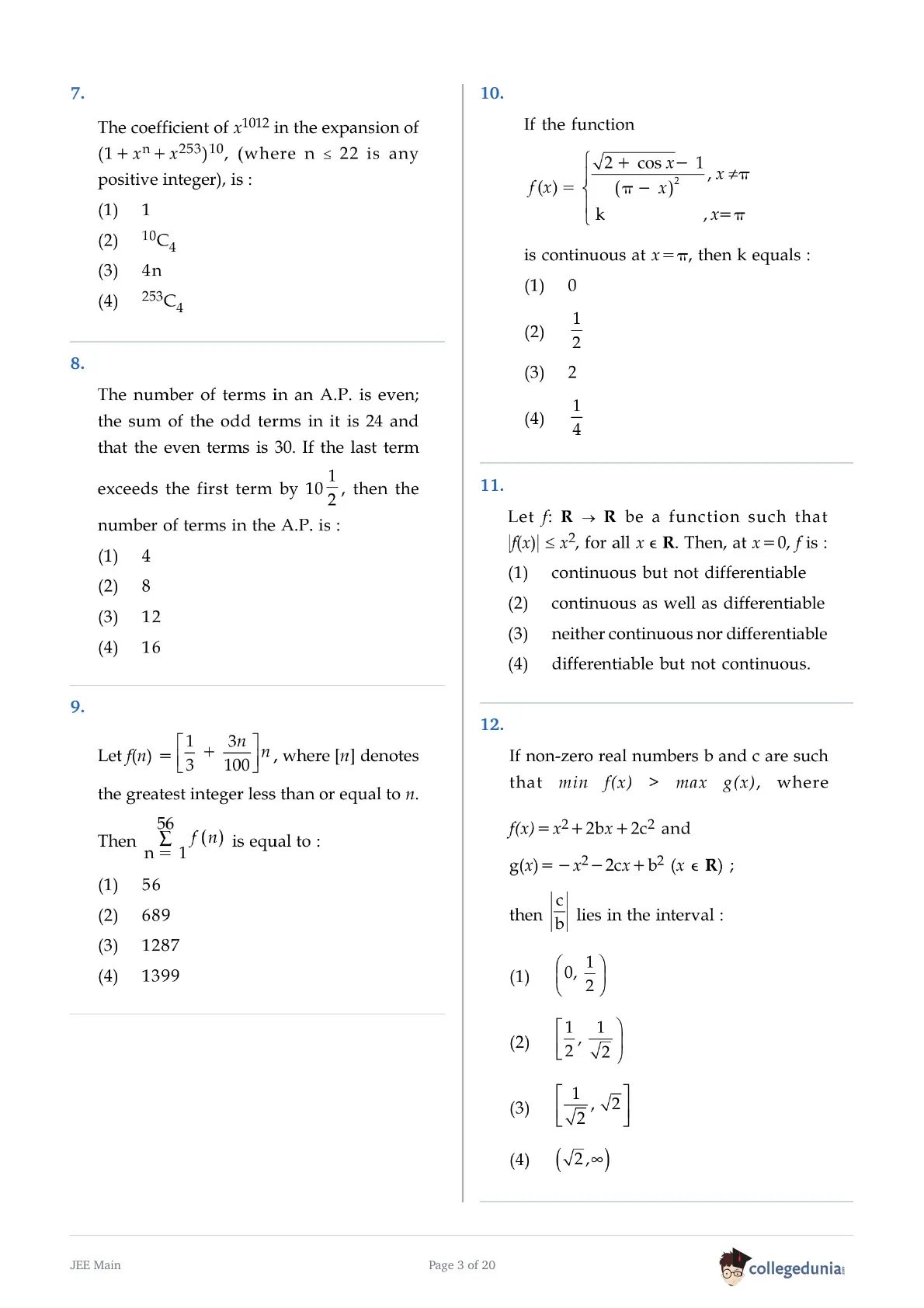
The coefficient of \(x^{1012}\) in the expansion of \((1 + x^n + x^{253})^{10}\), (where n \(\le\) 22 is any positive integer), is :-
The number of terms in an \(A.P\). is even; the sum of the odd terms in it is \(24\) and that the even terms is \(30\). If the last term exceeds the first term by \(10 \frac{1}{2},\) then the number of terms in the \(A.P\). is :
Let \(f\left(n\right) = \left[\frac{1}{3} + \frac{3n}{100}\right]{n},\) where \(\left[n\right]\) denotes the greatest integer less than or equal to n. Then \(\sum\limits^{56}_{n = 1} \Delta_{r} f\left(n\right)\) is equal to :
If the function \(f(x)=\begin{cases}\dfrac{\sqrt{2+\cos x}-1}{(\pi-x)^2}, & x\ne\pi\\ k, & x=\pi\end{cases}\) is continuous at \(x=\pi\), then k equals :
Let \(f:\mathbf{R}\to\mathbf{R}\) be a function such that \(|f(x)|\le x^2\), for all \(x\in\mathbf{R}\). Then, at \(x=0\), \(f\) is :
If non-zero real numbers b and c are such that \(\min f(x)>\max g(x)\), where \(f(x)=x^2+2bx+2c^2\) and \(g(x)=-x^2-2cx+b^2\) \((x\in\mathbf{R})\); then \(\left|\frac cb\right|\) lies in the interval :
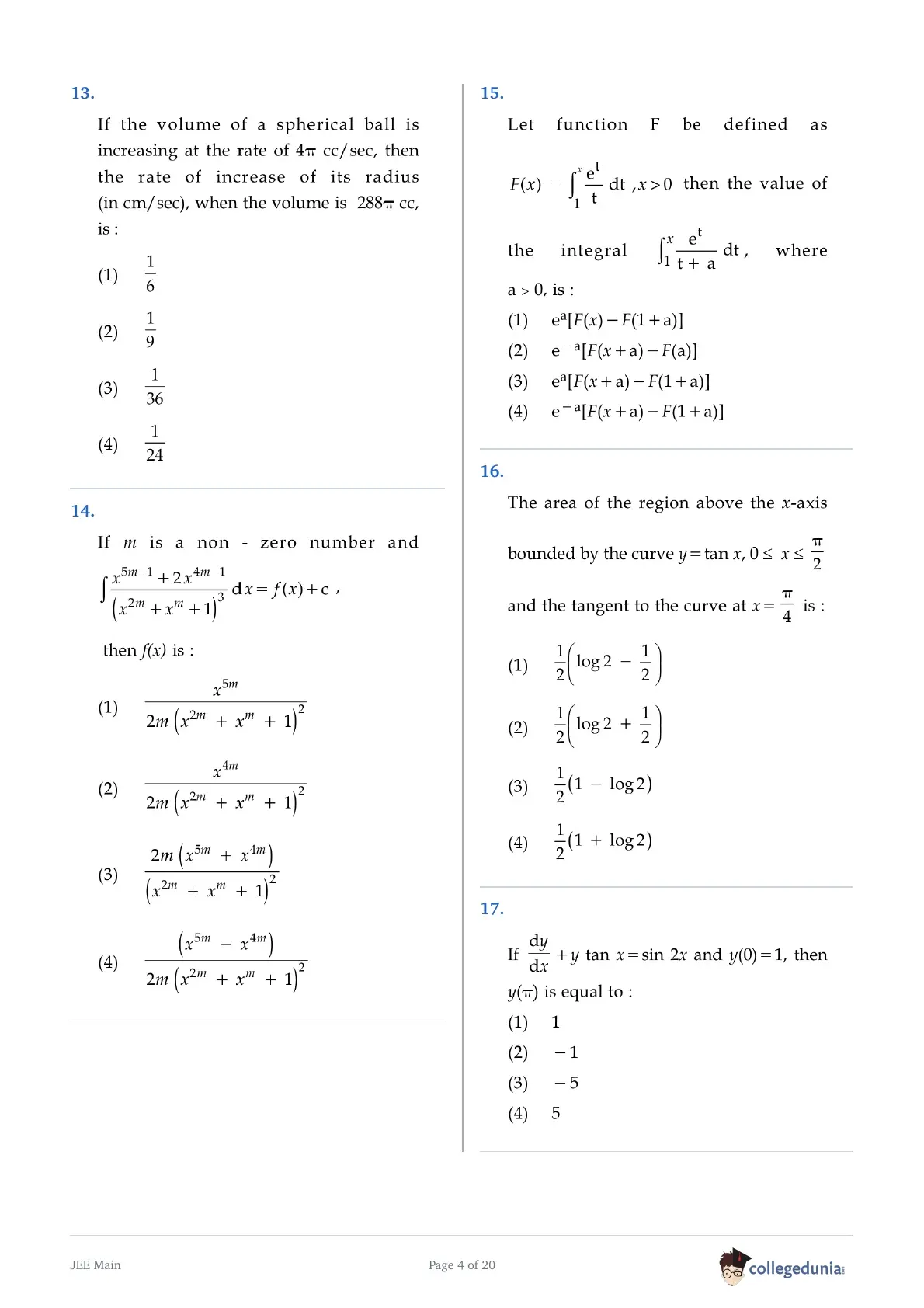
If the volume of a spherical ball is increasing at the rate of \(4\pi\) cc/sec, then the rate of increase of its radius (in cm/sec), when the volume is \(288\pi\) cc, is :
If m is a non-zero number and \(\displaystyle\int\frac{x^{5m-1}+2x^{4m-1}}{\left(x^{2m}+x^m+1\right)^3}\,dx=f(x)+c\), then \(f(x)\) is :
Let function F be defined as \(F(x)=\displaystyle\int_1^x\frac{e^t}{t}\,dt,\ x>0\), then the value of the integral \(\displaystyle\int_1^x\frac{e^t}{t+a}\,dt\), where \(a>0\), is :
The area of the region above the \(x\)-axis bounded by the curve \(y=\tan x,\ 0\le x\le \frac{\pi}{2}\) and the tangent to the curve at \(x=\frac{\pi}{4}\) is :
If \(\frac{dy}{dx}+y\tan x=\sin 2x\) and \(y(0)=1\), then \(y(\pi)\) is equal to :
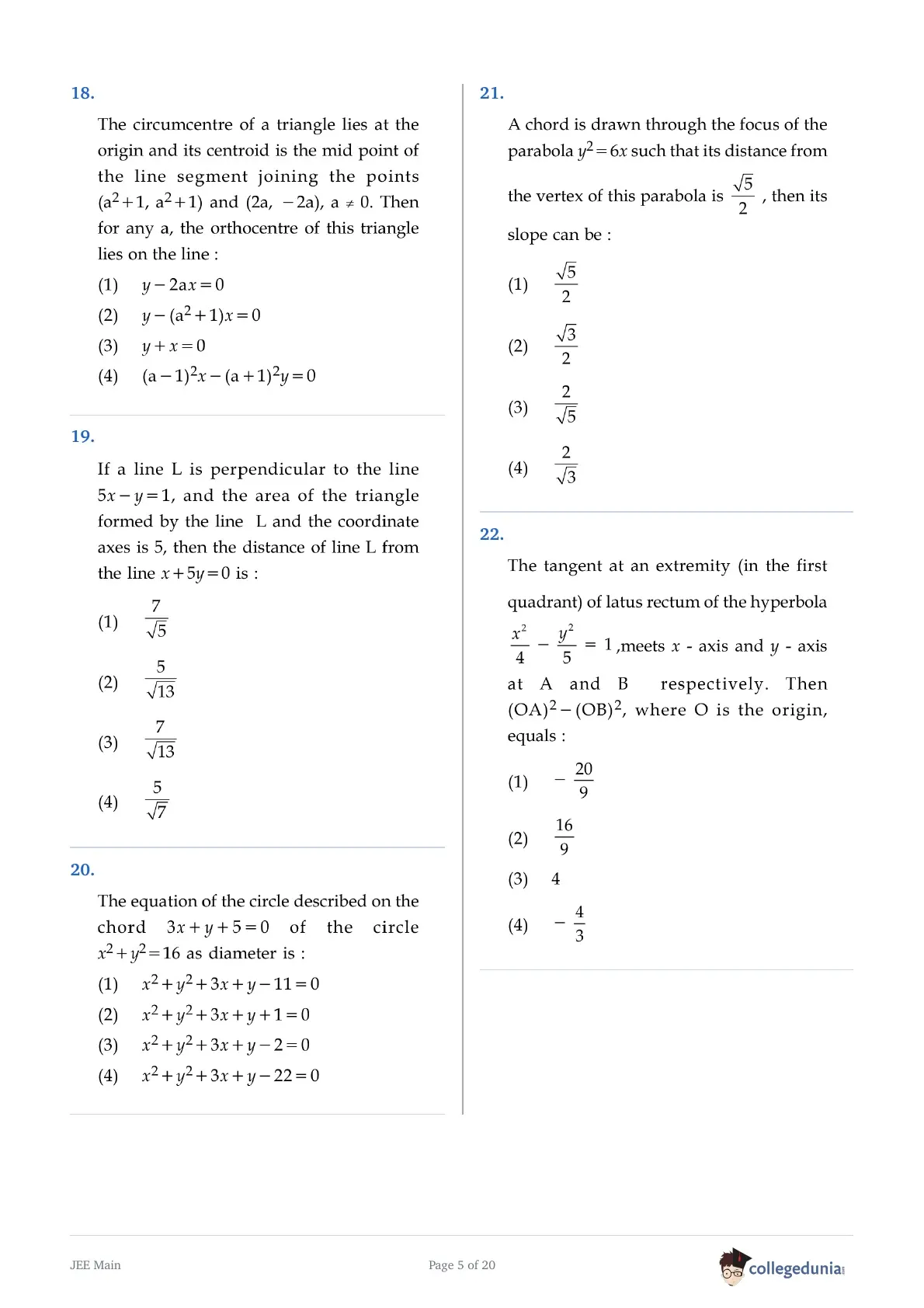
The circumcentre of a triangle lies at the origin and its centroid is the mid point of the line segment joining the points \((a^2+1,\ a^2+1)\) and \((2a,\ -2a),\ a\neq 0\). Then for any \(a\), the orthocentre of this triangle lies on the line :
If a line L is perpendicular to the line \(5x-y=1\), and the area of the triangle formed by the line L and the coordinate axes is \(5\), then the distance of line L from the line \(x+5y=0\) is :
The equation of the circle described on the chord \(3x+y+5=0\) of the circle \(x^2+y^2=16\) as diameter is :
A chord is drawn through the focus of the parabola \(y^2=6x\) such that its distance from the vertex of this parabola is \(\frac{\sqrt5}{2}\), then its slope can be :
The tangent at an extremity (in the first quadrant) of latus rectum of the hyperbola \(\frac{x^2}{4}-\frac{y^2}{5}=1\), meets \(x\)-axis and \(y\)-axis at A and B respectively. Then \((OA)^2-(OB)^2\), where O is the origin, equals :
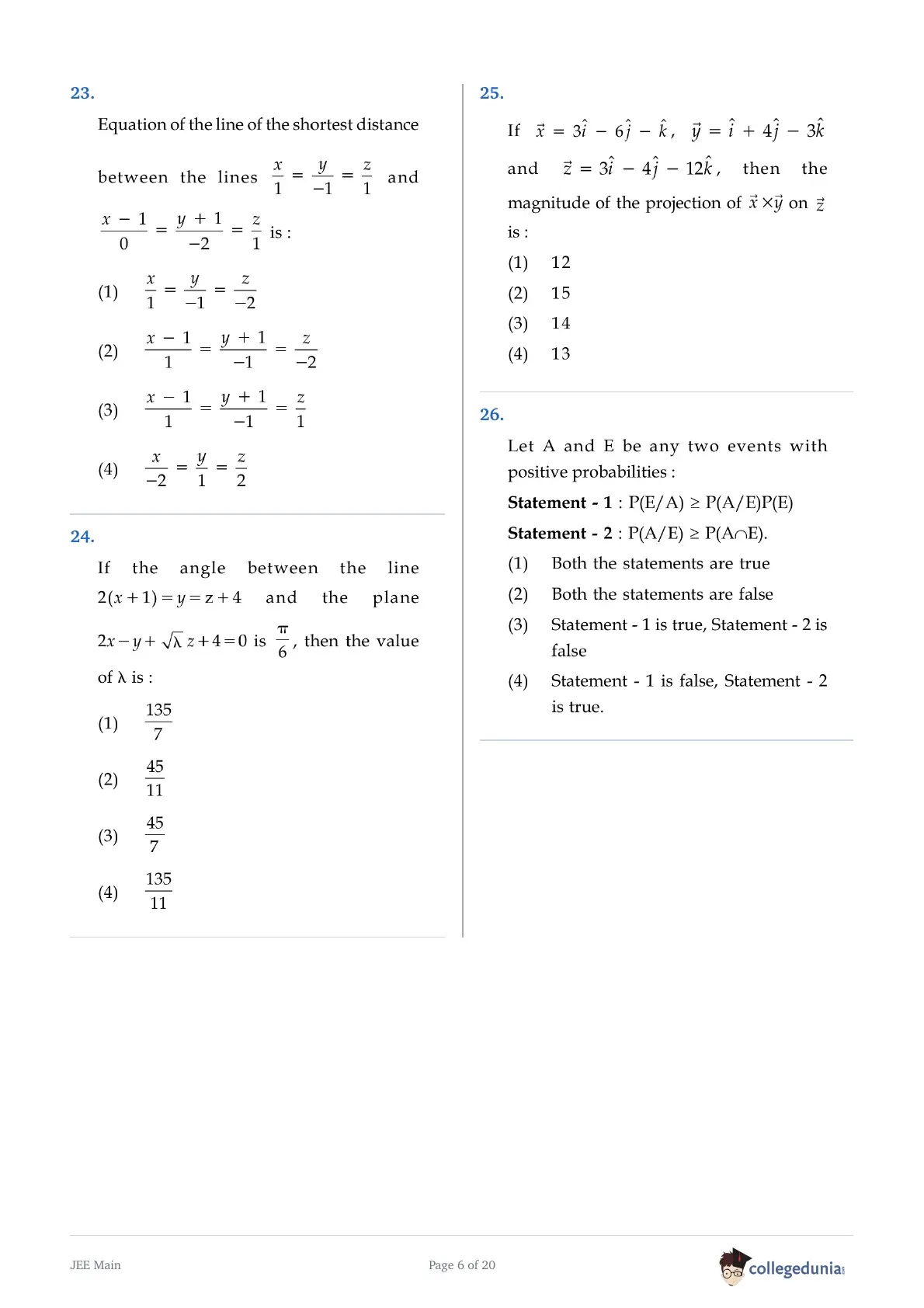
Equation of the line of the shortest distance between the lines \(\frac{x}{1} = \frac{y}{-1} = \frac{z}{1}\) and \(\frac{x-1}{0} = \frac{y+1}{-2} = \frac{z}{1}\) is :
If the angle between the line \(2(x+1)=y=z+4\) and the plane \(2x-y+\sqrt{\lambda}\,z+4=0\) is \(\frac{\pi}{6}\), then the value of \(\lambda\) is :
If \(\vec x=3\hat i-6\hat j-\hat k,\ \vec y=\hat i+4\hat j-3\hat k\) and \(\vec z=3\hat i-4\hat j-12\hat k\), then the magnitude of the projection of \(\vec x\times\vec y\) on \(\vec z\) is :
Let A and E be any two events with positive probabilities :
Statement - 1 : \(P(E/A)\ge P(A/E)P(E)\)
Statement - 2 : \(P(A/E)\ge P(A\cap E)\).
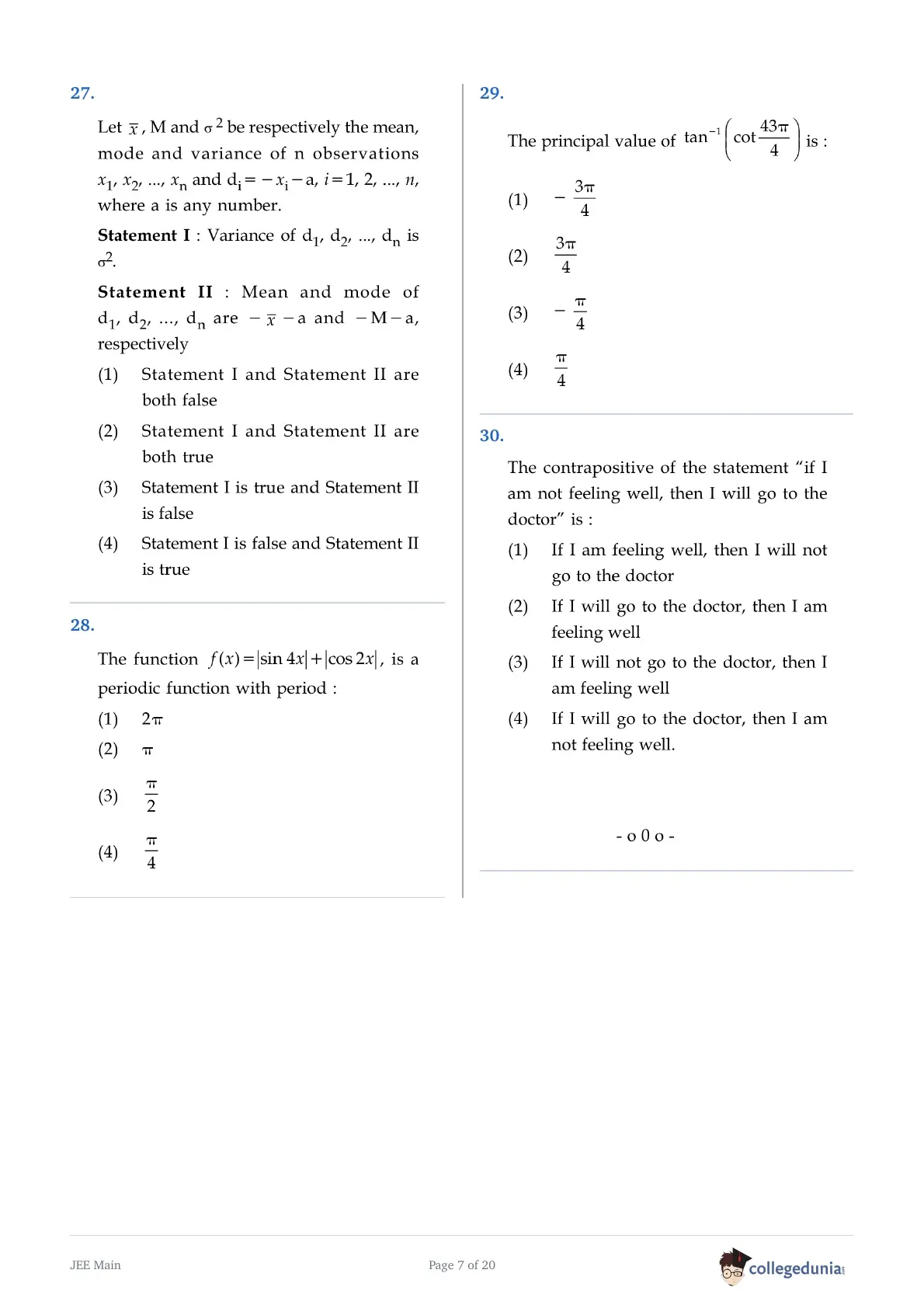
Let \(\bar x\), M and \(\sigma^2\) be respectively the mean, mode and variance of n observations \(x_1,x_2,\ldots,x_n\) and \(d_i=-x_i-a,\ i=1,2,\ldots,n\), where a is any number.
Statement I : Variance of \(d_1,d_2,\ldots,d_n\) is \(\sigma^2\).
Statement II : Mean and mode of \(d_1,d_2,\ldots,d_n\) are \(-\bar x-a\) and \(-M-a\), respectively.
The function \(f(x)=|\sin 4x|+|\cos 2x|\), is a periodic function with period :
The principal value of \(\tan^{-1}\left(\cot\frac{43\pi}{4}\right)\) is :
The contrapositive of the statement "if I am not feeling well, then I will go to the doctor" is :
Physics (Q31 - Q60)
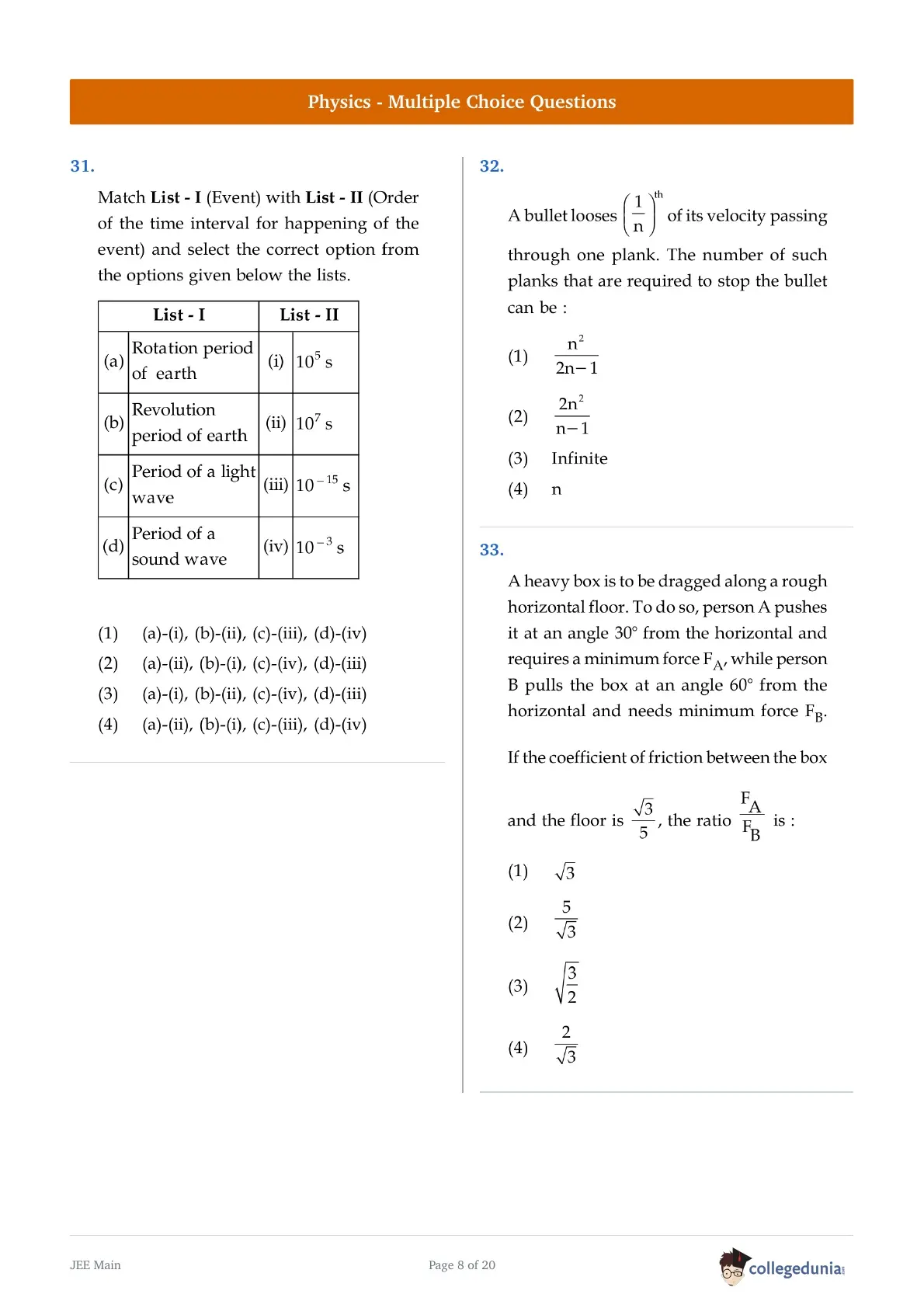
| List - I | List - II |
| (a) Rotation period of earth | (i) \(10^{5}\) s |
| (b) Revolution period of earth | (ii) \(10^{7}\) s |
| (c) Period of a light wave | (iii) \(10^{-15}\) s |
| (d) Period of a sound wave | (iv) \(10^{-3}\) s |
A bullet looses \(\left(\frac{1}{n}\right)^{th}\) of its velocity passing through one plank. The number of such planks that are required to stop the bullet can be :
A heavy box is to be dragged along a rough horizontal floor. To do so, person A pushes it at an angle \(30^\circ\) from the horizontal and requires a minimum force \(F_A\), while person B pulls the box at an angle \(60^\circ\) from the horizontal and needs minimum force \(F_B\).
If the coefficient of friction between the box and the floor is \(\frac{\sqrt3}{5}\), the ratio \(\frac{F_A}{F_B}\) is :
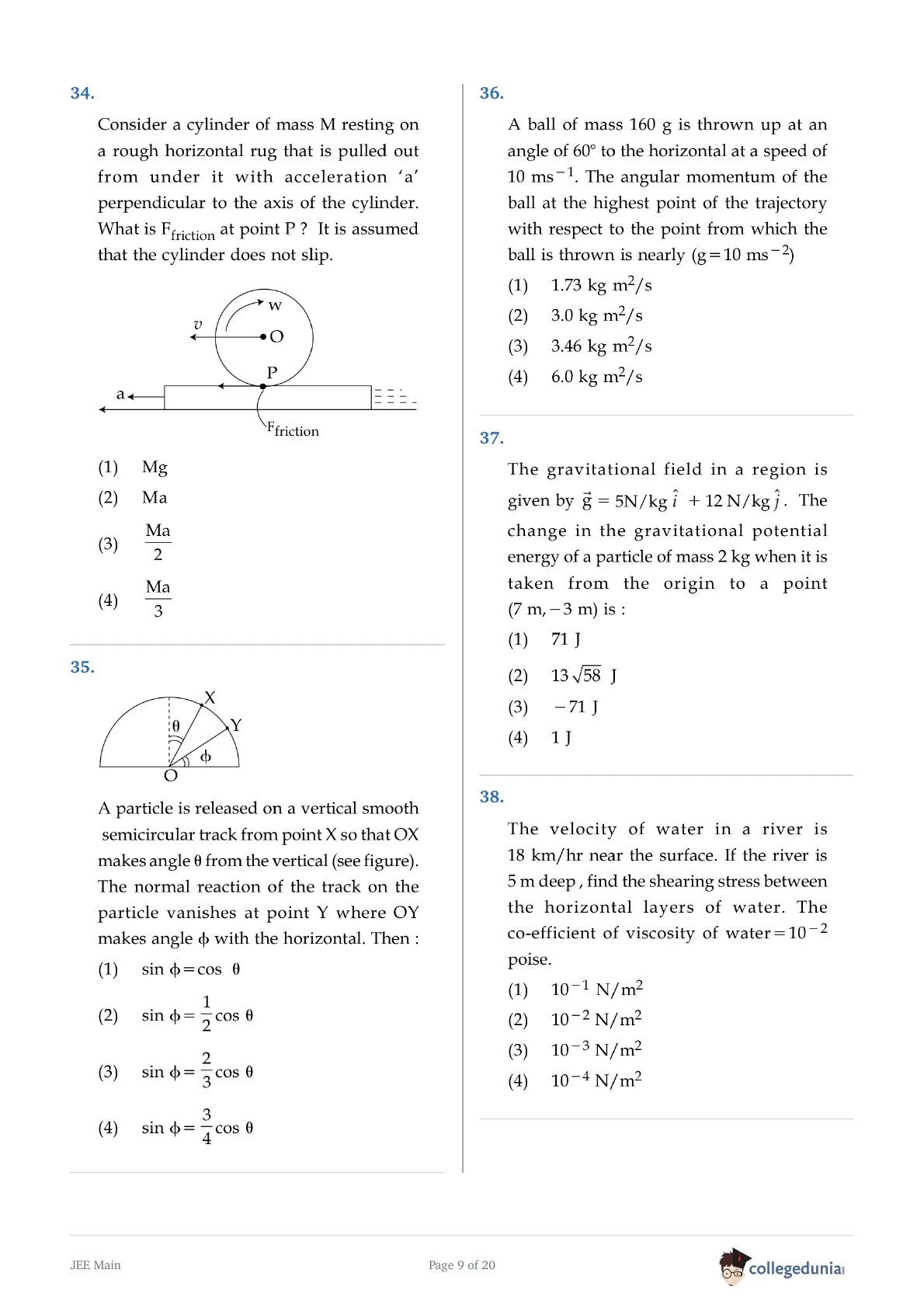
Consider a cylinder of mass \(M\) resting on a rough horizontal rug that is pulled out from under it with acceleration \('a'\) perpendicular to the axis of cylinder. What is \(F_{friction}\) at point \(P\) ? It is assumed that the cylinder does not slip.
A particle is released on a vertical smooth semicircular track from point \(X\) so that \(OX\) makes angle \(\theta\) from the vertical (see figure). The normal reaction of the track on the particle vanishes at point \(Y\) where \(OY\) makes angle \(\phi\) with the horizontal. Then :
A ball of mass 160 g is thrown up at an angle of \(60^\circ\) to the horizontal at a speed of \(10\ \mathrm{ms^{-1}}\). The angular momentum of the ball at the highest point of the trajectory with respect to the point from which the ball is thrown is nearly (\(g = 10\ \mathrm{ms^{-2}}\))
The gravitational field in a region is given by \(\vec g = 5\ \mathrm{N/kg}\ \hat i + 12\ \mathrm{N/kg}\ \hat j\). The change in the gravitational potential energy of a particle of mass 2 kg when it is taken from the origin to a point (7 m, \(-3\) m) is :
The velocity of water in a river is \(18\, km/hr\) near the surface. If the river is \(5\, m\) deep, find the shearing stress between the horizontal layers of water. The co-efficient of viscosity of water \(= 10^{-2}\) poise.
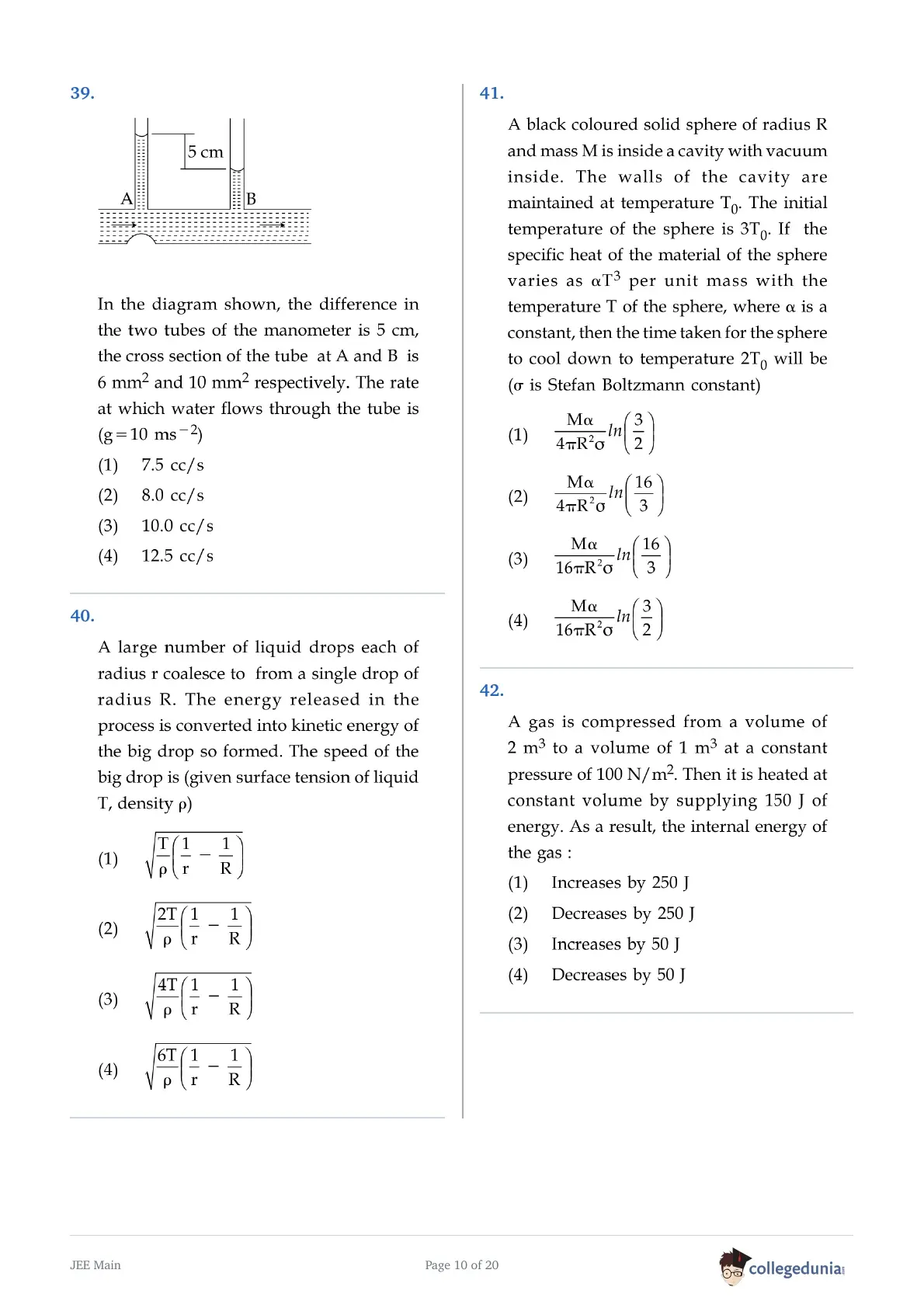
 In the diagram shown, the difference in the two tubes of the manometer is 5 cm, the cross section of the tube at A and B is \(6\ \mathrm{mm^2}\) and \(10\ \mathrm{mm^2}\) respectively. The rate at which water flows through the tube is (\(g = 10\ \mathrm{ms^{-2}}\))
A large number of liquid drops each of radius r coalesce to form a single drop of radius R. The energy released in the process is converted into kinetic energy of the big drop so formed. The speed of the big drop is (given surface tension of liquid T, density \(\rho\))
A black coloured solid sphere of radius R and mass M is inside a cavity with vacuum inside. The walls of the cavity are maintained at temperature \(T_0\). The initial temperature of the sphere is \(3T_0\). If the specific heat of the material of the sphere varies as \(\alpha T^3\) per unit mass with the temperature T of the sphere, where \(\alpha\) is a constant, then the time taken for the sphere to cool down to temperature \(2T_0\) will be (\(\sigma\) is Stefan Boltzmann constant)
A gas is compressed from a volume of \(2 \,m^3\) to a volume of \(1\, m^3\) at a constant pressure of \(100\, N/m^2\). Then it is heated at constant volume by supplying \(150\, J\) of energy. As a result, the internal energy of the gas :
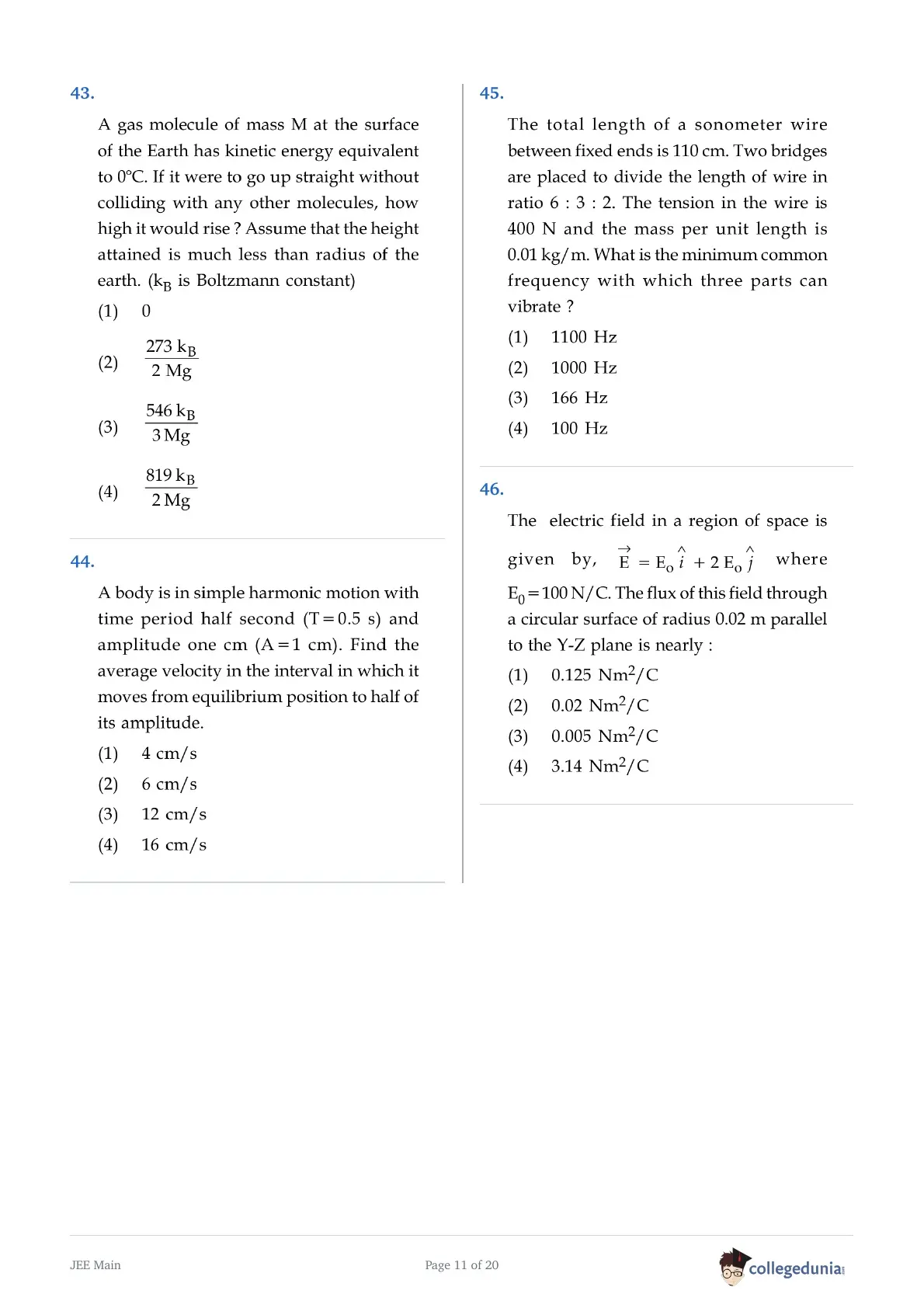
A gas molecule of mass M at the surface of the Earth has kinetic energy equivalent to \(0^\circ\)C. If it were to go up straight without colliding with any other molecules, how high it would rise ? Assume that the height attained is much less than radius of the earth. (\(k_B\) is Boltzmann constant)
A body is in simple harmonic motion with time period half second (T = 0.5 s) and amplitude one cm (A = 1 cm). Find the average velocity in the interval in which it moves from equilibrium position to half of its amplitude.
The total length of a sonometer wire between fixed ends is \(110\, cm\). Two bridges are placed to divide the length of wire in ratio \(6 : 3 : 2\). The tension in the wire is \(400\, N\) and the mass per unit length is \(0.01\, kg/m\). What is the minimum common frequency with which three parts can vibrate ?
The electric field in a region of space is given by, \(\vec E = E_0\hat i + 2E_0\hat j\) where \(E_0 = 100\ \mathrm{N/C}\). The flux of this field through a circular surface of radius 0.02 m parallel to the Y-Z plane is nearly :
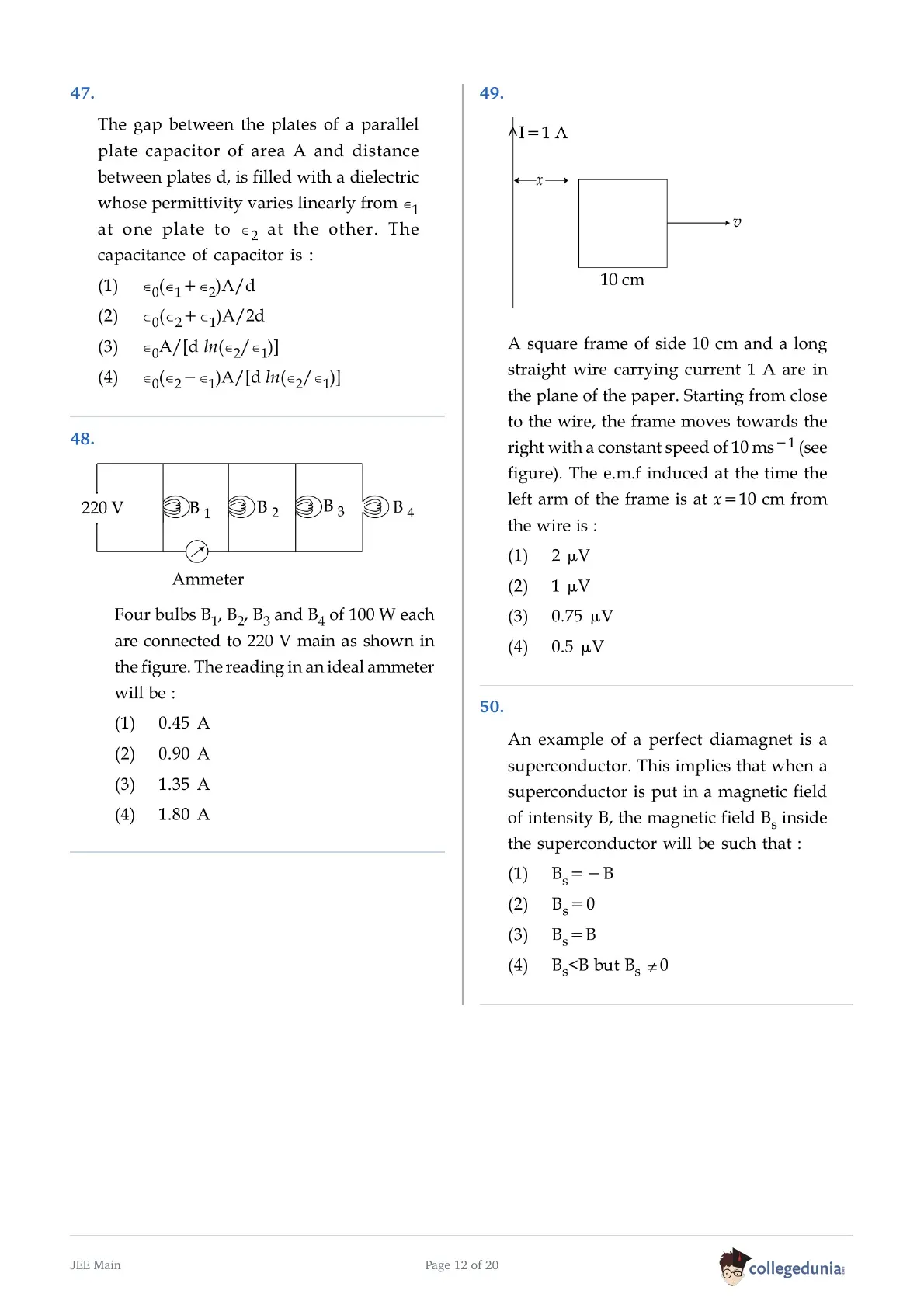
The gap between the plates of a parallel plate capacitor of area A and distance between plates \(d\), is filled with a dielectric whose permittivity varies linearly from \(\epsilon_{1}\) at one plate to \(\epsilon_{2}\) at the other. The capacitance of capacitor is :
 Four bulbs \(B_1\), \(B_2\), \(B_3\) and \(B_4\) of 100 W each are connected to 220 V main as shown in the figure. The reading in an ideal ammeter will be :
A square frame of side 10 cm and a long straight wire carrying current 1 A are in the plane of the paper. Starting from close to the wire, the frame moves towards the right with a constant speed of 10 ms (see figure). The e.m.f induced at the time the left arm of the frame is at x = 10 cm from the wire is :
An example of a perfect diamagnet is a superconductor. This implies that when a superconductor is put in a magnetic field of intensity B, the magnetic field \(B_s\) inside the superconductor will be such that :
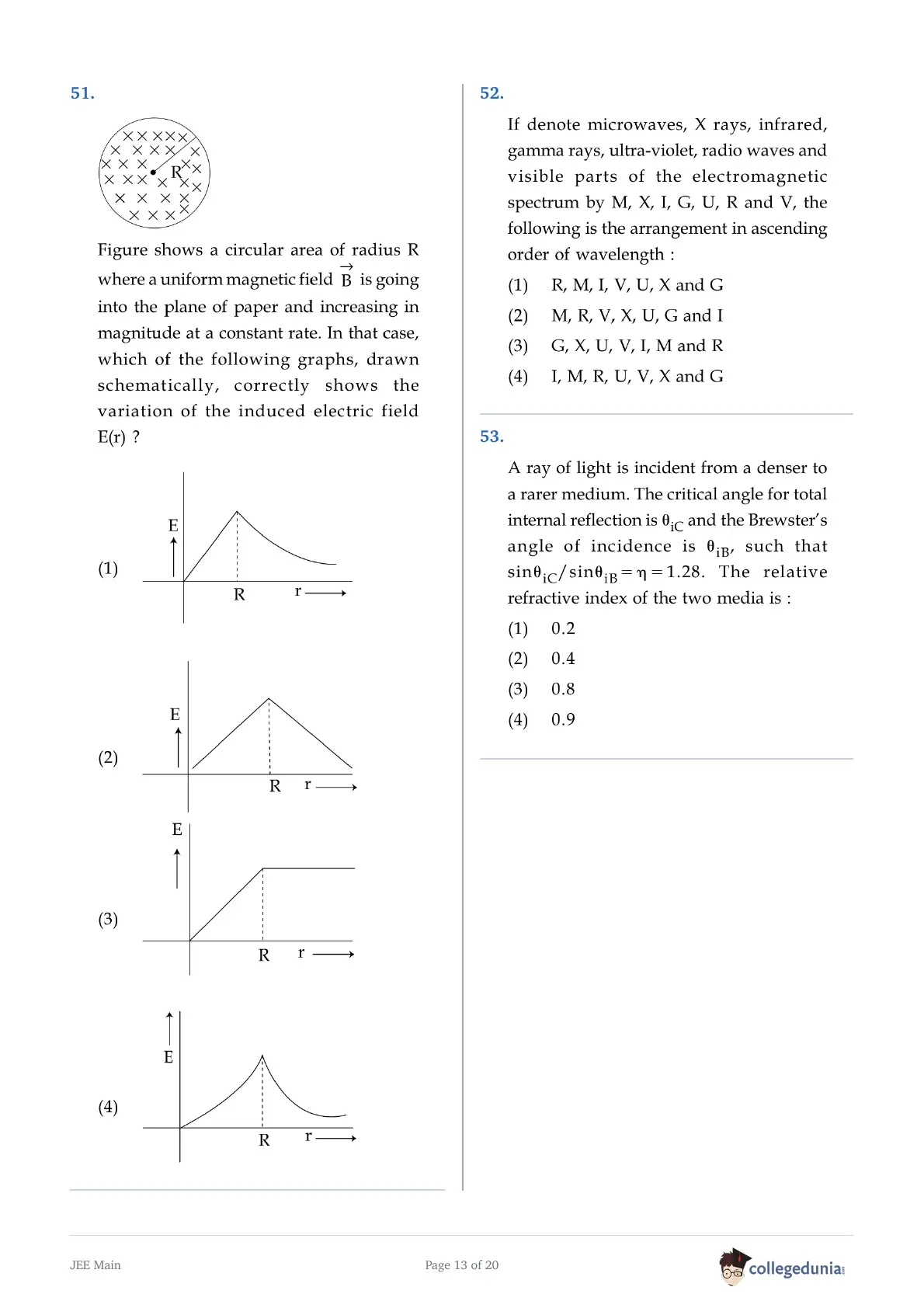
Figure shows a circular area of radius R where a uniform magnetic field \(\vec{B}\) is going into the plane of paper and increasing in magnitude at a constant rate. In that case, which of the following graphs, drawn schematically, correctly shows the variation of the induced electric field E(r)?
- (1)
![]()
- (2)
![]()
- (3)
![]()
- (4)
![]()


If denote microwaves, X rays, infrared, gamma rays, ultra-violet, radio waves and visible parts of the electromagnetic spectrum by M, X, I, G, U, R and V, the following is the arrangement in ascending order of wavelength :
A ray of light is incident from a denser to a rarer medium. The critical angle for total internal reflection is \(\theta_{iC}\) and the Brewster's angle of incidence is \(\theta_{iB}\), such that \(\sin\theta_{iC}/\sin\theta_{iB} = \eta = 1.28\). The relative refractive index of the two media is :
The diameter of the objective lens of microscope makes an angle \(\beta\) at the focus of the microscope. Further, the medium between the object and the lens is an oil of refractive index n. Then the resolving power of the microscope.
In a Young's double slit experiment, the distance between the two identical slits is 6.1 times larger than the slit width. Then the number of intensity maxima observed within the central maximum of the single slit diffraction pattern is :
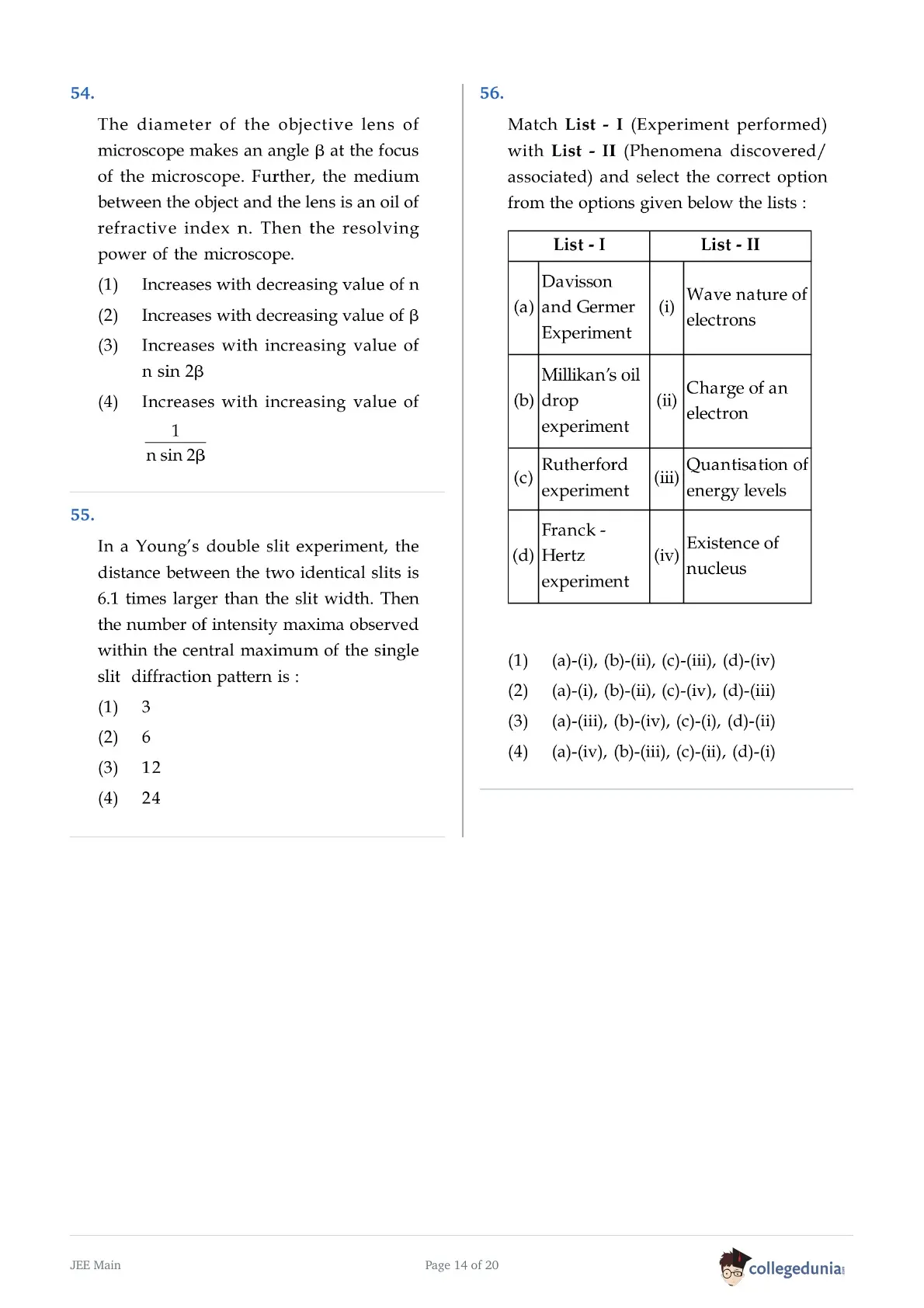
| List - I | List - II | |
| (a) Davisson and Germer Experiment | (i) | Wave nature of electrons |
| (b) Millikan's oil drop experiment | (ii) | Charge of an electron |
| (c) Rutherford experiment | (iii) | Quantisation of energy levels |
| (d) Franck - Hertz experiment | (iv) | Existence of nucleus |
A piece of wood from a recently cut tree shows 20 decays per minute. A wooden piece of same size placed in a museum (obtained from a tree cut many years back) shows 2 decays per minute. If half life of \(\mathrm{C^{14}}\) is 5730 years, then age of the wooden piece placed in the museum is approximately :

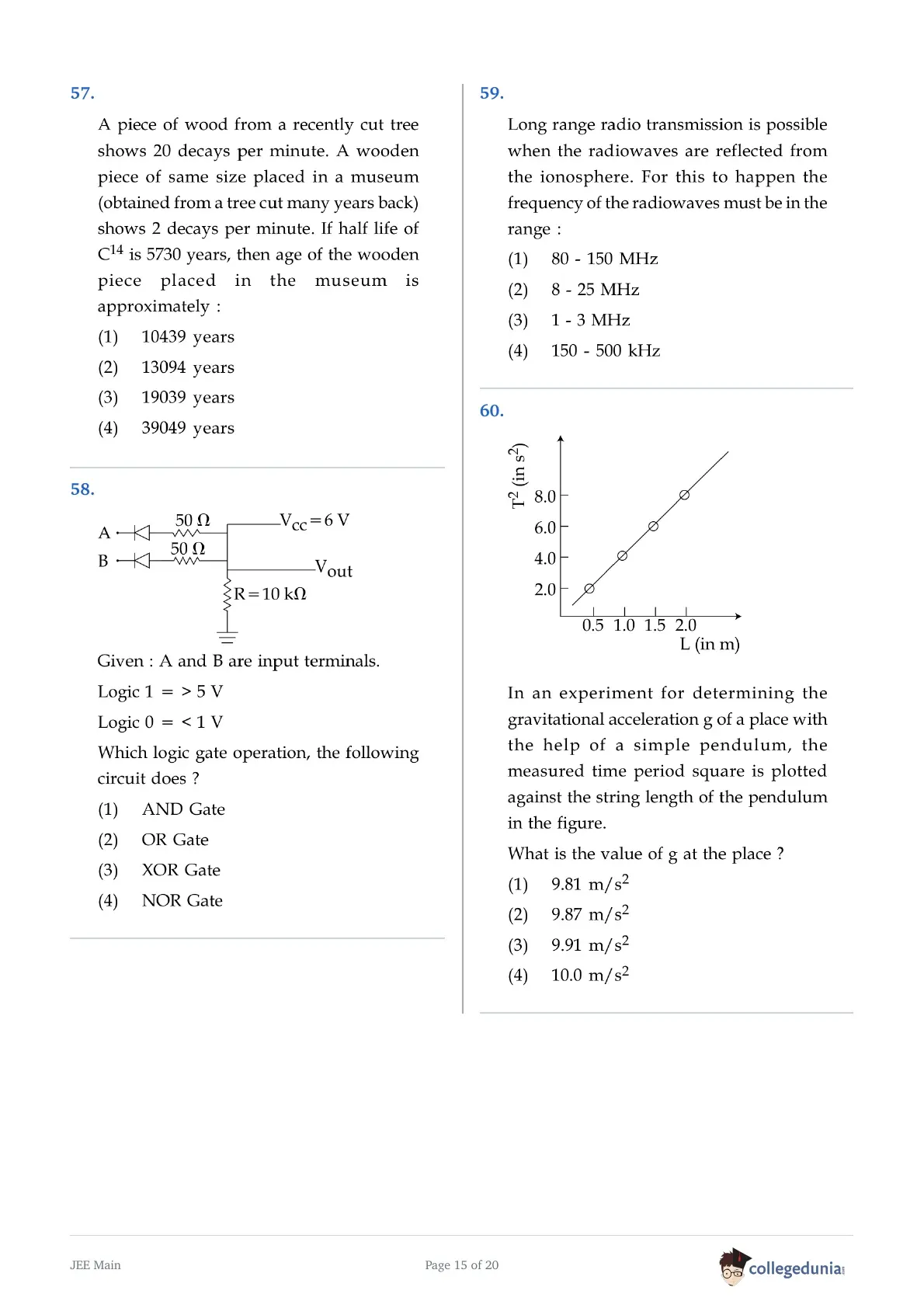
Given : A and B are input terminals.
Logic 1 = > 5 V
Logic 0 = < 1 V
Which logic gate operation, the following circuit does ?
Long range radio transmission is possible when the radiowaves are reflected from the ionosphere. For this to happen the frequency of the radiowaves must be in the range :

In an experiment for determining the gravitational acceleration g of a place with the help of a simple pendulum, the measured time period square is plotted against the string length of the pendulum in the figure.
What is the value of g at the place ?
Chemistry (Q61 - Q90)
Ionization energy of gaseous Na atoms is \(495.5\ \mathrm{kJmol^{-1}}\). The lowest possible frequency of light that ionizes a sodium atom is (\(h = 6.626\times10^{-34}\) Js, \(N_A = 6.022\times10^{23}\ \mathrm{mol^{-1}}\))
Choose the correct statement with respect to the vapour pressure of a liquid among the following :
Which one of the following molecules is paramagnetic ?
Zirconium phosphate \(\mathrm{[Zr_3(PO_4)_4]}\) dissociates into three zirconium cations of charge \(+4\) and four phosphate anions of charge \(-3\). If molar solubility of zirconium phosphate is denoted by S and its solubility product by \(\mathrm{K_{sp}}\) then which of the following relationship between S and \(\mathrm{K_{sp}}\) is correct ?
For the decomposition of the compound, represented as
\(\mathrm{NH_2COONH_4(s) \rightleftharpoons 2NH_3(g) + CO_2(g)}\)
the \(K_p = 2.9\times10^{-5}\ \mathrm{atm^3}\).
If the reaction is started with 1 mol of the compound, the total pressure at equilibrium would be :
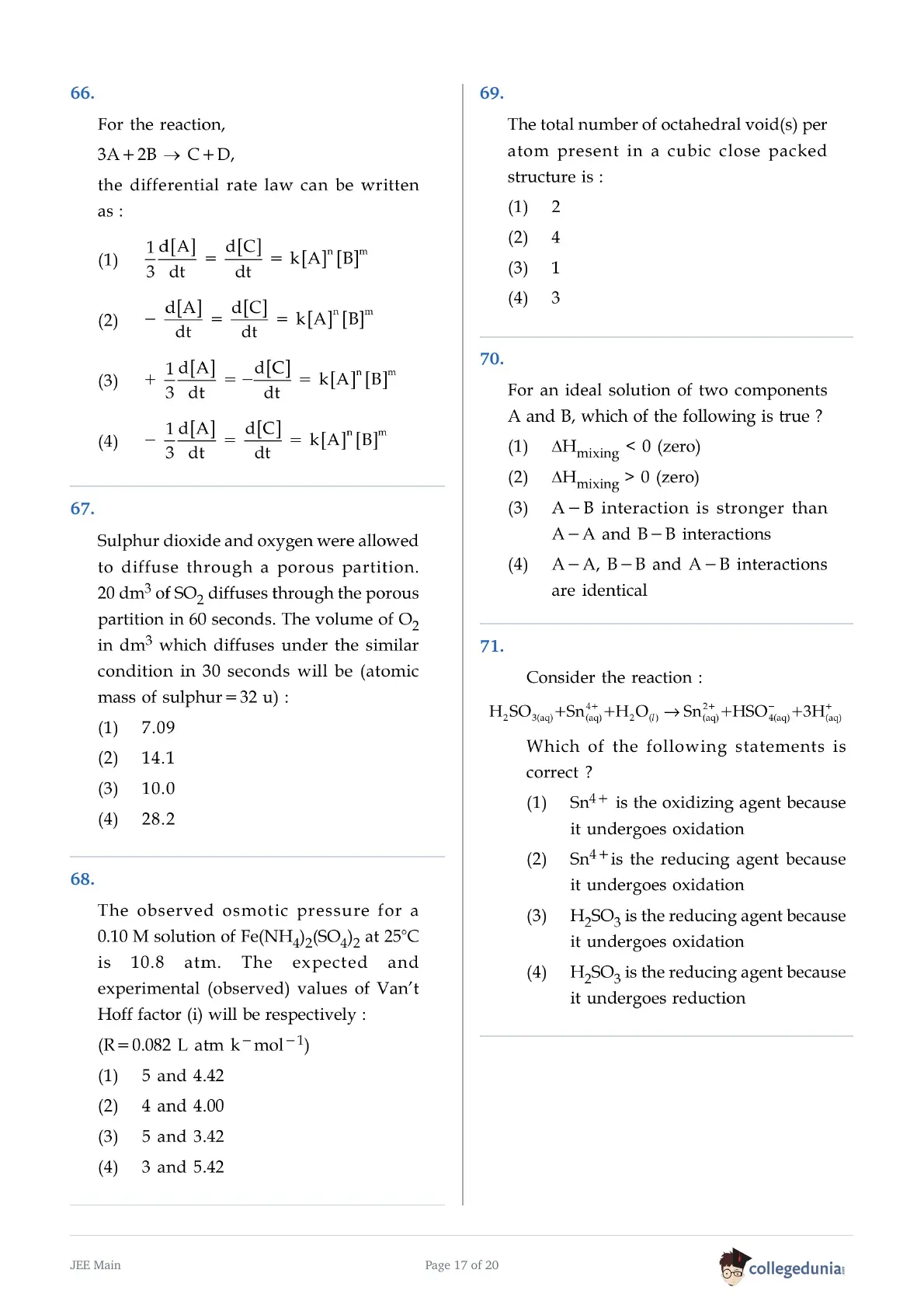
For the reaction, 3A + 2B \(\to\) C + D, the differential rate law can be written as :
Sulphur dioxide and oxygen were allowed to diffuse through a porous partition. \(20\ \mathrm{dm^3}\) of \(\mathrm{SO_2}\) diffuses through the porous partition in 60 seconds. The volume of \(\mathrm{O_2}\) in \(\mathrm{dm^3}\) which diffuses under the similar condition in 30 seconds will be (atomic mass of sulphur = 32 u) :
The observed osmotic pressure for a 0.10 M solution of \(\mathrm{Fe(NH_4)_2(SO_4)_2}\) at \(25^\circ\mathrm{C}\) is 10.8 atm. The expected and experimental (observed) values of Van't Hoff factor (i) will be respectively :
(\(R=0.082\ \mathrm{L\ atm\ K^{-1}\ mol^{-1}}\))
The total number of octahedral void(s) per atom present in a cubic close packec structure is :-
For an ideal solution of two components A and B, which of the following is true ?
Consider the reaction :
\(\mathrm{H_2SO_{3(aq)}+Sn^{4+}_{(aq)}+H_2O_{(l)}\rightarrow Sn^{2+}_{(aq)}+HSO^{-}_{4(aq)}+3H^{+}_{(aq)}}\)
Which of the following statements is correct ?
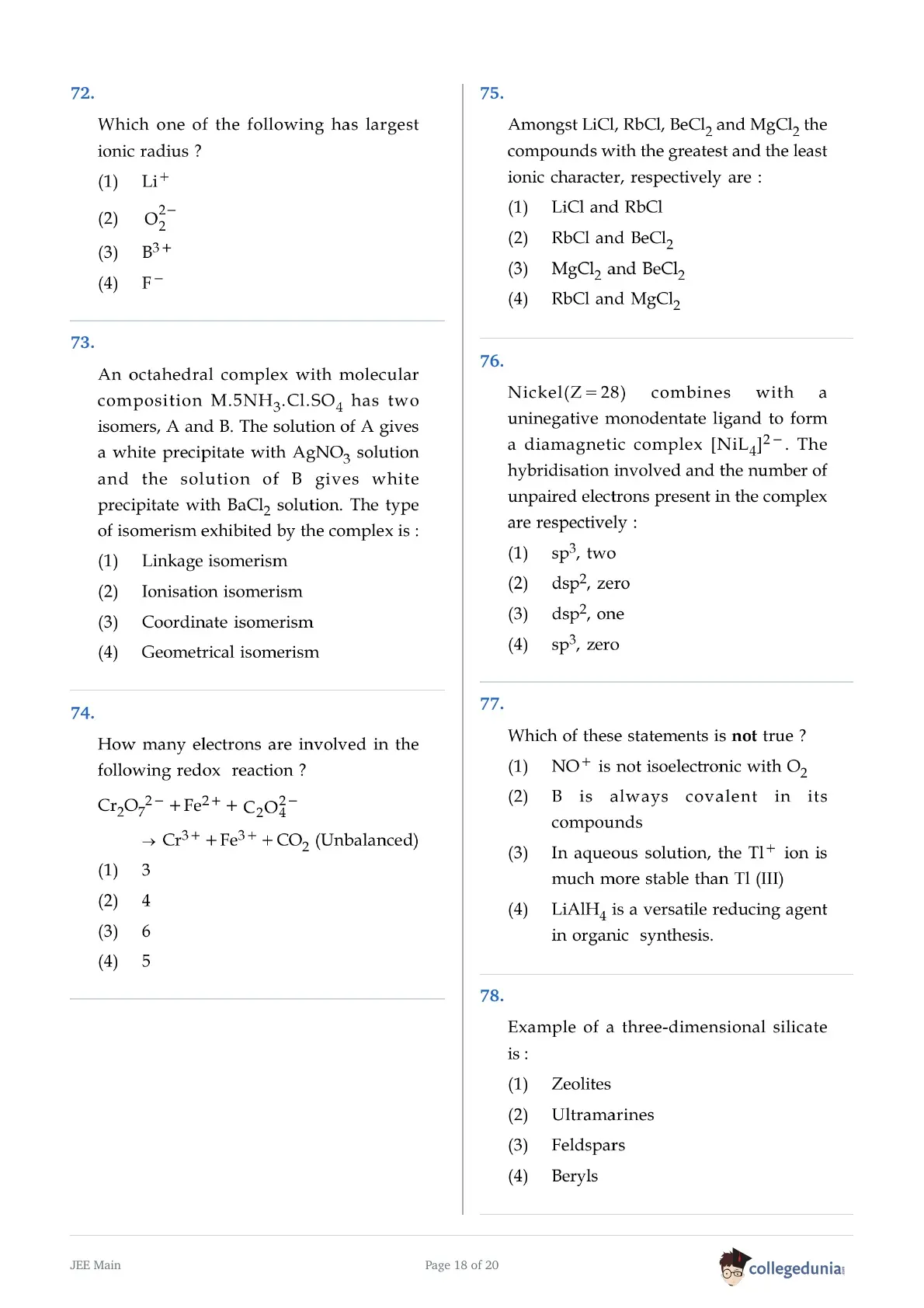
Which one of the following has largest ionic radius?
An octahedral complex having molecular composition Co.5NH\(_3\).Cl.SO\(_4\) has two isomers A and B. The solution of A gives a white precipitate with AgNO\(_3\) solution and the solution of B gives a white precipitate with BaCl\(_2\) solution. The type of isomerism exhibited by the complex is,
How many electrons are involved in the following redox reaction ?
\(\mathrm{Cr_2O_7^{2-}+Fe^{2+}+C_2O_4^{2-}}\)
\(\rightarrow \mathrm{Cr^{3+}+Fe^{3+}+CO_2}\) (Unbalanced)
Amongst \(LiCl, RbCl, BeCl_2\) and \(MgCl_2\) the compounds with the greatest and the least ionic character, respectively are :
Nickel(\(Z=28\)) combines with a uninegative monodentate ligand to form a diamagnetic complex \(\mathrm{[NiL_4]^{2-}}\). The hybridisation involved and the number of unpaired electrons present in the complex are respectively :
Which of these statements is not true ?
Example of a three-dimensional silicate is :
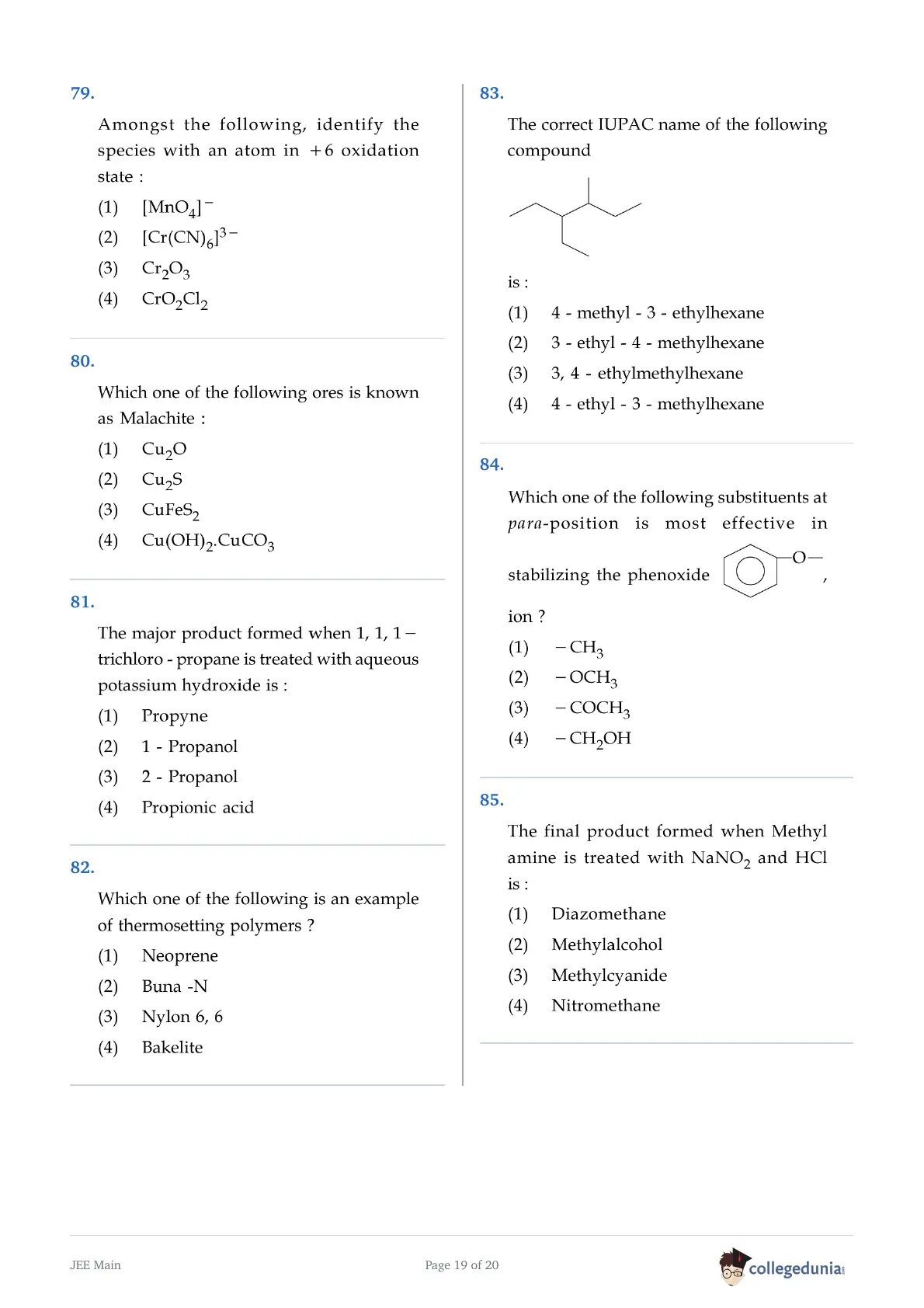
Amongst the following, identify the species with an atom in \(+6\) oxidation state :
Which one of the following ores is known as Malachite :
The major product formed when 1, 1, 1 - trichloro - propane is treated with aqueous potassium hydroxide is :
Which one of the following is an example of thermosetting polymers ?
The correct IUPAC name of the following compound  is :
Which one of the following substituents at para-position is most effective in stabilizing the phenoxide ion ?
The final product formed when Methyl amine is treated with \(\mathrm{NaNO_2}\) and HCl is :
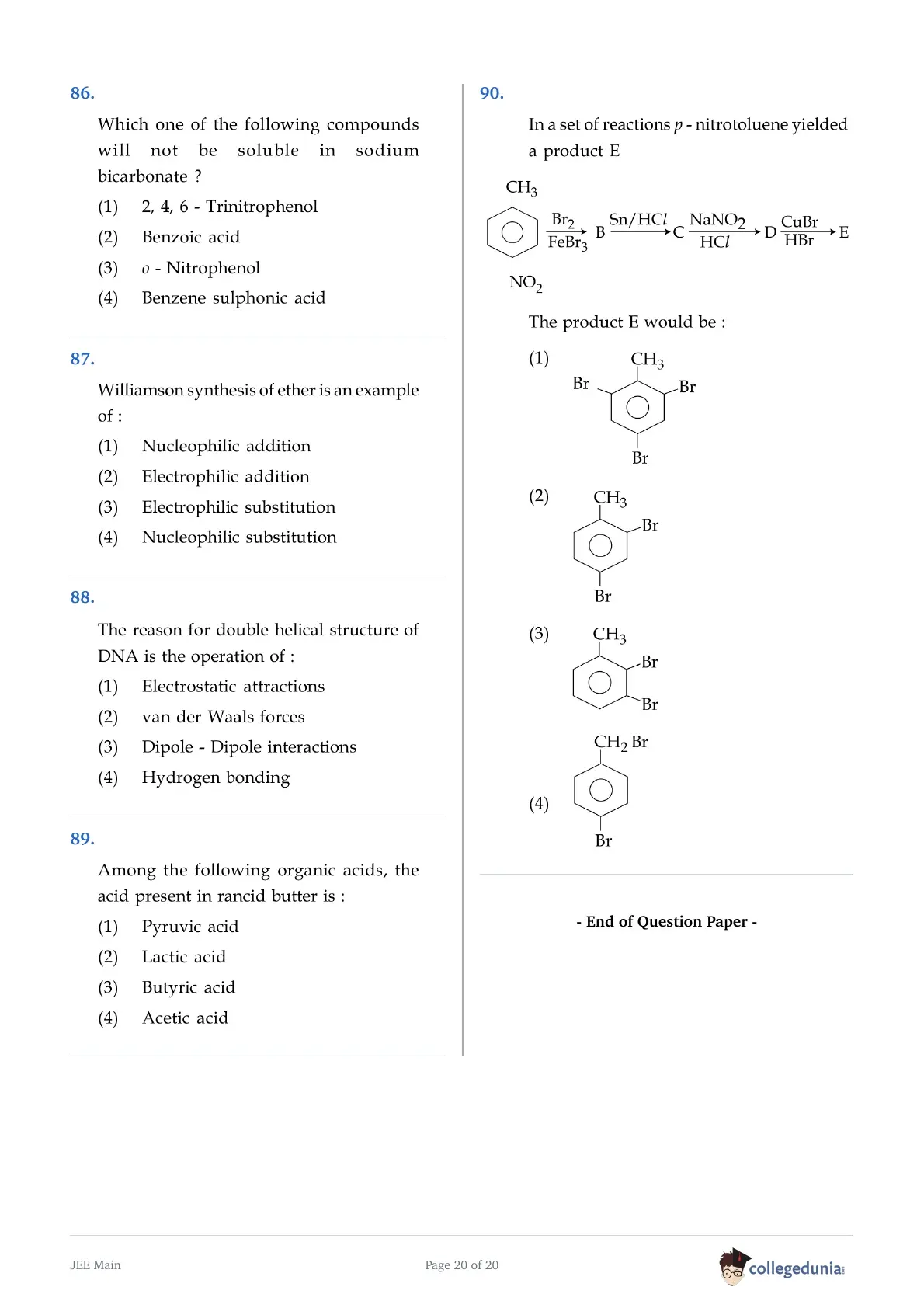
Which one of the following compounds will not be soluble in sodium bicarbonate?
Williamson synthesis of ether is an example of :
The reason for double helical structure of DNA is the operation of :
Among the following organic acids, the acid present in rancid butter is :
In a set of reactions p - nitrotoluene yielded a product E 
The product E would be :
- (1)
![]()
- (2)
![]()
- (3)
![]()
- (4)
![]()


JEE Main 2014 Exam Pattern and Marking Scheme
| Particulars | Details |
|---|---|
| Exam Mode | Online (Computer-Based Test) |
| Paper | B.E./B.Tech (Paper 1) |
| Duration | 3 hours (180 minutes) |
| Type of Questions | Multiple Choice Questions (MCQs) |
| Subjects | Mathematics, Physics, Chemistry |
| Total Questions | 90 questions |
| Total Marks | 360 marks |
| Marking Scheme | +4 for correct answer & -1 for incorrect answer; 0 for unattempted |
JEE Main 2014 April 19 Difficulty Level
In terms of difficulty level, B.E/B.Tech was of moderate to difficult level.
JEE Main 2014 Question Paper Analysis
- The question paper comprised a total of 90 questions divided among 3 sections i.e, Physics, Chemistry and Maths. Each section consists of 30 questions
- Physics Paper was moderate to difficult level
- Chemistry Paper was easy
- Maths Paper was Lengthy but not tough
For every correct answer, candidates got 4 and for each wrong attempt -1 marks were deducted.



Comments