



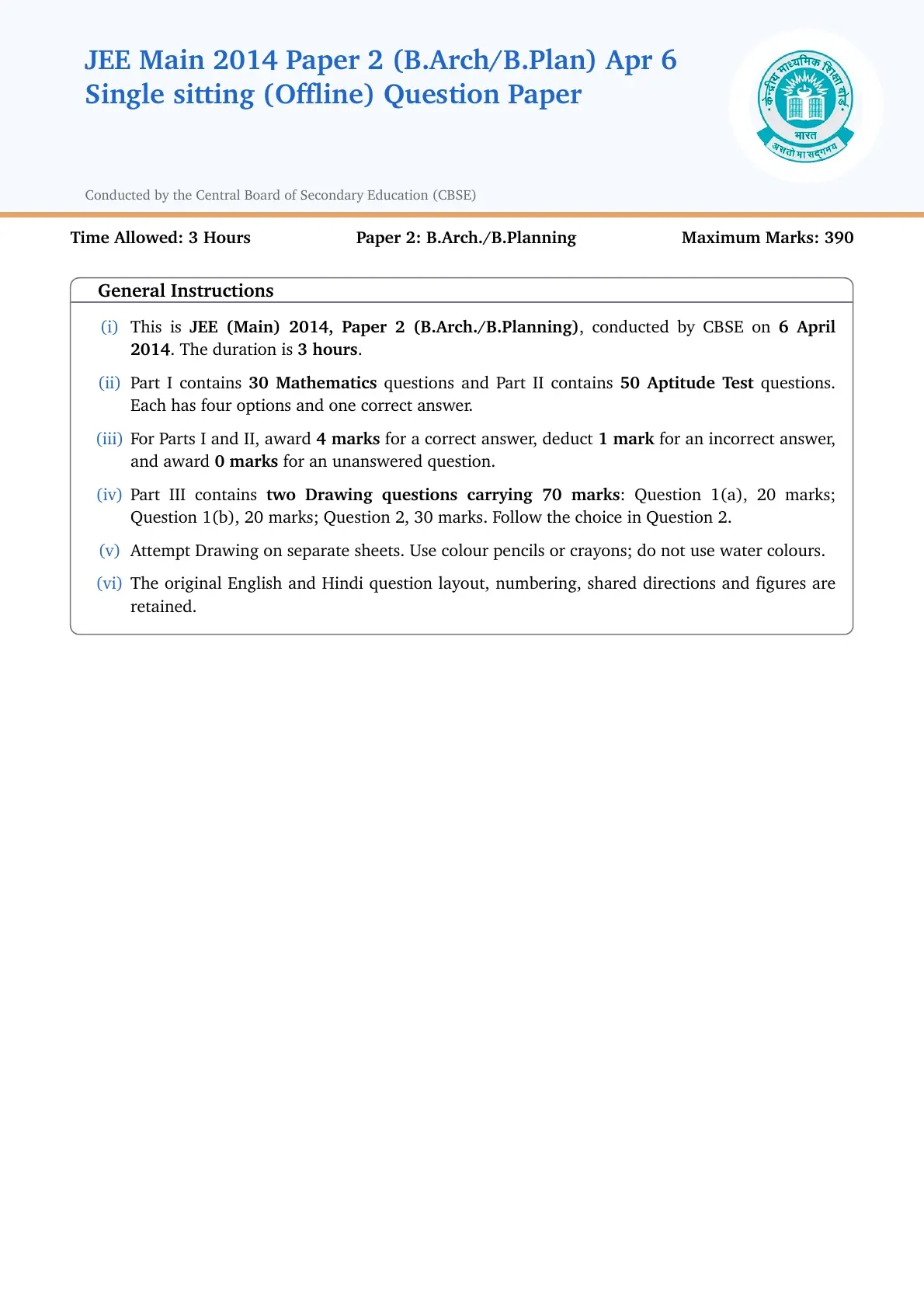
JEE Main 2014 B.Arch and B.Planning Paper 2 April 6 (Set K) Question Paper is available here with solutions PDF and detailed solutions for every question. CBSE conducted the pen-and-paper (offline) JEE Main 2014 Paper 2 for B.Arch and B.Planning on April 6, 2014. This page covers Set K of the paper. The question paper includes the following:
- 82 questions in a 3-hour pen-and-paper (offline) paper: Part I Mathematics (30), Part II Aptitude Test (50) and Part III Drawing Test (2)
- Mathematics: 30 multiple choice questions (MCQs), 4 marks each (120 marks)
- Aptitude Test: 50 MCQs, 4 marks each (200 marks)
- Drawing Test: 2 drawing questions, 70 marks in all
- Marking: +4 for a correct answer, -1 for an incorrect MCQ answer, 0 for an unattempted question; maximum marks 390
JEE Main 2014 B.Arch and B.Planning Paper 2 April 6 (Set K) Question Paper with Solution PDF
| NTA Official PDF | CD PDF | CD PDF with Solutions |
|---|---|---|
| Download official PDF 5.27 MB | Download Collegedunia PDF 5.63 MB | Download solutions PDF 3.12 MB |
Also Check:
JEE Main 2014 B.Arch and B.Planning Paper 2 April 6 (Set K) Questions with Solutions
Mathematics (Q1 - Q30)
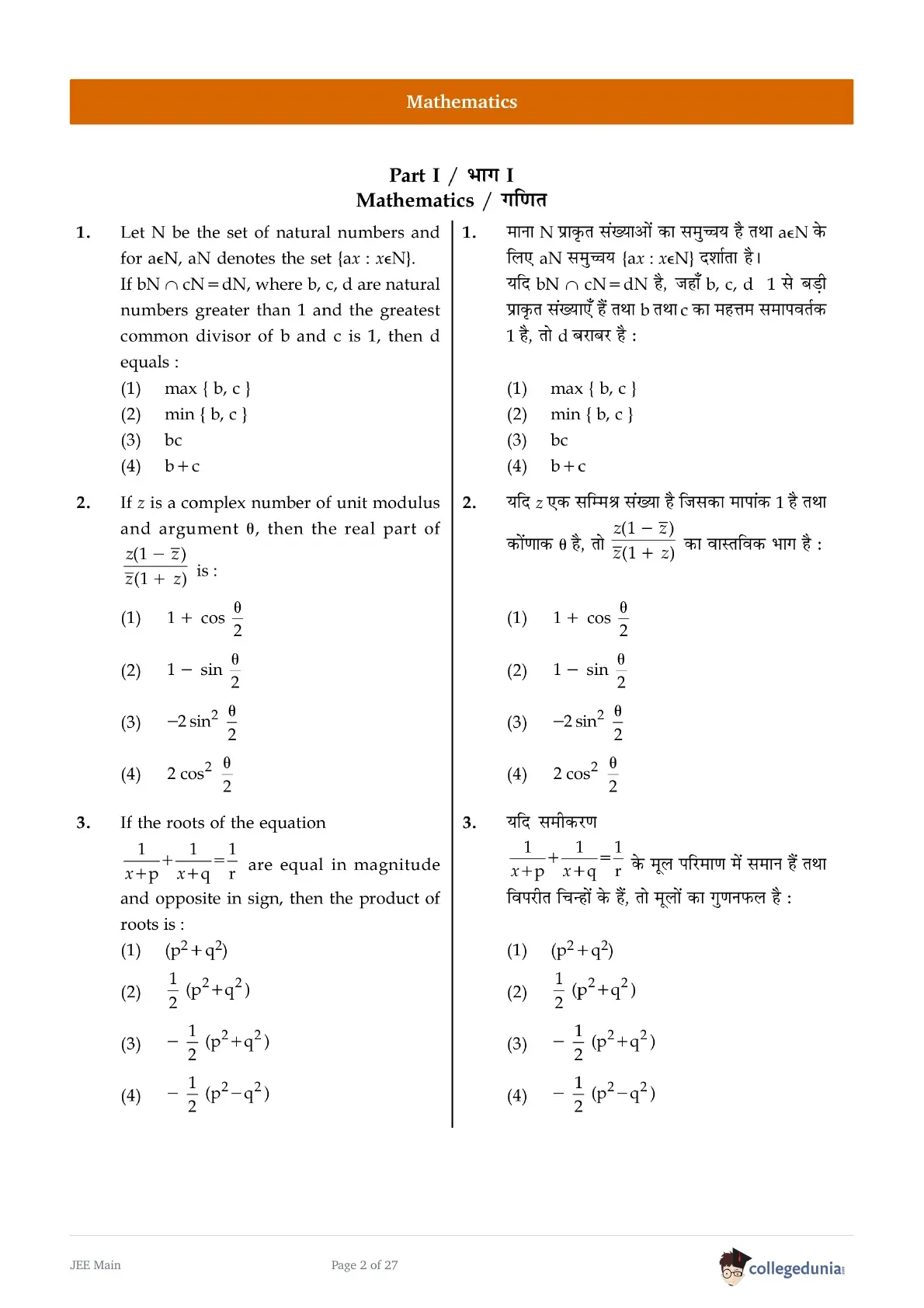
Let \(\mathrm{N}\) be the set of natural numbers and for \(\mathrm{a} \in \mathrm{N}\), \(\mathrm{aN}\) denotes the set \(\{\mathrm{a}x : x \in \mathrm{N}\}\).
If \(\mathrm{bN} \cap \mathrm{cN} = \mathrm{dN}\), where \(\mathrm{b}, \mathrm{c}, \mathrm{d}\) are natural numbers greater than 1 and the greatest common divisor of \(\mathrm{b}\) and \(\mathrm{c}\) is 1, then \(\mathrm{d}\) equals :
If \(z\) is a complex number of unit modulus and argument \(\theta\), then the real part of \(\dfrac{z(1-\bar{z})}{\bar{z}(1+z)}\) is :
If the roots of the equation
\(\dfrac{1}{x+\mathrm{p}}+\dfrac{1}{x+\mathrm{q}}=\dfrac{1}{\mathrm{r}}\) are equal in magnitude and opposite in sign, then the product of roots is :
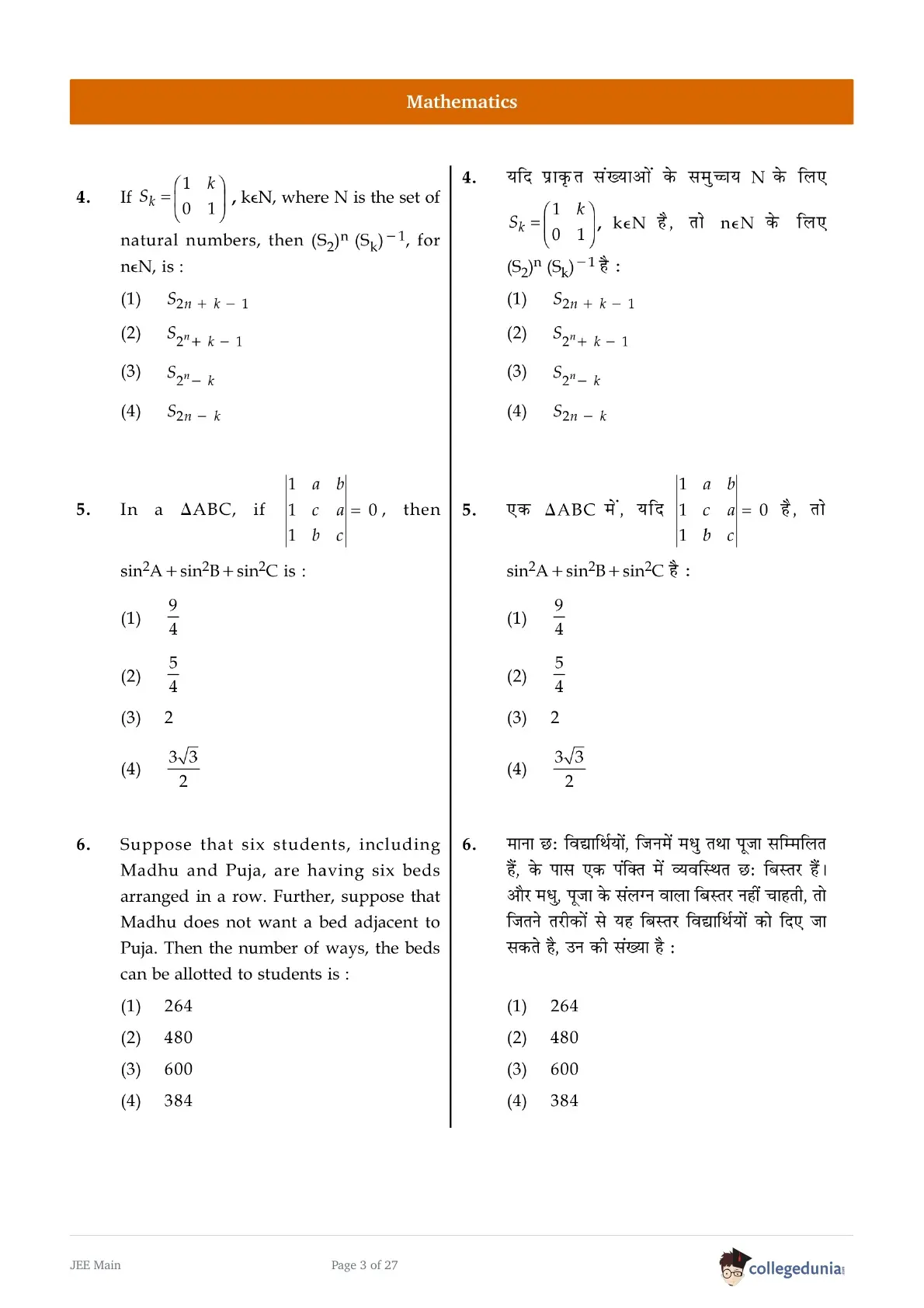
If \(S_{k}=\begin{pmatrix}1 & k \\ 0 & 1\end{pmatrix}\), \(k \in \mathrm{N}\), where \(\mathrm{N}\) is the set of natural numbers, then \((\mathrm{S}_{2})^{\mathrm{n}}(\mathrm{S}_{\mathrm{k}})^{-1}\), for \(\mathrm{n} \in \mathrm{N}\), is :
In a \(\Delta \mathrm{ABC}\), if \(\begin{vmatrix}1 & a & b \\ 1 & c & a \\ 1 & b & c\end{vmatrix}=0\), then \(\sin ^{2} \mathrm{A}+\sin ^{2} \mathrm{B}+\sin ^{2} \mathrm{C}\) is :
Suppose that six students, including Madhu and Puja, are having six beds arranged in a row. Further, suppose that Madhu does not want a bed adjacent to Puja. Then the number of ways, the beds can be allotted to students is :
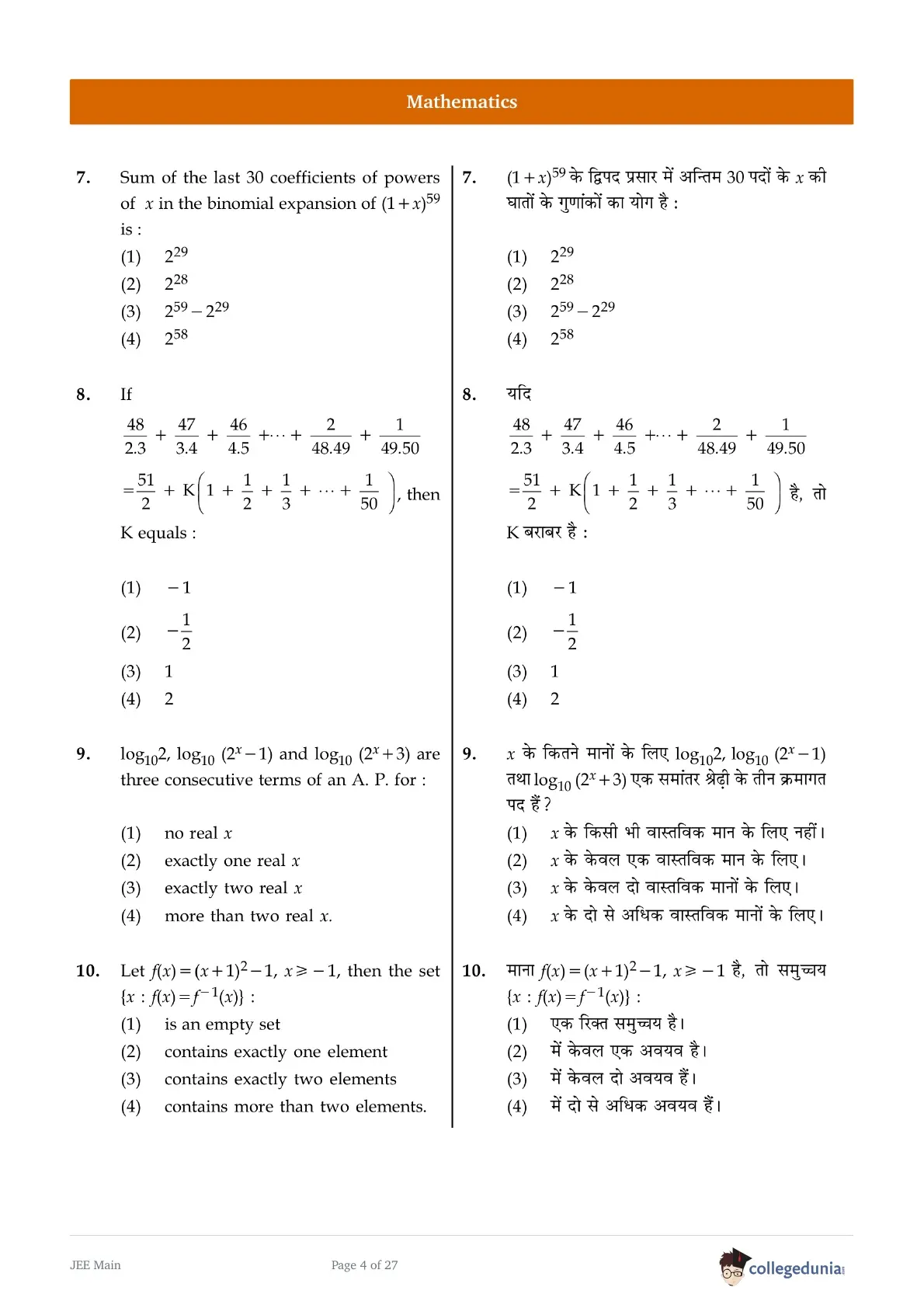
Sum of the last 30 coefficients of powers of \(x\) in the binomial expansion of \((1+x)^{59}\) is :
If
\(\dfrac{48}{2.3}+\dfrac{47}{3.4}+\dfrac{46}{4.5}+\cdots+\dfrac{2}{48.49}+\dfrac{1}{49.50}\)
\(=\dfrac{51}{2}+\mathrm{K}\left(1+\dfrac{1}{2}+\dfrac{1}{3}+\cdots+\dfrac{1}{50}\right)\), then
\(\mathrm{K}\) equals :
\(\log_{10} 2\), \(\log_{10}\left(2^{x}-1\right)\) and \(\log_{10}\left(2^{x}+3\right)\) are three consecutive terms of an A. P. for :
Let \(f(x)=(x+1)^{2}-1\), \(x \geq -1\), then the set \(\left\{x : f(x)=f^{-1}(x)\right\}\) :
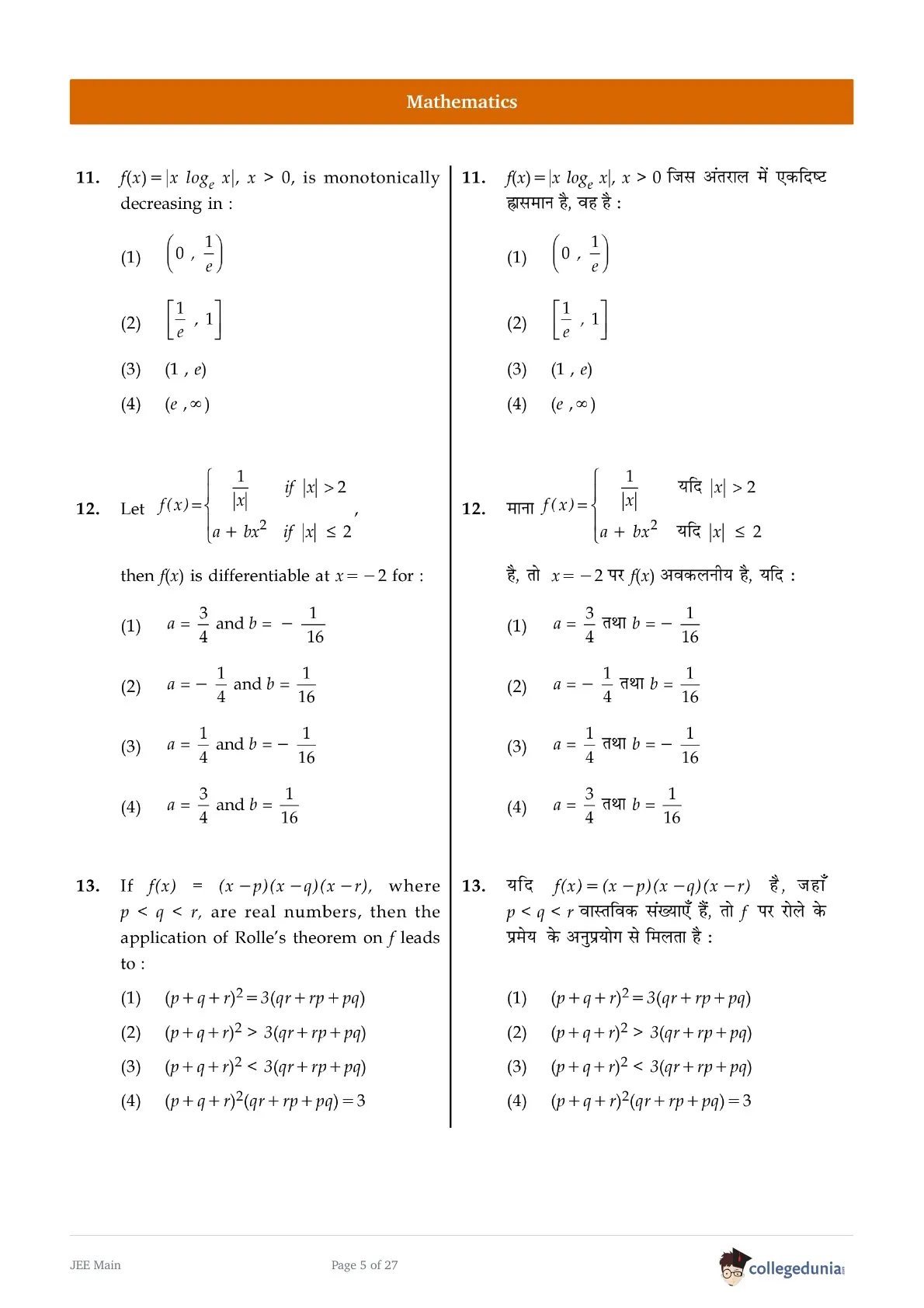
\(f(x)=\left|x \log_{e} x\right|\), \(x>0\), is monotonically decreasing in :
Let \(f(x)=\begin{cases}\frac{1}{|x|} & \text{if } |x|>2 \\ a+b x^{2} & \text{if } |x| \leq 2\end{cases}\),
then \(f(x)\) is differentiable at \(x=-2\) for :
If \(f(x)=(x-p)(x-q)(x-r)\), where \(p<q<r\), are real numbers, then the application of Rolle's theorem on \(f\) leads to :
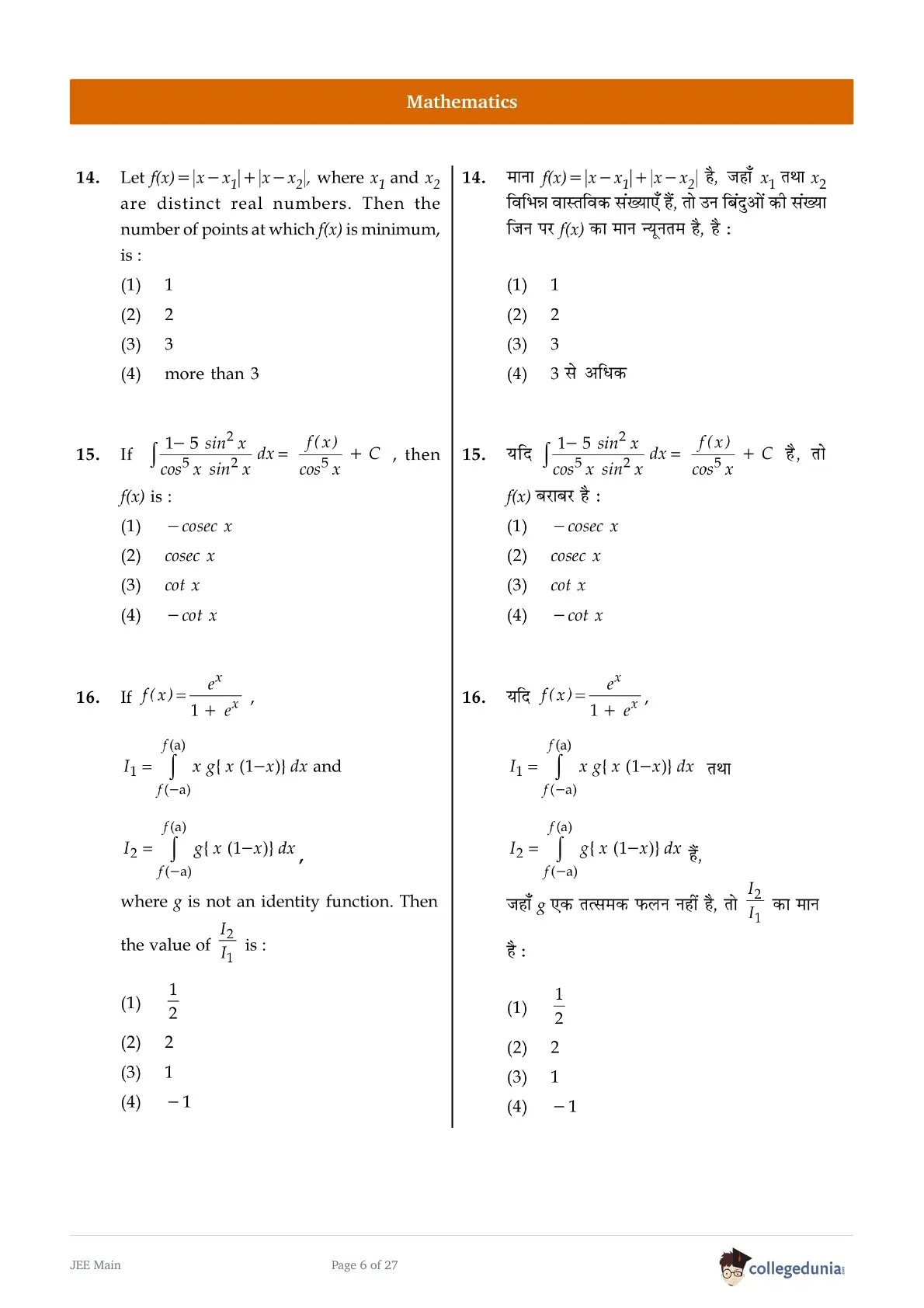
Let \(f(x)=\left|x-x_{1}\right|+\left|x-x_{2}\right|\), where \(x_{1}\) and \(x_{2}\) are distinct real numbers. Then the number of points at which \(f(x)\) is minimum, is :
If \(\int \frac{1-5 \sin ^{2} x}{\cos ^{5} x \sin ^{2} x}\, d x=\frac{f(x)}{\cos ^{5} x}+C\), then \(f(x)\) is :
If \(f(x)=\frac{e^{x}}{1+e^{x}}\),
\(I_{1}=\int_{f(-a)}^{f(a)} x\, g\{x(1-x)\}\, d x\) and
\(I_{2}=\int_{f(-a)}^{f(a)} g\{x(1-x)\}\, d x\),
where \(g\) is not an identity function. Then the value of \(\frac{I_{2}}{I_{1}}\) is :
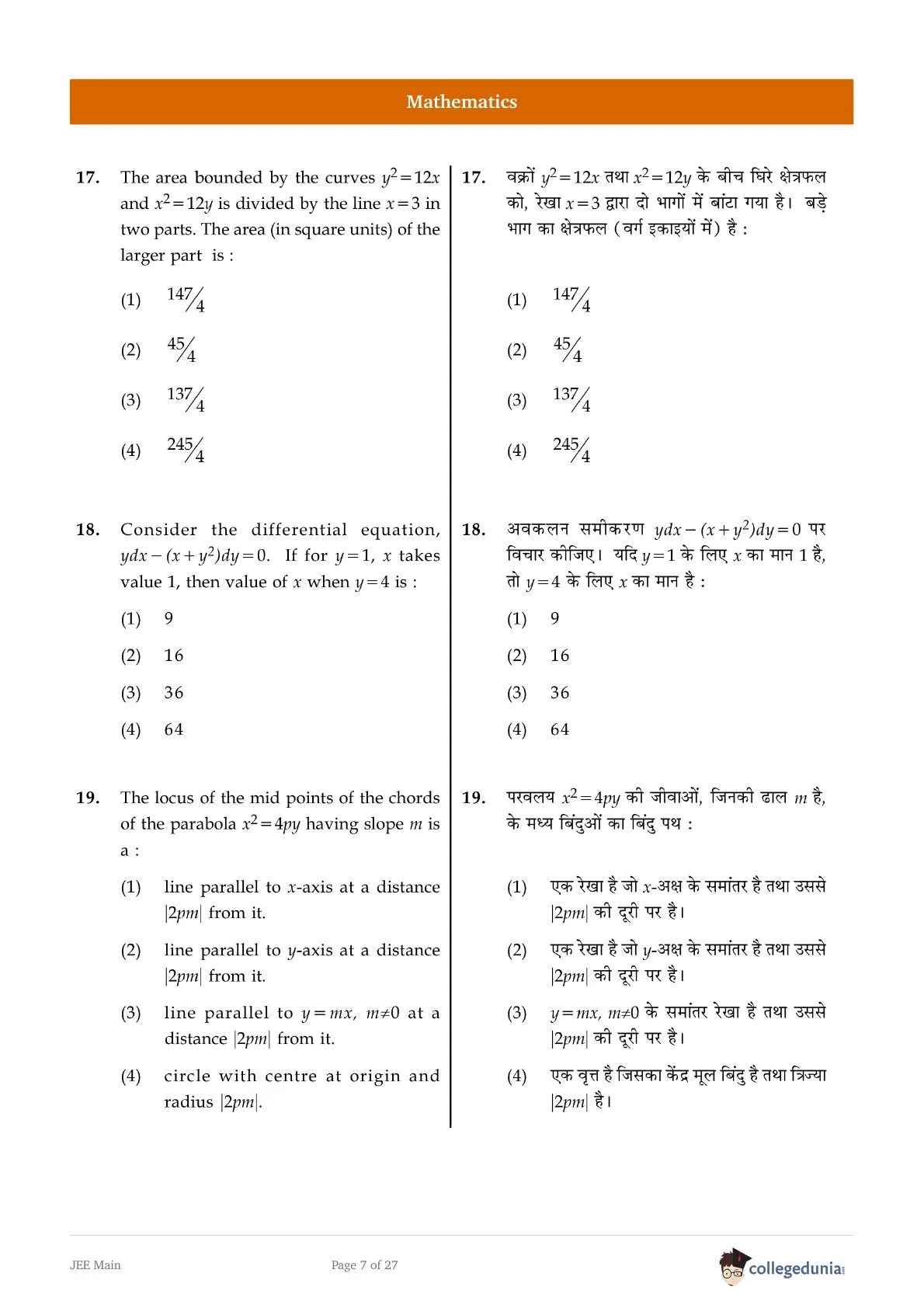
The area bounded by the curves \(y^{2}=12x\) and \(x^{2}=12y\) is divided by the line \(x=3\) in two parts. The area (in square units) of the larger part is :
Consider the differential equation, \(y\,dx-\left(x+y^{2}\right)dy=0\). If for \(y=1\), \(x\) takes value 1, then value of \(x\) when \(y=4\) is :
The locus of the mid points of the chords of the parabola \(x^{2}=4py\) having slope \(m\) is a :
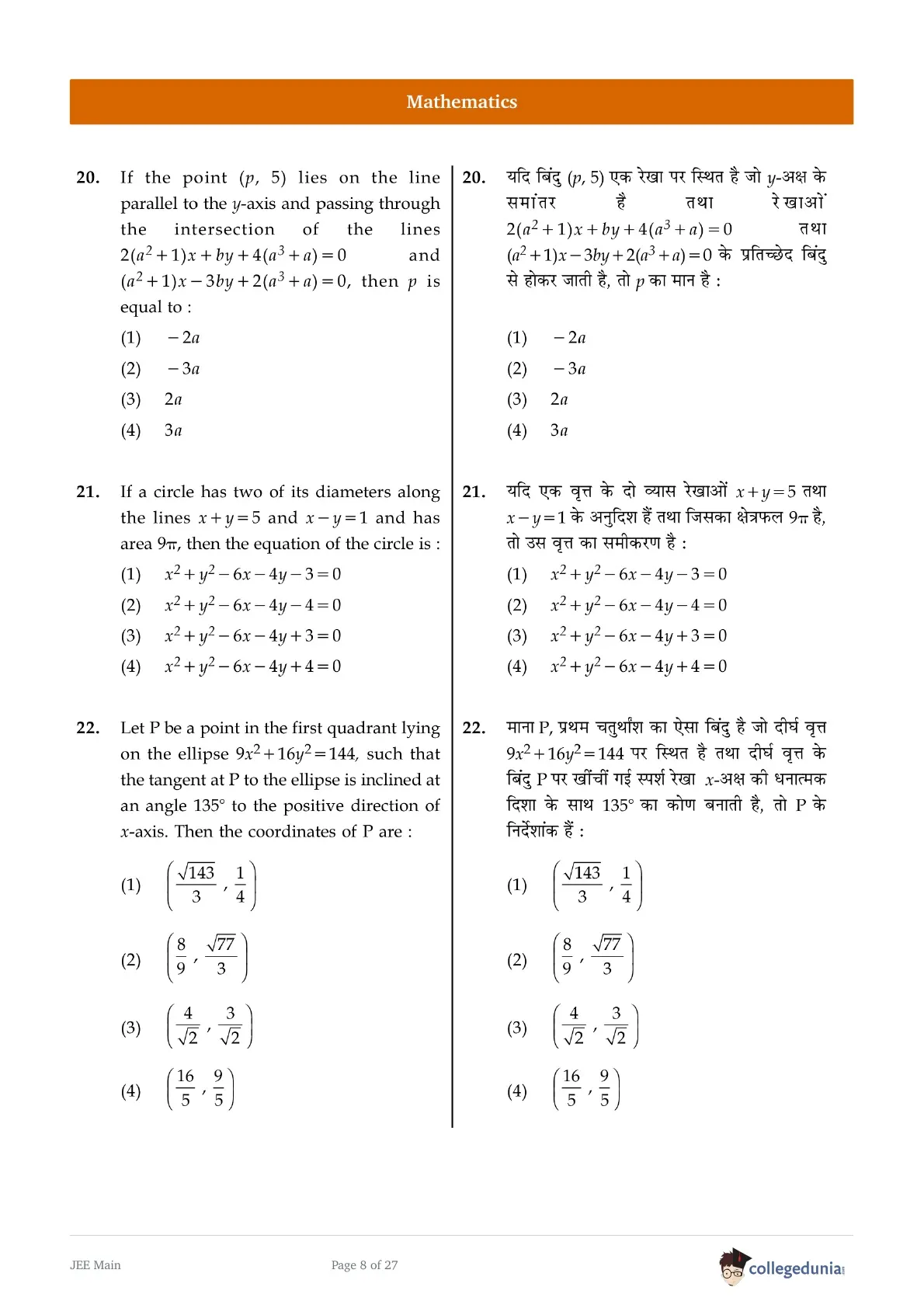
If the point \((p,5)\) lies on the line parallel to the \(y\)-axis and passing through the intersection of the lines \(2\left(a^{2}+1\right)x+by+4\left(a^{3}+a\right)=0\) and \(\left(a^{2}+1\right)x-3by+2\left(a^{3}+a\right)=0\), then \(p\) is equal to :
If a circle has two of its diameters along the lines \(x+y=5\) and \(x-y=1\) and has area \(9\pi\), then the equation of the circle is :
Let \(\mathrm{P}\) be a point in the first quadrant lying on the ellipse \(9x^{2}+16y^{2}=144\), such that the tangent at \(\mathrm{P}\) to the ellipse is inclined at an angle \(135^{\circ}\) to the positive direction of \(x\)-axis. Then the coordinates of \(\mathrm{P}\) are :
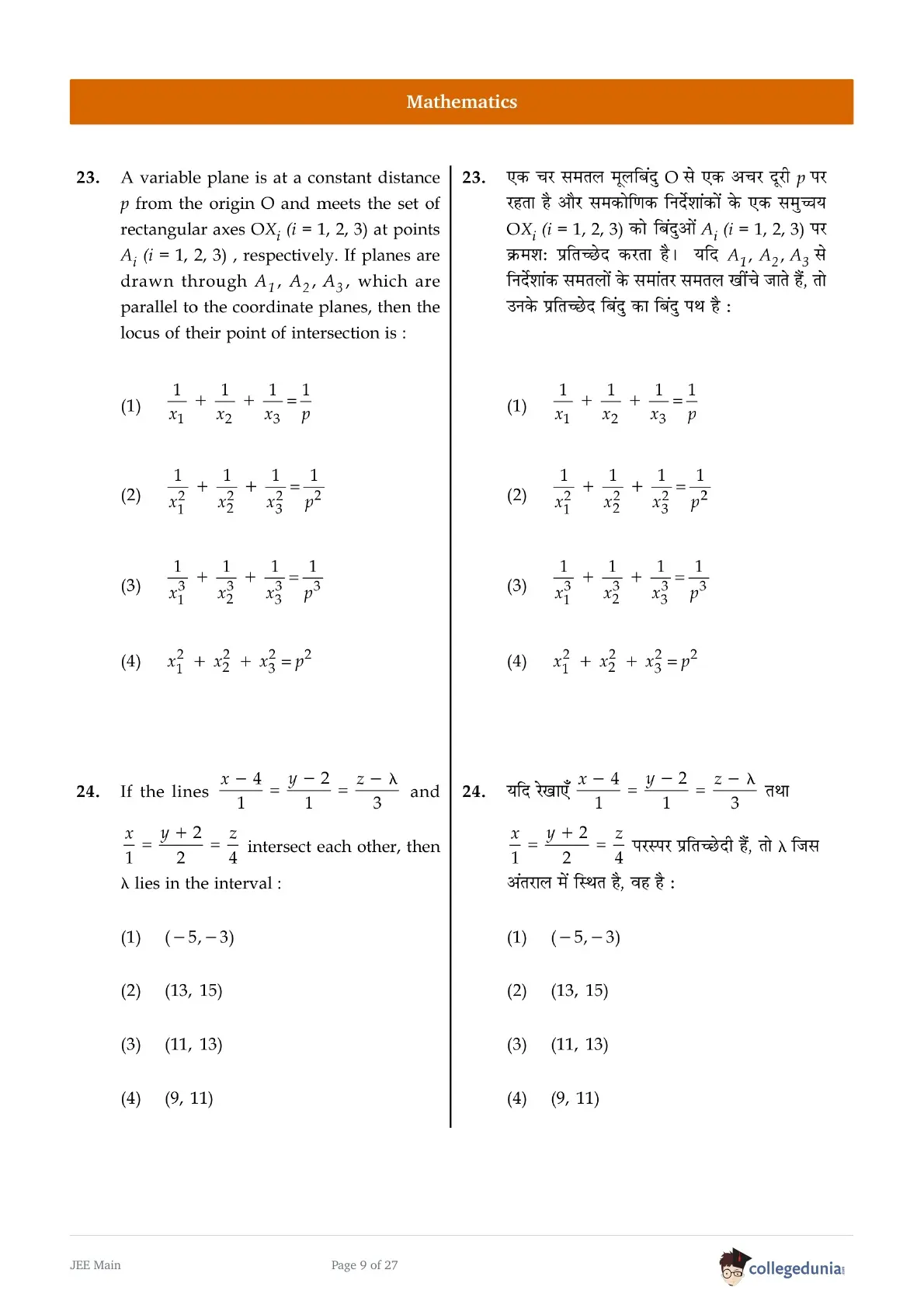
A variable plane is at a constant distance \(p\) from the origin \(\mathrm{O}\) and meets the set of rectangular axes \(\mathrm{OX}_{i}\) \((i=1,2,3)\) at points \(\mathrm{A}_{i}\) \((i=1,2,3)\), respectively. If planes are drawn through \(\mathrm{A}_{1}\), \(\mathrm{A}_{2}\), \(\mathrm{A}_{3}\), which are parallel to the coordinate planes, then the locus of their point of intersection is :
If the lines \(\frac{x-4}{1}=\frac{y-2}{1}=\frac{z-\lambda}{3}\) and \(\frac{x}{1}=\frac{y+2}{2}=\frac{z}{4}\) intersect each other, then \(\lambda\) lies in the interval :
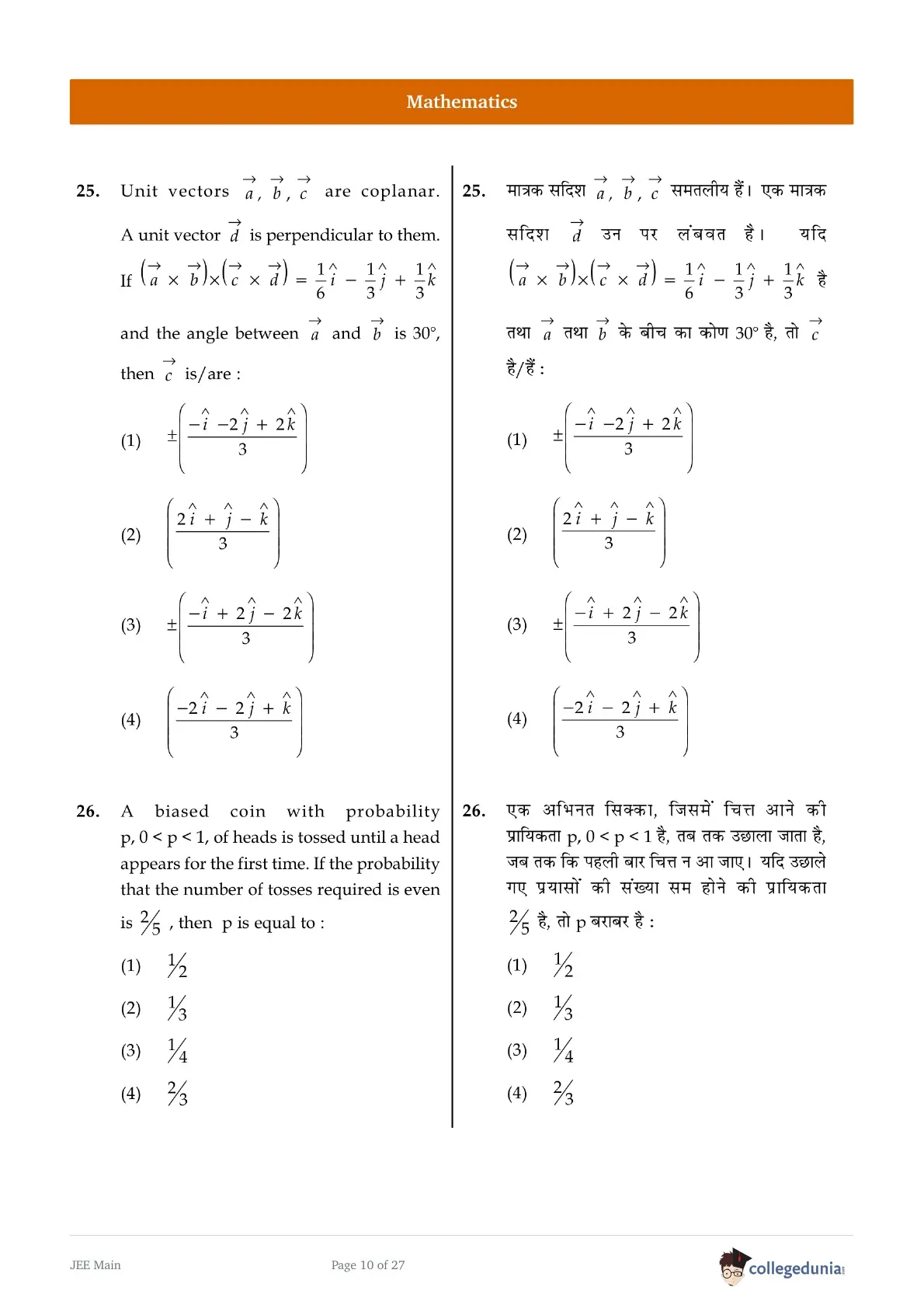
Unit vectors \(\vec{a}\), \(\vec{b}\), \(\vec{c}\) are coplanar. A unit vector \(\vec{d}\) is perpendicular to them. If \((\vec{a} \times \vec{b}) \times(\vec{c} \times \vec{d})=\frac{1}{6} \hat{i}-\frac{1}{3} \hat{j}+\frac{1}{3} \hat{k}\) and the angle between \(\vec{a}\) and \(\vec{b}\) is \(30^{\circ}\), then \(\vec{c}\) is/are :
A biased coin with probability p, \(0<\mathrm{p}<1\), of heads is tossed until a head appears for the first time. If the probability that the number of tosses required is even is \(\frac{2}{5}\), then p is equal to :
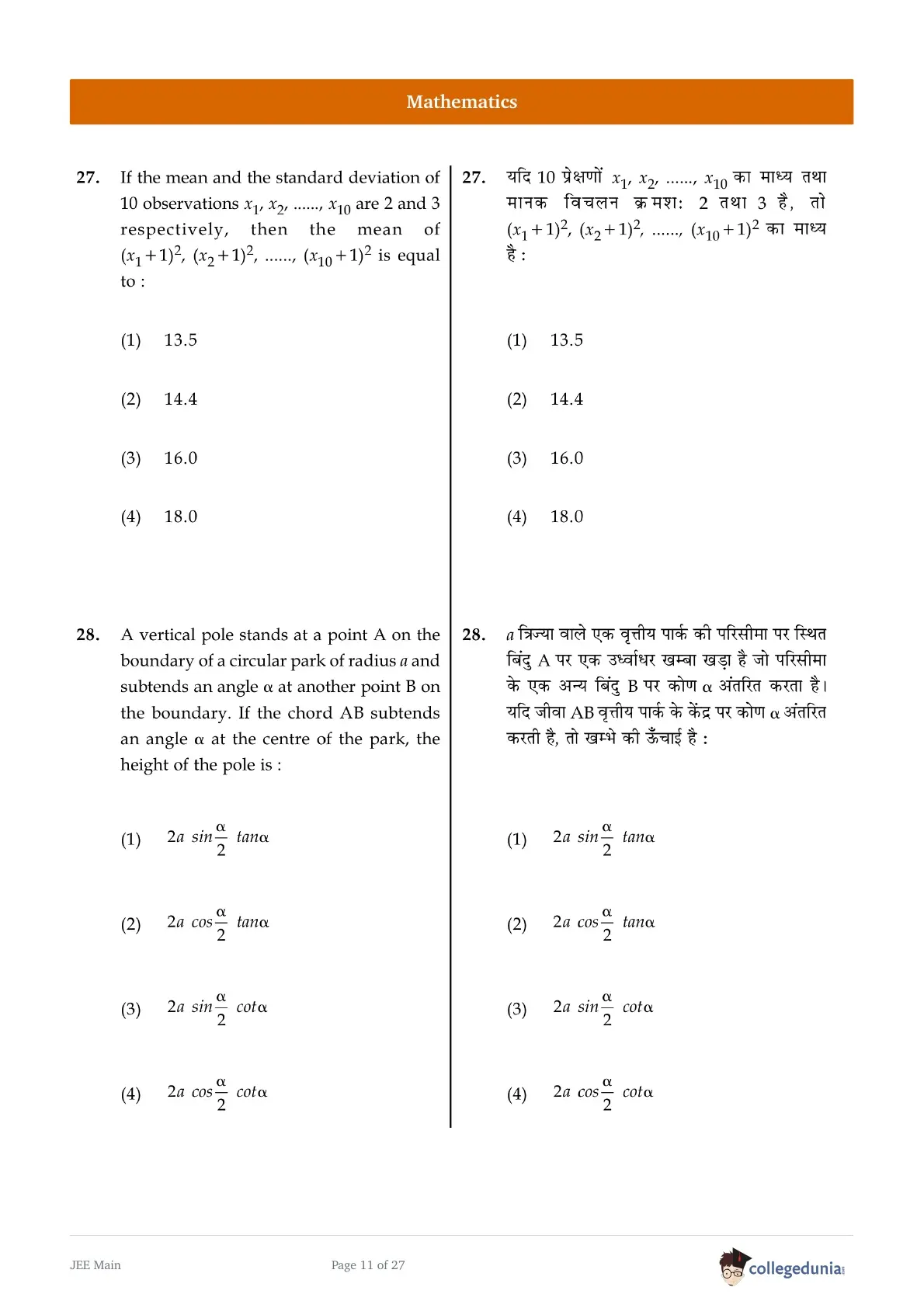
If the mean and the standard deviation of 10 observations \(x_{1}, x_{2}, \ldots \ldots, x_{10}\) are 2 and 3 respectively, then the mean of \(\left(x_{1}+1\right)^{2}\), \(\left(x_{2}+1\right)^{2}, \ldots \ldots,\left(x_{10}+1\right)^{2}\) is equal to :
A vertical pole stands at a point A on the boundary of a circular park of radius \(a\) and subtends an angle \(\alpha\) at another point B on the boundary. If the chord AB subtends an angle \(\alpha\) at the centre of the park, the height of the pole is :
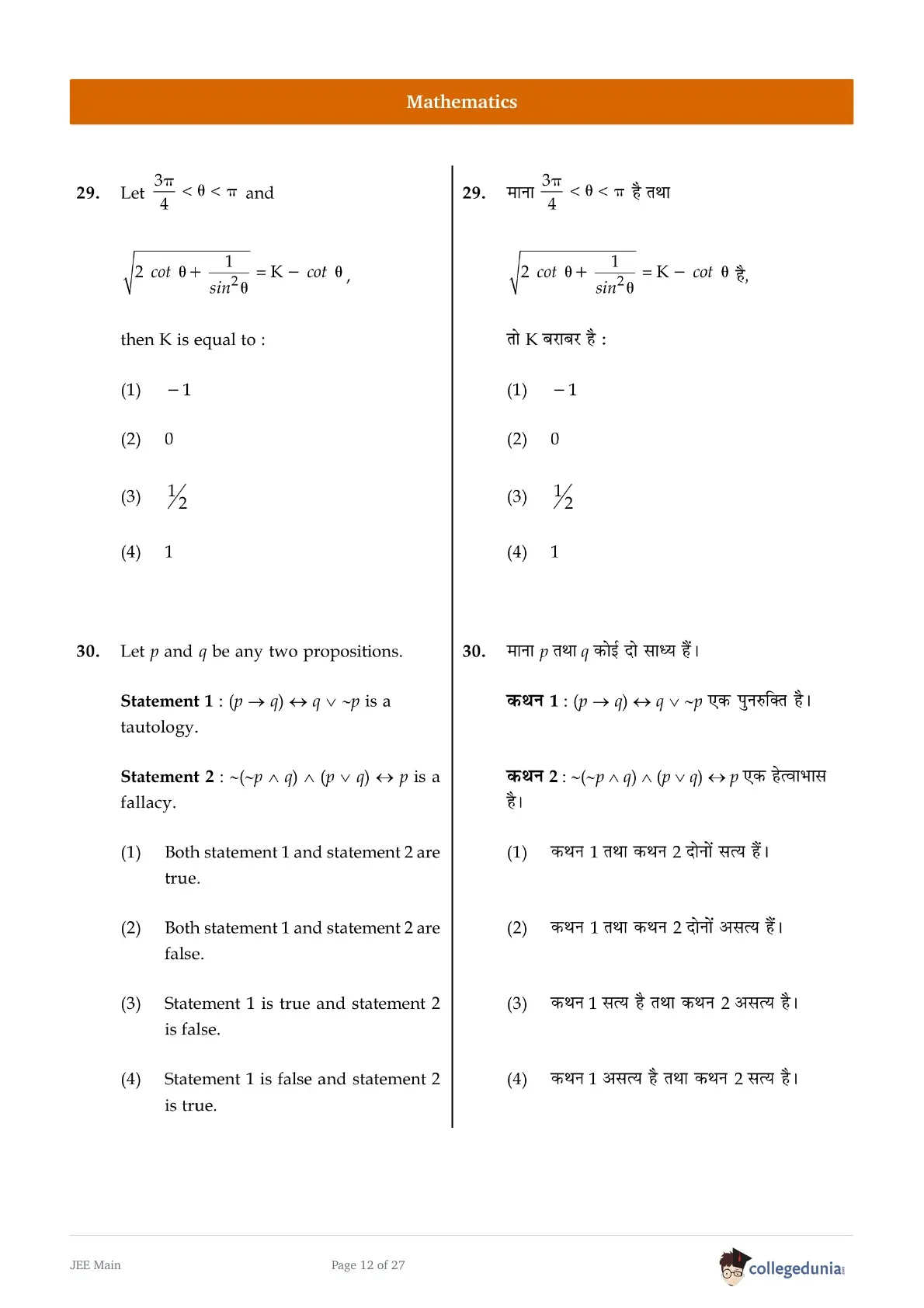
Let \(\frac{3 \pi}{4}<\theta<\pi\) and
\(\sqrt{2 \cot \theta+\frac{1}{\sin ^{2} \theta}}=\mathrm{K}-\cot \theta\),
then \(\mathrm{K}\) is equal to :
Let \(p\) and \(q\) be any two propositions.
Statement 1 : \((p \rightarrow q) \leftrightarrow q \vee \sim p\) is a tautology.
Statement 2 : \(\sim(\sim p \wedge q) \wedge(p \vee q) \leftrightarrow p\) is a fallacy.
Aptitude Test (Q31 - Q80)
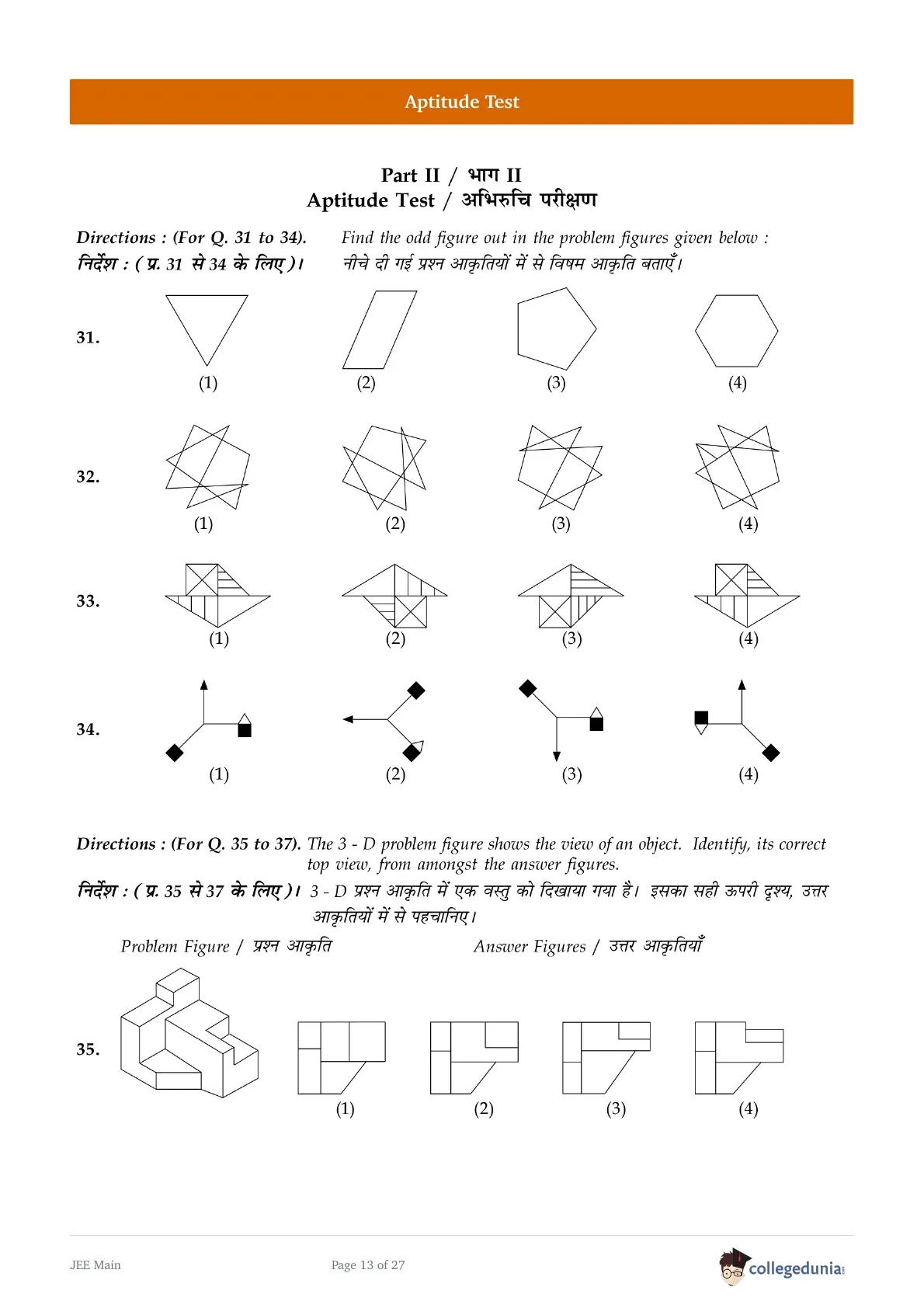
Directions: Find the odd figure out in the problem figures given below :
- (1)
![]()
- (2)
![]()
- (3)
![]()
- (4)
![]()


Directions: Find the odd figure out in the problem figures given below :
- (1)
![]()
- (2)
![]()
- (3)
![]()
- (4)
![]()


Directions : Find the odd figure out in the problem figures given below :
- (1)
![]()
- (2)
![]()
- (3)
![]()
- (4)
![]()


Directions : Find the odd figure out in the problem figures given below :
- (1)
![]()
- (2)
![]()
- (3)
![]()
- (4)
![]()


Directions : The 3 - D problem figure shows the view of an object. Identify, its correct top view, from amongst the answer figures.
- (1)
![]()
- (2)
![]()
- (3)
![]()
- (4)
![]()


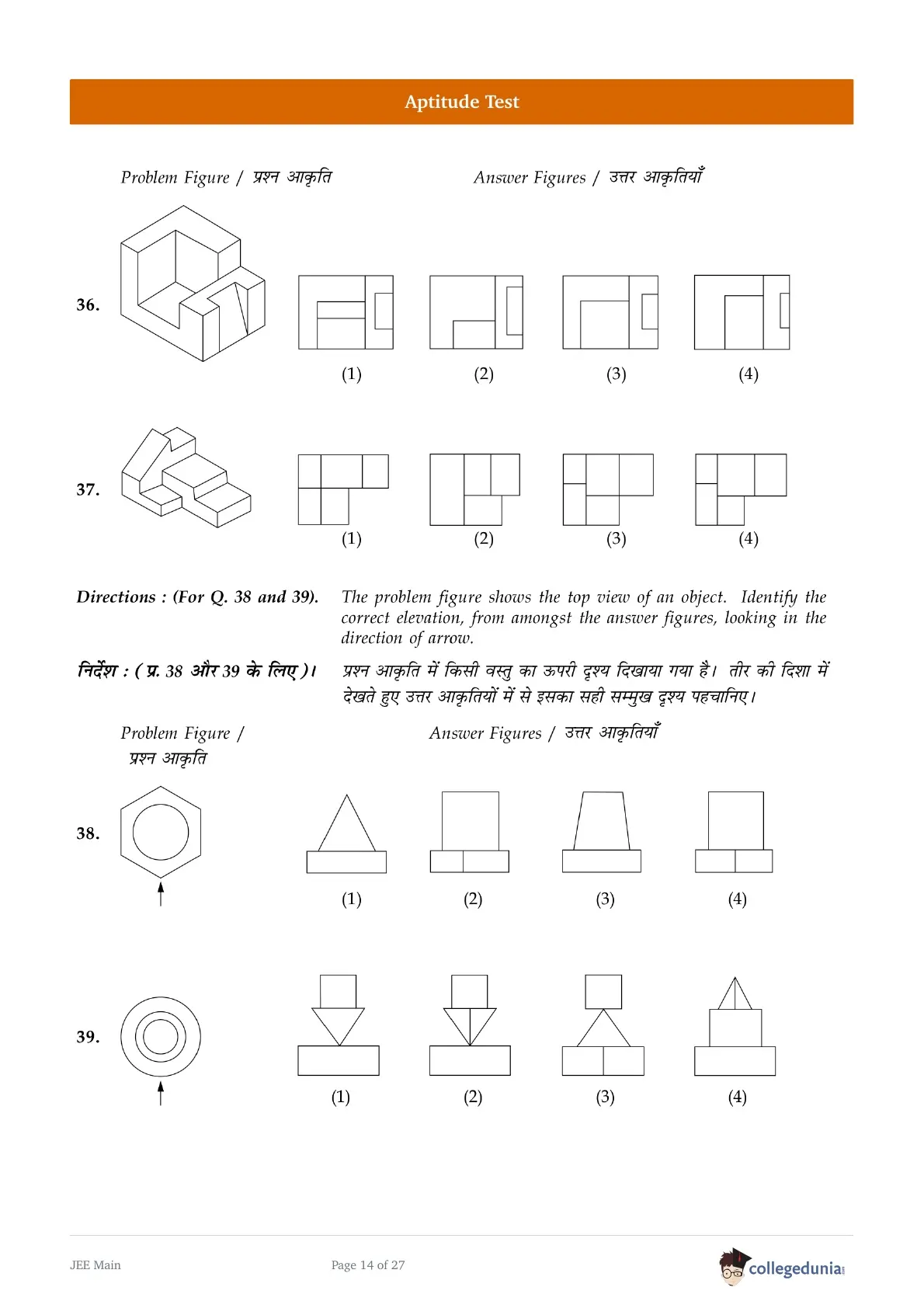
Directions : The 3 - D problem figure shows the view of an object. Identify, its correct top view, from amongst the answer figures.
- (1)
![]()
- (2)
![]()
- (3)
![]()
- (4)
![]()


Directions : The 3 - D problem figure shows the view of an object. Identify, its correct top view, from amongst the answer figures.
- (1)
![]()
- (2)
![]()
- (3)
![]()
- (4)
![]()


Directions : The problem figure shows the top view of an object. Identify the correct elevation, from amongst the answer figures, looking in the direction of arrow.
- (1)
![]()
- (2)
![]()
- (3)
![]()
- (4)
![]()


Directions : The problem figure shows the top view of an object. Identify the correct elevation, from amongst the answer figures, looking in the direction of arrow.
- (1)
![]()
- (2)
![]()
- (3)
![]()
- (4)
![]()


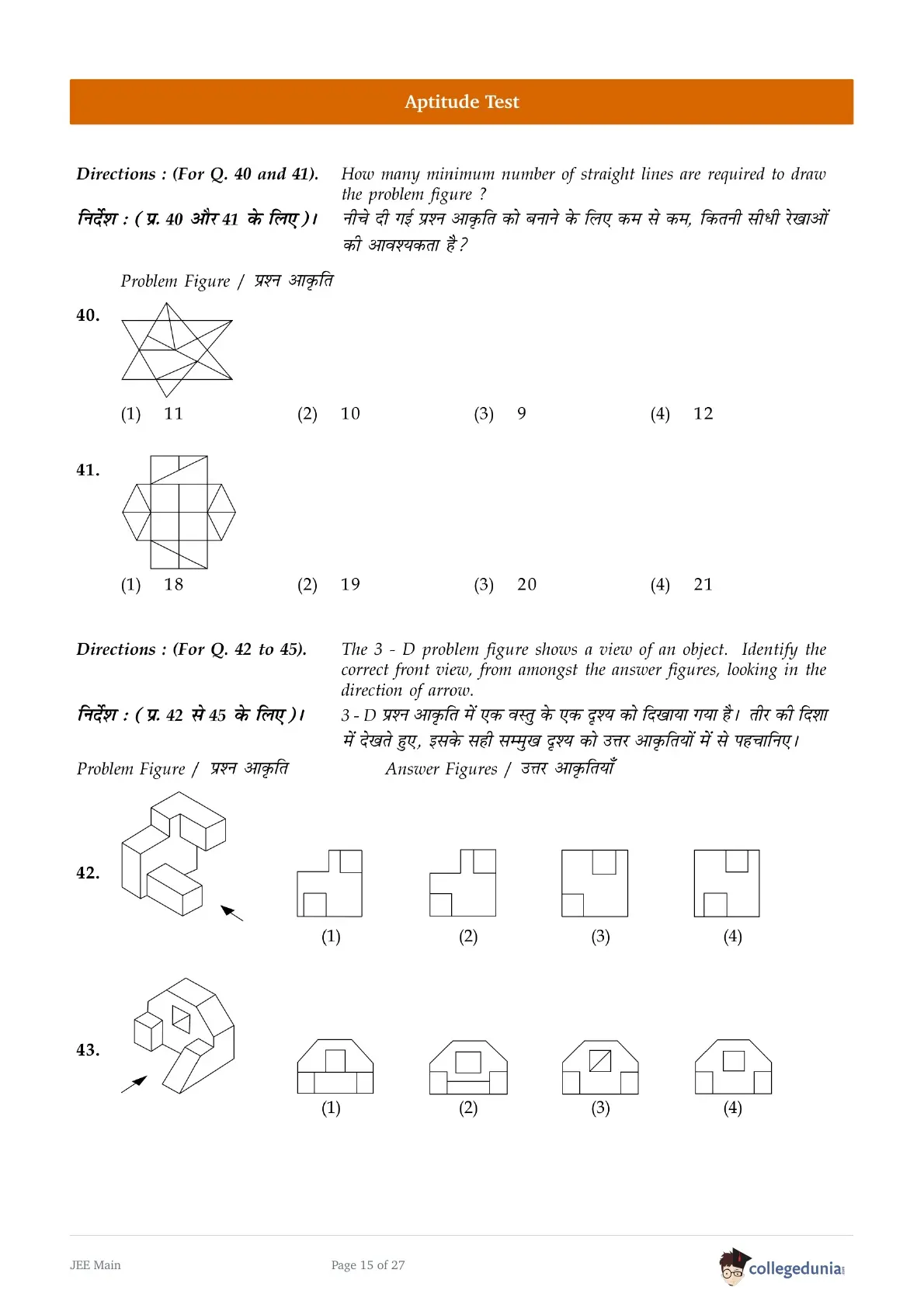
Directions : How many minimum number of straight lines are required to draw the problem figure ?
Directions: How many minimum number of straight lines are required to draw the problem figure ?
Directions: The 3 - D problem figure shows a view of an object. Identify the correct front view, from amongst the answer figures, looking in the direction of arrow.
- (1)
![]()
- (2)
![]()
- (3)
![]()
- (4)
![]()


Directions: The 3 - D problem figure shows a view of an object. Identify the correct front view, from amongst the answer figures, looking in the direction of arrow.
- (1)
![]()
- (2)
![]()
- (3)
![]()
- (4)
![]()


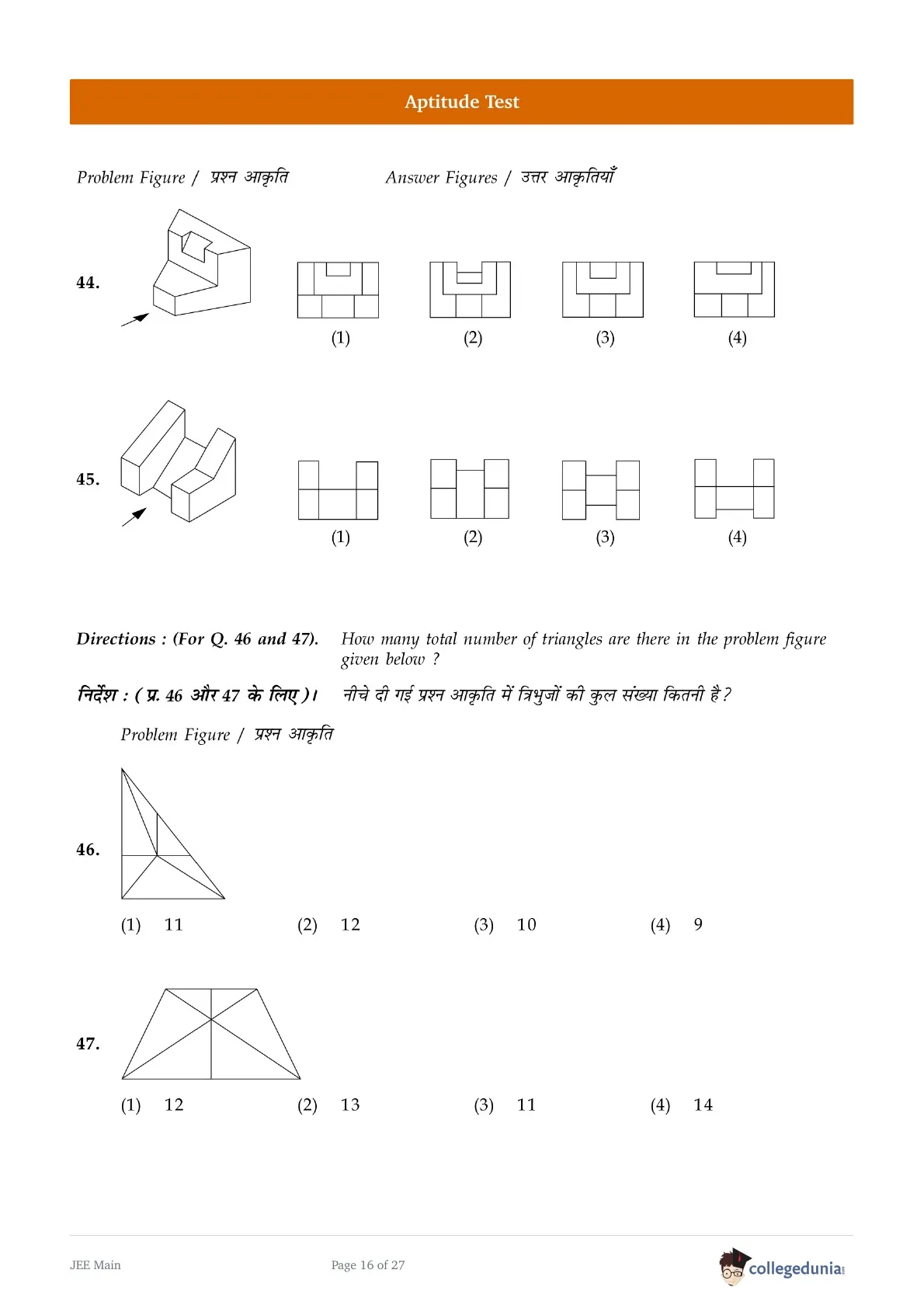
Directions: The 3 - D problem figure shows a view of an object. Identify the correct front view, from amongst the answer figures, looking in the direction of arrow.
- (1)
![]()
- (2)
![]()
- (3)
![]()
- (4)
![]()


Directions: The 3 - D problem figure shows a view of an object. Identify the correct front view, from amongst the answer figures, looking in the direction of arrow.
- (1)
![]()
- (2)
![]()
- (3)
![]()
- (4)
![]()


Directions: How many total number of triangles are there in the problem figure given below ?
Directions: How many total number of triangles are there in the problem figure given below ?
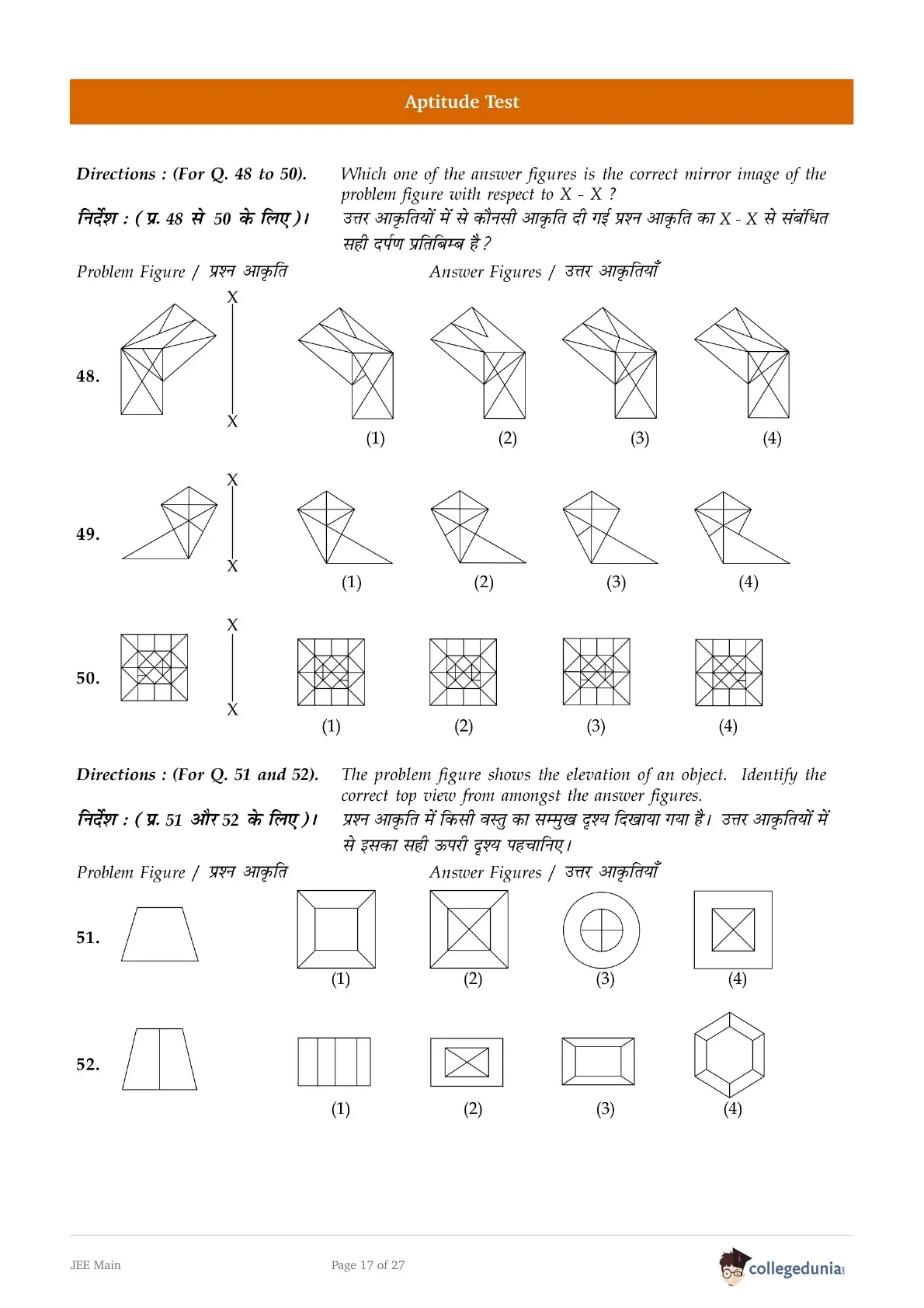
Directions: Which one of the answer figures is the correct mirror image of the problem figure with respect to X - X ?
- (1)
![]()
- (2)
![]()
- (3)
![]()
- (4)
![]()


Which one of the answer figures is the correct mirror image of the problem figure with respect to X - X ?
- (1)
![]()
- (2)
![]()
- (3)
![]()
- (4)
![]()


Which one of the answer figures is the correct mirror image of the problem figure with respect to X - X ?
- (1)
![]()
- (2)
![]()
- (3)
![]()
- (4)
![]()


The problem figure shows the elevation of an object. Identify the correct top view from amongst the answer figures.
- (1)
![]()
- (2)
![]()
- (3)
![]()
- (4)
![]()


The problem figure shows the elevation of an object. Identify the correct top view from amongst the answer figures.
- (1)
![]()
- (2)
![]()
- (3)
![]()
- (4)
![]()


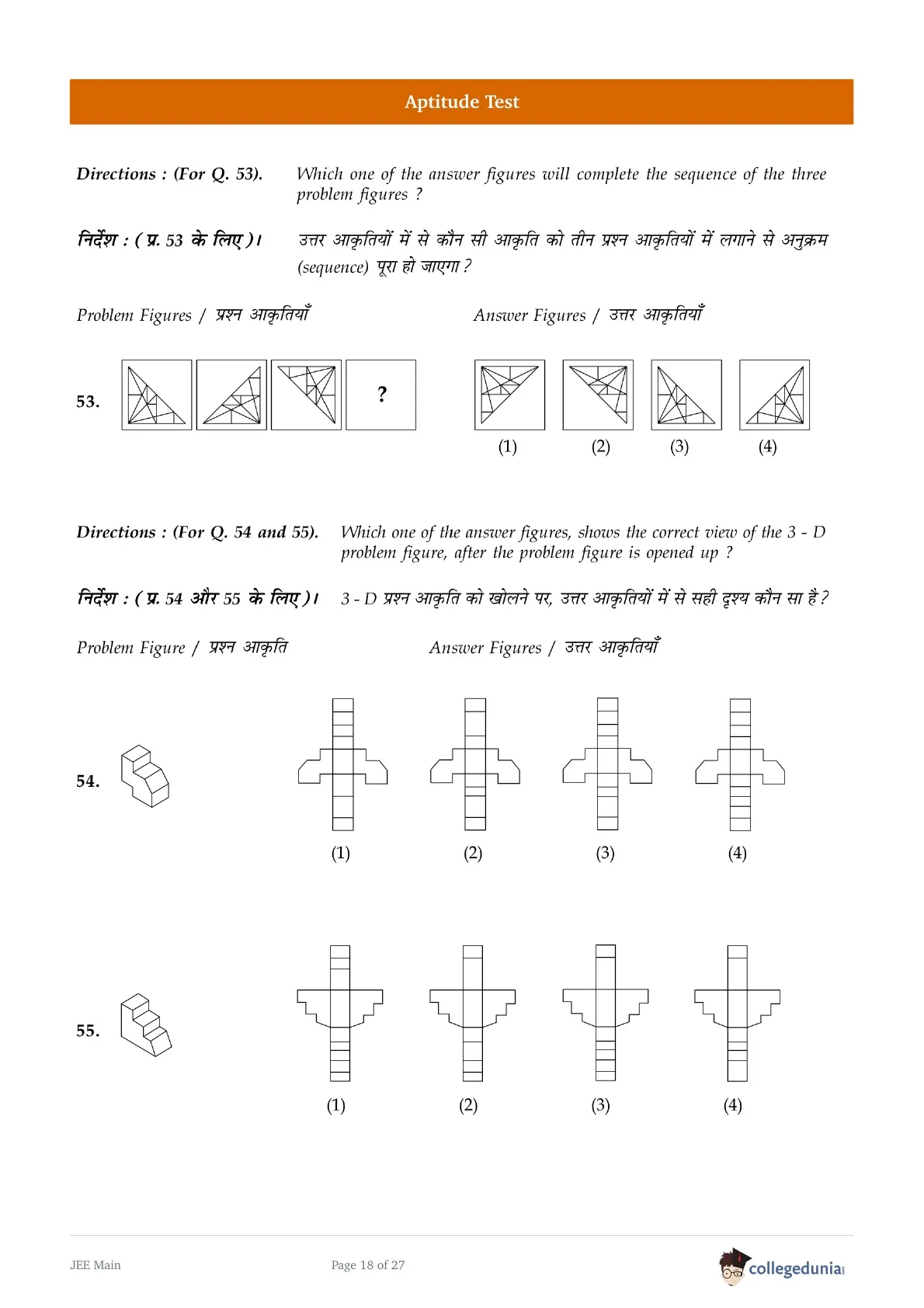
Which one of the answer figures will complete the sequence of the three problem figures ?
- (1)
![]()
- (2)
![]()
- (3)
![]()
- (4)
![]()


Which one of the answer figures, shows the correct view of the 3 - D problem figure, after the problem figure is opened up ?
- (1)
![]()
- (2)
![]()
- (3)
![]()
- (4)
![]()


Which one of the answer figures, shows the correct view of the 3 - D problem figure, after the problem figure is opened up ?
- (1)
![]()
- (2)
![]()
- (3)
![]()
- (4)
![]()


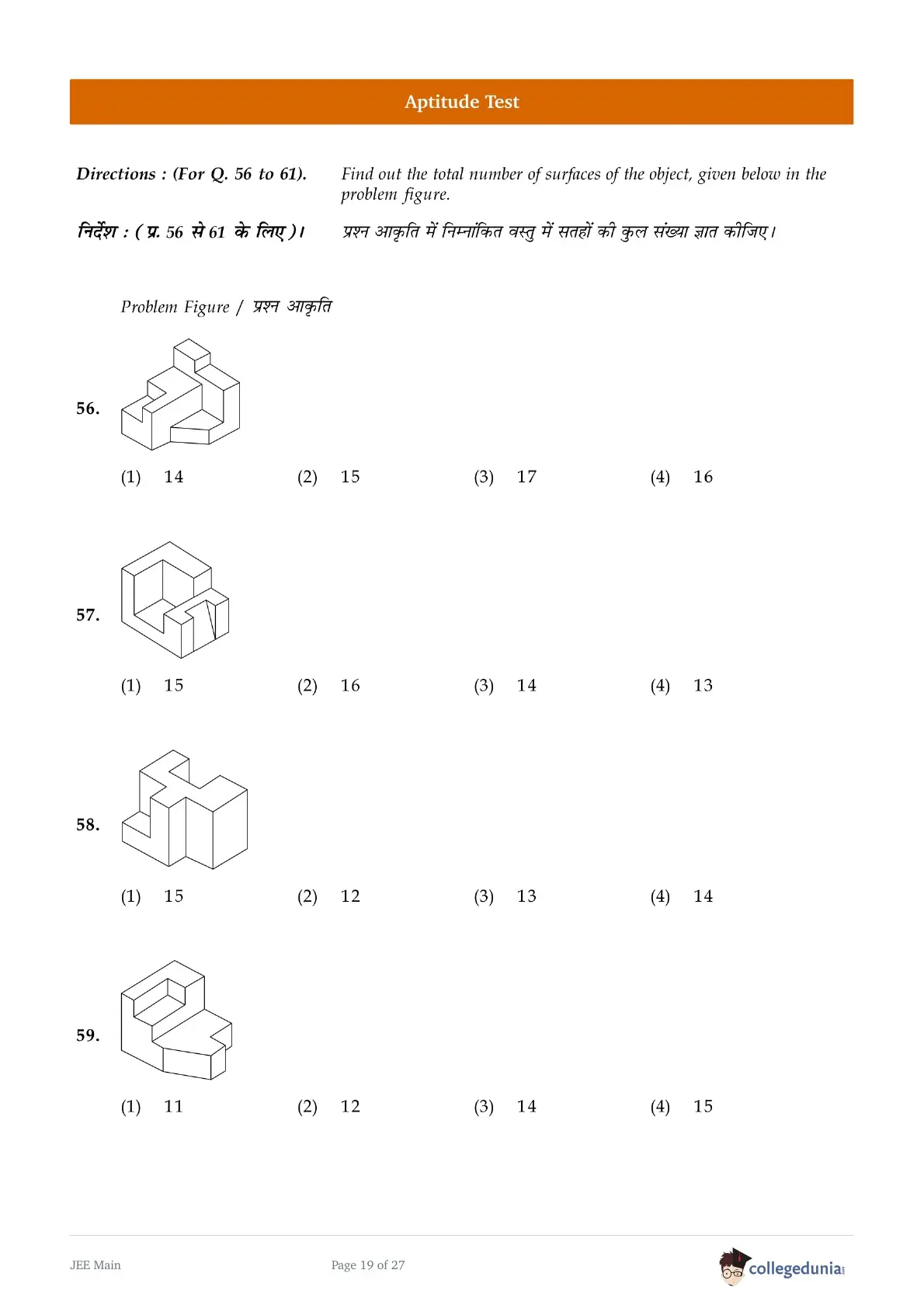
Find out the total number of surfaces of the object, given below in the problem figure.
Directions : Find out the total number of surfaces of the object, given below in the problem figure.
Directions : Find out the total number of surfaces of the object, given below in the problem figure.
Directions : Find out the total number of surfaces of the object, given below in the problem figure.
Directions : Find out the total number of surfaces of the object, given below in the problem figure.
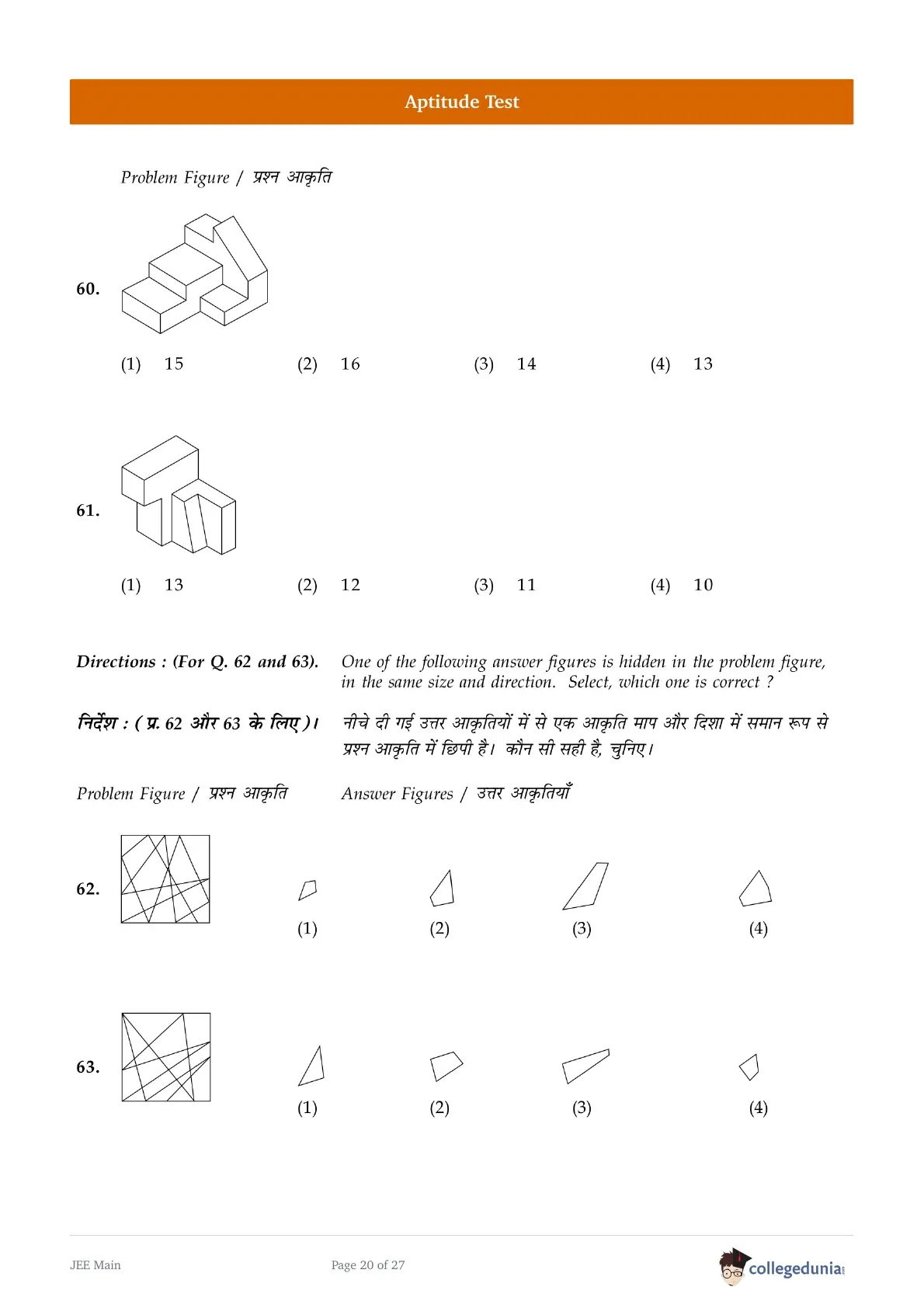
Directions : Find out the total number of surfaces of the object, given below in the problem figure.
Directions : One of the following answer figures is hidden in the problem figure, in the same size and direction. Select, which one is correct ?
- (1)
![]()
- (2)
![]()
- (3)
![]()
- (4)
![]()


Directions : One of the following answer figures is hidden in the problem figure, in the same size and direction. Select, which one is correct ?
- (1)
![]()
- (2)
![]()
- (3)
![]()
- (4)
![]()


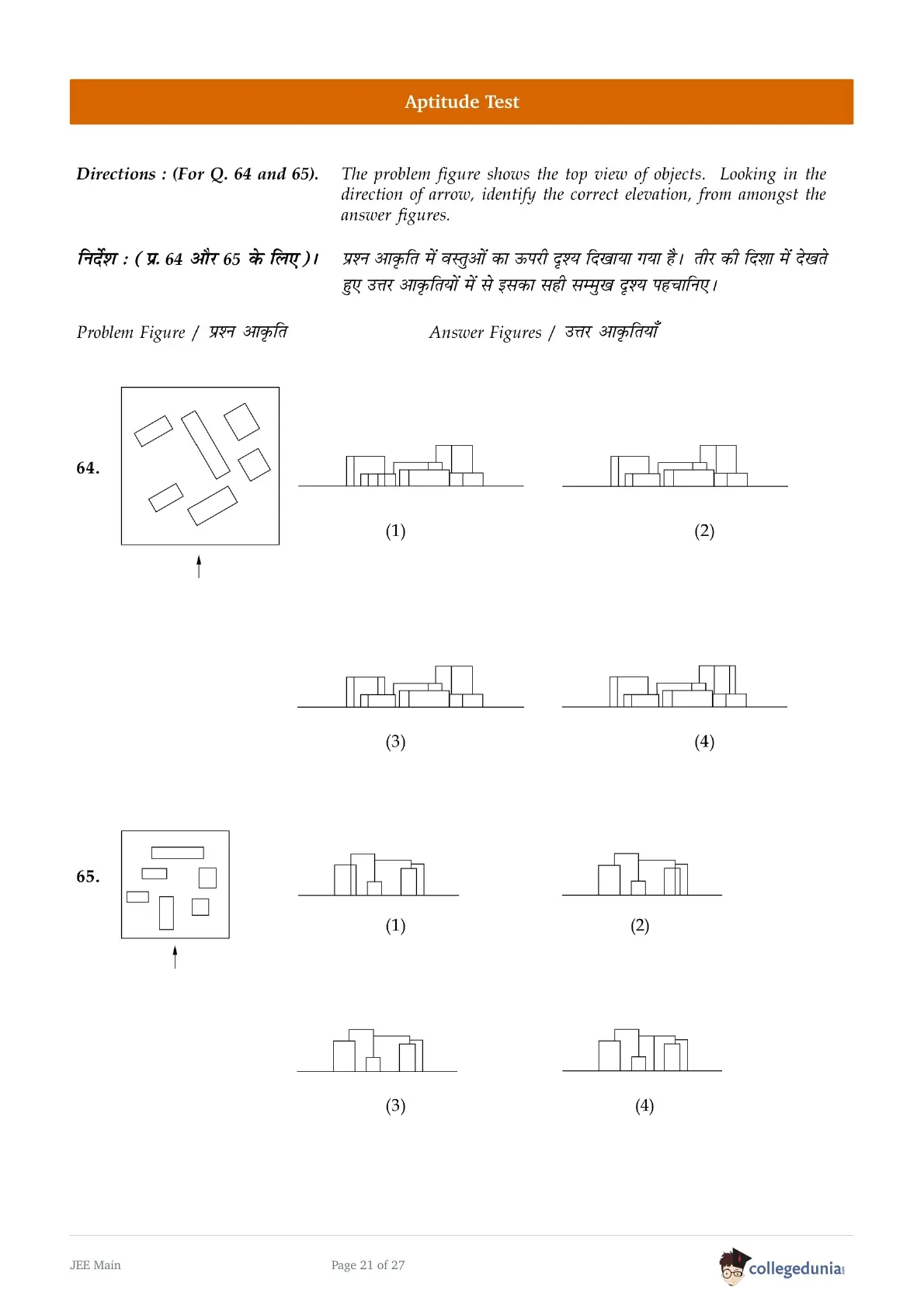
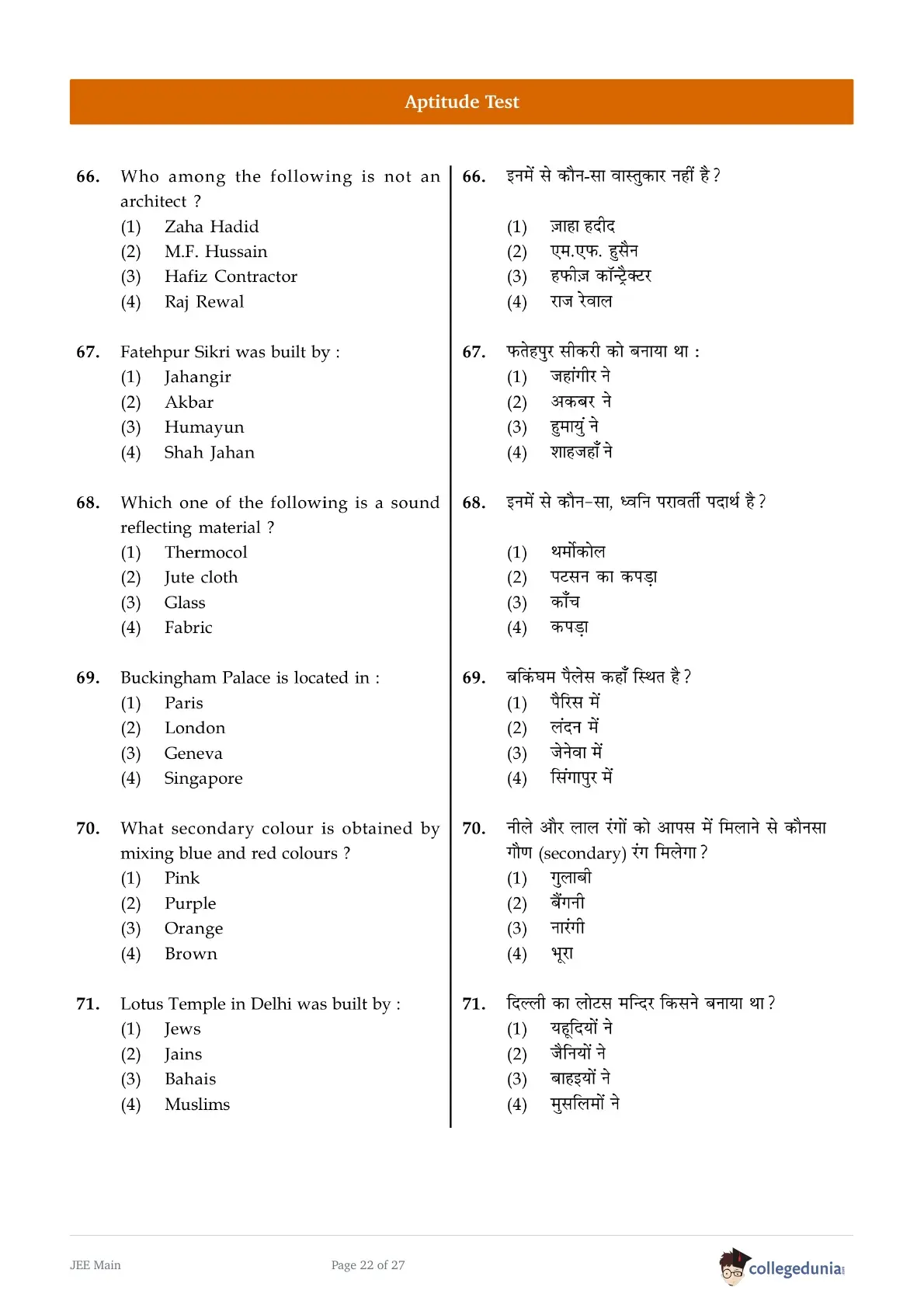
Directions : The problem figure shows the top view of objects. Looking in the direction of arrow, identify the correct elevation, from amongst the answer figures.
- (1)
![]()
- (2)
![]()
- (3)
![]()
- (4)
![]()


Directions: The problem figure shows the top view of objects. Looking in the direction of arrow, identify the correct elevation, from amongst the answer figures.
- (1)
![]()
- (2)
![]()
- (3)
![]()
- (4)
![]()


Who among the following is not an architect ?
Fatehpur Sikri was built by :
Which one of the following is a sound reflecting material ?
Buckingham Palace is located in :
What secondary colour is obtained by mixing blue and red colours ?
Lotus Temple in Delhi was built by :
Which one of the following material cannot be used in its original form for construction of walls ?
Green architecture is promoted these days because :
What is texture ?
Which one of the following is not an earthquake resistant structure ?
Which one of the following is an odd match ?
Why do large industrial buildings have high located glazing on the North side ?
Which one of the following is an odd match ?
Which one of the following is not a matching set ?
Which one of the following is not a matching set ?
Drawing Test (Q81 - Q82)
(a) Draw a rectangular frame of size 140 mm \(\times\) 210 mm in the space provided for answering this question. In this frame, compose an aesthetic 3 - dimensional composition, appropriate to the size of the frame, comprising cubes, cones and cylinders. There is no restriction of numbers, sizes, placement and direction of these solids in this frame. Colour your composition to make it visually exciting.
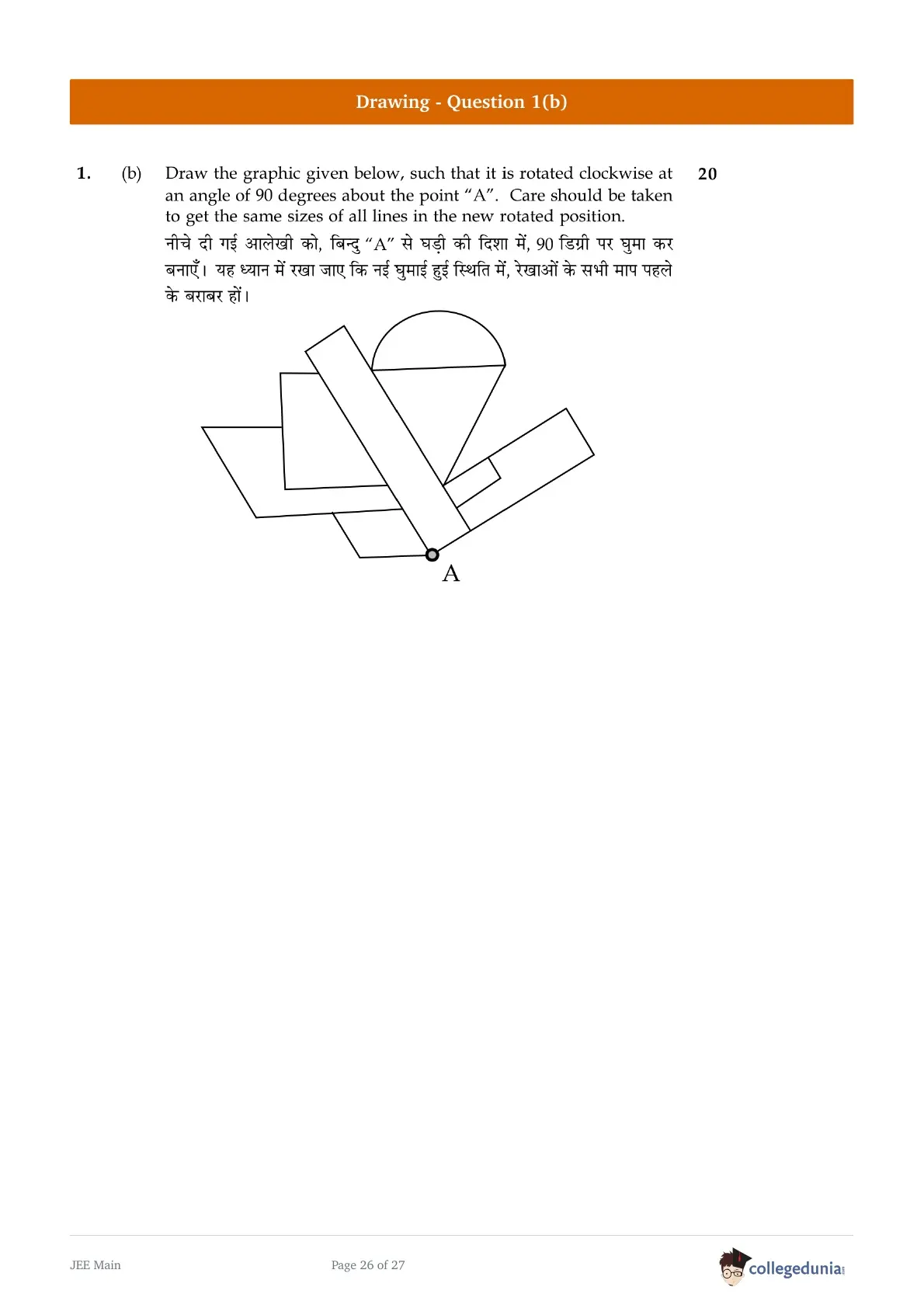
(b) Draw the graphic given below, such that it is rotated clockwise at an angle of 90 degrees about the point ‘A’. Care should be taken to get the same sizes of all lines in the new rotated position.
Draw from memory a balloon seller, selling balloons to a group of small children.
OR
Draw from memory a scene of a group of village women around a handpump with their pitchers/utensils for filling water.
JEE Main 2014 B.Arch / B.Planning (Paper 2) Exam Pattern and Marking Scheme
| Particulars | Details |
|---|---|
| Exam Mode | Offline (Pen and Paper) |
| Paper | B.Arch / B.Planning (Paper 2) |
| Duration | 3 hours (180 minutes) |
| Type of Questions | Multiple Choice Questions (MCQs) and drawing questions |
| Subjects | Mathematics, Aptitude Test, Drawing Test |
| Total Questions | 82 questions |
| Total Marks | 390 marks |
| Marking Scheme | +4 for correct answer & -1 for incorrect MCQ answer; 0 for unattempted |



Comments