




JEE Main 2014 April 9 Question Paper is available here with solutions PDF and detailed solutions for every question. CBSE conducted the computer-based test (CBT) Paper 1 on April 9, 2014. The JEE Main 2014 Paper 1 (B.E./B.Tech) question paper includes the following:
- 90 questions in a 3-hour CBT Mode: 30 each from Mathematics, Physics and Chemistry
- Question type: all multiple choice questions (MCQs) with a single correct option, 4 marks each
- Sections: Mathematics (30), Physics (30) and Chemistry (30), all questions compulsory
- Marking: +4 for a correct answer, -1 for an incorrect answer, 0 for an unattempted question
- Maximum marks: 360 (120 per subject)
JEE Main 2014 April 9 Question Paper with Solution PDF
| NTA Official PDF | CD PDF | CD PDF with Solutions |
|---|---|---|
| Download official PDF 3.18 MB | Download Collegedunia PDF 4.63 MB | Download solutions PDF 1.37 MB |
Also Check:
JEE Main 2014 April 9 Questions with Solutions
Mathematics (Q1 - Q30)
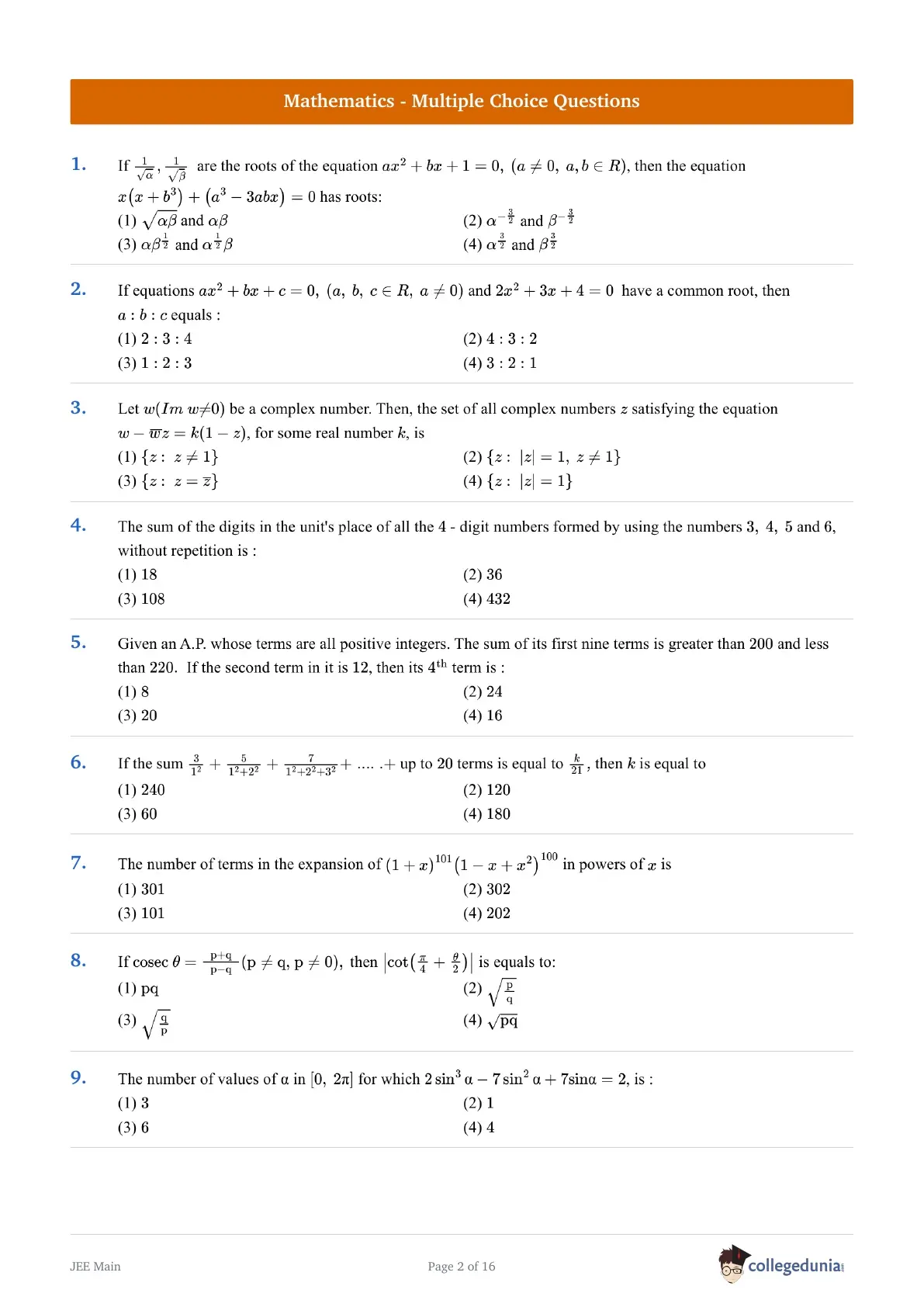
If \(\frac{1}{\sqrt{\alpha}}\) and \(\frac{1}{\sqrt{\beta}}\) are the roots of the equation, \(ax^{2} + bx +1 = 0 \left(a ^{ }\ne 0, a, b \in R\right)\), then the equation, \(x\left(x + b^{3}\right) + \left(a^{3} ? 3abx\right)\) = 0 has roots :
If equations \(ax^2+bx+c=0\), \((a,\ b,\ c\in R,\ a\ne 0)\) and \(2x^2+3x+4=0\) have a common root, then \(a:b:c\) equals :
Let \(w\ (\mathrm{Im}\,w\ne 0)\) be a complex number. Then, the set of all complex numbers \(z\) satisfying the equation \(w-\overline{w}z=k(1-z)\), for some real number \(k\), is
The sum of the digits in the unit's place of all the 4 - digit numbers formed by using the numbers 3, 4, 5 and 6, without repetition is :
Given an \(A.P\). whose terms are all positive integers. The sum of its first nine terms is greater than \(200\) and less than \(220\). If the second term in it is \(12\), then its \(4^{th}\) term is :
If the sum \(\frac{3}{1^2}+\frac{5}{1^2+2^2}+\frac{7}{1^2+2^2+3^2}+\ldots\) up to 20 terms is equal to \(\frac{k}{21}\), then \(k\) is equal to
The number of terms in the expansion of \((1+x)^{101}(1-x+x^2)^{100}\) in powers of \(x\) is
If \(\operatorname{cosec}\theta=\frac{p+q}{p-q}\ (p\ne q,\ p\ne 0)\), then \(\left|\cot\left(\frac{\pi}{4}+\frac{\theta}{2}\right)\right|\) is equals to:
The number of values of \(\alpha\) in \([0,\ 2\pi]\) for which \(2\sin^3\alpha-7\sin^2\alpha+7\sin\alpha=2\), is :
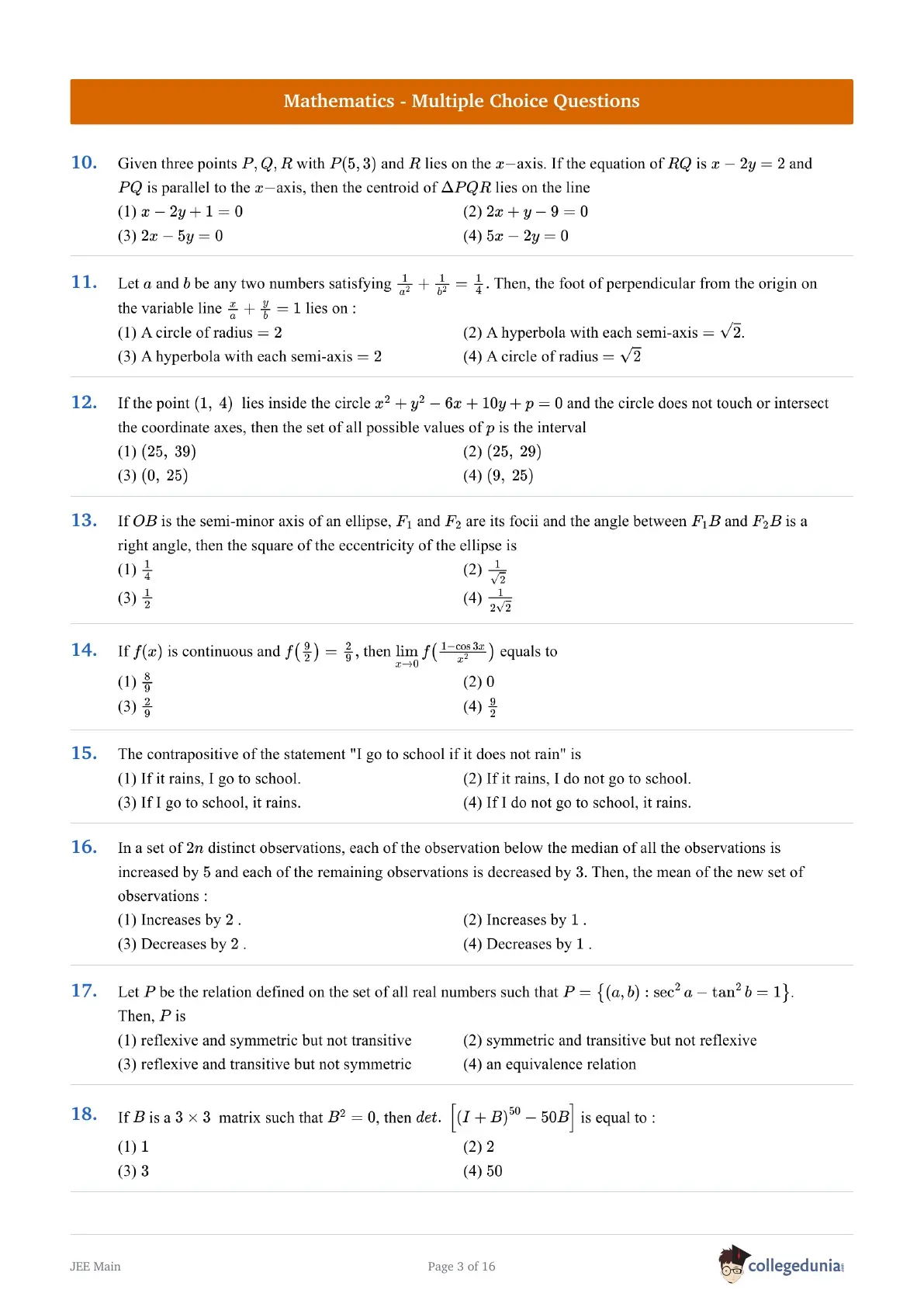
Given three points \(P,Q,R\) with \(P(5,3)\) and \(R\) lies on the \(x\)-axis. If the equation of \(RQ\) is \(x-2y=2\) and \(PQ\) is parallel to the \(x\)-axis, then the centroid of \(\Delta PQR\) lies on the line
Let \(a\) and \(b\) be any two numbers satisfying \(\frac1{a^2}+\frac1{b^2}=\frac14\). Then, the foot of perpendicular from the origin on the variable line \(\frac xa+\frac yb=1\) lies on :
If the point \((1,\ 4)\) lies inside the circle \(x^2+y^2-6x+10y+p=0\) and the circle does not touch or intersect the coordinate axes, then the set of all possible values of \(p\) is the interval
If \(OB\) is the semi-minor axis of an ellipse, \(F_1\) and \(F_2\) are its focii and the angle between \(F_1B\) and \(F_2B\) is a right angle, then the square of the eccentricity of the ellipse is
If \(f(x)\) is continuous and \(f\left(\frac92\right)=\frac29\), then \(\lim_{x\to0}f\left(\frac{1-\cos3x}{x^2}\right)\) equals to
The contrapositive of the statement "I go to school if it does not rain" is
In a set of \(2n\) distinct observations, each of the observation below the median of all the observations is increased by 5 and each of the remaining observations is decreased by 3. Then, the mean of the new set of observations :
Let \(P\) be the relation defined on the set of all real numbers such that \(P = \{(a, b) : \sec^2 a - \tan^2 b = 1\}\). Then, \(P\) is
If \(B\) is a \(3 \times 3\) matrix such that \(B^2 = 0\), then \(\det.\left[(I + B)^{50} - 50B\right]\) is equal to :
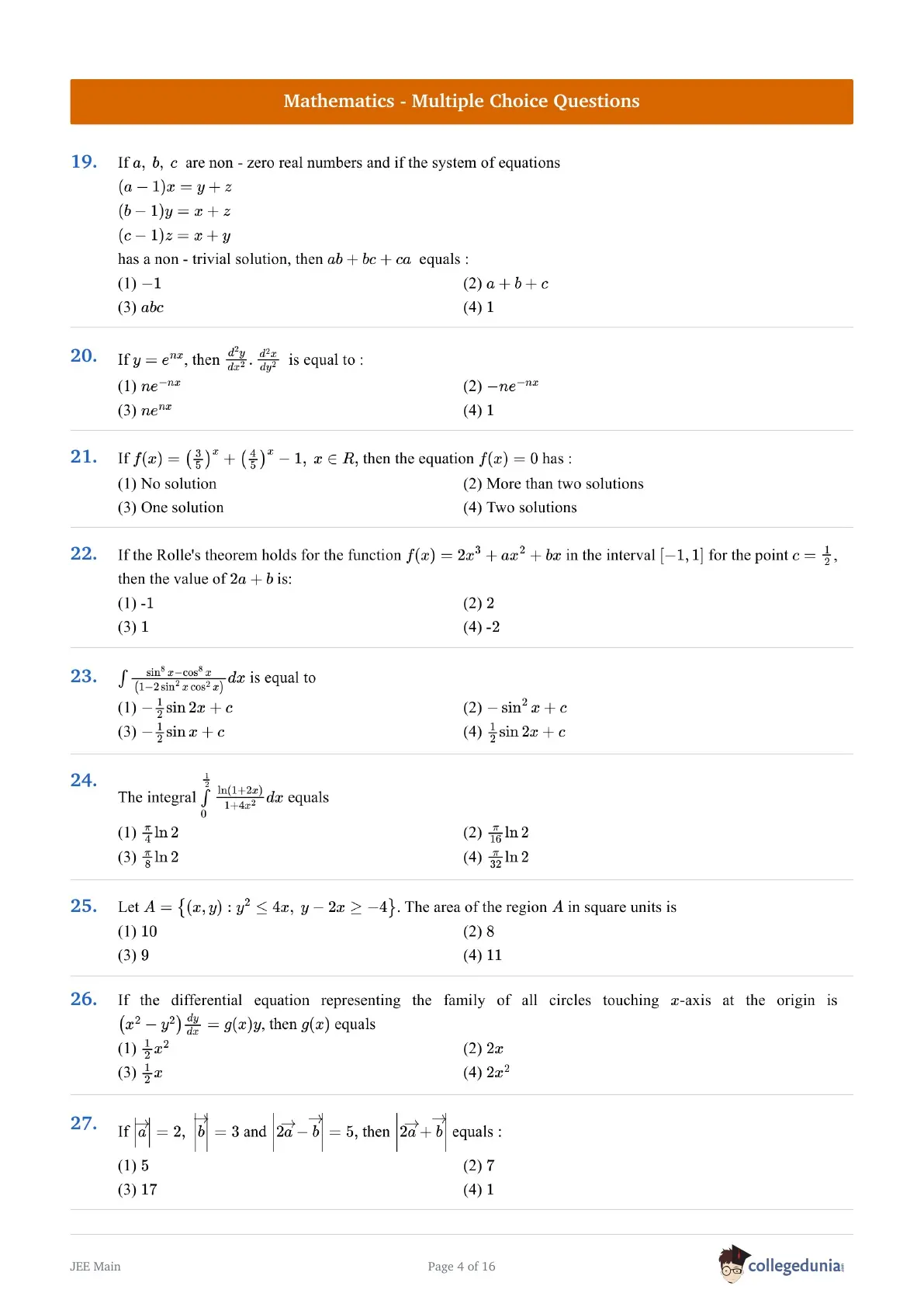
If \(a, b, c\) are non - zero real numbers and if the system of equations
\((a-1)x = y + z\)
\((b-1)y = x + z\)
\((c-1)z = x + y\)
has a non - trivial solution, then \(ab + bc + ca\) equals :
If \(y = e^{nx}\), then \(\frac{d^2y}{dx^2} \cdot \frac{d^2x}{dy^2}\) is equal to :
If \(f(x) = \left(\frac35\right)^x + \left(\frac45\right)^x - 1,\ x \in R\), then the equation \(f(x) = 0\) has :
If the Rolle's theorem holds for the function \(f(x) = 2x^3 + ax^2 + bx\) in the interval \([-1, 1]\) for the point \(c = \frac12\), then the value of \(2a + b\) is:
\(\int \frac{\sin^8 x - \cos^8 x}{(1 - 2\sin^2 x\cos^2 x)}\,dx\) is equal to
The integral \(\int^{^{\frac{1}{2}}}_{_0} \frac{ln \left(1+2x\right)}{1+4x^{2}}dx,\) equals :
Let \(A = \{(x, y) : y^2 \le 4x,\ y - 2x \ge -4\}\). The area of the region \(A\) in square units is
If the differential equation representing the family of all circles touching \(x\)-axis at the origin is \((x^2 - y^2)\frac{dy}{dx} = g(x)y\), then \(g(x)\) equals
If \(\left|\vec{a}\right| = 2\), \(\left|\vec{b}\right| = 3\) and \(\left|2\vec{a} - \vec{b}\right| = 5\), then \(\left|2\vec{a} + \vec{b}\right|\) equals :
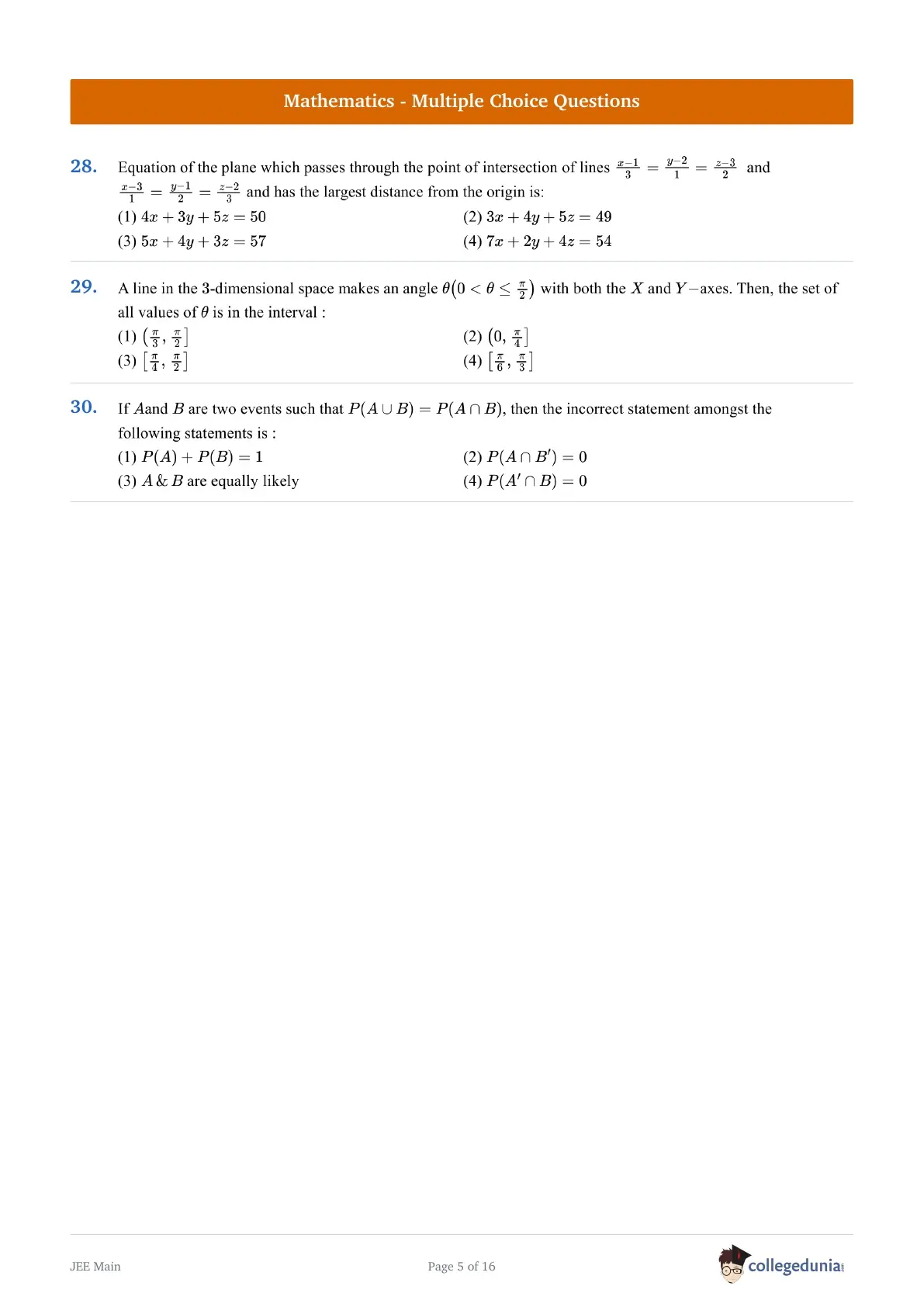
Equation of the plane which passes through the point of intersection of lines \(\frac{x-1}{3} = \frac{y-2}{1} = \frac{z-3}{2}\) and \(\frac{x-3}{1} = \frac{y-1}{2} = \frac{z-2}{3}\) and has the largest distance from the origin is:
A line in the 3-dimensional space makes an angle \(\theta\left(0 \lt \theta \le \frac\pi2\right)\) with both the \(X\) and \(Y\)-axes. Then, the set of all values of \(\theta\) is in the interval :
If \(A\) and \(B\) are two events such that \(P(A \cup B) = P(A \cap B)\), then the incorrect statement amongst the following statements is :
Physics (Q31 - Q60)
An experiment is performed to obtain the value of acceleration due to gravity \(g\) by using a simple pendulum of length \(L\). In this experiment time for 100 oscillations is measured by using a watch of 1 second least count and the value is 90.0 seconds. The length \(L\) is measured by using a meter scale of least count 1 mm and the value is 20.0 cm. The error in the determination of \(g\) would be :
The position of a projectile launched from the origin at \(t = 0\) is given by \(\vec{r} = (40\,\hat{i} + 50\,\hat{j})\) m at \(t = 2\) s. If the projectile was launched at an angle \(\theta\) from the horizontal, then \(\theta\) is (take \(g = 10\ \mathrm{ms^{-2}}\)).
Water is flowing at a speed of \(1.5\ \mathrm{m\,s^{-1}}\) through a horizontal tube of cross-sectional area \(10^{-2}\ \mathrm{m^2}\) and you are trying to stop the flow by your palm. Assuming that the water stops immediately after hitting the palm, the minimum force that you must exert should be (density of water \(= 10^{3}\ \mathrm{kg\,m^{-3}}\))
A block \(A\) of mass 4 kg is placed on another block \(B\) of mass 5 kg, and the block \(B\) rests on a smooth horizontal table. If the minimum force that can be applied on \(A\) so that both the blocks move together is 12 N, the maximum force that can be applied on \(B\) for the blocks to move together will be :
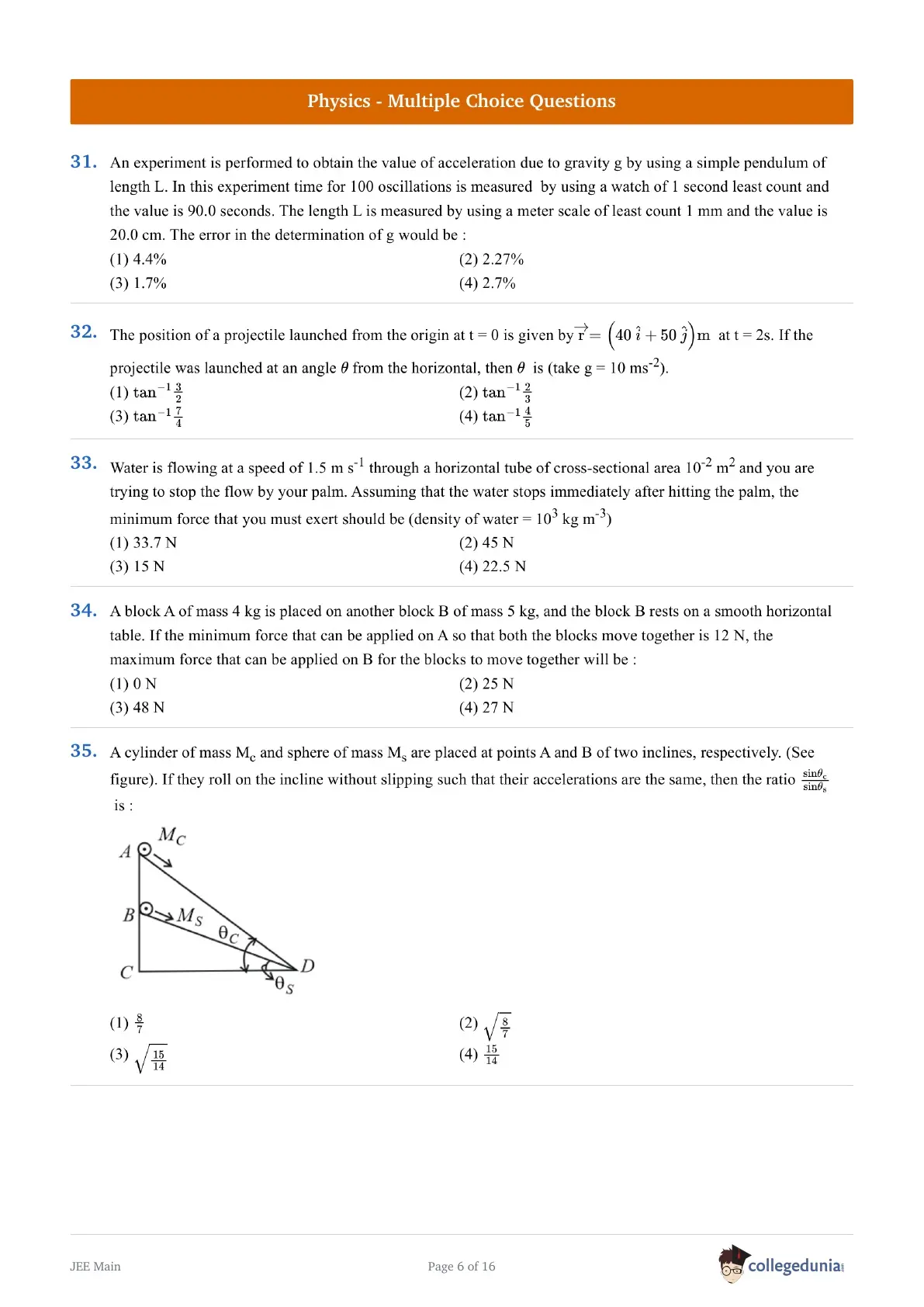
A cylinder of mass \(M_c\) and sphere of mass \(M_s\) are placed at points \(A\) and \(B\) of two inclines, respectively. (See figure). If they roll on the incline without slipping such that their accelerations are the same, then the ratio \(\dfrac{\sin\theta_c}{\sin\theta_s}\) is :
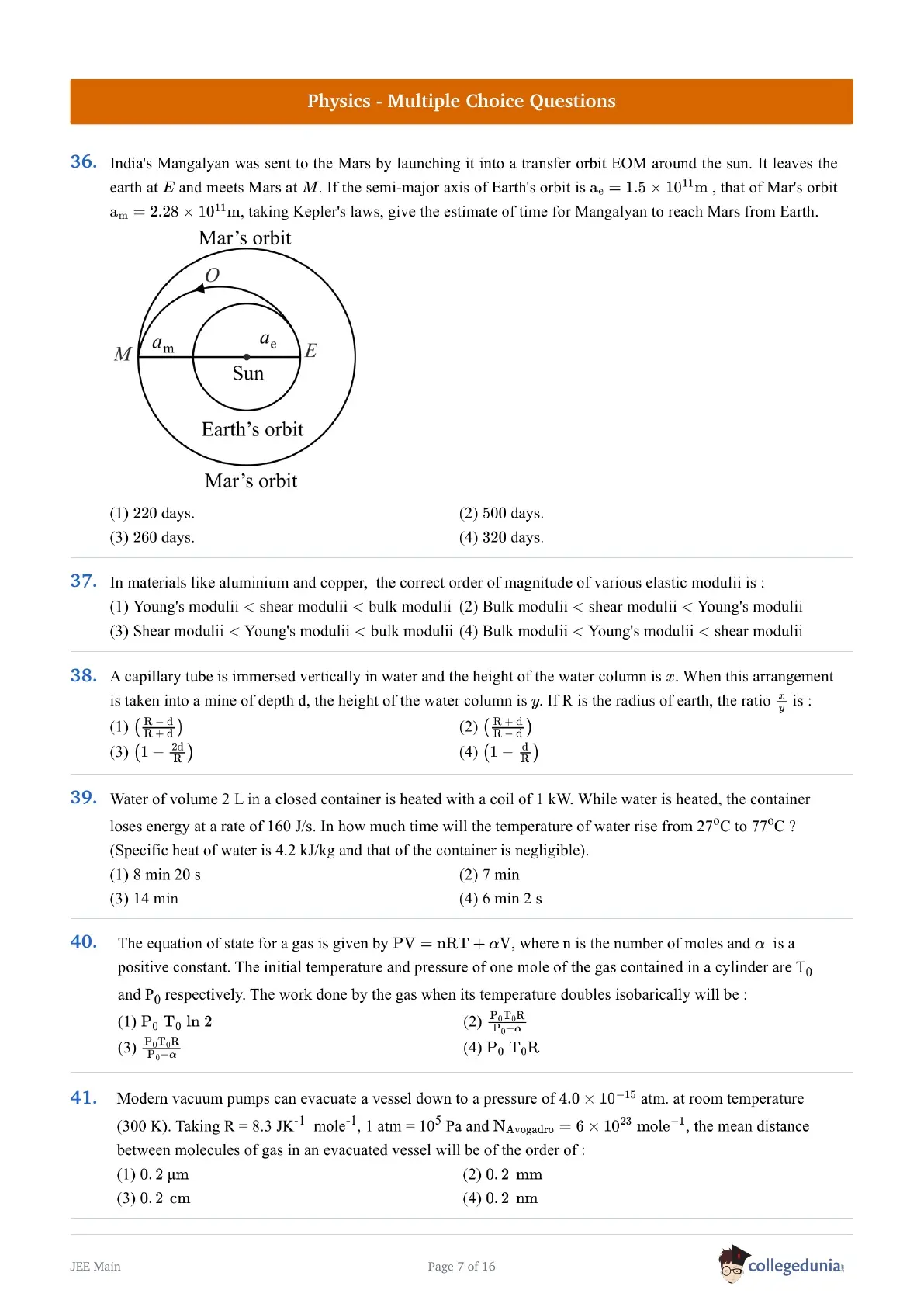
India's Mangalyan was sent to the Mars by launching it into a transfer orbit EOM around the sun. It leaves the earth at \(E\) and meets Mars at \(M\). If the semi-major axis of Earth's orbit is \(a_e = 1.5\times10^{11}\) m, that of Mars' orbit \(a_m = 2.28\times10^{11}\) m, taking Kepler's laws, give the estimate of time for Mangalyan to reach Mars from Earth.
In materials like aluminium and copper, the correct order of magnitude of various elastic modulii is :
A capillary tube is immersed vertically in water and the height of the water column is \(x\). When this arrangement is taken into a mine of depth \(d\), the height of the water column is \(y\). If \(R\) is the radius of earth, the ratio \(\frac{x}{y} \) is :
Water of volume 2 L in a closed container is heated with a coil of 1 kW. While water is heated, the container loses energy at a rate of 160 J/s. In how much time will the temperature of water rise from \(27^\circ\mathrm{C}\) to \(77^\circ\mathrm{C}\)? (Specific heat of water is 4.2 kJ/kg and that of the container is negligible).
The equation of state for a gas is given by \(PV = nRT + \alpha V\), where \(n\) is the number of moles and \(\alpha\) is a positive constant. The initial temperature and pressure of one mole of the gas contained in a cylinder are \(T_0\) and \(P_0\) respectively. The work done by the gas when its temperature doubles isobarically will be :
Modern vacuum pumps can evacuate a vessel down to a pressure of \(4.0 \times 10^{-15}\, atm\) at room temperature \((300\, K)\). Taking \(R = 8.3\, JK^{-1} \,mole^{-1}, 1\, atm = 10^5\, Pa\) and \(N_{\text{Avogadro}} = 6 \times 10^{23} mole^{-1}\), the mean distance between molecules of gas in an evacuated vessel will be of the order of :
Two bodies of masses 1 kg and 4 kg are connected to a vertical spring, as shown in the figure. The smaller mass executes simple harmonic motion of angular frequency 25 rad s\(^{-1}\), and amplitude 1.6 cm while the bigger mass remains stationary on the ground. The maximum force exerted by the system on the floor is (take \(g = 10\ \mathrm{m\,s^{-2}}\)).
The amplitude of a simple pendulum, oscillating in air with a small spherical bob, decreases from \(10\, cm\) to \(8\, cm\) in \(40\,\) seconds. Assuming that Stokes law is valid, and ratio of the coefficient of viscosity of air to that of carbon dioxide is \(1.3\), the time in which amplitude of this pendulum will reduce from \(10\, cm\) to \(5 \,cm\) carbon dioxide will be close to (\(\ell n\, 5 \,= \,1.601, \ell n\, 2\, =\, 0.693)\).
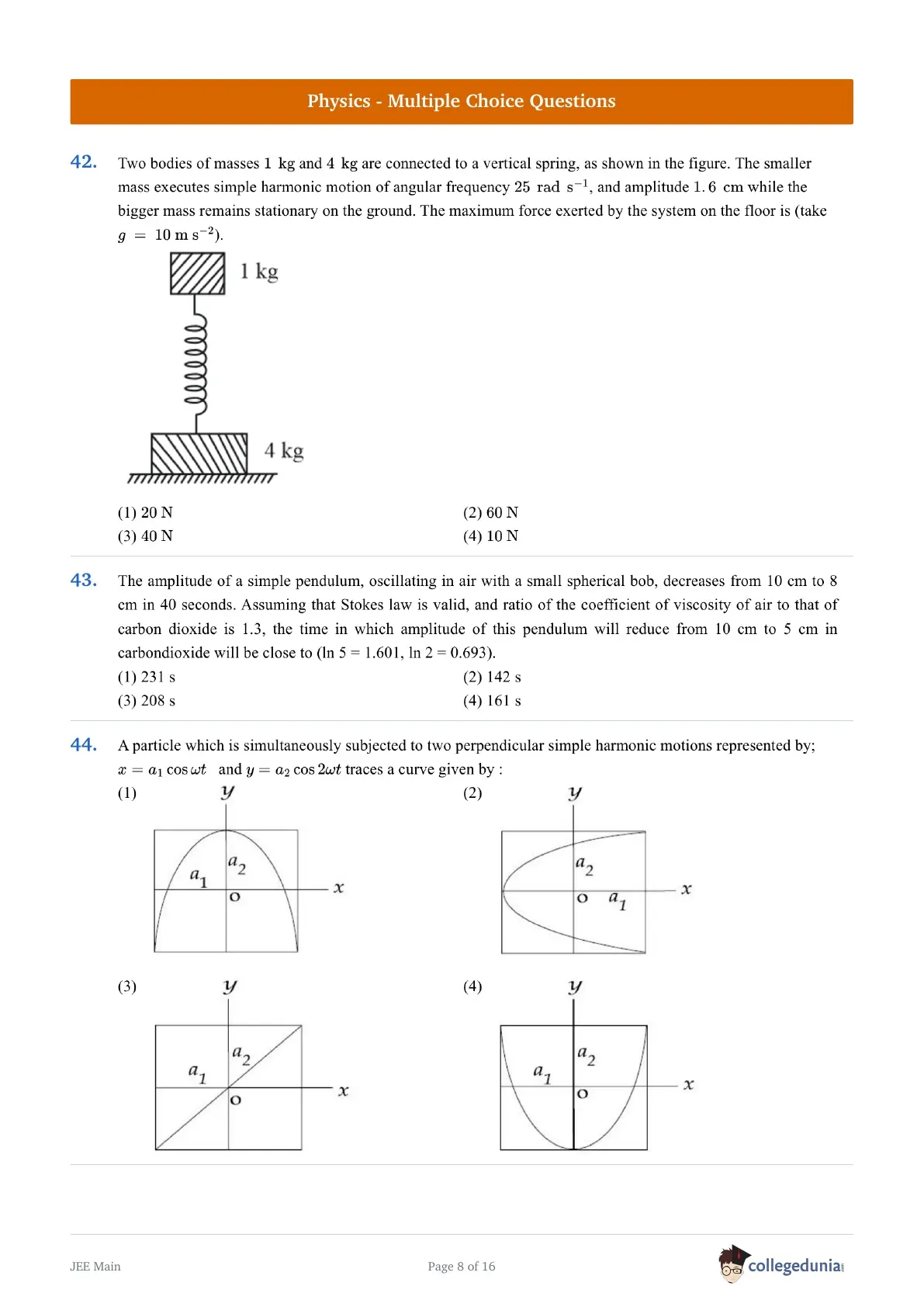
A particle which is simultaneously subjected to two perpendicular simple harmonic motions represented by; \(x = a_1\cos\omega t\) and \(y = a_2\cos 2\omega t\) traces a curve given by :
- (1)
![]()
- (2)
![]()
- (3)
![]()
- (4)
![]()


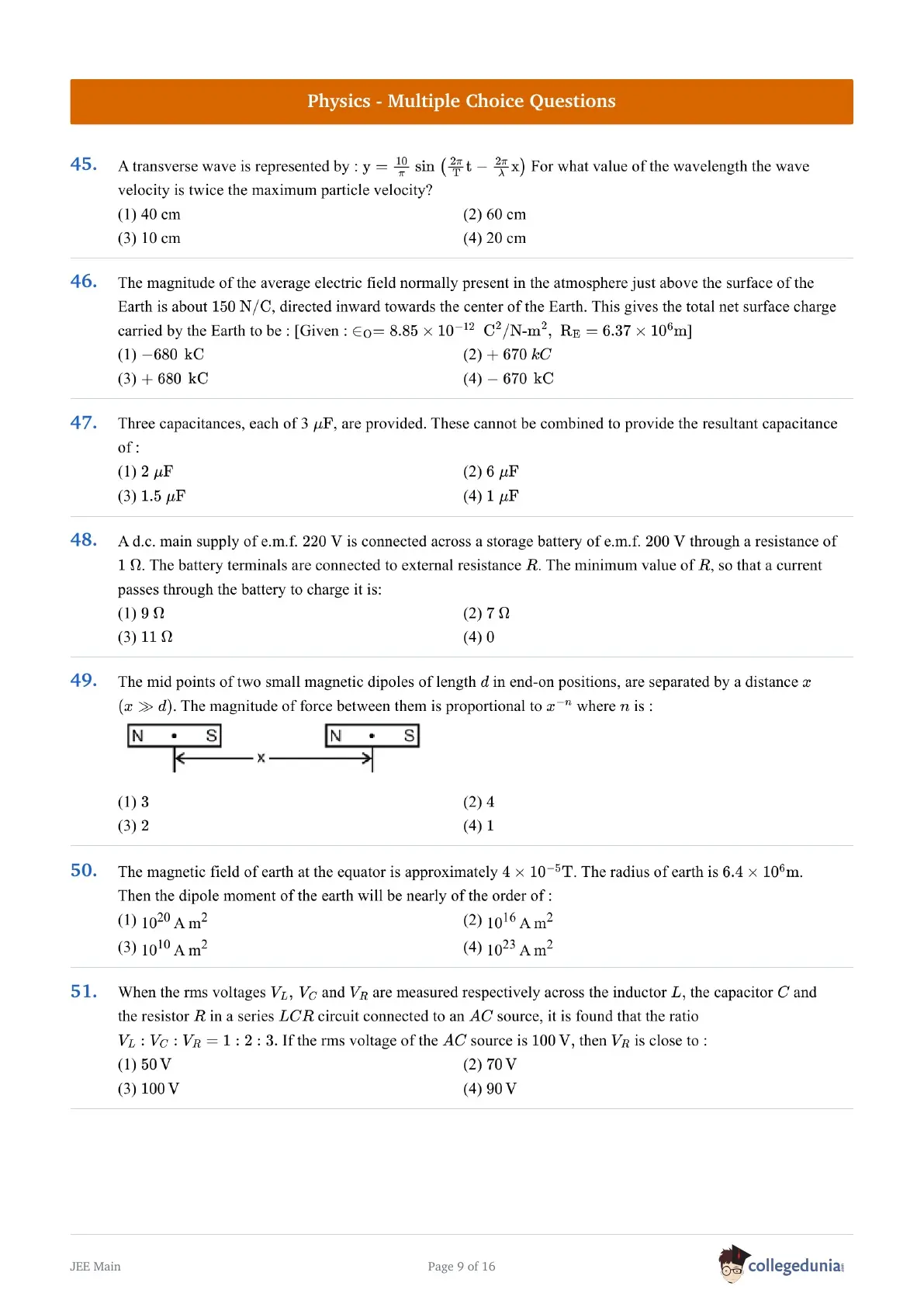
A transverse wave is represented by : \(y = \frac{10}{\pi} \sin \left(\frac{2\pi}{T}t-\frac{2\pi}{\lambda}x\right)\) For what value of the wavelength the wave velocity is twice the maximum particle velocity ?
The magnitude of the average electric field normally present in the atmosphere just above the surface of the Earth is about 150 N/C, directed inward towards the center of the Earth. This gives the total net surface charge carried by the Earth to be : [Given : \(\epsilon_0 = 8.85\times10^{-12}\ \mathrm{C^2/N\text{-}m^2}\), \(R_E = 6.37\times10^{6}\) m]
Three capacitances, each of \(3\ \mu\mathrm{F}\), are provided. These cannot be combined to provide the resultant capacitance of :
A d.c. main supply of e.m.f. \(220\, V\) is connected across a storage battery of e.m.f. \(200\, V\) through a resistance of \(1\) \(\Omega\). The battery terminals are connected to an external resistance '\(R\)'. The minimum value of '\(R\)', so that a current passes through the battery to charge it is :
The mid points of two small magnetic dipoles of length \(d\) in end-on positions, are separated by a distance \(x\) (\(x \gg d\)). The magnitude of force between them is proportional to \(x^{-n}\) where \(n\) is :
The magnetic field of earth at the equator is approximately \(4\times10^{-5}\,\mathrm{T}\). The radius of earth is \(6.4\times10^{6}\,\mathrm{m}\). Then the dipole moment of the earth will be nearly of the order of :
When the rms voltages \(V _{ L }, V _{ C }\) and \(V _{ R }\) are measured respectively across the inductor \(L ,\) the capacitor \(C\) and the resistor \(R\) in a series LCR circuit connected to an AC source, it is found that the ratio \(V _{ L }: V _{ C }: V _{ R }=1: 2: 3\). If the rms voltage of the AC sources is \(100 \,V ,\) the \(V _{ R }\) is close to:
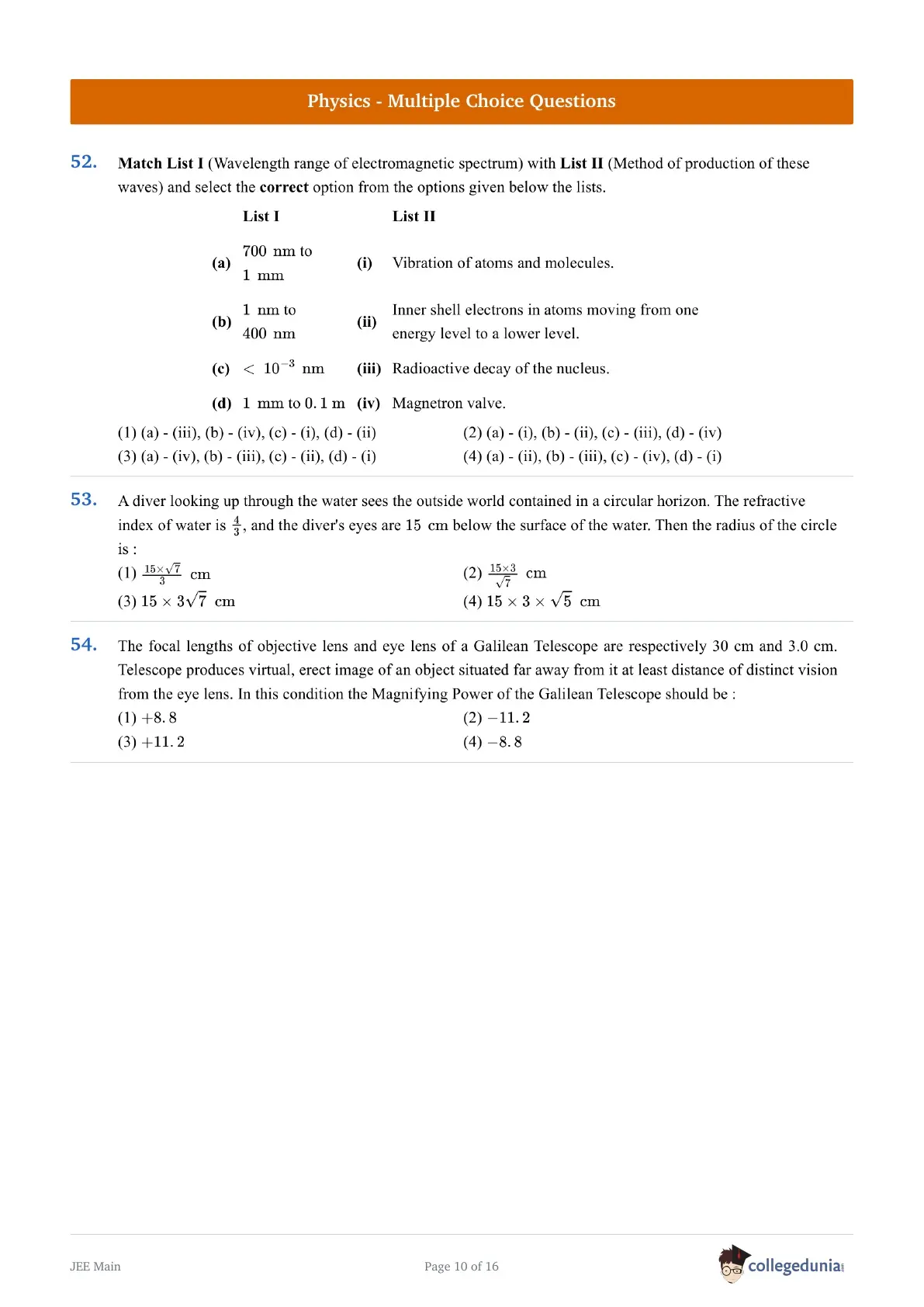
| List I | List II |
| (a) \(700\ \mathrm{nm}\) to \(1\ \mathrm{mm}\) | (i) Vibration of atoms and molecules. |
| (b) \(1\ \mathrm{nm}\) to \(400\ \mathrm{nm}\) | (ii) Inner shell electrons in atoms moving from one energy level to a lower level. |
| (c) \(\lt 10^{-3}\ \mathrm{nm}\) | (iii) Radioactive decay of the nucleus. |
| (d) \(1\ \mathrm{mm}\) to \(0.1\ \mathrm{m}\) | (iv) Magnetron valve. |
A diver looking up through the water sees the outside world contained in a circular horizon. The refractive index of water is \(\frac{4}{3}\), and the diver's eyes are \(15\ \mathrm{cm}\) below the surface of the water. Then the radius of the circle is :
The focal lengths of objective lens and eye lens of a Galilean Telescope are respectively \(30\ \mathrm{cm}\) and \(3.0\ \mathrm{cm}\). Telescope produces virtual, erect image of an object situated far away from it at least distance of distinct vision from the eye lens. In this condition the Magnifying Power of the Galilean Telescope should be :
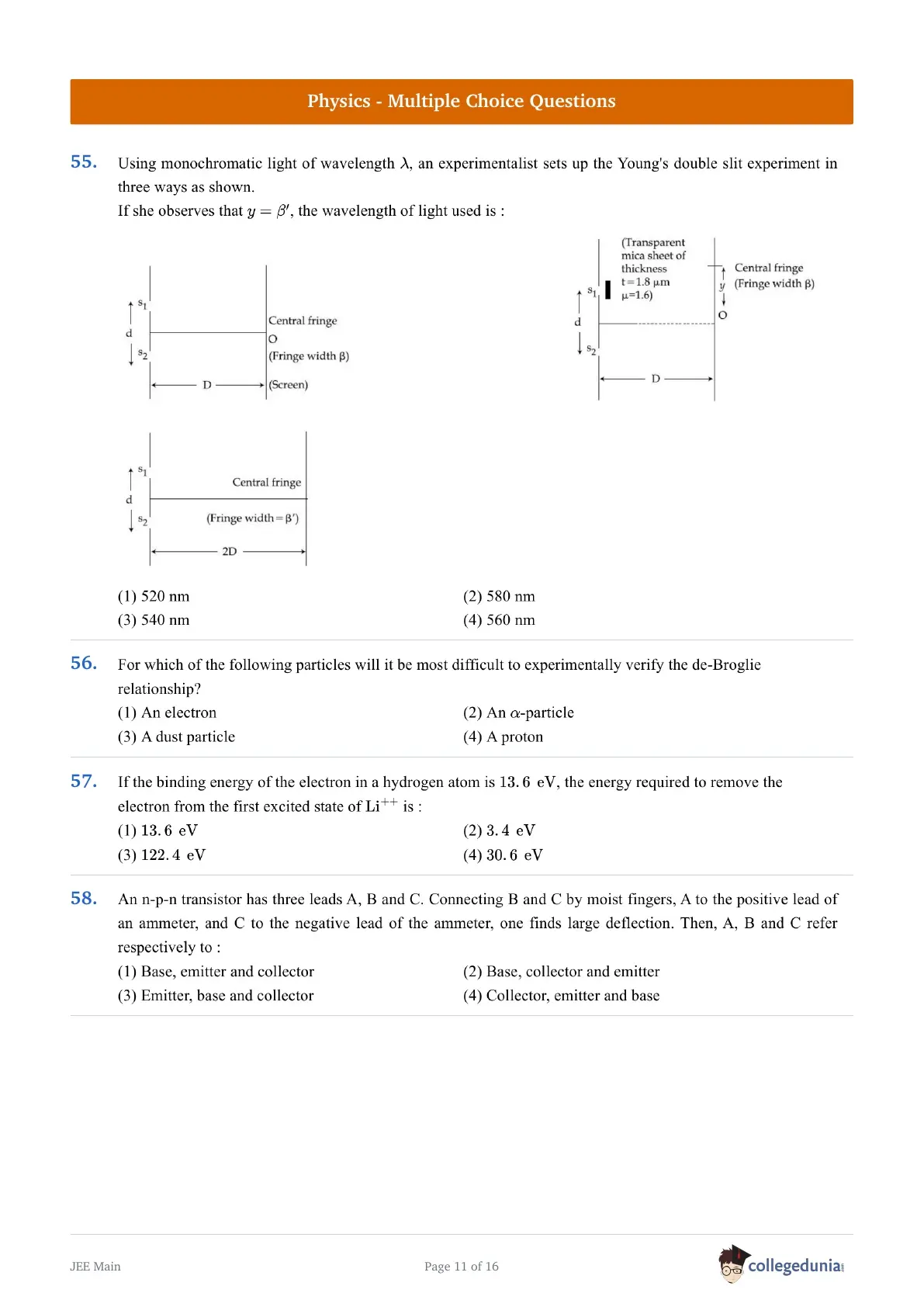
Using monochromatic light of wavelength \(\lambda\), an experimentalist sets up the Young's double slit experiment in three ways as shown.
If she observes that \(y=\beta'\), the wavelength of light used is :
For which of the following particles will it be most difficult to experimentally verify the de-Broglie relationship?
If the binding energy of the electron in a hydrogen atom is \(13.6\ \mathrm{eV}\), the energy required to remove the electron from the first excited state of \(\mathrm{Li^{++}}\) is :
An \(n-p-n\) transistor has three leads \(A, B\) and \(C\). Connecting \(B\) and \(C\) by moist fingers, \(A\) to the positive lead of an ammeter, and \(C\) to the negative lead of the ammeter, one finds large deflection. Then, \(A, B\) and \(C\) refer respectively to :
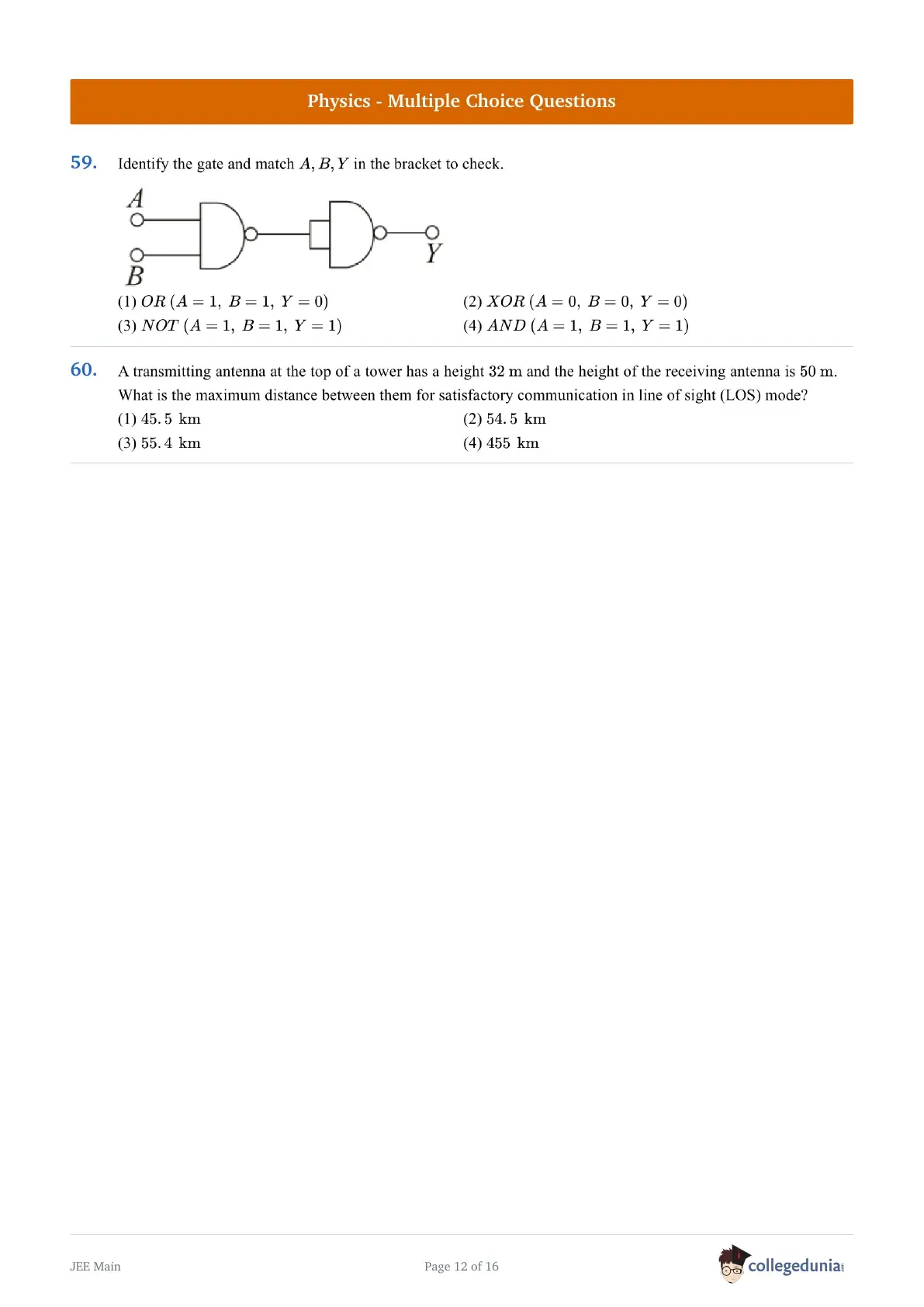
Identify the gate and match \(A, B, Y\) in the bracket to check.
A transmitting antenna at the top of a tower has a height \(32 \,m\) and the height of the receiving antenna is \(50 \,m\). What is the maximum distance between them for satisfactory communication in line of sight (LOS) mode ?
Chemistry (Q61 - Q90)
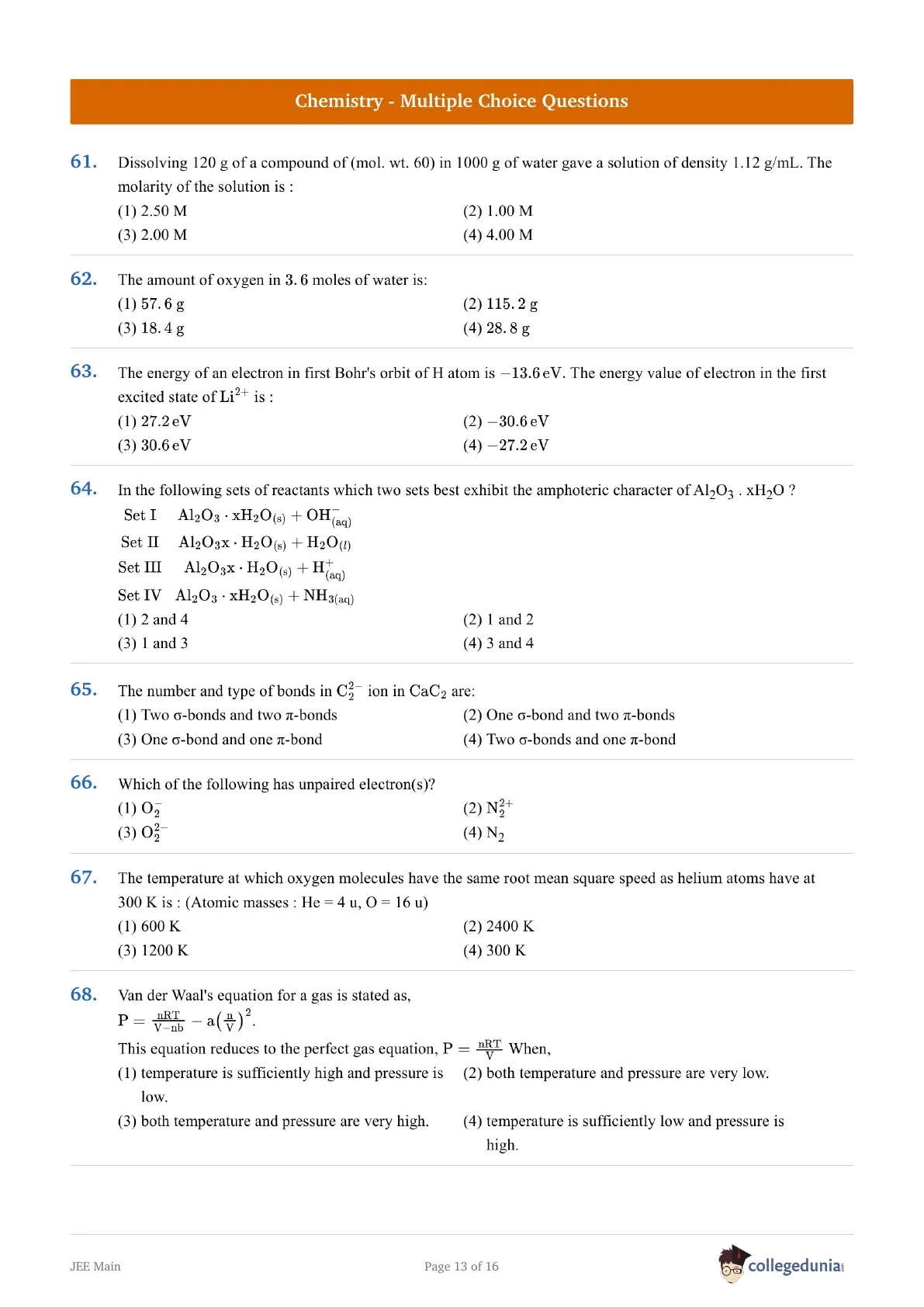
Dissolving \(120 \,g\) of a compound of (mol. wt. \(60\)) in \(1000 \,g\) of water gave a solution of density \(1.12 \,g/mL\). The molarity of the solution is :
The amount of oxygen in \(3.6\) moles of water is :
The energy of an electron in first Bohr orbit of \(H\) - atom is \(- 13.6\, eV\). The energy value of electron in the excited state of \(Li^{2+}\) is :
In the following sets of reactants which two sets best exhibit the amphoteric character of \(\mathrm{Al_2O_3\cdot xH_2O}\) ?
Set I: \(\mathrm{Al_2O_3\cdot xH_2O_{(s)}+OH^-_{(aq)}}\)
Set II: \(\mathrm{Al_2O_3\cdot xH_2O_{(s)}+H_2O_{(l)}}\)
Set III: \(\mathrm{Al_2O_3\cdot xH_2O_{(s)}+H^+_{(aq)}}\)
Set IV: \(\mathrm{Al_2O_3\cdot xH_2O_{(s)}+NH_{3(aq)}}\)
The number and type of bonds in \(\mathrm{C_2^{2-}}\) ion in \(\mathrm{CaC_2}\) are:
Which of the following has unpaired electron(s)?
The temperature at which oxygen molecules have the same root mean square speed as helium atoms have at 300 K is : (Atomic masses : He = 4 u, O = 16 u)
Van der Waal's equation for a gas is stated as, \(p = \frac{nRT}{V-nb}-a\left(\frac{n}{V}\right)^{2}.\) This equation reduces to the perfect gas equation, \(p = \frac{nRT}{V}\) when ,
The standard enthalpy of formation of \(\mathrm{NH_3}\) is \(-46.0\ \mathrm{kJ/mol}\). If bond enthalpy of \(\mathrm{H_2}\) is \(-436\ \mathrm{kJ/mol}\) and that of \(\mathrm{N_2}\) is \(-712\ \mathrm{kJ/mol}\), the average bond enthalpy of \(\mathrm{N-H}\) bond in \(\mathrm{NH_3}\) is :
At a certain temperature, only \(50\%\) \(HI\) is dissociated into \(H_2\) and \(I_2\) at equilibrium. The equilibrium constant is :
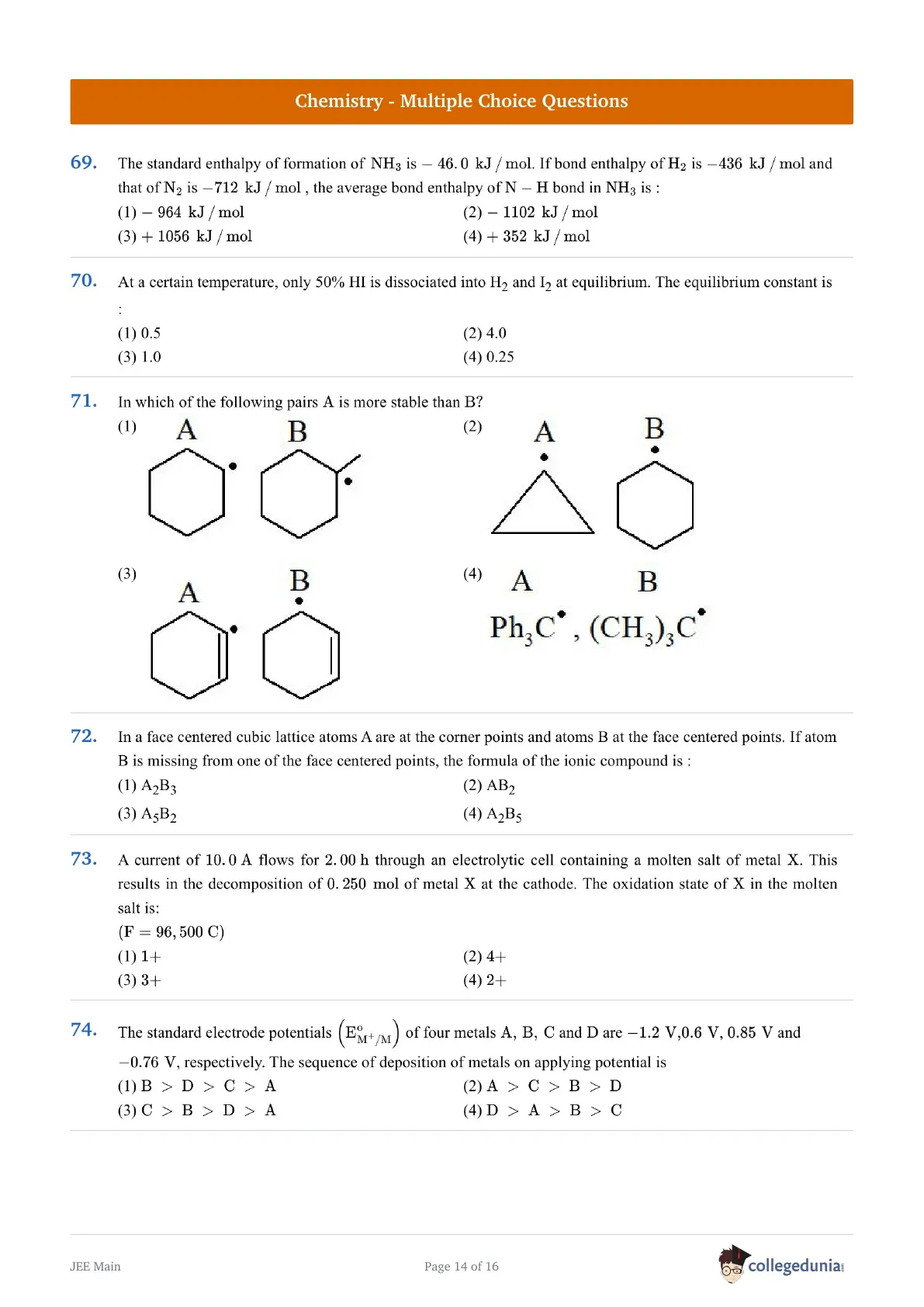
In which of the following pairs A is more stable than B?
- (1)
![]()
- (2)
![]()
- (3)
![]()
- (4)
![]()


In a face centered cubic lattice atoms \(A\) are at the corner points and atoms \(B\) at the face centered points. If atom \(B\) is missing from one of the face centered points, the formula of the ionic compound is :
A current of 10.0 A flows for 2.00 h through an electrolytic cell containing a molten salt of metal X. This results in the decomposition of 0.250 mol of metal X at the cathode. The oxidation state of X in the molten salt is :
(F = 96,500 C)
The standard electrode potentials \(\left(E^{\circ}_{M^+/M}\right)\) of four metals A, B, C and D are \(-1.2\ \mathrm{V}\), \(0.6\ \mathrm{V}\), \(0.85\ \mathrm{V}\) and \(-0.76\ \mathrm{V}\), respectively. The sequence of deposition of metals on applying potential is
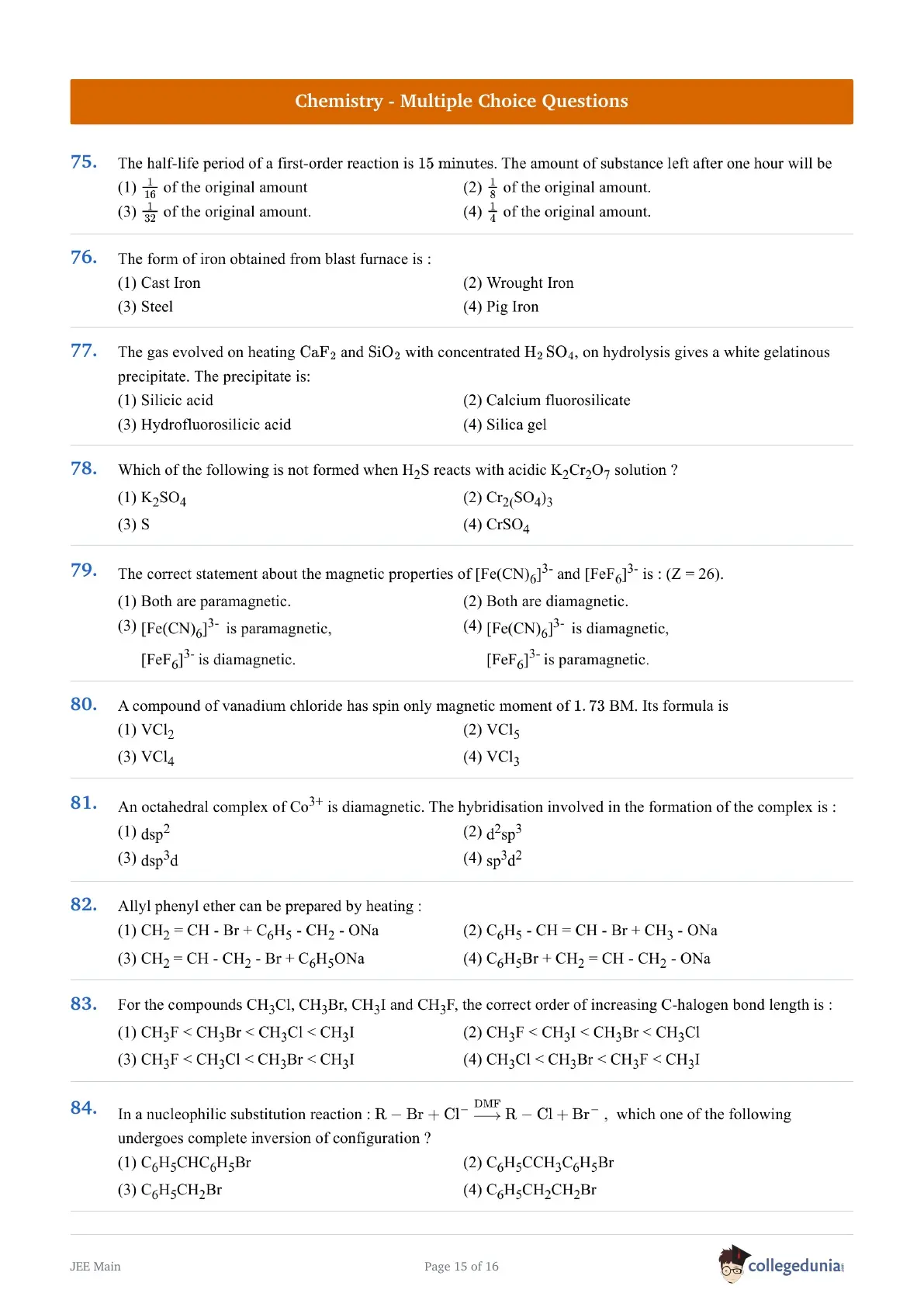
The half-life period of a first-order reaction is 15 minutes. The amount of substance left after one hour will be
The form of iron obtained from blast furnace is :
The gas evolved on heating \(\mathrm{CaF_2}\) and \(\mathrm{SiO_2}\) with concentrated \(\mathrm{H_2SO_4}\), on hydrolysis gives a white gelatinous precipitate. The precipitate is:
Which of the following is not formed when \(\mathrm{H_2S}\) reacts with acidic \(\mathrm{K_2Cr_2O_7}\) solution ?
The correct statement about the magnetic properties of \([\mathrm{Fe(CN)_6}]^{3-}\) and \([\mathrm{FeF_6}]^{3-}\) is : (Z = 26).
A compound of vanadium chloride has spin only magnetic moment of 1.73 BM. Its formula is
An octahedral complex of \(\mathrm{Co^{3+}}\) is diamagnetic. The hybridisation involved in the formation of the complex is :
Allyl phenyl ether can be prepared by heating :
For the compounds \(CH_3Cl, \, CH_3Br,\,CH_3I\) and \(CH_3F,\) the correct order of increasing \(C\)-halogen bond length is :
In a nucleophilic substitution reaction : \(\mathrm{R-Br + Cl^-} \xrightarrow{\mathrm{DMF}} \mathrm{R-Cl + Br^-}\), which one of the following undergoes complete inversion of configuration ?
In the hydroboration - oxidation reaction of propene with diborane, \(\mathrm{H_2O_2}\) and NaOH, the organic compound formed is:
Which is the major product formed when acetone is heated with iodine and potassium hydroxide?
Which one of the following reactions will not result in the formation of carbon-carbon bond ?


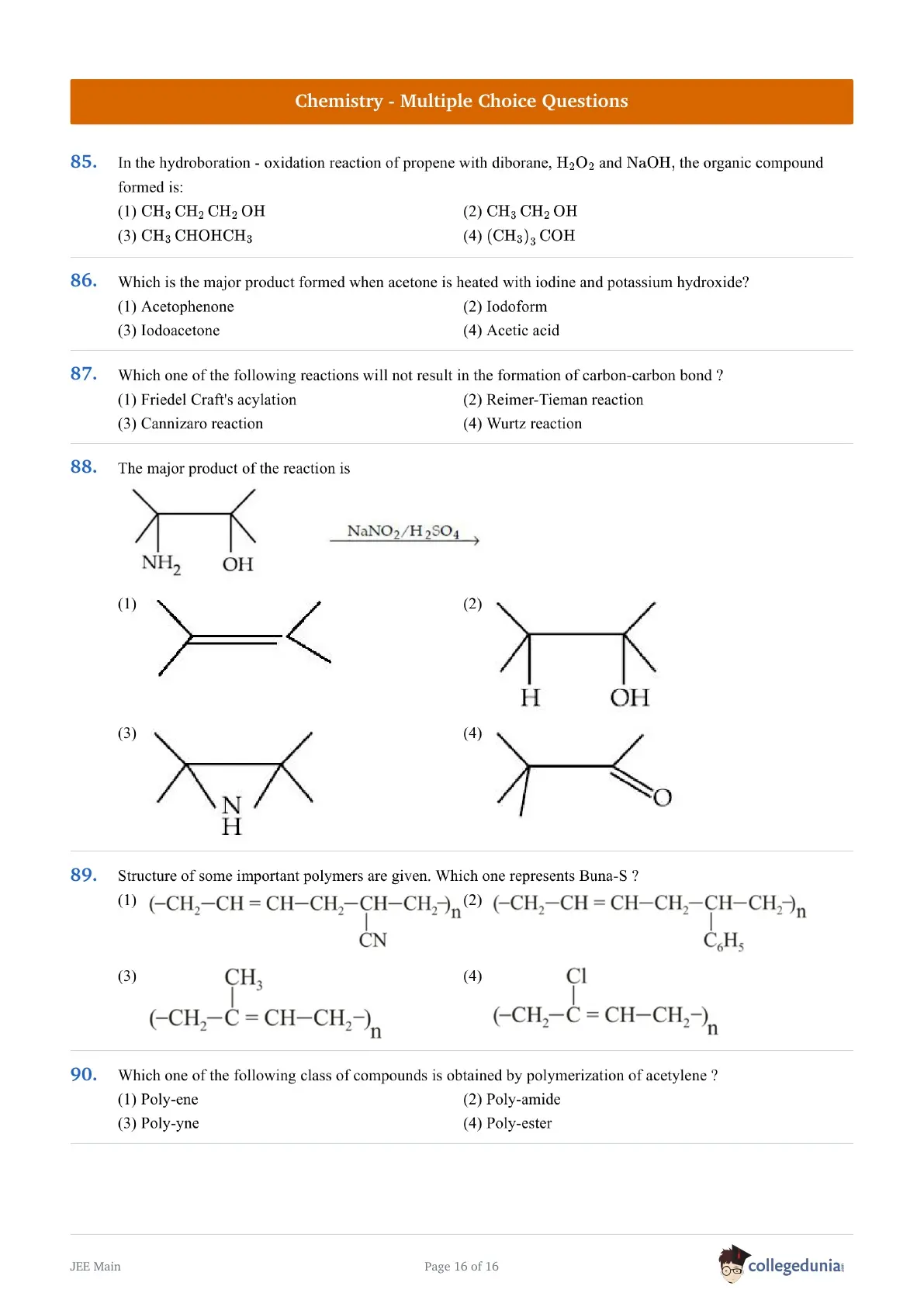
Structure of some important polymers are given. Which one represents Buna-S ?
- (1)
![]()
- (2)
![]()
- (3)
![]()
- (4)
![]()


Which one of the following class of compounds is obtained by polymerization of acetylene ?
JEE Main 2014 Exam Pattern and Marking Scheme
| Particulars | Details |
|---|---|
| Exam Mode | Online (Computer-Based Test) |
| Paper | B.E./B.Tech (Paper 1) |
| Duration | 3 hours (180 minutes) |
| Type of Questions | Multiple Choice Questions (MCQs) |
| Subjects | Mathematics, Physics, Chemistry |
| Total Questions | 90 questions |
| Total Marks | 360 marks |
| Marking Scheme | +4 for correct answer & -1 for incorrect answer; 0 for unattempted |
JEE Main 2014 April 9 Difficulty Level
Candidates rated the JEE Main 2014 B.E./B.Tech Question Paper as easy to moderate in terms of overall difficulty.
JEE Main B.E./B.Tech 2014 Paper Analysis
-
Physics was considered to be more difficult than Mathematics and Chemistry.
-
The math and chemistry sections were both equally difficult. The questions were simple to answer, and no unexpected questions were posed in either of these sections.
Each correct question is worth four points, and any incorrect answer will result in a one-point deduction.



Comments