




JEE Main 2015 April 10 Question Paper is available here with solutions PDF and detailed solutions for every question. CBSE conducted the computer-based test (CBT) Paper 1 on April 10, 2015. The JEE Main 2015 Paper 1 (B.E./B.Tech) question paper includes the following:
- 90 questions in a 3-hour CBT Mode: 30 each from Mathematics, Physics and Chemistry
- Question type: all multiple choice questions (MCQs) with a single correct option, 4 marks each
- Sections: Mathematics (30), Physics (30) and Chemistry (30), all questions compulsory
- Marking: +4 for a correct answer, -1 for an incorrect answer, 0 for an unattempted question
- Maximum marks: 360 (120 per subject)
JEE Main 2015 April 10 Question Paper with Solution PDF
| NTA Official PDF | CD PDF | CD PDF with Solutions |
|---|---|---|
| Download official PDF 3.16 MB | Download Collegedunia PDF 5.16 MB | Download solutions PDF 1.28 MB |
Also Check:
JEE Main 2015 April 10 Questions with Solutions
Mathematics (Q1 - Q30)
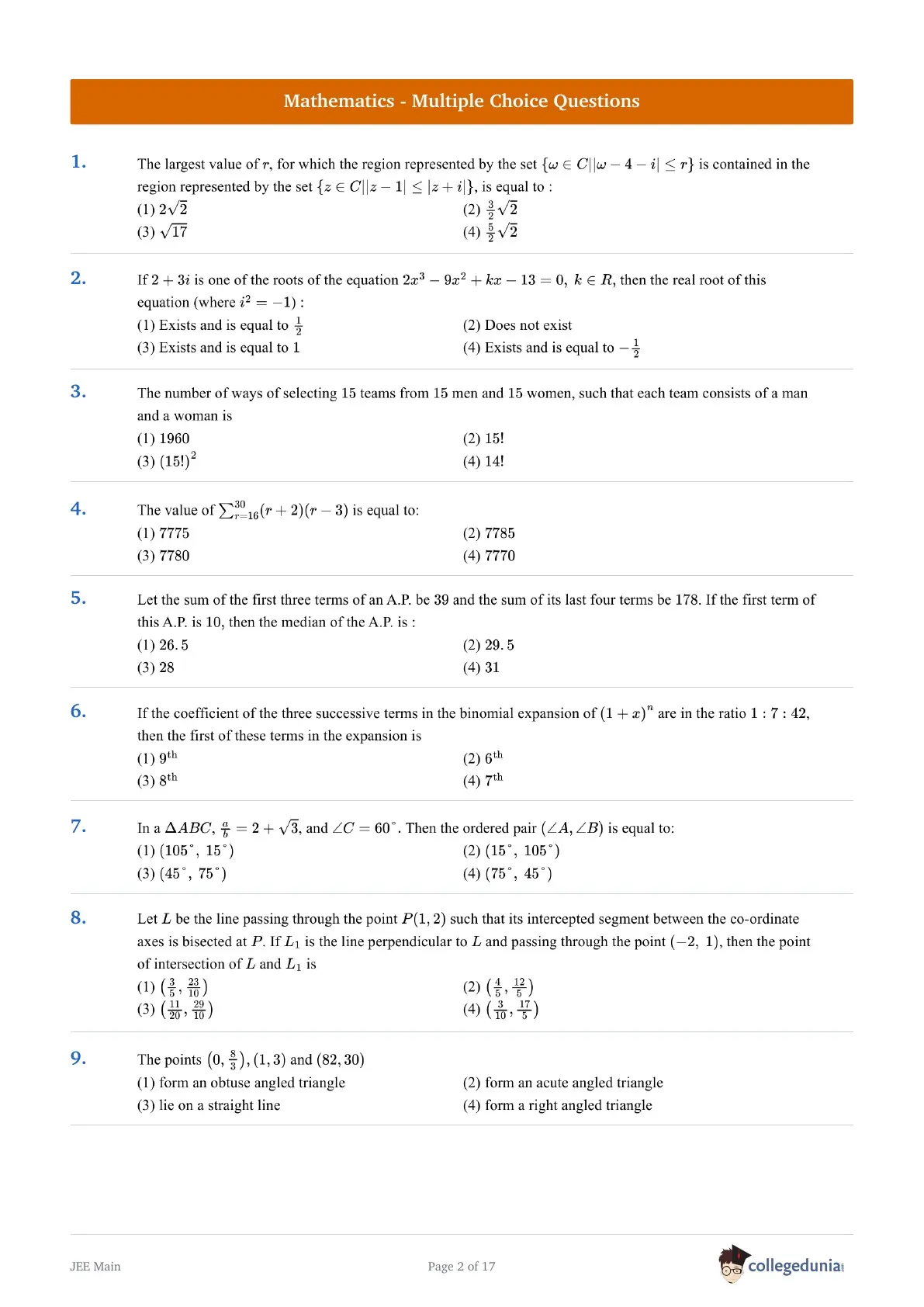
The largest value of \(r\), for which the region represented by the set \(\{\omega \in C \mid |\omega - 4 - i| \le r\}\) is contained in the region represented by the set \(\{z \in C \mid |z-1| \le |z+i|\}\), is equal to :
If \(2+3i\) is one of the roots of the equation \(2x^3-9x^2+kx-13=0\), \(k\in R\), then the real root of this equation (where \(i^2=-1\)) :
The number of ways of selecting 15 teams from 15 men and 15 women, such that each team consists of a man and a woman is
The value of \( \displaystyle \sum^{30}_{r = 16} (r + 2)(r - 3)\) is equal to :
Let the sum of the first three terms of an A.P. be 39 and the sum of its last four terms be 178. If the first term of this A.P. is 10, then the median of the A.P. is :
If the coefficient of the three successive terms in the binomial expansion of \((1+x)^n\) are in the ratio \(1:7:42\), then the first of these terms in the expansion is
In a \(\Delta ABC\), \(\frac{a}{b}=2+\sqrt{3}\), and \(\angle C=60^\circ\). Then the ordered pair \((\angle A,\angle B)\) is equal to:
Let \(L\) be the line passing through the point \(P(1,2)\) such that its intercepted segment between the co-ordinate axes is bisected at \(P\). If \(L_1\) is the line perpendicular to \(L\) and passing through the point \((-2,\,1)\), then the point of intersection of \(L\) and \(L_1\) is
The points \(\left(0,\frac{8}{3}\right)\), \((1,3)\) and \((82,30)\)
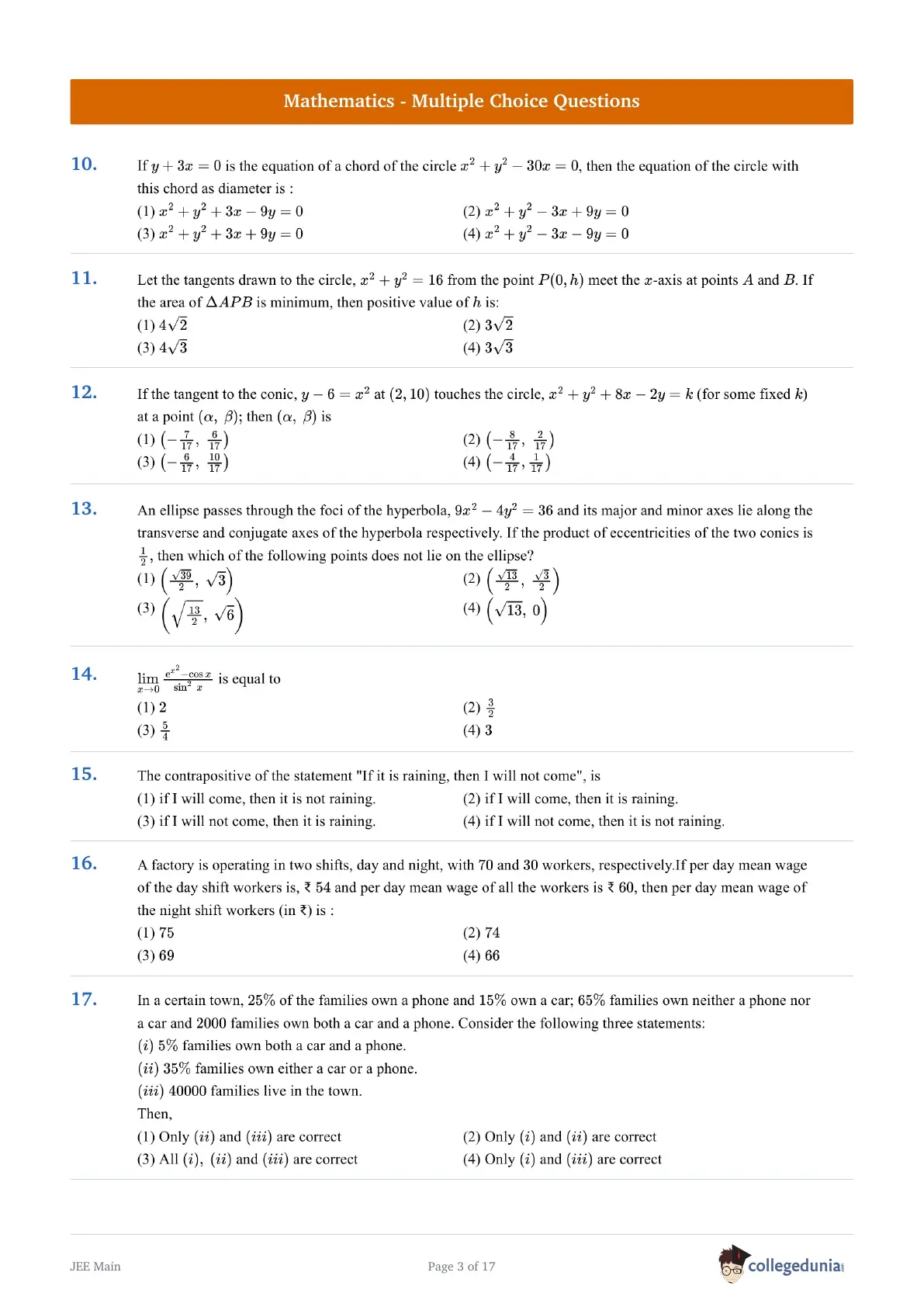
If \(y + 3x = 0\) is the equation of a chord of the circle, \(x^2 + y^2 - 30x = 0\), then the equation of the circle with this chord as diameter is :
Let the tangents drawn to the circle, \(x^2+y^2=16\) from the point \(P(0,h)\) meet the \(x\)-axis at points \(A\) and \(B\). If the area of \(\Delta APB\) is minimum, then positive value of \(h\) is:
If the tangent to the conic, \(y-6=x^2\) at \((2,10)\) touches the circle, \(x^2+y^2+8x-2y=k\) (for some fixed \(k\)) at a point \((\alpha,\,\beta)\); then \((\alpha,\,\beta)\) is
An ellipse passes through the foci of the hyperbola, \(9x^2? 4y^2 = 36\) an and minor axes lie along the transverse and conjugate axes of the hyperbola respectively. If the product of eccentricities of the two conics is \(\frac{1}{2},\) then which of the following points does not lie on the ellipse ?
\(\lim_{x\to0}\frac{e^{x^2}-\cos x}{\sin^2x}\) is equal to
The contrapositive of the statement "If it is raining, then I will not come", is
A factory is operating in two shifts, day and night, with 70 and 30 workers, respectively. If per day mean wage of the day shift workers is, ₹ 54 and per day mean wage of all the workers is ₹ 60, then per day mean wage of the night shift workers (in ₹) is :
In a certain town, \(25\%\) of the families own a phone and \(15\%\) own a car \(65\%\) families own neither a phone nor a car and \(2,000\) families own both a car and a phone. Consider the following three statements : (a) \(5\%\) families own both a car and a phone. (b) \(35\%\) families own either a car or a phone. (c) \(40,000\) families live in the town. Then,
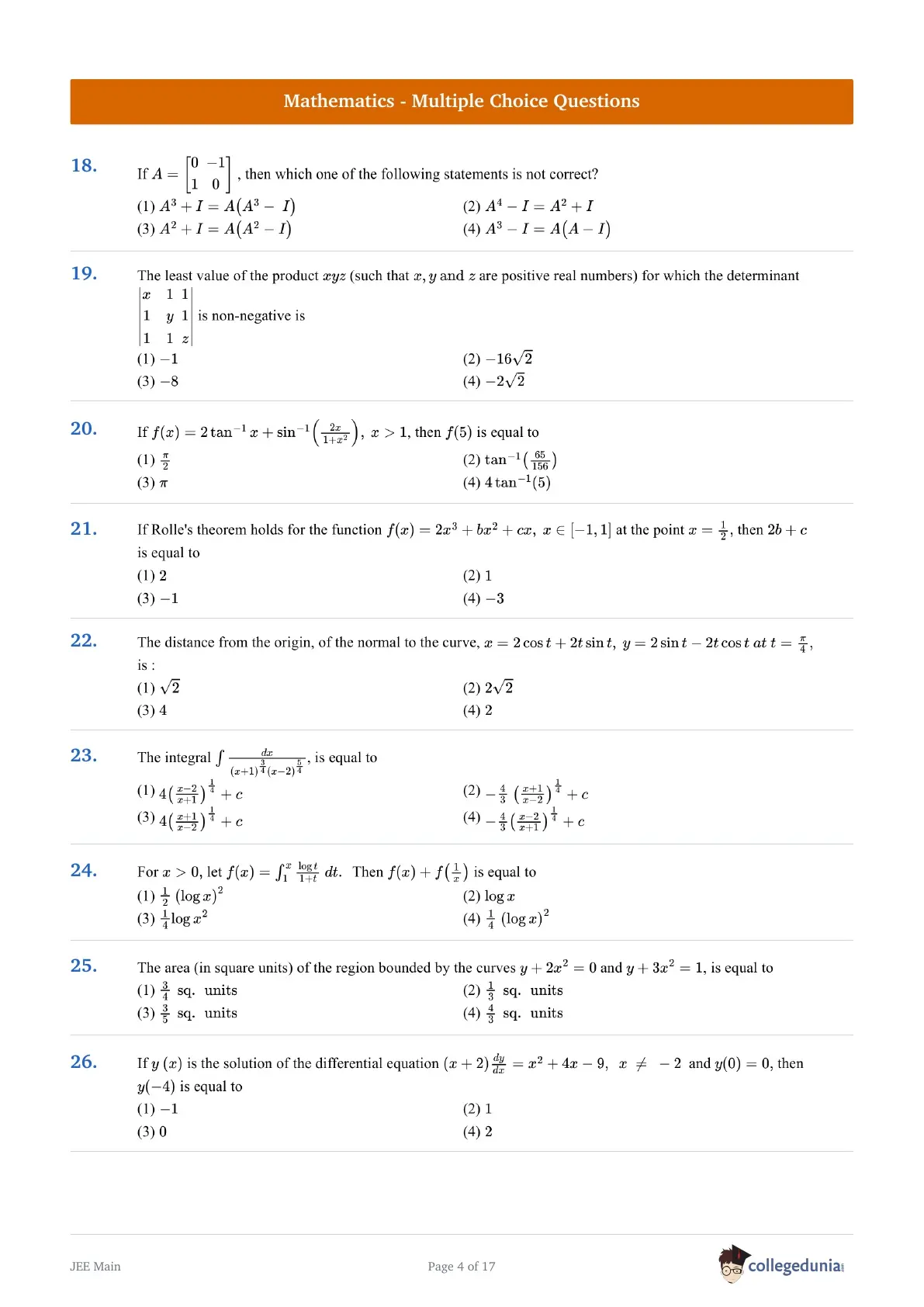
If \(A = \begin{bmatrix} 0\;\;-1\\1\;\;0 \end{bmatrix}\), then which one of the following statements is not correct?
The least value of the product \(xyz\) (such that \(x\), \(y\) and \(z\) are positive real numbers) for which the determinant \(\begin{vmatrix} x\;\;1\;\;1\\1\;\;y\;\;1\\1\;\;1\;\;z \end{vmatrix}\) is non-negative is
If \(f\left(x\right) = 2 \tan^{-1} x + \sin^{-1} \left(\frac{2x}{1+x^{2}}\right), x > 1\), then \(f(t)\) is equal to :
If Rolle's theorem holds for the function \(f(x) = 2x^3 + bx^2 + cx\), \(x \in [-1, 1]\) at the point \(x = \frac{1}{2}\), then \(2b + c\) is equal to
The distance from the origin, of the normal to the curve, \(x = 2\cos t + 2t\sin t\), \(y = 2\sin t - 2t\cos t\) at \(t = \frac{\pi}{4}\), is :
The integral \(\int \frac{dx}{(x+1)^{\frac{3}{4}}(x-2)^{\frac{5}{4}}}\), is equal to
For \(x \gt 0\), let \(f(x) = \int_1^x \frac{\log t}{1+t}\,dt\). Then \(f(x) + f\left(\frac{1}{x}\right)\) is equal to
The area (in square units) of the region bounded by the curves \(y + 2x^2 = 0\) and \(y + 3x^2 = 1\), is equal to
If \(y(x)\) is the solution of the differential equation \((x+2)\frac{dy}{dx} = x^2 + 4x - 9\), \(x \neq -2\) and \(y(0) = 0\), then \(y(-4)\) is equal to
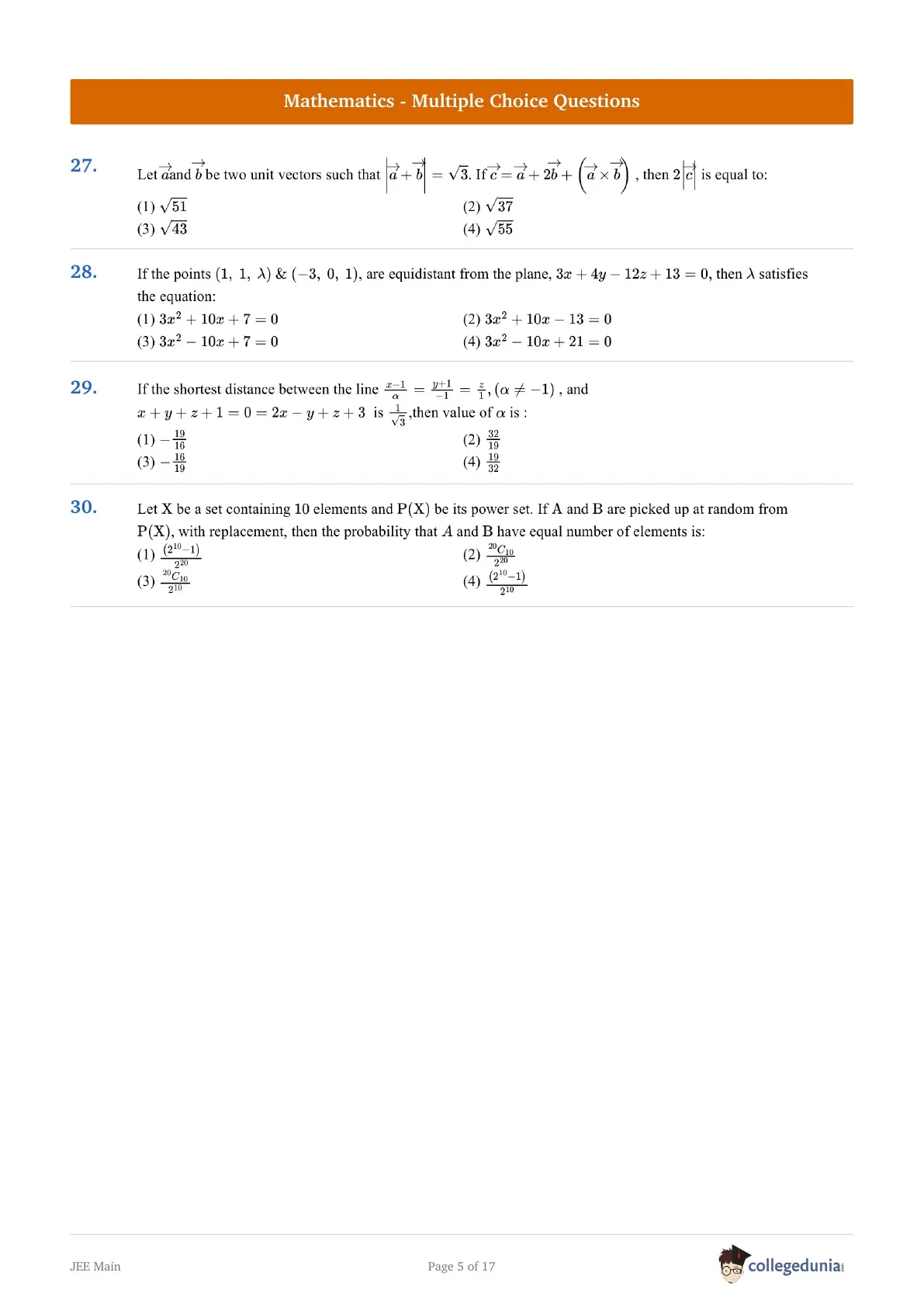
Let \(\vec{a}\) and \(\vec{b}\) be two unit vectors such that \(|\vec{a} + \vec{b}| = \sqrt{3}\). If \(\vec{c} = \vec{a} + 2\vec{b} + (\vec{a} \times \vec{b})\), then \(2|\vec{c}|\) is equal to:
If the points \((1, 1, \lambda)\) & \((-3, 0, 1)\), are equidistant from the plane, \(3x + 4y - 12z + 13 = 0\), then \(\lambda\) satisfies the equation:
If the shortest distance between the line \(\frac{x-1}{\alpha}=\frac{y+1}{-1}=\frac{z}{1}\), \((\alpha \neq -1)\), and \(x+y+z+1=0=2x-y+z+3\) is \(\frac{1}{\sqrt{3}}\), then value of \(\alpha\) is :
Let X be a set containing 10 elements and P(X) be its power set. If A and B are picked up at random from P(X), with replacement, then the probability that A and B have equal number of elements is:
Physics (Q31 - Q60)
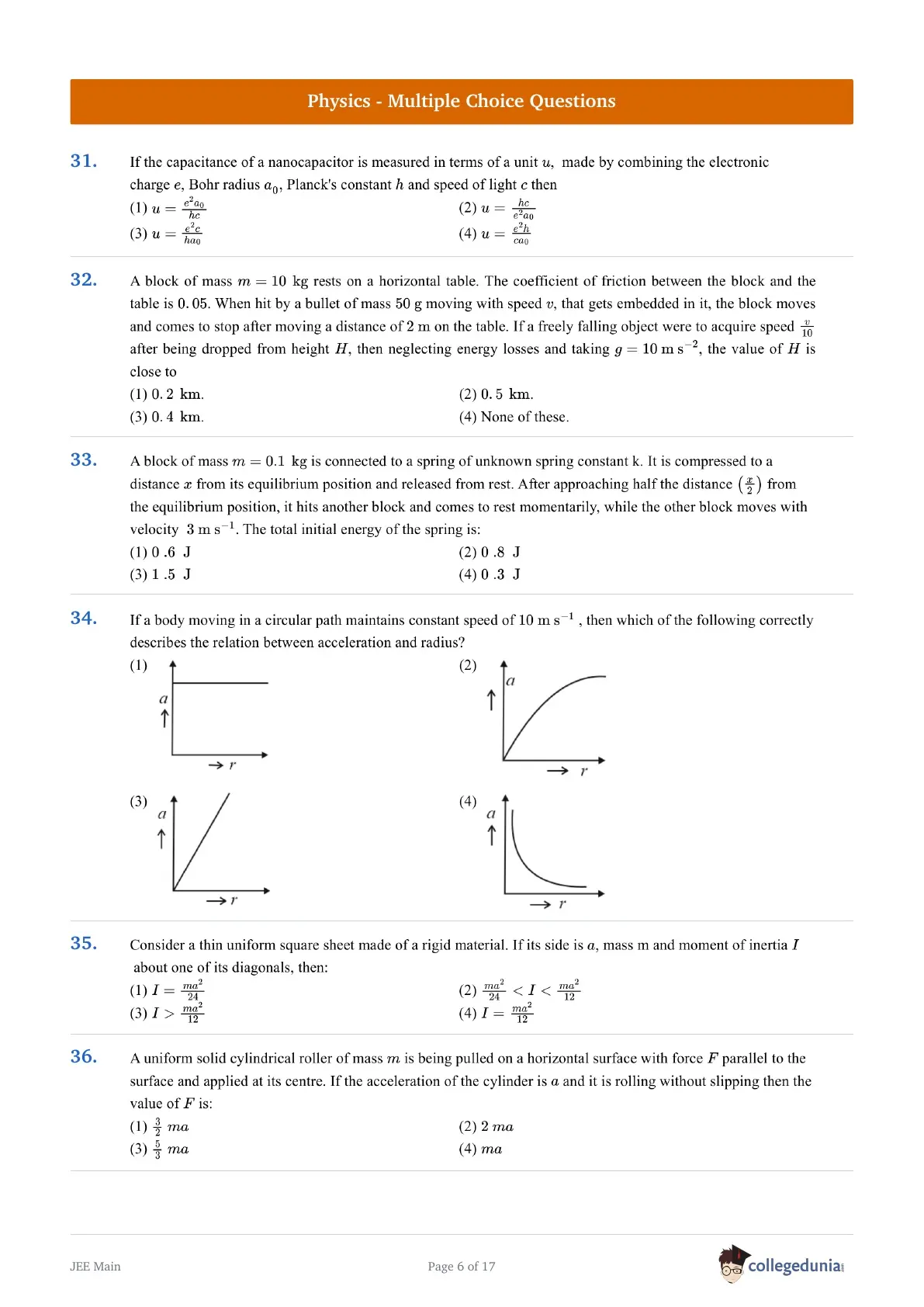
If the capacitance of a nanocapacitor is measured in terms of a unit \('u'\) made by combining the electronic charge \(V\), Bohr radius \('a_0'\), Planck's constant \('h'\) and speed of light \('c'\) then :
A block of mass \(m = 10\ \mathrm{kg}\) rests on a horizontal table. The coefficient of friction between the block and the table is 0.05. When hit by a bullet of mass 50 g moving with speed \(v\), that gets embedded in it, the block moves and comes to stop after moving a distance of 2 m on the table. If a freely falling object were to acquire speed \(\frac{v}{10}\) after being dropped from height \(H\), then neglecting energy losses and taking \(g = 10\ \mathrm{m\,s^{-2}}\), the value of \(H\) is close to
A block of mass \(m = 0.1\ \mathrm{kg}\) is connected to a spring of unknown spring constant k. It is compressed to a distance \(x\) from its equilibrium position and released from rest. After approaching half the distance \(\left(\frac{x}{2}\right)\) from the equilibrium position, it hits another block and comes to rest momentarily, while the other block moves with velocity \(3\ \mathrm{m\,s^{-1}}\). The total initial energy of the spring is:
If a body moving in a circular path maintains constant speed of \(10\ \mathrm{m\,s^{-1}}\), then which of the following correctly describes the relation between acceleration and radius?
- (1)
![]()
- (2)
![]()
- (3)
![]()
- (4)
![]()


Consider a thin uniform square sheet made of a rigid material. If its side is '\(a\)', mass \(m\) and moment of inertia \(I\) about one of its diagonals, then :
A uniform solid cylindrical roller of mass '\(m\)' is being pulled on a horizontal surface with force \(F\) parallel to the surface and applied at its centre. If the acceleration of the cylinder is '\(a\)' and it is rolling without slipping then the value of '\(F\)' is :
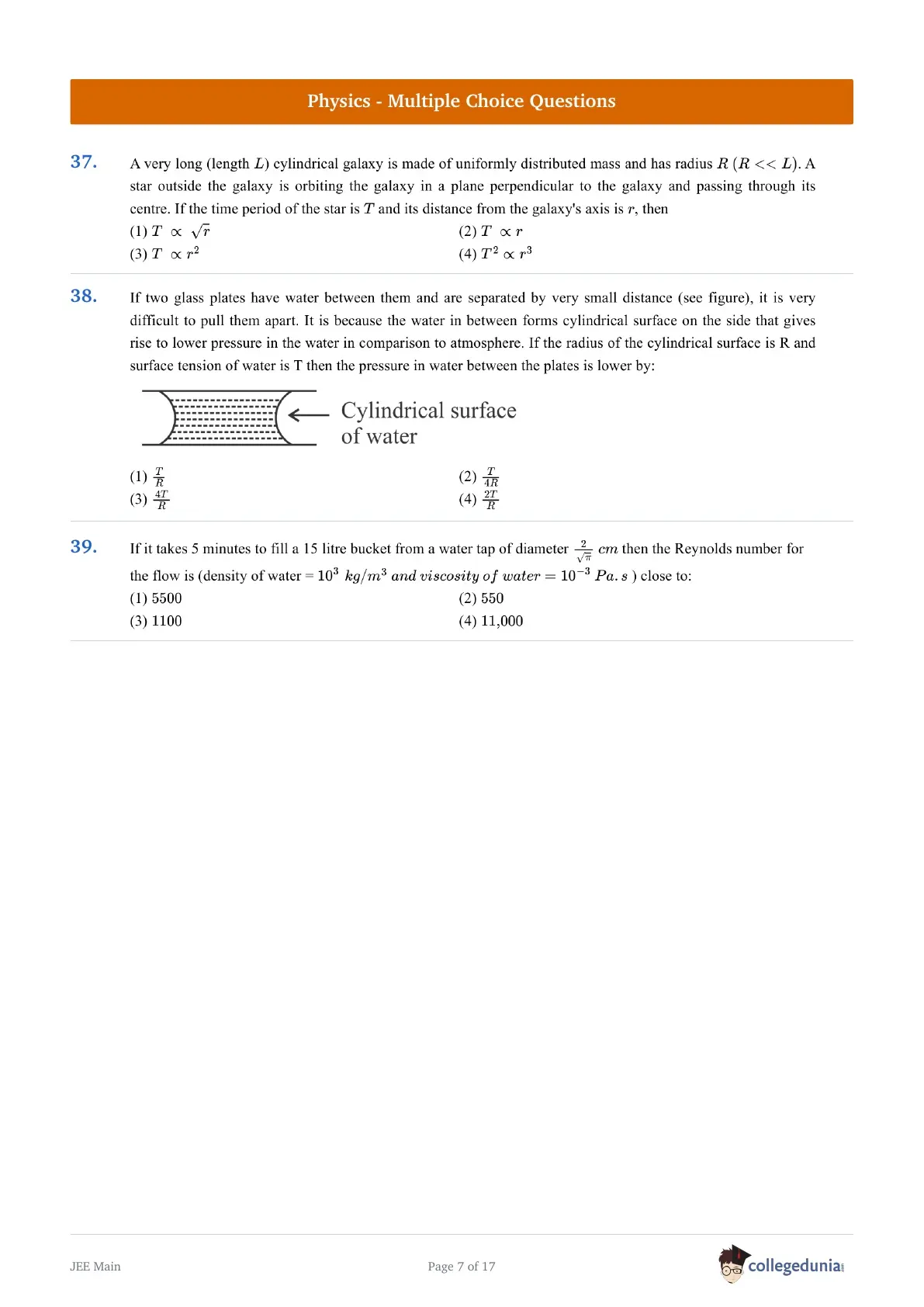
A very long (length L) cylindrical galaxy is made of uniformly distributed mass and has radius \(R (R << L)\). A star outside the galaxy is orbiting the galaxy in a plane perpendicular to the galaxy and passing through its centre. If the time period of star is \(T\) and its distance from the galaxy's axis is \(r\), then :
If two glass plates have water between them and are separated by very small distance (see figure), it is very difficult to pull them apart. It is because the water in between forms cylindrical surface on the side that gives rise to lower pressure in the water in comparison to atmosphere. If the radius of the cylindrical surface is R and surface tension of water is T then the pressure in water between the plates is lower by:
If it takes 5 minutes to fill a 15 litre bucket from a water tap of diameter \(\frac{2}{\sqrt{\pi}}\ \mathrm{cm}\) then the Reynolds number for the flow is (density of water \(= 10^{3}\ \mathrm{kg/m^3}\) and viscosity of water \(= 10^{-3}\ \mathrm{Pa\cdot s}\)) close to:
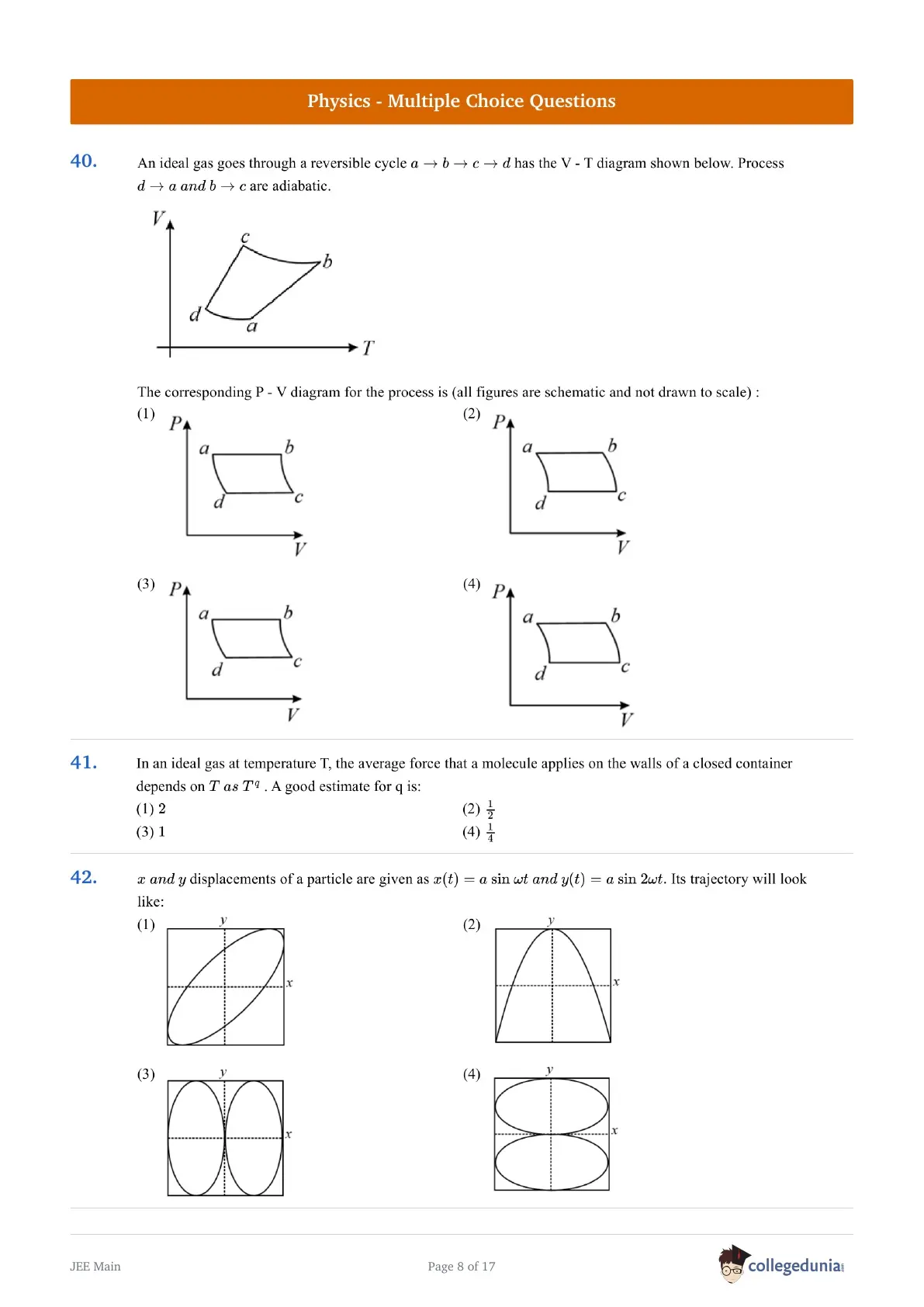
An ideal gas goes through a reversible cycle \(a\to b\to c\to d\) has the V - T diagram shown below. Process \(d\to a\) and \(b\to c\) are adiabatic.
The corresponding P - V diagram for the process is (all figures are schematic and not drawn to scale) :
- (1)
![]()
- (2)
![]()
- (3)
![]()
- (4)
![]()


In an ideal gas at temperature \(T\), the average force that a molecule applies on the walls of a closed container depends on \(T\) as \(T^q\). A good estimate for \(q\) is :
\(x\) and \(y\) displacements of a particle are given as \(x(t)=a\sin\omega t\) and \(y(t)=a\sin 2\omega t\). Its trajectory will look like:
- (1)
![]()
- (2)
![]()
- (3)
![]()
- (4)
![]()


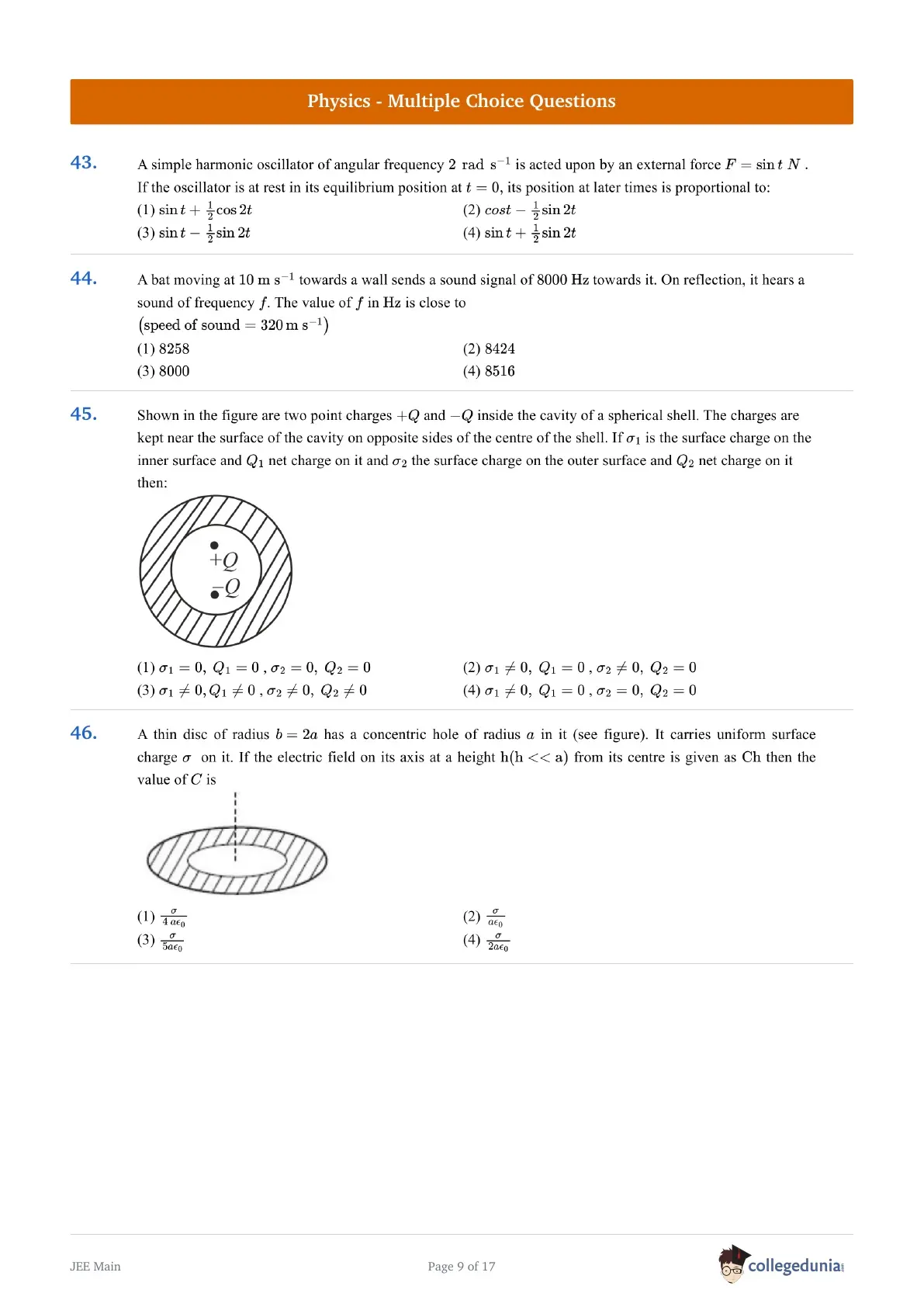
A simple harmonic oscillator of angular frequency \(2 \,rad \,s^{-1}\) is acted upon by an external force \(F= \sin\, t \,N\). If the oscillator is at rest in its equilibrium position at \(t\, =\, 0\), its position at later times is proportional to :
A bat moving at \(10\ \mathrm{m\,s^{-1}}\) towards a wall sends a sound signal of 8000 Hz towards it. On reflection, it hears a sound of frequency \(f\). The value of \(f\) in Hz is close to (speed of sound \(= 320\ \mathrm{m\,s^{-1}}\))
Shown in the figure are two point charges \(+Q\) and \(-Q\) inside the cavity of a spherical shell. The charges are kept near the surface of the cavity on opposite sides of the centre of the shell. If \(\sigma_1\) is the surface charge on the inner surface and \(Q_1\) net charge on it and \(\sigma_2\) the surface charge on the outer surface and \(Q_2\) net charge on it then:
A thin disc of radius \(b\, = \,2a\) has a concentric hole of radius '\(a\)' in it (see figure). It carries uniform surface charge '\(\sigma\)' on it. If the electric field on its axis at height '\(h\)' \((h < < a)\) from its centre is given as '\(Ch\)' then value of '\(C\)' is :
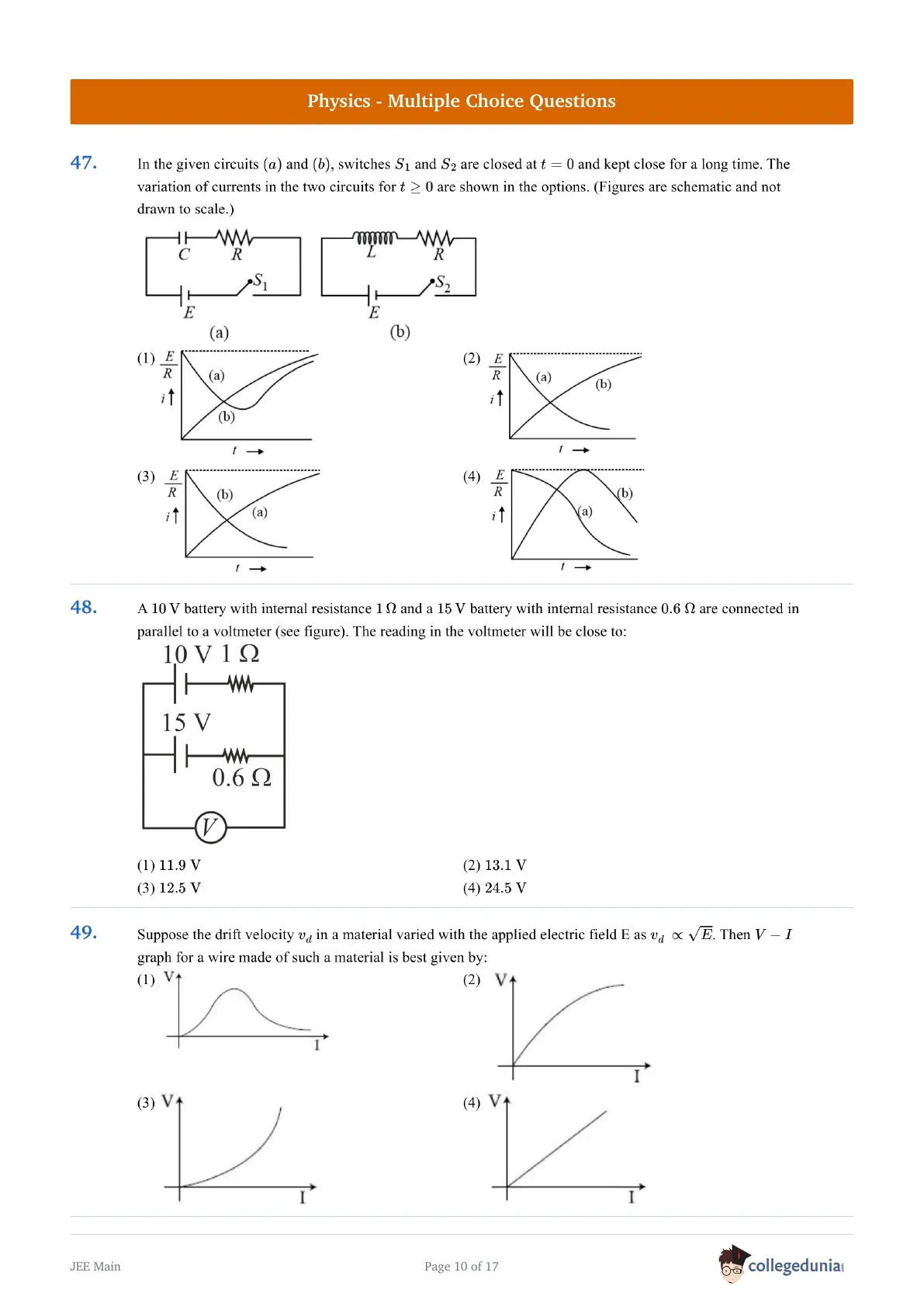
In the given circuits (a) and (b), switches \(S_1\) and \(S_2\) are closed at \(t=0\) and kept close for a long time. The variation of currents in the two circuits for \(t\ge0\) are shown in the options. (Figures are schematic and not drawn to scale.)
- (1)
![]()
- (2)
![]()
- (3)
![]()
- (4)
![]()


A 10 V battery with internal resistance \(1\,\Omega\) and a 15 V battery with internal resistance \(0.6\,\Omega\) are connected in parallel to a voltmeter (see figure). The reading in the voltmeter will be close to:
Suppose the drift velocity \(v_d\) in a material varied with the applied electric field E as \(v_d \propto \sqrt{E}\). Then \(V-I\) graph for a wire made of such a material is best given by:
- (1)
![]()
- (2)
![]()
- (3)
![]()
- (4)
![]()


A \(25\, cm\) long solenoid has radius \(2\, cm\) and \(500\) total number of turns. It carries a current of \(15\, A\). If it is equivalent to a magnet of the same size and magnetization \(|\bar{M}|\) (magnetic moment/volume), then \(|\bar{M}|\) is :
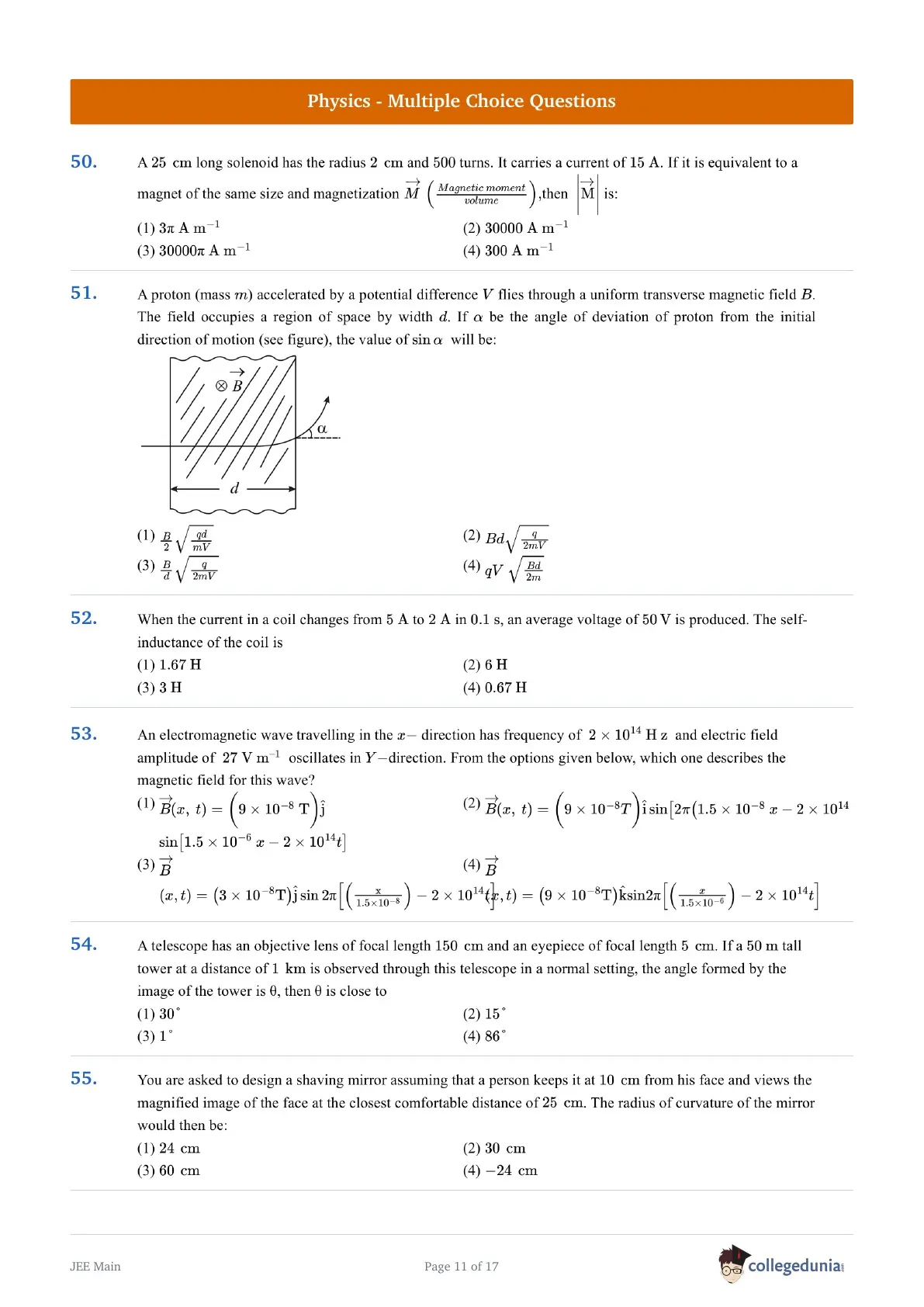
A proton (mass m) accelerated by a potential difference \(V\) flies through a uniform transverse magnetic field \(B\). The field occupies a region of space by width \(d\). If \(\alpha\) be the angle of deviation of proton from initial direction of motion (see figure), the value of \(\sin \,\alpha\) will be :
When current in a coil changes from \(5 \,A\) to \(2 \,A\) in \(0.1\, s\), an average voltage of \(50\, V\) is produced. The self - inductance of the coil is :
An electromagnetic wave travelling in the \(x\)-direction has frequency of \(2\times10^{14}\ \mathrm{Hz}\) and electric field amplitude of \(27\ \mathrm{V\,m^{-1}}\) oscillates in \(Y\)-direction. From the options given below, which one describes the magnetic field for this wave?
A telescope has an objective lens of focal length 150 cm and an eyepiece of focal length 5 cm. If a 50 m tall tower at a distance of 1 km is observed through this telescope in a normal setting, the angle formed by the image of the tower is \(\theta\), then \(\theta\) is close to
You are asked to design a shaving mirror assuming that a person keeps it at 10 cm from his face and views the magnified image of the face at the closest comfortable distance of 25 cm. The radius of curvature of the mirror would then be:
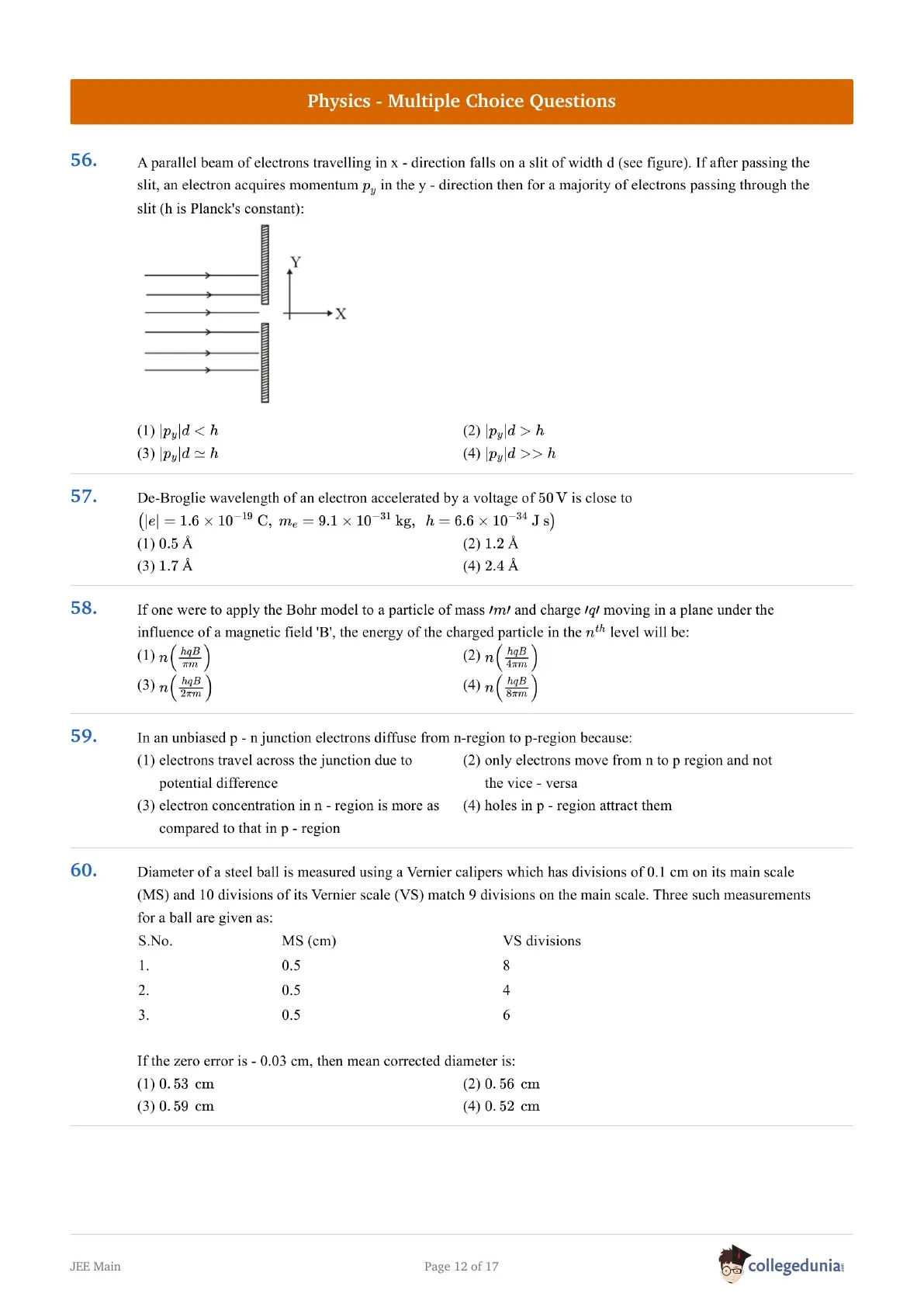
A parallel beam of electrons travelling in x - direction falls on a slit of width d (see figure). If after passing the slit, an electron acquires momentum \(p_y\) in the y - direction then for a majority of electrons passing through the slit (h is Planck's constant):
De-Broglie wavelength of an electron accelerated by a voltage of 50 V is close to (\(|e|=1.6\times10^{-19}\ \mathrm{C}\), \(m_e=9.1\times10^{-31}\ \mathrm{kg}\), \(h=6.6\times10^{-34}\ \mathrm{J\,s}\))
If one were to apply the Bohr model to a particle of mass 'm' and charge 'q' moving in a plane under the influence of a magnetic field 'B', the energy of the charged particle in the \(n^{th}\) level will be:
In an unbiased p - n junction electrons diffuse from n-region to p-region because:
| S.No. | MS (cm) | VS divisions |
| 1. | 0.5 | 8 |
| 2. | 0.5 | 4 |
| 3. | 0.5 | 6 |
Chemistry (Q61 - Q90)
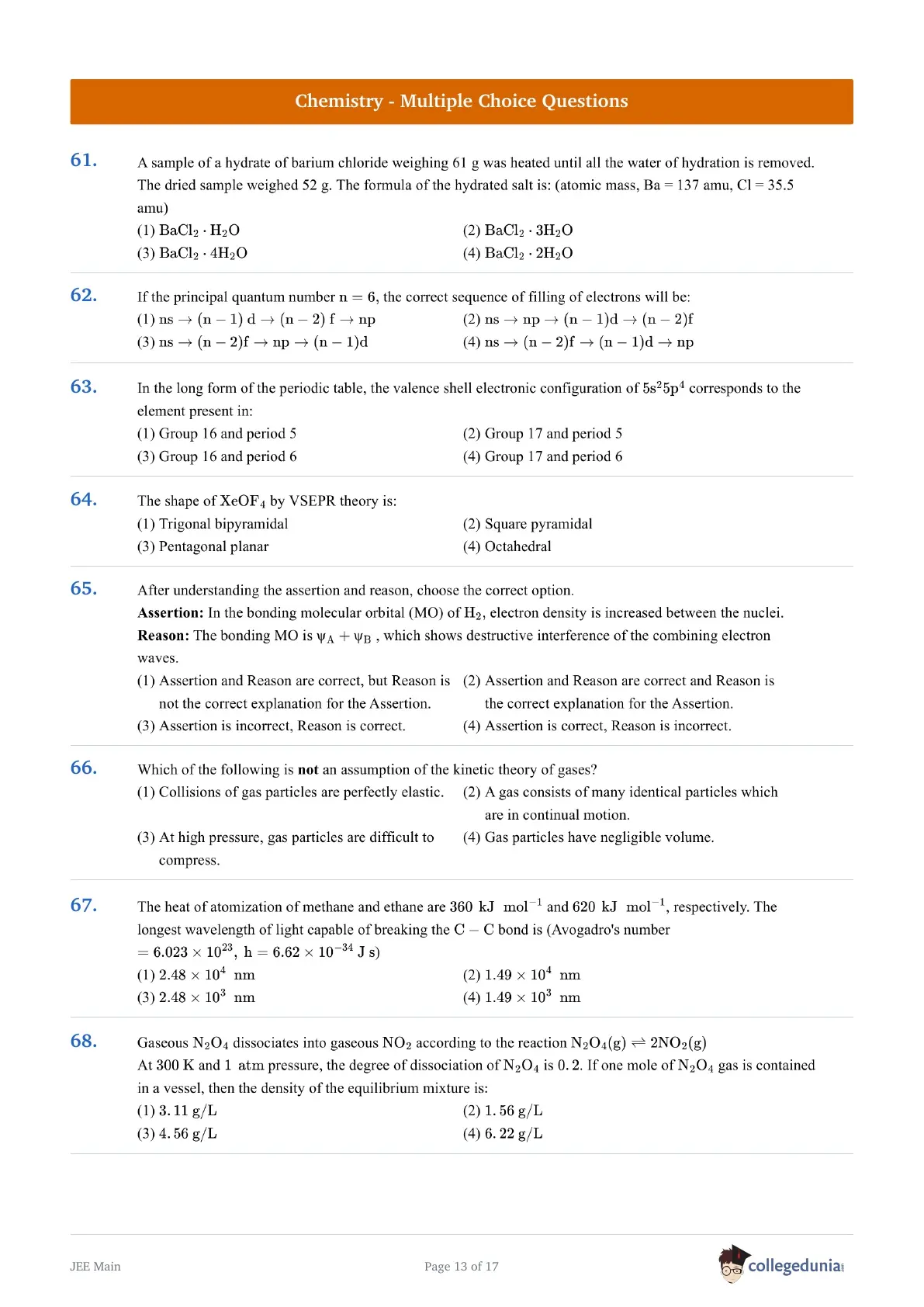
A sample of a hydrate of barium chloride weighing \(61\, g\) was heated until all the water of hydration is removed. The dried sample weighed \(52\, g.\) The formula of the hydrated salt is : (atomic mass, \(Ba = 137\, amu. Cl = 35.5\, amu\))
If the principal quantum number n = 6, the correct sequence of filling of electrons will be:
In the long form of the periodic table, the valence shell electronic configuration of \(5s^2 5p^4\) corresponds to the element present in :
The shape of \(\mathrm{XeOF_4}\) by VSEPR theory is:
After understanding the assertion and reason, choose the correct option.
Assertion: In the bonding molecular orbital (MO) of \(\mathrm{H_2}\), electron density is increased between the nuclei.
Reason: The bonding MO is \(\psi_A + \psi_B\), which shows destructive interference of the combining electron waves.
Which of the following is not an assumption of the kinetic theory of gases?
The heat of atomization of methane and ethane are \(360\ \mathrm{kJ\ mol^{-1}}\) and \(620\ \mathrm{kJ\ mol^{-1}}\), respectively. The longest wavelength of light capable of breaking the C \(-\) C bond is (Avogadro's number = \(6.023 \times 10^{23}\), \(h = 6.62 \times 10^{-34}\ \mathrm{J\ s}\))
Gaseous \(N_2O_4\) dissociates into gaseous \(NO_2\) according to the reaction \(N _{2} O _{4}( g ) \rightleftharpoons 2 NO _{2}( g )\) At \(300\, K\) and \(1\, atm\) pressure, the degree of dissociation of \(N_2O_4\) is \(0.2.\) If one mole of \(N_2O_4\) gas is contained in a vessel, then the density of the equilibrium mixture is :
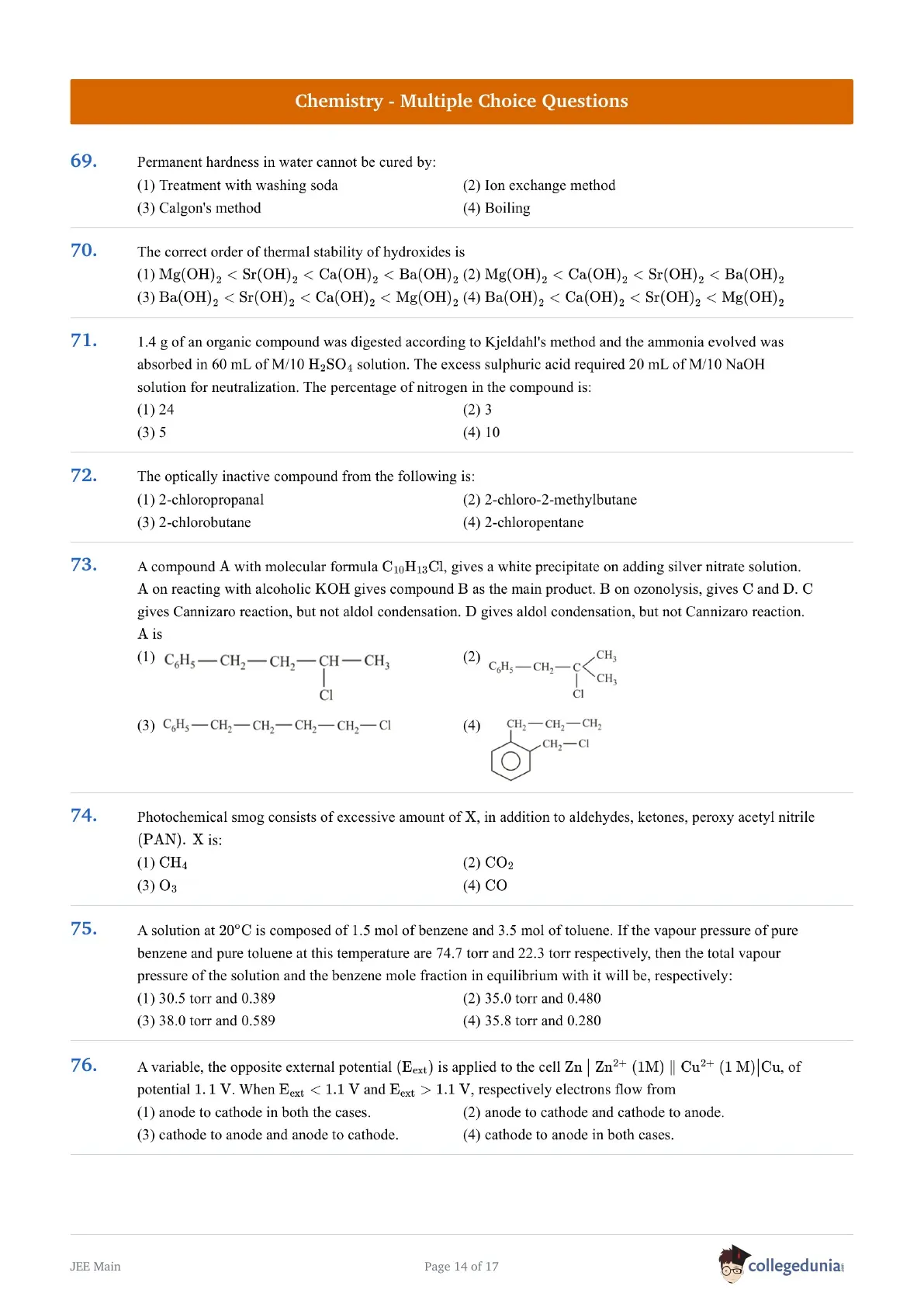
Permanent hardness in water cannot be cured by :
The correct order of thermal stability of hydroxides is :
1.4 g of an organic compound was digested according to Kjeldahl's method and the ammonia evolved was absorbed in 60 mL of M/10 \(\mathrm{H_2SO_4}\) solution. The excess sulphuric acid required 20 mL of M/10 NaOH solution for neutralization. The percentage of nitrogen in the compound is:
The optically inactive compound from the following is:
A compound A with molecular formula \(\mathrm{C_{10}H_{13}Cl}\), gives a white precipitate on adding silver nitrate solution. A on reacting with alcoholic KOH gives compound B as the main product. B on ozonolysis, gives C and D. C gives Cannizzaro reaction, but not aldol condensation. D gives aldol condensation, but not Cannizzaro reaction. A is
- (1)
![]()
- (2)
![]()
- (3)
![]()
- (4)
![]()


Photochemical smog consists of excessive amount of \(X\), in addition to aldehydes, ketones, peroxyacetyl nitrile \((PAN)\), and so forth. \(X\) is :
A solution at \(20^{\circ}\)C is composed of \(1.5\, mol\) of benzene and \(3.5\, mol\) of toluene. If the vapour pressure of pure benzene and pure toluene at this temperature are \(74.7\) torr and \(22.3\) torr, respectively, then the total vapour pressure of the solution and the benzene mole fraction in equilibrium with it will be, respectively :
A variable, the opposite external potential (\(E_{ext}\)) is applied to the cell \(\mathrm{Zn \mid Zn^{2+}\ (1\ M) \parallel Cu^{2+}\ (1\ M) \mid Cu}\), of potential 1.1 V. When \(E_{ext} \lt 1.1\) V and \(E_{ext} \gt 1.1\) V, respectively electrons flow from
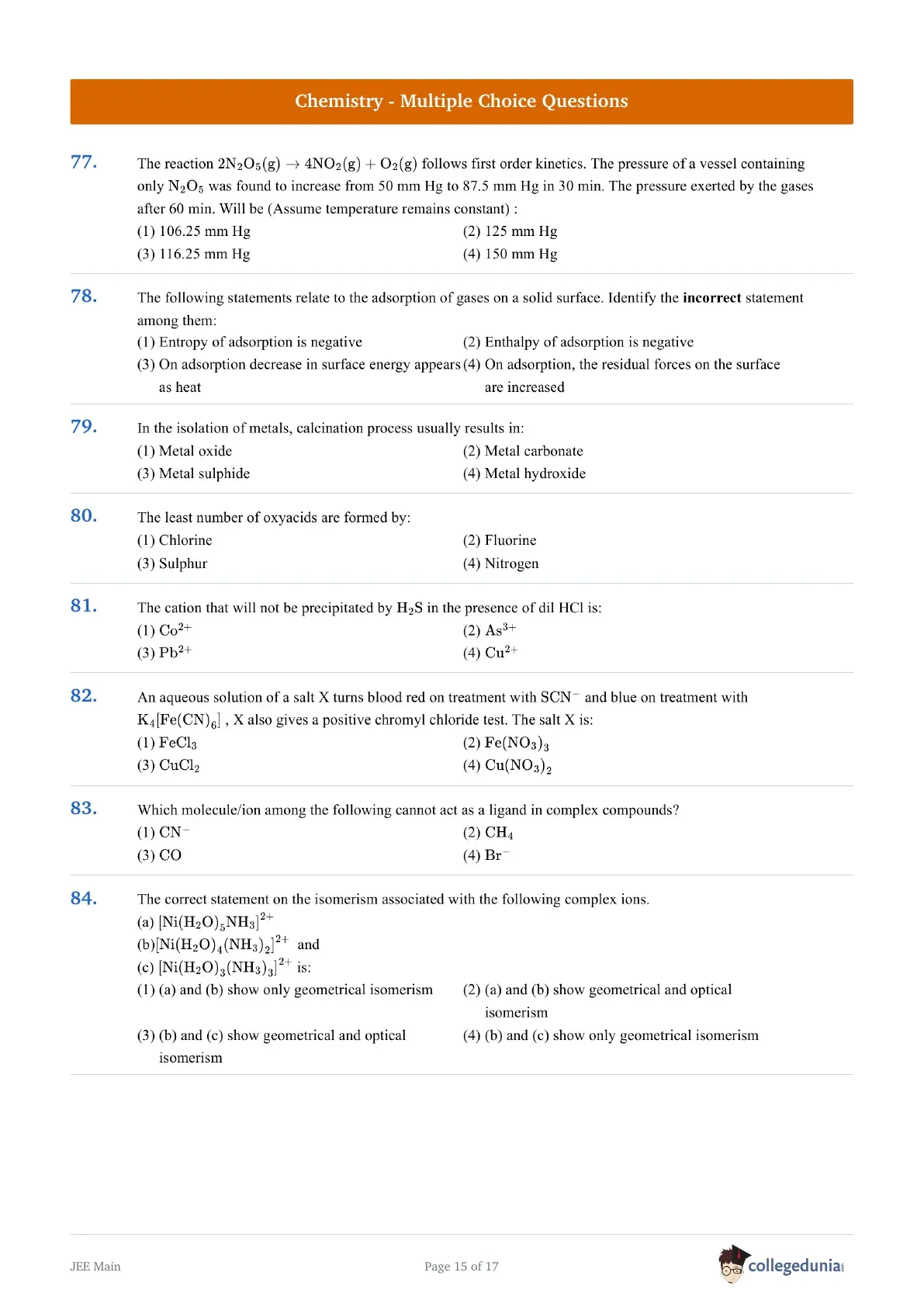
The reaction \(\mathrm{2N_2O_5(g) \rightarrow 4NO_2(g) + O_2(g)}\) follows first order kinetics. The pressure of a vessel containing only \(\mathrm{N_2O_5}\) was found to increase from 50 mm Hg to 87.5 mm Hg in 30 min. The pressure exerted by the gases after 60 min. Will be (Assume temperature remains constant) :
The following statements relate to the adsorption of gases on a solid surface. Identify the incorrect statement among them:
In the isolation of metals, calcination process usually results in:
The least number of oxyacids are formed by :
The cation that will not be precipitated by \(\mathrm{H_2S}\) in the presence of dil HCl is:
An aqueous solution of a salt X turns blood red on treatment with \(\mathrm{SCN^-}\) and blue on treatment with \(\mathrm{K_4[Fe(CN)_6]}\). X also gives a positive chromyl chloride test. The salt X is:
Which molecule/ion among the following cannot act as a ligand in complex compounds?
The correct statement on the isomerism associated with the following complex ions.
(a) \(\mathrm{[Ni(H_2O)_5NH_3]^{2+}}\)
(b) \(\mathrm{[Ni(H_2O)_4(NH_3)_2]^{2+}}\) and
(c) \(\mathrm{[Ni(H_2O)_3(NH_3)_3]^{2+}}\) is:

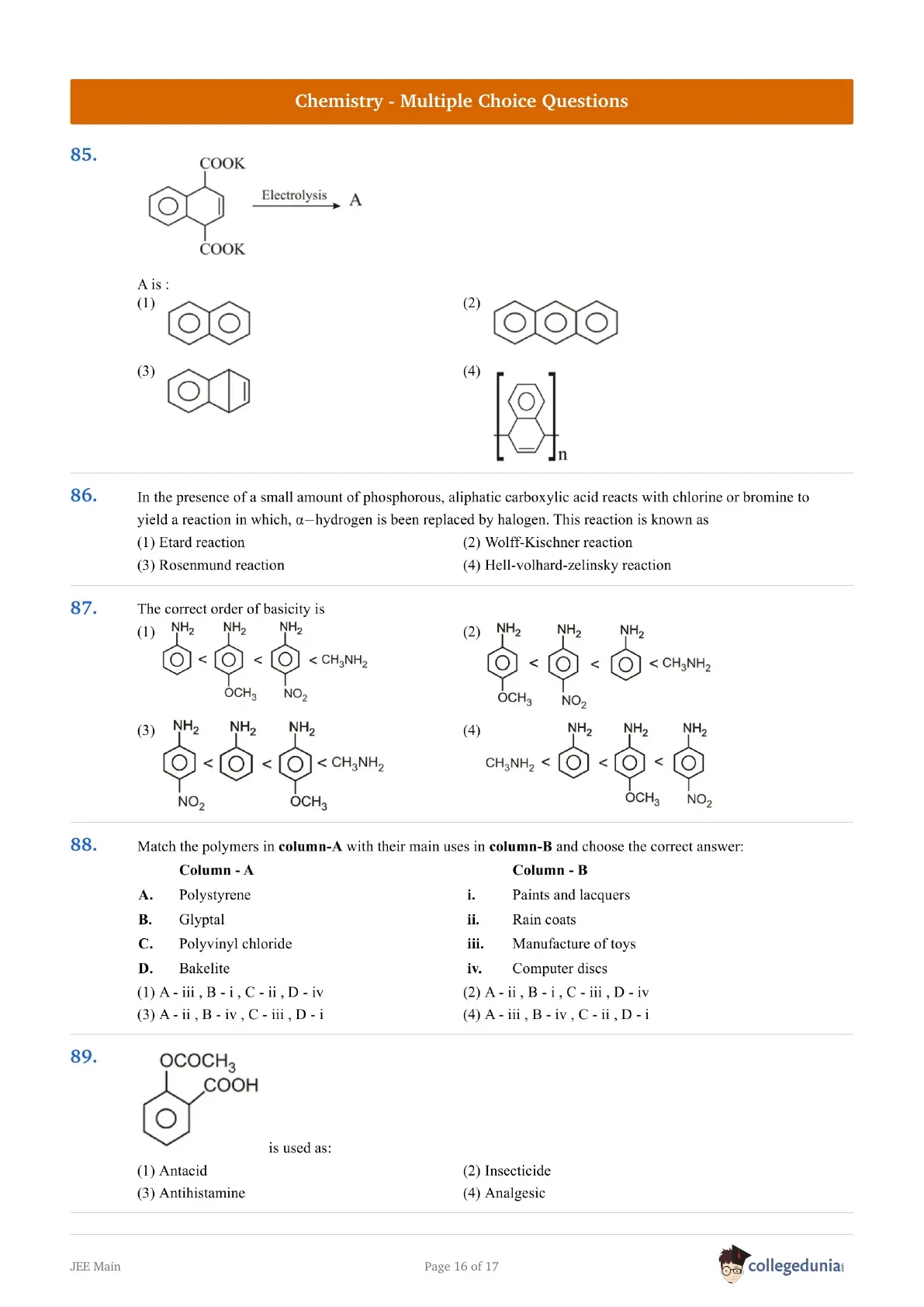
(the dipotassium salt of 1,4-dihydronaphthalene-1,4-dicarboxylic acid, with COOK at both sp3 ring carbons) \(\xrightarrow{\text{Electrolysis}}\) A
A is :
- (1)
![]()
- (2)
![]()
- (3)
![]()
- (4)
![]()


In the presence of a small amount of phosphorous, aliphatic carboxylic acid reacts with chlorine or bromine to yield a reaction in which, \(\alpha\)-hydrogen is been replaced by halogen. This reaction is known as


| Column - A | Column - B |
| A. Polystyrene | i. Paints and lacquers |
| B. Glyptal | ii. Rain coats |
| C. Polyvinyl chloride | iii. Manufacture of toys |
| D. Bakelite | iv. Computer discs |

(structure: benzene ring with \(\mathrm{OCOCH_3}\) and \(\mathrm{COOH}\) on adjacent carbons, i.e. acetylsalicylic acid) is used as:
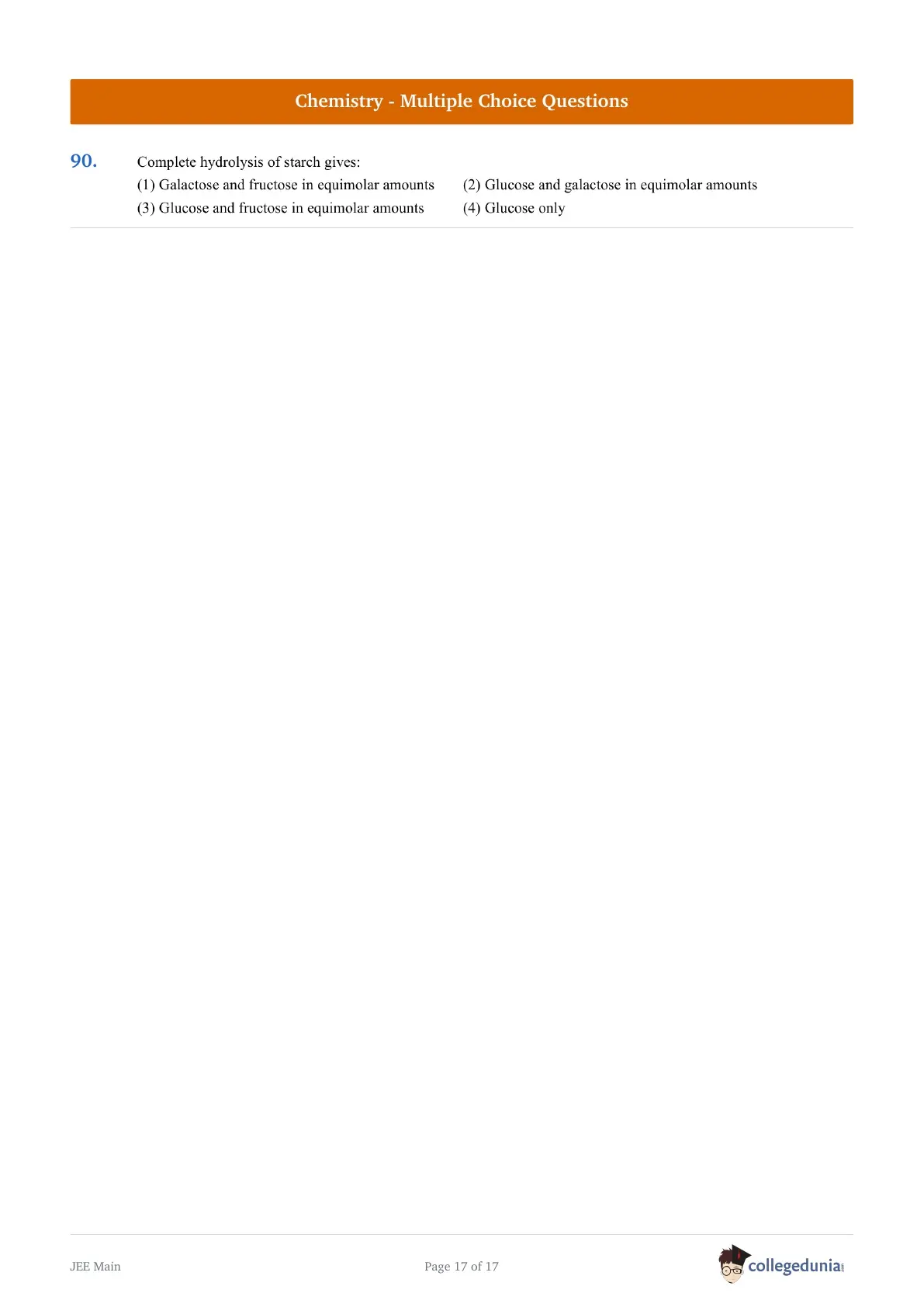
Complete hydrolysis of starch gives :
JEE Main 2015 Exam Pattern and Marking Scheme
| Particulars | Details |
|---|---|
| Exam Mode | Online (Computer-Based Test) |
| Paper | B.E./B.Tech (Paper 1) |
| Duration | 3 hours (180 minutes) |
| Type of Questions | Multiple Choice Questions (MCQs) |
| Subjects | Mathematics, Physics, Chemistry |
| Total Questions | 90 questions |
| Total Marks | 360 marks |
| Marking Scheme | +4 for correct answer & -1 for incorrect answer; 0 for unattempted |
JEE Main 2015 April 10 Difficulty Level
JEE Main 2015 B.E./B.Tech exam had a moderate level of difficulty level, similar to the offline paper held on April 4, 2015.
JEE Main B.E/ B.Tech 2015 Paper Analysis
JEE Main 2015 B.E./B.Tech question paper for the exam conducted online on April 10 consisted of multiple-choice questions. The paper consisted of three sections Physics, Chemistry, and Mathematics. There were no surprises in the question paper. JEE 2015 Mathematics section included more questions from topics such as 3D and Vectors.
Also, JEE Main 2015 Physics section was the toughest of all the sections; the questions asked in this section were a little tricky. Out of the 30 questions asked from Physics, just five questions were theory-based, while the remaining were numerical-based questions that required more time to solve.



Comments