




JEE Main 2016 April 9 Question Paper is available here with solutions PDF and detailed solutions for every question. CBSE conducted the computer-based test (CBT) Paper 1 on April 9, 2016, in the morning session from 9:30 AM to 12:30 PM. The JEE Main 2016 Paper 1 (B.E./B.Tech) question paper includes the following:
- 90 questions in a 3-hour CBT Mode: 30 each from Mathematics, Physics and Chemistry
- Question type: all multiple choice questions (MCQs) with a single correct option, 4 marks each
- Sections: Mathematics (30), Physics (30) and Chemistry (30), all questions compulsory
- Marking: +4 for a correct answer, -1 for an incorrect answer, 0 for an unattempted question
- Maximum marks: 360 (120 per subject)
JEE Main 2016 April 9 Question Paper with Solution PDF
| NTA Official PDF | CD PDF | CD PDF with Solutions |
|---|---|---|
| Download official PDF 4.58 MB | Download Collegedunia PDF 5.01 MB | Download solutions PDF 0.99 MB |
Also Check:
JEE Main 2016 April 9 Questions with Solutions
Mathematics (Q1 - Q30)
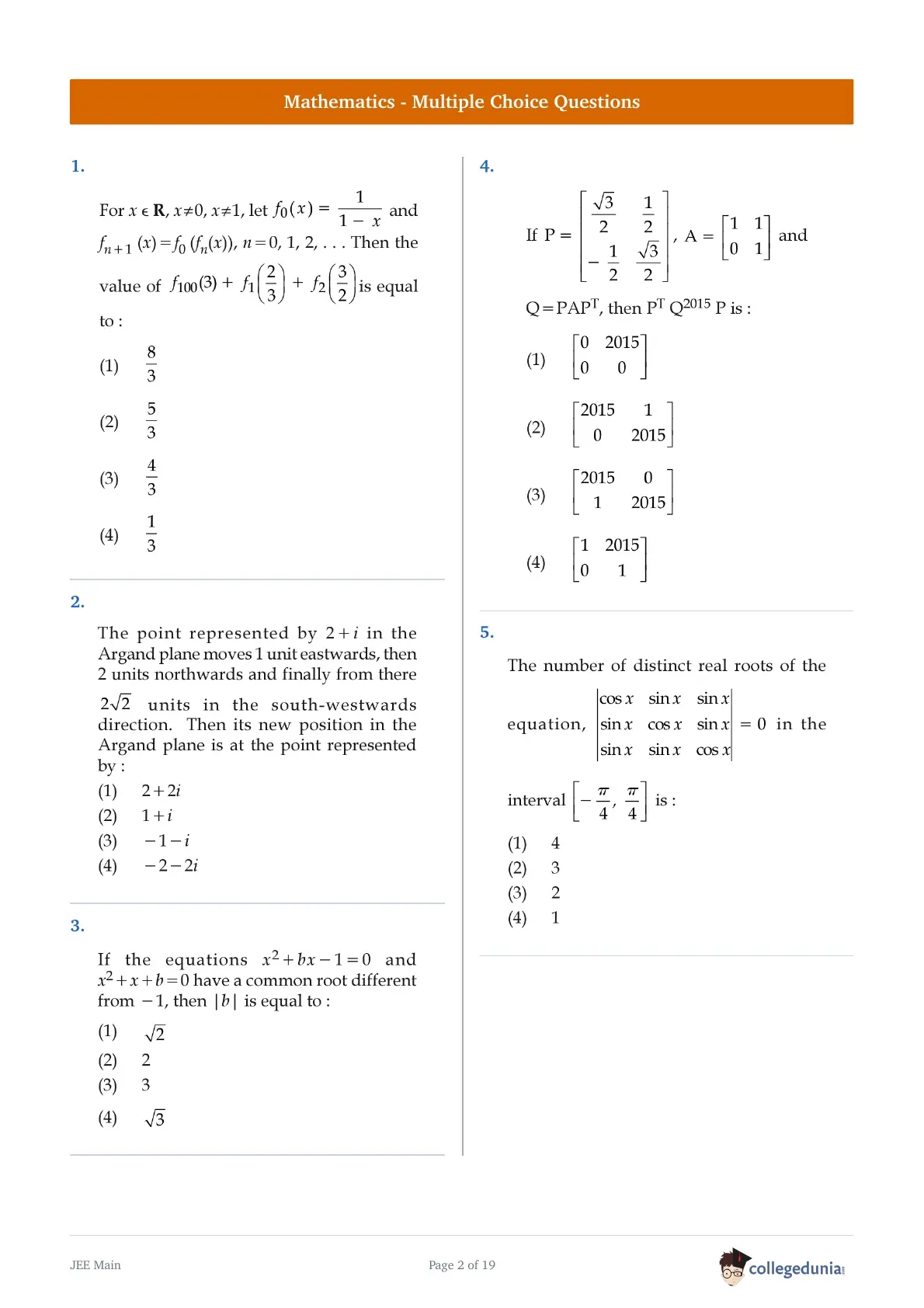
For \(x \, \in \, R , x \neq 0, x \neq 1,\) let \(f_0(x) = \frac{1}{1-x}\) and \(f_{n+1} (x) | = f_0 (f_n(x)), n = 0 , 1 , 2 , ...\) Then the value of \(f_{100}(3) + f_1 \left(\frac{2}{3} \right) + f_2 \left( \frac{3}{2} \right)\) is equal to :
The point represented by \(2+i\) in the Argand plane moves 1 unit eastwards, then 2 units northwards and finally from there \(2\sqrt{2}\) units in the south-westwards direction. Then its new position in the Argand plane is at the point represented by :
If the equations \(x^2+bx-1=0\) and \(x^2+x+b=0\) have a common root different from \(-1\), then \(|b|\) is equal to :
If \(P=\begin{bmatrix}\frac{\sqrt3}{2}&\frac12\\-\frac12&\frac{\sqrt3}{2}\end{bmatrix},\ A=\begin{bmatrix}1&1\\0&1\end{bmatrix}\) and \(Q=PAP^{T}\), then \(P^{T}Q^{2015}P\) is :
The number of distinct real roots of the equation, \(\begin{vmatrix}\cos x&\sin x &\sin x\\ \sin x&\cos x&\sin x\\ \sin x&\sin x&\cos x\end{vmatrix}= 0\) in the interval \( \left[- \frac{\pi}{4}, \frac{\pi}{4}\right]\) is :
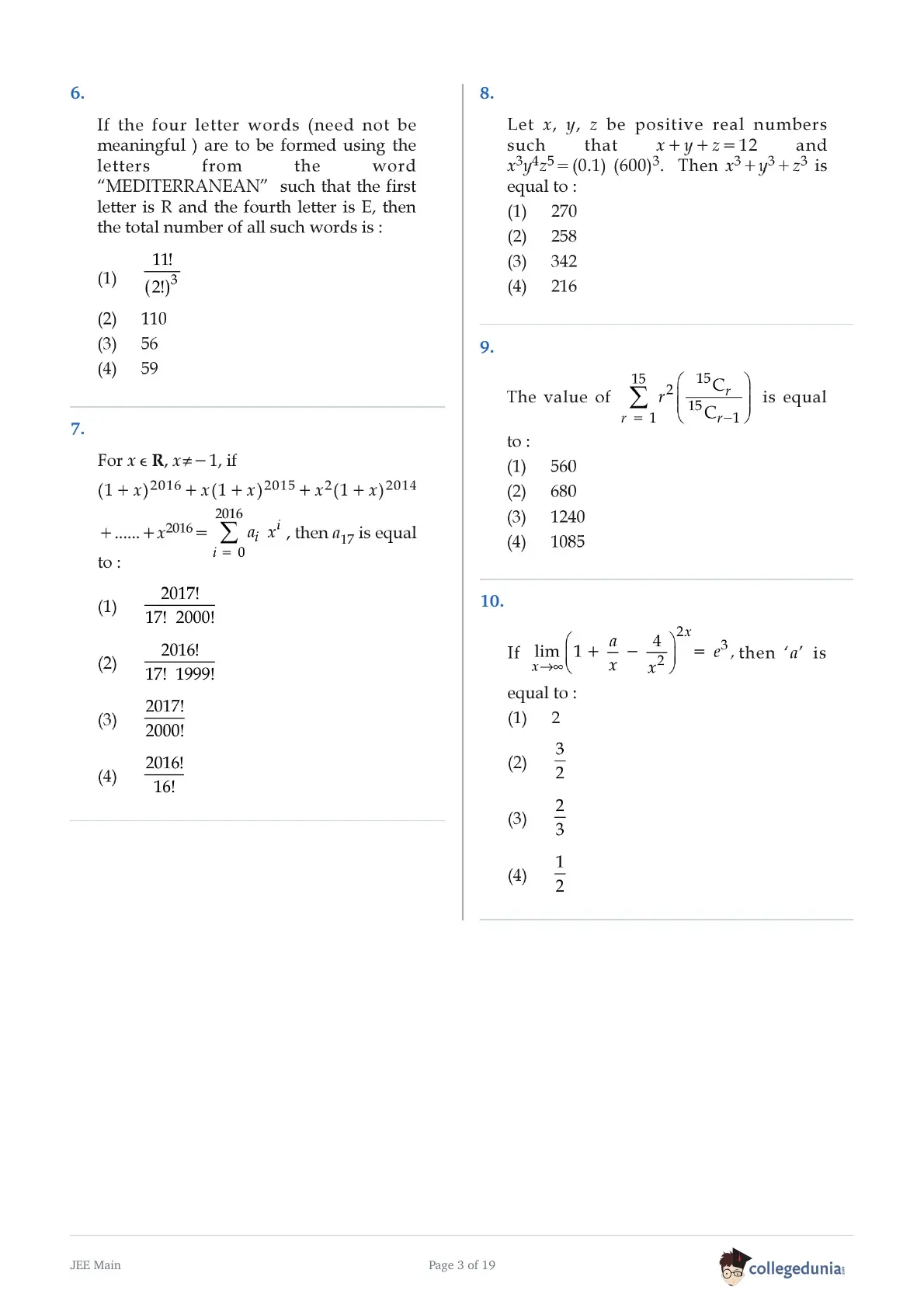
If the four letter words (need not be meaningful ) are to be formed using the letters from the word \("MEDITERRANEAN"\) such that the first letter is \(R\) and the fourth letter is \(E\), then the total number of all such words is :
For \(x\in\mathbf{R},\ x\neq-1\), if \((1+x)^{2016}+x(1+x)^{2015}+x^2(1+x)^{2014}+\ldots+x^{2016}=\sum_{i=0}^{2016}a_i\,x^i\), then \(a_{17}\) is equal to :
Let \(x,\ y,\ z\) be positive real numbers such that \(x+y+z=12\) and \(x^3y^4z^5=(0.1)(600)^3\). Then \(x^3+y^3+z^3\) is equal to :
The value of \(\sum_{r=1}^{15}r^2\left(\frac{{}^{15}C_r}{{}^{15}C_{r-1}}\right)\) is equal to :
If \(\lim_{x\to\infty}\left(1+\frac ax-\frac{4}{x^2}\right)^{2x}=e^3\), then 'a' is equal to :
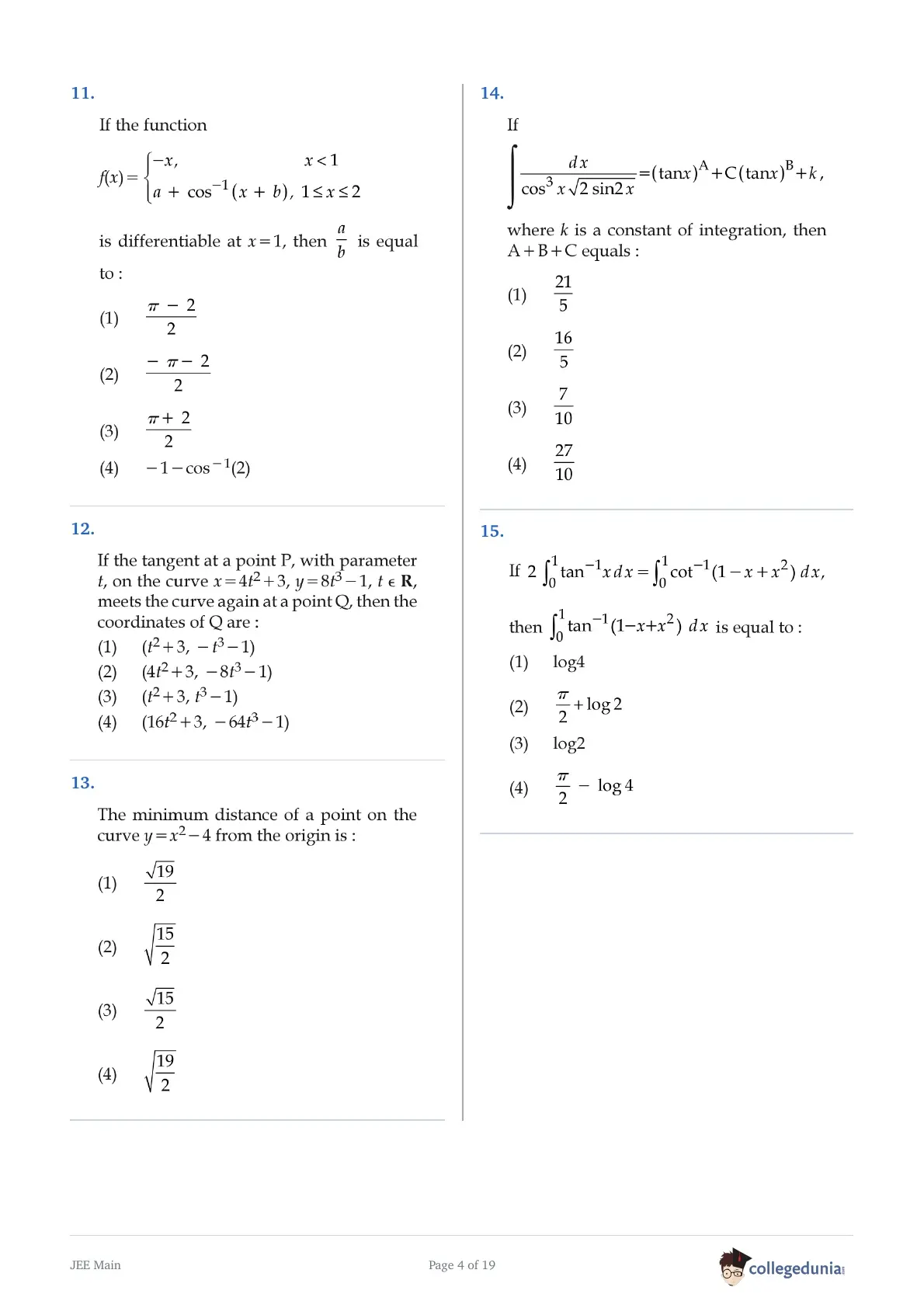
If the function \(f(x)=\begin{cases}-x, & x\lt 1\\ a+\cos^{-1}(x+b), & 1\le x\le 2\end{cases}\) is differentiable at \(x=1\), then \(\frac ab\) is equal to :
If the tangent at a point \(P\), with parameter \(t\), on the curve \(x = 4t^2 + 3, y = 8t^3 - 1, t \in R\), meets the curve again at a point \(Q\), then the coordinates of \(Q\) are :
The minimum distance of a point on the curve \(y=x^2-4\) from the origin is :
If \(\int\frac{dx}{\cos^3x\sqrt{2\sin2x}}=(\tan x)^{A}+C(\tan x)^{B}+k\), where \(k\) is a constant of integration, then \(A+B+C\) equals :
If \(2\int_0^1\tan^{-1}x\,dx=\int_0^1\cot^{-1}(1-x+x^2)\,dx\), then \(\int_0^1\tan^{-1}(1-x+x^2)\,dx\) is equal to :
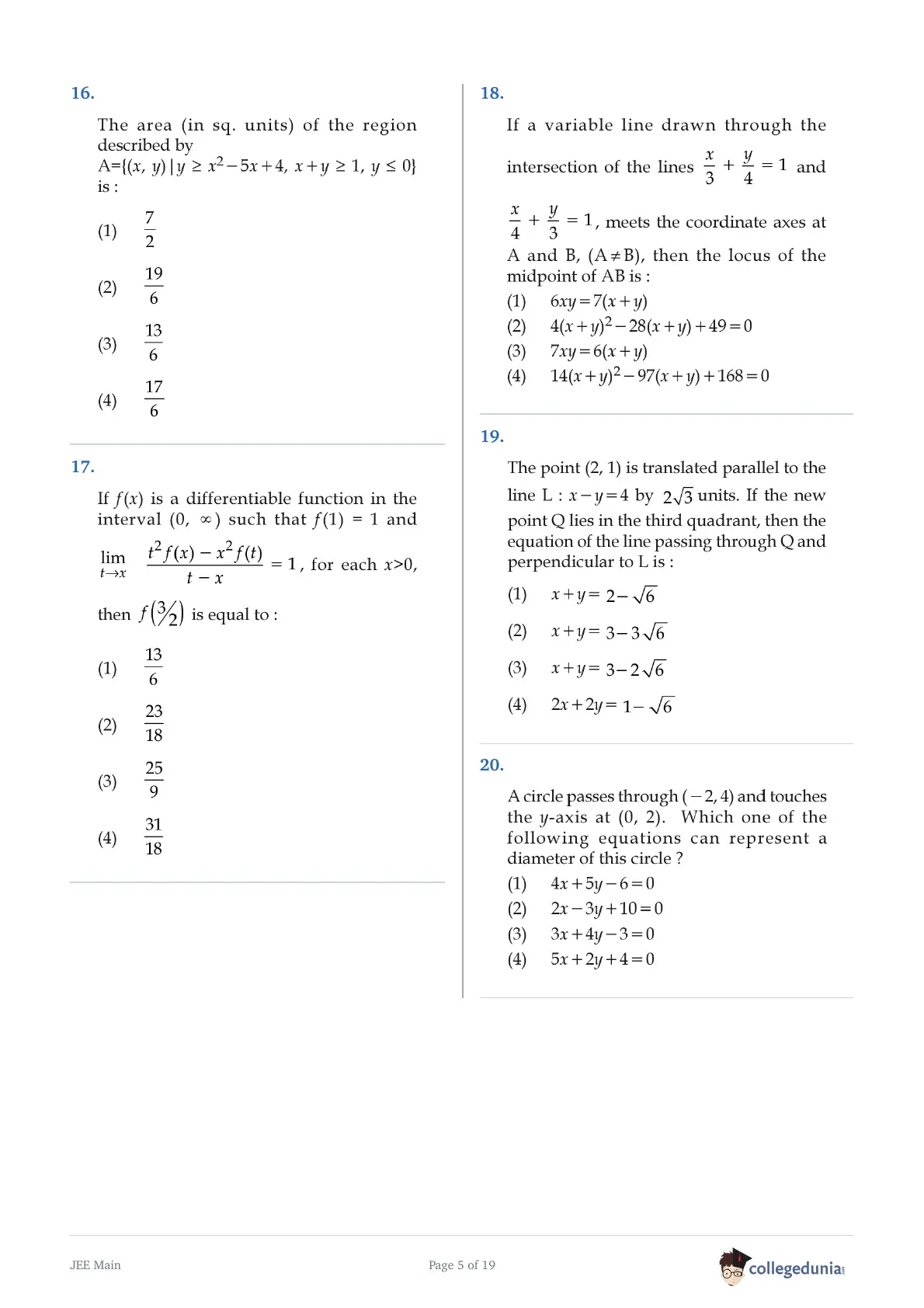
The area (in sq. units) of the region described by \(A=\{(x, y) \mid y \geq x^2-5x+4,\ x+y \geq 1,\ y \leq 0\}\) is :
If \(f(x)\) is a differentiable function in the interval \((0, \infty)\) such that \(f(1)=1\) and \(\lim_{t \to x} \frac{t^2 f(x)-x^2 f(t)}{t-x}=1\), for each \(x\gt 0\), then \(f\left(\frac{3}{2}\right)\) is equal to :
If a variable line drawn through the intersection of the lines \(\frac{x}{3} + \frac{y}{4} = 1\) and \(\frac{x}{4} + \frac{y}{3} = 1\), meets the coordinate axes at \(A\) and \(B\), \((A \neq B)\), then the locus of the midpoint of \(AB\) is :
The point \((2, 1)\) is translated parallel to the line \(L : x-y = 4\) by \(2\sqrt{3}\) units. If the new point \(Q\) lies in the third quadrant, then the equation of the line passing through \(Q\) and perpendicular to \(L\) is :
A circle passes through \((-2, 4)\) and touches the \(y\)-axis at \((0, 2)\). Which one of the following equations can represent a diameter of this circle ?
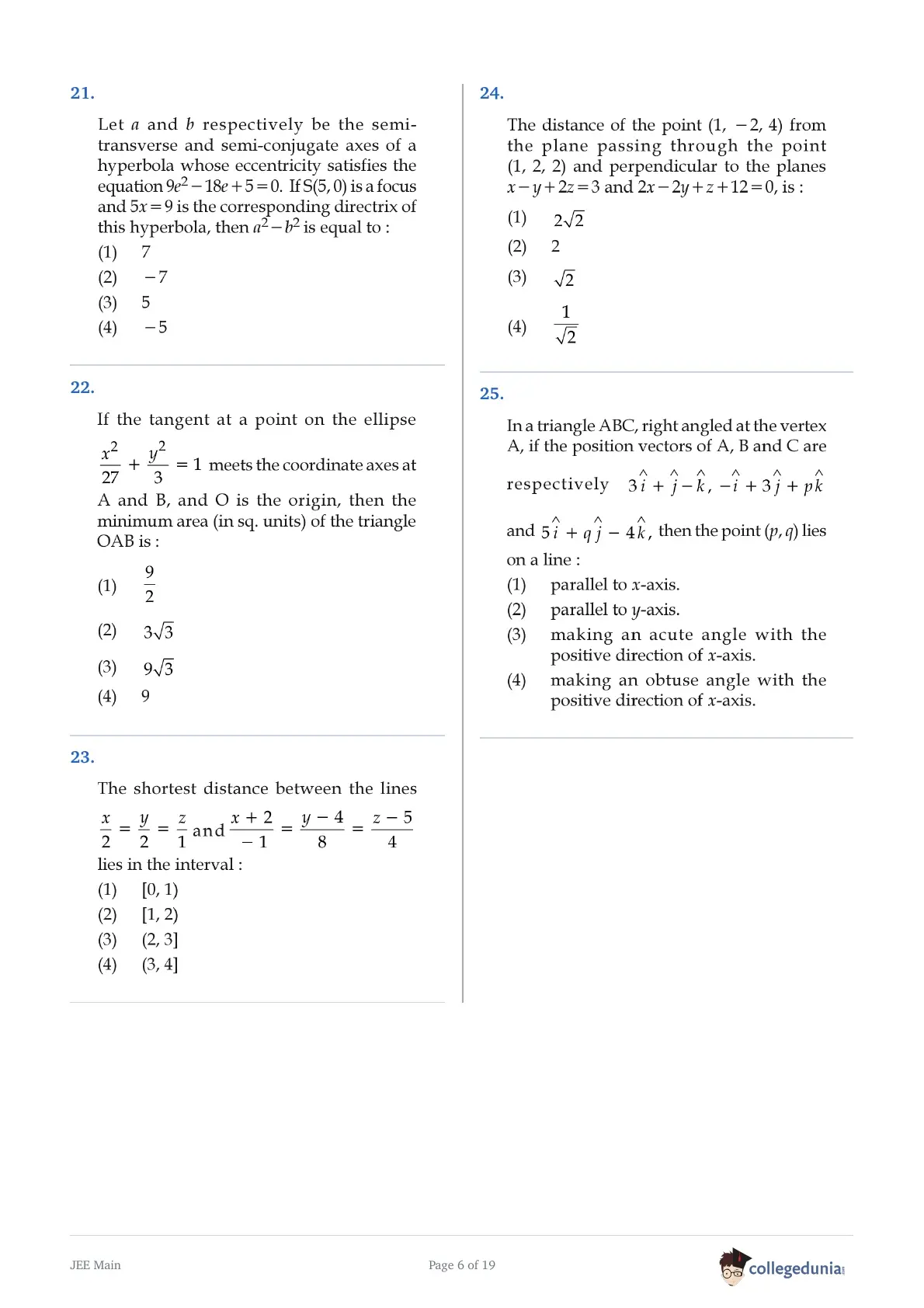
Let \(a\) and \(b\) respectively be the semi-transverse and semi-conjugate axes of a hyperbola whose eccentricity satisfies the equation \(9e^2-18e+5=0\). If \(S(5, 0)\) is a focus and \(5x=9\) is the corresponding directrix of this hyperbola, then \(a^2-b^2\) is equal to :
If the tangent at a point on the ellipse \(\frac{x^2}{27} + \frac{y^2}{3} =1\) meets the coordinate axes at A and B, and O is the origin, them the minimum area (in s units) of the triangle OAB is:
The shortest distance between the lines \(\frac{x}{2}=\frac{y}{2}=\frac{z}{1}\) and \(\frac{x+2}{-1}=\frac{y-4}{8}=\frac{z-5}{4}\) lies in the interval :
The distance of the point \((1, -2, 4)\) from the plane passing through the point \((1, 2, 2)\) and perpendicular to the planes \(x-y+2z=3\) and \(2x-2y+z+12=0\), is :
In a triangle ABC, right angled at the vertex A, if the position vectors of A, B and C are respectively \(3\hat i+\hat j-\hat k\), \(-\hat i+3\hat j+p\hat k\) and \(5\hat i+q\hat j-4\hat k\), then the point \((p, q)\) lies on a line :
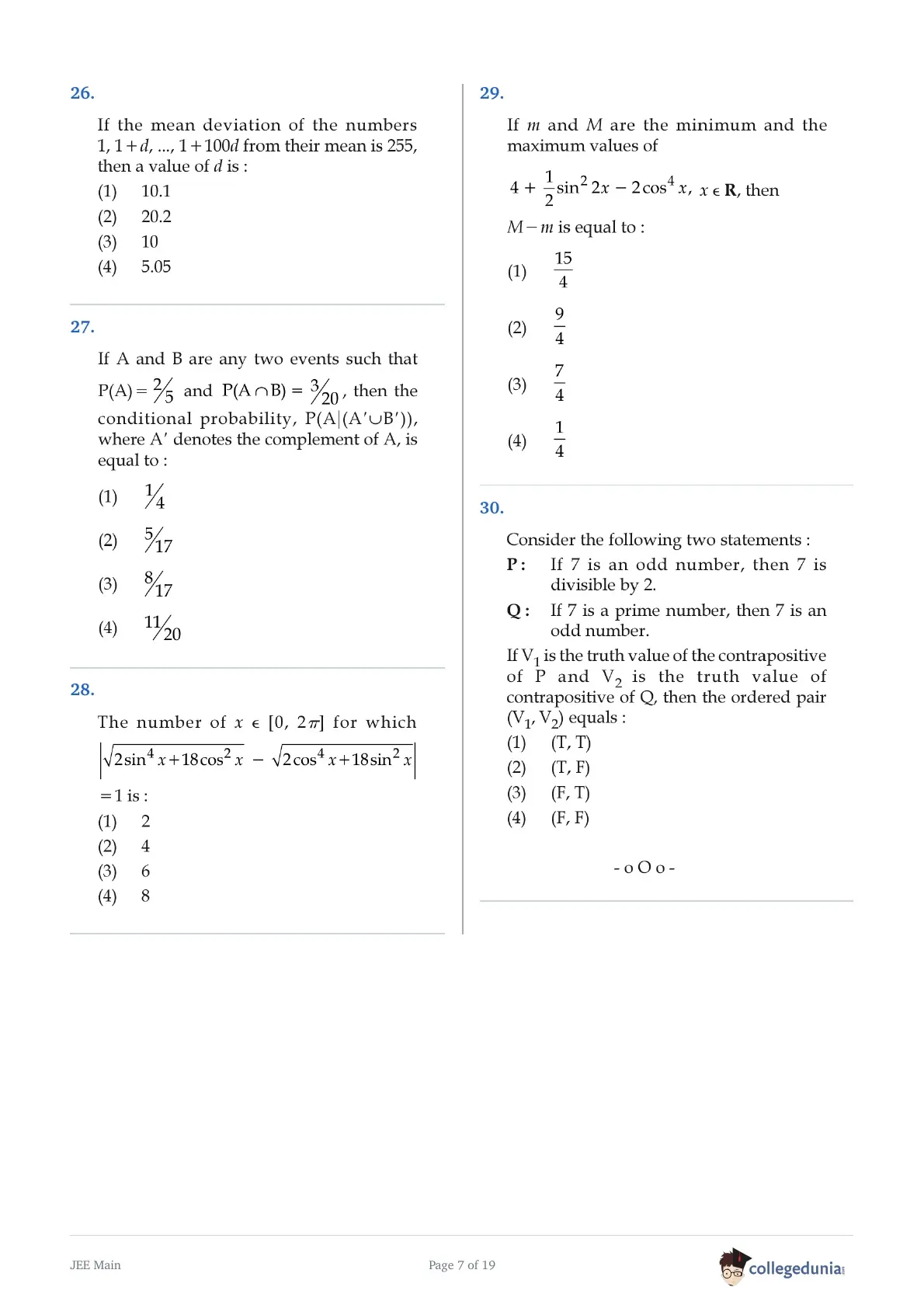
If the mean deviation of the numbers \(1, 1+d, \ldots, 1+100d\) from their mean is 255, then a value of \(d\) is :
If A and B are any two events such that \(P(A)=\frac{2}{5}\) and \(P(A\cap B)=\frac{3}{20}\), then the conditional probability, \(P(A\mid(A'\cup B'))\), where \(A'\) denotes the complement of A, is equal to :
The number of \(x\in[0, 2\pi]\) for which \(\left|\sqrt{2\sin^4x+18\cos^2x}-\sqrt{2\cos^4x+18\sin^2x}\right|=1\) is :
If \(m\) and \(M\) are the minimum and the maximum values of \(4+\frac{1}{2}\sin^2 2x-2\cos^4x,\ x\in\mathbf{R}\), then \(M-m\) is equal to :
Consider the following two statements :
P : If 7 is an odd number, then 7 is divisible by 2.
Q : If 7 is a prime number, then 7 is an odd number.
If \(V_1\) is the truth value of the contrapositive of P and \(V_2\) is the truth value of contrapositive of Q, then the ordered pair \((V_1, V_2)\) equals :
Physics (Q31 - Q60)
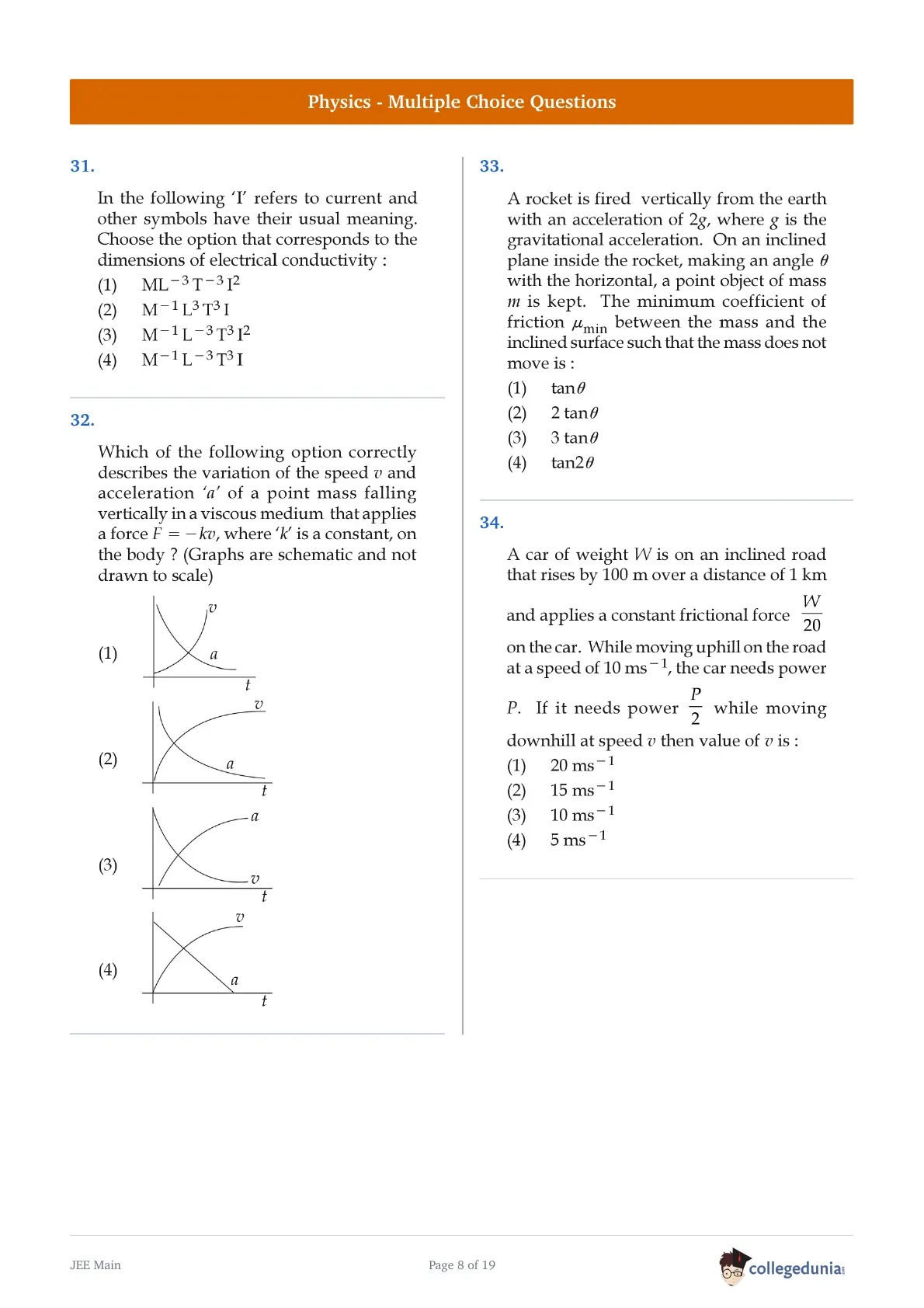
In the following 'I' refers to current and other symbols have their usual meaning. Choose the option that corresponds to the dimensions of electrical conductivity :
Which of the following option correctly describes the variation of the speed \(v\) and acceleration 'a' of a point mass falling vertically in a viscous medium that applies a force \(F=-kv\), where 'k' is a constant, on the body ? (Graphs are schematic and not drawn to scale)
- (1)
![]()
- (2)
![]()
- (3)
![]()
- (4)
![]()


A rocket is fired vertically from the earth with an acceleration of \(2g\), where \(g\) is the gravitational acceleration. On an inclined plane inside the rocket, making an angle \(\theta\) with the horizontal, a point object of mass \(m\) is kept. The minimum coefficient of friction \(\mu_{\min}\) between the mass and the inclined surface such that the mass does not move is :
A car of weight \(W\) is on an inclined road that rises by 100 m over a distance of 1 km and applies a constant frictional force \(\frac{W}{20}\) on the car. While moving uphill on the road at a speed of \(10\ \mathrm{ms^{-1}}\), the car needs power \(P\). If it needs power \(\frac{P}{2}\) while moving downhill at speed \(v\) then value of \(v\) is :
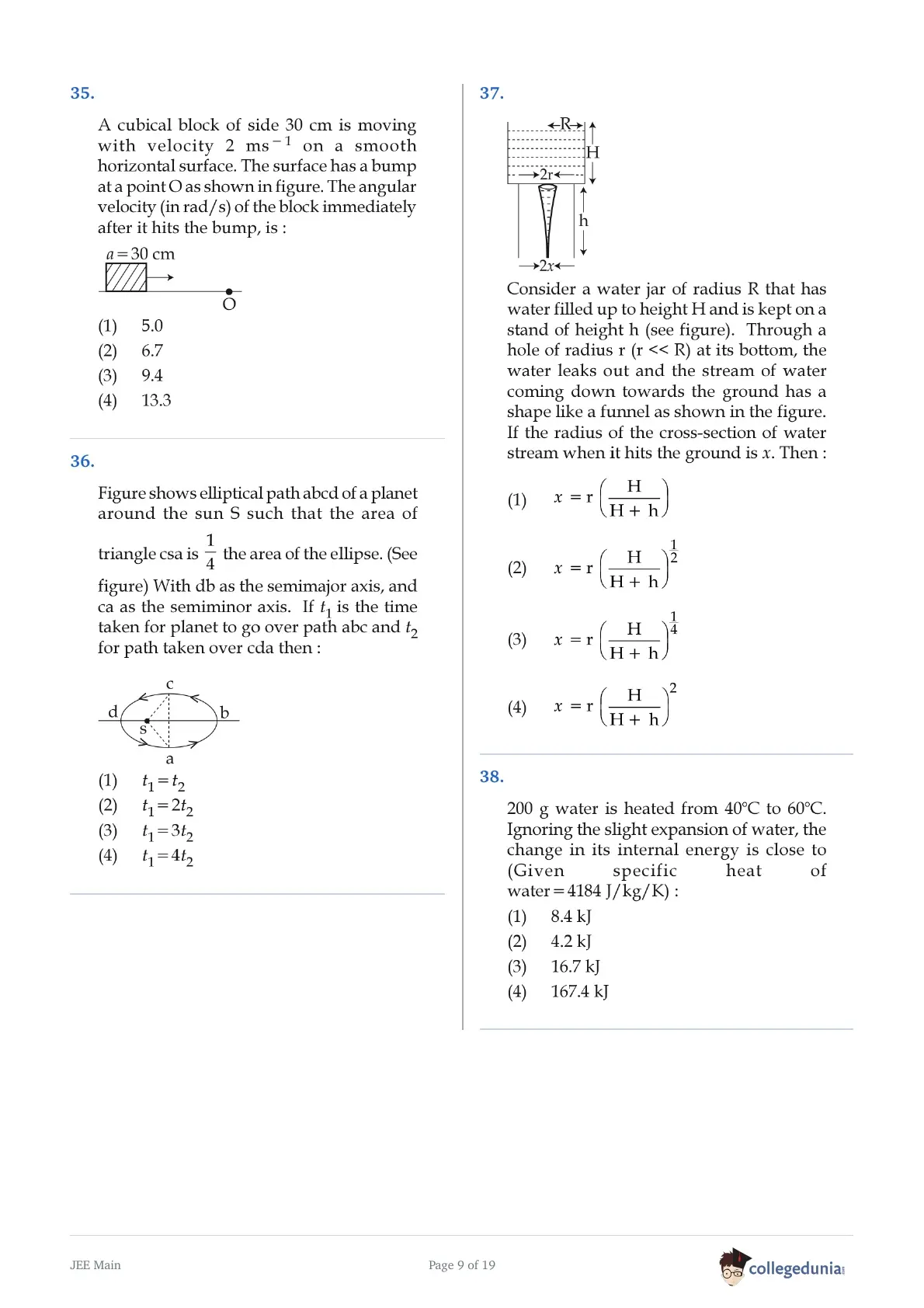
A cubical block of side 30 cm is moving with velocity \(2\ \mathrm{ms^{-1}}\) on a smooth horizontal surface. The surface has a bump at a point O as shown in figure. The angular velocity (in rad/s) of the block immediately after it hits the bump, is :
Figure shows elliptical path abcd of a planet around the sun \(S\) such that the area of triangle \(csa\) is \(\frac{1}{4}\) the area of the ellipse. (See figure) With \(db\) as the \(semimajor\) axis, and \(ca\) as the \(semiminor\) axis. If \(t_1\) is the time taken for planet to go over path \(abc\) and \(t_2\) for path taken over \(cda\) then :
Consider a water jar of radius \(R\) that has water filled up to height \(H\) and is kept on a stand of height \(h\) (see figure). Through a hole of radius \(r (r << R)\) at its bottom, the water leaks out and the stream of water coming down towards the ground has a shape like a funnel as shown in the figure. If the radius of the cross-section of water stream when it hits the ground is \(x\). Then :
200 g water is heated from \(40^\circ\mathrm{C}\) to \(60^\circ\mathrm{C}\). Ignoring the slight expansion of water, the change in its internal energy is close to (Given specific heat of water \(= 4184\ \mathrm{J/kg/K}\)) :
The ratio of work done by an ideal monoatomic gas to the heat supplied to it in an isobaric process is :
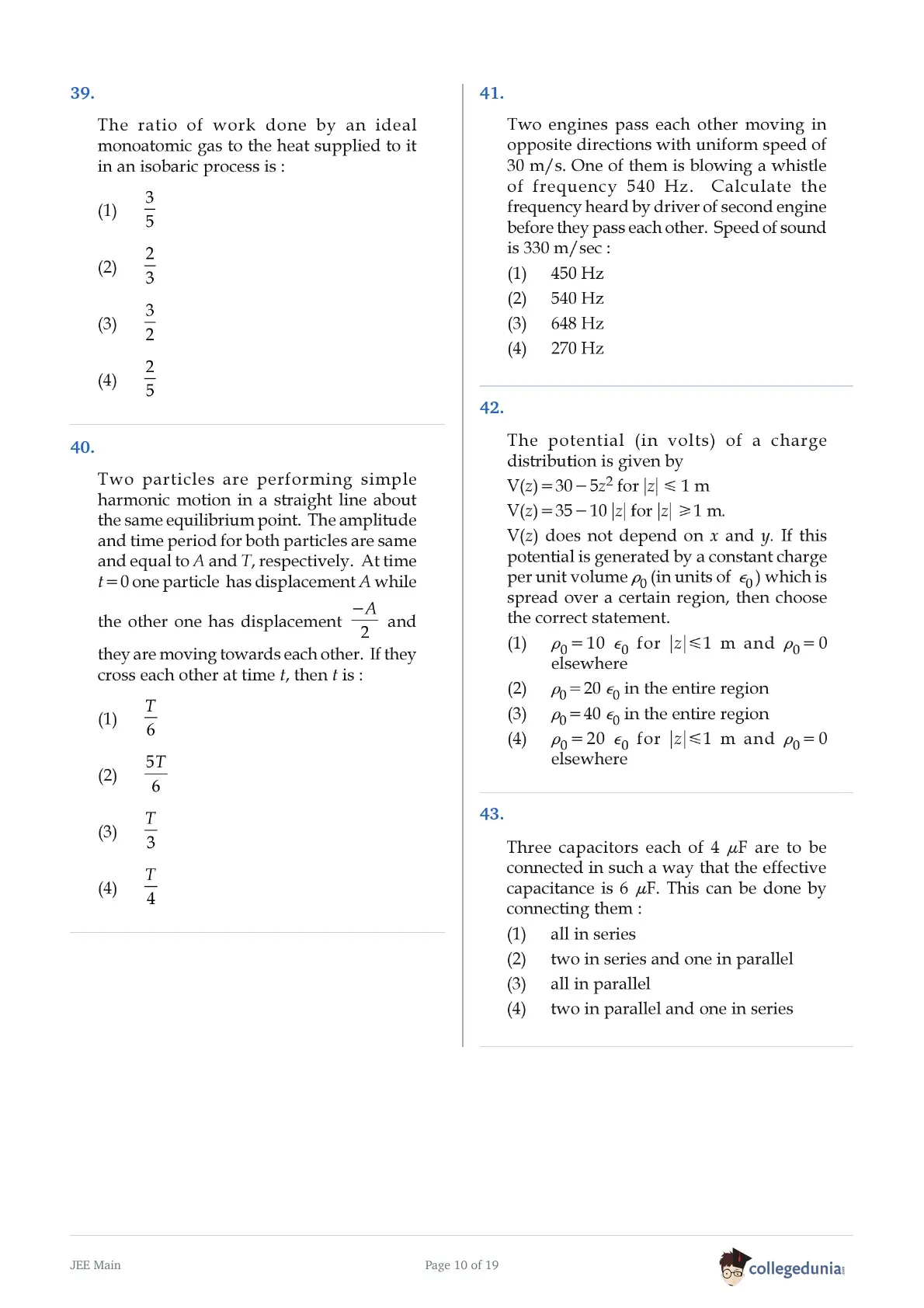
Two particles are performing simple harmonic motion in a straight line about the same equilibrium point. The amplitude and time period for both particles are same and equal to \(A\) and \(T\), respectively. At time \(t = 0\) one particle has displacement \(A\) while the other one has displacement \(\frac{-A}{2}\) and they are moving towards each other. If they cross each other at time \(t\), then \(t\) is :
Two engines pass each other moving in opposite directions with uniform speed of \(30\ \mathrm{m/s}\). One of them is blowing a whistle of frequency \(540\ \mathrm{Hz}\). Calculate the frequency heard by driver of second engine before they pass each other. Speed of sound is \(330\ \mathrm{m/sec}\) :
The potential (in volts) of a charge distribution is given by
\(V(z) = 30 - 5z^2\) for \(|z|\le 1\ \mathrm{m}\)
\(V(z) = 35 - 10|z|\) for \(|z|\ge 1\ \mathrm{m}\).
\(V(z)\) does not depend on \(x\) and \(y\). If this potential is generated by a constant charge per unit volume \(\rho_0\) (in units of \(\epsilon_0\)) which is spread over a certain region, then choose the correct statement.
Three capacitors each of \(4\ \mu\mathrm{F}\) are to be connected in such a way that the effective capacitance is \(6\ \mu\mathrm{F}\). This can be done by connecting them :

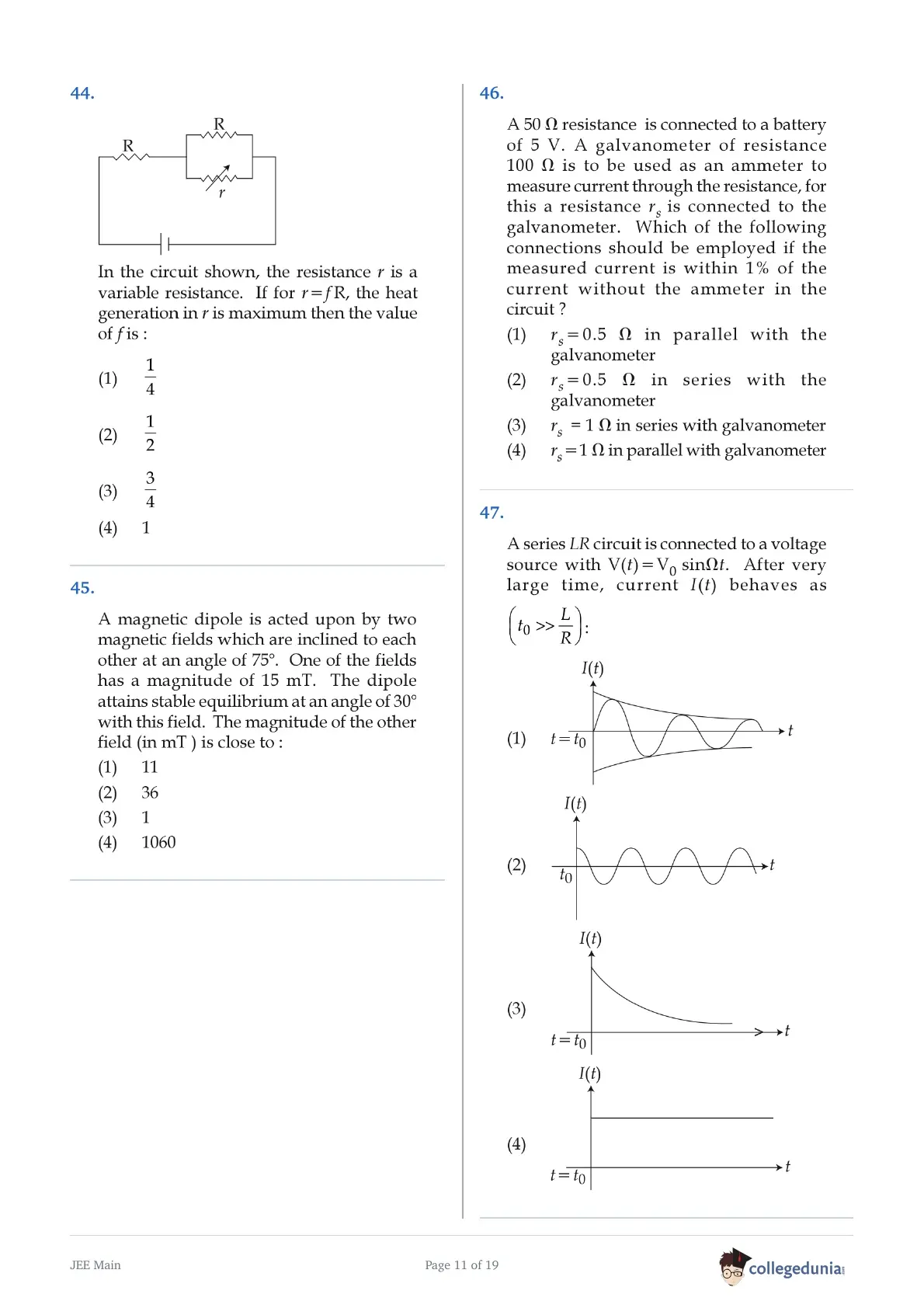
In the circuit shown, the resistance \(r\) is a variable resistance. If for \(r = fR\), the heat generation in \(r\) is maximum then the value of \(f\) is :
A magnetic dipole is acted upon by two magnetic fields which are inclined to each other at an angle of \(75^\circ\). One of the fields has a magnitude of 15 mT. The dipole attains stable equilibrium at an angle of \(30^\circ\) with this field. The magnitude of the other field (in mT) is close to :
A \(50\ \Omega\) resistance is connected to a battery of 5 V. A galvanometer of resistance \(100\ \Omega\) is to be used as an ammeter to measure current through the resistance, for this a resistance \(r_s\) is connected to the galvanometer. Which of the following connections should be employed if the measured current is within 1% of the current without the ammeter in the circuit ?
A series \(LR\) circuit is connected to a voltage source with \(V(t) = V_0 \sin\Omega t\). After very large time, current \(I(t)\) behaves as \(\left(t_0 \gg \frac{L}{R}\right)\):
- (1)
![]()
- (2)
![]()
- (3)
![]()
- (4)
![]()


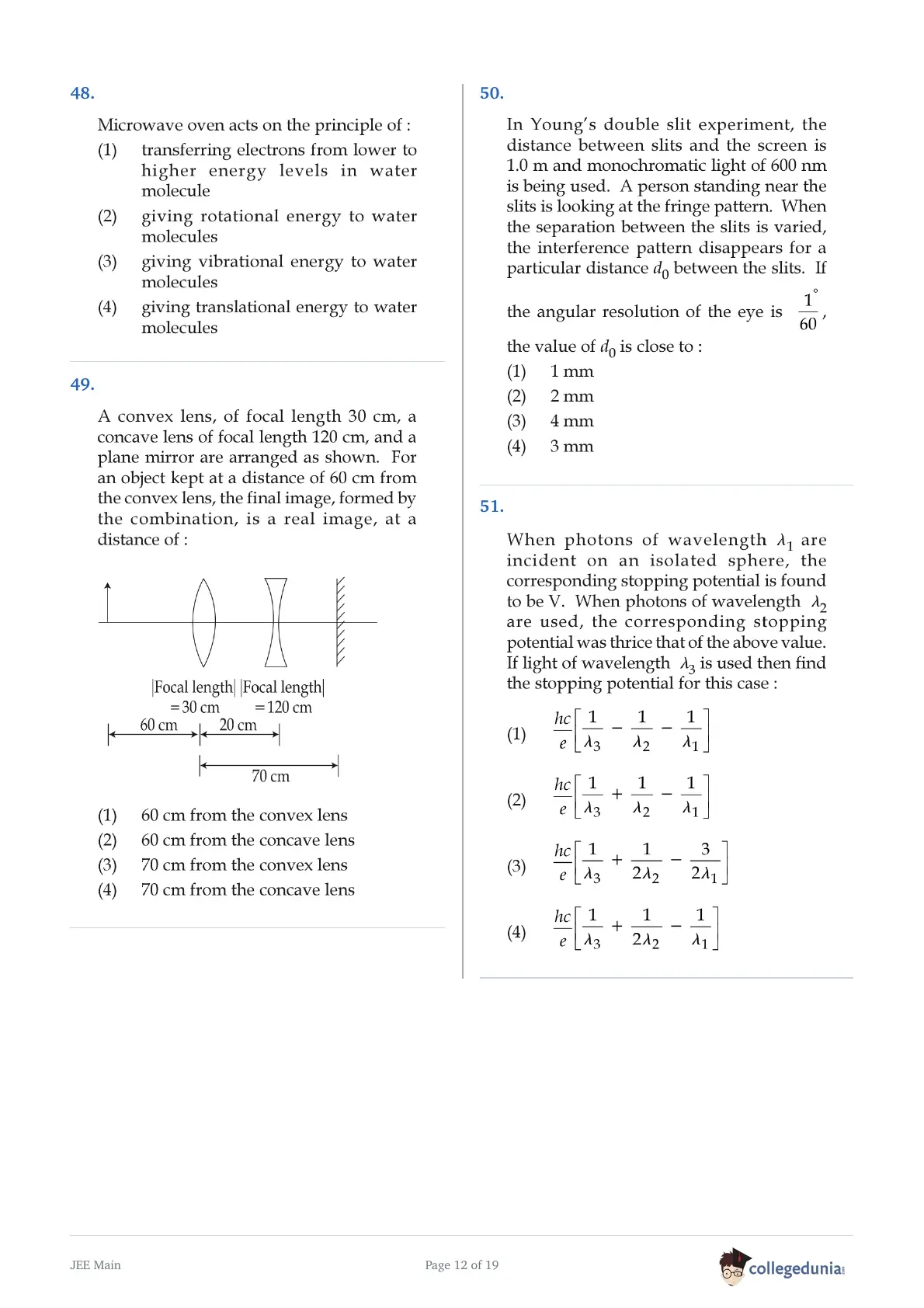
Microwave oven acts on the principle of :
A convex lens, of focal length 30 cm, a concave lens of focal length 120 cm, and a plane mirror are arranged as shown. For an object kept at a distance of 60 cm from the convex lens, the final image, formed by the combination, is a real image, at a distance of :
In Young's double slit experiment, the distance between slits and the screen is 1.0 m and monochromatic light of 600 nm is being used. A person standing near the slits is looking at the fringe pattern. When the separation between the slits is varied, the interference pattern disappears for a particular distance \(d_0\) between the slits. If the angular resolution of the eye is \(\frac{1^\circ}{60}\), the value of \(d_0\) is close to :
When photons of wavelength \(\lambda_1\) are incident on an isolated sphere, the corresponding stopping potential is found to be V. When photons of wavelength \(\lambda_2\) are used, the corresponding stopping potential was thrice that of the above value. If light of wavelength \(\lambda_3\) is used then find the stopping potential for this case :
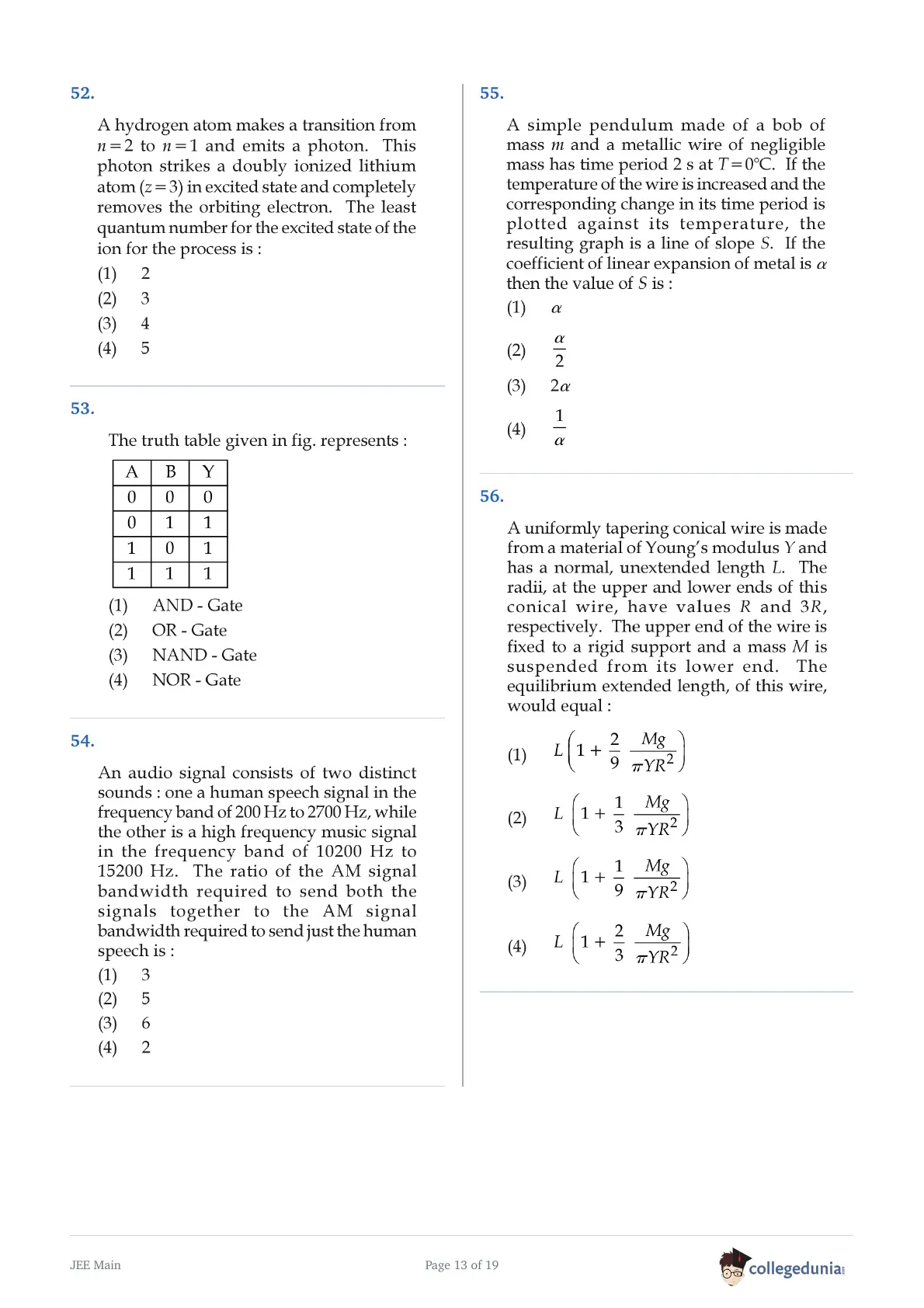
A hydrogen atom makes a transition from \(n = 2\) to \(n = 1\) and emits a photon. This photon strikes a doubly ionized lithium atom (\(z = 3\)) in excited state and completely removes the orbiting electron. The least quantum number for the excited state of the ion for the process is :
An audio signal consists of two distinct sounds : one a human speech signal in the frequency band of 200 Hz to 2700 Hz, while the other is a high frequency music signal in the frequency band of 10200 Hz to 15200 Hz. The ratio of the AM signal bandwidth required to send both the signals together to the AM signal bandwidth required to send just the human speech is :
A simple pendulum made of a bob of mass \(m\) and a metallic wire of negligible mass has time period 2 s at \(T = 0^\circ\mathrm{C}\). If the temperature of the wire is increased and the corresponding change in its time period is plotted against its temperature, the resulting graph is a line of slope \(S\). If the coefficient of linear expansion of metal is \(\alpha\) then the value of \(S\) is :
A uniformly tapering conical wire is made from a material of Young?s modulus \(Y\) and has a normal, unextended length \(L\). The radii, at the upper and lower ends of this conical wire, have values \(R\) and \(3R\), respectively. The upper end of the wire is fixed to a rigid support and a mass \(M\) is suspended from its lower end. The equilibrium extended length, of this wire, would equal :
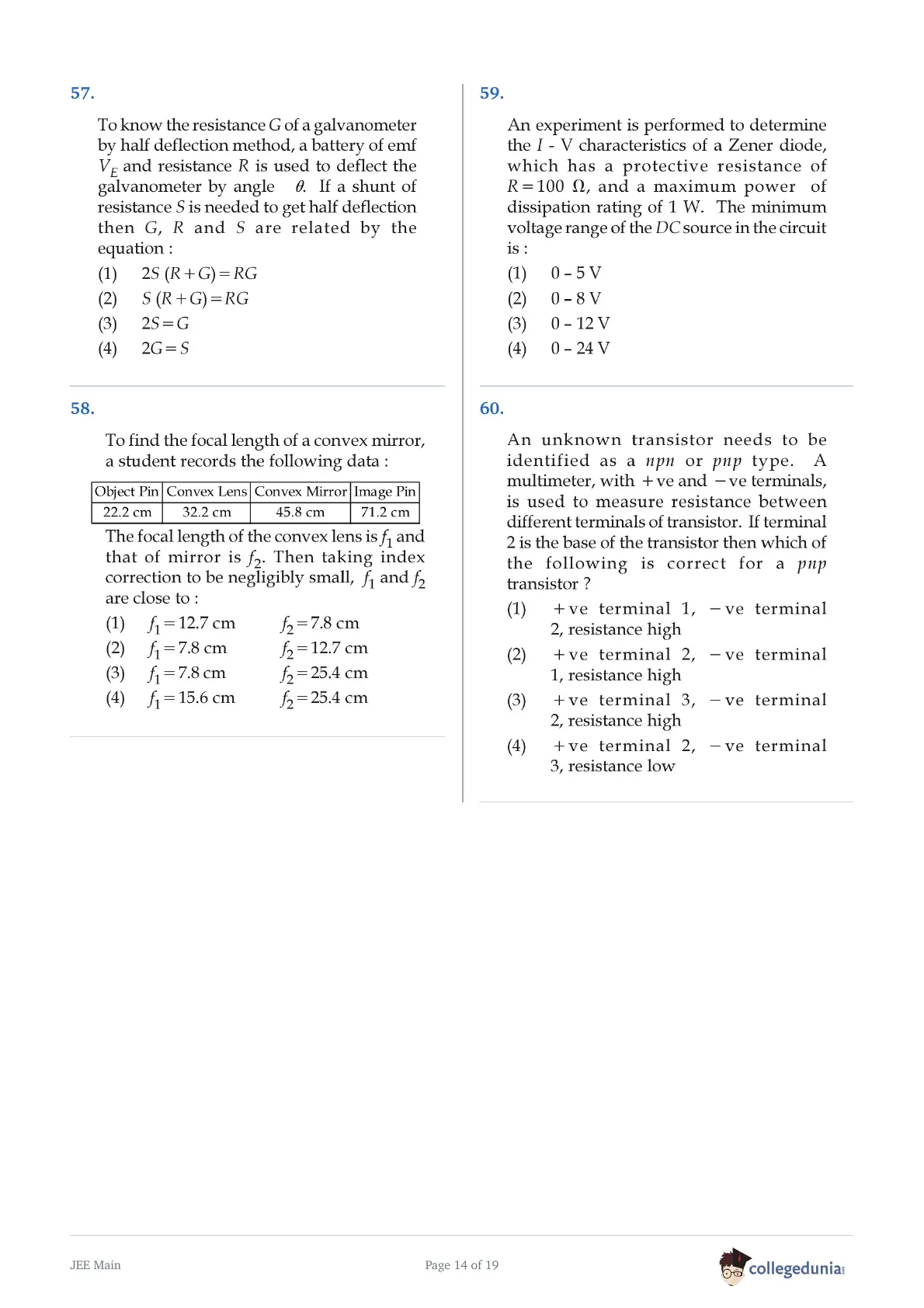
To know the resistance \(G\) of a galvanometer by half deflection method, a battery of emf \(V_E\) and resistance \(R\) is used to deflect the galvanometer by angle \(\theta\). If a shunt of resistance \(S\) is needed to get half deflection then \(G, R\) and \(S\) are related by the equation :
| Object Pin | Convex Lens | Convex Mirror | Image Pin |
| 22.2 cm | 32.2 cm | 45.8 cm | 71.2 cm |
An experiment is performed to determine the \(I\) - V characteristics of a Zener diode, which has a protective resistance of \(R = 100\ \Omega\), and a maximum power of dissipation rating of 1 W. The minimum voltage range of the \(DC\) source in the circuit is :
An unknown transistor needs to be identified as a \(npn\) or \(pnp\) type. A multimeter, with +ve and -ve terminals, is used to measure resistance between different terminals of transistor. If terminal 2 is the base of the transistor then which of the following is correct for a \(pnp\) transistor ?
Chemistry (Q61 - Q90)
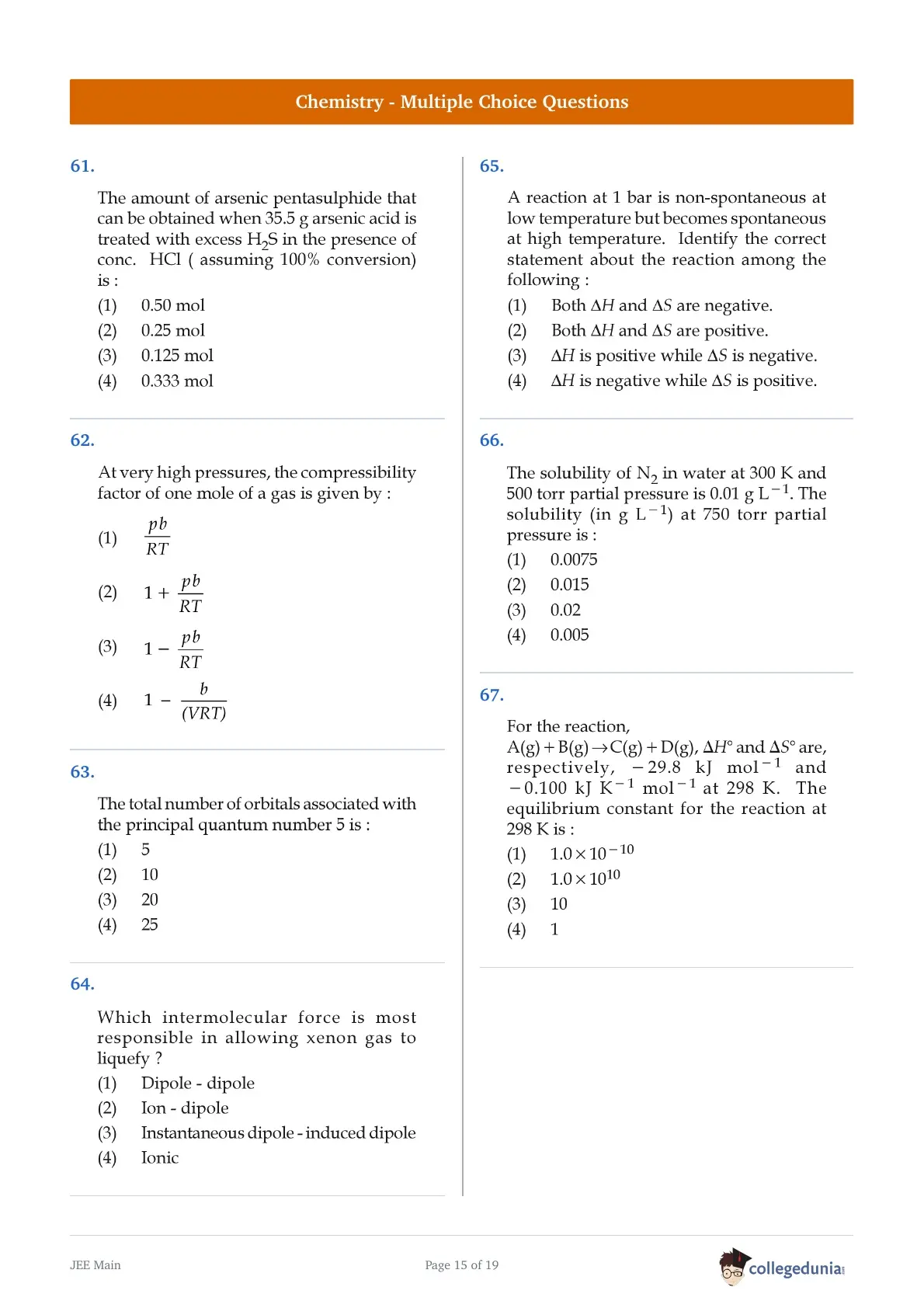
The amount of arsenic pentasulphide that can be obtained when 35.5 g arsenic acid is treated with excess \({H_2S}\) in the presence of conc. HCl ( assuming 100% conversion) is :
At very high pressures, the compressibility factor of one mole of a gas is given by :
The total number of orbitals associated with the principal quantum number 5 is :
Which intermolecular force is most responsible in allowing xenon gas to liquefy ?
A reaction at 1 bar is non-spontaneous at low temperature but becomes spontaneous at high temperature. Identify the correct statement about the reaction among the following :
The solubility of \(N_2\) in water at 300 K and 500 torr partial pressure is 0.01 g \(L^{-1}\). The solubility (in g \(L^{-1}\)) at 750 torr partial pressure is :
For the reaction, A(g) + B(g) \(\rightarrow\) C(g) + D(g), \(\Delta H^\circ\) and \(\Delta S^\circ\) are, respectively, \(-29.8\ \mathrm{kJ\ mol^{-1}}\) and \(-0.100\ \mathrm{kJ\ K^{-1}\ mol^{-1}}\) at 298 K. The equilibrium constant for the reaction at 298 K is :
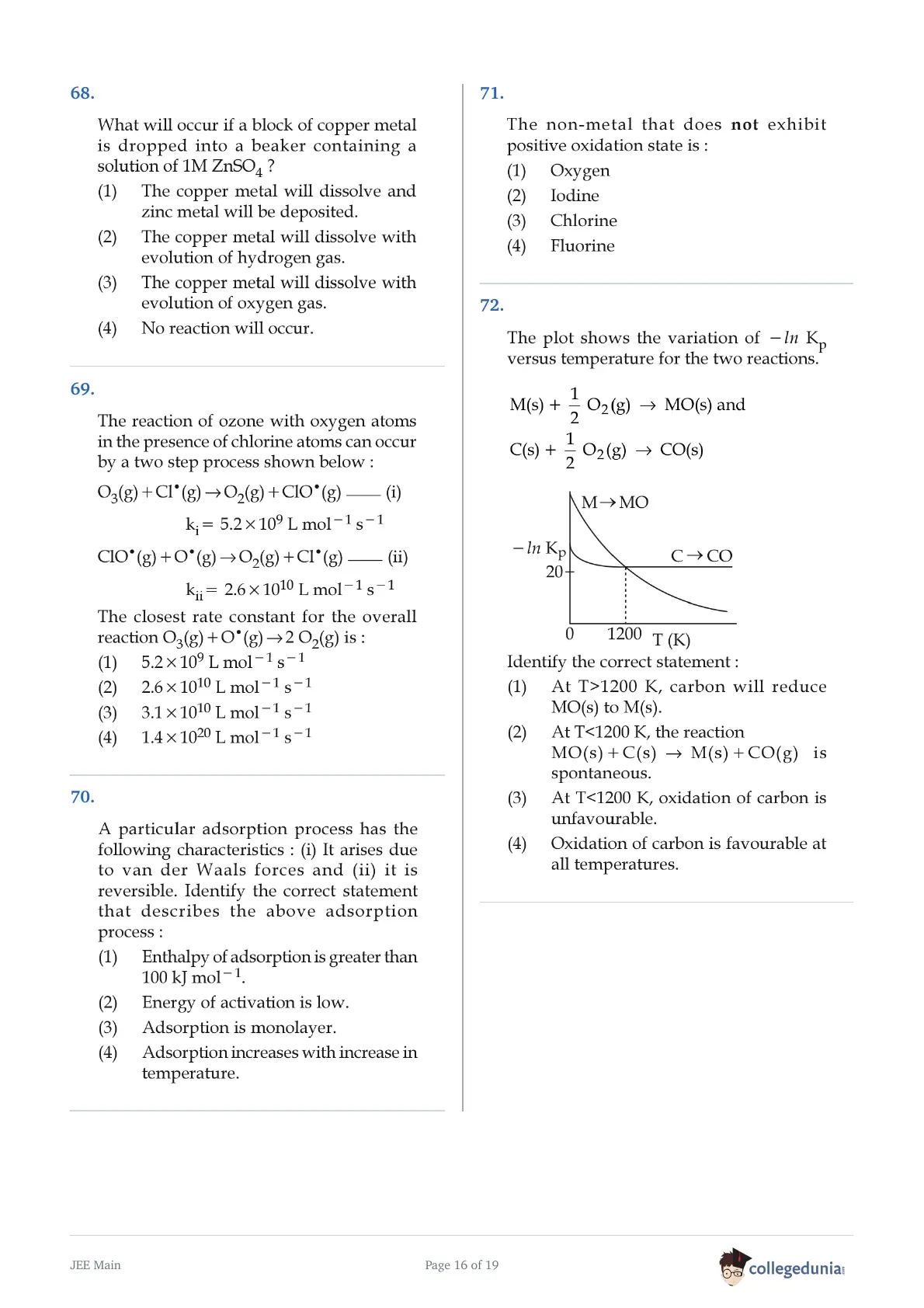
What will occur if a block of copper metal is dropped into a beaker containing a solution of 1M \(\mathrm{ZnSO_4}\) ?
The reaction of ozone with oxygen atoms in the presence of chlorine atoms can occur by a two step process shown below :
\(\mathrm{O_3(g)+Cl^{\bullet}(g)\rightarrow O_2(g)+ClO^{\bullet}(g)}\) ____ (i)
\(k_i=5.2\times10^{9}\ \mathrm{L\ mol^{-1}\ s^{-1}}\)
\(\mathrm{ClO^{\bullet}(g)+O^{\bullet}(g)\rightarrow O_2(g)+Cl^{\bullet}(g)}\) ____ (ii)
\(k_{ii}=2.6\times10^{10}\ \mathrm{L\ mol^{-1}\ s^{-1}}\)
The closest rate constant for the overall reaction \(\mathrm{O_3(g)+O^{\bullet}(g)\rightarrow 2\,O_2(g)}\) is :
A particular adsorption process has the following characteristics : (i) It arises due to van der Waals forces and (ii) it is reversible. Identify the correct statement that describes the above adsorption process :
The non-metal that does not exhibit positive oxidation state is :
The plot shows the variation of \(-\ln K_p\) versus temperature for the two reactions \(\mathrm{M(s)}+\frac{1}{2}\mathrm{O_2(g)}\rightarrow\mathrm{MO(s)}\) and \(\mathrm{C(s)}+\frac{1}{2}\mathrm{O_2(g)}\rightarrow\mathrm{CO(s)}\).
Identify the correct statement :
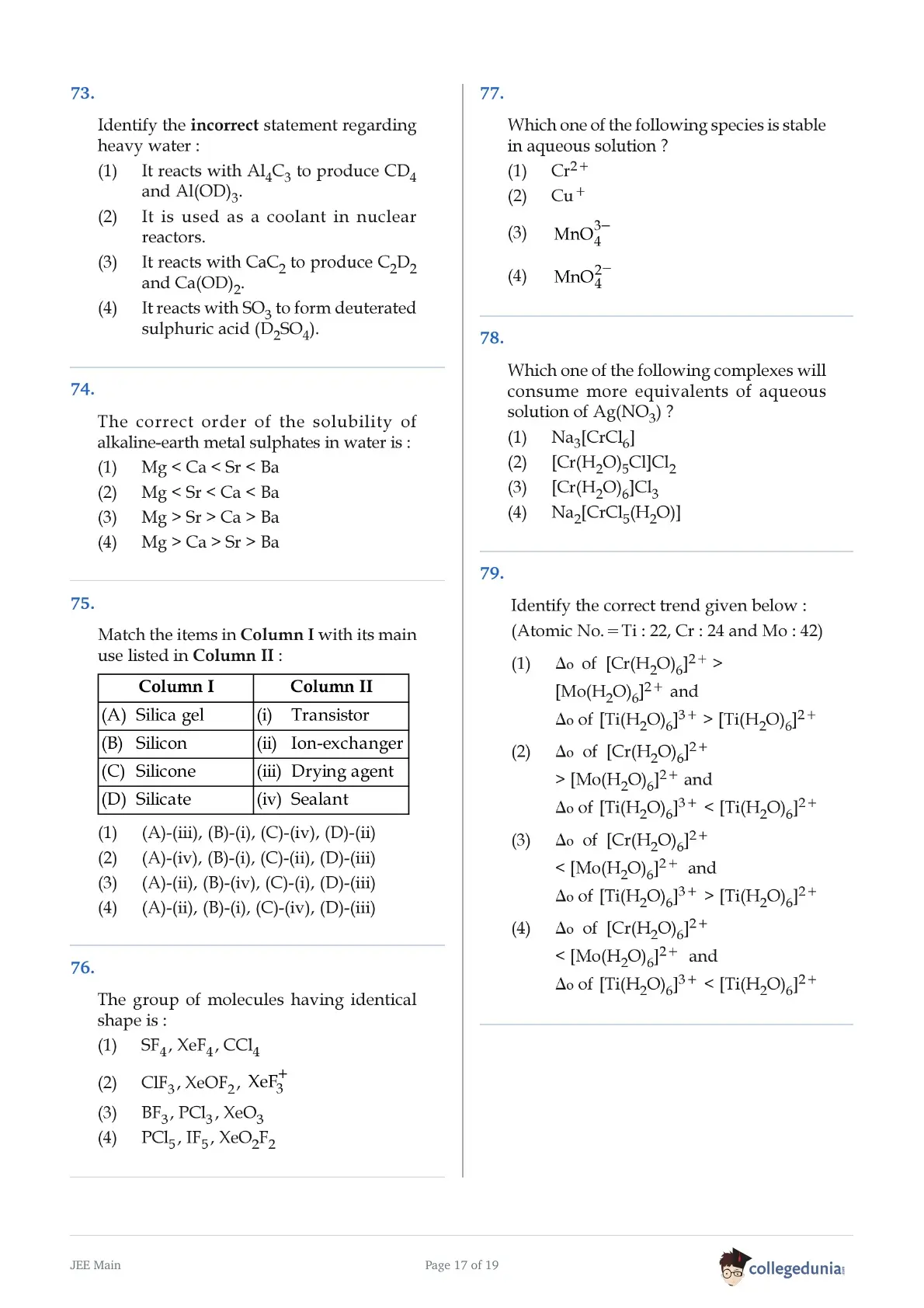
Identify the incorrect statement regarding heavy water :
The correct order of the solubility of alkaline-earth metal sulphates in water is :
| Column I | Column II |
| (A) Silica gel | (i) Transistor |
| (B) Silicon | (ii) Ion-exchanger |
| (C) Silicone | (iii) Drying agent |
| (D) Silicate | (iv) Sealant |
The group of molecules having identical shape is :
Which one of the following species is stable in aqueous solution ?
Which one of the following complexes will consume more equivalents of aqueous solution of \(\mathrm{Ag(NO_3)}\) ?
Identify the correct trend given below :
(Atomic No. = Ti : 22, Cr : 24 and Mo : 42)
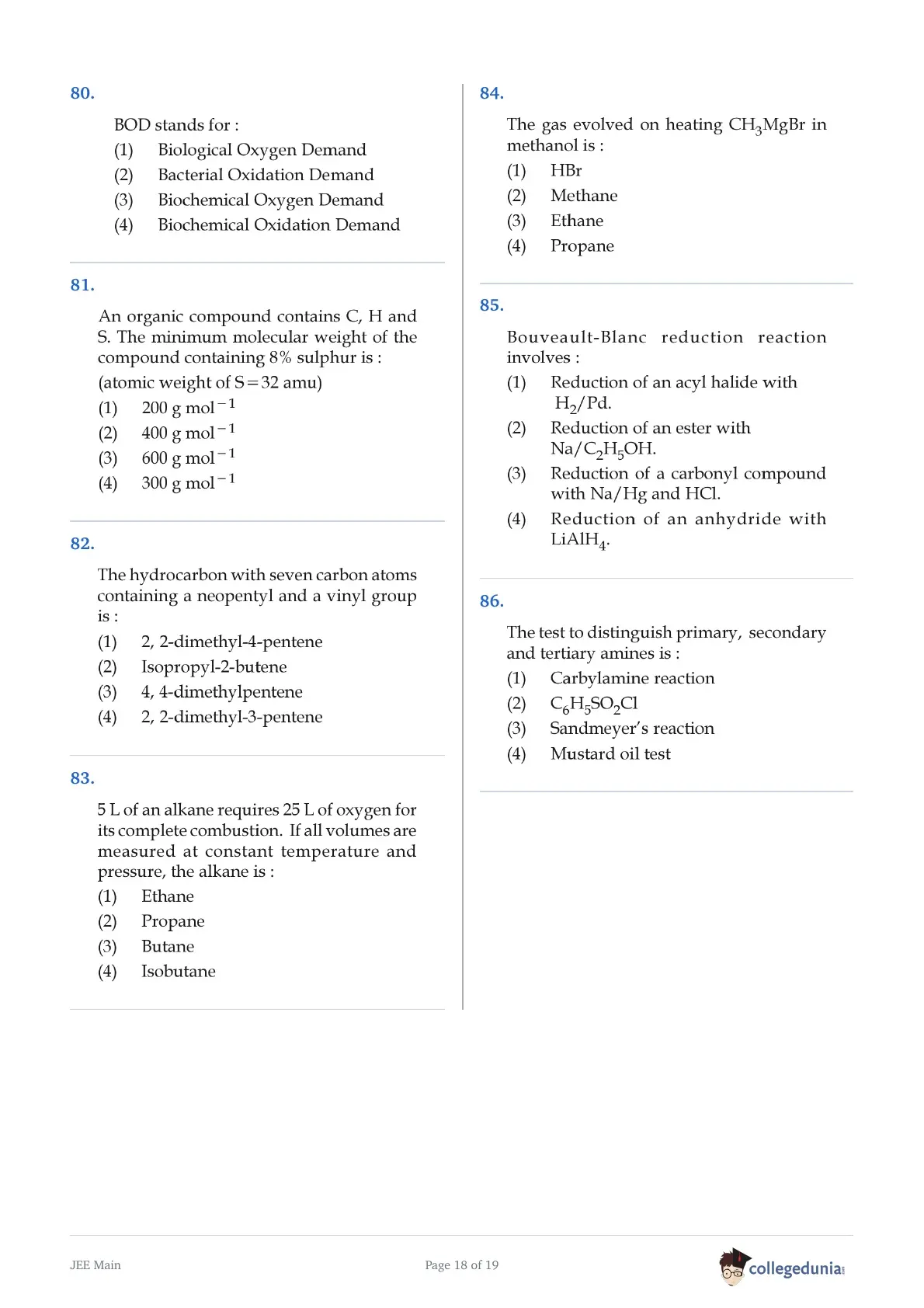
BOD stands for :
An organic compound contains C, H and S. The minimum molecular weight of the compound containing 8% sulphur is : (atomic weight of S=32 amu)
The hydrocarbon with seven carbon atoms containing a neopentyl and a vinyl group is :
5 L of an alkane requires 25 L of oxygen for its complete combustion. If all volumes are measured at constant temperature and pressure, the alkane is :
The gas evolved on heating \(\mathrm{CH_3MgBr}\) in methanol is :
Bouveault-Blanc reduction reaction involves :
The test to distinguish primary, secondary and tertiary amines is :
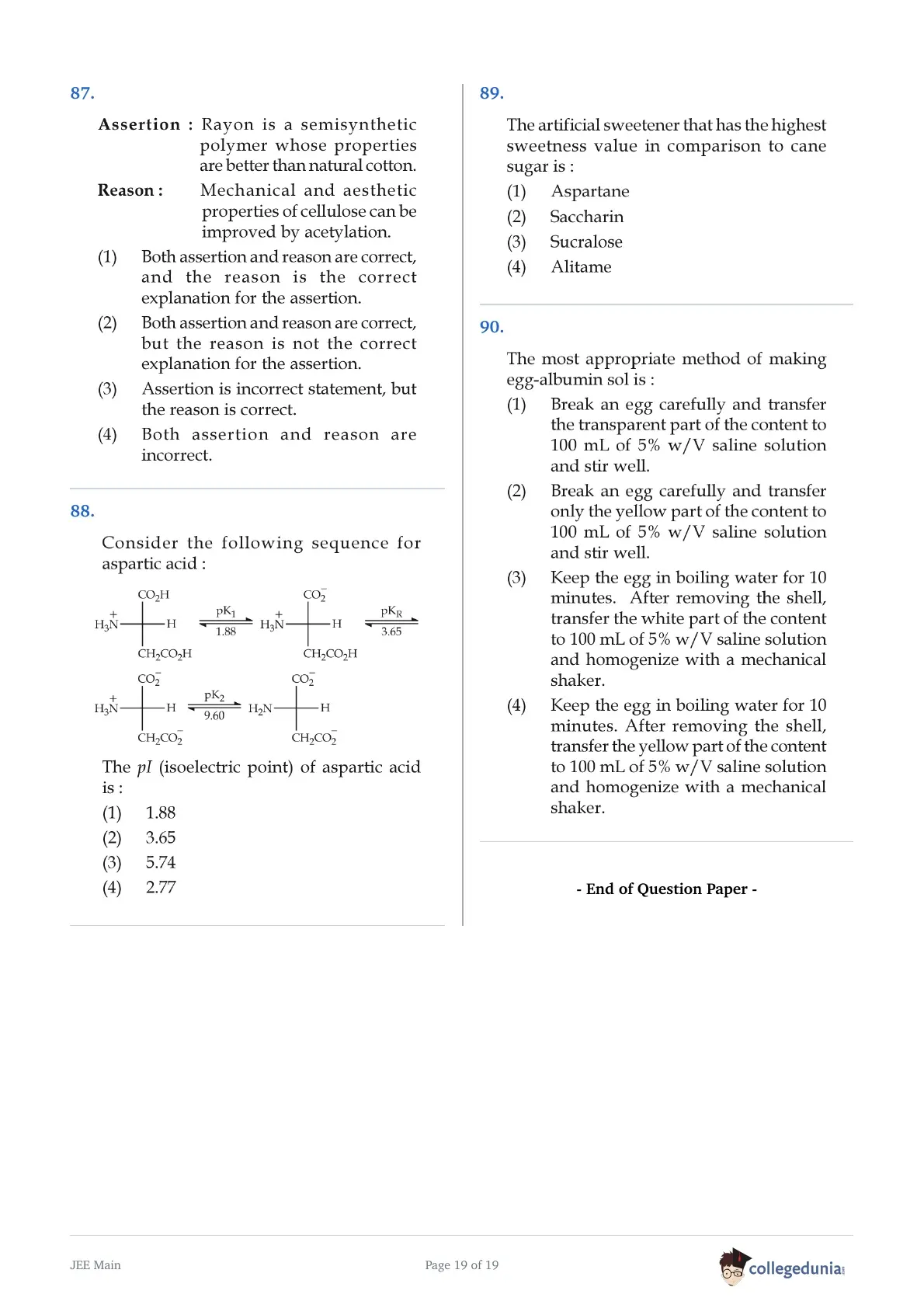
Rayon is a semisynthetic polymer whose properties are better than natural cotton. Mechanical and aesthetic properties of cellulose can be improved by acetylation.
Consider the following sequence for aspartic acid : The pI (isoelectric point) of aspartic acid is :
The artificial sweetener that has the highest sweetness value in comparison to cane sugar is :
The most appropriate method of making egg-albumin sol is :
JEE Main 2016 Exam Pattern and Marking Scheme
| Particulars | Details |
|---|---|
| Exam Mode | Online (Computer-Based Test) |
| Paper | B.E./B.Tech (Paper 1) |
| Duration | 3 hours (180 minutes) |
| Type of Questions | Multiple Choice Questions (MCQs) |
| Subjects | Mathematics, Physics, Chemistry |
| Total Questions | 90 questions |
| Total Marks | 360 marks |
| Marking Scheme | +4 for correct answer & -1 for incorrect answer; 0 for unattempted |
JEE Main 2016 April 9 Difficulty Level
Candidates rated JEE Main 2016 B.E./B.Tech Question Paper as moderate in terms of overall difficulty.
JEE Main B.E./B.Tech 2016 Paper Analysis
- Math was the toughest section with a total of 30 questions.
- Physics and Chemistry were easy as compared to the previous exam held.
For every correct answer, candidates got +4 marks and for each wrong attempt -1 mark was deducted.



Comments