




JEE Main 2018 April 16 Shift 1 Question Paper is available here with solutions PDF and detailed solutions for every question. CBSE conducted the computer-based test (CBT) first shift on April 16, 2018, from 9:30 AM to 12:30 PM. The JEE Main 2018 Paper 1 (B.E./B.Tech) question paper includes the following:
- 90 questions in a 3-hour CBT Mode: 30 each from Mathematics, Physics and Chemistry
- Question type: all multiple choice questions (MCQs) with a single correct option, 4 marks each
- Sections: Mathematics (30), Physics (30) and Chemistry (30), all questions compulsory
- Marking: +4 for a correct answer, -1 for an incorrect answer, 0 for an unattempted question
- Maximum marks: 360 (120 per subject)
JEE Main 2018 April 16 Shift 1 Question Paper with Solution PDF
| NTA Official PDF | CD PDF | CD PDF with Solutions |
|---|---|---|
| Download official PDF 5.12 MB | Download Collegedunia PDF 1.11 MB | Download solutions PDF 1.31 MB |
Also Check:
JEE Main 2018 April 16 Shift 1 Questions with Solutions
Mathematics (Q1 - Q30)
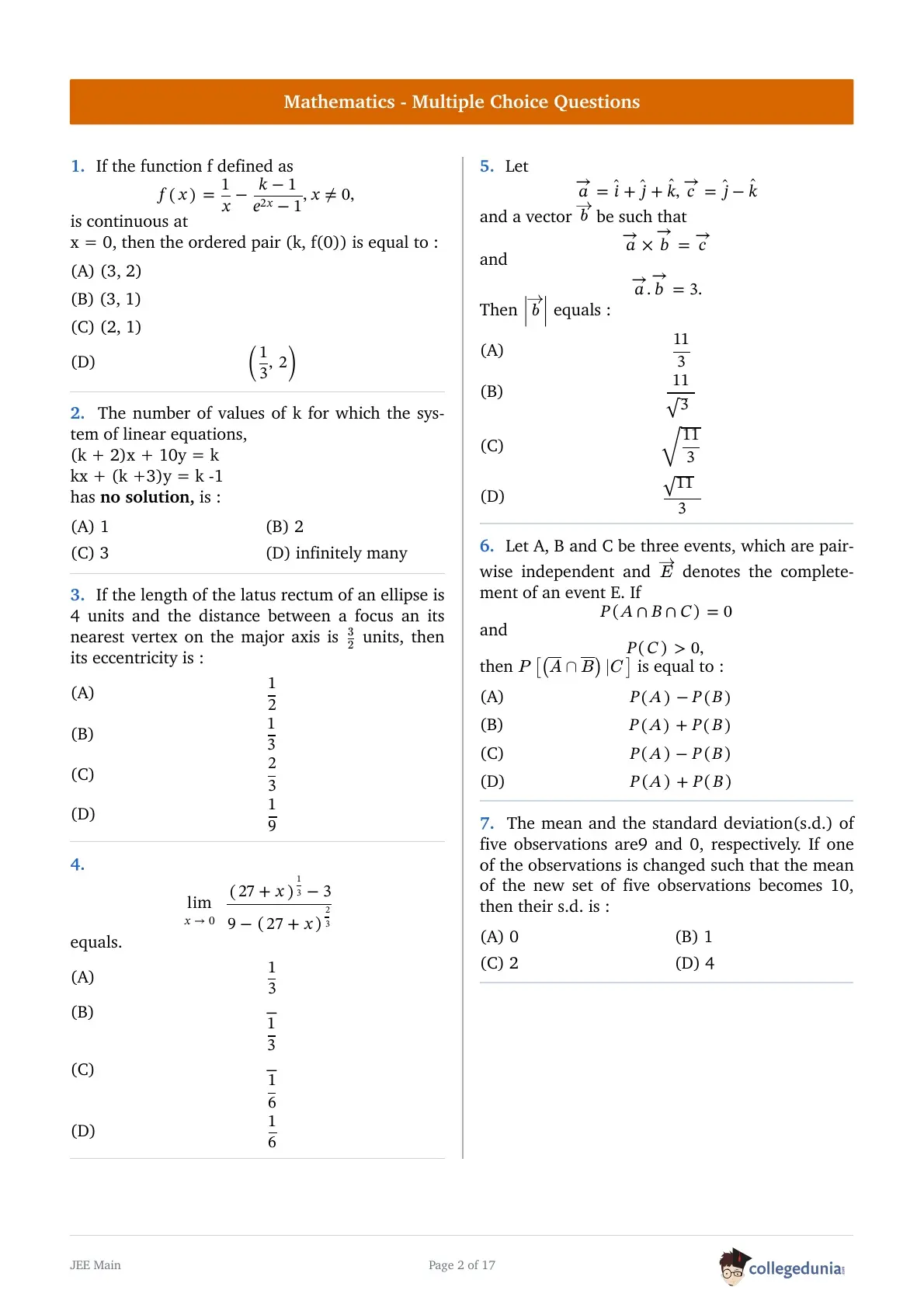
If the function f defined as
\(f(x) = \frac{1}{x} - \frac{k-1}{e^{2x}-1},\ x \neq 0,\)
is continuous at x = 0, then the ordered pair (k, f(0)) is equal to :
The number of values of k for which the system of linear equations,
\((k+2)x + 10y = k\)
\(kx + (k+3)y = k-1\)
has no solution, is :
If the length of the latus rectum of an ellipse is \(4\) units and the distance between a focus and its nearest vertex on the major axis is \(\frac{3}{2}\) units, then its eccentricity is :
\(\lim_{x \to 0} \frac{(27+x)^{\frac{1}{3}} - 3}{9 - (27+x)^{\frac{2}{3}}}\) equals.
Let \(\vec{a} = \hat{i} + \hat{j} + \hat{k},\ \vec{c} = \hat{j} - \hat{k}\) and a vector \(\vec{b}\) be such that \(\vec{a} \times \vec{b} = \vec{c}\) and \(\vec{a} \cdot \vec{b} = 3\). Then \(|\vec{b}|\) equals :
Let A, B and C be three events, which are pair-wise independent and \(\overline{E}\) denotes the completement of an event E. If \(P(A \cap B \cap C) = 0\) and \(P(C) \gt 0\), then \(P\left[(\overline{A} \cap \overline{B}) \mid C\right]\) is equal to :
The mean and the standard deviation(s.d.) of five observations are 9 and 0, respectively. If one of the observations is changed such that the mean of the new set of five observations becomes 10, then their s.d. is :
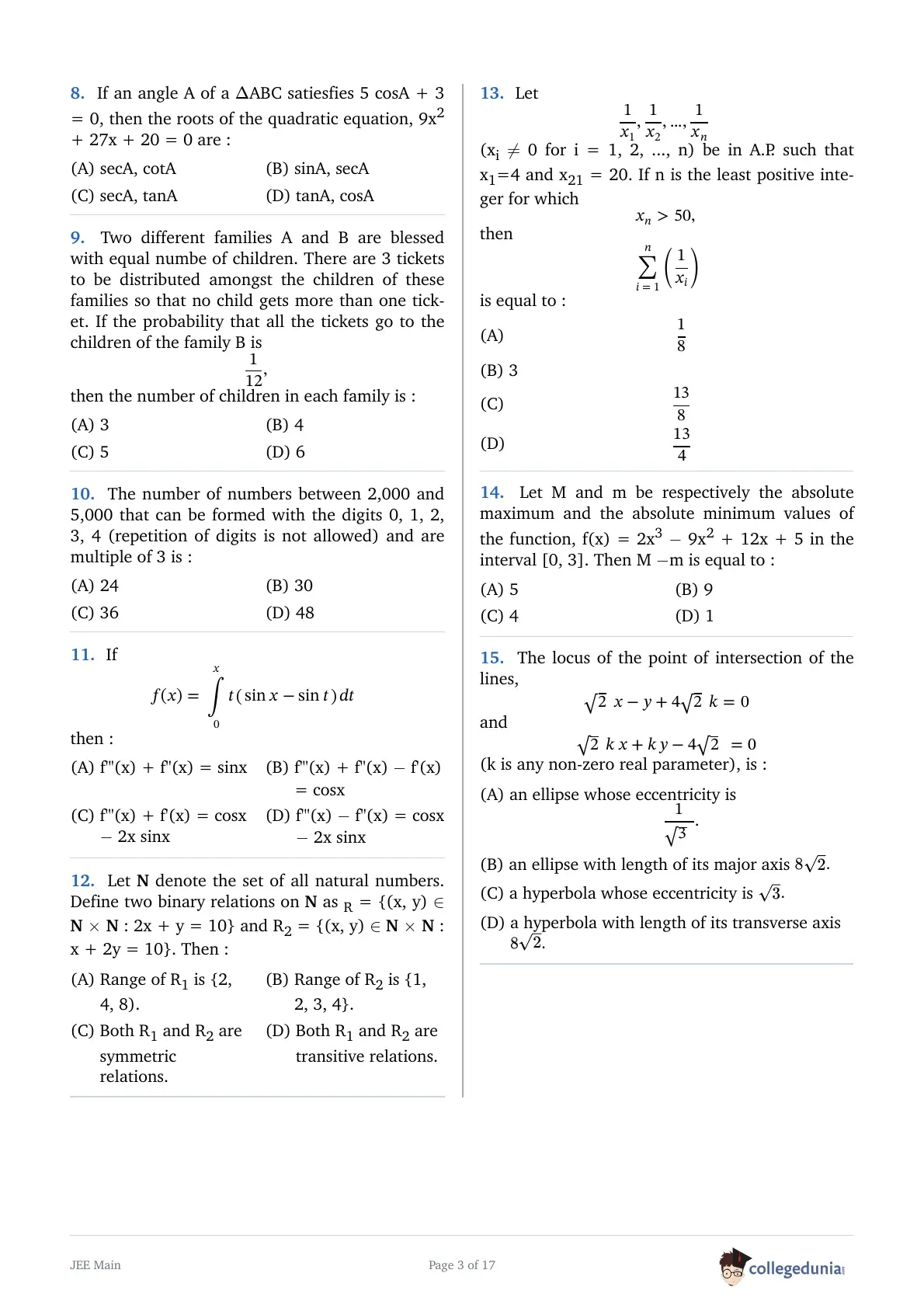
If an angle A of a \(\Delta\)ABC satiesfies 5 cosA + 3 = 0, then the roots of the quadratic equation, \(9x^2 + 27x + 20 = 0\) are :
Two different families A and B are blessed with equal numbe of children. There are 3 tickets to be distributed amongst the children of these families so that no child gets more than one ticket. If the probability that all the tickets go to the children of the family B is \(\frac{1}{12}\), then the number of children in each family is :
The number of numbers between \(2,000\) and \(5,000\) that can be formed with the digits \(0, 1, 2, 3, 4\) (repetition of digits is not allowed) and are multiple of \(3\) is :
If f(x) = ∫x0 t(sin x-sin t)dt then
Let N denote the set of all natural numbers. Define two binary relations on N as \(R_1 = \{(x, y) \epsilon N \times N : 2x + y = 10 \}\) and \(R_2 = \{(x, y) \epsilon N \times N : x + 2y = 10 \}\). Then :
Let \(\frac{1}{x_1} , \frac{1}{x^2} ,...., \frac{1}{x_n} (x_1 \neq 0\) for \(i = 1 , 2 , ... , n)\) be in A.P. such that \(x_1 = 4\) and \(x_{21} = 20\). If n is the least positive integer for which \(x_n > 50\), then \(\displaystyle\sum^n_{i = 1} \left( \frac{1}{x_i}\right)\) is equal to
The sum of absolute maximum and absolute minimum values of the function
\(f(x) = |2x^2 + 3x - 2| + \sin x \cos x\)
in the interval [0, 1] is :
The locus of the point of intersection of the lines, \(\sqrt{2} x-y + 4 \sqrt{2} \, k=0\) and \(\sqrt{2} k x+k \, y-4 \sqrt{2} = 0\) (k is any non-zero real parameter), is :
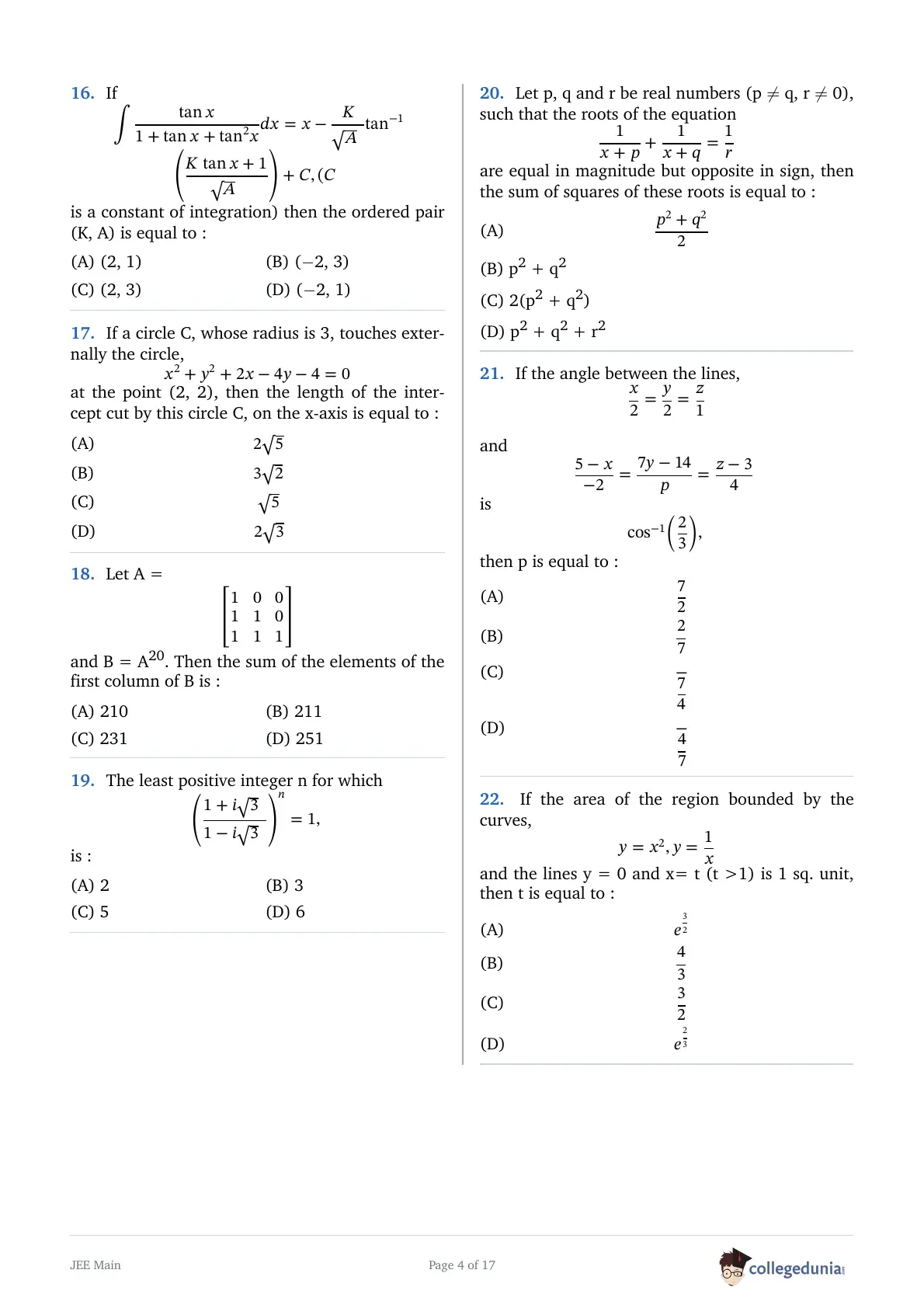
If \(\int \frac{\tan x}{1 + \tan x + \tan^2 x}\,dx = x - \frac{K}{\sqrt{A}}\tan^{-1}\left(\frac{K\tan x + 1}{\sqrt{A}}\right) + C\), (C is a constant of integration) then the ordered pair (K, A) is equal to :
If a circle C, whose radius is 3, touches externally the circle, \(x^2 + y^2 + 2x - 4y - 4 = 0\) at the point (2, 2), then the length of the intercept cut by this circle C, on the x-axis is equal to :
Let \(A = \begin{bmatrix} 1 & 0 & 0 \\ 1 & 1 & 0 \\ 1 & 1 & 1 \end{bmatrix}\) and \(B = A^{20}\). Then the sum of the elements of the first column of B is :
The least positive integer n for which \(\left( \frac{1 + i \sqrt{3}}{1 - i \sqrt{3}} \right)^n = 1 \), is :
Let p, q and r be real numbers (\(p \neq q,\ r \neq 0\)), such that the roots of the equation \(\frac{1}{x+p} + \frac{1}{x+q} = \frac{1}{r}\) are equal in magnitude but opposite in sign, then the sum of squares of these roots is equal to :
If the angle between the lines, \(\frac{x}{2} = \frac{y}{2} = \frac{z}{1}\) and \(\frac{5-x}{-2} = \frac{7y-14}{p} = \frac{z-3}{4}\) is \(\cos^{-1}\left(\frac{2}{3}\right)\), then p is equal to :
If the area of the region bounded by the curves, \(y = x^2,\ y = \frac{1}{x}\) and the lines y = 0 and x = t (t > 1) is 1 sq. unit, then t is equal to :
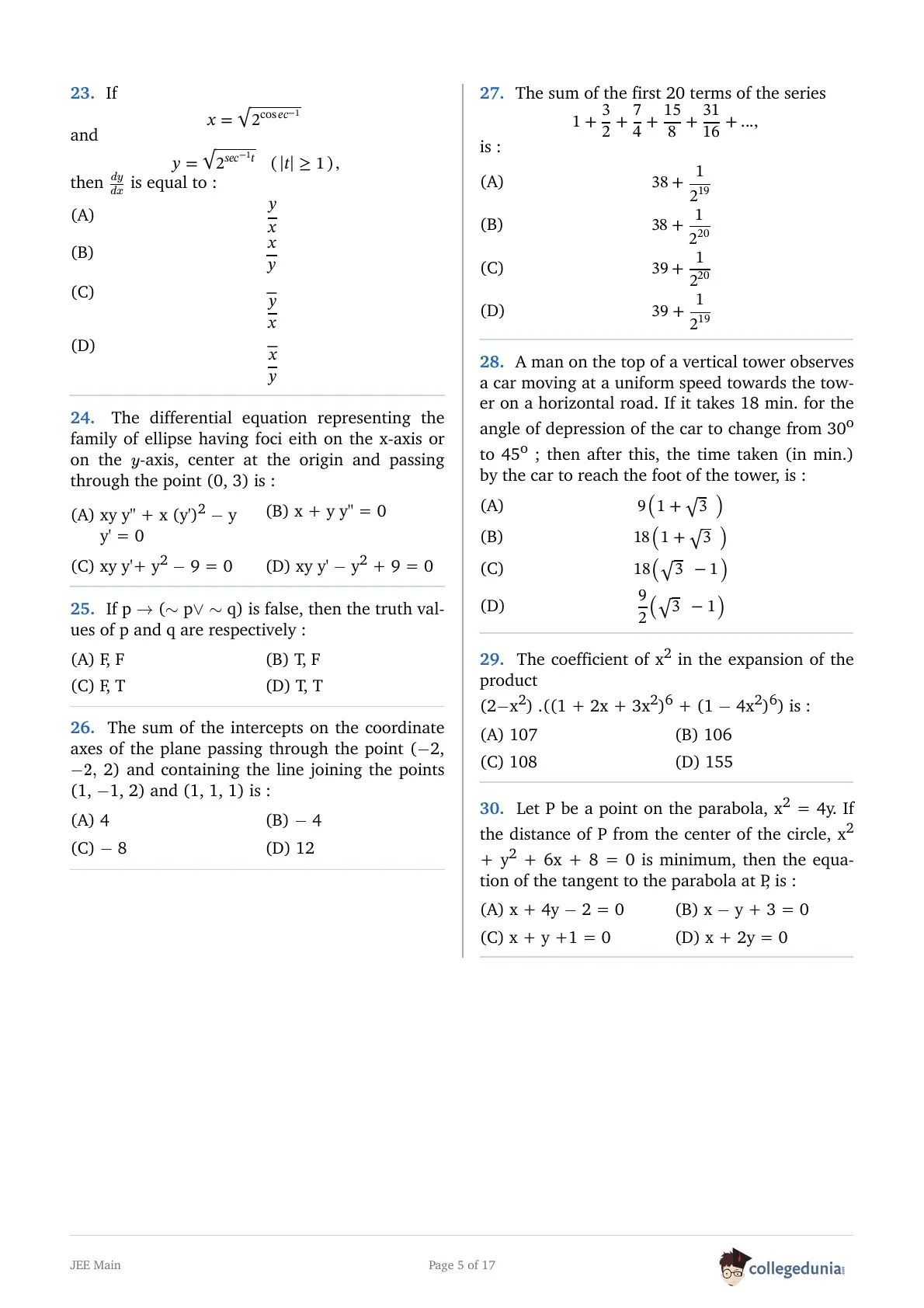
If \(x = \sqrt{2^{cosec^{-1} } t}\) and \(y = \sqrt{2^{\sec^{-1}} t} (|t | \geq 1)\), then \(\frac{dy}{dx}\) is equal to :
The differential equation representing the family of ellipses having foci either on the x-axis or on the y-axis, centre at the origin and passing through the point \((0, 3)\) is :
If \(p \rightarrow (p \wedge \sim q)\) is false, then the truth values of p and q are respectively :
The sum of the intercepts on the coordinate axes of the plane passing through the point \((-2,-2,2)\) and containing the line joining the points \((1,-1,2)\) and \((1,1,1)\) is :
The sum of the first 20 terms of the series
\(1+\frac{3}{2}+\frac{7}{4}+\frac{15}{8}+\frac{31}{16}+\ldots,\)
is :
A man on the top of a vertical tower observes a car moving at a uniform speed towards the tower on a horizontal road. If it takes 18 min. for the angle of depression of the car to change from \(30^{\circ}\) to \(45^{\circ}\) ; then after this, the time taken (in min.) by the car to reach the foot of the tower, is :
The coefficient of \(x^2\) in the expansion of the product
\((2-x^2)\cdot\left((1+2x+3x^2)^6+(1-4x^2)^6\right)\) is :
Let P be a point on the parabola, \(x^2=4y\). If the distance of P from the center of the circle, \(x^2+y^2+6x+8=0\) is minimum, then the equation of the tangent to the parabola at P, is :
Physics (Q31 - Q60)
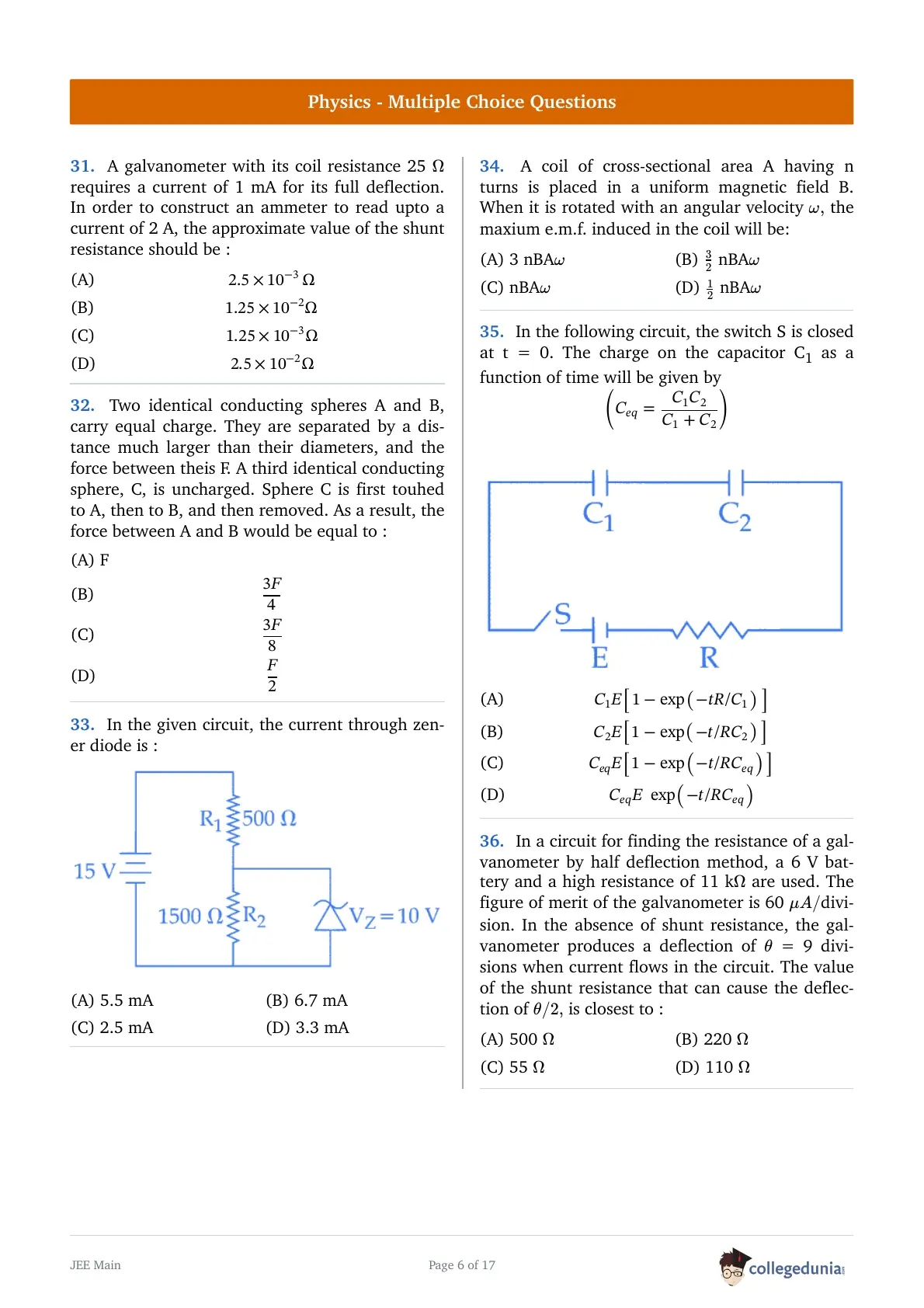
A galvanometer with its coil resistance \(25\,\Omega\) requires a current of 1 mA for its full deflection. In order to construct an ammeter to read upto a current of 2 A, the approximate value of the shunt resistance should be :
Two identical conducting spheres \(A\) and \(B\), carry equal charge. They are separated by a distance much larger than their diameters, and the force between them is \(F\). A third identical conducting sphere, \(C\), is uncharged. Sphere \(C\) is first touched to \(A\), then to \(B\), and then removed. As a result, the force between \(A\) and \(B\) would be equal to :
In the given circuit, the current through zener diode is :
A coil of cross-sectional area A having n turns is placed in a uniform magnetic field B. When it is rotated with an angular velocity \(\omega\), the maximum e.m.f. induced in the coil will be :
In the circuit shown, the switch \(S_1\) is closed at time \(t = 0\) and the switch \(S_2\) is kept open. At some later time \((t_0)\), the switch \(S_1\) is opened and \(S_2\) is closed. The behavious of the current \(I\) as a function of time \('t'\) is given by :
- (1)
![]()
- (2)
![]()
- (3)
![]()
- (4)
![]()


In a circuit for finding the resistance of a galvanometer by half deflection method, a \(6\, V\) battery and a high resistance of \(11 \, k\, \Omega\) are used. The figure of merit of the galvanometer is \(60 \, mu A\) division. In the absence of shunt resistance, the galvanometer produces a deflection of \(\theta = 9\) divisions when current flows in the circuit. The value of the shunt resistance that can cause the deflection of \(\theta / 2\), is closest to :
The de-Broglie wavelength (\(\lambda_B\)) associated with the electron orbiting in the second excited state of hydrogen atom is related to that in the ground state (\(\lambda_G\)) by :
Both the nucleus and the atom of some element are in their respective first excited states. They get de-excited by emitting photons of wavelengths \(\lambda_{N} ,\, \lambda_{A}\) respectively. The ratio \(\frac{\lambda_{N}}{\lambda_{A}}\) is closest to :
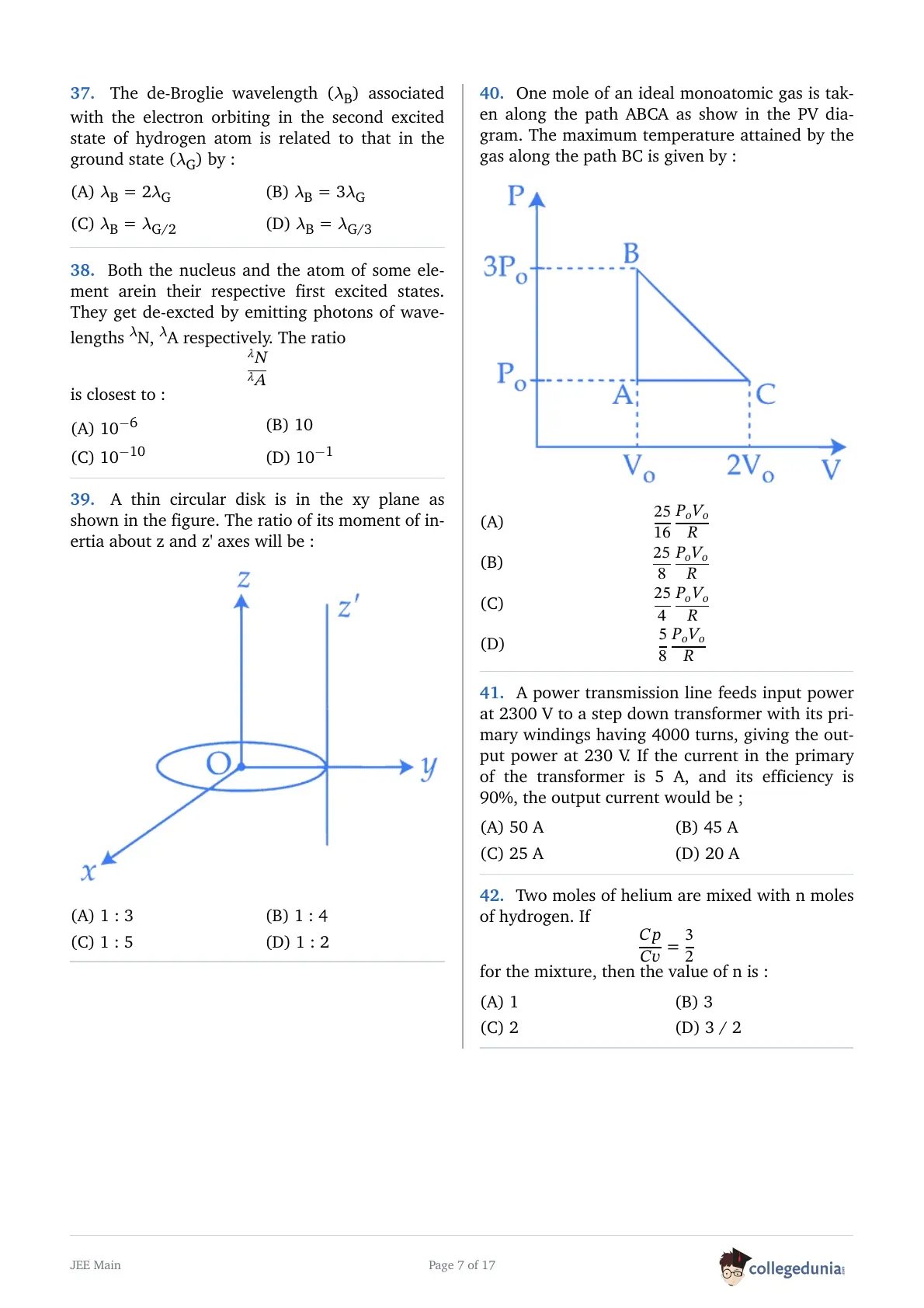
A thin circular disk is in the \(xy\) plane as shown in the figure. The ratio of its moment of inertia about \(z\) and \(z'\) axes will be :
One mole of an ideal monoatomic gas is taken along the path ABCA as show in the PV diagram. The maximum temperature attained by the gas along the path BC is given by :
A power transmission line feeds input power at \(2300\, V\) to a step down transformer with its primary windings having \(4000\) turns, giving the output power at \(230\, V\). If the current in the primary of the transformer is \(5\, A\), and its efficiency is \(90\%\), the output current would be :
Two moles of helium are mixed with \(n\) moles of hydrogen. If \(\frac{C_P}{C_V} = \frac{3}{2}\) for the mixture, then the value of n is :
The end correction of a resonance column is 1 cm. If the shortest length resonating with the tunning fork is 10 cm, the next resonating length should be :
A charge q is spread uniformly over an insulated loop of radius r. If it is rotated with an angular velocity \(\omega\) with resect to normal axis then the magnetic moment of the loop is :
A small soap bubble of radius 4 cm is trapped inside another bubble of radius 6 cm without any contact. Let \(P_2\) be the pressure inside the inner bubble and \(P_0\), the pressure outside the outer bubble. Radius of another bubble with pressure difference \(P_2-P_0\) between its inside and outside would be :
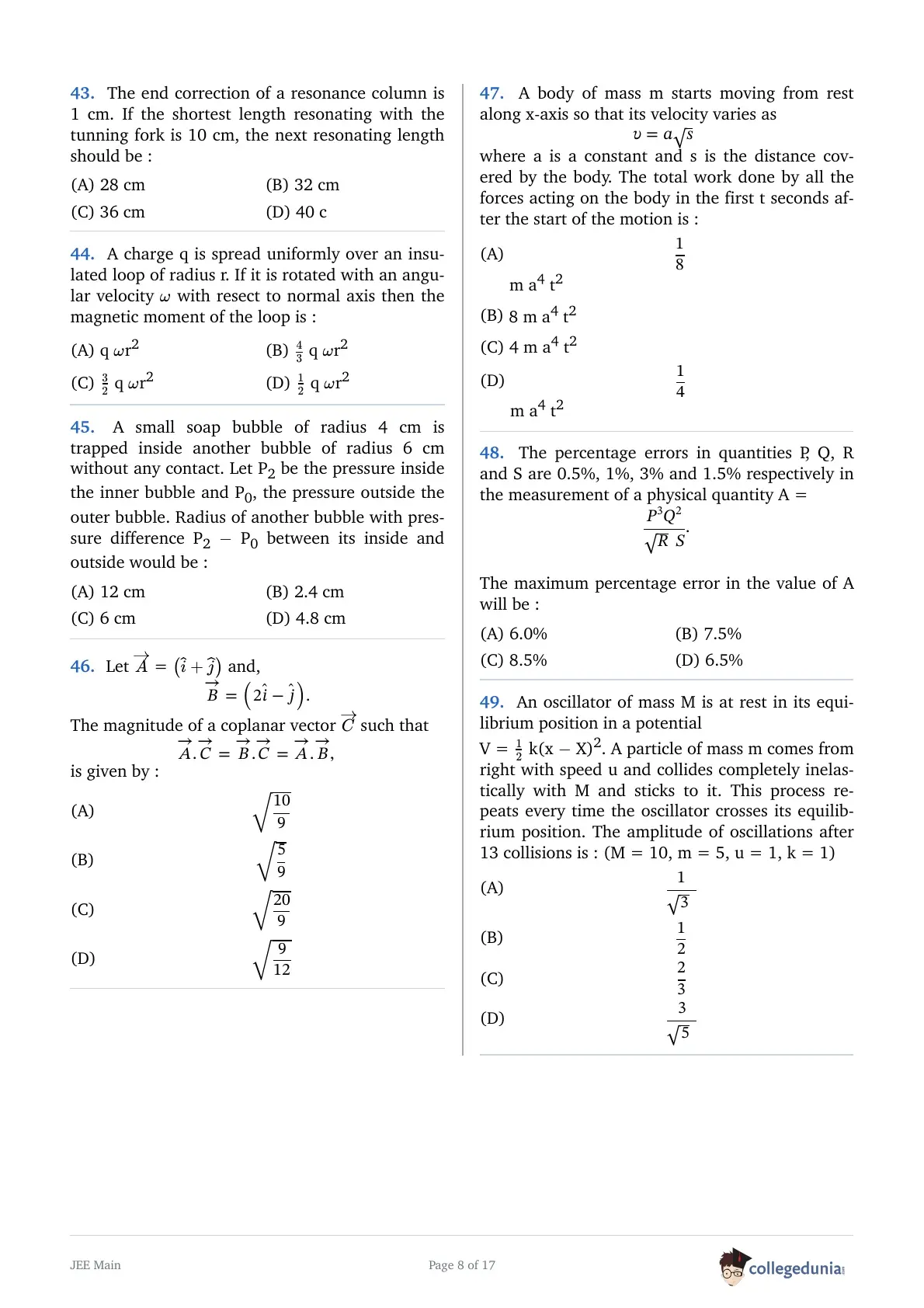
Let \(\vec{A}=(\hat{i}+\hat{j})\) and,
\(\vec{B}=(2\hat{i}-\hat{j})\).
The magnitude of a coplanar vector \(\vec{C}\) such that
\(\vec{A}\cdot\vec{C}=\vec{B}\cdot\vec{C}=\vec{A}\cdot\vec{B}\),
is given by :
A body of mass m starts moving from rest along x-axis so that its velocity varies as \(v = a \, \sqrt{s}\) where a is a constant and s is the distance covered by the body. The total work done by all the forces acting on the body in the first t seconds after the start of the motion is :
The percentage errors in quantities P, Q, R and S are 0.5%, 1%, 3% and 1.5% respectively in the measurement of a physical quantity \(A=\frac{P^3Q^2}{\sqrt{R}\,S}\).
The maximum percentage error in the value of A will be :
An oscillator of mass \(M\) is at rest in its equilibrium position in a potential \(V = \frac{1}{2} k(x - X)^2\). A particle of mass \(m\) comes from right with speed u and collides completely inelastically with \(M\) and sticks to it. This process repeats every time the oscillator crosses its equilibrium position. The amplitude of oscillations after \(13\) collisions is : \((M=10, m=5, u=1, k=1)\)
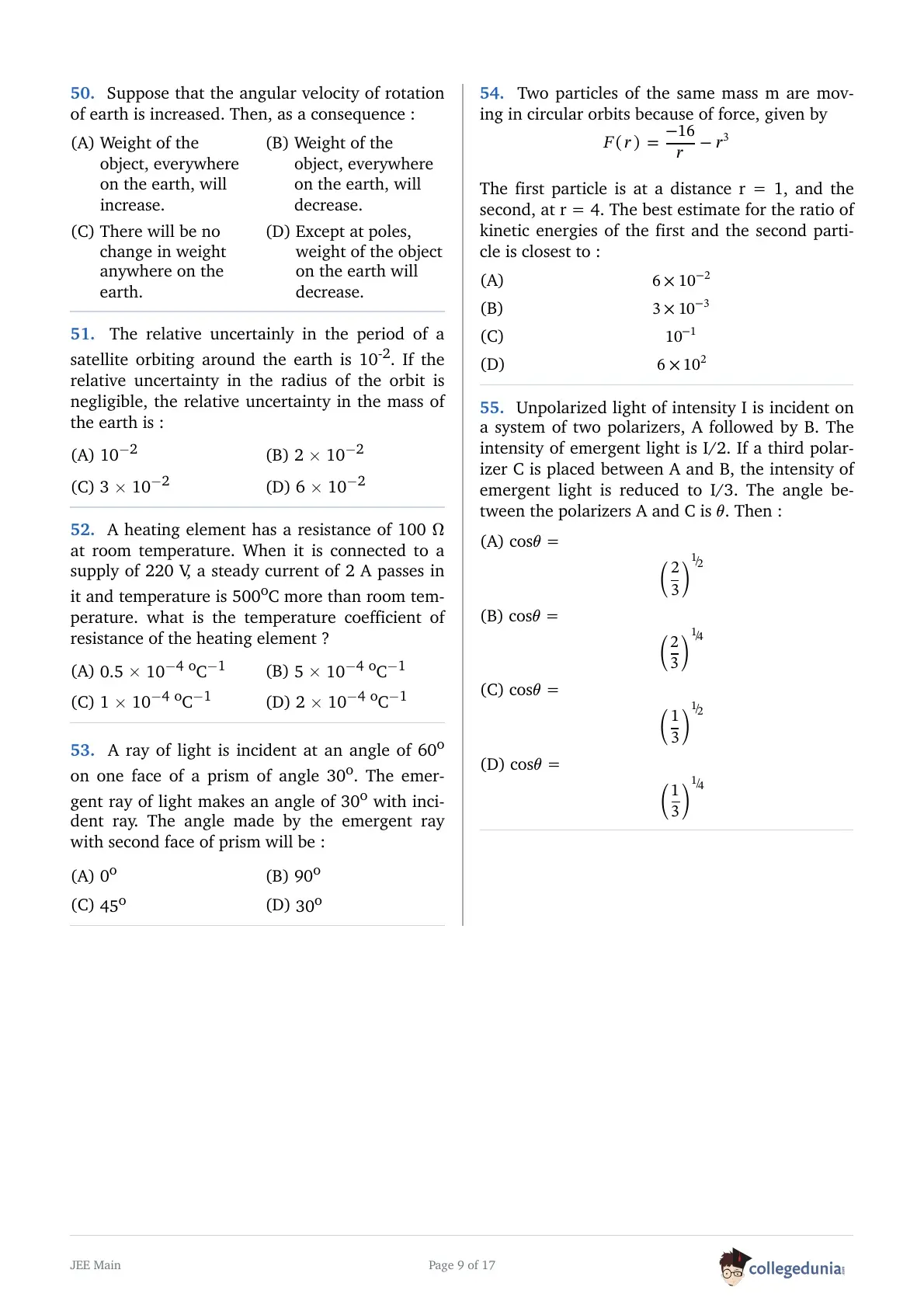
Suppose that the angular velocity of rotation of earth is increased. Then, as a consequence :
The relative uncertainty in the period of a satellite orbiting around the earth is \(10^{-2}\). If the relative uncertainty in the radius of the orbit is negligible, the relative uncertainty in the mass of the earth is :
A heating element has a resistance of \(100\ \Omega\) at room temperature. When it is connected to a supply of 220 V, a steady current of 2 A passes in it and temperature is \(500^\circ\mathrm{C}\) more than room temperature. What is the temperature coefficient of resistance of the heating element ?
A ray of light is incident at an angle of \(60^\circ\) on one face of a prism of angle \(30^\circ\). The emergent ray of light makes an angle of \(30^\circ\) with incident ray. The angle made by the emergent ray with second face of prism will be :
Two particles of the same masses moving initially with velocity \( 4 \hat{i} \) and \( 4 \hat{j} \) m/s respectively.
Acceleration of the first particle is \( 6 \hat{i} + 6 \hat{j} \) and of the second is zero. Find the path of the center of mass of the system.
Unpolarized light of intensity I is incident on a system of two polarizers, A followed by B. The intensity of emergent light is \(I/2\). If a third polarizer C is placed between A and B, the intensity of emergent light is reduced to \(I/3.\) The angle between the polarizers A and C is \(\theta\). Then :
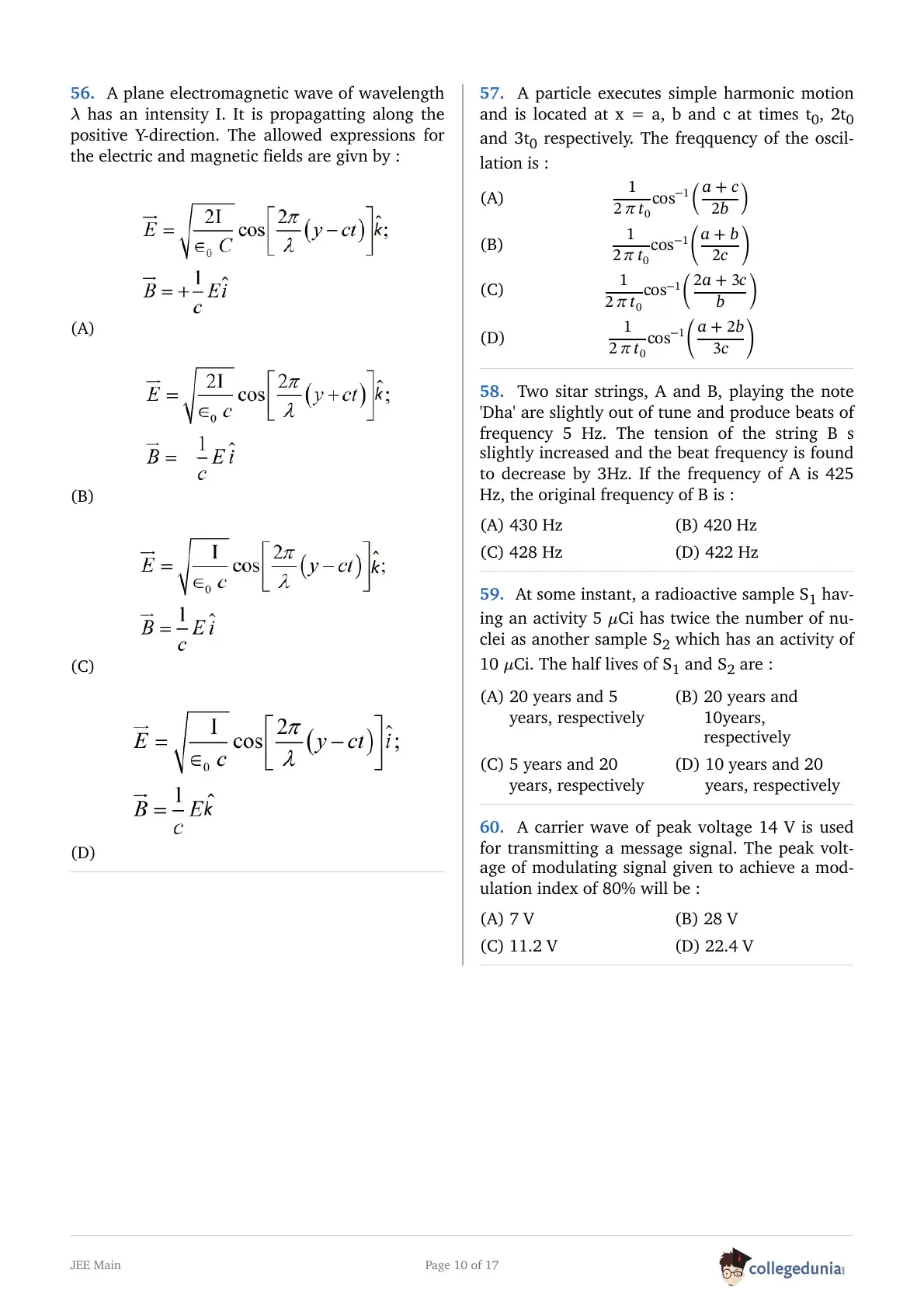
A plane electromagnetic wave of wavelength \(\lambda\) has an intensity I. It is propagating along the positive Y-direction. The allowed expressions for the electric and magnetic fields are given by :
A particle executes simple harmonic motion and is located at \(x = a,\ b\) and \(c\) at times \(t_0,\ 2t_0\) and \(3t_0\) respectively. The frequency of the oscillation is :
Two sitar strings, \(A\) and \(B\), playing the note ??ha??are slightly out of tune and produce beats of frequency \(5\, Hz\). The tension of the string \(B\) is slightly increased and the beat frequency is found to decrease by \(3\, Hz\). If the frequency of \(A\) is \(425\, Hz\), the original frequency of \(B\) is :
At some instant, a radioactive sample \(S_1\) having an activity \(5\ \mu\mathrm{Ci}\) has twice the number of nuclei as another sample \(S_2\) which has an activity of \(10\ \mu\mathrm{Ci}\). The half lives of \(S_1\) and \(S_2\) are :
A carrier wave of peak voltage \(14\, V\) is used for transmitting a message signal. The peak voltage of modulating signal given to achieve a modulation index of \(80\%\) will be:
Chemistry (Q61 - Q90)
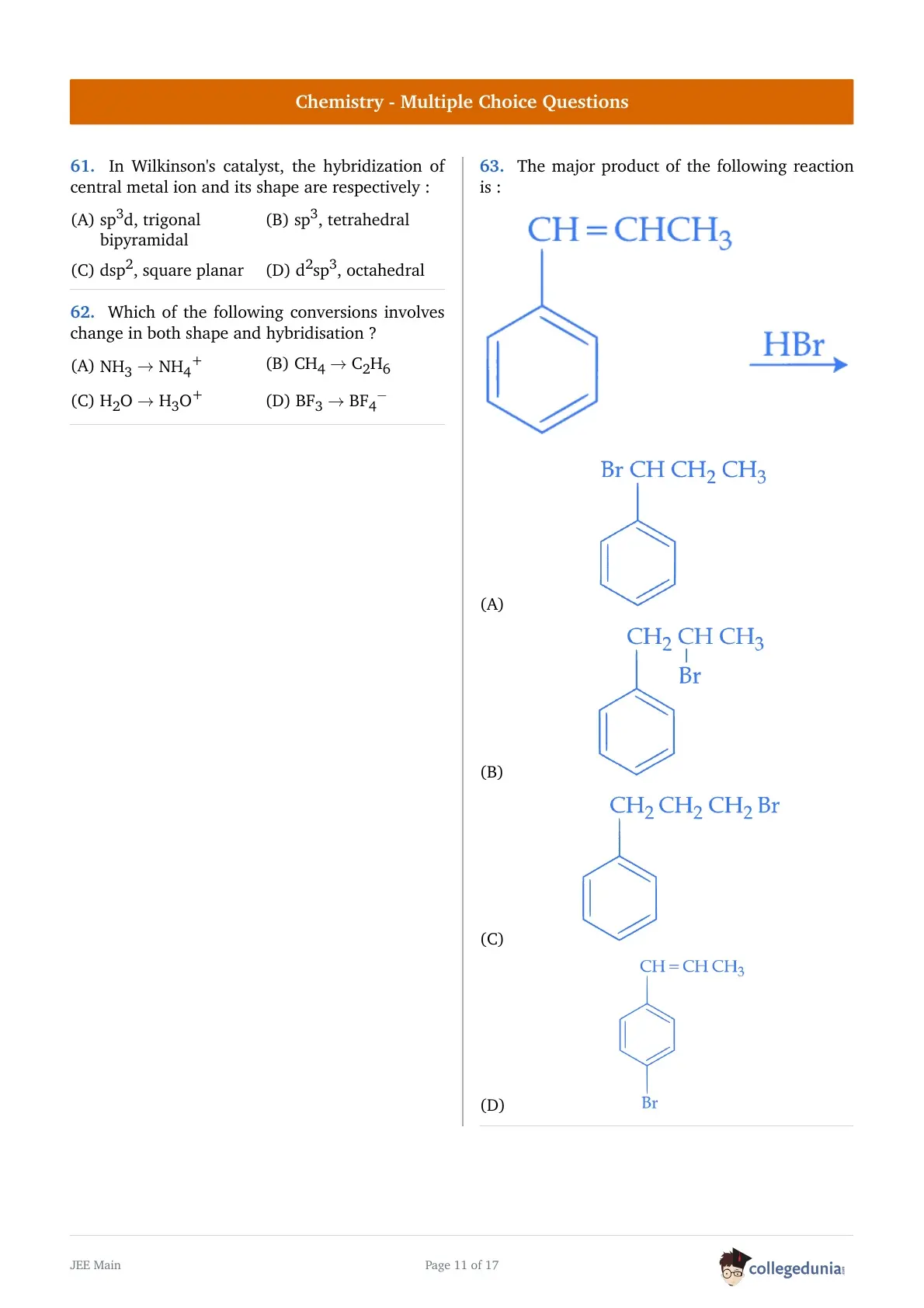
In Wilkinson?s catalyst, the hybridization of central metal ion and its shape are respectively :
Which of the following conversions involves change in both shape and hybridisation?


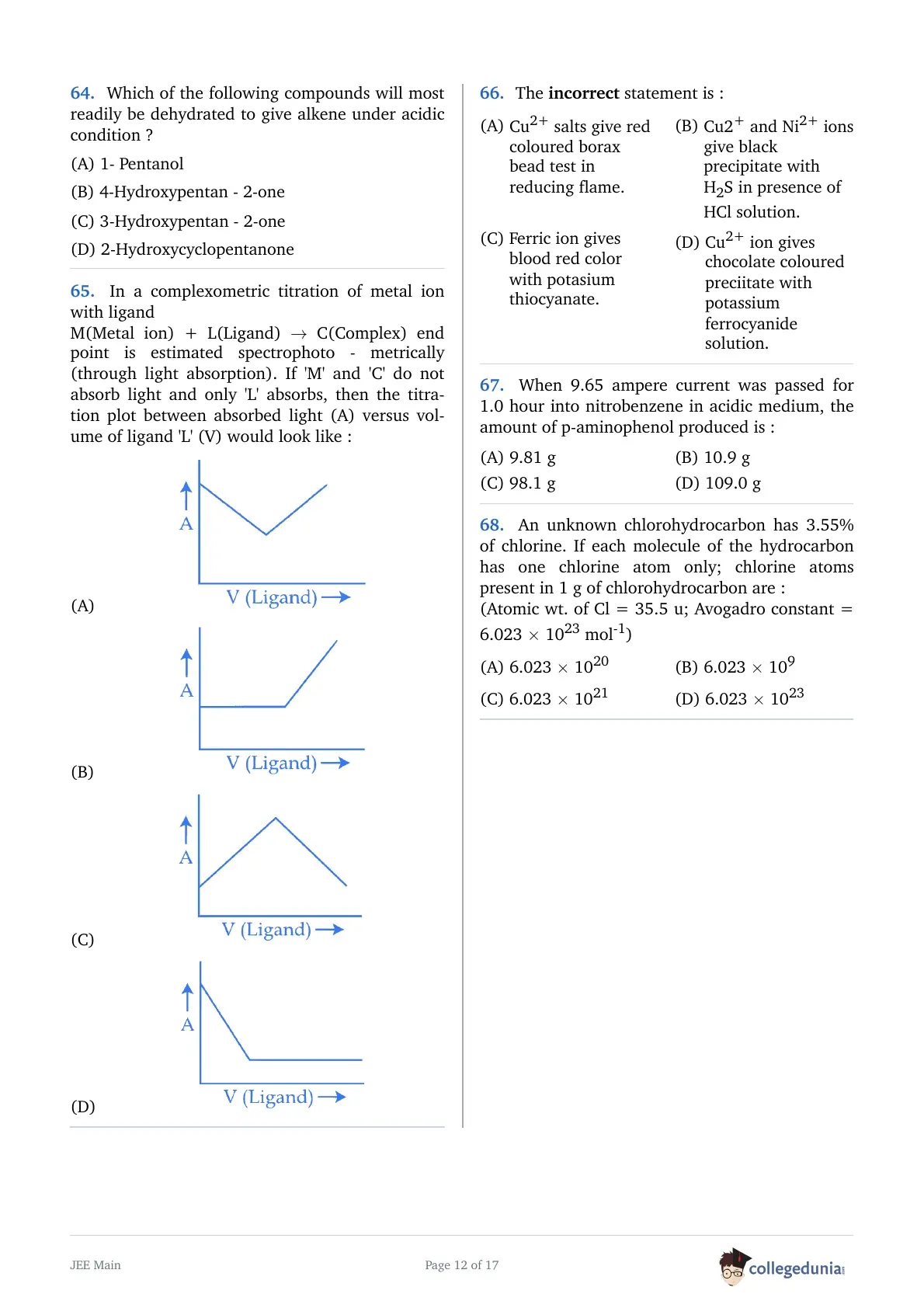
Which of the following compounds will most readily be dehydrated to give alkene under acidic condition ?
In a complexometric titration of metal ion with ligand \(M (\) Metal ion \()+ L (\) Ligand \() \rightarrow C (\) Complex \()\) end point is estimated spectrophotometrically (through light absorption). If 'M' and 'C' do not absorb light and only 'L' absorbs, then the titration plot between absorbed light ( \(A\) ) versus volume of ligand 'L' \((V)\) would look like
- (1)
![]()
- (2)
![]()
- (3)
![]()
- (4)
![]()


The incorrect statement is :
When \(9.65\,A\) current was passed for \(1.0\, hour\) into nitrobenzene in acidic medium, the amount of p-aminophenol produced is_____.
An unknown chlorohydrocarbon has 3.55% of chlorine. If each molecule of the hydrocarbon has one chlorine atom only; chlorine atoms present in 1 g of chlorohydrocarbon are :
(Atomic wt. of Cl = 35.5 u; Avogadro constant = \(6.023 \times 10^{23}\ \mathrm{mol^{-1}}\))
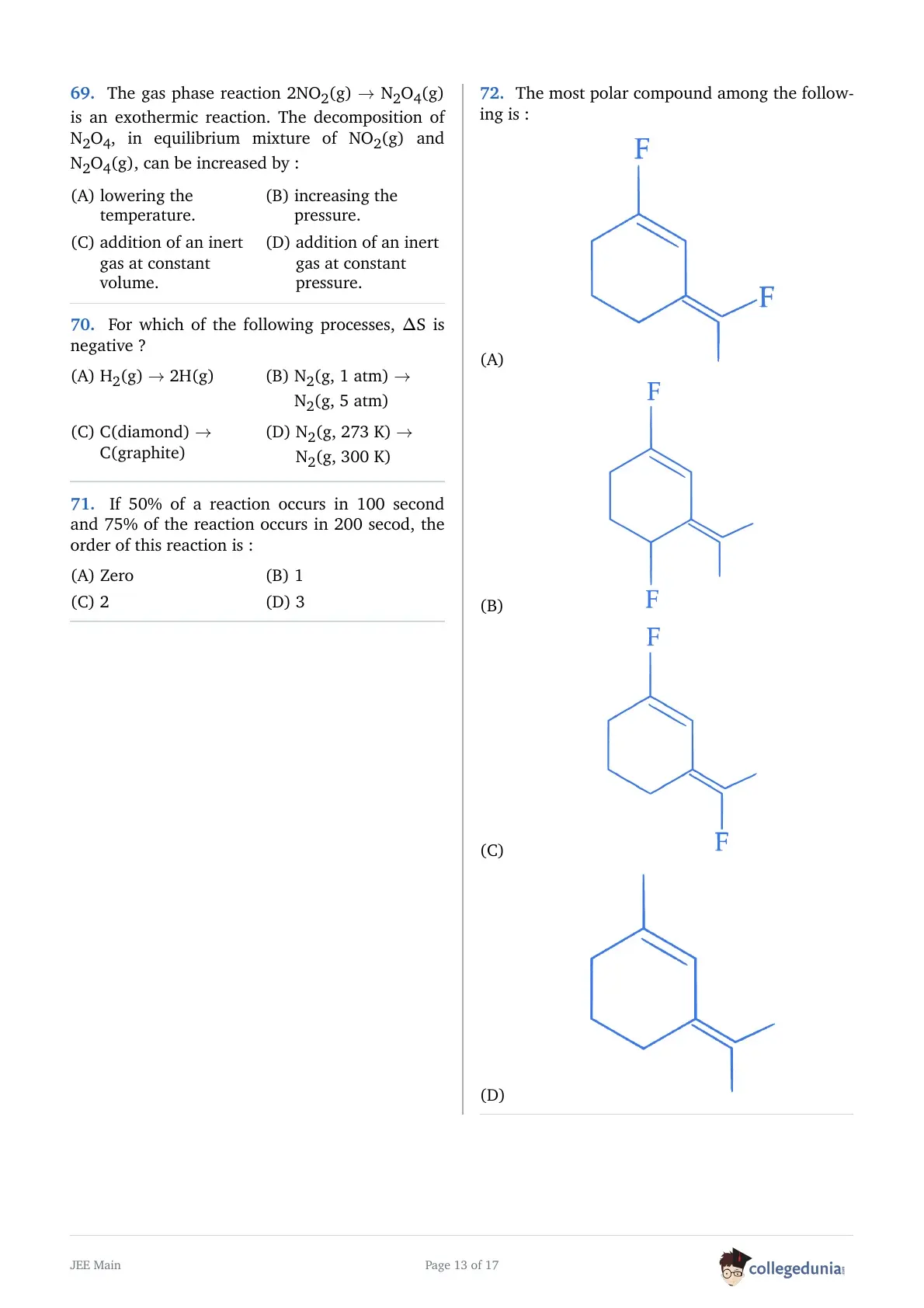
The gas phase reaction \(2\mathrm{NO_2(g)} \rightarrow \mathrm{N_2O_4(g)}\) is an exothermic reaction. The decomposition of \(\mathrm{N_2O_4}\), in equilibrium mixture of \(\mathrm{NO_2(g)}\) and \(\mathrm{N_2O_4(g)}\), can be increased by :
For which of the following processes, \(\Delta S\) is negative ?
If \(50\%\) of a reaction occurs in \(100\) second and \(75\%\) of the reaction occurs in \(200\) second, the order of this reaction is :


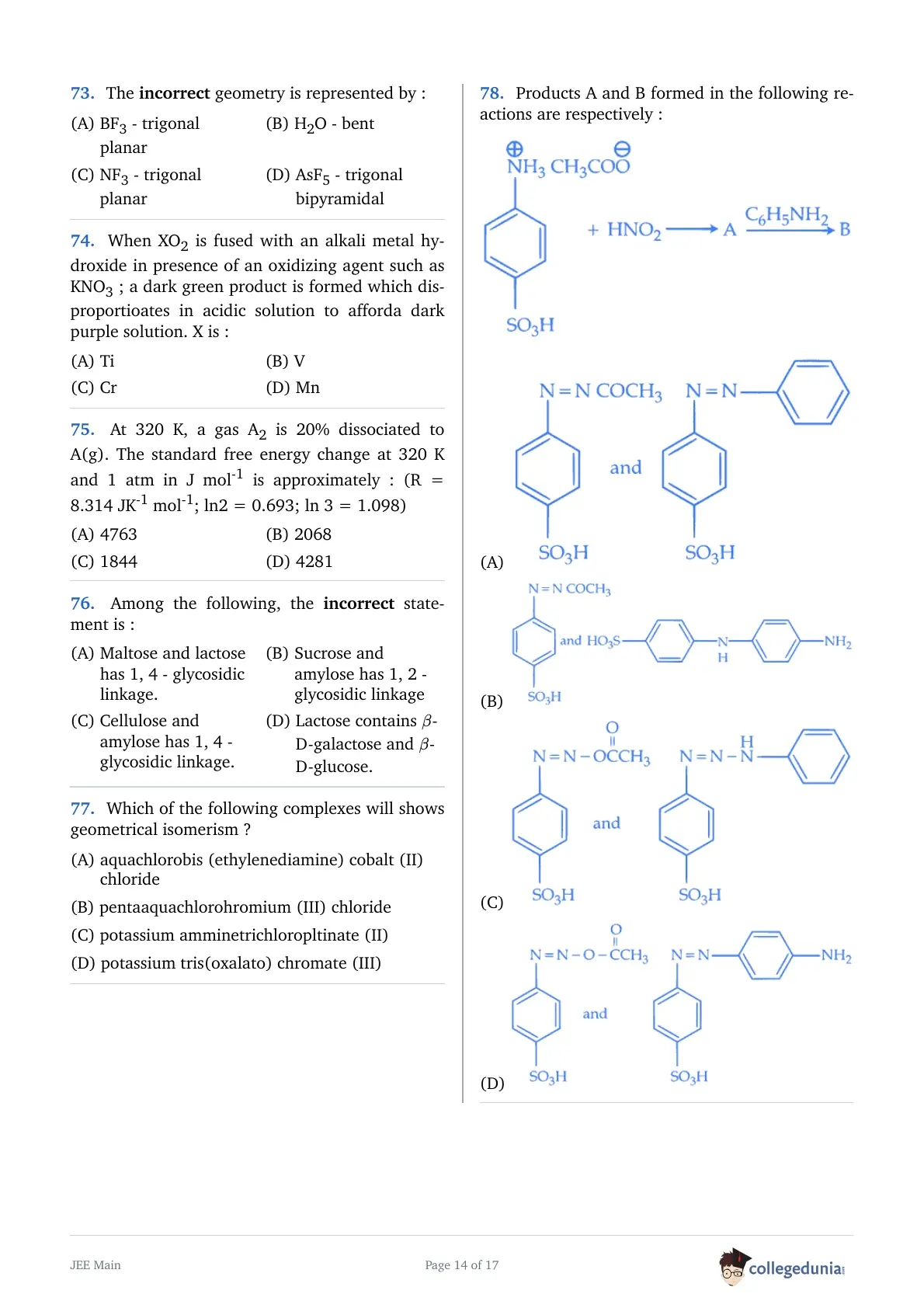
The incorrect geometry is represented by :
When \(\mathrm{XO_2}\) is fused with an alkali metal hydroxide in presence of an oxidizing agent such as \(\mathrm{KNO_3}\); a dark green product is formed which disproportionates in acidic solution to afford a dark purple solution. X is :
At 320 K, a gas A2 is 20% dissociated to A(g). The standard free energy change at 320 K and 1 atm in J mol\(^{-1}\) is approximately : (R=8.314 JK\(^{-1}\) mol\(^{-1}\); ln 2=0.693; ln 3=1.098)
Among the following, the incorrect statement is :
Which of the following complexes will shows geometrical isomerism ?
Products A and B formed in the following reactions are respectively :
- (1)
![]()
- (2)
![]()
- (3)
![]()
- (4)
![]()


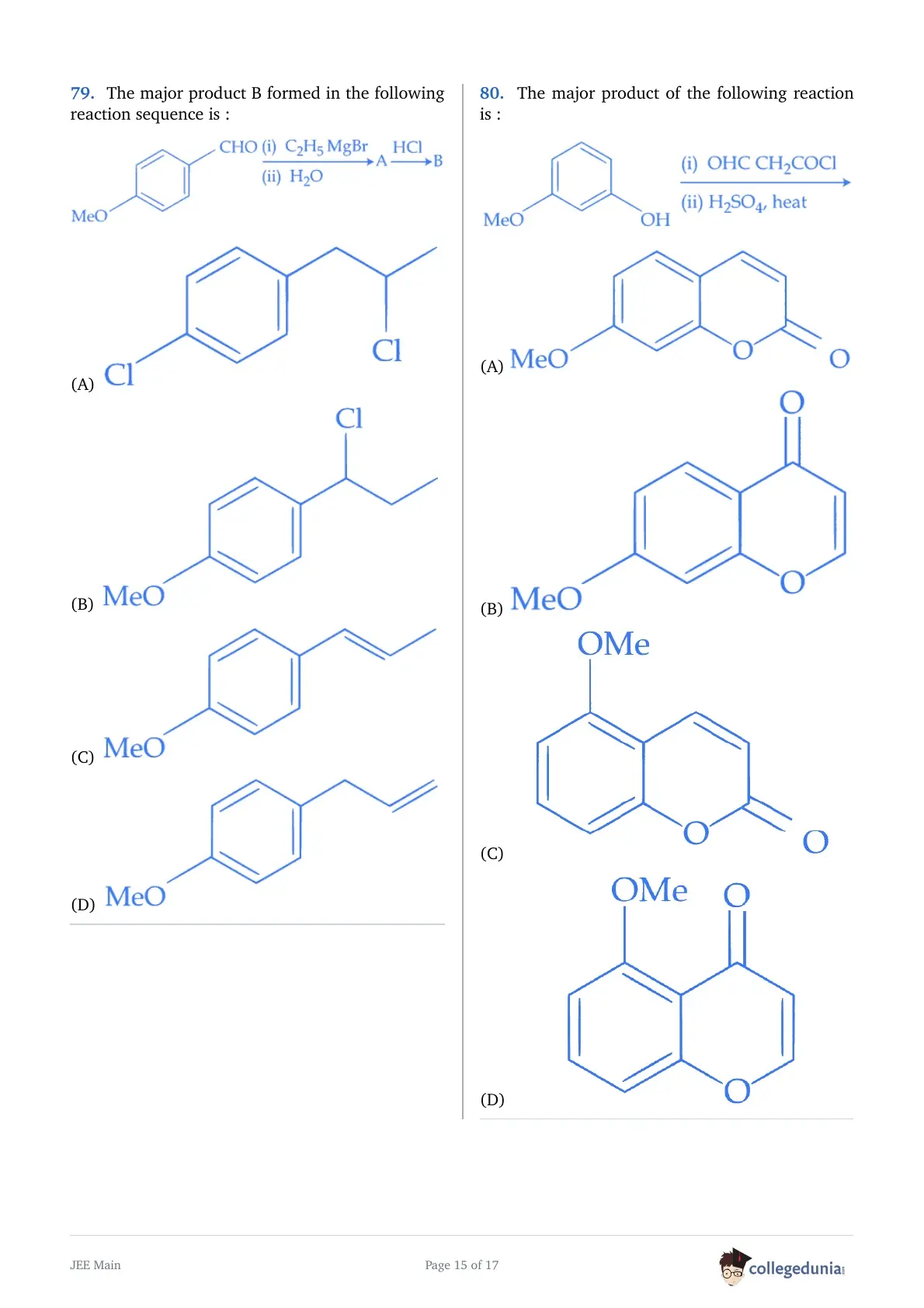
The major product (A) formed in the following reaction sequence is

- (1)
![]()
- (2)
![]()
- (3)
![]()
- (4)
![]()


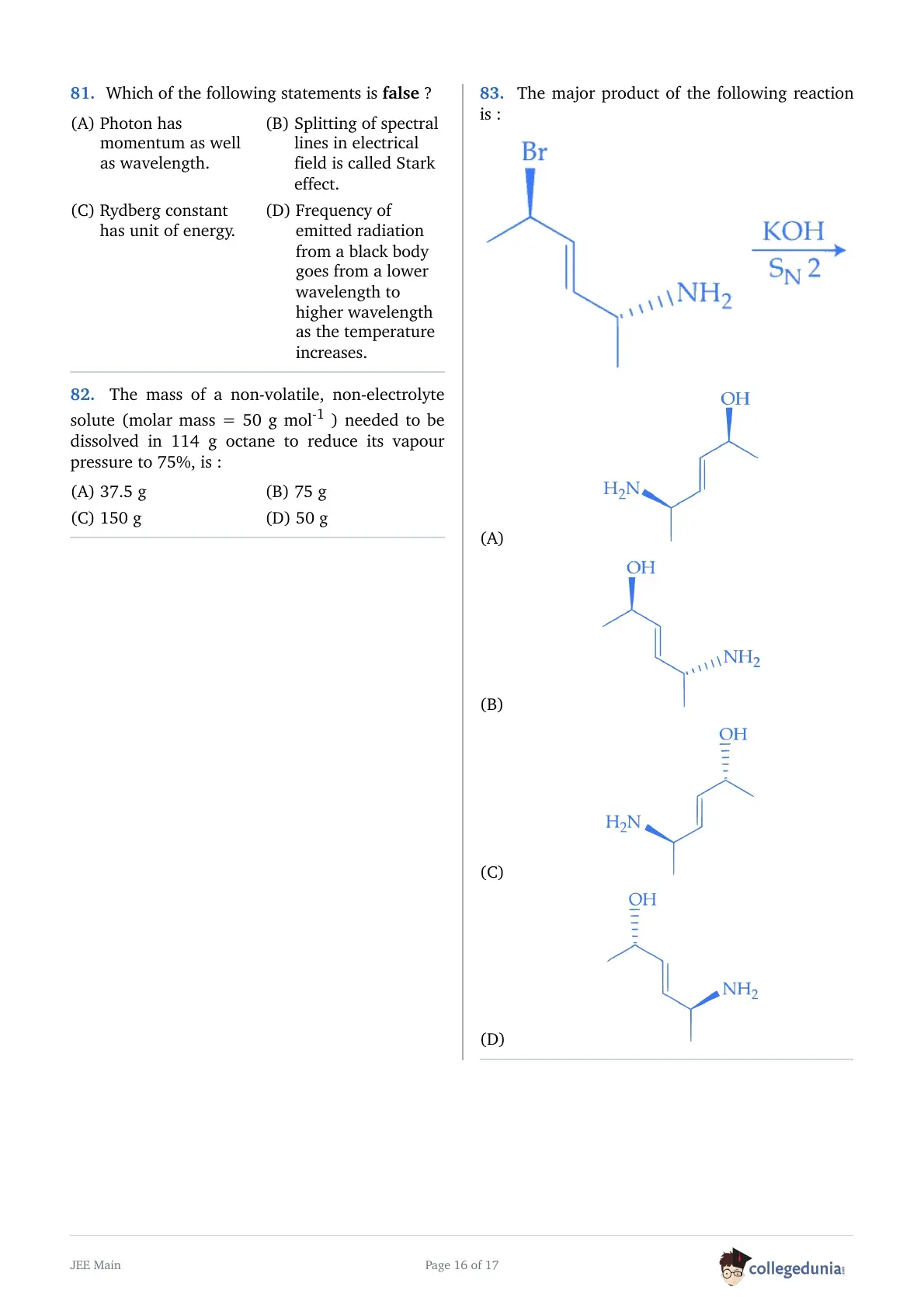
Which of the following statements is false?
The mass of a non-volatile, non-electrolyte solute (molar mass \(= 50\, g\, mol^{-1}\)) needed to be dissolved in \(114\, g\) octane to reduce its vapour pressure to \(75\%,\) is :


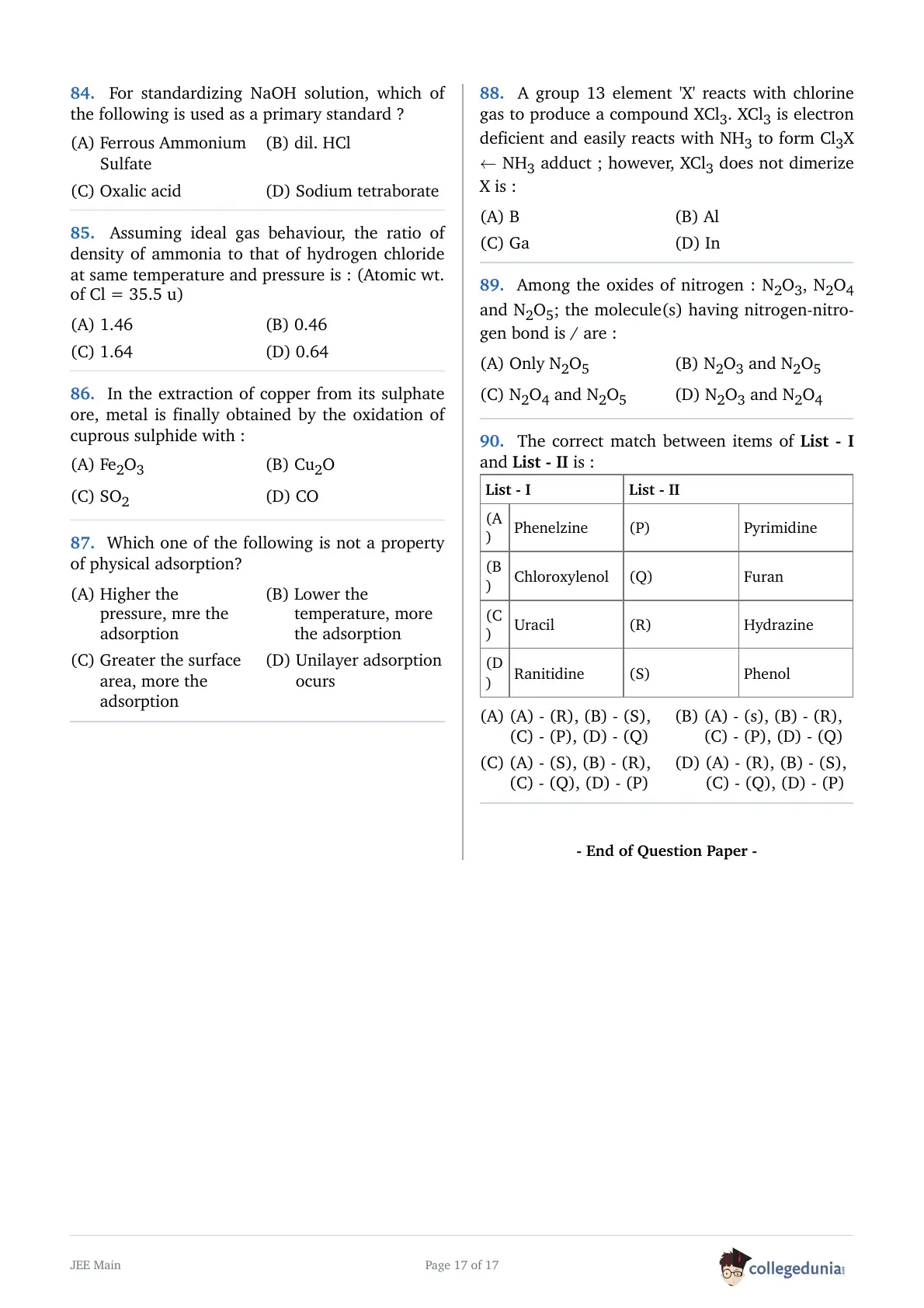
For standardizing NaOH solution, which of the following is used as a primary standard ?
Assuming ideal gas behaviour, the ratio of density of ammonia to that of hydrogen chloride at same temperature and pressure is : (Atomic wt. of Cl = 35.5 u)
In the extraction of copper from its sulphide ore, metal is finally obtained by the oxidation of cuprous sulphide with :
Which one of the following is not a property of physical adsorption?
A group 13 element 'X' reacts with chlorine gas to produce a compound \(XCl _{3} . XCl _{3}\) is electron deficient and easily reacts with \(NH _{3}\) to form \(Cl _{3} X \leftarrow NH _{3}\) adduct; however, \(XCl _{3}\) does not dimerise. \(X\) is
Among the given oxides of nitrogen; N2O, N2O3, N2O4 and N2O5, the number of compound/(s) having N – N bond is:
| List - I | List - II |
| (A) Phenelzine | (P) Pyrimidine |
| (B) Chloroxylenol | (Q) Furan |
| (C) Uracil | (R) Hydrazine |
| (D) Ranitidine | (S) Phenol |
JEE Main 2018 Exam Pattern and Marking Scheme
| Particulars | Details |
|---|---|
| Exam Mode | Online (Computer-Based Test) |
| Paper | B.E./B.Tech (Paper 1) |
| Duration | 3 hours (180 minutes) |
| Type of Questions | Multiple Choice Questions (MCQs) |
| Subjects | Mathematics, Physics, Chemistry |
| Total Questions | 90 questions |
| Total Marks | 360 marks |
| Marking Scheme | +4 for correct answer & -1 for incorrect answer; 0 for unattempted |
JEE Main 2018 April 16 Shift 1 Difficulty Level
In terms of difficulty level, the JEE Main B.E./B.Tech question paper was of moderate level.
JEE Main B.E./B.Tech Question Paper Shift 1 Analysis
- Chemistry had moderate to difficult type questions.
- Total 16 questions from the Class 11th syllabus were asked in the Chemistry section.
- Mathematics had the highest number of easy questions among all.
- 13 questions were of easy level in the Mathematics section.
- Each section had 30 questions each.
For every correct answer, the candidate got 4 marks and for each wrong attempt 1 mark was deducted.



Comments