




JEE Main 2019 April 8 Shift 2 Question Paper is available here with solutions PDF and detailed solutions for every question. NTA conducted the second shift on April 8, 2019, from 2:30 PM to 5:30 PM. The JEE Main 2019 Paper 1 (B.E./B.Tech) question paper includes the following:
- 90 questions in a 3-hour CBT Mode: 30 each from Mathematics, Physics and Chemistry
- Question type: all multiple choice questions (MCQs) with a single correct option, 4 marks each
- Sections: Mathematics (30), Physics (30) and Chemistry (30), all questions compulsory
- Marking: +4 for a correct answer, -1 for an incorrect answer, 0 for an unattempted question
- Maximum marks: 360 (120 per subject)
JEE Main 2019 April 8 Shift 2 Question Paper with Solution PDF
| NTA Official PDF | CD PDF | CD PDF with Solutions |
|---|---|---|
| Download official PDF 5.52 MB | Download Collegedunia PDF 1.10 MB | Download solutions PDF 1.89 MB |
Also Check:
JEE Main 2019 April 8 Shift 2 Questions with Solutions
Mathematics (Q1 - Q30)
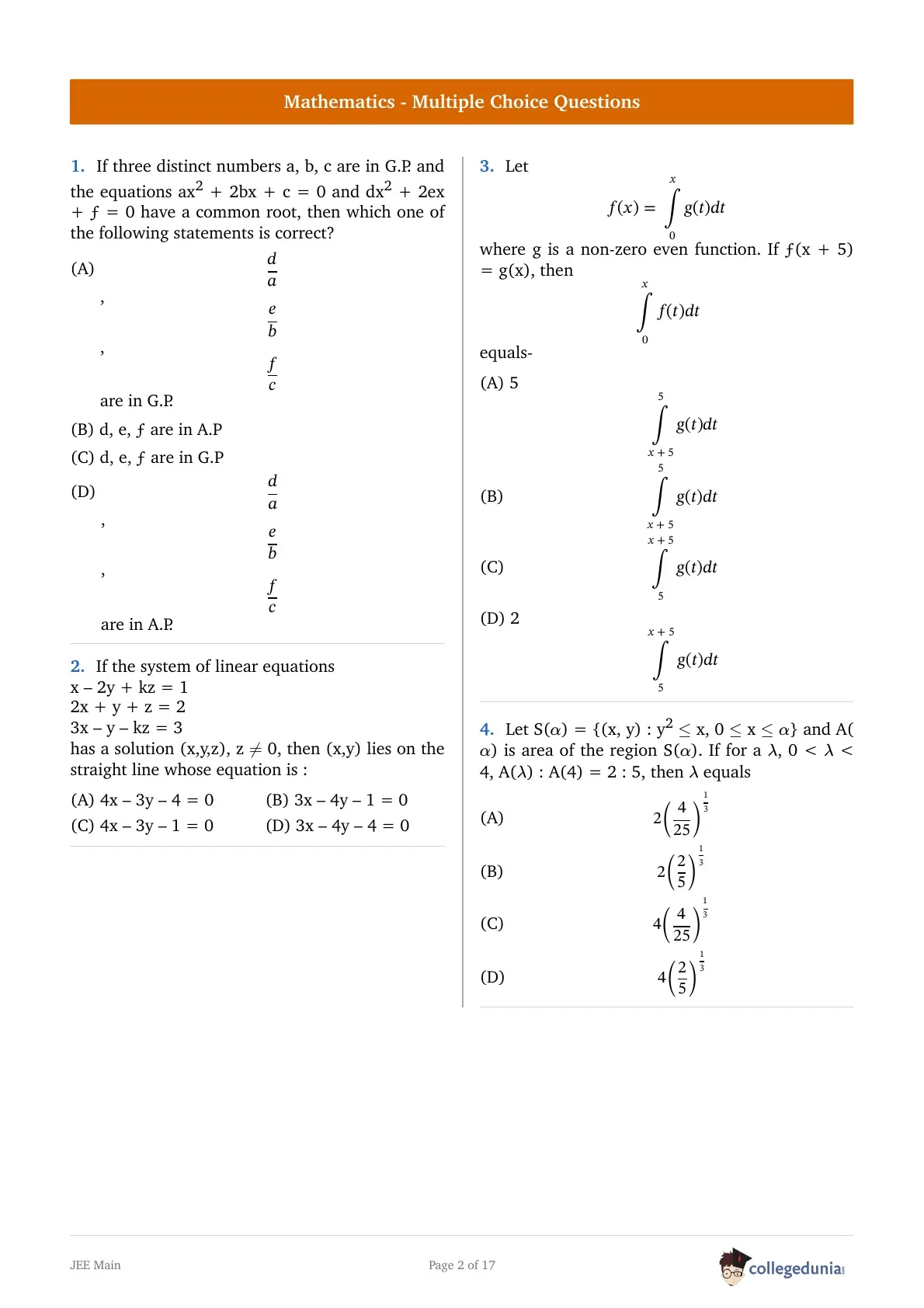
If three distinct numbers a,b,c are in G.P. and the equations \(ax^2 + 2bx + c = 0\) and \(dx^2 + 2ex + f = 0\) have a common root, then which one of the following statements is correct?
If the system of linear equations
\(x - 2y + kz = 1\)
\(2x + y + z = 2\)
\(3x - y - kz = 3\)
has a solution \((x, y, z)\), \(z \ne 0\), then \((x, y)\) lies on the straight line whose equation is :
Let \(f \left(x\right)= \int\limits_0^{x} g (t) dt\) , where g is a non-zero even function. If \(f \left(x+5\right)=g\left(x\right)\), then \( \int\limits_0^{x}f (t) dt \) equals-
Let \(S(\alpha) = \{(x, y) : y^2 \le x,\ 0 \le x \le \alpha\}\) and \(A(\alpha)\) is area of the region \(S(\alpha)\). If for a \(\lambda\), \(0 \lt \lambda \lt 4\), \(A(\lambda) : A(4) = 2 : 5\), then \(\lambda\) equals
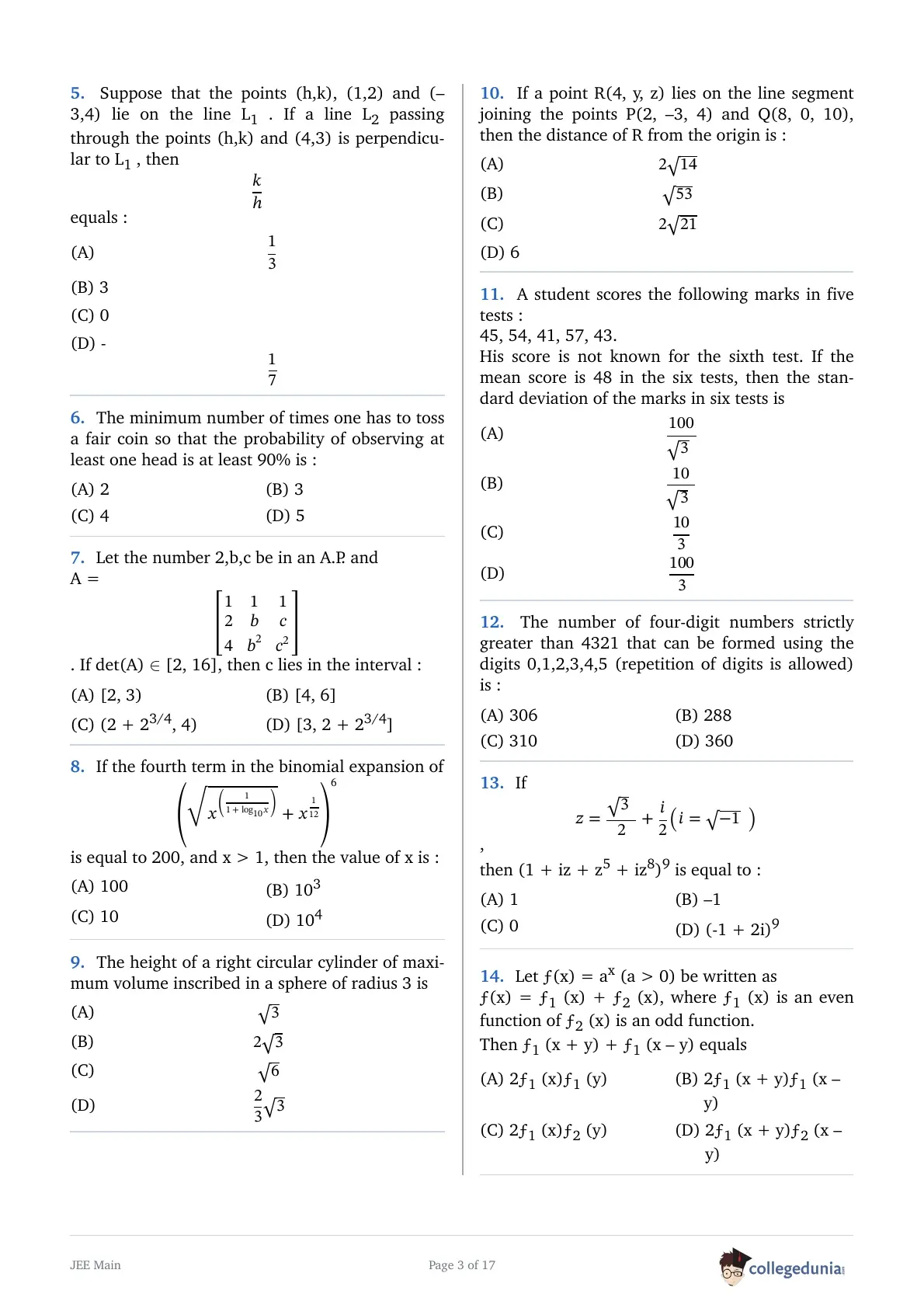
Suppose that the points \((h, k)\), \((1, 2)\) and \((-3, 4)\) lie on the line \(L_1\). If a line \(L_2\) passing through the points \((h, k)\) and \((4, 3)\) is perpendicular to \(L_1\), then \(\frac{k}{h}\) equals :
The minimum number of times one has to toss a fair coin so that the probability of observing at least one head is at least 90% is :
Let the number \(2, b, c\) be in an A.P. and \(A = \begin{bmatrix}1 & 1 & 1\\ 2 & b & c\\ 4 & b^2 & c^2\end{bmatrix}\). If \(\det(A) \in [2, 16]\), then \(c\) lies in the interval :
If the fourth term in the binomial expansion of \(\left(\sqrt{x^{\left(\frac{1}{1 + \log_{10} x}\right)}} + x^{\frac{1}{12}}\right)^{6}\) is equal to 200, and \(x \gt 1\), then the value of \(x\) is :
The height of a right circular cylinder of maximum volume inscribed in a sphere of radius 3 is
If a point \(R(4, y, z)\) lies on the line segment joining the points \(P(2, -3, 4)\) and \(Q(8, 0, 10)\), then the distance of \(R\) from the origin is :
A student scores the following marks in five tests : 45, 54, 41, 57, 43. His score is not known for the sixth test. If the mean score is 48 in the six tests, then the standard deviation of the marks in six tests is
The number of four-digit numbers strictly greater than 4321 that can be formed using the digits 0, 1, 2, 3, 4, 5 (repetition of digits is allowed) is :
If \(z = \frac{\sqrt{3}}{2} + \frac{i}{2}\) (\(i = \sqrt{-1}\)), then \((1 + iz + z^5 + iz^8)^9\) is equal to :
Let \(f(x) = a^x\) (\(a \gt 0\)) be written as \(f(x) = f_1(x) + f_2(x)\), where \(f_1(x)\) is an even function of \(f_2(x)\) is an odd function. Then \(f_1(x + y) + f_1(x - y)\) equals
The derivative of
\(\tan^{-1}\left(\dfrac{\sqrt{1+x^2} - 1}{x}\right)\)
with respect to
\(\tan^{-1}\left(\dfrac{2x\sqrt{1-x^2}}{1-2x^2}\right)\)
at \(x = \dfrac{1}{2}\) is :
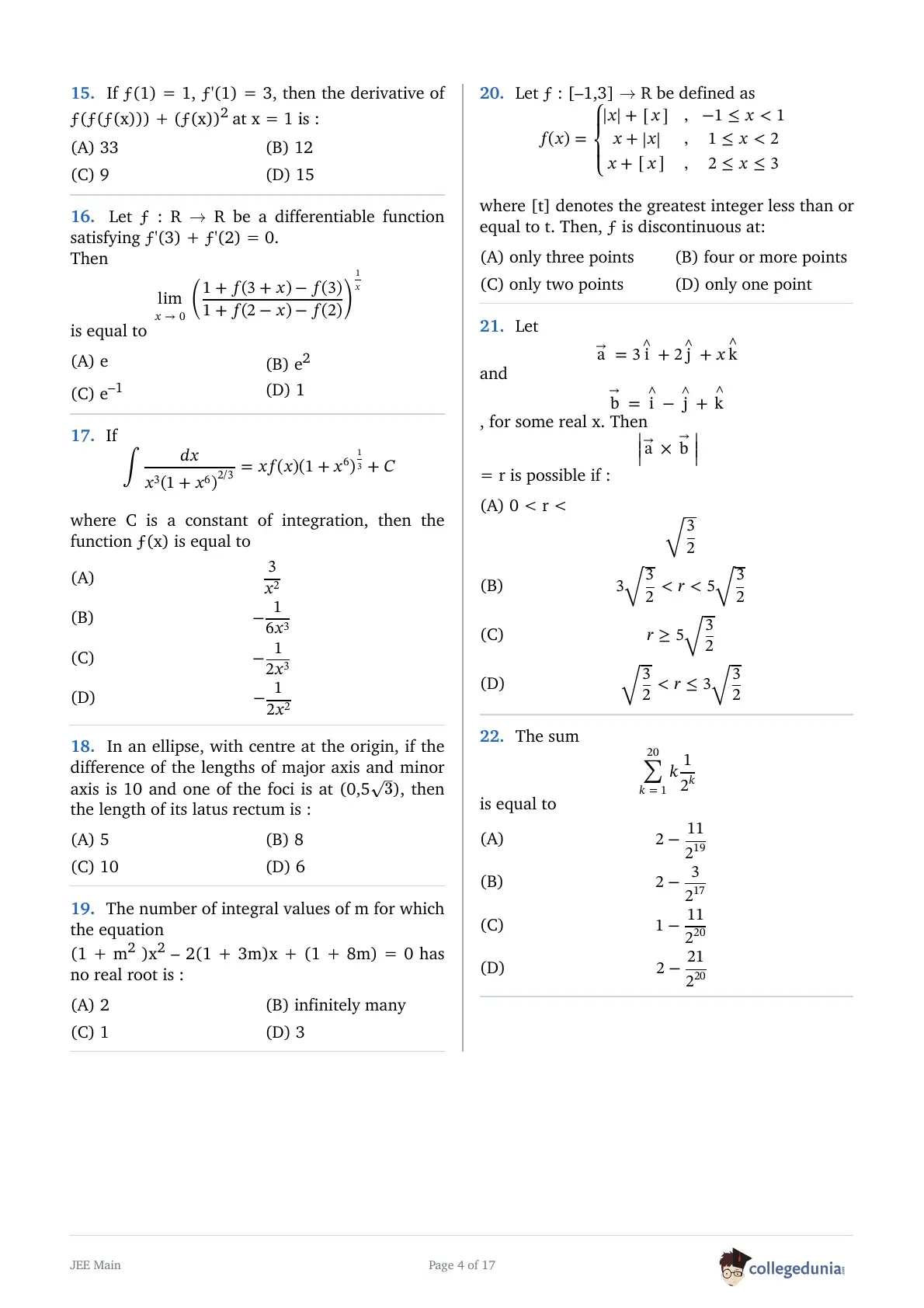
Let \(f : \mathbb{R} \to \mathbb{R}\) be a differentiable function satisfying \(f^{\prime}(3) + f^{\prime}(2) = 0\). Then \(\lim_{x \to 0}\left(\frac{1 + f(3 + x) - f(3)}{1 + f(2 - x) - f(2)}\right)^{\frac{1}{x}}\) is equal to
If \(\int \frac{dx}{x^{3}\left(1+x^{6}\right)^{\frac{2}{3}}}=f \left(x\right)\left(1+x ^{6}\right)^{\frac{1}{3}}+C\), where C is a constant of integration, then the function \(f \left(x\right)\) is equal to-
In an ellipse, with centre at the origin, if the difference of the lengths of major axis and minor axis is 10 and one of the foci is at \((0, 5\sqrt{3})\), then the length of its latus rectum is :
The number of integral values of m for which the equation \((1 + m^2)x^2 - 2(1 + 3m)x + (1 + 8m) = 0\) has no real root is :
Let \(f : [-1, 3] \to \mathbb{R}\) be defined as
\(f(x) = \begin{cases}|x| + [x], & -1 \le x \lt 1\\ x + |x|, & 1 \le x \lt 2\\ x + [x], & 2 \le x \le 3\end{cases}\)
where \([t]\) denotes the greatest integer less than or equal to \(t\). Then, \(f\) is discontinuous at:
Let \(\vec{a} = 3\hat{i} + 2\hat{j} + x\hat{k}\) and \(\vec{b} = \hat{i} - \hat{j} + \hat{k}\), for some real \(x\). Then \(|\vec{a} \times \vec{b}| = r\) is possible if :
The sum \(\sum_{k=1}^{20} k\,\frac{1}{2^k}\) is equal to
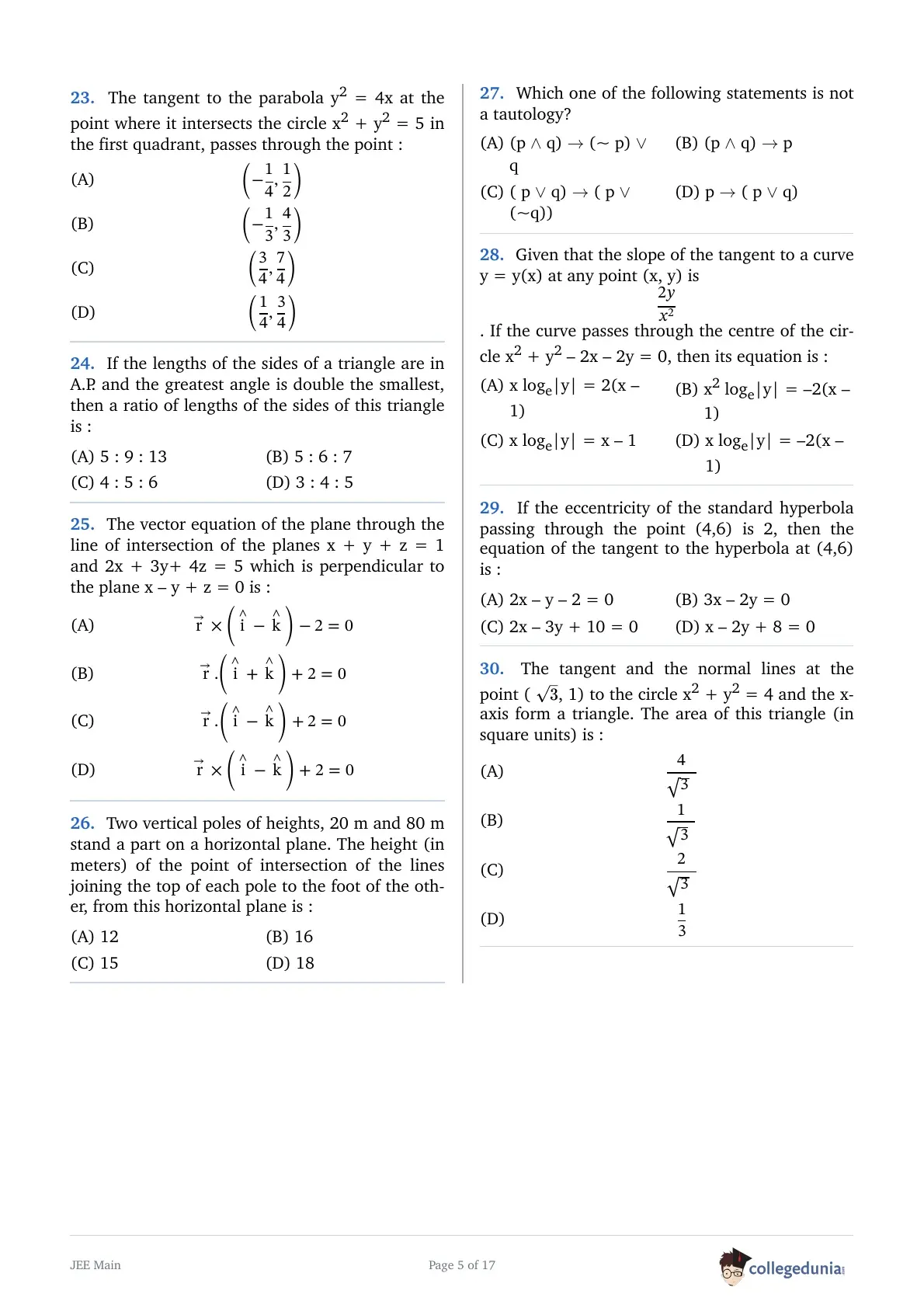
The tangent to the parabola \(y^2 = 4x\) at the point where it intersects the circle \(x^2 + y^2 = 5\) in the first quadrant, passes through the point :
The lengths of the sides of a triangle are 10 + x2, 10 + x2 and 20 – 2x2. If for x = k, the area of the triangle is maximum, then 3k2 is equal to :
The equation of a plane through the line of intersection of the planes \(x+2y=3,\ y-2z+1=0\), and perpendicular to the first plane is :
Two vertical poles of heights, 20 m and 80 m stand a part on a horizontal plane. The height (in meters) of the point of intersection of the lines joining the top of each pole to the foot of the other, from this horizontal plane is :
Which one of the following statements is not a tautology?
The slope of the tangent to a curve C: y = y(x) at any point (x, y) on it is \(\frac{2e^{2x}-6e^{-x}+9}{2+9e^{-2x}}\).If C passes through the points (0,\(\frac{1}{2}\)+\(\frac{\pi}{2\sqrt2}\)) and (α,\(\frac{1}{2e^{2\alpha}}\)), then eα is equal to
If the eccentricity of the standard hyperbola passing through the point (4,6) is 2, then the equation of the tangent to the hyperbola at (4,6) is :
The tangent and the normal lines at the point \(\left(\sqrt{3}, 1\right)\) to the circle \(x^2 + y^2 = 4\) and the x-axis form a triangle. The area of this triangle (in square units) is :
Physics (Q31 - Q60)
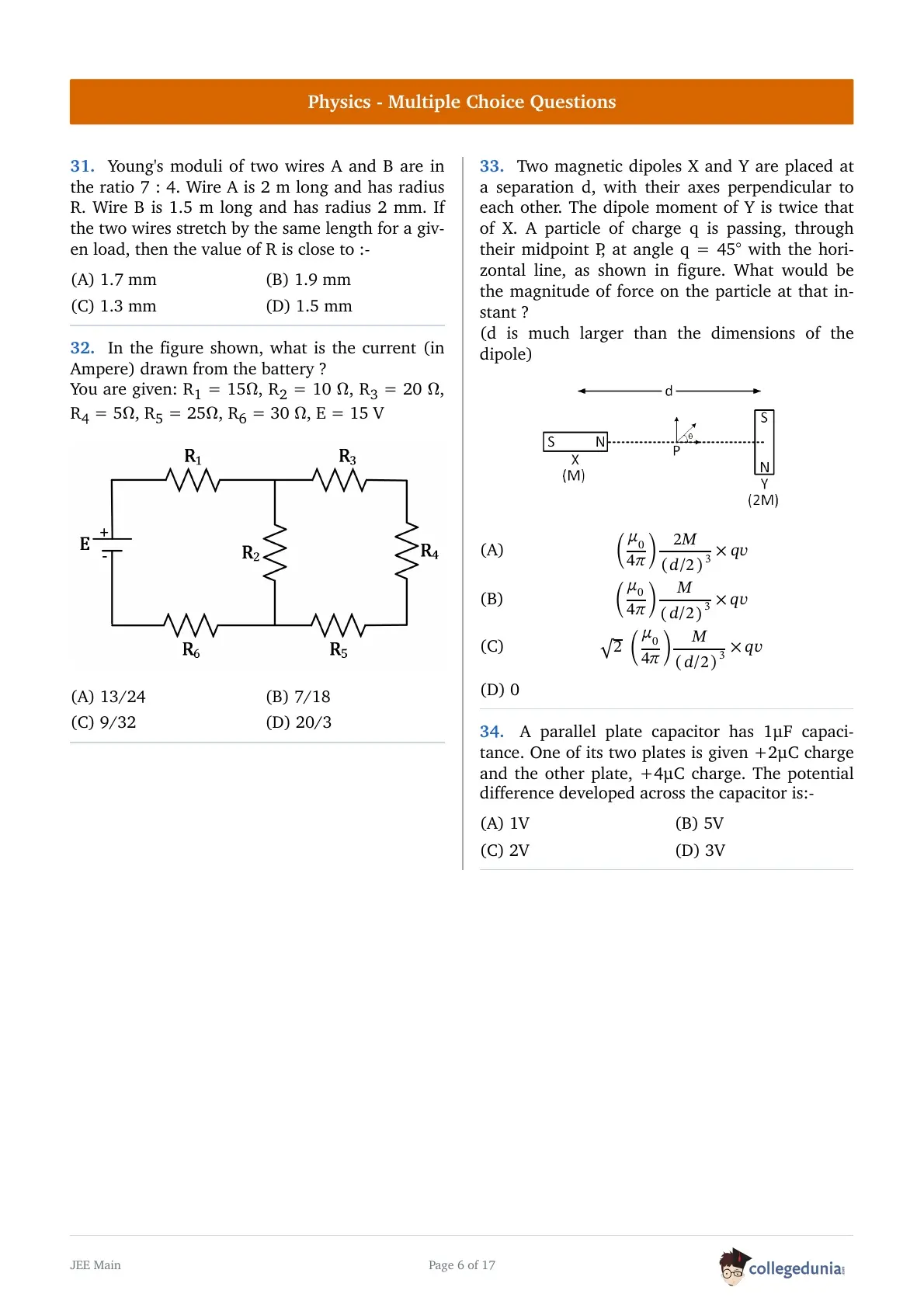
Young's moduli of two wires A and B are in the ratio 7 : 4. Wire A is 2 m long and has radius R. Wire B is 1.5 m long and has radius 2 mm. If the two wires stretch by the same length for a given load, then the value of R is close to :-
In the figure shown, what is the current (in Ampere) drawn from the battery ?
You are given: \(R_1 = 15\ \Omega\), \(R_2 = 10\ \Omega\), \(R_3 = 20\ \Omega\), \(R_4 = 5\ \Omega\), \(R_5 = 25\ \Omega\), \(R_6 = 30\ \Omega\), \(E = 15\) V
Two magnetic dipoles X and Y are placed at a separation d, with their axes perpendicular to each other. The dipole moment of Y is twice that of X. A particle of charge q is passing, through their midpoint P, at angle \(\theta = 45^\circ\) with the horizontal line, as shown in figure. What would be the magnitude of force on the particle at that instant ?
(d is much larger than the dimensions of the dipole)
A parallel plate capacitor has \(1\ \mu\)F capacitance. One of its two plates is given \(+2\ \mu\)C charge and the other plate, \(+4\ \mu\)C charge. The potential difference developed across the capacitor is:-
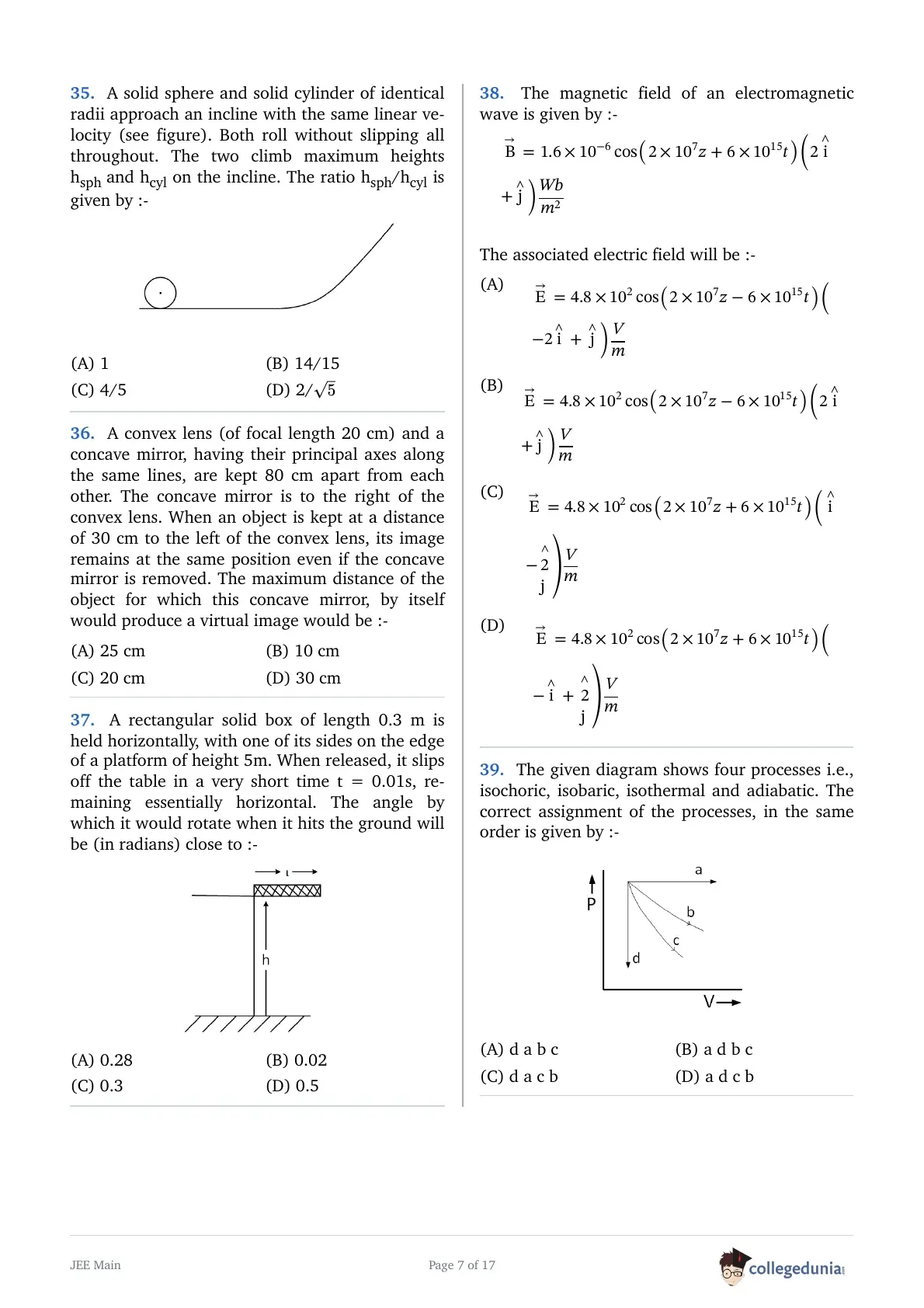
A solid sphere and solid cylinder of identical radii approach an incline with the same linear velocity (see figure). Both roll without slipping all throughout. The two climb maximum heights \(h_{sph}\) and \(h_{cyl}\) on the incline. The ratio \(\frac{h_{sph}}{h_{cyl}}\) is given by :
A convex lens (of focal length \(20\, cm\)) and a concave mirror, having their principal axes along the same lines, are kept \(80 \,cm\) apart from each other. The concave mirror is to the right of the convex lens. When an object is kept at a distance of \(30\, cm\) to the left of the convex lens, its image remains at the same position even if the concave mirror is removed. The maximum distance of the object for which this concave mirror, by itself would produce a virtual image would be :
A rectangular solid box of length \(0.3\, m\) is held horizontally, with one of its sides on the edge of a platform of height \(5\,m\). When released, it slips off the table in a very short time \(\tau = 0.01\,s\), remaining essentially horizontal. The angle by which it would rotate when it hits the ground will be (in radians) close to :
The magnetic field of an electromagnetic wave is given by : \(\vec{B} =1.6 \times10^{-6} \cos\left(2\times10^{7} z +6 \times10^{15}t\right)\left(2\hat{i} +\hat{j}\right) \frac{Wb}{m^{2}} \) The associated electric field will be :-
The given diagram shows four processes i.e., isochoric, isobaric, isothermal and adiabatic. The correct assignment of the processes, in the same order is given by :-
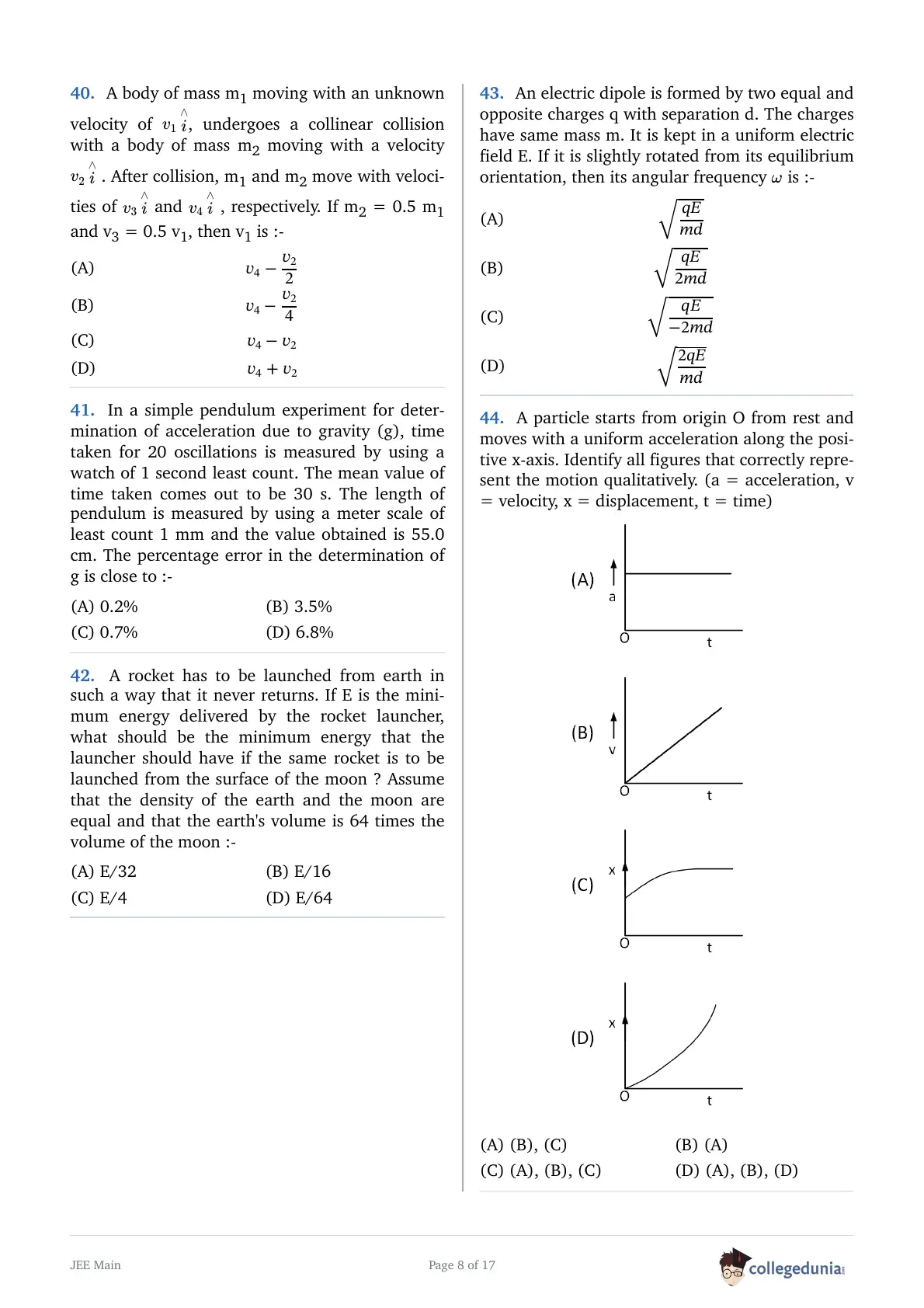
A body of mass \(m_1\) moving with an unknown velocity of \(v_1\hat{i}\), undergoes a collinear collision with a body of mass \(m_2\) moving with a velocity \(v_2\hat{i}\). After collision, \(m_1\) and \(m_2\) move with velocities of \(v_3\hat{i}\) and \(v_4\hat{i}\), respectively. If \(m_2 = 0.5\,m_1\) and \(v_3 = 0.5\,v_1\), then \(v_1\) is :-
In a simple pendulum experiment for determination of acceleration due to gravity (g), time taken for \(20\) oscillations is measured by using a watch of \(1\) second least count. The mean value of time taken comes out to be \(30\, s\). The length of pendulum is measured by using a meter scale of least count \(1\, mm\) and the value obtained is \(55.0\, cm\). The percentage error in the determination of \(g\) is close to :
A rocket has to be launched from earth in such a way that it never returns. If E is the minimum energy delivered by the rocket launcher, what should be the minimum energy that the launcher should have if the same rocket is to be launched from the surface of the moon ? Assume that the density of the earth and the moon are equal and that the earth's volume is 64 times the volume of the moon :-
An electric dipole is formed by two equal and opposite charges \(q\) with separation \(d\). The charges have same mass \(m\). It is kept in a uniform electric field \(E\). If it is slightly rotated from its equilibrium orientation, then its angular frequency \(\omega\) is :
A particle starts from origin \(O\) from rest and moves with a uniform acceleration along the positive \(x\)-axis. Identify all figures that correctly represent the motion qualitatively. (a = acceleration, v = velocity, x = displacement, t = time)
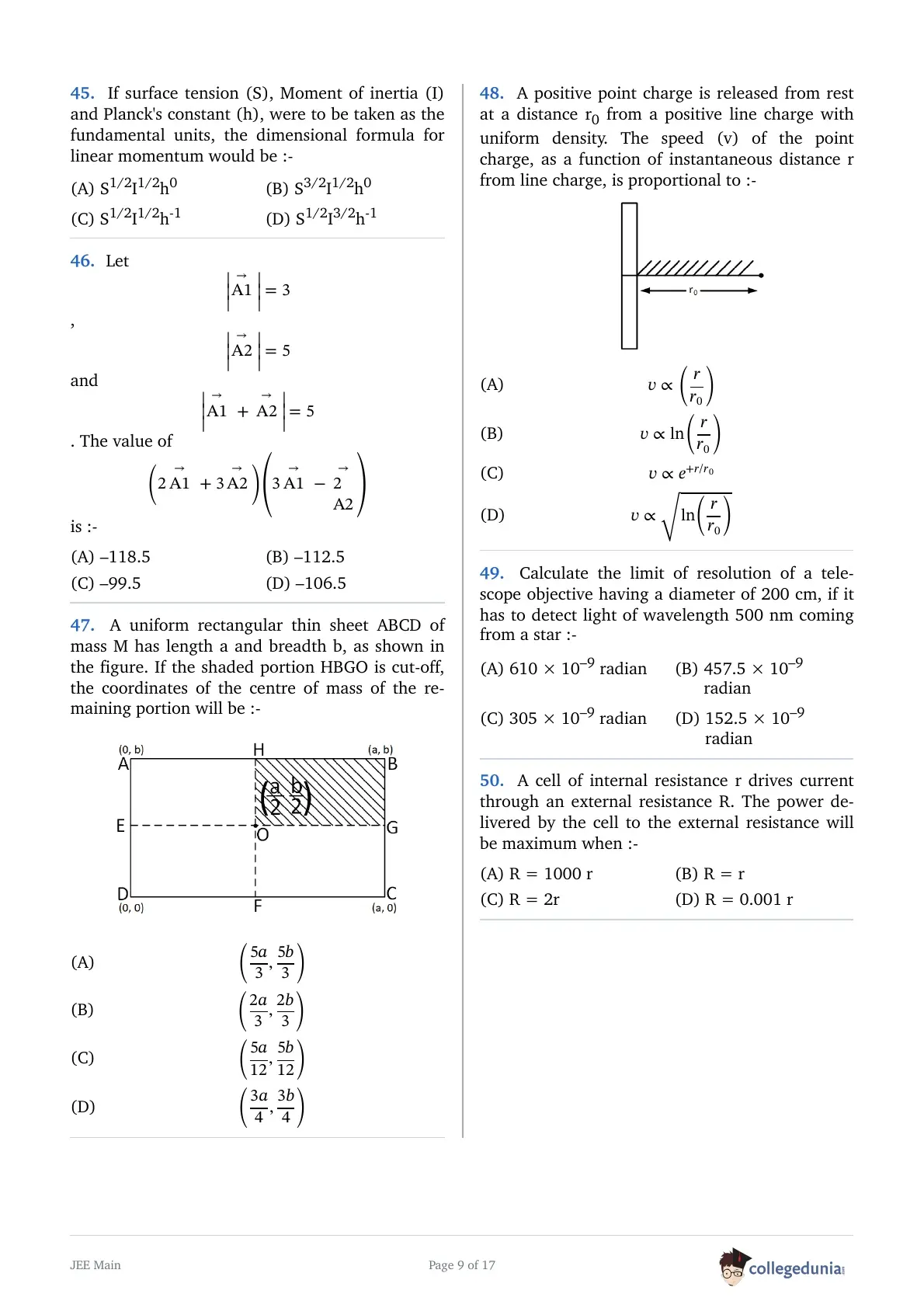
If surface tension (S), Moment of inertia (I) and Planck's constant (h), were to be taken as the fundamental units, the dimensional formula for linear momentum would be : -
Let \(\left|\vec{A_1}\right| = 3\), \(\left|\vec{A_2}\right| = 5\) and \(\left|\vec{A_1} + \vec{A_2}\right| = 5\). The value of \(\left(2\vec{A_1} + 3\vec{A_2}\right)\cdot\left(3\vec{A_1} - 2\vec{A_2}\right)\) is :-
A uniform rectangular thin sheet \(ABCD\) of mass \(M\) has length \(a\) and breadth \(b\), as shown in the figure. If the shaded portion \(HBGO\) is cut-off, the coordinates of the centre of mass of the remaining portion will be :
A positive point charge is released from rest at a distance \(r_0\) from a positive line charge with uniform density. The speed (\(v\)) of the point charge, as a function of instantaneous distance \(r\) from line charge, is proportional to :-
Calculate the limit of resolution of a telescope objective having a diameter of \(200\, cm\), if it has to detect light of wavelength \(500\, nm\) coming from a star :
A cell of internal resistance r drives current through an external resistance \(R\). The power delivered by the cell to the external resistance will be maximum when
The ratio of mass densities of nuclei of \(^{40}C_a\) and \(^{16}O\) is close to :-
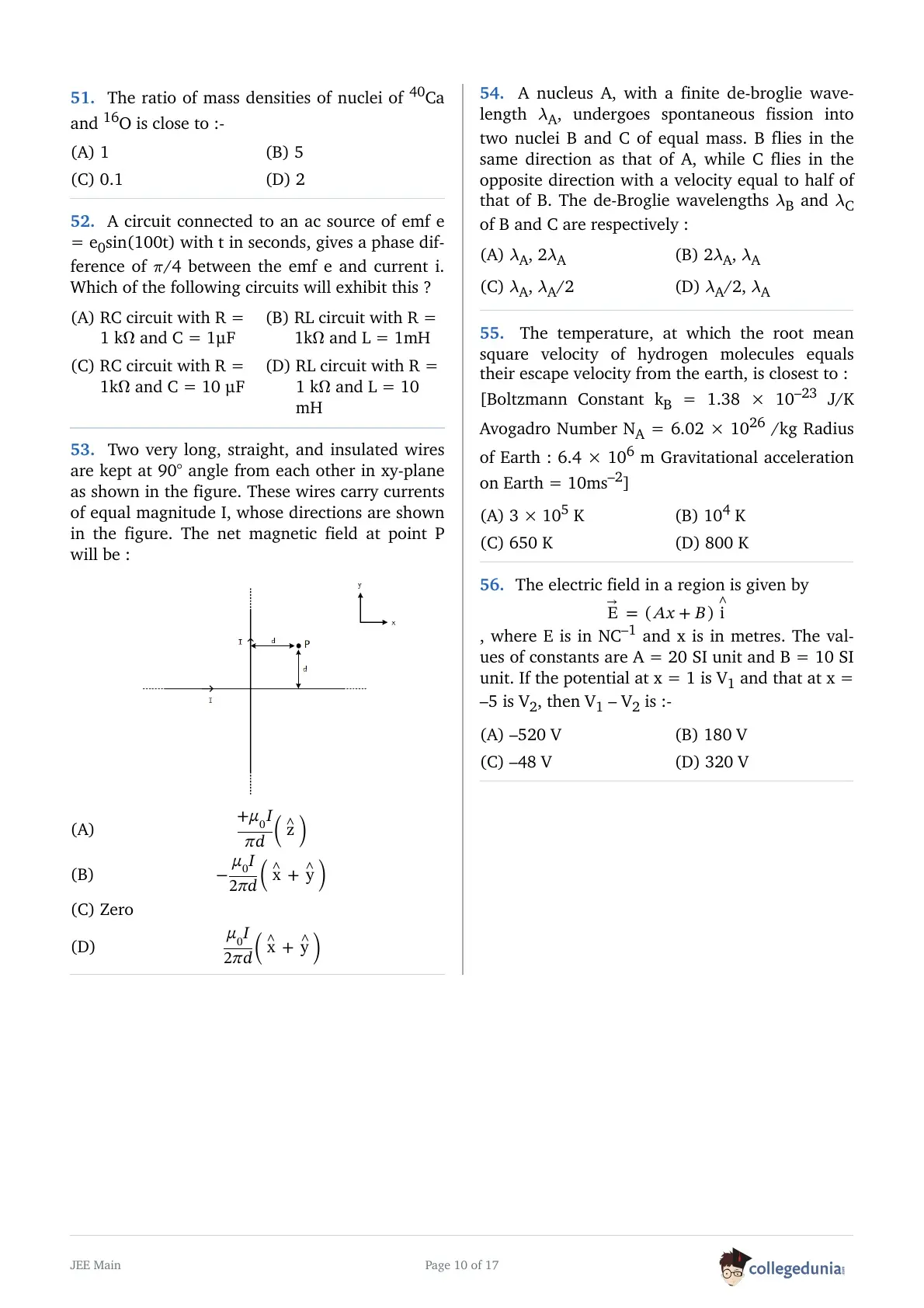
A circuit connected to an ac source of emf \(e = e_0\sin(100t)\) with \(t\) in seconds, gives a phase difference of \(\pi/4\) between the emf \(e\) and current \(i\). Which of the following circuits will exhibit this ?
Two very long, straight, and insulated wires are kept at \(90^{\circ}\) angle from each other in \(xy\) - plane as shown in the figure. These wires carry currents of equal magnitude \(I\), whose directions are shown in the figure. The net magnetic field at point \(P\) will be :
A nucleus A, with a finite de-broglie wavelength \(\lambda_A\), undergoes spontaneous fission into two nuclei B and C of equal mass. B flies in the same direction as that of A, while C flies in the opposite direction with a velocity equal to half of that of B. The de-Broglie wavelengths \(\lambda_B\) and \(\lambda_C\) of B and C are respectively :
The temperature, at which the root mean square velocity of hydrogen molecules equals their escape velocity from the earth, is closest to :
[Boltzmann Constant \(k_B = 1.38\times10^{-23}\ \mathrm{J/K}\)
Avogadro Number \(N_A = 6.02\times10^{26}\ \mathrm{/kg}\)
Radius of Earth : \(6.4\times10^{6}\ \mathrm{m}\)
Gravitational acceleration on Earth = \(10\ \mathrm{ms^{-2}}\)]
The electric field in a region is given by \(\vec{E} = (Ax + B)\hat{i}\), where \(E\) is in \(\mathrm{NC^{-1}}\) and \(x\) is in metres. The values of constants are \(A = 20\) SI unit and \(B = 10\) SI unit. If the potential at \(x = 1\) is \(V_1\) and that at \(x = -5\) is \(V_2\), then \(V_1 - V_2\) is :-
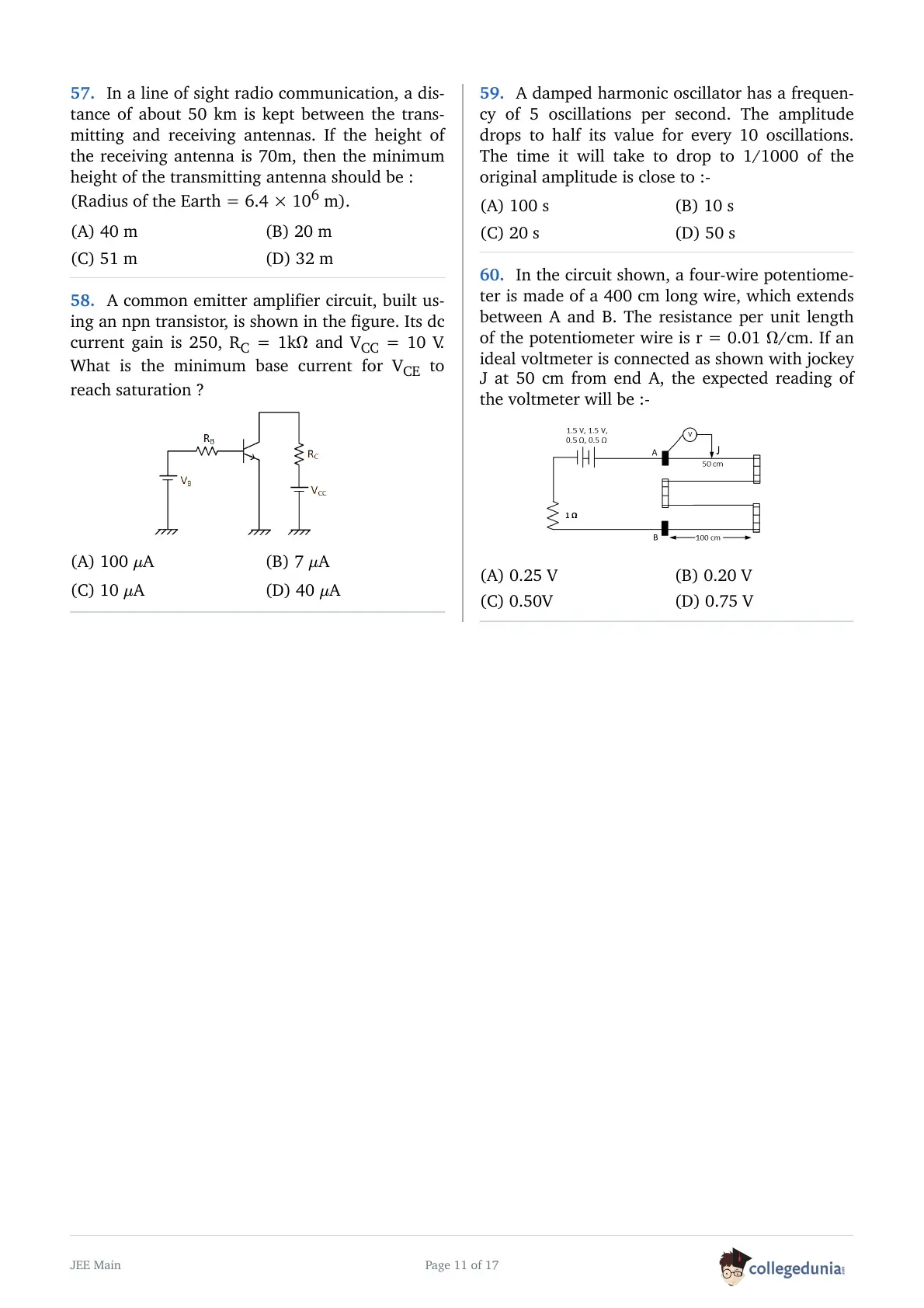
In a line of sight radio communication, a distance of about \(50\, km\) is kept between the transmitting and receiving antennas. If the height of the receiving antenna is \(70\,m\), then the minimum height of the transmitting antenna should be : (Radius of the Earth = \(6.4 \times 10^6 m\)).
A common emitter amplifier circuit, built using an npn transistor, is shown in the figure. Its dc current gain is \(250, \,R_C = 1k\Omega\) and \(V_{CC} = 10 V\). What is the minimum base current for \(V_{CE}\) to reach saturation ?
A damped harmonic oscillator has a frequency of 5 oscillations per second. The amplitude drops to half its value for every 10 oscillations. The time it will take to drop to \(1/1000\) of the original amplitude is close to :-
In the circuit shown, a four-wire potentiometer is made of a \(400\, cm\) long wire, which extends between \(A\) and \(B\). The resistance per unit length of the potentiometer wire is \(r = 0.01 \) \(\Omega/cm\). If an ideal voltmeter is connected as shown with jockey \(J\) at \(50\, cm\) from end \(A\), the expected reading of the voltmeter will be :
Chemistry (Q61 - Q90)
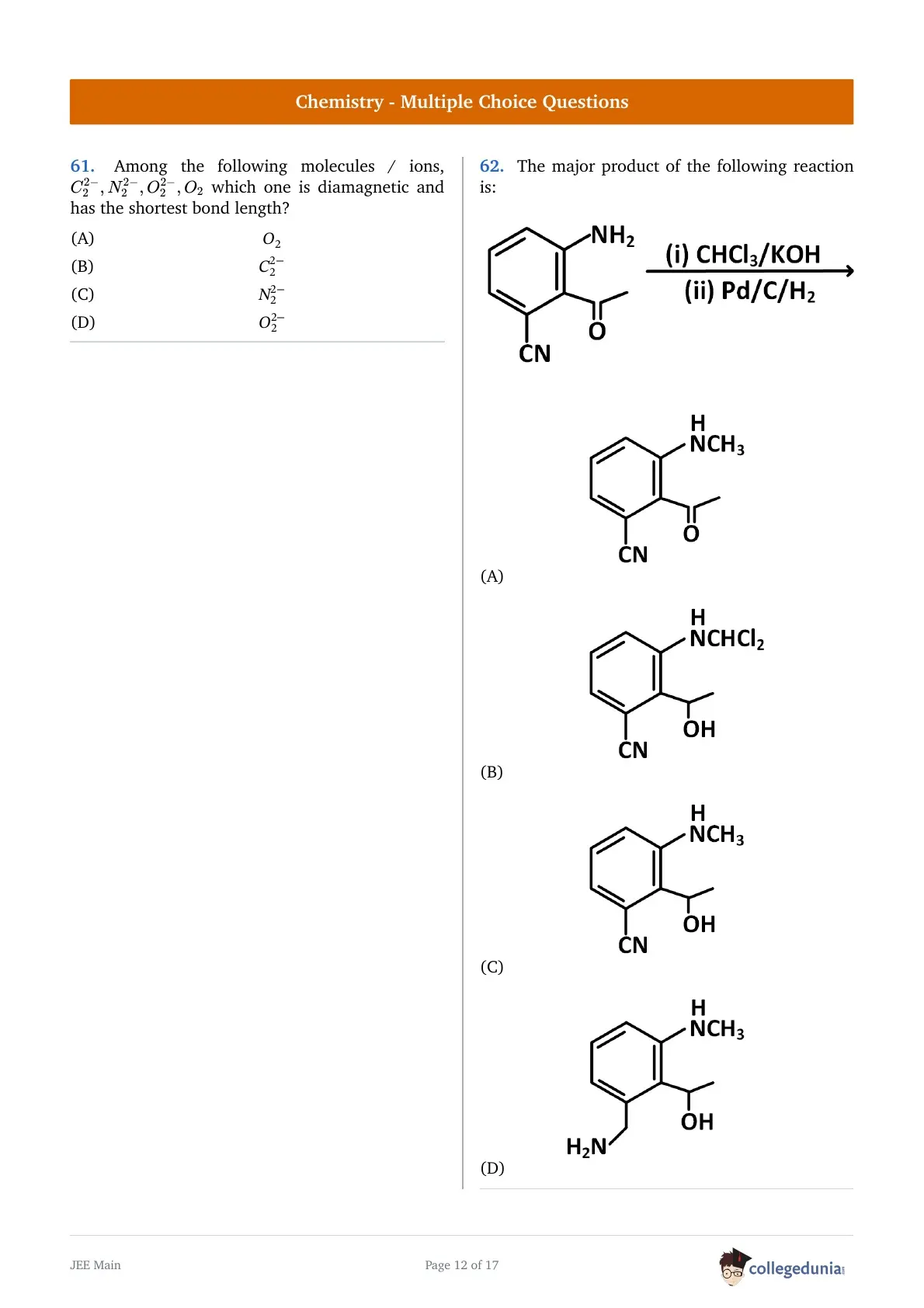
Among the following molecules / ions, \(C^{2-}_{2}, N^{2-}_{2}, O^{2-}_{2}, O_{2}\) which one is diamagnetic and has the shortest bond length?


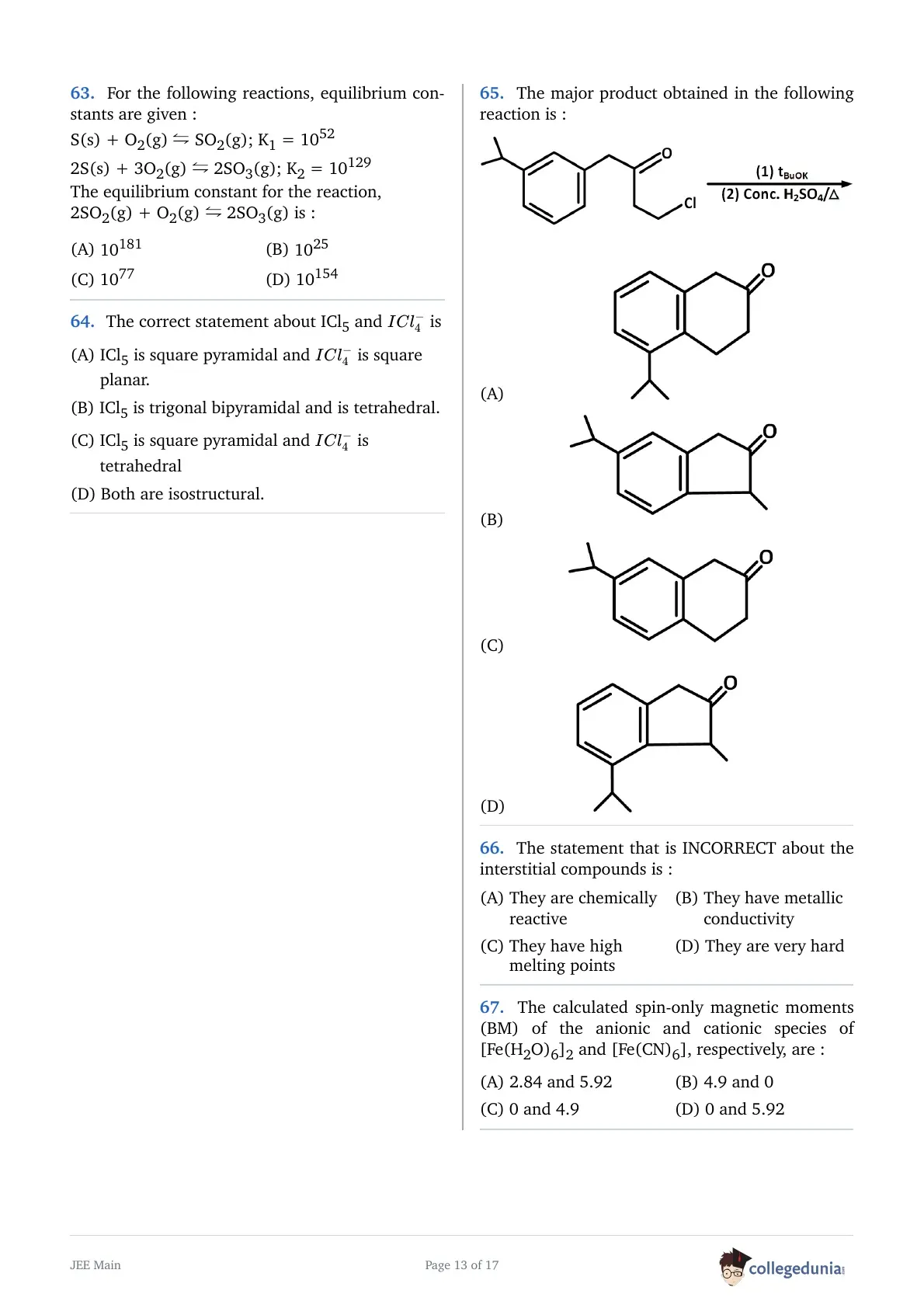
For the following reactions, equilibrium constants are given : \(S\left(s\right)+O_{2}\left(g\right) \)\({\rightleftharpoons}\)\(SO_{2}\left(g\right); K_{1} =10^{52}\) \(2S\left(s\right)+3O_{2}\left(g\right) \)\({\rightleftharpoons}\)\(2SO_{3}\left(g\right); K_{2} = 10^{129}\) The eqilibrium constant for the reaction, \(2SO_{2}\left(g\right)+O_{2}\left(g\right)\)\({\rightleftharpoons}\)\(2SO_{3}\left(g\right)\) is :
The correct statement about \(\mathrm{ICl_5}\) and \(\mathrm{ICl_4^-}\) is
The major product obtained in the following reaction is
- (1)
![major product obtained]()
- (2)
![major product obtained]()
- (3)
![major product obtained]()
- (4)
![major product obtained]()


The statement that is INCORRECT about the interstitial compounds is :
The calculated spin-only magnetic moments (BM) of the anionic and cationic species of \(\mathrm{[Fe(H_2O)_6]^{2+}}\) and \(\mathrm{[Fe(CN)_6]^{4-}}\), respectively, are :
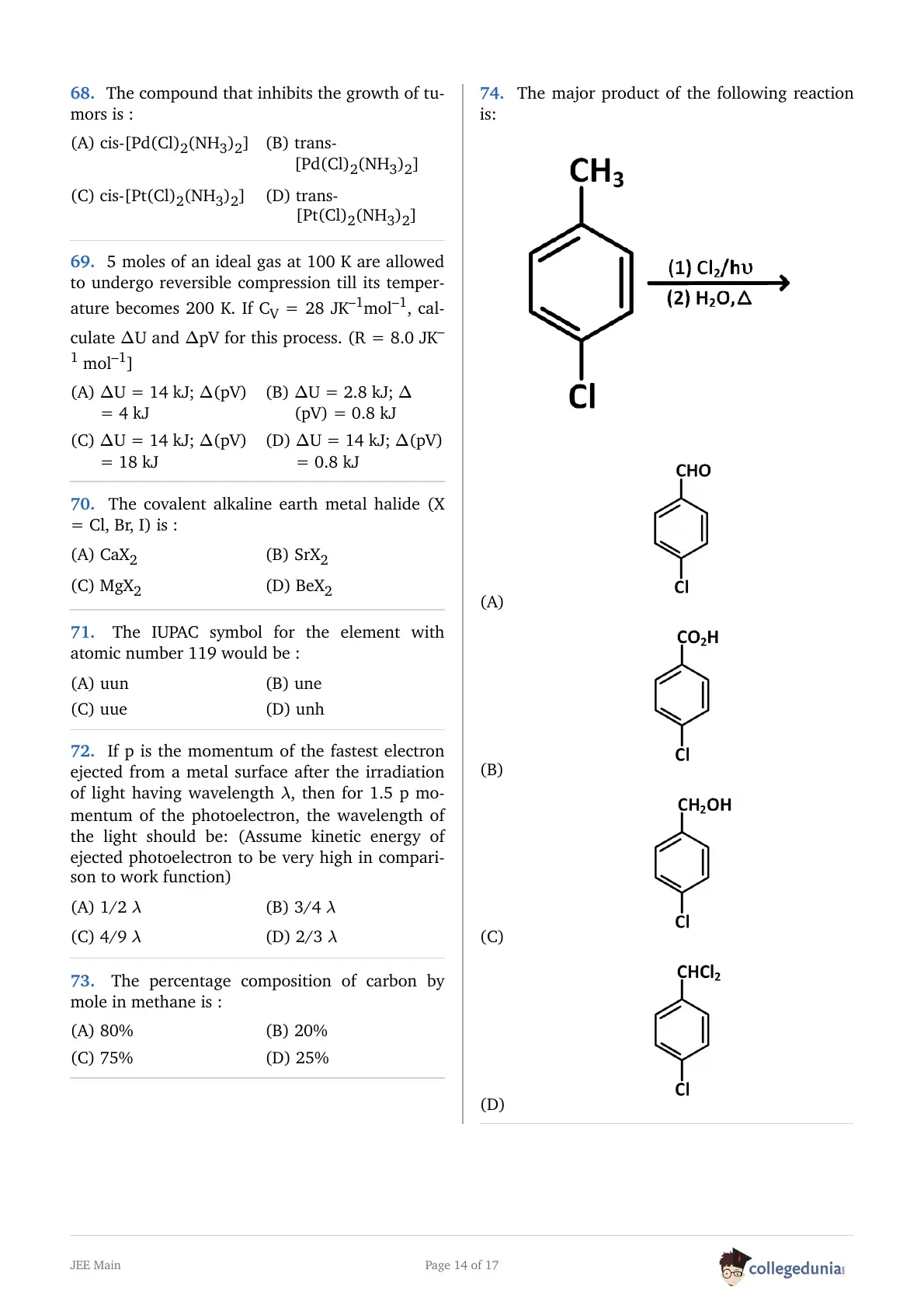
The compound that inhibits the growth of tumors is :
\(5\) moles of an ideal gas at \(100\, K\) are allowed to undergo reversible compression till its temperature becomes \(200\, K\). If \(C_{V} =28 JK^{-1}mol^{-1} , caculate \Delta\, U\) and \(\Delta \,pV \) for this process. (\(R = 8.0 \, JK^{-1}mol^{-1}\)]
The covalent alkaline earth metal halide (X = Cl, Br, I) is :
The IUPAC symbol for the element with atomic number \(119\) would be :
A metal of work function 2.3 eV is irradiated with radiation of wavelength \( y \times 10^2 \) nm. The maximum kinetic energy of ejected electron is \( 2.8 \times 10^{-20} \) J. Then calculate \( y \) (in nearest integer).
The percentage composition of carbon by mole in methane is :


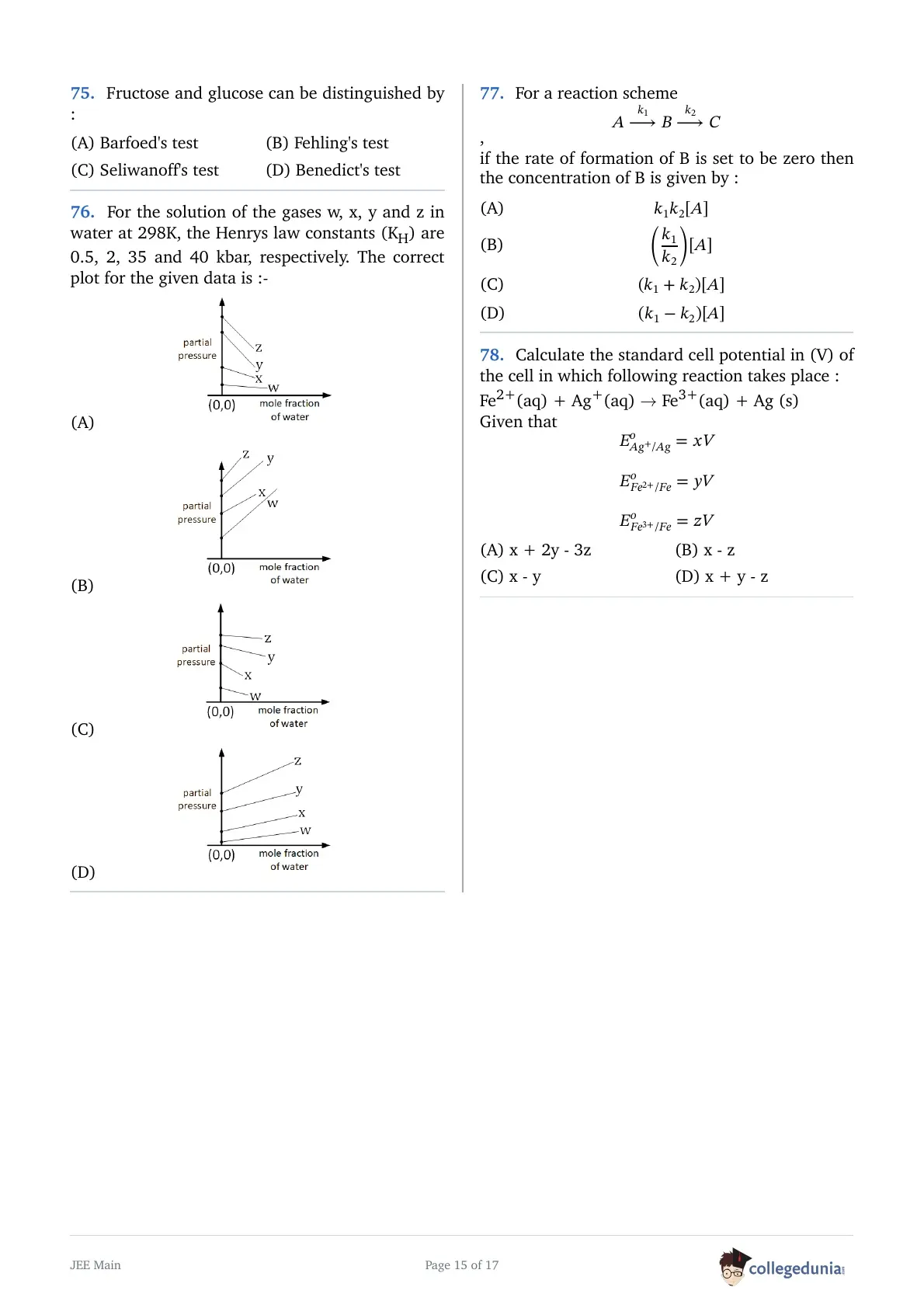
Fructose and glucose can be distinguished by :
For a solution of the gases A, B, C and D in water at 298 K, the values of Henry's law constant (KH) are 30.40, 2.34, 1.56 \( \times \) 10\( - \)5 and 0.513 k bar respectively. In the given graph, the lines marked as 'p' and 's' correspond respectively to :

For a reaction \(A \xrightarrow{K_1} B \xrightarrow{K_2} C\) If the rate of formation of B is set to be zero then the concentration of B is given by:
For the given cell: \[ {Fe}^{2+}(aq) + {Ag}^+(aq) \to {Fe}^{3+}(aq) + {Ag}(s) \] The standard cell potential of the above reaction is given. The standard reduction potentials are given as: \[ {Ag}^+ + e^- \to {Ag} \quad E^\circ = x \, {V} \] \[ {Fe}^{2+} + 2e^- \to {Fe} \quad E^\circ = y \, {V} \] \[ {Fe}^{3+} + 3e^- \to {Fe} \quad E^\circ = z \, {V} \] The correct answer is:


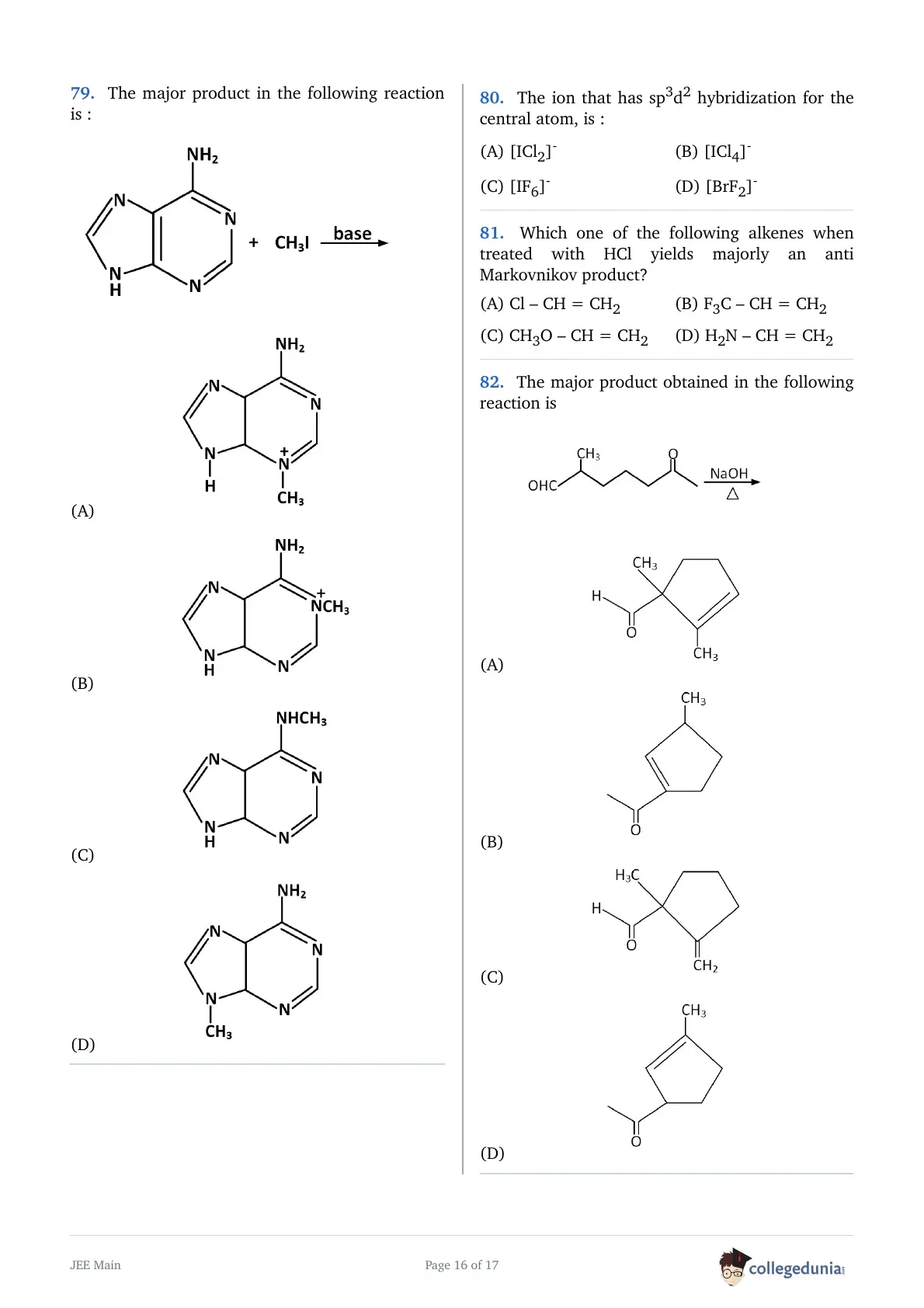
The ion that has \(sp^3d^2\) hybridization for the central atom, is :
Which one of the following alkenes when treated with HCl yields majorly an anti Markovnikov product?
The major product obtained in the following reaction is
- (1)
![]()
- (2)
![]()
- (3)
![]()
- (4)
![]()


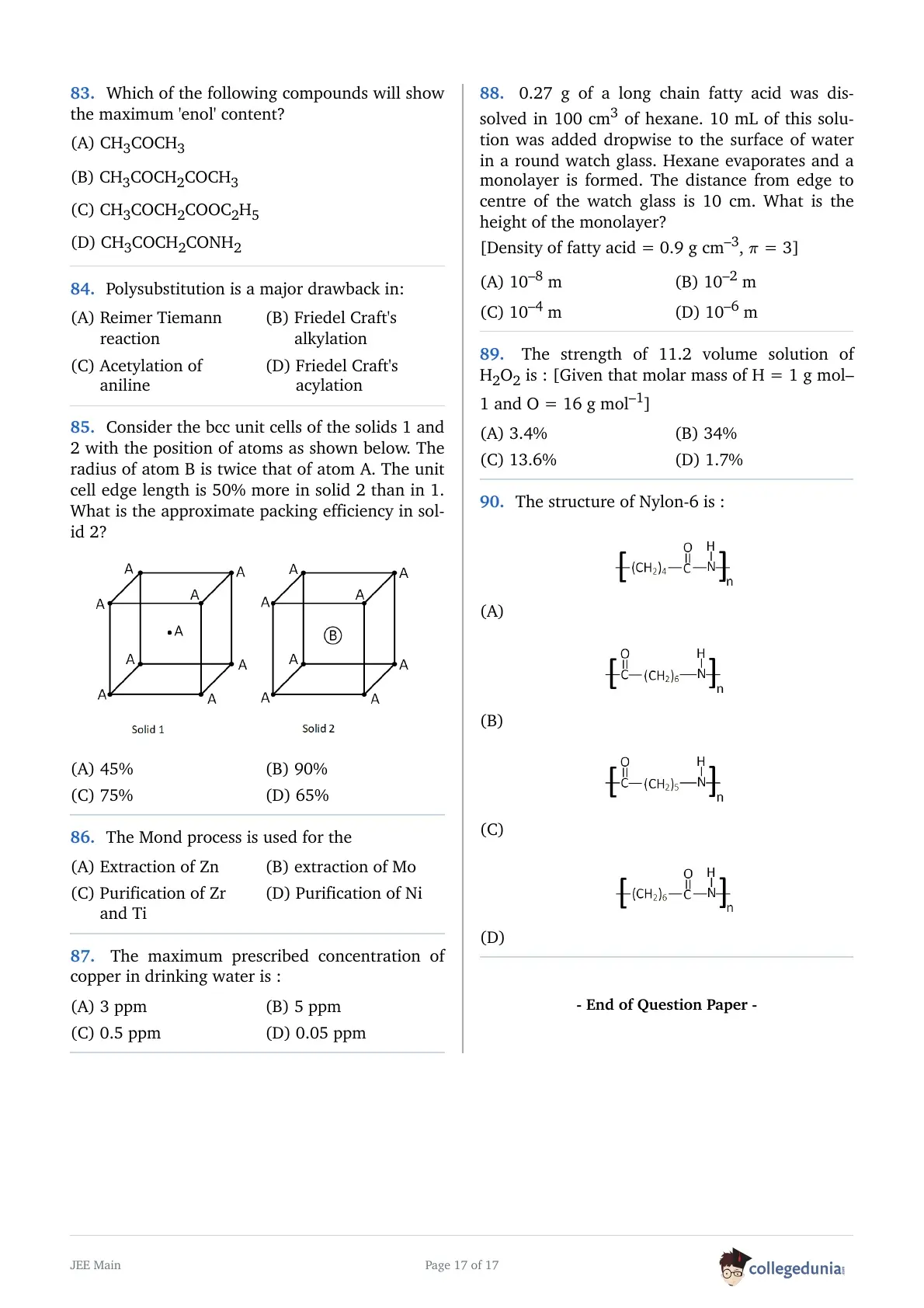
Which of the following compounds will show the maximum enol content?
Polysubstitution is a major drawback in:
Consider the \(bcc\) unit cells of the solids \(1\) and \(2\) with the position of atoms as shown below. The radius of atom \(B\) is twice that of atom \(A\). The unit cell edge length is \(50\%\) more in solid \(2\) than in \(1\). What is the approximate packing efficiency in solid \(2\) ?
The Mond process is used for the
| List-I (Species) | List-II (Maximum allowed concentration in ppm in drinking water) | ||
| A | F- | I | < 50 ppm |
| B | \(SO^{2-}_4\) | II | < 5 ppm |
| C | \(NO^-_3\) | III | < 2 ppm |
| D | Zn | IV | < 500 ppm |
Choose the correct answer from the options given below :
0.27 g of a long chain fatty acid was dissolved in 100 cm3 of hexane. 10 mL of this solution was added dropwise to the surface of water in a round watch glass. Hexane evaporates and a monolayer is formed. The distance from edge to centre of the watch glass is 10 cm. What is the height of the monolayer?
[Density of fatty acid = 0.9 g cm–3, \(\pi\) = 3]
The strength of \(11.2\) volume solution of \(H_2O_2\) is : [Given that molar mass of \(H = 1\, g\) \(mol^{-1}\) and \(O = 16\, g\, mol^{-1}]\)


JEE Main 2019 Exam Pattern and Marking Scheme
| Particulars | Details |
|---|---|
| Exam Mode | Online (Computer-Based Test) |
| Paper | B.E./B.Tech (Paper 1) |
| Duration | 3 hours (180 minutes) |
| Type of Questions | Multiple Choice Questions (MCQs) |
| Subjects | Mathematics, Physics, Chemistry |
| Total Questions | 90 questions |
| Total Marks | 360 marks |
| Marking Scheme | +4 for correct answer & -1 for incorrect answer; 0 for unattempted |
JEE Main 2019 April 8 Shift 2 Difficulty Level
The exam was successfully concluded by NTA (National Testing Agency) for the first time. Candidates rated JEE Main 2019 B.E./B.Tech Question Paper as difficult to moderate in terms of overall difficulty. The question paper comprises a total of 90 questions. The 90 questions were distributed across three main sections i.e. Physics, Chemistry, and Mathematics.
JEE Main B.E./B.Tech 2019 Paper Analysis
- Math was the toughest and lengthiest section with a total of 30 questions.
- Physics was moderate but a time-consuming paper, magnetics was an important topic in the paper.
- The Chemistry section was again the easiest section with direct questions from the book.
For every correct answer, candidates got +4 marks and for each wrong attempt, -1 marks were deducted.



Comments