




JEE Main 2019 April 8 Shift 1 Question Paper is available here with solutions PDF and detailed solutions for every question. NTA conducted the first shift on April 8, 2019, from 9:30 AM to 12:30 PM. The JEE Main 2019 Paper 1 (B.E./B.Tech) question paper includes the following:
- 90 questions in a 3-hour CBT Mode: 30 each from Mathematics, Physics and Chemistry
- Question type: all multiple choice questions (MCQs) with a single correct option, 4 marks each
- Sections: Mathematics (30), Physics (30) and Chemistry (30), all questions compulsory
- Marking: +4 for a correct answer, -1 for an incorrect answer, 0 for an unattempted question
- Maximum marks: 360 (120 per subject)
JEE Main 2019 April 8 Shift 1 Question Paper with Solution PDF
| NTA Official PDF | CD PDF | CD PDF with Solutions |
|---|---|---|
| Download official PDF 5.44 MB | Download Collegedunia PDF 1.10 MB | Download solutions PDF 1.33 MB |
Also Check:
JEE Main 2019 April 8 Shift 1 Questions with Solutions
Mathematics (Q1 - Q30)
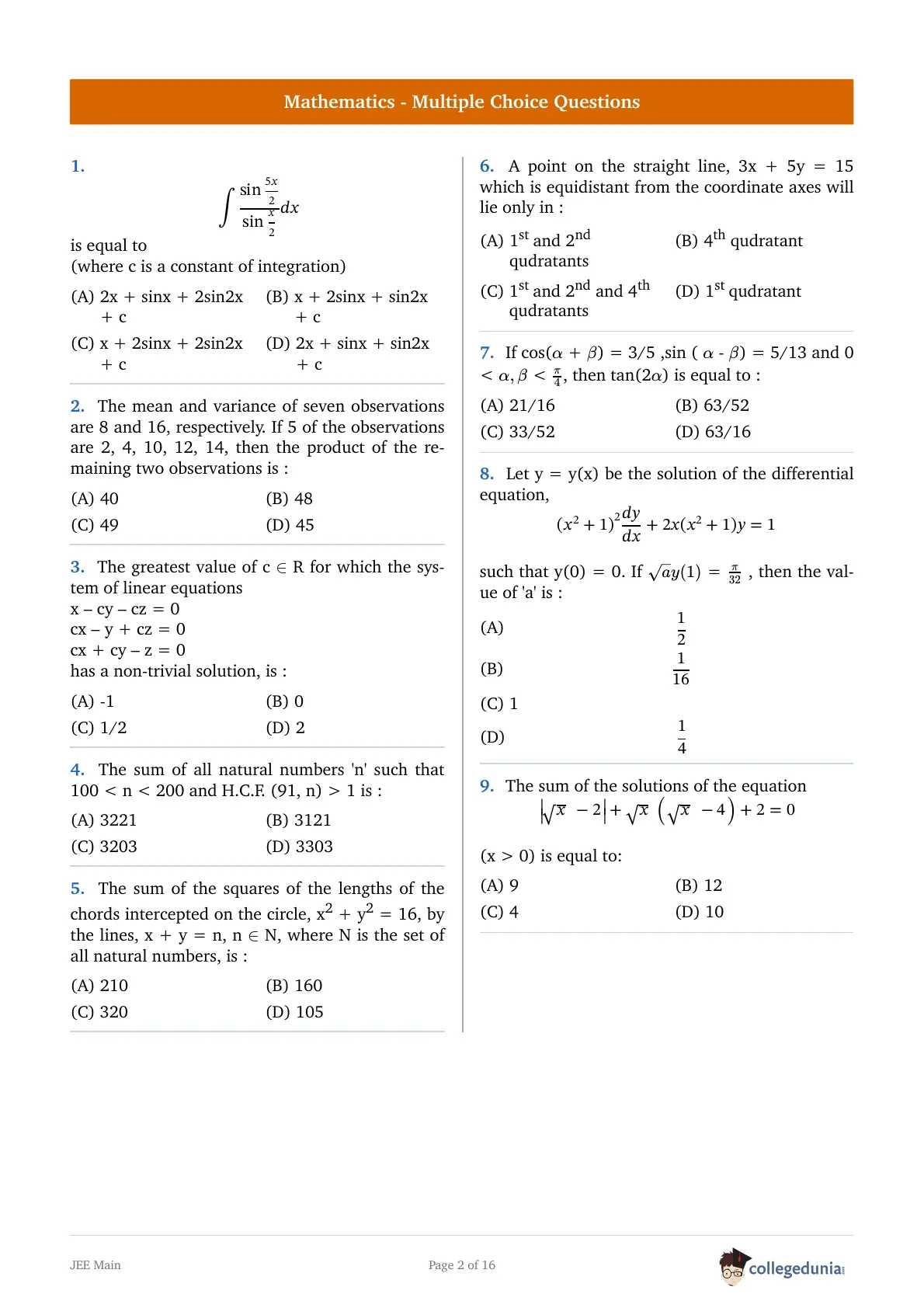
\(\int\frac{\sin \frac{5x}{2}}{\sin \frac{x}{2}} dx \) is equal to : (where \(c\) is a constant of integration)
The mean and variance of 7 observations are 8 and \(16,\) respectively. If five observations are \(2,4,10,12,14,\) then the absolute difference of the remaining two observations is :
The greatest value of \(c \in R\) for which the system of linear equations
\(x - cy - cz = 0\)
\(cx - y + cz = 0\)
\(cx + cy - z = 0\)
has a non-trivial solution, is :
The sum of all natural numbers 'n' such that \(100 \lt n \lt 200\) and H.C.F. \((91, n) \gt 1\) is :
The sum of the squares of the lengths of the chords intercepted on the circle, \(x^2 + y^2 = 16\), by the lines, \(x + y = n\), \(n \in N\), where N is the set of all natural numbers, is :
A point on the straight line, \(3x + 5y = 15\) which is equidistant from the coordinate axes will lie only in :
If \(\cos(\alpha + \beta) = 3/5\), \(\sin(\alpha - \beta) = 5/13\) and \(0 \lt \alpha, \beta \lt \frac{\pi}{4}\), then \(\tan(2\alpha)\) is equal to :
Let \(y = y(x)\) be the solution of the differential equation,
\((x^2 + 1)^2\frac{dy}{dx} + 2x(x^2 + 1)y = 1\)
such that \(y(0) = 0\). If \(\sqrt{a}\,y(1) = \frac{\pi}{32}\), then the value of 'a' is :
The sum of the solutions of the equation
\(\left|\sqrt{x} - 2\right| + \sqrt{x}\left(\sqrt{x} - 4\right) + 2 = 0\)
\((x \gt 0)\) is equal to:
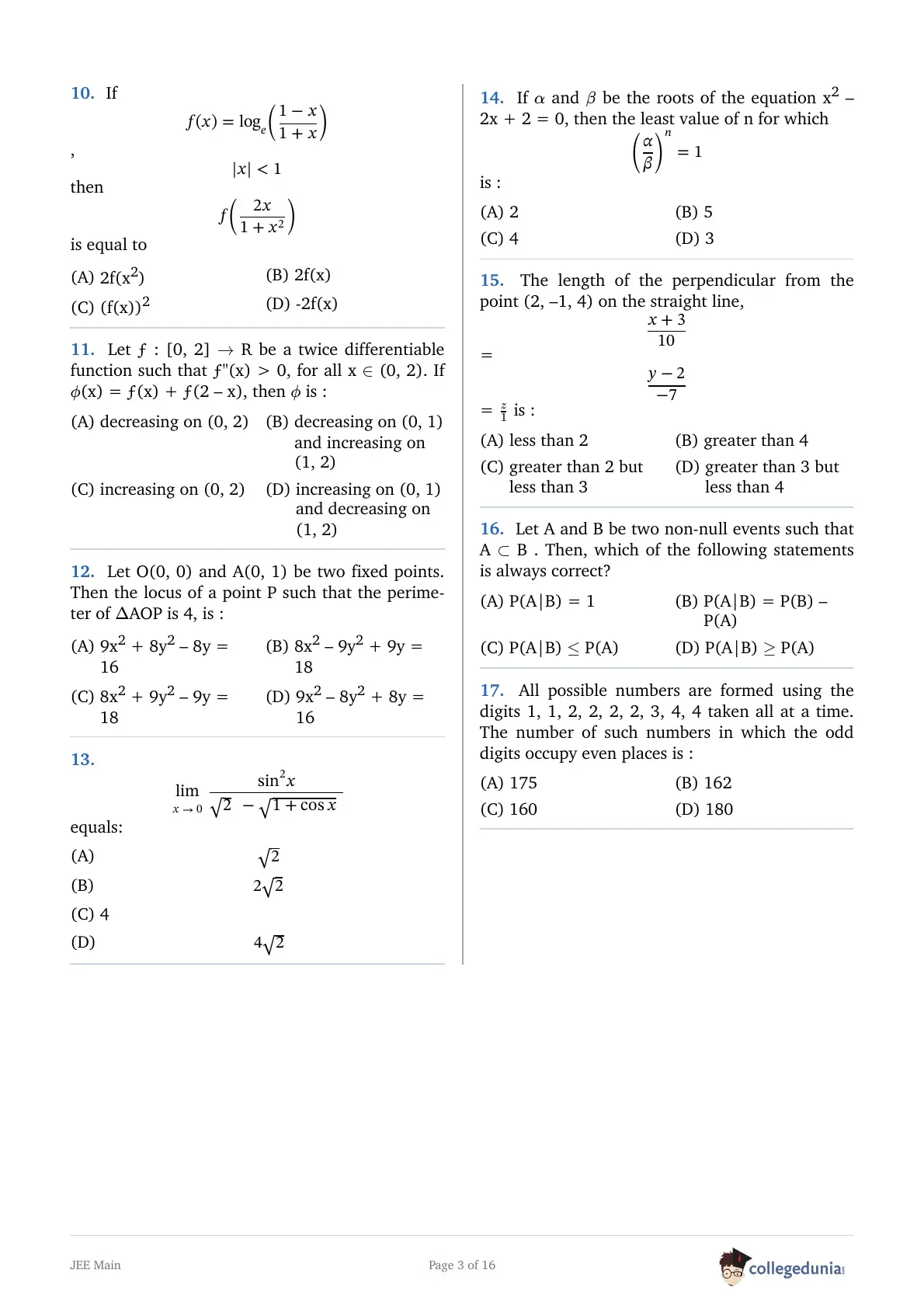
If \(f(x) = \log_e\left(\frac{1 - x}{1 + x}\right)\), \(|x| \lt 1\), then \(f\left(\frac{2x}{1 + x^2}\right)\) is equal to
Let \(f : [0, 2] \to R\) be a twice differentiable function such that \(f''(x) \gt 0\), for all \(x \in (0, 2)\). If \(\phi(x) = f(x) + f(2 - x)\), then \(\phi\) is :
Let \(O(0, 0)\) and \(A(0, 1)\) be two fixed points. Then the locus of a point P such that the perimeter of \(\Delta AOP\) is 4, is :
\(\displaystyle\lim_{x\to0} \frac{\sin^{2}x}{\sqrt{2} - \sqrt{1+\cos x}} \) equals :
If \(\alpha\) and \(\beta\) be the roots of the equation \(x^2 - 2x + 2 = 0\), then the least value of n for which \(\left(\frac{\alpha}{\beta}\right)^n = 1\) is :
The length of the perpendicular from the point \((2, -1, 4)\) on the straight line,
\(\frac{x + 3}{10} = \frac{y - 2}{-7} = \frac{z}{1}\) is :
Let A and B be two non-null events such that \(A \subset B\). Then, which of the following statements is always correct?
All possible numbers are formed using the digits \(1,1,2,2,2,2,3,4,4\) taken all at a time. The number of such numbers in which the odd digits occupy even places is :
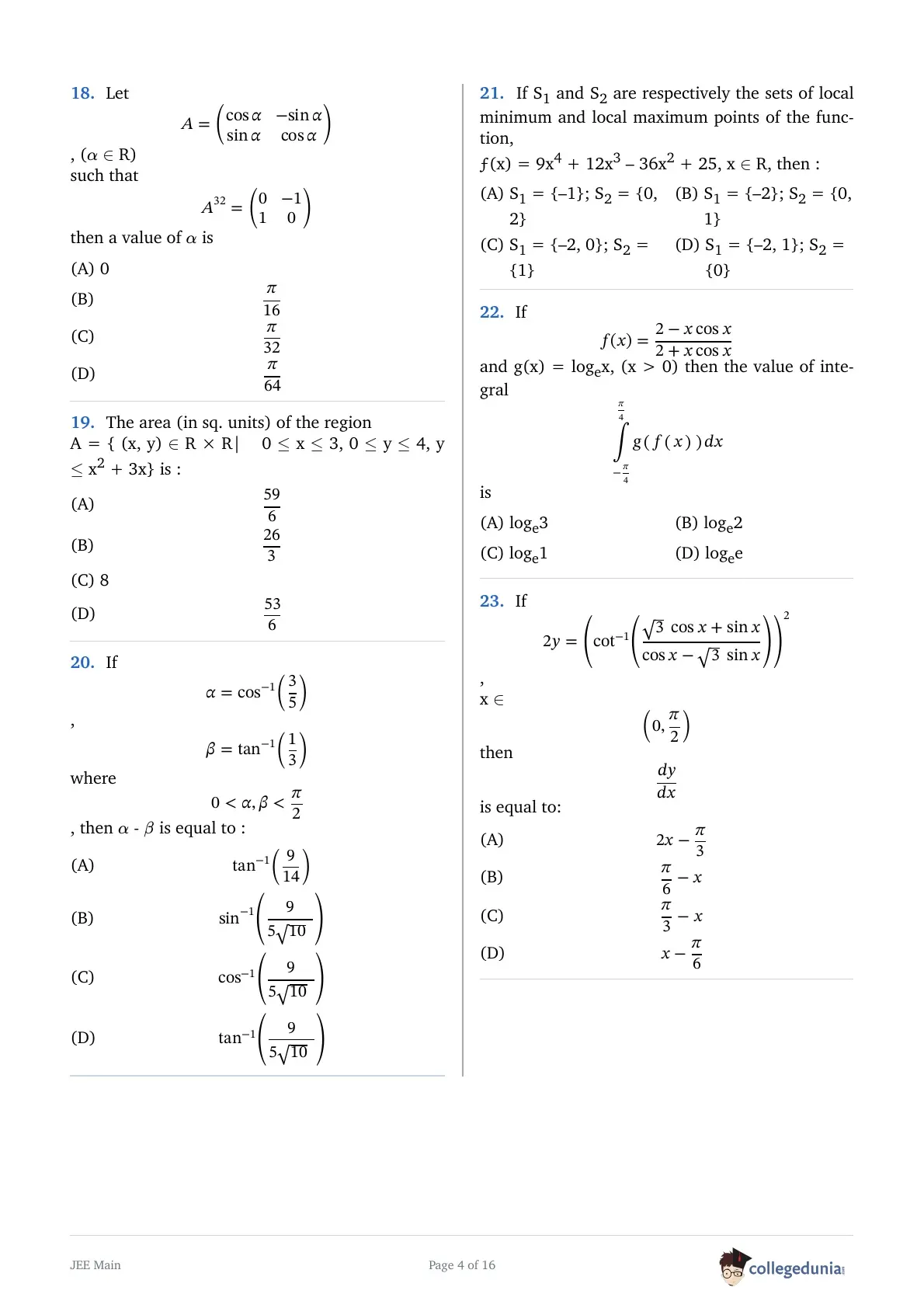
Let \(A = \begin{pmatrix}\cos\alpha & -\sin\alpha\\ \sin\alpha & \cos\alpha\end{pmatrix}\), \((\alpha \in R)\) such that \(A^{32} = \begin{pmatrix}0 & -1\\ 1 & 0\end{pmatrix}\) then a value of \(\alpha\) is
The area (in sq. units) of the region \(A = \{(x, y) \in R \times R \mid 0 \le x \le 3,\ 0 \le y \le 4,\ y \le x^2 + 3x\}\) is :
If \(\alpha = \cos^{-1}\left(\frac{3}{5}\right)\), \(\beta = \tan^{-1}\left(\frac{1}{3}\right)\), where \(0 \lt \alpha, \beta \lt \frac{\pi}{2}\), then \(\alpha - \beta\) is equal to :
If \(S_1\) and \(S_2\) are respectively the sets of local minimum and local maximum points of the function \(f(x) = 9x^4 + 12x^3 - 36x^2 + 25,\ x \in R\), then :
If \(f\left(x\right) = \frac{2- x\cos x}{2+x \cos x}\) and \( g\left(x\right) =\log_{e}x ., \left(x>0\right) \) then the value of integral \(\int\limits^{\frac{\pi}{4}}_{-\frac{\pi}{4}} g\left(f\left(x\right)\right)dx \) is :
If \(2y = \left(\cot^{-1}\left(\frac{\sqrt{3}\cos x + \sin x}{\cos x - \sqrt{3}\sin x}\right)\right)^2,\ x \in \left(0, \frac{\pi}{2}\right)\), then \(\frac{dy}{dx}\) is equal to :
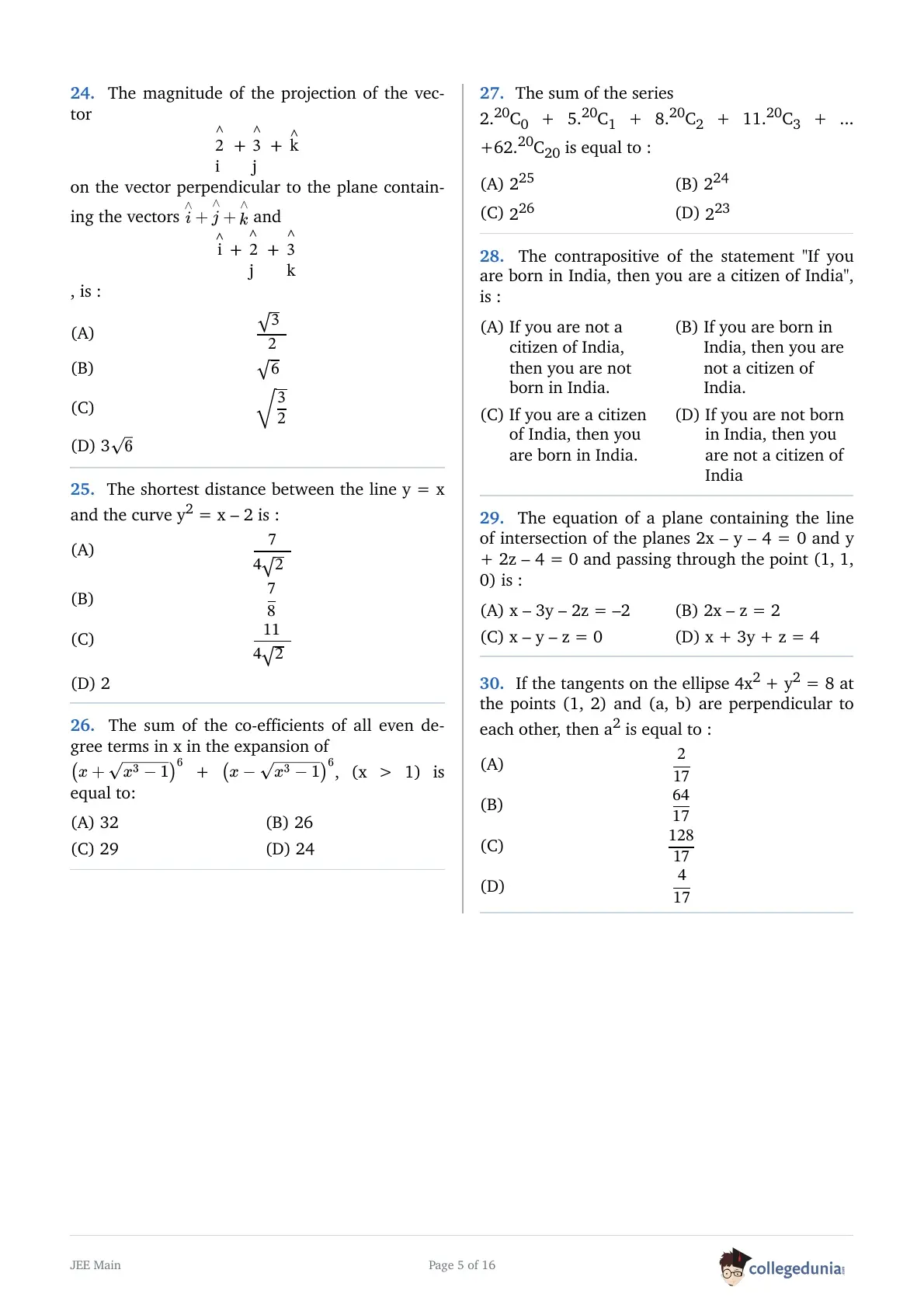
The magnitude of the projection of the vector \(2\hat{i} + 3\hat{j} + \hat{k}\) on the vector perpendicular to the plane containing the vectors \(\hat{i} + \hat{j} + \hat{k}\) and \(\hat{i} + 2\hat{j} + 3\hat{k}\), is :
The shortest distance between the line \(y = x\) and the curve \(y^2 = x - 2\) is :
If the sum of the co-efficients of all the positive even powers of x in the binomial expansion of \((2x^3+\frac{3}{x})^{10} \) is 510 – β·39, the β is equal to ____.
The sum of the series 2 \times 1 \times 20C_4 - 3 \times 2 \times 20C_5 + 4 \times 3 \times 20C_6 - 5 \times 4 \times 20C_7 + ... + 18 \times 17 \times 20C_{20}, is equal to
The contrapositive of the statement "If you are born in India, then you are a citizen of India", is :
The equation of a plane containing the line of intersection of the planes \(2x - y - 4 = 0\) and \(y + 2z - 4 = 0\) and passing through the point \((1, 1, 0)\) is :
If the tangents on the ellipse \(4x^2 + y^2 = 8\) at the points \((1, 2)\) and \((a, b)\) are perpendicular to each other, then \(a^2\) is equal to :
Physics (Q31 - Q60)
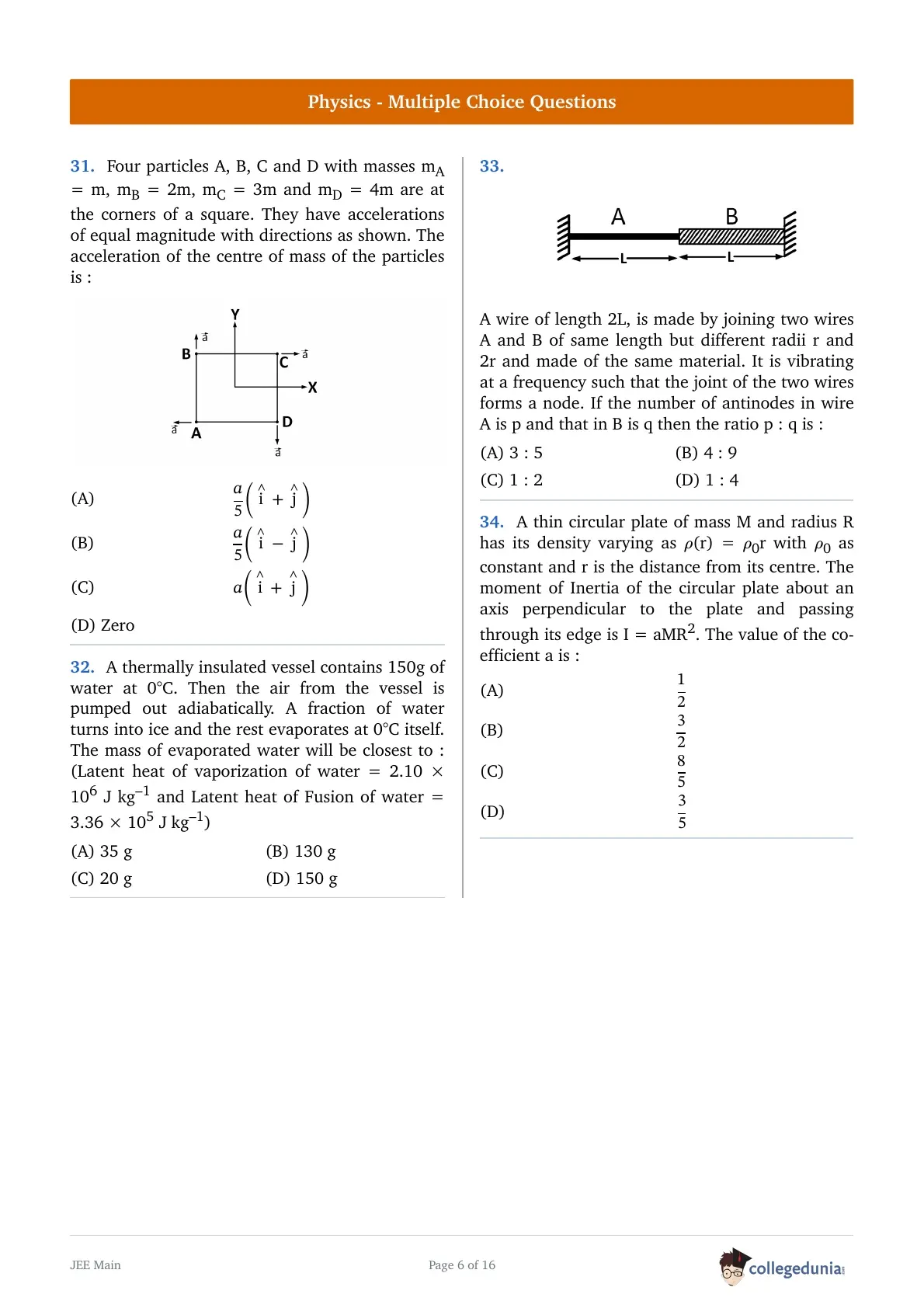
Four particles A, B, C and D with masses \(m_A = m\), \(m_B = 2m\), \(m_C = 3m\) and \(m_D = 4m\) are at the corners of a square. They have accelerations of equal magnitude with directions as shown. The acceleration of the centre of mass of the particles is :
A thermally insulated vessel contains \(150\,g\) of water at \(0^{\circ}C\). Then the air from the vessel is pumped out adiabatically. A fraction of water turns into ice and the rest evaporates at \(0^{\circ}C\) itself. The mass of evaporated water will be closest to : (Latent heat of vaporization of water \(= 2.10 \times 10^6 \; J \; kg^{-1}\) and Latent heat of Fusion of water = \(3.36 \times 10^5 \; J \; kg^{-1}\))

A wire of length \(2L\), is made by joining two wires A and B of same length but different radii \(r\) and \(2r\) and made of the same material. It is vibrating at a frequency such that the joint of the two wires forms a node. If the number of antinodes in wire A is \(p\) and that in B is \(q\) then the ratio \(p : q\) is :
A thin circular plate of mass \(M\) and radius \(R\) has its density varying as \(\rho (r) = \rho_0 r\) with \(\rho_0\) as constant and \(r\) is the distance from its centre. The moment of Inertia of the circular plate about an axis perpendicular to the plate and passing through its edge is \(I = aMR^2\). The value of the coefficient \(a\) is :
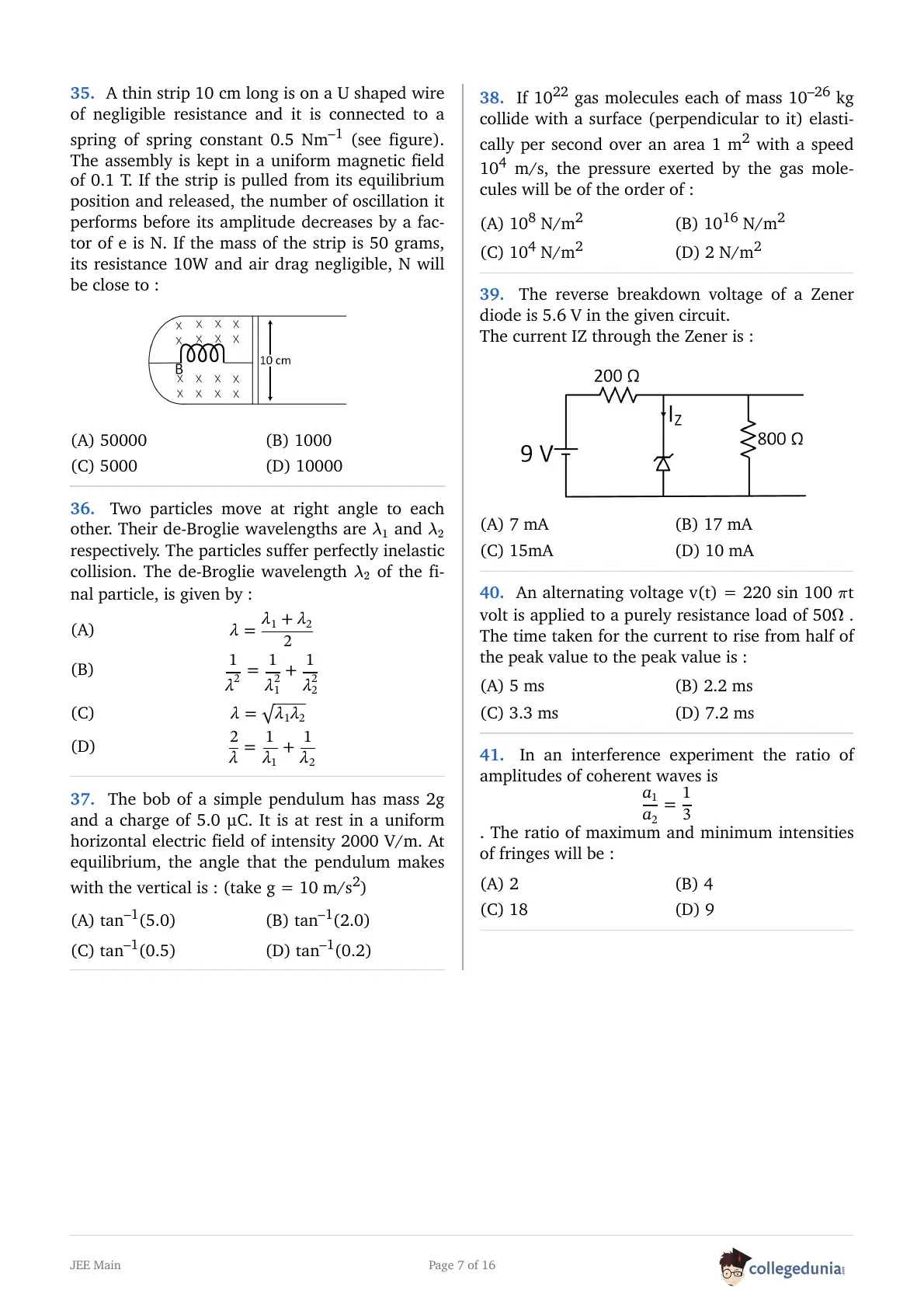
A thin strip 10 cm long is on a U shaped wire of negligible resistance and it is connected to a spring of spring constant \(0.5\ \mathrm{N\,m^{-1}}\) (see figure). The assembly is kept in a uniform magnetic field of 0.1 T. If the strip is pulled from its equilibrium position and released, the number of oscillation it performs before its amplitude decreases by a factor of \(e\) is \(N\). If the mass of the strip is 50 grams, its resistance \(10\ \Omega\) and air drag negligible, \(N\) will be close to :
Two particles move at right angle to each other. Their de-Broglie wavelengths are \(\lambda_1\) and \(\lambda_2\) respectively. The particles suffer perfectly inelastic collision. The de-Broglie wavelength \(\lambda_2\) of the final particle, is given by :
The bob of a simple pendulum has mass 2g and a charge of \(5.0\ \mu\mathrm{C}\). It is at rest in a uniform horizontal electric field of intensity 2000 V/m. At equilibrium, the angle that the pendulum makes with the vertical is : (take \(g = 10\ \mathrm{m/s^2}\))
If \(10^{22}\) gas molecules each of mass \(10^{-26}\) kg collide with a surface (perpendicular to it) elastically per second over an area \(1\, m^2\) with a speed \(10^4\) m/s, the pressure exerted by the gas molecules will be of the order of :
The reverse breakdown voltage of a Zener diode is 5.6 V in the given circuit.
The current \(I_Z\) through the Zener is :
An alternating voltage \( V(t) = 220 \sin 100 \pi t \) volt is applied to a purely resistive load of 50 \( \Omega \). The time taken for the current to rise from half of the peak value to the peak value is:
In an interference experiment the ratio of amplitudes of coherent waves is \(\frac{a_1}{a_2} = \frac{1}{3}\) . The ratio of maximum and minimum intensities of fringes will be :
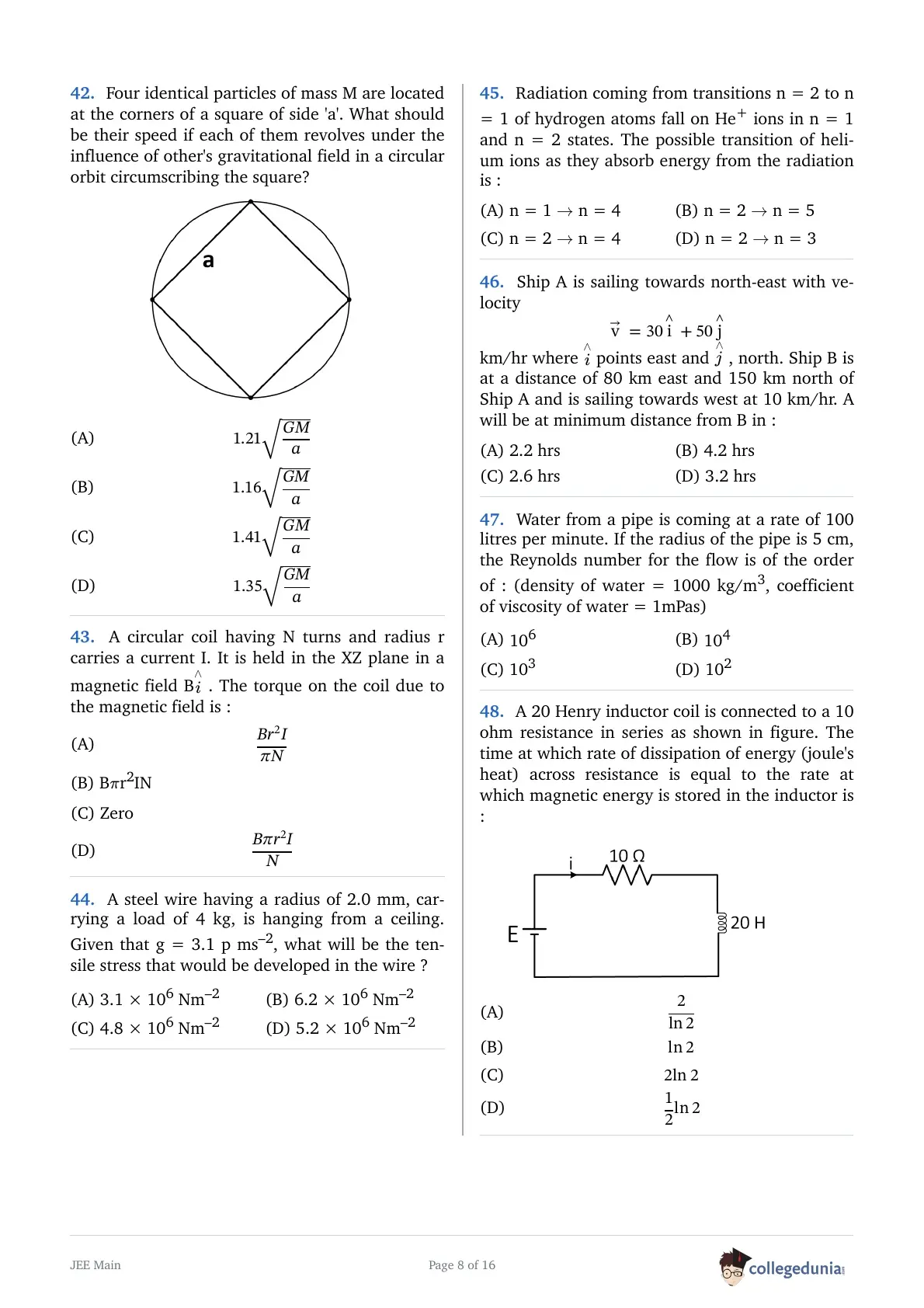
Four identical particles of mass \(M\) are located at the corners of a square of side \('a'\). What should be their speed if each of them revolves under the influence of other?s gravitational field in a circular orbit circumscribing the square?
A circular coil having \(N\) turns and radius \(r\) carries a current \(I\). It is held in the \(XZ\) plane in a magnetic field \(B \hat{i}\) . The torque on the coil due to the magnetic field is :
A steel wire having a radius of \(2.0\, mm\), carrying a load of \(4 \,kg\), is hanging from a ceiling. Given that \(g = 3.1 \; \pi \; ms^{-2}\), what will be the tensile stress that would be developed in the wire ?
Radiation coming from transitions \(n = 2\) to \(n = 1\) of hydrogen atoms fall on \(\mathrm{He^+}\) ions in \(n = 1\) and \(n = 2\) states. The possible transition of helium ions as they absorb energy from the radiation is :
Ship A is sailing towards north-east with velocity \(\vec{v} = 30\hat{i} + 50\hat{j}\) km/hr where \(\hat{i}\) points east and \(\hat{j}\), north. Ship B is at a distance of 80 km east and 150 km north of Ship A and is sailing towards west at 10 km/hr. A will be at minimum distance from B in :
Water from a pipe is coming at a rate of 100 litres per minute. If the radius of the pipe is 5 cm, the Reynolds number for the flow is of the order of : (density of water = 1000 kg/m3, coefficient of viscosity of water = 1mPas)
A \(20\) Henry inductor coil is connected to a \(10\) ohm resistance in series as shown in figure. The time at which rate of dissipation of energy (joule's heat) across resistance is equal to the rate at which magnetic energy is stored in the inductor is :
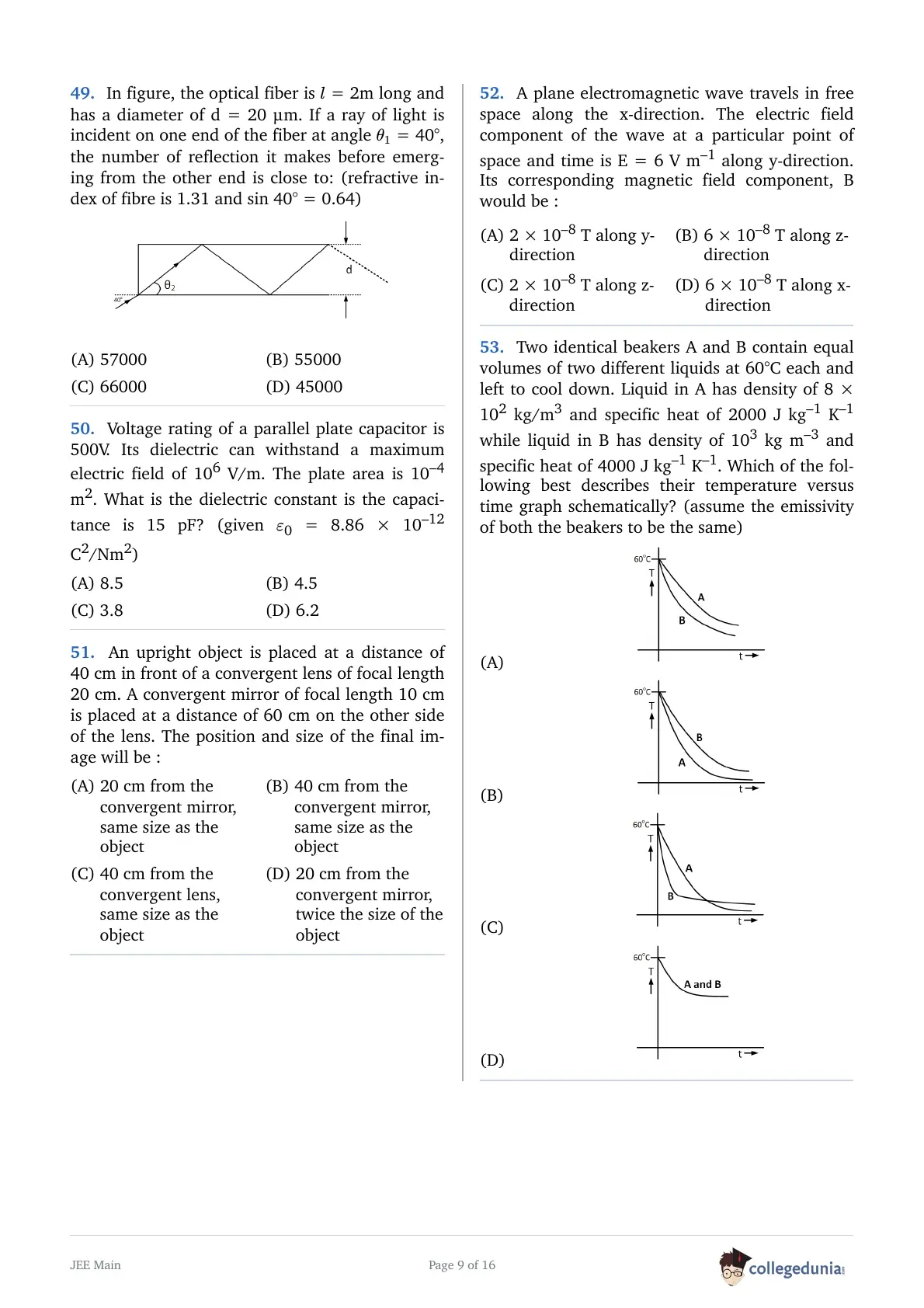
In figure, the optical fiber is \(l\) = 2m long and has a diameter of d = 20 \(\mu\)m. If a ray of light is incident on one end of the fiber at angle \(\theta_1\) = 40°, the number of reflection it makes before emerging from the other end is close to: (refractive index of fibre is 1.31 and sin 40° = 0.64)
Voltage rating of a parallel plate capacitor is \(500\,V\). Its dielectric can withstand a maximum electric field of \(10^6\) V/m. The plate area is \(10^{-4} \; m^2\). What is the dielectric constant is the capacitance is \(15\, pF\) ? (given \(\in_0 = 8.86 \times 10^{-12} C^2 / Nm^2\))
An upright object is placed at a distance of 40 cm in front of a convergent lens of focal length 20 cm. A convergent mirror of focal length 10 cm is placed at a distance of 60 cm on the other side of the lens. The position and size of the final image will be :
A plane electromagnetic wave travels in free space along the x-direction. The electric field component of the wave at a particular point of space and time is \(E = 6 \; V \; m^{-1}\) along y-direction. Its corresponding magnetic field component, B would be :
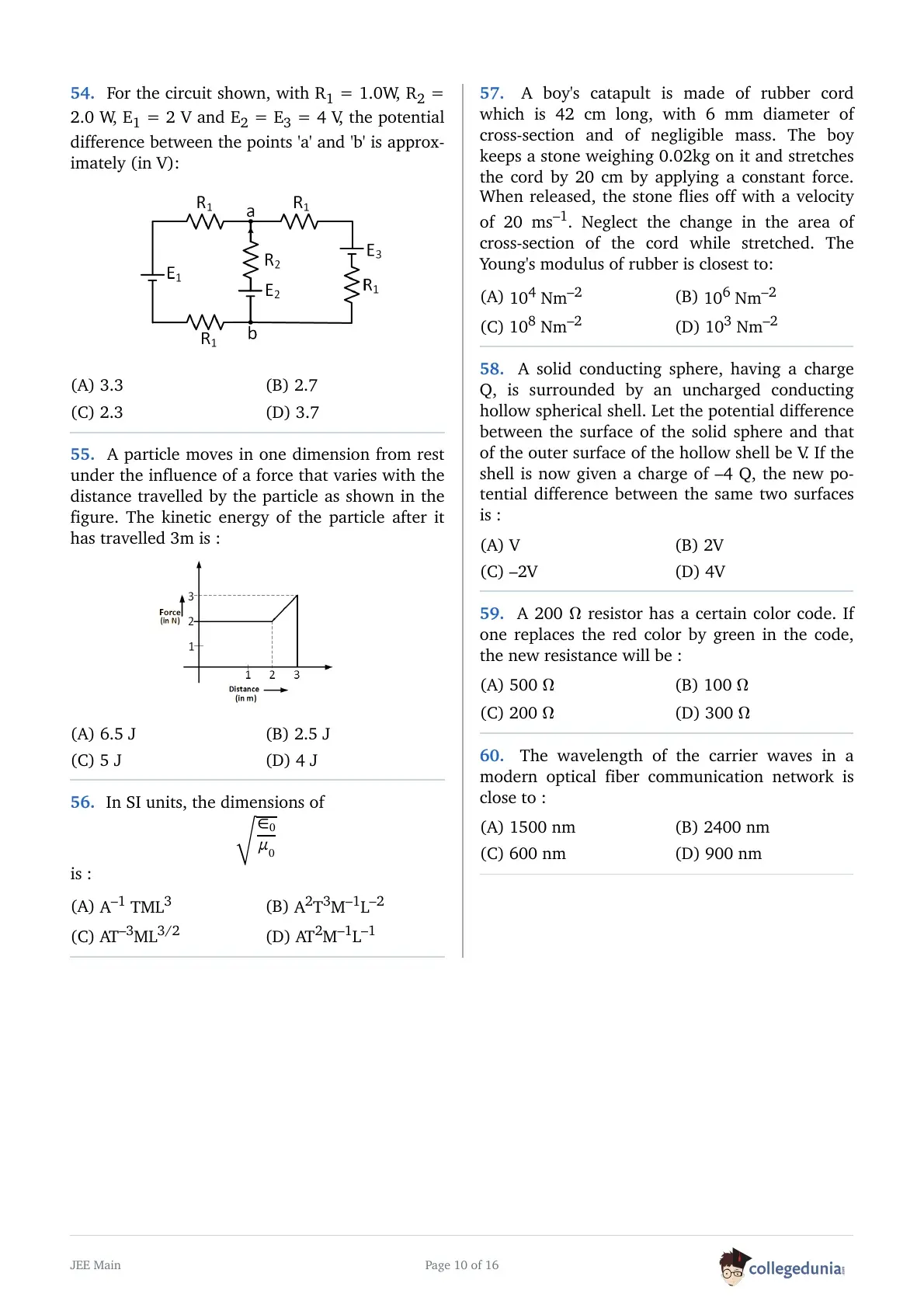
Two identical breakers A and B contain equal volumes of two different liquids at \(60^{\circ}C\) each and left to cool down. Liquid in A has density of \(8 \times 10^2 \; kg/m^3\) and sp ecific heat o f 2000 J \(kg^{-1} \; K^{-1}\) while liquid in B has density o f 103 kg m-3 and sp ecific heat o f 4000 J \(kg^{-1} K^{-1}\). Which of the following best describes their temperature versus time graph schematically? (assume the emissivity of both the beakers to be the same)
- (1)
![]()
- (2)
![]()
- (3)
![]()
- (4)
![]()


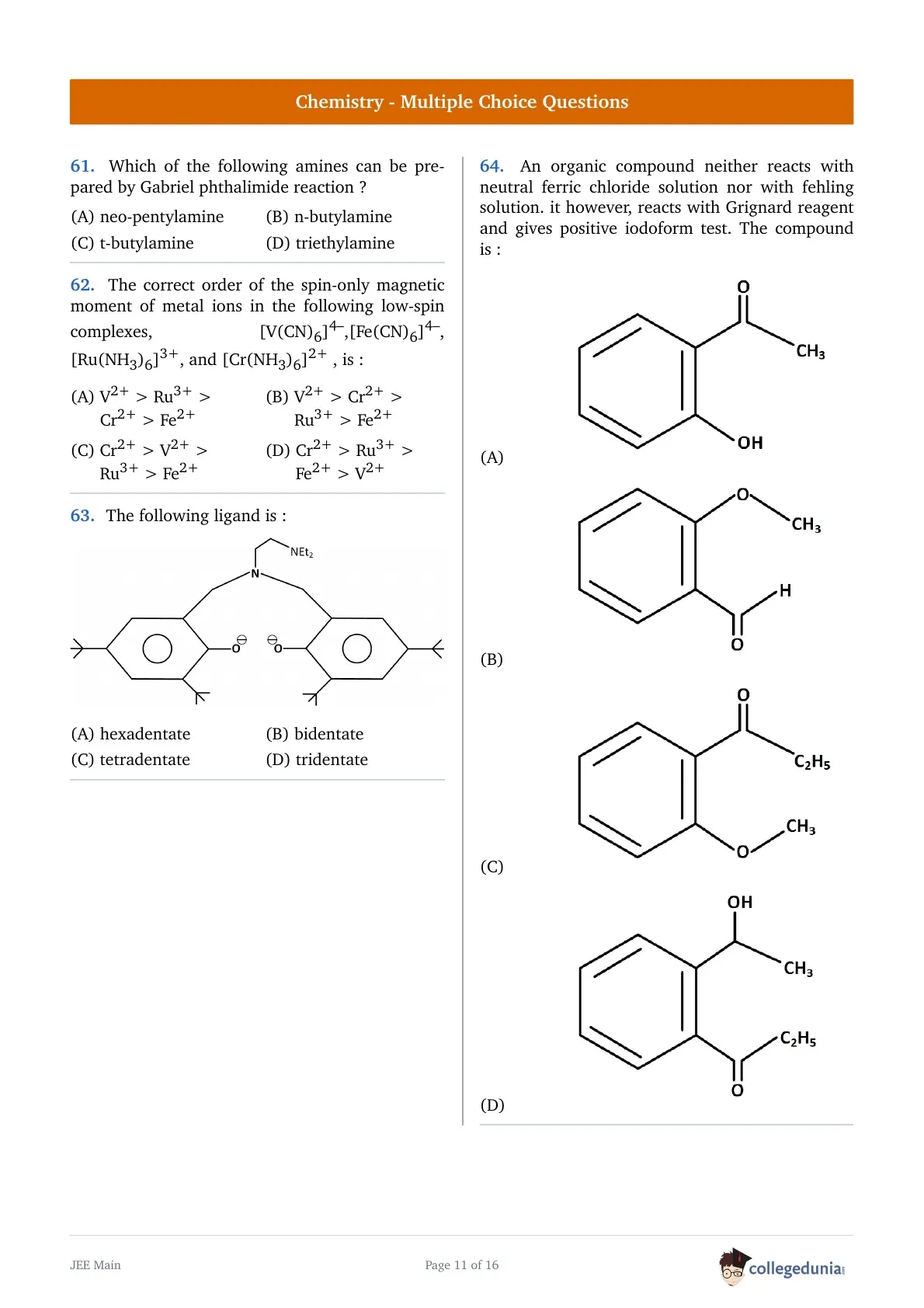
For the circuit shown, with R1 = 1.0W, R2 = 2.0 W, E1 = 2 V and E2 = E3 = 4 V, the potential difference between the points 'a' and 'b' is approximately (in V):
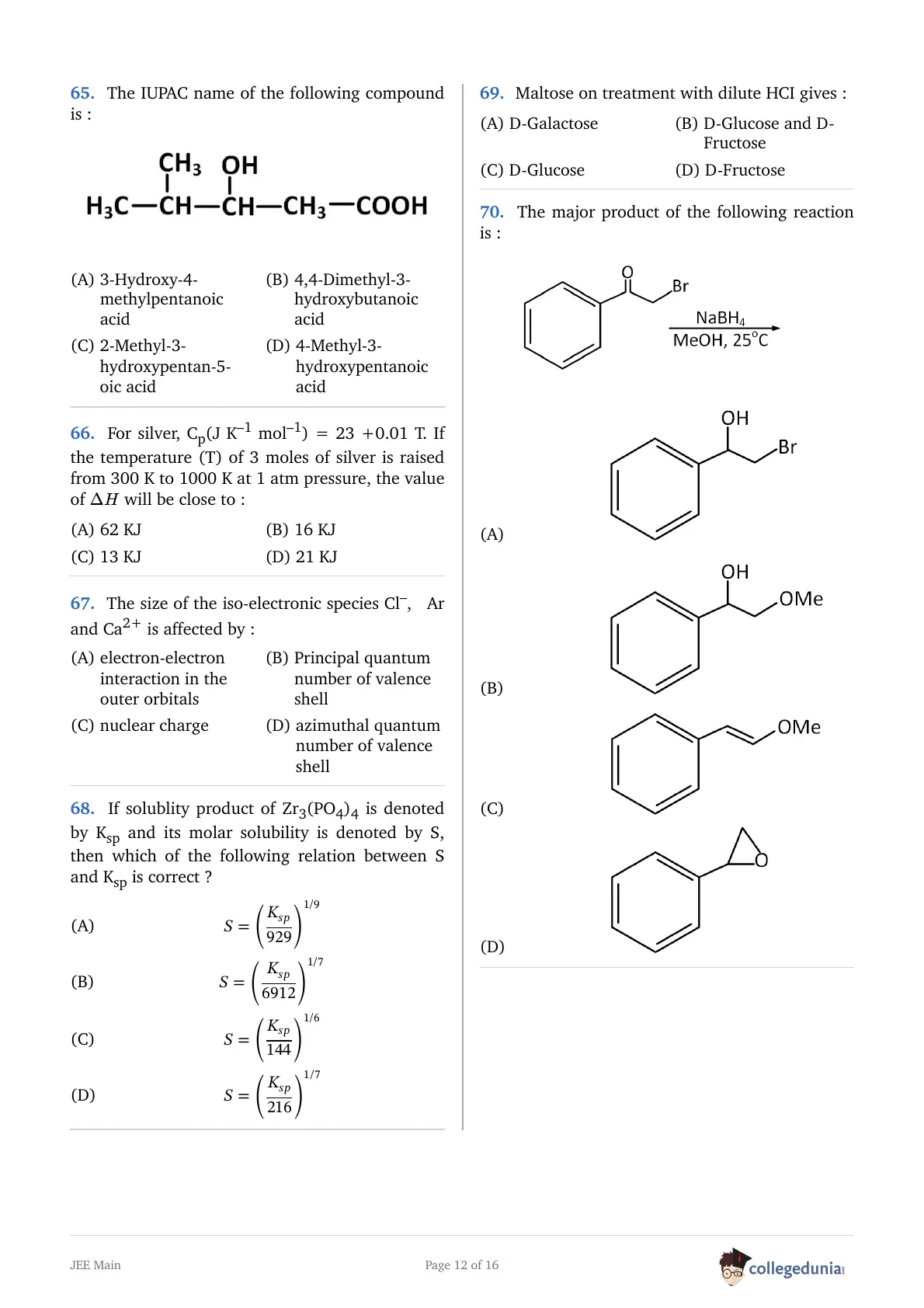
A particle moves in one dimension from rest under the influence of a force that varies with the distance travelled by the particle as shown in the figure. The kinetic energy of the particle after it has travelled 3m is :
In SI units, the dimensions of \(\sqrt{\dfrac{\in_0}{\mu_0}}\) is :
A boy's catapult is made of rubber cord which is \(42\, cm\) long, with \(6\, mm\) diameter of cross-section and of negligible mass. The boy keeps a stone weighing \(0.02\,kg\) on it and stretches the cord by \(20\, cm\) by applying a constant force. When released, the stone flies off with a velocity of \(20\, ms^{-1}\). Neglect the change in the area of cross-section of the cord while stretched. The Young's modulus of rubber is closest to:
A solid conducting sphere, having a charge \(Q\), is surrounded by an uncharged conducting hollow spherical shell. Let the potential difference between the surface of the solid sphere and that of the outer surface o f the hollow shell be \(V\). If the shell is now given a charge of \(-4\, Q\), the new potential difference between the same two surfaces is :
A 200 \(\Omega\) resistor has a certain color code. If one replaces the red color by green in the code, the new resistance will be :
The wavelength of the carrier waves in a modern optical fiber communication network is close to :
Chemistry (Q61 - Q90)
Which of the following amines can be prepared by Gabriel phthalimide reaction ?
The correct order of the spin-only magnetic moment of metal ions in the following low spin complexes, \({[V(CN)_6]^{4-}, [Fe(CN)6]^{4-}, [Ru (NH3)6]^{3+},}\) and \({[Cr(NH3)6]^{2+}}\), is :
The following ligand is :
An organic compound neither reacts with neutral ferric chloride solution nor with fehling solution. it however, reacts with Grignard reagent and gives positive iodoform test. The compound is :
- (1)
![]()
- (2)
![]()
- (3)
![]()
- (4)
![]()


The IUPAC name of the following compound is :
For silver, \( {C_{p}(JK^{-1} mol^{-1}) = 23 + 0.01T}\). If the temperature (T) of \(3\) moles of silver is raised from \(300\,K\) to \(1000\, K\) at \(1\, atm\) pressure, the value of \(\Delta H\) will be close to
The size of the iso-electronic species \(Cl^-, Ar\) and \( {Ca^{2+}}\) is affected by -
If solublity product of \(\mathrm{Zr_3(PO_4)_4}\) is denoted by \(\mathrm{K_{sp}}\) and its molar solubility is denoted by S, then which of the following relation between S and \(\mathrm{K_{sp}}\) is correct ?
Maltose on treatment with dilute HCI gives :


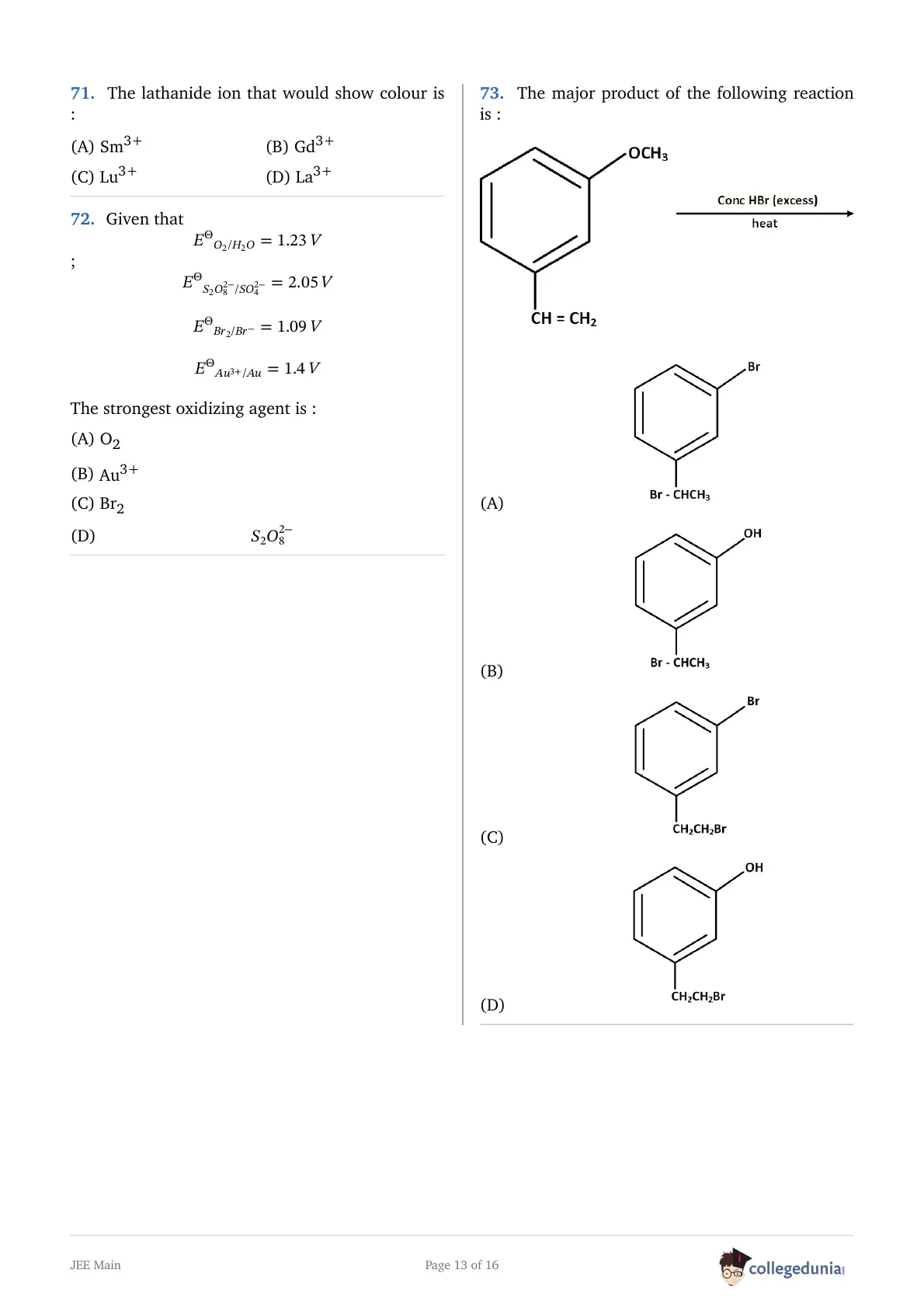
The lanthanide ion that would show colour is-
Given that
\(E^{\ominus}_{\mathrm{O_2/H_2O}} = 1.23\ \mathrm{V}\);
\(E^{\ominus}_{\mathrm{S_2O_8^{2-}/SO_4^{2-}}} = 2.05\ \mathrm{V}\)
\(E^{\ominus}_{\mathrm{Br_2/Br^-}} = 1.09\ \mathrm{V}\)
\(E^{\ominus}_{\mathrm{Au^{3+}/Au}} = 1.4\ \mathrm{V}\)
The strongest oxidizing agent is :


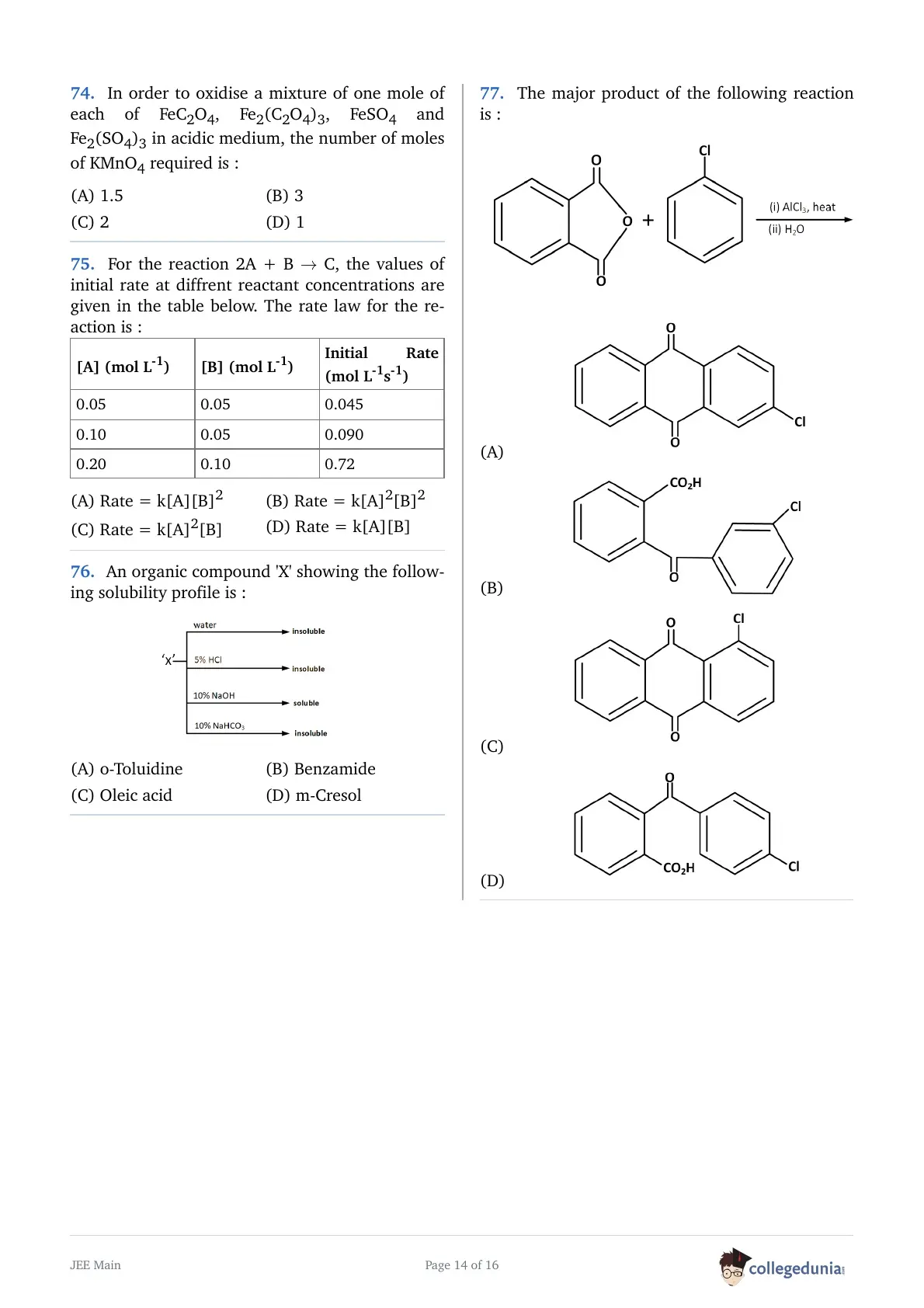
In order to oxidise a mixture one mole of each of \(\({FeC2O_4, Fe2(C2O4)3, FeSO4}\)\) and \(\({Fe2(SO4)3}\)\) in acidic medium, the number of moles of \(\({KMnO_4 }\)\) required is -
| [A] (mol L-1) | [B] (mol L-1) | Initial Rate (mol L-1 s-1) |
| 0.05 | 0.05 | 0.045 |
| 0.10 | 0.05 | 0.090 |
| 0.20 | 0.10 | 0.72 |
An organic compound 'X' showing the following solubility profile is -


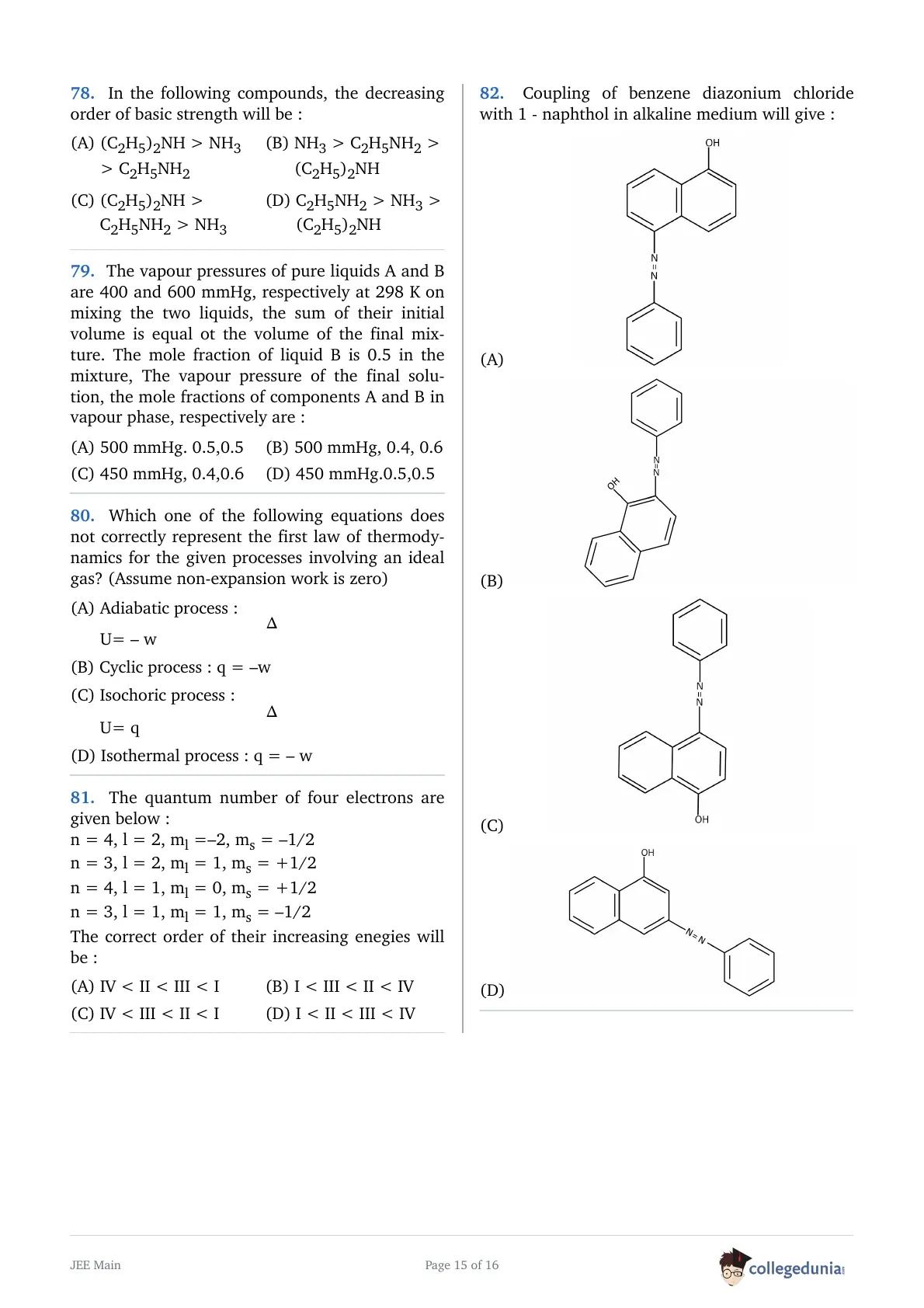
In the following compounds, the decreasing order of basic strength will be :
The vapour pressures of pure liquids \(A\) and \(B\) are \(400\) and \(600\, mmHg\), respectively at \(298\,K\). On mixing the two liquids, the sum of their initial volumes is equal to the volume of the final mixture. The mole fraction of liquid \(B\) is \(0.5\) in the mixture. The vapour pressure of the final solution, the mole fraction of components \(A\) and \(B\) in vapour phase, respectively are -
Which one of the following equations does not correctly represent the first law of thermodynamics for the given processes involving an ideal gas ? (Assume non-expansion work is zero)
Given below are the quantum numbers for 4 electrons.
A. n=3, l=2, ml=1,ms=+\(\frac{1}{2}\)
B. n=4, l=1, ml=0,ms=+\(\frac{1}{2}\)
C. n=4, l=2, ml=–2,ms=–\(\frac{1}{2}\)
D. n=3, l=1, ml=–1,ms=+\(\frac{1}{2}\)
The correct order of increasing energy is
Coupling of benzene diazonium chloride with 1 - naphthol in alkaline medium will give :
- (1)
![]()
- (2)
![]()
- (3)
![]()
- (4)
![]()


Which is wrong with respect to our responsibility as a human being to protect our environment ?
With respect to an ore, Ellingham diagram helps to predict the feasibility of its -
Diborane \({(B2H6)}\) reacts independently with \({O_2}\) and \({H2O}\) to produce, respectively
The correct order of hydration enthalpies of alkali metal ions is -
100 mL of a water sample contains 0.81 g of calcium bicrabonate and 0.73 g of magnesium bicarbonate. The hardness of this water sample expressed in terms of equivalents of \(\mathrm{CaCO_3}\) is : (Molar mass of calcium bicarbonate is 162 g mol-1 and magnesium bicarbonate is 146 g mol-1)
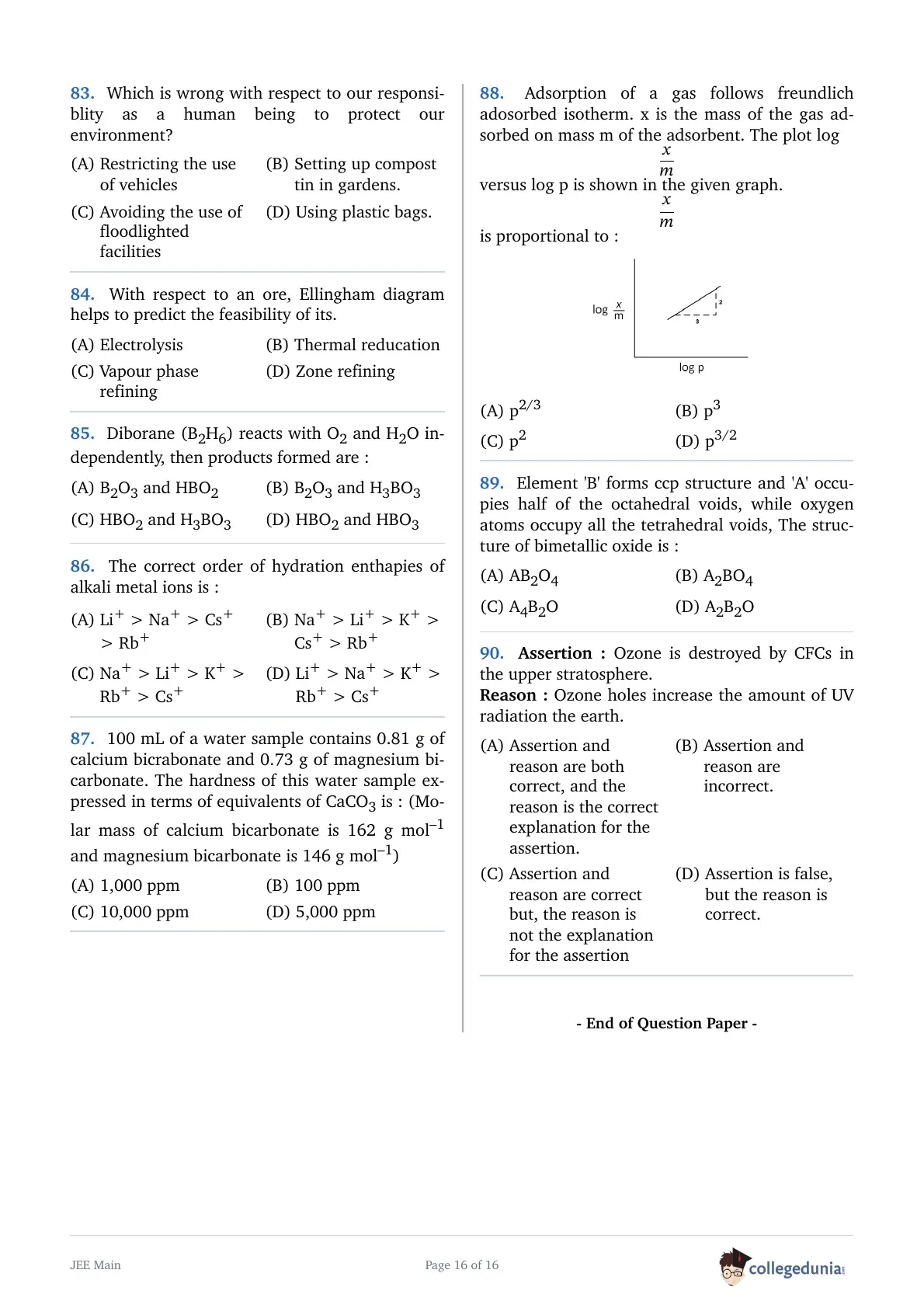
Adsorption of a gas follows freundlich adosorbed isotherm. x is the mass of the gas adsorbed on mass m of the adsorbent. The plot \(\log \frac{x}{m}\) versus \(\log p\) is shown in the given graph. \(\frac{x}{m}\) is proportional to :
Element 'B' forms ccp structure and 'A' occupies half of the octahedral voids, while oxygen atoms occupy all the tetrahedral voids. The structure of bimetallic oxide is :
Ozone is destroyed by CFCs in the upper stratosphere Ozone holes increase the amount of UV radiation reaching the earth.
JEE Main 2019 Exam Pattern and Marking Scheme
| Particulars | Details |
|---|---|
| Exam Mode | Online (Computer-Based Test) |
| Paper | B.E./B.Tech (Paper 1) |
| Duration | 3 hours (180 minutes) |
| Type of Questions | Multiple Choice Questions (MCQs) |
| Subjects | Mathematics, Physics, Chemistry |
| Total Questions | 90 questions |
| Total Marks | 360 marks |
| Marking Scheme | +4 for correct answer & -1 for incorrect answer; 0 for unattempted |
JEE Main 2019 April 8 Shift 1 Difficulty Level
JEE Main Paper 1 April Session Forenoon Slot was conducted on April 8, between 9:30 AM to 12:30 PM. As per the test-takers, the overall difficulty level was rated moderate. Students reported the April session to be of the same level of difficulty as the January session. The Physics section was the most difficult section in the question paper. A total of 90 questions were listed by NTA. Each question carried 4 marks. NCERT plays a crucial role in solving the questions.
JEE Main 2019 B.E./B.Tech Question Paper - Paper Analysis
JEE Main 2019 B.E./B.Tech Question Paper- Paper Analysis
- The Chemistry was the easiest section than Mathematics and Physics
- The Mathematics section was overall moderate. Majority of the questions were asked from the NCERT and 11th syllabus
- The questions from the Physics section were tricky and more time-consuming
- The cutoff for the same goes upto 80-85
| Sections | Difficulty Level | Analysis |
|---|---|---|
| Physics | The most difficult section to attempt | Most of the questions appeared from class 11th |
| Chemistry | Competitively Easy | There was no involvement of tricky questions. Most of the questions were factual based |
| Mathematics | Easy to moderate | Some of the test-takers rated Mathematics at an easy level. None of the questions listed from Mathematical Induction chapter |
Also Check:



Comments