




JEE Main 2019 January 12 Shift 2 Question Paper is available here with solutions PDF and detailed solutions for every question. NTA conducted the second shift on January 12, 2019, from 2:30 PM to 5:30 PM. The JEE Main 2019 Paper 1 (B.E./B.Tech) question paper includes the following:
- 90 questions in a 3-hour CBT Mode: 30 each from Mathematics, Physics and Chemistry
- Question type: all multiple choice questions (MCQs) with a single correct option, 4 marks each
- Sections: Mathematics (30), Physics (30) and Chemistry (30), all questions compulsory
- Marking: +4 for a correct answer, -1 for an incorrect answer, 0 for an unattempted question
- Maximum marks: 360 (120 per subject)
JEE Main 2019 January 12 Shift 2 Question Paper with Solution PDF
| NTA Official PDF | CD PDF | CD PDF with Solutions |
|---|---|---|
| Download official PDF 5.66 MB | Download Collegedunia PDF 1.19 MB | Download solutions PDF 2.68 MB |
Also Check:
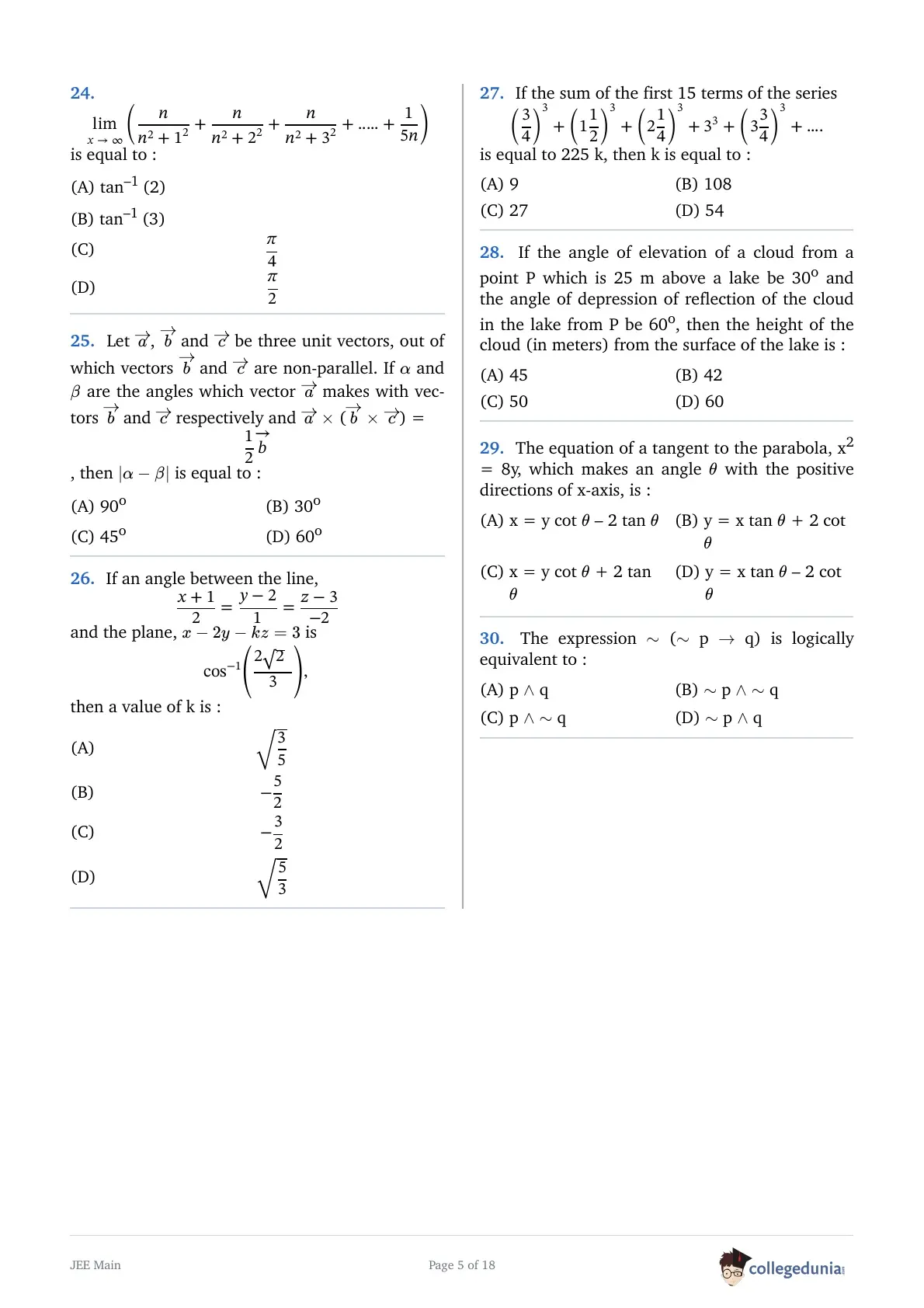
JEE Main 2019 January 12 Shift 2 Questions with Solutions
Mathematics (Q1 - Q30)
There are 4 men and 5 women in Group A, and 5 men and 4 women in Group B. If 4 persons are selected from each group, then the number of ways of selecting 4 men and 4 women is
If a curve passes through the origin and the slope of the tangent to it at any point (x, y) is (x² - 4x + y + 8)/(x - 2), then this curve also passes through the point :
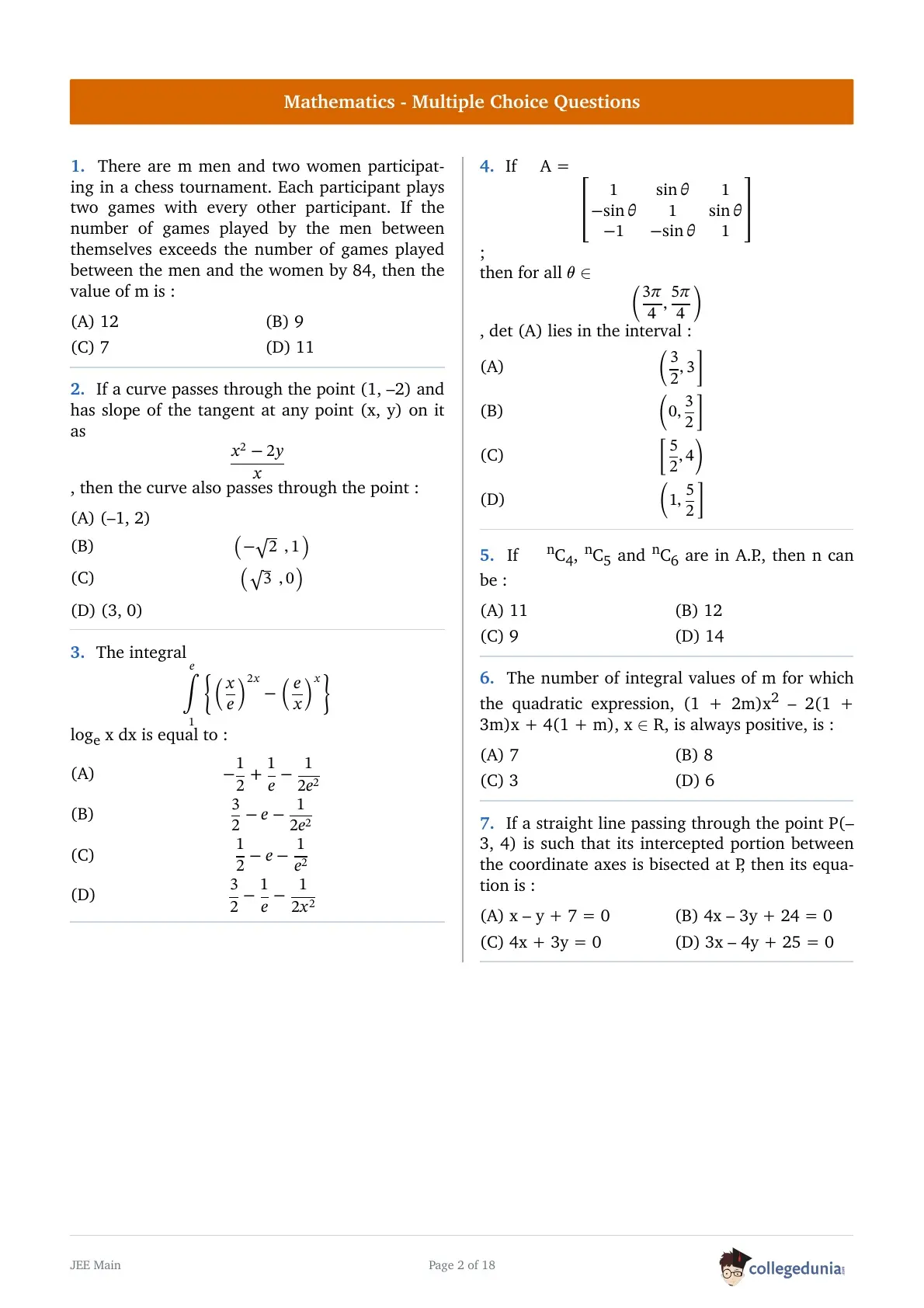
The integral \(\int_1^e \left\{\left(\frac{x}{e}\right)^{2x}-\left(\frac{e}{x}\right)^{x}\right\}\log_e x\,dx\) is equal to :
If \(A=\begin{bmatrix}1&\sin\theta&1\\-\sin\theta&1&\sin\theta\\-1&-\sin\theta&1\end{bmatrix}\); then for all \(\theta\in\left(\frac{3\pi}{4},\frac{5\pi}{4}\right)\), \(\det(A)\) lies in the interval :
If \(^nC_4,\ ^nC_5\) and \(^nC_6\) are in A.P., then n can be :
The number of integral values of m for which the quadratic expression, \((1+2m)x^2-2(1+3m)x+4(1+m)\), \(x\in R\), is always positive, is :
If a line intercepted between the coordinate axes is trisected at a point \(A(4, 3)\), which is nearer to \(x\)-axis, then its equation is :
Let S and S' be the foci of the ellipse and B be any one of the extremities of its minor axis. If 'S'BS is a right angled triangle with right angle at B and area (\(\Delta\)S'BS) = 8 s units, then the length of a latus rectum of the ellipse is :
The set of all values of \(\lambda\) for which the system of linear equations
\(2x_1-2x_2+x_3=\lambda x_1\)
\(2x_1-3x_2+2x_3=\lambda x_2\)
\(-x_1+2x_2=\lambda x_3\) has a non-trivial solution
In a class of 60 students, 40 opted for NCC, 30 opted for NSS and 20 opted for both NCC and NSS. If one of these students is selected at random, then the probability that the students selected has opted neither for NCC nor for NSS is :
Let \(z_1\) and \(z_2\) be two complex numbers satisfying \(|z_1|=9\) and \(|z_2-3-4i|=4\). Then the minimum value of \(|z_1-z_2|\) is :
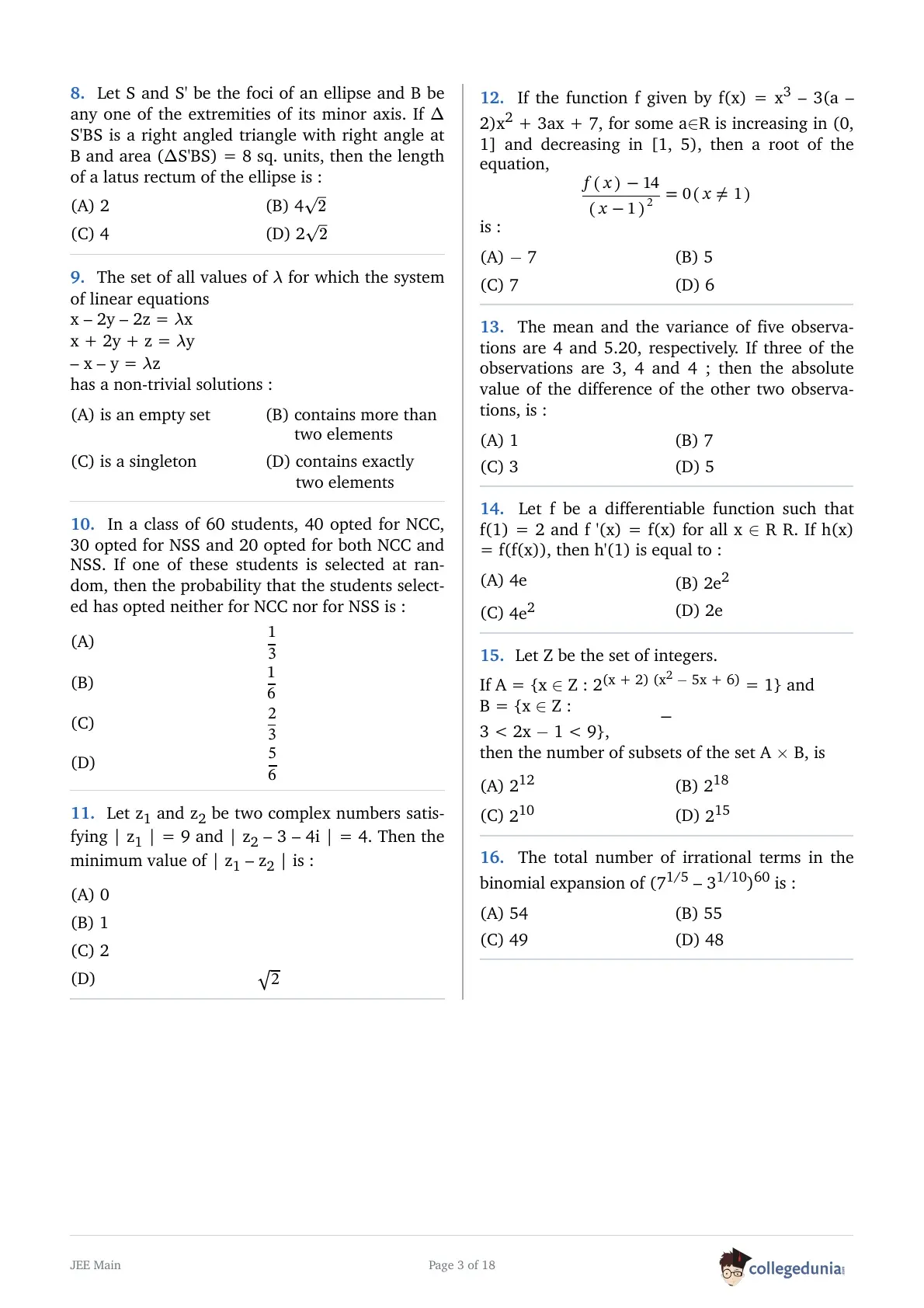
If the function f given by \(f(x)=x^3-3(a-2)x^2+3ax+7\), for some \(a\in R\) is increasing in (0, 1] and decreasing in [1, 5), then a root of the equation, \(\frac{f(x)-14}{(x-1)^2}=0\ (x\ne1)\) is :
The mean and the variance of five observations are 4 and 5.20, respectively. If three of the observations are 3, 4 and 4 ; then the absolute value of the difference of the other two observations, is :
Let f be a differentiable function such that \(f(1)=2\) and \(f'(x)=f(x)\) for all \(x\in R\). If \(h(x)=f(f(x))\), then \(h'(1)\) is equal to :
Let \(Z\) be the set of integers. If \(A \, = \, \{ x \in Z : 2^{ (x+2) (x^2 - 5x + 6)} \}=1\) and \(B \, = \, \{ \, x \in Z: -3 <2x -1 <9 \}\), then the number of subsets of the set \(A \times B\), is :
If \(n\) is the number of irrational terms in the expansion of \(\left(3^{1/4}+5^{1/8}\right)^{60}\), then \((n-1)\) is divisible by :
The integral \(\int \frac{1}{\sqrt[4]{(x - 1)^3 (x + 2)^5}} \, dx\) is equal to :
(where C is a constant of integration)
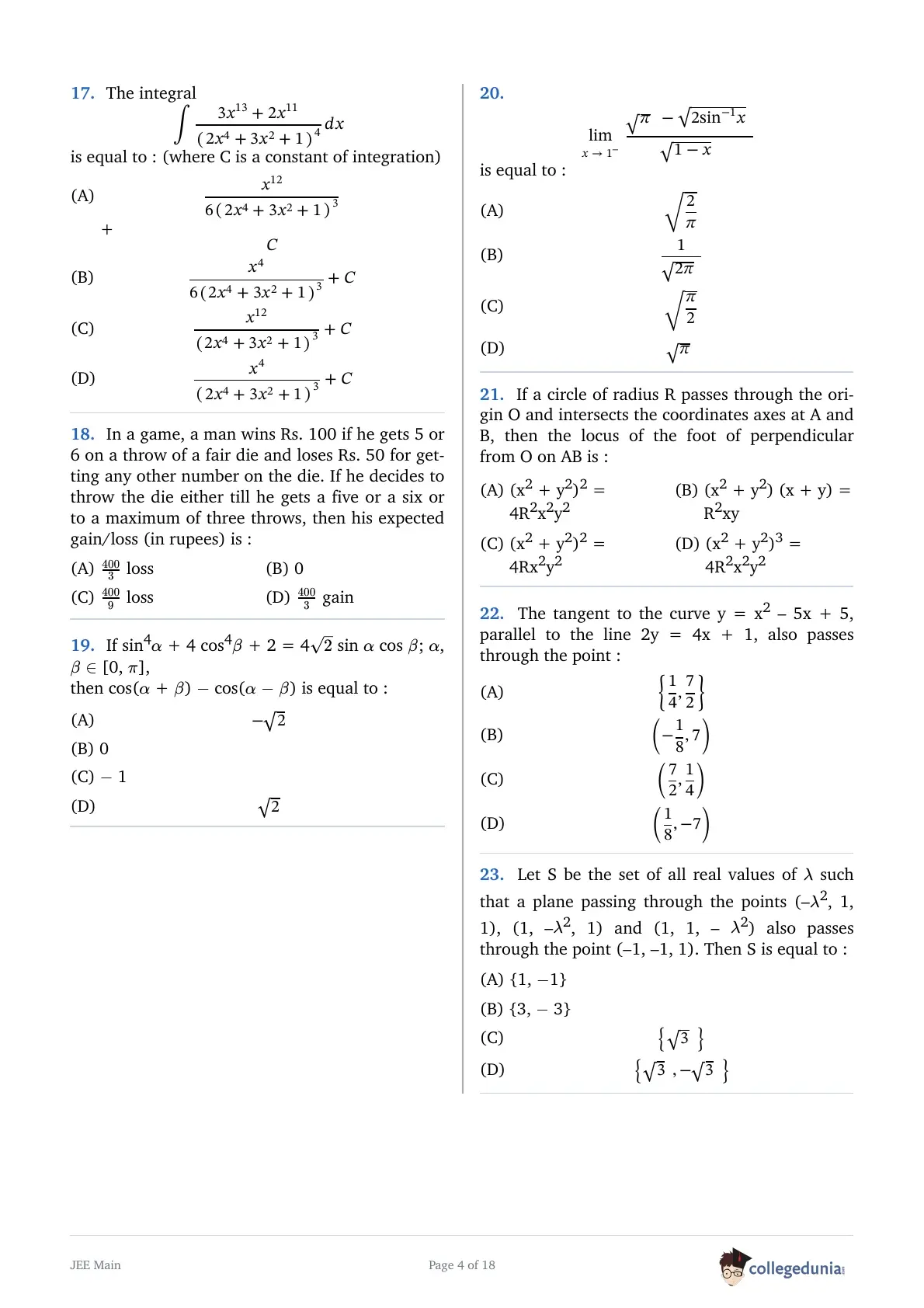
In a game, a man wins Rs. \(100\) if he gets \(5\) of \(6\) on a throw of a fair die and loses Rs. \(50\) for getting any other number on the die. If he decides to throw the die either till he gets a five or a six or to a maximum of three throws, then his expected gain/ loss (in rupees) is :
If \(\sin^4\alpha+4\cos^4\beta+2=4\sqrt2\,\sin\alpha\cos\beta;\ \alpha,\beta\in[0,\pi]\), then \(\cos(\alpha+\beta)-\cos(\alpha-\beta)\) is equal to :
\(\lim_{x\to1^-}\dfrac{\sqrt\pi-\sqrt{2\sin^{-1}x}}{\sqrt{1-x}}\) is equal to :
If a circle of radius \(R\) passes through the origin \(O\) and intersects the coordinate axes at \(A\) and \(B\), then the locus of the foot of perpendicular from \(O\) on \(AB\) is :
The tangent to the curve \(y=x^2-5x+5\), parallel to the line \(2y=4x+1\), also passes through the point :
Let S be the set of all real values of \(\lambda\) such that a plane passing through the points \((-\lambda^2,1,1)\), \((1,-\lambda^2,1)\) and \((1,1,-\lambda^2)\) also passes through the point \((-1,-1,1)\). Then S is equal to :
\(\lim_{x\to\infty}\left(\dfrac{n}{n^2+1^2}+\dfrac{n}{n^2+2^2}+\dfrac{n}{n^2+3^2}+\ldots+\dfrac{1}{5n}\right)\) is equal to :
Let \(\vec a,\vec b\) and \(\vec c\) be three unit vectors, out of which vectors \(\vec b\) and \(\vec c\) are non-parallel. If \(\alpha\) and \(\beta\) are the angles which vector \(\vec a\) makes with vectors \(\vec b\) and \(\vec c\) respectively and \(\vec a\times(\vec b\times\vec c)=\frac12\vec b\), then \(|\alpha-\beta|\) is equal to :
If an angle between the line, \(\frac{x+1}{2}=\frac{y-2}{1}=\frac{z-3}{-2}\) and the plane, \(x-2y-kz=3\) is \(\cos^{-1}\left(\frac{2\sqrt{2}}{3}\right)\), then a value of k is :
If the sum of the first 15 terms of the series \(\left(\frac{3}{4}\right)^3+\left(1\frac{1}{2}\right)^3+\left(2\frac{1}{4}\right)^3+3^3+\left(3\frac{3}{4}\right)^3+\ldots\) is equal to 225 k, then k is equal to :
If the angle of elevation of a cloud from a point P which is 25 m above a lake be 30o and the angle of depression of reflection of the cloud in the lake from P be 60o, then the height of the cloud (in meters) from the surface of the lake is :
The equation of a tangent to the parabola, \(x^2=8y\), which makes an angle \(\theta\) with the positive directions of x-axis, is :
Statement (P \(\Rightarrow\) Q) \(\land\) (R \(\Rightarrow\) Q) is logically equivalent to :
Physics (Q31 - Q60)
A vertical closed cylinder is separated into two parts by a frictionless piston of mass \(m\) and of negligible thickness. The piston is free to move along the length of the cylinder. The length of the cylinder above the piston is \(\ell_1\), and that below the piston is \(\ell_2\) , such that \(\ell_1\)>\(\ell_2\). Each part of the cylinder contains \(n\) moles of an ideal gas at equal temperature \(T\). If the piston is stationary, its mass, \(m\), will be given by : (R is universal gas constant and \(g\) is the acceleration due to gravity)
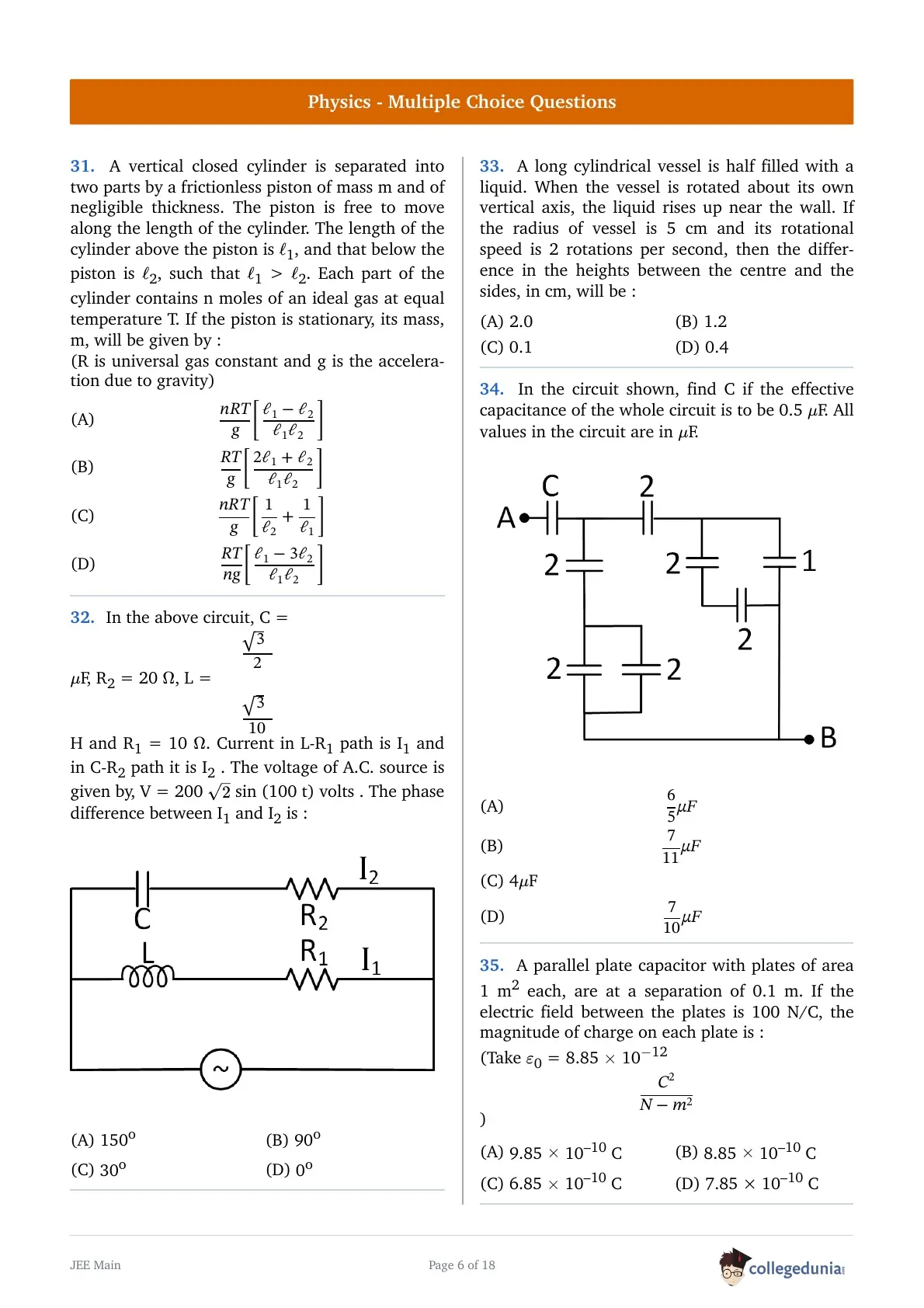
In the above circuit, \(C=\frac{\sqrt3}{2}\,\mu\mathrm{F}\), \(R_2=20\,\Omega\), \(L=\frac{\sqrt3}{10}\) H and \(R_1=10\,\Omega\). Current in L-\(R_1\) path is \(I_1\) and in C-\(R_2\) path it is \(I_2\). The voltage of A.C. source is given by, \(V=200\sqrt2\sin(100t)\) volts. The phase difference between \(I_1\) and \(I_2\) is :
A long cylindrical vessel is half filled with a liquid. When the vessel is rotated about its own vertical axis, the liquid rises up near the wall. If the radius of vessel is \(5\, cm\) and its rotational speed is \(2\) rotations per second, then the difference in the heights between the centre and the sides, in \(cm\), will be
In the circuit shown, find \(C\) if the effective capacitance of the whole circuit is to be \(0.5 \mu F\). All values in the circuit are in \(\mu F\).
A parallel plate capacitor with plates of area 1 m2 each, are at a separation of 0.1 m. If the electric field between the plates is 100 N/C, the magnitude of charge on each plate is :
(Take \(\varepsilon_0=8.85\times10^{-12}\ \frac{\mathrm{C^2}}{\mathrm{N\,m^2}}\))
A plano-convex lens (focal length \(f_2\), refractive index \(\mu_2\), radius of curvature \(R\)) fits exactly into a plano-concave lens (focal length \(f_1\), refractive index \(\mu_2\), radius of curvature R). Their plane surfaces are parallel to each other. Then, the focal length of the combination will be :
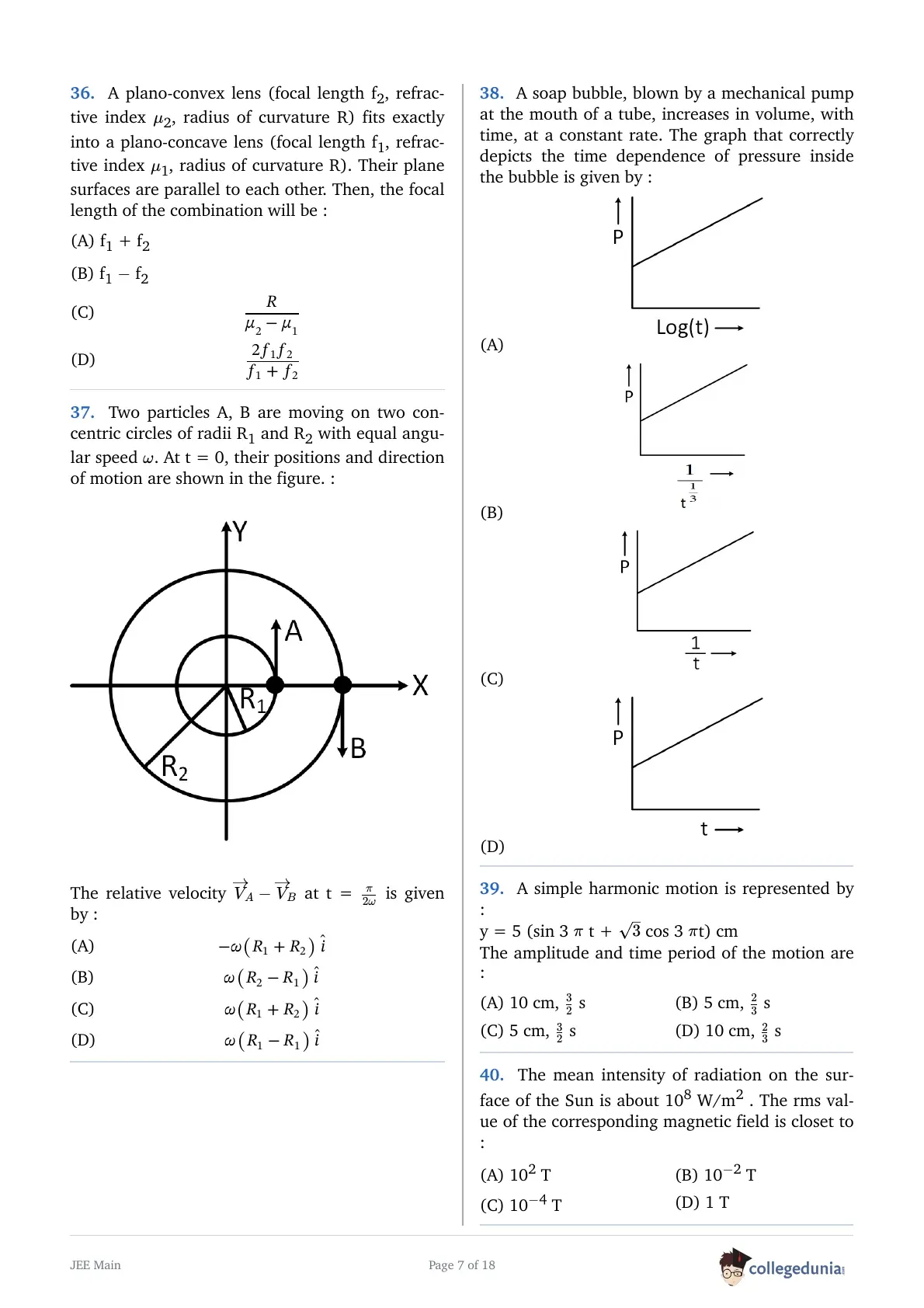
Two particles A, B are moving on two concentric circles of radii \(R_1\) and \(R_2\) with equal angular speed \(\omega\). At t = 0, their positions and direction of motion are shown in the figure.
The relative velocity \(\vec V_A-\vec V_B\) at \(t=\frac{\pi}{2\omega}\) is given by :
A soap bubble, blown by a mechanical pump at the mough of a tube, increases in volume, with time, at a constant rate. The graph that correctly depicts the time dependence of pressure inside the bubble is given by :
- (1)
![]()
- (2)
![]()
- (3)
![]()
- (4)
![]()


A simple harmonic motion is represented by :
\(y=5(\sin3\pi t+\sqrt3\cos3\pi t)\) cm
The amplitude and time period of the motion are :
The mean intensity of radiation on the surface of the Sun is about \(10^8\) W/m2. The rms value of the corresponding magnetic field is closet to :
A \(10\, m\) long horizontal wire extends from North East to South West. It is falling with a speed of \(5.0\,ms^{-1}\), at right angles to the horizontal component of the earth's magnetic field, of \(0.3 \times 10^{-4}\,Wb/m^2\). The value of the induced emf in wire is :
Two satellites, A and B, have masses m and 2m respectively. A is in a circular orbit of radius R, and B is in a circular orbit of radius 2R around the earth. The ratio of their kinetic energies, \(T_A/T_B\), is ;
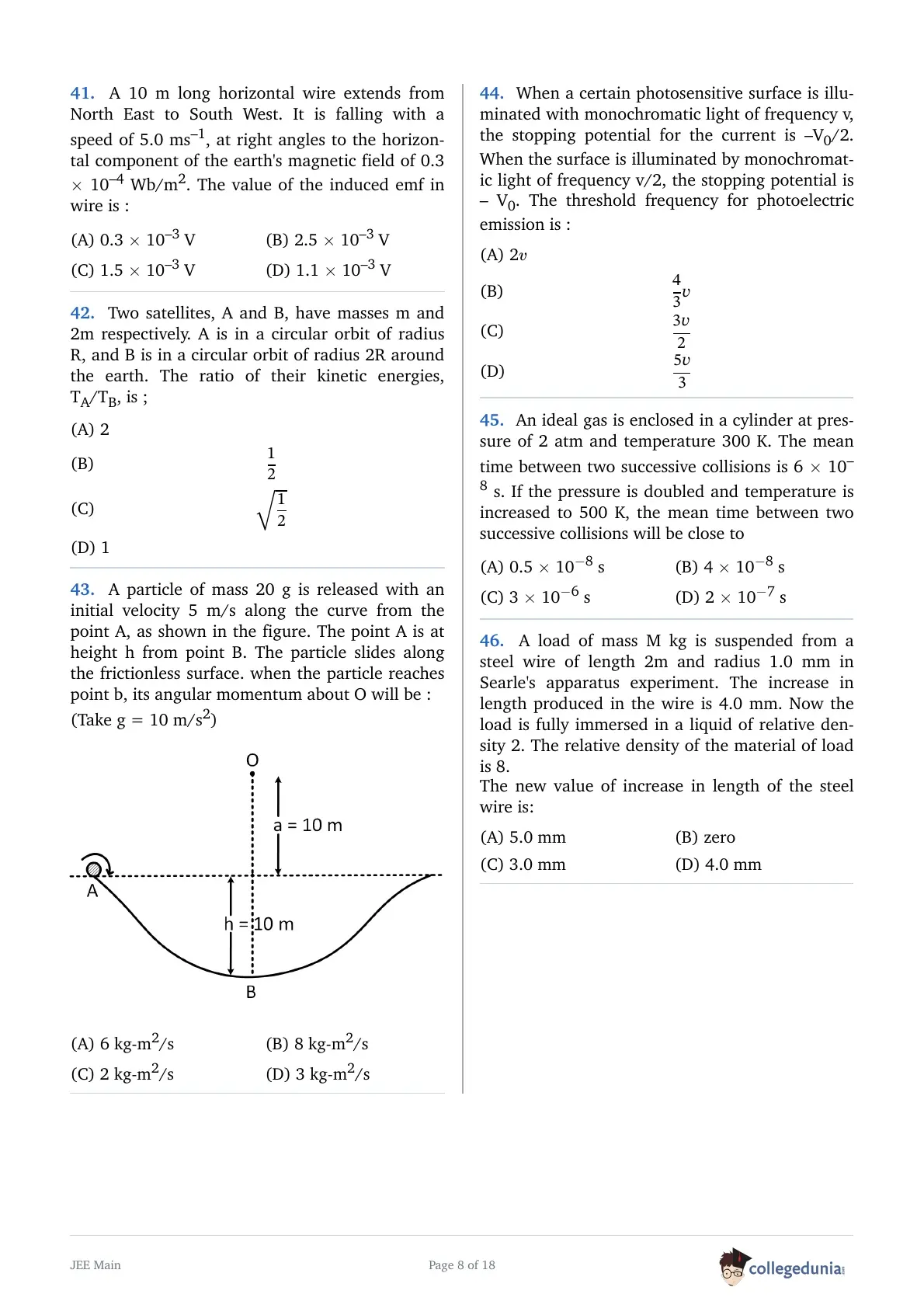
A particle of mass 20 g is released with an initial velocity 5 m/s along the curve from the point A, as shown in the figure. The point A is at height h from point B. The particle slides along the frictionless surface. When the particle reaches point B, its angular momentum about O will be :
(Take g = 10 m/s2)
When a certain photosensitive surface is illuminated with monochromatic light of frequency v, the stopping potential for the current is \(-V_0/2\). When the surface is illuminated by monochromatic light of frequency v/2, the stopping potential is \(-V_0\). The threshold frequency for photoelectric emission is :
In a dilute gas at pressure \(P\) and temperature \(T\), the mean time between successive collisions of a molecule varies with \(T\) as :
A load of mass \(M\, kg\) is suspended from a steel wire of length \(2\, m\) and radius \(1.0\, mm\) in Searle's apparatus experiment. The increase in length produced in the wire is \(4.0\, mm\). Now the load is fully immersed in a liquid of relative density \(2\). The relative density of the material of load is \(8\). The new value of increase in length of the steel wire is :
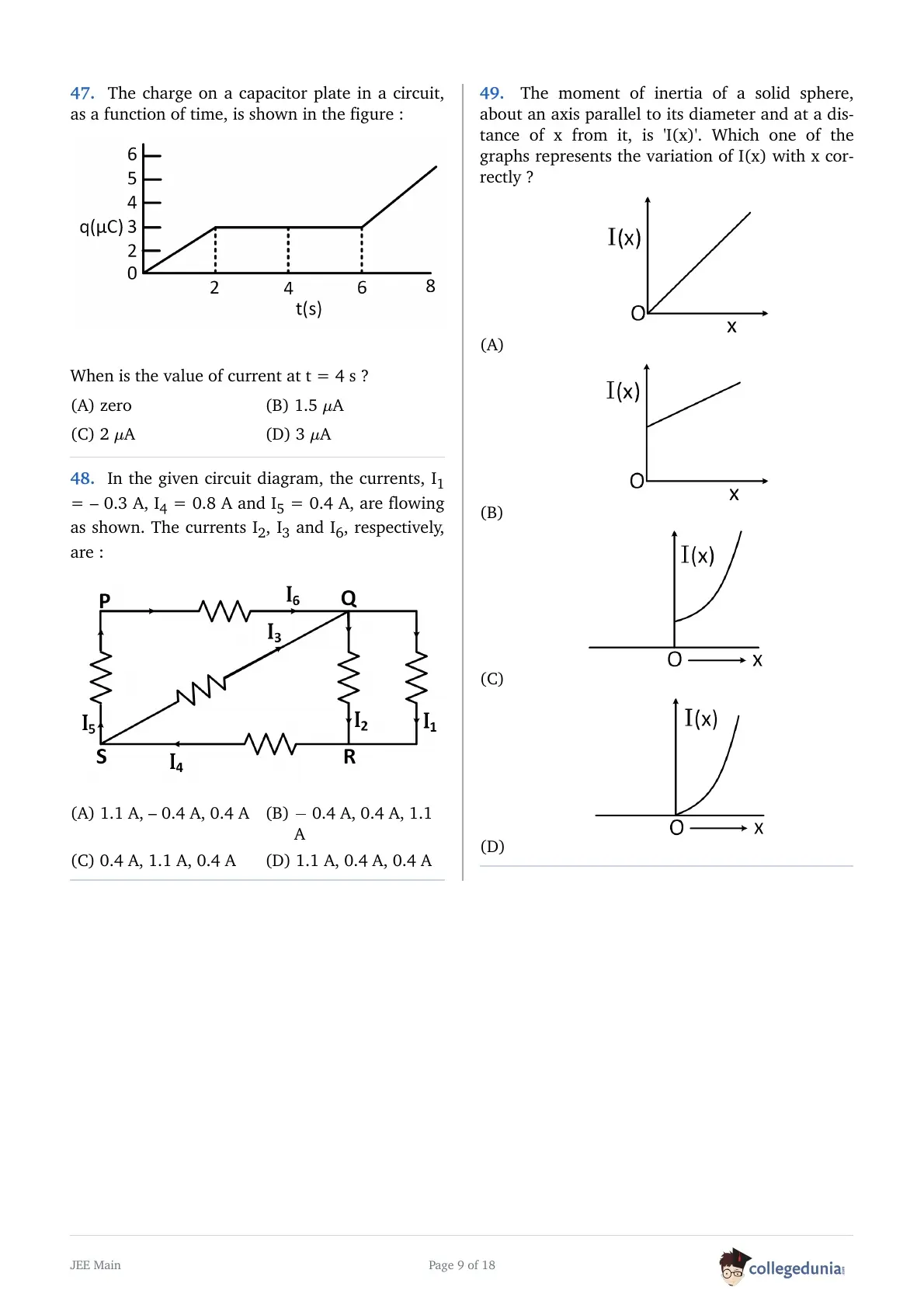
The charge on a capacitor plate in a circuit, as a function of time, is shown in the figure :
What is the value of current at t = 4 s ?
In the given circuit diagram, the currents, \(I_1 = 0.3\,A, I_4 = 0.8\, A\) and \(I_5 = 0.4\, A\), are flowing as shown. The currents \(I_2,I_3\) and \(I_6\),respectively, are :
If moment of inertia of rod about axis AB is equal to moment of inertia of solid sphere about an axis parallel to AB which is at 9m from AB axis as shown in the figure. If \( R = \frac{\alpha}{2} \), then find \( \alpha \).

Let \(\ell\), r, C and V represent inductance, resistance, capacitance and voltage, respectively. The dimension of \(\frac{\ell}{rCV}\) in SI units will be :
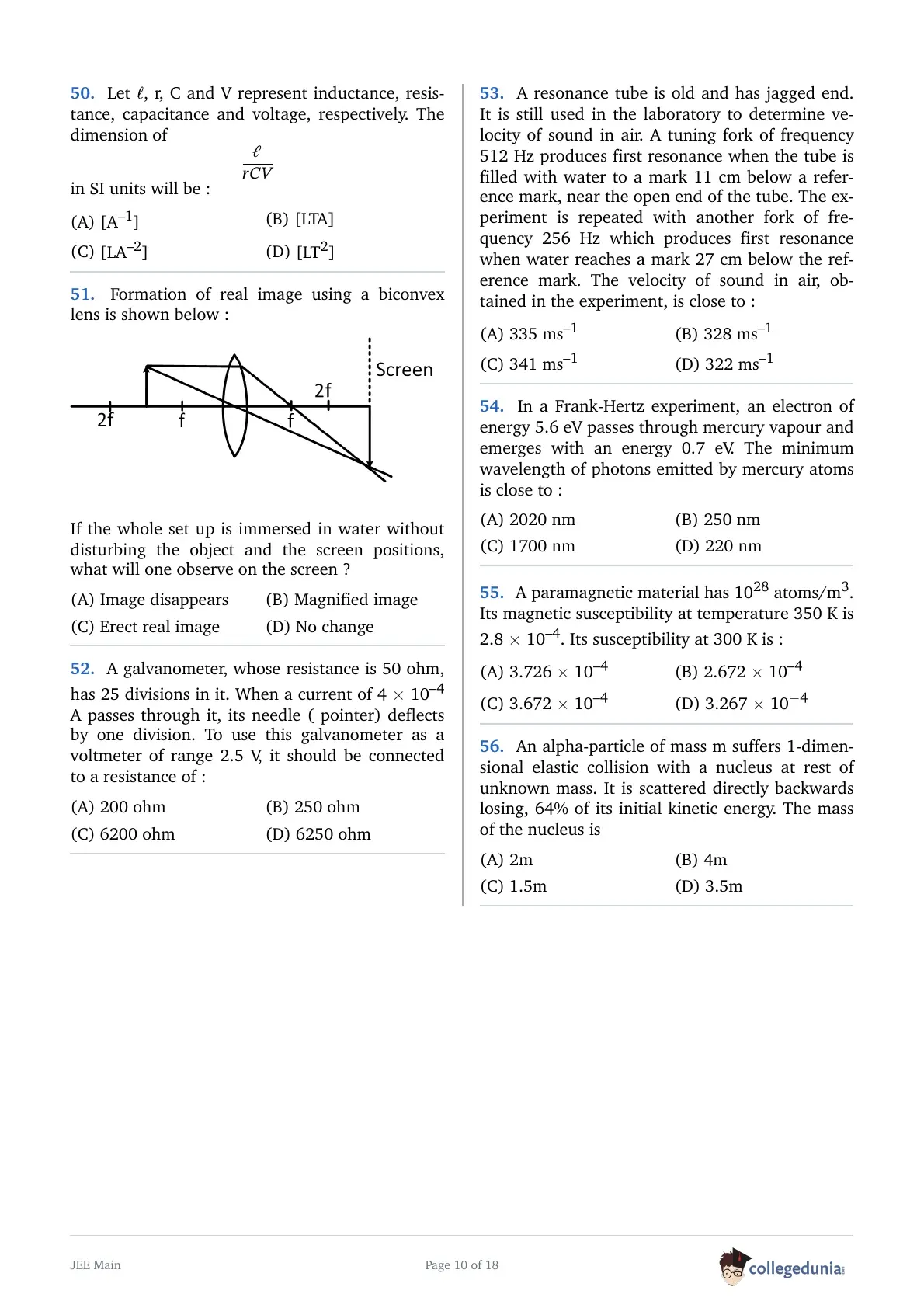
Formation of real image using a biconvex lens is shown below :
If the whole set up is immersed in water without disturbing the object and the screen positions, what will one observe on the screen ?
A galvanometer, whose resistance is \(50\, ohm\), has \(25\) divisions in it. When a current of \(4 \times 10^{-4}\) A passes through it, its needle (pointer) deflects by one division. To use this galvanometer as a voltmeter of range \(2.5\, V\), it should be connected to a resistance of:
A resonance tube is old and has jagged end. It is still used in the laboratory to determine velocity of sound in air. A tuning fork of frequency \(512\, Hz\) produces first resonance when the tube is filled with water to a mark \(11\, cm\) below a reference mark, near the open end of the tube. The experiment is repeated with another fork of frequency \(256\, Hz\) which produces first resonance when water reaches a mark \(27\, cm\) below the reference mark. The velocity of sound in air, obtained in the experiment, is close to:
In a Frank-Hertz experiment, an electron of energy 5.6 eV passes through mercury vapour and emerges with an energy 0.7 eV. The minimum wavelength of photons emitted by mercury atoms is close to :
A paramagnetic material has \(10^{28}\) atoms/m\(^3\). Its magnetic susceptibility at temperature 350 K is \(2.8 \times 10^{-4}\). Its susceptibility at 300 K is :
An alpha-particle of mass m suffers 1-dimensional elastic coolision with a nucleus at rest of unknown mass. It is scattered directly backwards losing, \(64\%\) of its initial kinetic energy. The mass of the nucleus is :
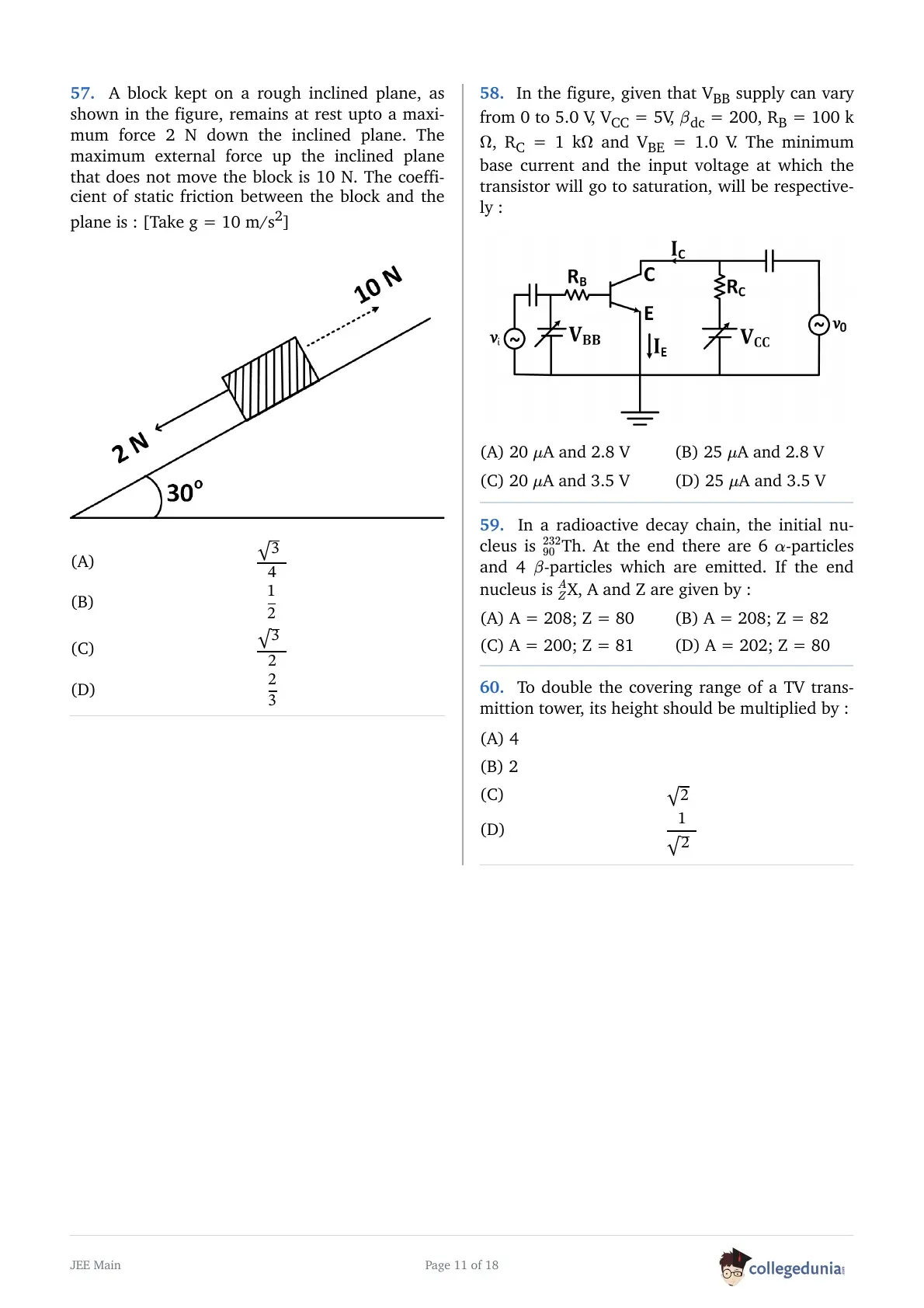
A block kept on a rough inclined plane, as shown in the figure, remains at rest upto a maximum force \(2 \,N\) down the inclined plane. The maximum external force up the inclined plane that does not move the block is \(10\, N\). The coefficient of static friction between the block and the plane is : [Take \(g = 10\, m/s^2\)]
 In the figure, given that \(V_{BB}\) supply can vary from \(0\) to \(5.0 \,V, V_{CC} = 5\,V, \beta_{dc} = 200, R_B = 100 \,k\,\Omega, R_C=l\, k\Omega\) and \(V_{BE}=1.0\, V\), The minimum base current and the input voltage at which the transistor will go to saturation, will be, respectively :
In a radioactive decay chain, the initial nucleus is \(^{232}_{90}Th\) . At the end there are \(6 \alpha\)-particles and \(4 \beta\)-particles which are emitted. If the end nucleus, If \(^{A}_{Z} X\) , \(A\) and \(Z\) are given by :
To double the covering range of a TV transmission tower, its height should be multiplied by :
Chemistry (Q61 - Q90)
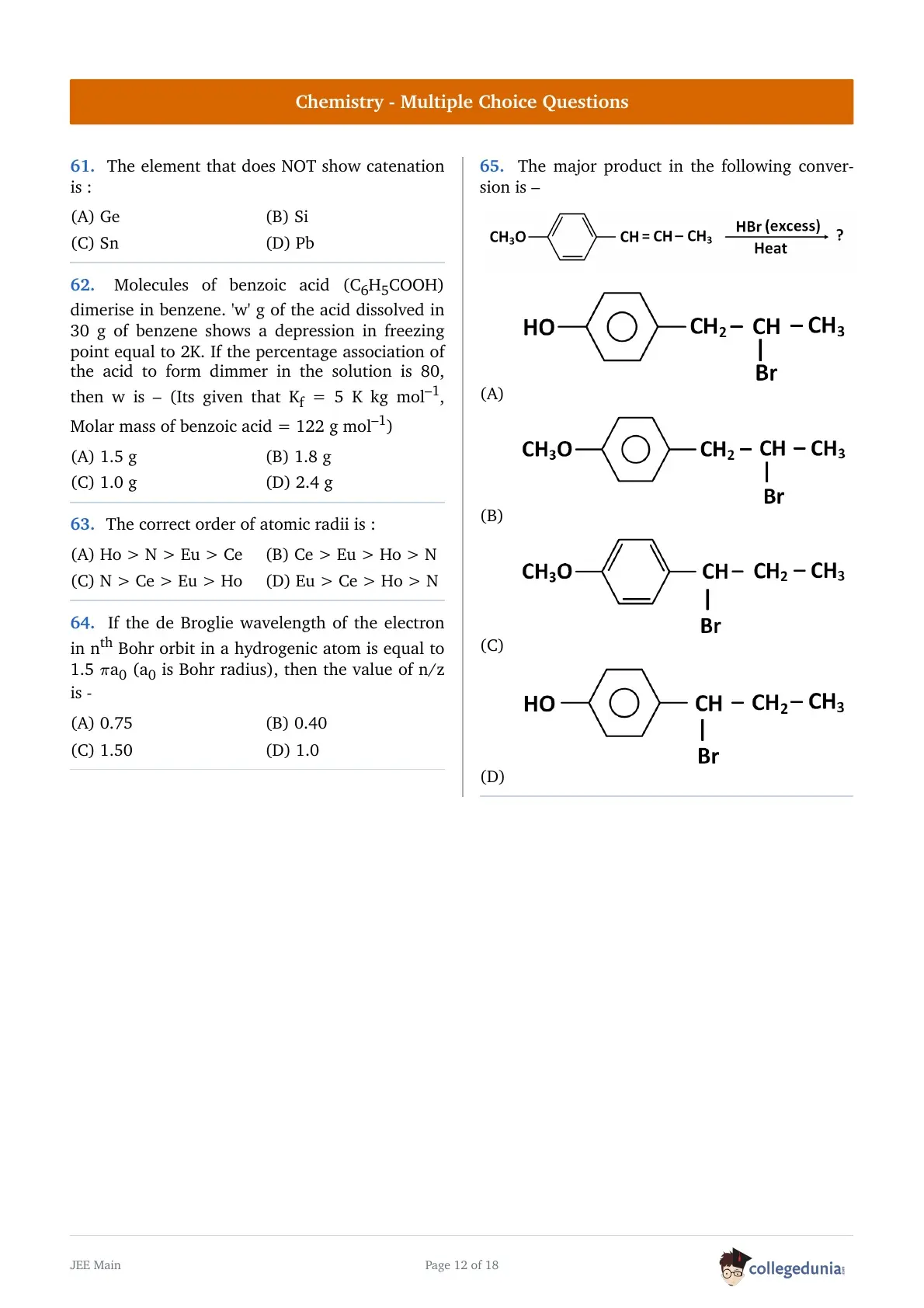
The element that does NOT show catenation is :
Molecules of benzoic acid (C\(_{6}H_{5}\)COOH) dimerise in benzene. \('w' \,g\) of the acid dissolved in \(30\, g\) of benzene shows a depression in freezing point equal to \(2K\). If the percentage association of the acid to form dimer in the solution is \(80\), then \(w\) is : (Given that \(K_{f} = 5 K\, kg\, mol^{-1} \), Molar mass of benzoic acid \(= 122 \,g\, mol^{-1})\)
The correct order of atomic radii is:
If the de Broglie wavelength of the electron in \(n^{th}\) Bohr orbit in a hydrogenic atom is equal to \(1.5\pi a_0\) (\(a_0\) is Bohr radius), then the value of \(n/z\) is -
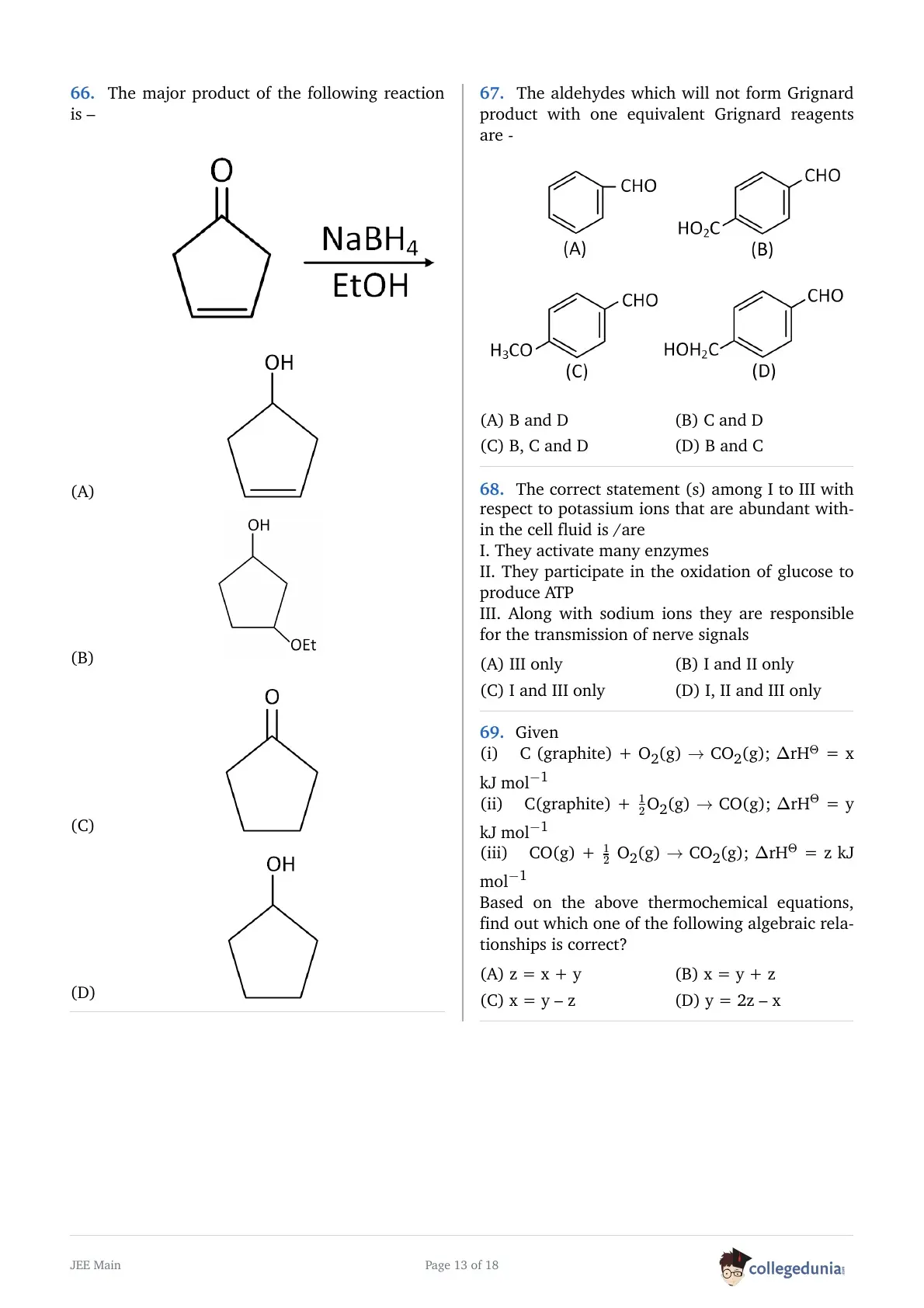
The major product in the following conversion is –
(4-methoxyphenyl)-CH=CH-CH3 treated with HBr (excess), heat, gives ?
- (1)
![]()
- (2)
![]()
- (3)
![]()
- (4)
![]()


The major product of the following reaction is –
(cyclopent-3-en-1-one treated with \(\mathrm{NaBH_4}\) in EtOH)
- (1)
![]()
- (2)
![]()
- (3)
![]()
- (4)
![]()


The aldehydes which will not form Grignard product with one equivalent Grignard reagents are -
(A) benzaldehyde; (B) 4-HO2C-C6H4-CHO; (C) 4-H3CO-C6H4-CHO; (D) 4-HOH2C-C6H4-CHO
The correct statement (s) among I to III with respect to potassium ions that are abundant within the cell fluid is /are
I. They activate many enzymes
II. They participate in the oxidation of glucose to produce ATP
III. Along with sodium ions they are responsible for the transmission of nerve signals
Given
(i) C (graphite) + \(\mathrm{O_2(g)} \to \mathrm{CO_2(g)}\); \(\Delta_rH^{\ominus} = x\ \mathrm{kJ\ mol^{-1}}\)
(ii) C (graphite) + \(\frac{1}{2}\mathrm{O_2(g)} \to \mathrm{CO(g)}\); \(\Delta_rH^{\ominus} = y\ \mathrm{kJ\ mol^{-1}}\)
(iii) CO(g) + \(\frac{1}{2}\mathrm{O_2(g)} \to \mathrm{CO_2(g)}\); \(\Delta_rH^{\ominus} = z\ \mathrm{kJ\ mol^{-1}}\)
Based on the above thermochemical equations, find out which one of the following algebraic relationships is correct?
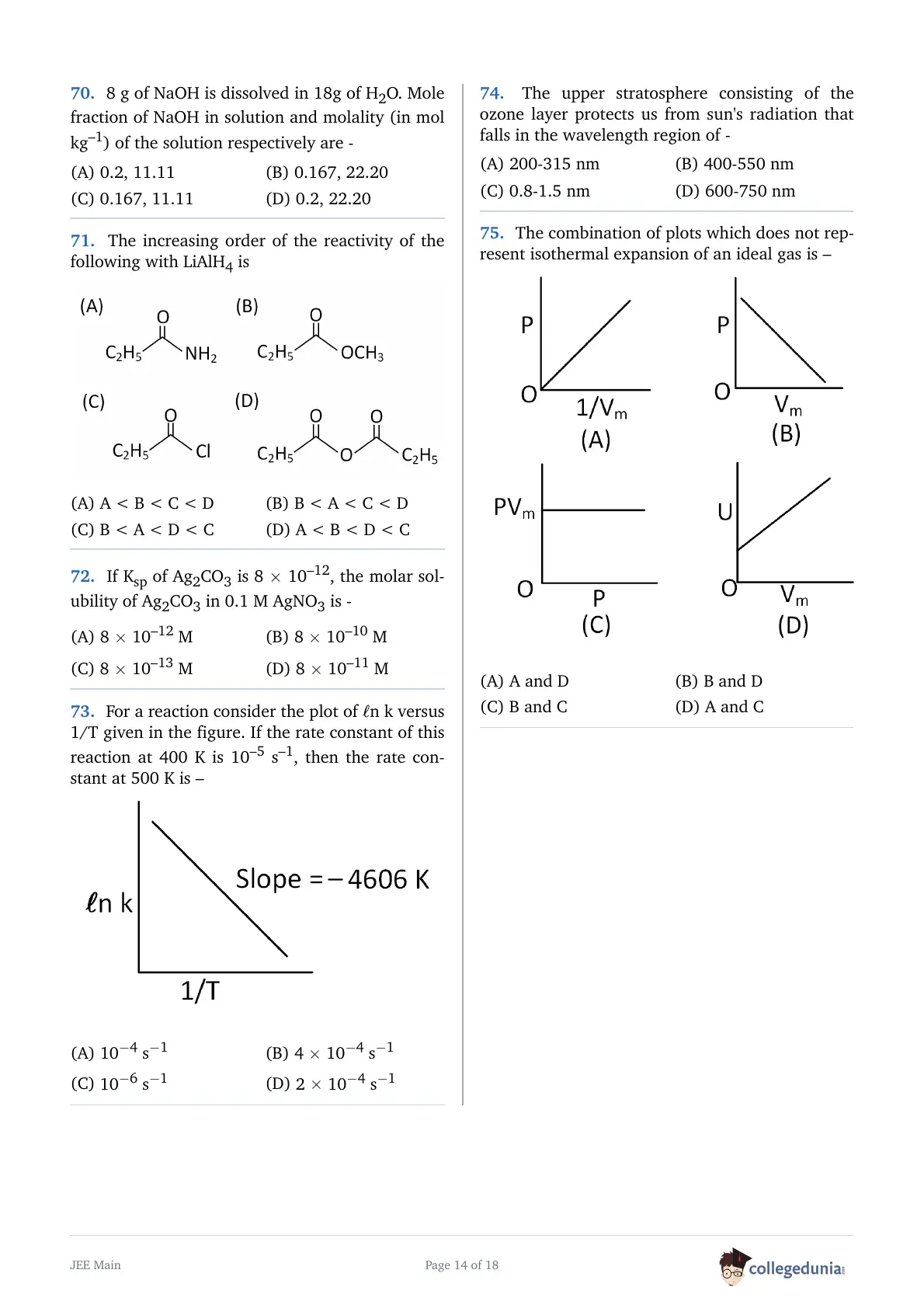
8 g of NaOH is dissolved in 18 g of \(\mathrm{H_2O}\). Mole fraction of NaOH in solution and molality (in mol kg\(^{-1}\)) of the solution respectively are -
The increasing order of the reactivity of the following with \(\mathrm{LiAlH_4}\) is
(A) \(\mathrm{C_2H_5CONH_2}\) (amide); (B) \(\mathrm{C_2H_5COOCH_3}\) (ester); (C) \(\mathrm{C_2H_5COCl}\) (acid chloride); (D) \(\mathrm{(C_2H_5CO)_2O}\) (anhydride)
If \(K_{sp}\) of \(\mathrm{Ag_2CO_3}\) is \(8\times10^{-12}\), the molar solubility of \(\mathrm{Ag_2CO_3}\) in 0.1 M \(\mathrm{AgNO_3}\) is -
For a reaction consider the plot of \(\ell n\,k\) versus \(1/T\) given in the figure. If the rate constant of this reaction at 400 K is \(10^{-5}\ \mathrm{s^{-1}}\), then the rate constant at 500 K is –
(The plot of \(\ell n\,k\) against \(1/T\) is a straight line with slope \(= -4606\ \mathrm{K}\).)
The upper stratosphere consisting of the ozone layer protects us from the sun's radiation that falls in the wavelength region of :
The combination of plots which does not represent isothermal expansion of an ideal gas is:
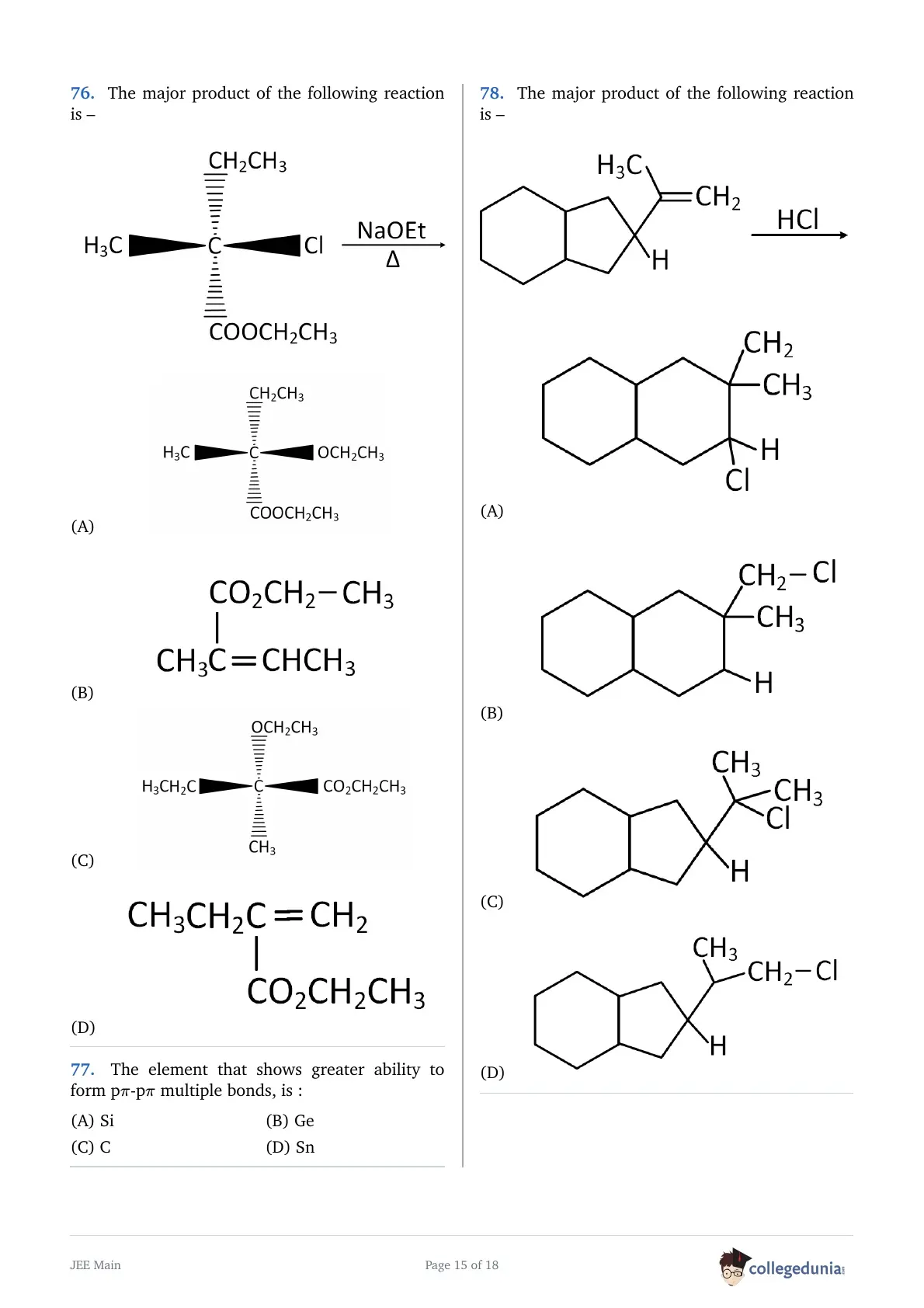
The major product of the following reaction is –
(the optically active tertiary chloride \(\mathrm{CH_3-C(Cl)(CH_2CH_3)-COOCH_2CH_3}\) is heated with \(\mathrm{NaOEt}\))
- (1)
![]()
- (2)
![]()
- (3)
![]()
- (4)
![]()


The element that shows greater ability to form p\(\pi\)-p\(\pi\) multiple bonds, is :
The major product of the following reaction is –
(The reactant is a bicyclic compound (an octahydroindene: six-membered ring fused to a five-membered ring) carrying an isopropenyl group, \(\mathrm{C(CH_3)=CH_2}\), on the five-membered ring carbon that also bears an H; reagent: HCl.)
- (1)
![]()
- (2)
![]()
- (3)
![]()
- (4)
![]()


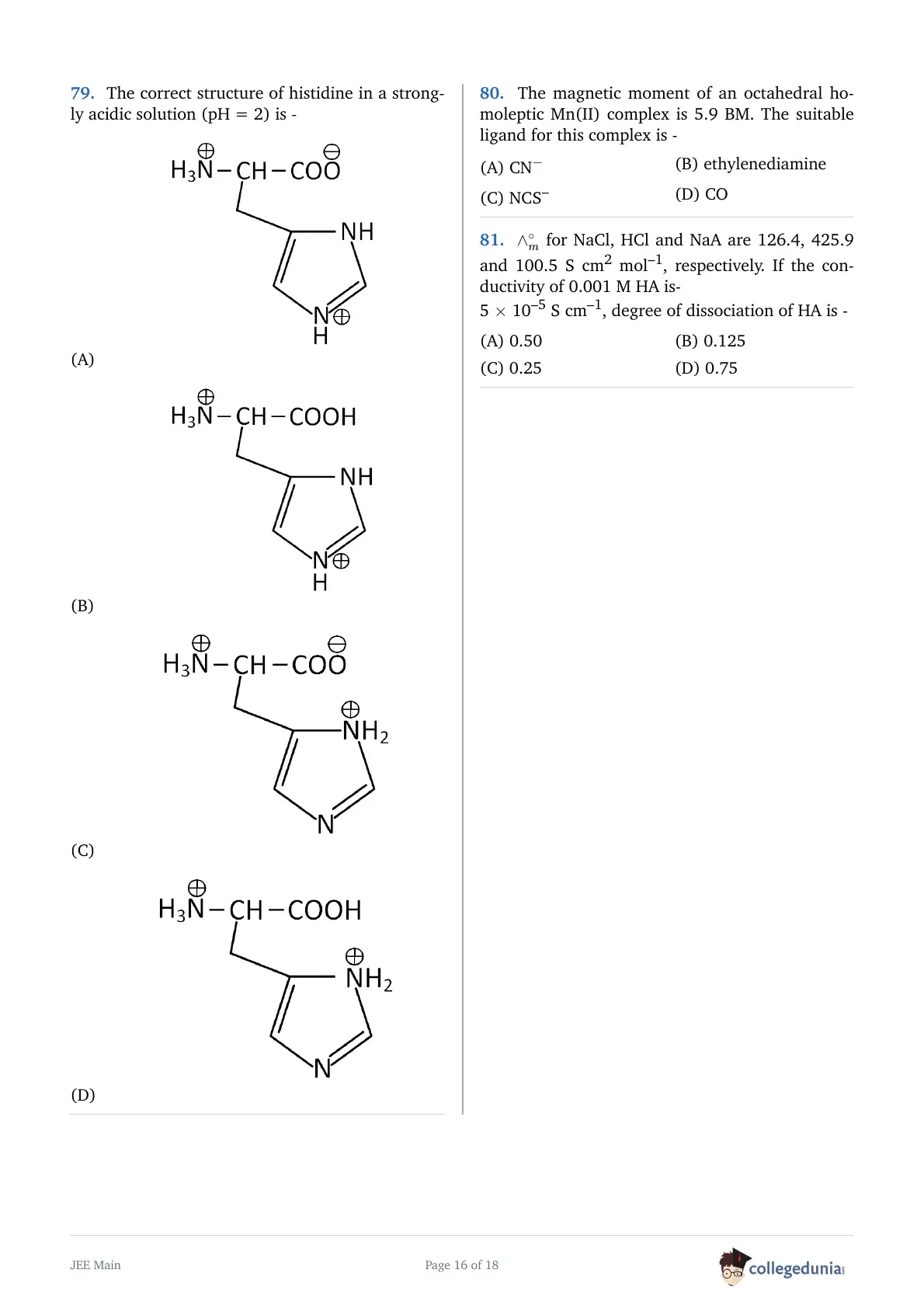
The correct structure of histidine in a strongly acidic solution (pH=2) is
- (1)
![]()
- (2)
![]()
- (3)
![]()
- (4)
![]()


The magnetic moment of an octahedral homoleptic Mn(II) complex is \(5.9\, BM\). The suitable ligand for this complex is :
\(\Lambda_m^\circ\) for NaCl, HCl and NaA are 126.4, 425.9 and 100.5 S cm2 mol−1, respectively. If the conductivity of 0.001 M HA is 5 \(\times\) 10−5 S cm−1, degree of dissociation of HA is -
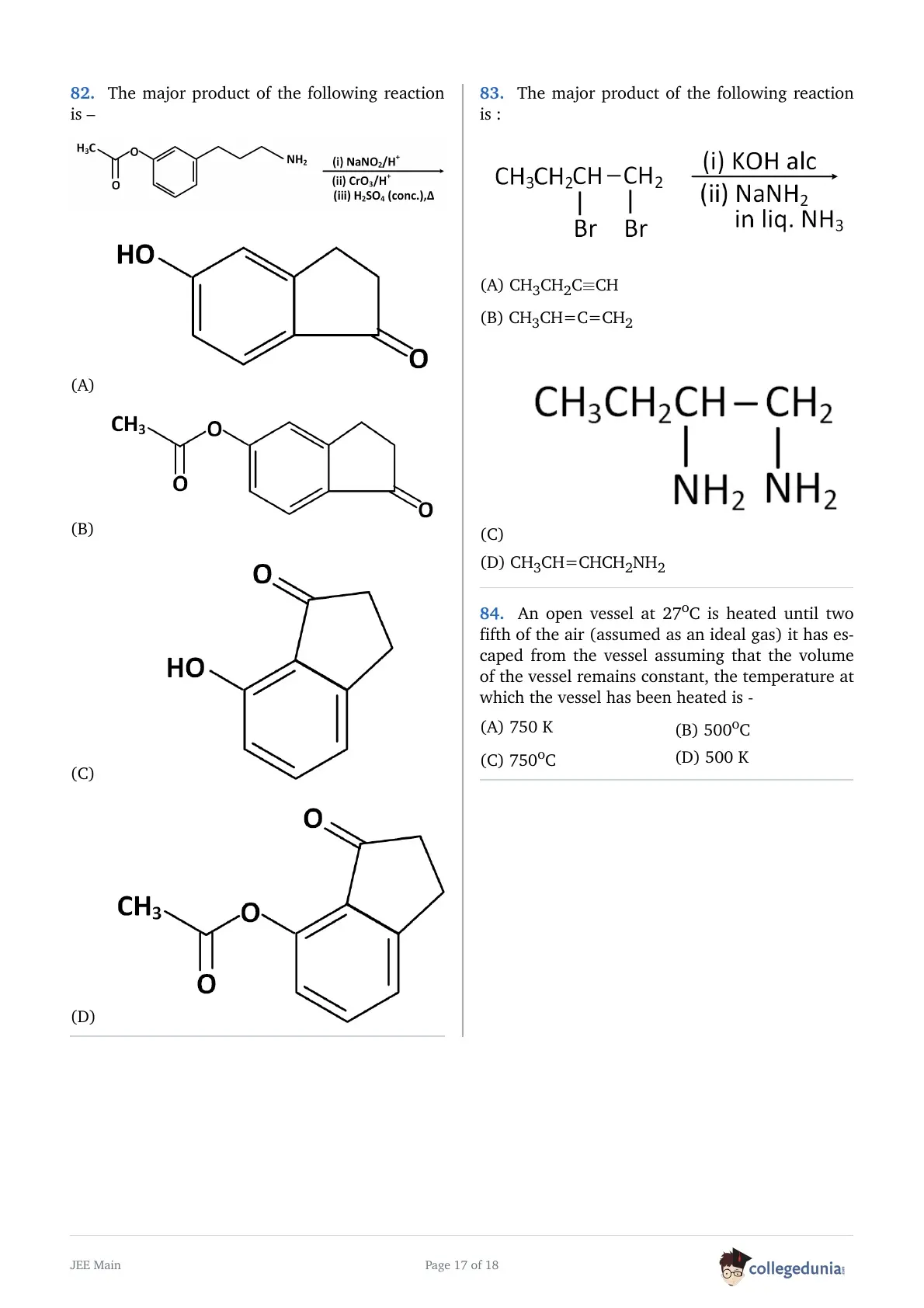
The major product of the following reaction is –
(Reactant: an aryl acetate, \(\mathrm{CH_3COO}\)-C6H4-\(\mathrm{CH_2CH_2CH_2NH_2}\), with the two substituents meta to each other. Reagents: (i) \(\mathrm{NaNO_2/H^+}\); (ii) \(\mathrm{CrO_3/H^+}\); (iii) \(\mathrm{H_2SO_4}\) (conc.), \(\Delta\).)
- (1)
![]()
- (2)
![]()
- (3)
![]()
- (4)
![]()


The major product of the following reaction is :
\(\mathrm{CH_3CH_2CH(Br)CH_2Br}\) (Br on the 2nd and 1st carbon; written as CH3CH2CH-CH2 with Br below each of the last two carbons)
Reagents: (i) KOH alc; (ii) NaNH2 in liq. NH3
An open vessel at \(27^{\circ}C\) is heated until two fifth of the air (assumed as an ideal gas) in it has escaped from the vessel. Assuming that the volume of the vessel remains constant, the temperature at which the vessel has been heated is :
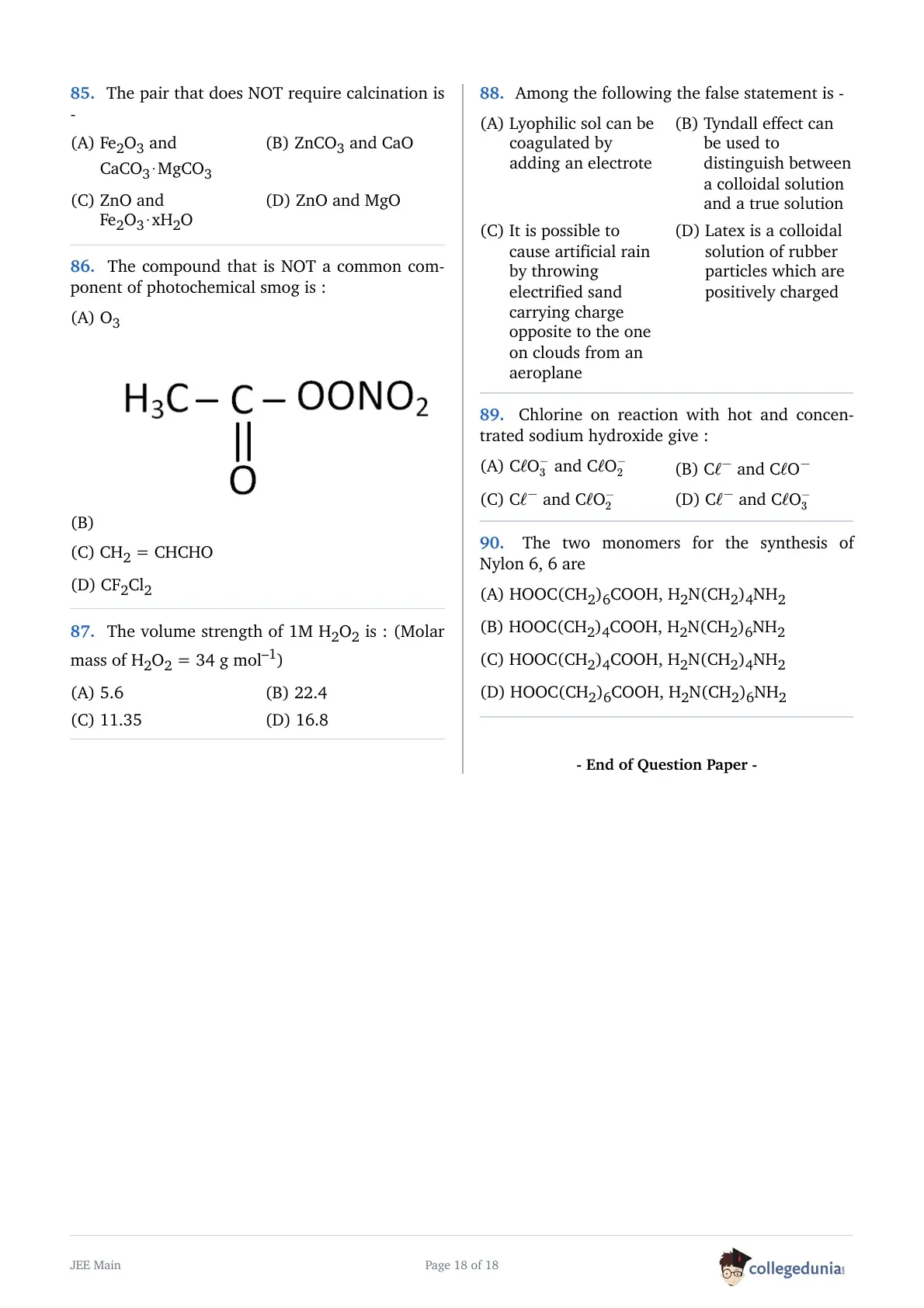
The pair that does NOT require calcination is:
The compound that is NOT a common component of photochemical smog is :
The volume strength of \(1 \,M H _{2} O _{2}\) is (Molar mass of \(\left. H _{2} O _{2}=34 \,g\, mol ^{-1}\right)\)
Among the following the false statement is -
Chlorine on reaction with hot and concentrated sodium hydroxide gives :
The two monomers for the synthesis of Nylon 6, 6 are
JEE Main 2019 Exam Pattern and Marking Scheme
| Particulars | Details |
|---|---|
| Exam Mode | Online (Computer-Based Test) |
| Paper | B.E./B.Tech (Paper 1) |
| Duration | 3 hours (180 minutes) |
| Type of Questions | Multiple Choice Questions (MCQs) |
| Subjects | Mathematics, Physics, Chemistry |
| Total Questions | 90 questions |
| Total Marks | 360 marks |
| Marking Scheme | +4 for correct answer & -1 for incorrect answer; 0 for unattempted |
JEE Main 2019 January 12 Shift 2 Difficulty Level
JEE Main 2019 B.E./B.Tech was conducted via CBT mode. The exam was conducted by NTA (National Testing Agency) in the Afternoon Session. The exam lasted for 180 minutes (2:30 PM to 5:30 PM). The exam was rated moderate in terms of difficulty. A total of 90 questions, from Physics, Chemistry, Mathematics, constituted the question paper of JEE Mains 2019 B.E./B.Tech.
JEE Main 2019 B.E./B.Tech Question Paper Overall Difficulty Level
- The Analytical section in Physics section was rated quite difficult and lengthy. 2-3 questions appeared from Kinematics were also rated complex.
- Matrices based questions from Mathematics were rated difficult. Questions from all the other sections of Mathematics were either of easy or moderate level.
- The Chemistry section remained the easiest section throughout the session. More than half of the questions in the Chemistry section were of easy level. Only 3-5 questions were of difficult level in the question paper.
For every correct attempt 4 marks were rewarded, while 1 mark would be deducted for every incorrect attempt.



Comments