




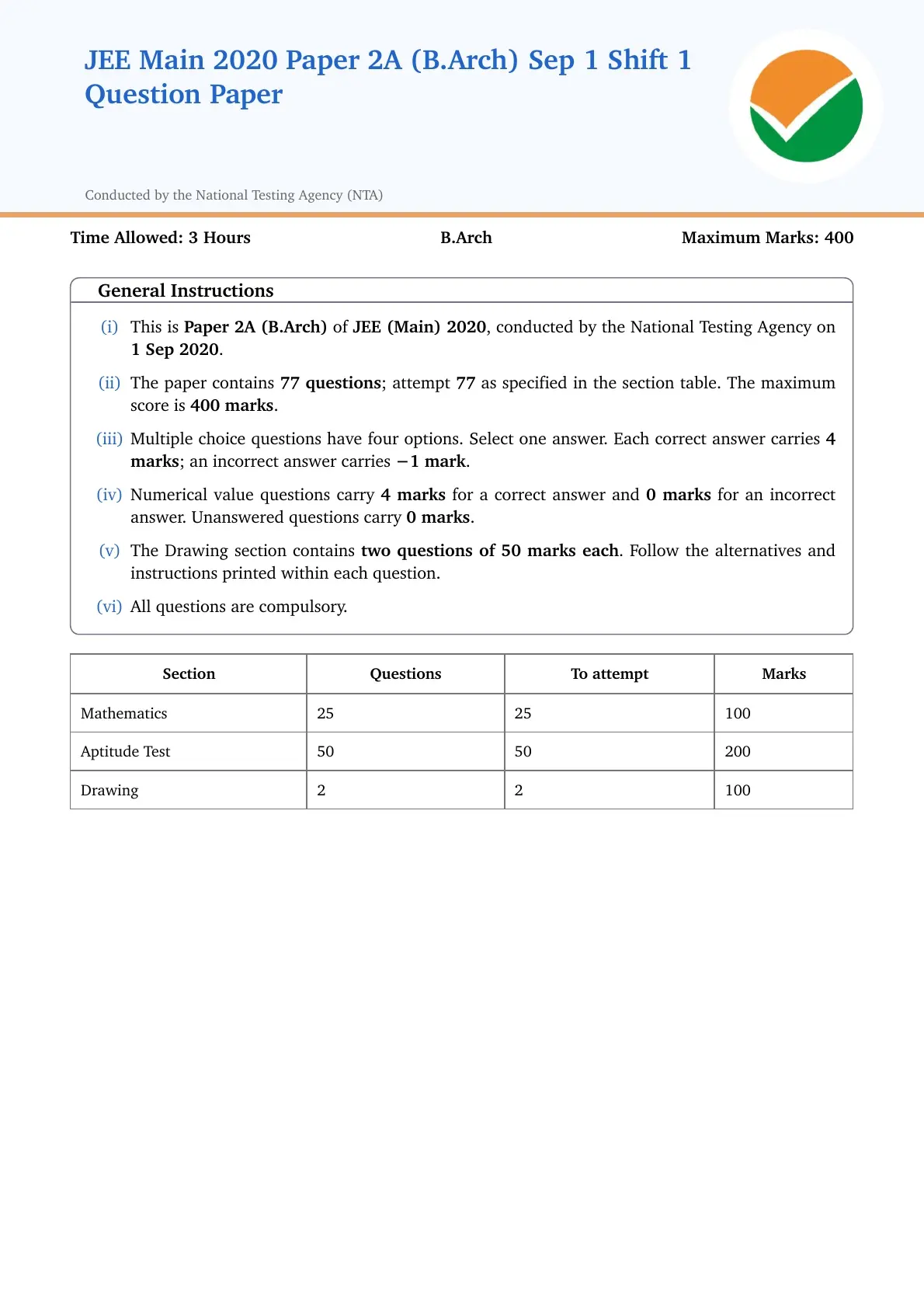
JEE Main 2020 B.Arch September 1 (Paper 2A) Question Paper is available here with solutions PDF and detailed solutions for every question. NTA conducted the JEE Main 2020 B.Arch (Paper 2A) exam on September 1, 2020, from 9:00 AM to 12:00 PM (Session 2). The question paper includes the following:
- 77 questions in a 3-hour paper: Part I Mathematics (25), Part II Aptitude Test (50) and Part III Drawing Test (2)
- Mathematics: 20 multiple choice questions (MCQs) and 5 numerical value questions, 4 marks each (100 marks)
- Aptitude Test: 50 MCQs, 4 marks each (200 marks)
- Drawing Test: 2 drawing questions, 50 marks each (100 marks)
- Marking: +4 for a correct answer, -1 for an incorrect MCQ answer (no negative marking for numerical value questions), 0 for an unattempted question; maximum marks 400
JEE Main 2020 B.Arch September 1 (Paper 2A) Question Paper with Solution PDF
| NTA Official PDF | CD PDF | CD PDF with Solutions |
|---|---|---|
| Download official PDF 4.06 MB | Download Collegedunia PDF 4.13 MB | Download solutions PDF 1.75 MB |
Also Check:
JEE Main 2020 B.Arch September 1 (Paper 2A) Questions with Solutions
Mathematics (Q1 - Q25)
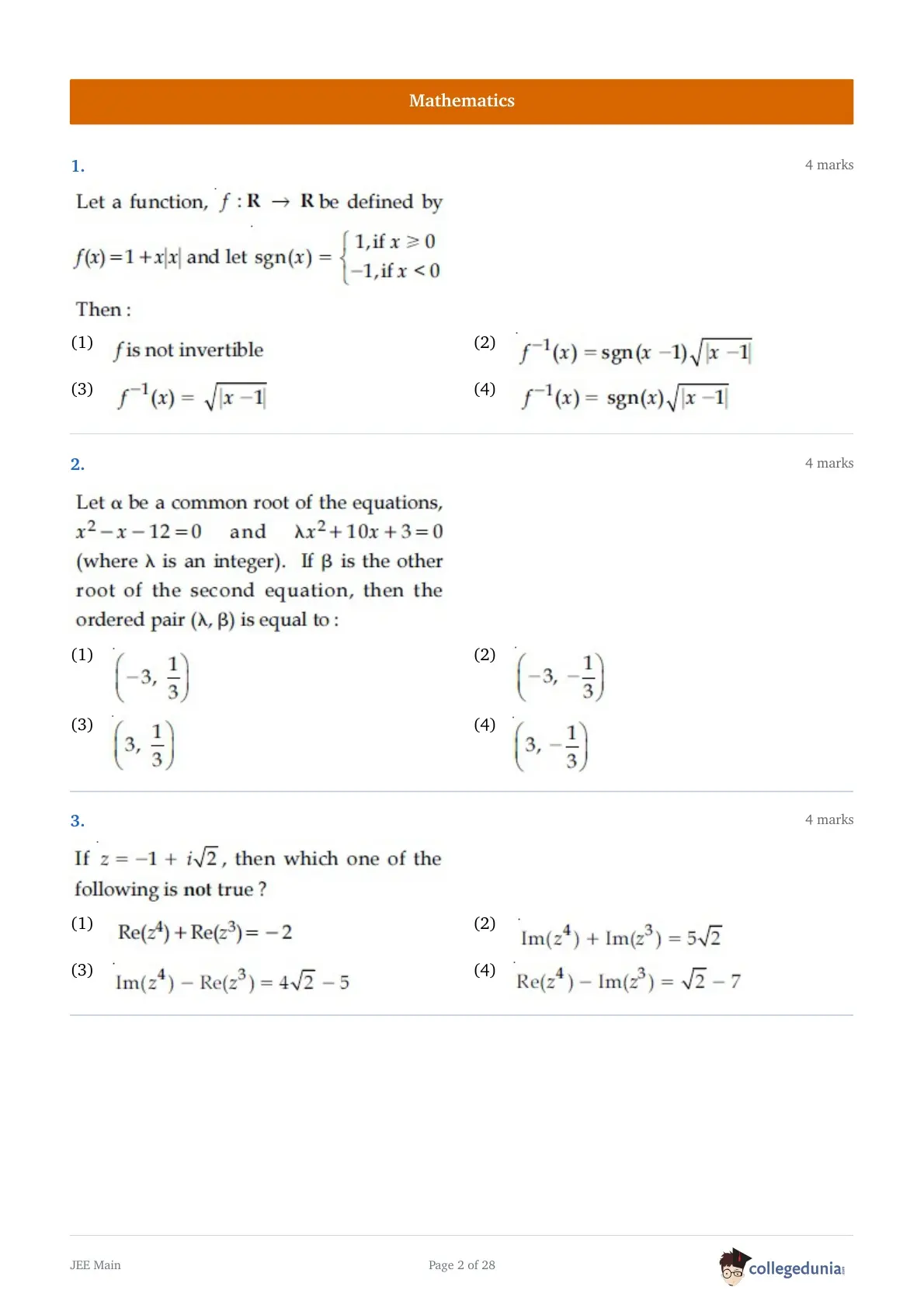
Let a function, \(f:\mathbb{R}\to\mathbb{R}\) be defined by \(f(x)=1+x|x|\) and let \(\operatorname{sgn}(x)=\begin{cases}1, & \text{if } x\ge 0\\ -1, & \text{if } x<0\end{cases}\)
Then :
Let \(\alpha\) be a common root of the equations, \(x^{2}-x-12=0\) and \(\lambda x^{2}+10x+3=0\) (where \(\lambda\) is an integer). If \(\beta\) is the other root of the second equation, then the ordered pair \((\lambda,\beta)\) is equal to :
If \(z=-1+i\sqrt{2}\), then which one of the following is not true ?
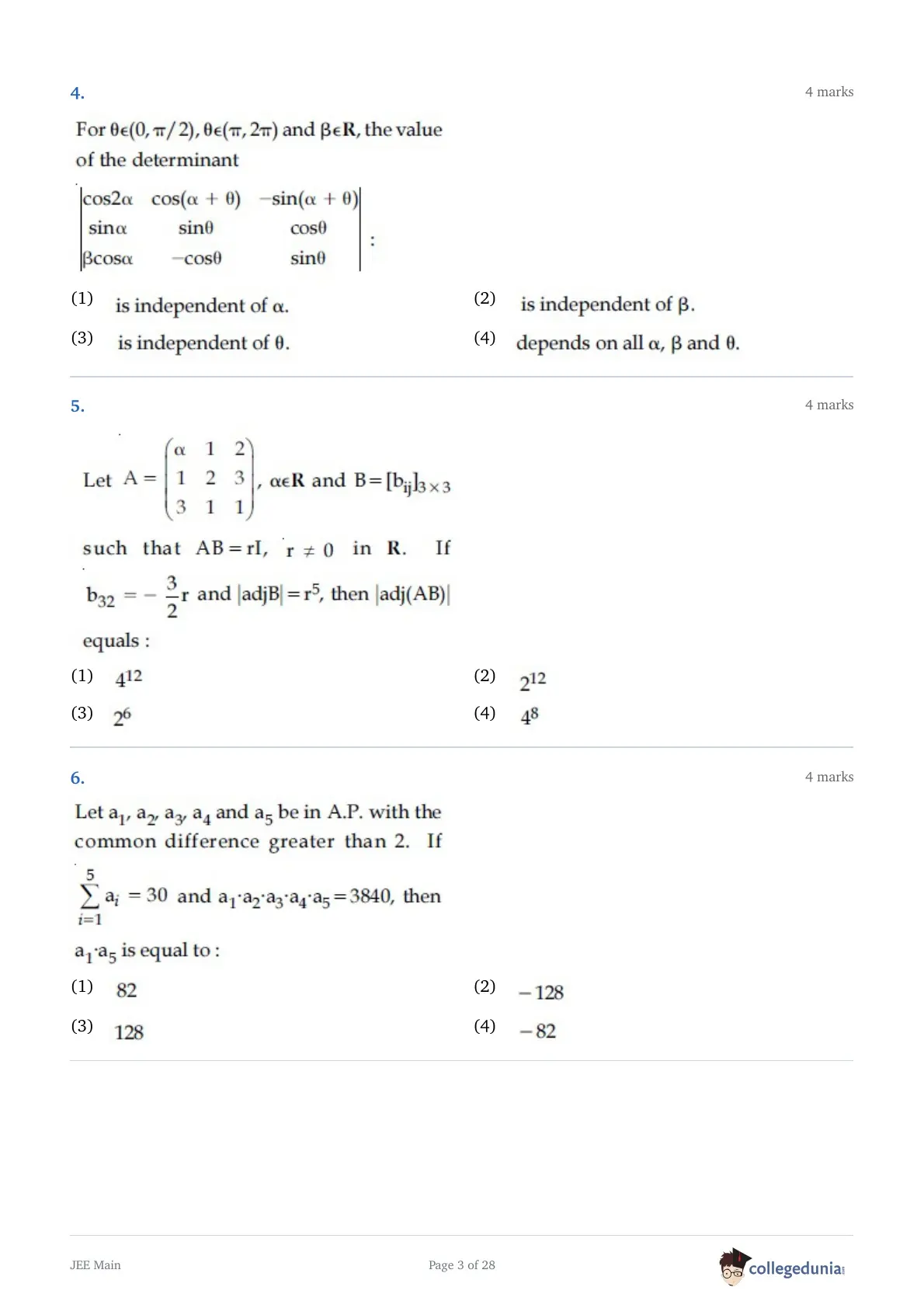
For \(\theta\in(0,\pi/2)\), \(\theta\in(\pi,2\pi)\) and \(\beta\in\mathbb{R}\), the value of the determinant
\(\begin{vmatrix}\cos 2\alpha & \cos(\alpha+\theta) & -\sin(\alpha+\theta)\\ \sin\alpha & \sin\theta & \cos\theta\\ \beta\cos\alpha & -\cos\theta & \sin\theta\end{vmatrix}\) :
Let \(A=\begin{pmatrix}\alpha & 1 & 2\\ 1 & 2 & 3\\ 3 & 1 & 1\end{pmatrix}\), \(\alpha\in\mathbb{R}\) and \(B=[b_{ij}]_{3\times3}\) such that \(AB=rI\), \(r\neq0\) in \(\mathbb{R}\). If \(b_{32}=-\frac{3}{2}r\) and \(|\operatorname{adj}B|=r^{5}\), then \(|\operatorname{adj}(AB)|\) equals :
Let \(a_1, a_2, a_3, a_4\) and \(a_5\) be in A.P. with the common difference greater than 2. If \(\sum_{i=1}^{5}a_i=30\) and \(a_1\cdot a_2\cdot a_3\cdot a_4\cdot a_5=3840\), then \(a_1\cdot a_5\) is equal to :
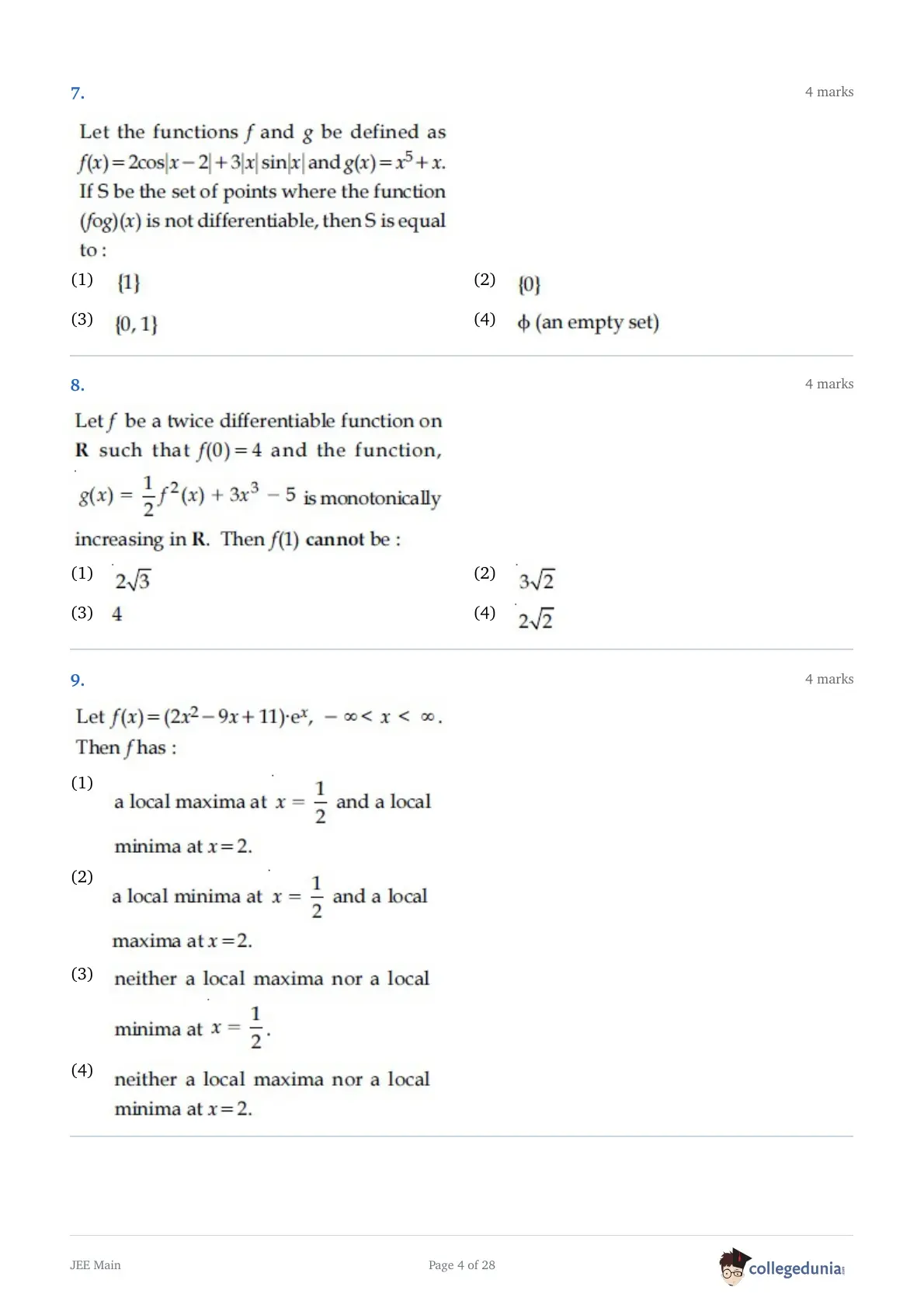
Let the functions \(f\) and \(g\) be defined as \(f(x)=2\cos|x-2|+3|x|\sin|x|\) and \(g(x)=x^{5}+x\). If S be the set of points where the function \((f\circ g)(x)\) is not differentiable, then S is equal to :
Let \(f\) be a twice differentiable function on \(\mathbb{R}\) such that \(f(0)=4\) and the function, \(g(x)=\frac{1}{2}f^{2}(x)+3x^{3}-5\) is monotonically increasing in \(\mathbb{R}\). Then \(f(1)\) cannot be :
Let \(f(x)=\left(2x^{2}-9x+11\right)\cdot e^{x},\ -\infty<x<\infty\). Then \(f\) has :
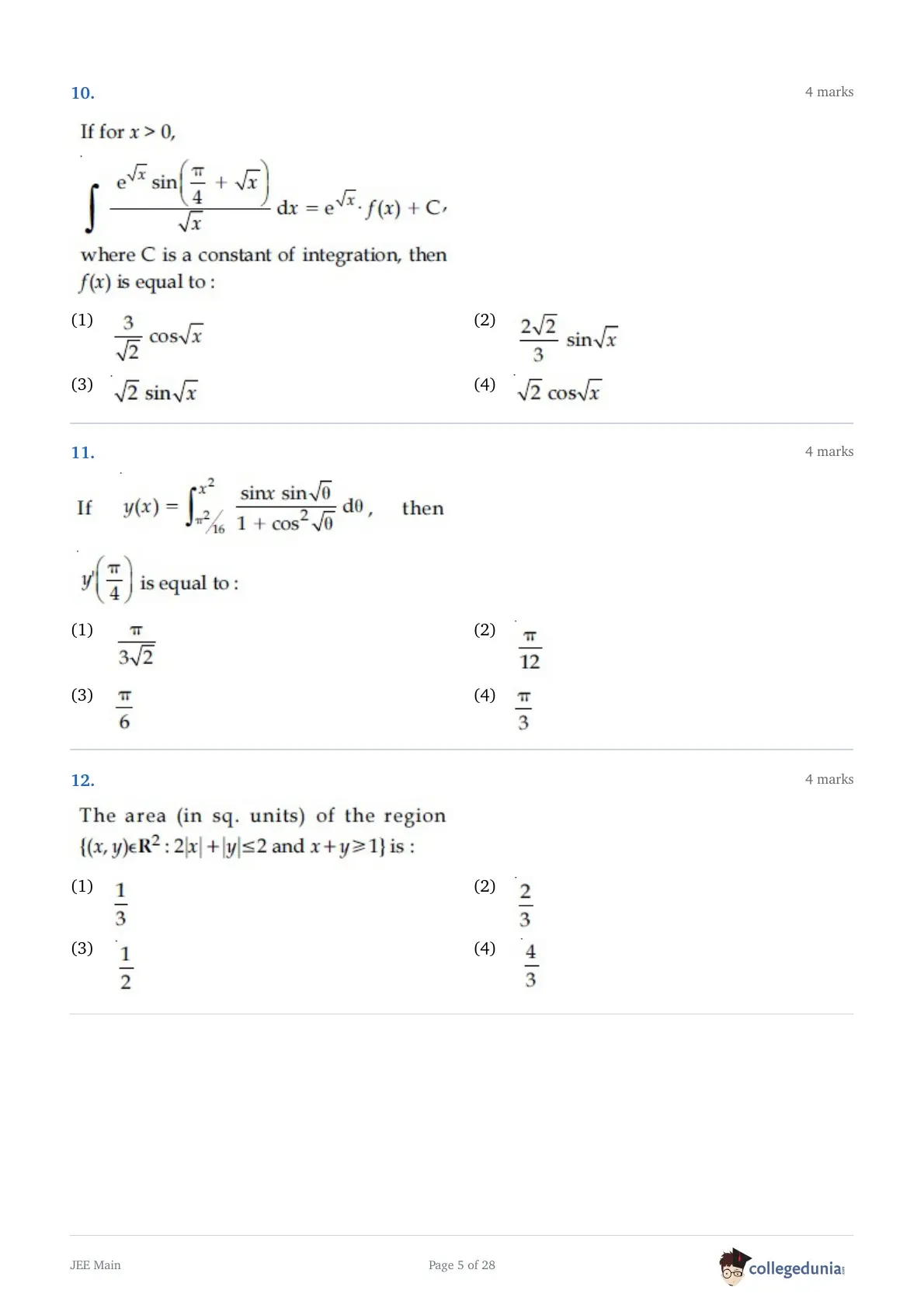
If for \(x>0\), \(\int \frac{e^{\sqrt{x}}\sin\left(\frac{\pi}{4}+\sqrt{x}\right)}{\sqrt{x}}\,dx=e^{\sqrt{x}}\cdot f(x)+C\), where \(C\) is a constant of integration, then \(f(x)\) is equal to :
If \(y(x)=\int_{\pi^{2}/16}^{x^{2}}\frac{\sin x\,\sin\sqrt{\theta}}{1+\cos^{2}\sqrt{\theta}}\,d\theta\), then \(y'\left(\frac{\pi}{4}\right)\) is equal to :
The area (in sq. units) of the region \(\{(x,y)\in\mathbb{R}^{2}:2|x|+|y|\le 2\text{ and }x+y\ge 1\}\) is :
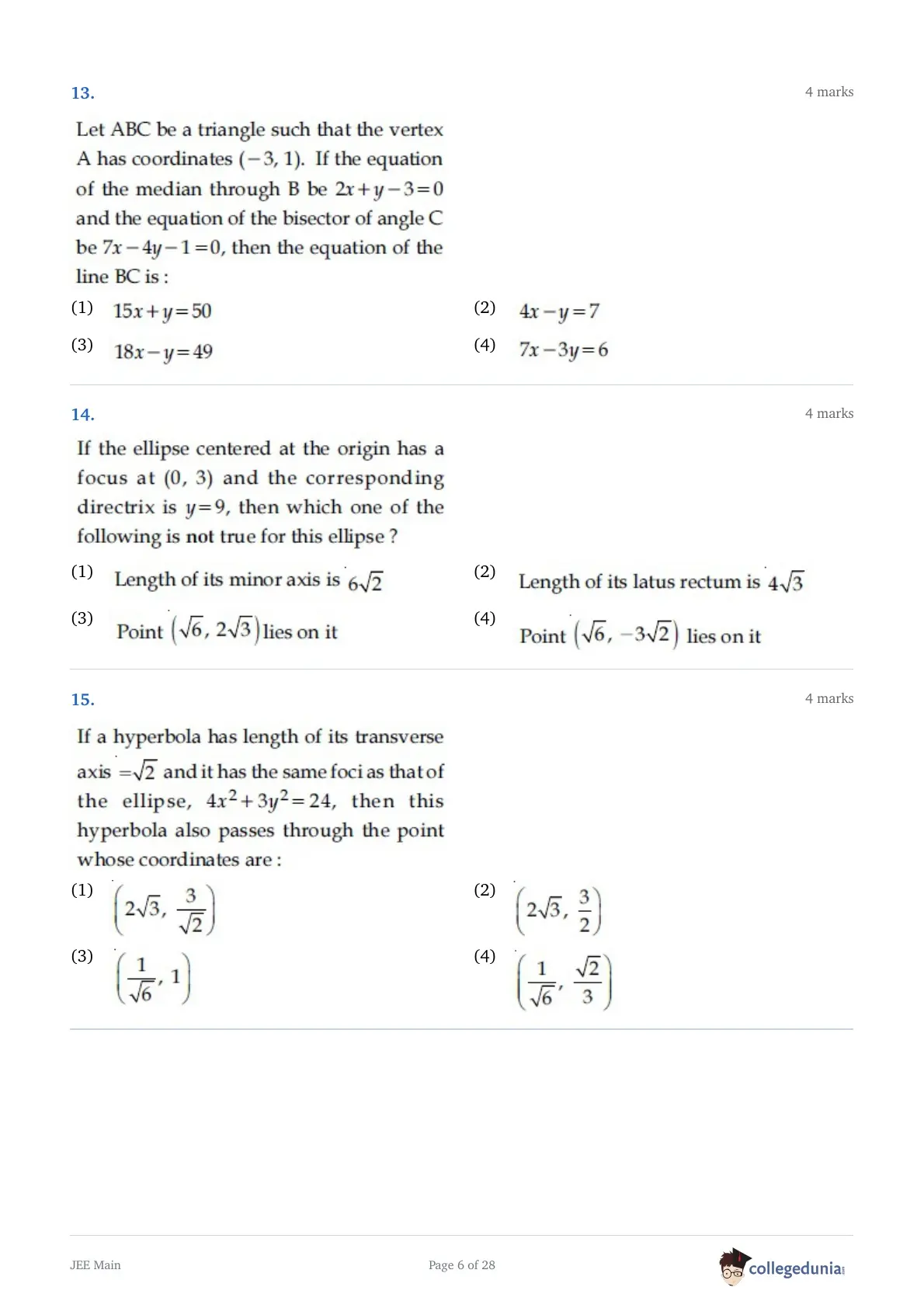
Let ABC be a triangle such that the vertex A has coordinates \((-3,1)\). If the equation of the median through B be \(2x+y-3=0\) and the equation of the bisector of angle C be \(7x-4y-1=0\), then the equation of the line BC is :
If the ellipse centered at the origin has a focus at \((0,3)\) and the corresponding directrix is \(y=9\), then which one of the following is not true for this ellipse ?
If a hyperbola has length of its transverse axis \(=\sqrt{2}\) and it has the same foci as that of the ellipse \(4x^{2}+3y^{2}=24\), then this hyperbola also passes through the point whose coordinates are :
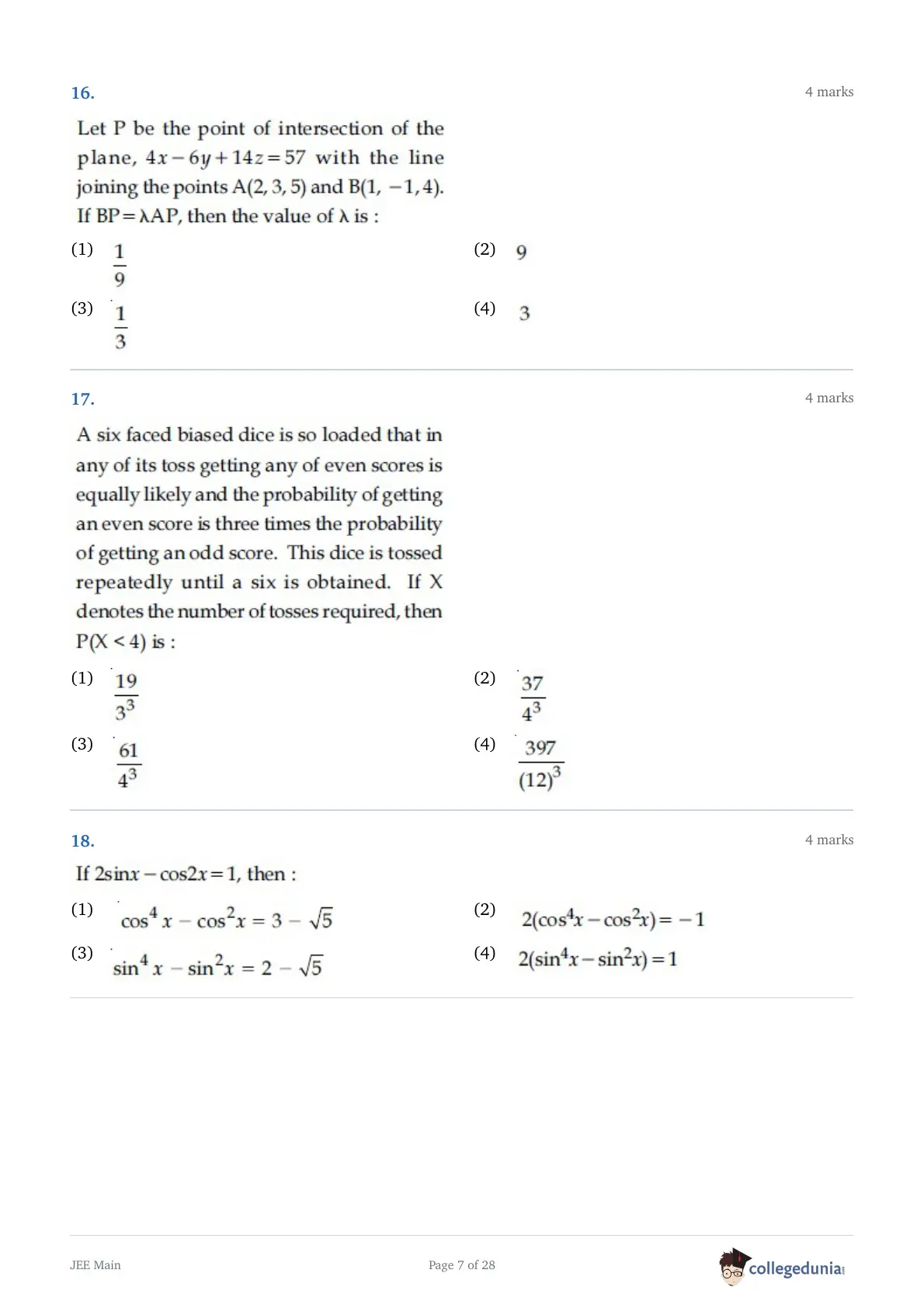
Let P be the point of intersection of the plane \(4x-6y+14z=57\) with the line joining the points A\((2,3,5)\) and B\((1,-1,4)\). If \(BP=\lambda\,AP\), then the value of \(\lambda\) is :
A six faced biased dice is so loaded that in any of its toss getting any of even scores is equally likely and the probability of getting an even score is three times the probability of getting an odd score. This dice is tossed repeatedly until a six is obtained. If X denotes the number of tosses required, then \(\mathrm{P}(\mathrm{X}<4)\) is :
If \(2 \sin x-\cos 2 x=1\), then :
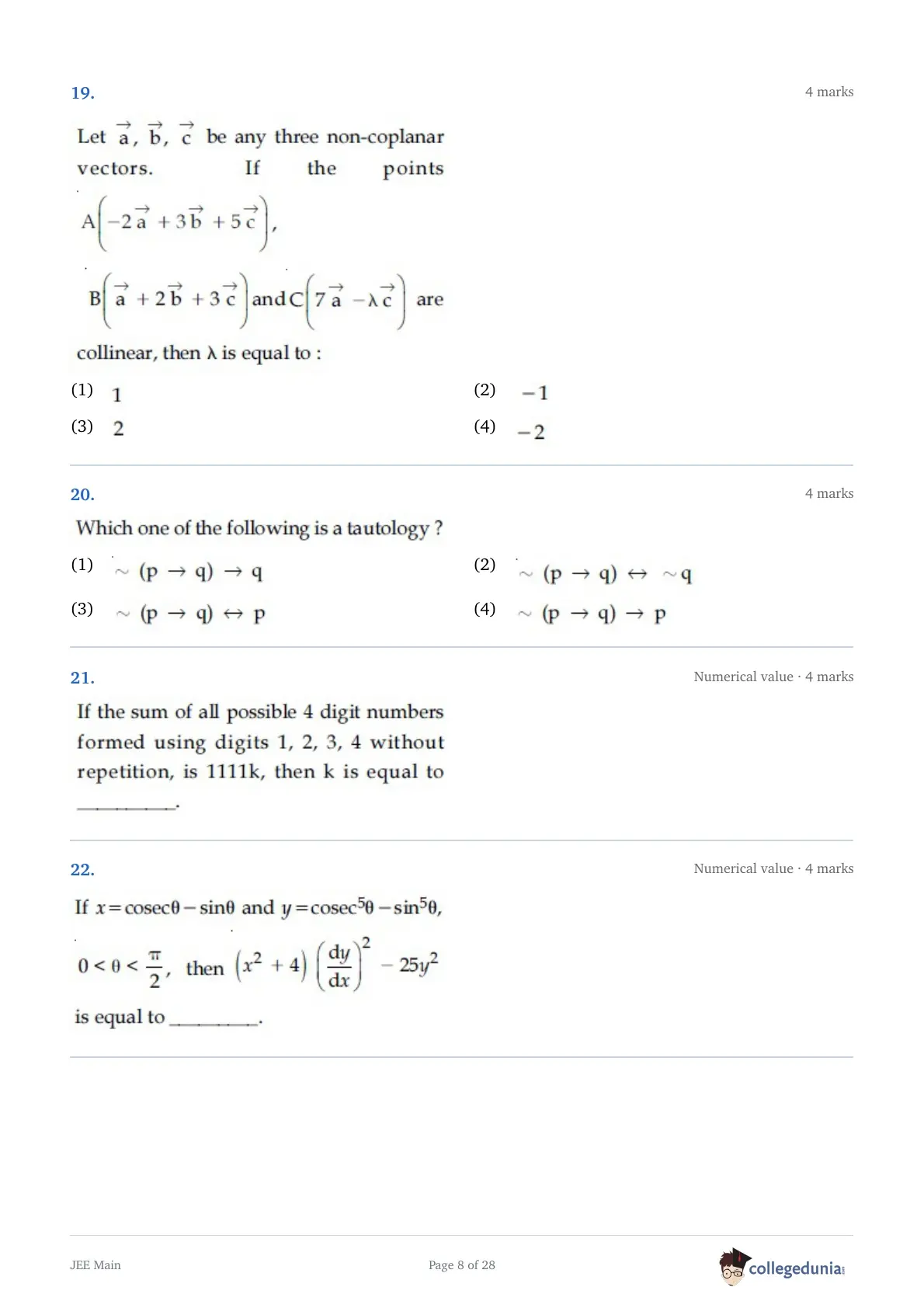
Let \(\vec{a}, \vec{b}, \vec{c}\) be any three non-coplanar vectors. If the points \(\mathrm{A}(-2 \vec{a}+3 \vec{b}+5 \vec{c})\), \(\mathrm{B}(\vec{a}+2 \vec{b}+3 \vec{c})\) and \(\mathrm{C}(7 \vec{a}-\lambda \vec{c})\) are collinear, then \(\lambda\) is equal to :
Which one of the following is a tautology ?
If the sum of all possible 4 digit numbers formed using digits 1, 2, 3, 4 without repetition, is \(1111 \mathrm{k}\), then \(\mathrm{k}\) is equal to ________.
If \(x=\operatorname{cosec} \theta-\sin \theta\) and \(y=\operatorname{cosec}^{5} \theta-\sin ^{5} \theta, 0<\theta<\frac{\pi}{2}\), then \(\left(x^{2}+4\right)\left(\frac{\mathrm{d} y}{\mathrm{~d} x}\right)^{2}-25 y^{2}\) is equal to ________.
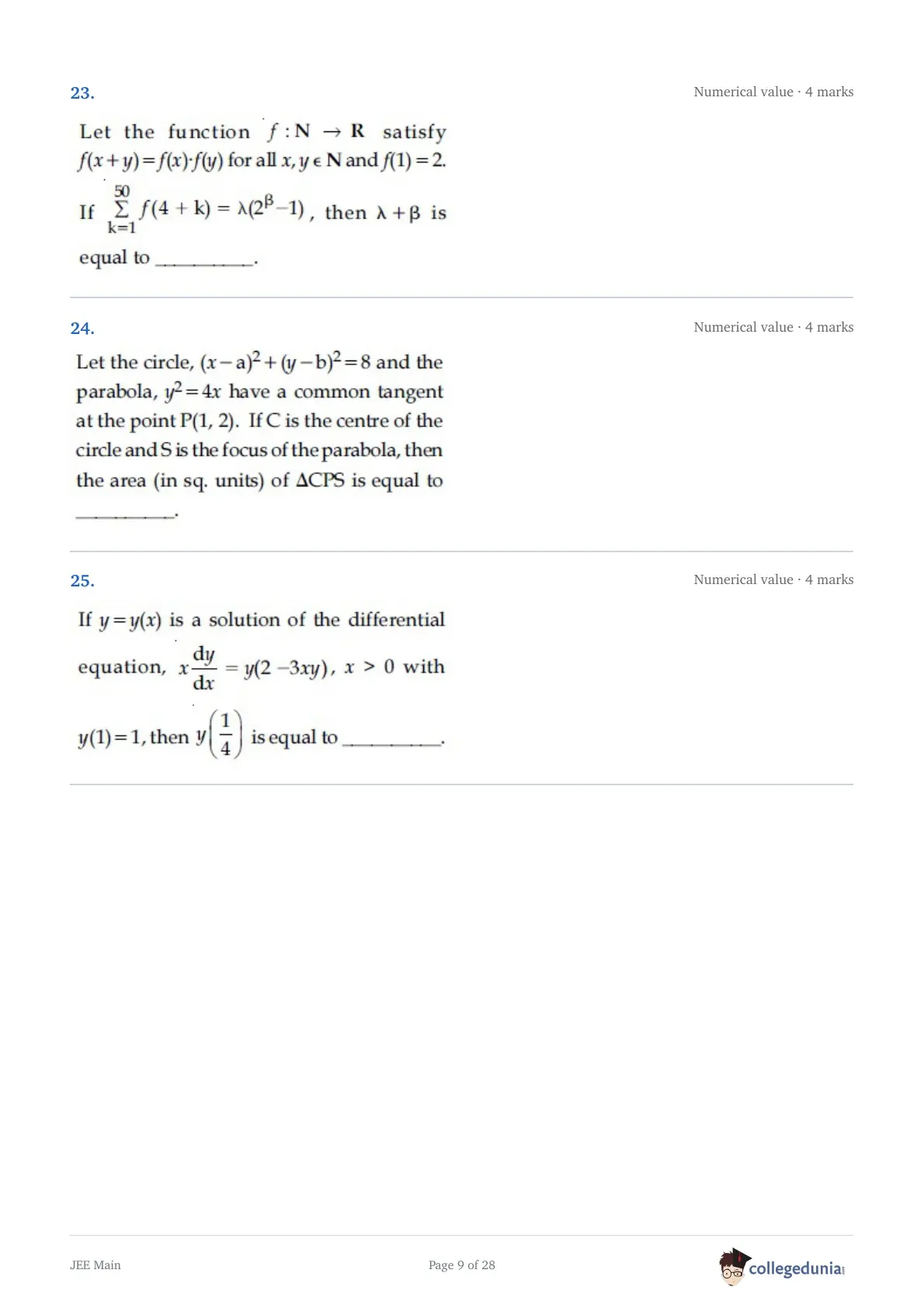
Let the function \(f: \mathrm{N} \rightarrow \mathrm{R}\) satisfy \(f(x+y)=f(x) \cdot f(y)\) for all \(x, y \in \mathrm{N}\) and \(f(1)=2\). If \(\sum_{\mathrm{k}=1}^{50} f(4+\mathrm{k})=\lambda\left(2^{\beta}-1\right)\), then \(\lambda+\beta\) is equal to ________.
Let the circle, \((x-\mathrm{a})^{2}+(y-\mathrm{b})^{2}=8\) and the parabola, \(y^{2}=4 x\) have a common tangent at the point \(\mathrm{P}(1,2)\). If \(\mathrm{C}\) is the centre of the circle and \(\mathrm{S}\) is the focus of the parabola, then the area (in sq. units) of \(\triangle \mathrm{CPS}\) is equal to ________.
If \(y=y(x)\) is a solution of the differential equation, \(x\frac{dy}{dx}=y(2-3xy),\ x>0\) with \(y(1)=1\), then \(y\left(\frac{1}{4}\right)\) is equal to ________.
Aptitude Test (Q26 - Q75)
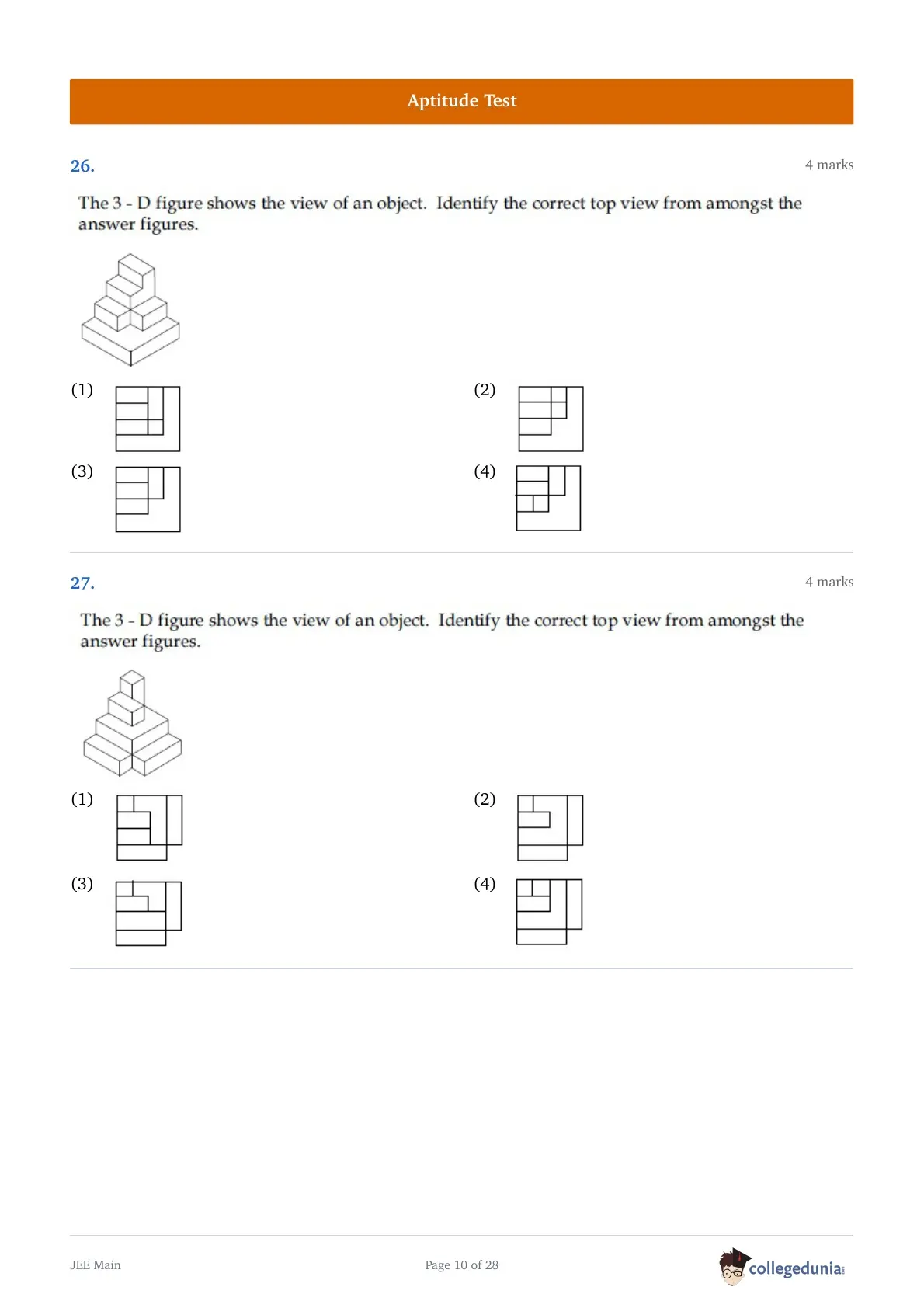
The 3 - D figure shows the view of an object. Identify the correct top view from amongst the answer figures.
- (1)
![]()
- (2)
![]()
- (3)
![]()
- (4)
![]()


The 3 - D figure shows the view of an object. Identify the correct top view from amongst the answer figures.
- (1)
![]()
- (2)
![]()
- (3)
![]()
- (4)
![]()


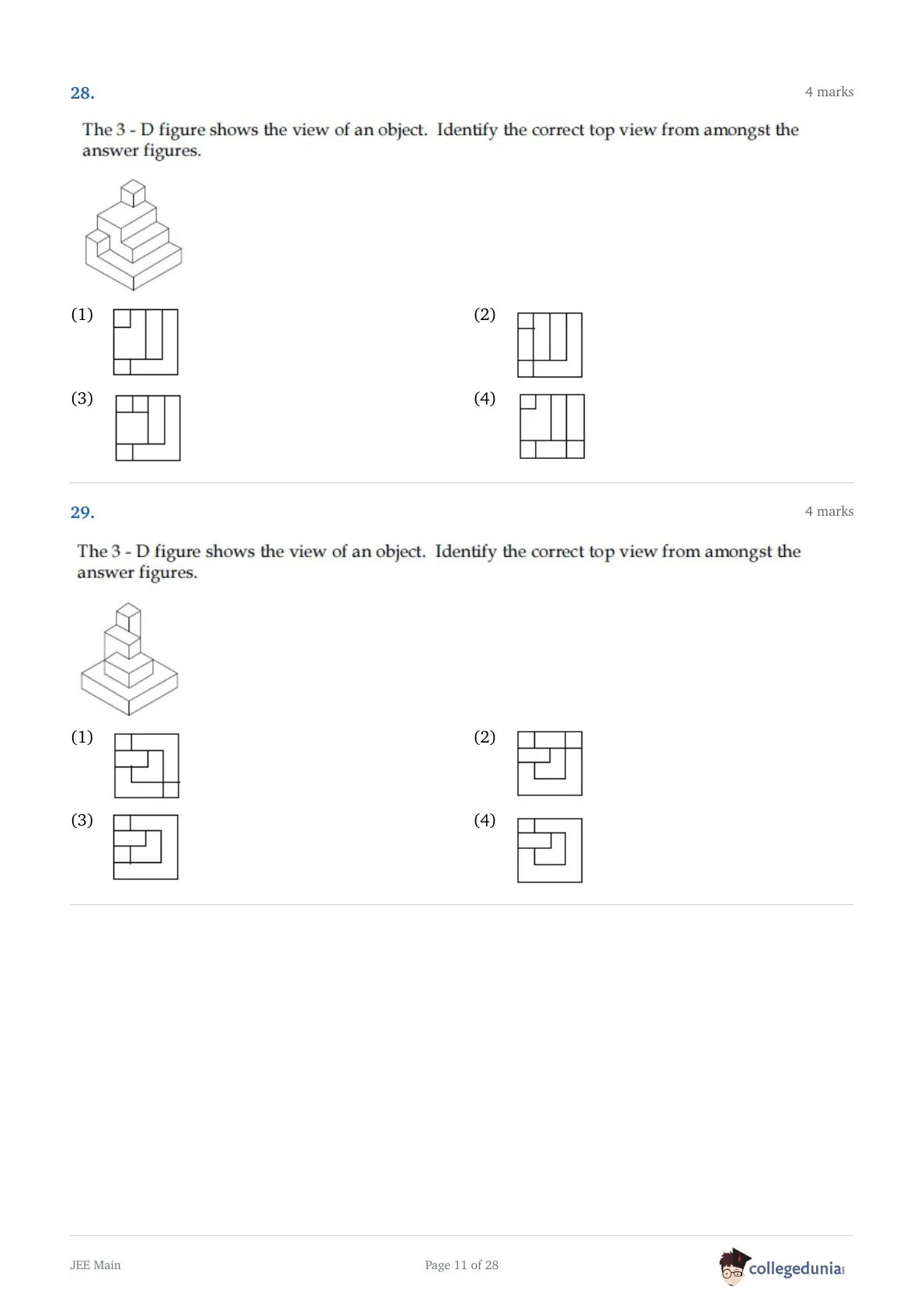
The 3 - D figure shows the view of an object. Identify the correct top view from amongst the answer figures.
- (1)
![]()
- (2)
![]()
- (3)
![]()
- (4)
![]()


The 3 - D figure shows the view of an object. Identify the correct top view from amongst the answer figures.
- (1)
![]()
- (2)
![]()
- (3)
![]()
- (4)
![]()


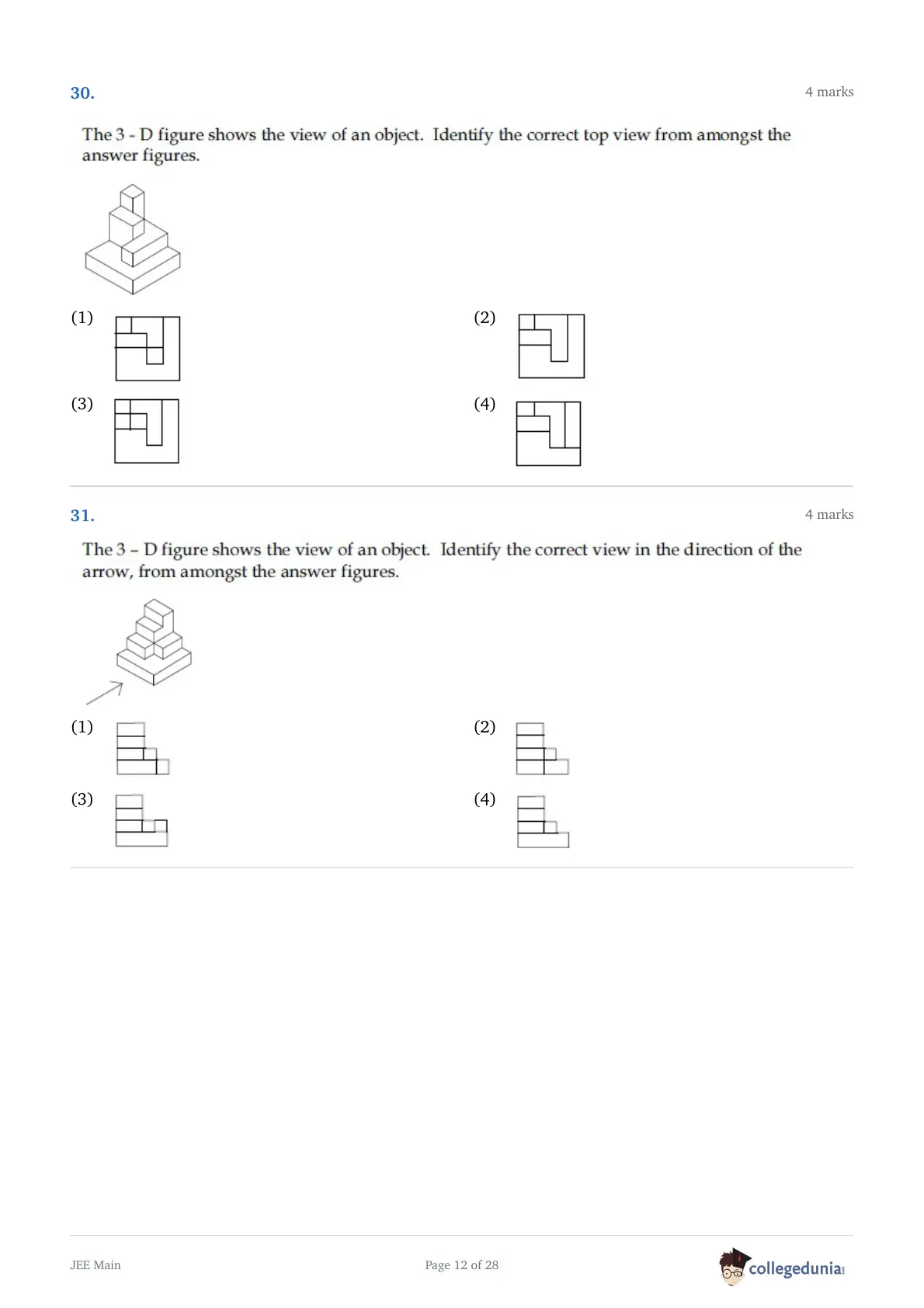
The 3 - D figure shows the view of an object. Identify the correct top view from amongst the answer figures.
- (1)
![]()
- (2)
![]()
- (3)
![]()
- (4)
![]()


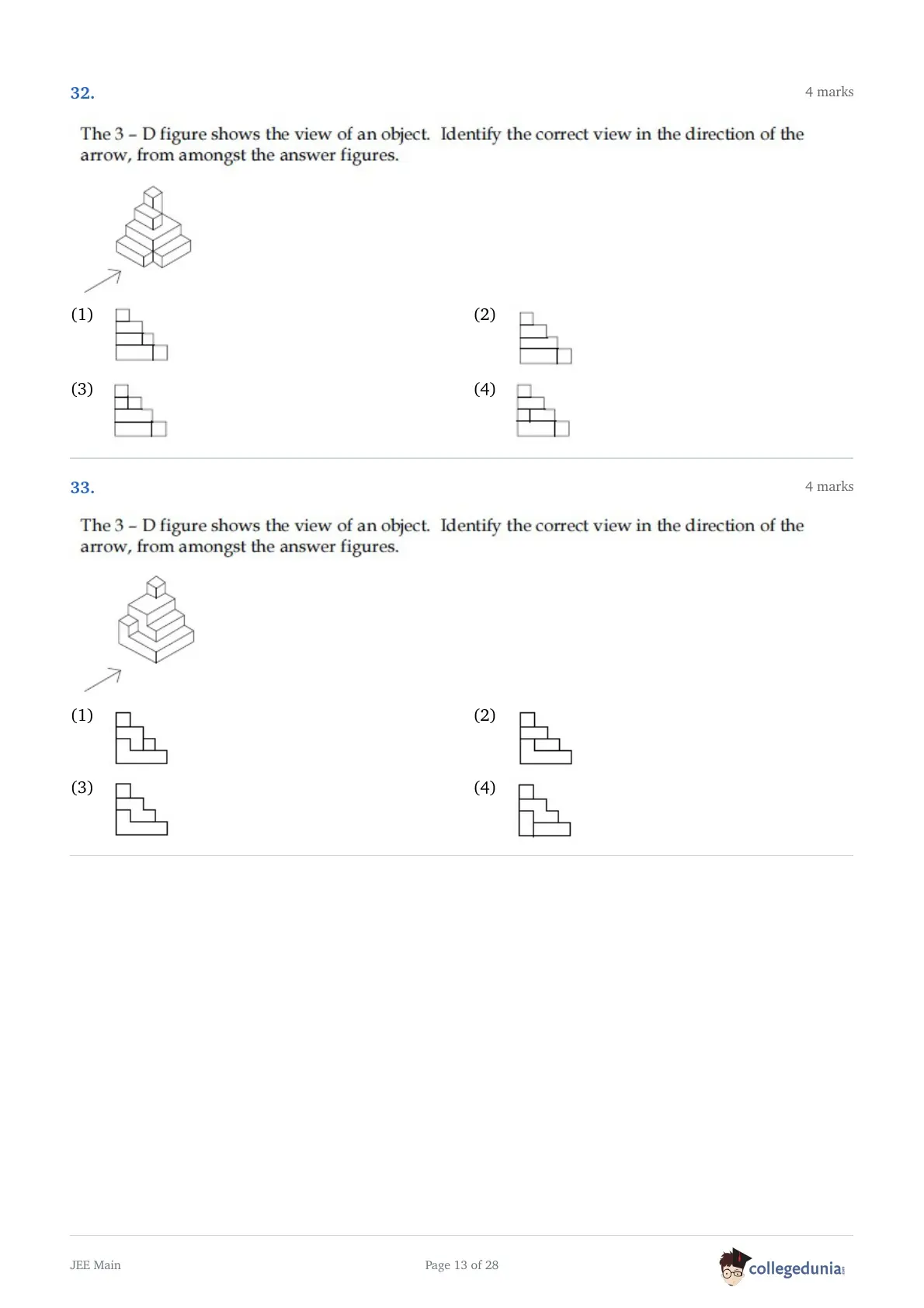
The 3 - D figure shows the view of an object. Identify the correct view in the direction of the arrow, from amongst the answer figures.
- (1)
![]()
- (2)
![]()
- (3)
![]()
- (4)
![]()


The 3 - D figure shows the view of an object. Identify the correct view in the direction of the arrow, from amongst the answer figures.
- (1)
![]()
- (2)
![]()
- (3)
![]()
- (4)
![]()


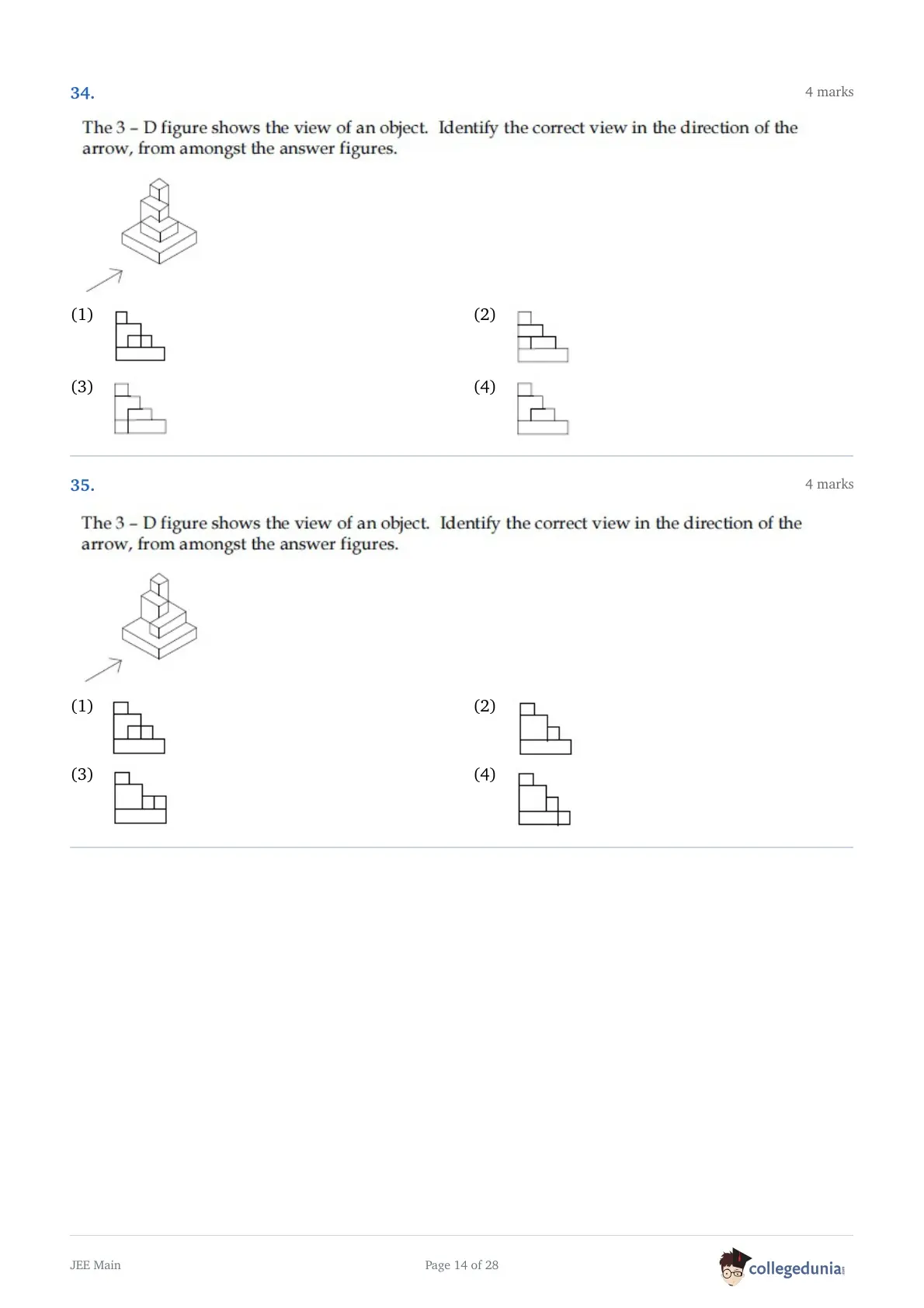
The 3 - D figure shows the view of an object. Identify the correct view in the direction of the arrow, from amongst the answer figures.
- (1)
![]()
- (2)
![]()
- (3)
![]()
- (4)
![]()


The 3 - D figure shows the view of an object. Identify the correct view in the direction of the arrow, from amongst the answer figures.
- (1)
![]()
- (2)
![]()
- (3)
![]()
- (4)
![]()


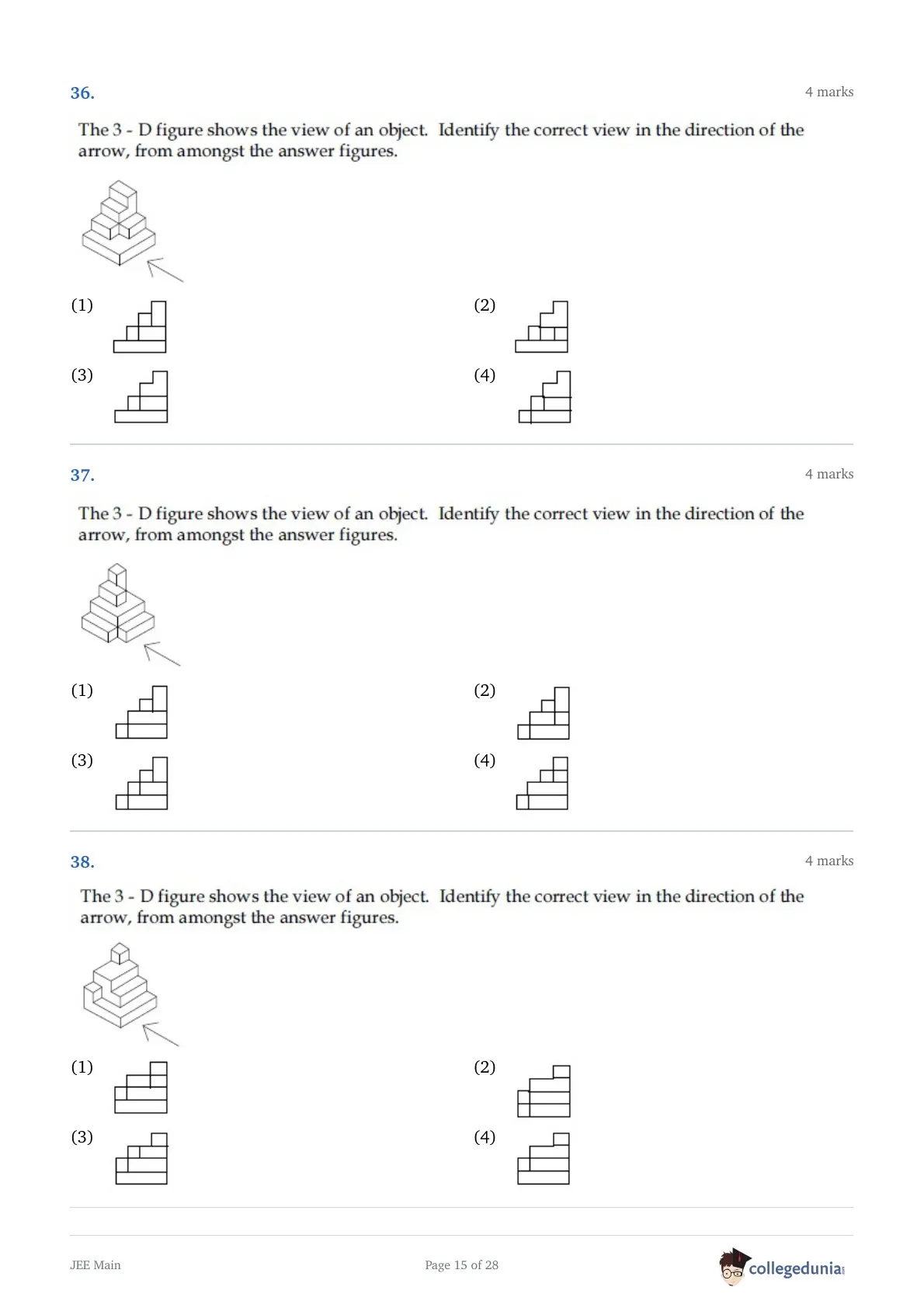
The 3 - D figure shows the view of an object. Identify the correct view in the direction of the arrow, from amongst the answer figures.
- (1)
![]()
- (2)
![]()
- (3)
![]()
- (4)
![]()


The 3 - D figure shows the view of an object. Identify the correct view in the direction of the arrow, from amongst the answer figures.
- (1)
![]()
- (2)
![]()
- (3)
![]()
- (4)
![]()


The 3 - D figure shows the view of an object. Identify the correct view in the direction of the arrow, from amongst the answer figures.
- (1)
![]()
- (2)
![]()
- (3)
![]()
- (4)
![]()


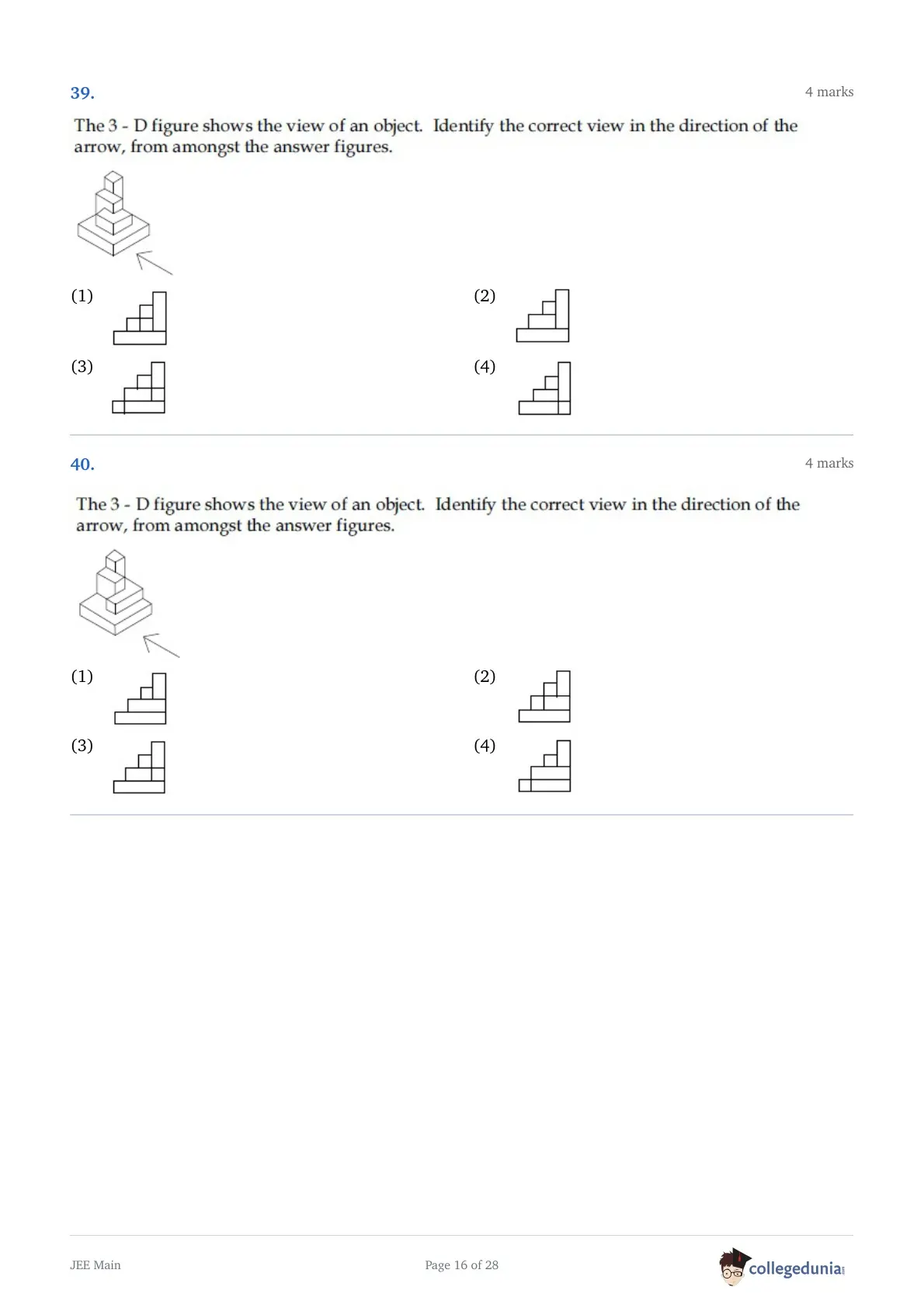
The 3 - D figure shows the view of an object. Identify the correct view in the direction of the arrow, from amongst the answer figures.
- (1)
![]()
- (2)
![]()
- (3)
![]()
- (4)
![]()


The 3 - D figure shows the view of an object. Identify the correct view in the direction of the arrow, from amongst the answer figures.
- (1)
![]()
- (2)
![]()
- (3)
![]()
- (4)
![]()


The 3 - D figure shows the view of an object. Identify the correct view in the direction of the arrow, from amongst the answer figures.
- (1)
![]()
- (2)
![]()
- (3)
![]()
- (4)
![]()


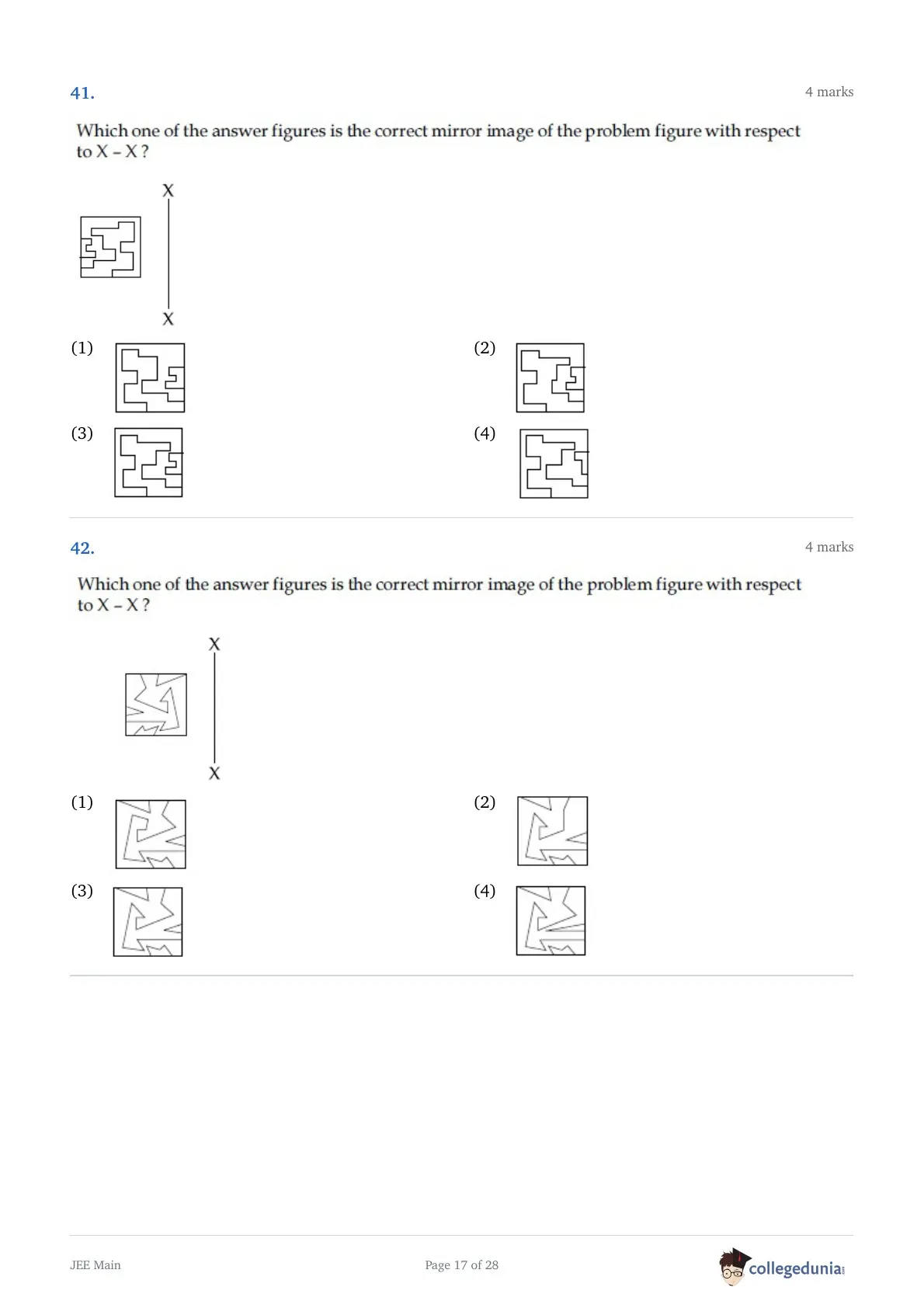
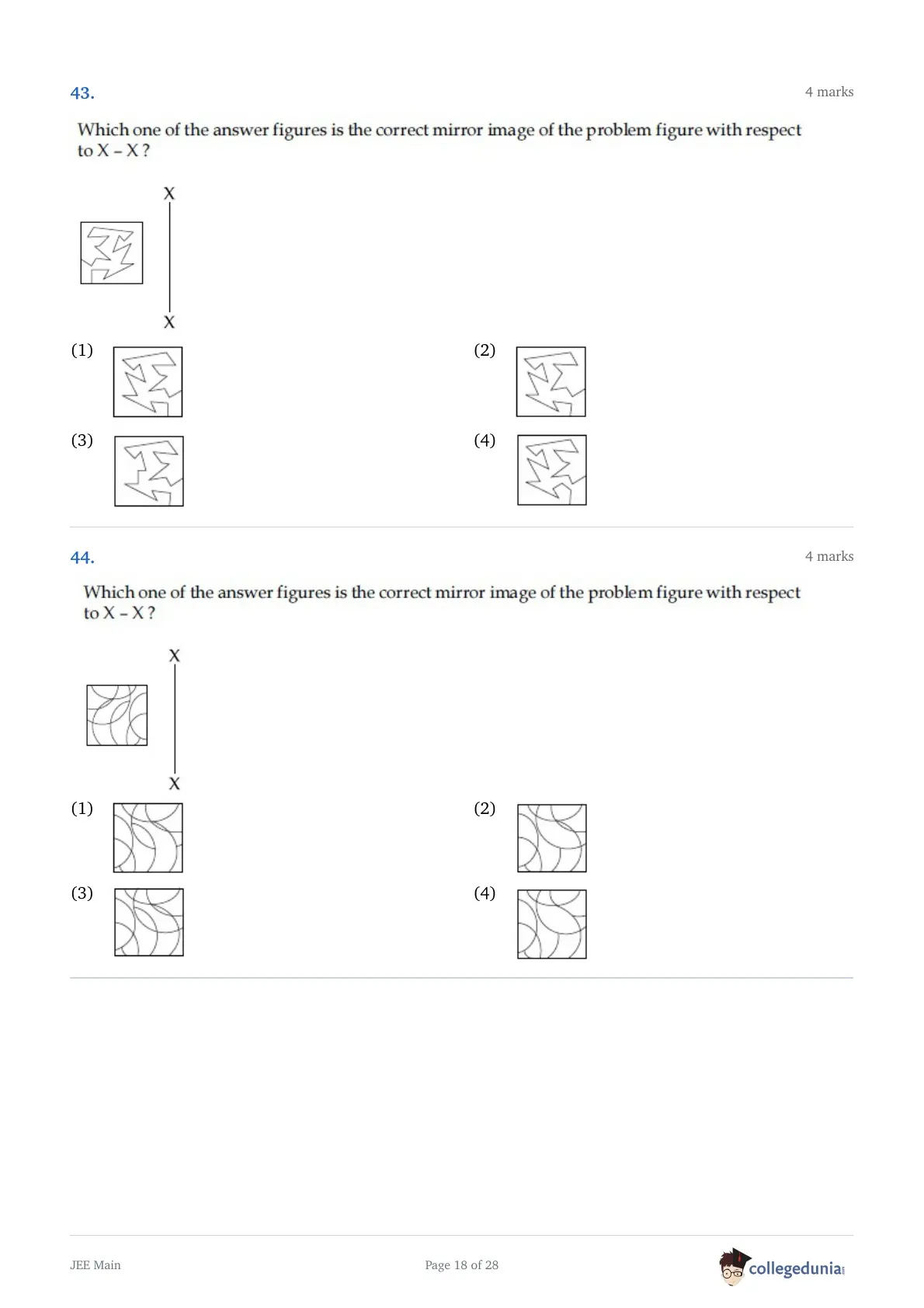
Which one of the answer figures is the correct mirror image of the problem figure with respect to X-X ?
- (1)
![]()
- (2)
![]()
- (3)
![]()
- (4)
![]()


Which one of the answer figures is the correct mirror image of the problem figure with respect to X-X ?
- (1)
![]()
- (2)
![]()
- (3)
![]()
- (4)
![]()


Which one of the answer figures is the correct mirror image of the problem figure with respect to X-X ?
- (1)
![]()
- (2)
![]()
- (3)
![]()
- (4)
![]()


Which one of the answer figures is the correct mirror image of the problem figure with respect to X-X ?
- (1)
![]()
- (2)
![]()
- (3)
![]()
- (4)
![]()


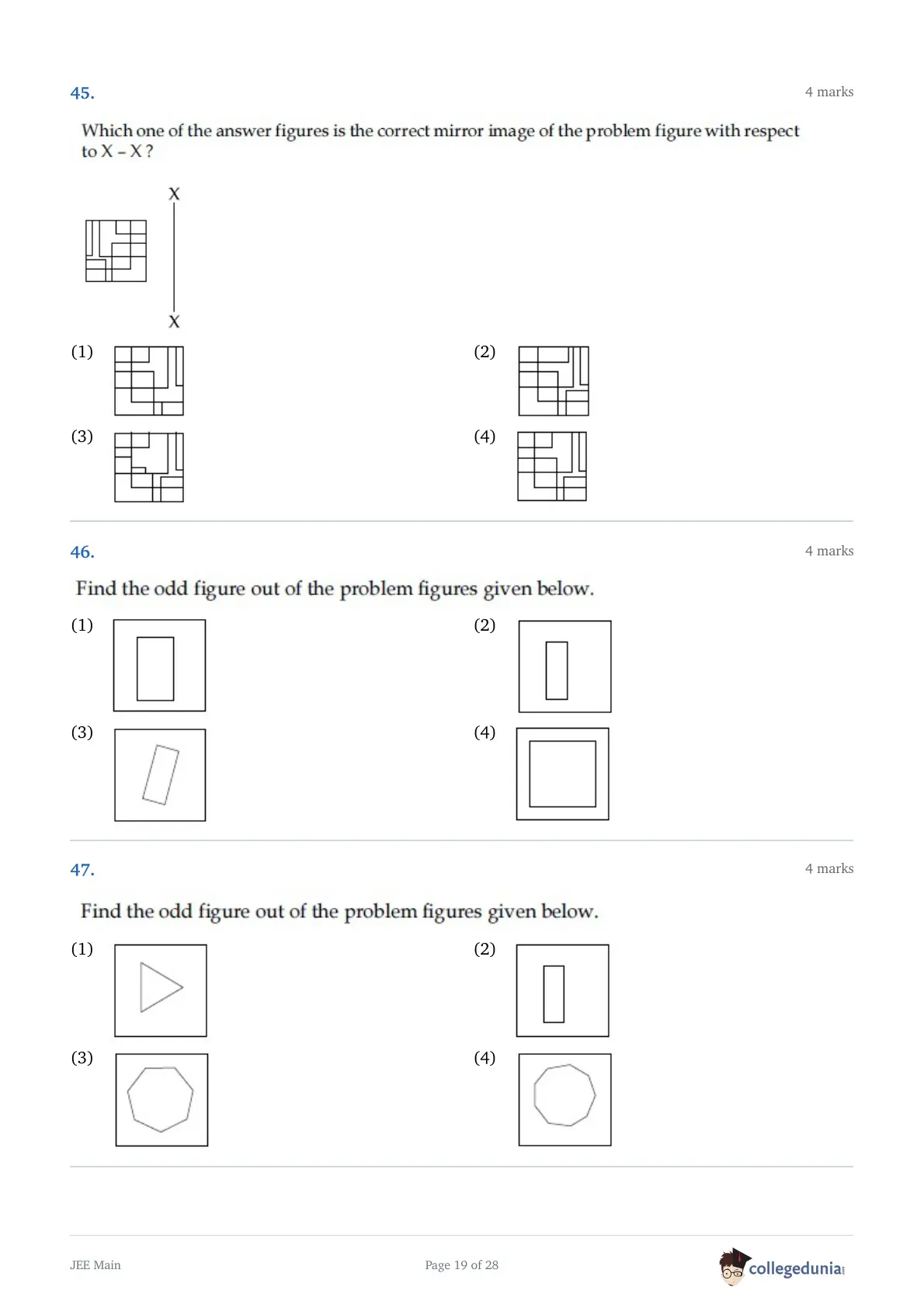
Which one of the answer figures is the correct mirror image of the problem figure with respect to X-X ?
- (1)
![]()
- (2)
![]()
- (3)
![]()
- (4)
![]()


Find the odd figure out of the problem figures given below.
- (1)
![]()
- (2)
![]()
- (3)
![]()
- (4)
![]()


Find the odd figure out of the problem figures given below.
- (1)
![]()
- (2)
![]()
- (3)
![]()
- (4)
![]()


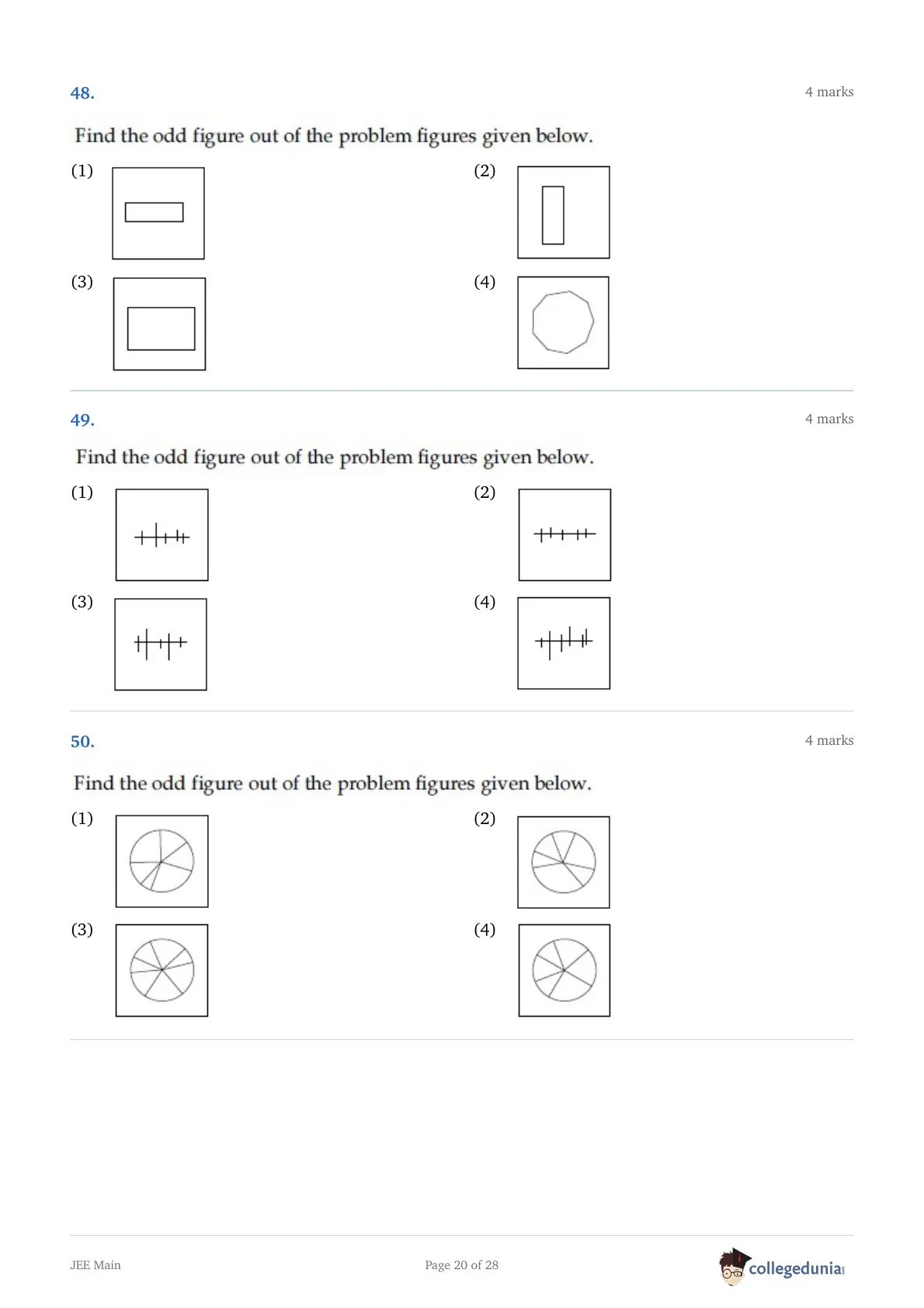
Find the odd figure out of the problem figures given below.
- (1)
![]()
- (2)
![]()
- (3)
![]()
- (4)
![]()


Find the odd figure out of the problem figures given below.
- (1)
![]()
- (2)
![]()
- (3)
![]()
- (4)
![]()


Find the odd figure out of the problem figures given below.
- (1)
![]()
- (2)
![]()
- (3)
![]()
- (4)
![]()


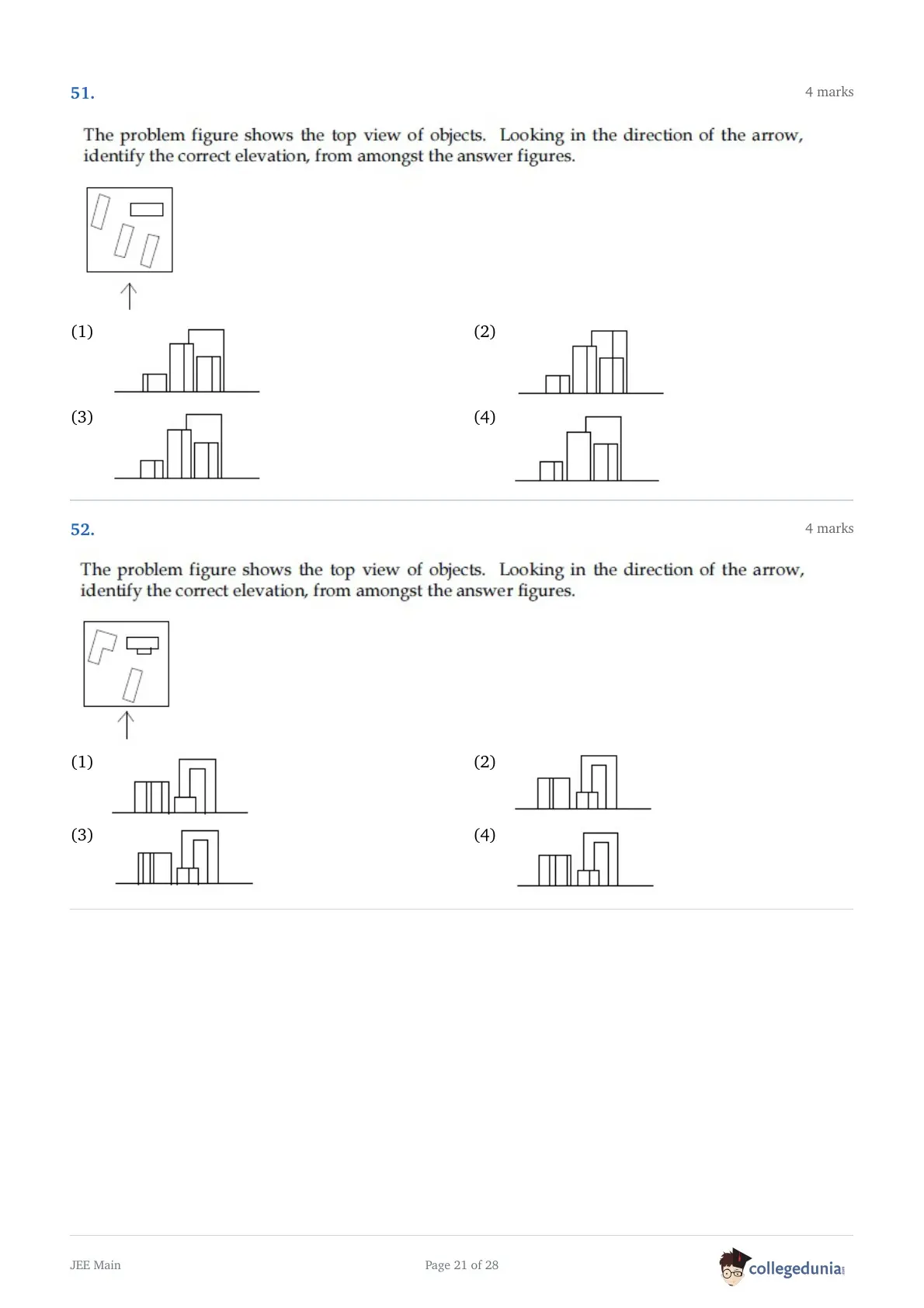
The problem figure shows the top view of objects. Looking in the direction of the arrow, identify the correct elevation, from amongst the answer figures.
- (1)
![]()
- (2)
![]()
- (3)
![]()
- (4)
![]()


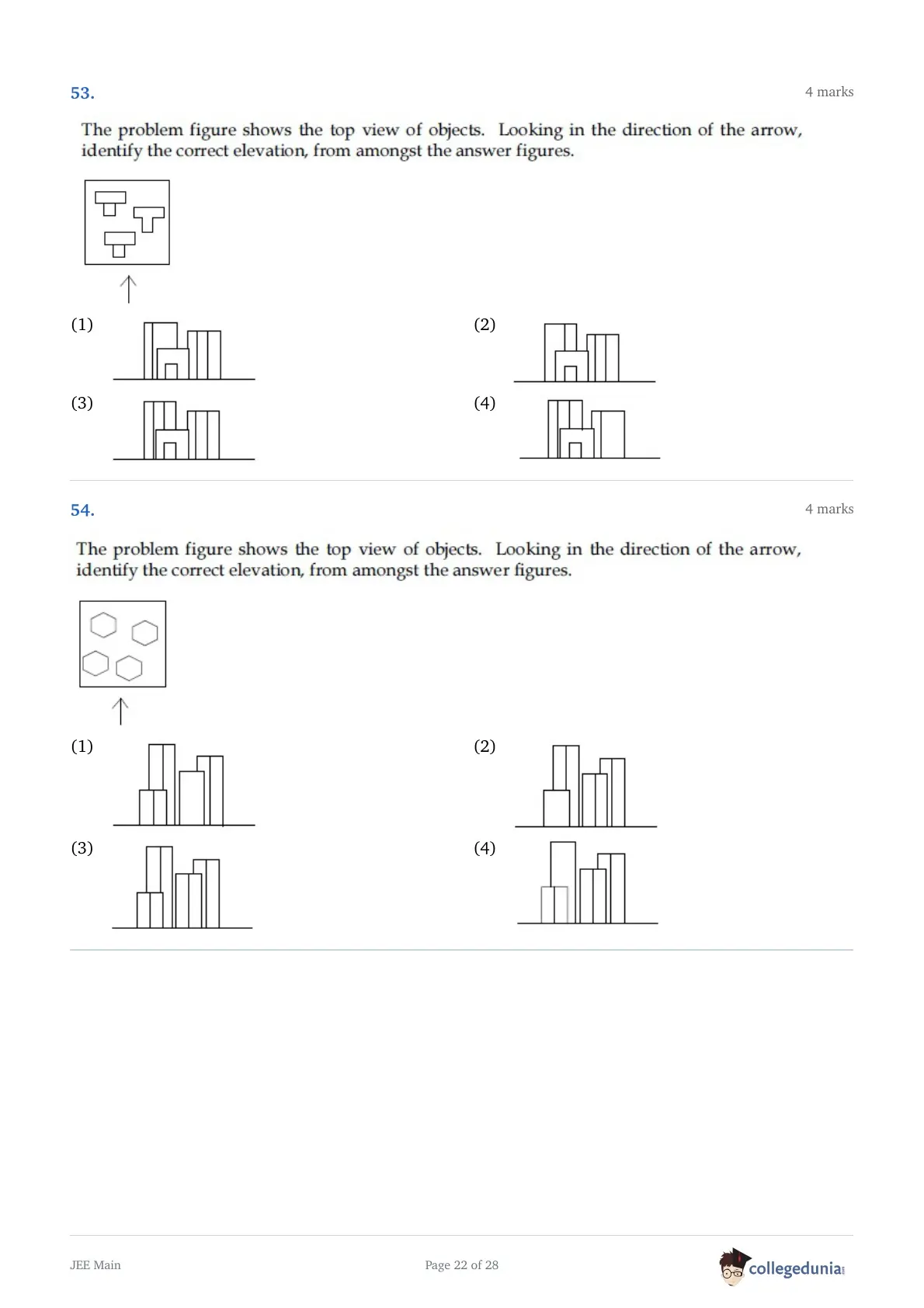
The problem figure shows the top view of objects. Looking in the direction of the arrow, identify the correct elevation, from amongst the answer figures.
- (1)
![]()
- (2)
![]()
- (3)
![]()
- (4)
![]()


The problem figure shows the top view of objects. Looking in the direction of the arrow, identify the correct elevation, from amongst the answer figures.
- (1)
![]()
- (2)
![]()
- (3)
![]()
- (4)
![]()


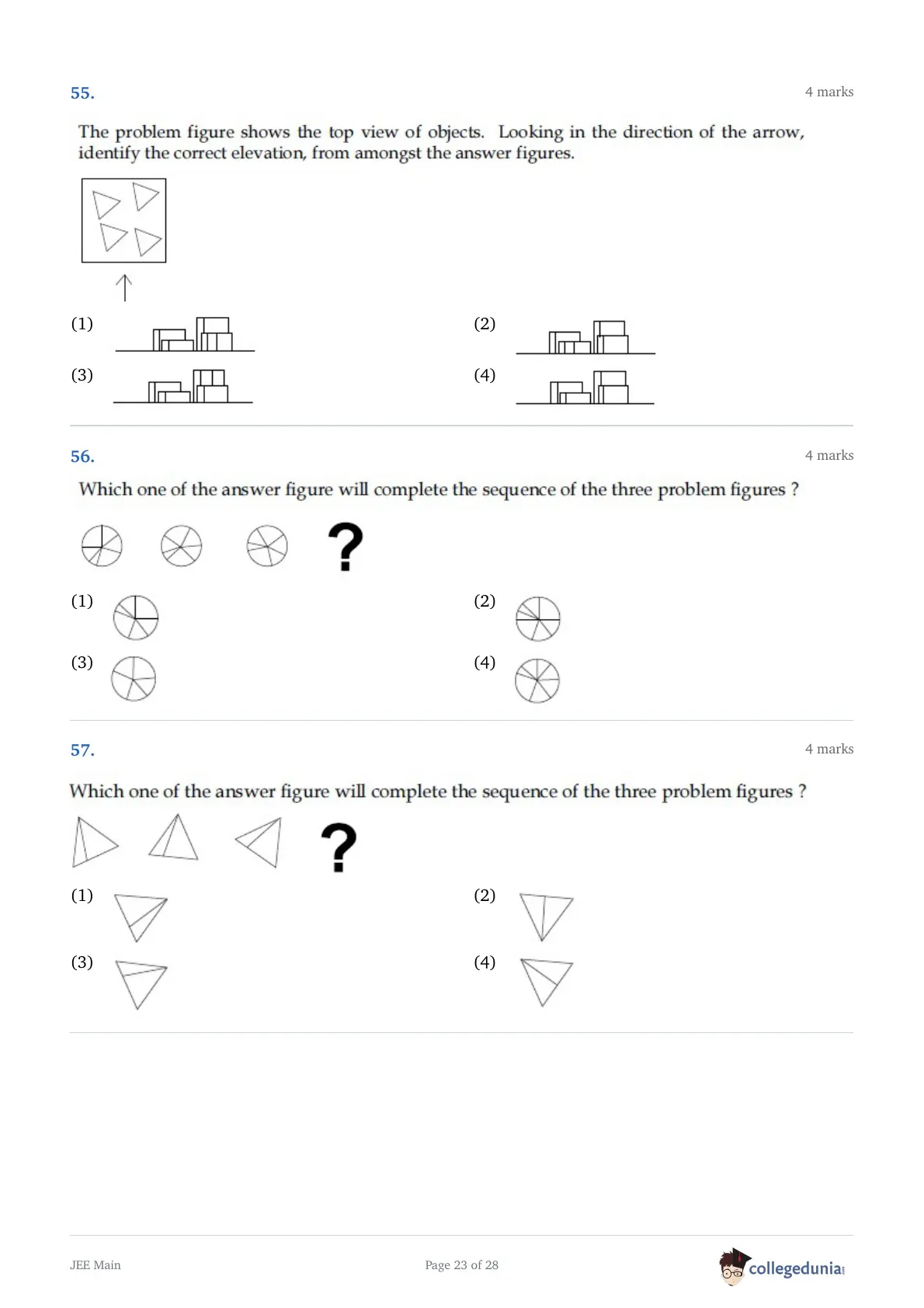
The problem figure shows the top view of objects. Looking in the direction of the arrow, identify the correct elevation, from amongst the answer figures.
- (1)
![]()
- (2)
![]()
- (3)
![]()
- (4)
![]()


The problem figure shows the top view of objects. Looking in the direction of the arrow, identify the correct elevation, from amongst the answer figures.
- (1)
![]()
- (2)
![]()
- (3)
![]()
- (4)
![]()


Which one of the answer figure will complete the sequence of the three problem figures ?
- (1)
![]()
- (2)
![]()
- (3)
![]()
- (4)
![]()


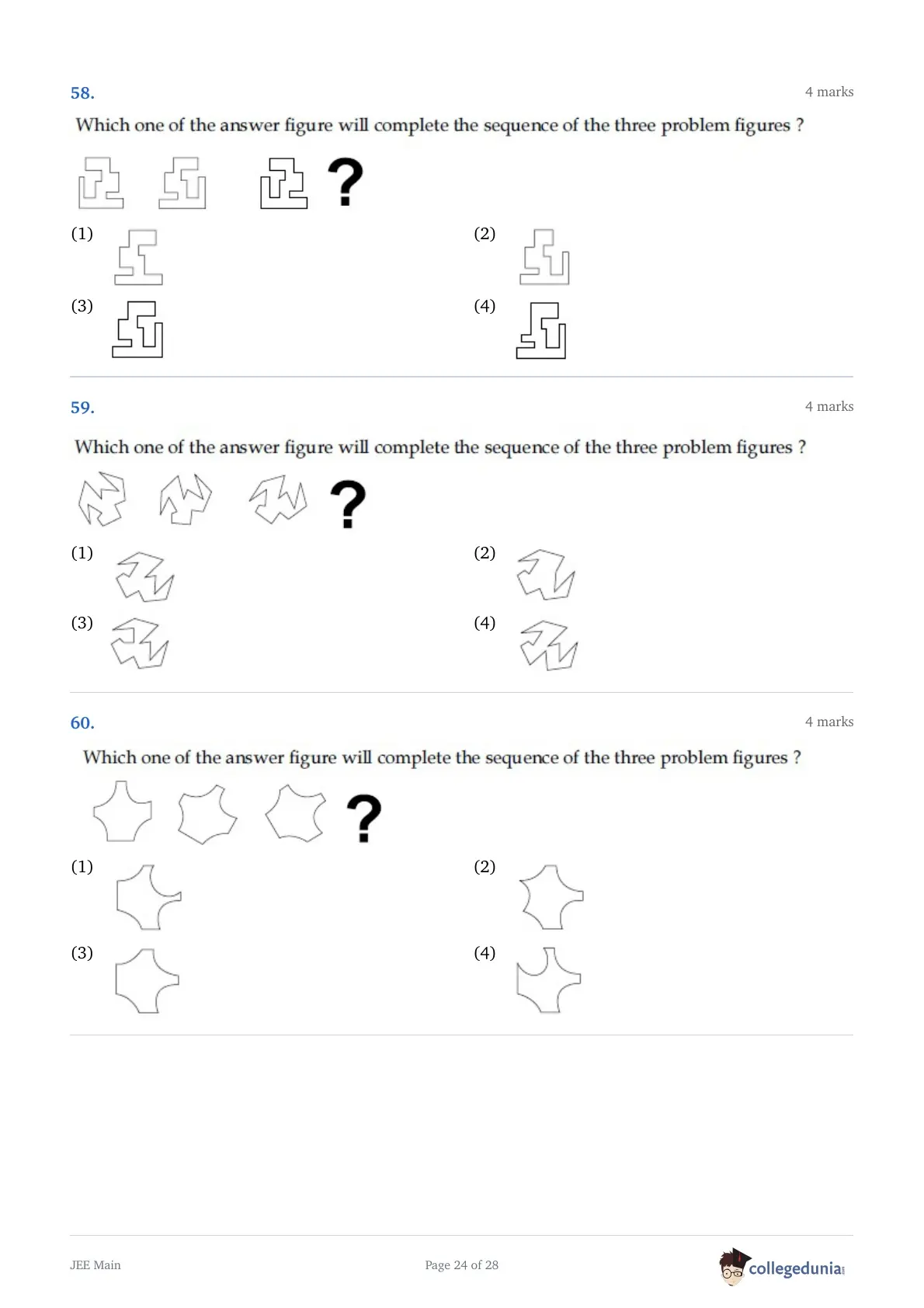
Which one of the answer figure will complete the sequence of the three problem figures ?
- (1)
![]()
- (2)
![]()
- (3)
![]()
- (4)
![]()


Which one of the answer figure will complete the sequence of the three problem figures ?
- (1)
![]()
- (2)
![]()
- (3)
![]()
- (4)
![]()


Which one of the answer figure will complete the sequence of the three problem figures ?
- (1)
![]()
- (2)
![]()
- (3)
![]()
- (4)
![]()


Which one of the answer figure will complete the sequence of the three problem figures ?
- (1)
![]()
- (2)
![]()
- (3)
![]()
- (4)
![]()


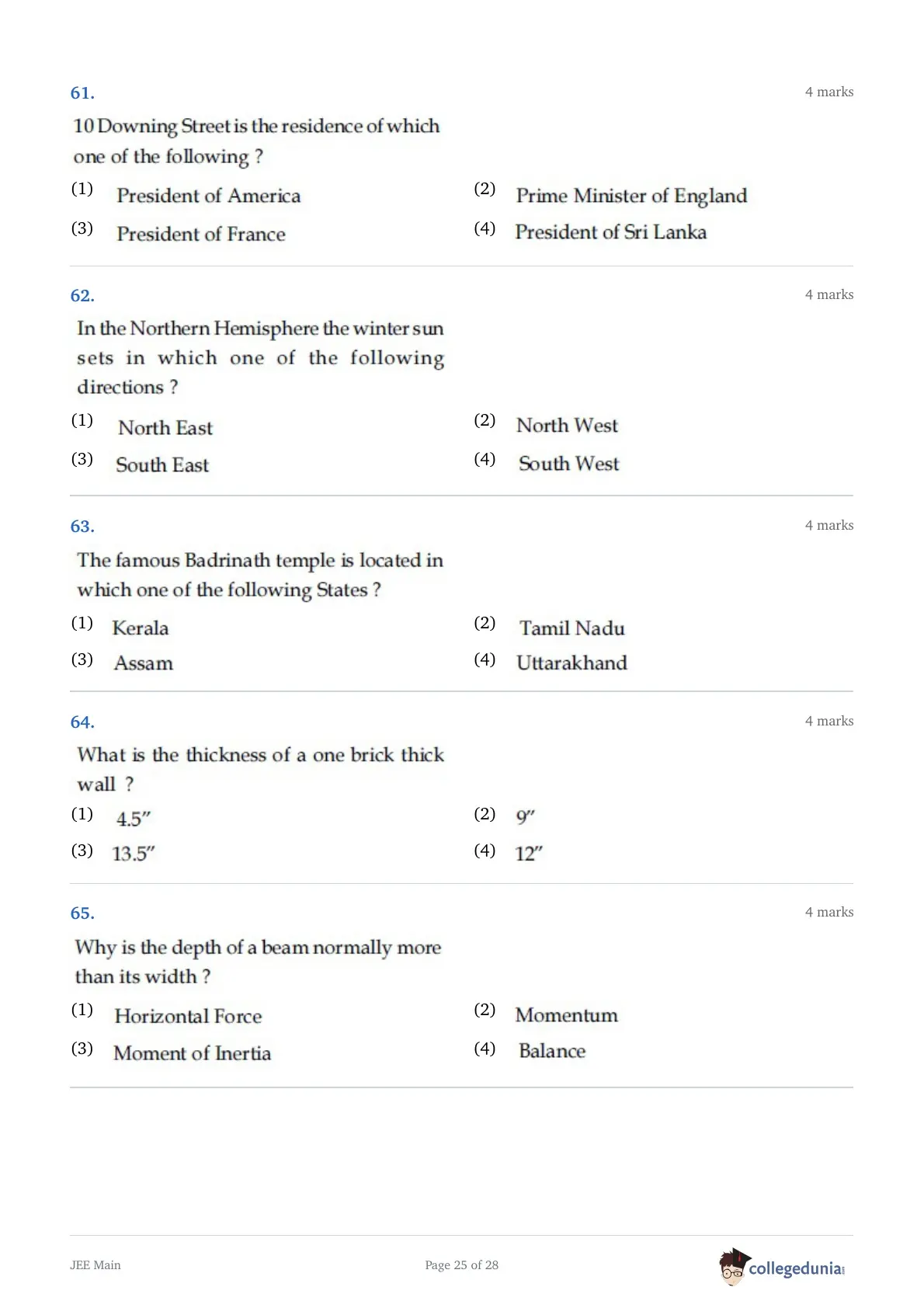
10 Downing Street is the residence of which one of the following ?
In the Northern Hemisphere the winter sun sets in which one of the following directions ?
The famous Badrinath temple is located in which one of the following States ?
What is the thickness of a one brick thick wall ?
Why is the depth of a beam normally more than its width ?
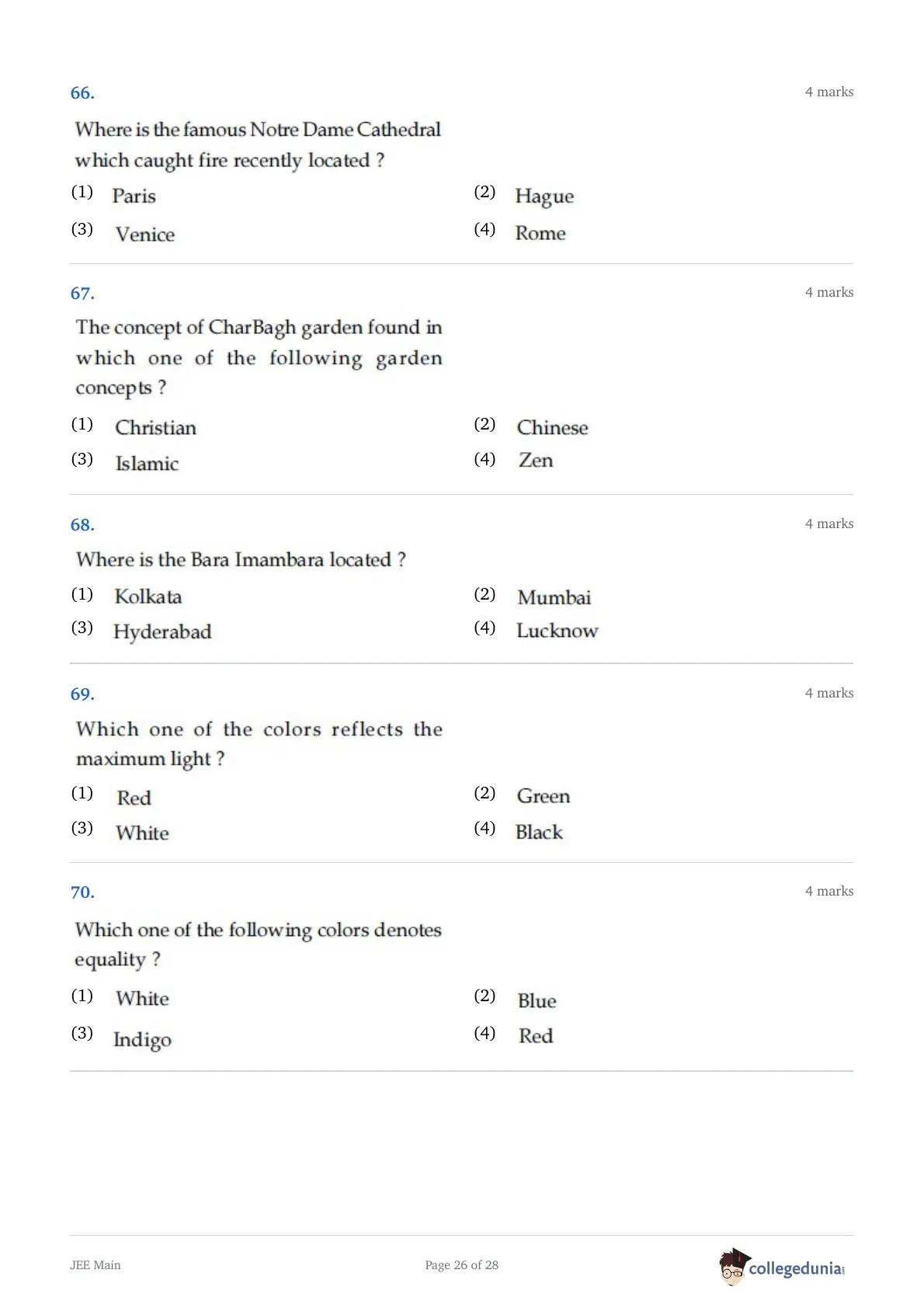
Where is the famous Notre Dame Cathedral which caught fire recently located ?
The concept of CharBagh garden found in which one of the following garden concepts ?
Where is the Bara Imambara located ?
Which one of the colors reflects the maximum light ?
Which one of the following colors denotes equality ?
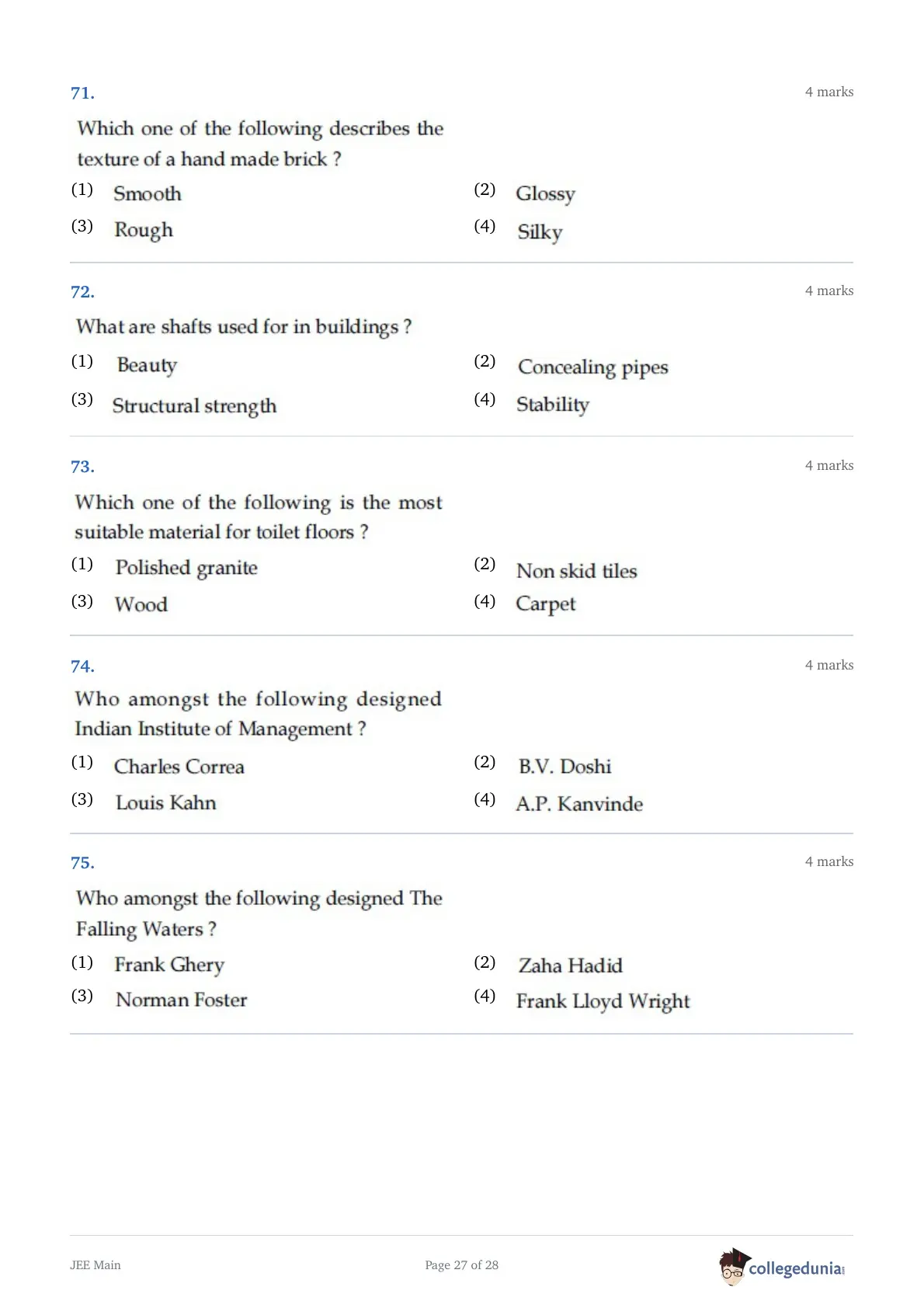
Which one of the following describes the texture of a hand made brick ?
What are shafts used for in buildings ?
Which one of the following is the most suitable material for toilet floors ?
Who amongst the following designed Indian Institute of Management ?
Who amongst the following designed The Falling Waters ?
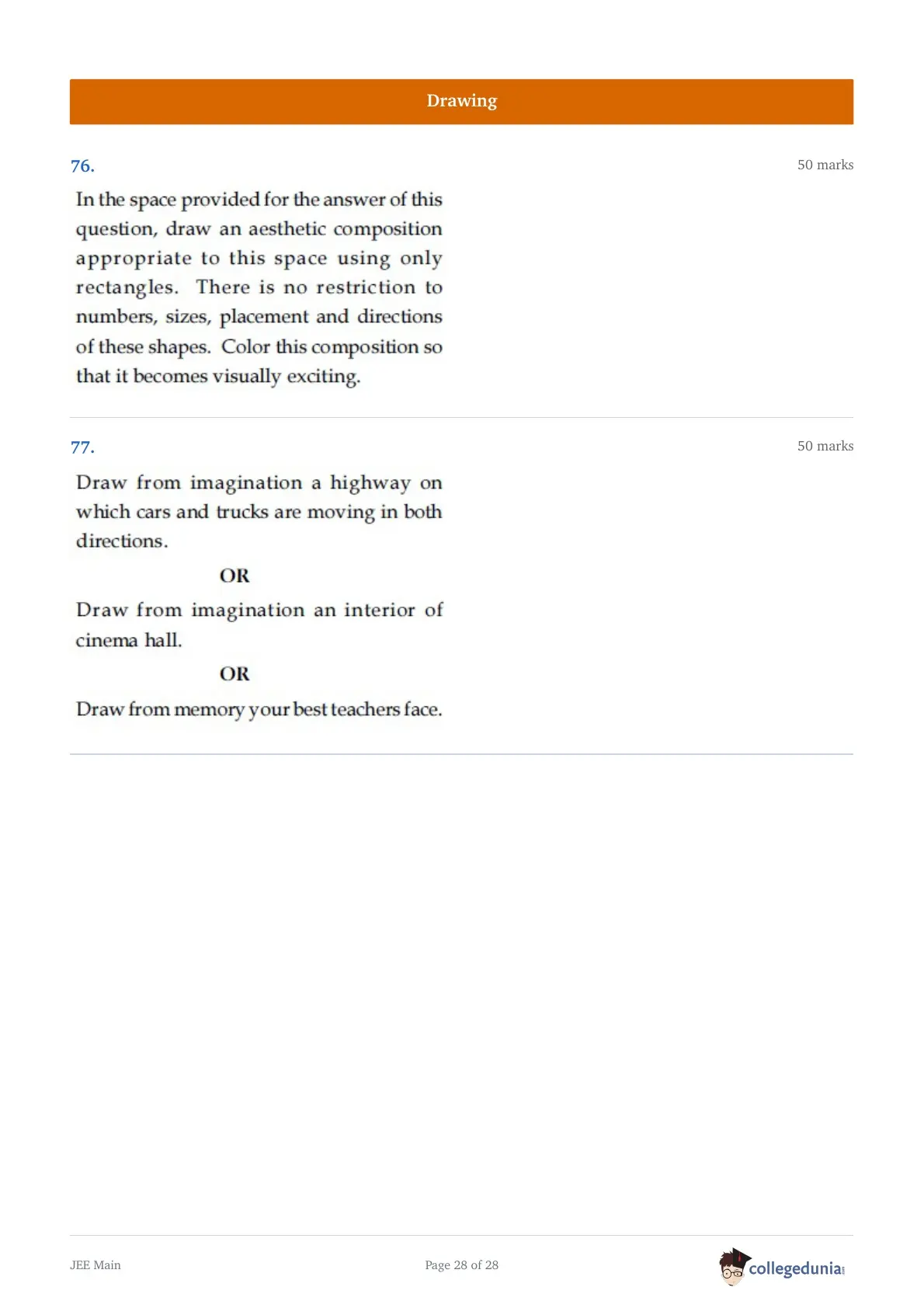
Drawing Test (Q76 - Q77)
In the space provided for the answer of this question, draw an aesthetic composition appropriate to this space using only rectangles. There is no restriction to numbers, sizes, placement and directions of these shapes. Color this composition so that it becomes visually exciting.
Draw from imagination a highway on which cars and trucks are moving in both directions.
OR
Draw from imagination an interior of cinema hall.
OR
Draw from memory your best teacher's face.
JEE Main 2020 B.Arch (Paper 2A) Exam Pattern and Marking Scheme
| Particulars | Details |
|---|---|
| Exam Mode | Online (Computer-Based Test) for Mathematics and Aptitude; Drawing Test on paper |
| Paper | B.Arch (Paper 2A) |
| Duration | 3 hours (180 minutes) |
| Type of Questions | Multiple Choice Questions (MCQs), numerical value questions and drawing questions |
| Subjects | Mathematics, Aptitude Test, Drawing Test |
| Total Questions | 77 questions |
| Total Marks | 400 marks |
| Marking Scheme | +4 for correct answer & -1 for incorrect MCQ answer (no negative marking for numerical value questions); 0 for unattempted |
JEE Main 2020 B.Arch September 1 (Paper 2A) Difficulty Level
In terms of difficulty level, JEE Main B.Arch paper was of moderate level.



Comments