




JEE Main 2020 September 3 Shift 1 Question Paper is available here with solutions PDF and detailed solutions for every question. NTA conducted the first shift on September 3, 2020, from 9:00 AM to 12:00 PM. The JEE Main 2020 Paper 1 (B.E./B.Tech) question paper includes the following:
- 75 questions in a 3-hour CBT Mode: 25 each from Mathematics, Physics and Chemistry
- Section A: 20 multiple choice questions (MCQs) per subject, 4 marks each
- Section B: 5 numerical value questions per subject, all compulsory, 4 marks each
- Marking: +4 for a correct answer, -1 for an incorrect MCQ, 0 for an unattempted question; no negative marking for numerical value questions
- Maximum marks: 300 (100 per subject)
JEE Main 2020 September 3 Shift 1 Question Paper with Solution PDF
| NTA Official PDF | CD PDF | CD PDF with Solutions |
|---|---|---|
| Download official PDF 4.40 MB | Download Collegedunia PDF 0.89 MB | Download solutions PDF 1.27 MB |
Also Check:
JEE Main 2020 September 3 Shift 1 Questions with Solutions
Mathematics - Section A (Q1 - Q20)
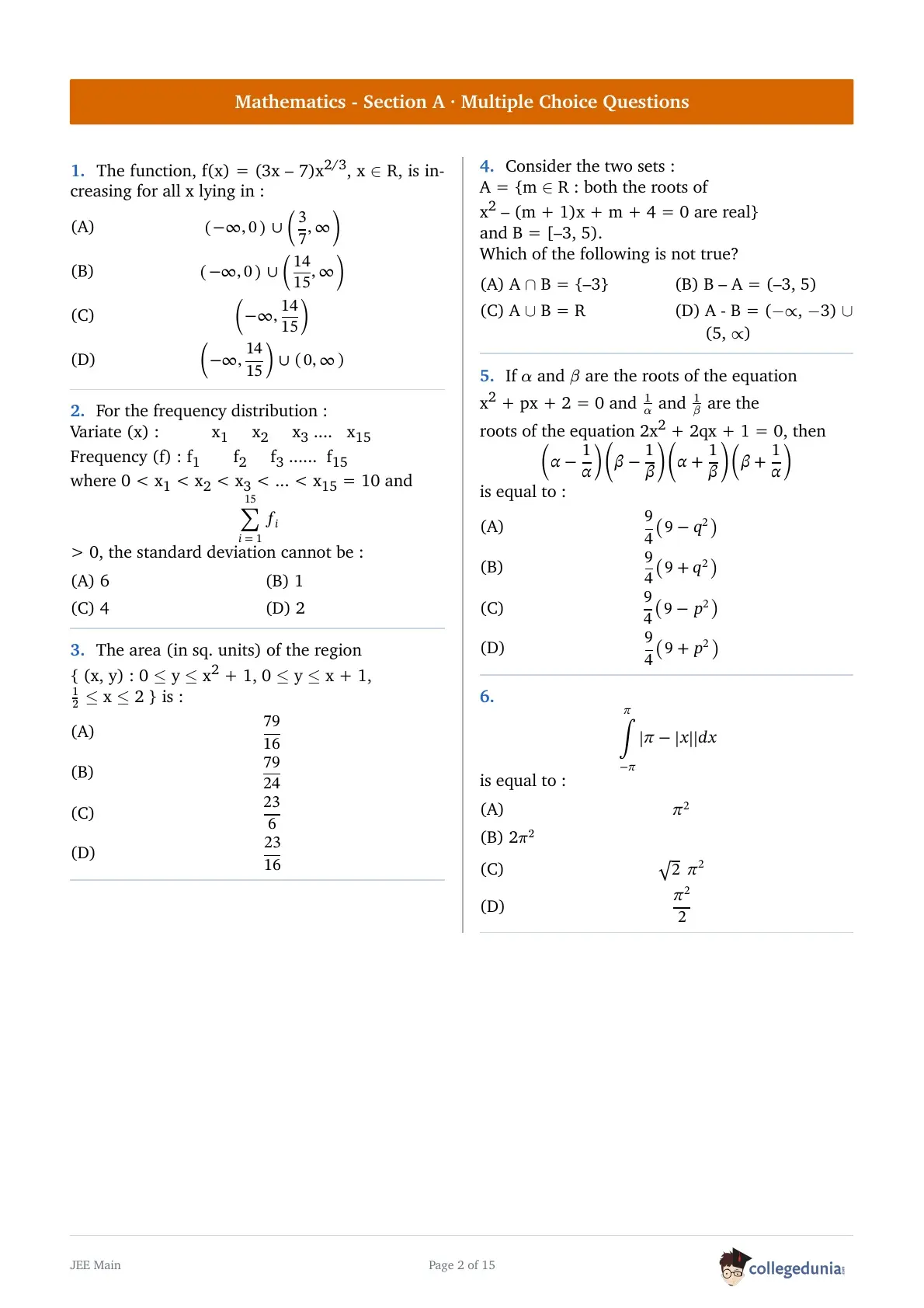
The function, \(f(x) = (3x - 7)x^{2/3}\), \(x \in \mathbb{R}\), is increasing for all \(x\) lying in :
For the frequency distribution :
Variate (x) : \(x_1\) \(x_2\) \(x_3\) .... \(x_{15}\)
Frequency (f) : \(f_1\) \(f_2\) \(f_3\) ...... \(f_{15}\)
where \(0 \lt x_1 \lt x_2 \lt x_3 \lt ... \lt x_{15} = 10\) and \(\sum_{i=1}^{15} f_i \gt 0\), the standard deviation cannot be :
The area (in sq. units) of the region \(\{(x, y) : 0 \le y \le x^2 + 1,\ 0 \le y \le x + 1,\ \frac{1}{2} \le x \le 2\}\) is :
Consider the two sets :
\(A = \{m \in \mathbb{R} : \text{both the roots of } x^2 - (m + 1)x + m + 4 = 0 \text{ are real}\}\)
and \(B = [-3, 5)\).
Which of the following is not true?
If \(\alpha\) and \(\beta\) are the roots of the equation \(x^2 + px + 2 = 0\) and \(\frac{1}{\alpha}\) and \(\frac{1}{\beta}\) are the roots of the equation \(2x^2 + 2qx + 1 = 0\), then \(\left(\alpha - \frac{1}{\alpha}\right)\left(\beta - \frac{1}{\beta}\right)\left(\alpha + \frac{1}{\beta}\right)\left(\beta + \frac{1}{\alpha}\right)\) is equal to :
\(\int_{-\pi}^{\pi} \left| \pi - |x| \right| dx\) is equal to :
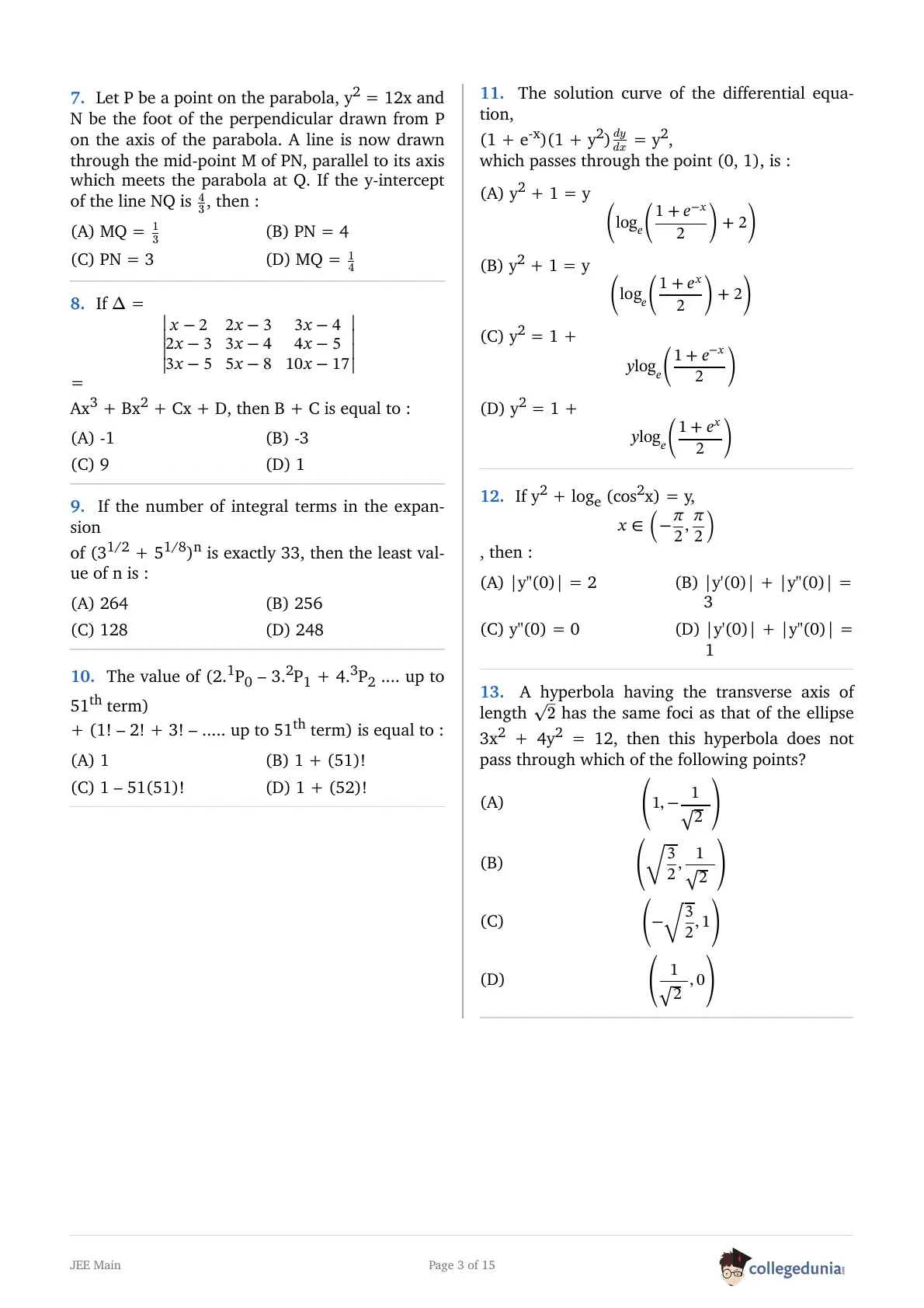
Let P be a point on the parabola, \(y^2 = 12x\) and N be the foot of the perpendicular drawn from P on the axis of the parabola. A line is now drawn through the mid-point M of PN, parallel to its axis which meets the parabola at Q. If the y-intercept of the line NQ is \(\frac{4}{3}\), then :
If \(\Delta = \begin{vmatrix} x - 2 & 2x - 3 & 3x - 4 \\ 2x - 3 & 3x - 4 & 4x - 5 \\ 3x - 5 & 5x - 8 & 10x - 17 \end{vmatrix} = Ax^3 + Bx^2 + Cx + D\), then \(B + C\) is equal to :
If the number of integral terms in the expansion of \((3^{1/2} + 5^{1/8})^n\) is exactly 33, then the least value of \(n\) is :
The value of (\(2\cdot{}^{1}P_0 - 3\cdot{}^{2}P_1 + 4\cdot{}^{3}P_2 \ldots\) up to 51th term) + (\(1! - 2! + 3! - \ldots\) up to 51th term) is equal to :
The solution curve of the differential equation, \((1 + e^{-x})(1 + y^2)\frac{dy}{dx} = y^2\), which passes through the point \((0, 1)\), is :
If \(y^2 + \log_e(\cos^2 x) = y\), \(x \in \left(-\frac{\pi}{2}, \frac{\pi}{2}\right)\), then :
A hyperbola having the transverse axis of length \(\sqrt{2}\) has the same foci as that of the ellipse \(3x^2 + 4y^2 = 12\), then this hyperbola does not pass through which of the following points?
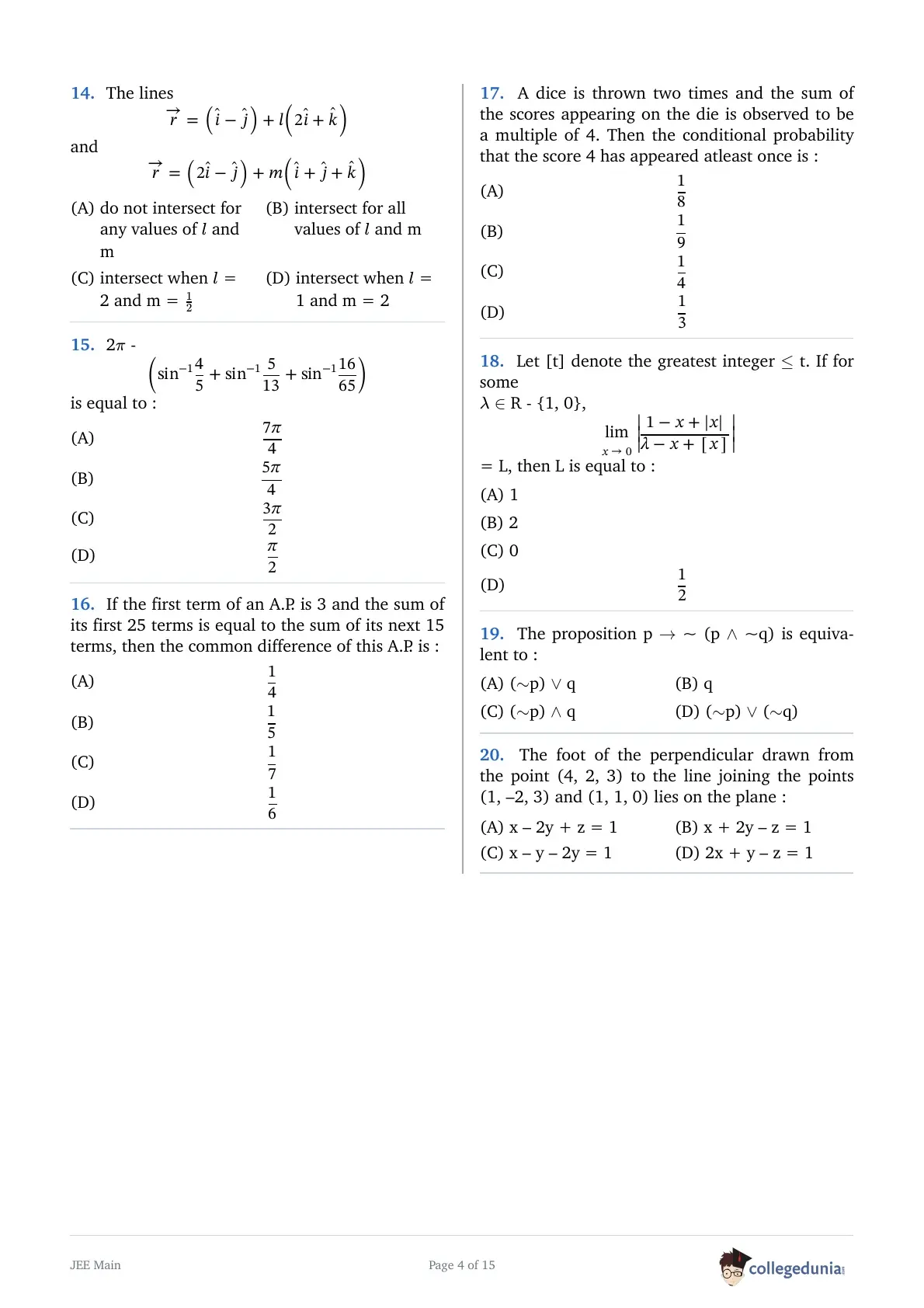
The lines
\(\vec{r} = (\hat{i} - \hat{j}) + l(2\hat{i} + \hat{k})\)
and
\(\vec{r} = (2\hat{i} - \hat{j}) + m(\hat{i} + \hat{j} + \hat{k})\)
\(2\pi - \left(\sin^{-1}\frac{4}{5} + \sin^{-1}\frac{5}{13} + \sin^{-1}\frac{16}{65}\right)\) is equal to :
If the first term of an A.P. is 3 and the sum of its first 25 terms is equal to the sum of its next 15 terms, then the common difference of this A.P. is :
A dice is thrown two times and the sum of the scores appearing on the die is observed to be a multiple of 4. Then the conditional probability that the score 4 has appeared atleast once is :
Let [t] denote the greatest integer \(\le\) t. If for some \(\lambda \in \mathbb{R} - \{1, 0\}\),
\(\lim_{x \to 0}\left|\frac{1 - x + |x|}{\lambda - x + [x]}\right| = L\), then L is equal to :
The proposition \(p \to \sim(p \wedge \sim q)\) is equivalent to :
The foot of the perpendicular drawn from the point (4, 2, 3) to the line joining the points (1, \(-\)2, 3) and (1, 1, 0) lies on the plane :
Mathematics - Section B (Q21 - Q25)
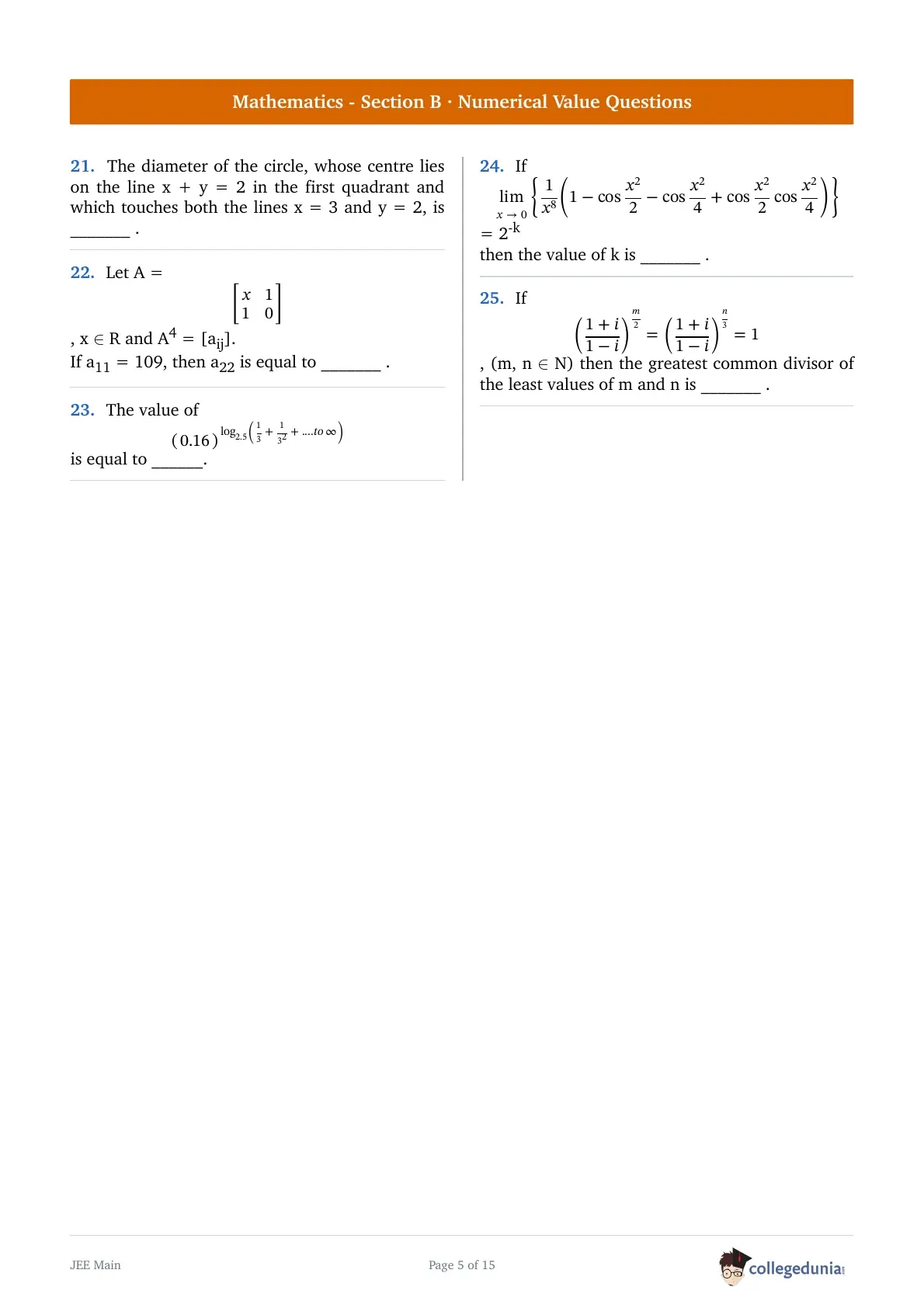
The diameter of the circle, whose centre lies on the line \(x + y = 2\) in the first quadrant and which touches both the lines \(x = 3\) and \(y = 2\), is _______ .
Let \(A = \begin{bmatrix} x & 1 \\ 1 & 0 \end{bmatrix}\), \(x \in \mathbb{R}\) and \(A^4 = [a_{ij}]\). If \(a_{11} = 109\), then \(a_{22}\) is equal to _______ .
The value of \((0.16)^{\log_{2.5}\left(\frac{1}{3} + \frac{1}{3^2} + \ldots \text{to } \infty\right)}\) is equal to _______ .
If \(\lim_{x \to 0}\left\{\frac{1}{x^8}\left(1 - \cos\frac{x^2}{2} - \cos\frac{x^2}{4} + \cos\frac{x^2}{2}\cos\frac{x^2}{4}\right)\right\} = 2^{-k}\), then the value of k is _______ .
If \(\left(\frac{1+i}{1-i}\right)^{\frac{m}{2}} = \left(\frac{1+i}{1-i}\right)^{\frac{n}{3}} = 1\), \((m, n \in N)\) then the greatest common divisor of the least values of \(m\) and \(n\) is _______ .
Physics - Section A (Q26 - Q45)
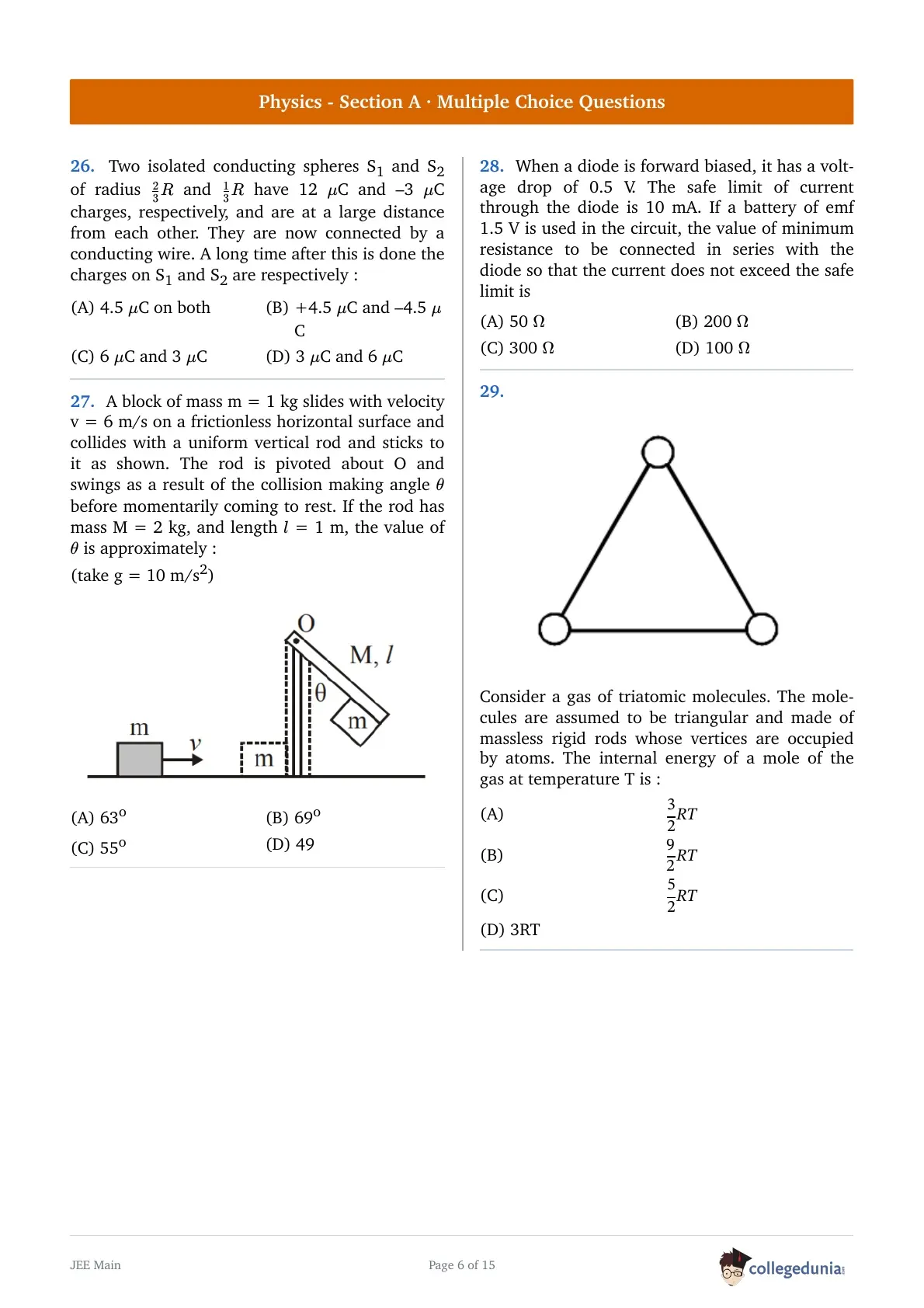
Two charged conducting spheres of radii a and b are connected to each other by a conducting wire. The ratio of charges of the two spheres respectively is:
A block of mass \(m = 1\) kg slides with velocity \(v = 6\) m/s on a frictionless horizontal surface and collides with a uniform vertical rod and sticks to it as shown. The rod is pivoted about O and swings as a result of the collision making angle \(\theta\) before momentarily coming to rest. If the rod has mass \(M = 2\) kg, and length \(l = 1\) m, the value of \(\theta\) is approximately :
(take \(g = 10\) m/s\(^2\))
When a diode is forward biased, it has a voltage drop of 0.5 V. The safe limit of current through the diode is 10 mA. If a battery of emf 1.5 V is used in the circuit, the value of minimum resistance to be connected in series with the diode so that the current does not exceed the safe limit is

Consider a gas of triatomic molecules. The molecules are assumed to be triangular and made of massless rigid rods whose vertices are occupied by atoms. The internal energy of a mole of the gas at temperature T is :
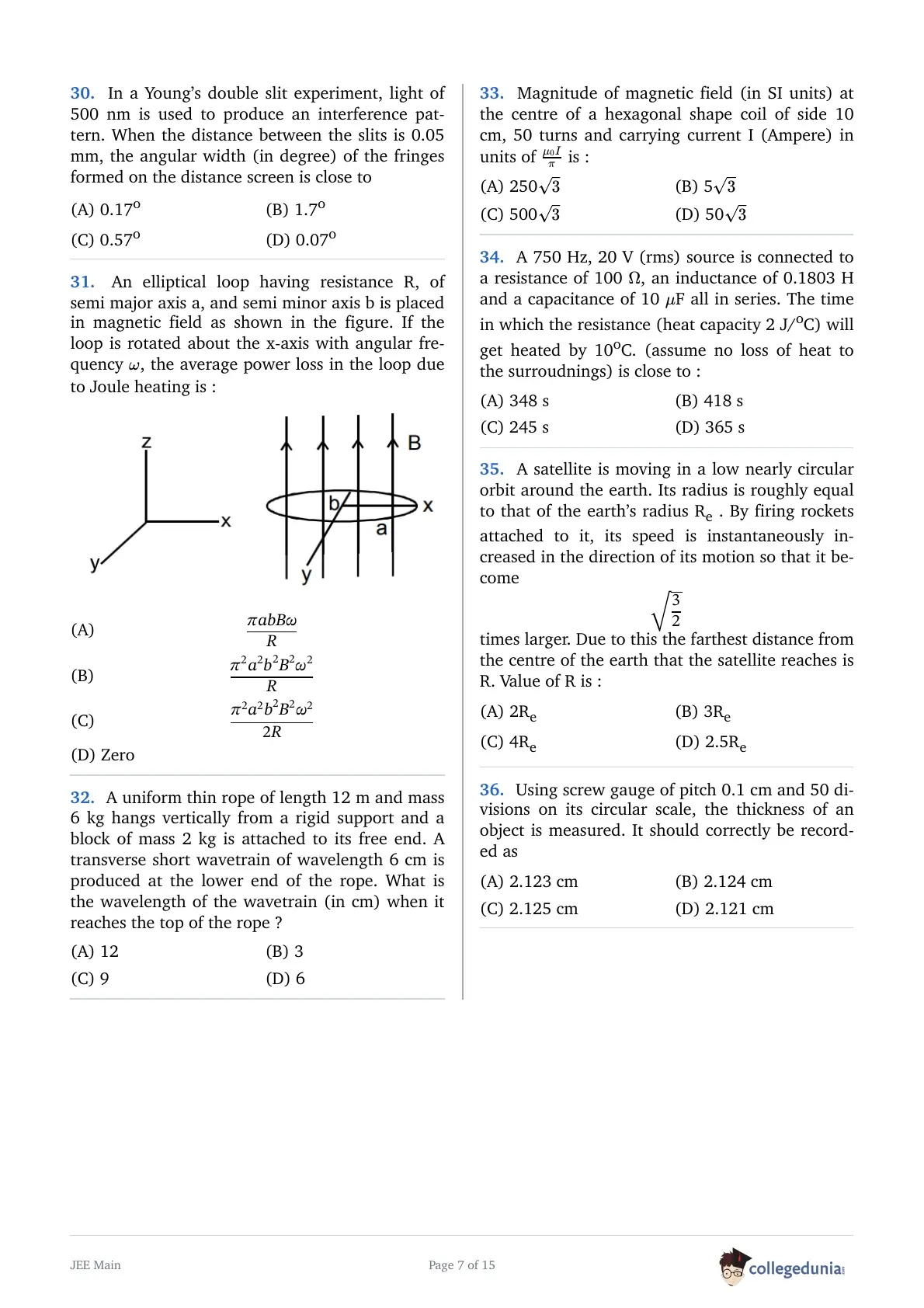
In a Young's double slit experiment, light of 500 nm is used to produce an interference pattern. When the distance between the slits is 0.05 mm, the angular width (in degree) of the fringes formed on the distance screen is close to
An elliptical loop having resistance R, of semi major axis a, and semi minor axis b is placed in magnetic field as shown in the figure. If the loop is rotated about the x-axis with angular frequency \(\omega\), the average power loss in the loop due to Joule heating is :
A uniform thin rope of length 12 m and mass 6 kg hangs vertically from a rigid support and a block of mass 2 kg is attached to its free end. A transverse short wavetrain of wavelength 6 cm is produced at the lower end of the rope. What is the wavelength of the wavetrain (in cm) when it reaches the top of the rope ?
Magnitude of magnetic field (in SI units) at the centre of a hexagonal shape coil of side 10 cm, 50 turns and carrying current I (Ampere) in units of \(\frac{\mu_0 I}{\pi}\) is :
An AC source is connected to an inductance of 100 mH, a capacitance of 100 μF and a resistance of 120 Ω as shown in the figure. The time in which the resistance having a thermal capacity 2 J/°C will get heated by 16°C is ___ s.

A satellite of mass \( \frac{M}{2} \) is revolving around Earth in a circular orbit at a height of \( \frac{R}{3} \) from the Earth's surface. The angular momentum of the satellite is \( M \sqrt{\frac{GM R}{x}} \). The value of \( x \) is:
A screw gauge of pitch 0.5 mm is used to measure the diameter of uniform wire of length 6.8 cm, the main scale reading is 1.5 mm and circular scale reading is 7. The calculated curved surface area of wire to appropriate significant figures is :
[Screw gauge has 50 divisions on its circular scale.]
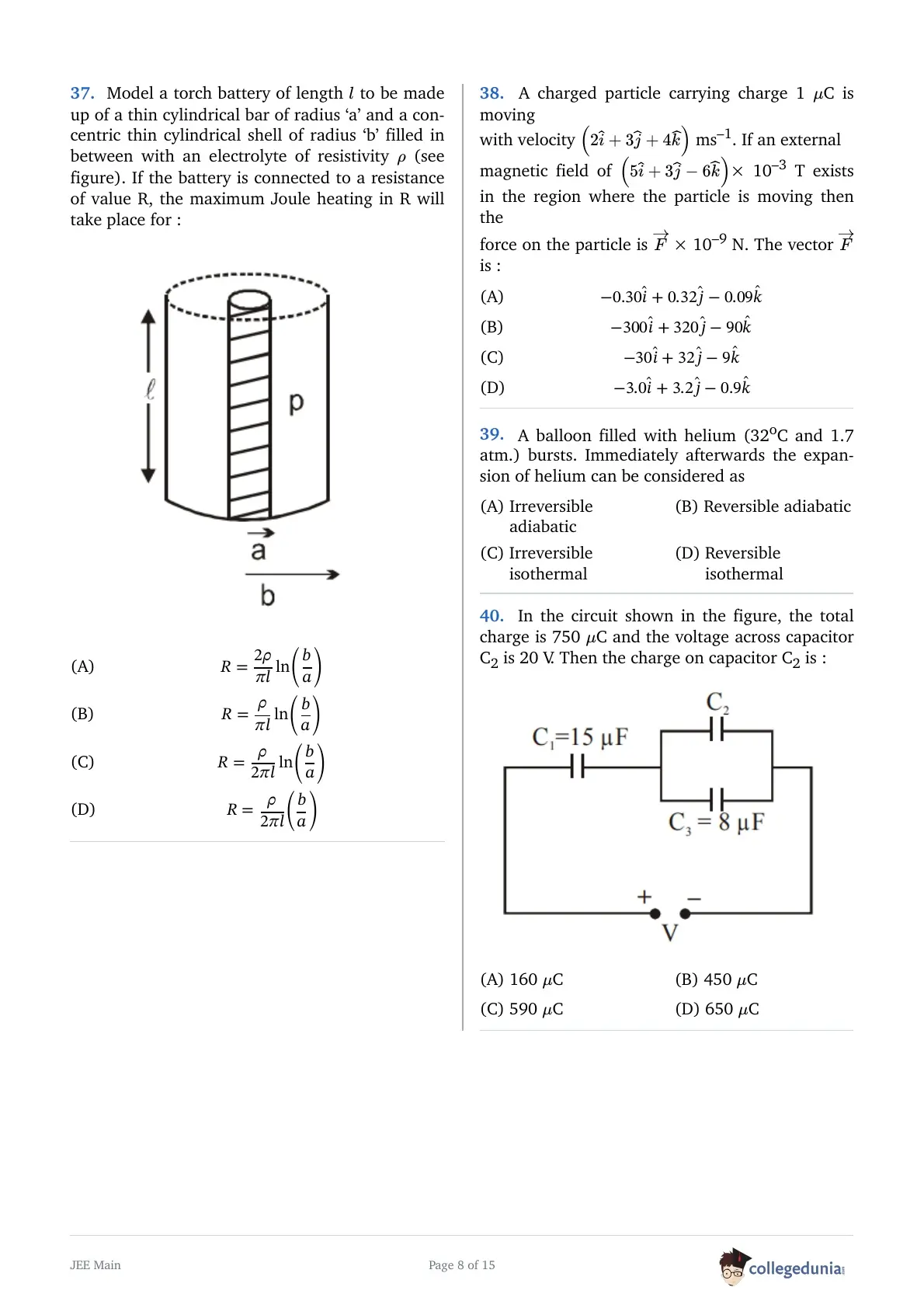
Model a torch battery of length \(l\) to be made up of a thin cylindrical bar of radius \('a'\) and a concentric thin cylindrical shell of radius \('b'\) filled in between with an electrolyte of resistivity \(\rho\) (see figure). If the battery is connected to a resistance of value \(R ,\) the maximum Joule heating in \(R\) will take place for :
A charged particle carrying charge \(1\ \mu\)C is moving with velocity \((2\hat i + 3\hat j + 4\hat k)\) ms\(^{-1}\). If an external magnetic field of \((5\hat i + 3\hat j - 6\hat k) \times 10^{-3}\) T exists in the region where the particle is moving then the force on the particle is \(\vec F \times 10^{-9}\) N. The vector \(\vec F\) is :
A balloon filled with helium (\(32^\circ\)C and 1.7 atm.) bursts. Immediately afterwards the expansion of helium can be considered as
In the circuit shown in the figure, the total charge is \(750\ \mu\)C and the voltage across capacitor \(C_2\) is 20 V. Then the charge on capacitor \(C_2\) is :
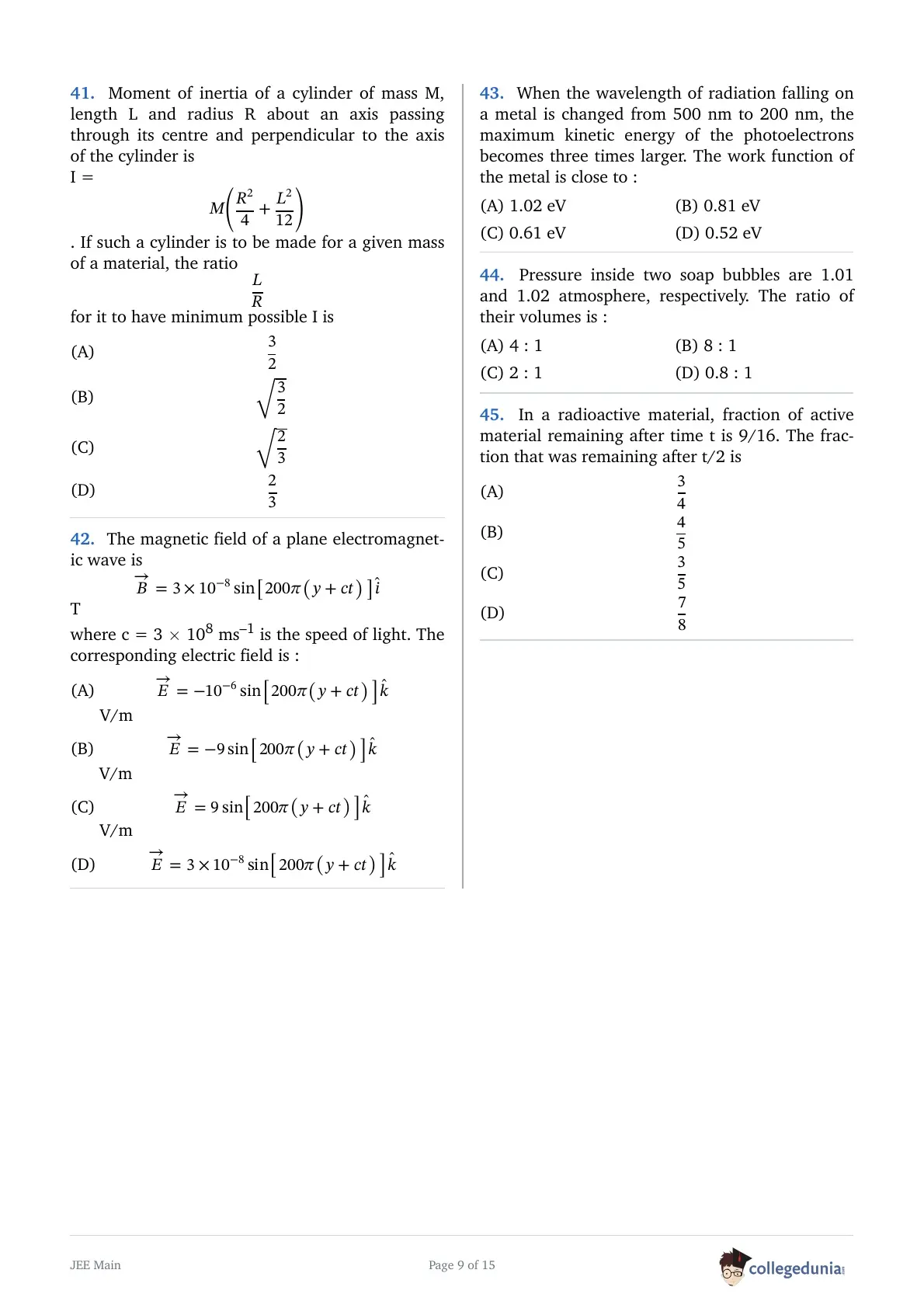
Moment of inertia of a cylinder of mass M, length L and radius R about an axis passing through its centre and perpendicular to the axis of the cylinder is \(I = M\left(\frac{R^2}{4} + \frac{L^2}{12}\right)\). If such a cylinder is to be made for a given mass of a material, the ratio \(\frac{L}{R}\) for it to have minimum possible I is
The magnetic field of a plane electromagnetic wave is
\(\vec{B} = 3\times 10^{-8}\sin\left[200\pi (y+ct)\right]\hat{i}\) T
where \(c = 3\times 10^{8}\ \mathrm{ms^{-1}}\) is the speed of light. The corresponding electric field is :
When the wavelength of radiation falling on a metal is changed from 500 nm to 200 nm, the maximum kinetic energy of the photoelectrons becomes three times larger. The work function of the metal is close to :
Pressure inside two soap bubbles are 1.01 and 1.02 atmosphere, respectively. The ratio of their volumes is :
In a radioactive material, fraction of active material remaining after time \(t\) is \(9 / 16 .\) The fraction that was remaining after \(t / 2\) is :
Physics - Section B (Q46 - Q50)
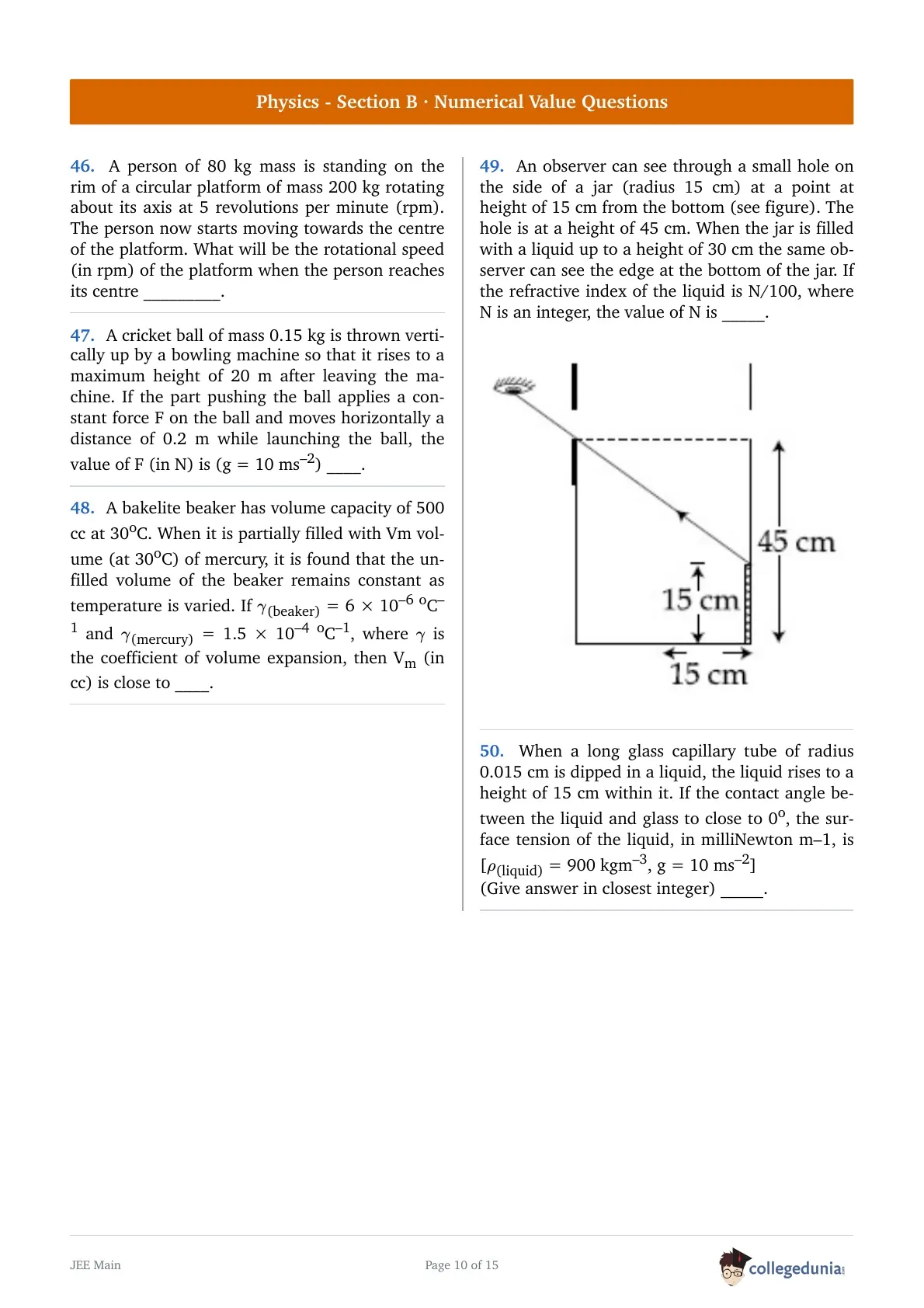
A person of 80 kg mass is standing on the rim of a circular platform of mass 200 kg rotating about its axis at 5 revolutions per minute (rpm). The person now starts moving towards the centre of the platform. What will be the rotational speed (in rpm) of the platform when the person reaches its centre ________.
A ball is thrown vertically upwards with a velocity of \(19.6 ms^{–1}\) from the top of a tower. The ball strikes the ground after \(6 s\). The height from the ground up to which the ball can rise will be \((k/5) m\). The value of k is ______ (use \(g = 9.8 m/s^2\))
A bakelite beaker has volume capacity of 500 cc at \(30^\circ\)C. When it is partially filled with \(V_m\) volume (at \(30^\circ\)C) of mercury, it is found that the unfilled volume of the beaker remains constant as temperature is varied. If \(\gamma_{\mathrm{(beaker)}} = 6\times10^{-6}\ {}^\circ\mathrm{C^{-1}}\) and \(\gamma_{\mathrm{(mercury)}} = 1.5\times10^{-4}\ {}^\circ\mathrm{C^{-1}}\), where \(\gamma\) is the coefficient of volume expansion, then \(V_m\) (in cc) is close to ________.
An observer can see through a small hole on the side of a jar (radius 15 cm) at a point at height of 15 cm from the bottom (see figure). The hole is at a height of 45 cm. When the jar is filled with a liquid up to a height of 30 cm the same observer can see the edge at the bottom of the jar. If the refractive index of the liquid is N/100, where N is an integer, the value of N is ________.
When a long glass capillary tube of radius 0.015 cm is dipped in a liquid, the liquid rises to a height of 15 cm within it. If the contact angle between the liquid and glass to close to \(0^\circ\), the surface tension of the liquid, in milliNewton \(\mathrm{m^{-1}}\), is [\(\rho_{\mathrm{(liquid)}} = 900\ \mathrm{kg\,m^{-3}}\), \(g = 10\ \mathrm{m\,s^{-2}}\)]
(Give answer in closest integer) ________.
Chemistry - Section A (Q51 - Q70)
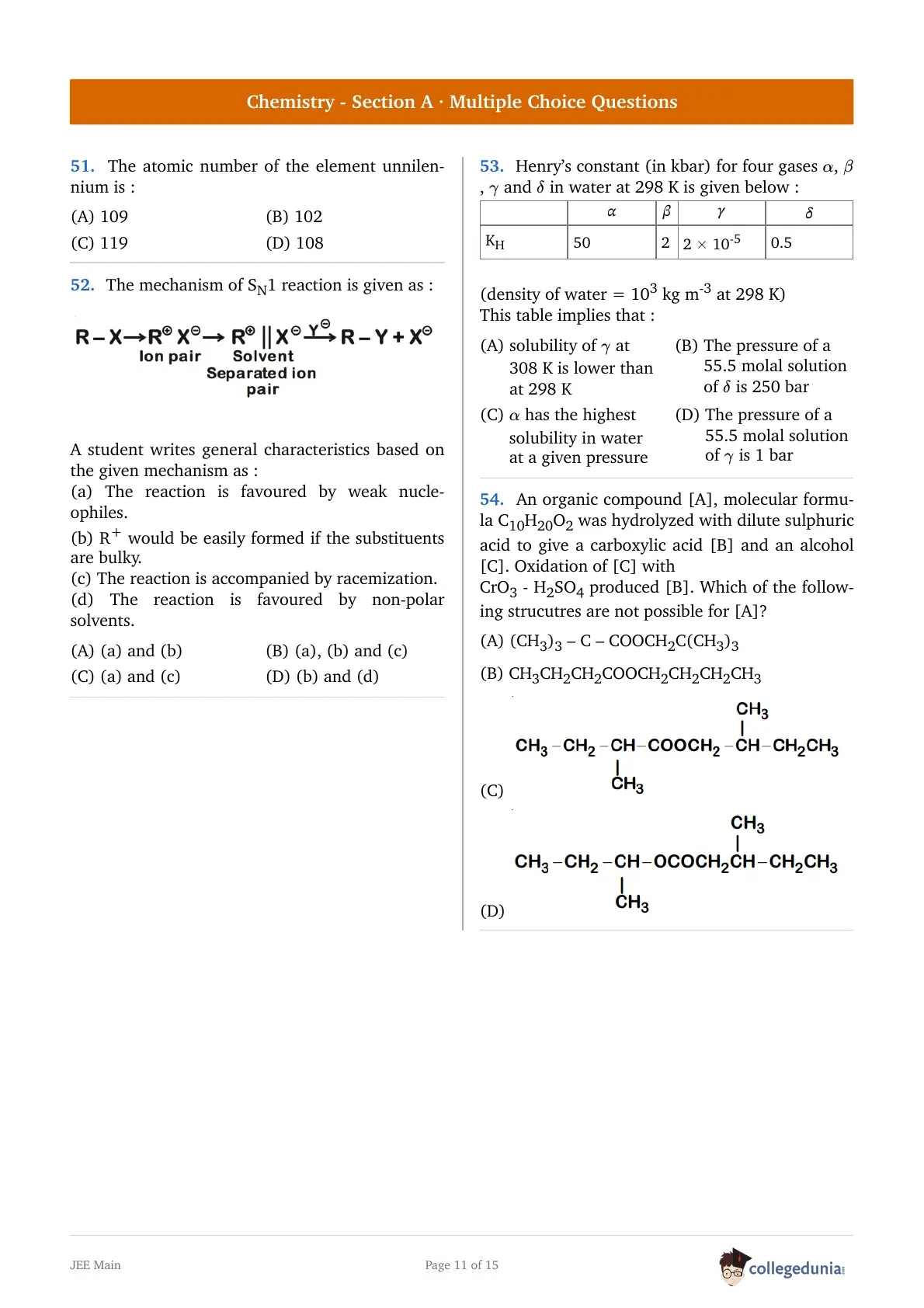
The atomic number of the element unnilennium is :
The mechanism of \(\mathrm{S_N1}\) reaction is given as :
A student writes general characteristics based on the given mechanism as :
(a) The reaction is favoured by weak nucleophiles.
(b) \(\mathrm{R^+}\) would be easily formed if the substituents are bulky.
(c) The reaction is accompanied by racemization.
(d) The reaction is favoured by non-polar solvents.
| \(\alpha\) | \(\beta\) | \(\gamma\) | \(\delta\) | |
| \(K_H\) | 50 | 2 | \(2\times10^{-5}\) | 0.5 |
This table implies that :
An organic compound [A], molecular formula \(\mathrm{C_{10}H_{20}O_2}\) was hydrolyzed with dilute sulphuric acid to give a carboxylic acid [B] and an alcohol [C]. Oxidation of [C] with \(\mathrm{CrO_3 - H_2SO_4}\) produced [B]. Which of the following strucutres are not possible for [A]?
- (1) \(\mathrm{(CH_3)_3-C-COOCH_2C(CH_3)_3}\)
- (2) \(\mathrm{CH_3CH_2CH_2COOCH_2CH_2CH_2CH_3}\)
- (3)
![]()
- (4)
![]()


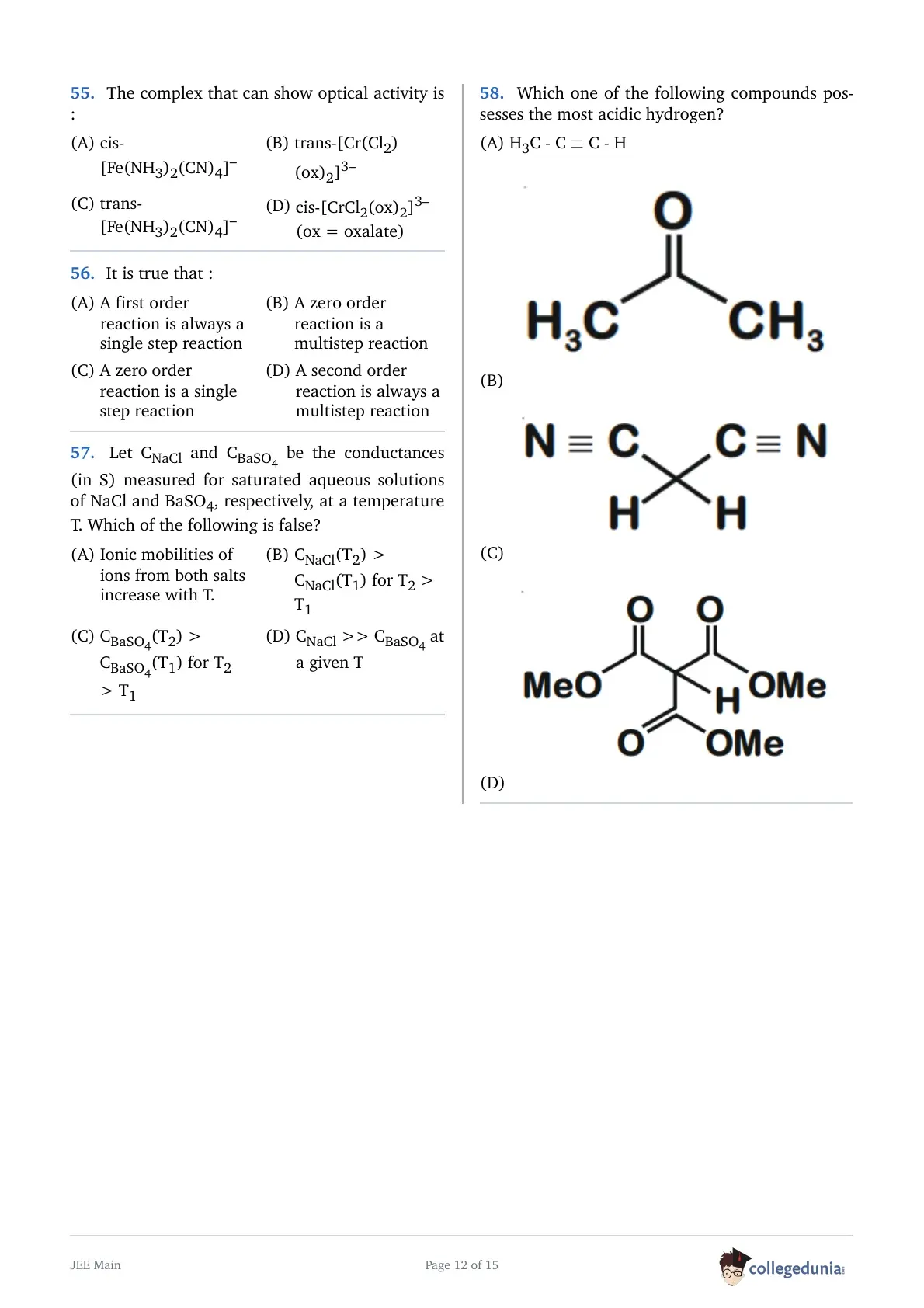
The complex that can show optical activity is :
It is true that :
Let CNaCl and CBaSO4 be the conductances (in S) measured for saturated aqueous solutions of NaCl and BaSO4, respectively, at a temperature T. Which of the following is false?
Which one of the following compounds possesses the most acidic hydrogen?
- (1) \(\mathrm{H_3C-C\equiv C-H}\)
- (2)
![]()
- (3)
![]()
- (4)
![]()


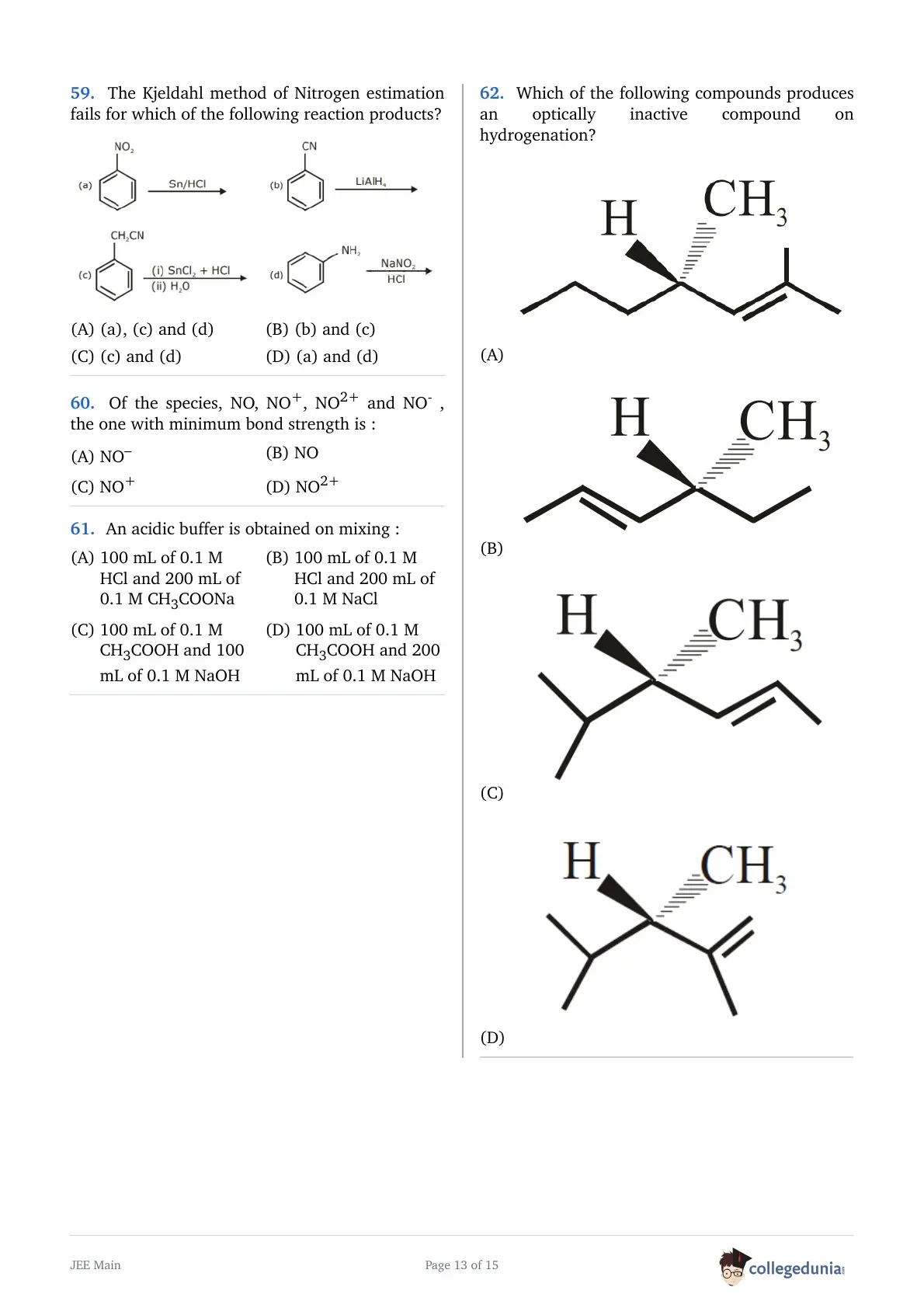
The Kjeldahl method of Nitrogen estimation fails for which of the following reaction products?
(a) nitrobenzene with Sn/HCl
(b) benzonitrile (C6H5CN) with LiAlH4
(c) benzyl cyanide (C6H5CH2CN) with (i) SnCl2 + HCl, (ii) H2O
(d) aniline with NaNO2/HCl
Of the species, NO, NO+, NO2+ and NO- , the one with minimum bond strength is :
An acidic buffer is obtained on mixing :
Which of the following compounds produces an optically inactive compound on hydrogenation?
- (1)
![]()
- (2)
![]()
- (3)
![]()
- (4)
![]()


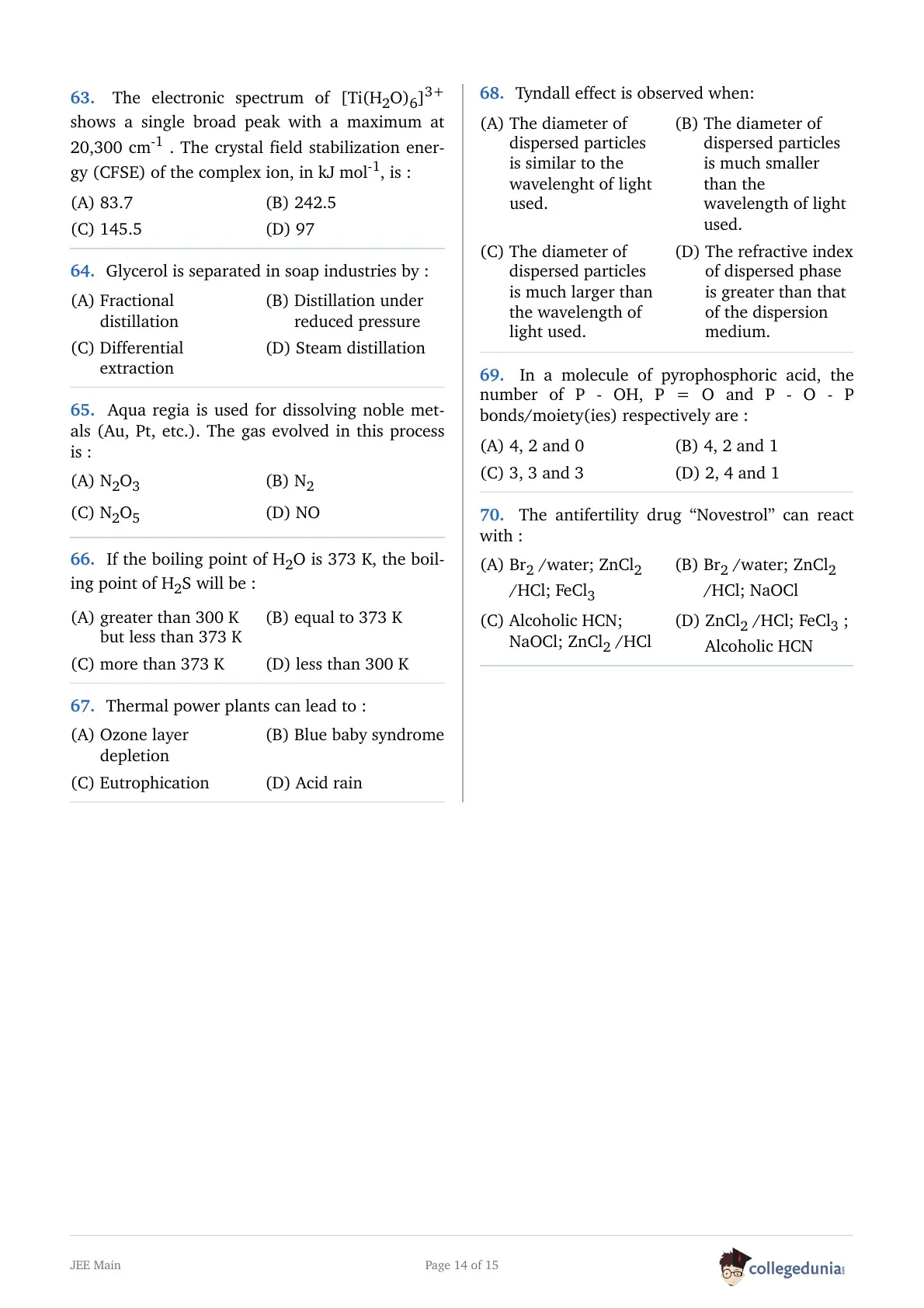
The electronic spectrum of \([\mathrm{Ti(H_2O)_6}]^{3+}\) shows a single broad peak with a maximum at 20,300 cm-1 . The crystal field stabilization energy (CFSE) of the complex ion, in kJ mol-1, is :
Glycerol is separated in soap industries by :
Aqua regia is used for dissolving noble metals (Au, Pt, etc.). The gas evolved in this process is :
If the boiling point of H2O is 373 K, the boiling point of H2S will be :
Thermal power plants can lead to :
Tyndall effect is observed when:
In a molecule of pyrophosphoric acid, the number of P - OH, P = O and P - O - P bonds/moiety(ies) respectively are :
The antifertility drug “Novestrol” can react with :
Chemistry - Section B (Q71 - Q75)
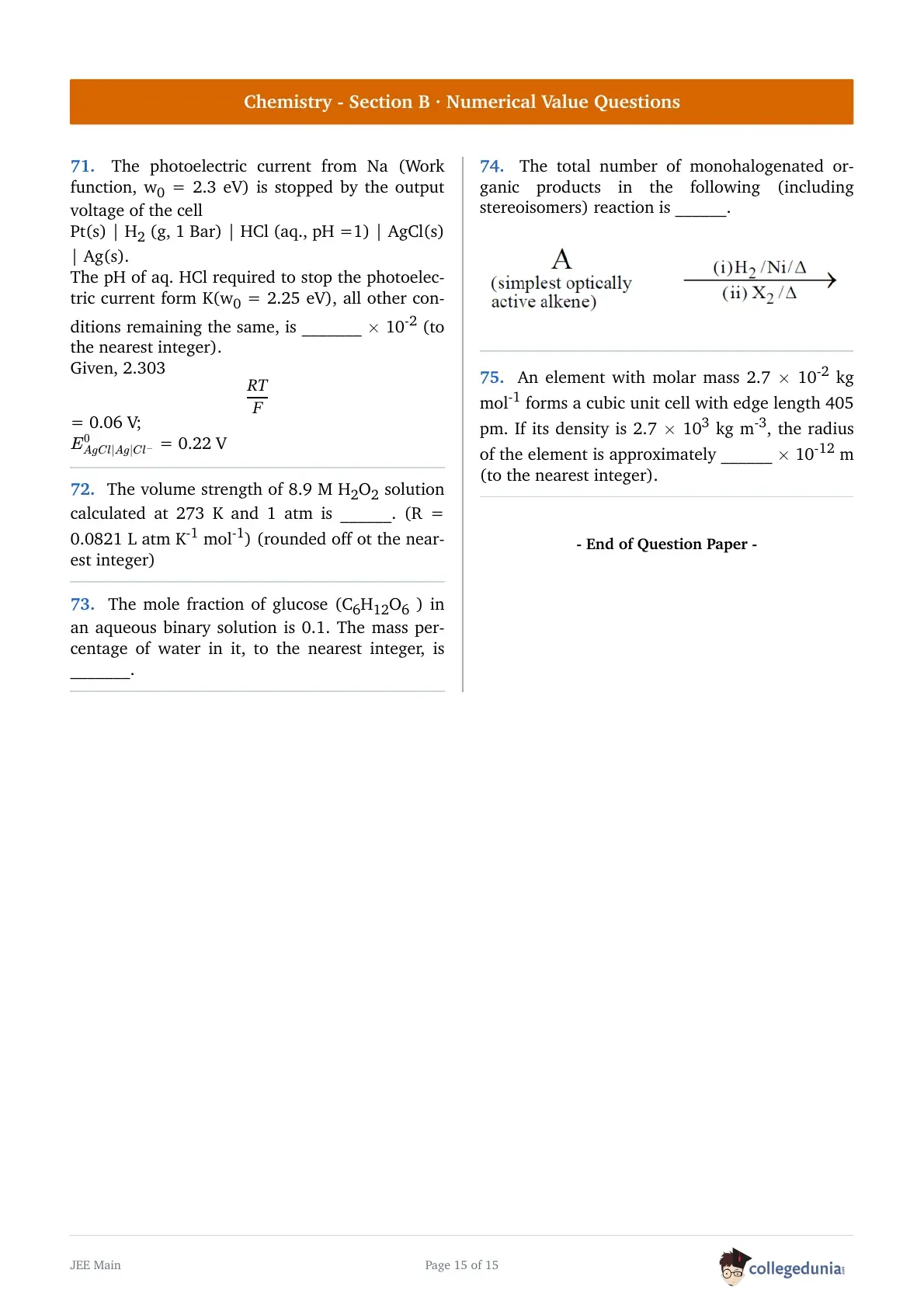
The photoelectric current from Na (Work function, \(w_0\) = 2.3 eV) is stopped by the output voltage of the cell
Pt(s) | \(\mathrm{H_2}\) (g, 1 Bar) | HCl (aq., pH =1) | AgCl(s) | Ag(s).
The pH of aq. HCl required to stop the photoelectric current form K(\(w_0\) = 2.25 eV), all other conditions remaining the same, is _______ \(\times\) \(10^{-2}\) (to the nearest integer).
Given, \(2.303\frac{RT}{F}\) = 0.06 V;
\(E^0_{\mathrm{AgCl|Ag|Cl^-}}\) = 0.22 V
The volume strength of 8.9 M \(\mathrm{H_2O_2}\) solution calculated at 273 K and 1 atm is ______. (R = 0.0821 L atm \(\mathrm{K^{-1}\,mol^{-1}}\)) (rounded off ot the nearest integer)
The mole fraction of a solute in a 100 molal aqueous solution is ___________ \(\times\) \(10^{-2}\). (Round off to the Nearest Integer).
[Given : Atomic masses : H : 1.0 u, O : 16.0 u ]
The total number of monohalogenated organic products in the following (including stereoisomers) reaction is ______.
An element M crystallises in a body centred cubic unit cell with a cell edge of 300 pm. The density of the element is 6.0 g cm–3. The number of atoms present in 180 g of the element is ______× 1023. (Nearest integer)
JEE Main 2020 Exam Pattern and Marking Scheme
| Particulars | Details |
|---|---|
| Exam Mode | Online (Computer-Based Test) |
| Paper | B.E./B.Tech (Paper 1) |
| Duration | 3 hours (180 minutes) |
| Type of Questions | Multiple Choice Questions (MCQs) + Numerical Value Questions |
| Subjects | Mathematics, Physics, Chemistry |
| Total Questions | 75 questions |
| Total Marks | 300 marks |
| Marking Scheme | +4 for correct answer & -1 for incorrect MCQ; no negative marking for Numerical Value Questions |
JEE Main 2020 September 3 Shift 1 Difficulty Level
JEE Main 2020 Paper 1 was conducted on September 3 by NTA. The exam was held in two slots. The Forenoon Slot was held between 9:00 AM and 12:00 PM. The overall difficulty level was rated easy to moderate by the candidates. A total of 75 questions appeared in the question paper. The questions were distributed across three subjects i.e. Physics, Chemistry, and Mathematics. Each subject carried 25 questions.
JEE Main 2020 B.E./B.Tech - Paper Analysis
The Mathematics section was the easiest section among all the three sections. The below-mentioned table shows the number of questions appeared in all the three sections as per the difficulty level-
Subjects |
Easy Level | Medium Level | Difficulty Level | |||
|---|---|---|---|---|---|---|
| No. Of Questions | Carried Marks | No. Of Questions | Carried Marks | No. Of Questions | Carried Marks | |
| Chemistry | 9 | 36 | 12 | 48 | 4 | 16 |
| Mathematics | 3 | 8 | 17 | 64 | 5 | 20 |
| Physics | 11 | 44 | 10 | 40 | 4 | 16 |
| Total | 23 | 92 | 39 | 156 | 13 | 52 |
- Medium level questions dominated the question paper of JEE Main B.Tech
- The number of difficult level of questions were the least
- The Mathematics section carried 20 MCQs and 5 numerical based questions
- Negative marking scheme would not be applied in case of numerical based questions
As per the specified marking pattern, 4 marks would be rewarded for every correct MCQ (Multiple Choice Questions). Wrong attempted MCQ will lead to reduction by 1 mark.



Comments