




JEE Main 2020 January 8 Shift 2 Question Paper is available here with solutions PDF and detailed solutions for every question. NTA conducted the second shift on January 8, 2020, from 2:30 PM to 5:30 PM. The JEE Main 2020 Paper 1 (B.E./B.Tech) question paper includes the following:
- 75 questions in a 3-hour CBT Mode: 25 each from Mathematics, Physics and Chemistry
- Section A: 20 multiple choice questions (MCQs) per subject, 4 marks each
- Section B: 5 numerical value questions per subject, all compulsory, 4 marks each
- Marking: +4 for a correct answer, -1 for an incorrect MCQ, 0 for an unattempted question; no negative marking for numerical value questions
- Maximum marks: 300 (100 per subject)
JEE Main 2020 January 8 Shift 2 Question Paper with Solution PDF
| NTA Official PDF | CD PDF | CD PDF with Solutions |
|---|---|---|
| Download official PDF 6.13 MB | Download Collegedunia PDF 1.26 MB | Download solutions PDF 1.77 MB |
Also Check:
JEE Main 2020 January 8 Shift 2 Questions with Solutions
Mathematics - Section A (Q1 - Q20)
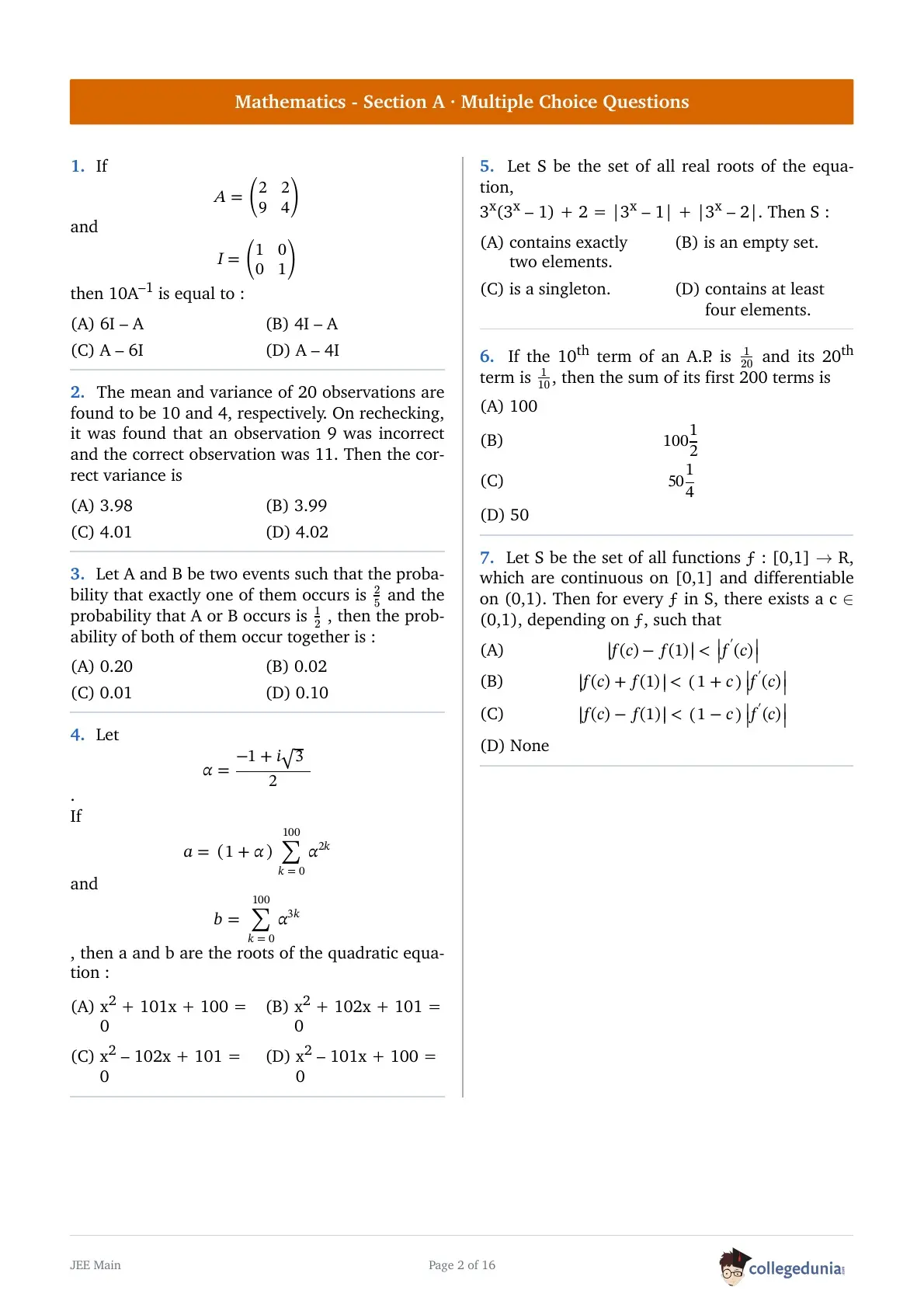
If \(A=\begin{pmatrix}2&2\\9&4\end{pmatrix}\) and \(I=\begin{pmatrix}1&0\\0&1\end{pmatrix}\), then \(10A^{-1}\) is equal to :
The mean and variance of \(20\) observations are found to be 10 and 4, respectively. On rechecking, it was found that an observation 9 was incorrect and the correct observation was \(11\). Then the correct variance is :
Given two independent events, if the probability that exactly one of them occurs is \(\frac{26}{49}\) and the probability that none of them occurs is \(\frac{15}{49}\), then the probability of more probable of the two events is :
Let \(\alpha=\dfrac{-1+i\sqrt3}{2}\). If \(a=(1+\alpha)\displaystyle\sum_{k=0}^{100}\alpha^{2k}\) and \(b=\displaystyle\sum_{k=0}^{100}\alpha^{3k}\), then \(a\) and \(b\) are the roots of the quadratic equation :
Let S be the set of all real roots of the equation, \(3^x(3^x-1)+2=|3^x-1|+|3^x-2|\). Then S :
If the \(10^{\text{th}}\) term of an A.P. is \(\dfrac{1}{20}\) and its \(20^{\text{th}}\) term is \(\dfrac{1}{10}\), then the sum of its first 200 terms is
Let S be the set of all functions \(f:[0,1]\to\mathbb{R}\), which are continuous on \([0,1]\) and differentiable on \((0,1)\). Then for every \(f\) in S, there exists a \(c\in(0,1)\), depending on \(f\), such that
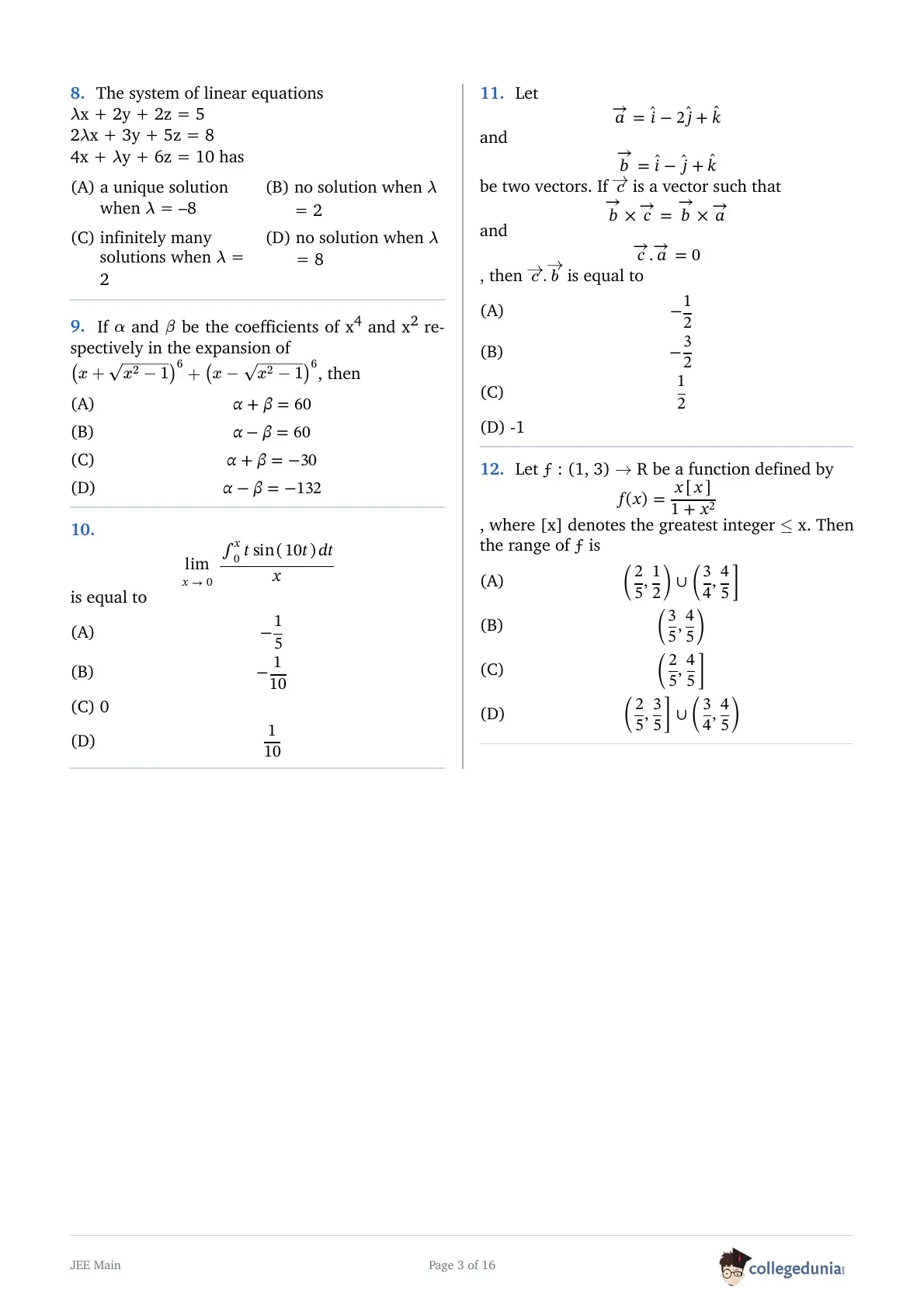
The system of linear equations \(\lambda x+2y+2z=5\) \(2\lambda x+3y+5z=8\) \(4x+\lambda y+6z=10\) has :
_____________If \(\alpha\) and \(\beta\) be the coefficients of \(x^4\) and \(x^2\) respectively in the expansion of \(\left(x+\sqrt{x^{2}-1}\right)^{6}+\left(x-\sqrt{x^{2}-1}\right)^{6},\) then :
\(\displaystyle\lim_{x\to0}\dfrac{\int_0^x t\sin(10t)\,dt}{x}\) is equal to
Let \(\vec{a}=\hat{i}-2\,\hat{j}+\hat{k}\) and \(\vec{b}=\hat{i}-\hat{j}+\hat{k}\) be two vectors. If \(\vec{c}\) is a vector such that \(\vec{b}\times\vec{c}=\vec{b}\times\vec{a}\) and \(\vec{c}\cdot\vec{a}=0,\) then \(\vec{c} \cdot \vec{b}\) is equal to :
Let \(f:(1,3)\to\mathbb{R}\) be a function defined by \(f(x)=\dfrac{x[x]}{1+x^2}\), where \([x]\) denotes the greatest integer \(\le x\). Then the range of \(f\) is
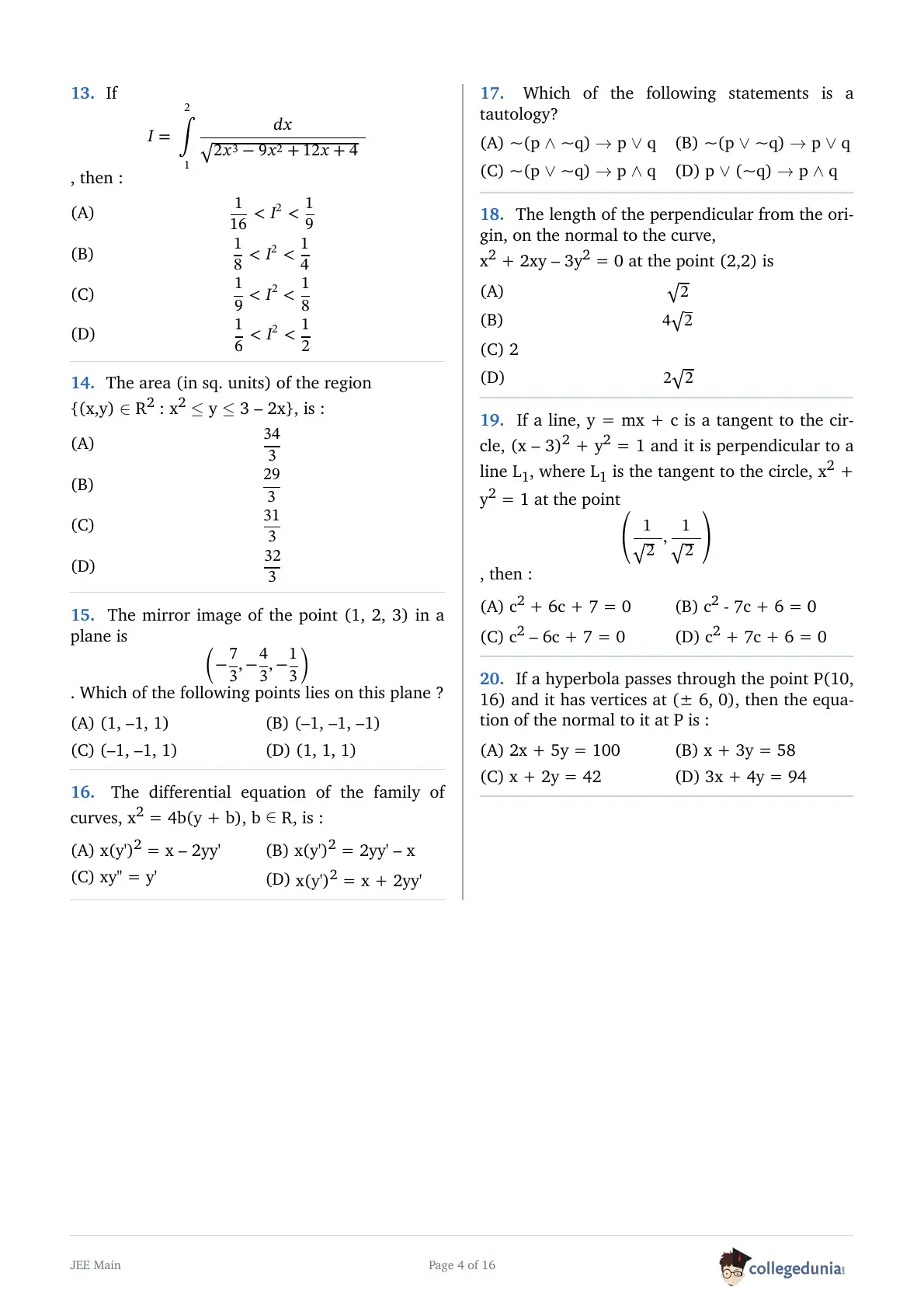
If \(I=\displaystyle\int_1^2\dfrac{dx}{\sqrt{2x^3-9x^2+12x+4}}\), then :
The area (in sq. units) of the region \(\{(x,y)\in\mathbb{R}^2: x^2\le y\le3-2x\}\), is :
The mirror image of the point \((1,2,3)\) in a plane is \(\left(-\dfrac73,-\dfrac43,-\dfrac13\right)\). Which of the following points lies on this plane ?
The differential equation of the family of curves, \(x^2=4b(y+b)\), \(b\in\mathbb{R}\), is :
Which of the following statements is a tautology?
The length of the perpendicular from the origin, on the normal to the curve, \(x^2+2xy-3y^2=0\) at the point \((2,2)\) is
If a line, \(y = mx + c\) is a tangent to the circle, \((x - 3)^2 + y^2 = 1\) and it is perpendicular to a line \(L_1\), where \(L_1\) is the tangent to the circle, \(x^2 + y^2 = 1\) at the point \(\left(\frac{1}{\sqrt{2}}, \frac{1}{\sqrt{2}}\right)\), then :
If a hyperbola passes through the point \(P(10,16)\) and it has vertices at \(( ? 6,0)\), then the equation of the normal to it at P is :
Mathematics - Section B (Q21 - Q25)
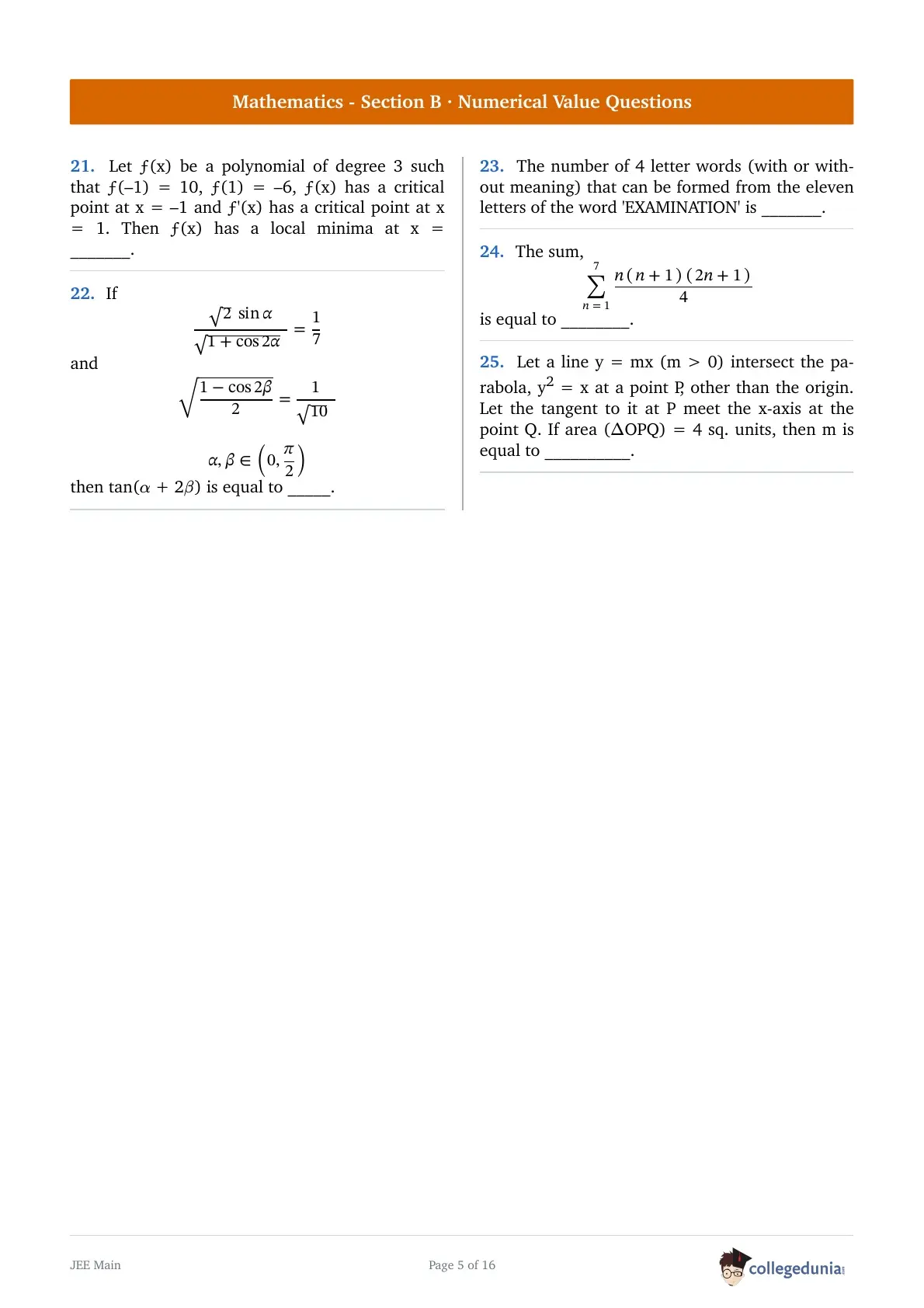
Let \( f(x) \) be a cubic polynomial with \( f(1) = -10 \), \( f(-1) = 6 \), and has a local minima at \( x = 1 \), and \( f'(x) \) has a local minima at \( x = -1 \). Then \( f(3) \) is equal to _________.
If \(\frac{\sqrt{2}\sin\alpha}{\sqrt{1 + \cos 2\alpha}} = \frac{1}{7}\) and \(\sqrt{\frac{1 - \cos 2\beta}{2}} = \frac{1}{\sqrt{10}}\), \(\alpha, \beta \in \left(0, \frac{\pi}{2}\right)\), then \(\tan(\alpha + 2\beta)\) is equal to _____.
The number of 4 letter words (with or without meaning) that can be formed from the eleven letters of the word 'EXAMINATION' is _______.
The sum, \(\sum_{n=1}^{7} \frac{n(n+1)(2n+1)}{4}\) is equal to ________.
Let a line \(y = mx\) \((m \gt 0)\) intersect the parabola, \(y^2 = x\) at a point P, other than the origin. Let the tangent to it at P meet the x-axis at the point Q. If area \((\Delta OPQ) = 4\) sq. units, then m is equal to __________.
Physics - Section A (Q26 - Q45)
Sound travels in a mixture of two moles of helium and \(n\) moles of hydrogen If rms speed of gas molecules in the mixture is \(\sqrt{2}\) times the speed of sound, then the value of \(n\) will be
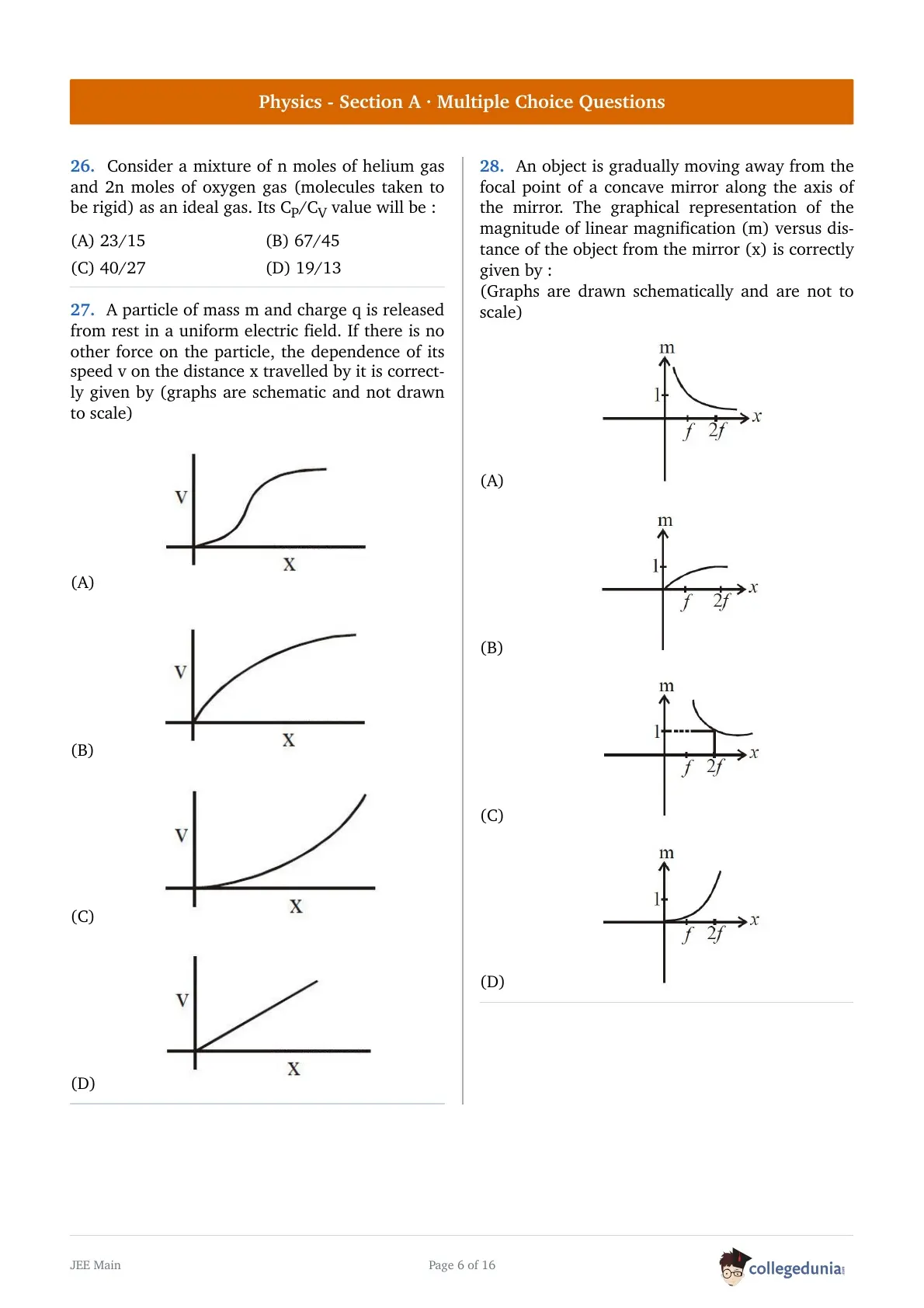
A particle of mass \(m\) and charge \(q\) is released from rest in a uniform electric field. If there is no other force on the particle, the dependence of its speed \(v\) on the distance \(x\) travelled by it is correctly given by (graphs are schematic and not drawn to scale)
- (1)
![]()
- (2)
![]()
- (3)
![]()
- (4)
![]()


An object is gradually moving away from the focal point of a concave mirror along the axis of the mirror. The graphical representation of the magnitude of linear magnification \((m)\) versus distance of the object from the mirror \((x)\) is correctly given by :
(Graphs are drawn schematically and are not to scale)
- (1)
![]()
- (2)
![]()
- (3)
![]()
- (4)
![]()


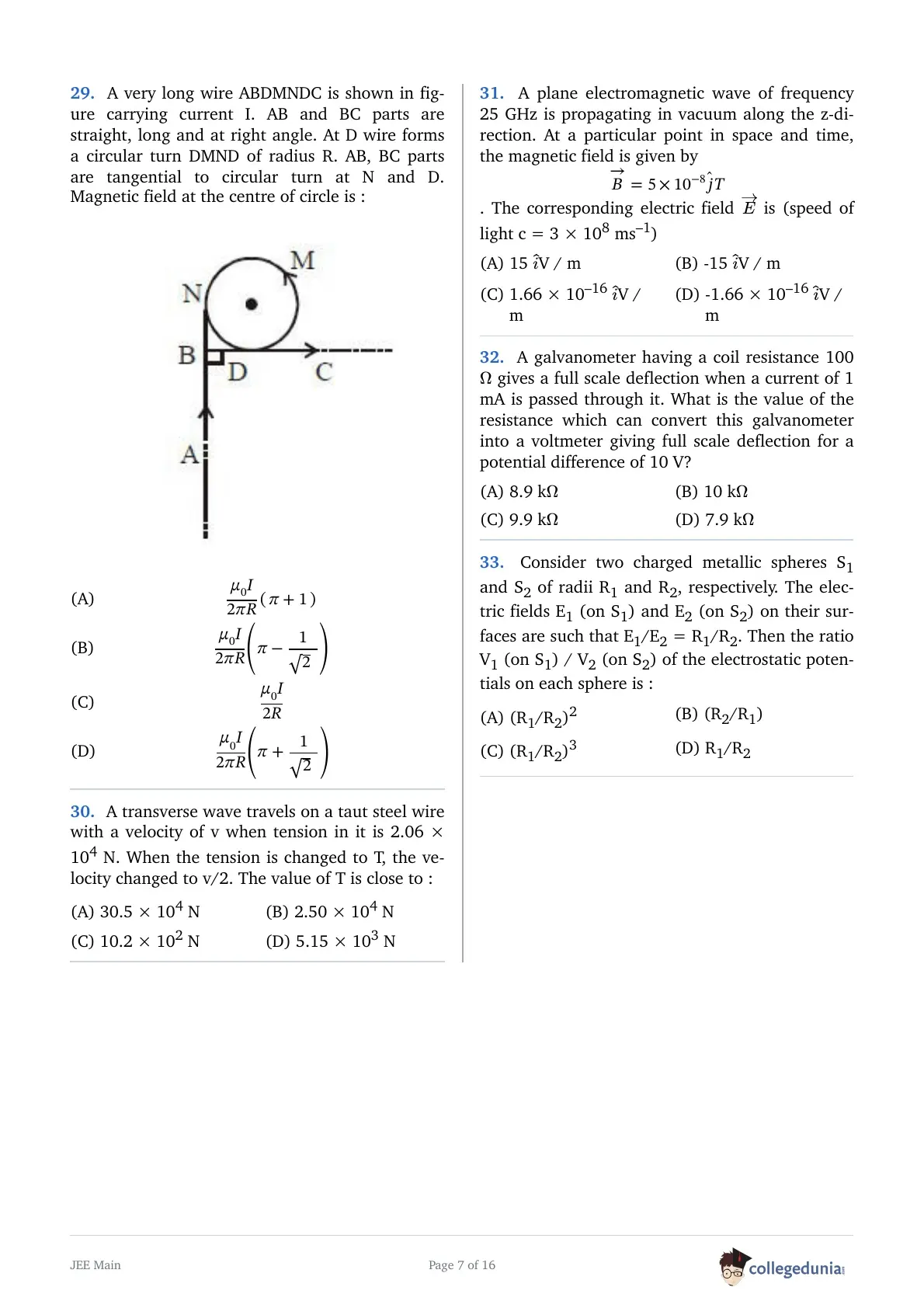
A very long wire ABDMNDC is shown in figure carrying current \(I\). AB and BC parts are straight, long and at right angle. At D wire forms a circular turn DMND of radius \(R\). AB, BC parts are tangential to circular turn at N and D. Magnetic field at the centre of circle is :
A transverse wave travels on a taut steel wire with a velocity of \(v\) when tension in it is \(2.06 \times 10^4\) N. When the tension is changed to \(T\), the velocity changed to \(v/2\). The value of \(T\) is close to :
A plane electromagnetic wave of frequency 25 GHz is propagating in vacuum along the z-direction. At a particular point in space and time, the magnetic field is given by \(\vec{B} = 5 \times 10^{-8}\,\hat{j}\,\mathrm{T}\). The corresponding electric field \(\vec{E}\) is (speed of light \(c = 3 \times 10^8\) ms-1)
A galvanometer having a coil resistance \(100\ \Omega\) gives a full scale deflection when a current of 1 mA is passed through it. What is the value of the resistance which can convert this galvanometer into a voltmeter giving full scale deflection for a potential difference of 10 V?
Consider two charged metallic spheres \(S_1\) and \(S_2\) of radii \(R_1\) and \(R_2\), respectively. The electric fields \(E_1\) (on \(S_1\)) and \(E_2\) (on \(S_2\)) on their surfaces are such that \(E_1/E_2 = R_1/R_2\). Then the ratio \(V_1\) (on \(S_1\)) / \(V_2\) (on \(S_2\)) of the electrostatic potentials on each sphere is :
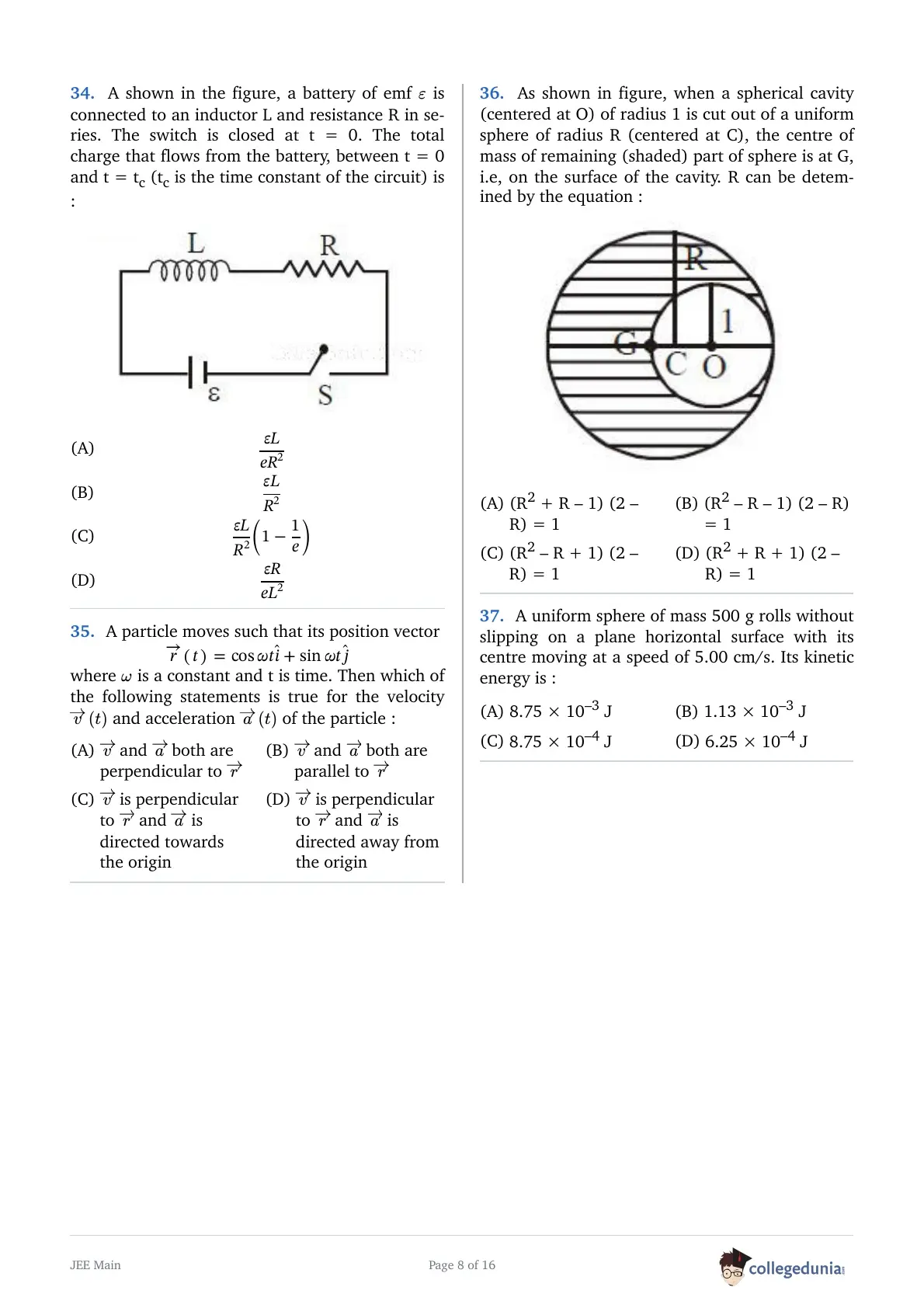
As shown in the figure, a battery of emf \(\varepsilon\) is connected to an inductor \(L\) and resistance \(R\) in series. The switch is closed at \(t = 0\). The total charge that flows from the battery, between \(t = 0\) and \(t = t_c\) (\(t_c\) is the time constant of the circuit) is :
A particle moves along the x-axis and has its displacement x varying with time t according to the equation \( x = c_0 (t^2 - 2) + c (t - 2)^2 \) where \( c_0 \) and \( c \) are constants of appropriate dimensions. Then, which of the following statements is correct?
As shown in figure, when a spherical cavity (centered at \(O\)) of radius 1 is cut out of a uniform sphere of radius \(R\) (centered at \(C\)), the centre of mass of remaining (shaded) part of sphere is at \(G\), i.e., on the surface of the cavity. \(R\) can be determined by the equation :
A uniform sphere of mass 500 g rolls without slipping on a plane horizontal surface with its centre moving at a speed of 5.00 cm/s. Its kinetic energy is :
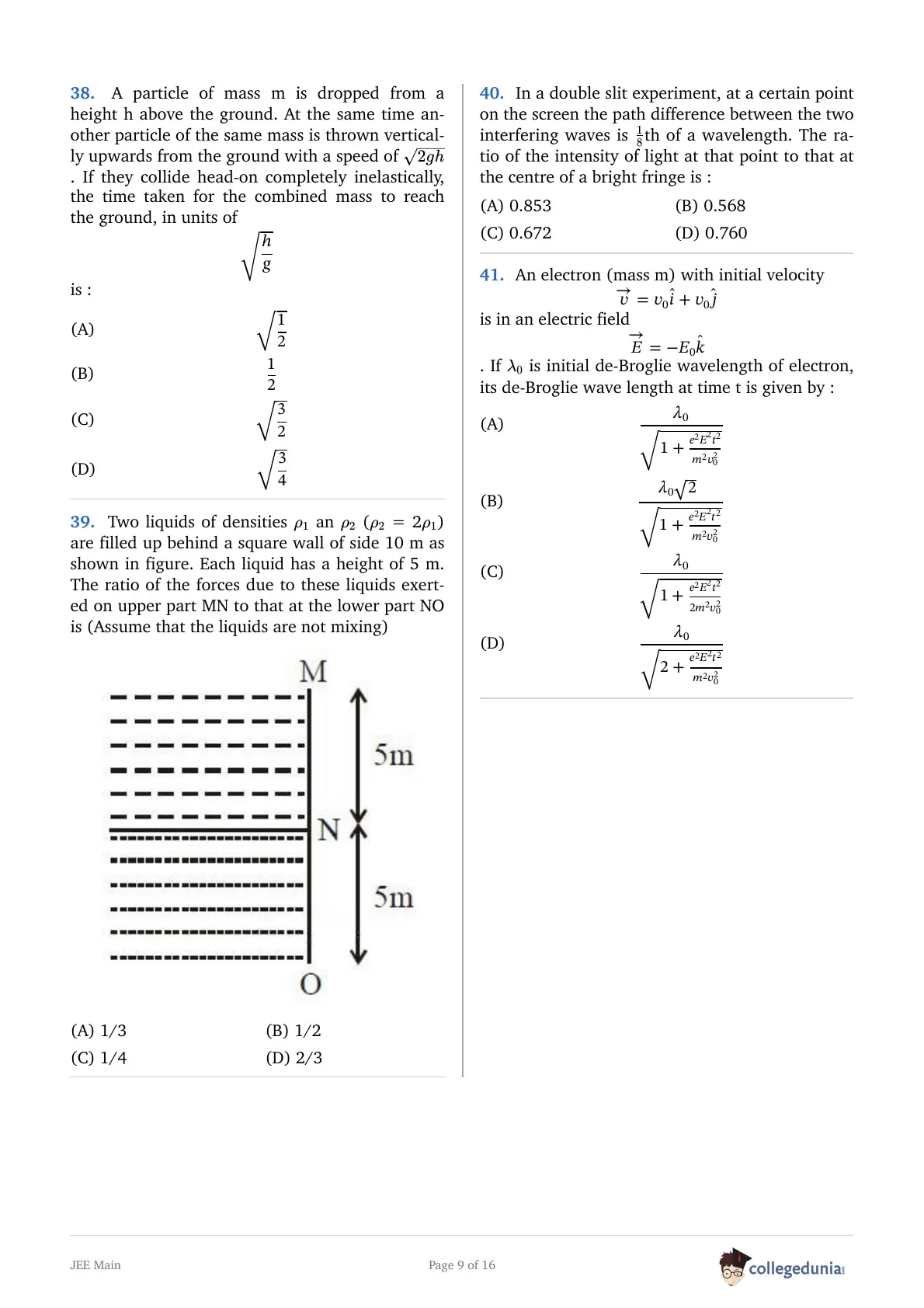
A particle of mass \(m\) is dropped from a height \(h\) above the ground. At the same time another particle of the same mass is thrown vertically upwards from the ground with a speed of \(\sqrt{2gh}\). If they collide head-on completely inelastically, the time taken for the combined mass to reach the ground, in units of \(\sqrt{\frac{h}{g}}\) is :
Two liquids of densities \(\rho_1\) and \(\rho_2\) (\(\rho_2=2\rho_1\)) are filled up behind a square wall of side 10 m as shown in figure. Each liquid has a height of 5 m. The ratio of the forces due to these liquids exerted on upper part MN to that at the lower part NO is (Assume that the liquids are not mixing)
In interference experiment the path difference between two interfering waves at a point \(A\) on the screen is \(\lambda/3\), where \(\lambda\) is the wavelength of these waves, and at another point \(B\) the path difference is \(\lambda/6\). The ratio of intensities at points \(A\) and \(B\) is _______.
An electron (mass m) with an initial velocity
\(\vec{v}=v_0\hat{i}(v_0>0)\)
is moving in an electric field
\(\vec{E}=E_0\hat{i}(E_0>0)\)
where E0 is constant. If at t = 0 de Broglie wavelength is
\(λ_0=\frac{ℎ}{mv_0}\)
, then its de Broglie wavelength after time t is given by
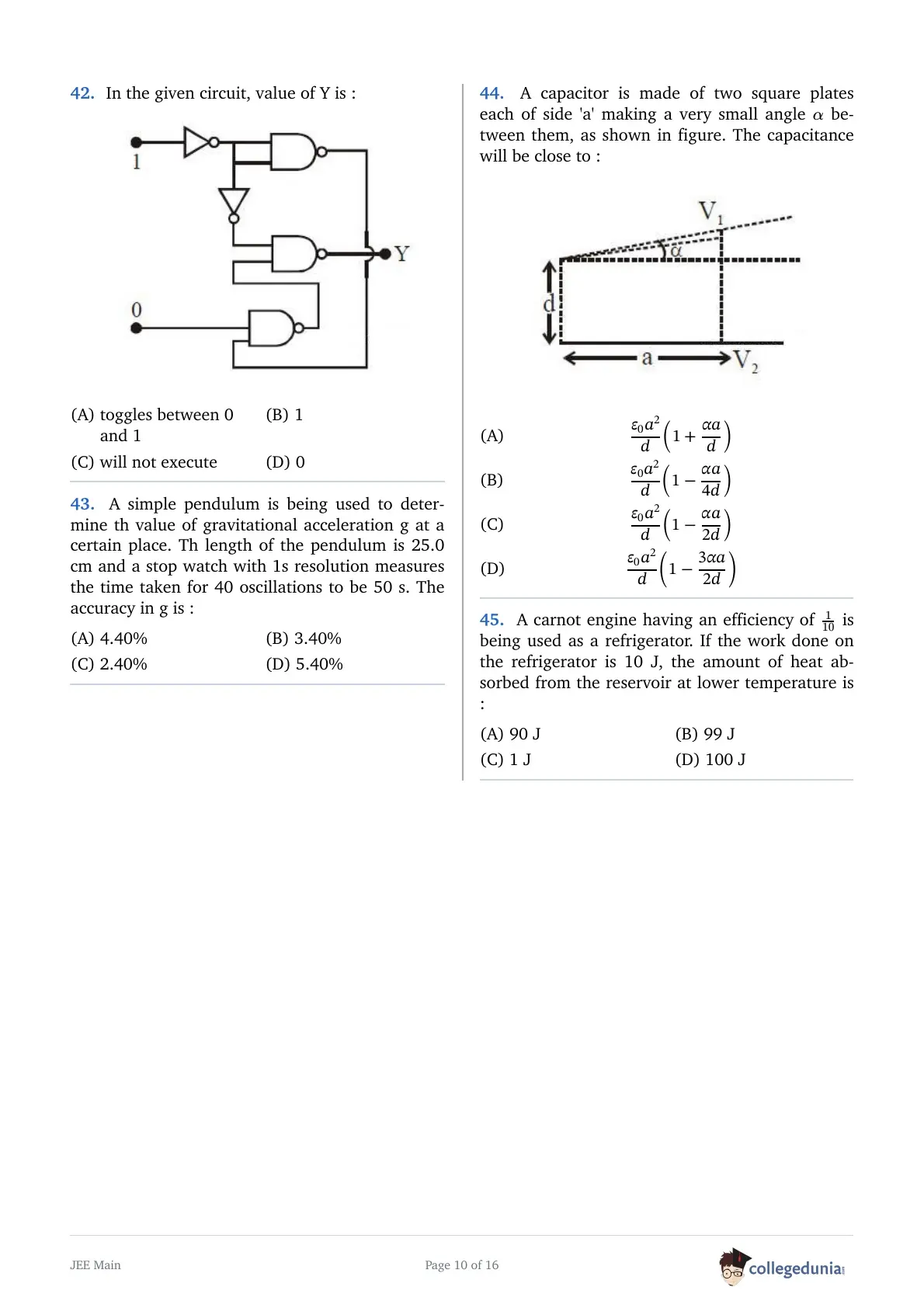
In the given circuit, value of \(Y\) is :
A simple pendulum is being used to determine the value of gravitational acceleration \(g\) at a certain place. The length of the pendulum is 25.0 cm and a stop watch with 1 s resolution measures the time taken for 40 oscillations to be 50 s. The accuracy in \(g\) is :
A capacitor is made of two square plates each of side \('a'\) making a very small angle a between them, as shown in figure. The capacitance will be close to :
A carnot engine having an efficiency of \(\frac{1}{10}\) is being used as a refrigerator. If the work done on the refrigerator is 10 J, the amount of heat absorbed from the reservoir at lower temperature is :
Physics - Section B (Q46 - Q50)
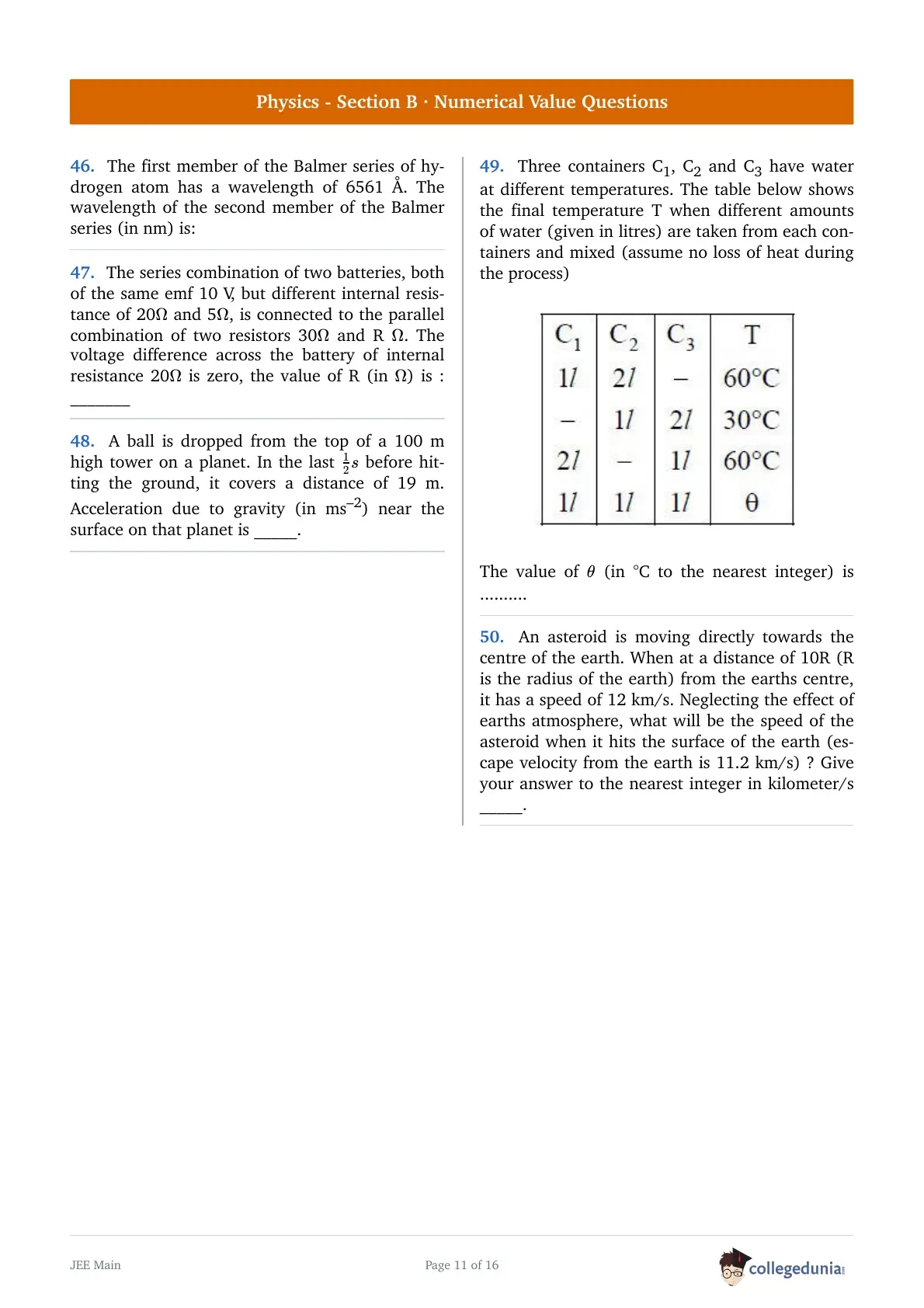
The first member of the Balmer series of hydrogen atom has a wavelength of 6561 \(\mathrm{\AA}\). The wavelength of the second member of the Balmer series (in nm) is:
The series combination of two batteries, both of the same emf 10 V, but different internal resistance of \(20\ \Omega\) and \(5\ \Omega\), is connected to the parallel combination of two resistors \(30\ \Omega\) and \(R\ \Omega\). The voltage difference across the battery of internal resistance \(20\ \Omega\) is zero, the value of \(R\) (in \(\Omega\)) is : _______
A ball is dropped from the top of a 100 m high tower on a planet. In the last \(\frac{1}{2}\) s before hitting the ground, it covers a distance of 19 m. Acceleration due to gravity (in \(\mathrm{ms^{-2}}\)) near the surface on that planet is _____.
| \(C_1\) | \(C_2\) | \(C_3\) | \(T\) |
| 1 l | 2 l | - | \(60^\circ\)C |
| - | 1 l | 2 l | \(30^\circ\)C |
| 2 l | - | 1 l | \(60^\circ\)C |
| 1 l | 1 l | 1 l | \(\theta\) |
An asteroid is moving directly towards the centre of the earth. When at a distance of \(10R\) (\(R\) is the radius of the earth) from the earths centre, it has a speed of \(12\ \mathrm{km/s}\). Neglecting the effect of earths atmosphere, what will be the speed of the asteroid when it hits the surface of the earth (escape velocity from the earth is \(11.2\ \mathrm{km/s}\)) ? Give your answer to the nearest integer in kilometer/s _____.
Chemistry - Section A (Q51 - Q70)
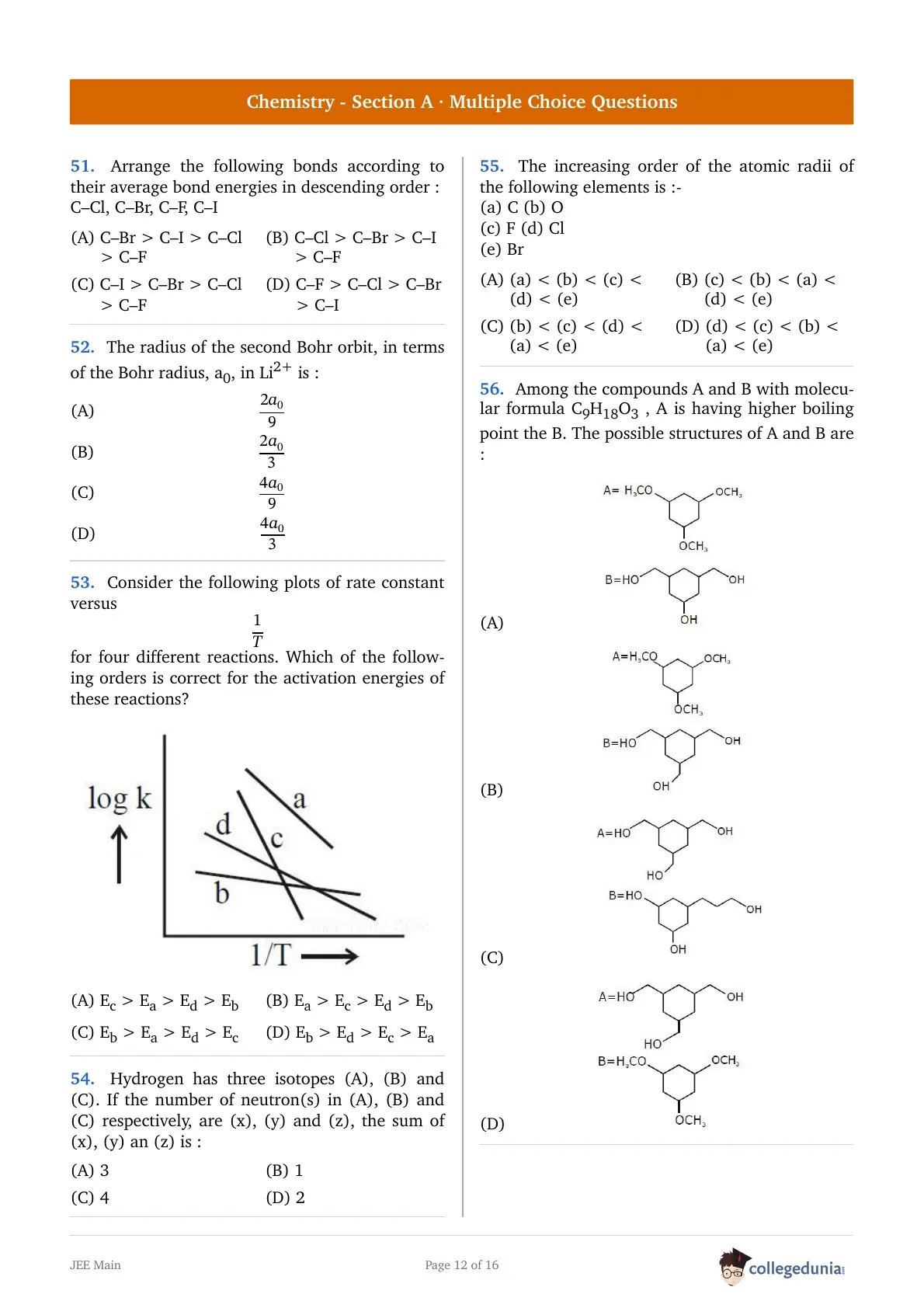
Arrange the following bonds according to their average bond energies in descending order :
\(\mathrm{C{-}Cl},\ \mathrm{C{-}Br},\ \mathrm{C{-}F},\ \mathrm{C{-}I}\)
If the radius of the 3rd Bohr’s orbit of hydrogen atom is r3 and the radius of 4th Bohr’s orbit is r4. Then
Consider the following plots of log of rate constant \( k (log k)\) vs \( \frac{1}{T} \) for three different reactions. The correct order of activation energies of these reactions is: 
Choose the correct answer from the options given below:
Hydrogen has three isotopes (A), (B) and (C). If the number of neutron(s) in (A), (B) and (C) respectively, are (x), (y) and (z), the sum of (x), (y) and (z) is :
The increasing order of the atomic radii of the following elements is :-
(a) C (b) O
(c) F (d) Cl
(e) Br
Among the compounds A and B with molecular formula \(\mathrm{C_9H_{18}O_3}\), A is having higher boiling point the B. The possible structures of A and B are :
- (1)
![]()
- (2)
![]()
- (3)
![]()
- (4)
![]()


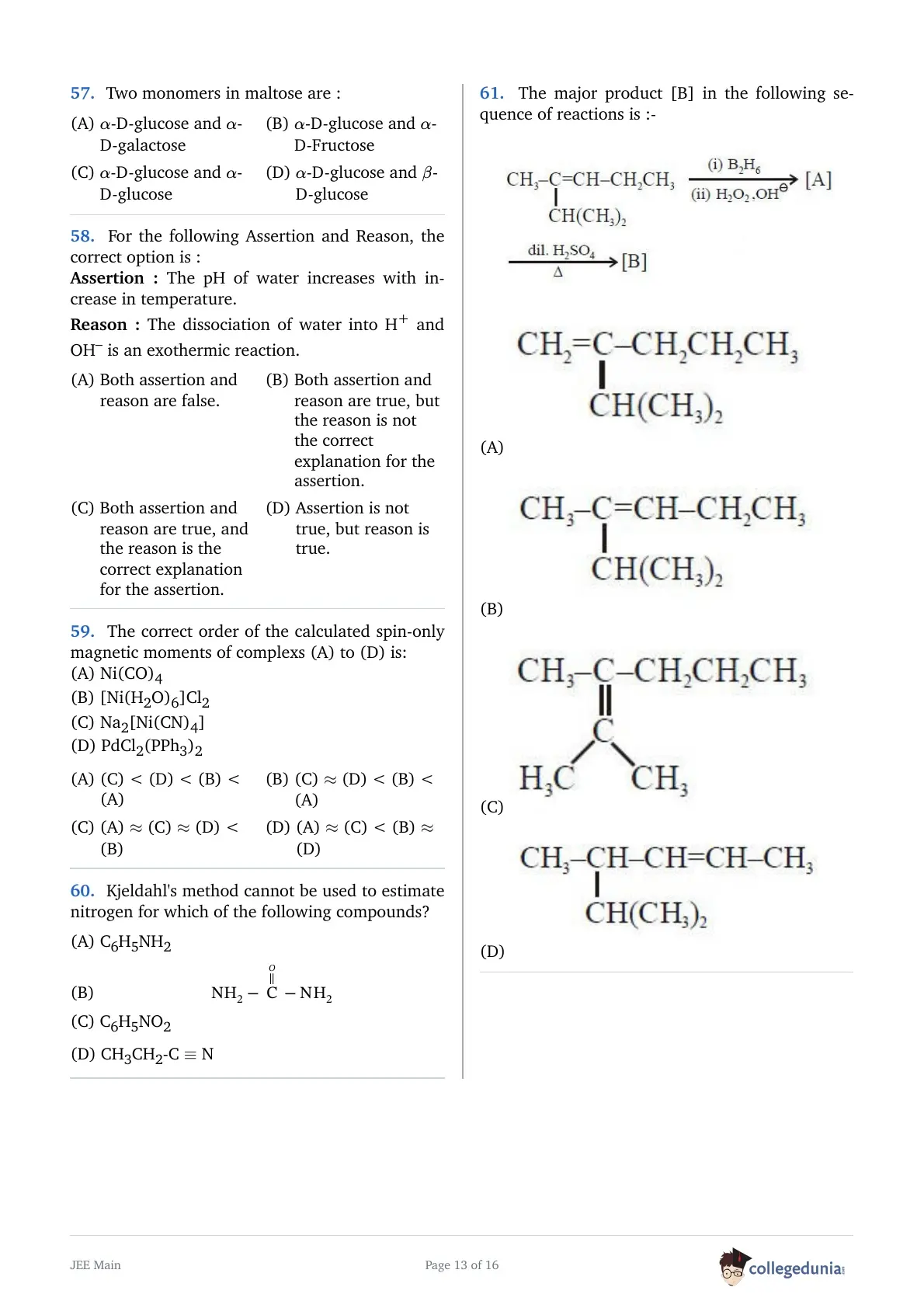
Two monomers in maltose are :
For the following Assertion and Reason, the correct option is :
Assertion : The pH of water increases with increase in temperature.
Reason : The dissociation of water into \(\mathrm{H^+}\) and \(\mathrm{OH^-}\) is an exothermic reaction.
The correct order of the calculated spin-only magnetic moments of complexs (A) to (D) is:
(A) \(\mathrm{Ni(CO)_4}\)
(B) \(\mathrm{[Ni(H_2O)_6]Cl_2}\)
(C) \(\mathrm{Na_2[Ni(CN)_4]}\)
(D) \(\mathrm{PdCl_2(PPh_3)_2}\)
Kjeldahl's method cannot be used to estimate nitrogen for which of the following compounds ?
- (1) \(C_6H_5NO_2\)
- (2)
![]()
- (3) \(CH_{3}CH_{2}-C\equiv N\)
- (4) \(C_6H_5NH_2\)

The major product [B] in the following sequence of reactions is :-
- (1)
![]()
- (2)
![]()
- (3)
![]()
- (4)
![]()


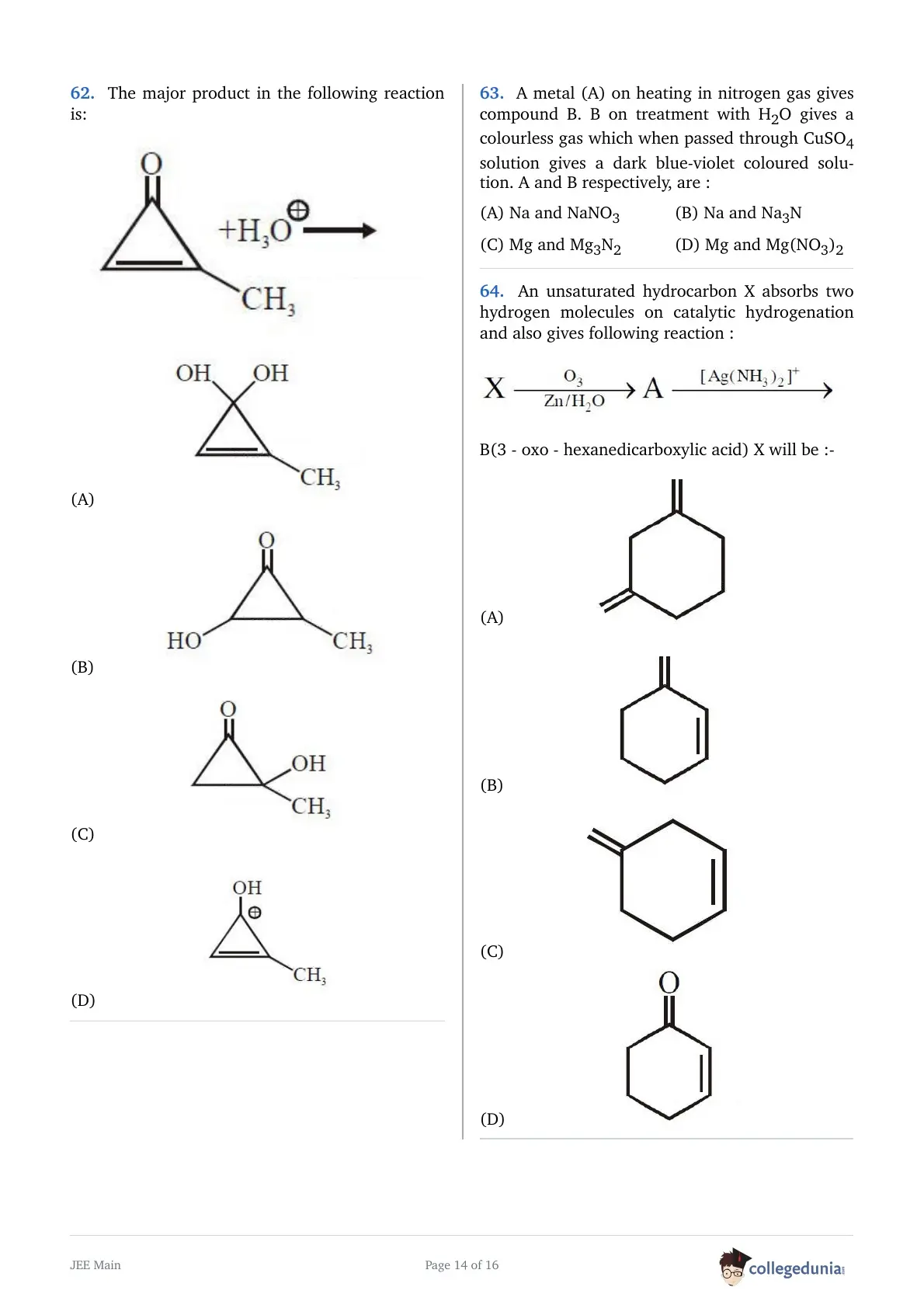
A metal (A) on heating in nitrogen gas gives compound B. B on treatment with \(\mathrm{H_2O}\) gives a colourless gas which when passed through \(\mathrm{CuSO_4}\) solution gives a dark blue-violet coloured solution. A and B respectively, are :
An unsaturated hydrocarbon X absorbs two hydrogen molecules on catalytic hydrogenation and also gives following reaction :
B (3 - oxo - hexanedicarboxylic acid) X will be :-
- (1)
![]()
- (2)
![]()
- (3)
![]()
- (4)
![]()


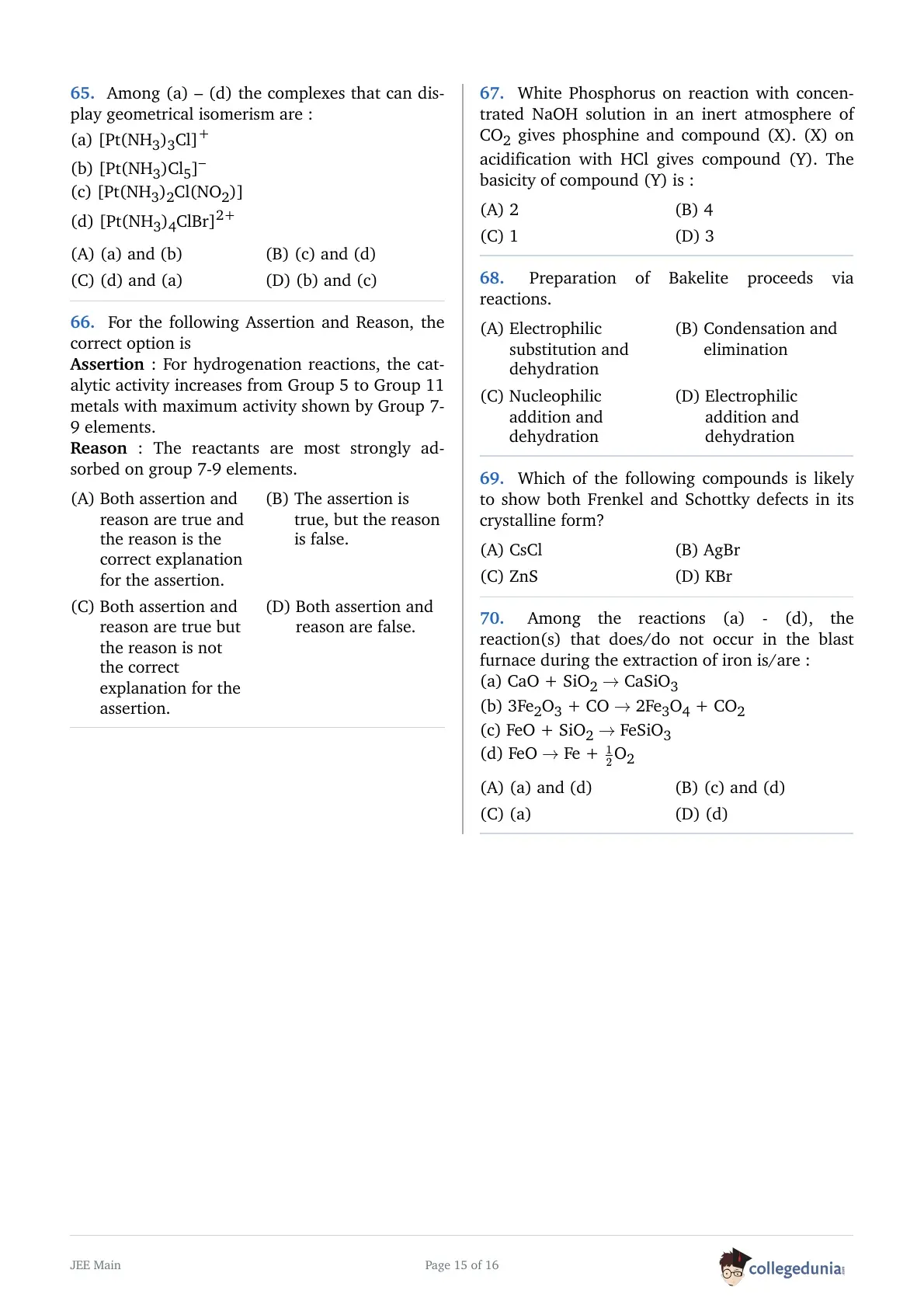
Among (a) - (d), the complexes that can display geometrical isomerism are : \(\left(a\right)\,\left[Pt\left(NH_{3}\right)_{3}Cl\right]^{+}\) \(\left(b\right)\,\left[Pt\left(NH_{3}\right)Cl_{5}\right]^{-}\) \(\left(c\right)\,\left[Pt\left(NH_{3}\right)_{2}Cl\left(NO\right)_{2}\right]\) \(\left(d\right)\,\left[Pt\left(NH_{3}\right)_{4}ClBr\right]^{2+}\)
For the following Assertion and Reason, the correct option is
Assertion : For hydrogenation reactions, the catalytic activity increases from Group 5 to Group 11 metals with maximum activity shown by Group 7-9 elements.
Reason : The reactants are most strongly adsorbed on group 7-9 elements.
White Phosphorus on reaction with concentrated NaOH solution in an inert atmosphere of \(\mathrm{CO_2}\) gives phosphine and compound (X). (X) on acidification with HCl gives compound (Y). The basicity of compound (Y) is :
Preparation of Bakelite proceeds via reactions.
Which of the following compounds is likely to show both Frenkel and Schottky defects in its crystalline form?
Which one of the following reactions does not occur during extraction of copper?
Chemistry - Section B (Q71 - Q75)
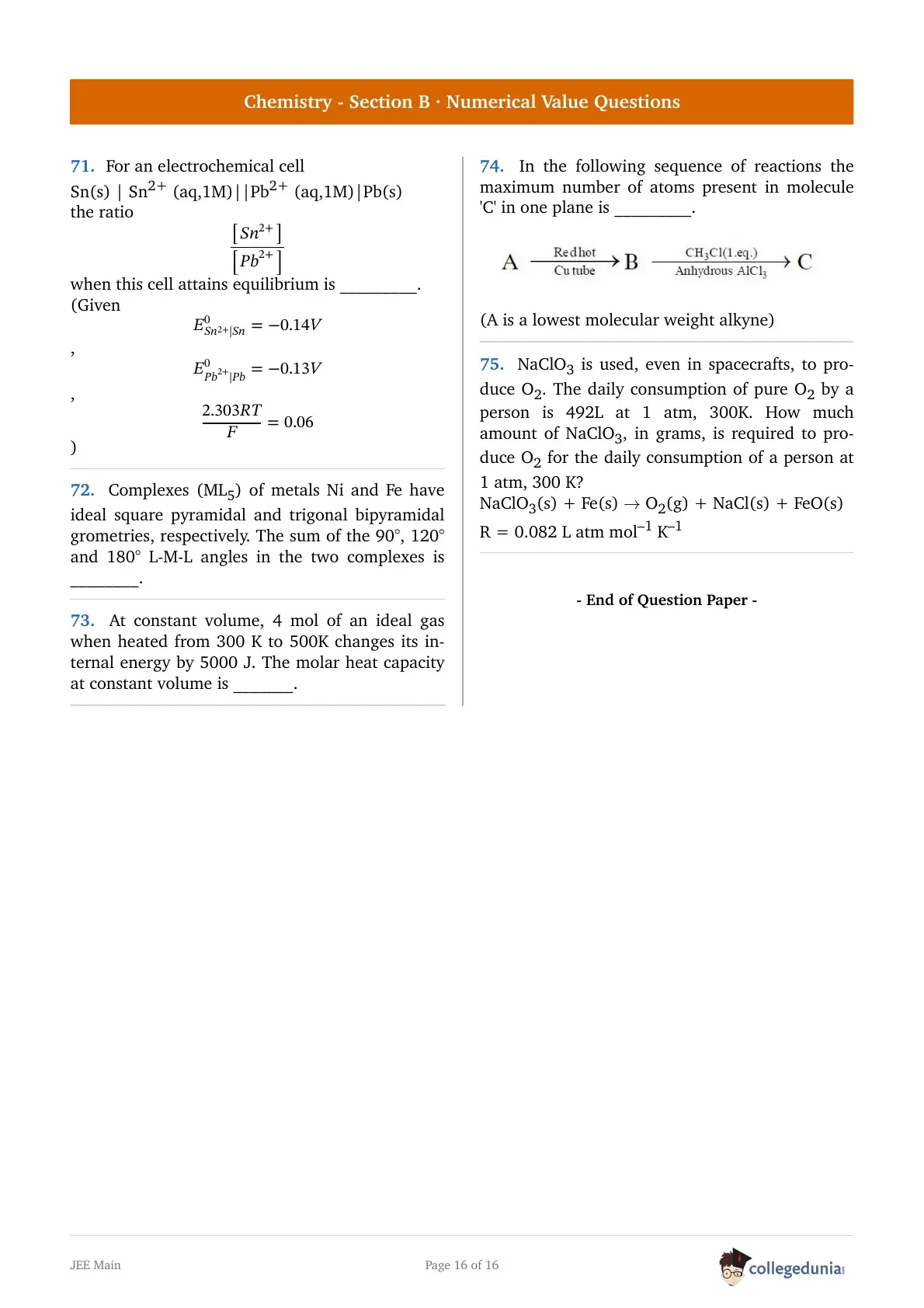
For an electrochemical cell
\(\mathrm{Sn(s)\,|\,Sn^{2+}(aq,1M)\,\|\,Pb^{2+}(aq,1M)\,|\,Pb(s)}\)
the ratio \(\frac{[\mathrm{Sn^{2+}}]}{[\mathrm{Pb^{2+}}]}\) when this cell attains equilibrium is _________.
(Given \(E^0_{\mathrm{Sn^{2+}|Sn}} = -0.14\,\mathrm{V}\), \(E^0_{\mathrm{Pb^{2+}|Pb}} = -0.13\,\mathrm{V}\), \(\frac{2.303RT}{F} = 0.06\))
Complexes (\(\mathrm{ML_5}\)) of metals Ni and Fe have ideal square pyramidal and trigonal bipyramidal grometries, respectively. The sum of the \(90^\circ\), \(120^\circ\) and \(180^\circ\) L-M-L angles in the two complexes is _________.
The molar heat capacity for an ideal gas at constant pressure is 20.785 J K–1 mol–1. The change in internal energy is 5000 J upon heating it from 300 K to 500 K. The number of moles of the gas at constant volume is _____. (Nearest integer)
(Given : R = 8.314 JK-1mol-1).
In the following sequence of reactions the maximum number of atoms present in molecule 'C' in one plane is _________.
(A is a lowest molecular weight alkyne)
\(\mathrm{NaClO_3}\) is used, even in spacecrafts, to produce \(\mathrm{O_2}\). The daily consumption of pure \(\mathrm{O_2}\) by a person is 492 L at 1 atm, 300 K. How much amount of \(\mathrm{NaClO_3}\), in grams, is required to produce \(\mathrm{O_2}\) for the daily consumption of a person at 1 atm, 300 K?
\(\mathrm{NaClO_3(s) + Fe(s) \to O_2(g) + NaCl(s) + FeO(s)}\)
\(R = 0.082\ \mathrm{L\ atm\ mol^{-1}\ K^{-1}}\)
JEE Main 2020 Exam Pattern and Marking Scheme
| Particulars | Details |
|---|---|
| Exam Mode | Online (Computer-Based Test) |
| Paper | B.E./B.Tech (Paper 1) |
| Duration | 3 hours (180 minutes) |
| Type of Questions | Multiple Choice Questions (MCQs) + Numerical Value Questions |
| Subjects | Mathematics, Physics, Chemistry |
| Total Questions | 75 questions |
| Total Marks | 300 marks |
| Marking Scheme | +4 for correct answer & -1 for incorrect MCQ; no negative marking for Numerical Value Questions |
JEE Main 2020 January 8 Shift 2 Difficulty Level
A total of 9,21,200 (approx) candidates registered for the B.Tech/B.E exam in the January session. In order to accommodate such a large number of candidates, JEE Main 2020 January session for B.E/B.Tech was spread over 2 days (January 8 and January 9, 2021), with the paper conducted in two shifts on each day.
JEE Main B.E./B.Tech Question Paper January 8, 2020 (Shift 2): Weightage of Topics
The subjectwise weightage of different topics in JEE Main January 8 Shift 2 Question Paper is given below.
Mathematics

| Topics in Mathematics | Number of Questions in the Paper |
|---|---|
| Binomial Theorem | 1 |
| Complex Numbers | 1 |
| Coordinate Geometry | 3 |
| Differential Calculus | 3 |
| Fundamentals of Mathematics | 1 |
| Integral Calculus | 4 |
| Matrix & Determinants | 2 |
| Permutation & Combination | 1 |
| Probability | 1 |
| Sequence & Series | 2 |
| Trigonometry | 1 |
| Vector and 3D | 2 |
| Mathematical Reasoning | 1 |
| Statistics | 1 |
Physics

| Units in Physics | Number of Questions |
|---|---|
| Electrodynamics | 7 |
| Heat & Thermodynamics | 3 |
| Mechanics | 8 |
| Modern Physics | 4 |
| Optics | 2 |
| SHM & Waves | 1 |
Chemistry

| Topics from Chemistry | Number of Questions in the Paper |
|---|---|
| Chemical Bonding | 1 |
| s-block | 1 |
| p-block | 1 |
| Periodic Table & Periodicity in Properties | 1 |
| Coordination Compounds | 3 |
| Metallurgy | 1 |
| Alkyl Halide, Alcohol & Ether | 1 |
| Biomolecules | 1 |
| Practical Organic Chemistry | 1 |
| Organic Reaction Mechanism II | 1 |
| Organic Reaction Mechanism III | 1 |
| Carbonyl compounds | 1 |
| Carboxylic Acid and their Derivatives | 1 |
| Polymers | 1 |
| Ionic Equilibrium | 1 |
| Thermodynamics and Thermochemistry | 1 |
| Mole Concept | 1 |
| Atomic Structure & Nuclear Chemistry | 2 |
| Chemical Kinetics | 1 |
| Electrochemistry | 1 |
| Surface Chemistry | 1 |
| Solid-state | 1 |
JEE Main B.E./B.Tech Previous Year Question Paper with Answer Key PDFs
Solving the previous years’ question paper is an integral part of preparing for an exam as it boosts the confidence of the student, gets them familiarised with the exam pattern, and improves their time management skills in the paper. So, for the benefit of the students, JEE Main B.E./B.Tech Previous Year Question Papers with Answer Key PDFs are provided below.



Comments