




JEE Main 2020 January 9 Shift 2 Question Paper is available here with solutions PDF and detailed solutions for every question. NTA conducted the second shift on January 9, 2020, from 2:30 PM to 5:30 PM. The JEE Main 2020 Paper 1 (B.E./B.Tech) question paper includes the following:
- 75 questions in a 3-hour CBT Mode: 25 each from Mathematics, Physics and Chemistry
- Section A: 20 multiple choice questions (MCQs) per subject, 4 marks each
- Section B: 5 numerical value questions per subject, all compulsory, 4 marks each
- Marking: +4 for a correct answer, -1 for an incorrect MCQ, 0 for an unattempted question; no negative marking for numerical value questions
- Maximum marks: 300 (100 per subject)
JEE Main 2020 January 9 Shift 2 Question Paper with Solution PDF
| NTA Official PDF | CD PDF | CD PDF with Solutions |
|---|---|---|
| Download official PDF 6.30 MB | Download Collegedunia PDF 1.41 MB | Download solutions PDF 1.70 MB |
Also Check:
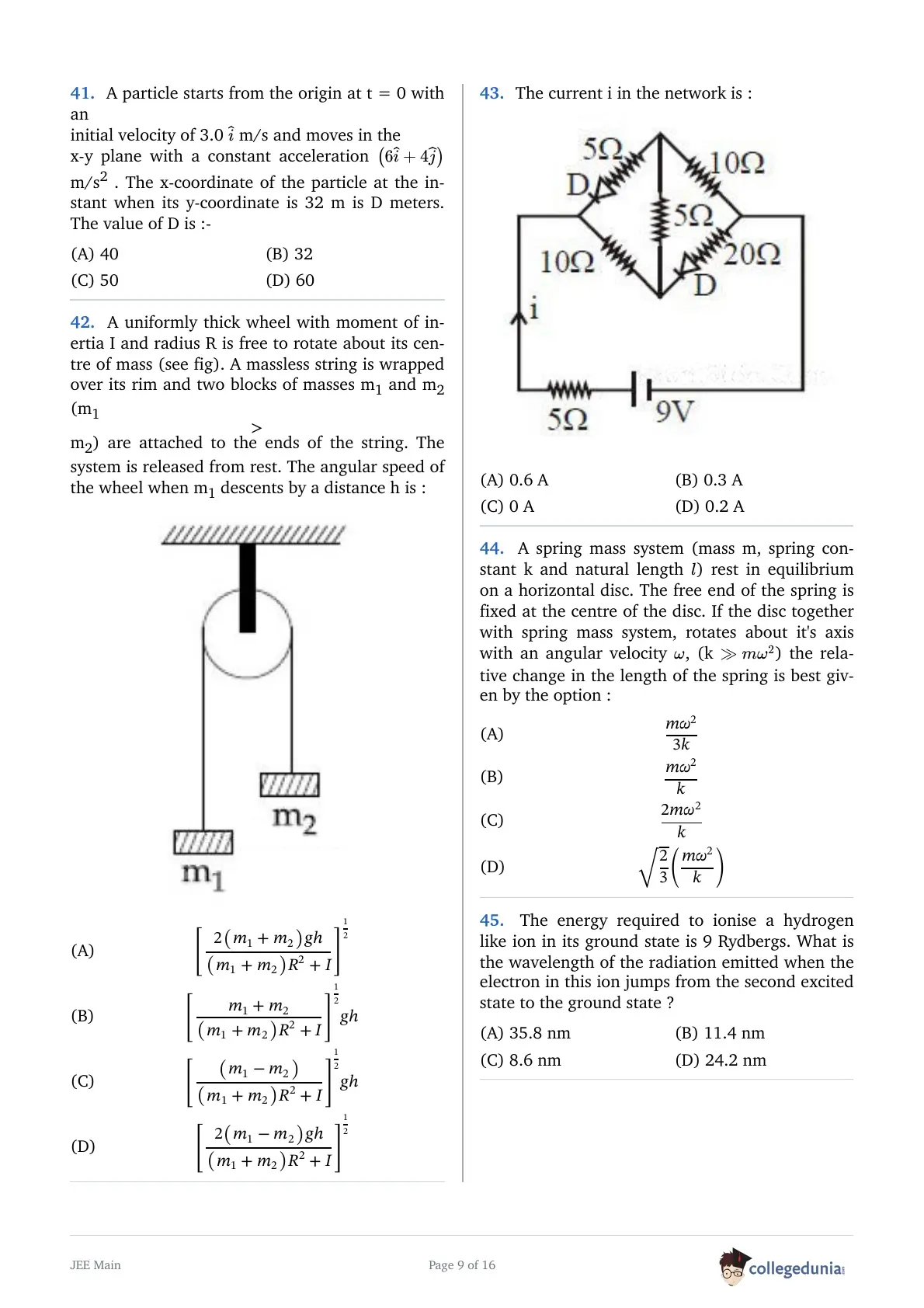
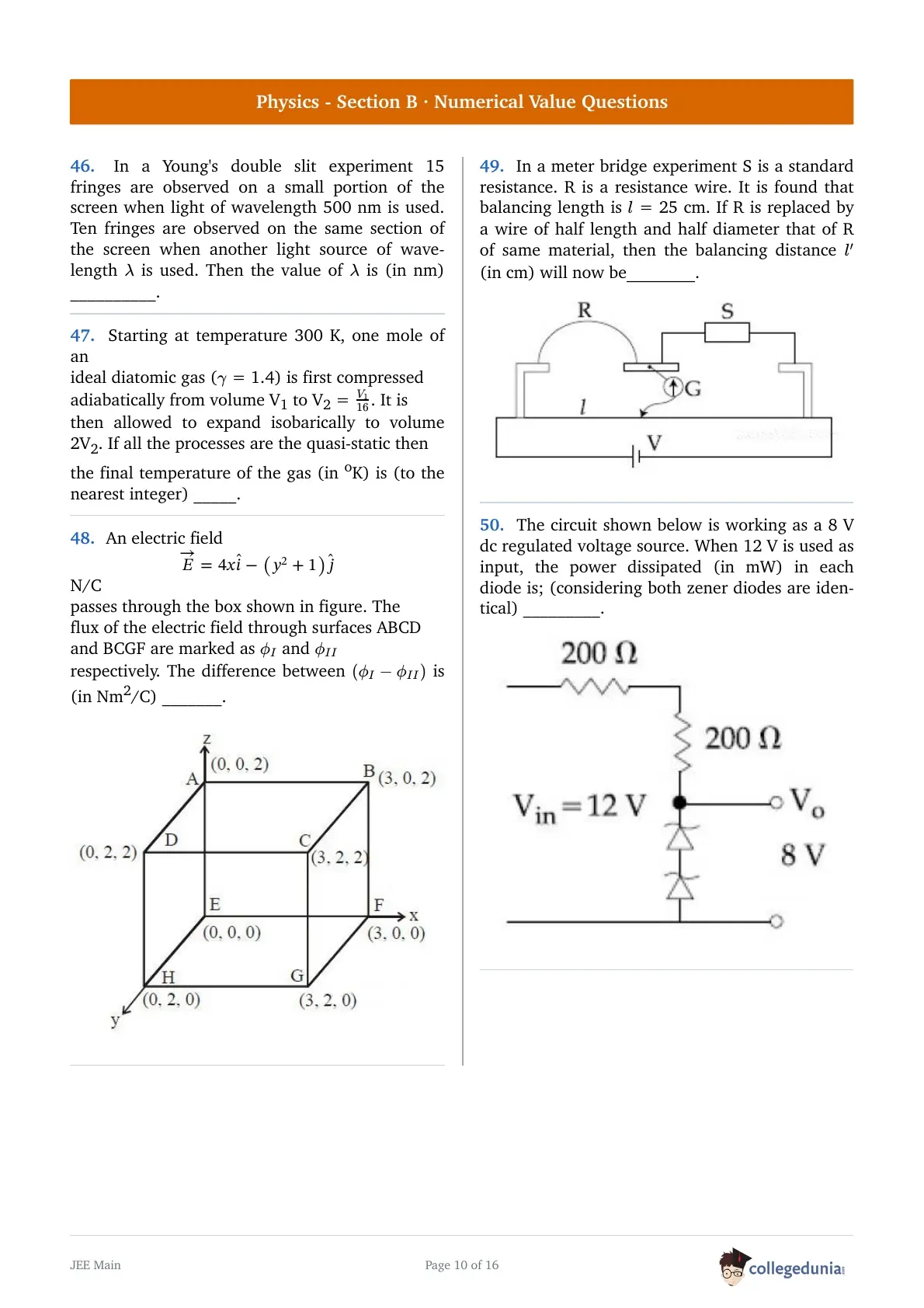
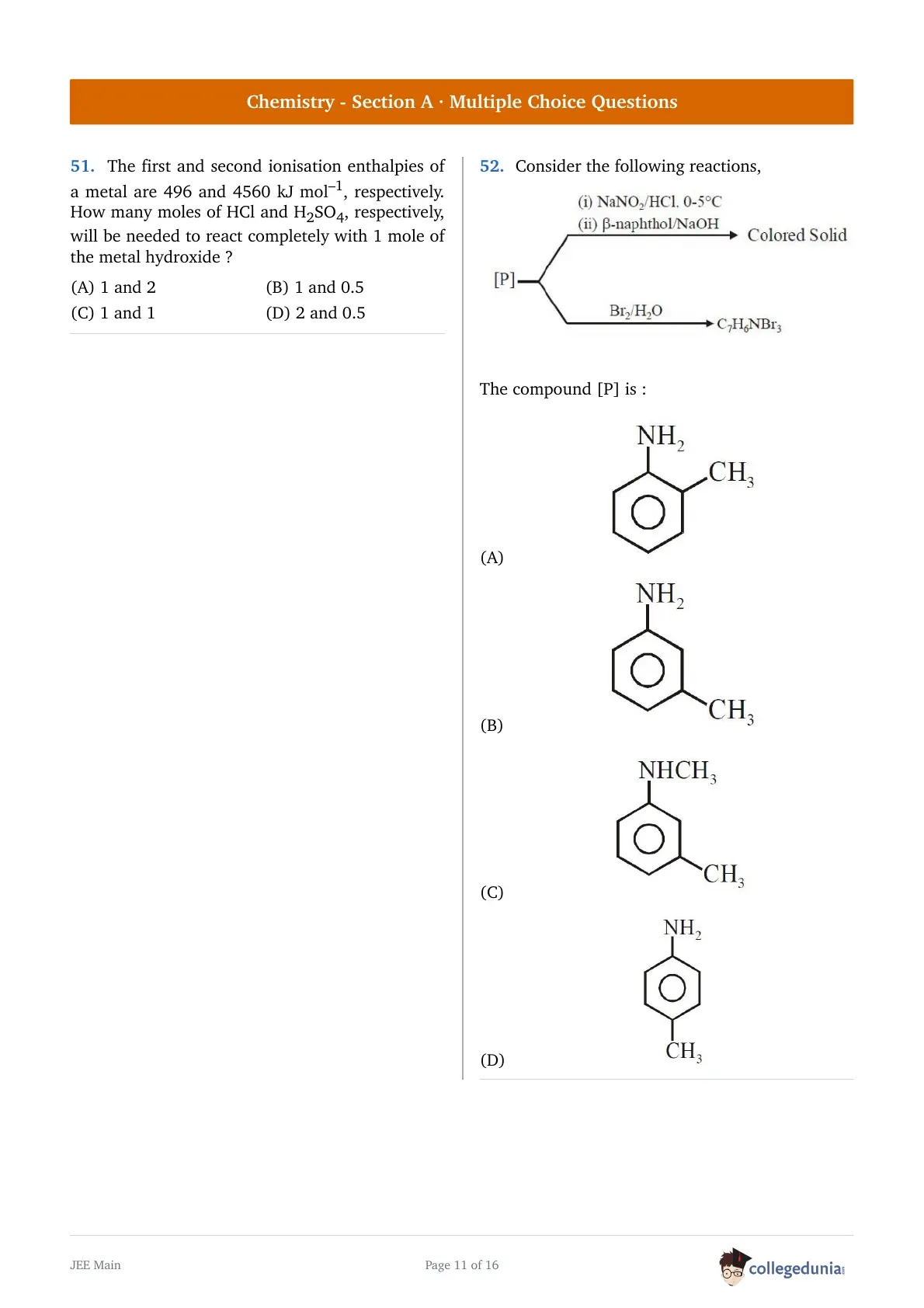
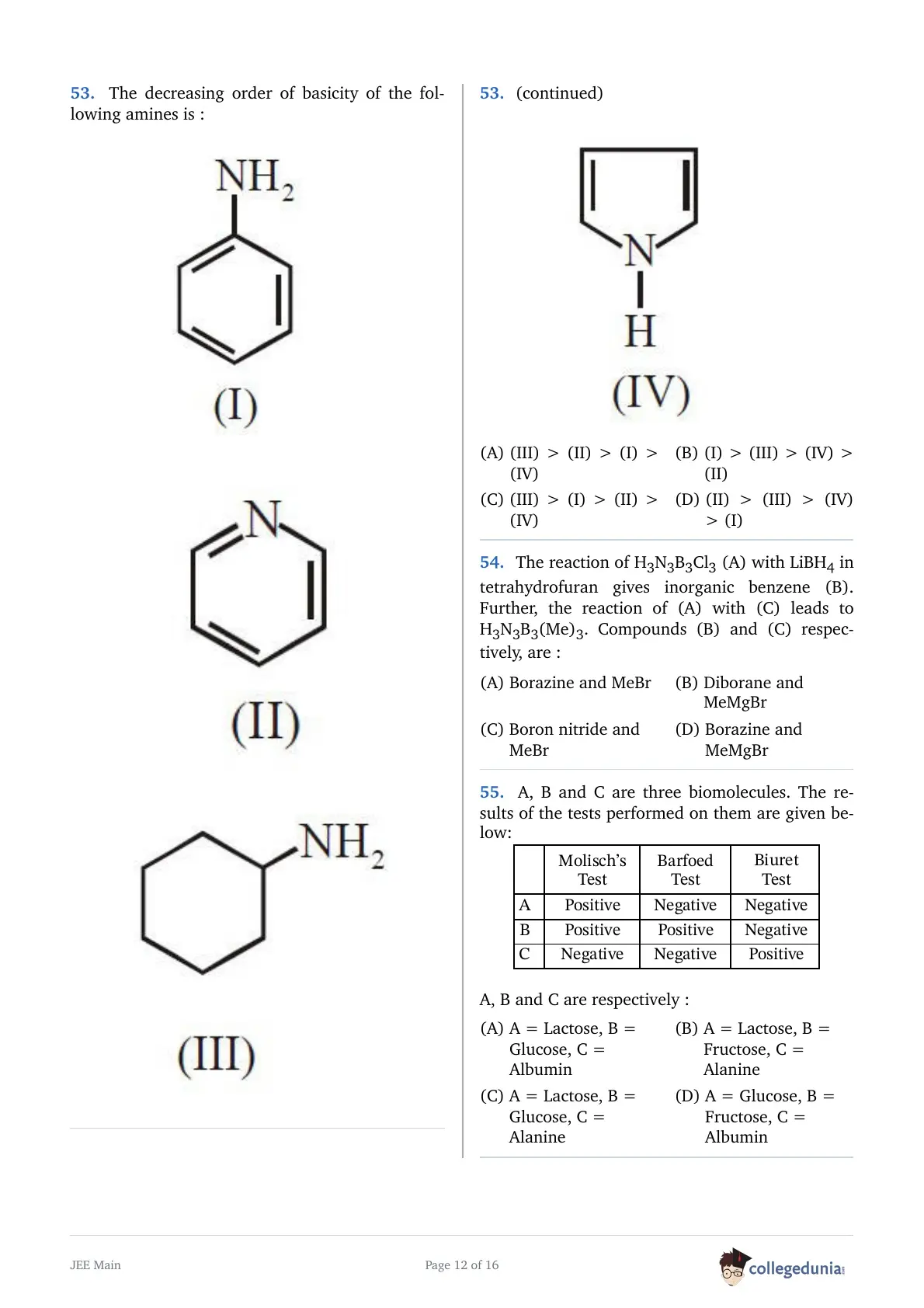
JEE Main 2020 January 9 Shift 2 Questions with Solutions
Mathematics - Section A (Q1 - Q20)
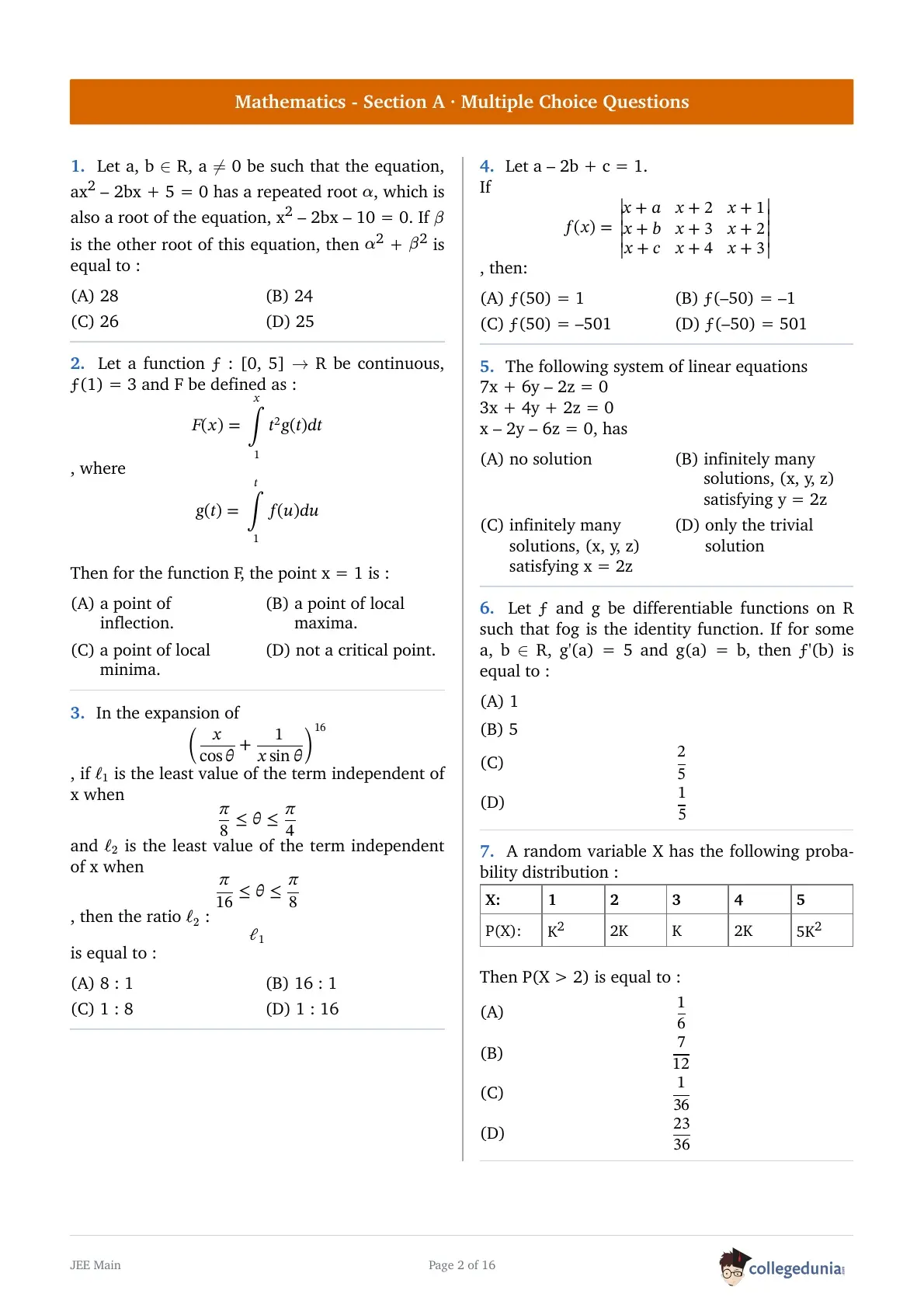
Let a, b \(\in\) R, a \(\ne\) 0 be such that the equation, \(ax^2 - 2bx + 5 = 0\) has a repeated root \(\alpha\), which is also a root of the equation, \(x^2 - 2bx - 10 = 0\). If \(\beta\) is the other root of this equation, then \(\alpha^2 + \beta^2\) is equal to :
Let a function \(f : [0, 5] \to R\) be continuous, \(f(1) = 3\) and F be defined as :
\(F(x) = \int_1^x t^2 g(t)\,dt\), where \(g(t) = \int_1^t f(u)\,du\).
Then for the function F, the point x = 1 is :
In the expansion of \(\left(\frac{x}{\cos\theta} + \frac{1}{x\sin\theta}\right)^{16}\), if \(\ell_1\) is the least value of the term independent of x when \(\frac{\pi}{8} \le \theta \le \frac{\pi}{4}\) and \(\ell_2\) is the least value of the term independent of x when \(\frac{\pi}{16} \le \theta \le \frac{\pi}{8}\), then the ratio \(\ell_2 : \ell_1\) is equal to :
Let \(a - 2b + c = 1\).
If \(f(x) = \begin{vmatrix} x + a & x + 2 & x + 1 \\ x + b & x + 3 & x + 2 \\ x + c & x + 4 & x + 3 \end{vmatrix}\), then:
The following system of linear equations
\(7x + 6y - 2z = 0\)
\(3x + 4y + 2z = 0\)
\(x - 2y - 6z = 0\), has
Let f and g be differentiable functions on R such that fog is the identity function. If for some a, b \(\in\) R, \(g'(a) = 5\) and \(g(a) = b\), then \(f'(b)\) is equal to :
| X: | 1 | 2 | 3 | 4 | 5 |
| P(X): | \(K^2\) | \(2K\) | \(K\) | \(2K\) | \(5K^2\) |
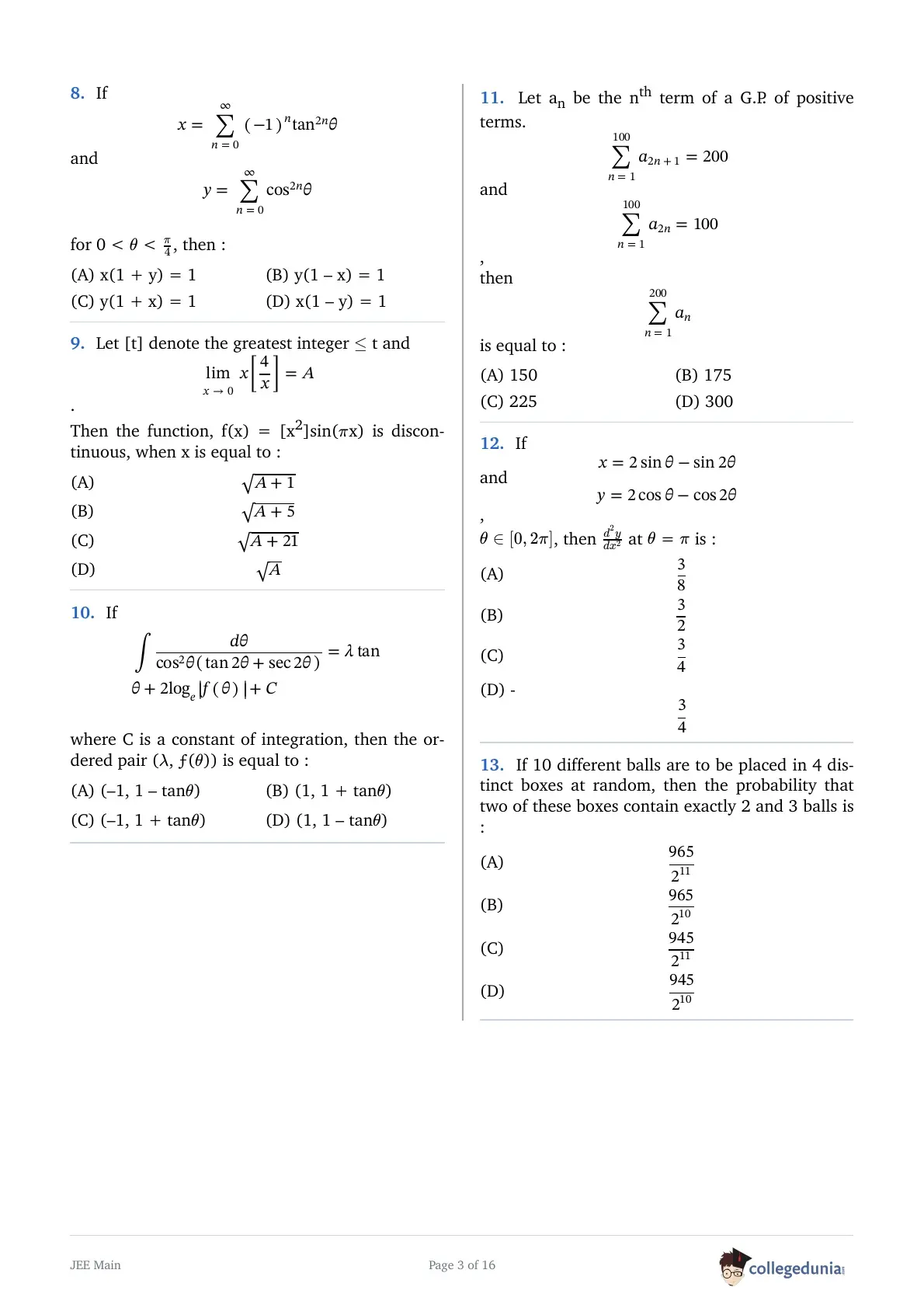
If \(x = \sum_{n=0}^{\infty} (-1)^n \tan^{2n}\theta\) and \(y = \sum_{n=0}^{\infty} \cos^{2n}\theta\) for \(0 \lt \theta \lt \frac{\pi}{4}\), then :
Let [t] denote the greatest integer \(\le t\) and \(\lim_{x \to 0} x\left[\frac{4}{x}\right] = A\).
Then the function, \(f(x) = [x^2]\sin(\pi x)\) is discontinuous, when x is equal to :
If \(\int \frac{d\theta}{\cos^2\theta\,(\tan 2\theta + \sec 2\theta)} = \lambda \tan\theta + 2\log_e |f(\theta)| + C\) where C is a constant of integration, then the ordered pair \((\lambda, f(\theta))\) is equal to :
Let \(a_n\) be the \(n^{th}\) term of a G.P. of positive terms. If \(x=\displaystyle \sum_{n=1}^{100}a_{2n+1}=200\) and \(x=\displaystyle \sum_{n=1}^{100}a_{2n}=100\), \(x=\displaystyle \sum_{n=1}^{200}a_n\) is equal to :
If \(x = 2\sin\theta - \sin 2\theta\) and \(y = 2\cos\theta - \cos 2\theta\), \(\theta \in [0, 2\pi]\), then \(\frac{d^2y}{dx^2}\) at \(\theta = \pi\) is :
If \(12\) identical balls are to be placed in \(3\) different boxes, then the probability that one of the boxes contains excatly \(3\) balls, is
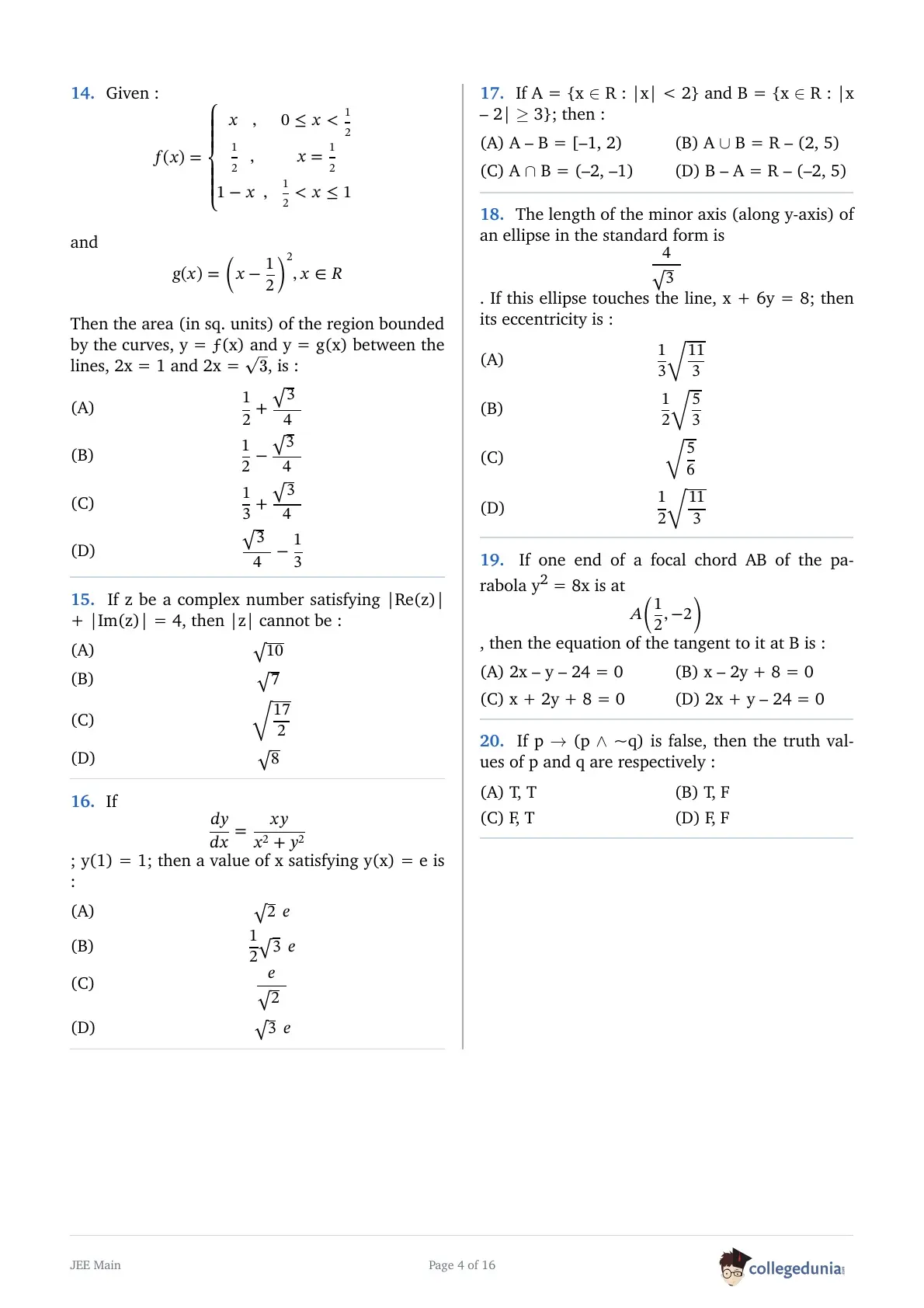
Given : \(f(x) = \begin{cases} x, & 0 \le x \lt \frac{1}{2} \\ \frac{1}{2}, & x = \frac{1}{2} \\ 1 - x, & \frac{1}{2} \lt x \le 1 \end{cases}\) and \(g(x) = \left(x - \frac{1}{2}\right)^2,\ x \in R\).
Then the area (in sq. units) of the region bounded by the curves, \(y = f(x)\) and \(y = g(x)\) between the lines, \(2x = 1\) and \(2x = \sqrt{3}\), is :
If \(z\) be a complex number satisfying \(\left|Re\left(z\right)\right|+\left|Im\left(z\right)\right|=4,\) then \(|z|\) cannot be :
If \(\frac{dy}{dx}=\frac{xy}{x^{2}+y^{2}}; y\left(1\right)=1;\) then a value of \(x\) satisfying \(y(x) = e\) is :
If \(A = \{x \in \mathbb{R} : |x| \lt 2\}\) and \(B = \{x \in \mathbb{R} : |x - 2| \ge 3\}\); then :
The length of the minor axis (along y-axis) of an ellipse in the standard form is \(\frac{4}{\sqrt{3}}\). If this ellipse touches the line, \(x + 6y = 8\); then its eccentricity is :
If one end of a focal chord of the parabola, \(y^2 = 16x\) is at \((1, 4),\) then the length of this focal chord is
If \(p \rightarrow (p \wedge \sim q)\) is false, then the truth values of p and q are respectively :
Mathematics - Section B (Q21 - Q25)
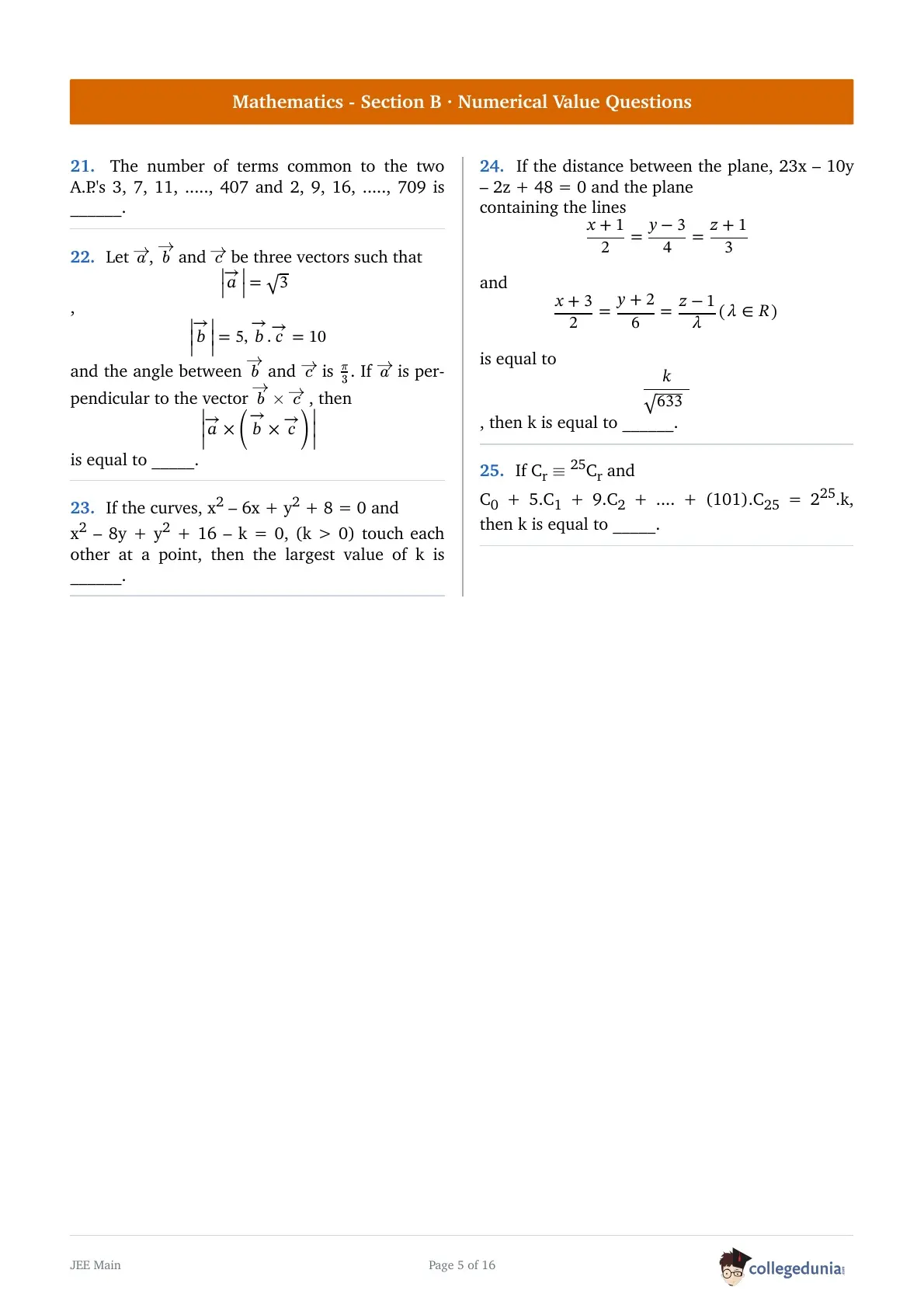
The number of terms common to the two A.P.'s \(3, 7, 11, \ldots, 407\) and \(2, 9, 16, \ldots, 709\) is ______.
Let \(\vec{a}\), \(\vec{b}\) and \(\vec{c}\) be three vectors such that \(|\vec{a}| = \sqrt{3}\), \(|\vec{b}| = 5\), \(\vec{b} \cdot \vec{c} = 10\) and the angle between \(\vec{b}\) and \(\vec{c}\) is \(\frac{\pi}{3}\). If \(\vec{a}\) is perpendicular to the vector \(\vec{b} \times \vec{c}\), then \(|\vec{a} \times (\vec{b} \times \vec{c})|\) is equal to ______.
If the curves, \(x^2 - 6x + y^2 + 8 = 0\) and \(x^2 - 8y + y^2 + 16 - k = 0\), \((k \gt 0)\) touch each other at a point, then the largest value of k is ______.
If the distance between the plane, \(23x - 10y - 2z + 48 = 0\) and the plane containing the lines
\(\frac{x + 1}{2} = \frac{y - 3}{4} = \frac{z + 1}{3}\)
and
\(\frac{x + 3}{2} = \frac{y + 2}{6} = \frac{z - 1}{\lambda}\) \((\lambda \in R)\)
is equal to \(\frac{k}{\sqrt{633}}\), then k is equal to ______.
If \(C_r \equiv {}^{25}C_r\) and \(C_0 + 5 \cdot C_1 + 9 \cdot C_2 + \ldots + (101) \cdot C_{25} = 2^{25} \cdot k\), then k is equal to ______.
Physics - Section A (Q26 - Q45)
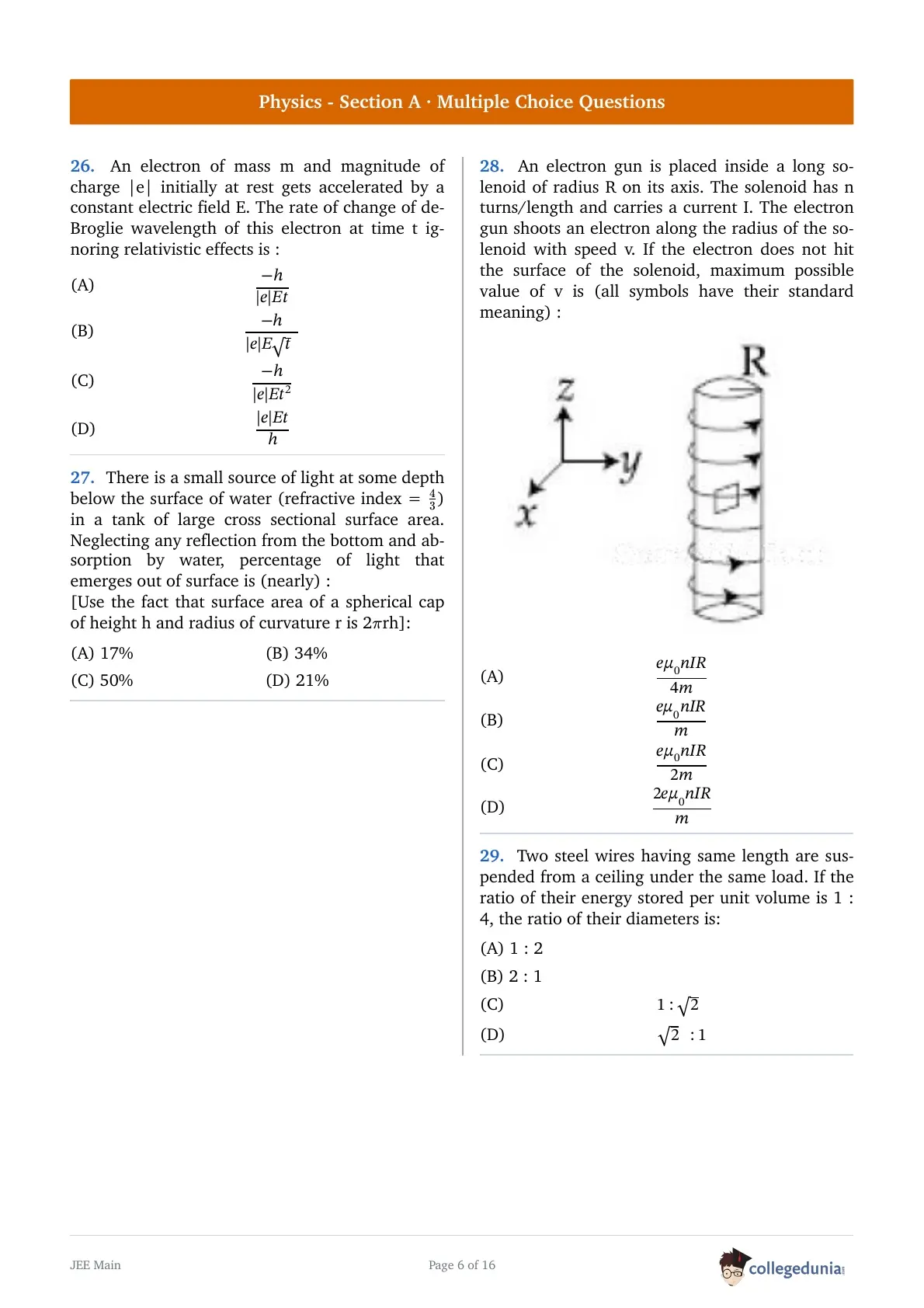
An electron of mass m and magnitude of charge \(|e|\) initially at rest gets accelerated by a constant electric field E. The rate of change of de-Broglie wavelength of this electron at time t ignoring relativistic effects is :
There is a small source of light at some depth below the surface of water (refractive index = \(\frac{4}{3}\)) in a tank of large cross sectional surface area. Neglecting any reflection from the bottom and absorption by water, percentage of light that emerges out of surface is (nearly) :
[Use the fact that surface area of a spherical cap of height h and radius of curvature r is \(2\pi rh\)]:
An electron gun is placed inside a long solenoid of radius R on its axis. The solenoid has n turns/length and carries a current I. The electron gun shoots an electron along the radius of the solenoid with speed v. If the electron does not hit the surface of the solenoid, maximum possible value of v is (all symbols have their standard meaning) :
Two steel wires having same length are suspended from a ceiling under the same load. If the ratio of their energy stored per unit volume is 1 : 4, the ratio of their diameters is:
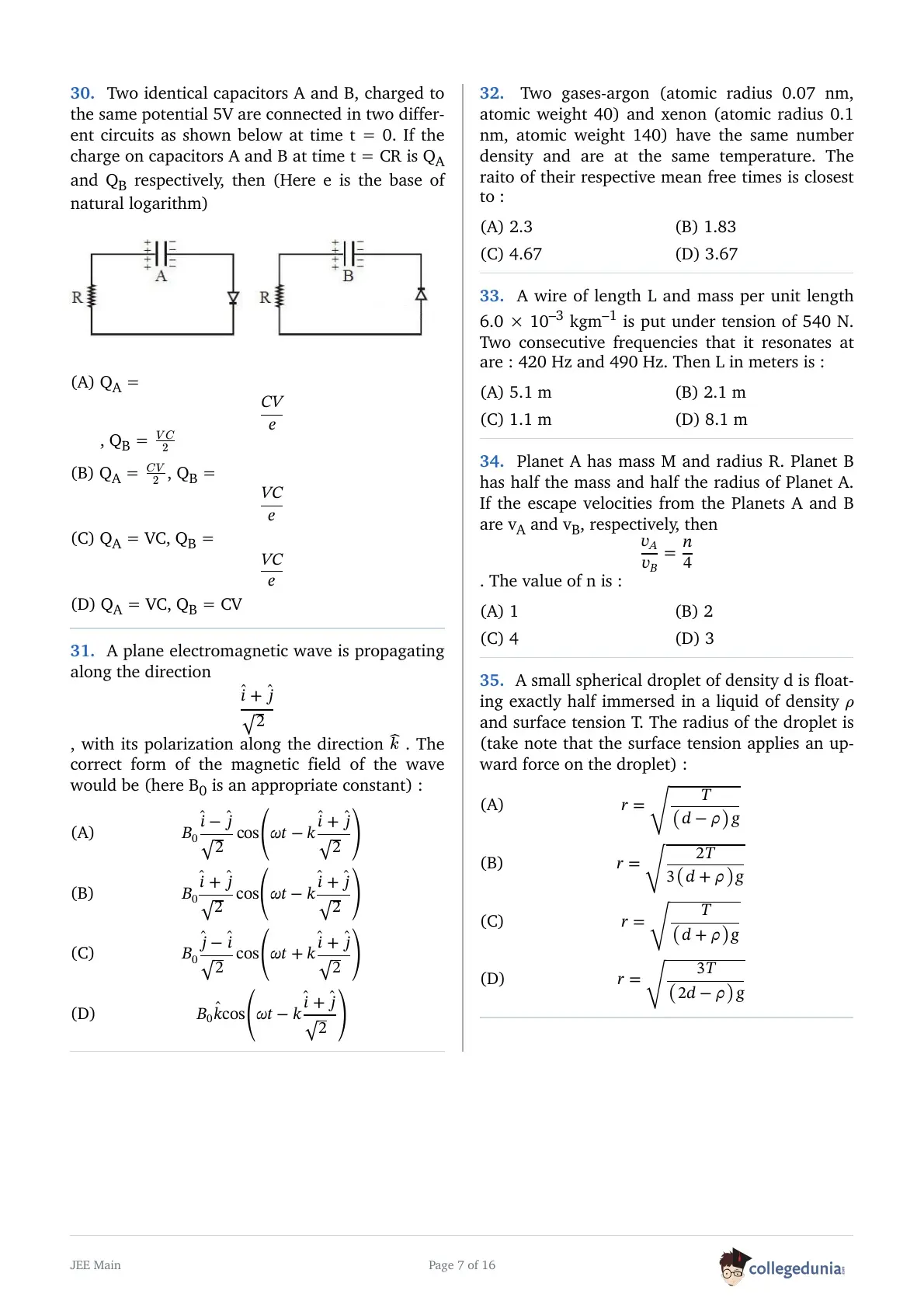
Two identical capacitors \(A\) and \(B\), charged to the same potential \(5V\) are connected in two different circuits as shown below at time \(t = 0\). If the charge on capacitors \(A\) and \(B\) at time \(t = CR\) is \(Q_A\) and \(Q_B\) respectively, then (Here e is the base of natural logarithm)
A plane electromagnetic wave is propagating along the direction \(\frac{\hat{i}+\hat{i}}{\sqrt{2}},\) with its polarization along the direction \(\hat{k}.\) The correct form of the magnetic field of the wave would be (here \(B_0\) is an appropriate constant):
Two gases - argon (atomic radius \(0.07\, nm\), atomic weight \(40\)) and xenon (atomic radius \(0.1\, nm\), atomic weight \(140\)) have the same number density and are at the same temperature. The ratio of their respective mean free times is closest to :
A wire of length \(L\) and mass per unit length \(6.0 \times 10^{-3} \,kgm^{-1}\) is put under tension of \(540\, N\). Two consecutive frequencies that it resonates at are: \(420\, Hz\) and \(490 \,Hz\). Then \(L\) in meters is :
Planet \(A\) has mass \(M\) and radius \(R\). Planet \(B\) has half the mass and half the radius of Planet \(A\). If the escape velocities from the Planets \(A\) and \(B\) are \(v_A\) and \(v_B\), respectively, then \(\frac{v_{A}}{v_{B}}=\frac{n}{4}\). The value of \(n\) is :
A small spherical droplet of density \(d\) is floating exactly half immersed in a liquid of density \(\rho\) and surface tension \(T\). The radius of the droplet is (take note that the surface tension applies an upward force on the droplet):
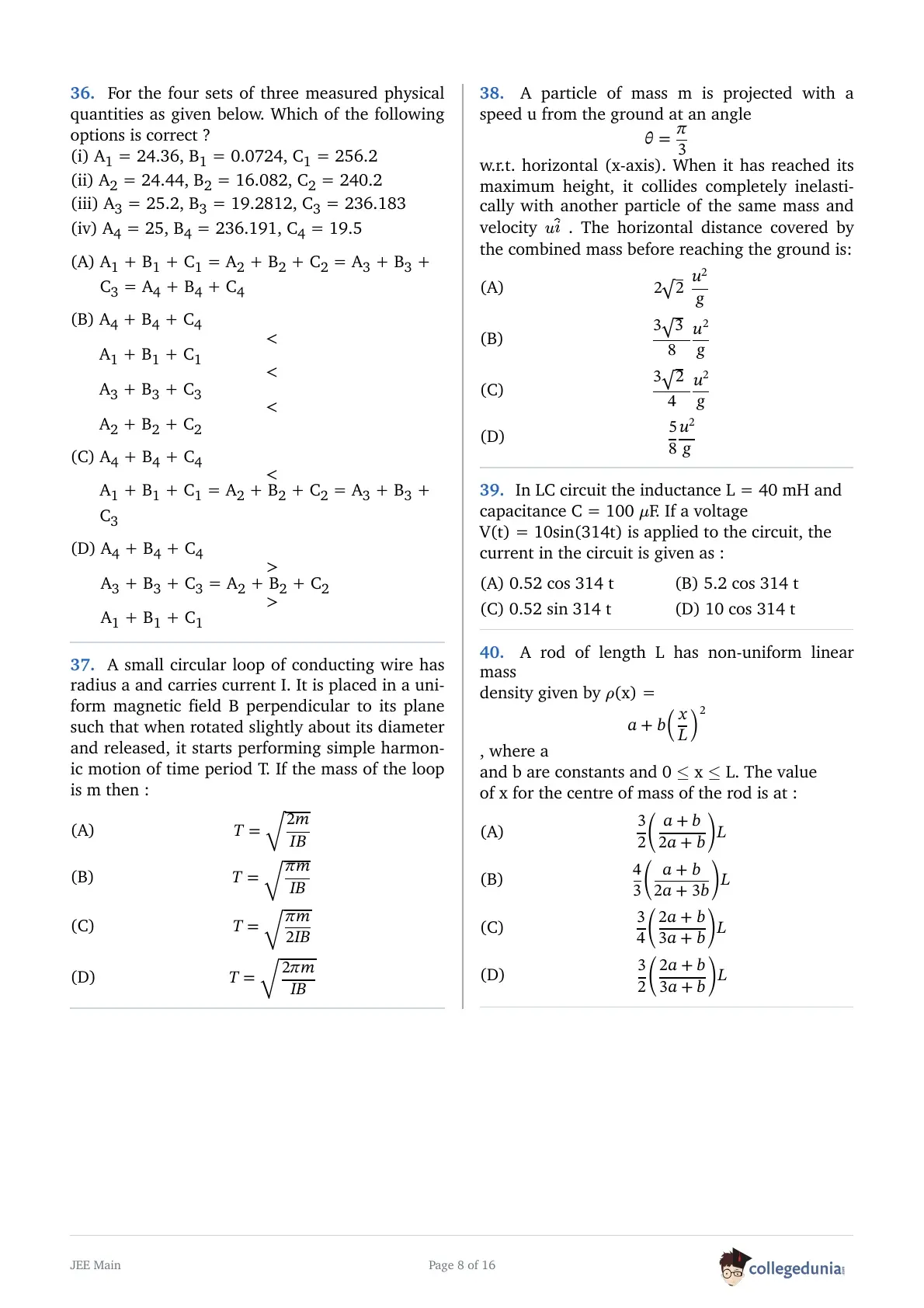
For the four sets of three measured physical quantities as given below. Which of the following options is correct ?
(i) \(A_1 = 24.36,\ B_1 = 0.0724,\ C_1 = 256.2\)
(ii) \(A_2 = 24.44,\ B_2 = 16.082,\ C_2 = 240.2\)
(iii) \(A_3 = 25.2,\ B_3 = 19.2812,\ C_3 = 236.183\)
(iv) \(A_4 = 25,\ B_4 = 236.191,\ C_4 = 19.5\)
A small circular loop of conducting wire has radius \(a\) and carries current \(I\). It is placed in a uniform magnetic field \(B\) perpendicular to its plane such that when rotated slightly about its diameter and released, it starts performing simple harmonic motion of time period \(T\). If the mass of the loop is \(m\) then :
A particle of mass m is projected with a speed \(u\) from the ground at an angle \(\theta=\frac{\pi}{3}\) w.r.t. horizontal (x-axis). When it has reached its maximum height, it collides completely inelastically with another particle of the same mass and velocity \(u\,\hat{i}\). The horizontal distance covered by the combined mass before reaching the ground is :
Find average power in electric circuit if source voltage \((V) = 20\;sin(100\;⍵t)\) and current in the circuit \((I) = 2\;sin\;\bigg(100⍵t + \frac{\pi}{3}\bigg)\)
A rod of length \(L\) has non-uniform linear mass density given by \(\rho\left(x\right)=a+b\left(\frac{x}{L}\right)^{2},\) where a and b are constants and \(0 \le x \le L.\) The value of \(x\) for the centre of mass of the rod is a t :
A particle starts from the origin at \(t = 0\) with an initial velocity of \(3.0\,\hat{i}\) m/s and moves in the x-y plane with a constant acceleration \(\left(6\hat{i} + 4\hat{j}\right)\) m/s\(^2\). The x-coordinate of the particle at the instant when its y-coordinate is 32 m is \(D\) meters. The value of \(D\) is :-
A uniformly thick wheel with moment of inertia \(I\) and radius \(R\) is free to rotate about its centre of mass (see fig). A massless string is wrapped over its rim and two blocks of masses \(m_1\) and \(m_2\) (\(m_1 \gt m_2\)) are attached to the ends of the string. The system is released from rest. The angular speed of the wheel when \(m_1\) descents by a distance \(h\) is :
The current \(i\) in the network is :
A spring mass system (mass \(m\), spring constant \(k\) and natural length \(l\)) rest in equilibrium on a horizontal disc. The free end of the spring is fixed at the centre of the disc. If the disc together with spring mass system, rotates about it's axis with an angular velocity \(\omega\), (\(k \gg m\omega^2\)) the relative change in the length of the spring is best given by the option :
The energy required to ionise a hydrogen like ion in its ground state is 9 Rydbergs. What is the wavelength of the radiation emitted when the electron in this ion jumps from the second excited state to the ground state ?
Physics - Section B (Q46 - Q50)
In a Young's double slit experiment 15 fringes are observed on a small portion of the screen when light of wavelength 500 nm is used. Ten fringes are observed on the same section of the screen when another light source of wavelength \(\lambda\) is used. Then the value of \(\lambda\) is (in nm) __________.
Starting at temperature 300 K, one mole of an ideal diatomic gas (\(\gamma = 1.4\)) is first compressed adiabatically from volume \(V_1\) to \(V_2 = \frac{V_1}{16}\). It is then allowed to expand isobarically to volume \(2V_2\). If all the processes are the quasi-static then the final temperature of the gas (in \(^o\)K) is (to the nearest integer) _____.
An electric field \(\overrightarrow{E} = 4x\,\hat{i} - (y^2 + 1)\hat{j}\) N/C passes through the box shown in figure. The flux of the electric field through surfaces ABCD and BCGF are marked as \(\phi_I\) and \(\phi_{II}\) respectively. The difference between \((\phi_I - \phi_{II})\) is (in Nm\(^2\)/C) _______.
In a meter bridge experiment S is a standard resistance. R is a resistance wire. It is found that balancing length is \(l\) = 25 cm. If R is replaced by a wire of half length and half diameter that of R of same material, then the balancing distance \(l'\) (in cm) will now be________.
The circuit shown below is working as a 8 V dc regulated voltage source. When 12 V is used as input, the power dissipated (in mW) in each diode is; (considering both zener diodes are identical) _________.
Chemistry - Section A (Q51 - Q70)
The first and second ionisation enthalpies of a metal are 496 and 4560 kJ mol\(^{-1}\), respectively. How many moles of HCl and \(\mathrm{H_2SO_4}\), respectively, will be needed to react completely with 1 mole of the metal hydroxide ?
Consider the following reactions,
The compound [P] is :
- (1)
![]()
- (2)
![]()
- (3)
![]()
- (4)
![]()


The decreasing order of basicity of the following amines is :
The reaction of \(\mathrm{H_3N_3B_3Cl_3}\) (A) with \(\mathrm{LiBH_4}\) in tetrahydrofuran gives inorganic benzene (B). Further, the reaction of (A) with (C) leads to \(\mathrm{H_3N_3B_3(Me)_3}\). Compounds (B) and (C) respectively, are :
| Molisch's Test | Barfoed Test | Biuret Test | |
| A | Positive | Negative | Negative |
| B | Positive | Positive | Negative |
| C | Negative | Negative | Positive |
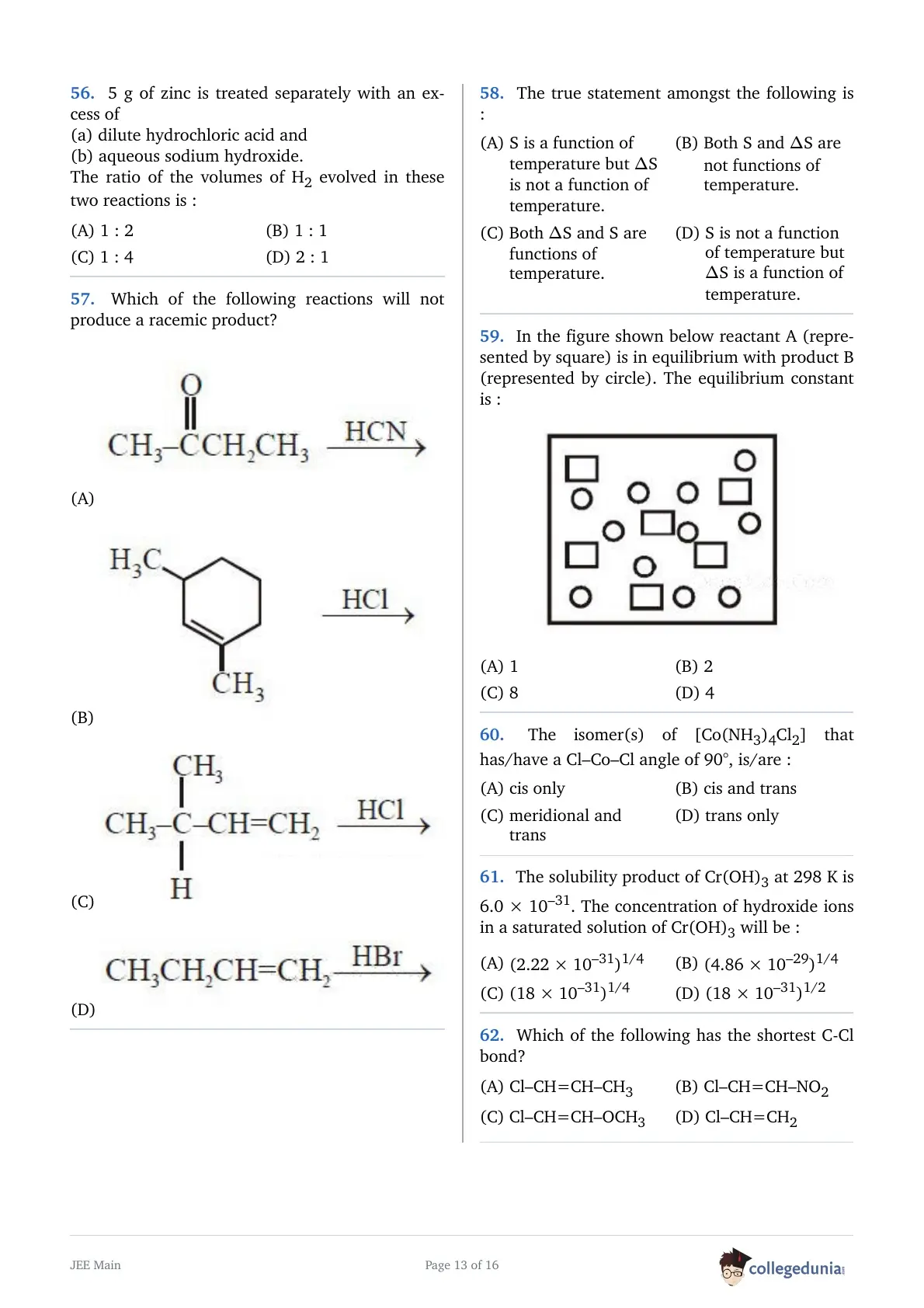
5 g of zinc is treated separately with an excess of
(a) dilute hydrochloric acid and
(b) aqueous sodium hydroxide.
The ratio of the volumes of \(\mathrm{H_2}\) evolved in these two reactions is :
Which of the following reactions will not produce a racemic product?
- (1)
![]()
- (2)
![]()
- (3)
![]()
- (4)
![]()


The true statement amongst the following is :
In the figure shown below reactant A (represented by square) is in equilibrium with product B (represented by circle). The equilibrium constant is :
The isomer(s) of \(\mathrm{[Co(NH_3)_4Cl_2]}\) that has/have a Cl-Co-Cl angle of 90\(^\circ\), is/are :
The solubility product of \(Cr(OH)_3\) at \(298 \,K\) is \(6.0 \times 10^{-31}.\) The concentration of hydroxide ions in a saturated solution of \(Cr(OH)_3\) will be :
Which of the following has the shortest C-Cl bond?


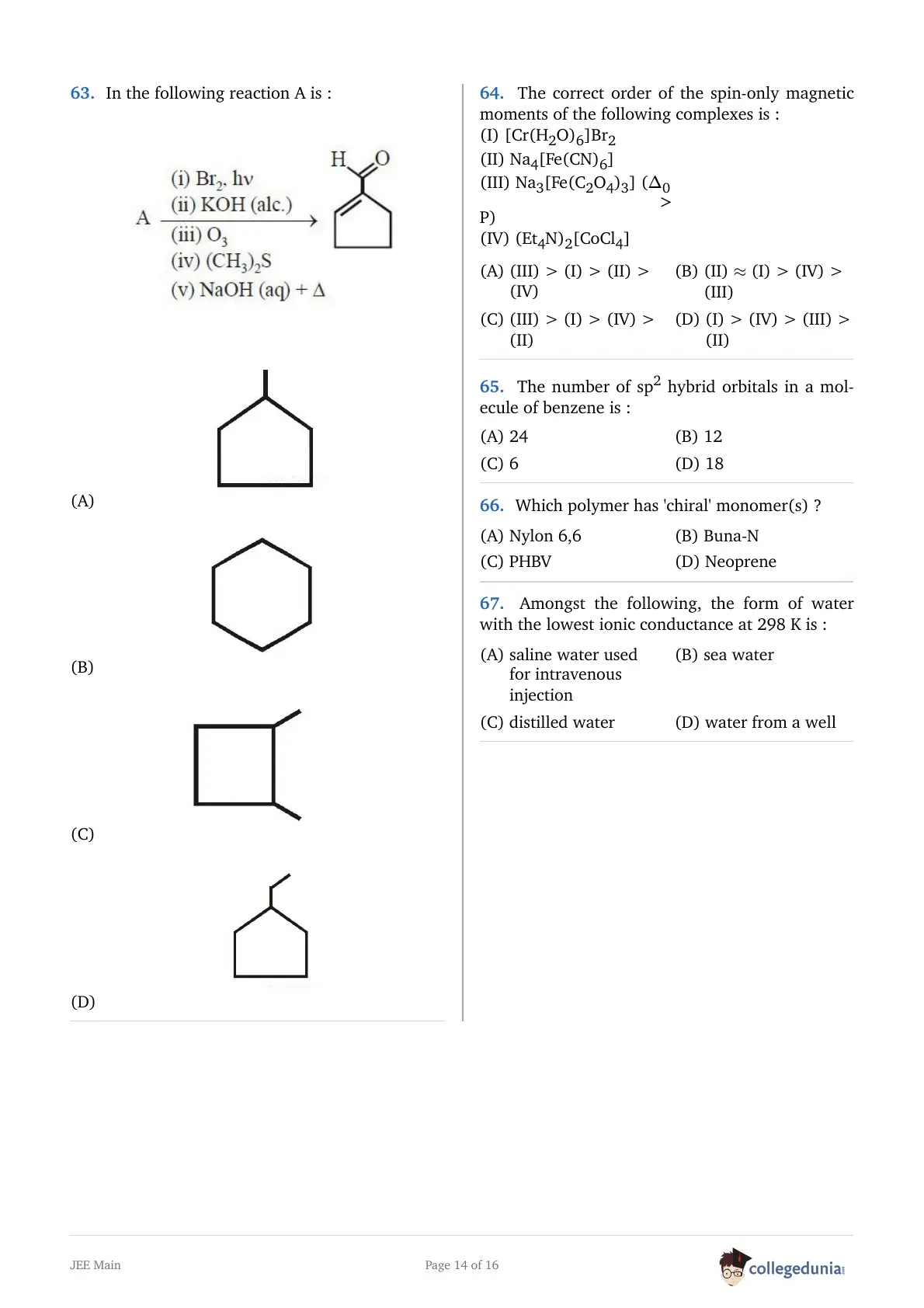
The correct order of the spin-only magnetic moments of the following complexes is : \((I)\, [Cr(H_2O)_6]Br_2\) \((II)\, Na_4[Fe(CN)_6]\) \((III)\, Na_3[Fe(C_2O_4)_3] (\Delta_0 > P)\) \((IV)\, (Et_4N)_2[CoCl_4]\)
The number of \(sp^2\) hybrid orbitals in a molecule of benzene is :
Which polymer has 'chiral' monomer(s) ?
Amongst the following, the form of water with the lowest ionic conductance at 298 K is :
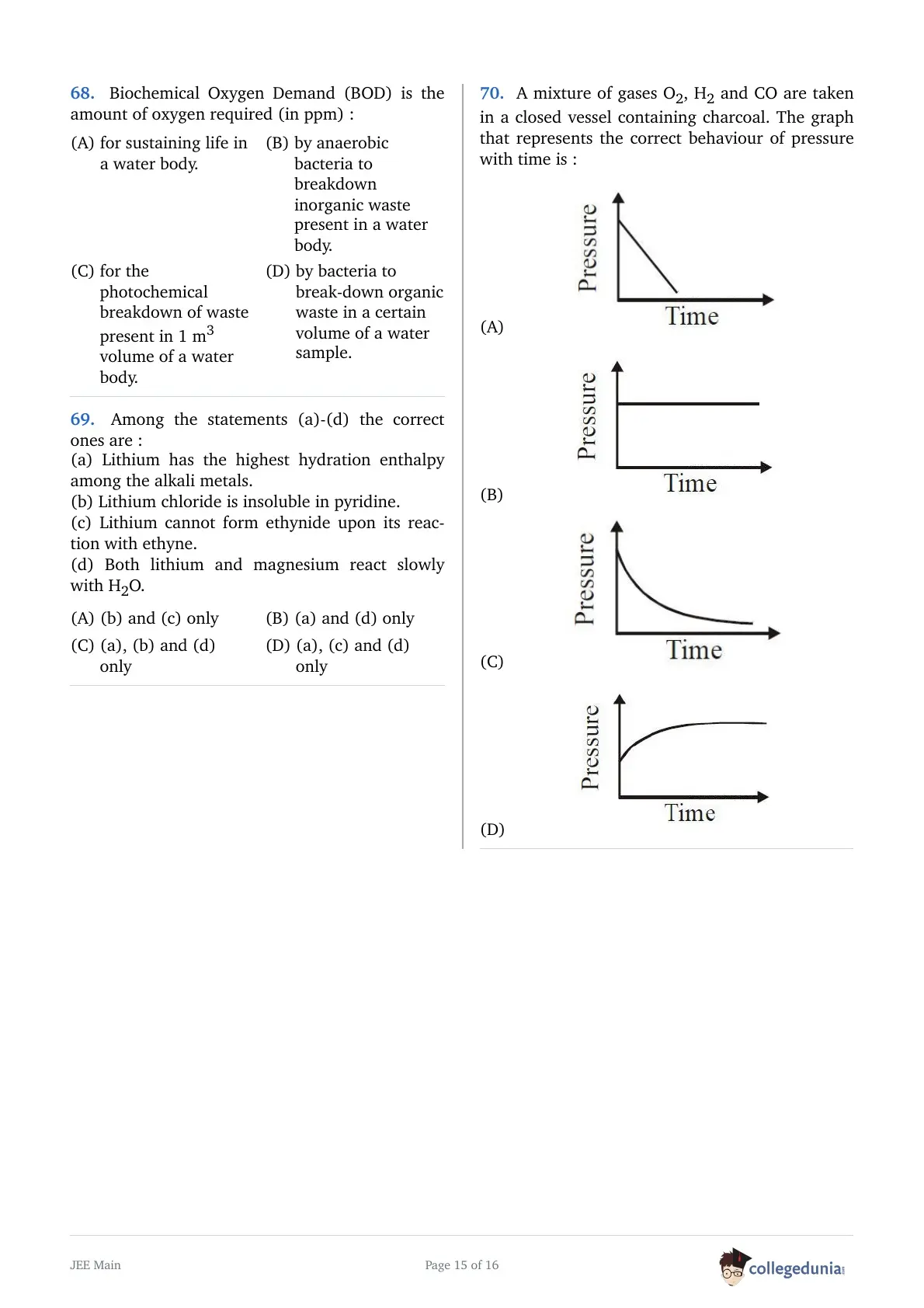
Biochemical Oxygen Demand (BOD) value can be a measure of water pollution caused by the organic matter. Which of the following statements is correct ?
Among the statements (A)-(D), the correct ones are : (a) Lithium has the highest hydration enthalpy among the alkali metals. (b) Lithium chloride is insoluble in pyridine. (c) Lithium cannot form ethynide upon its reaction with ethyne. (d) Both lithium and magnesium react slowly with \(H_2O\) .
A mixture of gases \(\mathrm{O_2}\), \(\mathrm{H_2}\) and \(\mathrm{CO}\) are taken in a closed vessel containing charcoal. The graph that represents the correct behaviour of pressure with time is :
- (1)
![]()
- (2)
![]()
- (3)
![]()
- (4)
![]()


Chemistry - Section B (Q71 - Q75)
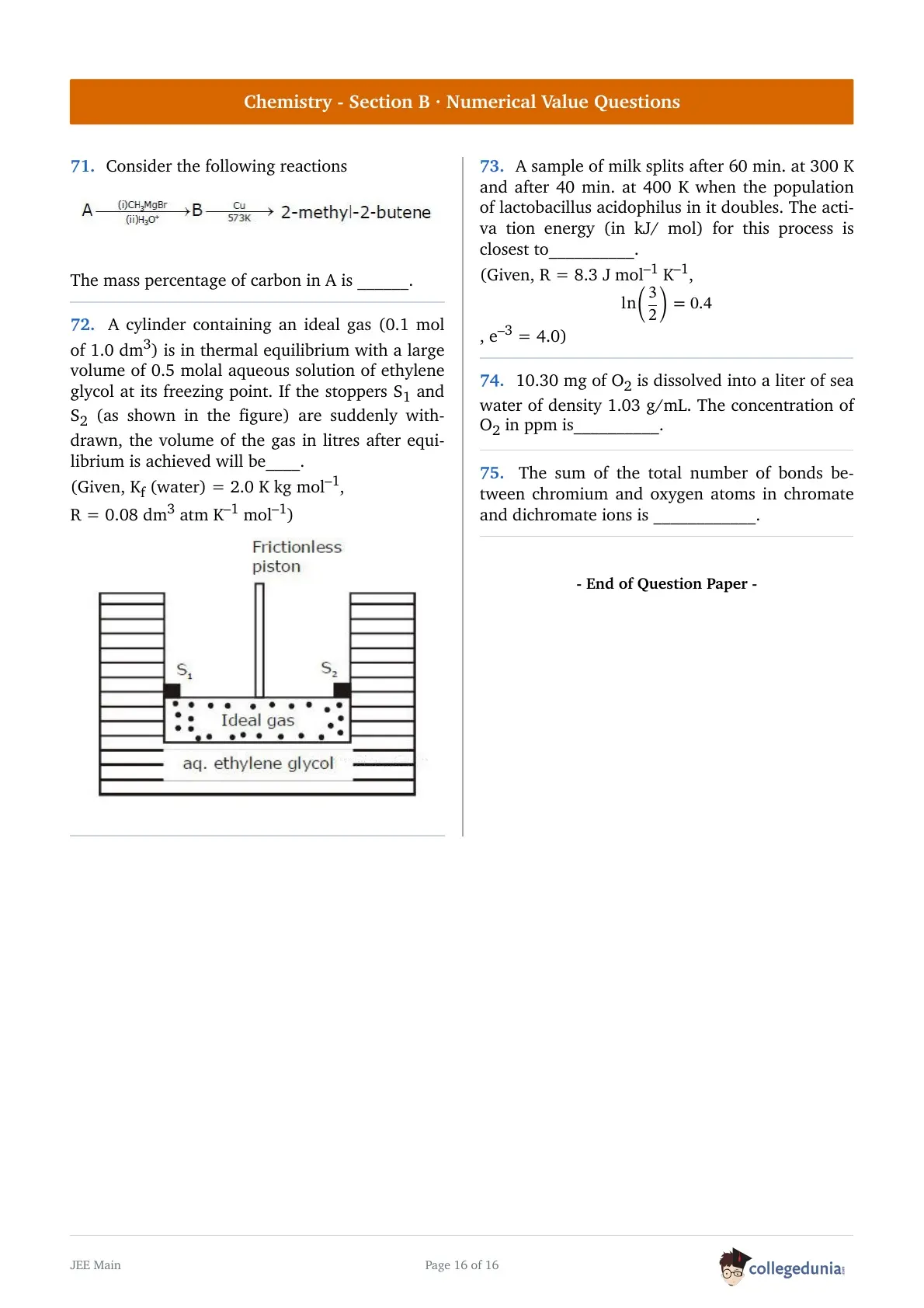
Consider the following reactions
The mass percentage of carbon in A is ______.
A cylinder containing an ideal gas (0.1 mol of 1.0 \(\mathrm{dm^3}\)) is in thermal equilibrium with a large volume of 0.5 molal aqueous solution of ethylene glycol at its freezing point. If the stoppers \(\mathrm{S_1}\) and \(\mathrm{S_2}\) (as shown in the figure) are suddenly withdrawn, the volume of the gas in litres after equilibrium is achieved will be____.
(Given, \(K_f\) (water) = 2.0 K kg \(\mathrm{mol^{-1}}\), \(R = 0.08\ \mathrm{dm^3\ atm\ K^{-1}\ mol^{-1}}\))
A sample of milk splits after 60 min. at 300 K and after 40 min. at 400 K when the population of lactobacillus acidophilus in it doubles. The activation energy (in kJ/mol) for this process is closest to__________.
(Given, \(R = 8.3\ \mathrm{J\ mol^{-1}\ K^{-1}}\), \(\ln\left(\frac{3}{2}\right) = 0.4\), \(e^{-3} = 4.0\))
10.30 mg of \(\mathrm{O_2}\) is dissolved into a liter of sea water of density 1.03 g/mL. The concentration of \(\mathrm{O_2}\) in ppm is__________.
The sum of the total number of bonds between chromium and oxygen atoms in chromate and dichromate ions is ____________.
JEE Main 2020 Exam Pattern and Marking Scheme
| Particulars | Details |
|---|---|
| Exam Mode | Online (Computer-Based Test) |
| Paper | B.E./B.Tech (Paper 1) |
| Duration | 3 hours (180 minutes) |
| Type of Questions | Multiple Choice Questions (MCQs) + Numerical Value Questions |
| Subjects | Mathematics, Physics, Chemistry |
| Total Questions | 75 questions |
| Total Marks | 300 marks |
| Marking Scheme | +4 for correct answer & -1 for incorrect MCQ; no negative marking for Numerical Value Questions |
JEE Main 2020 January 9 Shift 2 Difficulty Level
The paper was rated to be average in terms of difficulty by the test takers.
JEE Main B.E./B.Tech Question Paper January 9, 2020 (Shift 2): Weightage of Topics
The subjectwise weightage of different topics in JEE Main January 8 Shift 2 Question Paper is given below.
Mathematics

| Topics in Mathematics | Number of Questions |
|---|---|
| Binomial Theorem | 2 |
| Complex Numbers | 1 |
| Coordinate Geometry | 3 |
| Differential Calculus | 4 |
| Integral Calculus | 4 |
| Matrix & Determinants | 2 |
| Probability | 1 |
| Sequence & Series | 3 |
| Vector and 3D | 2 |
| Mathematical Reasoning | 1 |
| Quadratic Equation | 1 |
Physics

| Units in Physics | Number of Questions |
|---|---|
| Electrodynamics | 5 |
| Heat & Thermodynamics | 2 |
| Mechanics | 9 |
| Modern Physics | 6 |
| Optics | 2 |
| SHM & Waves | 1 |
Chemistry

| Chemistry Topics | Questions in Shift 2 |
|---|---|
| Chemical Bonding | 3 |
| Environmental chemistry | 1 |
| s-block | 2 |
| p-block | 1 |
| Coordination Compounds | 2 |
| d-block & f-block Elements | 1 |
| General Organic Chemistry- II | 1 |
| General Organic Chemistry- I | 1 |
| Aromatic Compounds | 1 |
| Biomolecules | 1 |
| Organic Reaction Mechanism I | 1 |
| Organic Reaction Mechanism II | 1 |
| Carbonyl compounds | 1 |
| Polymers | 1 |
| Ionic Equilibrium | 1 |
| Thermodynamics and Thermochemistry | 1 |
| Mole Concept | 1 |
| Chemical Kinetics | 1 |
| Electrochemistry | 1 |
| Surface Chemistry | 1 |
| Solid state | 1 |
| Solution & Colligative Properties | 1 |



Comments