




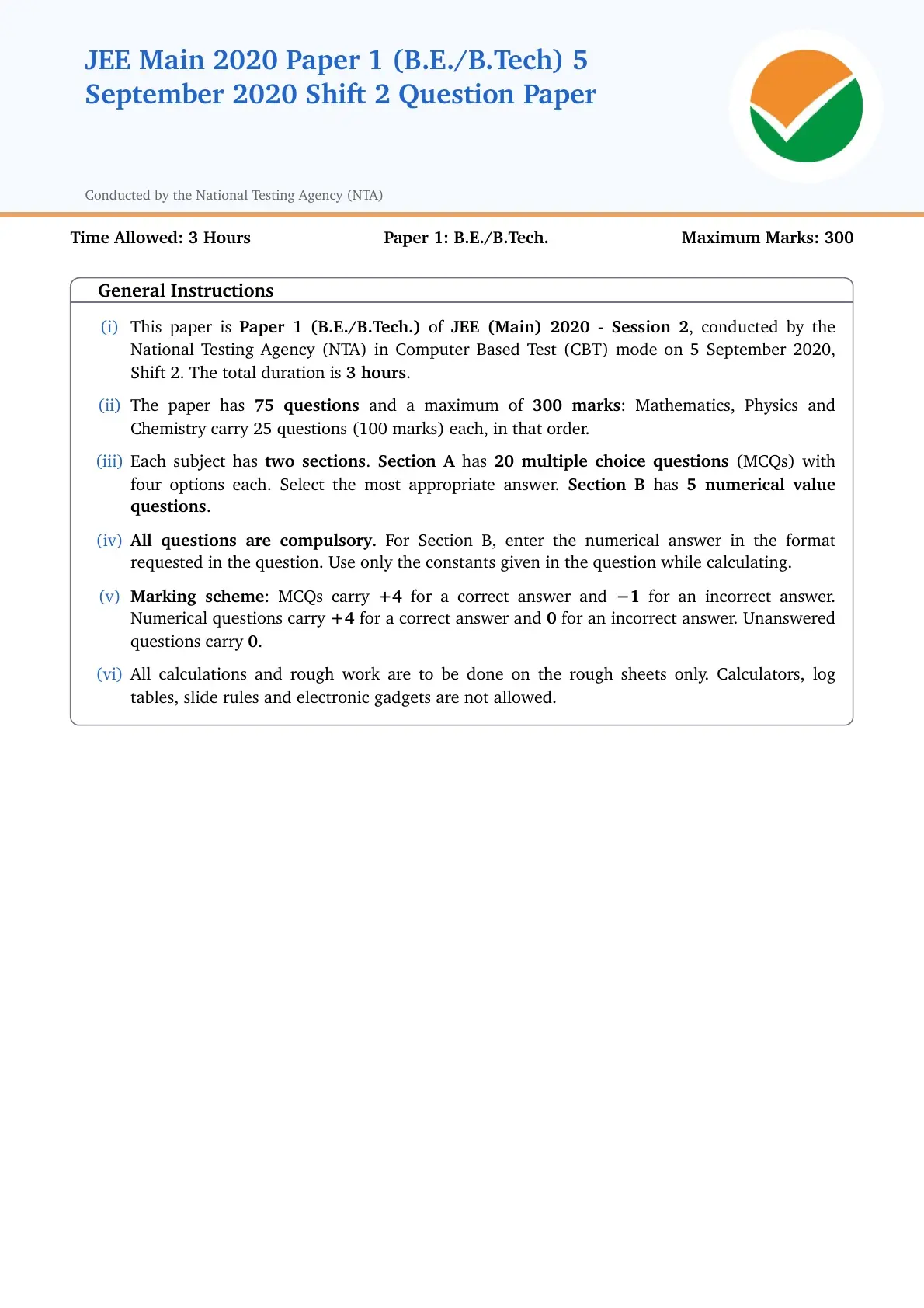
JEE Main 2020 September 5 Shift 2 Question Paper is available here with solutions PDF and detailed solutions for every question. NTA conducted the second shift on September 5, 2020, from 3:00 PM to 6:00 PM. The JEE Main 2020 Paper 1 (B.E./B.Tech) question paper includes the following:
- 75 questions in a 3-hour CBT Mode: 25 each from Mathematics, Physics and Chemistry
- Section A: 20 multiple choice questions (MCQs) per subject, 4 marks each
- Section B: 5 numerical value questions per subject, all compulsory, 4 marks each
- Marking: +4 for a correct answer, -1 for an incorrect MCQ, 0 for an unattempted question; no negative marking for numerical value questions
- Maximum marks: 300 (100 per subject)
JEE Main 2020 September 5 Shift 2 Question Paper with Solution PDF
| NTA Official PDF | CD PDF | CD PDF with Solutions |
|---|---|---|
| Download official PDF 4.76 MB | Download Collegedunia PDF 0.94 MB | Download solutions PDF 2.25 MB |
Also Check:
JEE Main 2020 September 5 Shift 2 Questions with Solutions
Mathematics - Section A (Q1 - Q20)
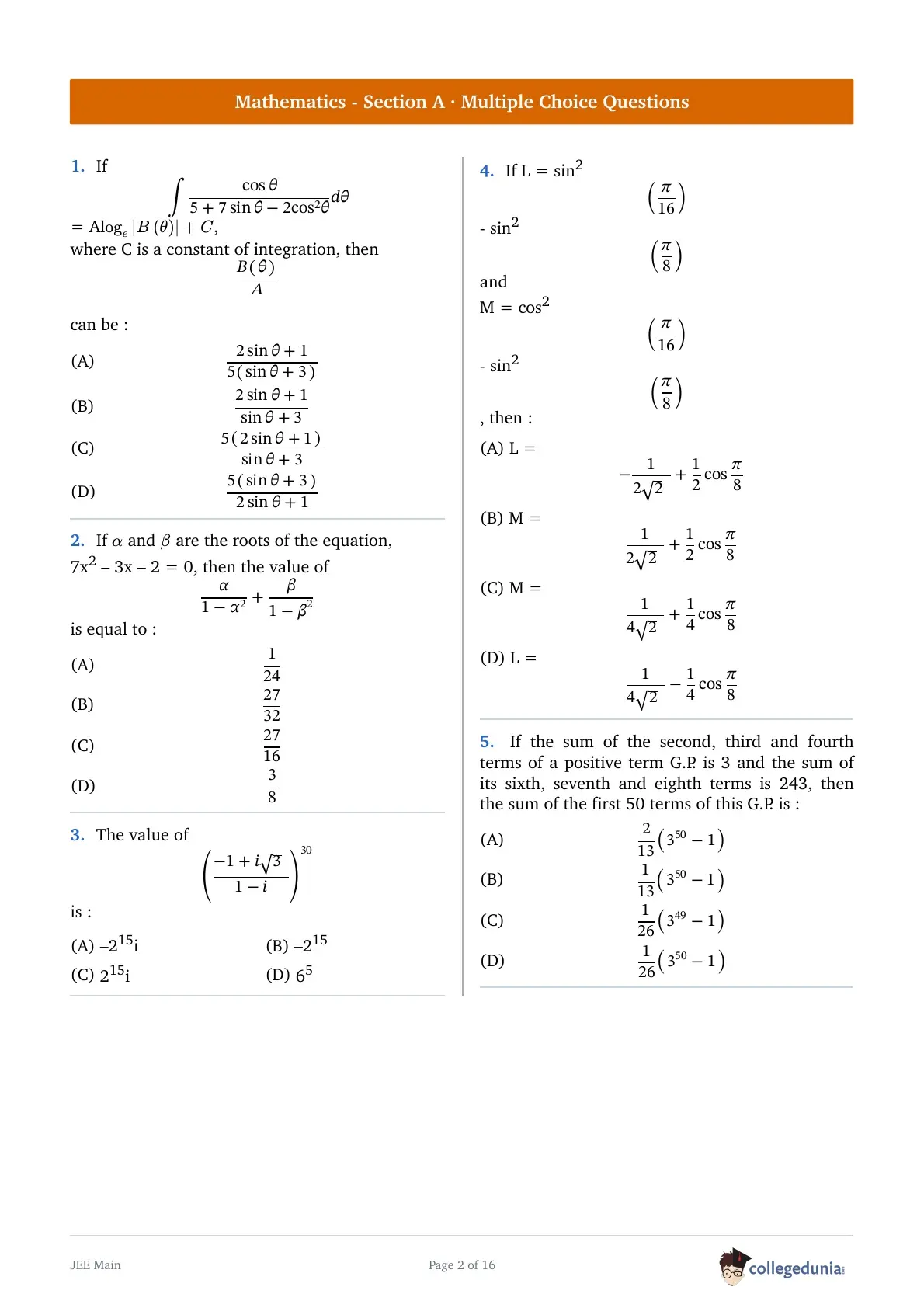
If \( \int \frac{\cos\theta}{5+7\sin\theta-2\cos^2\theta}\,d\theta = A\log_e|B(\theta)|+C \), where C is a constant of integration, then \( \frac{B(\theta)}{A} \) can be :
If \( \alpha \) and \( \beta \) are the roots of the equation, \( 7x^2-3x-2=0 \), then the value of \( \frac{\alpha}{1-\alpha^2}+\frac{\beta}{1-\beta^2} \) is equal to :
The value of \( \left(\frac{-1+i\sqrt{3}}{1-i}\right)^{30} \) is :
If \(L=\sin ^{2}\left(\frac{\pi}{16}\right)-\sin ^{2}\left(\frac{\pi}{8}\right)\) and \(M=\cos ^{2}\left(\frac{\pi}{16}\right)-\sin ^{2}\left(\frac{\pi}{8}\right),\) then :
If the sum of the second, third and fourth terms of a positive term G.P. is 3 and the sum of its sixth, seventh and eighth terms is 243, then the sum of the first 50 terms of this G.P. is :
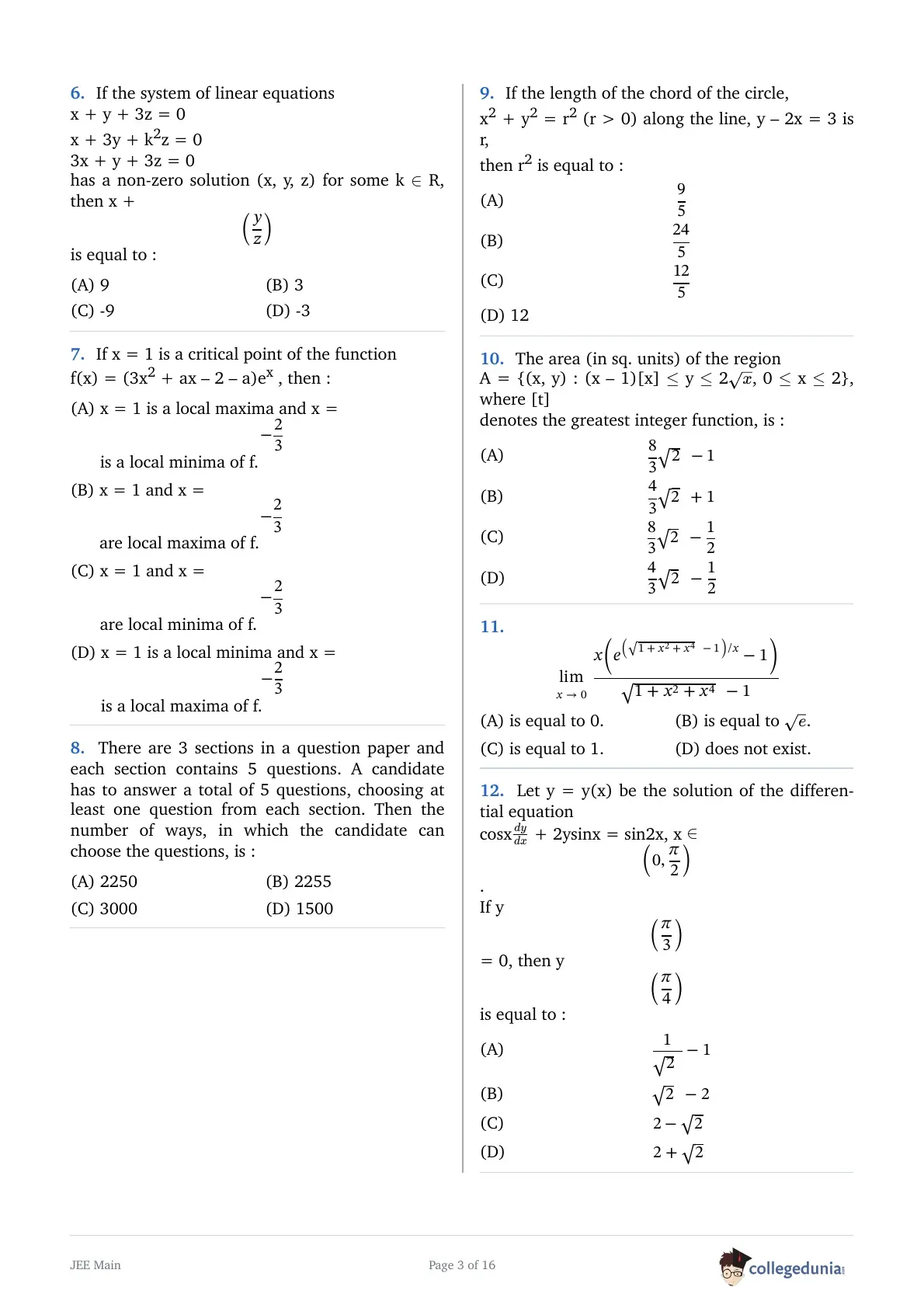
If the system of linear equations
\( x+y+3z=0 \)
\( x+3y+k^2z=0 \)
\( 3x+y+3z=0 \)
has a non-zero solution \((x, y, z)\) for some \(k\in R\), then \( x+\left(\frac{y}{z}\right) \) is equal to :
If \(x=1\) is a critical point of the function \( f(x)=(3x^2+ax-2-a)e^x \), then :
There are 3 sections in a question paper and each section contains 5 questions. A candidate has to answer a total of 5 questions, choosing at least one question from each section. Then the number of ways, in which the candidate can choose the questions, is :
If the length of the chord of the circle, \( x^2+y^2=r^2 \) (\(r>0\)) along the line, \( y-2x=3 \) is r, then \(r^2\) is equal to :
The area (in sq. units) of the region \( A=\{(x,y):(x-1)[x]\le y\le2\sqrt{x},\ 0\le x\le2\} \), where [t] denotes the greatest integer function, is :
\( \lim_{x\to0}\frac{x\left(e^{\left(\sqrt{1+x^2+x^4}-1\right)/x}-1\right)}{\sqrt{1+x^2+x^4}-1} \)
Let \(y=y(x)\) be the solution of the differential equation \( \cos x\,\frac{dy}{dx}+2y\sin x=\sin2x,\ x\in\left(0,\frac{\pi}{2}\right) \). If \( y\left(\frac{\pi}{3}\right)=0 \), then \( y\left(\frac{\pi}{4}\right) \) is equal to :
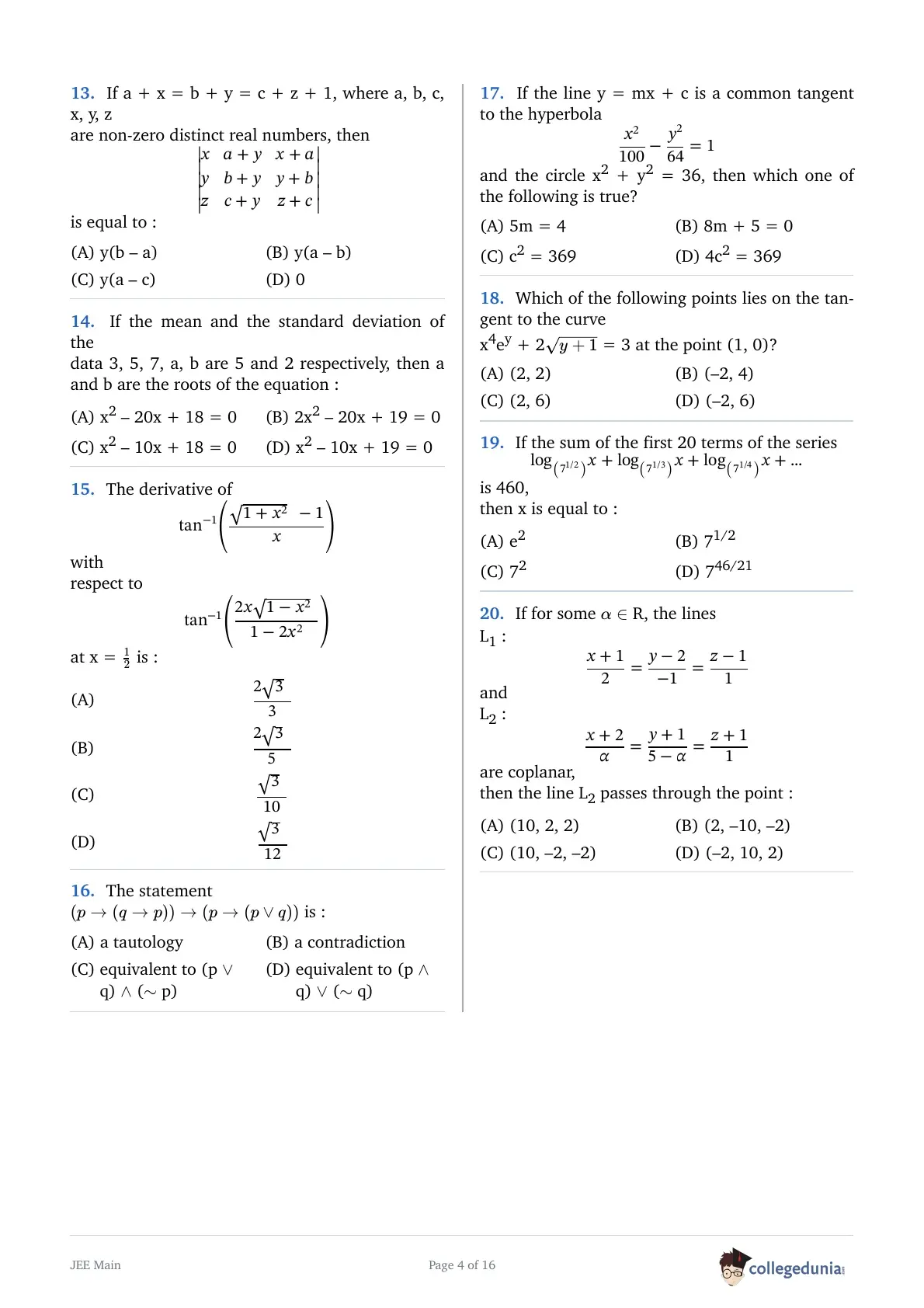
If \(a + x = b + y = c + z + 1\), where \(a, b, c, x, y, z\) are non-zero distinct real numbers, then
\(\begin{vmatrix} x & a+y & x+a \\ y & b+y & y+b \\ z & c+y & z+c \end{vmatrix}\)
is equal to :
If the mean and the standard deviation of the data \(3, 5, 7, a, b\) are \(5\) and \(2\) respectively, then \(a\) and \(b\) are the roots of the equation :
The derivative of
\(\tan^{-1}\left(\dfrac{\sqrt{1+x^2} - 1}{x}\right)\)
with respect to
\(\tan^{-1}\left(\dfrac{2x\sqrt{1-x^2}}{1-2x^2}\right)\)
at \(x = \dfrac{1}{2}\) is :
The statement
\((p \to (q \to p)) \to (p \to (p \vee q))\) is :
If the line \(y = mx + c\) is a common tangent to the hyperbola
\(\dfrac{x^2}{100} - \dfrac{y^2}{64} = 1\)
and the circle \(x^2 + y^2 = 36\), then which one of the following is true?
Which of the following points lies on the tangent to the curve
\(x^4 e^y + 2\sqrt{y+1} = 3\) at the point \((1, 0)\)?
If the sum of the first 20 terms of the series
\(\log_{(7^{1/2})}x + \log_{(7^{1/3})}x + \log_{(7^{1/4})}x + \ldots\)
is \(460\), then \(x\) is equal to :
If for some \(\alpha \in \mathbb{R}\), the lines
\(L_1 : \dfrac{x+1}{2} = \dfrac{y-2}{-1} = \dfrac{z-1}{1}\)
and
\(L_2 : \dfrac{x+2}{\alpha} = \dfrac{y+1}{5-\alpha} = \dfrac{z+1}{1}\)
are coplanar, then the line \(L_2\) passes through the point :
Mathematics - Section B (Q21 - Q25)
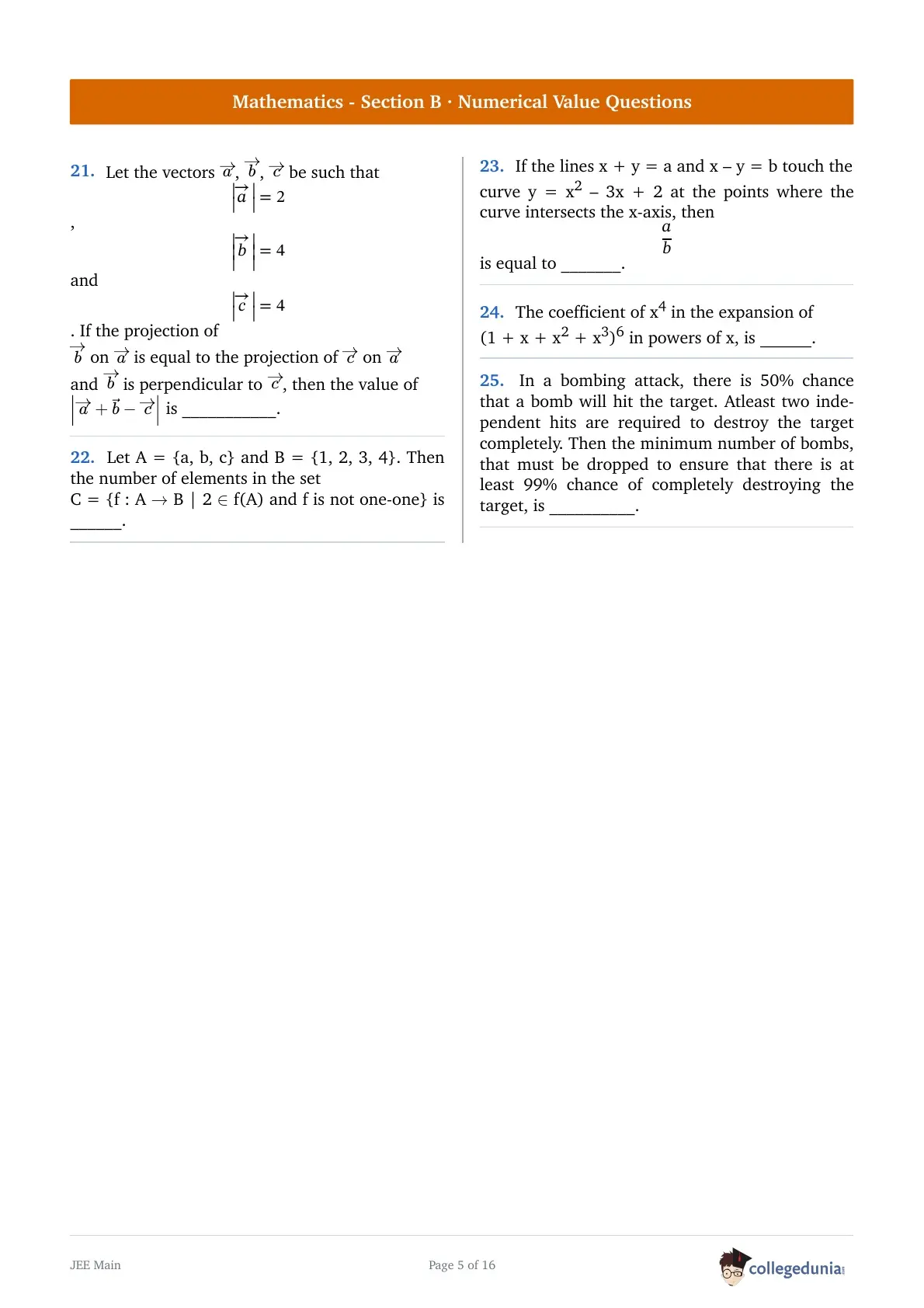
Let the vectors \(\vec{a}, \vec{b}, \vec{c}\) be such that \(|\vec{a}| = 2\), \(|\vec{b}| = 4\) and \(|\vec{c}| = 4\). If the projection of \(\vec{b}\) on \(\vec{a}\) is equal to the projection of \(\vec{c}\) on \(\vec{a}\) and \(\vec{b}\) is perpendicular to \(\vec{c}\), then the value of \(|\vec{a} + \vec{b} - \vec{c}|\) is ___________.
Let \(A = \{a, b, c\}\) and \(B = \{1, 2, 3, 4\}\). Then the number of elements in the set \(C = \{f : A \to B \mid 2 \in f(A)\text{ and } f\text{ is not one-one}\}\) is ______.
If the lines \(x + y = a\) and \(x - y = b\) touch the curve \(y = x^2 - 3x + 2\) at the points where the curve intersects the x-axis, then \(\dfrac{a}{b}\) is equal to _______.
The coefficient of \(x^4\) in the expansion of \((1 + x + x^2 + x^3)^6\) in powers of \(x\), is ______.
In a bombing attack, there is 50% chance that a bomb will hit the target. Atleast two independent hits are required to destroy the target completely. Then the minimum number of bombs, that must be dropped to ensure that there is at least 99% chance of completely destroying the target, is __________.
Physics - Section A (Q26 - Q45)
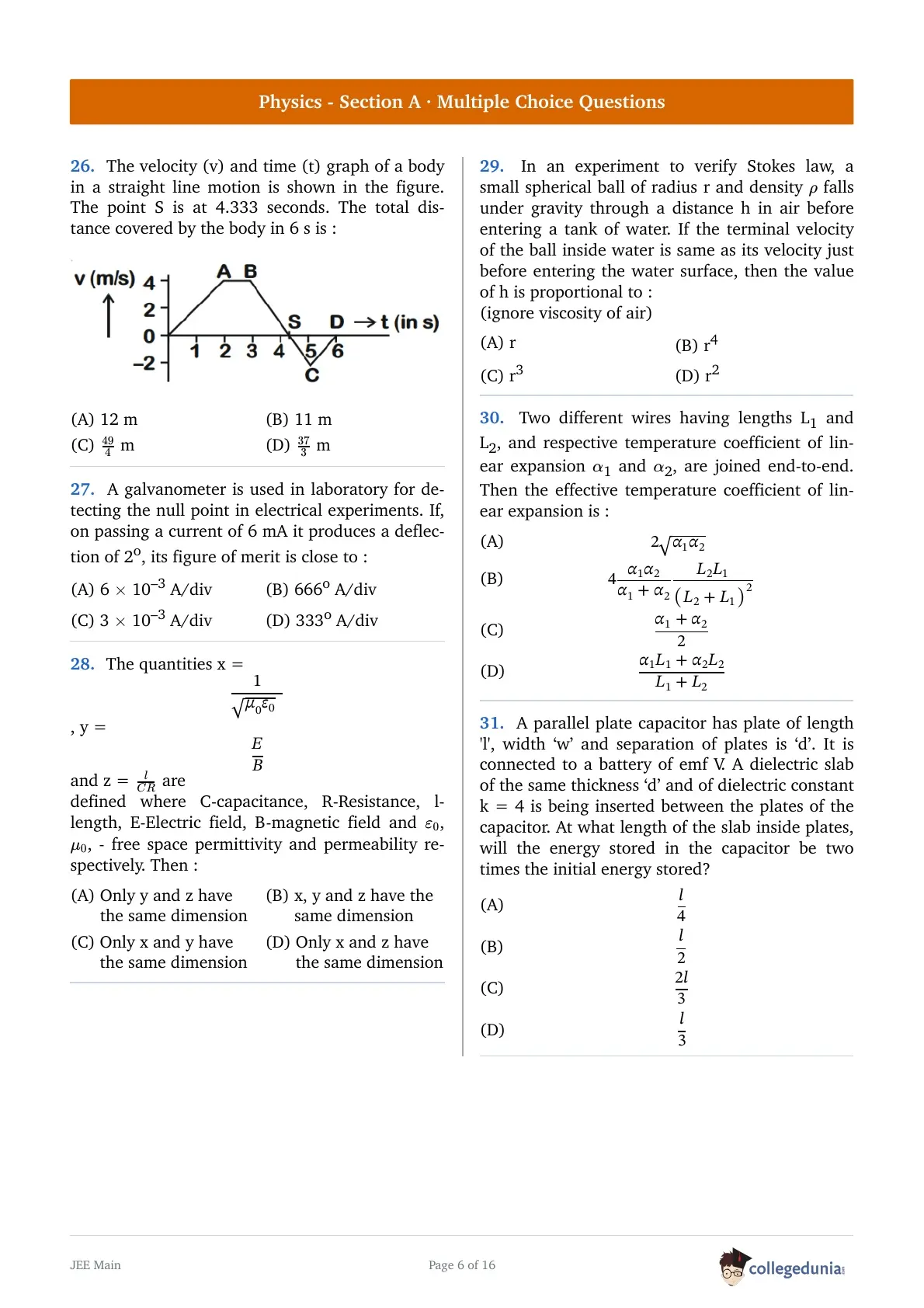
The velocity (v) and time (t) graph of a body in a straight line motion is shown in the figure. The point S is at 4.333 seconds. The total distance covered by the body in 6 s is :
A galvanometer is used in laboratory for detecting the null point in electrical experiments. If, on passing a current of 6 mA it produces a deflection of 2o, its figure of merit is close to :
The quantities \(x=\frac{1}{\sqrt{\mu_{0} \epsilon_{0}}}, y=\frac{E}{B}\) and \(z =\frac{1}{ CR }\) are defined where C - capacitance R - Resistance, l - length, E - Electric field, B - magnetic field and \(\epsilon_{0}, \mu_{0},\) - free space permittivity and permeability respectively. Then :
In an experiment to verify Stokes law, a small spherical ball of radius \(r\) and density \(\rho\) falls under gravity through a distance \(h\) in air before entering a tank of water. If the terminal velocity of the ball inside water is same as its velocity just before entering the water surface, then the value of \(h\) is proportional to (ignore viscosity of air)
Two different wires having lengths \(L_1\) and \(L_2\), and respective temperature coefficient of linear expansion \(\alpha_1\) and \(\alpha_2\), are joined end-to-end. Then the effective temperature coefficient of linear expansion is :
A parallel plate capacitor has plate of length 'l', width 'w' and separation of plates is 'd'. It is connected to a battery of emf V. A dielectric slab of the same thickness 'd' and of dielectric constant k = 4 is being inserted between the plates of the capacitor. At what length of the slab inside plates, will the energy stored in the capacitor be two times the initial energy stored?
An ideal gas at atmospheric pressure is adiabatically compressed so that its density becomes \(32\) times of its initial value. If the final pressure of gas is \(128\) atmospheres, the value of ?\(\gamma\)?of the gas is :
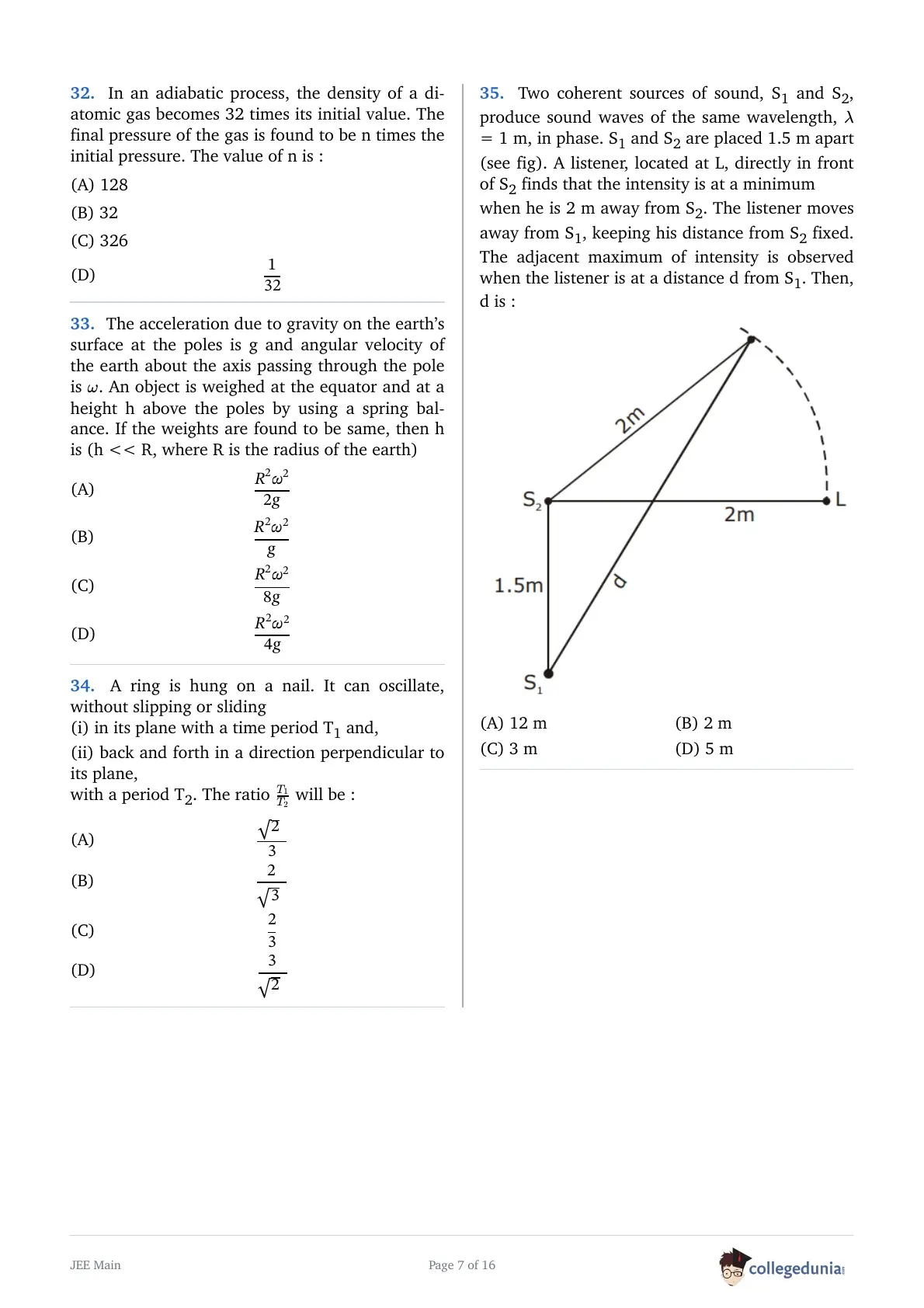
The acceleration due to gravity on the earth's surface at the poles is g and angular velocity of the earth about the axis passing through the pole is \(\omega\). An object is weighed at the equator and at a height h above the poles by using a spring balance. If the weights are found to be same, then h is (h << R, where R is the radius of the earth)
A ring is hung on a nail. It can oscillate, without slipping or sliding
(i) in its plane with a time period \(T_1\) and,
(ii) back and forth in a direction perpendicular to its plane, with a period \(T_2\). The ratio \(\frac{T_1}{T_2}\) will be :
Two coherent sources of sound, \(S_1\) and \(S_2\), produce sound waves of the same wavelength, \(\lambda\) = 1 m, in phase. \(S_1\) and \(S_2\) are placed 1.5 m apart (see fig). A listener, located at L, directly in front of \(S_2\) finds that the intensity is at a minimum when he is 2 m away from \(S_2\). The listener moves away from \(S_1\), keeping his distance from \(S_2\) fixed. The adjacent maximum of intensity is observed when the listener is at a distance d from \(S_1\). Then, d is :
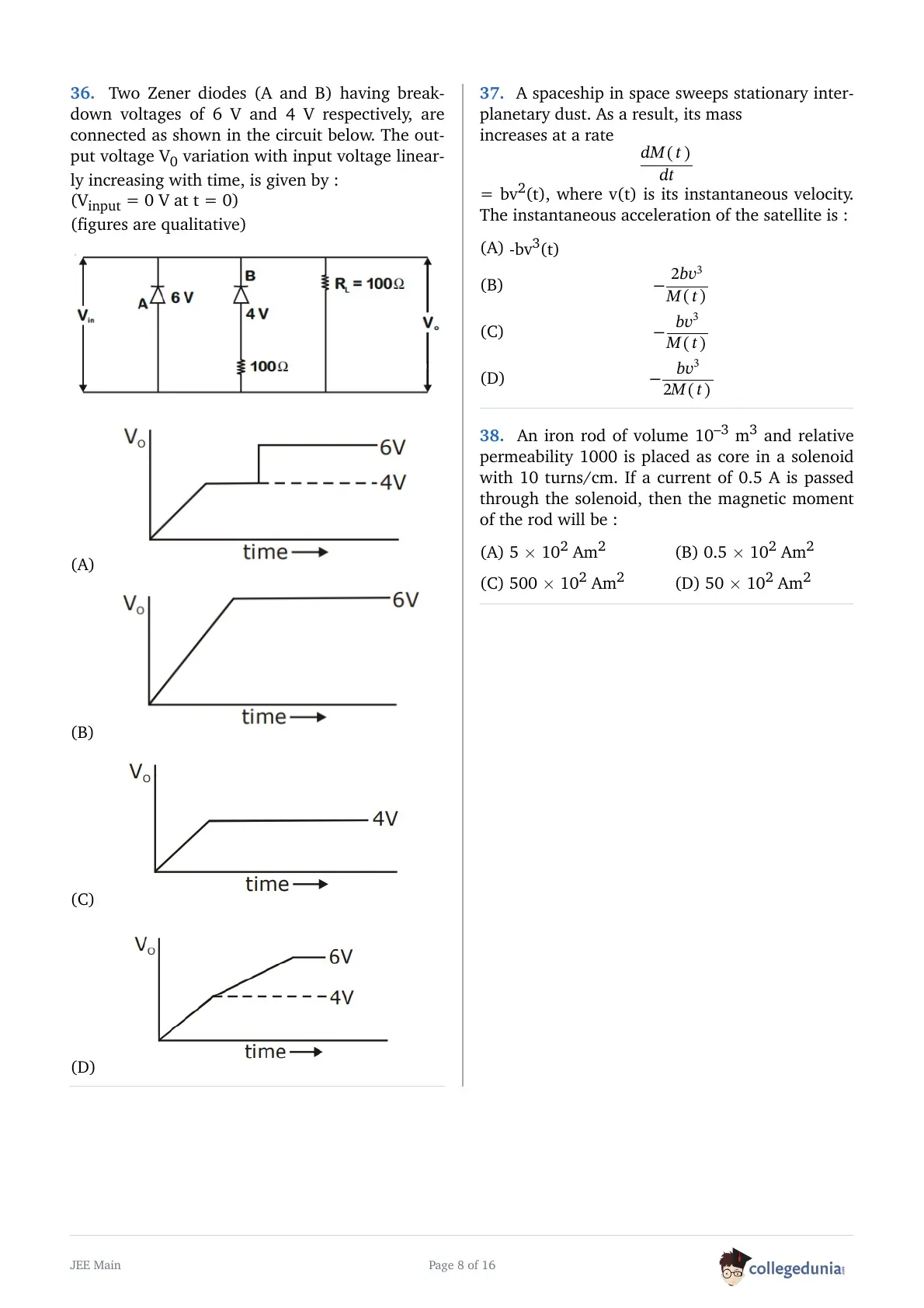
Two Zener diodes (A and B) having breakdown voltages of 6 V and 4 V respectively, are connected as shown in the circuit below. The output voltage \(V_0\) variation with input voltage linearly increasing with time, is given by :
(\(V_{input}\) = 0 V at t = 0)
(figures are qualitative)
- (1)
![]()
- (2)
![]()
- (3)
![]()
- (4)
![]()


A spaceship in space sweeps stationary interplanetary dust. As a result, its mass increases at a rate \(\frac{dM(t)}{dt} = bv^2(t)\), where v(t) is its instantaneous velocity. The instantaneous acceleration of the satellite is :
An iron rod of volume \(10^{-3}\) m3 and relative permeability 1000 is placed as core in a solenoid with 10 turns/cm. If a current of 0.5 A is passed through the solenoid, then the magnetic moment of the rod will be :
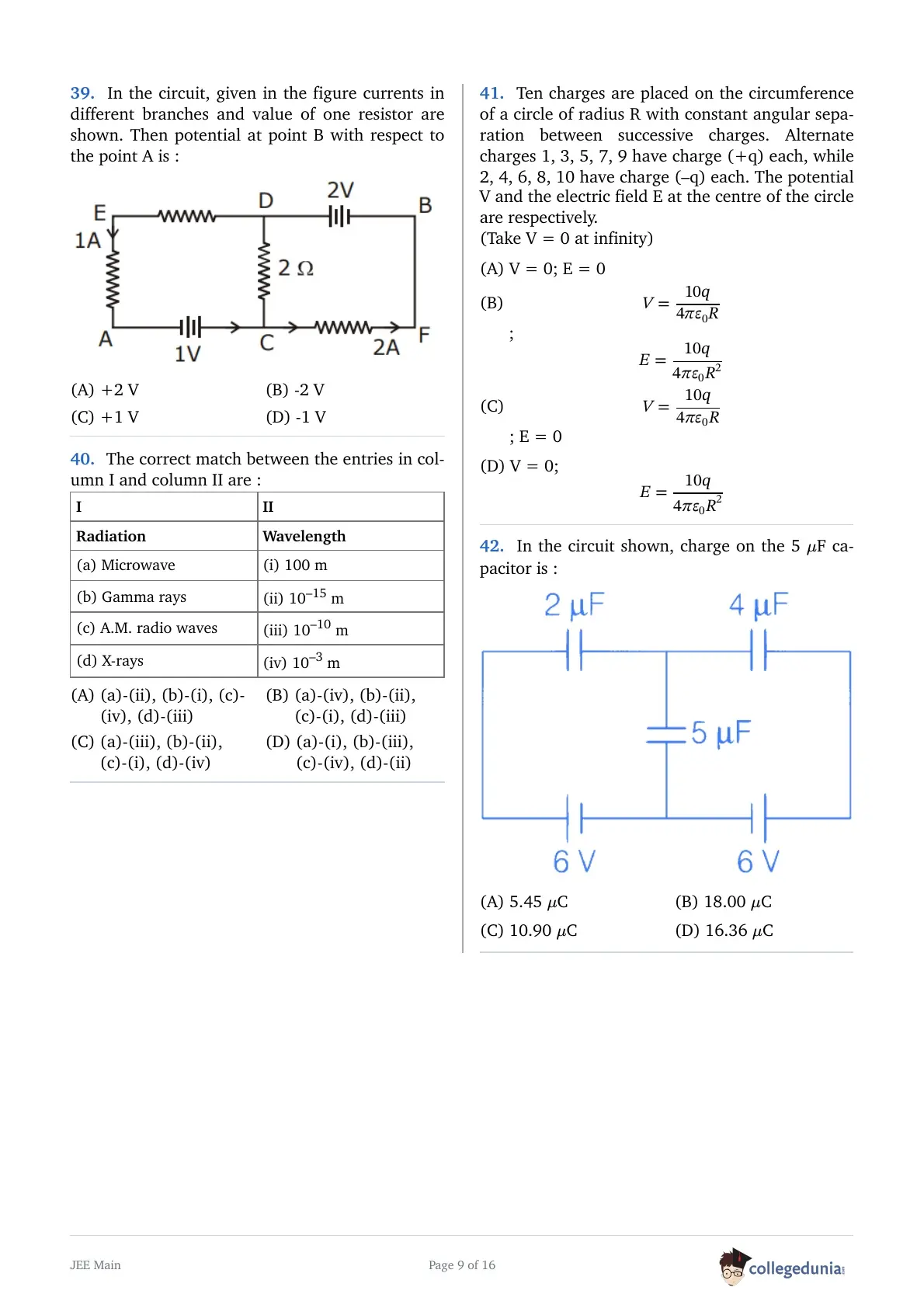
In the circuit, given in the figure currents in different branches and value of one resistor are shown. Then potential at point B with respect to the point A is :
| I | II |
| Radiation | Wavelength |
| (a) Microwave | (i) 100 m |
| (b) Gamma rays | (ii) \(10^{-15}\) m |
| (c) A.M. radio waves | (iii) \(10^{-10}\) m |
| (d) X-rays | (iv) \(10^{-3}\) m |
Ten charges are placed on the circumference of a circle of radius R with constant angular separation between successive charges. Alternate charges 1, 3, 5, 7, 9 have charge (+q) each, while 2, 4, 6, 8, 10 have charge (-q) each. The potential V and the electric field E at the centre of the circle are respectively.
(Take V = 0 at infinity)
In the circuit shown, charge on the \(5\ \mu\mathrm{F}\) capacitor is :
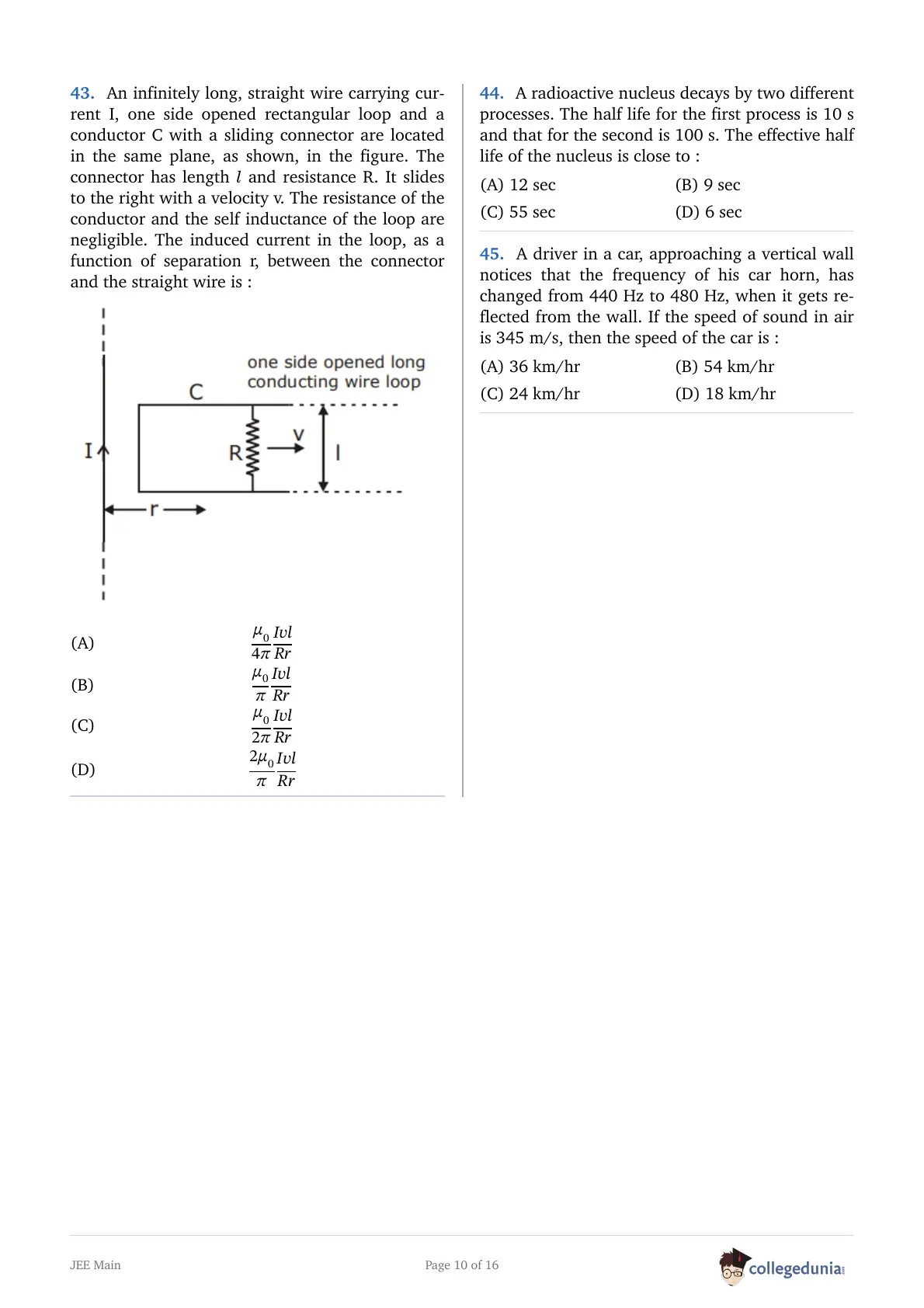
An infinitely long, straight wire carrying current I, one side opened rectangular loop and a conductor C with a sliding connector are located in the same plane, as shown, in the figure. The connector has length \(l\) and resistance R. It slides to the right with a velocity v. The resistance of the conductor and the self inductance of the loop are negligible. The induced current in the loop, as a function of separation r, between the connector and the straight wire is :
A radioactive nucleus decays by two different processes. The half life for the first process is \(10 s\) and that for the second is \(100 s\). the effective half life of the nucleus is close to:
A driver in a car, approaching a vertical wall notices that the frequency of his car horn, has changed from 440 Hz to 480 Hz, when it gets reflected from the wall. If the speed of sound in air is 345 m/s, then the speed of the car is :
Physics - Section B (Q46 - Q50)
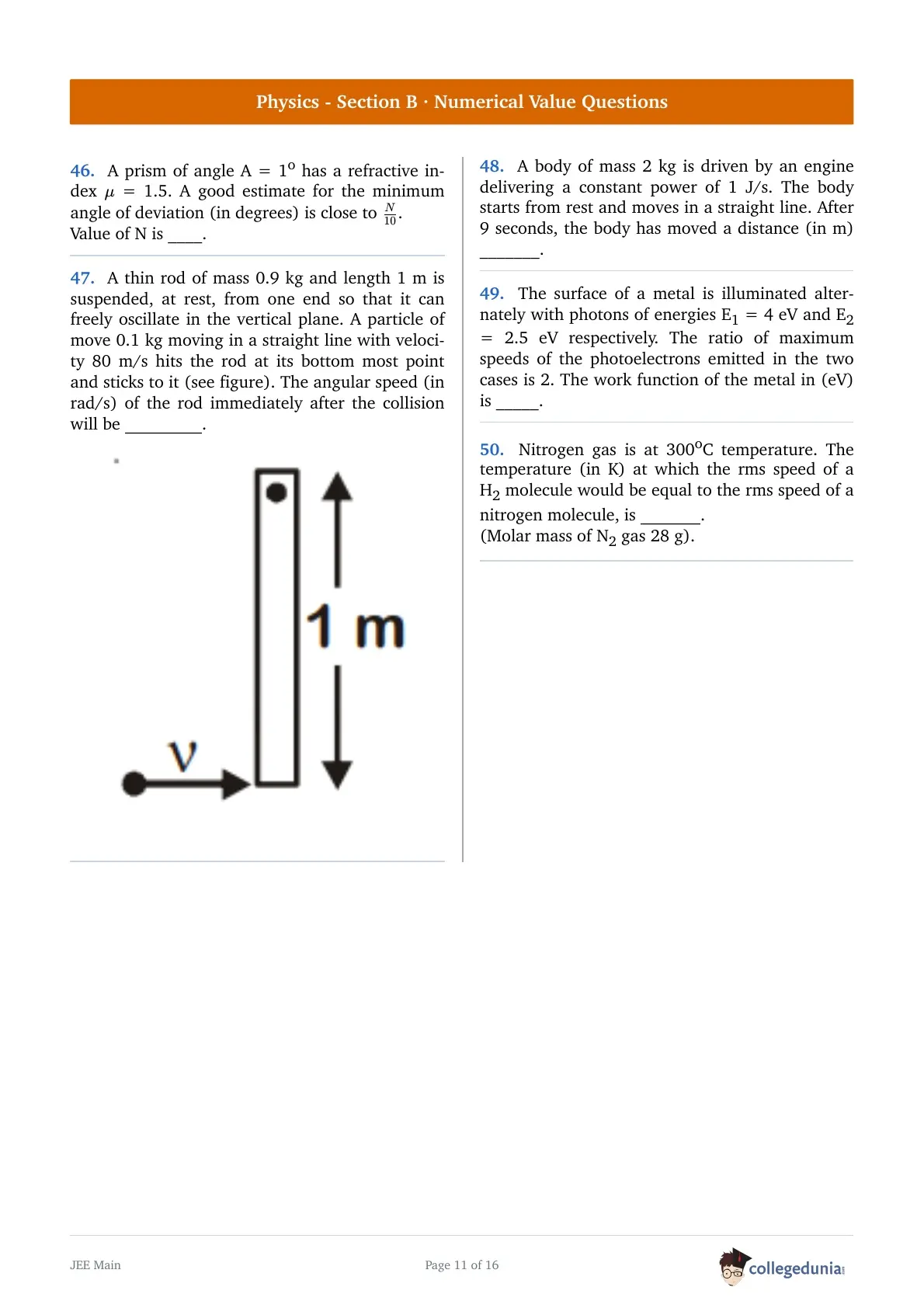
A prism of angle A = \(1^\circ\) has a refractive index \(\mu\) = 1.5. A good estimate for the minimum angle of deviation (in degrees) is close to \(\frac{N}{10}\).
Value of N is ____.
A thin rod of mass 0.9 kg and length 1 m is suspended, at rest, from one end so that it can freely oscillate in the vertical plane. A particle of move 0.1 kg moving in a straight line with velocity 80 m/s hits the rod at its bottom most point and sticks to it (see figure). The angular speed (in rad/s) of the rod immediately after the collision will be _________.
A body of mass 2 kg is driven by an engine delivering a constant power of 1 J/s. The body starts from rest and moves in a straight line. After 9 seconds, the body has moved a distance (in m) _______.
Two photons of wavelength \( \lambda \) and \(2\lambda\) are incident on a metal surface and emit photoelectrons of maximum kinetic energies \(3k\) and \(k\). Find work function of the metal.
Nitrogen gas is at \(300^\circ\mathrm{C}\) temperature. The temperature (in K) at which the rms speed of a \(\mathrm{H_2}\) molecule would be equal to the rms speed of a nitrogen molecule, is _______.
(Molar mass of \(\mathrm{N_2}\) gas 28 g).
Chemistry - Section A (Q51 - Q70)
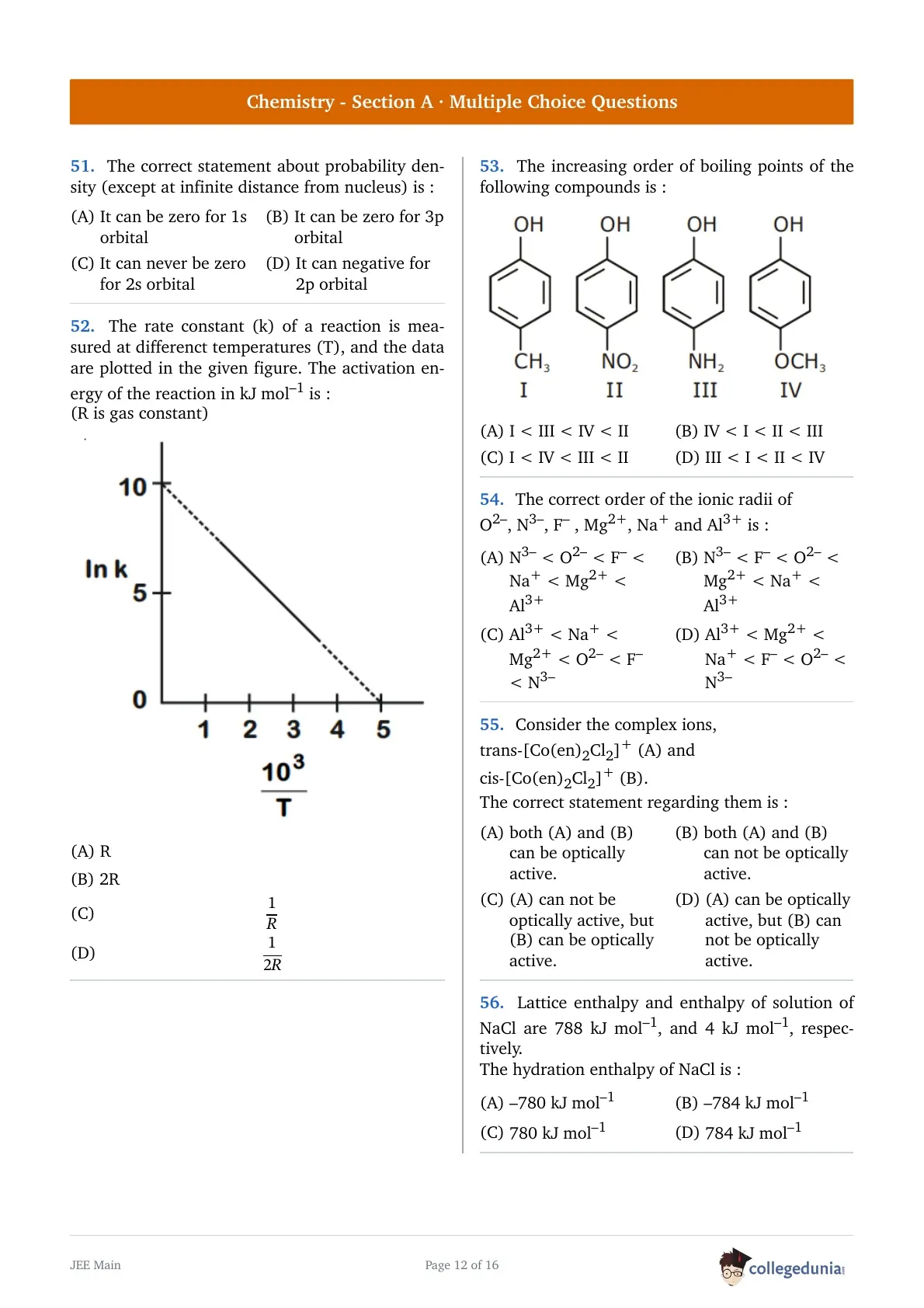
The correct statement about probability density (except at infinite distance from nucleus) is :
The rate constant (k) of a reaction is measured at differenct temperatures (T), and the data are plotted in the given figure. The activation energy of the reaction in \(\mathrm{kJ\ mol^{-1}}\) is :
(R is gas constant)
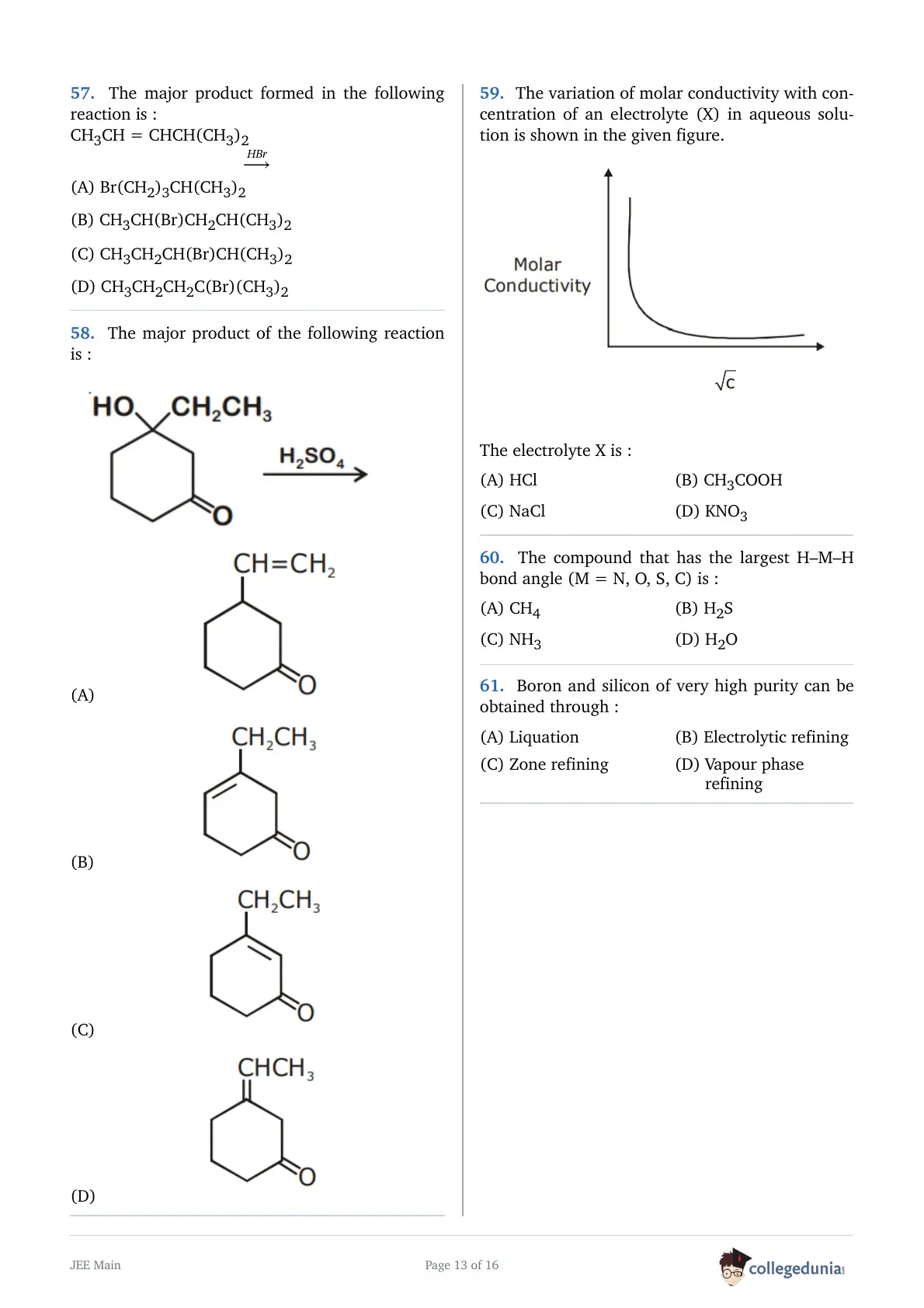
The increasing order of boiling points of the following compounds is :
(I: 4-methylphenol, II: 4-nitrophenol, III: 4-aminophenol, IV: 4-methoxyphenol)
The correct order of the ionic radii of
\(\mathrm{O^{2-}}\), \(\mathrm{N^{3-}}\), \(\mathrm{F^{-}}\), \(\mathrm{Mg^{2+}}\), \(\mathrm{Na^{+}}\) and \(\mathrm{Al^{3+}}\) is :
Consider the complex ions,
trans-\(\mathrm{[Co(en)_2Cl_2]^{+}}\) (A) and
cis-\(\mathrm{[Co(en)_2Cl_2]^{+}}\) (B).
The correct statement regarding them is :
Lattice enthalpy and enthalpy of solution of NaCl are 788 kJ mol\(-1\), and 4 kJ mol\(-1\), respectively.
The hydration enthalpy of NaCl is :
The major product formed in the following reaction is : \(CH _{3} CH = CHCH \left( CH _{3}\right)_{2} \stackrel{ HBr }{\longrightarrow}\)


The variation of molar conductivity with concentration of an electrolyte (X) in aqueous solution is shown in the given figure.
The electrolyte X is :
The compound that has the largest H-M-H bond angle (M = N, O, S, C) is :
Boron and silicon of very high purity can be obtained through :
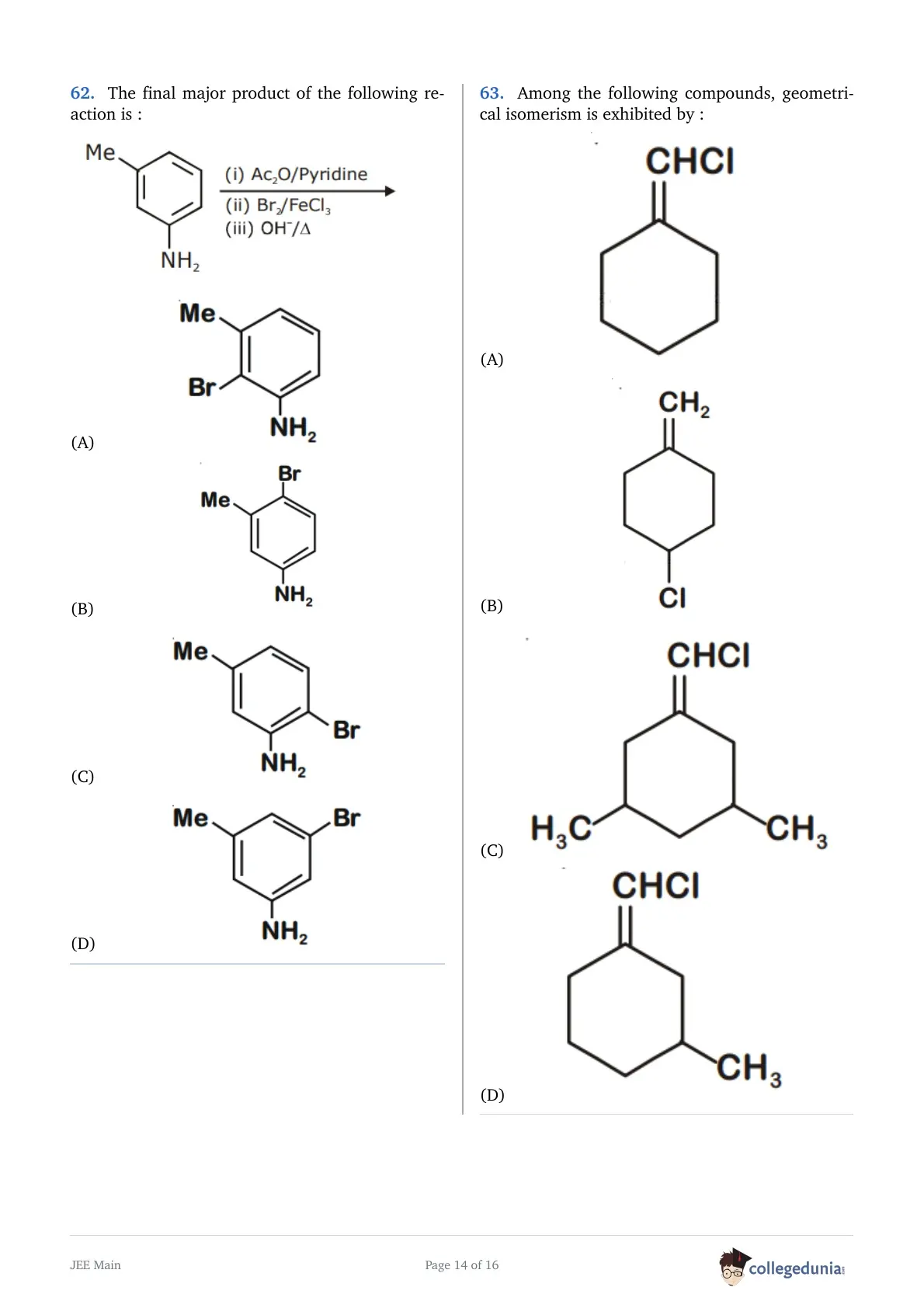
The final major product of the following reaction is :
(3-methylaniline treated with (i) \(\mathrm{Ac_2O}\)/Pyridine, (ii) \(\mathrm{Br_2/FeCl_3}\), (iii) \(\mathrm{OH^{-}/\Delta}\))
- (1)
![]()
- (2)
![]()
- (3)
![]()
- (4)
![]()


Among the following compounds, geometrical isomerism is exhibited by :
- (1)
![]()
- (2)
![]()
- (3)
![]()
- (4)
![]()


Which one of the following polymers is not obtained by condensation polymerisation?
Hydrogen peroxide, in the pure state, is :
An element crystallises in a face-centred cubic (fcc) unit cell with cell edge a. The distance between the centres of two nearest octahedral voids in the crystal lattice is
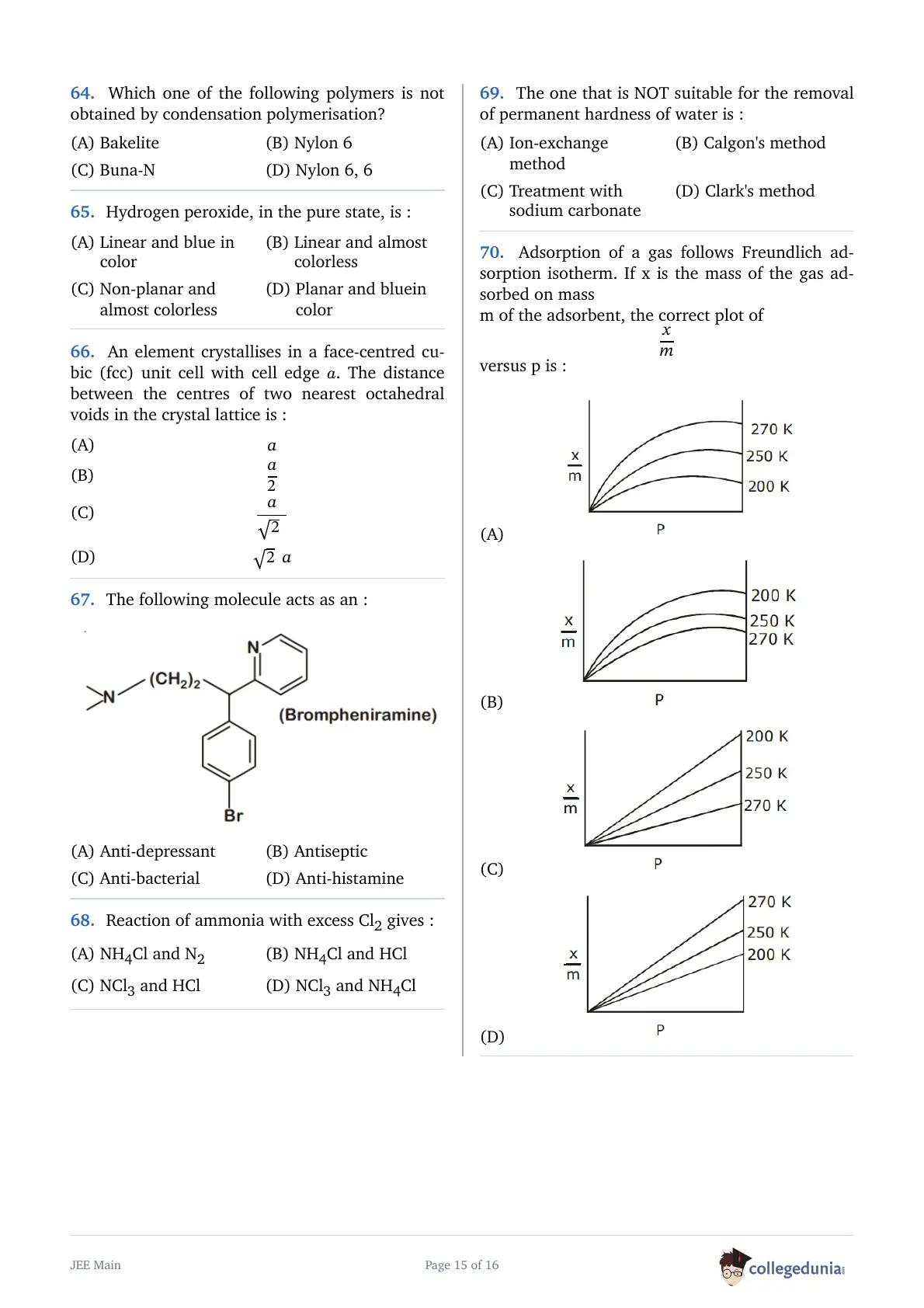
The following molecule acts as an :
Reaction of ammonia with excess \(\mathrm{Cl_2}\) gives :
The one that is NOT suitable for the removal of permanent hardness of water is :
Adsorption of a gas follows Freundlich adsorption isotherm. If x is the mass of the gas adsorbed on mass m of the adsorbent, the correct plot of \(\frac{x}{m}\) versus p is :
- (1)
![]()
- (2)
![]()
- (3)
![]()
- (4)
![]()


Chemistry - Section B (Q71 - Q75)
The volume, in mL, of 0.02 M \(\mathrm{K_2Cr_2O_7}\) solution required to react with 0.288 g of ferrous oxalate in acidic medium is _______.
(Molar mass of Fe = 56 g mol-1)
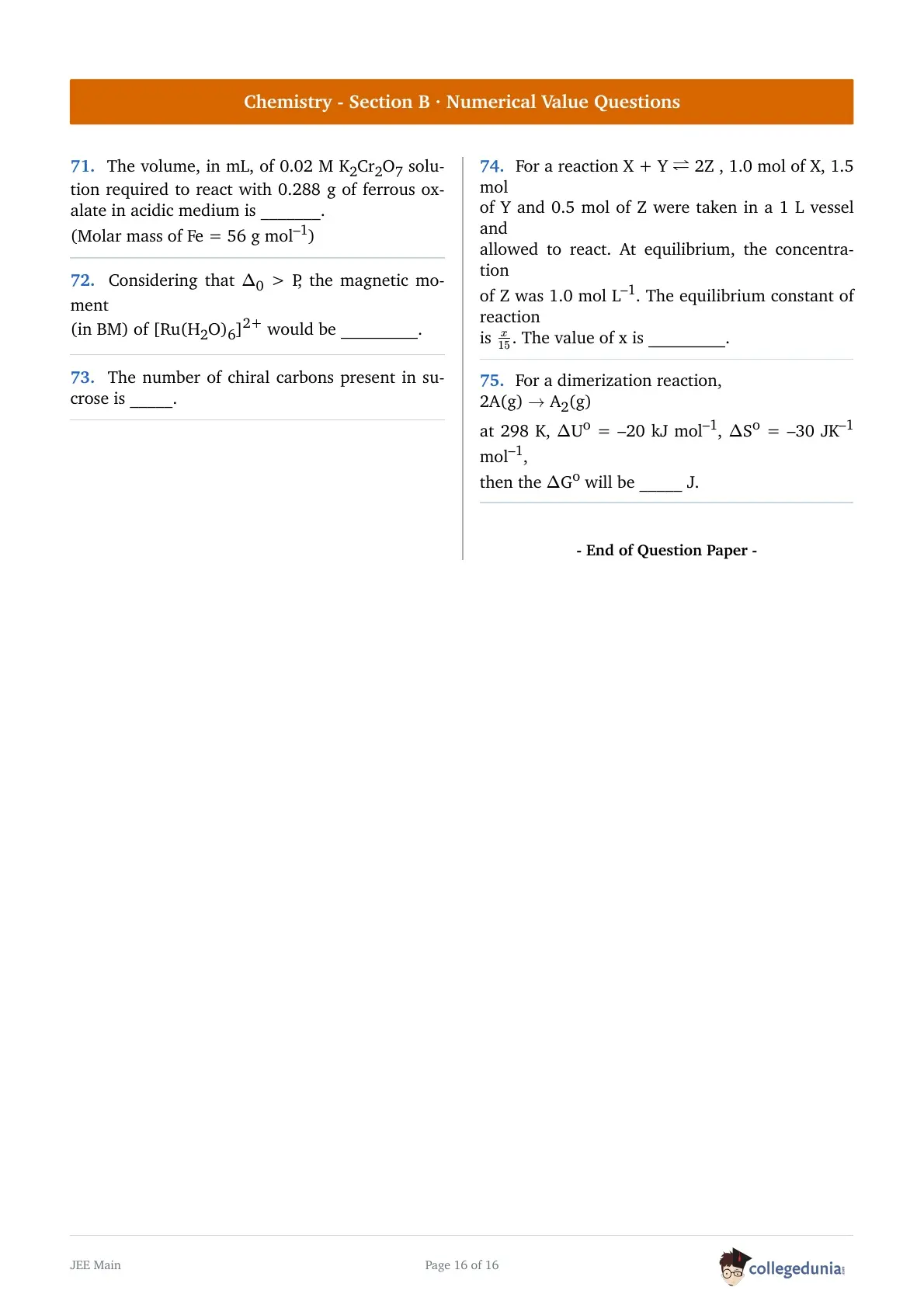
Considering that \(\Delta_0 \gt P\), the magnetic moment (in BM) of \(\mathrm{[Ru(H_2O)_6]^{2+}}\) would be _________.
In the given reaction,
(where Et is –C2H5)
The number of chiral carbon(s) in product A is ______.
For a reaction \(\mathrm{X + Y \rightleftharpoons 2Z}\), 1.0 mol of X, 1.5 mol of Y and 0.5 mol of Z were taken in a 1 L vessel and allowed to react. At equilibrium, the concentration of Z was 1.0 mol L-1. The equilibrium constant of reaction is \(\frac{x}{15}\). The value of x is _________.
For a dimerization reaction,
\(\mathrm{2A(g) \to A_2(g)}\)
at 298 K, \(\Delta U^\circ = -20\ \mathrm{kJ\ mol^{-1}}\), \(\Delta S^\circ = -30\ \mathrm{J\,K^{-1}\,mol^{-1}}\),
then the \(\Delta G^\circ\) will be _____ J.
JEE Main 2020 Exam Pattern and Marking Scheme
| Particulars | Details |
|---|---|
| Exam Mode | Online (Computer-Based Test) |
| Paper | B.E./B.Tech (Paper 1) |
| Duration | 3 hours (180 minutes) |
| Type of Questions | Multiple Choice Questions (MCQs) + Numerical Value Questions |
| Subjects | Mathematics, Physics, Chemistry |
| Total Questions | 75 questions |
| Total Marks | 300 marks |
| Marking Scheme | +4 for correct answer & -1 for incorrect MCQ; no negative marking for Numerical Value Questions |
JEE Main 2020 September 5 Shift 2 Difficulty Level
JEE Main 2020 B.E./B.Tech Question Paper for September 5, 2020 Afternoon Session was said to be moderate in terms of overall difficulty. Many candidates pointed out that questions especially from Chemistry and Mathematics section were similar to NTA Abhyas app mock test questions, in terms of pattern and difficulty level.



Comments