




JEE Main 2020 September 6 Shift 2 Question Paper is available here with solutions PDF and detailed solutions for every question. NTA conducted the second shift on September 6, 2020, from 3:00 PM to 6:00 PM. The JEE Main 2020 Paper 1 (B.E./B.Tech) question paper includes the following:
- 75 questions in a 3-hour CBT Mode: 25 each from Mathematics, Physics and Chemistry
- Section A: 20 multiple choice questions (MCQs) per subject, 4 marks each
- Section B: 5 numerical value questions per subject, all compulsory, 4 marks each
- Marking: +4 for a correct answer, -1 for an incorrect MCQ, 0 for an unattempted question; no negative marking for numerical value questions
- Maximum marks: 300 (100 per subject)
JEE Main 2020 September 6 Shift 2 Question Paper with Solution PDF
| NTA Official PDF | CD PDF | CD PDF with Solutions |
|---|---|---|
| Download official PDF 4.67 MB | Download Collegedunia PDF 0.96 MB | Download solutions PDF 1.07 MB |
Also Check:
JEE Main 2020 September 6 Shift 2 Questions with Solutions
Mathematics - Section A (Q1 - Q20)
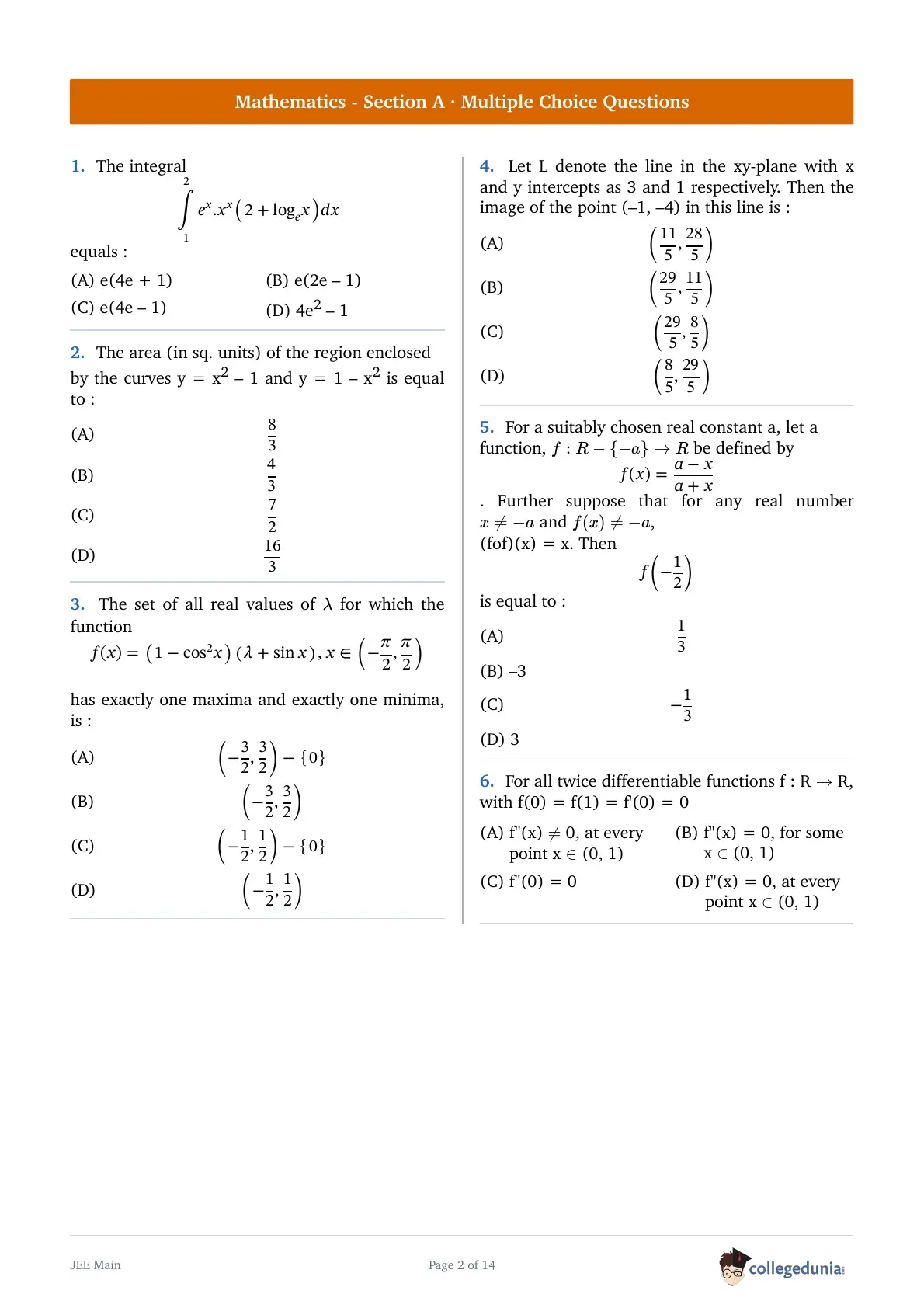
The integral
\(\int_1^2 e^x \cdot x^x\,(2+\log_e x)\,dx\)
equals :
The area (in sq. units) of the region enclosed by the curves \(y=x^2-1\) and \(y=1-x^2\) is equal to :
The set of all values of \(λ\) for which the equation \(cos^22x−2sin^4x−2cos^2x=λ\) has a real solution x, is
Let L denote the line in the xy-plane with x and y intercepts as 3 and 1 respectively. Then the image of the point \((-1,-4)\) in this line is :
For a suitably chosen real constant a, let a function, \(f:\mathbb{R}-\{-a\}\to\mathbb{R}\) be defined by \(f(x)=\frac{a-x}{a+x}\). Further suppose that for any real number \(x\ne -a\) and \(f(x)\ne -a\), \((f\circ f)(x)=x\). Then \(f\left(-\frac12\right)\) is equal to :
For all twice differentiable functions \(f:\mathbb{R}\to\mathbb{R}\), with \(f(0)=f(1)=f'(0)=0\)
Let \(f:\mathbb{R}\to\mathbb{R}\) be a function defined by \(f(x)=\max\{x,x^2\}\). Let S denote the set of all points in \(\mathbb{R}\), where f is not differentiable. Then :
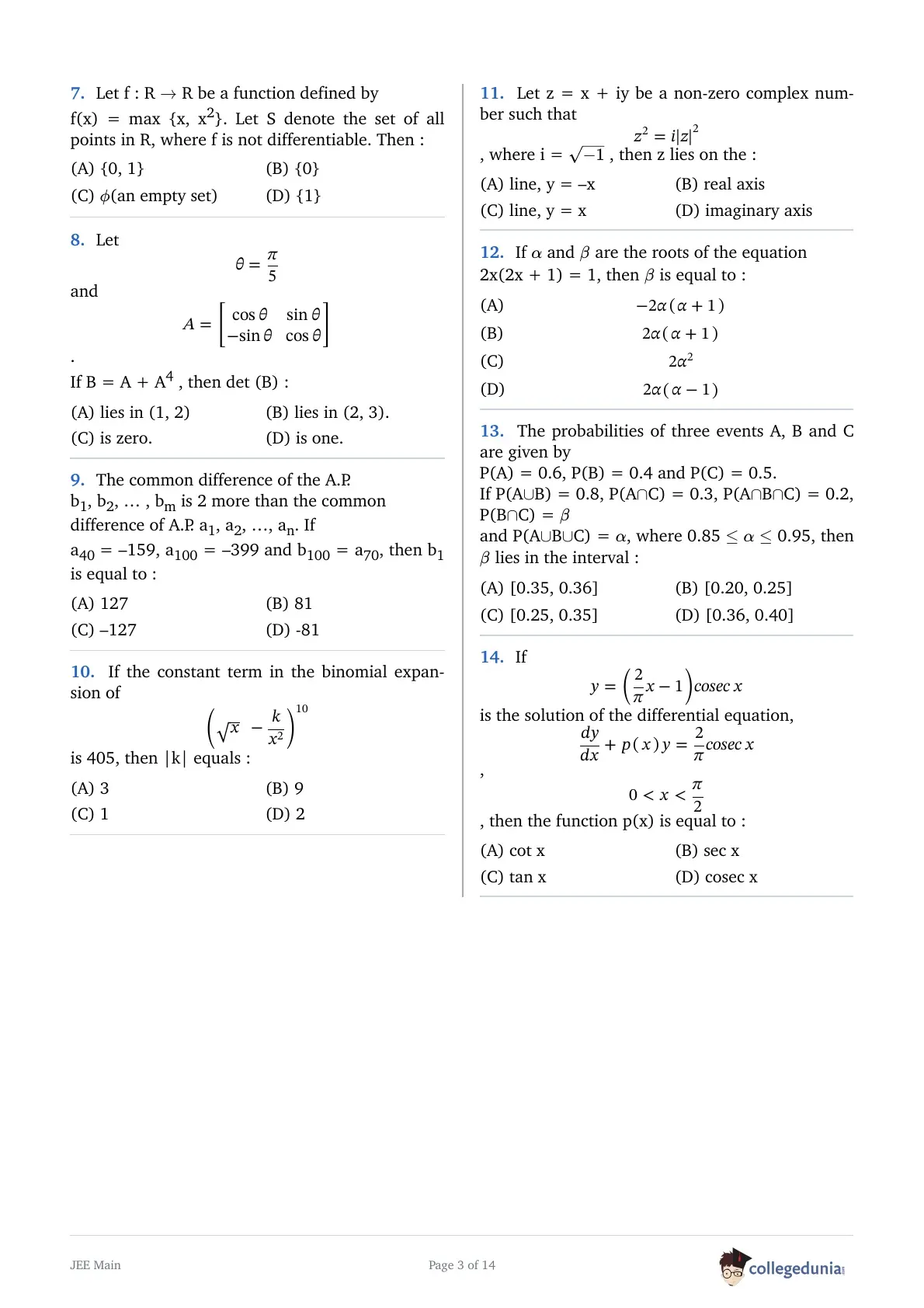
Let \(\theta=\frac{\pi}{5}\) and \(A=\begin{bmatrix}\cos\theta & \sin\theta\\ -\sin\theta & \cos\theta\end{bmatrix}\). If \(B=A+A^4\), then det (B) :
The common difference of the A.P. \(b_1,b_2,\ldots,b_m\) is 2 more than the common difference of A.P. \(a_1,a_2,\ldots,a_n\). If \(a_{40}=-159\), \(a_{100}=-399\) and \(b_{100}=a_{70}\), then \(b_1\) is equal to :
If the constant term in the binomial expansion of \(\left(\sqrt{x}-\frac{k}{x^2}\right)^{10}\) is 405, then \(|k|\) equals :
Let \(z=x+iy\) be a non-zero complex number such that \(z^2=i|z|^2\), where \(i=\sqrt{-1}\), then z lies on the :
If \(\alpha\) and \(\beta\) are the roots of the equation \(2x(2x+1)=1\), then \(\beta\) is equal to :
The probabilities of three events A, B and C are given by \(P(A)=0.6\), \(P(B)=0.4\) and \(P(C)=0.5\). If \(P(A\cup B)=0.8\), \(P(A\cap C)=0.3\), \(P(A\cap B\cap C)=0.2\), \(P(B\cap C)=\beta\) and \(P(A\cup B\cup C)=\alpha\), where \(0.85\le\alpha\le0.95\), then \(\beta\) lies in the interval :
If \(y = \left(\frac{2}{\pi}x - 1\right)\mathrm{cosec}\,x\) is the solution of the differential equation,
\(\frac{dy}{dx} + p(x)\,y = \frac{2}{\pi}\mathrm{cosec}\,x\), \(0 \lt x \lt \frac{\pi}{2}\),
then the function \(p(x)\) is equal to :
Let \(x^2 + y^2 + Ax + By + C = 0\) be a circle passing through (0, 6) and touching the parabola \(y = x^2\) at (2, 4). Then A + C is equal to __________.
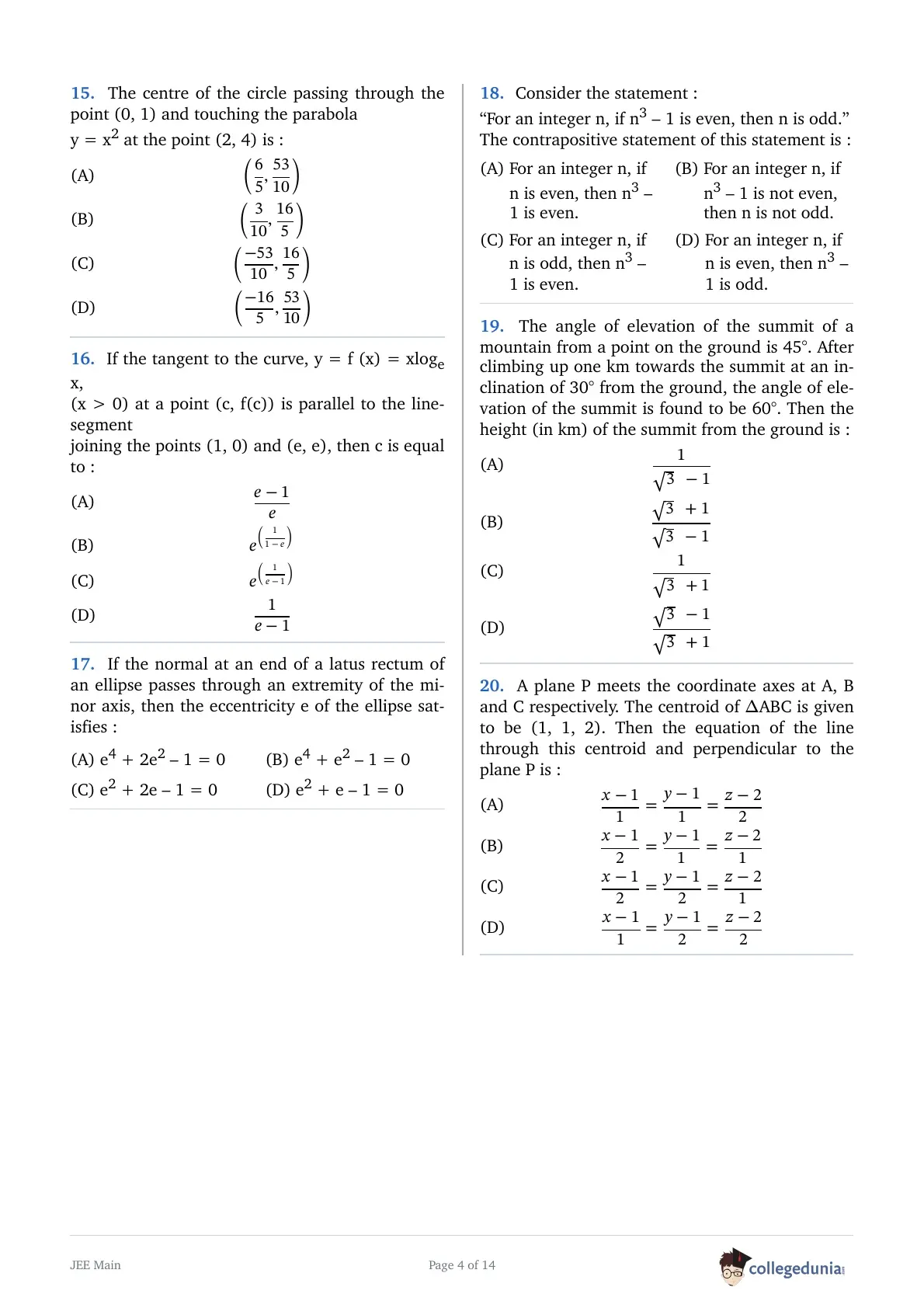
If the tangent to the curve, \(y = f(x) = x\log_e x\), \((x \gt 0)\) at a point \((c, f(c))\) is parallel to the line-segment joining the points \((1, 0)\) and \((e, e)\), then \(c\) is equal to :
If the normal at an end of a latus rectum of an ellipse passes through an extremity of the minor axis, then the eccentricity \(e\) of the ellipse satisfies :
Consider the statement :
“For an integer n, if \(n^3 - 1\) is even, then n is odd.”
The contrapositive statement of this statement is :
The angle of elevation of the summit of a mountain from a point on the ground is \(45^\circ\). After climbing up one km towards the summit at an inclination of \(30^\circ\) from the ground, the angle of elevation of the summit is found to be \(60^\circ\). Then the height (in km) of the summit from the ground is :
A plane P meets the coordinate axes at A, B and C respectively. The centroid of \(\Delta ABC\) is given to be \((1, 1, 2)\). Then the equation of the line through this centroid and perpendicular to the plane P is :
Mathematics - Section B (Q21 - Q25)
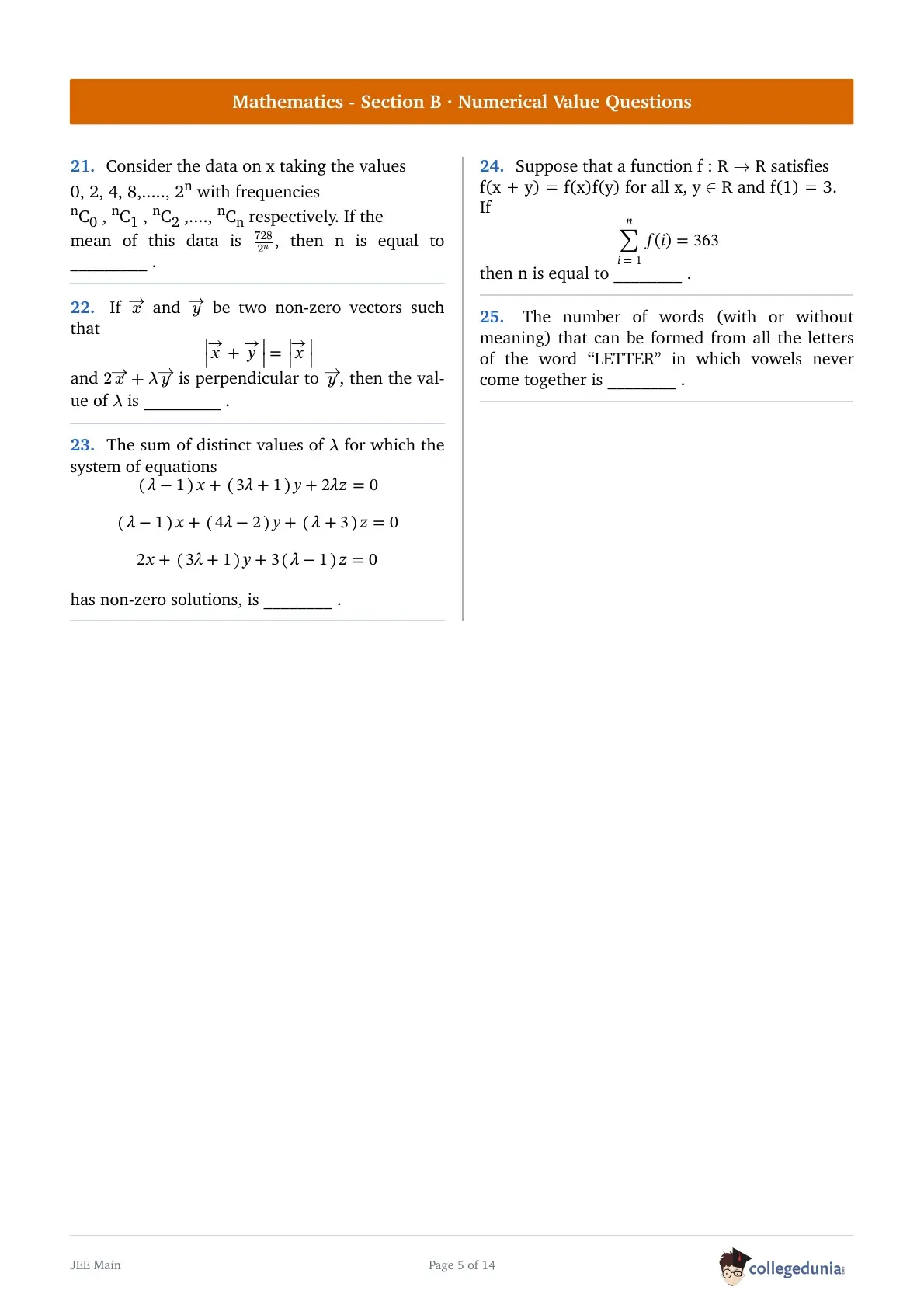
Consider the data on x taking the values \(0, 2, 4, 8, \ldots, 2^n\) with frequencies \({}^nC_0, {}^nC_1, {}^nC_2, \ldots, {}^nC_n\) respectively. If the mean of this data is \(\frac{728}{2^n}\), then n is equal to ________ .
Let \(\vec{a}, \vec{b}\) and \(\vec{c}\) be three non zero vectors such that \(\vec{b} \cdot \vec{c}=0\) and \(\vec{a} \times(\vec{b} \times \vec{c})=\frac{\vec{b}-\vec{c}}{2}\) If \(\vec{d}\) be a vector such that \(\vec{b} \cdot \vec{d}=\vec{a} \cdot \vec{b}\), then \((\vec{a} \times \vec{b}) \cdot(\vec{c} \times \vec{d})\) is equal to
The sum of distinct values of \(\lambda\) for which the system of equations
\((\lambda - 1)x + (3\lambda + 1)y + 2\lambda z = 0\)
\((\lambda - 1)x + (4\lambda - 2)y + (\lambda + 3)z = 0\)
\(2x + (3\lambda + 1)y + 3(\lambda - 1)z = 0\)
has non-zero solutions, is ________ .
Suppose that a function \(f : R \to R\) satisfies \(f(x + y) = f(x)f(y)\) for all \(x, y \in R\) and \(f(1) = 3\). If \(\sum_{i=1}^{n} f(i) = 363\) then n is equal to ________ .
The number of words (with or without meaning) that can be formed from all the letters of the word “LETTER” in which vowels never come together is ________ .
Physics - Section A (Q26 - Q45)
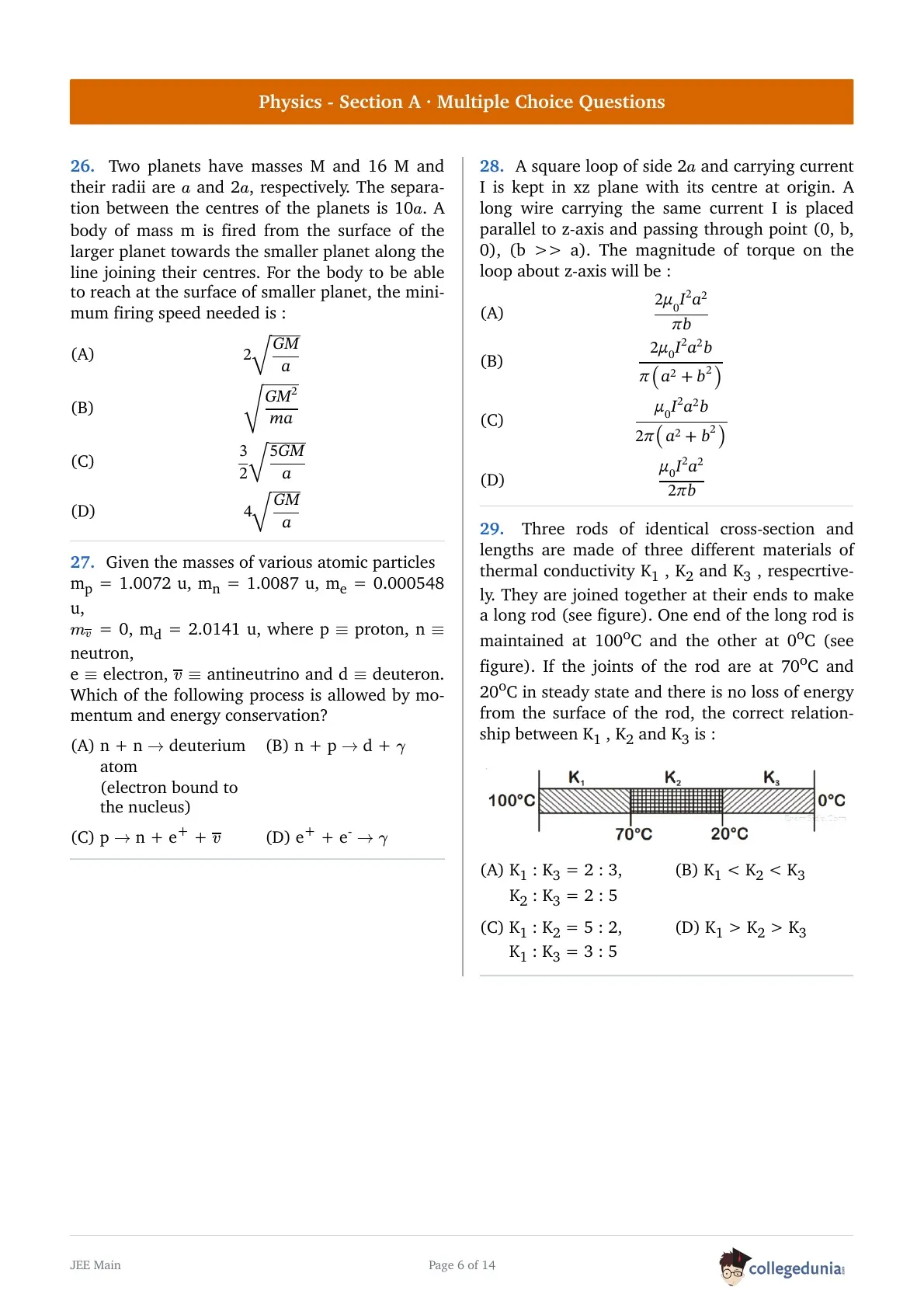
Two planets have masses M and 16 M and their radii are \(a\) and \(2a\), respectively. The separation between the centres of the planets is \(10a\). A body of mass m is fired from the surface of the larger planet towards the smaller planet along the line joining their centres. For the body to be able to reach at the surface of smaller planet, the minimum firing speed needed is :
Given the masses of various atomic particles \(m _{ p }=1.0072 u\) , \(m _{ n }=1.0087 \,u\) \(m _{ e }=0.000548 u\) , \(m _{\overline{ v }}=0\), \(m _{ d }=2.0141 u\) where \(p \equiv\) proton, \(n \equiv\) neutron, \(e \equiv\) electron, \(\overline{ v } \equiv\) antineutrino and \(d \equiv\) deuteron. Which of the following process is allowed by momentum and energy conservation ?
A square loop of side \(2a\) and carrying current I is kept in xz plane with its centre at origin. A long wire carrying the same current I is placed parallel to z-axis and passing through point \((0, b, 0)\), \((b \gt\gt a)\). The magnitude of torque on the loop about z-axis will be :
Three rods of identical cross-section and lengths are made of three different materials of thermal conductivity \(K_1\), \(K_2\) and \(K_3\), respectively. They are joined together at their ends to make a long rod (see figure). One end of the long rod is maintained at \(100^\circ\mathrm{C}\) and the other at \(0^\circ\mathrm{C}\) (see figure). If the joints of the rod are at \(70^\circ\mathrm{C}\) and \(20^\circ\mathrm{C}\) in steady state and there is no loss of energy from the surface of the rod, the correct relationship between \(K_1\), \(K_2\) and \(K_3\) is :
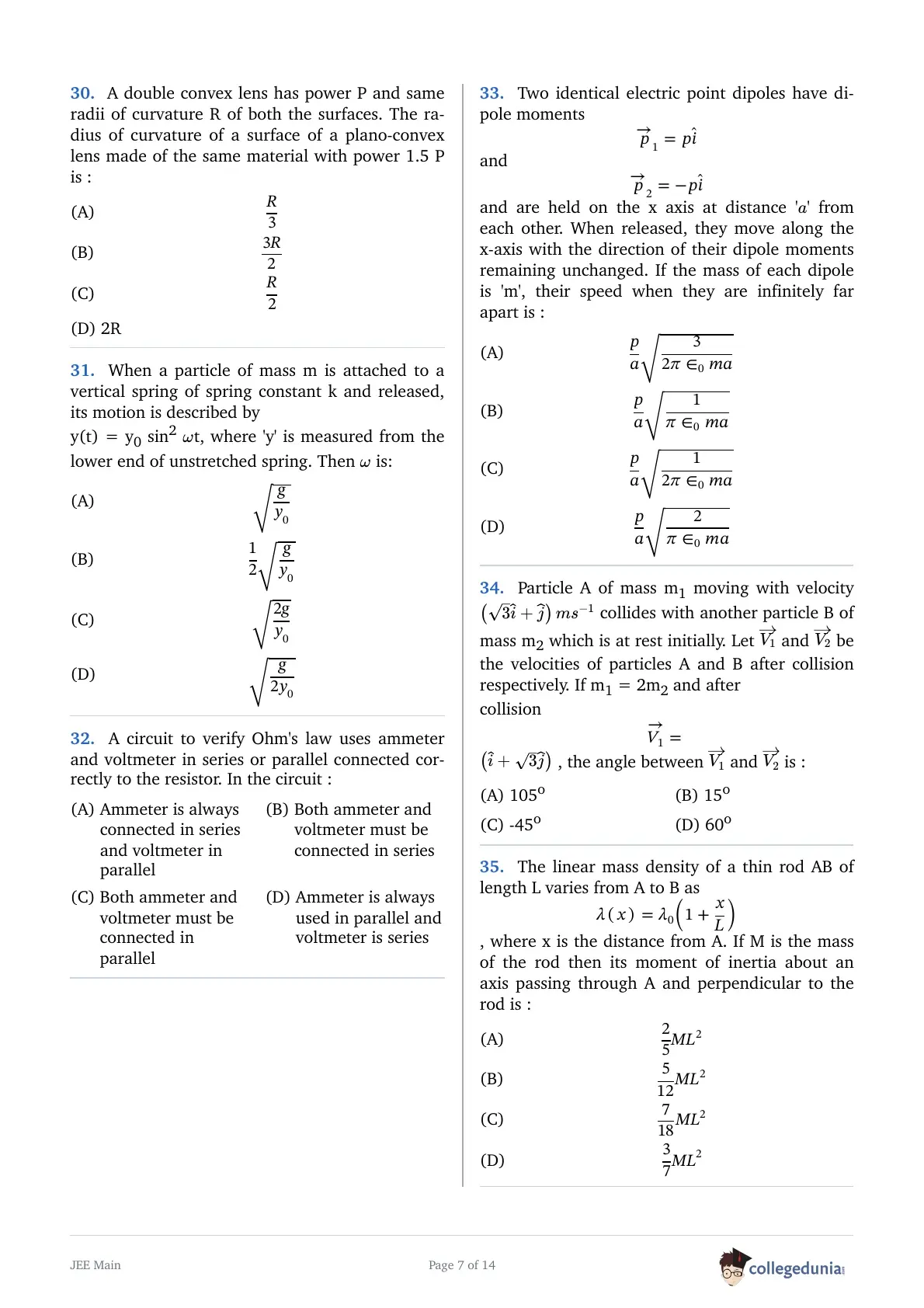
A double convex lens has power \(P\) and same radii of curvature \(R\) of both the surfaces. The radius of curvature of a surface of a plano-convex lens made of the same material with power \(1.5\,P\) is :
When a particle of mass \(m\) is attached to a vertical spring of spring constant \(k\) and released, its motion is described by \(y(t)=y_0\sin^2\omega t\), where \(y\) is measured from the lower end of unstretched spring. Then \(\omega\) is :
A circuit to verify Ohm's law uses ammeter and voltmeter in series or parallel connected correctly to the resistor. In the circuit :
Two identical electric point dipoles have dipole moments \(\vec{p}_1=p\hat{i}\) and \(\vec{p}_2=-p\hat{i}\) and are held on the x axis at distance \(a\) from each other. When released, they move along the x-axis with the direction of their dipole moments remaining unchanged. If the mass of each dipole is \(m\), their speed when they are infinitely far apart is :
Particle A of mass \(m_1\) moving with velocity \((\sqrt3\,\hat i+\hat j)\ \mathrm{ms^{-1}}\) collides with another particle B of mass \(m_2\) which is at rest initially. Let \(\vec V_1\) and \(\vec V_2\) be the velocities of particles A and B after collision respectively. If \(m_1=2m_2\) and after collision \(\vec V_1=(\hat i+\sqrt3\,\hat j)\), the angle between \(\vec V_1\) and \(\vec V_2\) is :
The linear mass density of a thin rod AB of length \(L\) varies from A to B as \(\lambda(x)=\lambda_0\left(1+\dfrac{x}{L}\right)\), where \(x\) is the distance from A. If \(M\) is the mass of the rod then its moment of inertia about an axis passing through A and perpendicular to the rod is :
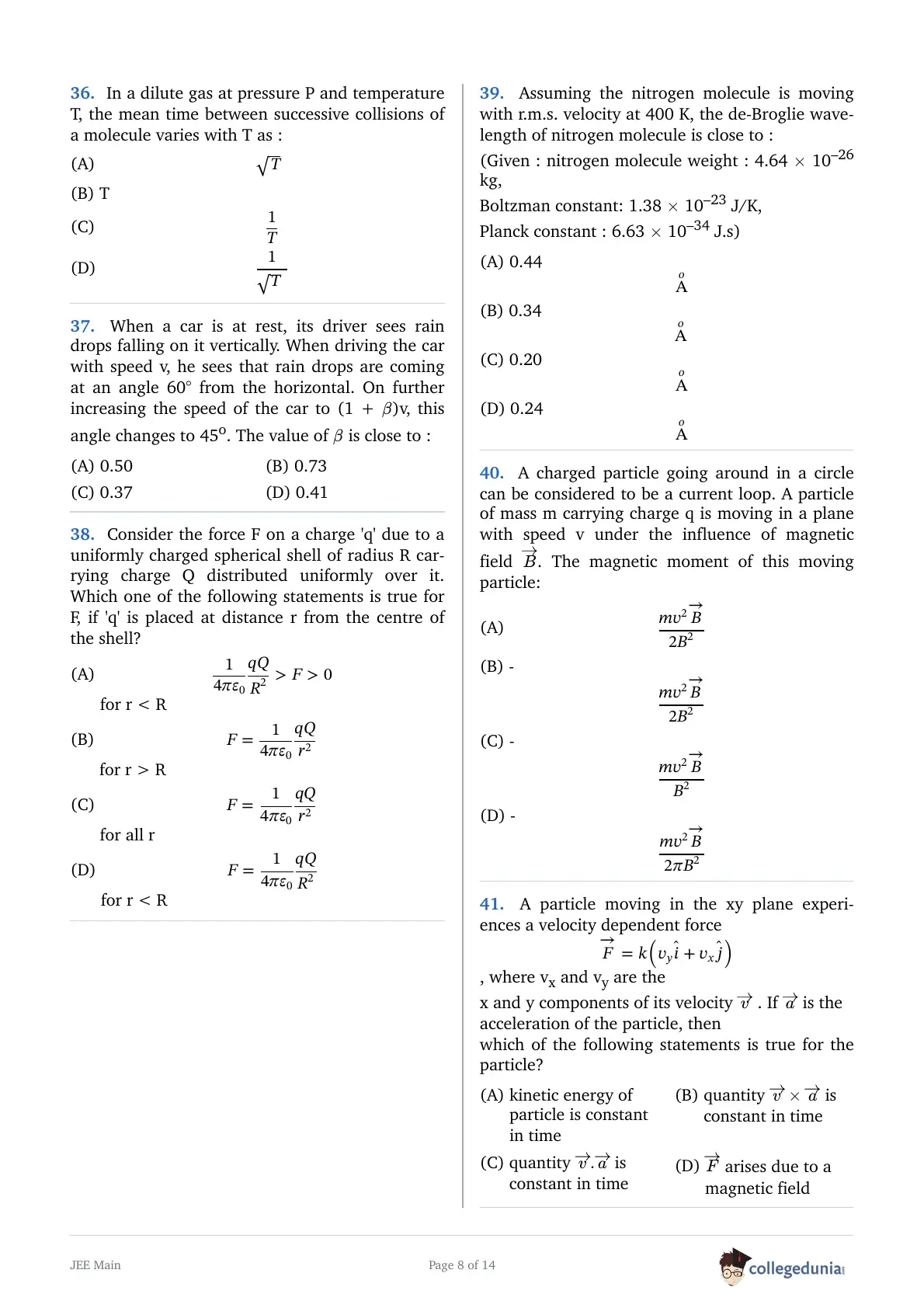
In a dilute gas at pressure \(P\) and temperature \(T\), the mean time between successive collisions of a molecule varies with \(T\) as :
When a car is at rest, its driver sees rain drops falling on it vertically. When driving the car with speed \(v\), he sees that rain drops are coming at an angle \(60^\circ\) from the horizontal. On further increasing the speed of the car to \((1+\beta)v\), this angle changes to \(45^\circ\). The value of \(\beta\) is close to :
Consider the force \(F\) on a charge \(q\) due to a uniformly charged spherical shell of radius \(R\) carrying charge \(Q\) distributed uniformly over it. Which one of the following statements is true for \(F\), if \(q\) is placed at distance \(r\) from the centre of the shell?
The de Broglie wavelength of an oxygen molecule at 27°C is x × \(10^{-12}\) m. The value of x is (take Planck's constant=6.63 × \(10^{-34}\) J/s, Boltzmann constant=1.38 × \(10^{-23}\) J/K, mass of oxygen molecule = 5.31 × \(10^{-26}\) kg)
A charged particle is moving in a magnetic field \[ \vec B = (3\hat i + 2\hat j)\ \text{T} \] with acceleration \[ \vec a = 4\hat i - \frac{x}{2}\hat j\ \text{m/s}^2 \] Find \(x\).
A particle moving in the xy plane experiences a velocity dependent force \(\vec F=k\left(v_y\hat i+v_x\hat j\right)\), where \(v_x\) and \(v_y\) are the x and y components of its velocity \(\vec v\). If \(\vec a\) is the acceleration of the particle, then which of the following statements is true for the particle?
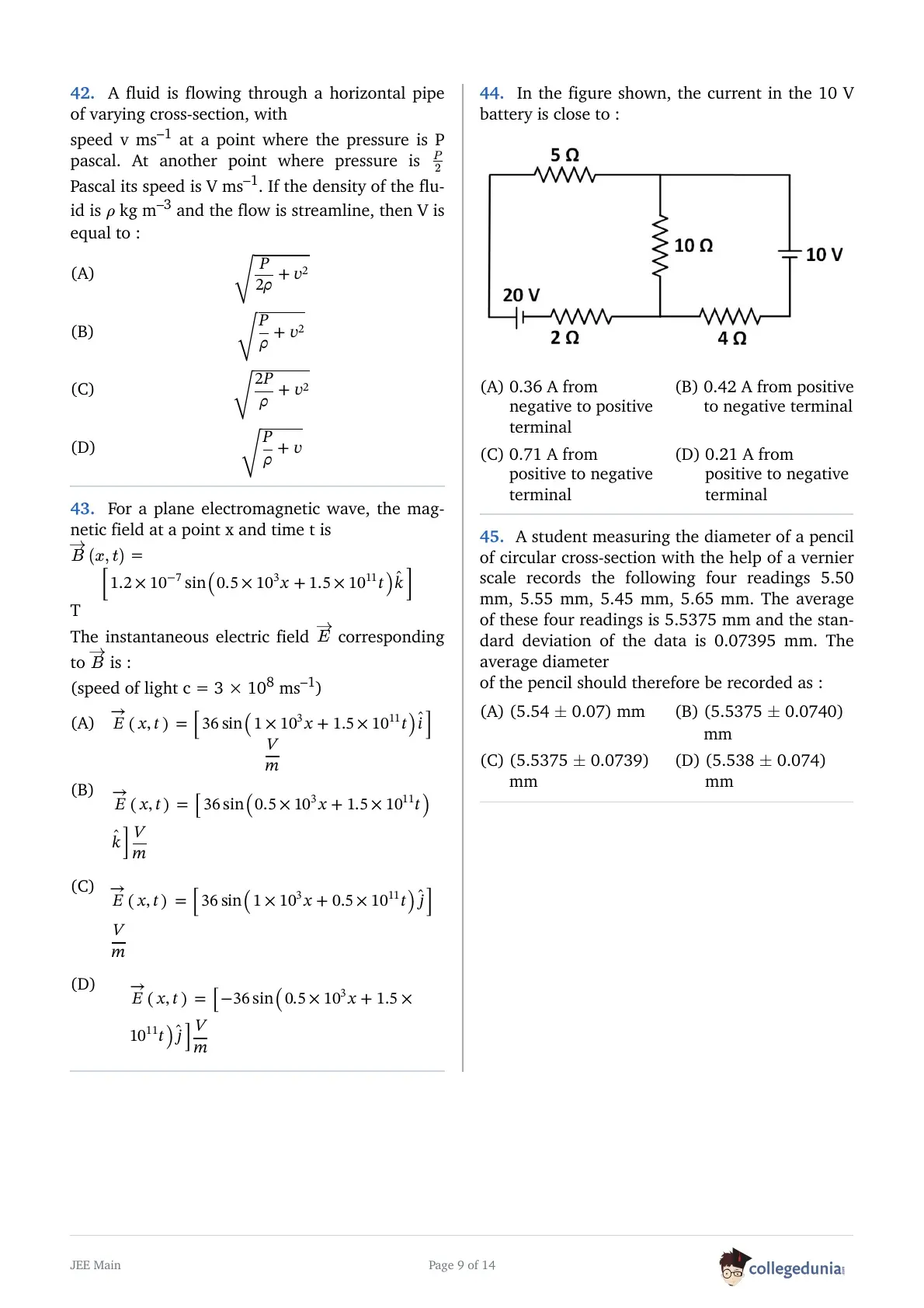
A fluid is flowing through a horizontal pipe of varying cross-section, with speed \(v\ \mathrm{ms^{-1}}\) at a point where the pressure is \(P\) pascal. At another point where pressure is \(\dfrac{P}{2}\) Pascal its speed is \(V\ \mathrm{ms^{-1}}\). If the density of the fluid is \(\rho\ \mathrm{kg\,m^{-3}}\) and the flow is streamline, then \(V\) is equal to :
For a plane electromagnetic wave, the magnetic field at a point x and time t is
\(\vec{B}(x,t)=\left[1.2\times10^{-7}\sin\left(0.5\times10^{3}x+1.5\times10^{11}t\right)\hat{k}\right]\) T
The instantaneous electric field \(\vec{E}\) corresponding to \(\vec{B}\) is :
(speed of light c = \(3\times10^{8}\) ms\(^{-1}\))
In the figure shown, the current in the 10 V battery is close to :
A student measuring the diameter of a pencil of circular cross-section with the help of a vernier scale records the following four readings 5.50 mm, 5.55 mm, 5.45 mm, 5.65 mm. The average of these four readings is 5.5375 mm and the standard deviation of the data is 0.07395 mm. The average diameter of the pencil should therefore be recorded as :
Physics - Section B (Q46 - Q50)
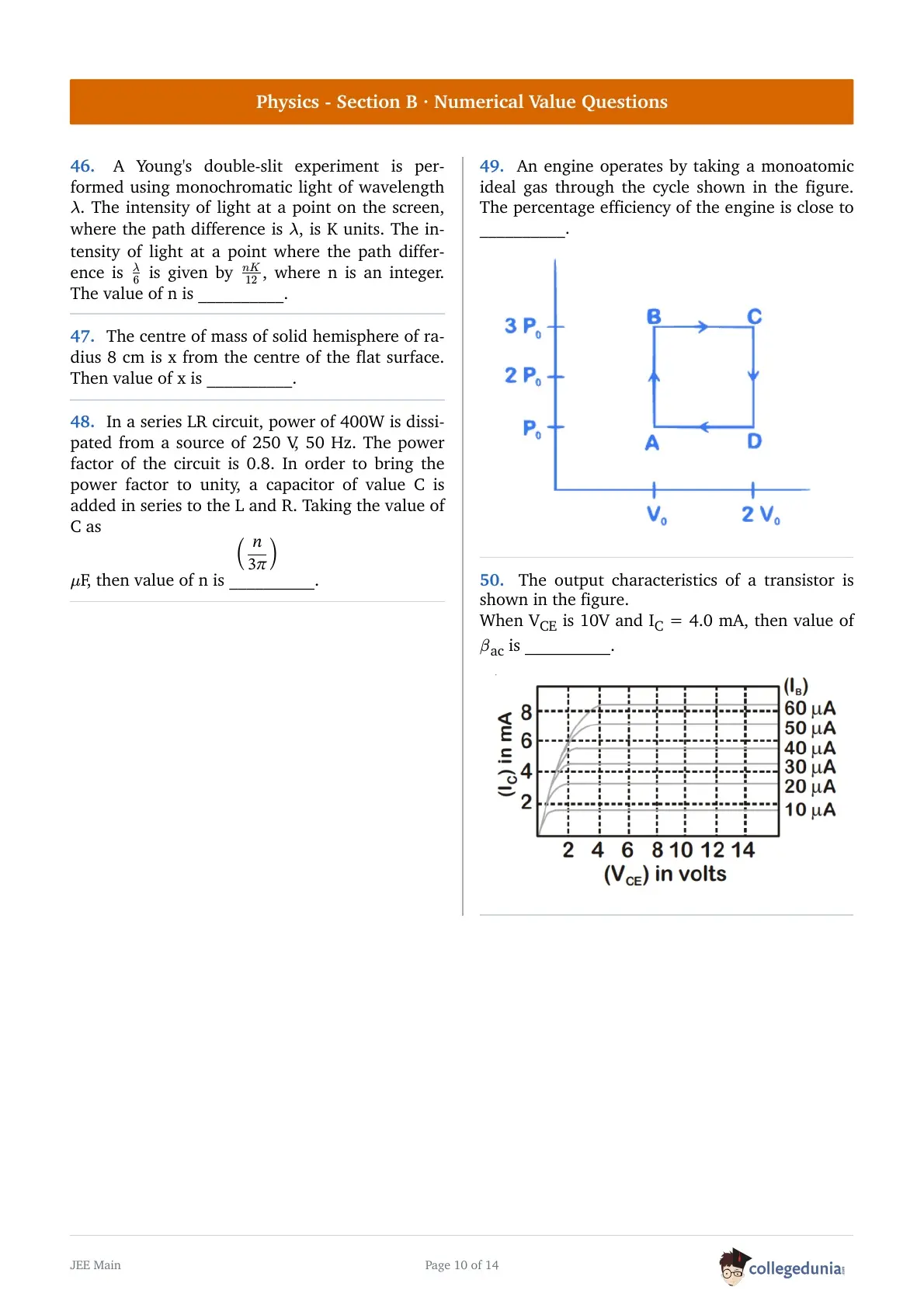
A Young's double-slit experiment is performed using monochromatic light of wavelength \(\lambda\). The intensity of light at a point on the screen, where the path difference is \(\lambda\), is K units. The intensity of light at a point where the path difference is \(\frac{\lambda}{6}\) is given by \(\frac{nK}{12}\), where n is an integer. The value of n is __________.
The centre of mass of solid hemisphere of radius 8 cm is x from the centre of the flat surface. Then value of x is __________.
In a series LR circuit, power of 400 W is dissipated from a source of 250 V, 50 Hz. The power factor of the circuit is 0.8. In order to bring the power factor to unity, a capacitor of value C is added in series to the L and R. Taking the value of C as \(\left(\frac{n}{3\pi}\right)\mu\)F, then value of n is __________.
An engine operates by taking \(n\) moles of an ideal gas through the cycle \(ABCDA\) shown in figure. The thermal efficiency of the engine is : (Take \(C_v = 1.5 \, R,\) where \(R\) is gas constant)
The output characteristics of a transistor is shown in the figure.
When VCE is 10 V and IC = 4.0 mA, then value of \(\beta_{ac}\) is __________.
Chemistry - Section A (Q51 - Q70)
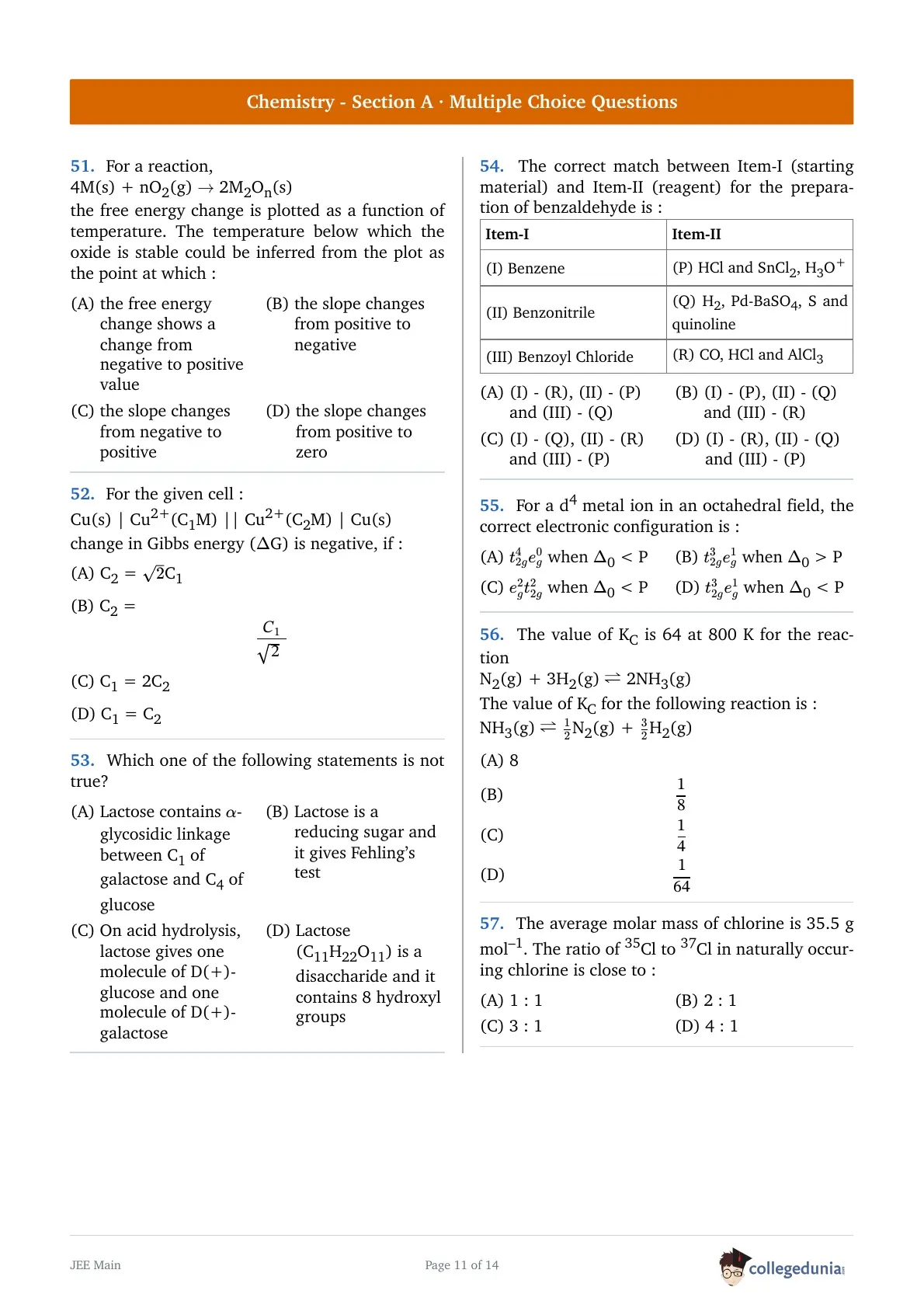
For a reaction,
\(4\mathrm{M(s)}+n\mathrm{O_2(g)}\rightarrow2\mathrm{M_2O_n(s)}\)
the free energy change is plotted as a function of temperature. The temperature below which the oxide is stable could be inferred from the plot as the point at which :
For the given cell :
\(\mathrm{Cu(s)\,|\,Cu^{2+}(C_1\,M)\,||\,Cu^{2+}(C_2\,M)\,|\,Cu(s)}\)
change in Gibbs energy (\(\Delta G\)) is negative, if :
Which one of the following statements is not true?
| Item-I | Item-II |
| (I) Benzene | (P) HCl and \(\mathrm{SnCl_2}\), \(\mathrm{H_3O^+}\) |
| (II) Benzonitrile | (Q) \(\mathrm{H_2}\), Pd-\(\mathrm{BaSO_4}\), S and quinoline |
| (III) Benzoyl Chloride | (R) CO, HCl and \(\mathrm{AlCl_3}\) |
For a \(\mathrm{d^4}\) metal ion in an octahedral field, the correct electronic configuration is :
The value of \(K_C\) is 64 at 800 K for the reaction
\(\mathrm{N_2(g) + 3H_2(g) \rightleftharpoons 2NH_3(g)}\)
The value of \(K_C\) for the following reaction is :
\(\mathrm{NH_3(g) \rightleftharpoons \frac{1}{2}N_2(g) + \frac{3}{2}H_2(g)}\)
The average molar mass of chlorine is 35.5 g mol\(^{-1}\). The ratio of \(^{35}\mathrm{Cl}\) to \(^{37}\mathrm{Cl}\) in naturally occuring chlorine is close to :
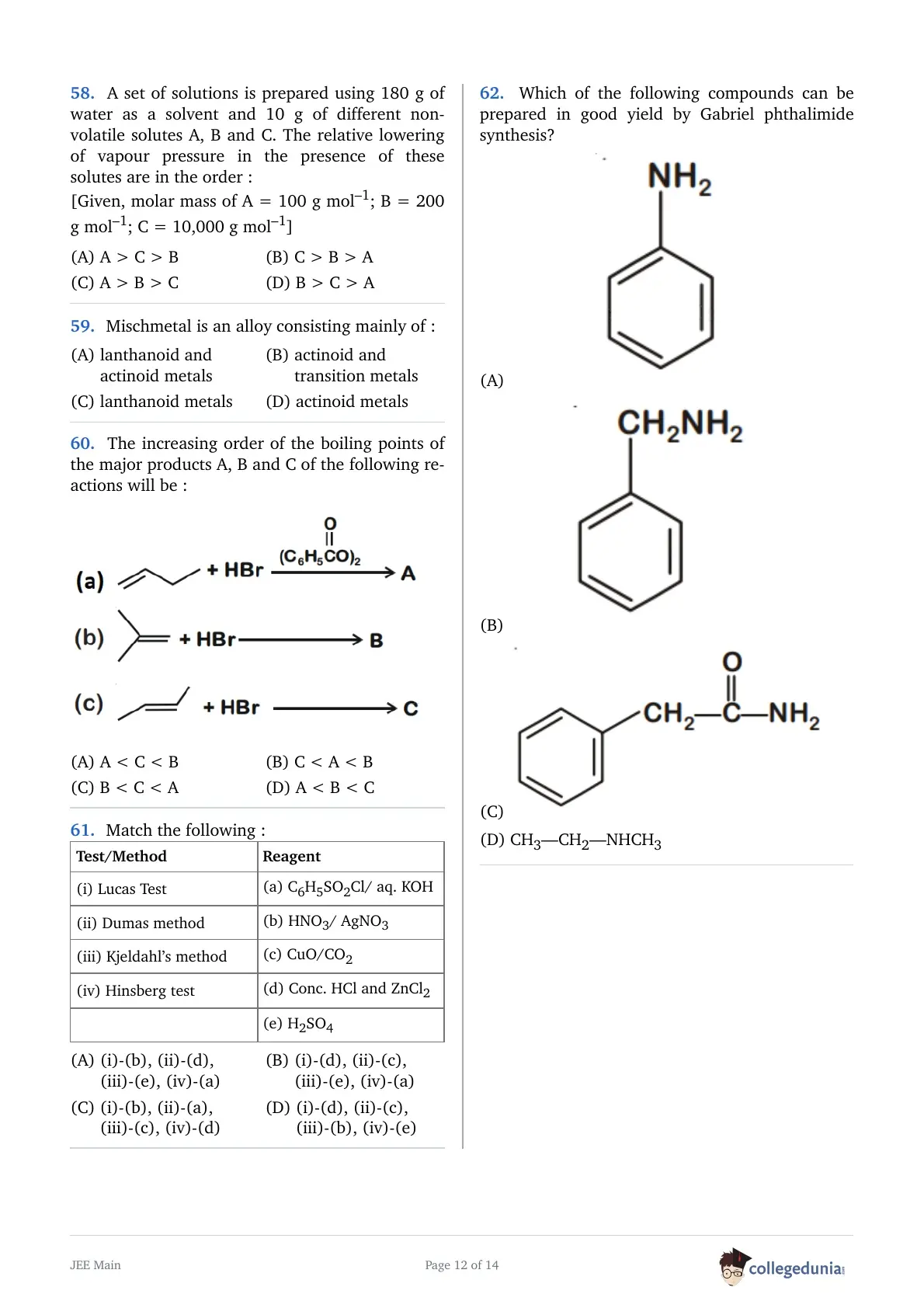
A set of solutions is prepared using 180 g of water as a solvent and 10 g of different nonvolatile solutes A, B and C. The relative lowering of vapour pressure in the presence of these solutes are in the order :
[Given, molar mass of A = 100 g mol\(^{-1}\); B = 200 g mol\(^{-1}\); C = 10,000 g mol\(^{-1}\)]
Mischmetal is an alloy consisting mainly of :
The increasing order of the boiling points of the major products A, B and C of the following reactions will be :
| Test/Method | Reagent |
| (i) Lucas Test | (a) \(\mathrm{C_6H_5SO_2Cl}\)/ aq. KOH |
| (ii) Dumas method | (b) \(\mathrm{HNO_3}\)/ \(\mathrm{AgNO_3}\) |
| (iii) Kjeldahl's method | (c) \(\mathrm{CuO/CO_2}\) |
| (iv) Hinsberg test | (d) Conc. HCl and \(\mathrm{ZnCl_2}\) |
| (e) \(\mathrm{H_2SO_4}\) |
Which of the following compounds can be prepared in good yield by Gabriel phthalimide synthesis?
- (1)
![]()
- (2)
![]()
- (3)
![]()
- (4) \(\mathrm{CH_3-CH_2-NHCH_3}\)


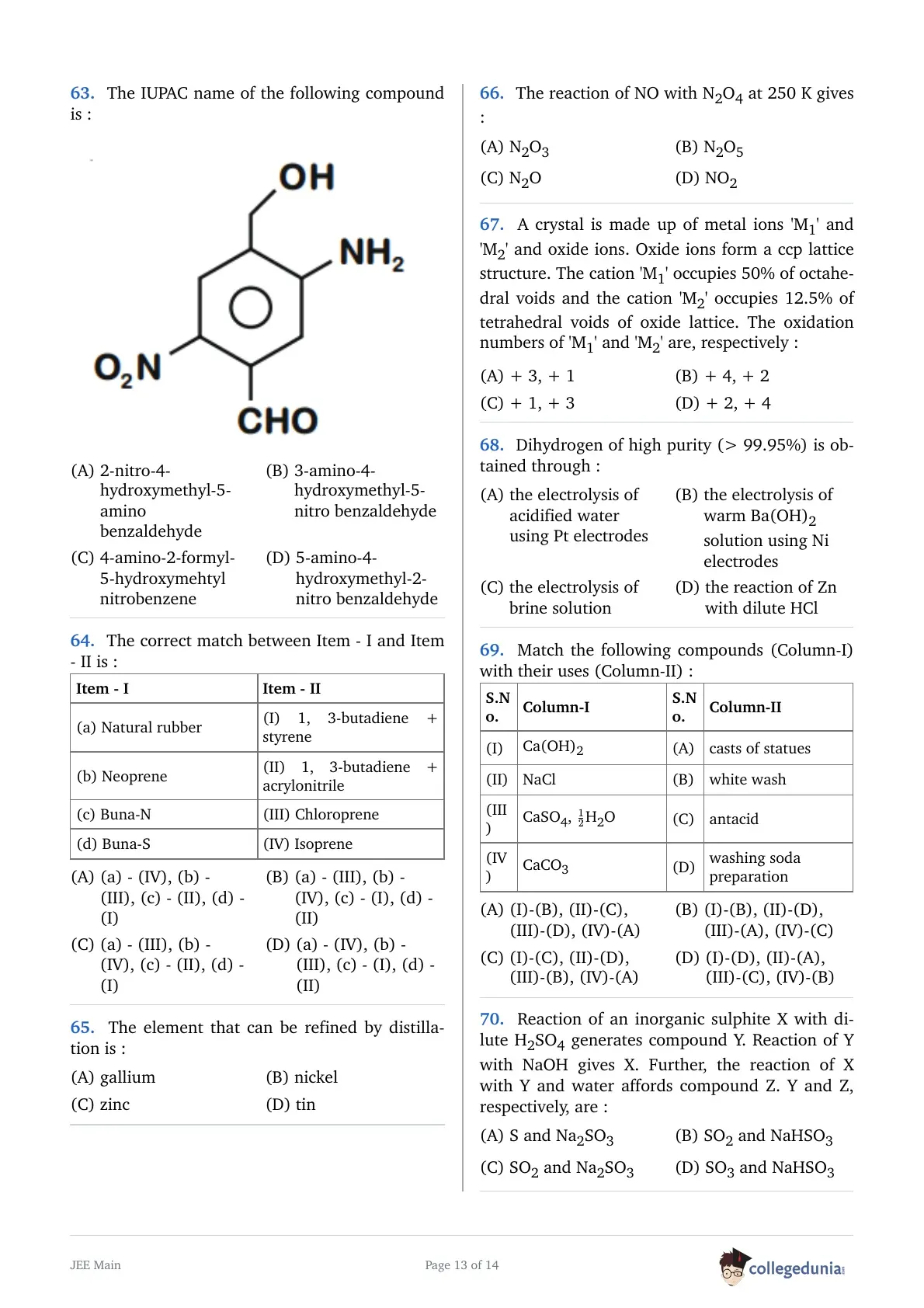
The IUPAC name of the following compound is :
| Item - I | Item - II |
| (a) Natural rubber | (I) 1, 3-butadiene + styrene |
| (b) Neoprene | (II) 1, 3-butadiene + acrylonitrile |
| (c) Buna-N | (III) Chloroprene |
| (d) Buna-S | (IV) Isoprene |
The element that can be refined by distillation is :
The reaction of NO with \(\mathrm{N_2O_4}\) at 250 K gives :
A crystal is made up of metal ions 'M \(_{1}\) ' and 'M \(_{2}\) ' and oxide ions. Oxide ions. form a ccp lattice structure. The cation '\(M_1\) occupies \(50 \%\) of octahedral voids and the cation 'M \(_{2}\) ' occupies \(12.5 \%\) of tetrahedral voids of oxide lattice. The oxidation numbers of ' \(M _{1}\) ' and ' \(M _{2}\) ' are, respectively:
High purity (>99.95%) dihydrogen is obtained by
| S.No. | Column-I | S.No. | Column-II |
| (I) | \(\mathrm{Ca(OH)_2}\) | (A) | casts of statues |
| (II) | NaCl | (B) | white wash |
| (III) | \(\mathrm{CaSO_4,\ \frac{1}{2}H_2O}\) | (C) | antacid |
| (IV) | \(\mathrm{CaCO_3}\) | (D) | washing soda preparation |
Reaction of an inorganic sulphite X with dilute \(\mathrm{H_2SO_4}\) generates compound Y. Reaction of Y with NaOH gives X. Further, the reaction of X with Y and water affords compound Z. Y and Z, respectively, are :
Chemistry - Section B (Q71 - Q75)
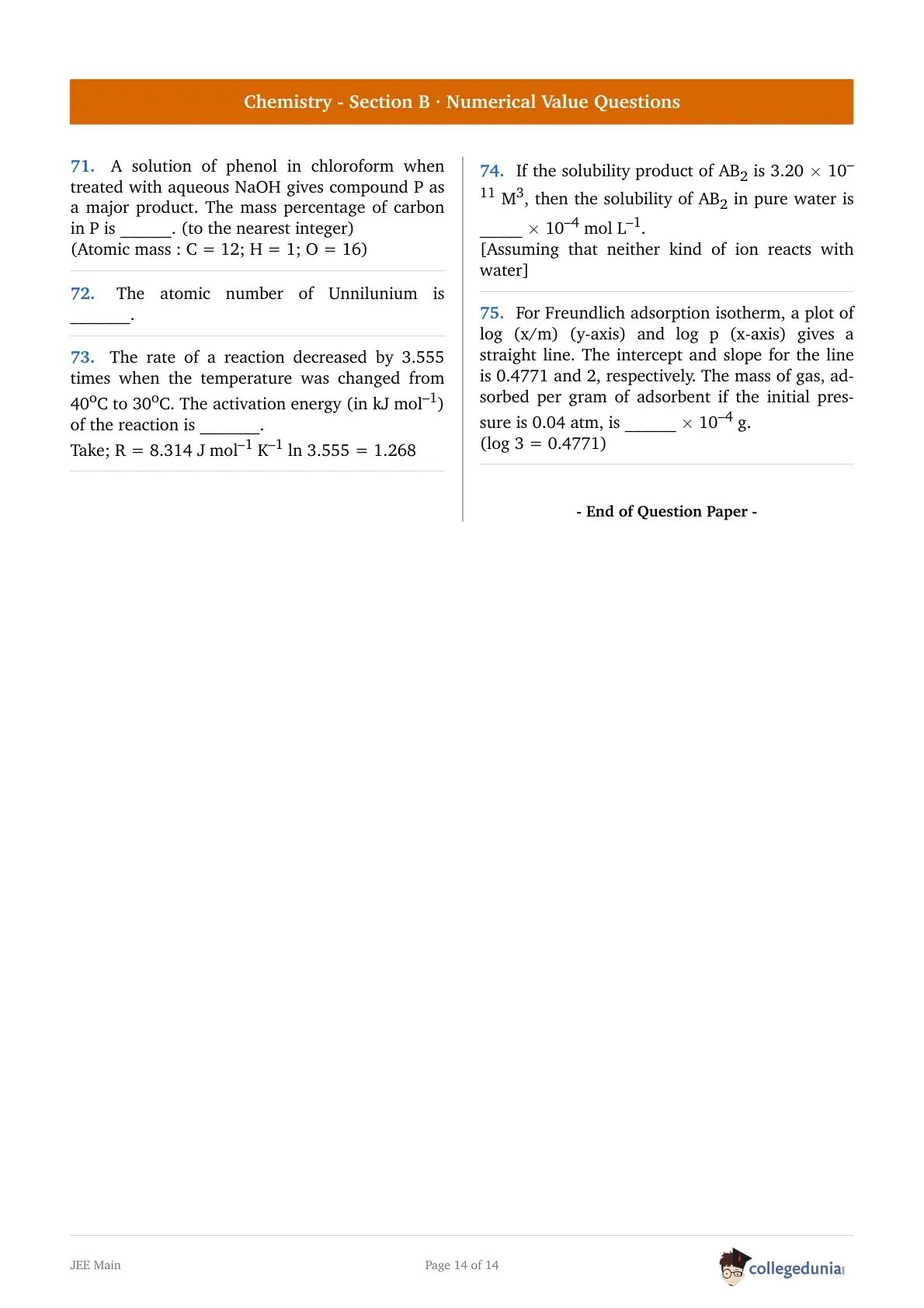
A solution of phenol in chloroform when treated with aqueous NaOH gives compound P as a major product. The mass percentage of carbon in P is ______. (to the nearest integer)
(Atomic mass : C = 12; H = 1; O = 16)
The atomic number of Unnilunium is _______.
The rate of a reaction decreased by 3.555 times when the temperature was changed from \(40^\circ\mathrm{C}\) to \(30^\circ\mathrm{C}\). The activation energy (in \(\mathrm{kJ\ mol^{-1}}\)) of the reaction is ______.
Take; \(R = 8.314\ \mathrm{J\ mol^{-1}\ K^{-1}}\)
\(\ln 3.555 = 1.268\)
If the solubility product of \(\mathrm{AB_2}\) is \(3.20\times10^{-11}\ \mathrm{M^3}\), then the solubility of \(\mathrm{AB_2}\) in pure water is ______ \(\times10^{-4}\ \mathrm{mol\ L^{-1}}\).
[Assuming that neither kind of ion reacts with water]
For Freundlich adsorption isotherm, a plot of \(\log(x/m)\) (y-axis) and \(\log p\) (x-axis) gives a straight line. The intercept and slope for the line is 0.4771 and 2, respectively. The mass of gas, adsorbed per gram of adsorbent if the initial pressure is 0.04 atm, is ______ \(\times10^{-4}\) g.
(\(\log 3 = 0.4771\))
JEE Main 2020 Exam Pattern and Marking Scheme
| Particulars | Details |
|---|---|
| Exam Mode | Online (Computer-Based Test) |
| Paper | B.E./B.Tech (Paper 1) |
| Duration | 3 hours (180 minutes) |
| Type of Questions | Multiple Choice Questions (MCQs) + Numerical Value Questions |
| Subjects | Mathematics, Physics, Chemistry |
| Total Questions | 75 questions |
| Total Marks | 300 marks |
| Marking Scheme | +4 for correct answer & -1 for incorrect MCQ; no negative marking for Numerical Value Questions |
JEE Main 2020 September 6 Shift 2 Difficulty Level
JEE main 2020 B.E./B.Tech Question Paper with Answer Keys for September 6 Afternoon Session is available. As per the initial students’ reaction, the paper was reported to be moderate to difficult in terms of overall difficulty. An attempt of 40-42 questions in the overall paper was considered a safe score.



Comments