




JEE Main 2020 September 6 Shift 1 Question Paper is available here with solutions PDF and detailed solutions for every question. NTA conducted the first shift on September 6, 2020, from 9:00 AM to 12:00 PM. The JEE Main 2020 Paper 1 (B.E./B.Tech) question paper includes the following:
- 75 questions in a 3-hour CBT Mode: 25 each from Mathematics, Physics and Chemistry
- Section A: 20 multiple choice questions (MCQs) per subject, 4 marks each
- Section B: 5 numerical value questions per subject, all compulsory, 4 marks each
- Marking: +4 for a correct answer, -1 for an incorrect MCQ, 0 for an unattempted question; no negative marking for numerical value questions
- Maximum marks: 300 (100 per subject)
JEE Main 2020 September 6 Shift 1 Question Paper with Solution PDF
| NTA Official PDF | CD PDF | CD PDF with Solutions |
|---|---|---|
| Download official PDF 5.44 MB | Download Collegedunia PDF 1.12 MB | Download solutions PDF 1.78 MB |
Also Check:
JEE Main 2020 September 6 Shift 1 Questions with Solutions
Mathematics - Section A (Q1 - Q20)
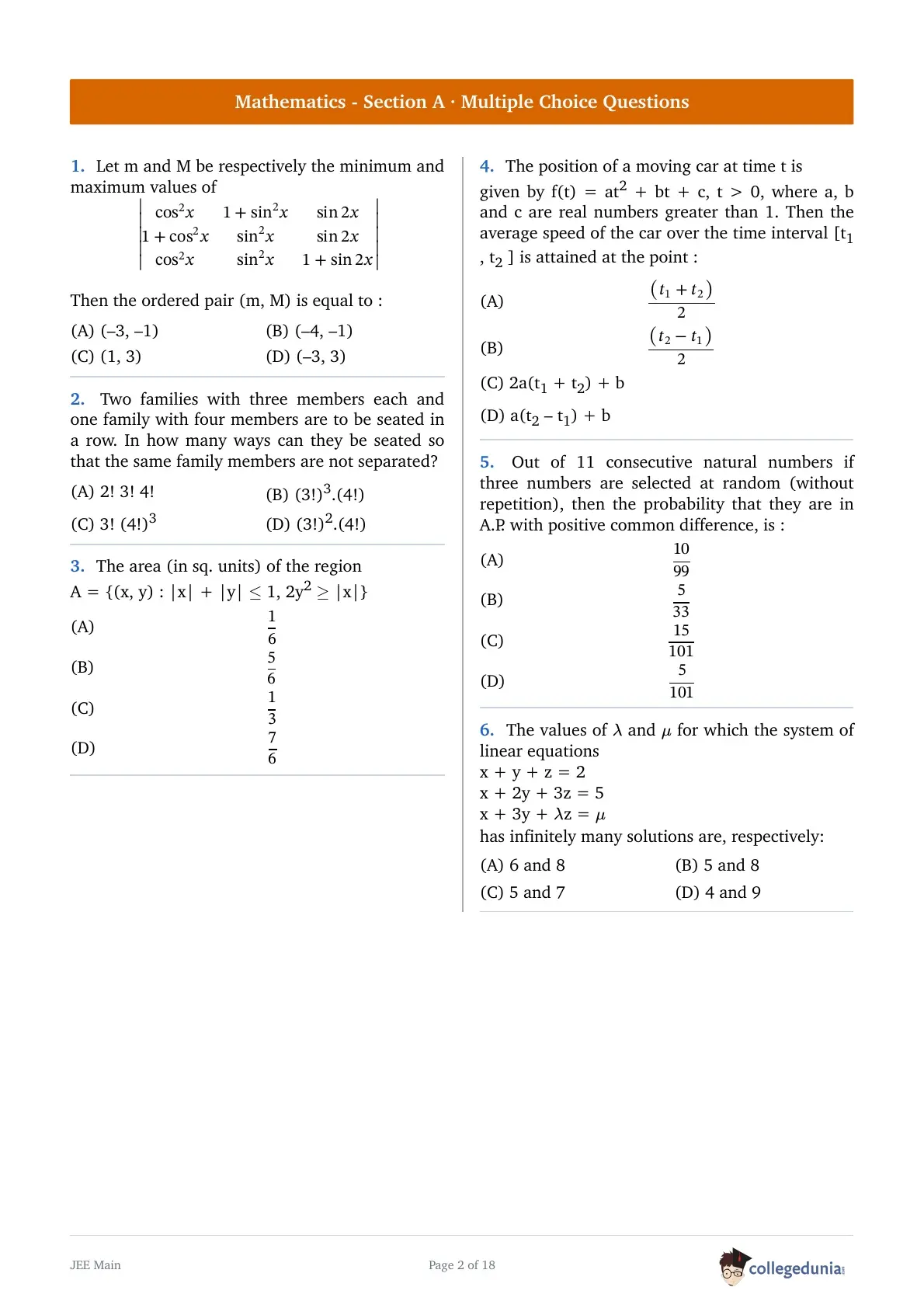
Let m and M be respectively the minimum and maximum values of
\(\begin{vmatrix}\cos^2 x & 1+\sin^2 x & \sin 2x\\ 1+\cos^2 x & \sin^2 x & \sin 2x\\ \cos^2 x & \sin^2 x & 1+\sin 2x\end{vmatrix}\)
Then the ordered pair (m, M) is equal to :
Two families with three members each and one family with four members are to be seated in a row. In how many ways can they be seated so that the same family members are not separated?
The area (in sq. units) of the region
\(A=\{(x, y) : |x|+|y|\le 1,\ 2y^2\ge |x|\}\)
The position of a moving car at time t is given by \(f(t)=at^2+bt+c,\ t>0\), where a, b and c are real numbers greater than 1. Then the average speed of the car over the time interval \([t_1,\ t_2]\) is attained at the point :
Out of 11 consecutive natural numbers if three numbers are selected at random (without repetition), then the probability that they are in A.P. with positive common difference, is :
The values of \(\lambda\) and \(\mu\) for which the system of linear equations
\(x+y+z=2\)
\(x+2y+3z=5\)
\(x+3y+\lambda z=\mu\)
has infinitely many solutions are, respectively:
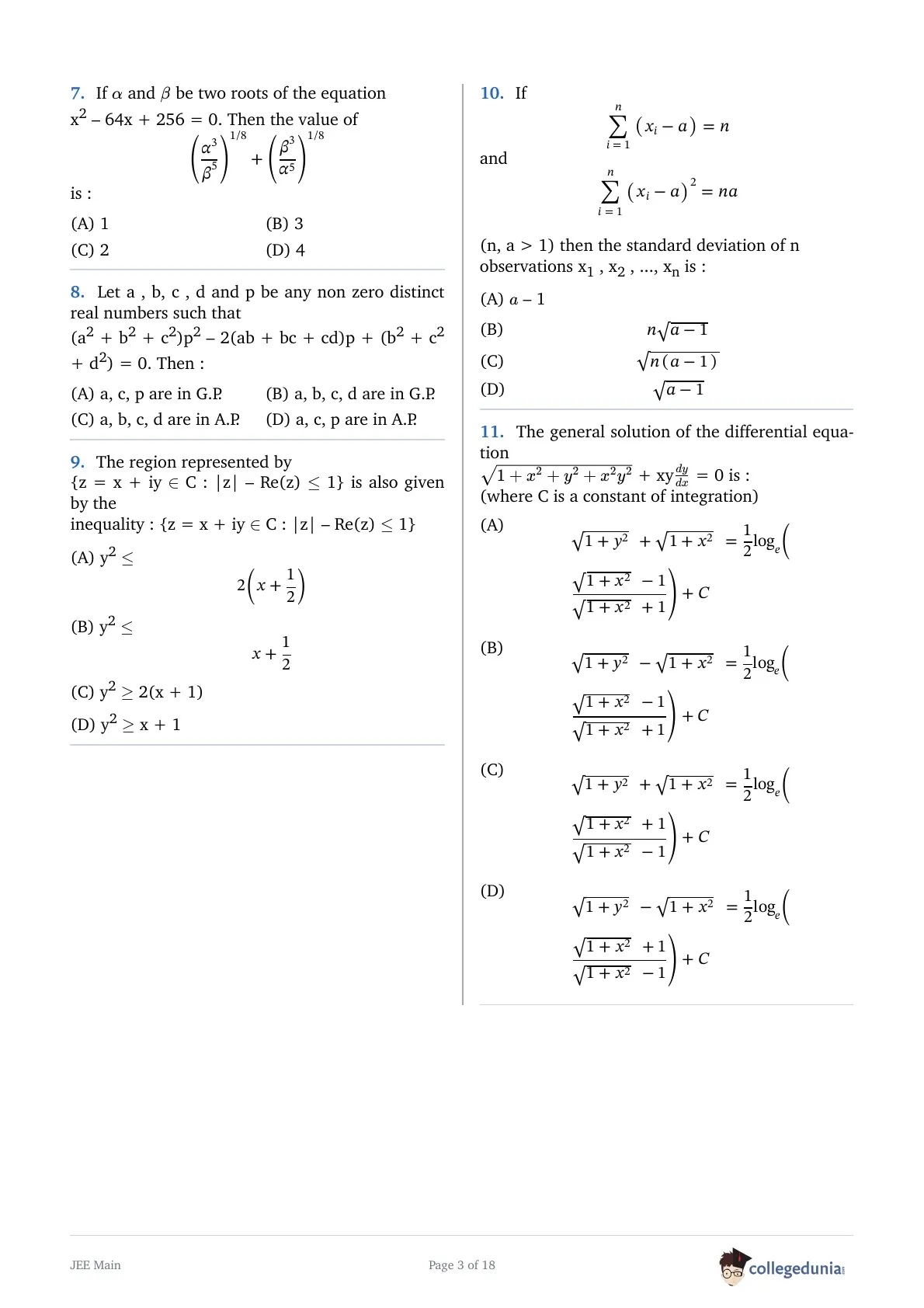
If \(\alpha\) and \(\beta\) be two roots of the equation \(x^2-64x+256=0\). Then the value of
\(\left(\dfrac{\alpha^3}{\beta^5}\right)^{1/8}+\left(\dfrac{\beta^3}{\alpha^5}\right)^{1/8}\)
is :
Let a, b, c, d and p be any non zero distinct real numbers such that
\((a^2+b^2+c^2)p^2-2(ab+bc+cd)p+(b^2+c^2+d^2)=0\). Then :
The region represented by
\(\{z=x+iy\in C : |z|-\mathrm{Re}(z)\le 1\}\) is also given by the inequality :
\(\{z=x+iy\in C : |z|-\mathrm{Re}(z)\le 1\}\)
If \(\displaystyle\sum_{i=1}^{n}(x_i-a)=n\) and \(\displaystyle\sum_{i=1}^{n}(x_i-a)^2=na\) \((n, a>1)\) then the standard deviation of n observations \(x_1, x_2, \ldots, x_n\) is :
The general solution of the differential equation
\(\sqrt{1+x^2+y^2+x^2y^2}+xy\dfrac{dy}{dx}=0\) is :
(where C is a constant of integration)
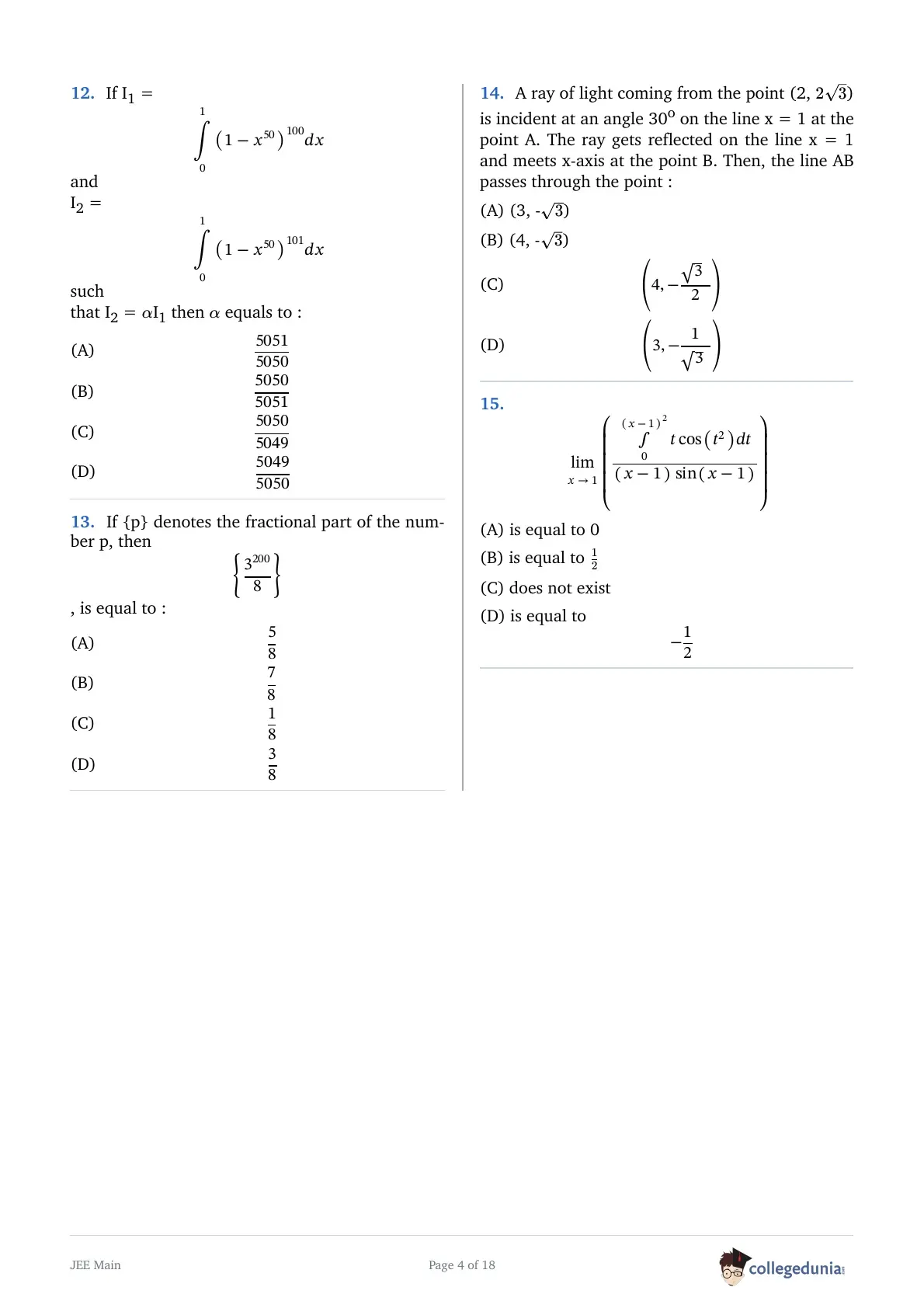
If \(I_1=\displaystyle\int_0^1(1-x^{50})^{100}dx\) and \(I_2=\displaystyle\int_0^1(1-x^{50})^{101}dx\) such that \(I_2=\alpha I_1\) then \(\alpha\) equals to :
If \(\{p\}\) denotes the fractional part of the number \(p\), then
\(\left\{\frac{3^{200}}{8}\right\}\), is equal to :
A ray of light coming from the point \((2,\,2\sqrt{3})\) is incident at an angle \(30^\circ\) on the line \(x=1\) at the point A. The ray gets reflected on the line \(x=1\) and meets x-axis at the point B. Then, the line AB passes through the point :
\(\displaystyle\lim_{x\to 1}\left(\frac{\int_{0}^{(x-1)^2} t\cos\left(t^2\right)dt}{(x-1)\sin(x-1)}\right)\)
If \(f(x+y)=f(x)f(y)\) and \(\displaystyle\sum_{x=1}^{\infty}f(x)=2\), \(x,y\in N\), where N is the set of all natural number, then the value of \(\frac{f(4)}{f(2)}\) is :
Let \(L_1\) be a tangent to the parabola \(y^2=4(x+1)\) and \(L_2\) be a tangent to the parabola \(y^2=8(x+2)\) such that \(L_1\) and \(L_2\) intersect at right angles. Then \(L_1\) and \(L_2\) meet on the straight line :
Which of the following points lies on the locus of the foot of perpedicular drawn upon any tangent to the ellipse,
\(\frac{x^2}{4}+\frac{y^2}{2}=1\)
from any of its foci?
The shortest distance between the lines
\(\frac{x-1}{0}=\frac{y+1}{-1}=\frac{z}{1}\)
and \(x+y+z+1=0,\ 2x-y+z+3=0\) is :
The negation of the Boolean expression \(p\vee(\sim p\wedge q)\) is equivalent to :
Mathematics - Section B (Q21 - Q25)
Let \(f:R\to R\) be defined as
\(f(x)=\begin{cases}x^5\sin\left(\frac{1}{x}\right)+5x^2, & x\lt 0\\ 0, & x=0\\ x^5\cos\left(\frac{1}{x}\right)+\lambda x^2, & x\gt 0\end{cases}\)
The value of \(\lambda\) for which \(f''(0)\) exists, is _______.
Let \( A \) and \( B \) be two finite sets with \( m \) and \( n \) elements respectively. The total number of subsets of the set \( A \) is 56 more than the total number of subsets of \( B \). Then the distance of the point \( P(m, n) \) from the point \( Q(-2, -3) \) is:
If \(\vec{a}\) and \(\vec{b}\) are unit vectors, then the greatest value of
\(\sqrt{3}\,|\vec{a}+\vec{b}|+|\vec{a}-\vec{b}|\)
is _______.
Let AD and BC be two vertical poles at A and B respectively on a horizontal ground. If AD = 8 m, BC = 11 m and AB = 10 m; then the distance (in meters) of a point M on AB from the point A such that \(MD^2+MC^2\) is minimum is _______.
The angle of elevation of the top of a hill from a point on the horizontal plane passing through the foot of the hill is found to be \(45^\circ\). After walking a distance of 80 meters towards the top, up a slope inclined at an angle of \(30^\circ\) to the horizontal plane, the angle of elevation of the top of the hill becomes \(75^\circ\). Then the height of the hill (in meters) is _______.
Physics - Section A (Q26 - Q45)
You are given that Mass of \(^{7}_{3}\mathrm{Li}\) = 7.0160u,
Mass of \(^{4}_{2}\mathrm{He}\) = 4.0026u
and Mass of \(^{1}_{1}\mathrm{H}\) = 1.0079u.
When 20 g of \(^{7}_{3}\mathrm{Li}\) is converted into \(^{4}_{2}\mathrm{He}\) by proton capture, the energy liberated, (in kWh), is :
[Mass of nucleon = 1 GeV/c2]
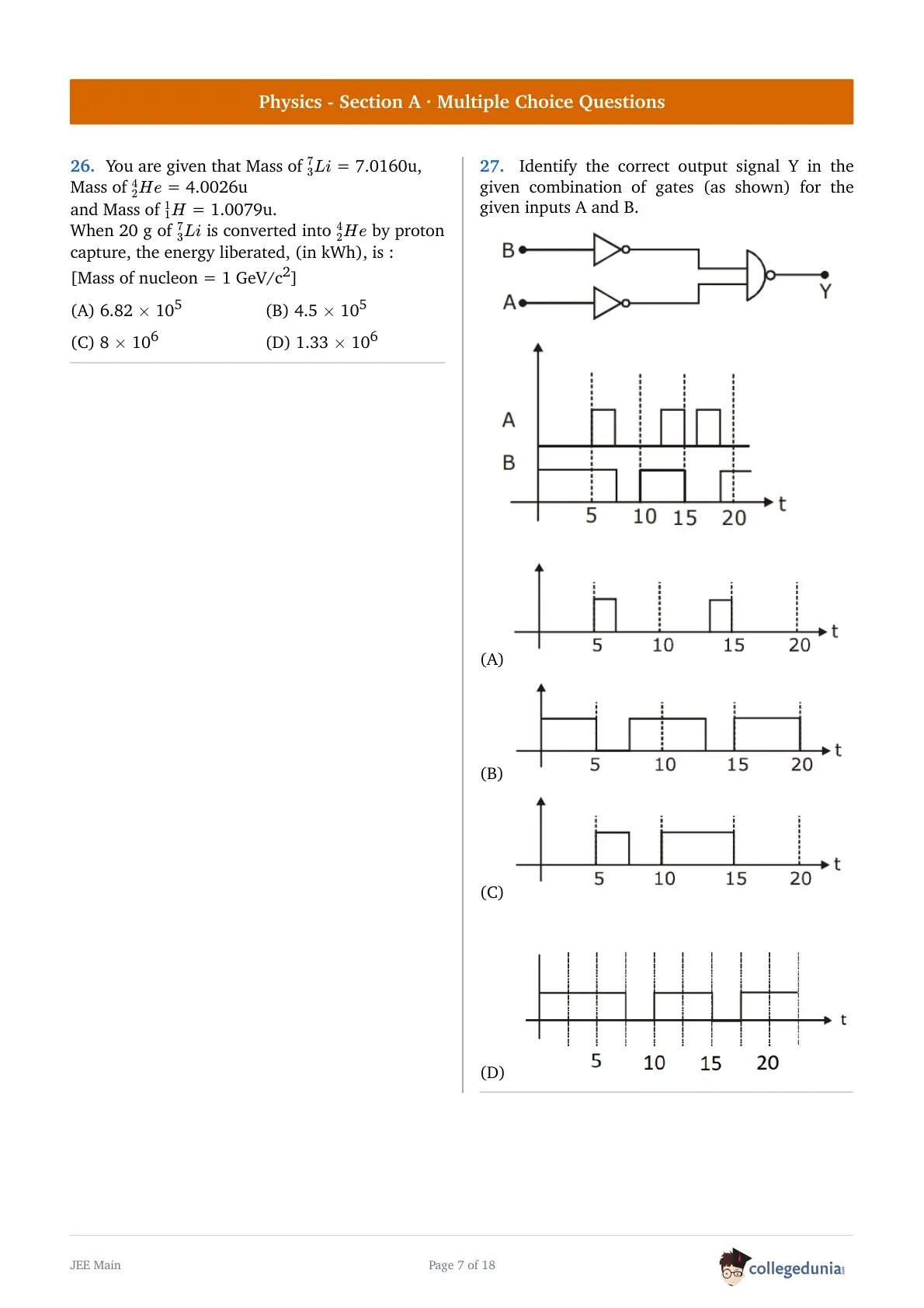
Identify the correct output signal \(Y\) in the given combination of gates (as shown) for the given inputs \(A\) and \(B\).
- (1)
![]()
- (2)
![]()
- (3)
![]()
- (4)
![]()


A particle of charge q and mass m is moving with a velocity \(-v\hat{i}\) (\(v \ne 0\)) towards a large screen placed in the Y - Z plane at a distance d. If there is a magnetic field \(\vec{B} = B_0\hat{k}\), the maximum value of v for which the particle will not hit the screen is :
Shown in the figure is a hollow icecream cone (it is open at the top). If its mass is \(M ,\) radius of its top, \(R\) and height, \(H ,\) then its moment of inertia about its axis is: 
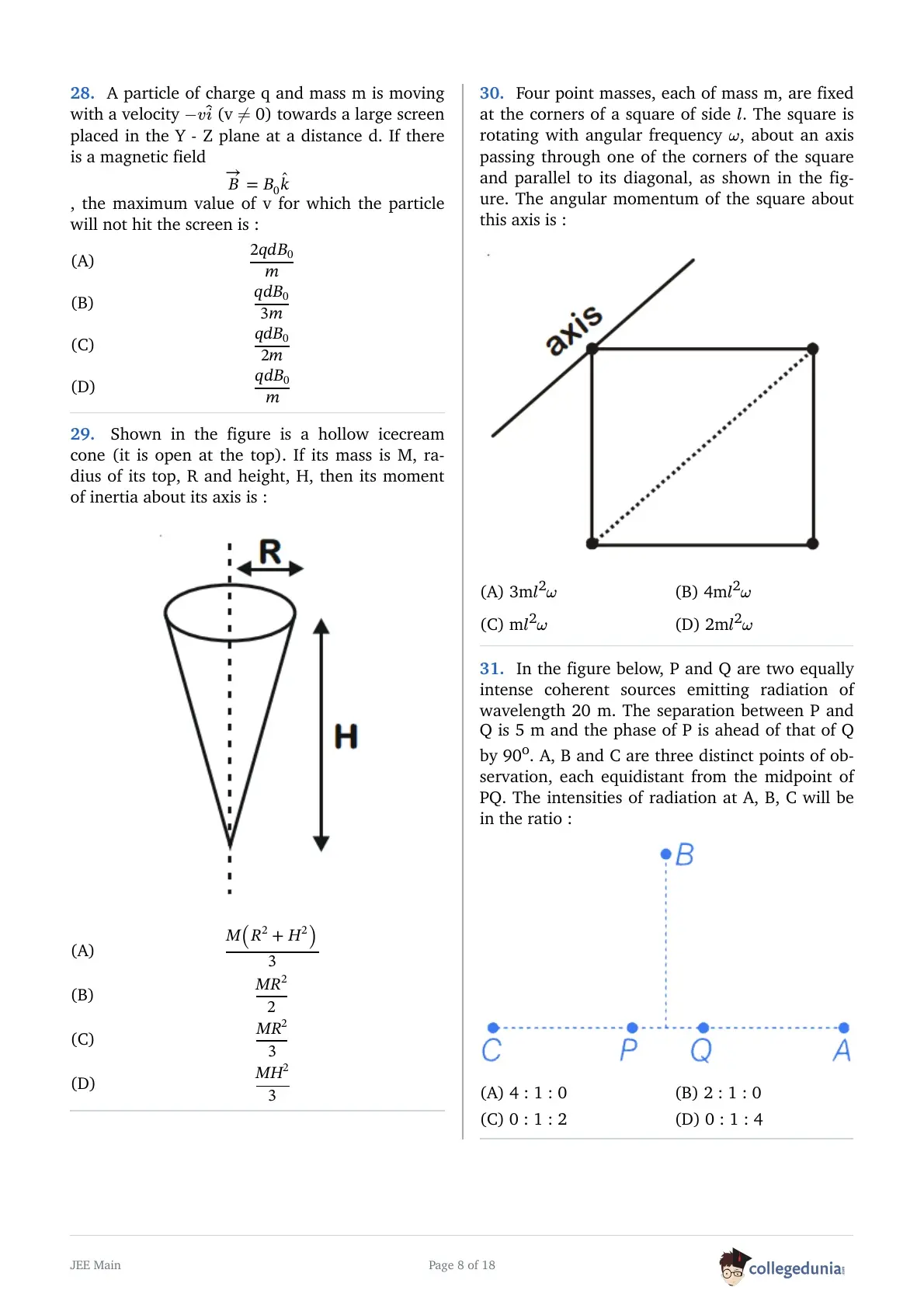
Four point masses, each of mass m, are fixed at the corners of a square of side \(l\). The square is rotating with angular frequency \(\omega\), about an axis passing through one of the corners of the square and parallel to its diagonal, as shown in the figure. The angular momentum of the square about this axis is :
In the figure below, P and Q are two equally intense coherent sources emitting radiation of wavelength 20 m. The separation between P and Q is 5 m and the phase of P is ahead of that of Q by \(90^{\circ}\). A, B and C are three distinct points of observation, each equidistant from the midpoint of PQ. The intensities of radiation at A, B, C will be in the ratio :
A clock has a continuously moving second's hand of 0.1 m length. The average acceleration of the tip of the hand (in units of \(\mathrm{ms^{-2}}\)) is of the order of :
A screw gauge has \(50\) divisions on its circular scale. The circular scale is \(4 \) units ahead of the pitch scale marking, prior to use. Upon one complete rotation of the circular scale, a displacement of \(0.5\, mm\) is noticed on the pitch scale. The nature of zero error involved, and the least count of the screw gauge, are respectively :
An object of mass m is suspended at the end of a massless wire of length L and area of crosssection A. Young modulus of the material of the wire is Y. If the mass is pulled down slightly its frequency of oscillation along the vertical direction is :
An electron is moving along +x direction with a velocity of \(6 \times 10^{6}\ \mathrm{ms^{-1}}\). It enters a region of uniform electric field of 300 V/cm pointing along +y direction. The magnitude and direction of the magnetic field set up in this region such that the electron keeps moving along the x direction will be :
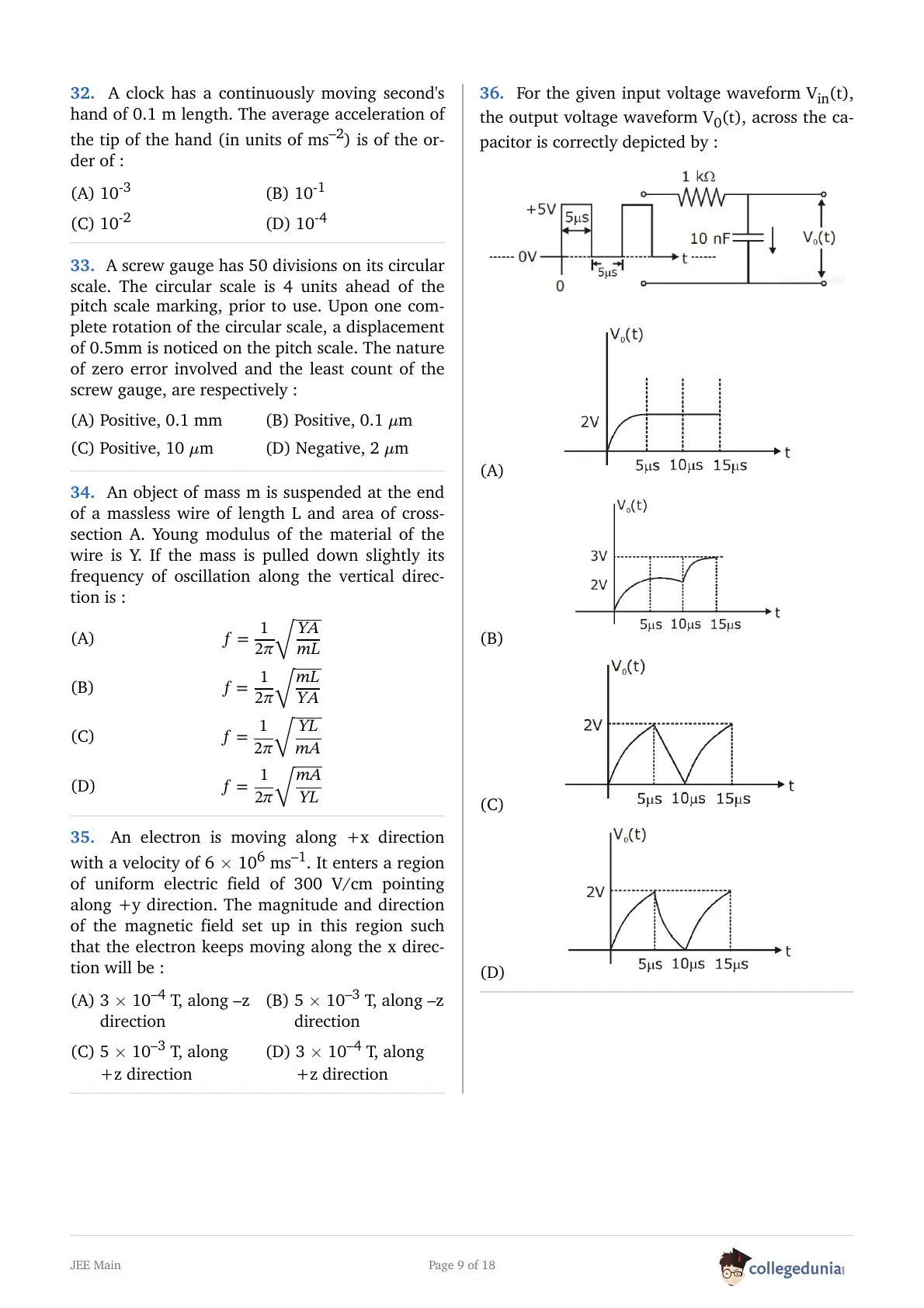
In the given circuit the input voltage Vin is shown in figure. The cut-in voltage of p–n junction diode
(D1 or D2) is 0.6 V. Which of the following output voltage (V0) waveform across the diode is correct?
- (1)
![]()
- (2)
![]()
- (3)
![]()
- (4)
![]()


A satellite is in an elliptical orbit around a planet P. It is observed that the velocity of the satellite when it is farthest from the planet is 6 times less than that when it is closest to the planet. The ratio of distances between the satellite and the planet at closest and farthest points is:
If the potential energy between two molecules is given by \(U = - \frac{ A }{ r ^{6}}+\frac{ B }{ r ^{12}},\) then at equilibrium, separation between molecules, and the potential energy are :
An electron, a doubly ionized helium ion (\(\mathrm{He^{++}}\)) and a proton are having the same kinetic energy. The relation between their respective de-Broglie wavelengths \(\lambda_e\), \(\lambda_{He^{++}}\) and \(\lambda_p\) is :
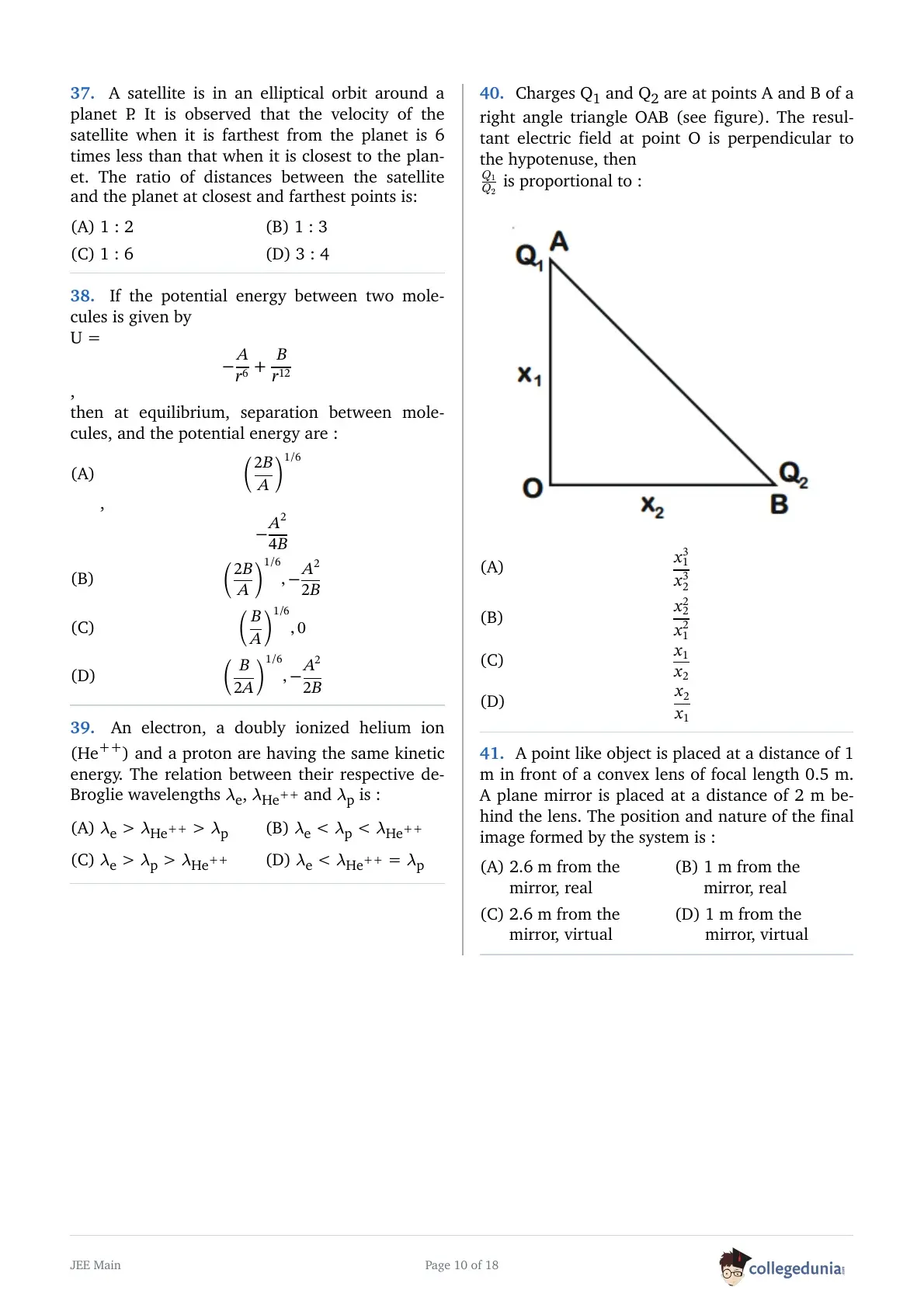
Charges \(Q_1\) and \(Q_2\) are at points A and B of a right angle triangle OAB (see figure). The resultant electric field at point O is perpendicular to the hypotenuse, then \(\frac{Q_1}{Q_2}\) is proportional to :
A point like object is placed at a distance of 1 m in front of a convex lens of focal length 0.5 m. A plane mirror is placed at a distance of 2 m behind the lens. The position and nature of the final image formed by the system is :
The translational degrees of freedom (\(f_t\)) and rotational degrees of freedom (\(f_r\)) of \( \text{CH}_4 \) molecule are:
An insect is at the bottom of a hemispherical ditch of radius 1 m. It crawls up the ditch but starts slipping after it is at height h from the bottom. If the coefficient of friction between the ground and the insect is 0.75, then h is :
(g = 10 \(\mathrm{ms^{-2}}\))
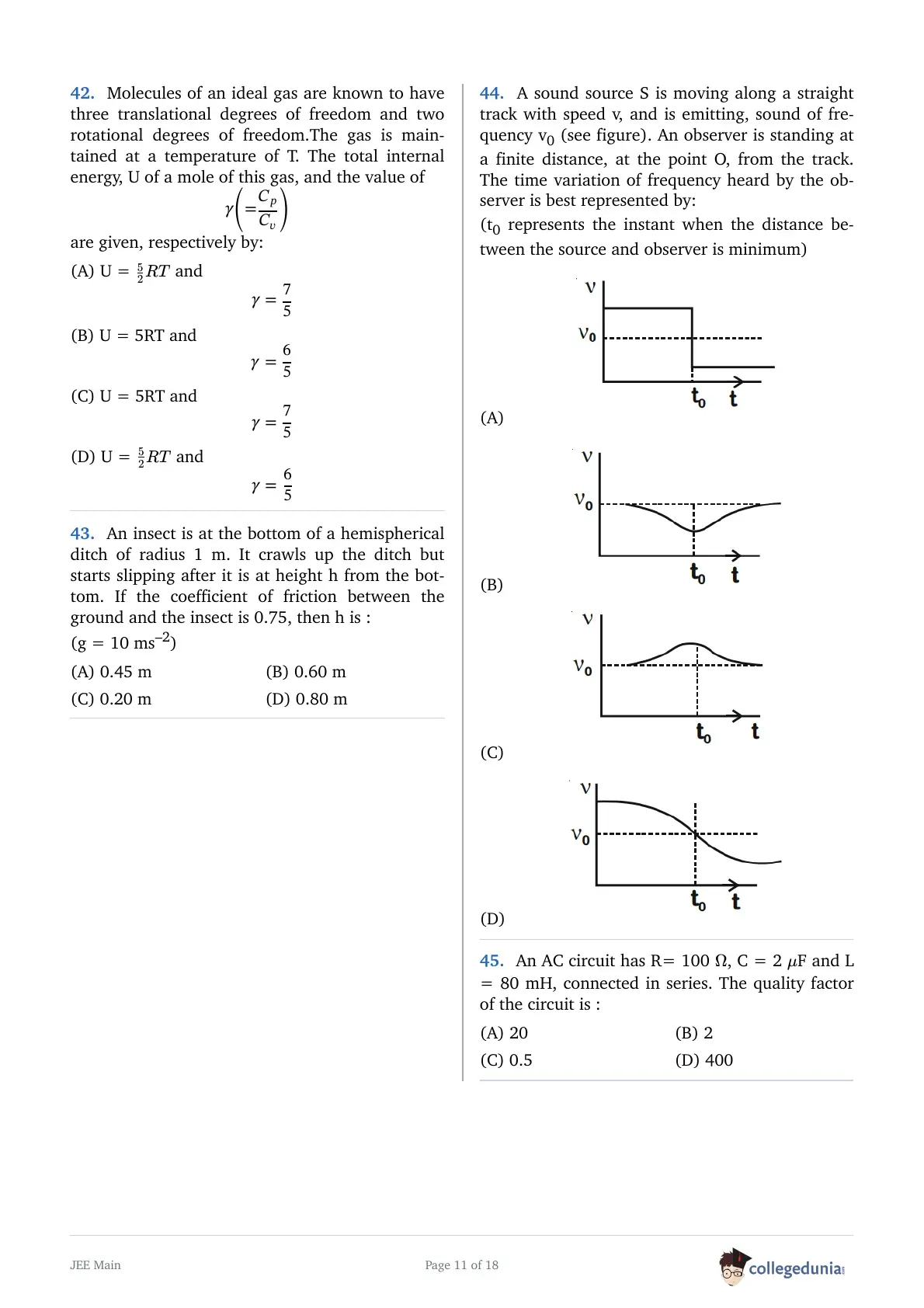
A sound source \(S\) is moving along a straight track with speed \(v ,\) and is emitting sound of frequency \(v_{0}\) (see figure). An observer is standing at a finite distance, at the point \(O ,\) from the track. The time variation of frequency heard by the observer is best represented by :
\(\left( t _{0}\right.\) represents the instant when the distance between the source and observer is minimum)
- (1)
![]()
- (2)
![]()
- (3)
![]()
- (4)
![]()


An AC circuit has R= 100 \(\Omega\), C = 2 \(\mu\)F and L = 80 mH, connected in series. The quality factor of the circuit is :
Physics - Section B (Q46 - Q50)
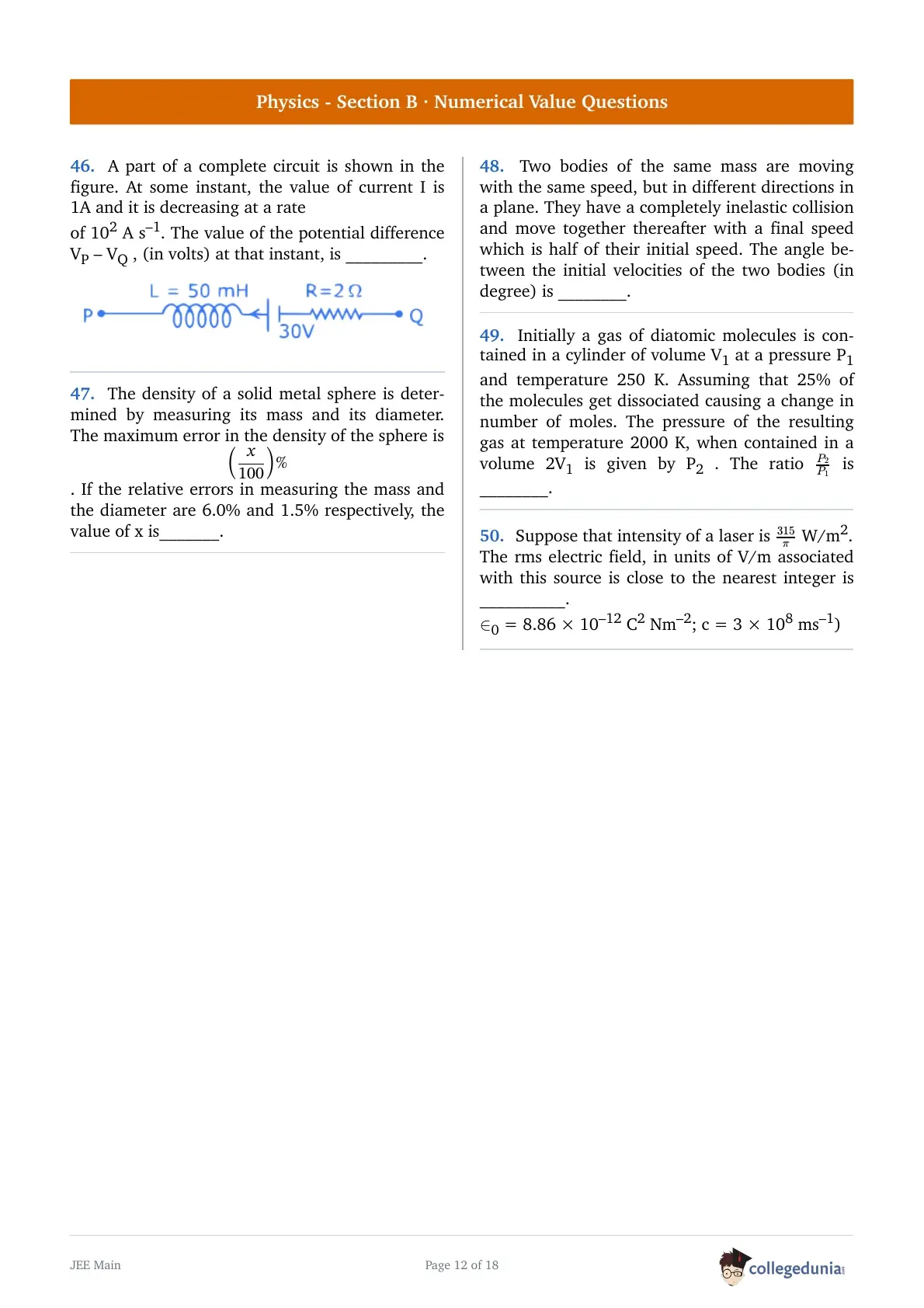
In a part of a circuit shown: Find VA – VB in volts. It is given that current is decreasing at a rate of 1 ampere/s.
The density of a solid metal sphere is determined by measuring its mass and its diameter. The maximum error in the density of the sphere is \(\left(\frac{x}{100}\right)\%\). If the relative errors in measuring the mass and the diameter are 6.0% and 1.5% respectively, the value of x is_______.
Two bodies of the same mass are moving with the same speed, but in different directions in a plane. They have a completely inelastic collision and move together thereafter with a final speed which is half of their initial speed. The angle between the initial velocities of the two bodies (in degree) is ________.
Initially a gas of diatomic molecules is contained in a cylinder of volume V1 at a pressure P1 and temperature 250 K. Assuming that 25% of the molecules get dissociated causing a change in number of moles. The pressure of the resulting gas at temperature 2000 K, when contained in a volume 2V1 is given by P2 . The ratio \(\frac{P_2}{P_1}\) is ________.
A laser beam has intensity of \(4.0\times10^{14}\ \text{W/m}^2\). The amplitude of magnetic field associated with the beam is ______ T. (Take \(\varepsilon_0=8.85\times10^{-12}\ \text{C}^2/\text{N m}^2\) and \(c=3\times10^8\ \text{m/s}\))
Chemistry - Section A (Q51 - Q70)
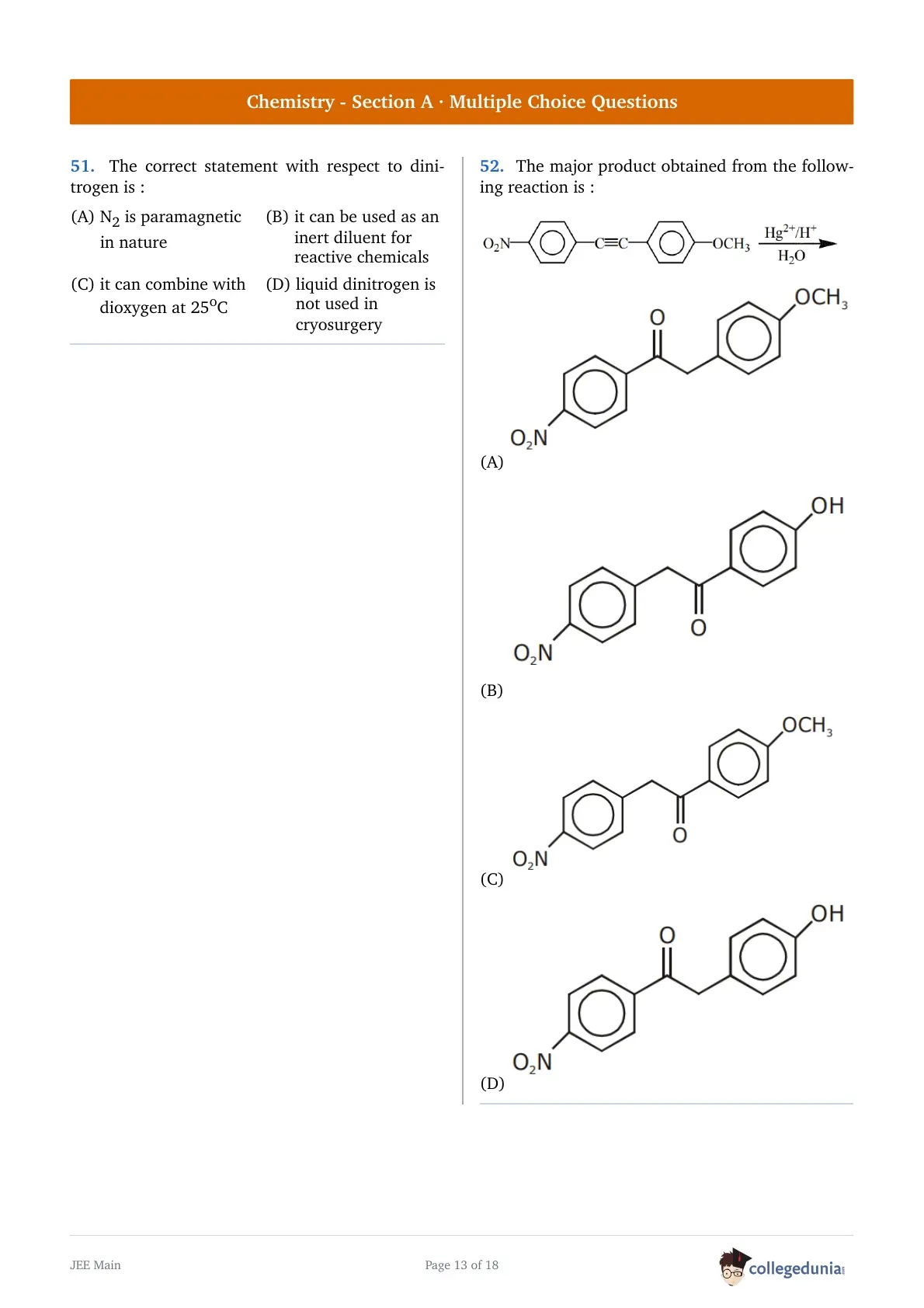
The correct statement with respect to dinitrogen is :
The major product obtained from the following reaction is :
- (1)
![]()
- (2)
![]()
- (3)
![]()
- (4)
![]()


The lanthanoid that does NOT show +4 oxidation state is :
| Temperature | Equilibrium Constant |
| T1 = 25\(^\circ\)C | K1 = 10 |
| T2 = 100\(^\circ\)C | K2 = 100 |
[Use R = 8.314 J K-1 mol-1]
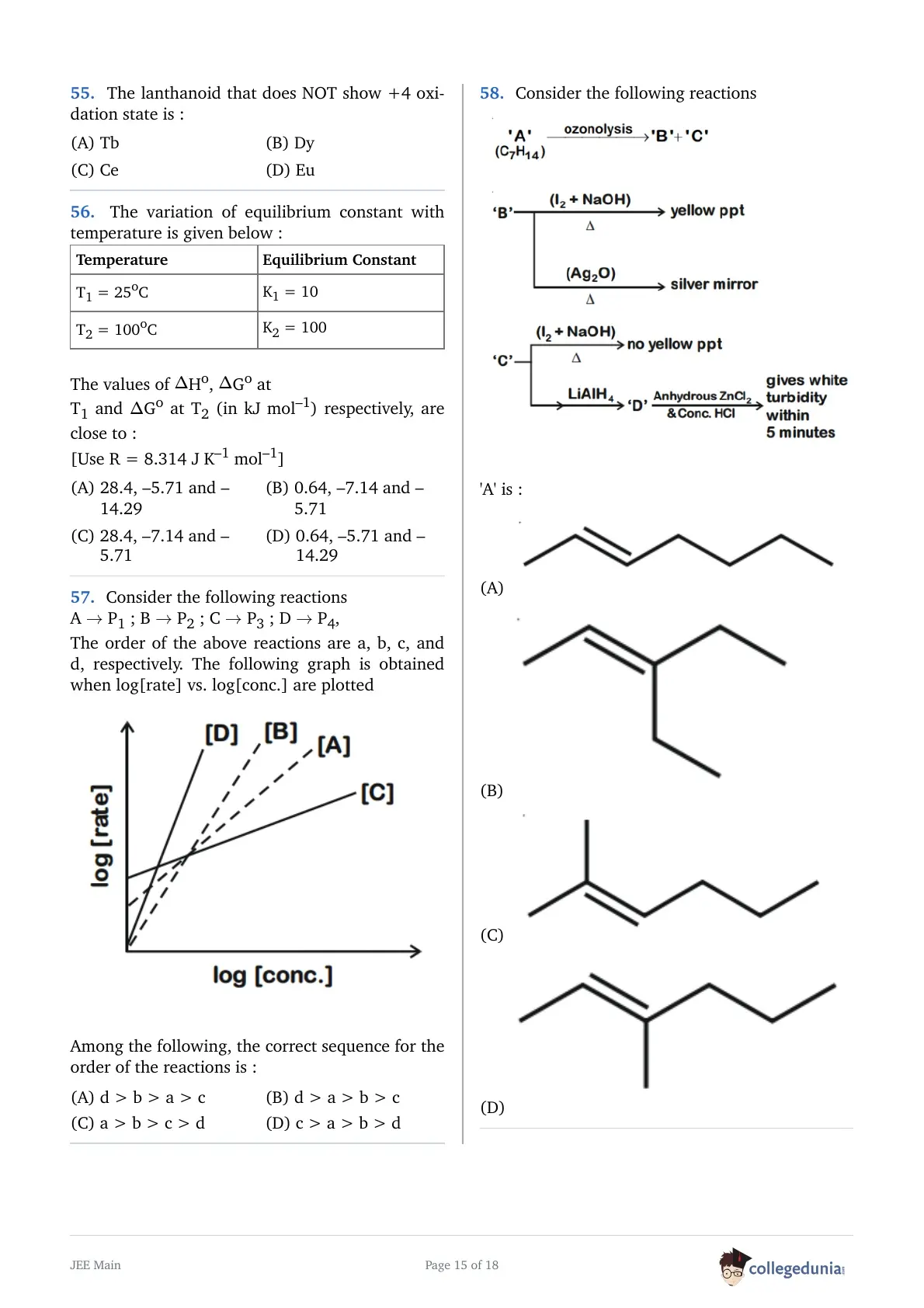
Consider the following reactions
A \(\rightarrow\) P1 ; B \(\rightarrow\) P2 ; C \(\rightarrow\) P3 ; D \(\rightarrow\) P4,
The order of the above reactions are a, b, c, and d, respectively. The following graph is obtained when log[rate] vs. log[conc.] are plotted
Among the following, the correct sequence for the order of the reactions is :


The set that contains atomic numbers of only transition elements, is :
Which of the following compounds shows geometrical isomerism?
Arrange the following solutions in the decreasing order of pOH :
(A) 0.01 M HCl
(B) 0.01 M NaOH
(C) 0.01 M CH3COONa
(D) 0.01 M NaCl
The species that has a spin-only magnetic moment of 5.9 BM, is :
(Td = tetrahedral)
A solution of two components containing n1 moles of the 1st component and n2 moles of the 2nd component is prepared. M1 and M2 are the molecular weights of component 1 and 2 respectively. If d is the density of the solution in g mL-1, C2 is the molarity and x2 is the mole fraction of the 2nd component, then C2 can be expressed as :
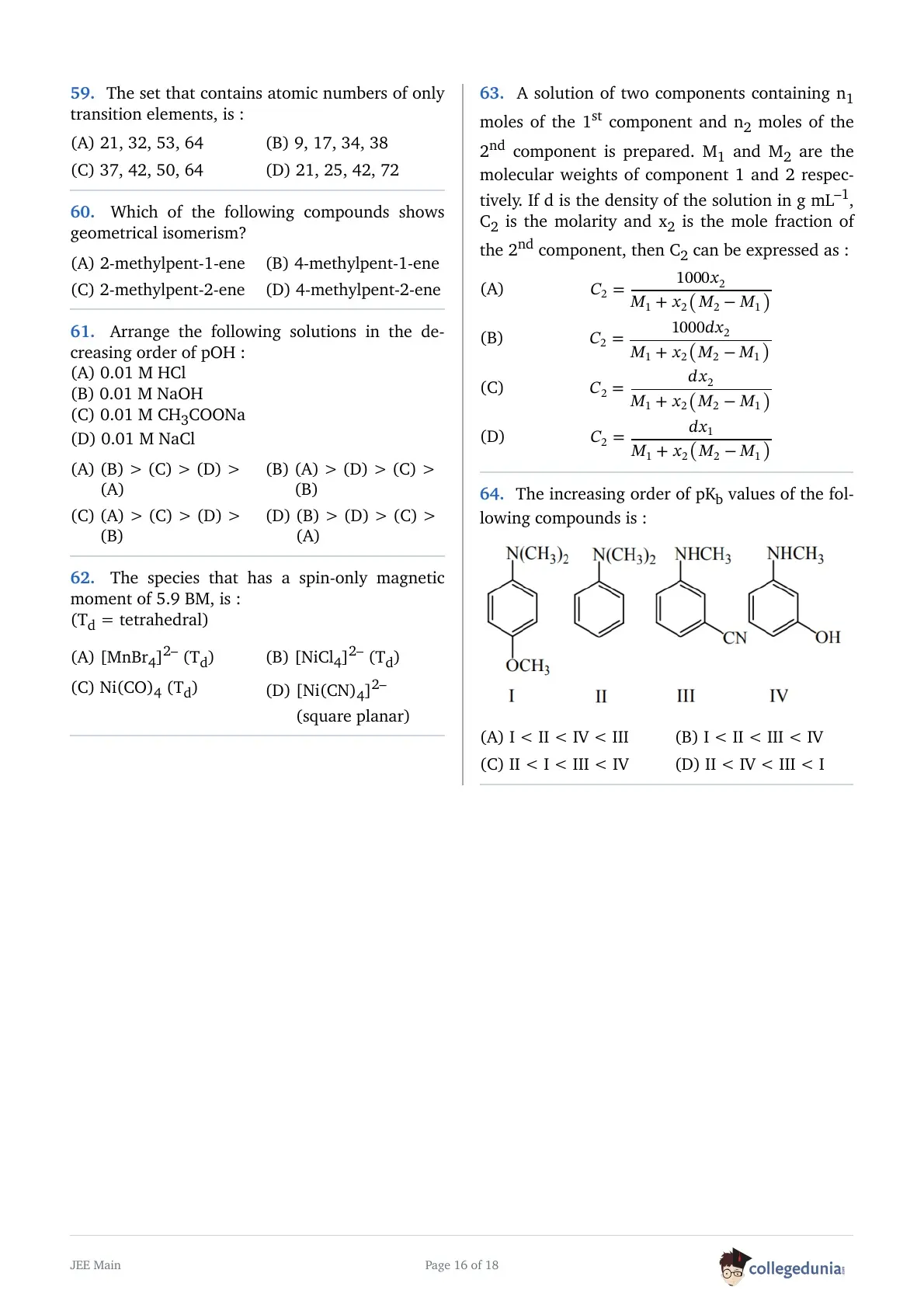
The increasing order of pKb values of the following compounds is :
(I) 4-methoxy-N,N-dimethylaniline, (II) N,N-dimethylaniline, (III) N-methylaniline with CN at the meta position, (IV) N-methylaniline with OH at the meta position.
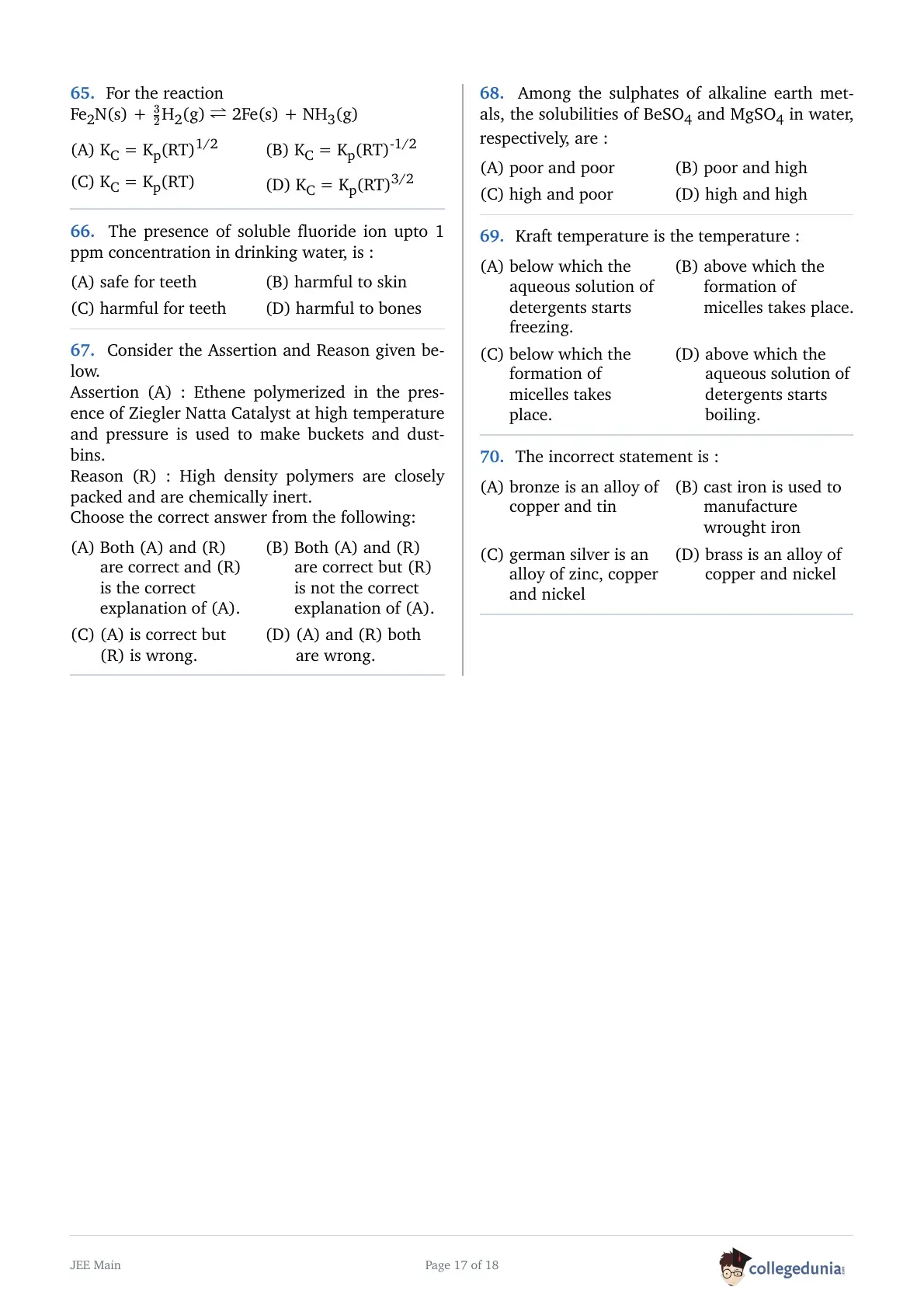
For the reaction
Fe2N(s) + \(\frac{3}{2}\)H2(g) \(\rightleftharpoons\) 2Fe(s) + NH3(g)
The presence of soluble fluoride ion upto 1 ppm concentration in drinking water, is :
Consider the Assertion and Reason given below.
Assertion (A) : Ethene polymerized in the presence of Ziegler Natta Catalyst at high temperature and pressure is used to make buckets and dustbins.
Reason (R) : High density polymers are closely packed and are chemically inert.
Choose the correct answer from the following:
Among the sulphates of alkaline earth metals, the solubilities of BeSO4 and MgSO4 in water, respectively, are :
Kraft temperature is the temperature
The incorrect statement is :
Chemistry - Section B (Q71 - Q75)
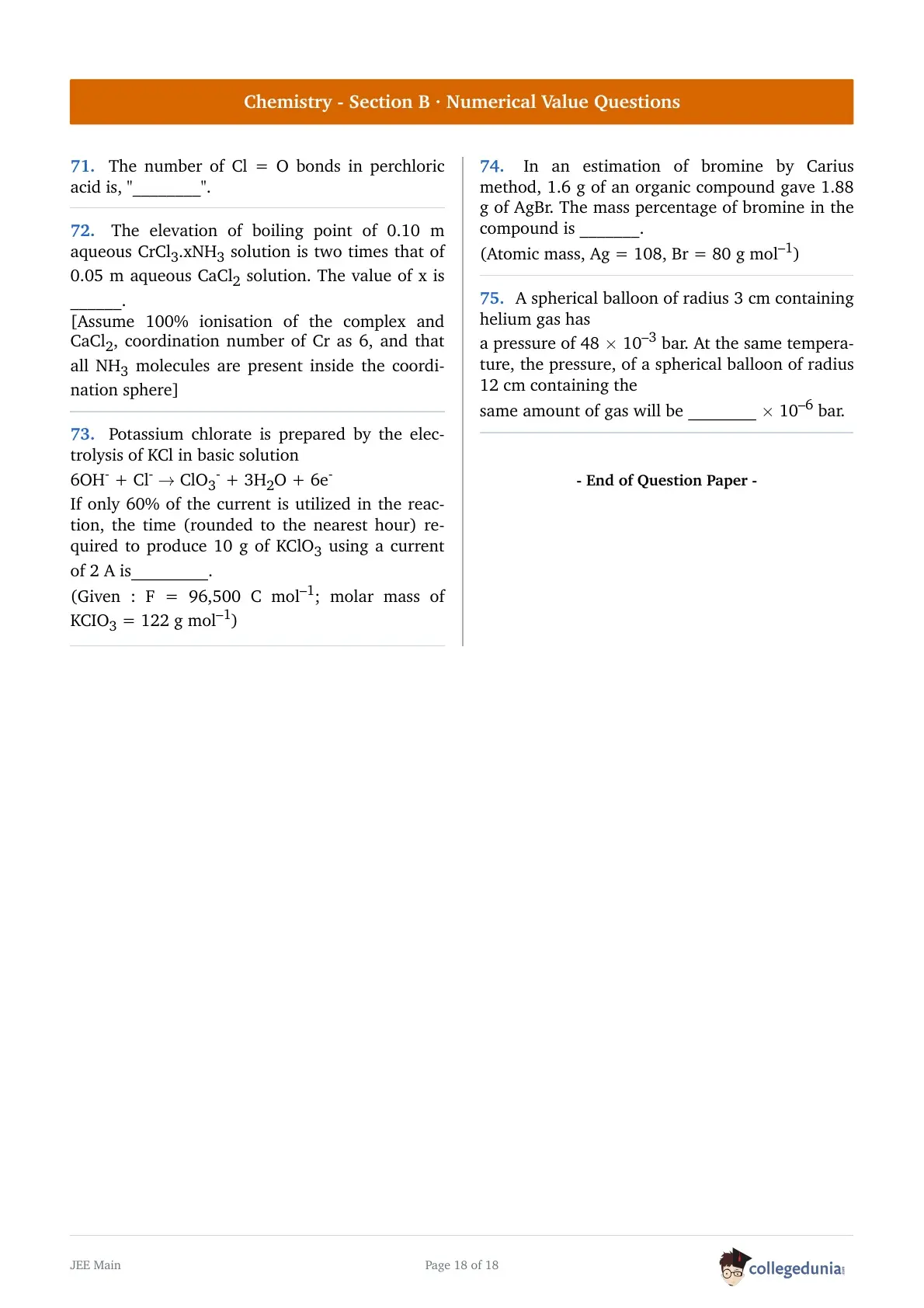
The number of Cl = O bonds in perchloric acid is, "________".
The elevation of boiling point of 0.10 m aqueous \(\mathrm{CrCl_3 \cdot xNH_3}\) solution is two times that of 0.05 m aqueous \(\mathrm{CaCl_2}\) solution. The value of x is ______.
[Assume 100% ionisation of the complex and \(\mathrm{CaCl_2}\), coordination number of Cr as 6, and that all \(\mathrm{NH_3}\) molecules are present inside the coordination sphere]
Potassium chlorate is prepared by the electrolysis of KCl in basic solution
\(6\mathrm{OH^-} + \mathrm{Cl^-} \to \mathrm{ClO_3^-} + 3\mathrm{H_2O} + 6e^-\)
If only 60% of the current is utilized in the reaction, the time (rounded to the nearest hour) required to produce 10 g of \(\mathrm{KClO_3}\) using a current of 2 A is ______.
(Given : F = 96,500 C \(\mathrm{mol^{-1}}\); molar mass of \(\mathrm{KClO_3}\) = 122 g \(\mathrm{mol^{-1}}\))
In an estimation of bromine by Carius method, 1.6 g of an organic compound gave 1.88 g of AgBr. The mass percentage of bromine in the compound is ______.
(Atomic mass, Ag = 108, Br = 80 g \(\mathrm{mol^{-1}}\))
A spherical balloon of radius 3 cm containing helium gas has a pressure of \(48 \times 10^{-3}\) bar. At the same temperature, the pressure, of a spherical balloon of radius 12 cm containing the same amount of gas will be ______ \(\times 10^{-6}\) bar.
JEE Main 2020 Exam Pattern and Marking Scheme
| Particulars | Details |
|---|---|
| Exam Mode | Online (Computer-Based Test) |
| Paper | B.E./B.Tech (Paper 1) |
| Duration | 3 hours (180 minutes) |
| Type of Questions | Multiple Choice Questions (MCQs) + Numerical Value Questions |
| Subjects | Mathematics, Physics, Chemistry |
| Total Questions | 75 questions |
| Total Marks | 300 marks |
| Marking Scheme | +4 for correct answer & -1 for incorrect MCQ; no negative marking for Numerical Value Questions |
JEE Main 2020 September 6 Shift 1 Difficulty Level
JEE Main 2020 B.E./B.Tech Question Paper for Sept 6 Morning session was moderate in terms of difficulty level. The mathematics section was the toughest among the three while Chemistry was the easiest.
JEE Main 2020 B.E./B.Tech Question Paper with Answer Key– Sept 6 (Morning Shift) Paper Analysis
- Questions from Optics, Modern Physics, Electrostatics and Magnetism, EMI and thermodynamics were asked in physics.
- Numerical Questions in Physics were mostly asked from class 11th syllabus while theoretical portion was mainly from class 12th.
- Mathematics section was moderate to difficult following the earlier trend. Questions were lengthy and that made the paper a bit tougher.
- Questions from Calculus, Trignometry, Algebra and Geometry had more weightage. Conic section and 3-D had toughest questions.
- Chemistry was again easiest of all the sections but had some tricky questions. NCERT based direct questions were asked.
- Questions from Chemical bonding, Co-ordination compound, were asked majorly. Inorganic chemistry had most weightage.
- An attempt of 38-42 questions will be considered safe score.



Comments