




JEE Main 2020 September 2 Shift 2 Question Paper is available here with solutions PDF and detailed solutions for every question. NTA conducted the second shift on September 2, 2020, from 3:00 PM to 6:00 PM. The JEE Main 2020 Paper 1 (B.E./B.Tech) question paper includes the following:
- 75 questions in a 3-hour CBT Mode: 25 each from Mathematics, Physics and Chemistry
- Section A: 20 multiple choice questions (MCQs) per subject, 4 marks each
- Section B: 5 numerical value questions per subject, all compulsory, 4 marks each
- Marking: +4 for a correct answer, -1 for an incorrect MCQ, 0 for an unattempted question; no negative marking for numerical value questions
- Maximum marks: 300 (100 per subject)
JEE Main 2020 September 2 Shift 2 Question Paper with Solution PDF
| NTA Official PDF | CD PDF | CD PDF with Solutions |
|---|---|---|
| Download official PDF 5.80 MB | Download Collegedunia PDF 1.15 MB | Download solutions PDF 1.78 MB |
Also Check:
JEE Main 2020 September 2 Shift 2 Questions with Solutions
Mathematics - Section A (Q1 - Q20)
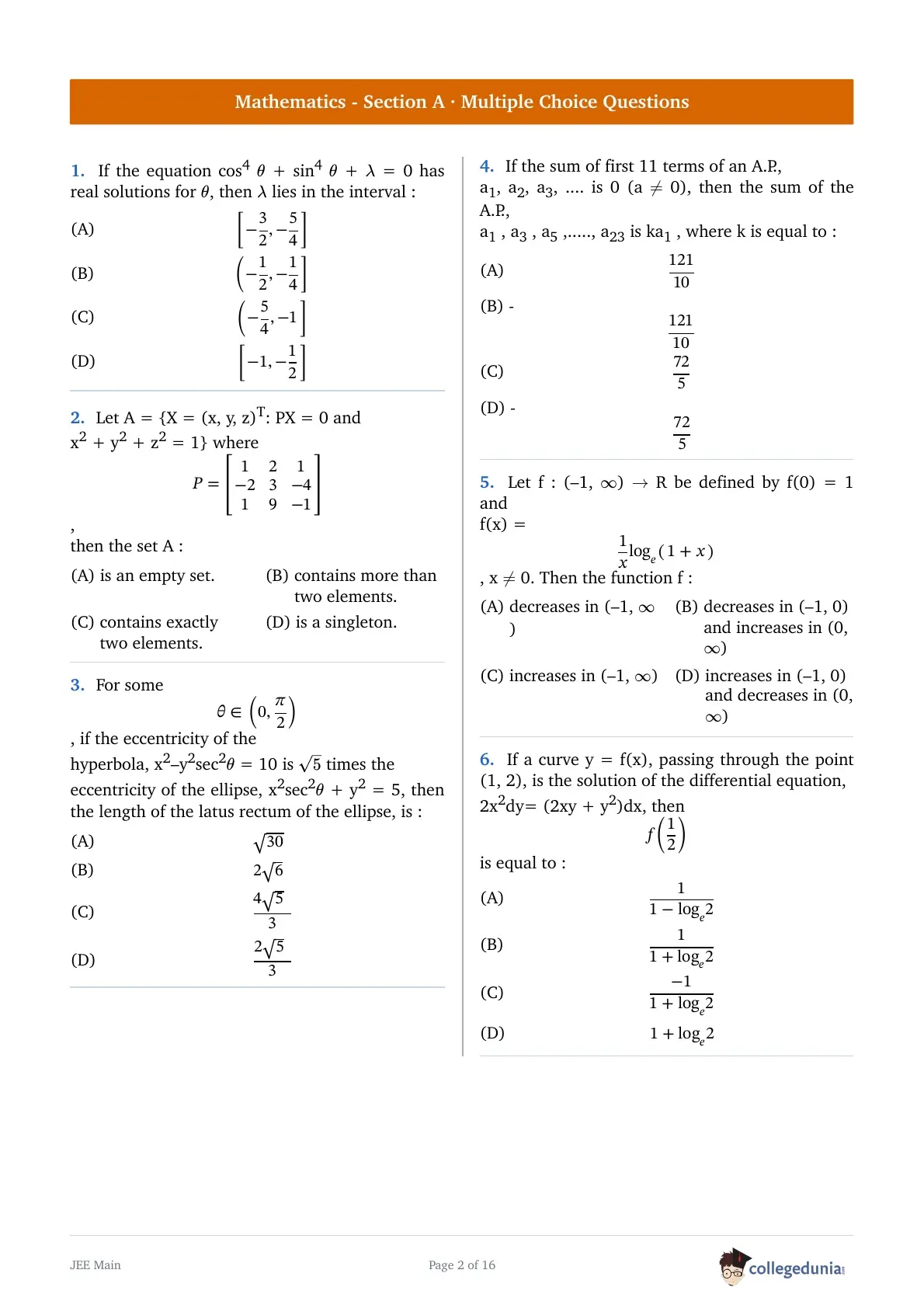
If the equation \(\cos^4\theta + \sin^4\theta + \lambda = 0\) has real solutions for \(\theta\), then \(\lambda\) lies in the interval :
Let \(A = \{X = (x, y, z)^T : PX = 0 \text{ and } x^2+y^2+z^2 = 1\}\) where \(P = \begin{bmatrix} 1 & 2 & 1 \\ -2 & 3 & -4 \\ 1 & 9 & -1 \end{bmatrix}\), then the set A :
For some \(\theta \in \left(0, \frac{\pi}{2}\right)\), if the eccentricity of the hyperbola, \(x^2 - y^2\sec^2\theta = 10\) is \(\sqrt{5}\) times the eccentricity of the ellipse, \(x^2\sec^2\theta + y^2 = 5\), then the length of the latus rectum of the ellipse, is :
If the sum of first 11 terms of an A.P., \(a_1, a_2, a_3, \ldots\) is 0 \((a_1 \ne 0)\), then the sum of the A.P., \(a_1, a_3, a_5, \ldots, a_{23}\) is \(ka_1\), where k is equal to :
Let \(f :(-1, \infty) \rightarrow R\) be defined by \(f (0)=1\) and \(f ( x )=\frac{1}{ x } \log _{ e }(1+ x ), x \neq 0 .\) Then the function \(f\)
If a curve \(y = f(x)\), passing through the point \((1, 2)\), is the solution of the differential equation, \(2x^2\,dy = (2xy + y^2)\,dx\), then \(f\left(\frac{1}{2}\right)\) is equal to :
Consider a region \(R = \{(x, y) \in \mathbb{R}^2 : x^2 \le y \le 2x\}\). If a line \(y = \alpha\) divides the area of region R into two equal parts, then which of the following is true?
The imaginary part of \(\left(3+2\sqrt{-54}\right)^{\frac12}-\left(3-2\sqrt{-54}\right)^{\frac12}\) can be :
Let \(f : \mathbb{R} \to \mathbb{R}\) be a function which satisfies \(f(x+y) = f(x) + f(y)\ \forall\ x, y \in \mathbb{R}\). If \(f(1) = 2\) and \(g(n) = \sum\limits_{k=1}^{(n-1)} f(k)\), \(n \in \mathbb{N}\), then the value of n, for which \(g(n) = 20\), is :
Let \(E^C\) denote the complement of an event E. Let \(E_1\), \(E_2\) and \(E_3\) be any pairwise independent events with \(P(E_1) > 0\) and \(P(E_1 \cap E_2 \cap E_3) = 0\).
Then \(P\left(E_2^C \cap E_3^C / E_1\right)\) is equal to :
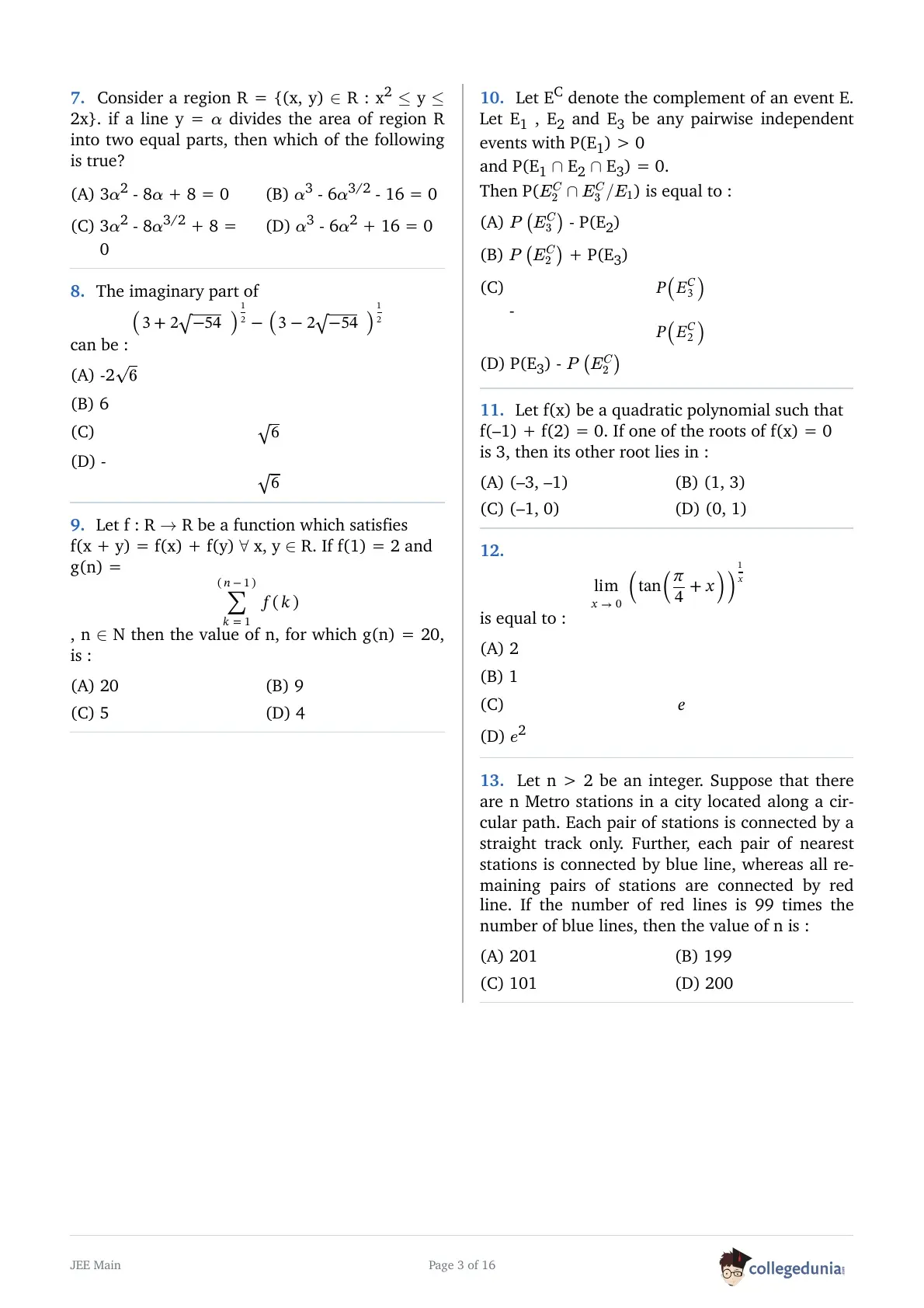
Let f(x) be a quadratic polynomial such that f(–1) + f(2) = 0. If one of the roots of f(x) = 0 is 3, then its other root lies in :
\(\lim\limits_{x\to0}\left(\tan\left(\frac{\pi}{4}+x\right)\right)^{\frac1x}\) is equal to :
Let \(n > 2\) be an integer. Suppose that there are n Metro stations in a city located along a circular path. Each pair of stations is connected by a straight track only. Further, each pair of nearest stations is connected by blue line, whereas all remaining pairs of stations are connected by red line. If the number of red lines is 99 times the number of blue lines, then the value of n is :
Let a, b, c \(\in \mathbb{R}\) be all non-zero and satisfy \(a^3+b^3+c^3=2\). If the matrix \(A=\begin{pmatrix} a & b & c \\ b & c & a \\ c & a & b \end{pmatrix}\) satisfies \(A^TA = I\), then a value of abc can be :
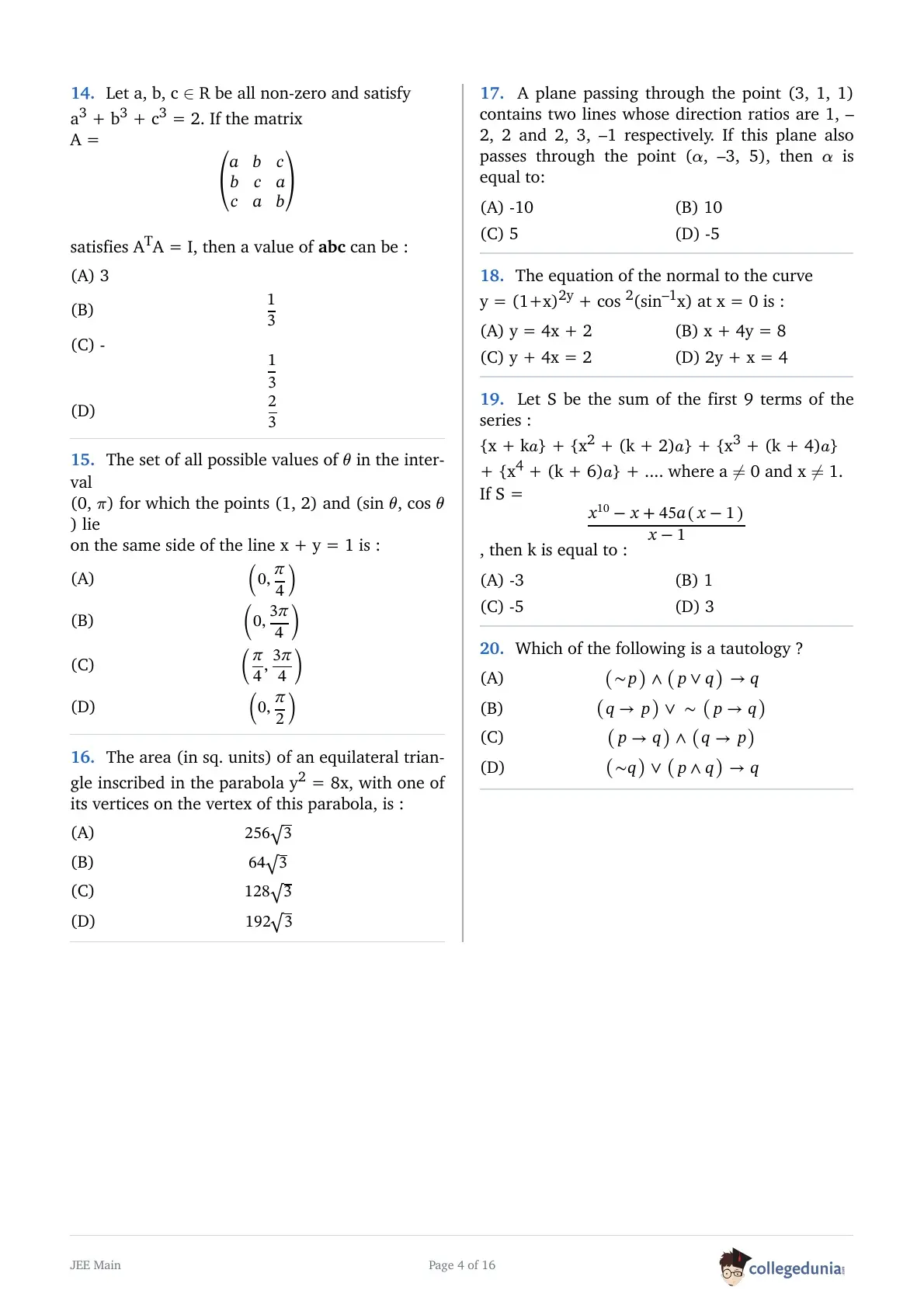
The set of all possible values of \(\theta\) in the interval
\((0, \pi)\) for which the points \((1, 2)\) and \((\sin\theta, \cos\theta)\) lie
on the same side of the line \(x + y = 1\) is :
An equilateral triangle OAB is inscribed in the parabola \(y^2 = 4x\) with the vertex O at the vertex of the parabola. Then the minimum distance of the circle having AB as a diameter from the origin is
A plane passing through the point \((3, 1, 1)\) contains two lines whose direction ratios are \(1, -2, 2\) and \(2, 3, -1\) respectively. If this plane also passes through the point \((\alpha, -3, 5)\), then \(\alpha\) is equal to:
The equation of the normal to the curve
\(y = (1+x)^{2y} + \cos^{2}(\sin^{-1}x)\) at \(x = 0\) is :
If the sum of the first 10 terms of the series \[ \frac{4 \cdot 1}{1 + 4 \cdot 1^4} + \frac{4 \cdot 2}{1 + 4 \cdot 2^4} + \frac{4 \cdot 3}{1 + 4 \cdot 3^4} + \ldots \] is \(\frac{m}{n}\), where \(\gcd(m, n) = 1\), then \(m + n\) is equal to _____.
Which of the following statements is a tautology?
Mathematics - Section B (Q21 - Q25)
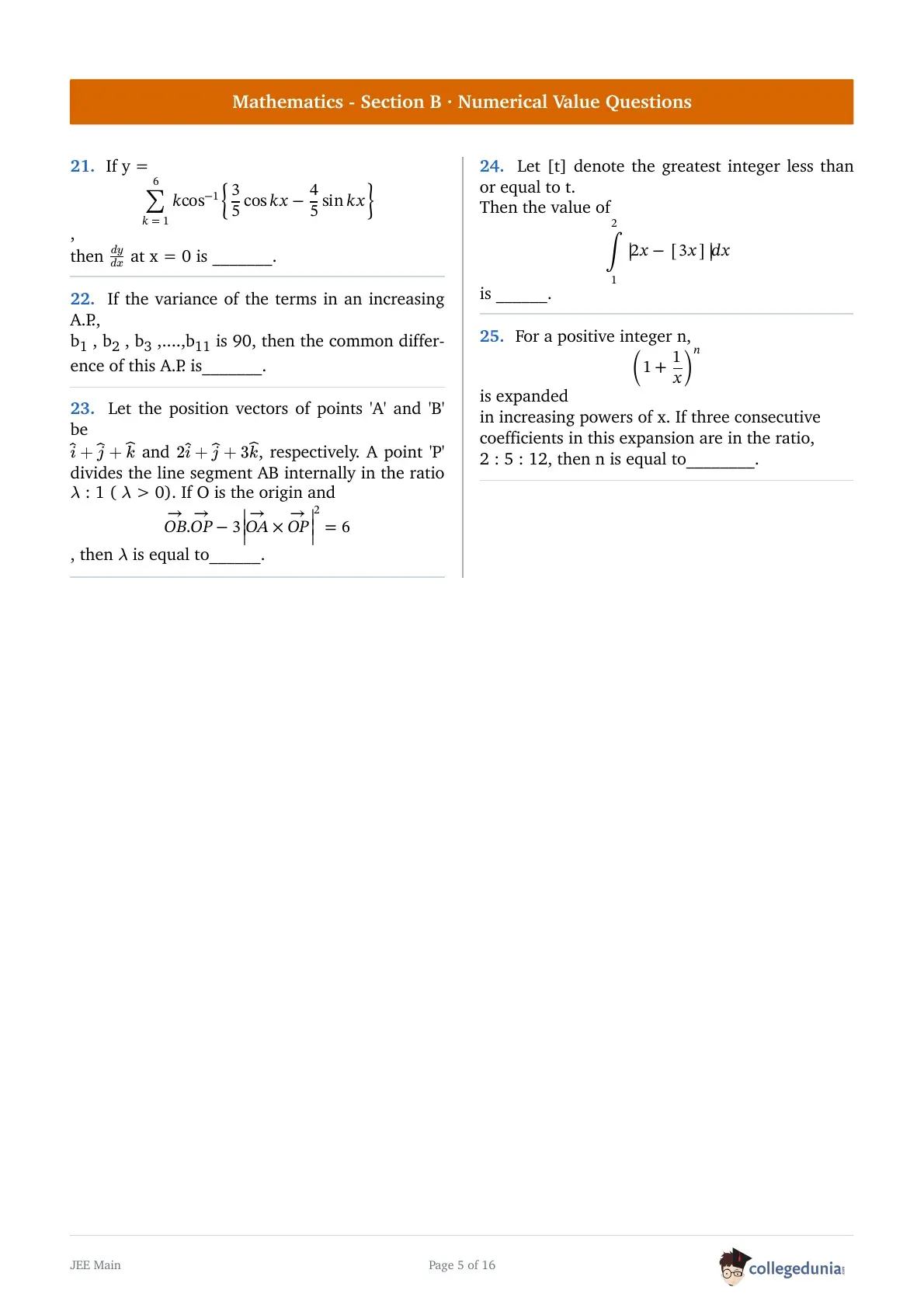
If \(y=\displaystyle\sum_{k=1}^{6} k\cos^{-1}\left\{\frac{3}{5}\cos kx-\frac{4}{5}\sin kx\right\}\), then \(\frac{dy}{dx}\) at \(x=0\) is _______.
If the variance of the terms in an increasing A.P.,
\(b_1, b_2, b_3, \ldots, b_{11}\) is 90, then the common difference of this A.P. is _______.
Let the position vectors of points \(A\) and \(B\) be \(\hat{i}+\hat{j}+\hat{k}\) and \(2\hat{i}+\hat{j}+3\hat{k}\), respectively. A point \(P\) divides the line segment \(AB\) internally in the ratio \(\lambda : 1\) (\(\lambda \gt 0\)). If \(O\) is the origin and
\(\overrightarrow{OB}\cdot\overrightarrow{OP}-3\left|\overrightarrow{OA}\times\overrightarrow{OP}\right|^{2}=6\), then \(\lambda\) is equal to _______.
Let \([t]\) denote the greatest integer less than or equal to \(t\). Then the value of
\(\displaystyle\int_{1}^{2}\left|2x-[3x]\right|dx\) is _______.
For a positive integer \(n\),
\(\left(1+\frac{1}{x}\right)^{n}\) is expanded
in increasing powers of \(x\). If three consecutive
coefficients in this expansion are in the ratio,
\(2 : 5 : 12\), then \(n\) is equal to _______.
Physics - Section A (Q26 - Q45)
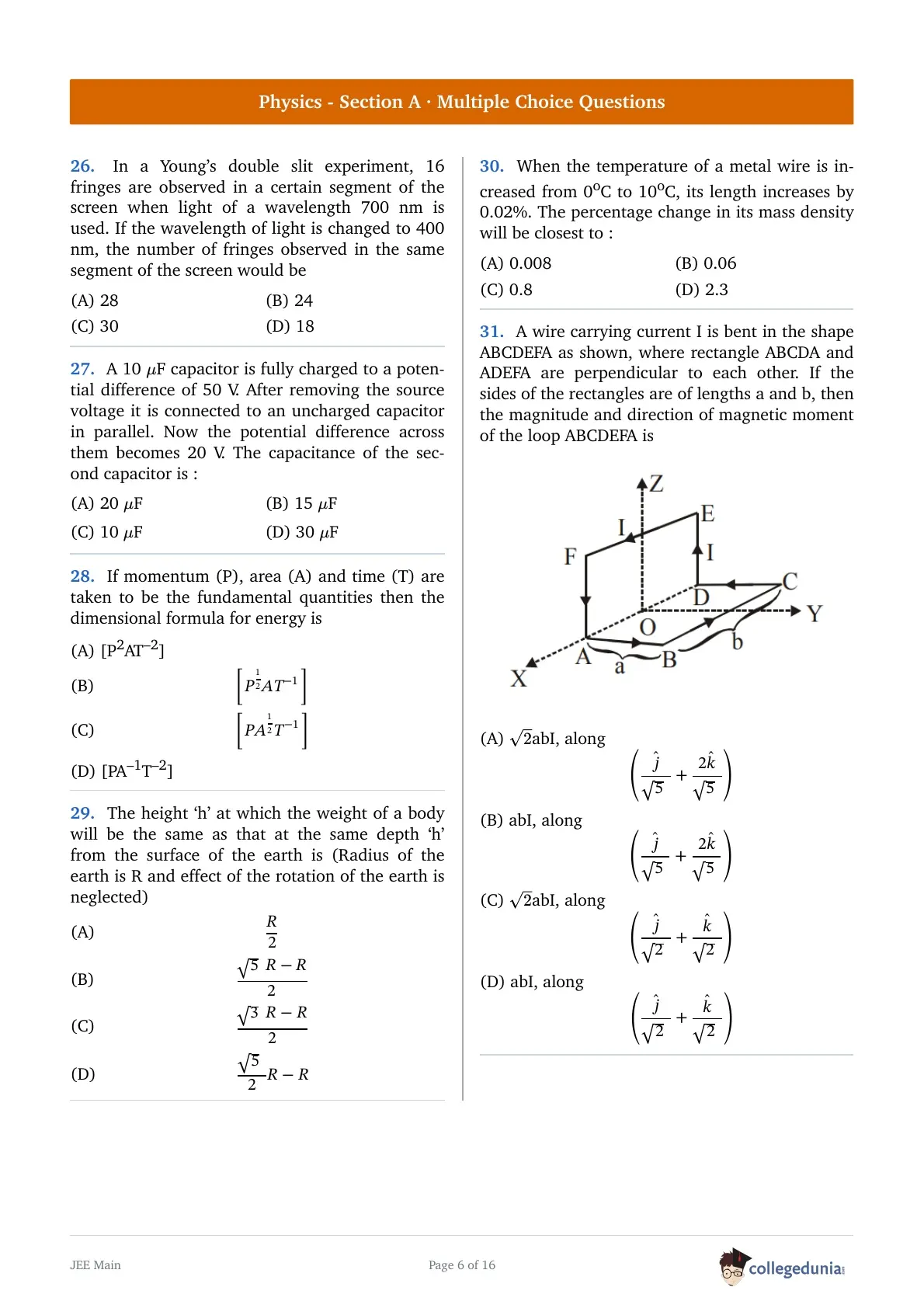
In a Young's double slit experiment, 16 fringes are observed in a certain segment of the screen when light of a wavelength 700 nm is used. If the wavelength of light is changed to 400 nm, the number of fringes observed in the same segment of the screen would be
A \(10\ \mu\mathrm{F}\) capacitor is fully charged to a potential difference of 50 V. After removing the source voltage it is connected to an uncharged capacitor in parallel. Now the potential difference across them becomes 20 V. The capacitance of the second capacitor is :
If momentum \( (P)\), area \((A)\) and time \((T)\) are taken to be the fundamental quantities then the dimensional formula for energy is :
The height 'h' at which the weight of a body will be the same as that at the same depth 'h' from the surface of the earth is (Radius of the earth is R and effect of the rotation of the earth is neglected)
When the temperature of a metal wire is increased from \(0^{\circ}\mathrm{C}\) to \(10^{\circ}\mathrm{C}\), its length increases by \(0.02\%\). The percentage change in its mass density will be closest to :
A wire carrying current \(I\) is bent in the shape ABCDEFA as shown, where rectangle ABCDA and ADEFA are perpendicular to each other. If the sides of the rectangles are of lengths \(a\) and \(b\), then the magnitude and direction of magnetic moment of the loop ABCDEFA is
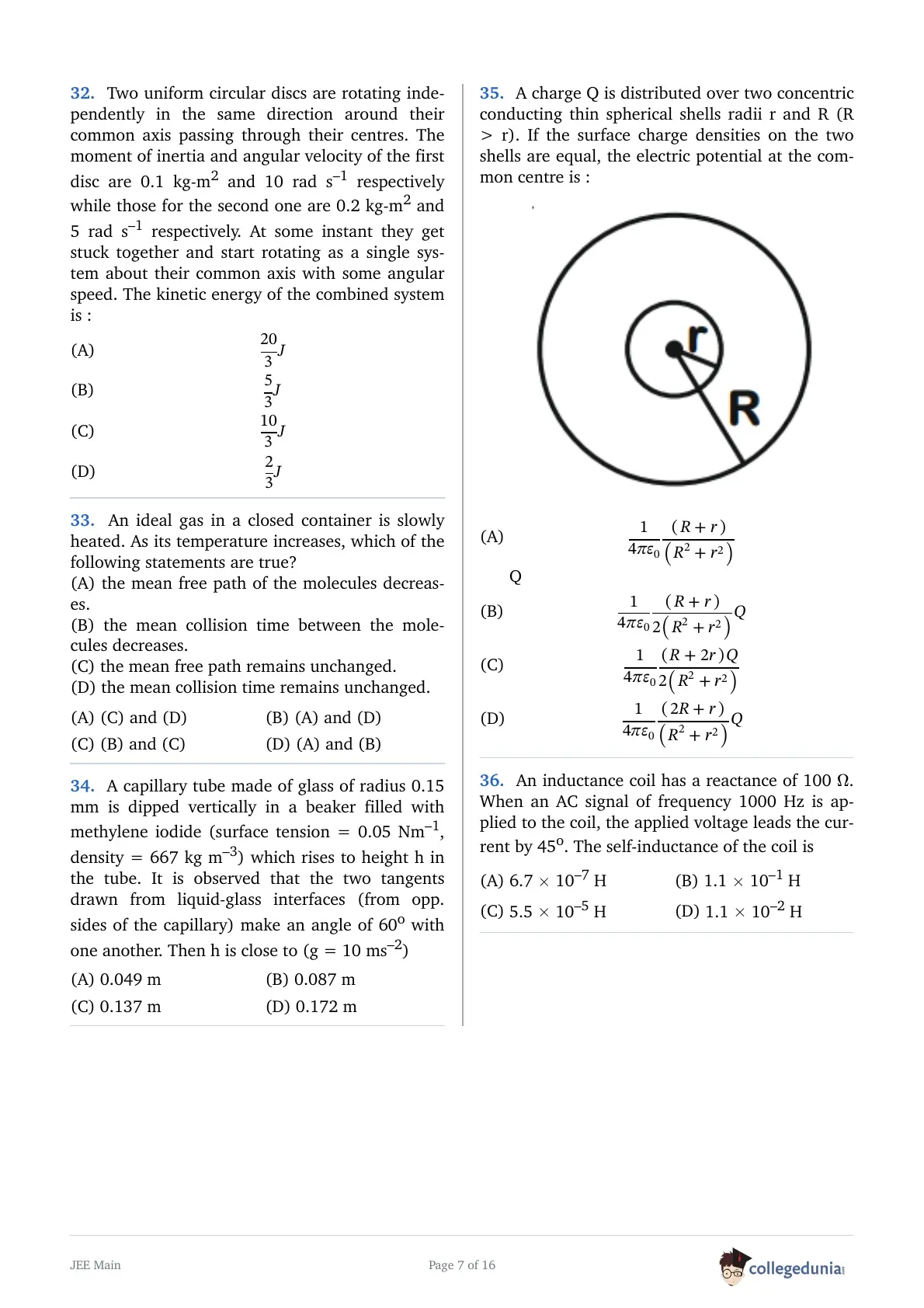
Two uniform circular discs are rotating independently in the same direction around their common axis passing through their centres. The moment of inertia and angular velocity of the first disc are \(0.1\, kg - m ^{2}\) and \(10 \,rad\, s^{-1}\) respectively while those for the second one are \(0.2\, kg - m ^{2}\) and \(5\, rad \,s ^{-1}\) respectively. At some instant they get stuck together and start rotating as a single system about their common axis with some angular speed. The Kinetic energy of the combined system is :
An ideal gas in a closed container is slowly heated. As its temperature increases, which of the following statements are true?
(A) the mean free path of the molecules decreases.
(B) the mean collision time between the molecules decreases.
(C) the mean free path remains unchanged.
(D) the mean collision time remains unchanged.
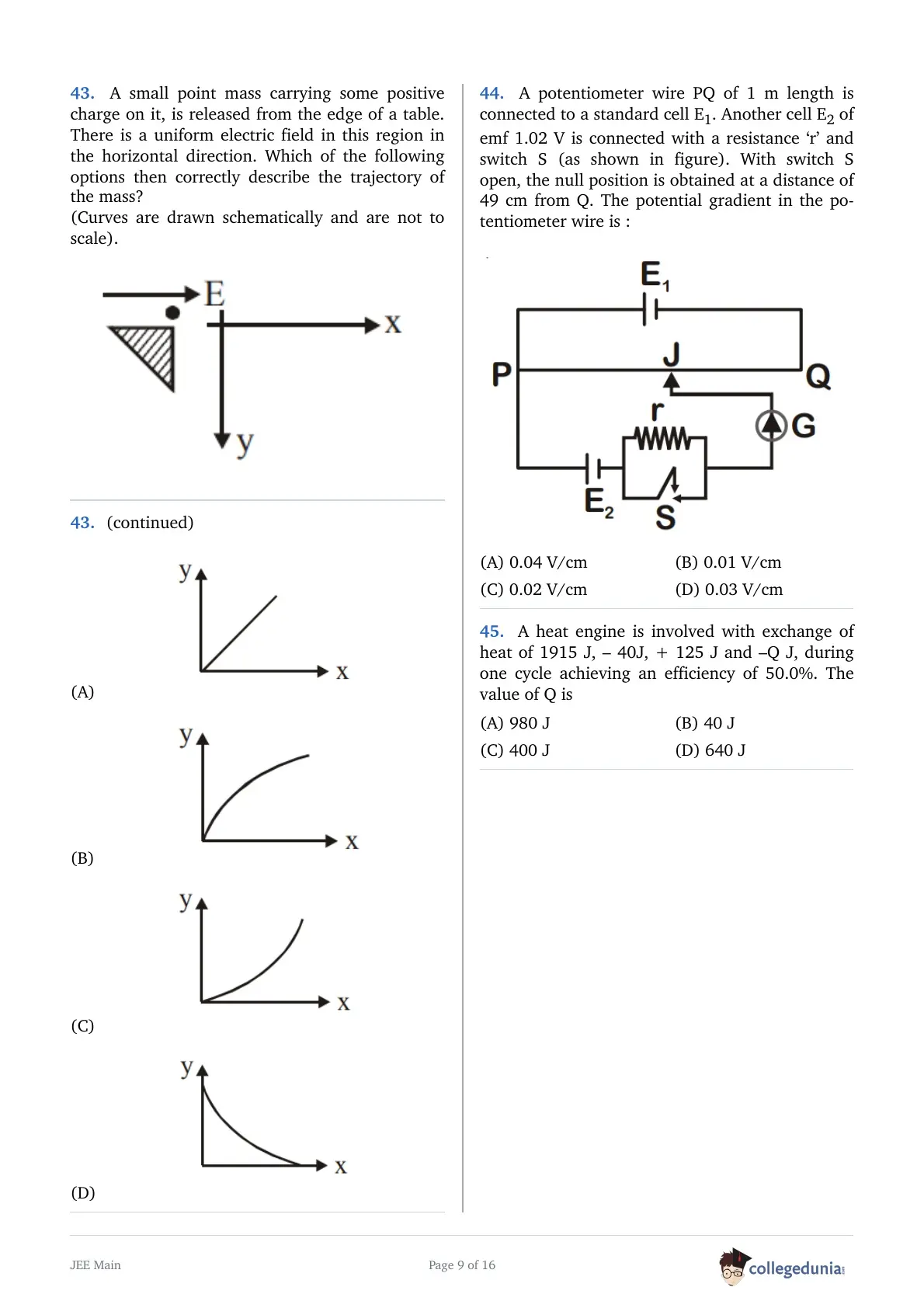
A capillary tube made of glass of radius 0.15 mm is dipped vertically in a beaker filled with methylene iodide (surface tension = 0.05 Nm-1, density = 667 kg m-3) which rises to height \(h\) in the tube. It is observed that the two tangents drawn from liquid-glass interfaces (from opp. sides of the capillary) make an angle of 60o with one another. Then \(h\) is close to (\(g = 10\ \mathrm{ms^{-2}}\))
A charge \(Q\) is distributed over two concentric conducting thin spherical shells radii \(r\) and \(R\) \(( R > r )\). If the surface charge densities on the two shells are equal, the electric potential at the common centre is :
An inductance coil has a reactance of 100 \(\Omega\). When an AC signal of frequency 1000 Hz is applied to the coil, the applied voltage leads the current by 45o. The self-inductance of the coil is
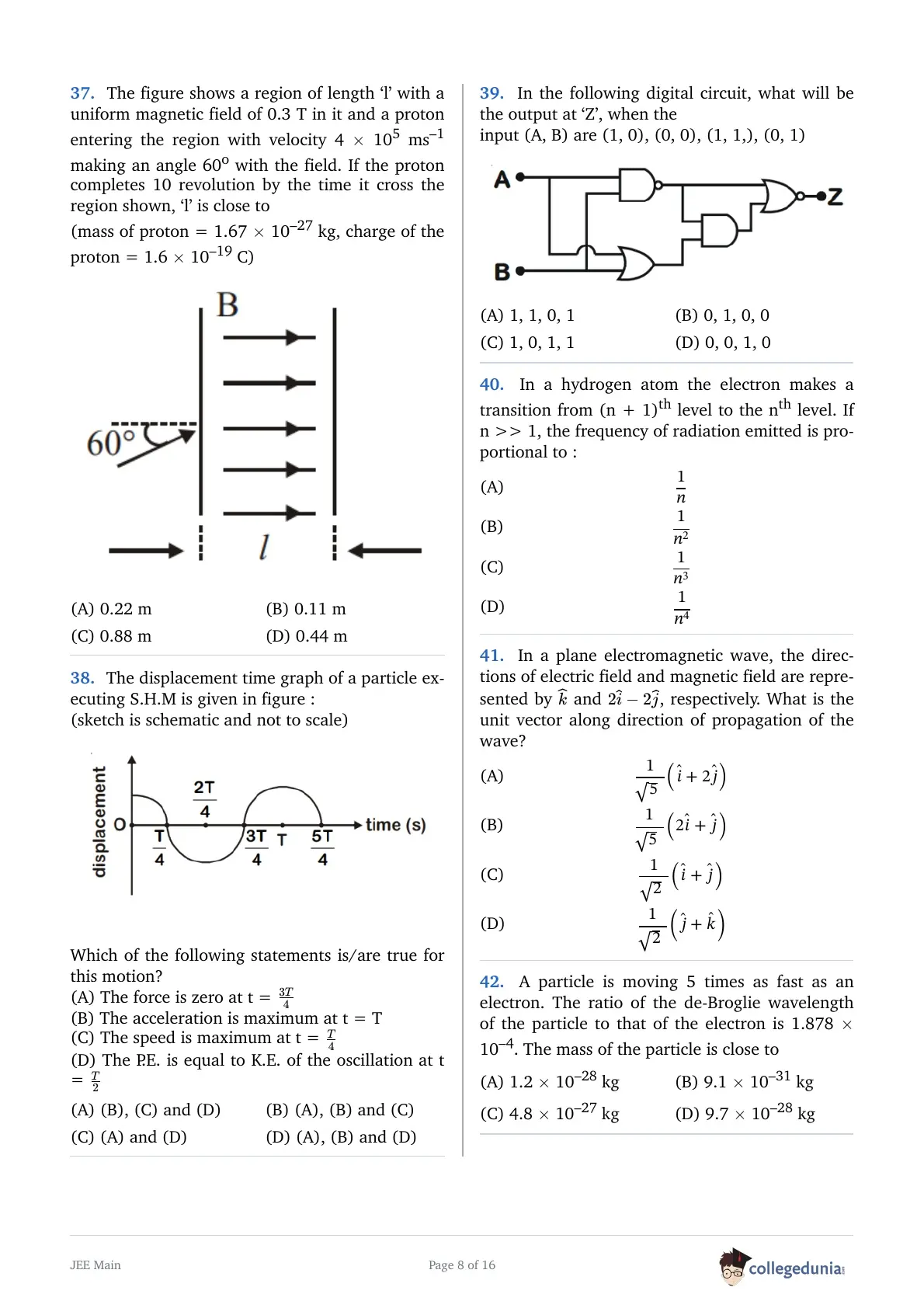
The figure shows a region of length '\(l\)' with a uniform magnetic field of 0.3 T in it and a proton entering the region with velocity \(4\times10^{5}\ \mathrm{ms^{-1}}\) making an angle \(60^\circ\) with the field. If the proton completes 10 revolution by the time it cross the region shown, '\(l\)' is close to
(mass of proton = \(1.67\times10^{-27}\) kg, charge of the proton = \(1.6\times10^{-19}\) C)
The displacement time graph of a particle executing S.H.M is given in figure :
(sketch is schematic and not to scale)
Which of the following statements is/are true for this motion?
(A) The force is zero at \(t = \frac{3T}{4}\)
(B) The acceleration is maximum at \(t = T\)
(C) The speed is maximum at \(t = \frac{T}{4}\)
(D) The P.E. is equal to K.E. of the oscillation at \(t = \frac{T}{2}\)
In the following digital circuit, what will be the output at 'Z', when the input (A, B) are (1, 0), (0, 0), (1, 1), (0, 1)
In a hydrogen atom the electron makes a transition from \((n+1)^{th}\) level to the \(n^{th}\) level. If \(n \gg 1\), the frequency of radiation emitted is proportional to :
In an electromagnetic wave the electric field vector and magnetic field vector are given as \(\vec{E} = E_0\hat{i}\) and \(\vec{B} = B_0\hat{k}\) respectively. The direction of propagation of electromagnetic wave is along :
A particle is travelling 4 times as fast as an electron. Assuming the ratio of de-Broglie wavelength of a particle to that of electron is 2 : 1, the mass of the particle is :
In the given circuit, charge \(Q_2 \) on the \(2 \mu F \) capacitor changes as \(C\) is varied from \(1 \mu F \) to \(3 \mu F. \) \(Q_2 \) as a function of \('C'\) is given properly by (figures are drawn schematically and are not to scale)
- (1)
![]()
- (2)
![]()
- (3)
![]()
- (4)
![]()


A potentiometer wire PQ of 1 m length is connected to a standard cell E1. Another cell E2 of emf 1.02 V is connected with a resistance 'r' and switch S (as shown in figure). With switch S open, the null position is obtained at a distance of 49 cm from Q. The potential gradient in the potentiometer wire is :
A heat engine is involved with exchange of heat of 1915 J, \(-40\) J, \(+125\) J and \(-Q\) J, during one cycle achieving an efficiency of 50.0%. The value of \(Q\) is
Physics - Section B (Q46 - Q50)
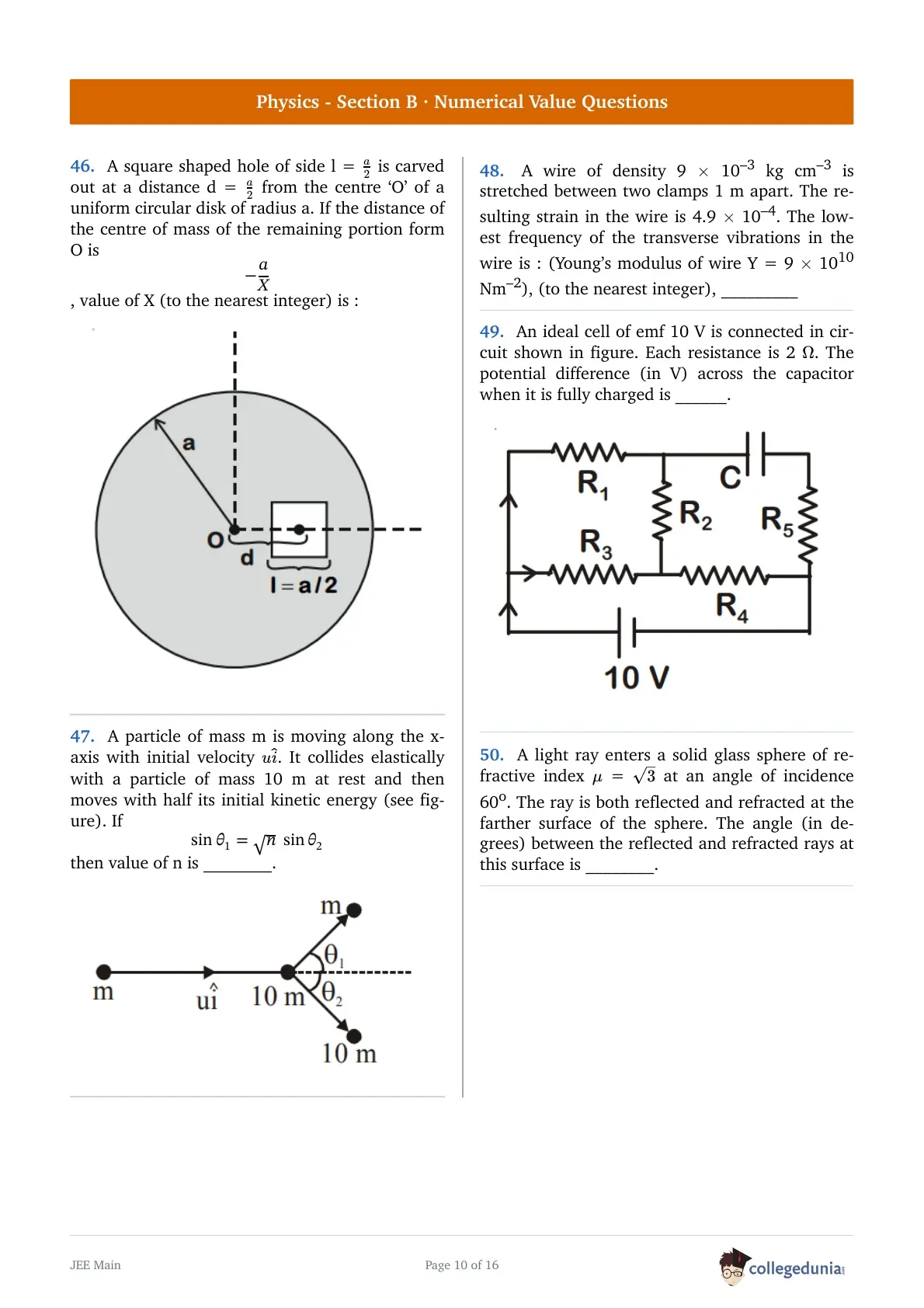
A square shaped hole of side \(l = \frac{a}{2}\) is carved out at a distance \(d = \frac{a}{2}\) from the centre 'O' of a uniform circular disk of radius \(a\). If the distance of the centre of mass of the remaining portion from O is \(-\frac{a}{X}\), value of \(X\) (to the nearest integer) is :
A particle of mass m moving with a velocity v collides with a particle of mass 2m at rest and sticks to it. Velocity of the combined mass equal to?
A wire of density \(8 × 10^3\) \(kg/m^3\) is stretched between two clamps 0.5 m apart. The extension developed in the wire is \(3.2 × 10^{–4}\) m. If Y = \(8 × 10^{10}\) \(N/m^2\) , the fundamental frequency of vibration in the wire will be ________Hz.
An ideal cell of emf 10 V is connected in circuit shown in figure. Each resistance is \(2\ \Omega\). The potential difference (in V) across the capacitor when it is fully charged is ______.
A light ray enters a solid glass sphere of refractive index \(\mu = \sqrt{3}\) at an angle of incidence \(60^\circ\). The ray is both reflected and refracted at the farther surface of the sphere. The angle (in degrees) between the reflected and refracted rays at this surface is ________.
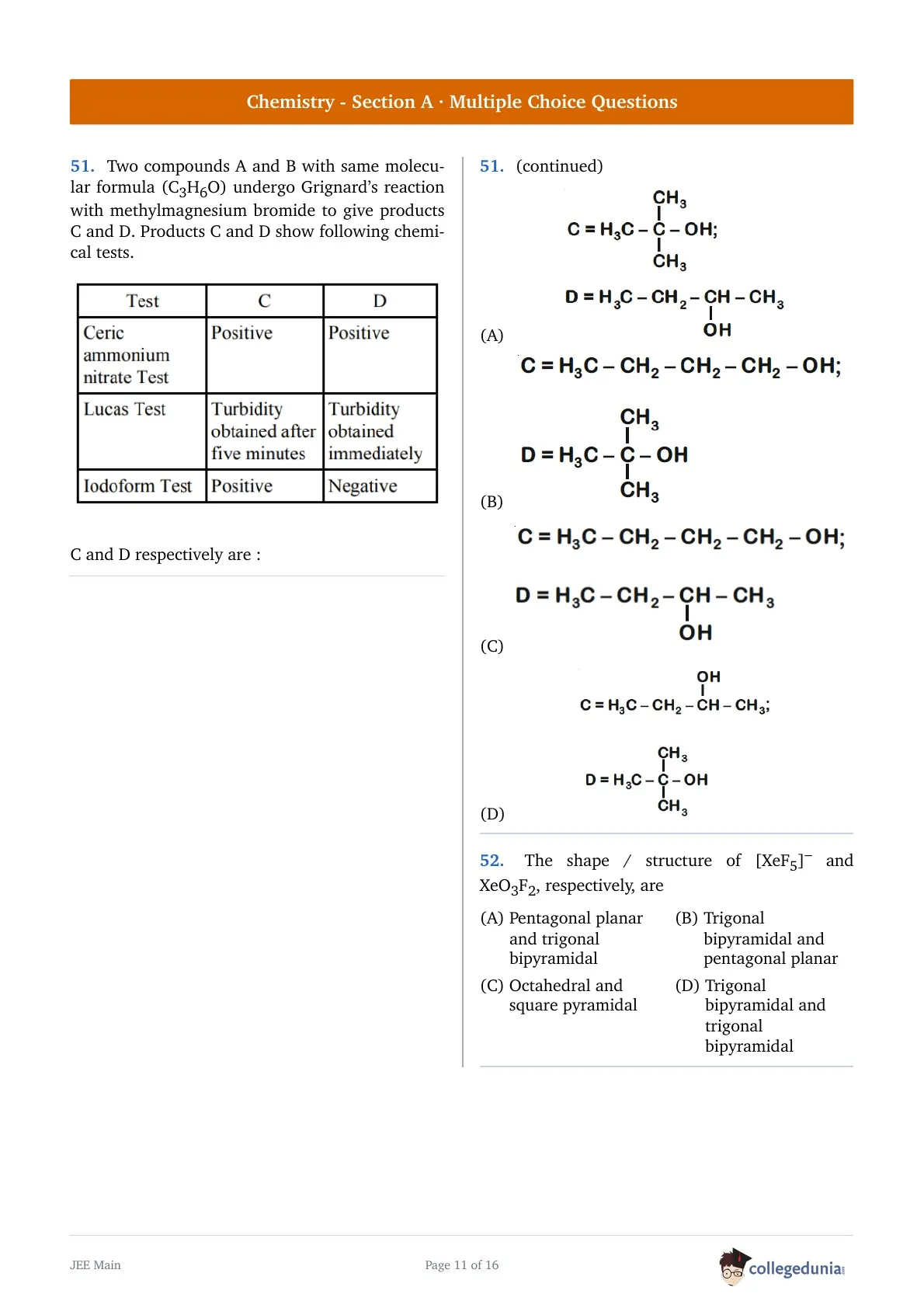
Chemistry - Section A (Q51 - Q70)
| Test | C | D |
| Ceric ammonium nitrate Test | Positive | Positive |
| Lucas Test | Turbidity obtained after five minutes | Turbidity obtained immediately |
| Iodoform Test | Positive | Negative |
- (1)
![]()
- (2)
![]()
- (3)
![]()
- (4)
![]()


The shapes of the compounds XeF2, XeF4, XeO3 and XeO4 respectively are:
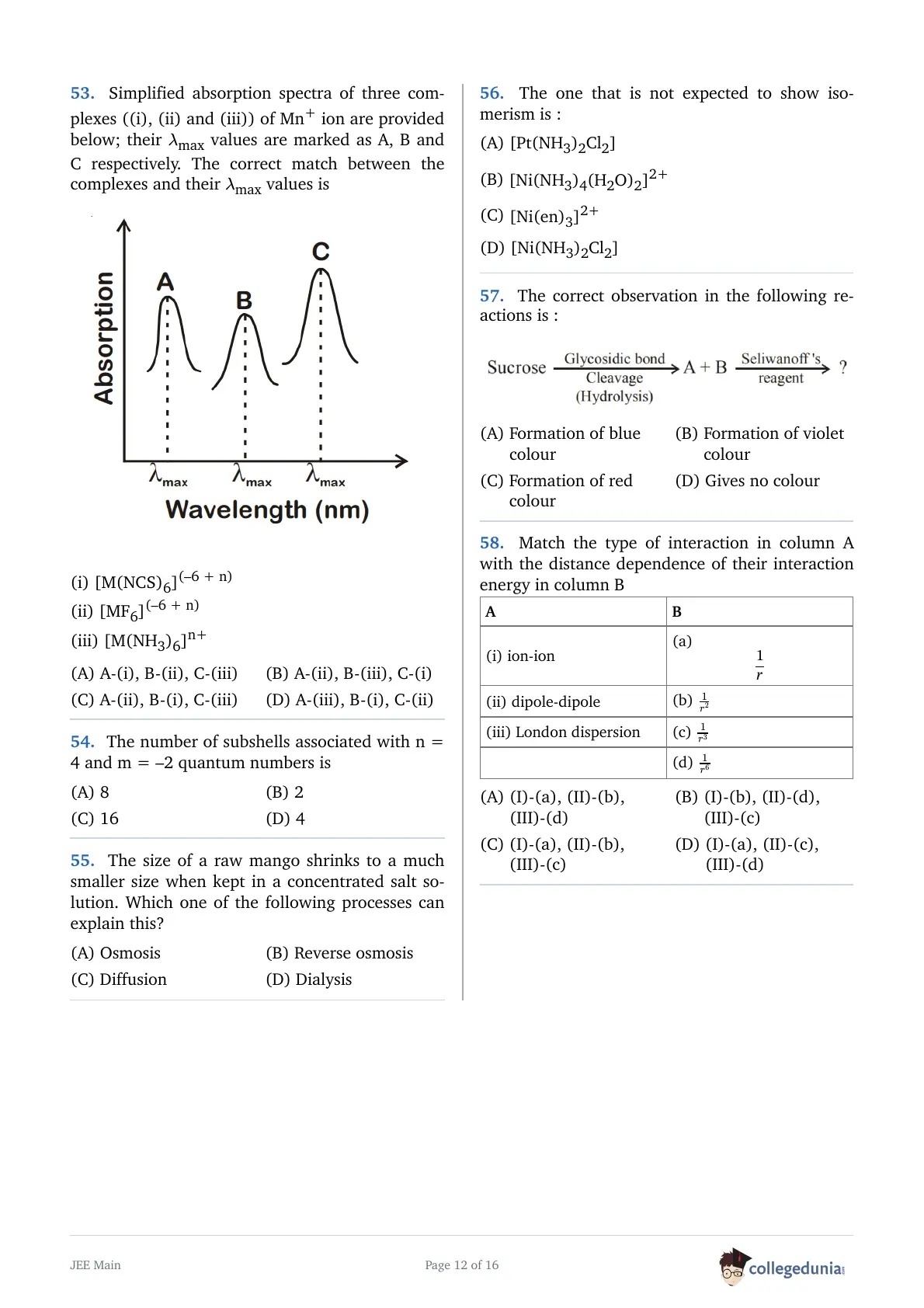
Simplified absorption spectra of three complexes ((i), (ii) and (iii)) of \(\mathrm{Mn^{+}}\) ion are provided below; their \(\lambda_{max}\) values are marked as A, B and C respectively. The correct match between the complexes and their \(\lambda_{max}\) values is
(i) \(\mathrm{[M(NCS)_6]^{(-6+n)}}\)
(ii) \(\mathrm{[MF_6]^{(-6+n)}}\)
(iii) \(\mathrm{[M(NH_3)_6]^{n+}}\)
The number of subshells associated with \(n = 4\) and \(m = -2\) quantum numbers is
The size of a raw mango shrinks to a much smaller size when kept in a concentrated salt solution. Which one of the following processes can explain this?
The one that is not expected to show isomerism is :
The correct observation in the following reactions is :
(Sucrose \(\xrightarrow[\text{(Hydrolysis)}]{\text{Glycosidic bond cleavage}}\) A + B \(\xrightarrow{\text{Seliwanoff's reagent}}\) ?)
| A | B |
| (i) ion-ion | (a) \(\frac{1}{r}\) |
| (ii) dipole-dipole | (b) \(\frac{1}{r^2}\) |
| (iii) London dispersion | (c) \(\frac{1}{r^3}\) |
| (d) \(\frac{1}{r^6}\) |
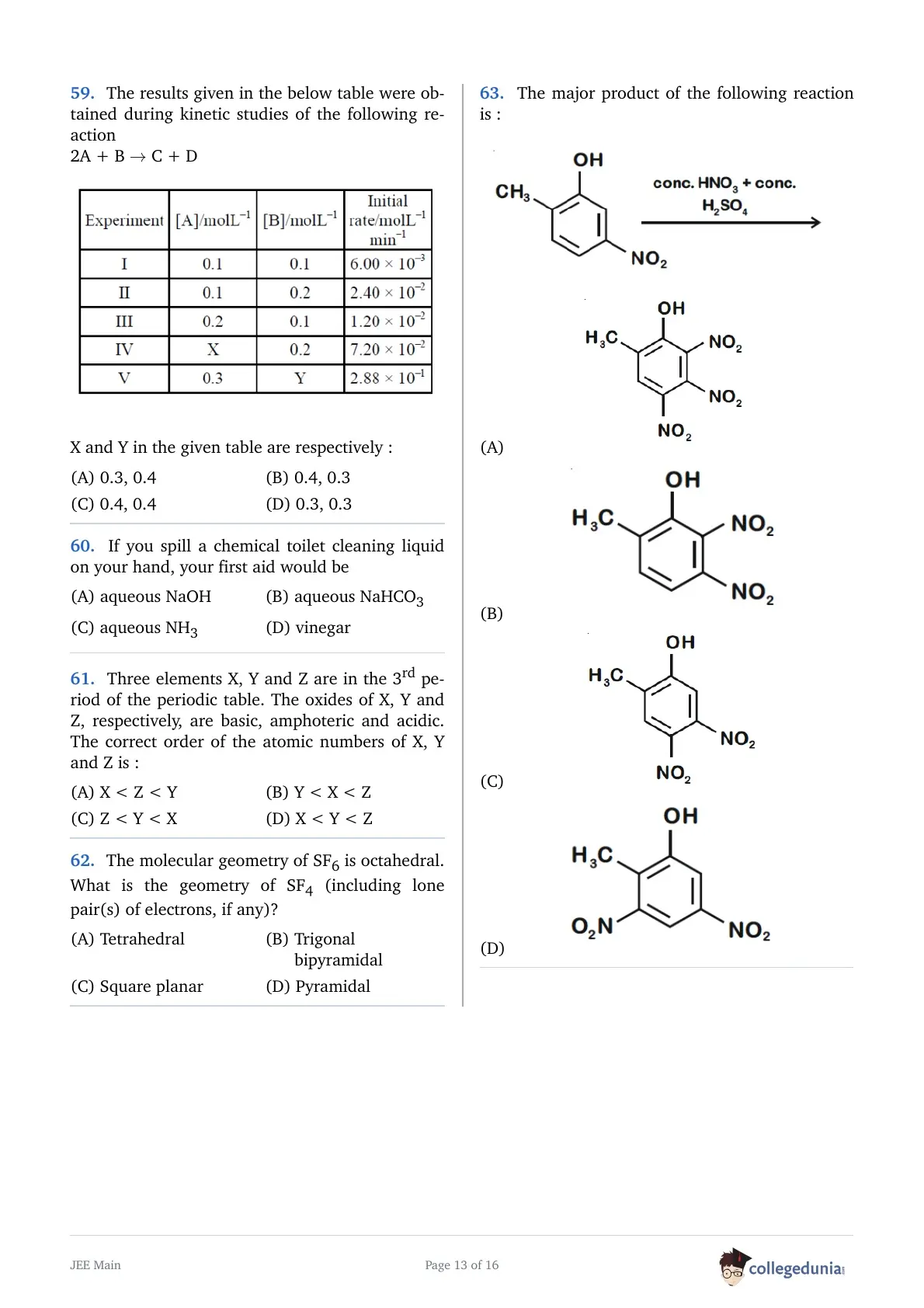
\(2A + B \to C + D\)
| Experiment | [A]/mol L-1 | [B]/mol L-1 | Initial rate/mol L-1 min-1 |
| I | 0.1 | 0.1 | \(6.00 \times 10^{-3}\) |
| II | 0.1 | 0.2 | \(2.40 \times 10^{-2}\) |
| III | 0.2 | 0.1 | \(1.20 \times 10^{-2}\) |
| IV | X | 0.2 | \(7.20 \times 10^{-2}\) |
| V | 0.3 | Y | \(2.88 \times 10^{-1}\) |
If you spill a chemical toilet cleaning liquid on your hand, your first aid would be
Three elements X, Y and Z are in the 3rd period of the periodic table. The oxides of X, Y and Z, respectively, are basic, amphoteric and acidic. The correct order of the atomic numbers of X, Y and Z is :
The molecular geometry of \(\mathrm{SF_6}\) is octahedral. What is the geometry of \(\mathrm{SF_4}\) (including lone pair(s) of electrons, if any)?


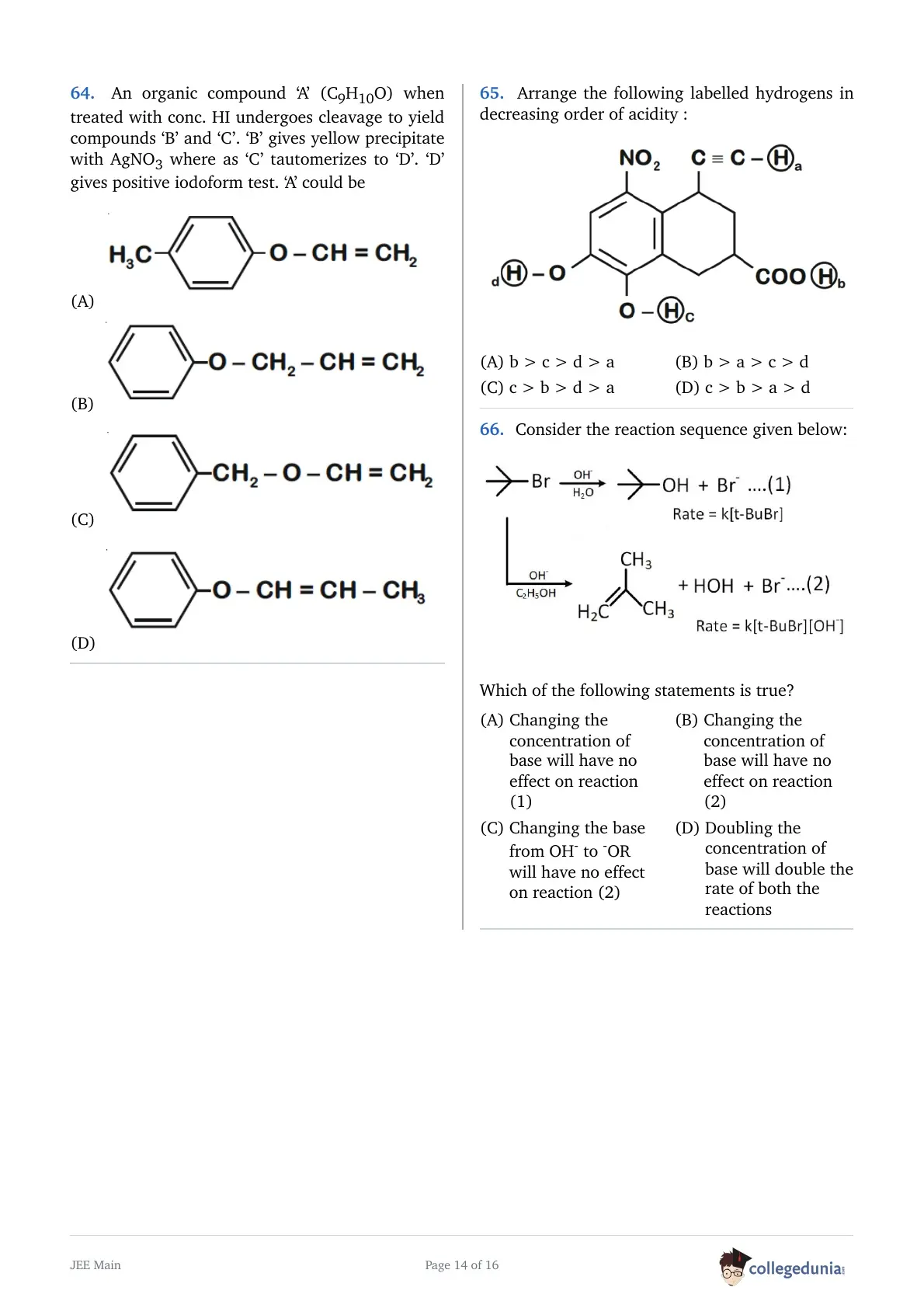
An organic compound ‘A’ (\(\mathrm{C_9H_{10}O}\)) when treated with conc. HI undergoes cleavage to yield compounds ‘B’ and ‘C’. ‘B’ gives yellow precipitate with \(\mathrm{AgNO_3}\) where as ‘C’ tautomerizes to ‘D’. ‘D’ gives positive iodoform test. ‘A’ could be
- (1)
![]()
- (2)
![]()
- (3)
![]()
- (4)
![]()


Arrange the following labelled hydrogens in decreasing order of acidity :
Consider the reaction sequence given below:
Which of the following statements is true?
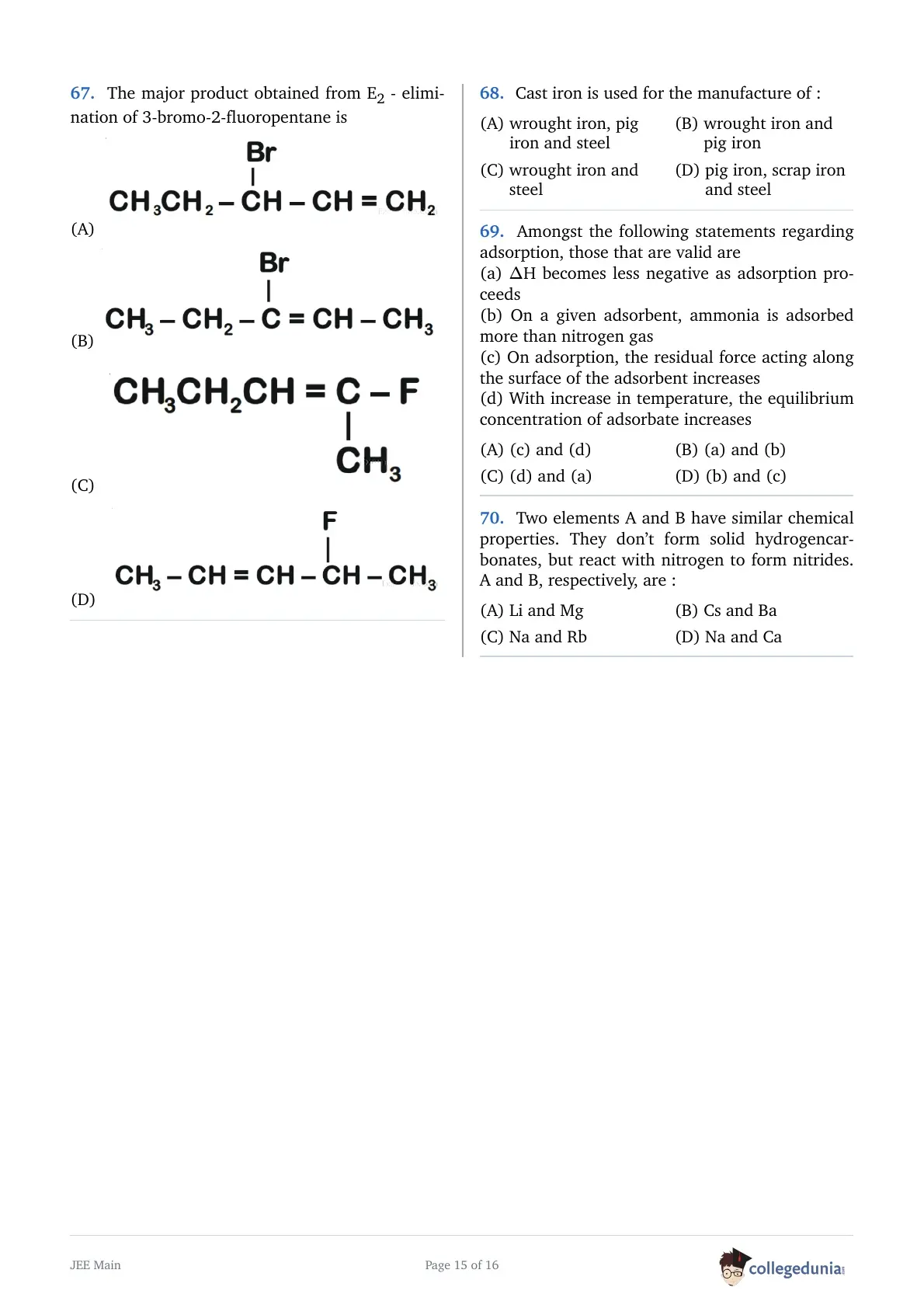
The major product obtained from \(\mathrm{E_2}\) - elimination of 3-bromo-2-fluoropentane is
- (1)
![]()
- (2)
![]()
- (3)
![]()
- (4)
![]()


Cast iron is used for the manufacture of :
Amongst the following statements regarding adsorption, those that are valid are
(a) \(\Delta H\) becomes less negative as adsorption proceeds
(b) On a given adsorbent, ammonia is adsorbed more than nitrogen gas
(c) On adsorption, the residual force acting along the surface of the adsorbent increases
(d) With increase in temperature, the equilibrium concentration of adsorbate increases
Two elements A and B have similar chemical properties. They don’t form solid hydrogencarbonates, but react with nitrogen to form nitrides. A and B, respectively, are :
Chemistry - Section B (Q71 - Q75)
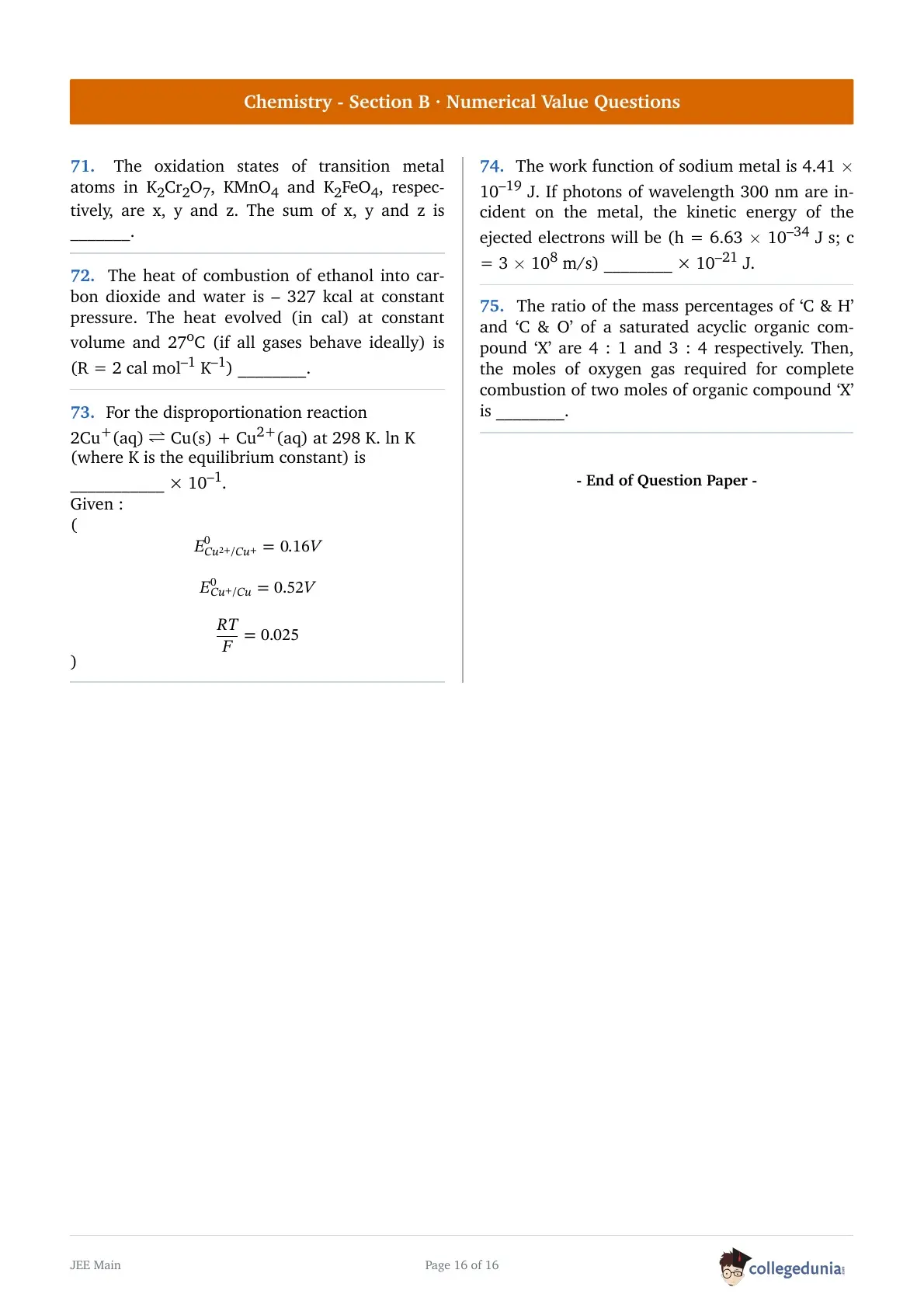
The oxidation states of \(Cr\) in \( [Cr(H_2O)_6]Cl_3, [Cr(C_6H_6)_2]\), and \(K_2[Cr(CN)_2(O)_2(O_2)(NH_3)]\) respectively are :
The heat of combustion of solid benzoic acid at constant volume is \(-321.30 \, \text{kJ}\) at \(27^\circ \text{C}\). The heat of combustion at constant pressure is \((-321.30 - xR)\, \text{kJ}\). The value of \(x\) is:
For the disproportionation reaction
\(\mathrm{2Cu^+(aq) \rightleftharpoons Cu(s) + Cu^{2+}(aq)}\) at 298 K. \(\ln K\) (where K is the equilibrium constant) is ___________ \(\times 10^{-1}\).
Given : ( \(E^0_{\mathrm{Cu^{2+}/Cu^+}} = 0.16\) V, \(E^0_{\mathrm{Cu^+/Cu}} = 0.52\) V, \(\dfrac{RT}{F} = 0.025\) )
The work function of sodium metal is \(4.41 \times 10^{-19}\) J. If photons of wavelength 300 nm are incident on the metal, the kinetic energy of the ejected electrons will be (h = \(6.63 \times 10^{-34}\) J s; c = \(3 \times 10^{8}\) m/s) ________ \(\times 10^{-21}\) J.
The ratio of the mass percentages of ‘C & H’ and ‘C & O’ of a saturated acyclic organic compound ‘X’ are 4 : 1 and 3 : 4 respectively. Then, the moles of oxygen gas required for complete combustion of two moles of organic compound ‘X’ is ________.
JEE Main 2020 Exam Pattern and Marking Scheme
| Particulars | Details |
|---|---|
| Exam Mode | Online (Computer-Based Test) |
| Paper | B.E./B.Tech (Paper 1) |
| Duration | 3 hours (180 minutes) |
| Type of Questions | Multiple Choice Questions (MCQs) + Numerical Value Questions |
| Subjects | Mathematics, Physics, Chemistry |
| Total Questions | 75 questions |
| Total Marks | 300 marks |
| Marking Scheme | +4 for correct answer & -1 for incorrect MCQ; no negative marking for Numerical Value Questions |
JEE Main 2020 September 2 Shift 2 Difficulty Level
JEE Main B.E/ B. Tech September 2, 2020 Question Paper was divided into 3 sections: Physics, Chemistry, and Mathematics. The overall difficulty level of the question paper was moderately high. The difficulty level of the Maths section was tough as compared to the previous sessions’ question paper. The chemistry section was equally tough as the Maths section. The Physics section was moderate in difficulty, which made it the easiest section of the paper. To develop an idea about the paper pattern and its difficulty level, candidates who are appearing for the upcoming JEE Main 2022 sessions are advised to go through the question paper for September 2, 2020, which is provided below with its answer key.
JEE Main 2020 B.E./B.Tech September 2 Question Paper (AN): Paper Analysis
The section-wise paper analysis for JEE Main September 2, 2020 B.E./B.Tech Question paper is as follows:
| Subjects | Sectional Analysis | Related Links |
|---|---|---|
| Mathematics |
|
JEE Main Mathematics Syllabus |
| Physics |
|
JEE Main Physics Syllabus |
| Chemistry |
|
JEE Main Chemistry Syllabus |



Comments