




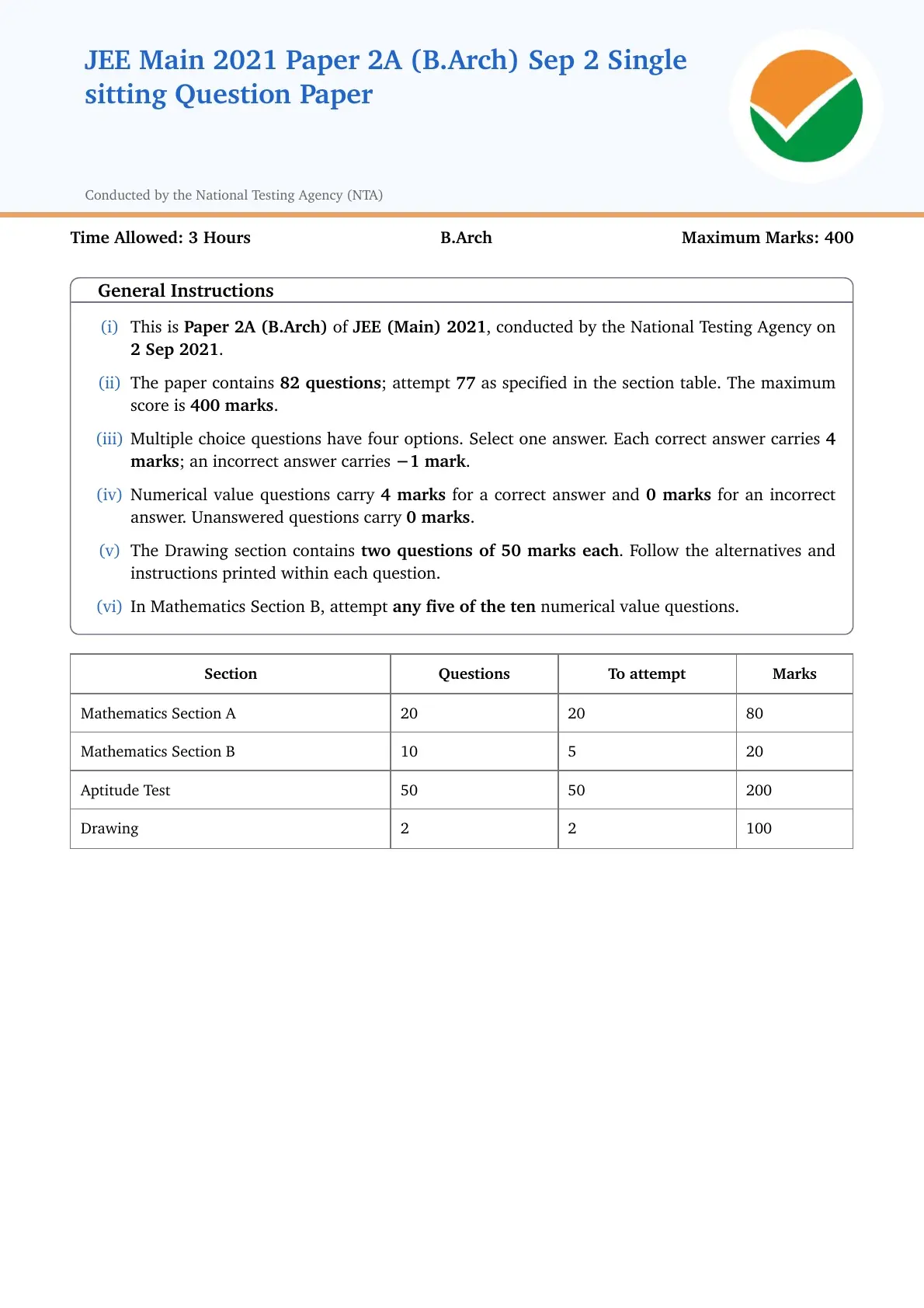
JEE Main 2021 B.Arch September 2 (Paper 2A) Question Paper is available here with solutions PDF and detailed solutions for every question. NTA conducted the JEE Main 2021 B.Arch (Paper 2A) exam on September 2, 2021 in the afternoon session (Session 4). The question paper includes the following:
- 82 questions in a 3-hour paper (77 to be attempted): Part I Mathematics (30), Part II Aptitude Test (50) and Part III Drawing Test (2)
- Mathematics: 20 multiple choice questions (MCQs) and 10 numerical value questions, of which any 5 are to be attempted; 4 marks each (100 marks)
- Aptitude Test: 50 MCQs, 4 marks each (200 marks)
- Drawing Test: 2 drawing questions, 50 marks each (100 marks)
- Marking: +4 for a correct answer, -1 for an incorrect MCQ answer (no negative marking for numerical value questions), 0 for an unattempted question; maximum marks 400
JEE Main 2021 B.Arch September 2 (Paper 2A) Question Paper with Solution PDF
| NTA Official PDF | CD PDF | CD PDF with Solutions |
|---|---|---|
| Download official PDF 4.90 MB | Download Collegedunia PDF 5.58 MB | Download solutions PDF 4.46 MB |
Also Check:
JEE Main 2021 B.Arch September 2 (Paper 2A) Questions with Solutions
Mathematics (Q1 - Q30)
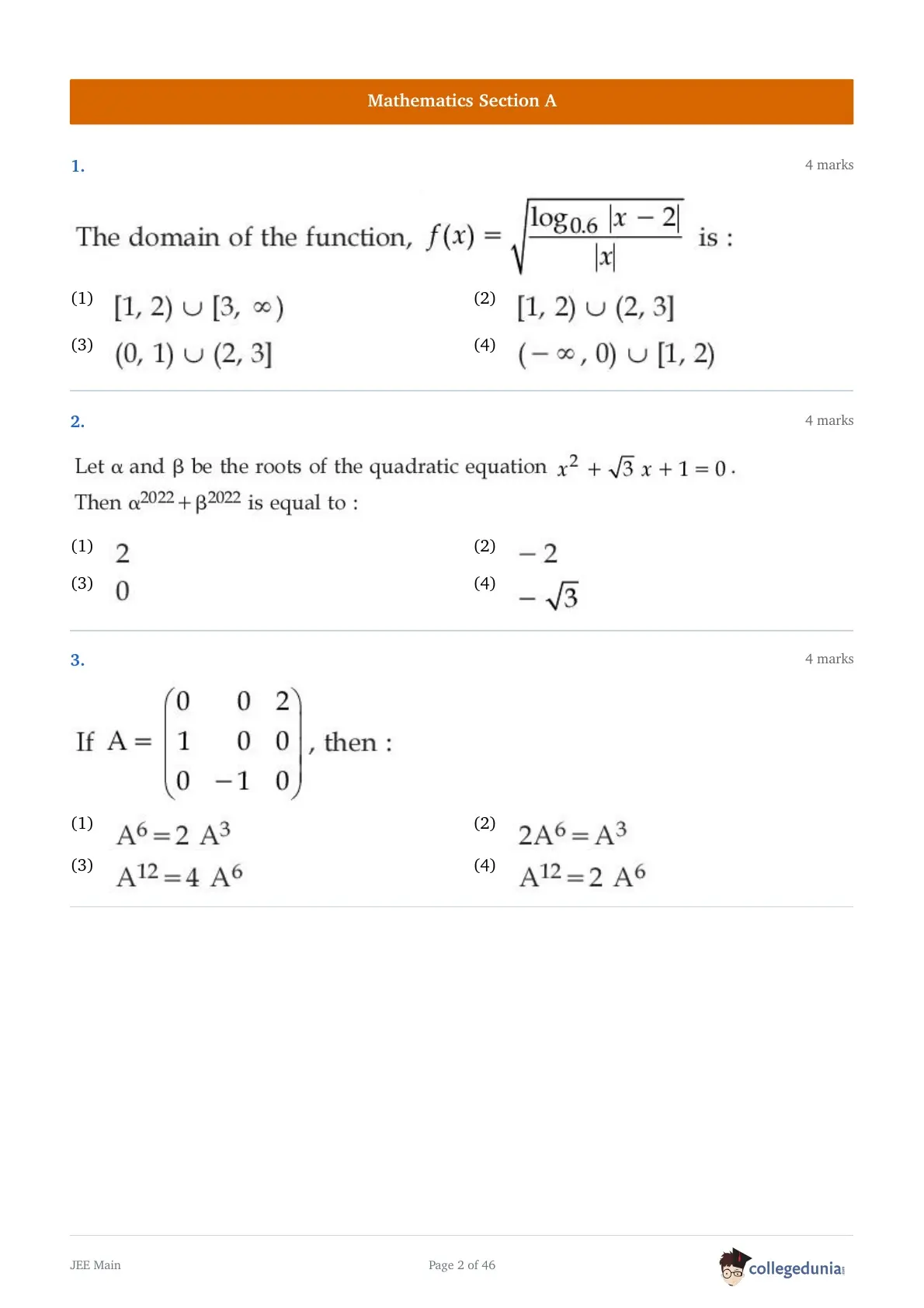
The domain of the function, \(f(x)=\sqrt{\frac{\log_{0.6}|x-2|}{|x|}}\) is :
Let \(\alpha\) and \(\beta\) be the roots of the quadratic equation \(x^{2}+\sqrt{3}\,x+1=0\). Then \(\alpha^{2022}+\beta^{2022}\) is equal to :
If \(A=\begin{pmatrix}0&0&2\\1&0&0\\0&-1&0\end{pmatrix}\), then :
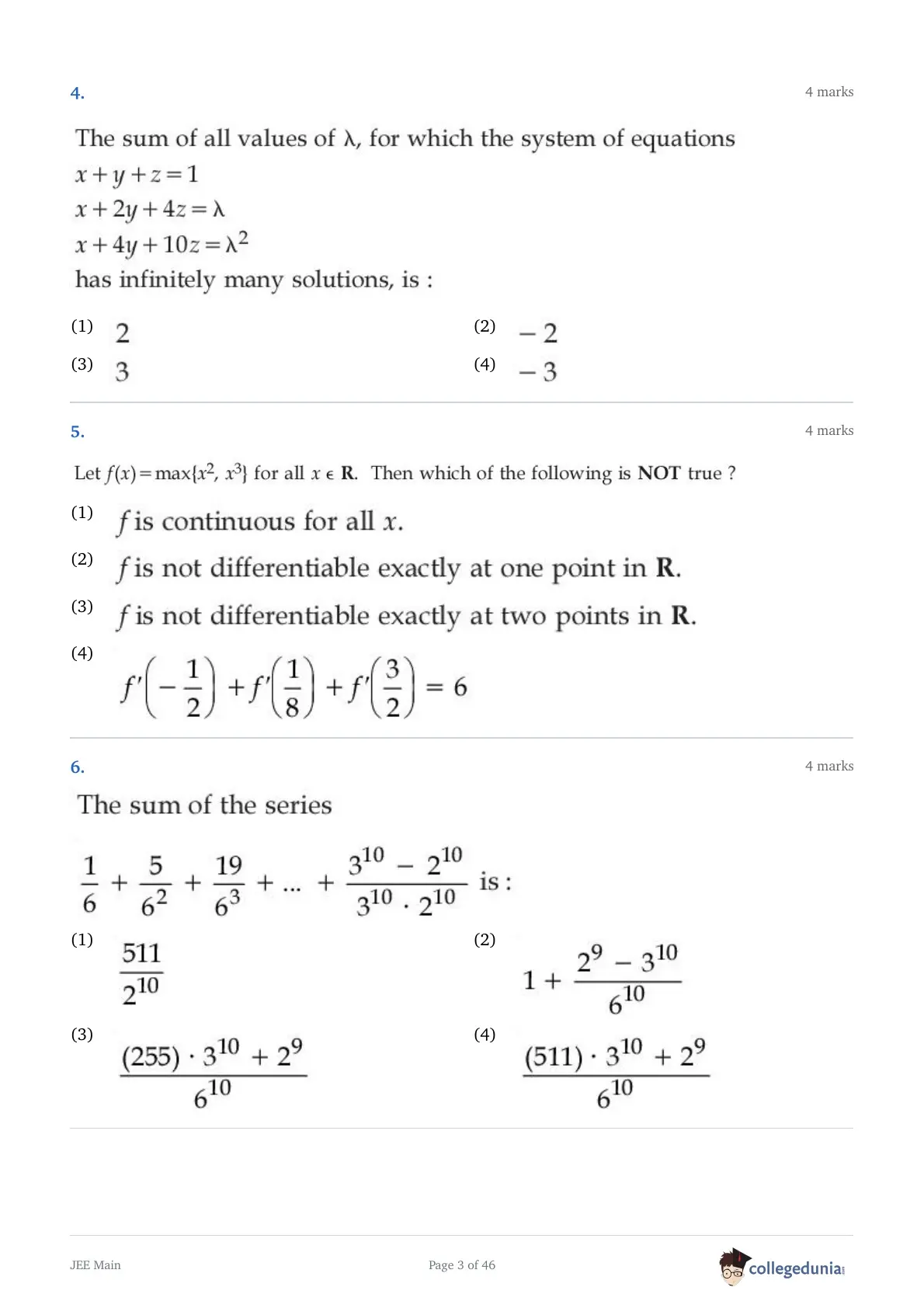
The sum of all values of \(\lambda\), for which the system of equations
\(x+y+z=1\)
\(x+2y+4z=\lambda\)
\(x+4y+10z=\lambda^{2}\)
has infinitely many solutions, is :
Let \(f(x)=\max\left\{x^{2},x^{3}\right\}\) for all \(x\in\mathbf{R}\). Then which of the following is NOT true ?
The sum of the series
\(\frac{1}{6}+\frac{5}{6^{2}}+\frac{19}{6^{3}}+\ldots+\frac{3^{10}-2^{10}}{3^{10}\cdot 2^{10}}\) is :
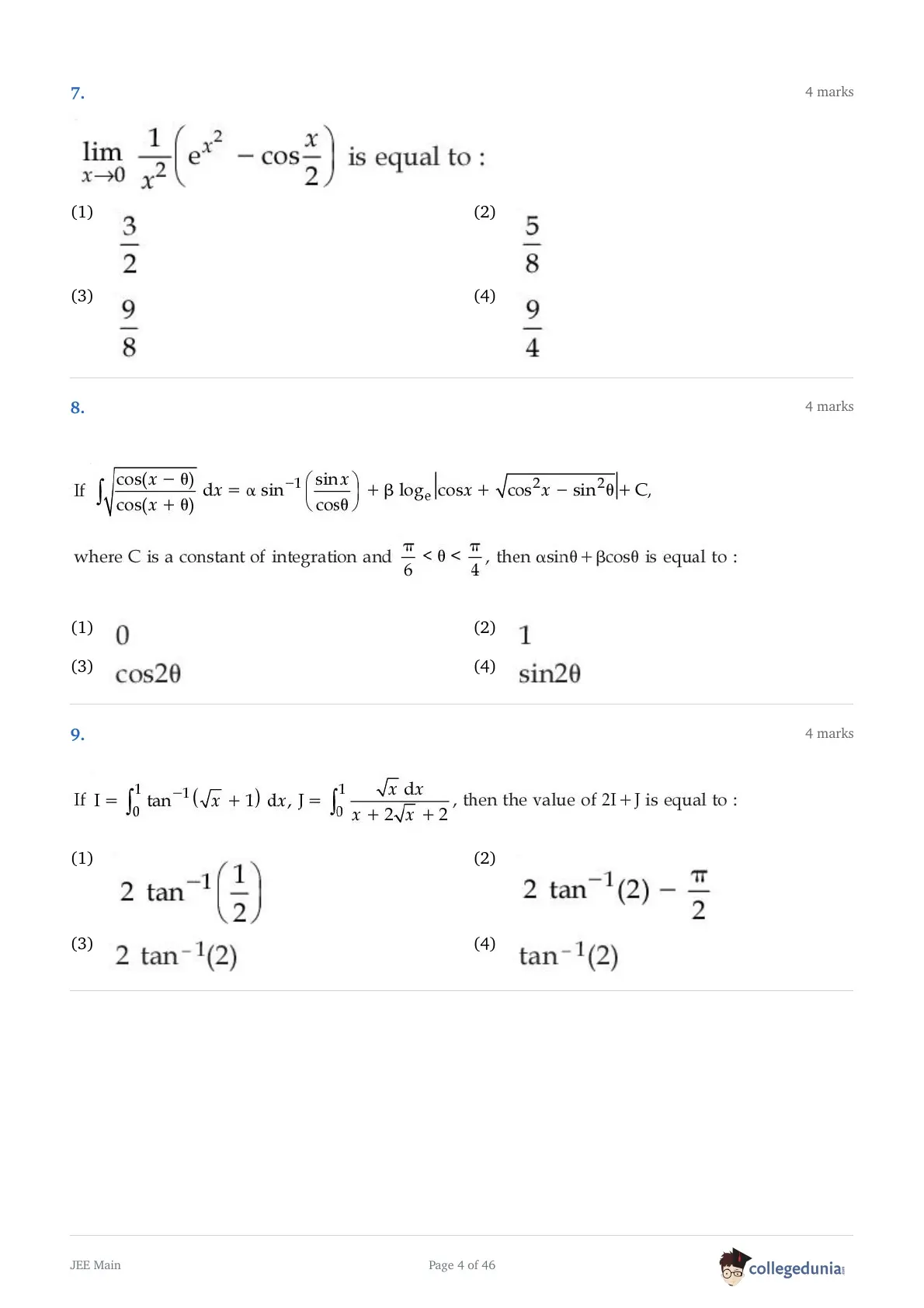
\(\lim_{x\to 0}\frac{1}{x^{2}}\left(\mathrm{e}^{x^{2}}-\cos\frac{x}{2}\right)\) is equal to :
If \(\int\sqrt{\frac{\cos(x-\theta)}{\cos(x+\theta)}}\,\mathrm{d}x=\alpha\sin^{-1}\left(\frac{\sin x}{\cos\theta}\right)+\beta\log_{\mathrm e}\left|\cos x+\sqrt{\cos^{2}x-\sin^{2}\theta}\right|+\mathrm{C}\),
where C is a constant of integration and \(\frac{\pi}{6}<\theta<\frac{\pi}{4}\), then \(\alpha\sin\theta+\beta\cos\theta\) is equal to :
If \(\mathrm{I}=\int_{0}^{1} \tan^{-1}(\sqrt{x}+1)\,dx\), \(\mathrm{J}=\int_{0}^{1} \frac{\sqrt{x}\,dx}{x+2\sqrt{x}+2}\), then the value of \(2\mathrm{I}+\mathrm{J}\) is equal to :
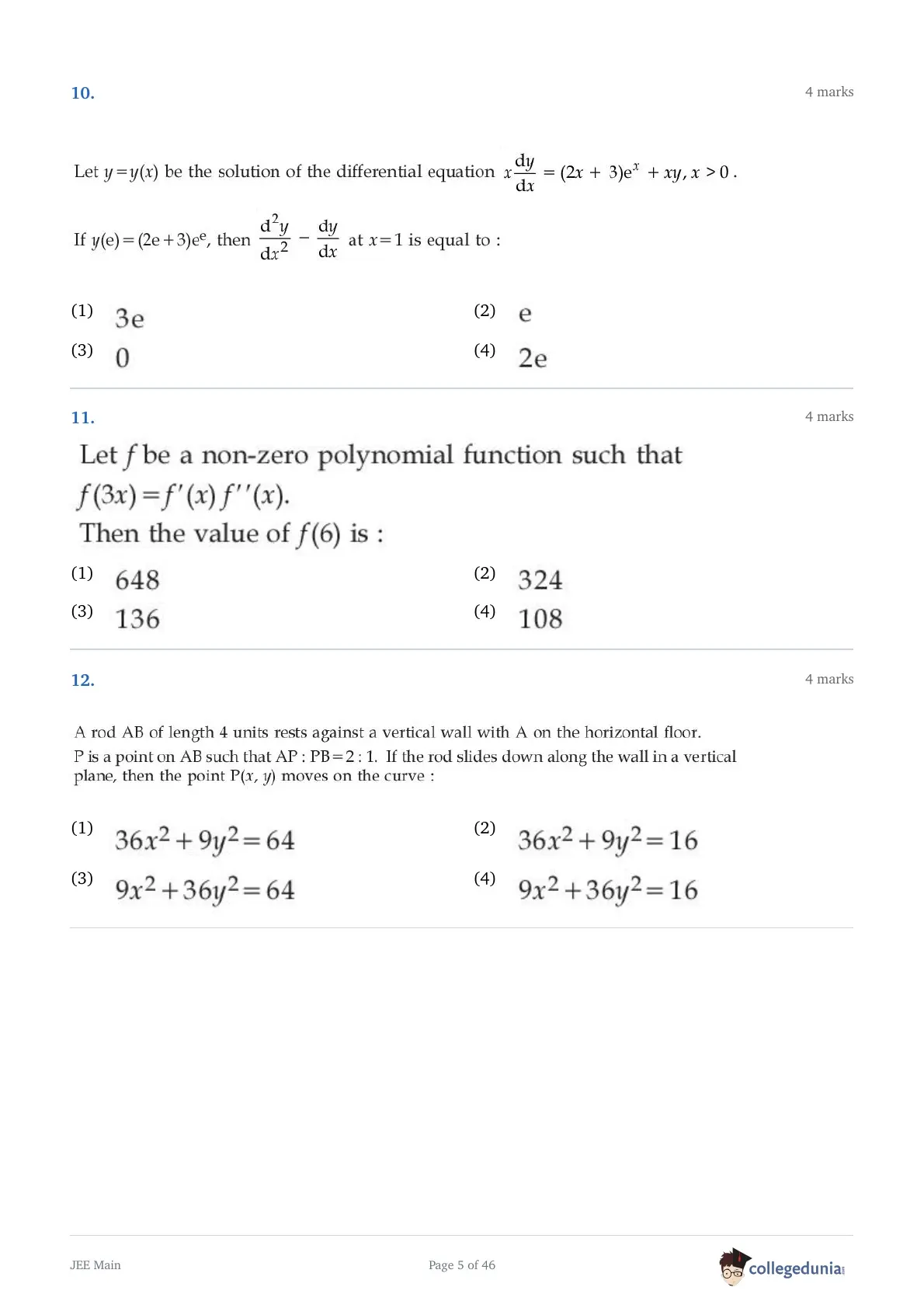
Let \(y=y(x)\) be the solution of the differential equation \(x\frac{dy}{dx}=(2x+3)e^{x}+xy,\ x > 0\). If \(y(e)=(2e+3)e^{e}\), then \(\frac{d^2y}{dx^2}-\frac{dy}{dx}\) at \(x=1\) is equal to :
Let \(f\) be a non-zero polynomial function such that \(f(3x)=f'(x)f''(x)\). Then the value of \(f(6)\) is :
A rod AB of length 4 units rests against a vertical wall with A on the horizontal floor. P is a point on AB such that AP : PB = 2 : 1. If the rod slides down along the wall in a vertical plane, then the point \(P(x,y)\) moves on the curve :
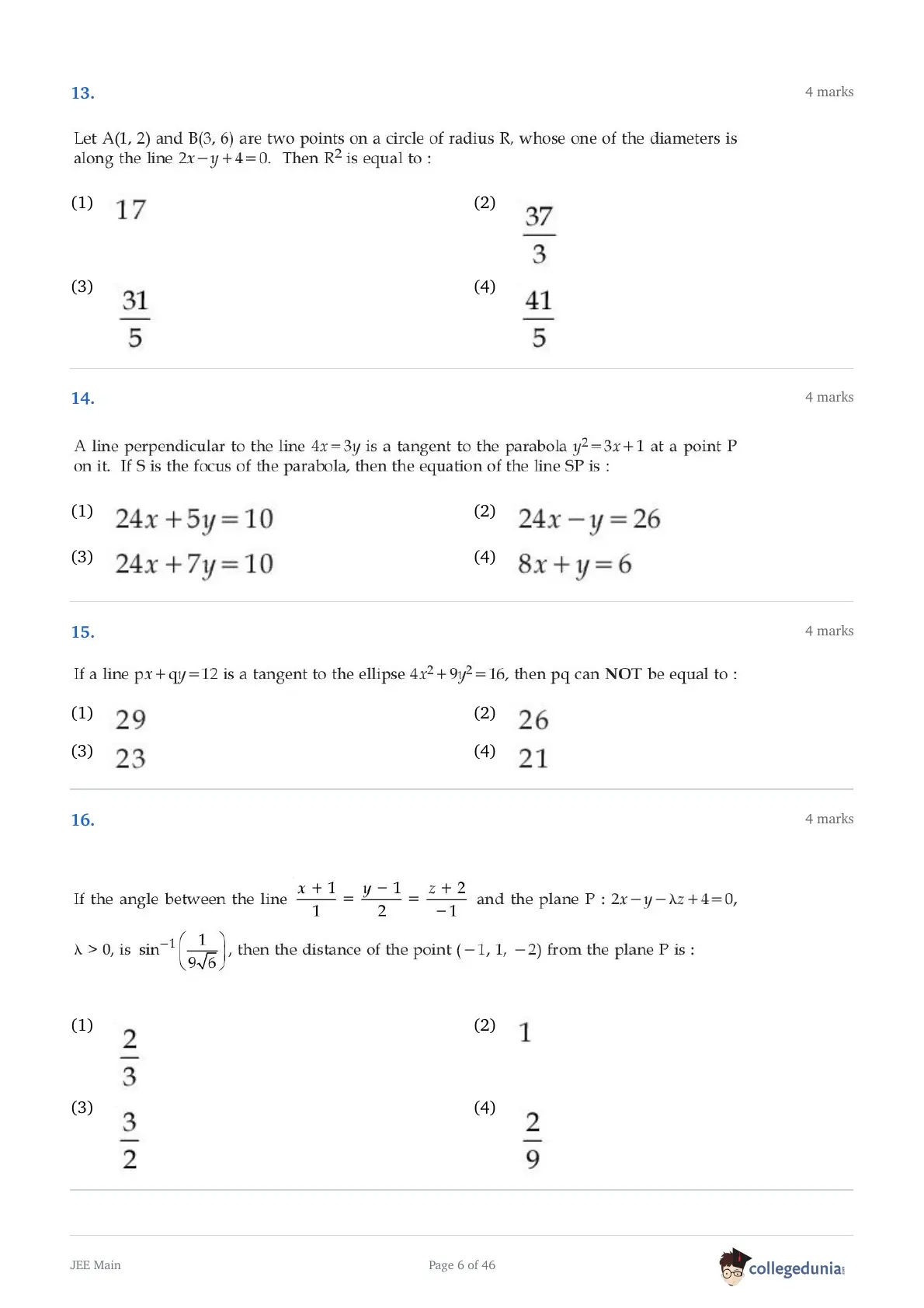
Let \(\mathrm{A}(1,2)\) and \(\mathrm{B}(3,6)\) be two points on a circle of radius \(\mathrm{R}\), whose one of the diameters is along the line \(2x-y+4=0\). Then \(\mathrm{R}^2\) is equal to :
A line perpendicular to the line \(4x=3y\) is a tangent to the parabola \(y^2=3x+1\) at a point \(\mathrm{P}\) on it. If \(\mathrm{S}\) is the focus of the parabola, then the equation of the line \(\mathrm{SP}\) is :
If a line \(\mathrm{p}x+\mathrm{q}y=12\) is a tangent to the ellipse \(4x^2+9y^2=16\), then \(\mathrm{pq}\) can NOT be equal to :
If the angle between the line \(\frac{x+1}{1}=\frac{y-1}{2}=\frac{z+2}{-1}\) and the plane \(\mathrm{P}: 2x-y-\lambda z+4=0\), \(\lambda > 0\), is \(\sin^{-1}\left(\frac{1}{9\sqrt6}\right)\), then the distance of the point \((-1,1,-2)\) from the plane \(\mathrm{P}\) is :
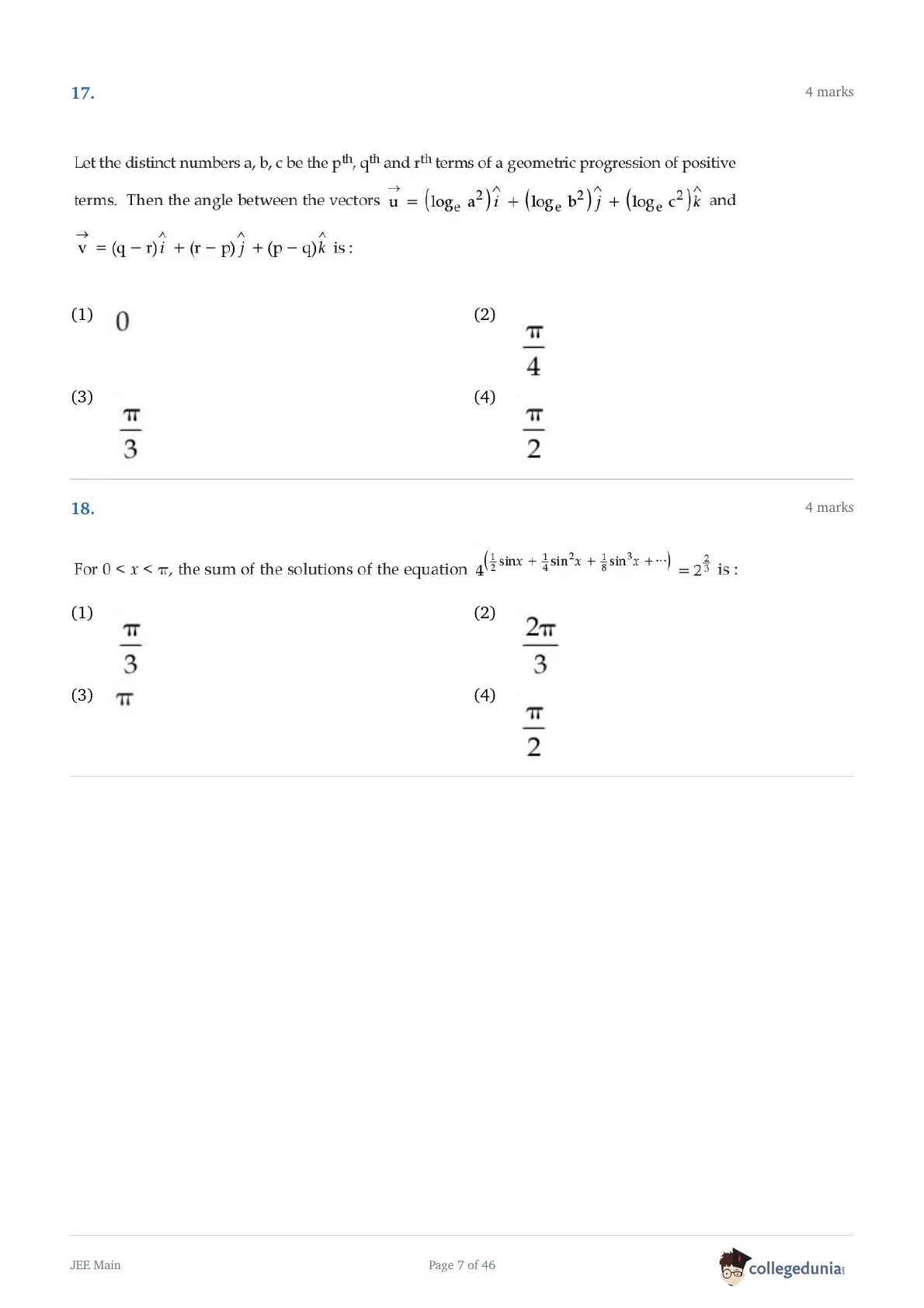
Let the distinct numbers \(\mathrm{a}, \mathrm{b}, \mathrm{c}\) be the \(\mathrm{p}^{\text{th}}, \mathrm{q}^{\text{th}}\) and \(\mathrm{r}^{\text{th}}\) terms of a geometric progression of positive terms. Then the angle between the vectors \(\overrightarrow{\mathrm{u}}=\left(\log_{\mathrm{e}} \mathrm{a}^{2}\right) \hat{i}+\left(\log_{\mathrm{e}} \mathrm{b}^{2}\right) \hat{j}+\left(\log_{\mathrm{e}} \mathrm{c}^{2}\right) \hat{k}\) and \(\overrightarrow{\mathrm{v}}=(\mathrm{q}-\mathrm{r}) \hat{i}+(\mathrm{r}-\mathrm{p}) \hat{j}+(\mathrm{p}-\mathrm{q}) \hat{k}\) is :
For \(0<x<\pi\), the sum of the solutions of the equation \(4^{\left(\frac{1}{2} \sin x+\frac{1}{4} \sin ^{2} x+\frac{1}{8} \sin ^{3} x+\cdots\right)}=2^{\frac{2}{3}}\) is :
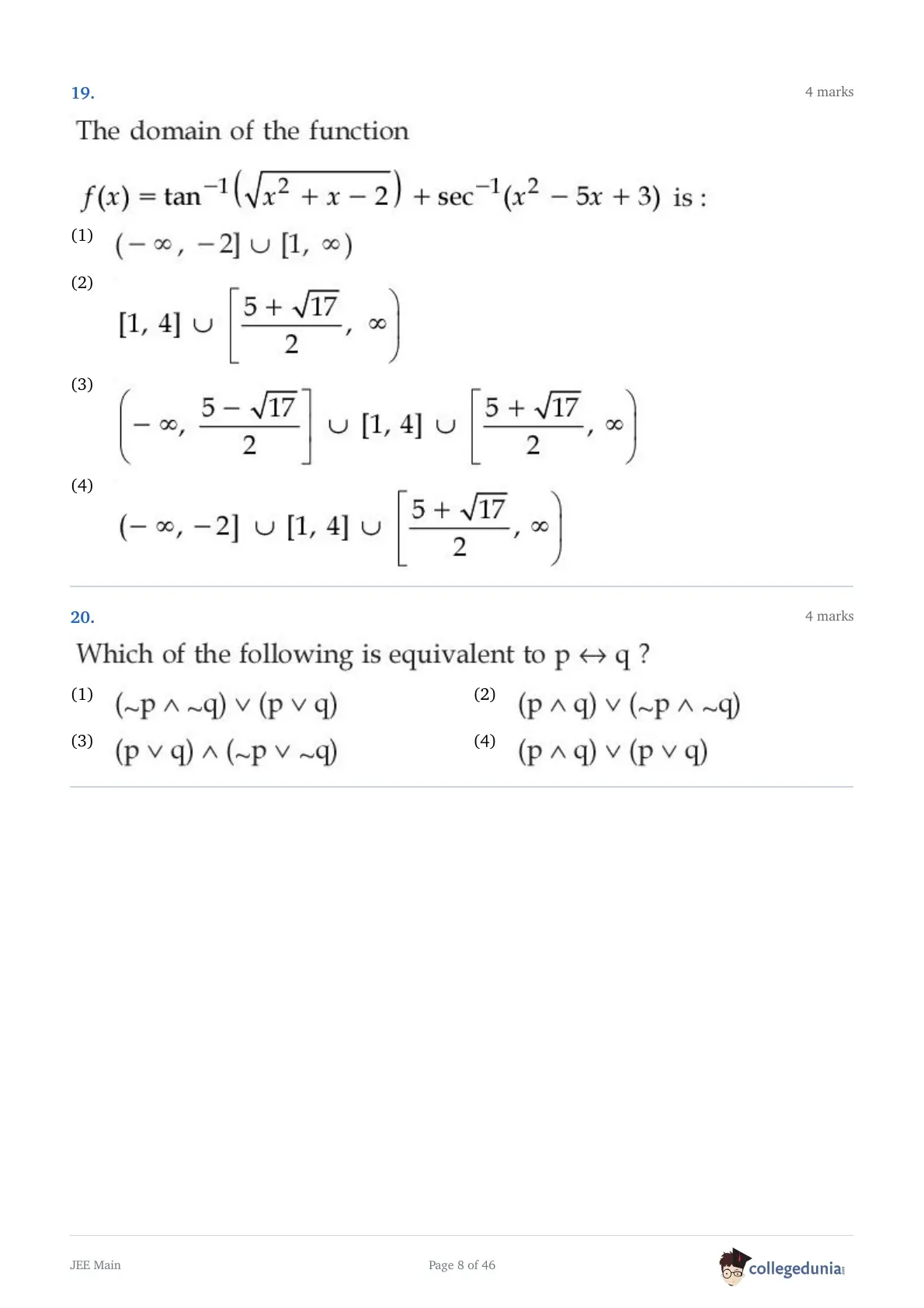
The domain of the function
\(f(x)=\tan ^{-1}\left(\sqrt{x^{2}+x-2}\right)+\sec ^{-1}\left(x^{2}-5 x+3\right)\) is :
Which of the following is equivalent to \(p \leftrightarrow q\) ?
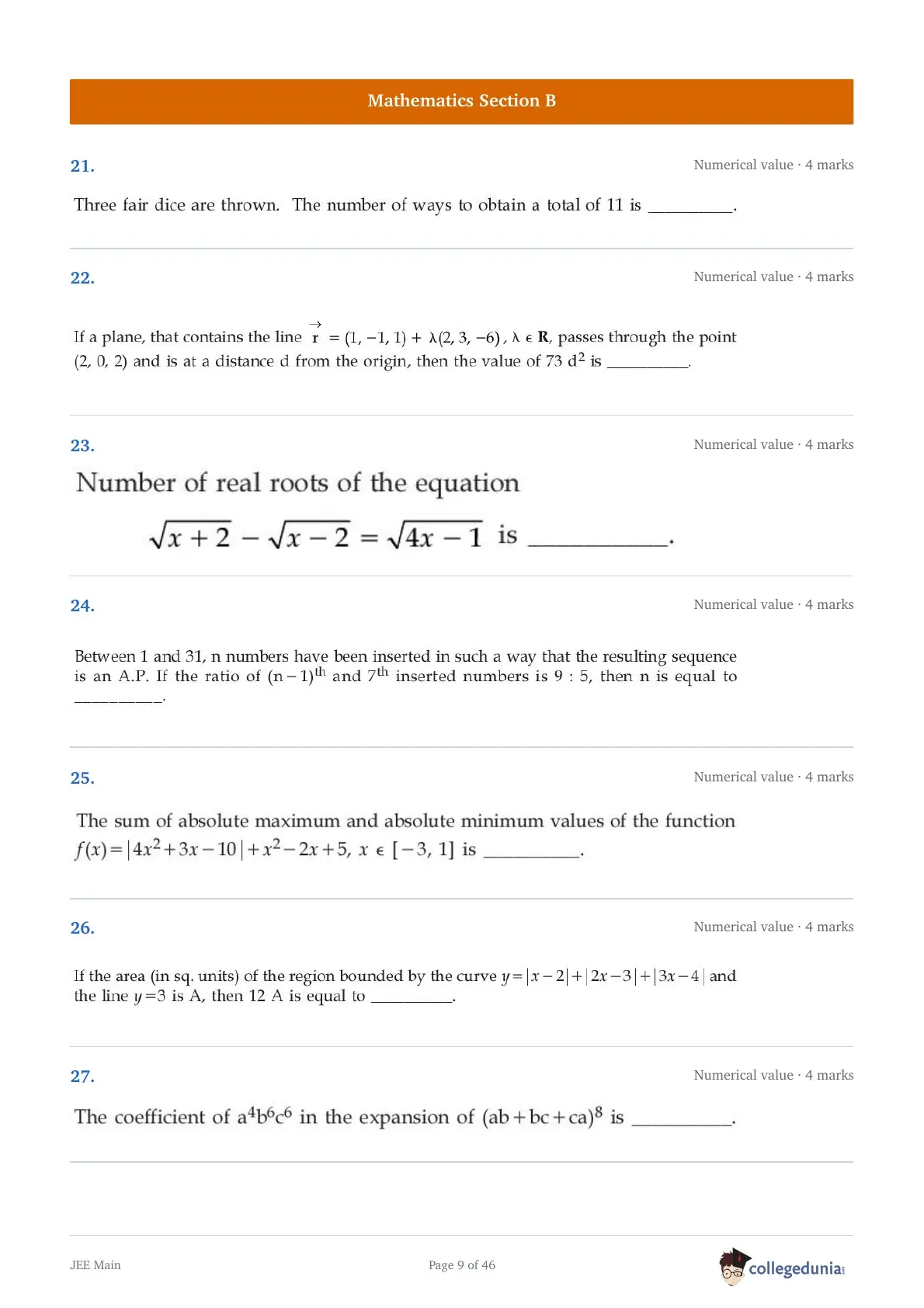
Three fair dice are thrown. The number of ways to obtain a total of 11 is ________.
If a plane, that contains the line \(\overrightarrow{\mathrm{r}}=(1,-1,1)+\lambda(2,3,-6), \lambda \in \mathbf{R}\), passes through the point \((2,0,2)\) and is at a distance \(\mathrm{d}\) from the origin, then the value of \(73 \mathrm{~d}^{2}\) is ________.
Number of real roots of the equation
\(\sqrt{x+2}-\sqrt{x-2}=\sqrt{4 x-1}\) is ________.
Between 1 and 31, \(\mathrm{n}\) numbers have been inserted in such a way that the resulting sequence is an A.P. If the ratio of \((\mathrm{n}-1)^{\text{th}}\) and \(7^{\text{th}}\) inserted numbers is \(9: 5\), then \(\mathrm{n}\) is equal to ________.
The sum of absolute maximum and absolute minimum values of the function \(f(x)=\left|4x^{2}+3x-10\right|+x^{2}-2x+5,\ x\in[-3,1]\) is ________.
If the area (in sq. units) of the region bounded by the curve \(y=|x-2|+|2x-3|+|3x-4|\) and the line \(y=3\) is A, then 12A is equal to ________.
The coefficient of \(a^{4}b^{6}c^{6}\) in the expansion of \((ab+bc+ca)^{8}\) is ________.
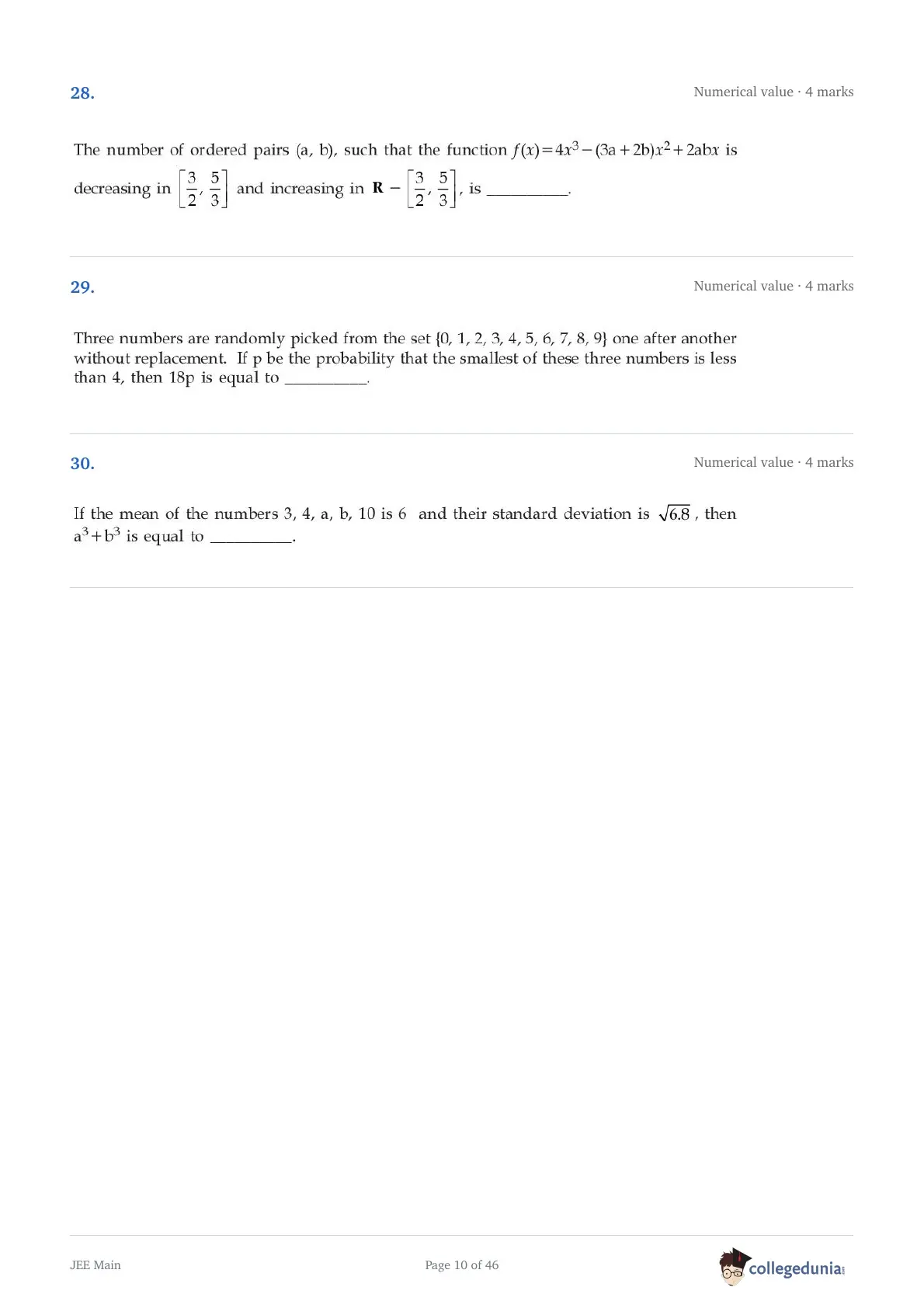
The number of ordered pairs \((a,b)\), such that the function \(f(x)=4x^{3}-(3a+2b)x^{2}+2abx\) is decreasing in \(\left[\frac32,\frac53\right]\) and increasing in \(\mathbb{R}-\left[\frac32,\frac53\right]\), is ________.
Three numbers are randomly picked from the set \(\{0,1,2,3,4,5,6,7,8,9\}\) one after another without replacement. If p be the probability that the smallest of these three numbers is less than 4, then 18p is equal to ________.
If the mean of the numbers \(3, 4, a, b, 10\) is 6 and their standard deviation is \(\sqrt{6.8}\), then \(a^{3}+b^{3}\) is equal to ________.
Aptitude Test (Q31 - Q80)
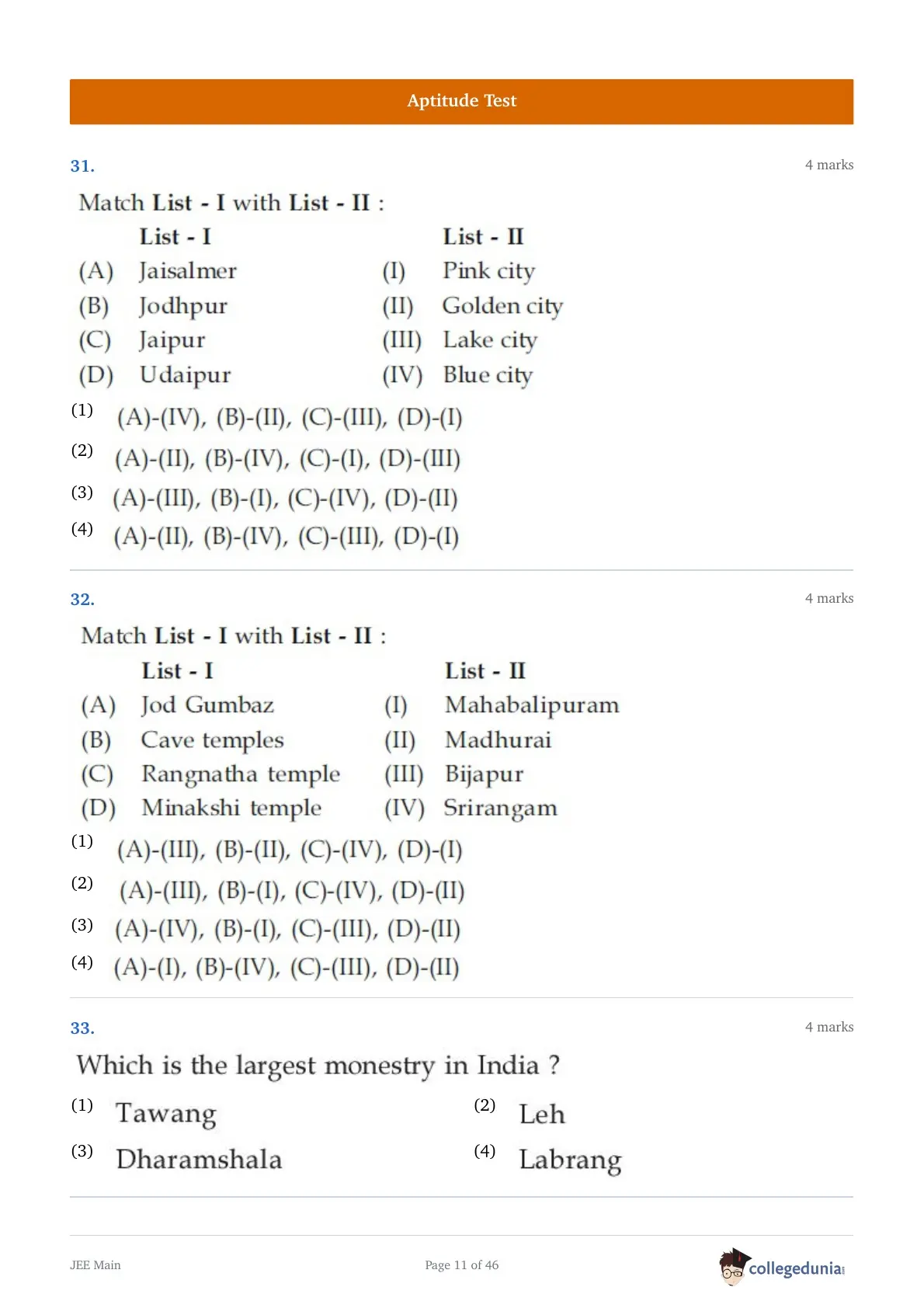
| List - I | List - II |
| (A) Jaisalmer | (I) Pink city |
| (B) Jodhpur | (II) Golden city |
| (C) Jaipur | (III) Lake city |
| (D) Udaipur | (IV) Blue city |
| List - I | List - II |
| (A) Jod Gumbaz | (I) Mahabalipuram |
| (B) Cave temples | (II) Madhurai |
| (C) Rangnatha temple | (III) Bijapur |
| (D) Minakshi temple | (IV) Srirangam |
Which is the largest monastery in India?
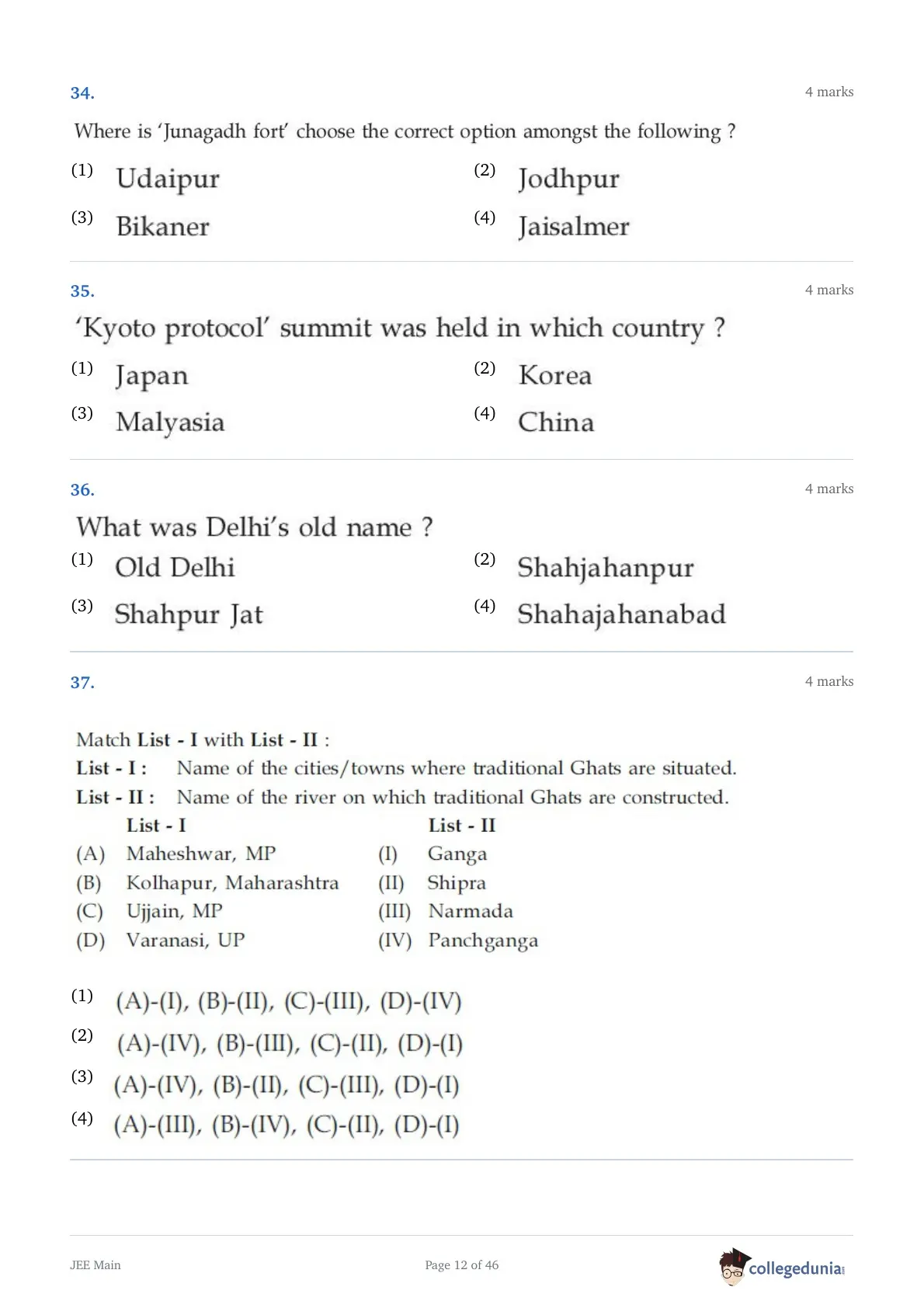
Where is ‘Junagadh fort’? Choose the correct option amongst the following.
‘Kyoto protocol’ summit was held in which country?
What was Delhi’s old name?
List - I: Name of the cities/towns where traditional Ghats are situated.
List - II: Name of the river on which traditional Ghats are constructed.
| List - I | List - II |
| (A) Maheshwar, MP | (I) Ganga |
| (B) Kolhapur, Maharashtra | (II) Shipra |
| (C) Ujjain, MP | (III) Narmada |
| (D) Varanasi, UP | (IV) Panchganga |
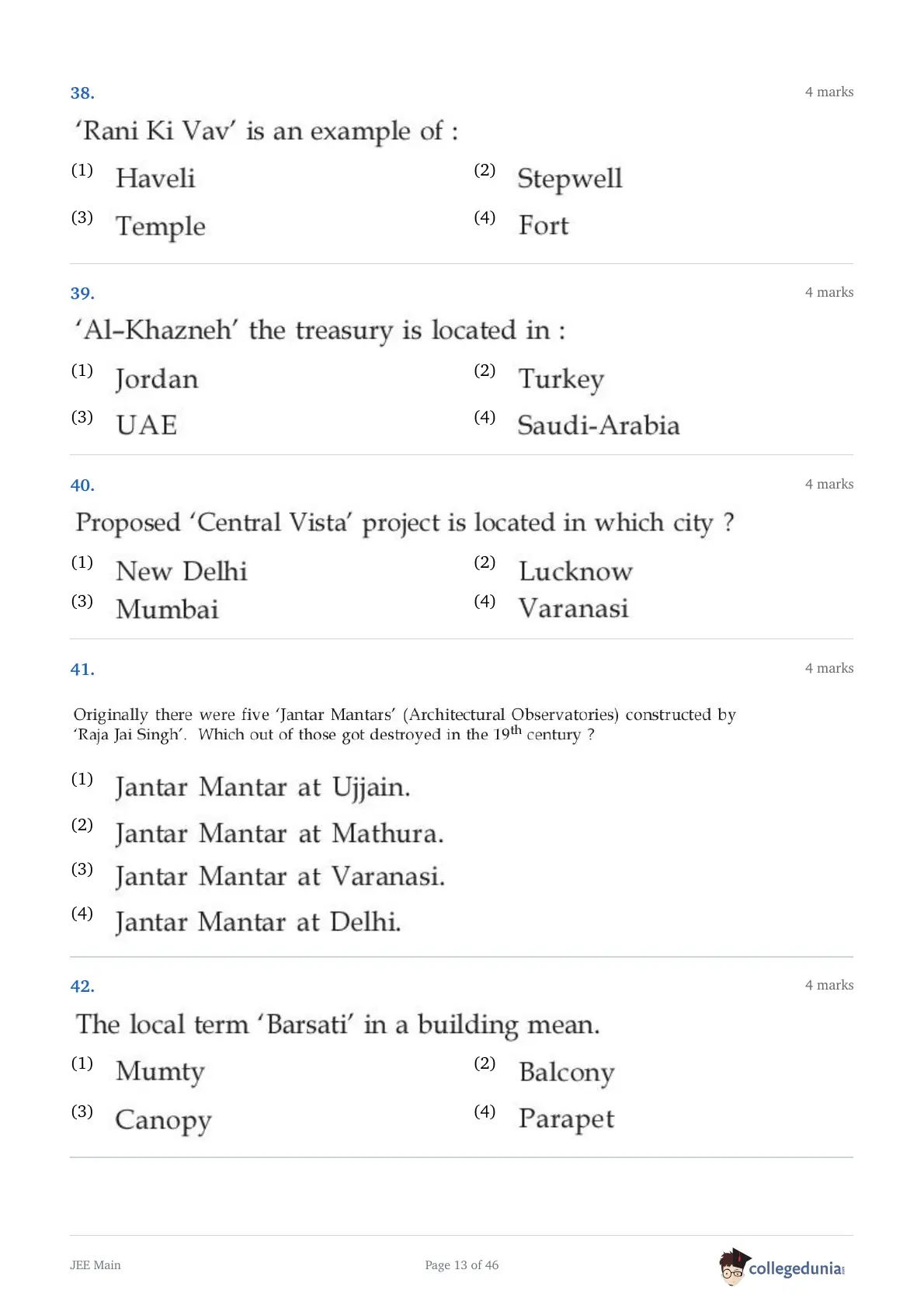
‘Rani Ki Vav’ is an example of:
‘Al–Khazneh’ the treasury is located in:
Proposed ‘Central Vista’ project is located in which city?
Originally there were five ‘Jantar Mantars’ (Architectural Observatories) constructed by ‘Raja Jai Singh’. Which out of those got destroyed in the 19th century ?
The local term ‘Barsati’ in a building mean.
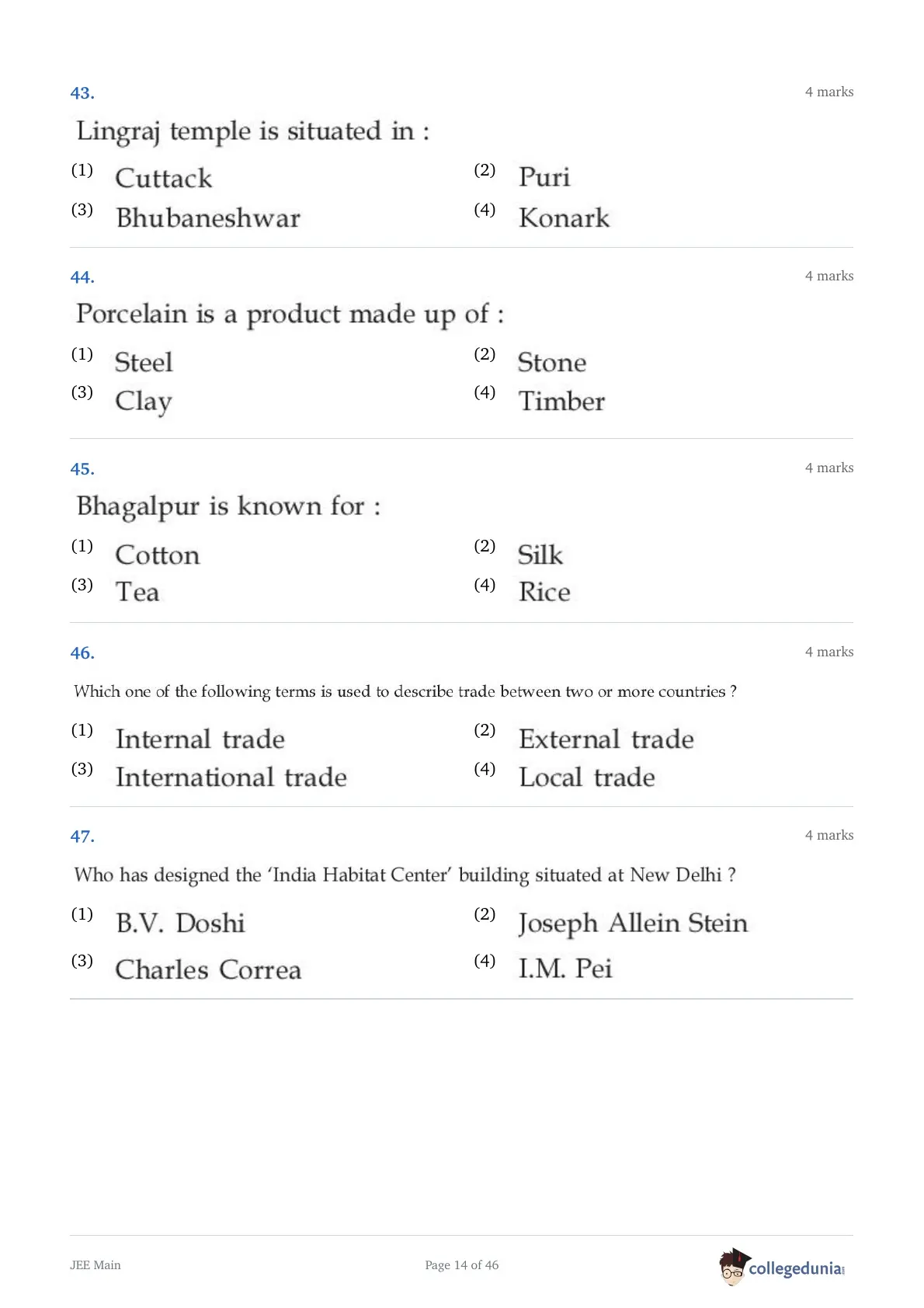
Lingraj temple is situated in :
Porcelain is a product made up of :
Bhagalpur is known for :
Which one of the following terms is used to describe trade between two or more countries ?
Who has designed the ‘India Habitat Center’ building situated at New Delhi ?

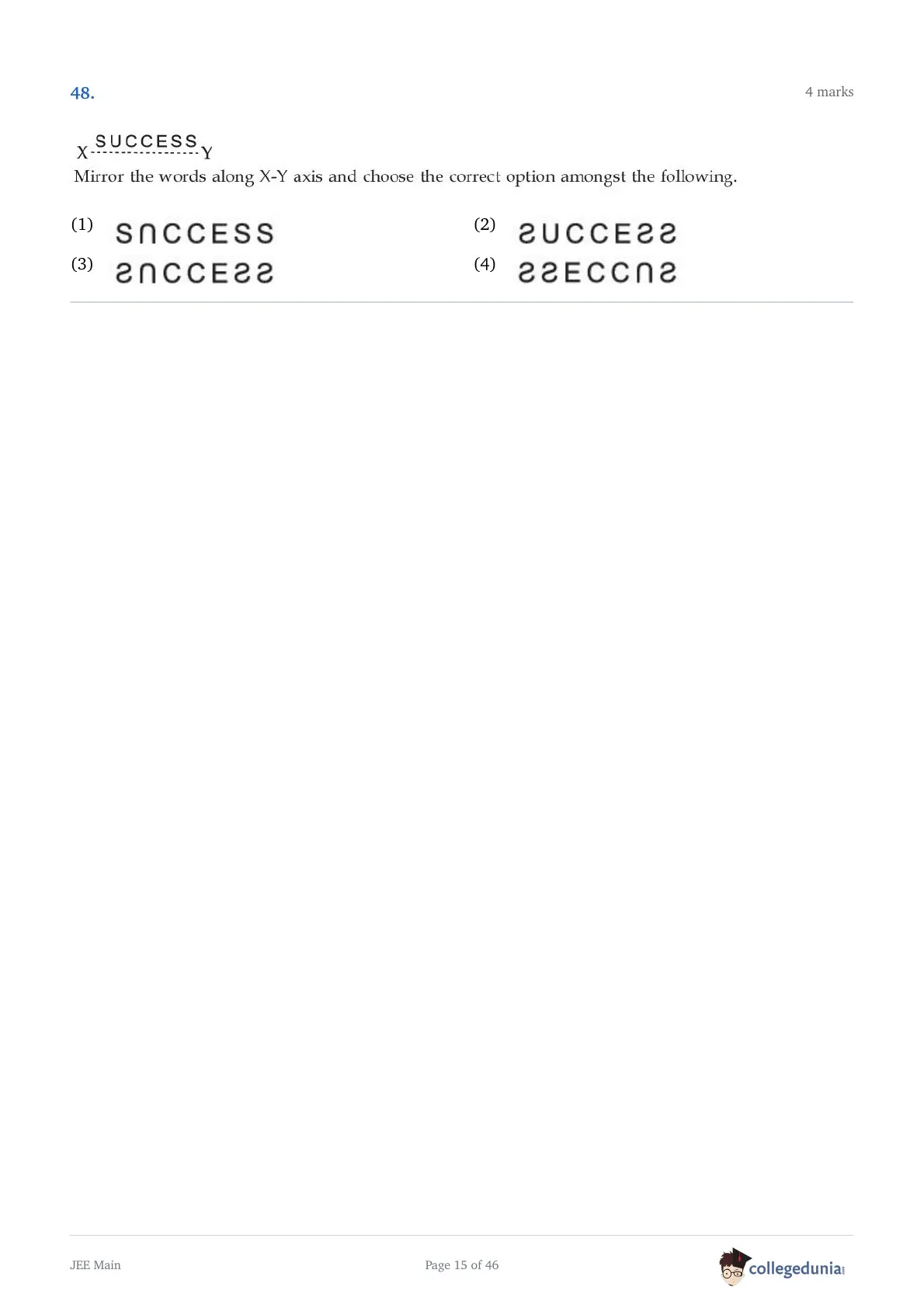
Mirror the words along X-Y axis and choose the correct option amongst the following.
- (1)
![]()
- (2)
![]()
- (3)
![]()
- (4)
![]()


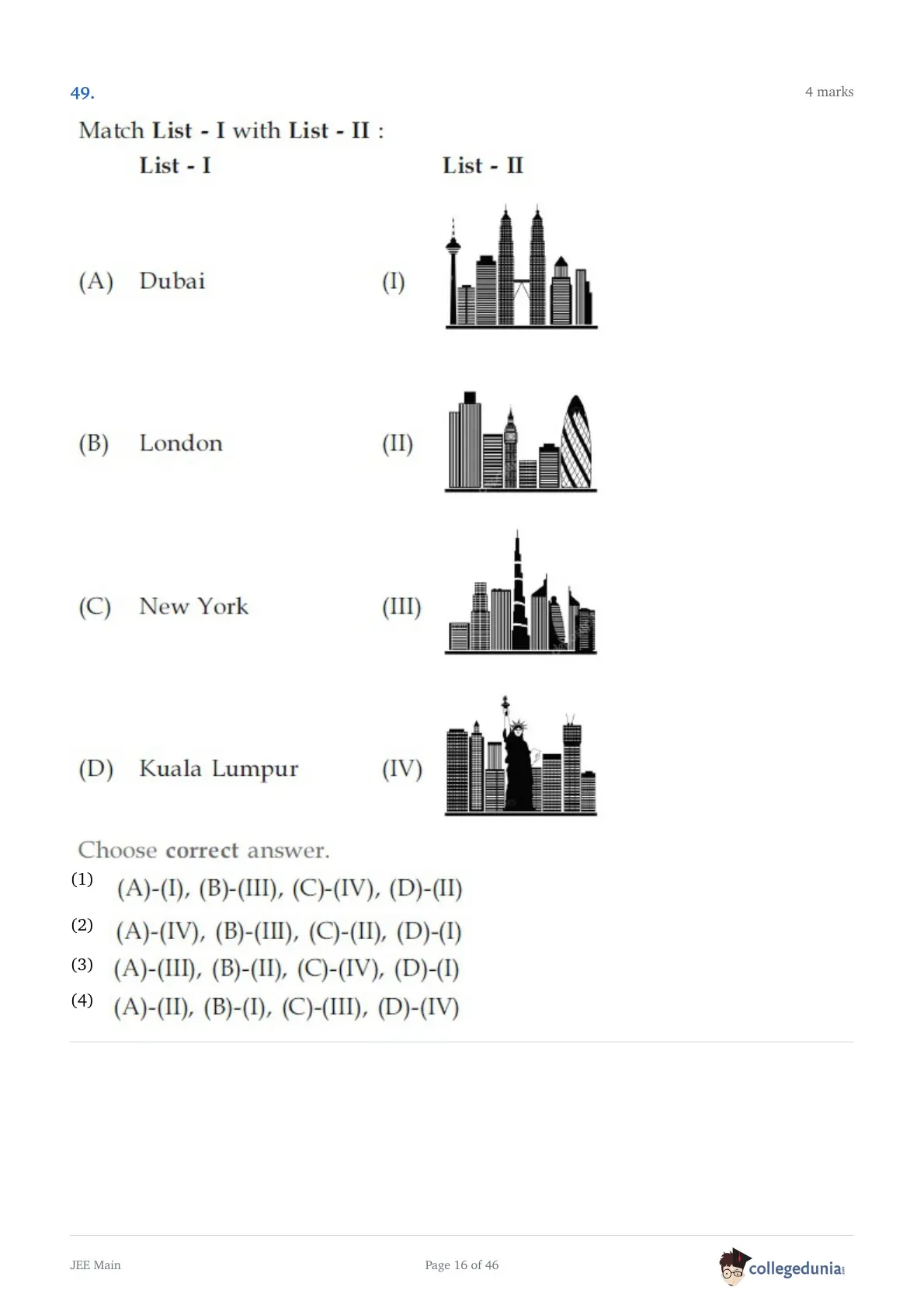
| List - I | List - II |
| (A) Dubai (B) London (C) New York (D) Kuala Lumpur |  |
| List - I | List - II |
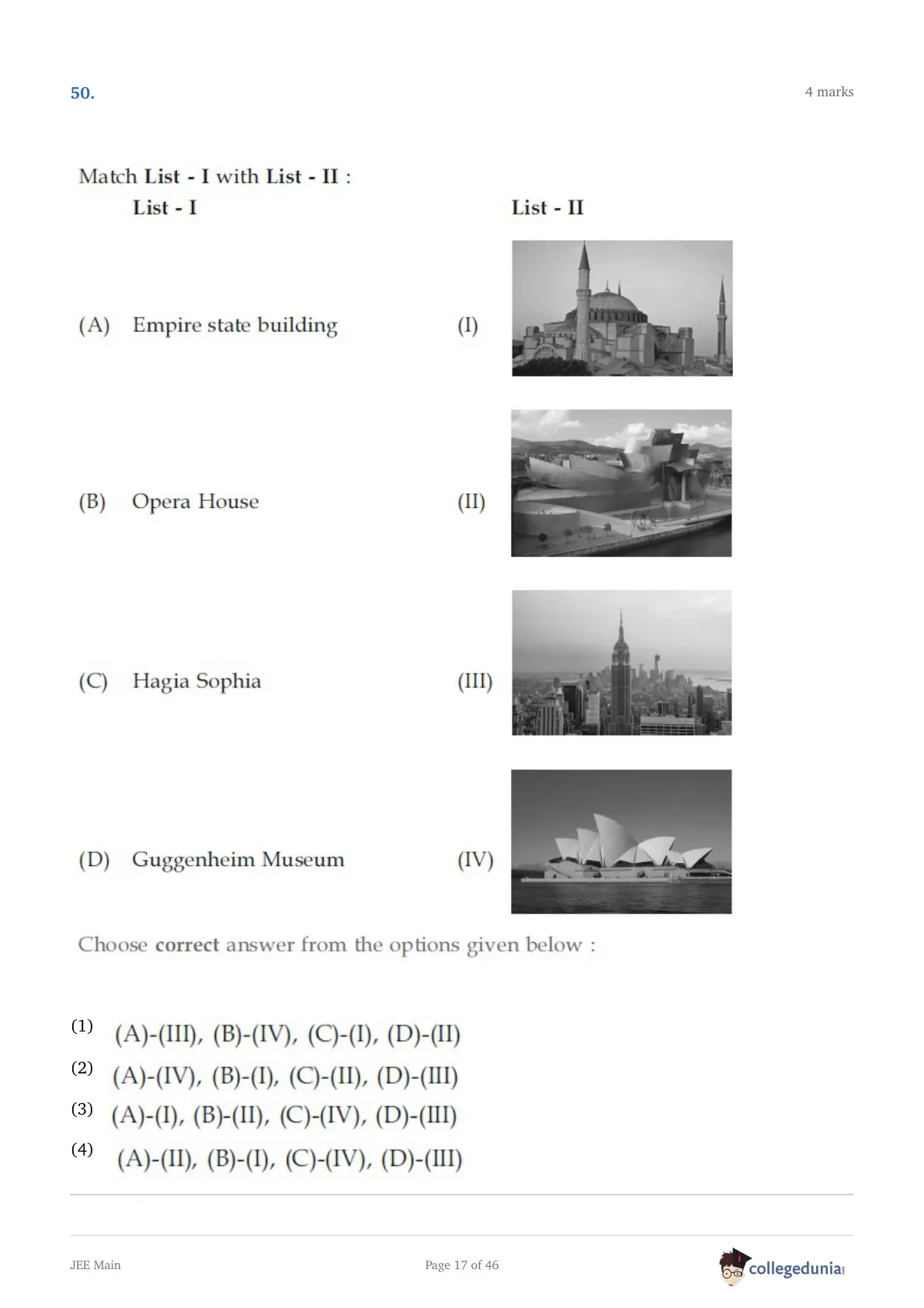
| (A) Empire state building (B) Opera House (C) Hagia Sophia (D) Guggenheim Museum |  |
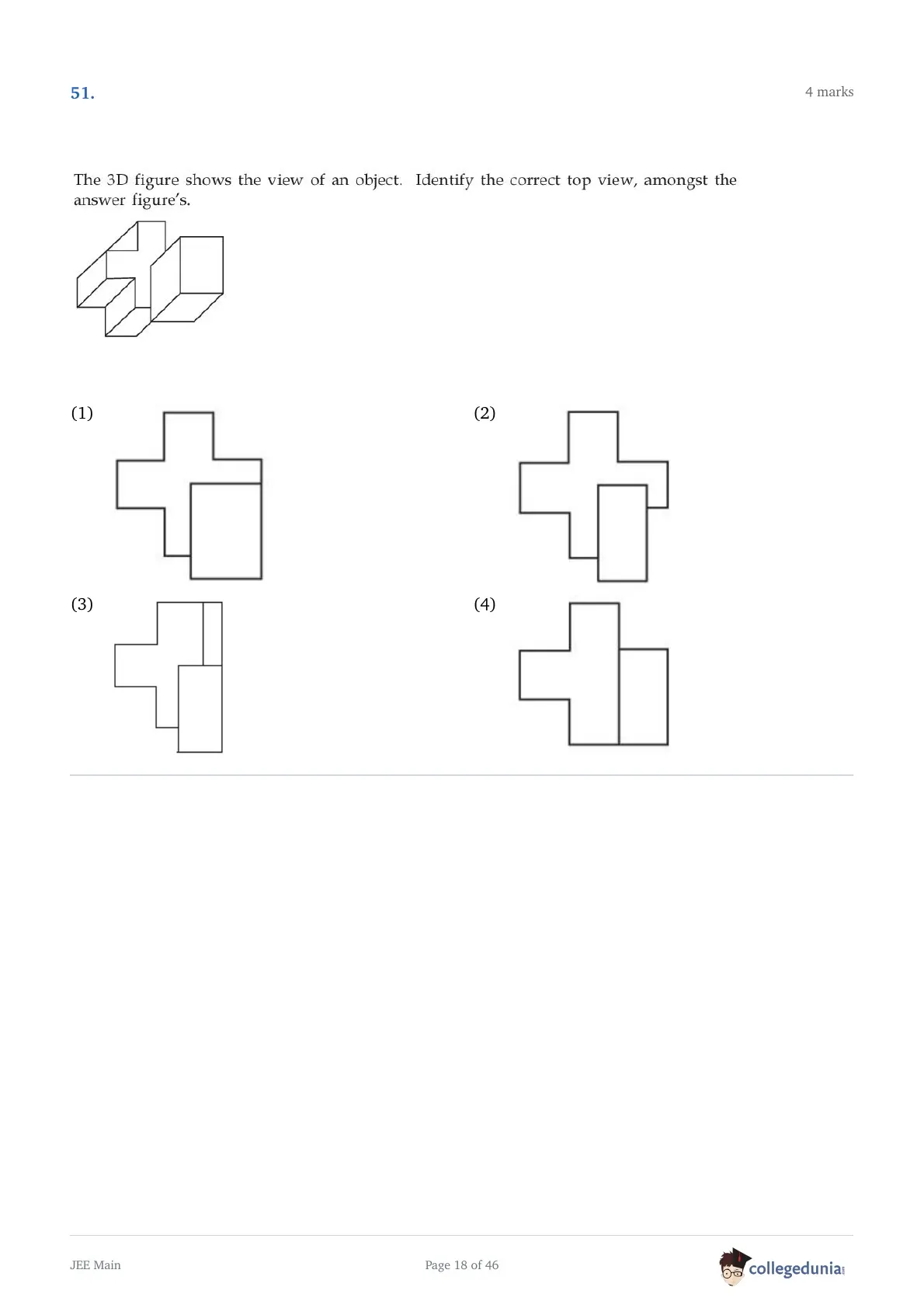
The 3D figure shows the view of an object. Identify the correct top view, amongst the answer figure's.
- (1)
![]()
- (2)
![]()
- (3)
![]()
- (4)
![]()


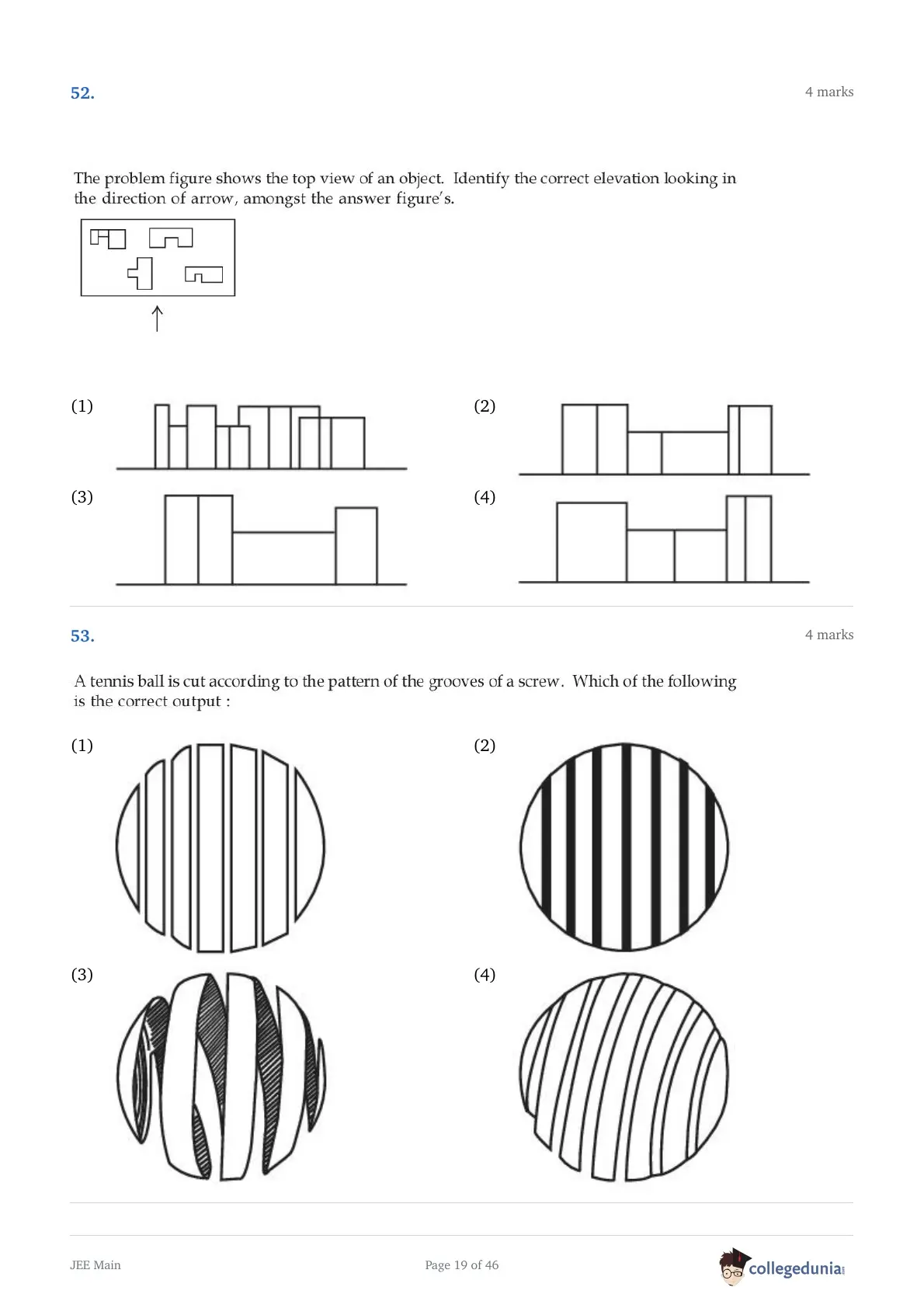
The problem figure shows the top view of an object. Identify the correct elevation looking in the direction of arrow, amongst the answer figure's.
- (1)
![]()
- (2)
![]()
- (3)
![]()
- (4)
![]()


A tennis ball is cut according to the pattern of the grooves of a screw. Which of the following is the correct output :
- (1)
![]()
- (2)
![]()
- (3)
![]()
- (4)
![]()


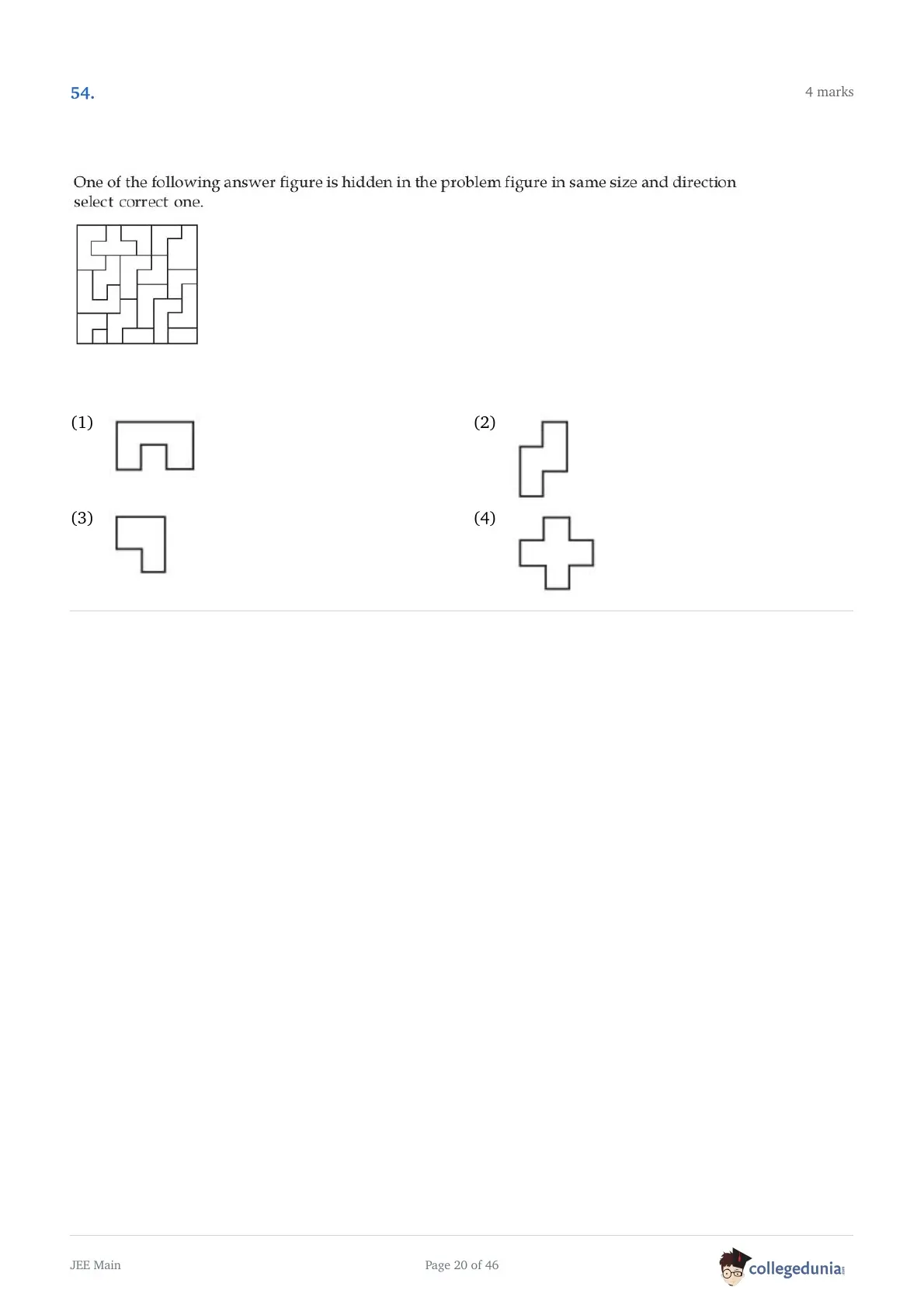
One of the following answer figure is hidden in the problem figure in same size and direction select correct one.
- (1)
![]()
- (2)
![]()
- (3)
![]()
- (4)
![]()


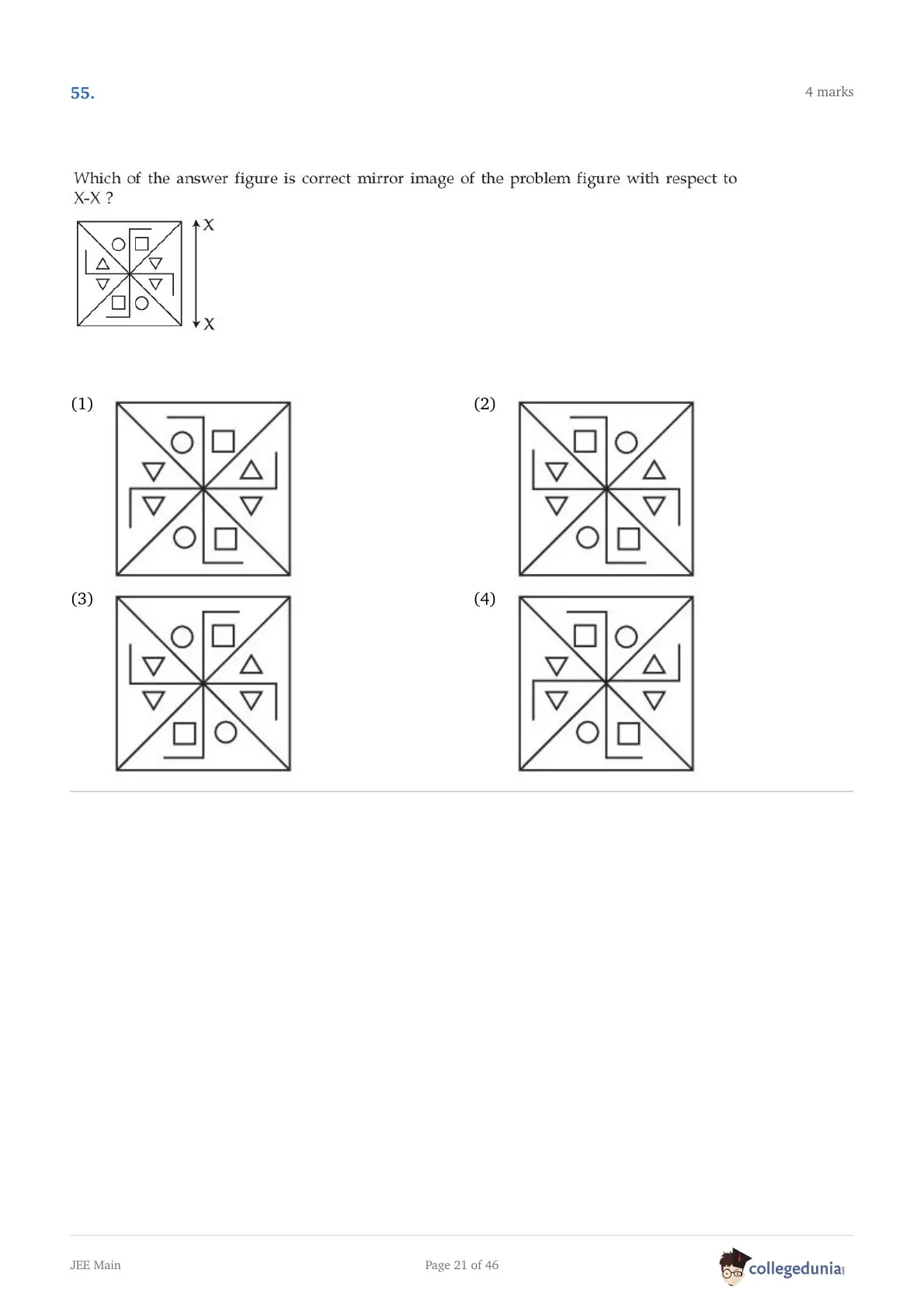
Which of the answer figure is correct mirror image of the problem figure with respect to X-X ?
- (1)
![]()
- (2)
![]()
- (3)
![]()
- (4)
![]()


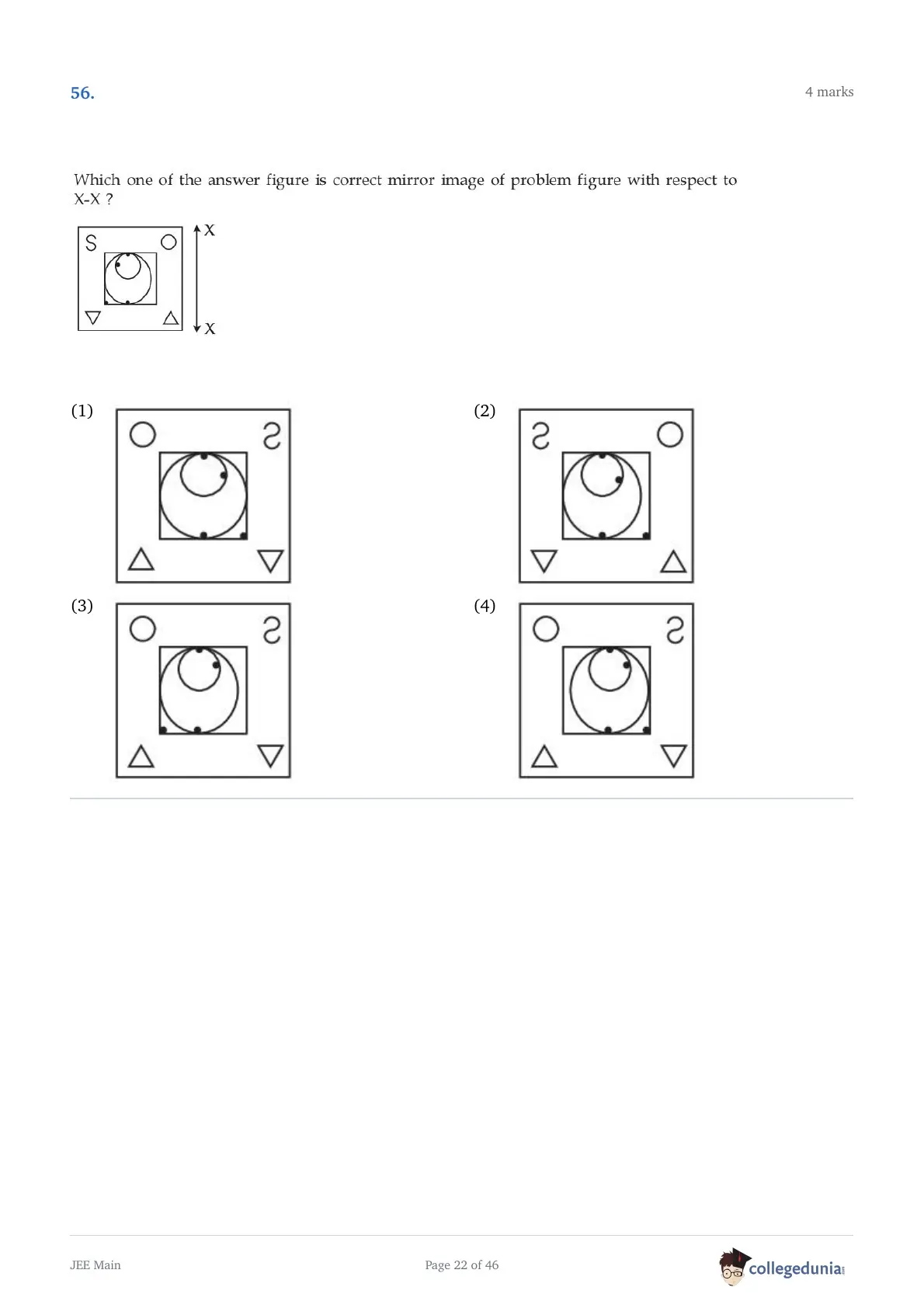
Which one of the answer figure is correct mirror image of problem figure with respect to X-X ?
- (1)
![]()
- (2)
![]()
- (3)
![]()
- (4)
![]()


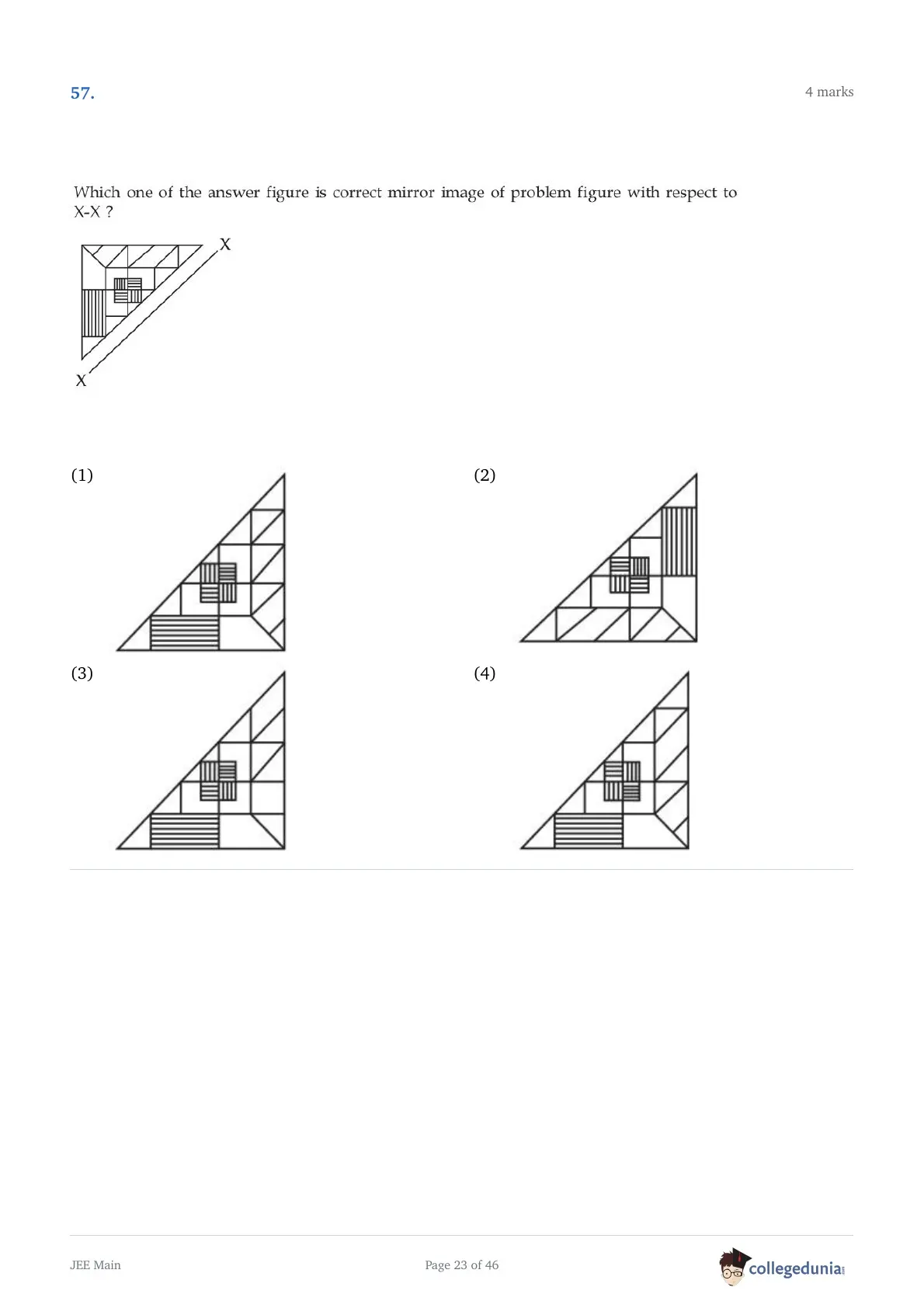
Which one of the answer figure is correct mirror image of problem figure with respect to X-X ?
- (1)
![]()
- (2)
![]()
- (3)
![]()
- (4)
![]()


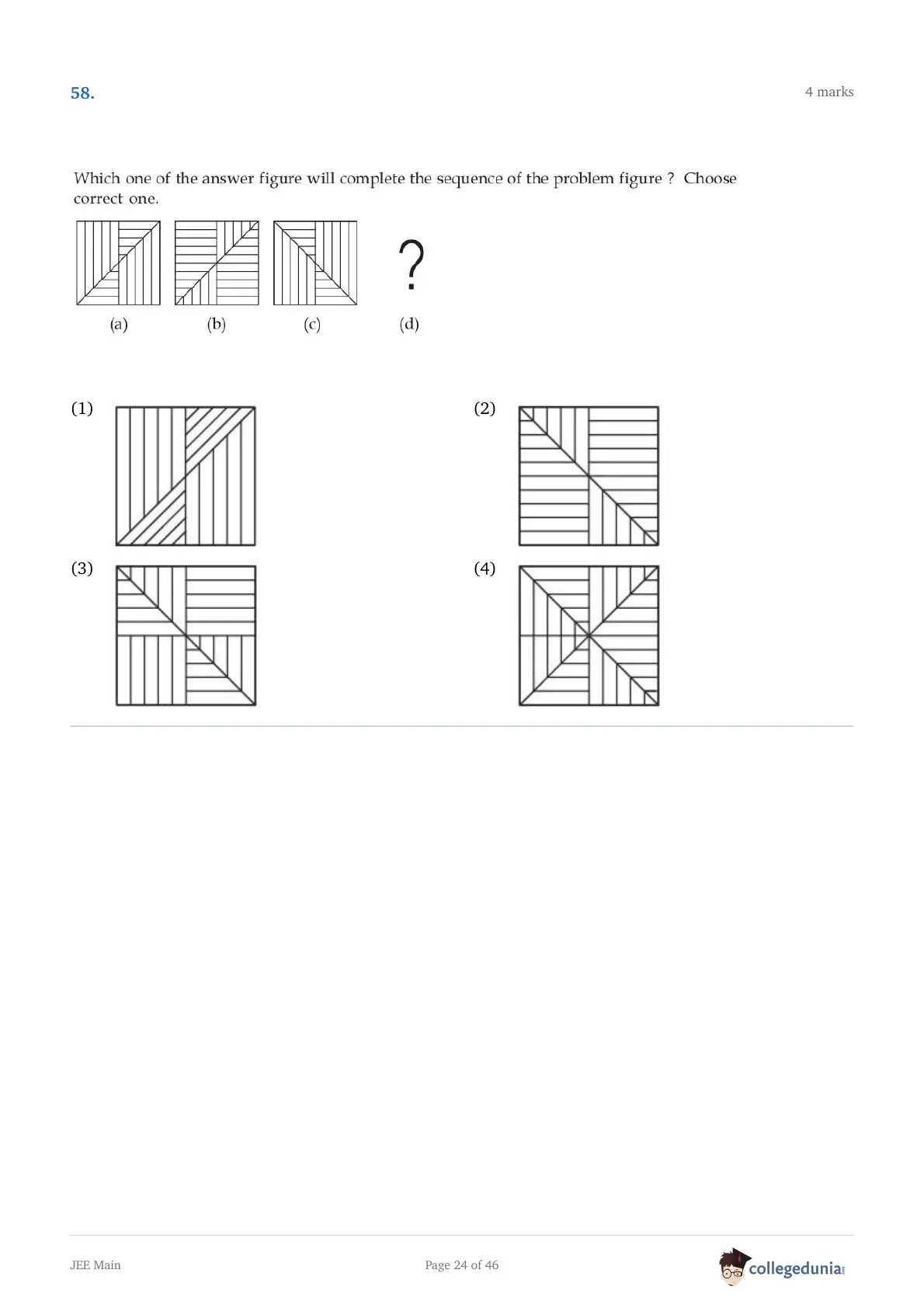
Which one of the answer figure will complete the sequence of the problem figure ? Choose correct one.
- (1)
![]()
- (2)
![]()
- (3)
![]()
- (4)
![]()


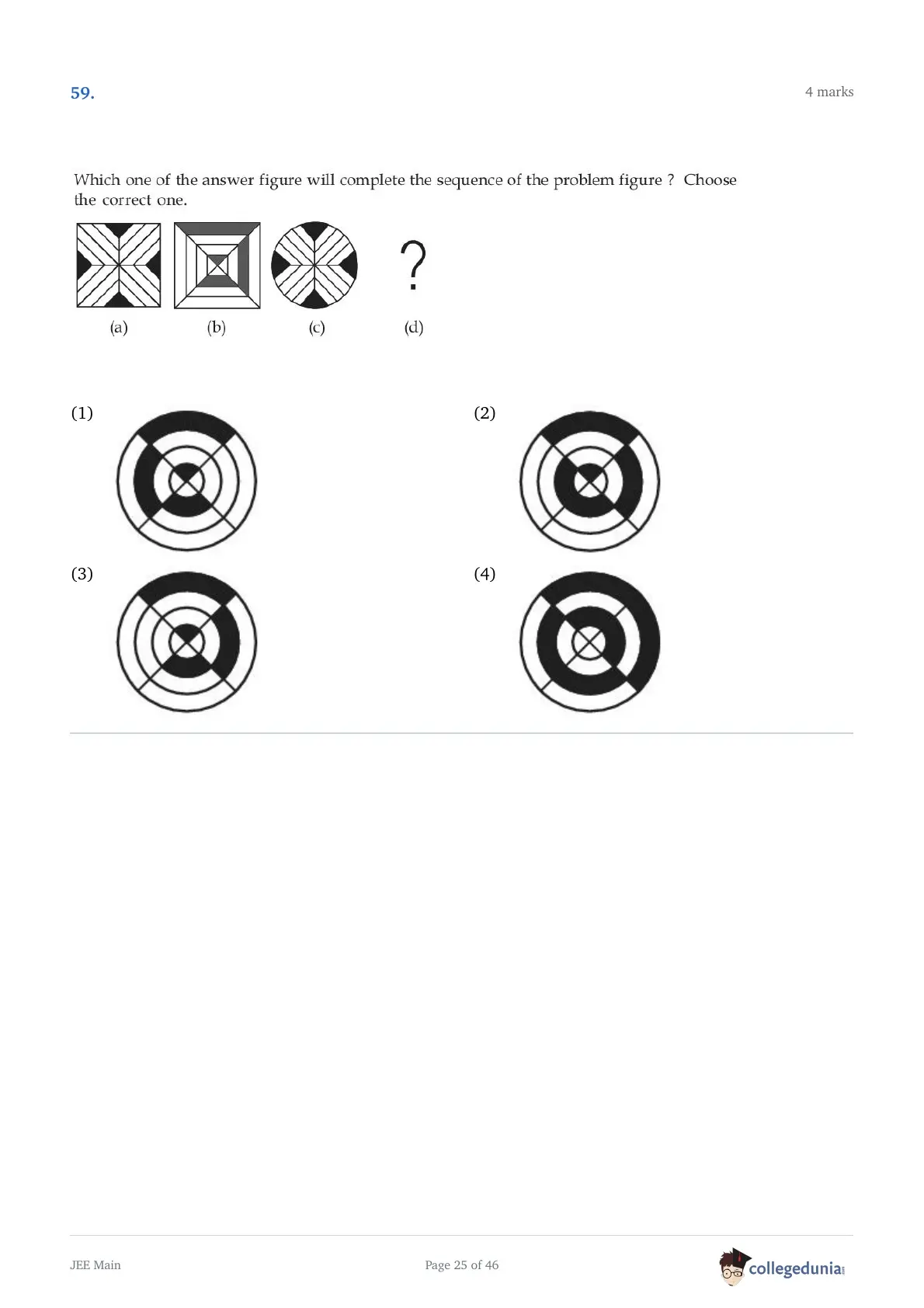
Which one of the answer figure will complete the sequence of the problem figure ? Choose the correct one.
- (1)
![]()
- (2)
![]()
- (3)
![]()
- (4)
![]()


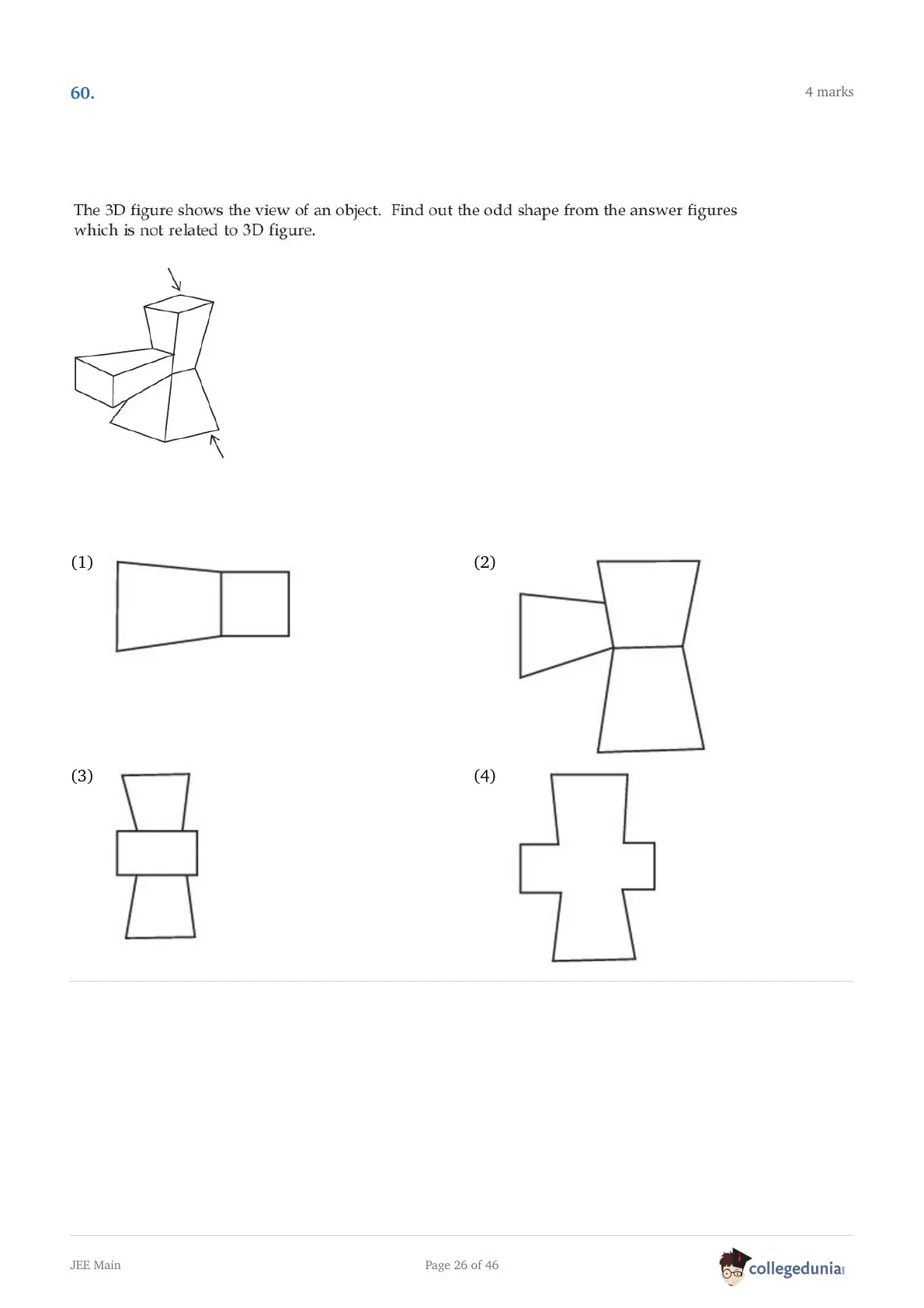
The 3D figure shows the view of an object. Find out the odd shape from the answer figures which is not related to 3D figure.
- (1)
![]()
- (2)
![]()
- (3)
![]()
- (4)
![]()


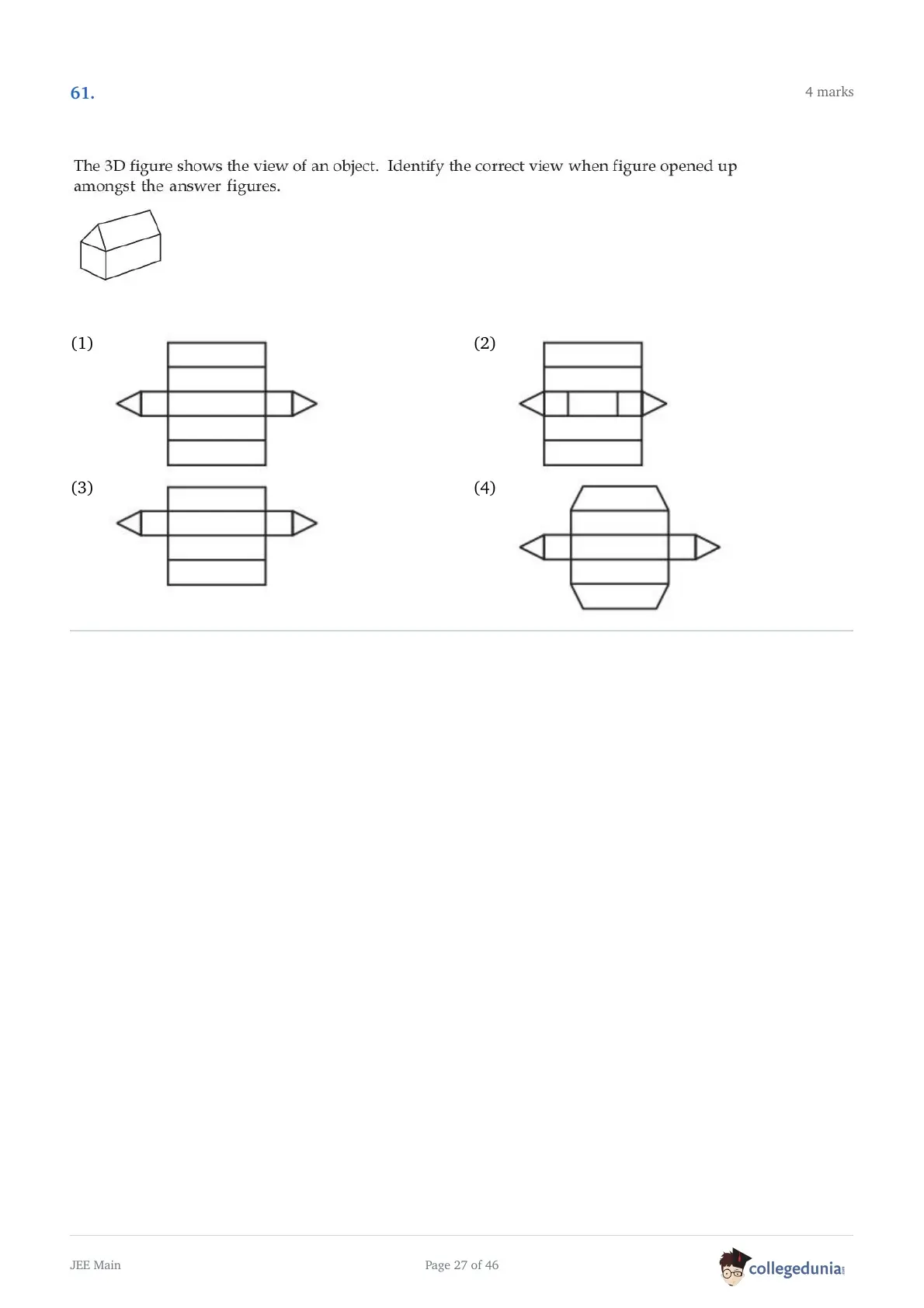
The 3D figure shows the view of an object. Identify the correct view when figure opened up amongst the answer figures.
- (1)
![]()
- (2)
![]()
- (3)
![]()
- (4)
![]()


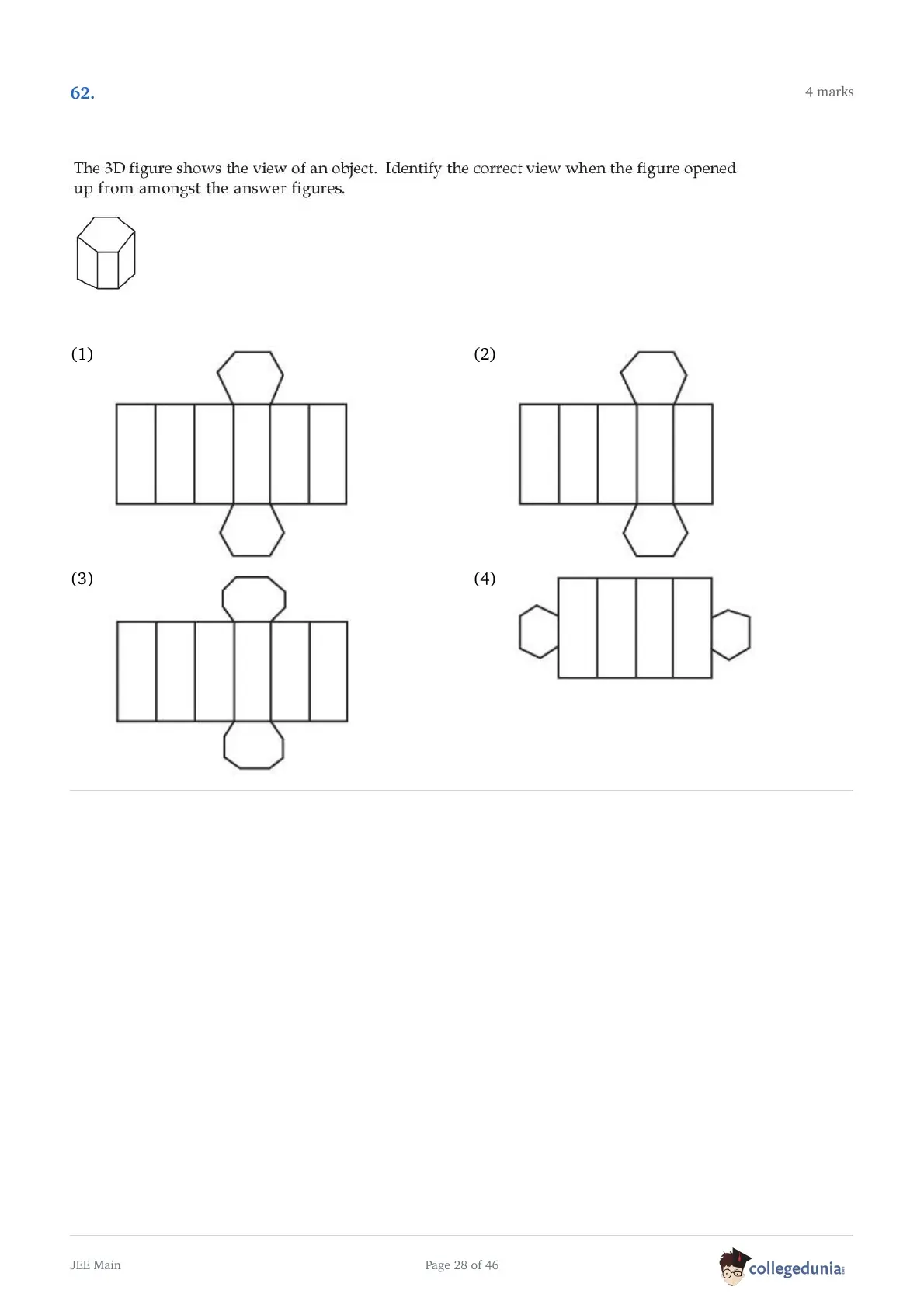
The 3D figure shows the view of an object. Identify the correct view when the figure opened up from amongst the answer figures.
- (1)
![]()
- (2)
![]()
- (3)
![]()
- (4)
![]()


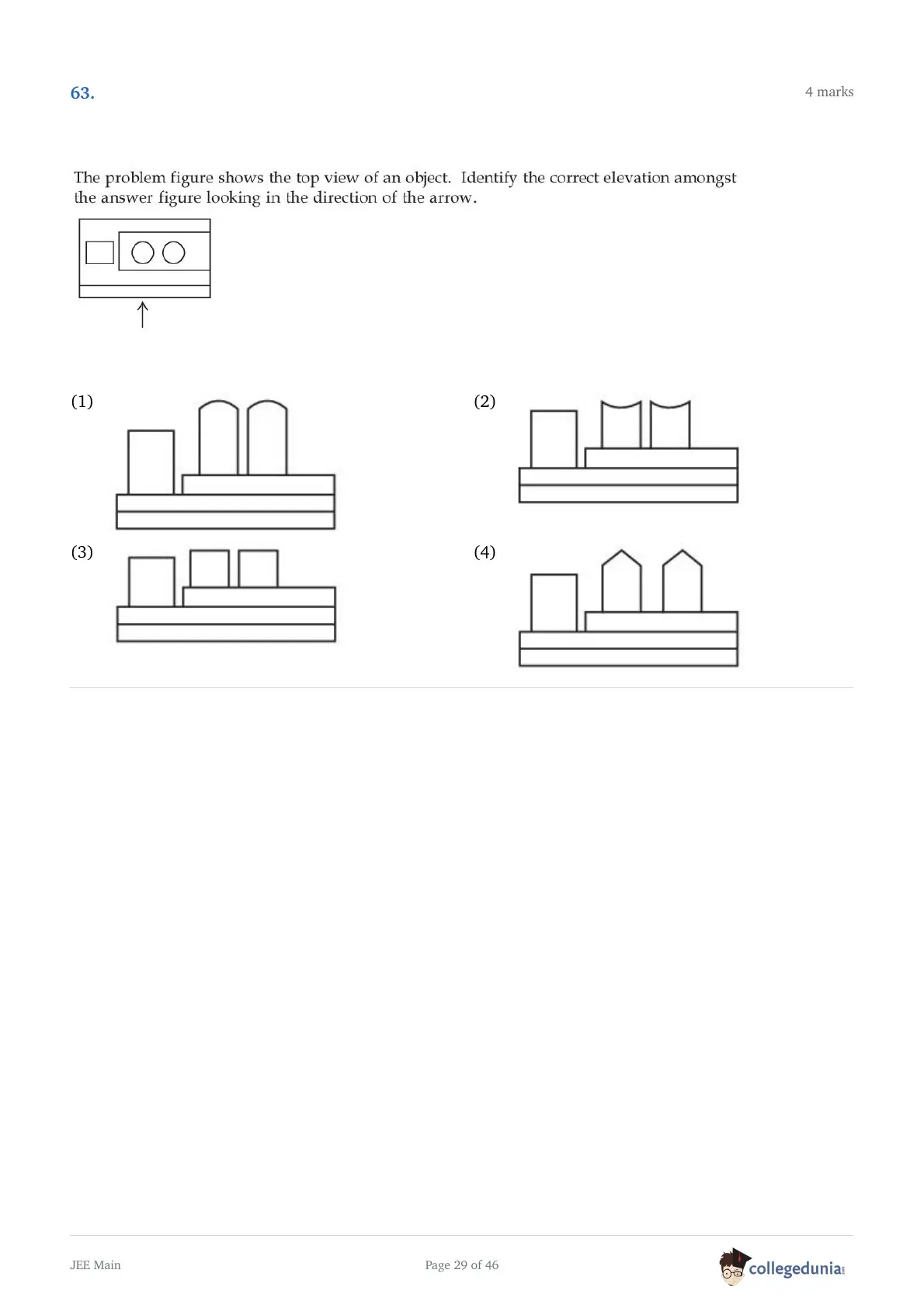
The problem figure shows the top view of an object. Identify the correct elevation amongst the answer figure looking in the direction of the arrow.
- (1)
![]()
- (2)
![]()
- (3)
![]()
- (4)
![]()


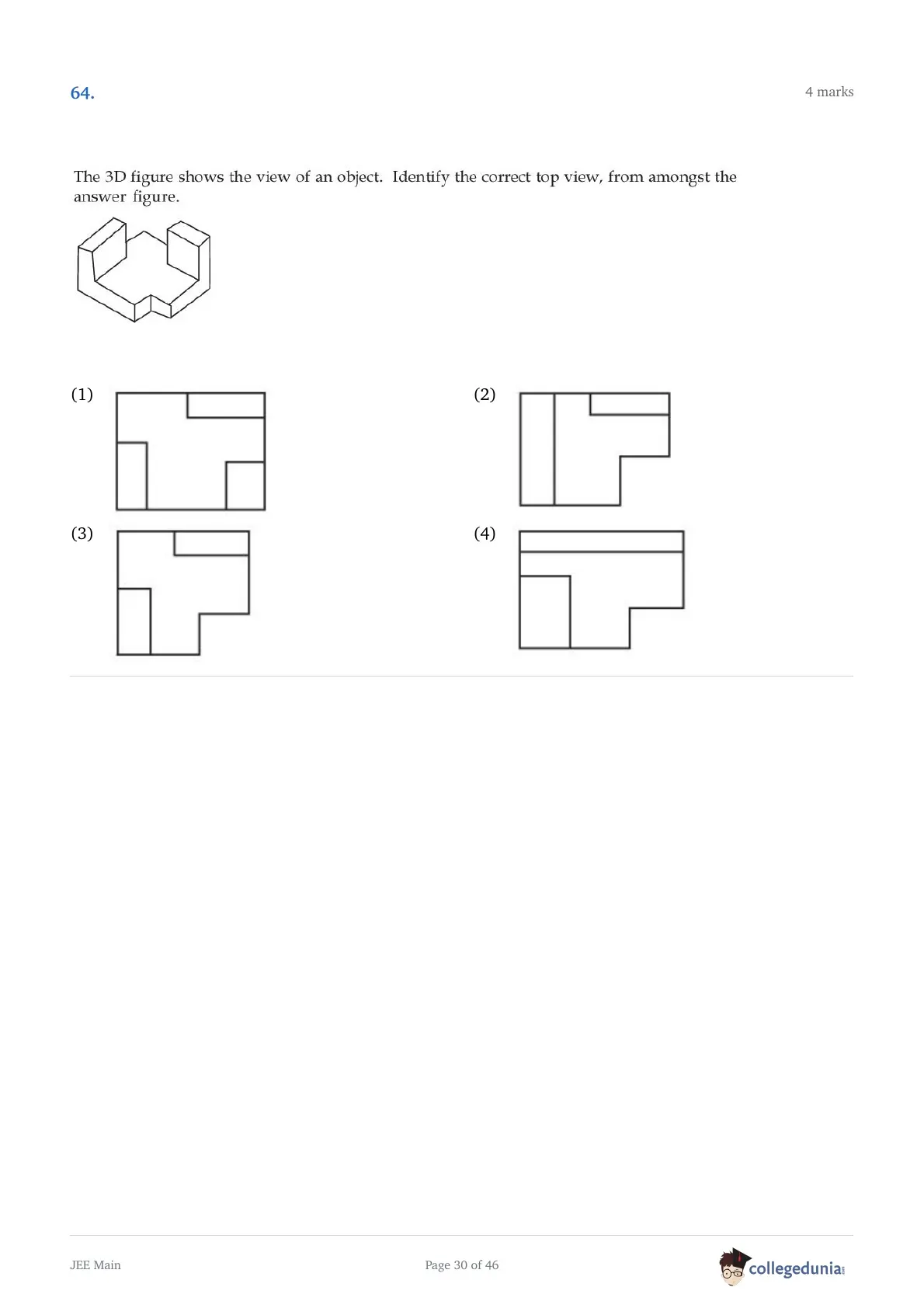
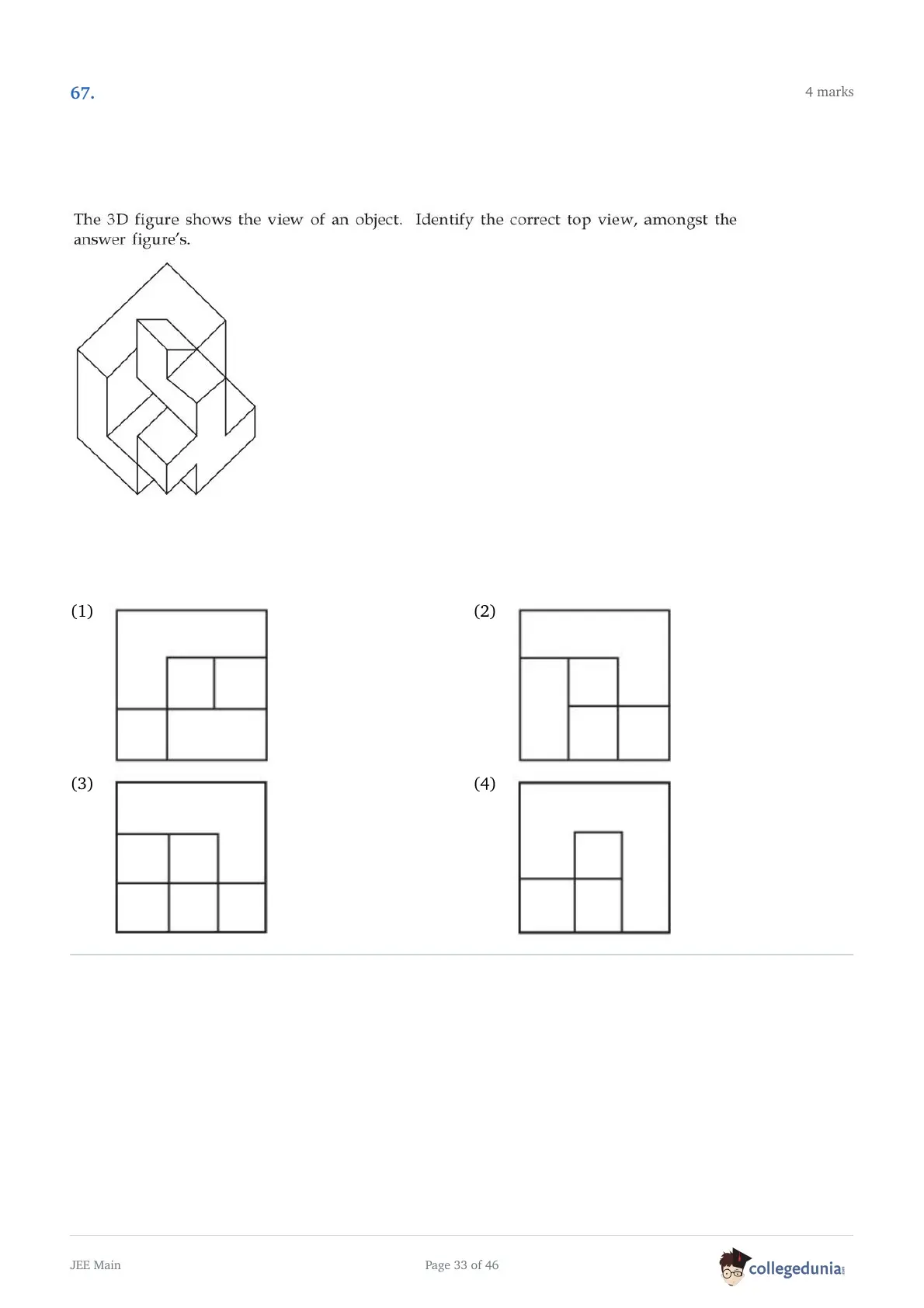
The 3D figure shows the view of an object. Identify the correct top view, from amongst the answer figure.
- (1)
![]()
- (2)
![]()
- (3)
![]()
- (4)
![]()


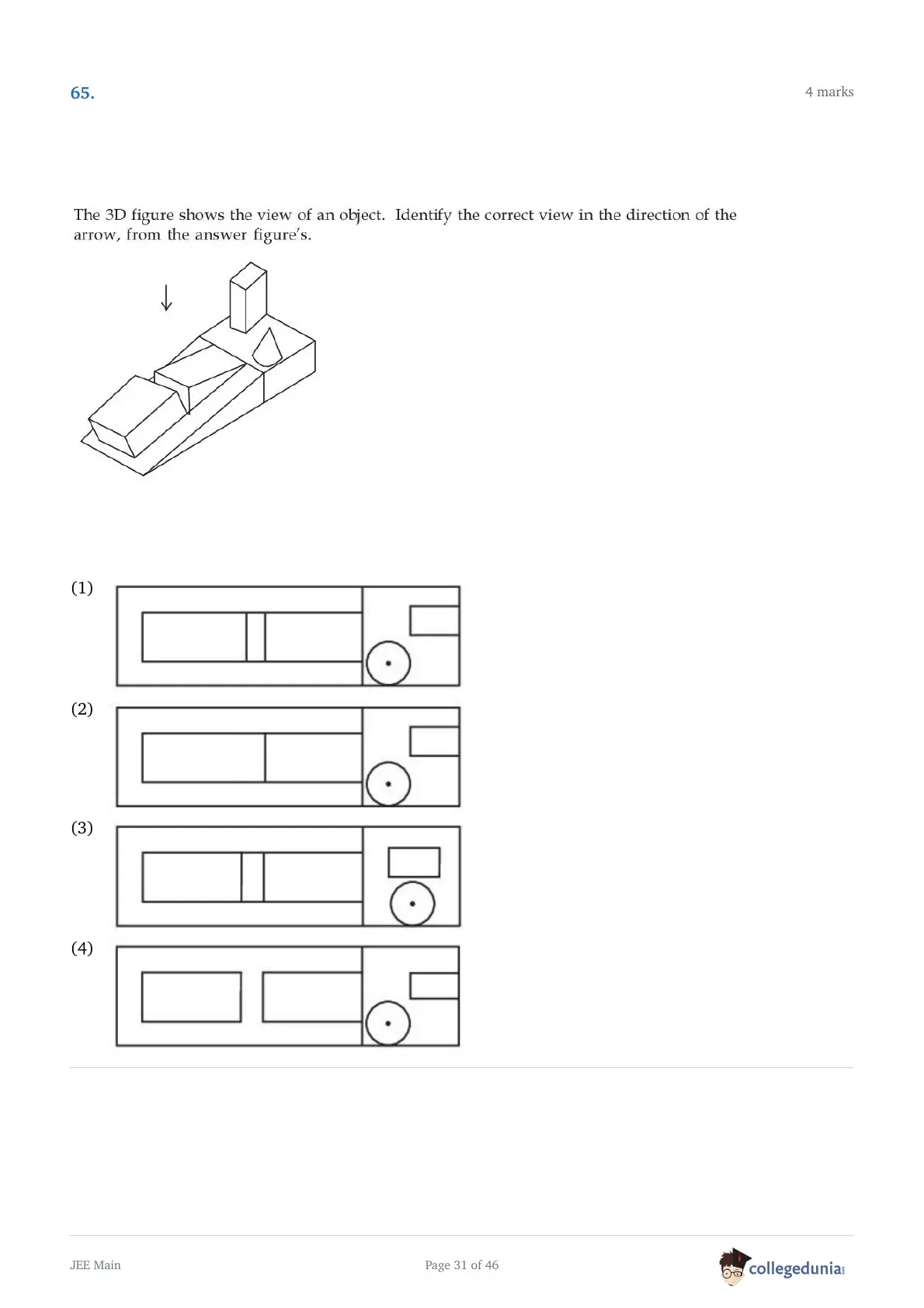
The 3D figure shows the view of an object. Identify the correct view in the direction of the arrow, from the answer figures.
- (1)
![]()
- (2)
![]()
- (3)
![]()
- (4)
![]()


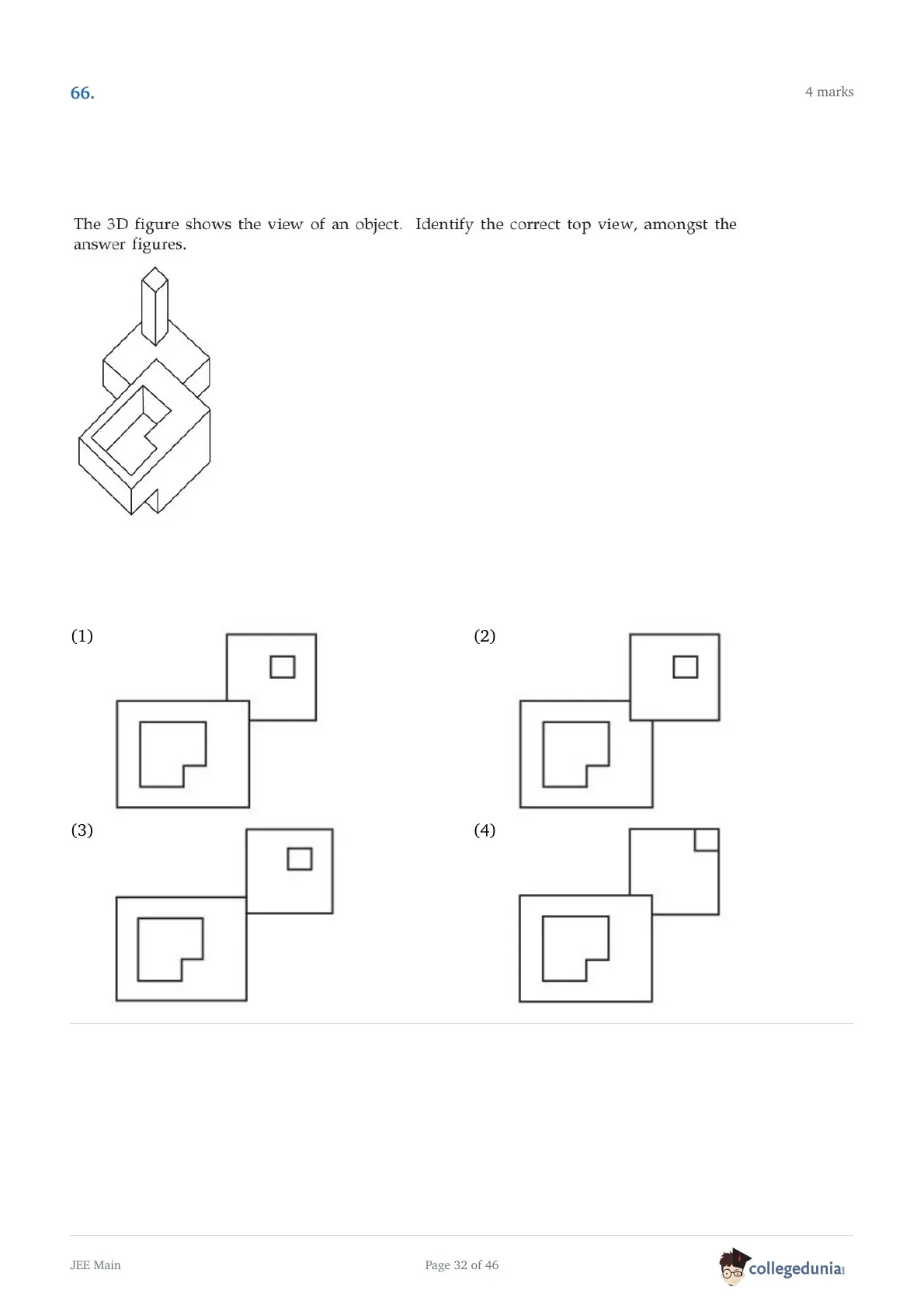
The 3D figure shows the view of an object. Identify the correct top view, amongst the answer figures.
- (1)
![]()
- (2)
![]()
- (3)
![]()
- (4)
![]()


The 3D figure shows the view of an object. Identify the correct top view, amongst the answer figures.
- (1)
![]()
- (2)
![]()
- (3)
![]()
- (4)
![]()


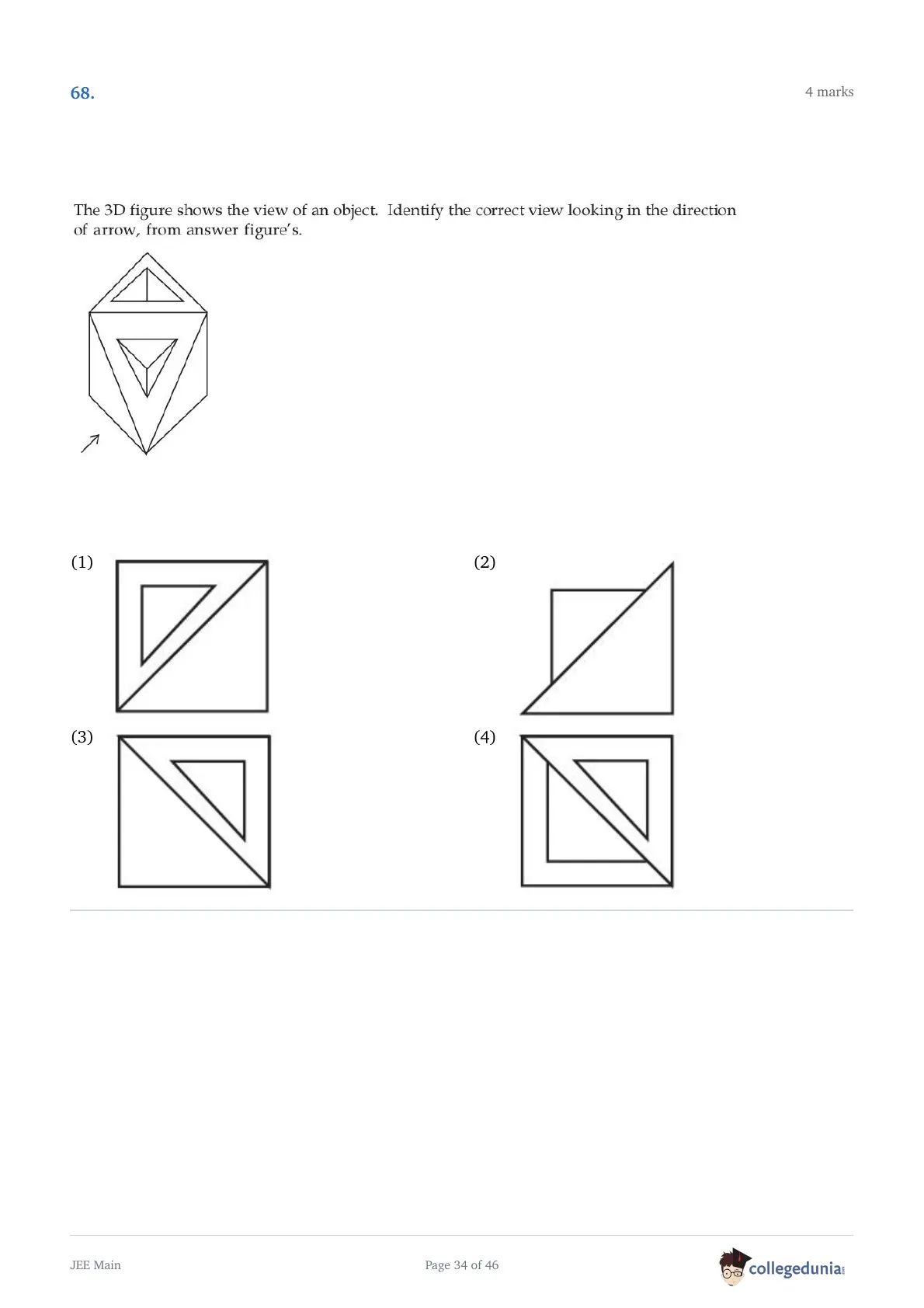
The 3D figure shows the view of an object. Identify the correct view looking in the direction of arrow, from answer figures.
- (1)
![]()
- (2)
![]()
- (3)
![]()
- (4)
![]()


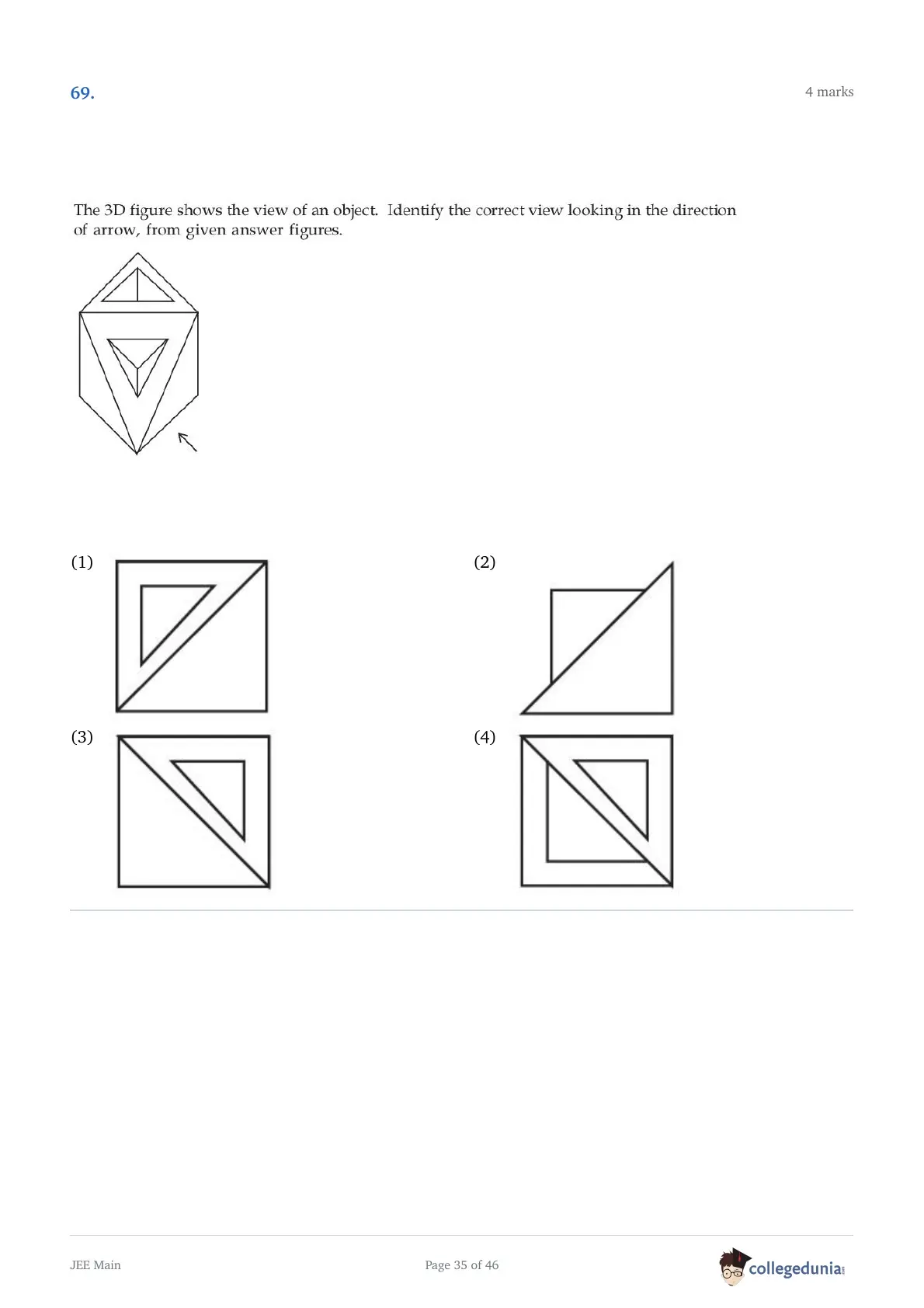
The 3D figure shows the view of an object. Identify the correct view looking in the direction of arrow, from given answer figures.
- (1)
![]()
- (2)
![]()
- (3)
![]()
- (4)
![]()


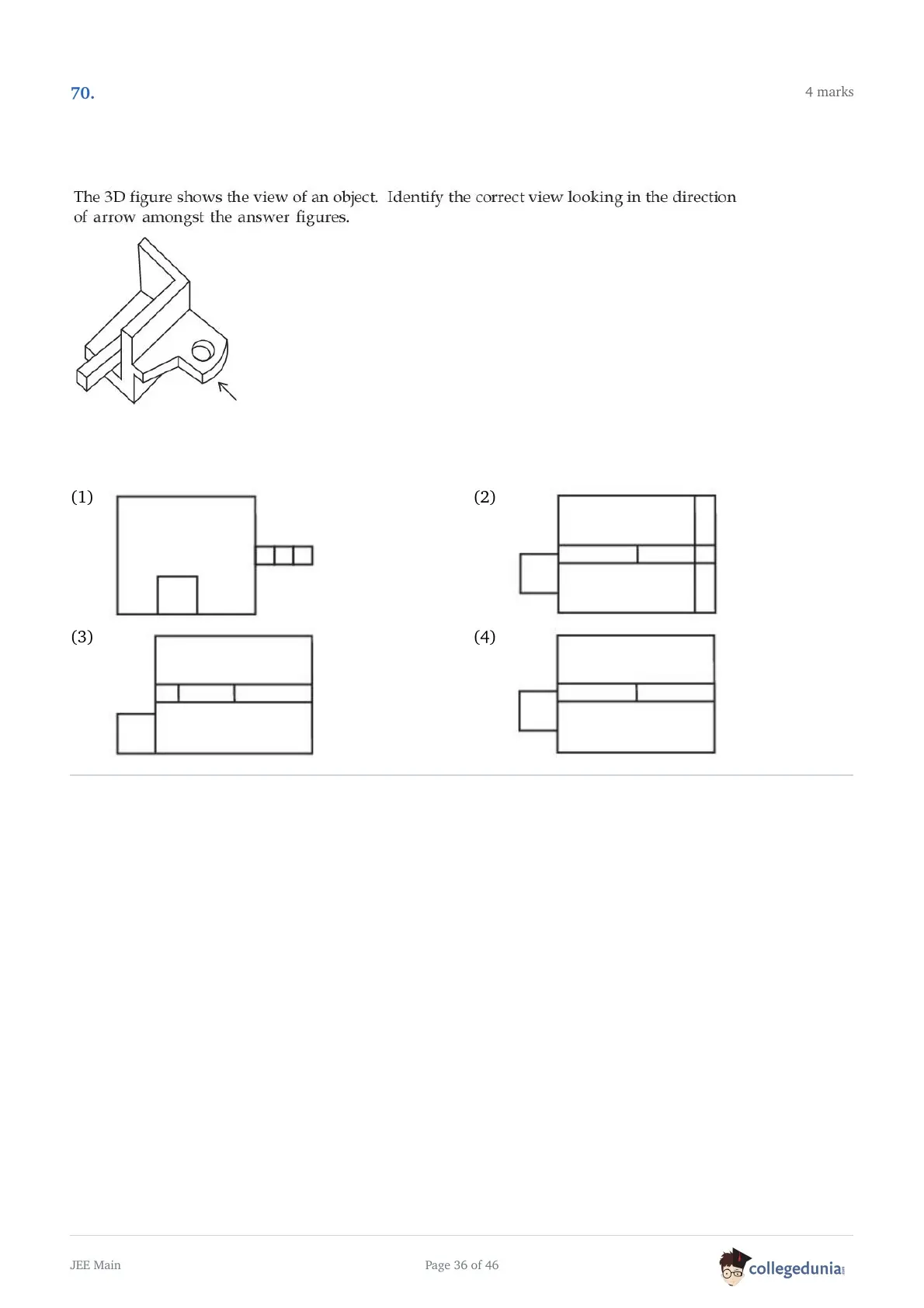
The 3D figure shows the view of an object. Identify the correct view looking in the direction of arrow amongst the answer figures.
- (1)
![]()
- (2)
![]()
- (3)
![]()
- (4)
![]()


The 3D figure shows the view of an object. Identify the correct view looking in the direction of arrow, from answer figures.
- (1)
![]()
- (2)
![]()
- (3)
![]()
- (4)
![]()


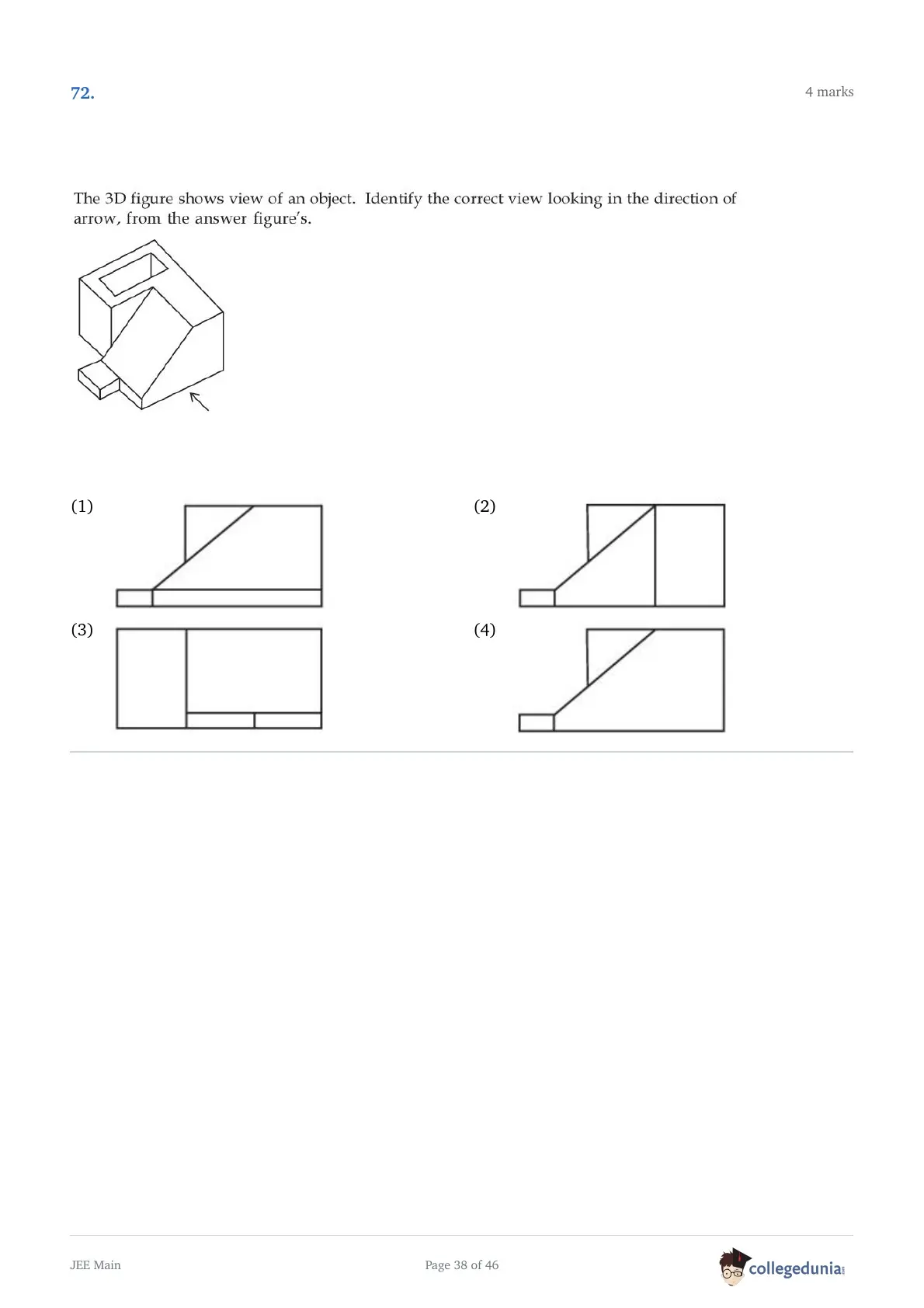
The 3D figure shows view of an object. Identify the correct view looking in the direction of arrow, from the answer figures.
- (1)
![]()
- (2)
![]()
- (3)
![]()
- (4)
![]()


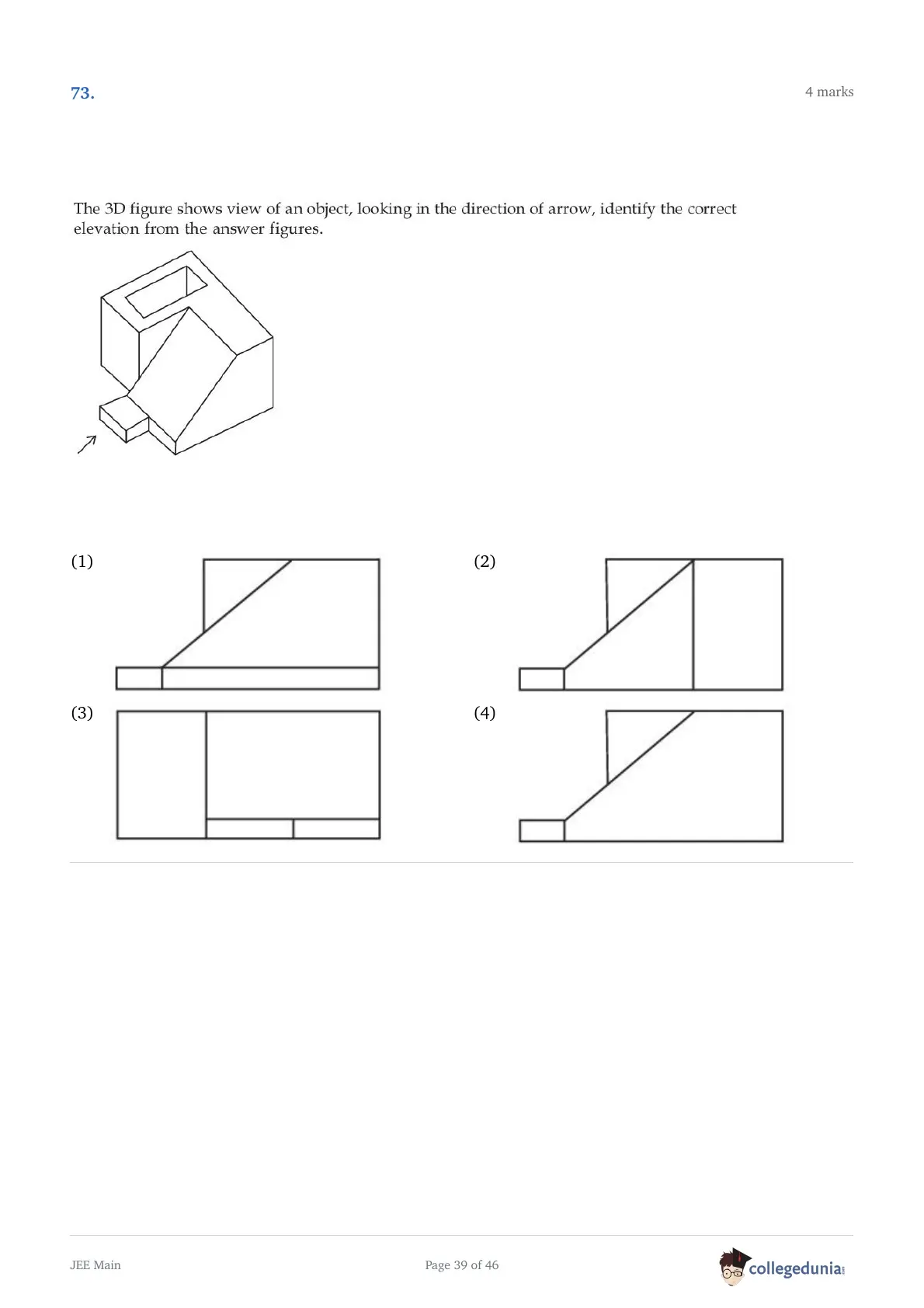
The 3D figure shows view of an object, looking in the direction of arrow, identify the correct elevation from the answer figures.
- (1)
![]()
- (2)
![]()
- (3)
![]()
- (4)
![]()


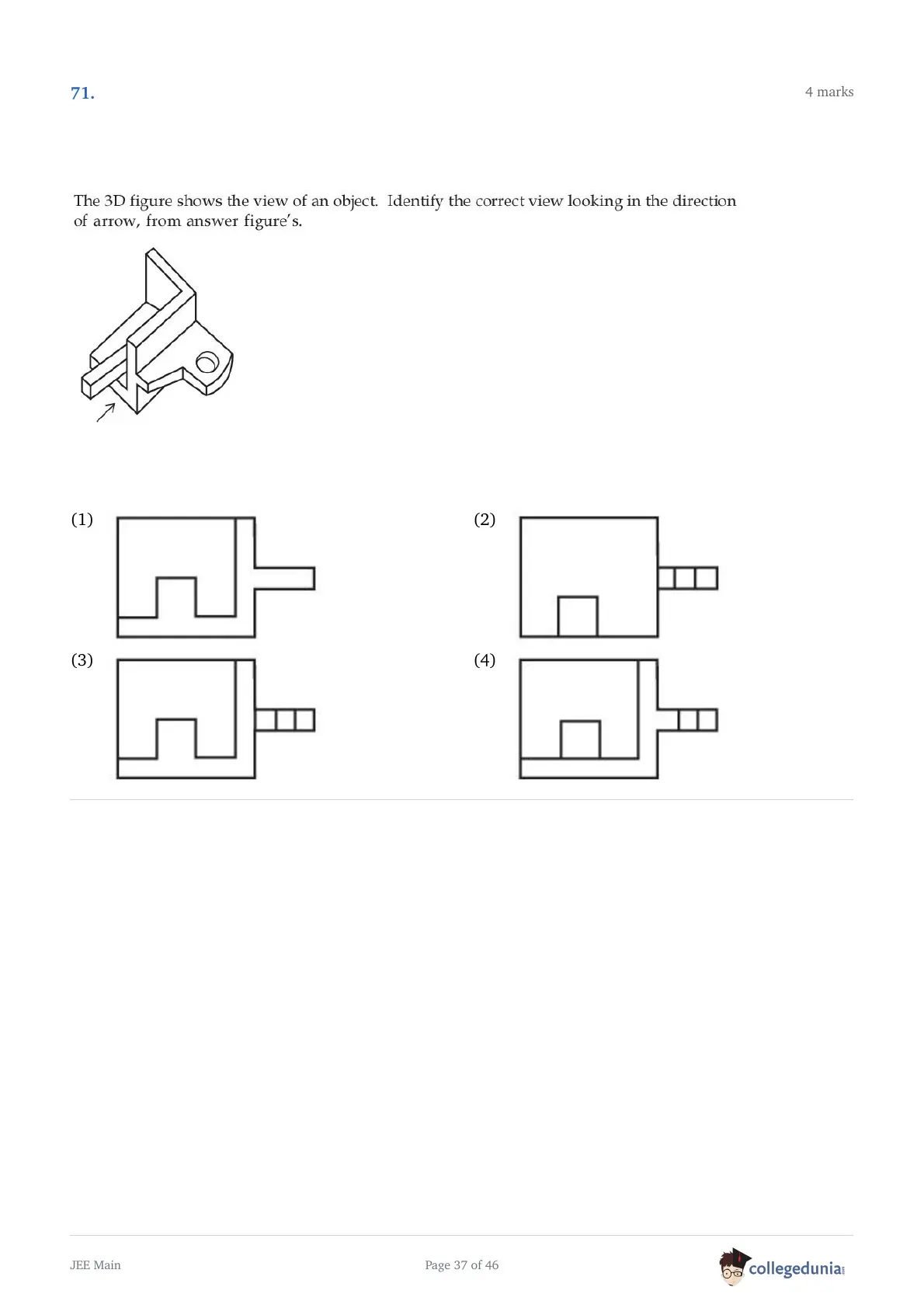
The 3D figure shows the view of an object. Identify the correct view looking in the direction of arrow, from the answer figure's.
- (1)
![]()
- (2)
![]()
- (3)
![]()
- (4)
![]()


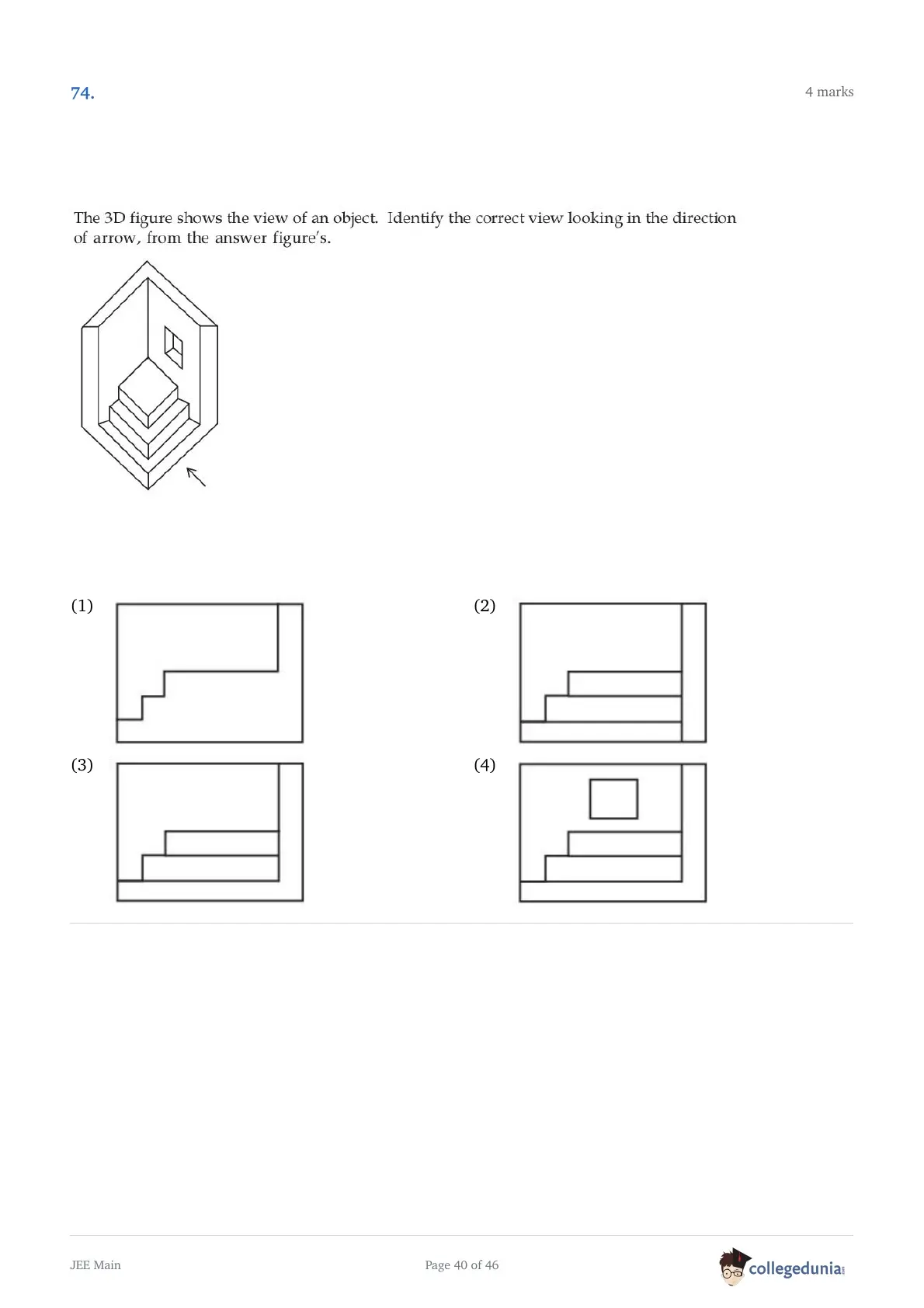
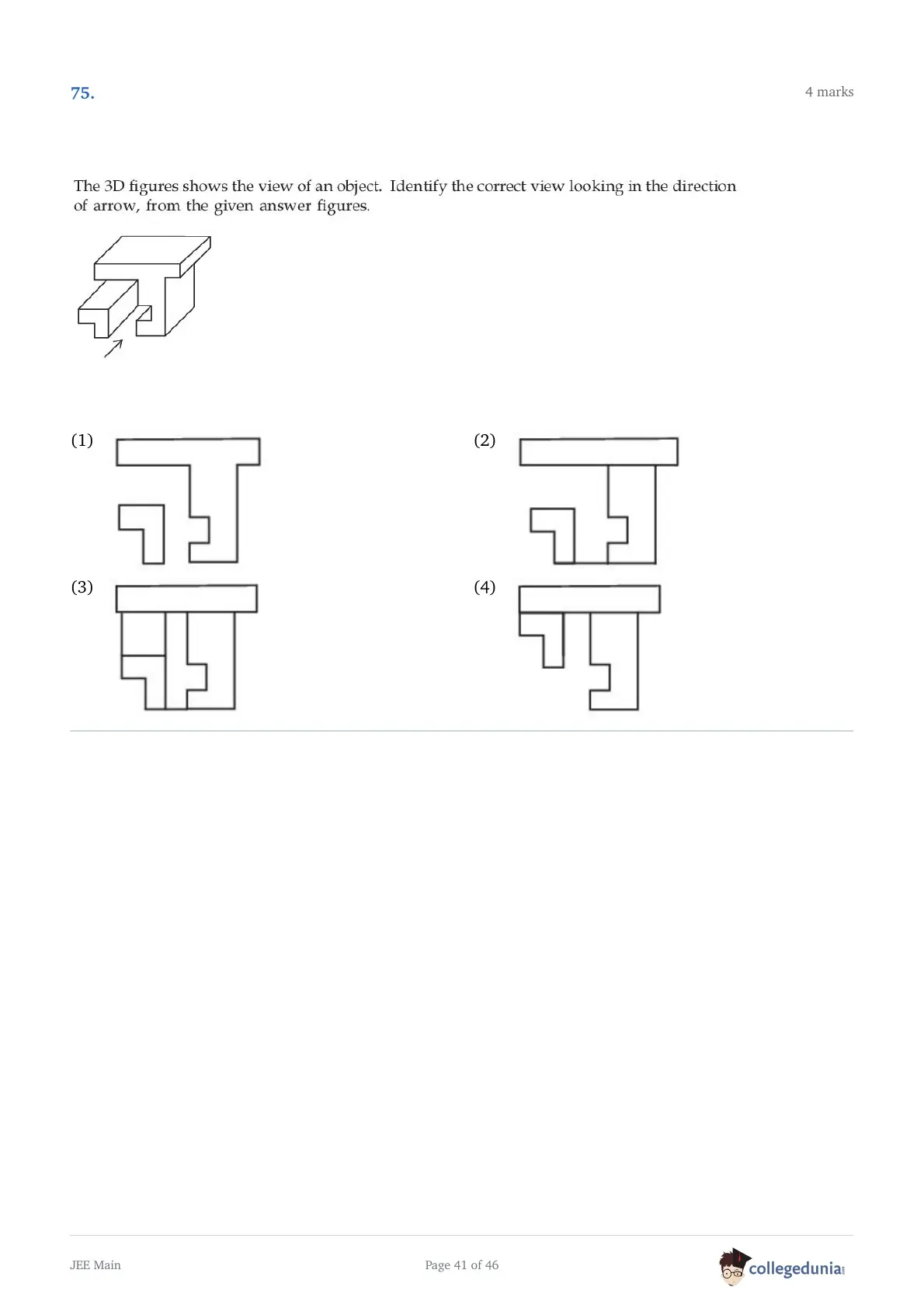
The 3D figures shows the view of an object. Identify the correct view looking in the direction of arrow, from the given answer figures.
- (1)
![]()
- (2)
![]()
- (3)
![]()
- (4)
![]()


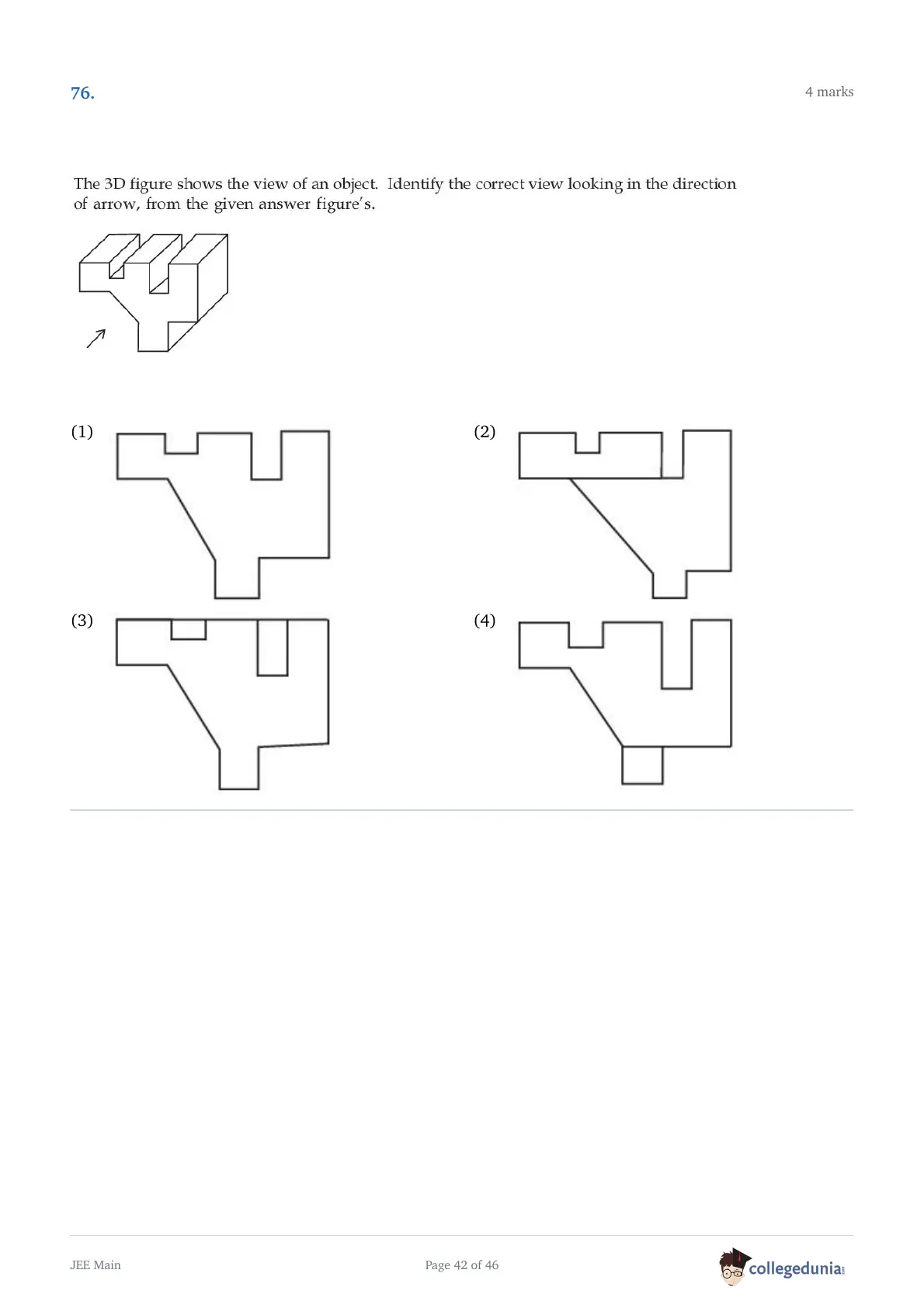
The 3D figure shows the view of an object. Identify the correct view looking in the direction of arrow, from the given answer figure's.
- (1)
![]()
- (2)
![]()
- (3)
![]()
- (4)
![]()


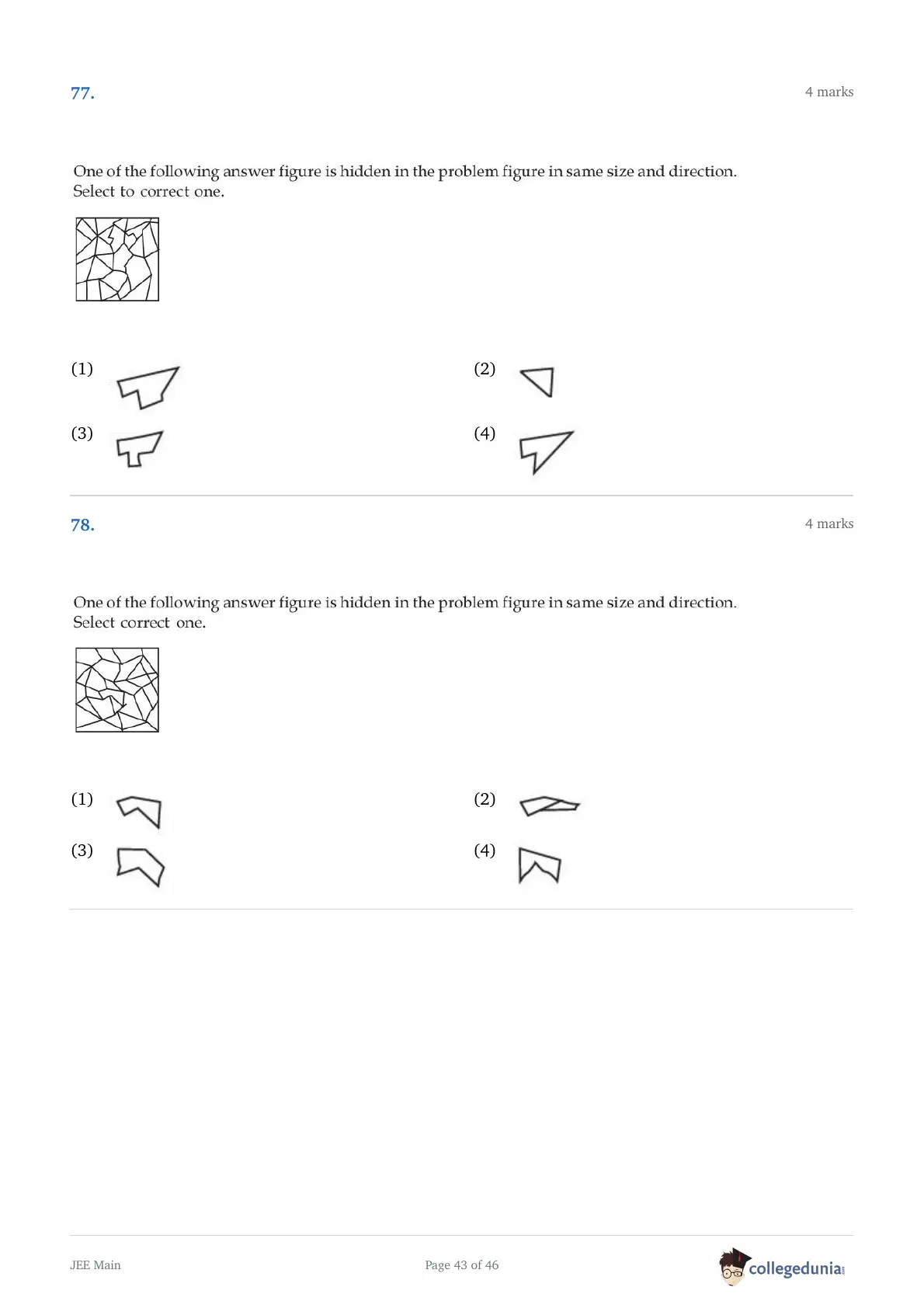
One of the following answer figure is hidden in the problem figure in same size and direction. Select correct one.
- (1)
![]()
- (2)
![]()
- (3)
![]()
- (4)
![]()


One of the following answer figure is hidden in the problem figure in same size and direction. Select correct one.
- (1)
![]()
- (2)
![]()
- (3)
![]()
- (4)
![]()


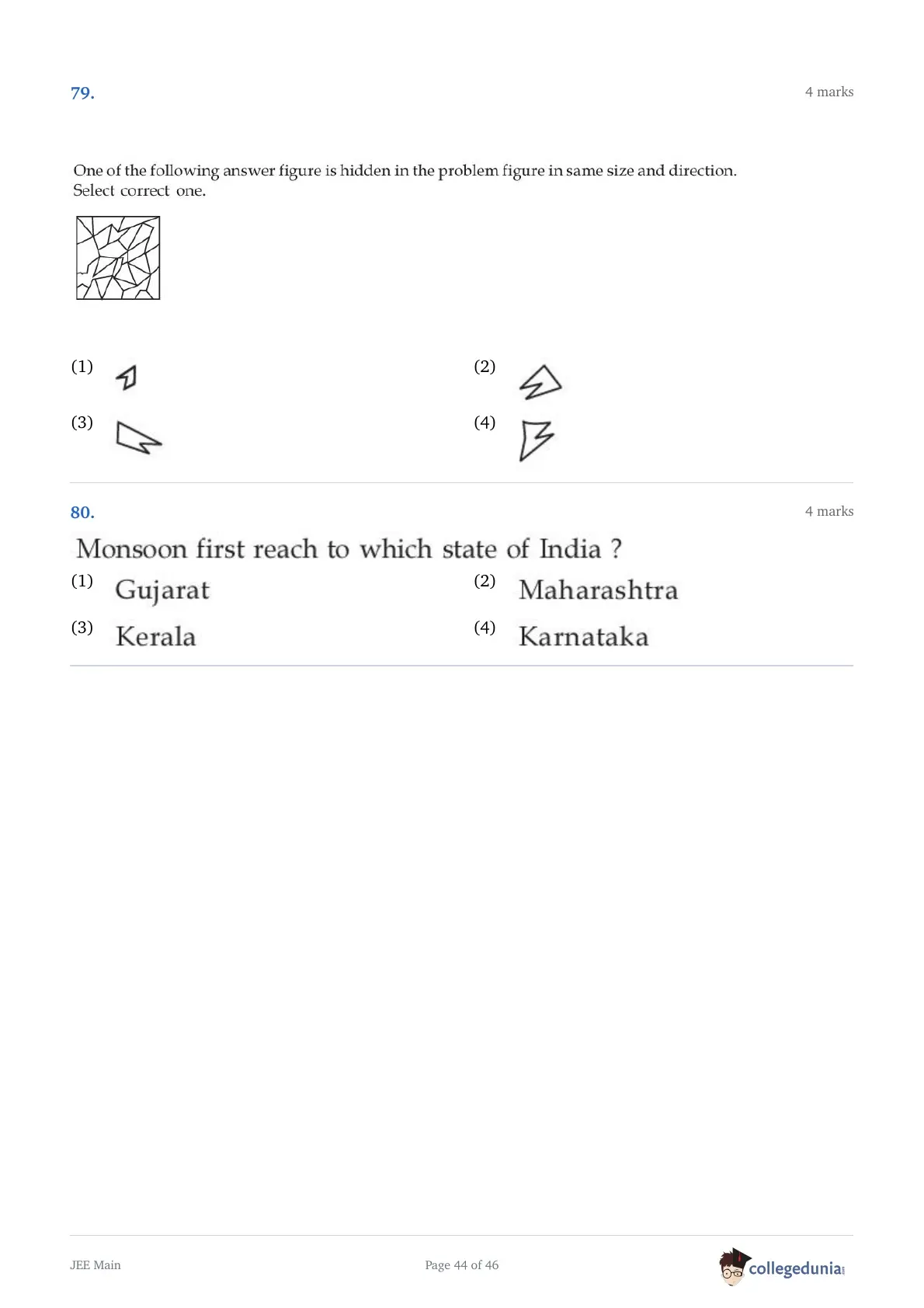
One of the following answer figure is hidden in the problem figure in same size and direction. Select correct one.
- (1)
![]()
- (2)
![]()
- (3)
![]()
- (4)
![]()


Monsoon first reach to which state of India ?
Drawing Test (Q81 - Q82)
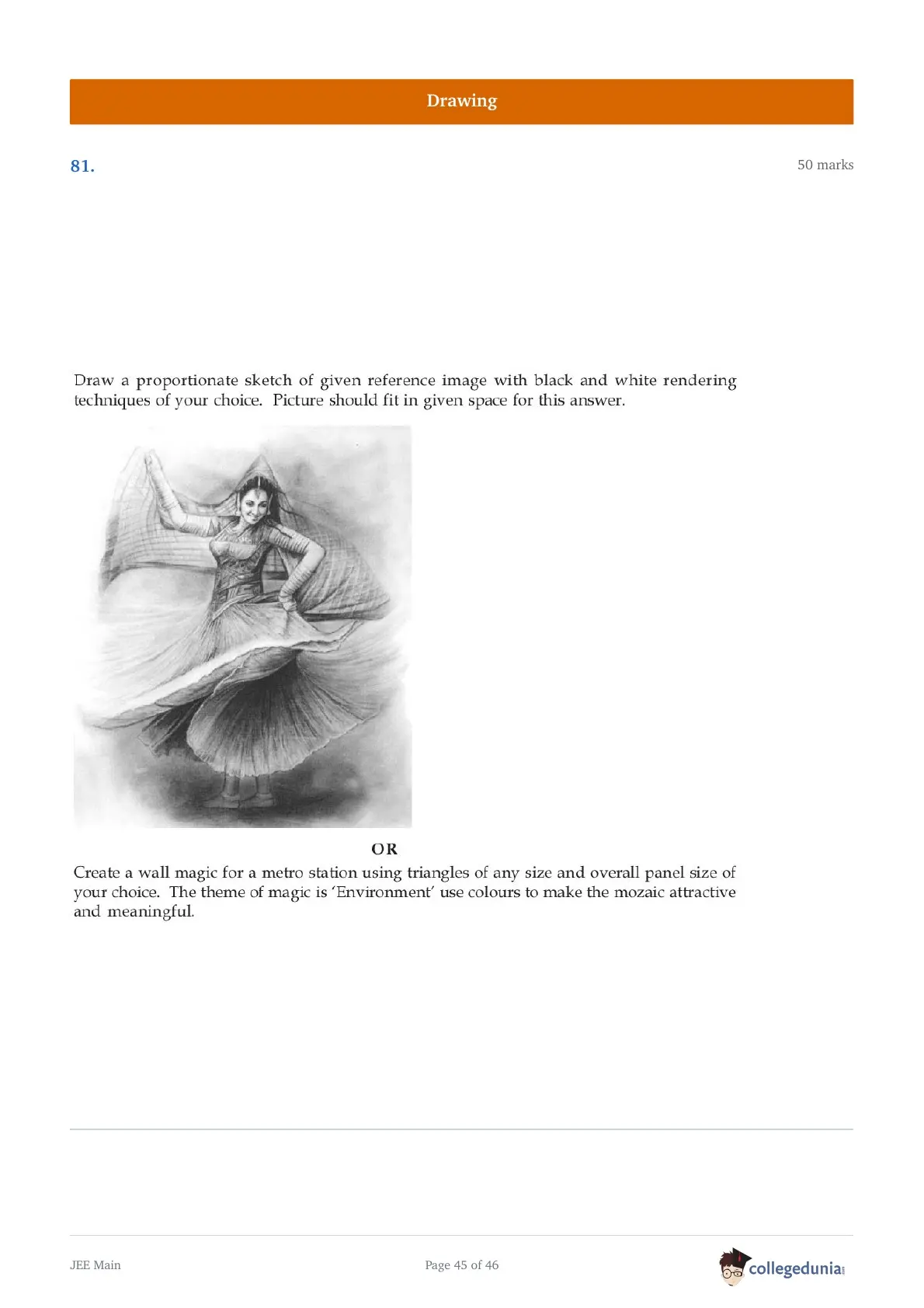
Draw a proportionate sketch of given reference image with black and white rendering techniques of your choice. Picture should fit in given space for this answer.
OR
Create a wall mosaic for a metro station using triangles of any size and overall panel size of your choice. The theme of mosaic is "Environment". Use colours to make the mosaic attractive and meaningful.
Consider yourself a fish in the aquarium that is in a room and a girl is standing near the aquarium and playing with the fish. Create the view of the room according the eye of fish.
OR
Create picture with fish/fishes, a girl, boat, farmers, tractor, trees and plants.
JEE Main 2021 B.Arch (Paper 2A) Exam Pattern and Marking Scheme
| Particulars | Details |
|---|---|
| Exam Mode | Online (Computer-Based Test) for Mathematics and Aptitude; Drawing Test on paper |
| Paper | B.Arch (Paper 2A) |
| Duration | 3 hours (180 minutes) |
| Type of Questions | Multiple Choice Questions (MCQs), numerical value questions and drawing questions |
| Subjects | Mathematics, Aptitude Test, Drawing Test |
| Total Questions | 82 questions (77 to be attempted) |
| Total Marks | 400 marks |
| Marking Scheme | +4 for correct answer & -1 for incorrect MCQ answer (no negative marking for numerical value questions); 0 for unattempted |



Comments