




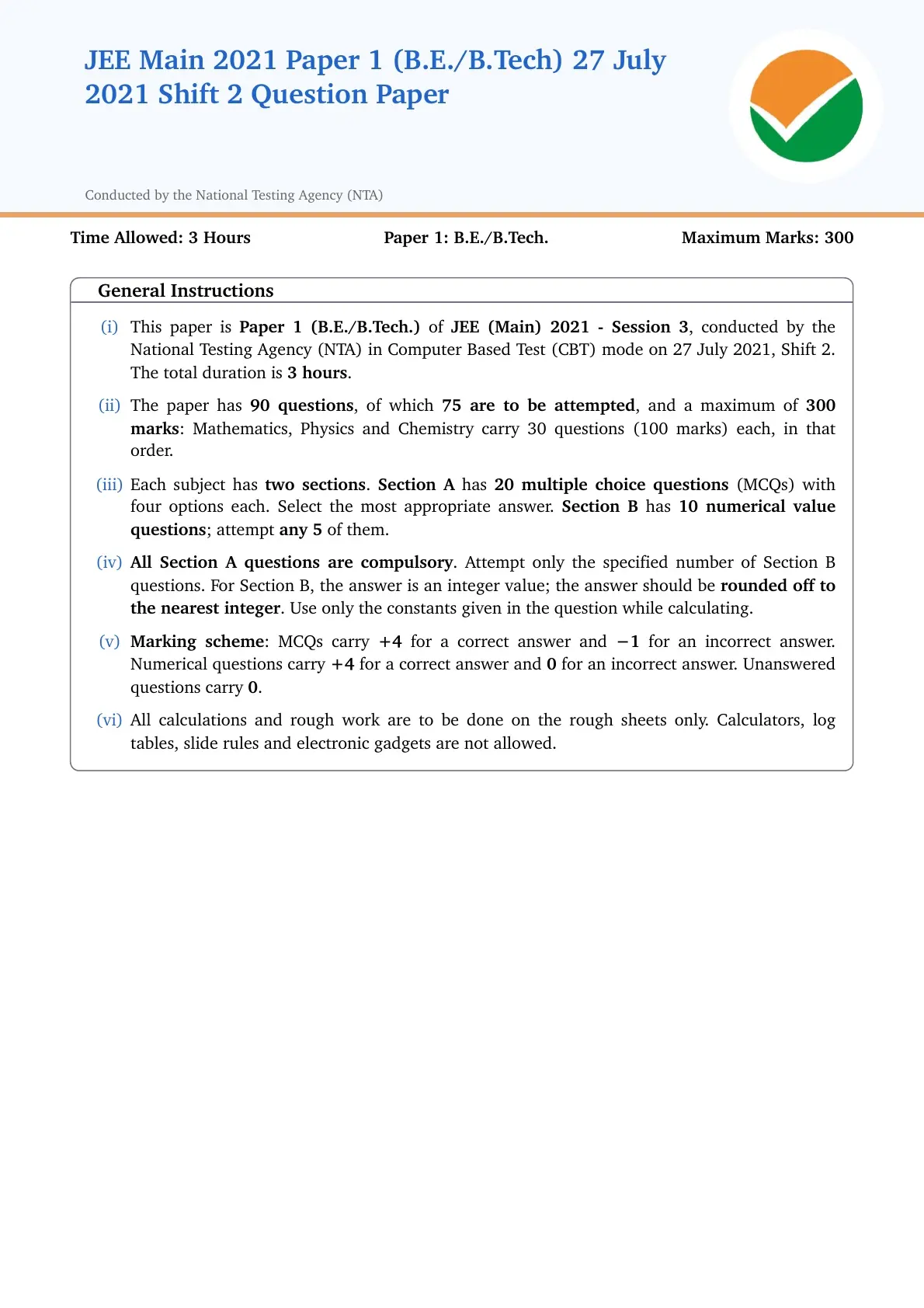
JEE Main 2021 July 27 Shift 2 Question Paper is available here with solutions PDF and detailed solutions for every question. NTA conducted the second shift on July 27, 2021, from 3:00 PM to 6:00 PM. The JEE Main 2021 Paper 1 (B.E./B.Tech) question paper includes the following:
- 90 questions in a 3-hour CBT Mode: 30 each from Mathematics, Physics and Chemistry (75 to be attempted)
- Section A: 20 multiple choice questions (MCQs) per subject, all compulsory, 4 marks each
- Section B: 10 numerical value questions per subject, any 5 to be attempted, 4 marks each
- Marking: +4 for a correct answer, -1 for an incorrect MCQ, 0 for an unattempted question; no negative marking for numerical value questions
- Maximum marks: 300 (100 per subject)
JEE Main 2021 July 27 Shift 2 Question Paper with Solution PDF
| NTA Official PDF | CD PDF | CD PDF with Solutions |
|---|---|---|
| Download official PDF 6.91 MB | Download Collegedunia PDF 1.16 MB | Download solutions PDF 1.58 MB |
Also Check:
JEE Main 2021 July 27 Shift 2 Questions with Solutions
Mathematics - Section A (Q1 - Q20)
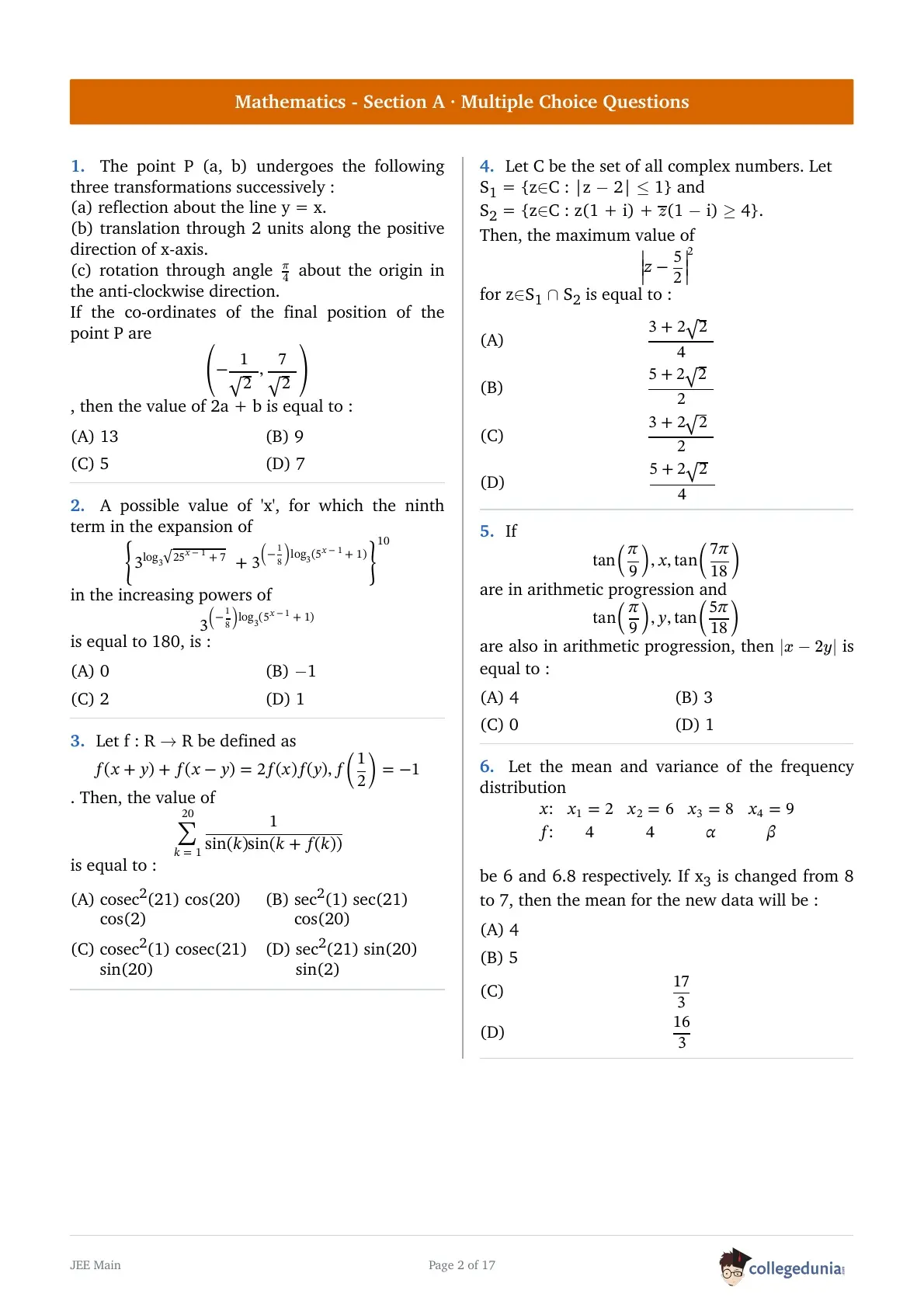
The point P (a, b) undergoes the following three transformations successively :
(a) reflection about the line y=x.
(b) translation through 2 units along the positive direction of x-axis.
(c) rotation through angle \(\frac{\pi}{4}\) about the origin in the anti-clockwise direction.
If the co-ordinates of the final position of the point P are \((-\frac{1}{\sqrt{2}}, \frac{7}{\sqrt{2}})\), then the value of 2a+b is equal to :
A possible value of 'x', for which the ninth term in the expansion of
\(\left\{ 3^{\log_3\sqrt{25^{x-1}+7}} + 3^{(-\frac{1}{8})\log_3(5^{x-1}+1)} \right\}^{10}\) in the increasing powers of \(3^{(-\frac{1}{8})\log_3(5^{x-1}+1)}\) is equal to 180, is :
Let \(f: \mathbb{R} \to \mathbb{R}\) be defined as \(f(x+y) + f(x-y) = 2f(x)f(y)\), \(f(\frac{1}{2}) = -1\). Then, the value of \(\sum_{k=1}^{20} \frac{1}{\sin(k) \sin(k+f(k))}\) is equal to :
Let C be the set of all complex numbers. Let
\(S_1 = \{z \in C : |z-2| \le 1\}\) and
\(S_2 = \{z \in C : z(1+i) + \bar{z}(1-i) \ge 4\}\).
Then, the maximum value of \(|z-\frac{5}{2}|^2\) for \(z \in S_1 \cap S_2\) is equal to :
If \(\tan(\frac{\pi}{9})\), x, \(\tan(\frac{7\pi}{18})\) are in arithmetic progression and \(\tan(\frac{\pi}{9})\), y, \(\tan(\frac{5\pi}{18})\) are also in arithmetic progression, then \(|x-2y|\) is equal to :
Let the mean and variance of the frequency distribution be 6 and 6.8 respectively.
x : \( x_1 = 2,\; x_2 = 6,\; x_3 = 8,\; x_4 = 9 \)
f : \( 4,\; 4,\; \alpha,\; \beta \)
If \( x_3 \) is changed from 8 to 7, then the mean for the new data will be:
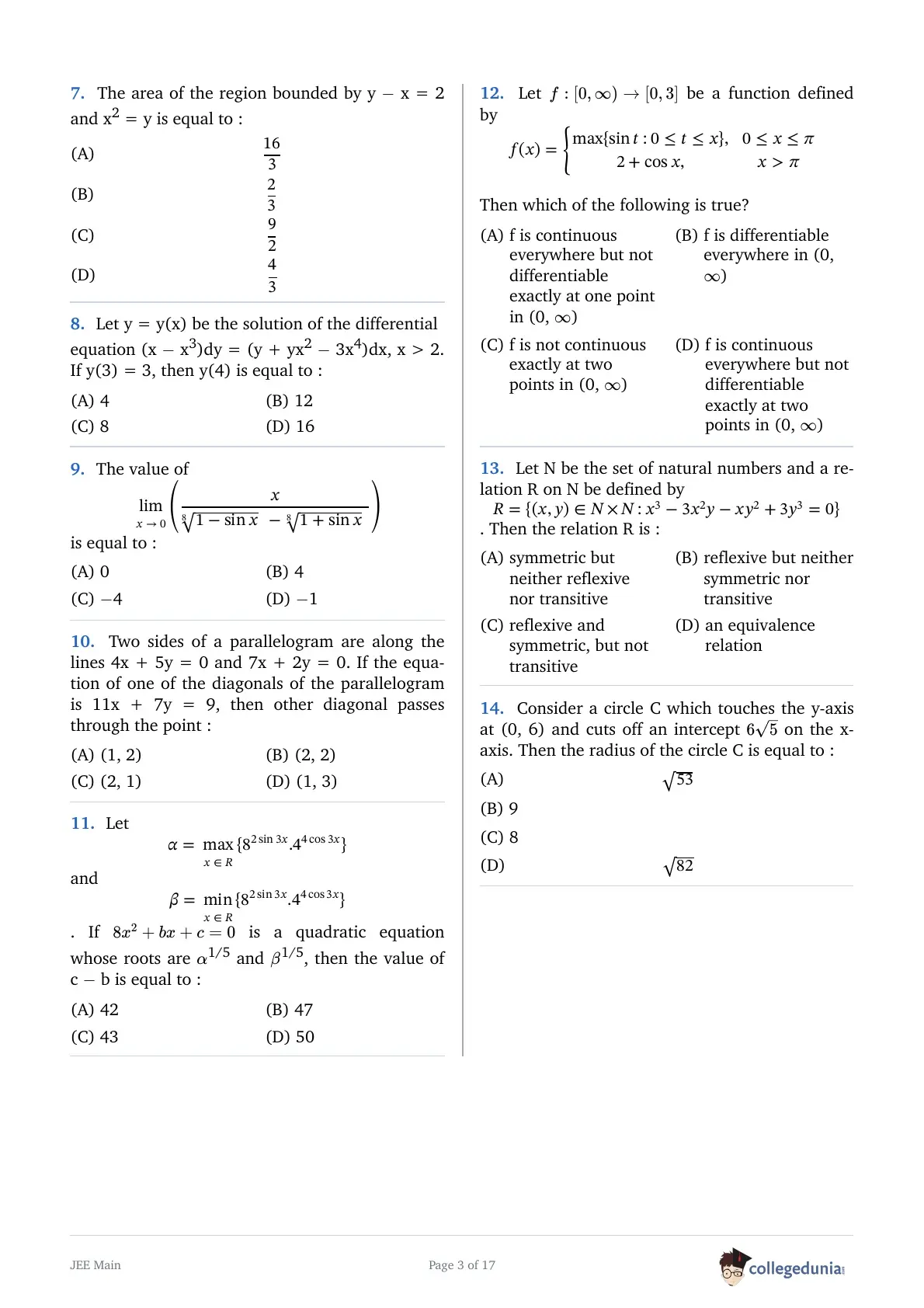
The area of the region bounded by \(y-x=2\) and \(x^2=y\) is equal to :
Let \(y=y(x)\) be the solution of the differential equation \((x-x^3)dy = (y+yx^2-3x^4)dx\), \(x>2\). If \(y(3)=3\), then \(y(4)\) is equal to :
The value of \(\lim_{x \to 0} \left(\frac{x}{\sqrt[8]{1-\sin x} - \sqrt[8]{1+\sin x}}\right)\) is equal to :
Two sides of a parallelogram are along the lines \(4x+5y=0\) and \(7x+2y=0\). If the equation of one of the diagonals of the parallelogram is \(11x+7y=9\), then other diagonal passes through the point :
Let \(\alpha = \max_{x \in \mathbb{R}}\{8^{2\sin 3x} \cdot 4^{4\cos 3x}\}\) and \(\beta = \min_{x \in \mathbb{R}}\{8^{2\sin 3x} \cdot 4^{4\cos 3x}\}\).
If \(8x^2+bx+c=0\) is a quadratic equation whose roots are \(\alpha^{1/5}\) and \(\beta^{1/5}\), then the value of c-b is equal to :
Let \( f : [0, \infty) \rightarrow [0, 3] \) be a function defined by
\[
f(x) =
\begin{cases}
\max\{\sin t : 0 \le t \le x\}, & 0 \le x \le \pi \\
2 + \cos x, & x > \pi
\end{cases}
\]
Then which of the following is true ?
Let \(\mathbb{N}\) be the set of natural numbers and a relation R on \(\mathbb{N}\) be defined by R = \(\{(x, y) \in \mathbb{N} \times \mathbb{N} : x^3 - 3x^2y - xy^2 + 3y^3 = 0\}\). Then the relation R is :
Consider a circle C which touches the y-axis at (0, 6) and cuts off an intercept \(6\sqrt{5}\) on the x-axis. Then the radius of the circle C is equal to :
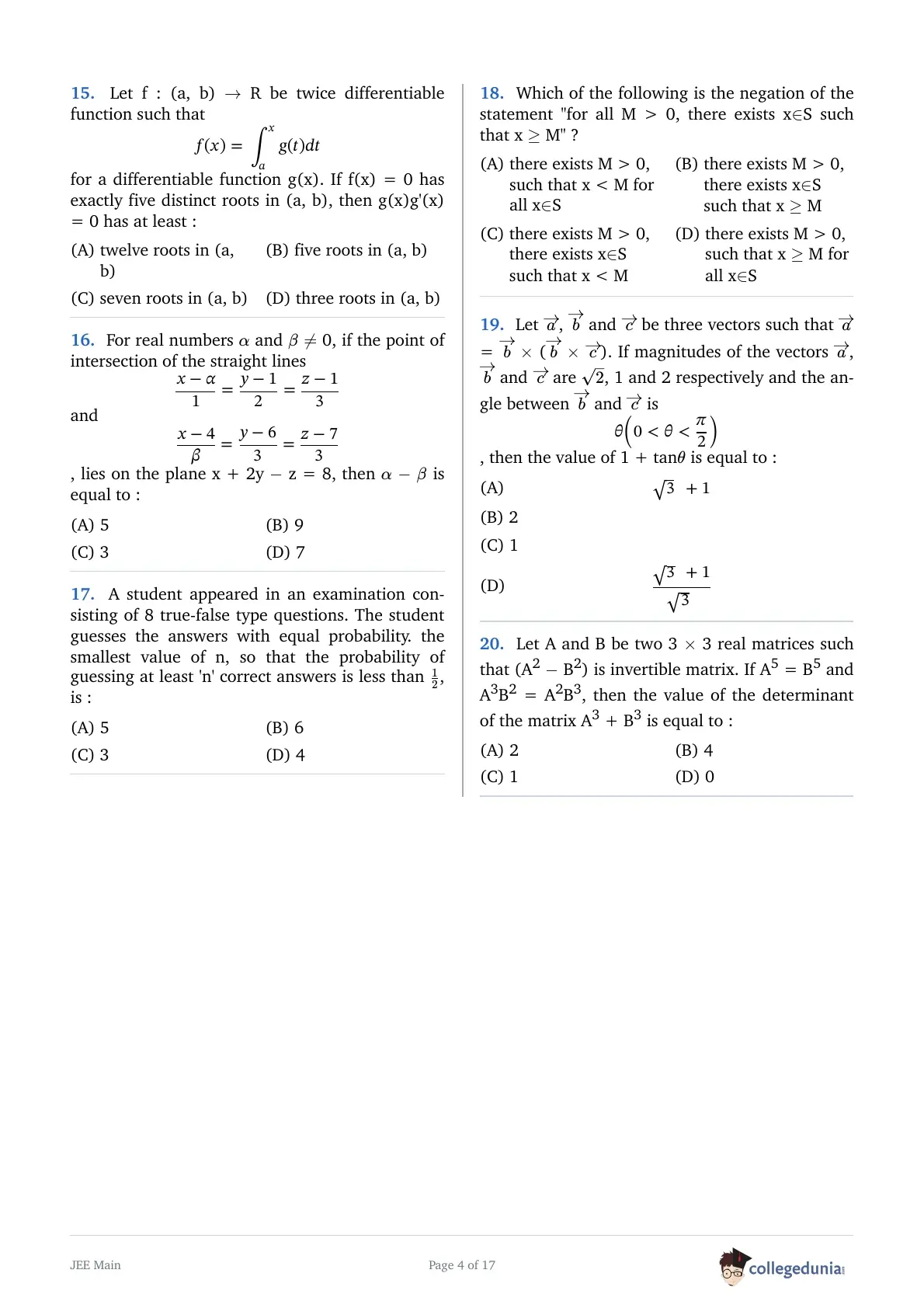
Let \(f: (a,b) \to \mathbb{R}\) be twice differentiable function such that \(f(x) = \int_a^x g(t)dt\) for a differentiable function \(g(x)\). If \(f(x)=0\) has exactly five distinct roots in \((a,b)\), then \(g(x)g'(x)=0\) has at least :
For real numbers \(\alpha\) and \(\beta \neq 0\), if the point of intersection of the straight lines
\(\frac{x-\alpha}{1} = \frac{y-1}{2} = \frac{z-1}{3}\) and \(\frac{x-4}{\beta} = \frac{y-6}{3} = \frac{z-7}{3}\)
lies on the plane \(x+2y-z=8\), then \(\alpha-\beta\) is equal to :
A student appeared in an examination consisting of 8 true - false type questions. The student guesses the answers with equal probability. The smallest value of n, so that the probability of guessing at least 'n' correct answers is less than \(\frac{1}{2}\), is :
Which of the following is the negation of the statement "for all M>0, there exists x\(\in\)S such that x \(\ge\) M" ?
Let \(\vec{a}\), \(\vec{b}\) and \(\vec{c}\) be three vectors such that \(\vec{a} = \vec{b} \times (\vec{b} \times \vec{c})\). If magnitudes of the vectors \(\vec{a}\), \(\vec{b}\) and \(\vec{c}\) are \(\sqrt{2}, 1\) and 2 respectively and the angle between \(\vec{b}\) and \(\vec{c}\) is \(\theta\) (\(0<\theta<\frac{\pi}{2}\)), then the value of \(1+\tan\theta\) is equal to :
Let A and B be two \(3 \times 3\) real matrices such that \((A^2 - B^2)\) is invertible matrix. If \(A^5=B^5\) and \(A^3B^2=A^2B^3\), then the value of the determinant of the matrix \(A^3+B^3\) is equal to :
Mathematics - Section B (Q21 - Q30)
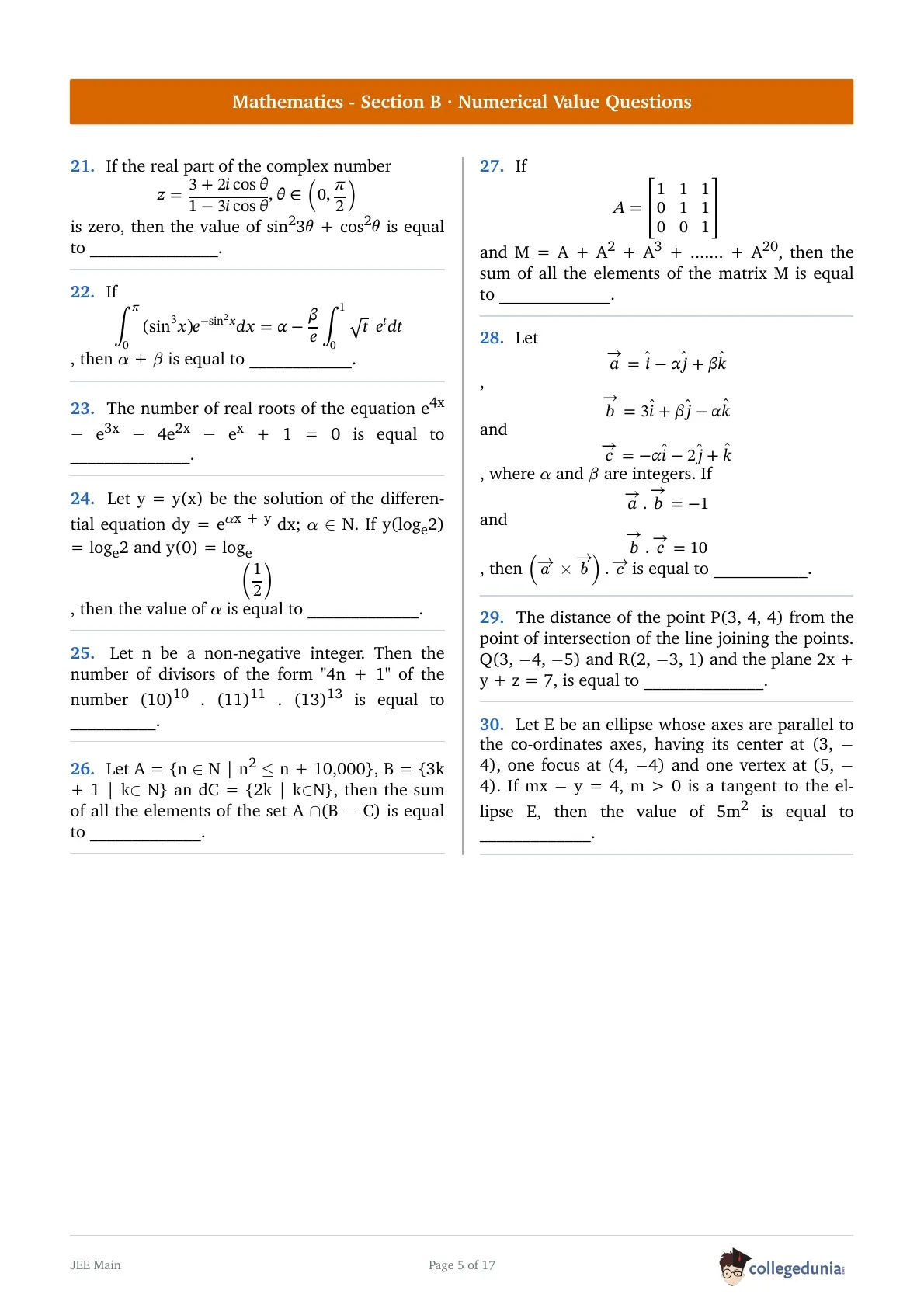
If the real part of the complex number \(z = \frac{3+2i\cos\theta}{1-3i\cos\theta}\), \(\theta \in (0, \frac{\pi}{2})\) is zero, then the value of \(\sin^2 3\theta + \cos^2 \theta\) is equal to ________.
If \(\int_0^\pi (\sin^3 x) e^{-\sin^2 x} dx = \alpha - \frac{\beta}{e} \int_0^1 \sqrt{t} e^t dt\), then \(\alpha+\beta\) is equal to ________.
The number of real roots of the equation \(e^{4x} - e^{3x} - 4e^{2x} - e^x + 1 = 0\) is equal to ________.
Let \(y=y(x)\) be the solution of the differential equation \(dy = e^{\alpha x+y}dx; \alpha \in \mathbb{N}\). If \(y(\log_e 2) = \log_e 2\) and \(y(0)=\log_e(\frac{1}{2})\), then the value of \(\alpha\) is equal to ________.
Let n be a non-negative integer. Then the number of divisors of the form "4n+1" of the number \((10)^{10} \cdot (11)^{11} \cdot (13)^{13}\) is equal to ________.
Let \(A = \{n \in \mathbb{N} | n^2 \le n+10000\}\), \(B = \{3k+1 | k \in \mathbb{N}\}\) and \(C = \{2k | k \in \mathbb{N}\}\). Then the sum of all the elements of the set \(A \cap (B-C)\) is equal to ________.
If \( A = \begin{pmatrix}
1 & 1 & 1 \\
0 & 1 & 1 \\
0 & 0 & 1
\end{pmatrix} \) and
\( M = A + A^2 + A^3 + \cdots + A^{20} \),
then the sum of all the elements of the matrix \( M \) is equal to ________.
Let \(\vec{a}=\hat{i}-\alpha\hat{j}+\beta\hat{k}\), \(\vec{b}=3\hat{i}+\beta\hat{j}-\alpha\hat{k}\) and \(\vec{c}=-\alpha\hat{i}-2\hat{j}+\hat{k}\), where \(\alpha\) and \(\beta\) are integers. If \(\vec{a} \cdot \vec{b} = -1\) and \(\vec{b} \cdot \vec{c} = 10\), then \((\vec{a} \times \vec{b}) \cdot \vec{c}\) is equal to ________.
The distance of the point P(3, 4, 4) from the point of intersection of the line joining the points Q(3, -4, -5) and R(2, -3, 1) and the plane \(2x+y+z=7\), is equal to ________.
Let E be an ellipse whose axes are parallel to the co-ordinates axes, having its center at (3, -4), one focus at (4, -4) and one vertex at (5, -4). If \(mx-y=4, m>0\) is a tangent to the ellipse E, then the value of \(5m^2\) is equal to ________.
Physics - Section A (Q31 - Q50)
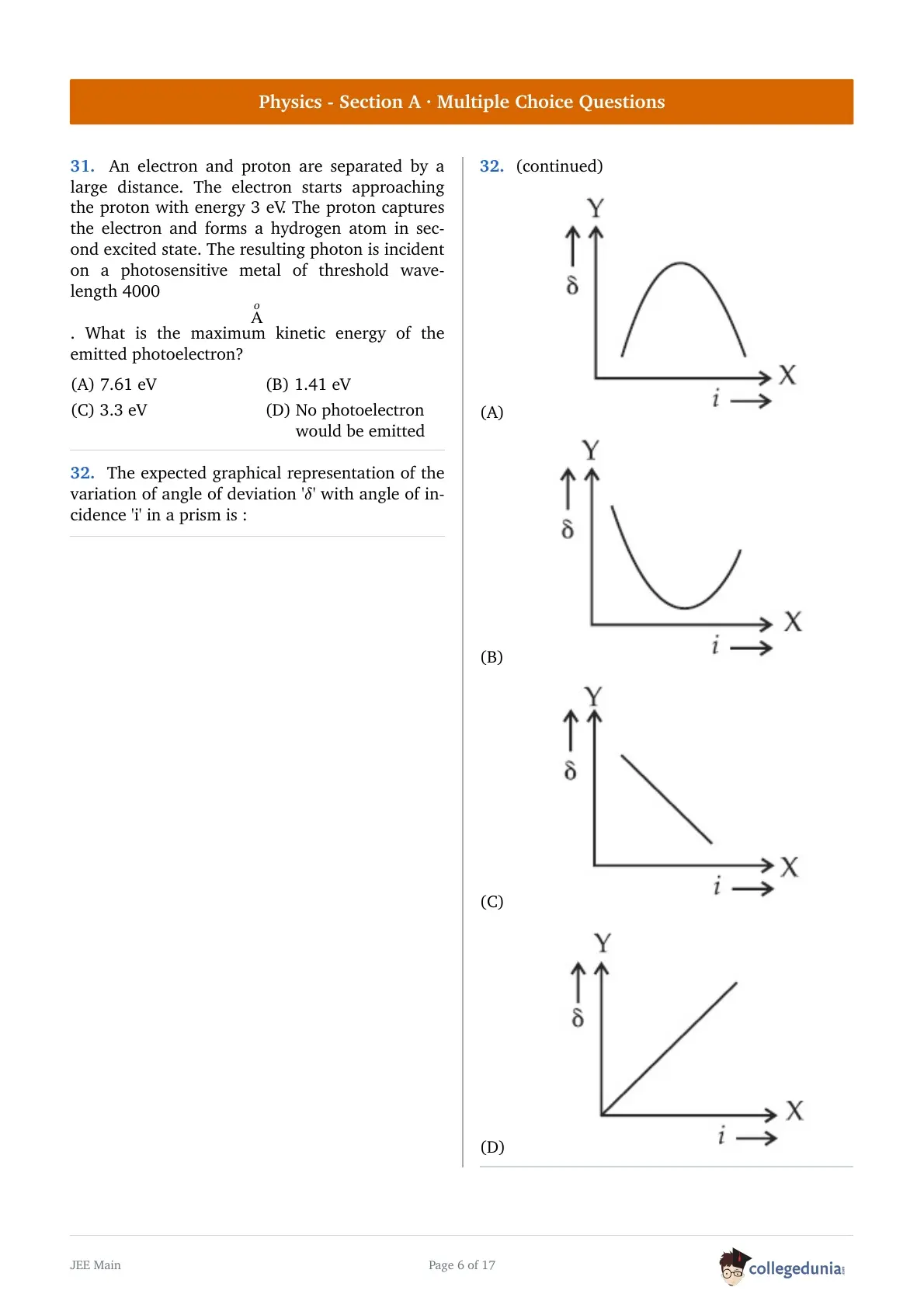
An electron and proton are separated by a large distance. The electron starts approaching the proton with energy 3 eV. The proton captures the electron and forms a hydrogen atom in second excited state. The resulting photon is incident on a photosensitive metal of threshold wavelength 4000 Å. What is the maximum kinetic energy of the emitted photoelectron?
The expected graphical representation of the variation of angle of deviation '\(\delta\)' with angle of incidence 'i' in a prism is : 

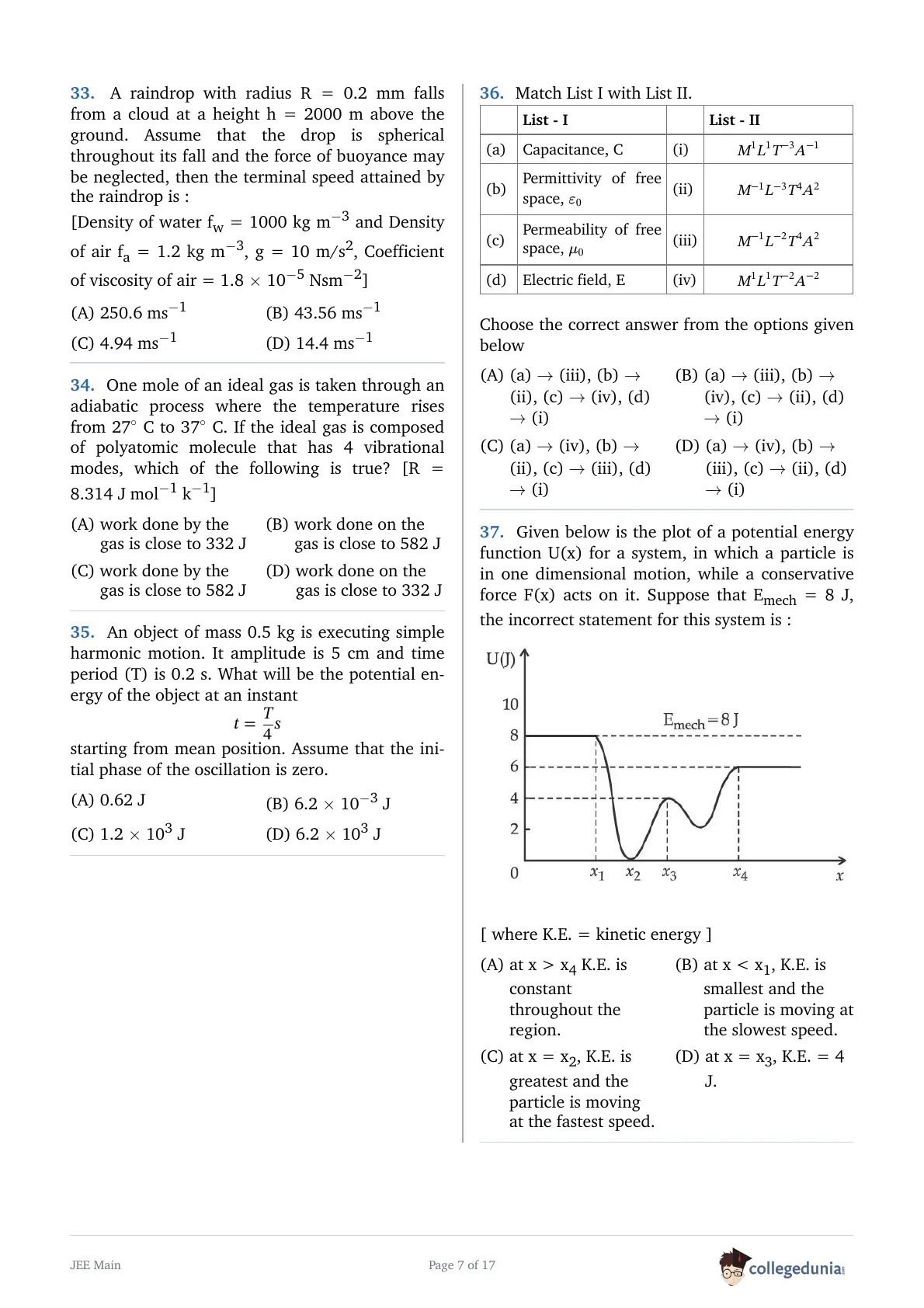
A raindrop with radius R=0.2 mm falls from a cloud at a height h=2000 m above the ground. Assume that the drop is spherical throughout its fall and the force of buoyancy may be neglected, then the terminal speed attained by the raindrop is :
[Density of water \(f_w = 1000 \text{ kg m}^{-3}\) and Density of air \(f_a = 1.2 \text{ kg m}^{-3}\), \(g=10 \text{ m/s}^2\)
Coefficient of viscosity of air \(= 1.8 \times 10^{-5} \text{ Ns m}^{-2}\) ]
One mole of an ideal gas is taken through an adiabatic process where the temperature rises from \(27^\circ\text{C}\) to \(37^\circ\text{C}\). If the ideal gas is composed of polyatomic molecule that has 4 vibrational modes, which of the following is true?
[R = 8.314 J mol\(^{-1}\) K\(^{-1}\)]
An object of mass 0.5 kg is executing simple harmonic motion. Its amplitude is 5 cm and time period (T) is 0.2 s. What will be the potential energy of the object at an instant t = T/4 starting from mean position. Assume that the initial phase of the oscillation is zero.
Match List I with List II. 
Choose the correct answer from the options given below:
Given below is the plot of a potential energy function U(x) for a system, in which a particle is in one dimensional motion, while a conservative force F(x) acts on it. Suppose that \(E_{mech} = 8\) J, the incorrect statement for this system is :
[ where K.E. = kinetic energy ]
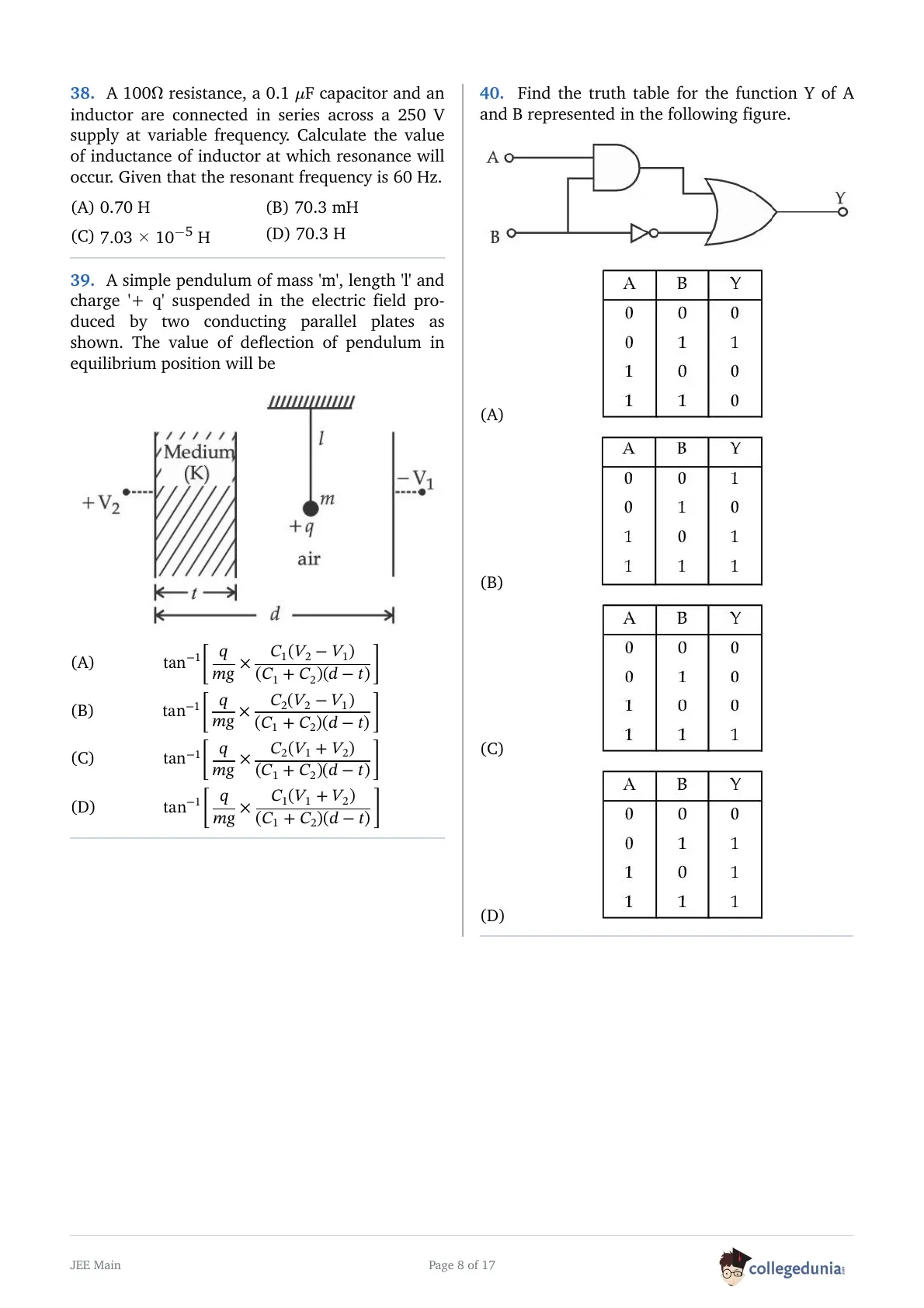
A 100 \(\Omega\) resistance, a 0.1 \(\mu\)F capacitor and an inductor are connected in series across a 250 V supply at variable frequency. Calculate the value of inductance of inductor at which resonance will occur. Given that the resonant frequency is 60 Hz.
A simple pendulum of mass 'm', length 'l' and charge '+q' suspended in the electric field produced by two conducting parallel plates as shown. The value of deflection of pendulum in equilibrium position will be: 
Find the truth table for the function Y of A and B represented in the following figure.
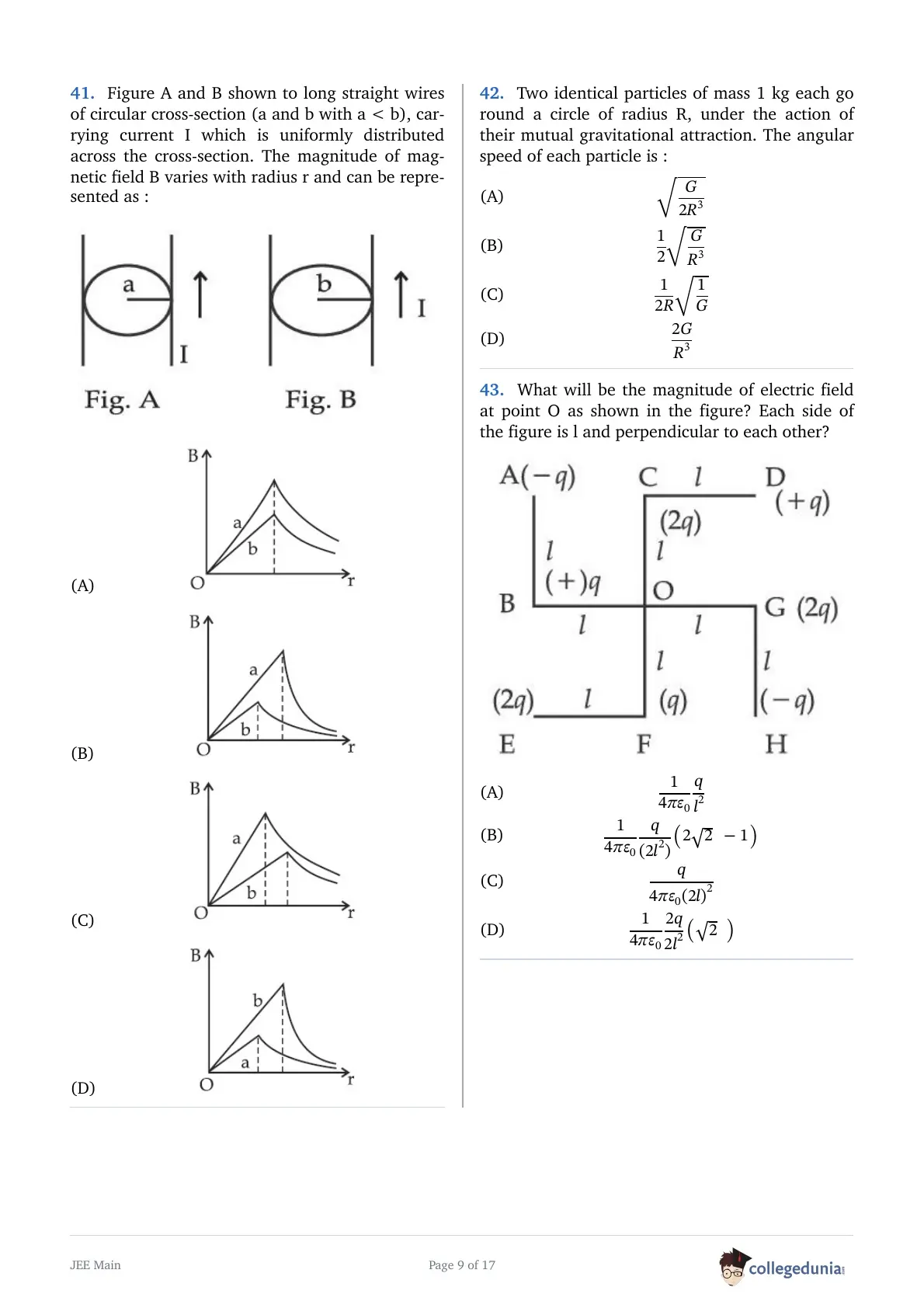
Figure A and B show two long straight wires of circular cross-section (a and b with a<b), carrying current I which is uniformly distributed across the cross-section. The magnitude of magnetic field B varies with radius r and can be represented as : 

Two identical particles of mass 1 kg each go round a circle of radius R under the action of their mutual gravitational attraction. The angular speed of each particle is :
What will be the magnitude of electric field at point O as shown in the figure? Each side of the figure is \(l\) and mutually perpendicular. 
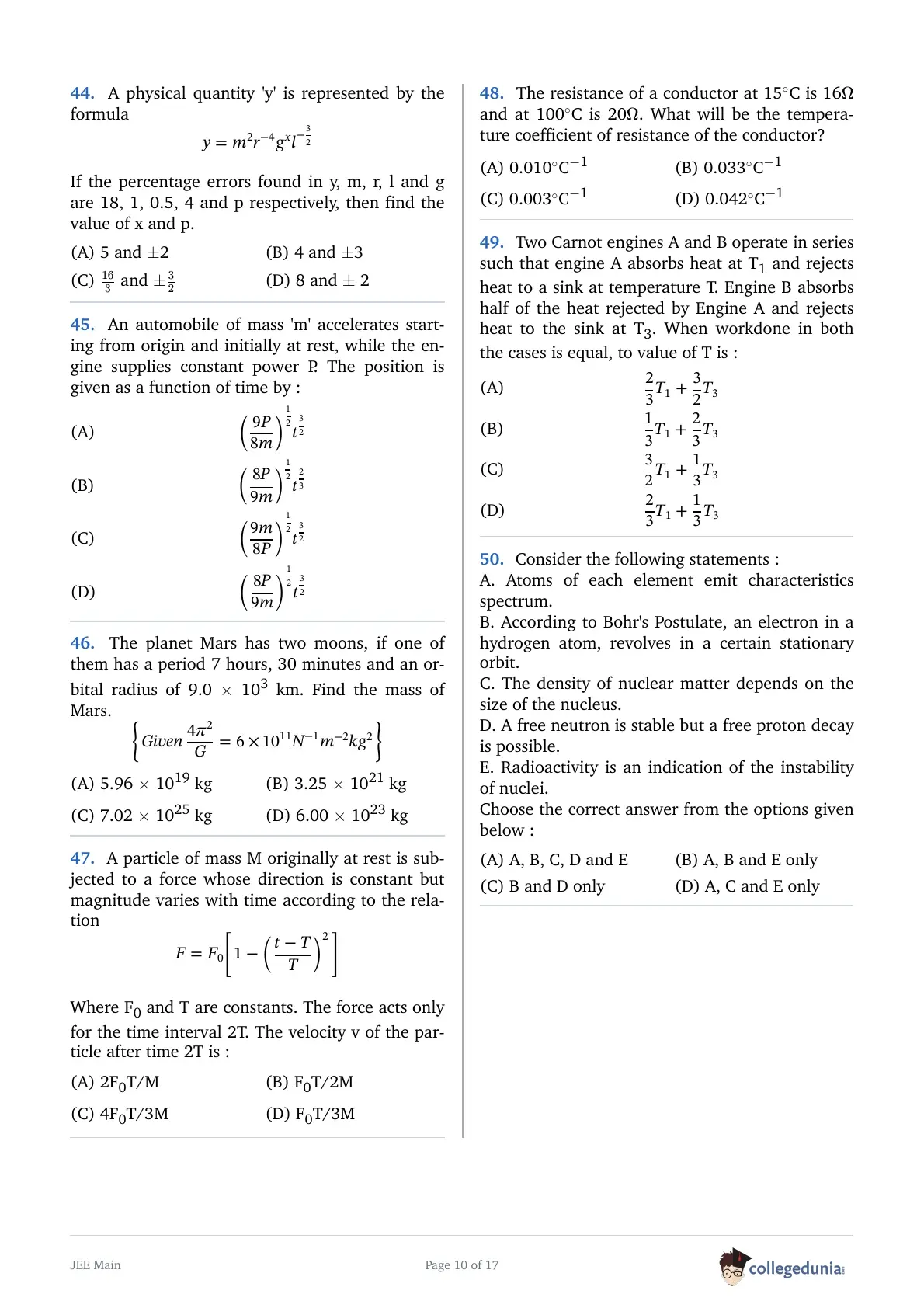
A physical quantity 'y' is represented by the formula \(y = m^x r^{-4} g^p l^{3/2}\). If the percentage errors found in y, m, r, l and g are 18, 1, 0.5, 4 and p respectively, then find the value of x and p.
An automobile of mass 'm' accelerates starting from origin and initially at rest, while the engine supplies constant power P. The position is given as a function of time by:
The planet Mars has two moons, if one of them has a period 7 hours, 30 minutes and an orbital radius of \(9.0 \times 10^3\) km. Find the mass of Mars.
\(\left\{ \text{Given } \frac{4\pi^2}{G} = 6 \times 10^{11} \text{ N}^{-1} \text{ m}^{-2} \text{ kg}^2 \right\}\)
A particle of mass M originally at rest is subjected to a force whose direction is constant but magnitude varies with time according to the relation
\(F = F_0 \left[1 - \left(\frac{t}{T}\right)^2\right]\)
Where \(F_0\) and T are constants. The force acts only for the time interval 2T. The velocity v of the particle after time 2T is:
The resistance of a conductor at \(15^\circ\text{C}\) is 16 \(\Omega\) and at \(100^\circ\text{C}\) is 20 \(\Omega\). What will be the temperature coefficient of resistance of the conductor?
Two Carnot engines A and B operate in series such that engine A absorbs heat at \(T_1\) and rejects heat to a sink at temperature T. Engine B absorbs half of the heat rejected by Engine A and rejects heat to the sink at \(T_3\). When workdone in both the cases is equal, the value of T is :
Consider the following statements :
A. Atoms of each element emit characteristics spectrum.
B. According to Bohr's Postulate, an electron in a hydrogen atom, revolves in a certain stationary orbit.
C. The density of nuclear matter depends on the size of the nucleus.
D. A free neutron is stable but a free proton decay is possible.
E. Radioactivity is an indication of the instability of nuclei.
Choose the correct answer from the options given below :
Physics - Section B (Q51 - Q60)
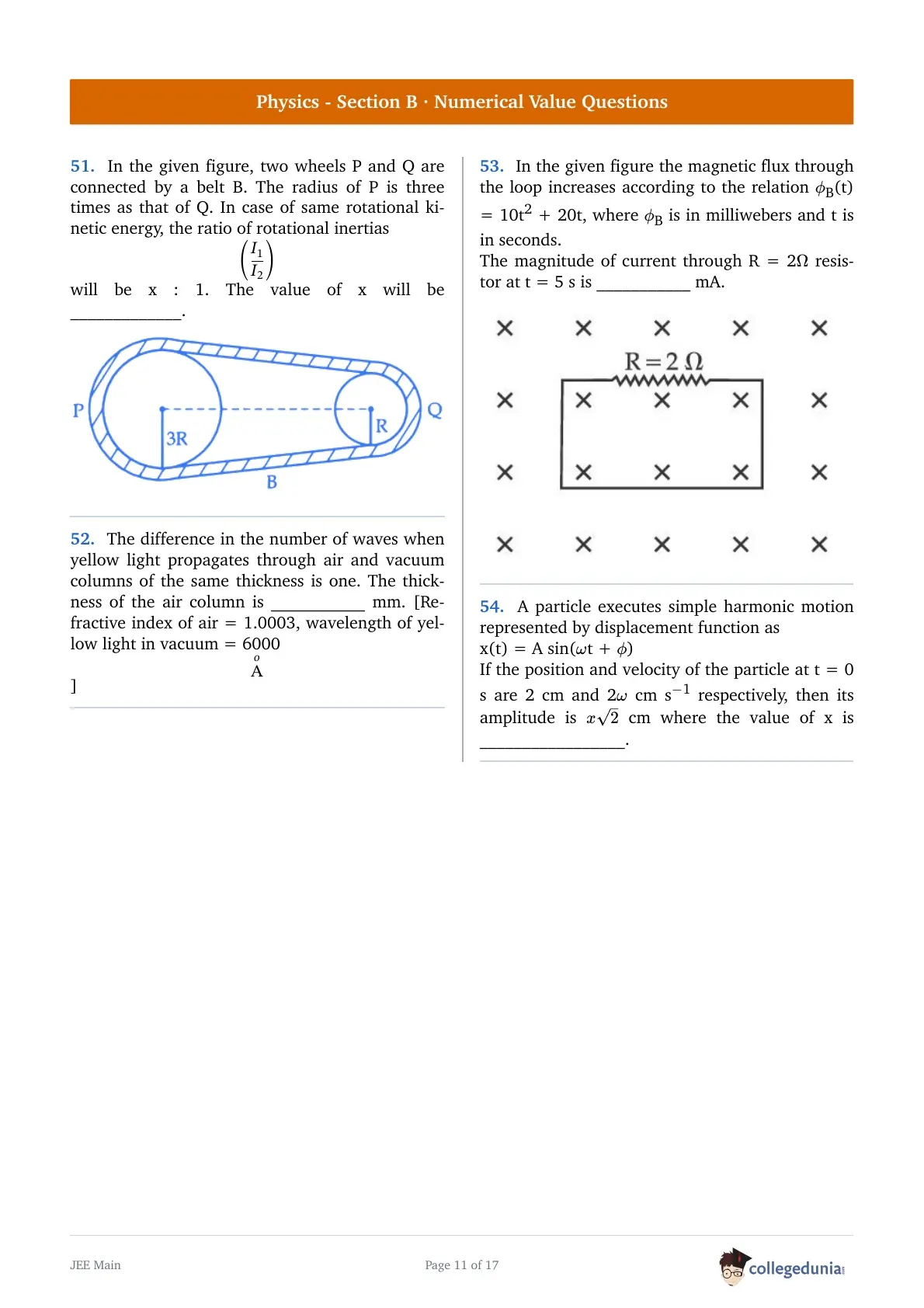
In the given figure, two wheels P and Q are connected by a belt B. The radius of P is three times as that of Q. In case of same rotational kinetic energy, the ratio of rotational inertias \((\frac{I_1}{I_2})\) will be x : 1. The value of x will be ________ . 
The difference in the number of waves when yellow light propagates through air and vacuum columns of the same thickness is one. The thickness of the air column is ________ mm.
[Refractive index of air = 1.0003, wavelength of yellow light in vacuum = 6000 Å]
In the given figure the magnetic flux through the loop increases according to the relation \(\phi_B(t) = 10t^2 + 20t\), where \(\phi_B\) is in milliwebers and t is in seconds. The magnitude of current through R=2.0 \(\Omega\) resistor at t=5 s is ________ mA. 
A particle executes simple harmonic motion represented by displacement function as x(t) = A sin(\(\omega\)t+\(\phi\)). If the position and velocity of the particle at t = 0 s are 2 cm and 2\(\omega\) cm s\(^{-1}\) respectively, then its amplitude is \(x\sqrt{2}\) cm where the value of x is ________.
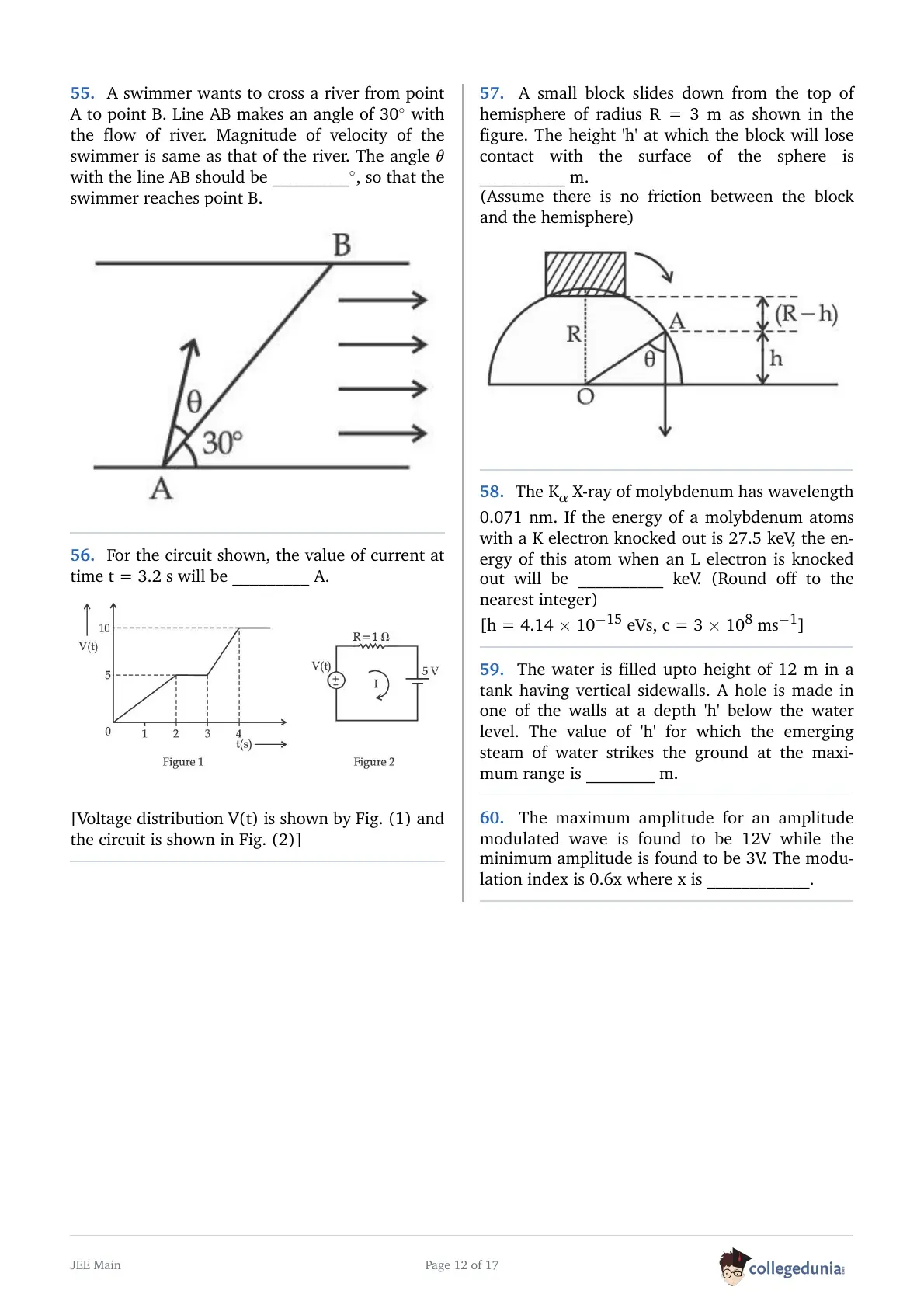
A swimmer wants to cross a river from point A to point B. Line AB makes an angle of 30\(^\circ\) with the flow of river. Magnitude of velocity of the swimmer is same as that of the river. The angle \(\theta\) with the line AB should be ________ \(^\circ\), so that the swimmer reaches point B. 
For the circuit shown, the value of current at time t=3.2 s will be ________ A. 
A small block slides down from the top of hemisphere of radius R=3 m as shown in the figure. The height 'h' at which the block will lose contact with the surface of the sphere is ________ m. (Assume there is no friction between the block and the hemisphere) 
The K\(_\alpha\) X-ray of molybdenum has wavelength 0.071 nm. If the energy of a molybdenum atom with a K electron knocked out is 27.5 keV, the energy of this atom when an L electron is knocked out will be ________ keV. (Round off to the nearest integer)
[ h = \(4.14 \times 10^{-15}\) eVs, c = \(3 \times 10^8\) ms\(^{-1}\) ]
The water is filled upto height of 12 m in a tank having vertical sidewalls. A hole is made in one of the walls at a depth 'h' below the water level. The value of 'h' for which the emerging stream of water strikes the ground at the maximum range is ________ m.
The maximum amplitude for an amplitude modulated wave is found to be 12 V while the minimum amplitude is found to be 3 V. The modulation index is 0.6x where x is ________ .
Chemistry - Section A (Q61 - Q80)
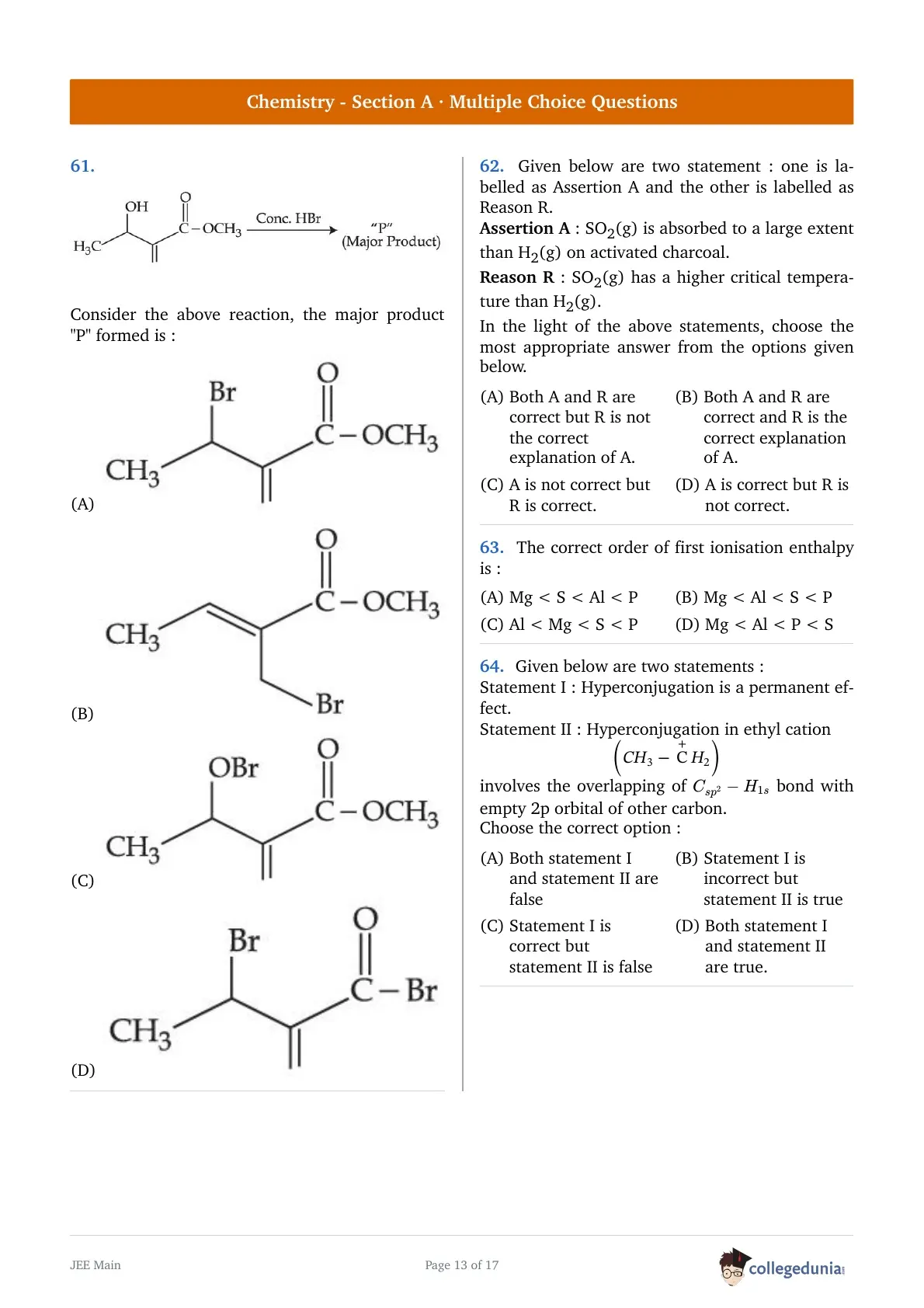
Consider the above reaction, the major product "P" formed is : 
Given below are two statements : one is labelled as Assertion A and the other is labelled as Reason R.
Assertion A : SO\(_2\)(g) is adsorbed to a larger extent than H\(_2\)(g) on activated charcoal.
Reason R : SO\(_2\)(g) has a higher critical temperature than H\(_2\)(g).
In the light of the above statements, choose the most appropriate answer from the options given below.
The CORRECT order of first ionisation enthalpy is :
Given below are two statements :
Statement I : Hyperconjugation is a permanent effect.
Statement II : Hyperconjugation in ethyl cation \( (\mathrm{CH_3-CH_2^+}) \) involves the overlapping of \( \mathrm{C_{sp^2}-H_{1s}} \) bond with empty \( 2p \) orbital of the other carbon.
Choose the correct option :
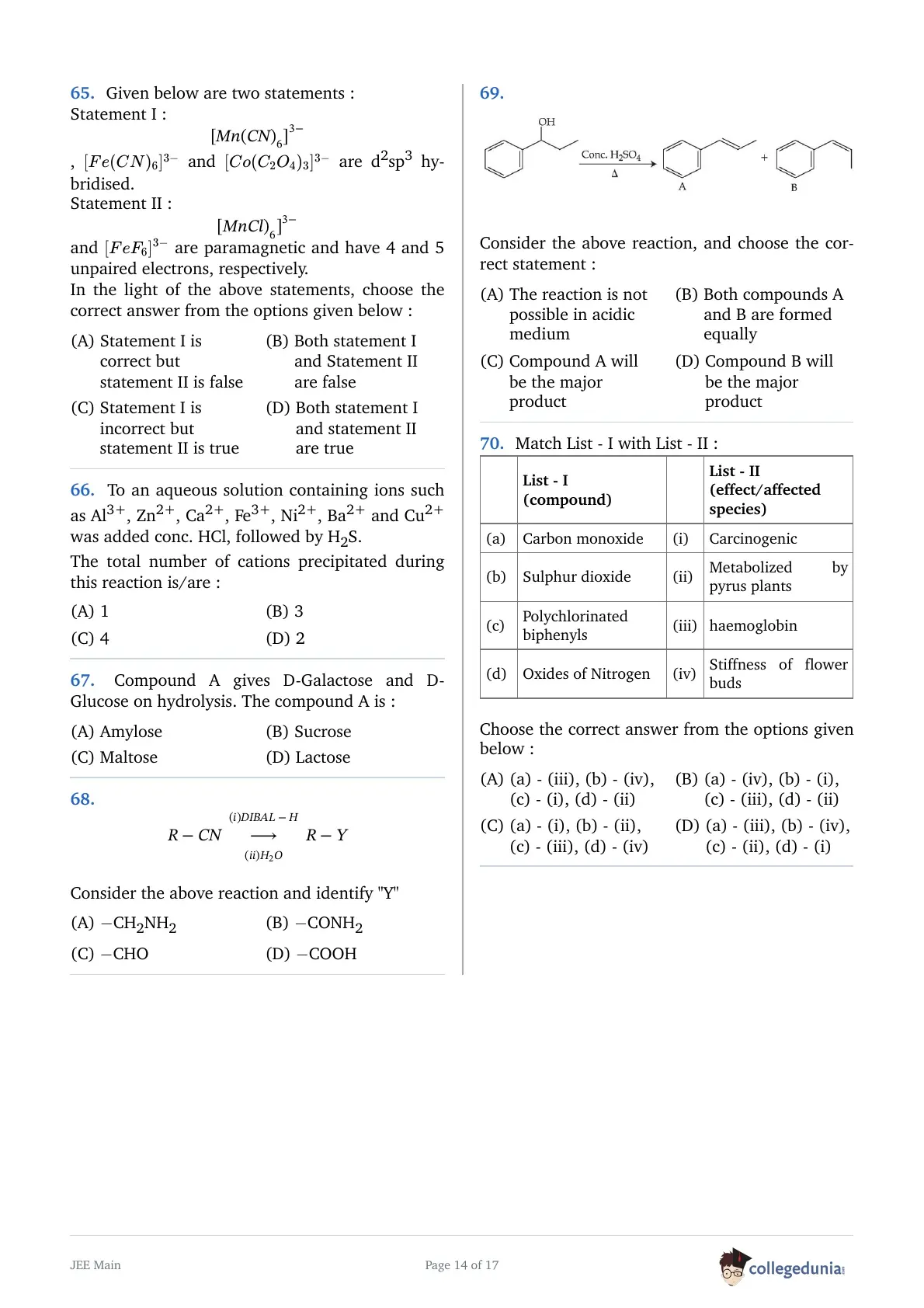
Given below are two statements :
Statement I : [Mn(CN)\(_6\)]\(^{3-}\), [Fe(CN)\(_6\)]\(^{3-}\) and [Co(C\(_2\)O\(_4\))\(_3\)]\(^{3-}\) are d\(^2\)sp\(^3\) hybridised.
Statement II : [MnCl\(_6\)]\(^{3-}\) and [FeF\(_6\)]\(^{3-}\) are paramagnetic and have 4 and 5 unpaired electrons, respectively.
Choose the correct option.
To an aqueous solution containing ions such as Al\(^{3+}\), Zn\(^{2+}\), Ca\(^{2+}\), Fe\(^{3+}\), Ni\(^{2+}\), Ba\(^{2+}\) and Cu\(^{2+}\) was added conc. HCl, followed by H\(_2\)S.
The total number of cations precipitated during this reaction is/are :
Compound A gives D-Galactose and D-Glucose on hydrolysis. The compound A is :
Consider the above reaction and identify "Y". 
Consider the above reaction, and choose the correct statement : 
Match List - I with List - II : 
Choose the correct answer from the options given below :
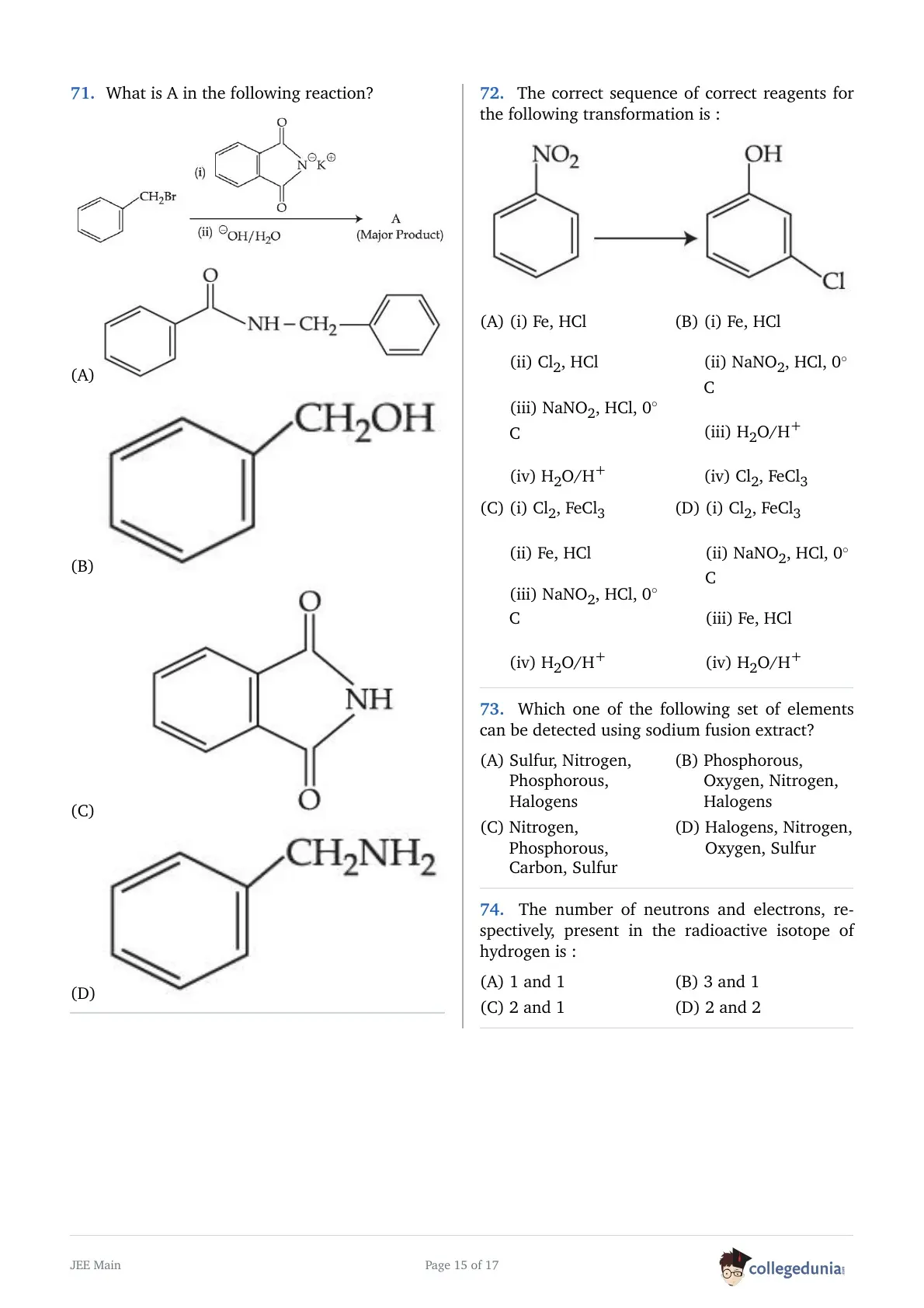
What is A in the following reaction ? 

The correct sequence of correct reagents for the following transformation is : 
Which one of the following set of elements can be detected using sodium fusion extract ?
The number of neutrons and electrons, respectively, present in the radioactive isotope of hydrogen is :
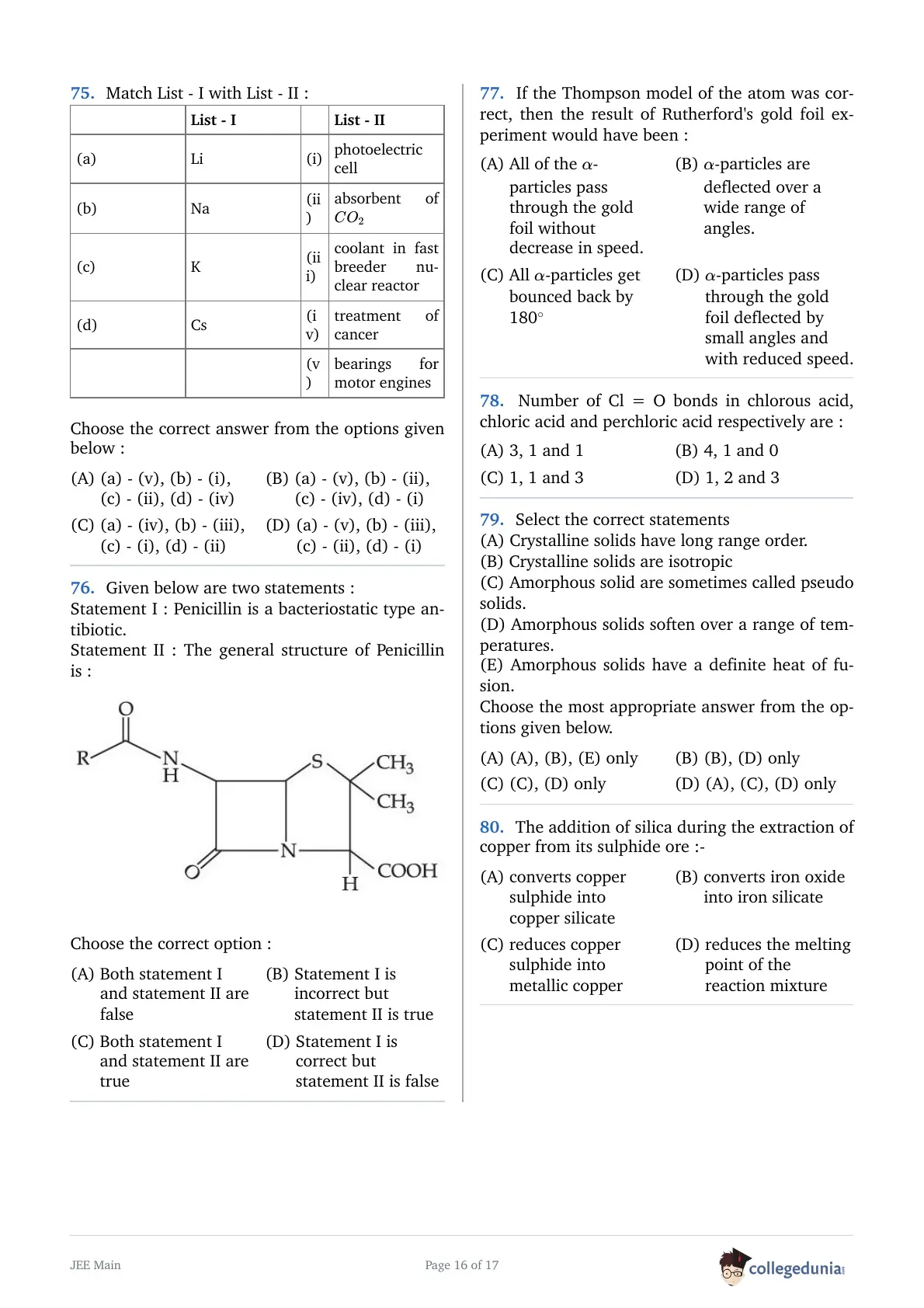
Match List - I with List - II : 
Choose the correct answer from the options given below :
Given below are two statements :
Statement I : Penicillin is a bacteriostatic type antibiotic.
Statement II : The general structure of Penicillin is :
Choose the correct option : 
If the Thompson model of the atom was correct, then the result of Rutherford's gold foil experiment would have been :
Number of Cl=O bonds in chlorous acid, chloric acid and perchloric acid respectively are :
Select the correct statements.
(A) Crystalline solids have long range order.
(B) Crystalline solids are isotropic.
(C) Amorphous solids are sometimes called pseudo solids.
(D) Amorphous solids soften over a range of temperatures.
(E) Amorphous solids have a definite heat of fusion.
Choose the most appropriate answer from the options given below :
The addition of silica during the extraction of copper from its sulphide ore
Chemistry - Section B (Q81 - Q90)
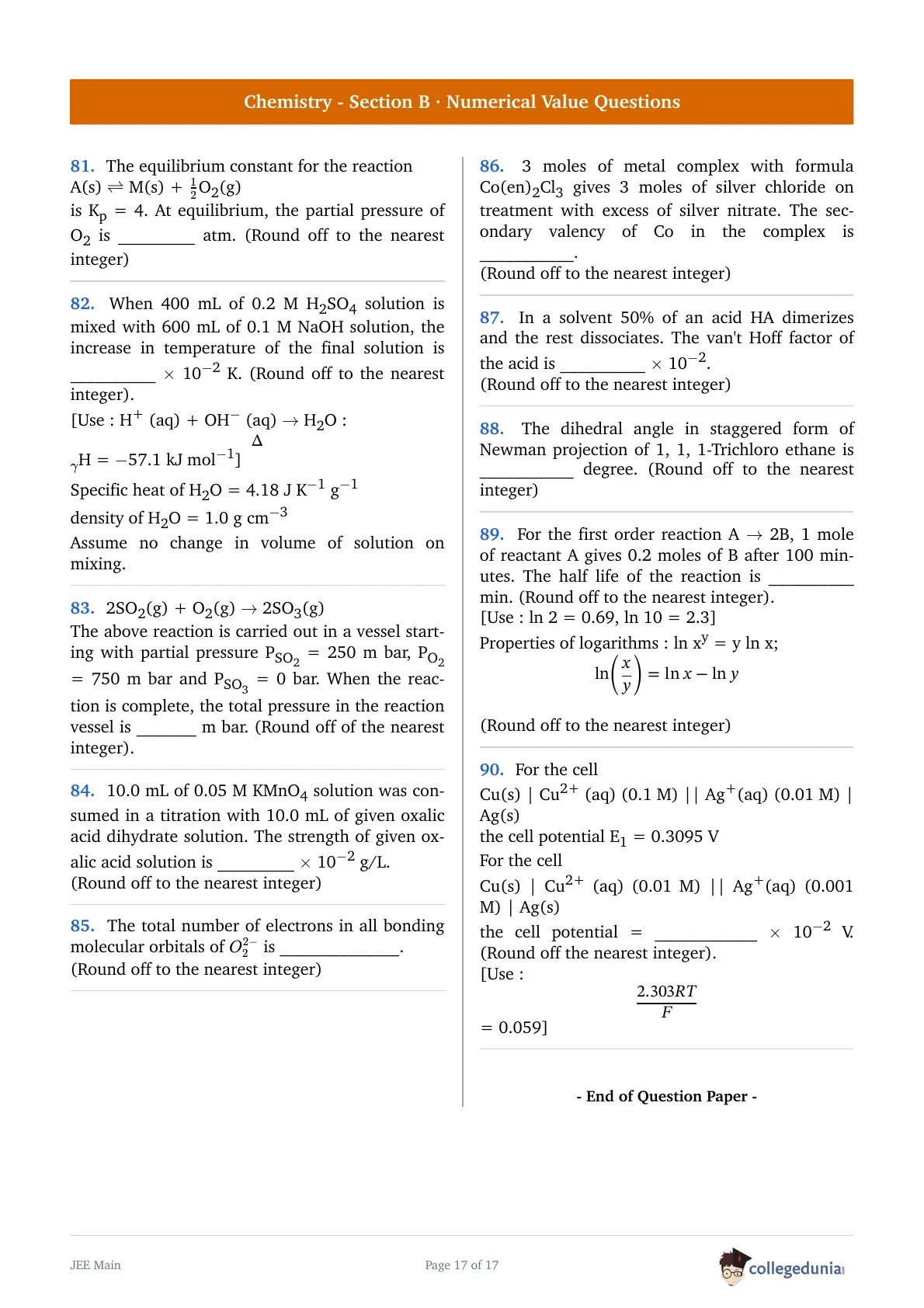
The equilibrium constant for the reaction
A(s) \(\rightleftharpoons\) M(s) + \(\frac{1}{2}\)O\(_2\)(g)
is K\(_p\)=4. At equilibrium, the partial pressure of O\(_2\) is ________ atm. (Round off to the Nearest Integer).
When 400 mL of 0.2 M H\(_2\)SO\(_4\) solution is mixed with 600 mL of 0.1 M NaOH solution, the increase in temperature of the final solution is ________ \(\times 10^{-2}\) K. (Round off to the Nearest Integer).
[Use : H\(^+\)(aq) + OH\(^-\)(aq) \(\rightarrow\) H\(_2\)O(l) ; \(\Delta_r H\) = -57.1 kJ mol\(^{-1}\)
Specific heat of H\(_2\)O = 4.18 J K\(^{-1}\) g\(^{-1}\)
density of H\(_2\)O = 1.0 g cm\(^{-3}\)
Assume no change in volume of solution on mixing.]
2SO\(_2\)(g) + O\(_2\)(g) \(\rightarrow\) 2SO\(_3\)(g)
The above reaction is carried out in a vessel starting with partial pressures P\(_{SO_2}\) = 250 m bar, P\(_{O_2}\) = 750 m bar and P\(_{SO_3}\) = 0 bar. When the reaction is complete, the total pressure in the reaction vessel is ________ m bar. (Round off to the Nearest Integer).
10.0 mL of 0.05 M KMnO\(_4\) solution was consumed in a titration with 10.0 mL of given oxalic acid dihydrate solution. The strength of given oxalic acid solution is ________ \(\times 10^{-2}\) g/L. (Round off to the Nearest Integer).
The total number of electrons in all bonding molecular orbitals of O\(_2^{2-}\) is ________.
(Round off to the Nearest Integer).
3 moles of metal complex with formula Co(en)\(_2\)Cl\(_3\) gives 3 moles of silver chloride on treatment with excess of silver nitrate. The secondary valency of Co in the complex is ________. (Round off to the Nearest Integer).
In a solvent 50% of an acid HA dimerizes and the rest dissociates. The van't Hoff factor of the acid is ________ \(\times 10^{-2}\). (Round off to the Nearest Integer).
The dihedral angle in staggered form of 1,1,1-Trichloro ethane is ________ degree. (Round off to the Nearest Integer).
For the first order reaction \(A \rightarrow 2B\), 1 mole of reactant A gives
0.2 moles of B after 100 minutes. The half life of the reaction is ________ min.
(Round off to the Nearest Integer).
For the cell Cu(s)|Cu\(^{2+}\)(aq) (0.1 M)||Ag\(^+\)(aq) (0.01 M)|Ag(s) the cell potential E\(_1\) = 0.3095 V
For the cell Cu(s)|Cu\(^{2+}\)(aq) (0.01 M)||Ag\(^+\)(aq) (0.001 M)|Ag(s) the cell potential = ________ \(\times 10^{-2}\) V. (Round off to the Nearest Integer).
[Use : \(\frac{2.303 RT}{F} = 0.059\)]
JEE Main 2021 Exam Pattern and Marking Scheme
| Particulars | Details |
|---|---|
| Exam Mode | Online (Computer-Based Test) |
| Paper | B.E./B.Tech (Paper 1) |
| Duration | 3 hours (180 minutes) |
| Type of Questions | Multiple Choice Questions (MCQs) + Numerical Value Questions |
| Subjects | Mathematics, Physics, Chemistry |
| Total Questions | 90 questions (75 to be attempted) |
| Total Marks | 300 marks |
| Marking Scheme | +4 for correct answer & -1 for incorrect MCQ; no negative marking for Numerical Value Questions |
JEE Main 2021 July 27 Shift 2 Difficulty Level
JEE Main 2021 B.E./B.Tech Question Paper - July 27, 2021- Afternoon Session was considered to be of above-average difficulty by the expert coaching institutions. The difficulty level was raised significantly by the Mathematics section which included complex and lengthy calculative questions, especially from Coordinate Geometry, Differential Calculus, and Integral Calculus. The physics section was just behind Mathematics on the difficulty scale, featuring a few complex problems related to Thermodynamics and Relative Motion. Chemistry, the easiest section of the three, prioritized Organic Chemistry II and Inorganic Chemistry II.
JEE Main 2021 B.E./B.Tech Question Paper July 27 (AN): Paper Analysis
JEE Main 2021 B.E./B.Tech Paper on July 27 Afternoon Session was conducted between 3.00 PM to 6.00 PM. The unit-wise JEE Main Paper Analysis is as follows:
| Subject | Topic | Number of Questions |
|---|---|---|
| Physics | Electrodynamics | 6 |
| Heat and Thermodynamics | 3 | |
| Mechanics | 10 | |
| Modern Physics | 5 | |
| Optics | 3 | |
| SHM and Waves | 3 | |
| Chemistry | Inorganic Chemistry I | 5 |
| Inorganic Chemistry II | 2 | |
| Organic Chemistry I | 2 | |
| Organic Chemistry II | 9 | |
| Physical Chemistry I | 4 | |
| Physical Chemistry II | 8 | |
| Mathematics | Binomial Theorem | 2 |
| Complex Numbers | 1 | |
| Coordinate Geometry | 3 | |
| Differential Calculus | 5 | |
| Integral Calculus | 4 | |
| Permutation and Combination | 2 | |
| Sequence and Series | 1 | |
| Vector and 3D | 2 | |
| Statistics | 1 | |
| Probability | 3 | |
| Quadratic Equations | 2 | |
| Trigonometry | 2 | |
| Matrix and Determinants | 2 |



Comments