




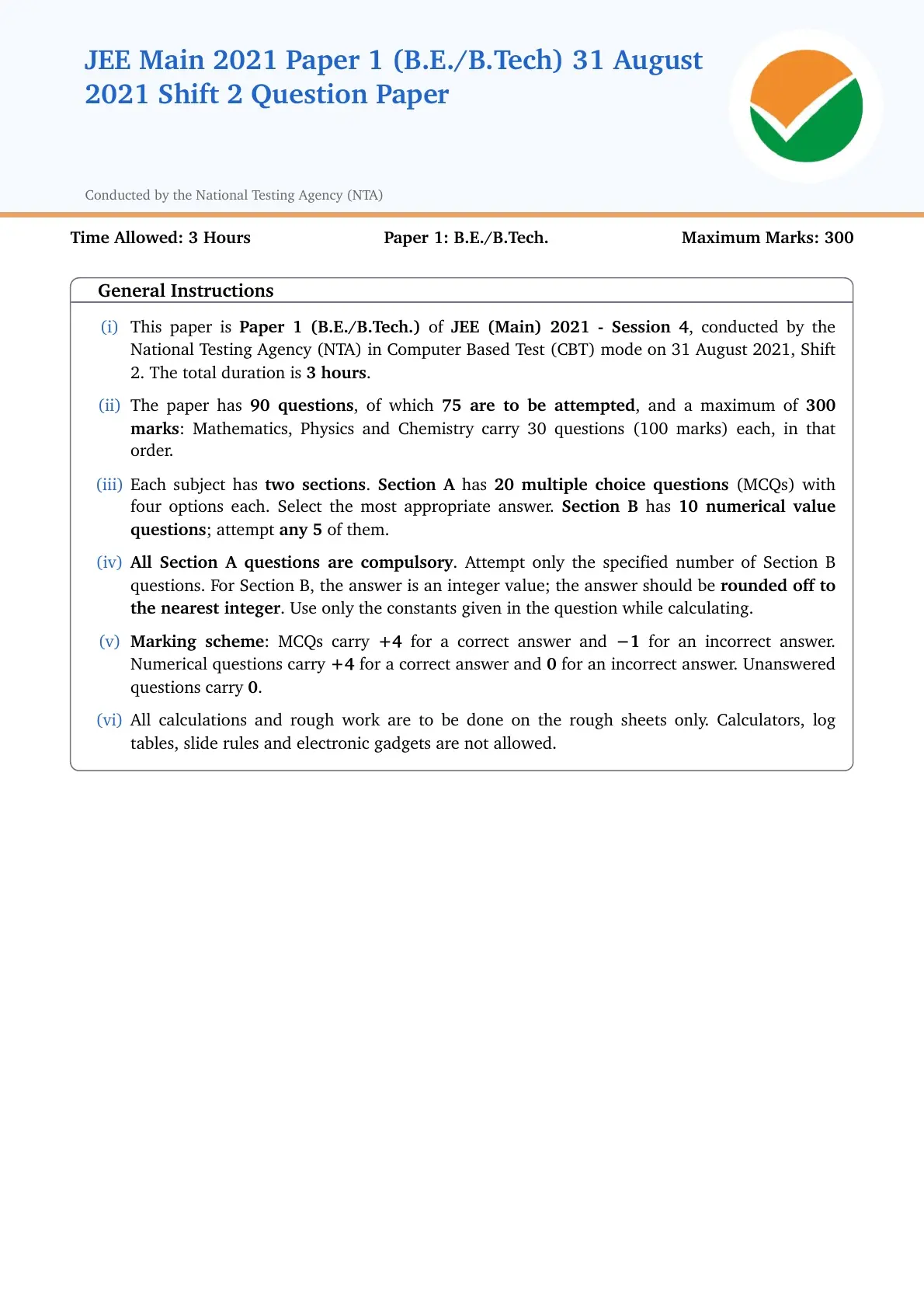
JEE Main 2021 August 31 Shift 2 Question Paper is available here with solutions PDF and detailed solutions for every question. NTA conducted the second shift on August 31, 2021, from 3:00 PM to 6:00 PM. The JEE Main 2021 Paper 1 (B.E./B.Tech) question paper includes the following:
- 90 questions in a 3-hour CBT Mode: 30 each from Mathematics, Physics and Chemistry (75 to be attempted)
- Section A: 20 multiple choice questions (MCQs) per subject, all compulsory, 4 marks each
- Section B: 10 numerical value questions per subject, any 5 to be attempted, 4 marks each
- Marking: +4 for a correct answer, -1 for an incorrect MCQ, 0 for an unattempted question; no negative marking for numerical value questions
- Maximum marks: 300 (100 per subject)
JEE Main 2021 August 31 Shift 2 Question Paper with Solution PDF
| NTA Official PDF | CD PDF | CD PDF with Solutions |
|---|---|---|
| Download official PDF 6.55 MB | Download Collegedunia PDF 1.16 MB | Download solutions PDF 1.10 MB |
Also Check:
JEE Main 2021 August 31 Shift 2 Questions with Solutions
Mathematics - Section A (Q1 - Q20)
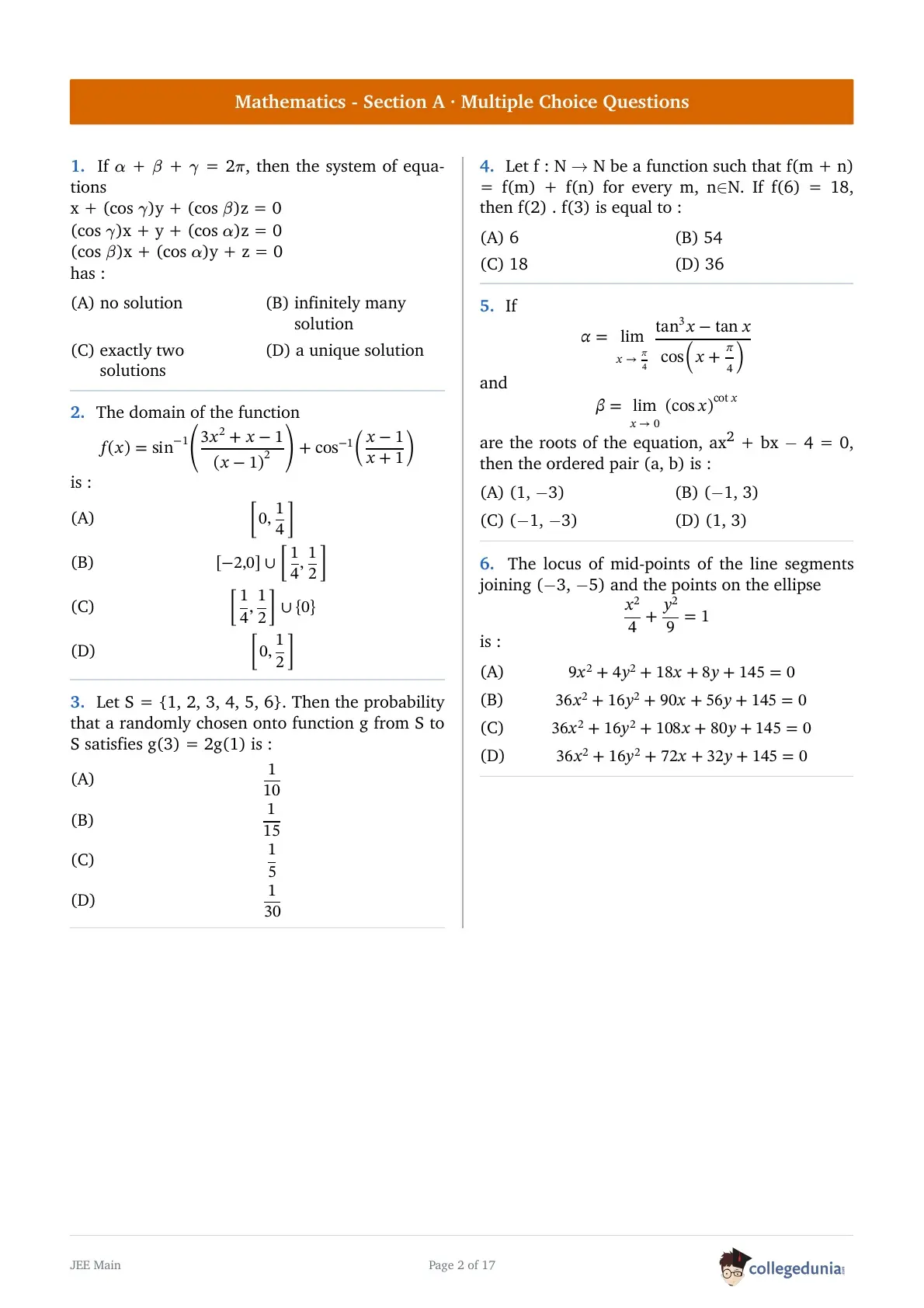
If \( \alpha + \beta + \gamma = 2\pi \), then the system of equations
\( x + (\cos \gamma)y + (\cos \beta)z = 0 \)
\( (\cos \gamma)x + y + (\cos \alpha)z = 0 \)
\( (\cos \beta)x + (\cos \alpha)y + z = 0 \)
has :
The domain of the function \(f(x) = \sin^{-1} \left( \frac{3x^2 + x - 1}{(x - 1)^2} \right) + \cos^{-1} \left( \frac{x - 1}{x + 1} \right)\) is :
Let \(S = \{1, 2, 3, 4, 5, 6\}\). Then the probability that a randomly chosen onto function \(g\) from \(S\) to \(S\) satisfies \(g(3) = 2g(1)\) is :
Let \( f : \mathbb{N} \to \mathbb{N} \) be a function such that \( f(m + n) = f(m) + f(n) \) for every \( m, n \in \mathbb{N} \). If \( f(6) = 18 \), then \( f(2) \cdot f(3) \) is equal to :
If \( \alpha = \lim_{x \to \pi/4} \frac{\tan^3 x - \tan x}{\cos(x + \frac{\pi}{4})} \) and \( \beta = \lim_{x \to 0} (\cos x)^{\cot x} \) are the roots of the equation, \( ax^2 + bx - 4 = 0 \), then the ordered pair \( (a, b) \) is :
The locus of mid-points of the line segments joining \( (-3, -5) \) and the points on the ellipse \( \frac{x^2}{4} + \frac{y^2}{9} = 1 \) is :
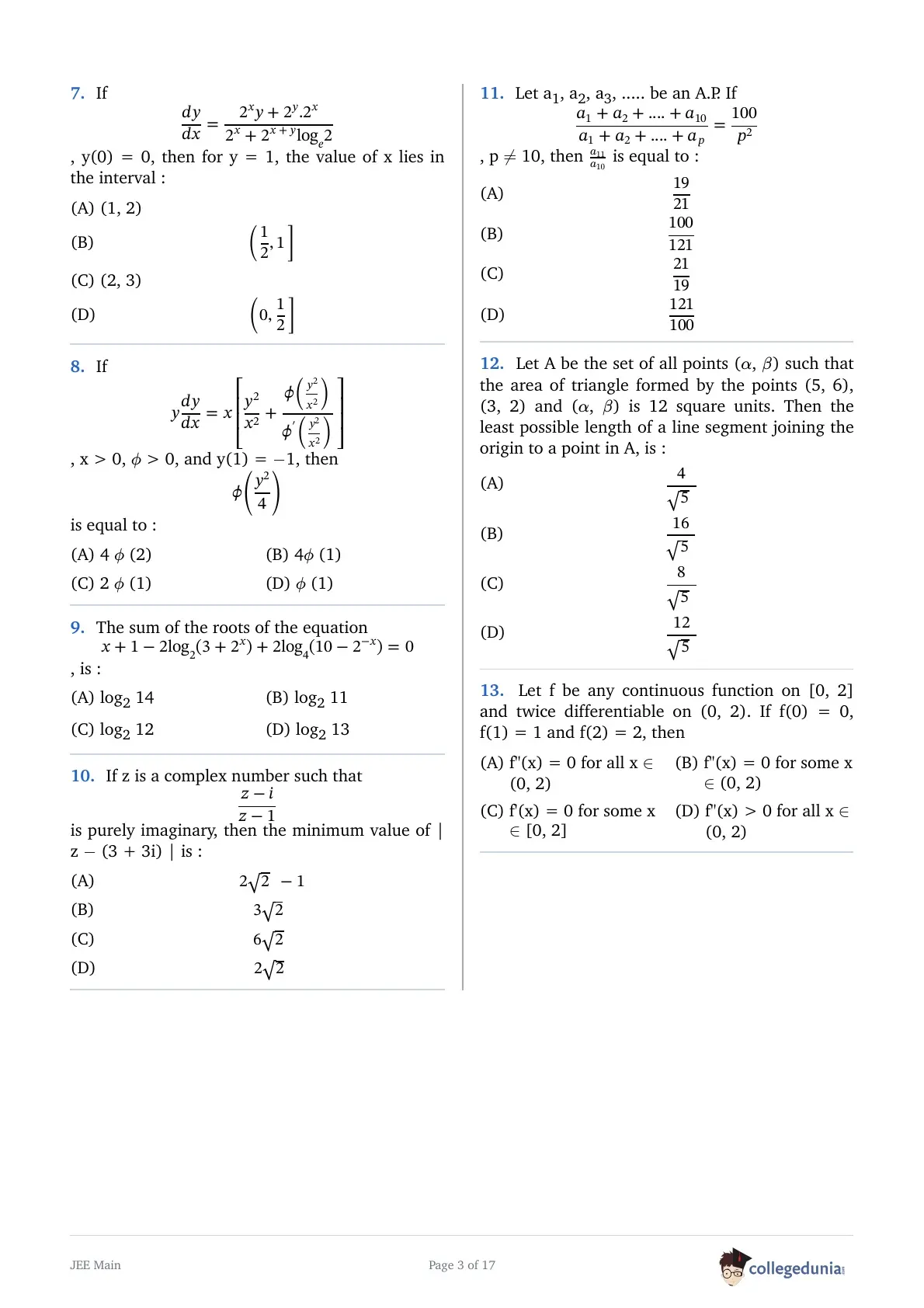
If \( \frac{dy}{dx} = \frac{2^x y + 2^y \cdot 2^x}{2^x + 2^{x+y} \log_e 2}, y(0) = 0 \), then for \( y = 1 \), the value of \( x \) lies in the interval :
If \( y \frac{dy}{dx} = x \left[ \frac{\phi(y^2/x^2)}{\phi'(y^2/x^2)} + \frac{y^2}{x^2} \right], x>0, \phi>0, \) and \( y(1) = -1 \), then \( \phi\left(\frac{y^2}{4}\right) \) is equal to :
The sum of the roots of the equation, \( x + 1 - 2\log_2(3 + 2^x) + 2\log_4(10 - 2^{-x}) = 0 \), is :
If \( z \) is a complex number such that \( \frac{z - i}{z - 1} \) is purely imaginary, then the minimum value of \( |z - (3 + 3i)| \) is :
Let \( a_1, a_2, a_3, \dots \) be an A.P. If \( \frac{a_1 + a_2 + \dots + a_{10}}{a_1 + a_2 + \dots + a_p} = \frac{100}{p^2}, p \neq 10 \), then \( \frac{a_{11}}{a_{10}} \) is equal to :
Let \( A \) be the set of all points \( (\alpha, \beta) \) such that the area of triangle formed by the points \( (5, 6), (3, 2) \) and \( (\alpha, \beta) \) is 12 square units. Then the least possible length of a line segment joining the origin to a point in \( A \), is :
Let \( f \) be any continuous function on \( [0, 2] \) and twice differentiable on \( (0, 2) \). If \( f(0) = 0, f(1) = 1 \) and \( f(2) = 2 \), then :
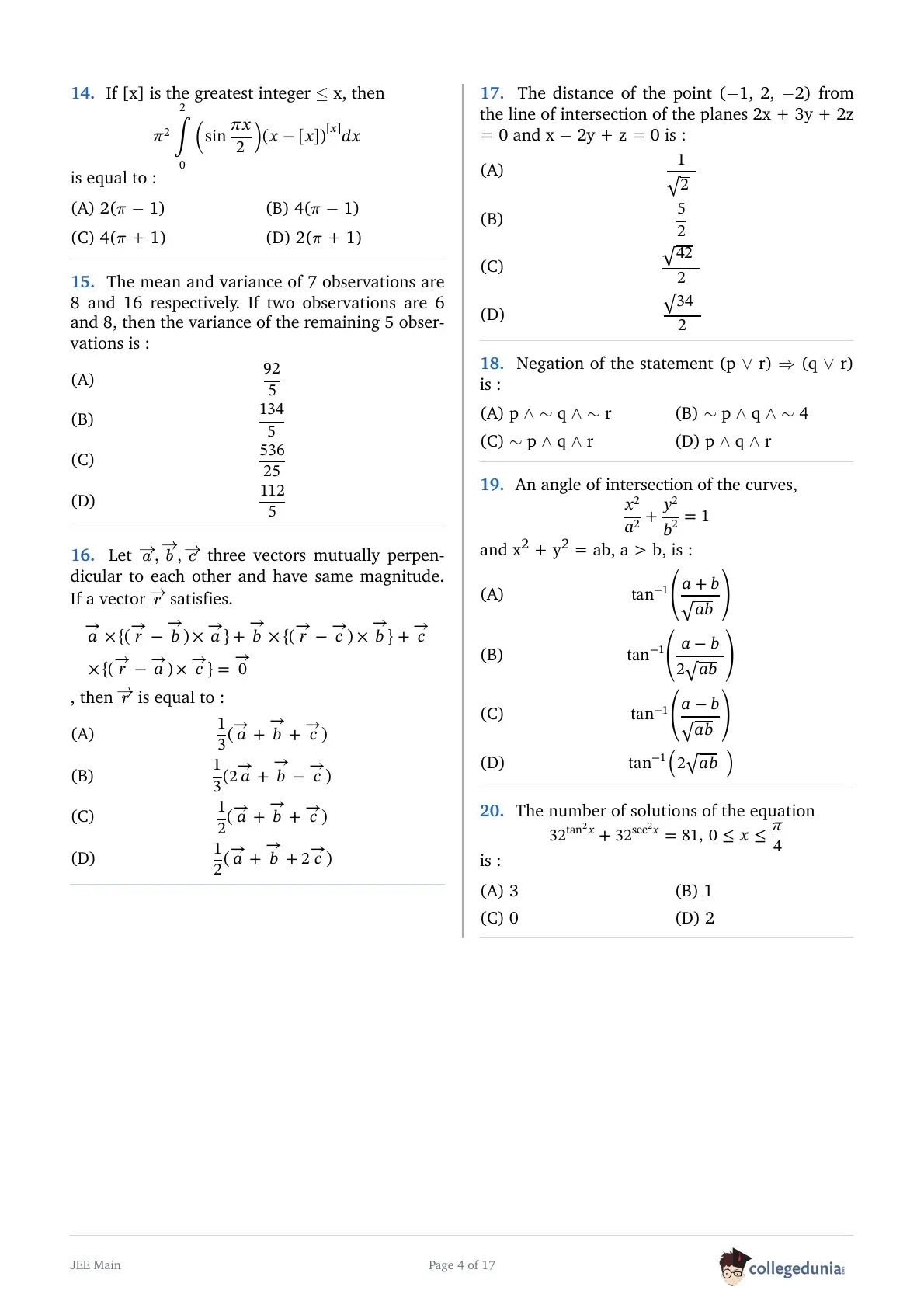
If \( [x] \) is the greatest integer \( \le x \), then \( \pi^2 \int_{0}^{2} \left( \sin \frac{\pi x}{2} \right) (x - [x])^{[x]} dx \) is equal to :
The mean and variance of 7 observations are 8 and 16 respectively. If two observations are 6 and 8, then the variance of the remaining 5 observations is :
Let \(\vec{a}, \vec{b}, \vec{c}\) be three vectors mutually perpendicular to each other and have same magnitude. If a vector \(\vec{r}\) satisfies \(\vec{a} \times \{(\vec{r} - \vec{b}) \times \vec{a}\} + \vec{b} \times \{(\vec{r} - \vec{c}) \times \vec{b}\} + \vec{c} \times \{(\vec{r} - \vec{a}) \times \vec{c}\} = \vec{0}\), then \(\vec{r}\) is equal to :
The distance of the point \((-1, 2, -2)\) from the line of intersection of the planes \(2x + 3y + 2z = 0\) and \(x - 2y + z = 0\) is :
Negation of the statement \((p \lor r) \implies (q \lor r)\) is :
An angle of intersection of the curves, \( \frac{x^2}{a^2} + \frac{y^2}{b^2} = 1 \) and \( x^2 + y^2 = ab, a>b \), is :
The number of solutions of the equation \(32^{\tan^2 x} + 32^{\sec^2 x} = 81\), \(0 \le x \le \frac{\pi}{4}\) is :
Mathematics - Section B (Q21 - Q30)
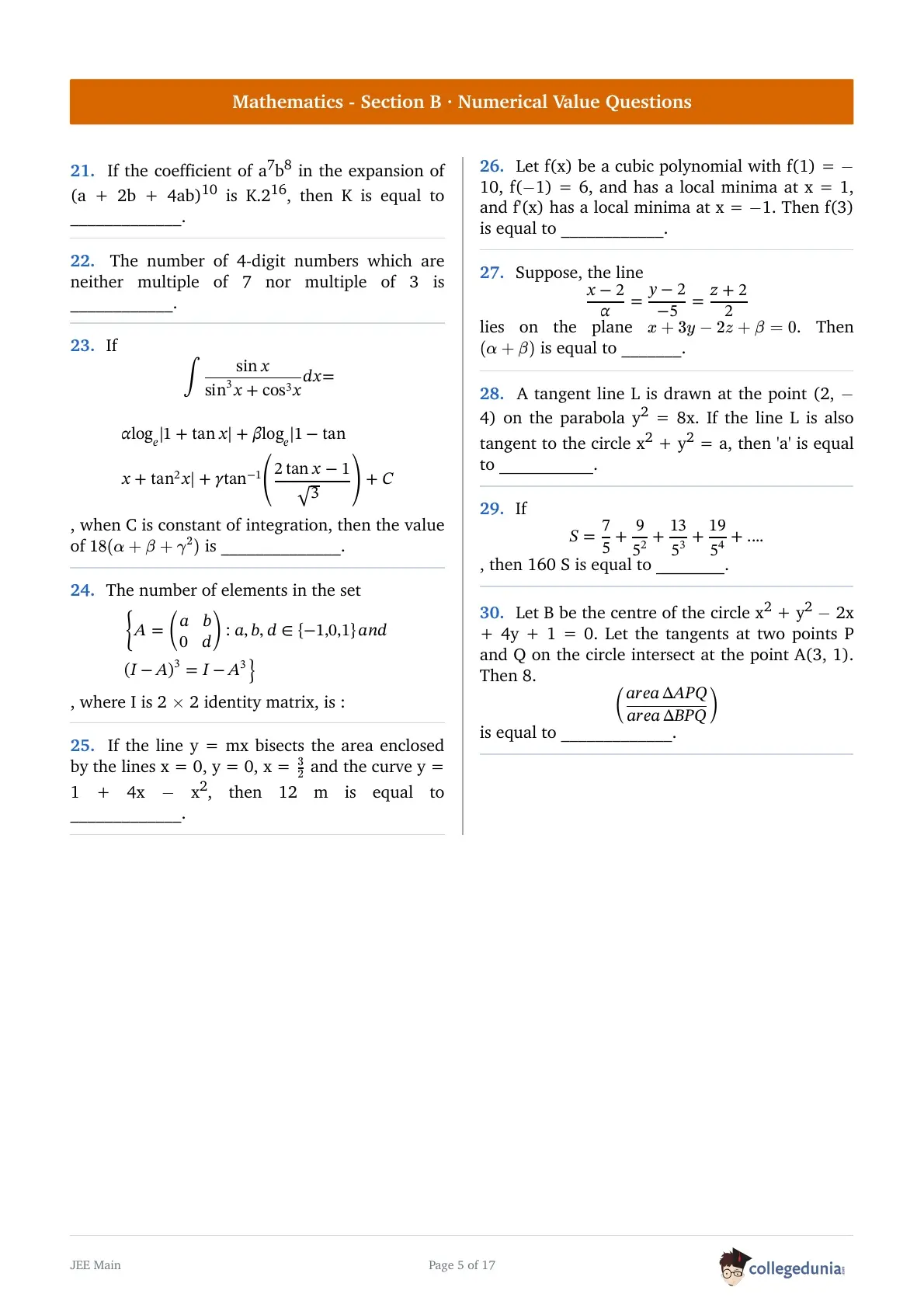
If the coefficient of \( a^7b^8 \) in the expansion of \( (a + 2b + 4ab)^{10} \) is \( K \cdot 2^{16} \), then K is equal to _________.
The number of 4-digit numbers which are neither multiple of 7 nor multiple of 3 is _________.
If \( \int \frac{\sin x}{\sin^3 x + \cos^3 x} dx = \alpha \log_e |1 + \tan x| + \beta \log_e |1 - \tan x + \tan^2 x| + \gamma \tan^{-1} \left( \frac{2 \tan x - 1}{\sqrt{3}} \right) + C \), when C is a constant of integration, then the value of \( 18(\alpha + \beta + \gamma^2) \) is _________.
The number of elements in the set
\[ \left\{ A = \begin{pmatrix} a & b \\ 0 & d \end{pmatrix} : a, b, d \in \{-1, 0, 1\} \text{ and } (I - A)^3 = I - A^3 \right\}, \]
where \( I \) is the \( 2 \times 2 \) identity matrix, is _________.
If the line \( y = mx \) bisects the area enclosed by the lines \( x = 0, y = 0, x = \frac{3}{2} \) and the curve \( y = 1 + 4x - x^2 \), then 12 m is equal to _________.
Let \( f(x) \) be a cubic polynomial with \( f(1) = -10 \), \( f(-1) = 6 \), and has a local minima at \( x = 1 \), and \( f'(x) \) has a local minima at \( x = -1 \). Then \( f(3) \) is equal to _________.
Suppose the line \(\frac{x - 2}{\alpha} = \frac{y - 2}{-5} = \frac{z + 2}{2}\) lies on the plane \(x + 3y - 2z + \beta = 0\). Then \((\alpha + \beta)\) is equal to _________.
A tangent line L is drawn at the point \( (2, -4) \) on the parabola \( y^2 = 8x \). If the line L is also tangent to the circle \( x^2 + y^2 = a \), then 'a' is equal to _________.
If \( S = \frac{7}{5} + \frac{9}{5^2} + \frac{13}{5^3} + \frac{19}{5^4} + ... \), then 160 S is equal to _________.
Let B be the centre of the circle \( x^2 + y^2 - 2x + 4y + 1 = 0 \). Let the tangents at two points P and Q on the circle intersect at the point \( A(3, 1) \). Then \( 8 \cdot \frac{\text{area } \Delta APQ}{\text{area } \Delta BPQ} \) is equal to _________.
Physics - Section A (Q31 - Q50)
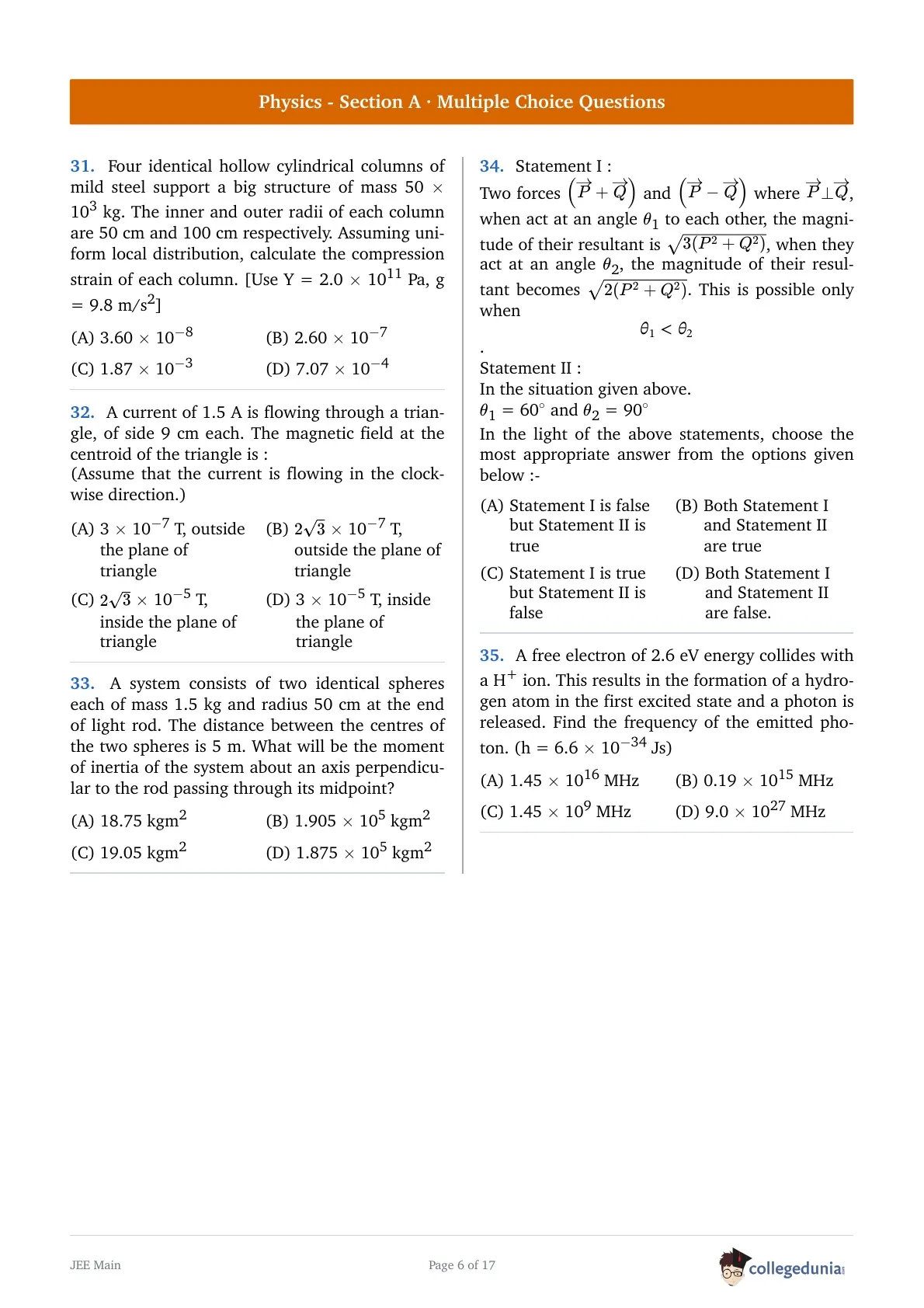
Four identical hollow cylindrical columns of mild steel support a big structure of mass \(50 \times 10^3\,\text{kg}\). The inner and outer radii of each column are 50 cm and 100 cm respectively. Assuming uniform local load distribution, calculate the compression strain of each column. [use \(Y = 2.0 \times 10^{11}\,\text{Pa}\), \(g = 9.8\,\text{m/s}^2\)]
A current of 1.5 A is flowing through a triangle, of side 9 cm each. The magnetic field at the centroid of the triangle is : (Assume that the current is flowing in the clockwise direction.)
A system consists of two identical spheres each of mass 1.5 kg and radius 50 cm at the ends of a light rod. The distance between the centres of the two spheres is 5 m. What will be the moment of inertia of the system about an axis perpendicular to the rod passing through its midpoint ?
Statement I : Two forces \((\vec{p} + \vec{q})\) and \((\vec{p} - \vec{q})\) where \(\vec{p} \perp \vec{q}\), when act at an angle \(\theta_1\) to each other, the magnitude of their resultant is \(\sqrt{3(p^2 + q^2)}\), when they act at an angle \(\theta_2\), the magnitude of their resultant becomes \(\sqrt{2(p^2 + q^2)}\). This is possible only when \(\theta_1<\theta_2\).
Statement II : In the situation given above, \(\theta_1 = 60^{\circ}\) and \(\theta_2 = 90^{\circ}\).
In the light of the above statements, choose the most appropriate answer from the options given below :
A free electron of 2.6 eV energy collides with a \(H^+\) ion. This results in the formation of a hydrogen atom in the first excited state and a photon is released. Find the frequency of the emitted photon. (\(h = 6.6 \times 10^{-34}\) J s)
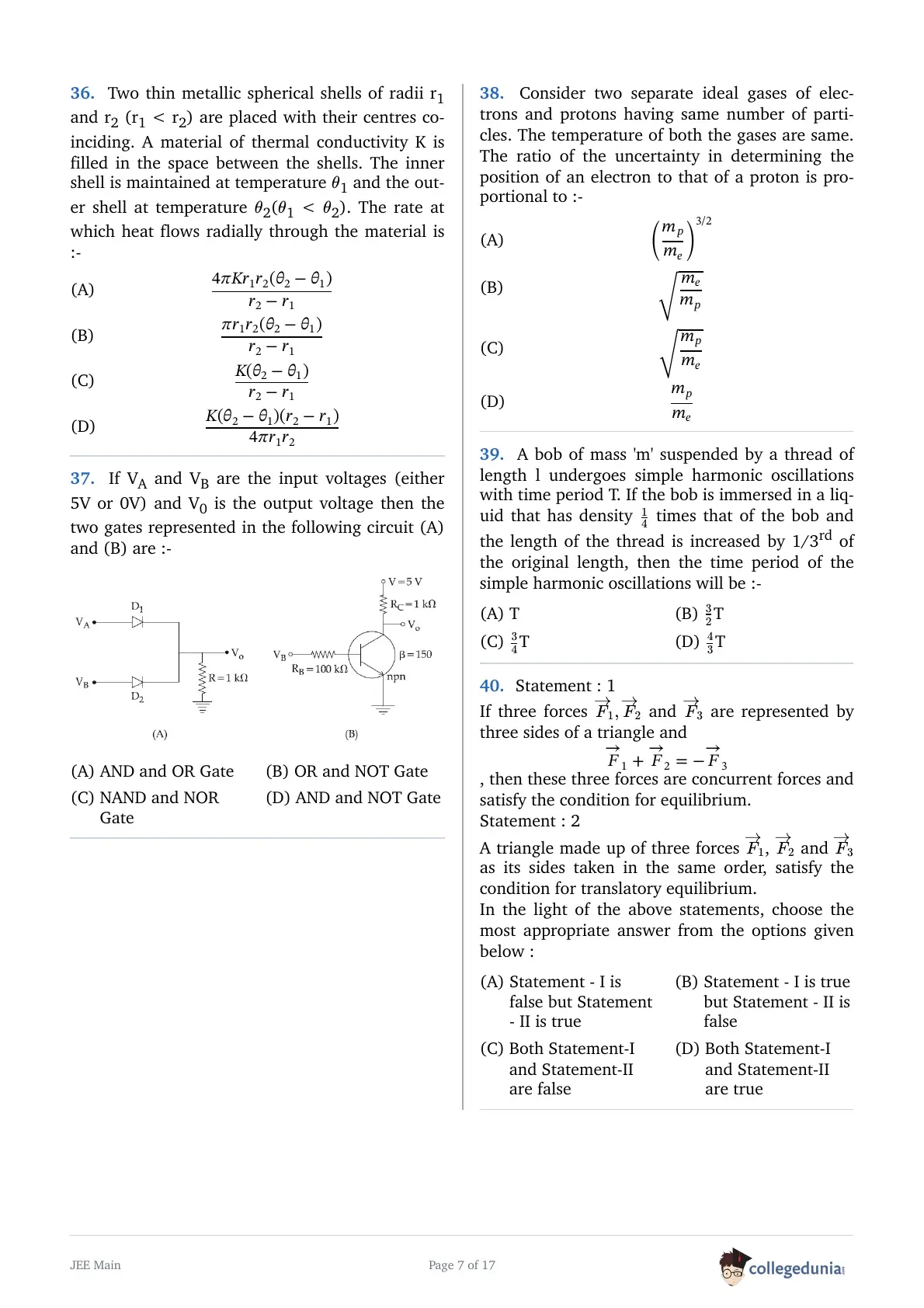
Two thin metallic spherical shells of radii \(r_1\) and \(r_2\) (\(r_1<r_2\)) are placed with their centres coinciding. A material of thermal conductivity K is filled in the space between the shells. The inner shell is maintained at temperature \(\theta_1\) and the outer shell at temperature \(\theta_2\) (\(\theta_1<\theta_2\)). The rate at which heat flows radially through the material is :
If \(V_A\) and \(V_B\) are the input voltages (either 5 V or 0 V) and \(V_o\) is the output voltage then the two gates represented in the following circuits (A) and (B) are :
\begin{center}
\includegraphics[width=0.5\textwidth]{logic_gates}
\end{center}
Consider two separate ideal gases of electrons and protons having same number of particles. The temperature of both the gases are same. The ratio of the uncertainty in determining the position of an electron to that of a proton is proportional to :
A bob of mass 'm' suspended by a thread of length \(l\) undergoes simple harmonic oscillations with time period T. If the bob is immersed in a liquid that has density \(\frac{1}{4}\) times that of the bob and the length of the thread is increased by \(1/3^{rd}\) of the original length, then the time period of the simple harmonic oscillations will be :
Statement I : If three forces \(\vec{F_1}\), \(\vec{F_2}\) and \(\vec{F_3}\) are represented by three sides of a triangle and \(\vec{F_1} + \vec{F_2} = -\vec{F_3}\), then these three forces are concurrent forces and satisfy the condition for equilibrium.
Statement II : A triangle made up of three forces \(\vec{F_1}\), \(\vec{F_2}\) and \(\vec{F_3}\) as its sides taken in the same order, satisfy the condition for translatory equilibrium.
In the light of the above statements, choose the most appropriate answer from the options given below :
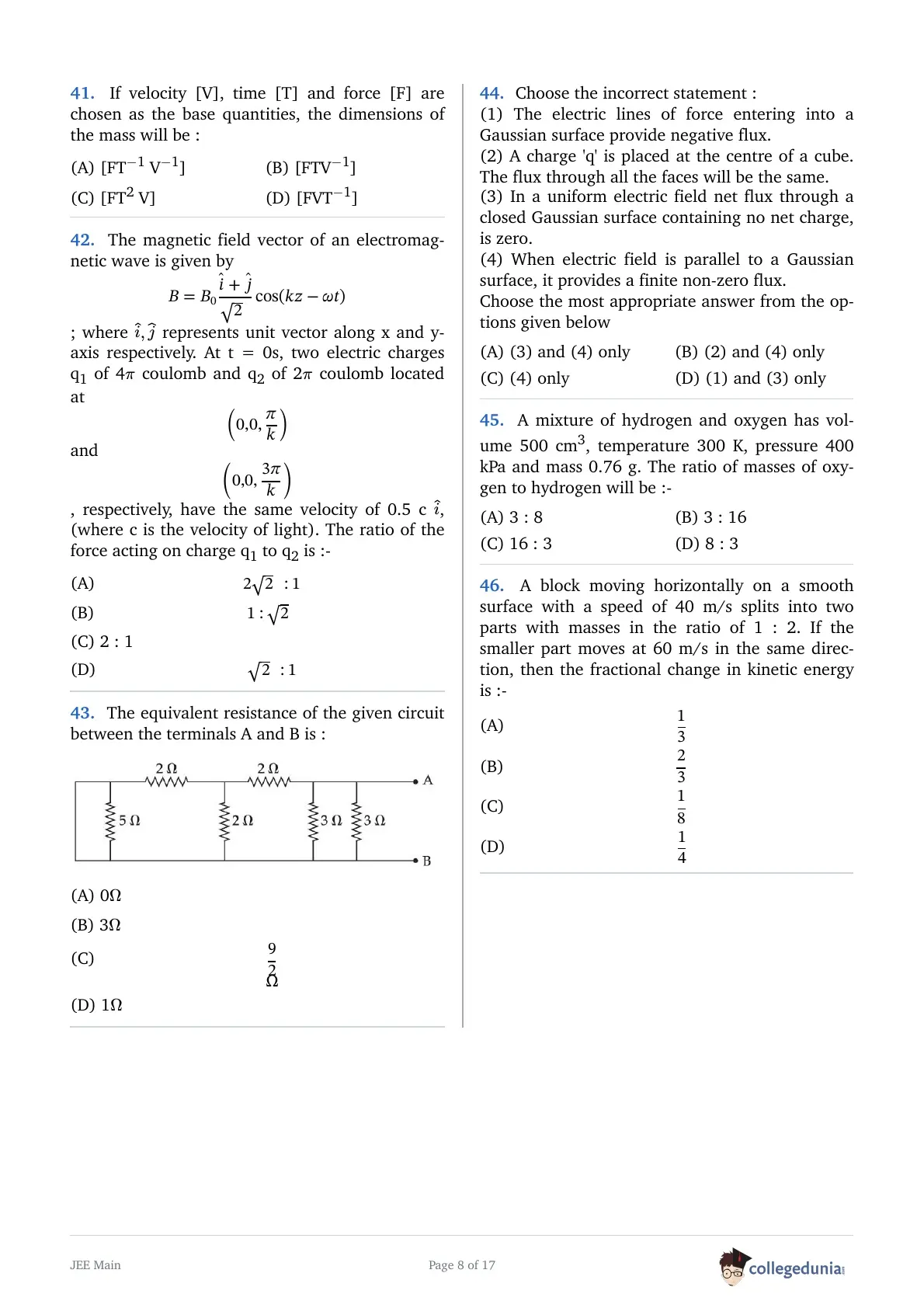
If velocity [V] time [T] and force [F] are chosen as the base quantities, the dimensions of the mass will be :
The magnetic field vector of an electromagnetic wave is given by \( \vec{B} = B_0 \frac{\hat{i} + \hat{j}}{\sqrt{2}} \cos(kz - \omega t) \); where \(\hat{i}, \hat{j}\) represents unit vector along x and y-axis respectively. At \(t = 0\) s, two electric charges \(q_1\) of \(4\pi\) coulomb and \(q_2\) of \(2\pi\) coulomb located at \((0, 0, \frac{\pi}{k})\) and \((0, 0, \frac{3\pi}{k})\), respectively, have the same velocity of \(0.5\,c\,\hat{i}\), (where c is the velocity of light). The ratio of the force acting on charge \(q_1\) to \(q_2\) is :
The equivalent resistance of the given circuit between the terminals A and B is : 
Choose the incorrect statement :
(a) The electric lines of force entering into a Gaussian surface provide negative flux.
(b) A charge 'q' is placed at the centre of a cube. The flux through all the faces will be the same.
(c) In a uniform electric field net flux through a closed Gaussian surface containing no net charge, is zero.
(d) When electric field is parallel to a Gaussian surface, it provides a finite non-zero flux.
Choose the most appropriate answer from the options given below :
A mixture of hydrogen and oxygen has volume 500 \(cm^3\), temperature 300 K, pressure 400 kPa and mass 0.76 g. The ratio of masses of oxygen to hydrogen will be :
A block moving horizontally on a smooth surface with a speed of 40 m/s splits into two parts with masses in the ratio of \(1 : 2\). If the smaller part moves at 60 m/s in the same direction, then the fractional change in kinetic energy is :
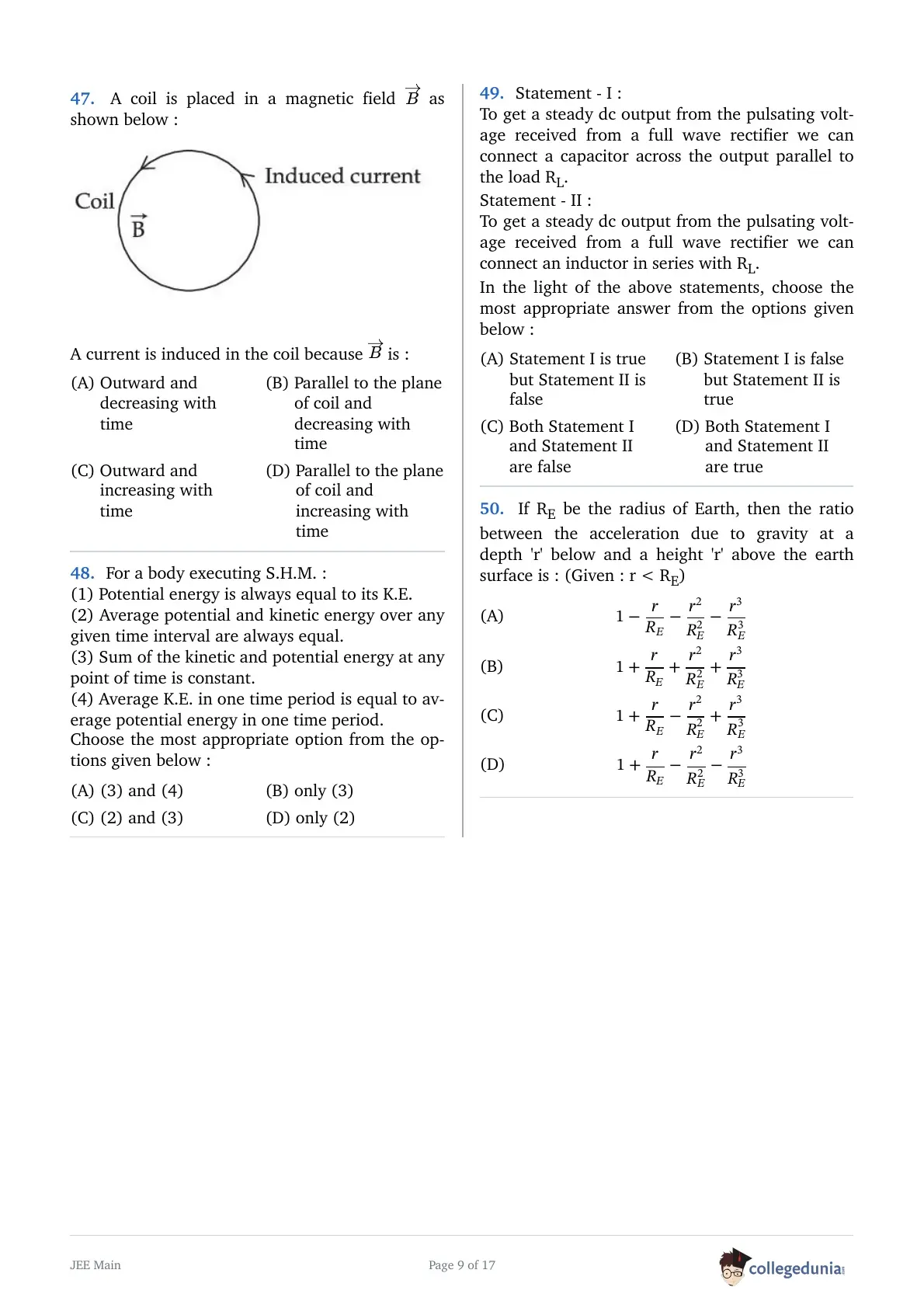
A coil is placed in a magnetic field \(\vec{B}\) as shown below :
A current is induced in the coil because \(\vec{B}\) is :
For a body executing S.H.M. :
(a) Potential energy is always equal to its K.E.
(b) Average potential and kinetic energy over any given time interval are always equal.
(c) Sum of the kinetic and potential energy at any point of time is constant.
(d) Average K.E. in one time period is equal to average potential energy in one time period.
Choose the most appropriate option from the options given below :
Statement I : To get a steady dc output from the pulsating voltage received from a full wave rectifier we can connect a capacitor across the output parallel to the load \(R_L\).
Statement II : To get a steady dc output from the pulsating voltage received from a full wave rectifier we can connect an inductor in series with \(R_L\).
In the light of the above statements, choose the most appropriate answer from the options given below :
If \(R_E\) be the radius of Earth, then the ratio between the acceleration due to gravity at a depth 'r' below and a height 'r' above the earth surface is : (Given : \(r<R_E\))
Physics - Section B (Q51 - Q60)
A parallel plate capacitor of capacitance 200 \(\mu F\) is connected to a battery of 200 V. A dielectric slab of dielectric constant 2 is now inserted into the space between plates of capacitor while the battery remains connected. The change in the electrostatic energy in the capacitor will be ________ J.
A long solenoid with 1000 turns/m has a core material with relative permeability 500 and volume \(10^3\) cm\(^3\). If the core material is replaced by another material having relative permeability of 750 with same volume maintaining same current of 0.75 A in the solenoid, the fractional change in the magnetic moment of the core would be approximately \(\left( \frac{x}{499} \right)\). Find the value of x.
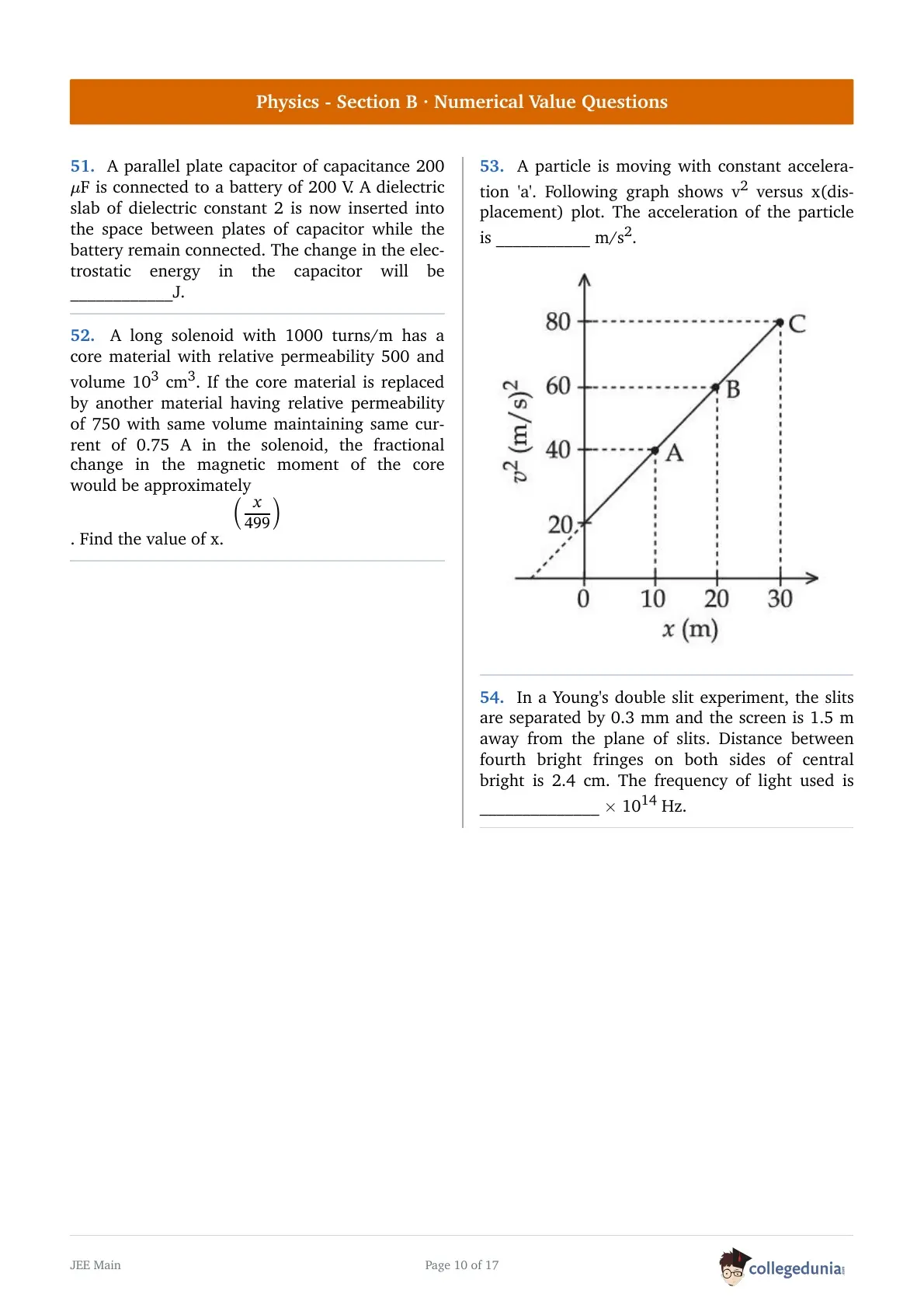
A particle is moving with constant acceleration 'a'. Following graph shows \(v^2\) versus x (displacement) plot. The acceleration of the particle is ________ m/s\(^2\).
\begin{center}
\includegraphics[width=0.35\textwidth]{graph_v2_x}
\end{center}
In a Young's double slit experiment, the slits are separated by 0.3 mm and the screen is 1.5 m away from the plane of slits. Distance between fourth bright fringes on both sides of central bright fringe is 2.4 cm. The frequency of light used is ________ \(\times 10^{14}\) Hz.
The diameter of a spherical bob is measured using a vernier callipers. 9 divisions of the main scale, in the vernier callipers, are equal to 10 divisions of vernier scale. One main scale division is 1 mm. The main scale reading is 10 mm and \(8^{th}\) division of vernier scale was found to coincide exactly with one of the main scale division. If the given vernier callipers has positive zero error of 0.04 cm, then the radius of the bob is ________ \(\times 10^{-2}\) cm.
A sample of gas with \(\gamma = 1.5\) is taken through an adiabatic process in which the volume is compressed from 1200 \(cm^3\) to 300 \(cm^3\). If the initial pressure is 200 kPa. The absolute value of the workdone by the gas in the process = ________ J.
At very high frequencies, the effective impedance of the given circuit will be ________ \(\Omega\). 
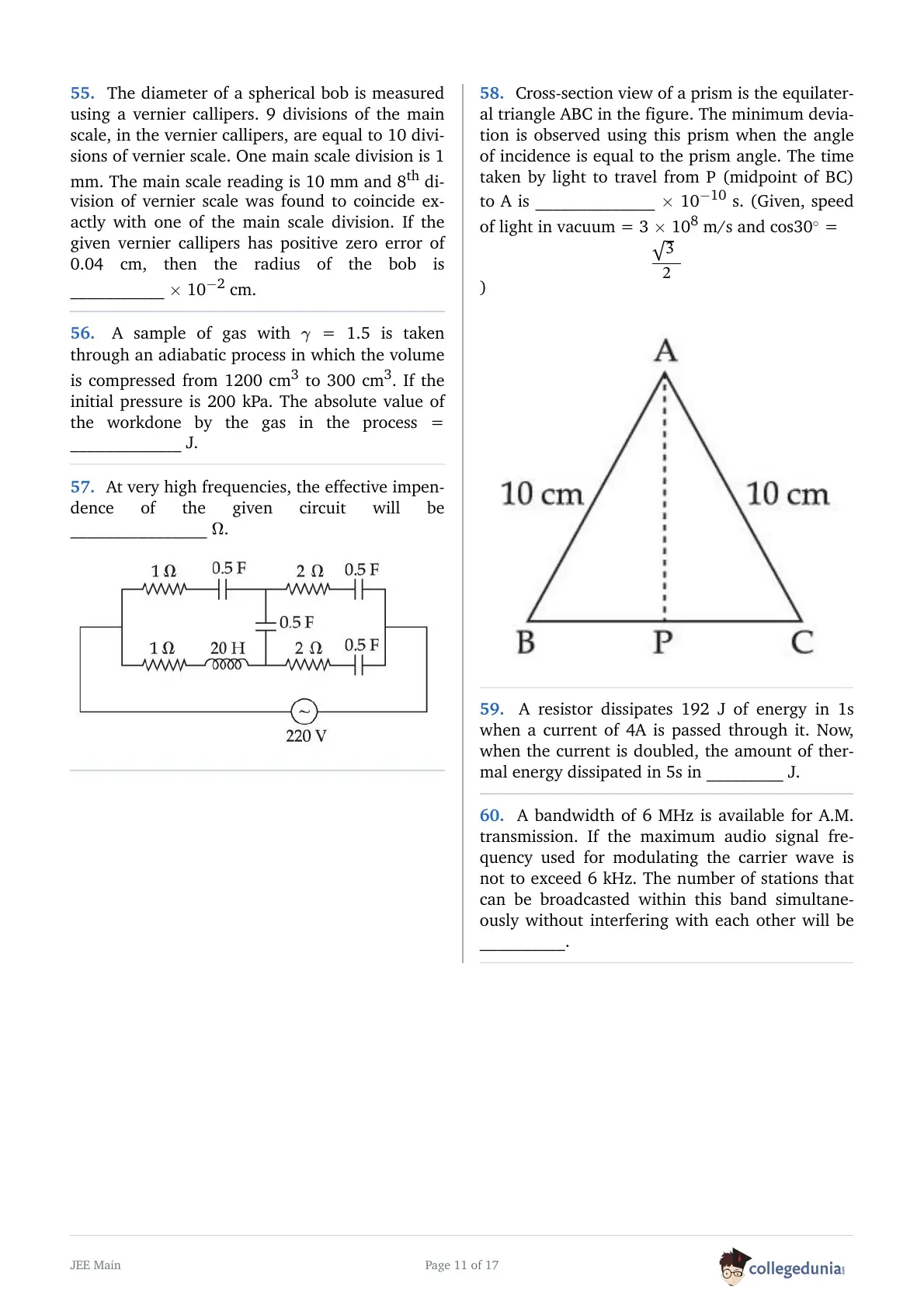
Cross-section view of a prism is the equilateral triangle ABC shown in the figure. The minimum deviation is observed using this prism when the angle of incidence is equal to the prism angle. The time taken by light to travel from P (midpoint of BC) to A is ________ \(\times 10^{-10}\) s. (Given, speed of light in vacuum \(= 3 \times 10^8\) m/s and \(\cos 30^\circ = \frac{\sqrt{3}}{2}\))
\begin{center}
\includegraphics[width=0.3\textwidth]{prism_diagram}
\end{center}
A resistor dissipates 192 J of energy in 1 s when a current of 4 A is passed through it. Now, when the current is doubled, the amount of thermal energy dissipated in 5 s is _________ J.
A bandwidth of 6 MHz is available for A.M. transmission. If the maximum audio signal frequency used for modulating the carrier wave is not to exceed 6 kHz. The number of stations that can be broadcasted within this band simultaneously without interfering with each other will be ________.
Chemistry - Section A (Q61 - Q80)
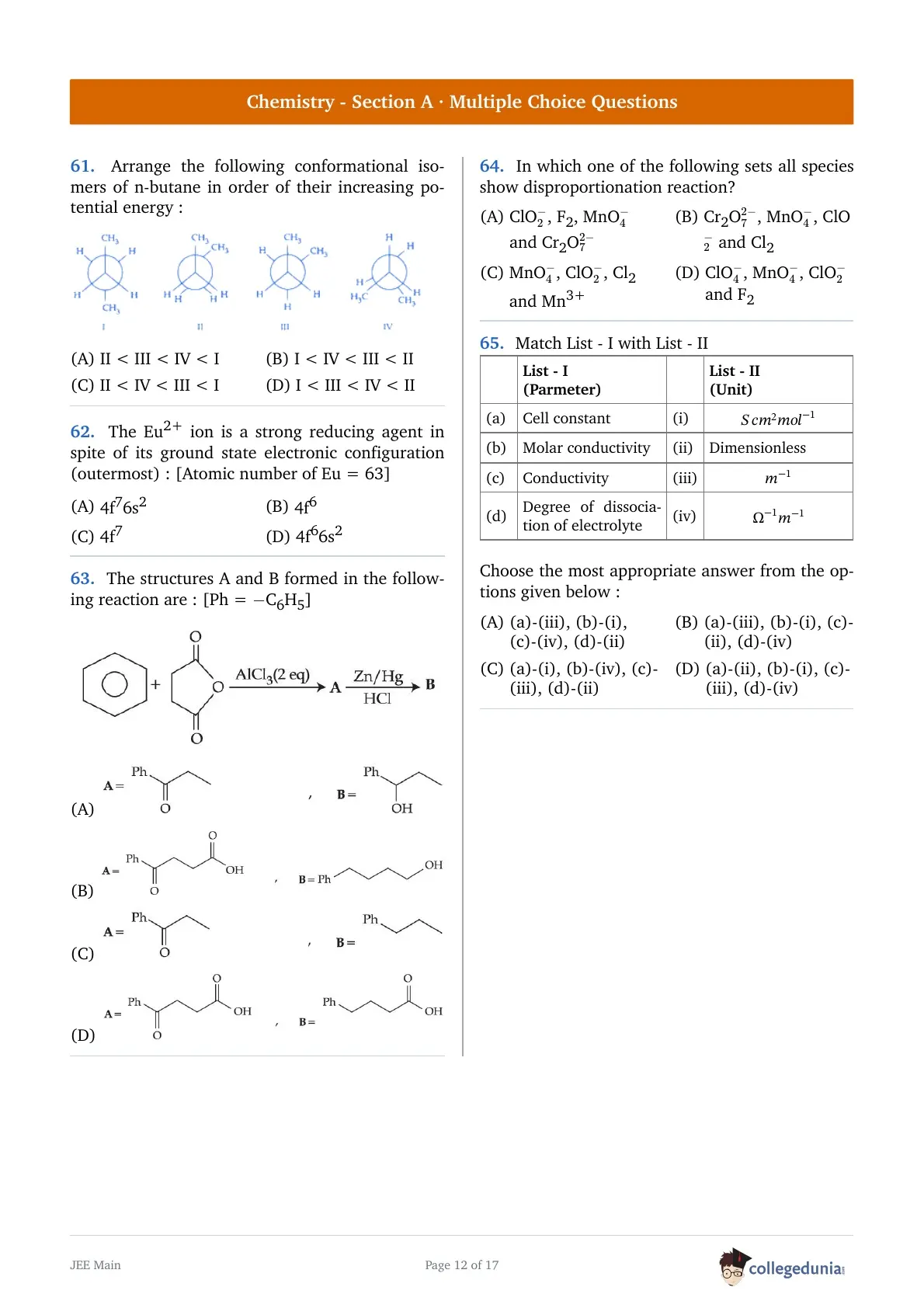
Arrange the following conformational isomers of n-butane in order of their increasing potential energy :
The \( \text{Eu}^{2+} \) ion is a strong reducing agent in spite of its ground state electronic configuration (outermost) : [Atomic number of Eu = 63]
The structures A and B formed in the following reaction are : [Ph = \(-\mathrm{C_6H_5}\)]
- (1)
![]()
- (2)
![]()
- (3)
![]()
- (4)
![]()


In which one of the following sets all species show disproportionation reaction ?
Match List - I with List - II :
\[
\begin{array}{llcl}
& \text{List - I} & & \text{List - II} \\
\text{(Parameter)} & & \text{(Unit)} \\
(a) & \text{Cell constant} & (i) & \text{S cm}^2 \text{ mol}^{-1} \\
(b) & \text{Molar conductivity} & (ii) & \text{Dimensionless} \\
(c) & \text{Conductivity} & (iii) & \text{m}^{-1} \\
(d) & \text{Degree of dissociation of electrolyte} & (iv) & \Omega^{-1} \text{m}^{-1} \\
\end{array}
\]
Choose the most appropriate answer from the options given below :
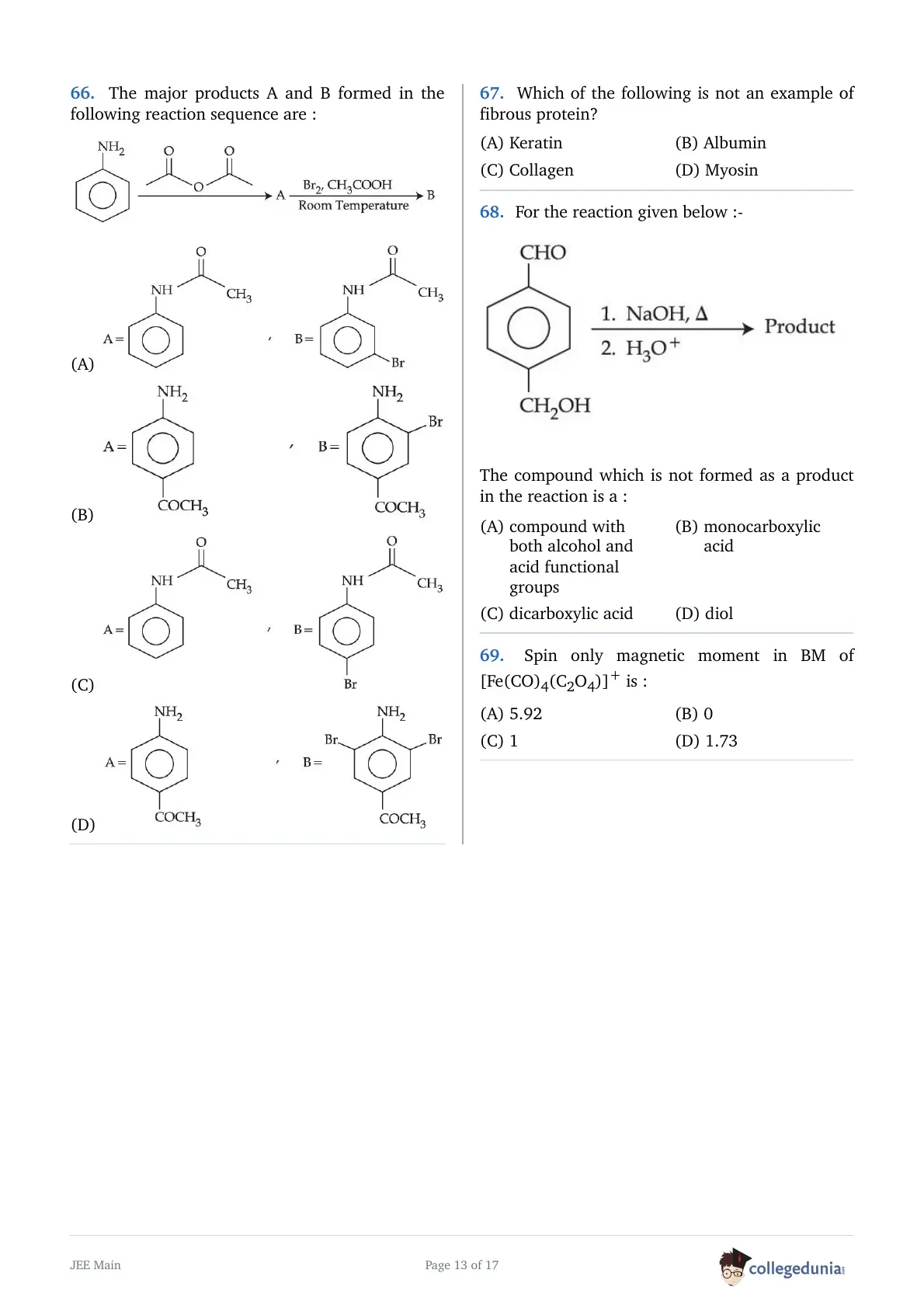
The major products A and B formed in the following reaction sequence are :
- (1)
![]()
- (2)
![]()
- (3)
![]()
- (4)
![]()


Which of the following is NOT an example of fibrous protein ?
For the reaction given below :
The compound which is not formed as a product in the reaction is a :
Spin only magnetic moment in BM of \( [\text{Fe(CO)}_4(\text{C}_2\text{O}_4)]^+ \) is :
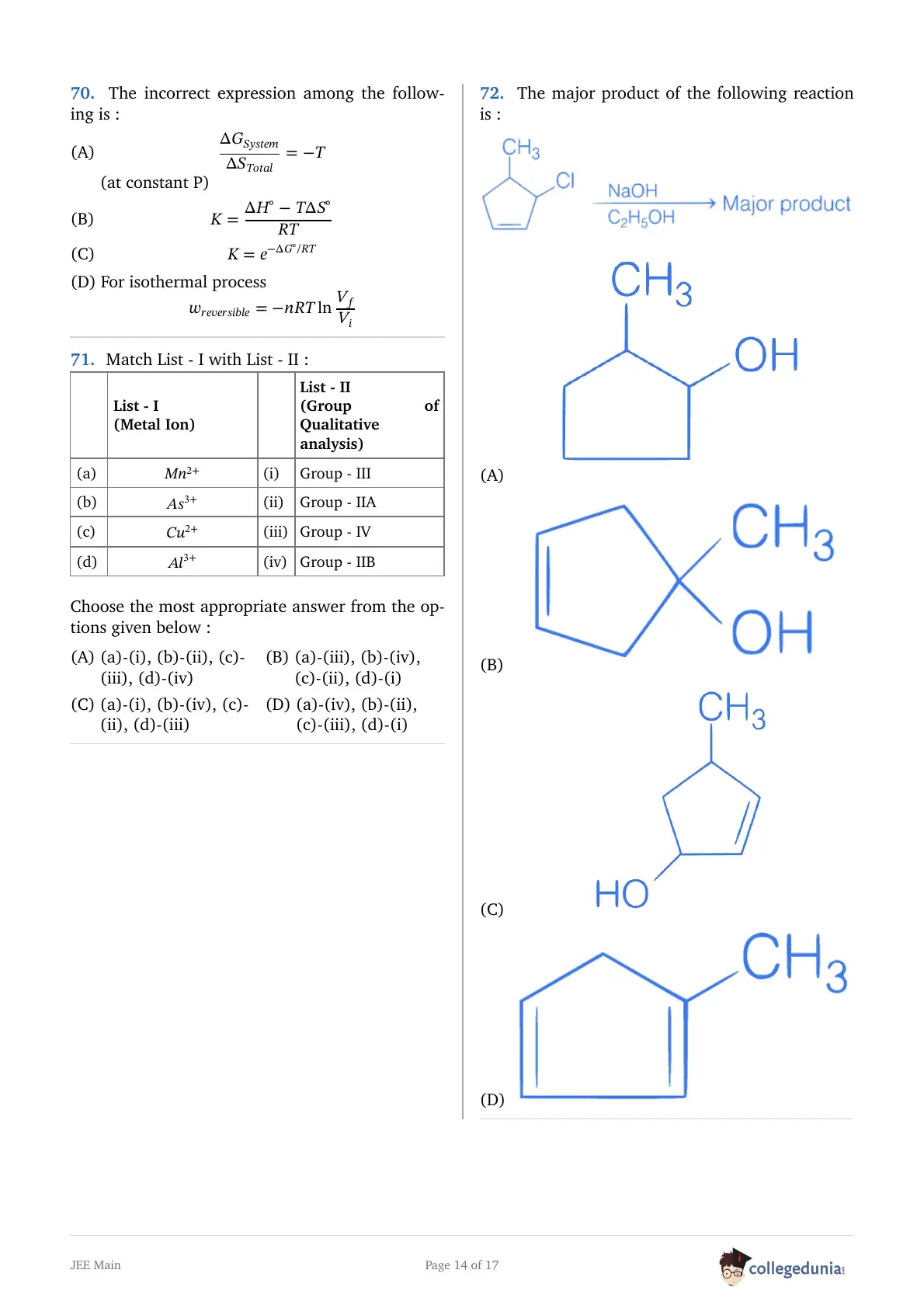
The incorrect expression among the following is :
Match List - I with List - II :
| List - I (Metal Ion) | List - II (Group in Qualitative analysis) |
|---|---|
| (a) \( \text{Mn}^{2+} \) | (i) Group - III |
| (b) \( \text{As}^{3+} \) | (ii) Group - IIA |
| (c) \( \text{Cu}^{2+} \) | (iii) Group - IV |
| (d) \( \text{Al}^{3+} \) | (iv) Group - IIB |
Choose the most appropriate answer from the options given below :
The major product of the following reaction is :
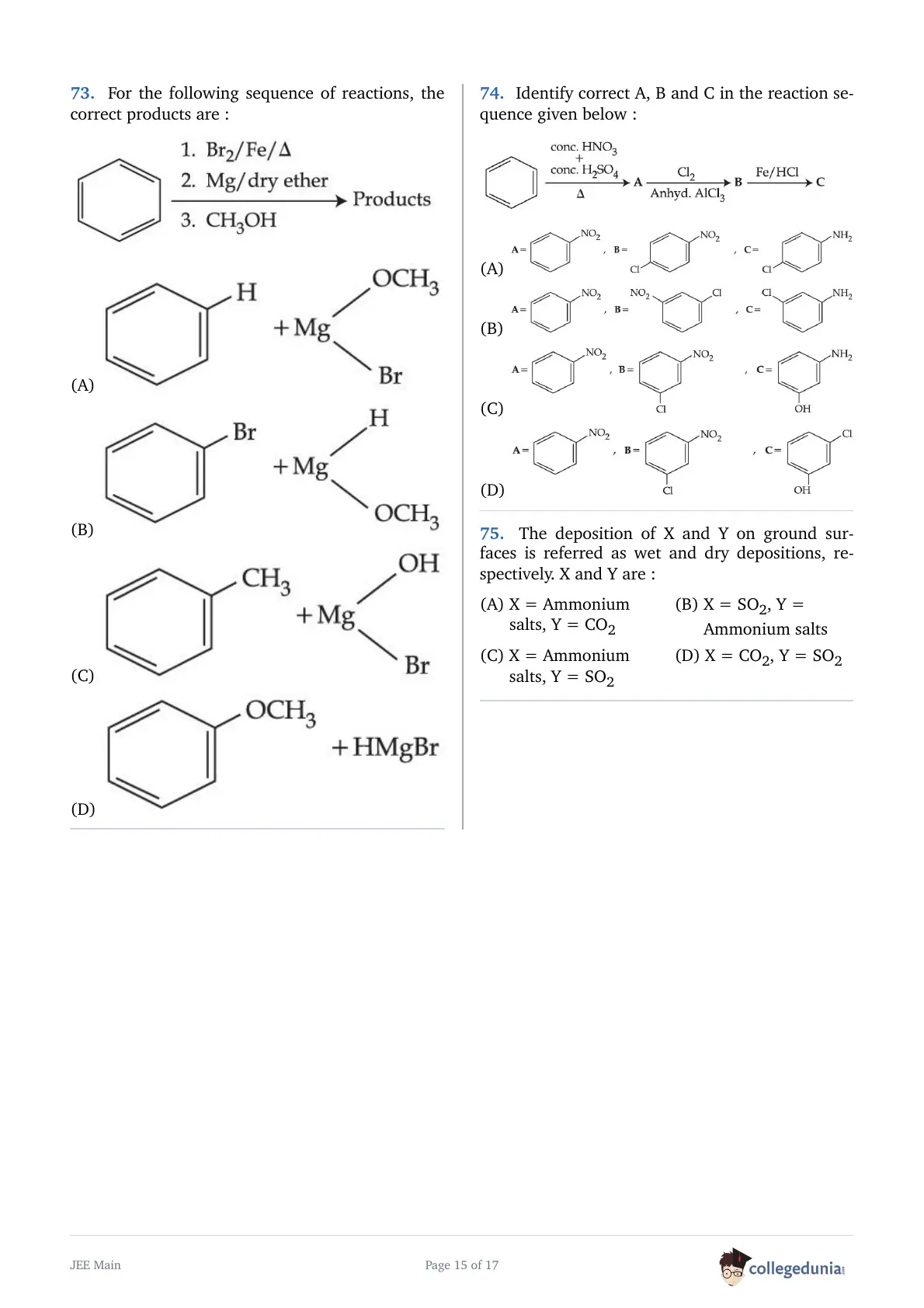
For the following sequence of reactions, the correct products are :
- (1)
![]()
- (2)
![]()
- (3)
![]()
- (4)
![]()


Identify correct A, B and C in the reaction sequence given below :
- (1)
![]()
- (2)
![]()
- (3)
![]()
- (4)
![]()


The deposition of X and Y on ground surfaces is referred as wet and dry depositions, respectively. X and Y are :
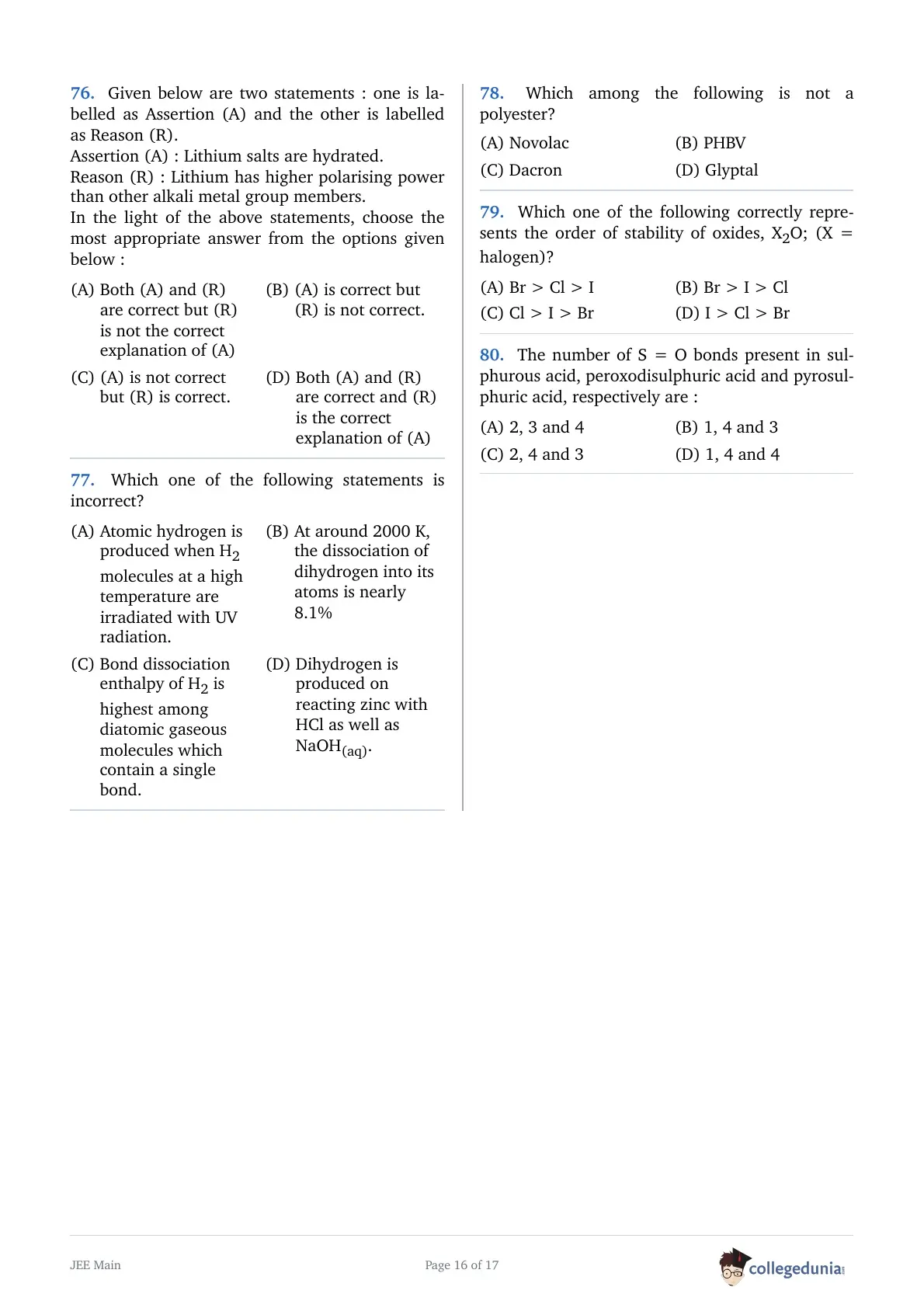
Given below are two statements : one is labelled as Assertion (A) and the other is labelled as Reason (R).
Assertion (A) : Lithium salts are hydrated.
Reason (R) : Lithium has higher polarising power than other alkali metal group members.
In the light of the above statements, choose the most appropriate answer from the options given below :
Which one of the following statements is incorrect?
Which among the following is not a polyester ?
Which one of the following correctly represents the order of stability of oxides, \( X_2O \); (X = halogen) ?
The number of S=O bonds present in sulphurous acid, peroxodisulphuric acid and pyrosulphuric acid, respectively are :
Chemistry - Section B (Q81 - Q90)
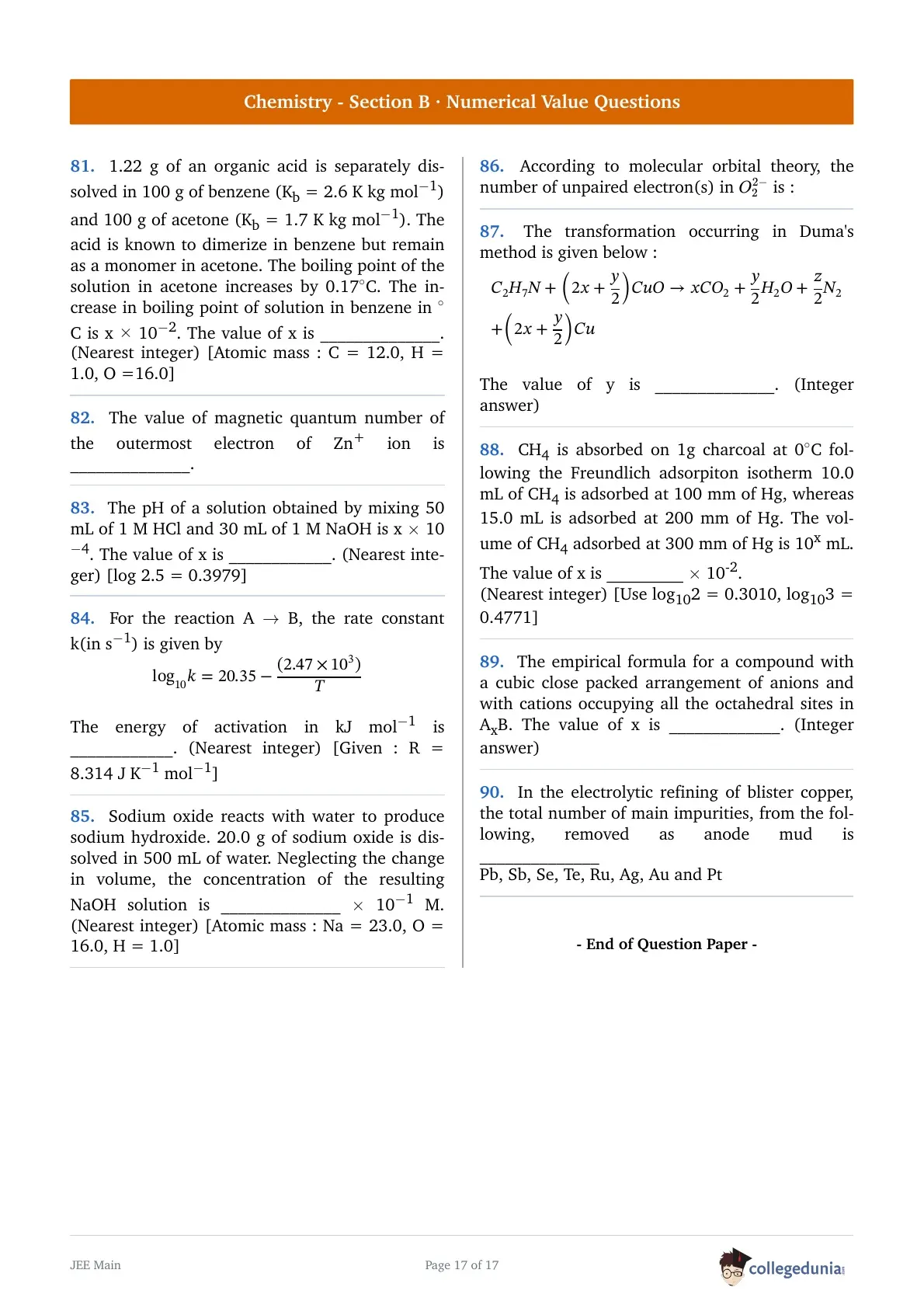
1.22 g of an organic acid is separately dissolved in 100 g of benzene (\(K_b = 2.6 \text{ K kg mol}^{-1}\)) and 100 g of acetone (\(K_b = 1.7 \text{ K kg mol}^{-1}\)). The acid is known to dimerize in benzene but remain as a monomer in acetone. The boiling point of the solution in acetone increases by \(0.17^\circ\text{C}\). The increase in boiling point of solution in benzene in \(^\circ\text{C}\) is \(x \times 10^{-2}\). The value of \(x\) is ________. (Nearest integer) [Atomic mass : C = 12.0, H = 1.0, O = 16.0]
The value of magnetic quantum number of the outermost electron of \(\text{Zn}^+\) ion is ________. (Integer answer)
The pH of a solution obtained by mixing 50 mL of 1 M HCl and 30 mL of 1 M NaOH is \(x \times 10^{-1}\). The value of \(x\) is ________. (Nearest integer) [log 2.5 = 0.3979]
For the reaction \(\text{A} \to \text{B}\), the rate constant \(k\) (in \(\text{s}^{-1}\)) is given by \(\log_{10} k = 20.35 - \frac{2.47 \times 10^3}{\text{T}}\). The energy of activation in \(\text{kJ mol}^{-1}\) is ________. (Nearest integer) [Given : R = 8.314 J K\(^{-1}\) mol\(^{-1}\)]
Sodium oxide reacts with water to produce sodium hydroxide. 20.0 g of sodium oxide is dissolved in 500 mL of water. Neglecting the change in volume, the concentration of the resulting NaOH solution is ________ \(\times 10^{-1}\) M. (Nearest integer) [Atomic mass : Na = 23.0, O = 16.0, H = 1.0]
According to molecular orbital theory, the number of unpaired electron(s) in \(\text{O}_2^{2-}\) is ________.
The transformation occurring in Duma's method is given below:
\(\text{C}_2 \text{H}_7 \text{N} + (2x + y/2) \text{CuO} \to x \text{CO}_2 + y/2 \text{H}_2\text{O} + z/2 \text{N}_2 + (2x + y/2) \text{Cu}\).
The value of \(y\) is ________. (Integer answer)
\(\text{CH}_4\) is adsorbed on 1 g charcoal at \(0^\circ\text{C}\) following the Freundlich adsorption isotherm. 10.0 mL of \(\text{CH}_4\) is adsorbed at 100 mm of Hg, whereas 15.0 mL is adsorbed at 200 mm of Hg. The volume of \(\text{CH}_4\) adsorbed at 300 mm of Hg is \(10^x\) mL. The value of \(x\) is ________ \(\times 10^{-2}\). (Nearest integer) [Use \(\log_{10} 2 = 0.3010, \log_{10} 3 = 0.4771\)]
The empirical formula for a compound with a cubic close packed arrangement of anions and with cations occupying all the octahedral sites is \(A_x B\). The value of \(x\) is ________. (Integer answer)
In the electrolytic refining of blister copper, the total number of main impurities, from the following, removed as anode mud is ________.
Pb, Sb, Se, Te, Ru, Ag, Au and Pt.
JEE Main 2021 Exam Pattern and Marking Scheme
| Particulars | Details |
|---|---|
| Exam Mode | Online (Computer-Based Test) |
| Paper | B.E./B.Tech (Paper 1) |
| Duration | 3 hours (180 minutes) |
| Type of Questions | Multiple Choice Questions (MCQs) + Numerical Value Questions |
| Subjects | Mathematics, Physics, Chemistry |
| Total Questions | 90 questions (75 to be attempted) |
| Total Marks | 300 marks |
| Marking Scheme | +4 for correct answer & -1 for incorrect MCQ; no negative marking for Numerical Value Questions |
JEE Main 2021 August 31 Shift 2 Difficulty Level
JEE Main 2021 B.E./B.Tech Question Paper - August 31, 2021- Afternoon Session was termed to be of above-average difficulty by the expert educators. This was largely due to the high difficulty level of the Mathematics section, which included lengthy and intricate questions on Integral Calculus, Vector and 3D, and Coordinate geometry. The Physics section came second in terms of difficultly and included a few complex numerical from Mechanics and Thermodynamics. The Chemistry section was relatively the easiest section of the paper, with a significant amount of questions being framed from Organic Chemistry (I and II). See JEE Exam Pattern
JEE Main 2021 B.E./B.Tech Question Paper August 31 (AN): Paper Analysis
JEE Main August 31, 2021 Afternoon (Shift 2) paper was conducted from 3.00 PM to 6.00 PM. The sectional analysis of the paper is as follows:
Mathematics
- Vector and 3D (10%), Integral Calculus (15%),and Coordinate Geometry (12%), were the major contributing units in the section
- Around 18 questions were asked from class XII topics and 12 Questions were asked from class XI topics. View JEE Main Mathematics Syllabus
Physics
- Mechanics (36%), Electrodynamics(30%), and Heat and Thermodynamics (16%) were the major units asked in the section
- Around 17 questions were asked from class XII topics and 13 Questions were asked from class XI topics. View JEE Main Physics syllabus
Chemistry
- Organic Chemistry II (28%), Organic Chemistry I( 12%), Inorganic Chemistry II (20%), and Physical Chemistry II (16%), were the major contributors of the section
- 11 Questions were framed from Class XI Chemistry Syllabus, and 19 Questions were framed from Class XII Chemistry Syllabus. View JEE Main Chemistry Syllabus



Comments