




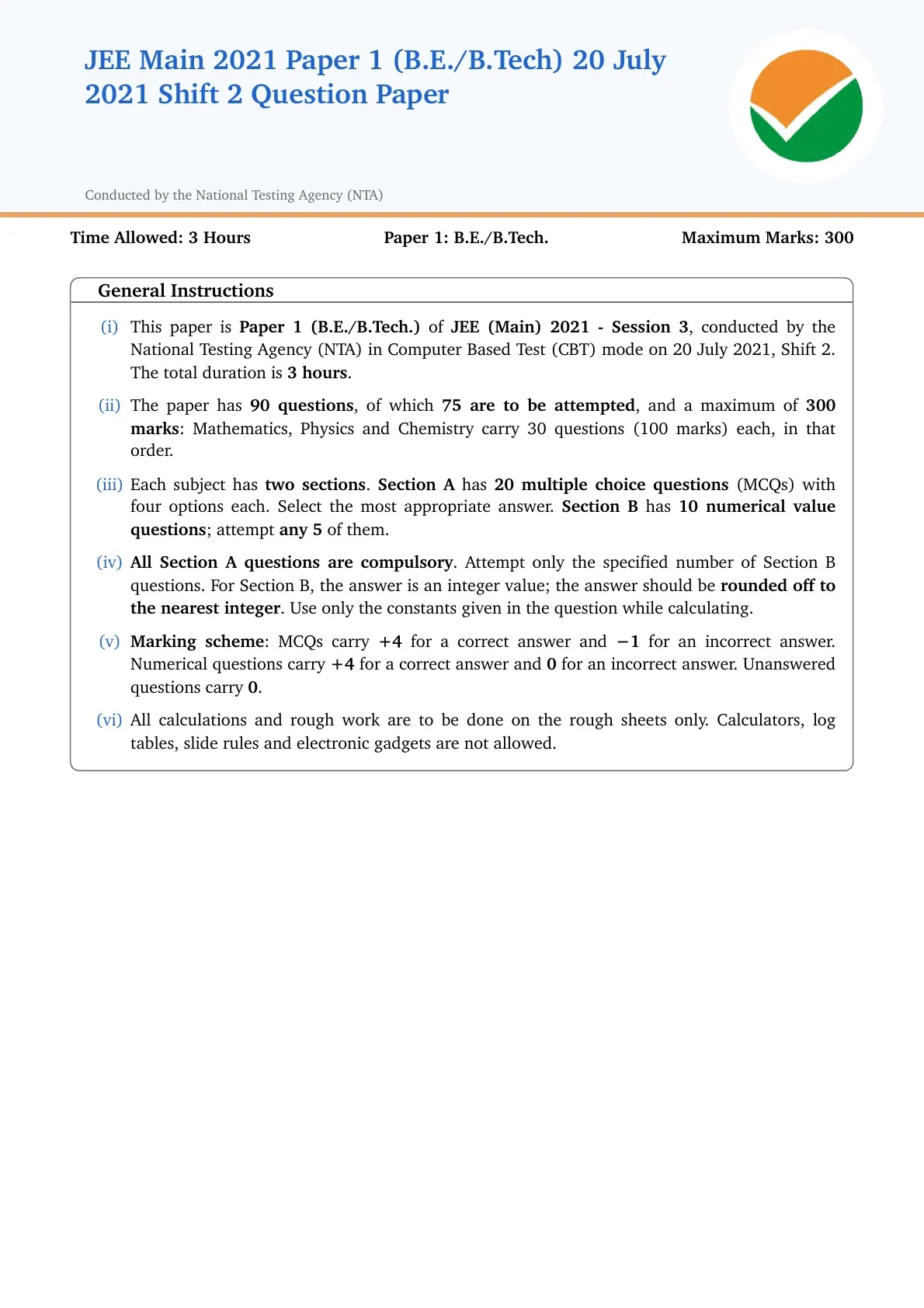
JEE Main 2021 July 20 Shift 2 Question Paper is available here with solutions PDF and detailed solutions for every question. NTA conducted the second shift on July 20, 2021, from 3:00 PM to 6:00 PM. The JEE Main 2021 Paper 1 (B.E./B.Tech) question paper includes the following:
- 90 questions in a 3-hour CBT Mode: 30 each from Mathematics, Physics and Chemistry (75 to be attempted)
- Section A: 20 multiple choice questions (MCQs) per subject, all compulsory, 4 marks each
- Section B: 10 numerical value questions per subject, any 5 to be attempted, 4 marks each
- Marking: +4 for a correct answer, -1 for an incorrect MCQ, 0 for an unattempted question; no negative marking for numerical value questions
- Maximum marks: 300 (100 per subject)
JEE Main 2021 July 20 Shift 2 Question Paper with Solution PDF
| NTA Official PDF | CD PDF | CD PDF with Solutions |
|---|---|---|
| Download official PDF 5.92 MB | Download Collegedunia PDF 1.13 MB | Download solutions PDF 1.40 MB |
Also Check:
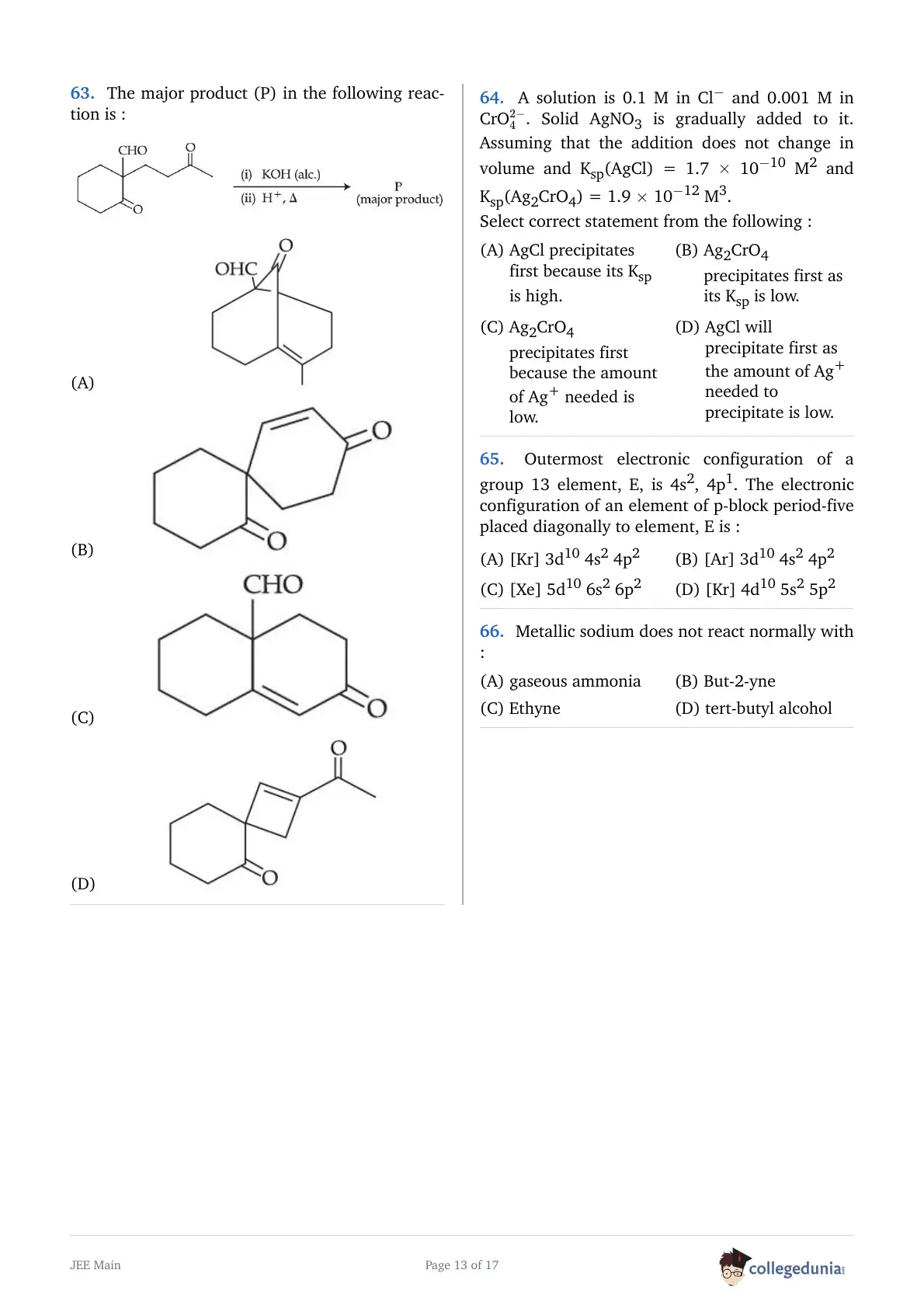
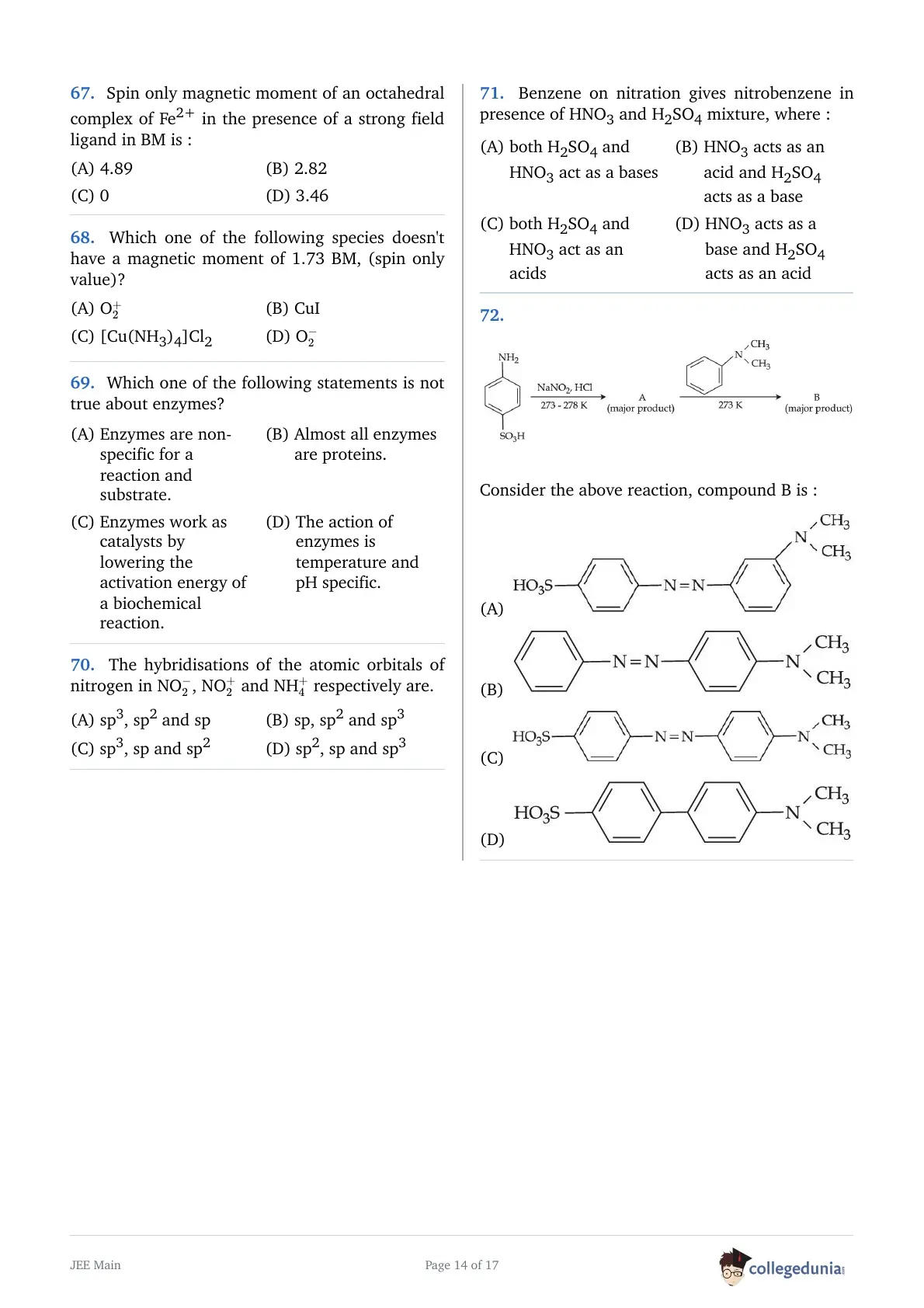
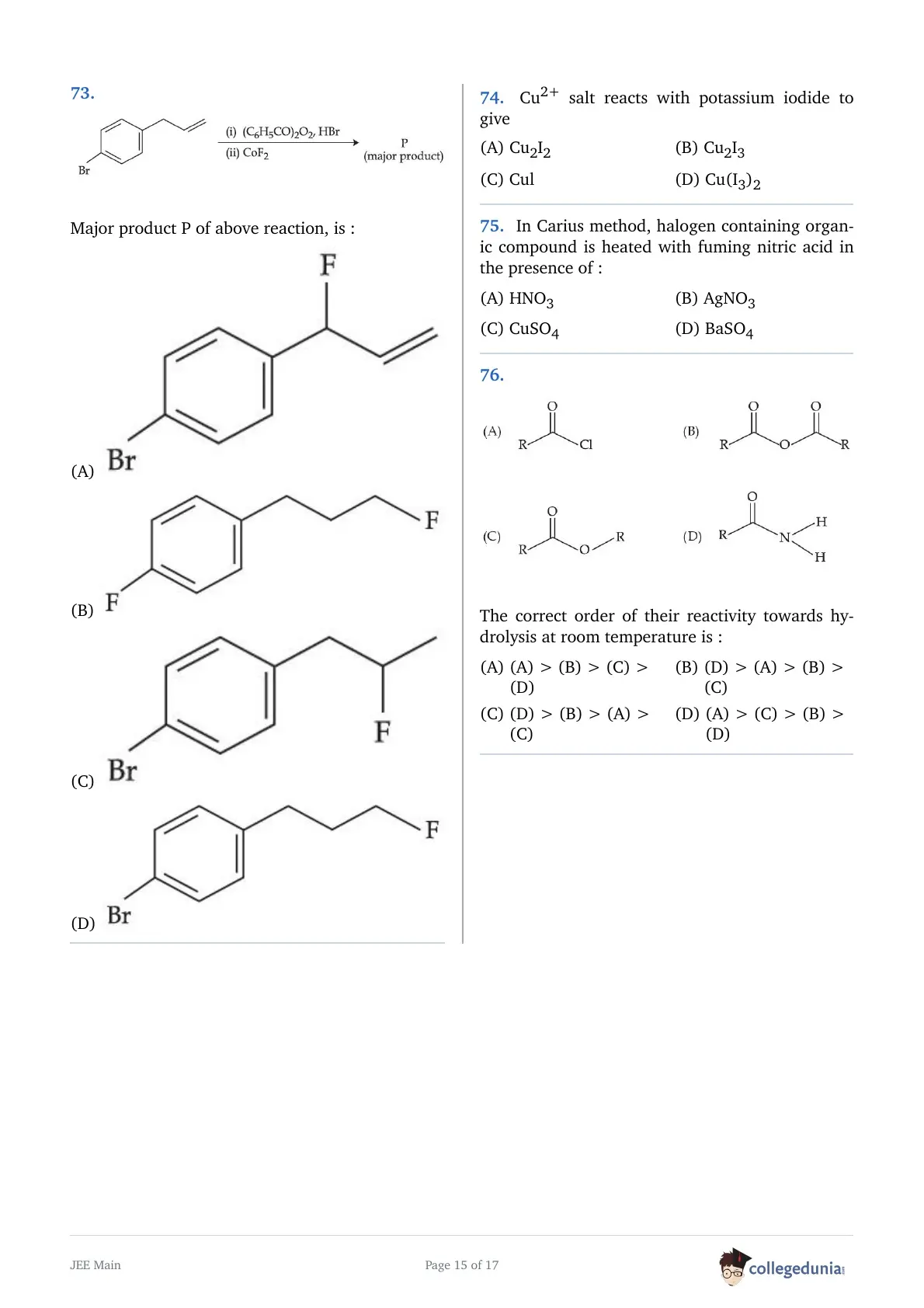
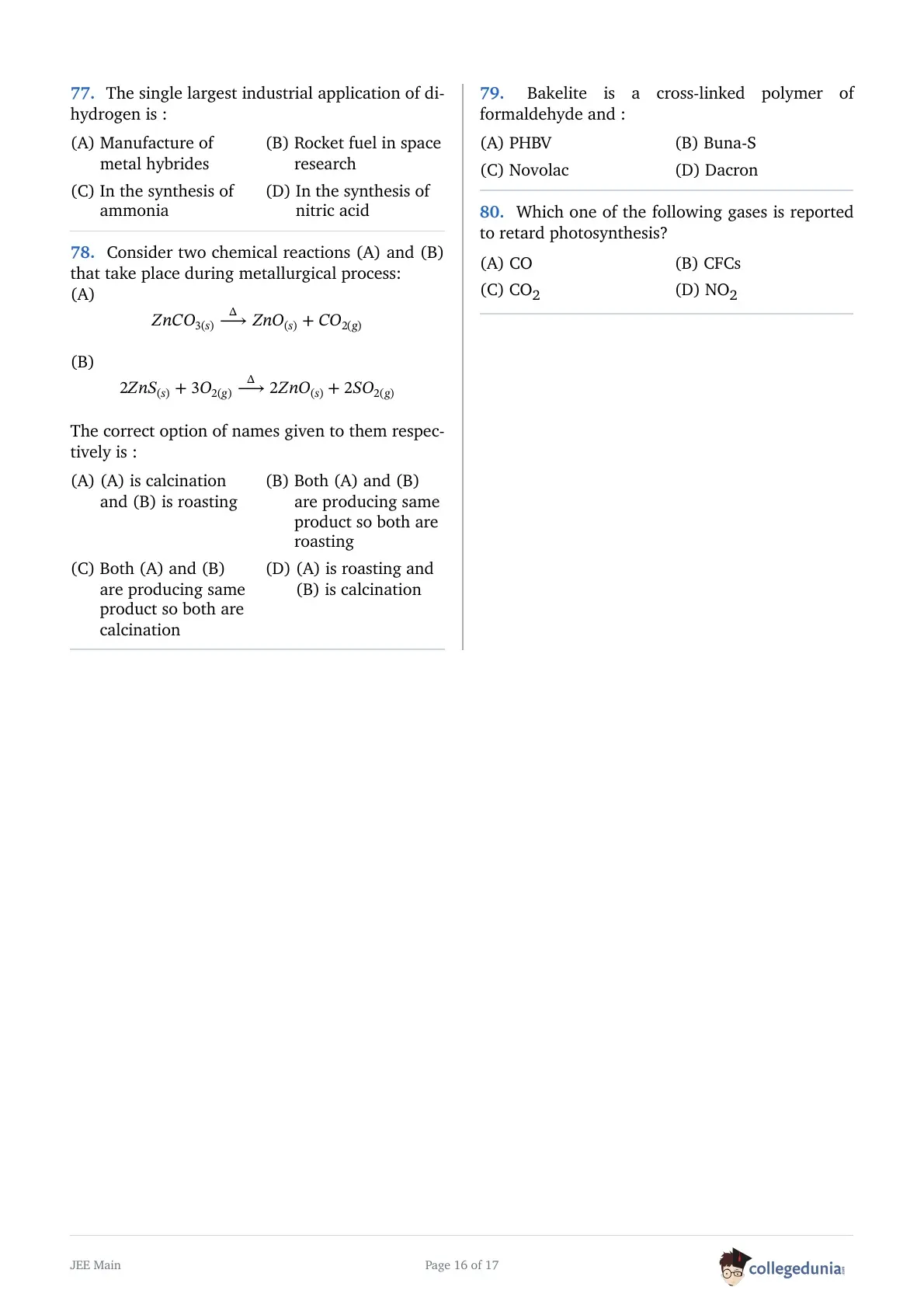
JEE Main 2021 July 20 Shift 2 Questions with Solutions
Mathematics - Section A (Q1 - Q20)
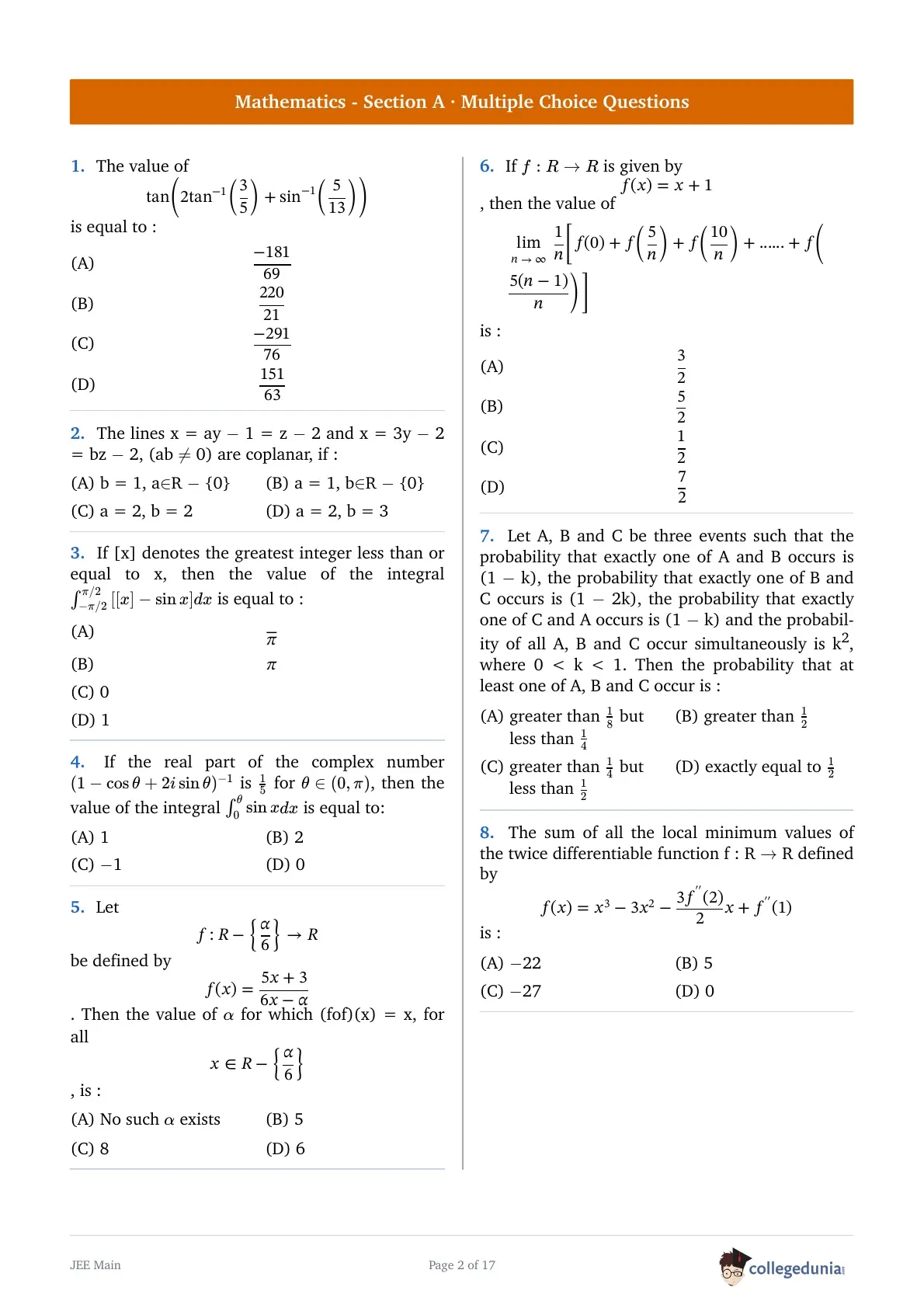
The value of
\(\tan\left(2\tan^{-1}\left(\frac{3}{5}\right)+\sin^{-1}\left(\frac{5}{13}\right)\right)\)
is equal to :
The lines \(x=ay-1=z-2\) and \(x=3y-2=bz-2\), \((ab\ne0)\) are coplanar, if :
If \([x]\) denotes the greatest integer less than or equal to \(x\), then the value of the integral \(\int_{-\pi/2}^{\pi/2}[[x]-\sin x]\,dx\) is equal to :
If the real part of the complex number \((1-\cos\theta+2i\sin\theta)^{-1}\) is \(\frac15\) for \(\theta\in(0,\pi)\), then the value of the integral \(\int_0^{\theta}\sin x\,dx\) is equal to:
Let \(f:R-\left\{\frac{\alpha}{6}\right\}\to R\) be defined by \(f(x)=\frac{5x+3}{6x-\alpha}\). Then the value of \(\alpha\) for which \((f\circ f)(x)=x\), for all \(x\in R-\left\{\frac{\alpha}{6}\right\}\), is :
If \(f:R\to R\) is given by \(f(x)=x+1\), then the value of
\(\lim_{n\to\infty}\frac{1}{n}\left[f(0)+f\left(\frac{5}{n}\right)+f\left(\frac{10}{n}\right)+\ldots\ldots+f\left(\frac{5(n-1)}{n}\right)\right]\)
is :
Let A, B and C be three events such that the probability that exactly one of A and B occurs is \((1-k)\), the probability that exactly one of B and C occurs is \((1-2k)\), the probability that exactly one of C and A occurs is \((1-k)\) and the probability of all A, B and C occur simultaneously is \(k^2\), where \(0\lt k\lt1\). Then the probability that at least one of A, B and C occur is :
The sum of all the local minimum values of the twice differentiable function \(f:R\to R\) defined by
\(f(x)=x^3-3x^2-\frac{3f^{\prime\prime}(2)}{2}x+f^{\prime\prime}(1)\)
is :
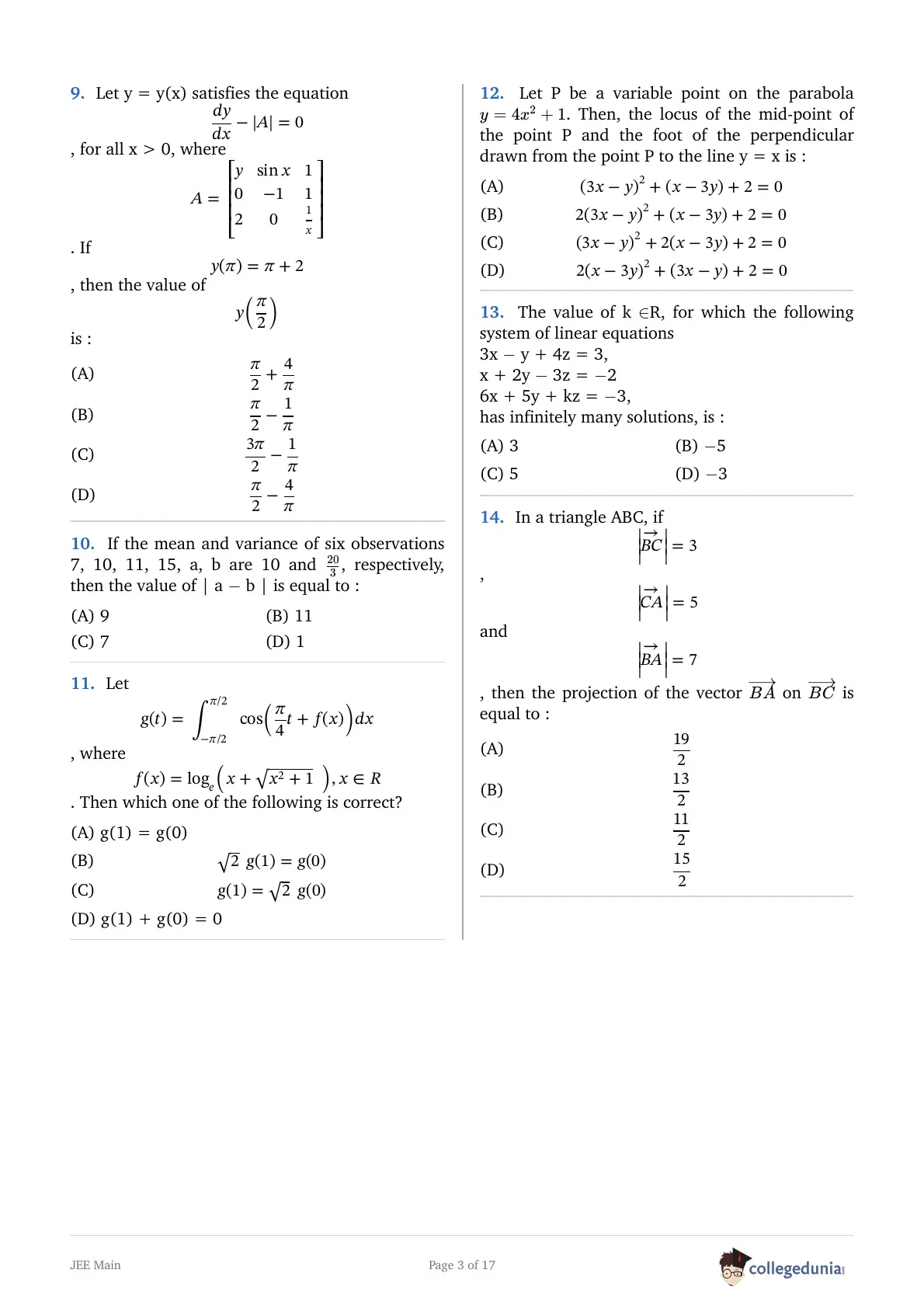
Let \(y=y(x)\) satisfies the equation
\(\frac{dy}{dx}-|A|=0\)
for all \(x\gt0\), where
\(A=\begin{bmatrix}y&\sin x&1\\0&-1&1\\2&0&\frac1x\end{bmatrix}\).
If \(y(\pi)=\pi+2\), then the value of \(y\left(\frac\pi2\right)\) is :
The mean and variance of the observations x, y, 5, 7, 9, 11, 13, 15 are 10 and 20 respectively. If x \(>\) y, then the value of x - y is:
Let \(g(t)=\int_{-\pi/2}^{\pi/2}\cos\left(\frac\pi4t+f(x)\right)dx\), where \(f(x)=\log_e\left(x+\sqrt{x^2+1}\right),\ x\in R\). Then which one of the following is correct?
Let P be a variable point on the parabola \(y=4x^2+1\). Then, the locus of the mid-point of the point P and the foot of the perpendicular drawn from the point P to the line \(y=x\) is :
The value of \(k\in R\), for which the following system of linear equations
\(3x-y+4z=3,\)
\(x+2y-3z=-2,\)
\(6x+5y+kz=-3,\)
has infinitely many solutions, is :
In a triangle ABC, if \(\left|\overrightarrow{BC}\right|=3\), \(\left|\overrightarrow{CA}\right|=5\) and \(\left|\overrightarrow{BA}\right|=7\), then the projection of the vector \(\overrightarrow{BA}\) on \(\overrightarrow{BC}\) is equal to :
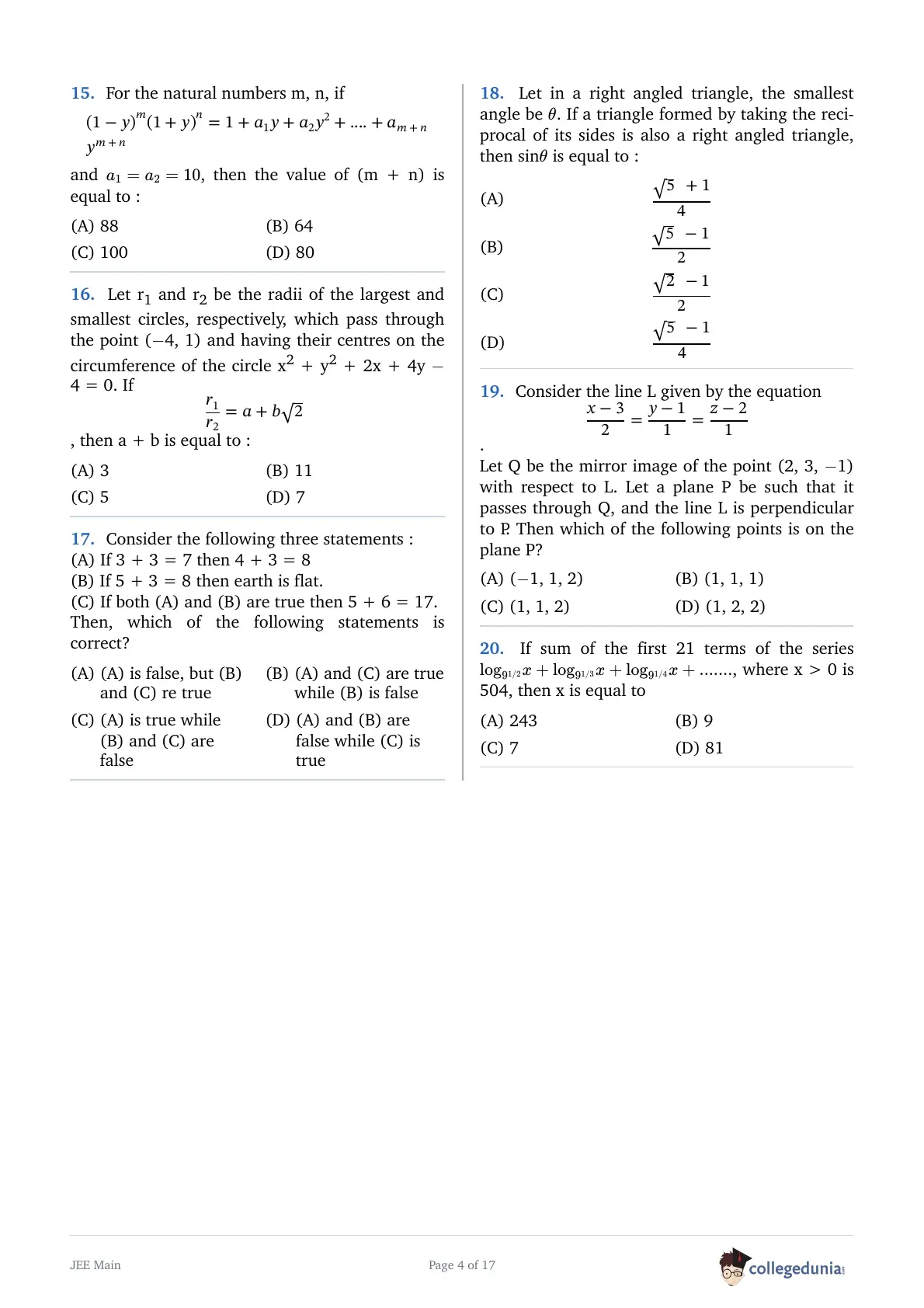
For the natural numbers m, n, if \((1-y)^m(1+y)^n=1+a_1y+a_2y^2+\ldots.+a_{m+n}y^{m+n}\) and \(a_1=a_2=10\), then the value of \((m+n)\) is equal to :
Let \(r_1\) and \(r_2\) be the radii of the largest and smallest circles, respectively, which pass through the point \((-4,1)\) and having their centres on the circumference of the circle \(x^2+y^2+2x+4y-4=0\). If \(\frac{r_1}{r_2}=a+b\sqrt2\), then \(a+b\) is equal to :
Consider the following three statements :
(A) If 3 + 3 = 7 then 4 + 3 = 8
(B) If 5 + 3 = 8 then earth is flat.
(C) If both (A) and (B) are true then 5 + 6 = 17.
Then, which of the following statements is correct?
Let in a right angled triangle, the smallest angle be \(\theta\). If a triangle formed by taking the reciprocal of its sides is also a right angled triangle, then \(\sin\theta\) is equal to :
Consider the line L given by the equation
\(\frac{x-3}{2} = \frac{y-1}{1} = \frac{z-2}{1}\).
Let Q be the mirror image of the point \((2, 3, -1)\) with respect to L. Let a plane P be such that it passes through Q, and the line L is perpendicular to P. Then which of the following points is on the plane P?
If sum of the first 21 terms of the series \(\log_{9^{1/2}} x + \log_{9^{1/3}} x + \log_{9^{1/4}} x + \ldots\ldots\), where \(x \gt 0\) is 504, then x is equal to
Mathematics - Section B (Q21 - Q30)
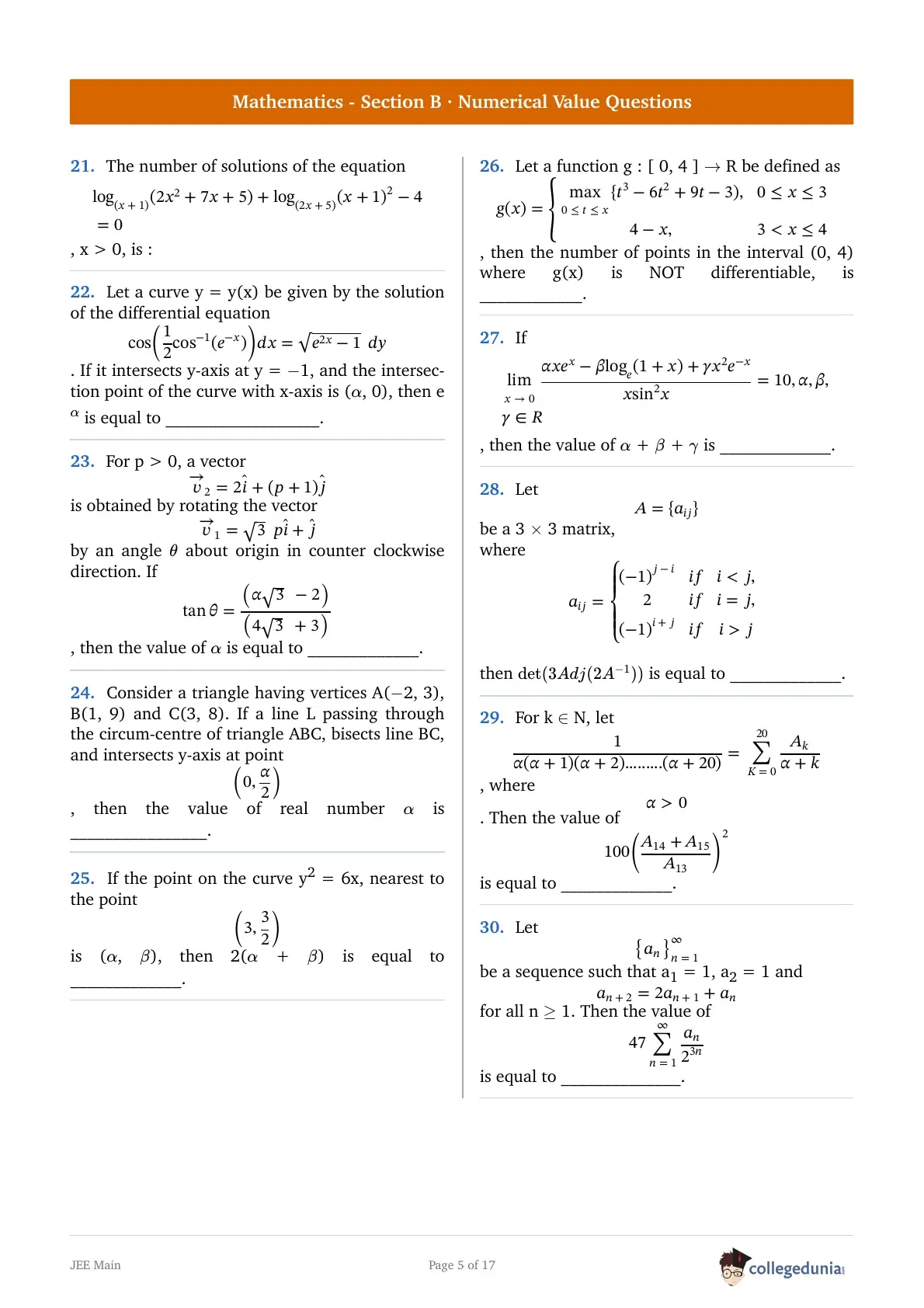
The number of solutions of the equation
\(\log_{(x+1)}(2x^2 + 7x + 5) + \log_{(2x+5)}(x+1)^2 - 4 = 0\)
, \(x \gt 0\), is :
Let \(y = y(x)\) be a solution curve of the differential equation \[(1 - x^2 y)\,dx = y\,dx + x\,dy.\] If the line \(x = 1\) intersects the curve \(y = y(x)\) at \(y = 2\) and the line \(x = 2\) intersects the curve \(y = y(x)\) at \(y = \alpha\), then a value of \(\alpha\) is:
For \(p \gt 0\), a vector
\(\vec{v}_2 = 2\hat{i} + (p+1)\hat{j}\)
is obtained by rotating the vector
\(\vec{v}_1 = \sqrt{3}\,p\hat{i} + \hat{j}\)
by an angle \(\theta\) about origin in counter clockwise direction. If
\(\tan\theta = \frac{(\alpha\sqrt{3} - 2)}{(4\sqrt{3} + 3)}\)
, then the value of \(\alpha\) is equal to ______________.
Consider a triangle having vertices A\((-2, 3)\), B\((1, 9)\) and C\((3, 8)\). If a line L passing through the circum-centre of triangle ABC, bisects line BC, and intersects y-axis at point
\(\left(0, \frac{\alpha}{2}\right)\)
, then the value of real number \(\alpha\) is ______________.
If the tangent to the curve y = x3 – x2 + x at the point (a, b) is also tangent to the curve y = 5x2 + 2x – 25 at the point (2, –1), then |2a + 9b| is equal to _____ .
Let a function \(g : [0, 4] \to R\) be defined as
\(g(x) = \begin{cases} \max\limits_{0 \le t \le x} \{t^3 - 6t^2 + 9t - 3),\quad 0 \le x \le 3 \\ 4 - x,\quad 3 \lt x \le 4 \end{cases}\)
, then the number of points in the interval (0, 4) where g(x) is NOT differentiable, is ______________.
If
\(\lim_{x \to 0} \frac{\alpha x e^{x} - \beta \log_e(1+x) + \gamma x^2 e^{-x}}{x \sin^2 x} = 10\), \(\alpha, \beta, \gamma \in R\)
, then the value of \(\alpha + \beta + \gamma\) is ______________.
Let
\(A = \{a_{ij}\}\)
be a \(3 \times 3\) matrix,
where
\(a_{ij} = \begin{cases} (-1)^{j-i}\ \text{if } i \lt j, \\ 2\ \text{if } i = j, \\ (-1)^{i+j}\ \text{if } i \gt j \end{cases}\)
then \(\det(3\,\mathrm{Adj}(2A^{-1}))\) is equal to ______________.
For \(k \in N\), let
\(\frac{1}{\alpha(\alpha+1)(\alpha+2)\ldots\ldots\ldots(\alpha+20)} = \sum\limits_{K=0}^{20} \frac{A_k}{\alpha + k}\)
, where
\(\alpha \gt 0\)
. Then the value of
\(100\left(\frac{A_{14} + A_{15}}{A_{13}}\right)^2\)
is equal to ______________.
Let
\(\{a_n\}_{n=1}^{\infty}\)
be a sequence such that \(a_1 = 1\), \(a_2 = 1\) and
\(a_{n+2} = 2a_{n+1} + a_n\)
for all \(n \ge 1\). Then the value of
\(47\sum\limits_{n=1}^{\infty} \frac{a_n}{2^{3n}}\)
is equal to ______________.
Physics - Section A (Q31 - Q50)
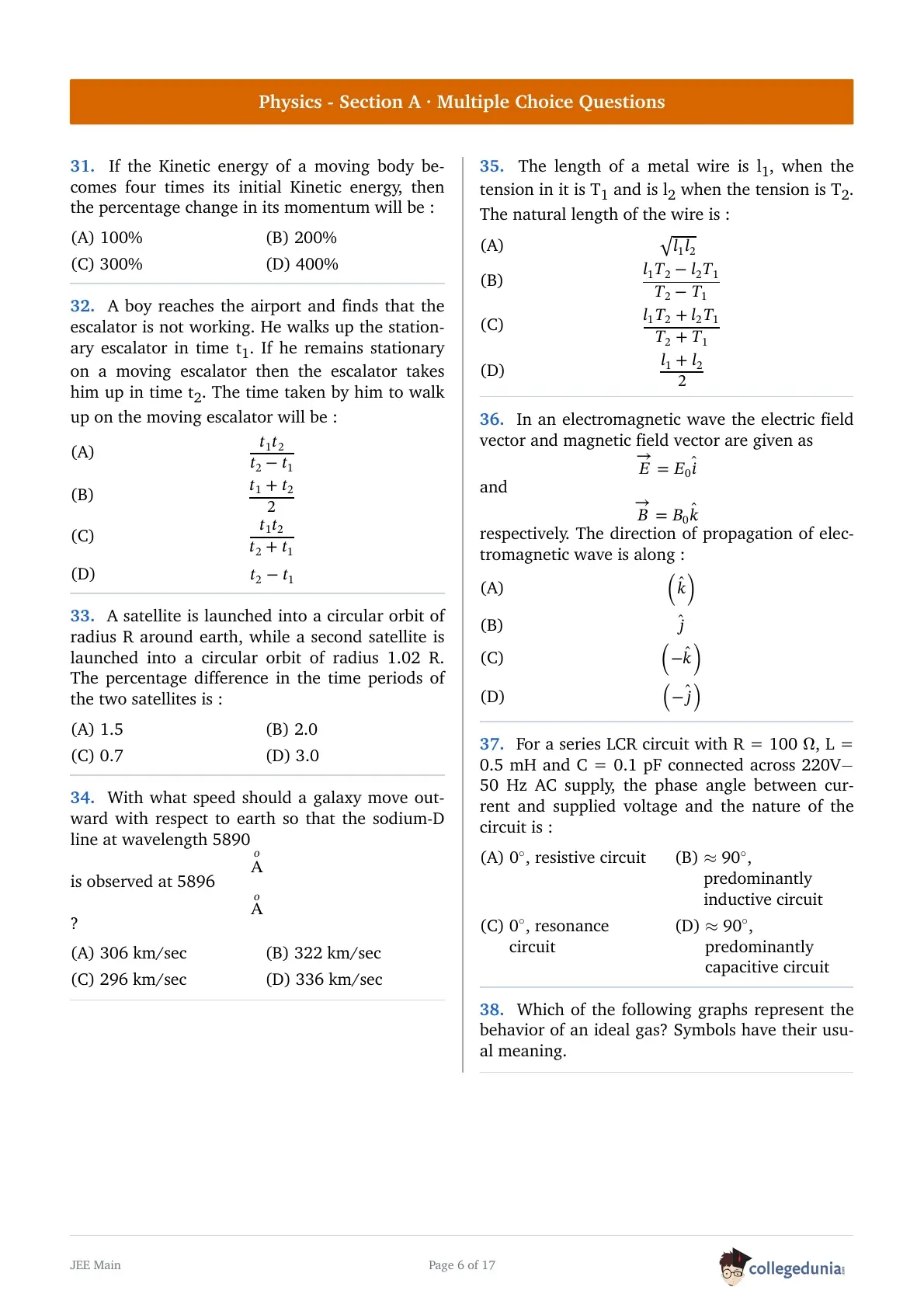
If the Kinetic energy of a moving body becomes four times its initial Kinetic energy, then the percentage change in its momentum will be :
A person climbs up a stalled escalator in \(60\, s\) . If standing on the same but escalator running with constant velocity he takes \(40\, s\). How much time is taken by the person to walk up the moving escalator ?
A satellite is launched into a circular orbit of radius \( R \) around the earth. A second satellite is launched into an orbit of radius \( 1.03R \). The time period of revolution of the second satellite is larger than the first one approximately by:
With what speed should a galaxy move outward with respect to earth so that the sodium-D line at wavelength 5890 \(\mathring{A}\) is observed at 5896 \(\mathring{A}\) ?
The length of metallic wire is \(l_1\) when tension in it is \(T_1\). It is \(l_2\) when the tension is \(T_2\). The original length of the wire will be :
In an electromagnetic wave the electric field vector and magnetic field vector are given as \(\vec{E} = E_0\hat{i}\) and \(\vec{B} = B_0\hat{k}\) respectively. The direction of propagation of electromagnetic wave is along :
For a series LCR circuit with R = 100 \(\Omega\), L = 0.5 mH and C = 0.1 pF connected across 220V\(-\)50 Hz AC supply, the phase angle between current and supplied voltage and the nature of the circuit is :
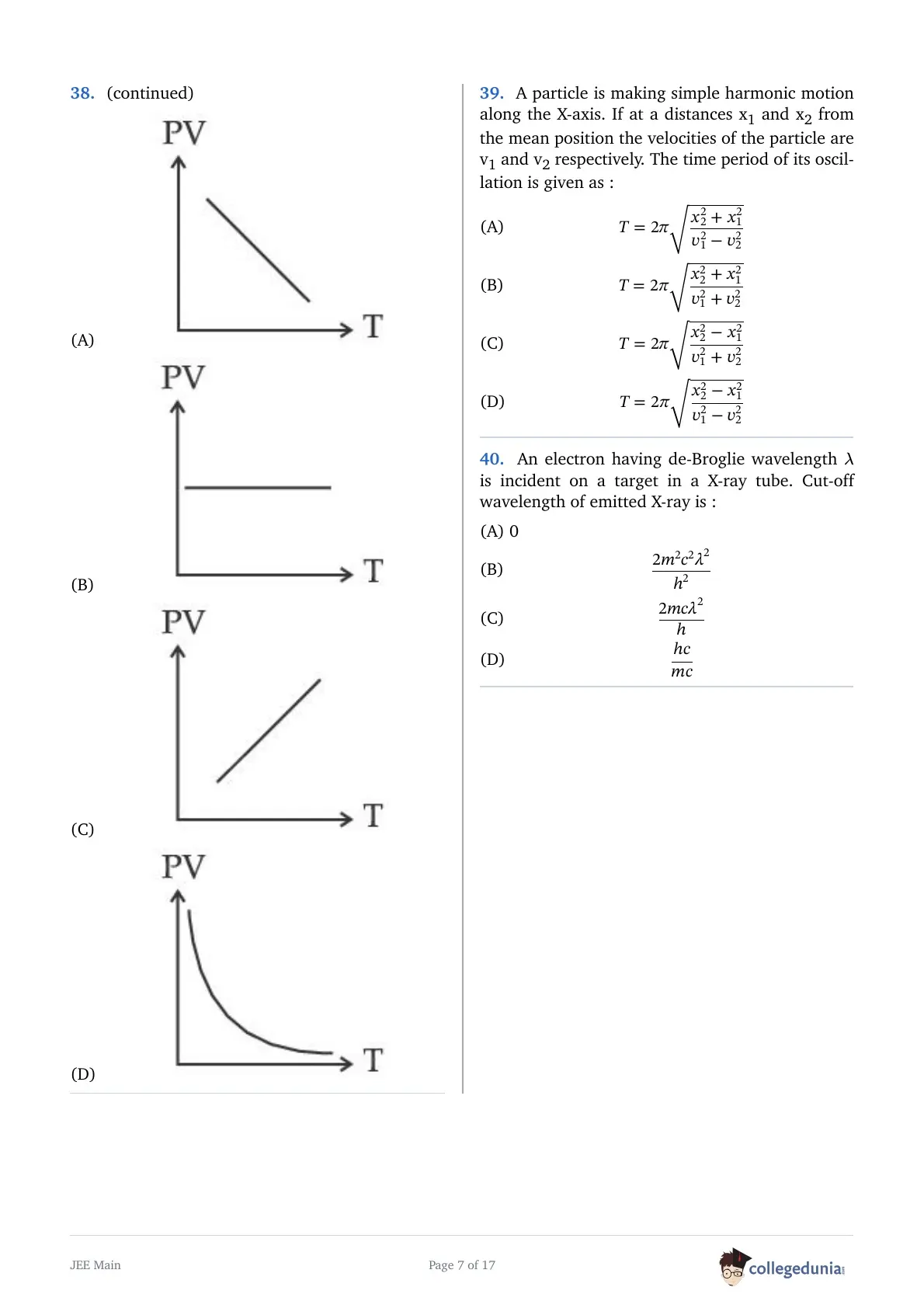
Which of the following graphs represent the behavior of an ideal gas? Symbols have their usual meaning.
- (1)
![]()
- (2)
![]()
- (3)
![]()
- (4)
![]()


A particle is making simple harmonic motion along the X-axis. If at a distances \(x_1\) and \(x_2\) from the mean position the velocities of the particle are \(v_1\) and \(v_2\) respectively. The time period of its oscillation is given as :
An electron having de-Broglie wavelength \(\lambda\) is incident on a target in a X-ray tube. Cut-off wavelength of emitted X-ray is :
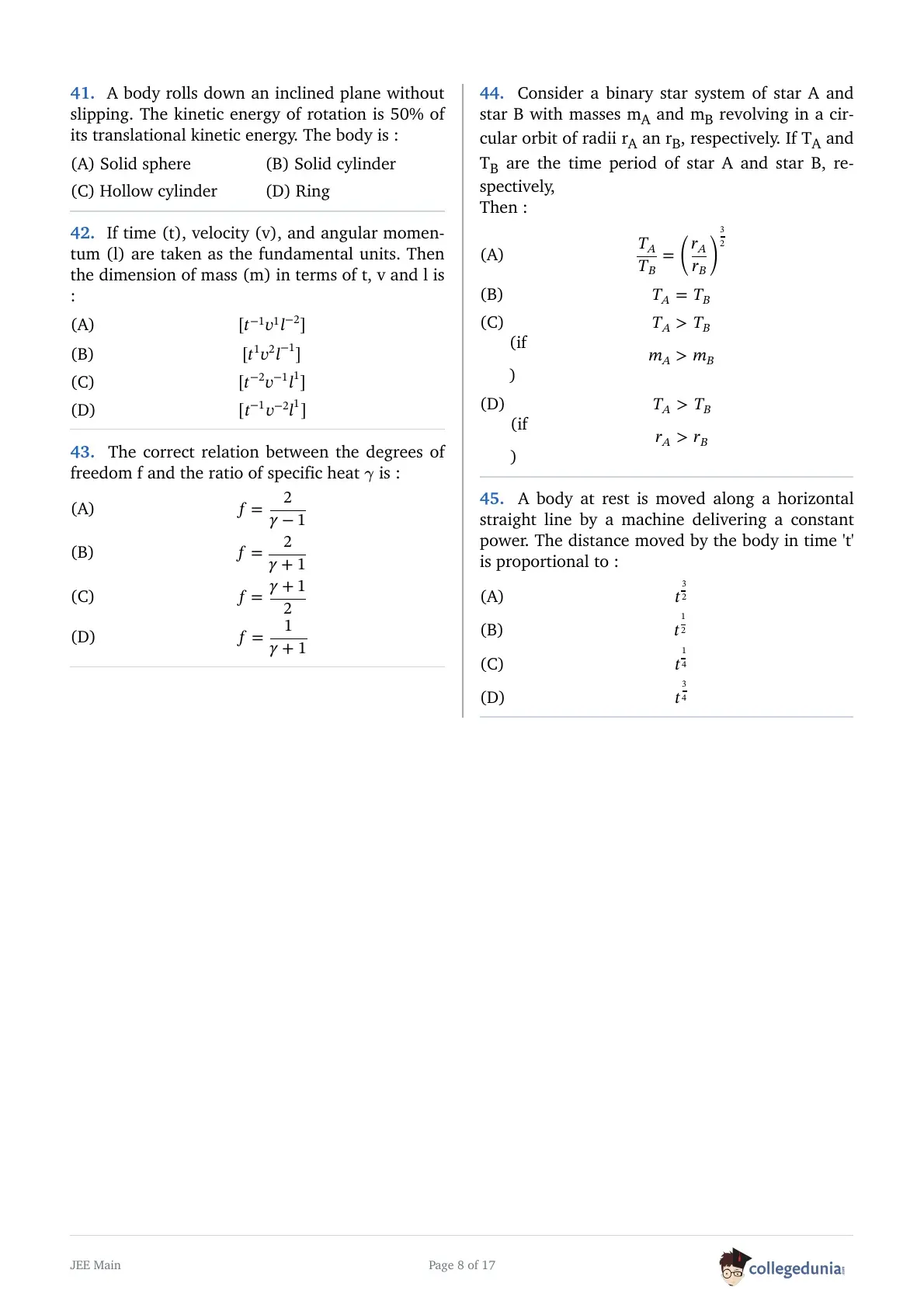
A body rolls down an inclined plane without slipping. The kinetic energy of rotation is 50% of its translational kinetic energy. The body is :
If time (t), velocity (v), and angular momentum (l) are taken as the fundamental units. Then the dimension of mass (m) in terms of t, v and l is :
The correct relation between the degrees of freedom f and the ratio of specific heat \(\gamma\) is :
Consider a binary star system of star A and star B with masses \(m_A\) and \(m_B\) revolving in a circular orbit of radii \(r_A\) an \(r_B\), respectively. If \(T_A\) and \(T_B\) are the time period of star A and star B, respectively,
Then :
A body at rest is moved along a horizontal straight line by a machine delivering a constant power. The distance moved by the body in time 't' is proportional to :
Two vectors \(\overrightarrow{A}+\overrightarrow{B}\) have equal magnitudes. If magnitude of \(\overrightarrow{A}+\overrightarrow{B}\) is equal to two times the magnitude of \(\overrightarrow{A}-\overrightarrow{B}\) then the angle between vec A and \(\overrightarrow{B}\) will be
Two small drops of mercury each of radius R coalesce to form a single large drop. The ratio of total surface energy before and after the change is :
The susceptibility of a paramagnetic material is \(99\). The permeability of the material in Wb/A-m, is
[Permeability of free space \(μ_0\) = \(4π × 10^{–7}\) Wb/A-m]
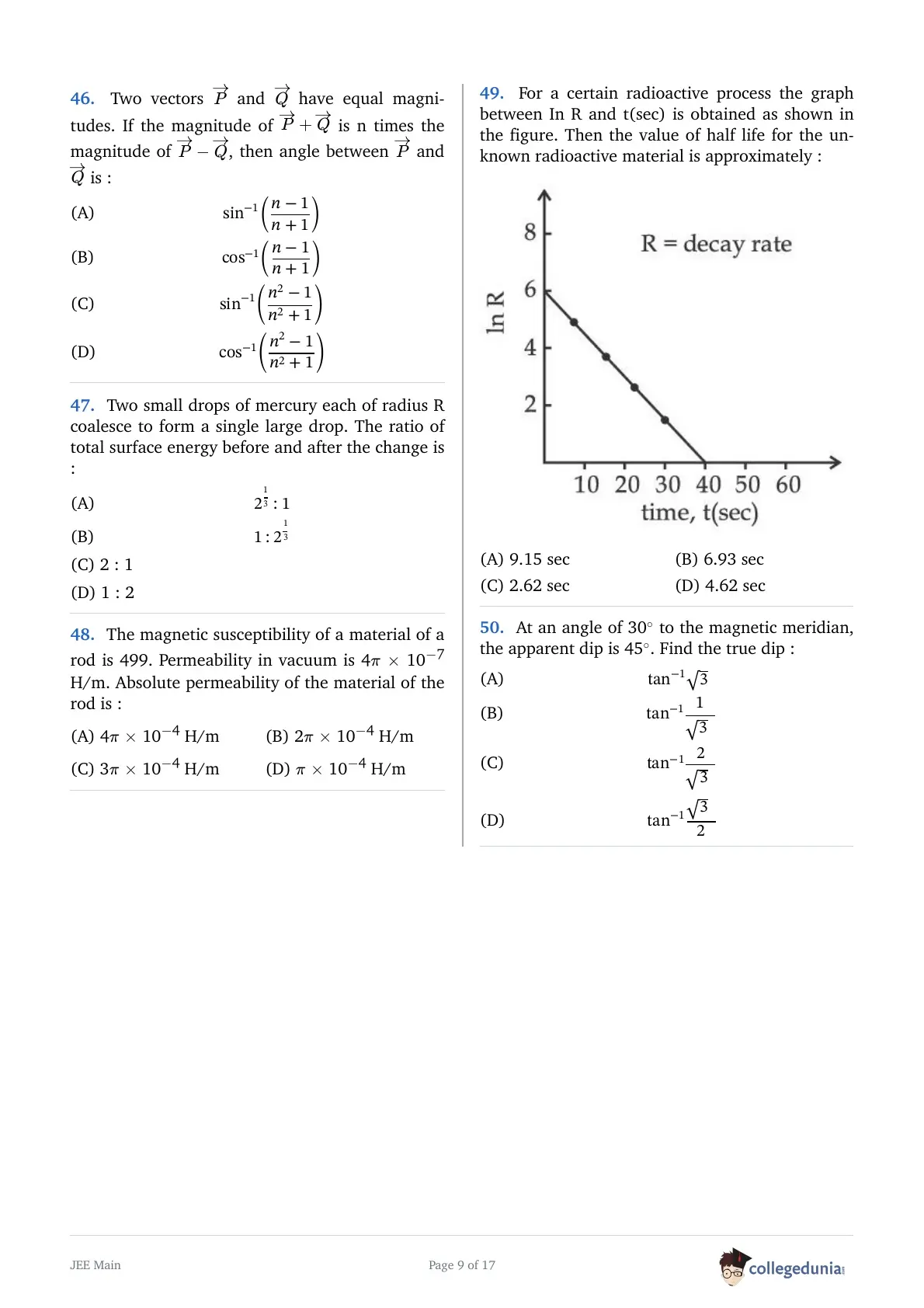
For a certain radioactive process the graph between ln R and t(sec) is obtained as shown in the figure. Then the value of half life for the unknown radioactive material is approximately :
At an angle of 30\(^\circ\) to the magnetic meridian, the apparent dip is 45\(^\circ\). Find the true dip :
Physics - Section B (Q51 - Q60)
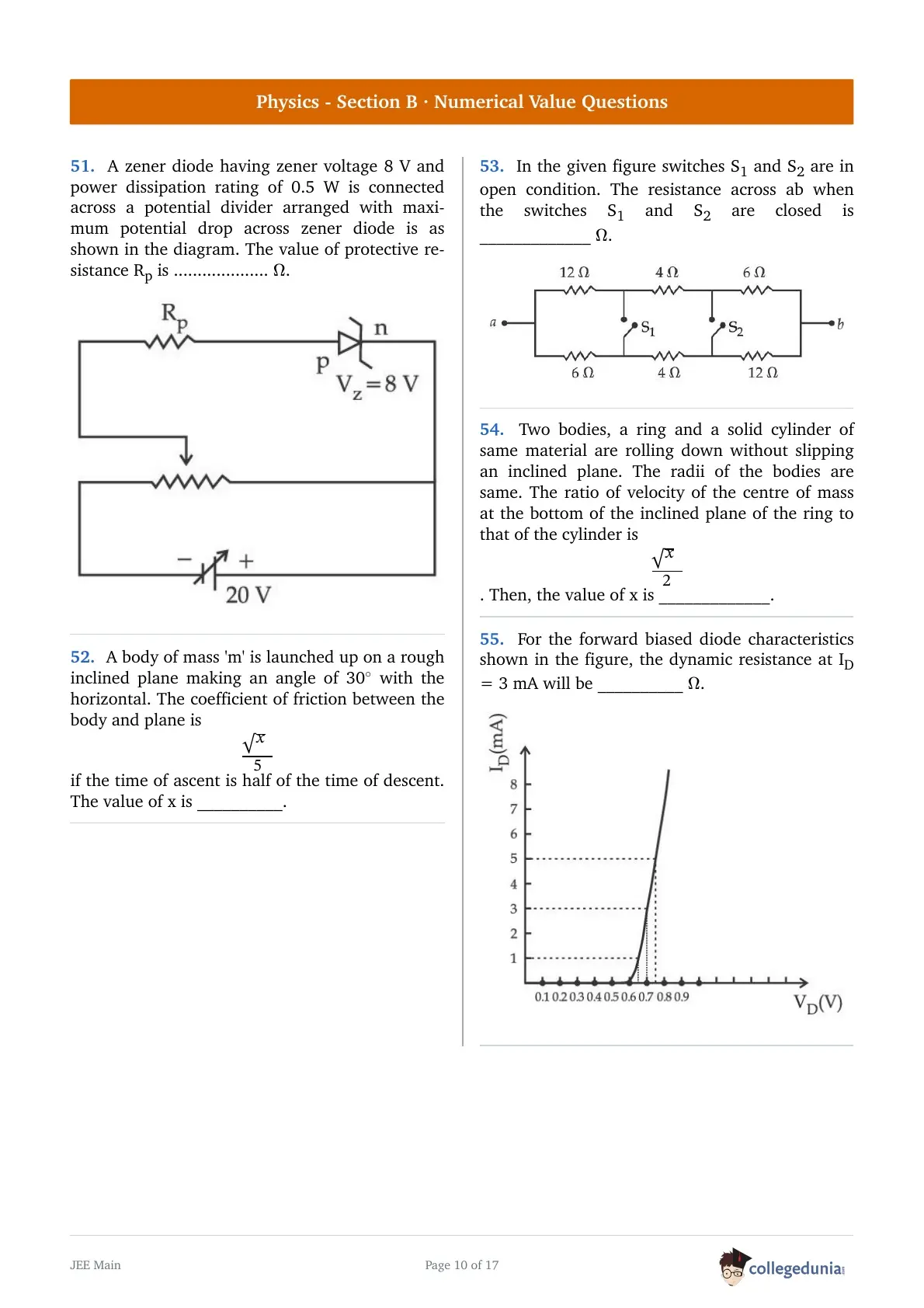
A zener diode having zener voltage 8 V and power dissipation rating of 0.5 W is connected across a potential divider arranged with maximum potential drop across zener diode is as shown in the diagram. The value of protective resistance \(R_p\) is .................... \(\Omega\).
A body of mass 'm' is launched up on a rough inclined plane making an angle of 30\(^\circ\) with the horizontal. The coefficient of friction between the body and plane is \(\dfrac{\sqrt{x}}{5}\) if the time of ascent is half of the time of descent. The value of x is __________.
In the given figure switches \(S_1\) and \(S_2\) are in open condition. The resistance across ab when the switches \(S_1\) and \(S_2\) are closed is _____________ \(\Omega\).
Two bodies, a ring and a solid cylinder of same material are rolling down without slipping an inclined plane. The radii of the bodies are same. The ratio of velocity of the centre of mass at the bottom of the inclined plane of the ring to that of the cylinder is \(\frac{\sqrt{x}}{2}\). Then, the value of x is _____________.
The I–V characteristics of a p-n junction diode in forward bias is shown in the figure. The ratio of dynamic resistance, corresponding to forward bias voltage of 2 V and 4 V respectively, is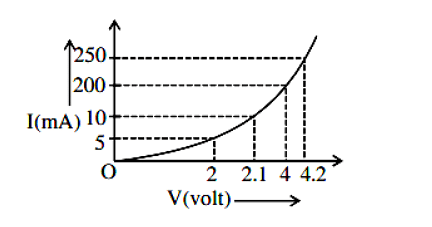
A series LCR circuit of R = 5 \(\Omega\), L = 20 mH and C = 0.5 \(\mu\)F is connected across an AC supply of 250 V, having variable frequency. The power dissipated at resonance condition is ______________ \(\times\) \(10^{2}\) W.
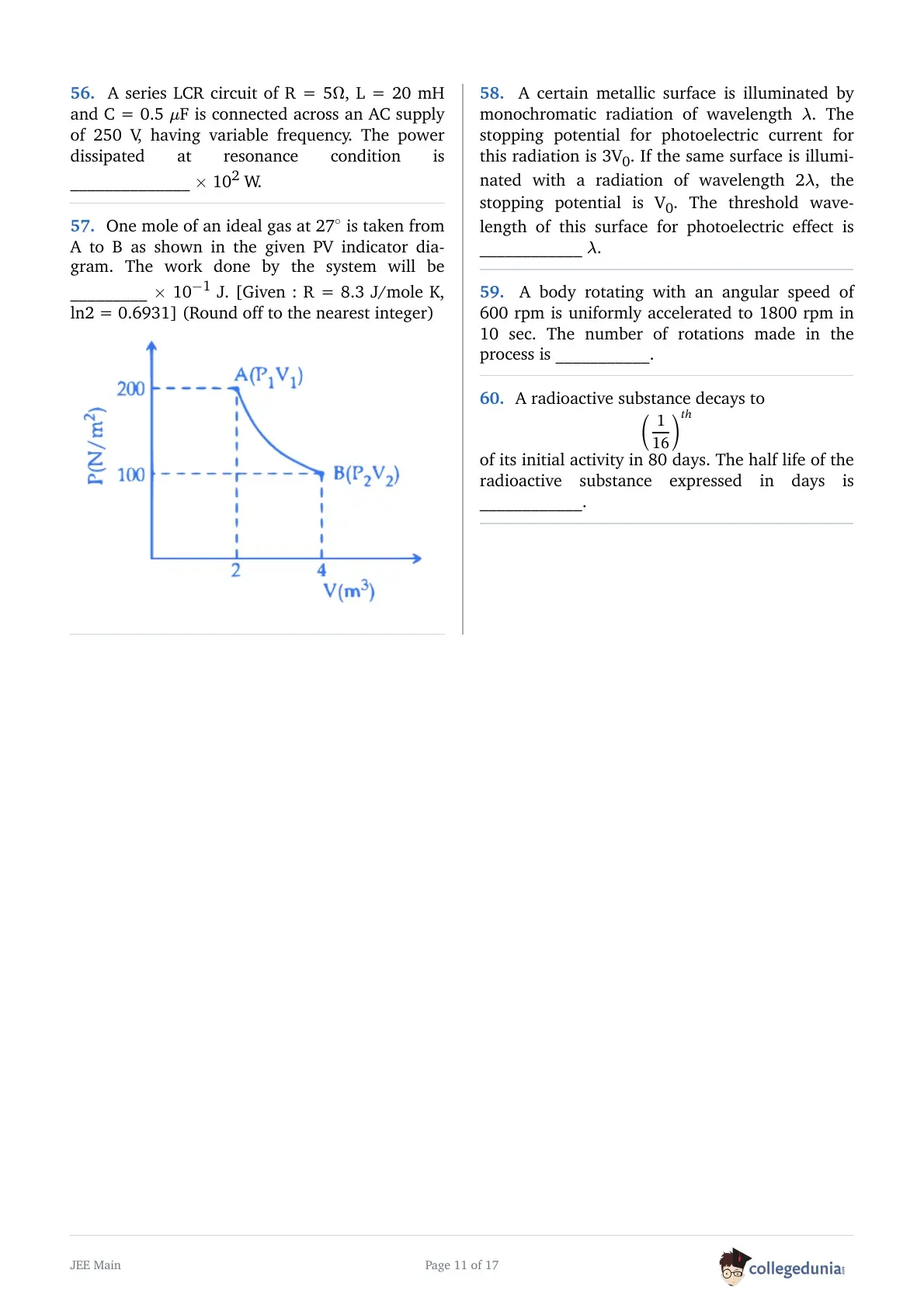
One mole of an ideal gas at \(27^\circ\) is taken from A to B as shown in the given PV indicator diagram. The work done by the system will be _________ \(\times\) \(10^{-1}\) J. [Given : R = 8.3 J/mole K, ln2 = 0.6931] (Round off to the nearest integer)
When a metal surface is illuminated by light of wavelength \( \lambda \), the stopping potential is 8V. When the same surface is illuminated by light of wavelength \( 3\lambda \), the stopping potential is 2V. The threshold wavelength for this surface is:
A body rotating with an angular speed of 600 rpm is uniformly accelerated to 1800 rpm in 10 sec. The number of rotations made in the process is ___________.
A radioactive substance decays to \(\left(\frac{1}{16}\right)^{th}\) of its initial activity in 80 days. The half life of the radioactive substance expressed in days is ____________.
Chemistry - Section A (Q61 - Q80)
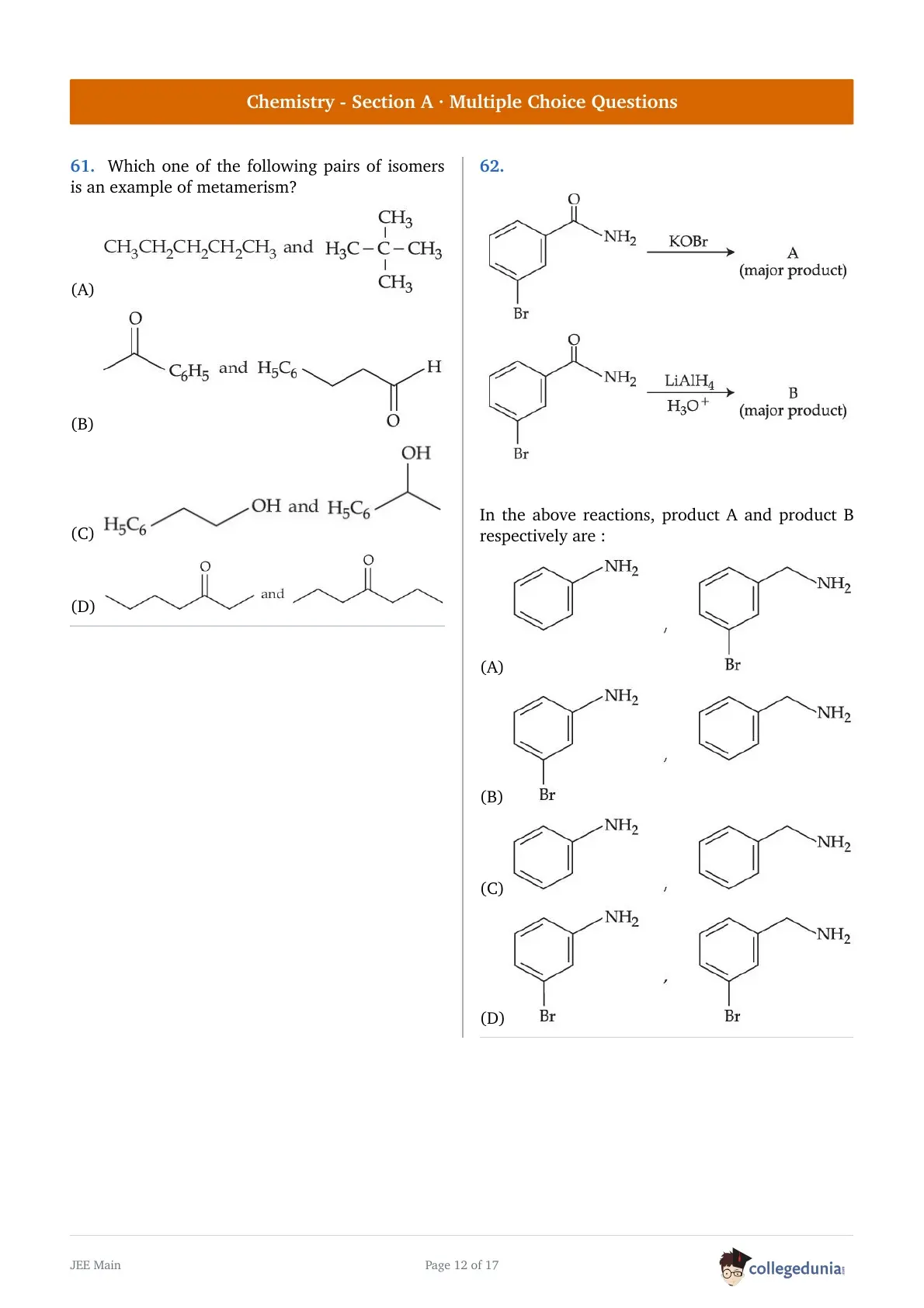
Which one of the following pairs of isomers is an example of metamerism?
- (1)
![]()
- (2)
![]()
- (3)
![]()
- (4)
![]()


Consider the above reactions, the product A and product B, respectively are
- (1)
![]()
- (2)
![]()
- (3)
![]()
- (4)
![]()


A solution is 0.1 M in \(\mathrm{Cl^-}\) and 0.001 M in \(\mathrm{CrO_4^{2-}}\). Solid \(\mathrm{AgNO_3}\) is gradually added to it. Assuming that the addition does not change in volume and \(K_{sp}(\mathrm{AgCl}) = 1.7\times10^{-10}\ \mathrm{M^2}\) and \(K_{sp}(\mathrm{Ag_2CrO_4}) = 1.9\times10^{-12}\ \mathrm{M^3}\).
Select correct statement from the following :
Outermost electronic configuration of a group 13 element, E, is \(4s^2, 4p^1\). The electronic configuration of an element of p-block period-five placed diagonally to element, E is :
Metallic sodium does not react normally with :
Spin only magnetic moment of an octahedral complex of \(\mathrm{Fe^{2+}}\) in the presence of a strong field ligand in BM is :
Which one of the following species doesn't have a magnetic moment of 1.73 BM, (spin only value)?
Which one of the following statements is not true about enzymes?
The hybridisations of the atomic orbitals of nitrogen in \(\mathrm{NO_2^-}\), \(\mathrm{NO_2^+}\) and \(\mathrm{NH_4^+}\) respectively are.
Benzene on nitration gives nitrobenzene in presence of \(\mathrm{HNO_3}\) and \(\mathrm{H_2SO_4}\) mixture, where :


\(\mathrm{Cu^{2+}}\) salt reacts with potassium iodide to give
In Carius method, halogen containing organic compound is heated with fuming nitric acid in the presence of :

The correct order of their reactivity towards hydrolysis at room temperature is :
The single largest industrial application of dihydrogen is :
Consider two chemical reactions (A) and (B) that take place during metallurgical process:
(A) \(\mathrm{ZnCO_{3(s)} \xrightarrow{\Delta} ZnO_{(s)} + CO_{2(g)}}\)
(B) \(\mathrm{2ZnS_{(s)} + 3O_{2(g)} \xrightarrow{\Delta} 2ZnO_{(s)} + 2SO_{2(g)}}\)
The correct option of names given to them respectively is :
Bakelite is a cross-linked polymer of formaldehyde and :
Which one of the following gases is reported to retard photosynthesis?
Chemistry - Section B (Q81 - Q90)
For a given chemical reaction A \(\rightarrow\) B at 300 K the free energy change is \(-49.4\) kJ \(\mathrm{mol^{-1}}\) and the enthalpy of reaction is 51.4 kJ \(\mathrm{mol^{-1}}\). The entropy change of the reaction is _____________ \(\mathrm{JK^{-1}\,mol^{-1}}\).
The wavelength of an electron of kinetic energy \(4.50 \times 10^{-29}\) J is ___________ \(\times 10^{-5}\) m. (Nearest integer)
Given : mass of electron is \(9 \times 10^{-31}\) kg, \(h = 6.6 \times 10^{-34}\) J s
The vapour pressures of two volatile liquids A and B at 25°C are 50 Torr and 100 Torr, respectively. If the liquid mixture, contains 0.3 mole fraction of A, then the mole fraction of liquid B in the vapour phase is \(\frac {x}{17}\). The value of x is _____.
4g equimolar mixture of NaOH and \(\mathrm{Na_2CO_3}\) contains x g of NaOH and y g of \(\mathrm{Na_2CO_3}\). The value of x is ____________ g. (Nearest integer)
In Carius method of estimation of halogen, 0.25 g of an organic compound gave 0.15 g of silver bromide (AgBr). The percentage of Bromine in the organic compound is ________________ × 10-1% (Nearest integer).
(Given: Molar mass of Ag is 108 and Br is 80 g mol-1)
\(\mathrm{PCl_5(g) \rightarrow PCl_3(g) + Cl_2(g)}\)
In the above first order reaction the concentration of \(\mathrm{PCl_5}\) reduces from initial concentration 50 mol \(\mathrm{L^{-1}}\) to 10 mol \(\mathrm{L^{-1}}\) in 120 minutes at 300 K. The rate constant for the reaction at 300 K is x \(\times\) \(10^{-2}\) \(\mathrm{min^{-1}}\). The value of x is __________. [Given log5 = 0.6989]
An aqueous solution of \(\mathrm{NiCl_2}\) was heated with excess sodium cyanide in presence of strong oxidizing agent to form \(\mathrm{[Ni(CN)_6]^{2-}}\). The total change in number of unpaired electrons on metal centre is _______________.
Potassium chlorate is prepared by electrolysis of KCl in basic solution as shown by following equation.
\(\mathrm{6OH^- + Cl^- \rightarrow ClO_3^- + 3H_2O + 6e^-}\)
A current of xA has to be passed for 10h to produce 10.0g of potassium chlorate. The value of x is ____________. (Nearest integer)
(Molar mass of \(\mathrm{KClO_3}\) = 122.6 g \(\mathrm{mol^{-1}}\), F = 96500 C)
100 ml of 0.0018% (w/v) solution of \(\mathrm{Cl^-}\) ion was the minimum concentration of \(\mathrm{Cl^-}\) required to precipitate a negative sol in one h. The coagulating value of \(\mathrm{Cl^-}\) ion is _________ (Nearest integer)
Diamond has a three dimensional structure of C atoms formed by covalent bonds. The structure of diamond has face centred cubic lattice where 50% of the tetrahedral voids are also occupied by carbon atoms. The number of carbon atoms present per unit cell of diamond is ____________.
JEE Main 2021 Exam Pattern and Marking Scheme
| Particulars | Details |
|---|---|
| Exam Mode | Online (Computer-Based Test) |
| Paper | B.E./B.Tech (Paper 1) |
| Duration | 3 hours (180 minutes) |
| Type of Questions | Multiple Choice Questions (MCQs) + Numerical Value Questions |
| Subjects | Mathematics, Physics, Chemistry |
| Total Questions | 90 questions (75 to be attempted) |
| Total Marks | 300 marks |
| Marking Scheme | +4 for correct answer & -1 for incorrect MCQ; no negative marking for Numerical Value Questions |
JEE Main 2021 July 20 Shift 2 Difficulty Level
JEE Main 2021 B.E./B.Tech Question Paper- July 20, 2021- Afternoon was rated to be moderately difficult by the expert coaching institutions. The exam was the second exam of the JEE Main 3rd Session. A large contributing factor to the moderate difficulty of the exam was the Mathematics section, which featured tricky and lengthy questions, especially from Probability and Differential Calculus. The second in terms of difficulty was the Physics section, featuring a significant amount of questions from Mechanics and Modern Physics. The difficulty level of the Chemistry section was equivalent to the Physics section, in terms of complexity and theory-based questions; the biggest contributor to the Chemistry section was Organic Chemistry (I and II).
JEE Main 2021 B.E./B.Tech Question Paper July 20 (Afternoon Session): Paper Analysis
JEE Main 2021 B.E./B.Tech Paper on July 20 Forenoon Session was conducted between 3.00 PM to 6.00 PM, the paper analysis for each unit is as follows.
| Subject | Topic | Number of Questions |
|---|---|---|
| Physics | Electrodynamics | 3 |
| Heat and Thermodynamics | 3 | |
| Mechanics | 13 | |
| Modern Physics | 8 | |
| Optics | 1 | |
| SHM and Waves | 2 | |
| Chemistry | Inorganics Chemistry I | 3 |
| Inorganics Chemistry II | 4 | |
| Organic Chemistry I | 7 | |
| Organic Chemistry II | 9 | |
| Physical Chemistry I | 5 | |
| Physical Chemistry II | 2 | |
| Mathematics | Binomial Theorem | 2 |
| Coordinate Geometry | 2 | |
| Differential Calculus | 4 | |
| Integral Calculus | 2 | |
| Permutation and Combination | 3 | |
| Probability | 2 | |
| Vector and 3D | 2 | |
| Statistics | 2 | |
| Quadratic Equations | 3 | |
| Mathematical Reasoning | 2 | |
| Trigonometry | 2 | |
| Matrix and Determinants | 2 | |
| Fundamental of Mathematics | 2 |
For detailed Question Paper Analysis, visit- JEE Main Question Paper Analysis



Comments