




JEE Main 2021 July 25 Shift 1 Question Paper is available here with solutions PDF and detailed solutions for every question. NTA conducted the first shift on July 25, 2021, from 9:00 AM to 12:00 PM. The JEE Main 2021 Paper 1 (B.E./B.Tech) question paper includes the following:
- 90 questions in a 3-hour CBT Mode: 30 each from Mathematics, Physics and Chemistry (75 to be attempted)
- Section A: 20 multiple choice questions (MCQs) per subject, all compulsory, 4 marks each
- Section B: 10 numerical value questions per subject, any 5 to be attempted, 4 marks each
- Marking: +4 for a correct answer, -1 for an incorrect MCQ, 0 for an unattempted question; no negative marking for numerical value questions
- Maximum marks: 300 (100 per subject)
JEE Main 2021 July 25 Shift 1 Question Paper with Solution PDF
| NTA Official PDF | CD PDF | CD PDF with Solutions |
|---|---|---|
| Download official PDF 6.34 MB | Download Collegedunia PDF 1.18 MB | Download solutions PDF 1.21 MB |
Also Check:
JEE Main 2021 July 25 Shift 1 Questions with Solutions
Mathematics - Section A (Q1 - Q20)
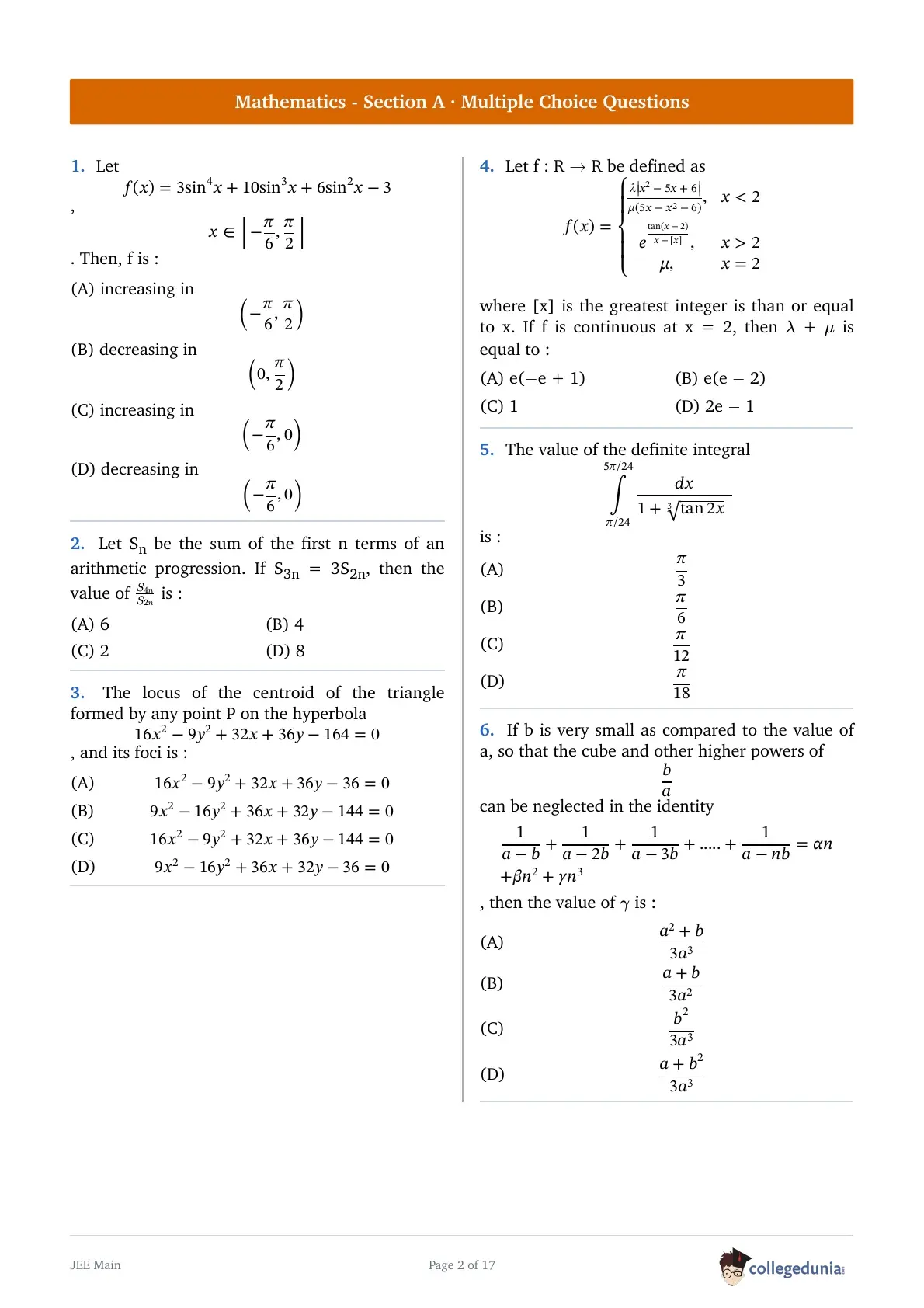
Let \(f(x) = 3 \sin^4 x + 10 \sin^3 x + 6 \sin^2 x - 3, x \in [-\frac{\pi}{6}, \frac{\pi}{2}]\). Then, \(f\) is :
Let \(S_n\) be the sum of the first n terms of an arithmetic progression. If \(S_{3n} = 3S_{2n}\), then the value of \(\frac{S_{4n}}{S_{2n}}\) is :
The locus of the centroid of the triangle formed by any point P on the hyperbola \(16x^2 - 9y^2 + 32x + 36y - 164 = 0\), and its foci is :
Let \(f : \mathbb{R} \to \mathbb{R}\) be defined as
\(f(x)=\begin{cases}\dfrac{\lambda\left|x^2-5x+6\right|}{\mu\left(5x-x^2-6\right)}, & x\lt 2\\[2mm] e^{\frac{\tan(x-2)}{x-[x]}}, & x\gt 2\\[2mm] \mu, & x=2\end{cases}\)
where \([x]\) is the greatest integer less than or equal to \(x\). If \(f\) is continuous at \(x=2\), then \(\lambda+\mu\) is equal to :
The value of the definite integral \(\int_{\pi/24}^{5\pi/24} \frac{dx}{1 + \sqrt[3]{\tan 2x}}\) is :
If \(b\) is very small as compared to the value of \(a\), so that the cube and other higher powers of \(\frac{b}{a}\) can be neglected in the identity \(\frac{1}{a-b} + \frac{1}{a-2b} + \frac{1}{a-3b} + ....... + \frac{1}{a-nb} = \alpha n + \beta n^2 + \gamma n^3\), then the value of \(\gamma\) is :
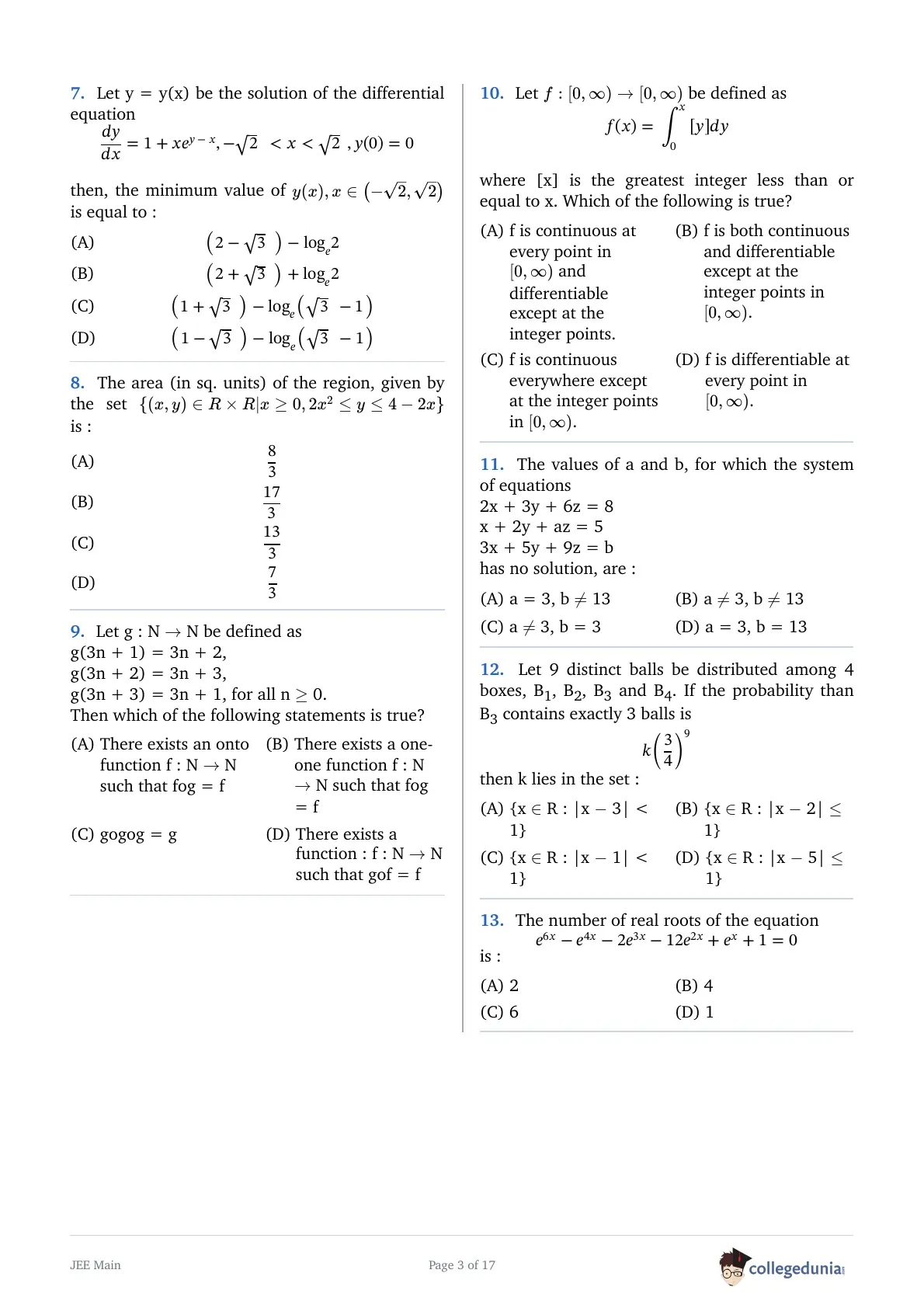
Let \(y=y(x)\) be the solution of the differential equation \(\frac{dy}{dx} = 1 + xe^{y-x}, -\sqrt{2}<x<\sqrt{2}, y(0) = 0\). Then, the minimum value of \(y(x), x \in (-\sqrt{2}, \sqrt{2})\) is equal to :
The area (in sq. units) of the region, given by the set \(\{(x, y) \in R \times R \mid x \ge 0, 2x^2 \le y \le 4 - 2x\}\) is :
Let \(g: N \to N\) be defined as \(g(3n+1) = 3n+2, g(3n+2) = 3n+3, g(3n+3) = 3n+1\), for all \(n \ge 0\). Then which of the following statements is true ?
Let \(f:[0, \infty) \to [0, \infty)\) be defined as \(f(x) = \int_0^x [y] dy\), where \([x]\) is the greatest integer less than or equal to \(x\). Which of the following is true ?
The values of a and b, for which the system of equations
\(2x + 3y + 6z = 8\)
\(x + 2y + az = 5\)
\(3x + 5y + 9z = b\)
has no solution, are :
Let 9 distinct balls be distributed among 4 boxes, \(B_1, B_2, B_3\) and \(B_4\). If the probability that \(B_3\) contains exactly 3 balls is \(k \left(\frac{3}{4}\right)^9\) then \(k\) lies in the set :
The number of real roots of the equation \(e^{6x} - e^{4x} - 2e^{3x} - 12e^{2x} + e^x + 1 = 0\) is :
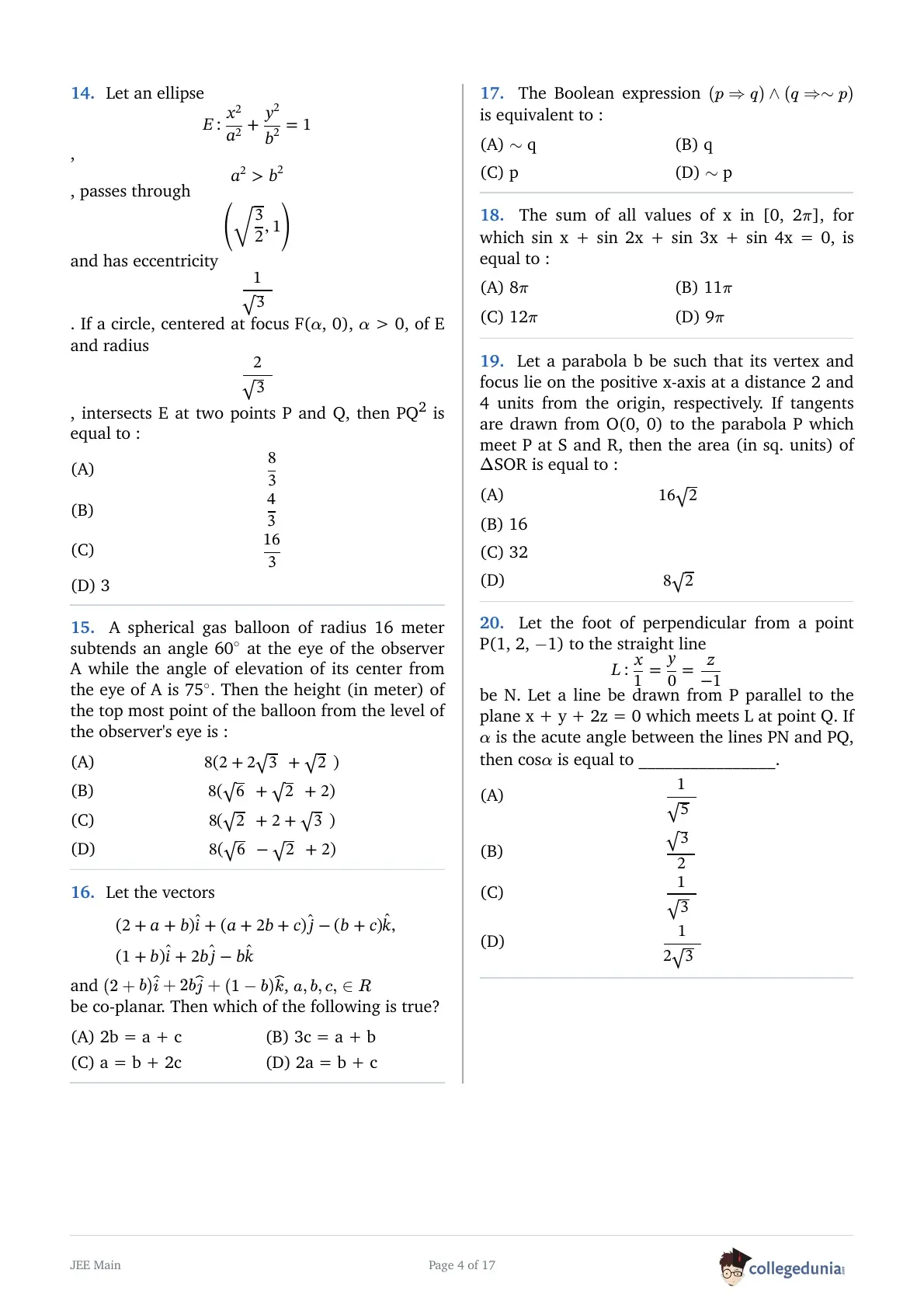
Let an ellipse \(E: \frac{x^2}{a^2} + \frac{y^2}{b^2} = 1, a^2>b^2\), passes through \(\left(\sqrt{\frac{3}{2}}, 1\right)\) and has eccentricity \(\frac{1}{\sqrt{3}}\). If a circle, centered at focus \(F(\alpha, 0), \alpha>0\), of \(E\) and radius \(\frac{2}{\sqrt{3}}\), intersects \(E\) at two points \(P\) and \(Q\), then \(PQ^2\) is equal to :
A spherical gas balloon of radius 16 meter subtends an angle \(60^{\circ}\) at the eye of the observer A while the angle of elevation of its center from the eye of A is \(75^{\circ}\). Then the height (in meter) of the top most point of the balloon from the level of the observer's eye is :
Let the vectors \((2 + a + b)\hat{i} + (a + 2b + c)\hat{j} - (b + c)\hat{k}\), \((1 + b)\hat{i} + 2\hat{j} - b\hat{k}\) and \((2 + b)\hat{i} + 2\hat{j} + (1 - b)\hat{k}\), \(a, b, c \in \mathbb{R}\) be co-planar. Then which of the following is true ?
The Boolean expression \((p \implies q) \wedge (q \implies \sim p)\) is equivalent to :
The sum of all values of \(x\) in \([0, 2\pi]\), for which \(\sin x + \sin 2x + \sin 3x + \sin 4x = 0\), is equal to :
Let a parabola \(P\) be such that its vertex and focus lie on the positive x-axis at a distance 2 and 4 units from the origin, respectively. If tangents are drawn from \(O(0, 0)\) to the parabola \(P\) which meet \(P\) at \(S\) and \(R\), then the area (in sq. units) of \(\Delta SOR\) is equal to :
Let the foot of perpendicular from a point \(P(1, 2, -1)\) to the straight line \(L: \frac{x}{1} = \frac{y}{0} = \frac{z}{-1}\) be \(N\). Let a line be drawn from \(P\) parallel to the plane \(x + y + 2z = 0\) which meets \(L\) at point \(Q\). If \(\alpha\) is the acute angle between the lines \(PN\) and \(PQ\), then \(\cos \alpha\) is equal to ________.
Mathematics - Section B (Q21 - Q30)
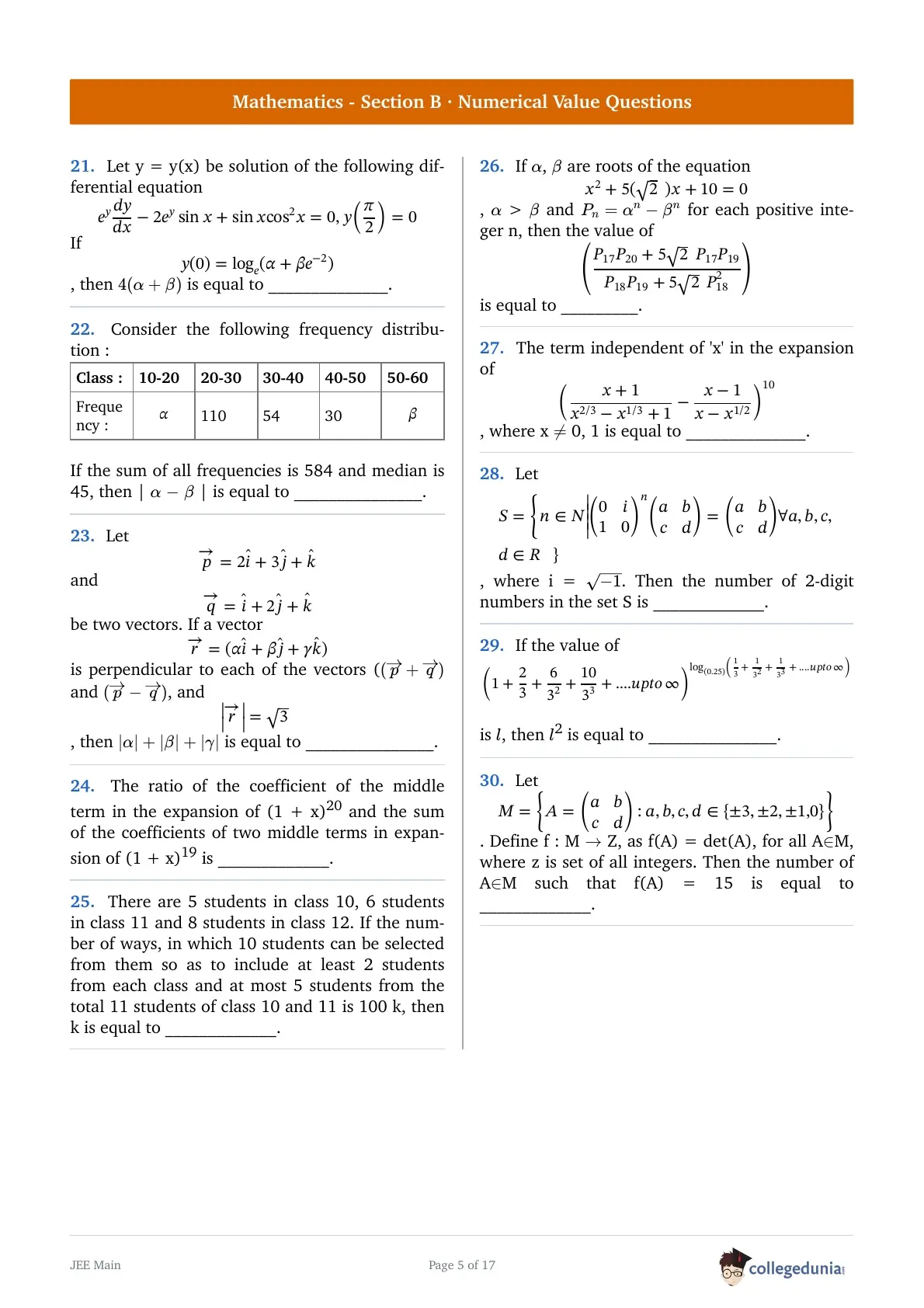
Let \(y=y(x)\) be solution of the following differential equation \(e^y \frac{dy}{dx} - 2e^y \sin x + \sin x \cos^2 x = 0, y(\pi/2) = 0\). If \(y(0) = \log_e(\alpha + \beta e^{-2})\), then \(4(\alpha + \beta)\) is equal to __________.
Consider the following frequency distribution: 
If the sum of all frequencies is 584 and median is 45, then \(|\alpha - \beta|\) is equal to __________
Let \(\vec{p} = 2\hat{i} + 3\hat{j} + \hat{k}\) and \(\vec{q} = \hat{i} + 2\hat{j} + \hat{k}\) be two vectors. If a vector \(\vec{r} = \alpha\hat{i} + \beta\hat{j} + \gamma\hat{k}\) is perpendicular to each of the vectors \((\vec{p} + \vec{q})\) and \((\vec{p} - \vec{q})\), and \(|\vec{r}| = \sqrt{3}\), then \(|\alpha| + |\beta| + |\gamma|\) is equal to __________.
The ratio of the coefficient of the middle term in the expansion of \((1+x)^{20}\) and the sum of the coefficients of two middle terms in expansion of \((1+x)^{19}\) is __________.
There are 5 students in class 10, 6 students in class 11 and 8 students in class 12. If the number of ways, in which 10 students can be selected from them so as to include at least 2 students from each class and at most 5 students from the total 11 students of class 10 and 11 is \(100k\), then k is equal to __________.
If \(\alpha, \beta\) are roots of the equation \(x^2 + 5(\sqrt{2})x + 10 = 0, \alpha>\beta\) and \(P_n = \alpha^n - \beta^n\) for each positive integer n, then the value of \(\frac{P_{17}P_{20} + 5\sqrt{2} P_{17}P_{19}}{P_{18}P_{19} + 5\sqrt{2} P_{18}^2}\) is equal to __________.
The term independent of '\(x\)' in the expansion of \(\left( \frac{x+1}{x^{2/3}-x^{1/3}+1} - \frac{x-1}{x-x^{1/2}} \right)^{10}\), where \(x \neq 0, 1\) is equal to __________.
Let \(S = \left\{ n \in \mathbb{N} : \begin{pmatrix} 0 & i \\
1 & 0 \end{pmatrix}^n \begin{pmatrix} a & b \\
c & d \end{pmatrix} = \begin{pmatrix} a & b \\
c & d \end{pmatrix}, \forall a, b, c, d \in \mathbb{R} \right\}\), where \(i = \sqrt{-1}\). Then the number of 2-digit numbers in the set S is __________.
If the value of \(\left( 1 + \frac{2}{3} + \frac{6}{3^2} + \frac{10}{3^3} + ....... \text{upto } \infty \right)^{\log_{0.25} \left( \frac{1}{3} + \frac{1}{3^2} + \frac{1}{3^3} + ....... \text{upto } \infty \right)}\) is \(l\), then \(l^2\) is equal to __________.
Let \(M = \left\{ A = \begin{pmatrix} a & b \\
c & d \end{pmatrix} : a, b, c, d \in \{ \pm 3, \pm 2, \pm 1, 0 \} \right\}\). Define \(f: M \to \mathbb{Z}\) as \(f(A) = \det(A)\), for all \(A \in M\), where \(\mathbb{Z}\) is the set of all integers. Then the number of \(A \in M\) such that \(f(A) = 15\) is equal to __________.
Physics - Section A (Q31 - Q50)
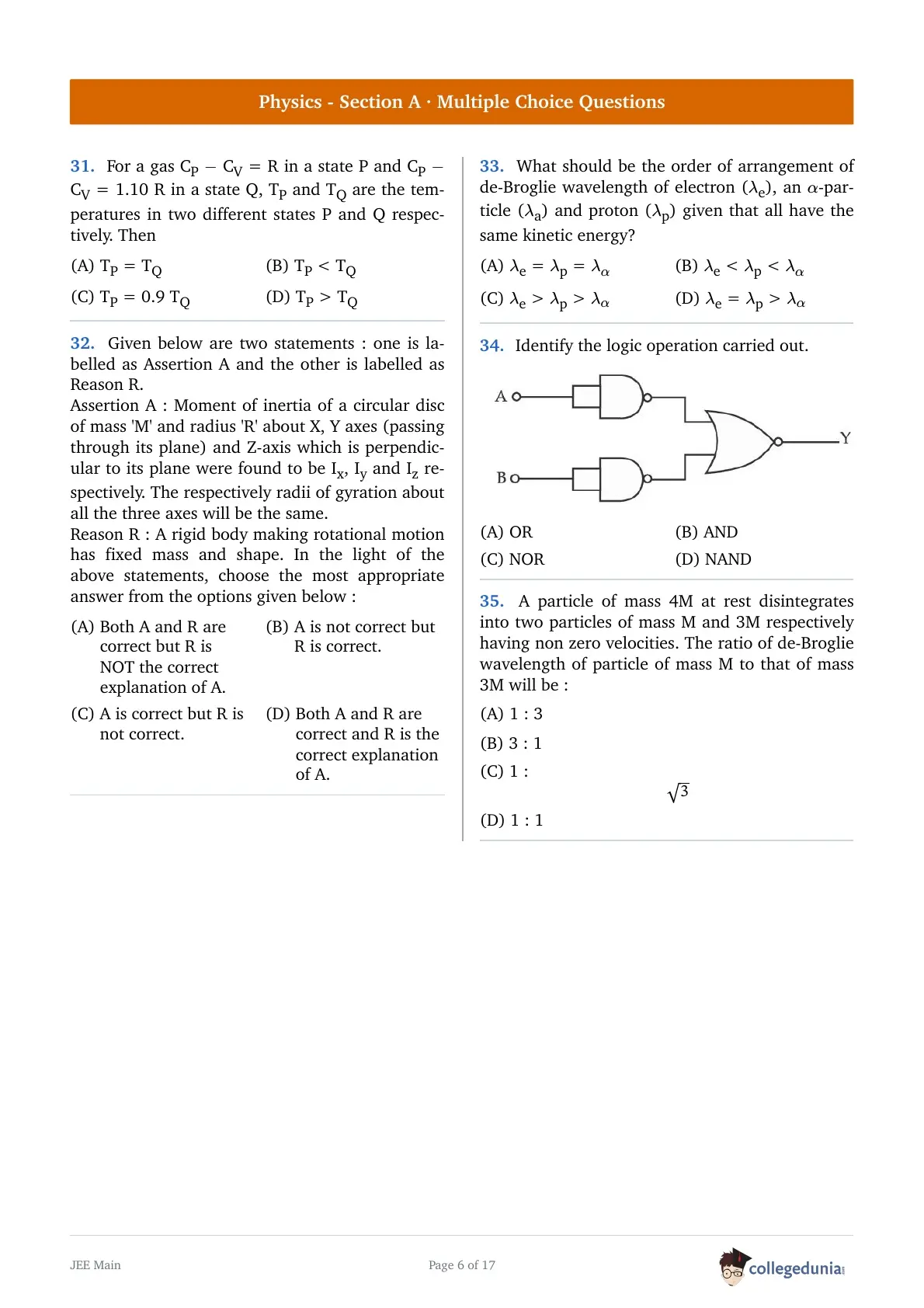
For a gas \(C_p - C_v = R\) in a state P and \(C_p - C_v = 1.10 R\) in a state Q. \(T_P\) and \(T_Q\) are the temperatures in two different states P and Q respectively. Then
Given below are two statements : one is labelled as Assertion A and the other is labelled as Reason R.
Assertion A : Moment of inertia of a circular disc of mass 'M' and radius 'R' about X, Y axes (passing through its plane) and Z-axis which is perpendicular to its plane were found to be \(I_x, I_y, & I_z\), respectively. The respective radii of gyration about all the three axes will be the same.
Reason R : A rigid body making rotational motion has fixed mass and shape.
In the light of the above statements, choose the most appropriate answer from the options given below :
What should be the order of arrangement of de-Broglie wavelength of electron (\(\lambda_e\)), an \(\alpha\)-particle (\(\lambda_\alpha\)) and proton (\(\lambda_p\)) given that all have the same kinetic energy?
Identify the logic operation carried out. 
A particle of mass 4M at rest disintegrates into two particles of mass M and 3M respectively having non zero velocities. The ratio of de-Broglie wavelength of particle of mass M to that of mass 3M will be :
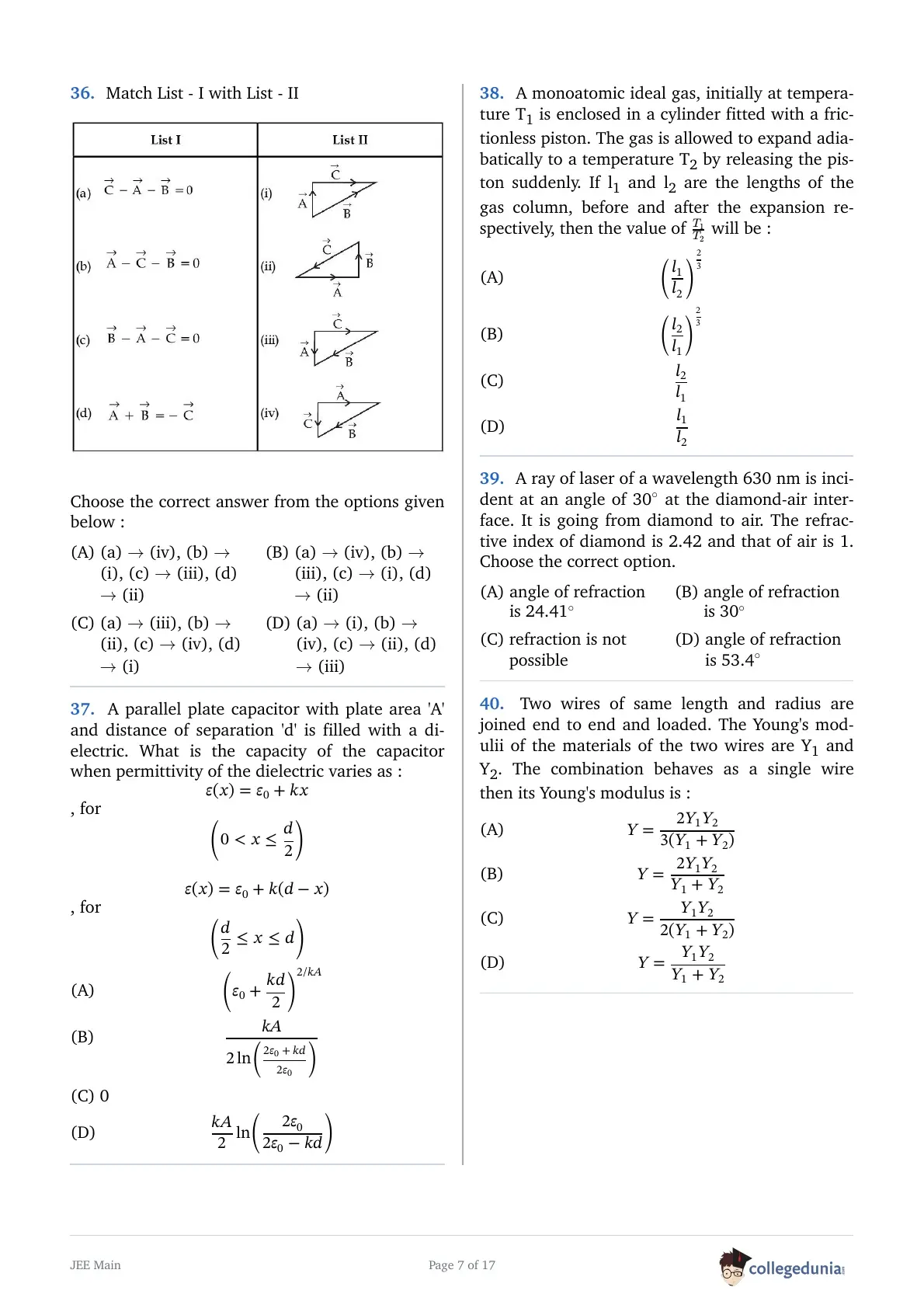
Match List I with List II. 
Choose the correct answer from the options given below :
A parallel plate capacitor with plate area 'A' and distance of separation 'd' is filled with a dielectric. What is the capacity of the capacitor when permittivity of the dielectric varies as :
\[ \epsilon(x) = \epsilon_0 + kx, \text{ for } \left( 0<x \le \frac{d}{2} \right) \]
\[ \epsilon(x) = \epsilon_0 + k(d-x), \text{ for } \left( \frac{d}{2} \le x \le d \right) \]
A monoatomic ideal gas, initially at temperature \(T_1\), is enclosed in a cylinder fitted with a frictionless piston. The gas is allowed to expand adiabatically to a temperature \(T_2\) by releasing the piston suddenly. If \(l_1\) and \(l_2\) are the lengths of the gas column, before and after the expansion respectively, then the value of \(\frac{T_1}{T_2}\) will be :
A ray of laser of a wavelength 630 nm is incident at an angle of \(30^\circ\) at the diamond-air interface. It is going from diamond to air. The refractive index of diamond is 2.42 and that of air is 1. Choose the correct option.
Two wires of same length and radius are joined end to end and loaded. The Young's moduli of the materials of the two wires are \(Y_1\) and \(Y_2\). The combination behaves as a single wire then its Young's modulus is :
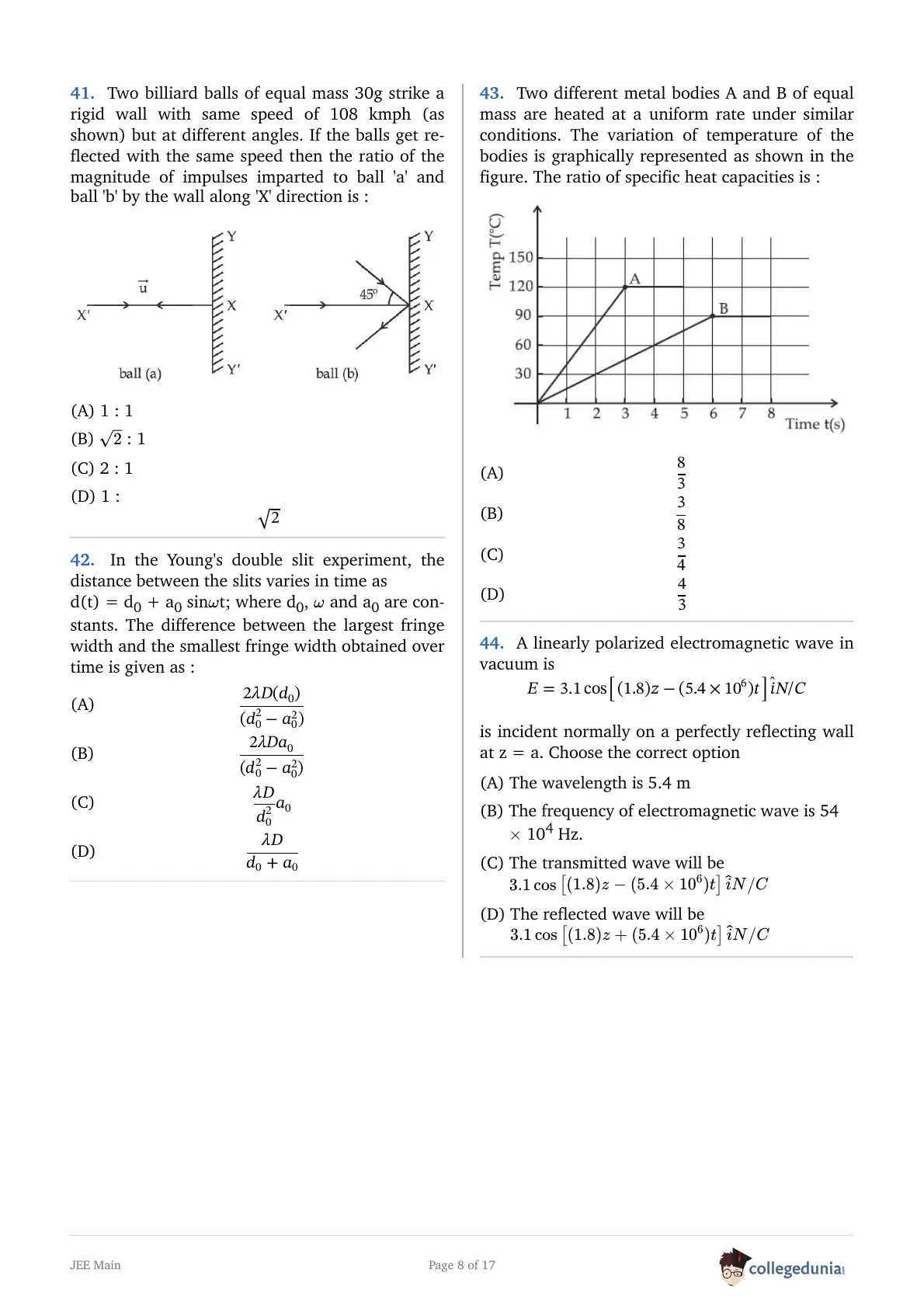
Two billiard balls of equal mass 30 g strike a rigid wall with same speed of 108 kmph (as shown) but at different angles. If the balls get reflected with the same speed then the ratio of the magnitude of impulses imparted to ball 'a' and ball 'b' by the wall along 'X' direction is : 
In the Young's double slit experiment, the distance between the slits varies in time as \(d(t) = d_0 + a_0 \sin \omega t\); where \(d_0, \omega\) and \(a_0\) are constants. The difference between the largest fringe width and the smallest fringe width obtained over time is given as :
Two different metal bodies A and B of equal mass are heated at a uniform rate under similar conditions. The variation of temperature of the bodies is graphically represented as shown in the figure. The ratio of specific heat capacities is : 
A linearly polarized electromagnetic wave in vacuum is
\[ E = 3.1 \cos [(1.8)z - (5.4 \times 10^8)t] \hat{i} \text{ N/C} \]
is incident normally on a perfectly reflecting wall at \(z=a\). Choose the correct option :
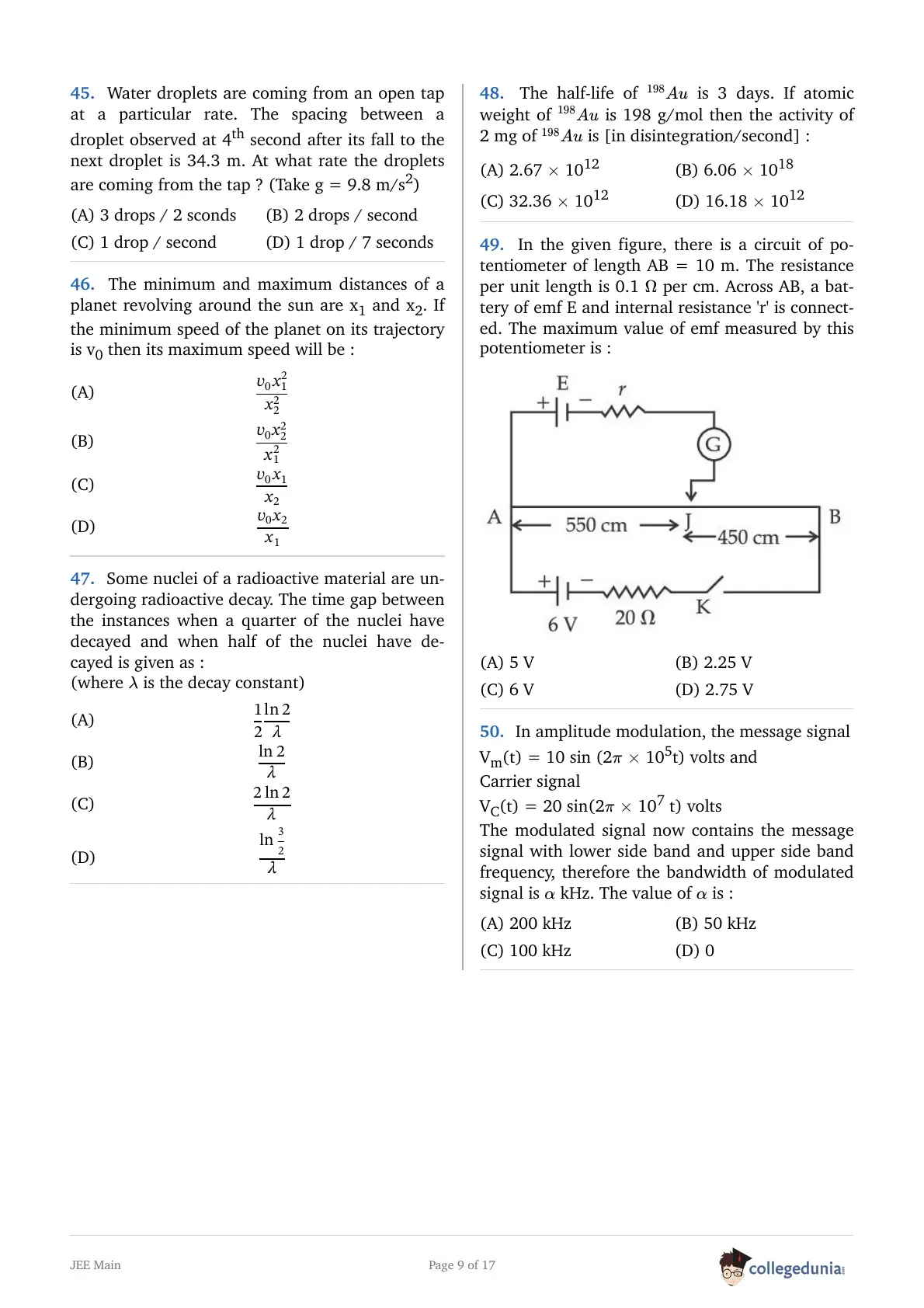
Water droplets are coming from an open tap at a particular rate. The spacing between a droplet observed at 4th second after its fall to the next droplet is 34.3 m. At what rate the droplets are coming from the tap? (Take \(g = 9.8 \text{ m/s}^2\))
The minimum and maximum distances of a planet revolving around the Sun are \(x_1\) and \(x_2\). If the minimum speed of the planet on its trajectory is \(v_0\) then its maximum speed will be :
Some nuclei of a radioactive material are undergoing radioactive decay. The time gap between the instances when a quarter of the nuclei have decayed and when half of the nuclei have decayed is given as : (where \(\lambda\) is the decay constant)
The half-life of \(^{198}\text{Au}\) is 3 days. If atomic weight of \(^{198}\text{Au}\) is 198 g/mol then the activity of 2 mg of \(^{198}\text{Au}\) is [in disintegration/second] :
In the given figure, there is a circuit of potentiometer of length AB = 10 m. The resistance per unit length is 0.1 \(\Omega\) per cm. Across AB, a battery of emf E and internal resistance 'r' is connected. The maximum value of emf measured by this potentiometer is : 
In Amplitude Modulation, the message signal \(V_m(t) = 10 \sin(2\pi \times 10^5 t)\) volts and Carrier signal \(V_c(t) = 20 \sin(2\pi \times 10^7 t)\) volts. The modulated signal now contains the message signal with lower side band and upper side band frequency, therefore the bandwidth of modulated signal is \(\alpha \text{ kHz}\). The value of \(\alpha\) is :
Physics - Section B (Q51 - Q60)
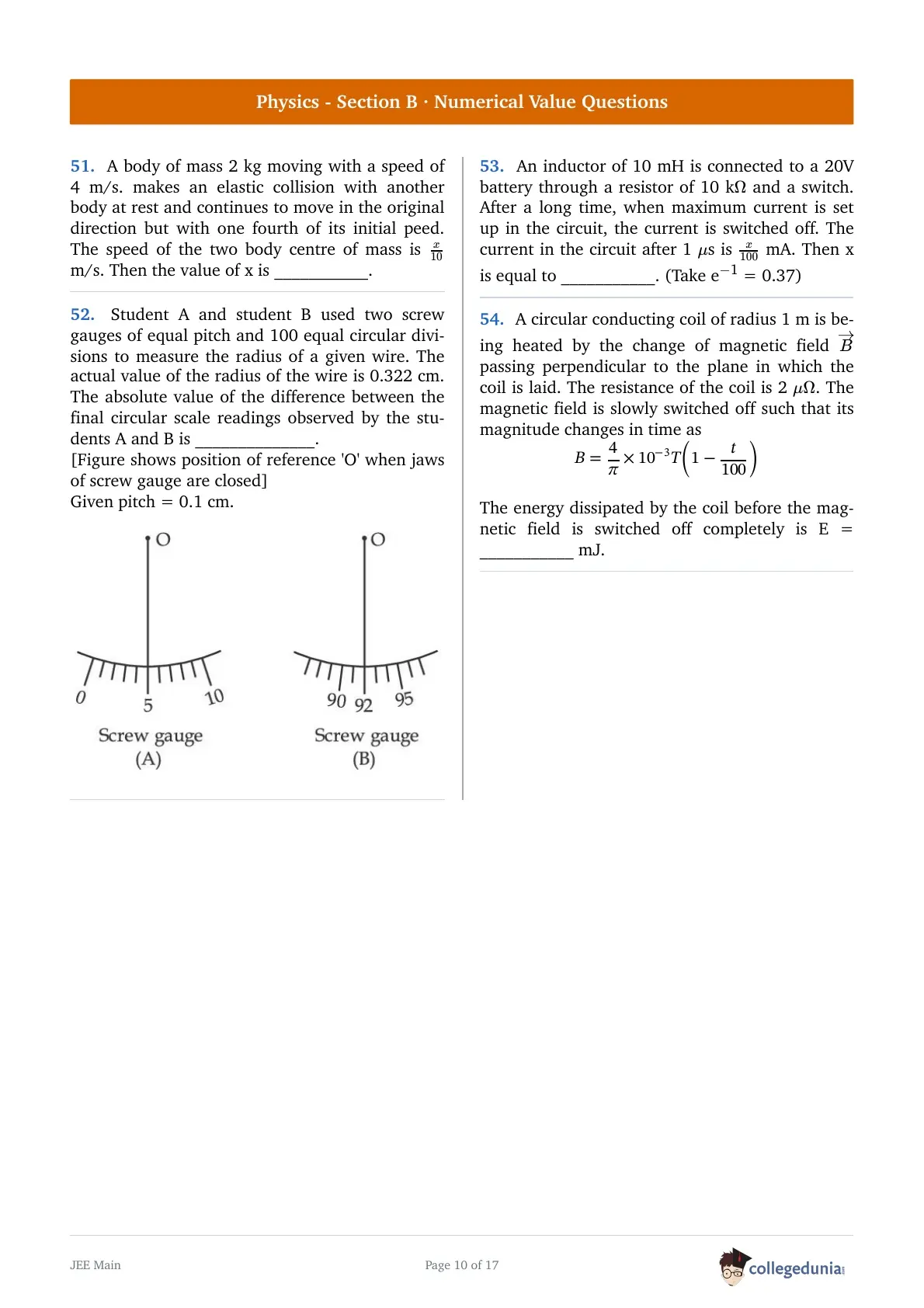
A body of mass 2 kg moving with a speed of 4 m/s makes an elastic collision with another body at rest and continues to move in the original direction but with one fourth of its initial speed. The speed of the two body centre of mass is \(\frac{x}{10}\) m/s. Then the value of \(x\) is ________.
Student A and Student B used two screw gauges of equal pitch and 100 equal circular divisions to measure the radius of a given wire. The actual value of the radius of the wire is 0.322 cm. The absolute value of the difference between the final circular scale readings observed by the students A and B is __________.
\([\)Figure shows position of reference '0' when jaws of screw gauge are closed\(]\)
Given pitch = 0.1 cm. 
An inductor of 10 mH is connected to a 20 V battery through a resistor of 10 k\(\Omega\) and a switch. After a long time, when maximum current is set up in the circuit, the current is switched off. The current in the circuit after 1 \(\mu\)s is \(\frac{x}{100}\) mA. Then \(x\) is equal to ________. (Take \(e^{-1} = 0.37\))
A circular conducting coil of radius 1 m is being heated by the change of magnetic field \(\vec{B}\) passing perpendicular to the plane in which the coil is laid. The resistance of the coil is 2 \(\mu\Omega\). The magnetic field is slowly switched off such that its magnitude changes in time as
\[ B = \frac{4}{\pi} \times 10^{-3} \text{T} \left( 1 - \frac{t}{100} \right) \]
The energy dissipated by the coil before the magnetic field is switched off completely is E = ________ mJ.
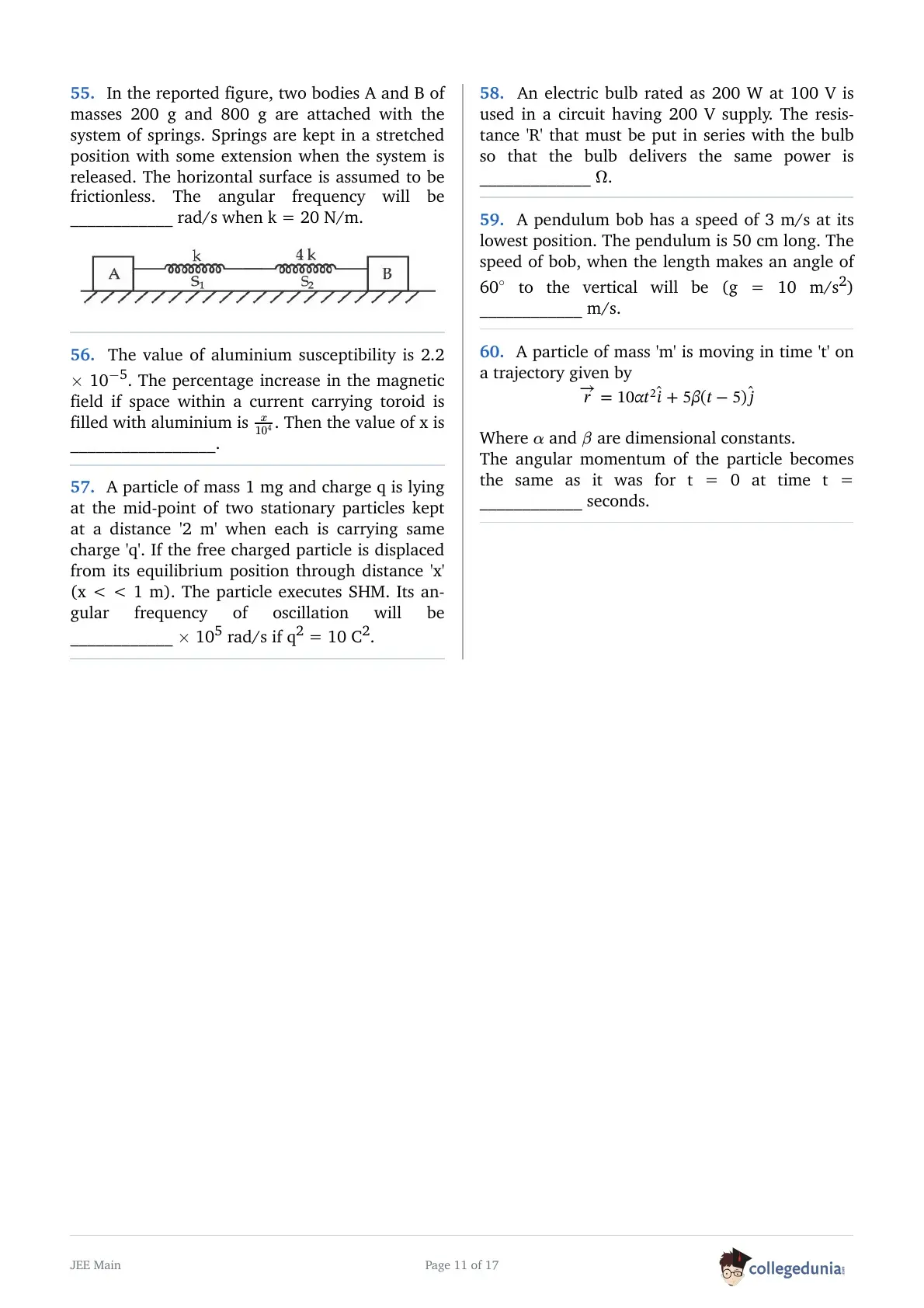
In the reported figure, two bodies A and B of masses 200 g and 800 g are attached with the system of springs. Springs are kept in a stretched position with some extension when the system is released. The horizontal surface is assumed to be frictionless. The angular frequency will be ________ rad/s when \(k = 20 \text{ N/m}\). 
The value of aluminium susceptibility is \(2.2 \times 10^{-5}\). The percentage increase in the magnetic field if space within a current carrying toroid is filled with Aluminium is \(\frac{x}{10^4}\). Then the value of x is __________.
A particle of mass 1 mg and charge q is lying at the mid-point of two stationary particles kept at a distance '2 m' when each is carrying same charge 'q'. If the free charged particle is displaced from its equilibrium position through distance 'x' (\(x << 1\) m). The particle executes SHM. Its angular frequency of oscillation will be ________ \(\times 10^5\) rad/s if \(q^2 = 10 \text{ C}^2\).
An electric bulb rated as 200 W at 100 V is used in a circuit having 200 V supply. The resistance 'R' that must be put in series with the bulb so that the bulb delivers the same power is ________ \(\Omega\).
A pendulum bob has a speed of 3 m/s at its lowest position. The pendulum is 50 cm long. The speed of bob, when the length makes an angle of \(60^\circ\) to the vertical will be (\(g = 10 \text{ m/s}^2\)) ________ m/s.
A particle of mass 'm' is moving in time 't' on a trajectory given by
\[ \vec{r} = 10 \alpha t^2 \hat{i} + 5 \beta (t - 5) \hat{j} \]
Where \(\alpha\) and \(\beta\) are dimensional constants. The angular momentum of the particle becomes the same as it was for \(t=0\) at time \(t = \)________ seconds.
Chemistry - Section A (Q61 - Q80)
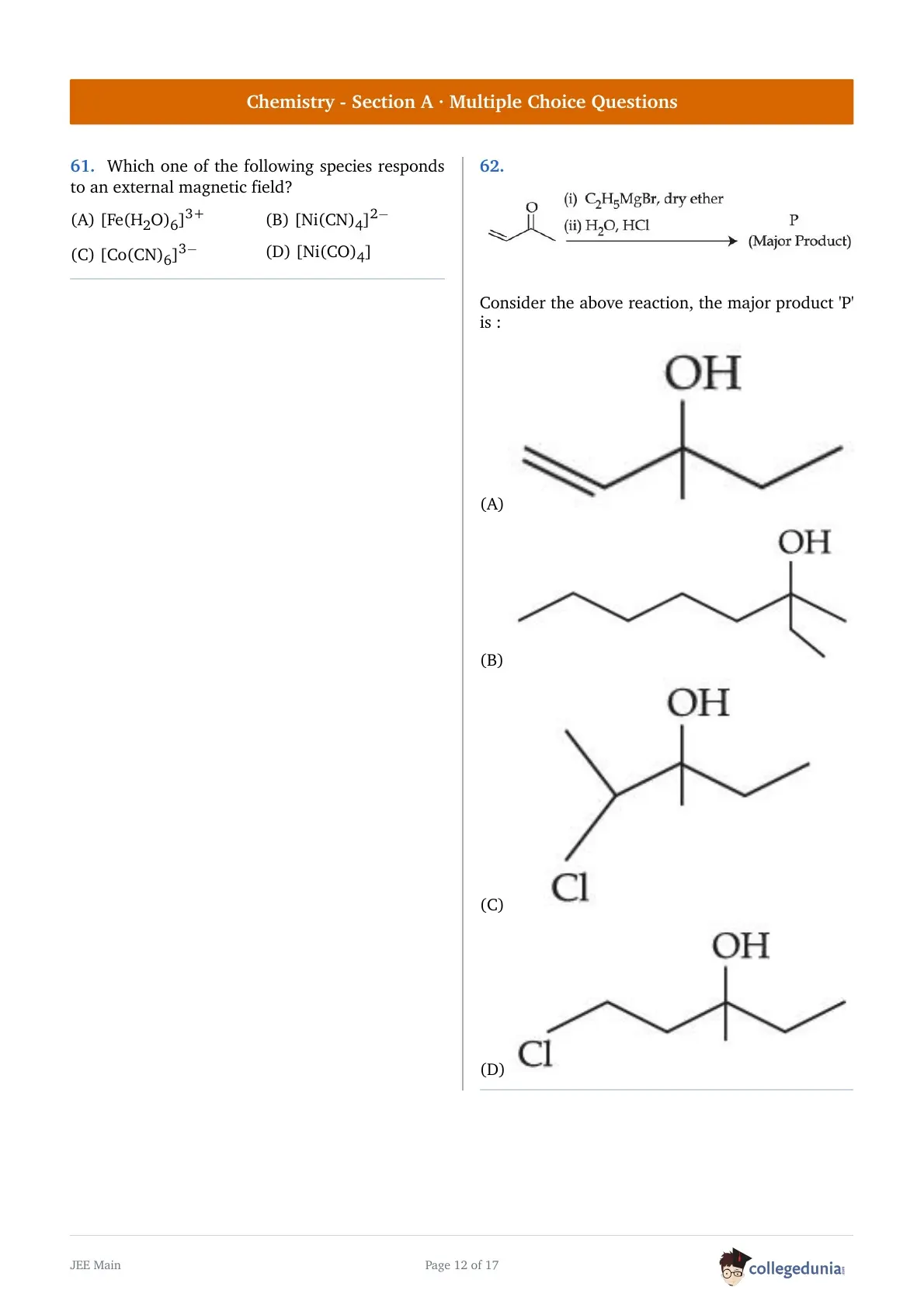
Which one of the following species responds to an external magnetic field ?

Consider the following reaction, the major product 'P' is: 
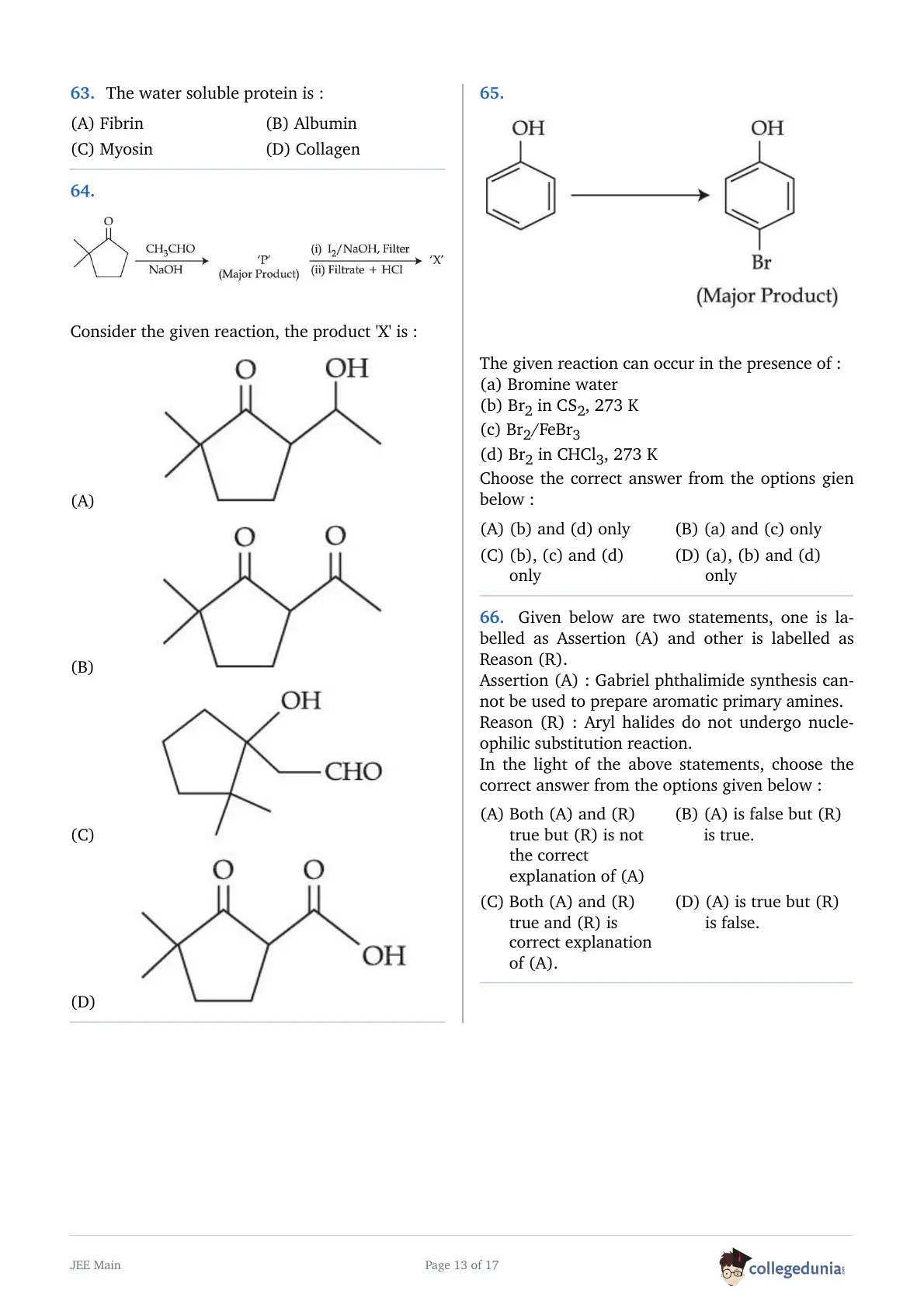
The water soluble protein is :

Consider the given reaction, the product 'X' is: 
The given reaction can occur in the presence of: 
(a) Bromine water
(b) \(Br_2\) in \(CS_2\), 273 K
(c) \(Br_2/FeBr_3\)
(d) \(Br_2\) in \(CHCl_3\), 273 K
Choose the correct answer from the options given below:
Given below are two statements, one is labelled as Assertion (A) and other is labelled as Reason (R).
Assertion (A) : Gabriel phthalimide synthesis cannot be used to prepare aromatic primary amines.
Reason (R) : Aryl halides do not undergo nucleophilic substitution reaction.
In the light of the above statements, choose the correct answer from the options given below :
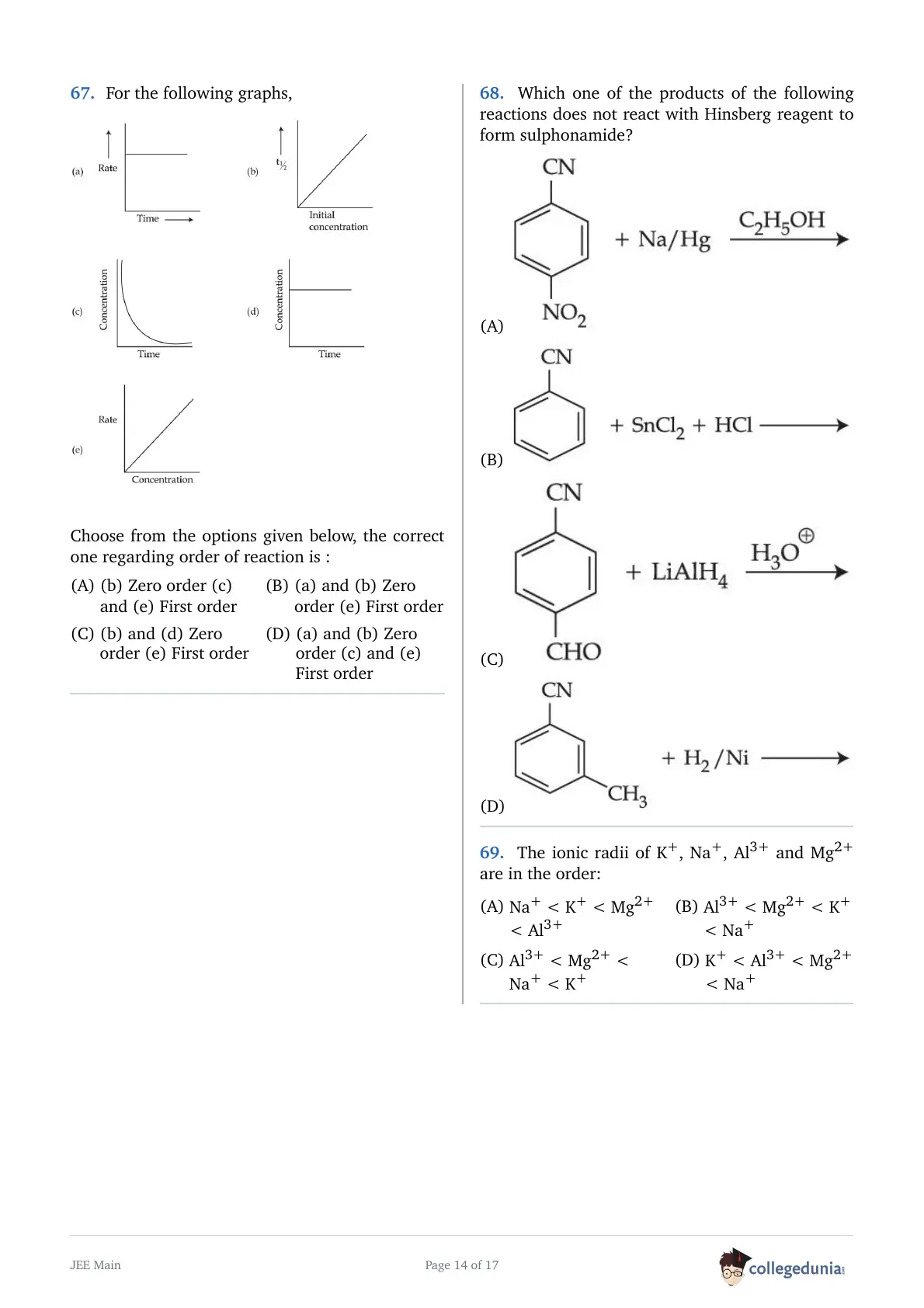
For the following graphs, 
Choose from the options given below, the correct one regarding order of reaction :
Which one of the products of the following reactions does not react with Hinsberg reagent to form sulphonamide? 
The ionic radii of \(K^+\), \(Na^+\), \(Al^{3+}\) and \(Mg^{2+}\) are in the order :
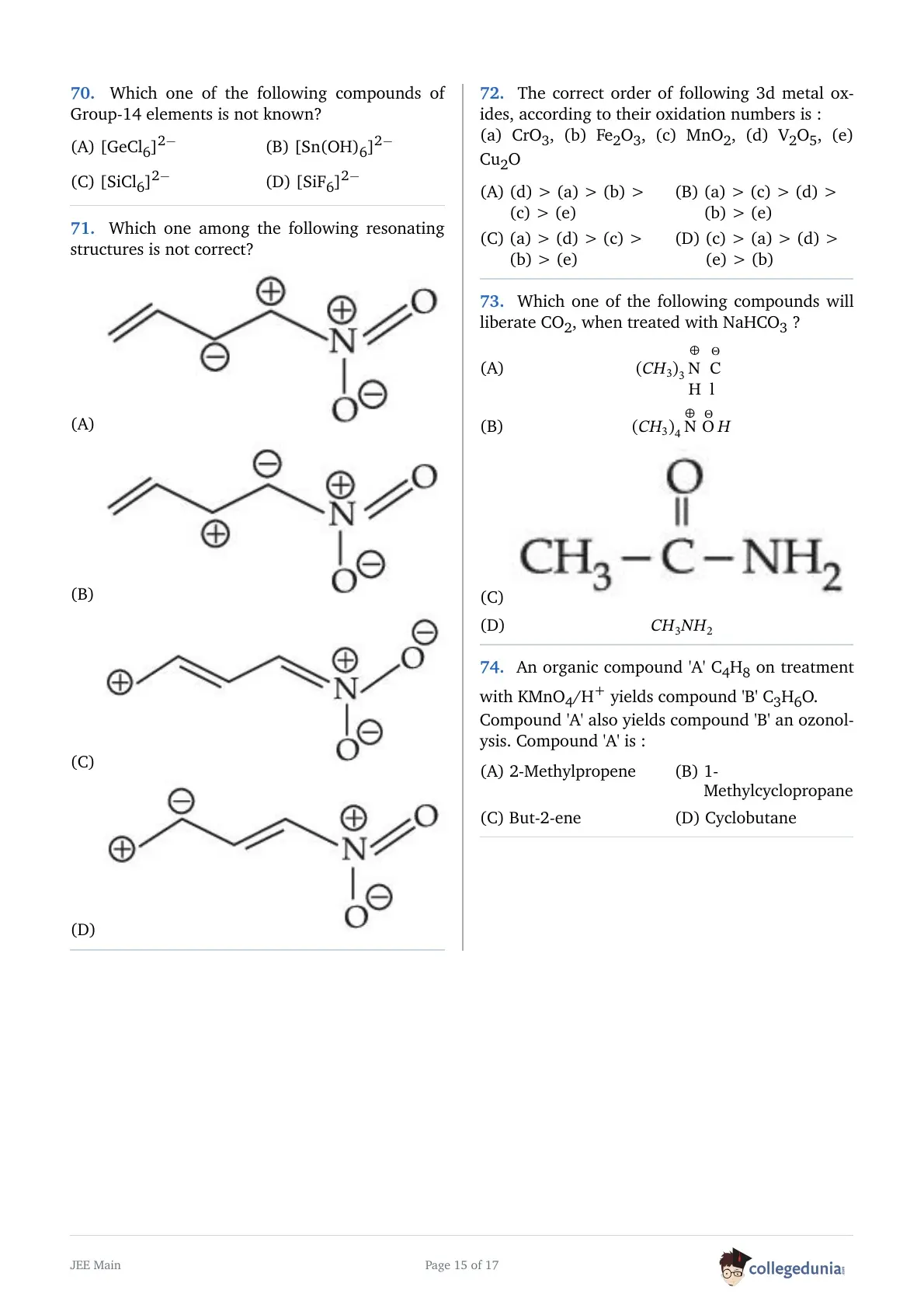
Which one of the following compounds of Group-14 elements is not known ?
Which one among the following resonating structures is not correct ? 

The correct order of following 3d metal oxides, according to their oxidation numbers is :
(a) \(CrO_3\)
(b) \(Fe_2O_3\)
(c) \(MnO_2\)
(d) \(V_2O_5\)
(e) \(Cu_2O\)
Which one of the following compounds will liberate \(CO_2\) when treated with \(NaHCO_3\)?
- (1)
![]()
- (2) \(CH_3NH_2\)
- (3) \((CH_3)_4N^+ OH^-\)
- (4) \((CH_3)_3NH^+ Cl^-\)

An Organic compound 'A' \(C_4H_8\) on treatment with \(KMnO_4/H^+\) yields compound 'B' \(C_3H_6O\). Compound 'A' also yields compound 'B' an ozonolysis. Compound 'A' is:

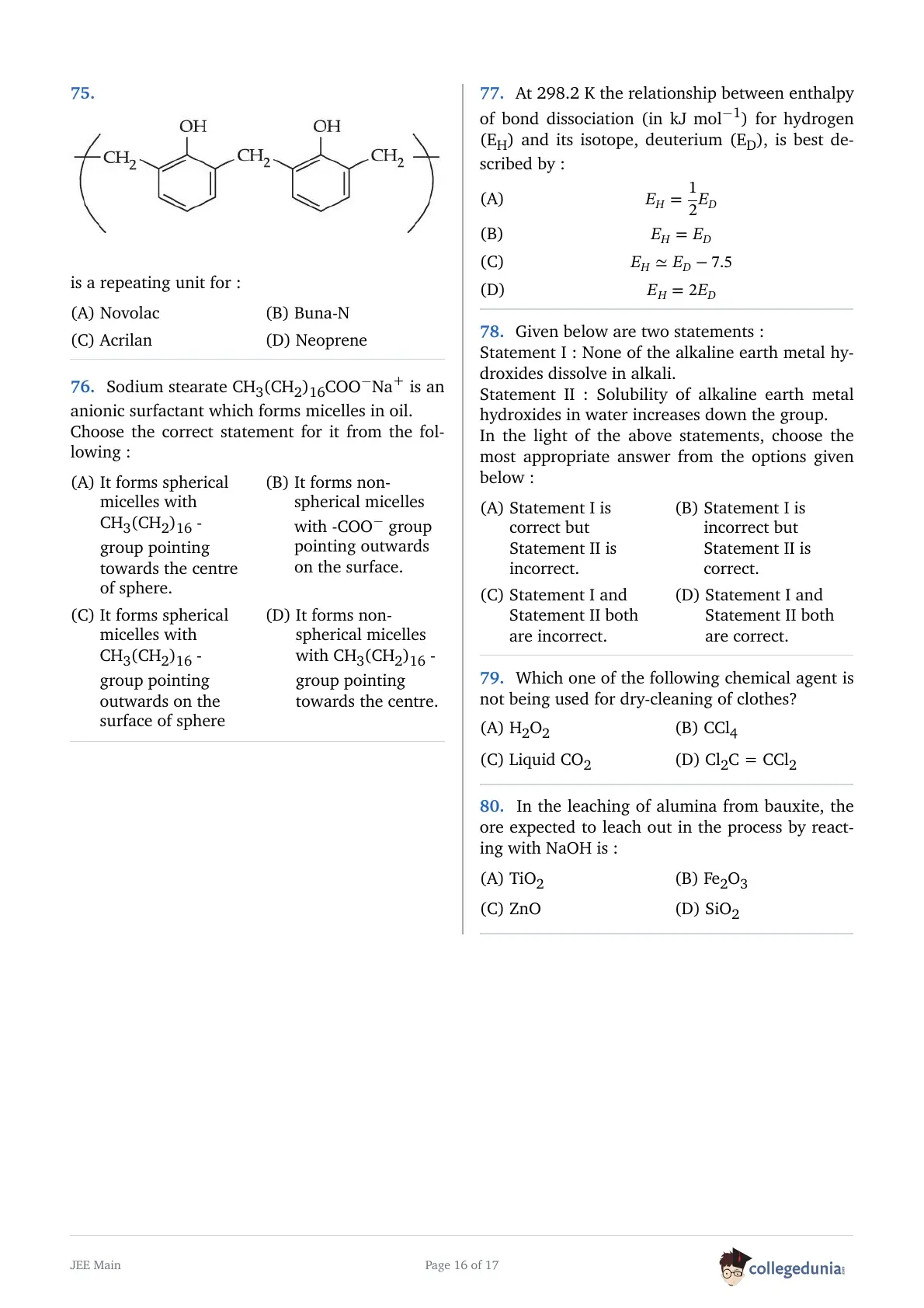
Sodium stearate \(CH_3(CH_2)_{16}COO^- Na^+\) is an anionic surfactant which forms micelles in water. Choose the correct statement for it from the following :
At 298.2 K the relationship between enthalpy of bond dissociation (in kJ mol\(^{-1}\)) for hydrogen (\(E_H\)) and its isotope, deuterium (\(E_D\)), is best described by :
Given below are two statements :
Statement I : None of the alkaline earth metal hydroxides dissolve in alkali.
Statement II : Solubility of alkaline earth metal hydroxides in water increases down the group.
In the light of the above statements, choose the most appropriate answer from the options given below :
Which one of the following chemical agent is not being used for dry-cleaning of clothes ?
In the leaching of alumina from bauxite, the ore expected to leach out in the process by reacting with NaOH is :
Chemistry - Section B (Q81 - Q90)
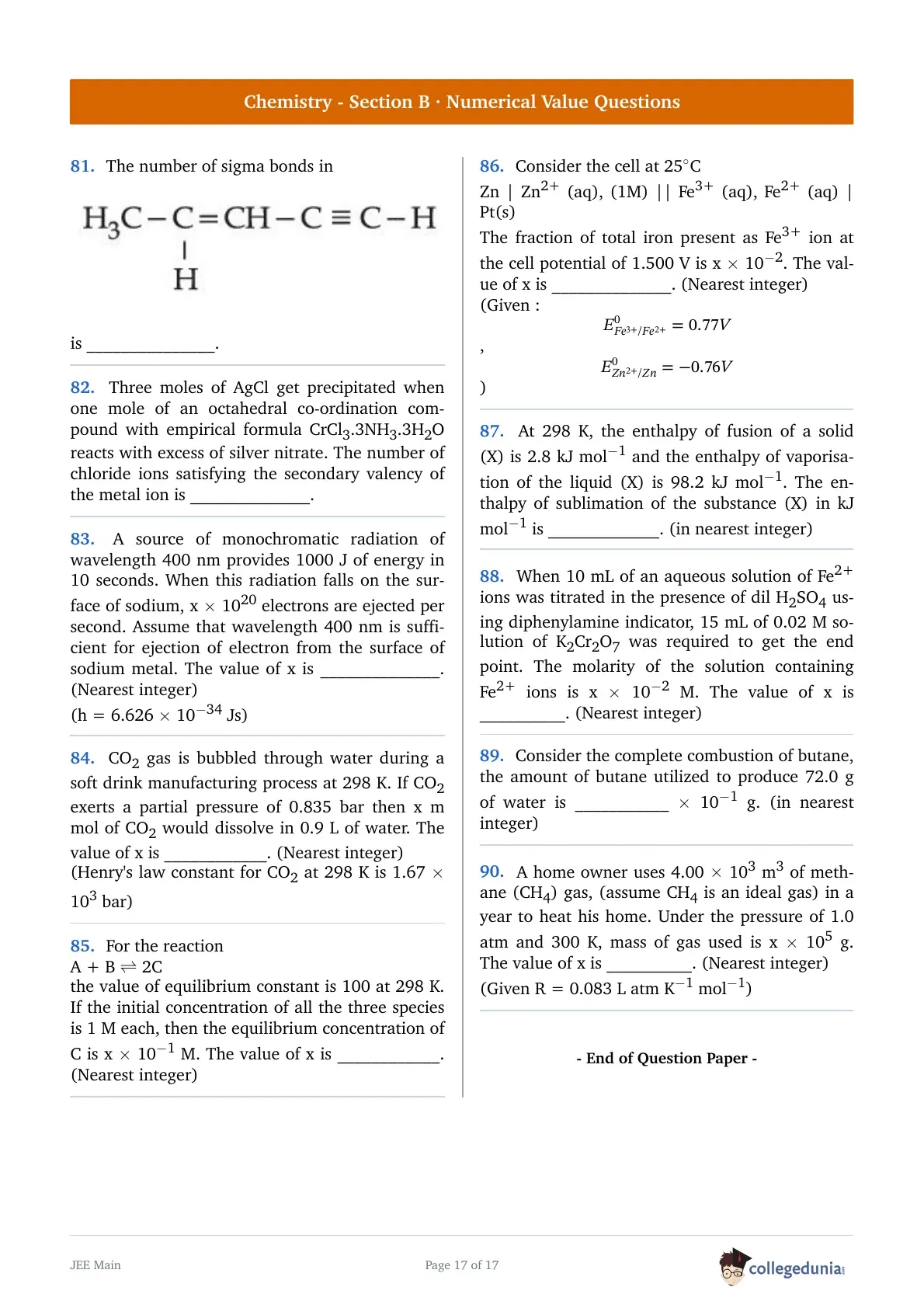
The number of sigma bonds in \(H_3C-CH=CH-C\equiv CH\) is ________.
Three moles of AgCl get precipitated when one mole of an octahedral co-ordination compound with empirical formula \(CrCl_3 \cdot 3NH_3 \cdot 3H_2O\) reacts with excess of silver nitrate. The number of chloride ions satisfying the secondary valency of the metal ion is ________.
A source of monochromatic radiation of wavelength 400 nm provides 1000 J of energy in 10 seconds. When this radiation falls on the surface of sodium, \(x \times 10^{20}\) electrons are ejected per second. Assume that wavelength 400 nm is sufficient for ejection of electron from the surface of sodium metal. The value of \(x\) is ________. (Nearest integer) (\(h = 6.626 \times 10^{-34} \text{ Js}\))
\(CO_2\) gas is bubbled through water during a soft drink manufacturing process at 298 K. If \(CO_2\) exerts a partial pressure of 0.835 bar then \(x \text{ m mol}\) of \(CO_2\) would dissolve in 0.9 L of water. The value of \(x\) is ________. (Nearest integer) (Henry's law constant for \(CO_2\) at 298 K is \(1.67 \times 10^3\) bar)
For the reaction \(A + B \rightleftharpoons 2C\) the value of equilibrium constant is 100 at 298 K. If the initial concentration of all the three species is 1 M each, then the equilibrium concentration of C is \(x \times 10^{-1}\) M. The value of \(x\) is ________. (Nearest integer)
Consider the cell at \(25^{\circ}C\): \(Zn | Zn^{2+} (aq, 1 \text{ M}) || Fe^{3+} (aq), Fe^{2+} (aq) | Pt(s)\). The fraction of total iron present as \(Fe^{3+}\) ion at the cell potential of 1.500 V is \(x \times 10^{-2}\). The value of \(x\) is ________. (Nearest integer) (Given: \(E^0_{Fe^{3+}/Fe^{2+}} = 0.77 \text{ V}\), \(E^0_{Zn^{2+}/Zn} = -0.76 \text{ V}\))
At 298 K, the enthalpy of fusion of a solid (X) is 2.8 kJ \(mol^{-1}\) and the enthalpy of vaporisation of the liquid (X) is 98.2 kJ \(mol^{-1}\). The enthalpy of sublimation of the substance (X) in kJ \(mol^{-1}\) is ________. (in nearest integer)
When 10 mL of an aqueous solution of \(Fe^{2+}\) ions was titrated in the presence of dil \(H_2SO_4\) using diphenylamine indicator, 15 mL of 0.02 M solution of \(K_2Cr_2O_7\) was required to get the end point. The molarity of the solution containing \(Fe^{2+}\) ions is \(x \times 10^{-2}\) M. The value of \(x\) is ________. (Nearest integer)
Consider the complete combustion of butane, the amount of butane utilized to produce 72.0 g of water is ________ \(\times 10^{-1}\) g. (in nearest integer)
A home owner uses \(4.00 \times 10^3 \text{ m}^3\) of methane (\(CH_4\)) gas, (assume \(CH_4\) is an ideal gas) in a year to heat his home. Under the pressure of 1.0 atm and 300 K, mass of gas used is \(x \times 10^5\) g. The value of \(x\) is ________. (Nearest integer) (Given R = 0.083 L atm \(K^{-1} mol^{-1}\))
JEE Main 2021 Exam Pattern and Marking Scheme
| Particulars | Details |
|---|---|
| Exam Mode | Online (Computer-Based Test) |
| Paper | B.E./B.Tech (Paper 1) |
| Duration | 3 hours (180 minutes) |
| Type of Questions | Multiple Choice Questions (MCQs) + Numerical Value Questions |
| Subjects | Mathematics, Physics, Chemistry |
| Total Questions | 90 questions (75 to be attempted) |
| Total Marks | 300 marks |
| Marking Scheme | +4 for correct answer & -1 for incorrect MCQ; no negative marking for Numerical Value Questions |
JEE Main 2021 July 25 Shift 1 Difficulty Level
JEE Main 2021 B.E./B.Tech Question Paper - July 25, 2021- Forenoon Session was considered to be moderate in terms of difficulty by experts. In contrast to the previous JEE Main Paper Analysis, the Mathematics section of the paper was the easiest section featuring direct formula-based questions. The Chemistry section, usually the easiest section of JEE Main Exam Pattern was the toughest section of this exam, requiring a relatively deeper understanding of Organic Chemistry (I and II). The Physics section was middle in terms of difficulty, with Electrodynamics and Mechanics framing a bulk of the questions.
JEE Main 2021 B.E./B.Tech Question Paper July 25 (FN): Paper Analysis
JEE Main 2021 B.E./B.Tech Paper on July 25 Forenoon Session was conducted between 9.00 AM to 12.00 Noon, the analysis of each section is as follows.
| Subject | Topic | Number of Questions | Related Links |
|---|---|---|---|
| Physics | Electrodynamics | 8 | JEE Main Physics Syllabus |
| Heat and Thermodynamics | 3 | ||
| Mechanics | 9 | ||
| Modern Physics | 7 | ||
| Optics | 2 | ||
| SHM and Waves | 1 | ||
| Chemistry | Inorganics Chemistry I | 5 | JEE Main Chemistry Syllabus |
| Inorganics Chemistry II | 3 | ||
| Organics Chemistry I | 5 | ||
| Organic Chemistry II | 9 | ||
| Physical Chemistry I | 5 | ||
| Physical Chemistry II | 3 | ||
| Mathematics | Binomial Theorem | 3 | JEE Main Mathematics Syllabus |
| Complex Numbers | 1 | ||
| Coordinate Geometry | 3 | ||
| Differential Calculus | 3 | ||
| Integral Calculus | 3 | ||
| Mathematics Reasoning | 1 | ||
| Permutation and Combination | 3 | ||
| Sequence and Series | 3 | ||
| Vector and 3D | 1 | ||
| Statistics | 1 | ||
| Quadratic Equations | 2 | ||
| Trigonometry | 3 | ||
| Matrix and Determinants | 3 |



Comments